From the FasterSkier archive — posts syndicated from athletes’ and coaches’ own blogs between 2004 and 2012, kept online as published. Current coverage is at fasterskier.com.
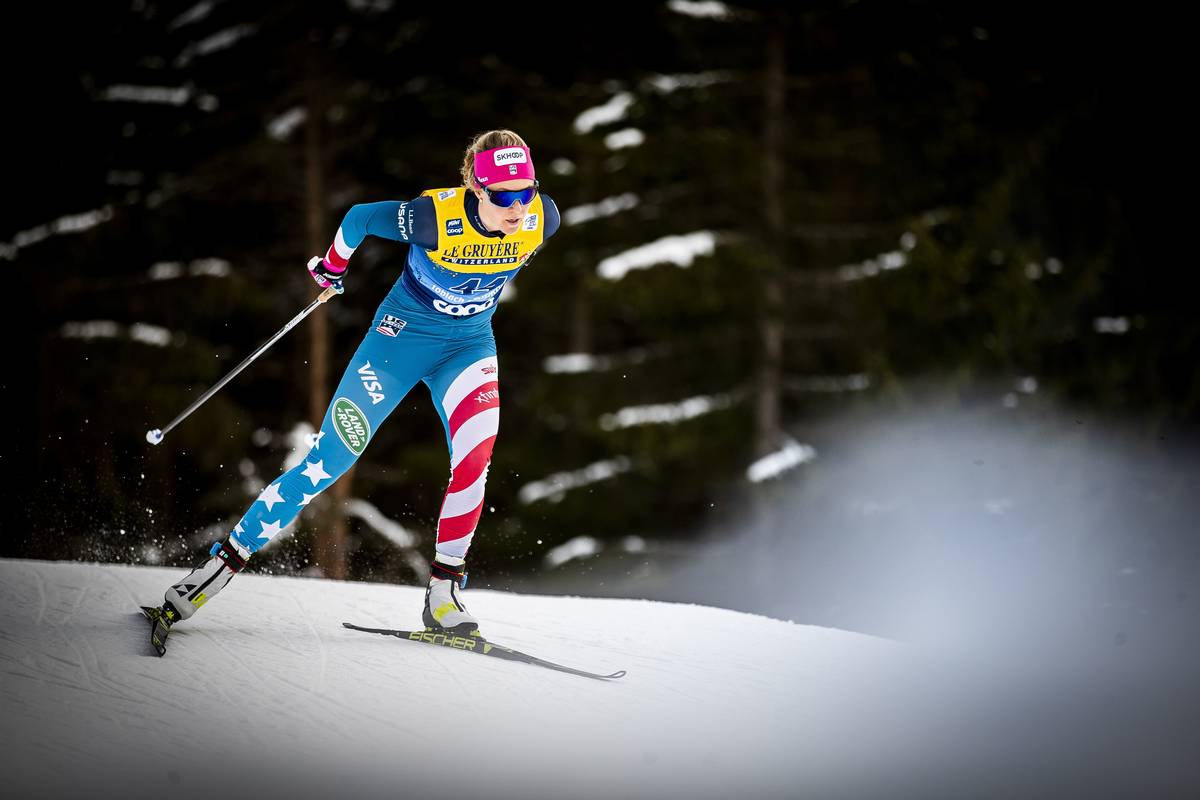
Norris and Hanneman, both skiers for APU in Anchorage, are among a rare group of U.S. men who have finished the Tour de Ski. We conducted a brief email exchange with the skiers post-Stage 7 of the Tour de Ski.
David Norris
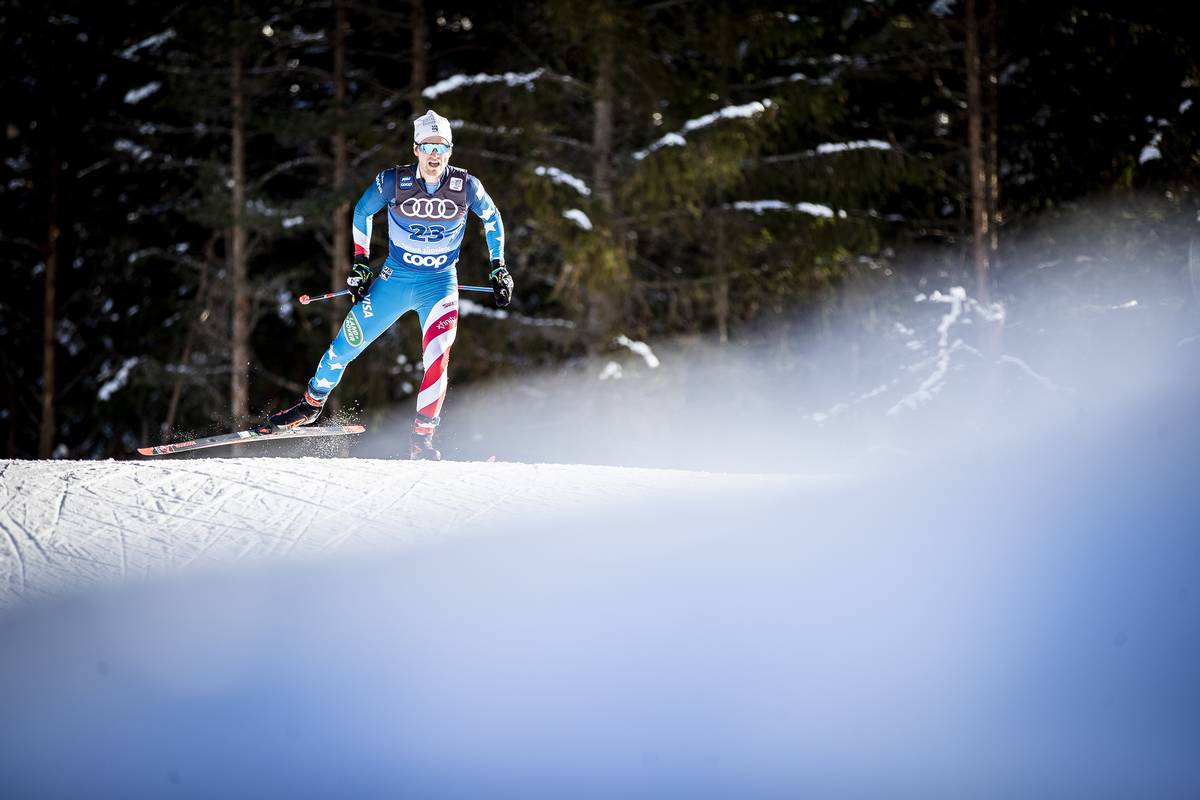
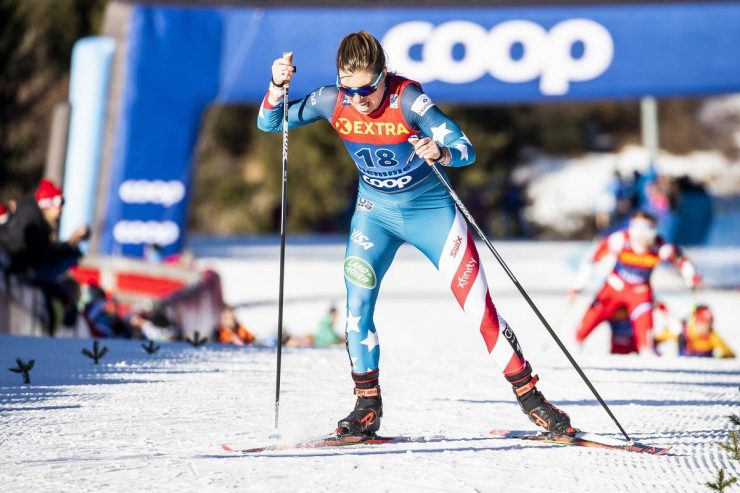
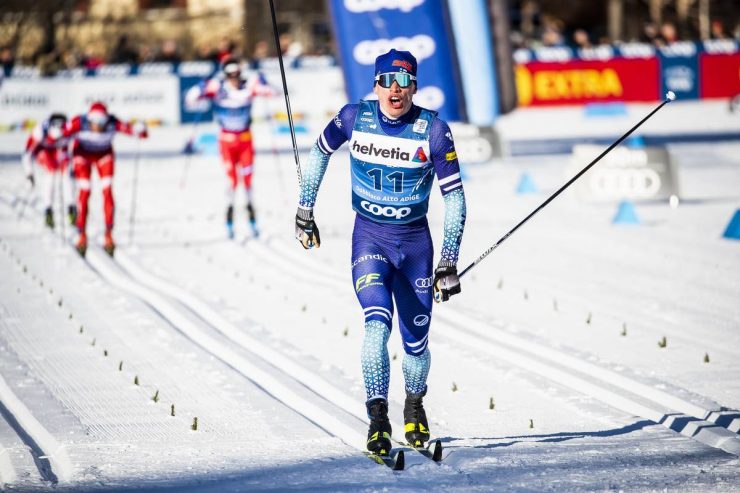
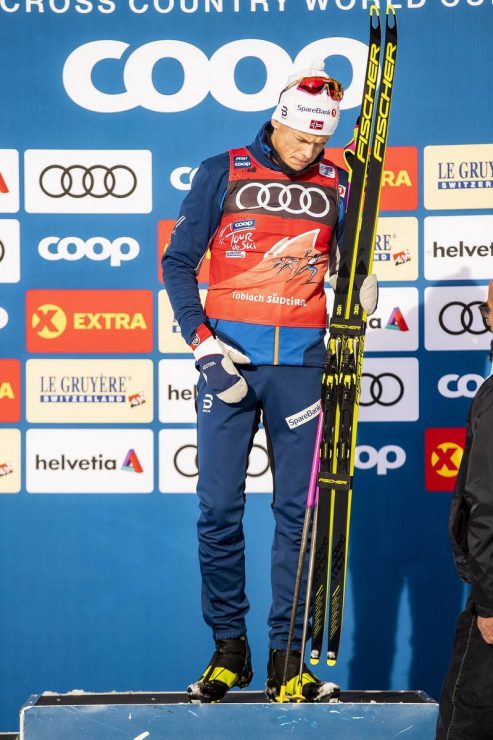
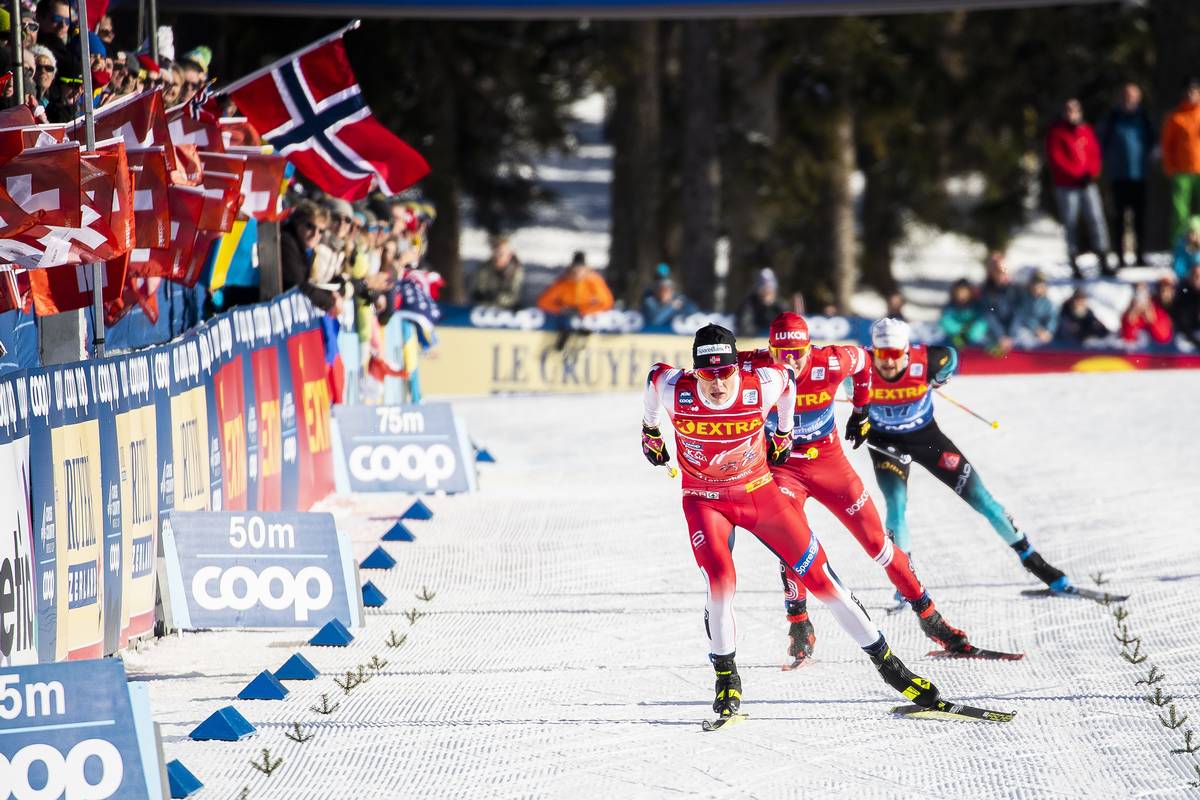
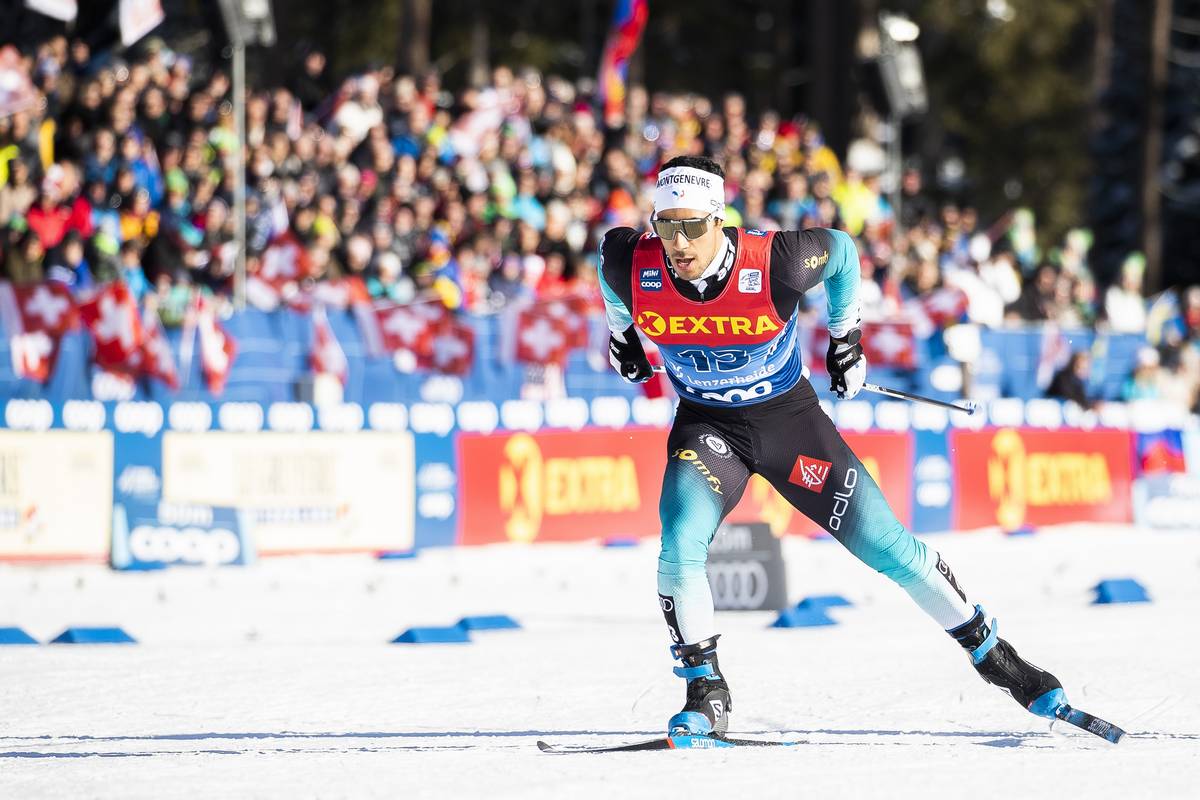
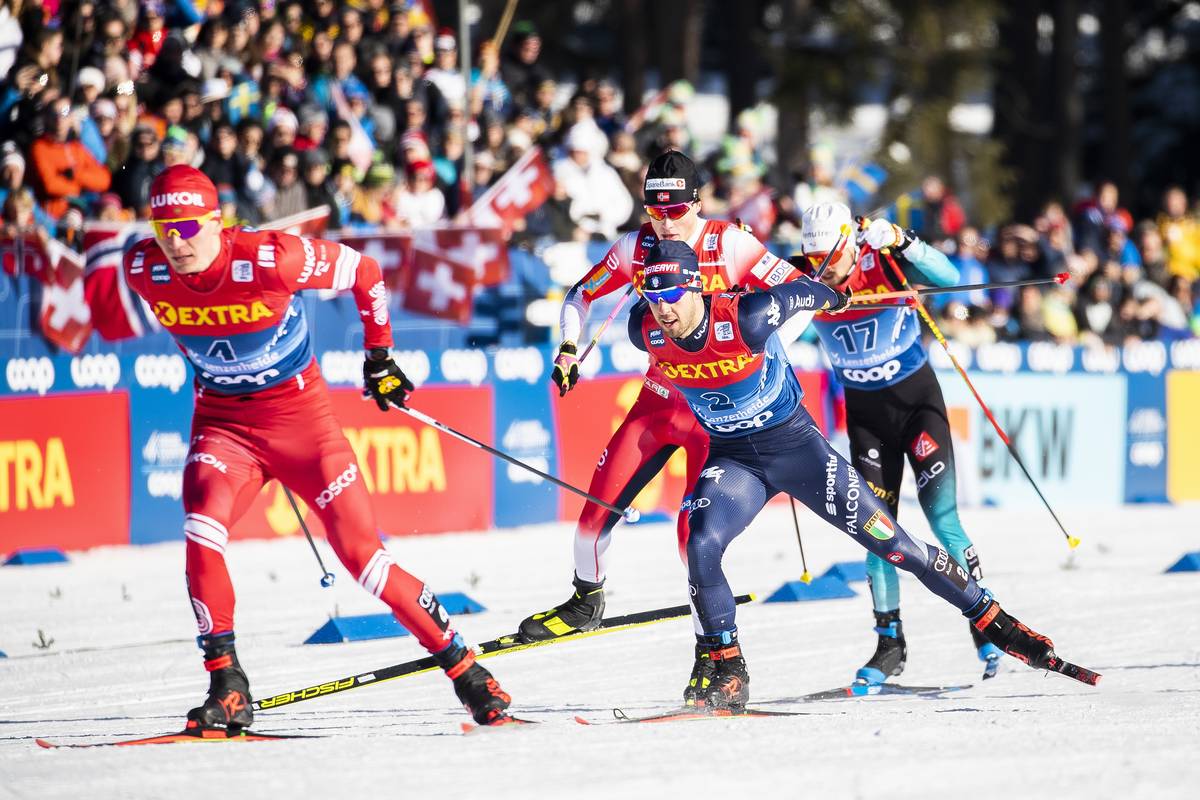
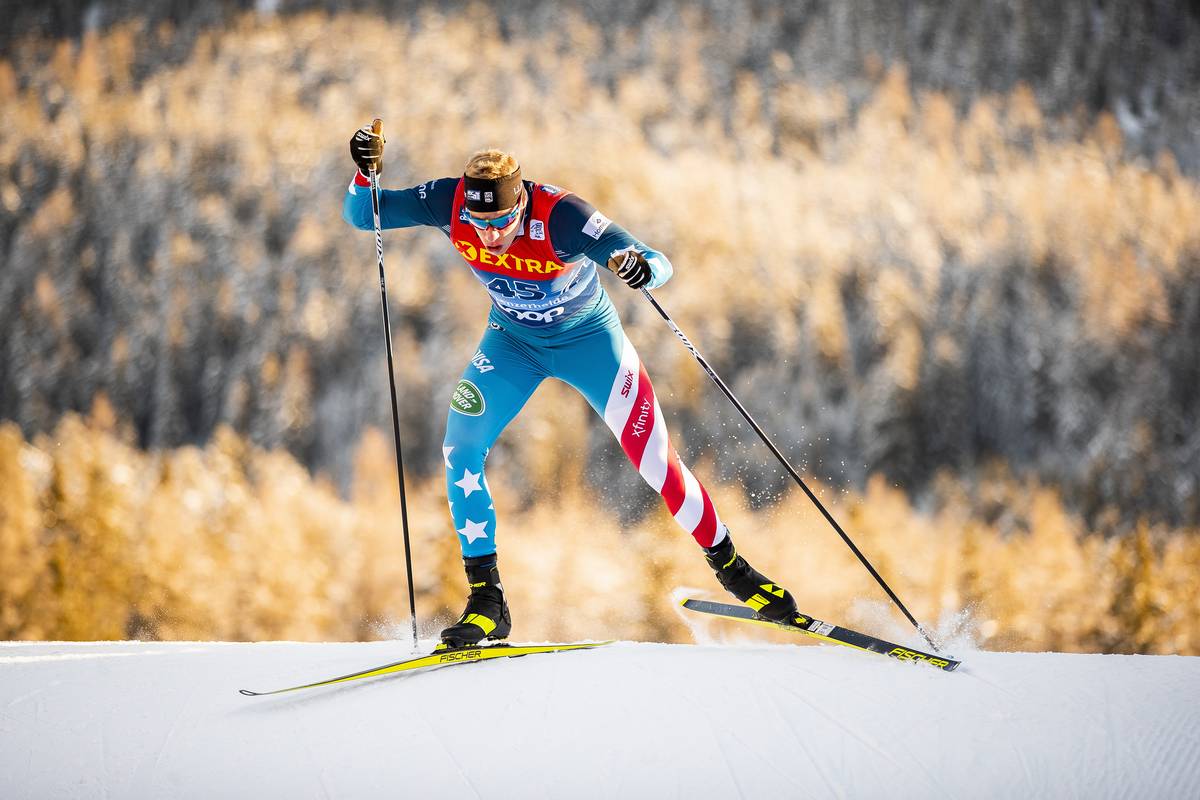
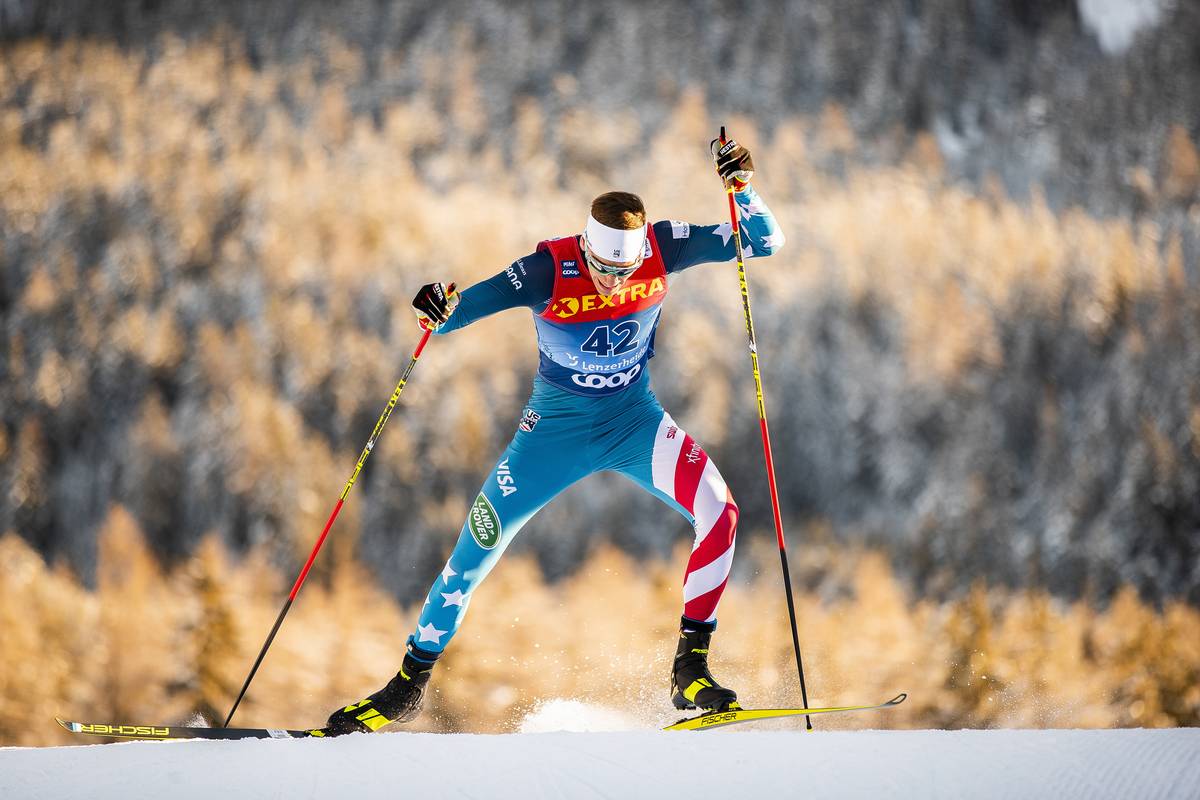
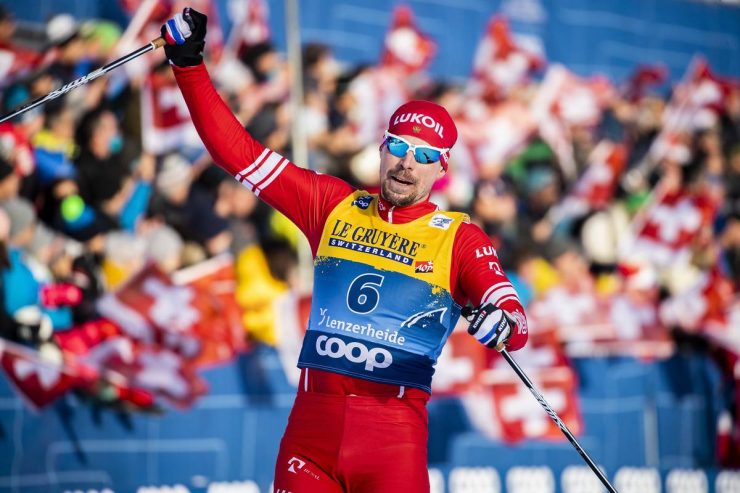
David Norris in Toblach: 2019-2020 Tour de Ski. (Photo: NordicFocus)
FasterSkier: Huge accomplishment to one, stay in the Tour, and two, remain near the top-30 in prob the deepest field the TdS has seen for a long time. Can you speak to that?
David Norris: I didn’t know what to expect going into the tour, but my goal was to finish in the top-30 overall and picking up some top-30 finishes in the distance events. Dropping out was never a plan unless I were to get sick.
The first three stages felt awful for me. I was healthy and fresh going into the Tour so I tried to just focus on improving each day and in general, I felt better each day that we raced.
FasterSkier: First time at the TdS. What are your takeaways in terms of how you grew as a ski racer this week?
David Norris: The Tour was a great chance for me to practice the skill of moving past frustrations and preparing for the next opportunity.
FasterSkier: Highlights?
David Norris: Toblach’s pursuit was a ton of fun. I got into a group of guys who were all battling hard against each other. Of course, the hill climb will remain a highlight to my ski racing memories.
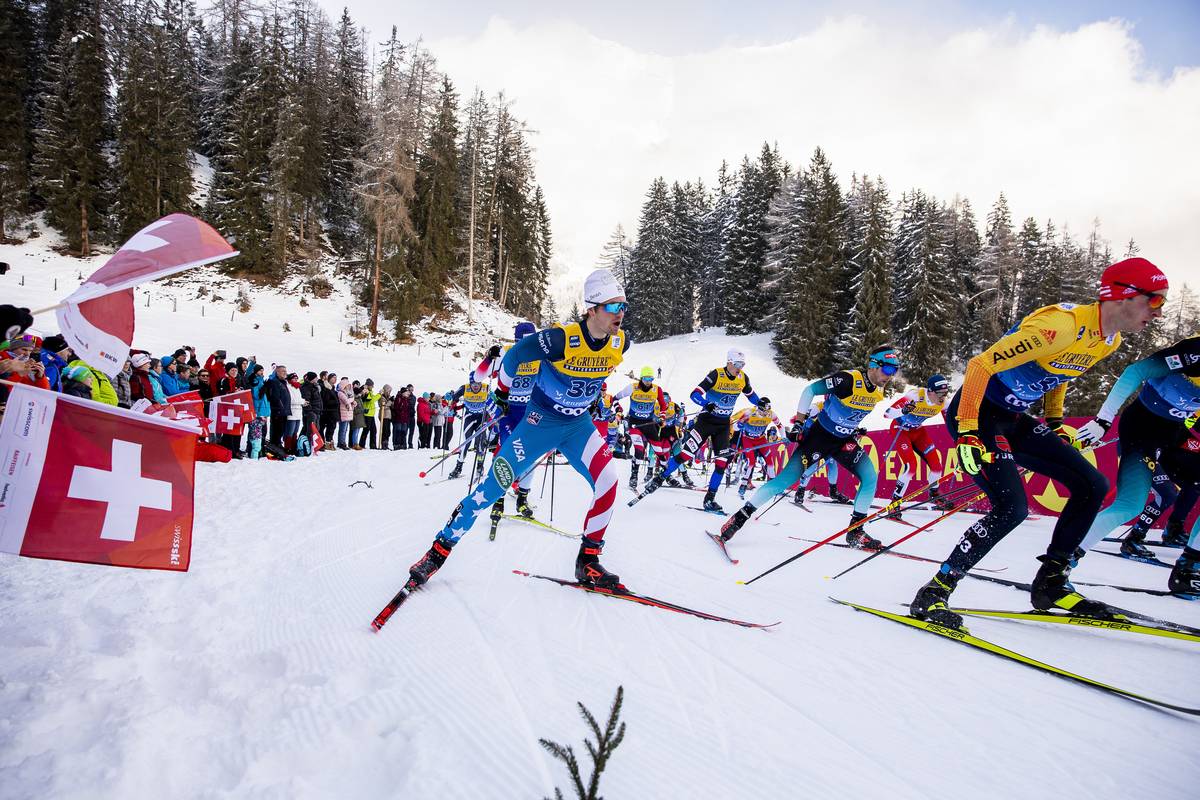
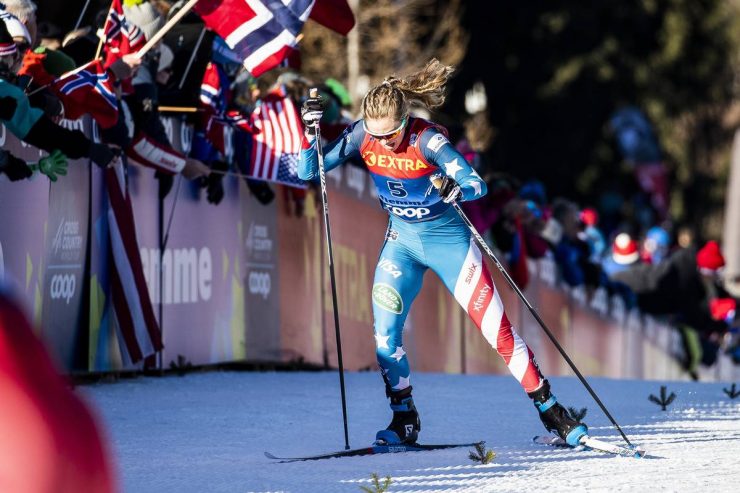
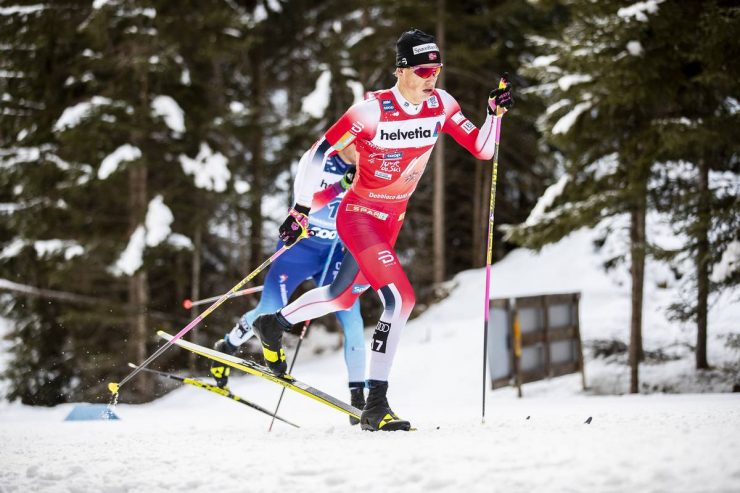
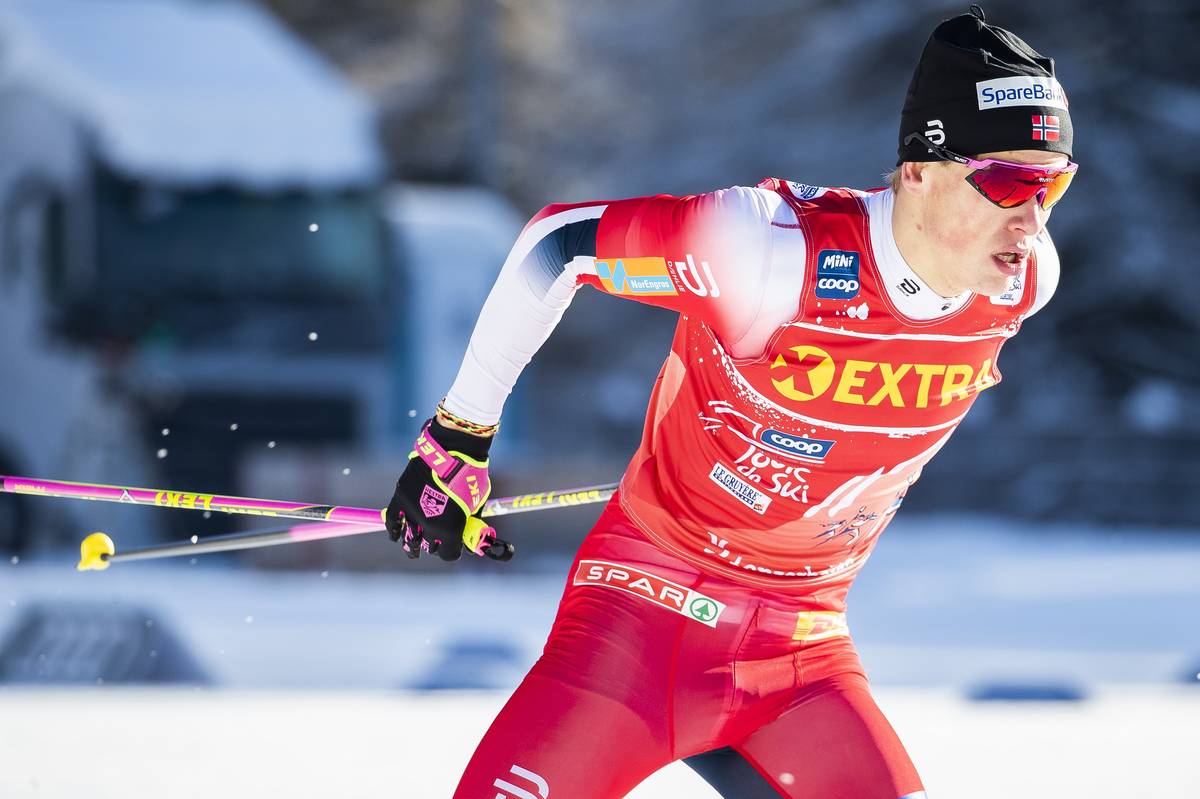
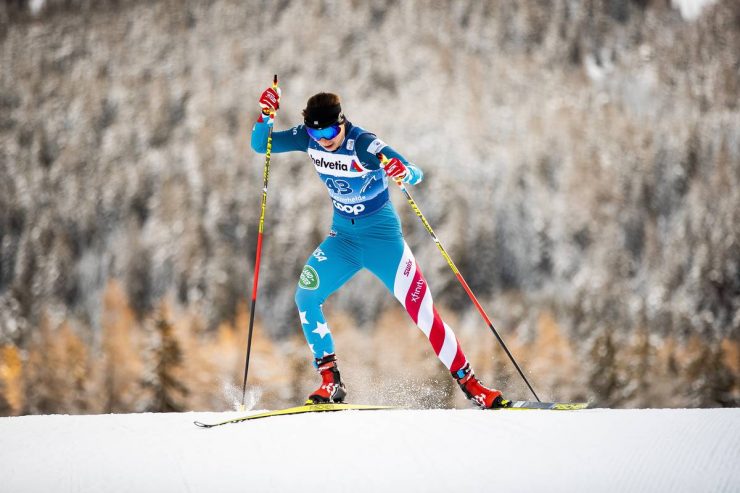
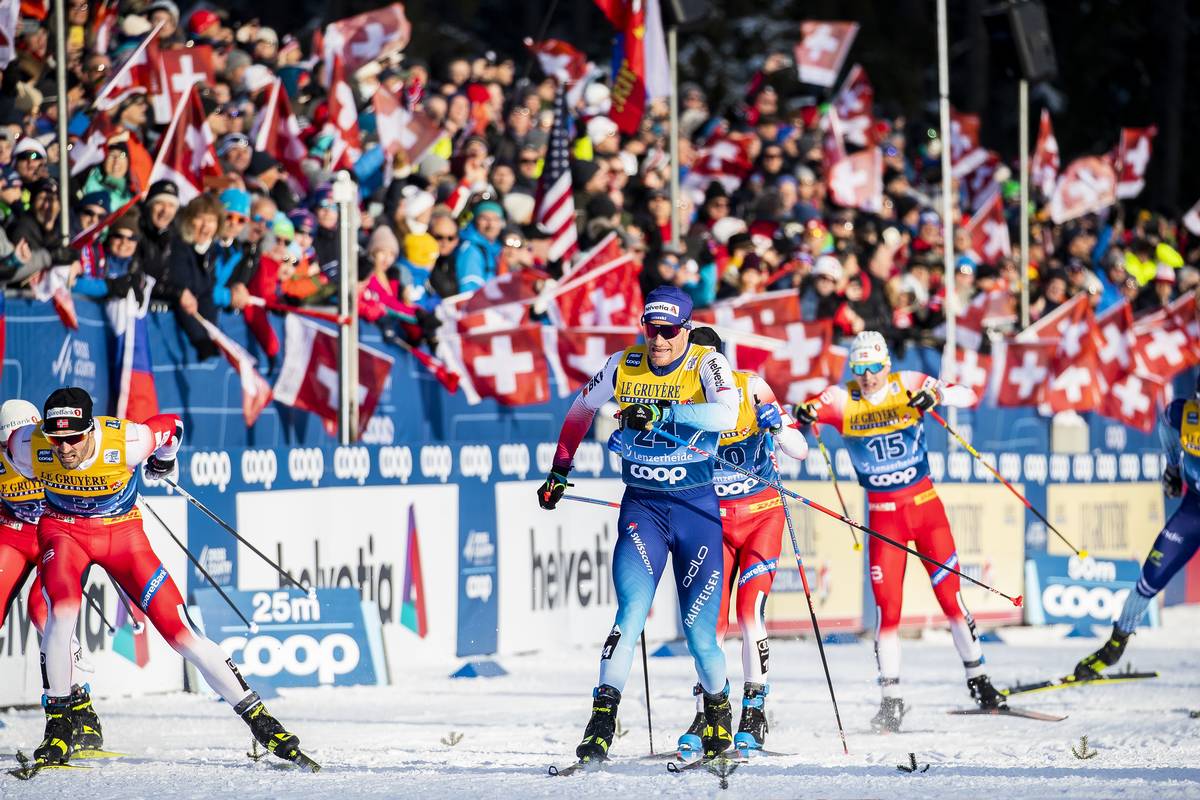
David Norris in Lenzerheide: 2019-2020 Tour de Ski. (Photo: NordicFocus)
FasterSkier: Lowlights?
David Norris: I crashed on a completely untechnical section of the 15km mass start in stage 5. When I got up I was in last after having a great start position.
FasterSkier: Top-30 on the Alpe. What was that experience like?
David Norris: Everyone went out hard and fought for spots before we got onto the Marcialonga trail. I felt really relaxed coming into the base of the climb after a few kilometers of single-file skiing. When the track got wide at the base of the climb I felt really strong and was able to move up a bunch of places. After about 8 minutes of climbing, I just remember trying to pick guys off/hanging on to dudes, listening to the fans screaming, and not clipping my tips on the alpine gates.
FasterSkier: You are a rarity — a U.S. male skier finishing the TdS. What advice would you give to others who might consider the risk/reward of contesting the event — given the opportunity?
David Norris: I can’t speak for where I will be in a few weeks, but because I remained healthy throughout the Tour I think it should help boost my fitness. I don’t think we should be afraid of this event. I washed my hands more than ever and ate an insane amount of risotto and pasta this week so I’d suggest others do the same going forward.
Logan Hanneman
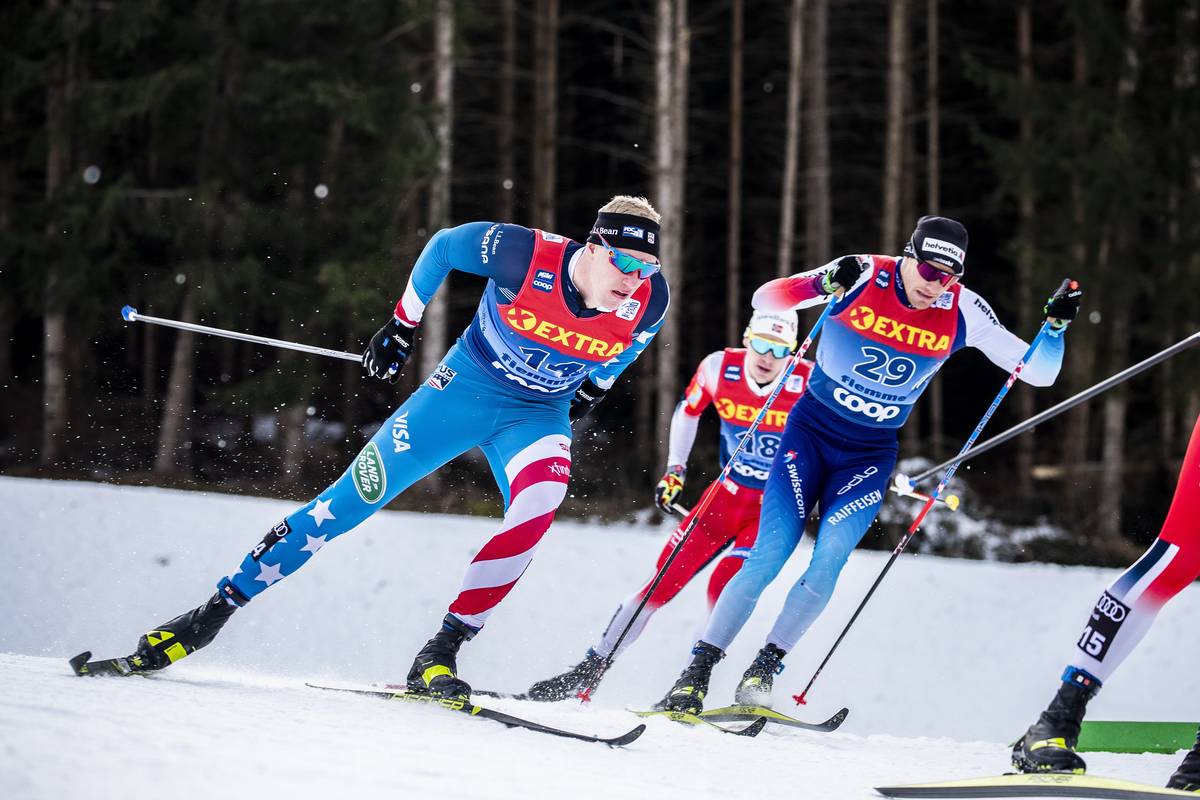
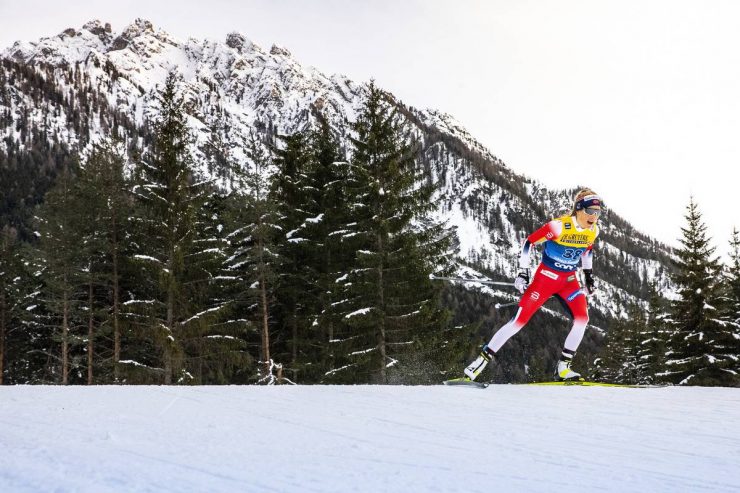
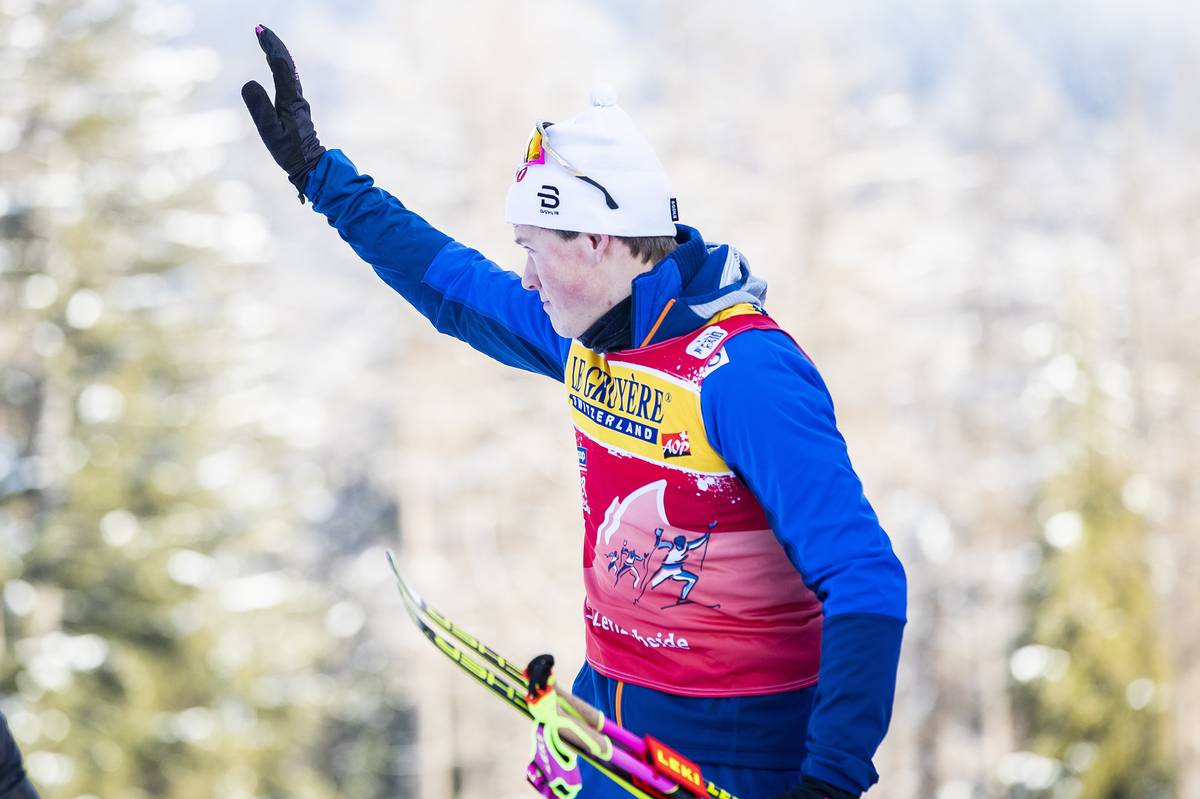
Logan Hanneman in Val di Fiemme: 2019-2020 Tour de Ski. (Photo: NordicFocus)
FasterSkier: Just finishing, what does that mean to you?
Logan Hanneman: It means quite a lot to finish the Tour actually. I am not much of a distance skier, so I was very happy to be able to make it through all of the stages without getting lapped or pulled.
FasterSkier: From a pure learning experience standpoint, what did you learn?
Logan Hanneman: I learned that there are some incredibly fit skiers in this world! But also besides that, I learned just how chaotic mass start races over here can be.
FasterSkier: Highlights?
Logan Hanneman: Definitely qualifying well in both sprints and making the heats was a highlight for me. Especially the second sprint. I was getting pretty tired that far into the tour, but so was everyone else.
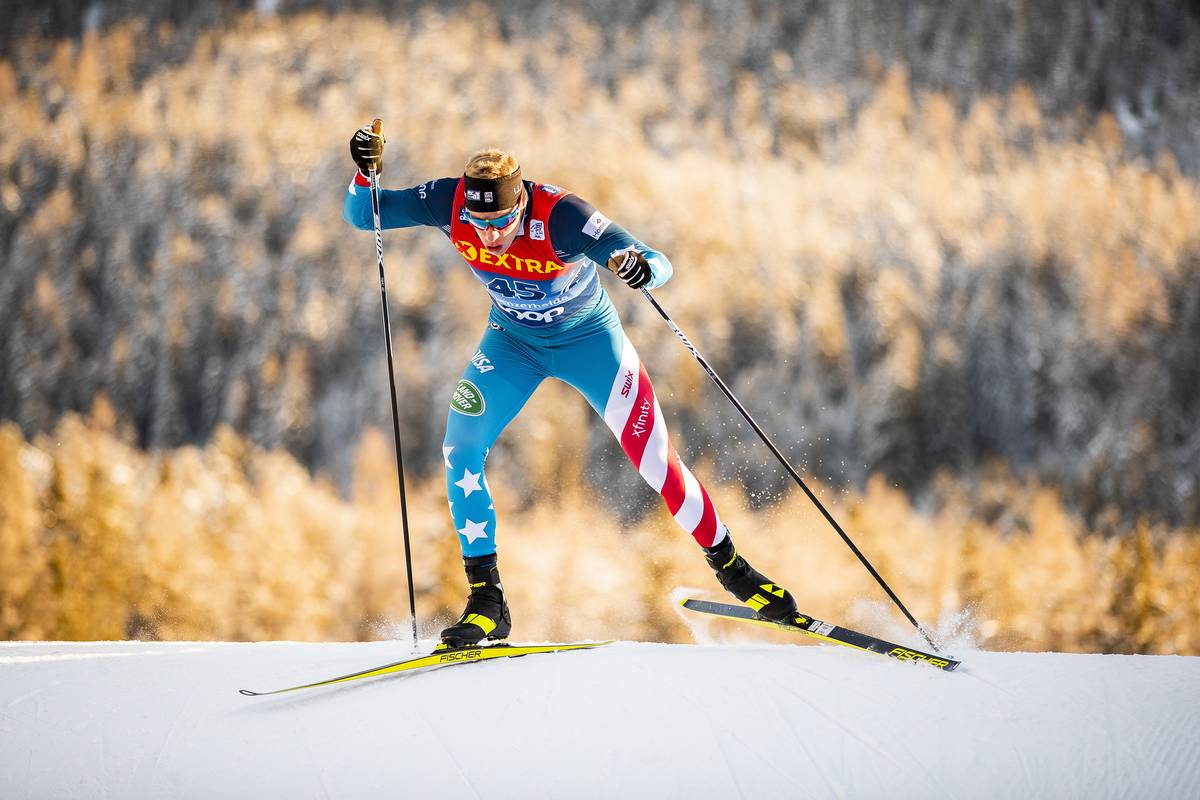
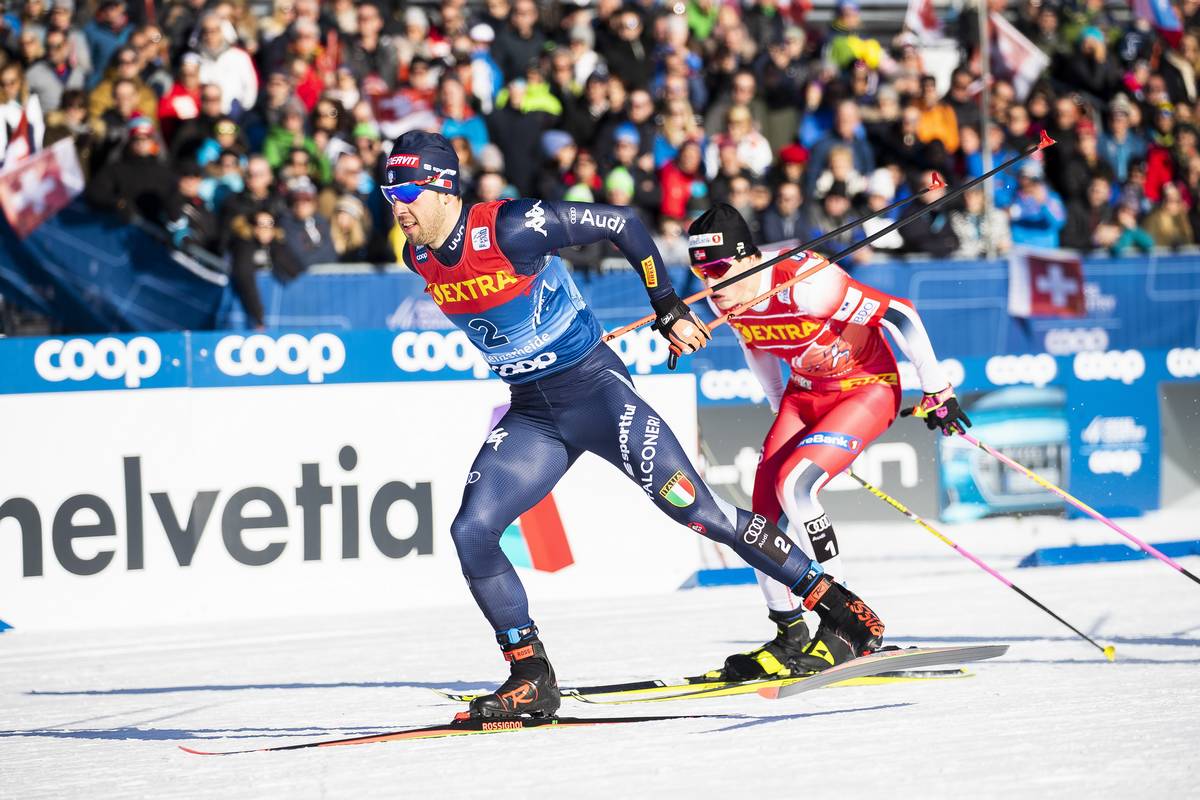
Logan Hanneman in Lenzerheide: 2019-2020 Tour de Ski. (Photo: NordicFocus)
FasterSkier: Lowlights?
Logan Hanneman: Lowlights…ha…realizing just how much more fit I need to get in order to even remotely close in distance races.
FasterSkier: Comment on why you stayed in the TdS? And will you get starts in Dresden or take a rest?
Logan Hanneman: I stayed in the Tour just because I had set the goal for myself to finish. Sure on paper, it may not have looked like a great decision, seeing as how I was way near the back in the distance races. But in years past, I have not done much distance races during the middle of the season, and I feel that that negatively affected my fitness for the remainder of the season, so I wanted to try something different this year. Plus, it’s pretty cool to finish that last stage, even though it is just brutal. I am unsure at this point for sure if I will get offered starts in Dresden, but I think it looks pretty promising, so I will plan on racing that weekend and then heading home for a few weeks to recover and train.
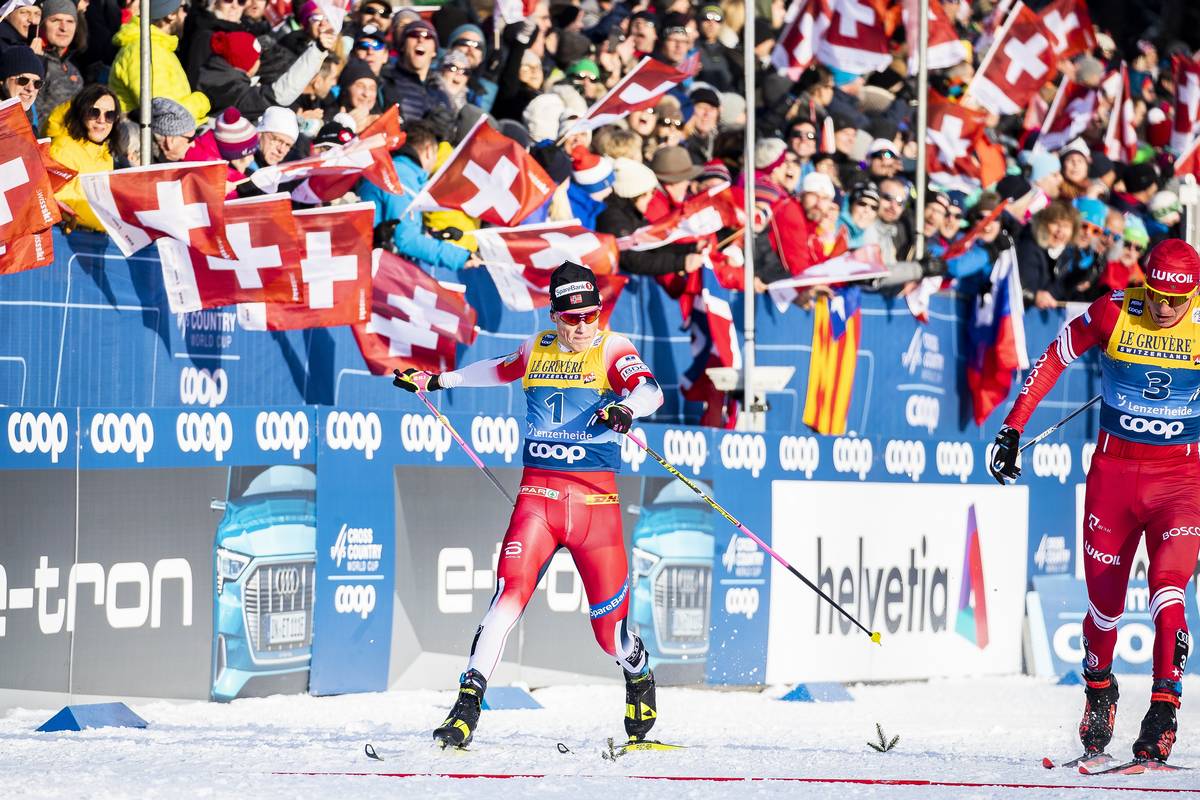
Therese Johaug: queen of the hill. (Photo: NordicFocus)
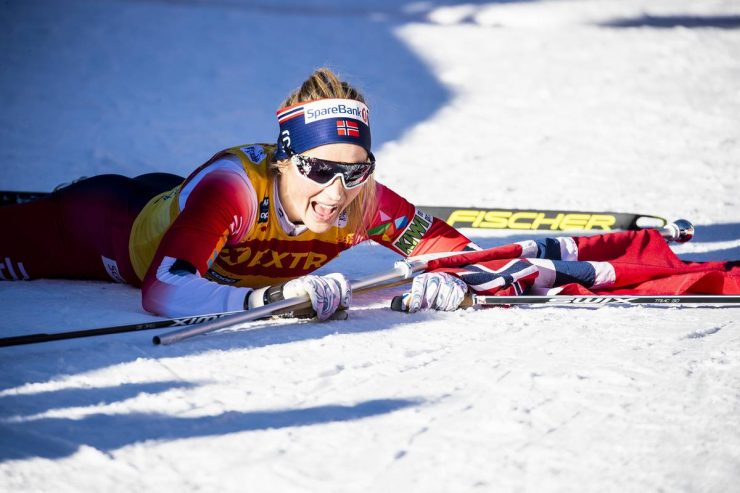
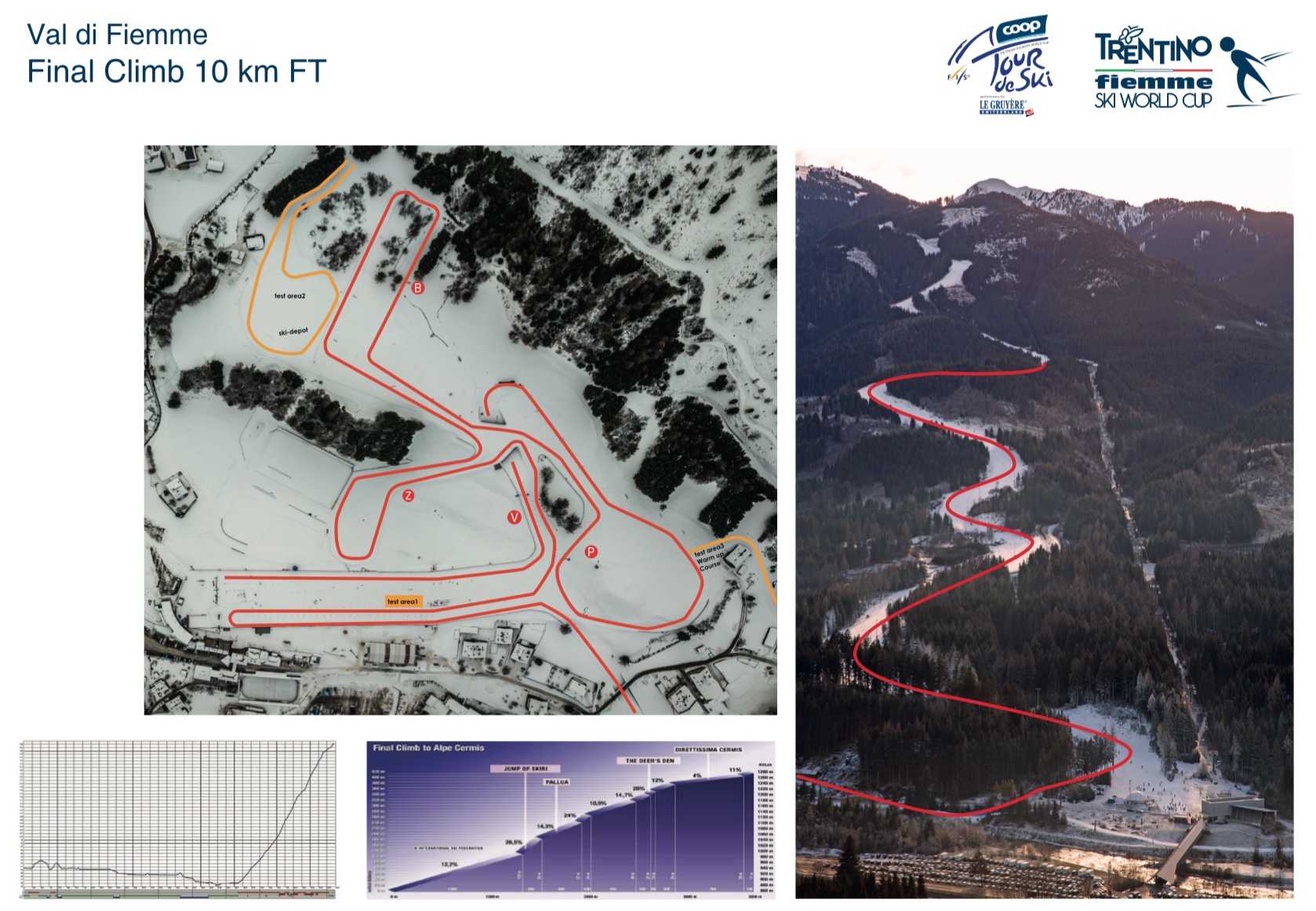
The fateful Alpe Cermis. The 10-kilometer capstone of the Tour de Ski, athletes complete the 1.5 k sprint loop before following the river valley down to the base of the alpine hill, climbing steeply for nearly 400 vertical meters to the finish. Bodies aching with the cumulative fatigue of the tour, racers are totally spent at the finish of the event. Crossing the line, they collapse with their faces pressed into the snow gasping for air and writhing in lactate-induced misery.
And so it was today.
First, a look back on Tours of the past. Unlike in the men’s event, the fastest skier up the Alpe Cermis has been the overall tour winner over the last four years.
Last year, Ingvild Flugstad Østberg was the fastest up the hill climb in 35:15.0 to take the overall win. Østberg was 42 seconds faster than the next skier, Krista Pärmäkoski of Finland. In 2017 and 2018, Heidi Weng was the first up the mountain by a similar margin. And four years ago in her most recent tour performance, Therese Johaug dusted the field, winning the day by a margin of 1:25.9. That’s nearly double the already large differential of her teammates.
Dubbed by Devon Kershaw an “once in a generation athlete,” Johaug has over 100 career podiums to her name, over 50 of which have been wins.
With this insight, it seemed safe to bet on Johaug in the final stage. However, the Norwegian superstar has proved to be beatable in this tour, much to everyone’s surprise.
Johaug was out-sprinted by Østberg in the final meters of the 10-kilometer classic pursuit in Stage 4, and the next day, she missed her first distance podium since she took 5th in the 5k skate in Toblach during Stage 4 of the 2016 Tour de Ski. (Johaug missed the 2017/18 and 2018/19 seasons while serving an 18-month ban after testing positive for the anabolic steroid clostebol, which was contained in a lip cream she used after sustaining a severe sunburn.)
Heading into the final stage, the overall standings looked like this: Norway’s Astrid Jacobsen trailed Johaug by three seconds. Natalia Nepryeava lurked 14 seconds back, and Ingvild Flugstad Østberg was 23 seconds back. Ranked as the top American, Sadie Maubet Bjornsen sat in 8th (+1:58), with Jessie Diggins 11th (+2:53).
The infamous climb up the Alpe Cermis. (Photo: Screenshot FIS Broadcast)
Historically, the event has been run in pursuit format: the first person to the top of the hill wins. This round features a mass start format; racers will need to drop and gap their chasers to earn time in the standings. Identifying rank in the overall standings required lots of quick math to follow the flux in deficits; eleven seconds between Jacobsen and Nepryaeva heading into the final stage, nine seconds between Nepyraeva and Østberg, and so on.
One final note before we begin: Ebba Andersson of Sweden, who was ranked 6th in the standings (+1:07), withdrew from the Tour before the final stage.
As expected, the pace went out conservatively around the sprint loop. Racing on a narrow band of man-made snow that frequently contrasted the bare ground and asphalt beside it, Johaug stepped to the front, a string of her teammates that included Heidi Weng, Østberg, Jacobsen, and Nepryaeva.
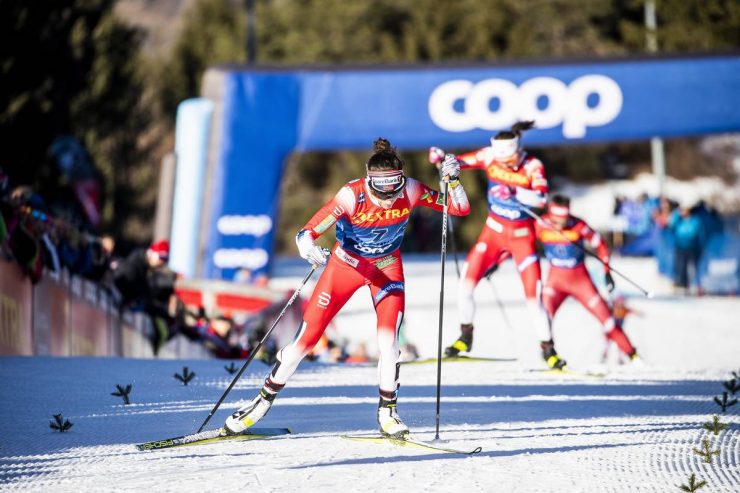
As they hit the hill, Johaug put her head down and got to work. She quickly created a gap to Heidi Weng and Østberg, who at first were willing to match the effort early in the climb, but quickly laid off, unwilling to succumb to temptation and risk flooding their legs with lactate too early.
It became a race for second place and a race against the clock. In the lead, Weng pulled Østberg and Nepryaeva up the hill, a gap to the next skiers.
Heidi Weng (NOR) races for second place up the Alpe Cermis with Ingvild Flugstad Østberg (NOR) and Natalia Nepryaeva (RUS) chasing. (Photo: NordicFocus)
With Jacobsen nowhere in sight, Nepryaeva and Østberg fought for podium positions. At 9 k, Weng led Østberg by roughly four seconds, followed by an equivalent gap to Nepryaeva. Though Østberg matched Weng stride for stride, the Norwegians were not able to pull away from the Russian.
Meanwhile, Johaug steadily chugged up the hill, on her own by over a minute. As the grade mellowed in the final 200 meters, she had energy left to ski V2, her technique masking the fatigue she must have felt.
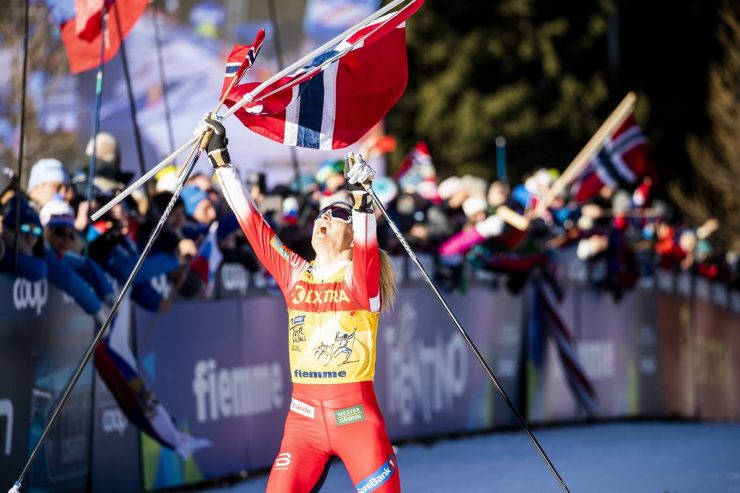
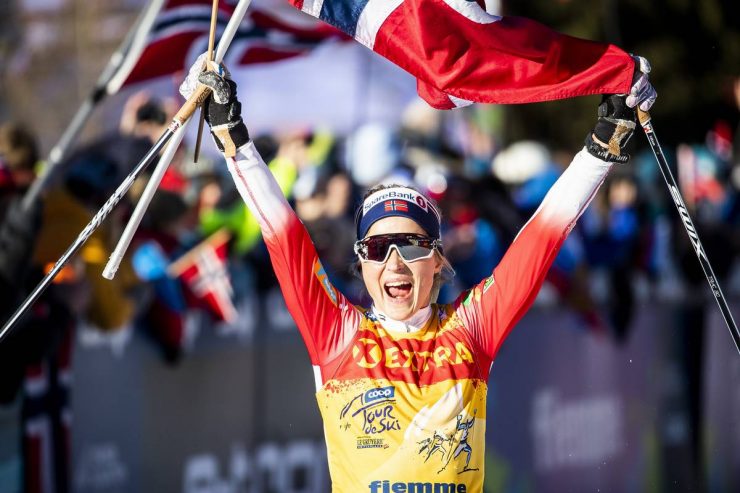
Waving the Norwegian flag high, Johaug shrieked with joy and relief as she stopped the clock at 34:21.6.
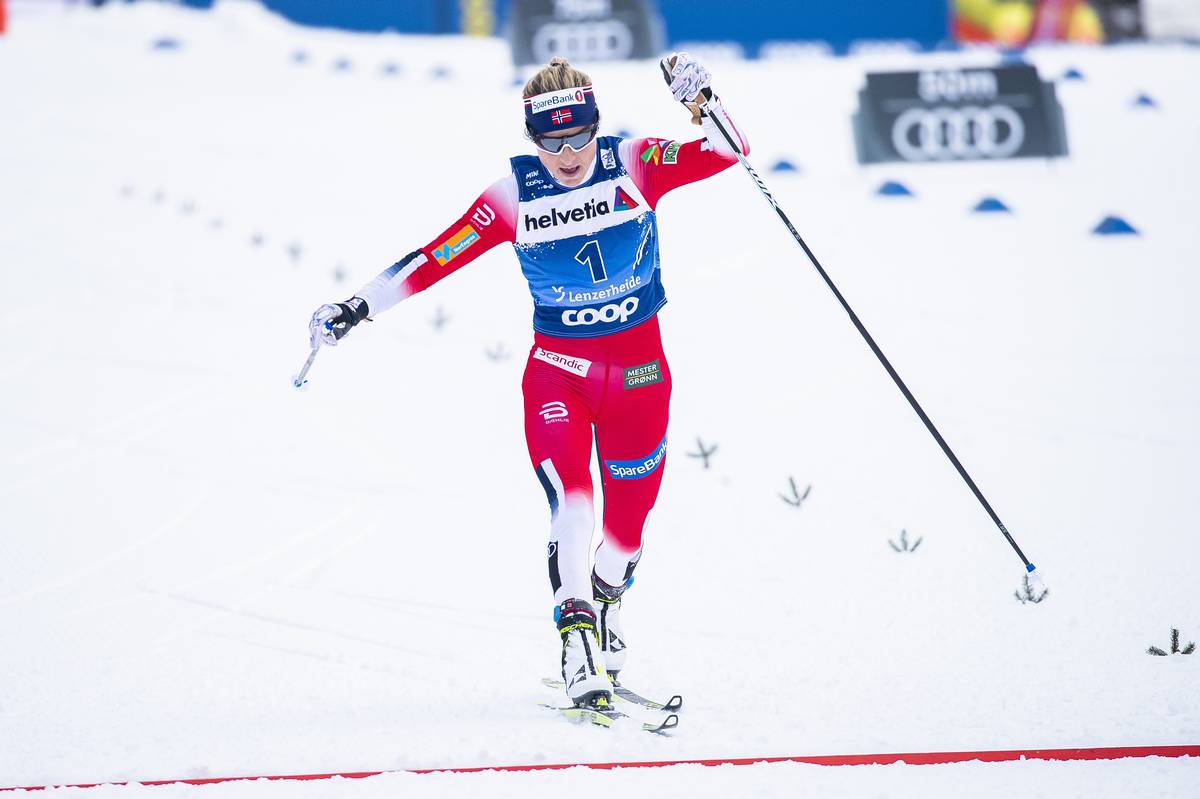
Therese Johaug celebrates her stage and overall victory at the finish of the 2019/2020 Tour de Ski. (Photo: NordicFocus)
A hard earned rest for Therese Johaug after winning the hill climb and taking the overall victory in the 2019/2020 Tour de Ski. (Photo: NordicFocus)
“I’m really, really happy now. My goal was, of course, when I’m going down here to fight for first place in the overall and today I do it. It has been seven hard days, but I am really, really happy now to come up here. I’m really looking forward to end this Tour de Ski because you wake every morning and are so nervous, but tomorrow I’m free.”
Firing on all cylinders, Heidi Weng crested the steep pitch, powering through the gradually ascending final meters for second (+50.3). Østberg followed in her wake for third (+54.5), followed by Nepryaeva in fourth (+57.1).
Throwing a boot to minimize her time back, Natalia Nepraeva finished 4th in the hill climb and 2nd in the overall 2019/2020 Tour de Ski. (Photo: NordicFocus)
So how did it all shake out? Therese Johaug took the overall Tour with an aggregate time of 2:28:18.6. Nepraeva landed the second spot on the podium (+1:11.1), followed by Østberg in third (+1:17.5). Weng finished 4th (+1:37.3), with Jacobsen behind her rounding out the top 5 (+2:13.4).
Theresa Johaug: 2019/2020 Tour de Ski champion. (Photo: NordicFocus)
First to the top of the Alpe Cermis, Therese Johaug (NOR) takes the overall victory in the 2019/2020 Tour de Ski. (Photo: NordicFocus)
Winding along the Marcialonga in the lead group, Diggins kept her position in the top ten throughout the day. At first, she trailed Jacobsen, Theresa Stadlober of Austria, and Charlotte Kalla of Sweden as they began the climb, but Kalla and Jacobsen fell off the pace.
Losing contact with Stadlober, Diggins was in the unfortunate position of skiing alone. Despite having no one to chase, she climbed steadily, sitting in 6th at 9 k with her teammate Rosie Brennan closing from behind.
Pure grit: Jessie Diggins ascends the final meters of the Alpe Cermis hill climb in 6th. (Photo: NordicFocus)
Holding her position, Diggins crossed the line for 6th (+1:51.1), chipping time off her deficit in the overall standings. With the hill climb, Diggins leapfrogged into the top 10, finishing 9th in the overall (+4:44.1).
“Today I was happy with my climb; I think I managed to pace it right so that I could keep moving up the hill steadily without blowing up – a line that is hard to find, but pretty crucial to get right! I had good energy and it’s nice to know that my fitness is in a good place even at the end of the tour,” Diggins wrote.
“Overall, this tour has been challenging in that I had many races where my fitness and effort weren’t reflected in the results. But I was proud of how I carried myself, contributed to having a positive team atmosphere and stayed positive without ever giving up, on the days when I had competitive skis but more important, on the days when I did not. It took a lot of positive energy, but now I can leave the Tour really proud of my mental toughness and ready to soak in all the hard work I put out there!”
Brennan and her teammate Sadie Maubet Bjornsen sat in the mid-teens at the base of the climb. As the grade increased, Brennan left Maubet Bjornsen and began picking off the women in front of her. Brennan advanced from 15th at the base of the climb to finish 7th (+1:58.0).
Rosie Brennan climbs to 7th place in the final stage of the 2019/2020 Tour de Ski. (Photo: NordicFocus)
In the overall standings, Maubet Bjornsen bumped up one spot into 7th (+4:40.6). Brennan finished 15th in the Tour (+7:11.0), and Ogden 28th (+12:26.5). 41 women finished the Tour.
“Wow, it feels good to make it to the top of that climb,” Maubet Bjornsen emailed. “I think it is safe to say, making it up that alpine slope after six hard days of racing is quite possibly the most physically painful thing I experience. Just crossing the line is such an achievement. This is only my third time I have made it, so it still feels just as exciting as the first one!
“This tour has had its ups, downs, and painfully near misses. Despite the rollercoaster, I feel like I gained confidence in my fitness and my skiing throughout the process. Not only that, I had my best ever Tour de Ski finish, ending in 7th place.
“No doubt I will come away from this tour both physically and mentally tougher!
“Thank you to the support crew who allowed it to happen, and thanks for all the cheers of encouragement both on the tough and wonderful days!”
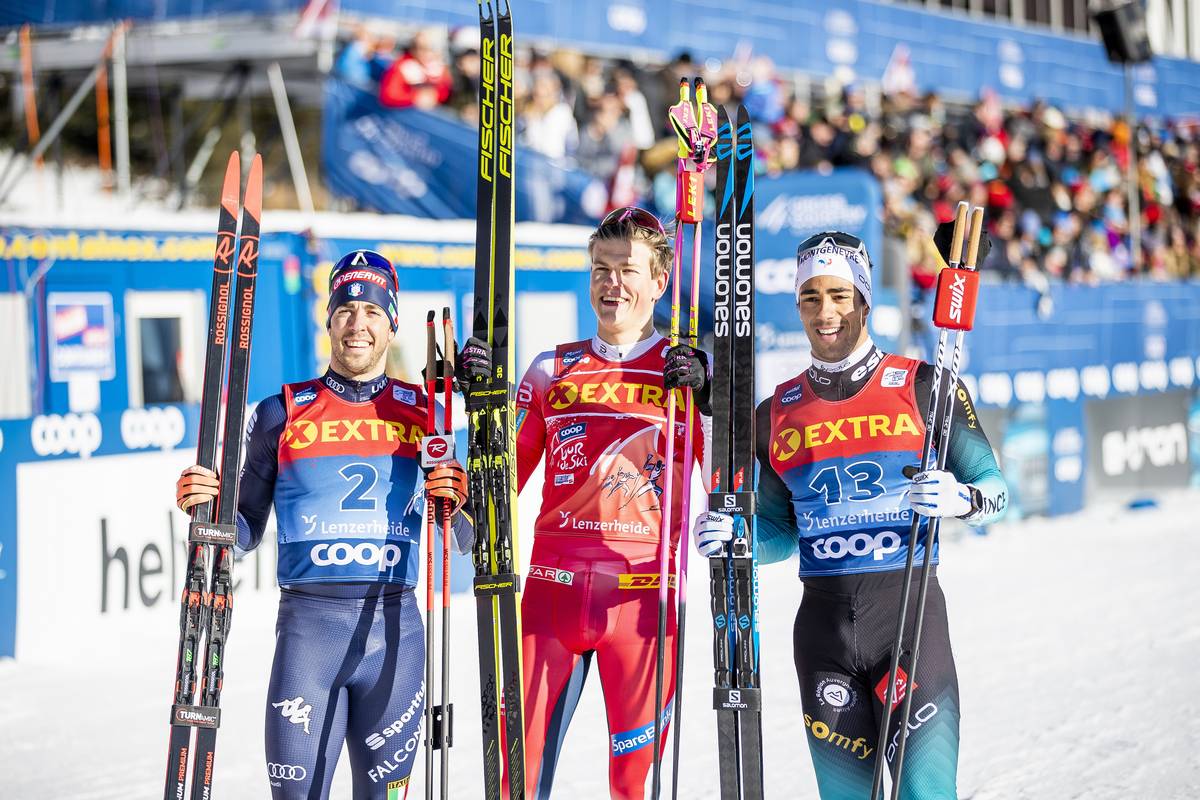
The 2019/2020 Tour de Ski podium: Therese Johaug (NOR) took the win ahead of Natalia Nepryaeva (RUS) and Ingvild Flugstad Oestberg (NOR) in third (l-r) . (Photo: NordicFocus)
With one stage remaining in the 2019-2020 Tour de Ski (TdS), and with standings somewhat unsettled before what some consider to be a slam dunk final stage for the current overall leader Therese Johaug from Norway, time bonuses were what mattered in Val di Fiemme, Italy on Saturday. Podium pride was at stake, but generous time bonuses were the carrot for many in the 1.27-kilometer classic sprint.
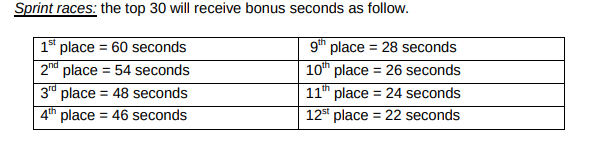
First through 30th place in the TdS sprints receive a time bonus. Sixty seconds for first, 54 seconds for second, and so on. Time matters.
After Stage 5, Johaug led the overall by 19 seconds over Ingvild Flugstad Østberg (NOR) in second, 32 seconds over Russia’s Natalia Nepryaeva, and for good measure, 33 seconds ahead of Astrid Uhrenholdt Jacobsen (NOR) in fourth.
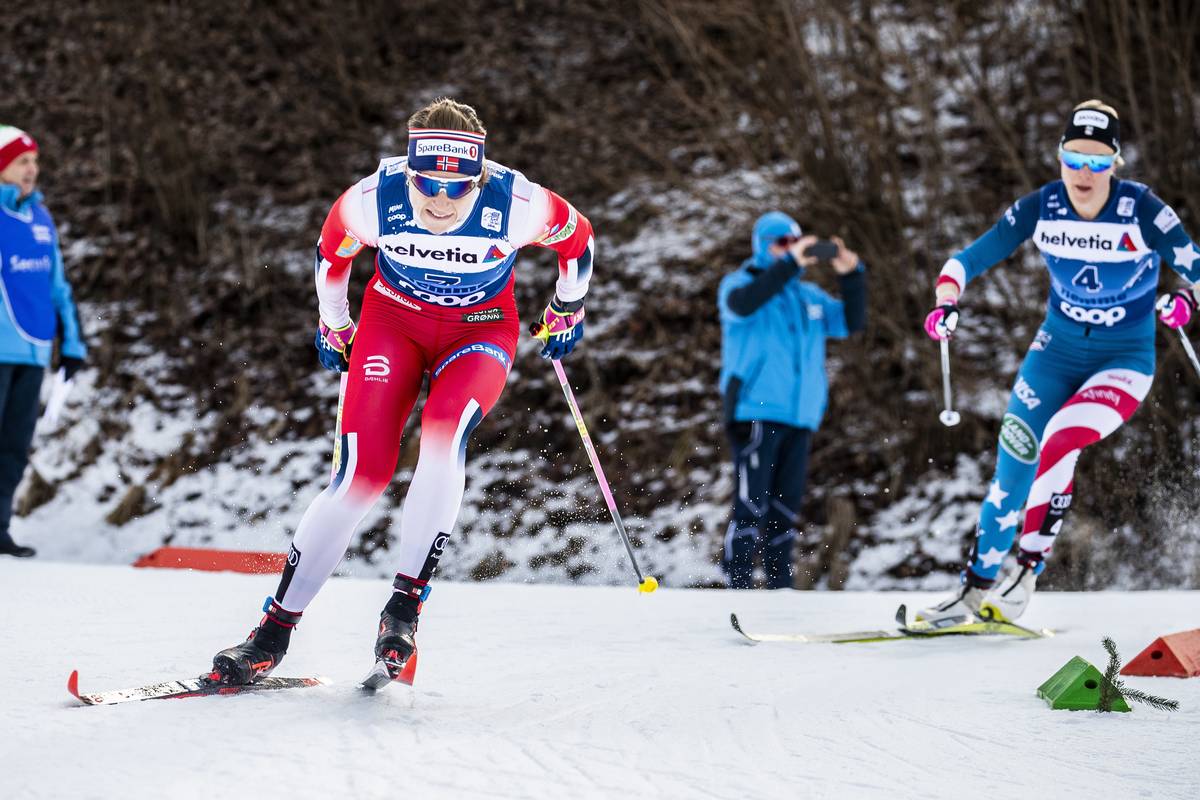
Finding her groove in time for the final stage. Astrid Uhrenholdt Jacobsen (NOR), moves to second overall in the Tour standings. Sadie Bjornsen (bib 4) follows. (Photo: NordicFocus)
The thirty-two-year-old Jacobsen comes off a mildly surprising win in Stage 5’s 10 k mass start classic race. Of late, her classic technique looks dialed and her ski speed has been an asset. For the longtime National Team member, the top podium spot has been a fleeting prize. Over her storied career, she has won five World Cups. We bring her up because she animated today’s classic sprint and positioned herself nicely for a TdS overall podium spot. More on that in a bit.
First a reminder, this is well into the TdS. Many of the World Cup’s top sprinters dropped from the Tour a stage or two ago. For the U.S., Sophie Caldwell is missing. Some top sprinting Swedes are not at the Tour. And Maiken Caspersen Falla of Norway took a raincheck. With forty-four skiers starting the qualifier, it was a good bet that many of the names we associate with distance skiing would progress.
Jessie Diggins of the U.S. qualified in first on the 1.27 k classic sprint course in 3:04.26. Yes, all the top contender names in this TdS advanced to the heats.
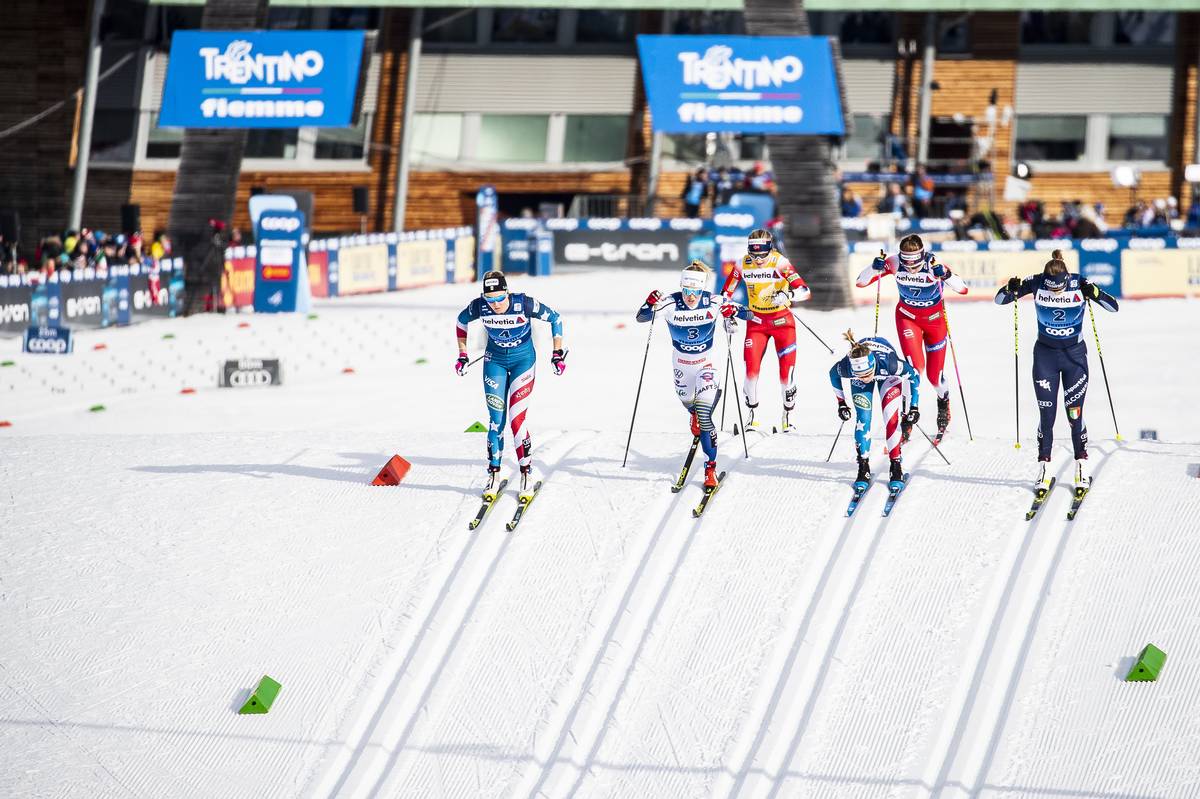
Jessica Diggins (USA), Natalia Nepryaeva (RUS), Lucia Scardoni (ITA), and Theresa Johuag (NOR) (l-r), during the first quarterfinal, Stage 6 of the Tour de Ski. (Photo: NoridcFocus)
In the first heat, Diggins looked smooth and powerful as she placed first. But slotting into fourth, in by far the fastest quarter-final was Johaug. She would advance to the semis, minimizing the potential damage of time bonus gains by her rivals for the overall.
In the second heat, it was Jacobsen who commanded the win with timely positioning and rocket skis. Sadie Maubet Bjornsen was second. Brennan placed fourth and did not advance.
After cataloging the quarters, all the key players remained. An upstart Anamarija Lampic from Slovenia, Nepryeava, Weng, and Østberg, Johaug, Diggins and Maubet Bjornsen. The only potential overall Tour contender not to advance and capitalize on more bonus time was Sweden’s, Ebba Andersson. Prior to today’s sprint, she was fifth overall, only 38 seconds out.
Andersson ended her day ranked 28th in the sprint.
Sadie Maubet Bjornsen (USA), Jonna Sundling (SWE), Jessica Diggins (USA), Lucia Scardoni (ITA), Therese Johaug (NOR), (l-r) during the first semifinal, Stage 6 of the Tour de Ski. (Photo: NordicFocus)
In the first semi, Jacobsen, Maubet Bjornsen, and Diggins went 1-2-3 to advance. Diggins moved on to the final as a lucky loser. Johaug bowed out in sixth. But her mission of time bonus mitigation was accomplished. Johaug ended her day ranked 11th.
Lampic, in the second semi, showed she too is a mint sprinter. She won her first career World Cup on Stage 2 of this TdS, a skate sprint, in a deeper field. Today, advancing to the finals after winning her semi, Lampic would add another exclamation point.
Out of the start, Nepryaeva fell hard in the finals while changing lanes. She placed sixth (+15.30) after realizing that burning energy to catch back on was futile. The five remaining in front kept it tight. Up the first climb, the skiers slotted into four lanes across with Jacobsen eventually taking charge.
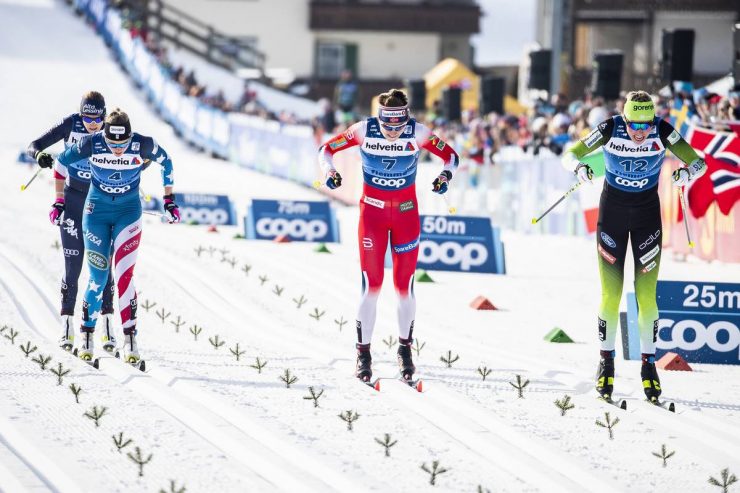
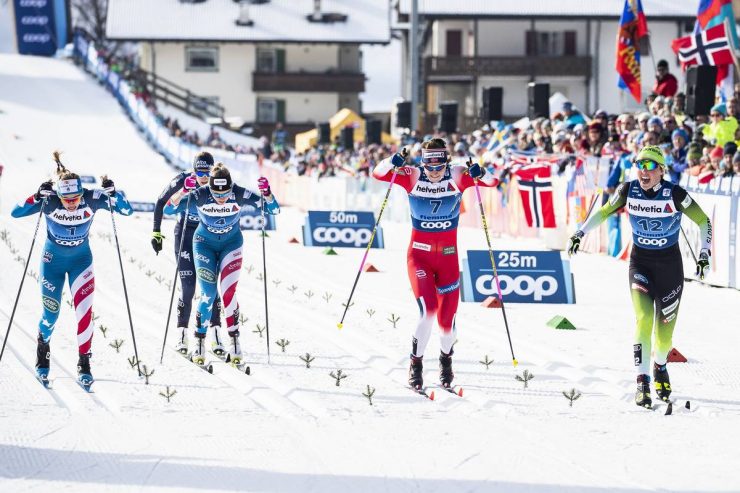
The course finishes with a long downhill into the final straight. Here, good skis and a transition into a power double pole played to Lampic’s favor. With Diggins, Maubet Bjornsen, Jacobsen, and Lampic gliding into the straightaway, Lampic was able to pull ahead for her second career World Cup win in 3:03.03. Diggins had a clear lane as did Jacobsen. Maubet Bjornsen, however, with a strong double pole, was stymied by Jacobsen blocking her in front. Maubet Bjornsen began pushing onto Jacbosen’s tails. The formidable U.S. skier switched tracks before she crossed the finish losing a smidge of momentum.
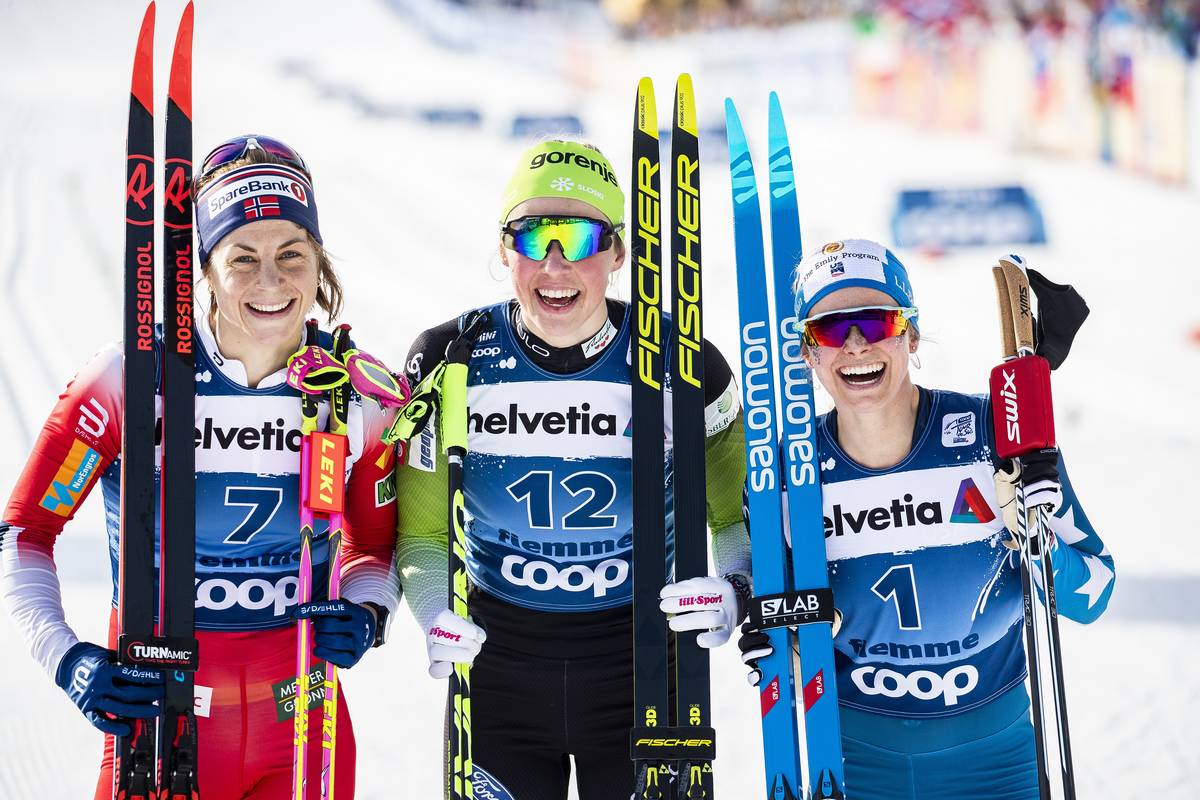
Jacobsen ultimately placed second (+0.22) in a photo finish with Diggins, who placed third (+0.28). Maubet Bjornsen was fourth (+0.8) and Lucia Scardoni of Italy fifth (+1.12).
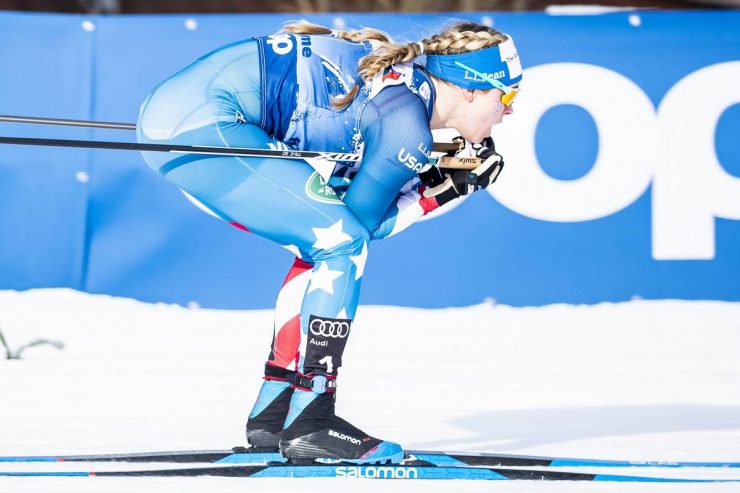
A streamlined Diggins during Stage 6 of the Tour de Ski. (Photo: NordicFocus)
“We haven’t seen a classic sprint here since 2013 World Champs, so tactically we were trying out a few new things and finding our strengths out there!” emailed Diggins. “I had good energy today and was just trying to push the pace at the start, but in the final, I was trying to use the slingshot a little bit more off of the downhill. I was also wary of getting boxed in on the tight corners because it was so important to be able to push hard over the top of the hill into the downhill.
“Huge thanks to the wax team for working so hard, and it was super fun to ski in the finals with Sadie! We’ve kept such a positive energy on this team the entire tour, through the good days and the hard days, and that has really paid off.”
Looking forward to finishing this tour like I always do – by going out there and giving it absolutely everything I have, so I can be proud of the effort I gave!
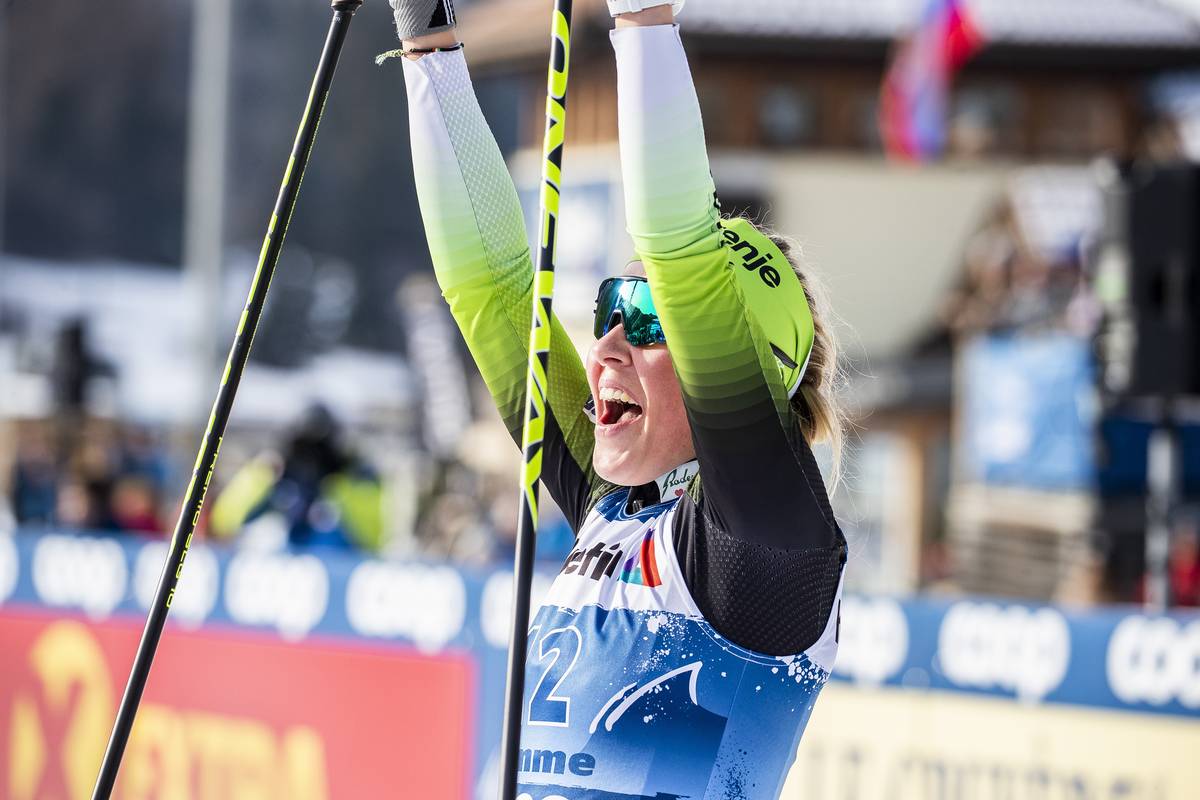
Anamarija Lampic (SLO) loving the win, post-Stage 6 Tour de Ski stoke. (Photo: NordicFocus)
“Hard to believe we can find sprinting muscles after so many days of racing, but somehow I felt amazing today!,” Maubet Bjornsen emailed. “Through my quarters and semis, I managed to place myself in a safe place, trying to conserve energy for the final, and feeling in total control. As the finals went off, I put myself in what felt like the ‘right position’. Unfortunately, I wasn’t in the right place at the right time on the final stretch, getting blocked up and just missing the podium by half a second.
“I can’t help but feel a bit frustrated, because I believe I could have won today if I could ski it again, but how can you be upset with a 4th place? I’ll have to channel all that frustration into the final day tomorrow, up the big alpine slope.”
Sadie Maubet Bjornsen (USA), Astrid Uhrenholdt Jacobsen (NOR), Anamarija Lampic (SLO), (l-r) in the final straight as Lampic takes the win. (Photo: NordicFocus)
Jessica Diggins (USA), Sadie Maubet Bjornsen (USA), Astrid Uhrenholdt Jacobsen (NOR), Anamarija Lampic (SLO), (l-r) in the final straight. (Photo: NordicFocus)
“While this tour has had plenty of ups and downs, I continue to feel strong and confident on my skis. Every new day is a new chance, which is so fun! That’s why I just love this crazy 7 races in 9 days. Getting yourself across that line on top of Cermise is an unbelievable achievement!”
Also for the U.S., Brennan placed 19th and Katharine Ogden 32nd.
The Shakeout for the Overall
Therese Johaug (NOR) kept it close today as she advanced to the semis in the Stage 6 classic sprint of the Tour de Ski. Johaug still leads the overall standings. (Photo: NordicFocus)
With her 11th place in the sprint, Johaug earned 24 bonus seconds, which in reality served to keep those potential overall threats, if any really exist, a few seconds back. That brings us to Jacobsen. After starting the day fourth overall, 33 seconds behind, her second place in the sprint netted her a 54-second time bonus. That bumped her to second overall, only three seconds behind Johaug. Nepryaeva is currently third overall, with 14 seconds to make up. Østberg fell to fourth — she placed 12th in the sprint — with a long 23 seconds to gain on the Alpe Cermis.
Post-Stage 6, Maubet Bjornsen improves to eighth overall (+1:58) from ninth after Stage 5, and Diggins jumped from 15th overall to 11th (+2:53) after Saturday’s sprint.
Tomorrow’s final stage, the infamous Cermis climb brings a new format this year. Historically, the Tour’s premier stage runs as a pursuit. With tomorrow’s mass start, every athlete heads out together. It will be on those trailing Johaug to somehow find a weakness and literally pull ahead.
If you’ve been listening to Devon Kershaw, no way, it will not happen — Johaug will not lose time on the Cermis.
The Alpe awaits.
(An athlete’s qualifying time from Stage 6 is used to determine an athlete’s time in the overall standings. Bonus time is subtracted from the overall time.)
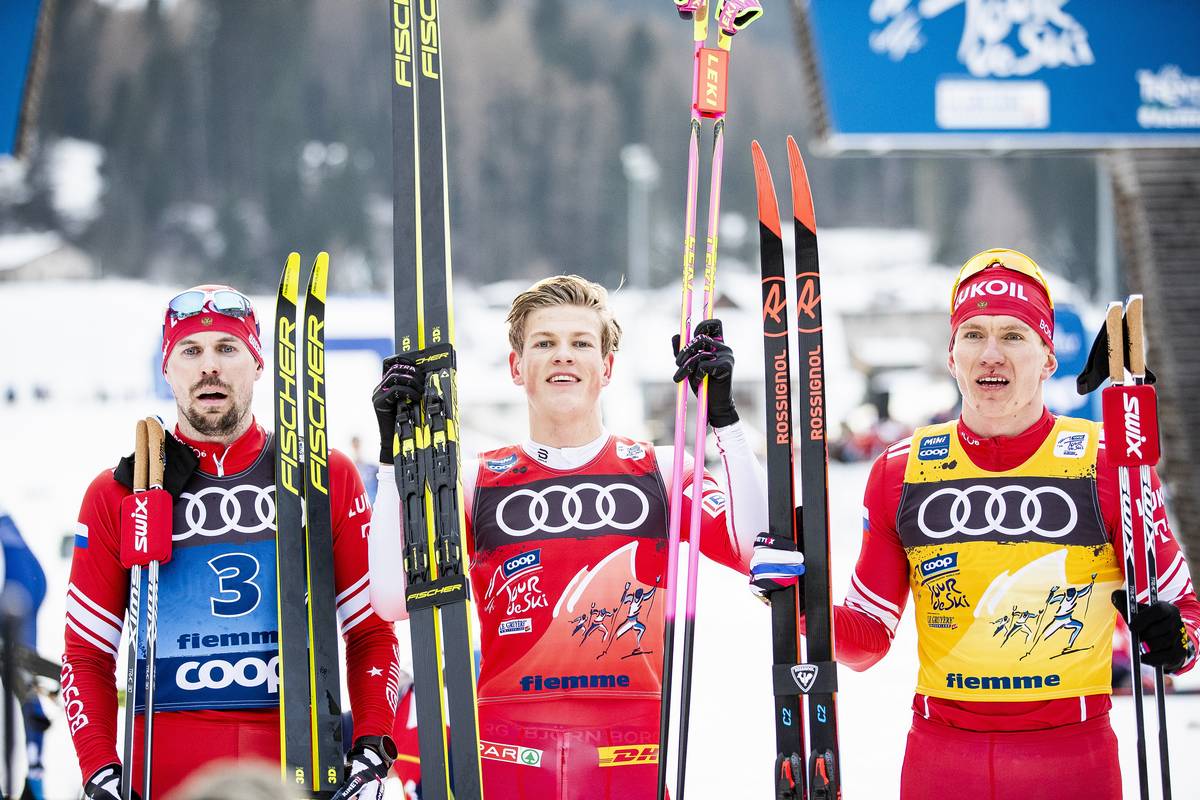
Three skiers atop the overall standings after Stage 4 set the tension for Stage 5 in Val di Fiemme, Italy: a 15-kilometer mass start classic race. Russia’s Alexander Bolshunov skied in the yellow leader’s bib while his teammate Sergey Ustiugov stood 16 seconds back in the overall. Johannes Høsflot Klæbo, Norway’s Tour de Ski (TdS) podium hope, lurked at 26 seconds back.
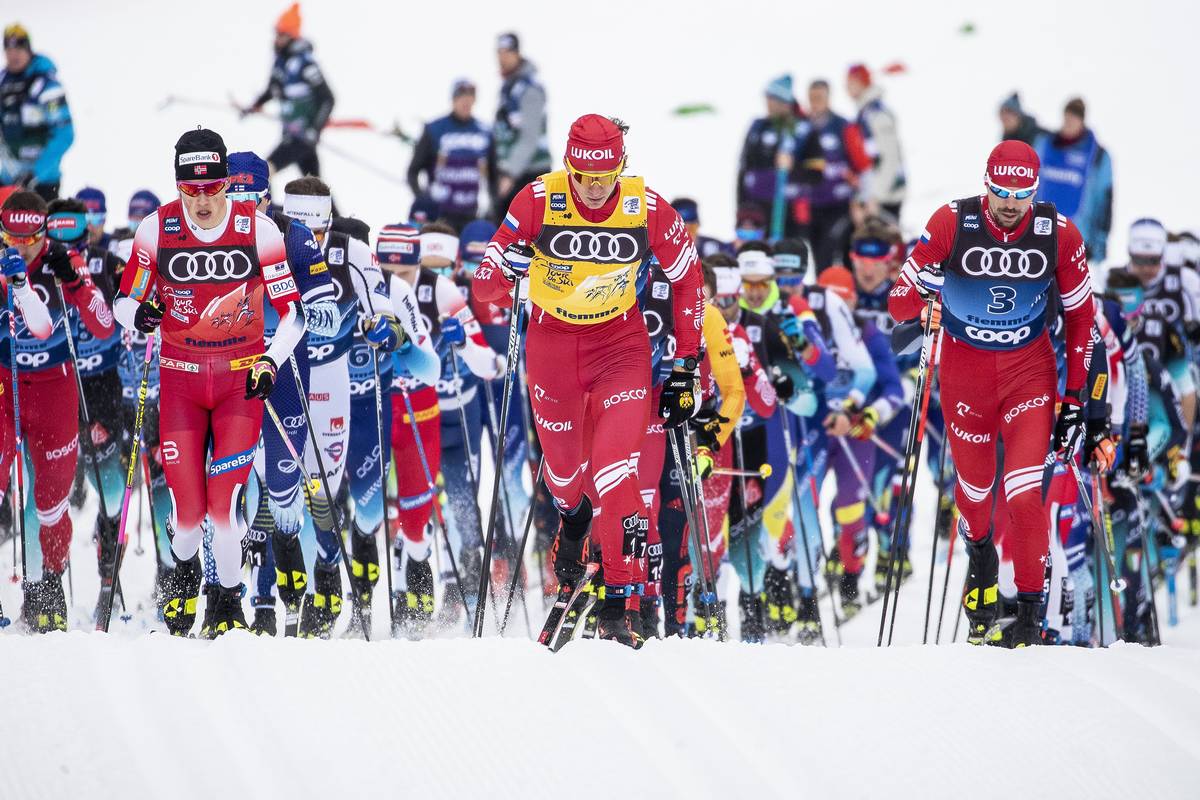
Alexander Bolshunov (RUS), Johannes Hoesflot Klaebo (NOR), Sergey Ustiugov (RUS), (l-r) early during Stage 5 of the TdS in Val di Fiemme, Italy. (Photo: NordicFocus)
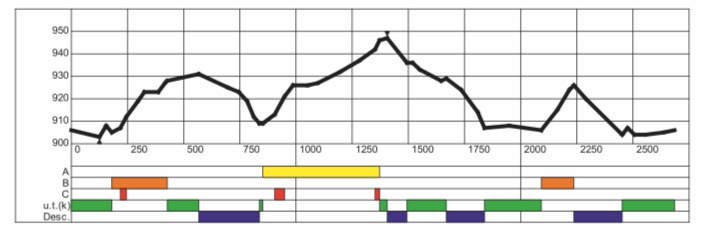
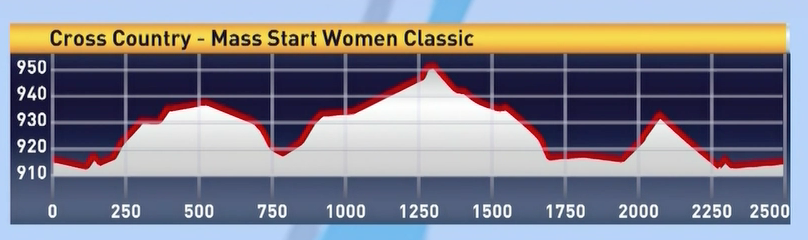
With a mass start format, the three contenders would play chess match skiing with a closing 1.5 k of turbocharged showmanship to determine the day’s winner. In between, as the 62 starters looped around the 2.5 k course which featured three climbs and an equal number of slick descents, the front pack never shattered.
Val di Fiemme 2.5 k course profile
The men’s field remained roughly intact through 7.5 k. With an arbitrary cutoff of five seconds, 25 skiers came through within that time frame. Hans Christer Holund of Norway leading, Sebastian Eisenlauer of Germany in 25th.
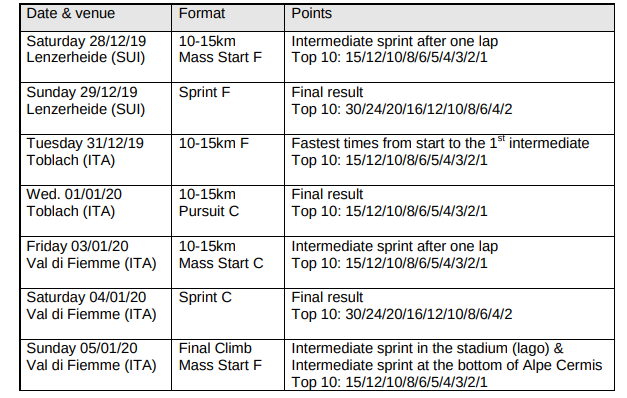
One kilometer ahead, at the 8.5 k mark, sat the day’s only time bonus atop a climb — a finite opportunity for some to snag time and decrease a time deficit.
Holund accelerated, awakening the leaders as the time bonus mark closed in. With the front of the field finally getting strung out, and several Norwegians present to steal a bonus spot away from the Russians (they took four of the top five spots through the bonus mark), Klæbo made a move up the inside to grab the first place 15 second prize. Bolshunov came through in fourth for an eight second bonus, Ustiugov in ninth for two seconds.
Pål Golberg (NOR), leading Alexander Bolshunov (RUS), (l-r) during Stage 5 of the TdS in Val di Fiemme, Italy. (Photo: NordicFocus)
Post time-bonus, the pace backed off. Until roughly 13 k, no skier in the front group made a discernible effort to separate. At 32:10, at the base of a climb, a mass of more than 20 skiers strode up led by Bolshunov in the yellow bib. It remained that way as the bell rang indicating the final lap.
Then the Russian charge began with Ustiugov’s double-pole push-and-punch through 13.9 k. On the course’s tricky descent that arcs left and loops back up for the decisive climb, Ustiugov was that Russian bear again. Unbridled and running, he was matched on the outside by an equally determined Klæbo.
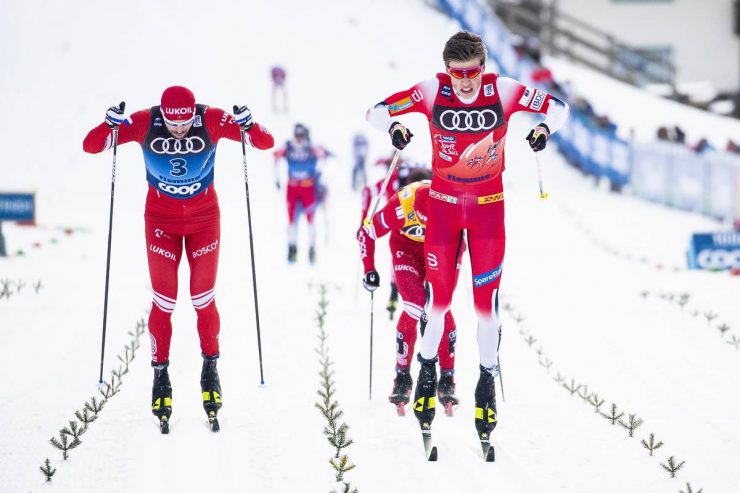
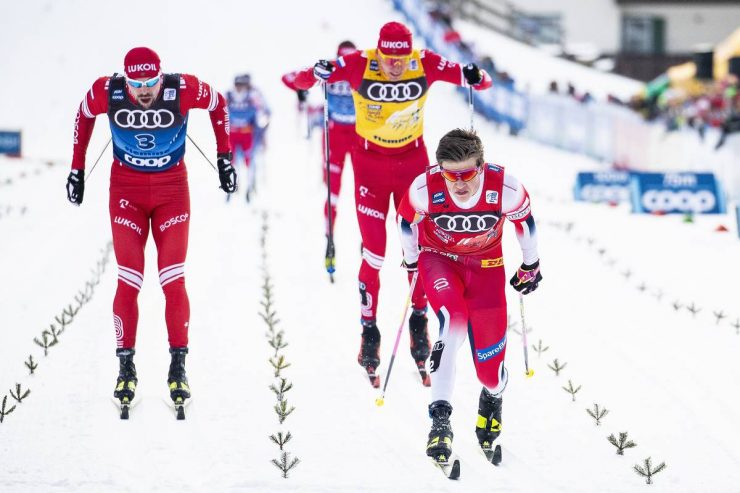
Through the downhill, Klæbo proved to have slightly better glide as he slid past Ustiugov into the straightaway. There Klæbo is king. He won in 39:51.0, with Ustiugov 0.7 seconds back in second place. Bolshunov held tight for third (+1.0).
With the close pack racing and Klæbo’s sharp move for the max time bonus, Bolshunov still leads the overall. However, that lead stands at 16 seconds over Klæbo in second overall. Ustiugov sits in third, 21 seconds back.
Full extension Johannes Høsflot Klæbo for the win. (Photo: NordicFocus)
Johannes Høsflot Klæbo (NOR) is a finisher as he takes the Stage 5 TdS win over Sergey Ustiugov (RUS), (l-r). (Photo: NordicFocus)
Two American men remain in the Tour. David Norris placed 38th (+1:41.9) on Stage 5. He tumbled on the second lap, but regained contact with the field. With two stages remaining, Norris is 36th overall. Teammate Logan Hanneman, a sprinter by trade, placed 59th (+4:49.8) on Friday.
David Norris of the U.S. is 36th overall after Stage 5 of the TdS, a 10 k mass start classic. Photo: NordicFocus)
World Cup Coach Matt Whitcomb’s post-race comments on the men’s racing
Tomorrow’s classic sprint remains a decisive day for Klæbo. Classic sprints and Klæbo most often mean one thing: a top step on the podium. And with that top step comes a 60 second time bonus. To stay in touch, Bolshunov and Ustiugov will need to make the six skier final.
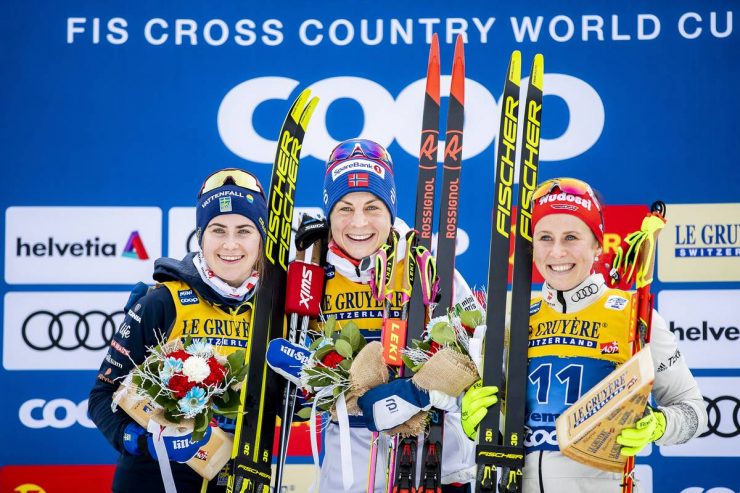
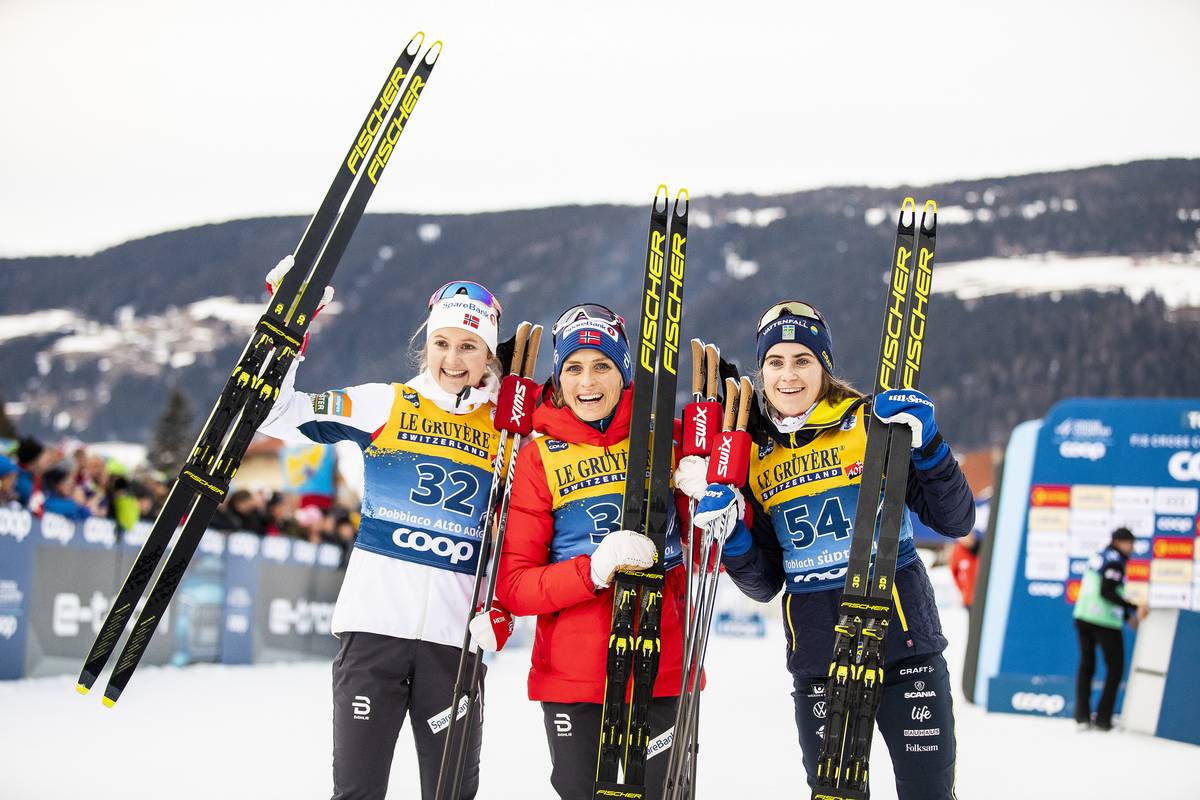
The women’s podium after Stage 5 of the 2019/2020 Tour de Ski in Val di Fiemme, Italy. Astrid Uhrenholdt Jacobsen (NOR) took the win ahead of Ebba Andersson (SWE), and Katharina Hennig (GER). (Photo: NordicFocus)
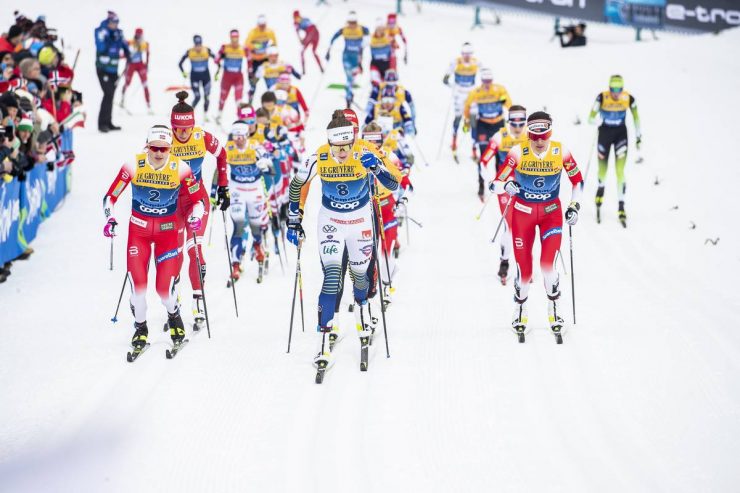
The 100th Tour de Ski Stage in Val di Fiemme, Italy, featuring a four lap 10-kilometer mass start classic. Coupling the results in distance racing over the last 14 months since Therese Johaug returned to the world cup and those of Stage 4, it seemed like a safe bet to predict a rematch between Johaug and her teammate Ingvild Flugstad Østberg. Another opportunity to race head-to-head over every meter of the course, and for Johaug to make a statement that her loss was a fluke.
It quickly became clear that Østberg crossing the line 0.4 seconds ahead of Johaug was akin to Roger Bannister running 3:59.4 on a cinder track in Oxford. The barrier was broken, illuminating the potential for the host of men who followed. Johaug was no longer invincible. No longer in a class of her own.
Ebba Andersson (SWE), Ingvild Flugstad Oestberg (NOR), and Heidi Weng (NOR) lead the pack in a 10-kilometer mass start classic in Val di Fiemme. (Photo: NordicFocus)
Nearing the end of the first 2.5 k lap, seven athletes formed a tight group at the front of the pack. Putting in a surge for the point bonus at 2.3 k, Natalia Nepryeava of Russia was in the lead, stretching out the group slightly. The trailing women rebounded like a slinky, continuing to push as a group.
The elevation profile of the 2.5 k course in Val di Fiemme, Italy. (Photo: Screenshot FIS broadcast)
Rounding the fast winding turns of the steep descent halfway through the lap, the chink in Johaug’s armour widened. Temperature well above freezing and old manmade snow made for lightning fast conditions, and racers were likely kicking with a variation of klister, perhaps with a hardwax cover. In the first lap, Johaug lost her footing and crashed, rebounding quickly and keeping contact with the pack.
In each of the subsequent laps, she was seen scrubbing speed, doing what she could to stay on her feet at the risk of shearing off some of her grip.
Therese Johaug approaches the fateful horseshoe bend in Val di Fiemme with Ebba Andersson close on her tails. (Photo: NordicFocus)
Jessie Diggins tackles the fast icy corners in Val di Fiemme during Stage 5 of the 2019/2020 Tour de Sk. (Photo: NordicFocus)
Spending the majority of the race at the front, Ebba Andersson of Sweden made several attempts to reduce the size of the group, but each of her moves were matched. Johaug, Østberg, and their teammates Astrid Jacobsen held strong beside Nepryeava, and Katharina Hennig of Germany.
As the 6k checkpoint approach, providing the opportunity for the first ten athletes to earn up to 15 bonus seconds, the pace accelerated. Jacobsen emerged at the front, sprinting head to head against Andersson with the remainder of the women close on their tails. Jacobsen held off the Swede, earning the most time.
Tour leaders Østberg and Johaug were 4th and 6th at the bonus, respectively. As expected after a high-speed snowplow down the hill, Johaug appeared to be struggling with her kick and was forced to run alongside the pack of women outside the track.
Sadie Maubet Bjornsen, who initially fell off the lead pack with Jessie Diggins, pushed to reconnect with the lead group and hovered 2 seconds behind in 8th at the time bonus. Diggins began to fade and was not within the top ten skiers; she did not earn bonus seconds.
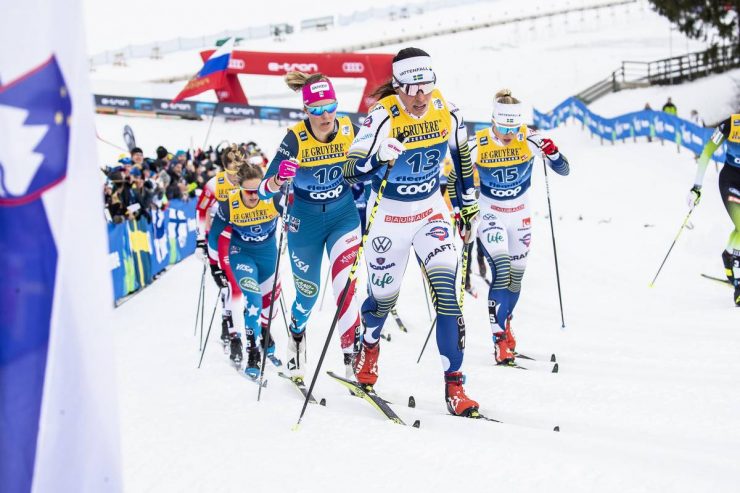
Charlotte Kalla (SWE, bib 13), Sadie Maubet Bjornsen, and Jonna Sundling (SWE) lead the chase group during Stage 5 of the 2019/2020 Tour de Ski. (Photo: NordicFocus)
As the final lap began, the pace heated up and the lead pack began to whittle down. Østberg led at each of the checkpoints. She too could no longer climb inside the tracks, but neither could her opponents. Heading into the fast and technical descent, Østberg motioned to the racers behind her as if to say, ‘Let’s chill out and give each other space here so we all stay on our feet.’
And so they did; each of the top five skiers stayed on their feet around the horseshoe bend. But as they headed up the final punchy climb with less than a kilometer to go, Østberg tangled with Johaug and went down and the tip of her pole snapped off. Running on her skis as she ripped off the strap and reached for a new one, she charged ahead, not pausing to put the strap of the replacement over her hand.
But her momentum was lost and she could not regain her contact with the three leaders who had taken off at the front: Jacobsen, Andersson, and Hennig.
Astrid Uhrenholdt Jacobsen (NOR) rounds the final turn toward the stadium with Katharina Hennig (GER) in hot pursuit. (Photo: NordicFocus)
Double poling in ferocious unison, the three women sprinted to the line with Jacobsen less than half a ski length ahead of Andersson who occupied the neighboring track. Hennig remained tucked in behind Jacobsen, who began to pull further ahead in the final meters.
Stopping the clock at 29:07.9, Jacobsen took the win and landed her first Tour de Ski podium since the final stages of the 2014 Tour, also in Val di Fiemme. Despite balancing the workload of a full-time medical school student, 2020 is shaping up to be one of Jacobsen’s career best seasons. She is currently ranked 4th in the overall World Cup standings.
Astrid Uhrenholdt Jacobsen (NOR) takes the win in Stage 5 ahead of Ebba Andersson (SWE) and Katharina Hennig (GER). (Photo: NordicFocus)
Andersson was next across the line (+0.4), followed closely by Hennig in third (+1.0). The Swede has the unfortunate statistic of having the most podium finishes in World Cup races (including tour stages and overall tour ranks) without ever landing on the top spot. With today’s result, she has 13 podium finishes, moving ahead of Maubet Bjornsen who has 12. At just 22 years of age, the time is nigh for her to happily surrender her title.
Also one of the younger athletes in the field, today was Hennig’s first podium racing with the bigs. The German took third in distance classic race at U23’s last year and has cracked the top 10 on the World Cup a handful of times in the event.
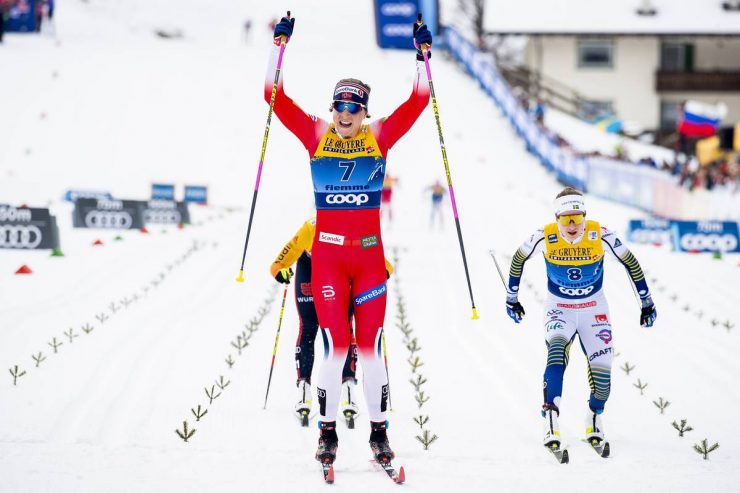
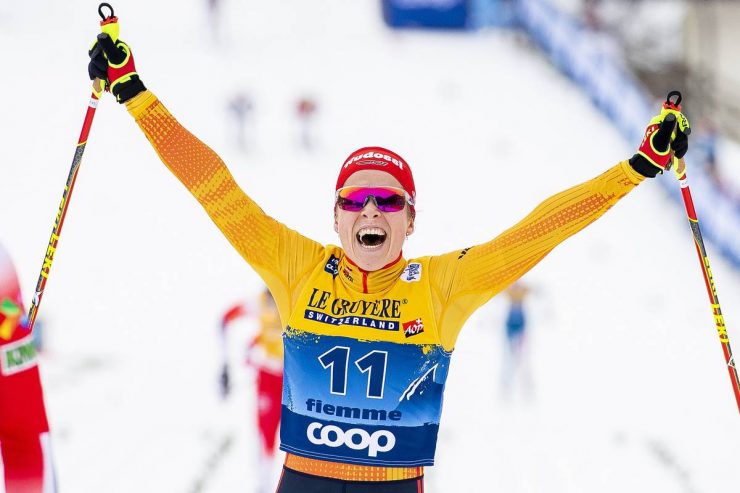
Katharina Hennig (GER) throws her arms up in celebration of a third place finish in Stage 5 of the 2019/2020 Tour de Ski. (Photo: NordicFocus)
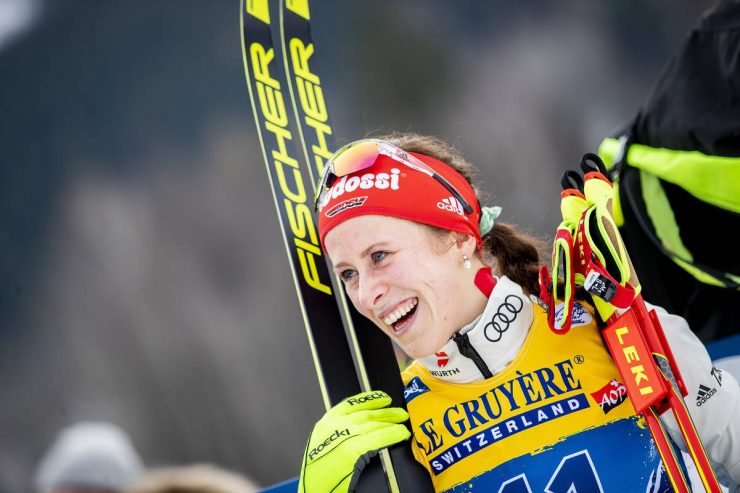
Katharina Hennig gives an infectious smile after snagging her first World Cup podium in Stage 5 of the 2019/2020 Tour de Ski. (Photo: NordicFocus)
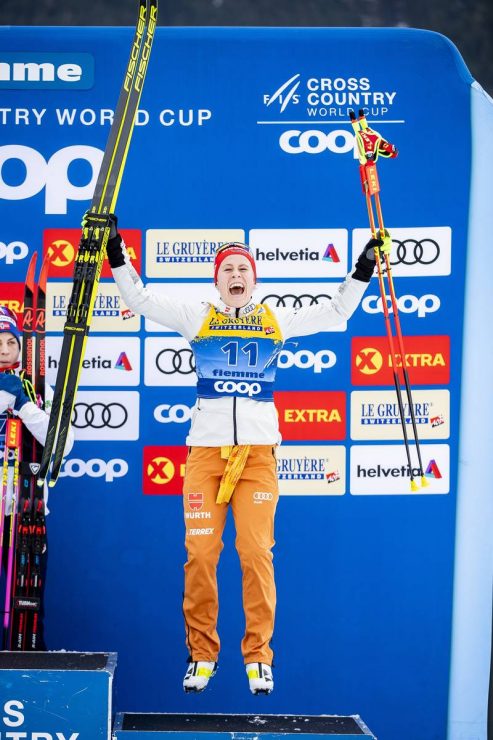
Unable to contain her excitement about her performance, Hennig accidentally dropped her skis as she jumped up and down on the podium.
Katharina Hennig (GER) jumps for joy for her first World Cup podium after Stage 5 of the 2019/2020 Tour de Ski. (Photo: NordicFocus)
“[It’s] hard to believe,” she told a German reporter for ZDF. “On the last loop I noticed I was still keeping in touch with the top, and then I somehow just put everything out that I had.”
The broadcaster explained that Hennig had stated that beating Johaug was not a goal the team had discussed, presuming that it was not possible. Yet the 23-year-old had stuck with Johaug throughout the race and beaten her by over five seconds.
“I really don’t know what to say,” Hennig said in response. “I just know that I want to say thank you to everyone supporting me on my journey, our team, our wax technicians, my parents, my boyfriend, my coach, everyone, without them this would not be possible.”
Johaug had ended the race in 4th (+6.2), followed by a frustrated Østberg who swatted her pole into the snow as she crossed the line in 6th (+6.8). Norwegian news outlet NRK reported that Østberg needed time to gather herself before she could listen Johaug’s apology and accept that there was no malicious intent.
Maubet Bjornsen held her position in the field, racing alongside Nepryeava throughout the second half of the race. She was the top American finisher in 7th (+17.2). Ceding time for her overall standing, Diggins fell back to 17th (+1:05.5). A few seconds behind, Rosie Brennan finished 20th (+1:07.7), and Katharine Ogden finished just inside the points in 28th (+1:56.9).
Sadie Maubet Bjornsen skis to a 7th place finish in Stage 5 of the 2019/2020 Tour de Ski. (Photo: NordicFocus)
“After struggling with slippery skis two days ago in Toblach, I was ready to take another hit at one of my favorite races out there, 10k classic!” Maubet Bjornsen wrote in an email to several news outlets. “My race plan today was to be patient, and race my own race. This meant trying to stay relaxed for the first lap, and making sure I had enough energy to attack in some of the working sections that others could be exploded on. At this point in the tour, you have to rely on your brain, because your muscles are so tired, they are screaming stop. The goal is to let your brain overpower that feeling, and just keep pushing.”
Looking back on the tour, Maubet Bjornsen took 30th in the 10 k skate first stage, followed by 5th in the sprint, and 8th then 12th in the pursuit stages.
“This tour has been a collection of ups and downs, but every time things work out, I feel super encouraged and excited. Tomorrow’s classic sprint will be really funny. When people are so tired, I am sure it will look different than a normal sprint, but that sounds so fun! I can’t wait. If I can find the same feelings I found today, I feel confident I can find my magic.”
“Two more days to go, time to rely on determination and mental power!” she concluded.
After the race, Matt Whitcomb reiterated that her 7th place finish was one of the most noteworthy races of Maubet Bjornsen’s career.
“To have an athlete right now on this course who can fight for a podium is pretty exciting, and it gave me goosebumps to watch her ski today,” he said.
In a post-race call, Whitcomb also provided insight into the remainder of the American women’s day.
Post-race interview with Matt Whitcomb on women’s performance.
Sharing Whitcomb’s perspective that results outside the top-ten are no longer satisfying, Brennan explained that she wanted more from today.
“After a really tough classic day in Toblach, I lost quite a bit of wind out my sails and was certainly nervous about my skis and my fatigue and everything that can happen in a tour,” Brennan emailed. “As a result, I chose to ski a little conservative and ski within myself. I am pleased with the result and some very steady skiing, but certainly think I was a bit too conservative. With two days left, it’s time to let it all out!”
Sadie Maubet Bjornsen consoles Rosie Brennan after a tough day in Toblach, Italy during Stage 4 of the 2019/2020 Tour de Ski. (Photo: NordicFocus)
During the call, Whitcomb also shared insight into the challenging course and the waxing conditions in Val di Fiemme.
Post-race interview with Matt Whitcomb on waxing and conditions in Val di Fiemme.
Overall Tour Standings
Despite back-to-back losses, Johaug remains in the lead in the overall standings by a margin of 16 seconds. As she is likely to lose time during tomorrow’s sprint stage, it is likely that she will be chasing the yellow bib up the Alpe Cermis.
Østberg also maintains her position in second. Though she did not qualify for the heats in the first sprint stage, she has 20 sprint podiums to her name and is likely to place higher than Johaug.
Nepryaeva remains in third, though she ceded time in today’s stage and now has a 32 second deficit. Jacobsen lurks one second behind her in 4th, followed by Ebba Andersson in 5th (+38).
Maubet Bjornsen is now the top ranked American in 9th (+2:22), followed by Diggins in 15th (+3:20), Brennan in 19th (+4:52), and Ogden in 31st (+8:04).
The Tour de Ski says so long to Tobalch, where Stage 4, a classic pursuit for the men and women, firmed up the standings for some at the sharp end and saw others take a slide down the rankings.
Stage 4, a 10 k/15 k classic pursuit in Toblach, Italy saw Johaug retain the overall lead for the women, and Bolshunov snag the yellow leader’s bib from Ustiugov. On a tricky classic course with steeper hills than Stage 3’s skate loop, big efforts took their toll.
Therese Johaug of Norway (yellow bib) and teammate Ingvild Flugstad Østberg during the Stage 4 classic pursuit in Tobalch, Italy. (Photo: NordicFocus)
Kershaw lays it out and discusses the winners and the faders from the day’s stage. The Tour takes a rest day tomorrow as Val di Fiemme awaits for the last three stages.
The men’s podium of Stage 4 of the 2019/2020 Tour de Ski. Alexander Bolshunov (center) won the stage ahead of Sergey Ustiugov (left) and Iivo Niskanen (right). (Photo: NordicFocus)
The hunter becomes the hunted. Looking back on previous tours, Russia’s Sergey Ustiugov has not worn the leader bib going into the pursuit stage except for the 2016/2017 tour in Oberstdorf, Germany. That year, Ustiugov won six of the seven stages, placing second in the mass start classic in Stage 6, but still raced up the final hill climb with a significant buffer for the overall victory.
This year, Ustiugov was the man to beat. After a dominant performance in yesterday’s 15-kilometer skate, the Russian began the 15 k classic in Toblach, Italy with a lead of 22.6 seconds before the next skier and 27 seconds in the overall standings. On the hunt were his teammates, Ivan Yakimushkin and Alexander Bolshunov, followed by a troop of athletes looking to earn back time on the leader. In particular, a host of Norwegians looking for redemption after the third stage. Would his gap be enough to hold his position over 15 k’s?
Within the first 4 k, the answer was evident. Bolshunov and 4th place starter Calle Halfvarsson of Sweden closed the gap and overtook the leader. The three men skied together through 8 k, then Bolshunov began to crack open a gap.
Sergey Ustiugov falls short in preserving his rights to the leader bib in Stage 4 of the 2019/2020 Tour de Ski. (Photo: NordicFocus)
Unable to match the pace, Ustiugov switched into damage control mode. Standings in the overall tour are based on the cumulative time from each stage, and the time added from today’s event is based on time of day results, meaning the elapsed time each individual spent on course. Being caught by Bolshunov meant Ustiugov had already lost 29 seconds, meaning that Bolshunov’s aggregate time now earned the 23-year-old the rights to the yellow bib.
Ustiugov was able to keep his teammate within 20 seconds, but Bolshunov never saw his position at risk and finished with a 13 second lead. He stopped the clock at 38:14.9 for his first stage win in the Tour de Ski. Subtracting this from his deficit in the overall, Bolshunov now leads the overall rankings by 16 seconds.
Alexander Bolshunov celebrates his Stage 4 win during the 2019/2020 Tour de Ski. (Photo: NordicFocus)
“It was a really, really hard race,” Bolshunov told FIS through a translator. “A big part of this was that I had to work alone. Sergey in the middle helped to keep the pace, by my own feelings started to run away and the last lap it was really hard to keep the speed.”
When asked whether he had energy left for the final three stages in Val di Fiemme, he answered with a mischievous smile.
“The tour just started.”
Alexander Bolshunov (RUS) takes control ahead of Calle Halfvarsson (SWE) and Sergey Ustiugov (RUS) during Stage 4 of the 2019/2020 Tour de Ski. (Photo: NordicFocus)
Alexander Bolshunov (RUS) blasts off as he leaves behind Calle Halfvarsson (SWE) and Sergey Ustiugov (RUS) during Stage 4 of the 2019/2020 Tour de Ski. (Photo: NordicFocus)
When Bolshunov began to pull away, Halfvarsson fell dramatically off the leaders, dropping from eight seconds back to over 50. Perhaps the Swede was paying for his effort in light of the cumulative tour fatigue that is setting in. He rebounded in the final lap to finish within 30 seconds of Bolshunov in 5th.
Steadily working his way up through the field in his dominant technique, Iivo Niskanen had an outstanding performance. The Finn began the race in 11th place with a deficit of 1:35, half of which he recouped in the first half. Like many other athletes, Niskanen began to fade in the middle part of the race, but he switched on his afterburners in the final lap.
Iivo Niskanen rises up the ranks on his way to a third place finish in Stage 4 of the 2019/2020 Tour de Ski. (Photo: NordicFocus)
With 2.5 k to go, Niskanen was 50 seconds back on Bolshunov in sixth, yet he could be seen rounding the corner into the final stretch as Ustiugov slid over the line. Niskanen took the third spot on the podium finishing 24.8 seconds back on the leader, a result that moves him into fifth place in the overall standings.
So far this season, Niskanen won the 15 k classic in Ruka in addition to a 10 k classic early season opener. He is also an Olympic champion in the 50 k classic and podium finisher in the 15 k classic at the 2019 World Ski Championships in Seefeld, his stride and glide prowess is clear. Heading into two additional classic stages, he now sits in 5th place in the overall standings with a 1:10 deficit.
Iivo Niskanen takes third during Stage 4 of the 2019/2020 Tour de Ski. (Photo: NordicFocus)
Desperate to whittle down his 37-second deficit in the overall ranks, Johannes Høsflot Klæbo looked like a workhorse in the pursuit. No pomp, just head down, focused, determination. He knew he was not fighting for a podium position on the day, but any time he could gain on the leaders would help keep him in contention for an overall win. It is essential that he keep his overall deficit within a margin that could be surpassed with bonus seconds he intends to garner in the sprint during Stage 6.
Klæbo started the day 1:11 behind Ustiugov. Nearly 30 seconds of this were chipped away in the first 5 k, then he began to struggle. He began ceding places and time, leaving him in 16th at the 12.4 k mark 1:23 in the hole. He too found a new gear, closing hard in his final lap to move into 10th (+57.2).
Johannes Høsflot Klæbo climbs his way into 10th during the 15 k classic pursuit in the 2019/2020 Tour de Ski. (Photo: NordicFocus)
As he gained time on Ustiugov, his deficit in the overall standings reduced to 26 seconds, though he still sits in third. Perhaps better suited for head to head competition, Klæbo is in good position heading into the next two stages.
Again the top American distance athlete, David Norris finished 44th (3:43), improving on his 51st place finish yesterday. His time of 39:34.9 was the 34th fastest time of day.
Kevin Bolger finished 61st (+5:24.9), and Logan Hanneman 71st (+7:47.2).
In a post-race interview, Whitcomb shares that Bolger, who is a sprint-specialist, used the TdS distance stages as an opportunity to build fitness. He will now leave the tour to prepare for the city sprints in Dresden. Whitcomb also provided insight into Norris and Hanneman’s races, and offered a possible answer to the yo-yo like time difference seen in the race.
Post-race interview with Matt Whitcomb.
Racing continues Friday with a 15 k mass start classic in Val di Fiemme, Italy.
Toblach, Italy. A stunning stadium and backdrop with the Dolomites lording over the venue and a steady cling-clang of baritone bells greeted skiers along portions of the course. Stage 3 in Toblach, a 10-kilometer interval start skate, turbocharged the 2019-2020 Tour de Ski (TDS).
Another win for Therese Johaug, albeit by a small margin, during Stage 3 of the 2019/2020 Tour de Ski in Toblach, Italy. (Photo: NordicFocus)
After two stages, a Stage 1 mass start skate and Stage 2 skate sprint, Russia’s Natalia Nepryaeva sat atop the overall standings. In third overall, Norway’s imminent threat, Therese Johaug, was positioned only five seconds back. Other names to watch, like Ingvild Flugstad Østberg, also from Norway, was seventh overall, 27 seconds back.
With three distance stages in a row — today’s 10 k skate, Wednesday’s 10 k classic pursuit (both in Toblach) and a Stage 5 10 k classic mass start in Val di Fiemme — this mid-stretch of the TdS would firm up the overall standings.
We’ll say this upfront with a bit of biased towards the spectacle of mass starts — this was fun-to-watch on-the-edge-of-your-seat interval start racing. Imagine a window for FIS live timing open on the desktop, a live stream of the racing open in another, and some texting banter here and there about the close splits, and it was a highlight so far of the young ski racing year.
Two laps around a working 5 k course featuring two climbing sections, one beginning at 1.4 k, the other at 2.5 k, was enough to jostle the standings and draw out some great performances.
Let’s start with the day’s top-10 finishers and then get to how the suspense built. Rosie Brennan for the U.S. was ninth (+45.0), Sadie Maubet Bjornsen (U.S.) eighth (+42.9), Jessie Diggins (U.S.) seventh (+35.6), Nepryaeva sixth (+26.0), Astrid Jacobsen Uhrenholdt (Norway) fifth (+20.8), Heidi Weng (Norway) fourth (+10.5), Ebba Anderson third (+10.2), Østberg second (+0.7), and Johaug in first.
23:51.9 was the winning time for Johaug. That Johaug won is no surprise. She’s the winner of the last 15 of 16 distance races on the World Cup. What startled many was the eye-blink time difference between Johaug and Østberg.
Ingvild Flugstad Østberg on her way to a close second place in Stage 3 of the TdS in Toblach, Italy. Stage 3 was a 10 k interval start skate. (Photo: NoridcFocus)
Ebba Anderson slides across the finish in Stage 3 of the 2019/2020 Tour de Ski in Toblach, Italy. Wearing bib 51, Katharine Ogden finishes just outside the points in 34th. (Photo: NordicFocus)
We’ll take a two-race 10 k skate interval start sample for comparison. In Ulricehamn, Sweden last February, Johaug put 58.7 seconds into her teammate. In March, Johaug gapped Østberg by 30.8 seconds in Falun.
Fast forward to today’s third stage in Toblach, and 5 k in, Johaug had the fastest time with Østberg 8.9 seconds back. At 6.7 k Østberg was 4.1 seconds behind. With almost all of the climbing past, at 8 k, Østberg had pulled ahead by an ephemeral 0.1.
In the armchair analysis, we should note that Østberg began in bib 32, Johaug in 38. Of the top-10 skiers on Tuesday, only two began before Østberg making her effort amidst less than perfect timesplit information that much more remarkable. Prior to the TdS, Østberg had been kept from competing by the National Team for not meeting certain health metrics. This was her third World Cup race of the season.
The reigning TdS champion arrived at this TdS primed.
With no time bonuses on offer, Johaug leapfrogged from third overall before the stage into first, with a total time of 55:14. Nepryaeva is second (+0:21), Weng third (+0:23), and Østberg fourth (+0:23).
Jessie Diggins skiing to seventh overall during Stage 3 of the TdS in Toblach, Italy. (Photo: NordicFocus)
Jessie Diggins skiing to seventh overall during Stage 3 of the TdS in Toblach, Italy. (Photo: NordicFocus)
Post-race interview with Jessie Diggins
Diggins is ninth overall (+1:10), Maubet Bjornsen 10th (+1:19), and Brennan 13th (+1:46).
Rosie Brennan continues her top-10 drive during Stage 3 of the TdS. (Photo: NordicFocus)
“I am very happy with my race today,” Brennan emailed. “I have some big goals riding on this tour and while I didn’t have my worst races that last two days, they were quite what I dreamed of. Today was much more what I had in mind. I love individual races and knew I had to make the most of the one intervals start race in the tour. I had a strong first lap and faded a bit more than I wanted the second lap but am happy with an improved result. Tomorrow will be a fun day as I get to ski with my favorite training partner, Sadie!”
Sadie Maubet Bjornsen during Stage 3 of the TdS in Toblach, Italy. (Photo: NordicFocus)
“Another exciting day of racing in stage 3,” Maubet Bjornsen emailed several outlets. “I woke up feeling recovered and refreshed, so I was really excited for today. We have raced three skate races in a row now, so our skating muscles are getting pretty tired, but every time things are tough in the tour, I just remind myself that everyone is in the same boat! I was really happy to finish 8th today, and I feel like I am in a great place for the pursuit classic race tomorrow. Rosie, Jessie and I are all starting close enough together that we can make an American train, and take on “the world” together. We are still trying to dig ourselves out of a hole in the “overall standings” from the stage 1 waxing mistake, but every day, we are chipping away little by little… which is the key to this tour. I can’t wait to put some classic skis on my feet tomorrow, and see what I can do!”
Outside the top-10, the U.S. had an astounding day. Sophie Caldwell, currently the fourth-ranked sprinter on the World Cup, raced to 25th (+1:25.9). According to FIS, this is Caldwell’s third time in the top-30 for a World Cup distance event and her first in skate.
Katharine Ogden raced to 34th (+1:42). Julia Kern did not start due to illness.
World Cup Head Coach Matt Whitcomb’s post-race comments on the women’s race
Sophie Caldwell primed for distance racing and in the points during Stage 3 of the TdS. (Photo: NordicFocus)
Racing continues tomorrow for the women with a 10 k classic pursuit. Start positions and time back are based on today’s results, not time back in the overall standings. For example, Johaug will start first, Østberg second (+0.1) — times are rounded — and Diggins seventh (+0:36). This should make for a tighter and more exciting TdS pursuit at a time when overall time gaps can make head-to-head racing less likely.
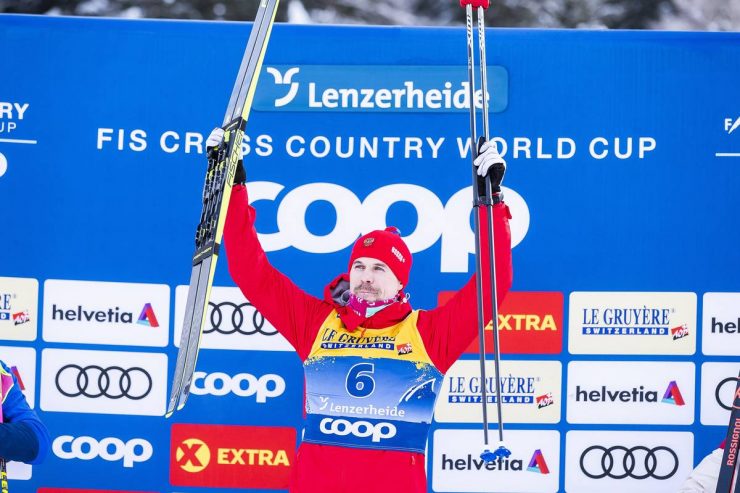
Rising to the top, Sergey Ustiugov takes the win in Stage 3 of the 2019/2020 Tour de Ski in Toblach, Italy. (Photo: NordicFocus)
New day, new venue, almost a new decade. The 2019/2020 Tour de Ski continued in Toblach, Italy with a 15-kilometer interval start skate. In the war of attrition that is the tour, the first stages set the tone. Hopefuls for the overall win seek to establish their position near the top without expending too much energy to hold up for the long haul.
We are now in the meat and potatoes of the tour. Three consecutive distance races, interrupted by one travel day. There are no bonus seconds on the line in the next two stages, meaning athletes need to fight for every second solely with their own grit.
Sergey Ustiugov (RUS) flies to his second stage win during the 15-kilometer skate in Toblach, Italy. (Photo: NordicFocus)
Racing midway through the seeded group in bib 44, Russia’s Sergey Ustiugov took off on Stage 3, setting the fastest time at each checkpoint to lead wire-to-wire. But his position in the leader chair was insecure until the remainder of the seeded men had their shot.
Wearing the highest numbered bib in the seeded group as the overall tour leader, Klæbo would have information on how he was matching up with Ustiugov at each checkpoint, informing him on whether he needed to work harder or lay off the gas. After winning a 60-second time bonus in the sprint, Klæbo had a cushion of 34 seconds over Ustiugov to work with. Victory in stage three was not imperative, but it would be important to keep the Russian within that margin.
In the first 5 k, it looked like this was how the story would play out. Ustiugov’s teammate Alexander Bolshunov, who trailed Klæbo by 32 seconds, nearly matched the pace setter. Klæbo trailed by six seconds, followed by three of his teammates in the next ten seconds: Hans Christer Holund, Simen Hegstad Krüger, and Pål Golberg. Each of these men is accomplished in distance racing.
Johannes Høsflot Klæbo falls flat in his attempt to keep the leader bib in Stage 3 of the 2019/2020 Tour de Ski. (Photo: NordicFocus)
On his way to a second place finish, Alexander Bolshunov consistently performs in Stage 3 of the 2019/2020 Tour de Ski. (Photo: NordicFocus)
However, things quickly began to change. Ustiugov’s splits became untouchable, and the Norwegian stronghold began to crumble. By the 10 k mark, his time was over 15 seconds ahead the next skier, and Klæbo had fallen 40 seconds behind into 15th. Ustiugov had the race locked up.
Sergey Ustiugov (RUS) locks eyes on his second stage win during the 15-kilometer skate in Toblach, Italy. (Photo: NordicFocus)
As the remainder of the seeded group made their way through the finish, Ustiugov remained on top by a large margin. His 23-year-old teammate Ivan Yakimushkin, who had not landed in the top 30 in either of the first two stages of the tour, worked his way into second place (+22.6). Yakimushkin was 43rd in the 15 k in Lenzerheide and qualified in 49th in the sprint, leaving him ranked 47th overall.
Sliding his boot across the line in unmatchable time, Sergey Ustiugov takes the win in Stage 3 of the 2019/2020 Tour de Ski in Toblach, Italy. (Photo: NordicFocus)
Rising to the top, Sergey Ustiugov takes the win in Stage 3 of the 2019/2020 Tour de Ski in Toblach, Italy. (Photo: NordicFocus)
Prior to the tour, Yakimushkin was a member of the Russian relay team that won the event in Lillehammer earlier this month and posted a top-10 in the distance classic race in Ruka.
Bolshunov, who was also born in 1996, took third 29 seconds back. Currently the top-ranked distance skier on the World Cup, Bolshunov has raced consistently in the tour: third in the first stage, and eighth in the second.
The all-Russian men’s podium of the 15-kilometer freestyle event in Stage 3 of the 2019/2020 Tour de Ski in Toblach, Italy. Sergey Ustiugov (center) was the clear winner over Ivan Yakimushkin (left), and Alexander Bolshunov (right). (Photo: NordicFocus)
In addition to sweeping the podium, Russia took three additional spots in the top 10, with Artem Maltsev, Andrey Melnichenko, and Denis Spitzov finishing 5th, 6th, and 10th, respectively.
Looking frustrated, Klæbo fell back to 17th (+1:11.4) by the finish, well-outside the margin he had to work with.
Johannes Høsflot Klæbo grimaces after a disappointing performance in the 15-kilometer freestyle event in Stage 3 of the 2019/2020 Tour de Ski in Toblach, Italy. (Photo: NordicFocus)
He was not the only Norwegian to struggle after the 5 k mark. Goldberg fell from 8th to 60th, and Krüger from 6th down to 22nd. Holund was the only Norwegian to maintain his top-10 position throughout the race, finishing 5th. Sjur Røthe also worked his way into 8th.
Though he leads the point standings, Johannes Høsflot Klæbo hides the usual toothy smile after a disappointing performance in the 15-kilometer freestyle event in Stage 3 of the 2019/2020 Tour de Ski in Toblach, Italy. (Photo: NordicFocus)
Though he still leads the point standings, Klæbo is now 37 seconds in the hole for the overall, sitting in 3rd place. He faces a pursuit-start classic tomorrow and a mass start classic on Friday. Presuming the time bonuses are still available in the mass start, he will have the opportunity to earn back time there and also in the classic sprint on Saturday.
Ustiugov’s performance bumped him into the overall lead with Bolshunov 27 seconds behind in second place. Nothing is out of reach for these three men. Holund and Maltzev round out the top five, trailing by just over 1:20.
As was seen in the final climb up the Alpe Cermis last year, Ustiugov has the upper hand over the Norwegian. Klæbo will need to rebound in time to create a significant gap before the final stage if he hopes to repeat his victory.
For the Americans, David Norris was again the top-ranked distance skier, finishing 51st (+2:22.6). Kevin Bolger finished 60th (+3:04.0), followed by Logan Hanneman in 73rd (+3:46.0).
In a post-race call, Matt Whitcomb provided insight into the men’s race. He also explains his approach counseling athletes about races in which athletes may not be set up to excel.
Post-race interview with Matt Whitcomb.
David Norris skis to 51st, the top American finish in Stage 3 of the 2019/2020 Tour de Ski in Toblach, Italy. (Photo: NordicFocus)
Heading into three classic races, Whitcomb explained that the techs are feeling confident in ski selection and waxing. Many K’s have been logged to ensure the American skis are ready to compete.
Post-race interview with Matt Whitcomb regarding ski testing.
With lickety-split snow and a two-lap course lined with fans, Stage 2 of the Tour de Ski (TdS) in Lenzerheide, Switzerland, a 1.5-kilometer skate sprint, sent a few ripples through the field, but solidified Norway’s Johannes Høsflot Klæbo as the TdS front runner.
Yesterday, Klæbo, in second place, ceded little time to two of his main rivals for the overall, Russians Sergey Ustiugov, who won Saturday’s mass start skate, and Alexander Bolshunov, who placed third.
Sprint courses are the real canvas for Klæbo. With half of Sunday’s course splashed in sunshine while the other sunken in deep shadows, Klæbo was able to use his tactical smarts and his explosive finish to conserve energy, pounce when it mattered, and take the win. Which, it so happens, came with a plentiful stash of time in a 60-second time bonus.
Johannes Høsflot Klæbo sprinting to the Stage 2 TdS win. (Photo: NordicFocus)
Klæbo began the day qualifying in first with a time of 2:44.64. Nearly matching his pace was Italy’s prayer for skate sprint salvation, Federico Pellegrino, who punched the clock in 2:45.84.
The duo went 1-2, Klæbo then Pellegrino, in the first quarterfinal which allowed the pair ample time to rest prior to the semis. In the first semi, it again was Klæbo-Pellegrino, 1-2 to advance.
The skate sprint powerhouses: Federico Pellegrino (ITA) and Norway’s Johannes Høsflot Klæbo (NOR) during Stage 2 of the 2019-2020 TdS. (Photo: NordicFocus)
The men’s final featured Klaebo, Pellegrino, Richard Jouve of France, Pål Golberg of Norway, Russia’s Gleb Retivykh, and Johan Haeggstroem of Sweden. Jouve, who qualified in 13th, and advanced after placing second and first respectively in his quarterfinal and semi, went out in the final with a statement as he tried to secure his first career World Cup win.
Jouve went to the front immediately after leaving the start gates. The pace nothing too tepid, more of a control move to keep a potential podium in sight amidst the attacking prowess of Klæbo and Pellegrino.
A minute into the final, Jouve pushed along the shaded back straight to produce a line of six skiers – Klæbo in third, Pellegrino in fourth. With the sweeping left-hand turn which returned skiers to sunshine and the main stadium, the pace took on a this-is-for-real tempo. Jouve maintained his position upfront as they climbed out of the stadium. Klæbo sat back, several feet to the right of Jouve, safely out of traffic.
Richard Jouve of France placed third in Stage 2 of the TdS in Lenzerheide, Switzerland. (Photo: NordicFocus)
On the long descending straight on the backside of the course, just before their second time through the sweeping left back into sunshine, Pellegrino lets his skis glide him into a position behind Jouve. Klæbo kept wide and outside as they rounded the corner into the final straight.
Midway through the turn, Klæbo was textbook sprint wunderkind: he boosted ahead with a quick-turnover but equally powerful V2 to seal it. He won in 2:55.33. Pellegrino, who stuck in Klæbo’s draft down the straight, pulled past Jouve to take second (+0.35). Jouve was third (+0.57).
Hunting the finish line – Norway’s Johannes Høsflot Klæbo during Stage 2 of the 2019-2020 TdS. (Photo: NordicFocus)
With the Stage 2 win, Klæbo earned that aforementioned 60-second time bonus, and the TdS overall lead. His total time after two stages rests at 35:07. He sits 32 seconds ahead of Russia’s Bolshunov, who is second in the overall after placing eighth in the sprint, earning him a 30 second time bonus. Ustiugov, placed 11th in the sprint (24 second time bonus) and is positioned fifth overall at 34 seconds back.
Both Bolshunov and Ustiugov stayed at the front of their semi for the first lap. That semi also featured Klæbo and Pellegrino. Bolshunov faded to fourth as the second lap ensued, while Ustiugov maintained his spot at the sharp end. Down the home stretch, they were swallowed into the Klæbo-Pellegrino maw.
Alexander Bolshunov (RUS) pushing the pace while chased by Federico Pellegrino (ITA), Norway’s Johannes Høsflot Klæbo (NOR), and France’s Renaud Jay during the men’s TdS Stage 2 skate sprint in Lenzerheide, Switzerland. (Photo: NordicFocus)
For the U.S. men, two standout qualifiers marked a successful day. Logan Hanneman qualified in 10th (+4.56) and Kevin Bolger in 12th (+4.72).
Hanneman finished 21st for a career-best World Cup result. He placed fifth in the fourth quarterfinal after getting hung up in a crash as Slovenia’s Miha Simenc and Norway’s Jan Thomas Jenssen tangled a meter ahead.
“I am quite happy with the day, even though it ended with a crash,” Hanneman emailed. “The qualifier was definitely the highlight. I honestly didn’t feel that great, so I was a little bit worried when I hit the hill on the first lap. But then I just tried to ski really big when I lapped through, abs apparently I was going faster than I thought I was.
“In the heat, everything was going well, and I was set up for a good position into the final downhill, however on the corner just after the short steep climb, the Norwegian and Slovenian came in from the outside, and collided with one another. I was directly to the inside of them and a little behind, so I had nowhere to go but to crash into them.
So it goes I suppose, but I was getting excited for the final push into the finish.
“My plan for the next few days is really to race as hard as I can in the distance races. They are not my strong suit, and I would really like to make it to the end of the Tour, so keeping within the time-back requirement would be awesome. So we will just take one at a time and see how they unfold!”
Bolger placed fifth in the third quarterfinal to place 22nd overall in the sprint.
Logan Hanneman placed 21st during the Stage 2 TdS skate sprint for a career best World Cup result. (Photo: NordicFocus)
Kevin Bolger placed 22nd overall in the TdS Stage 2 skate sprint in Lenzerheide, Switzerland. (Photo: Nordic Focus)
Racing continues for the men on Tuesday with an 15 k interval start skate in Tobalch, Italy. Monday is a rest day.
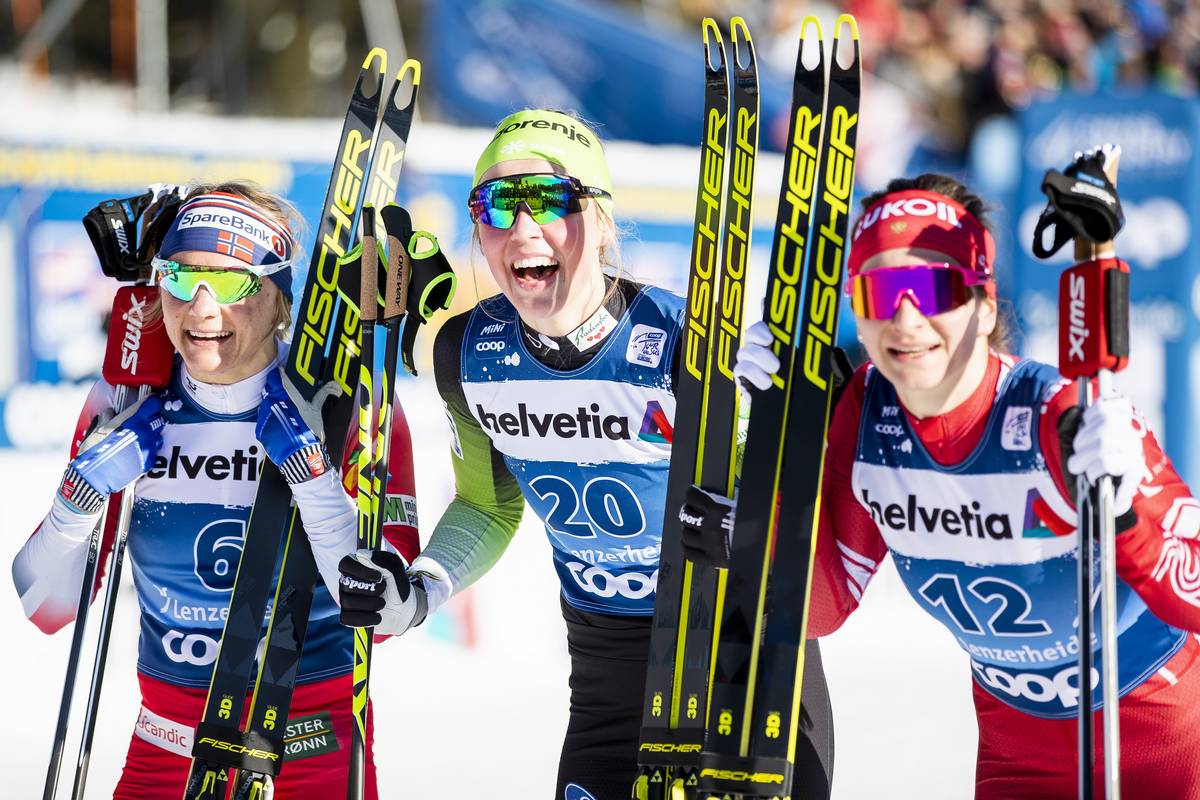
The women’s podium of Stage 2 of the 2019/2020 Tour de Ski. Anamarija Lampic of Slovenia (center) took first ahead of Norway’s Maiken Caspersen Falla (left) and Russia’s Natalia Nepryaeva (right). (Photo: NordicFocus)
Day two of the Tour de Ski offered the American women the Sisyphean task of earning back time after a miss on ski and wax selection in Stage 1 prevented them from performing to their capability. This was particularly so for Jessie Diggins, a favorite for the overall tour podium who finished the first stage in 29th 1:20 behind Norway’s pace-setting Theresa Johaug. Her teammate Sadie Maubet Bjornsen, also a top all-arounder, was in the same position. Maubet Bjornsen ended Stage 1 in 30th.
The initial run of the TdS in Lenzerheide, Switzerland is about not digging yourself into a time-deficit hole. A podium is nice, a win even better. But the primary objective is to not lose too much time to the leaders. At the start of Stage 2, Diggins and Bjornsen were in that hole.
Backs against the wall and a significant boulder to push ahead of them, the two would need to make it into the final of the 1.5-kilometer freestyle sprint to make significant headway on the tour leaders. A podium finish would be ideal. Since time differentials in sprint racing are small, it would be imperative to earn bonus seconds based on their final standings: 60 seconds for a win sliding down to 42 seconds for sixth.
As Johaug, the overall leader heading into the second stage, was not a podium threat in the sprint event, it was almost-certain that she would lose time on her chasers, increasing the opportunity for the Americans and other overall podium hopefuls.
Knowing the task at hand, Diggins bravely faced the new day with resolve.
“Now I get to focus on doing what I love best: fighting my way back,” she wrote on Instagram.
Julia Kern powers to a seventh place result in qualification during Stage 2 of the 2019/2020 Tour de Ski. (Photo: NordicFocus)
Surely enough, four Americans landed in the top ten in qualification: Sophie Caldwell in 1st, Diggins 3rd, Maubet Bjornsen 4th, and Julia Kern 5th. Rosie Brennan also qualified for the heats in 28th. The final member of the American squad, Katharine Ogden, finished 60th in qualification.
And on to the quarters five Americans went. With the momentum and energy of the team, the boulder budged.
Racing in the lightning-fast first heat of the rounds, Diggins fought at the front with leaders Maiken Caspersen Falla (NOR), Anamarija Lampic (SLO), and Anne Kjersti Kalvå (NOR). Last year, Falla was the ranked second overall in the World Cup sprint standings and Lampic was ranked 6th.
Diggins was unafraid to push the pace and spend time at the front. She showed her balance on her feet as she took on the fast descents and icy corners of the course, holding her position. In the final straightaway, Falla and Lampic took off from the front, leaving Kalvå and Diggins fighting for lucky loser positions. With the fate of a fast heat and their stick-to-the front pacing — their times would have won any other round — Kalvå and Diggins easily advanced to the next round.
Charging to the finish in the second heat of the quarter-final in Stage 2 of the 2019/2020 Tour de Ski. Jonna Sundling of Sweden holds the lead on the far left with Rosie Brennan tucked into the back left. (Photo: NordicFocus)
The Americans continued to shine in the rounds. In the second heat, Brennan mixed it up with the leaders but lost contact with the pack, finishing fifth in her heat. In the slowest third heat, Caldwell patiently followed the pedestrian pace, then showed her top gears in the final sprint to win the round. Maubet Bjornsen took second in the fourth heat to advance, and Julia Kern took third in a three-way photo finish for the top spot in the final heat.
Three Americans advance to the semis.
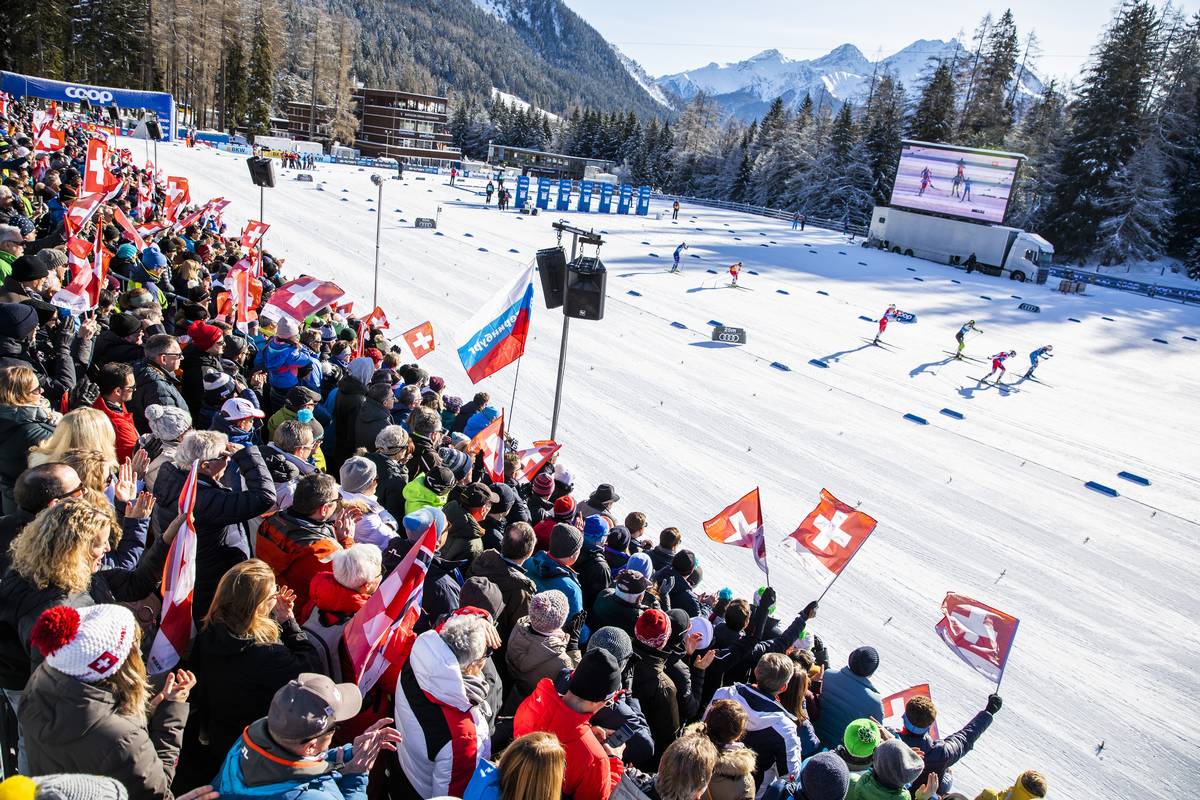
Adrenaline surges through the crowd in spectacular Lenzerheide, Switzerland during Stage 2 of the Tour de Ski. (Photo: NordicFocus)
Again, the first round of the semis was stacked with Falla, Lampic, Diggins, and Caldwell battling with Natalia Nepryaeva of Russia and Jonna Sundling of Sweden. Showing her grit, Diggins won the heat for an automatic spot in the finals, while Caldwell finished fifth. The spread of finishers in the heat was less than one second. Maubet Bjornsen finished second in heat 2, also advancing to the final.
Two Americans in the final. The pieces were coming together.
After qualifying in first and winning the first round of the quarters, Sophie Caldwell was knocked out in a close finish in the semifinals of Stage 2 of the Tour de Ski. (Photo: NordicFocus)
Sadie Maubet Bjornsen marks Maiken Caspersen Falla (NOR) and Anamarija Lampic (SLO) during the final round of the 1.5-kilometer freestyle sprint in Stage 2 of the 2019/2020 Tour de Ski. (Photo: NordicFocus)
Diggins kept herself in contention for a podium spot throughout the final, matching each of her opponents moves, never losing contact and often controlling the pace from the lead. Maubet Bjornsen held strong in the middle of the pack.
Leaving nothing on the course, Diggins jump skated each of the rollers, powering in a no pole skate into a tuck on the descent. She raced with grit over every meter.
Rounding the final curve into the straightaway, she sat in fourth behind Lampic, Falla, and Nepryaeva who had begun to accelerate off the front. Matching their tempo but unable to close the gap, Diggins crossed the line in fourth, doubling over as she gasped for air.
Racing with the fire for which she is known, Jessie Diggins gasps for air after taking 4th in Stage 2 of the 2019/2020 Tour de Ski. (Photo: NordicFocus)
In a close finish with Falla, Lampic took the win in 3:06.2 with the Norwegian 0.03 seconds behind her. Nepryaeva finished third (+0.47), with a half second gap to Diggins. After falling off the lead pack, Maubet Bjornsen finished 5th (+4.78), and Tiril Udnes Weng sixth (+5.29).
By centimeters, Anamarija Lampic takes the win in Stage 2 of the 2019/2020 Tour de Ski ahead of Maiken Caspersen Falla (left) and Natalia Nepyaeva (right). (Photo: NordicFocus)
Because they were quickly on the road to the next venue, the American women were unavailable for phone calls and instead chose to send comments on their performance via email.
“Today was a great day,” wrote Diggins. “I was so proud of the entire team for staying positive, rebounding from yesterday and for keeping it super professional; nobody was mad, everyone just learned the lessons from the skis that day and then moved onwards. For me, it was important to just focus on what I can control and have confidence in my fitness that I knew was there.”
In response to a query on handling the pressure of offsetting her deficit in the overall standings, Diggins offered a process-oriented response.
“It was definitely crucial to my tour to make the finals, but instead of focusing on the outcome I focused on skiing every step of the way as well as I could!”
Jessie Diggins smiles as she walks away from a 4th place finish in Stage 2 of the 2019/2020 Tour de Ski. (Photo: NordicFocus)
“Now I’m looking forward to Toblach — a venue with many many positive memories for me!” she concluded.
Maubet Bjornsen also remarked on the positive energy taking vengeance on the first stage provided. She explained that with “impossibly slow skis”, it felt like a success to lose only 1:20 to the leaders. Maubet Bjornsen added that it was not just the athletes looking for a do-over in Stage 2.
“The tech team worked extra hard to find a solution and our entire team came back strong today! Although it was an imperfect start, positivity and constantly fighting are the two keys to this incredibly exciting event. I sometimes think the winners of the TDS are not the most physically fit people, but the most mentally tough.”
Like Diggins, she too is eager for a second go in the next round of racing in Stage 3 and hopes to continue whittling down her gap to the overall tour leaders.
“I look forward to the next stop in Toblach for another attempt at a 10 k skate, hopefully with an equal revenge as today. I have some precious seconds to try to win back still. One day at a time.”
She finished by saying that they are driving away from Lenzerheide “with some tired legs, but rejuvenated souls!”
Seeking revenge, Sadie Maubet Bjornsen flies to a fourth place finish in qualification during Stage 2 of the 2019/2020 Tour de Ski. (Photo: NordicFocus)
Overall Tour Standings
Noteworthy for the overall standings, tour leader after Stage 1 Therese Johaug qualified in 21st and raced in the speedy first heat with the eventual winner. She finished in fifth, just behind Diggins. Had she raced in any other round, the distance phenom, who is not known for her sprinting, would have advanced as well. Her result put her in 23rd for the day, earning six bonus seconds.
Though she slid back to third in the overall rankings, this result maintained her threat for the overall tour victory. Johaug is only five seconds out of first place heading into three distance stages where she will have the opportunity to create a gap over the field before the Stage 6 sprint. In the fifth stage, a mass start classic in Val di Fiemme, Italy, she will also have the opportunity to earn bonus seconds at various checkpoints, giving her further insurance on the following sprint day.
After a third place finish in Stage 2, Natalia Nepryaeva takes over the overall leader bib in the 2019/2020 Tour de Ski. (Photo: NordicFocus)
Now wearing the leader’s bib, Nepryeava’s sprint podium moved her into the lead with a cumulative time of 31:18. She finished sixth in the first stage. Demonstrating her potential in the competition, Nepryaeva dueled with Norway’s Ingvild Flugstad Østberg throughout the 2018/2019 tour to finish second overall. The Russian won the first distance stage and took second in the final four stages.
Lampic, who finished 50 seconds behind Johaug for 20th on Saturday’s distance race, moved into third overall, one second behind Nepyraeva. Last year, she finished 22nd in the tour.
Slovenia’s Anamarija Lampic smiles in delight after winning the second stage of the 2019/2020 Tour de Ski. (Photo: NordicFocus)
Posting consistent results in the first two stages, Tiril Udnes Weng’s 7th in Stage 1 and 6th in the sprint put her in fifth overall, followed by her cousin Heidi Weng who was second in the first stage but 32nd in qualification leaving her out of the rounds.
Cutting their time back in half, Diggins sits in 11th place, 39 seconds behind Nepryaeva, followed by Maubet Bjornsen in 12th (+41). The overall podium continues to be up for grabs.
Racing continues Tuesday December 31st in Toblach, Italy with 10 k freestyle, followed by a 10 k pursuit start classic on Wednesday.
Stage 1 of the 2019-2020 Tour de Ski is final. With two distinct shows in the Lenzerheide, Switzerland men’s and women’s mass start races, the seven-stage TdS narrative has the intro chapter written. Therese Johaug for Norway looks prepped for the distance race sweep, whereas the men’s side has several skiers playing for keeps. On second thought, maybe it’s not that simple after all. They’ve got six stages to go.
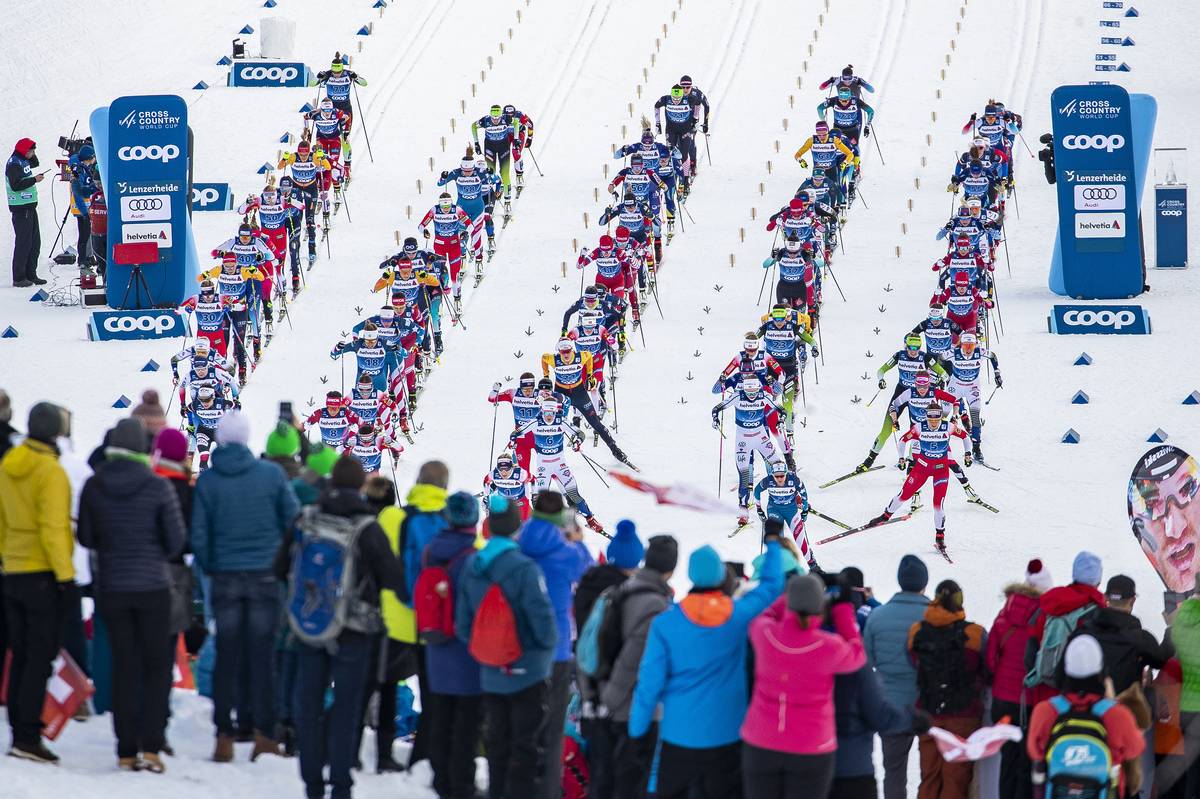
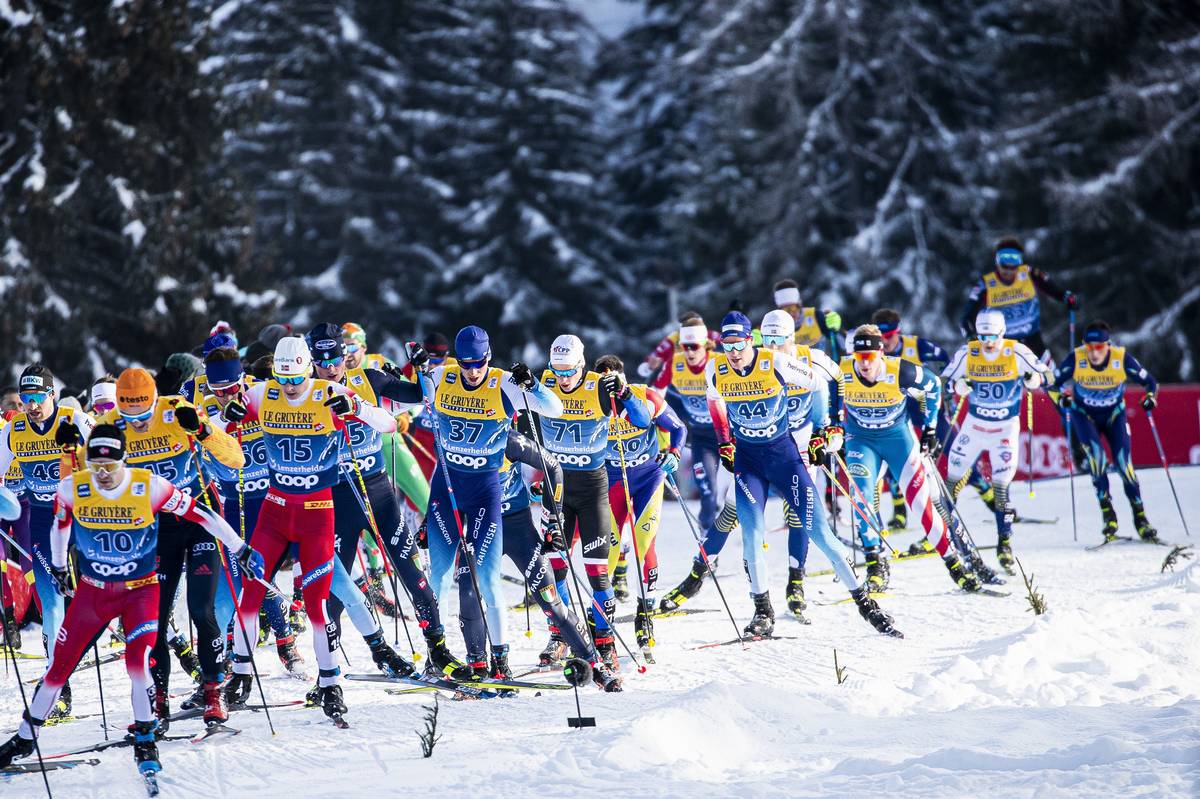
Quite literally, a massive mass start on the World Cup. Stage 1 of the 2019-2020 Tour de Ski in Lenzerheide, Switzerland. (Photo: NirdicFocus)
Ustiugov claims his 8th stage win in the opening event of the 2019/2020 Tour de Ski. (Photo: NordicFocus)
The starting corral was blocked by a wall of red before the start of the 15-kilometer mass start freestyle in Lenzerheide, Switzerland. Of the top ten ranked athletes, eight hailed from either Norway or Russia, interrupted only by Iivo Niskanen of Finland and Lucas Chanavat of France.
Johannes Høsflot Klæbo thanks his supporters before climbing into the second spot on the podium after the first stage of the 2019/2020 Tour de Ski. (Photo: NordicFocus)
Front and center was last year’s victor Johannes Høsflot Klæbo. He became the youngest Tour de Ski Champion at 22 years of age after holding off Russia’s Sergey Ustiugov who was gaining on the Norwegian throughout the final climb up the Alpe Cermis. It was clear in the final meters that there was no showmanship or gamesmanship in this performance; the young star was fully spent as he collapsed over the line.
Now an aged and wizened 23-year-old working on his tactics and gears in distance racing, Klæbo aspires to become the second man in history to win consecutive tours. Swiss athlete Dario Cologna did this in 2011 and 2012.
Klæbo is not a lock for this achievement — today’s opening stage made that abundantly clear. He will need to hold off the likes of Sergey Ustiugov and Alexander Bolchunov (RUS), Niskanen, Emil Iversen (NOR) and an otherwise deep field all vying for the same goal.
“I will try my best and I will count [my time] after the last day,” Klæbo told FIS during a pre-race press conference.
With the starting pistol marking the start of the nascent tour, the men began soaring around the course, through snow laden pine forest in front of high mountains emerging from their wreath of snow.
For the first 10 k, the field held strong in a long train. The top men, who stemmed from the first row of the start line, regularly exchanged the lead and the top 40 were separated by 10 seconds. Though the pace began to accelerate, the top ten were only spread by three seconds with 1.5 k to go.
A dense pack of skiers during the first stage of the 2019/2020 Tour de Ski, a 15-kilometer mass start freestyle. Logan Hanneman can be found on the right side of the image wearing bib 85. (Photo: NordicFocus)
Moves and countermoves. With 1 k to go, Ustiugov took charge. He rocketed off the front to create a gap to the lead pack. His teammate Bolshunov was three seconds back, along with Cologne, Iversen, Klæbo, and their Norwegian teammates Simen Hegstad Krüger and Sjur Røthe.
Ustiugov managed to maintain his gap and flew through the final straightaway in a confident V2. In the screen behind him was a pack of men whose final standings were far less certain. Klæbo and Bolshunov were dueling tête-à-tête in a sprint to the finish, sliding their boots over the line in sync for a photo finish. It was decided that Klæbo edged out his competitor for second, though he and Bolshunov will both enter the second stage of the tour four seconds behind Ustiugov.
Johannes Høsflot Klæbo (NOR) and Alexander Bolshunov (RUS) slide across the line in a photo finish at the end of the first stage of the Tour de Ski. (Photo: NordicFocus)
Iversen surged for 4th (+7.2) ahead of his countryman Martin Løwstrøm Nyenget (+8.6) who bested Tour de Ski veteran Cologna, Hans Christer Holund, Jan Thomas Jenssen, and Sjur Røthe in a five-way photo finish. Finishing in the order listed, the five men were separated by a margin of 0.4 seconds. Krüger rounded out the top ten one second later (+10.0).
Dario Cologna (bib 24) finishes amongst a herd of men vying for position at the end of Stage 1 of the 2019/2020 Tour de Ski, a 15-kilometer mass start skate in Lenzerheide, Switzerland. (Photo: NordicFocus)
“It was a really good performance and the shape was okay,” Ustiugov told FIS through a translator at the finish. “It was for sure a pleasure to win the first stage and I wish to show the same results on the next stages. Big thanks to Russian fans because it’s a really big pleasure to hear Russian people [cheering] here in Switzerland. It’s great.”
Russia’s Sergey Ustiugov celebrates his victory after the first stage of the 2019/2020 Tour de Ski, a 15-kilometer mass start skate. (Photo: NordicFocus)
Today’s victory marks the Russian’s eighth win in a TdS stage, advancing him to the second most behind Petter Northug who has 13 wins. The winner of the 2016/2017 TdS, Ustiugov has reached the overall podium in three of his last four rounds, only missing the final TdS podium in the 2017/2018 tour where he withdrew after the 5th stage. The Russian also won the first distance stage of last year’s TdS.
The men’s podium of the first stage of the 2019/2020 Tour de Ski, a 15-kilometer mass start skate in Lenzerheide, Switzerland. Sergey Ustiugov (RUS) took the win over Johannes Høsflot Klæbo (NOR) and Alexander Bolshunov (RUS) who were second and third, respectively, in a photo finish. (Photo: NordicFocus)
Three Americans started in Lenzerheide. David Norris finished as the top ranked American in 58th (+1:11.2). Kevin Bolger finished 64th (+1:35.0), followed by fellow Logan Hanneman in 69th (+1:42.1). Simi Hamilton was slated to start, but withdrew from the TdS due to a pulled muscle in his groin.
For the first nine kilometers, Norris hovered on the cusp of the top-30. After the race, Matt Whitcomb explained the energy-expenditure challenges of racing in this position, along with the strategy of sprint specialists Bolger and Hanneman.
Post-race interview with Matt Whitcomb on men’s performance.
“This was a fun mass start – fast and flowing,” wrote Norris explained an email after the race. “For the first 12km or so I felt really comfortable in the group. I tried to ski relaxed and avoid any of the chaotic crashes and tangles that seemed to occur each lap. With about 2 km to the finish I felt great and my skis were running well, but all of the sudden I bonked incredibly hard – got tunnel vision and struggled to avoid tripping on myself. It was a tough way to finish the race, but I’m optimistic I have better days ahead in this tour.”
Swiss flags flying against a breathtaking backdrop. Wearing bib 77, Kevin Bolger can be found at the center. (Photo: NordicFocus)
Norway’s Therese Johaug crossing the finish in first place during the first stage of the TdS in Lenzerheide, Switzerland. (Photo: NordicFocus)
Saturday marked the start of the 14th Tour de Ski in Lenzerheide, Switzerland. Forgoing the traditional prologue start to determine time back to the leader, organizers threw in a spicy 11-kilometer mass start freestyle. Easy to follow for fans, maybe not so much for those following in the wake of Norway’s Therese Johaug.
The scene was a Swiss winter ideal: plentiful snow, portions of the course dappled in sunlight, others shrouded in a drifting-in and drifting-out ground fog. Thousands of fans lined the course proving in the right venue, on a festive day, organizing committees can throw a cross-country party.
Quite literally, a massive mass start on the World Cup. Stage 1 of the 2019-2020 Tour de Ski in Lenzerheide, Switzerland. (Photo: NirdicFocus)
Crowds in full force during the first stage of 2019-2020 in Lenzerheide, Switzerland. (Photo: NordicFocus)
The party jumped into Swiss-cowbell-ringing high gear when the starter’s gun fired. The hot pace was palpable. It appeared no skier wanted to be left dangling too far from Johaug who pulled through to lead 1:20 into the race. Jessie Diggins and Sadie Maubet Bjornsen matched the pace upfront. But, by then, with roughly 1/10th of the race completed, the field was strung out. The vibe was clear: no matter what an athlete’s intent, they all were trying to minimize the hurt Johaug would inflict over the next 10 k.
We could exhaustively detail the splits and time back as the race unfolded. At moments it appeared Johaug was simply at a level where imagining a one minute gap across the finish line wasn’t outlandish. However, with each shot of Johaug churning her high-tempo technique or the on-course mics picking up her solitary but thoroughbred breathing, she was chased by a group just out of contact.
This was not a total runaway for Johaug.
Therese Johaug during Stage 1 of the 2019-2020 Tour de Ski in Lenzerheide, Switzerland. (Photo: NordicFocus)
Therese Johaug (NOR), Heidi Weng (NOR), Astrid Uhrenholdt Jacobsen (NOR), (l-r) during Stage 1 of the 2019-2020 Tour de Ski in Lenzerheide, Switzerland. (Photo: NordicFocus)
Therese Johaug during Stage 1 of the 2019-2020 Tour de Ski in Lenzerheide, Switzerland. (Photo: NordicFocus)
By 5.6 k, the front chase group had coalesced. Two skiers who had yet to compete on the World Cup this season, Sweden’s Ebba Andersson and Norway’s Ingvild Flugstad Østberg, proved racing into form wasn’t a necessity. They were joined by Norwegians Astrid Uhrenholdt Jacobsen, Heidi Weng, and Russia’s Natalia Nepryaeva.
During the three laps of the 3.3 k course, Jacobsen and Nepryeava fell off slightly. Weng, Andersson, and Østberg kept it interesting during this opening act of the TdS. At 8.6 k Joahug was nearly 19 seconds up on Østberg. By the finish, the chasers took a chunk of time out of Johaug’s lead.
Johaug won in 28:12.1, with Weng in second (+12.3), Andersson in third (+12.9), and Østberg fourth (+13.1). Jacobsen placed fifth (+24.1), and Nepryeava sixth (+40.1).
Ebba Andersson of Sweden on her way to third during the first stage of the 2019-2020 Tour de Ski. (Photo: NordicFocus)
Ebba Andersson (SWE), Ingvild Flugstad Østberg (NOR), Heidi Weng (NOR), (l-r) come into the finish during the Stage 11 k mass start skate in Lenzerheide, Switzerland. (Photo: NordicFocus)
“I was really surprised today, mass start in skating,” Johaug told FIS after the race. “In my mind, I think there would be other girls at the finish line. I had a really good day today. And my skis were perfect. I decided with my trainer and brother that on the first lap I didn’t go so fast, and out of the second lap I should speed up. And then I get a gap. I am so so happy. The mass start in 10 k, it is not my favorite distance so I am really surprised and really happy now.”
According to the FIS database, the last 10 k mass start skate Johaug contested was in 2016, prior to her ban for a positive doping test. In that 2016 Falun, Sweden race, she beat a second place Weng by only 8.8 seconds. (Johaug served an 18-month ban, returning to the World Cup in November of 2018.)
The U.S. women came into the race with formidable stats. Just this year, of the nine races contested prior to Saturday’s TdS Stage 1, including team events, there have been six U.S. podiums.
In Lenzerheide, at least in the early going for this TdS, the U.S. women fell momentarily away from their own high expectations. Rosie Brennan (USST) was the top-finisher in 20th (+59.8). Diggins (USST) placed 29th (+1:20.7) and Maubet Bjornsen (USST) 30th (+1:20.7).
Kerttu Niskanen (FIN), Tiril Udnes Weng (NOR), Rosie Brennan (USA), Delphine Claudel (FRA), (l-r), (l-r) on Satiurday’s first stage of the 2019-2020 Tour de Ski. (Photo: NordicFocus)
“Today was a bit of a mixed day,” Brennan emailed several media outlets. “Having missed the last two weekends of racing, I wasn’t quite sure where I was at, but I felt really good in the race and am really happy with my effort. We struggled a bit with our skis and I maybe wasted a bit too much energy trying to move up in places that didn’t make sense with the skis I had on my feet. The good news is that it was overall a very tight race so, despite less than perfect skis, I didn’t lose too much time in the overall and am still optimistic for the rest of the tour.”
Katharine Ogden (SMST2), in her first World Cup of the season, skied to 42nd (+2:03.0). Sophie Caldwell (USST) placed 46th (+2:23.7), and Julia Kern (USST) 57th (+3:02.6).
Jessie Diggins (USA), Charlotte Kalla (SWE), (l-r), (l-r) early on during Stage 1 of the 2019-2020 Tour de Ski. (Photo: NordicFocus)
During a post-race interview with U.S. World Cup Coach Matt Whitcomb, he was blunt when discussing the team’s lackluster skis. “When we saw them at about 3.5 k coming out of the stadium on the long gradual uphill, Sadie and Jessie just looked tired,” Whitcomb said. “And frankly they are not tired. They are in awesome shape. That’s when we knew something was wrong.”
World Cup Coach Matt Whitcomb’s post-race comments about the U.S. women’s team and lackluster skis
Whitcomb explained during the post-race call that the FIS asked coaches to vote on whether to include or eliminate Stage 1 time bonuses. Initially, Stage 1 was slated for time bonuses at 3.3 k and 6.6 k. However, with the prospect of a Johaug time-bonus sweep, teams voted to eliminate those bonuses for Saturday’s racing.
World Cup Coach Matt Whitcomb’s post-race comments about time bonuses for Stage 1
Racing continues in Lenzerheide tomorrow with a 1.5 k skate sprint for the women.
The Tour de Ski (TdS) is well into its teenage years. This year’s edition, the 14th, features three locales and the following races with a few minor new twists to excite this seasonal highlight of cross-country World Cup racing.
Lenzerheide, Switzerland (stages 1-2) Dec. 28, 29
Stage 1: 10/15 k freestyle mass start. A mass start initiates the TdS this year, that’s new. It replaces the timeworn prologue.
Stage 2: Skate sprint
Toblach, Italy (Stages 3-4) Dec. 31, Jan. 1
Stage 3: 10/15 k individual start skate
Stage 4: 10/15 k classic pursuit (the pursuit start position is based on the Dec. 31st skate race, not overall time).
Val di Fiemme, Italy (Stages 5-7) Jan. 3, 4, 5
Stage 5: 10/15 k mass start classic
Stage 6: Classic sprint
Stage 7: Final climb – mass start skate. The mass start on the Alpe Cermis is a new format.
Overall (time based) Standings
The TdS is relatively basic when it comes to determining the winner: it’s the skier with the shortest elapsed time over seven stages. In TdS edition’s past, traditionally that was the first athlete across the finish line atop the Cermis, as that has traditionally been a pursuit start format. This year, with a mass start on the final climb, it’s possible for the stage winner and the overall TdS champion to be different skiers.
If you are drilling down on an athlete’s overall time and their corresponding overall TdS rank, here’s how time bonuses come into play. “Bonus” seconds are on offer during the sprint and mass start stages (excluding the final climb). Bonus seconds are subtracted from an athlete’s race day time, and then the overall time — a cumulative time for stages raced — is calculated.
Sprints offer time bonuses for 1-30th place.
For mass starts, bonus seconds are up for grabs at intermediate points. Only the top-10 skiers through an intermediate point receive a time bonus. They receive 15, 12, 10, 8, 6, 5, 4, 3, 2 and 1 seconds, respectively.
Points Competition
Within the TdS, there is also a points competition. Less prestigious than the overall? Yes. But the points incentivize spicier racing as the top-three in the overall points standings receive a money prize. Below is a table detailing how and when points are acquired.
Just to be clear, these TdS points are different than World Cup points. World Cup points will be awarded after each stage and after the overall standings are finalized. World Cup points are used to determine the sprint, distance, and overall World Cup rankings.