From the FasterSkier archive — posts syndicated from athletes’ and coaches’ own blogs between 2004 and 2012, kept online as published. Current coverage is at fasterskier.com.

Tag: 2019 FIS Nordic World Ski Championships in Seefeld

  • Euphoric Victory for Sweden’s Nilsson and Dahlqvist in Classic Team Sprint; Diggins, Bjornsen 5th

    Euphoric Victory for Sweden’s Nilsson and Dahlqvist in Classic Team Sprint; Diggins, Bjornsen 5th

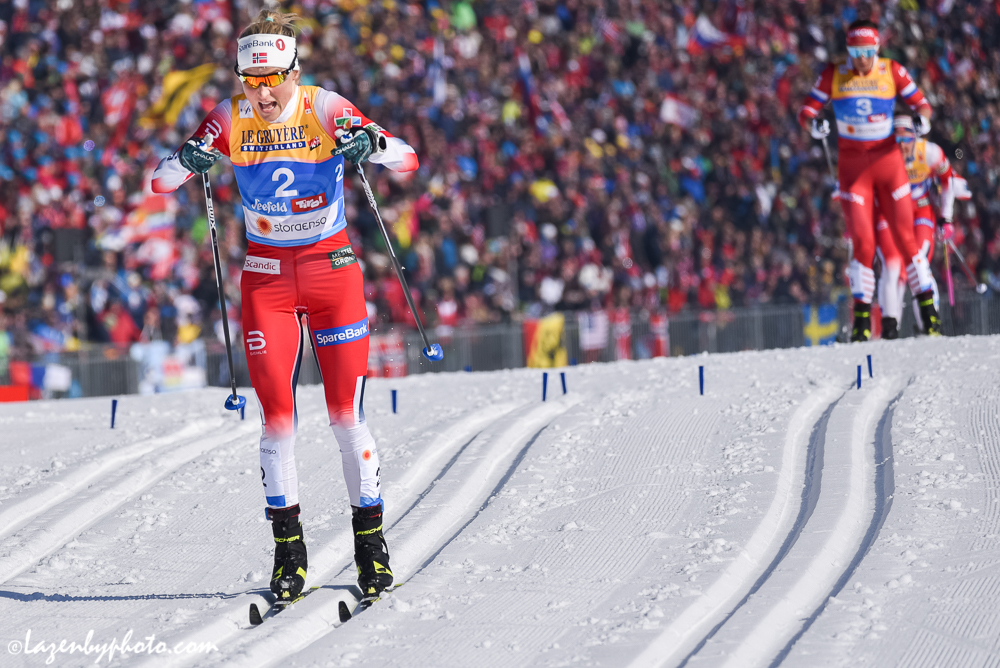
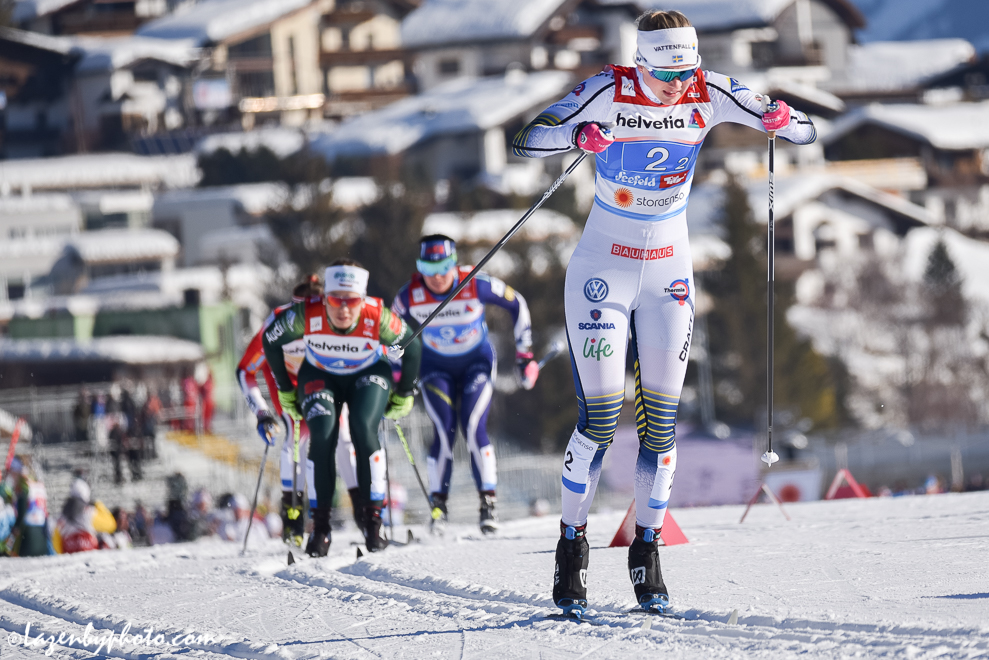
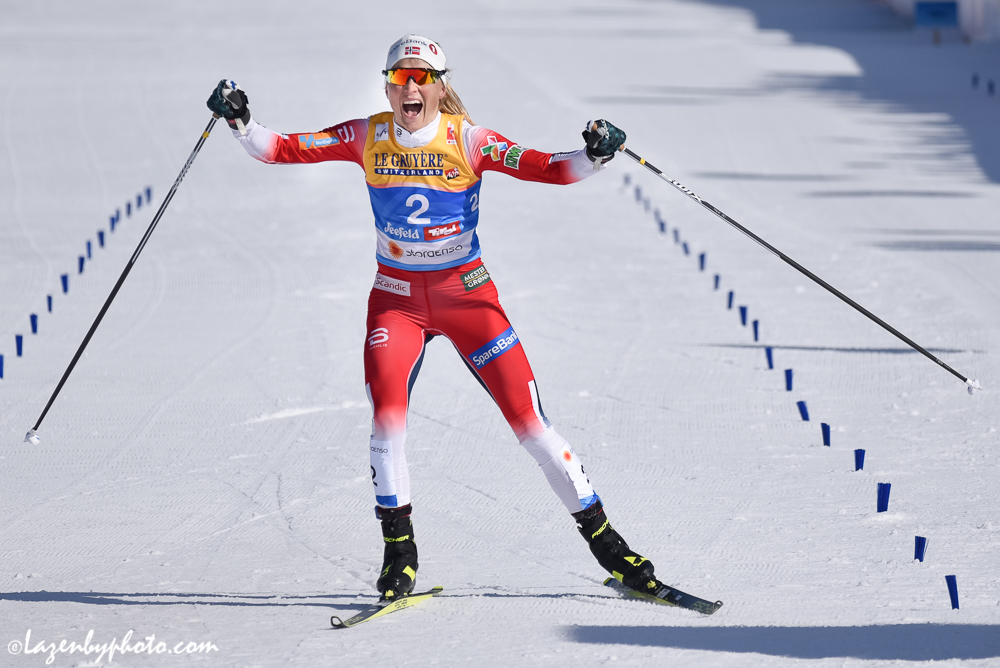
    Hips forward and drive…As clutch as they come – Sweden’s formidable Maja Dahlqvist (bib 2) during the women’s 6 x 1.2 k classic team sprint at the 2019 World Championship in Seefeld, Austria. (Photo: John Lazenby/lazenbyphoto.com)

    Icy tracks and a relatively flat course made for a tight race in Seefeld, Austria for the women’s 6 x 1.2-kilometer classic team sprint. Even in the final meters as the women charged up the last climb and double poled to the finish, the winner was not clear. In fact, the three fastest teams were within one second of one another. The resulting time difference between first and fifth place was less than the difference between the gold and silver medalist teams in Lahti, Finland in the 2017 World Ski Championships.

    A team sprint can often play out like a jack-in-the-box; in the first four legs, the women look calm and controlled, steadily winding up the tempo as the race progresses. The final two legs are explosive.

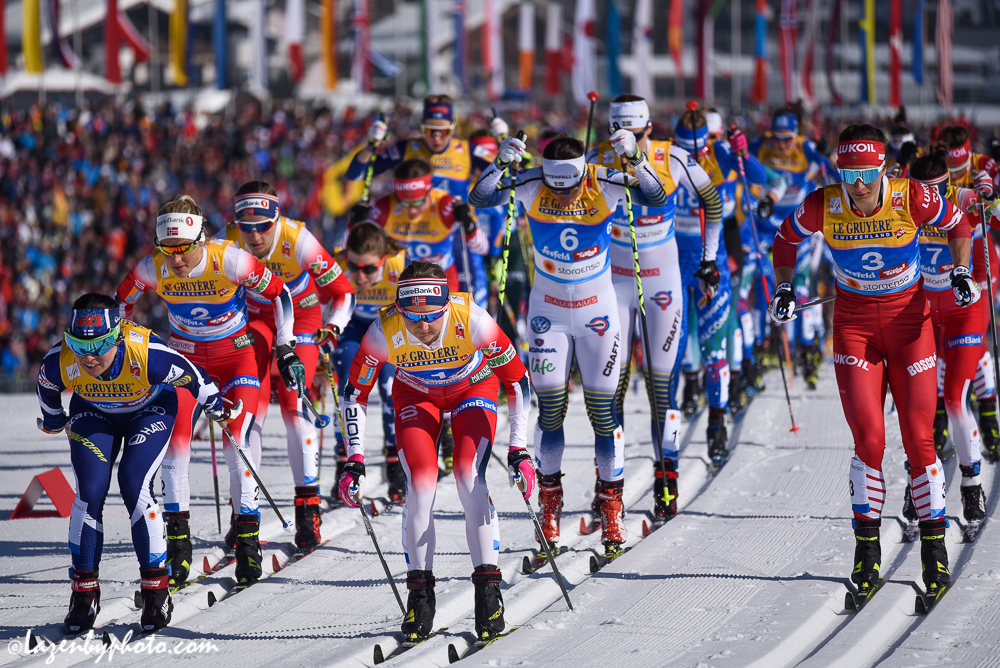
    This was the case today as Norway’s Maiken Caspersen Falla tagged her teammate Ingvild Flugstad Østberg for the last time amidst a pack of seven nations all within three seconds. Østberg powered through the course with a fiery purpose, trying to create a gap that would allow her and her teammate to repeat their victory in the event during the 2015 championship. Her move was matched by the teams from Sweden, Slovenia, and Russia, with Sadie Bjornsen of the United States just behind their tails.

    Russia’s Natalia Nepryeava challenged Østberg and took the lead before rounding a hairpin turn and descending in a tuck toward the stadium, but as she tagged her teammate, Yulia Belorukova, the Norwegians, Swedes, and Slovenes all remained less than 1.5 seconds back. Bjornsen tagged her partner Jessie Diggins in fifth only 2.7 behind.  
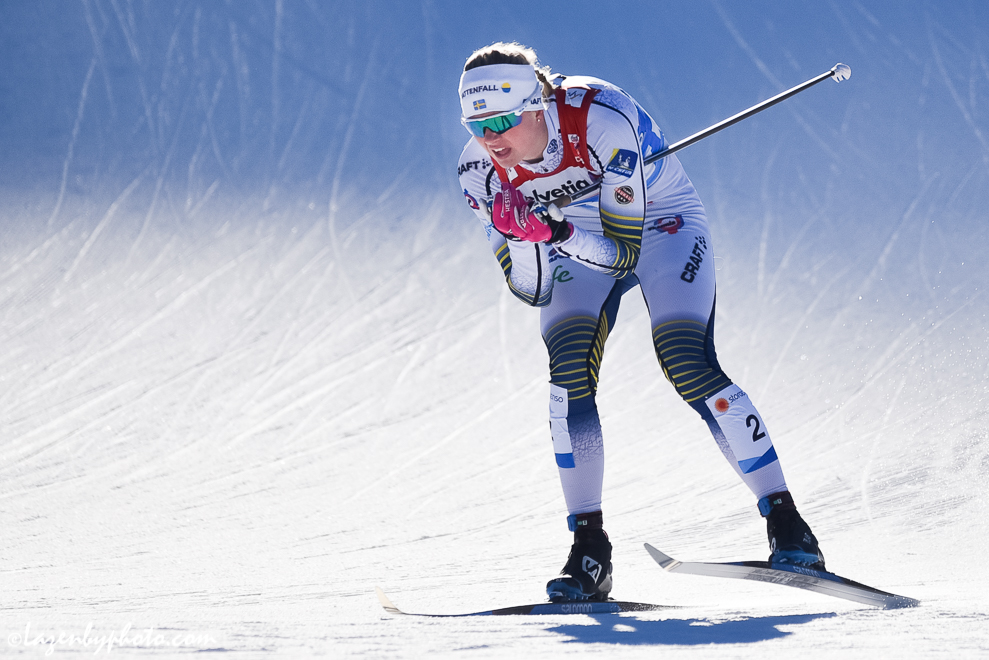
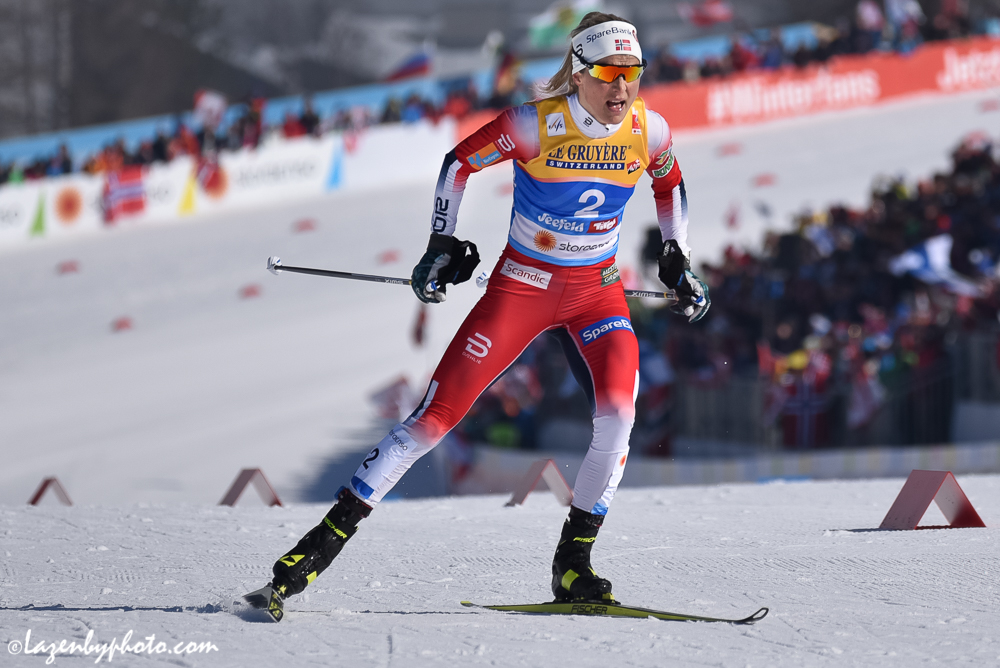
    Sweden’s Maja Dahlqvist during the women’s 6 x 1.2 k classic team sprint at the 2019 World Championship in Seefeld, Austria. (Photo: John Lazenby/lazenbyphoto.com)

    In the final lap, Falla charged to the front to take the lead for Norway. Maja Dahlqvist of Sweden and Anamarija Lampic of Slovenia went with her, as Belorukova began to fade a few meters behind. The lap seemed to dissolve in a heartbeat, as the four women found themselves rounding the last turn. Dahlqvist, who had been tucked in behind Falla, slingshot around her and into the lanes and began double poling rapidly to the finish. Falla could not match her pace, and as she lost touch with the Swede in the final meters, Lampic surged to seize silver.

    The gold medal team of Nilsson and Dahlqvist stopped the clock in a time of 15:14.93, with Slovenia’s Katja Visnar and Lampic just 0.37 seconds behind. Østberg and Falla took bronze (+0.60), followed by the Russians in fourth (+0.93), and the Americans in fifth (+2.79).

    “It feels really really really good,” Nilsson told the International Ski Federation (FIS) at the finish.

    “Really really good,” added Dahlqvist as the two laughed. “It was really tight today, but I felt strong in the end, so it was good.”

    The duo could not contain their excitement as they reflected on their narrow victory. They had already demonstrated their ability to excel on the course in Thursday’s individual skate sprint, but in the final Nilsson was unable to match Falla and a crash took Dahlqvist out of contention.

    “I felt really powerful today,” said Nilsson. “I like the course – it’s very fast and you have to be very focused and not let anyone pass you in the wrong places. When Maya crossed the finish line first it was like euphoria.”
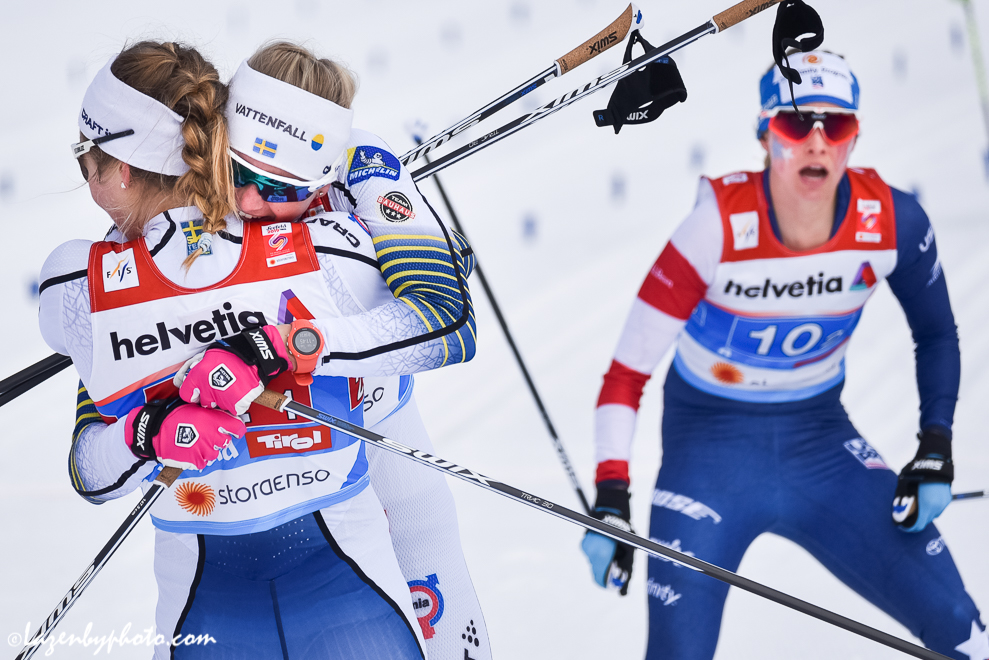
    Sweden’s winning duo –Maja Dahlqvist embracing teammate Stina Nilsson at the 2019 World Championships in Seefeld, Austria. (Photo: John Lazenby/lazenbyphoto.com)

    Today’s medals are the fifth in this World Championships for Sweden and the sixth for Norway. While Falla certainly hoped to add a third gold to her collection of team sprint medals, her bronze is her fourth medal in the event, making her the most decorated woman in the team sprint.

    For Slovenia, earning a silver medal is a leap from their last two results in World Championships and their best result overall in a World Championship event. Visnar was part of both sprint teams, contributing to a 9th place finish in 2015 and an 8th in 2017. During the 2018 Olympics, Lampic and her partner took sixth.

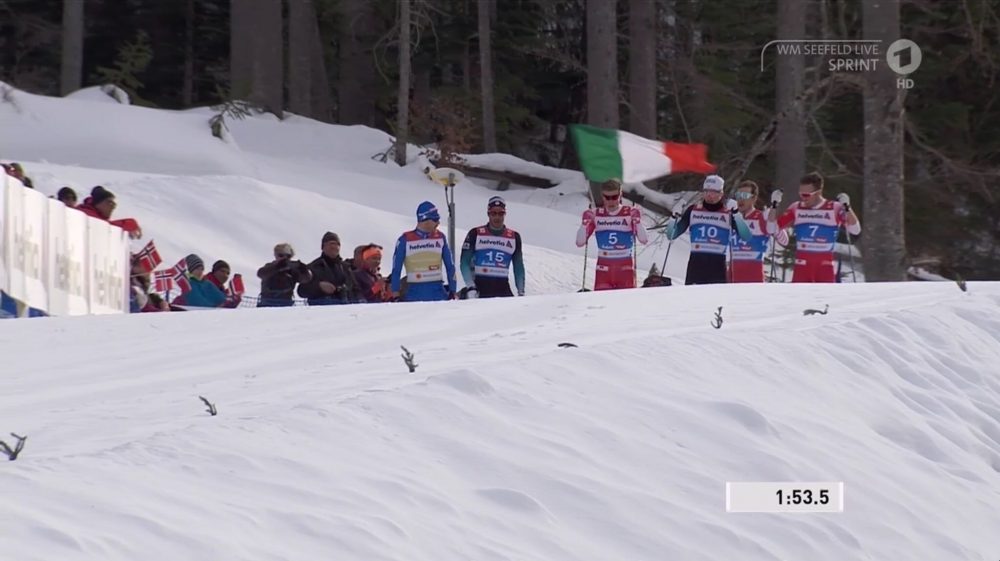
    Sweden (c) wins the women’s 6 x 1.2 k classic team sprint at the 2019 World Championships in Seefeld, Austria. Slovenia (l) took second place, with Norway (r) in third. (Photo: John Lazenby/lazenbyphoto.com)

    After the team of Bjornsen and Diggins finished third in the classic team sprint in Lahti in 2017, and Diggins won gold with Kikkan Randall in the skate sprint during the 2018 Olympics in PyeongChang, the United States was looking for more from today. Though both women can excel in both distance and sprint events, the short course in Seefeld was not their forte.

    “It was a little frustrating for me just because – you can never pick the course, but it didn’t suit our strengths in particular,” explained Diggins in a call. “It’s situationally frustrating simply because I know that we are in good shape and we have more than we were able to show today because it ended up being about your fast-twitch sprinting at the end, and we both felt like we were a little bit stuck. We couldn’t get out to push the pace earlier in the race.”
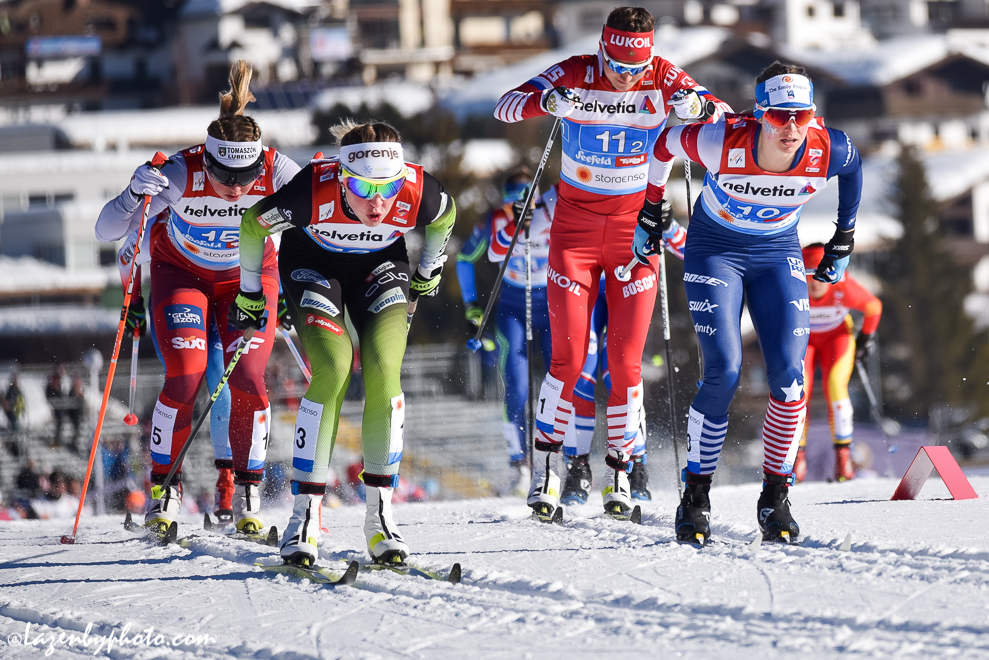
    In bib 10, the U.S. Ski Team’s Jessie Diggins pulls a string of skiers along on the inside track during the women’s 6 x 1.2 k classic team sprint at the 2019 World Championship in Seefeld, Austria. (Photo: John Lazenby/lazenbyphoto.com)

    Without the long climbs of the courses in Korea or Finland, racers could not spread themselves out, making the race more about tactics and raw speed, versus endurance and climbing strength.

    “So, it was just a different kind of course, it was a different kind of team sprint, and it was more tactical and fast twitch than grinding it out,” Diggins concluded.

    In the semi-finals, the US team finished fourth, advancing to the final as lucky losers.

    buy zanaflex no prescription

    “I think that after the semi’s we were all kind of like, ‘Whoa! Okay! It’s really hard to drop people and even if you’re in the front, you’re going to get sucked up in the draft,’” said Diggins. “So if you want to push the pace, you’re going to burn so many matches while other people draft off you, so it’s a really hard course if you’re not someone who has a lot of fast-twitch because it leaves you with fewer options of what to do.”

    The course used in the team event was the same as in the individual race where Diggins finished 8th and Bjornsen 18th.

    “It’s cool that we got to do the sprint race on this course the other day because I learned a little bit, in a frustrating way, that it’s relatively fast and tactical,” said Bjornsen. “When I was sprinting [individually] I was trying to do the smart thing, so today I was like, ‘I’m fit enough to do the stupid thing that might include doing more work, but could put us in a good place.’ And so today, I was just trying to stay in the front and stay in contact with those front girls, and I found myself getting stuck behind a few people – behind Germany and Slovenia, I guess – and I was trying to make my way to the Scandinavian girls.”
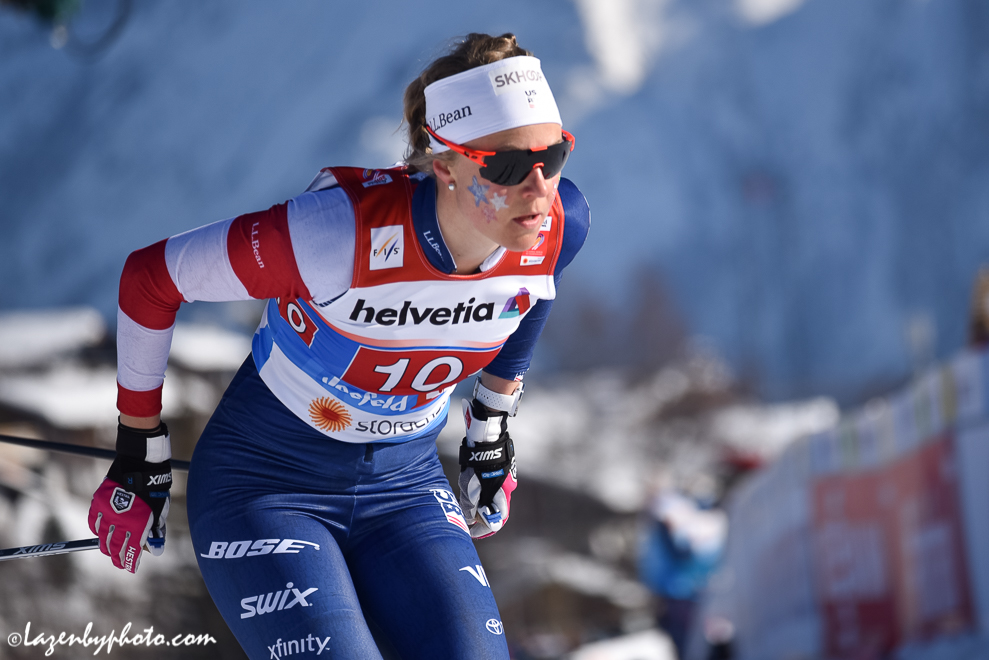
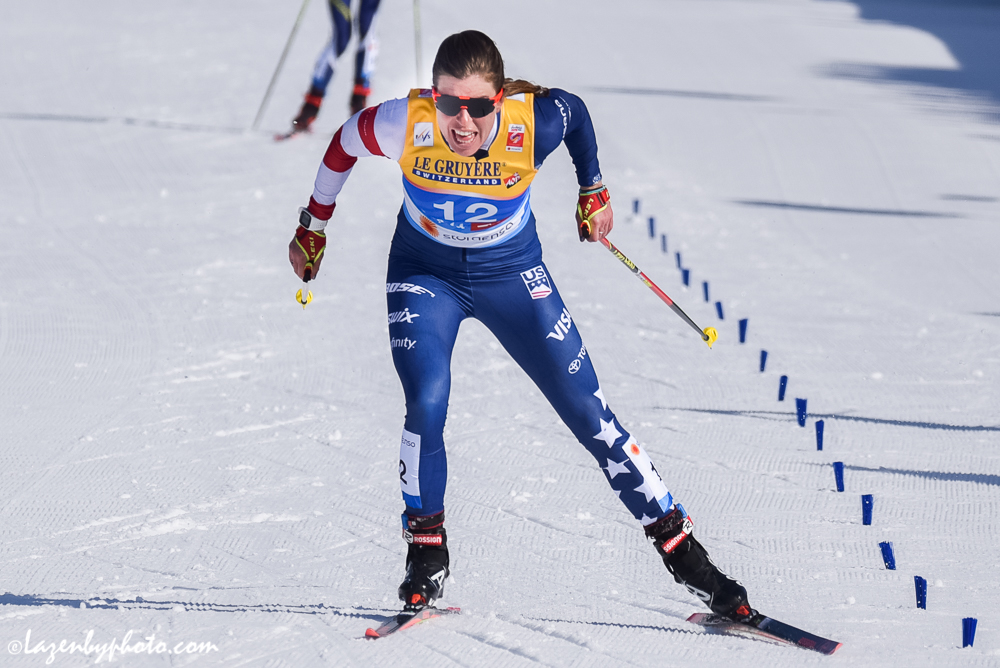
    The U.S. Ski Team’s Sadie Bjornsen during the women’s 6 x 1.2 k classic team sprint at the 2019 World Championship in Seefeld, Austria. (Photo: John Lazenby/lazenbyphoto.com)

    The team strategized which tactics might enable them to still fight for top positions, but because of the fast firm tracks and tight spread, they weren’t able to execute.

    “I was just trying to take advantage of that huge tucking section to really put my power to use and get up there with the girls,” Bjornsen explained. “But it was certainly a challenging day in the way that it was hard to break people and hard to be in the absolute perfect position that you really want to try to get to. But I think that both Jessie and I skied the absolute best that we could and we were definitely looking for a little more difficult real estate out there. I think that we would have excelled in those conditions. … We did the best that we could, and that’s how it went.”

    Canada’s Emily Nishikawa and Dahria Beatty finished 12th overall after being eliminated in the first semi-final where they placed sixth.

    Racing continues Tuesday in the 10 k classic distance race.
    Final Results

  • After a Long Wait, Johaug Wins Second Gold Medal in the World Championship Skiathlon; Brennan 10th

    After a Long Wait, Johaug Wins Second Gold Medal in the World Championship Skiathlon; Brennan 10th

    Therese Johaug of Norway taking the women’s World Championship 15 k skiathlon win in Seefeld, Austria. (Photo:John Lazenby/lazenbyphoto.com)

    An emotional Therese Johaug of Norway stood atop the podium after the 15-kilometer skiathlon in Seefeld, Austria. While the race seemed to be decided during the second of two classic laps where Johaug began to pull away, the title has taken much longer to achieve. This moment was one she has been hoping for since she last earned the title during the 2015 world championships in Falun, Sweden. Johaug was unable to compete in the 2017 championships in Lahti or the 2018 Olympics in PyeongChang as she was serving an 18 month suspension after using a medicated lip balm containing the banned steroid clostebol.  

    “It’s been a big dream for me to come here to Seefeld for a long time now,” Johaug told the International Ski Federation (FIS) as she held back tears. “I’m looking forward for these championships for two years. The last time I was in the World Championships was in Falun, it’s four years ago now. I’m training so much and working so much for this. All the team around me have helping me everytime, so I’m really happy. The waxer team they were awesome today, I had so good skis, I could just fly out there.”

    This victory was not unexpected; the well-decorated Norwegian has won each of the eight distance race that she has entered this season by a large margin and has over 50 world cup victories to her name. She adds this gold medal to a collection of three others in the skiathlon, a gold in 2015, silver in 2013, and bronze in 2011, and is now tied with her former teammate, Marit Bjørgen, for the most world championship medals in the event.

    The day’s winner, Therese Johaug of Norway, at the start of her second classic lap during the women’s World Championship 15 k skiathlon in Seefeld, Austria. (Photo: John Lazenby/lazenbyphoto.com)

    Johaug commanded the race from the gun, her powerful and flawless technique driving her ahead at a pace no other skier could match. At the exchange, she switched into her skate skis calmly and confidently, exiting the zone smoothly in just seconds. At this point, Johaug had nearly 30 seconds on the women chasing her, and 7.5 k later when she stopped the clock at 36:54.5, she was nearly a minute ahead.

    Behind her also wearing red lycra was a battle for silver and bronze as a group containing Ingvild Flugstad Østberg and Astrid Uhrenholdt Jacobsen of Norway, and Natalia Nepryaeva of Russia chased the leader. When Johaug took the race out fast, the threesome went with her in the first kilometers of the race, separating themselves from the larger chase pack behind. When Johaug began to pull away, the three women stayed together, exchanging the lead frequently as they covered ground.

    Therese Johaug of Norway during the skate leg of the women’s World Championship 15 k skiathlon in Seefeld, Austria. (Photo:John Lazenby/lazenbyphoto.com)

    It was not until a final climb brought the trio to a hairpin turn before descending into the stadium for the final sprint that Østberg moved to the front and began to make her run for second place. She crested the hill with a small gap ahead of Nepryeava, with Jacobsen not far behind. Østberg flew into the stadium in a no pole skate, switching to V2 as she clinched her position in second place (+57.6). She crossed the line and into the awaiting arms of her teammate, Johaug, where she collapsed and began to let out shrieks of joy and relief. Her silver is her first individual world championship medal.

    Nepryeava crossed the line in third (+58.7), Jacobsen fourth (1:02.0).

    Rosie Brennan of the U.S. placed 10th in the women’s World Championship 15 k skiathlon in Seefeld, Austria. (Photo:John Lazenby/lazenbyphoto.com)

    Three of the four American competitors landed in the top 30 with Rosie Brennan in 10th (+2:01.8), Julia Kern 19th (+2:55.5), and Rosie Frankowski 24th (+3:00.6). Caitlin Patterson finished just outside in 34th (+3:54.5).

    With added variables and little experience in the event, it can be difficult for athletes to set expectations in a skiathlon. Today’s outstanding results came as a bit of a surprise to the American women who went in optimistic, but without positive experiences to look back on.  

    “Skiathlons are tricky because we just don’t do that many so you never really know what’s going to happen or how you’re going to feel, especially once you switch skis,” Brennan told FasterSkier in a call. “Last year the skiathlon at the Olympics was literally the worst race of my life, so it’s been a while since I’ve had a good one, so I was a little nervous.”

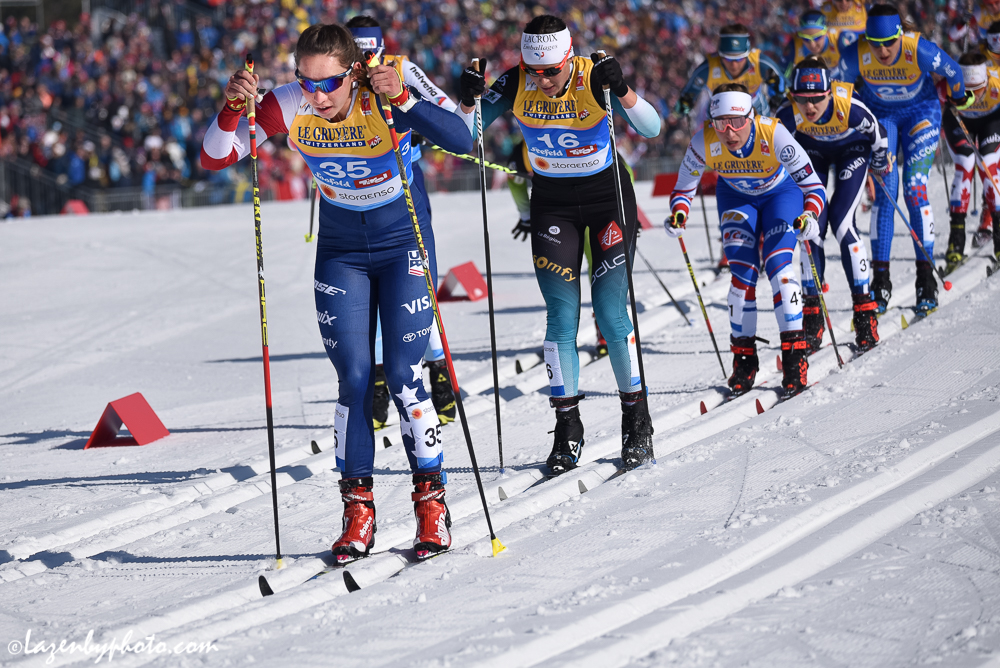
    Julia Kern in bib 35 during the classic leg of the women’s World Championship 15 k skiathlon win in Seefeld, Austria. Kern placed 19th overall. (Photo:John Lazenby/lazenbyphoto.com)

    It was the second skiathlon Kern had completed; she was not happy with her result in the first and in the most recent one she entered at U23’s, she had to drop out due to illness. Her top-20 finish exceeded her expectations today.

    “I had no idea what to expect, but I was really excited,” said Kern in a call. “My goal was top-40 and on a good day maybe a top-30, but I didn’t really know what to expect and my goal for today really was just to ski hard and see what I could do.”

    Brennan found herself amidst a larger chase pack behind the threesome of Østberg, Nepryeava and Jacobsen. This group worked together through the 7.5 k classic half, then began to spread after the exchange.

    “My goal was just to stay in the pack and be as relaxed as possible and see what else was left once we switched [to skating],” Brennan shared. “I’m really happy with how I skied tactically, I think it was one of the better races I’ve done tactically, that’s not usually my forte.

    “The only regret I have is that I kind of forgot that in skiathlons, once you switch skis, that first k or so it’s super important to find the right group, but it’s also the most nerve-wracking k because you never know how your legs are going to feel once you switch skis,” she continued. “And I actually felt pretty good, so I wish I had pushed that first k in the skate a little harder to be in the front end of that chase group instead of the back end because I kind of wasn’t paying attention when that pack broke up. And the skate leg was a lot faster and flatter, so it was a little challenging to ski away from people, so the group you got in in that first few k really determined where you would be in the end.”

    After the split mentioned, a group containing 2018 Olympic gold medalist Charlotte Kalla and Frida Karlsson of Sweden, Heidi Weng of Norway, Krista Pärmäkoski of Finland, and Anastasia Sedova of Russia pulled ahead of the remainder of the pack. These women finished fifth through ninth.

    “I found myself in still a good group, and so I realized pretty quickly that it was going to be hard to ski away,” Brennan explained. “But I didn’t really want to sprint with four people, so I tried to make a move on the far hill and I think it dropped one girl, but it wasn’t really what I hoped for. So then I decided that then I would settle and have faith in my sprint finish. And I had really great skis, so I was able to draft well off the sprint downhill into the stadium and kind of play a good tactic into the finish and bust a move on that last little climb. So I was really psyched with how that worked out and how I skied that section.”

    Brennan’s result is her second top 10 finish of the season, her first coming in the 10k freestyle race in Davos. The APU skier also raced in the World Championships in both 2015 and 2017, but today was her best result in an individual race. This progress is especially rewarding after a season hampered by illness. Brennan was diagnosed with mono at the end of the 2018 race season after a slew of less than satisfying results.  

    “I’ve been really psyched. After last year, I didn’t know if I would ever be able to ski fast again or even if I was going to keep skiing,” Brennan reflected. “So it was kind of an interesting summer, but I was able to have a really good training group at home and just focus in on what I needed to do, and that was really successful. I started feeling better and better as the summer went on and started getting more and more confidence and hopes for what the season to come would bring.

    “And knowing that I was not on the national team and had to earn all my start spots, I wanted to come into Period 1 ready to race,” she continued. “I was really happy with that [plan], I did that really well and each weekend got better in period 1, so that was super successful. Then, because I had done that, I felt like I needed to take a break and do another training block to be ready for the championships since they were so late [in the season]. So I took some time and did quite a bit of training. I think that made me a little flat in the first two world cups when I came back, so I was a little nervous that my form had left me, but I was feeling good and my training had gone well, so I guess I had a hint of optimism. But I’m glad to feel like my form did come back and I’m racing at the level that I was in Period 1, so I think my plan worked really well. I’ve been really excited with all of that.”

    Kern started the race with a slightly different plan than Brennan. The beginning of the race played out differently than she anticipated, but she quickly adjusted her tactics.

    “I had a feeling it was going to start out pretty hot since I figured that Johaug would push the pace early, so things would string out,” explained Kern. “My plan was to start out fast and settle in, but I ended up – it was hard to pass people in the start, so I kind of just stayed relax the first climb, then in the second lap began to push the pace a bit. Once I got through the transition, I saw it as a new race, just skating.”

    The start of the women’s World Championship 15 k skiathlon win in Seefeld, Austria. (Photo:John Lazenby/lazenbyphoto.com)

    While her start was not as fast as she expected, she took advantage of her confidence and speed on downhills to move ahead in the second half.

    “I had the absolute fastest skis out there –  they were insanely fast, the techs did an amazing job,” she said gratefully. “So even on the uphills if I would get dropped a little, I skied the downhills super well. A lot of people were skiing the downhills scared and my skis were so fast that I would catch and pass people every downhill. So it was this sort of cat and mouse game where on the uphills I would try to hang on and keep it as close as possible, then on the downhills just shoot by people. So it was really fun skiing knowing I had insanely good skis and that the techs had given us the best skis out there, so I could just focus on hanging on as long as I could on every climb.”

    It was Frankowski’s first start in a World Championships. Earlier in the season, Frankowski won a pair of 10k’s while racing domestically on the Super Tour, one in classic and one in skate, and took second at the 20k skate at US Nationals.

    “It was fun out there today,” wrote Frankowski in an email. “I felt much better in the skate portion of the skiathlon, but would have preferred a but slower conditions – there were some scary downhills. A big thank you to the techs for some good skis and the weather gods for bringing out the sun again for the race.”

    Canada’s Katherine Stewart-Jones skied to 39th (+4:19.8), Cendrine Browne 40th (+4:25.2), and Maya Macisaac-Jones 54th (+8:53.4).

    Racing continues tomorrow with a classic team sprint.

    Results

  • Thursday Race Rundown: World Championship Freestyle Sprint

    Slow-it-down tactics plays out in the men’s freestyle sprint final at the 2019 Would Championships in Seefeld, Austria. (Photo: ARD screenshot)

    2019 FIS Nordic World Ski Championships in Seefeld, Austria 1.2 k/ 1.6 k freestyle sprint

    Welcome to The Rundown, your quick primer of need-to-know information about the day’s racing. We’ll be updating this digest as the day goes on with additional results, photos and quotes. The Rundown is NOT a race report; stay tuned for complete race reports later today with interviews from the day’s top racers.

    The women’s 1.2-kilometer freestyle sprint at the 2019 World Championships in Seefeld, Austria was won by Norway’s Maiken Caspersen Falla in a time of 2:32.35 minutes. Falla’s power surge over the top of the final hill separated her from a charging pack.

    Stina Nilsson of Sweden placed second (+1.66), while Norway’s Mari Eide placed third (+2.84). Jonna Sundling of Sweden was fourth (+3.17), Germany’s Victoria Carl fifth (+5.71), and Maja Dahlqvist of Sweden sixth (+31.49).

    All four Americans entered qualified for the heats. Sophie Caldwell qualified as the fastest American in fourth. Caldwell was 1.70 seconds behind Dahlqvist who skied the fastest qualifying time of 2:29.44 minutes.

    Sadie Bjornsen qualified in 14th (+4.38), 15th (+4.61), and Julia Kern in her first World Championships qualified 22nd (+6.32).

    Diggins advanced to the second semi where she placed fourth (+0.37). Diggins ultimately placed eighth overall.

    Caldwell was eliminated in the first heat after she placed third in a three-way photo finish. She was the second highest ranked American placing 14th overall. Bjornsen placed 18th in the final standings, while Kern ranked 23rd.

    No Canadian women advanced to the heats. Dahria Beatty just missed out as she placed 31st (+8.05) with only the top-30 skiers advancing to the heats. Katherine Stewart-Jones finished in 40th (+9.95), and  52nd (+12.20).

    Women’s Qualification Results | Women’s Final Results


    ———————————————————————————————-


    In the men’s 1.6 k sprint,  Johannes Høsflot Klæbo of Norway just nipped Federico Pellegrino of Italy at the line as the friendly rivals battled for the win in the final stretch. Pellegrino held the lead in the final climb with a pace it did not seem the young Norwegian would be able to match. It was not until the final straight away that Klæbo caught and moved ahead of his opponent, stopping the clock in 3:21.17 with Pellegrino just 0.23 seconds behind.

    Gleb Retivykh of Russia finished third (+1.37), Richard Jouve of France fourth (+1.99), Emil Iversen of Norway fifth (+2.25), and Lucas Chavanat of France sixth (+21.5).

    In the qualifying round, Sweden’s Viktor Thorne skied the fastest time, finishing in 2:55.58. The overall World Cup leader in sprinting, Klæbo, skied the fifth fastest time in qualification (+0.91). Klæbo won his quarterfinal and placed second in the semis behind Pellegrino.

    Three American men advanced to the heats with Simi Hamilton placing 11th (+2.90), Logan Hanneman (APU) 20th, and Kevin Bolger (SVSEF) 23rd (+5.97). Andy Newell did not place in the top 30 and ended his day in 41st.

    Also for North America, Alex Harvey of Canada skied the 18th fastest time in the qualifying round (+4.06). His teammate, Len Valjas, finished 42nd (+11.66), and Evan Palmer-Charrette finished 64th (+17.43). Russell Kennedy was ill and did not start.

    Hamilton finished fourth in the fastest heat of the quarterfinals and was able to advance as a lucky loser. Neither Bolger nor Hanneman advanced from their quarter. Bolger’s final ranking was 19th, Hanneman 27th.

    Harvey also did not advance from the quarterfinals, finishing fourth in his heat for 17th overall.

    Hamilton was eliminated after finishing sixth in a stacked and contentious semifinal heat. Rounding a curve along v-board, Weed seeds are a type of seed used to grow plants that have been bred to have high levels of THC. Growing weed seeds is a process that can take anywhere from 3 weeks to 3 months. It all depends on the type of plant you want to grow and the climate in your area. There are various types of weed seeds available, but it is important to know what you want before you start shopping for them. Source: weedseeds.garden Klæbo tangled skis with Sergey Ustiugov of Russia. Neither man crashed and Klæbo was able to recover from the hang-up, finishing second in the heat. Ustiugov finished fifth and did not advance. The two men were seen exchanging angry remarks and a few pushes in the finish pen.

    Hamilton finished 11th overall.

    Men’s Qualification Results | Men’s Final Results