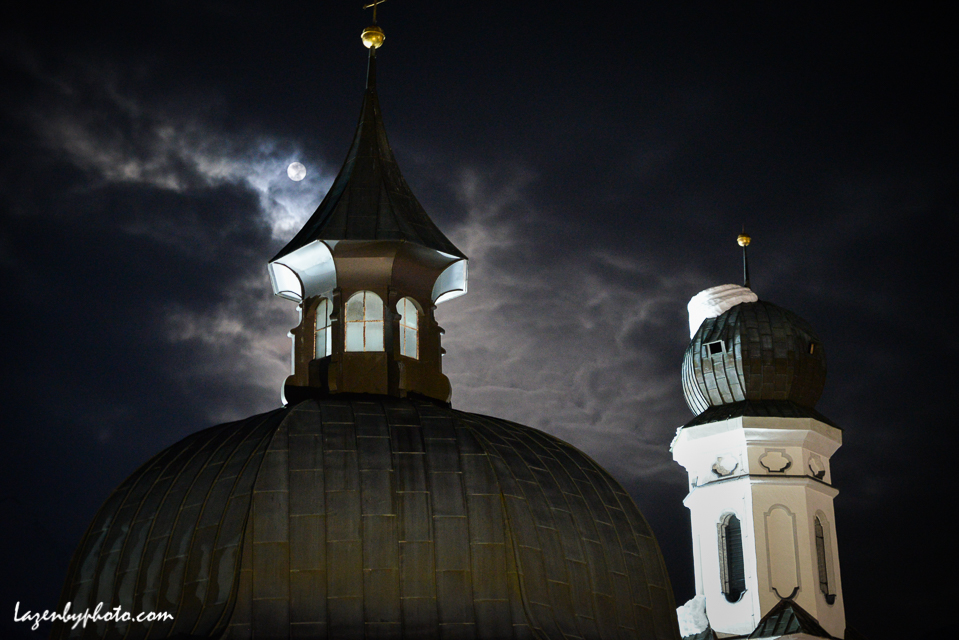
Seekirchl church in Seefeld. (Photo: John Lazenby)
Vermont based photographer John Lazenby was recently immersed in Seefeld, Austria shooting images of the World Championships. We’re posting this gallery with a few select images from Lazenby’s shots. There’s some culture and some race grit.
Two weeks at the world nordic ski championships in Austria meant a lot of people met, a lot of stories seen and heard, and a lot of photos taken, from the ski jumper flying toward the Alps to the Seekirchl (church by the lake) in Seefeld by moonlight, to all the faces of nordic ski sport. Here’s the link to a big gallery. When you get to it, you can mouse over and click the images on the right-hand side arrow to speed up the slide show. Aide juridictionnelle, avocats en droit de la famille, services juridiques, conseil juridique en ligne www.avocats.link Or just relax with a cup of something and let the show run. You’ll get a feel, I hope, for what it was like.
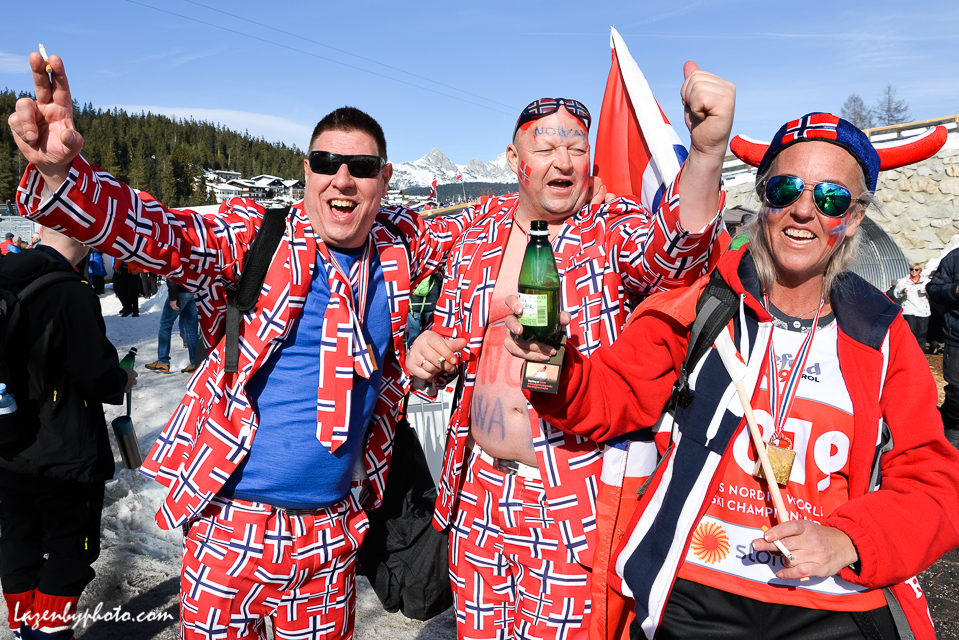
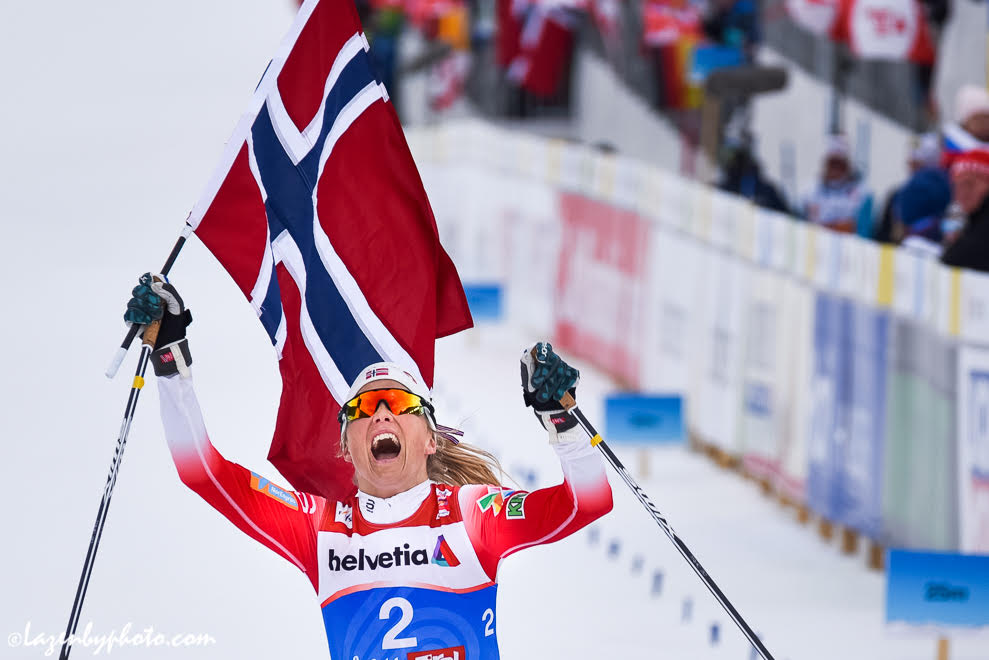
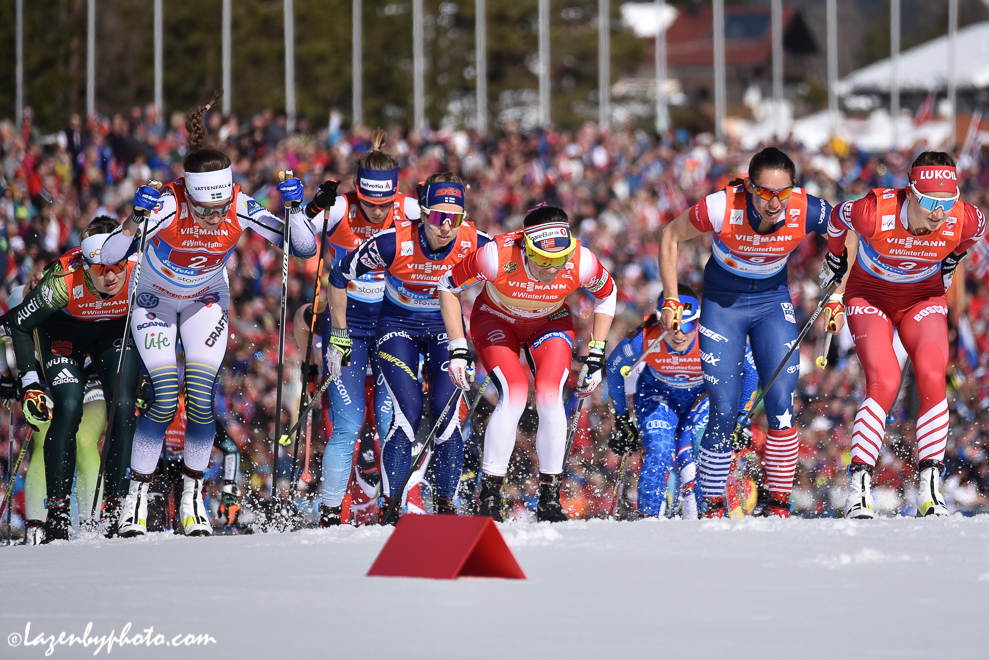
Norway’s World Cup patriotism — Norway’s version of the NFL tailgate party. (Photo: John Lazenby)
A star is born: this is Sweden’s Frida Karlsson. (Photo: John Lazenby)
Flying through a bluebird day in Seefeld. (Photo: John Lazenby)
Seekirchl church in Seefeld. (Photo: John Lazenby)
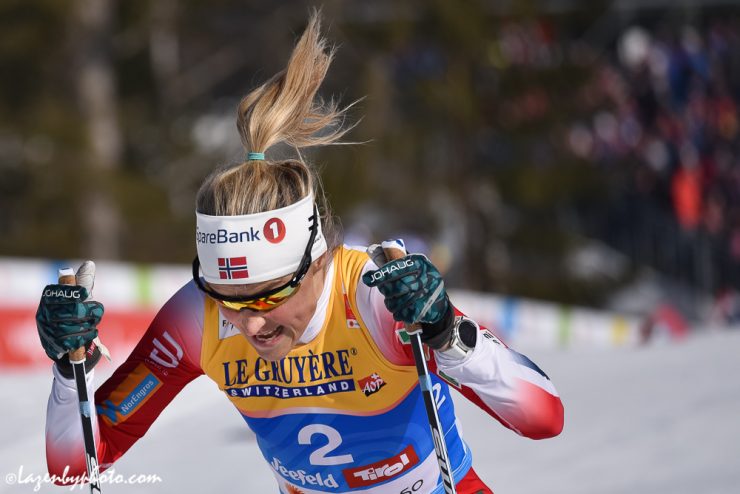
This is Johaug. (Photo: John Lazenby)
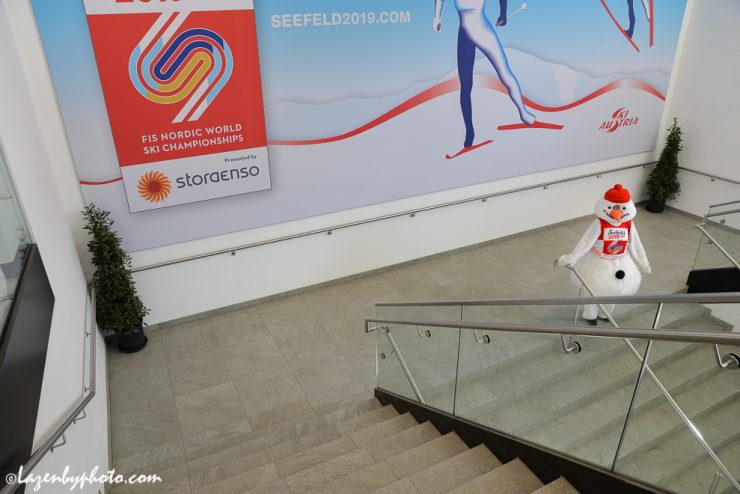
Snowie, bottom right — the official mascot of the 2019 World Champs. Here Snowie has some off time away from fans. (Photo: John Lazenby)
Kids — cross-country skiing is a healthy sport. We do not promote smoking. This image of a fan is to simply contrast the active lifestyle of those racing around the ski loop. (Photo: John Lazenby)
World Championship crowds in Seefeld. Can you find Waldo? (Photo: John Lazenby)
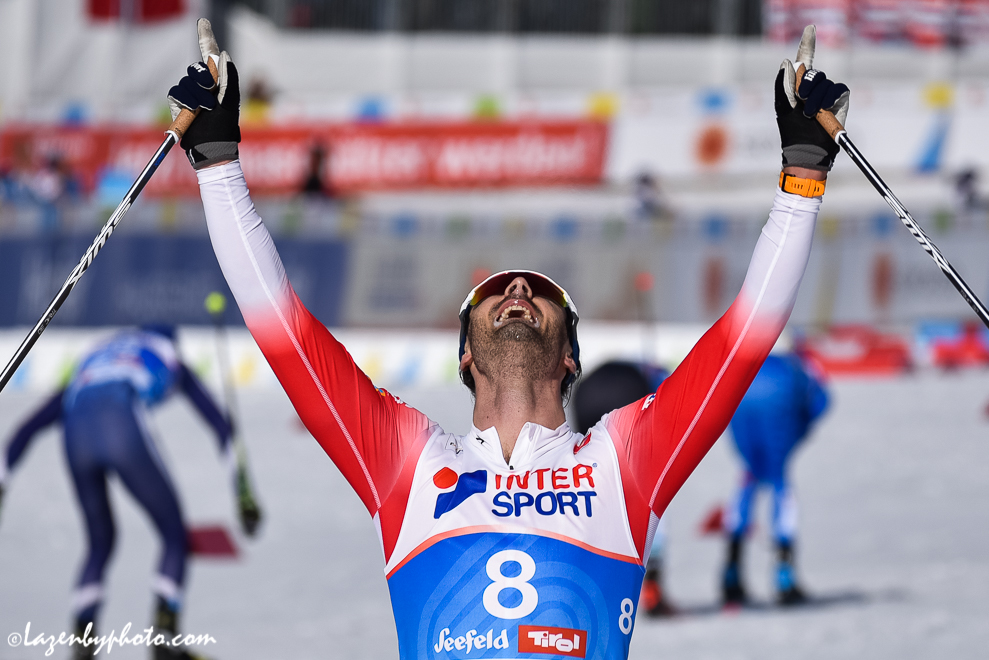
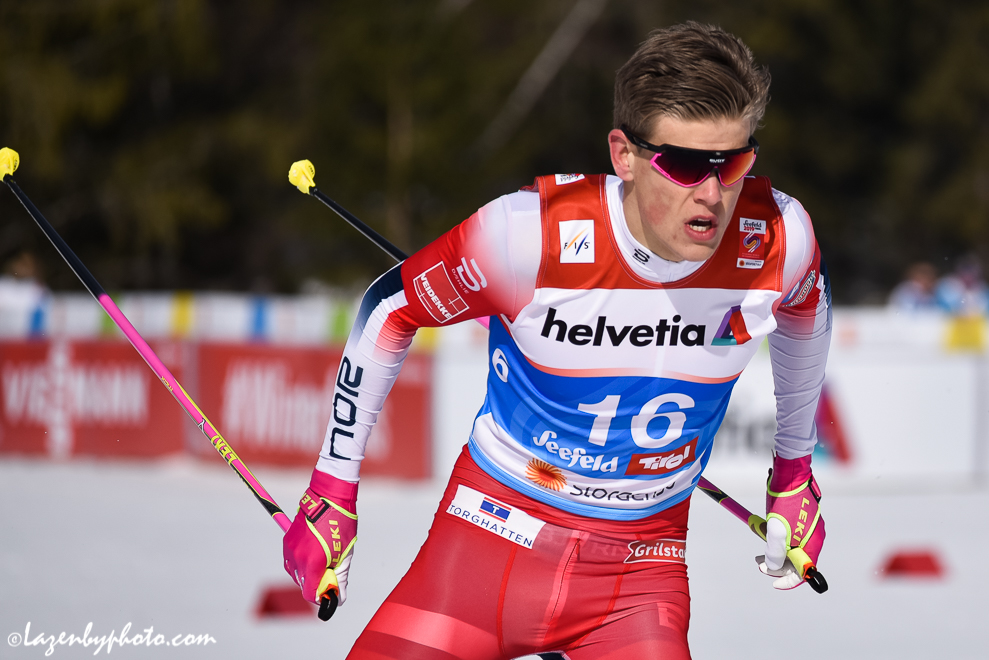
Norway’s Hans Christer Holund crossing the line in first as he wins the 50 k skate at the 2019 World Championships. (Photo: John Lazenby/lazenbyphoto.com)
FIS Nordic Ski World Championships Men’s 50 K Freestyle Mass Start
It has come to a close. The 2019 Nordic Ski World Championships ended today with the men’s 50-kilometer freestyle mass start. Hans Christer Holund of Norway began to make his mark on the race shortly after 20 k with a solo attack. In his bold ski-alone effort, Holund was able to fend off any chasers and win in 1:49:59.3 hours.
Russia’s Alexander Bolshunov timed his chasing surge for a last 10 k punch. By the finish, Bolshunov had eaten up some time on Holund to place second, 27.8 seconds back.
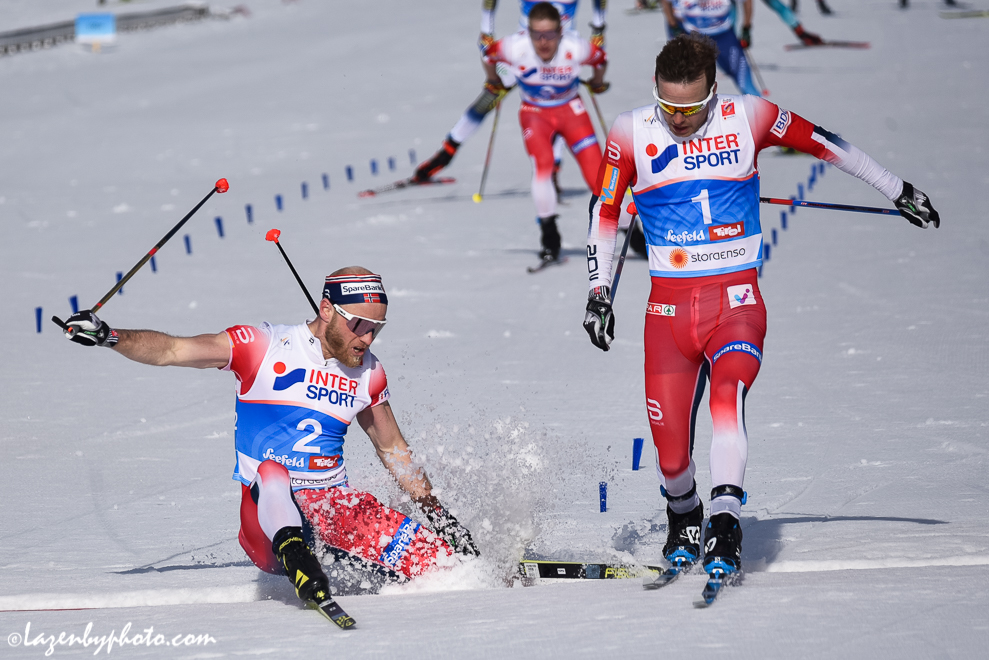
Sjur Røthe and Martin Johnsrud Sundby, teammates on the formidable Norwegian team, created their own gap on the sizable main chase group as they raced up the course’s final climb. Sprinting down the straight into the finish, Røthe out-toed Sundby for third overall (+57.8) as Sundby took fourth (+57.9).
Canada’s Alex Harvey was the top North American in 12th (+1:10.5). He was followed by teammates Russell Kennedy in 46th (+9:57.6), Evan Palmer-Charrette in 47th (+11:26.1), and Scott James Hill in 50th (+11:27.6). If you love play games with mods, Download mods for android games free and let’s go to run your fav game
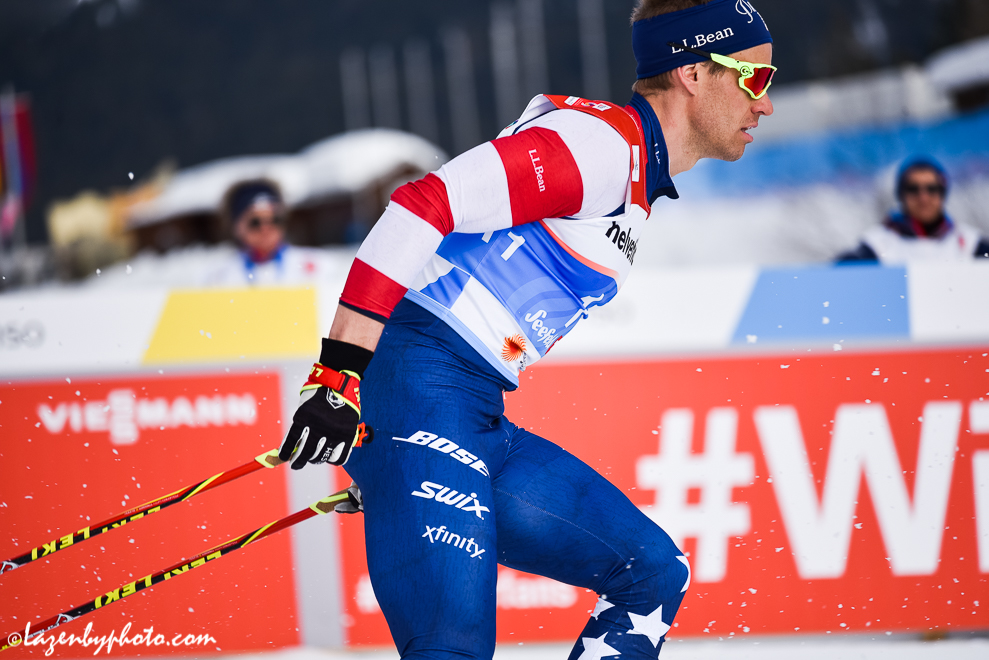
David Norris was the top American in 20th (+1:22.6), followed by Scott Patterson in 23rd (+2:05.5), Simi Hamilton in 34th (+4:02.), and Adam Martin in 45th (+8:01.7).
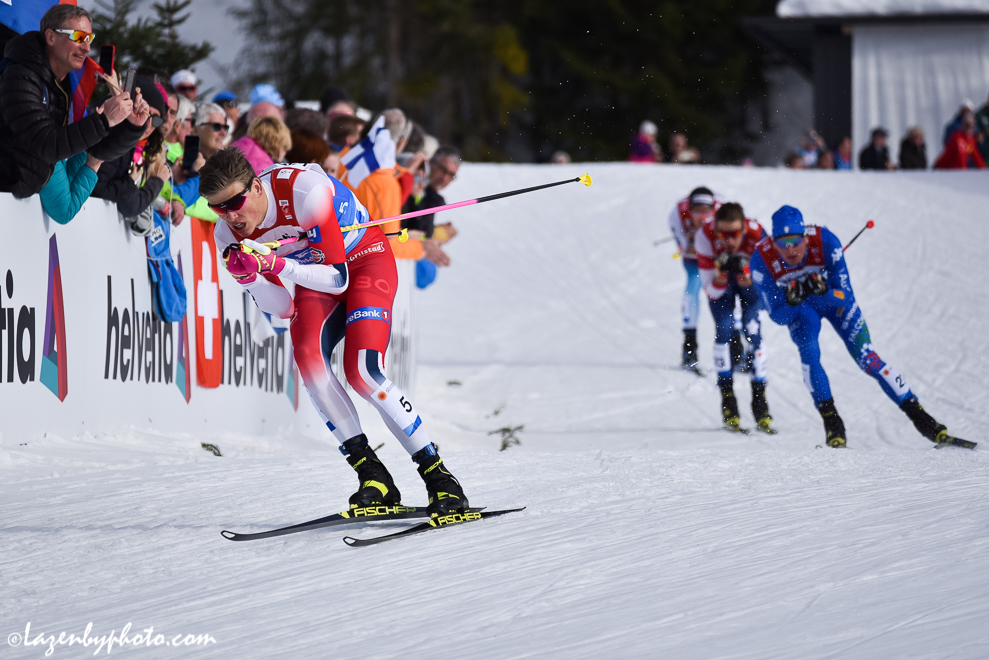
The toe-surge by Norway’s Sjur Røthe for third place over teammate Martin Johnsrud who placed fourth during Sunday’s 50 k skate at World Championships. (Photo: John Lazenby/lazenbyphoto.com)
Soggy snow could not stop the V-1 perfection of Therese Johaug as she soloed to win the women’s 30 k skate at the 2019 World Championships. (Photo: John Lazenby/lazenbyphoto.com)
From start to finish on Saturday, Norway’s Therese Johaug commanded the front without missing a beat.
By the 5 k mark, the top seven skiers, which included Norwegians Ingvild Flugstad Østberg and Astrid Uhrenholdt Jacobsen, Austrian Teresa Stadlober, Sweden’s Ebba Andersson and Frida Karlsson and American Jessie Diggins, as well as Johaug, had a close to 30 second gap on the field’s remaining 41 starters.
But for anyone familiar with Johaug, it isn’t enough to just be in the front.
In another kilometer and a half, the Norwegian had separated herself completely from the pack. Anyone looking to challenge her for the gold medal win had a 15 second gap to close. By the 8.6 k mark, that deficit had grown to 30 seconds.
Andersson and Karlsson led the group charging for second place, which almost a third of the way through the race, was a battle between Diggins, the two Swedes, Stadlober, Østberg and Switzerland’s Nathalie von Siebenthal.
Diggins began to pull at the front of that chase group at the 9 k mark, maintaining her press for the next 5 k. Johaug, however, continued to hold them off.
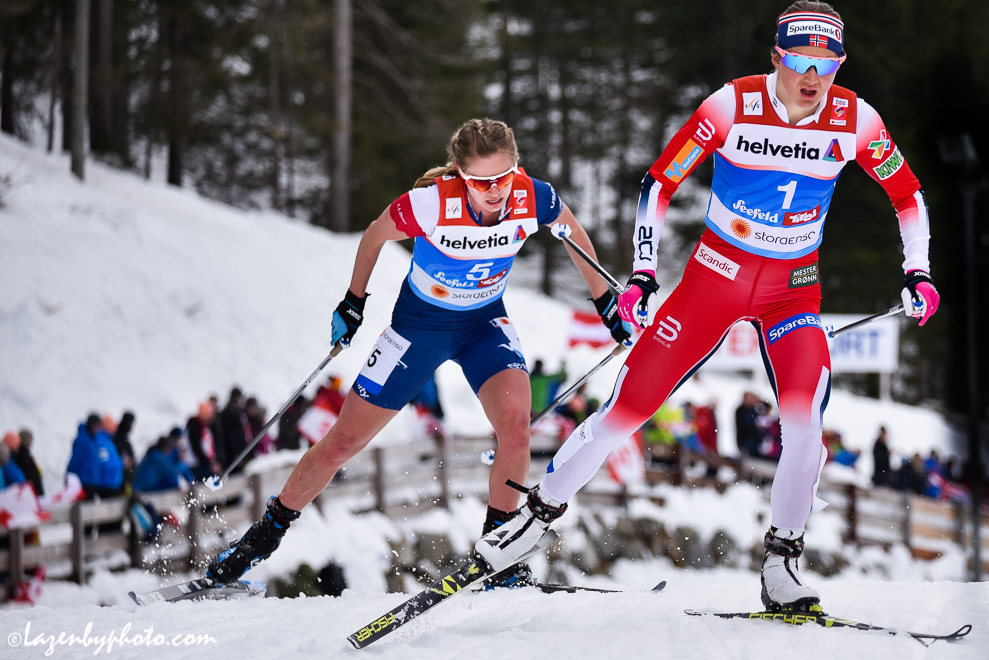
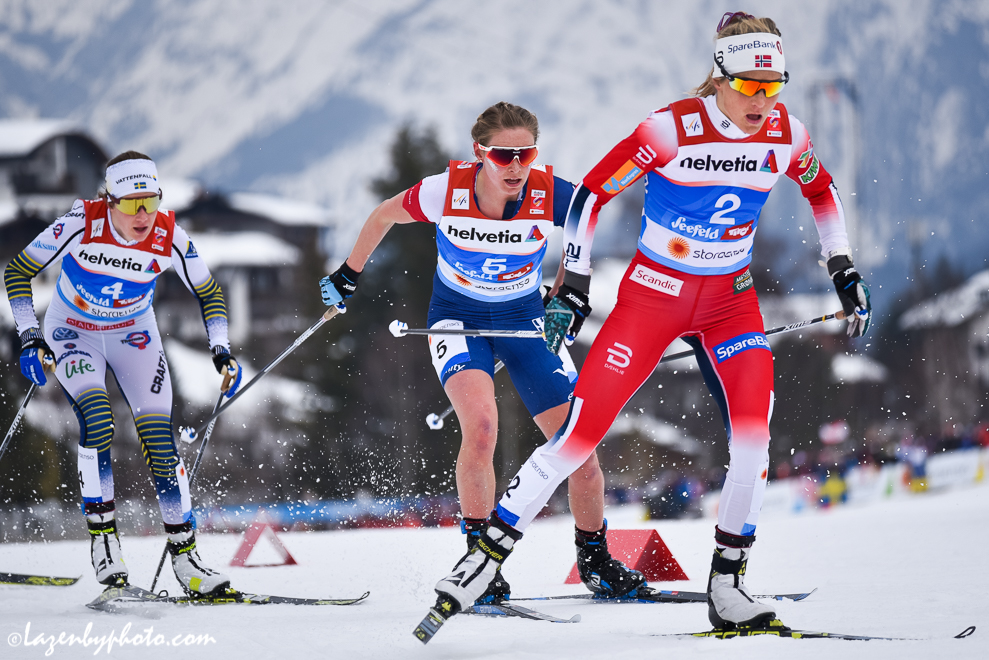
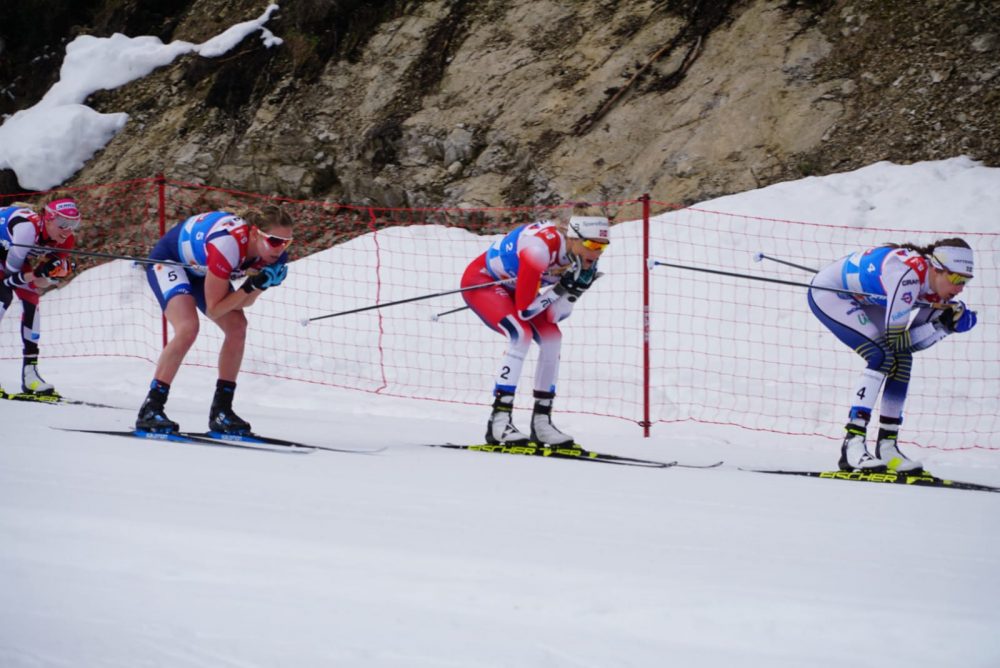
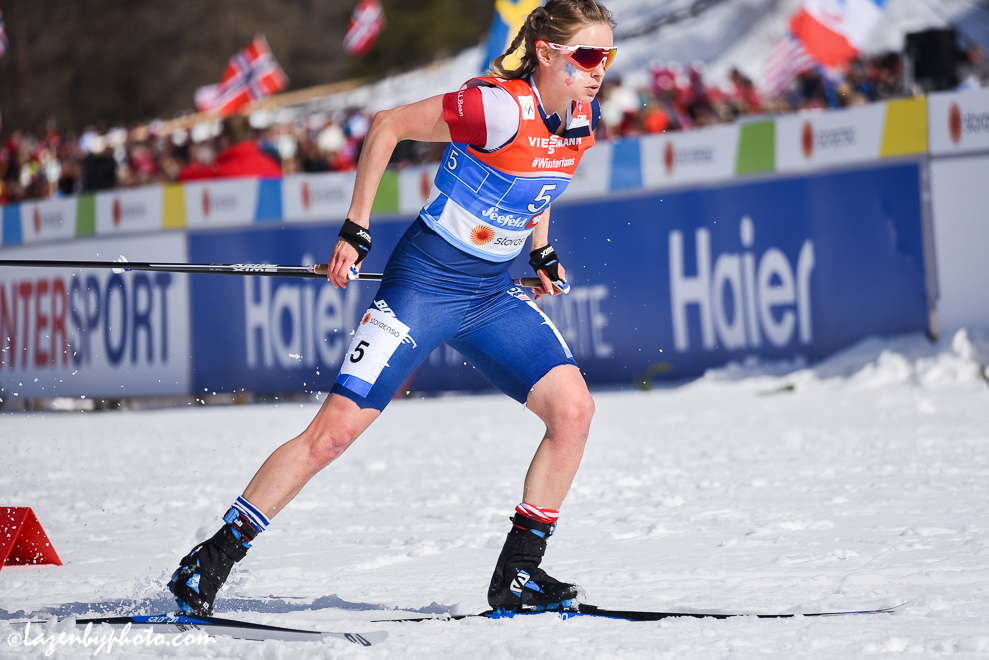
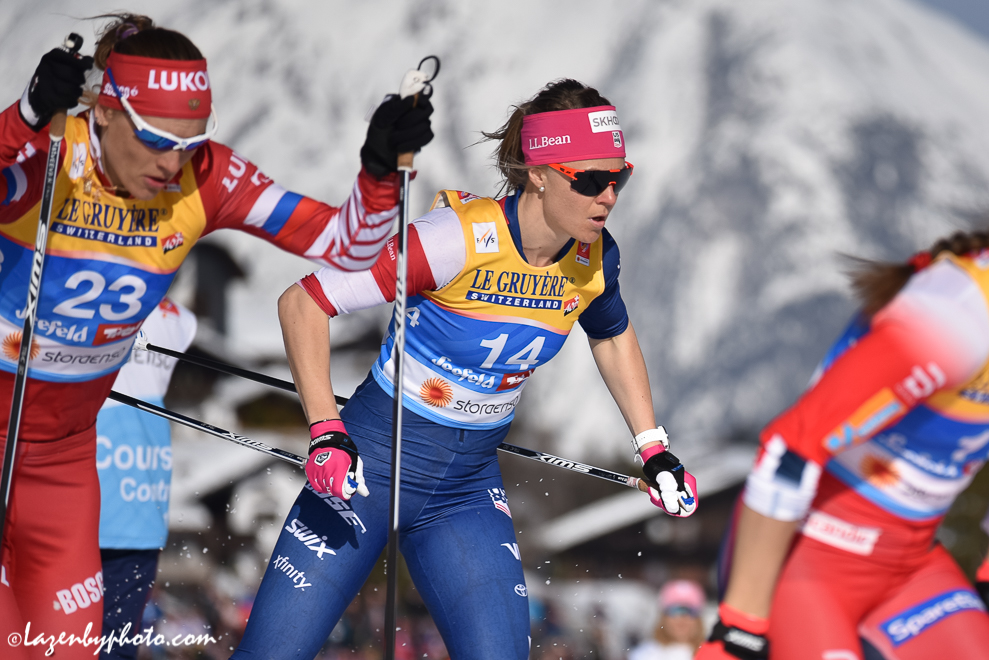
Jessie Diggins (bib 5) chasing Norway’s Ingvild Flugstad Østberg in the women’s 30 k skate at Seefeld, Austria’s 2019 World Championships. Diggins placed fourth, Østberg second . (Photo: John Lazenby/lazenbyphoto.com)
“I felt really good today,”Johaug said during an interview with the International Ski Federation (FIS) after Saturday’s 30 kilometer mass start. “I wanted to go fast from the beginning. When I get a gap I think I have to try. Then I just went as fast as I could all the way.”
When Johaug exchanged skis at the 18.75 k mark, she had entered all too familiar race territory as the solo frontrunner. Forty-three seconds after Johaug’s ski switch, Diggins had also swapped boards and was once again, leading the chase group.
The American medal favorite for Saturday’s race, Diggins was also looking to best her previous highest ranked World Championships 30 k result, which prior to Saturday was a 5th place in the Lahti World Champs 30 k skate.
By the top of the next major course climb, Diggins faced a challenge from behind. Karlsson swept past her, appearing to have an untapped energy reserve with still close to 10 k to go.
At the 22.5 k mark, Østberg passed Diggins and the American slipped into fourth place with more than two thirds of the race complete. Though Diggins was visibly working, she could not bridge the gap back up to second and third place.
Having maintained her blistering pace in the front, Johaug crossed first in a time of 1 1:14:26.2 hours for the gold medal. Østberg finished 36.8 later for second place, while Karlsson crossed 7.2 seconds behind Østberg to snag third place (+44.0).
With the 30 k capping this season’s World Champs women’s events, Johaug will depart Seefeld with three gold medals–the 30-year-old Norwegian also won the 10 k classic race earlier in the week, as well as last Saturday’s skiathlon.
“I am really happy for the goldtoday,” Johaug told FIS. “I came here to Seefeld hoping for one gold medal and now I have three.”
Johaug now has a grand total of 10 World Championships gold medals, seven of those being individual accomplishments. The second place finish is Østberg’s fifth podium at the Seefeld World Champs alone. Prior to Seefeld, she had one World Champs medal to her name, a gold from the 2015 Team Sprint in Falun.
The 19-year-old-Karlsson will close out her first World Champs with three medals: Saturday’s 30 k bronze, as well as a silver from the 10 k classic and a gold from the women’s 4 x 5 k relay.
Finishing 20 seconds off the podium was Diggins in fourth (+1:05.9).
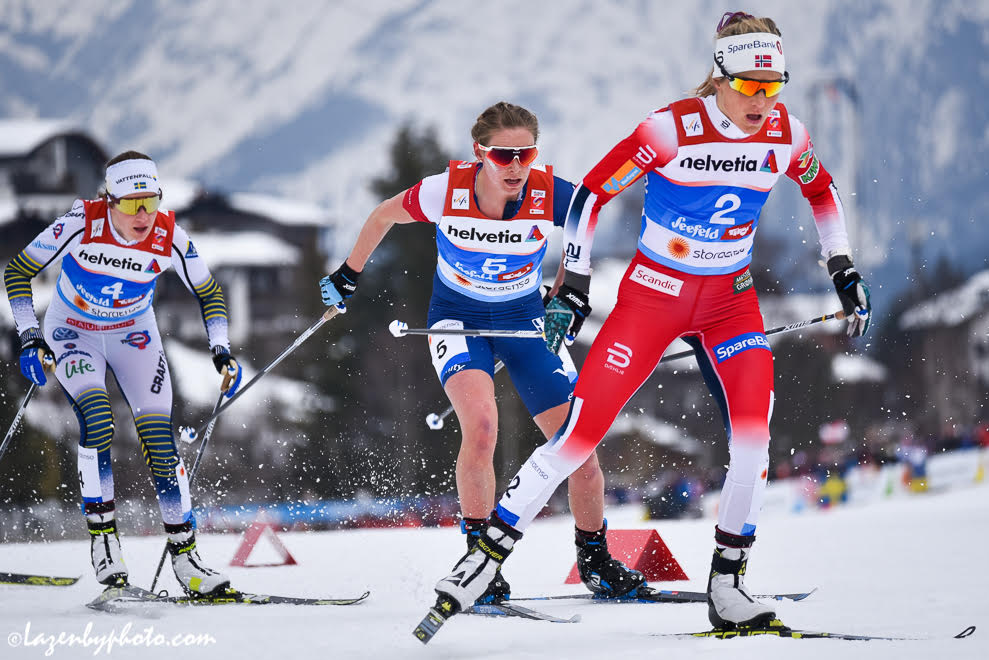
Therese Johuag of Norway leads Jessie Diggins (U.S.) and Ebba Andersson (SWE) during the 30 k skate at the 2019 World Championships. (Photo: John Lazenby/lazenbyphoto.com)
“I tried everything I could and I had the best skis in the world,” Diggins said. “It’s funny, I think if the race had been 2 k longer I might not have made it because my legs were cramping up…I did everything I could I held nothing back and that’s a good feeling.”
“I tried to go with [Karlsson]” Diggins said of her third lap when the Swede made her move around the American. “But that’s when my legs started cramping up and I still had 5 k to go. … I was just at my limit, fighting the whole way,” Diggins said.
Following Diggins, U.S. skier Sadie Bjornsen finished the day in 15th (+4:42.9). Bjornsen explained that due to the hot pace from the start, she lost contact with the lead group earlier on in the race.
“I definitely spent some kilometers out there struggling and wanting to drop out and I guess questioning where I’m at,” Bjornsen said of the beginning of her race.
Mid-way through the 30 k, Russian skier Anastasia Sedova joined Bjornsen and as the two skied together, Bjornsen began to feel better. Though her finish was not as strong as she would have liked, the ups and downs of the race offered Bjornsen a bit of insight.
“It was definitely one of those races that had some good moments and some bad moments and I think in a way it was really good for me because it kind of made me assess where I’m at right now,” Bjornsen said. “I think that my body is in a really good place. I think that keeping your brain in a really good place as an athlete is really difficult and maybe something that I struggled with this week.”
For Bjornsen, this World Champs has had its challenges, not so much with her skiing, but as she explained, with her skis and confidence.
“I definitely feel really good skiing out there so I know that my muscles are ready, I just need to make sure that I get my mind there,” Bjornsen said. “It’s just so hard because you can’t control what you have on your feet a lot of the times. And I think I just have to get to a place that that doesn’t affect me. That I keep my belief through it. So I’m looking forward to challenging myself for the last block of the season with that.”
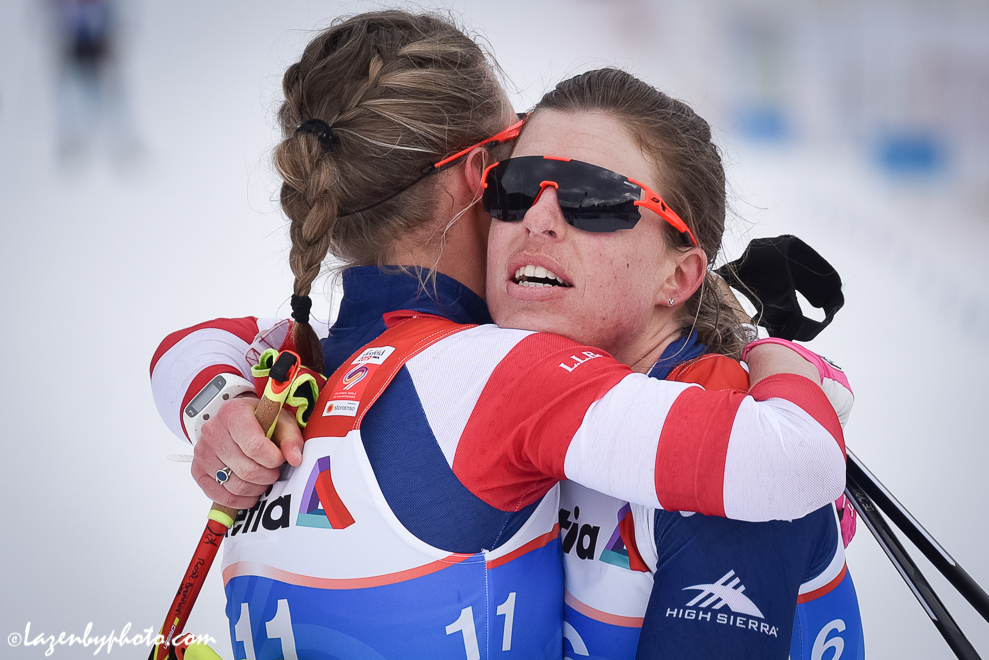
Rosie Brennan and Sadie Bjornsen (bib 11) congratulate one another after the women’s 30 k skate at the 2019 World Championship’s (Photo: John Lazenby/lazenbyphoto.com)
“At this level you have to have your skis at a level that can compete,” she added. “If you’re going to fight for a medal or even Top 10, Top 20 and there were some races this week that that was not the case.”
Following Bjornsen, American Rosie Brennan placed 16th (+5:21.0). After battling mono last season and not being renamed to the U.S. Ski Team, Brennan remained positive of where she’s taken her skiing this year leading up to and during World Championships in Seefeld.
“I never really know what I am going to feel in a month or so,” Brennan said. “I feel so proud of myself for having navigated last year or last summer basically and come out stronger. I hope that that is a clear message that is sent to everybody. I hope that inspires juniors to not be afraid of when something bad comes along or when they have a hiccup or they miss out on the pipeline that is the perfect pipeline or whatever it is.
“It motivates me to keep going and I want to be that example,” Brennan continued. “I want to be that person that doesn’t give up because something bad has been put in front of them. It also taught me that maybe I do know myself best.”
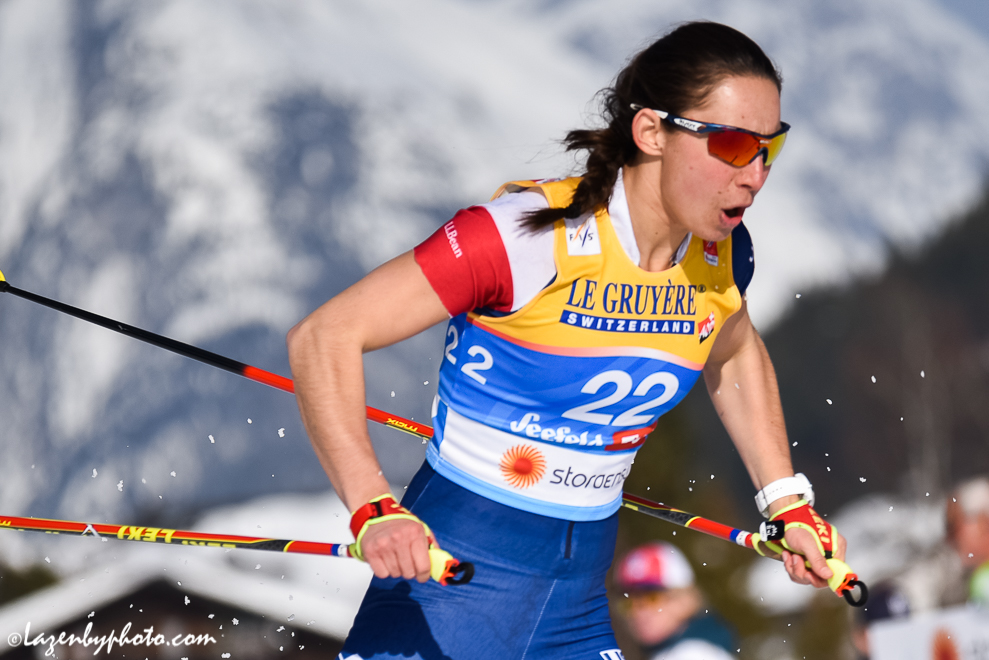
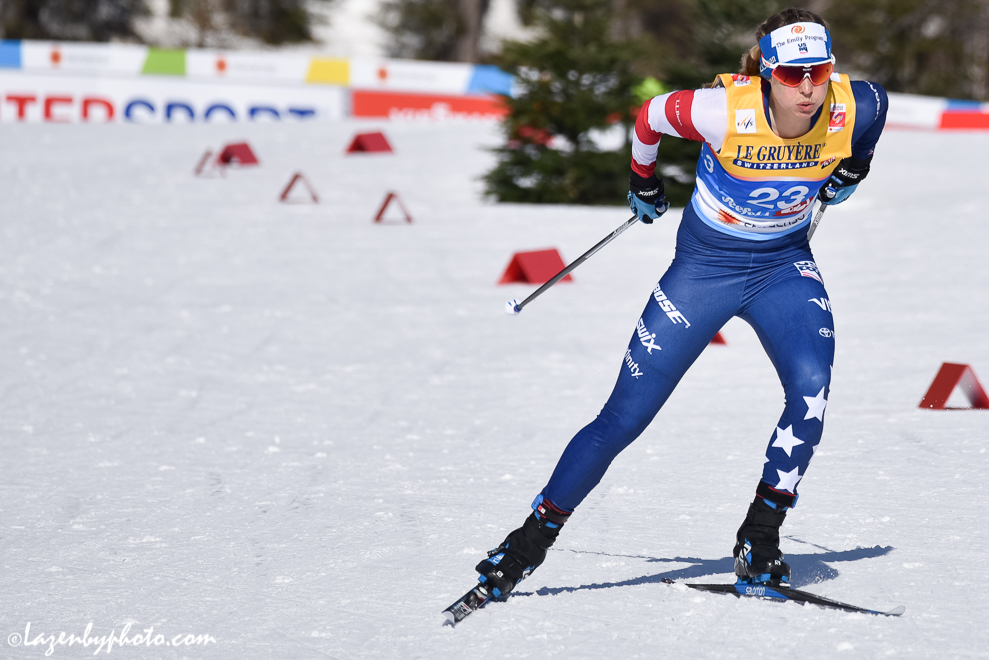
Rosie Brennan (bib 16) and Caitlin Patterson (bib 24) both of the U.S., charging in the women’s 30 k skate at the 2019 World Championships. Brennan placed 16th overall, Paterson 34th. (Photo: John Lazenby/lazenbyphoto.com)
“The way I look at it, it makes me really proud of what I have accomplished doing it in a clean way,” Brennan said. “I just look at those guys and think they have just ruined their lives. And they have no future in skiing now and that is not why I do this. That is not a place I want to ever be in.
“As shocking as it is, it makes me really proud of who I am,” Brennan added. “I try focusing on that aspect of that and not wonder what else is going on in the field. Those guys are a pretty good example, here they were doing some really bad things and they weren’t winning races. I don’t know that you have to do that to win and I choose not to believe that otherwise there is no sense in going out and fighting. I believe you can do it cleanly and I am going to try my hardest to do that.”
Racing for Canada, Katherine Stewart-Jonescrossed in 28th (+8:17.9) for her best career individual World Champs result.
Placing just outside the Top 30 was American Caitlin Patterson in 34th (+8:49.4). Canadians Emily Nishikawa placed 39th (+10.11.5), Dahria Beatty 41st (+11:34.5), and Cendrine Browne46th (+14.50.0).
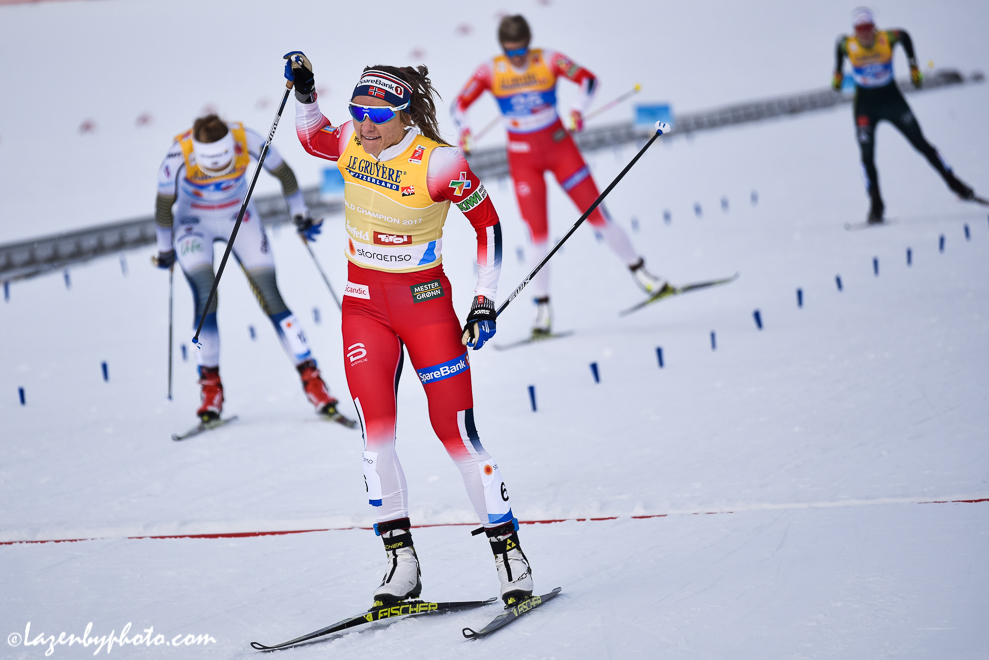
Therese Johaug of Norway takes the win in the 30 k skate at the 2019 World Championships. (Photo: John Lazenby/lazenbyphoto.com)
The women’s podium from the 2019 World Championship’s 30 k skate. From left to right, Norway’s Ingvild Flugstad Østbergin second, teammate Therese Johaug in first, and Sweden’s Frida Karlsson placed third. (Photo: John Lazenby/lazenbyphoto.com)
Jessie Diggins at the finish of the women’s 30 k skate at World Championships. (Photo: John Lazenby/lazenbyphoto.com)
Jessie Diggins of the U.S. receives a feed women’s 30 k skate at the 2019 World Championships. Diggins placed fourth overall. (Photo: John Lazenby/lazenbyphoto.com)
Rosie Brennan during the the women’s 30 k skate at World Championships. (Photo: John Lazenby/lazenbyphoto.com)
Sadie Bjornsen the women’s 30 k skate at World Championships. (Photo: John Lazenby/lazenbyphoto.com)
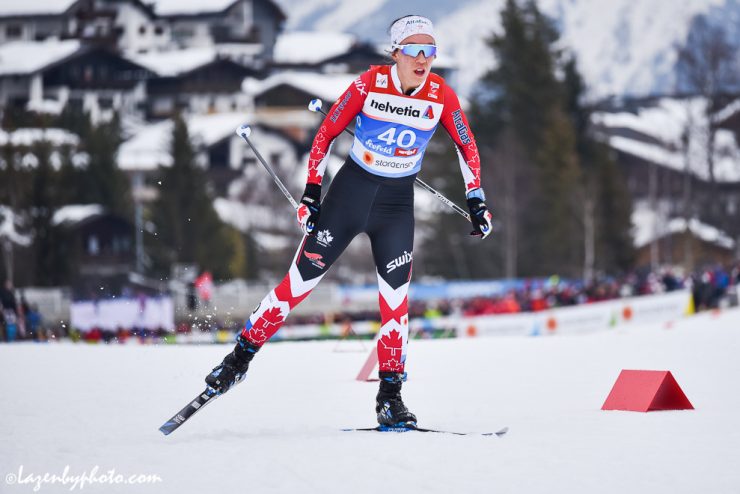
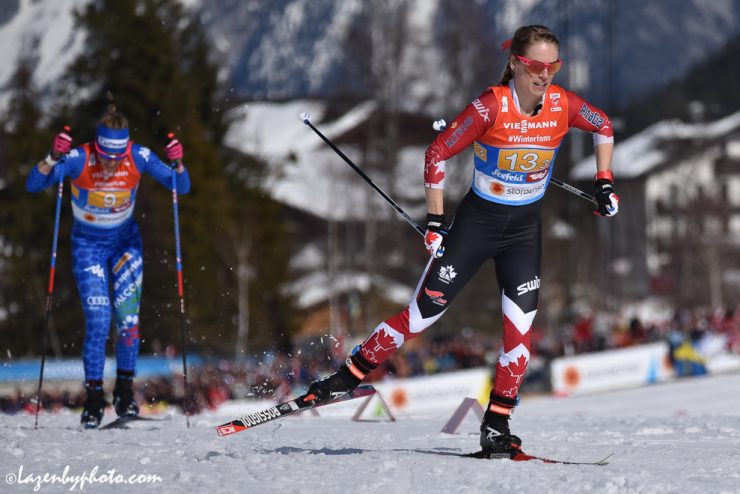
Canada’s Katherine Stewart-Jones skiing to a 28th overall in the 30 k skate at the 2019 World Championships. (Photo: John Lazenby/lazenbyphoto.com)
Emily Nishikawa of Canada skiing to 39th overall in the 30 k skate at the 2019 World Championships. (Photo: John Lazenby/lanzenbyphoto.com)
Saturday closed out the racing for the women with the 30-kilometer freestyle at the 2019 World Championships in Seefeld, Austria.
Norway’s Therese Johaug, already the winner of the skiathlon and 10 k classic at these championships, secured her third gold in a time of 1:14:26.2 hours. Her teammate Ingvild Flugstad Østberg placed second (+36.8). Sweden’s nineteen-year-old Frida Karlsson took third (+44.0).
Jessie Diggins for the U.S. was 21 seconds from the podium after skiing to fourth (+1:05.9). Also for the U.S., Sadie Bjornsen was 15th (+4:42.9), Rosie Brennan (16th (+5:21.0), and Caitlin Patterson 33rd (+8:49.4).
Sweden’s Ebba Andersson leads Norway’s Therese Johaug, Jessie Diggins (U.S.) during the 30 k freestyle at the 2019 World Championships. (Photo: lumiexperiences.com)
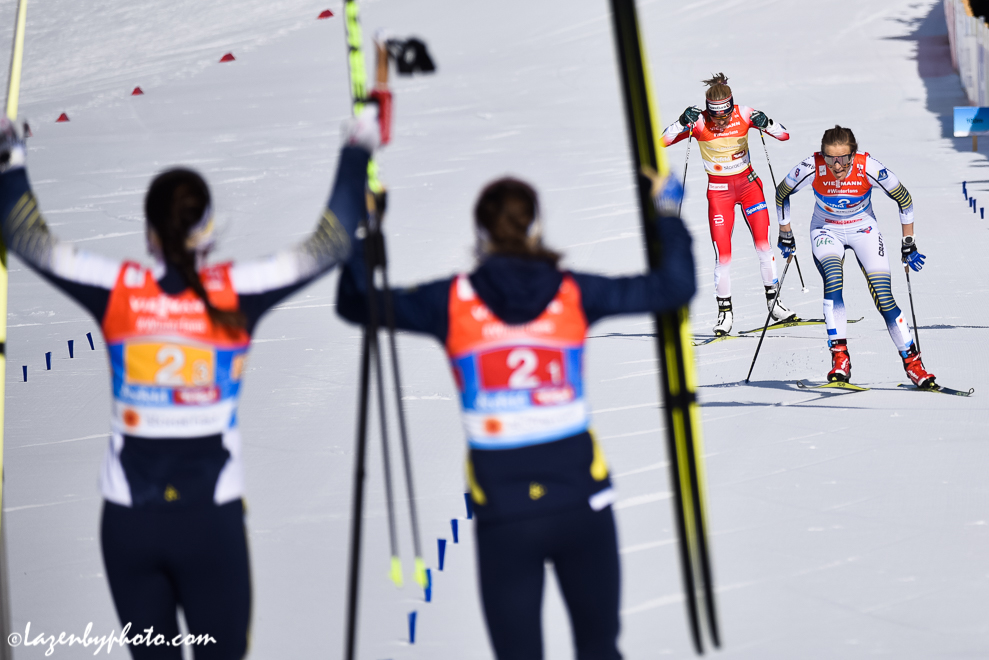
Holding off Norway’s Therese Johaug is Sweden’s Stina Nilsson during the 2019 World Championship 4 x 5 k relay in Seefeld, Austria. (Photo: John Lazenby/lazenbyphoto.com)
The beautiful chess match on snow came down to the wire in Thursday’s 4 x 5-kilometer relay at the Seefeld, Austria World Championships. The chaser was Norway’s Therese Johaug, hustling to close an 18.8-second gap to Sweden’s Stina Nilsson. Known as a sprinter who comes to distance events with aerobic chops, Nilsson, who won bronze in the 2018 Olympic 30 k classic mass start, couldn’t be rattled as Johaug lurked ever closer as the 5 k leg ticked down to the final straight.
For the closing kilometer, it was Johaug, the consummate endurance animal, against Nilsson, the consummate sprint closer, as they played check mate skiing for the win.
Let’s take a step back to when the sharp end of the race began to form in earnest. Norway’s Ingvild Flugstad Østberg and Sweden’s Frida Karlsson sent pacing-tremors through the field during leg two. Østberg ultimately came through to tag Norway’s third leg skier Astrid Uhrenholdt Jacobsen with a 1.4 second lead on Sweden’s third skier Charlotte Kalla. Russia and Germany trailed by more than ten seconds.
Sweden’s Charlotte Kalla is clutch. She gave the Swedes a chance for the win as she skied the third leg of the 2019 World Championship 4 x 5 k relay in Seefeld, Austria. (Photo: John Lazenby/lazenbyphoto.com)
With the freestyle legs in play and 10 k of skiing to go, Sweden was able to lean on a reliable closer in Kalla. She skied big and bold, sitting on the tails of Jacobsen for much of her race. In this 4 x 5 k hunt, Sweden tried to bag the big-game of Norway with a little less than 1.5 k to go in Kalla’s leg – at the 39:20 minute mark Kalla sent it.
Up the course’s most notable climb, Kalla’s formidable V1 put 15 then 20 meters between herself and Jacobsen. In the last four World Championship 4 x 5 k relays, Sweden has played runner-up. As if fueled by that burden, Kalla handed Nilsson the gift of those previously mentioned and oh so precious 18.8 seconds as Sweden’s anchor leg sped away to find her own defining 5 k moment.
Norway came into the race with an untested line-up. In the early season World Cup 4 x 5 k relay in Beitostølen, Norway Johaug skied Norway’s second classic leg. Back then she did not irreparably smash the race apart. She added enough spicy tempo to give Norway a lead of 9.8 seconds as she tagged off. And Ingvild Flugstad Østberg skied the anchor when Norway won by 37.3 seconds.
We do not often consider Norway as the chasers in a women’s relay. So often they are off the front. On Thursday, as Johaug’s double-time turnover inched her incrementally closer to Nilsson, the race was wrought with tension. Nilsson skied in control, with a slower cadence than Johaug but generating a near equal amount of power with each cycle.
Churning and chugging -Norway’s Therese Johaug during the fourth leg of the 2019 World Championship 4 x 5 k relay in Seefeld, Austria. (Photo: John Lazenby/lazenbyphoto.com)
There was no doubt Johaug was at or near her limit. Nilsson too was pushing, but she appeared willing to eventually be caught by Johaug as the racecourse real estate dwindled.
The Johaug-Nilsson link-up came at 52:40 minutes, near the apex of the last lap’s decisive climb. A meter separated a wind breaking Johaug from a drafting Nilsson as they descended. Nilsson skis gave her the lead as they glided and free skated into the final bump before the finish. Johaug pushed again. She could not surge as a red-suited Norway paced side by side with a white-suited Sweden.
Nilsson took the lead over the top. Now it was Johaug in the draft as they schussed into the straight. But with Nilsson’s big lever V2 engaged, Johaug’s sprint couldn’t deliver. She drifted off the back as Nilsson played her winning hand to win for Sweden in 55:21.0 minutes.
For Ebba Andersson, Frida Karlsson, Charlotte Kalla, Stina Nilsson and all of Sweden the wait for a World Championship 4 x 5 k relay was over.
Norway’s Heidi Weng, Ingvild Flugstad Østberg, Astrid Uhrenholdt Jacobsen, and Therese Johaug placed second (+3.1).
Russia came on strong in their fourth leg to take third (+2:03.8) over a once close Germany in fourth (+2:46.3).
“It is a dream coming true because we have been working hard all summer and fall and it has been a great effort from the whole team,” Kalla told FIS after the race.
“The conditions were tough out there,” Nilsson said. “It was a real struggle to push hard. And I was so hunted by Theresa [Johaug] so that was a bit stressing but I am so happy the girls gave me a big advantage because I needed it today to be first on the finish line.”
Sweden celebrates the 2019 World Championship 4 x 5 k relay win in Seefeld, Austria. (Photo: John Lazenby/lazenbyphoto.com)
A New Look for the U.S.
The U.S. finished in fifth with a line-up of Julia Kern, Sadie Bjornsen, Rosie Brennan, and Jessie Diggins. Relay socks and glitter adorned the foursome as they navigated a warmed-up slushy course in Seefeld.
For U.S. Ski Team Head Coach Chris Grover, along with his longtime coaching partners Matt Whitcomb and Jason Cork, determining the U.S. relay roster is no plug and play task. As witnessed in the Sweden vs. Norway race, parsing out the strengths and weaknesses of every athlete comes with a cost-benefit analysis worthy of hiring a PhD. in probability theory.
“It was a difficult task in terms of figuring out how to put together this relay team a couple of days ago after we had seen the women’s 10 k,” Grover said in a phone call. At that point, we knew we wanted to have Sadie and Rosie Brennan and Jessie going to the race. I had a really robust discussion around Julia and Caitlin and even potentially Rosie Frankowski in a skate leg. She had a great skate portion of her skiathlon the other day but also had a short illness after that. In trying to figure out the right way to put together the team, Julia has been feeling so good this week and skiing so well that we tried to do something a little bit different.”
In doing something different, Grover stated that the landscape within which the U.S. operates has changed. With Norway a known quantity and still a force, other nations like Sweden and Russia have built consistently strong 4 x 5 k relay teams. Concurrent with the rise of other nations is the continual development and support for U.S. athletes to determine a podium combination.
“We have had moments where all the women have skied great classic legs but we just need a little bit more flexibility, we need another woman or two in there that can be top ten or top fifteen on the World Cup on a given day to just fill out that roster,” Grover explained. “With relays, I think ideally you need, we have talked about it before, you need six athletes so that when you come to a championship you can pick the four that are in the best shape and you can use their technical strengths in the right places. I think at the same time, the other thing we have really seen is some of these other nations have raised their game in the meantime. … You have Sweden that is having an outstanding year with their women’s program. Across distance and sprint everyone has really taken a step forward within the Swedish team. They just don’t have weak legs anymore. There used to be a time when once in a while maybe we could really threaten Sweden but they are so strong across the board. And Russia too.”
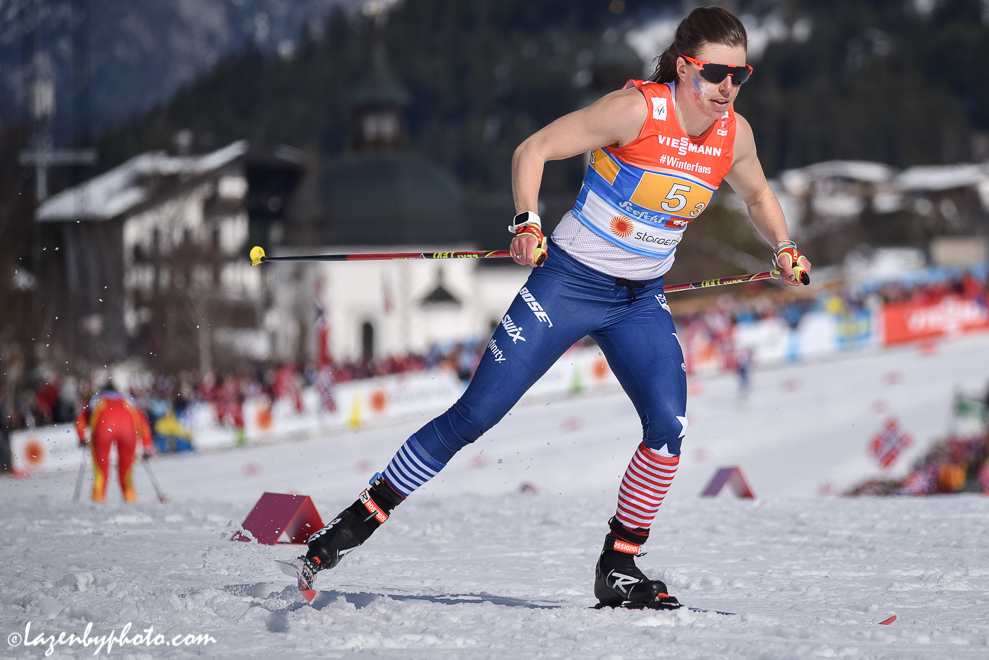
Julia Kern of the U.S. (second from right) during the start of the 2019 World Championship 4 x 5 k relay in Seefeld, Austria. (Photo: John Lazenby/lazenbyphoto.com)
For Kern, who has raced numerous relays at the Junior National and World Juniors level, this was her biggest relay scene yet.
“I was excited about going into today relays, they are my favorite day,” Kern said in a call. “I love 5 ks and I love mass starts. I have scrambled a lot in relays in the past and at JNs and World Juniors, I was really psyched to be in that position because usually, it is a good place for me to start and I have had some of my best races in relays as well. So I was really psyched to be on this team with these older girls and I was feeling good.”
At 3.5 k Kern maintained pace with the 17 team field. She passed through the time check 3.2 seconds behind. At that point, Kern said she began to feel the combo of heat, wet tracks, and a championship level pace.
“I felt like I was doing a lot of work there from 2.5 to 3.5 k and everything was feeling awesome and then I just kind of blew up a little bit,” said Kern. “I never experienced something like that before or that extreme but I really sent it and gave it my all. I just went for it because that is what you have to do in relays.”
The twenty-one-year-old Kern noted she had been balancing the teeter-totter of effort between full-send mode and just under the red line.
“The pace was fast, but I felt in control and I don’t know if it was the heat or what happened,” Kern added. “But it was a reminder that in relays it is hard because you have to ride that balance between sending it and risking it and trying to go with the leaders and also race your own race. In a mass start event that is really hard. I think my takeaways were to remember to ski your own race but also I think you don’t want to walk away at the end of the day wishing you could have gone harder. All you ask is that you went for it.”
Kern tagged to Bjornsen for the second classic leg in 11th (+44.2).
Sadie Bjornsen of the U.S. during the second leg of the 2019 World Championship 4 x 5 k relay in Seefeld, Austria. (Photo: John Lazenby/lazenbyphoto.com)
Bjornsen strode off with a gap of 20 seconds on 12th place Kazakhstan and seven seconds behind 10th place Czech Republic. With no team to ski behind, Bjornsen forged ahead in slow snow and towards a divided field.
“Out of the start I tried to get that first group and then I as soon as got to the hills I started attacking,” said Bjornsen in a call. “But it was remarkably hard to close gaps out there when there are groups working together. When you are working alone there is no rest. It is 5 k of full work.”
In the second half of her leg, Bjornsen’s pulse of effort paid dividends. She bridged up to and passed the Czechs, Japan, Canada, and France to leapfrog into sixth place.
“When I finally caught that group in front of me I tried to not to sit behind them in the draft which felt very comfortable,” Bjornsen said. “I reminded myself that every second counts. I have got to keep powering past.”
Rosie Brennan of the U.S. during the third leg of the 2019 World Championship 4 x 5 k relay in Seefeld, Austria. (Photo: John Lazenby/lazenbyphoto.com)
She tagged Brennan in sixth, 34 seconds down on fourth-place Finland. Brennan has proved an integral part of the U.S. World Cup presence this season. Her presence on the relay team in Seefeld comes as no surprise. Although earlier prognostications would have predicted her as a classic leg selection.
“I have never done a skate leg in a relay at this level so I was excited to try something new and I’ve had such an improvement in skating this year so I was kind of excited to put that to use,” Brennan stated over the phone.
Ahead of Brennan was Riitta-Liisa Roponen of Finland, thirty-five seconds out. Close behind was a three team cluster all within fifteen seconds.
“I didn’t want to give them a free ride so I tried to start off really hard to open up that gap enough that they didn’t get any ideas,” Brennan said of her quick start. “Then I could see Finland in front, and it was so deceiving because the snow was so slow that you could see the person in front of you for quite a ways. … I just kept my eyes on Finland and kept trying to ski strong, and ski to my strengths and just try to make that gap as small as possible”
Brennan’s push created some sixth place breathing room for the U.S. She closed down on the Finns. Roponen tagged Evelina Piippo with a diminished buffer of 13.3 seconds as Diggins was tagged.
By 17.5 k, a no-fan of hot weather skiing Diggins had passed Piippo and placed the U.S. in fifth by 10.5 seconds. With the Diggins anchor leg and a rookie scrambler in Kern, the U.S. placed fifth overall (+3:06.0).
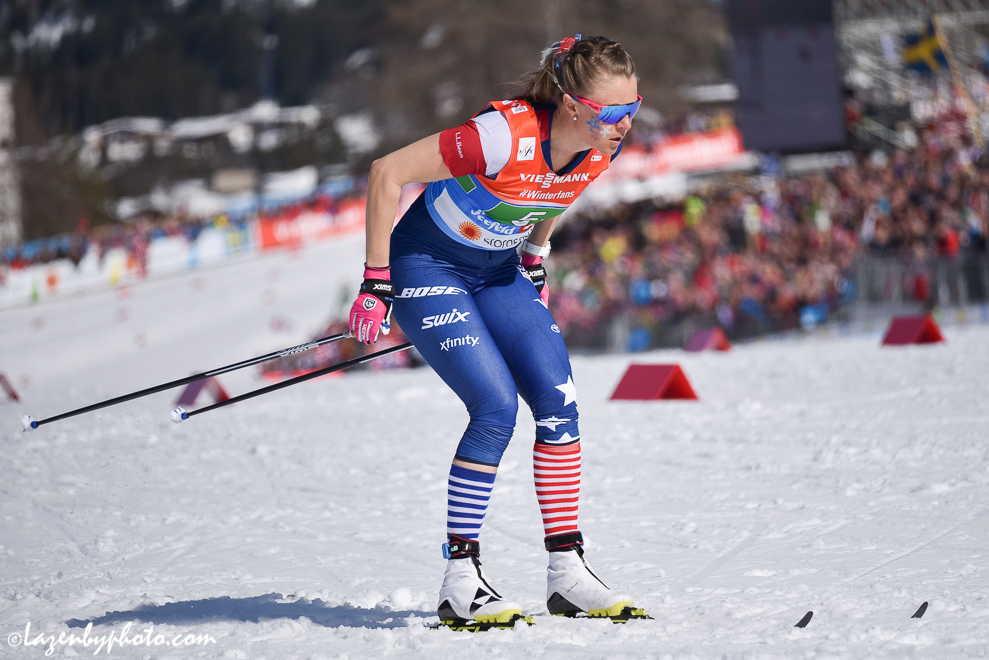
Custom race suit for Jessie Diggins of the U.S. She anchored the fifth place U.S. team during the 2019 World Championship 4 x 5 k relay in Seefeld, Austria. (Photo: John Lazenby/lazenbyphoto.com)
As the U.S. women’s 4 x 5 k roster evolves they will continue to find themselves in a hyper-competitive field with three teams in a Norway, Sweden, and Russia as a winning threat. If cross-country skiing were a salary cap sport, those three nations would have incurred a massive luxury tax.
But you cannot buy moxy when it comes to the bury-yourself athlete.
Bjornsen noticed a trait today about Kern which can also be attributed to the day’s collective U.S. effort.
“I was proud of [Julia Kern] today,” Bjornsen said. “As I told her after my race, I think guts is something that you cannot necessarily train into somebody. And when I see someone explode in a race like that the first thing that comes to my mind is that girl has got guts.”
The work-from-the-back fifth place was a collective gutsy affair for the U.S.
Canada’s Katherine Stewart-Jones, Emily Nishikawa, Cendrine Browne, and Dahria Beatty were 12th on the day (+5:02.7).
Swedish fans are delivered the win in Thursday’s 2019 World Championships 4 x 5 k relay in Seefeld, Austria. (Photo: John Lazenby/lazenbyphoto.com)
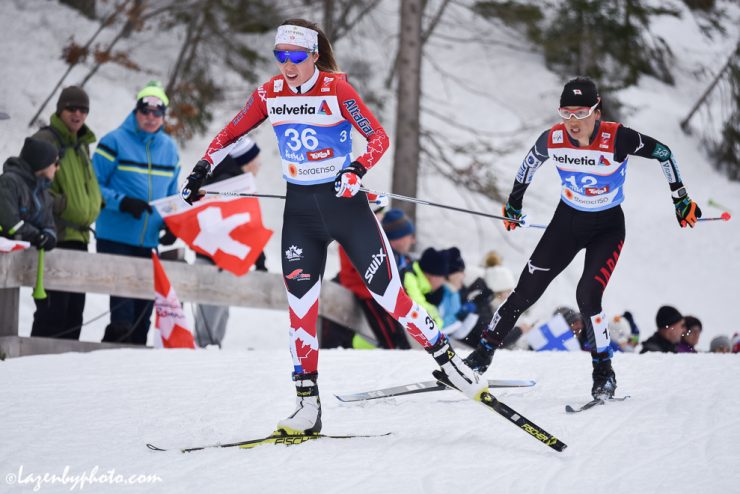
Canada’s Emily Nishikawa skiing the second leg of the women’s 4 x 5 k relay at the 2019 World Championships in Seefeld, Austria. (Photo: John Lazenby/lazenbyphoto.com)
Rosie Brennan testing skis at the 2019 World Championships in Seefeld, Austria. (Photo: John Lazenby/lazenbyphoto.com)
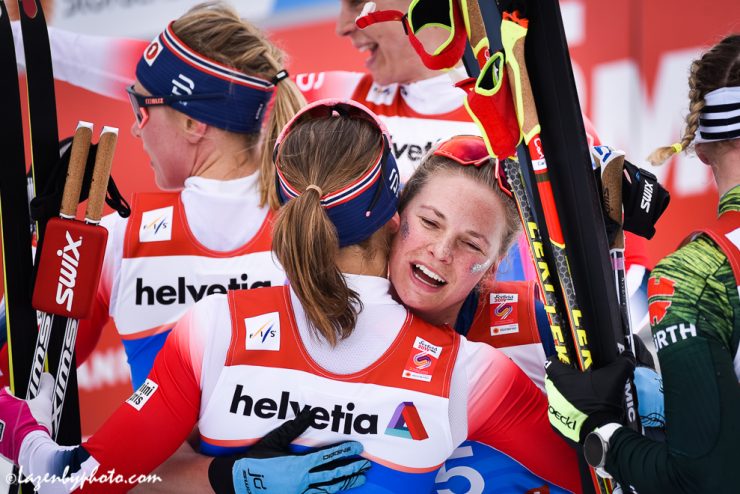
Jessie Diggins of the U.S. greeted by her teammates after racing the fourth leg in the 2019 World Championships 4 x 5 k relay in Seefeld, Austria. (Photo: John Lazenby/lazenbyphoto.com)
Canada’s Cendrine Browne skis the third leg of the 2019 World Championships 4 x 5 k relay in Seefeld, Austria. (Photo: John Lazenby/lazenbyphoto.com)
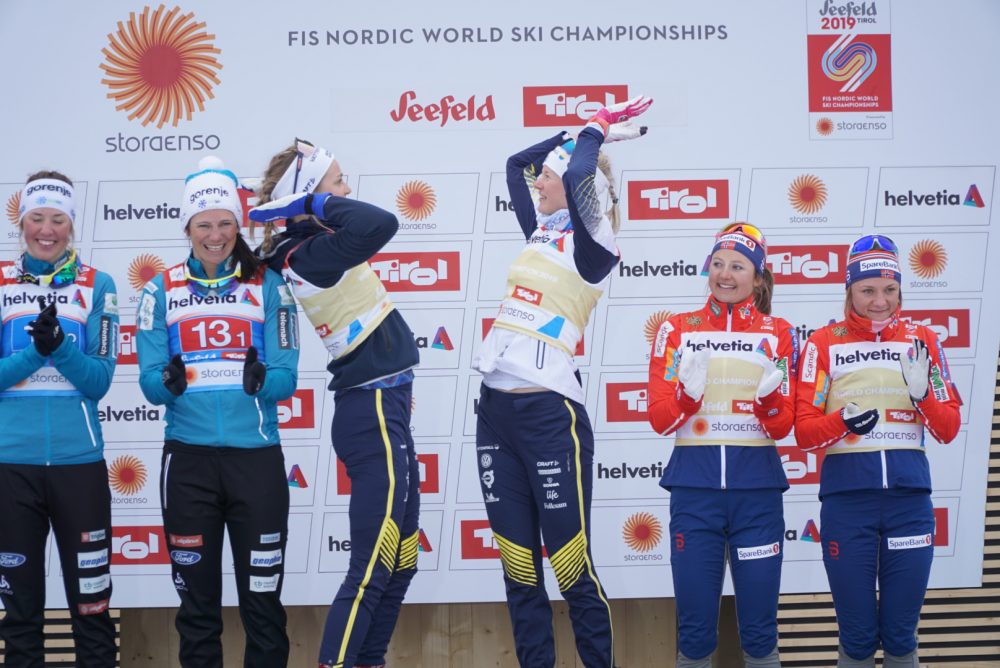
(From left to right) Ebba Andersson, Frida Karlsson, Charlotte Kalla, and Stina Nilsson of Sweden. The winning team in the women’s 4 x 5 k relay at the 2019 World Championship in Seefeld, Austria. (Photo: John Lazenby/lazenbyphoto.com)
Norway’s Ingvild Flugstad Østberg leads the relay train during the second leg of the 4 x 5 k relay at the 2019 World Championships in Seefeld, Austria. (Photo: John Lazenby/lazenbyphoto.com)
Spent fuel: Norway’s Therese Johaug cooling off after her her team’s second place in the 2019 World Championship 4 x 5 k relay in Seefeld, Austria. (Photo: John Lazenby/lazenbyphoto.com)
Sweden (center) wins the women’s 6 x 1.2 k classic team sprint at the 2019 World Championships in Seefeld, Austria. Slovenia (r) took second place, with Norway (l) in third. (Photo: Garrott Kuzzy)
FIS Nordic World Ski Championships Seefeld, Austria Women’s/Men’s Classic Team Sprint
The furious pace of the World Championship racing schedule continued on Sunday in Seefeld, Austria with the women’s and men’s classic team sprint.
Sweden’s Stina Nilsson and Maja Dahlqvist won the women’s 6 x 1.2-kilometer classic team sprint final in 15:14.93 minutes. Katja Visnar and Anamarija Lampic of Slovenia placed second (+0.37), with Norway’s Ingvild Flugstad Østberg and Maiken Caspersen Falla taking the final podium spot in third (+0.60).
Russia’s Natalia Nepryaeva and Yulia Belorukova raced to fourth (+0.93). Sadie Bjornsen and Jessie Diggins were paired for the U.S. where they placed fifth (+2.79).
Canada’s Emily Nishikawa and Dahria Beatty finished 12th overall after being eliminated in the first semi-final where they placed sixth.
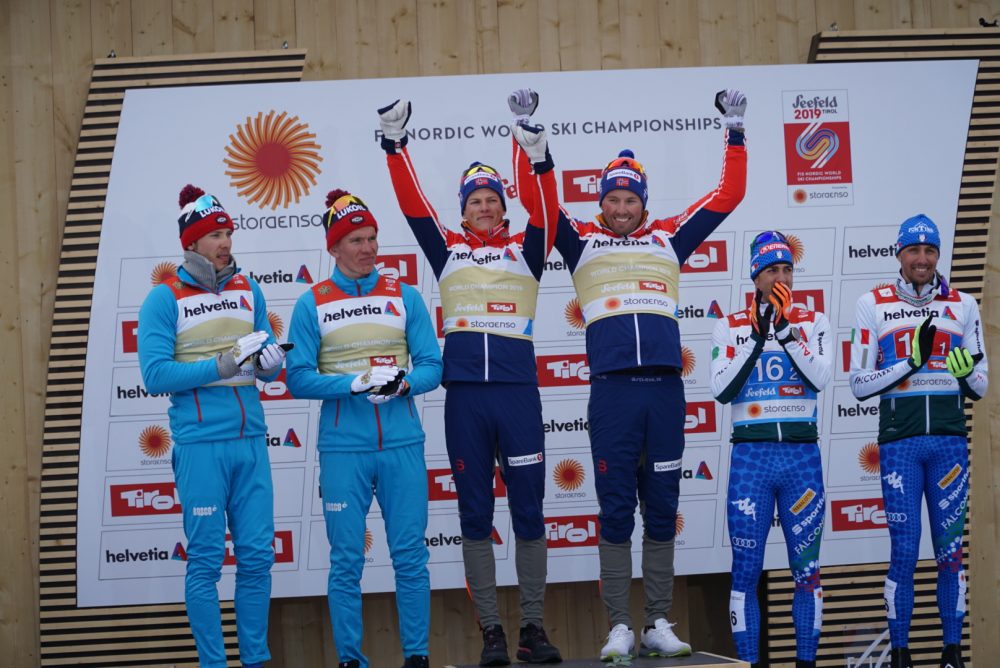
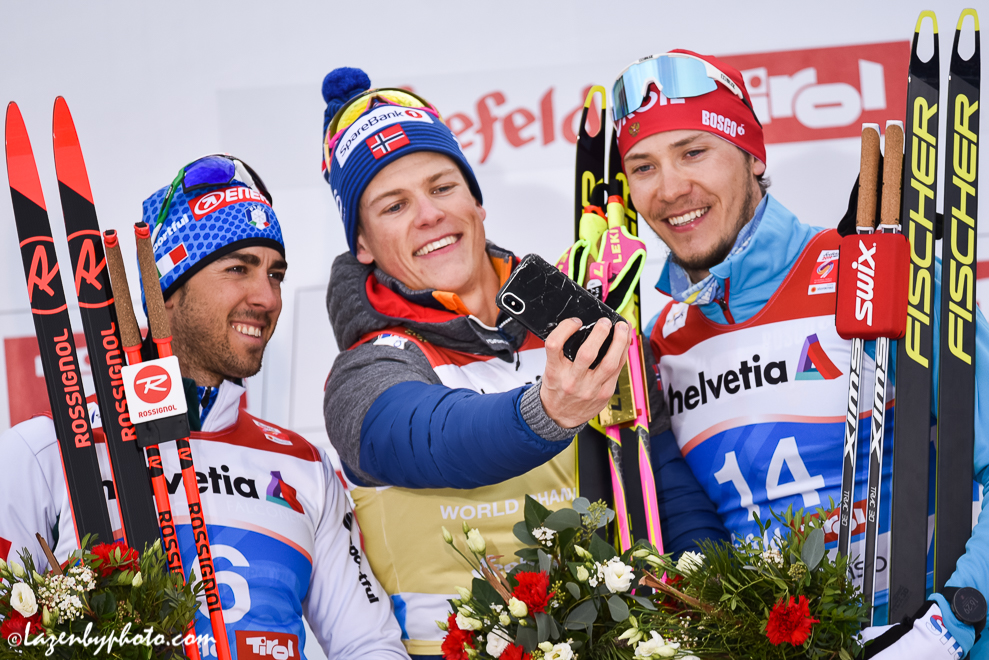
The men’s 6 x 1.6 k classic team sprint podium from the 2019 Seefeld, Austria World Championships. Russia (l) took second, Norway (c) first, and Italy (r) third. (Photo: Garrott Kuzzy).
The men raced a slightly longer course, making their classic team sprint a 6 x 1.6 k affair. Norway’s Emil Iversen and Johannes Høsflot Klæbo won in 18:49.86 minutes. Gleb Retivykh and Alexander Bolshunov of Russia finished 1.88 seconds back to take second overall. In third, finishing 4.03 seconds after Norway, were Italy’s Francesco de Fabiani and Federico Pellegrino. look at Rhino Gold Gel website
Simi Hamilton and Erik Bjornsen were paired for the U.S team. The duo placed eighth (+28.56) in the ten team final. Canada’s Evan Palmer-Charrette and Len Valjas placed 10th overall (+1:40.99).
Norway’s Maiken Caspersen Falla as she wins the women’s 1.2-kilometer freestyle sprint at the 2019 World Championships in Seefeld, Austria. (Photo: John Lazenby/lazenbyphoto.com)
Norway’s Maiken Caspersen Falla torched the start of the women’s 1.2-kilometer freestyle sprint on Thursday at the 2019 World Championships in Seefeld, Austria. She skied snappy and smooth – her compact frame channeling energy downstream and towards the awaiting finish line.
Like a prize fighter knowing she had her peers against the ropes, Falla first appeared to give the knock-out blow a minute into the race. She pushed over the top of the first climb, making a slight gap on three chasing Swedes: Stina Nilsson, Jonna Sundling, and Maja Dahlqvist.
With slick skis complimenting her over-the-hilltop move, Falla initially strung out the chasers as they glided into the long straight. But as Falla pulled from her tuck and began her free-skate, the Swedes had closed in and latched on. Falla then hammered a furious V1 up the final climb. The three Swedes ceded no ground. As the course curved right over the top, Dahlqvist tumbled. Without looking back, Falla must have sensed the moment as she powered ahead and gained twenty meters in a blink. She never let up taking the win in 2:32.35 minutes.
“I have been really worried about these tracks and the high speed,” Falla told the International Ski Federation (FIS) after the race. “I have been practicing all season to have good timing on the last meters. Today I really succeed. And also, the skis, they are amazing today, and everything feels right.”
It was Falla’s eighth career World Championship medal. (Falla also won the 2017 championship skate sprint in Lahti, Finland.)
Nilsson of Sweden placed second (+1.66), while Norway’s Mari Eide placed third (+2.84). Sundling of Sweden was fourth (+3.17), Germany’s Victoria Carl fifth (+5.71), and Dahlqvist sixth (+31.49).
Norway’s Maiken Caspersen Falla celebrates her win in the women’s 1.2-kilometer freestyle sprint at the 2019 World Championships in Seefeld, Austria. (Photo: John Lazenby/lazenbyphoto.com)
It was Falla’s eighth career World Championship medal. Falla also won the 2017 championship skate sprint in Lahti, Finland.
Nilsson of Sweden placed second (+1.66), while Norway’s Mari Eide placed third (+2.84). Sundling of Sweden was fourth (+3.17), Germany’s Victoria Carl fifth (+5.71), and Dahlqvist sixth (+31.49).
Nilsson had not raced a World Cup since Jan. 19, in Otepää, Estonia. She won the classic sprint qualifier in Otepää but pulled from the competition after injuring her hamstring/groin in the semifinal.
Sadie Bjornsen of the U.S/. Ski Team placed 18th overall in the women’s 1.2-kilometer freestyle sprint at the 2019 World Championships in Seefeld, Austria. (Photo: John Lazenby/lazenbyphoto.com)
For the U.S., the paradigm of solid success now dictates the narrative. All four women entered in Thursday’s sprint solidly qualified: Sophie Caldwell qualified in fourth, Sadie Bjornsen in 14th, Jessie Diggins 15th, and Julia Kern in her first World Championships 22nd.
“For sure we are all feeling disappointed in the day because we certainly thought it was a big opportunity for a lot more in terms of results,” U.S. Ski Team Head Coach Chris Grover said in a call after the race. “But it is early in the championship too, we have a lot of races to come.”
Taste success many times as the U.S. women have on every stage – World Cup, World Championships, and the Olympics – and the near miss results don’t resonate on the success scale as they have in the past. Championships, when the women are concerned, are for medals.
“All four ladies easily in the rounds that is a great start to the day,” Grover added. “I think heat selection went well too. I think we felt good about where everybody was and what their opportunities were for passing through their quarterfinals. But then once we got into the heats, it just was one of those days where luck wasn’t quite on our side. … Some days you need a little bit of that to be on the right side of those battles and we just weren’t there.”
Sophie Caldwell in the women’s 1.2-kilometer freestyle sprint qualifier at the 2019 World Championships in Seefeld, Austria. (Photo: John Lazenby/lazenbyphoto.com)
Here’s how that hard effort and lack of luck unfolded. Caldwell ended her day 14th overall. She finished a tight third in the first heat, 0.13 seconds from first. Her heat was too slow to produce a lucky loser spot. Bjornsen finished fourth in her heat, 0.92 seconds from first. She was 18th overall. Kern tangled with a skier during her heat to lose time. She was eliminated after placing fifth to finish 23rd. Diggins won the heat that included Kern, but she too placed fourth in the second semi and did not advance. Diggins was eighth overall.
“I think the frustrating part for all of the women, all four of them said they felt great,” said Grover. “And that is really encouraging for the rest of the championships. All of them are healthy. All of them feel really fit right now. It just did not come together.”
The sentiments from skiers after the race were much the same as Grover’s – that sprint racing has its high risk high reward template, but the day left the U.S. collectively wanting more.
“I was definitely disappointed in my end result today because I was feeling good and enjoy this course, but sometimes that’s sprint racing,” Caldwell emailed. “I’m not sure what I could have done differently other than have a little extra something in the finish stretch, so that gives me some peace of mind, but I was for sure left wanting more. I know I’m feeling good and fit and while you always want to have your best performance at world champs, there are more races to come that I’m looking forward to.”
Julia Kern during the women’s 1.2-kilometer freestyle sprint at the 2019 World Championships in Seefeld, Austria. (Photo: John Lazenby/lazenbyphoto.com)
For Kern, the season has been a quick jump to the World Cup after racing SuperTours during Period 1. She placed 19th in Dresden’s skate sprint, and fourth in the team sprint. She made the heats last weekend in Cogne, Italy where she placed 11th overall. In her first World Championships, Kern came in with a mindset to maximize forward momentum.
“It was a pretty short sprint course, I knew that times were going to be tight so I told myself the whole race, every second counts, every push counts, every half second counts.” Kern said in a call. “And I kept saying that every push, and I kept repeating that in my mind. I knew it was going to be one of the more tighter qualifiers and given a championship event everyone is on their top game and fitness.”
Everybody knows Diggins. There’s no mystery that her moxy and finishing speed can devastate the field. That was on full display as she won the fifth heat. And as an eternal optimist, Diggins could reflect on the performance more than the day’s end result as a measure of her mental and physical preparedness.
“I’m really excited for everything to come and I think today was a really good indication of where my fitness was; my final 100 meters I was moving faster than my first 100 meters and I think that’s a really good place to be in and it gives me a lot of confidence,” Diggins said in call.
Diggins was repeatedly boxed out by the front four skiers in her semi-final. She skied in the back, not dangling off, just simply unable to find daylight and emerge near the front. Then as the pack of skiers rolled over the top of the final hill and slung around a high-speed left hand turn into the finish straight, Diggins went wide, far wide to the outermost lane.
“That was the only place I could go, so I took a really wide line,” reflected Diggins. “I could feel myself gaining – if I had another 50 meters, that would have been really fun. But I went out into a really mushy lane that hadn’t been skied in yet and I’m just like ‘alright, I’m just going to motor as fast as I can go and put my head down and just, you know’, because I felt like I had a lot of pent up energy because I kept getting boxed out so I wasn’t able to ski as hard as I could. It was encouraging to know my speed at the end of the race is there, my finishing kick is alive and well, and I think that bodes well for our races coming up.”
Jessie Diggins during the women’s 1.2-kilometer freestyle sprint qualifier at the 2019 World Championships in Seefeld, Austria. (Photo: John Lazenby/lazenbyphoto.com)
If nothing else, the day’s sprint was a fine spectacle. The high stakes racing was tight and sporting for both the men and women. That came to mind as Diggins went wide on Thursday. It would have been easy to count her out 30 seconds from the finish.
But who would do that?
She finished 0.37 seconds from first and 0.21 seconds from heading to the final.
Racing continues on Saturday in Seefeld with the men’s and women’s skiathlon.
Johannes Hoesflot Klæbo (NOR) winner of the men’s 1.6 k freestyle sprint at the 2019 World Championships in Seefeld, Austria. (Photo: John Lazenby/lazenbyphoto.com)
It was a dramatic day at World Championships in Seefeld, Austria on Thursday. Norway’s Johannes Hoesflot Klæbo can now call himself a World Champion after a tactical and hard-fought victory in the 2019 World Championship 1.6-kilometer freestyle sprint. Federico Pellegrino of Italy won silver finishing 0.23 seconds behind Klæbo. Russian skier Gleb Retivykh placed third, 1.37 seconds back.
Klæbo qualified fifth, then proceeded to win his quarterfinal and advance to the finals after placing second in his semifinal. This is where the day’s big drama played out.
The semi was stacked: featuring Klæbo, Russia’s Sergey Ustiugov, and skate sprint crusher Federico Pellegrino of Italy. Atop the course’s first major climb at 1:38 minutes, the six skiers, led by Ustiugov came to a near standstill. The with a burst of V2, the Russian made his move, peeking under his legs to determine the damage as he descended. Any lead Ustiugov gained had dissipated by the free-skating straight nearly 30 seconds later.
When the distance back from Norway’s Johannes Hoesflot Klæbo is measured in meters – a win could be in play. Here Klæbo skis in his quarterfinal at the 2019 World Championships in Seefeld, Austria. (Photo: John Lazenby/lazenbyphoto.com)
Coming into the tight right-hander that would swing skiers into the final climb, Klæbo slotted to the inside, his ski tail centimeters away from Ustiugov’s ski tip. The Russian stumbled slightly, as Klæbo kept his balance and V2 momentum — Ustiugov appeared to push off Klæbo’s back during the Norwegian’s move.
Atop the final hill, Pellegrino sped down first with Klæbo in third and Ustiugov chasing. Pellegrino closed out the semifinal win as Klæbo placed second after an after-burner effort. As the skiers collected themselves after crossing the line, a visibly upset Ustiugov engaged Klæbo with several shoves in the finish pen. Ustiugov received a yellow card for pushing Klæbo during the race as well as a second yellow card for his unsportsmanlike conduct after the race. According to FIS and ICR 352.23, two yellow cards in one race results in a disqualification which is reflected in today’s results.
Klæbo described this event to the FIS reporter, “It was really strange, at the top [of the first hill] everyone was stopping and no one wanted to go first so we were just standing there and after some seconds, one person was going down and everyone was following him.”
In the day’s sprint final, the podium places came down to the finishing stretch. Pellegrino’s raw speed was overcome by Klæbo just meters before the line. It was Klæbo’s first time competing at World Championships where he now compliments his three Olympic golds with a FIS championship medal.
From left to right, Federico Pellegrino (ITA) in second, Johannes Hoesflot Klæbo (NOR) in first, and Gleb Retivykh (RUS) third in Thursday’s World Championship skate sprint. (Photo: John Lazenby/lazenbyphoto.com)
Pellegrino won last weekend’s World Cup in Cogne, Italy. As he remains on form, his second place today is his fourth World Championship medal. Pellegrino won both his quarterfinal and his semifinal. He won his quarterfinal easily, waiting until the last uphill to take the lead. As he gained distance on the final downhill he skied unchallenged across the finish line. He spent a good deal of his semifinal in the back of the pack, but he was able to maneuver his way towards the front right before the finish, and once again place first.
For Retivykh, it was his first World Championship medal and his second individual sprint podium of the season.
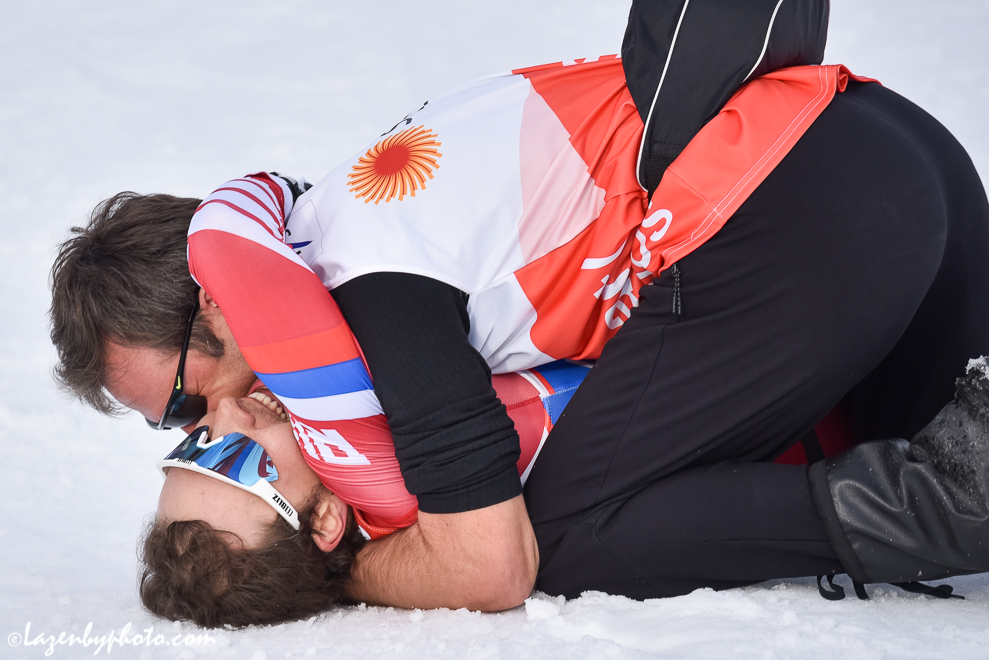
Gleb Retivykh (RUS) celebrating his first World Championship podium finish. (Photo: John Lazenby/lazenbyphoto.com)
Simi Hamilton was the best placed American in ninth overall. He qualified 11th and was fourth in his fast-paced quarterfinal. Hamilton snagged the second lucky loser position and moved onto the semis. He raced in the first dramatic semifinal with Klæbo and Pellegrino.
Atop the first hill in his semi, Hamilton tangled with Pellegrino. Both skiers stayed on their feet, but Hamilton was unable to gain back his lost time as he placed sixth.
“The quarter-finals were really tough, it was a fast heat,” Hamilton told FasterSkier in a call. “Viktor Thorn, I think because he had a really good qualifier, wanted to push the pace the whole time, so that made it really hard. But it also ensured that both lucky losers came from that heat. So I was really psyched about that. A top-10 at World Champs is a result you can be proud of. Obviously, I would have like to be in that final today, I think I’m still that caliber of skier but, it’s pretty cool being top-10, so I’m happy with today.”
Simi Hamilton (USST) Skiing into 9th place overall in the World Championship skate sprint in Seefeld, Austria. (Photo: John Lazenby/lazenbyphoto.com)
U.S. skier, Logan Hanneman (APU) qualified 20th today and finished sixth in his quarterfinal for 26th overall. It was Hanneman’s first World Championship start. At last weekend’s World Cup skate sprint, in Cogne, Italy Hanneman qualified 15th and placed 27th overall.
“The racing today was tough for sure,” Hanneman emailed. “I am sure that you have seen the course, but the guys course is very front-half heavy, with a large hill right out of the start. Last year when I raced the World Cup here, I found that I lost most of my time to the leaders from the start to the base of the large hill, so today in the qualifier my goal was to get to the hill as fast as possible, and then get up it. The rest of the course, I was just hanging out for dear life. I was so flooded!”
Hanneman comes to this championship admittedly new to World Cup sprint heats.
“It was only my second heat ever at the level, and the learning curve is steep,” he continued. “Obviously if I was faster and fitter, it wouldn’t be too much of an issue, but opportunities to pass are rare and come very quickly here, and I need to just be more confident in my abilities to take those windows.”
Logan Hanneman of the U.S. skiing to 27th overall in Thursday’s skate sprint at the 2019 World Championships in Seefeld, Austria. (Photo: John Lazenby/lazenbyphoto.com)
USST member, Kevin Bolger qualified 23rd today. He was in the first quarterfinal with Klæbo and Ustiugov where he placed fourth. Bolger finished 18th overall for his best result of the season.
“Great job by Logan and by Kevin in their first World Championship sprint heats,” U.S. Ski Team Head Coach told FasterSkier in a call. “Neither of those guys really have a lot experience yet skiing heats, they are at the place where they aren’t qualifying in the top part of the field yet either so it kind of makes sense that they are going to end up 5th or 6th in their heat until they can take another step forward in their qualification and also just build their experience and learn how to really ski in the heats with these guys.”
Bolger told FasterSkier about his quarterfinal via email, “I picked Heat One because it looked like a A.) it would be a fast heat and B.) it looked like a competitive heat where the guys were going to ski and not play any games. Unfortunately, my time wasn’t fast enough to move on. Ustiugov made a move going up the first hill and I was wasn’t quite able to respond and get in the tail of it! But of course, I’m happy to have skied competitively with my heat!”
U.S. skier Andy Newell was 41st in the qualifiers today. According to Grover, Newell is suffering from a back strain.
“Newell has been struggling with a light strain to his back for a little bit here,” Grover said. “So I think if he had been healthy, he’s easily qualifying material. Then you go into a world championship field with only four starters from each nation, he would have easily made that. So bummed for Andy that he wasn’t 100% healthy and ready to really unleash it today, it would have been awesome to have four guys in there.”
For Canada, Alex Harvey, who announced he will retire from the World Cup after the finals in Quebec this March, placed 16th overall.
“It was a good start today and the body felt really good,” said Harvey in a Cross Country Canada press release. “I just wanted to come in today and get some good feelings heading into the rest of the championships. I did that so I’m happy.”
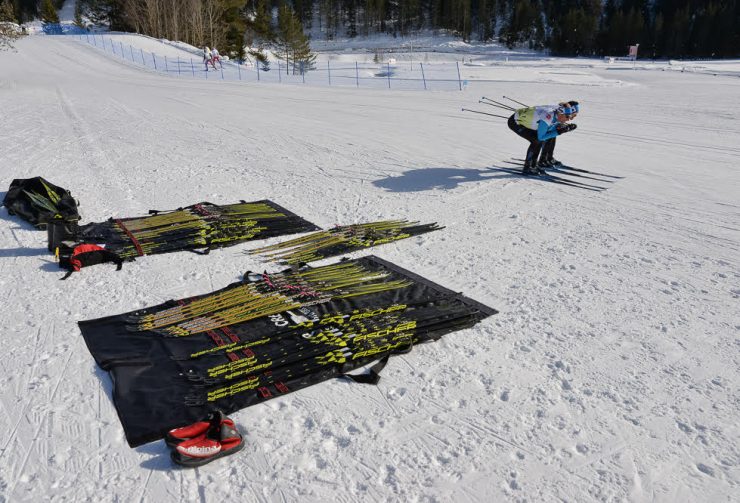
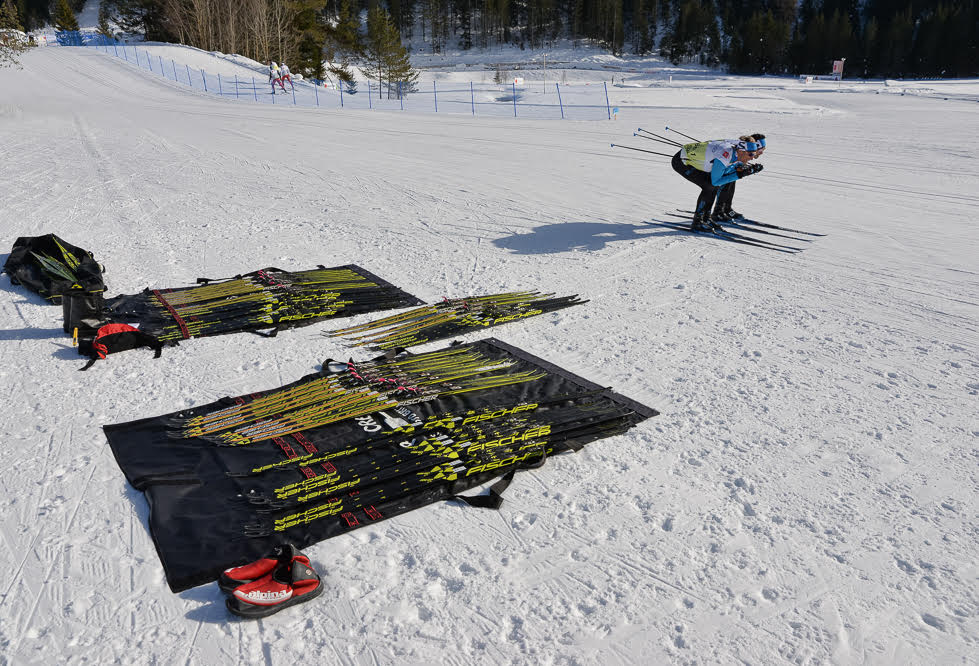
Cross country and nordic combined athletes have arrived in Seefeld, Austria to prepare for the 2019 FIS Nordic World Ski Championships which begin on Thursday, Feb. 21. To ready themselves for the competitions, athletes, techs, and coaches are trying out the courses and testing wax. Nordic combined athletes are also practicing on the Olympic jump at Innsbruck.
Click each photo in the gallery below to enlarge.
Photos courtesy of John Lazenby / lazenbyphoto.com
Testing skis and wax in Seefeld, Austria on Tuesday – site of the 2019 Nordic Ski World Championships. (Photo: John Lazenby/lazenbyphoto.com).
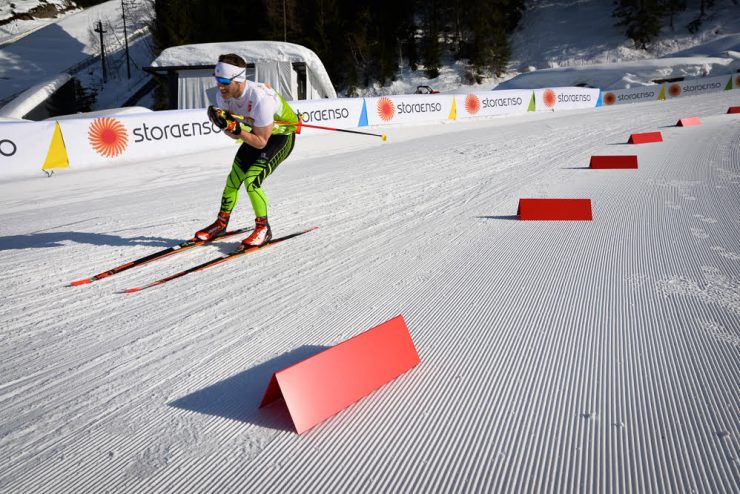
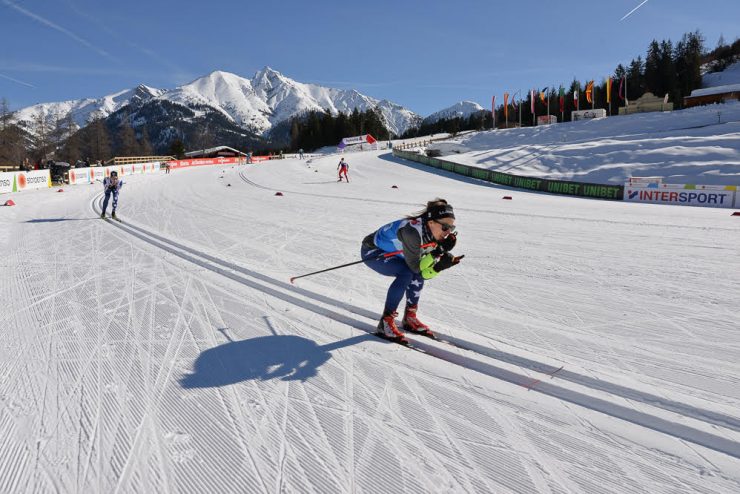
Athletes, coaches, and techs test skis on the 2019 World Championships course in Seefeld, Austria. (Photo: John Lazenby/lazenbyphoto.com).
Athletes, coaches, and techs test skis on the 2019 World Championships course in Seefeld, Austria. (Photo: John Lazenby/lazenbyphoto.com).
Athletes, coaches, and techs test skis on the 2019 World Championships course in Seefeld, Austria. (Photo: John Lazenby/lazenbyphoto.com).
Athletes, coaches, and techs test skis on the 2019 World Championships course in Seefeld, Austria. (Photo: John Lazenby/lazenbyphoto.com).
Athletes, coaches, and techs test skis on the 2019 World Championships course in Seefeld, Austria. (Photo: John Lazenby/lazenbyphoto.com).
Athletes, coaches, and techs test skis on the 2019 World Championships course in Seefeld, Austria. (Photo: John Lazenby/lazenbyphoto.com).
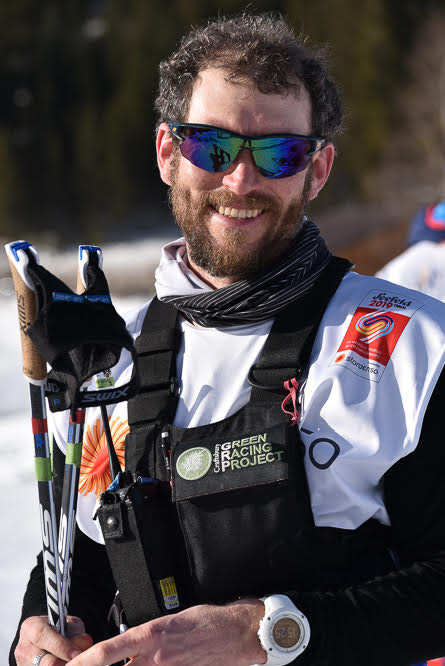
Benjamin Lustgarten (Craftsbury Green Racing Project) tests skis on the 2019 World Championship course in Seefeld, Austria. (Photo: John Lazenby/lazenbyphoto.com).
Athletes, coaches, and techs test skis on the 2019 World Championships course in Seefeld, Austria. (Photo: John Lazenby/lazenbyphoto.com).
Benjamin Lustgarten (Craftsbury Green Racing Project) tests skis on the 2019 World Championship course in Seefeld, Austria. (Photo: John Lazenby/lazenbyphoto.com).
APU Head Coach Erik Flora and Sadie Bjornsen (USST) test skis and wax on the 2019 World Championship course in Seefeld, Austria. (Photo: John Lazenby/lazenbyphoto.com).
Flags from each nation fly over the stadium in Seefeld, Austria for the 2019 World Championships. (Photo: John Lazenby/lazenbyphoto.com).
Andy Newell (right) with U.S. Ski Team wax tech Patrick Moore (left). (Photo: John Lazenby/lazenbyphoto.com)
Athletes, coaches, and techs test skis on the 2019 World Championships course in Seefeld, Austria. (Photo: John Lazenby/lazenbyphoto.com).
US Ski Team wax tech Jean-Pascal “JP” Laurin enjoying the sun on a wax testing day before the 2019 World Championships in Seefeld, Austria. (Photo: John Lazenby/lazenbyphoto.com).
Wax Tech Nick Brown of Craftsbury Green Racing Project smiles on a sunny testing day in Seefeld, Austria before the 2019 World Championships. (Photo: John Lazenby/lazenbyphoto.com).
Athletes, coaches, and techs test skis on the 2019 World Championships course in Seefeld, Austria. (Photo: John Lazenby/lazenbyphoto.com).
Grant Andrews, US Nordic Combined, tries out the 2019 World Championships course in Seefeld, Austria. (Photo: John Lazenby/lazenbyphoto.com).
Rosie Frankowski (APU) tests skis on the 2019 World Championship course in Seefeld, Austia. (Photo: John Lazenby/lazenbyphoto.com).
Logan Hanneman (APU) test skis on the 2019 World Championships course in Seefeld, Austria. (Photo: John Lazenby/lazenbyphoto.com).
Athletes, coaches, and techs test skis on the 2019 World Championships course in Seefeld, Austria. (Photo: John Lazenby/lazenbyphoto.com).
The Olympic rings at the ski jumps in Innsbruck, Austria. (Photo: John Lazenby/lazenbyphoto.com).
Testing skis and wax in Seefeld, Austria on Tuesday – site of the 2019 Nordic Ski World Championships. (Photo: John Lazenby/lazenbyphoto.com).
Watching the events live … ee’ve got to temper the good news. If you subscribe to the NBC Gold “Snow” Pass, then you will have live/replay access to almost all of the championship events. We cannot overemphasize the “almost”.
Back when NBC announced it’s Gold Pass system, subscribers did not have access to the Seefeld championships. At the time, the rights holder in Austria was reportedly asking too steep a price from NBC to secure the broadcast rights in the U.S.
That changed a few weeks back. The scheduled upcoming event listings for the Gold “Snow” Pass now includes the championships. This is where the “almost” becomes the let down for those with no VPN access to a site like British Eurosport.
A more thorough examination of the Gold Pass schedule reveals the events on March 1-3 will not be streamed live or rebroadcast. These events include the men’s 4 x 10-kilometer relay, the women’s 30 k classic mass start, and the men’s 50 k classic mass start.
A phone call this morning to NBC Sports confirmed the last three days of racing from Seefeld will not be streamable or archived as a replay on NBC Gold. Further, it appears this three-day block from Seefeld will not be streamed or broadcast on the NBCSN cable channel, or the Olympic Channel.
For those in Canada, contributor Gerry Furseth advises viewers to check out the CBC Sports broadcast schedule. You can find that link here.
Below is the viewing schedule, as of this morning, from the U.S. Again, this does not include information for those with a VPN or those accessing delayed coverage from our friend in the Midwest. The NBCSN and Olympic Channel appear to be moving targets when it comes to determining a concrete viewing schedule. (FasterSkier will update this story with any confirmed scheduling changes.)
All times listed are EST and are for live streams/broadcast unless noted.
Day 1: Wednesday, Feb. 20
Women’s qualification 5 k classic
Men’s qualification 10 k classic
Day 2: Thursday, Feb. 21
Women’s/men’s freestyle sprint 8:30 AM (NBC Gold/Olympic Channel)
Day 3: Friday, Feb. 22
Nordic combined individual Gundersen 10 k – Jumping 4:30 AM, Skiing 10:00 AM (NBC Gold)
Day 4: Saturday, Feb. 23
Women’s 15 k skiathlon 5:00 AM (NBC Gold)
Men’s 30 k skiathlon 6:30 AM (NBC Gold)
Day 5: Sunday, Feb. 24
Women’s/men’s classic team sprint final 5:30 AM (NBC Gold)
Tape delay team sprint final 11:30 AM (NBC Sports)
Nordic combined team sprint 2 x 7.5 k – Jumping 4:30 AM, Skiing 7:30 AM (NBC Gold)
Day 6: Monday, Feb. 25 No Competitions
Day 7: Tuesday, Feb. 26
Women’s 10 k individual start classic 7:30 AM (NBC Gold)
Day 8: Wednesday, Feb. 27
Men’s 15 k individual start classic 8:00 AM (NBC Gold)
Day 9: Thursday, Feb. 28
Women’s 4 x 5 k relay 7:00 AM (NBC Gold)
Nordic Combined individual Gundersen 10 k – Jumping 5:00 AM, Skiing 9:00 AM (NBC Gold)
Russia’s Alexander Bolshunov (c) after winning the men’s 15-kilometer classic individual start on Sunday in Cogne, Italy. Finand’s Iivo Niskanen (l) placed second and Russia’s Alexander Bessmertnykh in third. (Photo: FIS screenshot)
If there’s anyone on the hunt to dethrone Finland’s Iivo Niskanen of the 15-kilometer classic kingship–Niskanen was the gold medalist in the 2017 Lahti World Championships 15 k classic and is certainly looking to repeat the feat at this year’s World Championships 15 k classic in Seefeld, Austria–it’s Russia’s Alexander Bolshunov.
On Sunday in Cogne, Italy, the 22 year old Bolshunov raced to a decisive win over Niskanen, besting the Finn by 43.7 seconds with his time of 34:48.4. Sunday’s result comes exactly eleven months after Bolshunov’s first-career World Cup win, which he achieved in last season’s 15 k classic at World Cup Finals in Falun, Sweden.
Between his victory in Falun and Cogne, Bolshunov has reigned at the top of the podium two other times–taking back-to-back victories in the International Ski Federation’s (FIS) opening races in Ruka, one of which happened to be a 15 k classic.
With the 2019 World Champs slated to start next Wednesday, Feb. 20 and the men’s 15 k classic scheduled for Feb. 27, Bolshunov could be on his way to his first World Championships gold. On paper, one skier definitively stands in his way. And if anyone can hold off a Russian attack, it’d be a Finn.
Niskanen has been a force in the 15 k classic for the past five years; seven of his nine World Cup podiums are in the 15 k classic event and all of his wins on the World Cup have come in the discipline. Along with his World Champs gold medal, the 27 year old has two World Cup wins from Kuusamo, one in 2014 and one in 2016 and four weeks ago, he also claimed the men’s 15 k victory in Otepää, Estonia.
The Finn and the Russian were in close quarters for the first half of Sunday’s interval start, with Niskanen trailing Bolshunov by 6.5 seconds at the 3 k mark, then 9.8 seconds by the 7 k mark.
In another 3 k, the Finn, who had started 12 bibs behind the Russian in bib 53, was down on Bolshunov by 24.9 seconds. Bolshunov’s pace for the remaining 5 k proved too fast for Niskanen and the Russian put another 18.8 seconds into the Finn by the end of the race.
Russia’s Alexander Bolshunov (l) on his way to winning the men’s 15-kilometer classic individual start on Sunday in Cogne, Italy. (Photo: NBC screenshot)
“With every minute the snow got softer and softer and one really needed some good ski’s today,” Bolshunov said according to a FIS press release.
Following Bolshunov and Niskanen, Russia’s Alexander Bessmertnykh took third, finishing 55.9 seconds behind the race winner.
Canadian Alex Harvey was the top North American male finisher on Sunday, placing 10th, 1:40.7 seconds behind Bolshunov. Harvey started in bib 65, four bibs ahead of Sunday’s final starter, Didrik Tønseth of Norway.
With Bolshunov still in the leader’s chair by the time he got on course, Harvey pressed to the front and he also pushed others back. At the 2 k mark, he was ranked ninth and 14.6 seconds down on Bolshunov, with that gap widening to 44.2 seconds at the halfway point. An early charge from Tønseth put the Norwegian ahead of the Canadian by 0.2 seconds at the 2 k and later 7.6 seconds at 7 k, but by the finish, Harvey had the Norwegian beat by 16 seconds.
The result is Harvey’s fourth Top 10 this season. At the age of 30, he is about to enter his sixth World Championships, and is one of Canada’s strongest hopefuls for hardware in Seefeld.
The next North American to finish on Sunday was the U.S. Ski Team’s, Erik Bjornsen in 16th (+1:54.8). The result is Bjornsen’s best individual finish this season and in the 27 year old’s eyes, came just at the right time.
“Today’s race went well. It’s exactly the boost of confidence I needed heading into Seefeld,” Bjornsen wrote in an email to FasterSkier.
While some U.S. athletes spent last weekend at a training camp in Davos, Switzerland, Bjornsen raced the World Cup individual sprint and team sprint competitions that took place in Lahti. The transition from low altitude to racing in the Italian Alps “made yesterday’s sprint really difficult,” Bjornsen explained. Sunday’s distance course, he added, “suited me better.”
“I didn’t feel extremely good or anything, but I think I was able to pace it well and use my double pole power on all the gradual climbs,” Bjornsen said. “I did much more strength training this summer and I’m still trying to get some of my endurance back. We had a great camp in Sweden a couple weeks ago and I put in a lot of volume. Hopefully that’ll pay off now.”
American Kyle Bratrud scored his first World Cup points on Sunday, finishing in 26th (+2:21.1) just 1.2 seconds behind Switzerland’s Dario Cologna in 25th (+2:19.9).
Prior to Sunday, Bratrud had competed in one other World Cup race, the Östersund 15 k back in 2015 where he finished 84th. He qualified for his first World Championships that same year and has qualified for every World Champs since then. In Lahti two years ago, he finished 33rd in the 15 k classic, 20.7 seconds outside the Top 30.
“I wish I could say I have some formula for making World Championship teams every other year but in truth I just seem to be healthy every other year,” Bratrud wrote in an email to FasterSkier on Sunday. “This year I also joined Stratton and have made great strides with this extremely professional program.”
Though initially unsure if he would race in Cogne on Sunday, Bratrud’s decision to do so turned out to be the right call.
“Today was awesome. I wasn’t sure I would even race since I was in bed with a cold two days ago but I felt good yesterday and woke up this morning feeling fine so I decided to send it,” Bratrud wrote.
“It was an interesting race course in the sense that it wasn’t very hilly but there was a lot of work and we are at altitude,” he added. “There were stretches were I was hoping for more hills and stretches where I was thankful to have recovery but all in all I’m very happy with the result leading into Seefeld.”
Earlier this season, Bratrud garnered his third U.S. National title at U.S. Cross Country Championships in Craftsbury Vt. and is currently the Continental Cup leader. Thanks to that, most of his trip to Austria for World Champs is covered by FIS.
Kyle Bratrud racing to a win in the men’s 15-kilometer classic race at U.S. nationals in Craftsbury, Vt. (Photo: John Lazenby)
“I got to Davos on February 5th and spent some time at altitude training and acclimating before Cogne which really helped,” he wrote “I’m looking forward to head a bit lower for Seefeld!”
Also competing for the U.S., was American David Norris in 33rd (+2:52.2). Norrisfinished 9.3 seconds outside of Sunday’s Top 30 and is also on the 2019 World Championships Team bound for Seefeld next week.
Two more U.S. skiers competed on Sunday, with Scott Patterson finishing in 43rd (+3:36.8) and Adam Martin in 50th (+3:56.3). Canadians Evan Palmer-Charrette and Scott James Hill placed 56th (+4:17.0) and 58th (+4:20.6), respectively.
In late August, U.S. Ski Team (USST) Head Coach Chris Grover broke his own news, releasing three new sets of criteria on behalf of U.S. Ski & Snowboard, the national governing body for cross-country skiing. The three separate documents discussed by Grover and linked in his blog disclosed the selection criteria for World Cup and World Cup Period 1 team selection, 2019 World Ski Championships (WSC) in Seefeld, Austria, and the 2019/2020 national team.
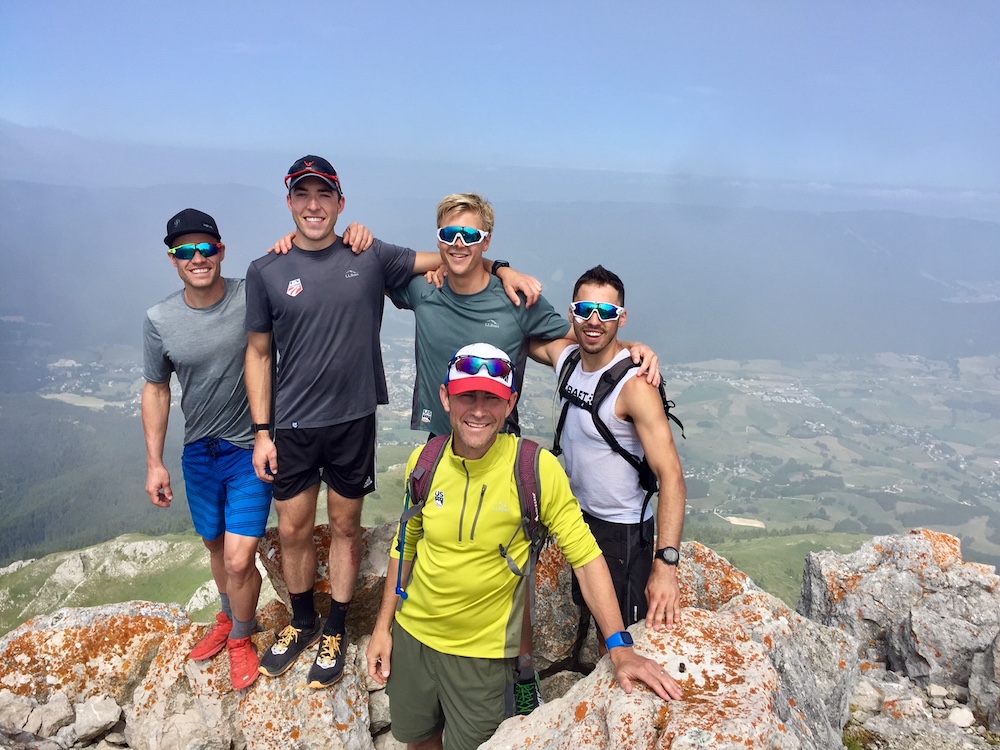
U.S. Ski Team Head Coach Chris Grover (front) with (from left to right) Simi Hamilton, Paddy Caldwell, Erik Bjornsen, and Ian Torchia on top of the Roc Cornafion above Villard-de-Lans, France, during a training camp this summer. (Photo: Chris Grover)
Grover and new USST development coach Gus Kaeding spoke with FasterSkier for its podcast on Sept. 11 to highlight some of the updated criteria and provide context for the modifications.
(A lightly edited conversation with Grover and Kaeding is available on the Nordic Nation podcast. Warning: you may want to time your listening for a 1.5-hour road trip or dish duty after a crowded dinner party. It’s a lengthy discussion.)
New U.S. Cross Country Development Coach Gus Kaeding. (Photo: Sarah Brunson/U.S. Ski & Snowboard)
World Cup Selection Criteria
Considering World Cup Period 1 starts, Grover stated in the following interview and in accordance with the selection criteria, the discretionary picks were made in consult with a larger working group. That group is comprised of four national-team staff coaches — Grover, Matt Whitcomb, Jason Cork, and Kaeding — as well as Dakota Blackhorse-von Jess (athlete rep), August Teague (chair of the cross-country coaches sub-committee), and eight senior club coaches: Chris Mallory (Sun Valley Gold Team), Erik Flora (Alaska Pacific University), Joe Haggenmiller (Central Cross Country), Pepa Miloucheva (Craftsbury Green Racing Project), Austin Caldwell (formerly of the Bridger Ski Foundation, now assisting the University of Colorado-Boulder Ski Team), Dragan Danevski (BSF), Pat O’Brien (Stratton Mountain School T2 Team), and Dan Weiland (Ski Club Vail).
According to Grover, this 14-person working group was tasked with helping develop WSC and World Cup selection criteria. Further, this group, which again includes the four USST staff coaches, remains responsible for nominating the discretionary picks for each World Cup period this season.
Once those World Cup Period 1 nominations were made, they were sent to a three-person discretionary selection review group with the authority to approve or disapprove those nominations.
The language in the World Cup selection criteria, as it refers to this smaller group, reads as follows: “All discretionary selections will be reviewed by a discretionary selection review group comprised of the U.S. Ski & Snowboard Nordic Program Manager, the U.S. Ski & Snowboard Chief of Sport, and the athlete representative from that sport who is a member of the U.S. Ski & Snowboard Board. If the U.S. Ski & Snowboard Board Athlete Representative is also a currently competing athlete then another athlete, who is not actively competing, will be selected by the Athletes’ Council to be the representative in this group.”
In a follow-up email, Grover clarified who serves on the discretionary selection review group. “This would normally be Bryan Fish, Luke Bodensteiner, and Rosie Brennan. Because Rosie is an active athlete, Dakota has replaced her,” Grover explained.
The other changes to World Cup selection that Grover cited in his original blog post are as follows and discussed in the podcast:
The standard by which men advance from one World Cup period to the next from top 30 to top 40 to reflect the greater depth in the men’s WC field.
Addition of SuperTour leaders as guaranteed starts to the Tour de Ski.
Addition of language to the past criteria for selecting a World Cup Finals team in Quebec City, including:
Top-30 individual performance at the Seefeld World Champs (the previous standard was top 25).
Created a best 11 of 14 SuperTour results selection to round out the World Cup Finals team, to encourage athletes to continue to race in Europe mid-season, rather than feeling the need to attend every SuperTour competition.
World Ski Championships Criteria
Come late February, the World Championships begin. In a personal blog published on FasterSkier, Grover noted the key changes to the current WSC selection criteria.
The World Cup remains the most direct path to meeting objective criteria for WSC team nomination.
Discretionary selection is divided into two phases: Phase 1 and Phase 2. The phases refer to the use of coaches’ discretion once objective criteria have been applied to WSC team selection.
As FasterSkier understands the criteria, Phase 1 will be used to discretion solidly performing World Cup skiers who have not met objective criteria. Phase 1 reads much like recent 2017 Lahti and 2015 Falun WSC discretionary criteria. The current language allows for some latitude when considering potential team discretionary picks. An indication of potential future championship medal performance, as well as any outstanding competition results from last season and the 2018/2019 season, are tools for coaches making discretionary picks.
However, the “attitude and commitment of athletes” language included in the past as a possible factor in discretionary selection was excluded from the latest iteration of WSC selection criteria.
The discretionary selections made by USST team coaches in Phase 1 will be reviewed by a three-person group including the U.S. Ski & Snowboard President and CEO Tiger Shaw, Bodensteiner, and the U.S. Ski & Snowboard board athlete rep as long as they are not actively competing. Another non-competing athlete will be chosen as a replacement if this conflict of interest arises. During the 2018 OWG selection, for example, former USST member Holly Brooks served as the athlete rep. Brooks was retired from competition when she served as part of the review committee.
For any remaining team spots, Phase 2 of discretionary selection “may” be used. This is where the selection of SuperTour skiers comes into play. Grover, in his blog, said the selection of domestic skiers from SuperTour could be perceived as the biggest change.
Phase 2 can but is not obligated to consider the 2019 Championship Selection List and the “next best athlete” in what the criteria define as a “pool” of athletes. The “pool” is separated into four discrete disciplines: women’s distance, women’s sprint, men’s distance, and men’s sprint.
The criteria also specify the “next best athlete” as “the highest ranked athlete on the ranking list in each of the four disciplines who was not nominated to the team.”
The 2019 Championship Selection List will be created using an athlete’s best two results in sprint and distance respectively with points accrued from SuperTour races and weighted U.S. National Championships races. (Sprint points for the Championship Selection List consider qualification place only.)
The athlete pools allow for the USST head coach to select an athlete from a refined list based on sex and discipline, rather than a single men’s or women’s list.
During the interview, Grover explained his rational behind Phase 2 Discretionary Selection and the use of pools.
“We obviously found ourselves last year in a situation going into the Olympics where we were feeling compelled, due to the language in the criteria, to look at selection as one list of athletes,” hesaid. “And to look at athletes who had more points in any discipline, whether they were a man or a woman, a distance skier or a sprinter, as the next best athlete to be nominated to the team. By moving the secondary or domestic selection from an objective domestic selection to a discretionary selection, it gives us coaches discretion to be able to select from the correct pool to fill an open start spot. So if we know that we need to fill a men’s 50 k skate spot, we can look to the men’s distance list and not to an overall combination of women’s and men’s distance and sprint lists. So this is kind of a creative way that we feel is going to solve the issue that we had last year. The USOC [U.S. Olympic Committee] has given us the thumbs up, to go ahead and pursue, and we are hoping that it selects more of the right athletes at the bottom of the selection.”
The process for selecting athletes in Phase 2 appears streamlined. Grover recommends an athlete from the “pools” and the three-person selection committee makes the selection. The criteria also specify that potential WSC team athletes chosen during Phase 2 should have attained a minimum World Rank (FIS points) of 120 in sprint or distance by the release of FIS points list 5 for this upcoming season.
In the past, athletes have contacted coaches to advocate for themselves. The updated WSC criteria provide guidelines by which athletes can contact Bodensteiner directly in writing as a means of self-advocacy. Those direct petitions are potentially considered by the selection committee.
For athletes with a grievance with WSC team selection, the criteria also provide contact information for the USOC Athlete Ombudsman Kacie Wallace. Athletes can contact the USOC for assistance when challenging their non-selection.
In this instance, when it comes to the WSC and team selection, the USOC has oversight since the WSC selection criteria involve “protected competitions”. Both World Cups and the WSC are protected competitions by definition.
From USOC Bylaws, Section 1.3(W) pg. 3: “protected competition” means: 1) any amateur athletic competition between any athlete or athletes officially designated by the appropriate NGB or PSO as representing the United States, either individually or as part of a team, and any athlete or athletes representing any foreign country where (i) the terms of such competition require that the entrants be teams or individuals representing their respective nations and (ii) the athlete or group of athletes representing the United States are organized and sponsored by the appropriate NGB or PSO in accordance with a defined selection or tryout procedure that is open to all and publicly announced in advance, except for domestic amateur athletic competition, which, by its terms, requires that entrants be expressly restricted to members of a specific class of amateur athletes such as those referred to in Section 220526(a) of the Act; and
2) any domestic amateur athletic competition or event organized and conducted by an NGB or PSO in its selection procedure and publicly announced in advance as a competition or event directly qualifying each successful competitor as an athlete representing the United States in a protected competition as defined in 1) above.
As FasterSkier understands, the USOC does not provide legal representation for athletes. However, the USOC does provide a lengthy list of arbitration decisions on its website as a resource for those who believe they have been wrongly denied membership on a team.
Another notable change is the clarification of language as it pertains to the selection of WSC sprinters. In the context of selection criteria, it is referred to as the “5-sprinter-max rule”. In other words, no more than five sprinters total per sex will be selected to the current WSC team. Five male sprinters. Five female sprinters. No more.
During the 2018 Olympic Winter Games (OWG) selection, the five-sprinter-max rule was challenged. Specifically, the language in the OWG selection criteria did not specify what happens when an athlete dually qualifies through objective criteria. For example, last year Jessie Diggins, Sadie Bjornsen, Kikkan Randall, and Sophie Caldwell all met objective OWG criteria in both distance and sprint. Would a dually qualified athlete’s inclusion on the team take up both a distance spot and one of five female sprint spots? Last winter, that question appeared unsettled.
The answer moving forward into the current 2019 WSC team selection period for the dually qualified athlete conundrum is a categorical yes. Dually qualified athletes do count towards a sprint spot.
Again, in the podcast, some of the other major changes are discussed in greater detail.
2019/2020 USST Selection Criteria:
Kaeding was brought on board to help better define criteria when it comes to USST nominations. One thing is clear, the new criteria spells out in detail the performance benchmarks both senior and junior skiers should meet to receive USST member status.
The new USST criteria include objective criteria for A, B, and D-team status based on an athlete’s year of birth (YOB) and the minimum World Rank an athlete should have at a specific age. This is referred to as age-weighted criteria. For example, if an athlete was born in 1995 and is 24 years old by January and their World Rank is 20th or better, they’ll be an auto-nomination to the A-team.
Kaeding discusses in the podcast the data-crunching basis for the reliance on World Rank and an athlete’s YOB when it comes to the objective criteria. In his blog post, Grover wrote the following regarding the use of World Rank:
“The USST staff has spent much of the past year examining data from major championship medalists over the past decade, and have found that world rank is often the best indicator of who is on the path towards a future medal.”
For A-team nomination, any athlete regardless of age who finishes in either the top-15 of the FIS World Cup Sprint and Red Group List and/or the top-15 in the FIS World Cup Distance and Red Group List is an A-teamer. The old A-team requirement involved a top-30 rank. Grover said in the podcast this change better reflects the World Cup’s Red Group that includes only the top-15 skiers in sprint and/or distance. Red Group athletes have World Cup food and lodging paid for by the International Ski Federation (FIS).
Additionally, any skier with a top-six result in a sprint or distance World Cup race punches the A-team ticket too.
B-team objective requirements are less stringent. World Rank and YOB benchmarks are detailed. Further, an athlete born in 1996 and scoring an individual top 10 at the 2019 U23 World Championships is an auto-nomination to the B-team.
D-team objective criteria have been both broadened and tightened. First and foremost, an athlete will have to be under 23 to remain a D-team athlete for 2019/2020.
U23 World Championships results qualifying an athlete for the D-team have expanded to include an individual top 10 at U23s for an athlete born in 1997 or 1998. And any athlete at World Juniors placing in the top 10 moves onto the D-team. The old requirement for D-team nomination based on U23 and World Juniors individual performance was a podium finish.
World Rank and YOB benchmarks are included in the D-team objective criteria.
Coaches’ discretionary selection to the B and D-teams remain a possibility. The language under the Discretionary Selection Policy section is similar to recent editions.
To contact Grover and Kaeding directly, they provided their email addresses:
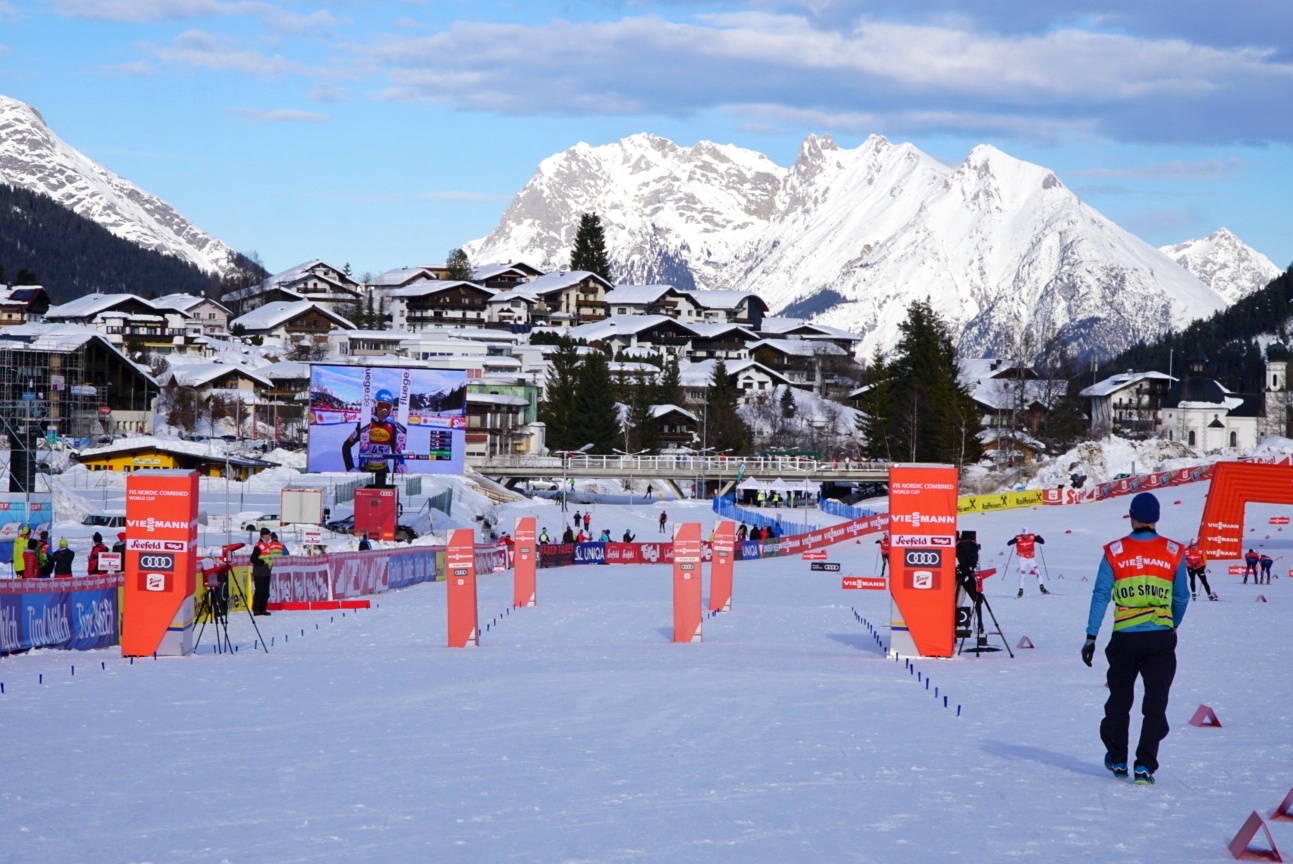
The pre-race scene at the 2018 World Cup in late January in Seefeld, Austria. The venue will host 2019 World Championships. (Photo: Garrott Kuzzy/LumiExperiences.com)
With the 2019 International Ski Federation (FIS) Nordic World Ski Championships the next major championship on the docket, Garrott Kuzzy, a 2010 U.S. Olympian who lives in Innsbruck, Austria, interviewed the chief of course for the 2019 World Championships in Seefeld, Austria. Via email, he asked Thomas Unterfrauner about preparing for the event, which will run from Feb. 20 to March 3.
***
Garrott Kuzzy:How is the atmosphere around Seefeld leading up to the 2019 World Championships?
Thomas Unterfrauner: The atmosphere is very interesting. The whole village of Seefeld is focused on the championships next winter. Everybody seems to have a role in preparing for it for it. We all know that this is a big opportunity for us to showcase the whole Olympiaregion Seefeld to the world.
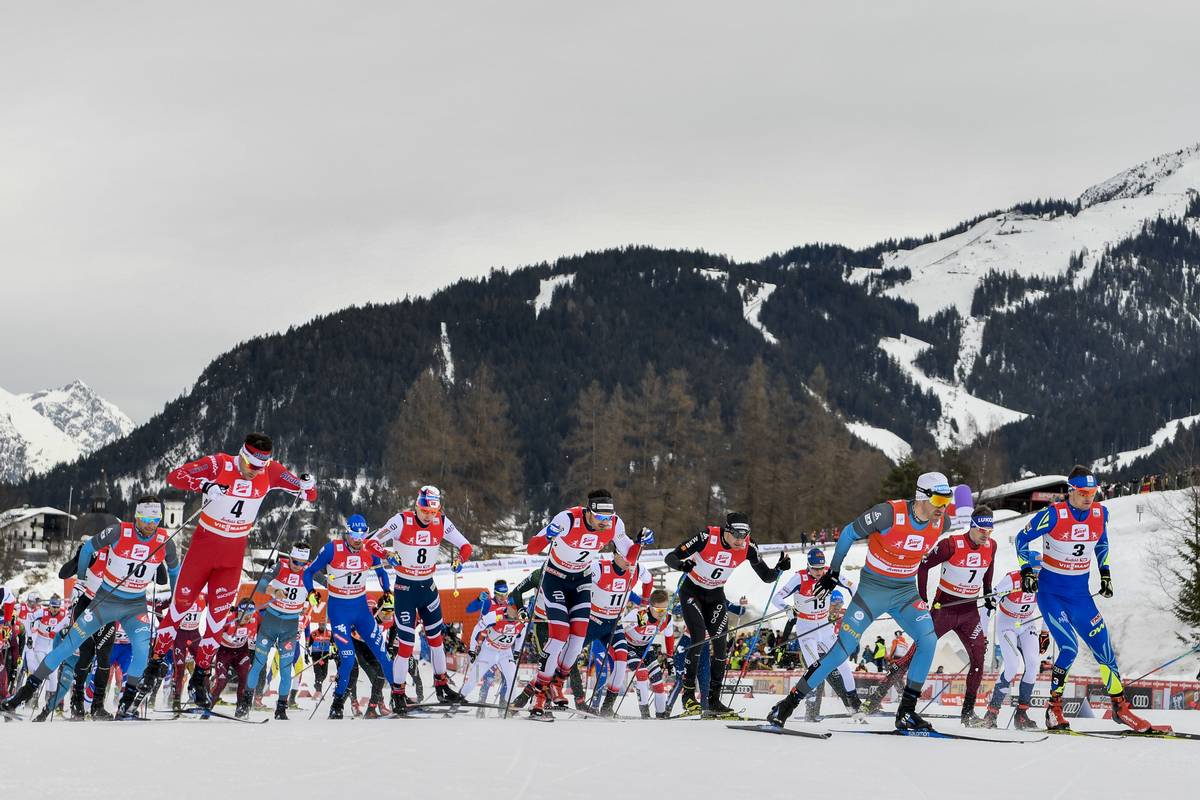
Early in the men’s 15 k freestyle mass start at the 2018 World Cup in Seefeld, Austria, with Canada’s Alex Harvey (4), Switzerland’s Dario Cologna (6) and Norway’s Hans Christer Holund (2) skiing near the front of the pack. (Photo: Salomon/NordicFocus)
GK:In 2017, Seefeld hosted the OPA Cup finals. There was ankle-deep standing water in parts of the stadium. Big changes were made in the stadium and on the trails and it seems to have worked. What changes did you make?
TU: We reviewed the course in detail after the OPA Cup finals last spring. There were several challenging areas on the course, especially the water in the stadium. We worked with several specialists to analyze and make changes to the stadium and the course.
GK:What changes do you still plan to make before next winter?
TU: Our biggest change will be to make the stadium even wider. There are many things we need to fit into the stadium, such as start and finish lanes and a wide section of race course going between them, plus bleachers that we did not have for the World Cup this year. At this point, 90 percent of our work is complete. We are mostly making some finishing touches now.
GK:The courses for this year’s World Cup in Seefeld seemed to really appeal to the U.S. skiers, especially Sophie Caldwell and Jessie Diggins, who both won races. What did you learn about the course at the World Cup this winter?
TU: We learned many things from the World Cup this winter. We approach most events, such as National or OPA Cup level competitions, with athletes and teams in mind. With World Cups and World Championships, we have the additional considerations of television and marketing partners. Some of our new questions we consider are where to place sponsor banners, cameras and how to get power to them. Television and marketing partners work with us to make sure all of the additional hardware is in place.
GK:What was the general response from the athletes?
TU: The reaction to the courses was positive from all sides. Athletes and coaches both commented how easy it was to access the trails, wax trailers, and the start and finish areas from the course for warming-up, cooling-down and testing skis. The stadium is also close enough to Seefeld that teams can get to and from the skiing without having to take a bus. With our improved rollerski loop, there are many teams coming to Seefeld for their summer training, to spend more time getting comfortable with the course and the surroundings.
Left to right: Mikaela Sundbaum (assistant technical delegate), Annmari Viljanmaa (TD), Christian Krepper (chief of competition), and Thomas Unterfrauner (chief of course) at the 2018 World Cup in Seefeld, Austria. (Photo: Garrott Kuzzy / Lumi Experiences)
GK:How many spectators are you expecting for the 2019 World Championships?
TU: We are expecting around 15,000 spectators per day for the World Champs, around three times as many as we had for the World Cup races last winter.
GK:You were at the 2017 World Championships in Lahti, Finland. In your mind, what is the difference between a World Cup and the World Championships?
TU: The size of the event and the length of time are the biggest differences. There are more athletes, coaches, support staff, media and spectators, all of whom stay for up to two weeks or more. Everything down to how we dispose of trash has to be considered. That is to say, there is a lot of housekeeping to be done for a full two weeks–much longer than one World Cup weekend.
GK:Why should someone travel to ski in Seefeld? What makes Seefeld unique?
TU: Seefeld and the whole Olympia Region (Seefeld hosted the cross country events for the 1964 and 1976 Olympic Games) is made up of several different towns, valleys and trail networks, including Seefeld, Leutasch, Mösern, Scharnitz, Buchen and Reith. In total, there are over 200 kilometers of trails. We can offer skiers of all levels terrain that matches their wishes, whether that’s challenging World Cup trails through the woods or flat, relaxed terrain through open valleys. The quality of life here on the Seefeld Plateau is very high, with clean air, amazing nature, spectacular scenery and most importantly, good snow conditions.
GK:Finally, there are some big hopes for the U.S. team, coming off a gold-medal performances in Seefeld and PyeongChang. That said, there are also some skiers flying under the radar who could challenge for the victory. Teresa Stadlober will surely be aiming for a big performance in her home country. Therese Johaug has not competed in 2018, but will be back in 2019. There’s a rumor she was in Seefeld for a World Champs simulation training camp while the rest of her competition was at the Olympic Games. Do you have any predictions for next winter?
TU: Nope, I have no predictions. My aim is to offer fair and safe races for all athletes. Off the trail, we will have a host a huge celebration of cross country skiing. I would love to draw more attention to our sport, especially here in Austria. So, I suppose it would be pretty special if Austria won a medal 😉
GK:Finally, you work as an electrician in the summer. Are there any skills or attributes from your summer job that you put to use in the winter as chief of course?
TU: Yes, there are many parts, especially working under pressure and attention to detail. If an electrician makes a mistake, it can be very hard, or impossible, to go back and fix later. In the worst cases, the house could burn down. We use similar structures in preparing for big events, so that details are not overlooked and everything runs exactly as it should when you turn on the lights and welcome the world.
Garrott competed in the 2010 Olympic Games and raced several years with the US Ski Team and the CXC Team. He is founder of Lumi Experiences, offering cross-country ski vacations to Europe. Lumi Experiences is partnering with the National Nordic Foundation to offer trips to the 2019 World Championships in Seefeld.
Seefeld in Tirol, Austria, will host the 2019 Nordic World Championships. (Photo: Garrott Kuzzy/LumiExperiences.com)