Tag: 2020 Dresden city sprints

  • Switzerland Bests Russia at the Line in the Team Sprint; Caldwell Hamilton and Diggins 4th for USA

    Switzerland Bests Russia at the Line in the Team Sprint; Caldwell Hamilton and Diggins 4th for USA


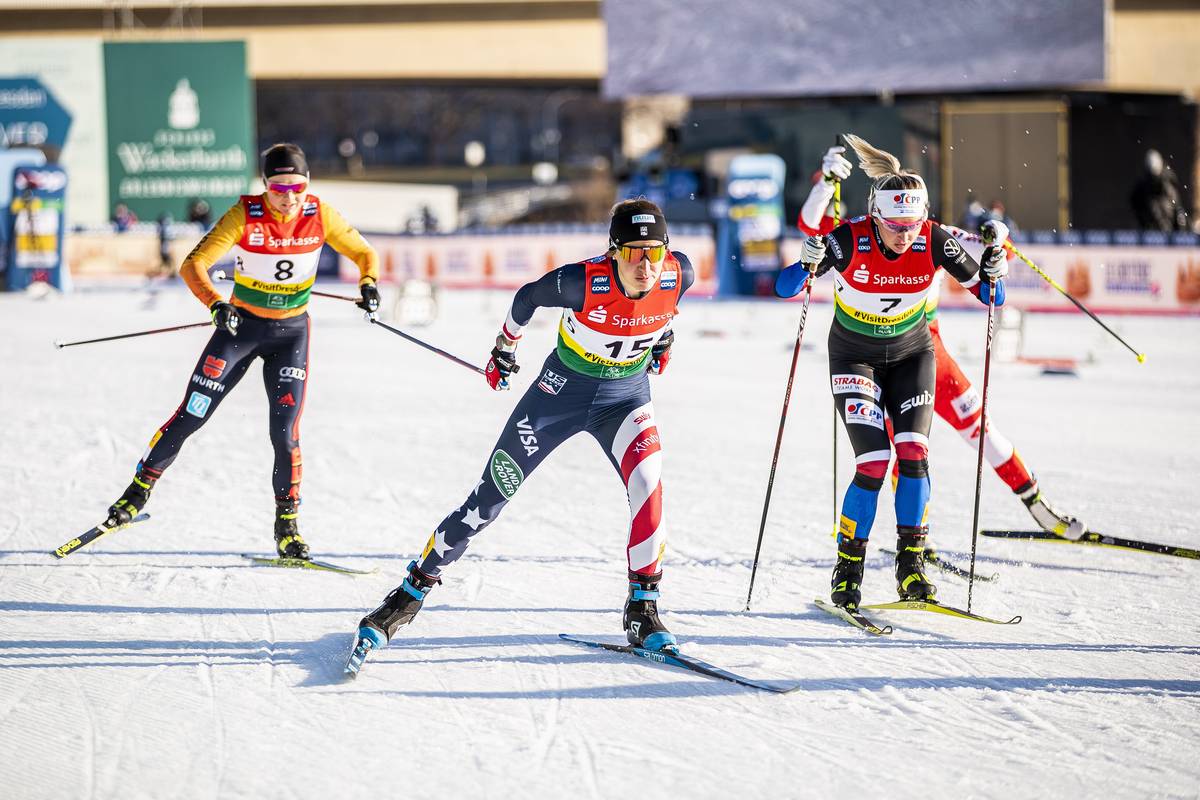
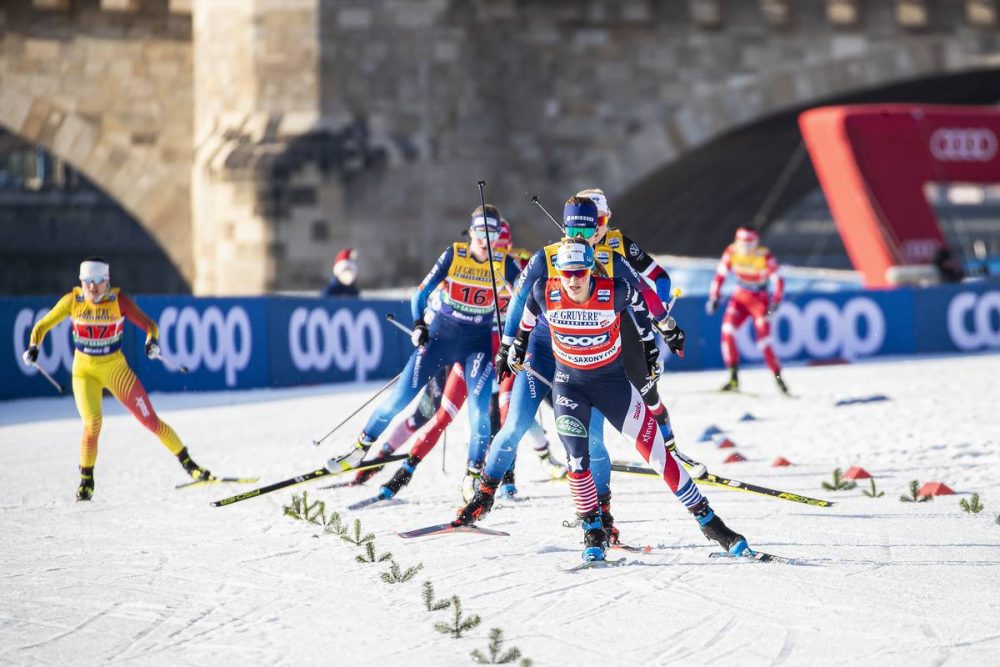
    Jessie Diggins leads the pack during the team sprint in Dresden, Germany. (Photo: NordicFocus)

    This World Cup coverage is made possible through the generous support of Marty and Kathy Hall and their A Hall Mark of Excellence Award. To learn more about A Hall Mark of Excellence Award or to learn how you can support FasterSkier’s coverage please contact info@fasterskier.com.

    Another lovely spring-like day in Dresden, Germany with vibrant green grass contrasting the ribbon of man-made snow along the Elbe River bank. On course in the women’s team sprint final, a ten-team affair became a relative runaway as it concluded. 

    For the uninitiated and new to the team sprint concept, two-athletes form a team, and they tag off to one another six times each. In other words, each athlete races a .65 k lap (one time around the Dresden course) and tags off to their partner. Each partner races six 0.65 k laps for a total of 7.8 k for the team. It is dizzying. And yes, it can seem like a blur of Lycra and skis and poles. Roller derby meets cross-country ski refinement is one way to describe it. 

    At the race’s midpoint, the racing blur was led by an upstart team from China, pulling the pack along in their yellow and red highlighted suits. Switzerland I, U.S. I, Slovenia, Russia I, and Germany I were separated by 2.8 seconds. Just enough time back for those in the rear to keep hope alive, and for viewers to see that no real breakaway and podium locks had been determined. We’ll call it semi-scrum in its organization.  
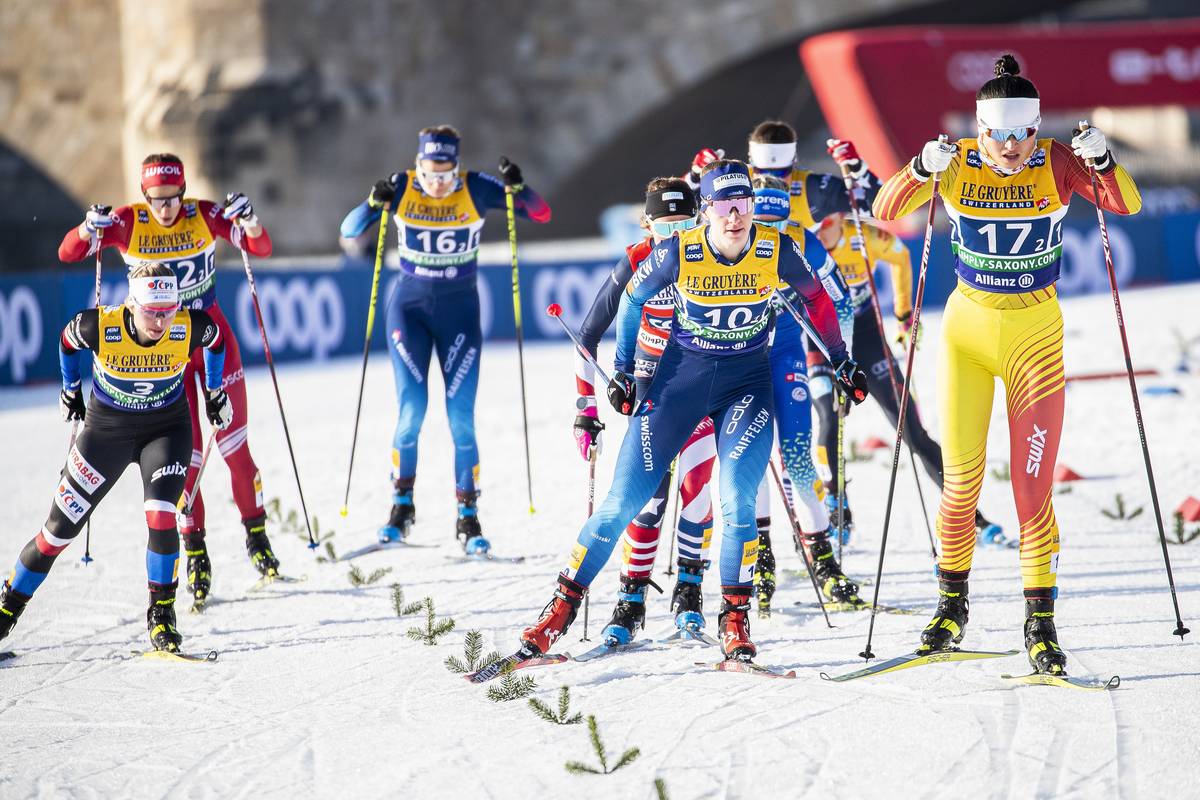
    Dinigeer Yilamujiang of China leads the women’s pack halfway through the team sprint in Dresden, Germany. (Photo: NordicFocus)

    5.2 k into the race, at the eighth exchange, Russia I played their hand as they burned fuel upfront. The race became a four-team affair with Russia I setting the pace, and Switzerland I, Slovenia, and the U.S. racing in the slipstream. This trend continued with the U.S. falling off slightly at 6.5 k, 1.4 seconds back. Not much time, but in a team sprint event, when drafting and maintaining a lock on those in front are key, it can appear to be a mighty gap. 

    Russia I continued it’s work up front and the pattern was set on the final tag. With 0.7 k to go, the Russians were up 2.3 seconds on the Swiss, 2.5 seconds on Slovenia, and 2.6 seconds on the U.S.
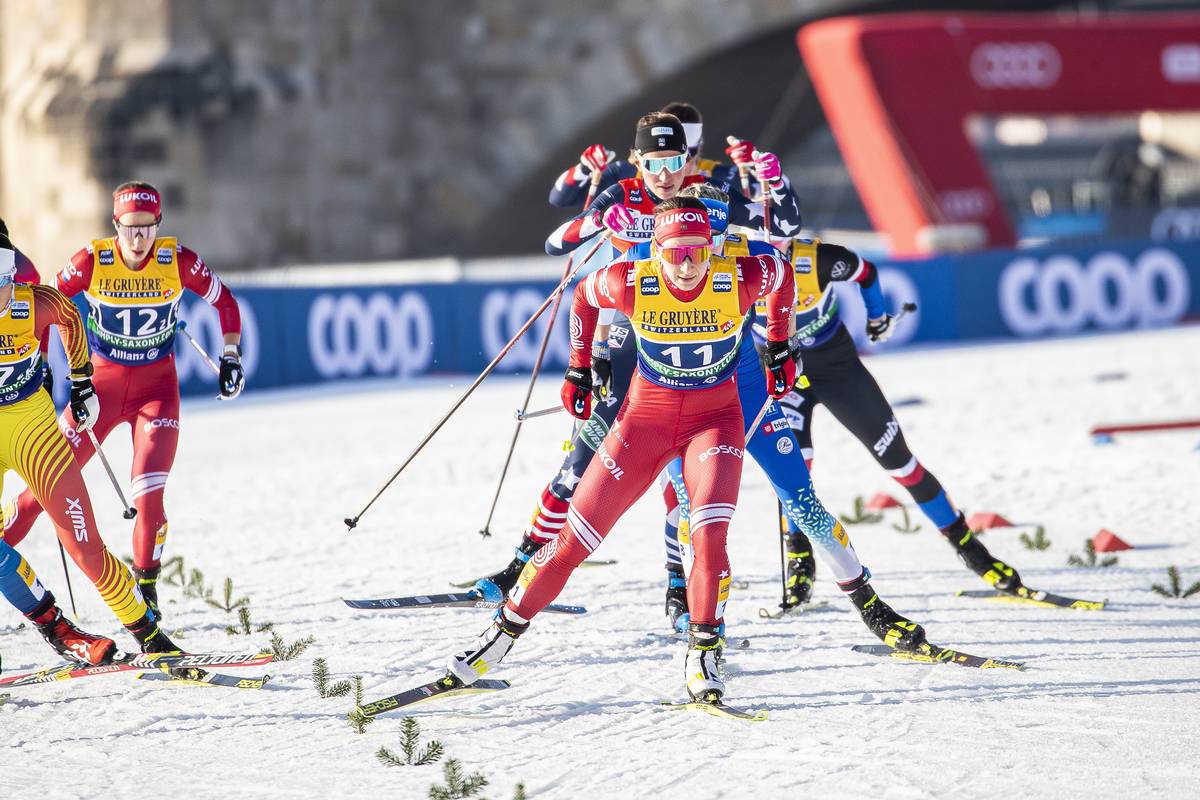
    Natalie Nepryaeva of Russia takes charge in the second half during the team sprint in Dresden, Germany. Caldwell Hamilton tucks in just behind. (Photo: NordicFocus)

    In that final lap, Fähndrich for the Swiss, reeled in Russia’s Nepryaeva, who at the onset seemed uncatchable, seized control of the front and took the win in 16:38.34 minutes. Nepryaeva crossed 0.32 seconds back to secure second for Russia I. Lampic crossed 1.12 seconds back for Slovenia’s third place. Caldwell Hamilton, slightly off the pace, finished in fourth (+3.01) for U.S. I. 
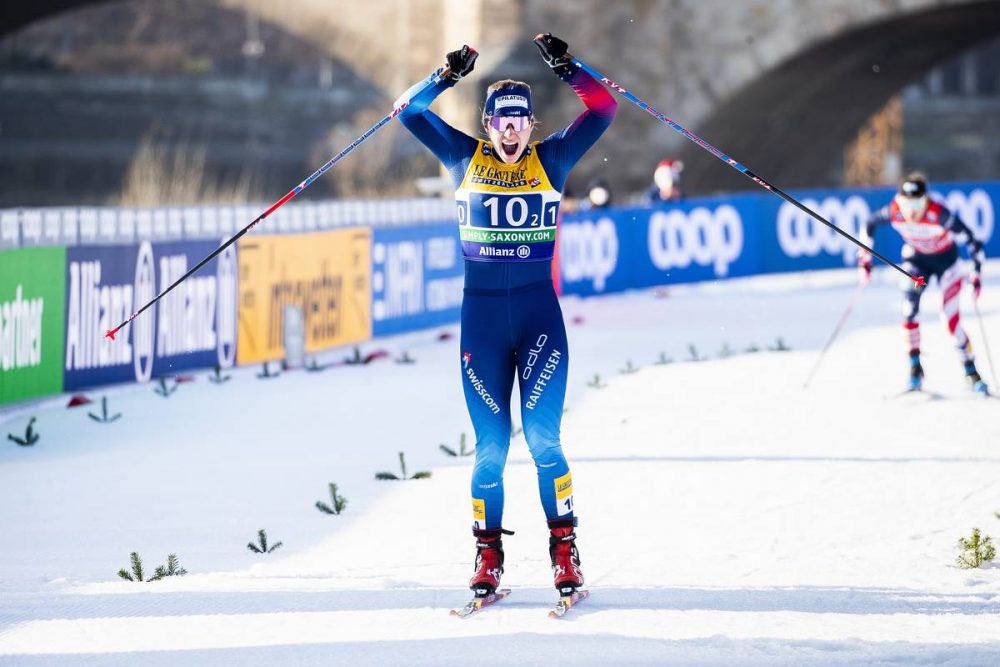
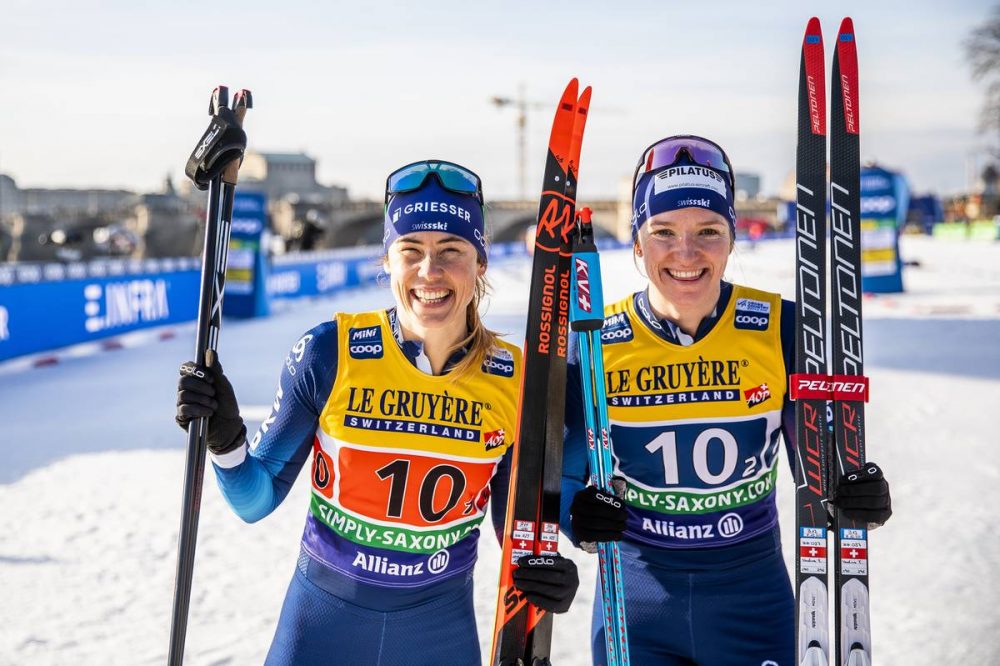
    Switzerland’s Nadine Fähndrich celebrates bringing home a team sprint victory with partner Laurien Van Der Graaff. (Photo: NordicFocus)

    “I felt very good and saw that Natalia [Nepryaeva] was already a bit tired and I could catch up a lot from behind. So I had a very good feeling, and was hoping and fighting to make it happen today,” said Fähndrich to Swiss broadcaster SRF about her team’s last loop. 

    Laurien Van Der Graaff and partner Nadine Fähndrich take the win for Switzerland in the team sprint in Dresden, Germany. (Photo: NordicFocus)

    Van der Graaff, Fähndrich’s teammate, added, “I knew I had to send off Nadine in a good position. So I fought and suffered on my last leg, and talked to myself the whole time ‘come on, just a little bit more until I can tag off to her’. We already saw yesterday that she’s in great shape, she’s the strongest athlete at the moment. And I knew in the end she’d make it.” 
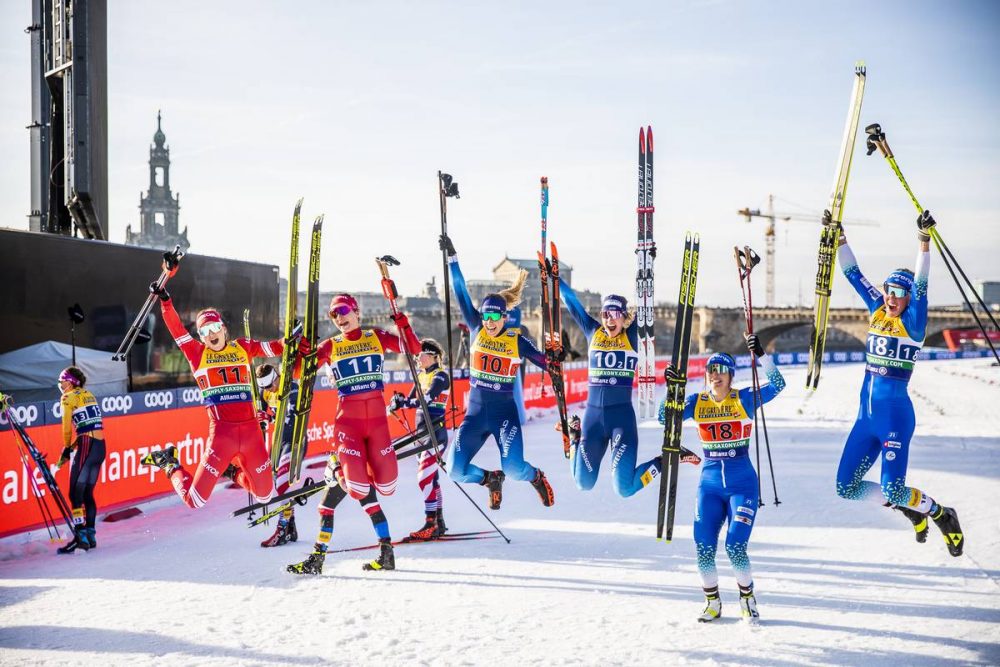
    The women’s podium of the team sprint in Dresden Germany. Switzerland’s Laurie Van Der Graaf and Nadine Fähndrich took the win with Russia’s Yulia Stupak and Natalia Nepryaeva in second, and Eva Urevc and Anamarija Lampic of Slovenia in third. (Photo: NordicFocus)

    In recent years, the women’s team sprints have been dominated by Sweden. They have won eight of the last nine team sprint events – with a sweep of the last six. However, neither Caldwell Hamilton nor Diggins is a stranger to the podium in the event. Caldwell Hamilton was third in the event twice, once in the 2017 pre-Olympic World Cup event in PyeongChang and again in 2018 in Dresden. Both times, she raced alongside Ida Sargent, who retired in 2018. Diggins was a member of the 2018 Olympic gold medal team with Kikkan Randall, and the 2013 World Champs team sprint gold with Randall, along with a World Championship bronze from the classic team sprint in Lahti in 2017. 
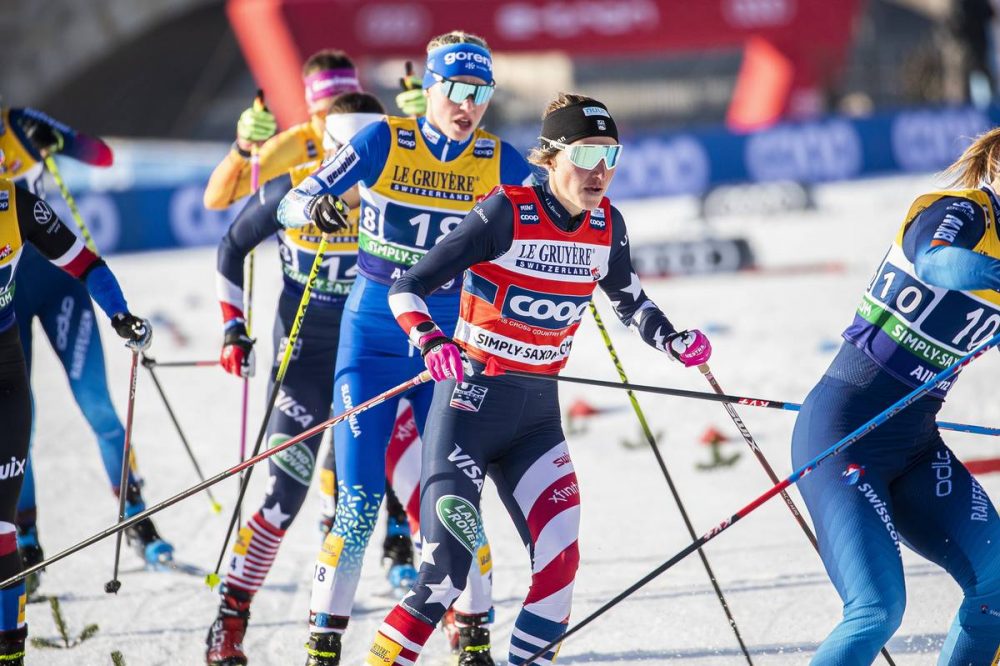
    Sophie Caldwell Hamilton marks the leader around the bend during the team sprint in Dresden, Germany. (Photo: NordicFocus)

    “We fought hard out there, and I am so proud of all our teams for giving it out best effort!” wrote Diggins in a post-race email. “Personally I struggled a bit with positioning on such a short and tactical loop, but I was proud of how I held my own in city sprinting on a course that challenged me in different ways! I thought we had great skis and it’s nice to feel that we’re working our way into better and better racing form.”

    Both Caldwell Hamilton and Diggins were coming off of strong performances on the course in yesterday’s individual sprint event, finishing 2nd and 4th, respectively. Both seemed well matched for the flat and spicy course, with tight corners where the manmade snow crumbles to a dicey sugar.
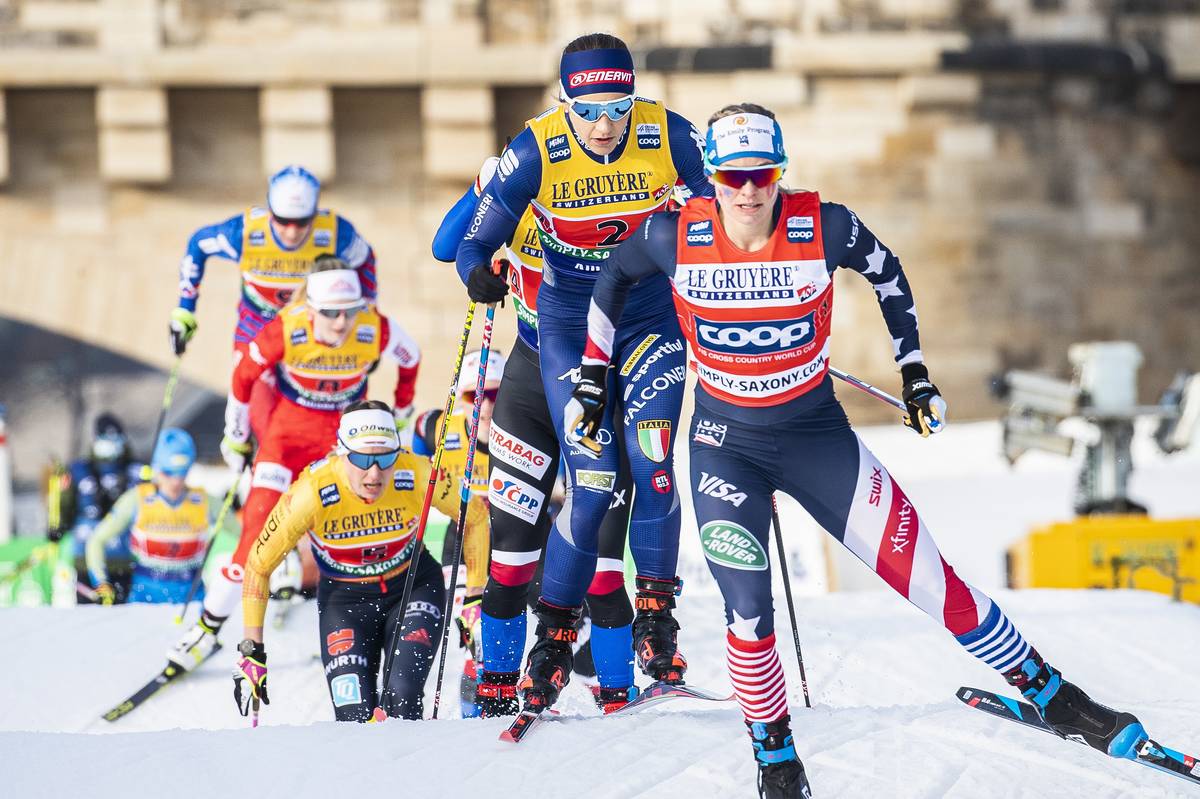
    Jessie Diggins in control over the rollers during the team sprint in Dresden, Germany. (Photo: NordicFocus)

    “It was fast and furious out there today, as Dresden always is,” emailed Caldwell Hamilton. “I think Jessie and I both wanted to fight for a podium today and knew we were capable of it, but this race is a wild card and I think overall we skied quite well. For me personally, I always look back at these Dresden team sprints and wish I had skied more aggressively, but with so much carnage out there, you’re riding a fine line between aggressive and risky, so that sweet spot can be tricky to find. In hindsight, we can always find a small thing or two we would have done differently, but it’s still an effort I’m proud of and any time I get to team up with Jessie is an honor. Dresden hosted an exciting weekend as usual and now I’m looking forward to a little Christmas break in Seefeld!”
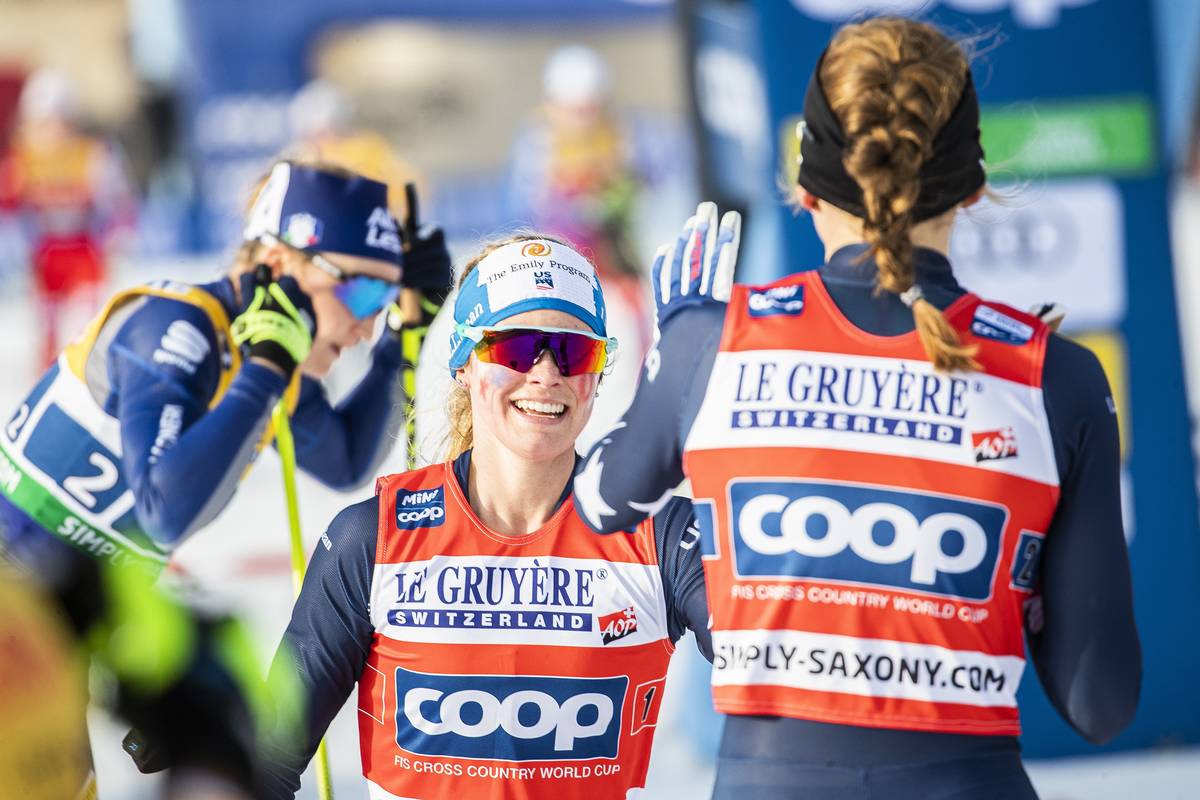
    Jessie Diggins and Sophie Caldwell Hamilton celebrate a 4th place finish in the team sprint in Dresden, Germany. (Photo: NordicFocus)

    Hannah Halvorsen and Julia Kern placed eighth in the final, 12.35 seconds off the winning time. The duop advanced to the final after placing fifth in the first semi-final. The top five teams from each semi advance to the finals.
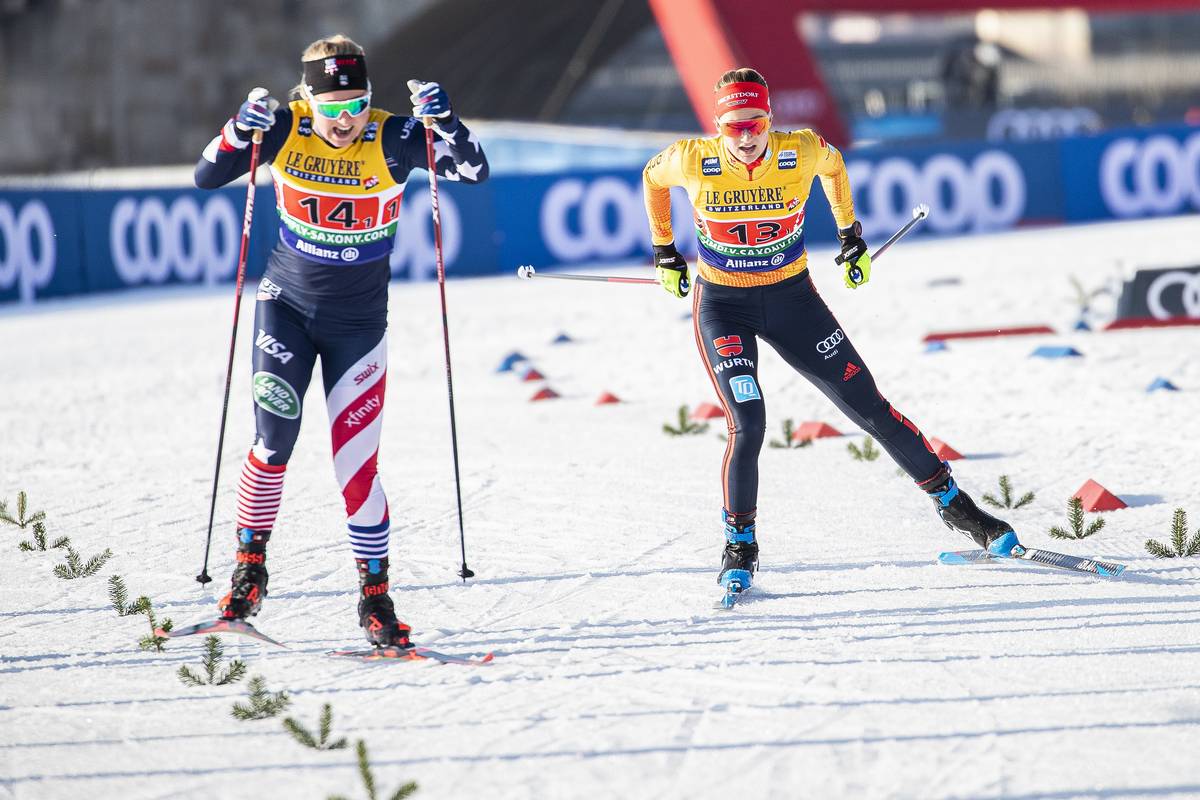
    Hannah Halvorsen faces off with Germany’s Laura Gimmler during the team sprint in Dresden, Germany. (Photo: NordicFocus)

    A quick look to the overall standings as Period 1 draws to a close: Despite sitting out the city sprints in Dresden, Rosie Brennan is still in charge of the yellow bib with 377 points. Missing this World Cup stop was part of Brennan’s season plan. Russia’s Tatiana Sorina trails by 41 points in second (334 pts), followed by Norway’s Therese Johaug in third (301 pts).

    Women’s Team Sprint Final Results: Team Sprint Final Results

    Women’s Team Sprint Semi-final Results:  Semi-final 1 | Semi-final 2

    Overall World Cup Standings

  • Russia, France, and Italy Put On a Show in Dresden’s Team Sprint; Hamilton-Bolger 9th for USA

    Russia, France, and Italy Put On a Show in Dresden’s Team Sprint; Hamilton-Bolger 9th for USA

    This World Cup coverage is made possible through the generous support of Marty and Kathy Hall and their A Hall Mark of Excellence Award. To learn more about A Hall Mark of Excellence Award or to learn how you can support FasterSkier’s coverage please contact info@fasterskier.com.

    The team sprint is like a pump rocket, slowly building pressure for a final eruptive takeoff. Six 0.65 km laps each in rapid succession. Short recoveries between legs mean the athletes slowly wind up the effort while staying out of trouble, not wanting the rocket to misfire and lose it’s peak potential. Stay in the pack, drafting and in control, don’t crash or break a pole are sound strategies. 

    Chaos in the exchange zone, Richard Jouve tags Lucas Chanavat during the team sprint in Dresden, Germany. (Photo: NordicFocus)

    The men’s event evidenced this metaphor perfectly. The pack stayed close and looked comfortable with no crashes through the first half. As the final four exchanges progressed, you could feel the pressure from the pump steadily rise (in this case, three pumps wearing red, navy, or royal blue lycra) fighting against the confines of the bottle. 

    At the 7th exchange, just after the half-way mark, the pressure reached its limit and the launch began. Richard Jouve of the France 1 team accelerated from the exchange zone, making an effective push to stretch out the field. Italy’s Francesco De Fabiani and Russia’s Alexander Bolshunov kept close on his tails, and although the remaining pack did not immediately lose contact, it became increasingly clear who the podium contenders would be. 

    Foot on the gas, Richard Jouve accelerates to spread out the pack for the final half of the team sprint in Dresden, Germany. (Photo: NordicFocus)

    Next exchange, Russia took the reins, with Gleb Retivykh setting pace. Yesterday’s sprint winner Federico Pellegrino looked confident as he tucked in behind the Russian, the winners of the two qualifying rounds squaring off. Lucas Chavanat of France kept close contact in third.

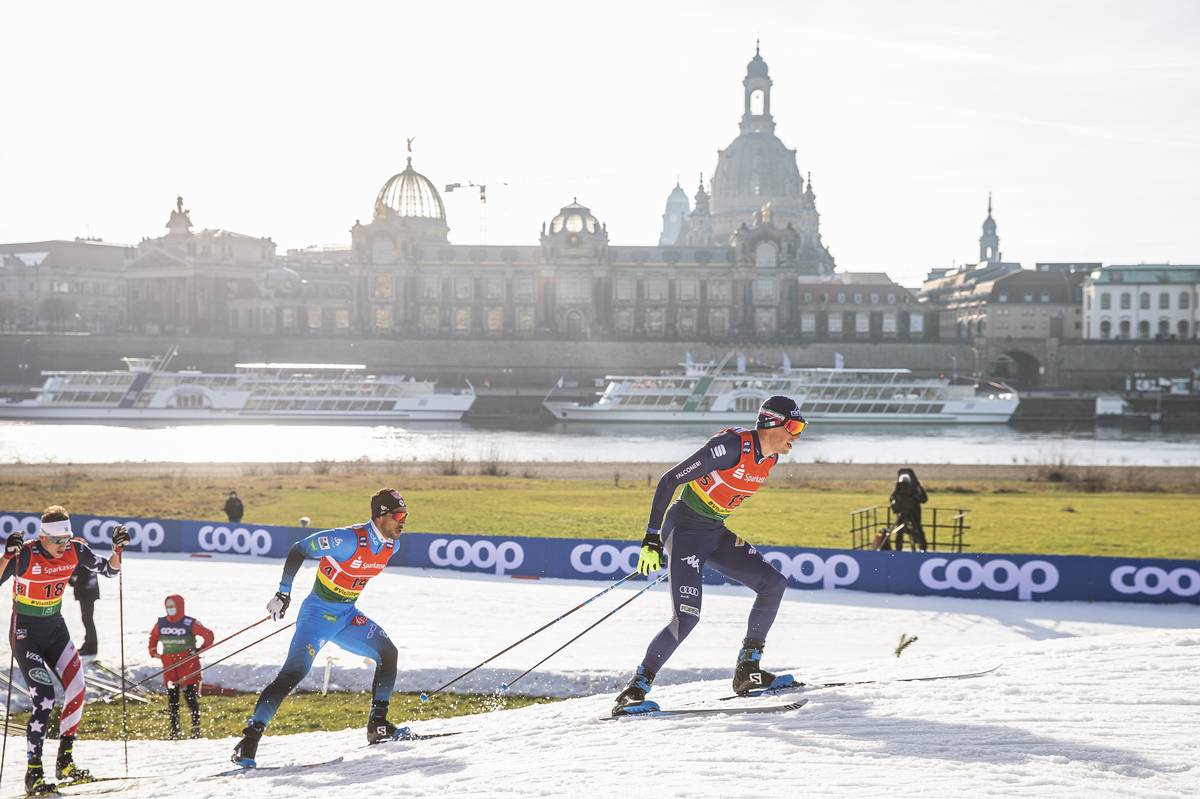
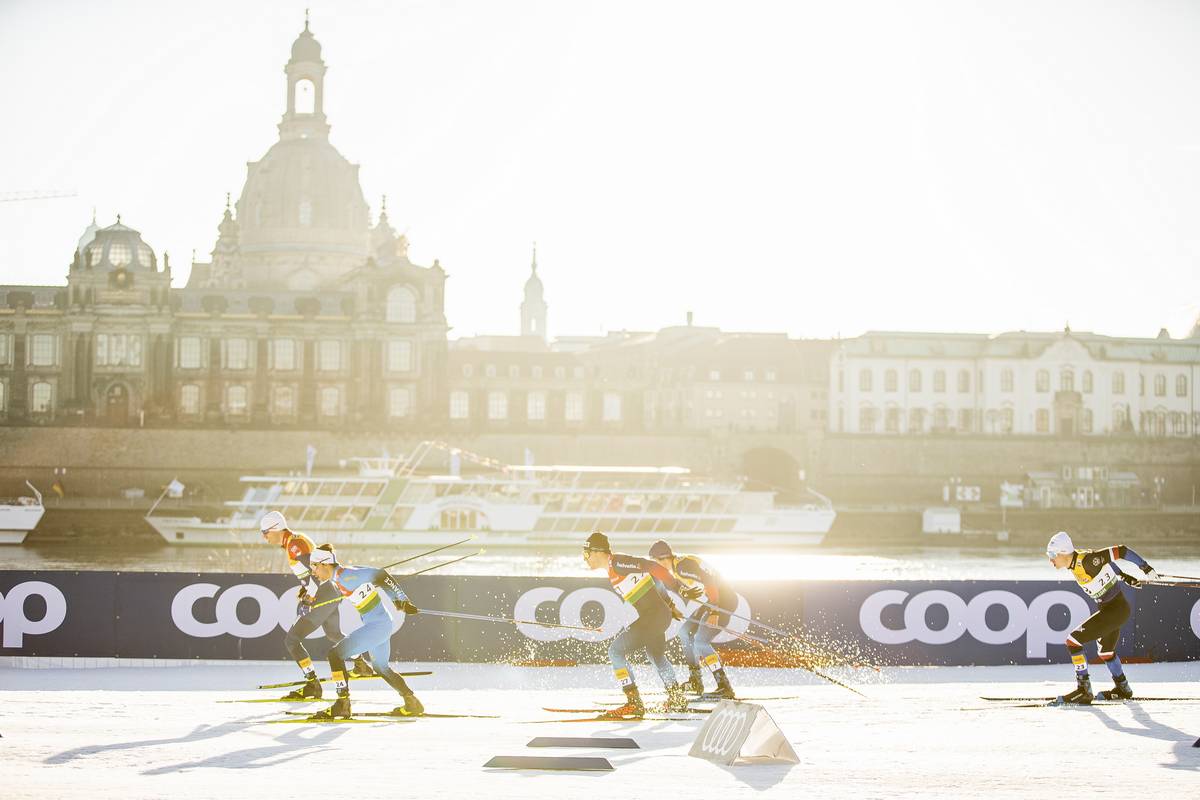
    With the Dresden skyline as a backdrop, Italy’s Francesco De Fabiani leads Richard Jouve of France and American Kevin Bolger during the team sprint. (Photo: NordicFocus)

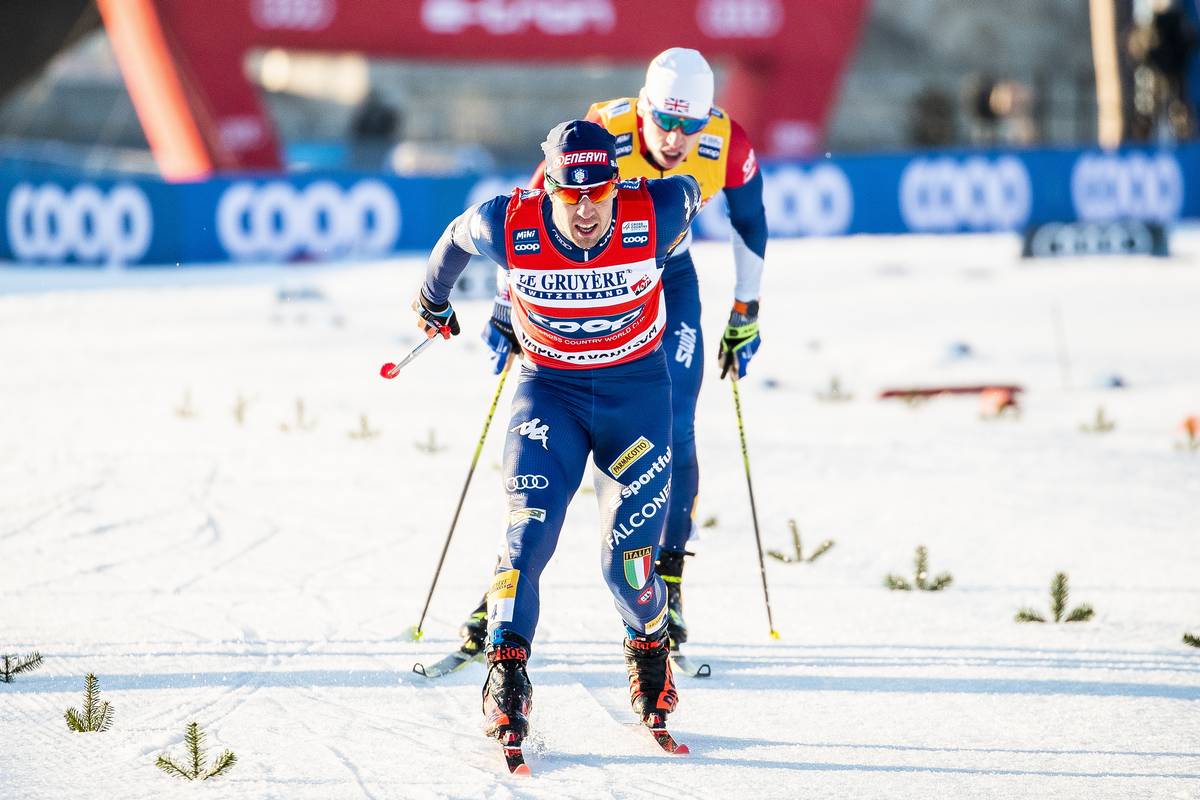
    Russia continued their up-tempo from the front during the final lap where the three leading teams separated from the chasers. Heading into the lanes, all three teams had a chance. Retivykh took charge off of looker’s left, while Chavanat fought for centimeters on lookers right. Pellegrino tucked in behind the Frenchman, priming himself to sneak a boot around at the line.

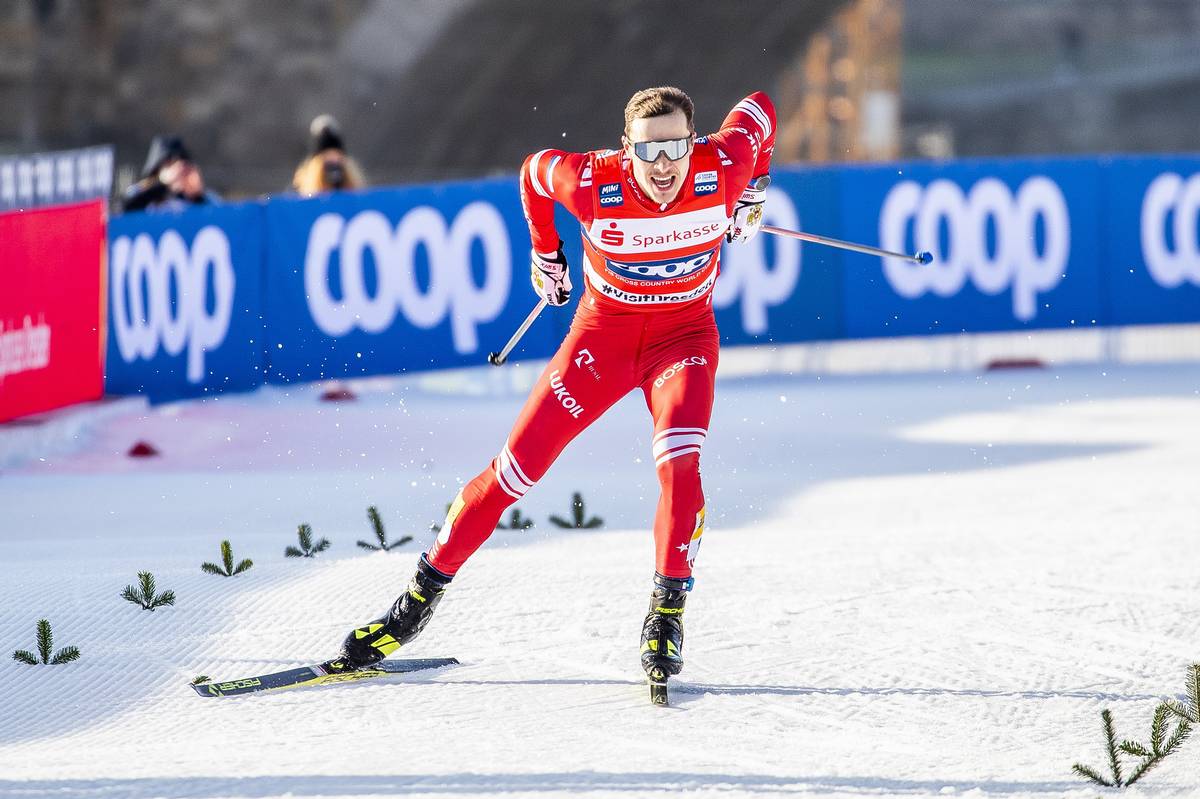
    Real estate was limited and Retivykh had unmatched finishing speed on the day, crossing the line for the win in 15:01.14. Chavanat stopped the clock +0.19 seconds behind in second, and Pellegrino carried the Italians to third (+0.58).

    Down the home strech, Gleb Retivykh takes the victory for Russia at the team sprint in Dresden, Germany. (Photo: NordicFocus)
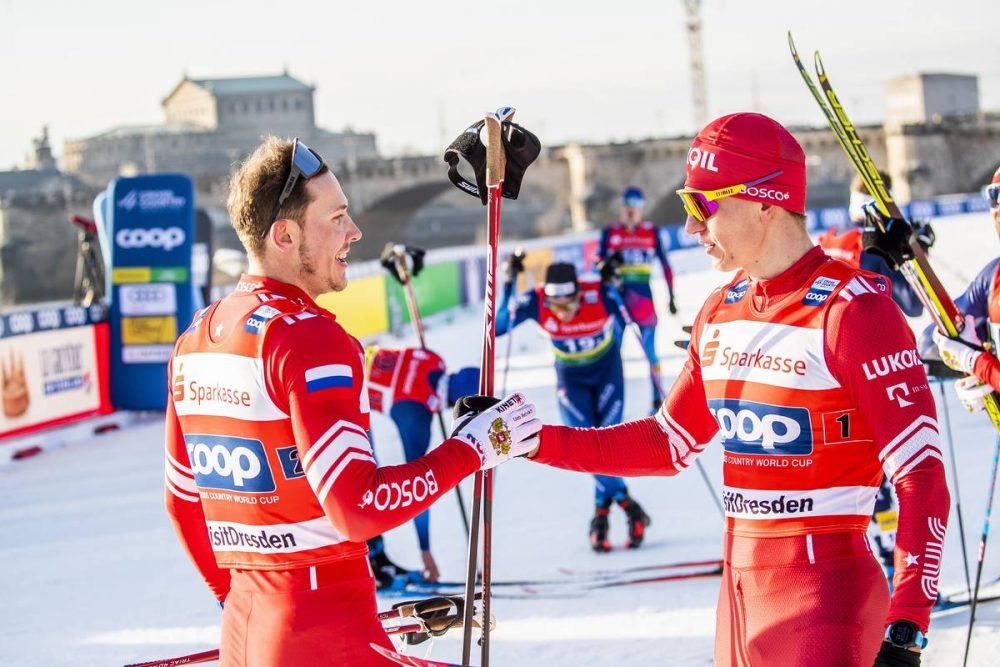
    The Russian victors Gleb Retivykh (L) and Alexander Bolshunov (R) shake hands after the team sprint in Dresden, Germany. (Photo: NordicFocus)

    “It is a very nice competition every time we come to Dresden…” Retivykh told FIS after the race. “We worked together really well and with tactics. The Russian teams took the podium today for women and men. We’re happy.” 

    Prior to today’s win, Russia was in a three-year drought for team sprint victories. Russia last won the event in February, 2017 during a pre-Olympic World Cup in PyeongChang, China. Retivykh was also the anchor on that day.

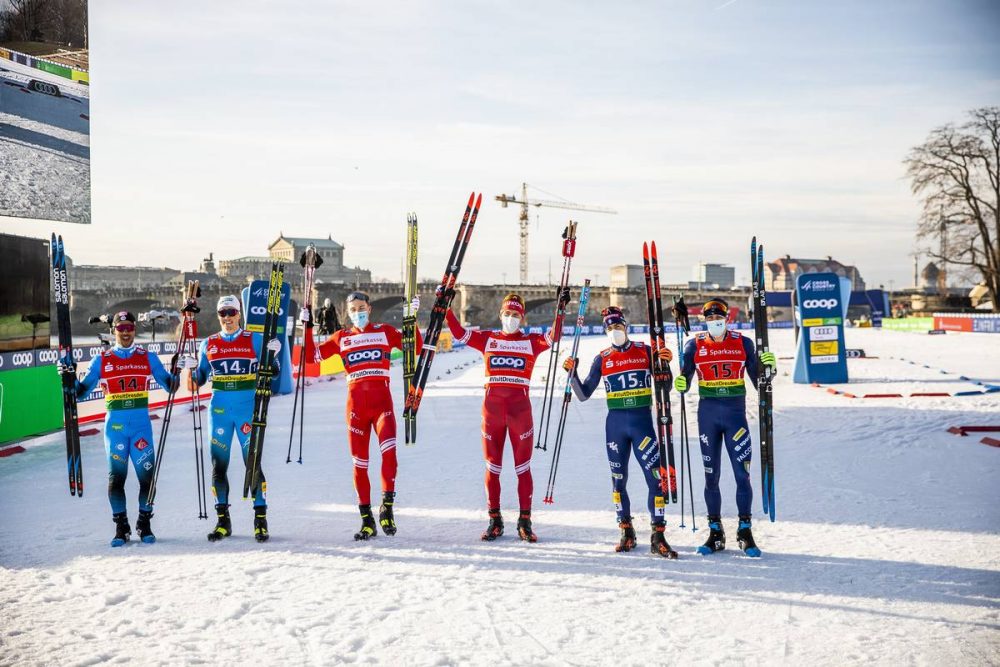
    The men’s podium of the team sprint in Dresden, Germany. The Russia 1 team of Alexander Bolshunov and Gleb Retivykh stole the show, with Richard Jouve and Lucas Chavanat of France in close second, and Italy’s Francisco de Fabiani and Federico Pellegrino in third. (Photo: NordicFocus)

    Behind the podium finishers, the U.S. team of Kevin Bolger and Simi Hamilton stayed in the mix, skiing strong in the middle of the pack and close to the leaders through the final two laps. With two laps of the course to go, Bolger and Hamilton began to lose contact along with the remaining teams, fading from 2 seconds back at 6.5 k to finish 12.57 seconds behind in 9th. 

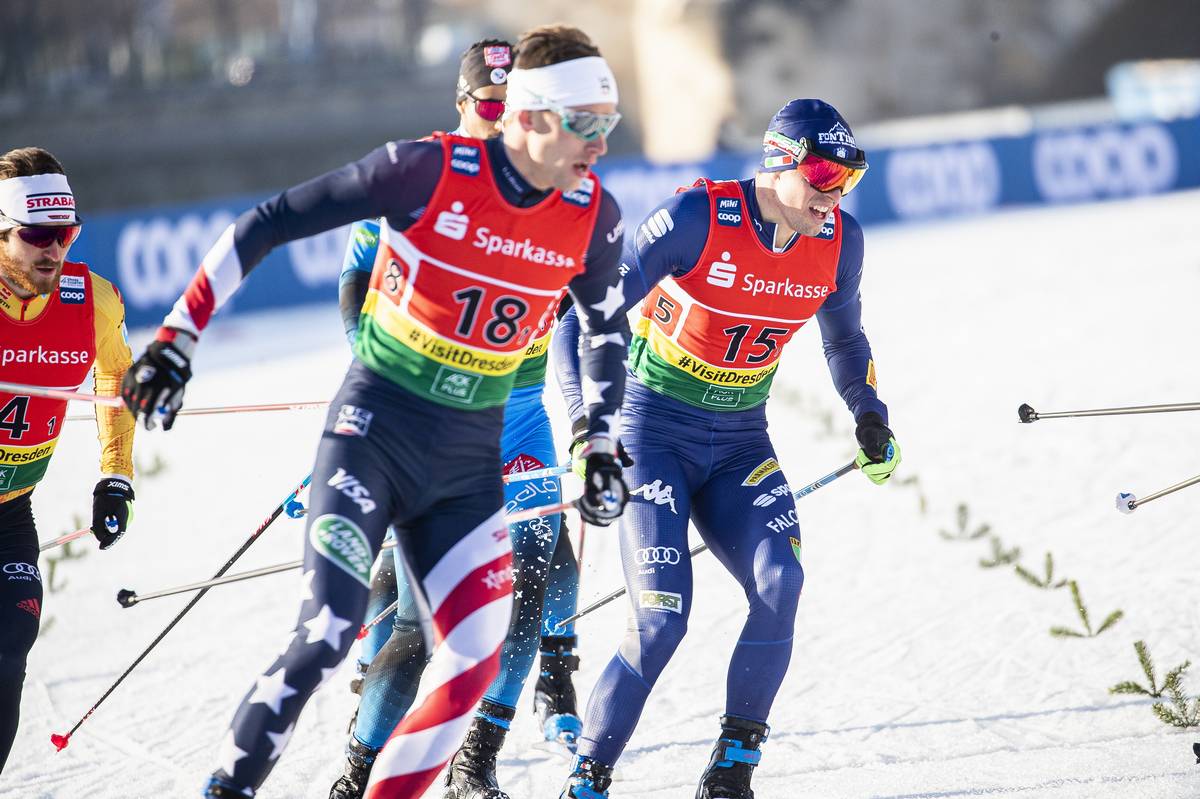
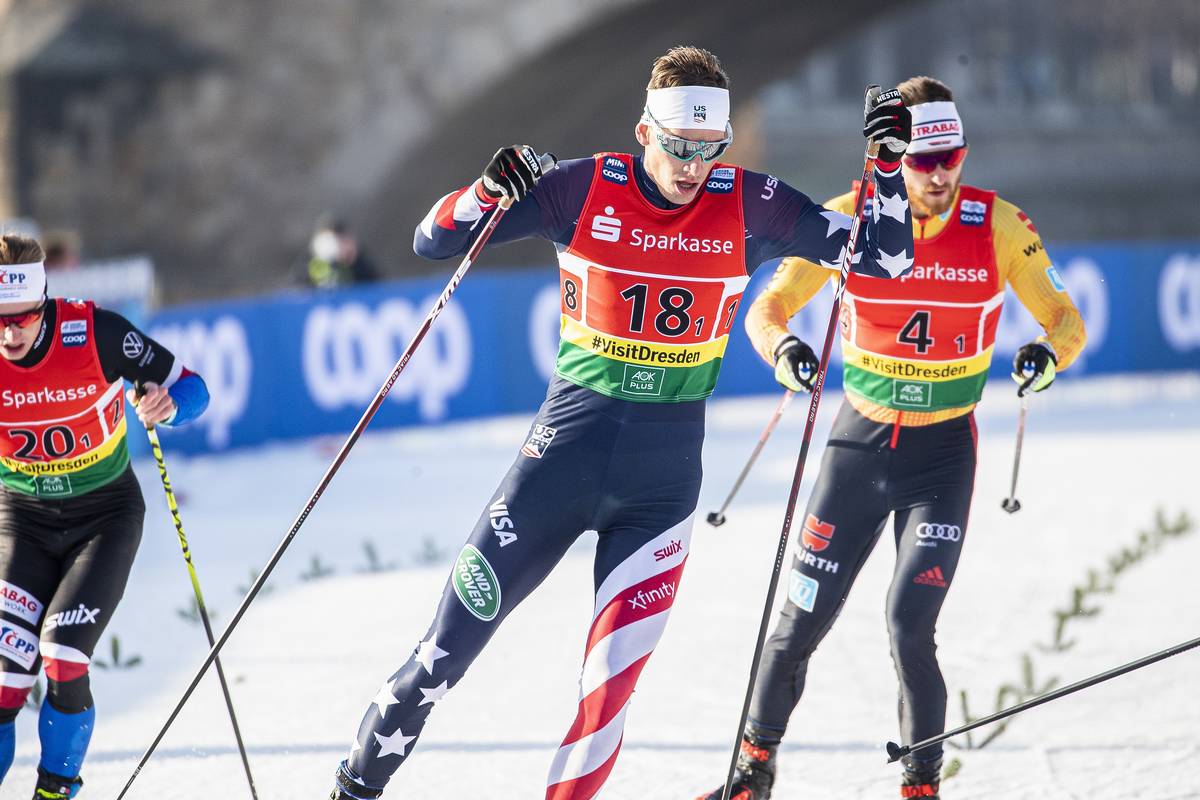
    Kevin Bolger (bib 18) rounds the curve with Italy’s Francisco De Fabiani during the team sprint in Dresden, Germany. (Photo: NordicFocus)
    Simi Hamilton keeps the U.S. team in the mix during the team sprint in Dresden, Germany. (Photo: NordicFocus)

    “Even though the result wasn’t exactly what we wanted today I thought we skied really well and fought through both heats,” wrote Hamilton after the race. “I felt great in our semi, and still pretty good for the final, but things were incredibly scrappy and we just kind of kept getting caught in the back with tangles, broken poles, and the likes. Team sprinting can be so fun and so frustrating at the same time, but it was just really, really cool to ski with Kevin today and I’m so psyched with how he’s skiing right now.”

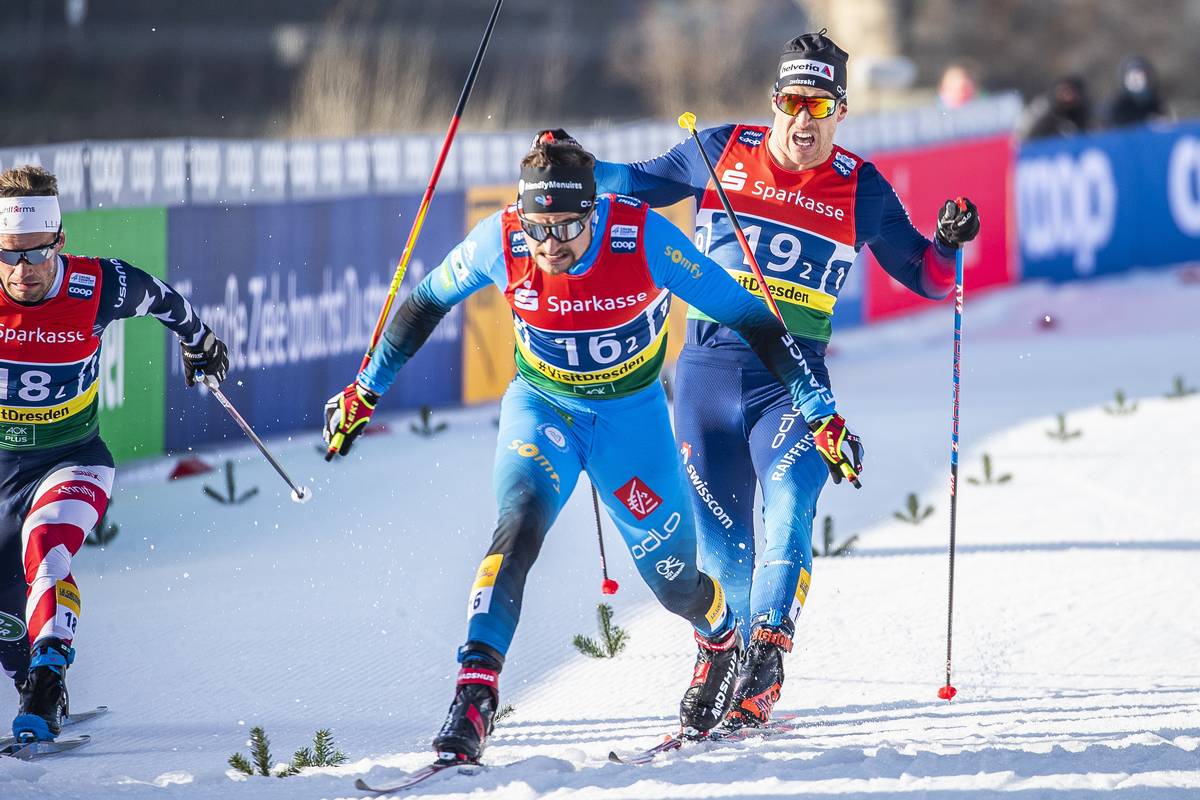
    Simi Hamilton fights to the finish with Jovian Hediger (SUI), Renaud Jay (FRA) just behind. (Photo: NordicFocus)

    The Bolger-Hamilton duo had placed fifth in the first semi-final in a tight finish, 0.69 seconds behind winners Italy I ( De Fabiani and Pellegrino).

    In the second men’s semi-final, the U.S. team of Logan Hanneman and JC Schoonmaker placed 10th (+27.21) and did not advance. 

    The World Cup takes a holiday break until the Tour de Ski which is scheduled to begin on January 1.

    Men’s Team Sprint Final Results: Final Results

    Men’s Team Sprint Semi-final Results: Semi-final 1 | Semi-final 2
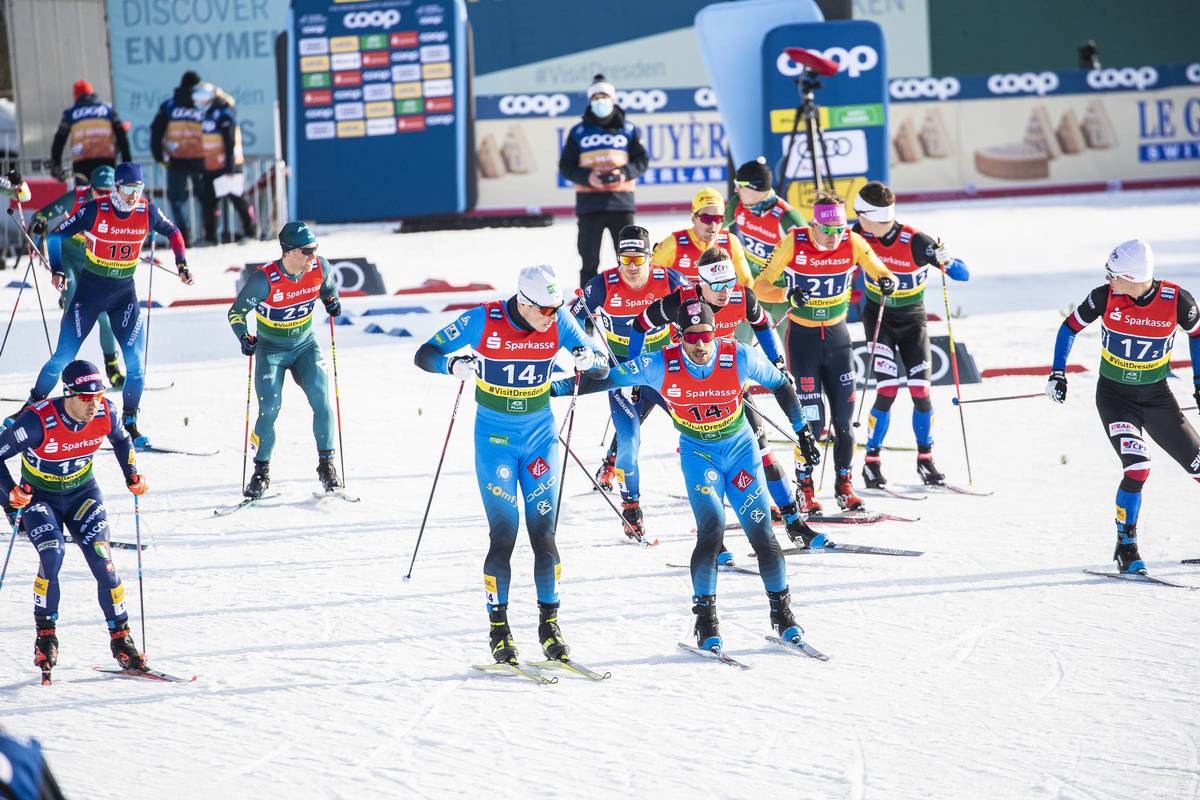
    Out of the lanes and around the bend, Kevin Bolger keeps the Americans in contention during the team sprint in Dresden, Germany. (Photo: NordicFocus)
  • Pellegrino takes it to 15 Sprint Wins as he Clutches in Dresden: Hamilton Fifth, Bolger Sixth for the U.S.

    Pellegrino takes it to 15 Sprint Wins as he Clutches in Dresden: Hamilton Fifth, Bolger Sixth for the U.S.

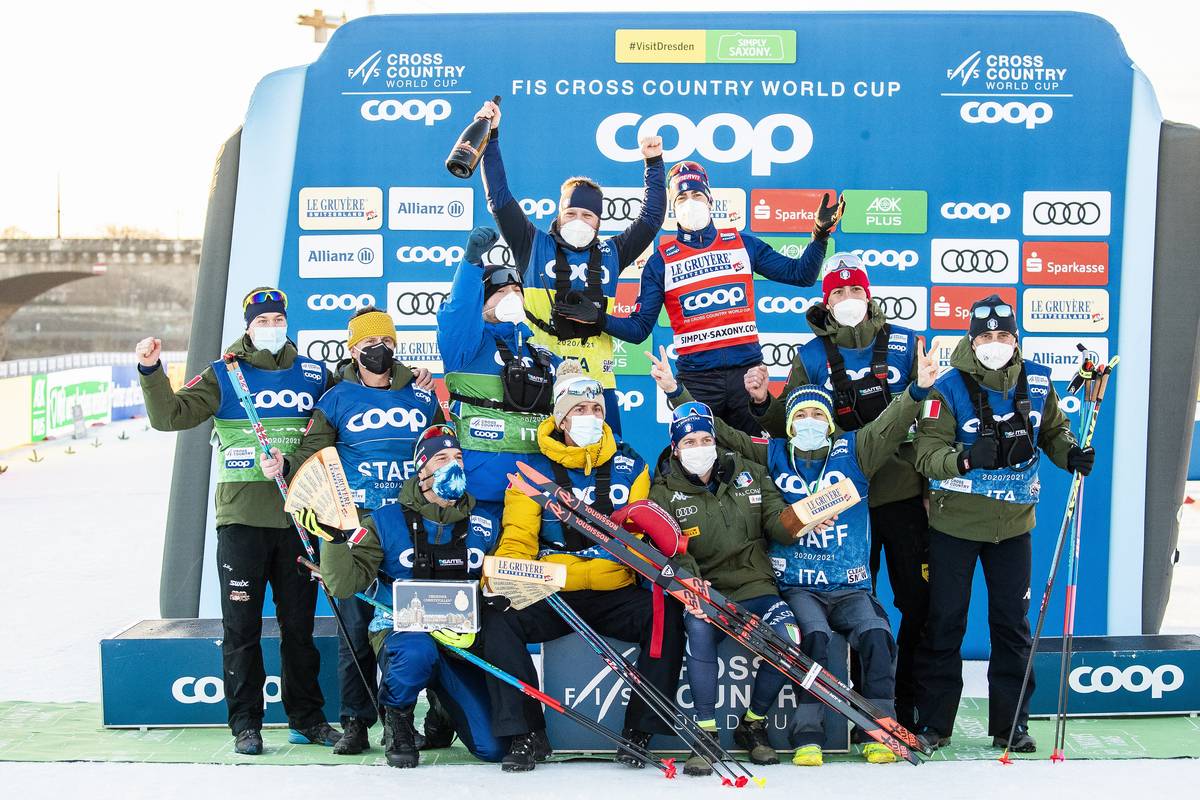
    The Pellegrino support crew after his Dresden win. (Photo: NordicFocus)

    This World Cup coverage is made possible through the generous support of Marty and Kathy Hall and their A Hall Mark of Excellence Award. To learn more about A Hall Mark of Excellence Award or to learn how you can support FasterSkier’s coverage please contact info@fasterskier.com.

    Laid out like a white magic carpet along the Elbe River in Dresden, Germany, the thin ribbon of snow became the speedy tracks for the men’s 1.3-kilometer freestyle sprint on Saturday. While the state of Saxony, where Dresden is situated, went on lockdown this week, Federico Pellegrino of Italy was unleashed, yet again. 

    Peerless once again to the line: Federico Pellegrino with the Dresden skate sprint win. (Photo: NordicFocus)

    After qualifying in fourth behind fastest qualifier Lucas Chanavat from France, Pellegrino boxed out, out-paced, and out-foxed the six-athlete final to win in 2:21:96. Last week’s sprint winner in Davos for back-to-back wins. This is Pellegrino’s 15th individual World Cup title, to place third overall for the most career sprint wins on the World Cup. (Johannes Høsflot Klæbo of Norway has 24 wins, while the now-retired Emil Jönsson of Sweden won 16 sprints.) 

    “After Davos, for sure my confidence went up, really up, and I knew I had a good chance to win,” said, Pellegrino in his post-race interview with FIS, “Two years ago I was disqualified and last year somebody took me down… so today by the semi-final I didn’t want to get any risk so I went in the front.” 

    Pellegrino advanced to the final after winning the first quarterfinal and placing second to Andrew Young (28) in the first semifinal. Great Britain’s Young continued his impressive rise to the elite level as he placed second on Saturday, a scant 0.53 seconds off Pellegrin’s winning time. Last weekend in Davos, Young earned his first World Cup podium since 2015, when he placed third overall in the skate sprint. Russia’s Gleb Retivykh placed third (+0.91) for the podium’s final spot. Teammate Alexander Bolshunov, the overall leader of the men’s World Cup, was fourth (+1.19). Two Americans advanced to the finals. Simi Hamilton, for his best 2020-2021 result skied to fifth (+1.80), and Kevin Bolger sixth (+3.95).

    A big glimmer of British hope, Andrew Young leads the pack in Dresden. (Photo: NordicFocus)

    For the thirty-three-year-old Hamilton, in his third individual sprint of the season, he has steadily improved. After placing 50th in the Ruka classic sprint, he qualified ninth and placed 14th in Davos, cresting with his fifth place in Dresden. Hamilton did not start last year’s Dresden sprint as he recovered from illness. 

    Post-race interview with Simi Hamilton. 

    “I think there were a lot more good things than bad things that came out of today,” said Hamilton. “Those will become more clear as I go forward. …  I feel like I regained a lot of confidence today with my top-end speed which I feel I haven’t had in a few years just with getting older and losing a little bit of power. On a day like today when you have such a fast flat course, you are not going to have a good qualifier and you are not going to ski in the finals if you don’t at least have a little bit of sprinter strength still. So I think that was a really good sign.”

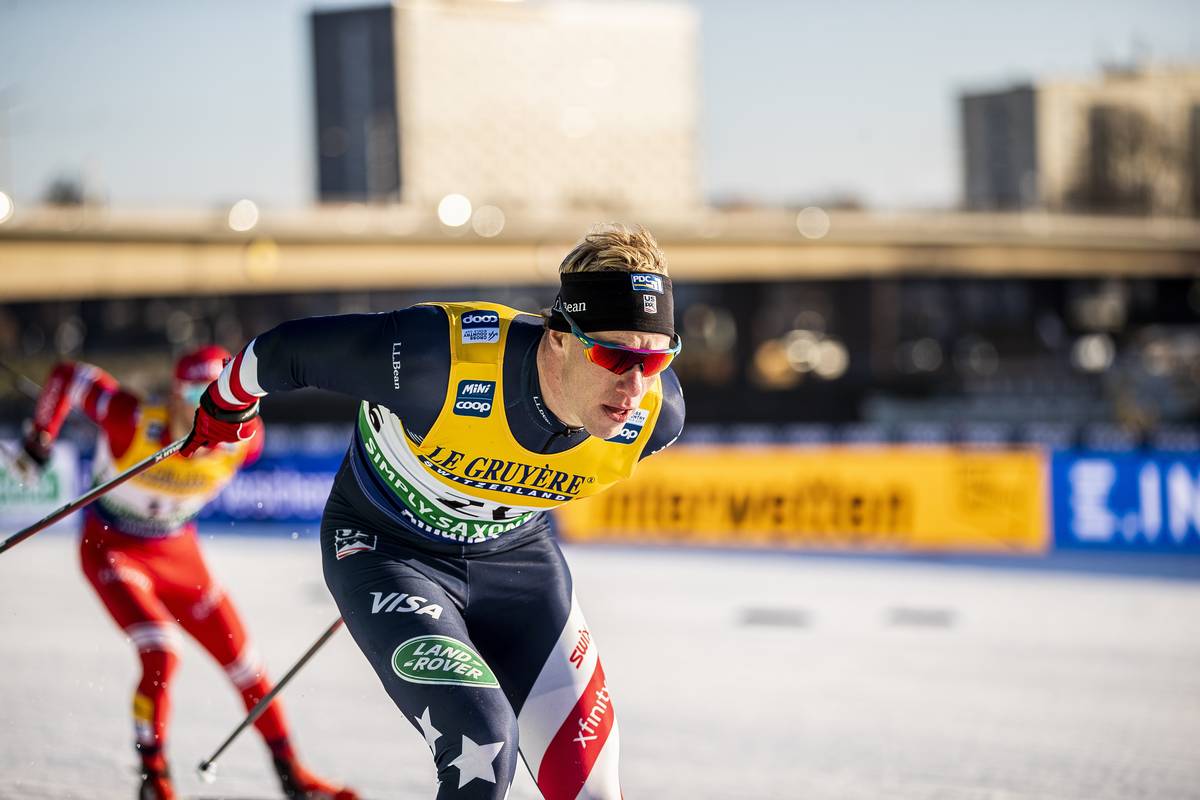
    Big and smooth: Simi Hamilton during the Dresden sprints. He placed 5th overall. (Photo: NordicFocus)

    Since Bolger broke onto the scene after placing 11th in the 2018 Lahti, Finland skate sprint, Saturday’s result marked his 12th career top-30 World Cup result. However, since that Lahti semi, Bolger has a run of semi-final droughts. His sixth place in Dresden is a result high-mark for the U.S. Ski Team athlete as he advanced to his first sprint final after progressing through the semis along with Hamilton as lucky losers.

    Bolger looked at ease in the final, his big-frame keeping pace, until he snapped a pole. He did eventually receive a spare, fiddled with the grip, and reconnected to the pack of five skiers slightly upfront.

    “I was on cloud nine I was psyched to be there,” Bolger said of his first sprint final appearance. “Even going back [a bit], once you make the semi-final anything is possible, and then making that final was an extra cherry on top. From there I wanted to try and just ski fast in any possible way that I could. From the gun I just went for it and had a really great start … I got unlucky with that pole break but just getting there is such a relief because … I came onto the scene in Lahti with that 11th, and there has been this big elephant in the room, ‘when am I going to get back to the semi-final again?’ Doing it today and getting to a final is like a huge monkey off my back.”

    Post-race interview with Kevin Bolger. 


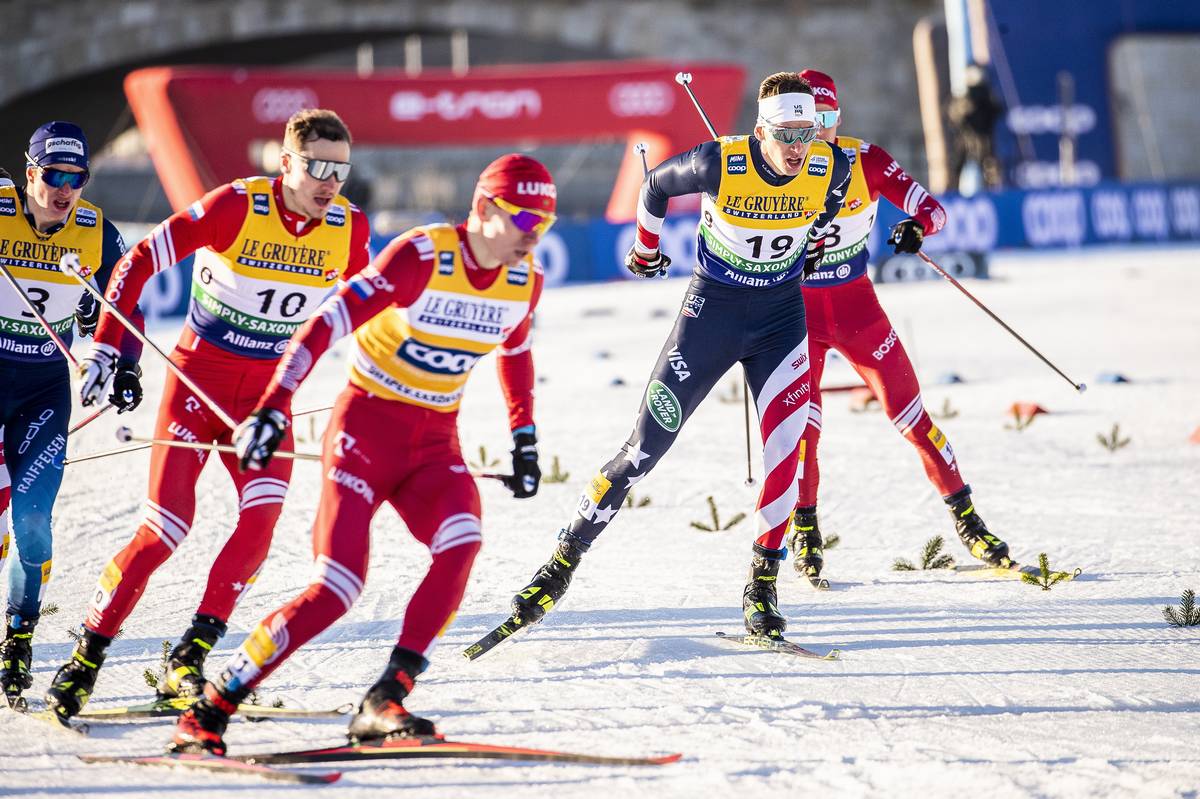
    Kevin Bolger, bib 19, had a career-best 6th overall in Saturday’s Dresden skate sprint. (Photo: NordicFocus)

    Also for the U.S., JC Schoonmaker and Logan Hanneman advanced beyond qualification. Schoonmaker, who qualified in 22nd, placed third in the first quarterfinal. The twenty-year-old Schoonmaker finished 14th overall, for a career-best result. Schoonmaker’s first World Cup was last season here in Dresden when he placed 30th. 

    Hanneman moved onto the semi-finals for the second weekend in a row. In Davos, he placed ninth overall, a career-best. Today, he fell off the pace in the first semi where he placed sixth. He concluded the day 12th overall. 

    Logan Hanneman placed 12th on the day in Dresden. (Photo: NordicFocus)

    Gus Schumacher (20), finished in 43rd, while Tyler Kornfield was 52nd. 

    Considering the World Cup sprint series, Pellegrino leads with 220 points, Bolshunov is second with 170, and Young is third with 152. Hamilton is eighth, Bolger ninth, and Hanneman 11th, respectively. 

    Racing continues in Dresden with a team sprint on Sunday. 

    Final Results | Overall Sprint Standings 

    Sky view of the Dresden, Germany sprint circuit. (Photo: Nordic Focus)
  • Fähndrich takes First Victory in Dresden City Sprints, Caldwell Hamilton Second

    Fähndrich takes First Victory in Dresden City Sprints, Caldwell Hamilton Second

    Nadine Faehndrich (SUI) celebrates her win as Sophie Caldwell Hamilton (USA) lunges for the line. Photo: Nordic Focus

    This World Cup coverage is made possible through the generous support of Marty and Kathy Hall and their A Hall Mark of Excellence Award. To learn more about A Hall Mark of Excellence Award or to learn how you can support FasterSkier’s coverage please contact info@fasterskier.com. 

    Tight corners, flat laps, and fast skis, the Dresden city sprints are sure to provide some spice to the World Cup circuit. With sunshine and above-freezing temperatures you would be forgiven for thinking it was March instead of mid-December. The green grass lining the course could have fooled you too.

    The previous six sprint events held in this city have all been won by the women’s sprinting powerhouse country, Sweden. With the Swedes, Norwegians, and Finns still absent from the World Cup, the title was open to a new nation’s winner. Nadine Fähndrich of Switzerland seized the opportunity as she won in a time of 2:38.52. Sophie Caldwell Hamilton of the U.S.,  notched her first podium of the season, coming in second and Anamaria Lampic of Slovenia finished third. 

    Today’s podium: Sophie Caldwell Hamilton (USA) finished second, Nadine Faehndrich (SUI) with her first victory, and Anamarija Lampic (SLO) in third, (l-r). Photo: Nordic Focus

    Katerina Janatova of the Czech Republic won the qualifier with a time of 2:37.15. “I really like it here, I like the flat, I think it’s really fast,” said Janatova in a FIS interview before the heats, where she was eliminated in the semi-finals.

    All four U.S. women made the top thirty in qualification, led by Jessie Diggins in 12th at 2:41.47. She was followed by Julia Kern in 13th, Caldwell Hamilton in 15th, and Hannah Halvorsen in 26th. Returning from a year of injury rehabilitation, Halvorsen continues to demonstrate the meaning of tenacity, earning her first World Cup points with a 23rd place finish after being bumped out in the quarterfinals. In an email, Halvorsen wrote, “I think a lot of racers can relate to the feeling that you can have a bunch of people tell you that you’re good enough, but sometimes it takes a result to believe that for yourself. Making the heats makes me feel like I belong here, and that is a pretty incredible feeling because I have wanted to be a World Cup skier since I was little.”

    A career first “in the points” for Hannah Halvorsen – 2020 Dresden, Germany sprint. (Photo: NordicFocus)

    Diggins, Caldwell Hamilton, and Kern all advanced to the semi-finals where Kern was eliminated in the second heat. Both Diggins and Caldwell Hamilton advanced to the finals. 

    Through to the finals after a tight squeeze in the finish lanes in her semi-final, Caldwell Hamilton lined up with teammate Diggins, accompanied on the start line by eventual winner Fähndrich (SUI), Anamarija Lampic (SLO), Laurien van der Graaff (SUI), and Lucia Scardoni (ITA).

    Diggins tangled slightly with Scardoni (ITA) at the top of the first rise but escaped unscathed, only to avoid Lampic’s discarded broken pole on the ensuing descent. Caldwell Hamilton positioned herself well with a smooth corner into the second lap and slotted in behind Fähndrich (SUI). Despite a broken pole on the first lap, Lampic (SLO) made a strong recovery and pulled herself back into contention, dueling Caldwell Hamilton in a photo finish for second place which ultimately went to Caldwell Hamilton. Diggins followed in fourth (+2.60), with van der Graaff (+3.04) and Scardoni (+3.30) rounding out the top six. 

    Laurien Van Der Graaff (SUI), who finished 5th, congratulates teammate and winner, Nadine Faehndrich (SUI). Photo: Nordic Focus

    Today was the first World Cup victory for Fähndrich (SUI), who races on Peltonen skis, not often seen in the World Cup lineup. After her race, she told FIS, “Yeah it means a lot, it’s amazing, I just concentrate on my work and not too much on what is after the finish line.” She placed fourth in last weekend’s skate sprint in Davos. 

    Sophie Caldwell Hamilton (USA) celebrates her podium finish. Photo: Nordic Focus

    For Caldwell Hamilton, the second-place finish marked her first podium of the season and first individual podium since Davos last year where she finished third in the skate sprint. She finished just off the podium in fourth during the Dresden sprints last year. With today’s result, she moves into third place with 125 points in the overall sprint rankings behind Lampic (172 points) and Fähndrich (176 points) who has taken the top spot after her win today. 

    Post-race interview with Sophie Caldwell Hamilton: 


    Jessie Diggins during the 2020 Dresden skate sprints. (Photo: NordicFocus)

    As for Diggins, today was her first time through to the sprint finals this season. “For me, the best part was that I really, truly had fun out there,” said Diggins, whose last sprint final appearance was in Oberstdorf Germany last year where she finished third. “Seeing Hannah make the heats for the first time brought such an adrenaline rush, seeing so many of our boys in the semi and then Sim and Kevin in the final, and of course Sophie skiing like a boss! I’m so proud of this team and the atmosphere we’ve created in our little bubble, and we’re really feeding off one another’s happiness. My own day was exciting as city sprinting isn’t exactly what I’m known for, but my body felt good and I’m just so pumped to team sprint here tomorrow!” 

    Women’s Qualifier | Women’s Final 

  • Chanavat Stays out of Trouble in Dresden with the Skate Sprint Win

    Chanavat Stays out of Trouble in Dresden with the Skate Sprint Win

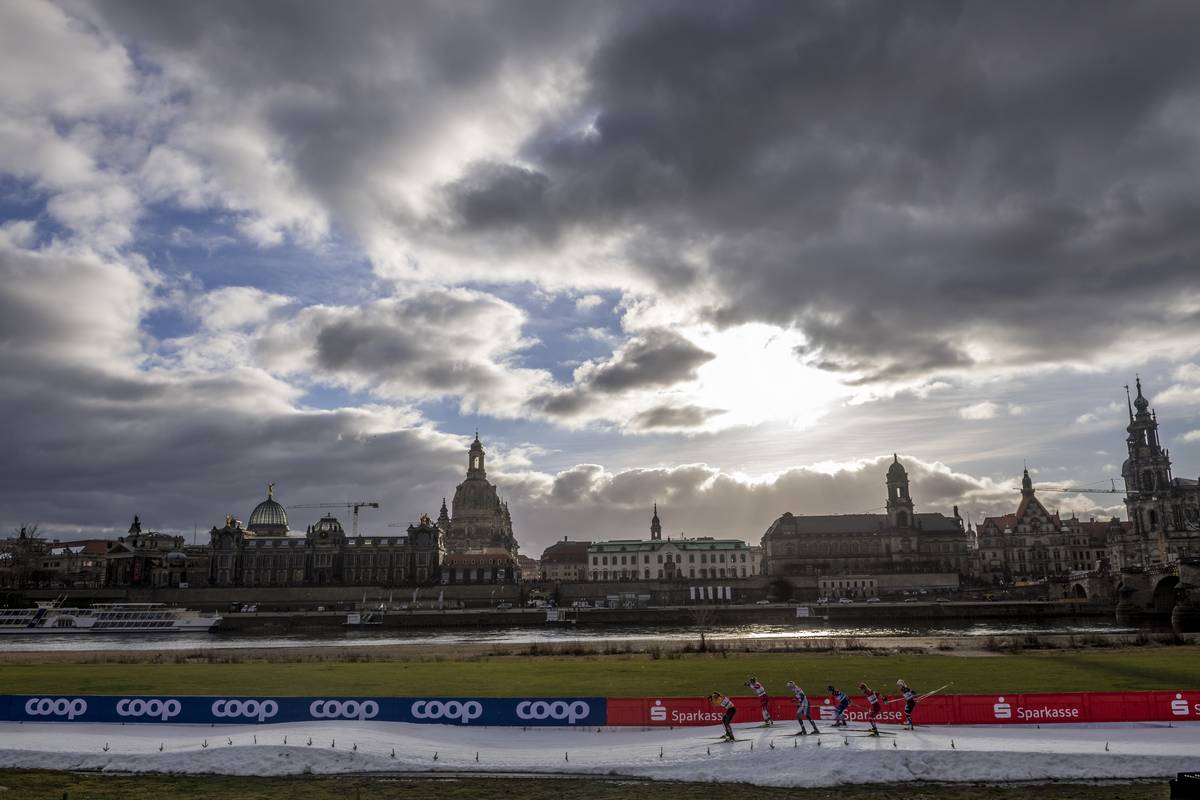
    Dresden cityscape. (Photo: NordicFocus)

    The metaphors are rife when describing the rough and tumble nature of the urban environment. Most often we think of pine forest, alps, and Hansel and Gretel valleys as the backdrop for the World Cup. To foster interest and in-fill a dense schedule of racing, city-sprints are nothing new when it comes to populating the World Cup calendar. Places like Dresden provide a contextual backdrop to a Europe steeped in history. The city is often a reminder of darker times, as it’s historic architecture was destroyed in World War II. 

    The city, since rebuilt to historical specs, is the place to be post Tour de Ski. 

    As a sprint specific weekend immediately following the Tour, the field is absent one notable name from Norway: Johannes Høsflot Klæbo. He placed third overall in the Tour and took the weekend to recover. 

    The World Cup show goes on. And perhaps one of the most stable and finest skate ski technicians out there took center stage. France’s Lucas Chanavat earned his third podium of the season and his second career World Cup victory with a win on Saturday in Dresden. Chanavat won the two-lap 1.3-kilometer qualifier in 2:14.72.

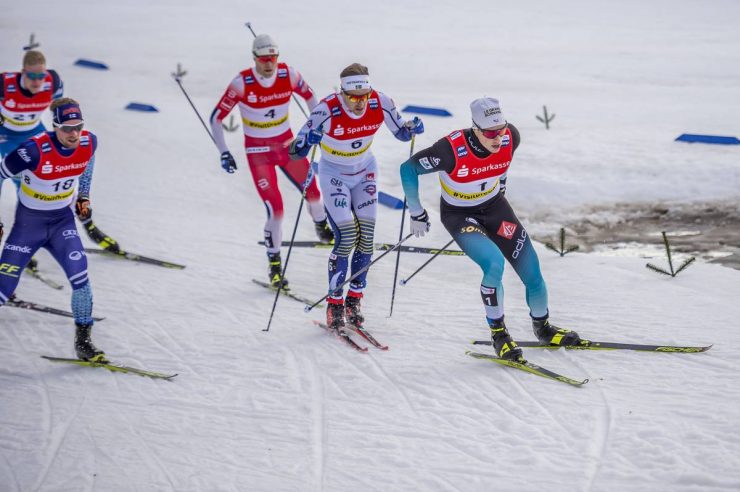
    Lucas Chanavat of France (bib 1), where he was all day, out front during the Dresden city sprints. (Photo: NordicFocus)

     In a tight qualifier in which the top-10 were separated by 1.75 seconds, three Americans qualified for the heats: Logan Hanneman in 21st (+3.65), nineteen-year-old junior skier JC Schoonmaker (in his debut World Cup) 24th (+3.80), and Kevin Bolger in 28th (+4.00). 

    Bolger finished 25th for the day after placing fifth in the second quarterfinal. Schoonmaker was 30th overall and in the points, as he slotted into sixth in that same quarterfinal heat. Hanneman ended up 29th overall, after skiing to sixth in the first quarterfinal. 

    For Canada, Bob Thompson placed 34th, Graham Ritchie 46th, Antoine Cyr 51st, and Pierre Grall-Johnson 66th.


    Post-race comments from Marine Dusser, Head Coach at University of Alaska Anchorage

    Stats aside, this was a tricky course for a basic two-lap oval sprint race. Crashes and slides were plentiful. Staying on your feet, an obvious must, was problematic for some. Most notable was a clash during the fourth quarter, where France’s Richard Jouve clipped the back of Italy’s Federico Pellegrino’s skis. It occurred on the lap corner where skiers seemed to be magnetically attracted to the tightest line up against the v-boards. 

    Not a bad tactic. But the high risk move didn’t always pay off. Pellegrino went down, as did Jouve, in a gnarly tumble. Pellegrino took a moment on course to disparage Jouve. Both skate sprint savants, Pellegrino placed an uncharacteristic 27th and Jouve 22nd.   

    The scene was a reminder that those who fired from the start, got out front, and remained there, set themselves up for success. With no true kicker hills on course, coupled with the high speed tracks, remaining in the front and out of trouble proved to be the recipe for success.  

    Chanavat played those tactics to perfection. He won his quarterfinal, semi-final (in a photo-finish with Norway’s Sindre Bjørnestad Skar), and the final by skiing boss-like out front in 2:14.81.

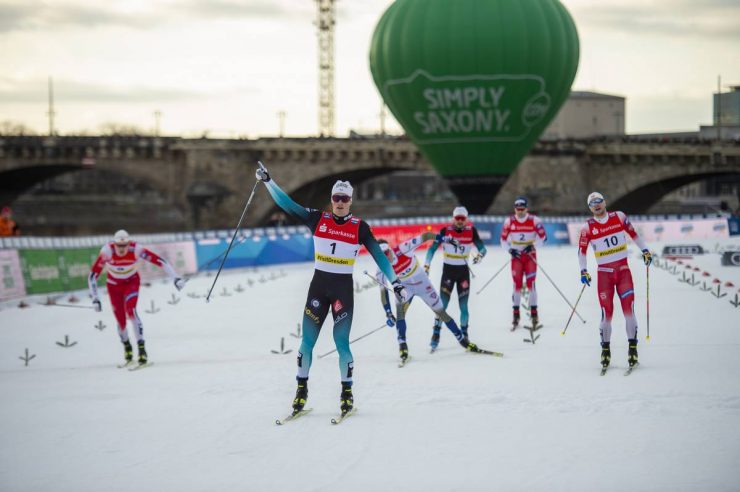
    Number one in the qualifier, number one in the final. Lucas Chanavat is the champion in Dresden. (Photo: NordicFocus)

    The only mishap in the final was for Håvard Solås Taugbøl of Norway, who snapped a pole early on the first lap. Skiing the remainder of the lap with a single pole, he ultimately placed sixth, only 1.86 seconds back. 

    “I felt good today, especially in the final stretch,” Chanavat told FIS after the race. “I saw the crazy falls because Richard Jouve is usually fighting there (in the 180° turn) during the final and he was unlucky today again but he will be back stronger soon. I was hoping for a World Cup victory this year but I was not expecting it to happen so fast.”

    Skar took second place (+0.61), Sweden’s Johan Haeggström third (0.96). Pål Trøan Aune of Norway placed fourth (+1.04), and Jay Renaud of France fifth. 

    Racing continues tomorrow with a team sprint.

    Qualification Results | Men’s Results

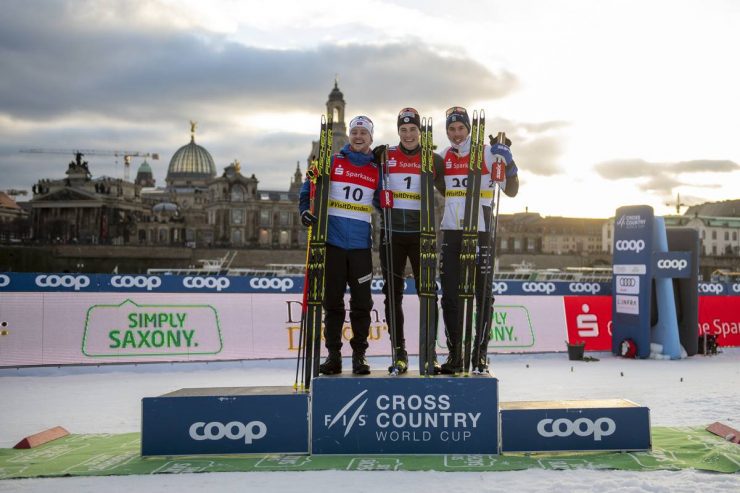
    The men’s podium on the streets of Dresden. Lucas Chanavat (FRA) takes the win ahead of Sindre Bjørnestad Skar (NOR) and Johan Haeggström (SWE). (Photo: NordicFocus)