From the FasterSkier archive — posts syndicated from athletes’ and coaches’ own blogs between 2004 and 2012, kept online as published. Current coverage is at fasterskier.com.
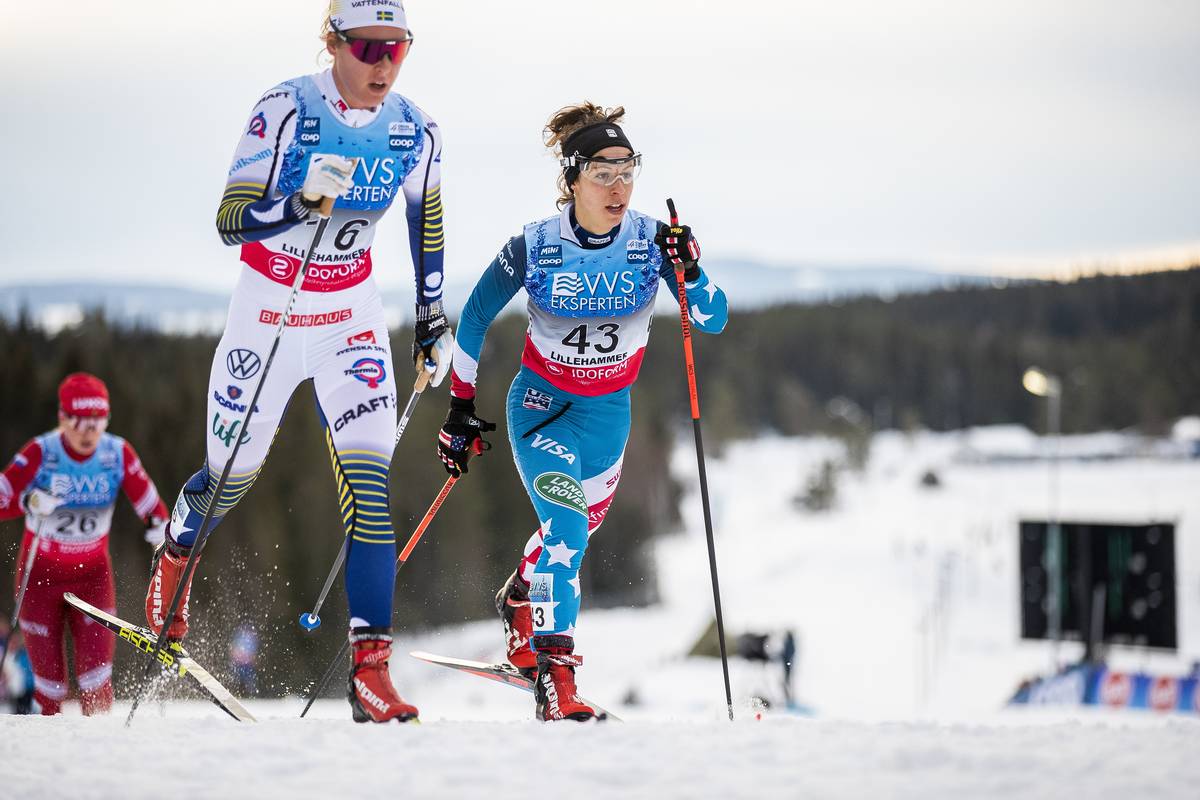
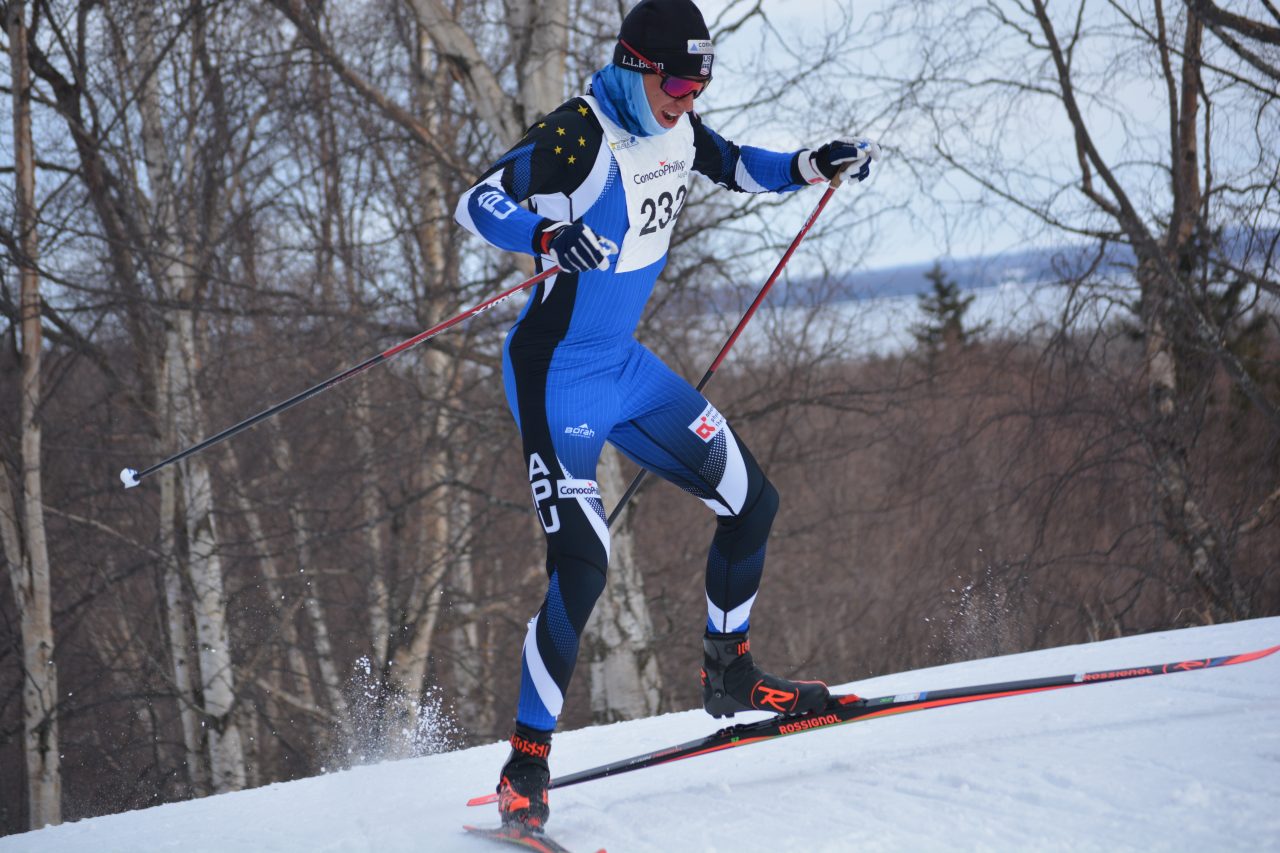
Rosie Frankowski races a December 2019 skiathlon World Cup event in Lillehammer, NOR. (Photo: NordicFocus)
The Olympic Dream.
Perhaps the opportunity to compete at the highest level of sport would not be as sought-after and revered were it not for the inherent scarcity of opportunities to achieve it. This year, only eight women and six men were able to represent the United States in cross-country skiing in Zhangjiakou, down from a total of twenty – 11 women, 9 men – who were selected for PyeongChang in 2018.
Among those who came up just shy was 30-year-old Rosie Frankowski, who has spent the last eight years training with APU under head coach Erik Flora. Frankowski is a 2018 Olympian and 2019 World Championship competitor, finishing inside the top-30 in both places – 21st in the 30 k classic in Korea and 24th in the 15 k skiathlon in Seefeld.
Rosie Frankowski skis through wet falling snow to win the women’s 10k at the opening SuperTour weekend in Duluth, MN. (Photo: Jordan Woods/Woods Creek Productions)
After strong early season results that included two wins and three third place finishes in early season SuperTours, Frankowski lined up in Soldier Hollow for a two-week stretch of racing that felt like it was for all the marbles. As many women had already met the objective criteria for team selection via results on the World Cup, it was only the final few spots that remained open for domestic racers; in the hungry pool all fighting for these spots via some combination of U.S. Nationals, Sun Valley SuperTour, and Tour de Ski results were Frankowski, Caitlin Patterson, Alayna Sonnesyn, Katharine Ogden, Novie McCabe, and Sophia Laukli.
As Frankowski describes in this episode, her opening races – the freestyle sprint and the 20-kilometer mass start skate – of U.S. Nationals went remarkably well; despite being known as a distance specialist, she won the sprint qualifier and finished sixth in the final, then won the race for second place in the 20 k skate, behind Rosie Brennan who had dropped the field from the start. From there, Frankowski faced a series of challenges – slick skis and variable klister conditions in the 10 k classic, a fall in the classic sprint, and a sublexed shoulder in the opening race in Sun Valley.
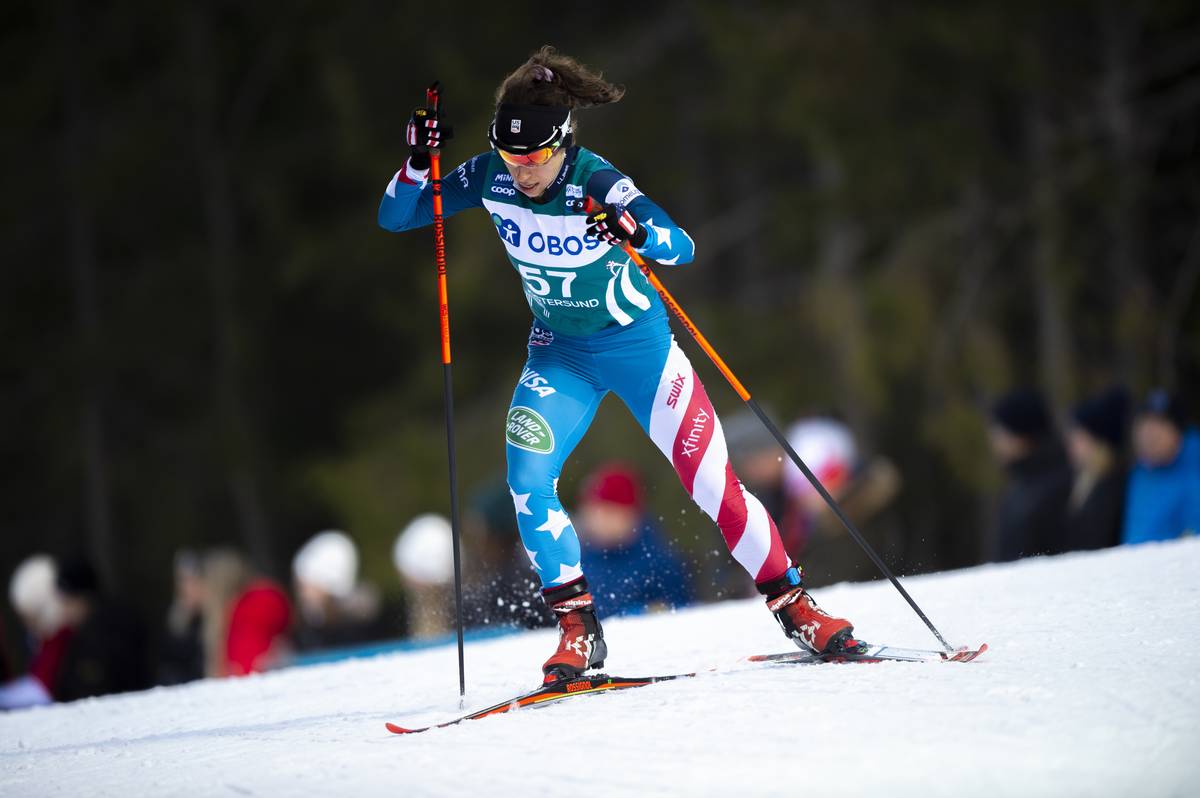
Rosie Frankowski on course during a February 2020 World Cup in Östersund, SWE. (Photo: NordicFocus)
The official team nominations for the 2022 Beijing Olympics were released the following week, and Frankowski was named as the second alternate for the women’s team. Five months later, Frankowski finds herself at a transition point in her career. It’s not a cut and dry retirement as she has earned Period I starts on the World Cup and has other race objectives next winter, but it’s a shift in focus as she and her partner prepare to relocate from Anchorage, AK to Durango, CO.
In this conversation, Frankowski shares the highlights and challenges of the 2021-22 race season, and provides invaluable insights into the experience of spending her career as a “bubble athlete”, fighting for international race opportunities and team selection, while juggling the financial realities of supporting her professional ski racing career. She reflects on her time with APU, and discusses defining success when surrounded by “more-accomplished” teammates, and how she expects the ratio of mountain running to ski-specific training to shift after this transition.
Thanks for listening and thanks to Concept2 for supporting this podcast.
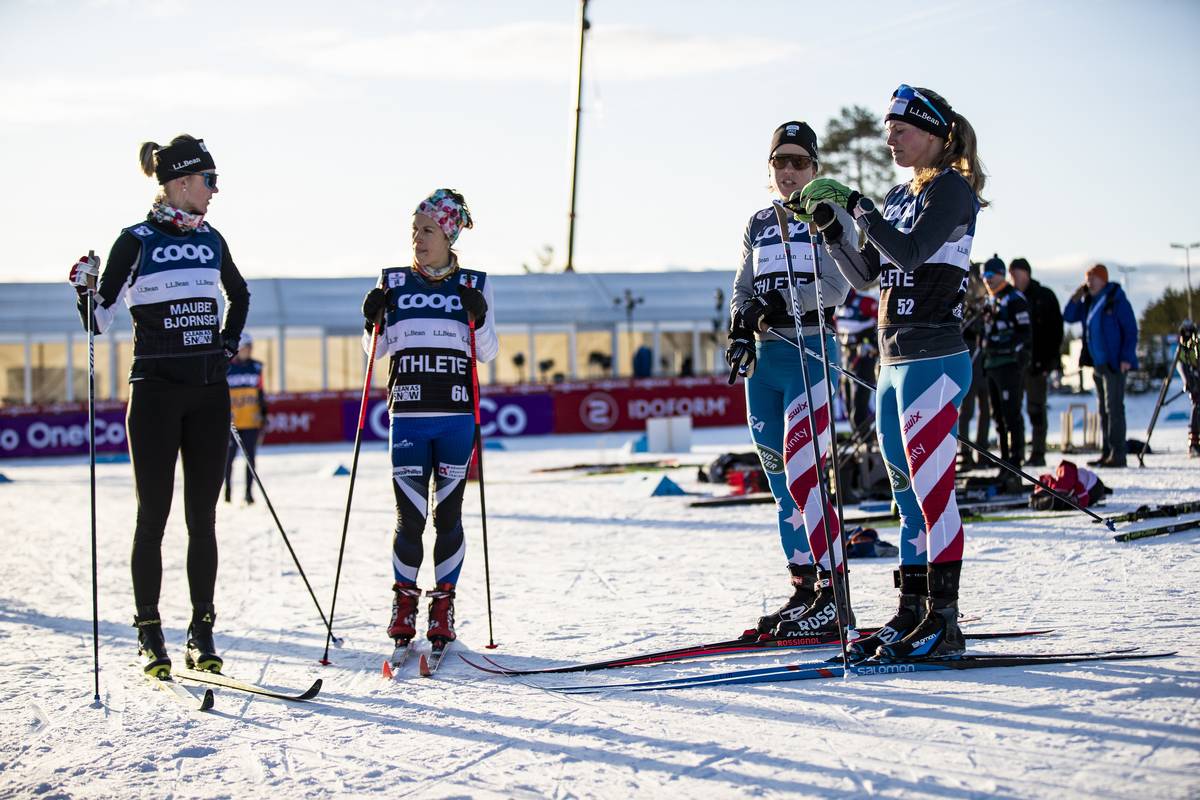
Scenes from a training day in Lillehammer in December 2019. From left to right, Sadie Maubet Bjornsen, Rosie Frankowski, Rosie Brennan, and Jessie Diggins. (Photo: NordicFocus)
Fast racing on the manmade tracks during the men’s sprint heats in Duluth, MN. (Photo: Hansi Johnson)
By Gavin Kentch and Rachel Bachman Perkins
The SuperTour returned this weekend with races in Duluth, Minnesota, held on the new snowmaking courses at Grand Avenue Nordic Center. The weekend included all levels of racing, with green juniors lining up to race alongside the veterans racing on the SuperTour, and a strong sense of community and cross-country ski energy across the board. Skiers like to ski; athletes were glad to be back.
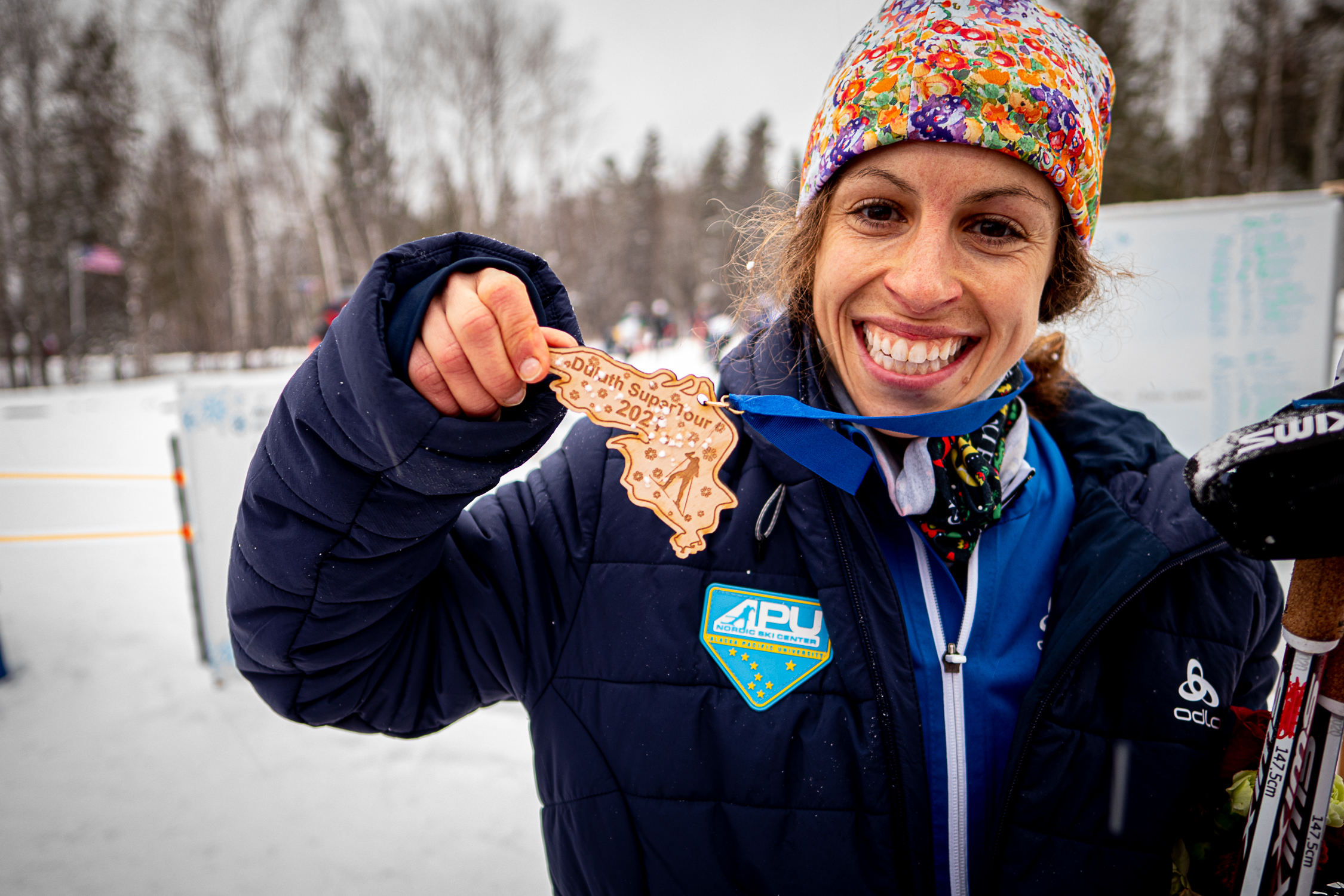
Alaska Pacific University Nordic Ski Center (APU) athletes had a strong showing for the weekend, winning three out of four races. Rosie Frankowski (APU) and Alayna Sonnesyn (SMS T2) each made the podium twice. FasterSkier unofficially calculates the current SuperTour leaders as APU skiers Rosie Frankowski for the women, with 51 points after two races, and Tyler Kornfield for the men, with 42 points. The overall SuperTour leaders at the end of next weekend’s racing in Cable should receive start rights on the World Cup for Period 2, the Tour de Ski. Official USSS standings, here, have recently been updated, and accord with FasterSkier’s math.
Saturday: Freestyle sprint
Alayna Sonnesyn started out the qualifier in style, destroying the field to set the day’s fastest time for the two-lap, 1.3-kilometer course by a staggering ten-plus seconds. Several heats later, she was joined in the women’s final by a largely chalk field: Becca Rorabaugh (APU), Rosie Frankowski (APU), Julia Richter (University of Utah), and Sarah Goble (Sun Valley), who had the day’s second, third, fourth, and ninth fastest qualifying times, respectively. Katerina Hyncicova (NMU), who had been 23rd in qualifying, was the main outlier here.
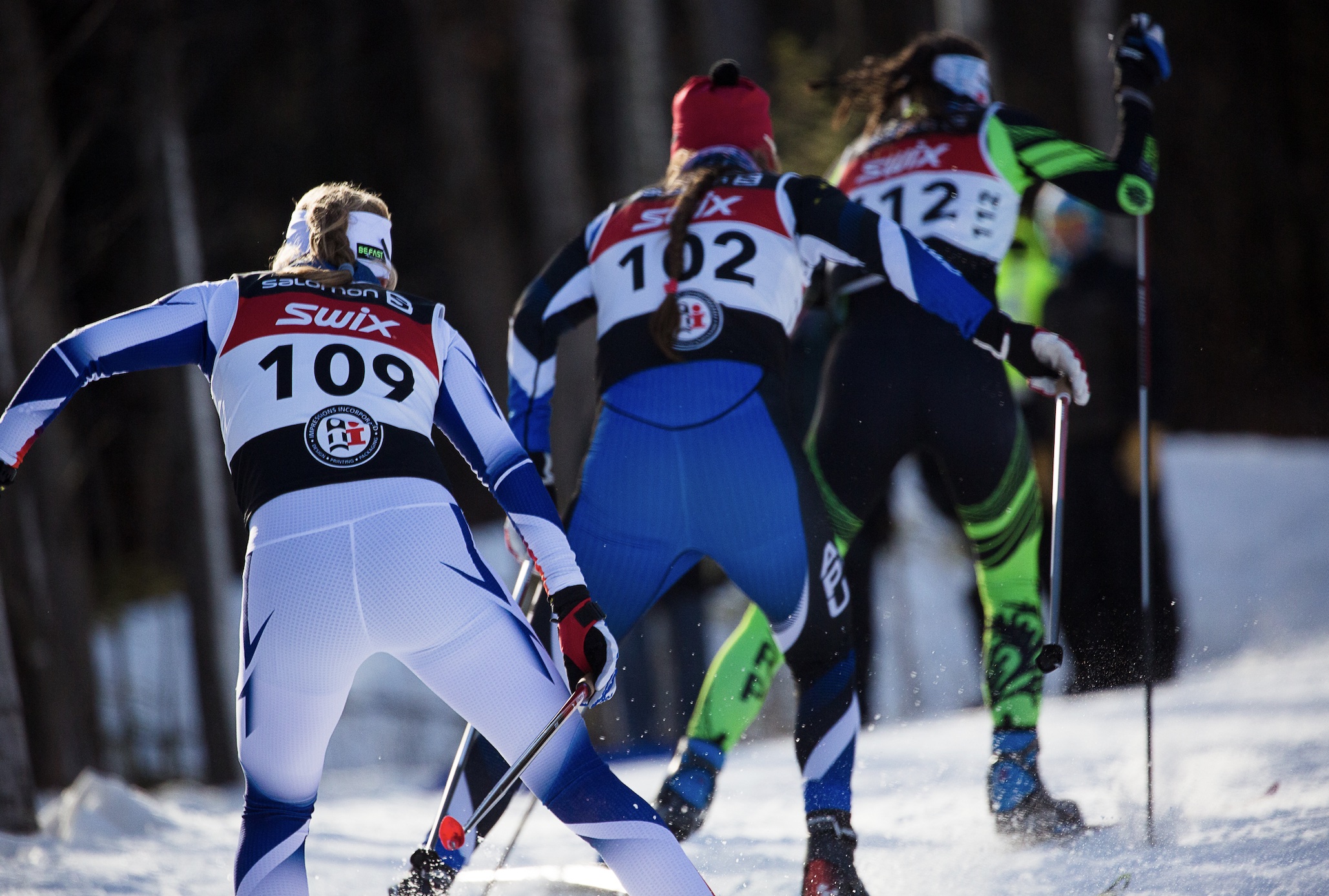
Becca Rorabaugh (Bib 102) races through the heats to win the opening SuperTour sprint in Duluth. (Photo: Hansi Johnson)
Roughly three minutes later, the two women who had consistently been the top athletes in the field all day, Sonnesyn and Rorabaugh, found themselves at the top of the long descent for the second and last time in the women’s final. Sonnesyn led going into the descent, but Rorabaugh skied this segment aggressively to slingshot around Sonnesyn and was able to significantly out-glide her by the bottom of the hill. Sonnesyn made up some ground as the two of them made the lefthand turn into the stadium and the uphill finish, but Rorabaugh was never seriously threatened on her way to the line.
Rorabaugh took the win in 3:11.49, with Sonnesyn 0.47 seconds back.
Roughly four seconds later, the compact powerhouse Frankowski, traditionally identified as more of a distance skier, led Richter to the line by nearly 1.5 seconds to take third. Goble in fifth and Hyncicova in sixth made up the rest of the final.
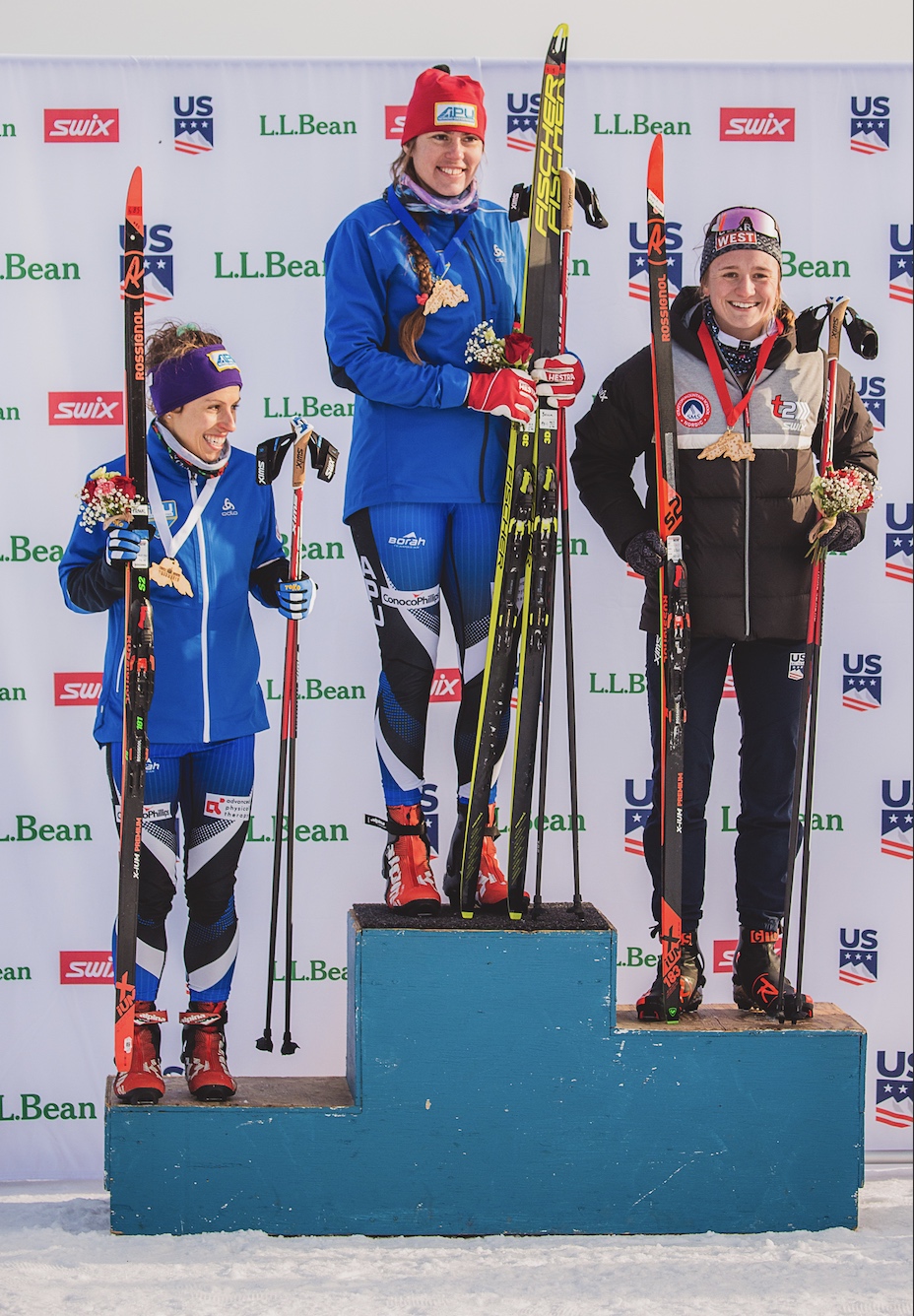
The podium of the women’s freestyle sprint in Duluth. Becca Rorabaugh (APU) took the win ahead of Alayna Sonnesyn (SMS T2) and Rosie Frankowski (APU). (Photo: Hansi Johnson)
It was Rorabaugh’s first SuperTour win since the skate sprint at Wirth Park in February 2020. It was Frankowski’s first SuperTour podium since she was first and second at West Yellowstone in a sprint and distance race in December 2018.
“The sprint went really well for me,” Rorabaugh wrote in a post-race email. “It was exciting to get to race at a Super Tour again! I love icy conditions, I love speed, and I love head to head racing, so it was pretty ideal for me. It’s also good to know that I’m sharpening up; these results show that I can hammer when I need to which is a good sign for the season.”
Reflecting on racing at the national level after a year away, Rorabaugh continued, “It feels really good to be back and to get to race against some of the people that I haven’t seen since early 2020. It seemed like Alaska was quite separate during last season, like maybe people forgot we were up there, so it’s fun to remind everyone that we’re a force to be reckoned with.”
Few athletes were familiar with the new course in Duluth. Rorabaugh also reflected on the course and the event as a whole.
“The sprint course in Duluth is fun and it suits me incredibly well. Some might say it’s lacking a long, steep climb, but I think most would agree that the downhill and the finish stretch are exciting and fun. The finish stretch is pitched up enough that you have to have a good sprint. You can’t just carry speed all the way to the line, which keeps things spicy at the end.
“The energy in Duluth has also been great, everyone has been very welcoming and combining the Super Tour with junior races means it’s a huge event. I always enjoy getting to see the younger skiers giving it their all, and the organized chaos of big races is exciting!”
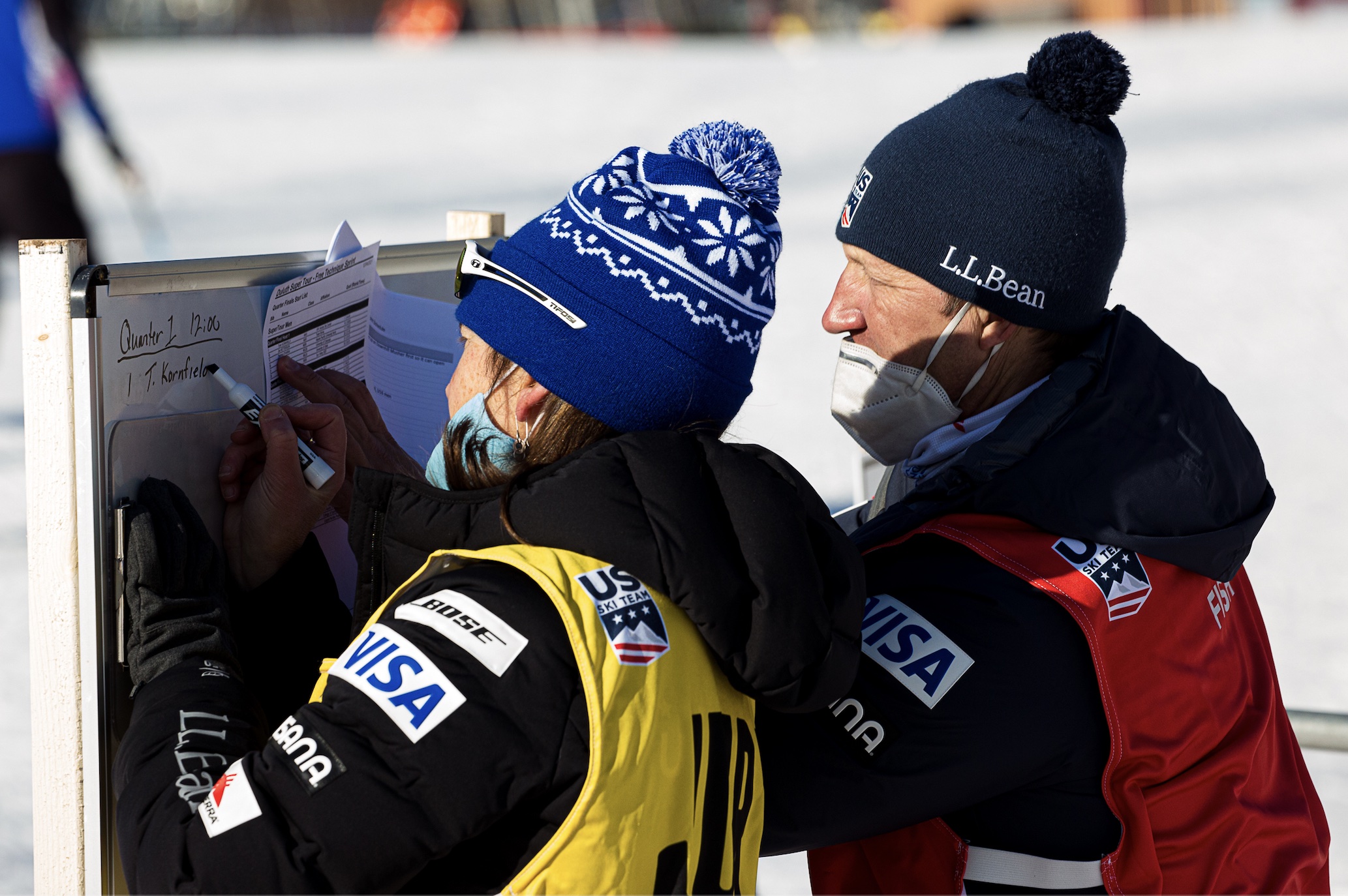
Bryan Fish, U.S. Ski & Snowboard Sport XC Development Manager, reads the men’s heat list as it’s transferred onto a white board. (Photo: Hansi Johnson)
The men’s race featured more of the same: most top qualifiers making it through to the final, and an APU skier moving up from second to outglide a competitor on the final downhill into the finish. For the men, it was the first, second, third, eight, ninth, and outlier 27th-place qualifiers in the final: Tyler Kornfield (APU), Logan Diekmann (BSF), Bill Harmeyer (SMS), Adam Witkowski (Michigan Tech), Noel Keeffe (University of Utah/USST), and Kjetil Bånerud (NMU), respectively.
Two-plus minutes later, it was Keeffe leading Kornfield into the top of the final downhill. 15 seconds later, it was Kornfield leading Keeffe into the finish lanes, as APU’s skis were once again superior. Kornfield kept his lead through the stadium to take the win in 2:47.44, narrowly ahead of Keeffe (+0.23).
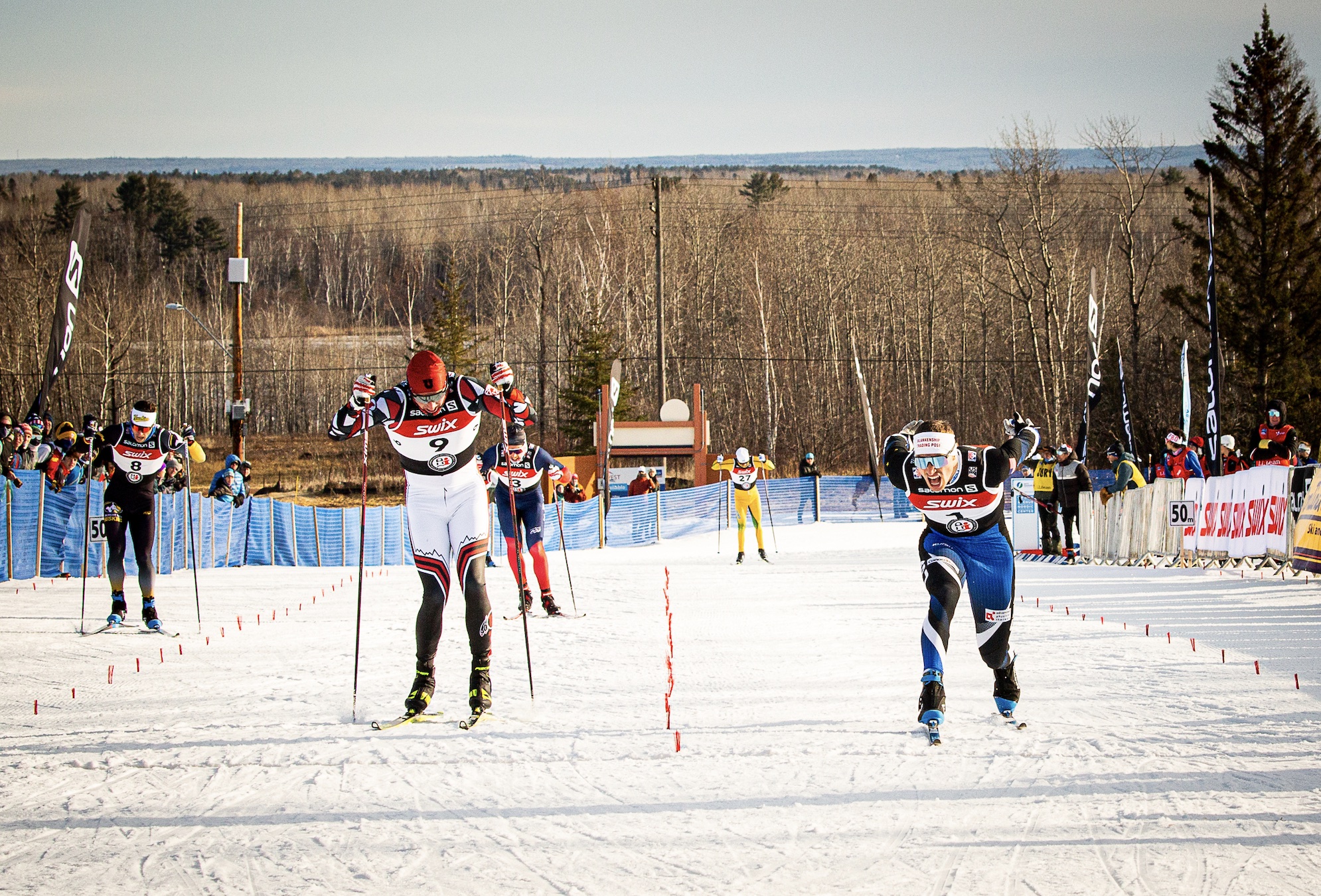
Tyler Kornfield (APU), right, wins the men’s freestyle sprint in a bootslide ahead of Noel Keefe (Univ. of Utah) at the opening SuperTour weekend in Duluth, MN. (Photo: Hansi Johnson)
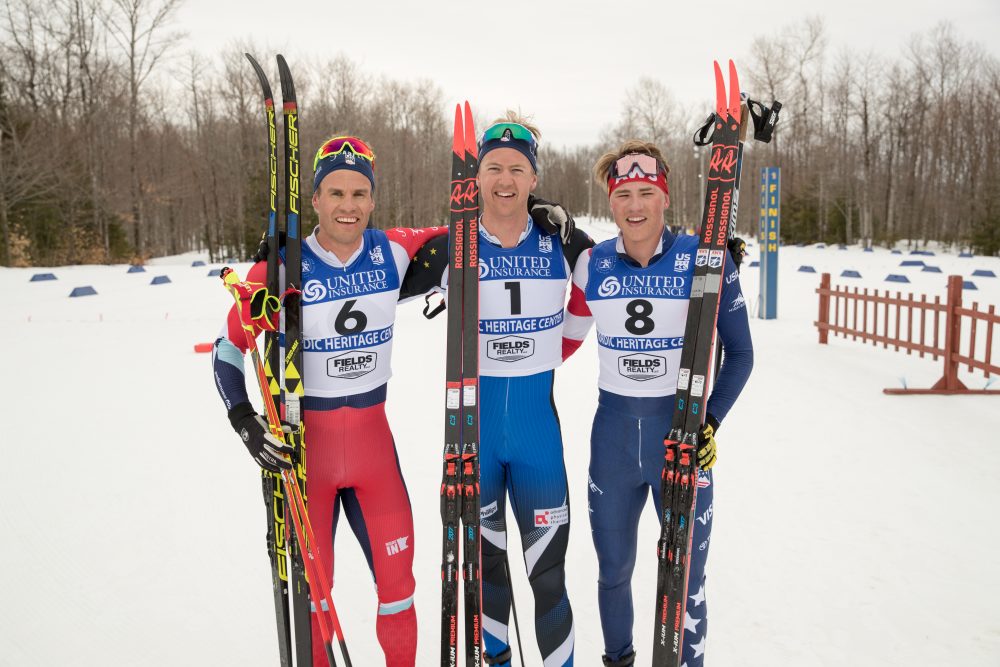
A few seconds later, Witkowski (+2.90) outdistanced Harmeyer (+3.36) for the final podium spot. Diekmann and Bånerud followed several seconds later.
“It feels great to get to racing again,” Kornfield wrote after the race. “Last season, I was able to race two sprint qualifiers, but I failed to qualify for the heats in both. I love racing head to head and it was difficult at times to find inspiration. Fortunately, I have a great team at APU along with Gus and JC being in Alaska, we have been able to do a few time trials to prepare for the season. That allowed me to come to the races feeling calm and prepared. Though I never know exactly how I will perform early in the season, I have been cautiously optimistic about how my body has been performing in training. I hope that I can continue the trend into next week and onto the rest of the season. My mantra for the season is to make every race count and I think I did that in the sprint.”
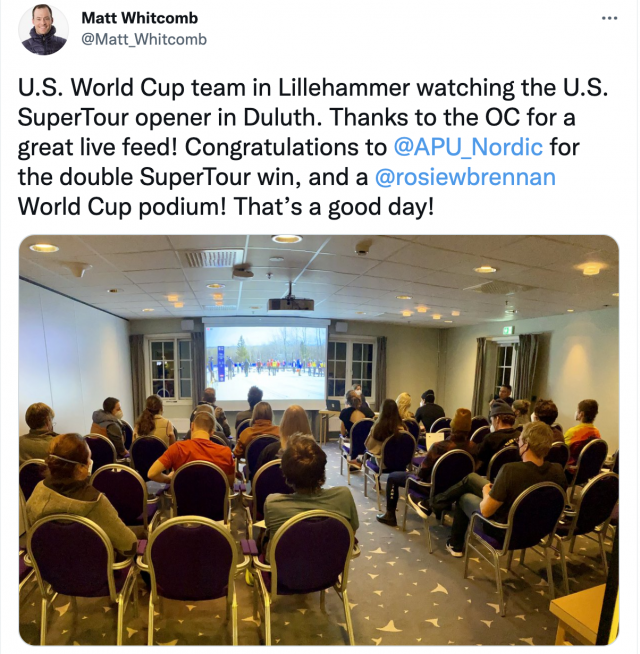
Earlier that day, Kornfield’s longtime partner and fellow APUNSC athlete, Rosie Brennan, had made the podium in Lillehammer in a World Cup race. USST coach Matt Whitcomb congratulated the APU program on its successful day, alongside a heartwarming photo of the World Cup crew watching the CXC Live feed of the SuperTour races in a conference room at the Scandic Lillehammer.
“It is also easy to be inspired to race well when Rosie finishes on the podium of the World Cup,” Kornfield continued in his comments on the sprint day. “I often need to be careful because it is hard to fall back asleep after checking her results at three in the morning, but this morning, it was worth it.”
Kornfield also spoke to the course and event in Duluth, praising its challenges and how they might prepare athlete to race at the World Cup level.
“The course in Duluth was great! I think it was a perfect combination of long enough working sections that were wide enough to maneuver, as well as technical/icy turns that would cost someone who might lose focus either leading into, during, or coming out of the turns. If we have more courses like this one, I believe we can keep pushing the momentum of domestic racing that will prepare us for racing in Europe. It was also great to see so many people out watching. That can be rare sometimes on the SuperTour, but there is an obvious sense of excitement and passion in Duluth that will hopefully turn into a regular SuperTour venue!”
Fast racing on the tracks in Duluth as the SuperTour returns. (Photo: Hansi Johnson)
Sunday: Freestyle distance
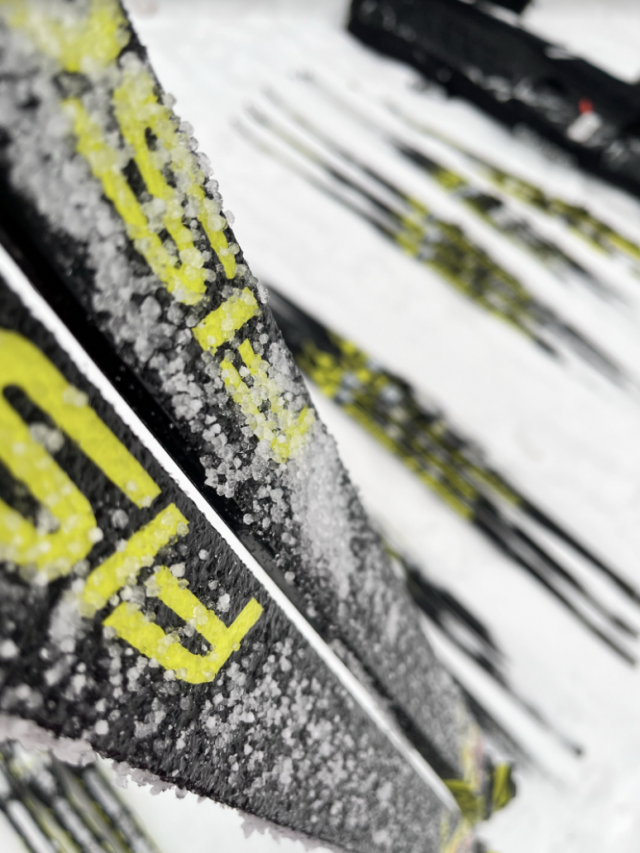
While athletes raced on a white ribbon with bare ground exposed on either side during the sprint, what one might call a “wintery mix” arrived in Duluth on Sunday morning. Over four inches of fresh snow fell overnight, which turned into wet icy flakes as the races began. APU coach and tech Galen Johnston shared photos of graupel-encrusted skis, which left us wondering what skiers might have looked like at the finish.
In the individual start freestyle events, senior men raced five laps of a roughly 2.2-kilometer course while senior women raced three laps.
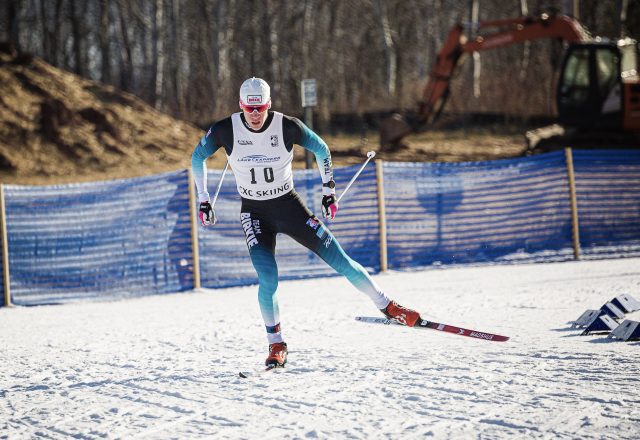
Team Birkie’s Zak Ketterson eked out a win on the men’s side in a time of 26:33.4, beating Northern Michigan University (NMU) athlete Kjetil Bånerud by 3.4 seconds. Bånerud had started three bibs ahead and held the fastest splits until Ketterson came through. Craftsbury Green Racing Project (CGRP) athlete Adam Martin skied the third-fastest men’s time (+8.6) to round out the podium.
“10 kilometers is a tricky distance because while it seems short compared to our normal 15k distance, it’s definitely still long enough to require some good pacing,” wrote Ketterson after the race. “I was fortunate to receive a lot of splits from my coaches, as well as my old NMU coaches and others.”
Zak Ketterson on course during the opening SuperTour races in Duluth, MN. (Photo: Hansi Johnson)
Originally from Bloomington, MN, on the south side of Minneapolis, Ketterson is an NMU alumnus. While other athletes on the podium, like Frankowski and Sonnesyn, are also originally from the Midwest, Ketterson has spent his entire ski career in the region, and he felt the community support during the race.
“It was a really great atmosphere at the Grand Ave Nordic center. I really like Duluth and have very fond memories from when I raced there last year with NMU at some NCAA qualifier races. My favorite part of racing in the Midwest is that there are so many friends that cheer for me. It really feels like a ‘home’ race.”
Commenting on the season ahead, Ketterson shared, “My goals for this season are to just take it one race at a time, trying to do my best in every opportunity I get. We will see where that gets me! For now, I’m just happy to be a part of such an amazing team (Team Birkie) and to be racing again.”
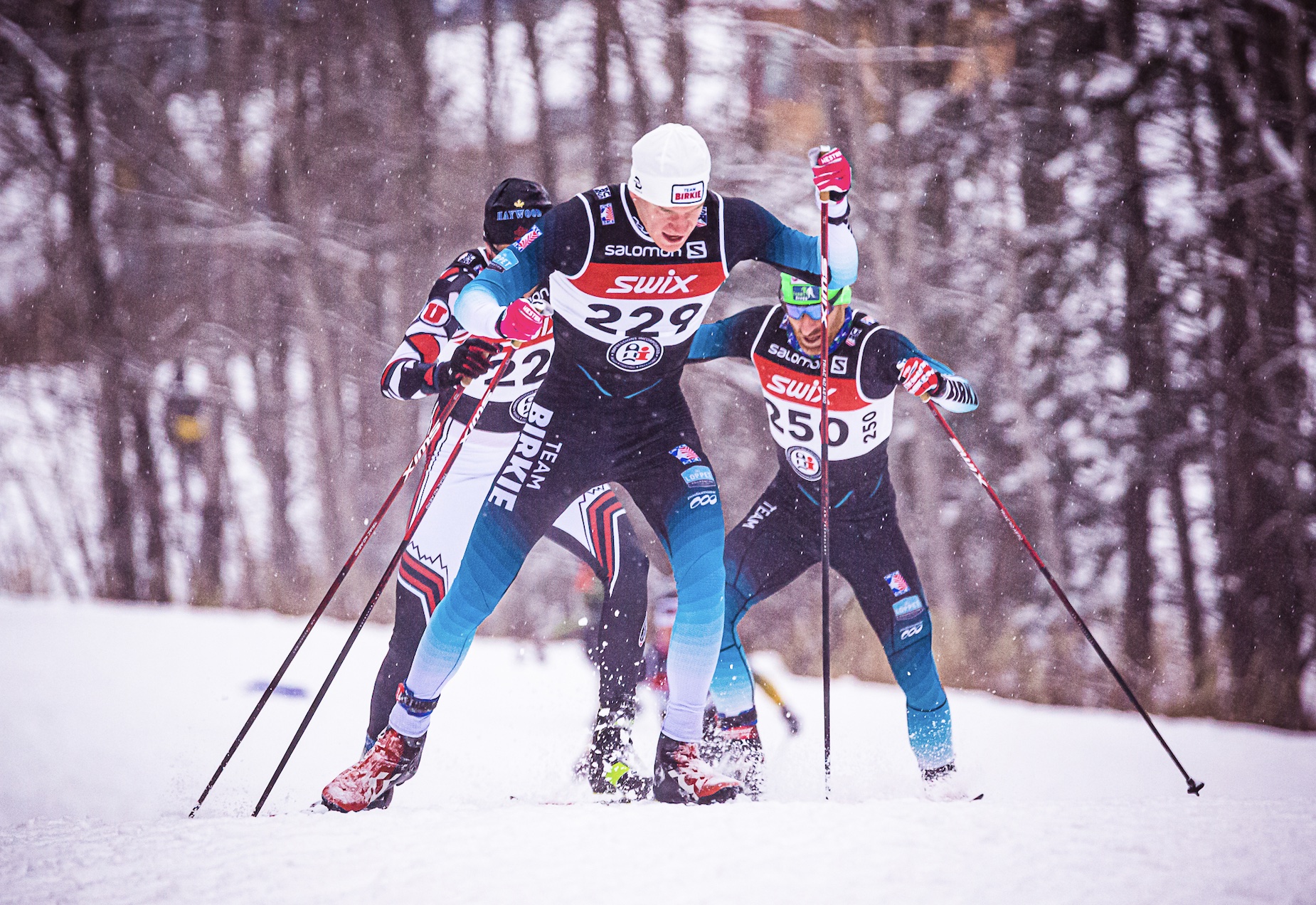
Zak Ketterson pushes uphill during the 10k skate, with Team Birkie “legend”, Brian Gregg (Bib 250), matching pace behind. (Photo: Hansi Johnson)
On the women’s side, with her second podium of the season, APU’s Rosie Frankowski edged out Alex Lawson (CGRP) by just 0.9 seconds. Lawson started behind Frankowski and had been sitting in third, powering through her final lap to create a nail-biter over the final kilometer. During this final lap, Lawson overtook Alayna Sonnesyn (SMS T2), who finished third (+6.1).
The women’s top-6 after the 10k distance race in Duluth. Rosie Frankowski (APU) topped the podium, ahead of Alex Lawson (CGRP) and Alayna Sonnesyn (SMS T2). (Photo: Hansi Johnson)
Frankowski shared the following reflections on her weekend in Duluth via email:
“Before heading down to Duluth, I was pretty nervous about this weekend and tried to have realistic expectations since these races were a short, relatively flat sprint and 5k—both events that I honestly don’t typically perform that well in. However, I have been focusing on speed work, downhills and carrying speed a lot this summer behind my speedy APU teammates so yesterday’s results on a very fast course was a great surprise that boosted my confidence for today’s 5k. Today out on the course was a whirlwind. We actually raced 3 laps of a bit over 2 kilometer lap so I lucked out that it was a bit longer and the snowfall from the night before and during the race made it slower than yesterday. The course held up surprisingly well and was really not that choppy or soft except the one V-1 hill.
“I went out as hard as I could since honestly my 5k race pace often accidentally is my 10k pace and I knew that I needed to be snappy. I did slow down throughout the laps, but I honestly think most of that slowdown was on the downhill section which was where I questioned whether I should free skate, tuck, V-2, etc. I was very early in the seeded group so I didn’t really have the chance to rely on splits back or watching my competitors to determine what seemed to work best. All in all, I am super excited to walk away with the win and I am hoping this weekend of racing gives me more confidence about my short race skiing abilities, and I have to give a hats off to our APU wax techs and all of the volunteers from Duluth that made this weekend possible.”
Rosie Frankowski skis through wet falling snow to win the women’s 10k at the opening SuperTour weekend in Duluth, MN. (Photo: Hansi Johnson)
On returning to racing with a widespread field of high-level athletes, Frankowski echoed her teammate Rorabaugh’s sentiments on feeling isolated as she stayed put in Anchorage. Her words embody the many challenges we have all faced in the calculus of travel and risk-assessment during the pandemic.
“It’s nice to be back racing on a national level circuit. Last season was really challenging since us Alaskans didn’t have much opportunity to race people from out of state (due to avoiding unnecessary air travel). We had a crazy strong early season circuit with Sadie Bjornsen, Jess Yeaton and Becca all in our races, but it felt like we were just not connected with the rest of the country. I personally really struggled with turning down Period 1 World Cup starts after a teammate contracted COVID and the financial implications that COVID created with race uncertainty. Then in January, I contracted COVID and it felt like it ended my opportunities to gain World Cup starts.
“I am just thankful that this year we have more certainty about what races will happen and what the road to opportunity looks like. I also feel that as I have gotten older, I have realized that while good results are fun and exciting, the true value in racing a circuit is the relationships you create with your competitors, other coaches, officials, etc. Returning to the Supertour and Duluth (as Minnesota is my home state), I found so much joy in chatting with my fellow racers, longtime club coaches, friends from NMU [Frankowski is also an alumna], Southwest High School and LNR, and just being part of a community that wants to spend their weekend working hard out in the cold. I’m hoping that no matter where my results fall this season, and whether I make the lofty goals I’ve laid out, I can appreciate the people and connections as the true value of ski racing.”
With a win in the distance and third place in the sprint, APU’s Rosie Frankowski leads the SuperTour point rankings. (Photo: Hansi Johnson)
It’s been a while. This country’s last races on the SuperTour, the highest level of domestic competition, occurred in Cable, Wisconsin, in February 2020 in connection with that year’s American Birkebeiner. Classic sprints were held on the Wednesday before Birkie weekend. (SuperTour points were likely also awarded for the Birkie marathon races a few days later.) Gus Schumacher won the men’s final; Nichole Bathe and Kaitlynn Miller were on the podium for the women. Schumacher is now a full-time World Cup skier, and one of the top U23 athletes in the world; Bathe, who hails from Great Britain, hasn’t raced in this country since; Miller has been retired for a year and a half.
Those races were, measured literally and chronologically, roughly 21 months ago. Depending upon how the pandemic has treated you, it may feel more like 21 years. Multiple high-level FIS races were held in this country last season, but equally as many were cancelled; there’s a lot of red on this schedule, and last year’s domestic racing preview was presciently entitled, “Fluoros, FIS Races, and Foiled Plans.” While races in Anchorage or Soldier Hollow, among others, drew strong regional fields, and NCAA Championships in New Hampshire featured college skiers from most but not all of the country, there has not been a FIS race with a truly nationwide field in this country for two seasons now.
Local racing: Scott Patterson racing in Anchorage in April 2021. (Photo: Laarni Power)
That changes this weekend. The start list for the first race in Duluth shows athletes hailing from all six main American pro ski clubs. Plus the University of Utah. Plus Canada. Plus basically every college team, high school team, or club within a few hours’ drive. Organizers report roughly 380 athletes total registered across all classes. They’ll race a skate sprint on Saturday, and an interval-start 5/10-kilometer skate race on Sunday. Racing continues in Cable the following weekend, before taking a three-week break until U.S. Nationals, at Soldier Hollow the first week in January.
Here’s a simple version of the eight race weekends (counting both U.S. Nationals and Spring Series as a “weekend”) comprising this year’s SuperTour schedule. When multiple distances are listed, the women race the first, shorter distance, and the men the second, longer distance:
Dec. 4–5, Duluth: skate sprint; 5/10 k interval start skate
Dec. 10–12, Cable: 15 k mass start skate; classic sprint; 10/15 k interval start classic
Jan. 2–7, Soldier Hollow (U.S. Nationals): skate sprint; 20/30 k mass start skate; 10/15 k interval start classic; classic sprint
Jan. 15–16, Sun Valley: 5/10 k interval start skate; 10/15 k mass start classic
Jan. 29–30, Lake Placid: classic sprint; 10 k mass start skate
Feb. 4–6, Craftsbury: skate sprint; 10 k interval start classic; 7.5 k skate pursuit
[Feb. 5–20, 2022 Winter Olympics, Beijing]
Feb. 26, Cable–Hayward: American Birkebeiner, 52 k mass start skate marathon
March 20–27, Whistler (Canadian Nationals and SuperTour Finals): skate and classic interval start, distance TBD; classic sprint; skate team sprint; 42 k mass start skate
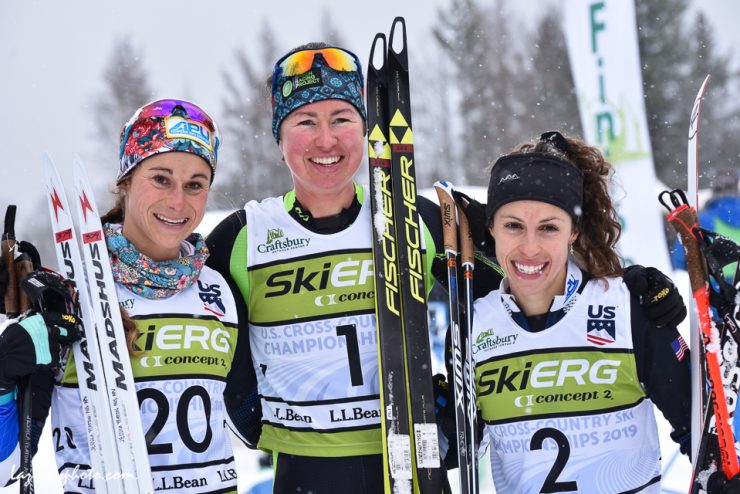
Domestic racing: The women’s 20 k skate podium at the 2019 U.S. Cross-Country Nationals at Craftsbury, VT. From left to right, Jessica Yeaton (APU/Australian National Team) in third, Caitlin Patterson (CGRP) first, and Rosie Frankowski (APU) second. (Photo: John Lazenby)
Two things to note about the race schedule in this Olympic year. For one, the January Sun Valley race weekend will, if current plans hold, be the swan song for the licit use of fluorinated ski wax in FIS nordic races in this country. The Monday after those races, the qualification window for the 2022 U.S. Olympic Team will have closed, and, USSS Cross Country Program Director Chris Grover wrote this fall, “fluorocarbon waxes will be banned at all FIS Cross Country races in the USA.” Grover added, “testing will often support that ban.”
So if you’re racing or teching in Sun Valley next month, smoke ’em while you got ’em (but use a respirator, work in a ventilated space, and turn your iron down if your fluoros are actually smoking).
Second, you may have heard that this is an Olympic year. So will winning all the Midwestern races in December guarantee a non–World Cup athlete selection to the American squad for Beijing?
Well, not exactly. The selection criteria for the 2022 Winter Olympics team generally prioritize World Cup performance over domestic SuperTour performance. And when it comes to domestic racing, they explicitly prioritize performance at next month’s U.S. Nationals over any other December or January race occurring within the Olympic qualifying window.
In practice, under a system that (a) counts an athlete’s two best SuperTour finishes in a single discipline (sprint or distance) between the start of the season and January 16 and (b) awards significant bonus SuperTour points for podium finishes at U.S. Nationals, an athlete who finishes first and fourth in Soldier Hollow (same discipline) would have more SuperTour points than an athlete who wins every single race in Duluth, Cable, and Sun Valley. Second and third at U.S. Nationals also ranks an athlete ahead of two firsts in non-Nationals races.
That said, the hypothetical athlete who dominated everywhere other than Soldier Hollow would likely have a strong case for discretionary selection to the Olympic team, and would be assured (“will be selected”) start rights to multiple World Cup races in the 2021/2022 season as the domestic SuperTour leader at various relevant points in time.
Caitlin Gregg destroys the field in the 20k freestyle at 2014 US National Championships in Soldier Hollow.
This math, and the implications of bonus points for podium performances at U.S. Nationals, have been in place for some time. In September 2016, a green FasterSkier reporter named Gavin Kentch wrote, “American cross-country skiing does not have a trials system,” in the sense that everyone shows up at one race on one day, top x athletes across the line make the team – think the U.S. Olympic Trials for swimming or track and field, say, or, for ski fans of a certain age, the one-day Gold Cup pursuit race at Soldier Hollow in December 2001 that qualified the winner for the Salt Lake City games two months later. To which an older athlete named Kris Freeman wrote, in a Facebook comment preserved here, “the allocation of bonus points to Nationals essentially makes the remainder of the SuperTours irrelevant. Nationals is now World Champ and Olympic Trials, which is fine, but let’s call them what they are.”
This reporter was technically correct, but in terms of athlete experiences and the implications of the domestic race season, Freeman, who at the time had been selected to 12 senior U.S. Olympic or World Championships teams and knew what he was talking about, was probably more practically correct. The math remains unchanged this season.
Results and logistics
How to find results from and otherwise track this season’s races? Good question. Hopefully this site, the main USSS SuperTour page, will have links to results (clicking through to each individual SuperTour sub-page should get you there), but no guarantees. Searching on Facebook for the ski club hosting each race weekend may be your best bet if the USSS site is unavailing. In general, MyRaceResults most frequently has start lists, detailed results, and live timing for most races in this country, augmented by some or all of Superior Timing for, generally, the Midwest, Bullitt Timing for the Northeast, and Zone4 for Canada.
Race organizers of this weekend’s stop in Duluth advised FasterSkier late Wednesday that entry lists will be available at Superior Timing on Thursday. Results should be findable here throughout the weekend.
In practice, FasterSkier will keep you abreast of each SuperTour stop, with a brief recap including results and quotes from some of the top athletes appearing on Monday or Tuesday of the following week.
Domestic racing: From left, Simi Hamilton (SMS club suit), Erik Bjornsen (APU suit), and Gus Schumacher (USST suit, but Alaska Winter Stars headband) make up the podium for the men’s 15-k mass start classic during 2019 SuperTour Finals in Presque Isle, Maine. (Photo: U.S. Ski & Snowboard – Reese Brown)
Who’s racing
We have recently previewed six prominent American domestic ski clubs. These clubs, to be sure, are not going to make up 100% of the entrants in this season’s SuperTour races, and U.S. Nationals will draw skiers even more broadly from across the country, including junior athletes from a wide range of clubs. But if you’d like to review six hotbeds for professional domestic skiing, take a look back at the following team previews: