From the FasterSkier archive — posts syndicated from athletes’ and coaches’ own blogs between 2004 and 2012, kept online as published. Current coverage is at fasterskier.com.
In this episode, we have Matt Whitcomb back to debrief the 2021/22 Tour de Ski, including highs and lows, overcoming setbacks, and managing a circulating head cold. We also discuss the cancellation of the upcoming World Cup races in Les Rousses, FRA, covid safety in a critical window before the Olympics, and the racing happening in Soldier Hollow during the 2022 US Cross Country Championships.
Thanks for listening.
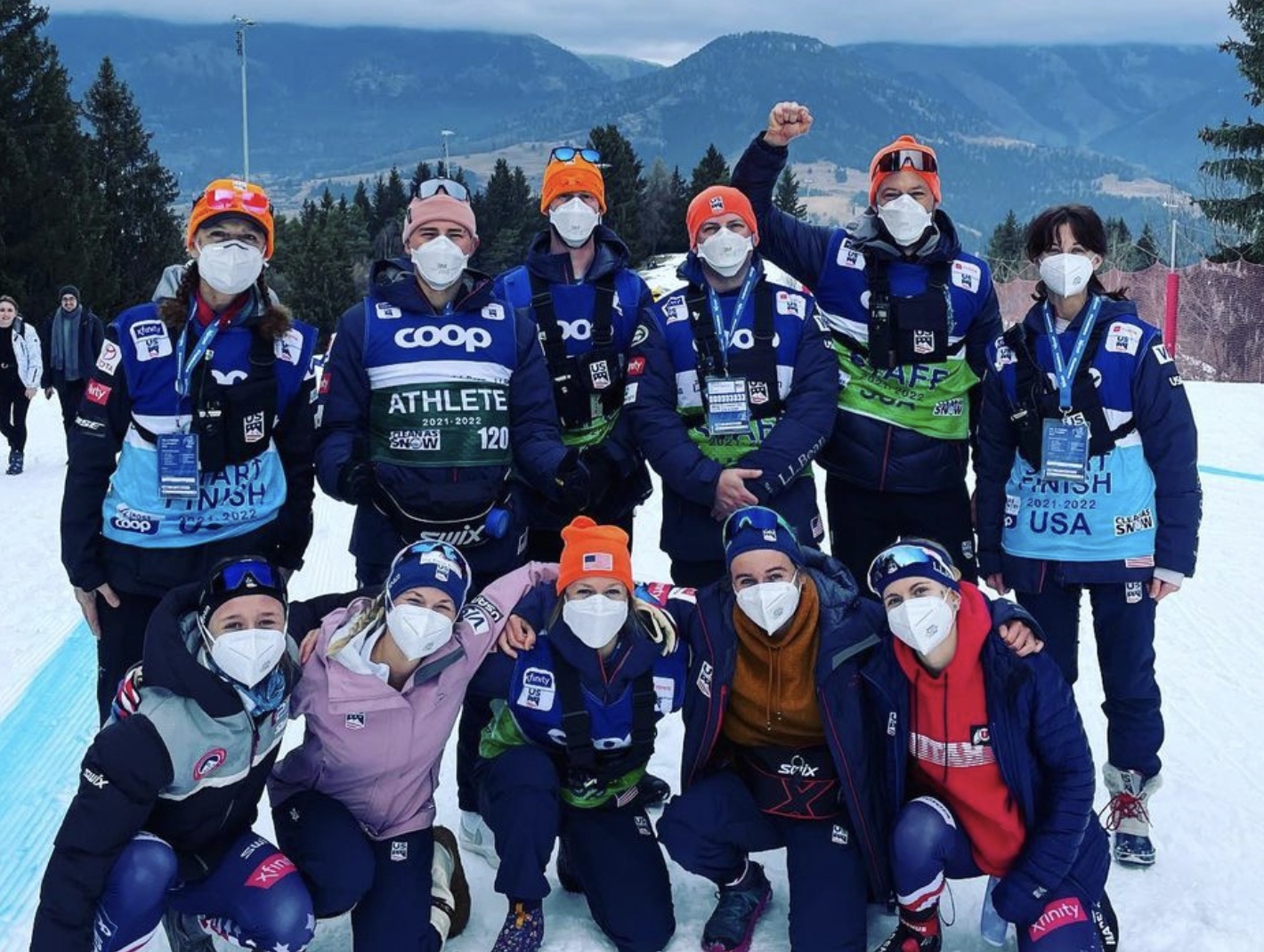
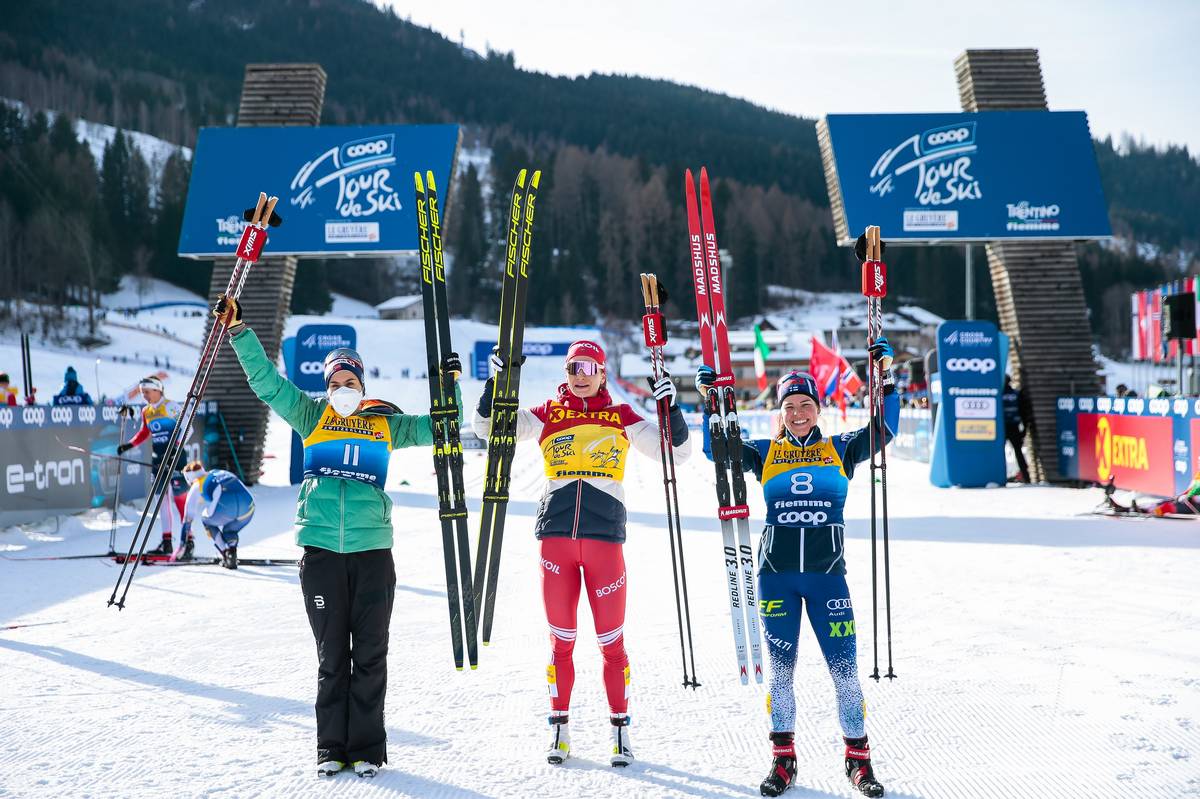
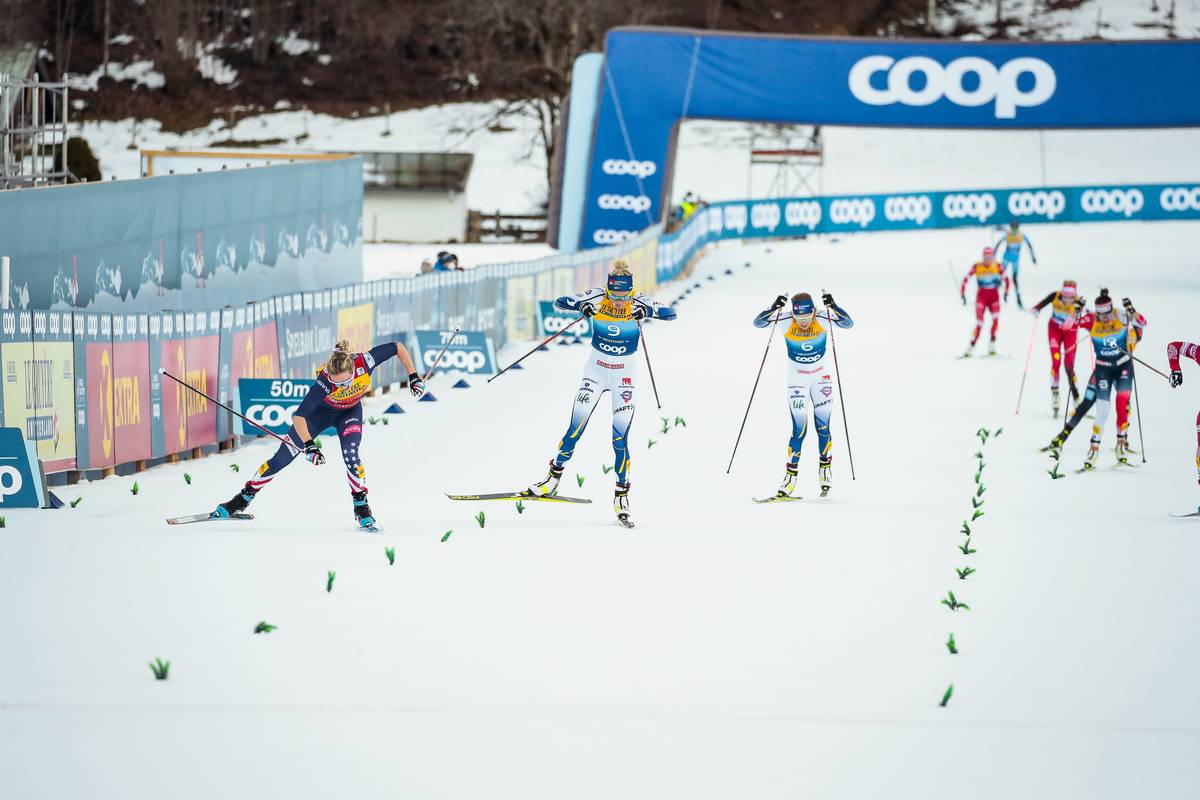
The American women who finished the 2021/22 Tour de Ski pose with coaches and support staff at the top of the Alpe Cermis. (Photo: Tom Horrocks / Instagram @jessiediggins)
We’ve got extra-special Alaska-based guest Kikkan Randall joining us for this episode to recap the 2021/22 Tour de Ski. We break down a rough finish for a head cold-afflicted Jessie Diggins, some sensational skiing by Johannes Høsflot Klæbo, and some lingering questions about Olympic preparation.
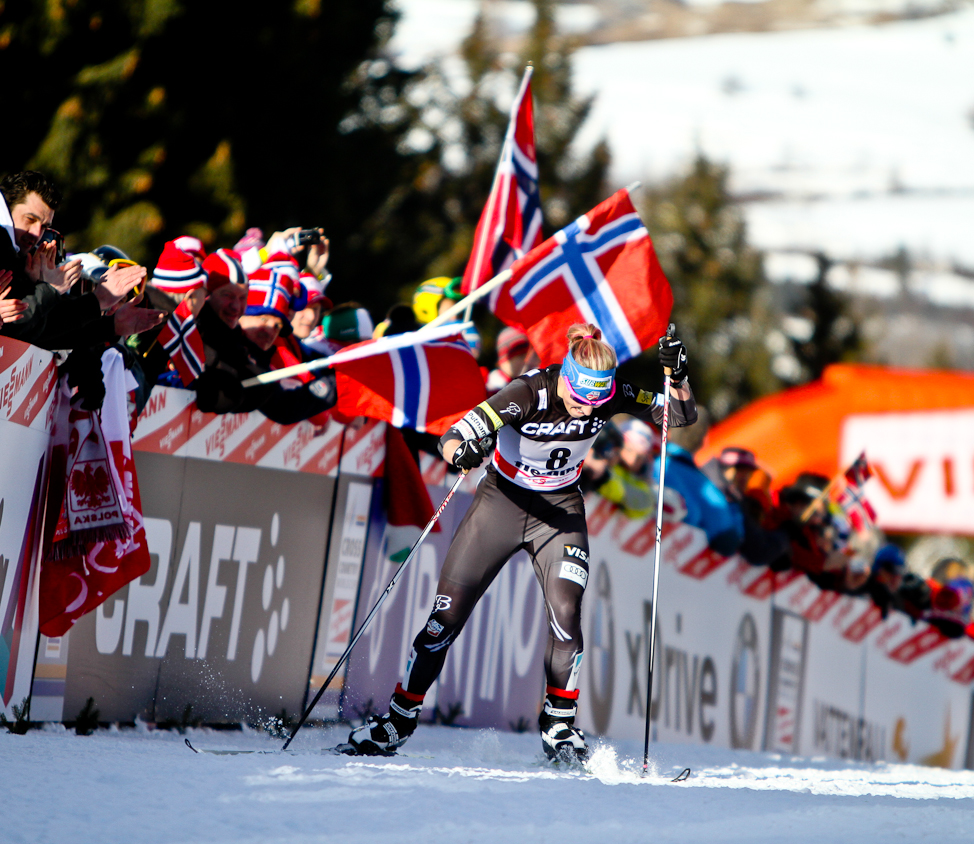
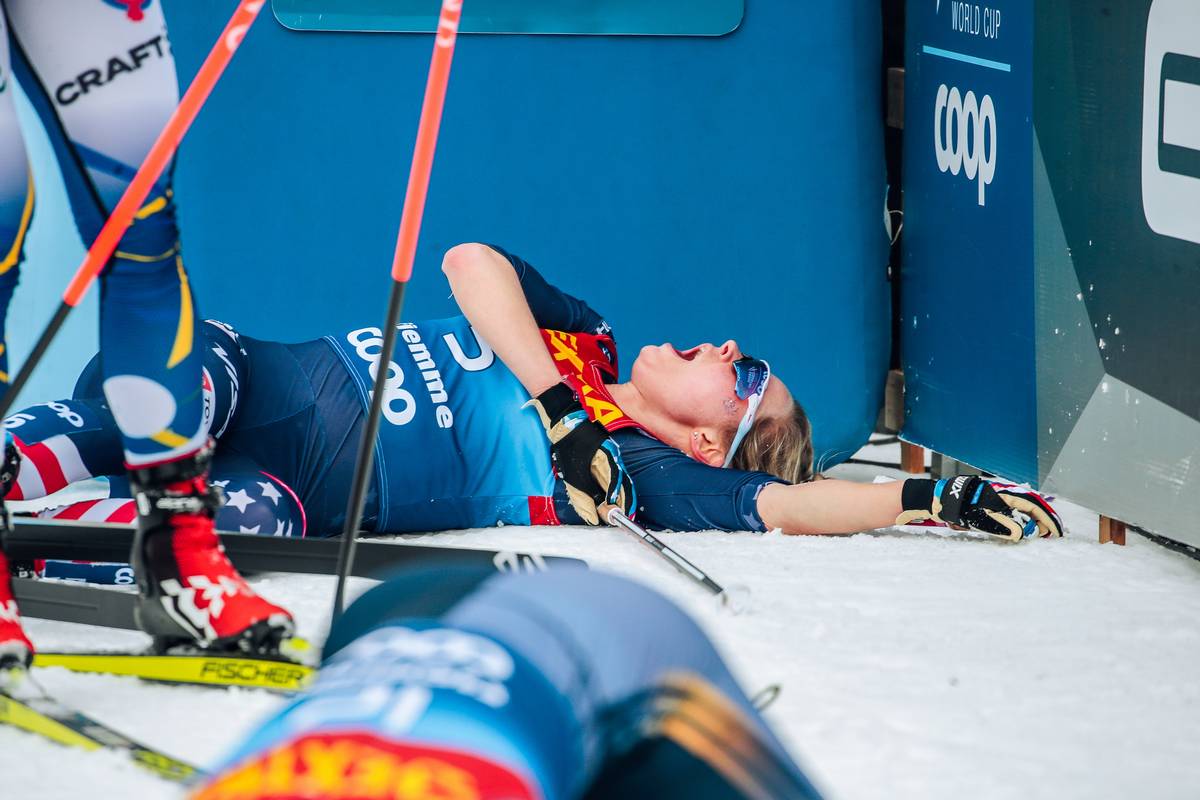
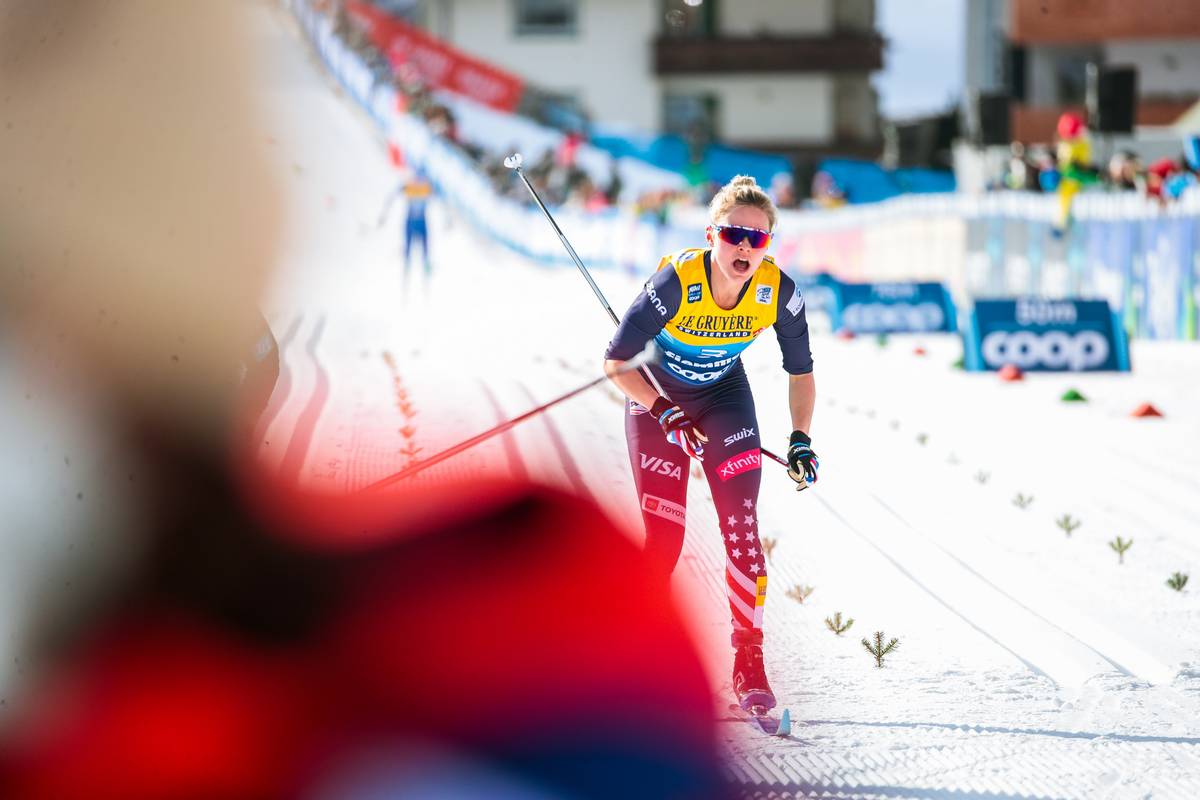
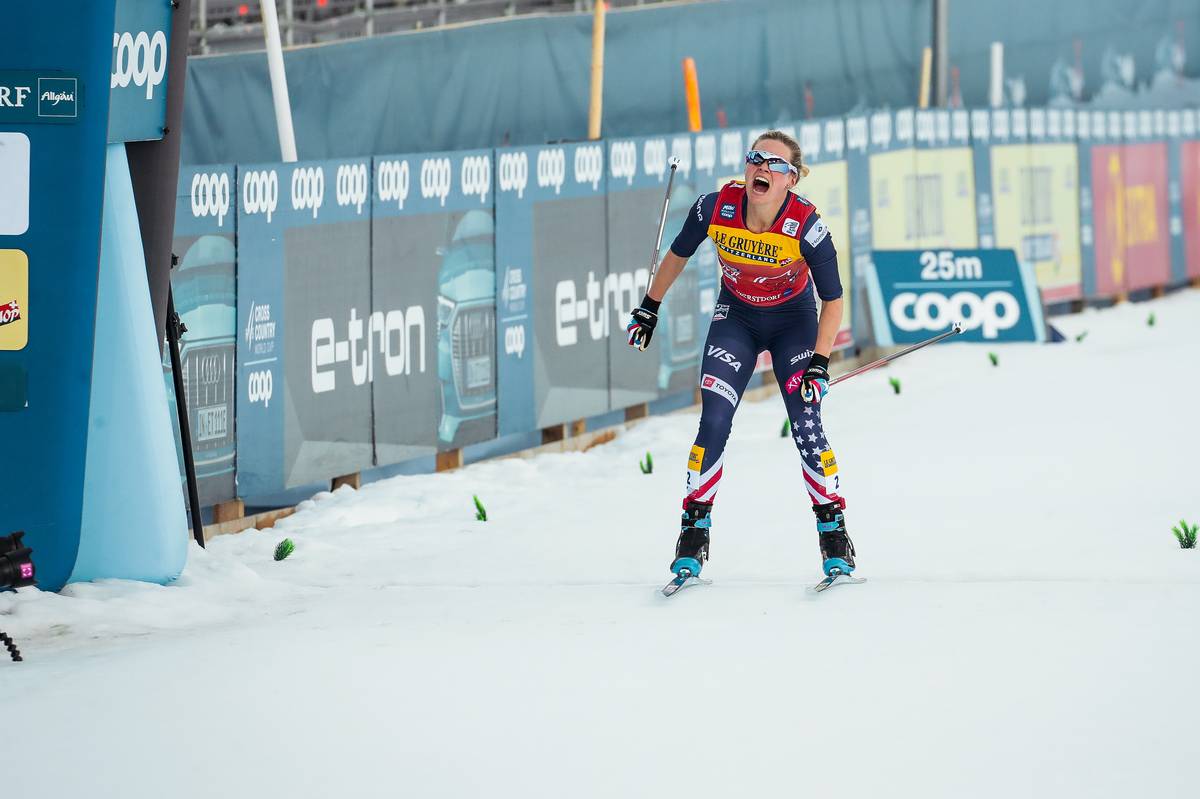
Kikkan Randall finishing the Tour de Ski’s final climb on Sunday. (Photo: FasterSkier archives)Jessie Diggins embodies the soul crushing, full body burning cumulative fatigue of the Tour de Ski following the final hill climb up the Alpe Cermis. (Photo: NordicFocus)
This World Cup coverage is made possible through the generous support of Marty and Kathy Hall and the A Hall Mark of Excellence Award. To learn more about A Hall Mark of Excellence Award or to learn how you can support FasterSkier’s coverage please contact info@fasterskier.com.
Again the capstone of the Tour de Ski, athletes faced the infamous and grueling hill climb up the Alpe Cermis in Val di Fiemme, Italy to close out six stages of racing over eight days. After winding roughly 6.5-kilometers along the valley floor, a gradual climb leads to the alpine ski area, where 418 vertical meters (~1,370’) of incline spread over the final 3k awaits, snaking up an alpine ski area with maximum grades over 40%.
The profile of the point-to-point hill climb up the Alpe Cermis, the capstone of the Tour de Ski. (Photo: Screenshot 2022 FIS Broadcast)
Heading into the final stage, Jessie Diggins sat in sixth place in the overall Tour standings, facing a deficit of 1:42 to leader Natalia Nepryaeva (RUS). Quickly reviewing the blur of racing over the last week, Diggins had two stage victories, first in the opening skate sprint in Lenzerheide and again in the 10k mass start free in Oberstdorf, her career best start to the Tour. However, a crash in the quarterfinal in Stage 4, followed by a challenging 10k mass start classic in Stage 5, turned the tide on Diggins’ status as a favorite to win the overall Tour.
Over the last 15 years of the Tour de Ski, nine of the winners entered the final stage in the lead, including the winners of the last three iterations, namely Diggins in 2021, Therese Johaug (NOR) in 2020, and Ingvild Flugstad Østberg (NOR) in 2019. The last upset occurred in 2018, where Heidi Weng (NOR) overcame a minimal two second deficit to overtake Østberg in the hill climb and snag the overall Tour victory.
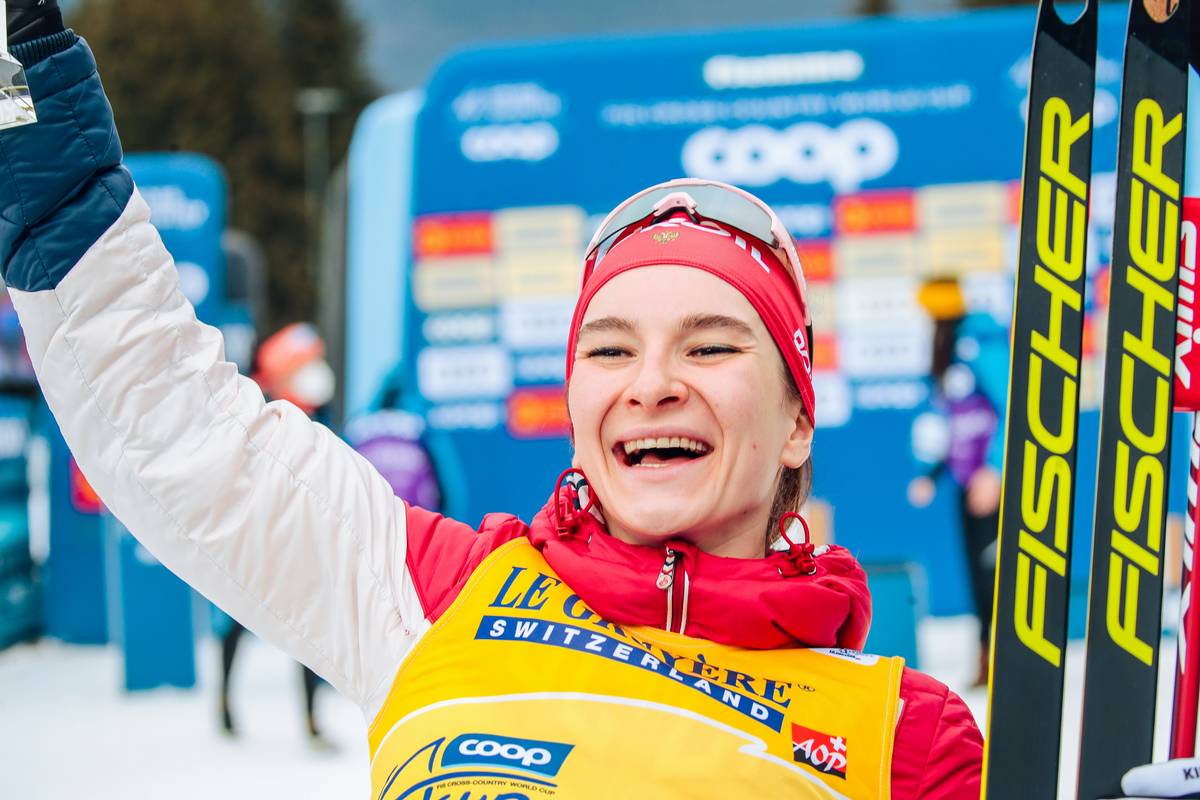
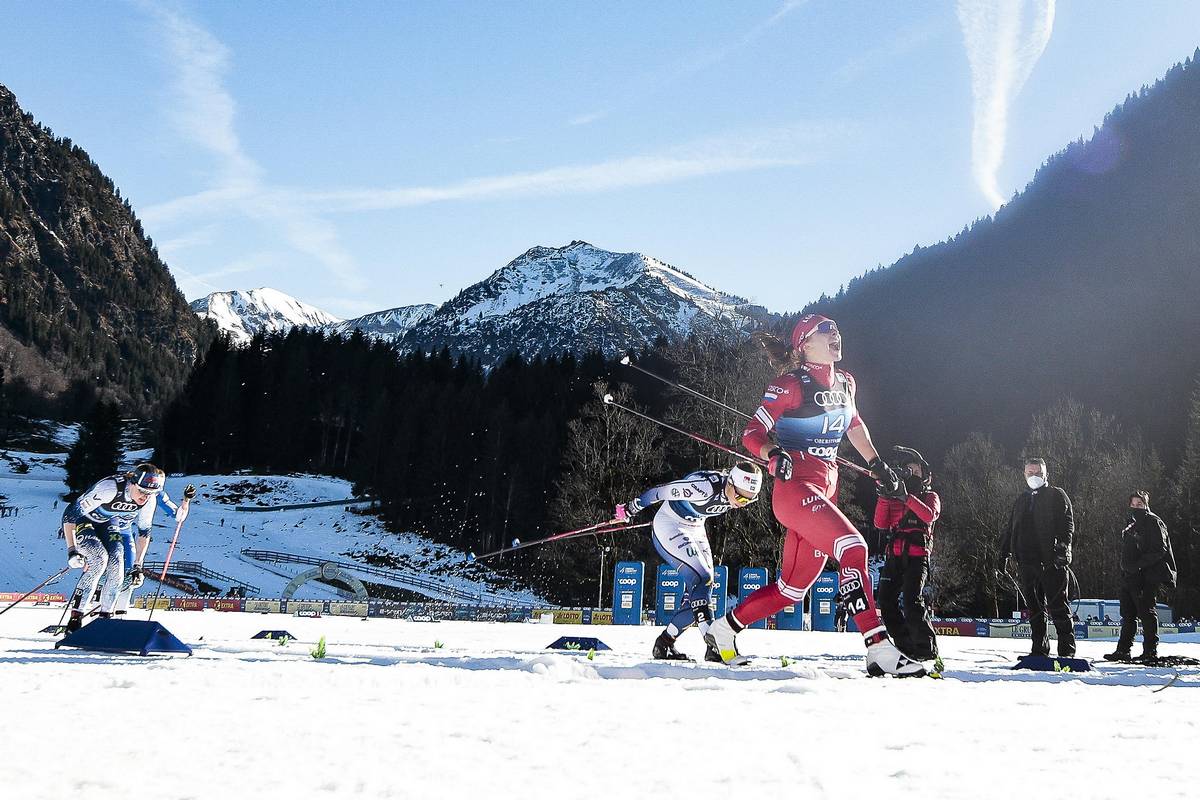
An ecstatic Natalia Nepryaeva (RUS) celebrates her overall victory in the 2021/22 Tour de Ski. (Photo: NordicFocus)
With this in mind, perhaps today’s storyline was already written: Nepryaeva’s lead of 1:12 over second place Ebba Andersson (SWE) looked, from a historical perspective, like more than enough to seal the fate of the Tour. With two second-place finishes on her resume, a win would make Nepryaeva the first Russian woman to win the Tour de Ski.
But it would still need to be decided who would be the first woman to the top of the hill, and by how much. Perhaps the end result would not change, but in an event more about grit than technique or tactics, anything could happen.
At the base of the hill, it was Heidi Weng (NOR) leading the way with Ebba Andersson matching her V1 stride for stride. Diggins sat near the front of the lead group, which also contained Nepryaeva, Krista Pärmäkoski (FIN), and Kerttu Niskanen (FIN).
Spectators highlighting the steepness of the Alpe, Heidi Weng (NOR) and Ebba Andersson (SWE) race to the line in the final hill climb during Stage 6 of the 2021/22 Tour de Ski. (Photo: NordicFocus)
As the grade increased, Andersson and Weng began to trade off in the lead, climbing perfectly in sync as the field behind them began to thin. Pärmäkoski was 3.3 seconds back at 7.5, with Nepryaeva now 9.8 seconds back. Again, with 1:12 to play with between herself and Andersson, and 1:40 to Weng who entered the final stage in fifth, Nepryaeva did not need to worry about her placement in the final stage; her overall win was safe so long as she kept herself within that margin of the other women.
Between 7.5 and the subsequent 9.2k, Weng and Andersson put another 15 seconds on Nepryaeva, who trailed 18.1 seconds behind in third, now ahead of Pärmäkoski.
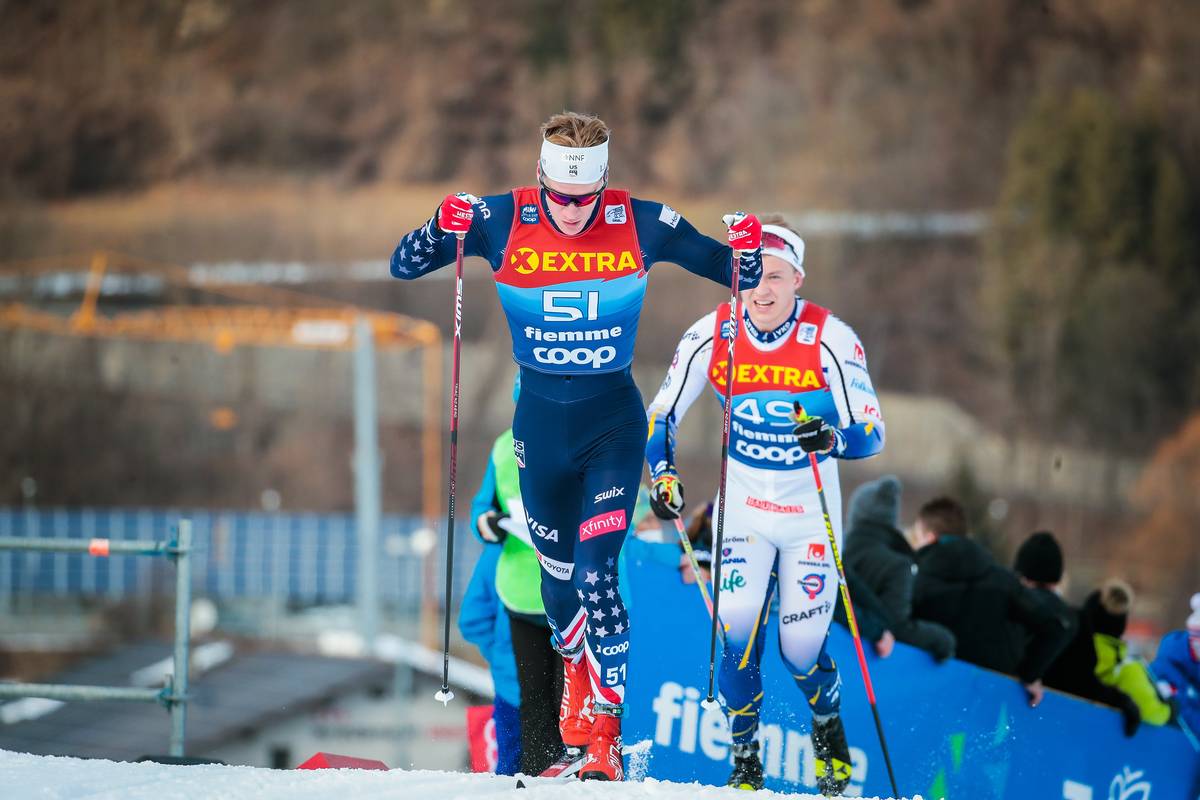
Skiing her way from 11th into 5th, within striking distance of Pärmäkoski, was 21-year-old Sophia Laukli (USA). Laukli skied with high tempo, somehow accelerating relative to those around her despite the fatigue and lactate that must have been flooding each of their bodies after climbing for so long at that effort. Also moving up on the steepest grades, Novie McCabe (USA) had picked off four places between 7.5 and 9.2k, skiing from 13th into 9th. Still fighting, but perhaps not with the same fury we saw last year when she raced for the win, Diggins had faded from 8th place into 14th.
Heidi Weng (NOR) accelerates in the final kilometer to drop Ebba Andersson (SWE) and take the win in the hill climb. (Photo: NordicFocus)
Over the final 0.8k, it became clear that Weng, who has a history of strong finishes in the hill climb, had been biding her time. With Andersson no longer able to match, she accelerated off the front with confidence. Andersson did not respond to the move, and Weng skied away to win by 7 seconds in a time of 35:41.2.
Weng was the overall Tour winner in 2017 and 2018, each time skiing the fastest time of day in the hill climb. After a 2019/20 season where her results could most-kindly be described as “off”, Weng was fourth overall in the Tour but second up the hill in 2020. The Norwegians did not compete in the Tour de Ski last year in 2021.
After working together through the first 9.2k, Heidi Weng (NOR) took the win in the hill climb ahead of Ebba Andersson (SWE). (Photo: NordicFocus)
Weng’s win in the hill climb moved her from fifth into third in the overall standings behind Andersson in second, her first time back on the overall Tour podium since her win in 2018. It’s Weng’s fourth time being on the Tour podium, having also achieved a third place result three consecutive years in 2014-2016.
“It was very hard today, when it’s mass start it’s chaos,” Weng told FIS at the finish. “I wanted to be first at the bottom of the hill, so I tried to get out fast, so it was good that Ebba was with me. It was very steep today and the snow was not as easy as yesterday, so it was a very hard hill today and I was very happy that I [could go fast] and I just tried to stay focused on the finish line.”
Today’s queen of the hill, Heidi Weng (NOR) won the final stage of the 2021/22 Tour de Ski, advancing to third in the overall standings. (Photo: NordicFocus)
Powering through the final kilometer, Claudel Delphine of France made her way from 6th at 9.2k onto the stage podium, overtaking Nepryaeva to finish third (+28.5). Solidifying herself as the overall Tour champion, Nepryaeva was fourth to the top of the Alpe, 32.3 seconds behind Weng and well within the margin needed for the accomplishment.
Claudel Delphine (FRA) celebrates a third place finish in the hill climb, while Natalia Nepryaeva (RUS) crosses in fourth for the overall Tour victory. (Photo: NordicFocus)
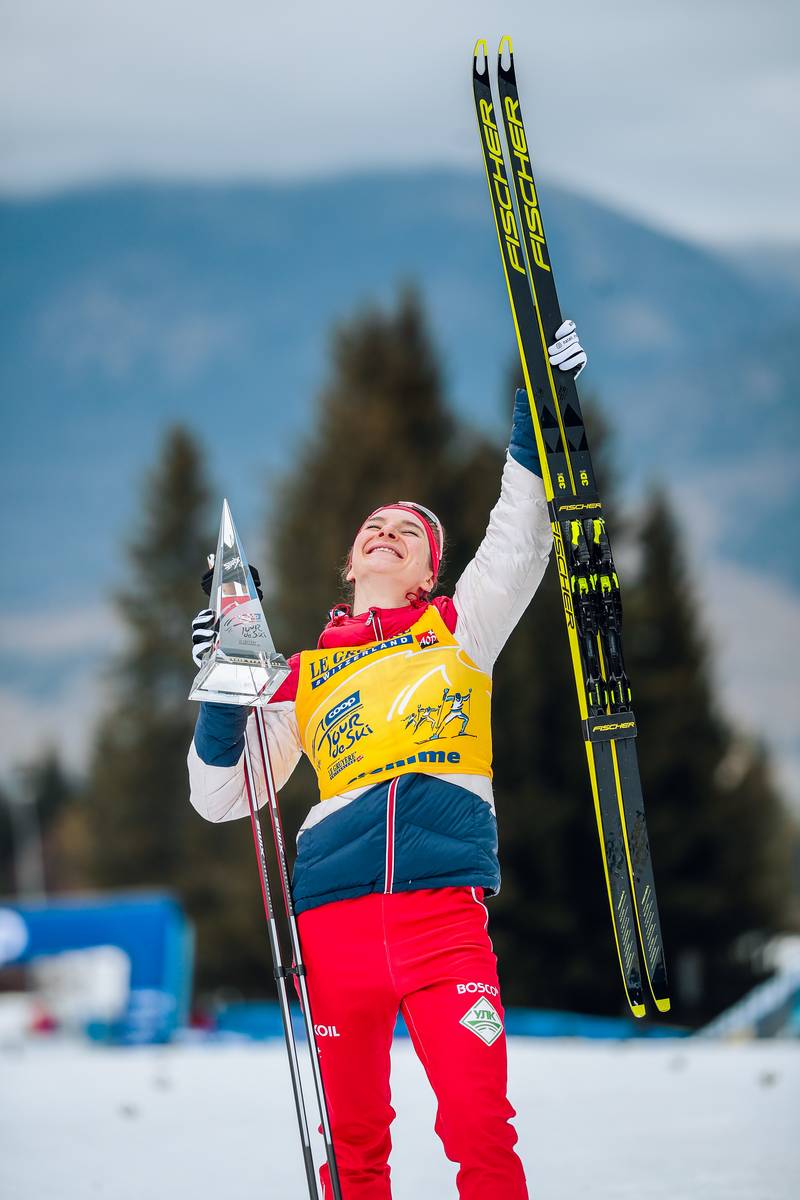
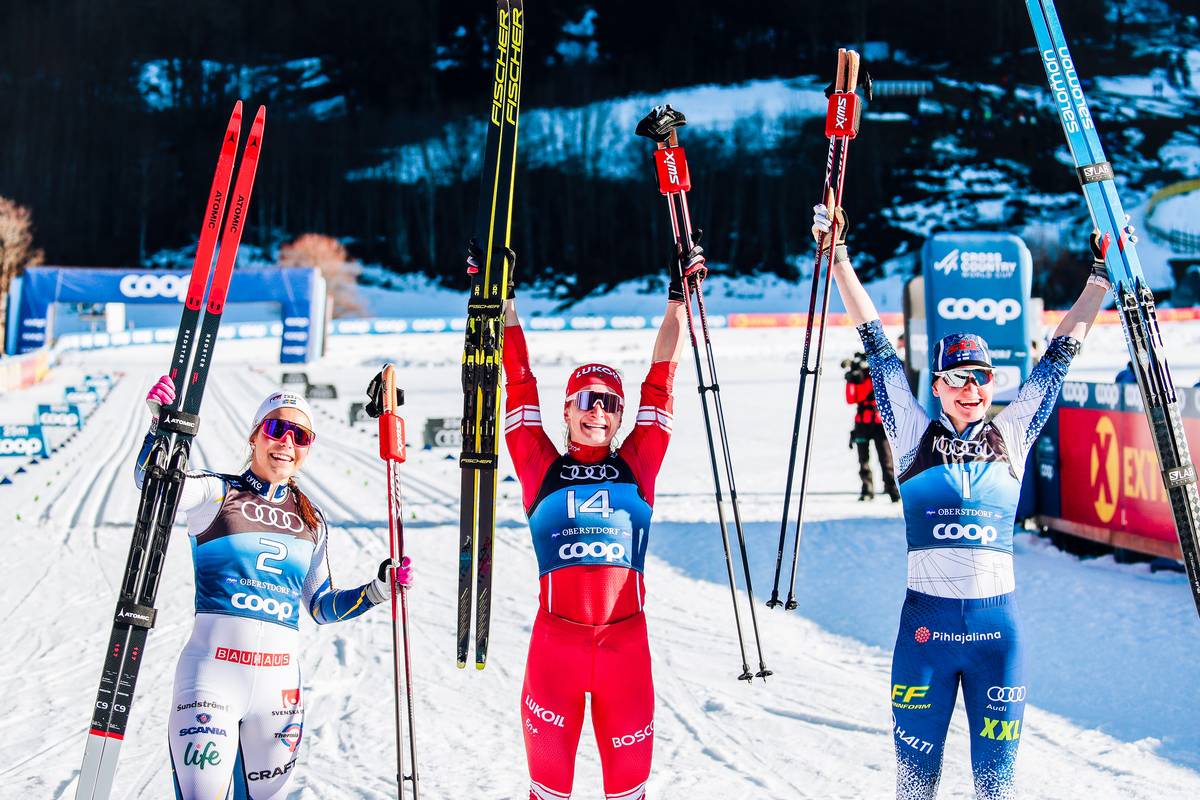
During her four previous years of racing the Tour, Nepryaeva has been on the podium twice, finishing second in 2019 and 2020. Finally on top, eyes smiling behind her N95, Nepryaeva shrieked with joy as she stepped onto the podium to accept her trophy, hopping up and down as she raised her skis and poles in celebration. The FIS broadcast did not include a post-race interview.
After two second-place finishes, Natalia Nepryaeva (RUS) is the winner of the 2021/22 Tour de Ski. (Photo: NordicFocus)
Next to the top of the mountain was Laukli in fifth (+49.9), followed by Pärmäkoski in sixth (+59.9), and McCabe in seventh (+1:04.4). Americans have a strong history on the hill climb, with Liz Stephen skiing the fourth fastest time of day in 2015, the third fastest in both 2014 and 2016, then peaking at the second fastest time in 2017. Laukli and McCabe are in good company.
“It felt pretty good!” an enthusiastic McCabe told U.S. Ski & Snowboard cross country communications manager Tom Horrocks at the finish. “It was tough, obviously, but I am stoked about it.”
Novie McCabe races to 7th in the Alpe Cermis hill climb. (Photo: NordicFocus)
McCabe explained that she had followed Laukli through the valley runout and into the hill climb, knowing her teammate was looking to be in good position as they reached steep sections.
From there, McCabe was “just trying to keep moving around people without flooding [with lactate] on the way up.”
For Laukli, the result “was quite a shock.”
“After yesterday, I was extremely tired, so it was a bit of a 180,” she told Horrocks after the race. “I was really, really, looking forward to this race though. I knew this was my style of a course… I tried to stay chill and ski it tactically well, and I was able to start the climb with a lot of energy.”
Laukli explained that through the first 6k, she had sat in the draft of the women in front of her. With “super fast skis”, this allowed her to do minimal work before the hill began to pick up.
Full audio interview with Novie McCabe and Sophia Laukli, hosted by Tom Horrocks.
Sophia Laukli skis her way to 5th in the final hill climb of the 2021/22 Tour de Ski. (Photo: NordicFocus)
While arguably not comparable to other World Cup races, these results are nonetheless career-best finishes for both Laukli and McCabe, leaving them confident in their fitness as they head into a recovery block.
Making relentless forward progress in the face of the Tour’s challenges, Diggins crossed the line in 15th (+2:06.1), pushing her down the overall standings to a final placement of eighth (+3:15.8).
“This was one of the hardest days of many years for me,” Diggins said in the mixed zone. “I’m just so proud to have finished. The last few days I have been really having to fight through a lot.”
Full audio interview with Jessie Diggins, recorded from the mixed zone by Tom Horrocks.
Still smiling after a challenging Tour, Jessie Diggins finished 15th in the final hill climb. (Photo: NordicFocus)
Ever-focused on the importance of those around her, Diggins emphasized how proud she was of her support team and teammates, before concluding, “It’s always a good feeling to have finished something so hard.”
Outside the Top-30, Alayna Sonnesyn was the final American finisher in 36th (+3:46.1) of the 46 Tour finishers.
Making her way through the long-haul of racing, Sonnesyn explained that she is “ready for a nap.”
“It’s definitely been a tough Tour for me and I was hoping for a lot more going into it,” she told Horrocks after the race. “But Jessie gave the advice last night to only allow positive thoughts during the hill climb, and that’s what I did. There were many times where I felt like I could stop, but I told myself to keep going, and I’m proud of that.”
Full audio interview with Alayna Sonnesyn, hosted by Tom Horrocks.
Katharine Ogden did not start the hill climb, instead hopping aboard a plane for Salt Lake City, UT to race the 15k interval start classic, the final event of the U.S. National Championships in Soldier Hollow.
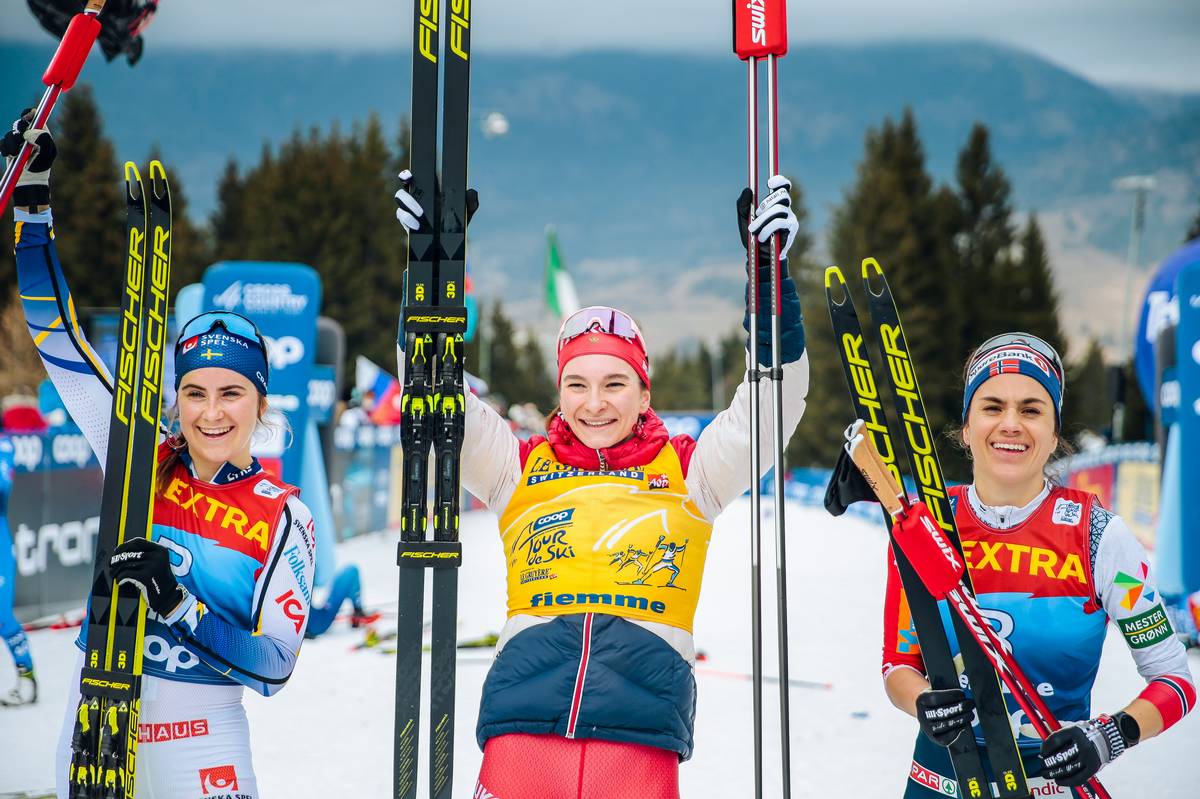
The 2021/22 Tour de Ski Podium: Natalia Nepryaeva (RUS) took her first overall win ahead of Ebba Andersson (SWE) in second and Heidi Weng (NOR) in third. (Photo: NordicFocus)
Taking a final look at the overall tour standings by cumulative time and points, Nepryaeva was the overall winner by a margin of 46.7 seconds ahead of Andersson in second, and Weng in third (+1:07.7).
In the point standings, which favor sprinters and those chasing the bonus point opportunities that arrive at early checkpoints in distance races, Johanna Hagström (FIN) took the win with 60 points, narrowly beating Diggins in second with 59. Hagström finished second in the classic sprint in Oberstdorf, and eighth in the freestyle sprint in Lenzerheide, but also collected 15 points in yesterday’s distance race and again from the combination of two bonus point opportunities today at 2.3 and 6.8k. Nepryaeva was third in the point standings with a total of 55.
Despite setbacks, Jessie Diggins finished second in the 2021/22 Tour de Ski point standings. (Photo: NordicFocus)
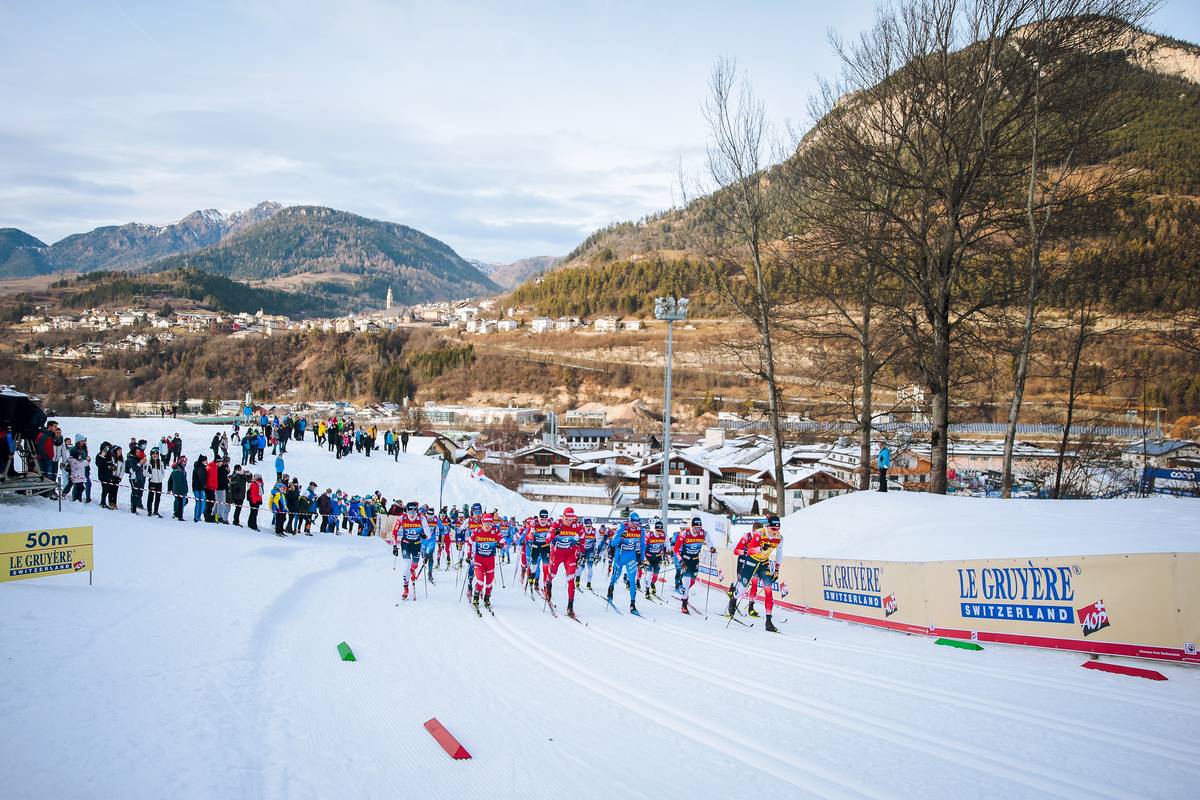
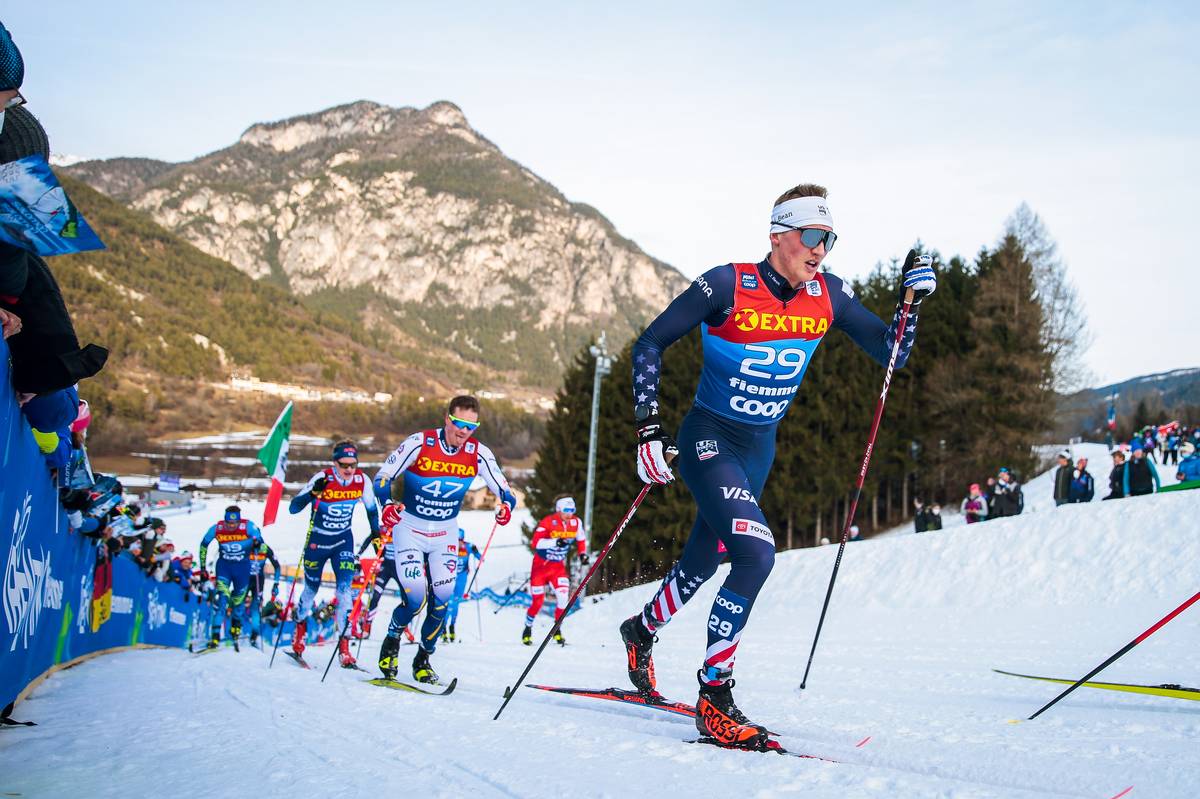
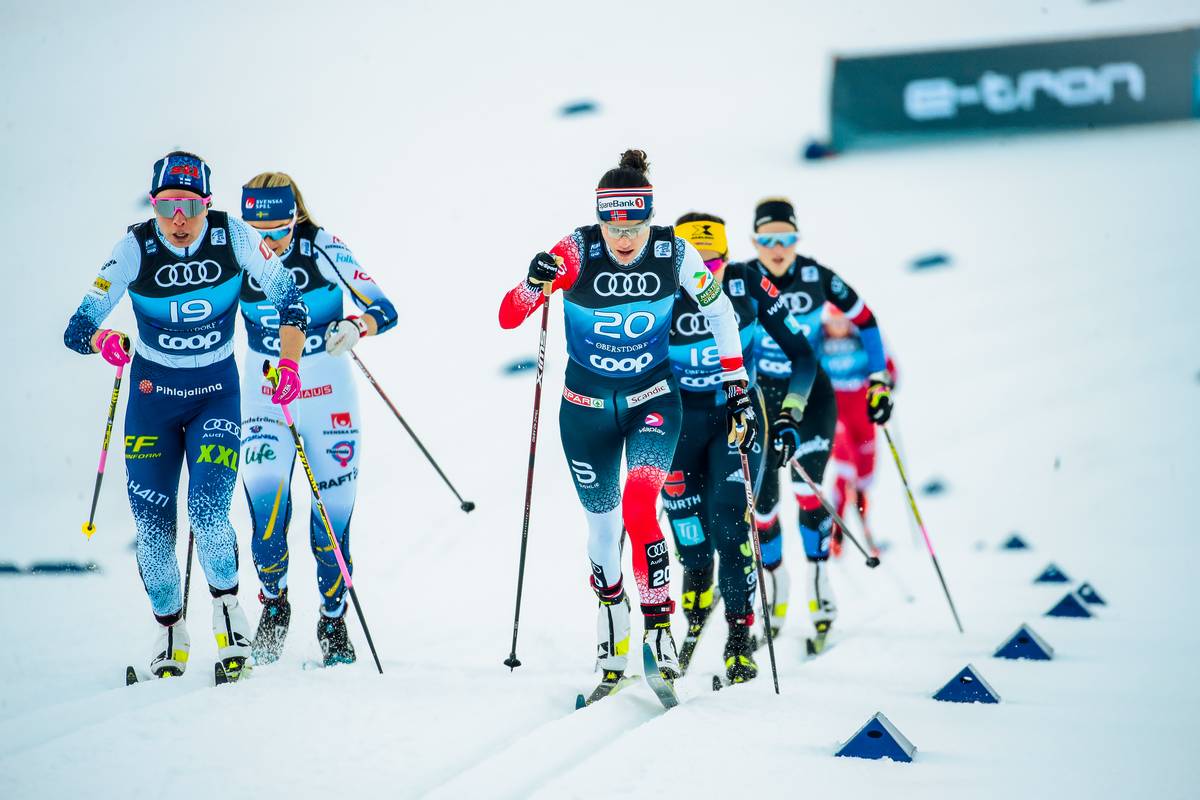
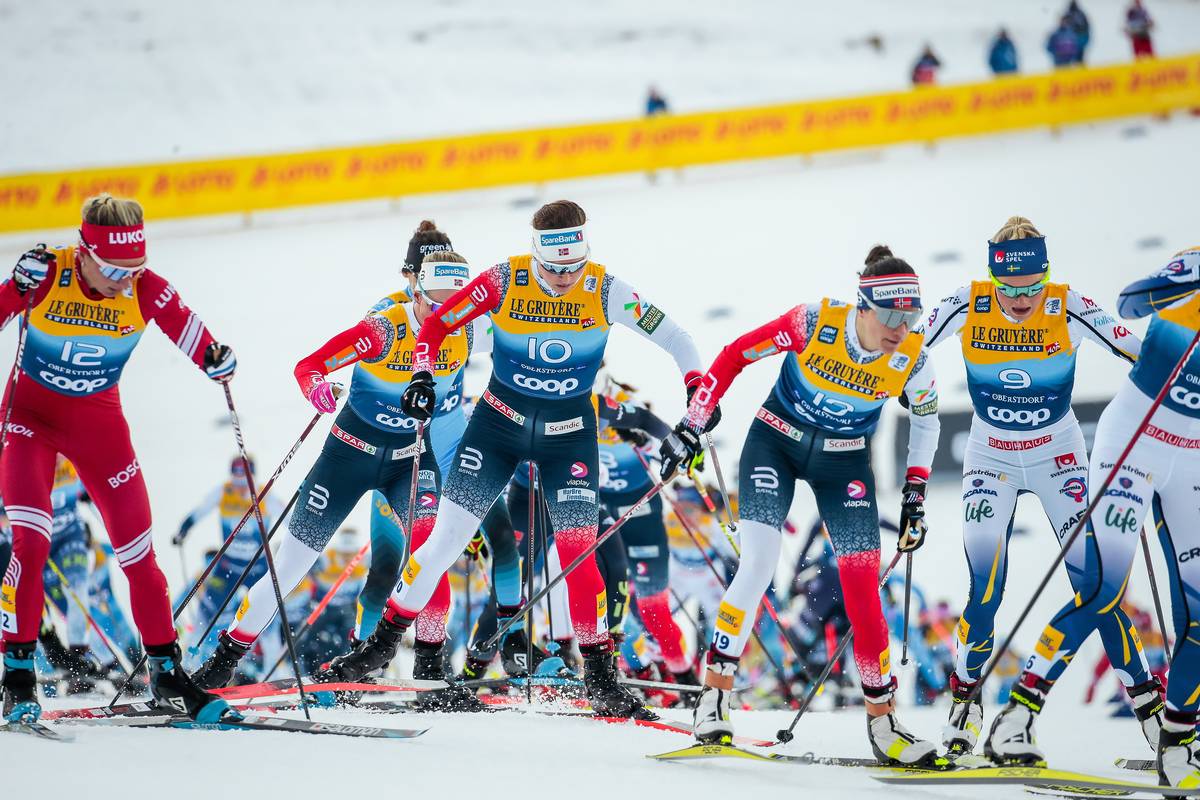
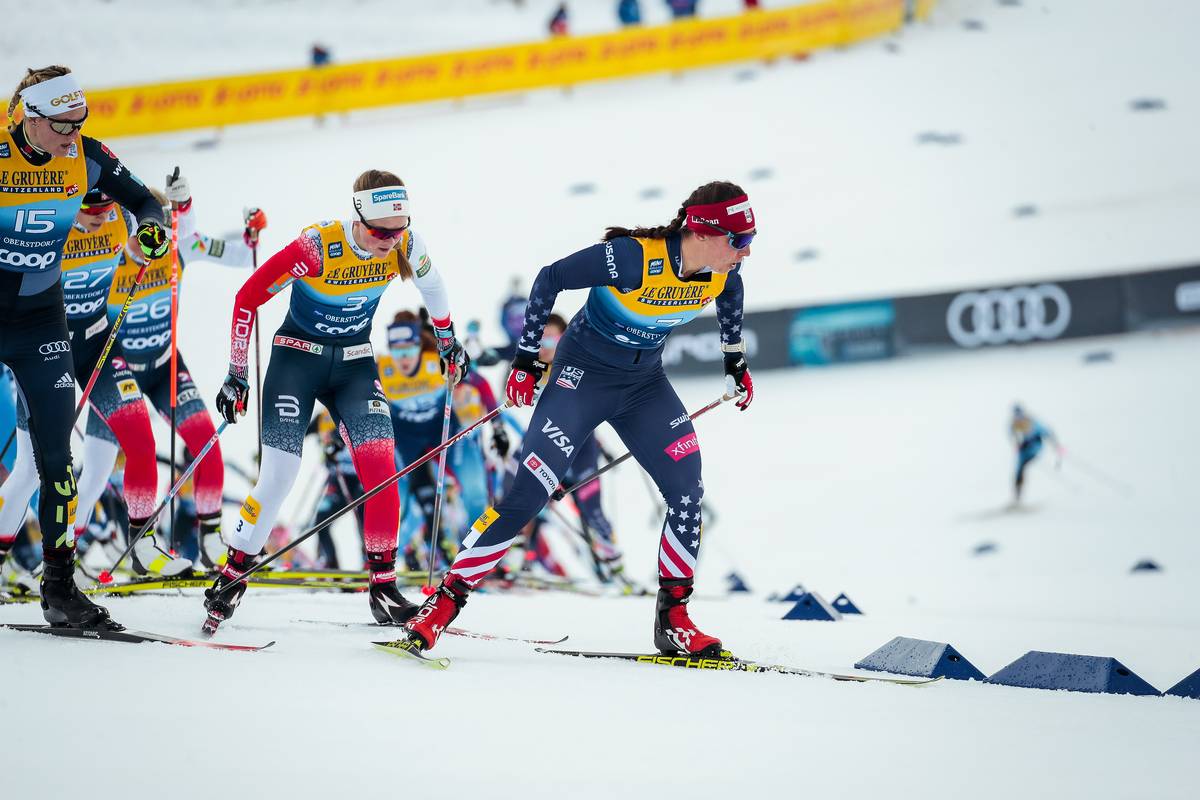
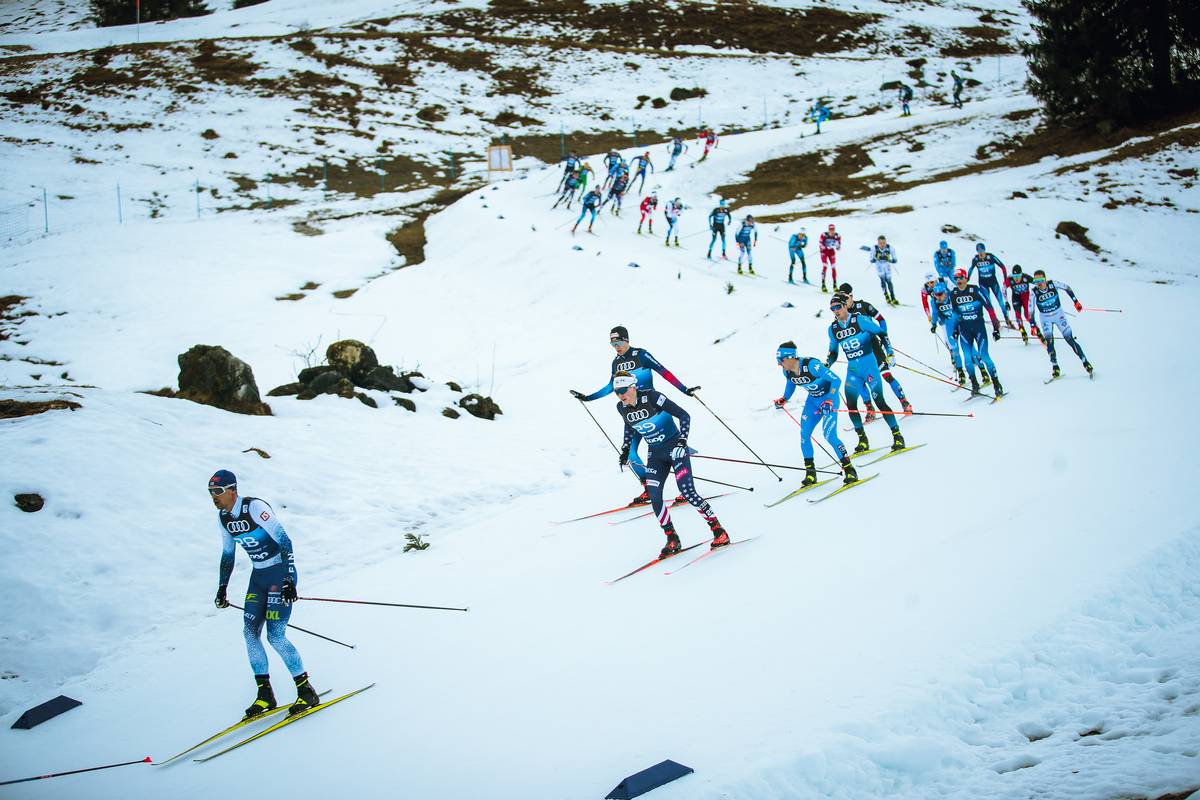
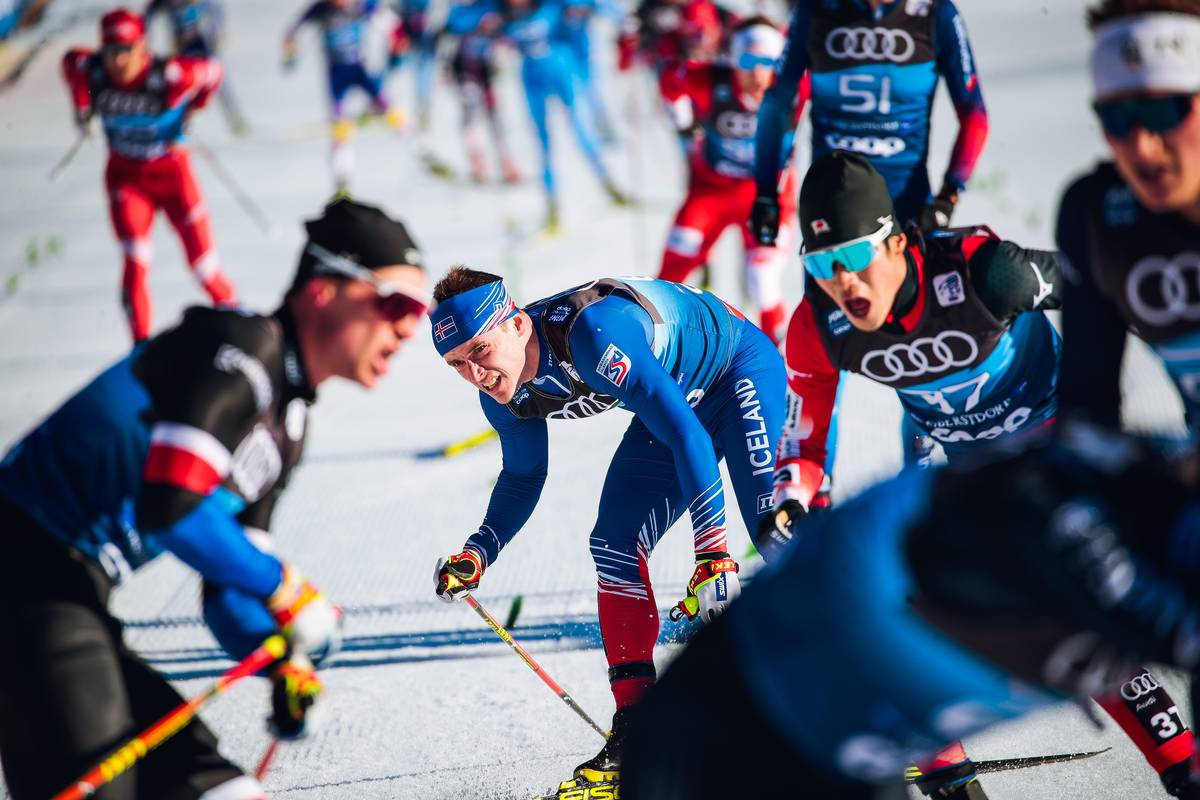
Athletes take to the tracks for Stage 5 of the 2021/22 Tour de Ski, a 15-kilometer mass start classic in Val di Fiemme, Italy. (Photo: NordicFocus)
This World Cup coverage is made possible through the generous support of Marty and Kathy Hall and the A Hall Mark of Excellence Award. To learn more about A Hall Mark of Excellence Award or to learn how you can support FasterSkier’s coverage please contact info@fasterskier.com.
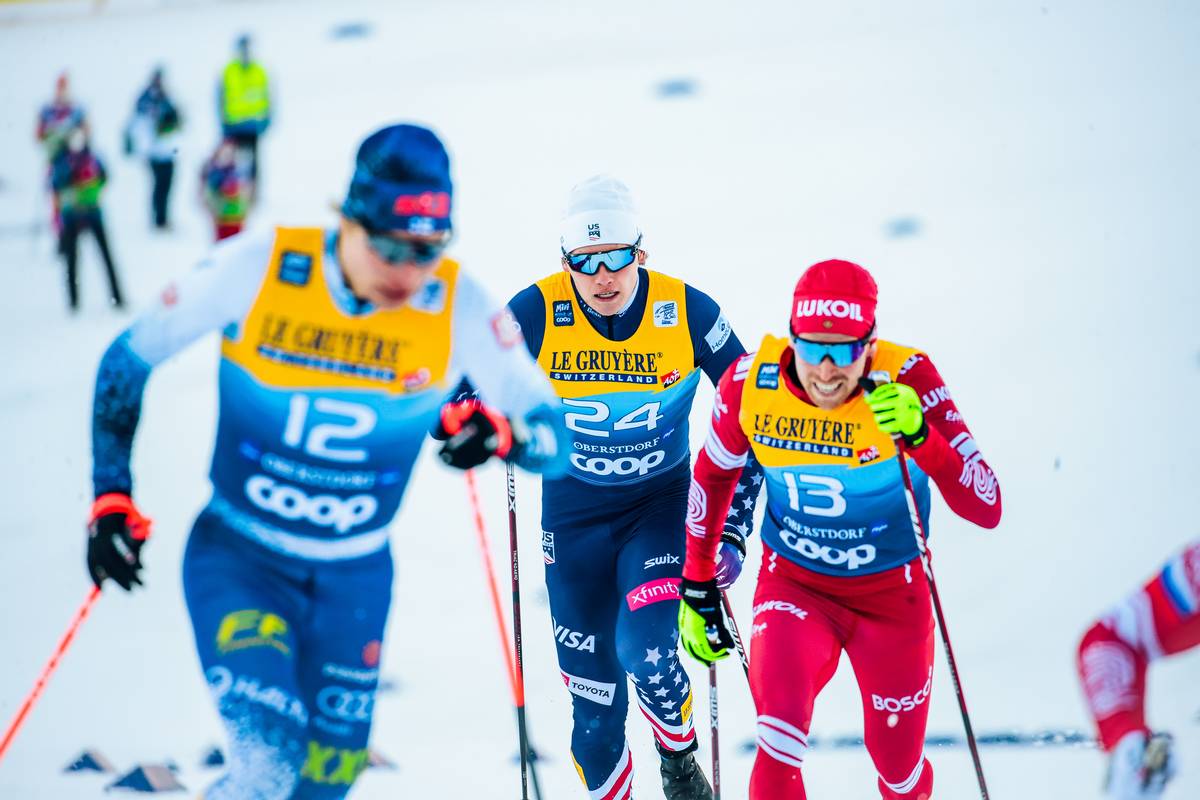
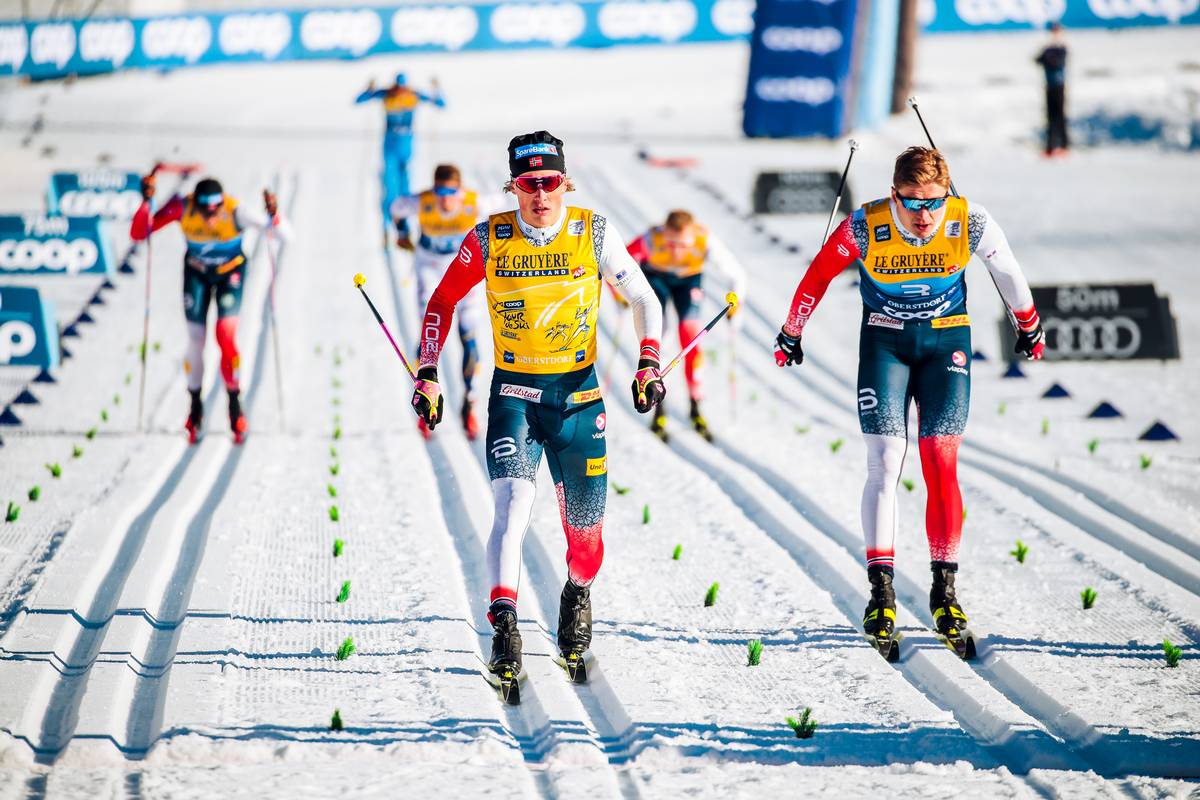
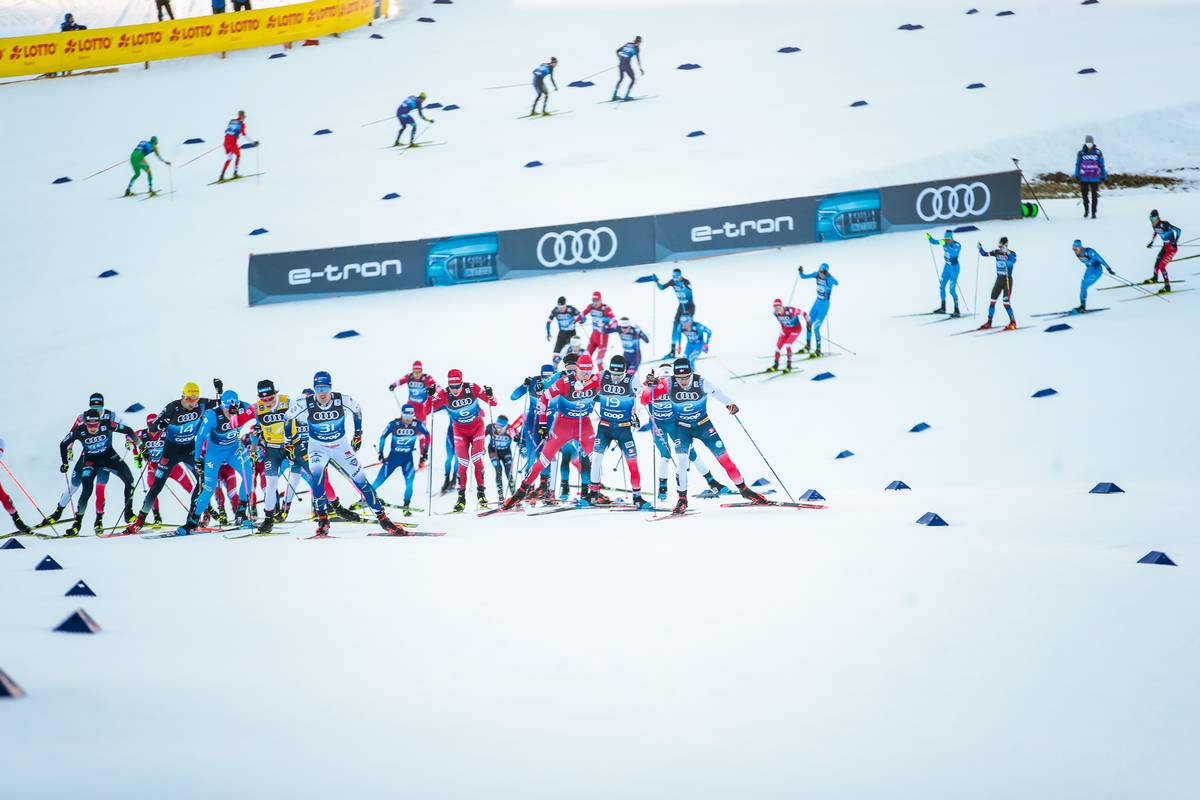
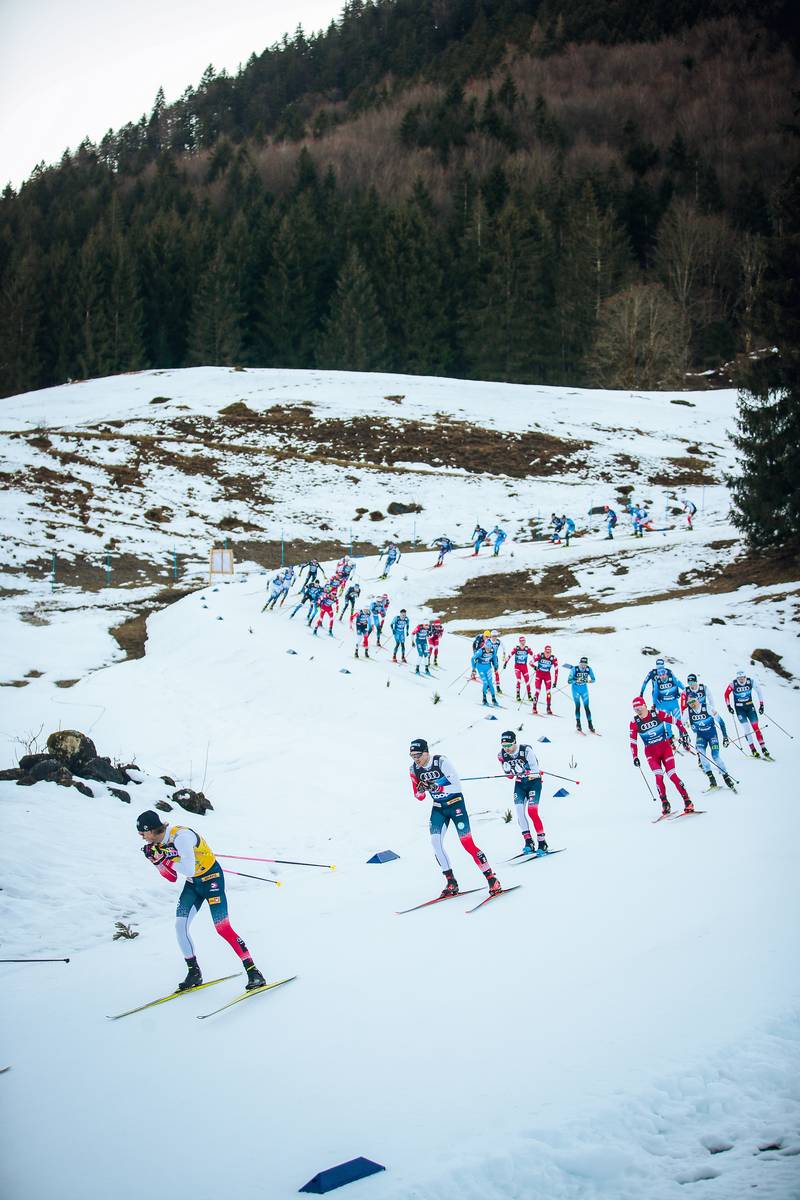
From Switzerland, to Germany, to the Italian Dolomites, the 2021/22 Tour de Ski continued today with its fifth of six stages, a 15-kilometer classic in Val di Fiemme. Dwindling from over 100 racers in the opening stages in Lenzerheide, just 62 men took the tracks in Stage 5, perhaps reducing the inevitable congestion of a mass start during the first of six 2.5k loops.
With the end of the Tour fast approaching, today’s race was all about time gaps. With three wins over four stages, Johannes Høsflot Klæbo (NOR) led the tour by 1:03 over teammate Pål Golberg, and perhaps more importantly, 1:19 over Russia’s Alexander Bolshunov, who entered the Tour on the heels of overall victories in both 2020 and 2021. With an abbreviated schedule that perhaps favors sprinters more than the usual seven-plus stage grind, Klæbo’s lead was not unprecedented, however, the Norwegian’s track record up the final hill climb on the infamous Alpe Cermis pales in comparison to the Russian’s.
Over the last four iterations of the Tour de Ski, Bolshunov has incrementally shaved a position or two off each year. Finishing sixth in 2018 by time of day, he advanced to fifth in 2019, third in 2020, and second in 2021. In contrast, Klæbo was 21st up the hill in 2020 and skied the 27th fastest time of day in 2019. He did not compete in the 2018 or 2021 Tours.
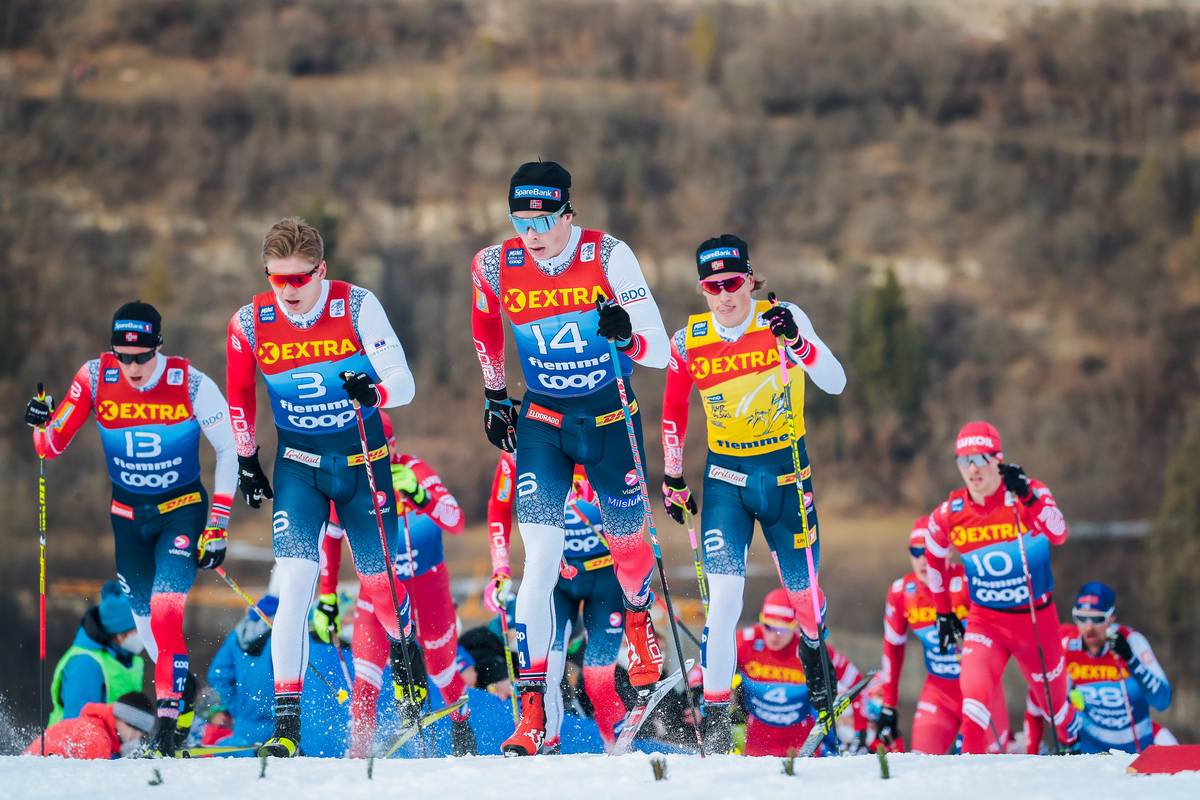
A slew of Norwegians lead the way in the opening laps of the 15k mass start classic in Val di Fiemme. (Photo: NordicFocus)
Though the margin was only 15 seconds between the men, Bolshunov had also beaten Klæbo in the previous classic stage, on the second day of racing in Lenzerheide. With a time bonus opportunity today at 8.5k, Bolshunov had the potential to do some damage in the overall standings.
With both athletes through the opening kilometers cleanly, without crashes or broken equipment, the tension began to build through the middle laps.
At the halfway mark, Stage 2 winner and 15k classic specialist Iivo Niskanen (FIN) led the way through the stadium with a train of athletes, mostly Norwegian and Russian, on his tails. Klæbo sat comfortably in 4th (+1.3), with Bolshunov back in 17th (+6.8). Klæbo surged ahead of Niskanen to collect the maximum time bonus of 15 seconds at 8.5k, before allowing the Finn to continue the work at the front. Bolshunov was 9th at the time bonus, earning only 2 seconds.
Iivo Niskanen leads the way in Stage 5. (Photo: NordicFocus)
At 10k, Niskanen and Klæbo began to break away from the lead group, led by Bolshunov, who had skied into third, now five seconds back on Klæbo.
Pulling away with 5k to go is not a tactic we typically see from Klæbo, who historically has been better served by tactical finishes where the pack remains tight until the final kilometer, where he’s able to use his sprint acceleration to excel. Niskanen showed in Stage 2 his capability to run away with a win, but could Klæbo keep pace?
By the next lap, Klæbo showed that not only could he match the Finn, but he could drop him. The two were separated by 9.5 seconds at the 12.5k checkpoint, with the chase group over 23 seconds behind Klæbo. Halfway through the final lap, Klæbo had grown his lead to nearly 17 seconds over a fading Niskanen, with Russia’s Alexey Chervotkin leading the chase group 26 seconds back from the leader.
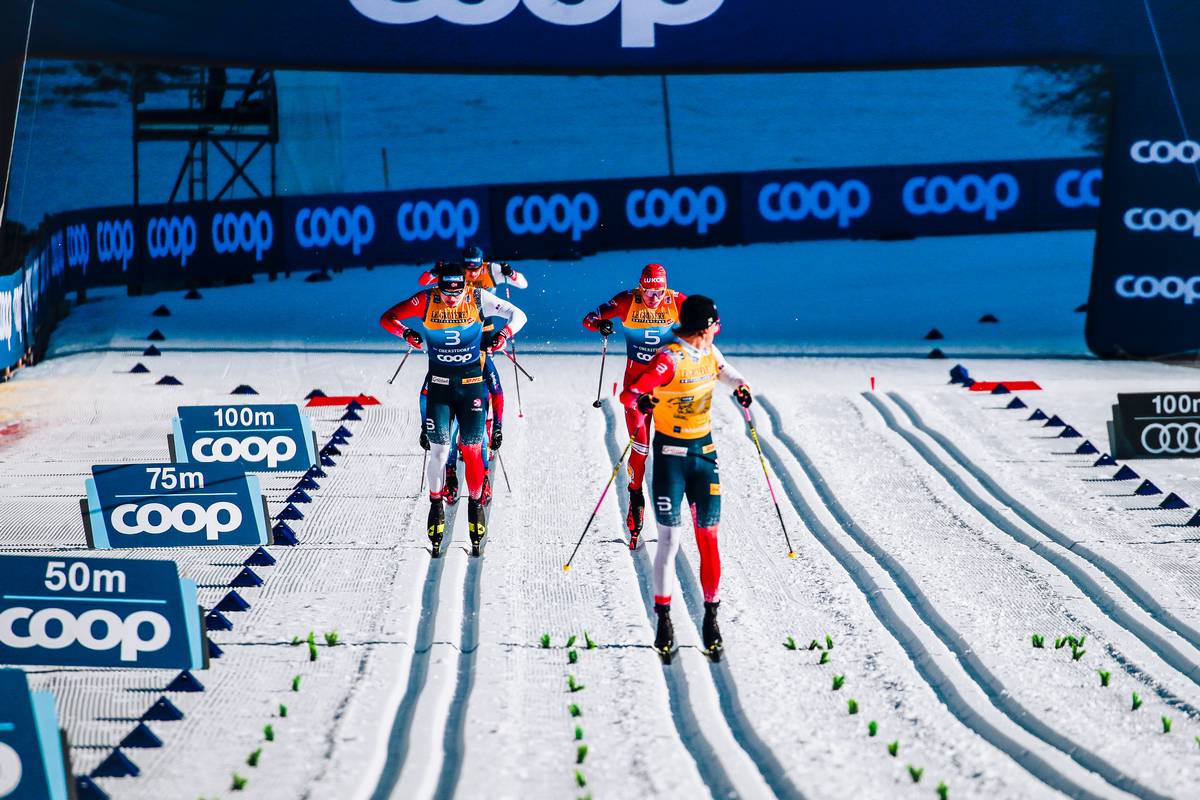
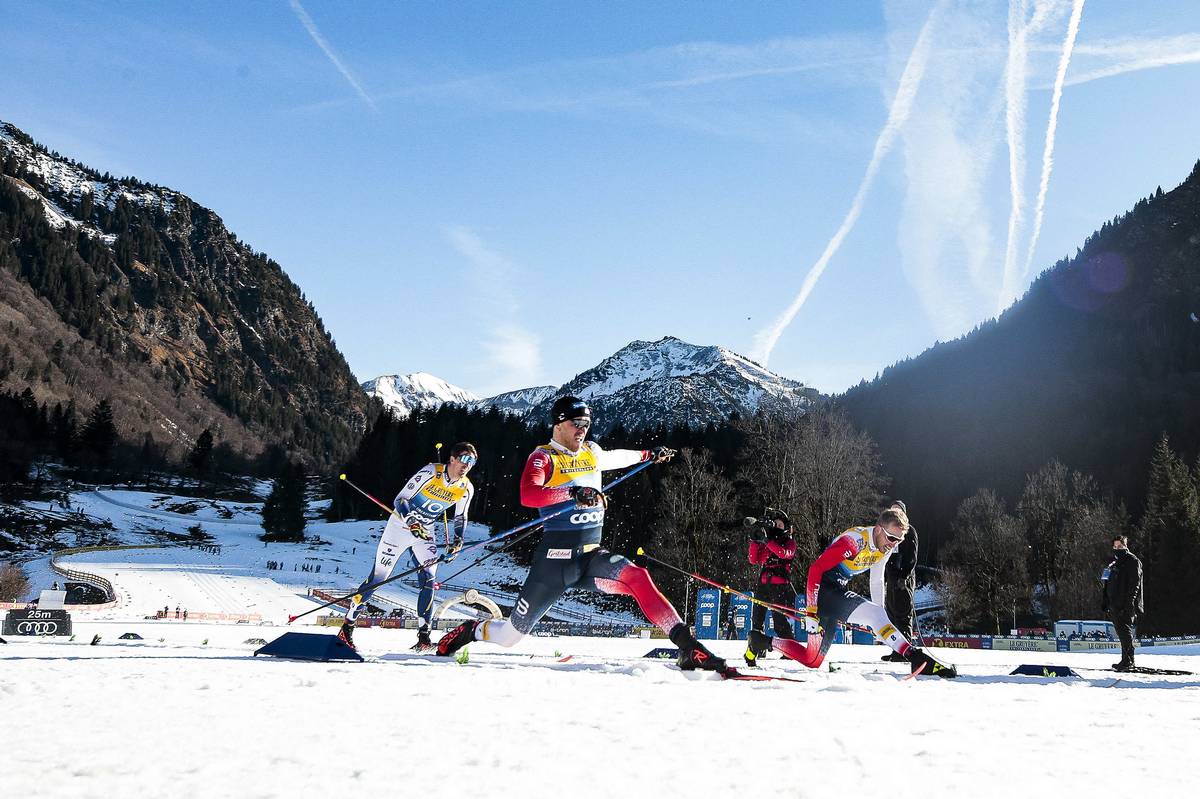
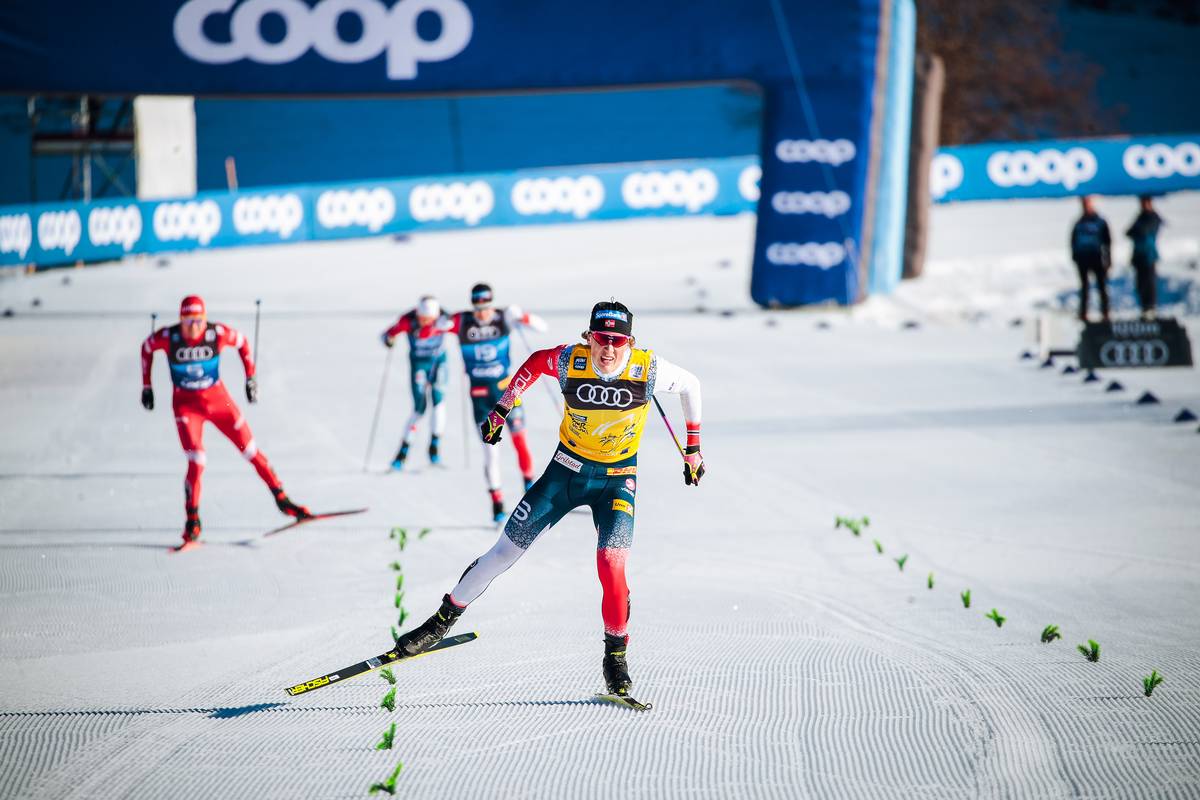
Running away with a fourth stage win, Johannes Høsflot Klæbo crosses the line of the 15k mass start classic while his chasers in the background descend into the stadium. (Photo: NordicFocus)
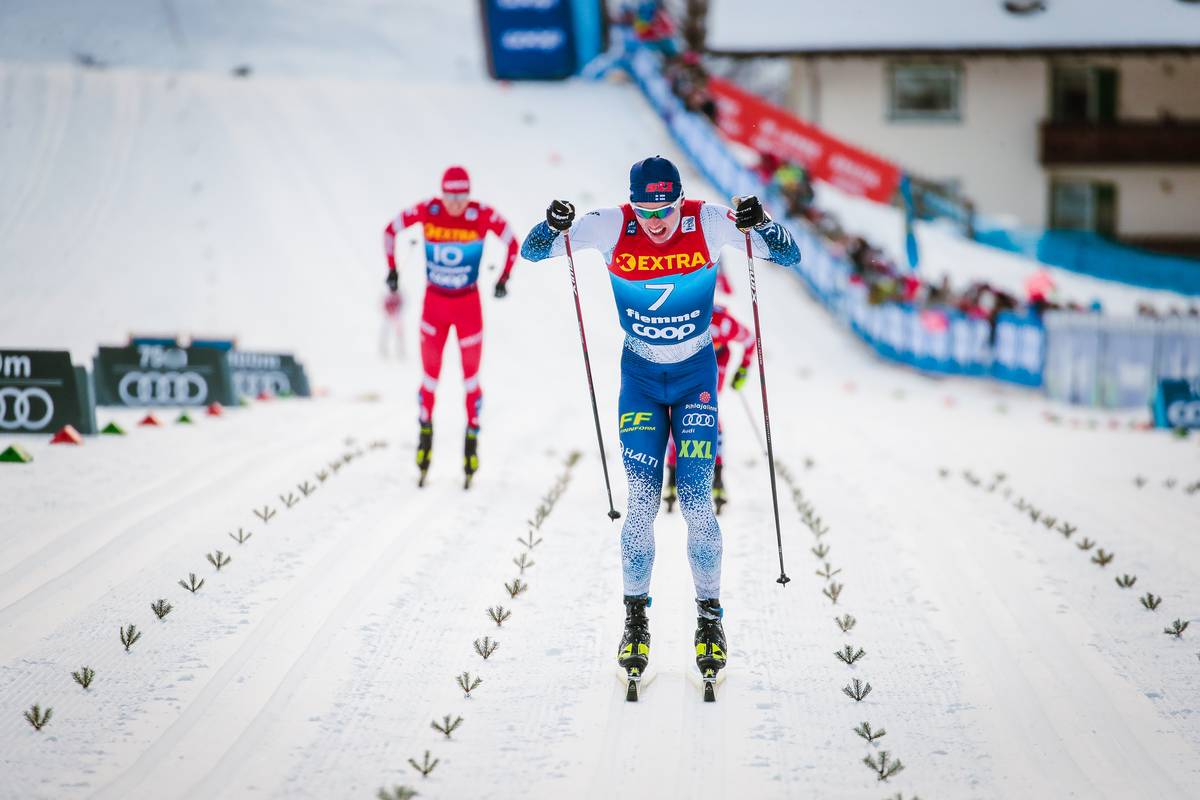
Climbing powerfully up the final climb, pushing into the downhill, and cruising confidently through the finish lanes for the win, Klæbo took a fourth Stage win in 41:31.2. Niskanen held his ground for second (+20.8), while Chervotkin continued to chase the podium for third (+23.7), edging out his teammate Denis Spitsov by 0.3 seconds at the line.
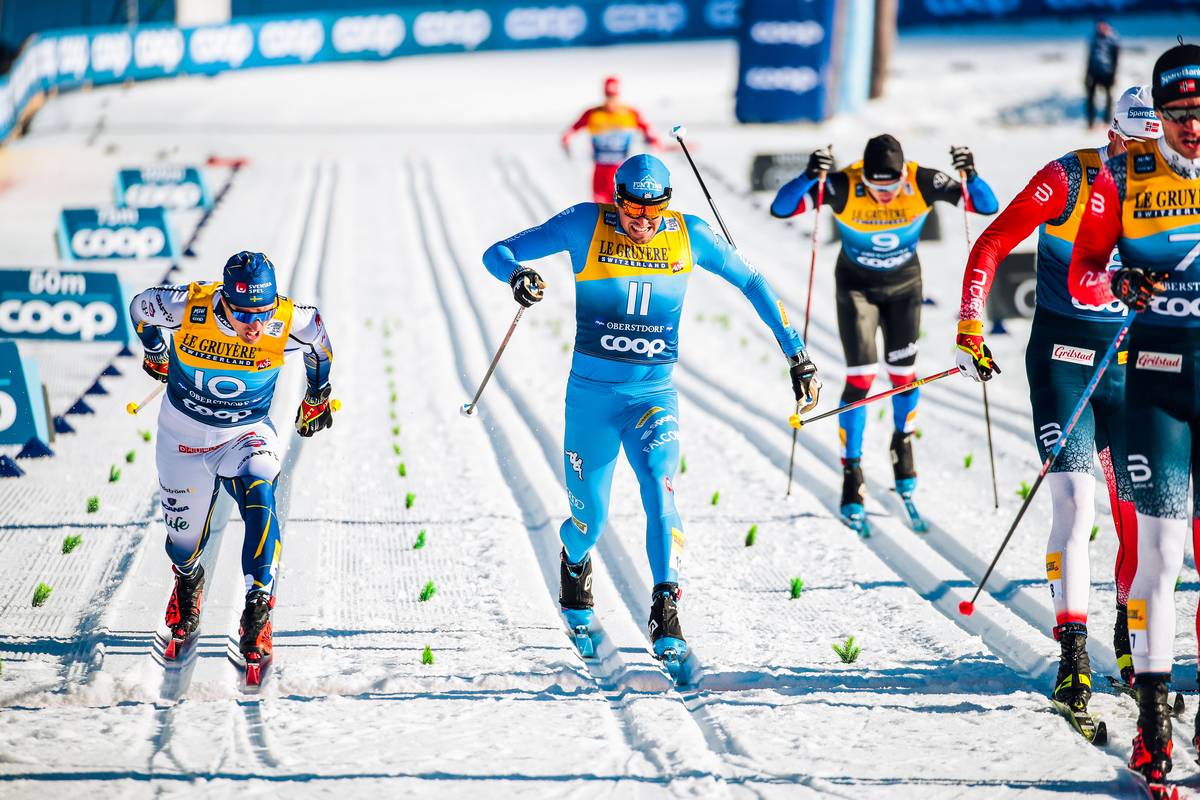
Iivo Niskanen pushes to second place in Stage 5, while Russian chasers fight for the final podium spot in his wake. (Photo: NordicFocus)Stopping the watches, Alexey Chervotkin (right) and Denis Spitsov cross third and fourth, respectively, at the finish of Stage 5 in Val di Fiemme. (Photo: NordicFocus)
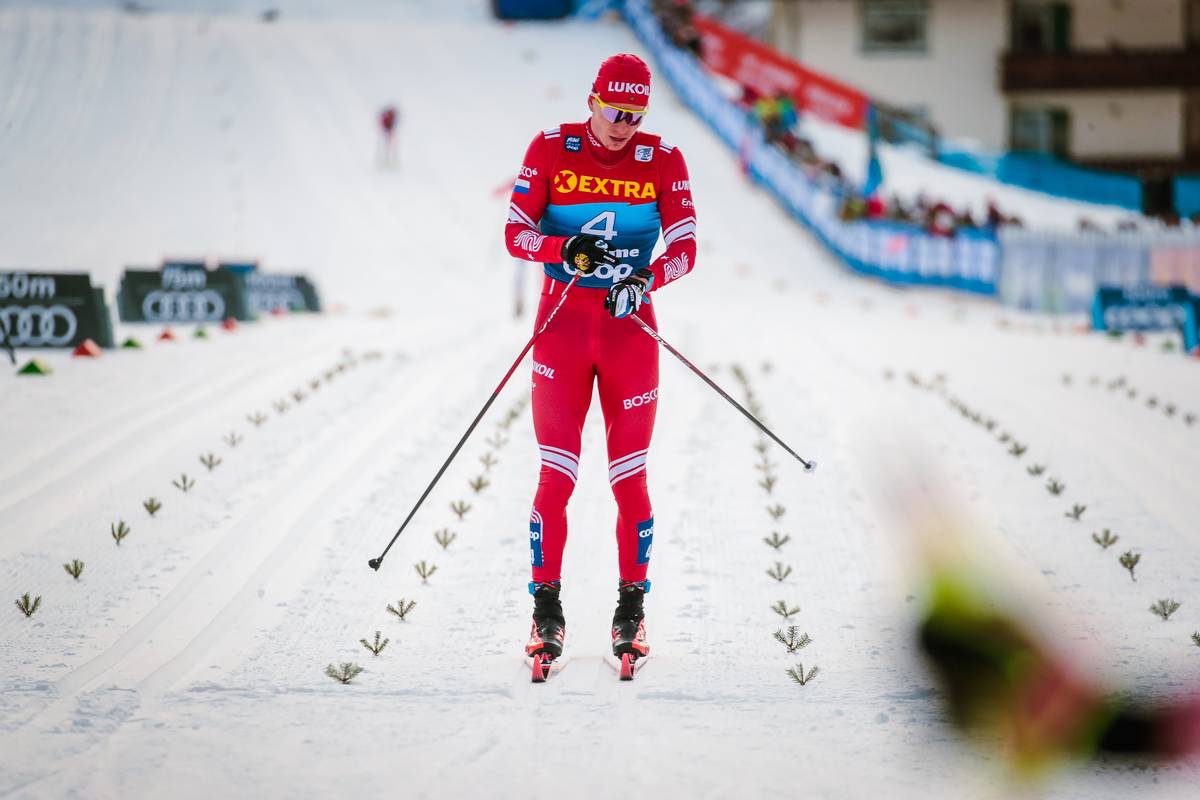
Losing time in the overall standings, Bolshunov crossed the line 5th (+27.9). Between the time difference of the finish and the net loss of 13 seconds at the time bonus, this set Bolshunov back in the overall Tour standings by 2 minutes, though he remains in second place behind Klæbo.
Bolshunov coasts over the line for fifth in the 15k mass start classic in Val di Fiemme. (Photo: NordicFocus)
Commenting on his win and the growth of his advantage, Klæbo called it an “amazing day” in his post-race interview with FIS.
“We had amazing skis, and I think I used the rest day yesterday pretty good, so it was amazing to go out there with great grip and great gliding.”
On his fatigue as the tour wanes, Klæbo continued, “I think we all are tired, but I was just trying to push all I could today, and like I said, amazing skis and the shape was good so it was amazing to actually win from the front for a change.”
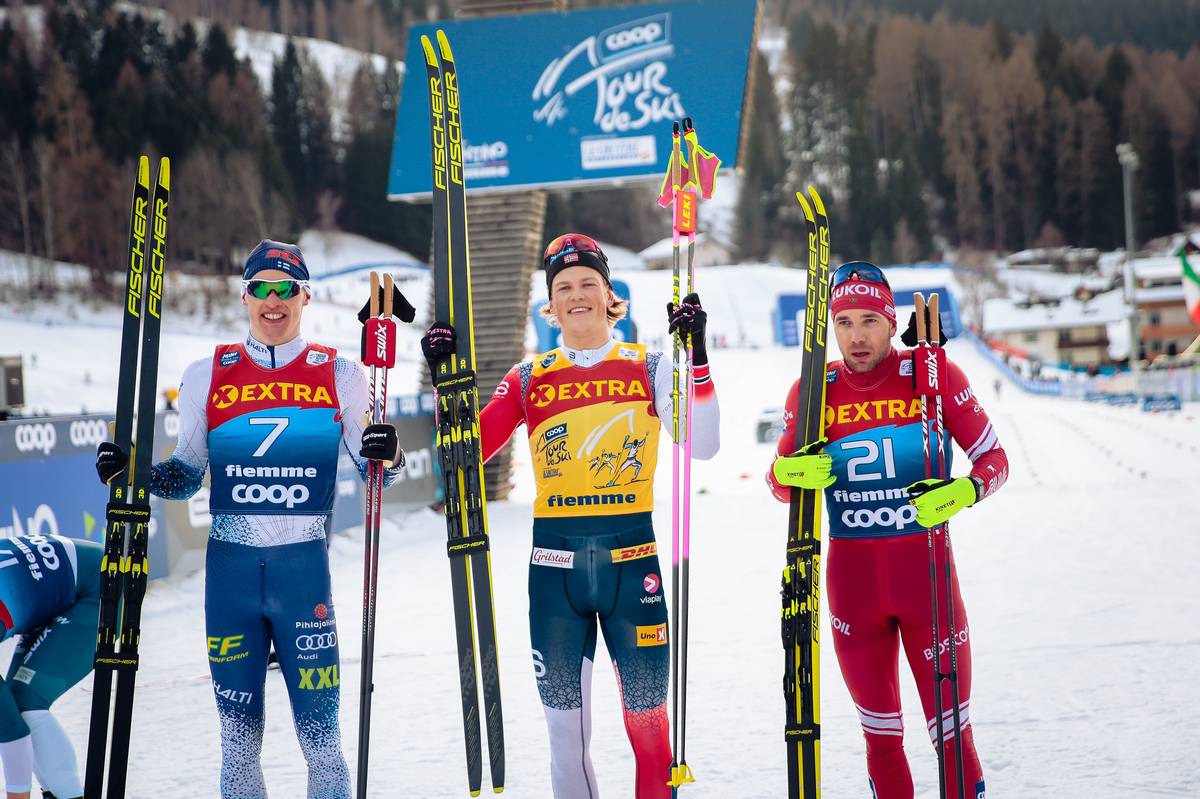
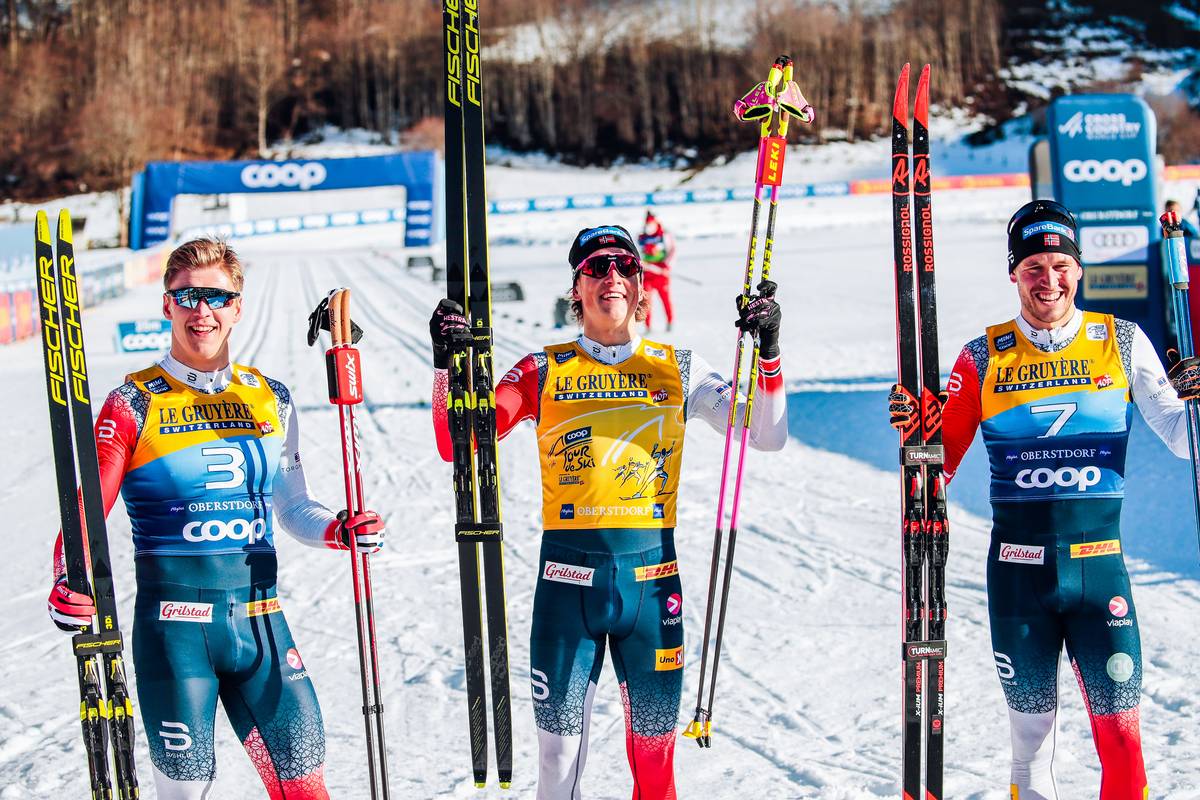
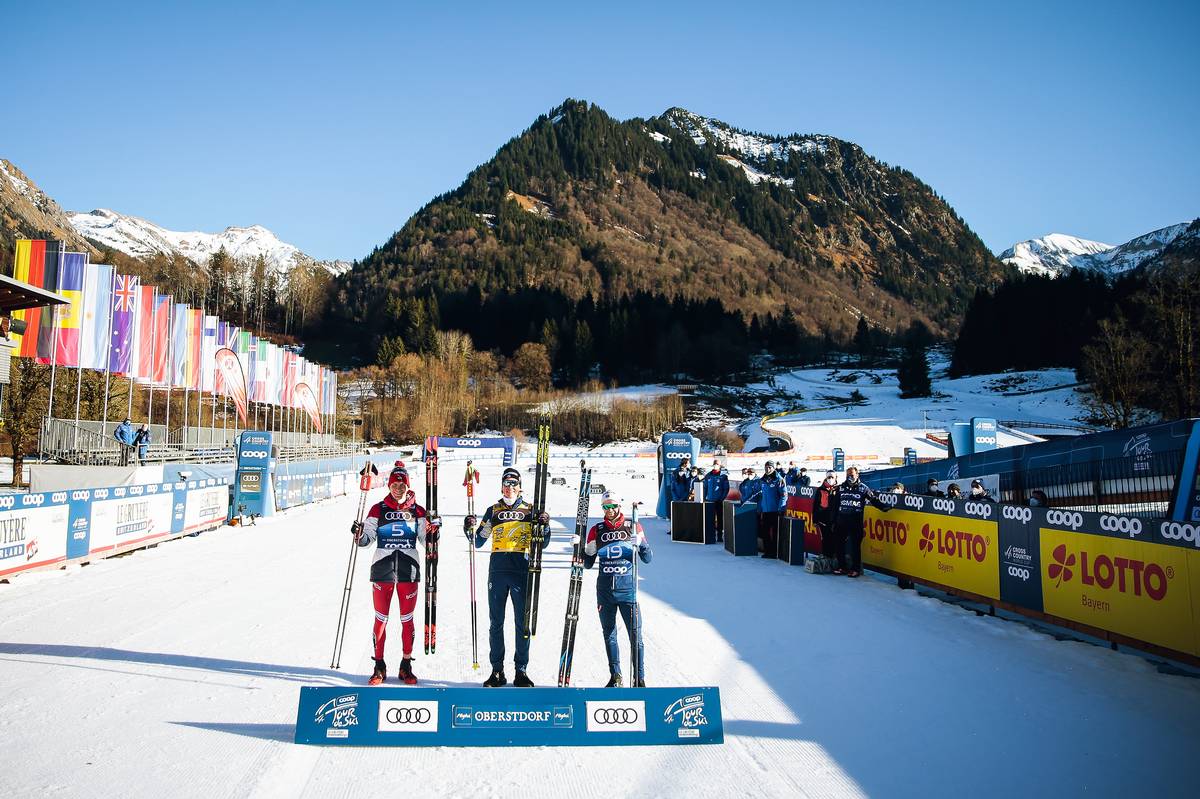
The men’s podium after Stage 5 of the Tour de Ski: Johannes Høsflot Klæbo (NOR) took the win ahead of Iivo Niskanen (FIN) in second and Alexey Chervotkin (RUS) in third. (Photo: NordicFocus)
The start format of the final hill climb has shifted from a pursuit start based on overall standings in the tour, indicating that the first to the top of the hill would be the winner, to a mass start where overall standings become more foggy. This may mean that Klæbo is steadily being passed through the climb tomorrow, often those more lithe than the muscular sprint champion, while an athlete like Bolshunov climbs with more real estate, and perhaps less demoralization, near the front.
In response to the format, Klæbo explained: “[It’s not my favorite for sure, but I want to push everything I can tomorrow, then we’ll just see how it goes, but looking forward to tomorrow’s race as well.”
Gus Schumacher races Stage 5 of the 2021/22 Tour de Ski in Val di Fiemme. (Photo: NordicFocus)
It was a challenging day for the American men today, with only Gus Schumacher and Zak Ketterson remaining in the tour. Schumacher skied to 50th (+4:15.5) while Ketterson finished 59th (+5:42.9). Luke Jager and Ben Ogden, both sprint focused, pulled from the Tour after Stage 4.
“This is my first tour, and probably the first time I’ve done this many races in so few days,” Ketterson said after his race. “You kind of go into the race, just seeing what will happen. Today was pretty tough, of course, but I guess it’s just the nature of skiing that you have to just look toward the next stage. We have another race tomorrow and it’s a new chance. So, just have to have short term memory loss, I guess.”
Zak Ketterson races Stage 5 of the 2021/22 Tour de Ski in Val di Fiemme, ITA. (Photo: NordicFocus)
In terms of what he has learned over the last week in his first starts on the World Cup, Ketterson explained that this biggest adjustment has been to the level of racing and the density of world-class athletes.
“The most interesting thing, if I have an off day in the US on the SuperTour, may I’ll be in the top 10, maybe top 20… but here, if you have a bad race, you get exposed. So it’s just seeing that you just have to stay super focused, because if you slip even a little bit here, you just lose so much.”
Full audio from post-race interview with Zak Ketterson, hosted by U.S. Ski & Snowboard cross country communications manager Tom Horrocks.
Leaders of the day, Iivo Niskanen (FIN) and Johannes Høsflot Klæbo (NOR) set the pace in the 15-kilometer mass start classic in Val di Fiemme. (Photo: NordicFocus)
Taking a last look at the overall standings before the final stage, Iivo Niskanen sits in third by time (+2:49) behind Klæbo and Bolshunov, with Norway’s Erik Valnes and Golberg in fourth (+3:04) and fifth (+3:09), respectively. Klæbo sits atop the points standings with 93, leading Valnes in second with 63, and Bolshunov in third with 42.
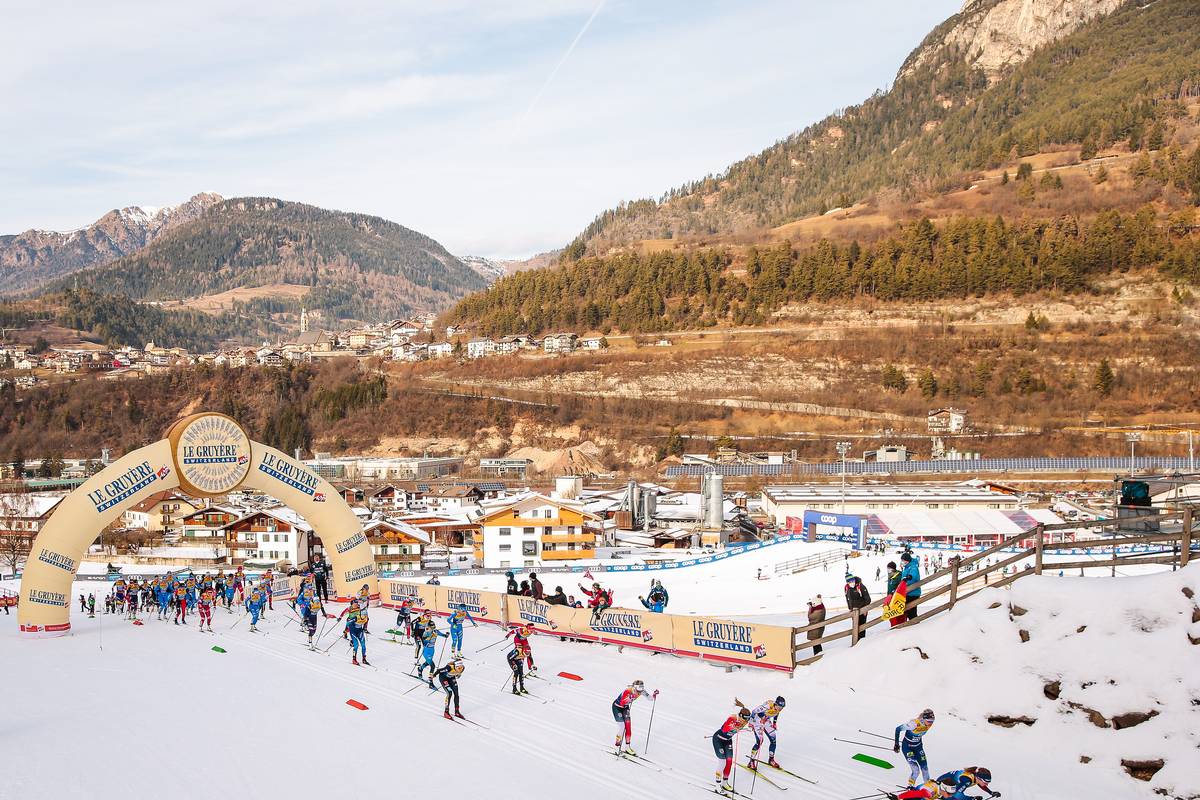
Not-quite-winter. The women’s 10-kilometer classic kicked off the final two stages of the 2021/22 Tour de Ski in Val di Fiemme, Italy. (Photo: NordicFocus)
This World Cup coverage is made possible through the generous support of Marty and Kathy Hall and the A Hall Mark of Excellence Award. To learn more about A Hall Mark of Excellence Award or to learn how you can support FasterSkier’s coverage please contact info@fasterskier.com.
After a day of rest, the Tour de Ski kicked off it’s final two stops in the mountains of northern Italy. After a dramatic freestyle sprint in Stage 4, there was a lot on the line with little time to go in the Tour for many of the women who lined up for today’s 10-kilometer mass start classic in Val di Fiemme. With blue skies and sunshine illuminating the spectacular Italian Dolomites, the stage was set for a spectator’s dream over the four lap course.
First, a quick look to the overall Tour standings to set the tone. Natalia Nepryaeva (RUS) took the lead in Stage 4. With the 60-second time bonus for a sprint win, Nepryaeva entered Stage 5 with a 34 seconds lead on Kerttu Niskanen (FIN) in second, and 38 seconds ahead of Jessie Diggins (USA) in third.
A favorite for a second consecutive Tour win, Diggins led the standings heading into the fourth stage, during which she was taken out by Frida Karlsson (SWE) in the quarterfinals, losing vital time in the Tour standings. Karlsson was later disqualified for obstruction and withdrew from the Tour after being issued a three minute time penalty that put her out of contention for the overall win.
While Diggins typically responds well to pressure and has put together impressive performances up the final hill climb, the classic tracks in Val di Fiemme have historically challenged Diggins, who would need to minimize time lost in order to still be in a position to fight for the overall win in the final stage. In last year’s Tour, Diggins was 10th in the 10k classic in Val di Fiemme, 17th in 2020 and 2019, and 4th in 2018. The odds were, perhaps, not in her favor, but the potential was there.
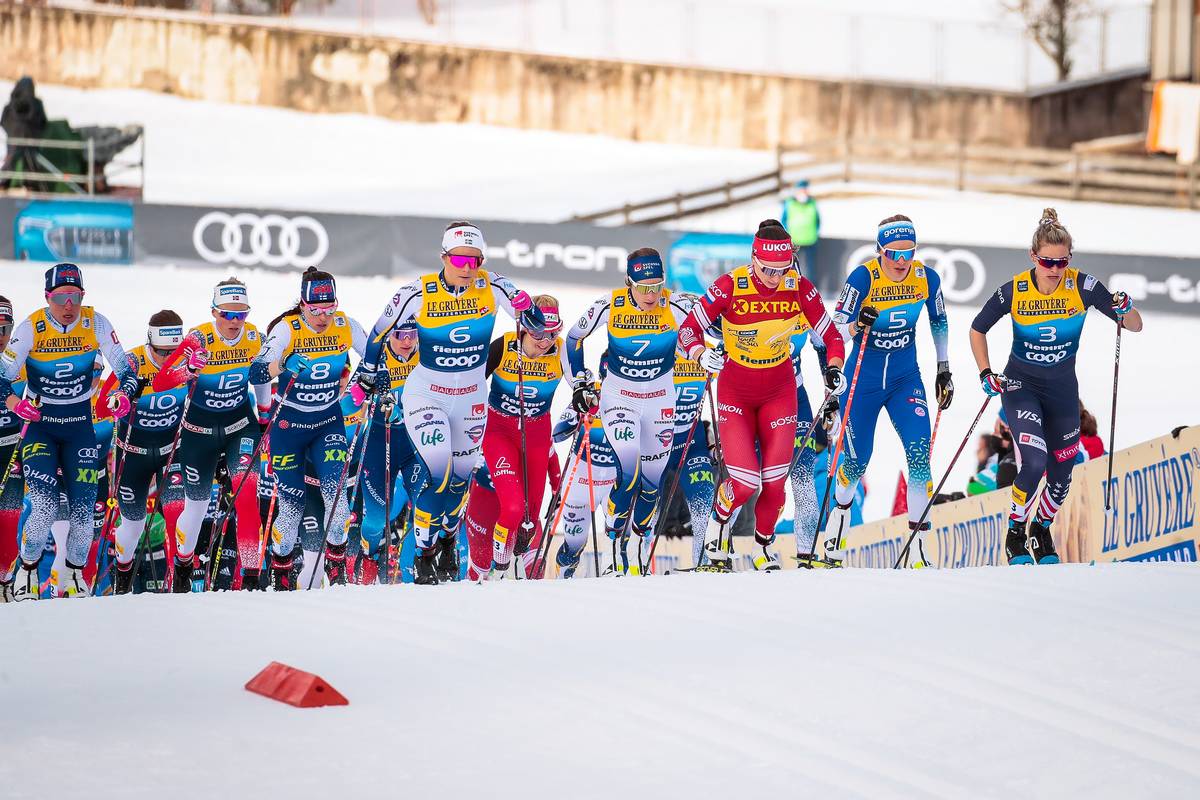
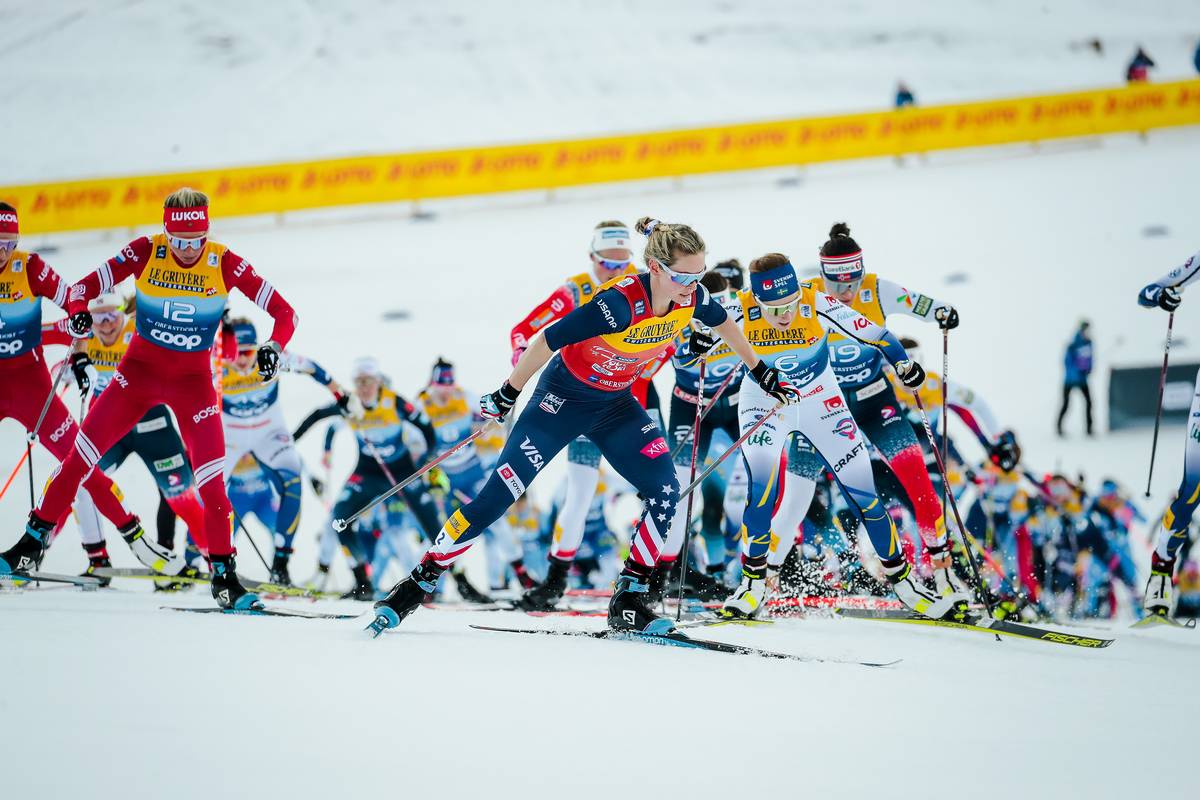
Athletes take to the tracks for Stage 5 of the 2021/22 Tour de Ski, a mass start classic in Val di Fiemme, Italy. (Photo: NordicFocus)
Within the race, there were two opportunities for bonuses, one for Tour points and one for bonus seconds. These opportunities arose at 2.3 and 6k, respectively.
As racers took to the course, the congestion of a mass start was apparent. A pole snapped within the first minute as racers jostled for position in the lanes before settling in.
As the second lap started, a gap began to form behind a large lead pack of about 14 women, which included Diggins, Nepryaeva, and Niskanen. The lead women created a roughly eight-second lead on the chase pack at 3.5k.
Heidi Weng navigates fast and icy corners during the 2021/22 Tour de Ski in Val di Fiemme, Italy. (Photo: NordicFocus)
At the halfway mark a group of six skiers began to thin out the lead group, led by Krista Pärmäkoski (FIN), Heidi Weng (NOR), Ebba Andersson(SWE), Katharina Henning (GER), Nepryaeva, and Teresa Stadlober (AUT). They opened up about a six-second lead on the chase pack which included Diggins and Niskanen.
As the women lapped through the stadium for the last 2.5k, this lead group, now led by Andersson, had stretched their lead to more than 20 seconds over the next chase pack.
Working together through most of the final lap, the group of six women skied together until the final climb before the stadium where Nepryaeva began to surge.
Charging up the hill and pushing hard over the top before dropping into a tuck, she quickly dropped the women in pursuit. Cruising through the stadium with a powerful doublepole, Nepryaeva had a comfortable lock on the win, stopping the clock with a fist pump in 29:51.3.
Natalia Nepryaeva (RUS) takes the win in Stage 5 of the Tour de Ski. (Photo: NordicFocus)Fighting for second and third, Heidi Weng (NOR) overtakes Krista Pärmäkoski (FIN). (Photo: NordicFocus)
In second at the top of the climb, but gaining ground in the descent and double pole, Weng pulled ahead of Pärmäkoski to finish second (+3.7), with the Finn just behind in 3rd (+4.7). The remainder of the lead group skied through the finish evenly spread with Andersson in 4th (+7.5), Henning in 5th (+10.9), and Stadlober 6th (+14.3).
The women’s podium after Stage 5 of the Tour de Ski. Natalia Nepryaeva (RUS) took the win ahead of Heidi Weng (NOR) in second, and Krista Pärmäkoski (FIN) in third. (Photo: NordicFocus)
In a FIS Interview, Nepryaeva was asked how she felt about the race and about the course. “I am really happy to win here, it is a really important place for me, as it was my first win at World Juniors here.”
Outside the lead group and fighting hard to minimize time lost, Diggins crossed the finish line in 13th (+58.0). Diggins explained after the race that the icy conditions in Val di Fiemme were tricky for many of the women racing, as the speed checks needed to stay in control through the downhills in mass start conditions also cost them some grip in the final laps.
“I think it was one of those [days] where I had to really catch myself and be thinking really, really hard about standing tall and thinking about technique, which is harder for me in classic,” Diggins explained post-race. “I’m really proud of staying in the moment and never giving up and doing what I could with what I had.”
Never a question of whether she has given her all, Diggins crosses the line in 13th in Stage 5. (Photo: NordicFocus)
Looking ahead to the Alpe Cermis, where her time deficit may prove insurmountable, Diggins once again showed her never-give-up attitude
“I’m excited. It’s so hard, but it’s such a feeling of accomplishment making it to the top of that mountain… You can rest assured I will be crossing that finish line with nothing left.”
Full audio clip from Jessie Diggins, interviewed on-site by Tom Horrocks, U.S. Ski & Snowboard cross country communications manager.
Katherine Ogden skis to 31st in Stage 5 of the 2021/22 Tour de Ski. (Photo: NordicFocus)
Missing the Top-30 by just 13 seconds, Katherine Ogden raced to 31st (+2:17.4) as the next American finisher. Also with strong finishes, Novie McCabe crossed the line in 36th (+2:38.3) just ahead of her teammate Sophia Laukli, who took 39th (+2:57.7). Alayna Sonnesyn rounded out the women in stars and stripes in 51st (+5:32.1).
Post-race interview with Katharine Ogden and Novie McCabe, interviewed by Tom Horrocks.
Sophia Laukli skis to 39th in Stage 5 of the Tour de Ski in Val di Fiemme. (Photo: NordicFocus)
Looking back on the bonus opportunities, Johanna Hagström (SWE) made a move just before the 2.3k point bonus to pull away from the pack to snag the maximum of 15 points. Pärmäkoski and Weng tied for second to both get 12 points. Diggins crossed the 2.4k mark in 8th, earning 3 bonus points.
At the 6k time bonus opportunity, Andersson was the first over the line, giving her 15 bonus seconds in the tour. Weng was able to continue her bonus streak on the day by crossing second and getting a 12-second bonus, while Pärmäkoski crossed in 3rd for 10 bonus seconds. Nepryaeva finished in 5th, collecting six seconds.
After today, Nepryaeva was able to not only hold on to her lead in the Tour, but expand it. Now leading Andersson by 1:12 seconds, heading into the final stage of the tour tomorrow. Diggins dropped down to sixth place from third, now behind by 1:42.
Alayna Sonnesyn skis to 51st in Stage 5 of the Tour de Ski in Val di Fiemme, Italy. (Photo: NordicFocus)
The final stage of the 2021/22 Tour de Ski, the infamous Alpe Cermis hill climb, kicks off at 11:30 CET / 5:30 EST.
Welcome back to the Devon Kershaw show for our Tour de Ski stage 3 and 4 recap. We get into Frida Karlsson’s withdrawal from the tour after her egregious take-out of Jessie Diggins in Saturday’s classic sprint. We also cover Calle Halfvarsson and Joanna Hagström delivering for Sweden, Johannes Klæbo giving a couple of beat-downs, and Diggins’ come-from-behind win Friday.
We’ll be taping a mailbag episode next week — send us your questions at devon@fasterskier.com and nat@fasterskier.com. And happy new year.
Jessie Diggins goes down in her quarterfinal heat. Frida Karlsson (SWE) was penalized for obstruction, but the fall left Diggins in 3rd place overall in the Tour de Ski. (Photo: NordicFocus)
The women’s podium after Stage 4: Natalia Nepryaeva (RUS) took the win ahead of Johanna Hagström (SWE) and Johanna Matintalo (FIN). (Photo: NordicFocus)
This World Cup coverage is made possible through the generous support of Marty and Kathy Hall and the A Hall Mark of Excellence Award. To learn more about A Hall Mark of Excellence Award or to learn how you can support FasterSkier’s coverage please contact info@fasterskier.com.
Every Grand Tour must have a Queen Stage. Dreamt up by organizers, meant to stand at the crux of the race, animate its characters, and start the action towards resolution in the narrative that’s formed over its early stages.
In cycling, these are the iconic places where grand settings meet grand drama – Alpe d’Huez, Mt. Ventoux, or the Angliru. The Queen Stage comes with pomp and circumstance, like a coronation or diamond jubilee.
At this year’s Tour de Ski though, the Queen Stage in Oberstdorf — and this 1.2-kilometer Classic Sprint proved to be just that — was more like a queen’s address to parliament; an agenda laid out for how this Tour will go into its final stages in Val di Fiemme, Italy, negotiated through the tricky rules, regulations, and politics of ski racing on the World Cup.
Alayna Sonnesyn (USA) during qualifying in Oberstdorf at Stage 4 of the Tour de Ski. (Photo: NordicFocus)
Coming into the day, there was a set order in this year’s Tour de Ski overall classification that matches what you would expect if you just watched the races individually. After a Stage 1 victory in the freestyle sprint, and an exciting 10k freestyle victory yesterday, Jessie Diggins (USA) wore the yellow leader’s bib. Below her was Stage 2 winner Kertuu Niskanen (FIN), and then Natalia Nepryaeva (RUS) in third. The time gap between the three, however, was relatively small. Diggins, despite her two wins, only had a 13 second advantage over Niskanen. With time bonuses for the finalists and semi-finalists in the Stage 4 Classic Sprint all well above that threshold — ranging from 60 sec for the winner to 22 sec for the last semi-finalist finisher — the 1.2k loop at Oberstdorf had the potential to animate and transform the overall classification in an instant. And that’s what happened. Call it a Queen Stage.
Kerttu Niskanen (FIN), who started and finished the day in 2nd place in the overall classification. (Photo: NordicFocus)
The day started strong for the Americans, with Diggins qualifying 7th (+3.43) and Katharine Ogden joining her in heats after qualifying 26th (+7.94). Diggins’ two closest rivals both qualified off her pace, with Nepryaeva in 13th (+5.08) and Niskanen in 18th place (+6.10).
Katharine Ogden (USA) powers up the first climb during quarterfinal action. Ogden qualified 26th on the day. (Photo: NordicFocus)
Ogden would meet Nepryaeva in her quarterfinal, where they set out to race a 1.2k sprint course that featured two punctuated climbs, with a technical downhill sweeping to the right in between. Their heat was a fast one, with Ogden establishing herself in the field behind Anamarija Lampic (SLO), then coming off the top of the first climb in fourth place. As the field spread out across the second climb, Nepryaeva came off the top first, with Lampic in tow. When they came out of the downhill into the long, straight, finishing straight, Nepryaeva had the lead, but Lampic showed a fight to regain her 2nd place ahead of Greta Laurent (ITA). In the excitement, Ogden had been left out of the pack slightly, and came across the line in 5th place.
Where this Tour really turned on its head though, was in Diggins’ quarterfinal heat. Lined up against a field that included qualifier winner Johanna Matintalo (FIN), Tatiana Sorina (RUS), and Frida Karlsson (SWE), the heat was a tense affair from the gun. Sorina led out over the first climb, and Diggins successfully jockeyed for position coming out of the first downhill. In the approach to the final climb, a slight left-hand turn became the setting for the defining moment of the day.
As Diggins recounted in an interview with U.S. Ski & Snowboard cross country communications manager Tom Horrocks:
“I was in the track, Frida [Karlsson] was double-poling outside the track, and then moved in on me, so I moved to switch lanes, she switched on top of me, and caused me to fall – which is a huge bummer… that severely impacts my tour.”
Jessie Diggins goes down in her quarterfinal heat. Frida Karlsson (SWE) was penalized for obstruction, but the fall left Diggins in 3rd place overall in the Tour de Ski. (Photo: NordicFocus)
It severely impacted the World Cup season too. Diggins crossed the line in 6th, but before the following heat had hit the first climb the FIS jury had already come back with a yellow-card and disqualification for Frida Karlsson. As a result of it being Karlsson’s second yellow-card of the season, her first arriving in the same event in Ruka back in November, she was also given a 3-minute time penalty in the overall classification for the Tour de Ski.
That calls to question whether the World Cup’s best distance racer this season will continue to race the Stage 5 10k mass start classic in Val di Fiemme or forgo the end of the Tour altogether. While she started the day in 7th place and +45 sec off Diggins, the 3-minute penalty dropped her to 44th place (+4:30).
Despite the penalties against Karlsson, Diggins’ quarterfinal time and placing were unaltered, leaving her out while both Niskanen and Nepryaeva advanced to the semi-finals, where the time bonuses for just finishing automatically exceeded the margin of Diggins’ lead in cumulative time standings. Diggins was awarded a 4 sec bonus for her quarterfinal finish, so a net 18 sec gain was at least guaranteed. In an instant then, two of the World Cup’s most compelling stories this season veered towards drastically off course. Diggins’ title-defense now faces steep odds (and a steep climb in Stage 6). Karlsson finds herself further down in the pack than she has been all year.
The semi-finals then, marked a brave new Tour de Ski.
Natalia Nepryaeva (RUS), Greta Laurent (ITA), Krista Pärmäkoski (FIN), and Ane Appelkvist Stenseth (NOR) (L-R) during their semi-final. (Photo: NordicFocus)
Nepryaeva raced through her semi-final with a tactical approach carried over from the quarters, preferring to stay with the pack led out by Matintalo and Johanna Hagström (SWE), before pushing the last climb and setting herself up for the long double-pole finish – for which she looked stronger than anyone else in the field. She won a semi-final that stayed tight and stayed fast, sending both lucky losers to the final.
Kerttu Niskanen (FIN) in 2nd semi-final. She would finish 5th in the heat, with Anamarija Lampic (SLO) winning to advance to the finals. (Photo: NordicFocus)
Niskanen would line up in the second semi-final. She matched up against Lampic, Laurent and Mathilde Myhrvold (NOR), with the former two looking to lead the race from the gun. By the time they crested the final climb, Lampic had stretched out the field and Niskanen had been caught out the back. She finished fifth in the heat, and didn’t advance to finals. Lampic carried the heat, and Myhrvold came second.
Nepryaeva then, would be playing a game of seconds for the Tour lead. And she would be playing it, skiing the course, like she had all day. Lampic, Hagström and Matintalo formed the front of the pack, while Nepryaeva waited for the last climb to swing out and throw a burst of acceleration that saw her and Hagström come over the top together. As Nepryaeva came out of her tuck on the finishing stretch, the strength of her double pole was on full display. She crossed the finish line first, and with a scream that no doubt will echo all the way to Val di Fiemme to warn that there is a whole new dynamic coming to its courses when the Tour resumes after the rest day tomorrow.
Natalia Nepryaeva (RUS) comes across the finish line to win Stage 4 and take the lead in the Overall Classification at the Tour de Ski. (Photo: NordicFocus)
That new dynamic is a new order. Standings going into Italy: Natalia Nepryaeva in first (53:40.0), Kerttu Niskanen in second (+34.0), and Jessie Diggins third (+38.0).
Johanna Hagstroem (SWE), Natalia Nepryaeva (RUS), Johanna Matintalo (FIN) on the podium in Oberstdorf. (Photo: NordicFocus)
With two stages to ski though, the gaps in this year’s Tour de Ski are nowhere from definitive. When it was alluded that her misfortune may change her tactical approach to the last two stages in Italy, Diggins replied simply, “it’s still full throttle everyday. It has to be.”
Full audio clip from post-race interview with Jessie Diggins, hosted by Tom Horrocks:
The Queen Stage of Oberstdorf may have made its sound and fury, but ultimately this race and its story are far from their conclusion, and it still contains a character in Diggins who has proven so-often that she can make us throw out all of the books.
Jessie Diggins during qualifying at Stage 4 of the Tour de Ski. (Photo: NordicFocus)
After final results were decided, Diggins ended her day in 21st, with Ogden a few places behind in 24th.
Outside the Top-30, the U.S. had strong results in the qualifier. Alayna Sonnesyn finished in 43rd (+14.93), Novie McCabe finished in 54th (+18.45), and Sophia Laukli finished in 61st (+26.87).
Both Hailey Swirbul and Julia Kern have dropped from the Tour, each sharing on social media that they have a cold and are focused on recovery.
Novie McCabe during qualifying at Stage 4 of the Tour de Ski. (Photo: NordicFocus)
This World Cup coverage is made possible through the generous support of Marty and Kathy Hall and the A Hall Mark of Excellence Award. To learn more about A Hall Mark of Excellence Award or to learn how you can support FasterSkier’s coverage please contact info@fasterskier.com.
As we begin Stage 4 of the Tour de Ski, the first classic sprint since the opening race of the season in Ruka, Finland on November 26th, we look back to the last time athletes raced the event on the tracks in Oberstdorf, Germany.
During the2021 World Championships, Johannes Høsflot Klæbo (NOR) took command of the gold medal from the qualifier on a 1.5-kilometer course seemingly designed for his racing style. A quick double pole start from the stadium leads to a long steady first climb where he skied long, strong, and steady, usually in second or third position. After a winding descent, athletes encounter a second short but steep climb of roughly 18 vertical meters, where Klæbo would begin his signature run. Stomping his way to the lead as he crested the top of the climb, stepping around a left-hand curve, and dropping into a tuck on the final descent leading into the stadium, Klæbo was repeatedly in position to advance through each round comfortably, eventually winning the final by several ski lengths. (Video highlights here.)
Alexander Terentev races to second place in qualification during Stage 4 of the Tour de Ski in Oberstdorf. (Photo: NordicFocus)
Winning today’s qualifier in 2:55.78, Klæbo looked to be on track for a repeat victory in Oberstdorf, however, it is worth noting that he did not win the aforementioned other classic sprint this season. In Ruka, it was 22-year-old Alexander Terentev who took hold of the event in qualification and looked to, well, out-Klæbo Klæbo throughout the heats. We saw familiar tactics with a power move on the final climb, paired with impressive acceleration over the final meters to capture the win, but this time, the athlete employing these tactics was in a Russian race suit. While Klæbo has won each of the sprints he has entered since, with Terentev eliminated in the semis, Stage 4 would be a rematch both were eyeing.
Setting the stage, Terentev was second in qualification, +1.5 behind Klæbo, with Erik Valnes (NOR) in third (+2.37), Federico Pellegrino 4th (+3.53), and Alexander Bolshunov 5th (+3.61). Ben Ogden was the top American qualifier today, finishing 15th (+8.08), while Luke Jager finished 24th (+10.83). The American selected heats two and five, respectively.
Johannes Høsflot Klæbo and Erik Valnes take the lead in the final climb of the quarterfinal, with Ivan Yakimushkin (bib 23) and Iivo Niskanen (bib 29) chasing. (Photo: NordicFocus)
In the first wave of the quarterfinal, Finland’s Iivo Niskanen, winner of the Stage 2 15k classic, pushed the pace heading up the first climb, perhaps looking to ensure an opportunity for a fast rather than tactical heat, knowing he was up against Valnes and Klæbo and likely would only have the opportunity to advance as lucky loser. However, the Norwegians, unphased, chose not to respond, waiting patiently mid-pack to use the same tactic described at World Champs. In the second climb, both created enough room to look as if they had begun their cooldown as they skied through the finish lanes, with Klæbo addigng a lackadaisical boot slide at the line that put him just ahead of his teammate. Behind them, Niskanen and Ivan Yakimushkin (RUS) sprinted to the line to chase the clock, with the Russian finishing ahead of the Finn. However, their times did not hold up through subsequent rounds and their day had ended.
Alexander Bolshunov leads the quarter final during Stage 4 of the Tour de Ski, with Ben Ogden racing in bib 15. (Photo: NordicFocus)
In the second heat of the quarters, Ogden lined up alongside Bolshunov, who took control out of the gate. Staying in the pack through the first climb, Ogden found himself in fifth as athletes exited the second and began descending toward the stadium. In the final curves, Ogden couldn’t quite maintain the position needed to contend for a spot as lucky loser, finishing 5th in a fast heat, +1.52 behind Bolshunov.
Terentev looked as though his day might be over before he could face Klæbo head-to-head. Federico Pellegrino (ITA) stepped on his pole as lanes decreased in the opening stretch, causing it to snap. Terentev calmly accepted a replacement, steadily working his way back into the mix. Running out of the tracks in the final climb, Terentev accelerated around the left-hand curve and into the downhill in the lead, continuing through the finish for the win ahead of Mikal Novak (CZE) to advance comfortably.
Alexander Terentev leads his quarterfinal during Stage 4 of the Tour de Ski in Oberstdorf. (Photo: NordicFocus)
In the fifth heat of the quarters, Jager maintained contact with the pack through the first climb, but found himself off the back as he left the second. Jager’s legs wobbled as he found his footing in the descent. Perhaps too flooded to ski as aggressively as was needed to put himself in contention for higher placement, he crossed the line sixth in the heat, +6.88 behind the winner.
Luke Jager raced in the fifth quarterfinal during Stage 4 of the Tour de Ski in Oberstdorf. (Photo: NordicFocus)
On we go to the semifinals.
In a stacked first heat, Bolshunov and Terentev set the pace at the front heading up the first climb. Striding metronomically, they held Valnes and Klæbo temporarily at bay. As the men charged into the final climb, Klæbo advanced at a run up the outside, rounding the left hand bend with Terentev at the front before beginning the sweeping downhill side by side.
Terentev began to move across the track behind Klæbo, looking to finding a line that might be optimal for using the Norwegian’s draft to slingshot into the final lanes at high speed. Not waiting long enough, Terentev caught his tips on the Norwegian’s tails, losing his footing and crashing with a slide into the v-boards. No chance to recover what was lost, Terentev stood up, taking a defeated swing at the ground with his pole, before slowly continuing through the final meters to the finish, now well off the back.
As the two had created a small gap to their chasers, Valnes and Bolshunov navigated around the crash easily, racing to the line for second and third. Pulling ahead with his double pole, Valnes snagged second with Bolshunov less than half a second back, hoping for a lucky loser spot in the final.
With a comfortable lead, Johannes Høsflot Klæbo looks over his shoulder as Erik Valnes and Alexander Bolshunov race to the line in the semifinal. (Photo: NordicFocus)
Terentev later received verbal warning for a classical technique infraction.
In the second and less-eventful semi, Pål Golberg and Even Northug attempted to take control of the race in the final climb, but they remained matched by Italy’s Francesco De Fabiani and Sweden’s Calle Halfvarsson as they crested the top. Goldberg picked up the most speed in the descent, accelerating out of the final curve with a sizable gap to his three chasers. Laying off the gas before the line, Goldberg took the win ahead of Northug, who left De Fabiani and Halfvarsson fighting for lucky loser spots on his tails.
Calle Halfvarsson and Fracesco de Fabiani take it to the line in the semifinal. (Photo: NordicFocus)
De Fabiani and Halfvarsson crossed in a photo finish, both just 0.02 seconds ahead of Bolshunov’s mark, allowing them both to advance to the final and ending the Russian’s day.
With four Norwegians in the final, they were guaranteed at least one spot on the podium.
Norway were 1-2-3 coming out of the first climb, with Klæbo sitting in second position. Doublepoling into the next climb, Klæbo matched Valnes as the two ran at the front, Klæbo out of track and Valnes in the inside lane.
Johannes Høsflot Klæbo leads into the final descent in the last round of the Stage 4 classic sprint in Oberstdorf. (Photo: NordicFocus)
Klæbo accelerated into the curve at the top stepping in front of Valnes and leading him into the downhill. Klæbo powered into the final stretch still in the lead, with Valnes a ski length back but closing fast with a strong doublepole. Valnes changed lanes, knowing it was his only opportunity if he wanted to try for a win, but there was not enough real estate left and this cost him speed as they came to the line. No time to celebrate this time, Klæbo pushed his boot over the finish to stop the clock at 2:54.77, roughly 3.5 seconds faster than any other rounded, with Valnes 0.3 seconds back for second place.
Johannes Høsflot Klæbo takes the win in Stage 4 ahead of teammate Erik Valnes, while Pål Golberg, Even Northug, and Calle Halfvarsson fight for the final spot on the podium behind. (Photo: NordicFocus)
Behind the duo, the remaining two Norwegians sprinted to the line for a photo finish, with Goldberg edging out Northug for third by just 0.02 seconds. Halfvarsson, still in contention for the podium in the final stretch, crossed 0.5 seconds behind the Norwegians to end his day in 5th, while De Fabiani seemed to have accepted his fate, crossing the line casually +11.71 behind Klæbo.
Determining third place, Pål Golberg (center) edges out Even Northug, wit hCalle Halfvarsson just off the mark in fifth. (Photo: NordicFocus)
Another all-Norway classic sprint podium in Oberstdorf, and a second consecutive win for Klæbo.
“It’s amazing to start a new year with a victory and also to have two of my best friends coming onto the podium as well,” Klæbo told FIS at the finish. “I am really satisfied with today’s race, and also to start, hopefully, a good new year.”
After four races in five days, Klæbo was asked whether Tour fatigue had begun to set in.
“For sure, I am getting a little bit tired, but still, when the weather is like this and the conditions are pretty nice, it gives you a lot of energy. So it’s just trying to push hard, looking forward to a rest day tomorrow, and trying to push hard in the last two legs.”
The all-Norwegian men’s podium after Stage 4 of the Tour de Ski: Johannes Høsflot Klæbo took his fourth win of the Tour ahead of Erik Valnes in second and Pål Golberg in third. (Photo: NordicFocus)
After the final results were determined, Ogden ended his day in 22nd.
“I took the qualifier out really hot, hoping to be in the top 3 in qualification,” Ogden told U.S. Ski & Snowboard cross country communications manager Tom Horrocks at the finish. “I was a little flooded at the end, but not the end of the world. I chose heat 2, which is not always what I do, so I tried something different, and I think I skied well in the heat. It’s been a lot of racing for me early, so I’m a little tired, and wasn’t the smartest out there… but I’d say I’m learning a lot and making progress, so one day I’ll put it together.”
Full audio clip with Ben Ogden, interviewed by Tom Horrocks.
Ben Ogden races in heat 2 of the quarterfinals in Oberstdorf. (Photo: NordicFocus)
It was Jager’s second time qualifying for the rounds in a classic sprint, and his second-best overall World Cup result. Jager was 18th in the opening classic sprint in Ruka, and finished 27th today.
“I was trying to be competitive, in second, third, or fourth, somewhere where I could potentially get in a draft and have a good finish, hopefully,” Jager told Horrocks post-race. “It didn’t work out that way… Hindsight is 20/20, so maybe I wish I had picked a different lane and just gotten out and ran earlier, but at the end of the day, the pace was just really, really fast. I was and am, chronically and acutely, pretty tired right now, so I just didn’t really have it and wasn’t as aggressive as I should have been going over the top. I like to think if I had another shot in that exact same position, I could make fourth or fifth, but an objective qualification in that [heat] probably wasn’t going to happen for me today.”
Luke Jager races to 27th in Stage 4 of the Tour de Ski in Oberstdorf. (Photo: NordicFocus)
Looking to the bright side, Jager expressed how grateful he has been to have had excellent skis in every race he’s competed this season, which provides confidence even on the days when the body doesn’t want to cooperate. At 21-years-old, Jager’s career is still nascent, and it’s easy to understand how progress at this level may not be linear.
“I’m super thankful for the opportunity [to race on the World Cup this season]… It feels often like it’s one step forward, four steps backward over here, just because it’s so brutal. The last month, especially, has been pretty tough and pretty demoralizing at times for me. I’m going home today, so it’s pretty nice to end with a glimmer of hope for what is to come. It’s the real deal. Sometimes it’s easy to forget that because so many Americans are doing well, but it’s pretty damn hard over here.”
Full audio clip with Luke Jager, interviewed by Tom Horrocks.
Kevin Bolger races to 33rd in qualification during Stage 4 of the Tour de Ski in Oberstdorf. (Photo: NordicFocus)
Outside the Top-30, Kevin Bolger and Zak Ketterson were just shy of making the heats, finishing 33rd (+13.10) and 34th (+13.39), less than a second off the time needed to advance. Logan Hanneman was also a near-miss, finishing 37th (+14.08). Gus Schumacher rounded out the American starters in 45th (+16.51) of 73 starters.
Looking at the overall Tour de Ski standings with four of six stages complete, Johannes Høsflot Klæbo tops the list for both cumulative time and points after winning three of four events. By time, he sits 1:03 ahead of teammate Pål Golberg and 1:19 ahead of Alexander Bolshunov. With a 15k mass start classic and 10k freestyle hill climb to go, Klæbo is in good standing, but cannot be complacent, as the hill climb, in particular, has historically favored Bolshunov.
By points, which favor sprint stages and intermediate sprints in distance races, Klæbo leads with 81 points ahead of Erik Valnes, who holds 50, and Goldberg with 41.
After a rest and travel day, racing continues Monday in Val di Fiemme, Italy.
With three wins in four stages, Johannes Høsflot Klæbo leads the overall Tour de Ski standings by both cumulative time and points. (Photo: NordicFocus)
The start of the women’s 10-kilometer mass start free during Stage 3 of the 2021/22 Tour de Ski in Oberstdorf, Germany. (Photo: NordicFocus)
This World Cup coverage is made possible through the generous support of Marty and Kathy Hall and the A Hall Mark of Excellence Award. To learn more about A Hall Mark of Excellence Award or to learn how you can support FasterSkier’s coverage please contact info@fasterskier.com.
Stage 3 of the Tour de Ski, the halfway mark in this year’s edition, and the venue has shifted to Oberstdorf, Germany, site of the 2021 World Championships. The race on tap was a 10-kilometer skate and the first mass start event of the season. Temperatures were warm and sunny though the courses were located on the shady side of the valley, creating fast, firm conditions. After an exciting battle, it was the American Jessie Diggins who claimed the victory in Stage 3, using her speedy free skate technique to move from third to first down the finish lanes. Diggins finished in a time of 21:30.8, lightning-fast by the distance. Let’s examine what happened out on the course during those twenty-one minutes.
Jessie Diggins wins her second stage of the 2021/22 Tour de Ski, a 10k mass start free in Obsertdorf. (Photo: NordicFocus)
The course was made of three laps of a 3.3 k loop and the fast conditions made it challenging for any one athlete to break away from the rest of the pack. Immediately from the gun, Diggins was at the front, clearly looking to push the pace from the start. Through the first time-check at 2.1 k, the pack was largely still together. As the group navigated one of the many v-board rimmed corners, Frida Karlsson (SWE) got caught on the inside, taking a fall just before the end of first lap.
At 3.3k, Diggins was in the lead, shadowed by Ebba Andersson (SWE) and Heidi Weng (NOR), though the top twenty athletes were all within 10 seconds of each other. Stepping over broken pole remnants from the previous lap, the racers headed out on the second, towards the bonus points opportunity at 4k.
Weng (NOR) was first through the checkpoint to gather 15 points with Andersson (SWE) earning 12 and Karlsson, having recovered from her fall and making up significant ground, taking 10 in third place. Andersson, Weng, and Diggins continued to work hard up front and at 5.4k, a small break seemed to be forming.
Ebba Andersson (SWE) leads Jessie Diggins (USA) and Helene Fossesholm (NOR) around a fast turn into the stadium during Stage 3 of the 2021/22 Tour de Ski in Oberstdorf, GER. (Photo: NordicFocus)
Unlike many women’s mass start races we have seen in the past few years (Johaug pulling away, the chasers strung out behind), this race was tight from start to finish. As the front pack took shape it initially held five athletes but was soon joined by another five. Andersson (SWE) was often at the front, followed by Helene Marie Fossesholm of Norway, Diggins, Teresa Stadlober of Austria, Karlsson (SWE), Weng (NOR), Tatiana Sorina (RUS), Katharina Henning (GER), Natalia Nepryaeva (RUS) and Delphine Claudel (FRA).
Despite the various efforts of Andersson and Diggins to break, the fast conditions and course profile seemed to make this difficult.
Jessie Diggins leads the masses early in a fast and icy 10-kilometer mass start classic in Oberstdorf, Germany. (Photo: NordicFocus)
Rounding another v-board corner, Karlsson nearly fell again, catching herself with her hands. As the front pack sped towards the finish, Fossesholm (NOR) faded and dropped, leaving nine. Heading towards 8.7 km, Karlsson lengthened her stride and began to pull away, creating a gap of +1.7 to Diggins. Diggins and Sorina worked to close the gap on the next and final hill, though they didn’t overtake the Swede. Ending in a fast downhill finish where many of you may recall last year’s World Championship drama, Diggins was poised to use her strengths.
As the front three athletes came into sight of the finish lanes, Karlsson still held the lead, Sorina in second and Diggins closing fast in third. Choosing the outside lane Diggins free-skated hard, passing Sorina and then Karlsson to cross the line in first.
“It felt pretty extreme,” said Diggins to FIS when asked about her finish, “it probably didn’t look very graceful or pretty, but they did such a good job preparing the course in such warm conditions so it was awesome that it was hard. But in my head I was ready for the finish lanes to feel unstable, so I thought just stay as low to the ground as possible. That way if you fall you don’t have far to go.”
Head down and free skating, Jessie Diggins fights all the way to the line against Frida Karlsson (SWE) and Tatiana Sorina (RUS, cut off on right). (Photo: NordicFocus)
Karlsson (SWE) hung onto second place +0.5 behind Diggins and Sorina (RUS) grabbed third (+0.8).
This win marks Diggin’s ninth World Cup distance victory, all coming in skate technique.
Talking about course conditions Diggins said, “It was tricky because if you’re leading, you’re doing so much work, but if you’re not in front it’s easy to get swallowed up. I have to say I had the best skis in the world.” In a separate interview, Diggins reiterated this point, emphasizing the importance of her ski speed, “[our team] gave me some absolute rockets and that was the difference maker, being able to trust the draft, and trust the skis and know that they would help me pick up places and get me to where I want to be so that was crucial to me out there.”
Post-race audio clip from the mixed zone, recorded by U.S. Ski & Snowboard cross country communications manager Tom Horrocks.
After a powerful free skate sprint to the finish, Jessie Diggins crosses the line to narrowly win Stage 3 of the 2021/22 Tour de Ski in Oberstdorf. (Photo: NordicFocus)
Julia Kern was the next American finisher in 24th position (+43.8).
“It was fast and furious, a lot of fun,” said Kern afterwards. “I didn’t have the best energy out there but it was a hard fight. Skis were competitive and good, it was a really icy day so it was hard to stay on your feet.”
Post-race interview with Julia Kern hosted by Tom Horrocks.
Julia Kern skis a strong Stage 3 during the 2021/22 Tour de Ski in Oberstdorf. (Photo: NordicFocus)
Katharine Ogden finished just outside the top thirty in 32nd place (+56.7).
“I was psyched with my strategy of just staying relaxed and trying not to get too swept up in the mass start chaos,” Ogden explained in a post-race interview. “I was definitely a little bit bummed to be so close to the points, but not quite in them. But everyone wants to be Top-30, so that’s okay. It was encouraging, makes me really excited for Val di Fiemme.”
Full audio clip with Katharine Ogden, interviewed by Tom Horrocks.
Following her was Sophia Laukli in 37th (+1:00.4), Alayna Sonnesyn in 52nd (+1:39) and Novie McCabe in 54th (+1:42.5). Hailey Swirbul did not start.
The women’s podium after Stage 3 of the 2021/22 Tour de Ski in Obserstdorf: Jessie Diggins (USA) took the win in a sprint finish ahead of Frida Karlsson (SWE) and Tatiana Sorina (RUS). (Photo: NordicFocus)
Diggins now leads the Tour standings again, +0:13 ahead of Kerttu Niskanen (FIN). Natalia Nepryaeva (RUS) is in third, just one second behind Niskanen.
Kern is the next American behind Diggins and is currently in 17th (+1:47). Katherine Ogden is sitting in 31st (+2:48), Sophia Laukli is 41st (+3:11), Novie McCabe is 46th (+3:31) and Alayna Sonnesyn is 58th (+4:58). The fourth stage of the Tour will take place Saturday, featuring a classic sprint, before they change venues for the final time on January 3rd.
An aerial view of the icy track in Oberstdorf, Germany, where winter looks to ebb and flow. (Photo: NordicFocus)
This World Cup coverage is made possible through the generous support of Marty and Kathy Hall and the A Hall Mark of Excellence Award. To learn more about A Hall Mark of Excellence Award or to learn how you can support FasterSkier’s coverage please contact info@fasterskier.com.
Traveling Northeast from Lenzerheide, Switzerland to Oberstdorf, Germany, home to last year’s FIS World Ski Championships, athletes lined up for Stage 3 of the Tour de Ski for a mass start 15-kilometer skate. Once again encountering conditions altogether different from those in the previous stage, the tracks in Oberstdorf were lightning fast, and icy, with bare earth scarring the landscape between the ribbons of white.
Given the conditions and the winding nature of the 3.75k loop, there was little separation in the first three laps of the four-lap race. Johannes Høsflot Klæbo (NOR) and Alexander Bolshunov (RUS) surged to the front to collect the Tour bonus points at the 4.4k checkpoint, with Klæbo keeping putting in just enough effort to slide his boot over the line 0.3 seconds ahead of the Russian’s, earning them 15 and 12 points, respectively. Ivan Yakimushkin (RUS) was next in line at the checkpoint for 10 points, followed by Pål Golberg (NOR) for 8, and Calle Halfvarsson (SWE) for 6.
The pack stayed tight through the first two laps of the men’s 15k freestyle mass start in Oberstdorf, Germany. (Photo: NordicFocus)
Once the checkpoint was crossed, the men stood up, returning to a calm and relaxed state at the front of a massive pack of racers with little opportunity, or need, to break away just yet. Given the density of skiers on the course and the speed of the track, downhills were taken with care, with the leaders standing up, putting arms to the sides to indicate they were all on the same page – take it easy, keep everyone’s equipment intact, no unnecessary crashes.
The leaders wind through icy curves as they descend toward the stadium in Stage 3 of the Tour de Ski in Oberstdorf. (Photo: NordicFocus)
This theme continued through the third lap, where the race for the podium finally began.
At 9.6k, just 12 seconds separated the top 30, who moved like a slinky through the woods, compressing on the climbs, stretching on the descents. Repeat, repeat.
However, by 12k, five men had dropped the masses, and by 13.4, this had dwindled to three. Led by Klæbo in the yellow bib, Bolshunov, Sjur Røthe (NOR), and Andrew Musgrave (GBR) quickly gapped the field to fight for the podium.
Alexander Bolshunov (RUS) leads Andrew Musgrave (GBR) and Johannes Høsflot Klæbo (NOR) as the leaders begin to break away in the final lap. (Photo: NordicFocus)
While one might expect Klæbo in such conditions to wait until the final meters to show off his acceleration, he started his kick much further out, pushing into the final descent and trusting his ability to race the following icy curves. Though his chasers began to catch him as they navigated tight bends that led into the stadium, Klæbo hop-skated over the final roller and held the others at bay, skiing into the finish lanes with plenty of space to earn a clear victory.
Racing all the way to the line, Bolshunov pushed to claim second place (+3.4) with Røthe securing the final podium spot just behind in third (+4.0).
Johannes Høsflot Klæbo (NOR) powers to the line for the win in Stage 3 of the Tour de Ski, while Alexander Bolshunov (RUS) and Sjur Røthe (NOR) fight to the line for second and third. (Photo: NordicFocus)
Lacking the closing speed for a podium spot but still putting together a season-best day, Musgrave closed for 4th (+5.6). Perhaps well-suited to the style of racing in Oberstdorf, the Brit had been tenth in the event on the same tracks during last year’s World Championships in similar conditions. The 2021 World Championships 15k free had an all-Norwegian podium, led by Hans Christer Holund, Simen Hegstad Krüger, and Harald Østberg Amundsen, with Bolshunov disappointed at the line in 4th, and Røthe nearly a minute off the lead in sixth.
Johannes Høsflot Klæbo (NOR) welcomes teammate Sjur Røthe (NOR) across the line in third, while Andrew Musgrave (GBR) takes fourth. (Photo: NordicFocus)
“It was a wee bit annoying to let a podium finish slip through my fingers on a day when I was feeling good and had amazing skis,” wrote Musgrave in a post-race email to FasterSkier. “It was definitely nice to be back racing better after a very tough start to the season though!”
Musgrave continued with a comment on a start to the season he deems sub-par, ending with some optimism.
“I’ve had a rough season so far, struggling to take World Cup points, and just generally not feeling in form. I took a week completely off training between Lillehammer and Davos, and that seems to have got me back on track.”
Though from afar, the race looked congested with the field of men staying tightly grouped through the first 11k, Musgrave painted a different picture, speaking to his approach to the course in fast conditions.
“The race today was a bit less chaotic than I thought it might be. With such fast, icy conditions I thought there would be a big group still together sprinting for the win at the end. My plan was to keep as far forwards as possible, to avoid any falls that might happen in the pack. It ended up being a good call- the group ended up splitting up quite a bit on the technical, icy downhill. I was far enough forward to keep myself on the right side of any gaps that opened up.”
Though just-shy of the podium, Andrew Musgrave (GBR) looked thrilled with his season-best fourth place result in Oberstdorf. (Photo: NordicFocus)
As for Klæbo, today marks his 47th World Cup victory, tying the legendary and notorious Petter Northug, but remarkably, only his second win in a freestyle distance event. His last win in the 15k skate also took place in Oberstdorf, during the 2018/19 Tour de Ski. Of his five wins in the 15k classic, four have taken place in mass start races.
“The first round was pretty slow, then on the third lap it was starting to pick up a little bit,” Klæbo told FIS of his strategy after the race. “I was trying to be near the front today, the downhills were pretty sketchy. For the finish, I didn’t want to take the chance to be [second] in the last turn there, so I went for it.”
The men’s podium of the 15k mass start freestyle in Oberstdorf: Johannes Høsflot Klæbo (NOR) took the win ahead of Alexander Bolshunov (RUS) in second and Sjur Røthe (NOR) in third. (Photo: NordicFocus)
Asked what was the determining factor in the race, and where he found his advantage, Klæbo affirmed his plan of making a move on the winding downhill in the last kilometer.
“I was just trying to push really, really hard in the downhill, and just come through the downhills [safely] because, like I said, it was pretty sketchy.”
Surviving amongst the masses, Gus Schumacher led the American men, breaking into the top-30 to place 25th (+53.3) on the day. Bouncing back from a cold that he feels has impeded him in the first two stages, Schumacher explained he is feeling stronger and more energetic by the day, contributing to his improvement from his first two finish positions.
“[It was] super icy, and I was a little nervous about the dynamics of the first mass start of the year,” Schumacher told U.S. Ski & Snowboard cross country communications manager Tom Horrocks on-site after the race. “But the guys at the front were pushing the pace well enough that it sort of strung out, so it was actually fairly good skiing, except for some of those corners where you’d toss it into a power slide and just keep going forward.”
Gus Schumacher navigates an icy downhill amongst a pack of men, each looking to stay upright with equipment intact through the race. (Photo: NordicFocus)
Though he felt the pace was faster than it appeared from the live stream, he acknowledged that the pack did begin to spread significantly over the final lap and a half, which he identified as an “ideal mass start” situation for him in most circumstances.
“As it strung out, I didn’t quite have the gas that I’ve had before to keep jumping up to the next person, but I think it went well.”
Full audio clip from post-race interview with Gus Schumacher, hosted by Tom Horrocks.
Just off the mark for Top-30, Zak Ketterson skied to 36th (+1:02.6), just 5 seconds shy of 30th. As this year’s Tour de Ski are the first World Cup starts 24-year-old Ketterson has earned, this result marks an international career best at the senior level. Having been pulled up to the World Cup as SuperTour leader following the opening races in Duluth, MN and Cable, WI, the Team Birkie athlete is using this opportunity to vie for a widely-desired sixth spot for American men, which currently is not guaranteed to exist, on the 2022 Olympic team.
“I’m really happy with that. The goal for anyone is to be in the top-30, that’s just the first stepping stone, so for me to be close to that, it’s kind of a dream come true,” Ketterson told Horrocks post-race. “Especially with some rough races at the start of this Tour, it’s nice to have some positive feedback.”
Chaos and carnage at the finish line as athletes chase the final spots in the Top-30. Gus Schumacher, who was 25th, is out of focus in the top right. (Photo: NordicFocus)
“What’s led to me performing my best in the past is just to focus on things I can control and just the process,” Ketterson explained in response to how he is mentally handling these circumstances. “I think that’s what got me here from the SuperTour, I didn’t think about trying to be in the top SuperTour spot, I just thought, ‘Let’s have a good race, and if that gets me where I want to go, great. If not, that’s life.’ So I just try to give myself the best chance everyday and the rest takes care of itself.”
Full audio clip from post-race interview with Zak Ketterson, hosted by Tom Horrocks.
Ben Ogden was the next American in 64th (+1:59.0), crossing the line with his teammate, Kevin Bolger, in 65th (+2:00.4). Luke Jager skied to 70th (+2:19.7), while Logan Hanneman rounded out the men’s squad in 75th (+3:54.1).
Ben Ogden races Stage 3 of the 2021/22 Tour de Ski in Oberstdorf. (Photo: NordicFocus)
Looking to the overall Tour standings, with a one-minute time bonus for his sprint win, coupled with 4th in the 15k classic and a second win today, Johannes Høsflot Klæbo leads the overall standings by both time and points. By time, he is 45 seconds ahead of his teammate Pål Golberg, with Bolshunov moving into third with a 47 second deficit. By points, Klæbo has earned double that of the next athlete with 51, followed by teammate Erik Valnes with 26, and Bolshunov with 24.
Racing continues tomorrow with a classic sprint, where Klæbo will again be a favorite. Quarterfinals begin at 12:00 CET / 6:00 EST.
Johannes Høsflot Klæbo (NOR) out for a training ski after arriving in Oberstdorf, Germany. (Photo: NordicFocus)
Welcome back to the Devon Kershaw Show. This week we have an under-the-weather Rachel Perkins, filling in for Nat Herz, to breakdown the first two stages of the Tour de Ski in Lenzerheide, Switzerland. From winter storm conditions for the 10/15k classic that contrasted a clear and fast opening freestyle sprint, there was plenty to note in these first two stages. We discuss translating top results in qualification into advancing into the semifinals and finals, Diggins and Kern’s power that earned the Americans 1st and 4th in the sprint, and Finnish mastery of rub skis leading to Niskanen sibling dominance in Stage 2.
Have a question you want answered? Send them to Devon at devon@fasterskier.com and to Nat at nat@fasterskier.com.
We’ll be back in a few days after the next two stages of the Tour de Ski, a 10/15k mass start skate and classic sprint, in Oberstdorf, Germany. Thanks for listening.
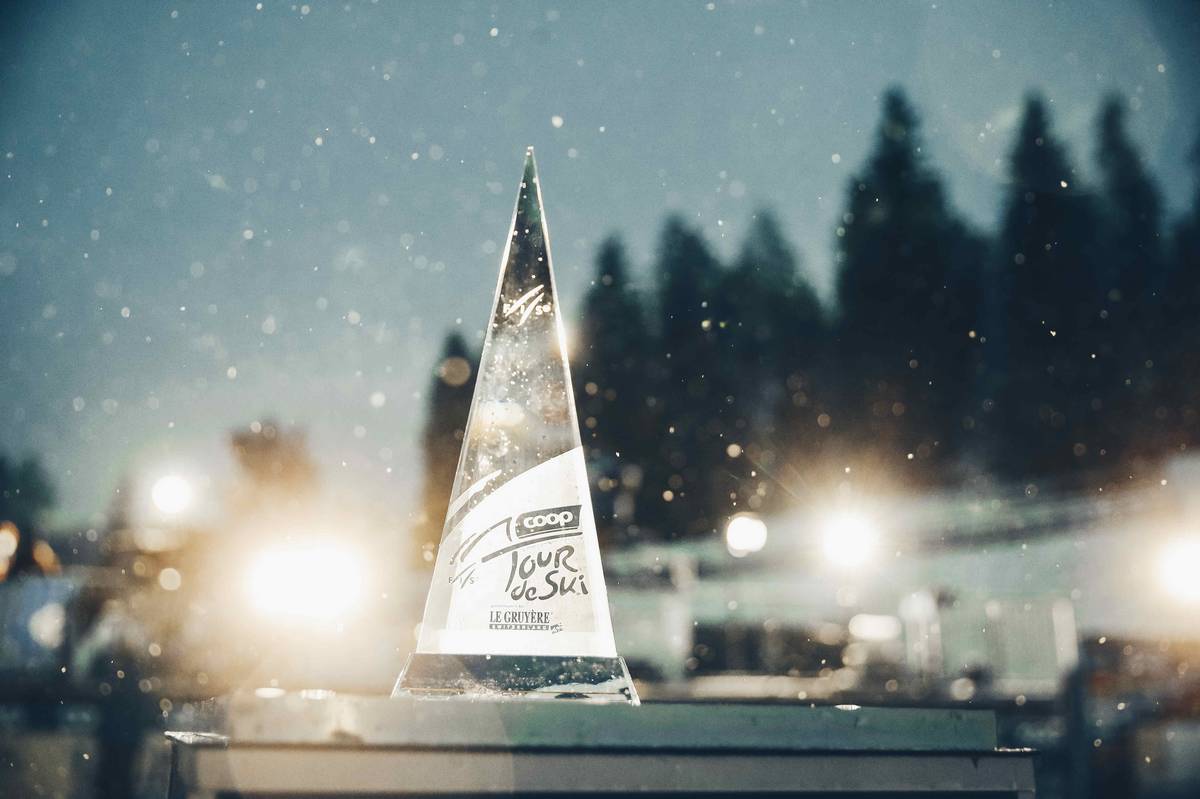
In addition to plenty of cheese, the 2021/22 Tour de Ski winners will take home this coveted trophy. (Photo: NordicFocus)
This World Cup coverage is made possible through the generous support of Marty and Kathy Hall and the A Hall Mark of Excellence Award. To learn more about A Hall Mark of Excellence Award or to learn how you can support FasterSkier’s coverage please contact info@fasterskier.com.
Returning to the kick and glide after a long hiatus, the second stage of the 2021/22 Tour de Ski featured a 10 k classic individual start for the women. With the exception of those who raced the classic legs of the relay in Lillehammer on December 5th, the last classic race was over a month ago, taking place at the season opener in Ruka. To keep things interesting, for the athletes, for the technicians and for the viewers, the temperature in Lenzerheide, Switzerland hovered around 34°F and snow fell heavily. Wax and ski preparation is always incredibly important but not always as evident as it was today as the women completed the 10 kilometer course.
After all 81 skiers had crossed the finish line, it was Kerttu Niskanen of Finland who stood at the top of the podium, having completed the course in 27:04.0.
Kerttu Niskanen celebrates a snowy victory in Stage 2 of the Tour de Ski. (Photo: NordicFocus)
To rewind, with Therese Johaug not taking part in the Tour, it is fair to say that Frida Karlsson of Sweden was a strong favorite to win this race. Karlsson has finished on the podium in all four distance events of the season so far, taking first place in the only classic distance event of the season up to this point in Ruka. With her main rival not in competition, Karlsson might have been hoping to ski away with another title.
Frida Karlsson (SWE) on course in Lenzerheide during a snowy 10k interval start classic. (Photo: NordicFocus)
From the start, it was clear that Ebba Andersson (SWE) wasn’t going to make things easy for her teammate. Andersson, who started in bib 29- one place ahead of Karlsson in bib 30, shot out of the gate with a tempo and ferocity that conveyed she meant business. At the 2.4 k checkpoint, there was an opportunity for bonus points in the Tour standings, and Andersson took the lead out of the first 29 starters, only to be quickly bettered by Karlsson by 0.9 seconds.
However, Karlsson’s advantage would not last and already at the 3.7k mark, she was +5.2 seconds behind Andersson. From there, the gap continued to widen. At 5.8 k Andersson was +13.7 seconds ahead of Karlsson, at 7.4 k she was +21.8 ahead and when both Swedes had crossed the finish, Andersson had put 26.4 seconds on Karlsson.
Ebba Andersson (SWE) races through falling flakes during the women’s individual start 10k classic in Lenzerheide. (Photo: NordicFocus)
At this point, it appeared that the day’s victor had been decided. But, as the snowflakes lessened and grew smaller, another contender was showing herself out on the course.
Niskanen (FIN) started in bib 50 and was clearly skiing well. As was Natalia Nepryaeva of Russia in bib 54. Nepryaeva was the second fastest through 2.4 k, slotting between Karlsson and Andersson. Niskanen was +7.8 down to Karlsson at that point in fourth position. Moving forward to 3.7k, Niskanen skied up to third, +5.2 to Andersson, while Nepryaeva had dropped to +8.5. Through 5.8k, Niskanen had overtaken Karlsson’s time and was sitting in second, just +4.8 behind Andersson. Between 7.4 and 8.7k, the Finn turned on the burners, gaining 12.6 seconds on Andersson over that distance. Accompanied by the excited shouts of her coach, Niskanen took the lead and continued to grow the margin. When she crossed the finish line she was +18.2 seconds ahead of Andersson and +44.6 ahead of Karlsson.
Kerttu Niskanen on her way to win the women’s 10k individual start classic in Lenzerheide. (Photo: NordicFocus)
Nepryeava (RUS), who dropped to fifth place at 7.4 k (+24 to Andersson) and was 4th (+32.9 to Niskanen) at 8.7k, gained significant ground over the final 1.3 kilometers. Between the 8.7 and 10k mark, she overtook Krista Pärmäkoski (FIN) to finish on the podium in third, +30.5 behind Niskanen.
The women’s podium for a snowy 10k individual start classic in Lenzerheide. Kerttu Niskanen (FIN) took the win ahead of Ebba Andersson (SWE) and Yulia Stupak (RUS). (Photo: NordicFocus)
This win was Niskanen’s third victory, having more than 230 World Cup starts. All three have come in 10k classic events, two taking place in Lenzerheide (today’s race being one, the other in 2014 when she won the stage).
“Today was a really good day,” Niskanen told FIS after the race. “I felt good and my skis were working well. I usually enjoy high altitude so today was good.” In response to a question about the conditions she said, “we have really good waxing men, they have done really good work yesterday and today.”
Diggins pushes through the final meters to finish 16th in Lenzerheide. (Photo: NordicFocus)
Jessie Diggins was the first finisher for the American contingent in 16th position (+1:07.9). Whether it was the four rounds of sprinting yesterday, the skis and conditions today, or some combination of both, Diggins appeared to be lacking in her usual pep, though she fought hard to the line, as always.
In a post-race interview with U.S. Ski & Snowboard cross country communications manager, Tom Horrocks, Diggins talked about how the team handled trying conditions with down to the wire work by the techs to select the best skis for the day.
“Everyone stayed really calm and collected, on a day when it would have been easy to panic and waste a ton of energy,” Diggins explained. “Really zoning in on process goals has always been [important] for me, and days like this, it’s really clear why that is so important.”
Diggins also provided into her pacing in today’s stage, and how her ability to adapt to the variable conditions and kick by jumping out of the track, running, or double poling are a testament to her progress in classic skiing, as she feels she may have been unable to adapt as seamlessly even four years ago.
Full audio interview with Jessie Diggins hosted by Tom Horrocks.
Hailey Swirbul was the next American, finishing 18th (+1:13.5), to match her bib number.
“I think today was a day that benefitted smooth, strong, steady skiing,” wrote Swirbul after the race. “I tried to stay calm out there and ski into it the best I could. Definitely a challenging course! I honestly didn’t have the greatest feelings in my body today, but I’ve learned that racing isn’t about feeling good… it’s about skiing your best and using your strengths even when it doesn’t feel good or rewarding. I think our skis were right in the mix on a day with tricky conditions, so that was awesome!”
Commenting on the team more broadly, Swirbul spoke to the perseverance of the American women in light of the variable conditions.
“Everyone worked really hard and persevered through a mentally and physically challenging day, and that’s something to be proud of!”
Hailey Swirbul races to 18th in Stage 2 of the Tour de Ski, a 10km interval start classic. (Photo: NordicFocus)
Novie McCabe was just outside the top thirty, in 34th position with a time of 28:50.6 (+1:46.6), followed closely by teammate Katharine Ogden in 35th (+1:47.4). Julia Kern finished 41st (28:58.3) and Sophia Laukli was 44th (+29:04.2). Rounding out the American finishers was Alayna Sonnesyn in 66th position (+3:14.1).
Post-race interview with Matt Whitcomb, from U.S. Ski & Snowboard cross country communications manager Tom Horrocks, discussing the men’s and women’s day in Lenzerheide.
Novie McCabe skis to 34th in Stage 2 of the Tour de Ski. (Photo: NordicFocus)
Niskanen (FIN) now leads the overall Tour standings, with Diggins holding on to second +0:29 seconds back. Nepryeava (RUS) has moved into third, +0:35 behind Niskanen. The athletes get a break tomorrow before racing picks up again on Friday in Oberstdorf, Germany with a 10k mass start skate.
Spectators line the course in Lenzerheide, Switzerland for the first stop of this year’s Tour de Ski. (Photo: NordicFocus)
This World Cup coverage is made possible through the generous support of Marty and Kathy Hall and the A Hall Mark of Excellence Award. To learn more about A Hall Mark of Excellence Award or to learn how you can support FasterSkier’s coverage please contact info@fasterskier.com.
The 16th edition of the Tour de Ski kicked off today in Lenzerheide, Switzerland, beginning with a two-lap 1.5-kilometer skate sprint. In past years, the Tour has been a longer event with eight or more stage races. This year’s edition however, has six stages taking place over the course of eight days, to accommodate preparations for the upcoming Olympics in Beijing.
As a reminder to readers who may have forgotten over the course of the past twelve months, Jessie Diggins claimed the overall victory in last year’s Tour de Ski, making her the first non-European athlete (male or female) to achieve that title. After a convincing win in today’s first stage event, Diggins looks to be in contention for the overall win once more in 2022.
Jessie Diggins (USA) all smiles after finishing first in the 1.5 k skate sprint (Photo: NordicFocus)
The Tour last visited Lenzerheide in the 2019/20 season where Slovenian Anamarija Lampic earned her first World Cup victory, with Diggins finishing fourth. The sprint course is a 2 x 0.75k loop, with a climb out of the start, leading into a long downhill on the back stretch of the course, and a fast corner into the lap/finish lanes. Looking at the surrounding mountains and meadows, there seemed to be little snow and the temperature hovered around freezing as the sprint rounds began.
With three American women in the top thirty in qualification, the first quarter-final heat featured two of them, Jessie Diggins, who qualified 3rd with a time of 3:03.4 and Hailey Swirbul who qualified in 27th (3:09.49). Also in the first heat was Nadine Fähndrich of Switzerland, who posted the fastest qualifying time of the day (3:02.54). Swirbul, Fähndrich and Diggins were quick off the line with Diggins gaining the lead over the crest of the hill. Heading down, Fähndrich used the draft to gain speed and draw even with Diggins. As they rounded the corner heading towards the lap Fähndrich lost her balance and fell, sliding wide and taking out Swirbul in the process.
Nadine Fähndrich (SUI) leads Hailey Swirbul (USA) in the first quarter-final, before a fall. (Photo: NordicFocus)
With two competitors down, Diggins held the lead for most of the second lap, using her freeskate to gain space on the descent though once again, she was overtaken as Anne Kjersti Kalvå of Norway slingshot around Diggins and claimed first. Diggins finished second and both advanced to the semi-final rounds.
Hailey Swirbul (USA) racing in the quarter-finals (Photo: NordicFocus)
“I felt I raced my best today,” wrote Swirbul after the race. “I did not have the build up to the Tour that I had planned due to some unforeseen stresses, but that’s the way life goes sometimes. That won’t stop me from giving my best every day and leaving it all out there. I am really excited to hopefully build into the Tour this year and follow the strong skiing set by my teammates today! I thought our team skied really well overall, and our service team and medical/nutrition staff were top notch.”
Reflecting on her quarter-final, Swirbul wrote, “I had a surprisingly good start for myself and found myself in a good position early on. I tried to stay on the leaders the best I could but flew into the side-boards at the bottom of that first downhill… ouch! I’m glad to be okay, just a bit scraped and bruised. Looking forward to tomorrow.”
The second quarter-final heat saw an easy pace and a tight pack with Mathilde Myhrvold (NOR) and Johanna Hagström coming through as the fastest two.
In heat three, the Czech skier Katerina Janatova led most of the two laps, only to be passed by Anna Dyvik (SWE) and Tiril Udnes Weng (NOR) on the descent. Entering the finish lanes, Natalia Nepryeava of Russia turned on the pace and passed Dyvik to finish 2nd, though the Swede advanced to the semis as well given the fast time of the heat.
Katerina Janatova (CZE), Anna Dyvik (SWE) and Natalia Nepryaeva (RUS), (l-r) in quarterfinal number three. (Photo: NordicFocus)
In heat four, Laurien Van Der Graaff of Switzerland, a crowd favorite, followed a similar tactic to that of Janatova from the previous heat. Once again, this proved not to be the best strategy as Lampic (SLO) used the draft to pass Van Der Graaff on the final corner and easily take the win. Laura Gimmler of Germany came from behind and out-lunged Van Der Graaff to take the second qualifying position.
The final quarter-final heat featured the third American, Julia Kern who qualified in 9th position with a time of 3:05.24. This heat only had five racers as Eva Urec of Slovenia, who qualified in 16th, did not start the rounds. Moa Lundgren of Sweden led the first lap while Kern sat in fourth. As they headed through the lap, Kern made a move to the front and crested the hill in the lead. Despite a slight loss of balance on the corner, Kern was able to break the pattern from the previous four heats and became the first person to lead on the final downhill and hold onto that lead all the way to the finish line. Coletta Rydzek of Germany finished second behind Kern and Kerttu Niskanen of Finland earned the final lucky loser spot.
Julia Kern (USA) follows Coletta Rydzek (GER), (l-r) in the semi-final rounds. (Photo: NordicFocus)
As the men raced their quarter-final rounds, course conditions appeared to be getting faster and it got cloudier and the temperature dropped. When the women returned for the semi-final heats, Diggins was once again in the first heat. This time she stayed in the pack, near the back for the entire first loop. Taking a wide lane through the lap she gained the lead and created a gap to the rest of the field over the hill. With the pack strung out behind her Diggins held her lead and finished first, with Myhrvold of Norway taking second.
Tiril Udnes Weng (NOR) navigates a corner with Mathilde Myhrvold (NOR) on the outside (Photo: NordicFocus)
In semi-final number two, Lampic (SLO) had an early lead while Kern followed in second. Rounding the corner for the first time, Kern overtook the Slovenian and upped the pace. These two held off other challenges to secure first and second qualifying positions and thanks to the fast time of their heat, Rydzek (GER) and Dyvik (SWE) also came through as lucky losers.
Thus, the final featured two Americans (Diggins and Kern), one Slovenian (Lampic), one Norwegian (Myhrvold), one Swede (Dyvik), and a German (Rydzek). Out of the start gate the pace was conservative, nobody really wanting to be the leader on the first descent. Heading into the second and final loop, Diggins found space through the middle of the pack while Kern worked wide, both Americans coming to the fore. Up the hill, Lampic worked her way into second, Kern in third with Myhrvold (NOR) close behind. Diggins held the lead, taking a good corner and fending off a challenge from Myhrvold at the last minute.
Jessie Diggins (USA) pushing hard towards the finish with Myhrvold (NOR) to her right (Photo: NordicFocus)
With first place going to Diggins, the twenty-three year old Myhrvold earned her first World Cup podium in second place. Lampic out-sprinted Kern to finish third, with Kern coming in fourth. Dyvik (SWE) came in 5th and Rydzek (GER) finished 6th, her best World Cup finish to date.
Coletta Rydzek (GER) finished sixth, her first time making a sprint final. (Photo: NordicFocus)
“The rounds today were definitely tactical,” wrote Kern after the race, “but also rewarded just skiing hard. The track got faster as the day went on after some light precipitation before the qualifier, which glazed the track a bit as the temps got warmer. There was definitely a draft on the downhill, but skating really hard into the downhill and being in the front position was the most important, which made the tactics a bit tricky with both leading and following. I felt strong all day, my skis were ripping fast, and body was feeling good!”
Kern sat out in Davos due to a stomach bug and she wrote, “Dresden allowed me to rebuild that momentum that I was feeling after Lillehammer. After the Dresden weekend, I didn’t even want a break, I just wanted to keep rolling so I was very much looking forward to today.”
Anticipating tomorrow’s 10 k classic she wrote, “I am really excited to finally get to classic ski again after eight skate races in a row. I haven’t done a classic race since the opener in Ruka so I am curious to see how my classic skiing is coming along, and also how my fitness carries over to some distance racing after a few weeks off from distance racing as well. Overall, the team energy is great, we have an awesome support staff and I am excited for more races to come!’
Diggins, whose parents and sister were at the venue in Lenzerheide, was all smiles after the race. “Thanks to my family for the cheering,” she said in a post-race FIS interview, “I’m just in a really happy place, and for me happiness is fast.” When asked about her preparation for the next few days of racing she said she plans to “eat a lot, sleep a lot, and see how it goes.”
Here are some additional post-race comments from Diggins and Kern, interviewed by Tom Horrocks, U.S. Ski & Snowboard Cross Country communications manager, who will be on-site through the Tour.
The Tour continues tomorrow with a 10 k classic on tap for the women. Diggins currently holds the lead ahead of Myhrvold (NOR) by +0:05 seconds.
Novie McCabe (USA) racing to 46th in her first Tour de Ski competition (Photo: NordicFocus)
Also competing in the Tour for the Americans is Novie McCabe, who finished 46th (3:12.89), and Katharine Ogden who was 55th (3:14.74). SuperTour leader who recently joined the American squad in Europe, Alayna Sonnesyn skied to 58th (3:15.11), with Sophia Laukli rounding out the American women in 76th (3:20.43). There are no Canadian women taking part in this year’s TdS.
Post-race interview with Matt Whitcomb on the course in Lenzerheide, which has suited Americans well over the years, along with additional comments on the men’s and women’s races.
Sophia Laukli (USA) finished 76th in her first TdS event (Photo: NordicFocus)