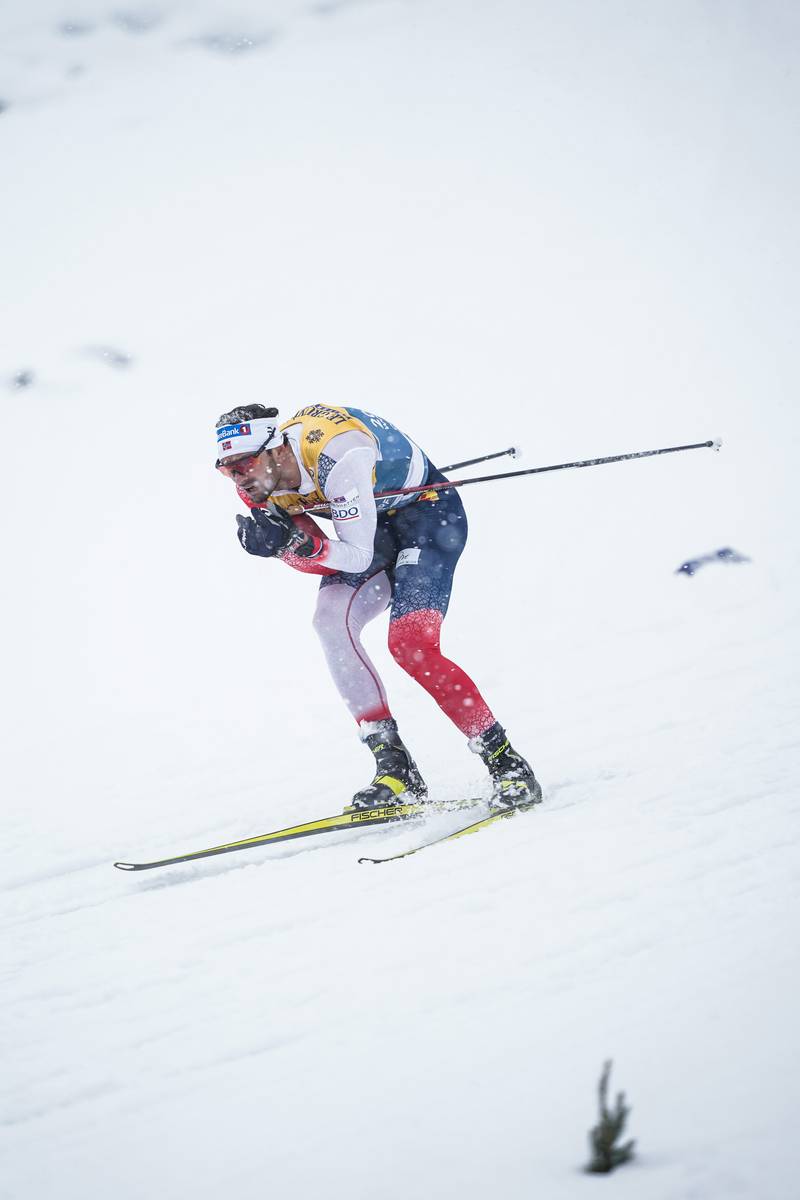
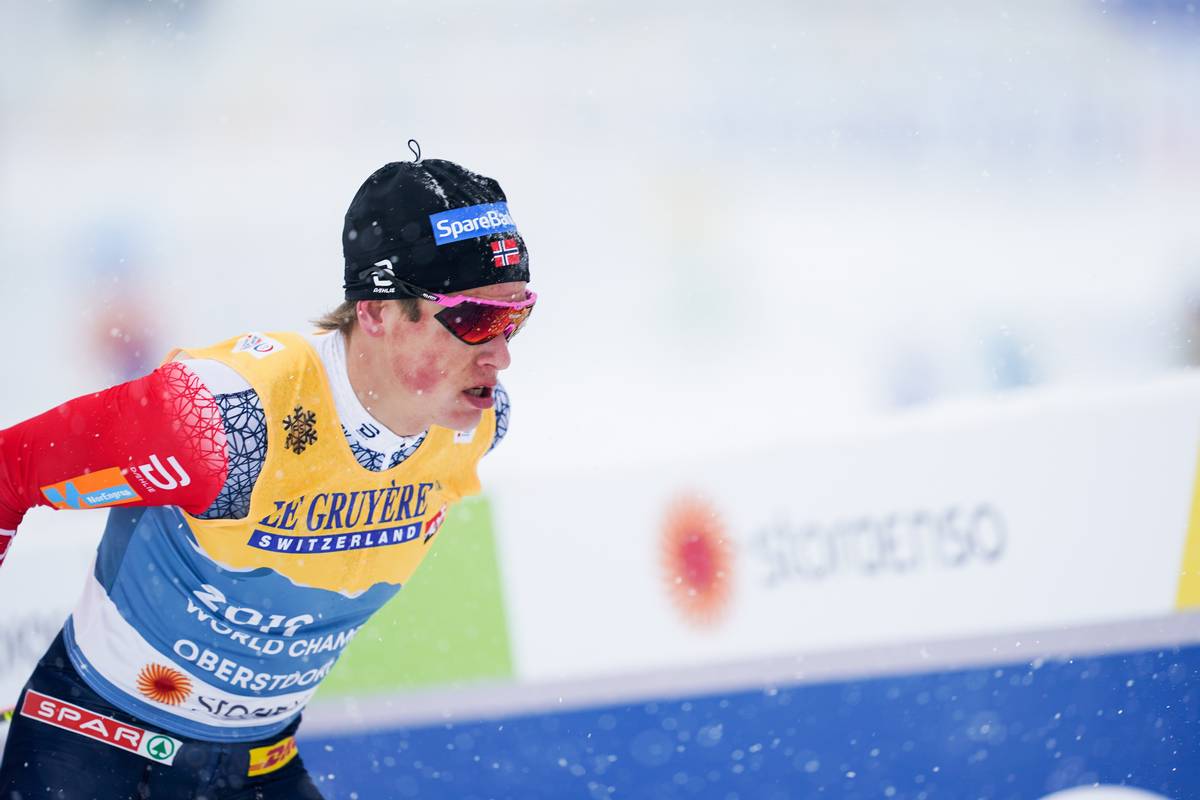
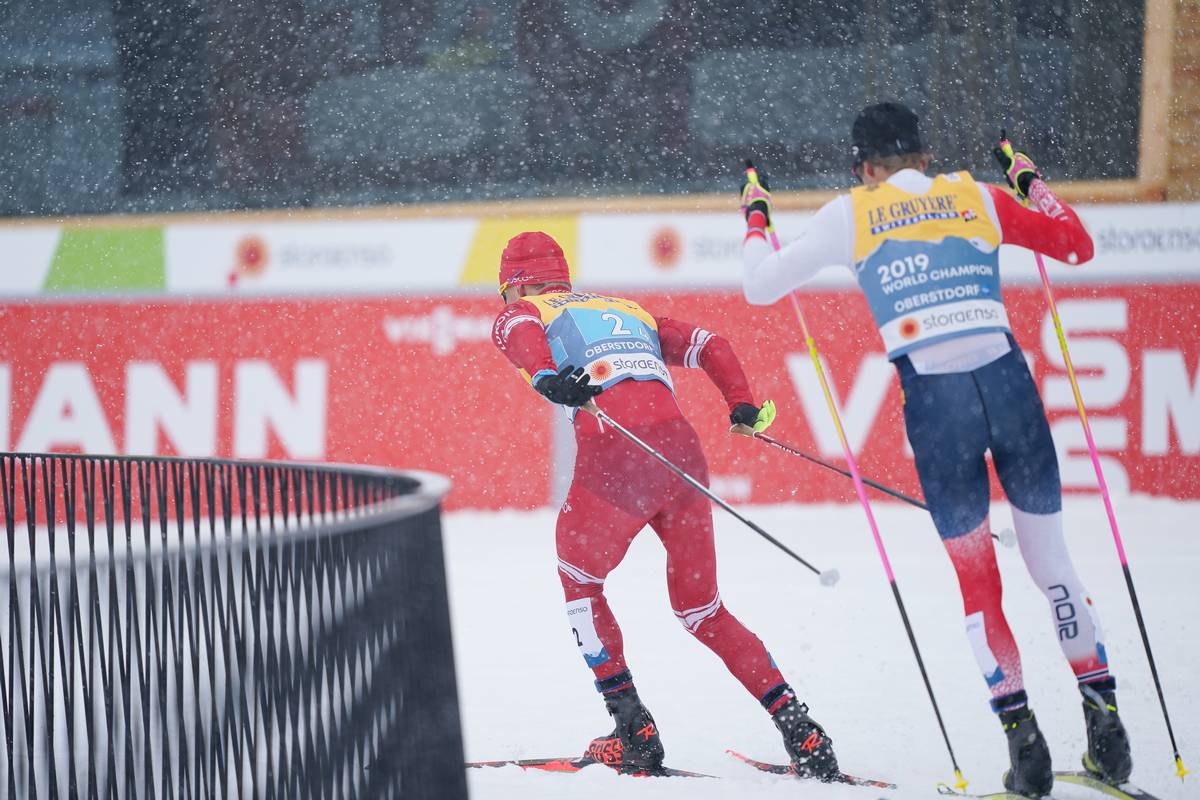
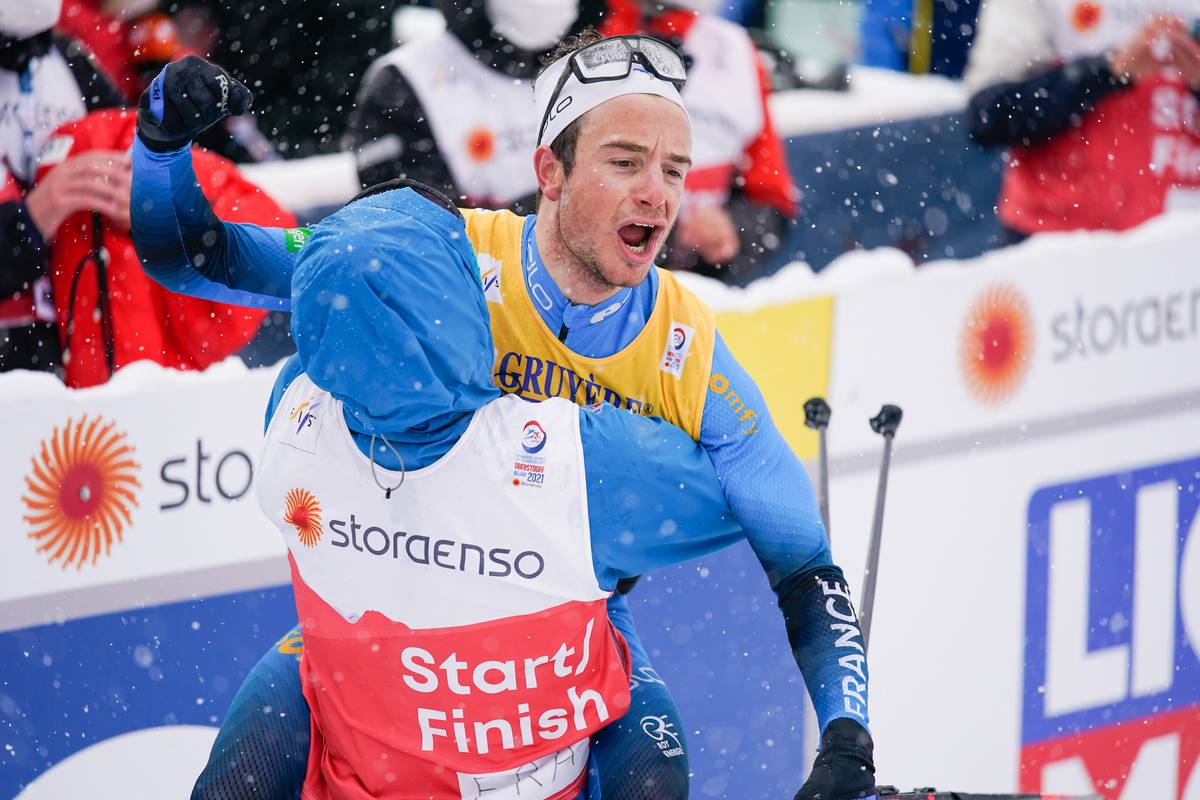
Tag: 2021 Oberstdorf World Championships

  • Johaug Runs Away With Gold in the 30-kilometer Classic; Maubet Bjornsen 15th in Final Professional Race

    Johaug Runs Away With Gold in the 30-kilometer Classic; Maubet Bjornsen 15th in Final Professional Race

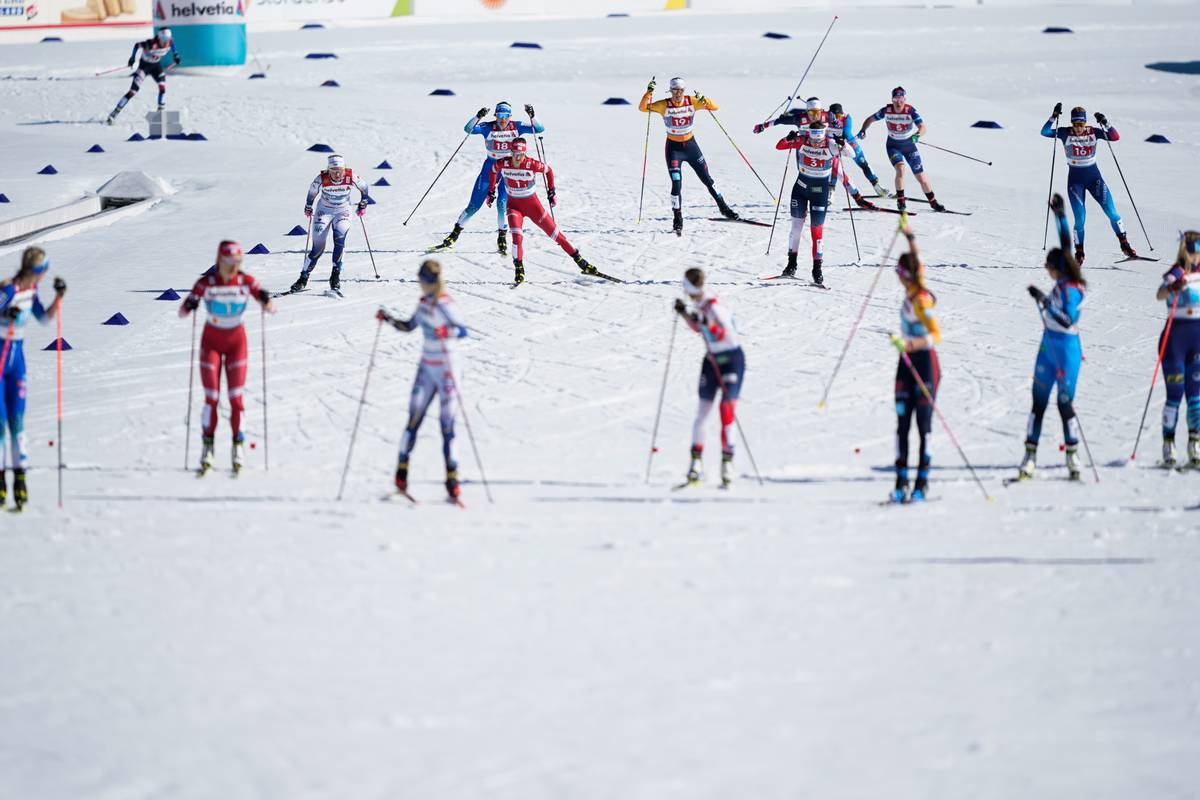
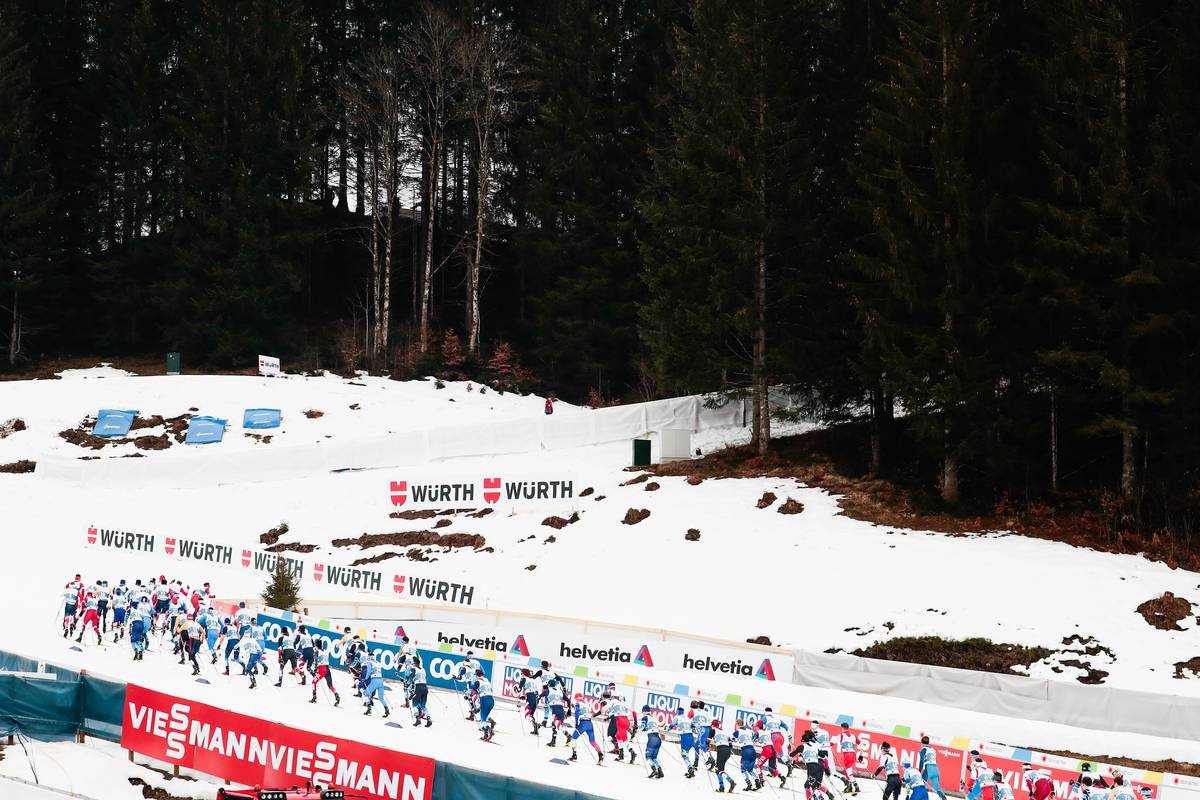
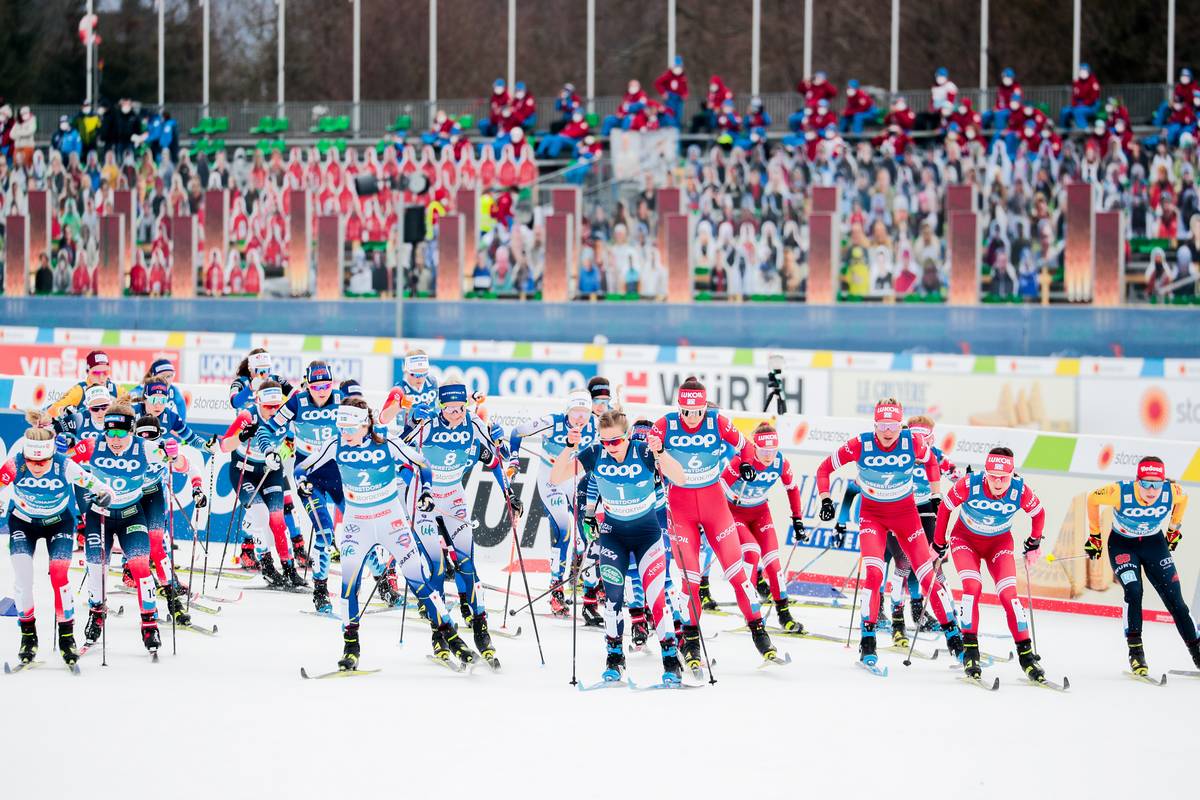
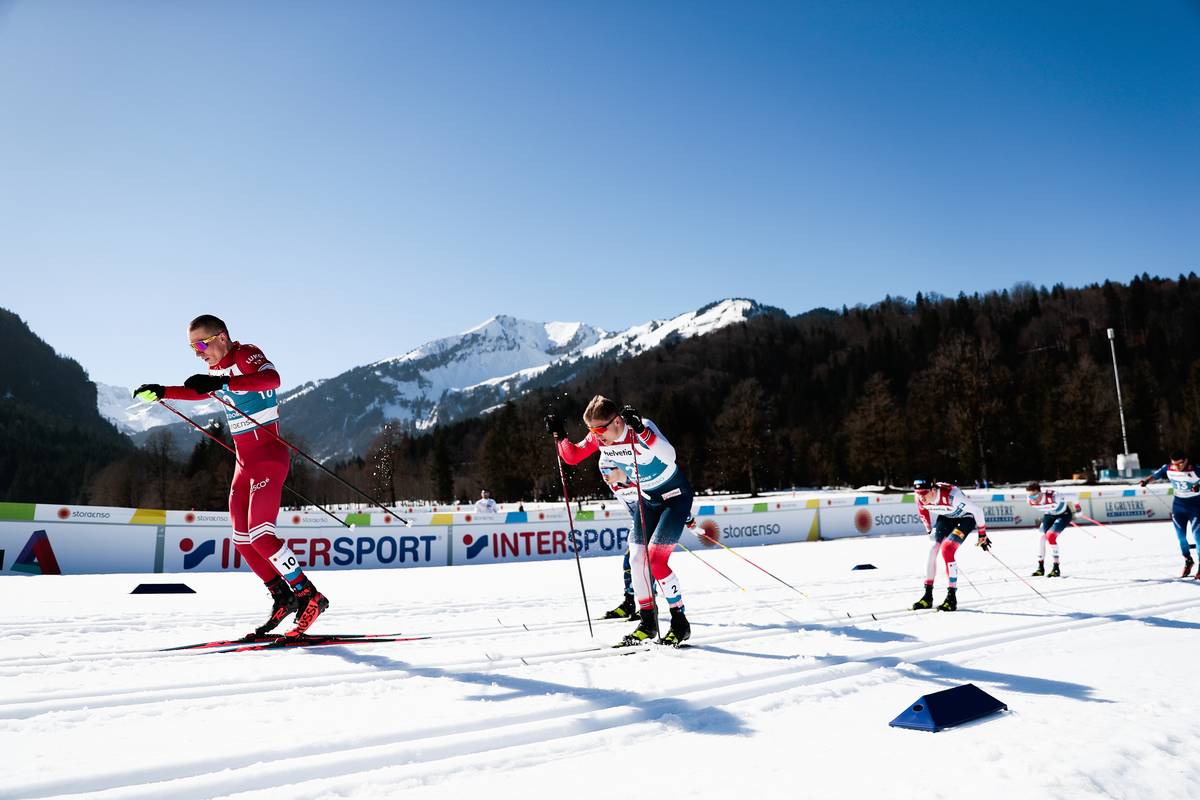
    A clear day after Friday’s snowstorm greeted the start of the women’s 30 k classic in Oberstdorf. (Photo: NordicFocus)

    This World Championship coverage is made possible through the generous support of Marty and Kathy Hall and their A Hall Mark of Excellence Award. To learn more about A Hall Mark of Excellence Award or to learn how you can support FasterSkier’s coverage please contact info@fasterskier.com.

    A blanket of fresh snow lay on the ground while the frozen rocky peaks of the Bavarian Alps peaked through the clouds. Finally, Oberstdorf, Germany looked like a wintery venue. 

    With temperatures that might feel brisk relative to the tropical heatwave earlier in the week, the women’s field took to the tracks for their final event of the 2021 World Championships: a 30-kilometer mass start classic. 

    The women’s 30 k closes out racing for the women at the 2021 World Champs. (Photo: NordicFocus)

    To set the stage for today’s race, one should first look back to the 2019 World Championships, which featured a 30 k freestyle, and the 30 k classic at last year’s Holmenkollen in Oslo, the last World Cup race to take place before the season was truncated due to the rise of the COVID-19 pandemic. 

    Let’s glance at the World Champs in Seefeld, Austria, where Norway’s Therese Johaug led the field through the first 5 k, then pulled away. She gapped the field by more than 30 seconds, holding her ground on her own at the front for the remainder of the race. Her teammate Ingvild Flugstad Østberg led the chasers to take second place, followed by, what was at the time a new name, Sweden’s 19-year-old Frida Karlsson, earning a bronze medal in her inaugural World Championships. 

    Johaug’s performance at the Holmenkollen looked to be an attempt to repeat this style of victory. She was off the front at the 20 k mark, but had not taken the opportunity to switch her skis. Working together on fresh boards were Karlsson and teammate Ebba Andersson, who steadily closed the gap to Johaug. With less than 2 k to go, Karlsson could be seen from the same camera angle, gaining ground with every kick and glide.

    Inside the last kilometer, Karlsson overtook Johaug on a long climb. Despite the Norwegian’s best efforts, she could not match the speed of the Swede’s skis on the downhill and Karlsson broke away to win by just under 2 seconds. 

    So what would it be today? 

    Therese Johaug on course during the World Championshp 30 k classic in Oberstdorf, Germany. (Photo: NordicFocus)

    Johaug’s pace from the start seemed impossible to sustain for the full duration of the event. While other women looked steady and controlled, Johaug was simply charging, her rapid breathing matched by her tempo. 

    By 10 k, Johaug had a lead of over 53 seconds to the first chase group, led by her teammate Heidi Weng, Andersson of Sweden, and Katharina Hennig of Germany. At the halfway mark, this lead ballooned to over 1:32. Even if impeded by subpar skis, it looked to be an insurmountable margin. Spoiler alert: it was. This left a race for silver and gold in her wake. 
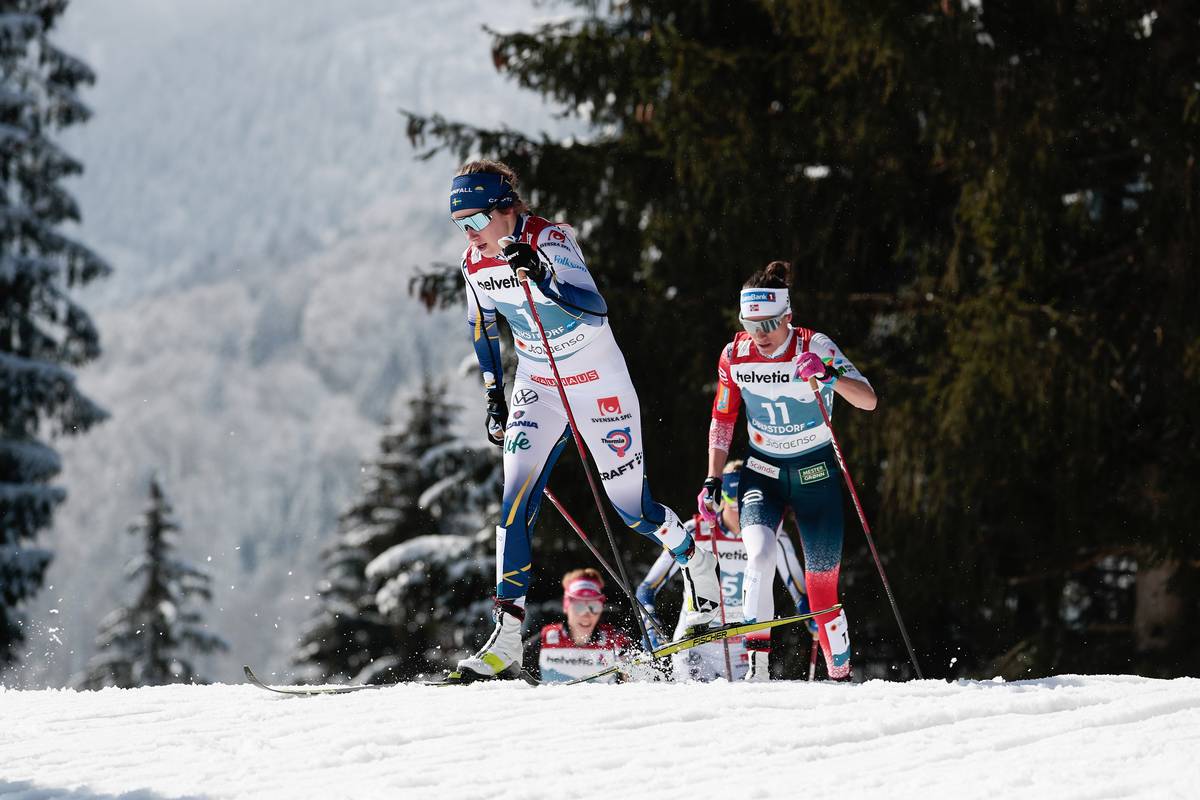
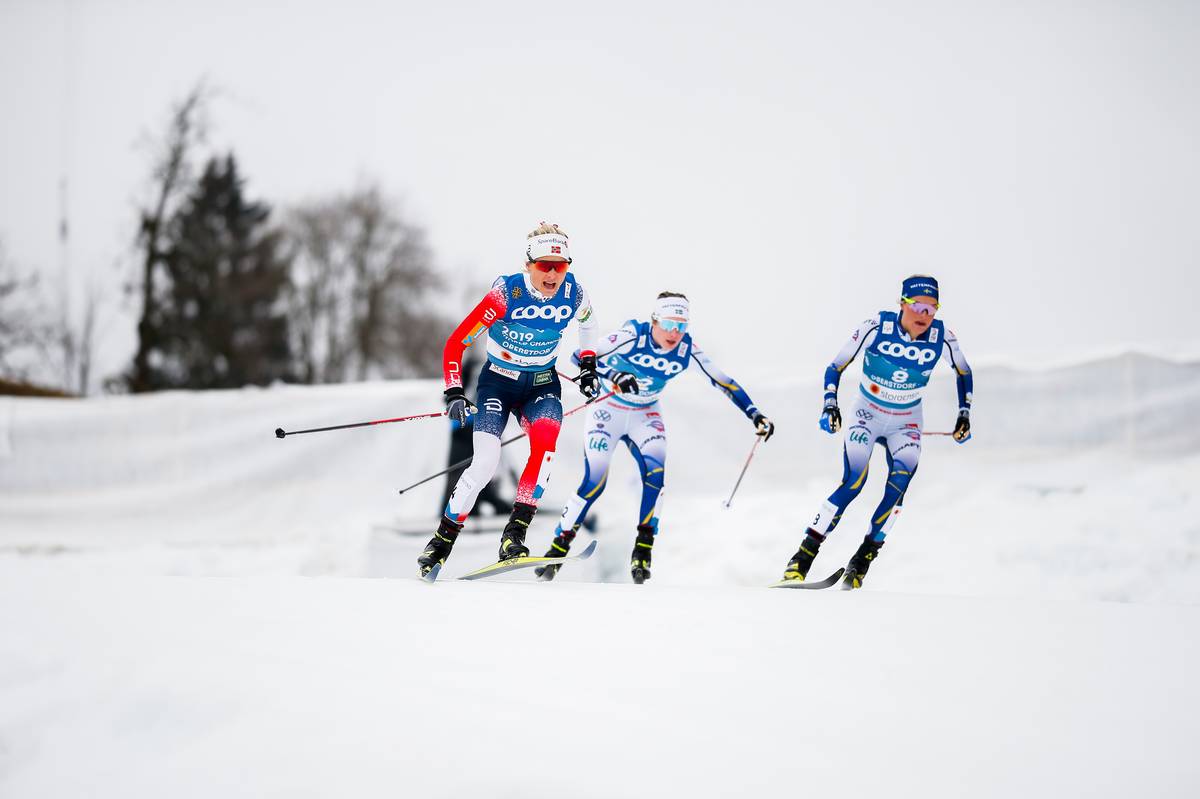
    Ebba Andersson, Heidi Weng, Frida Karlsson, and Therese Stadlober – the main chasers – play for second and third place as Johaug skis off the front. (Photo: NordicFocus)

    A pack of five women seemed to be pulling ahead of the larger chase group that had been together from the start. At 15k it was: Andersson, Karlsson, Weng, Hennig, and Therese Stadlober of Austria. 

    After a 15 second gap, Krista Pärmäkoski skied alone in an effort to gap up, leaving behind a second chase group that included Sadie Maubet Bjornsen in 8th, in what she announced would be the final race of her professional career. 

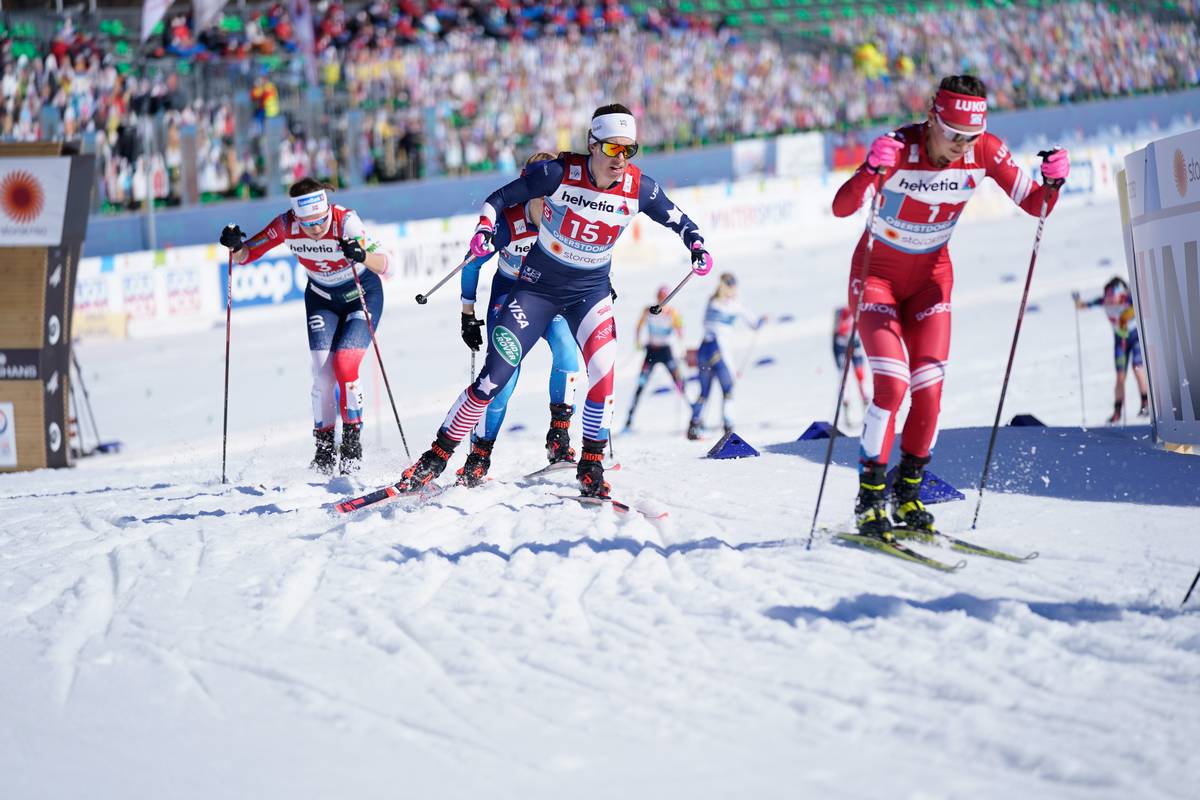
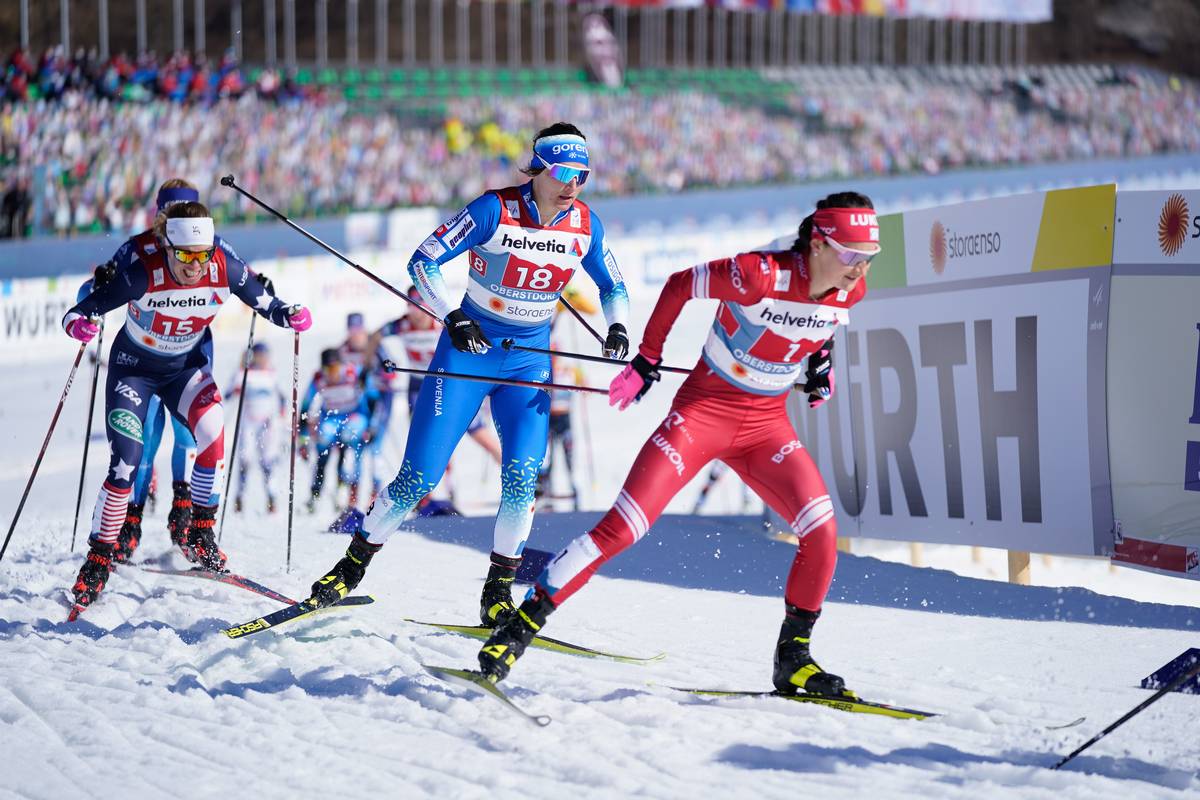
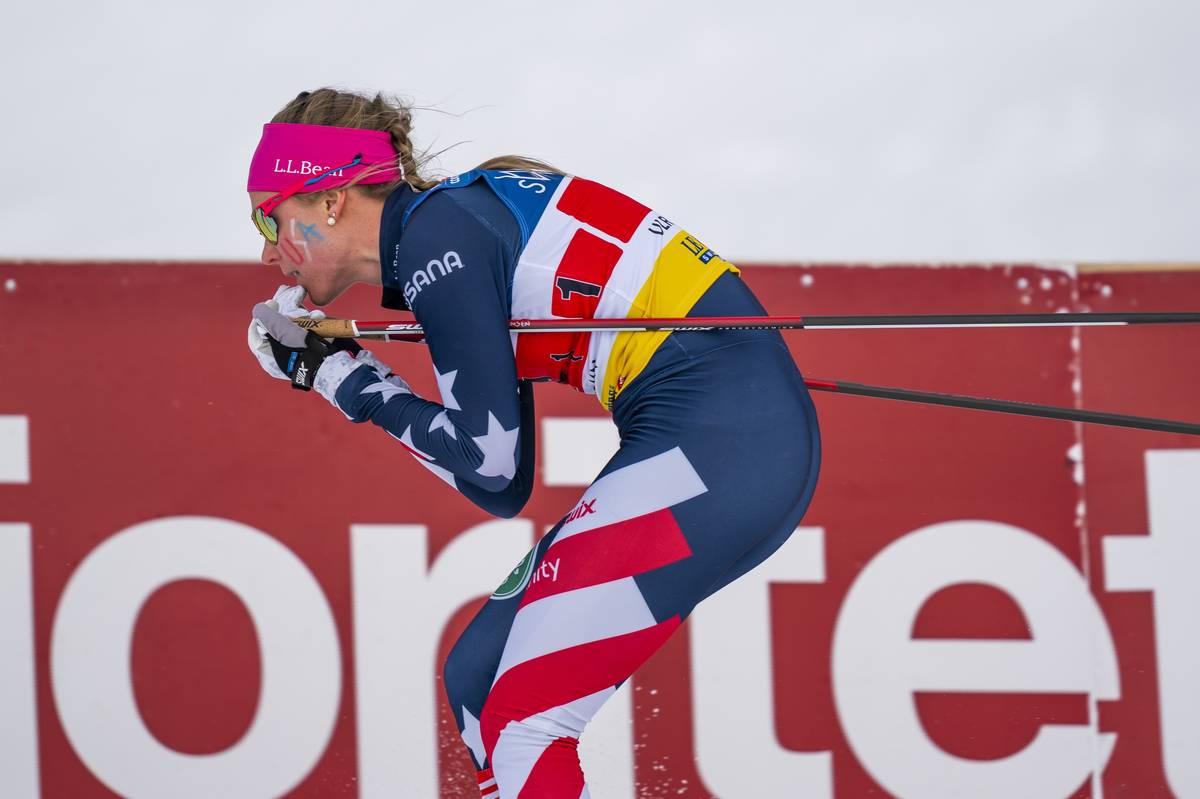
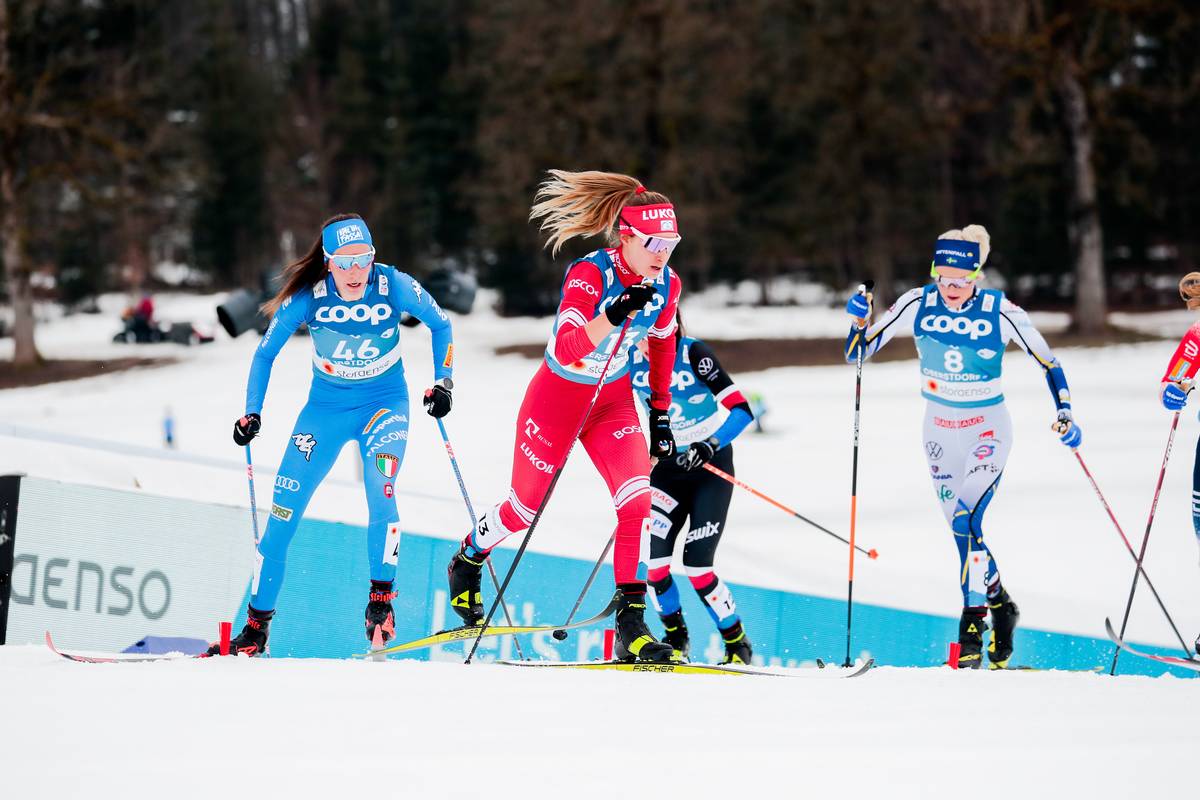
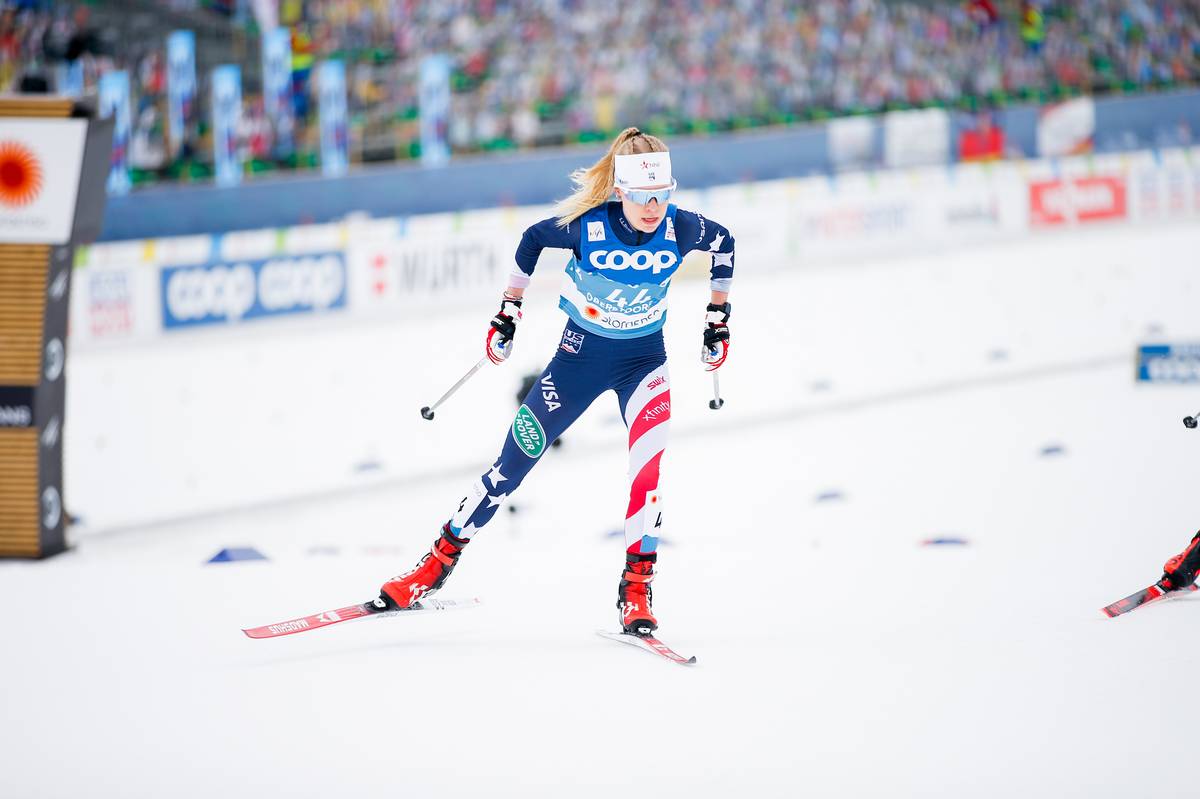
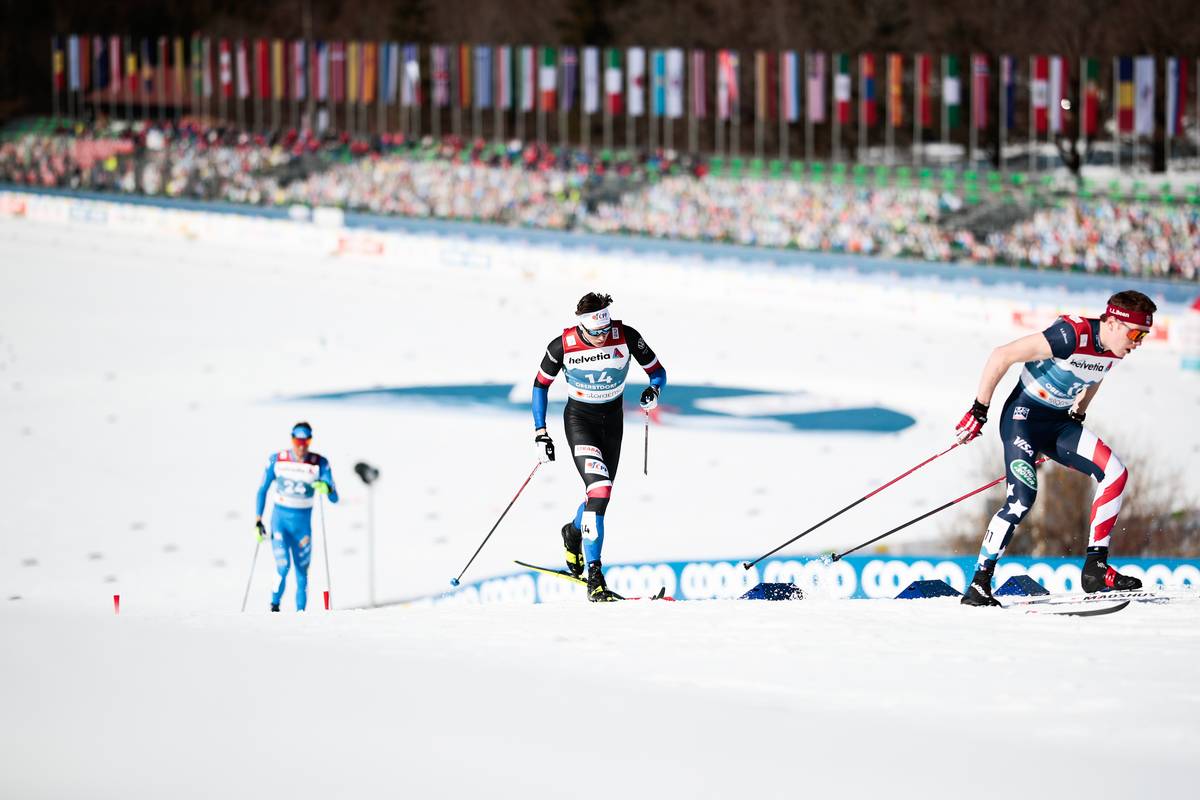
    Sadie Maubet Bjornsen (USA) alongside Yana Kirpichenko (RSF), (l-r) in the 30 k classic. The race closes out Maubet Bjornsen’s international race career. (Photo: NordicFocus)

    At 18k Johaug smoothly switched into new boards, while the first chase pack worked their way toward the stadium in the background. Johaug’s gap was approaching two minutes. 
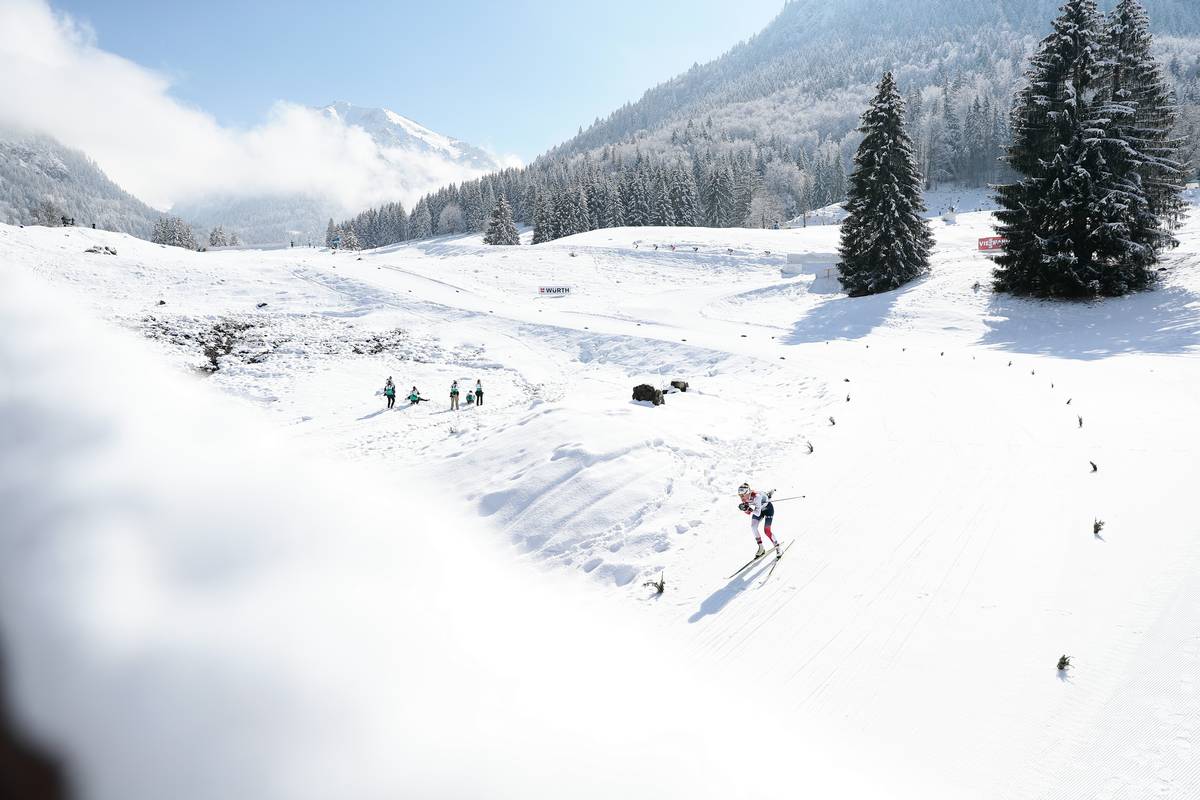
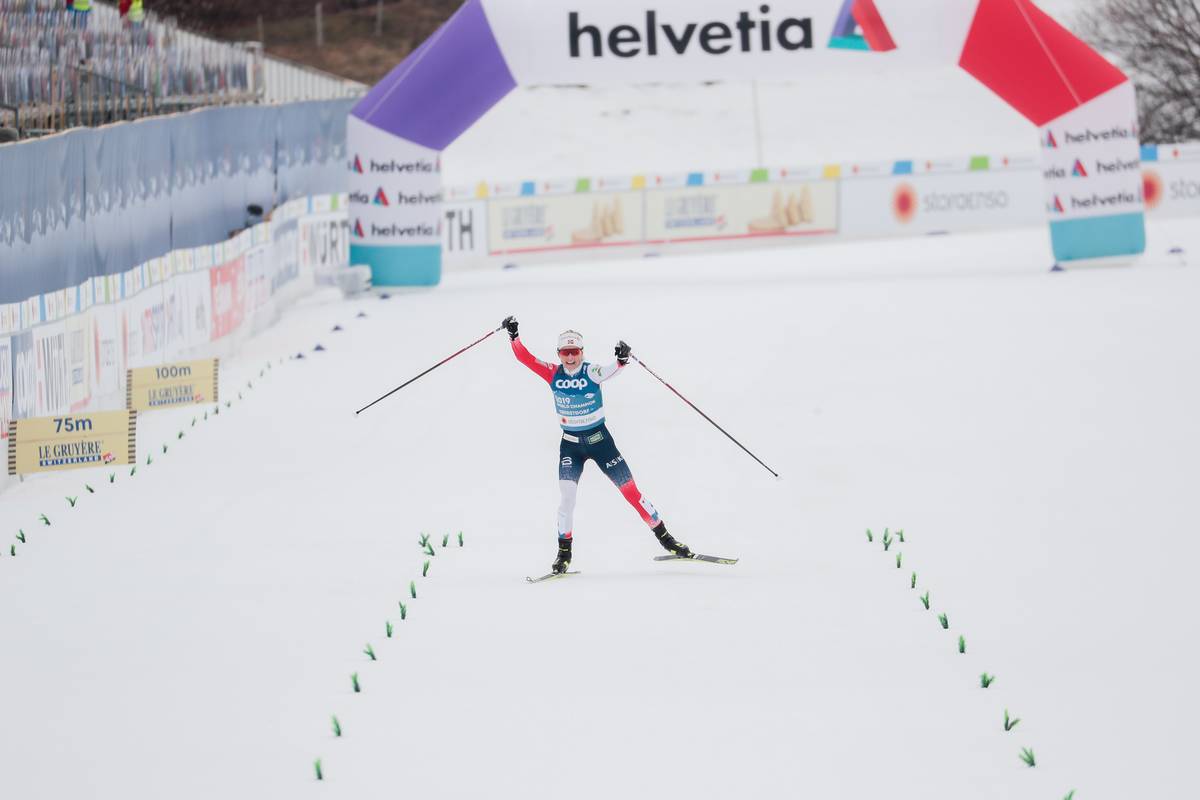
    A solo affair for the win: Therese Johuag of Norway during the 30 k classic. (Photo: NordicFocus)

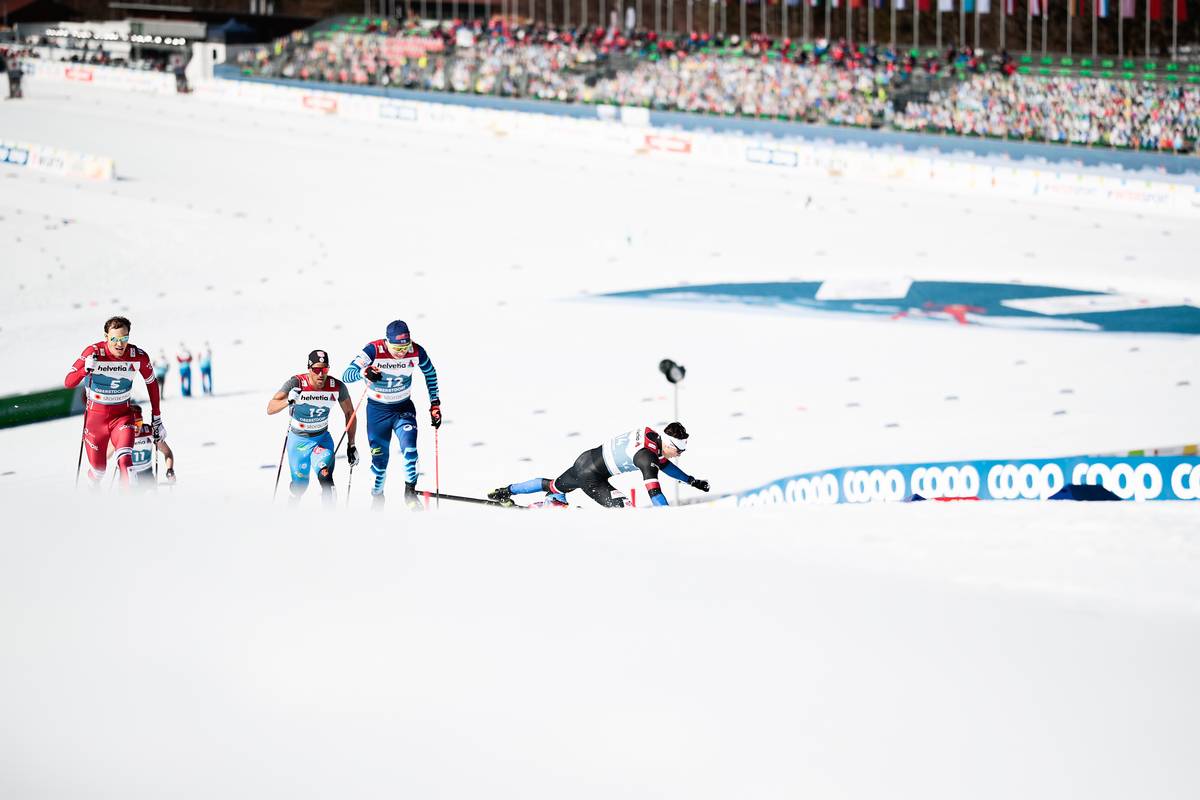
    Inside the final 10k, a few women led by Pärmäkoski, had gapped up to the first chase group. After a crash took out the three women at the front — Andersson, Karlsson, and Weng — Stadlober snuck around the right side, increasing her tempo to kick and glide away from the women now 16 seconds behind her in pursuit. 

    Striding and poling in sync, Karlsson, Andersson, and Weng looked determined to regain contact with the Austrian. As they departed the stadium in the sun with 6k to go, the threesome had achieved this goal. They strided away up tracks that looked to be eroding in the sun, heading into the woods where the course looked much different. As more crashes had already happened behind them on sugary sweeping downhills, the task ahead looked to be as much about staying upright as skiing fast. 
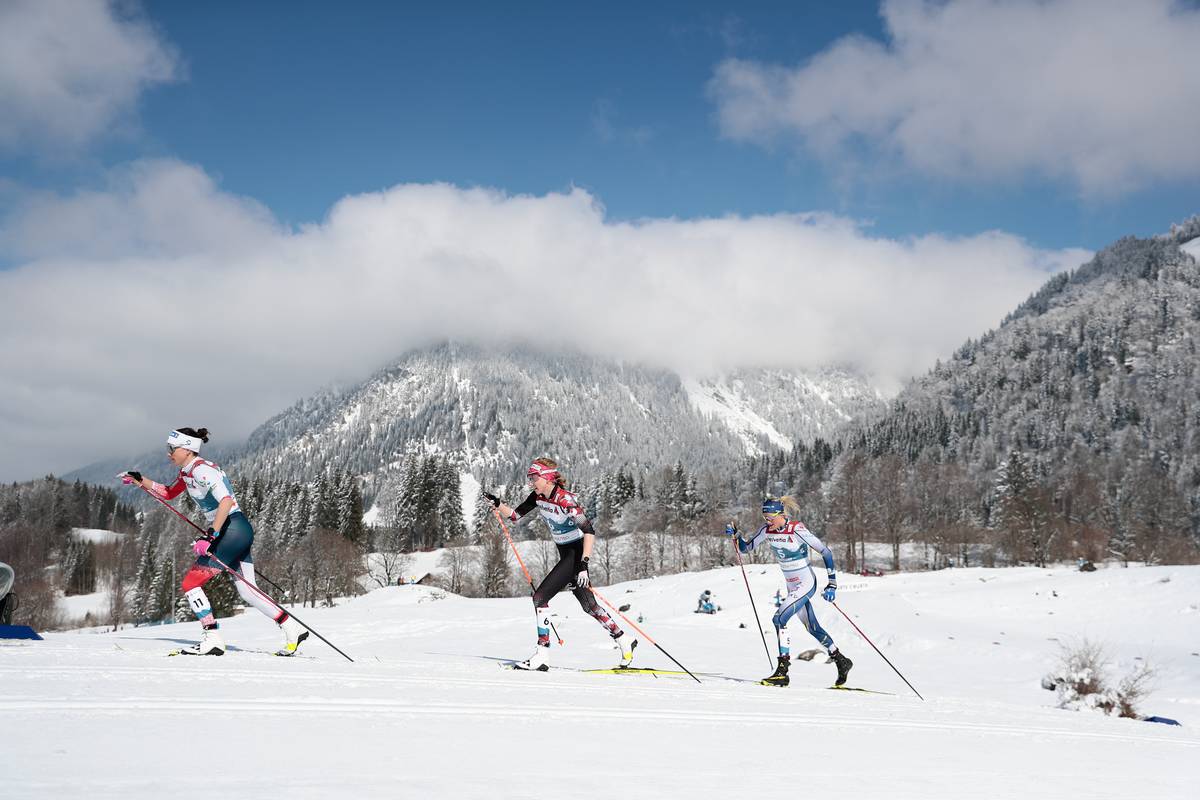
    Heidi Weng (NOR) leads Therese Stadlober (AUT) and Frida Karlsson (SWE) during the mass start 30 k classic. (Photo: NordicFocus)

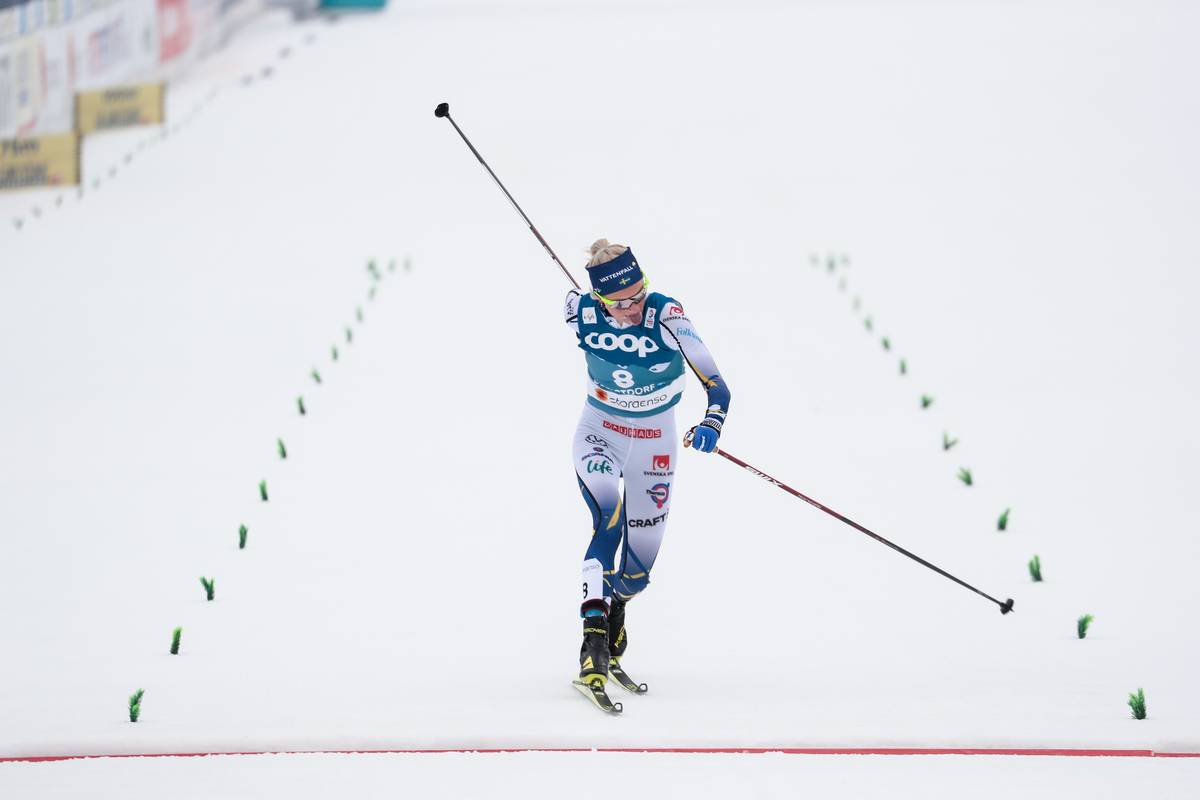
    Talking to a trailside coach on a climb with 2k to go, Johaug seemed to be basking in the confidence of her victory. Attacking through the final kilometer of the course nonetheless, Johaug alternated between a spicy double pole and throwing her arms up in celebration as she made her way down the finishing lanes to stop the clock in 1:24:56.3.
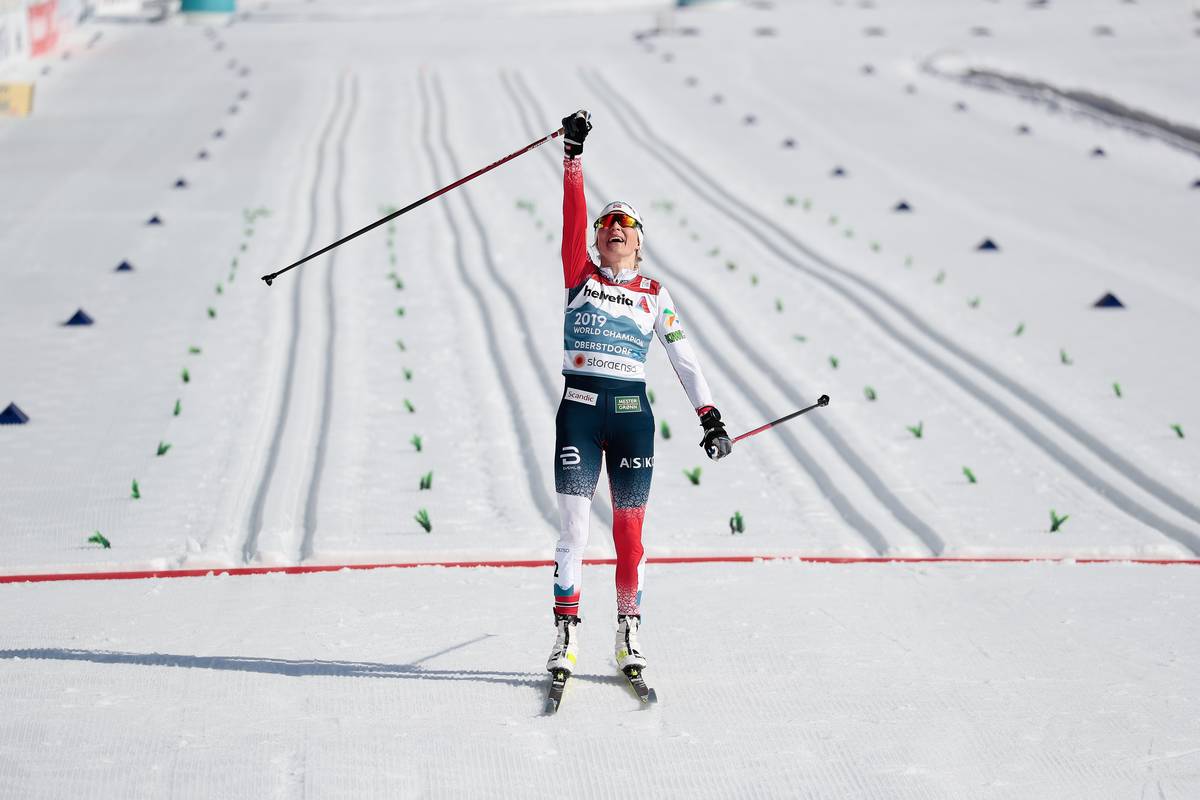
    Therese Johaug is a singular distance champ. (Photo: NordicFocus)

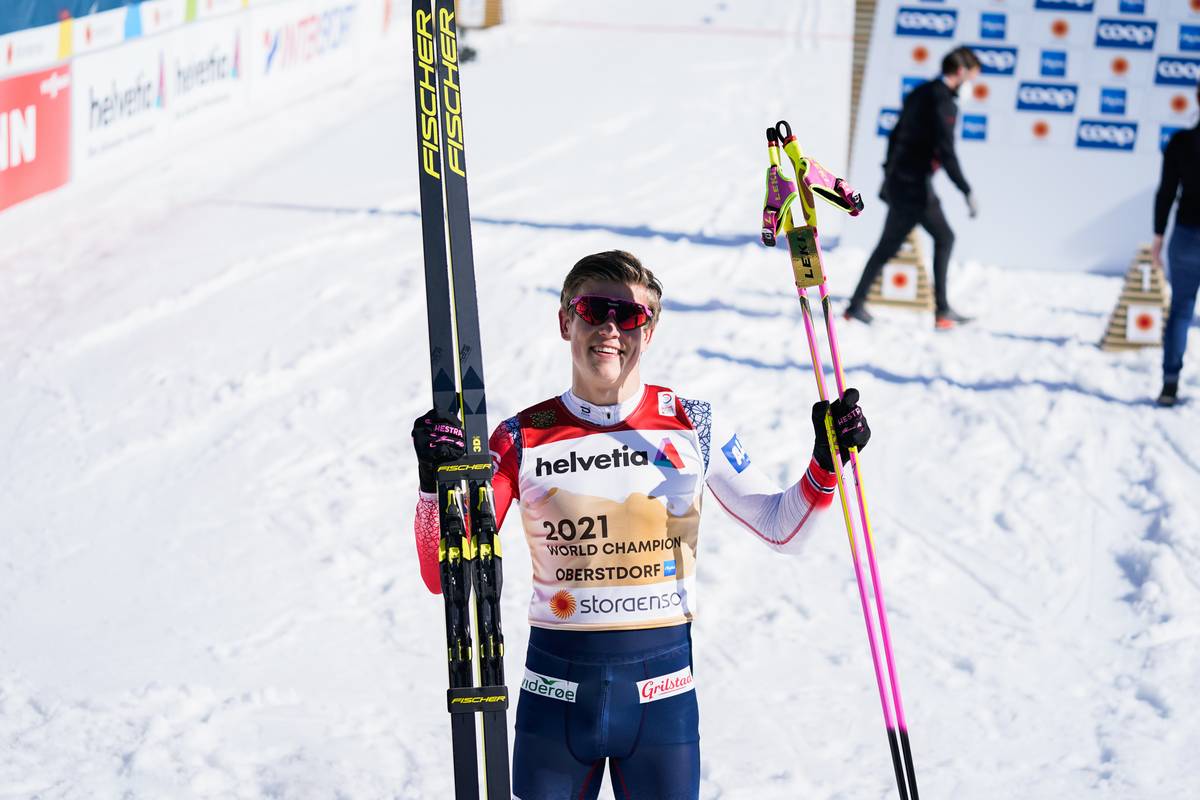
    Earning her 14th championship medal, ten of which are gold, Johaug has overtaken Norwegian ski legend Marit Bjørgen for the most World Championship medals. The first in her collection was a bronze in the 30k classic in Sapporo, Japan in 2007. Johaug struck out in 2009, but came into the 2011 World Championships on her home turf in Oslo ready to go, taking gold in the 30 k skate and relay, and bronze in the skiathlon. 

    Johaug is also the second woman to have won 30 k events in both freestyle and classic at the World Championship, following in the footsteps of Elena Välbe of Russia who retired after the Nagano Olympics in 1998. Johaug also joins Välbe and Bjørgen as the only women to have won successive 30 k events at a World Championships. 
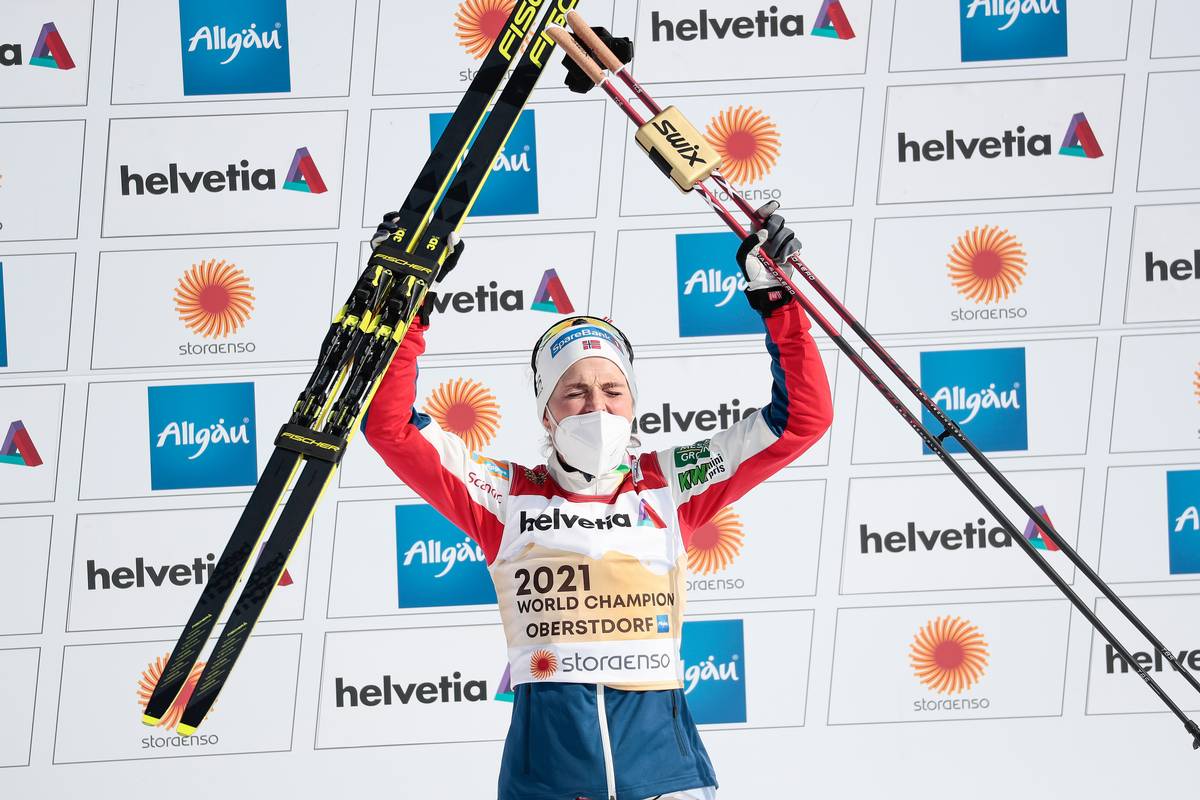
    Therese Johaug takes a fourth gold medal in the 30 k mass start classic. (Photo: NordicFocus)

    “It’s amazing, actually,” said of her string of four gold medal performances in Oberstdorf in a post-race interview with FIS. “I work so hard for it, training so much to reach my goals. To come here to Oberstdorf and fight for four gold medals, I have no words. I know so many girls train really hard to reach their goals, and I know that I have a lot of pressure on me when I come here. I was a favorite to win the distance, but you have to do it, and it takes a lot of focus to reach your goals.”

    The FIS interviewer called it the “era of Therese Johaug”, to which the Norwegian gave an emotional response, her voice breaking tearfully with her final statement. 

    “I never have been in such good shape. I am so happy. I’m 33 years and I know I’m getting older and older and I know that this time ends soon, so I am just so happy.”

    Sun, glory, and another championship distance win. (Photo: NordicFocus)

    In the closing kilometers of the race for silver and bronze, Weng, Andersson, and Karlsson began to drop Stadlober. Finding a new gear as she surged up the last steep climb, Weng rounded the hairpin turn in the lead and dropped into a tuck. 

    With just a sugary right hand curve out of the downhill to navigate before the final straightaway, Weng was shooting her shot. However, Karlsson’s skis and double pole were superior as they headed down the lanes, gaining her centimeters on Weng with each strike. 

    In the end, the small gap Weng had created from her move was enough. By a margin of 0.6 seconds, Weng took silver (+2:34.2), leaving Karlsson with her second bronze medal in the event (+2:34.8). 
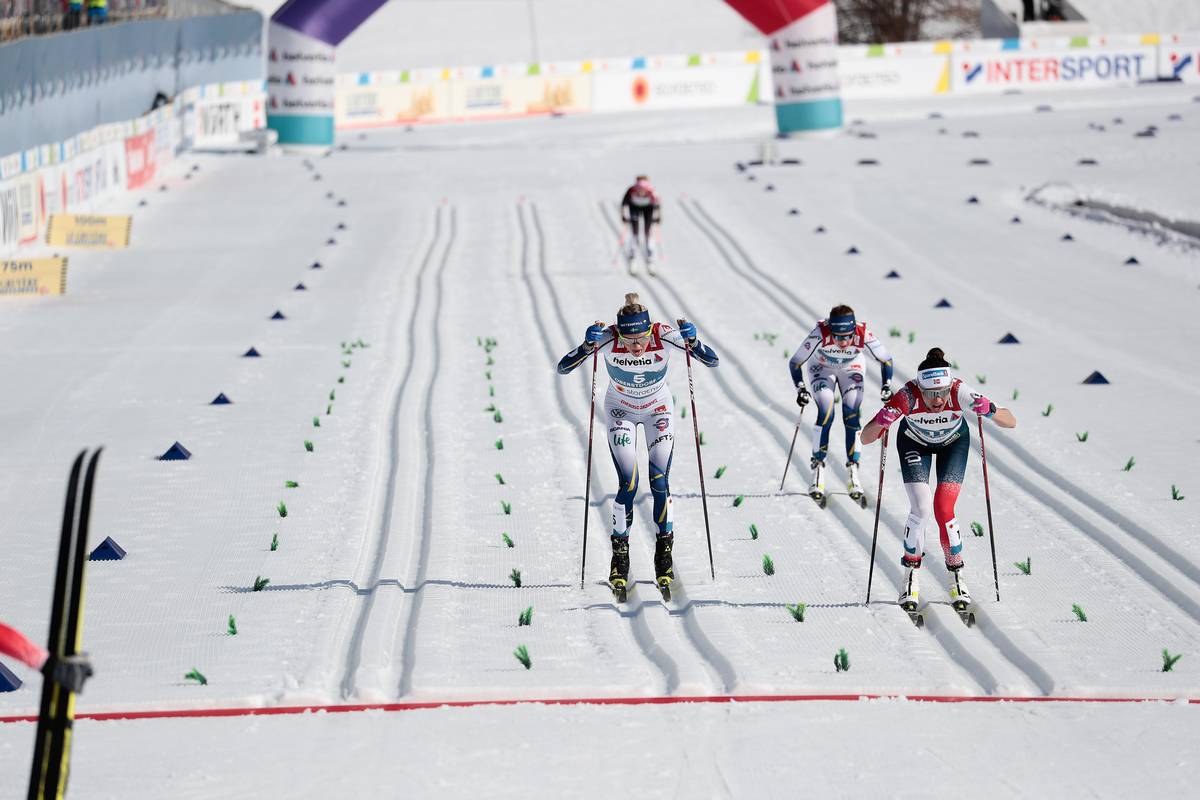
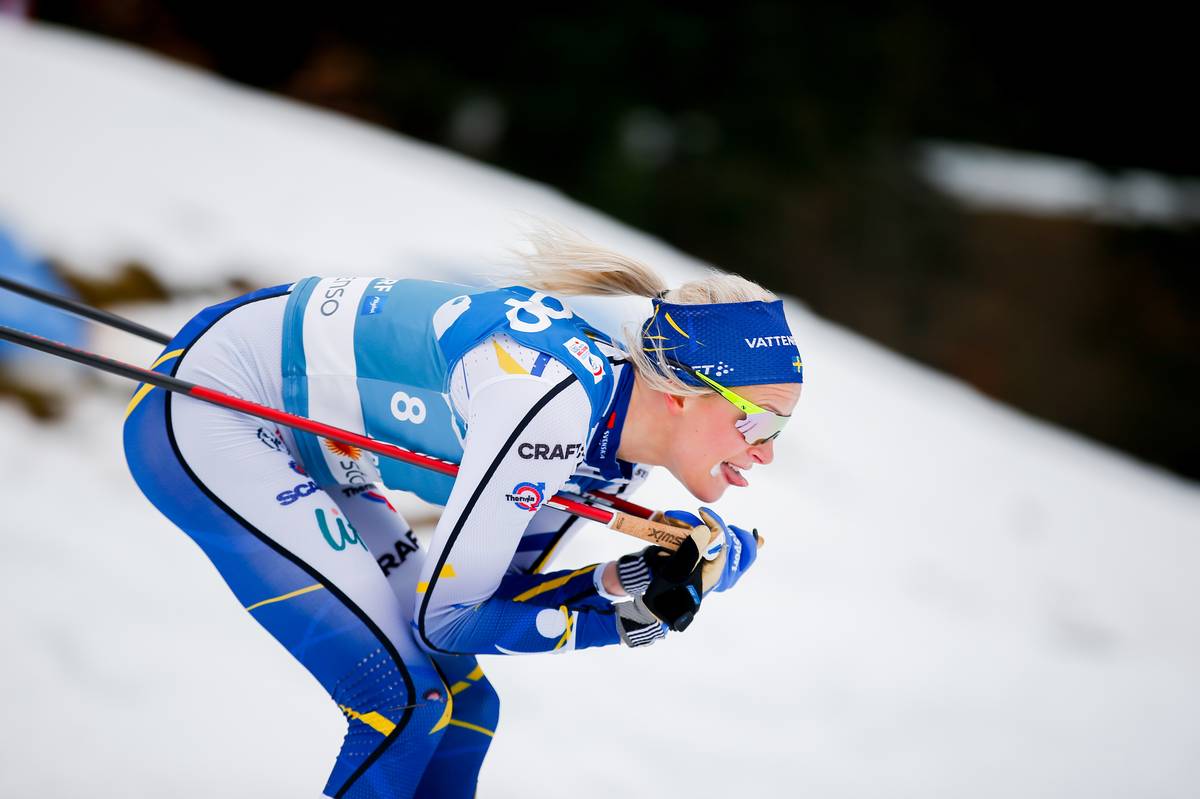
    Frida Karlsson, and Heidi Weng (NOR), (l-r) dual for silver and bronze. (Photo: NordicFocus)
    Heidi Weng (NOR) edges out Frida Karlsson (SWE) for a silver medal in the 30 k classic. (Photo: NordicFocus)

    Andersson held on for fourth (+2:36.3), followed by Stadlober in fifth (+2:59.4). 

    After the finish, Karlsson was seen rolling up the sleeve of her race suit and holding her forearm, which she proceeded to show the Swedish support staff. After icing and splinting the injury, she was reportedly taken away by medical staff and did not participate in the podium ceremony. In an interview with the Swedish news outlet Expressen, a team doctor explained that the injury occured in the crash with Andersson and Weng and that she is being taken to the hospital for x-rays. FasterSkier will share additional information as it becomes available. 
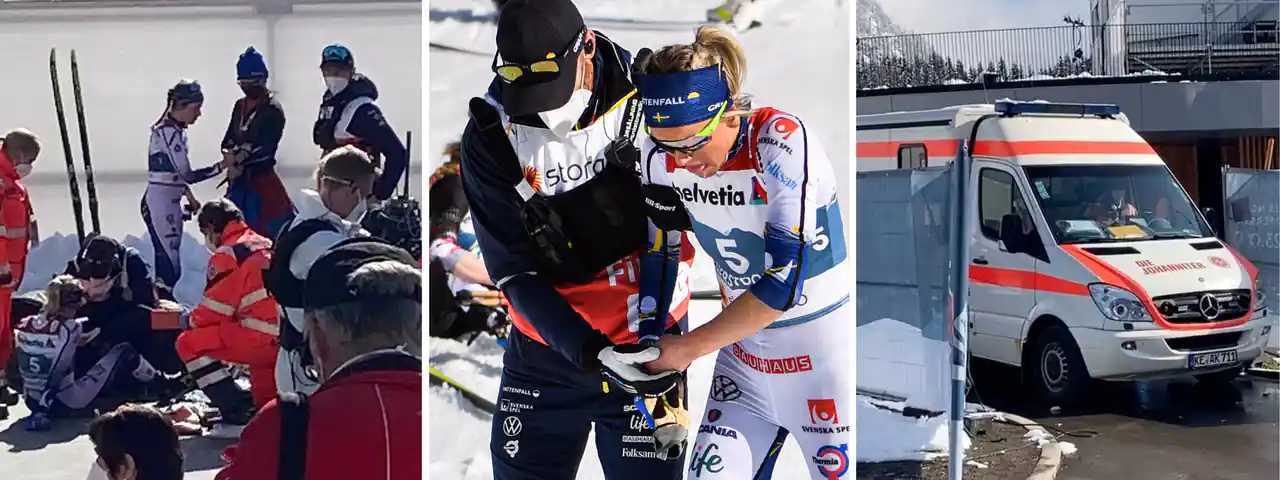
    Frida Karlsson was carted away for x-rays after a bronze medal performance in the 30 k classic. (Photo: Expressen.se)
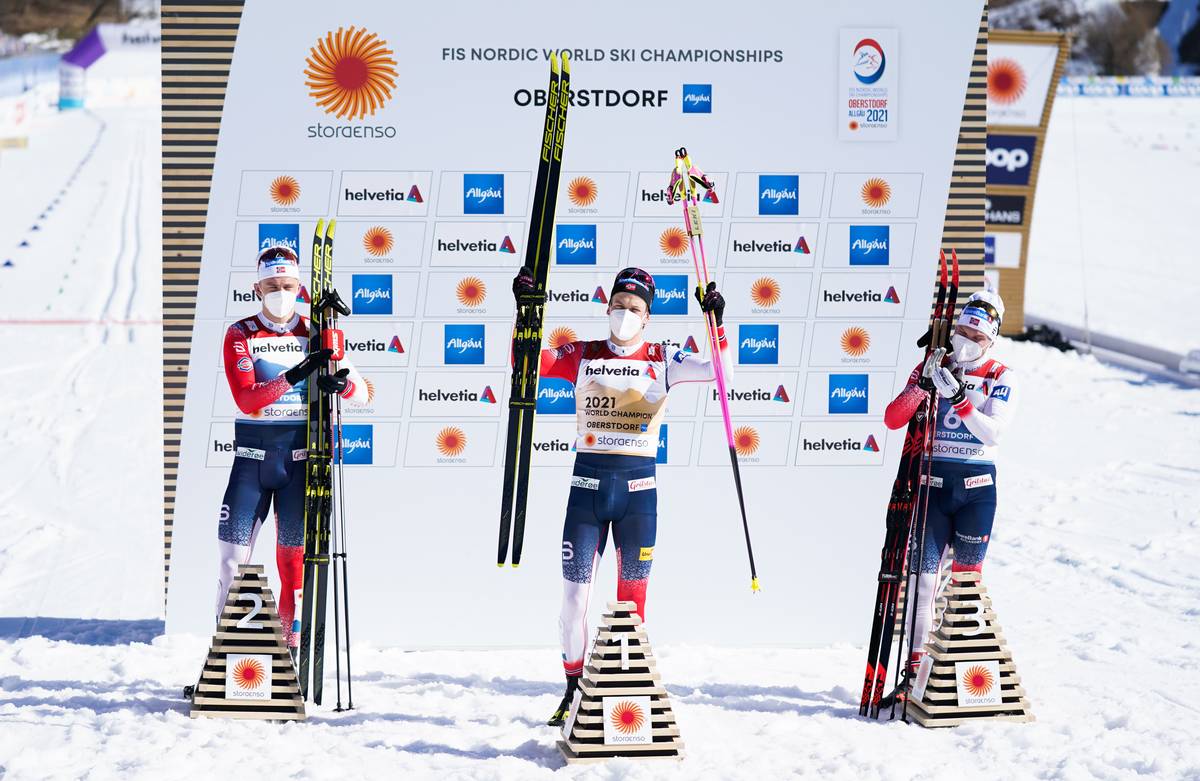
    Only gold and silver represented at the podium ceremony after the 30 k classic. Therese Johaug (NOR) took the win ahead of Heidi Weng (NOR), with Frida Karlsson (SWE) earning bronze before being taken away for x-rays of her arm injury. (Photo: NordicFocus)

    Turning our focus to North America, Maubet Bjornsen skied her way to 15th. After falling off the pace with the second chase group as it broke apart, Maubet Bjornsen held her ground well inside the top-20 over the final two laps. Finishing in a tight finish with Johanna Matintalo of Finland and Emma Ribom of Sweden, who took 13th and 14th respectively, Maubet Bjornsen crossed the line 4:42.4 behind Johaug. 
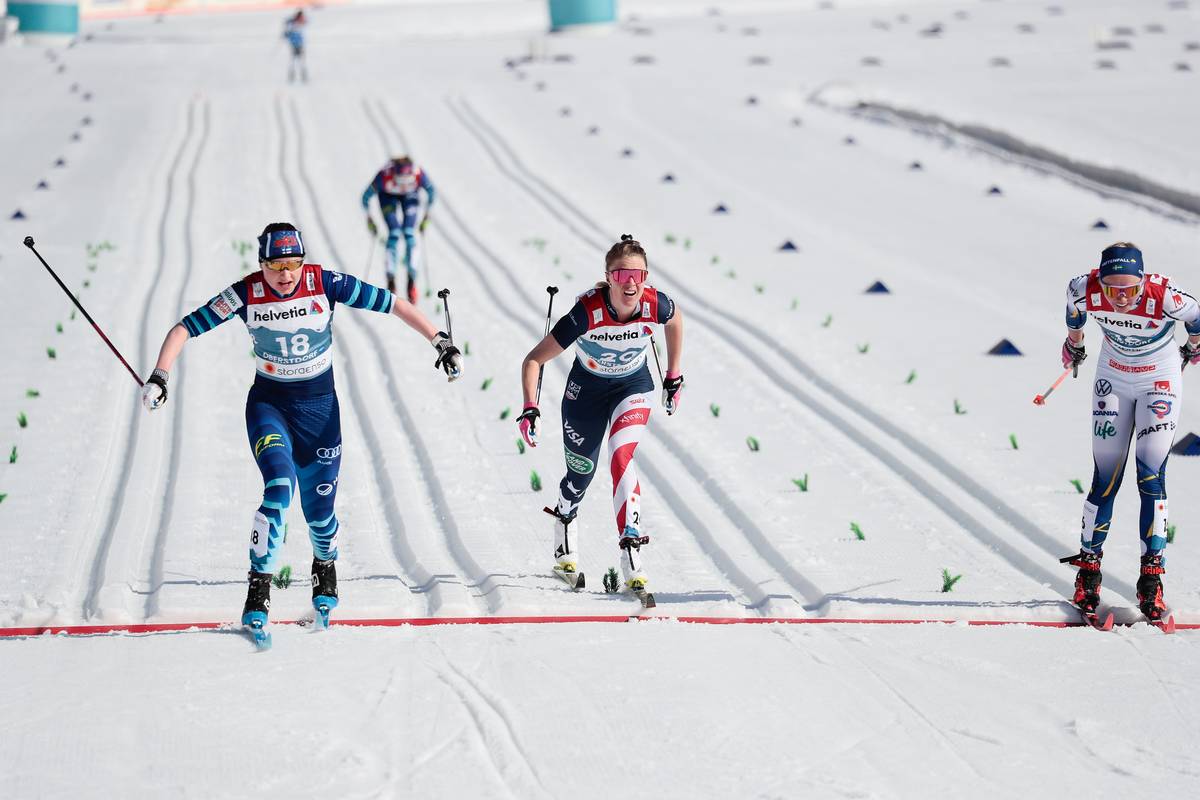
    In a close finish, Sadie Maubet Bjornsen takes 15th in the 30 k classic. (Photo: NordicFocus)

    “I had many kilometers of celebrating and it was just the hardest 30 k I have ever done,” said Maubet Bjornsen after her race. “So you know, nothing like going out on that to remind you how hard this sport is.”

    Providing insight into her day, Maubet Bjornsen reflected positively on the first half of her racing, adding that her equipment could not quite match her effort after the ski change.

    “I felt totally incredible for the first three laps and then I switched onto some skis that were not quite good enough to stay with the pack I was skiing with. Then it was just like fighting to get to the finish. But I feel really stoked about my first 15 k and that is a good memory, just feeling like one of the strongest girls climbing that monster hill. That is a fun memory to go out with.”
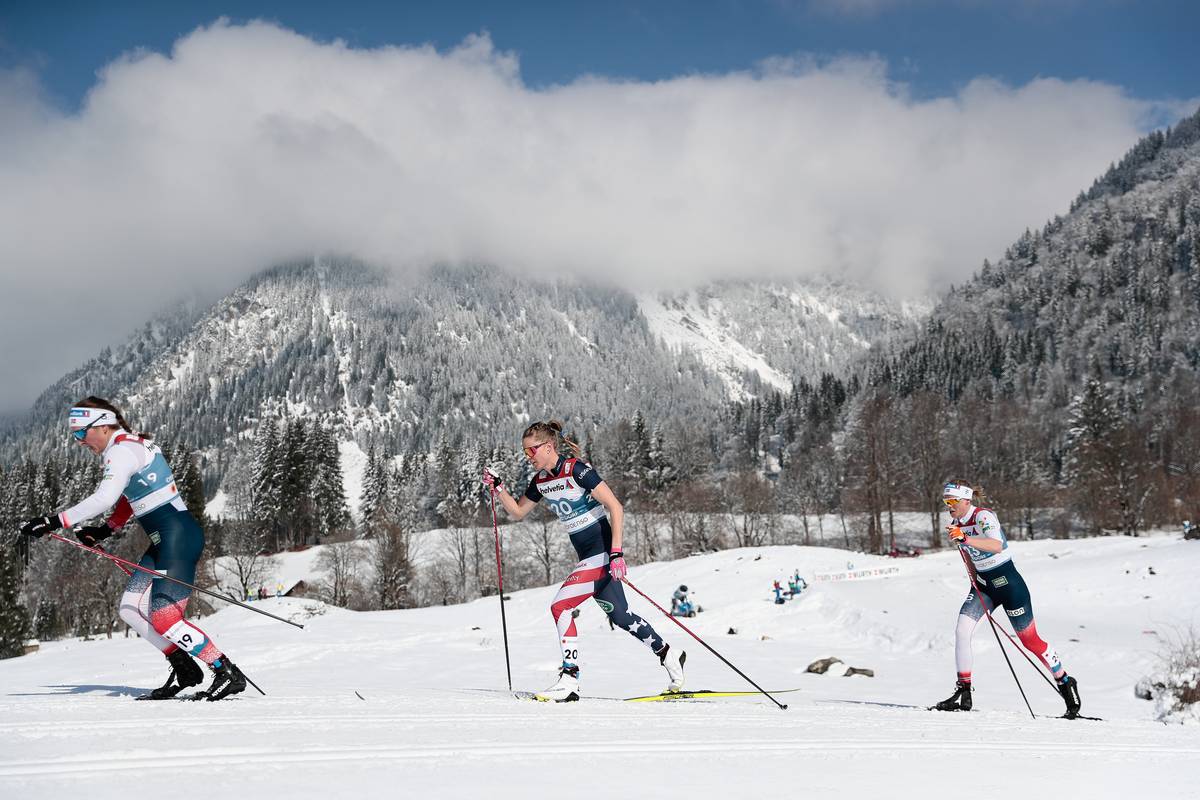
    Sadie Maubet Bjornsen ends her professional career at the World Championship 30 k classic in Oberstdorf, Germany. (Photo: NordicFocus)

    Closing out her initial thoughts on her final race, Maubet Bjornsen added, “I definitely feel really grateful for my whole career and this last week was definitely really special and the relay was certainly the highlight of the week. It is good to finish on a really hard note too, pushing through 30 kilometers and yeah, I am thankful for my whole career.”

    Also inside the top-30 were Hailey Swirbul in 26th (+6:55.6) and Sophia Laukli in 28th (+8:00.7). The final American starter, Katharine Ogden, took 37th (+11:30.7). 

    “I think it went pretty well for me,” said Swirbul after her race. “I am happy with my day. I had a pretty fast start and I got to ski with my Sadie for a brief moment there in her last race as a professional, so that was really special.”
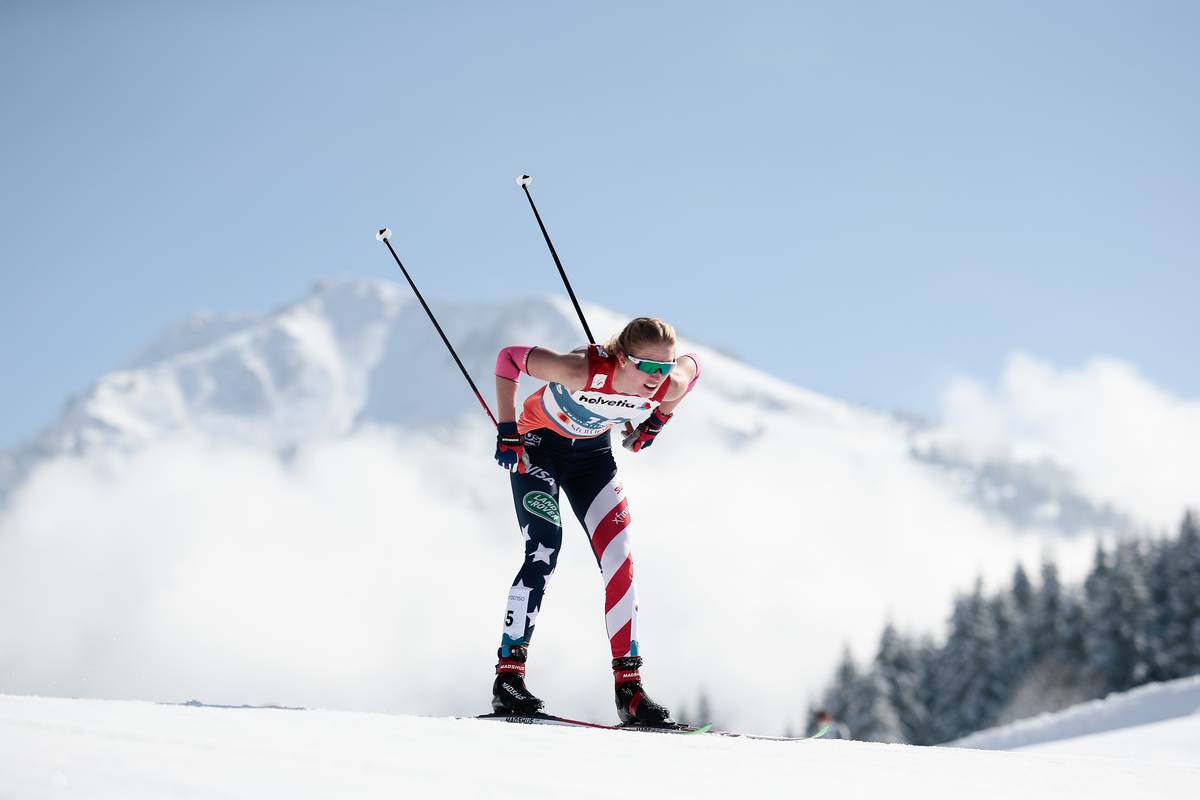
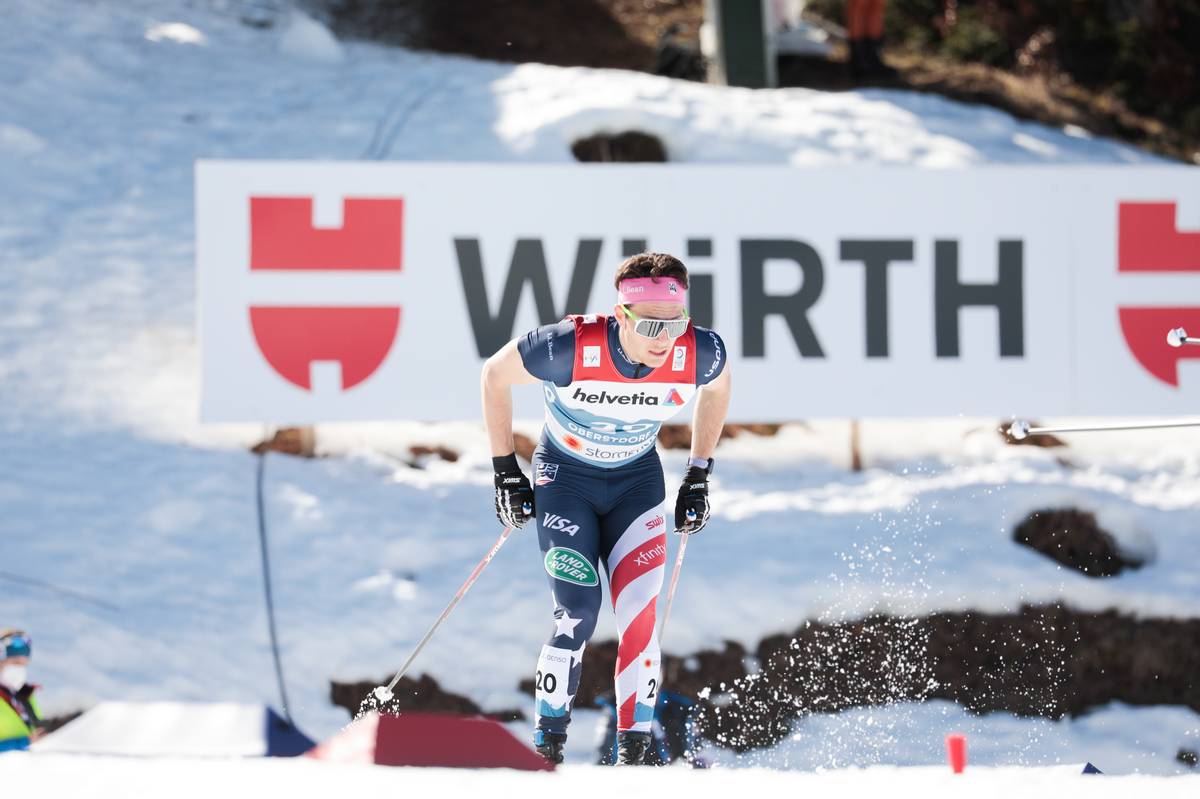
    Hailey Swirbul of the U.S., cresting a hill during the 30 k classic. (Photo: NordicFocus)

    “In the 30 k there are so many deaths, and so many revivals that you just have to keep going,” Swirbul continued. “And I went through a couple of those and was very relieved to see the finish line. I am proud out team today and some good fighting.”

    For Laukli, today was a first — her debut in the 30 k event. She explained after the race that was not sure how to pace, and felt she had good energy throughout, never on the cusp of a bonk despite skiing alone with no one to draft behind for much of the distance.

    “This is the type of race you want to ski with other people,” Laukli said regarding what she learned. “And also, you should switch skis — which I forgot to do. Definitely a learning experience and there’s a lot I can improve on, but I am overall happy with how it went.”
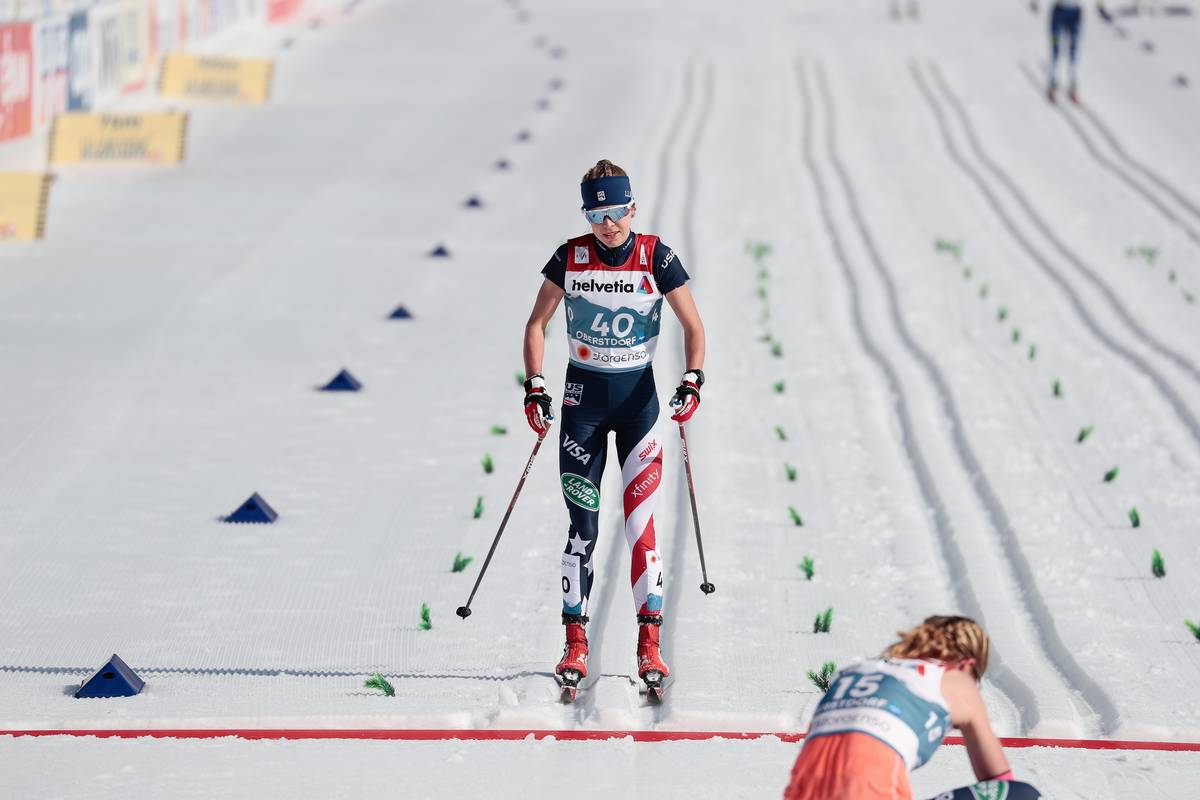
    Sophia Laukli crosses the line 28th in the 30 k classic. (Photo: NordicFocus)
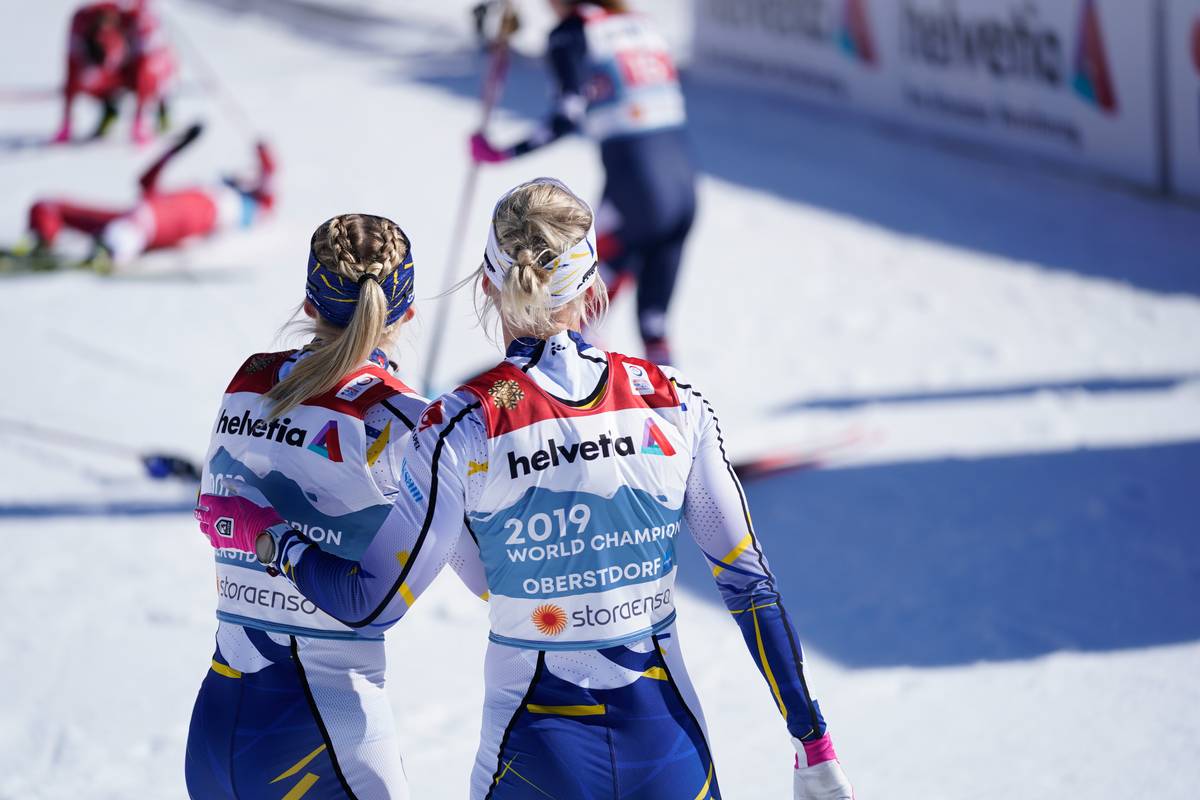
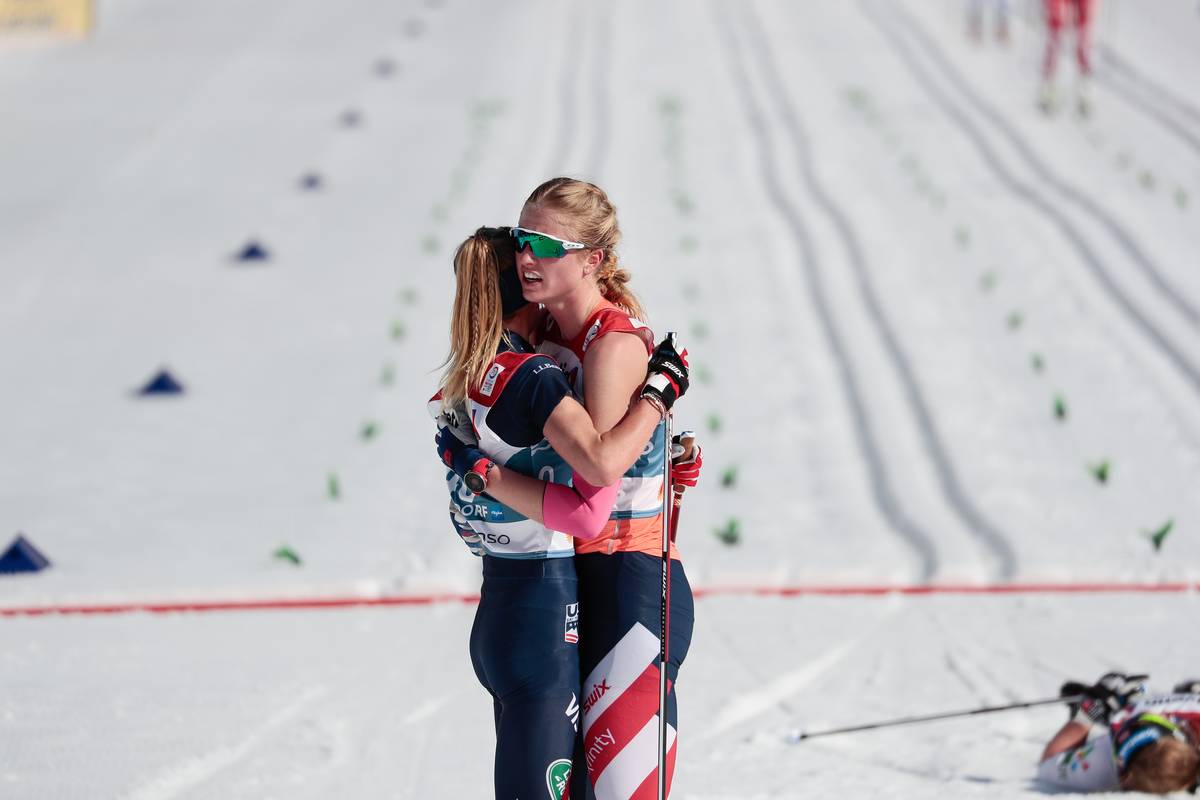
    Sophia Laukli and Hailey Swirbul share a supportive hug after 30 kilometers of classic ski racing. (Photo: NordicFocus)

    Canada’s Katherine Stewart-Jones led the way for our neighbors to the North (or East, if you’re Alaskan), finishing 23rd (+6:05.7). Stewart-Jones went out at a fast pace, sitting at the back of Maubet Bjornsen’s chase group in 17th at the 10 k mark, fading into 21st by 20k, holding her ground in this range for the remainder of the day.

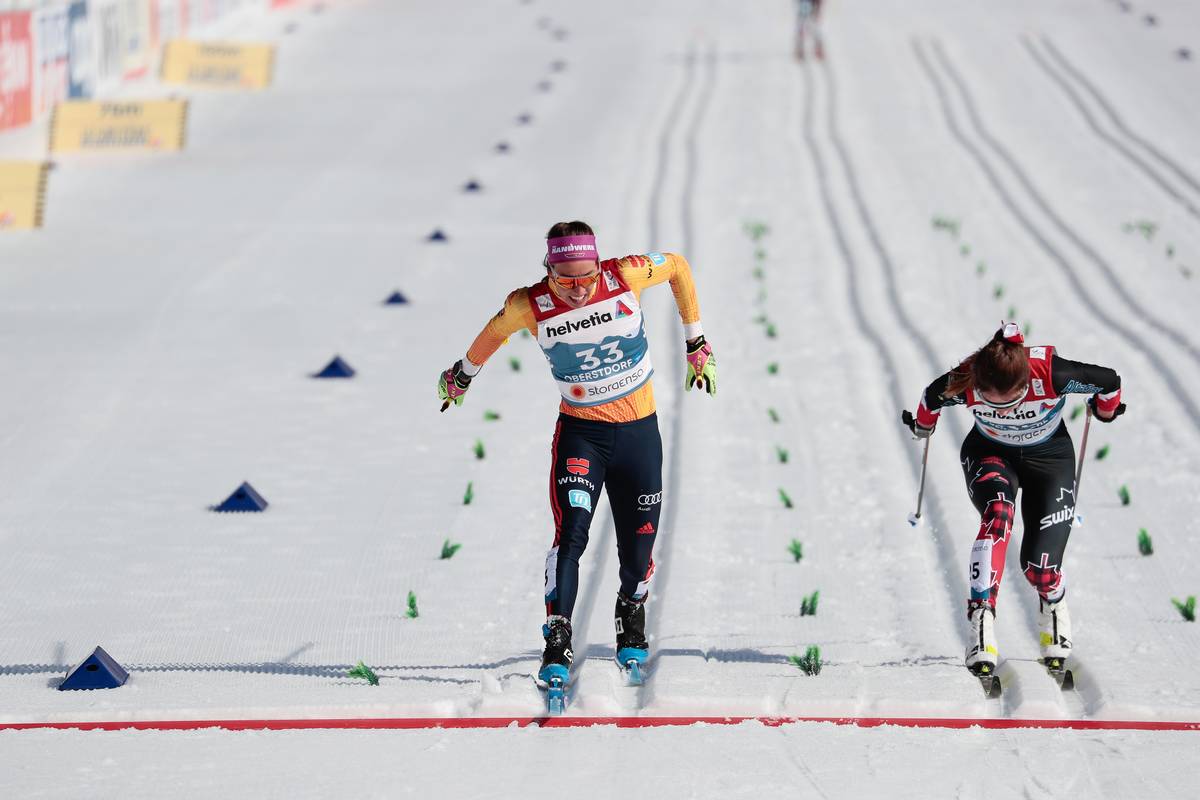
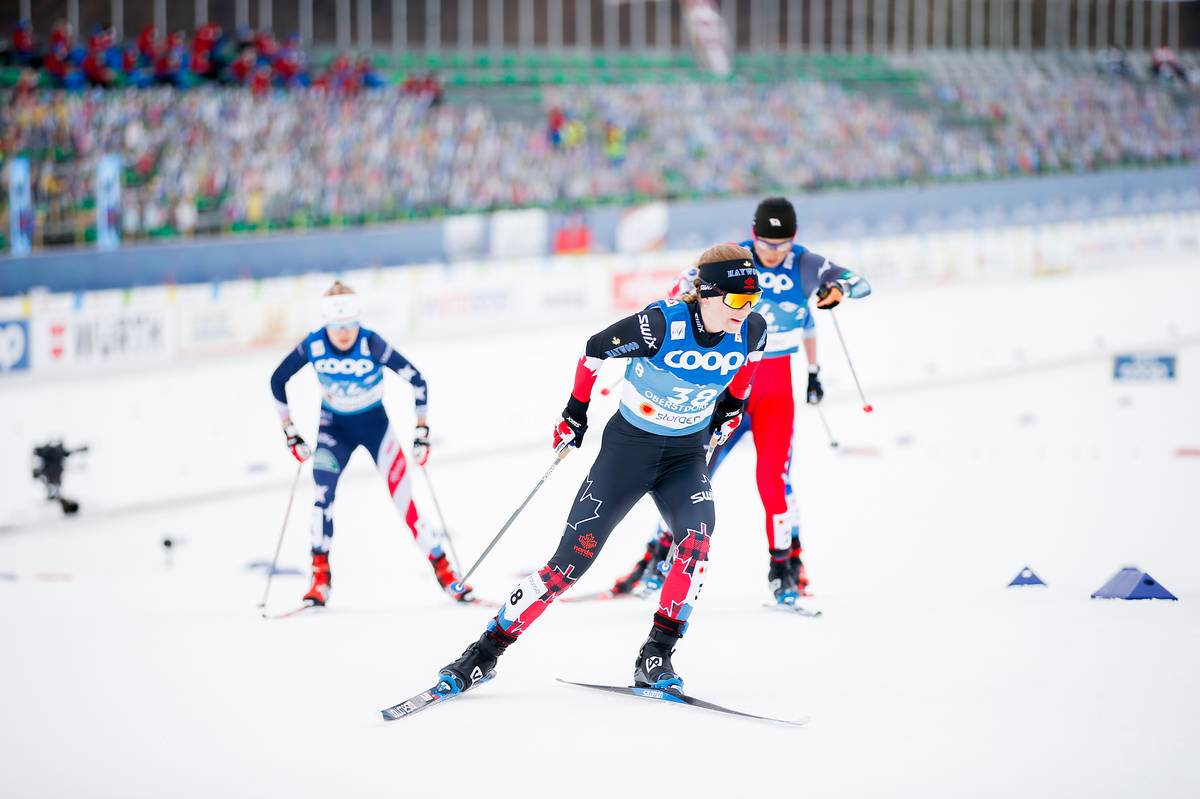
    Katherine Stewart-Jones (CAN) chases Tatiana Sorina (RUS) during the mass start 30 k classic. (Photo: NordicFocus)


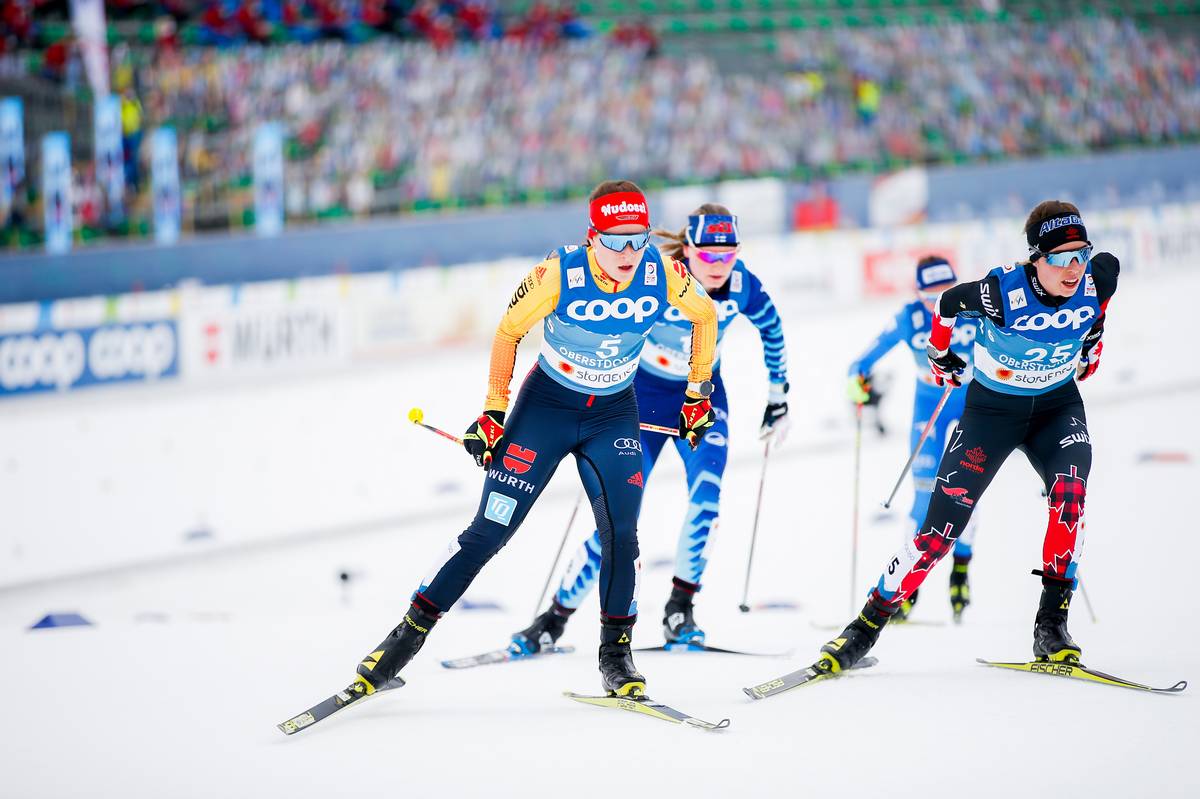
    Sofie Krehl (GER), and Katherine Stewart-Jones (CAN), (l-r) finish strong. (Photo: NordicFocus)

    Cendrine Browne was next for Canada, finishing 27th (+7:57.6). Outside the top-30, Dahria Beatty took 34th (+10:01.0).

    Canada’s Cendrine Browne racing to 27th in the 30 k classic. (Photo: NordicFocus)

    Jessie Diggins and Rosie Brennan did not start today, reportedly conserving energy for the final World Cup stop in Engadin, Switzerland beginning March 13th. The weekend will include a 10 k classic and 30 k skate.

    Final Results

    Katharine Ogden on her 30 k classic journey. (Photo: NordicFocus)
  • Heavy Snow and a Heavy Klæbo Hop-Skate: Norway Beats Russia for Men’s Relay Win

    Heavy Snow and a Heavy Klæbo Hop-Skate: Norway Beats Russia for Men’s Relay Win

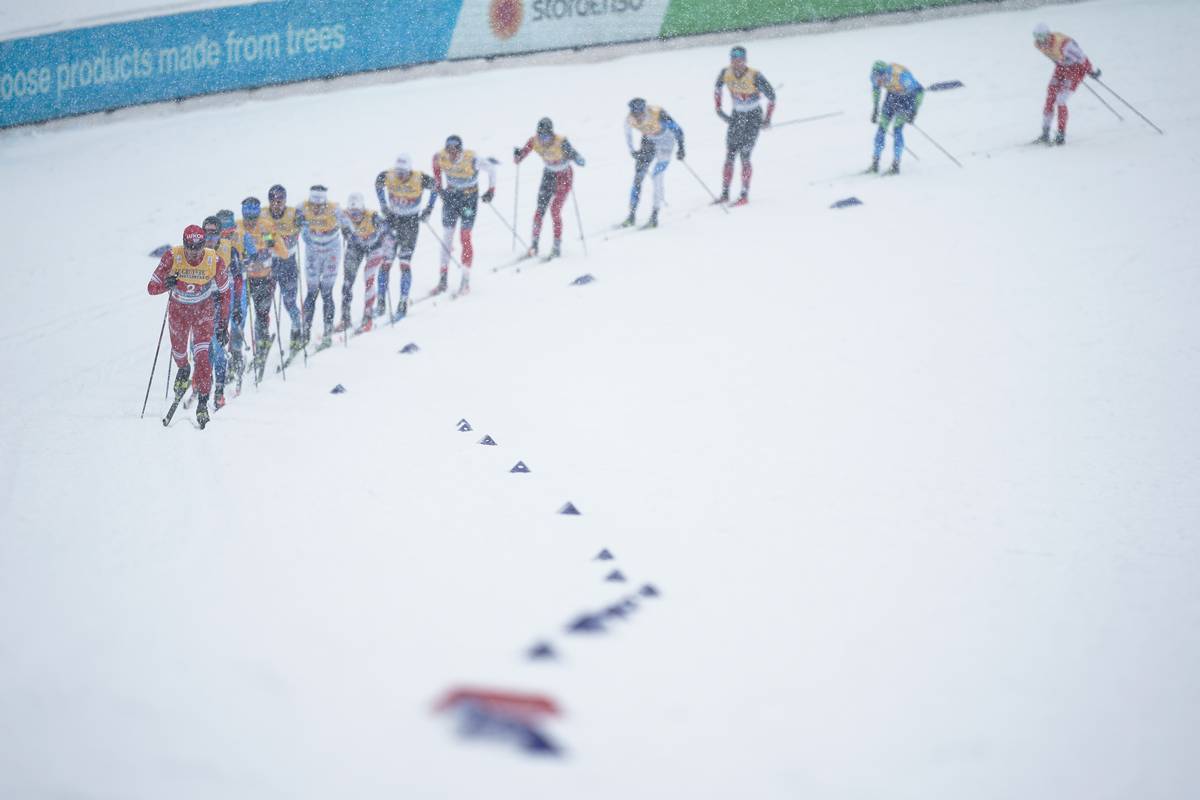
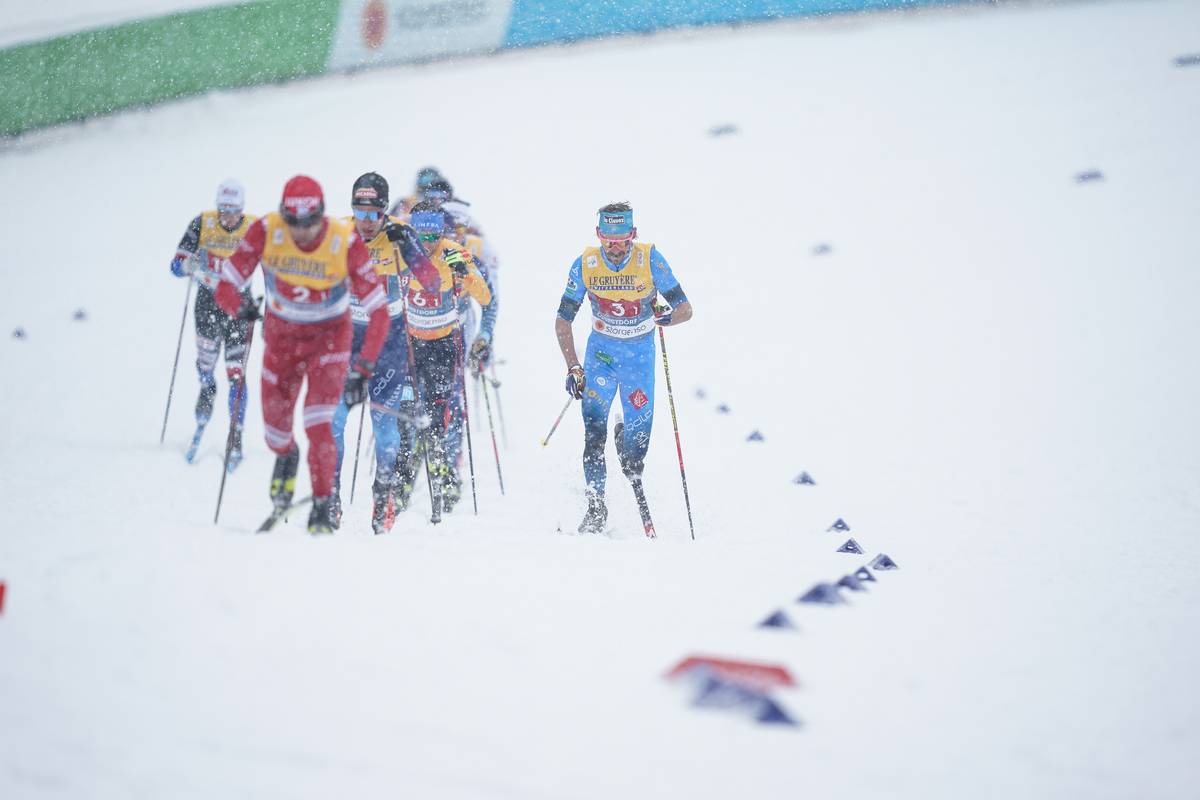
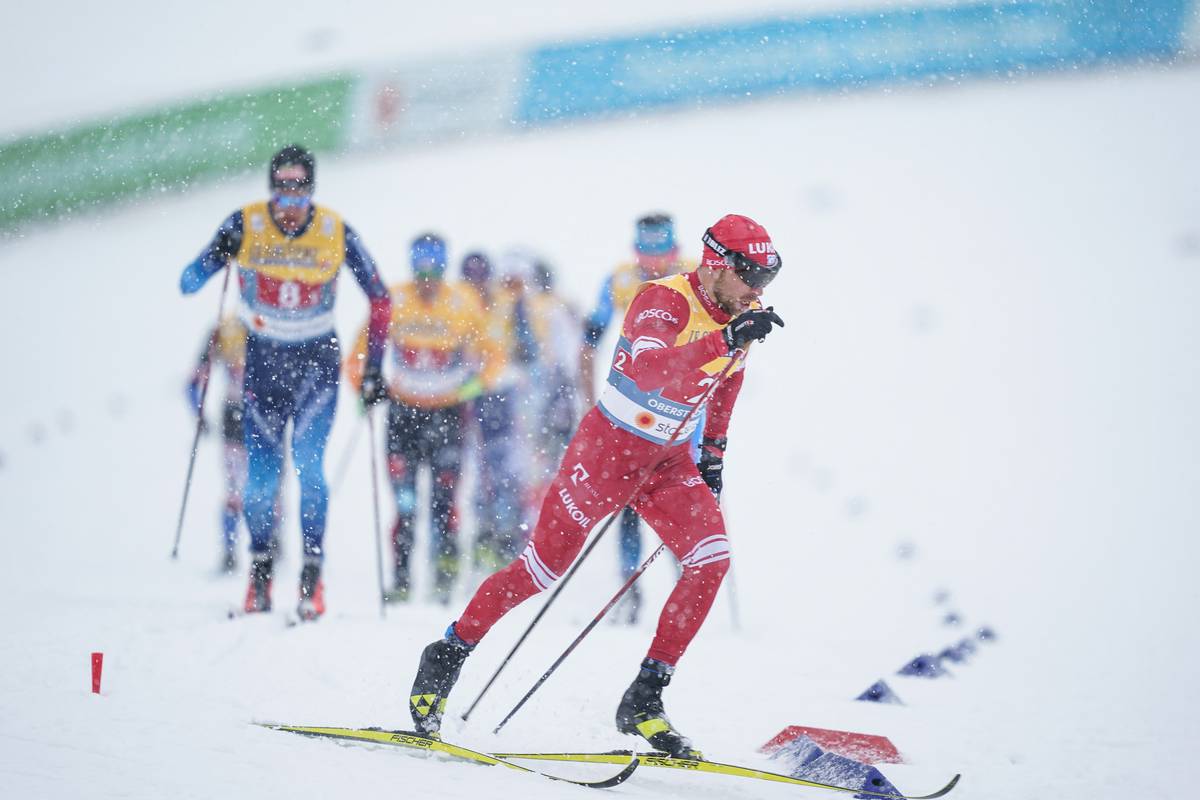
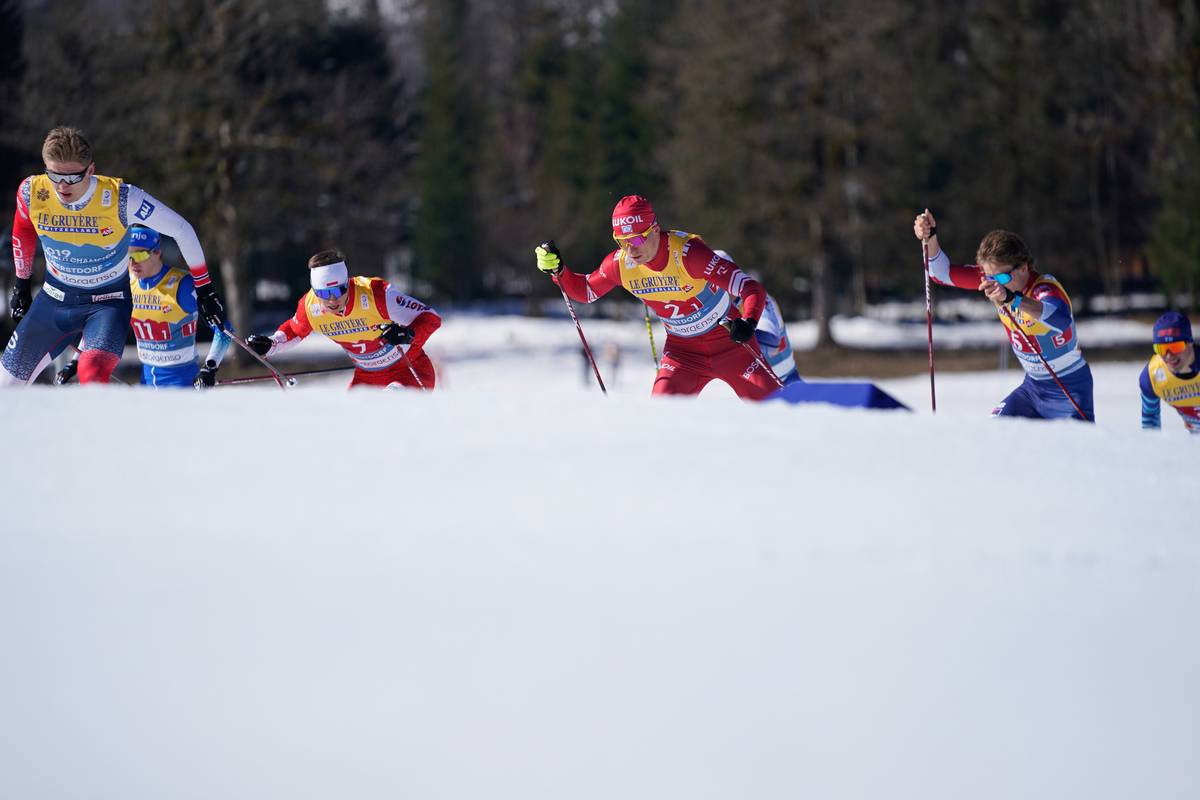
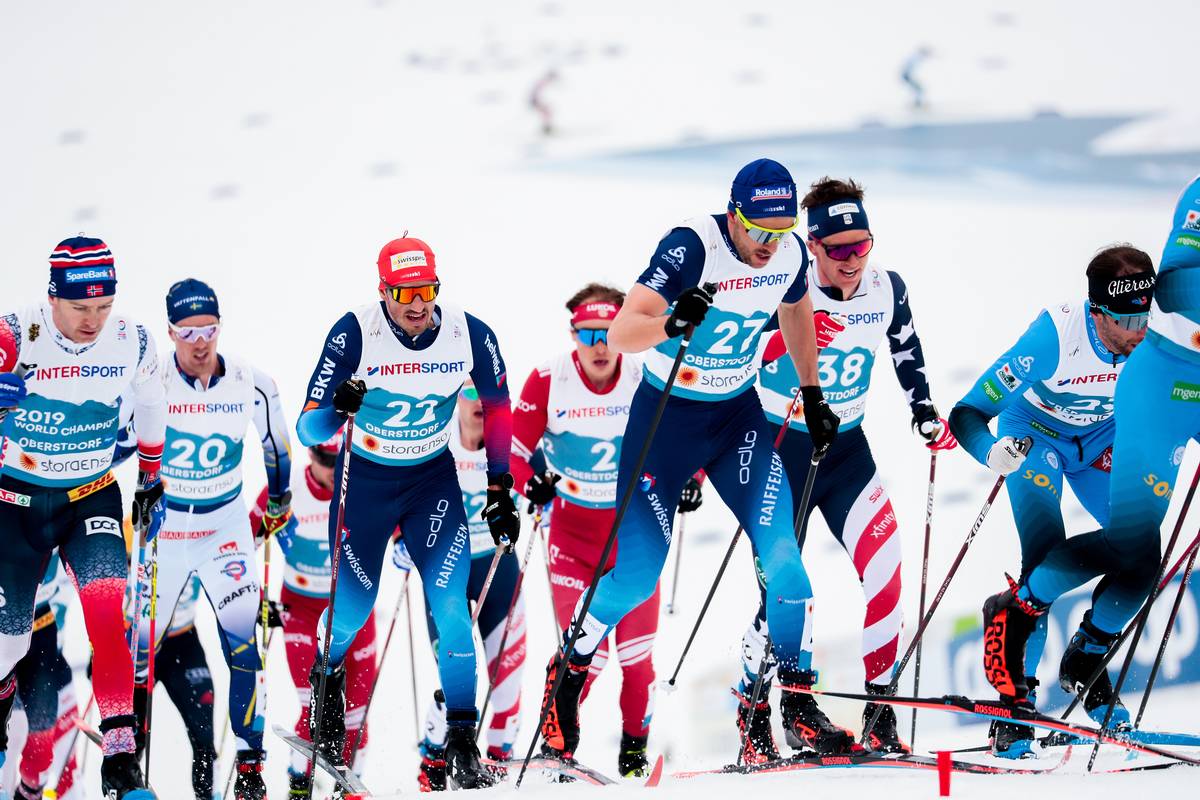
    A train, led by Alexey Chervotkin (RSF), winding through the snow. (Photo: NordicFocus)

    This World Championship coverage is made possible through the generous support of Marty and Kathy Hall and their A Hall Mark of Excellence Award. To learn more about A Hall Mark of Excellence Award or to learn how you can support FasterSkier’s coverage please contact info@fasterskier.com. 

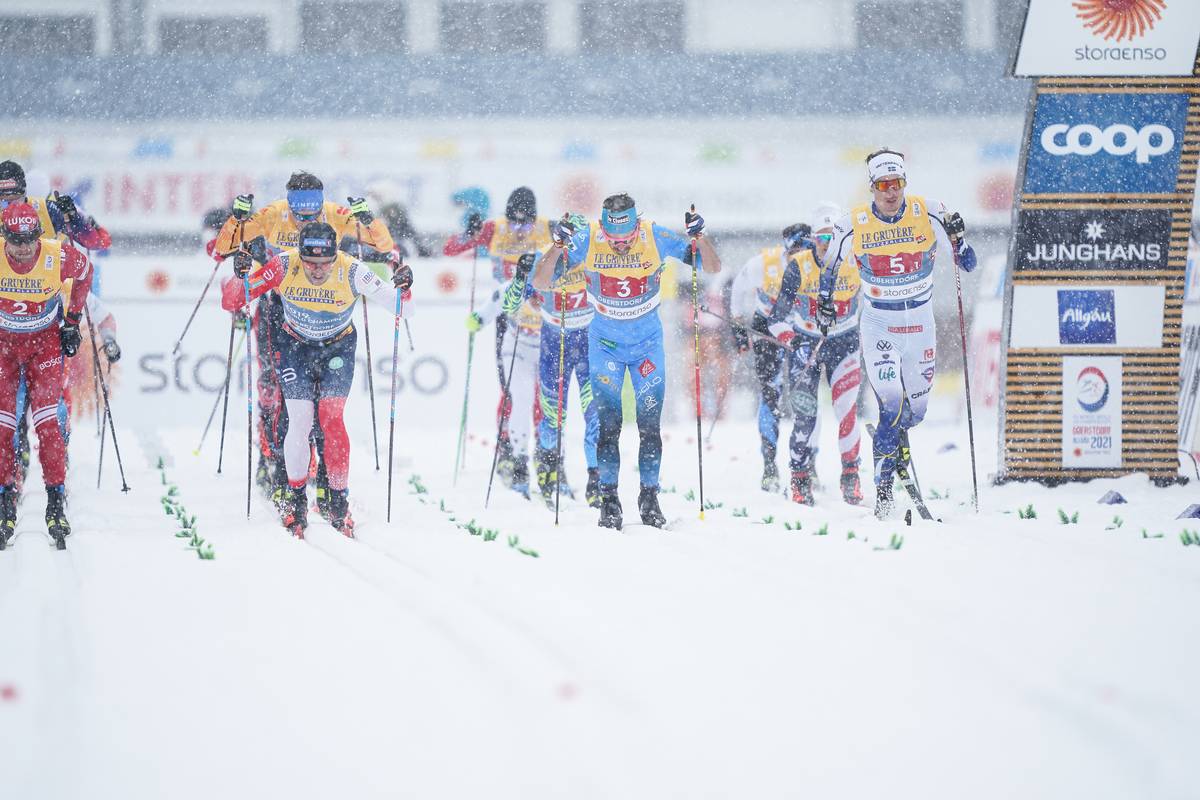
    After the tropical conditions of the past week, the men were greeted with heavy snowfall for Friday’s championship 4 x 10 k relay competition in Oberstdorf. Temperatures hovered around freezing and the snow fell thick and fast as the scramblers lined up at the start. Eighteen nations were represented at the start line with thirteen completing the whole race. 

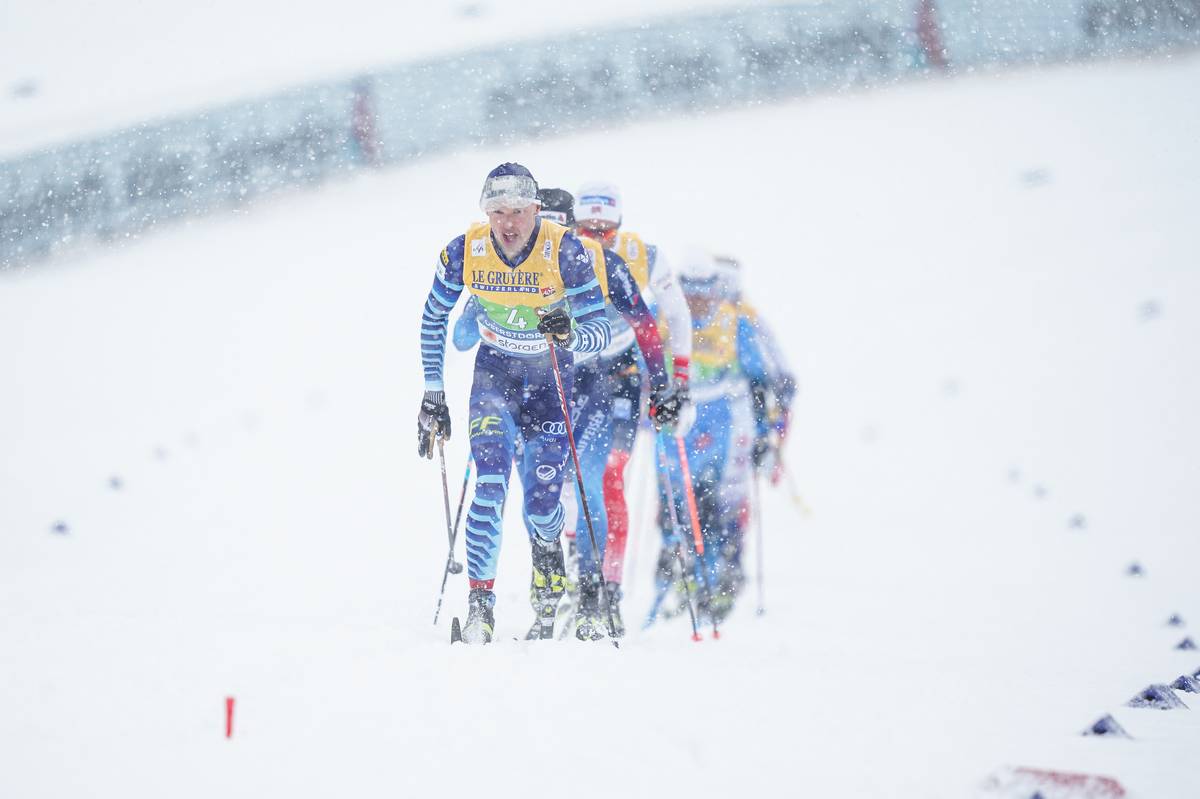
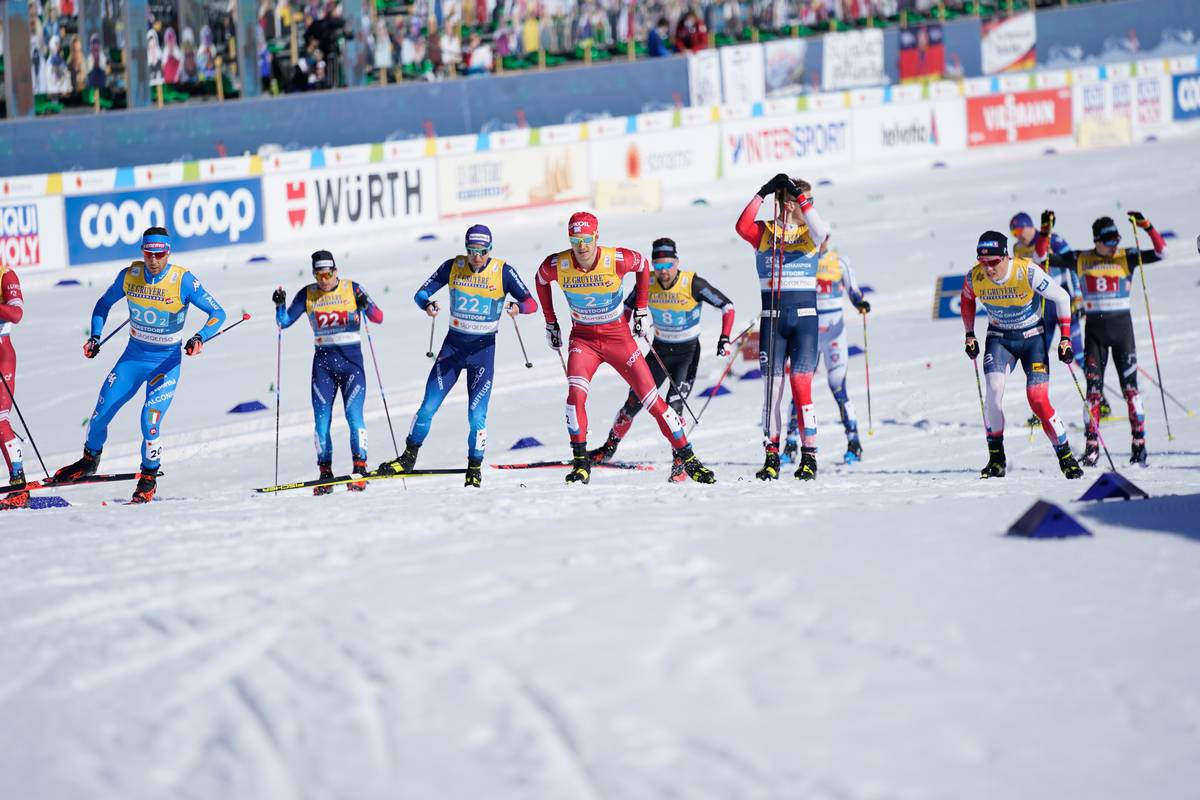
    The start to a snowy 4 x 10 k relay at the 2021 World Championships. (Photo: NordicFocus)

    On paper Norway was the team to beat out on the track. Of the last 15 men’s relay titles at a World Championship, Norway has won all but one. The last time Norway failed to win the men’s relay was in 1999 when team Austria finished 0.2 seconds ahead of Norway. And in the end on Friday after striding and skating through fresh snow for 40 k, it was once again team Norway that crossed the line in first, but what a race it was to get them there. 

    Johannes Hoesflot Klaebo (NOR), Hans Christer Holund (NOR), Emil Iversen (NOR), Paal Golberg (NOR), (l-r) 2021 Relay World Champions. (Photo: NordicFocus)

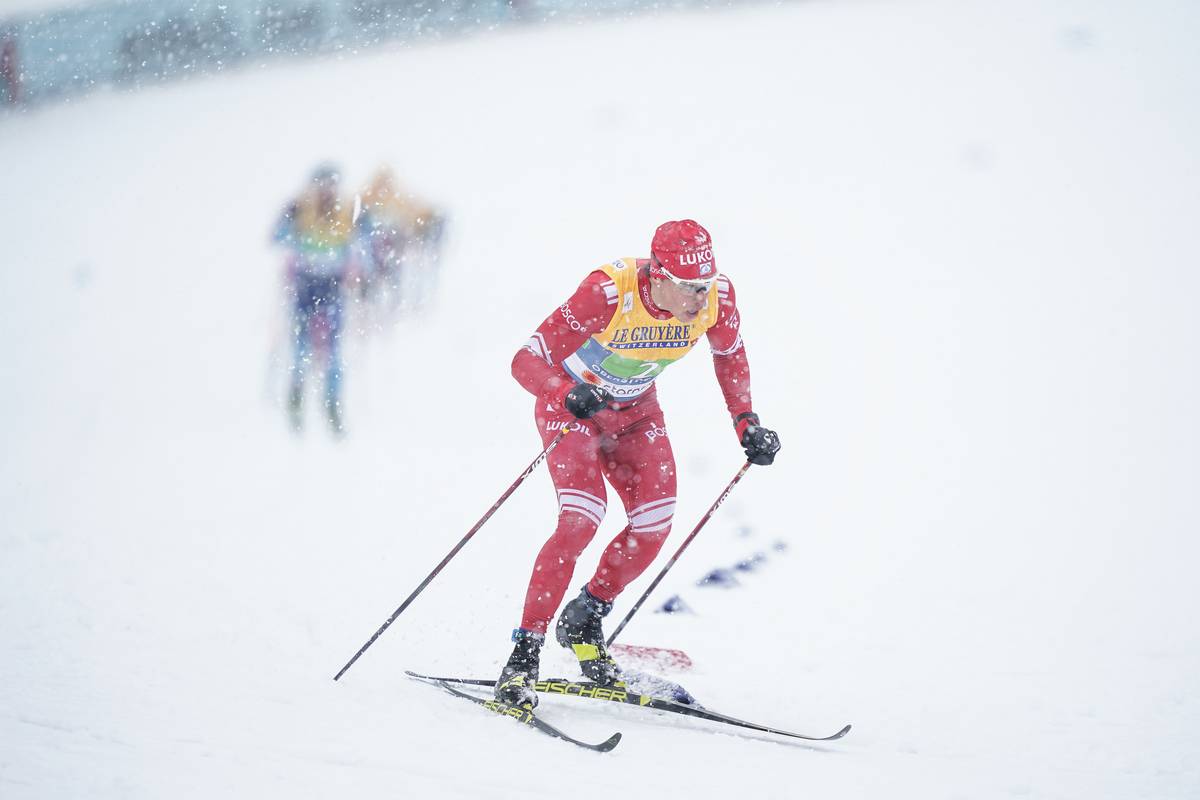
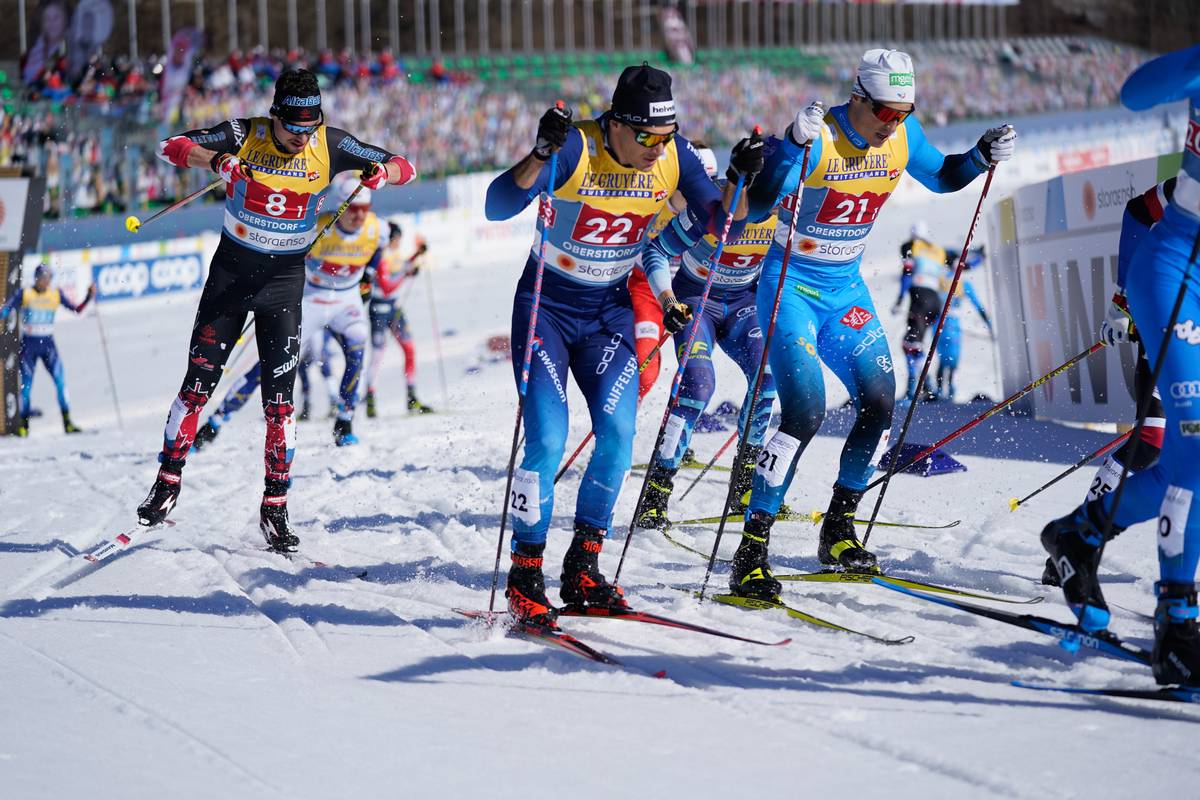
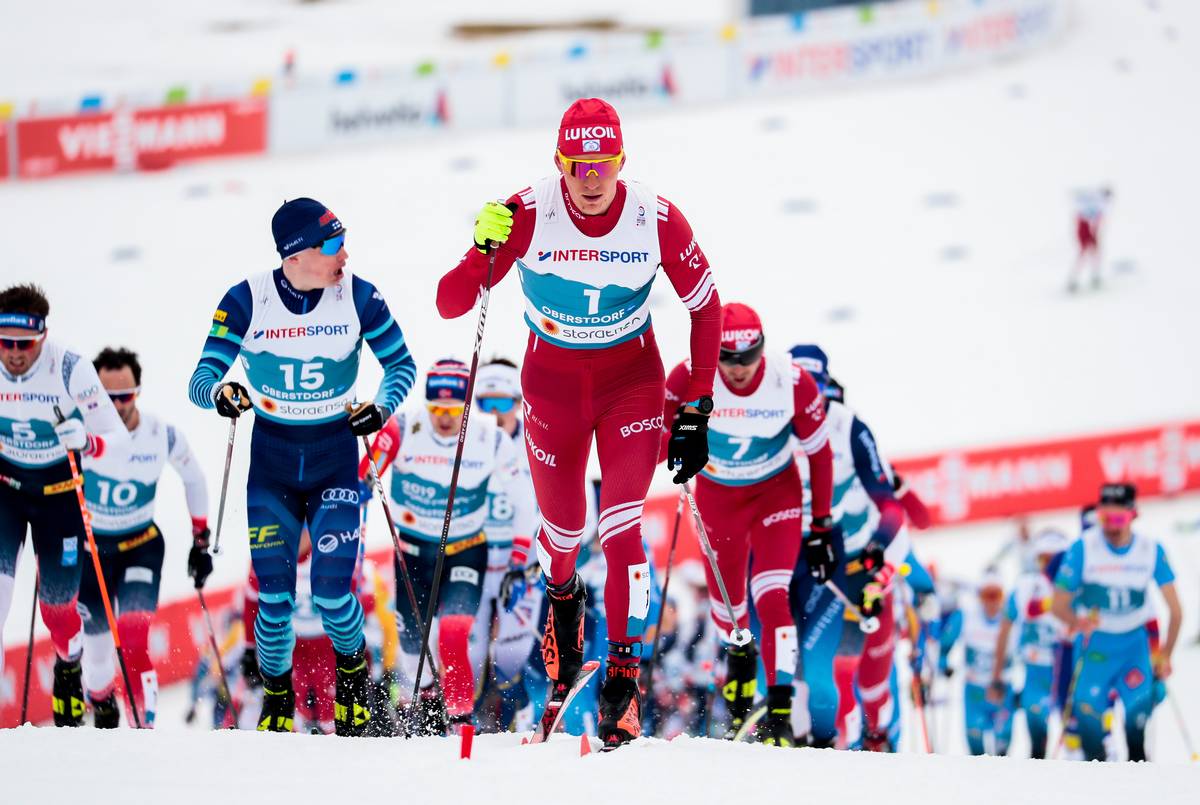
    The team most likely to challenge Norway was Russia, or the Russian Ski Federation as they are represented at these championships. The bar was set from the beginning. Despite conditions not favoring an early breakaway, Alexey Chervotkin (RSF) made a move just 1.4 k off the start, putting distance between himself and the pack.

    Hugo Lapalus (FRA), out of the tracks, while Alexey Chervotkin drives the bus. on the scramble leg. (Photo: NordicFocus)
    Making a move that stuck on the first keg: Russia’s Alexey Chervotkin pushed over the top. (Photo: NordicFocus)

    At 4.7 k, Chervotkin had stretched his lead to +14.1 seconds and the group seemed largely unprepared to mount an organized counterattack. Perhaps expecting the Russian to fade or simply unable to respond, Norway’s Pål Goldberg remained tucked in the rear of the pack. At 6.6 k the margin was +33.6 to Russia. Save for Chervotkin’s effort out front, the pace remained World Cup-pedestrian. At one point, the skiers nearly halting completely at the crest of the sprint hill, playing chicken for who would descend first. Through 8 k the gap to Russia was nearly one minute.

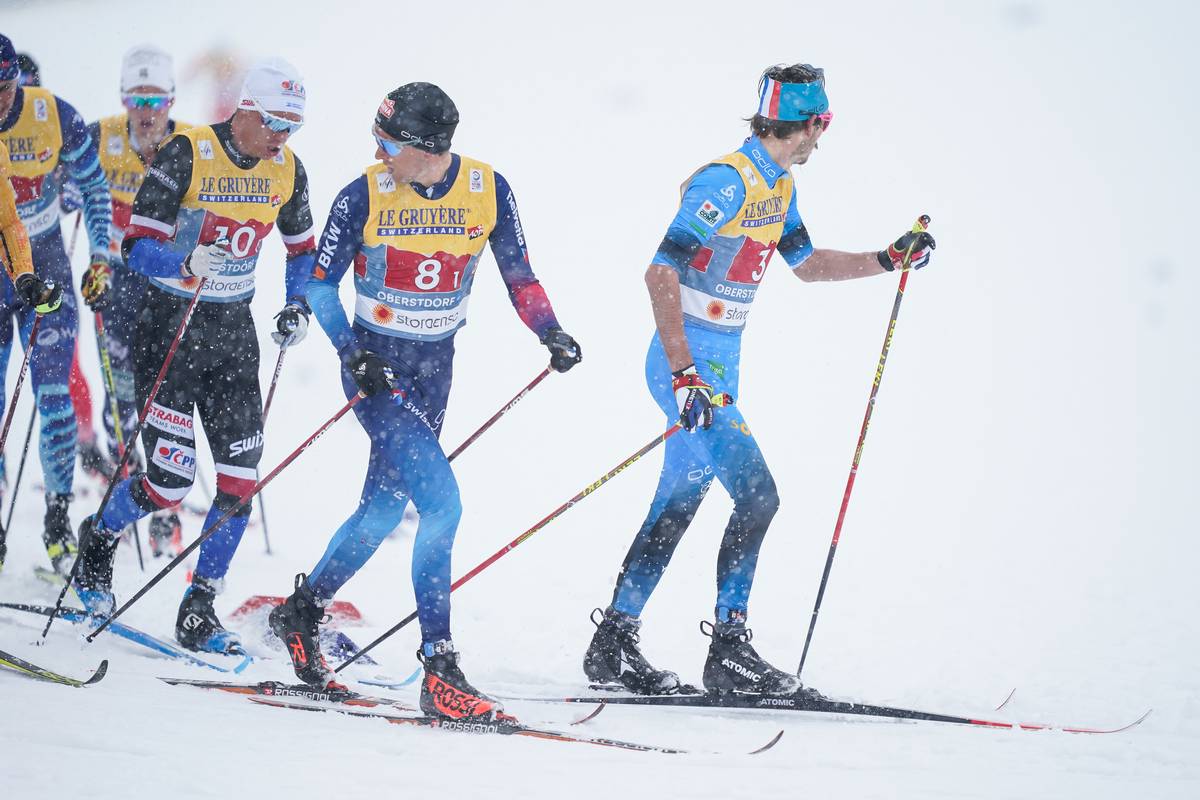
    No man’s land, atop the climb, Michal Novak (CZE), Beda Klee (SUI), Hugo Lapalus (FRA), (l-r) bring the pace to a walk as no team wants to chase Russia down. (Photo: NoricFocus)

    Entering the first exchange the chase pack had split in two, with France leading and Norway off the back in 10th position. In a post-race interview Golberg said of his race, “it was a bit of a tough start. I chose a different choice [of ski] from the seventeen other skiers so that was really stupid but fortunately I have three skiers on my team that are better than everyone else here today so I’m really happy for them.” One of those skiers was Emil Iversen who took over for Norway on the second leg. His work linked Norway up with the rest of the chase pack, now being led by Iivo Niskanen of Finland. Ivan Yakimushkin had taken control for RSF, but already, with the hot pace set by Niskanen, the gap was down to +30.4 seconds to Norway. 


    Ivan Yakimushkin, Russia’s second leg skier, sensing the group led by Iivo Niskanen closing in on the second leg. (Photo: NordicFocus)

    At 13.3 k Niskanen, Iversen, and Dario Cologna of Switzerland were closing in on Yakimushkin. After 40 minutes on the clock they had overtaken the Russian. The pack now comprised six nations (France and Sweden also in contention), with team Canada drifting around eight seconds behind. Again on lap two through the stadium the pace slowed to a halt before the descent, unrelenting snow adding an extra challenge to the lead. 

    At the base of the Burgstall climb on his final lap, Iversen (NOR) made his move, directly shadowed by Niskanen (FIN). To the soundtrack of much excited shouting from the coaches, the pair closed in on the exchange zone, with Russia now off the back. 

    Iivo Niskanen of Finland doing the work to reel in Russia on the second leg of the 4 x 10 relay. (Photo: NordicFocus)

    Wednesday’s 15 k skate champion, Hans Christer Holund, contended the first skate leg for Norway. His lead over Russia being +23.6 seconds at the tag zone. Followed by Perttu Hyvarinen, Finland’s third leg, Holund broke trail out front through deep snow as behind him, Artem Maltsev for RSF turned on the burners, starting to forge the gap. At 23.3 k there was just six seconds between them and the Finn was fading fast. At 24.7 k Holund was alone out front, +12.1 ahead of RSF and Finland now in third. As the athletes battled through their last loop, the wheels seemed to come off for Maltsev (RSF) and Clement Parisse of France and Jens Burman of Sweden moved to the fore. 

    Norwegian work horse on the third leg: Hans Christer Holund. (Photo: NordicFocus)

    Into the final exchange Holund handed team anchor Johannes Høsflot Klæbo a +25.5 second lead over France and Sweden (virtually neck and neck), and a +35 second lead to Russia, for whom Alexander Bolshunov would be taking anchor. 

    Johannes Hoesflot Klæbo (NOR) biding his time for the final show-down. (Photo: NordicFocus)

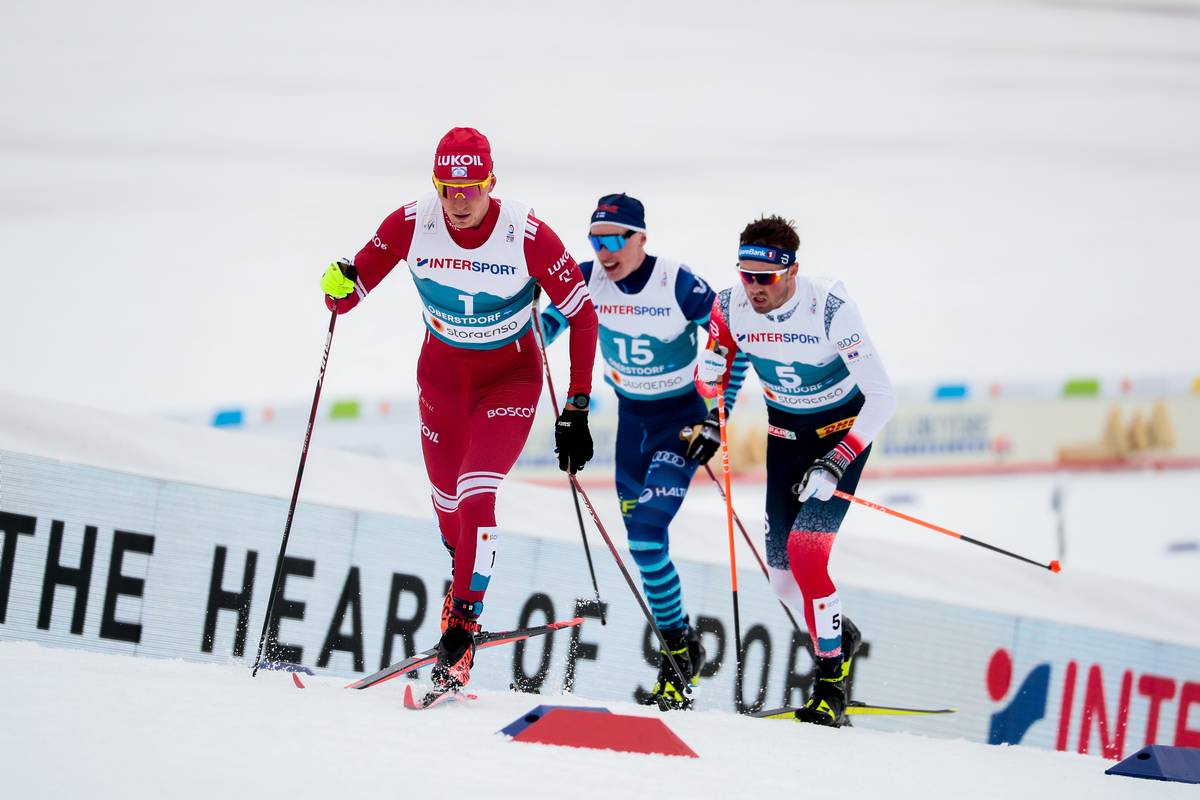
    With Klæbo (NOR) out on his own in deep snow, Bolshunov was on the hunt. The ten second lead over Russia held by Sweden and France was immediately absorbed and once again there was a pack of five teams in contention behind Norway. At 31.4 k Bolshunov had only gained 0.5 seconds on Klæbo but that was soon to change. By 33.3 k he had broken away from the chase pack and was +15.8 behind. Each of the two athletes played to their respective strengths, Klæbo cruising easily while he waited for his ride to catch up and Bolshunov grinding away with metronomic consistency.

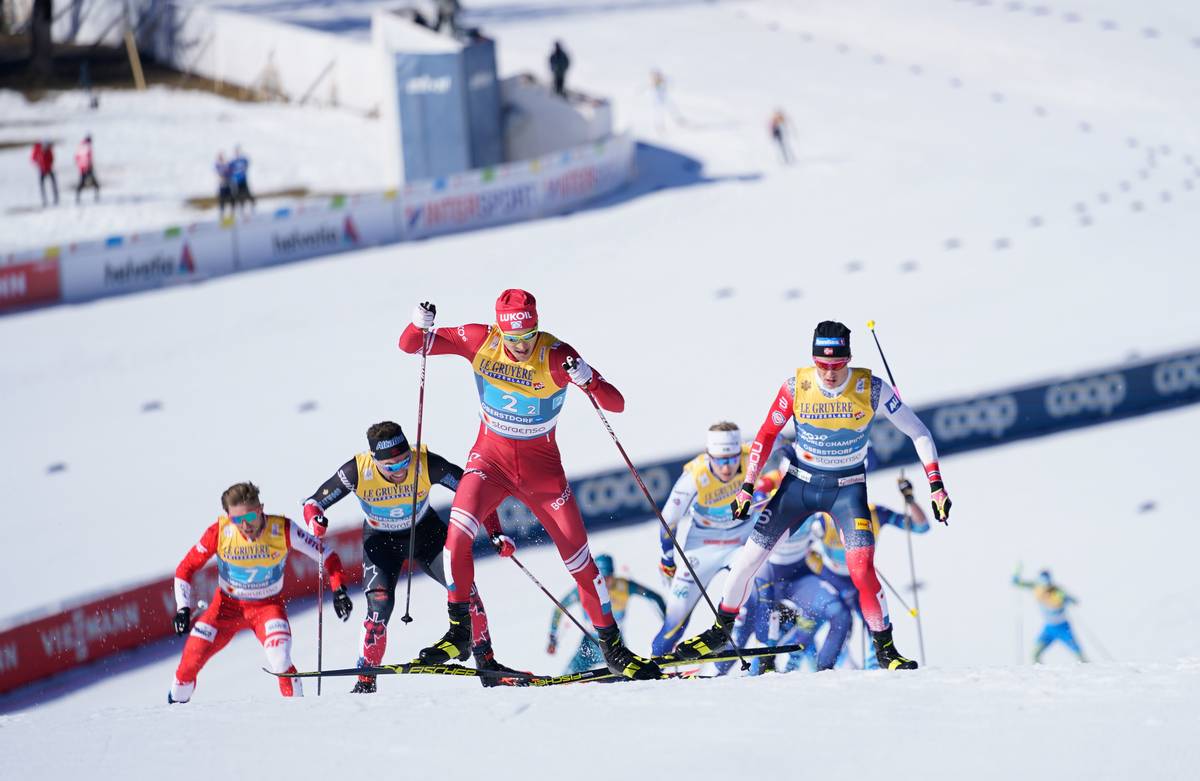
    Locked in for battle, Norway versus Russia to conclude the Men’s 4×10 k championship relay. (Photo: NordicFocus)

    By 34.7 k the duel was on – the world’s best playing hot and cold as they ticked away the kilometers toward the finish line. With Norway absent for much of the Wold Cup season, these two rivals have not had many head-to-head opportunities this year up until this moment. For his part, Bolshunov never moved to pull away from Klæbo who boasts a peerless finishing kick. Once atop the course’s final major run up the Burgstall climb, when Bolshunov had gained no ground, this chess march was all but done. 

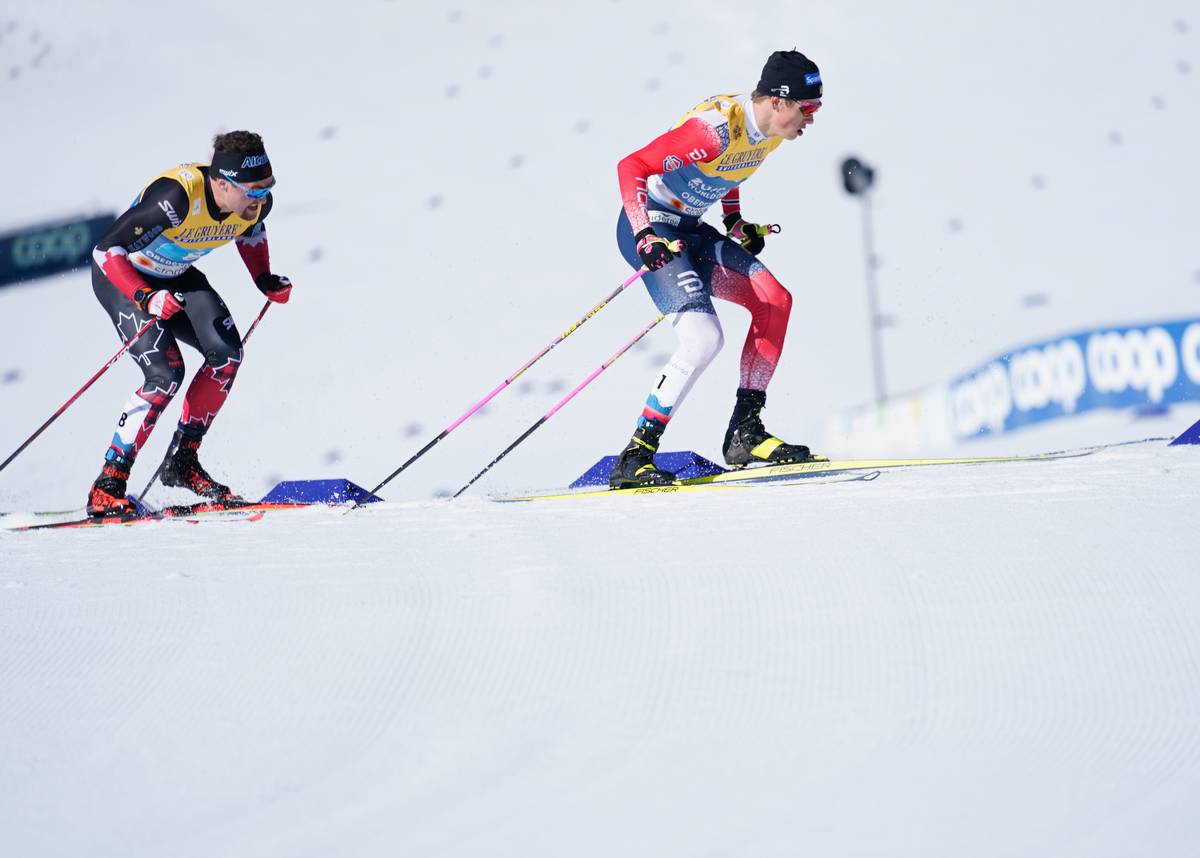
    Klaebo (NOR) not giving an inch to Bolshunov (RSF). (Photo: NordicFocus)

    Entering the corner into the final sprint hill before the finish there was virtually no gap between the two skiers, though in reality the game had tipped in Norway’s favor. While Bolshunov may dominate the distance races, Klæbo remains king of the sprint and once he made his up-skate move, there was nothing the Russian could do. The decisive moment came half way up the hill as Klæbo catapulted himself away with an unmatched turn of pace, setting up for an easy cruise down the finish straight, sealing the deal on gold for Norway once again in a time of 1:52:39. Twelve seconds later, Bolshunov crossed the line, meaning silver for RSF. 

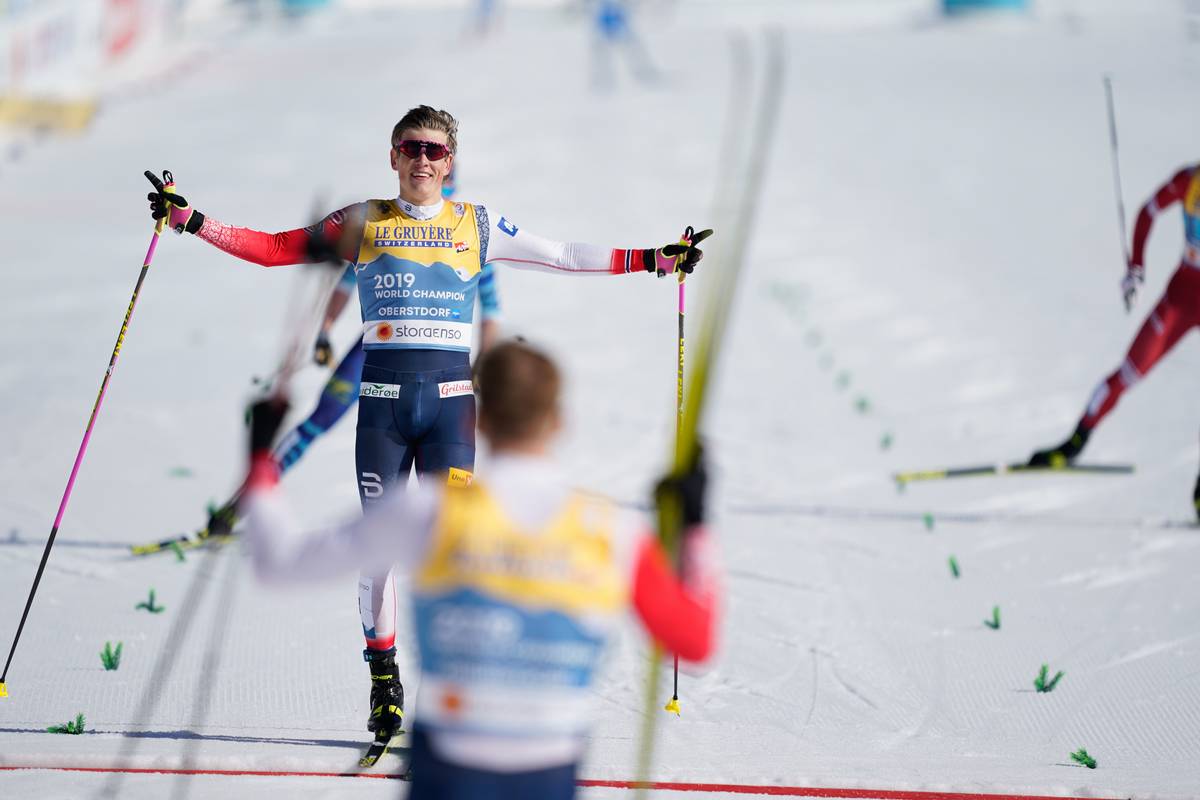
    The deal has been sealed, Johannes Hoesflot Klæbo (NOR) celebrates victory as a defeated Bolshunov (RSF) gives up before the line. (Photo: NordicFocus)

    Rewind a bit and the fight for bronze was unfolding on the Burgstall climb as Jules Lapierre of France made a break, gaining ten seconds of advantage over Sweden, Finland and Switzerland.

    Jules Lapierre (FRA) gets a boost after bringing home bronze for France. (Photo: NordicFocus)

    Though that advantage shrunk on the descent, it remained enough to give France third place, finishing + 1:12.6 behind Norway and four seconds ahead of Sweden in fourth. 

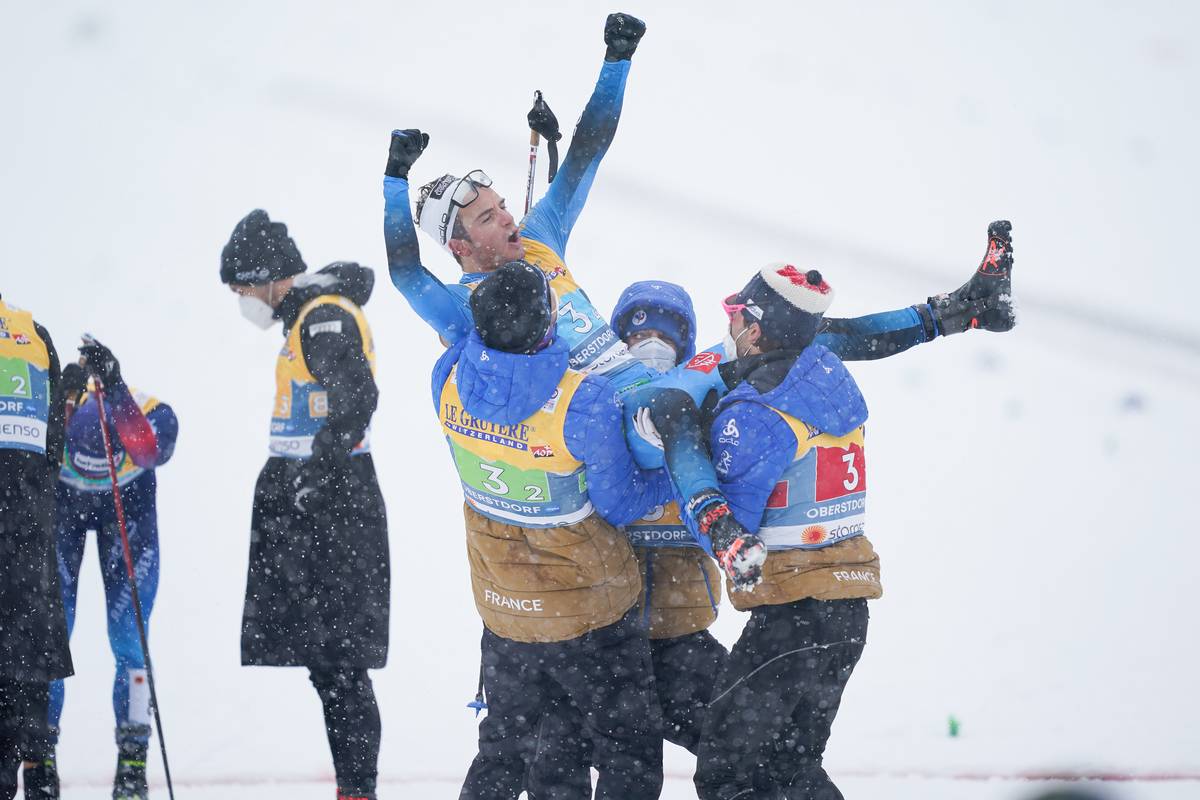
    No shortage of enthusiasm from team France after their third place finish. (Photo: NordicFocus)

    For team USA, David Norris raced the scramble, handing over to Scott Patterson in 11th position at the first exchange. 

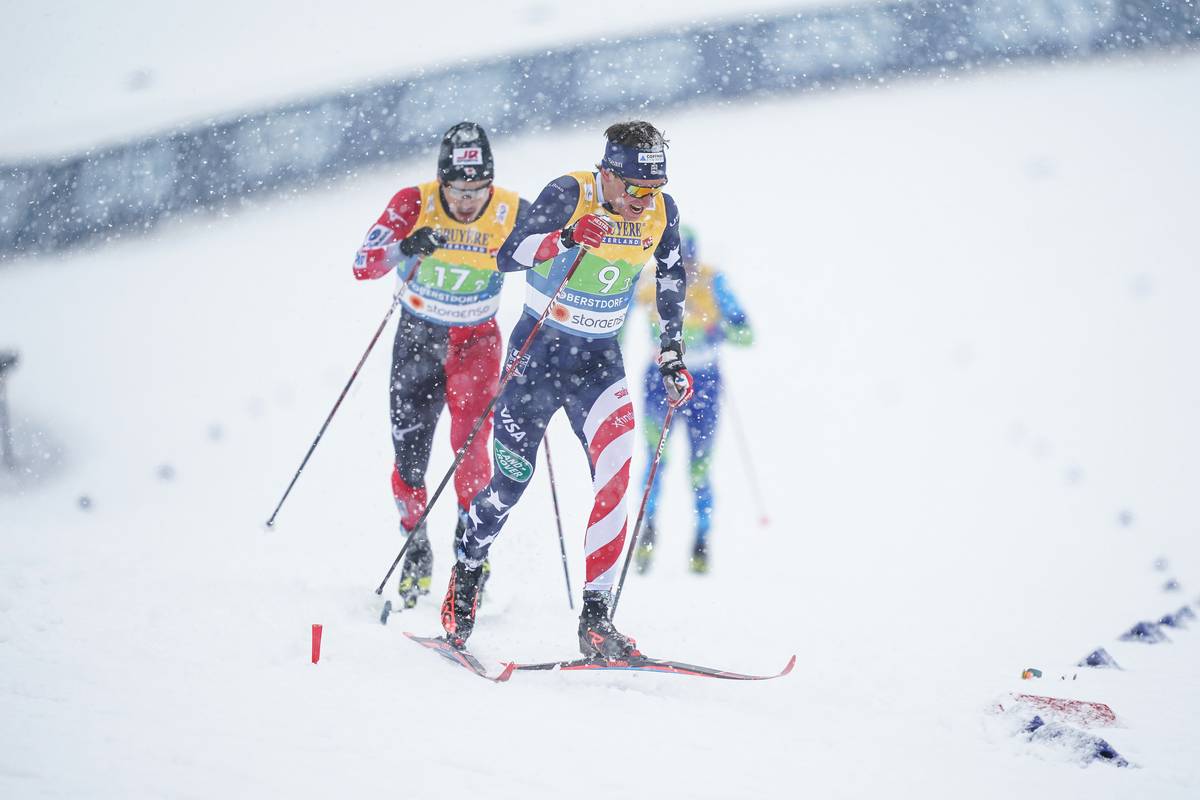
    Scott Patterson for the U.S. settles into a pacing groove on the second leg of the 4 x 10 k relay. (Photo: NordicFocus)

    Patterson remained steady through his laps and tagged Simi Hamilton, still in 11th. Over the course of his 10 k, Hamilton gained one position and tagged Gus Schumacher in 10th place.

    “It was awesome,” Hamilton said of the racing and wild Oberstdorf weather. “It was, I mean a pretty crazy, bizarre, different weird day with the conditions. You know like, you never really know what to expect when you wake up and its basically 32 and dumping all day. It’s going to make for a pretty different race but I’m super proud of our team.

    “I think we put together just four really good consistent legs. Our skis were awesome, my boards were running really really well. The climb was tough for me, as kind of a “sprinter” when you mix in a four-minute climb its always tough for me but thankfully I was able to kind of rely on some good glide to recover from the top down to the stadium each time so that was great. But yeah, these boys are… it was maybe the most fun relay I’ve ever skied on, on the World Cup or World Championship just because, I don’t know we had a really good energy going today. We all came out and fought hard and I think this is the type of energy that you know eventually will land us on the podium. I won’t be on that team, but it’s cool to be a part of it. I’m stoked, it was a great way to end the championships for me and it was a fun day.”

    Simi Hamilton, leg three skier for the U.S. (Photo: NordicFocus)

    Schumacher and Friedrich Moch of Germany battled it out, the advantage ultimately going to Germany who finished in 7th, Schumacher crossing the line 8th for the United States. 

    Graham Ritchie (CAN) keeping Canada’s team in contact during the scramble leg. (Photo: NordicFocus)

    Team Canada, who posted a strong start by Graham Ritchie, ended the day in 10th place. Skiing leg two for Canada was Antoine Cyr, followed by Russell Kennedy with youngster Remi Drolet holding the anchor position. 

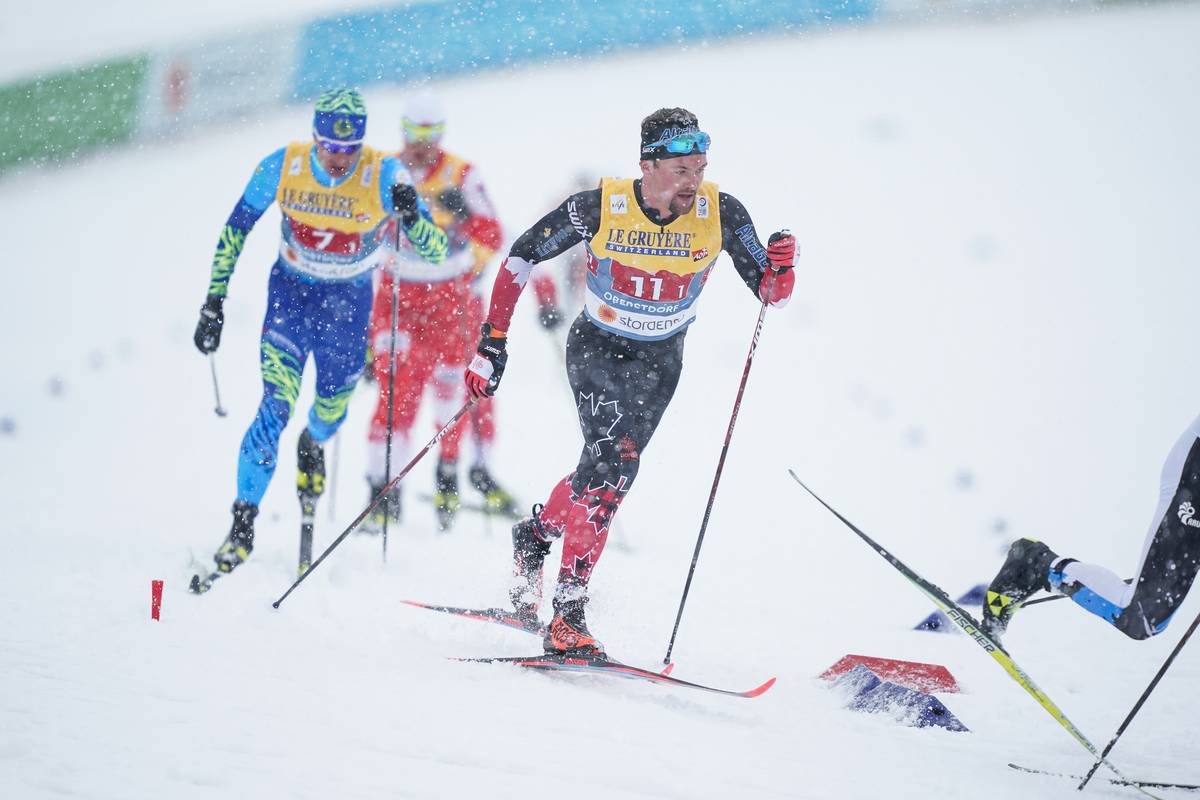
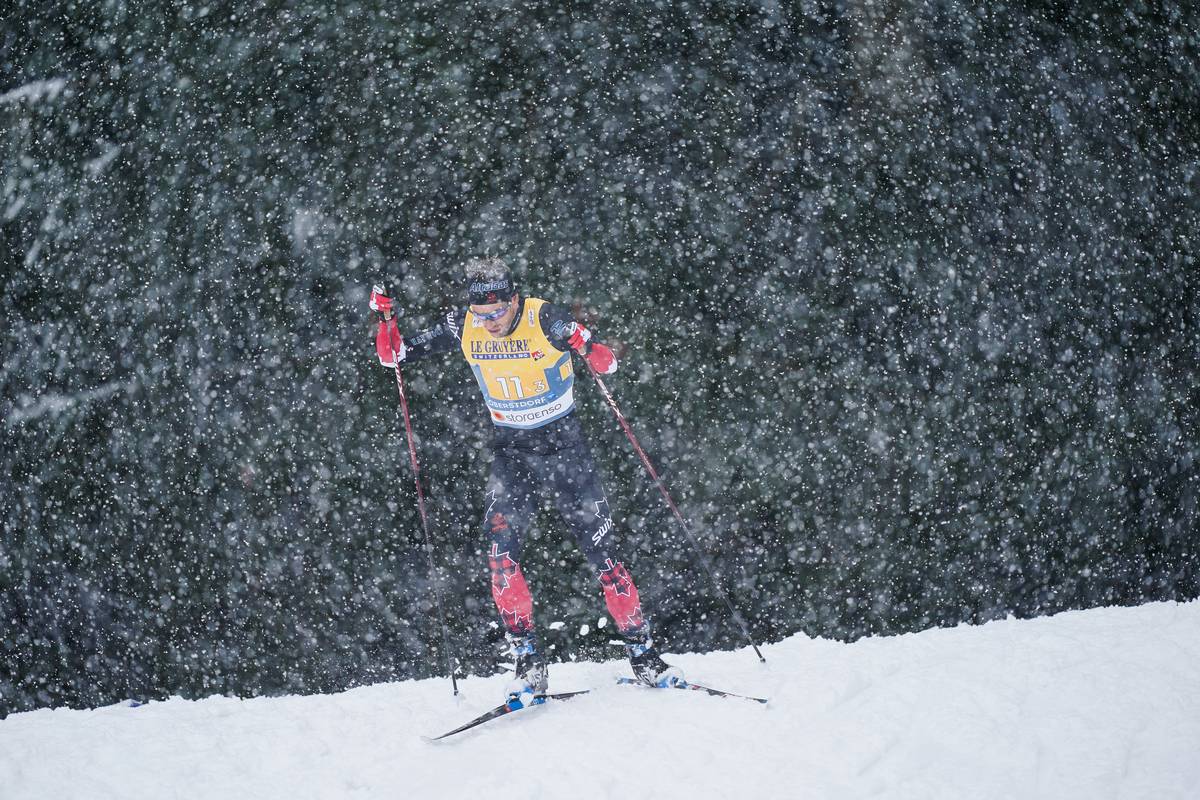
    In a snow globe, Russell Kennedy of Canada during leg three of the 4 x 10 k relay. (Photo: NordicFocus)

    This year’s World Championships conclude for the men on Sunday with a 50 k classic mass start event. 

    Results: Men’s 4×10 k Relay

  • The Devon Kershaw Show: 2021 World Championship Team Sprint with Alex Harvey (And a 10th Anniversary Celebration Concerning Oslo 2011)

    The Devon Kershaw Show: 2021 World Championship Team Sprint with Alex Harvey (And a 10th Anniversary Celebration Concerning Oslo 2011)

    In this Sunday, World Championship team sprint episode of the Devon Kershaw Show, we have a special guest from Québec , the actual Prince of Québec … Alex Harvey.
    It has been ten short or long years since he and Kershaw won the classic team sprint at the 2011 Oslo World Championships. First off, before listening to the episode today…check out the videos posted below.
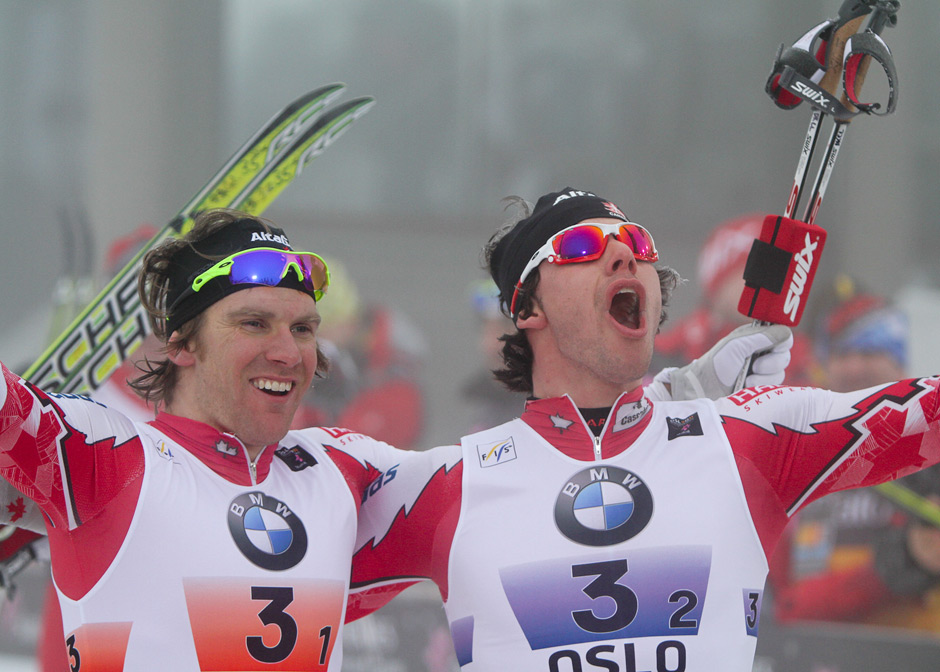
    Devon Kershaw (l) and Alex Harvey celebrate their World Championships gold in 2011 in Oslo, Norway.


    To set the scene, this win goes down at the Holmenkollen, the Shangri La of cross-country skiing. The Holmenkollen is hallowed ground.
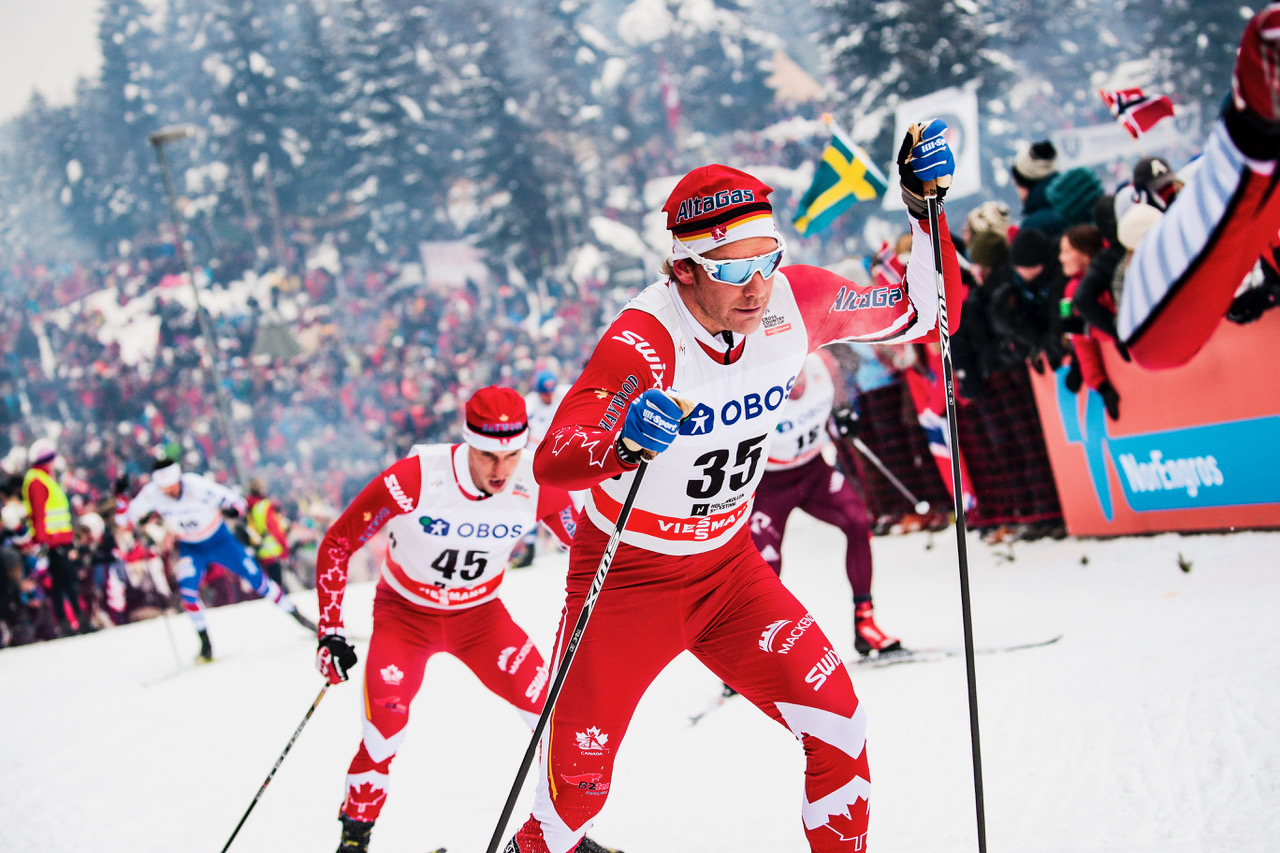
    Devon Kershaw leads his Canadian teammate Andy Shields during the 2018 Holmenkollen 50 k freestyle mass start on March 10 in Olso, Norway. (Photo: Fischer/NordicFocus)

    Think dense fog rolling in from Oslo fjord – a hundred thousand fans lining the course and stomping in the stands – there to witness the Canadians overtake a Norwegian in the final straight to win the team sprint. Back then, Harvey and Kershaw were a decade younger but no less wise. But we’ll let them tell the story.


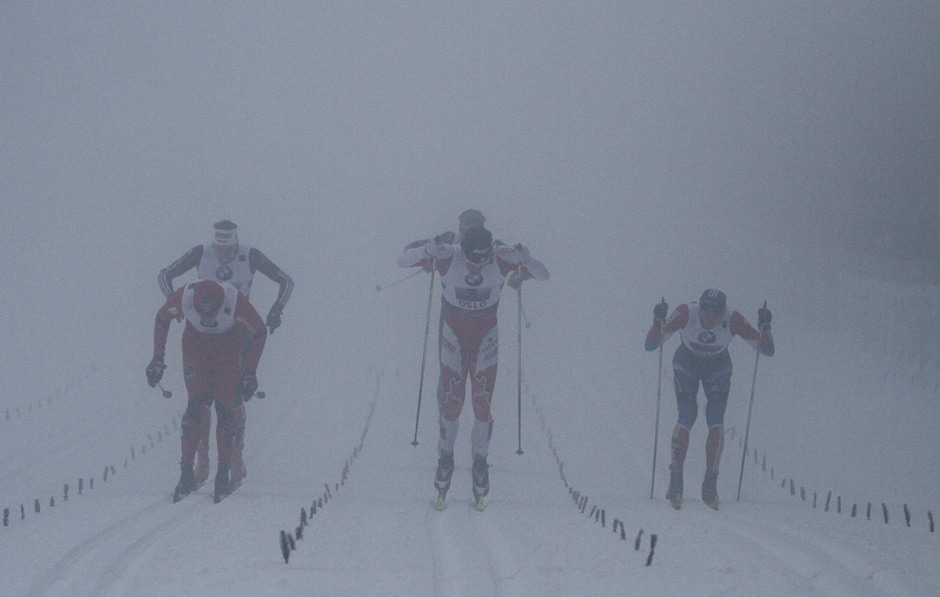
    Harvey (C) powers to the line ahead of Ola Vigen Hattestad (L) and Alexander Panzhinskiy (R) for the 2011 World Champs win in Oslo.

    For now, their win in Oslo is a good spine tingle for these times. They remind us of the gift of crowds and that anything can happen when the stars and maybe a little fog align.

    Here are some solid videos to time-machine back and relive the scene:

    1) The call from British Eurosport

    Indeed, we do get to the 2021 World Championships too. Kershaw and Harvey chat about the sunny day’s racing in the freestyle team sprint won by Norway on the men’s side and Sweden for the women.

    Thanks for listening.

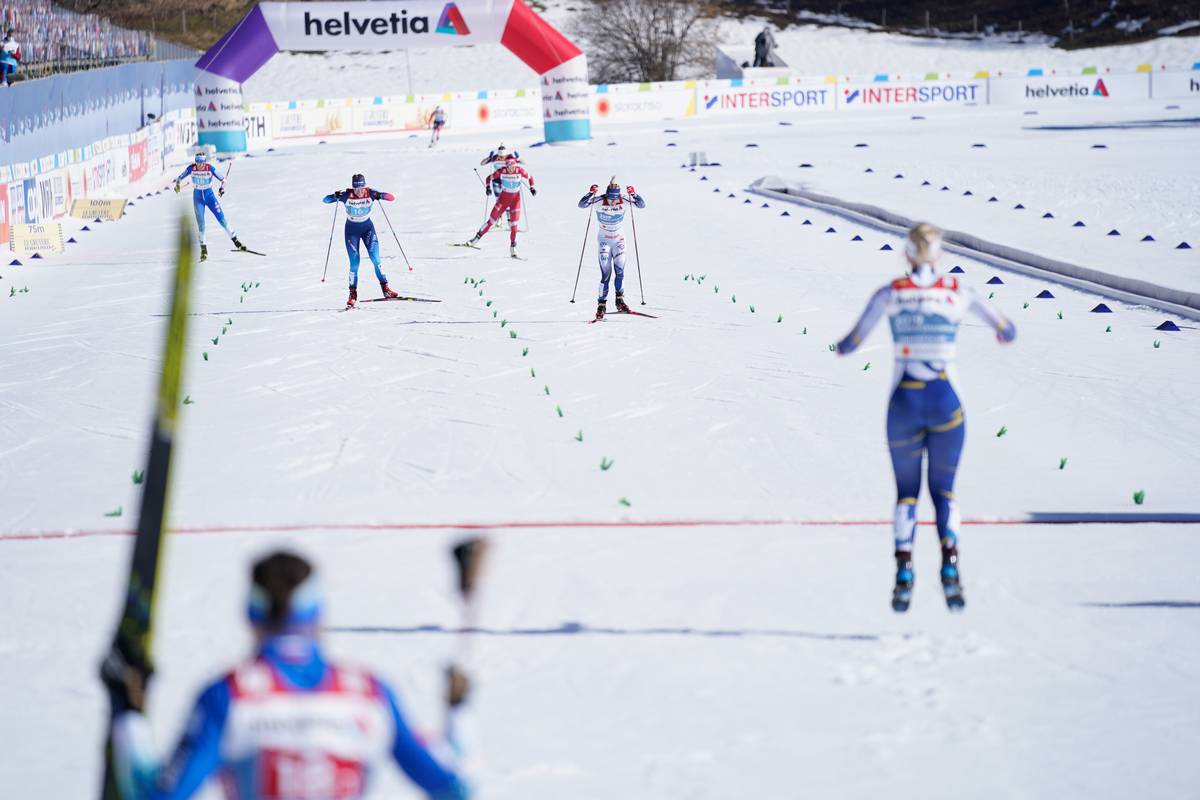
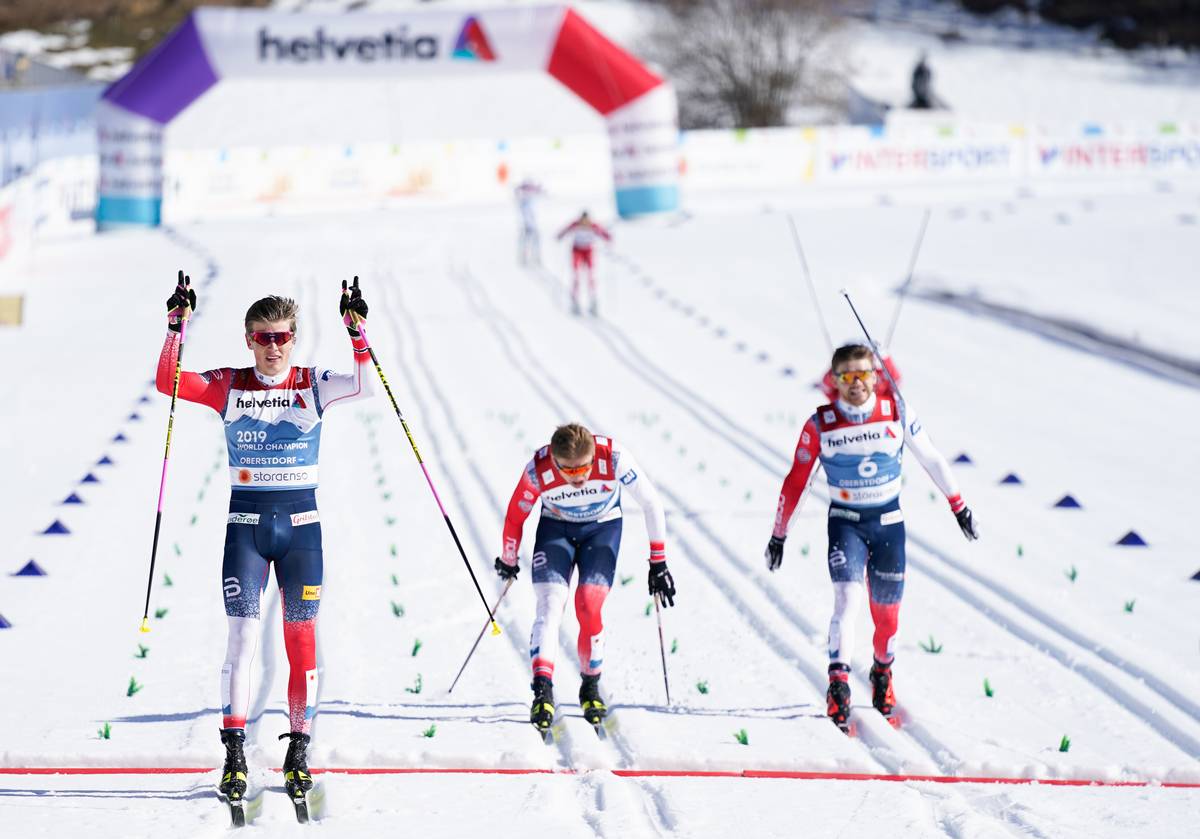
    The final moments of the World Championship team sprint in Oberstdorf, Germany. (Photo: NordicFocus)
  • Norway Speeds Ahead for Men’s Team Sprint Gold, Canada’s Cyr and Ritchie 7th Overall

    Norway Speeds Ahead for Men’s Team Sprint Gold, Canada’s Cyr and Ritchie 7th Overall

    Greeting teammate Erik Valnes at the finish, Johannes Høsflot Klæbo helps Norway to gold in the team sprint. As Klæbo’s bib makes apparent – this makes it back-to-back team sprint titles. (Photo: NordicFocus)

    This World Championship coverage is made possible through the generous support of Marty and Kathy Hall and their A Hall Mark of Excellence Award. To learn more about A Hall Mark of Excellence Award or to learn how you can support FasterSkier’s coverage please contact info@fasterskier.com.

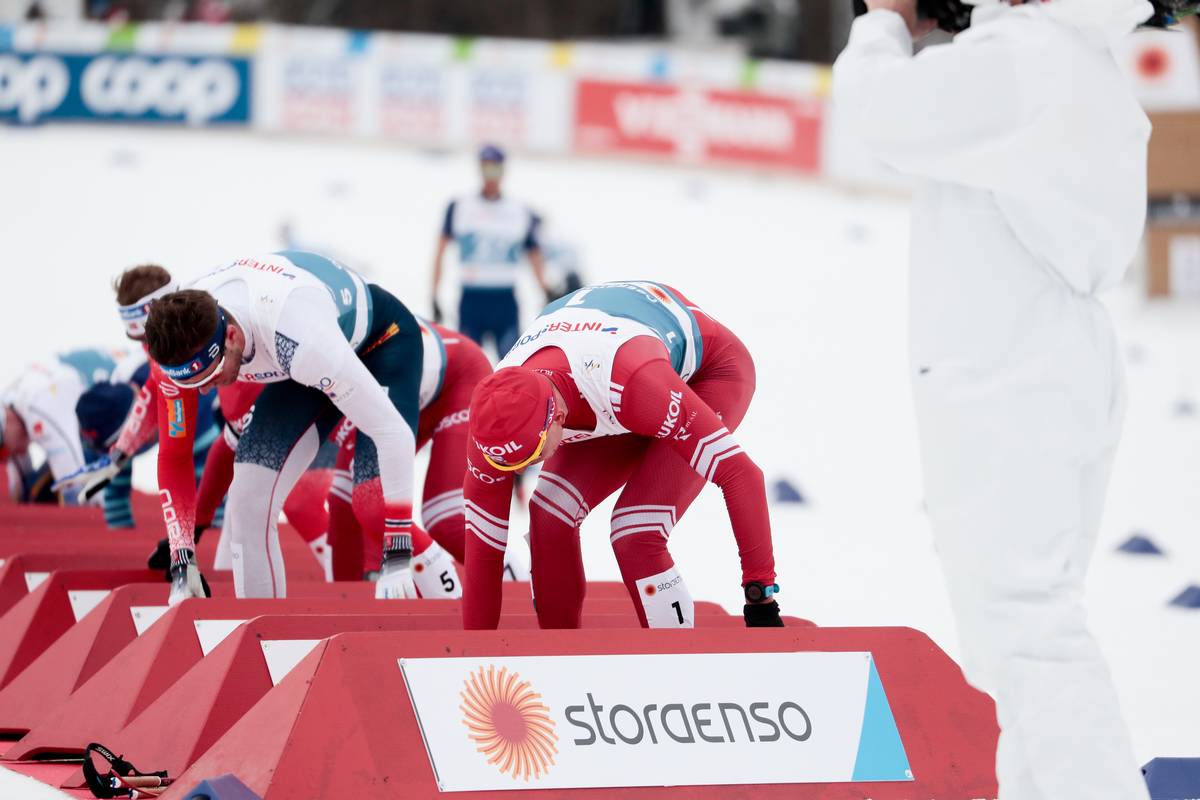
    The firepower was evident on the start line. Norway, Russia, France, Italy, and six other teams paired for the team sprint Sunday at the 2021 Oberstdorf, Germany World Championships. Revving at the start for Norway were Erik Valnes and Johannes Høsflot Klæbo, with Alexander Bolshunov and Gleb Retivykh for Russia. Two teams in a freestyle team sprint with a seemingly endless list of scores to settle.

    With the third day of racing dawning at these championships, Klæbo comes in with a gold medal in Thursday’s classic sprint while Valnes earned silver. Bolshunov satisfied his itch for individual gold with a technical-strike win in yesterday’s 30-kilometer skiathlon. Although only twenty-four-years-old, the win was the first individual championship title for Bolshunov.

    With a wide-angle view of the blue sky and mountainscape, the setting was dreamy if not trending on too warm for the start of the team sprint. At this level of racing with F1 engine fine-tuning and horsepower – the initial pacing and gamesmanship wasn’t exactly horse and buggyesque, but certainly not close to redline speed. The real jazz in this team sprint, which amounted to a total of 7.2 k of skate sprinting with each athlete racing three laps total,  came around the 6:40 mark.

    Erik Valnes (NOR), Alexander Bolshunov (RSF), (l-r) during the chess match portion of the World Championship team sprint. (Photo: NordicFocus)

    Bolshunov and Valnes were rolling for their respective teams. Up the course’s decisive hill, Bolshunov hop-skated and V1’d to separate himself from Valnes, Francesco de Fabiana of Italy, France’s Lucas Chanavat, and Ristomatti Hakola of Finland. The shake-up from Bolshunov was enough to have what appeared to be everlasting relevance in this narrative. It turns out, the move almost stuck.

    Gleb Retivykh (RSF), Johannes Høsflot Klæbo (NOR), (l-r) cresting a hill during the men’s team sprint final. (Photo: NordicFocus)

    Retivykh, one of the planet’s best skate sprinters, pulsed away with a two-second lead at the third exchange over Norway. Italy (+2.5), France (+2.8), and Finland (+3.2) were close behind. As far as prescient strategies go, the burst of speed from Bolshunov and cushion of time gifted his partner seemed a lucid move on many levels. It kept the Russians out of traffic. And it kept hope alive for a Russian gold when the stars, and in fact, the entire universe was aligned in this truth: No skier besides maybe his partner, Valnes, currently door-slams a final climb and descent into a finishing straight like Klæbo.

    There were more pulses of speed from Bolshunov on his final turn of the screw during his final lap. Camera angles and stopwatches aside, the Russians appeared ready to bite down on real gold rather than see their efforts stymied on the final lap in an effort for fool’s gold. Retivyk took a 4.3-second lead at 6 k into the last 1.2 k to finish the race. Klæbo had his target ahead in Retivyk, with Joni Mäki skating off 5.1 seconds back. France and Italy, at that point and time, barring a spill upfront, were no longer podium threats at +9.9 and +10.0 seconds behind, respectively.

    The tag zone chaos. (Photo: NordicFocus)

    At 13:00 into the race, on that last lap, Retivyk V2d 15 meters ahead of Klæbo and Mäki. At the base of the first rolling climb, with no evident uptick in effort, Klæbo (with Mäki in his draft) began to close in. On the long glide-out, Klæbo’s slick skinny skis did the work: Norway and Finland were locked onto Russia at 13:40.

    At 14:08, despite the race officially not run its course, was over. Klæbo moved around Retivyk and put on a technical and profound display of high-turnover uphill precision. Around the left 180-degree corner atop the hill, Klæbo had 20 meters on Retivyk and Mäki.

    Down the straight, with what looked like 40 and maybe 50 meters of real estate between himself and second and third place, Klæbo let up, soaked in the stoke, and won for Norway in 15:01.74. Finland was second (+1.68), and Russia third (+2.09).

    Looking back at his chasers, Johannes Høsflot Klæbo skis the final meters toward gold in the team sprint. (Photo: NordicFocus)


    With room to relax and take it in, Johannes Høsflot Klæbo anchors Norway’s gold medal team sprint. (Photo: NordicFocus)

    “It means so much to me, yah, to be World Champions,” Valnes told FIS after the race. “It is an amazing feeling and it is amazing to be a team with Johannes. I am really happy, I have been nervous for this day.”

    For Klæbo, this makes it back-to-back World Championship team sprint gold medals. He won in 2019 in Seefeld, Austria’s classic team sprint with Emil Iversen. The duo outpaced Bolshunov and Retivyk in that race too, when Russia placed second overall.

    “It is amazing,” Klæbo told FIS. “I think it was also a tough semifinal today with really hard conditions and it was really high speed and then the sun started burning a little bit and the conditions got a little bit heavier so it was perfect for us. I felt really strong today and Valnes did a very good job there so it was an amazing feeling. Like I said, to be World Champions together is the best feeling.”

    Klæbo is also the 2018 Olympic team sprint champion with Martin Johnsrud Sundby.


    The men’s team sprint podium in Oberstdorf: Norway took home the victory ahead of Finland and Russia. (Photo: NordicFocus)

    Canada was the lone North American team represented in the men’s final. Antoine Cyr and Graham Ritchie placed fourth in semifinal A, which was won by Norway in a tight finish – the top four teams were within 0.61 seconds. (Due to the warm weather in Oberstdorf, race officials changed the ruling yesterday to allow the top four teams in each semifinal to advance plus the two additional fastest teams overall. Before the rule change, the top two teams from each semi, and the next six fastest teams by time, considering both semis, were slated to advance.)

    In the final, Canada, fueled by the two twenty-two-year-old skiers, crossed the line in a photo finish with Sweden to place seventh, 0.4 seconds behind Sweden and 17.06 seconds off Norway’s winning time.

    “This race is good for both of us,” said Cyr to Nordiq Canada. “Graham has proven he is a good distance skier and is a wicked sprinter. I also enjoy being in the heats sprinting like today, so it is a good mix for us.”

    Antoine Cyr (CAN), Jovian Hediger (SUI), Lucas Chanavat (FRA), (l-r) doing the men’s first team sprint semi-final. (Photo: NordicFocus)

    “This is eye opening and very cool for us to have Canada right there in the mix,” said Ritchie, to Nordiq Canada. “It hasn’t sunk in yet really, but we have the confidence and thought we could do it. It is pretty cool.”

    Graham Ritchie (CAN), locking on to Johannes Høsflot Klæbo (NOR), (l-r). (Photo: NordicFocus)

    For the U.S., on a team representing two generations of cross-country skiing, Simi Hamilton and Gus Schumacher were eliminated in semi-final B and placed 14th overall. In their semi, Schumacher appeared to ski away on the fourth tag a fraction before being tagged by Hamilton. He snow-plowed as he sensed Hamilton had not reached him before the end of the tag zone. As he checked speed, Switzerland’s Jovian Hediger crashed into Schumacher. Schumacher righted himself and circled back to Hamilton for the tag.

    The U.S. skied to seventh in that semi, 15.56 seconds off the pace of Italy’s winning time. This was Schumacher’s first World Championship appearance and by most accounts, the last team sprint for the veteran Hamilton.

    Gus Schumacher (USA) racing in semi-final B of the men’s team sprint on Sunday. (Photo: NordicFocus)

    Reflecting on the race, the twenty-year-old Schumacher noted that championships racing on the senior level was a growth opportunity. “I think we can chill out a little bit more in the sort of clustery-spots and rely more on good skiing,” Schumacher told the U.S. Ski Team after the race. “I think I was a little bit unsure of how good the skiing needed to be and put a lot of pressure on the tactics and the bumper-car aspect of it. But, I mean, we skied pretty well. But there was a bobble that cost it all.”

    Asked what he would take away from the experience, Schumacher was matter-of-fact about the experience and moving forward. “I think just the way I approach most races and just be more relaxed and looking to enjoy it and whatever happens, happens, is a good approach to these races too even if they are not necessarily conducive to chill skiing.”

    “It was amazing,” Schumacher added about teaming up with Hamilton. “I felt a lot of pressure because it is his last World Champs and his last team sprint. We knew that we had a lot of potential. I was really proud to have this start and give him my all. I think I did my best, but I made a mistake.”


    Simi Hamilton (USA) racing in Sunday’s second semi during the team spring semis. (Photo: NordicFocus)

    For his part, as Hamilton ruminated on the day, he was clear about honoring the big picture of team culture and putting the day’s events in perspective. Below are Hamilton’s comments as told to the U.S. Ski Team’s Tom Horrocks:

    It is one of those days where going into it felt awesome. We were psyched, our training has been amazing not just Gus and I, the whole men’s team we are clicking in a way that I don’t think I have ever seen this men’s team click before.

    All that contributes to just feeling really prepared and psyched for a race like this. And, we did everything we could, you know it is a team sprinting is, I would put sprinting in general, in its own category when it comes to chaos and things that can go wrong and things that can happen. Team sprinting has its own category in that level of chaos.

    Especially championship events like this where there is in the men’s semis there are up to 20 teams or something like that. It is always chaos and you see really changing conditions, so the tag zone is getting slower, a corner is getting sloppier, and it just, yeah it was one of those things we mistimed our tag, it wasn’t Gus’s fault because the tag zone had been much faster, even the previous leg…so you get into this mindset of going when you think you should be going, but it is hard to adapt to the change, for how much slower it is.

    I think he just went a little early, and we missed that tag at the very end of the zone, the jury is always going to see that, that you are going to miss the tag, so we decided that we wanted to just stop and get back in the zone and tag, that’s is when things kind of really took a turn for the worse.

    But, it doesn’t change all that stuff leading up to today. You know, this probably being my last team sprint and last sprint effort ever, obviously I wanted to ski with Gus in the final and possibly win that elusive medal at World Champs. But you, know, I have been thinking about it for the last hour skiing out with Gus and it is like it is just as important for me to feel like what I did today to get onto this team and be able to race with Gus, that is going to contribute to him winning medals in the future with this group of guys coming up. To me, that is just as important as me potentially winning a medal. I am still so grateful and humbled to be a part of this team and be able to race with Gus and train with Gus and all the other guys, and so it doesn’t change how I felt about the day at all. We are both fit. We are still hungry and fortunately, I think we get a few more racing opportunities coming up this week so we are going to make the most of that and enjoy the sunshine.”

    Dense pacsk skiing during the men’s second semifinal in Oberstdorf. (Photo: NordicFocus)

    – Harald Zimmer contributed reporting


    Results: Semi-Final A | Semi-Final B | Finals

  • Sweden’s Sundling Edges Out Switzerland for Team Sprint Gold; USA 5th

    Sweden’s Sundling Edges Out Switzerland for Team Sprint Gold; USA 5th

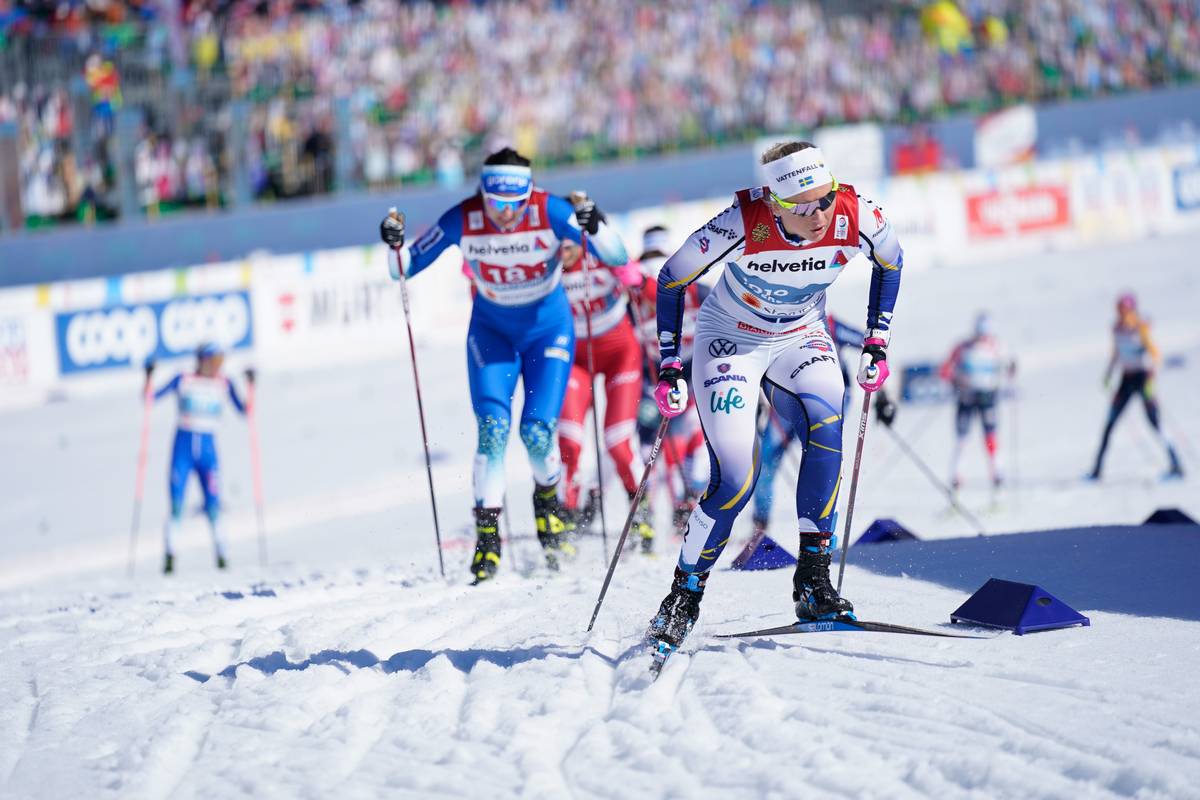
    The scene from an exchange during the World Championship team sprint in Oberstdorf, Germany. (Photo: NordicFocus)

    This World Championship coverage is made possible through the generous support of Marty and Kathy Hall and their A Hall Mark of Excellence Award. To learn more about A Hall Mark of Excellence Award or to learn how you can support FasterSkier’s coverage please contact info@fasterskier.com.

    And now for something completely different. The skate team sprint.

    Three roughly 1-kilometer loops each for 7.2 k total, relatively flat with just two brief upticks per lap, winding back and forth along the valley floor in Oberstdorf, Germany. Would the terrain be enough for one team to pull away from others or would it be an empty-the-tank last two laps, fighting for every centimeter? 

    From semifinal A, advanced the Swedish team of Maja Dahlqvist and Jonna Sundling, who won their heat by nearly two seconds ahead of the Russian Ski Federation (RSF), represented by Yulia Stupak and Natalia Nepryaeva, Norway, and Finland. Three teams finished within a second in Semifinal B, with Slovenia’s Eva Urevc and Anamarija Lampic edging out Rosie Brennan and Sadie Maubet Bjornsen for the U.S., and the Swiss Women, Laurien van der Graaff and Nadine Fähndrich. Germany and the Czech Republic also advanced from the second wave of semis. 

    Note that four teams advanced from each heat of the semifinals with the next two fastest times, a change from the usual top two teams plus six fastest times. This change was made based on the weather and conditions on the course.

    Rosie Brennan  marks Russia’s Yulia Stupak during the World Championship team sprint in Oberstdorf. (Photo: NordicFocus)

    So far in this World Championship, Brennan had only raced the classic sprint qualifier and Maubet Bjornsen not at all, perhaps leaving them fresh for this competition. American voices could be heard shouting words of encouragement as the women toiled around the course as a large group through the first four exchanges. At the third exchange at 3.6 k, the US was sitting in fifth, 2.3 seconds behind Sweden in the lead and in contact.

    Slowly, Sweden began to turn up the dial, building intensity. However, as the final laps took off, any ground Dahlqvist gained on her competitors was closed as they descended off the first roller and headed into the primary climb of the course. It was here that RSF’s Stupak began to challenge, duking it out with Dahlqvist but unable to pull away.

    Sweden’s Dahlqvist leads the way in the World Championship team sprint in Oberstdorf, Germany. (Photo: NordicFocus)

    After the final change, it was Sweden and RSF at the front, with a small gap to Norway, the U.S., and Switzerland with Slovenia a few meters back. 

    In the final lap, the tempo accelerated, poles whipped through the air, and any predictions of what might happen were laid wayside. 

    As Sundling tried to pull away, Fähndrich quickly closed the gap to the front, skiing at the Swede’s hip. Nepryaeva began to fall off the pace, and was being caught by Maubet Bjornsen and Lampic. Though Sundling and Fähndrich held ground at the front, the podium was within reach for each nation.

    Rosie Brennan (USA) tails Eva Urevc (SLO) and Yulia Stupak (RSF) during the World Championship team sprint in Oberstdorf, Germany. (Photo: NordicFocus)

    At the top of the intermediate climb and on the outside of the left-hand curve, Maubet Bjornsen ski was caught in a tangle, dropping her to her knee and stalling her momentum at an inopportune moment. The American rebounded quickly but was no longer able to fight for the top spots. 

    Making their way for the last time up the primary climb, Sweden and Switzerland, alone up-front, created a small gap to Nepryaeva. Meanwhile, Lampic of Slovenia was closing in and looking strong.  

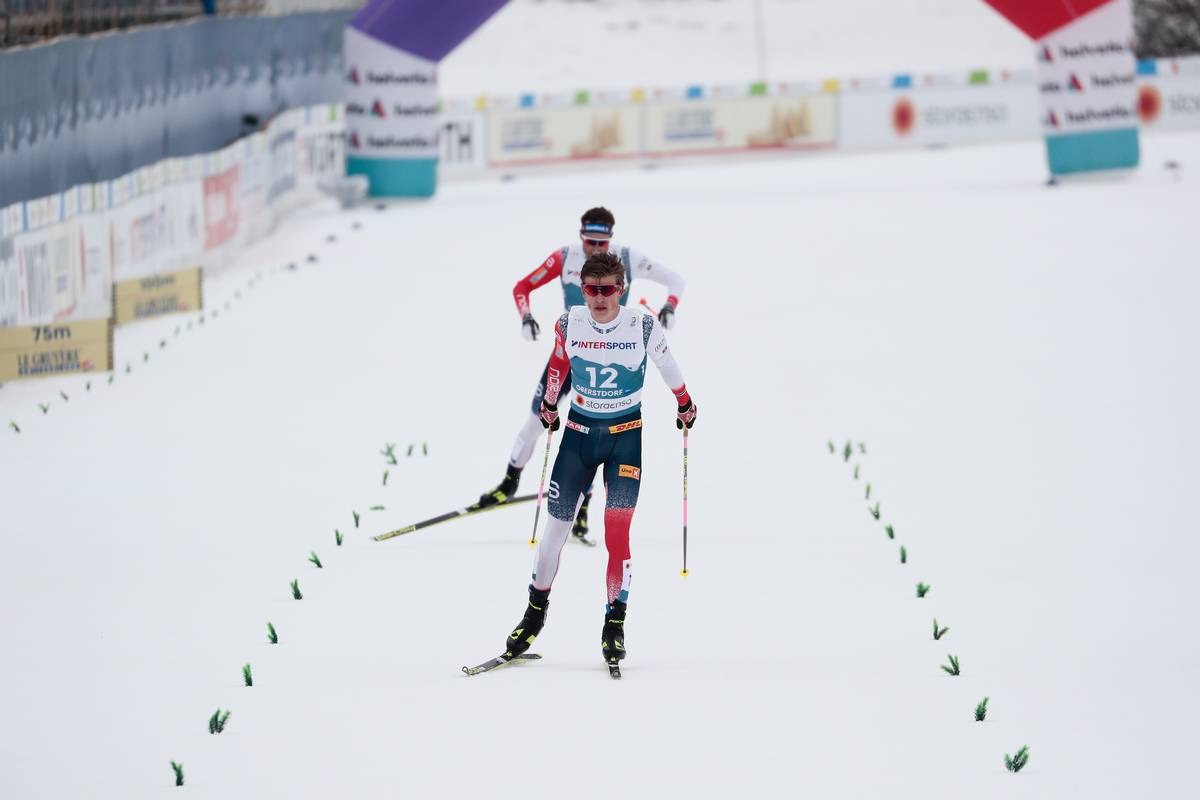
    The final moments of the World Championship team sprint in Oberstdorf, Germany. (Photo: NordicFocus)

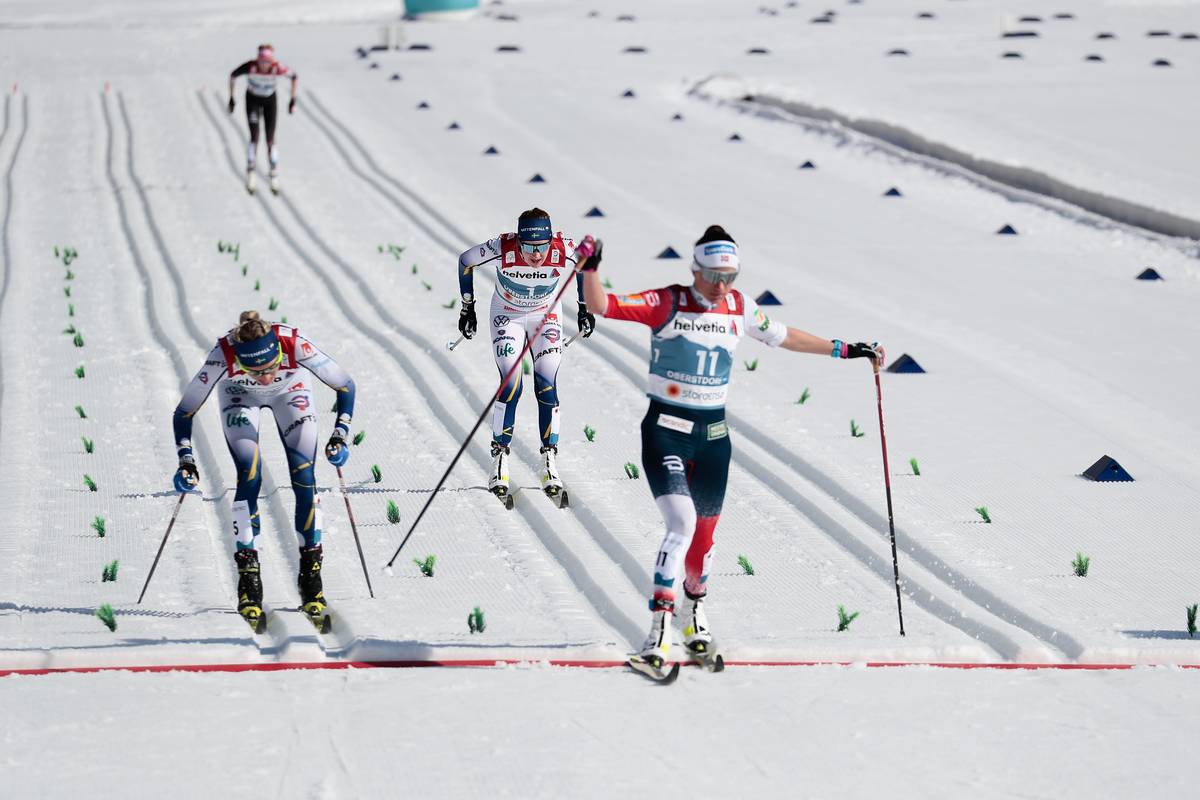
    Sundling was first into the final lanes, with Fähndrich a ski length behind, matching but not able to overtake the Swede. The women soared to the finish with Sweden holding its ground for the win, Switzerland finishing just under a second behind for the silver medal. 

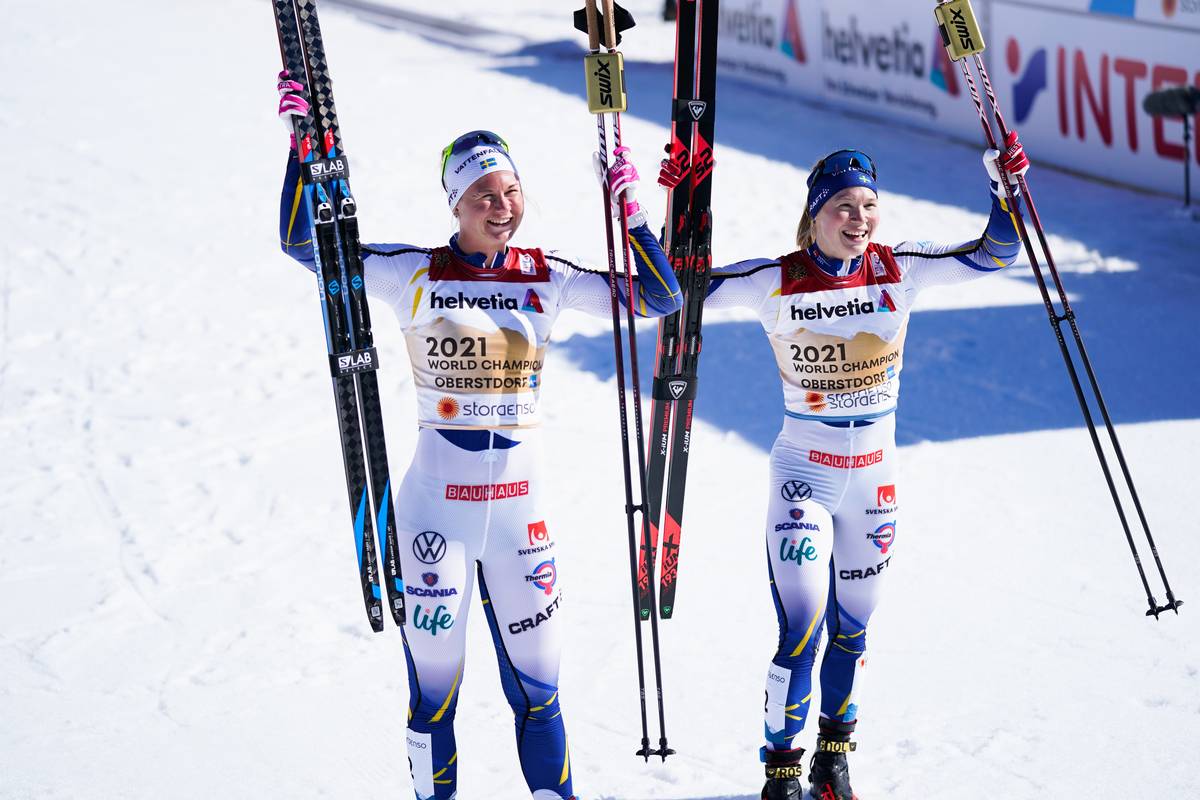
    Sweden’s Jonna Sundling and Maja Dahlqvist take home World Championship gold in the team sprint. (Photo: NordicFocus)

    “It was so fun to race today,” Dahlqvist told FIS after the race. “But it was hard too, the conditions were a little warm. It was easier in the qualification.”

    Sundling was asked whether she knew how close behind Fähndrich was in the final meters.

    “I heard there was someone behind me, but I just had my focus on the finish line and to cross it first.”

    Fighting for bronze, Lampic out-sprinted Nepyraeva to bring home a medal for Slovenia (+3.46), leaving RSF in fourth (+3.95). 

    The women’s podium at the World Championship team sprint in Oberstdorf. Sweden took the win ahead of Switzerland and Slovenia. (Photo: NordicFocus)

    The women of Sweden have made their sprint prowess well known this season and were favored to win their third World Championship medal in this event, piggybacking on the 2019 World Championships in Seefeld, Austria. Dahlqvist led the team there too, with Stina Nilsson as the anchor. Both members of today’s Swedish team were coming off of strong results in the opening classic sprint, where Sundling collected a gold medal.

    The winners, Sweden’s Maja Dahlqvist and Jonna Sundling, take in their team sprint victory in Oberstdorf. (Photo: NordicFocus)

    However, a medal for Switzerland and Slovenia, while not unexpected, is perhaps a more novel result. The duo of Van der Graaff and Fähndrich won the team sprint in Dresden, Germany earlier this season, but this is the historic first Swiss medal in the event and the first women’s medal for Switzerland since 1987, a bronze earned by Evi Kratzer in the 5k classic.

    Laurien Van Der Graaf (SUI) watches her teammate, Nadine Fähndrich, bring home a silver medal for their team. (Photo: NordicFocus)
    Laurien van der Graaff and Nadine Fähndrich take silver for Switzerland. (Photo: NordicFocus)


    “We always said we want that medal,” Van der Graaff told the Swiss news outlet SRF. And now it’s there! No idea, the emotions are there. It’s incredible.”

    Commenting on when they knew they could celebrate, Fähndrich replied, “I was only really sure when I crossed the line. She had tagged off to me in a great position, with only a little bit of a gap to [positions] one and two. Then I felt that those athletes around me tried a little to play tactical games, but I just thought no, I had to risk it because I felt good. I just knew ‘all out now’!”

    Laurien van der Graaff and Nadine Fähndrich celebrate with their tech after earning a World Championship silver medal in the team sprint. (Photo: NordicFocus)

    Despite the size of their team and country, the Slovenian team of Urevc and Lampic took 3rd in Dresden and won the most recent World Cup team sprint in Ulricehamn, Sweden. Slovenia also took silver in the 2019 Championships in Seefeld. Taking home her second medal of this Championship, 25-year-old Lampic also leads the overall World Cup sprint standings. 

    Eva Urevc and Anamarija Lampic of Slovenia bring home a World Championship bronze medal in the team sprint in Oberstdorf, Germany. (Photo: NordicFocus)
    Sadie Maubet Bjornsen helps the Americans to a 5th place finish at the World Championship team sprint. (Photo: NordicFocus)

    Finishing alone, Maubet Bjornsen brought the American women home in fifth (+5.83), matching the team’s result in this event at the 2019 World Championships.

    When asked if they were left wanting, Brennan gave an optimistic and grateful response:

    I’m actually really happy with it,” she said. “It’s been, quite literally, a career-long dream to do a team sprint with Sadie. She’s been a best friend and training partner for the entirety of my professional career, so I was just so happy and excited to even get this opportunity. I know that we are capable of more on any given day, but that’s ski racing — you go out there and you give it your all. Some days you win, some you don’t. But it was honestly a pretty special day for me.”

    Rosie Brennan marks Russia’s Yulia Stupak during the World Championship team sprint in Oberstdorf. (Photo: NordicFocus)

    Perhaps envisioning the hang-up in the last lap, Maubet Bjornsen discussed the degradation of the course between the semifinal and final. She explained that the tracks were fast, firm, and tactical in the final, becoming more dangerous as the transformed snow began to break down and accumulate on the surface. In these deeper conditions, Maubet Bjornsen explained that a skier must be aware of their equipment at all times to stay upright and powerful. 

    However, reflecting on their performance, she too focused on the positive, commenting on the years and hours the two have spent training and racing together throughout their careers, beginning as juniors. 

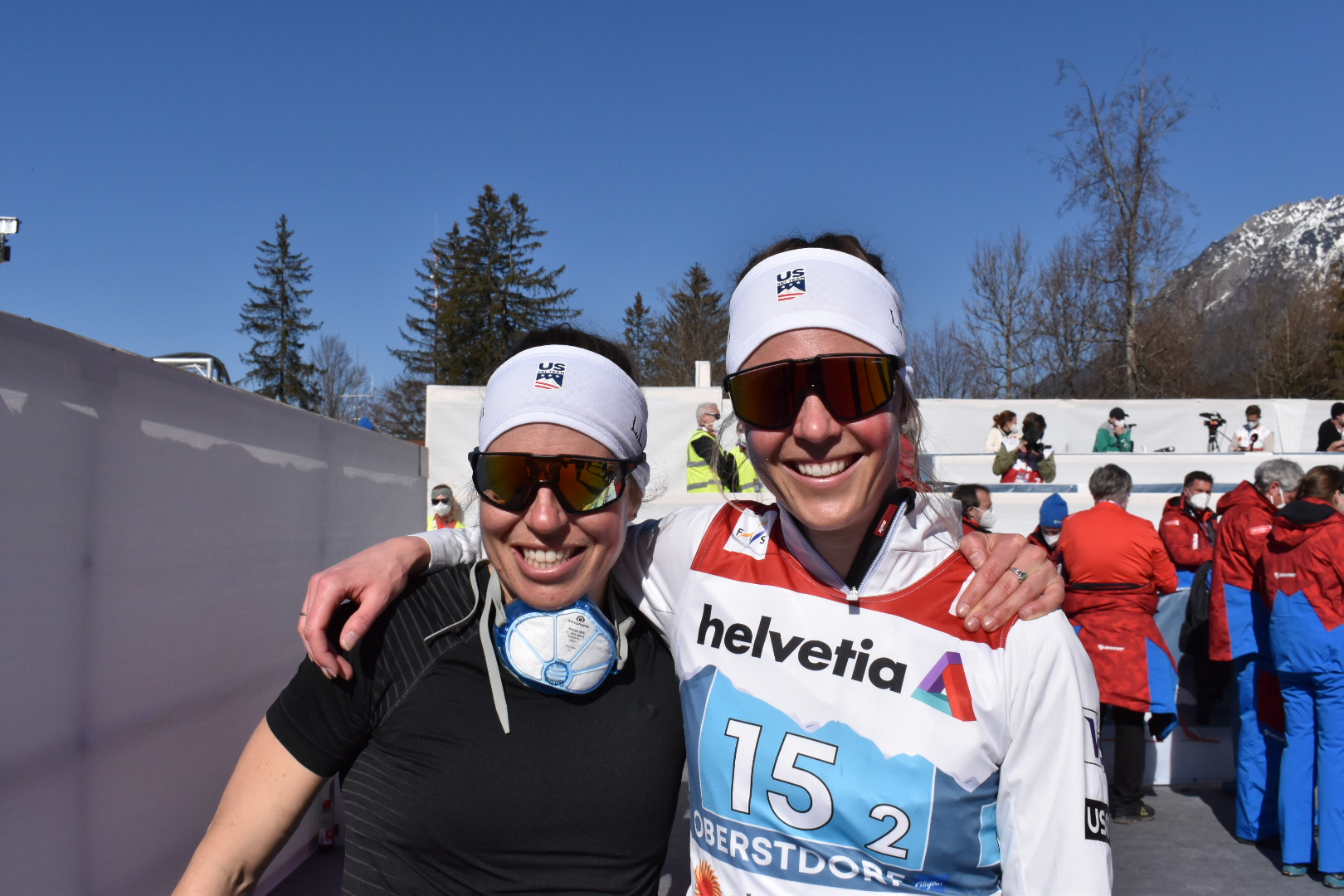
    Rosie Brennan and Sadie Maubet Bjornsen prepare for the World Championship team sprint in Oberstdorf, Germany. (Photo: Tom Horrocks/USST)

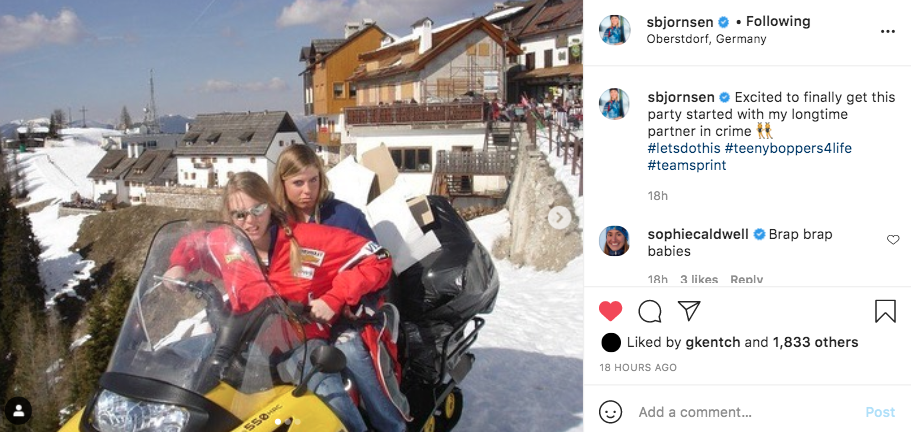
    “I feel like we skied an awesome race,” Maubet Bjornsen said. “Unfortunately, I got stepped on the first uphill which took me out of the draft and I couldn’t quite find the gear to come back to [the group]. Which is a bummer because my skis were incredible and I feel like if I would have been with those girls over the top of the second climb it could have been a medal day, but like Rosie said, you can never count on that, but I think it’s pretty cool that my number one training buddy and me were in a fight for a medal. That’s pretty neat. If you would have asked us that at 14-years-old, beating on each other, we would have laughed at you. So I think if we brought our 14-year-old selves here, we’d be pretty darn proud.”

    A trip down memory lane. (Photo: Instagram @sbjornsen)

    Results: Semifinal A | Semifinal B | Final


  • Bolshunov Victorious in the 30-Kilometer Skiathlon; Patterson 14th, Norris 17th

    Bolshunov Victorious in the 30-Kilometer Skiathlon; Patterson 14th, Norris 17th

    The field of all skiathlon athletes leaves the stadium in Oberstdorf, Germany. (Photo: NordicFocus)

    This World Championship coverage is made possible through the generous support of Marty and Kathy Hall and their A Hall Mark of Excellence Award. To learn more about A Hall Mark of Excellence Award or to learn how you can support FasterSkier’s coverage please contact info@fasterskier.com.

    With swaths of bare ground peeking through the melting snow, skis rattling through tracks and swooshing across the lanes, and short-sleeved race tops, World Championship racing continued in a warm Oberstdorf, Germany for the men’s 15k/15k skiathlon. Swirling through the stadium after each 3.75 kilometer lap, four in classic then another four in skate.
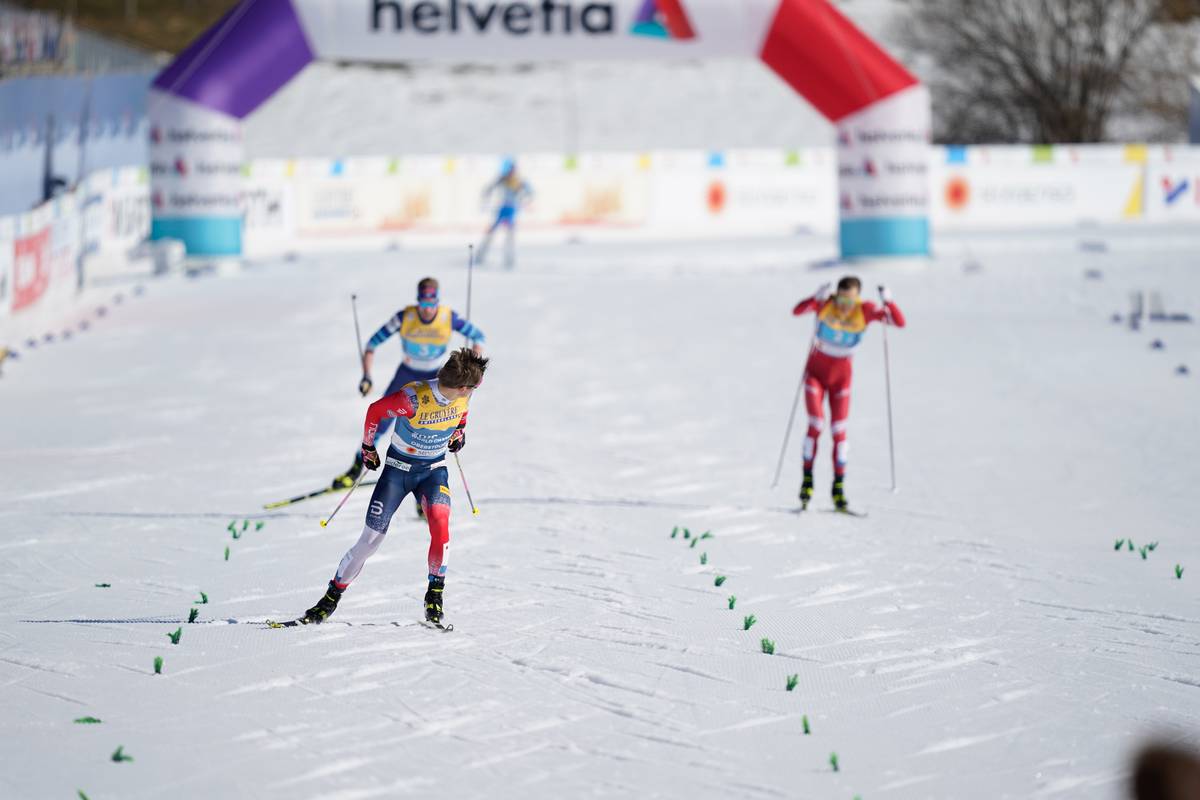
    For some historical context, Norway’s Sjur Røthe won the event in 2019 during the World Championships in Seefeld, Austria by a margin of just 0.1 seconds over Russia’s Alexander Bolshunov, with Martin Johnsrud Sundby crossing the line just 0.6 seconds later. Because of this victory, Norway was able to enter five men in today’s skiathlon, compared to four representing other countries. 

    Two years prior at the World Championships in Lahti, Finland, Russia’s Sergey Ustiugov took the win ahead of Norwegian’s Sundby, who had fallen 500 meters from the finish, and Finn Hågen Krogh. The message – the 30 k championship skiathlon comes down to the wire.

    With Bolshunov clearly on form this season and a pack of hungry Norwegians in pursuit, today’s mass start event looked again to be a Russia versus Norway dog fight.

    Alexander Bolshuov leads the men’s field during the classic leg of the World Championship 15k/15k skiathlon in Oberstdorf, Germany. (Photo: NordicFocus)

    As a large lead group of men slowly whittled down in the classic leg, Bolshunov held a steady position at or near the front alongside Finland’s Iivo Niskanen, who was 4th in 2019, and a slew of strong Norwegian racers that included Røthe, Hans Christer Holund, Emil Iversen, Johannes Høsflot Klæbo, and 2018 skiathlon Olympic champion, Simen Hegstad Krüger. These men entered and left the exchange together, with a steady stream of chasers not far behind. 

    Alexander Bolshunov (RUS) leads Iivo Niskanen (FIN) and Emil Iversen (NOR) during the classic leg of the World Championship 15k/15k skiathlon in Oberstdorf, Germany. (Photo: NordicFocus)


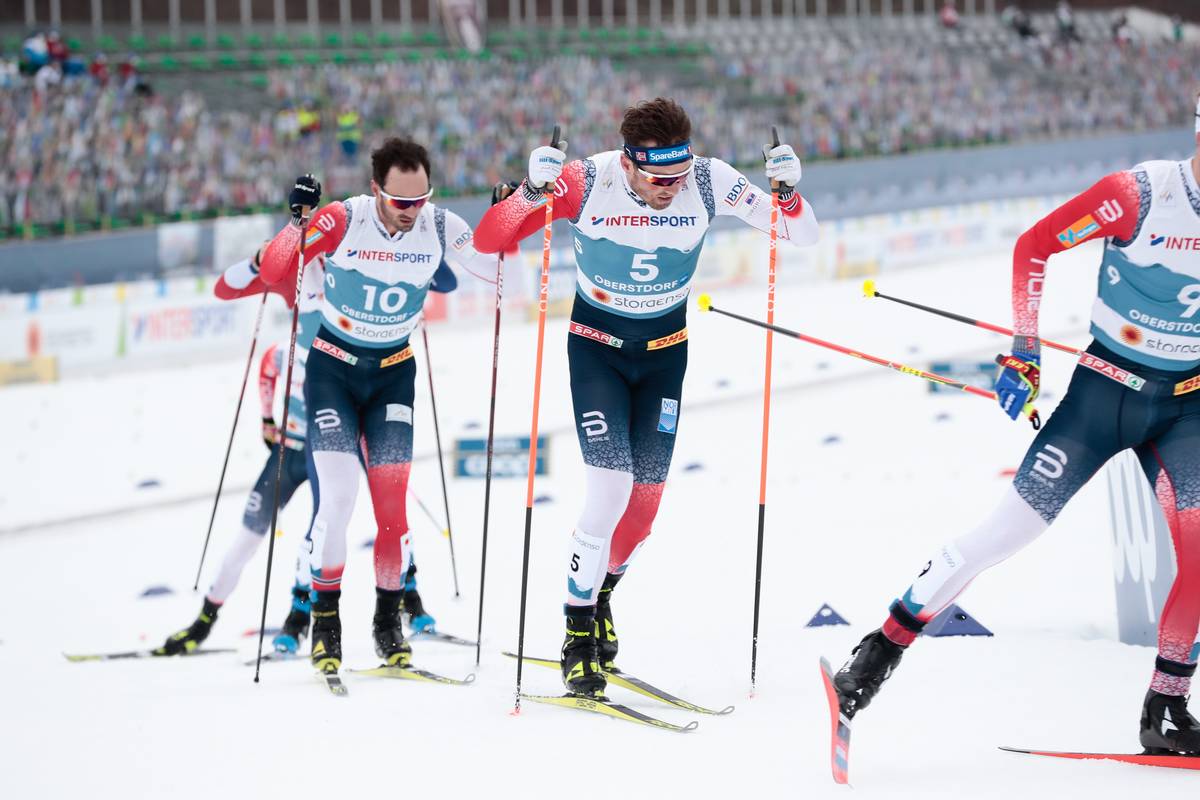
    A train of Norwegians near the front of the pack during the 15k/15k skiathlon in Oberstdorf, Germany. (Photo: NordicFocus)


    Bolshunov and company swapping skis. (Photo: NordicFocus)

    In the chase pack at the exchange and sitting in 11th place at the 16 k checkpoint was Scott Patterson. The American started in bib 38, well inside the inner workings of the accordion of racers that stretched and compressed over the first few laps. Nonetheless, Patterson steadily worked his way up through the field, looking to build on his 18th place finish in the event at the 2018 Olympics and 30th place finish the subsequent year in Lahti. With 11 k to go, Patterson was tucked in with Russia’s Ivan Yakimushkin and Alexey Chervotkin, roughly 21 seconds behind the leaders and reeling in Niskanen and Jens Burman of Sweden.

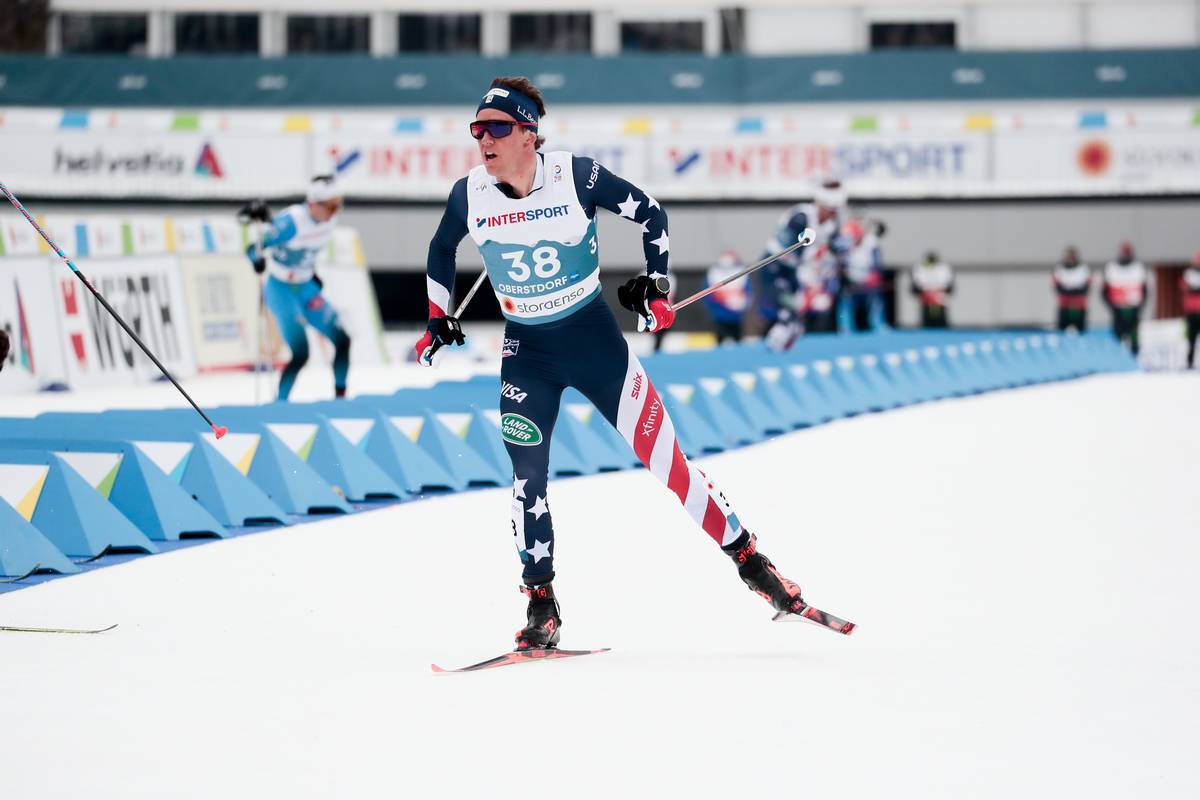
    Scott Patterson (bib 38) skis his way up through the men’s field during the World Championship 15k/15k skiathlon in Oberstdorf, Germany. (Photo: NordicFocus)

    Back at the front, it was still Bolshunov versus five Norwegians with Great Brittain’s Andrew Musgrave interjecting the pattern, though fitting within the red-blue-white color scheme. 

    With 6 k to go the pack whittled further. It was Røthe, Bolshunov, Holund, then Krüger, with Iversen and Klæbo chasing with pained faces a few seconds behind. Musgrave had fallen off the pace, and the chasers led by Patterson in 8th position were over 1:20 back.

    The eventual winner, Bolshunov, setting the tempo on the skate leg. (Photo: NordicFocus)


    Johannes Høsflot Klæbo (NOR) marks Andrew Musgrave (GBR) in the final laps of the World Championship 15k/15k skiathlon in Oberstdorf, Germany. (Photo: NordicFocus)

    There was no question that Bolshunov looked strong and confident at the front; the spring in his V2 and full-body power in his V1 were enviable after 26 k’s of racing. But he had bobbled on a descent the previous lap as the men stepped as if on hot coals around a corner, a reminder that anything could happen in the final lap. The Norwegians were matching his every move, albeit from a few meters behind.   

    With 2 k remaining, Holund took to the front, pulling Bolshunov who finally showed signs of fatigue, with Krüger on his tails. Hop-skating up a rolling climb and building his small gap, Holund continued to hammer, but the threesome rejoined on the downhill.

    Attacking the final roller with a seemingly superhuman tempo, stepping around a hairpin, and dropping into a tuck, Bolshunov took back the lead and tore away at the front. He created enough of a gap over Holund and Krüger that he could look over his shoulder, raise his arms, and take in the victory as he crossed the finish line in a time of 1:11:33.9. 

    Alexander Bolshunov raises his arms in celebration as he crosses the line for the win in the World Championship 15k/15k skiathlon in Oberstdorf, Germany. (Photo: NordicFocus)
    Alexander Bolshunov for the win with Simen Hegstad Krüger and Hans Christer Holund behind. (Photo: NordicFocus)
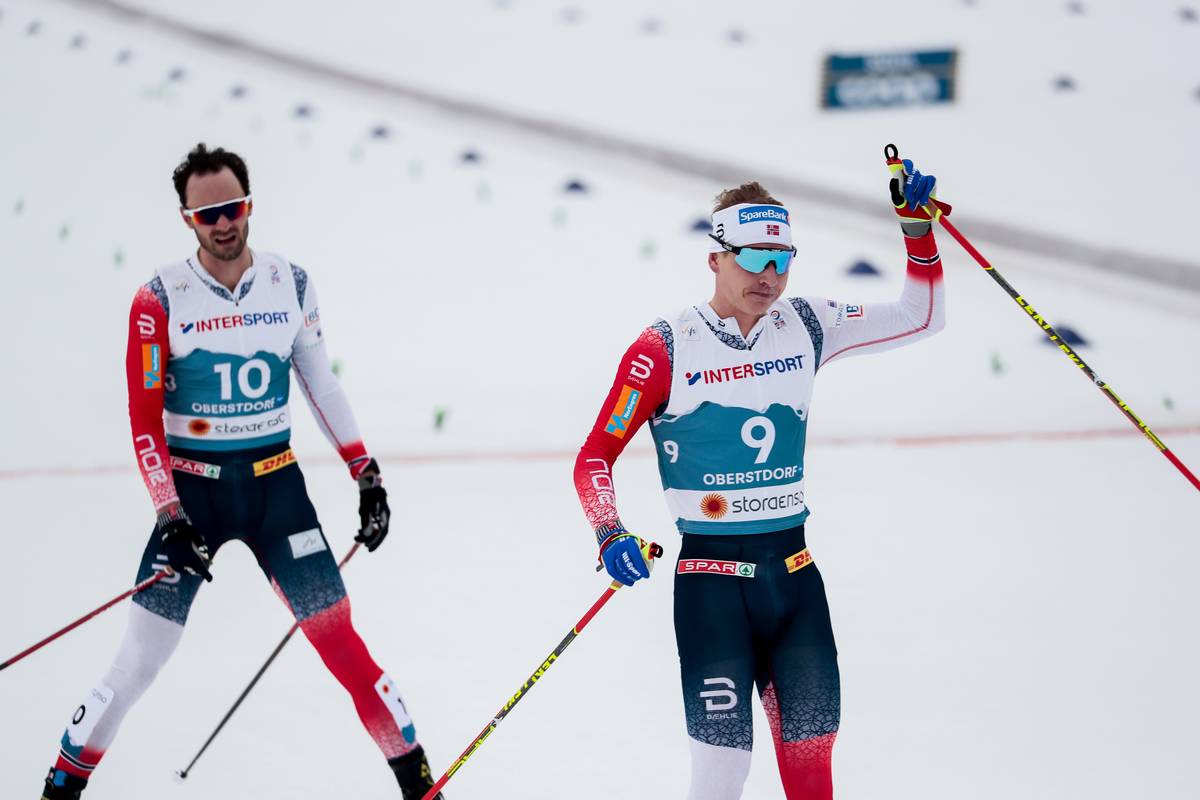
    Simen Hegstad Krüger (bib 9) and Hans Christer Holund of Norway finish second and third, respectively, in the World Championship 15k/15k skiathlon in Oberstdorf, Germany. (Photo: NordicFocus)

    Krüger took the silver medal (+1.1) with Holund just behind for bronze (+1.7).

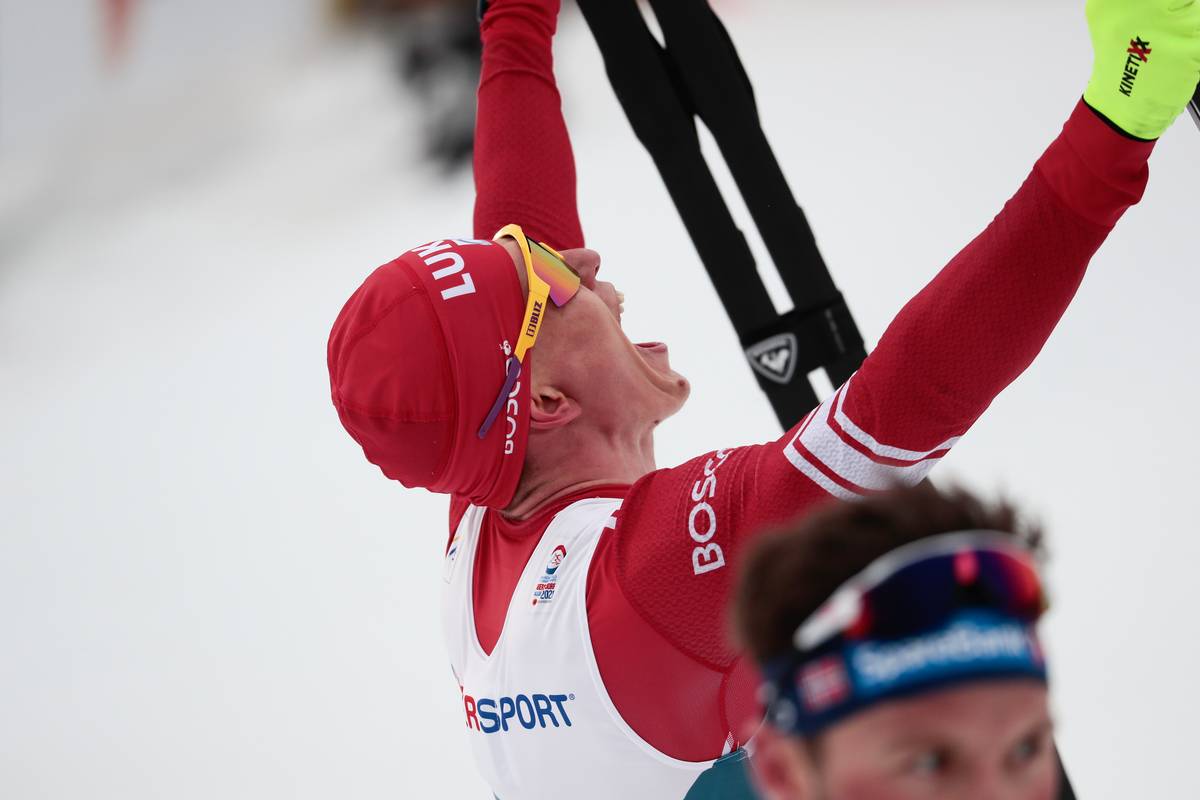
    Alexander Bolshunov roars in celebration of victory at the World Championship 15k/15k skiathlon in Oberstdorf, Germany. (Photo: NordicFocus)

    Today marks Bolshunov’s first individual World Championship gold medal. He holds two individual silver metals, one in the aforementioned skiathlon and another in the 50 k freestyle in 2019. He also helped the Russian team to second place in the 4×10 k relay and team sprint.

    “I felt fine in the first half, then on the last uphill, I was repeating ‘I have to win today. I have to win today,’” Bolshunov told FIS through a translator in a post-race interview. “On the final descent, I could understand that this is the day that I finally achieved this task.”

    Silver and bronze: Simen Hegstad Krüger (L) and Hans Christer Holund (R) of Norway finish second and third, respectively, in the World Championship 15k/15k skiathlon in Oberstdorf, Germany. (Photo: NordicFocus)
    The men’s podium of the World Championship 15k/15k skiathlon in Oberstdorf, Germany. Alexander Bolshunov (RUS) took the win ahead of Simen Hegstad Krüger (NOR) and Hans Christer Holund (NOR). (Photo: NordicFocus)

    After a gap, Klæbo was next across the line in 4th (+21.5) followed by Iversen in 5th (+22.1) and Røthe 6th (+47.3).

    Johannes Høsflot Klæbo and Emil Iversen ski to 4th and 5th in the World Championship 15k/15k skiathlon in Oberstdorf, Germany. (Photo: NordicFocus)

    For the Americans, the excitement continued as Scott Patterson made his way with the chase pack toward the finish. He sat in 9th with 2k to go, but his group was nine men deep. As they made their way into the stadium and sprinted toward the line, Patterson was unable to hold this position, ending his day in a nearly indistinguishable photo finish with Niskanen. It was decided Niskanen edged him out for 13th, leaving Patterson 14th (+2:03.3), less than three seconds behind Yakimushkin who led this chase group.

    “It was great, we had awesome skis today, classic felt pretty good,” Patterson said after the race. “The last lap the front guys definitely turned it up a bit and started spreading things out. But, kind in the transition I was able to put a pretty good switchover and get on some more guys… It is the first race of World Champs, I have not raced in a month. I felt good, so looking forward to some more racing. I think without a pack, I think 15 k skate next, I think it could be even better, I felt strong out there. Really excited for this week coming up.”

    Scott Patterson skis to 14th in the World Championship 15k/15k skiathlon in Oberstdorf, Germany. (Photo: NordicFocus)

    Commenting on the course conditions, Patterson continued, “It was definitely different than yesterday out there on the course; it was skiing really well. It was pretty consistent all the way around, the corners weren’t nearly as deep as we have had the last couple days. Honestly, this cloudy weather and a little rain over night made it really nice skiing. Consistent fair racing for everyone, I think. And we had awesome skis…the best thing.”

    Behind this group but steadily holding his ground inside the top-20, David Norris finished 17th (+2:19.8). This is Norris’s best individual finish on the world stage since he took 16th in a 15 k freestyle in Falun, Sweden in March, 2019. Leading the American men, he took 20th in the 2019 World Championships in the 50k freestyle, finishing 24th in the 50k classic a week later at the Holmenkollen in Oslo, Norway. 

    David Norris cracks the top-20 with a 17th place finish in the World Championship 15k/15k skiathlon in Oberstdorf, Germany. (Photo: NordicFocus)

    Norris’s start to this season was delayed after he contracted COVID-19 in November. After two weeks of complete rest, Norris conservatively began to resume training in hopes that he could still salvage a season on the World Cup. Today’s result is a testament to his fortitude in the face of adversity, COVID-induced and otherwise

    “It was good,” Norris put his race simply. “The classic was pretty mellow until it wasn’t with about 3 k to go before the exchange. That was the first time I really flooded and started to suffer. But then, I got through the exchange and then worked up in the skate with groups of seemed like groups of three and four. We kind of worked our way up until we caught a good chase pack.

    “By the first 3 k of the skate I was really kind of still suffering the final effort in the classic,” Norris continued. “Then all of a sudden, my legs got under me and I felt pretty free — it is the best I have felt all season skating. And that was awesome.”

    David Norris bumps fists with Imanol Rojo of Spain after the World Championship 15k/15k skiathlon in Oberstdorf, Germany. (Photo: NordicFocus)

    At the 20k mark, Norris was roughly 30 seconds back on Patterson’s group, but made up 10 seconds over the last two laps. 

    “I worked my up until I was in the group with Scott and then it was kind of funny, because I mean, I was a little bit suffering on the climbs and dangling, and Scott was at the front kind of pushing, but I felt really good in the rolling terrain and flats, so I’d usually make up any ground I lost and I held kind of strong in that position, but I wasn’t really in it for the fight at the front of that group.”

    Hunter Wonders skis to 31st in the World Championship 15k/15k skiathlon in Oberstdorf, Germany. (Photo: NordicFocus)

    Fellow Alaskan Hunter Wonders was the next American, just outside the top-30 in 31st (+4:25.7). 21-year-old Ben Ogden rounded out the American starters in 45th (+6:27.4). 

    Antoine Cyr races to 27th in the World Championship 15k/15k skiathlon in Oberstdorf, Germany. (Photo: NordicFocus)

    Racing for Canada, Antoine Cyr skied his way into the top-30 finishing 27th (+4:01.9). A minute back, Remi Droulet took 39th (+5:02.4), with Phillipe Boucher finishing 51st (+7:46.1). 

    Canada’s Remi Droulet skis to 39th in the World Championship 15k/15k skiathlon in Oberstdorf, Germany. (Photo: NordicFocus)

    58 men finished the race with an additional 11 starters ending their day early after being lapped by the leaders. Racing continues on Sunday with the team sprint.  

    Final Results 


  • Johaug Breaks Away for the Skiathlon Win; Diggins 15th

    Johaug Breaks Away for the Skiathlon Win; Diggins 15th

    Cut-out fans and cut-off shirtsleeves for the start of the 15 k skiathlon in Obertsdorf Germany (Photo: Nordic Focus)

    This World Championship coverage is made possible through the generous support of Marty and Kathy Hall and their A Hall Mark of Excellence Award. To learn more about A Hall Mark of Excellence Award or to learn how you can support FasterSkier’s coverage please contact info@fasterskier.com.

    Overcast skies greeted the skiers as they lined up for a 15 k skiathlon Saturday morning, the second World Championship event in Oberstdorf, Germany. Despite temperatures hovering around 37°F, the tracks were firm and fast, the course consisting of two classic laps of a 3.75 k loop and two skate laps of a different 3.75 k loop. Sixty women started the competition though with a few athletes getting lapped, the finishers numbered 56. With little fanfare in an otherwise stark ski course during the pandemic, Therese Johaug of Norway was the show. At the end of the day, Johaug once again topped the podium in a time of 38:35.5, though this wasn’t purely a given early in classic leg. 

    Theresa Johaug (NOR) fighting hard from the gun. (Photo: Nordic Focus)

    Immediately off the line, Johaug was at the front, pushing the pace. Two young Swedes, Ebba Andersson and Frida Karlsson weren’t about to let her take off and stuck to her like glue. As the three skiers descended towards the stadium at the end of the first lap on a ribbon of white snow through bare brown fields, it looked as if the top three had already been decided. Exiting a sharp right-hand corner Johaug’s skis slid out into Karlsson and both skiers went down. Andersson capitalized on the moment to take the lead. Righting herself, Johaug rebounded quickly. Karlsson, however, ended up with a broken pole and compounded with a botched hand-off to receive a replacement, she found herself +17.5 seconds down to the leaders. 

    Johaug (NOR), Andersson (SWE) and Karlsson (SWE), cornering tightly. (Photo: Nordic Focus)

    At the 5 k mark, Karlsson had clawed back a few seconds and was +13 behind Johaug, Andersson, and Tatiana Sorina representing the Russian Ski Federation. 

    Tucked in for seed, Frida Karlsson (SWE) during the women’s skiathlon. (Photo: NordicFocus)
    Karlsson (SWE) works her way back after a fall and broken pole, pictured here following Yana Kirpichenko (RSF). (Photo: Nordic Focus)

    Entering the exchange Johaug and Andersson were neck and neck, the Swede echoing Johaug’s every move. However, Andersson was four seconds slower than Johaug swapping skis and exiting. This little gap was all the Norwegian needed to shake her Swedish shadow. 

    Behind Johaug and Andersson, over the next lap, the Russian gradually began to fade, as Karlsson closed in on Sorina. Up front, Johaug motored while Andersson barely held on to the Norwegian. 

    Johaug simply began to gain ground and time on her rivals as the remaining kilometers ticked off. She worked her advantage on the hills and began to widen the gap as Karlsson clawed back to Andersson. At 9 k the two Swedes were +19 seconds back from Johaug, at 11.3 k Johaug had increased that to +27 seconds and by 12.8 k, the gap was +33 seconds. 

    Johaug (NOR) into the finishing straight with no competitors in sight. (Photo: Nordic Focus)

    In the closing meters, all Johaug needed to do was stay upright through the descent and the victory was hers. “Oh it’s amazing,” said Johaug after the race, “I’m looking forward to this day for so long and I’m training a lot and the Norwegian team has not got so much World Cup this year so this World Championships means a lot to me.” Laughing she said, “I know that everybody thinks that I should win but it’s not so easy, you have to fight for yourself and you have to have good skis though the waxer in the team Norway has done a really good job”

    When asked about her fall on the first lap, Johaug seemed unphased, “Oh I fall on the first lap in the stadium here, but I was feeling I have a really good body today and my shape is really good so it didn’t mean so much.” 

    For Johaug this is her fifth skiathlon championship podium and third gold after winning in 2015 and 2019. Her win puts the total number of medals she has collected at world championship events up to 11, only Norway’s Marit Bjørgen and Elena Välbe of Russia have more (18 and 14 respectively). 

    2021 Women’s Skiathlon podium, Johaug (NOR) with gold, Karlsson (SWE) silver and Andersson (SWE) with bronze. (Photo: Nordic Focus)

    Behind Johaug, the race for second and third was real – Karlsson and Andersson no-pole skated to the line, as Karlsson entered the straight with a slight lead though her teammate was closing fast. Karlsson took silver just +0.2 ahead of Andersson. Teresa Stadlober of Austria out sprinted veteran Charlotte Kalla of Sweden to take fourth, Kalla finished fifth. Norwegian youngster Helene Marie Fossesholm came in sixth and Delphine Claudel of France matched her personal best finish, placing 7th. 

    Karlsson (SWE) lunges for the line, out of the shot her teammate Andersson (SWE) does the same. (Photo: Nordic Focus)

    For Karlsson, this is her second silver medal at a world championship, she finished second in the 10 k classic in Seefeld in 2019. This is Andersson’s first individual world championship medal. She holds medals from 2017 and 2019 as a member of the Swedish relay team, but Saturday’s performance tops her previous best individual championship performance of sixth place in the 30 k skate in Seefeld in 2019. 

    Andersson (SWE) holds a tuck, following her teammate Karlsson (SWE) closely on the descent. (Photo: Nordic Focus)

    Leading the American finishers today was Jessie Diggins in 15th, +1:59.5 back from Johaug. “I am going to be honest, it was pretty disappointing if you look at it from a results perspective,” said Diggins after the race, explaining that she felt ski speed on the day was a disadvantage for the team. “However, I was so proud of how hard I pushed and I prepared for these championships in every way possible. I took such great care to train smart, train hard, rest up. Mentally I was ready. Took really good care about not overheating which I was really psyched about. I was dumping bottles of water on myself and chewing ice chunks before the start. So I think I came into this absolutely as ready and prepared as possible. And the thing is, to have a good race all the puzzle pieces have to fit together, and we missed out today.”

    Jessie Diggins, during the classic leg of the skiathlon. She finished her classic leg in 19th and moved up to 15th at the finish. (Photo: NordicFocus)


    Diggins (USA) giving it her all in the skate leg. (Photo: Nordic Focus)

    When asked about her teammates’ performances, Diggins responded, “They worked so hard. I would have loved to see them have every opportunity to really really shine because I know they could have been further up on the results sheet with the energy and the grit that all these young women displayed. So I think that is so promising to see how well they skied given the disadvantage that we had today. I think, to me, that is really impressive because it is easy to put together a good race when you have the fastest wax in the field, it is harder to just never give up and keep fighting, and to me, that is so much more impressive.”

    Team huddle, U.S. women post-skiathlon (Photo: Tom Horrocks/USST)

    Competing in her first championship event, Sophie Laukli of the United States finished 25th, +3:18.7 back. After the race Laukli said, “It was a fun course for me, lots of hills and climbing. I mean I was a little bit dreading some of the bigger climbs, but it definitely worked to my advantage. I felt pretty good so that was awesome.”

    Laukli’s World Cup debut came a few weeks ago in Lahti Finland where she finished 33rd in the skiathlon event. When asked about her strategy for the day Laukli replied, “Yeah, I definitely think of myself as more of a skate skier so my goal was to try and stick with a group in the classic and then make up some more places in the skate and I think that I was definitely able to do that and really use the hills to my advantage in the end.”

    Laukli (USA) competing in her first World Championships where she placed 25th. (Photo: Nordic Focus)

    Katharine Ogden was the next American finisher in 32nd place and Hailey Swirbul finished 37th. Before the race, Swirbul spoke with FIS saying, “I feel ready to go, this is my first race at my first World Championships. All I can hope is to give my best effort today.” 

    Swirbul (USA-left) and Ogden (USA-right) striding through the classic laps. (Photo: Nordic Focus)


    Interview with U.S. Head Coach Whitcomb discussing the classic sprint and skiathlon.

    Cendrine Browne was the first Canadian of the day, in 23rd place. During the skiathlon at the 2019 World Championships, Browne finished 40th. Next came Katharine Stewart-Jones in 28th place. Stewart-Jones also placed 28th in the 30 k skate event at the 2019 championships. Rounding out the Canadian finishers was Laura LeClair who placed 48th. 

    Cendrine Browne (CAN) was the top Canadian, racing to 23rd. (Photo: NordicFocus).

    “Today was one of the hardest courses I’ve ever done,” Browne told Nordiq Canada. “No flats, only up hills and twisty downhills,” said Browne, who was 26th in a 30-kilometre skate-ski race at the 2017 World Championships in Lahti, Finland. “I’m really happy and proud that I was able to hold on in the classic part, and be in good position to start the skate.
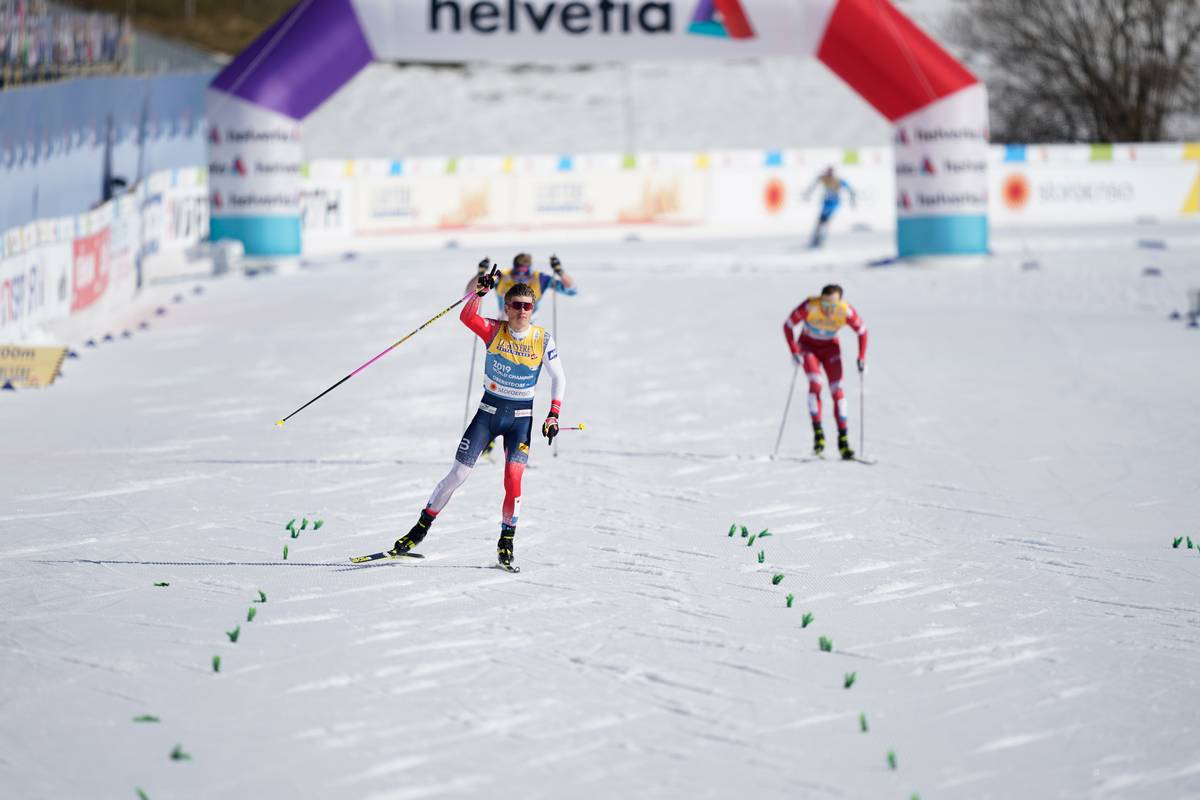
    “The plan today was to hold on in the classic and then catch-up time in the skate,” she added. “Unfortunately, I was only able to maintain the speed I had, but I’m still very happy,” added Browne. “I had a pack to ski with during the whole race which helped me push myself even more.”
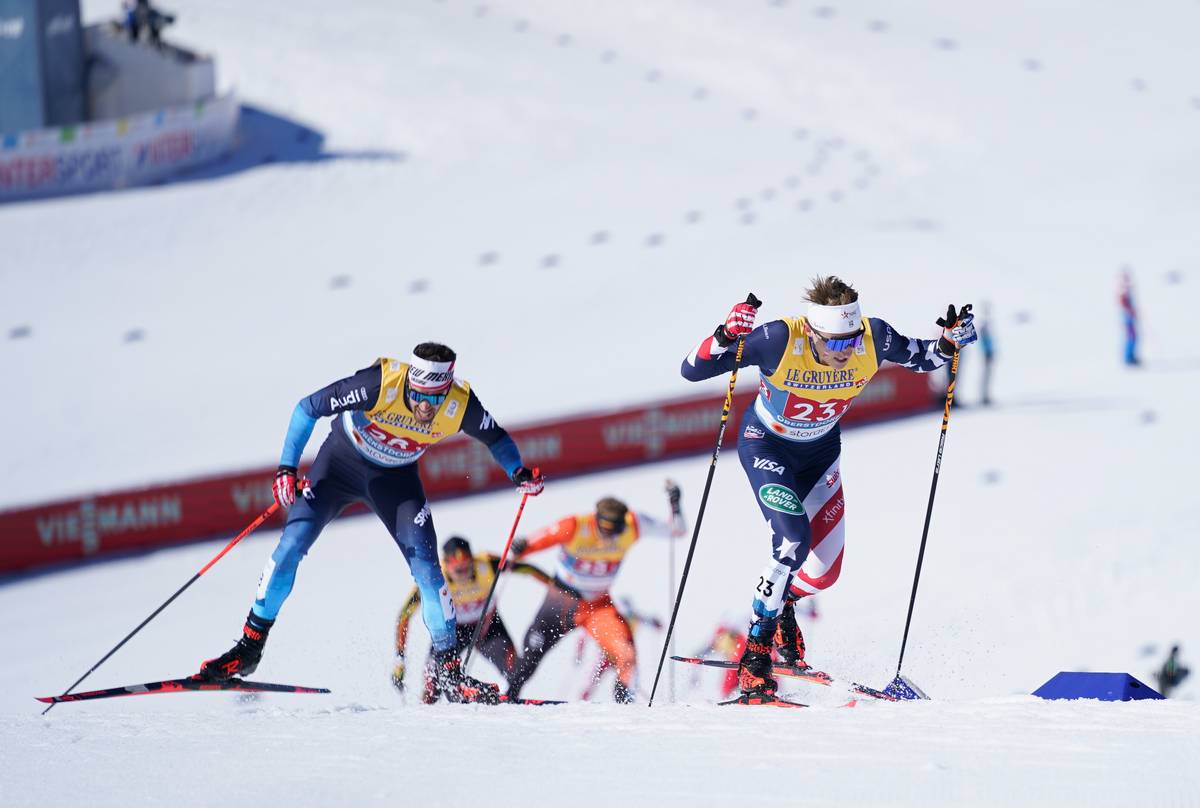
     

    Katharina Hennig (GER), Katherine Stewart-Jones (CAN), (l-r) racing the skate leg of the 15 k skiathlon. (Photo: NordicFocus)
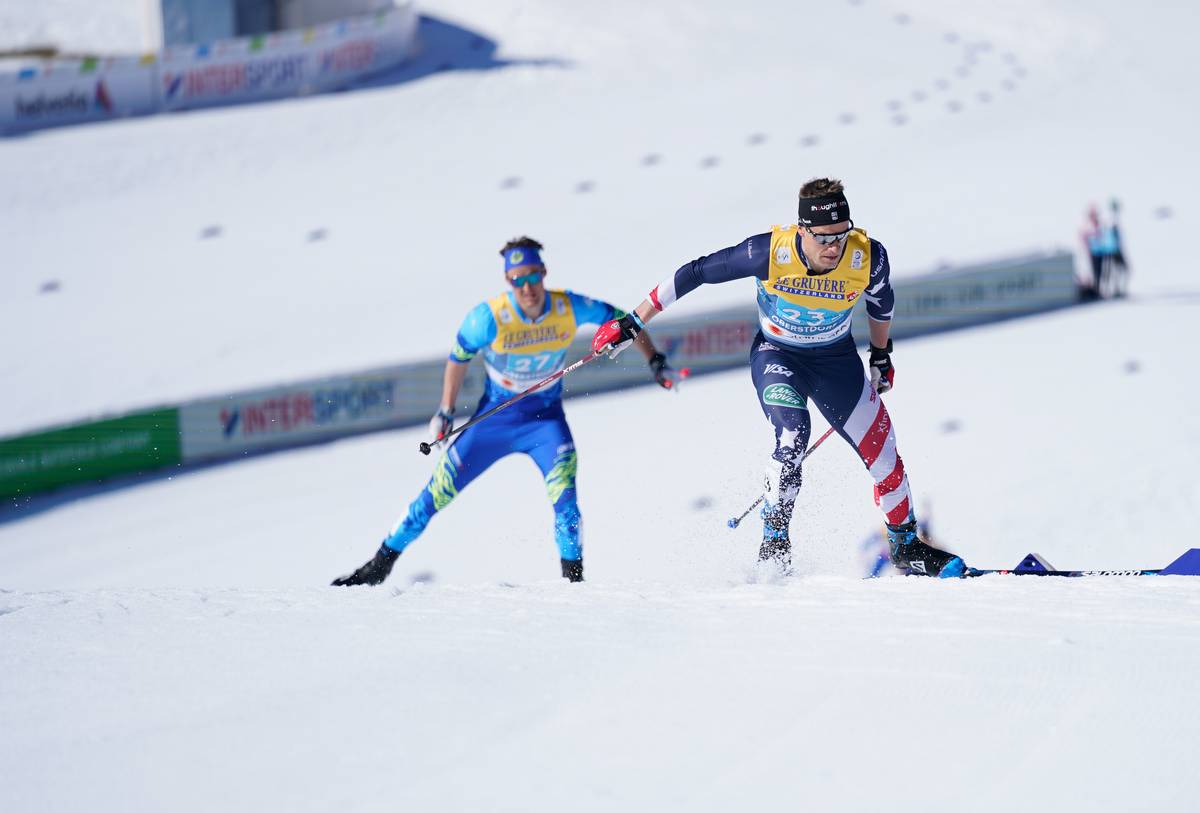
    “I had some bigger dreams for today, but I honestly gave it my all with what I had on the day,” said Stewart-Jones according to Nordiq Canada. “My start was a bit slow, and I didn’t feel super energetic on the classic, but I was able to find a better rhythm in the skate, especially on the second lap.

    “Having two of us in the top-30 (again today) is definitely a good start, but I know that we have more in the tank, and I’m looking forward to some more racing,” said Stewart-Jones.

    Racing continues Sunday with a team sprint event. 

    Results: Womens Skiathlon

  • Norwegian Triple Championship Podium with Klæbo Crowned the Winner; Ogden 17th for the US

    Norwegian Triple Championship Podium with Klæbo Crowned the Winner; Ogden 17th for the US

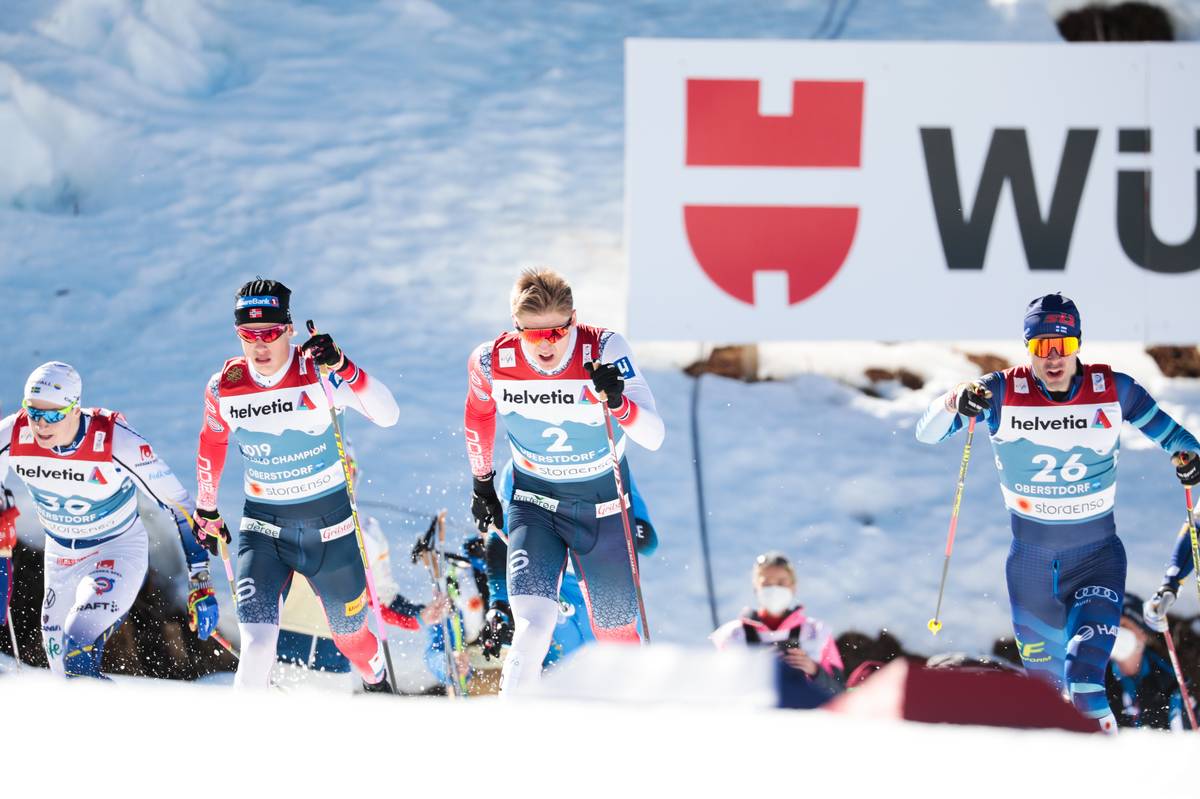
    Norsk triple. Johannes Høsflot Klæbo (left) raises his hands in victory as Valnes (middle) and Taugbøl (right) lunge for the line. (Photo: NordicFocus)
    This World Championship coverage is made possible through the generous support of Marty and Kathy Hall and their A Hall Mark of Excellence Award. To learn more about A Hall Mark of Excellence Award or to learn how you can support FasterSkier’s coverage please contact info@fasterskier.com.

    Against the backdrop of hundreds of cardboard cut-out fans, the men battled for the first medals of the 2021 World Championships in Oberstdorf, Germany. Despite warming temperatures, conditions were firm and fast for the 1.5 k classic sprint, likely due to the application of salt to help with freezing. The course featured three climbs with the last being the most significant and sustained. 

    A smiling Klæbo after being the first athlete to complete back-to-back sprint victories at World Championships. (Photo: NordicFocus)

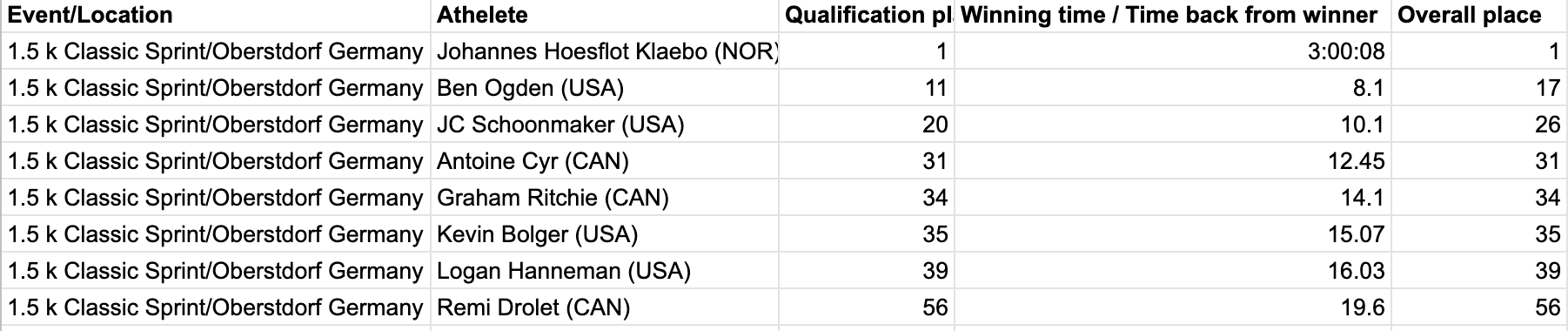
    From start to finish, the day belonged to Johannes Høsflot Klæbo who won the qualifier in a time of 3:00:08 and took his second consecutive sprint World Championships gold medal, becoming the first male athlete in history to repeat back to back sprint golds, winning the final in a time of 3:01.30. 

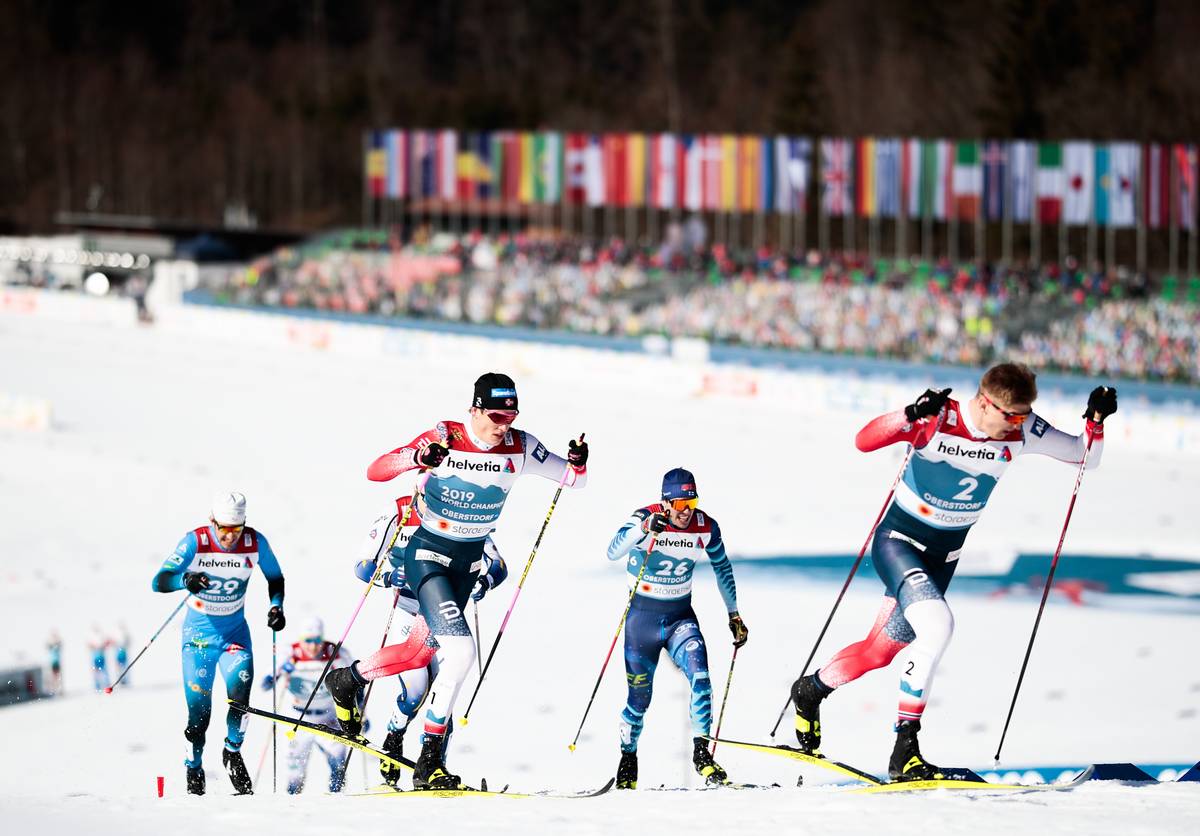
    As in the women’s race, the final hill proved to be the decisive factor throughout the quarterfinals and into the remaining rounds. The hill was no stride-fest, but instead a full-on sprint-run. Competing in Heat 1, Norwegians Erik Valnes and Klæbo easily gapped their competitors on the climb and advanced with ease.  

    The eventual 1-2 skiers charging. Valnes (bib 2) and Klæbo (left). (Photo: NordicFocus)
    Valnes (bib 2) and Klæbo (left) lead over the crest of the hill in their quarter-final heat. (Photo: NordicFocus)

    Racing in Heat 2 was J.C. Schoonmaker for the United States who qualified in 20th position. Schoonmaker came in 6th in his heat to finish 26th overall. After the race, Schoonmaker said, “I did not feel my best today but it was a solid result I think for my first World Champs, and I think I can walk away, I learned a lot and I think I am happy with it. But definitely saw it going better and I hoped it was going to go better. But, yeah I think it was overall still good.” 

    A sleeve-less JC Schoonmaker (USA) racing through warm temps in the quarter-final rounds. (Photo: NordicFocus)

    His teammate, Ben Ogden, qualified in 11th position and raced in the fifth quarterfinal. Ascending the final climb in that heat, Francesco De Fabiani of Italy found himself caught in the slush and went down, taking Cerny Ondrej of the Czech Republic down with him.

    Ondrej Cerny (CZE) taking the stumble. (Photo: NordicFocus)
    Ogden was able to move around the crash and capitalize. (Photo: NordicFocus)

    Ogden ended up fourth after a solid fight in his quarterfinal and 17th overall. In a post-race interview, Ogden said about his day, “It was good in general. The qualifier was really good. I was happy to be able to feel fast in that. And then in the heats were a little tricky, as they often are. Just remembering that this is only my second heat so far this year since World Juniors last year. I have a lot to learn and that was my first ever World Cup level heat. So, yeah, I am really excited with the whole day, and we will be looking forward to the skiathlon in a few days” 

    In the semi-final rounds, once again Klæbo and Valnes went one-two in the first semi. Given this was the faster semi, Alexander Bolshunov (representing the Russian Ski Federation at these championships) and Oskar Svensson of Sweden, also advanced from this heat as lucky losers. Coming from the second semi-final was Håvard Solås Taugboel of Norway and Sergey Ustiugov (RSF) who bested the likes of skate sprint legend Federico Pellegrino and steady sprint finalist Gleb Retivykh to advance to the final. 

    Bolshunov (RSF) and Valnes race against a picturesque backdrop through the sprint rounds (Photo: Nordic Focus)

    Preparing for one last round, the three Norwegians, two Russians, and lone Swede took their start positions, having shed hats and layers as the temperatures and efforts increased. Steady through the first part of the course, again the final climb marked a crucial moment. Taking the inside lane Klæbo stomped his way up the hill using his trademark technique. However, it was his teammate Valnes who was first over the crest. As they descended into the stadium Klæbo shot to the outside and took off. Valnes was left to fend-off his teammate Taugboel to secure second place while bronze went to Taugboel, making it a Norwegian triple. 

    Triple Norwegian podium for the first championship event of 2021 (Photo: NordicFocus)

    Speaking to FIS after the race Klæbo said, “I don’t know what to say. I’ve been so nervous the last couple of days. It’s been a really strange season with not so many competitions and I think we made some decisions that weren’t so good when we were sitting at home watching the Tour de Ski, but today it feels great and is a dream come true.” When asked about the conditions he replied, “I think it was a really tough day, the conditions were really good today, I think it was the right decision to salt it yesterday. It’s really hard out there when it’s so warm, and you are losing a lot of energy.”

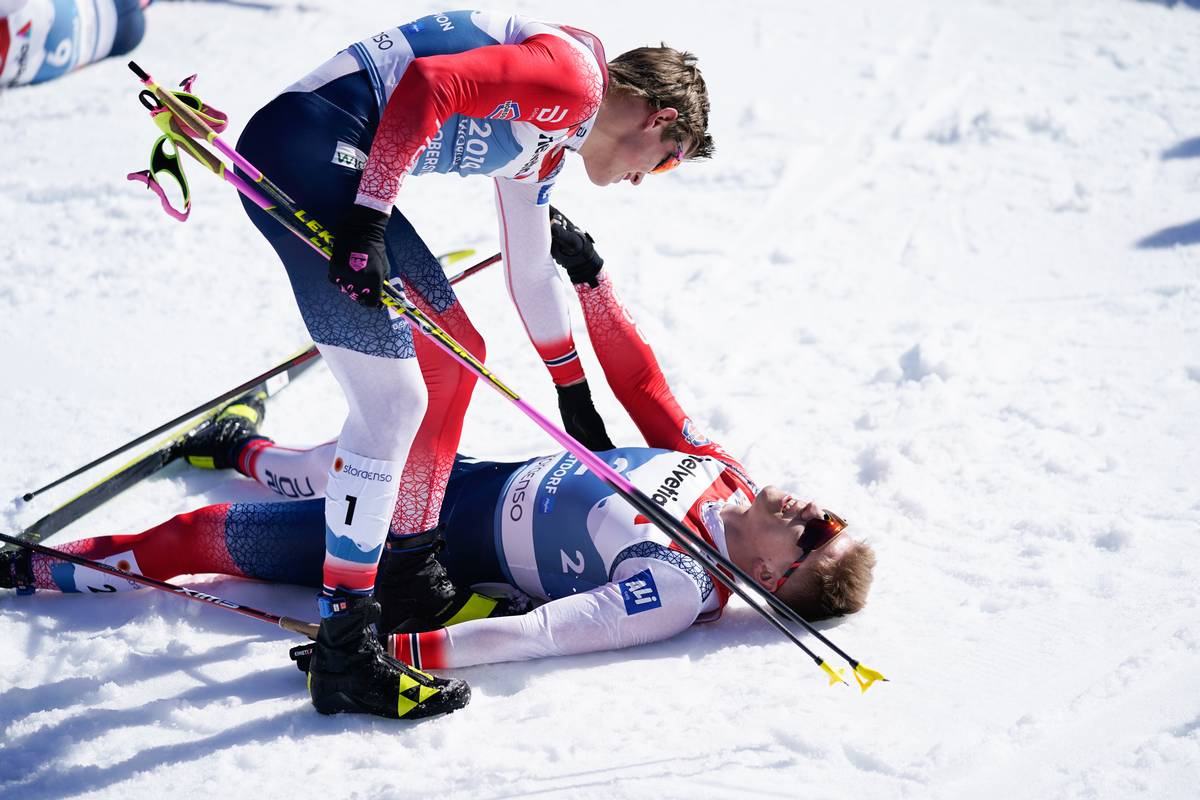
    Klæbo congratulates a tired teammate, Valnes, after they finish 1-2 in the classic sprint. (Photo: NordicFocus)

    Klæbo came out of his first World Championships in 2019 with three gold medals after winning the individual sprint as well as the team sprint and relay event with teammates. After this victory on Thursday it seems like he is well on his way to another successful championship. For his teammate Valnes, this is his first time competing at World Championships. Valnes has made one other podium appearance this season when he won the classic sprint at the season opener in Ruka, Finland. This is also the first time at World Championships for Taugboel who has had three individual World Cup podiums throughout his career, all in sprint events. 

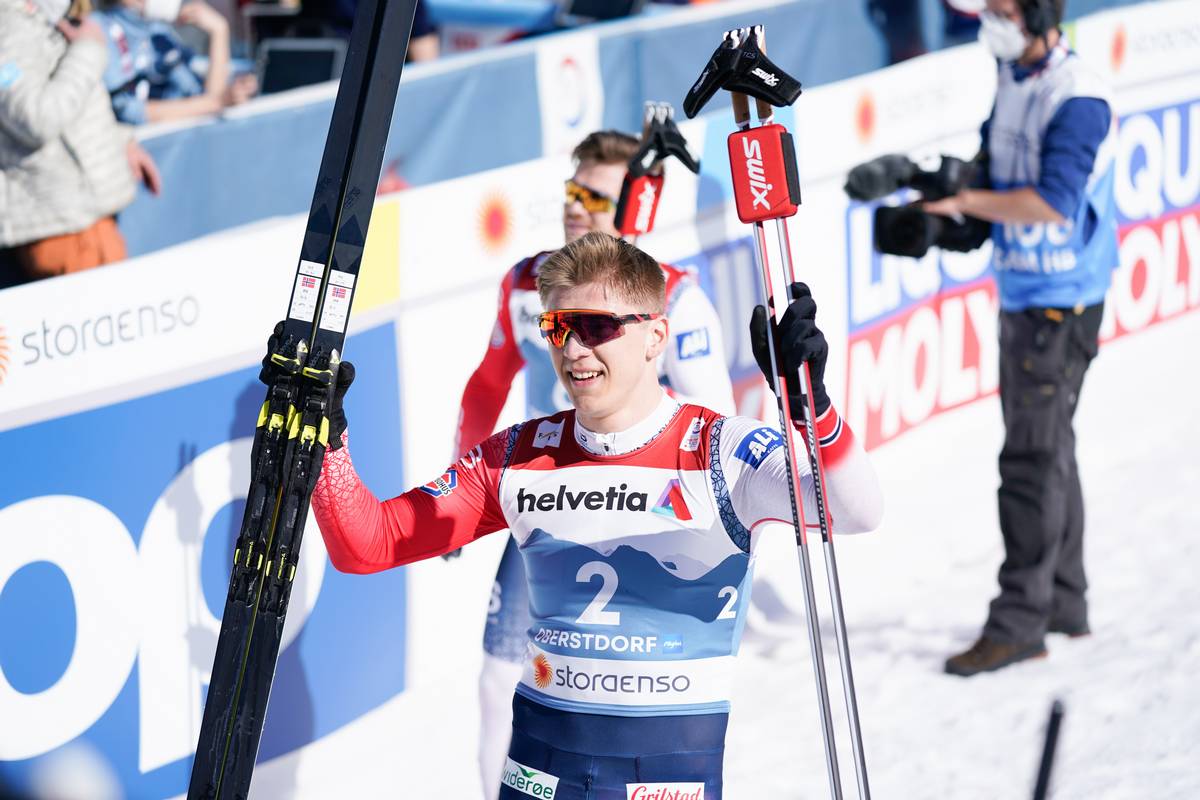
    Valnes after placing second in the classic sprint (Photo: Nordic Focus)

    Racing continues on Saturday with a 30 k skiathlon.

    Results: Men’s Final | Men’s Qualifier

  • Sweden’s Sundling Cruises for First Championship Gold in the Classic Sprint

    Sweden’s Sundling Cruises for First Championship Gold in the Classic Sprint

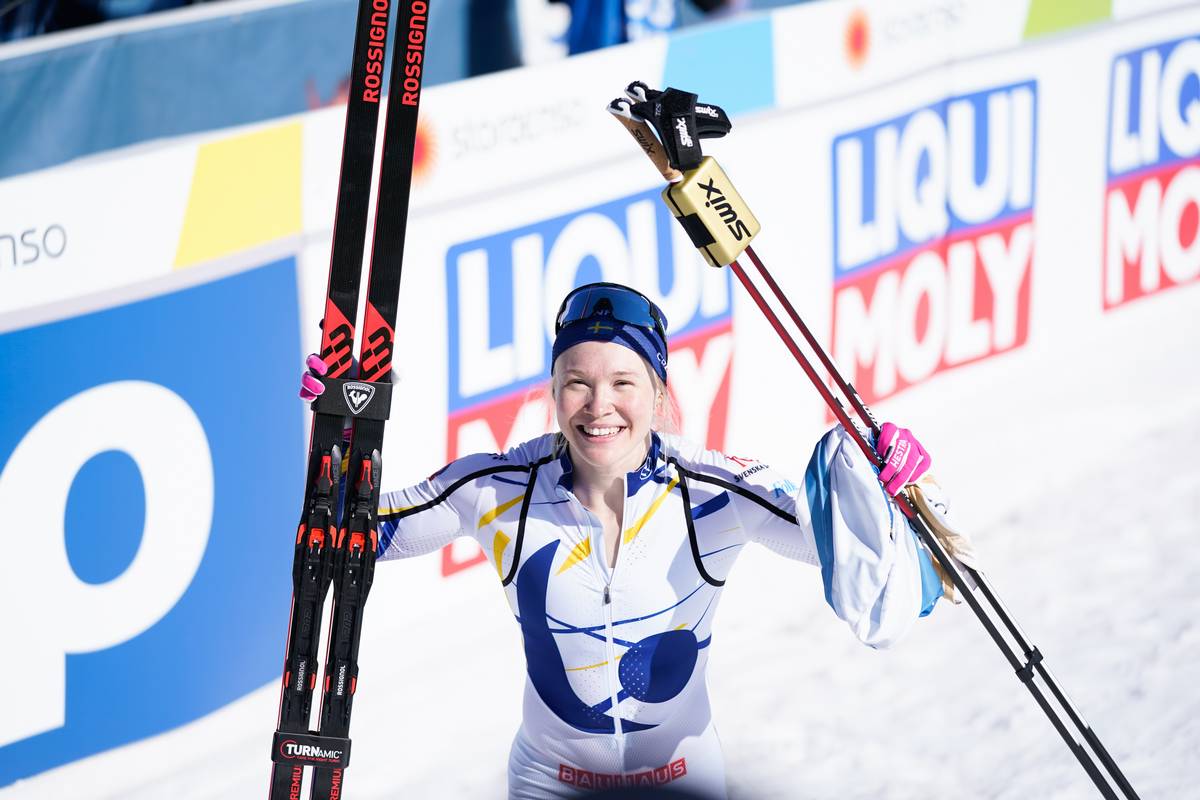
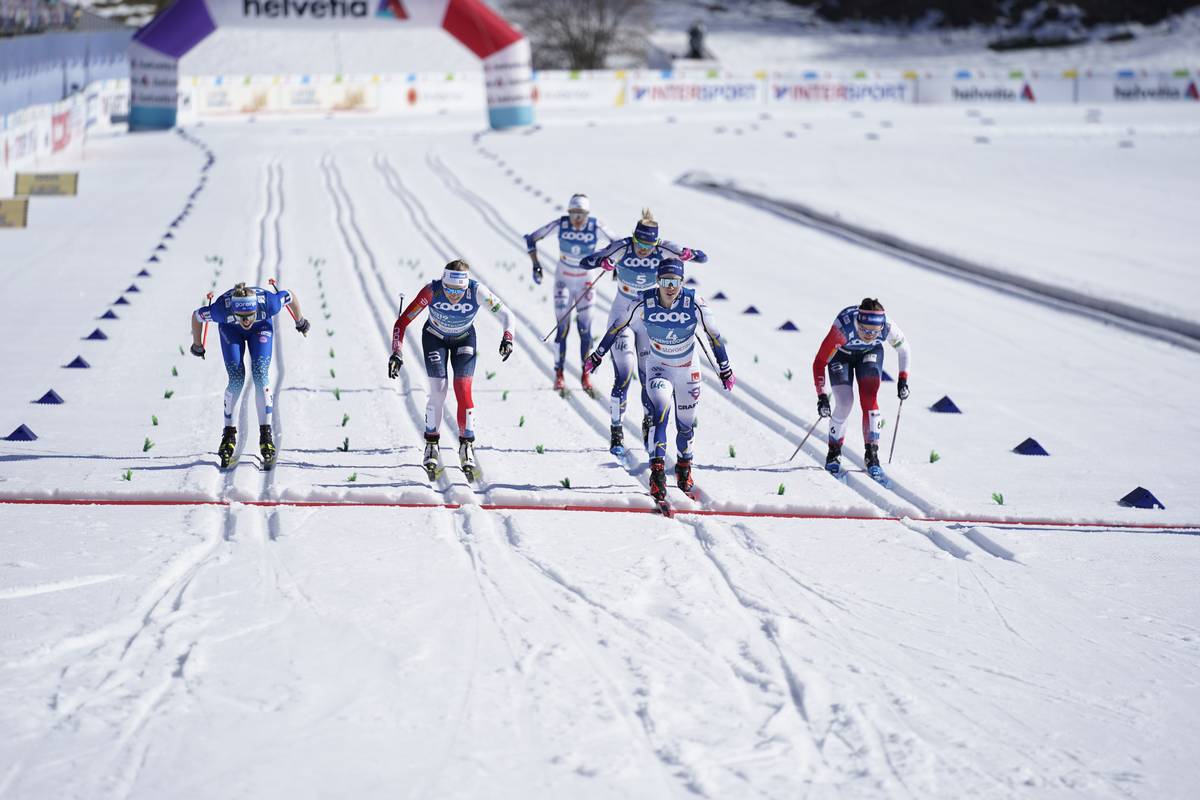
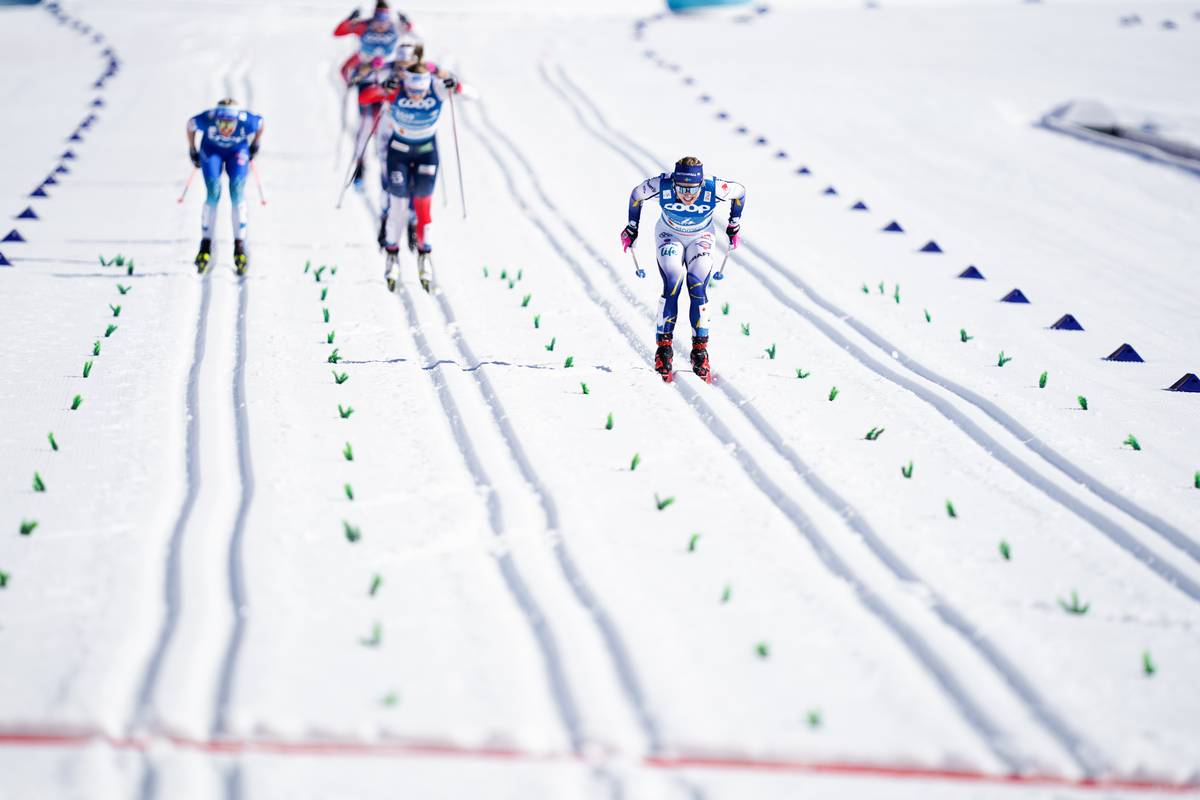
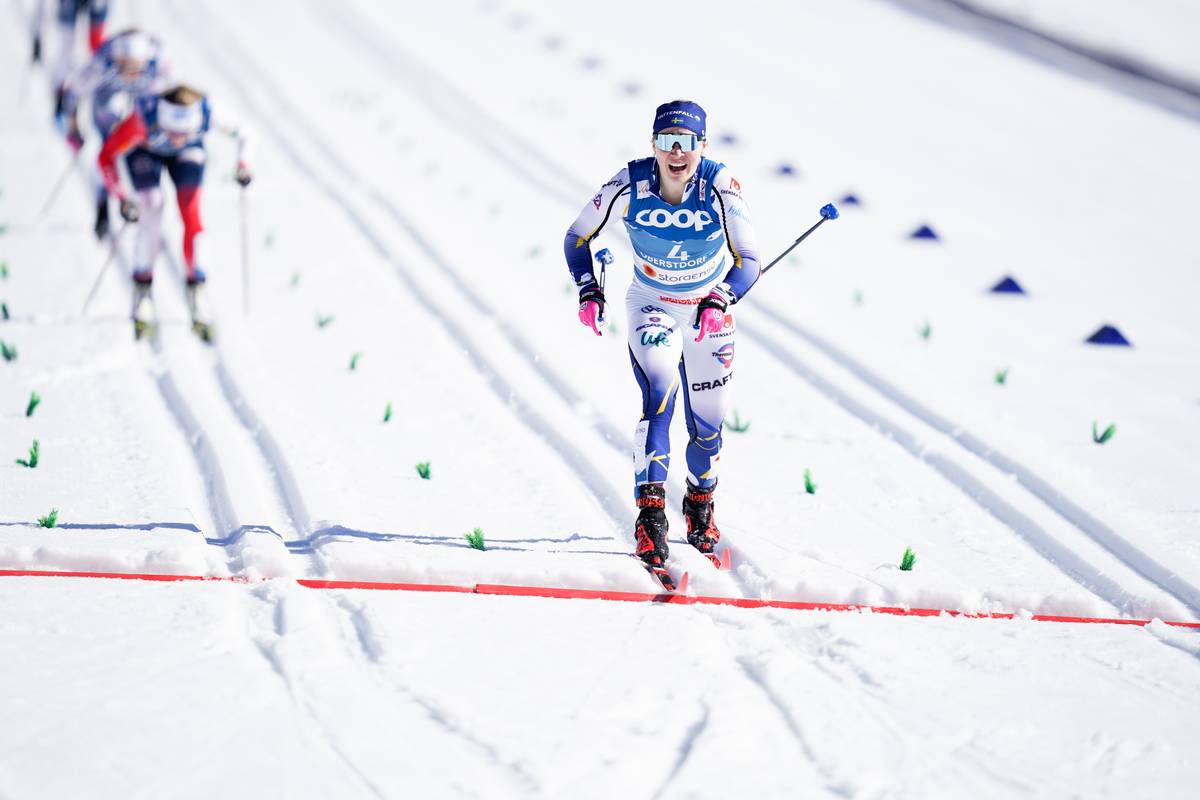
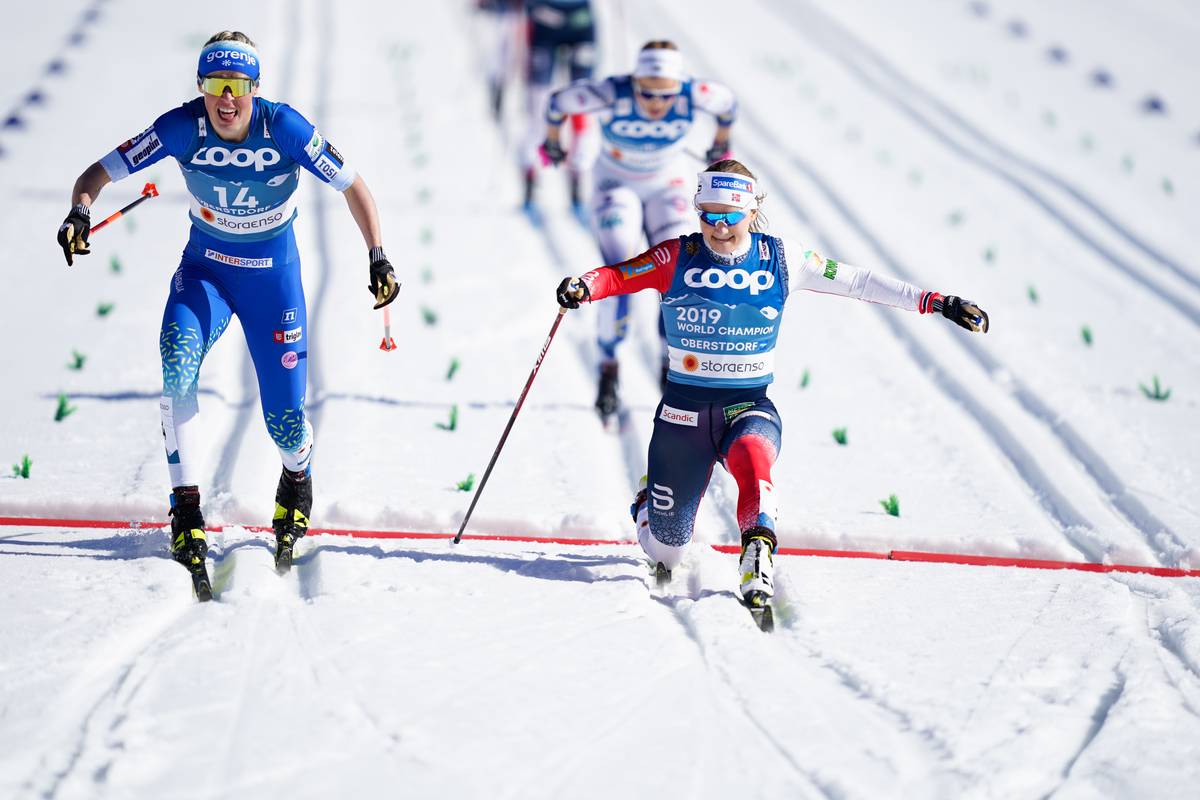
    Jonna Sundling of Sweden wins the women’s classic sprint at the 2021 Oberstdorf World Championships. (Photo: NordicFocus)

    This World Championship coverage is made possible through the generous support of Marty and Kathy Hall and their A Hall Mark of Excellence Award. To learn more about A Hall Mark of Excellence Award or to learn how you can support FasterSkier’s coverage please contact info@fasterskier.com.

    After qualifying events on Wednesday, World Championships kicked off in earnest in Oberstdorf, Germany with the Classic Sprint event Thursday morning. Due to unseasonably warm temperatures, the start times were pushed earlier in the day to optimize course conditions and hopefully preserve snow for the remainder of the competition.

    The women raced a 1.2 k course, with Johanna Hagström winning the qualifier in a time of 2:39.33. After her qualifier, Hagström said, “it felt really great, I was focused on being calm and do[ing] fast skiing by good technique so I think I got it.”

    Johanna Hagström of Sweden during the women’s classic sprint qualifier. (Photo: NordicFocus)

    Jumping ahead to close the day out, top honors went to her Swedish teammate, Jonna Sundling, who won the final in a time of 2:36.76.

    On a salted course, which despite the sun’s radiation held up, the sustained final climb proved to be an effective make-it or break-it moment in terms of dictating the results narrative. Throughout the quarter-final rounds, gaps formed as the leaders crested the hill well ahead of their competitors. Notably, after two false starts at the beginning of Heat 5, one for technical issues and the second the result of Tatiana Sorina (RSF) jumping the gun, a crash by Johanna Matintalo of Finland forced Sorina well off-course to avoid a tangle though she seemingly was not disqualified for her deviation. Observers of the sport will note that Russian athletes are representing the Russian Ski Federation and not “Russia” during these championships. This is the result of a recent Court of Arbitration for Sport ruling.

    Sophie Caldwell Hamilton of the U.S.s racing in qualification. (Photo: NordicFocus)

    Two U.S. women qualified for the heats, Jessie Diggins in 23rd and Sophie Hamilton Caldwell in 26th. Hamilton Caldwell raced in quarterfinal number two where she finished 6th, concluding the day in 29th position. Diggins chose heat four and finished 5th for an overall place of 24th.

    After her race, Diggins shared with the U.S. Ski Team, “I am really really excited to be here, first of all, I feel like really lucky that we are getting to race at all. I think this is pretty incredible when I think back to how we were looking at this season back in November, the fact that we have made it here to World Champs and they are happening is really really cool. For me personally, I came into this World Champs feeling like I have prepared the very best that I could. I even tried to acclimate to the heat as much as possible because it is super super hot and sunny here.”

    Johanna Hagström (SWE), Jessie Diggins (USA), (l-r) racing in the heats. Diggins went on to place 24th overall. (Photo: NordicFocus)
    Katharina Hennig (GER), Jessie Diggins (USA), (l-r) during the fourth heat in Oberstdorf. (Photo: NordicFocus)

    Regarding today’s race Diggins said, “So today, in the qualifier, just went out and I think I definitely was still waking up my body I think from pre-camp so it definitely felt like I need to find that next gear. But was happy to have made it into the heats. And then in my heat, I felt like I did a good job not overheating staying out of the sun when I could. Getting a great warm-up and skis dialed in with Cork. And I think we had very competitive skis. On the last uphill, I definitely was mentally trying to churn the legs and get the gears going and I just felt like my body just ran out of energy. I know I prepared the best I could and now am just focused on hydrating, fueling, getting out of the snow and getting ready for a lot of races up ahead. I am really proud of my effort, I felt like I pushed as hard as I could and I don’t have any regrets.”

    Maiken Caspersen Falla (NOR), Maja Dahlqvist (SWE), and Jonna Sundling (SWE), (l-r) finishing a tight first semifinal. (Photo: NordicFocus)

    In a stacked first semi-final heat, Sundling of Sweden and Maiken Caspersen Falla of Norway advanced automatically with both lucky losers also coming from this heat, Norway’s Ane Appelkvist Stenseth and Slovenia’s Anamarija Lampic. A false start at the beginning of semi-final number two resulted in a yellow-card for Hagström though she still qualified in second place. Lotta Udnes Weng of Norway had a stumble and fall at the top of the first climb, nearly taking out her sister and fellow competitor, Tiril Udnes Weng (NOR). Tiril Udnes Weng recovered to win the semi-final ahead of Hagström.

    For the final, three Norwegians, two Swedes and one Slovenian lined up to complete the first medal event of the 2021 World Championships. For the first climb, the group stayed largely together but as they entered the second and final hill Sundling turned on the burners. Gapping the field, she crested over the top alone, with Falla some paces behind. Entering the final straights, Sundling was unchallenged as she swept across the line, arms raised, to claim her first-ever championship medal.

    Sundling soloing in for the win. (Photo: NordicFocus)


    With the win, Sundling scores her first career championship gold. (Photo: NordicFocus)

    Behind her, a battle for second and third position was playing out as Lampic was quickly closing in on Falla. Both skiers threw their feet forward for a photo-finish lunge that ultimately went to Falla, leaving Lampic with bronze. Hagström finished fourth, Stenseth fifth and Tiril Udnes Weng (NOR) placed sixth.

    Throwing toes at the line, Anamarija Lampic (SLO) and Maiken Caspersen Falla (NOR), (l-r). Falla placed second with Lampic third. (Photo: NordicFocus)

    Sundling has three individual World Cup victories to her name, all coming from freestyle sprint events. At the Seefeld World Championships in 2019 she finished fourth in the skate sprint. After her victory today Sundling said in an interview with FIS, “I am so so happy, I have dreamt of this and to get this victory, it’s amazing. I’m really really happy.” When asked about the rest of the field she said, “[my competitors] were so strong, it is a fast and tough track and I think everyone did a really good job today and I’m really satisfied to be the first over the finish line of course.”

    Falla, the 2019 and 2017 Sprint World Champion, takes home her fifth individual championship medal after placing second. This is Falla’s second international race of the year as she sat out much of the season. For Lampic, this third-place finish marks her first individual World Championship podium. In Seefeld in 2019, Lampic placed second in the team sprint with teammate Katja Visnar.

    The women’s classic sprint podium: Maiken Caspersen Falla (NOR) second, Jonna Sundling (SWE) first, and Anamarija Lampic (SLO), (l-r). (Photo: NordicFocus)


    Rosie Brennan racing in qualification. (Photo: NordicFocus)
    Julia Kern racing in qualification. (Photo: NordicFocus)
    Dahria Beatty was the top Canadian placing 38th. (Photo: NordicFocus)

    Racing continues Saturday with a 15 k skiathlon for the women. Looking forward, when asked about her feelings going into the skiathlon Diggins said, “sometimes after a camp especially at altitude, you need to do a hard effort to just sort of blow the rust out of the gears. And so I think that was really great, and yeah it is kind of nice because in skiathlon it is a very different energy system than a sprint. I am really excited to again just send it with everything I have. That is all I can promise, is that I am going to cross the line being totally gassed.”

    Results: Women’s Final | Women’s Qualifier

  • Nordiq Canada Names 2021 World Championship Team (Press Release)

    Nordiq Canada Names 2021 World Championship Team (Press Release)

    Katherine Stewart-Jones (CAN) and Cendrine Browne (right) at the finish of the 15 k skiathlon in Lahti, Finland. (Photo: NordicFocus) – FIS world cup cross-country, skiathlon women, Lahti (FIN). www.nordicfocus.com. © Vianney THIBAUT/NordicFocus. Every downloaded picture is fee-liable.

    Press Release


    CANMORE, Alta.—Nordiq Canada has named 10 athletes who will wear the nation’s colours at the 2021 FIS World Nordic Ski Championships in Oberstdorf, Germany, February 23 – March 7.

    Earning their coveted spots based on results achieved at the 2020-21 World Cup races, five women and five men will bring the maple leaf to the start line in all races throughout the two-week Nordic festival.

     “Not having competitions in Canada this season to properly evaluate athlete performance, we developed an objective criteria for our World Cup trip, and subsequently the World Championships, in consultation with the High Performance Committee with a focus on managing risks associated with the ongoing pandemic,” said Kate Boyd, high performance director, Nordiq Canada. “Travelling and competing during these times has not been easy, however, each of our national team athletes have shown their resilience and adaptability through this adversity. They have stepped up and delivered. We look forward to now shifting our focus to performing on the biggest stage of the year at the World Championships.”

    Five Canadians, who have celebrated multiple career-best performances as a team since returning to the World Cup circuit, will toe the line in women’s racing. Katherine Stewart-Jones (Chelsea, Que.), who is coming off an impressive 17th-place finish in Falun, Sweden, leads the Canadian charge. The 25-year-old will be joined by Maya MacIsaac-Jones (Athabasca, Alta.) and Cendrine Browne (Saint-Jérôme, Que.) who have both also stormed into the top-30 this year. MacIsaac-Jones sprinted to 18th place in Ulricehamn, Sweden, while Browne has two, top-30 finishes including a career-best 23rd place result. Olympian, Dahria Beatty (Whitehorse), will be looking for a breakthrough of her own at the premiere event on the Nordic calendar this season. Laura Leclair (Quebec City) will make her World Championship debut at the elite level.

    Canada will also field a team of five male athletes who have been living, training and competing in a controlled bubble while following robust protocols since traveling to Europe in early January.

    The lone Olympian Russell Kennedy (Canmore, Alta.), who has skied into the top-30 twice himself this season, will be counted on to lead the young and determined group of men making their first trip to the elite World Championships. Graham Ritchie (Parry Sound, Ont.), Rémi Drolet (Rossland, B.C.), and Antoine Cyr (Gatineau, Que.) – who are all fresh off representing Canada at the Under23 World Championships last week in Finland – will now head to Germany to test themselves against the world’s best. Philippe Boucher (Levis, Que.) rounds out the men’s squad.

    “This is a dynamic group of athletes focused on delivering results when it counts the most,” added Boyd. “Being a younger team, the World Championships are a key measuring stick in their continued progression. These athletes have all worked hard to achieve this honour of representing Canada, and I know they will make the country proud.”

    It is the third time Oberstdorf has hosted the FIS World Nordic Ski Championships. The last time the world’s best gathered in the German ski town in 2005, Sara Renner made history while sprinting to Canada’s first-ever World Championship medal when she won the bronze. The triumph helped open the doors for 15 years of sustained medal-winning success by a new generation of Canadian cross-country skiers.

    Devon Kershaw and Alex Harvey picked up the torch from Renner and two-time Olympic medallist, Beckie Scott, when they shocked the world by winning the team sprint race at the 2011 event. Harvey skied his way to the World Championship podium four more times in individual races throughout his illustrious career, claiming one more gold (2017 Lahti – 50km skate); one silver (2015 Falun – sprint); two bronze (2015 Falun – 30km skiathlon, 2013 Val di Fiemme – sprint).

    Nordiq Canada is the governing body of para-nordic and cross-country skiing in Canada, which is the nation’s optimal sport and recreational activity with more than one million Canadians participating annually. Its 60,000 members include athletes, coaches, officials and skiers of all ages and abilities. With the support of its valued corporate partners – Haywood Securities Inc., AltaGas, Swix and Lanctôt Sports– along with the Government of Canada, Canadian Olympic Committee, Canadian Paralympic Committee, Own the Podium and B2Ten, Nordiq Canada develops Olympic, Paralympic and World champions. For more information on Nordiq Canada, please visit us at www.nordiqcanada.ca.


    *****

    FOR FURTHER INFORMATION:

    Chris Dornan

    Nordiq Canada

    T: 403-620-8731