Tag: 2021 retirements

  • Sadie Maubet Bjornsen Retires: Career Highlights and the Final Race (Part II)

    Sadie Maubet Bjornsen Retires: Career Highlights and the Final Race (Part II)

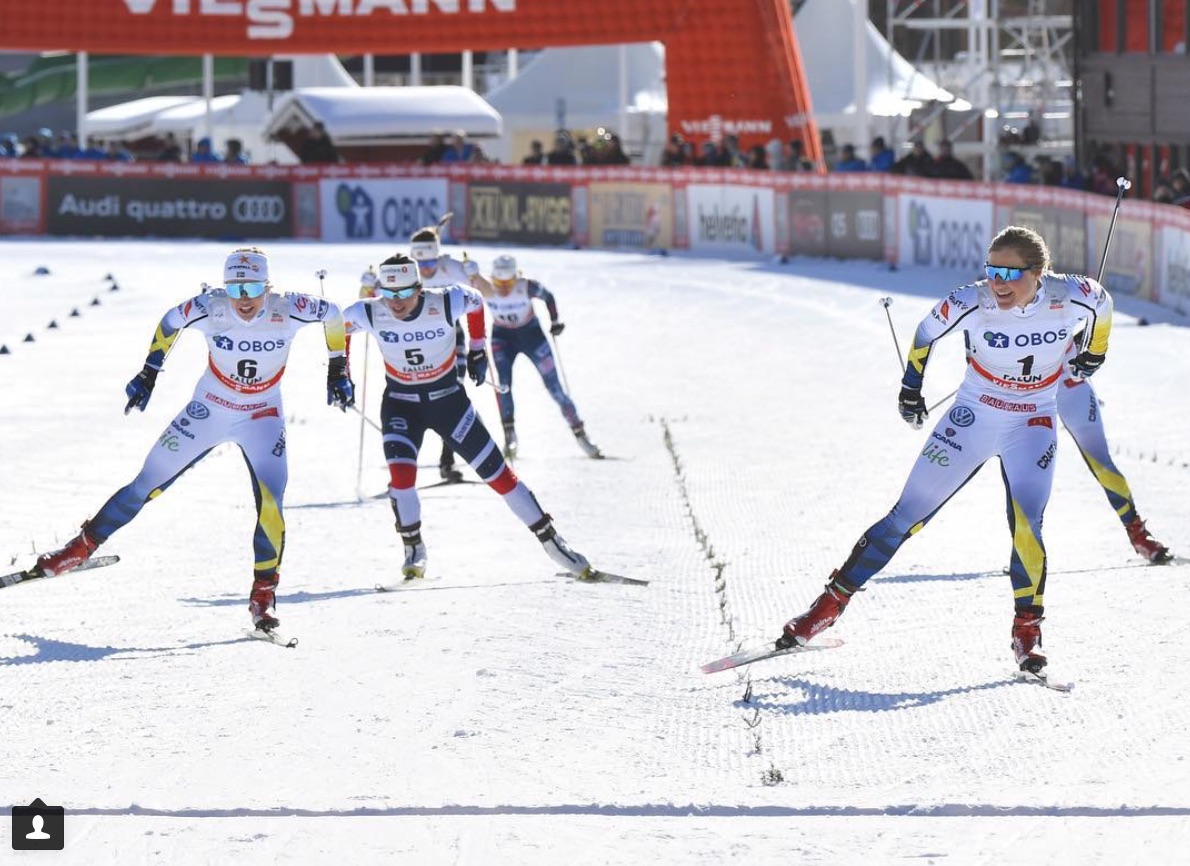
    Sadie finishes third in the women’s 10-kilometer freestyle pursuit at 2018 World Cup Finals in Falun, Sweden. (Photo: Fischer/NordicFocus)

    Part I of this article examined Sadie Maubet Bjornsen’s childhood, World Cup debut, and the injuries that she overcame along the way. This article, Part II, starts with a frank look at some of the challenges of being an American World Cup skier, then discusses her overall career highlights, her final World Championships earlier this year, and what comes next.

    In addition to the injuries, there are some challenges to life on the World Cup circuit, particularly as an American away from home for so long. Sadie is clear-eyed about these drawbacks, reflecting, “World Cup racing has its shine, but certainly there are things that are really tough. For me the toughest thing was always being away from home for that long, and then when things were more serious with Jo it was being away from him for that long. I would say, I managed the pressure of feeling like I needed to do well by having school. I think that was such a savior for me through the process. I think I never got too terribly wrapped up in doing perfect racing. I think the other thing that was really important for me was I developed some close friendships with my teammates. We had some things to talk about aside from ski racing. I think having these partnerships with people you are racing with makes you think about things aside from ski racing and having the capacity to laugh and not having everything result focused.”
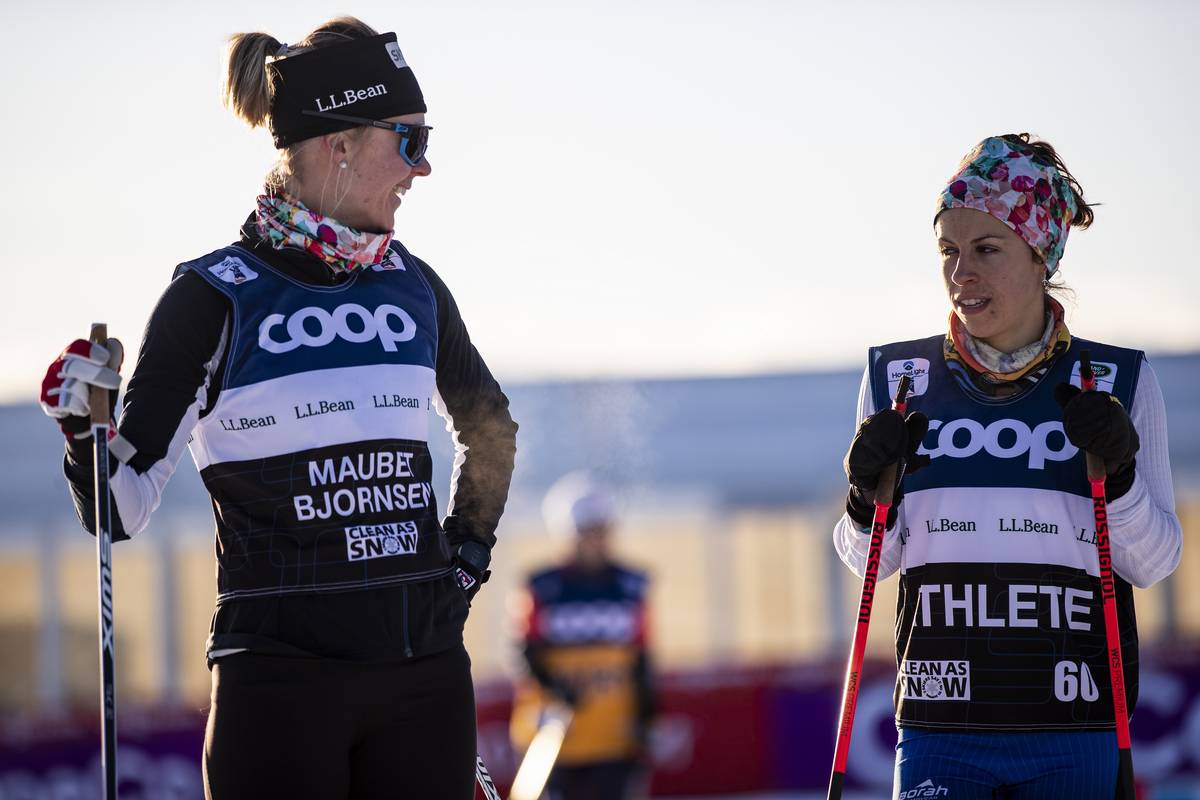
    APU teammates Sadie Maubet Bjornsen and Rosie Frankowski chat trailside during a training day before World Cup races in Lillehammer Norway in December, 2019. (Photo: NordicFocus)

    There are also challenges to being an aspiring American junior skier in 2021, and to seeing the levels of performance that have become seemingly routine – as a ski nation, we’ve come a long way from the early-Randall period, when a single top-30 result would cause the FasterSkier comments section to fill up with jubilant congratulations. While this is hardly the fault of any current World Cup athlete, the rousing American success can make it daunting for juniors trying to keep up. Sadie is asked what she would say to a hypothetical American junior following pro skiers on social media, and thinking to herself something like, “If I’m not training 700 hours a year at age 17 or I’m not on a World Juniors relay podium team by age 18, I’m a complete failure; that’s what it takes to be successful on the national team these days.”

    Sadie has thoughts on this: “I think there will always be a standard to compare yourself to. I think that is how the world works, and the more things go on social media, the more visual that standard is. I think that is going to be our biggest challenge going forward. When I was younger, I did not even know who World Cup athletes were; I did not watch the World Cup. I hardly knew what cross-country skiing was, so I had a really soft entrance into what I wanted to accomplish. I think that before people go too far, I think they have to work on the true goal-setting process. And that sounds funny, but it is as simple as, ‘Okay, I want to get better next year. I am training 450 hours right now.’ Well, of course you are not going to train 800 hours next year. Instead, you need to take the time to identify, Where am I, where do I want to go. You need to be sure you are not just skipping that whole process and just using a standard to compare yourself to.

    “I think really working on the goal-setting process from a young age and identifying yourself as an individual is really important, because we will always be comparing ourselves to some standard like, ‘Do you I have a six pack, I do not have a six pack at all, everyone seems to.’ You know what, not everyone is going to have a six pack. Or, ‘Everyone seems to be training at 800 hours, but I take 400.’ Again, not everyone does that, not everyone can. I think that we just have to be – as a junior you just have to recognize that not everyone is the same and you are never going to escape the comparison game. But that is what is going to help you create your own path, is being able to identify your strengths and your goals. I think that is such a necessary part that can be easy to skip when all you think about is where you want to go.”

    * * *

    Sadie’s words are wise, but this is a retirement article, so we’re going to move on to where she ended up going: to the top of the sport, or very close to it. She was on the U.S. Olympic team in 2014 and 2018, and all six American World Championships teams from Oslo in 2011 through Oberstdorf in 2021.
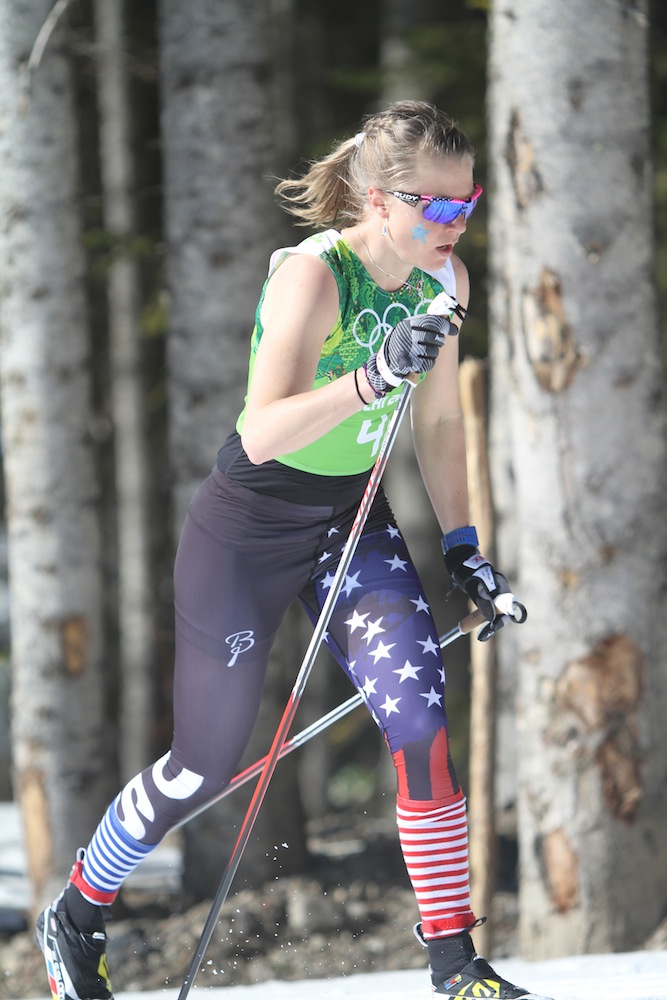
    Sadie Bjornsen skis the second classic leg in the women’s 4 x5 k relay at the Sochi Olympics in 2014.

    Sadie was on American relay teams 14 times in senior-level international competition, half of them at the Olympics or World Championships. There have been five times in, well, ever that the U.S. women notched a podium finish in a World Cup relay; Sadie was on the team for four of them. Each time, she skied the second classic leg, historically where each nation places its strongest classic skier in an attempt to string out the field. She filled the same role in two Olympic relays and three World Championships (2017–21), too, after skiing the scramble leg in 2013 and 2015.

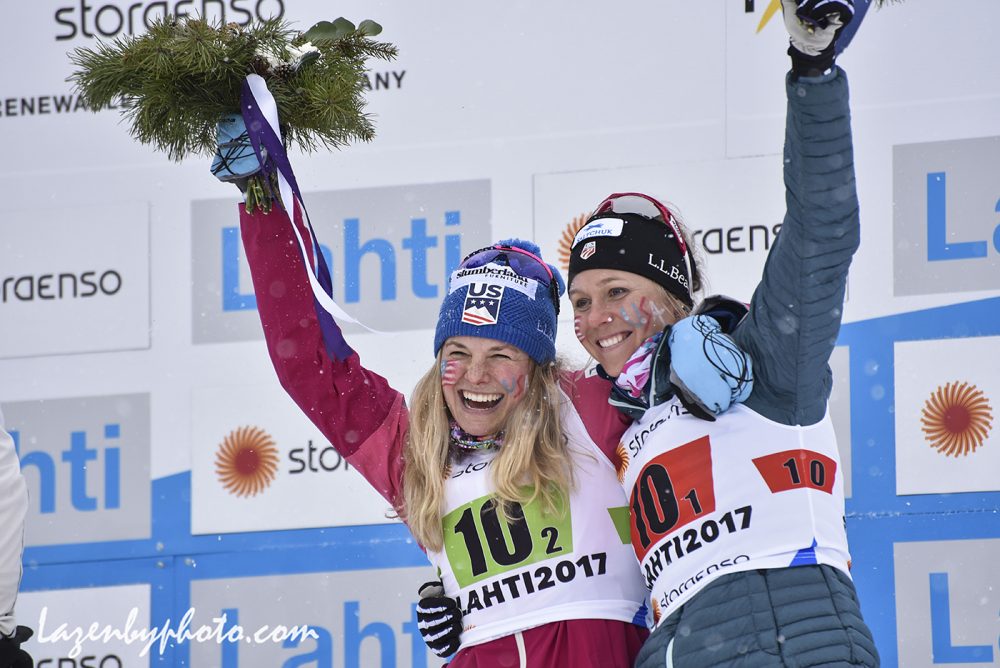
    And while Sadie won her World Champs medal in the classic team sprint, at Lahti in 2017, she was the first alternate for the epochal skate team sprint, at Pyeongchang in 2018, winning universal praise from her coaches and teammates alike for the poise and magnanimity with which she handled being, in effect, the first person left off this team. (Her blog post about this moment is better written and more insightful than anything in this article: “A small piece deep inside my heart crumbled at the same time, knowing that I had missed such an amazing opportunity,” Sadie wrote after the fact, while also lauding the team and its accomplishments with surpassing grace.) She would later team up with Rosie Brennan for the skate team sprint in Oberstdorf this March, coming one ill-timed “that’s sprint racing” final-leg tangle away from contending for a medal there as well.
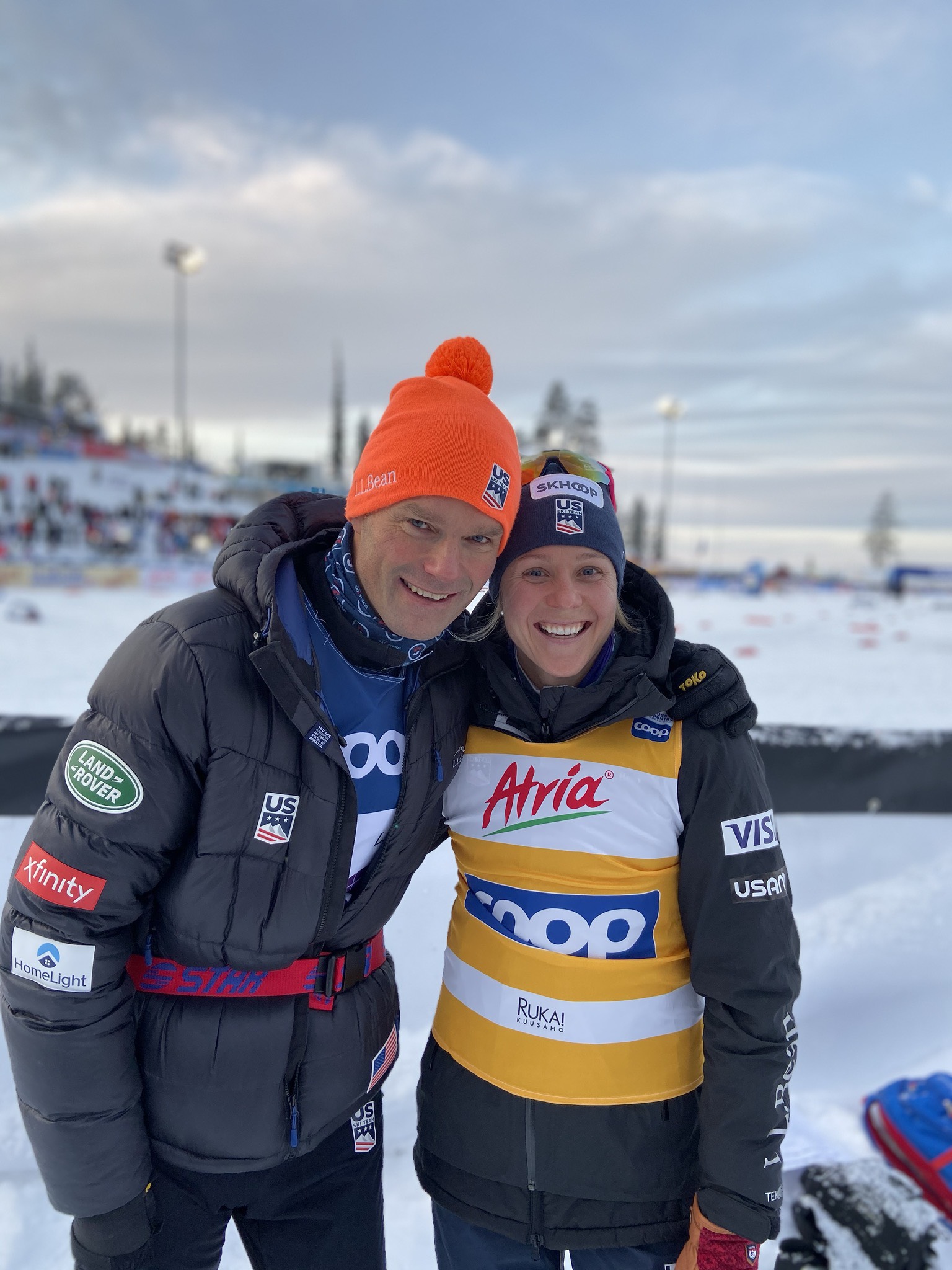
    Sadie Maubet Bjornsen in her yellow World Cup leader’s bib and her new wax tech, Per Erik Bjornstad of Norway, in November 2019.

    Oh, and she was also the first American woman ever to wear the yellow overall World Cup leader’s bib, early in the 2019/2020 season, followed this past season by first Brennan and then Diggins, marking a moment when she literally did reach the top of her sport. (Other moments: the four separate times that she posted the fastest time in a World Cup sprint qualification, two in sprint and classic.) She earned the yellow bib by placing third in a sprint and fourth in a 10 k on successive days in Ruka. And she ranked 16th or higher in the overall World Cup standings for five consecutive years, often slightly higher in sprint than in distance but with strong results in both disciplines.
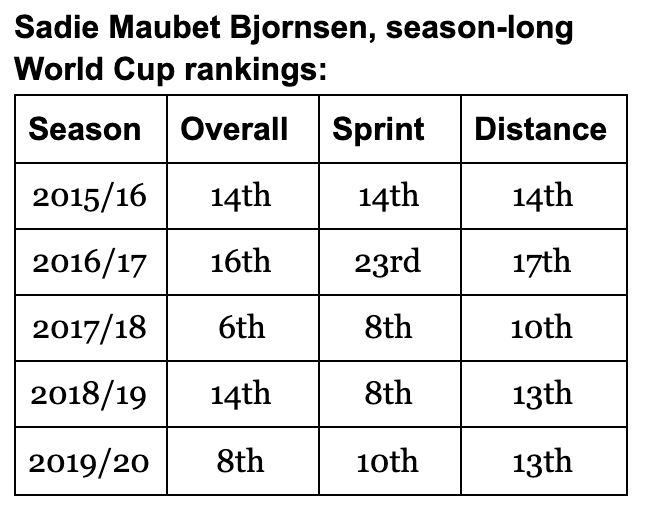
    table: Gavin Kentch for FasterSkier

    As this (partial) palmarès shows, Sadie is an exceptionally well-rounded athlete – balanced, even. In fact, she was the first American ever to post a podium finish in all four World Cup disciplines (classic sprint, freestyle sprint, classic distance, freestyle distance) and is still one of only two to do so, with Diggins being the other. (Diggins got there first if you count a “time of day podium” in a pursuit race as a standalone classic distance podium, which most people probably would not.) She retires as the second most well-rounded or broadly competitive American skier ever, after only Diggins.

    This “career slam” was a longtime goal for Sadie.

    “Since I was a young girl I always used to get so frustrated when somebody would tell me that I was just a sprinter,” Sadie notes, “or I was just a distance skier, or anything like that. I hated being identified by something; I wanted to be the person that could do it all. As I progressed and made the national team, I remember there being this talk about this classic deficit, and when will Americans have ‘real’ classic skiers. That used to make me so mad because I did not feel like we had any classic skier specialists, I thought we were all just skiers! So there are always these little motivators that push me to keep improving all elements in my skiing and it has been something that has been a personal goal.
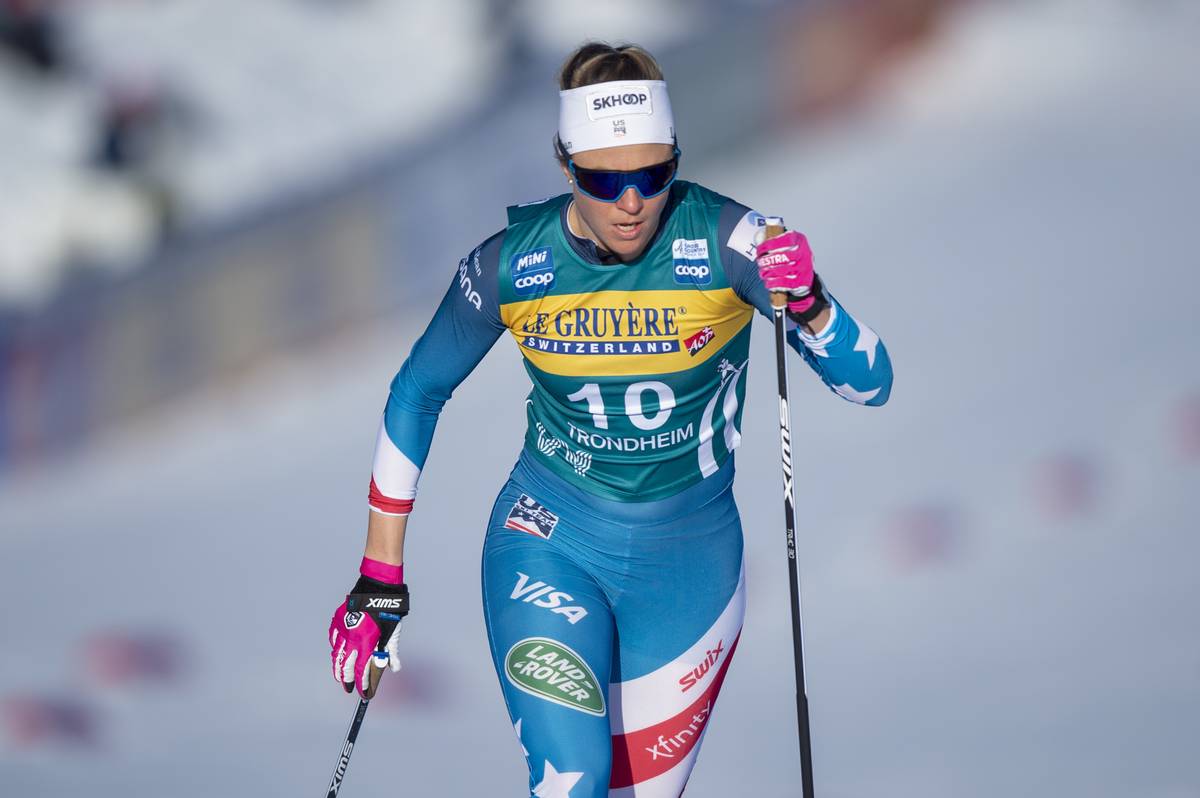
    Sadie racing in the FIS Ski Tour 2020 in Trondheim, Norway. (Photo: NordicFocus)

    “It is hard to be the first to do something on our team, because everyone is so darn good. It feels like they have kind of reached a level already before you. So that was kind of my own personal thing, that was going to be my goal. I did not really feel like it was specifically anybody else’s at the time. That was going to be my thing, to be the one who was going to do everything. I could be ready to be on the podium on any given day, I could be on the relay on any given distance or any given position, and so I started slowly working towards that mission. Part of doing it – I can’t remember what came first, getting the yellow jersey or when I got that sprint podium, because that completed the cycle; I can’t remember what it was. But for both of those moments, the achievement I felt was so huge because I knew it was the thing I had been working on. So it definitely gave me a lot of happiness just knowing there was no limit to what I could do. It could be any given day, any given race, so that is actually my greatest achievement is accomplishing that.”

    Finally, here’s longtime USST coach Matt Whitcomb on what Sadie brought to the starting line on race day: “I’m feeling grateful for Sadie’s commitment to a long career with the team, but this retirement hurts a lot. The first time I met her was in 2007 at World Juniors in Tarvisio, Italy, so my entire existence with the U.S. ski team has had Sadie as a part of it. She’s one of those athletes that keeps coaches coming back every year. Her style of racing is an inspiration to watch; she can really hurt herself. Coaches and scientists talk a lot about the importance of athletic talent, but they don’t talk enough about the importance of being willing to access that 100% effort. Anyone has that choice, but it’s not so easy. I’ve never heard Sadie say, ‘I think I could’ve gone a little harder.’ If she’s on the starting line, she’s there to give it. As I look back on her career, I know she could not have tried harder. She did her best, and that deserves a standing ovation.”
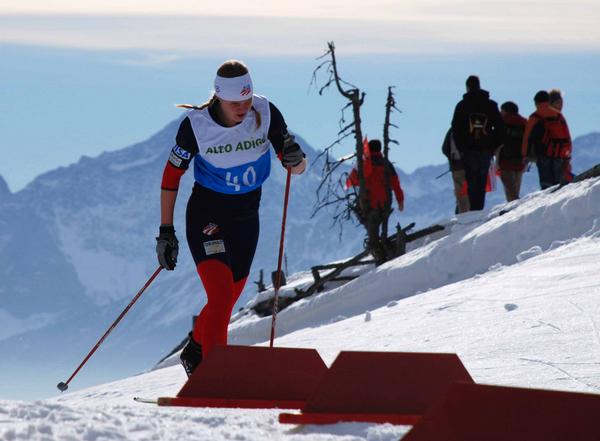
    This undated, uncredited photo is the oldest image of Sadie in the current FasterSkier image library. It seems to be from the 5 k classic at 2008 World Juniors in Italy. Sadie placed 24th in the interval-start race, 59.7 seconds behind winner Therese Johaug.

    * * *

    However, not all goals come true – as a wise person named Sadie Maubet Bjornsen once said, sometimes you have to announce a goal that is “really risky and really scary and really intimidating to say.”

    And so, as Sadie recently wrote on Instagram, hearkening back to summer 2020 and her decision to dedicate herself to one more year of training, “Last summer I danced between hanging up my skis, or continuing on. There was one last goal I wanted to accomplish not just for myself, but for the team that taught me what it meant to dream bigger than big. This goal was an Olympic/World Championship 4×5 podium. I knew in my heart we were forming into the strongest relay team we had ever had, and I felt the need to lay it all on the line for my team in @oberstdorf2021.”
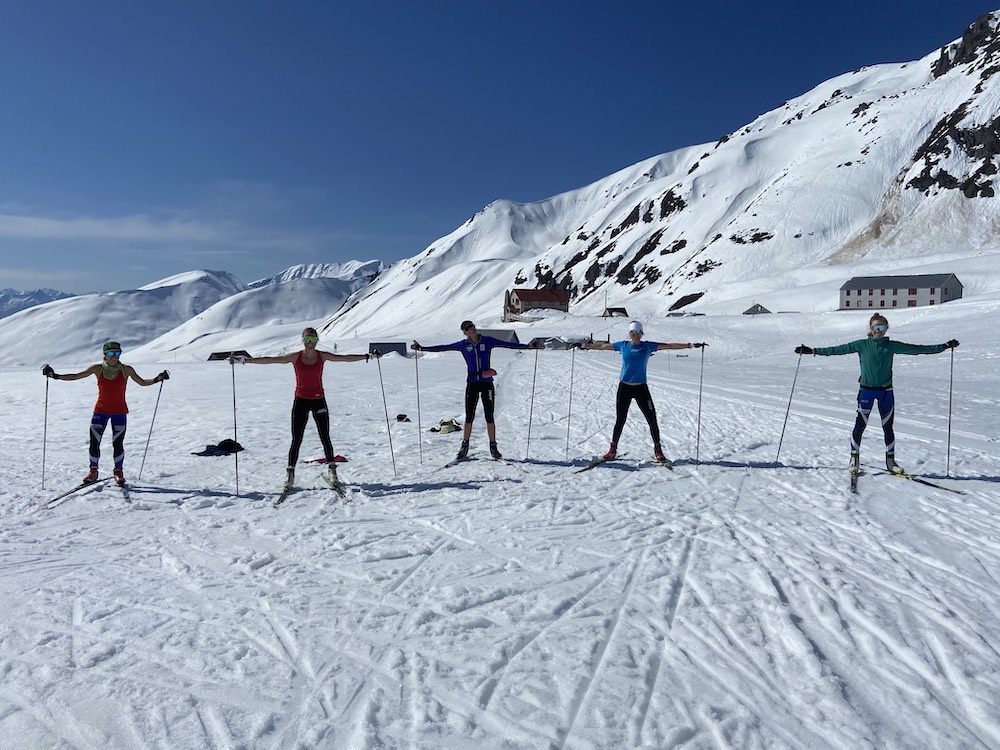
    From left, APU athletes Rosie Frankowski, Sadie Bjornsen, Hailey Swirbul, Becca Rorabaugh, and Caroline Brisbois maintain a healthy distance while skiing at Hatcher Pass on May 13, 2020. (photo credit: courtesy Sadie Bjornsen)
    Sadie training at Hatcher Pass in Alaska (with, from left, APU teammates Rosie Frankowski, Sadie, Hailey Swirbul, Becca Rorabaugh, and Caroline Brisbois) in May 2020, Covid-era social distancing in effect. (photo credit: courtesy Sadie Bjornsen)

    Sadie continued on for one more year, one more season of intervals in the sun and ODs in the rain and logging her total tendon load following each workout. She stayed in Alaska in the summer while the world shut down for Covid. She was on snow early in the fall. She skied a ton. She trained hard. She stayed home in Anchorage through all of World Cup Period I, all of Period II (Tour de Ski), and the first half of Period III to better peak for World Champs. She donned a mask and flew over to Europe in mid-January, after doing just one citizens race and two Anchorage FIS races that winter, and promptly placed 10th in her first World Cup race in nearly a year – despite having abstained from hard intensity for the previous five weeks while nursing a back injury. She would finish 15th, 15th, and 4th in her next three World Cup races, then 11th in her first race at World Champs. All the pieces were in place.

    When race day dawned in Oberstdorf, it was the 15th, and final, international relay of Sadie’s career. While there was, technically, one race remaining at World Champs, the 30-kilometer classic two days later, her teammates knew that this was the race she had stayed in the sport for. As she had told them the previous summer, “I am staying one more year with ski racing and this is why.”

    Put another way, Sadie had literally dedicated one year of her life to ski for less than 15 minutes – one last classic leg on one last American women’s relay team, “for the team that taught me what it meant to dream bigger than big.” Try not to get goosebumps while you read that.

    Her teammates were not unappreciative of her dedication. Their mindset going out to the start line, Sadie recalls, was, “okay, if we can see when we tagged each other, we know we did not give enough.” She adds, “We all knew how invested we were and I really felt like that was the strongest ski race we had ever had, and the most ready we had ever been.”

    Sadie Maubet Bjornsen (far right, green bib 5) is tagged by Hailey Swirbul in the women’s 4x5km relay in Oberstdorf. (photo: Modica/NordicFocus)

    After a year of preparation, Sadie’s relay leg – the second classic leg, one last time – took her 14 minutes and 40.5 seconds. She took the handoff from Hailey Swirbul in eighth after the chaos of the scramble leg, 13 seconds out of third. Halfway through her 5-kilometer leg, she was still 11 seconds off the podium. Less than a kilometer later, she had moved the Americans up into third. She would tag off in fourth, 0.3 seconds out of third, having done precisely what she needed to do to help her team. 

    If you watch the replay, it is very plausible to conclude that Sadie could not indeed see by the end of her leg.

    If you’re reading this website, you probably know what happened next: Sadie tagged off to Rosie Brennan for leg three; Brennan pushed hard but was unable to drop anyone around her, tagging off to Diggins in a virtual tie for third; Diggins took off for her anchor leg alongside Finnish anchor Krista Pärmäkoski; Diggins skied her heart out; it wasn’t quite enough; Finland took the bronze, with the U.S. 0.8 seconds back in fourth. It was the American women’s, and Sadie’s, fourth fourth-place finish in the last five World Championship relays. Between the relay and the team sprint, Sadie would leave Oberstdorf a combined 3.17 seconds out of taking home two medals and realizing this whimsical GIF after a year of training.
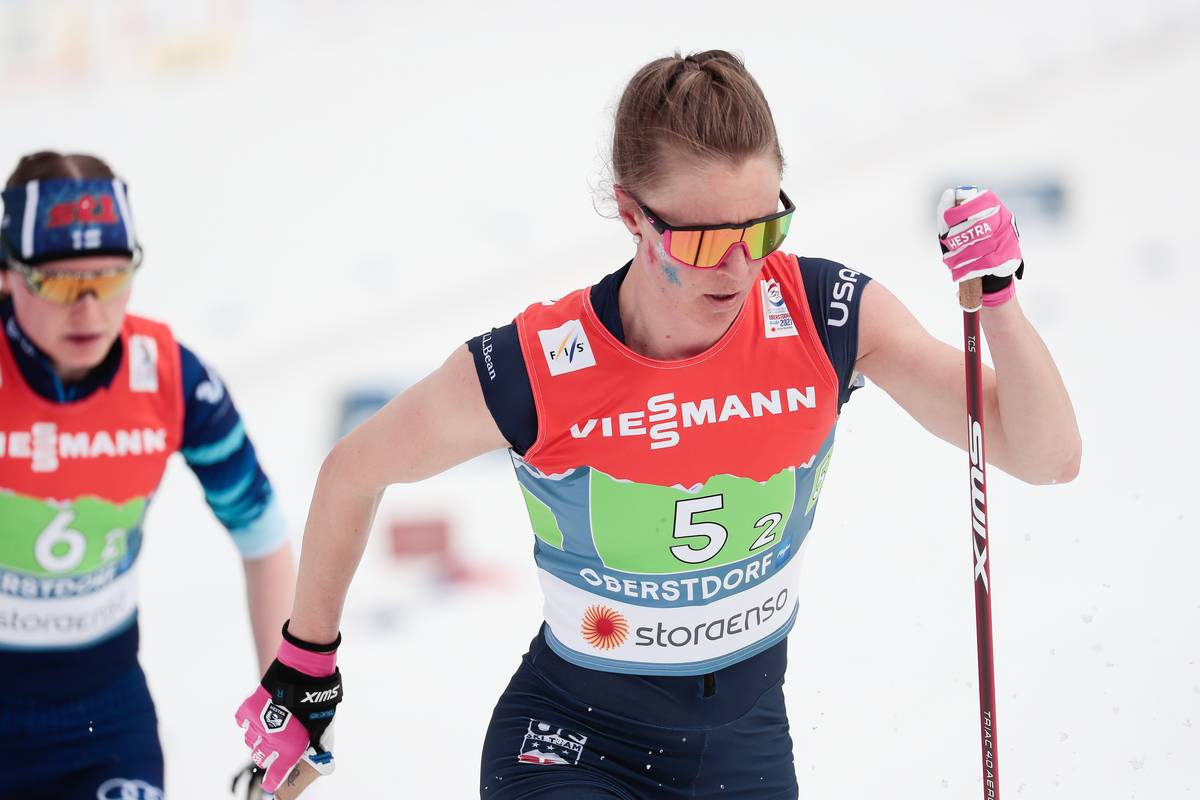
    Sadie digging deep on leg two of the 4 x 5 k relay. (Photo: NordicFocus)

    Sadie has no regrets: “We wanted to go to the point where we could not even see where we were going anymore,” she reflected on the relay after the season ended. “I think we literally did that. There were no regrets with that day. … It’s just an achievement in itself to know that there are no regrets. Of course you feel different when you also get the medal but I am so glad I came back for another year. This just felt different than any of the other relays I have been part of so it was certainly worth it.” Sometimes you have to set dream goals that scare you.

    * * *

    Sadie spent her ski career setting results goals, but she also spent it pursuing a rigorous course of study. She earned two degrees – not a double major, but two separate B.A. degrees – from Alaska Pacific University (the school, not the eponymous domestic ski club), in accounting and nonprofit management. She has embarked on coursework for her M.B.A. She has passed the first of four sections of the fiendishly difficult Uniform CPA Examination to become a certified public accountant, and sat for the second section last weekend.
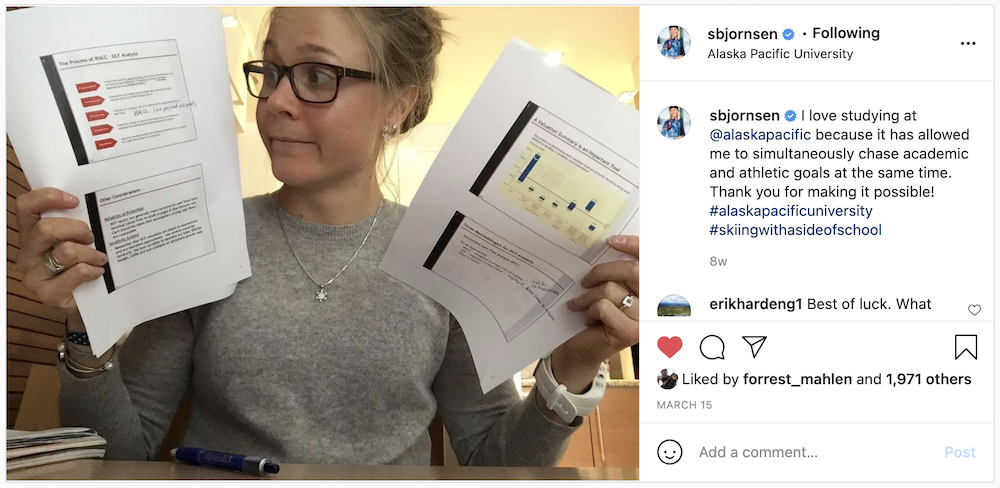
    She studied in the team van by headlamp while driving to and from Hatcher Pass for early-season skiing. She attended class remotely from all around the world, years before “Zoom” became a part of everyone’s lexicon. The former NCAA athlete did, in fact, go pro in sports, but she ably laid the groundwork to go pro in something other than sports now that her ski career is over.

    To hear Sadie tell it, these academic demands helped, rather than hindered, her ski career. She explicitly says that doing both at the same time helped her to stay in “a perfect balance”: “When I was trying to do the best that I could in school, when you have the personality that you’re just, like, a bit of a perfectionist, it’s easy to kind of get out of balance. So for me, with ski racing, it was easy to try to perfect every single thing. And when it couldn’t happen, I would really struggle. And so school always provided that balance for skiing, and skiing provided that balance for school. And so I never looked at it that I was like, doing either of them imperfectly. I was just in a perfect balance of challenging myself both physically and mentally. So I think that it just took the pressure down enough to do both of them really well.”
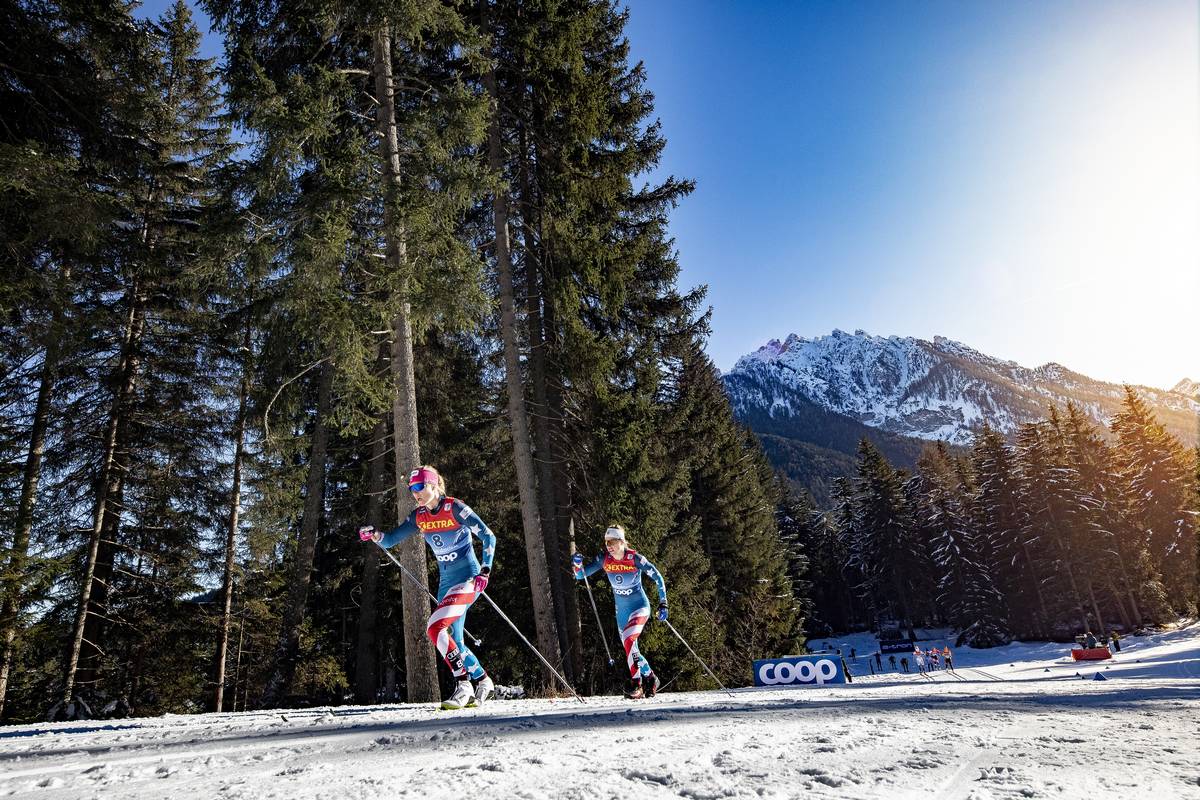
    Sadie Maubet Bjornsen (left) and Rosie Brennan (right) stride in sync during the 2020 Tour de Ski in Toblach, Italy. (Photo: NordicFocus)

    Balance sometimes comes at a cost. The World Cup end-of-season celebration, notorious as the first time in months when a group of the most highly disciplined athletes on earth can finally let their hair down? She pre-gamed for that by signing on to class. The morning of her first ever Olympic race? Class was at 7:30 to 9:30 p.m. Alaska time the night before, which was 5:30 to 7:30 a.m. Sochi time. Sadie, who woke up early to attend the class, appreciated the timing, as only someone who has negotiated balky European wifi for a decade can: “That was great, because that’s before anybody wakes up and breaks the internet or shuts you down.”

    “That is what makes things so rewarding,” Sadie reflects on the school–skiing balancing act, “is working really hard at them and giving up things for them. Again, it was something that worked really well for me to do them together.”

    Verrier, the UAA volunteer coach and longtime friend, makes similar observations.

    “Sadie said something to me recently that I’ve been thinking about a lot,” Verrier wrote to FasterSkier this spring. “She told me that the most unpleasant and darkest time in her ski career was when she decided to put everything else aside and focus solely on being a professional ski racer. That approach just didn’t work for her at all. She found that she actually needed something else – her academic studies – to keep the skiing from becoming too ‘heavy.’ When she recently started working toward becoming a CPA, while still ski racing, she immediately felt much ‘lighter’ – and more successful. When I think back to when I was first getting to know Sadie at UAA, it all starts to come together and make a lot of sense to me. I don’t think she’s ever been one who thrives best with a singular focus. I think Sadie’s at her best in more complex environments. Whether it’s focusing on academics and athletics at the same time, or having chronic health issues thrown up in front of her skiing goals, I think Sadie’s most at home when there’s more than one thing going on at a time. And I don’t think I realized that about Sadie when she was a freshman at UAA. And maybe she didn’t either.”
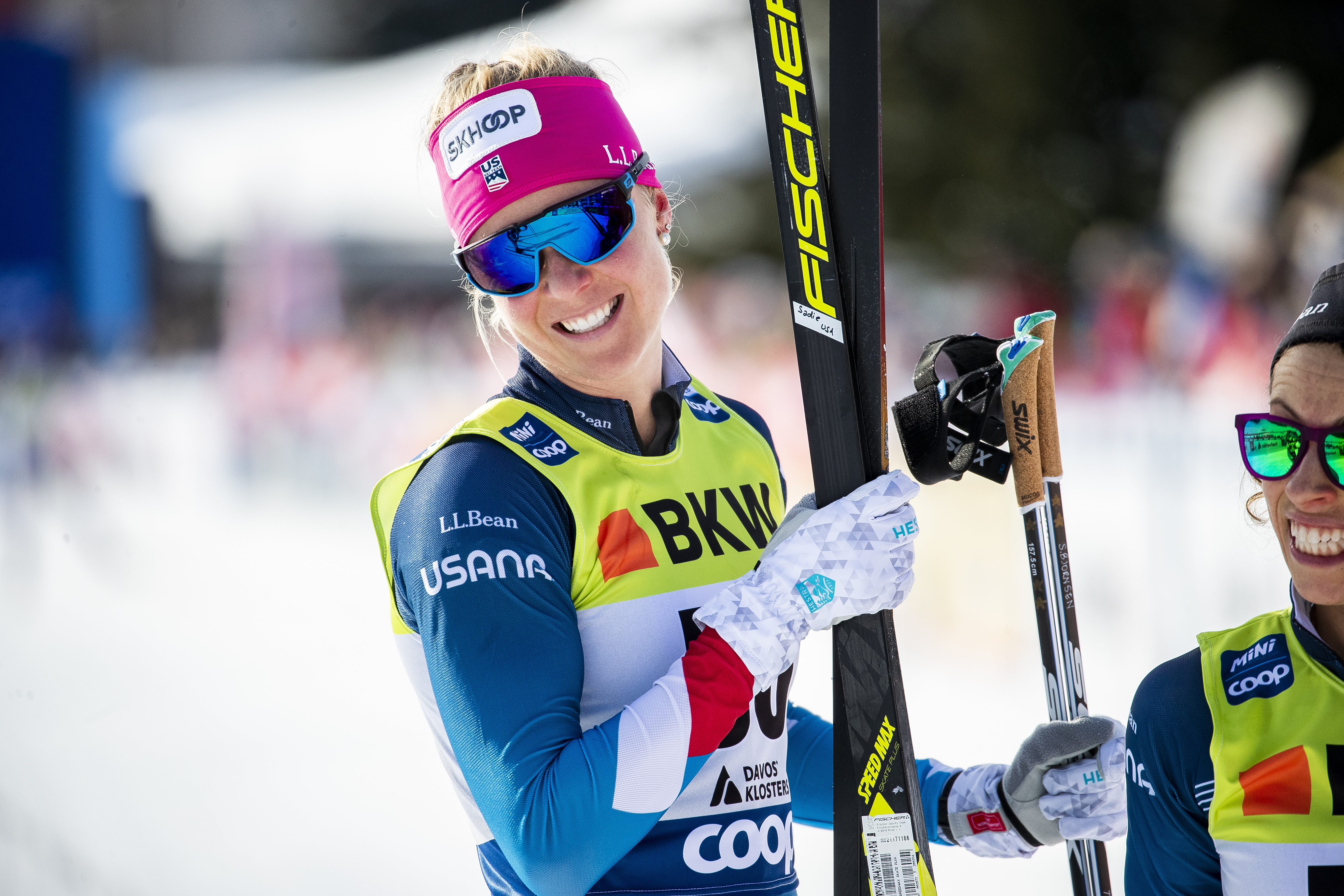
    Another consistently strong performance by Sadie Maubet Bjornsen (9th) at the 10-kilometer skate race in Davos, Switzerland, in December 2019. (Photo: NordicFocus)

    Everyone needs to figure out the version of balance that works well for their lives. For Sadie, this ultimately involved earning multiple degrees and studying for one of the most difficult professional licensing exams out there. Here’s Verrier again: “Now that she’s shifting her focus to a career in accounting, she recently told me she’s totally loving the challenge of being the ‘minnow’ again, instead of the ‘shark.’ And when she says it, you can see her eyes light up and you know she’s enjoying starting something new that she feels she’s not very good at yet.”

    * * *

    So, what’s next? For the immediate future, prepping for the CPA exam is pretty much a full-time job. Sadie passed one section, out of four, this spring, and just sat for the second section. Eventually, she will have passed all of Auditing and Attestation, Business Environment and Concepts, Financial Accounting and Reporting, and Regulation, and will be qualified to work in any of a broad range of fields, from assurance and attestation services to forensic accounting to regulatory compliance.

    She has already started a business, Bjornsen Bookkeeping, and is providing simple accounting services on the side in addition to studying. She is also transitioning to a life in which she has to specifically carve out time to exercise outdoors, as opposed to automatically doing so twice daily for her job. “Being physically active used to be my job, so it was easy,” she recently wrote on Instagram in a post advocating for physical activity through local group Healthy Futures. “In the past month I have learned how easily a busy day doesn’t include activity… and it makes me feel horrible!”

    Sadie plans to stay in Alaska for the time being; it is a good place to be active outside. “I do plan on staying in Anchorage and staying involved in this community despite the fact that I am done racing as a professional athlete,” she says. “I found it really inspiring this winter that Holly Brooks is still racing. She is not the Olympic athlete that she was six years ago, but she is still out there enjoying the process and racing with no shame and I found that so inspiring this winter. I also hope that I can stay involved without having such a high standard as I would have had as a professional athlete.”
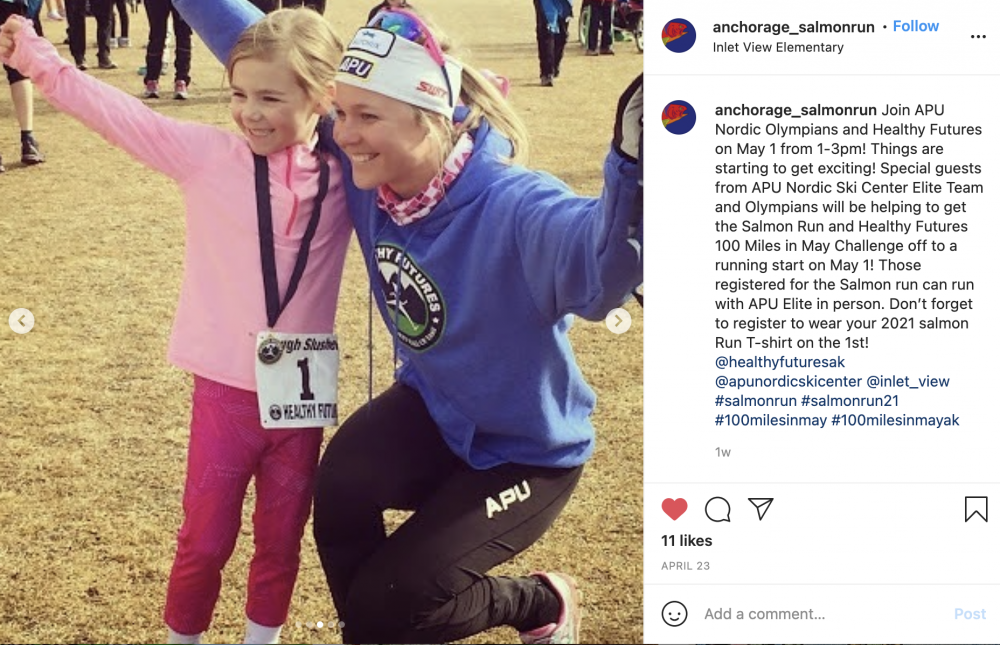
    Sadie Maubet Bjornsen at a Healthy Futures community event, ca. 2017 (photo: Instagram/Anchorage Salmon Run)

    An Anchorage citizens race can often boast five former Olympians in the field; Sadie may make it six. She may also continue to lend her presence to the various outreach groups and activities – Fast and Female, Healthy Futures, Tuesday Night Races – that have ensured that hundreds of kids in Anchorage already have a signed Sadie poster on their walls, or have had her lead warmups before their race.

    And finally, speaking of kids, when Sadie spoke with FasterSkier for a 2016 profile, she answered the “where do you see yourself in five years” question with, “Anywhere in the world, hopefully starting a family.” It’s now five years later. While Sadie and Jo’s personal life is their own and this is emphatically not intended as a birth announcement, it seems safe to say that, should children indeed be in the picture some time soon, Sadie is well qualified to take on the prodigious balancing act that is modern motherhood.

    * * *

    Disclaimer: Anchorage is a small town, and Sadie and I are both affiliated with the same club program, Alaska Pacific University Nordic Ski Center. Over the years, Sadie has signed multiple posters for my children (okay, also for me as well); I have trained with her a handful of times in APUNSC program-wide bounding sessions; and my wife and I are currently hiring her husband to do light handyman work at our house. If you conclude from all of this that I cannot be completely unbiased toward her, that is, frankly, correct. However, I promise that anyone on the FasterSkier team, let alone anyone involved in American skiing over the past fifteen years, would speak of Sadie in roughly the same glowing terms that I have done here. That does not mean that this article is unbiased; it does suggest that it is representative.

    * * *

    Further reading (if this wasn’t enough):

    Anchorage Daily News: This January, local photojournalist Marc Lester wrote and photographed a superb photo essay on Sadie’s approach to what she knew at the time was her final season of World Cup skiing

    Alaska Public Media: Earlier this winter, Sadie spoke with Adam Verrier for local public radio show Outdoor Explorer, pairing with UAA/USST skier JC Schoonmaker in an hour-long episode entitled “Starting and ending World Cup ski careers”

    Nordic Nation: Sadie spoke with Jason Albert for the FasterSkier podcast in 2018 about the “Sadie System,” the approach she took to managing tendon load and overall life balance alongside of competing as a professional skier

    U.S. Ski & Snowboard: Sadie spoke with Tom Horrocks immediately after this season for an interview that is a far shorter version of this article and that provides a fine complement to some topics discussed here

    NBC New York, “Sadie Bjornsen and Jessie Diggins explain cross-country skiing with Legos”: A delightful two-minute video that is precisely what the title promises. Plus, your chance to see Sadie enact a finish-line lunge using Lego characters.

  • Balanced to the End, Sadie Maubet Bjornsen Retires (Part I)

    Balanced to the End, Sadie Maubet Bjornsen Retires (Part I)

    Sadie Maubet Bjornsen (left) skis alongside Yana Kirpichenko (RSF) in the 30 k classic in the 2021 World Championships in Oberstdorf. The race closed out Maubet Bjornsen’s international race career. (Photo: NordicFocus)

    To classic ski, and to do so well, requires an athlete to perform an almost stupidly large number of tasks at the same time. You have to move two arms, two legs, and two ankles in alternation, in almost infinite variations depending upon the snow, the wax, the course, and your remaining energy. You have to mediate between power and finesse, kick and glide, stimulus and weight transfer. In short, you have to balance a whole lot of things.

    If you’re this country’s most beautiful classic skier of the past decade, you’re going to have a pretty darn good sense of balance. If you’re going to train at international levels while also earning multiple degrees… and call into class the morning of your first Olympic race… and earn World Cup podiums in all disciplines… your sense of balance is going to be off the charts.

    If you can do all these things, your name is Sadie Maubet Bjornsen, who retired from professional skiing after this year’s World Championships in Oberstdorf. If you’re anyone else, read on for a look at her career, and what she brought to American nordic skiing over the past decade-plus.

    * * *

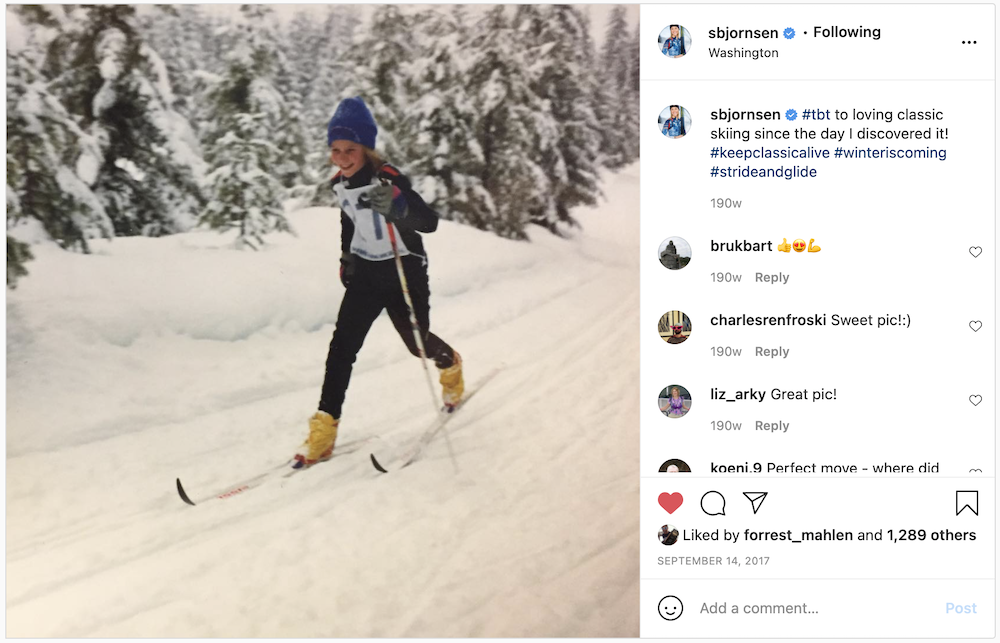
    Sadie’s ski career had humble if bucolic beginnings in Washington’s Methow Valley. She skied, of course. The Methow is a pretty good place to do so. She attended an Olympic homecoming parade for neighbor Laura McCabe after Nagano, and realized that the Olympics were something you could do.

    But she also ran and biked and played in the woods, and worked on construction sites moving boards around, and in general had an active and, well, balanced childhood. She didn’t rollerski till high school. She trained 250 hours as a high school freshman, up to only 380 as a senior (some high-level American juniors now train twice as much). The humorless application of a rigid and dogmatic training schedule it was not.

    “I am not a good ski racer because of what I have done in the past five years, but because of the way I was raised,” Sadie noted in an April phone interview with FasterSkier. (Such a childhood seems pretty well suited to making ski racers; her younger brother, Erik Bjornsen, was also a longtime member of the national ski team.)

    Sadie was not unskilled at skiing; she represented the U.S. at World Juniors at Kranj, Slovenia, in 2006, alongside future USST teammates Liz Stephen and Morgan Arritola. But, tellingly, those races in 2006 are the very first FIS races in her profile; she hadn’t been, say, shuttling between U.S. Nationals and RMISA from a young age. Sense of balance, indeed.

    Sadie decided to continue skiing in college, heading north to join head coach Trond Flagstad and volunteer assistant coach Adam Verrier on the ski team at the University of Alaska Anchorage in fall 2008. On paper her results were hardly bad – she was third at 2009 NCAA Championships in the 5-kilometer classic race, for example, slightly ahead of Rosie Brennan, Caitlin Patterson, and Sophie Caldwell Hamilton, and her coaches were thrilled for her potential – but things were not going well for her as she began life as a college student. When she moved across the street to Alaska Pacific University, or APU, after the 2008/2009 season, it was as a somewhat broken athlete.

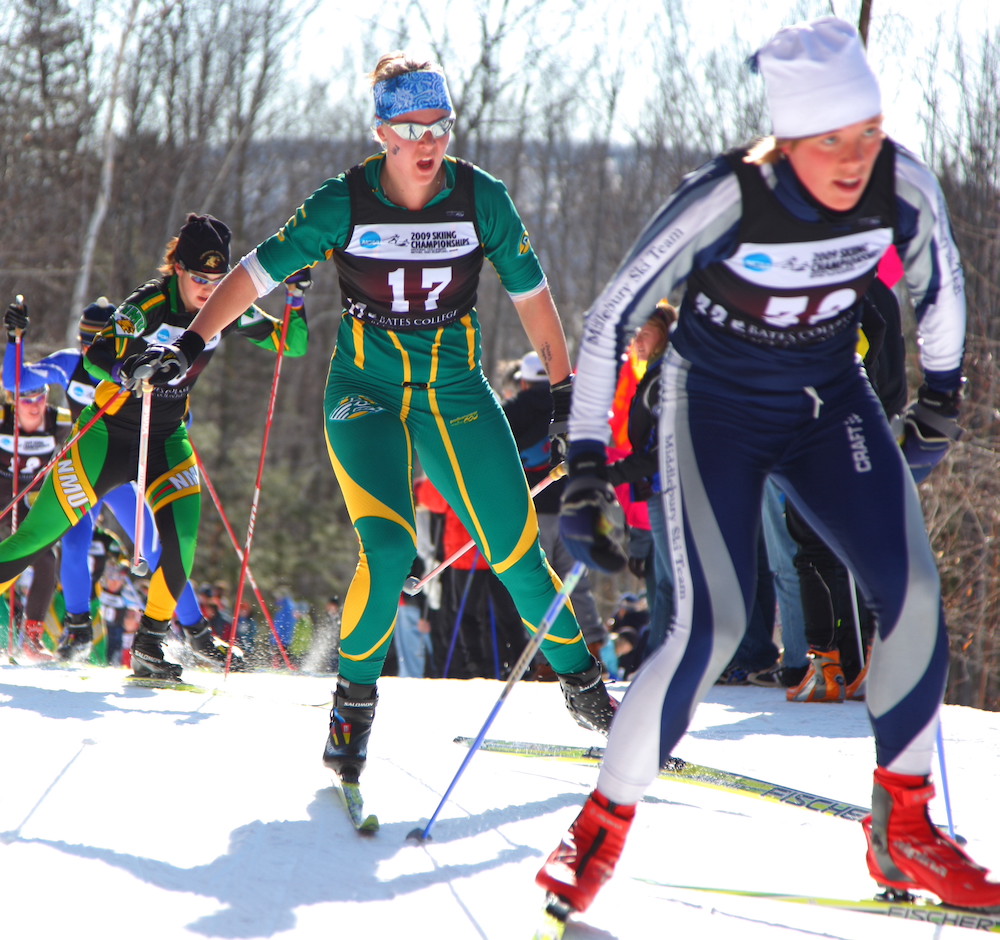
    Sadie (bib 17) competes at 2009 NCAA Championships in Rumford, Maine, for UAA. (photo: Trond Flagstad)

    “I came in [to APU] kind of as a broken, injured race car,” Sadie recalls. “I could not train for more than 30 minutes and I was not training much, under 500 hours, and somehow [APU head coach Erik] Flora believed in me. I have no idea why; I still wonder that to this day, what gave him the belief because I was not racing well the year that I came here. I had had my worst season ever, I dropped out of college and I had my worst season ever because like I said, I need balance. He took a chance on me, and I remember telling him I wanted to make the World Championships team. And that was certainly a laughable thing to say, but he was totally supportive and he designed a program for this girl who could only train 30 minutes at a time.”

    Reader, she made the World Championships team. She made the team for Oslo, in 2011; for Val di Fiemme, in 2013; for Falun, in 2015; for Lahti, in 2017; for Seefeld, in 2019; and for Oberstdorf, in 2021. She also made two Olympic teams in that time, in 2014 and 2018. We’ll have more on her results later, but that’s a heck of a CV for someone who couldn’t train for more than 30 minutes at a stretch two years before her first World Cup podium.

    * * *

    Sadie, of course, did not know that any of this would come to pass when she toed the line in her first-ever World Cup weekend, a skate sprint and 10 k classic in Drammen, Norway, in February 2011. 1.2 kilometers for the qualifier, go as fast as you can, top 30 athletes make the heats and get to keep on racing. Everyone else goes home.

    There were 71 athletes in the field that day. Maiken Caspersen Falla of Norway won qualifying. Kikkan Randall won the final. Sadie, then 21 years old, finished 42nd, nearly two seconds out of qualifying – frankly, in sprint racing, at least a 1.2-kilometer sprint covered in roughly 2:16, that’s not particularly close. Sadie’s name appears nowhere in this website’s contemporary race writeup, not even a half sentence at the end giving a cursory listing of other North Americans who also raced.

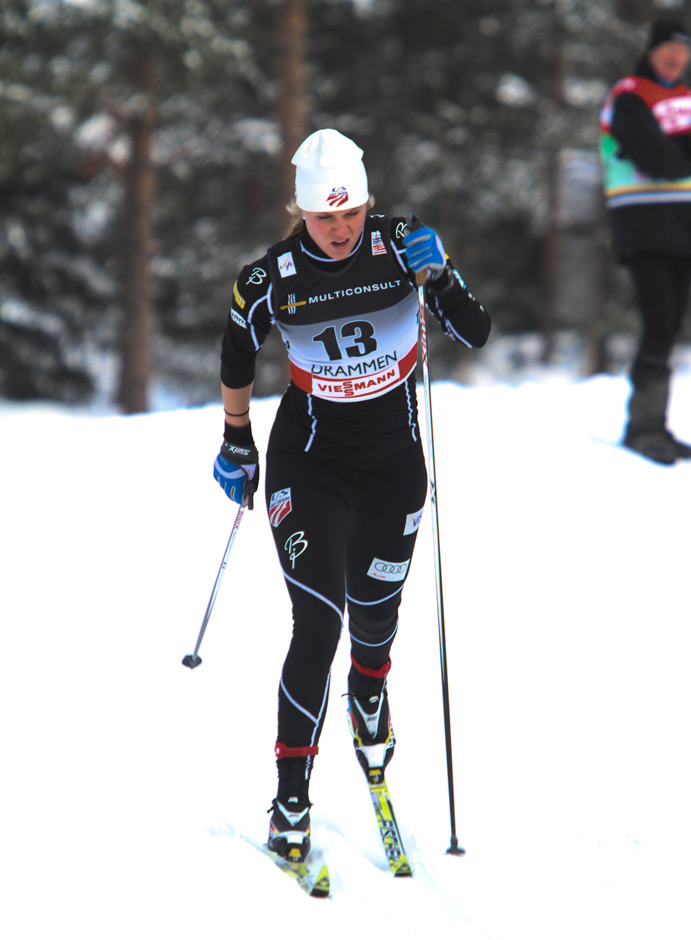
    Sadie in her inaugural World Cup weekend, in February 2011, in the 10 k classic. (There are no photos of her in the sprint qualifier in the FS database.) This photo was originally captioned, “Sadie Bjornsen (USA) with her sharp classic form.”

    Was Sadie surprised that she didn’t make the heats? Oh yes.

    “I had a really strong memory from that first one,” she now reminisces. “I remember crossing the line after the sprint and going up to [USST head coach Chris] Grover and saying, ‘There is no way I did not qualify. I think the timing is wrong.’

    “I cannot believe how sure I was of myself at that age, because now I look at the young kids and think, Wow, how do they think they can win? That is incredible, I think I missed that! I was not thinking that I was winning, I was just sure that I had qualified. I think there is something to be said about being young, just having so much confidence. After asking him, ‘Did they mess up?’ my next question was, ‘What did I do wrong? Where did I lose that time, because I know I did it perfectly!’ He went on to explain, ‘Oh, well, in this finishing stretch there is a lot of time you can lose,’ and so on. 

    “It was a little bit of a learning experience for me. It turns out World Cup skiing is pretty darn fast, I just had no idea.”

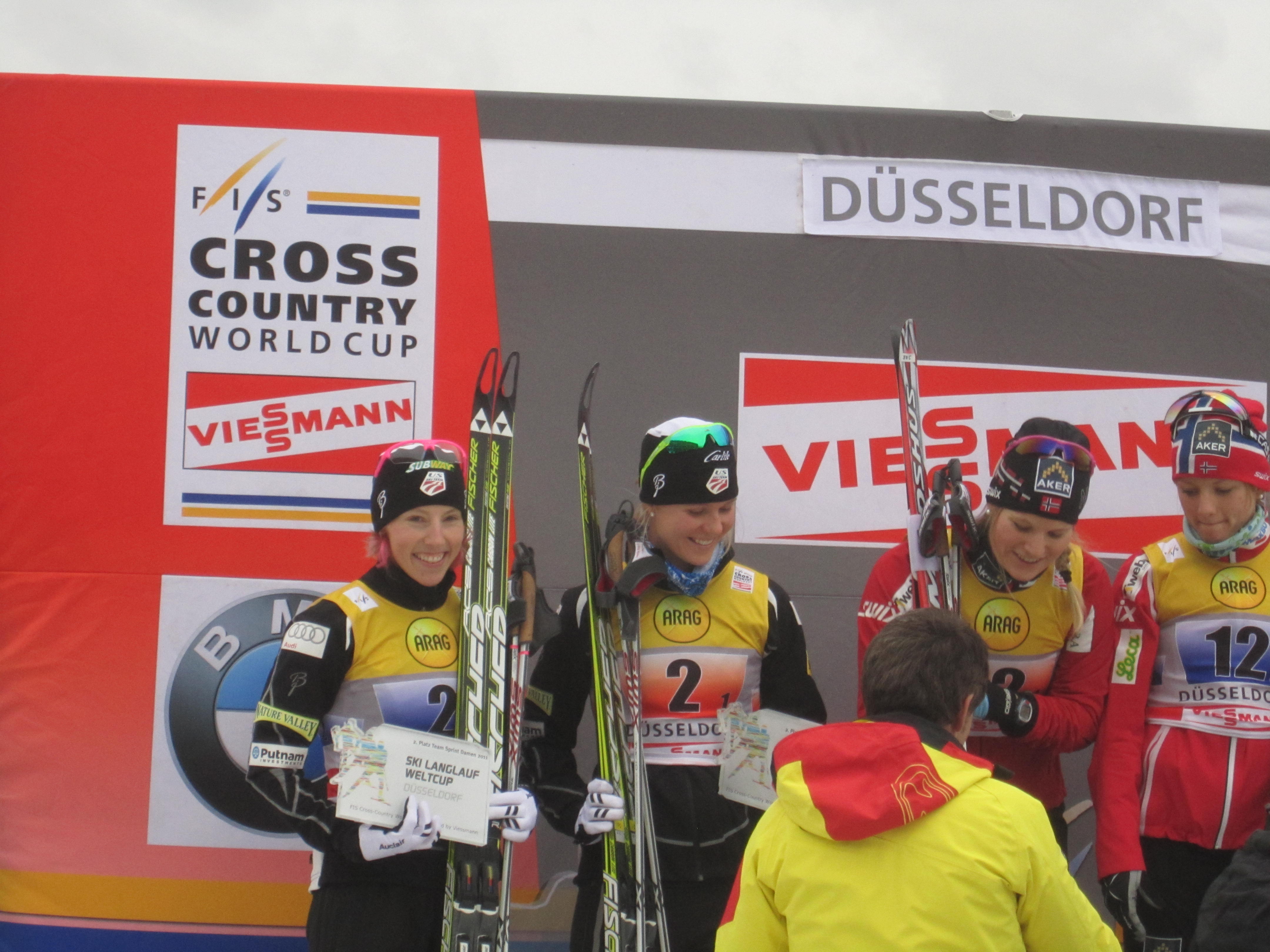
    Less than a year later, Sadie was standing on the World Cup podium: Sadie Bjornsen and Kikkan Randall, second, team sprint, Düsseldorf, Germany, December 2011. It was the first World Cup team sprint podium in American history. FasterSkier’s race recap was headlined “Americans pull off surprise second,” and expressed sentiments such as, “the American pair, while talented, was going to have to have a good day to make the final.” No insult was intended, it was just a very, very different era in American skiing.

    Randall (L) and Bjornsen (R) on the podium in Düsseldorf, Germany, December 2011. Team Sprint World Cup silver. Photo: Kieran Jones

    Both athletes, when asked about this race a decade later, independently sound similar notes as they recall this moment: Randall was the seasoned veteran with multiple podiums to her name who knew what she was doing; Sadie was the 22-year-old rookie who had never made the World Cup sprint heats in her life, with a 34th in qualifying on the same course the day before serving as her previous highwater mark through that point in her career.

    Here’s Randall, in a recent email to FasterSkier: “One great memory was in 2011 when Sadie and I teamed up for the World Cup team sprint in Düsseldorf. In between the semis and finals Sadie was so nervous she could hardly sit still. I managed to fall asleep for a few minutes and she couldn’t believe I was able to be so calm. Once we got out on the snow, Sadie found her composure and we went on to win the silver medal together for the first ever World Cup team sprint podium result.”

    And, in much the same vein, here’s Sadie, earlier this spring: “I would say Kikkan did the brunt of the work in that race but it was like a race car driving race. All I had to do was stay on my feet. Somehow I did that and she had that killer finishing sprint. But it was a great moment.”

    (For historical perspective, here’s Sadie’s quote to this website in December 2011, from the race writeup linked above: “It’s the greatest thing to happen so far! It hasn’t even sunk in yet! It helps to have a sprint champion like Kikkan on your team, that’s for sure.”)

    Hindsight is, famously, 20/20, and we all know now that both athletes would earn a World Championships medal in this event within their careers, Randall in 2013 and Sadie in 2017 (in each case teaming up with Jessie Diggins). But what was Sadie thinking at the time?

    U.S. Ski Team teammates Jessie Diggins (l) and Sadie Bjornsen celebrate their bronze medal in the women’s 6 x 1.3-kilometer classic team sprint at the 2017 Nordic World Championships in Lahti, Finland. (Photo: John Lazenby/Lazenbyphoto.com)

    “I definitely did not expect that,” she says now, “and I would say that was a shiny moment before the next three years of near misses. I think it took me about three years to consistently qualify top-30. … I do remember that podium being like, Oh wait! I might actually be good after all! You know, World Cup racing does not make you feel good about yourself when you are never racing top 30. That Düsseldorf podium was definitely the thing that fueled me for the next three years as I went through the tough process of making the steps to being a World Cup racer.”

    * * *

    This process is tough for any World Cup skier; any athlete competing at this level is working her butt off to excel in a sport where small margins mean medals. But few athletes did this work against such a consistent backdrop of injury and limitations as Sadie dealt with throughout her entire career.

    When Sadie was 16 years old, she took an antibiotic, Levaquin, that had been prescribed for a sinus infection. It had enduring and devastating effects: “it had this side effect of permanent damage to your tendons and your ability for your tendons to recover,” as Sadie puts it.

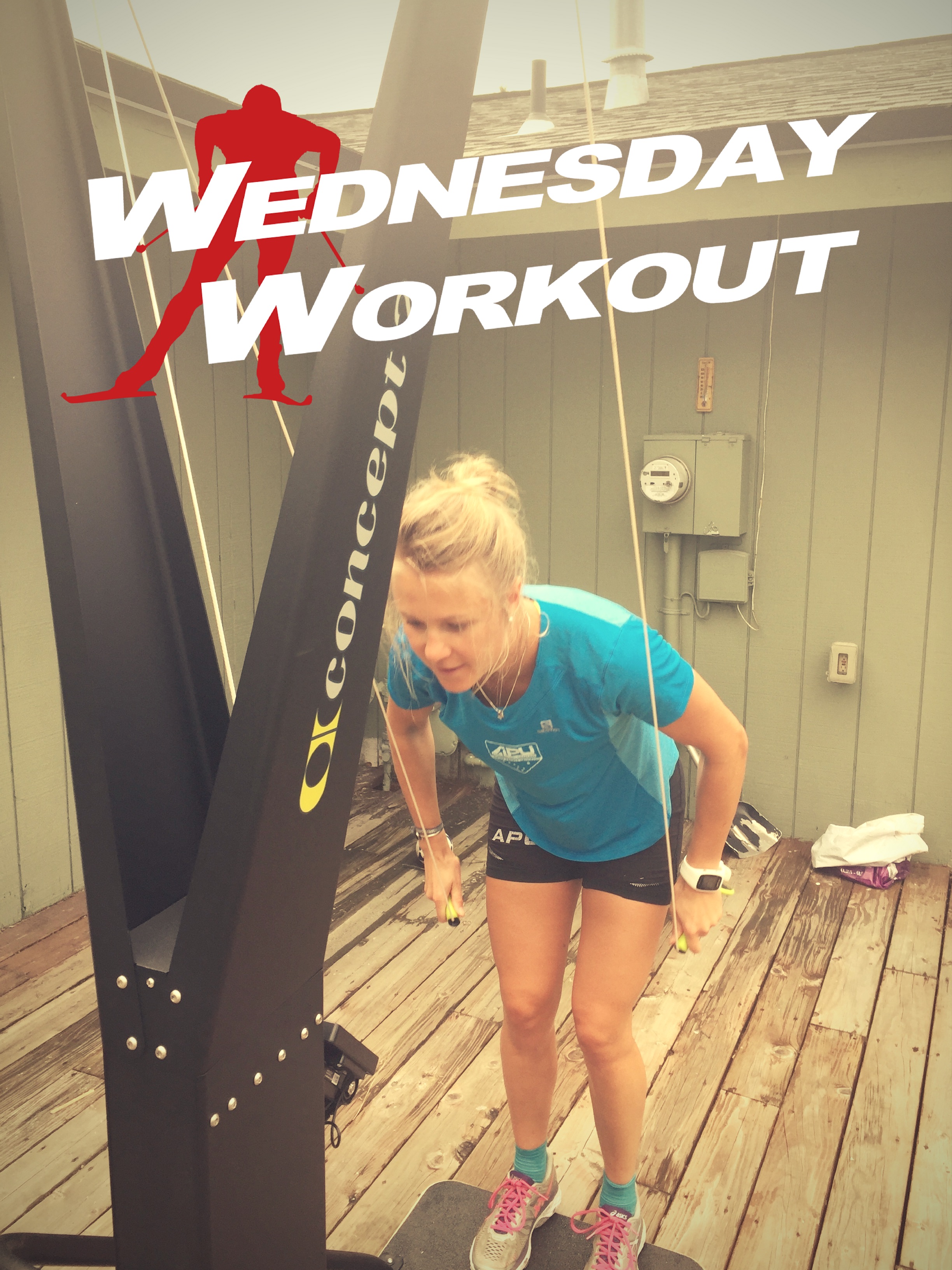
    Sadie Bjornsen, of APU and the U.S. Ski Team, during a SkiErg interval workout at her home in Anchorage, Alaska. She didn’t have to do this workout in sandals or some other form of heel-less shoe, as was sometimes the case. (Courtesy photo)

    The result was, in Sadie’s words, “continuous injury” for the next 15 years of her life, variously manifesting as, among other things, foot tendonitis and/or elbow tendonitis and/or knee tendonitis – these are sort of important joints and body parts for a pro athlete. Most World Cup skiers spend, in round numbers, 40 percent or more of their average annual training hours running. Some years, Sadie couldn’t run at all. Some years, it was SkiErg, and aqua jogging, and ski walking, or even skipping, sometimes in 30-minute increments or less when that was all that her body could handle, as many times a day as she could manage and her tendons could bear. Sadie estimates that she was able to consistently run for only around a fifth of her competitive career.

    It seems slightly dismissive to call all of this “injuries” – an injury is typically something that you come back from, recover from, and move on, maybe even stronger than before. Sadie’s tendinopathy was far more endemic, insidious, ever-present. You don’t have an independent blank in your training log for “overall tendon load,” in which you carefully estimate the strain placed on each of several large tendon groups in the body, with an eye to curtailing or cancelling the next day’s training session if that cumulative load is too high, a decade after a broken bone. You don’t literally drill a hole in the back of your ski boot a decade after a stress fracture. There are injuries, and then there’s continuous injury.

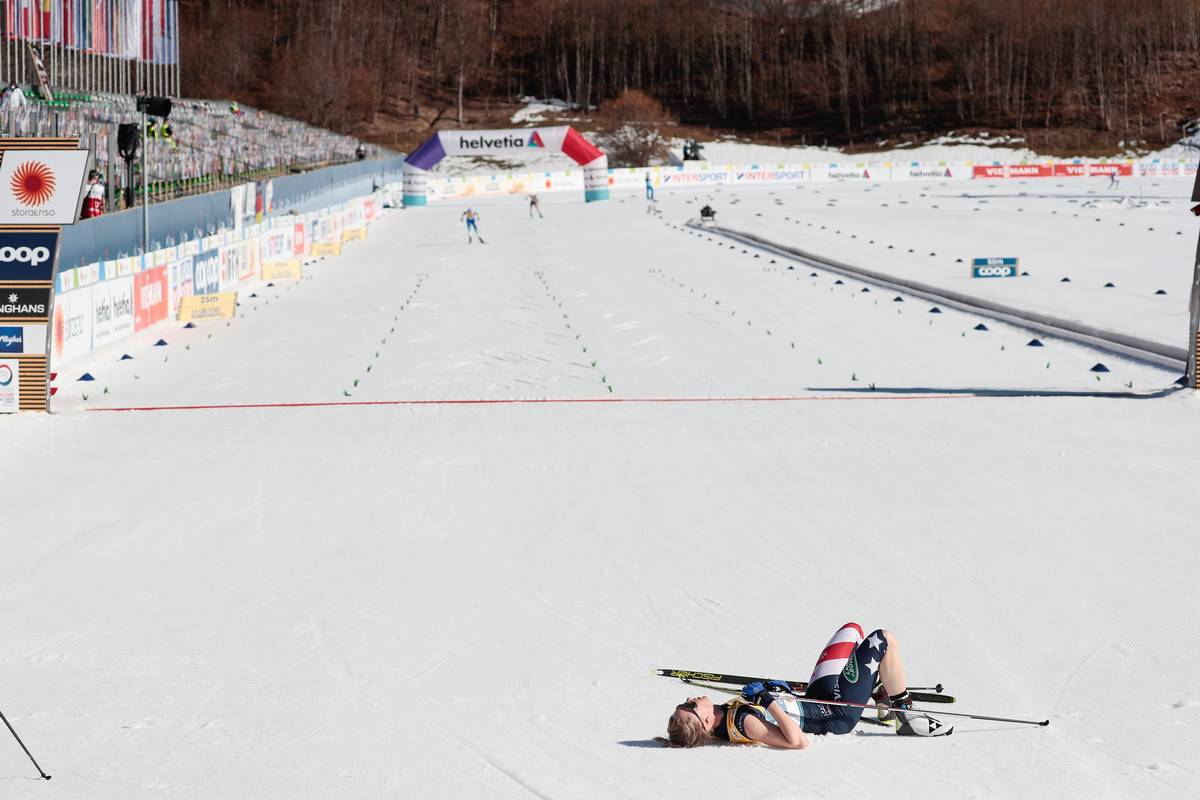
    Sadie recovers after the 10 k interval start skate at this year’s World Championships in Oberstdorf. (photo: Modica/NordicFocus.)

    Whatever you call it, it would be blithe to dismiss its deleterious effects on Sadie’s career: In a sport defined by physical performance, any limitation on what you can do, physically, is not going to help you, physically. But mentally, or conceptually, or holistically, or on some other facets that help to make up a complete athlete? The entirety of Sadie’s career makes a profound argument that there are some silver linings to be found here.

    Here’s Adam Verrier, the longtime UAA volunteer, reflecting on these issues. He doesn’t quite say “talent needs trauma,” a shorthand for the notion that talented potential is often well-served by some form of challenge, but it’s close:

    “As I’ve watched Sadie’s athletic career and her academic path, it’s become clear that she really enjoys the process of trying to accomplish a goal that is so challenging that she doesn’t know whether she’ll be able to succeed or not,” Verrier wrote to FasterSkier. “Sadie’s tendon problems have been a constant throughout her entire career, and they’ve hampered her training to the extent that she can’t train in the ‘typical’ way at all.

    She’s relegated to lots of aqua-jogging and Ski-erging, and I don’t mean to talk shit about aqua-jogging, but it’s not the typical path to the World Cup ski podium. 

    “I’ve sometimes wondered, though, whether Sadie would have done as well as she did if she didn’t have her health problems. I’ve wondered if her chronic tendon issues have put up the roadblock that she’s needed – as a foil – something to fight against. I wonder if her chronic tendon issues are the thing that’s made this whole thing interesting for Sadie and has kept her attention throughout her ski career and has, in fact, enabled her success. I recently asked her about that, and she agreed that perhaps the whole experience would have been less interesting and compelling if she could run a lot and rollerski a lot, like most everybody else.

    “Sadie’s a problem solver by nature, and she has the patience and the resolve to take on big goals and try to find a way over, around, or through the roadblocks to reach her ultimate goal. Watching Sadie’s career over the years, the thing that has stood out for me has been her willingness to embrace difficult challenges and go into the fight with one hand tied behind her back.”

    Randall, writing separately, observed almost exactly the same thing: “I don’t think I can recall a time when Sadie wasn’t dealing with an injury,” she told FasterSkier. “Yet she never let the injuries be setbacks or excuses. She was always so determined and creative in finding ways to train in alternative ways and she made the adversity into her own magic. Her example helped influence a positive can-do culture on our teams. … Sadie got so good at managing her alternative training and I wonder if it actually gave her an advantage in the long run. Kind of like tying one hand behind your back and then all of the sudden having two hands to work with. It takes incredible mental fortitude and belief, but it has its upsides too. You could say that is Sadie’s super power!”

    And, just to complete the trifecta, here’s Sadie herself on this issue: “Things have never been steady, smooth sailing for me. But sometimes that is what created who I was. It actually forced me to make my brain the strongest muscle in my body, and I think we do not always train the brain enough. We think about training our quad muscles or our arm muscles the best, and so something that was a bit of a challenge to me actually created some strength of its own.

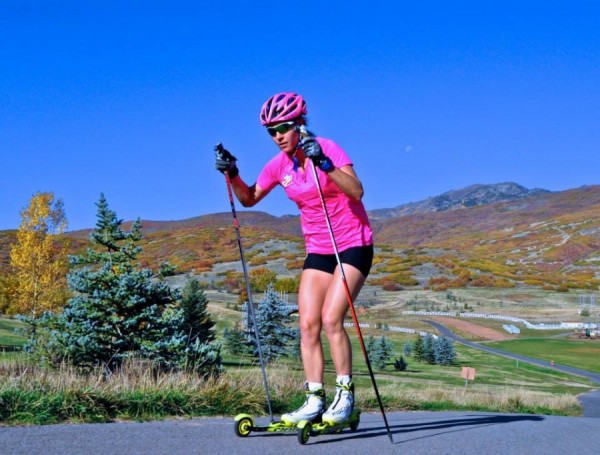
    Sadie Bjornsen (USST/APU) rollerskiing at Soldier Hollow in Midway, Utah, in 2014, a loop course unlike the one-way uphill climbs on the Anchorage Hillside. (Photo: USSA)

    “It definitely was unbelievably frustrating when I am on the tenth injury of the summer, I am having to do my own thing and I cannot come to normal training, and I have to make Flora carry my classic skis in the car because I can only ski for 30 minutes and I will be way out on the Hillside and cannot get back to my car. Often I just felt like a pain in the butt, like why does this keep happening to me? It was something that I always had to work around and I think that it actually made me stronger in the end. Because when I did have the chance to race, it was such a gift, it was never something that I took for granted because I never knew that I was going to actually show up and be able to do it.”

    Sadie continues, “A part of being injured all the time is you have to learn to forget it, or not let it hold you back. I would not say I ever truly conquered that, but I made sense of it. I do remember summers where … literally I would not classic ski the whole entire summer. Or, I believe, there was a summer that it was skating. I do remember when you are showing up at Ruka [for the opening World Cup weekend], I had not been able to ski for basically two months before I showed up. I had literally had to hole out the back of my boot. I showed up to the organizers and asked permission to modify my equipment, and my tech just took a knife and made a bolt hole out the back. Then I went out the next day and I won the qual. Nobody believed it, I did not believe it, but I think that fight that keeps you pushing through injuries gives you so much power.”

    U.S. Ski Team and Alaska Pacific University teammates Sadie Bjornsen (r) and Kikkan Randall during a ski-walking workout on Gasline in fall 2016. (Photo: courtesy Sadie Bjornsen)

    Call it what you will – flexibility, response to adversity, talent needs trauma – but these themes came to a head in summer 2016. Randall had just had a baby, developed diastasis recti during pregnancy, and didn’t get back into running until six or seven months after Breck’s April birth. Sadie was suffering from worse tendinopathy than usual, and couldn’t run. Or classic ski. And so that summer, the two of them ski walked up Gasline, a rolling, five-mile climb at the edge of Anchorage, at least, literally, 100 times. Meet at Glen Alps, stash a car, carpool down to Hillside, ski walk up, drive back down to Hillside. Repeat. Watch out for bears.

    “Sadie and I did a bunch of Gasline and alternative training sessions” that summer and fall, Randall recalls. “I remember it being so nice to have those workouts to talk and push each other and feel like we weren’t totally alone and away from the team. It almost didn’t seem like we were missing anything because those workouts were so enjoyable and productive. I appreciated the time to spend one-on-one with Sadie and get to have fantastic conversations, and jokes.”

    “We had to come up with something to talk about all 100 days,” reminisces Sadie. “It takes about an hour and 20 minutes to walk up that hill and there are bears along the way so we had to be loud. I remember bonding with her that year like I never had and developing an incredible friendship with her. I think we both went through it that summer because she was coming back from having a kid and you know there are challenges with that. … I think that day after day we believed that it did not matter that it was weird or different or imperfect, we both were bonding together knowing that we could make it happen. … It definitely is a great example of being in an individual sport with a team. I bet we both carried each other a bit that year.”

    Sadie Bjornsen (r) tends to her U.S. teammate Jessie Diggins after Diggins outlunged Sweden’s Stina Nilsson (not shown) for the bronze medal in the women’s 6 x 1.3-kilometer classic team sprint on Sunday at the 2017 Nordic World Championships in Lahti, Finland. (Photo: John Lazenby/Lazenbyphoto.com)

    After ski walking through summer and fall of 2016, both athletes would medal at World Championships in Lahti in spring 2017 – Randall in the individual skate sprint, Sadie in the classic team sprint, skiing in a technique that she literally had been unable to do all summer.

    “When I did have the chance to race,” Sadie says now, “it was such a gift. It was never something that I took for granted because I never knew that I was going to actually show up and be able to do it.”

    At the time, a day after the medal in Lahti, Sadie gave an interview to FasterSkier in which, referring to setting the goal of medaling in this event when she couldn’t even classic ski, she said, “If you don’t have those dream goals, then maybe you don’t belong here, because you’re not reaching for the highest level. … Or maybe you’ll never reach this level, because you never put something out there that was really risky and really scary and really intimidating to say, even. And I think that’s really important in making this step, and maybe even a really integral part of our team.”

    In part two: some not-so-glamorous parts of the World Cup grind; Sadie’s overall career accomplishments; and why she trained for one more year to race for 15 minutes.

  • 2020/21 International Retirement Roundup

    2020/21 International Retirement Roundup

    After an unusual and unprecedented season, many athletes have announced their retirement as they move on from professional ski racing. Aside from the three notable retirements from the U.S. Ski Team, Sadie Maubet-Bjornsen, Sophie Caldwell-Hamilton, and Simi Hamilton, twelve international athletes have said goodbye to World Cup competitions. 

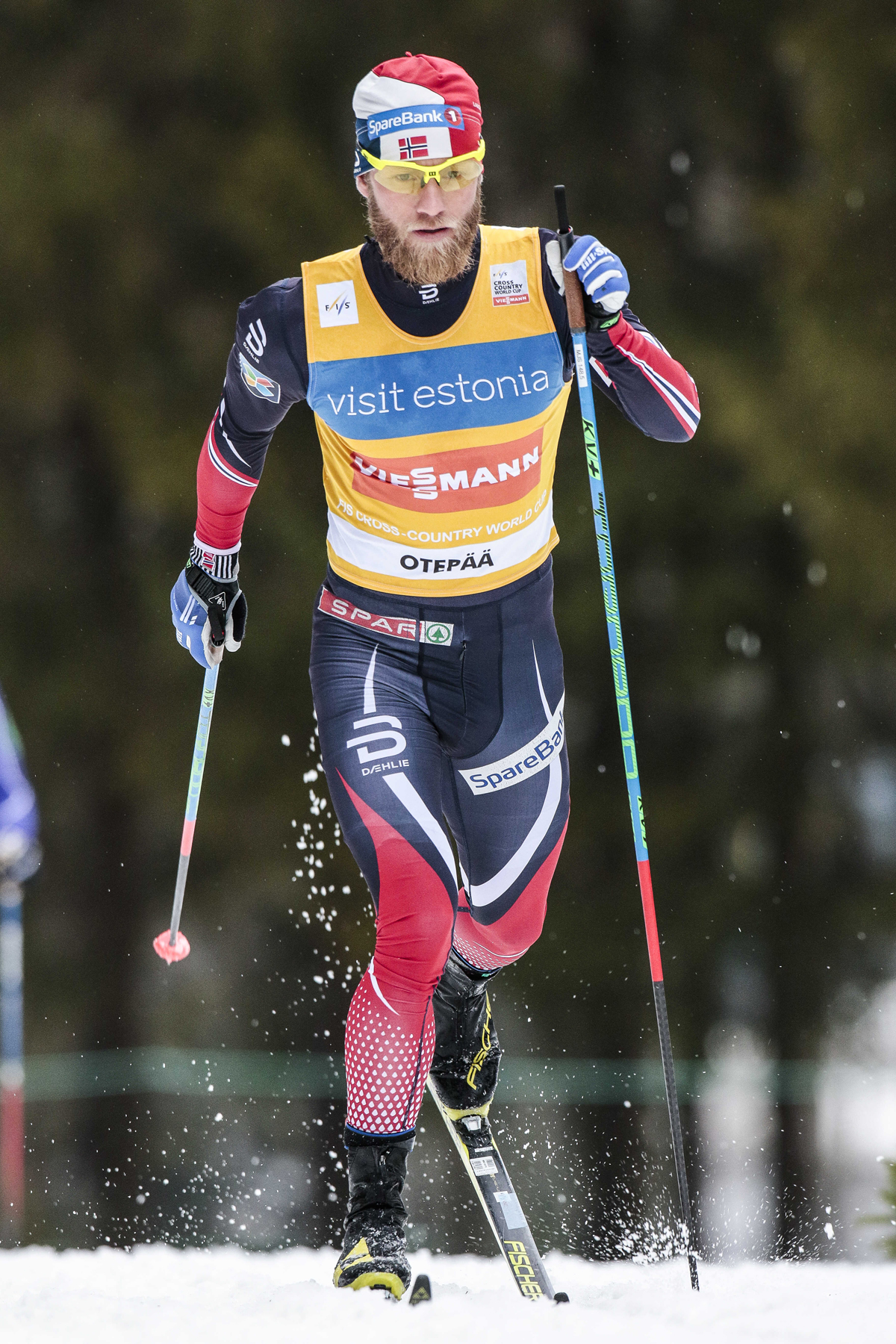
    Norway’s Martin Johnsrud Sundby racing to 2017 victory in the men’s 15 k classic at the pre-World Championships World Cup in Otepää, Estonia. (Photo: NordicFocus)

    Perhaps the biggest name among them is Martin Johnsrud Sundby of Norway, who after a somewhat inauspicious start to his World Cup career in 2005 when he DNF’d at the Oslo 50 k, went on to become a staple of men’s cross-country skiing. Sundby leaves the stage with five Olympic medals, including two gold medals (both from team events), four Championship medals, and thirty World Cup victories to his name. Results aside, Sundby was an important presence on the Norwegian men’s team for many years, taking on the responsibility of team captain.

    Sundby was sanctioned in 2016 for an anti-doping violation when he exceeding the allowable amount of salbutamol – an asthma medication – in his system.


    Putting his veteran strength on display, Martin Johnsrud Sundby skis to 7th in his first international competition of the [2020/21] season. (Photo: NordicFocus)
    In a goodbye letter by Norges Skiforbund President, Erik Røste, Røste writes, “Martin never gave up [in spite of challenges]. And that’s what really characterizes Martin. Because in addition to a fantastic talent, Martin is a struggler. One who has put in more effort and training than most to achieve his dream of becoming the best in the world… Thank you for all the contributions both on and off the trail.” (Translated from Norwegian). 

    Also retiring from team Norway is Mari Eide, who is expecting a child. Eide made her World Cup debut in 2010 and contested 70 World Cup starts since that time. At the 2019 Seefeld World Championships, Eide earned a bronze medal, finishing third in the skate sprint. 

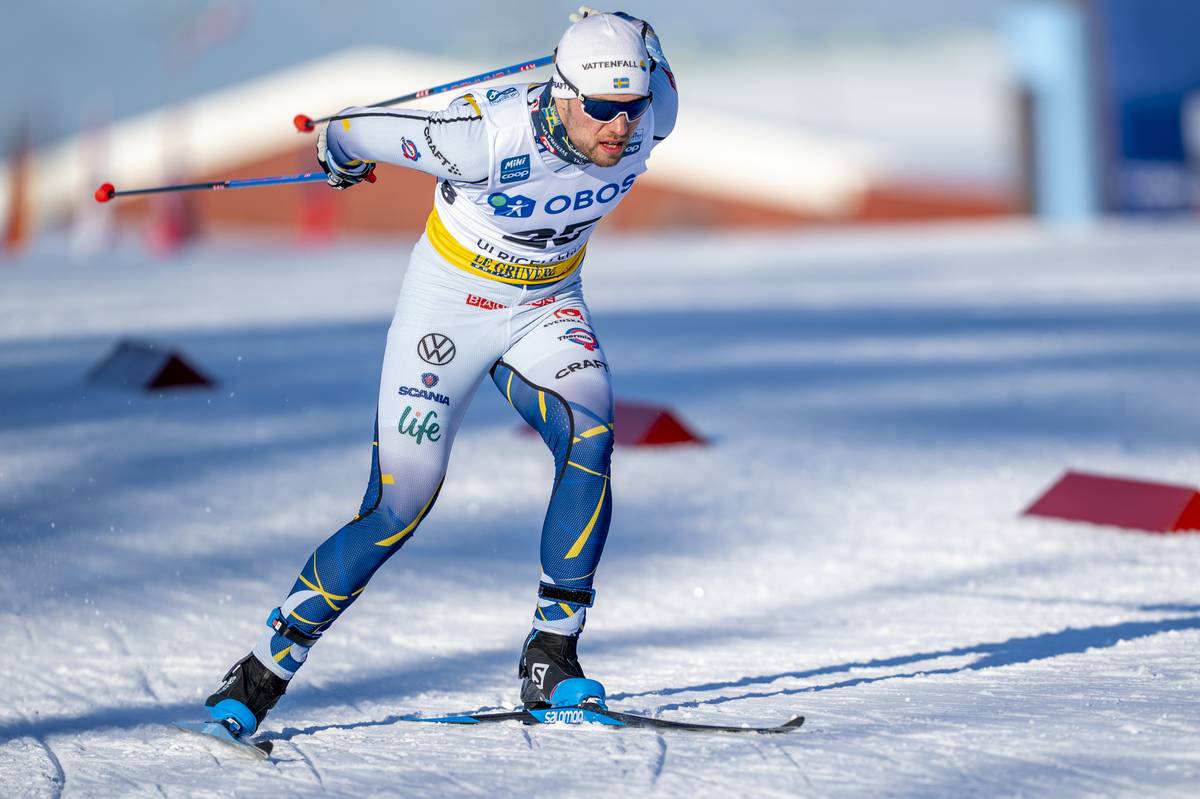
    Viktor Thorn (SWE) racing the individual sprint in Ulricehamn, Sweden (Photo: NordicFocus)

    From Sweden, Viktor Thorn and Hanna Falk have both announced an end to their ski careers. While Thorn is only 24 years old, he has been struggling with ongoing back pain and thus decided to step away from the sport. In a statement Thorn said, “I have struggled with back problems for almost five years and have come to the stage that I feel it is no longer worth spending all the time it takes to be able to be in the absolute elite level, when the last percent to be able to perform at the level I want to be hindered by my back … I feel ready to take on new challenges in life. A tough decision as the skis have been a big part of my life for so long, this decision still feels right. I am grateful for everything that this sport has given me and I will always be a skier but just not at the elite level anymore.” 

    Sweden’s Hanna Falk (r) smiles as she wins the fourth World Cup race of her career and first race in Falun, Sweden, with a victory in the women’s freestyle sprint at 2018 World Cup Finals. (Photo: Svenska Skidspelen/Instagram)

    Hanna Falk, who has also struggled with health problems throughout her career, announced retirement after a lengthy career. Falk began World Cup racing in 2007 and earned her first victory in 2009 at the Düsseldorf (GER) City Sprints. After a period of health issues, Falk returned in form during the 2016/17 season, proving herself to be a force on the sprint circuit. She retires with 113 World Cup starts, including eleven podium finishes. 

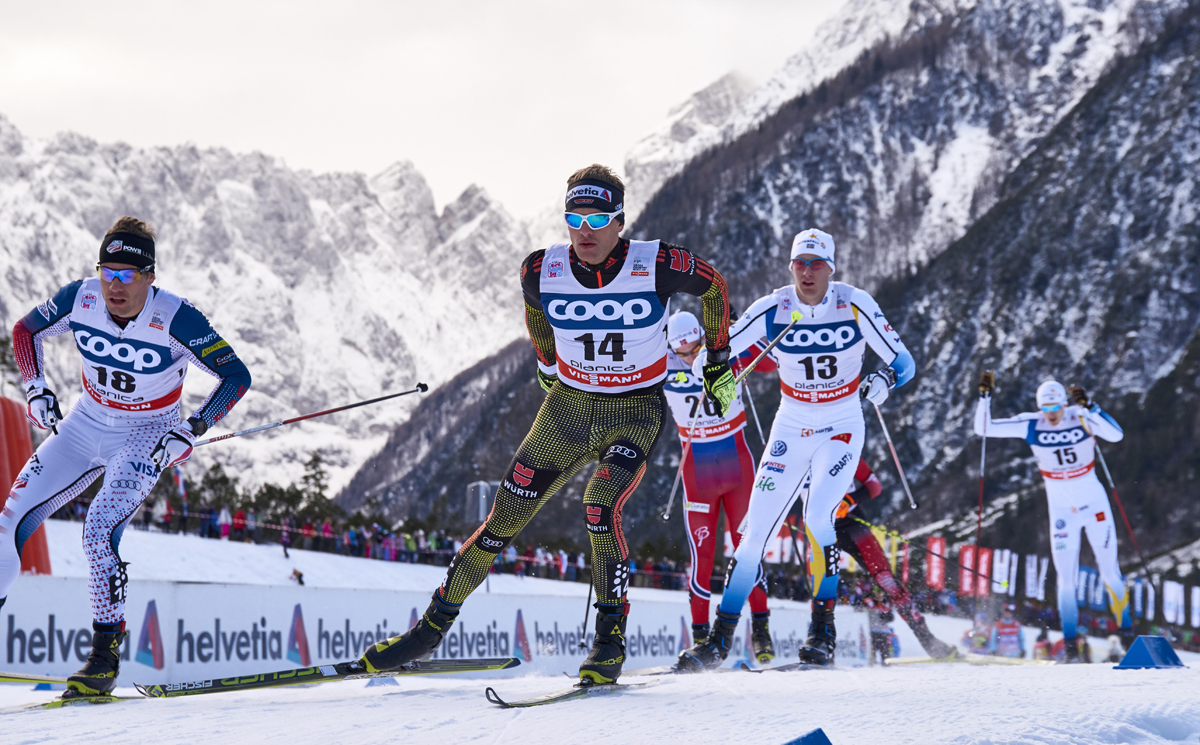
    American Simi Hamilton (l) goes head-to-head with Germany’s Sebastian Eisenlauer (14), Norway’s Eivind Østnor Bakken (26), and Sweden’s Gustav Nordström (13) during their 1.2 k freestyle sprint quarterfinal on Saturday at the World Cup in Planica, Slovenia. (Photo: Fischer/NordicFocus)

    From Germany, 31-year old Sebastian Eisenlauer has announced his intention to move on from professional ski racing. Eisenlauer began his World Cup career in 2010, going on to start 131 World Cups and represent Germany at two Olympics (Sochi and PyeongChang). Of his career, Eisenlauer said, “That’s it. An incredible time comes to an end and it feels like the right time to move along new paths. Every race was worth the step from every stage of my career, I find people that I can call friends now still. Thank you to everyone who joined and supported me on this journey.” 

    Finland’s Susanna Saapunki has decided to transition from professional ski racing to professional mountain running. Saapunki spent six years racing on the World Cup circuit, totalling 42 World Cup starts and one World Championship start in Lahti, Finland. Saapunki has now chosen to focus solely on running. 

    Anna Zherebyateva of Russia is concluding her World Cup career. Zherebyateva is engaged to Alexander Bolshunov and intends to focus on starting a family. 

    Anouk Faivre Picon of France has officially announced retirement after some years away from the World Cup circuit in which she primarily started in marathon events. Faivre Picon spent a summer training with the US Women’s Ski Team. 

    Also on the list of retirements this season are Livio Bieler and Anja Lozza of Switzerland, Stefan Zelger of Italy, and Valentin Mättig of Germany.