
From the FasterSkier archive — posts syndicated from athletes’ and coaches’ own blogs between 2004 and 2012, kept online as published. Current coverage is at fasterskier.com.

Tag: 2021 Tokyo Olympics

  • A Glimpse Inside the Tokyo Olympic Bubble with Peter Graves

    A Glimpse Inside the Tokyo Olympic Bubble with Peter Graves

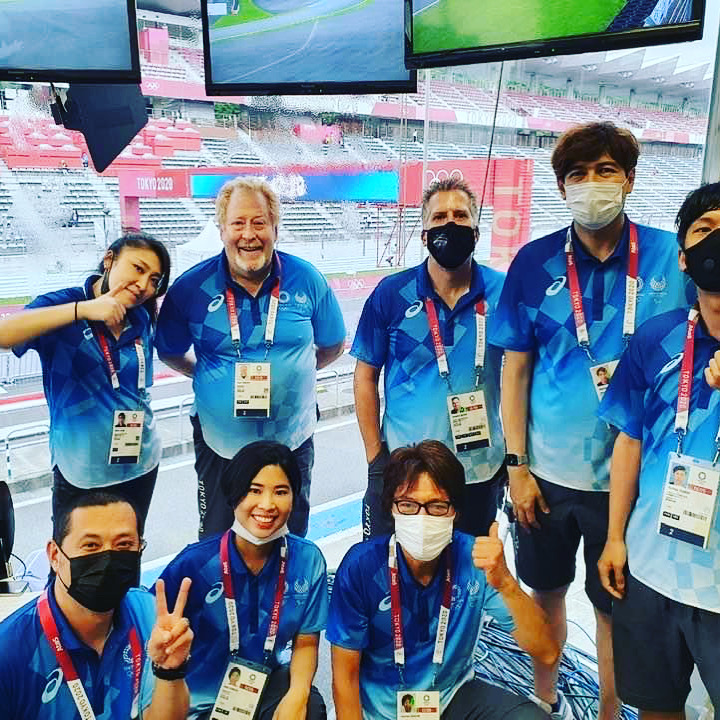
    The cycling announcing/production team at the Tokyo 2020 venue near Fuji International Speedway (Courtesy photo.)

    Most FasterSkier readers will be familiar with the name Peter Graves, also referred to as the voice of cross country skiing (and incidentally, the author’s uncle). This summer, Graves lent his voice to the cycling venues near Tokyo for the 2020-turned-2021 Olympic Games. For Graves, this marks his twelfth time announcing at the Games, including summer and winter appearances. Needless to say, he has a wealth of experience.

    FasterSkier connected with Graves on a recent call to understand how the coronavirus pandemic may have affected this year’s games, and what insights the Tokyo Games might provide for the upcoming Winter Games in Beijing in February 2022. 

    Peter Graves in the announcers booth, Tokyo 2020 (Courtesy)

    Graves was quick to highlight the great announcing and production team he worked with and the graciousness of the host country, Japan. “They ran great events,” he said, “I think they did a truly remarkable job under a very difficult set of circumstances.” For context, the Tokyo Games drew roughly 11,091 athletes from 206 participating countries, and over 770,000 COVID tests were conducted from July 1st onward. Of those tests, the cumulative total of positive COVID cases (including airport tests for Games participants and Tokyo 2020 screening tests) came to 567, with three additional positives coming fourteen days after leaving Japan. Graves called this, “a very admirable record,” all things considered. 

    Graves was in Japan for ten days, announcing at the road and time-trial cycling events. To fans watching from home, a stark difference this year was the lack of spectators at most events. However, cycling was one of the three venues that allowed socially distanced spectating and particularly during the road race, Graves noted that there were lots of spectators along the road where he “saw a lot of joy of free people sharing the Olympic spirit.”

    For Graves, this year’s games were a very different experience than past years, particularly socially. His first Olympic announcing appearance came in 1980 during the Lake Placid Winter Olympics, at the cross country skiing venue, which Graves describes as “the last of the smaller, more intimate games.” (Lake Placid at the time had a population of just 2,490.)

    Reminiscing about the “joie de vivre” of the main street, which was turned into a pedestrian zone for the Games, Graves described the tradition of trading Olympic pins, another strong memory from Lake Placid and other games. “I have a collection of probably 3,000 pins from over the years and I love trading but I just didn’t see any of that [in Tokyo]” said Graves. “I brought a lot of pins to Tokyo and didn’t trade a single one because there was nobody to trade with!”

    Being “in the bubble” meant that Graves and his team were tested for COVID everyday. Before departing the US, he needed two negative test results within 72 hours of departure and was tested again upon his arrival in Japan. The initial COVID testing procedures alone took six hours. 

    Peter Graves in the announcing booth at the conclusion of the cycling races (Courtesy photo.)


    Graves was stationed at the Fuji International Speedway, about two hours from Tokyo, where the road race and time-trial events finished. Everyday the same car took the announcing team from the hotel to the venue, and everybody was masked. Their temperatures were taken daily as they entered, and they left the venue at the end of the day in the same car, with the same crew. Graves and his announcing crew were allowed approximately fifteen minutes to get their dinners to bring back to their hotel rooms. In contrast to other Olympics, there weren’t any nights of eating with friends or colleagues for Graves this time around. “The story of life in a bubble,” he said. There was virtually nobody out on the streets and while Graves said he can’t vouch for Tokyo, he thought it was the same sort of scene there. 

    “The Olympics are first and foremost about the athletes and their performances,” stated Graves, “[this year] gave me more respect for the athletes, most were in the Olympic village and that was quite secure as well, in terms of COVID.” 

    Usually, he is able to meet and interact with the athletes a bit but there was none of that this year, “I didn’t get the chance to speak to them personally or to take photos,” Graves explained. Nevertheless, he shared some personal highlights, including very tactical road races which were “fascinating.” “I enjoyed watching and commenting on them,” said Graves, “there was a vast amount of tactics, as there always is. The Tour de France had just ended the Sunday before and many of the same athletes were competing in Tokyo.” 

    Graves also emphasized the important messages about mental health that athletes such as Simone Biles shared. “I left with a great appreciation for people like Simone Biles who made, I think, a really important case to speak about mental health,” said Graves, “to make it okay to be truthful, to make it okay to say ‘I’m not feeling well, mentally or physically.’ I think those messages are really important cautionary tales to everyone. Those were the things I was impressed with by the athletes.” 

    Graves voiced his support for the Olympics going ahead, in spite of the arguments against them happening. 
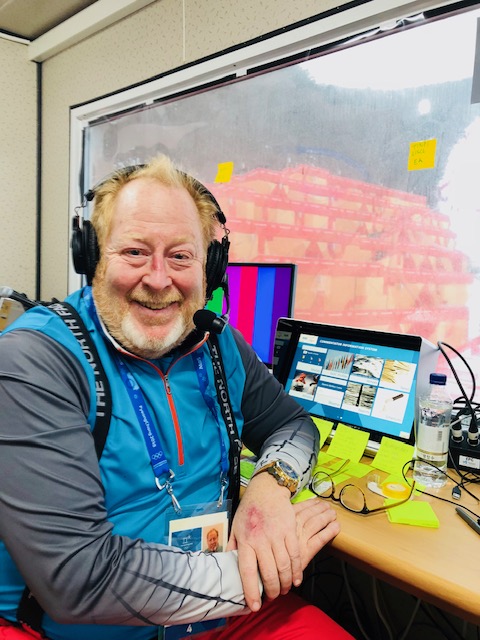
    Peter Graves announcing alpine events at the 2018 Winter Olympic Games (Courtesy Photo)

    “I’m glad they did the Games,” he said, “I’m well aware there were plenty of nay-sayers. It robs the athletes of an opportunity that may never come again. My hope is that the athletes found joy taking part in the Games, because the spirit is embodied by their humanity and enthusiasm. On TV, I saw countless examples of really great sportsmanship. I think the athletes should really be praised for how they managed themselves over there.” 

    Given the delay to the 2020 Games, we are now less than six months away from the Winter Olympics, scheduled to take place in Beijing starting February 4th, 2022. While Graves was clear that he can’t speak about Beijing per say, his experience in Tokyo may shed some light on what the upcoming Winter Games may look like. “One wonders, with the Beijing Games just six months away and the resurgence of the Delta variant globally,” pondered Graves, “I have to believe priority number one for Beijing will be keeping a good and tight bubble for those Games too.” 

     

  • News Round-Up for Mid-July

    News Round-Up for Mid-July


    The Biathlon Integrity Unit Comes Online: 

    Earlier this month, the website biathlonintegrity.com came online. The site is the digital interface of the Biathlon Integrity Unit, an independent arm of the International Biathlon Union. Part of the Biathlon Integrity Unit’s mandate, according to the website, is to provide a mechanism to “investigate and prosecute violations” as they relate to “integrity related matters in Biathlon, including anti-doping, ethical breaches, betting-related issues and any kind of result manipulation.”

    What that means from a practical standpoint is an easy to use portal to locate anti-doping information on WADA doping codes and specific requirements for athletes in the IBU’s Registered Testing Pool which mandates registered athletes abide by specific out-of-competition testing protocols and whereabouts requirements.

    The site also provides access to educational materials pertaining to anti-doping, anti-corruption, safeguarding (which entails protecting all biathletes including minors from mental, physical, or sexual abuse), and diversity. Additionally, an easy to find section allows individuals to file a confidential whistleblower report informing the Biathlon Integrity Unit about ethical and/or anti-doping code violations.


    “Knock-on Effect” comments from Dick Pound: 

    Dick Pound, the former head of WADA and current member of the International Committee member made comments on July 15th in an interview with Reuters linking the potential cancellation of the 2021 Tokyo Olympics and the 2022 Beijing Winter Games. The Tokyo Olympics were slated for this summer but were postponed until July 23 to August 8, 2021, due to the ongoing pandemic. 

    “Taking the political side out of it for the moment say there is a COVID problem in July and August next year in Tokyo, it is hard to imagine there is not going to be a knock-on effect in the same area five months later,” Pound told Reuters.

    The summer and winter events pose a quick-turnaround timetable for the IOC. Practically speaking, it is hard to fathom a scenario where the pandemic impacts a summer 2021 global sporting event, like the Summer Olympics, yet does not affect a 2022 Olympics.   

    In the Reuters piece, Pound posited several scenarios that might impact the 2022 Games. One focused on the pandemic and the notion that a vaccine still would not be readily available by winter 2022. (Beijing is scheduled to host from February 4 – 20.) Further, Pound speculated that some countries who have not curbed the spread of Covid-19 might be banned from travel to China.  

    Pound went further to draw the current icy relations between China and the U.S. into the mix. Both nations have ramped up their antagonism towards one another. The U. S. withdrew recently from the Who Health Organization (WHO), which the current U.S. administration claims is a tool for Chinese propaganda. 

    “At least one part of the U.S. is planning an election campaign which is all anti-China,” Pound said to Reuters. “If you are a conspiracy theorist, you might say well, the WHO is strongly influenced by China and they could probably without smirking too much go to a WHO meeting, from which the U.S. will no longer be associated, and say this isn’t positive health.

    “At least one part of the U.S. is planning an election campaign which is all anti-China

    “If you are a conspiracy theorist, you might say well, the WHO is strongly influenced by China and they could probably without smirking too much go to a WHO meeting, from which the U.S. will no longer be associated, and say this isn’t positive health.

    “That is an extreme supposition. There are all kinds of crazy things that could happen.”


    Athletes as Guinea Pigs

    It was widely reported on July 11th that UK Sport (the United Kingdom’s government agency supporting Olympic and Paralympic sport) was involved with experimenting on athletes to boost performance. The Daily Mail acquired documents revealing that 91 athletes were given the experimental sports drink – called DeltaG – as they trained for the 2012 London Olympics. 

    The DeltaG drink, according to documents, contained synthetic ketones. When endurance athletes run low on fuel, the body can convert fat to ketones for energy. Some theorize that supplemental synthetic ketones can serve as a complement to the body’s natural fat-to-ketone conversion process, known as ketosis, to further prolong endurance.

    The news reports claim that of the 91 athletes testing the substance, 36 experienced adverse side effects. 

    UK Sport had participating athletes sign waivers absolving UK Sport of any wrongdoing as well as sign an NDA to prevent athletes from leaking information or discussing the covert project. 

    The Daily Mail also unearthed a document in which UK Sport could not guarantee the substances in DeltaG were WADA compliant. 

    “UK Sport does not guarantee, promise, assure or represent that use of ketone esters is absolutely World Anti-Doping Code compliant and therefore excludes all responsibility for use of the ketone ester,” was one quoted section of a UK Sport “participant information sheet”. 

    The Daily Mail wrote the information document also included this verbiage: “WADA might exercise … their rights to regulate … [and] collect blood samples or retrospectively test old samples. This may occur if there were pressure of the media if the concept was to leak. However … ketosis is a temporary physiological state and would be difficult to prove or test with any post-event samples.”

    The news report did state that UK Sport notified WADA and UK Anti-Doping before administering the study. At the time, ketones were not on the banned substance list. Ketones remain legal. However, their efficacy and potential for adverse health effects are of concern to some in the sports world. 

    One twist in the story involved the U.S. military. Internal documents obtained by The Daily Mail claim UK Sport scientists read a science journal piece about the U.S. military experimenting on animals with DeltaG. The U.S. military then linked UK Sport with Oxford University to pilot their own study.