From the FasterSkier archive — posts syndicated from athletes’ and coaches’ own blogs between 2004 and 2012, kept online as published. Current coverage is at fasterskier.com.
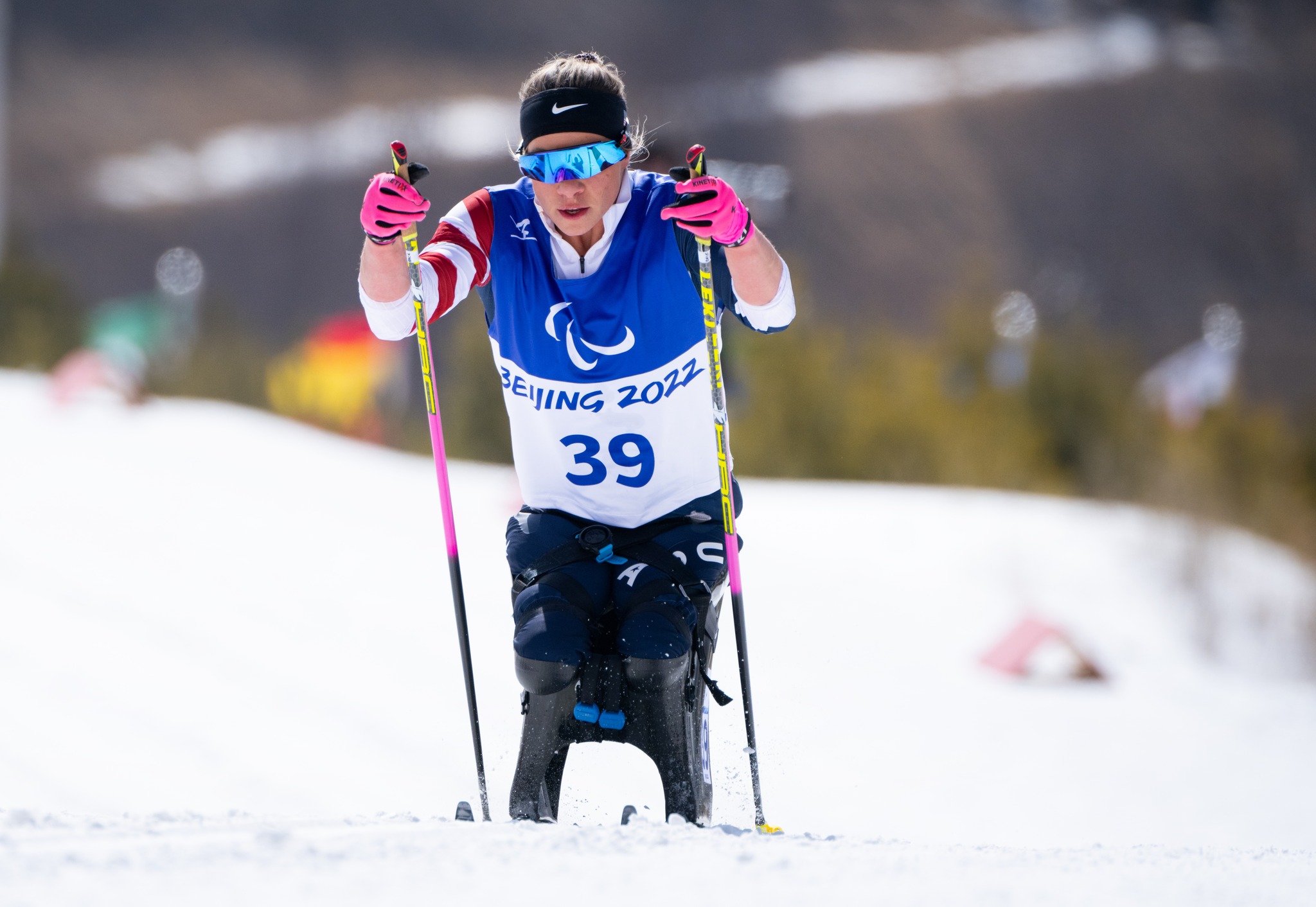
Oksana Masters races to a silver medal in the long-distance cross country sitting event on day two of the 2022 Beijing Paralympic Winter Games. (Photo: Mark Reis / Team USA)
U.S. Para Nordic star Oksana Masters (Louisville, Kentucky) won silver in the women’s sitting long-distance cross-country race on Sunday, her second medal of the Paralympic Winter Games Beijing 2022.
Masters, a cross-country skier and biathlete, also won gold in the women’s sitting biathlon sprint on Saturday and now has 12 career Paralympic medals between the winter and summer Paralympic Games. Sunday’s silver medal comes six months after winning double gold in Para-cycling at the Paralympic Games Tokyo 2020.
The 2022 world champion in long-distance cross-county, Masters raced the 15-kilometer course at the Zhangjiakou Biathlon Center in a time of 43:38.8 — just 32 seconds behind China’s Hongqiong Yang, who won the gold with a factored time of 43:06. China’s Panpan LI finished with the bronze in 45:17.
Master’s silver medal matches the silver she won in long-distance cross-country at the Paralympic Games Sochi 2014.
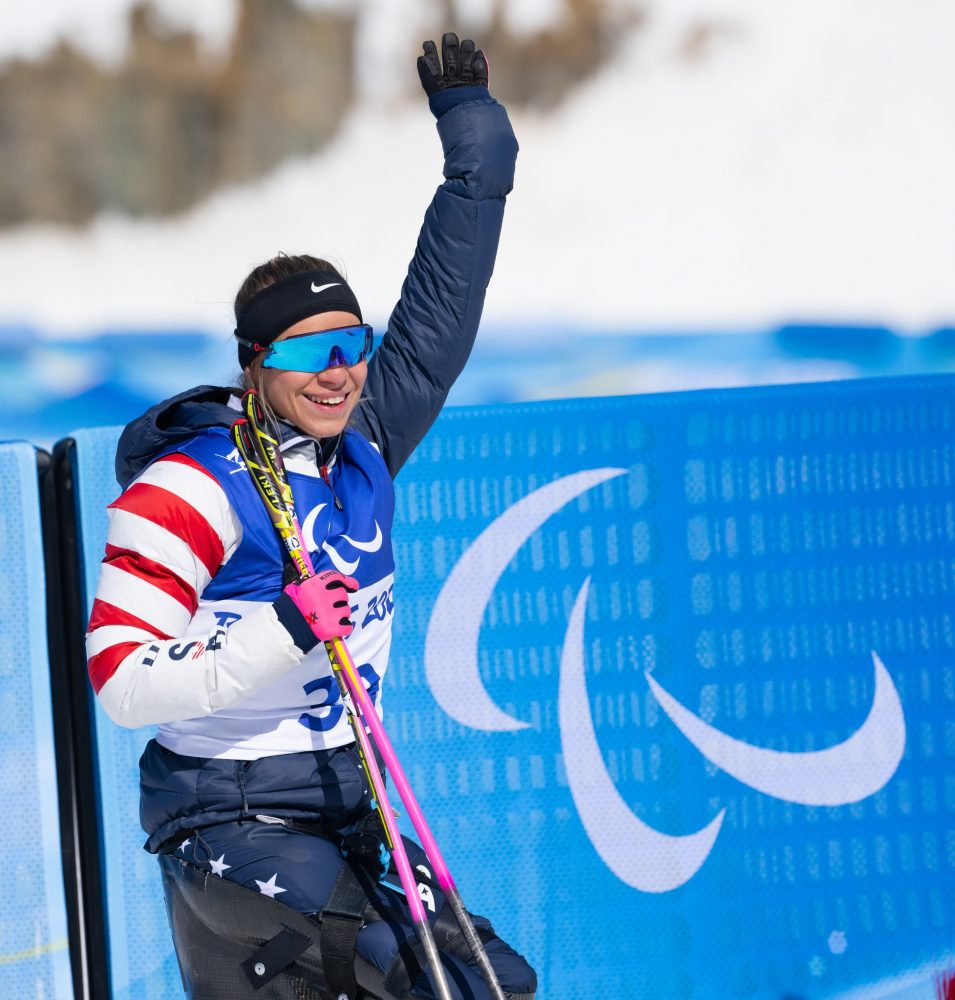
Oksana Masters is on a medal streak, adding silver in the long distance cross country race to her gold in the biathlon sitting sprint. (Photo: Mark Reis / Team USA)
“I was trying so hard to get the gold,” said Masters, who admits she could have raced faster from the start. “I was trying to upgrade from silver in Sochi and the PyeongChang bronze, but I’m just so happy to be able to fight my way onto the podium.
“I can’t wait to see the U.S. flag being raised today at the medal ceremony [for biathlon sprint]. I was trying to not do my classic ‘go out hard and then die.’ Looking back maybe I was too reserved in the first few laps and then got to a spot where I didn’t have enough space to make up. This course is not really technical so there’s not a lot of places to make up time either. I wish there was more elements of skiing in it, but I think it challenged me in a really different way and I’m excited to see what the next few races have.”
Kendall Gretsch skis to fourth in the women’s long-distance event. (Photo: Mark Reis / Team USA)
Teammate Kendall Gretsch (Downers Grove, Ill.) finished just off the podium, in fourth, with a time of 46:26. She finished second, behind Masters, in long-distance cross-country at the Lillehammer 2022 World Para Snow Sports Championships in January. She won the bronze medal in Saturday’s sitting biathlon sprint.
Dan Cnossen (Topeka, Kansas) led the U.S. men in the sitting category, placing sixth with a time of 49:22. Former sled hockey champion turned Nordic skier Josh Sweeney (Glendale, Arizona), placed 16th in his Nordic debut. For Cnossen, Sunday’s long-distance race offered a new personal challenge.
“I don’t care what the result was today,” Cnossen said. “For me, this was a personal test. In my opinion, this is the hardest race that we do in the cross-country discipline at 18 kilometers. In the last Games we had in 2018, it was a 15-kilometer race.”
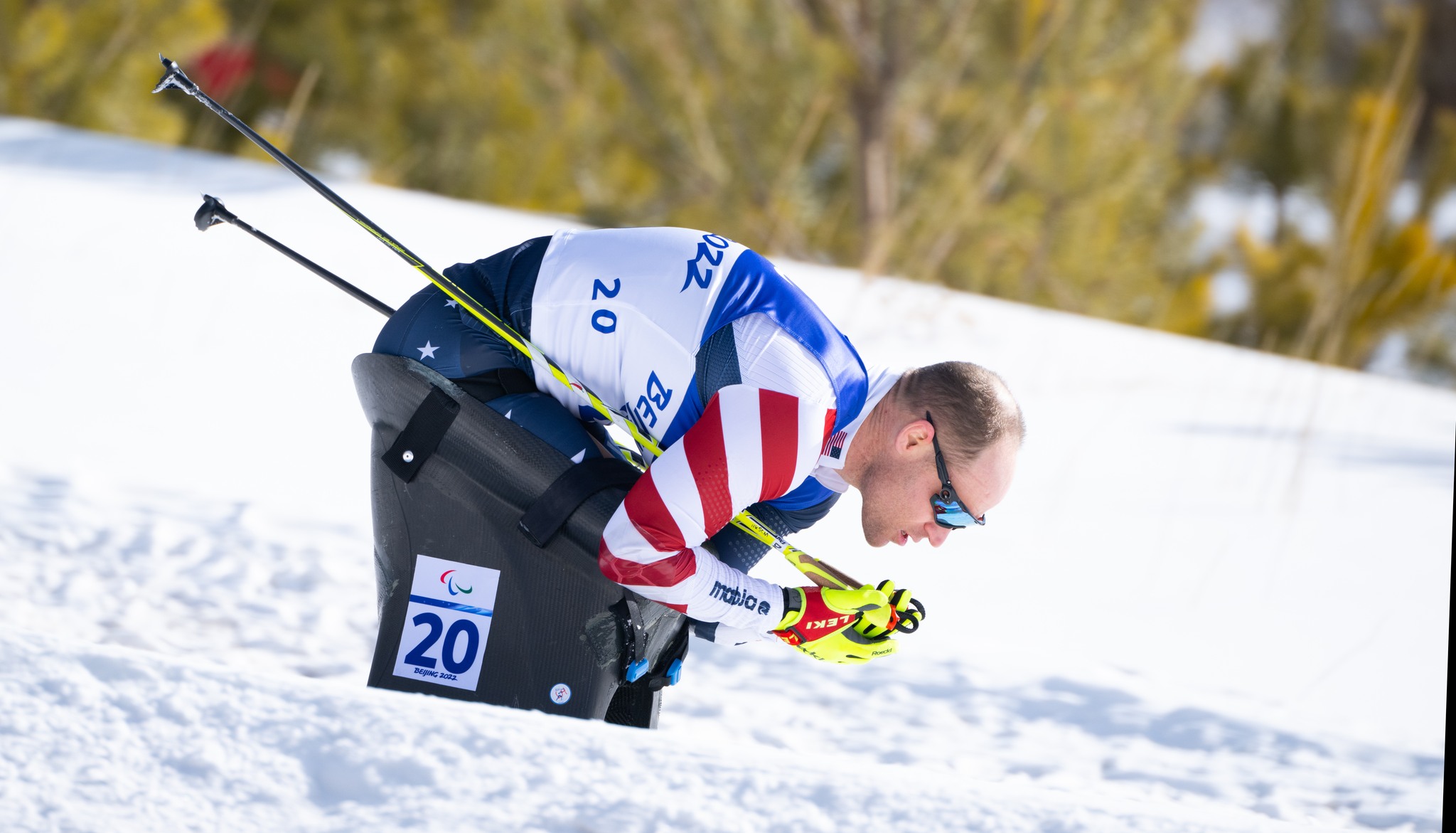
Dan Cnossen races the sitting long-distance cross country event on day 2 of the 2022 Beijng Paralympic Winter Games. (Photo: Mark Reis / Team USA)
“I’ve never done an 18-kilometer, and I just wanted that personal challenge. There’s a battle going on in your head [during the race]. And it’s against the part of me that wants to go a little easier or softer, to kind of not challenge myself as much. And so, it’s a personal test to see what I could do and I’m happy with that. I executed my race plan really well. I had gas in the tank on the last lap, which was the plan. So, success for me.”
A newcomer to Para Nordic skiing, Sweeney isn’t new to the Winter Paralympics. The retired Marine Corps sergeant earned a gold medal as a member of the U.S. sled hockey team at the Paralympic Winter Games Sochi 2014. After retiring from sled hockey, Sweeney competed for a few years in elite paratriathlon before transitioning to Para Nordic skiing in 2021 through the Challenged Athletes Foundation. He notes his experiences from the different sports aids him on the Nordic course.
“Having the different sport experience is [helpful]. Knowing, especially in the triathlon world, what good pacing can do for you and not getting too carried away with what everyone else is doing is big,” Sweeney said. “I’ve learned over all these sports that you have to trust yourself and your coaches, respect the process and just put in the work and you’ll be alright.”
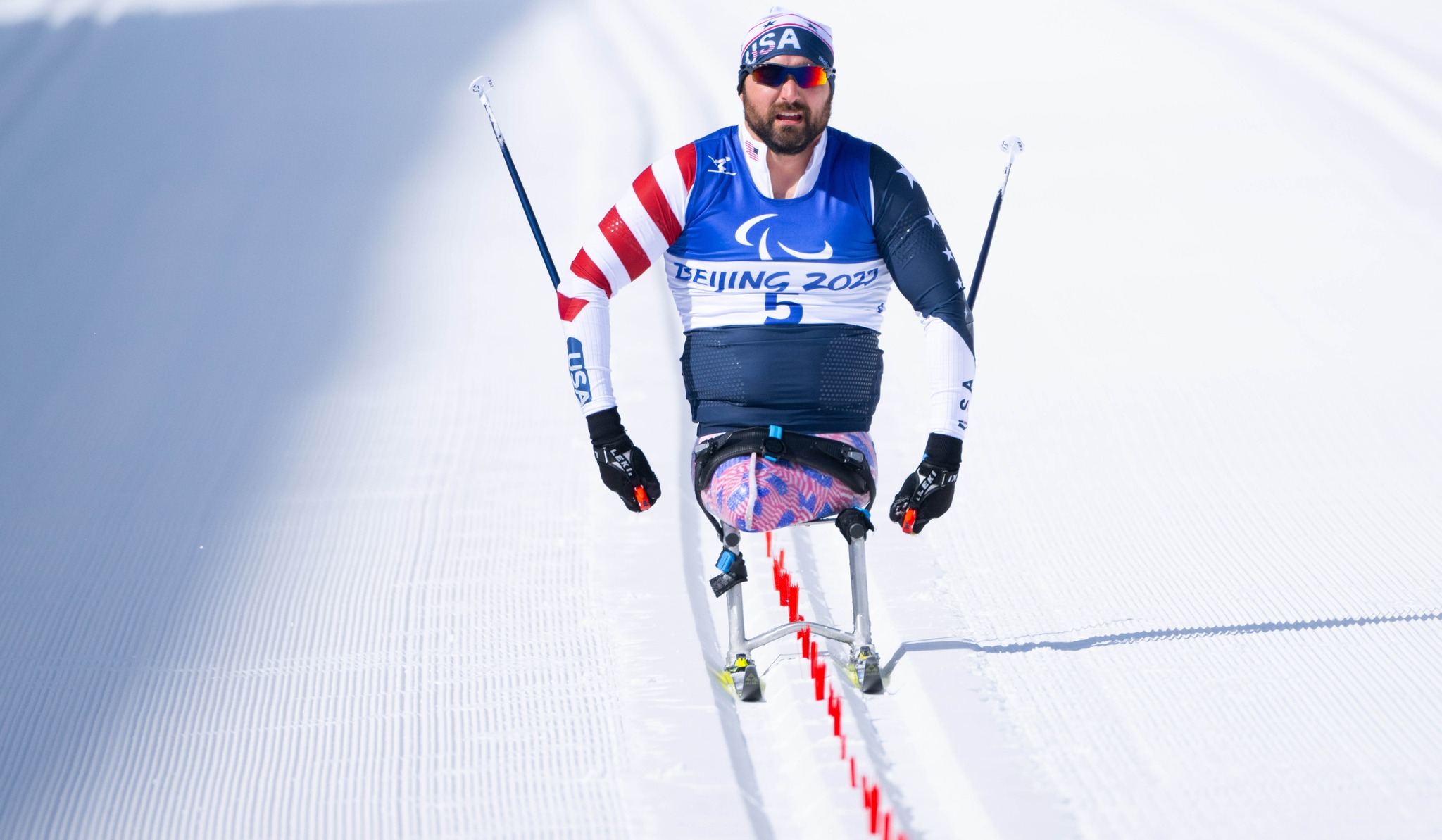
Josh Sweeney races the men’s long-distance cross country sitting event on day two of the 2022 Beijing Paralympic Winter Games. (Photo: Mark Reis / Team USA)
China’s Peng Zheng and Zhongwu Mao, won gold and silver, respectively, and Canada’s Collin Cameron won bronze.
Racing continues Monday in Zhangjiakou with the men’s and women’s long-distance cross-country in the standing and vision impaired categories. Watch U.S. Paralympics Nordic Skiing competition from the 2022 Beijing Paralympics on NBC, which features more than 230 hours of coverage across NBC, Peacock, USA Network, the Olympic Channel, NBCOlympics.com and the NBC Sports App. All events will be streamed live on NBC’s Peacock. Follow U.S. Paralympics Nordic Skiing on Facebook, Twitter and Instagram for daily updates from Beijing.
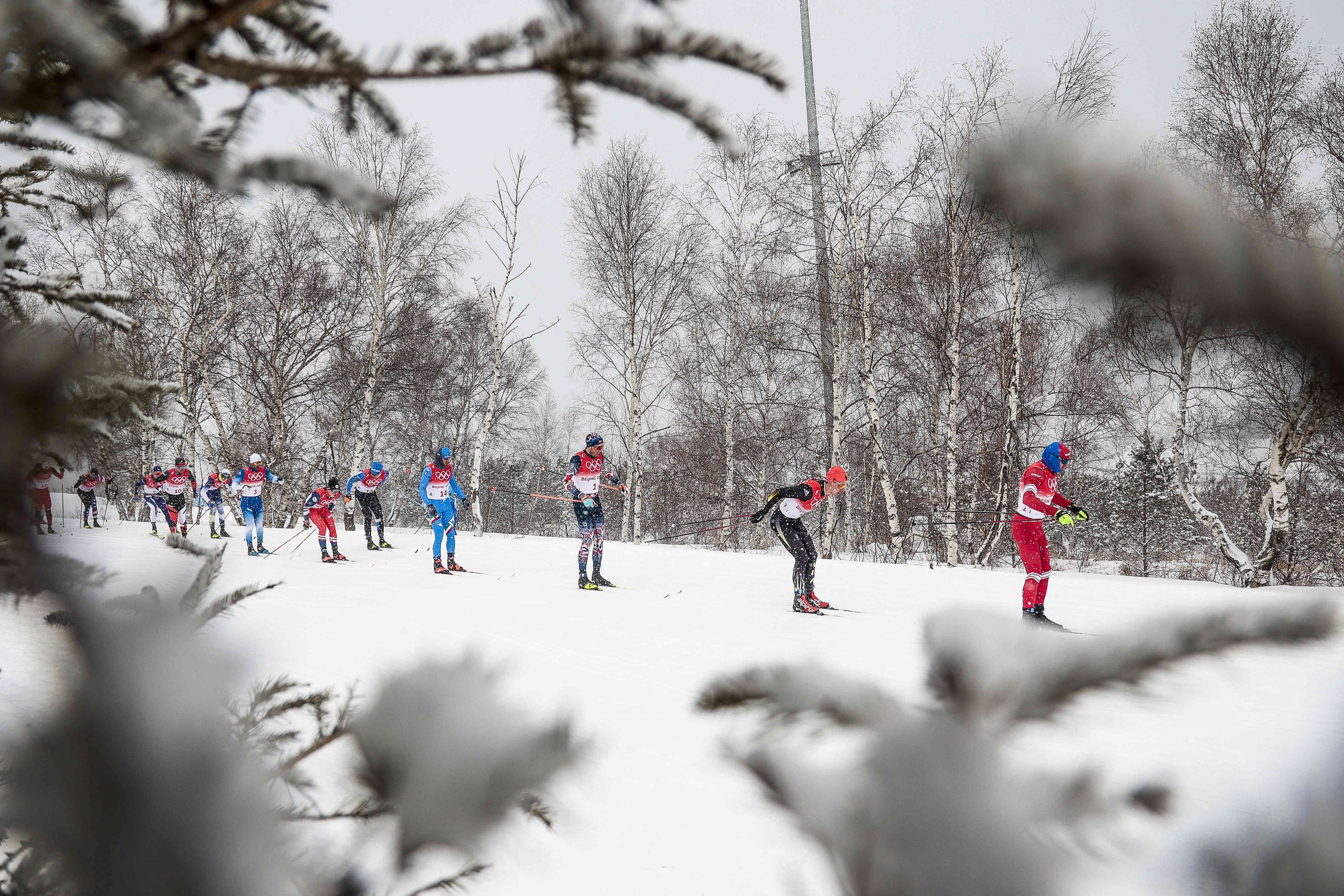
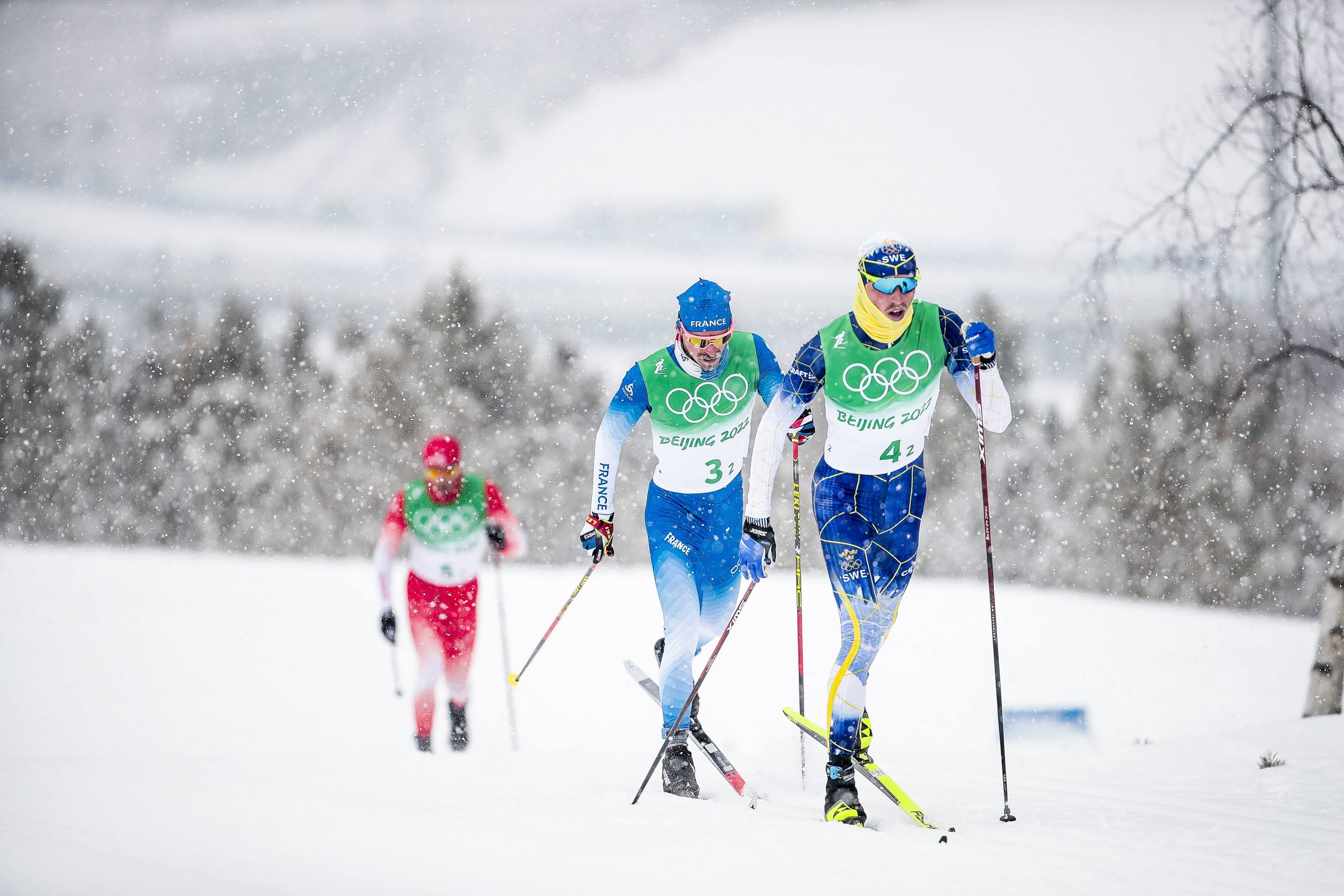
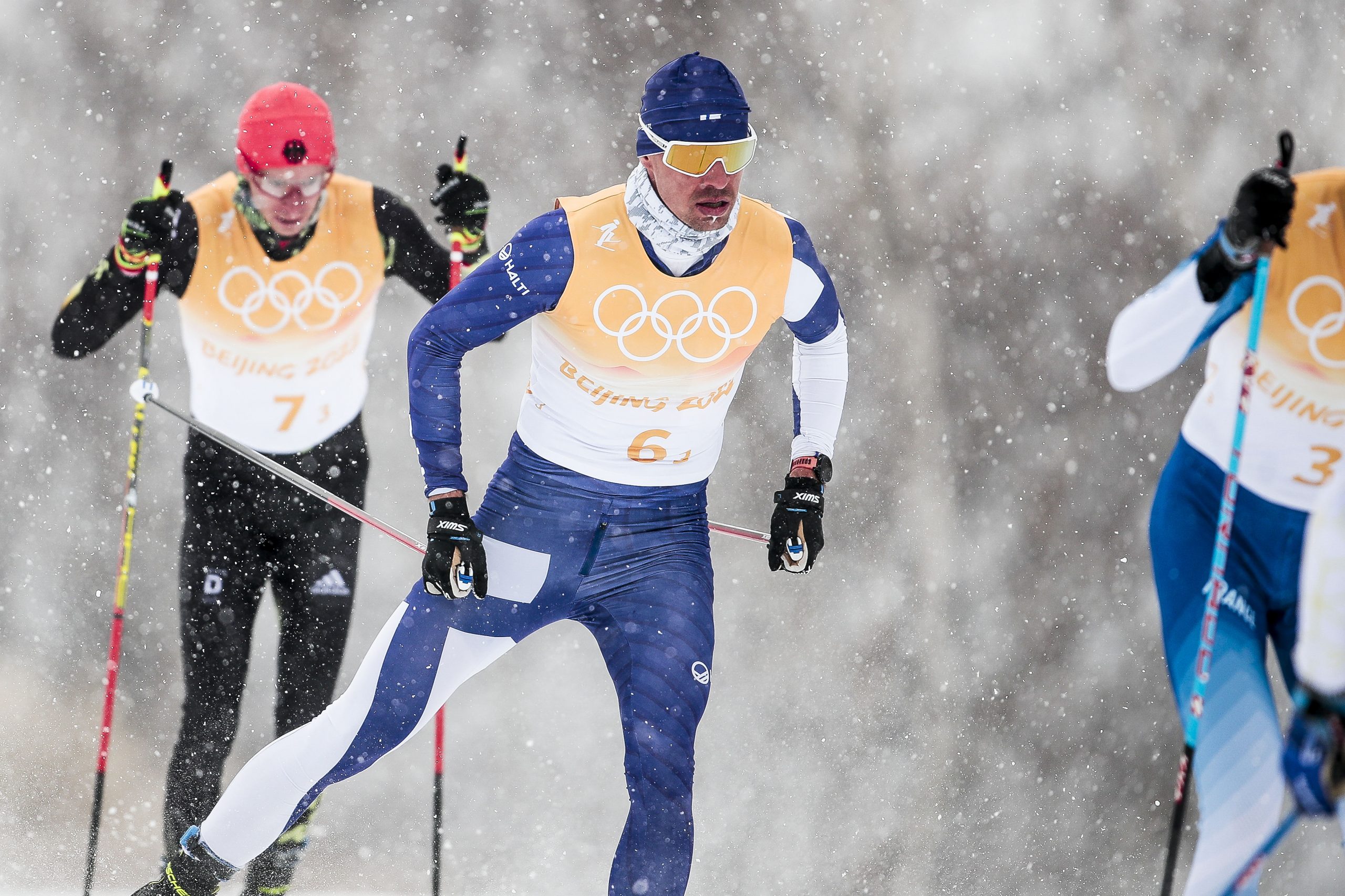
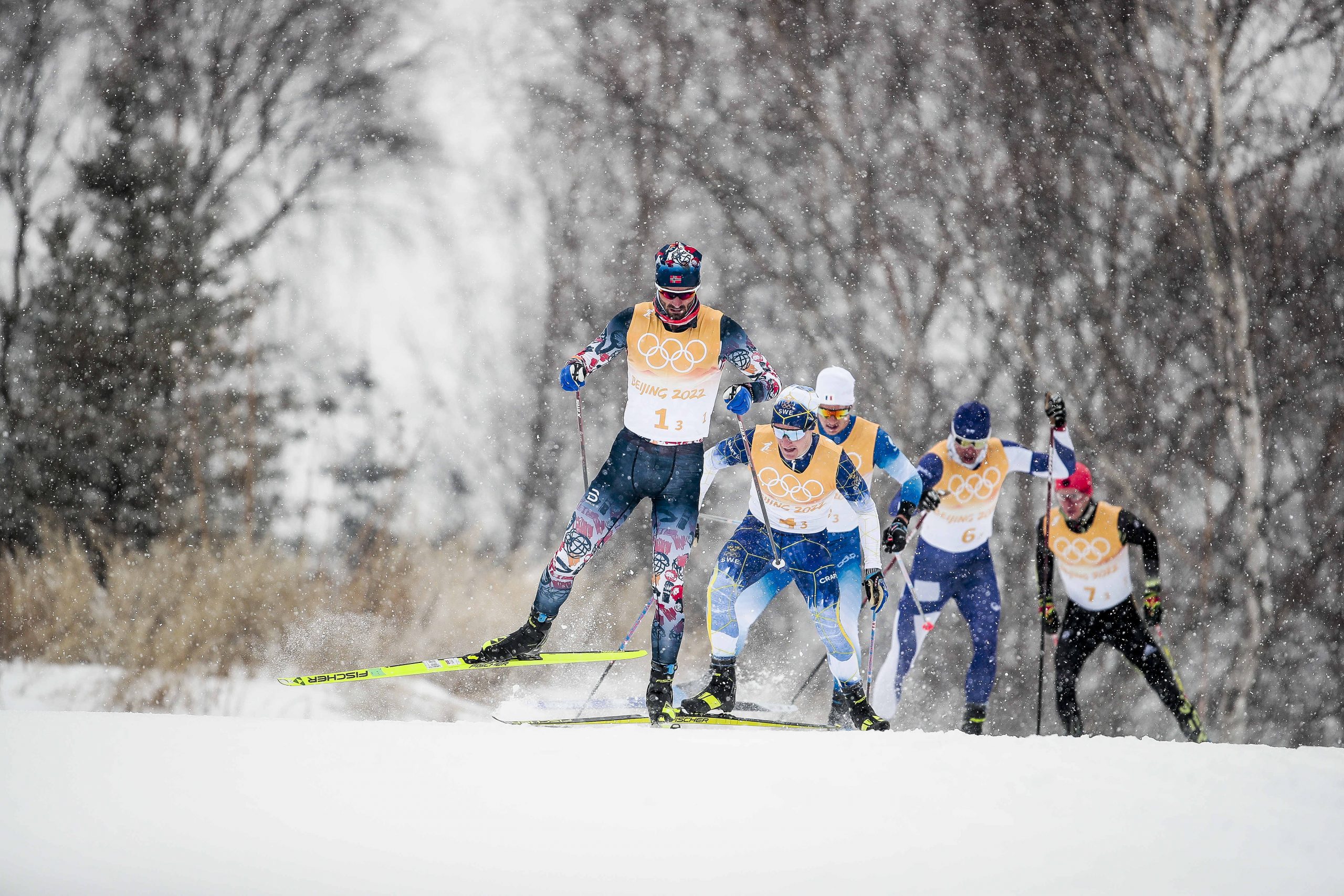
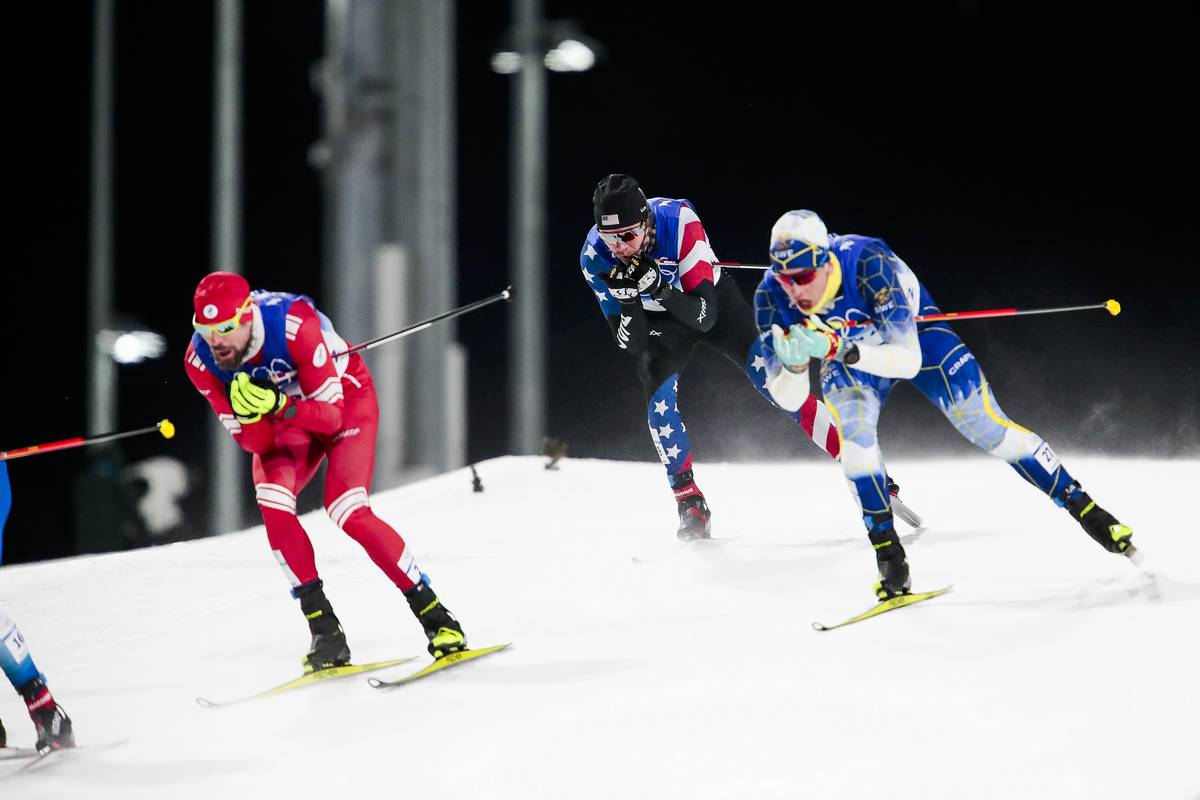
Early stages, Emil Iversen (NOR), Alexey Chervotkin (ROC), Richard Jouve (FRA), and Oskar Svensson (SWE) (l-r) lead the men’s 4 x 10 k relay. (Photo: NordicFocus)
This World Cup coverage is made possible through the generous support of Marty and Kathy Hall and the A Hall Mark of Excellence Award. To learn more about A Hall Mark of Excellence Award or to learn how you can support FasterSkier’s coverage please contact info@fasterskier.com.
After a thrilling women’s relay event on Saturday, it was the men’s turn to compete, each athlete skiing the laps of 3.3-kilometers for a total of 4 x 10 k. In a surprising turn of events, more snow than has fallen in a decade came down in Zhangjiakou over the last 24 hours, altering the otherwise stable man-made conditions the men have raced to this point. Conditions being what they were, heavy snowfall and 11°F on challenging courses, this made for an especially long race.
The ROC proved to best handle the conditions, winning gold in 1:54:50.7. Norway skied to silver (+1:07.2), with France taking bronze (+1:16.4), while the American men skied to ninth (+8:05.6), with the Canadians in 11th (+9:10.4).
Scott Patterson skis the second leg of the men’s 4 x 10 k relay through unprecedented conditions. (Photo: NordicFocus)
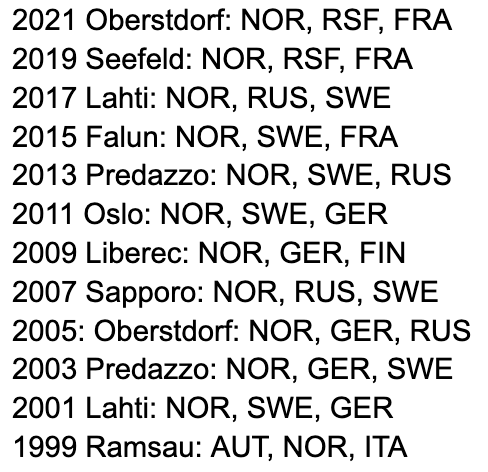
Men’s skiing for the past few years has been dominated by two nations, Norway and Russia (or as they are known at these Games, the Russian Olympic Committee (ROC)). When it comes to the men’s 4 x 10 k relay however, Norway has historically been in a class of its own.
Results summary for men’s 4 x 10 k relay at World Championships since 1999.
Since Team Norway’s all-around poor showing at Sochi in 2014, which included the men’s team finishing 4th, they have not lost a championship relay. Indeed, looking at relay results from World Championships, you have to dig all the way back to 1999 to find Norway not winning gold, when Norway finished second to Austria in Ramsau. Their performances at the Olympics have been less dominant but most relevant for today’s race, they won gold in PyeongChang in 2018 with the same man, Johannes Høsflot Klæbo, in the anchor leg.
As such, despite the Norwegian men’s struggles thus far at these games, it seemed likely that fans would be seeing another battle between Norway and the ROC for top spot. Fifteen nations were represented on the start line and as the first leg was underway Sunday morning, the race appeared to be playing out remarkably similarly to the World Championships in Oberstdorf last year.
A brief recap for those who don’t remember, in heavy snowfall, ROC athlete Alexey Chervotkin made an early move and ended his leg with nearly a minute lead on the rest of the field which was later eaten up and the win went to Norway. Today it was a different story.
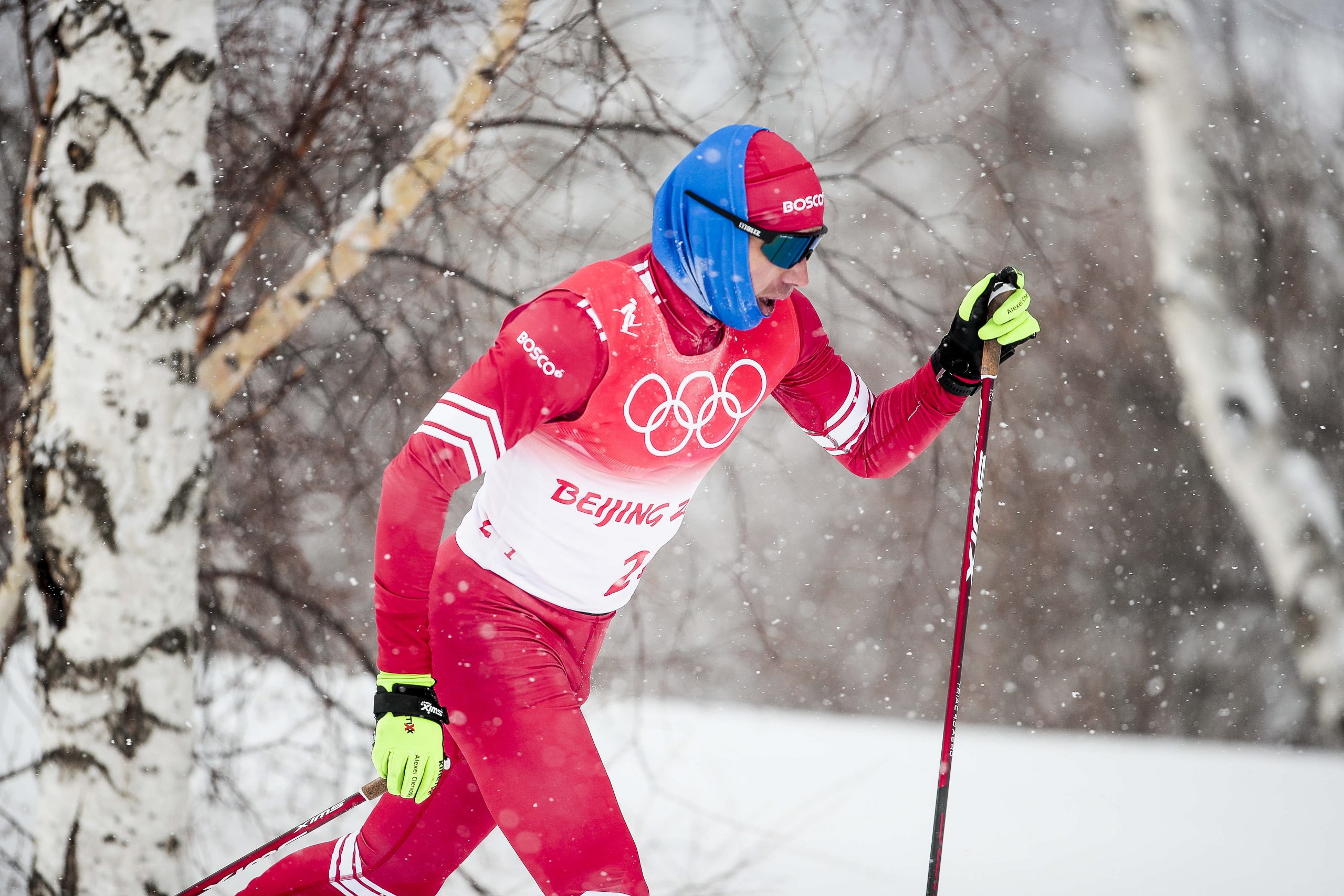
Alexey Chervotkin (ROC) making a decisive early break (Photo: NordicFocus)
Chervotkin was once again in the scramble position for the ROC and he put the hammer down right from the start gun. At 4.3 k he had a gap of +12.6 seconds to the rest of the field and that was the closest anyone got to the ROC for the rest of the race. Although it took three more athletes and another hour and forty-one minutes of skiing to seal the deal.
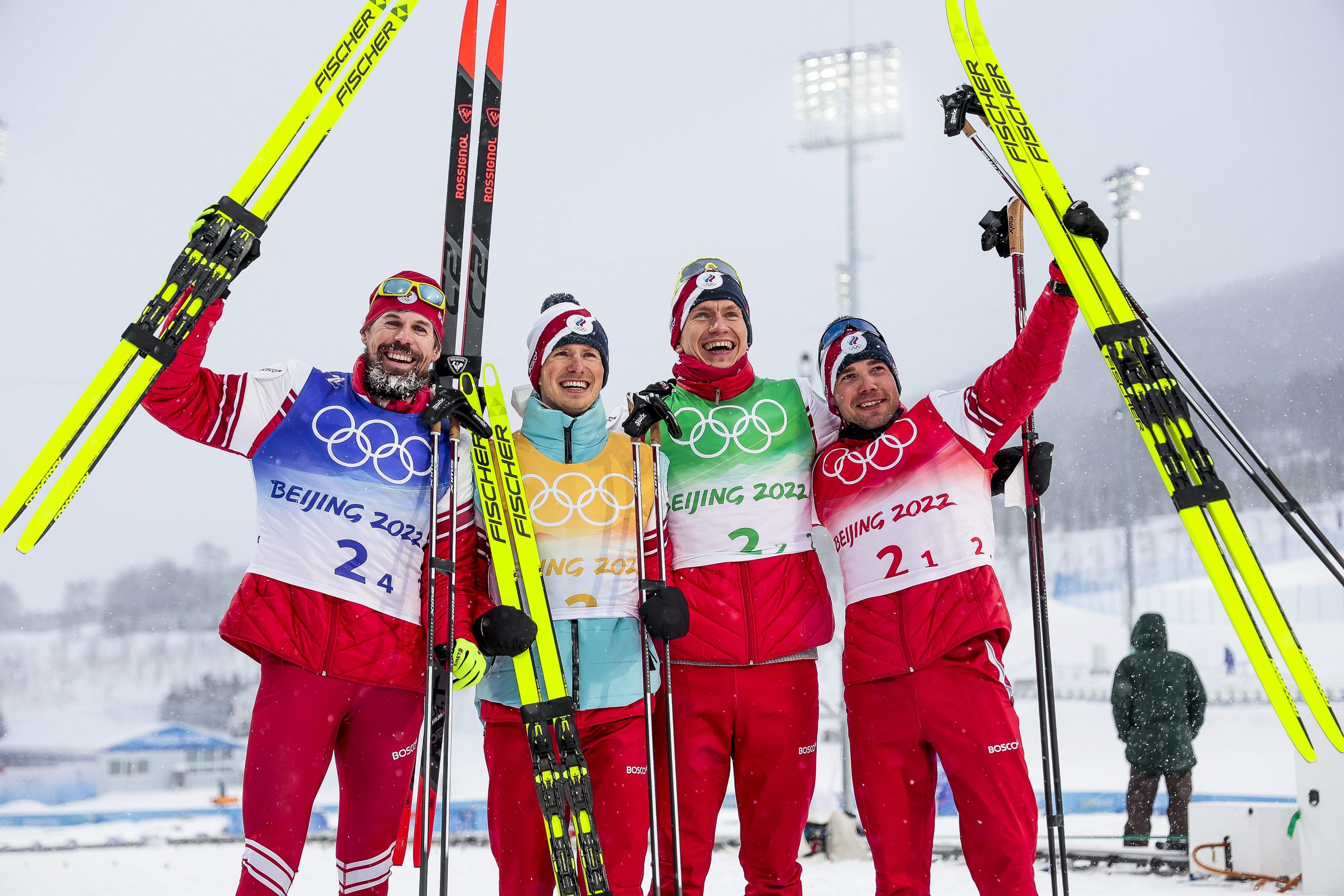
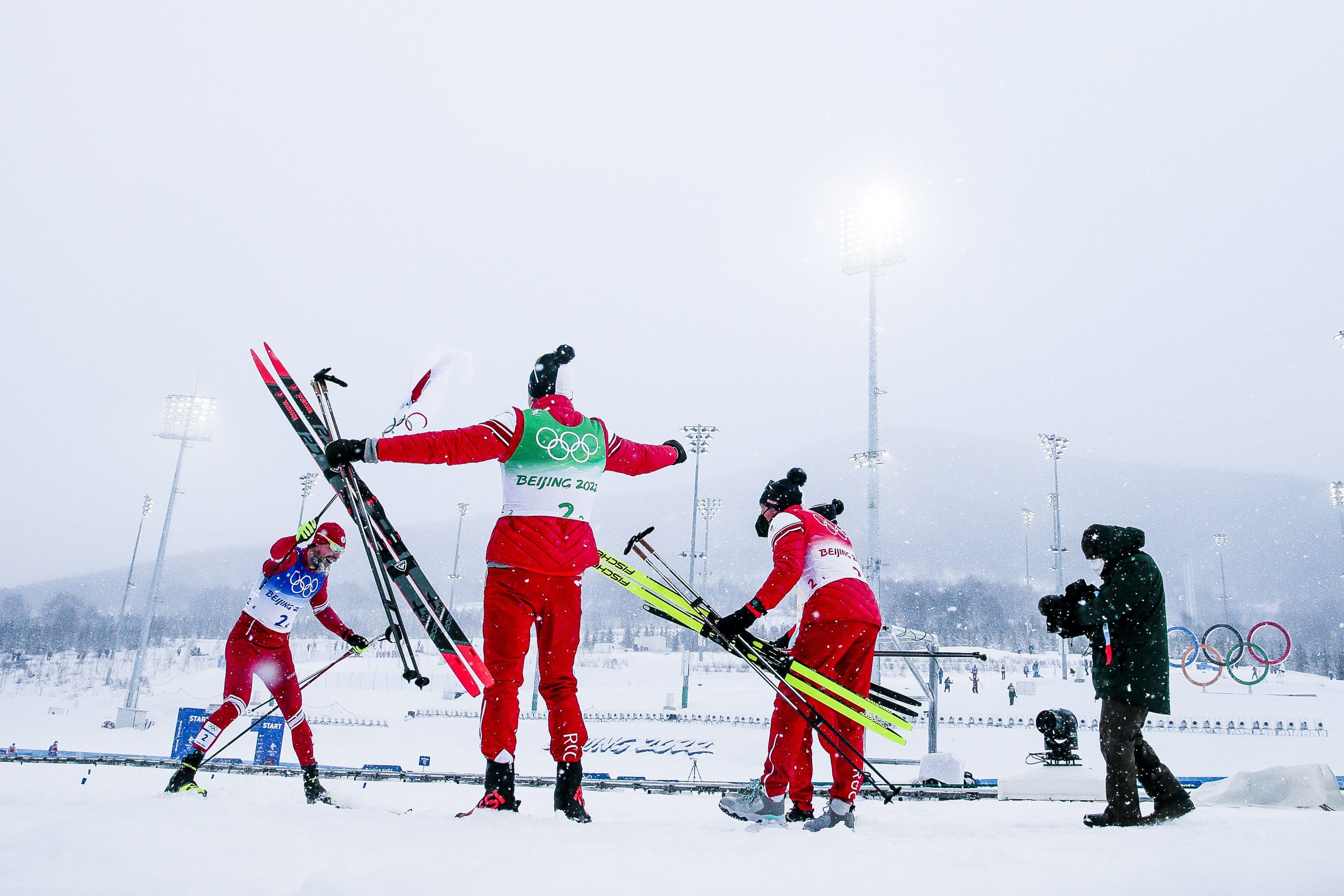
All smiles for Sergey Ustiugov, Denis Spitsov, Alexander Bolshunov, Alexey Chervotkin, (l-r) after taking Olympic gold for the ROC for the first time in over forty years. (Photo: NordicFocus)
Making his first appearance at these games after some controversy regarding a start in the 15 k classic, Emil Iversen took the first leg for Norway. For the majority of his leg, Iversen did the work to pull at the front of the chase group, which was composed of teams Italy, Germany, Sweden and France. No doubt inspired by the German women’s relay performance, Janosch Brugger skied a strong leg for Germany, ultimately pulling away with Italy’s Federico Pelligrino in the final kilometers of their leg.
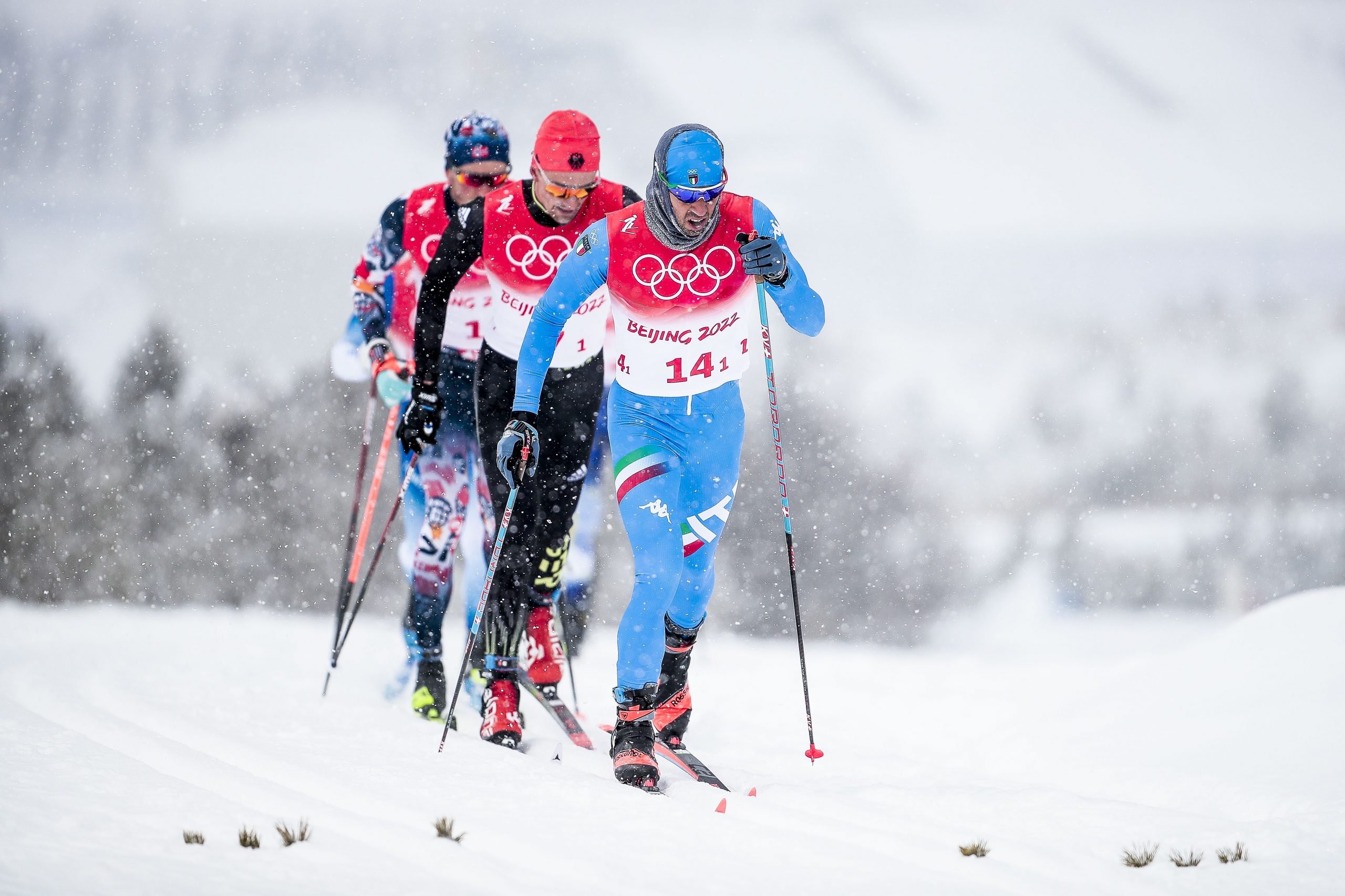
Federico Pellegrino (ITA) leads Janosch Brugger (GER) and Emil Iversen (NOR) (Photo: NordicFocus)
With Iversen fading fast on the final lap up the A-climb, Brugger and Pelligrino gapped the Norwegian by 10 seconds, coming into the first exchange +23.5 and +24.1, respectively, behind Chervotkin of the ROC. Next came Iversen, who tagged his teammate, Pål Golberg, with a gap of +34.4 to the ROC.
Despite the hard work put in by Chervotkin, the conditions were such that it took him 30:14.7 to ski 10 k, which is much slower than we might normally expect. Chervotkin had taken 5th place in the 15 k classic on Friday in 38:51.7 with stable conditions; five additional kilometers in roughly 8.5 minutes longer.
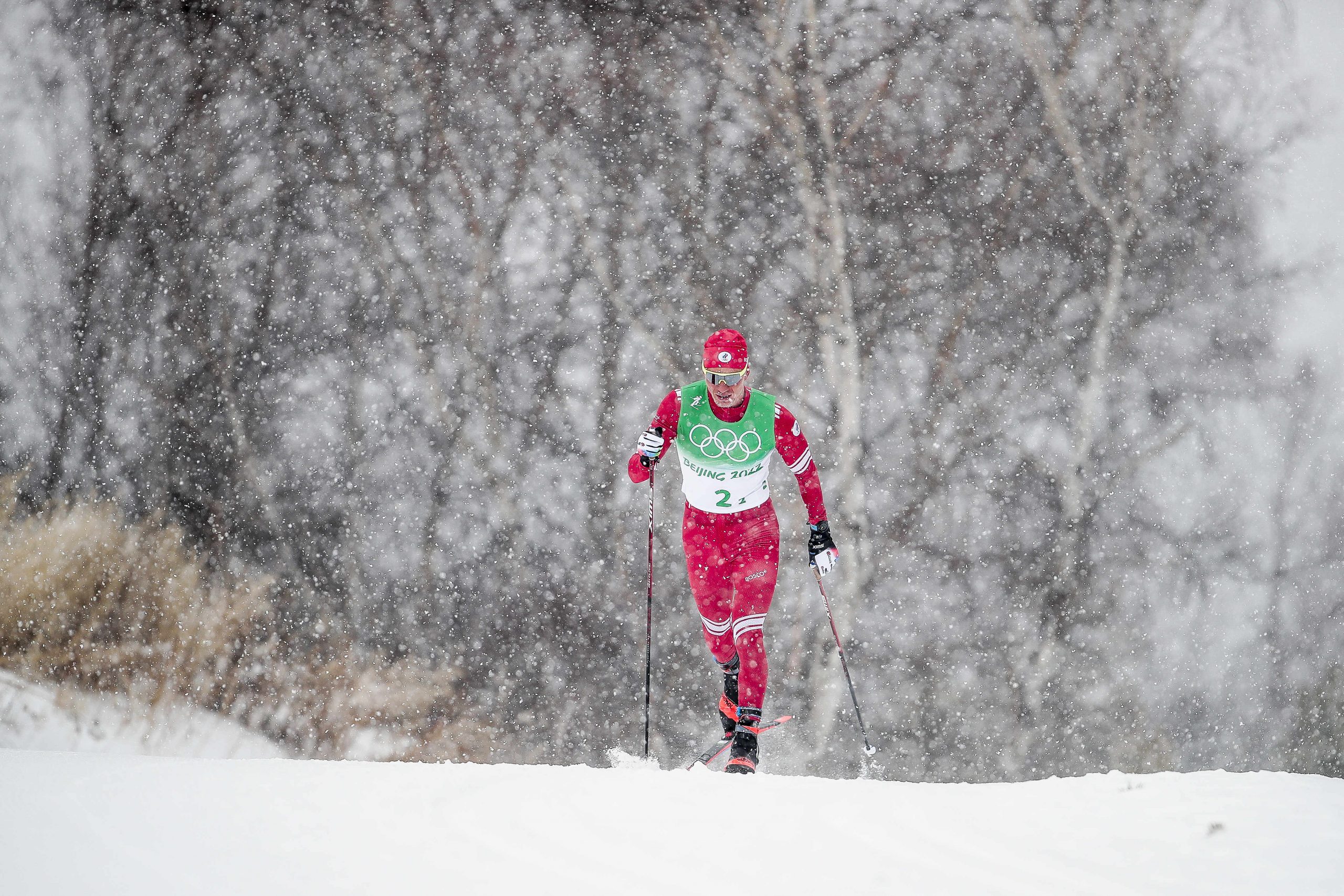
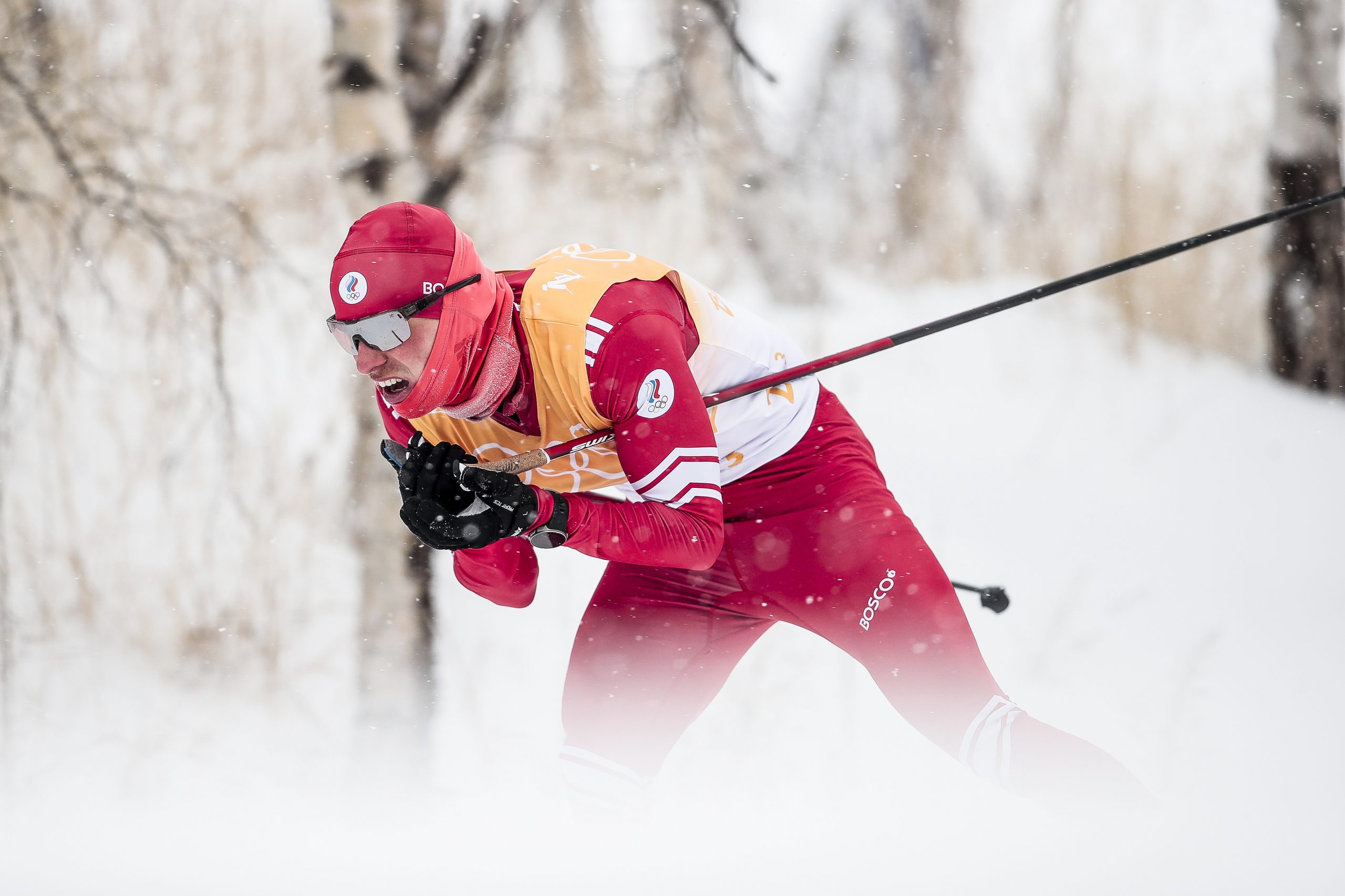
Gliding on his own through falling snow, Alexander Bolshunov (ROC)(Photo: NordicFocus)
With the first leg complete, it was skiathlon winner Alexander Bolshunov who took over for the Russian Olympic Committee. Grinding out front on his own, Bolshunov continued to put time into the rest of the field, widening his lead to +37.8 through 13.3 k, up to +44.5 at 16.6 k and +59.5 at the completion of his three laps.
Behind him, Golberg worked quickly to close the gap to Italy and Germany, legs which were being skied by Francesco de Fabianiand Friedrich Moch. Over the course of his second lap, Golberg began to pull away, creating a ten second gap to the chasers. However, as the skiers completed the third, and their final, 3.3 k lap, things were shaking up.
Pål Golberg (NOR) who would later fade and be caught by William Poromaa of Sweden (Photo: NordicFocus)
Iivo Niskanen, having been tagged in 11th position and +1:47.5 behind, was executing another outstanding classic performance, gaining time on everyone in the field. With the Finn closing quickly, what had been two chase groups merged to one.
Moch for Germany, William Poromaa for Sweden, Hugo Lapalus for France and Niskanen for Finland were all battling for bronze medal position as de Fabiani of Italy faded off the back. Up the final A-climb that had been the undoing of Iversen one leg earlier, Golberg too began to slow.
Hugo Lapalus (FRA) and William Poromaa (SWE) both skiing well (Photo: NordicFocus)
This show of weakness was all Poromaa needed to up the pace, and by the time they entered the stadium for the second exchange, the Swede had caught the Norwegian.
Golberg tagged Hans Christer Holund, +59.5 behind Bolshunov who had given way to Denis Spitsov. Poromaa handed over to Jens Burman, +59.7 behind the ROC. Behind them, Niskanen had moved his team from 11th to 4th and gained 36 seconds on the ROC as he tagged Perttu Hyvarinen. Lapalus of France handed off to Clement Parisse, +1:09.7 back.
Showing his classic strength, Iivo Niskanen (FIN) works to close a big deficit (Photo: NordicFocus)
Having switched to freestyle technique, the third leg was underway and suddenly there was a pack of five nations vying for silver and bronze position, the ROC nearly a minute ahead and all but secured the gold.
Despite the deep snow, Spitsov (ROC) seemed to have no trouble maintaining his advantage as Holund (NOR) took up the mantle of the chase. Through 23.3 k, Holund led the train, still trailing +51.4 behind the ROC.
Perttu Hyvarinen (FIN) fading fast (Photo: NordicFocus)
After Niskanen’s effort, the Finnish team was dropping quickly with Hyvarinen at the helm and was soon out of contention. Florian Notz, skiing for Germany, was also beginning to fade, seeming to drift off the back on each uphill and regain time on the downhill. Eventually, as the chase group entered the stadium for the final lap of their leg, Notz lost contact, bringing the group down to three nations, Norway, Sweden and France.
Hans Christer Holund (NOR) leads a train of chasers (Photo: NordicFocus)
Spitsov still clear off the front, Holund continued to lead the chase. With each section of downhill it became clear that the skis of Parisse (FRA) were not gliding like those of Burman (SWE) and Holund (NOR). In spite of this, and perhaps thanks to the trailside encouragement of his teammates, Parisse dug deep to stay in contact with the Swede and the Norwegian.
Denis Spitsov (RUS) holds a tuck, skiing through deep snow on his own (Photo: NordicFocus)
With 1:27:09.3 on the clock, Spitsov tagged off to Sergey Ustigov, still well clear of the rest of the field. Gaining a few meters on the Frenchman, Holund and Burman tagged their anchor legs with virtually no time between them, +44.9 and +45.4 behind the ROC. A few seconds later, Parisse gave way to the veteran Maurice Manificat, +49.2.
Clement Parisse (FRA) who hung tough in the third leg to help secure bronze for France (Photo: NordicFocus)
This lengthy battle now in its final stages, Manificat worked to close the gap to Sweden and Norway, making the chase pack a group of three once again.
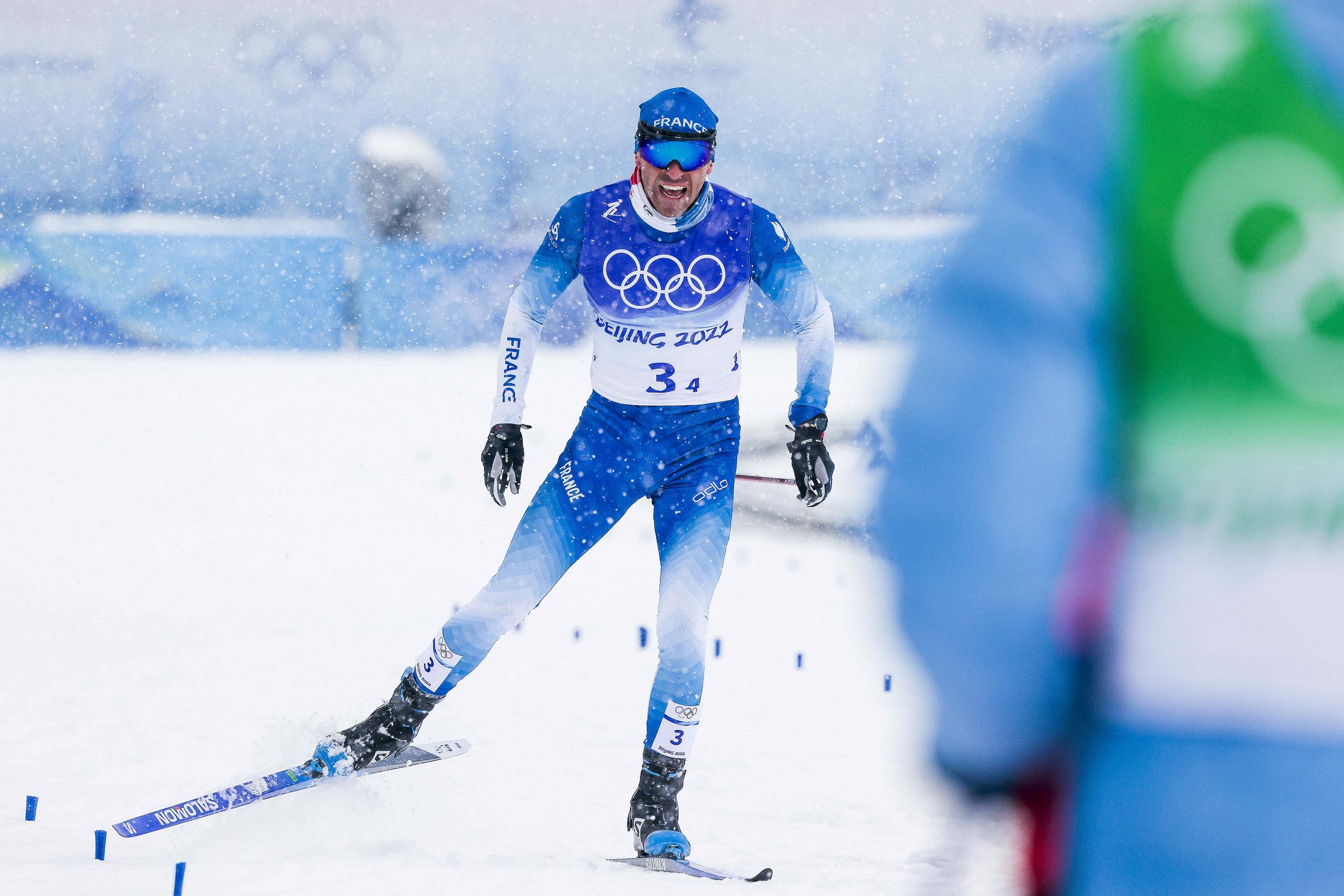
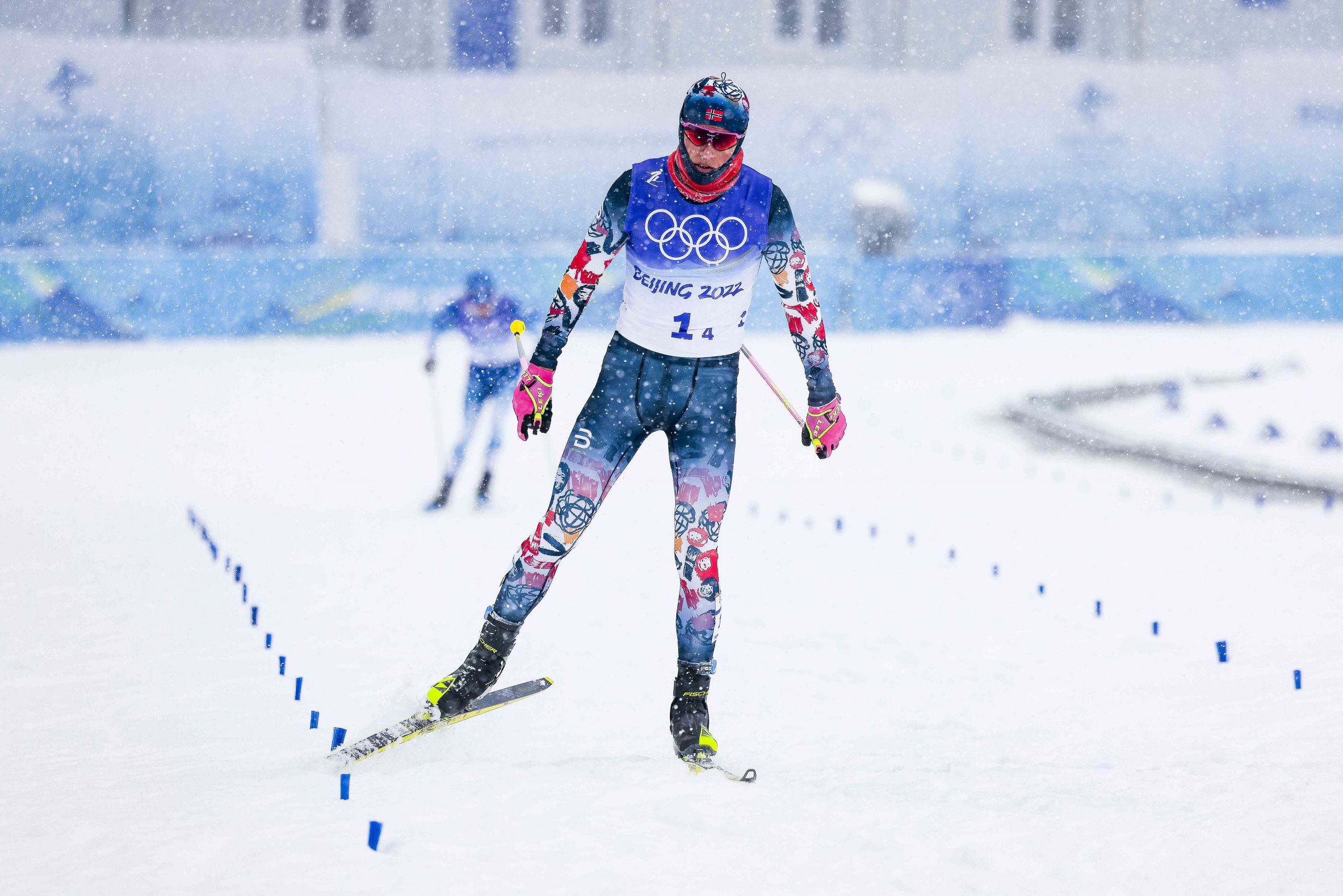
The skis still looked to be a challenge for France as Norway’s anchor, Klæbo, pulled away from the other two by thirteen seconds on the descent towards the stadium, in a move that appeared to be largely unintentional. Not letting up, Manificat took on the task of closing on Klæbo once again, pulling Sweden’s Johan Häggström with him. The second time up the last A-climb of the 3.3 k loop, Manificat busted away from the Swede, catching Klæbo, who appeared to be out for an easy distance ski.
Maurice Manificat (FRA) in the closing moments of his relay leg (Photo: NordicFocus)
Through the stadium for the final time with 36.6 k complete, Ustigov and the ROC was +1:04.3 clear of France and Norway.
To put it bluntly, the last 3.3 k were hard to watch. Knowing he had no chance of beating the Norwegian in a sprint finish, Manificat continued to push to his limit, his ski speed not doing him any favors. Klæbo was all too happy to sit in behind, drafting easily as Manificat tried his best to shake him. In the end, Klæbo did not even have to reach into his bag of tricks, he simply out-glided the Frenchman, who could do nothing about it.
No big moves from Johannes Høsflot Klæbo (NOR) as he brings home the silver medal for Norway (Photo: NordicFocus)
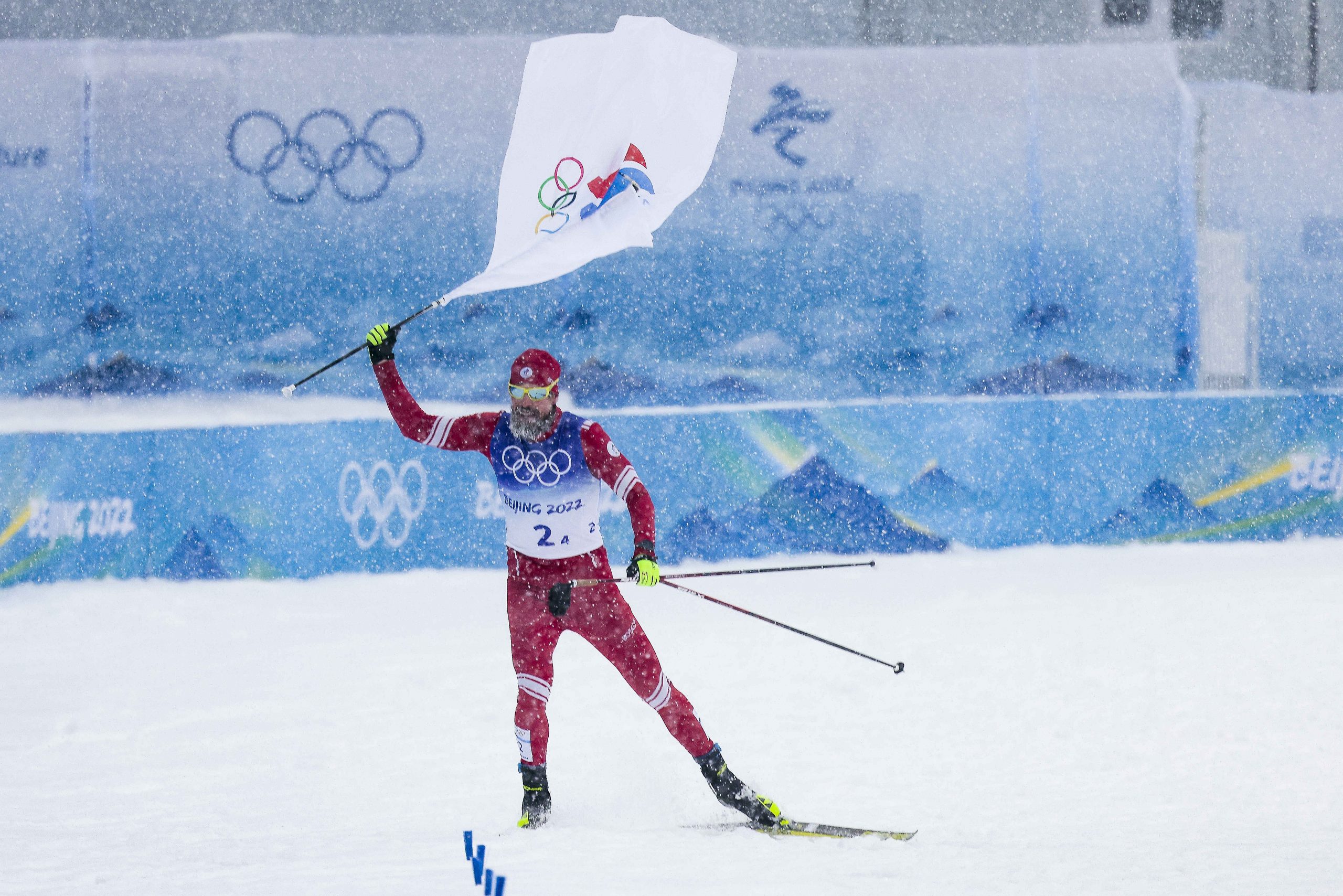
Many meters ahead, Ustigov cruised into the stadium, grabbed an ROC flag and waved it triumphantly as he crossed the finish line before any challengers had even entered the stadium. Finishing in a time of 1:54:50.7 the men secured the second relay gold medal of the Games, after the ROC women brought home gold in the 4 x 5 k yesterday.
Chervotkin, who gave the ROC such a strong start, said of winning gold, “we were aiming for this. We tried to achieve it, and for several years we haven’t been able to. Today everything aligned. Everything was super. The weather seemed to be hard and there was snow but it was in our favor so everything was great.”
Alone with a flag, Sergey Ustiugov (ROC) heads for gold (Photo: NordicFocus)
Despite the consistent strength of the Russian team, they have not won a 4 x 10 k relay in over forty years. The last time they topped the podium in this event it was under yet another name, as the Soviet Union, at Lake Placid in 1980. Of course in recent years, they have consistently been runner-up, earning silver in 2021 Obserstdorf, 2019 Seefeld, 2018 PyeongChang and 2017 Falun.
Ustigov crosses the finish line unchallenged as his teammates wait to congratulate him (Photo: NordicFocus)
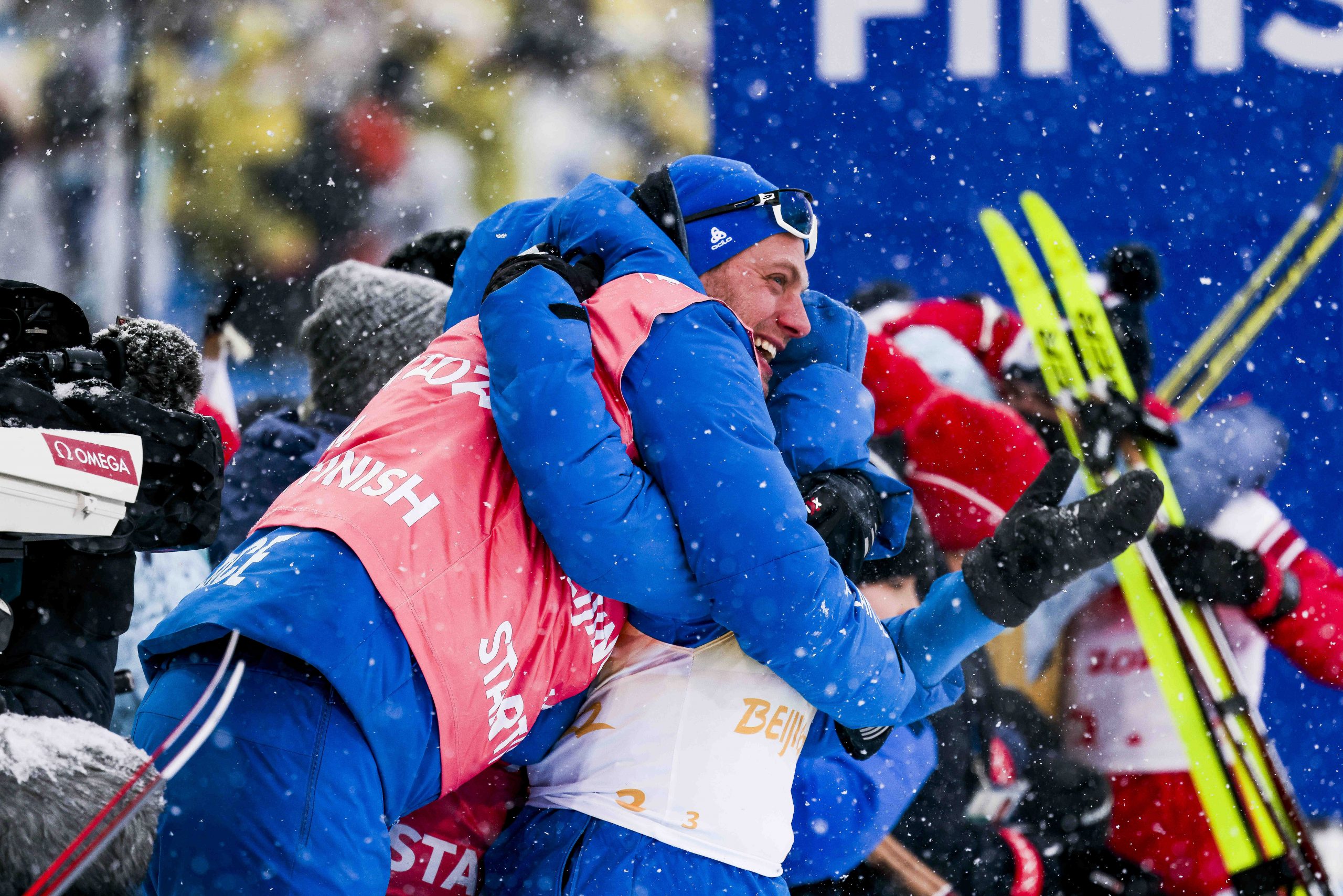
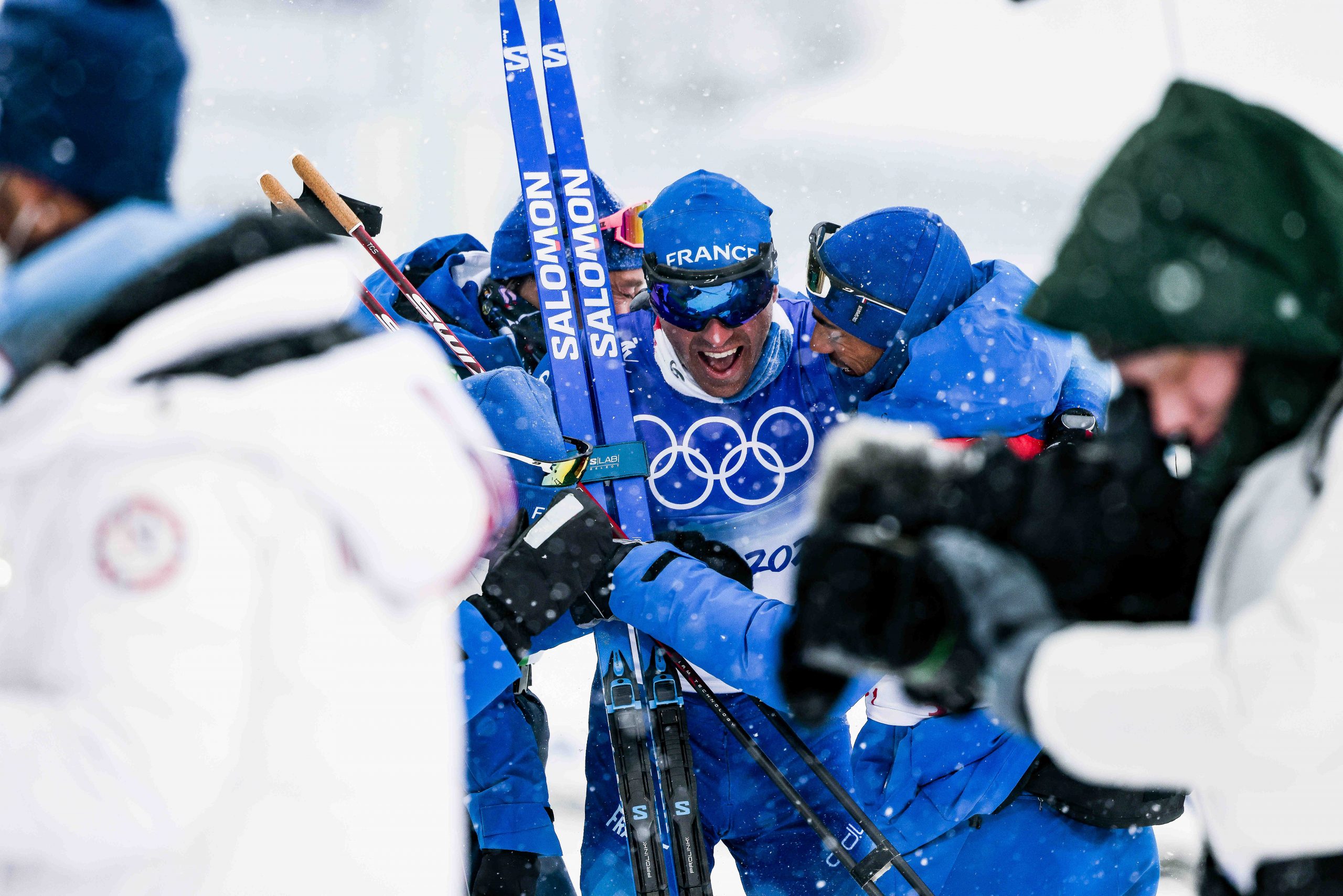
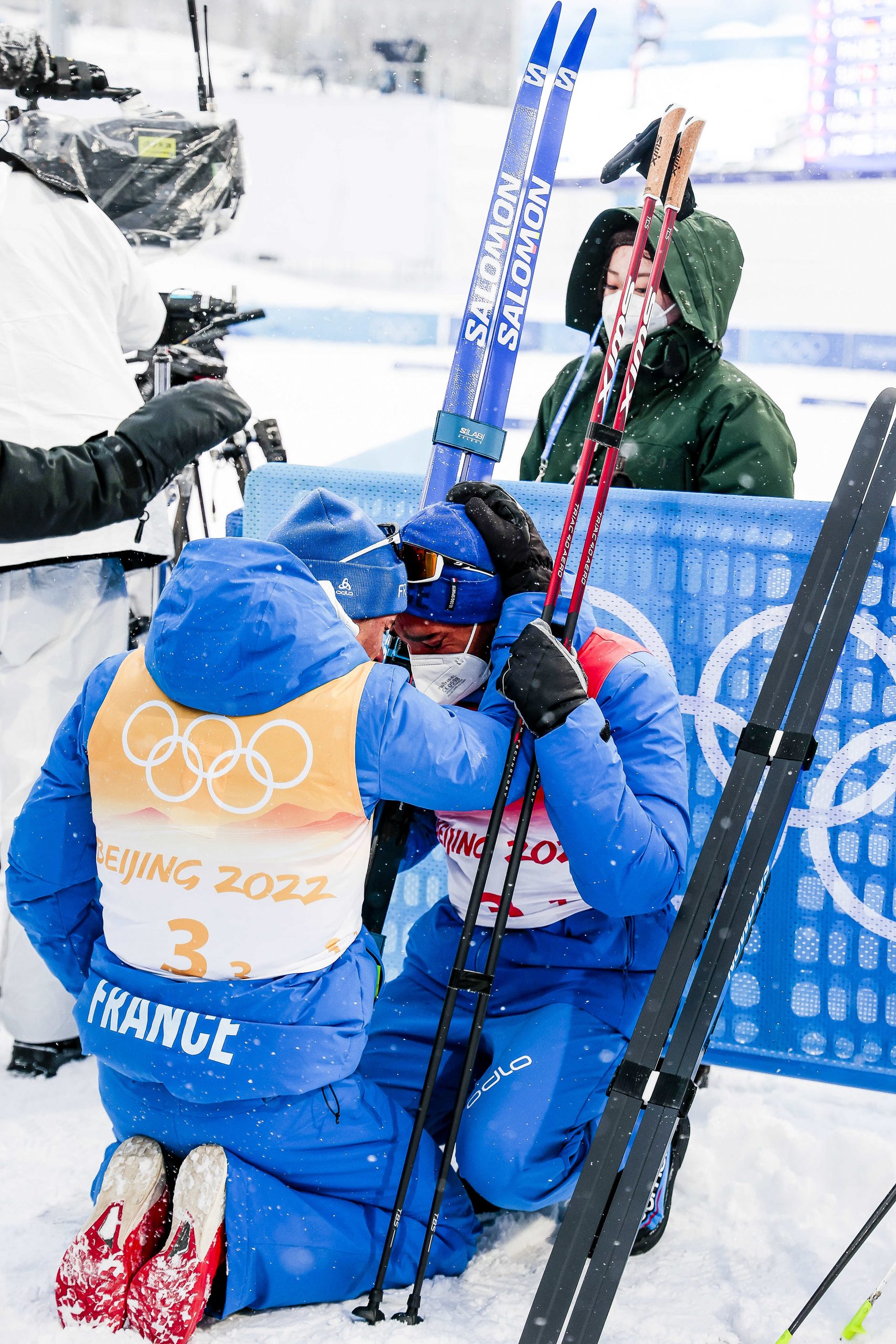
Today the positions were reversed as Klæbo skied slowly across the line for silver, having simply glided away from Manificat in the closing stages. He was met by rather somber congratulations from his teammates, particularly in comparison to the French who celebrated their bronze as if it were gold.
Elation for the French at having secured another Olympic bronze in the men’s relay (Photo: NordicFocus)
After the race, Klæbo said, “when you’re doing a relay, you’re doing it as a team and that is the beautiful part of it, so it’s always fun to race the relay and do it together. We all need to be satisfied with today’s result, and I guess we’re going to celebrate it in the evening and then some of us need to start preparing for the next race. But still we’re going to enjoy this evening.”
His teammate Pål Golberg spoke about the challenging conditions, saying, “The course was tough before and with the snow and wind today, it was even tougher. So I mean, with altitude and everything it’s challenging but we did our best today. The four Russian guys were better so just take the hat off to them and try to be satisfied with the silver.”
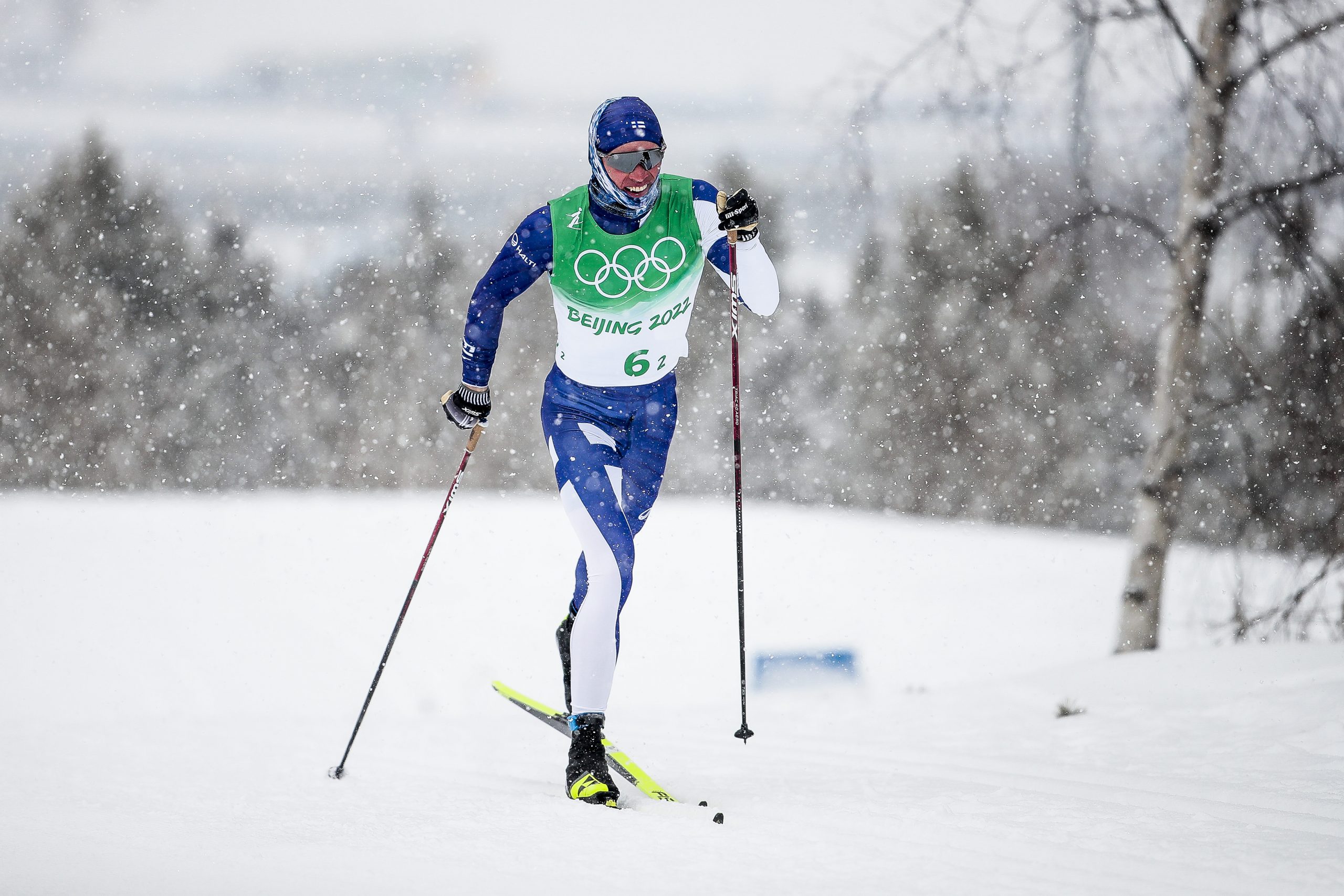
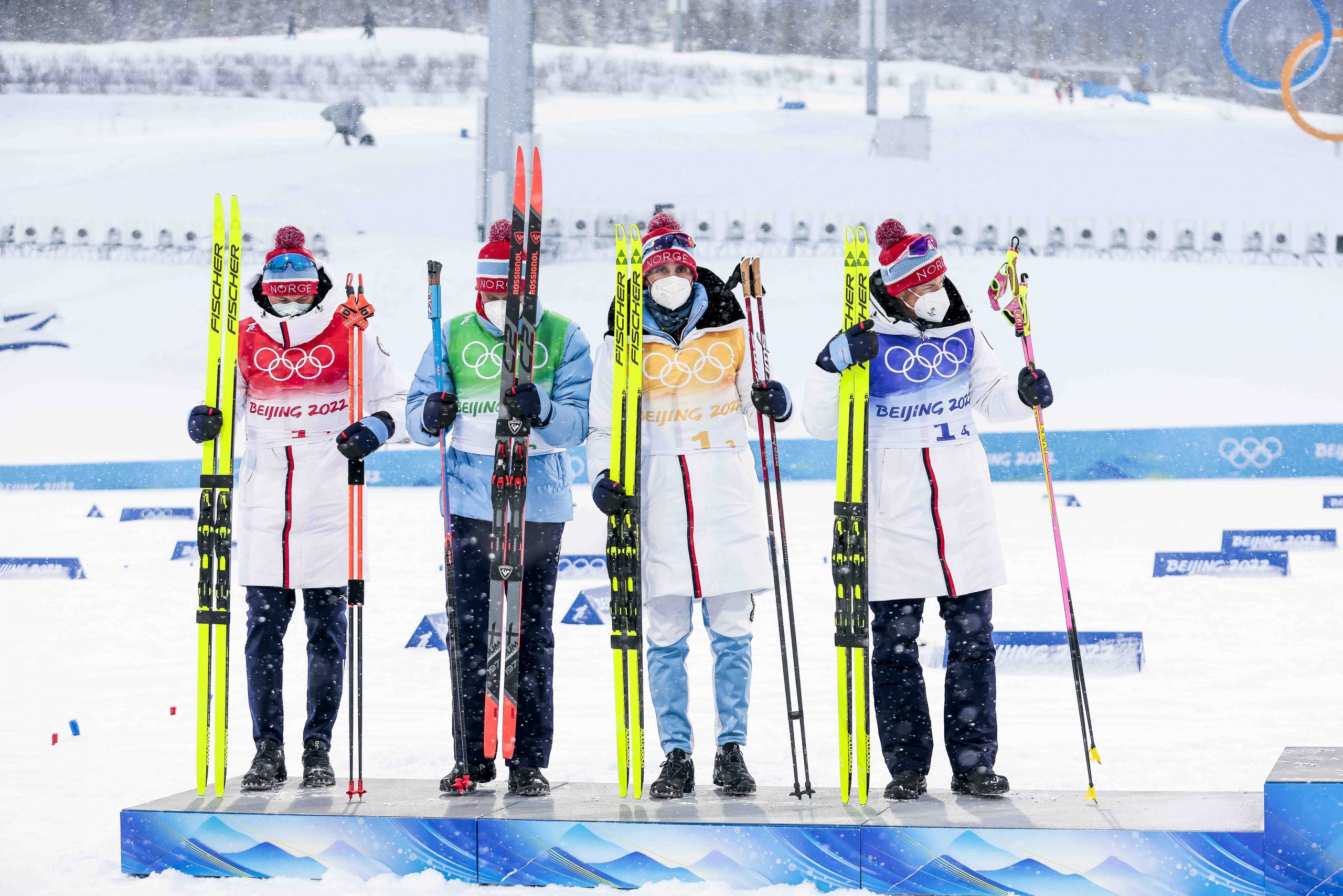
Emil Iversen (NOR), Pål Golberg (NOR), Hans Christer Holund (NOR), Johannes Høsflot Klæbo (NOR), (l-r) were the only team not celebrating their medal (Photo: NordicFocus)
If Norway has held a monopoly on gold in the men’s relay, then the same can be said about the French and bronze. This is the third consecutive Olympics that France has earned bronze in the men’s 4 x 10 relay and Maurice Manificat has played a part in all of them. Similarly, in the last four World Championships, France has collected bronze in three of them.
When asked about winning another medal at the Games, Manificat replied, “four Olympics for me and some medals in the relay since Sochi, so for sure it’s an amazing feeling.”
Regarding the challenge of trying to drop Klæbo he said, “I tried, in the big uphill and I give my best, I give all I had. Medal in relay is the best medal. Because you share it together. We thought all the year about the relay, it’s our soul.”
Teammates congratulate Maurice Manificat (FRA) on a gutsy final leg to bring France the bronze medal (Photo: NordicFocus)Clement Parisse (FRA) and Richard Jouve (FRA) share a moment at the finish. (Photo: NordicFocus)
With three teams lapped out of the race and the spread between the ROC and 12th place finishers, the Czech Republic at +10:07.1, the day was evidently a tough one.
Improving on an 11th place finish in PyeongChang, the American men skied to 9th place today, +8:05.6 behind.
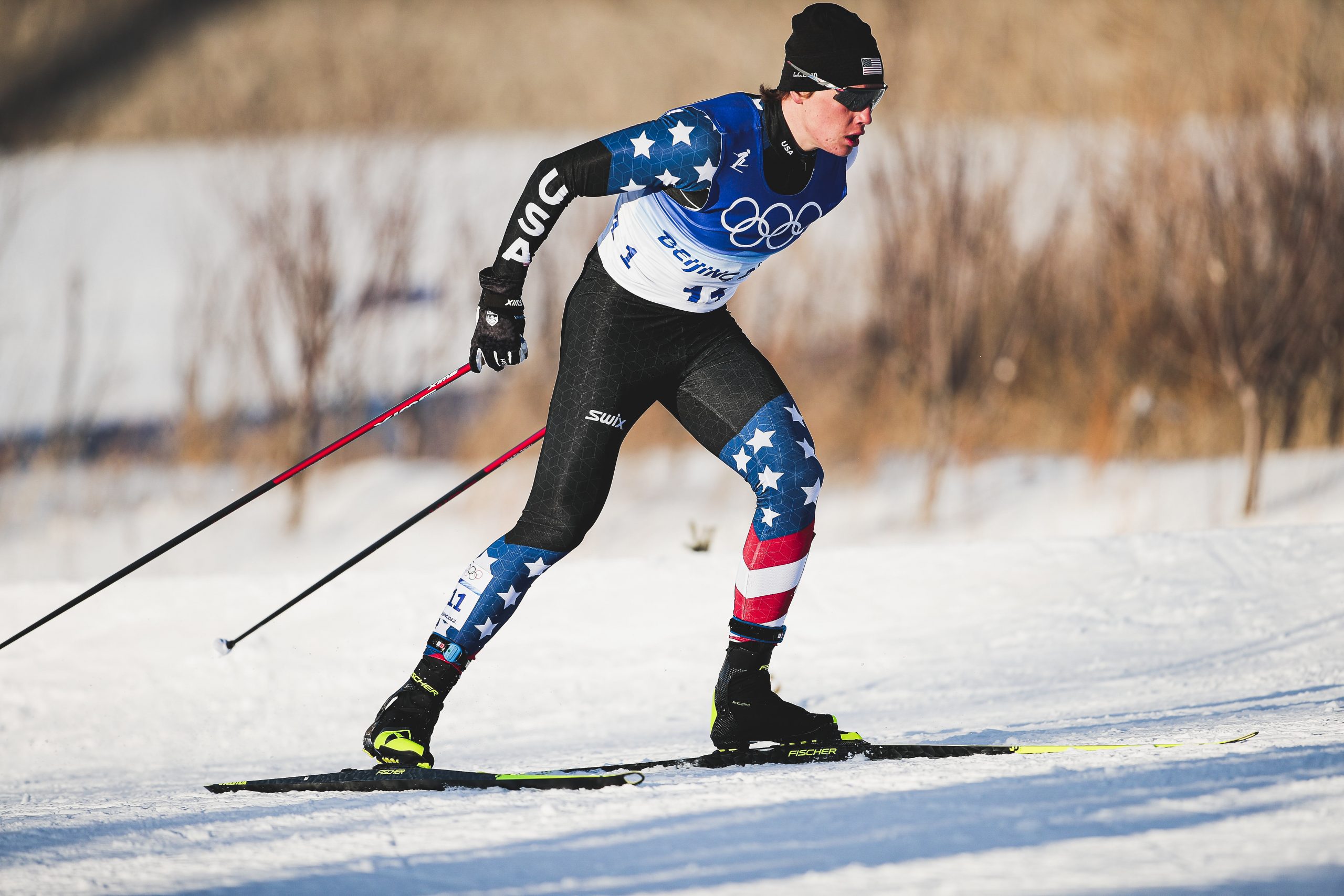
Luke Jager skis the scramble leg for the Americans during the Olympic 4 x 10 k relay. (Photo: NordicFocus)
Luke Jager took the scramble leg for Team USA, putting the team in 13th, +2:39 behind at the conclusion of his leg.
“I felt kind of like I’d become sort of aware of some of the subtleties of how scramble legging in skiing works in the last years, but it was sort of like, all that went out the window,” Jager told FasterSkier from the mixed zone. “For a lot of reasons: the course is really hard, the altitude was really hard, and 10 k versus five or 7.5, was a really big difference. At the end of the day, I just wasn’t fit enough to be where I want to be and there was no hiding to be had. So, I feel like I learned a lot from it, but I just feel like I need to go home and train a lot more.”
While Jager chalked it up as a disappointment, he contrasted the statement it with: “that’s obviously multifaceted. There’s pros to it all, and I’m really thankful to be here.”
Up next was Scott Patterson, who started the Games with an impressive 11th place finish in the skiathlon. Patterson bumped the team up into 11th place, though the time gap continued to widen at +4:23.2.
“I think as we’ve seen in every race this week, those courses are pretty unforgiving,” Patterson explained. “I felt like I had to go out and ski my own race and not really think too much about what everyone else was doing, just go move into the race and try to ski well. It was a little bit interesting place where Luke tagged me off, but I think I picked off some people and put us in a good spot, so I’m happy with that.”
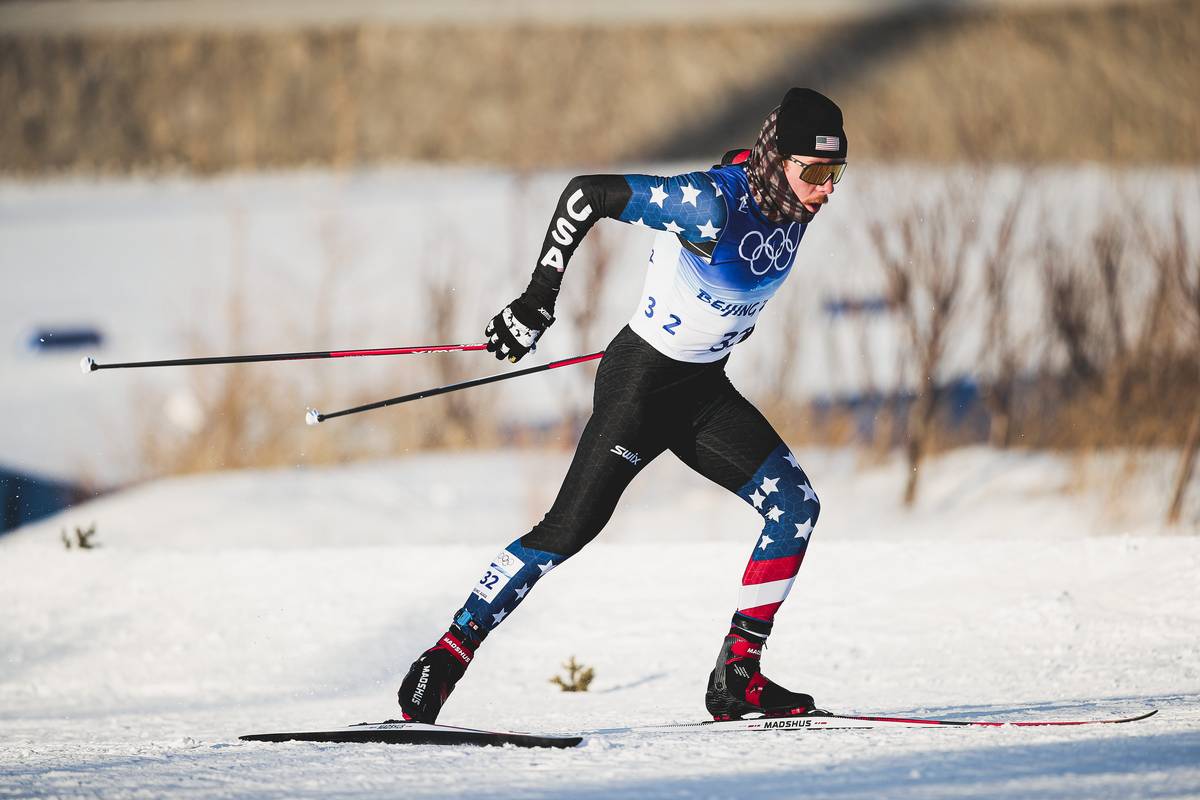
Gus Schumacher races the third leg of the men’s 4 x 10 k relay. (Photo: NordicFocus)
Patterson tagged Gus Schumacher who maintained their position in 11th place and finished his leg +6:04 behind. In the anchor position, Kevin Bolger moved past both the Japanese and Czech team to put the team in 9th place.
“I’m proud of us for coming together the team,” said Schumacher after the race. “We’ve all had some tough races here… It hasn’t been easy for us. I think it’s a little bit hard especially to have the girls’ success – there’s some pressure there.”
While the team was seemingly unanimous that this pressure was self-imposed and that it had been a relief to feel they had “nothing to lose and everything to gain,” the Americans also affirmed that they brought hopeful energy to the day, looking to take a step forward as a team, regardless of what that looked like on paper.
Over the last four Olympic cycles, the Americans have been 11th place in the last two Games, along with 12th in 2006 and 13th in 2010. It might not be a medal, but it was, in fact, a step forward for the program.
“I think we all really put it out there and yeah, good energy,” Schumacher concluded.
Kevin Bolger (USA) skiing the anchor leg for Team USA (Photo: NordicFocus)
The Canadian team was led out by Graham Ritchie who ended his leg in 14th, +2:42 behind. Antoine Cyr took the second classic leg and moved up one position to 13th, +4:23.2.
In the transition to skate, Olivier Léveillé skied Canada’s third leg, again moving the team up one position to 12th, +6:44.6. Rémi Drolet anchored to bring the team home in 11th position, +9:10.4.
Antoine Cyr (CAN) skiing the second leg for Canada (Photo: NordicFocus)American men’s 4 x 10 k relay team: Kevin Bolger, Scott Patterson, Luke Jager, and Gus Schumacher (l-r) (Photo: NordicFocus)
“The relay is really a game of staying in contact,” Matt Whitcomb told FasterSkier in the mixed zone. “When you lose contact, it becomes a different race. Time expands immeasurably. So I’m very proud of the way that these guys tackled the project that they’re handled today. There’s also – and I say it with a Canadian over my shoulder – this is one of our favorite rivalries: our northern friends. And it really is a friendly and very fun rivalry, where we’re always giving each other splits back and forth, and I’m proud of both teams today. And I’m also excited for our guys to come out just a little bit on top.”
The next Olympic cross country ski event will be the men’s and women’s team sprint, happening on Wednesday, February 16th.
This World Cup coverage is made possible through the generous support of Marty and Kathy Hall and the A Hall Mark of Excellence Award. To learn more about A Hall Mark of Excellence Award or to learn how you can support FasterSkier’s coverage please contact info@fasterskier.com.
Thursday morning saw the third women’s cross-country race in the Zhangjiakou stadium. On the docket, a 10-kilometer individual start classic with two laps of a challenging 5 k course. After a reprieve from the wind during the sprint event Tuesday evening, it was blowing once again as the athletes headed to the start.
Zhangjiakou 5 k course. (screenshot from FIS homologation certificate)
Unlike the skiathlon which saw 62 finishers, the start list for the 10 k individual classic featured 98 racers. Most of the later starters represented nations we don’t normally see at World Cup events, such as Greece, Brazil, and Hungry. Many of these skiers fall into the ‘B-standard’ Olympic qualification category; provided they can earn less than 300 FIS points in a competition prior to the games, but have greater than the 100 point threshold of the A-standard, these athletes can race in the 10 k and relay events.
To set the stage for Thursday’s race, we can begin with a brief dive into recent Olympic, World Championship, and World Cup results at this distance. Given that this year’s edition of the individual-start 10 k event was contested in classic technique, the 10 k individual start in PyeongChang was a freestyle race (disciplines alter every two years at championship events). As such, it is harder to draw direct predictions from the podium four years ago to possible success in today’s event. Nevertheless, to remind ourselves, it was Ragnhild Haga of Norway who walked away with the gold in 2018. Charlotte Kalla of Sweden finished second and she was followed by Marit Bjørgen of Norway in third position. Delving deeper into the Olympic records, a look at the results from the 10 k individual classic in Sochi, shows that Justyna Kowalczyk of Poland took gold, with Kalla again the runner-up, and Therese Johaug rounding out the podium with bronze.
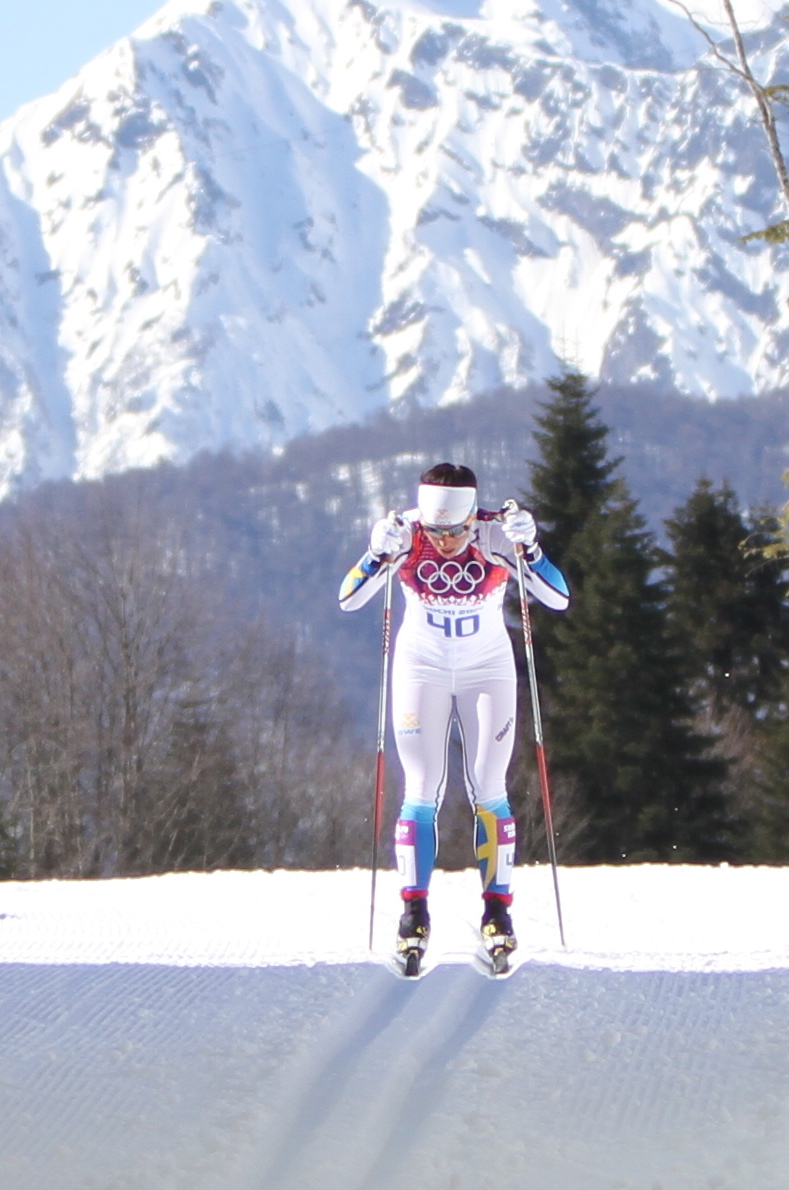
Sweden’s Charlotte Kalla racing to silver in the 10 k classic individual start at the 2014 Olympics in Sochi, Russia. (Photo: FS archives)
The most recent championship-level 10 k individual-start classic race was in Seefeld, Austria when the World Championships were held there in 2019. There, the victory went to Therese Johaug who finished 12.2 seconds ahead of Frida Karlsson of Sweden. Johaug’s teammate, Ingvild Flugstad Østberg was third, but has since battled health concerns and been largely absent from international racing.
This season, the two 10 k individual start classic events have been won by Karlsson (in Ruka, FIN +13.7 ahead of Johaug) and Kerttu Niskanen of Finland in Lenzerheide, SUI (during the Tour de Ski in which Johaug did not compete).
Perhaps one of the more open events in terms of podium predictions, the race turned out to be an exciting one with the margins between medal positions coming down to hundredths of seconds. In the end, it was Johaug of Norway who walked away with her second gold medal from these Games, eking out a win ahead of Niskanen (FIN) by just 0.4 seconds.
Therese Johaug (NOR) crosses the finish line and collapses (Photo: NordicFocus)
Rewinding to the start, Russian Olympic Committee athletes Natalia Nepryaeva and Tatiana Sorina clocked the fastest times to begin. Looking at the course profile, the first split at 1.3 k comes at the end of a good deal of climbing. Close behind the ROC athletes were two Finn’s, Niskanen and Krista Pärmäkoski, with Johaug rounding out the top five, a surprising +12.8 seconds behind Nepryaeva.
Move forward to 3.6 k and the top three were within 0.5 seconds of each other, Niskanen and Johaug tied with a split of 10:47.7, Nepryaeva passing through at 0.5 seconds off their mark. With one lap complete, Nepryaeva had started to fade, perhaps paying the price for her early pace. At 5 k it was Johaug with the advantage over Niskanen, but only by +0.6 seconds, and Nepryaeva was now +6.2 behind.
Therese Johaug (NOR) striding her way to a win in the 10 k classic (Photo: NordicFocus)
Through 6.3 k it seemed like Niskanen had made a break, pulling ahead of Johaug by 11 seconds, on a section of course that is mostly climbing, generally a strong point for Johaug. Nepryaeva was still in third +14.7 behind Niskanen and Pärmäkoski (FIN) was holding onto her fourth place position, +17.7 back. In the next 0.5 k, something appears to have happened to the ROC athlete, as Nepryaeva lost 12.1 seconds to Niskanen (+26.8) and was overtaken in by Pärmäkoski who moved into third +18 seconds behind her teammate.
The final course split was at the 8.6 k mark and with Johaug having the earlier bib, we saw her through first. She had gained the minute start deficit she had to Jessie Diggins and moved past the American, employing her signature high tempo up the final A-climb. When Niskanen came through moments later, her body language was visibly more labored than Johaug’s. In spite of this, Niskanen still held the lead, +1.3 seconds ahead of the Norwegian. Pärmäkoski remained in third, +23.6 behind, followed by Nepryaeva who was +31.8 behind.
Natalia Nepryaeva (ROC) slides her foot across the line, 0.1 seconds behind Krista Pärmäkoski of Finland (Photo: NordicFocus)
Entering the stadium, Johaug was skiing outside the windblown tracks. Knowing the margins were tight, she pushed hard, crossing the finish line in a time of 28:06.3. Facing a headwind into the finish, Niskanen chose to keep her skis inside the tracks, battling the final meters as the stopwatch ticked by. Sliding her foot across the line, the timestamp turned to red. She crossed +0.4 seconds behind Johaug.
“It was the two most nervous minutes in my life, waiting for [Niskanen]”, said Johaug in the press conference after the race.
“It was a really tough race out there today and, as Kerttu said, it was really close race,” Johaug continued. “So I feel that it’s also Kerttu’s gold medal because 0.4 second is nothing. I think we both are the the winners today in my head.”
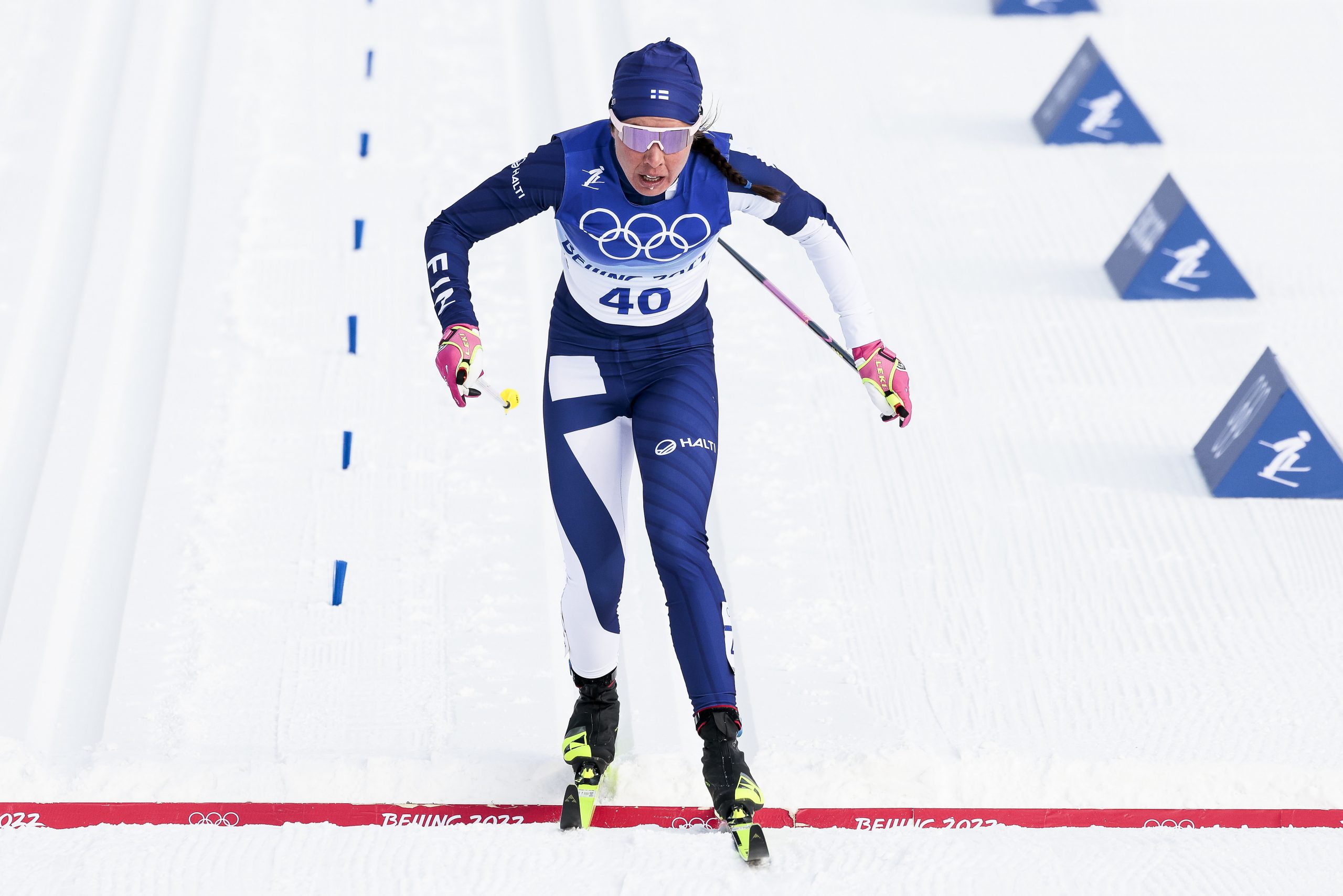
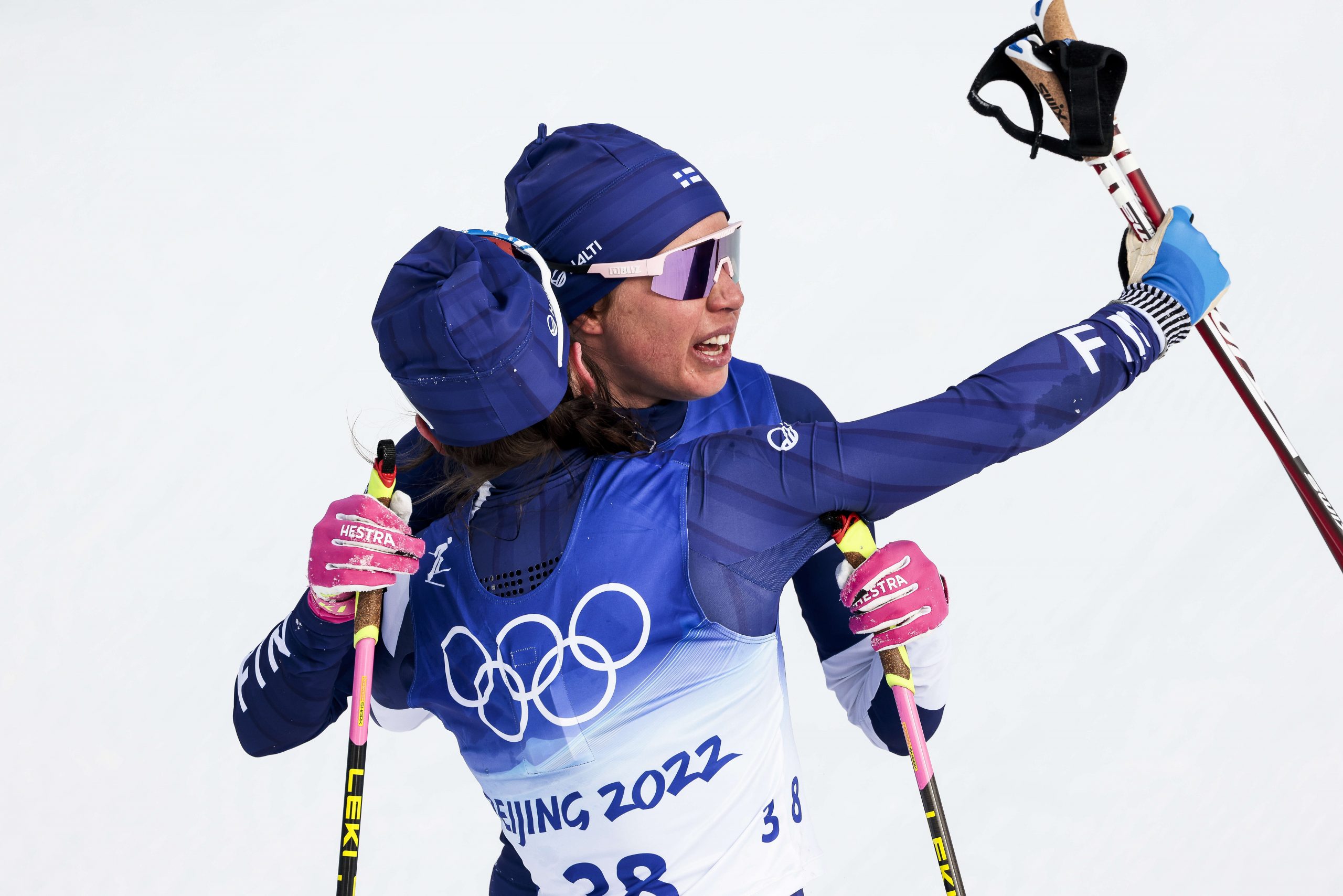
Kerttu Niskanen (FIN) digs deep for precious time in the 10 k classic (Photo: NordicFocus)Teammates Krista Pärmäkoski (FIN) and Kerttu Niskanen (FIN) celebrate their podium finishes. (Photo: NordicFocus)
After earning her first individual gold medal just days ago in the skiathlon, Johaug continues to cement her place in history as she gains another. Her performance gives the Norwegians something to hold onto as the rest of the team struggled to perform at the level fans are accustomed to.
With twins Tiril Udnes and Lotta Udnes Weng finishing 21st and 25th respectively and Mathilde Myhrvold back in 44th position, the remaining women racing on behalf of Norway did not have their strongest showing.
So far, Johaug is the only female Norwegian athlete to earn a medal of any color, while Johannes Høsflot Klæbo earned the only medal on the men’s side, a gold in the 1.5 k freestyle sprint on Tuesday. Three Norwegian athletes, including medal favorites Heidi Weng and Simen Hegstad Krüger, remain detained due to a positive COVID test just prior to travel. Weng recently announced on social media that she will not be making it to China and it is unclear whether Krüger will be cleared in time to compete in events next week.
Lotta Udnes Weng (NOR) finished 25th in the 10 k classic (Photo: NordicFocus)
For Kerttu Niskanen, this silver marks her first individual championship medal. She holds two silver medals from team events, both coming from Sochi in 2014. Niskanen only has three World Cup victories to her name and they all were in 10 k classic events, a specialty of hers.
“My plan before this race was to push hard every time and try to ski within my limits,” Niskanen explained in the press conference. “In the second laps on the long uphill from stadium, on the big uphill, [that] was the best part part for me in these tracks… I tried to push hard also end of the race but the I can say that Therese was much better than me. I did my best and it was really near but, yeah.”
Kerttu Niskanen (FIN) celebrating her first individual Olympic medal (photo: NordicFocus)
The bronze medal was also decided by a razor-thin margin. Pärmäkoski started bib number 38 and was hunted by Nepryaeva in bib 60 who had the advantage of more split information. However, when Nepryaeva crossed the finish line, she was outside by just 0.1 seconds, having finished in a time of 28:37.9 whereas Pärmäkoski came across in 28:37.8. Pärmäkoski has three individual Olympic medals, from a range of events in PyeongChang. She earned bronze in both the skiathlon and 10 k individual freestyle in 2018, as well as silver in the 30 k classic mass start.
Krista Pärmäkoski (FIN) stretching for the lunge that gave her third place (Photo: NordicFocus)
For the American contingent, there was some back and forth playing out between Jessie Diggins and Rosie Brennan throughout the race. Just 48 hours after winning the first individual medal for women’s cross-country skiing, Diggins was back on the start line wearing bib 34, starting one minute ahead of eventual winner, Johaug in bib 36. Brennan started in bib 44.
Jessie Diggins (USA) crests a climb in the 10 k individual start classic (Photo: NordicFocus)
At the 1.3 k mark, the two were 13th and 14th, with Brennan +19.9 behind and Diggins +20.4. At 3.6 k Brennan had moved into 8th, +21.3 behind with Diggins in 10th, +25.1 back. With the climbing complete for the first lap, the 5 k split showed Diggins in 9th, +30.1 behind with Brennan now behind her in 11th, +31.8. Begin the climbing for the second lap and Brennan was again the first American, in 9th place and +45.7 behind while Diggins was in 14th, +52.7.
Rosie Brennan (USA) hits a dynamic stride in the 10 k classic (photo: NordicFocus)
At 8.6 k the two were neck and neck, Diggins in 10th, +1:05.6 and Brennan in 11th, +1:11.6. Over the final 1.4 k Diggins grew her advantage over her teammate to finish in 8th position, +1:08.8 behind winner, Therese Johaug (NOR). Brennan finished her day in 13th place, +1:22.3 behind Johaug.
Jessie Diggins (USA) left it all out on the course in the 10 k classic, per usual. (Photo: NordicFocus)
As she provided comments on today’s performance, Diggins first spoke to savoring the moment of yesterday’s medal ceremony. “It was so special to call my family and call my fiancé, and come back to the apartment and show our staff like our coaches the medal and just enjoy that moment.”
After a “rollercoaster” of eating, drinking, and other recovery-focused actions – Diggins said the Tour de Ski was helpful for knowing how to handle the tight turnaround – she turned her full attention to today’s classic race.
“I was really, really happy today,” Diggins said in the mixed zone. “I was so focused on my process. This is undoubtably my weakest event, but I was just so focused on enjoying it – like, ‘Great! No pressure. This is just my day to go out there and enjoy racing at the Olympics.’ Especially seeing Novie do her first Olympic race – I got to put the glitter on her I give her a hug – it was honestly pretty emotional. But in a good way.”
Though she has steadily closed the gap between her results in skate and classic performances, Diggins has been primarily seen success in freestyle competitions. On today’s race, she maintained that her focus was not on the result, but on giving her all despite classic being her weaker technique.
“It was so cool to work on that process and dial in the kick,” Diggins said. “I was so, so grateful for awesome skis. When I go really hard, I can’t feel my body from the waist down. And when you can’t feel your legs and you’re still kicking up the hill – you have to have great kick… And man, they delivered. I was just so proud of them.Especially in challenging conditions where it’s windblown in the tracks, or you’re trying to keep skis fast and grippy. That’s hard… I think they did a great job.”
Speaking to whether she has made progress in her classic skiing, Diggins continued, “I would like to think so. I’ve been working very very hard on it for a lot of years. I’ve been just so focused on that process on the technique and every single stride I was just thinking so hard about my technique. It really kept me right in the moment and thinking about what I could do so yeah, I’m gonna keep working on it to keep improving it.”
Jessie Diggins skis to 8th in the 10 k classic. (Photo: NordicFocus)
On a course Brennan described as “brutal” she explained that seconds could easily be gained or lost along any stretch, up or downhill. She also acknowledged the challenge of facing the wind in an interval start race where there may be less opportunity to use another skier to block the wind than there is in a mass start. Overall, Brennan executed her goals on the day, despite looking to be higher on the results sheet.
“I was really focused on having powerful classic skiing and I was pretty happy with how I skied,” Brennan said in the mixed zone. “I wish I had a little more, but I did what I could with what I had today.”
Brennan finished one place (just 0.6 seconds) behind Sweden’s Frida Karlsson, who has two wins in the 10 k classic on the World Cup, including a win over Johaug earlier this season. This strong result is on the heels of her Olympic career best finish in the individual skate sprint, which was held under the lights Tuesday evening.
“The turnaround was definitely hard,” Brennan said. “It’s really hard with these late night races to get good sleep afterwards. So I think that was challenging. I did a lot of training this summer to try to like mimic that load. So I’m hoping that I can manage it, but we will take it day by day and see what we can do.”
Rosie Brennan comes to the line in 13th in the 10 k individual start classic. (Photo: NordicFocus)
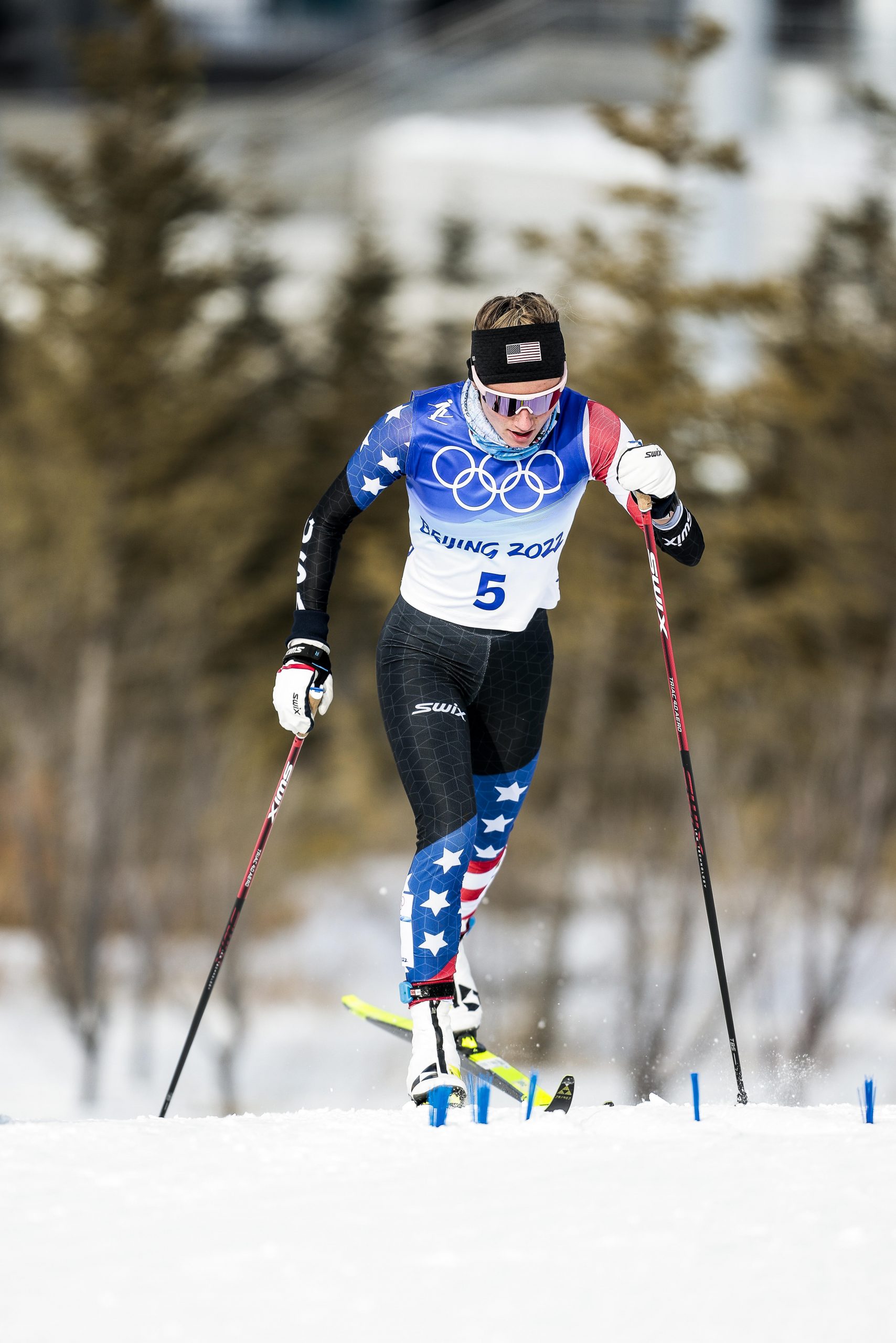
Making her Olympic debut, Novie McCabe was the first starter for the United States, wearing bib number 5. At the age of 20, McCabe is the youngest member of a young team in Beijing. After earning her first World Cup points in Davos earlier this year, McCabe also notched a top-ten finish during the Alpe Cermis hill climb during the Tour de Ski. In an impressive performance, McCabe skied her way to 24th in a time of 30:34.9.
When she started, the British Eurosport announcers remarked, “I think McCabe is going to be a superstar like Diggins in a few years.”
At 5 k, McCabe was in 38th position, +1:27.9 behind Johaug. At 6.3 k she had moved into 32nd, at 6.8 k she was in 29th and by 8.6 k she had jumped to 24th, which she held through the finish.
“The long last hill was, for sure, so hard,” McCabe said after the race. “I tried to kind of just zone out and get through it. And I knew that it would be tough, especially on the last time up. But it was nice also to have so many people like around me out there and kind of have people to watch ahead of me. That helps a lot.”
Novie Mccabe (USA) skiing strong in her first Olympic race (Photo: NordicFocus)
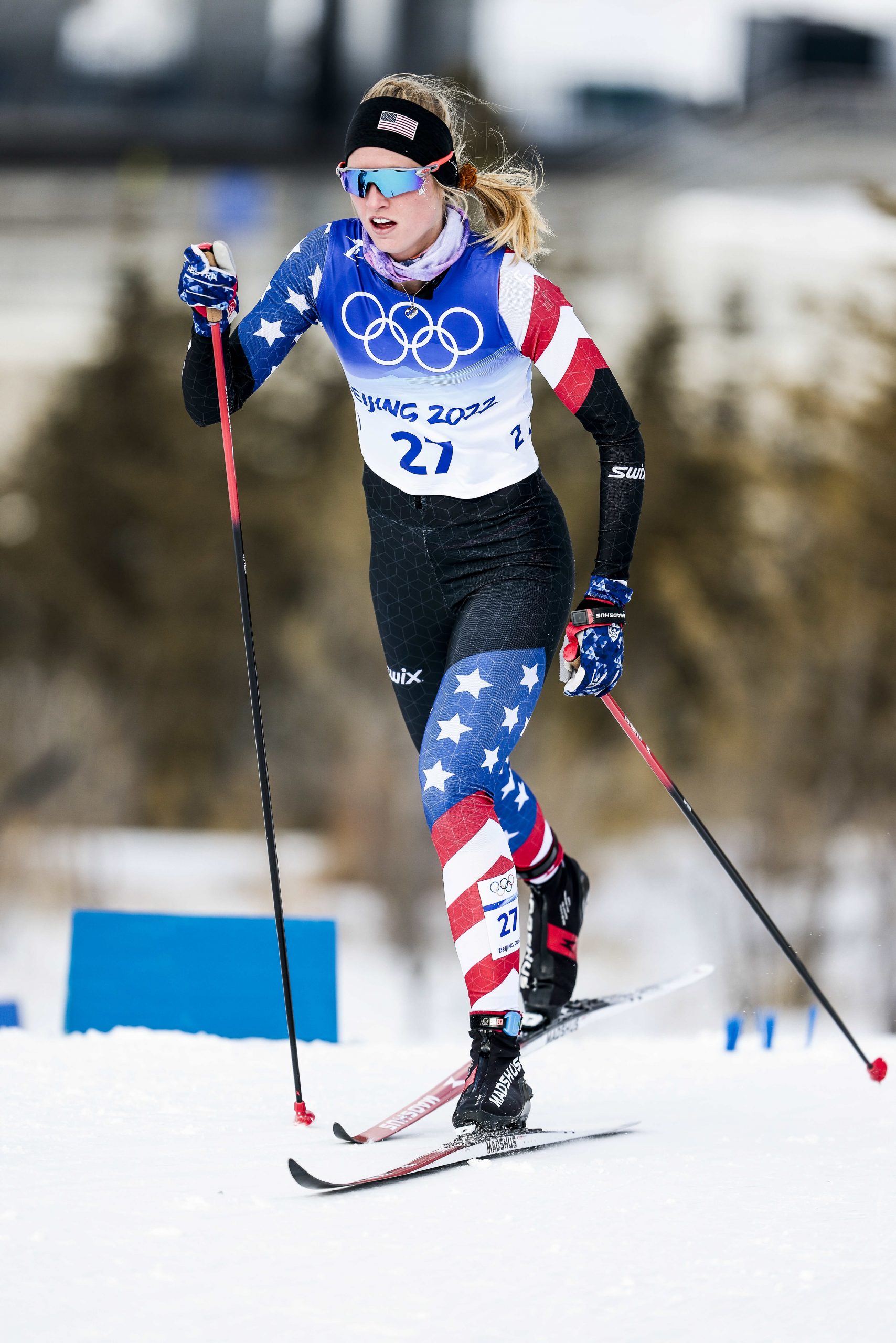
Hailey Swirbul was the fourth American competitor and wore bib 27. Swirbul raced in the skiathlon earlier this week and finished in 40th. In today’s 10 k classic, she bested that performance and landed herself in 32nd, +2:59.0 behind Johaug. Swirbul was just five seconds outside of the Top-30.
“It was better than my last race,” Swirbul said simply in response to how she felt about her day. “I’m excited. I had a little bit of a reset – had a few days to recover from that first effort and have really focused on kind of resetting my goals, trying to push as hard as I could through that whole race and not give up no matter what. And I was able to do that today.”
With the women’s relay looming, team selection is a buzzing topic amongst ski fans. Swirbul skied a classic leg in the December, 2021 relay in Lillehammer, NOR, and was a member of the 2021 World Championship relay team in Oberstdorf, GER. The American team finished just off the podium in fourth in both races.
Swirbul said that relay team selection was not on her mind during her race today, though she does feel the pressure to perform that is perhaps inescapable at an Olympic level competition.
“That definitely does factor in for all of us here,” she said. “But I think at the end of the day, everyone on our team is confident that we’re going to try to put in the team with the best shot of a relay medal. So there are no hard feelings. There’s nothing personal about that team selection. We all trust that we’re just trying to do the best for our nation and give us a good shot.”
Hailey Swirbul (USA) working her way to a 32nd place finish in the 10 k classic (Photo: NordicFocus)
For the Canadians, Dahria Beatty continued her momentum, building off of strong performances in both the skiathlon and sprint to finish 18th, +1:53.9. This is a personal best for Beatty, following a week of personal bests. She finished 25th in the skiathlon and 25th in the sprint; her best Olympic performance before that was a 37th place in 2018 during the 10 k freestyle at PyeongChang.
Dahria Beatty (CAN) skiing to a personal best result of 18th (Photo: NordicFocus)
Behind Beatty, Kathrine Stewart-Jones finished 36th for team Canada, +3:02.3 behind. Cendrine Brown was 48th (+3:41.6), and Olivia Bouffard-Nesbitt was 61st (+4:54.8).
This World Cup coverage is made possible through the generous support of Marty and Kathy Hall and the A Hall Mark of Excellence Award. To learn more about A Hall Mark of Excellence Award or to learn how you can support FasterSkier’s coverage please contact info@fasterskier.com.
During the American broadcast of the 30-kilometer Skiathlon on Sunday, NBC Analyst Chad Salmela made the comment that race represented the “old-school” of long-burn, grind-it-out ski racing. That length of ski race, updated only for the introduction of skating, has been a feature of Olympic competition since the 12th Olympiad held in 1956.
In contrast, each one of the American skiers starting today was already born when the 1.5 km freestyle sprint became an Olympic event at the 2002 Salt Lake City games. In fact, only Kevin Bolger (born in 1993) can claim to have a living memory of that event. The other three – JC Schoonmaker, Ben Ogden, and Luke Jager – were all two years old when Tor Arne Hetland won gold at Soldier Hollow.
Luke Jager (USA) on his way to qualifying 30th in the Individual Sprint Qualifier in Beijing. (Photo: NordicFocus)
In the intervening twenty years, those latter three were part of an American generation that came of age sprinting on the 2002 Soldier Hollow course, contesting junior and senior U.S. Nationals as they climbed through the ranks and quietly holding tight to their Olympic dreams. Meanwhile, the generation of skiers they looked up to were trailblazers, with sprinting their preferred in-road for American skiing on the Olympic stage. At the 2006 Torino games, Andrew Newell came through qualifiers in 2nd. Then Simi Hamilton became a consistent presence on the World Cup circuit, and qualified for heats in the last freestyle the Olympic sprint at the 2014 Sochi games. Eight years later in 2022, the kids had grown, and from Vermont hollows, Wisconsin Northwoods, the California snowfields, and the Alaskan frontier, had converged on a start-line in Beijing, ready to push for something new.
After qualifying, they had already done it. The American men started four skiers for the individual sprint, and for the first time in Olympic history, each one of them made the heats. Leading the way was recently crowned U.S. sprint champion JC Schoonmaker, who finished in 13th, +6.12 seconds off of winner Lucas Chanavat (FRA), who clocked a 2:45.03 on the 1.5 k course. Ben Ogden finished in 19th (+7.18), Kevin Bolger was 22nd (+7.47), and Luke Jager rounded out the quarterfinal field in 30th (+9.41).
Jager, in 30th, found himself right away in the unique challenges the Olympics can bring then, saying in an interview with FasterSkier that “There were seeded guys behind me and I knew I was right on the bubble [for qualifying]. I was getting interviewed by NBC and the whole time just wanting to reach down and check my phone.”
In the end, he was through with his American teammates.
Ben Ogden skis to 19th in qualification in the men’s individual freestyle sprint. (Photo: NordicFocus)
They joined the established field that’s become familiar to those who follow the World Cup week-to-week, and for whom the individual sprint was a priority at these Games. That included defending individual sprint gold medalist Johannes Høsflot Klæbo (NOR), who qualified in 3rd (+1.71), defending silver medalist Federico Pellegrino (ITA) in 6th (+4.52), and the Russian Olympic Committee’s (ROC) own young star Alexander Terentev in 14th (+5.89).
The whole field would converge in the quarterfinals to race a 1.5 k course that raced as a “true sprint” as NBC Analyst and American gold medalist Kikkan Randall remarked on the American broadcast. Her remarks were apt; the course raced as a single-lap, taking three minutes for the majority of the field, on fully artificial snow. If you were looking for an archetype for what the “sprint-course” has developed into since the inception of the event at the 2002 Olympics, you’d have the one in Beijing. A first climb gave way to a downhill, which led to a long final climb, before skier’s took a sharp left turn into the final stadium stretch. The tactical pressure-point was the turn to go into the descent following the first-climb. If you went over with speed, the transition into the final hill could prove to be a decisive factor in a long-burn attack. If you followed, the draft could be just as important to launch a punchy sprint to move up the field on the last climb.
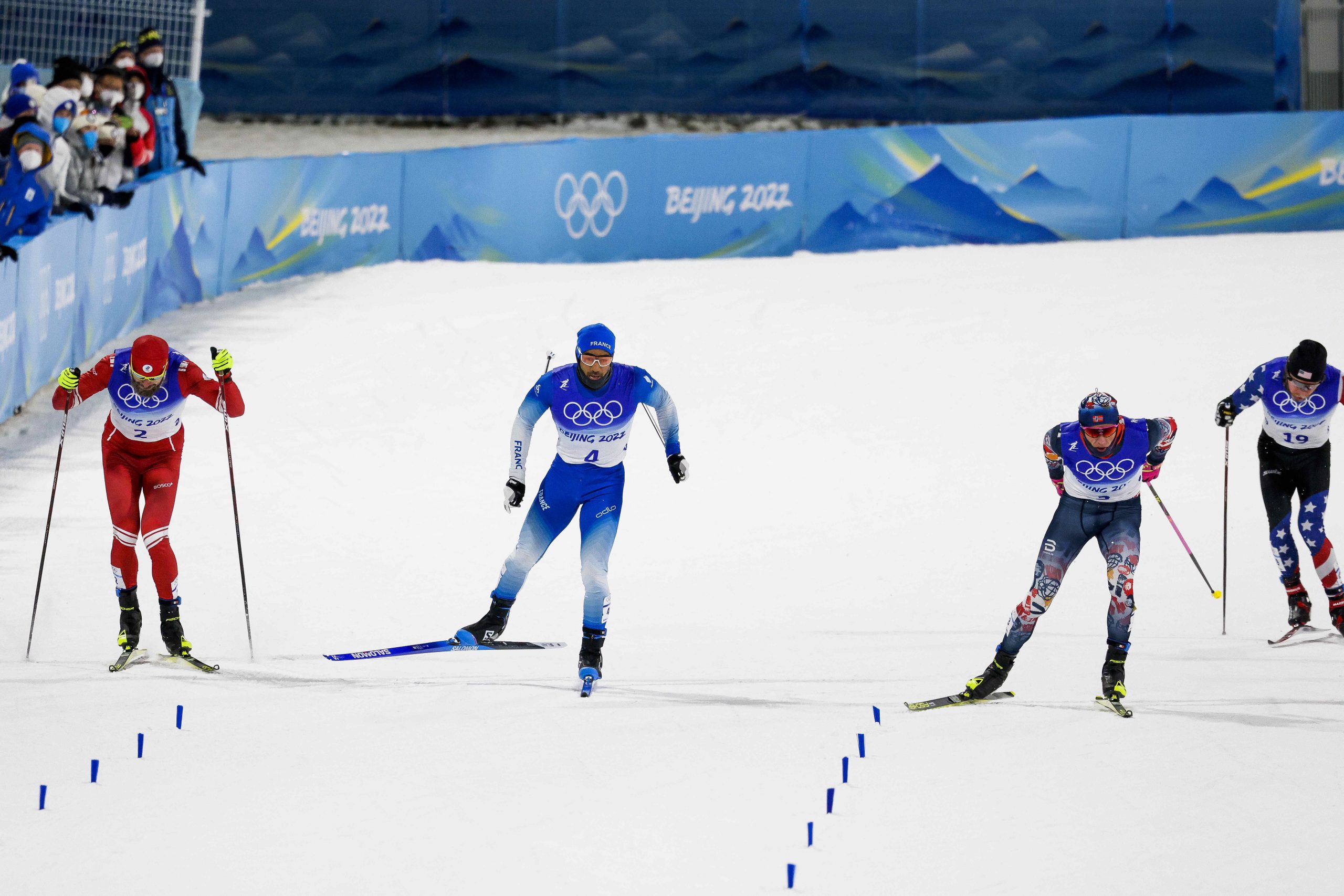
That racers would see both approaches became apparent straight from the first quarterfinal, which featured Klæbo, Sergey Ustiugov (ROC), and Ben Ogden. Klæbo seemed to take the tactic of a long-burn attack on this course, which was helped along by a field that seemed set at every level today to try and force him out in front so as to catch his draft. He used the corner off of the first uphill to delay his burst of speed into the downhill just enough to surprise the field, and by the time he hit the final climb, he was in a comfortable position to win the heat.
Ben Ogden crosses the finish-line in sprint heat action. Ogden would finish 12th, the best men’s individual sprint finish in US Olympic history. (Photo: NordicFocus)
His burst of speed, though, had blown open the field behind him. Ben Ogden was caught out in 5th place going into the final corner. It turned out, in this particular case, to be a blessing. In front of him, Renaud Jay (FRA) stumbled over Anton Persson (SWE) (who was given a yellow-card for obstruction) and caused a split-second hang up in the field with Oskar Svensson (SWE) that allowed Ogden to come into the finishing straight with a chance. He ended up taking it, finishing fourth place. Klæbo (2:51.57) had animated the quarterfinal, and the chase behind him yielded a fast heat. Ogden finished with a time of 2:53:00, good enough to warrant hope for a lucky loser spot into the semi-finals, but he would have to wait through four more heats to find out for certain.
The third quarterfinal saw the next American action, with Kevin Bolger and JC Schoonmaker lining up against sprint stalwarts Richard Jouve (FRA) and Håvard Solås Taugbøl (NOR). Bolger, who is eight years senior to his fellow teammates, took a tactic in this race that suggested he understood the gravitas of the Olympics and how you race to stay in it. He led the pack out with gusto, trying to take the heat along with him.
The field, however, seemed to have other ideas. Bolger said in an interview with FasterSkier that he “started V1-ing on the hill and I went ‘nope, not getting lucky loser, this is a different pace than the qualifier.” With those lucky loser spots most likely gone, the heat became a race for 1st and 2nd. Jouve and Taugbøl turned out to have the burst of speed needed in the end, with Bolger in 3rd. For the bleary-eyed among us back in the U.S., he provided the first glimmer of the American’s intrepidness on the day. For his part, Jager followed his older teammate, and his presence in 5th across the line was another reminder that that American spirit was found in spades on the day.
Kevin Bolger (USA) and Luke Jager (USA) in quarterfinal action. Photo: NordicFocus.
Jager pointed to how the Olympic experience was a unique one that he’ll hope to build on in an interview with FasterSkier, saying, “maybe it was the novelty, [but] to be perfectly honest my head wasn’t maybe in a great place to look towards advancing, but I think it’s one step at a time and I’m figuring out the right mindset to qualify consistently now and to advance. It was unlike anything else… it’s dark out and you need sunglasses, that’s awesome!”
The fourth heat fleshed out the idea that Bolger had in the previous heat. The skiers went hard from the gun, knowing that if they could race a faster heat than the first quarterfinal, a 3rd or 4th in this heat could still keep their Olympic dreams alive. This was all complicated as Erik Valnes (NOR) pulled away to win the heat and a long sprint for second ensued. Pål Golberg (NOR) and Raimo Vignants (LAT) went down, and the sprint seemed to end up going for Chinese skier Qiang Wang, who hadn’t raced in the World Cup field since before the pandemic in 2019.
Unofficial results showed that Valnes and Wang were through in 1st and 2nd, respectively. Results also showed that the quarterfinal had been the fastest heat of the day. Valnes finished in 2:49.31, with 3rd place Artem Maltsev (ROC) at 2:50.37 getting a lucky loser nod. The race jury quickly deliberated and disqualified (or officially, “ranked as last”) Wang, which meant that Maltsev was through to the semifinals on an automatic bid. That opened up one more lucky loser spot, and the next time on the list would prove to be a 2:53:00; belonging to Ben Ogden. He was through to the semifinals of the Olympic games.
JC Schoonmaker (USA) races in the final quarterfinal on Tuesday in Beijing. Photo: NordicFocus.
The last quarterfinal saw JC Schoonmaker narrowly lose out on a sprint to Alexander Terentev and Joni Mäki (FIN), after Schoonmaker led out the pack for the first part of the race.
The men’s semifinals then, for the first time ever in an Olympic games, featured an American. And that American found himself in a who’s-who of heavyweights. The first semi-final lineup; Klæbo , Pellegrino, Jouve, Ustiugov, Chanavat, and Ben Ogden.
Ben Ogden races the quarterfinal of the men’s freestyle sprint during the 2022 Beijing Olympic Winter Games. (Photo: NordicFocus)
As the field climbed up the first hill, the skiers seemed set on fighting Klæbo tactics with Klæbo tactics. The race to get over the top was on.
Richard Jouve ended up winning the fight to go into the downhill first, while Klæbo got caught at the back-end of a pack that remained tight. That included Ogden, who had weathered the storm to come into the final hill with the group. The transition into the final climb was furious, with Klæbo moving through the pack and bringing his rivals along with him. When they came into the final stretch, the field spread four wide and Klæbo, in shades of race nightmares past, looked to have eased up early, producing a four-way photo finish. Pellegrino and Klæbo ended up getting the nod to the finals in first and second, respectively.
Ogden finished just off the sprint in 6th place (+1.24). His final placing of 12th is the best for an American man in an Olympic sprint. More than that though, he loomed in the background of a sprint of the world’s biggest names, appearing not as a straggler but as a shadow. The youngest in his semi-final field by 5 years, as he crossed the line, it seemed to be a reminder that the Americans are the ascendent force in sprint racing, with much more to learn, and to come, as they continue to gain experience at the Olympics.
The second semi-final saw Artem Maltsev race with the same purpose he had struck out with in the quarterfinal. He seemed set on making sure that luck, in the lucky losers, would be with the second semi-final. After the first climb he had a gap that his teammate Alexander Terentev and Joni Mäki would claw back successfully in the lead-up to the stadium sprint, finishing 1st and 2nd, respectively. Maltsev and Oskar Svensson (SWE) were successful in their project of creating a fast heat though, and claimed the two lucky loser bids to the finals.
The final then, had a field filled with shades of the last Olympic individual sprint. Klæbo had his chance to defend his medal. Pellegrino had his chance to one-up himself and claim gold in his stronger technique. Terentev, Mäki, Svensson, and Maltsev were all racing for their first Olympic medal of any sort.
Sergey Ustiugov (ROC), Richard Jouve (FRA), Johannes Høsflot Klæbo (NOR), and Ben Ogden (USA) in semi-final heat 1. Klæbo and Ustiugov advanced to the final. (Photo: NordicFocus).
There was again then, a guarantee for something new. A new medalist at the Olympic games. This was, though, still a sprint race of the world’s best. That meant the field knew who they didn’t want to have a positional advantage – Johannes Høsflot Klæbo. They skied wide, without much depth, to try and force him to the front. Through the first climb, they were successful. Klæbo though, one-upped them, again sneaking a move into the later part of the corner leading into the downhill, and catching the field just off-guard enough to give himself an advantage going into the final climb.
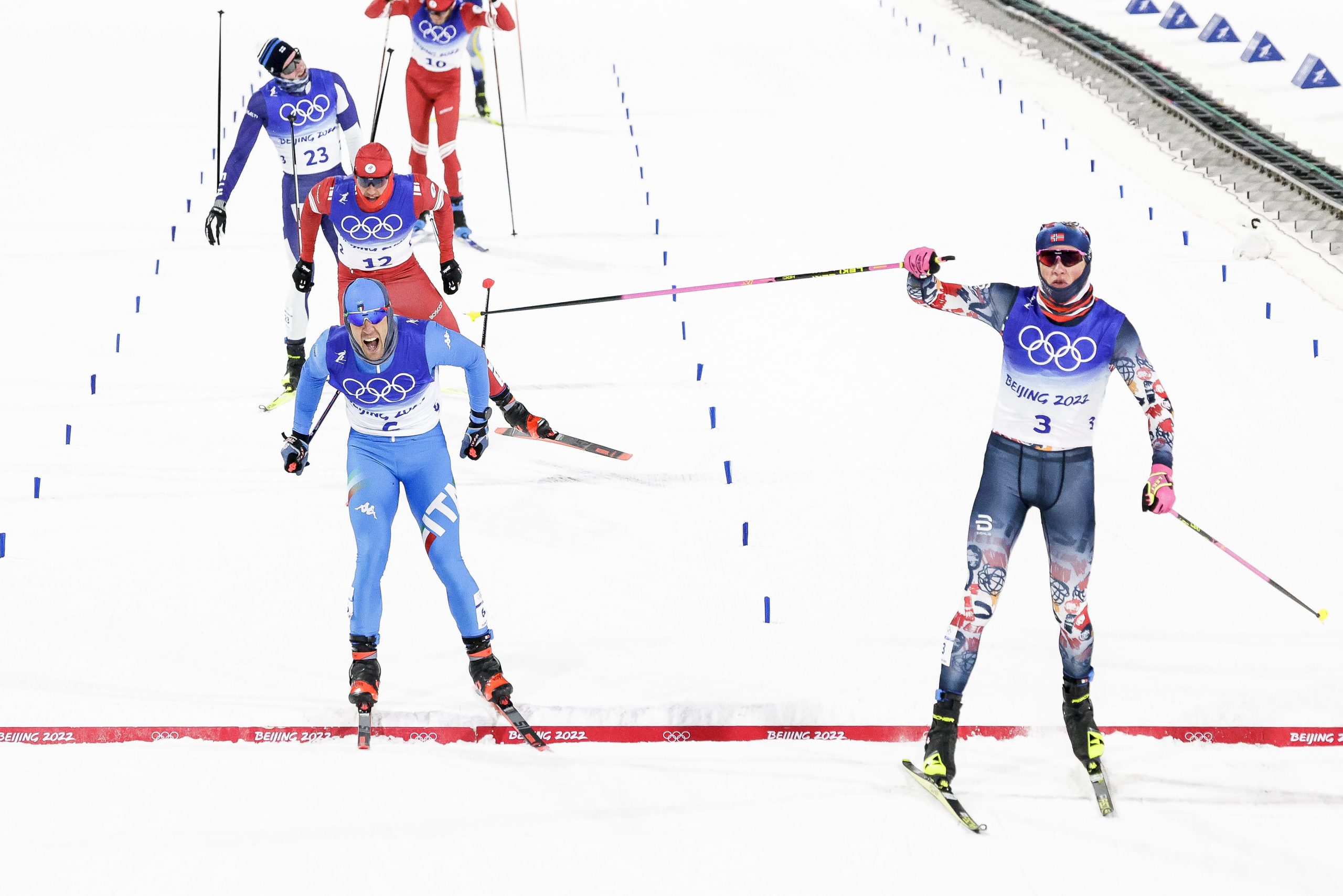
Johannes Høsflot Klæbo (NOR) crosses in 1st to win gold in the men’s 1.5 k individual sprint. Federico Pellegrino (ITA) follows in 2nd place to claim silver. Photo: NordicFocus.
There was no reeling him back. He came across the finish line an Olympic champion once again, defending his individual sprint medal and further building his case as one of the sport’s greats. Pellegrino pulled into the final climb and let out a final sprint that proved he is still Klæbo’s chief sprint competitor, four years on from establishing that fact in PyeongChang. The final step on the podium was occupied by Alexander Terentev, who, after a season in which he opened with a win, got to see his potential as an Olympic skier converted into kinetic possibility. He has one medal, and it would be a good bet that it won’t be long before he starts dreaming of the 1.5 k course that will be dreamt up for Milano-Cortina in 2026.
Which, on the men’s side as a whole, is where many of us Americans are too. Even in these first few moments after their arrival on the Olympic stage, there is an err of possibility, energy, and optimism in the air about where this crop of skiers goes from here. We could get carried away and let that excitement uproot us from the source of that optimism in the first place. So before we look forward, let’s remember that the act of converting optimism into action is tenacity, and we can cherish Kevin Bolger, JC Schoonmaker, Luke Jager, and Ben Ogden giving us an image clad in stars and stripes of that here, today, in Beijing 2022.
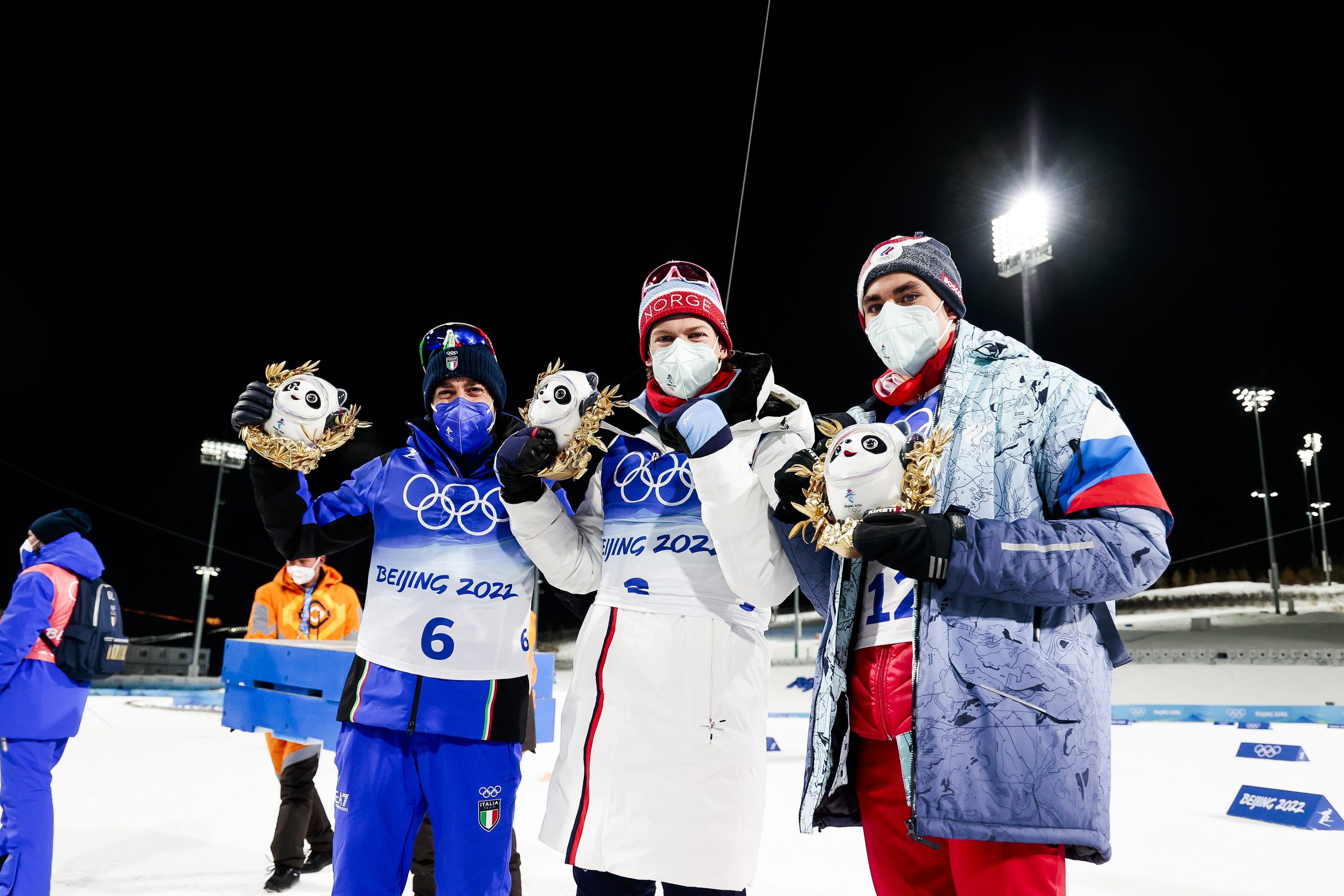
Men’s podium of the Olympic 1.5 k Individual Sprint in Beijing. Johannes Høsflot Klæbo (NOR) in 1st, Federico Pellegrino (ITA) in 2nd, Alexander Terentev (ROC) in 3rd. Photo: NordicFocus.
The Canadians also put up a set of strong performances in the sprint qualifier. Graham Ritchie finished 34th (+10.01), just 0.6 seconds out of qualifying for heats. The results continued with Olivier Léveillé in 54th (+17.23), and Antoine Cyr in 56th (+17.56).
The season’s biggest races start in less than a month at a venue that is by all accounts well-designed, but also has yet to host an official FIS race. Here’s some of what is currently known about the National Cross-Country Skiing Centre in Zhangjiakou, 100-plus miles northwest of Beijing in the Hebei province of China.
The Courses
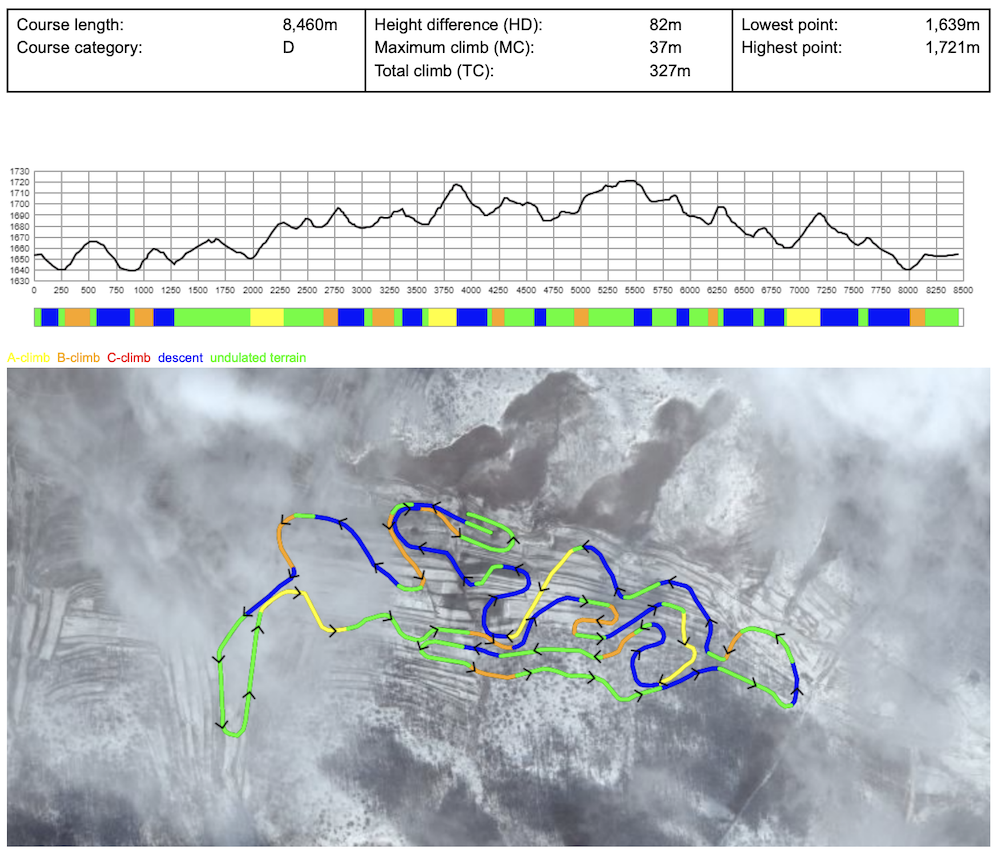
The races will be held at altitude. The stadium is located at an elevation of roughly 1,650 meters above sea level (appr. 5,400 feet), according to the homologation certificates, and the 8.3 k loop reaches an elevation of 1,721 meters. The last comparable global championship was the 2002 Winter Olympics in Salt Lake City, Utah, where the stadium in nearby Soldier Hollow is between those two heights. It is not coincidence that the presumptive American Olympic team is spending this month in some or all of Seefeld, AUT, Livigno, ITA or Park City, UT to log more time at altitude in advance of the Games.
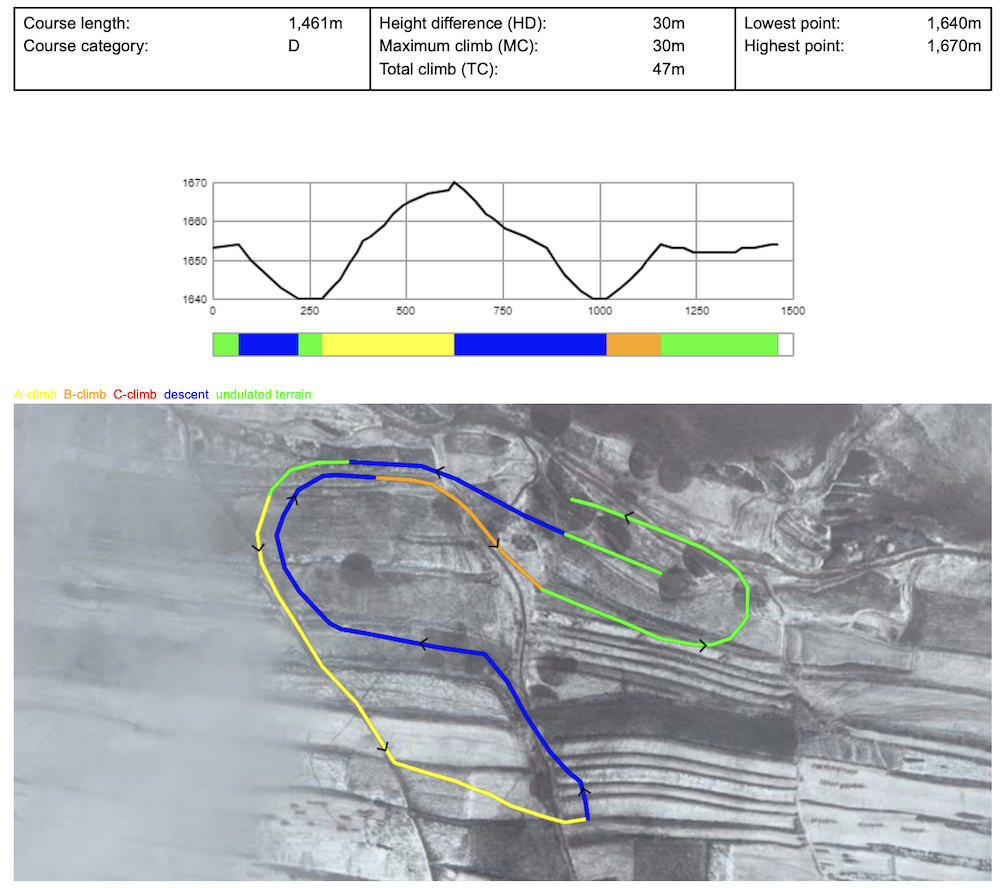
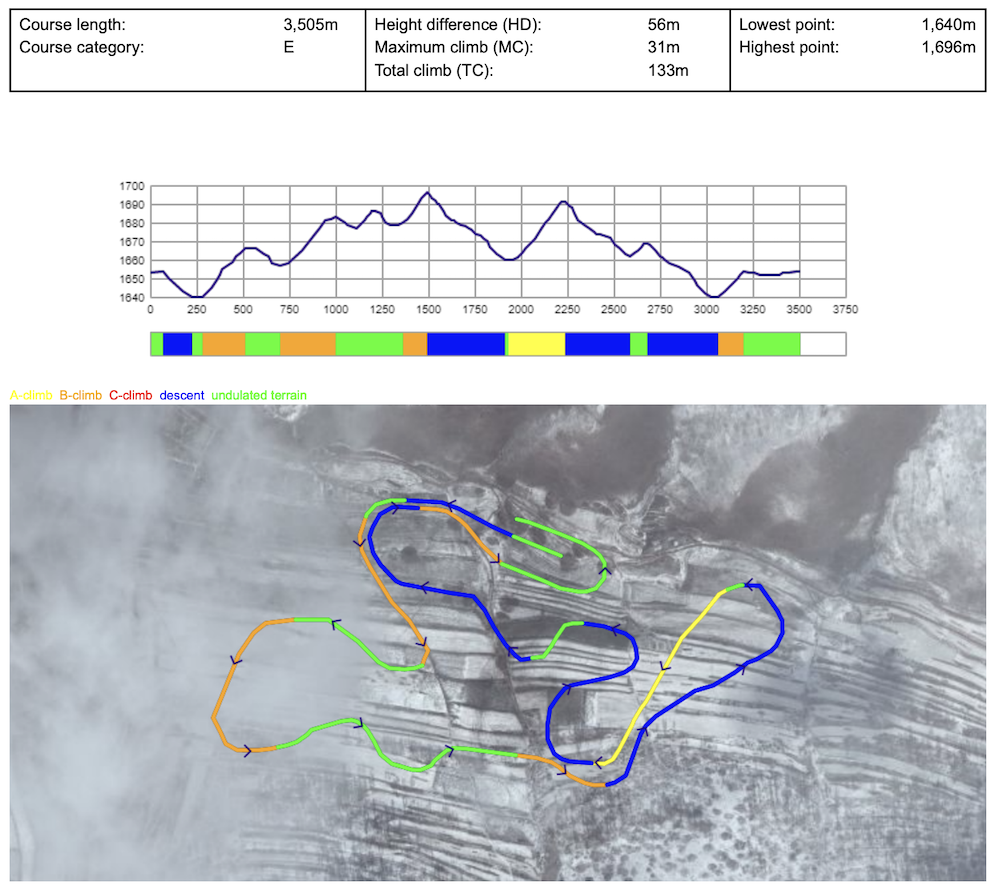
You can find full homologation certificates for all of the Zhangjiakou courses here. Here are excerpts from some of the course profiles. Note the color key, which indicates that an A-Climb is highlighted in yellow, a B-Climb in orange, descents in blue, and undulating terrain in green.
Zhangjiakou sprint course. (screenshot from FIS homologation certificate)Zhangjiakou 3.3 k course. (screenshot from FIS homologation certificate)Zhangjiakou 5 k course. (screenshot from FIS homologation certificate)Zhangjiakou 8.3 k course. (screenshot from FIS homologation certificate)
Going off of simple math alone, the sprint course features a maximum climb of 30 meters, the same as the sprint course in Falun, SWE. The distance courses feature roughly 39 meters of climbing per kilometer, at the high end of the allowable homologation range but very much in line with other championship courses. You can consult the homologation certificates for a more nuanced look at overall gradient, course flow, and associated statistics.
More holistically, the 14-meter climb back up to the stadium, in the final half-kilometer of all courses, is notable, at least in contrast to venues that feature a downhill into the stadium. A follow-up article in the next few weeks will compare this aspect of the Zhangjiakou courses to other recent championship courses.
Intriguingly, rumor has it that the warmup track at the venue is underground. This is perhaps less noteworthy in track and field, where major international stadia often have a small warmup track near the athletes’ call room, near bathrooms and out of view of spectators. It seems more notable when it appears to describe a ski tunnel–like environment.
Conditions
It is widely expected to be cold and dry. This was presaged in a research paper in the Journal of Science in Sport and Exerciseblurbed on this site last May, which was summarized as stating, “The Beijing venue has a very high probability of temperatures near the lower limit permitted for FIS races (-20C). Combining cold with higher elevation and low humidity results in suggested pacing adjustments to ensure good lung function at the end of races.” Matt Whitcomb, in discussing the Period 1 races held near this temperature limit early in this World Cup season, similarly referred to these races as being good prep for the Olympics.
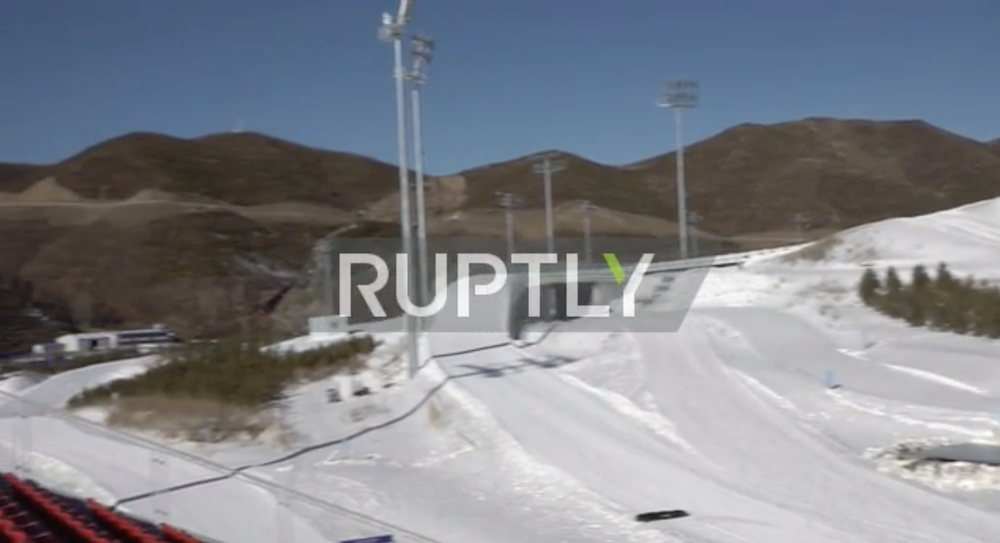
Screenshot image of Olympic venue in late December 2021, taken from video published on news site ruptly.tv. (original video)
Expect entirely manmade snow throughout the venue; natural snowfall in the region is negligible, and two weeks ago the ground was bare everywhere outside the ski trails and stadium (see background of photo above, or background of this Instagram post). A comparable preview article published two weeks ago on SkiRacing.com and discussing the alpine venue at Xiaohaituo Mountain (A+ title: “What to expect when you’re inspecting”) unpacks some implications of this for waxing and ski performance. This is not to say that precisely the same conditions will be present in Zhangjiakou, dozens of miles away at a different venue, but rather to flag some relevant issues to consider here.
For the alpine runs, for example, that author foresaw “average annual snowfall of 5cm/2 inches, high winds, very low temperatures, sunny days and clear nights,” all of which also describes likely conditions in Zhangjiakou. She also noted the possibility of “sand blowing in from Mongolia and debris from the massive earthmoving during trail construction” being present in the snow. She described one wax manufacturer formulating a “special series of Beijing waxes for extreme cold temperatures, extremely aggressive snow and massive daily temperature swings due to sun exposure.” This is all likely broadly applicable to conditions at Zhangjiakou as well.
What about the waxing
To paint in very broad strokes here on a potentially touchy subject, the American skiers appear to have had “good” skis for some races in Pyeongchang, but, shall we say, “not as good” skis for some races in Seefeld and Oberstdorf. Given that euphemistic use of “not as good,” keep in mind as you read this section the norms that generally govern reporting on or public statements about the efficacy of wax jobs in this country: By the time an athlete is expressing polite concern about her wax job to the American press, it is probably the case that her skis were, objectively speaking, noticeably worse than other athletes’.
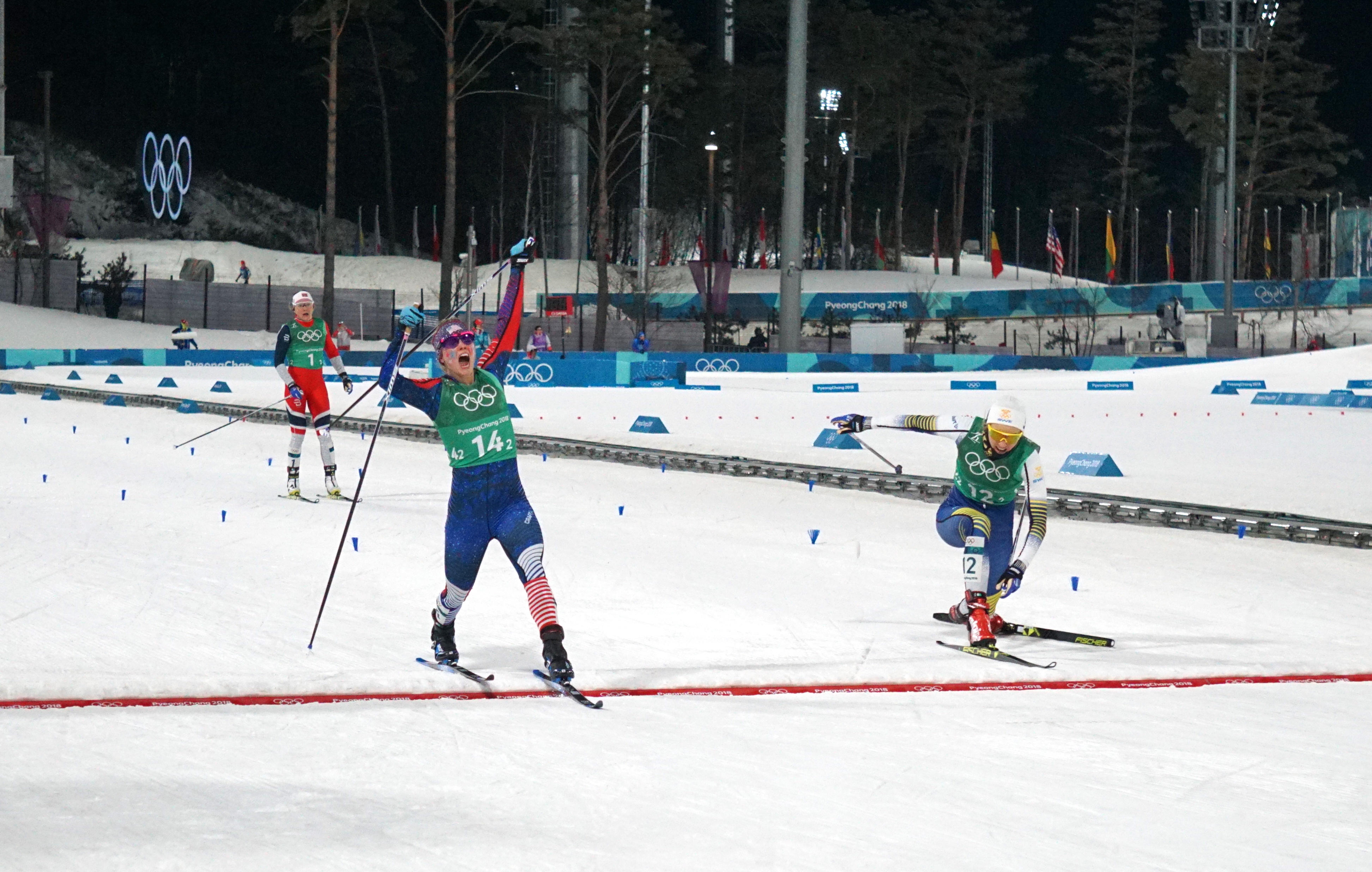
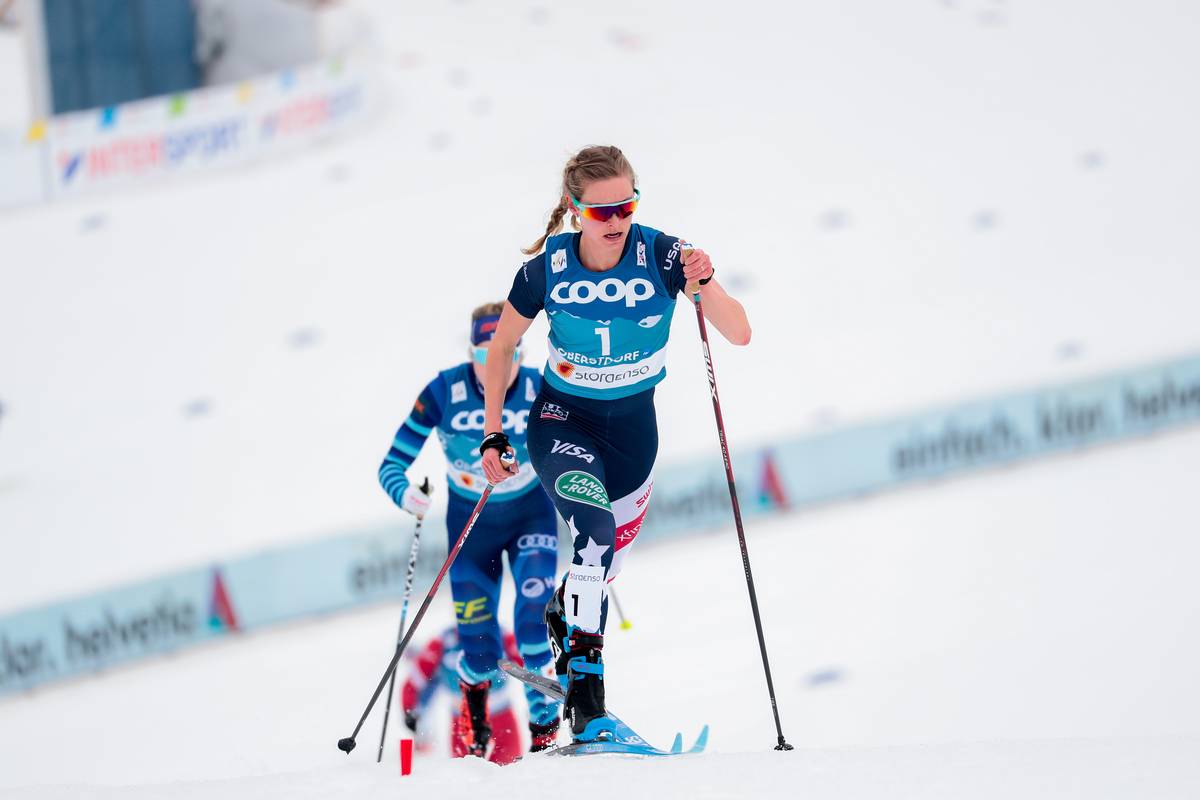
You may have seen this photo before: Jessie Diggins (14) edges Sweden’s Stina Nilsson (r) for gold, while Norway’s Maiken Caspersen Falla (l) races to bronze, in the women’s freestyle team sprint final at the 2018 Olympics in Pyeongchang, South Korea. (Photo: Noah Hoffman)
Regarding Pyeongchang, the 2018 Winter Olympics, if you’re reading this website you are probably familiar with a certain highlight that ends with Chad Salmela’s epochal cri de cœur (“Here comes Diggins!”). But rewind 56 seconds, to the descent off the top of the final downhill coming into the stadium, and you will see Diggins rocket into contention midway though the downhill. Her skis were, it appears from this video, at worst “competitive,” and at best “fastest in the field.” The air temperature for this race was -5.4 C and the snow temp was -10.1 C, according to the official results.
Regarding Seefeld, the 2019 World Championships, Sadie Maubet Bjornsen told this website, following the 30-kilometer freestyle at the end of two weeks of racing, that while she generally felt good on course, “It’s just so hard because you can’t control what you have on your feet a lot of the time.” She added, “At this level you have to have your skis at a level that can compete if you’re going to fight for a medal or even top 10, top 20. And there were some races this week that that was not the case.” Air temp for this race was +5.6 C and the snow temp was -0.3 C, according to the official results. (Disclosure: In this same article, teammate Jessie Diggins said, of the same race in the same conditions, “I had the best skis in the world.”)
Jessie Diggins races in the skiathlon in Oberstdorf, February 2021. (photo: Modica/NordicFocus)
Finally, regarding Oberstdorf, the 2021 World Championships, the ever-upbeat Diggins contemporaneously told this website, following a rough day in the skiathlon for the entire American women’s team, “I think that is so promising to see how well [my teammates] skied given the disadvantage that we had today. I think, to me, that is really impressive because it is easy to put together a good race when you have the fastest wax in the field. It is harder to just never give up and keep fighting [in less advantageous conditions], and to me, that is so much more impressive.” Air temp for this race was +3.2 C and the snow temp was -0.6 C.
Writing several months later in the Boulder Nordic Sport catalog (page 6 of this PDF), U.S. Ski Team coach and wax tech Jason Cork spoke more bluntly when discussing this race and the championships more broadly: “I thought Jessie should medal in the 10km, and she missed the bronze by 5.1 seconds. I thought she could medal in the skiathlon; I’ve never been more sick and angrier about screwing up skis as I did that afternoon. We’d hoped to finally get the women the championship relay podium they’ve been chasing since 2013, and we weren’t able to deliver skis competitive enough to make it a reality. It was warm and soft, course access was severely limited, we got outsmarted and outgunned. We stood in the way of a lot of dreams in Oberstdorf.”
Zach Caldwell, for his part, has voiced the opinion that the Americans’ relative lack of tech resources, specifically the lack of an on-site stonegrinder and a centralized grind system, has harmed them in the last two championships held in warm and sloppy conditions. If some of these premises are correct, then forecast waxing conditions in Zhangjiakou that are far more akin to those in Pyeongchang than to those in Seefeld or Oberstdorf could be beneficial for the American tech team. (Find more insights into the challenges ski technicians will likely face during the Games in the latest episode of The Devon Kershaw Show, featuring Caldwell. Spoiler alert: These dynamics are in fact a whole lot more complicated than just “cold = easy, warm = difficult,” and Caldwell knows a heck of a lot more about this area than this reporter, so you should probably listen to him.)
The first cross-country race in this year’s 2022 Winter Olympic Games will be the women’s skiathlon, held on February 5.
In this episode, we have Matt Whitcomb back to debrief the 2021/22 Tour de Ski, including highs and lows, overcoming setbacks, and managing a circulating head cold. We also discuss the cancellation of the upcoming World Cup races in Les Rousses, FRA, covid safety in a critical window before the Olympics, and the racing happening in Soldier Hollow during the 2022 US Cross Country Championships.
Thanks for listening.
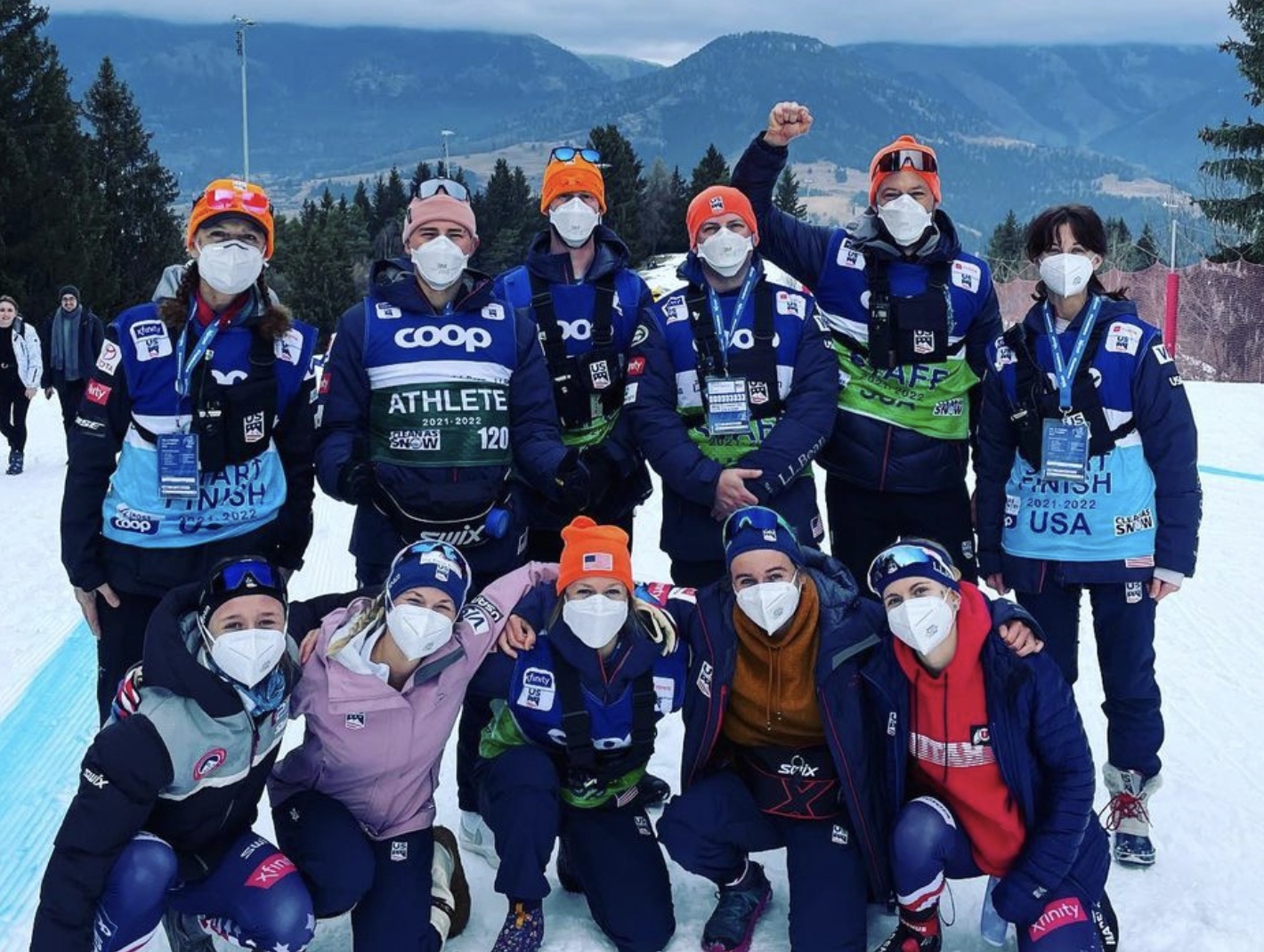
The American women who finished the 2021/22 Tour de Ski pose with coaches and support staff at the top of the Alpe Cermis. (Photo: Tom Horrocks / Instagram @jessiediggins)
Many readers will consume energy the next few weeks determining how and when to watch the Tokyo Olympics. The summer games feature 339 events in 33 different sports. Its Exhausting on many levels.
FasterSkier covers the winter side of the Olympics, which begin on February 4th, 2022 in Beijing, China. But, we’re here to glance at the Olympics in the news.
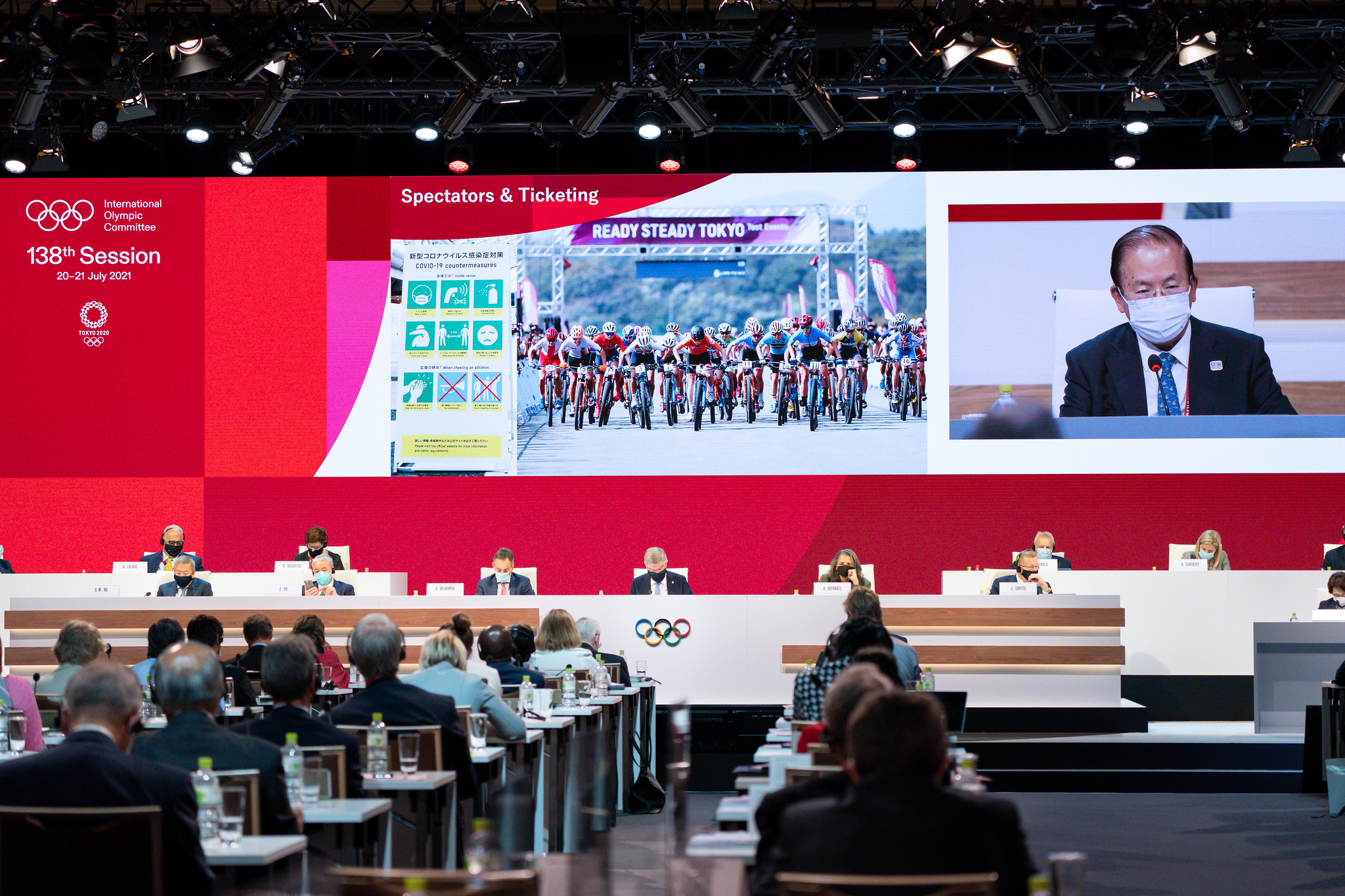
IOC President Thomas Bach during the first day of the 138th IOC Session at the Okura Hotel in Tokyo ahead of TOKYO 2020, the XXXII IOC Olympic Games. (Photo: IOC/Greg Martin)
The news coming out of Tokyo are the Covid-19 cases popping up here and there amongst foreign nationals entering the country for the Olympics. Those trends are compounded by a steep uptick of cases among Japanese citizens. As of July 19th, total cases in Japan approached levels not seen since January – a month often associated with easier transmission of colds and flu.
The New York Times reports this morning that three positive cases have been detected at the Olympic Village. Over twenty more athletes have tested positive outside those accommodations. The messages projected from stakeholders in Tokyo are mixed. Three days ago, International Olympic Committee chief, Thomas Bach, asked the Japanese Prime Minister to reconsider allowing some spectators if the pandemic improves over the short term. For now, spectators are banned from all competitions. Today, Toshiro Muto, head of the Tokyo Organizing Committee, said in a press conference, that if conditions worsen considerably the 2021 Games could be shuttered, but that the further decisions about the 2021 Games would be discussed in “five-party talks.”
With the persistence of Covid-19, variable access to vaccines, and a choice from some with access to the vaccine to forgo immunization due to safety concerns, the virus will likely be around in February 2022.
China is not Japan. There are many layers to that statement. Media, including the Internet, feels the heavy hand of state control in China. So data coming from China regarding Covid-19 infection rates should at least be viewed with eyes wide open. The Johns Hopkins University dashboard, an excellent resource monitoring global infection and vaccination rates, shows China’s situation contrasts Japan’s. According to the Johns Hopkins Covid-tracker, China reported 65 positive cases on July 19.
The regime in China also wields iron-fist power. It is likely that its ability to regulate the movement of its citizens during the Winter Games, especially if cases begin to spike next winter, is real. Despite China’s vastly larger population and geographic breadth, what is occurring in Japan now does not necessarily equate to a similar situation in Beijing when its time for China to host.
Heat and the Summer Games
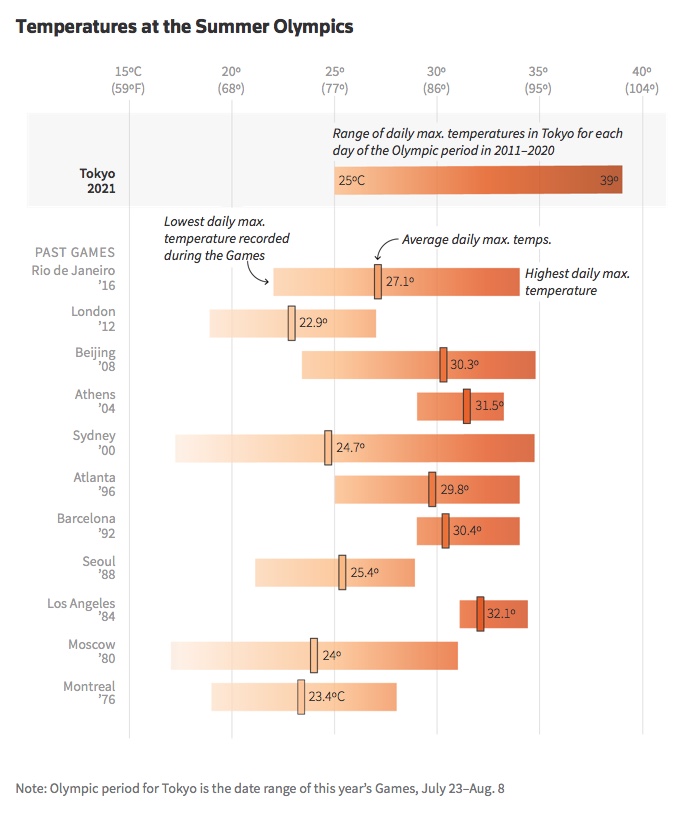
For those interested in high performance, you’ve likely monitored stories and research regarding training and racing in high temperatures and high humidity. Tokyo, if trends persist, should offer both conditions in the upper end of the spectrum. Reuters published an excellent infographic exploring the weather conditions athletes are likely to experience during the Olympics.
1964 was the last time Tokyo hosted the Summer Olympics. Back then, October was the chosen month for competitions. October in Japan presents markedly cooler average temperatures than late July and mid-August.
As the Summer Olympic quad comes to a close, the corresponding think-pieces about the Olympic movement have sprouted. One of many treatments on the topic, which is titled Let the Games … Be Gone? comes from the NYT’s John Branch. The subtitle, After bidding scandals, human rights outrages, overburdened host cities, rampant cheating, a pandemic — and, sure, thrilling competitions — has the world had enough of the Olympics? speaks to the central thesis of his argument. Branch, known as a deft wordsmith, writes about sports for the Times.
Branch quotes many of the most outspoken reformers we have heard from before, including former cross-country skier Noah Hoffman, and icon Edwin Moses.
This brings to mind efficient ways to take a deep dive into the politics of international sport, including the murky world of anti-doping.
It’s now been over a month since the release of the Global Athlete podcast, which Hoffman hosts. In full transparency, Hoffman is a friend, and we have covered him widely at FasterSkier.
If you are looking for lighthearted sports banter, look elsewhere. This podcast trends towards policy wonkishness, with just the right amount of detail for the keen fan or observer of the Olympics. So far, the podcast has delivered. A high-point episode for FasterSkier readers should be Episode 3: Current Athlete Representation Models with Beckie Scott and Han Xiao.
Scott is a retired Canadian cross-country skier who won a gold medal at the 2002 Winter Olympics after the top-two finishers were disqualified for doping. Scott went on to work in anti-doping advocacy as Chair of the World Anti-Doping Agency Athlete Committee and was an IOC member after being elected to the organization’s Athlete’s Commission.