From the FasterSkier archive — posts syndicated from athletes’ and coaches’ own blogs between 2004 and 2012, kept online as published. Current coverage is at fasterskier.com.

Tag: 2022 Beijing Olympic Games

  • Ben Ogden: Balancing Olympic and NCAA Skiing Ambitions Alongside a New Wave of Top US Skiers

    Ben Ogden: Balancing Olympic and NCAA Skiing Ambitions Alongside a New Wave of Top US Skiers

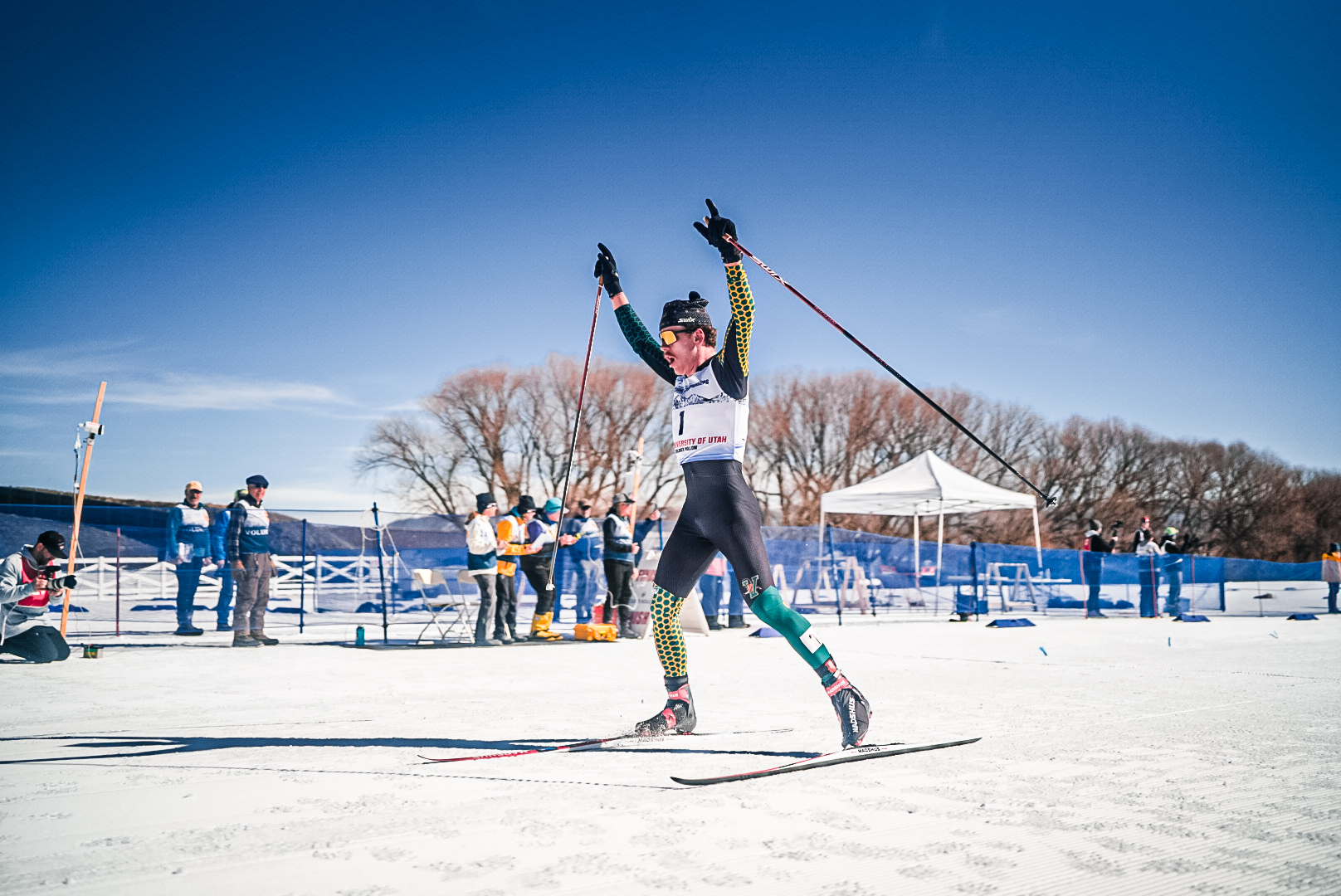
    Ben Ogden celebrates after sweeping the 2022 NCAA Championships in Midway, Utah. Ogden became 1 of only 4 skiers (alongside US Ski Team teammates Novie McCabe and Sophia Laukli) to win an NCAA Championship and represent the US at the Olympics in the same season. (Photo: Tobias Albrigtsen / @untraceableg)

    “So after the World Cup, Olympics, and NCAAs, is that it for you this season?”

    “Well…I think I’m going to race the Rikert Grand Prix this weekend.” (He won).

    I couldn’t have stumbled upon a more apt soundbite to describe Ben Ogden, and he offered it up ten seconds into our interview.

    Skiing for the US Ski Team and University of Vermont (UVM), Ogden is primed to write the next chapter in American men’s skiing – a Vermonter who can’t help but love Vermont skiing, a racer who races for the sake of racing. He’s also an author that you get a sense doesn’t want to quite yet claim that he is holding the pen.

    For now, then, that pen falls to me:

    “If young potential was representing a country, it would have been draped in an American flag.”

    I wrote that after the first day of World Cup racing this season in Ruka last November. Ogden, alongside US teammates JC Schoonmaker and Luke Jager – all 21 or 22 years old – had sprinted their way to top 10 qualifiers in the classic sprint. (Schoonmaker eventually made the semi-finals).

    It was a line that proved to be a thesis for the US Men’s Ski Team during the 2021-22 season. Each result from Ogden and his teammates – neatly introduced to the world when they won the team relay at the World Junior Ski Championships in 2019 – backing up the argument that the youngest US men were ready to mix-it-up with their European counterparts at the sport’s highest level.

    For Ogden, that included a slew of World Cup results in Periods I and II, an Olympics highlighted by a semi-finals appearance in the classic sprint in February, and an NCAA Championship sweep in March.

    The juxtaposition in those latter two highlights is cause for pause, so again:

    In the same year that Ben Ogden raced the Olympics, someway and somehow, he won an NCAA Championship.

    That confluence of talent and time has happened exactly twice before Ogden, and once after. The first before came a half-century ago, when fellow Vermonter Stan Dunklee represented the USA at the 1976 Innsbruck Olympics before winning NCAAs a couple weeks later. The second before came a mere two hours prior to Ogden, when Novie McCabe (University of Utah) won the this year’s women’s 5 k Classic NCAA Championship. Likewise, the one time after came when Sophia Laukli (University of Utah) won this year’s 15 k Freestyle NCAA Championship.

    In other words, those who race in the stars-and-stripes were able to will those stars to align in a way that’s never been seen before. Once there was a lone skier able to accomplish the Olympics-NCAA double, and now, after a week in Utah in 2022, there are four.

    That represents a paradigm shift in American skiing: a generation of skiers reaching the top of the sport younger than ever before, without allowing themselves stray too far from the American skiing community in which they grew up and remain an integral part in sustaining.

    In an interview with FasterSkier, Ogden provided insights into the underlying attitudes that are driving that success among his cohort of top American skiers, with one theme pervading throughout: skiing fast means “skiing” –the places, people, and feelings of joy for which that word comes to connate.

    Ben Ogden celebrates back-to-back NCAA titles in style while cheering on the women’s field in the 15 k Freestyle Mass Start. (Photo: Tobias Albrigtsen / @untraceableg)

    This interview has been edited for length and clarity.

    On goal-setting for the Olympics and college skiing through the pandemic:

    FasterSkier/Ben Theyerl (FS): There’s been a lot of different levels you were competing on this year – Olympics, World Cup, NCAAs, and now citizen racing – what were you looking at in terms of goal setting coming into this season?

    Ben Ogden (BO): Yeah, I knew this year was going to be a big year for goals for me. If I’m honest, a lot of that was because the last two years drove home that you can’t take anything for granted in terms of opportunities.

    In a way that pushed me to say ‘you need to try and have your cake and eat it too,’ which meant going to the Olympics and going to NCAAs. That felt weird to shoot for because I knew there were things that were completely out of my control which could keep that from happening. For instance, if I ended up getting COVID while in Beijing, or if I was contact traced, I wasn’t going to be home in time to race the Carnivals I needed [in order to qualify for NCAAs].

    I really wanted to do both because this is the only time I could. But I didn’t dare fixate on it too much. It just felt like it would be such a horrendous disappointment if something happened, and I couldn’t. So, in the first half of the season, I really tried to keep my priorities on the World Cup.

    I had smaller goals there too, [like advancing] to a semi-final in a Classic Sprint, or qualifying in a Skate [sprint],

    Like I said though, ‘having your cake and eating it too’ was the big goal, and it’s just unbelievable that it could happen not only for all three of us – JC (Schoonmaker), Luke (Jager) and I – and also Novie (McCabe) and Sophia (Laukli) on the women’s side. We were all thinking the same way.

    It was [our] only chance to do the Olympics and NCAAs and it happened.

    FS: That is a pretty sweet moment where the stars aligned…

    BO: It’s totally crazy. I mean, like I said, the big thing I went into this season with was the idea that this was my only chance to do [the Olympics and NCAAs].

    It made me lucky too. I came into NCAAs with this confidence I took from the rest of the season which was an insane mental advantage. Having results on the World Cup and at the Olympics represented steady progress on other goals that made me ready to complete [the NCAA] one.
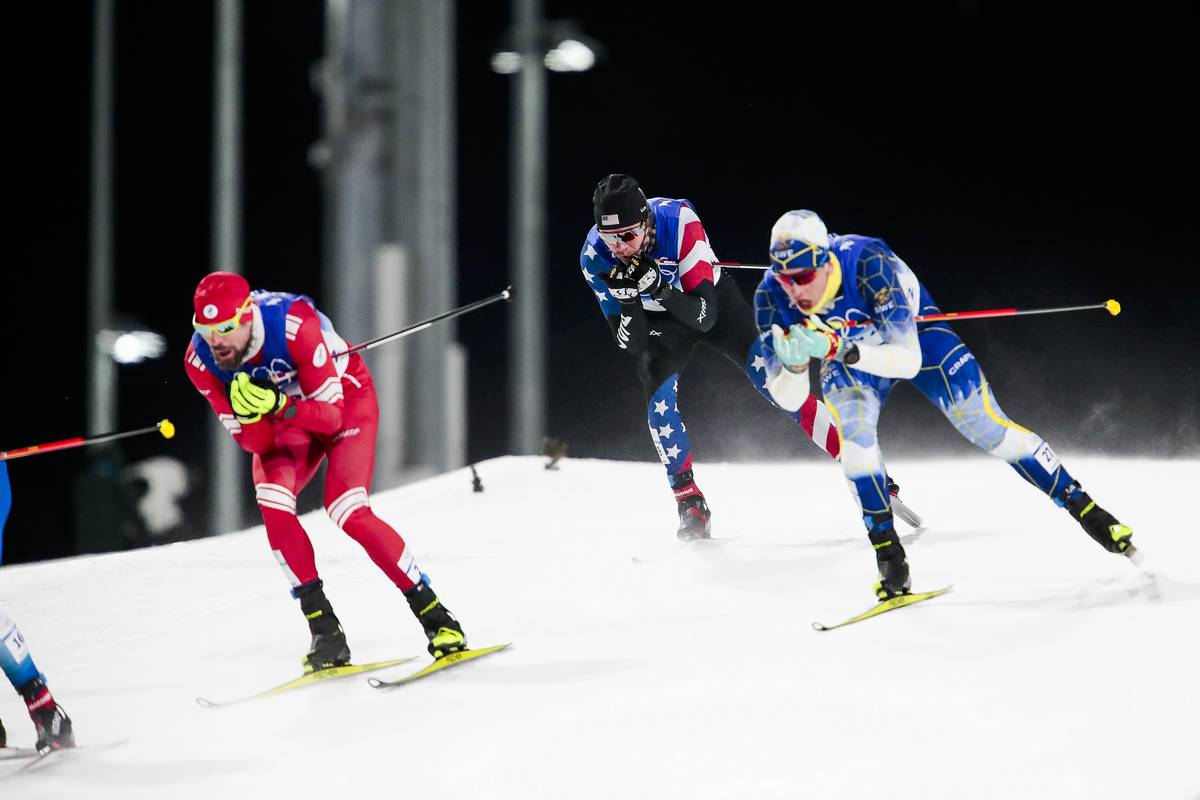
    Ben Ogden races the quarterfinal of the men’s freestyle sprint during the 2022 Beijing Olympic Winter Games. (Photo: NordicFocus)

    FS: When did those goals that you accomplished this season get set? You took your first NCAA title at the 10 k Classic in Bozeman (in 2020), and then COVID hit before you could go for the 20 k, and everything got weirder from there. How did that affect your long-term goal making?

    BO: Bozeman was such a weird experience. What I took from that was actually more of a shift towards my approach to NCAAs this year. I sort of felt like I checked off the NCAA win from my list of goals at Bozeman, so my goals were more team-oriented [for UVM]. That meant trying to get everybody psyched, make a connection with the Alpine skiers, and see if we could get them fired up to lift UVM to a great team finish.

    FS: You certainly did your part on that front. You became the 14th male skier to sweep NCAAs*. You’re also the first male American-born athlete to do so**. Any reflections on what that means to you?

    BO: I’m really proud to put my name on that list, obviously. There are some really talented skiers who have done [a sweep] in the past. Like I said, I was really obsessed with the team scoring, so I was focused on doing everything I possibly could there and didn’t realize I was the first [male] American ever.

    But that feels really good.

    FS: This is me being a reporter here, but to me that speaks a lot to you and the group of guys you’re with on the US team who are really pushing American skiing forward. Like that checks off a big box with an American doing that at NCAAs.

    BO: Totally, it’s another thing to be really proud of between all of us.

    On following his sister Katharine’s NCAA Success:

    FS: I should add that while you were the first American man to complete an NCAAs sweep, you weren’t the first Ogden. I have to ask, was Katharine having done this a couple of years ago (KO swept NCAAs at Steamboat Springs in 2018, she also won the 15 k Classic in 2019) on your mind going into this year?

    BO: Oh yeah. It’s kind of funny, actually. I remember last year, I tried to petition the NCAA to race at Nationals because I couldn’t race some Carnivals due to COVID restrictions. When my petition wasn’t accepted, I remember thinking to myself, ‘Well, there goes my only opportunity to tie Katharine.’ But that was more of a funny thought than a driving force for me. I told someone else that was asking me that it didn’t matter if I tied her number of wins. But to do it was pretty cool…

    I should be clear though, my wins certainly weren’t in as commanding a fashion as hers. I remember going to Stowe when I was a freshman [in 2019] and while we were warming up for the 20 k I turned my head and was like, ‘Oh, there goes Katharine’ and there was no one else in sight. It was like, ‘My gosh, this is insane.’ That’s not even talking about Steamboat (in 2018) which was pretty darn cool. She not only swept, but helped carry Dartmouth to one of their overall better finishes.

    So yeah, all that makes it feel really good to match her in wins and take UVM to a 2nd place, which is pretty exciting for us.

    Dartmouth freshman Katharine Ogden racing to her second-straight victory of the 2018 NCAA Skiing Championships in Steamboat Springs, Colorado. She won the 15 k freestyle mass start by more than 38 seconds. (Photo: Dartmouth Sports/Clarkson Creative)
    On UVM and college skiing this year, and their place in his development as a skier:


    FS: On that UVM front, your team was really back to dominating the EISA this year. How did that come together? And how has that program helped you develop as a skier the past few years?

    BO: When I was a freshman, we had a bunch of older guys on the team that were getting UVM great results. When they graduated, we were still very good in the EISA, but we weren’t quite as dominant. It took some time to get back.[For example,] Jacob Nystadt, our Swede, is a sophomore this year, and it was the first year he could figure out the rhythm and training that works for the college circuit (after the EISA raced an abbreviated season last season).

    We have such a talented team and push each other hard in every interval. Everyone helps out with the motivation, and we’re all on a very high level where we know it’s not just about training hard, but training smart as well.

    One of our strengths is that we all have a different upbringing and bring something unique to the table. Our NCAA Championship team this year was a Norwegian, a Swede, and an American, and beyond that there’s even more geographic diversity from across the country and the world. That all comes together to build and balance training, and then we can put it all together on the racecourse.

    FS: How does (Patrick) Weaver (UVM Head Coach) contribute to that? How do you and him work to balance the NCAA skiing along with the World Cup side of things on the US Team?

    Patrick Weaver: UVM’s Head Cross-Country Coach. (Photo: UVM Athletics/NENSA)

    BO: Patrick has been a huge part of my development as a skier. I feel like I’ve gotten so much stronger in my four years at UVM, and that’s all due to him. I think our philosophies towards skiing line up remarkably well, which comes from him having a similar experience – being an Olympian, being on the World Cup, skiing professionally for many years, but still wanting to, and having, skied in college. At every turn, he’s had advice for me that comes from the perspective of someone who really wants me to succeed in skiing on all levels. He’s not just interested in seeing me do well at NCAAs or at Carnivals, but instead supports me no matter what I want to do.

    This year there were a few moments where it looked like it might be questionable whether I could race World Cups and make it home to compete in some Carnivals. But when it came down to it, Weaver left the decision up to me, which really made a difference. If you have a coach trying to force you to do something that you don’t want to do, it’s not conducive to happiness in your skiing. And Weaver stresses that; happiness is the driving factor towards speed. You can train like a madman, be in the best shape ever, but if your head isn’t in the right place, and you’re not doing what you think is important, then you might as well not be training at all.

    Weaver’s understanding of that was a huge part of my ability to achieve my goals this year. College skiing is where I’m happiest, he knows that, and his understanding of why that is a big part of our ability to achieve our goals as a team this season.

    FS: Within that season, was there a moment where you got nervous about whether the NCAA Championships were going to be possible? Like when you went to the [first race of the year] at Colby, and they cancel the second day (due to cold weather), did it make you go, ‘Crap, I need to find another Carnival now?’

    BO: Oh yeah. That was a case in which Patrick and I were talking and like, ‘Oh gosh, this could be the end right here.’ We changed my plans to book a flight home from [the Olympics] on February 17th so that if I needed, I could race just the second day of the Middlebury Carnival on February 19th. It would have been insane, but I would have done it just to get the points I needed.

    Patrick talked to the EISA and thankfully all the coaches were like, ‘No, that’s totally fine. Three races (all of which Ogden won) and the Olympics are plenty to qualify [for NCAAs].”


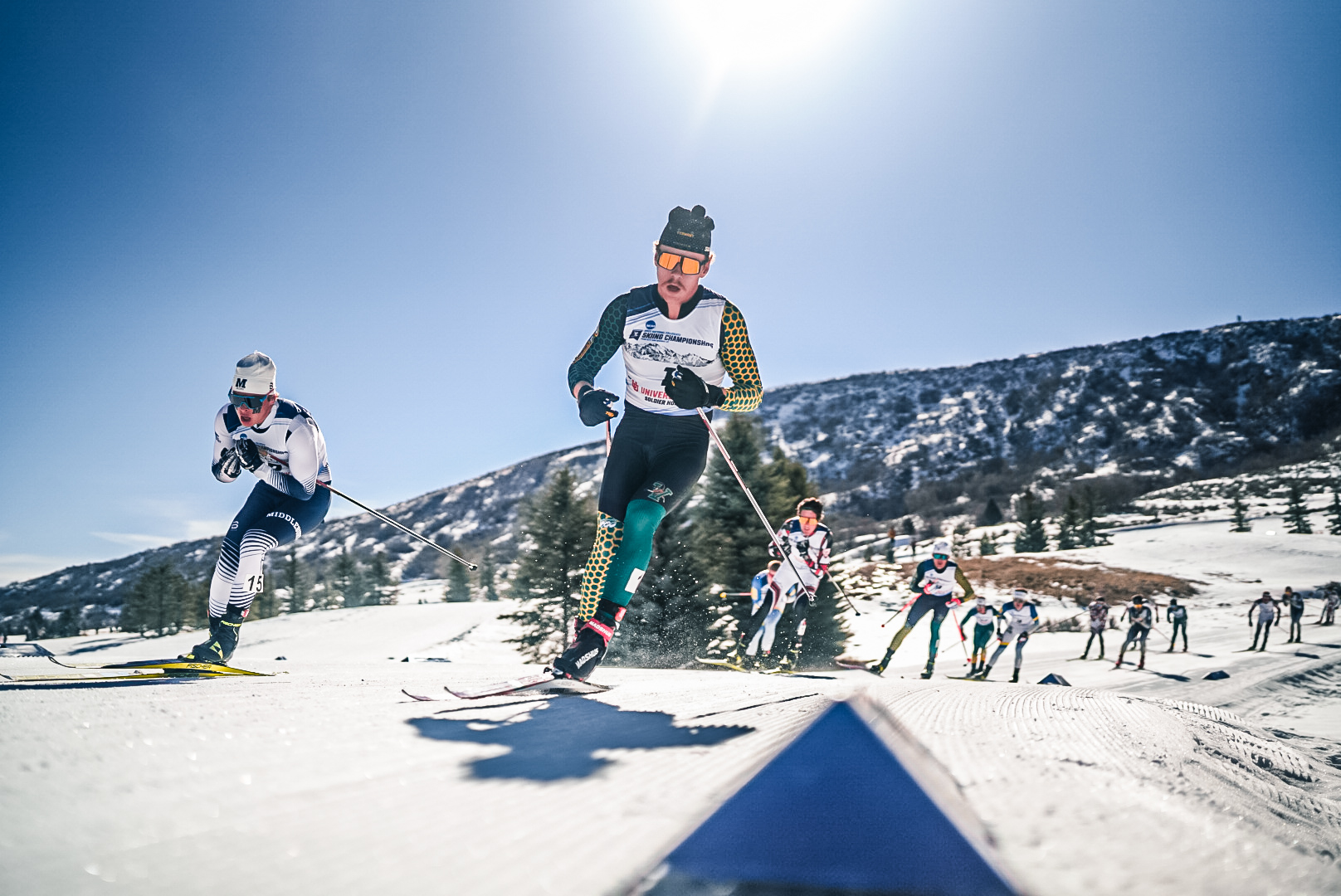
    Ben Ogden races for the win in the 10 k classic during the 2022 NCAA Championships in Soldier Hollow Utah. (Photo: Tobias Albrigtsen / @untraceableg)
    On the fun of racing the NCAA Championship Mass Start:


    FS: Did you end up watching the NCAA 20 k footage at all?

    BO: Yeah, actually, I did.

    FS: I was curious what your race plan was going into that mass start?

    BO: Haha, well you know, and I think you can tell by watching that race, I’m not exactly known for my detailed race plans. In that race in particular I knew that I was going to have to be careful – the alpiners (from UVM) and all my friends I grew up skiing with in Vermont were out there, and with them cheering from lap one there was a good chance I just got revved up and went for it then.

    I figured my best chance at winning would be to wait until the last lap and try to make it happen there, but then, you know, I was riding a high from winning a couple days earlier and the dream of winning off the front kept popping to my head. If you watch the race closely, you saw my move on lap four (of six), which was the definition of wishful thinking.

    I went up that hill, came around to take a feed on lap five and I was like, ‘Oh God, what have I done?’

    But I ended up finishing the race and got away with it.

    It’s funny because so many people after the race were like, ‘Oh man, you’re built different, you’re toying with the field out there’ and I was like, ‘Oh that’s not at all how it felt.’

    FS: You can count me in that lot. I was watching you bounce back and forth at the front going, ‘Man, he’s like the leader of the peloton, he’s got it under control!’

    BO: (laughs) Well on Cabin Hill, it didn’t feel like that. We went up the Hollow and I looked around at who was with me and thought I was maybe playing for a podium. I was able to tuck into the pack to stay up in front, and then Bernie (Flaschberger, from Denver University) went forward on one of the sprint hills. I thought he was going to drop us, but I tried to ski up and was surprised that I could stay with him. That’s when I began to think maybe I can do this, and so I went for it. Again, it was the extra confidence for sure.

    FS: I think for us, who watch you on the World Cup all the time, it was a different side of your racing to watch. To see some of the maneuvering was pretty cool.

    BO: I tell you man, it’s a real treat to race at the front of a mass start. I did quite a few mass starts on the World Cup this year, but there I’m starting in bib 70, the accordion in the field is so aggressive, and it is just so hard to move up.
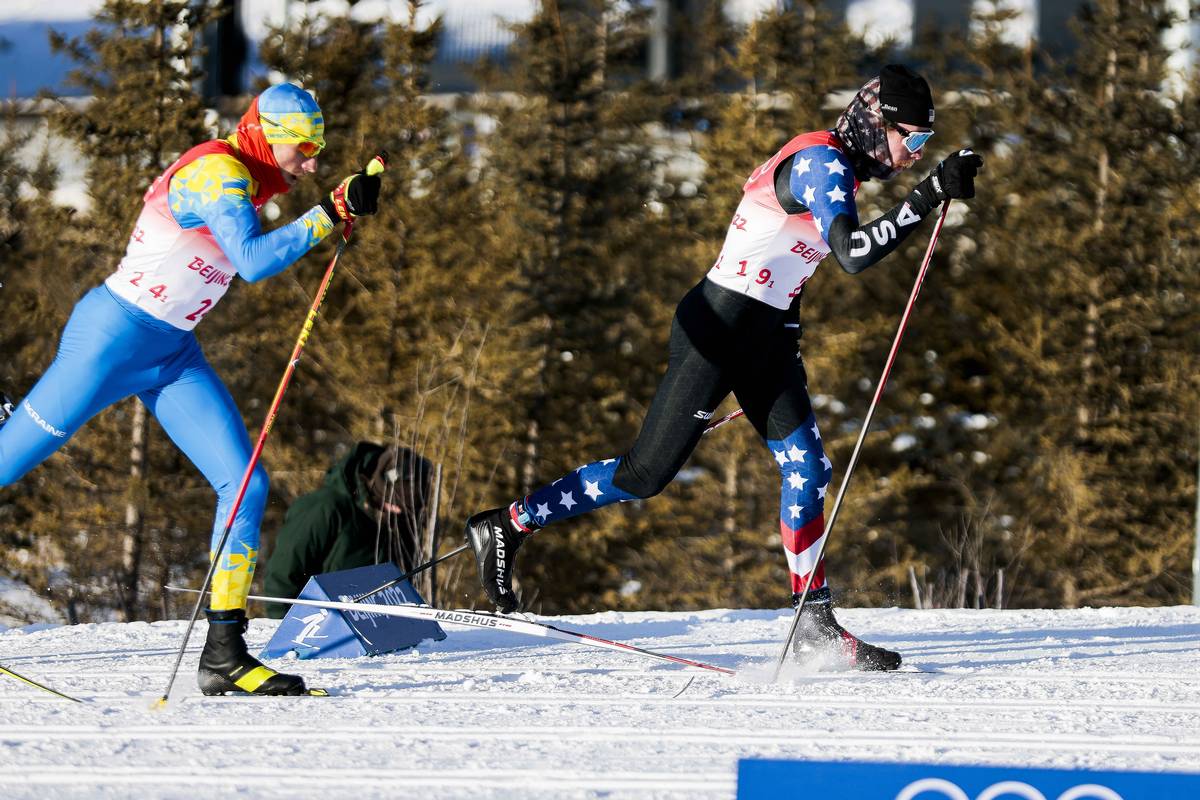
     

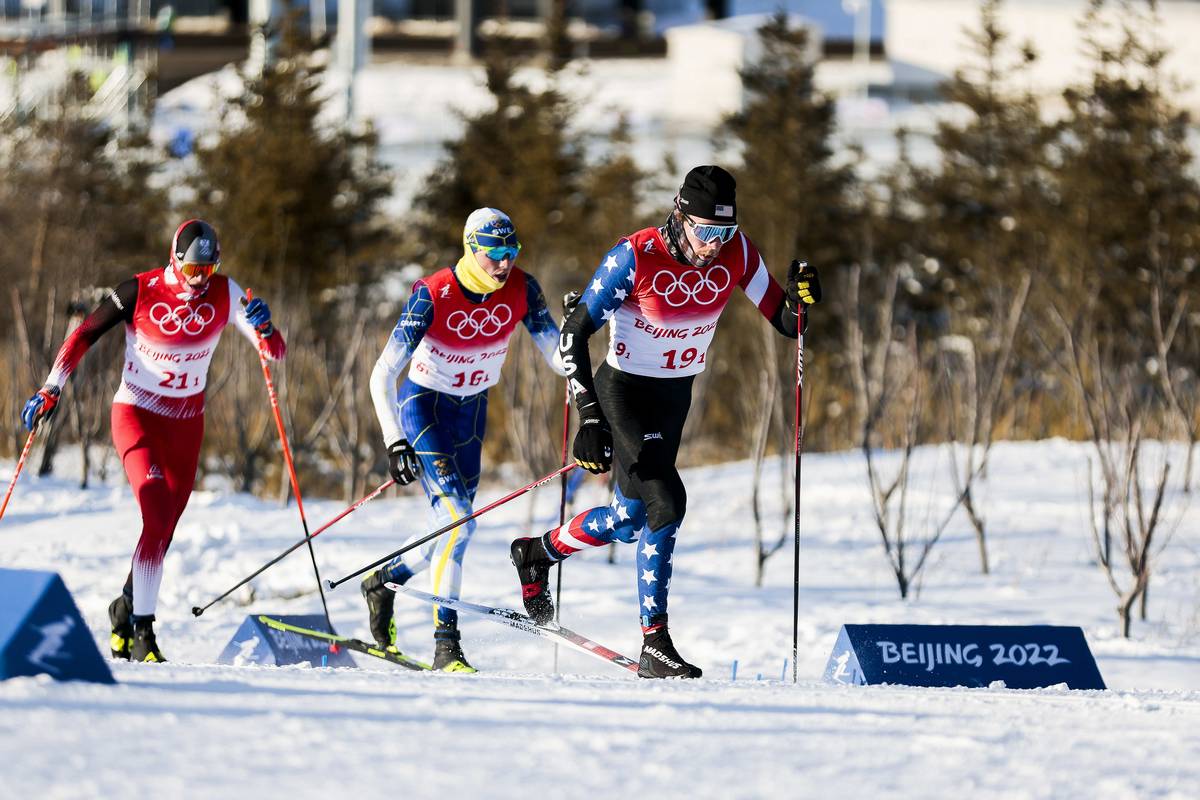
    Ben Ogden (USA) pushes up the A-climb in the the team sprint semifinal at the 2022 Beijing Olympic Games. Ogden and teammate JC Schoonmaker went on to finish 9th. (Photo: NordicFocus)
    On the US Ski Team’s success this season, and what comes next:


    FS: I know you’re racing the Rikert Grand Prix this weekend, but with your season being pretty much over I was wondering if you’d be willing to share some early reflections on a pretty amazing season for you and your teammates on a lot of different fronts?

    BO: Yeah, I’m really happy with what I’ve done this year.

    FS: Do you have an early favorite moment at all?

    BO: Again, it’s early still, but I would be surprised if there’s a lot of moments in my ski career that rival that 20 k at NCAAs as far as how cool of a race it was. There were so many people that I knew out there cheering, and then after it was just instant happiness with everyone out there. Good race, bad race, whatever, everyone was ready to relax, cheer on the women’s race, and just enjoy the most perfect day in the Utah sun. Can’t ask for anything more than that.

    I shouldn’t discount the moments on the World Cup that were a lot of fun either. Reaching the semi-final at Davos was really exciting, and then the semi-final at the Olympics after was a crazy, cool race. Those are the moments that motivate me for World Cup racing in the future because I wasn’t on the top, but I got a real taste of what it’s like to be in the mix.

    The big takeaway from this year for me is that the best skiing happens when you’re having fun, and I couldn’t be luckier with the group that I have [at UVM] and that I’m with on the World Cup. JC, Luke, and Gus – they really are my best friends, skiing or not, which is incredible. With being on [those] teams, you’re somewhat placed in those groups randomly, right? They don’t choose the World Cup team based on personality. And yet, if you have a good group, it makes the World Cup experience 1000 times better. I’m sure that there will be seasons and races in the future where we’re not quite feeling like the kings of the world every other weekend. That’s when I’ll come back to memories from this season and remind myself of what’s important.

    FS: It’s pretty darn cool to watch you guys. My coach Tracey Cote at Colby used to say when she started in college skiing back in the late 1990s she would watch the World Cup and the Carnival skiers and they didn’t look anything alike, and maybe five years ago, she said we’d gotten to where Carnival skiers were starting to look like those skiers on the World Cup. I think with you, it’s the next step – the Carnival skiers are on the World Cup. Do you guys have a notion that you’re pushing the sport forward, especially on the men’s side, in the US?

    BO: A little bit, but I think that’s more something people say to us than what we’re focused on. 

    I think for us it’s demonstrating that racing in College is fun and we all understand that the World Cup can be too. Sometimes, people just take themselves way too seriously on the World Cup, and I think that only serves to detract from their ability, and at the end of the day, their happiness too.

    I guess it feels like we’re pushing the limits a little bit by doing that, and with our results, but really one of the things that makes us all so cohesive is the shared sense that what we dream of in skiing is a lot bigger than what we’ve done so far.

    With that sense, every race sort of feels like it’s already a piece of the past, if that makes sense. For example, that sprint at the Olympics was awesome for me, and I patted myself on the back. But then again, I looked around and everyone on the team could say ‘Your dream is to be better’ and because of that I can see myself being in the final or on the podium one day.

    I know the other boys think the same way, and that’s what is really fun about the whole group. We all finish a race and we’re all already talking about what we could have done better and what type of training is going to help make us faster in that realm. And now, because of that, we’re motivated, and we’ll talk about it all summer and train together too.

    Ben Ogden and JC Schoonmaker at the finish of the team sprint at the 2022 Beijing Olympics. (Photo: NordicFocus)

    FS: Yeah, like one of you guys said in a comment to Nat (Herz), [FasterSkier’s Olympics Correspondent], that there was a race at the Olympics where you were skiing along and Klæbo passed you, and you were like ‘holy crap I can ski with him, even if it’s just for a hill. Like, the goal is one day to ski with him much longer but that’s down the road.’ I thought that was a great metaphor for where you guys are in your skiing right there.

    BO: That was definitely me in the 15 k classic. He lapped me and I skied with him up the hill and then over a little of the flat, and yeah, he beat me by how many minutes? But you know what, for that five-minute stretch there I could ski with him. That gives you an idea for what it takes to be where your goals are. I’m glad you picked up on that.

    FS: Lastly, with you being a senior undergrad at UVM, I wanted to see if you could give us any leads on where we might see you skiing next year?

    BO: I don’t know exactly. I’m just starting to get my head around it after NCAAs, but I’ll have a meeting with Weaver and see what he thinks and talk about what I want to do. I had big plans to just do an accelerated master’s in Engineering and stay at UVM for a fifth year. That was a year ago though, and then between the Olympics and World Cup I ended up missing 7 weeks of school. So, I had to ease off on that.

     It comes down to aspirations outside of skiing, which I definitely have, but with things taking off like they have this year I probably see myself doing something similar to this year at this moment. I don’t not see myself in school next year, and I still hopefully can balance it with whatever comes next with the next ski season.

    FS: Well, wherever life lands you, I know I speak for a lot that we’ll be looking forward to seeing you ski, and congratulations on an incredible season.
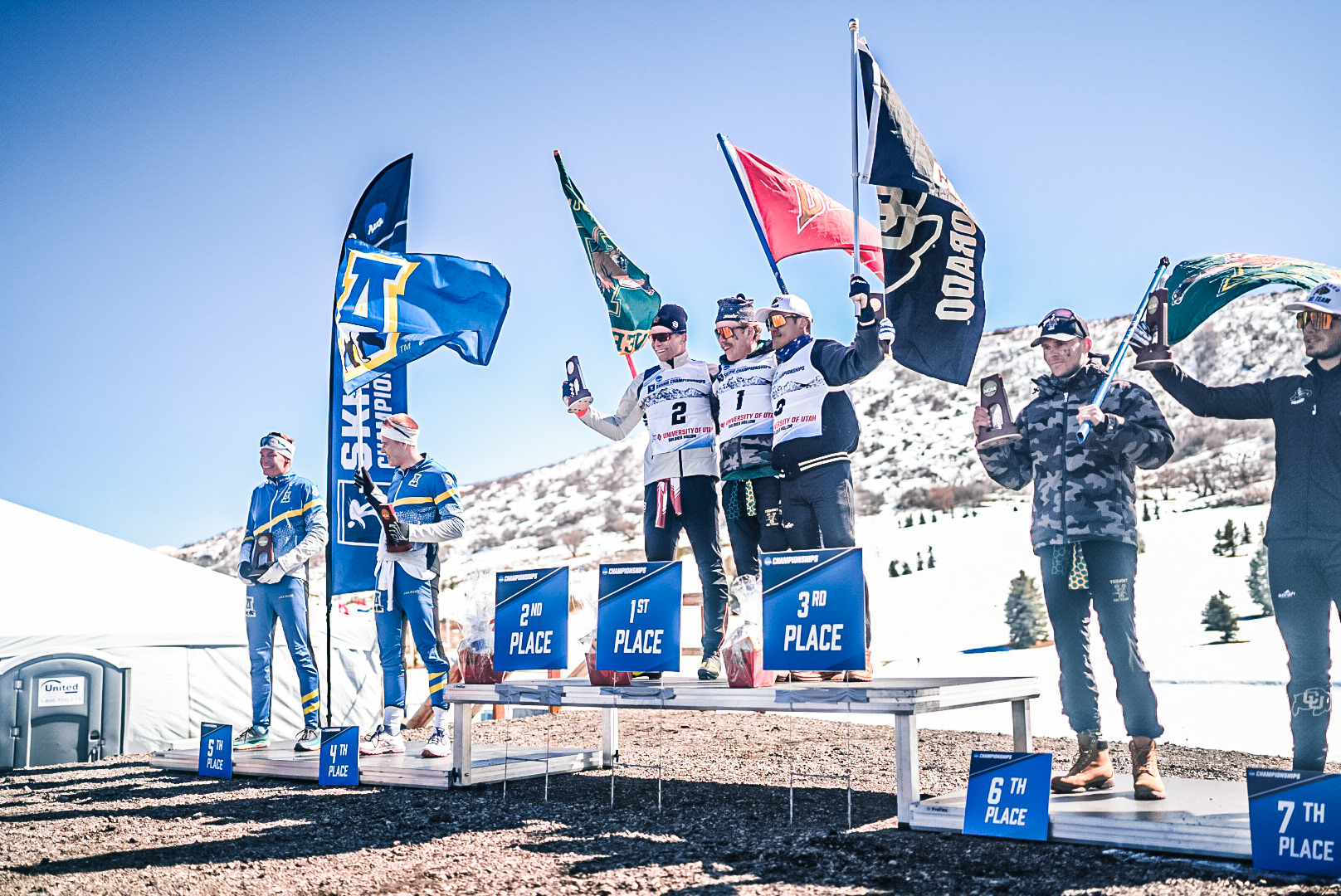
    The 2022 NCAA 10 k classic podium: Ben Ogden (Univ. of VT) took the win ahead of Andreas Kirkeng (Denver Univ.) and Magnus Bøe (Univ. of CO). (Photo: Tobias Albrigtsen / @untraceableg)

    NCAA History Notes:

    *Ogden is the 9th skier to win NCAAs in its current format, winning both the 10 k Classic and 20 k Freestyle. This format has been skied since 1989. In the decade prior to the change from 1980-1988 five skier swept NCAAs by winning both a 10 k Classic and 3 x 5 k Classic Team Relay.

    **Ogden is the 2nd American citizen, after Norwegian immigrant John Aalberg completed a sweep for the University of Utah in 1984.

  • Diggins Brings Home a Second Silver for USA in Windy 30k; Johaug Earns her Third Gold of the Games

    Diggins Brings Home a Second Silver for USA in Windy 30k; Johaug Earns her Third Gold of the Games

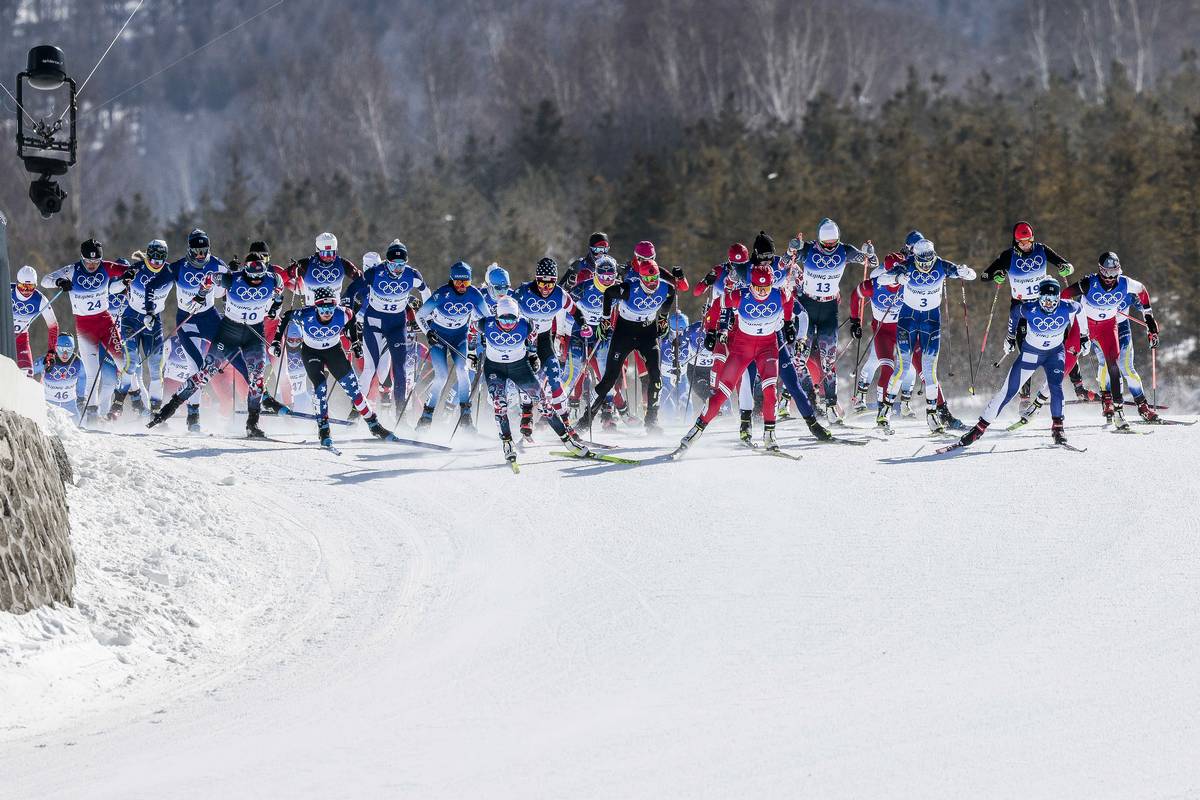
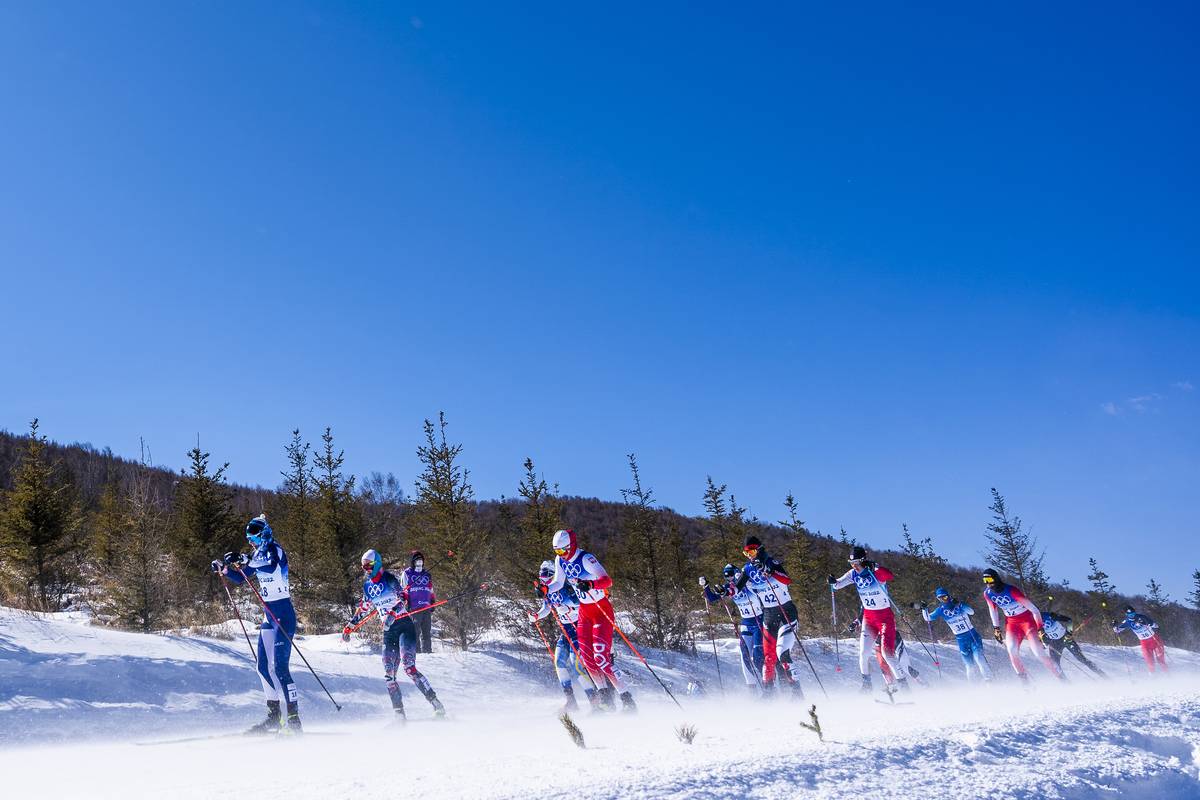
    Drifting snow visible around the athletes feet as they complete four laps of the 7.5 k course (Photo: NordicFocus)

    This World Cup coverage is made possible through the generous support of Marty and Kathy Hall and the A Hall Mark of Excellence Award.  To learn more about A Hall Mark of Excellence Award or to learn how you can support FasterSkier’s coverage please contact info@fasterskier.com.
    The women’s 30 k underway at 11am local time (Photo: NordicFocus)

    Sunday morning, battling through ripping winds, the women delivered an impressive and dramatic final cross-country event to close out the 2022 Beijing Winter Olympics. For the first time, skiing further than the men (gender parity coming more quickly than anyone could have guessed) thanks to the men’s kilometer event getting shortened to 28.4 k due to harsh conditions. Though the thermometer did not read particularly low in the Zhangjiakou stadium, roaring winds made racing both considerably colder and considerably more difficult as the women completed four laps of the 7.5 k course, the race happening three hours earlier than originally planned due to the weather.

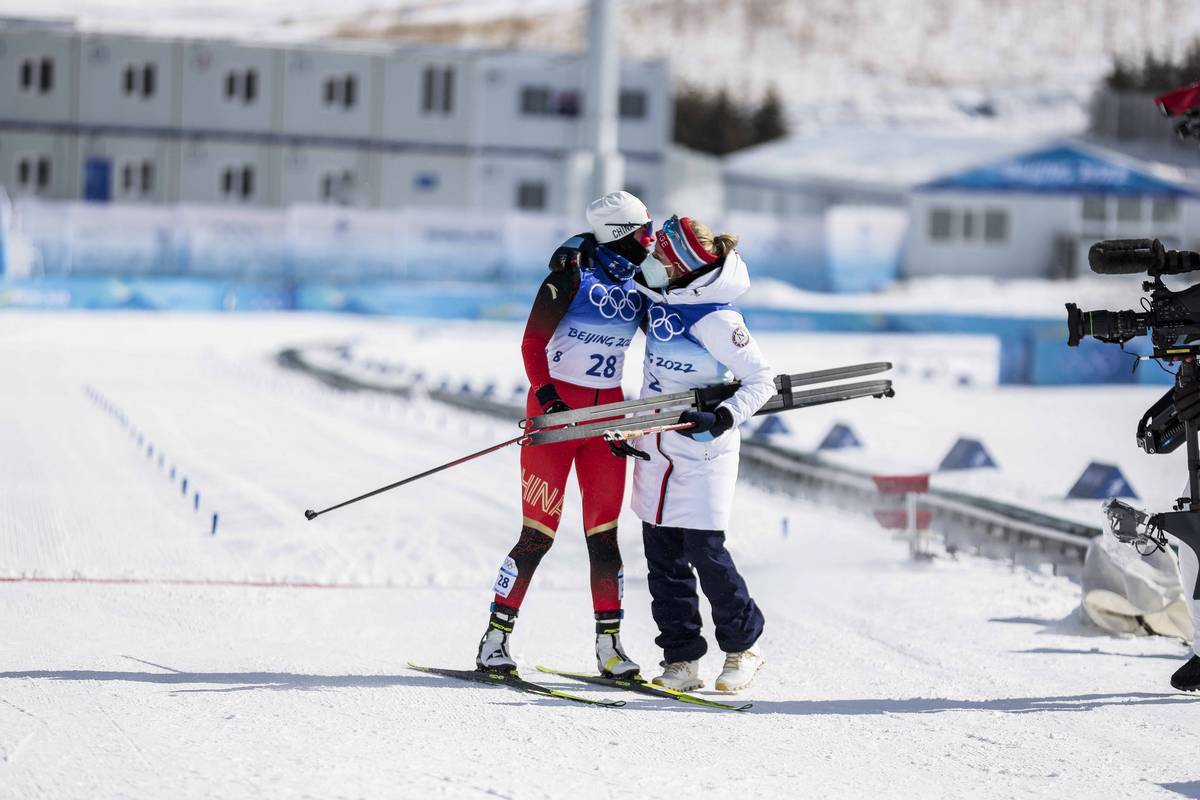
    Jessie Diggins (USA) and Therese Johaug (NOR) congratulate each other after the 30 k (Photo: NordicFocus)

    First the highlights, Therese Johaug of Norway secured her third individual gold medal of the Games in dominant fashion, +1:43.3 clear of second place. In a truly gutsy performance, Jessie Diggins earned US women’s cross-country its second individual women’s medal, securing silver, and all four American women finished in the top twenty. 

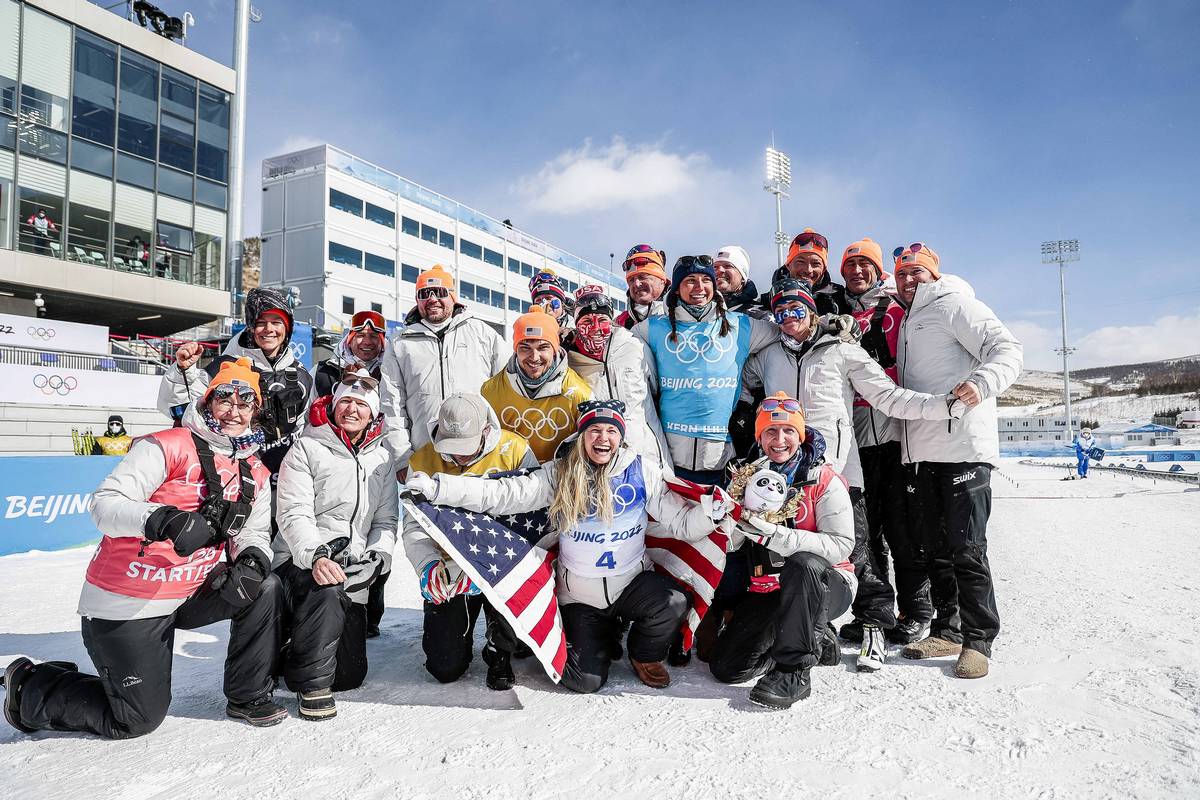
    Jessie Diggins celebrates with teammates and staff after finishing second in the 30 k skate (Photo: NordicFocus)

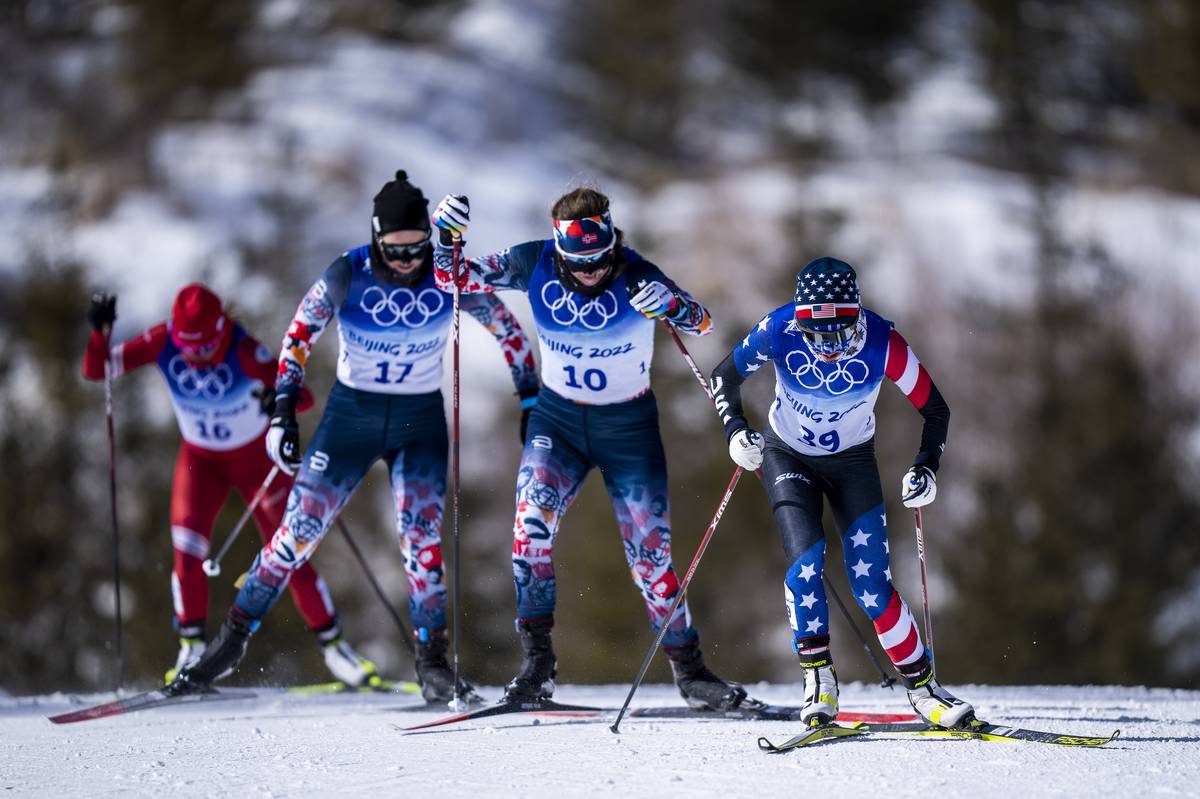
    But how did we get there? Within five minutes of starting, Johaug was at the front, pushing the pace. Any thoughts that she might have preferred to stick with pack skiing given the windy conditions were quickly banished. After just 2.9 k, she had successfully broken up the field and pulled away, bringing six athletes with her. Moments later the front group was down to four as Johaug charged ahead, with Diggins, Ebba Andersson of Sweden, and Delphine Claudel of France sticking with her. A chase pack formed, initially composed of Rosie Brennan of the USA, along with Krista Pärmäkoski and Kerttu Niskanen of Finland, the bronze and silver medalists from the 15 k classic. 

    Ebba Andersson (SWE) was overtaken in the closing stages of the race after skiing in third for more than 20 k (Photo: NordicFocus)

    The rest of the first lap saw lots of lead changes among the front four as no one was eager to take on the wind at the front. In each of the more sheltered sections we saw Johaug applying pressure, but the three athletes with her responded to the moves and stayed with her. Behind them, Brennan was working hard to close the gap but not finding luck gaining any ground. 

    Rosie Brennan leading Kerttu Niskanen (FIN), Jonna Sundling (SWE) and Krista Pärmäkosk (FIN) (Photo: NordicFocus)

    With one lap complete, we saw the first withdrawal from the race as skiathlon silver medalist, Natalia Nepryaeva, representing the Russian Olympic Committee (ROC), stopped her race. Petra Novakova of the Czech Republic also pulled out later on. 

    Up at the front, as the athletes took on the first major climb out of the stadium, Claudel (FRA) started to fade. By the top of the hill, she had lost contact and was off the back on her own. Behind her, the chase pack had strengthened in numbers to ten, led by Brennan (USA) and trailed by her teammate, Sophia Laukli (USA) making her first Olympic appearance. 

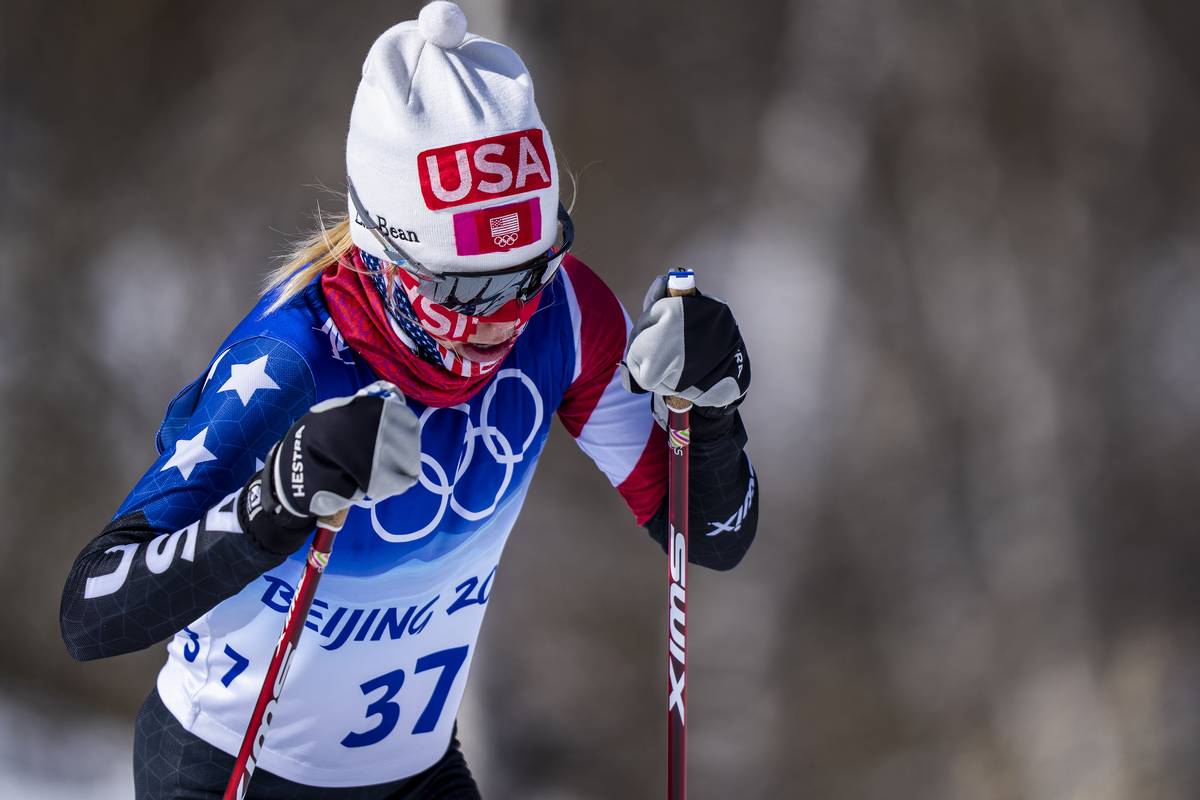
    Sophia Laukli, heavily taped up, skied to 15th in her first Olympic appearance (Photo: NordicFocus)

    As Johaug (NOR), Diggins (USA) and Andersson (SWE) crested the initial climbing section and entered a feed zone, Johaug seized an opportunity. Diggins and Andersson swung wide to grab bottles and Johaug rocketed away. Though Diggins worked to chase her down, the move was set and Johaug had taken up her favorite race position- out front on her own. 

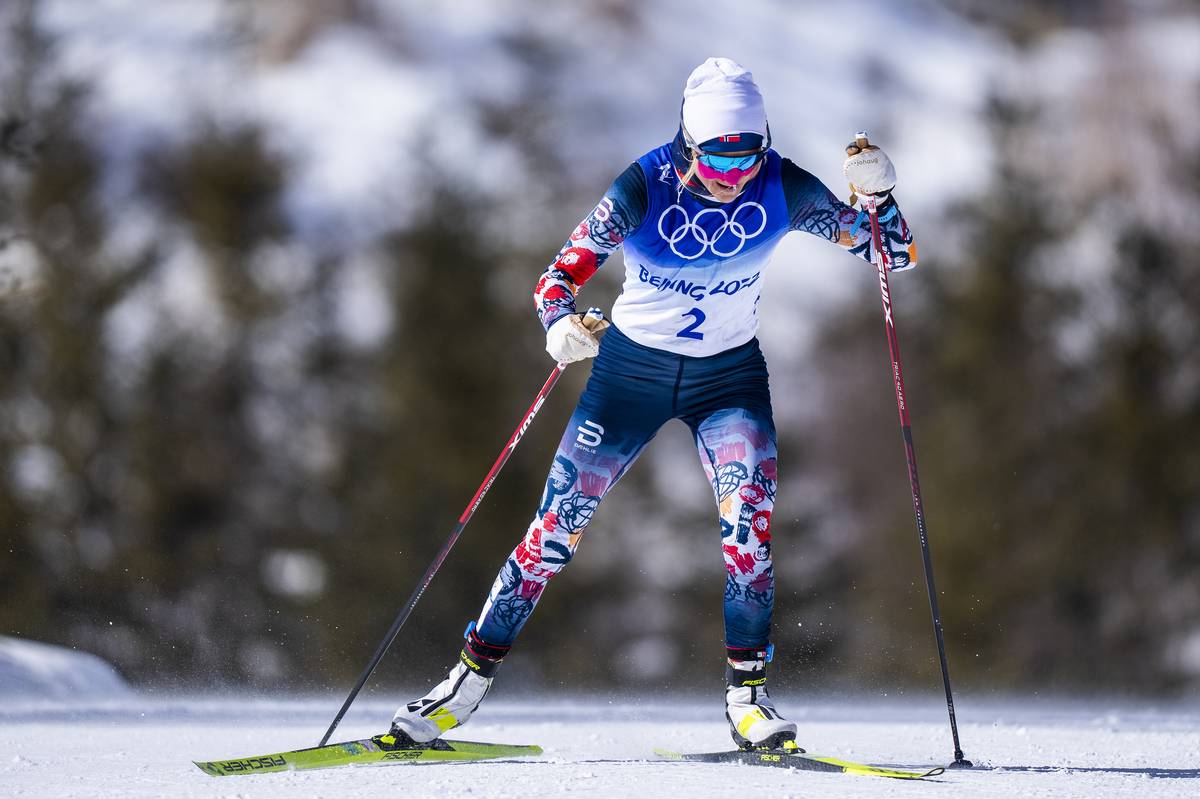
    Therese Johaug (NOR) battling the elements on her own out front (Photo: NordicFocus)

    With 10.4 k of racing complete, the first four athletes were spaced out evenly with 16 seconds between each of them. Johaug led, +16 ahead of Diggins, who was trailed by Andersson (+32.8), followed by Claudel (+49).

    Behind them, Brennan was having difficulty getting her two Finnish shadows to take on any of the lead work as she battled the wind, still trying to close. 

    Rosie Brennan, still leading the chase pack (Photo: NordicFocus)

    With two laps of racing complete, the time gap continued to grow in Johaug’s favor. The chasers were quickly reeling in Claudel (FRA) and looked to be nearing Andersson (SWE) as well, just +14 seconds behind her. On the A-climb out of the stadium, Claudel was absorbed by the group and the margin to Andersson was down to just ten seconds. Perhaps sensing this, the Swede redoubled her effort and at 17.9 k had widened the margin to +31 seconds. 

    The front two, each entirely by herself, continued fighting hard, Johaug’s advantage to Diggins and the rest of the field growing steadily. At 21.2 k Johaug was +1:08 ahead of Diggins and +2:07.1 ahead of Andersson. As such, the top three entered and exited the stadium in turn, each one leaving as the next entered, now with one lap to go. 

    Jessie Diggins skied most of the race on her own (Photo: NordicFocus)

    Andersson (SWE) appeared to be well clear of the chasers, +36.1 seconds ahead at 22.5 k. Around this time, Pärmäkoski (FIN) broke a pole and dropped from the chase pack, which was now composed of Brennan (USA), Claudel (FRA), Niskanen (FIN), Jonna Sundling (SWE), Tatiana Sorina (ROC), Teresa Stadlober (AUT) and Mariya Istomina (ROC). 

    Through 25.4 k, Johaug had a lead of +1:39.8 to Diggins. Andersson was +2:40.2 behind and still 36 seconds up on the chasing group, as the camera caught Johaug lapping a skier, a full 7.5 k ahead.

    Heading into the final grinding climb the chasers seemed to have sensed an opportunity. Spindrift almost fully obscured Niskanen and Brennan, being blasted by the wind as they closed in on Andersson, +14 seconds behind at 28.7 k. 

    Kerttu Niskanen sensing third place is close by in the final stages of the women’s 30 k (photo: NordicFocus)

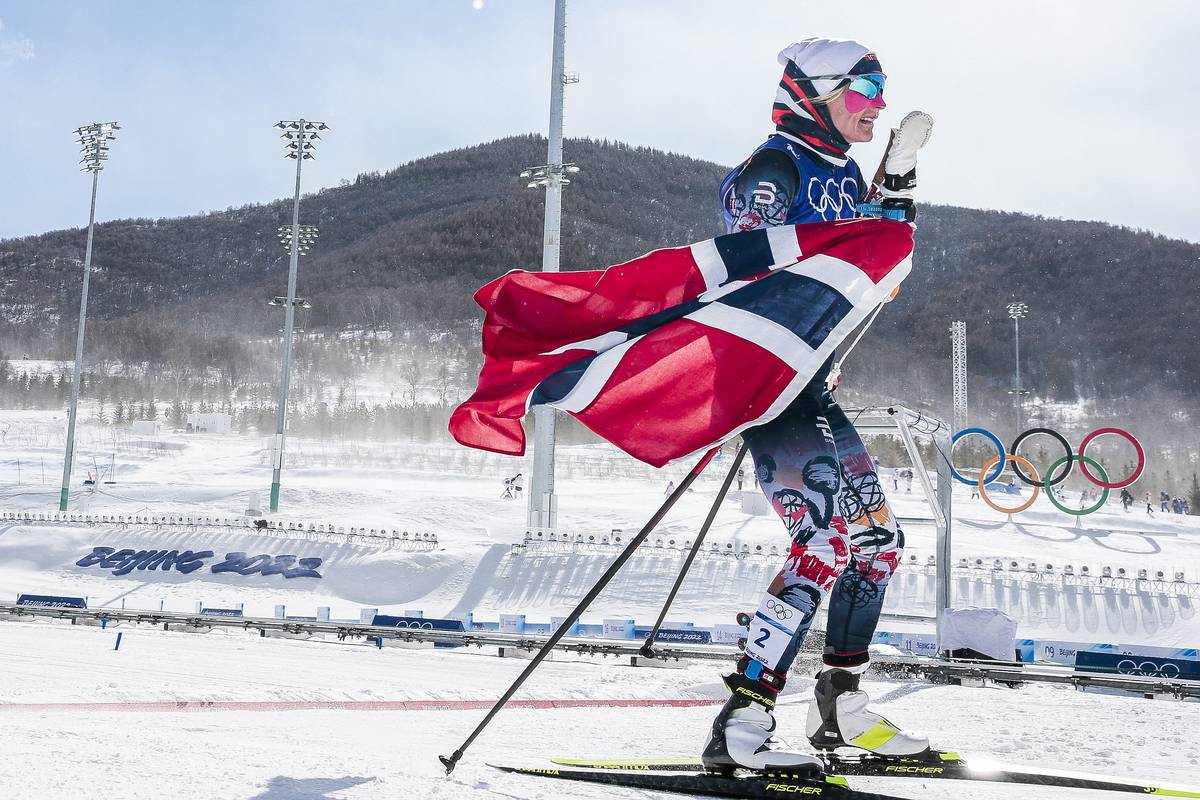
    Over two minutes ahead of them, Johaug entered the stadium and was handed a Norwegian flag to manage in the wind as she headed into the finish. 1:24.54 of racing and she had earned her third gold medal of the games, having won every distance race.

    Therese Johaug earns her third victory of the Games with a margin of +1:43 (Photo: NordicFocus)

    “I am so proud and I am so happy,” said Johaug, “It is a dream come true that I can stand here for Norway with three gold medals in the same Olympics. I was so, so happy 14 days ago when I got my first [gold medal] and I cannot believe I should have more. It’s fantastic to end my Olympic career with these three gold medals.”

    Johaug, who is 33 years old, announced before the 30 k that this would be her last Olympic appearance.

    Therese Johaug crosses the finish line taking her third victory of the 2022 Olympic Games (Photo: NordicFocus)

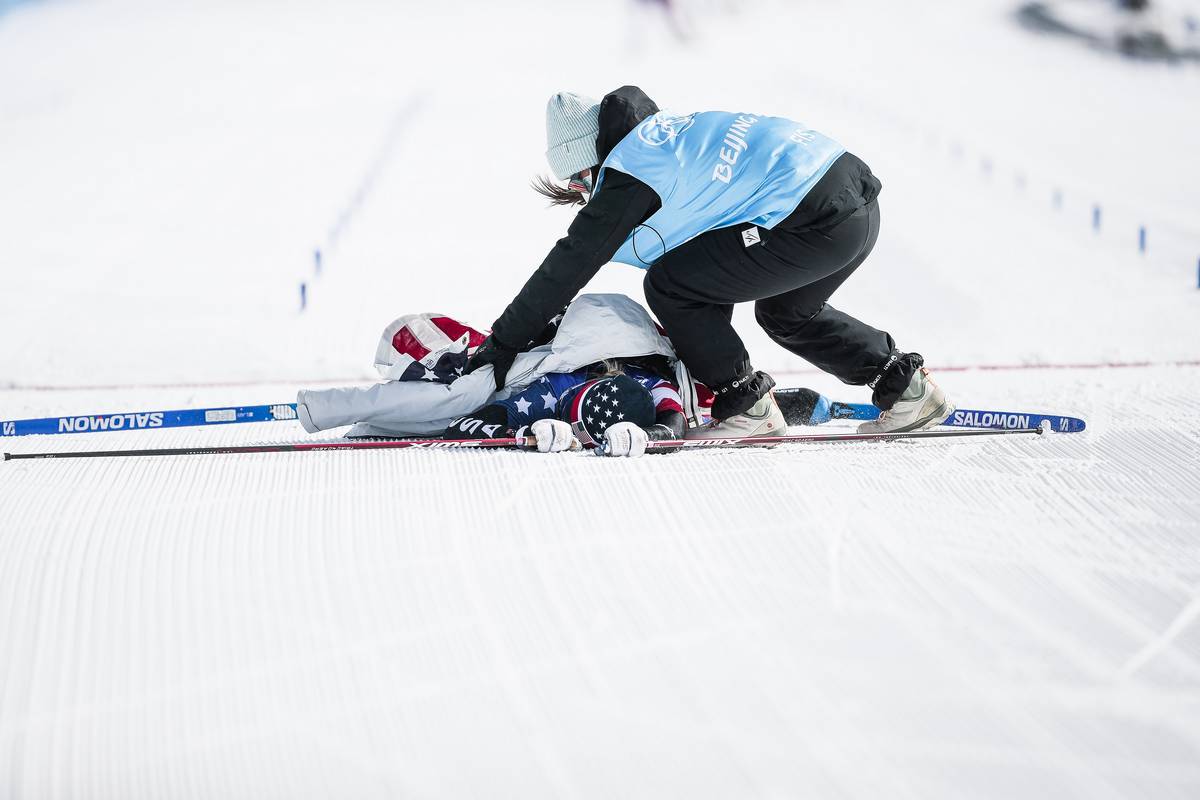
    With Johaug winning by the second-largest margin of victory in this event, +1:43.3 later came Diggins, V1’ing across the finish line and collapsing, having spent everything out on the course.

    “It’s really emotional,” said Diggins after the race, “That’s one of the hardest things I’ve ever done in my whole life, especially because I had food poisoning 30 hours ago, which is why I thought I was going to die at the finish line… My legs were cramping the whole last 17 k, I don’t know how I made it to the finish. It was amazing.”

    Jessie Diggins nears the line after 30 k of tough racing (Photo: NordicFocus)

    Diggins now holds three Olympic medals, gold from the team sprint in 2018, silver from today’s effort, and bronze from the skate sprint two weeks ago. With this silver medal Diggins also becomes the first non-European woman to land on the podium in the women’s 30 k event.

    Speaking to the food poisoning issue Diggins said, “I woke up yesterday morning and pretty much everything was coming right out of me, so I basically laid in bed all day and made myself eat food. Luckily it wasn’t so bad, but I was feeling pretty bad 24 hours ago. I talked to my parents and my mom said, ‘Don’t decide how you feel right now, just go out there and ski because you love to race.’ And she was right.”

    Johannes Høsflot Klæbo withdrew from the men’s race yesterday, also citing food issues. 

    Jessie Diggins celebrates silver before dropping flat (Photo: NordicFocus)

    “We had amazing skis,” concluded Diggins, “Our team worked so hard. I just tried to ski smart and then I wanted to ski a gutsy race, so when Therese [Johaug] went, I tried to go with her and I couldn’t stay. So then I thought I would just put my head down and ski my own race.”

    “That might have been the best race of my entire life, I’m not going to lie. It was also maybe the hardest race of my whole life. It’s been an emotional roller-coaster, but I am so happy we made it to the end. To have a medal in the sprint and the 30 k are the ultimate bookends for me. I have been trying to be a good all-around athlete my whole life, so this has been really cool.”

    Earning her second individual medal of the Games, Jessie Diggins in silver position (Photo: NordicFocus)

    With the first two medals decided, the race for bronze was turning into a nail-biter. Having held off the pack and skied by herself for nearly 20 k, Andersson (SWE) was quickly being overtaken. Niskanen was closing fast and bringing the rest of the chase group with her.

    As the skiers headed into the final little climb into the stadium, Niskanen blazed past Andersson. Suddenly, what had seemed like a sure bet for bronze had turned to an 8th place for the Swede as Sundling (SWE), Sorina (ROC), Brennan (USA) and Claudel (FRA) all finished in front of her.

    Kerttu Niskanen (FIN) fast closing on the finish line to bring home bronze (Photo: NordicFocus)

    Niskanen (FIN) earned her second medal of the Games, after finishing just +0.4 behind Johaug in the 10 k classic, with bronze in the 30 k, this time with a much larger margin of +2:33.3. “The last 1500 meters in a 30 k is important,” said Niskanen in the press conference afterwards, “everyone is tired and I only did push hard and believe in my medal all the time.” 

    The Niskanen family cumulatively won five medals in Beijing, Kerttu’s brother Iivo won gold, silver and bronze over the course of these games.

    “We’re both happy,” said Kerttu, referring to herself and her brother, “I am happy that he made an amazing Olympics here. The whole family is waiting for us at home. Everyone is very happy.”

    Rosie Brennan working hard, her every move closely followed by Kerttu Niskanen (FIN) (Photo: NordicFocus)

    Having taken on much of the lead work for the majority of the race and after her near-medal performance in the skate sprint earlier in the Games, Brennan was once again just outside, finishing in 6th position (+2:38.7).

    “[It’s] Frustrating,” said Brennan afterwards, “I literally tried everything I had and nobody wanted to work with me, so I just had to try to do the best I could and unfortunately it wasn’t enough and that’s hard to swallow, but I tried my best.” 

    Bringing us further inside the experience on course, Brennan continued, “There was a gap that formed [at the beginning] and I just wasn’t in the right place at the right time, and Jessie played that so beautifully, it was amazing. I thought about fighting the wind to bridge it but I had a feeling there would be some places that popped off the back so I was trying to get that group to work with me and keep a steady pace and pick up the people that dropped, but those girls had absolutely zero interest in working with me. I kept yelling at them and being like ‘lets go get them’, and they did nothing. When that happens, there’s not much you can do but ski your own race. I did everything I could. I think the Finns have really fast skis, which was hard for me. I don’t regret trying but I wish it had turned out differently.”

    Kerttu Niskanen is happy with her skis and with her bronze medal (Photo: NordicFocus)

    When asked about not sharing the lead, Niskanen (FIN) replied, “I have to say that Rosie was really strong today, she push sometimes really hard to uphills and it was good for me because I thought that we had the best skiers in our group to make a strong speed all the time. I thought that we need to ski fast all the time, but many times I was tired and sometimes I thought that Rosie go in front of me but I think I had a little bit faster skis today so it helps me a little bit. I think everyone was really really tired, a long trip, many many races, and I was tired but today’s race was like a tired girls competition.”

    Brennan confirmed that her skis were not competitive with those of the Finns, and when asked about seeing those athletes ski past her after she had done so much pulling she said, “It’s definitely a little demoralizing. Especially since I don’t think I had the skis to match that, I wasn’t able to get enough of a gap on the uphill to hold it on the downhill and that’s always a bummer but that’s a part of ski racing too.”

    In the end, Brennan reflected, “I feel very confident that I’m in the best shape of my life this past week and I did everything I could to be in a place to win a medal and the rest is just largely out of my control. I can’t control the weather, I can’t control my skis, I did everything I could to prepare for the day so I have to be proud of that.”

    Brennan also gave a shout-out to her supporters at home, saying, “I’m overwhelmed with all the support I’ve received, especially given the time [difference] and the number of people that have become nocturnal to cheer me on. It really means so much.”

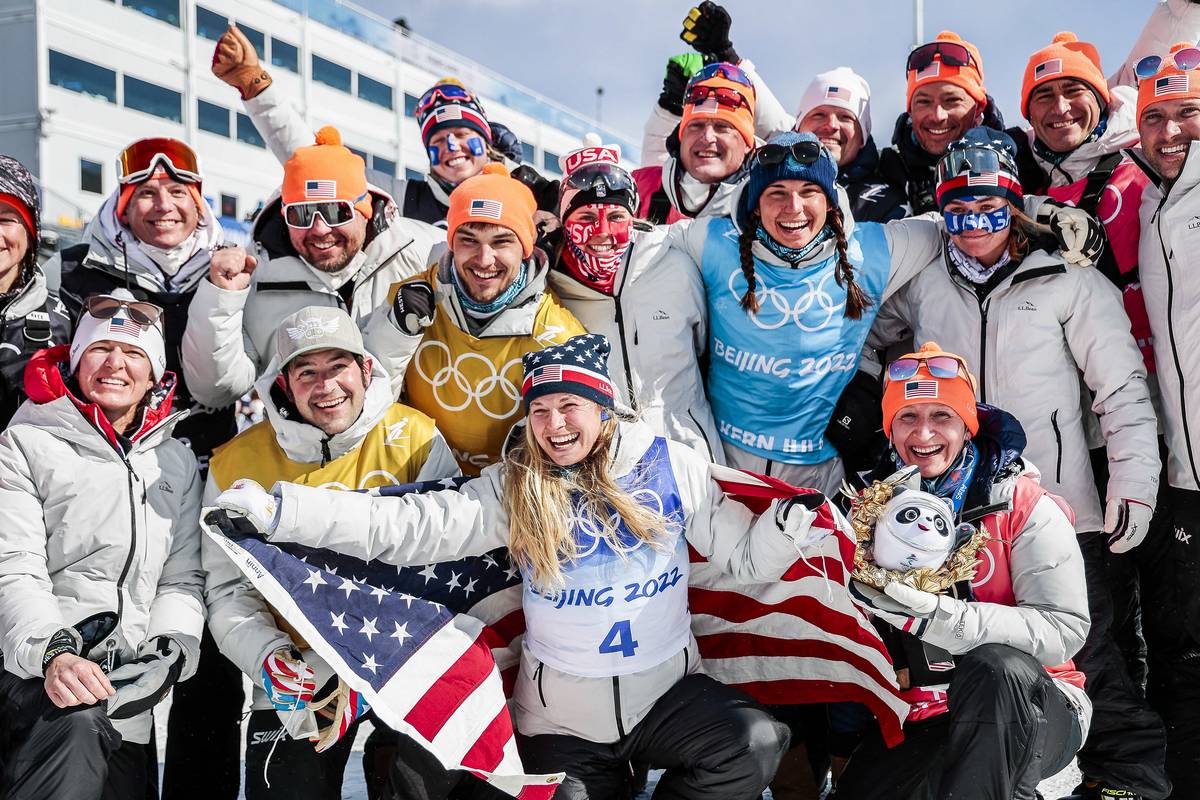
    Jessie Diggins with teammates and staff after winning a historic silver medal (Photo: NordicFocus)

    “I’m so happy for Jessie, and I never wanted a podium more for someone like Rosie today.” said USST head coach, Matt Whitcomb, “Nobody deserves it more or less than anybody [else]. You just see Rosie come so close and all this hard work, and she’s at the absolute peak of her career, it’s been a long wonderful career, a challenging career, and you just want to see a medal wrapped around her neck. And so, if there’s something to take away from today, it’s one of the most successful days in US skiing history.”

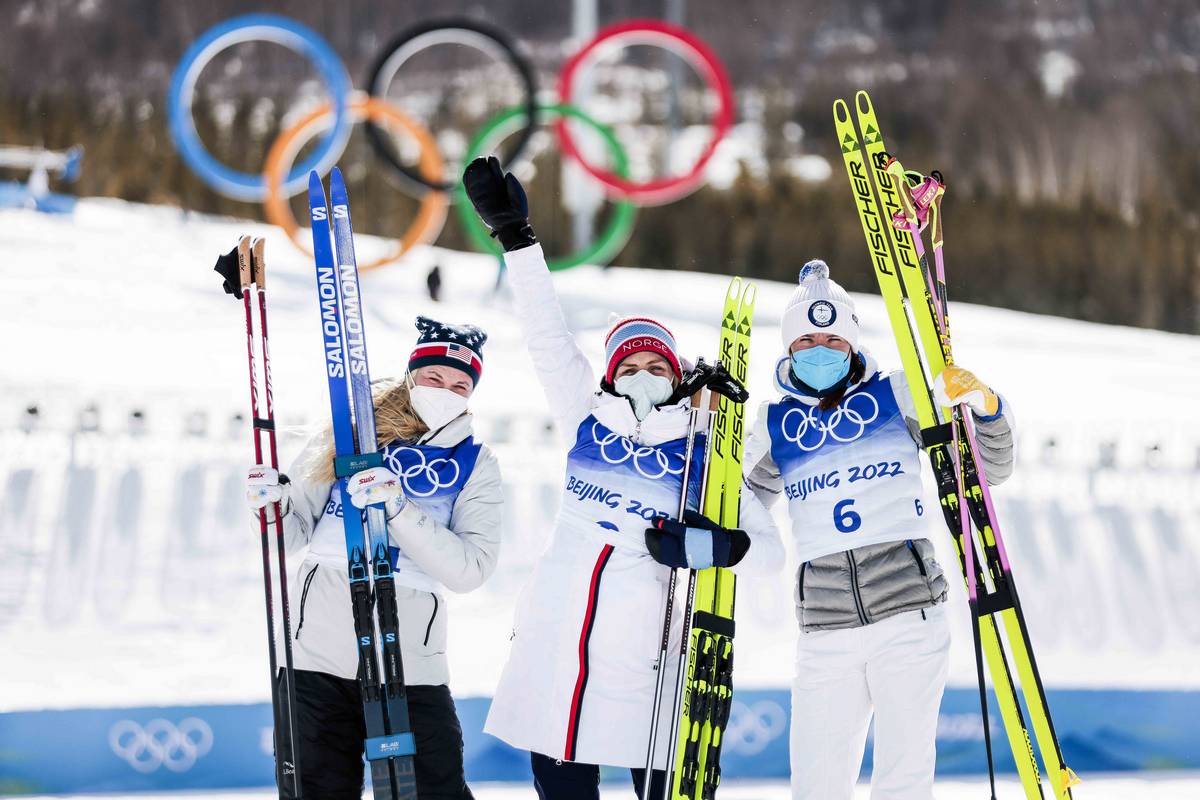
    2022 Olympic 30 k podium: Jessie Diggins, Therese Johaug and Kerttu Niskanen (l-r) (Photo: NordicFocus)

    Speaking to Brennan’s work leading the chase pack for much of the race he said, “[Niskanen’s] bronze medal was in large part earned by Rosie, and everybody knows it. And that’s just racing, it’s like a game of poker. Every time Rosie would try to pull aside and let someone else lead they would not. And there’s nothing wrong with that, that’s just tactics, but 10 seconds would open up every time she did so she would stay on the gas. She had no other choice. She did the only thing she could have done.”

    Minutes later, the camera showed an American skier who had gone the wrong way, entering the lap instead of the finish. It turned out to be Laukli, who had to double-back and in the process was passed by the Weng twins, Tiril and Lotta, of Norway. In the end, Laukli came across the line 15th, +6:27.2 back.

    Sophie Laukli, finished 16th after taking the wrong lane and being passed by two skiers (Photo: NordicFocus)

    “I’m bummed for her,” said coach Chris Grover, “that she lost two places because she worked hard for those but she did the right thing, retracing her steps all the way back and that’s one of the lessons that you do once on the big show and then you never do it again. Jessie did it in Sochi.” 

    He continued, “It’s just an outstanding performance [by all the women] we had great skis. The techs did a great job.”

    Laukli was followed just seconds later by her teammate Novie McCabe who completed her Olympics with an Olympic personal-best 18th place (+6:28.5) after an impressive few weeks of race efforts. McCabe was 24th  in the 10 k classic, and helped the American women to 6th in the relay last week. 

    Novie McCabe (USA) followed by Tiril and Lotta Udnes Weng of Norway (Photo: NordicFocus)

    The scene at the finish line was reminiscent of the top of the Alpe Cermis after the Tour de Ski, skiers lay sprawled on the snow as staff members rushed to get them into warmer clothes.

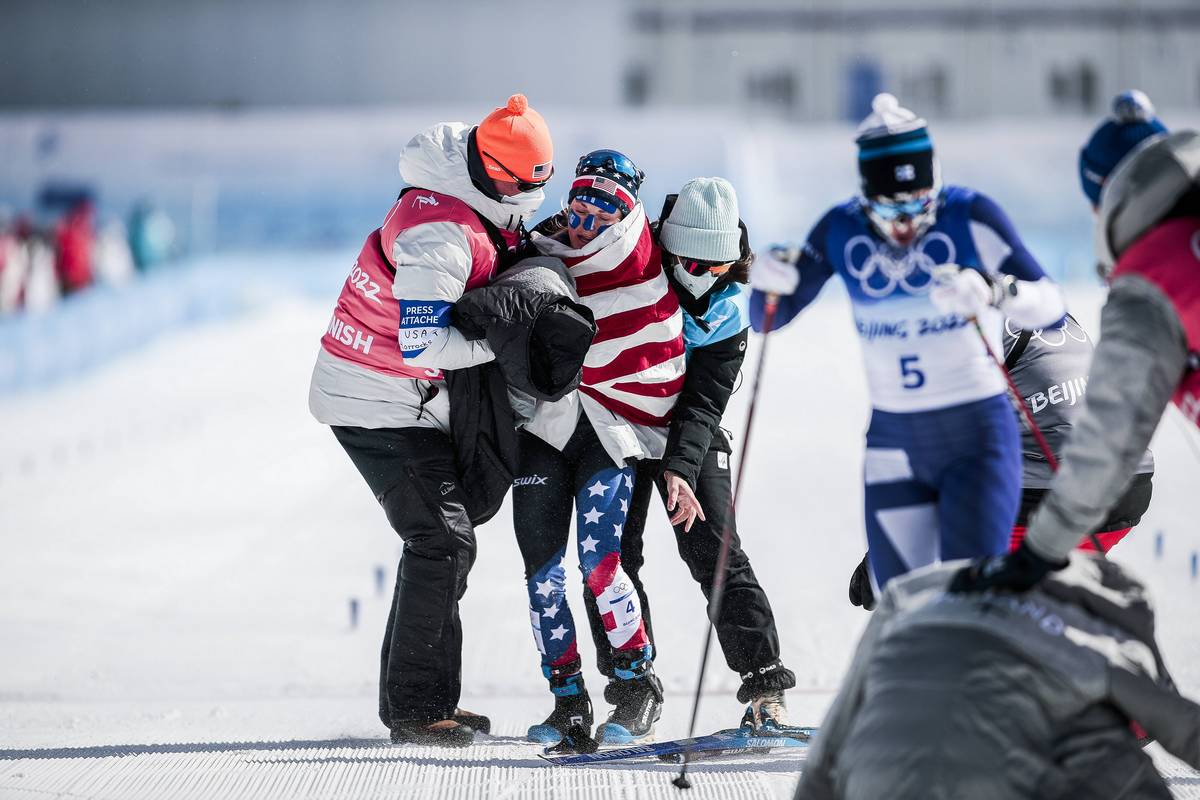
    Diggins was unable to stand on her own and was escorted out of the finish pen with two helpers on either side. 

    An exhausted Diggins is covered by a coat and an American flag, having earned silver in the women’s 30 k. (Photo: NordicFocus)

    Grover shared, “Jessie had food poisoning 36 hours ago and had a really rough night, she didn’t ski the last few days. You could see out there, her body language, for the last two laps she did not look fresh and for her to hang on like that for those two laps was an unbelievable athletic and mental performance. [Diggins] asked Matt in the feed zone what lap she was on and we had to tell her she was in the third lap, she had one more to go and then when she needed to go to the finish.” 

    Jessie Diggins is escorted out of the finish area with help (Photo: NordicFocus)

    He added, ““I think this might have been the deepest she’s ever dug.”

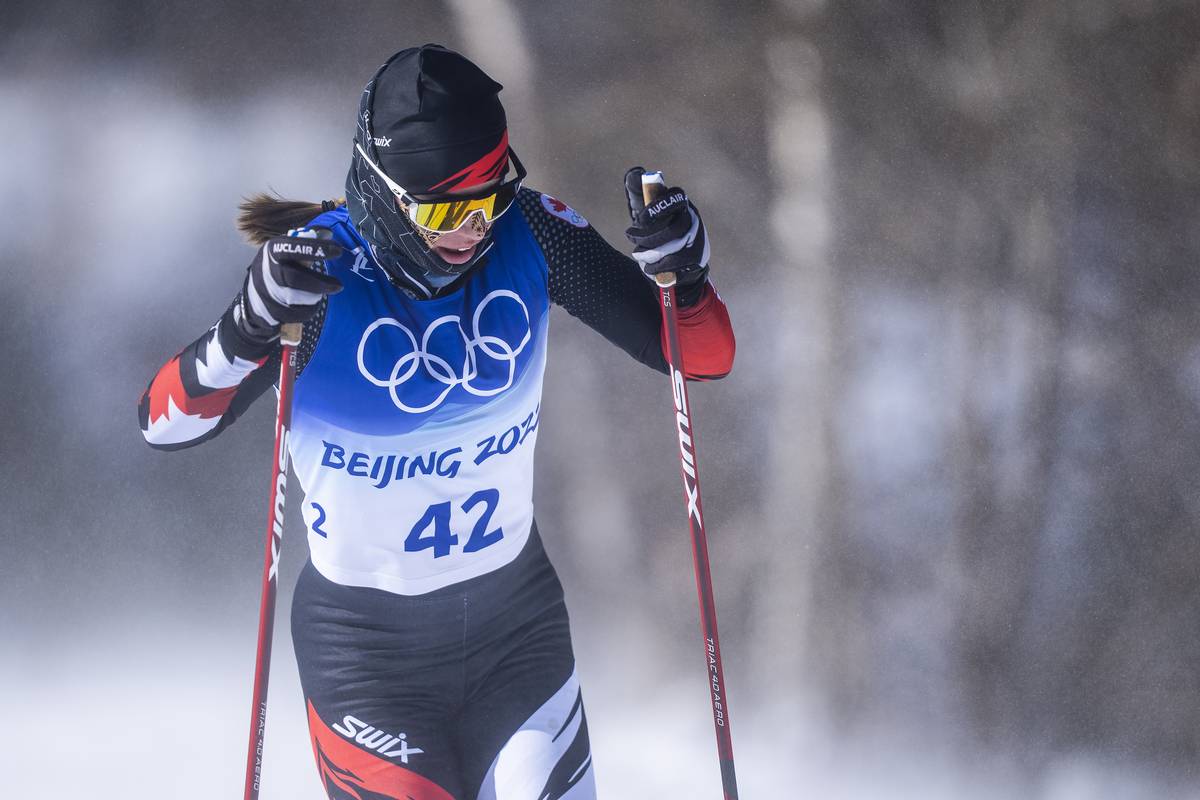
    Leading the way for the Canadians, Cendrine Browne finished in 16th (+6:27.6).

    “[This is a] Canadian record in a mass-start at the Olympics and it’s also my personal best,” said Browne, “It’s amazing to leave the Olympics on such a high note. I’m thrilled, I have no words. It was tough conditions out there, really cold, very windy but I think I played it well. In the last lap there was an attack and I was able to stay with the group and pull away to finish 16th.”

    Cendrine Browne reached a new personal best with her 16th place finish (Photo: NordicFocus)

    In a race with giant time margins, Kathrine Stewart-Jones notched 30th, +7:39.3 behind Johaug. Dahria Beatty was 39th (+11:14.2) and Laura LeClair was 51st (+15:20.5). 

    Jessica Yeaton, competing for Australia, was 43rd (+12:12.1). 

    30 k winner Therese Johaug greets last place finisher Dinigeer Yilamujiang of China who finished over 25 minutes behind the Norwegian (Photo: NordicFocus)

    World Cup racing resumes next weekend in Lahti, Finland with a skate sprint and 10 k classic for the women. 

    Results

  • Norway Pulls off a Historic Team Sprint Gold Repeat; Canadians in 5th and Americans in 9th for Strong Team Debut

    Norway Pulls off a Historic Team Sprint Gold Repeat; Canadians in 5th and Americans in 9th for Strong Team Debut

    This World Cup coverage is made possible through the generous support of Marty and Kathy Hall and the A Hall Mark of Excellence Award.  To learn more about A Hall Mark of Excellence Award or to learn how you can support FasterSkier’s coverage please contact info@fasterskier.com.


    The team sprint: it’s the youngest event on the Olympic program, having been contested only since the 2006 Torino Games. The event has since become a marquee event in the sport of cross country skiing.

    Holding it up as a marquee event, of course, is easier to say coming from the United States. If you tuned into the NBC broadcast, you got the delight of hearing 2018 team sprint gold medalist Kikkan Randall analyze the race where she won the US’s only gold medal in cross country skiing, while her teammate from that race, Jessie Diggins, worked to repeat the Olympic medal feat. 

    Yes, the team sprint was that race, and we could all revel in that memory as it played out in Zhangjiakou, China on Wednesday.

    Competitors surrounded by the colors of the sunset. (Photo: NordicFocus)

    Beyond that, though, no other event exemplifies the nuances involved in modern skiing like the team sprint. This is an event that pairs the specialists with the even-more specialized, and has an err of a nordic nerd’s daydream to the team-selection possibilities that arise from doing so.

    What if you lined up the two athletes who single-handedly changed a generation of skiers together under one flag? Well, they’d turn out to win gold in Pyeongchang 2018, like when Johannes Høsflot Klæbo and Martin Johnsrud Sundy were paired as team Norway. What if you repeated when Finland won gold in Sochi 2014, but this time Iivo Niskanen, who was then seemingly untouchable as a classic skier? Well, that one offers a bridge to what played out in Beijing 2022.

    Of course, hypotheticals joined up with storylines that didn’t need to be posed as a question today too. For the US men, this was the crystallized moment where one generation was handed off to another. Call to mind the US Olympic team sprint team anytime in the last eight years and it was the steadfast duo of Simi Hamilton and Erik Bjornsen. These men, now retired, were sixth in the team sprint in both the 2014 Olympics in Sochi and the 2018 Games in PyeongChang. Then, this morning, it was Ben Ogden and JC Schoonmaker, both born in 2000.

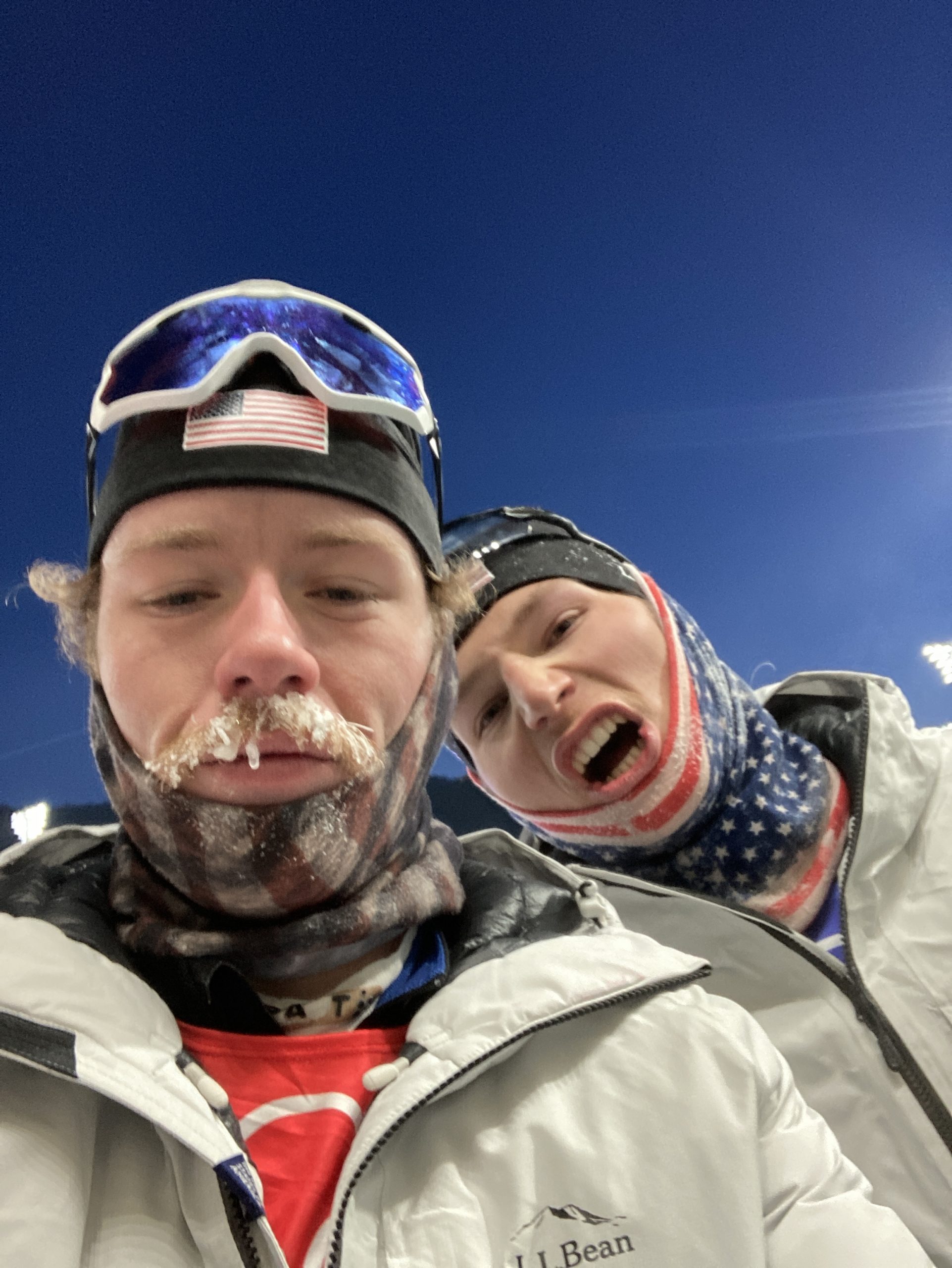
    The (frozen) fresh-faces of American skiing. Teammates Ben Ogden and JC Schoonmaker after completing the Team Sprint on Wednesday in Beijing. (Photo: Nat Hertz)

    The two made up a pairing that was more pure-sprint oriented than most of the competitors that were most closely watched going into today. The strategy for a few of the top teams, in particular, the Russian Olympic Committee and Finland, seemed to be pairing their top-class distance skier with a sprinting specialist.

    For the course in Beijing, it was a good strategy on paper. The 1.5-kilometer course, last seen in the individual sprint last week, had one tactical pressure point going into a downhill when it was raced as a single lap. When it was raced in a burst of three per skier with little rest in between, however, just how much the long, semi-gradual, uphills on this course made skiers work moved to the forefront. In the team sprint, having a skier who could stay with a sustained attack through multiple legs was an appealing prospect, especially when it was meant to set up for a punchy last climb that would no doubt give way to a mad dash for the finish.

    For two teams, Norway and the Russian Olympic Committee (ROC), that mad dash had been setting up since the first World Cup of the season, when 22-year-old Alexander Terentev (ROC) out-dueled sprint superstar Johannes Høsflot Klæbo (NOR) to challenge the latter’s classic sprinting dominance.

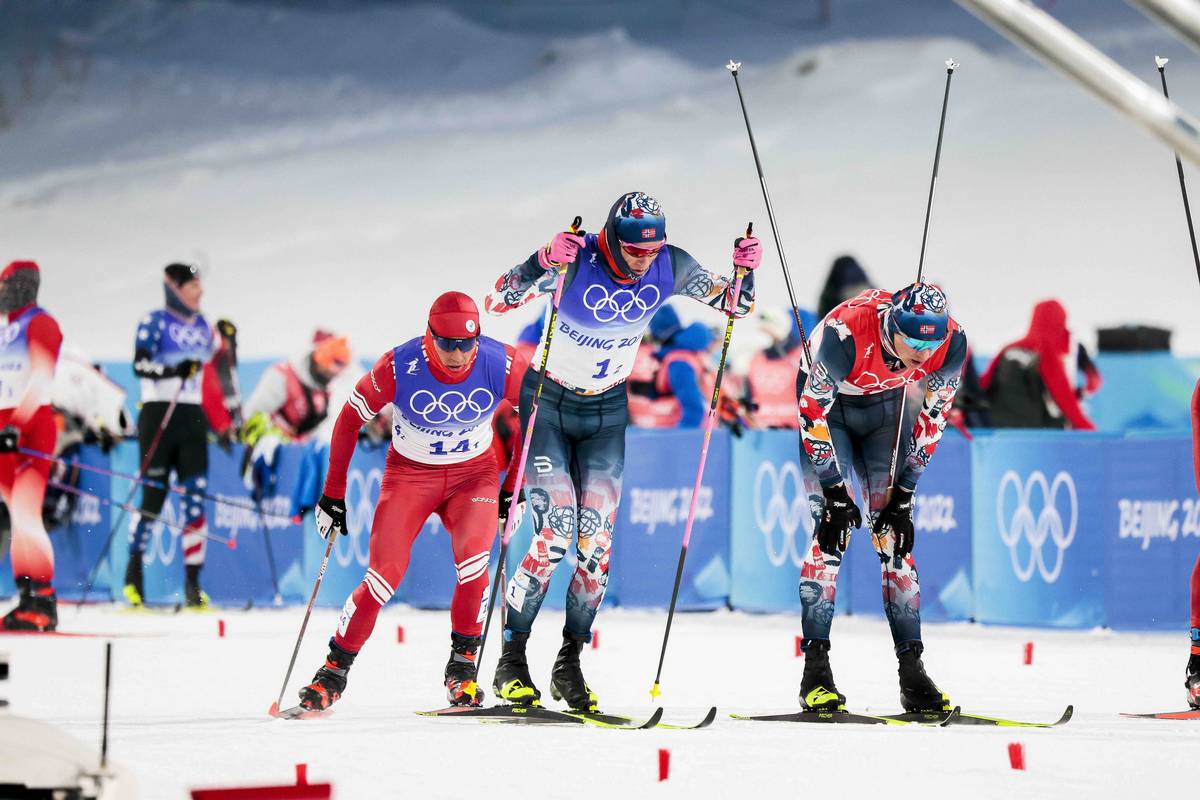
    Johannes Høsflot Klæbo (NOR) accelerates out of the exchange zone after receiving a tag from teammate Erik Valnes, followed by Alexander Bolshunov (ROC) on his way to tag teammate Alexander Terentev. (Photo: NordicFocus)

    They would both ski the anchor legs on their teams. Klæbo was paired with fellow sprinter Erik Valnes to make team Norway, while Terentev was paired with 30 k skiathlon gold medalist Alexander Bolshunov to make team ROC. Finland joined the intrigue, sending out 15 k classic gold medalist Iivo Niskanen in the first leg paired with the World Cup’s perennial “oh, that’s right he’s a great sprinter too!” Joni Maki as an anchor.

    As such, the teams in the final skied the first and second legs could roughly be divided into: leg 1 – the distance skiers and long-burn sprinters, and leg 2 – classic sprinting’s very best.

    The US had qualified for the final as the second lucky loser, finishing a messy semi-final that saw Ben Ogden break a pole and recover to finish 6th place (+4.43 off of heat winners Italy’s mark of 20:06.99). 

    “It was a hard semi-final, ours was fast and everyone was pushing. [The pole break] was one of many places where we used more energy than we had to today.” said Ogden in post-race interview with FasterSkier in the mixed zone.

    But as Ogden went out in the final, he seemed to settle in and leave the troubles of that semi-final behind. He looked comfortable in a pack that had settled on jockeying for position in the early part of the race, moving up to 4th place through the first exchange.

    Ben Ogden (USA) strides early in the the team sprint. (Photo: NordicFocus)

    The men’s field going out relatively slowly could be attributed to Norway’s Valnes. He seemed to comprehend that with his team as a pre-race favorite, the eyes of the pack were on the “What is that?” pattern of his suit. Valnes looked to lead the pack so-as only to try and lull it into complacency. It was a strategy that made sense, knowing he would be tagging off to the current fastest human on skis in a drag race, Klæbo.

    Alexander Bolshunov, though, called Valnes out on his bluff, making sure to pick up the pace just enough so that the pack would have to work throughout its first leg.

    So began the stalemate that would last for much of the early legs of the race. In the first exchange to the anchor-legs, Klæbo showed outward signs of his strength, and his desire to keep the pace right in the sweet spot where he could shoot around them in the end. JC Schoonmaker, meanwhile, remained placed right off the leaders, in the pack, moving through the course.

    The second showing of leg 1, including Valnes, Bolshunov, Niskanen, and Ogden saw Bolshunov push on the initial climb out of the stadium. Valnes covered the move, before the pack came together in the final climb into the stadium. The pressure, and the speed, had increased. Ben Ogden, though, had kept up with the pack, and came through the half-way mark with the Americans in 7th place (+4.4).

    Johannes Høsflot Klæbo (NOR), Richard Jouve (FRA), and Joni Maki (FIN) face off in the classic team sprint during the 2022 Olympic Winter Games. (Photo: NordicFocus)

    In their second laps, a lead group that included Terentev, Klæbo, Maki, and Schoonmaker, the pack began to take shape. The decisive move didn’t come from any of those skier’s mentioned, though, but instead from a familiar agitator in sprint heats on the World Cup. Moving up from behind the leaders, France’s Richard Jouve powered to the front of the pack on the first uphill, but was quickly matched by both Terentev and Klæbo. The duo, as they approached  the downhill, put in a burst of speed that hadn’t been seen on the course up to that point, and it was all it took for the pack to begin to thin.

    This was the move that saw the young American team begin to lose contact with the lead group. Schoonmaker later said that “the downhills felt tighter and more aggressive than some other World Cup sprints.”

    The Americans slipped to 9th place, and remained there for the rest of the day despite the early efforts of the duo to stay locked in and pushing all the way through.

    JC Schoonmaker races the classic team sprint final during the 2022 Olympic Winter Games. (Photo: NordicFocus)

    Meanwhile, at the front, the exchange to the final lap of the odd-leg skiers found Bolshunov once again putting in an attack on the uphill that led out of the stadium. The move indicated that the ROC had faith in the young Terentev as the anchor, but that chancing it with Klæbo still on deck was not the preferred option. Valnes took the ROC strategy off the table anyway, letting out a blistering counter-attack that showed his own strength and served to further separate the pack. When they came into the final climb into the stadium for the last exchange, it was just Norway, the ROC, and Finland who were in contention for the gold medal.

    Finland, in fact, was the first to the exchange. That came courtesy of Niskanen, who evaded the front of the pack for much of his race. The 15 k classic champion unleashed his diagonal stride on his final climb of the day, with both efficiency and power that exemplify optimal technique.

    The last lap, then, looked like a three-way pack of Finland, Norway, and the ROC, and, not far back and putting together an outstanding day, Canada (+9.7). The team of Graham Ritchie and Antoine Cyr had put in an unexpected and auspicious effort for the whole world to see.

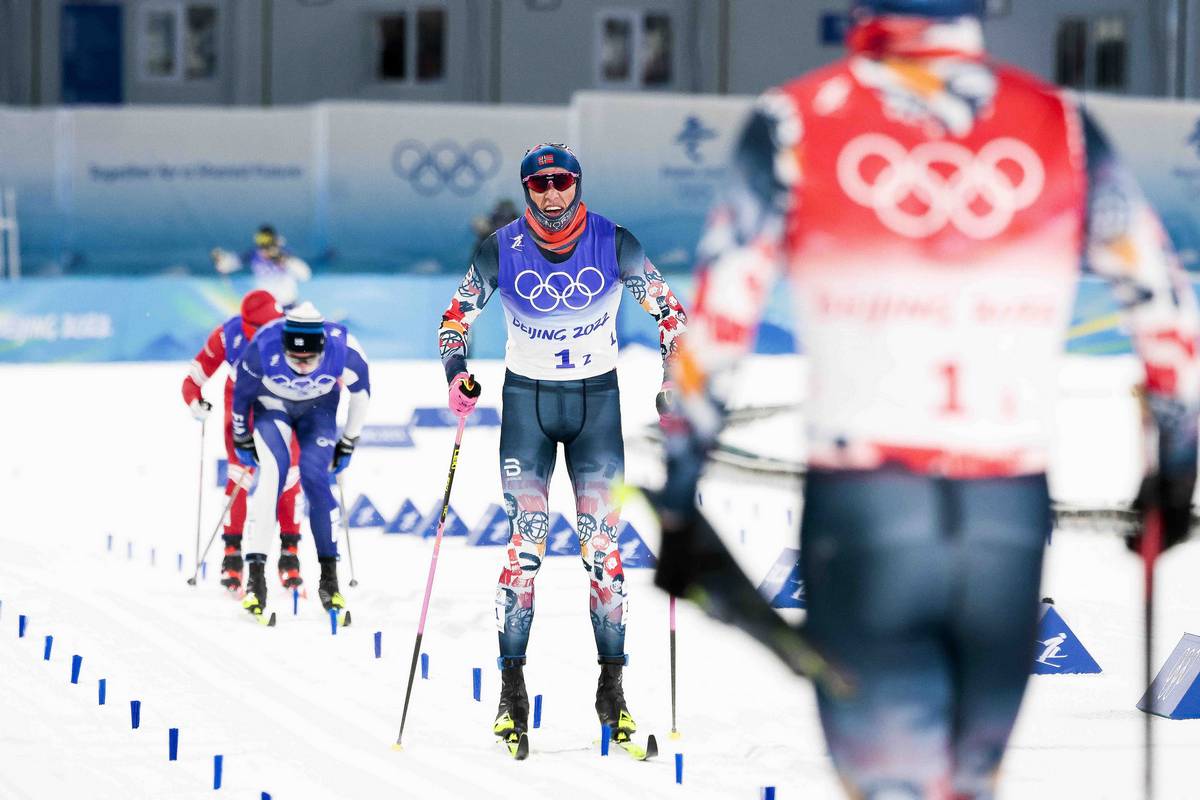
    Johannes Høsflot Klæbo (NOR) leads the way to the line, with Joni Maki (FIN) and Alexander Terentev (ROC) behind for second and third. (Photo: NordicFocus)

    Still, the skiers to face off for medals remained; Joni Maki (FIN), Johannes Høsflot Klæbo (NOR), Alexander Terentev (ROC).

    The front three remained tight throughout the final lap. The pace was fast, but not fast enough to shake the familiar feeling that we’d been here, on this 1.5 k course, before, and it was a stage for which one player was ready to take the lead role: Klæbo.

    On the last hill, Klæbo went, and proved again that he was both a master of the art of sprint racing, and still indisputably its best practitioner. He, and Norway, would repeat as gold medalists in the team sprint in a time of 19:22.99.

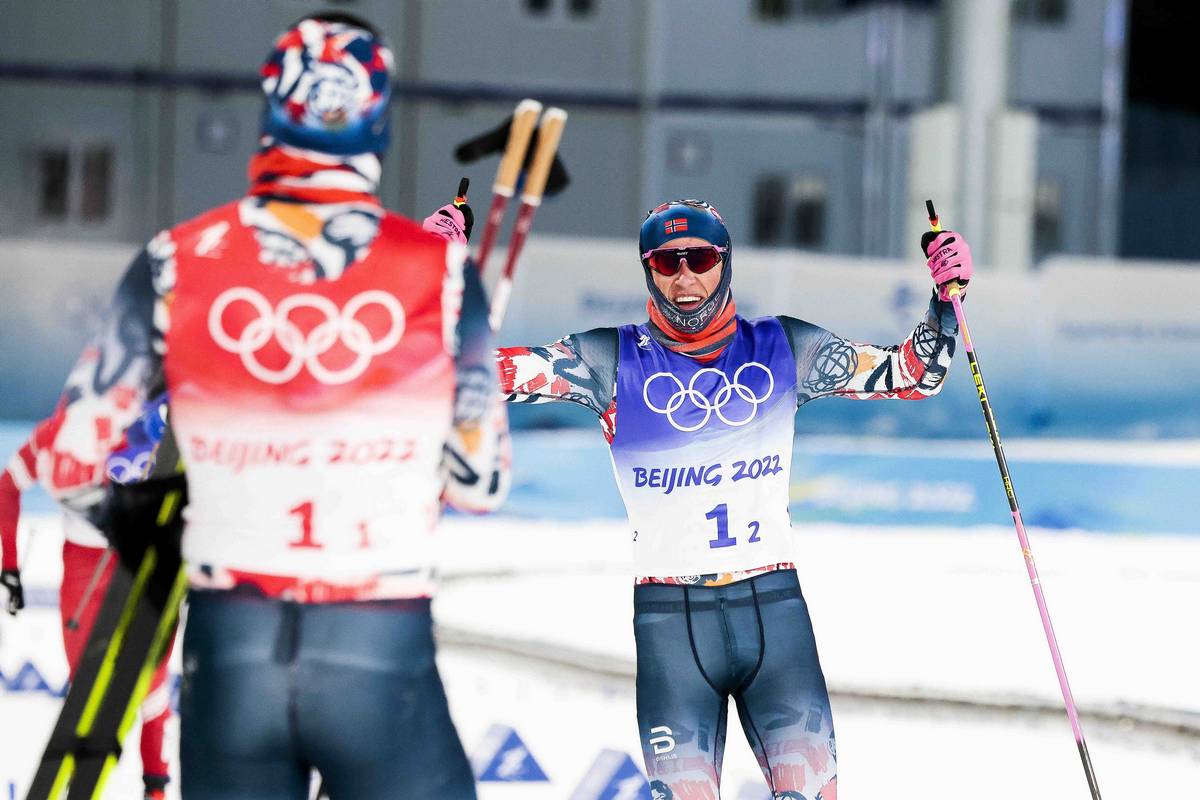
    Johannes Høsflot Klæbo celebrates team sprint gold with teammate Erik Valnes. (Photo: NordicFocus)

    In comments to the press after, Klæbo said of repeating as a gold medalist, “I’m really proud, it’s special to do this together as a team. We won the team sprint in 2018, and doing it in a different way now, different style, with a different person, it’s special.”

    Behind him, Joni Maki made a late effort to pull in front of Terentev and deliver Finland, and his teammate Iivo Niskanen, back to the medal ceremony that they last attended for the team sprint in 2014 by finishing second (+2.46). Terentev finished third (+4.29), ensuring that the ROC (or, for these purposes, the Olympic delegation formerly known as Russia) continued its streak of never having finished outside of the medals in the team sprint at an Olympic Games.

    Graham Ritchie (CAN) double-poles toward the finish of the men’s team sprint. (Photo: NordicFocus)

    Sweden pulled back to fourth place (+15.06), and the surprise of the day was the young Canadian team of Ritchie and Cyr, both 23 years old, finishing in fifth place (+22.31). The Americans held the gap to +1:05.08, and finished in ninth.

    Ogden and Schoonmaker came away feeling optimistic on their first go-around at the Olympic team sprint, saying “It’s good. With some experience, we can be a lot better.” 

    Ben Ogden (USA) and James Clinton Schoonmaker (USA) at the finish of the team sprint. (Photo: NordicFocus)

    “Some more training under our belts will be a big game changer for us,” Schoonmaker continued, “[because] we’ve done zero team sprints [like this] with 3 laps. This is our first time skiing a real team sprint.” 

    Through its pushes-and-pulls, posturing and performances, the team sprint again proved to be a thrilling highlight of skiing. And with it completed, and a pair of gutsy performances turned in, it is possible to turn a glint of our attention today towards what the two young North American teams will do four years from now in Cortina, Italy. Really, it is just too easy to go there already, and let the Olympic dreams run wild.

    That of course though, would be premature. There’s as old-school a race as they come left in Beijing on Saturday, when the 50 k freestyle will be revived on the Olympic stage. The final men’s event promises to be as pleasant a distraction from future thoughts as there is in the world of skiing. So let’s enjoy.

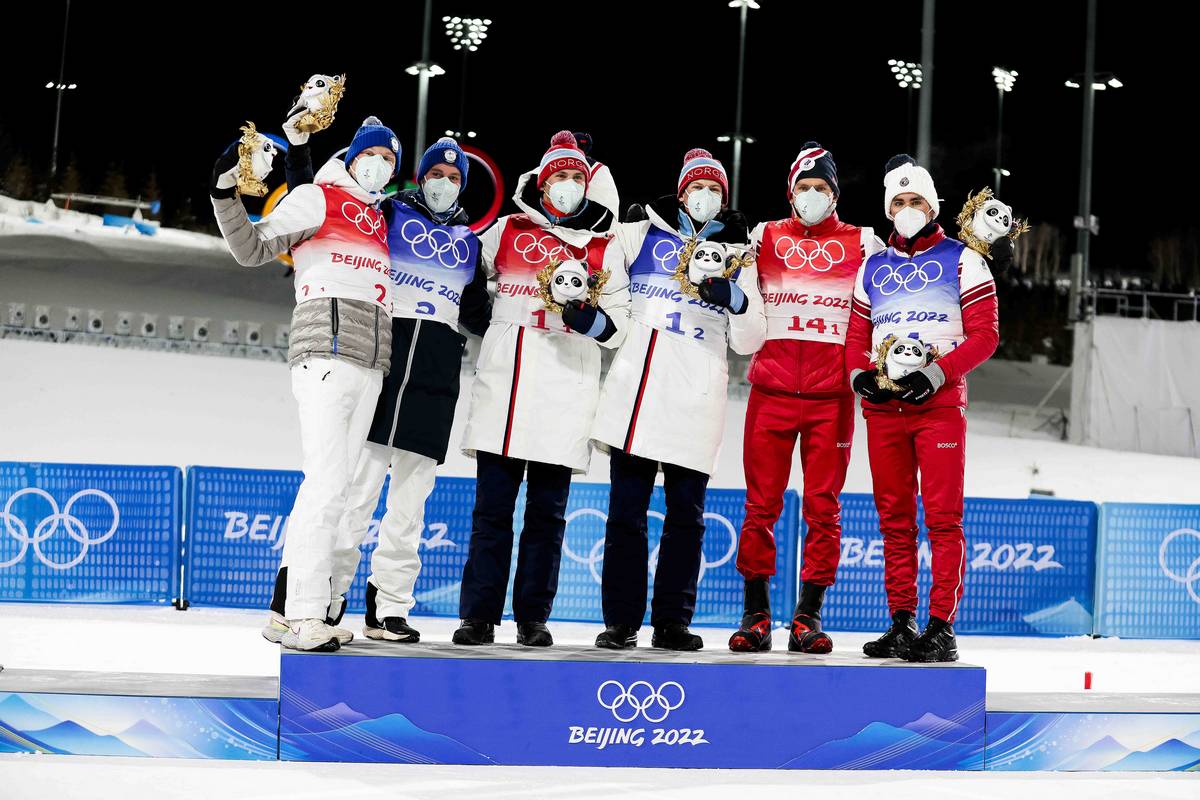
    Finland, Norway and the Russian Olympic Committee on the men’s team sprint podium. (Photo: NordicFocus)

    Results: Semifinal A | Semifinal B | Final

  • The Devon Kershaw Show: No-doubt Niskanen in the 15 k Classic

    The Devon Kershaw Show: No-doubt Niskanen in the 15 k Classic

    We’ve got our latest episode straight out of China to break down Iivo Niskanen’s dominating win in the Olympic 15 k individual start classic. We talk about some of the drama on the Norwegian team, cover the American and Canadian results and bring on special guest Vahur Teppan, a retired Estonian athlete who coached members of China’s national team for the past four years.

    Thanks for listening!

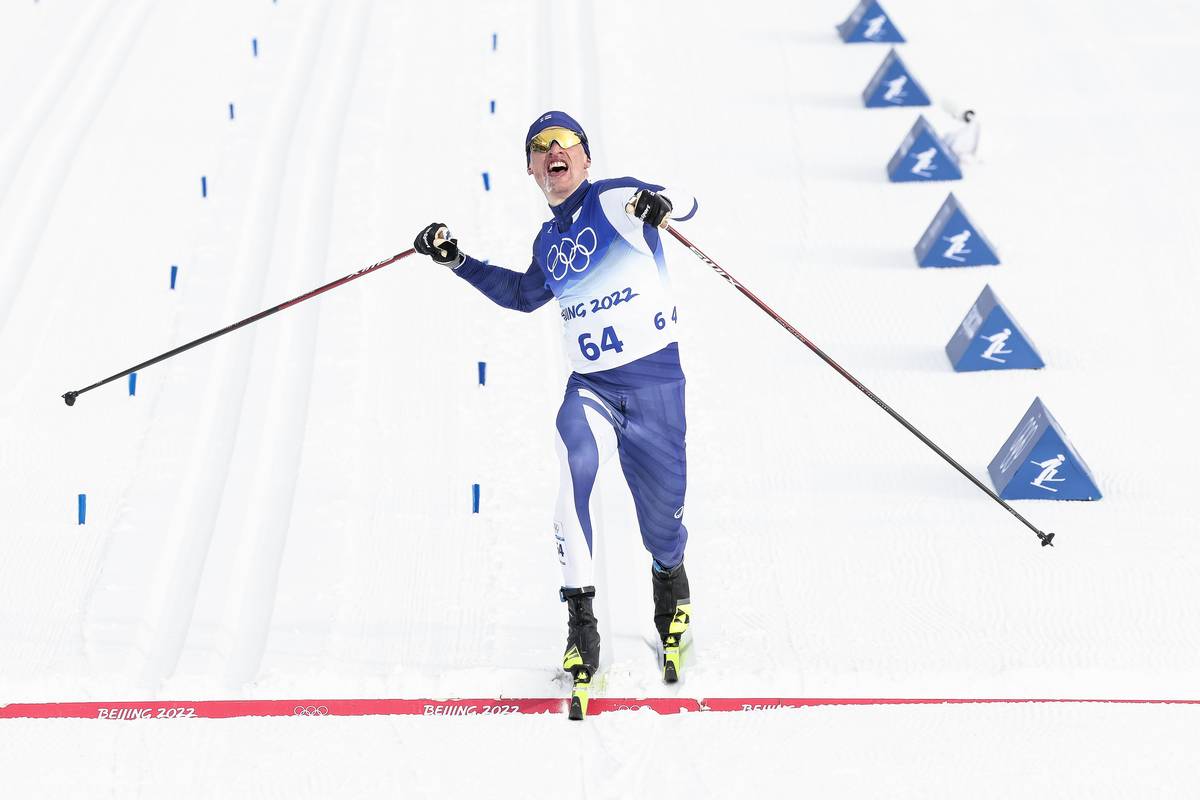
    Iivo Niskanen celebrates a gold medal performance in his signature event, the 15 k individual start classic. (Photo: NordicFocus)