From the FasterSkier archive — posts syndicated from athletes’ and coaches’ own blogs between 2004 and 2012, kept online as published. Current coverage is at fasterskier.com.
In this episode, we chat with Hailey Swirbul, who – at just 24 years old – has been competing at the top end of the sport for quite some time. A bronze medal in the 4 x 3.3k relay at the 2017 Junior World Championships in Soldier Hollow put Hailey – and relay teammates Julia Kern, Hannah Halvorsen, and Katherine Ogden – on the map in a big way in US Skiing. Hailey has gone on to spend the better part of the last four years racing on the World Cup, earning 48 World Cup starts and one individual podium in the 10k skate in Davos in 2020. She’s currently preparing for the upcoming World Championships in Planica, Slovenia, which starts on February 22nd.
Following last year’s Beijing Olympics, Hailey opened up about the contrast in expectation versus reality in the Olympic experience, and how the high stress, high pressure environment of life in Europe, particularly in the lead-up to the Olympics, negatively impacted her mental health and felt increasingly unsustainable. She questioned whether she wanted to keep skiing at all, but eventually decided to keep at it, with a new approach. She took a full time engineering job in the summer, and decided to forego period one and two on the World Cup, racing the SuperTour and US Nationals domestically instead.
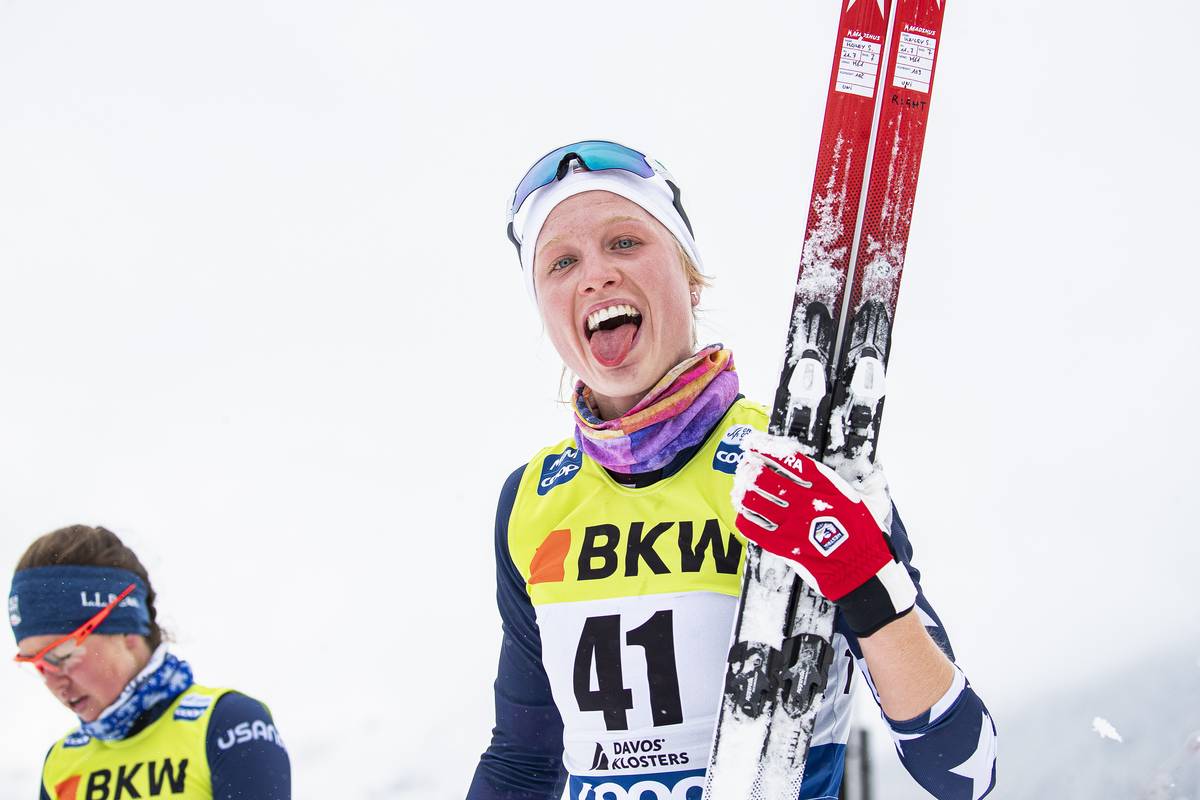
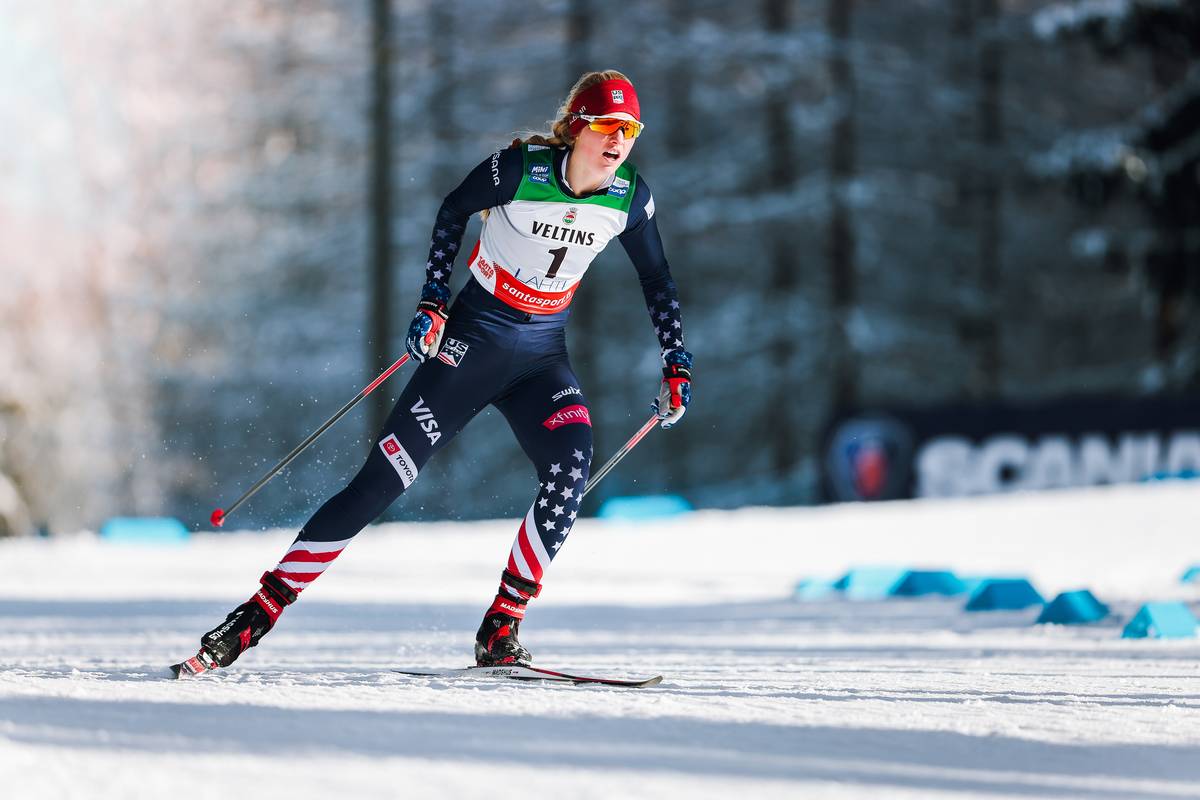
Hailey Swirbul enjoys her time in the leader’s chair after a solid performance in the 10k skate in Davos in December 2021. (Photo: NordicFocus)
As we discuss, this approach has rejuvenated her love for the sport and her motivation for the training and sacrifices it requires. And, it’s contributed to an outstanding season of racing, both domestically and internationally. She remains the SuperTour Leader as of recording, having earned a spot on the podium in all but one event, and swept all four events at the National Championships in Houghton, MI in early January. She seamlessly transitioned back onto the World Cup in Les Rousses, FRA where she raced into the semifinal of the classic sprint, followed by a top-20 result the following day in the 20k mass start classic. She qualified for the sprint heats again the following weekend in Toblach, ITA, was 26th in the 10k free the next day, and capped off the long weekend by scrambling for the US women’s relay team, which ended the day in bronze medal standing.
Thanks for listening, and thanks to Concept2 for supporting this podcast.
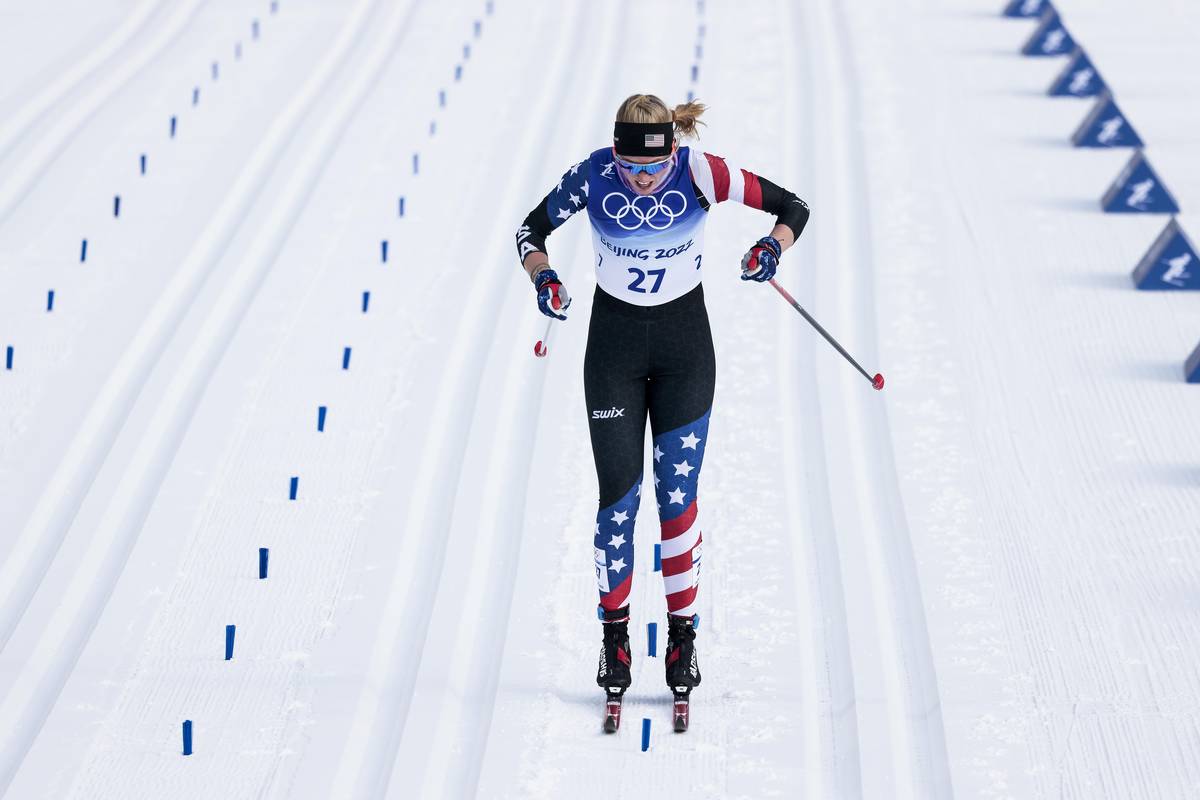
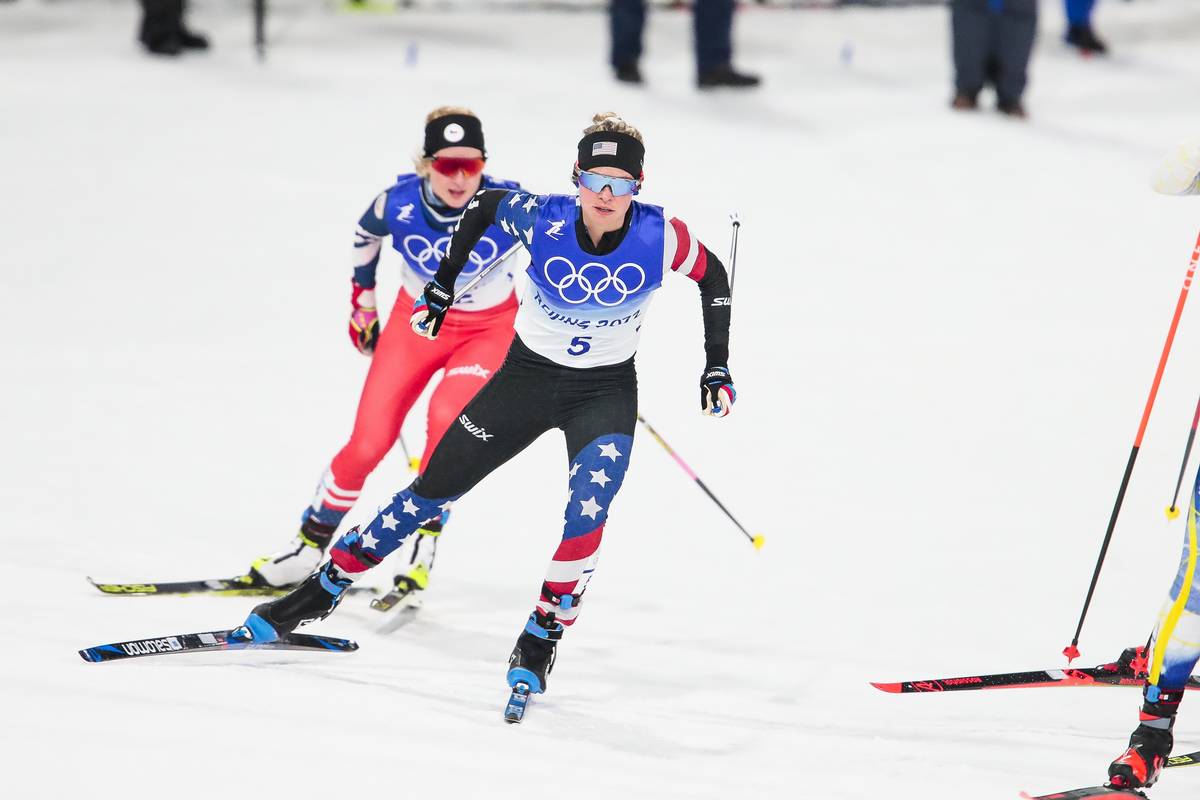
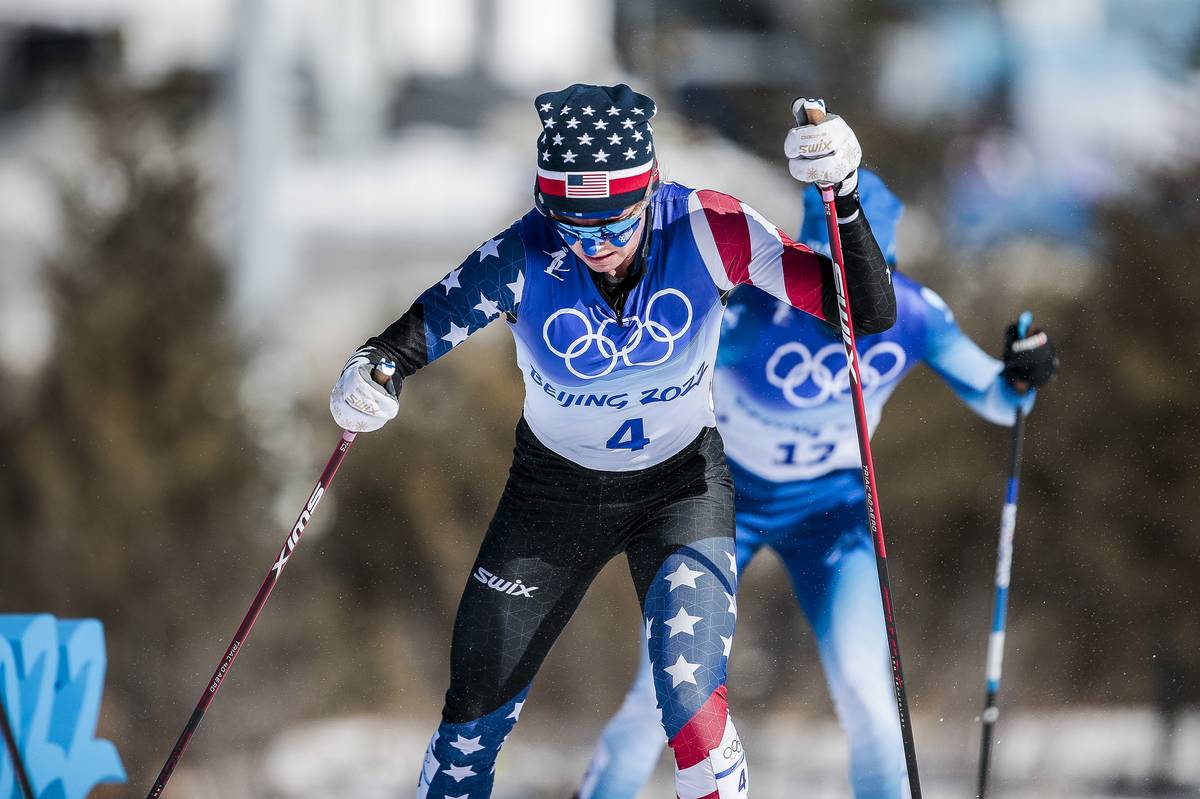
Hailey Swirbul pushes to the finish of the 10 k individual start classic during the 2022 Olympic Winter Games. (Photo: NordicFocus)
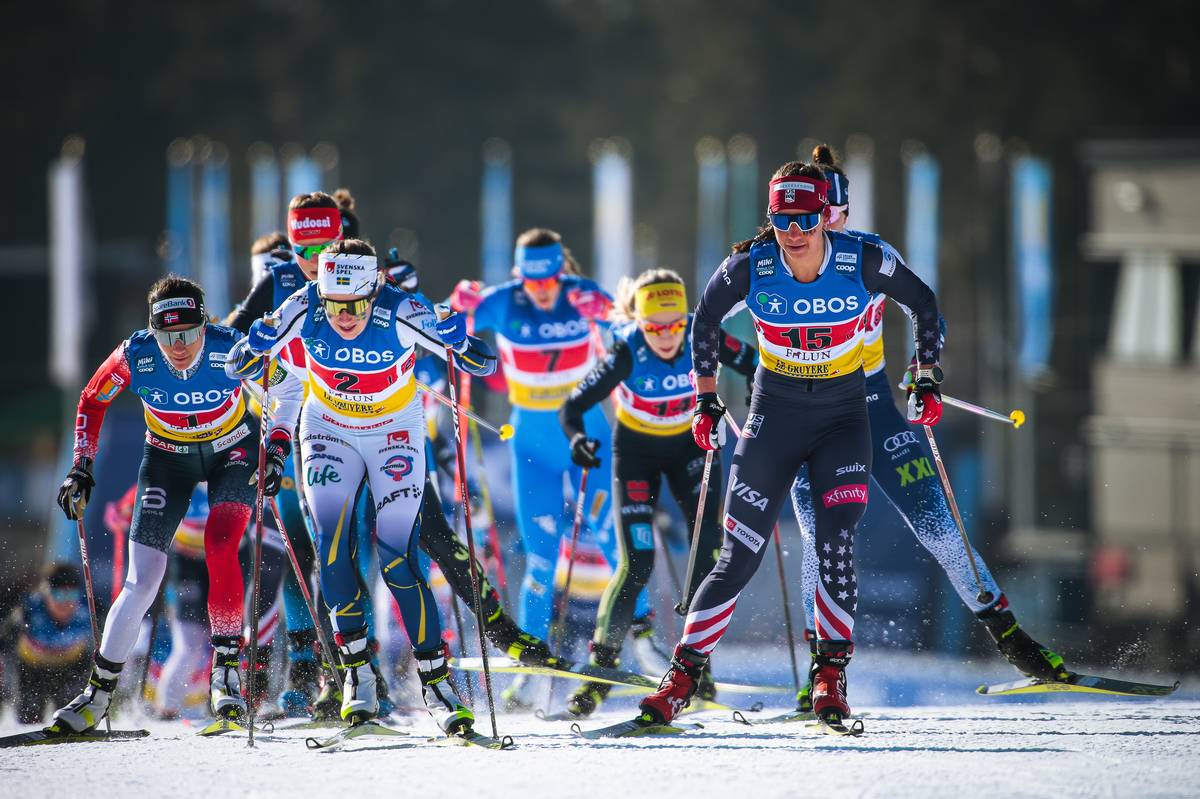
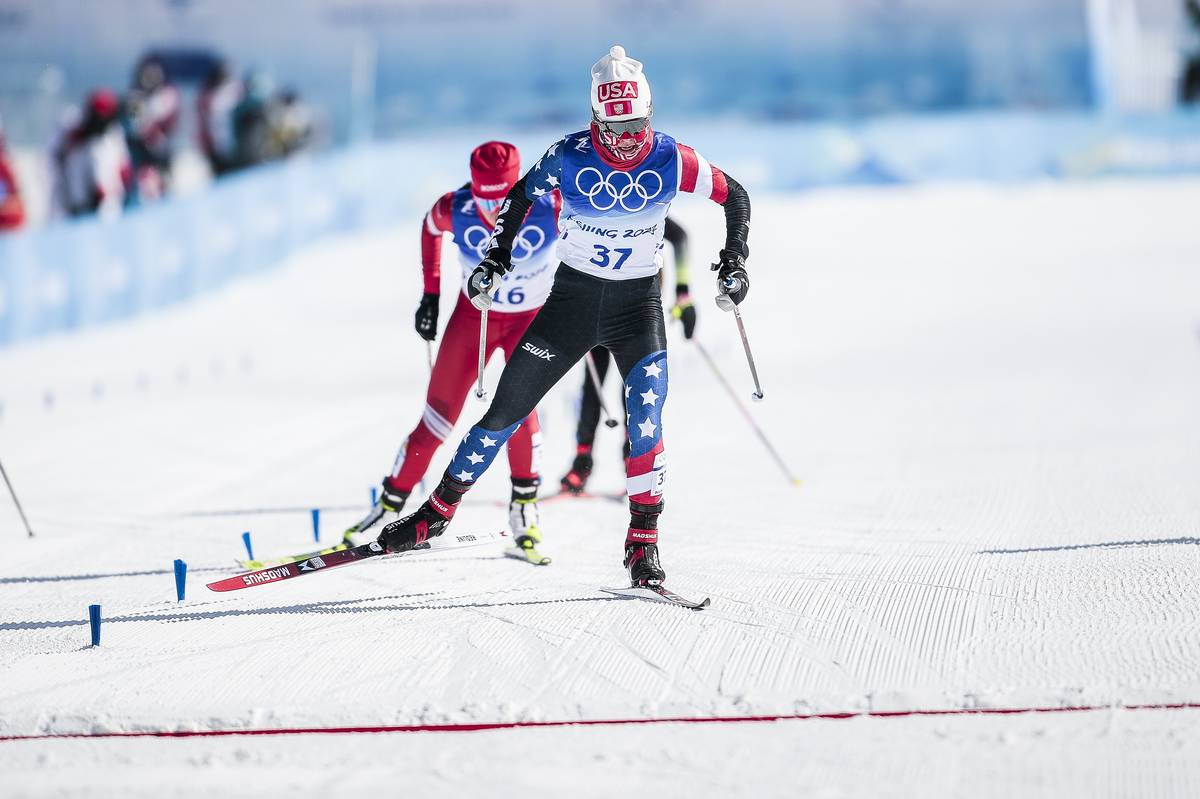
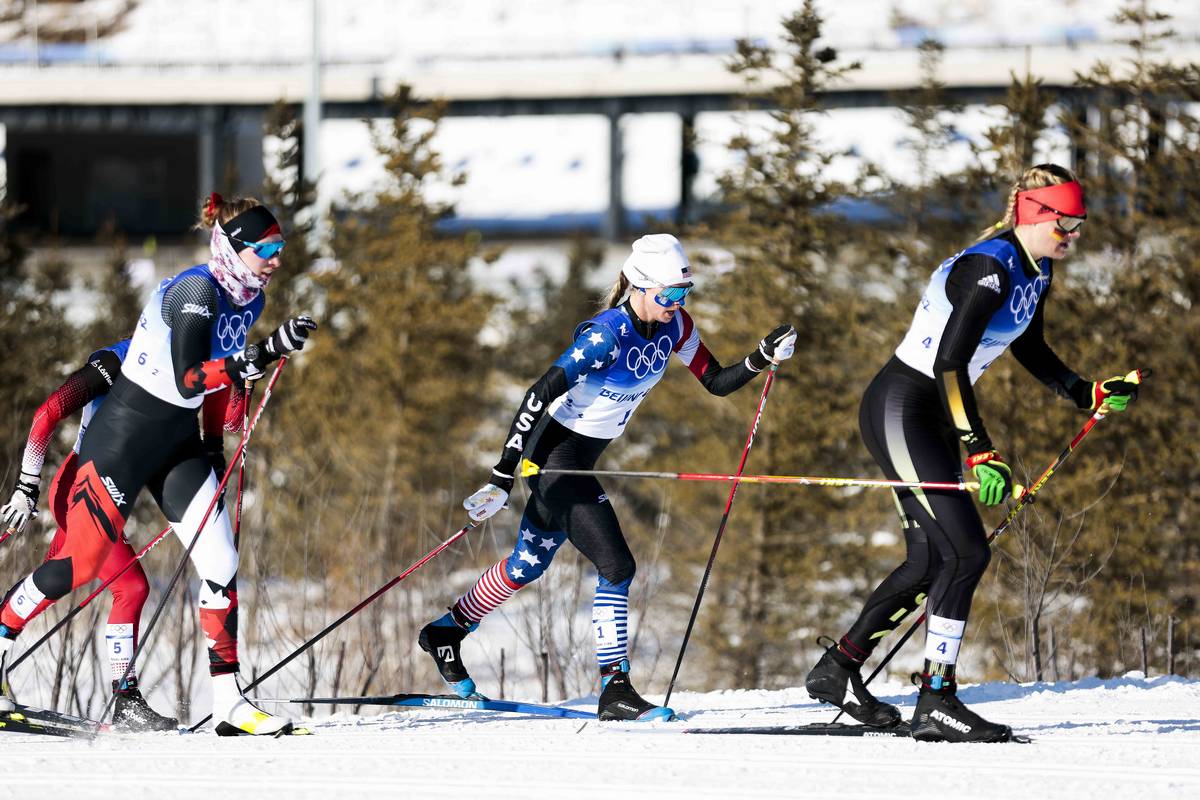
Julia Kern leads the pack during the first leg of the 4 x 5 k mixed relay in Falun, SWE in March 2022. (Photo: NordicFocus)
At 24-years-old, Julia Kern is quickly becoming a seasoned veteran in her 7th year on the U.S. Ski Team. However, her career trajectory has been stepwise, not exponential.
After making breakthroughs during the 2019-20 season, including her first World Cup podium in a skate sprint in Planica, Slovenia, she faced injuries and setbacks heading into the following season in 2020-2021, leaving her walking away from that season feeling disappointed in both her World Cup and World Championship racing. Reflecting on her takeaways in an interview that summer, she said “Progress isn’t linear from season to season.”
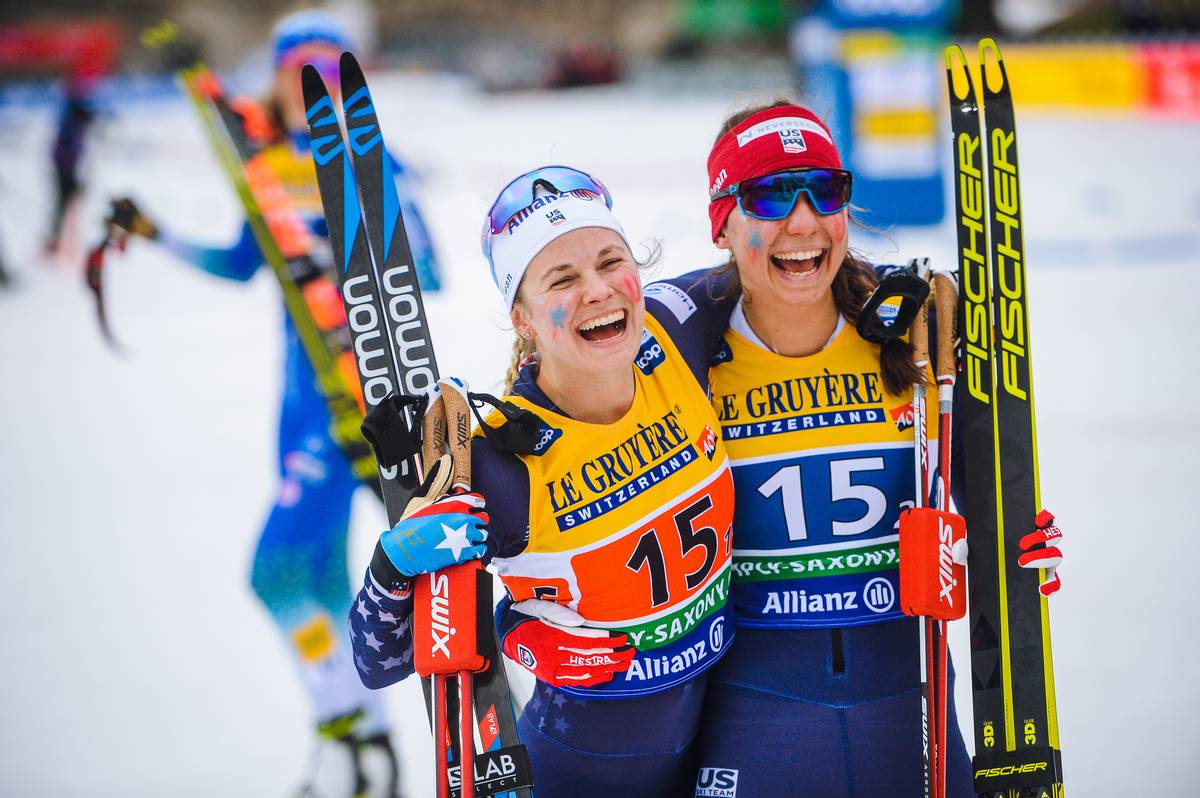
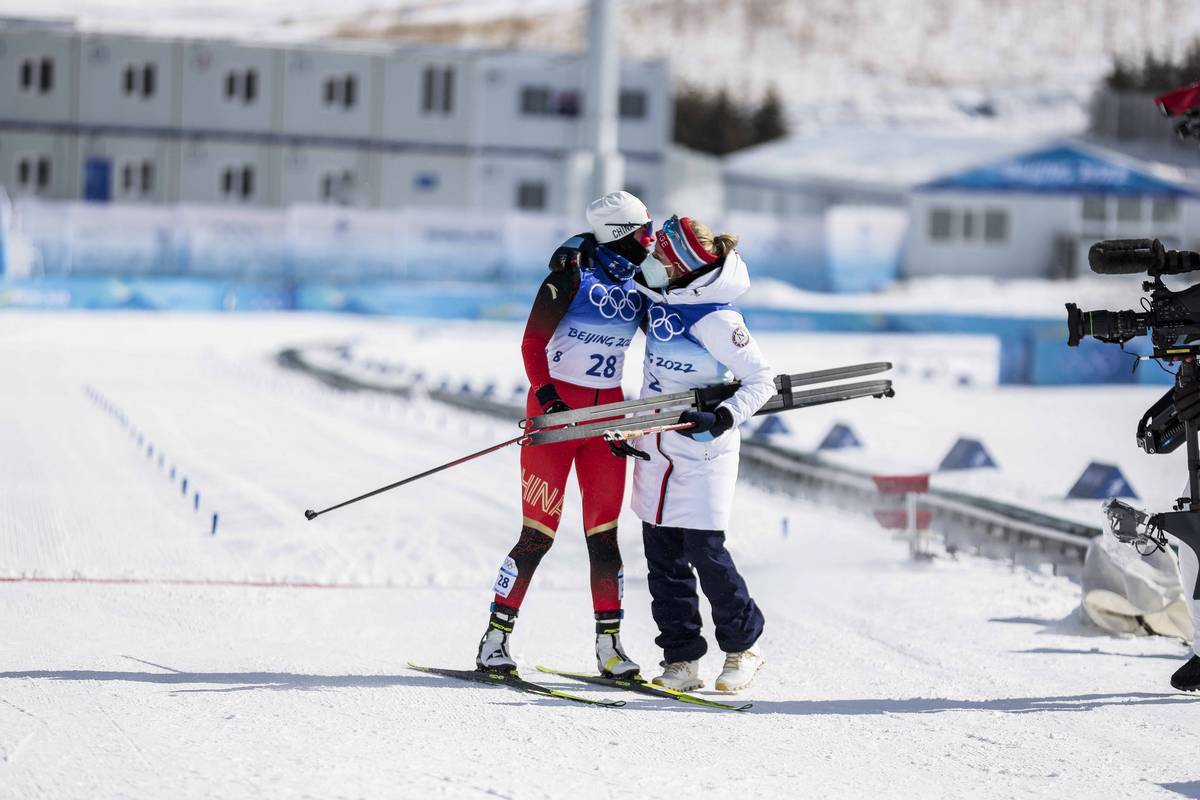
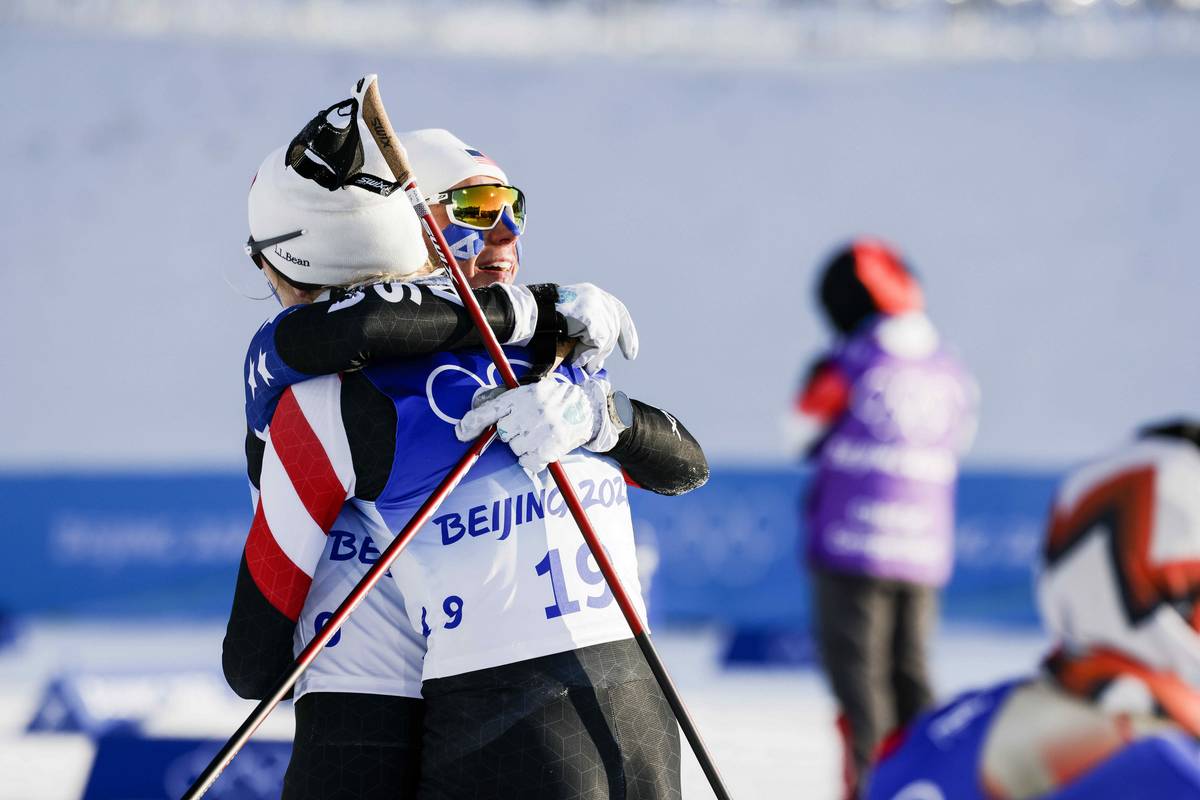
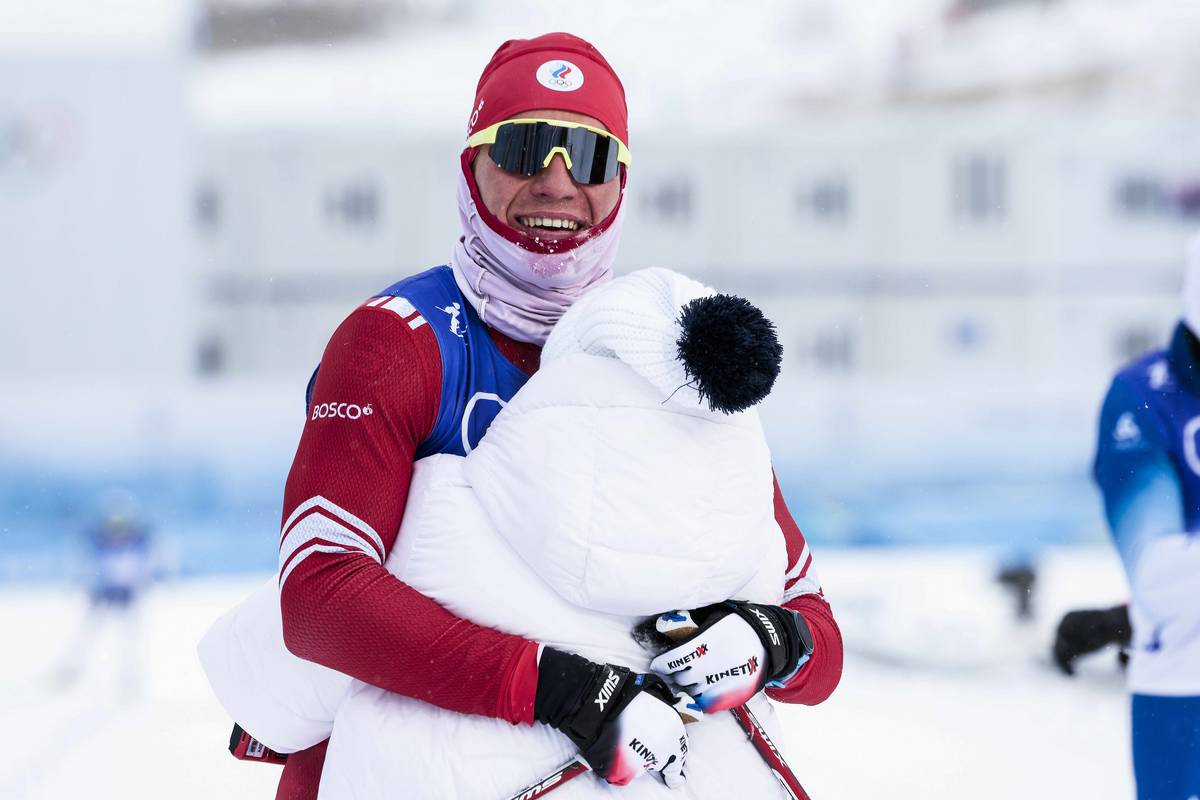
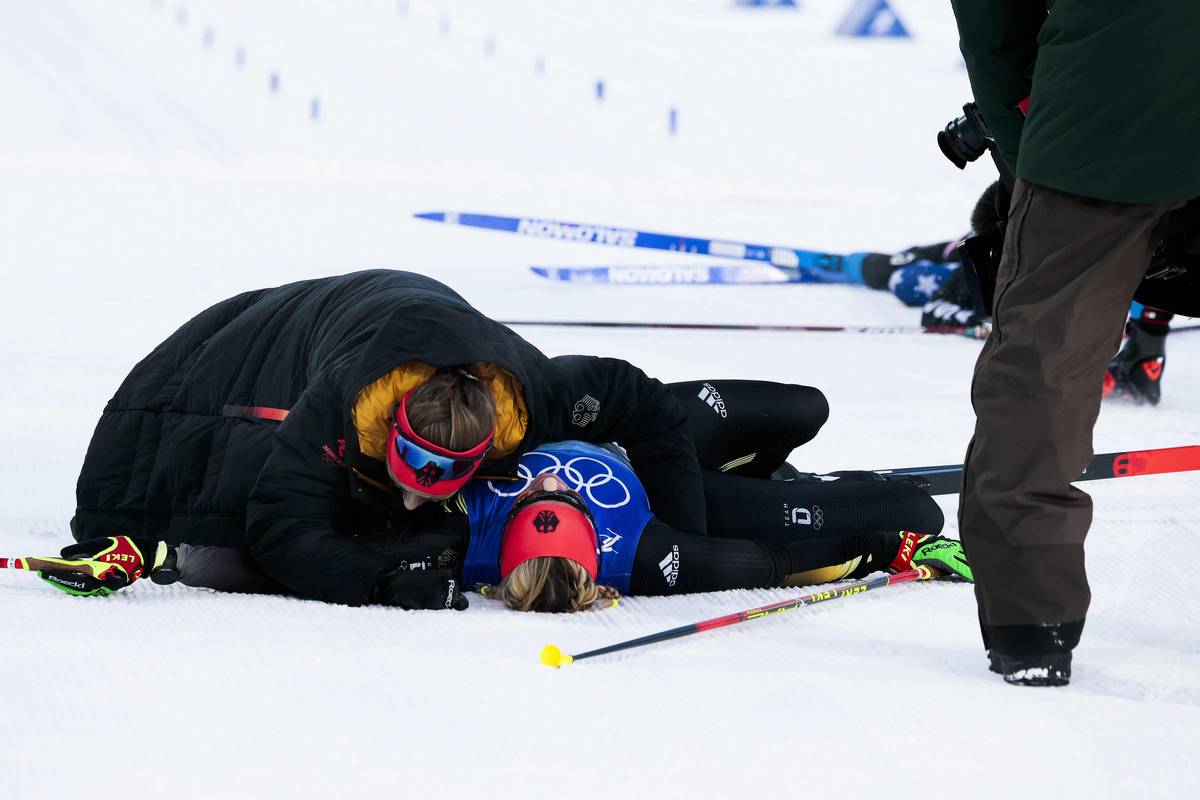
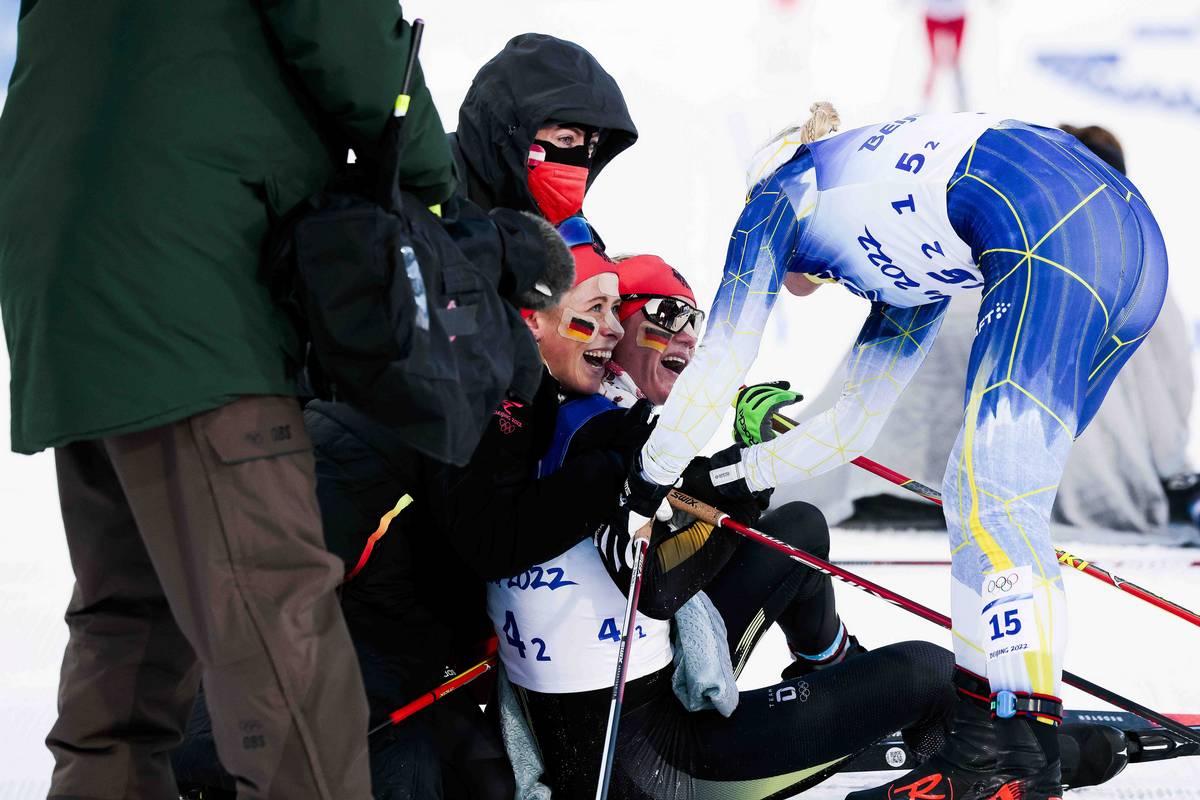
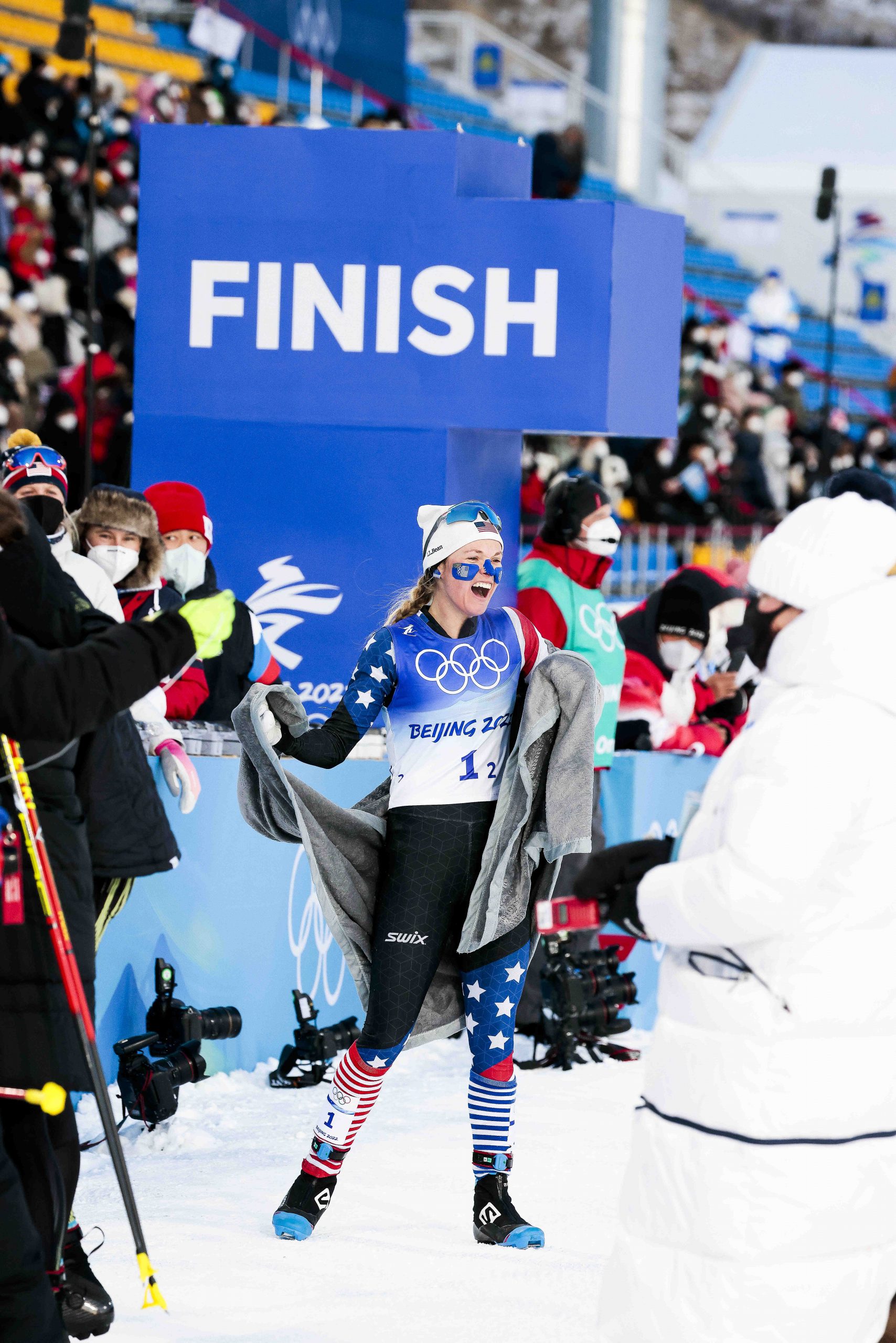
Hailey Swirbul (bib 19) and Julia Kern embrace at the finish of their first Olympic appearance in the 15 k skiathlon. (Photo: NordicFocus)
Recently named the recipient of the US Nordic Olympic Women’s Gold Rush Award for her grit and grace as a professional skier, Julia has demonstrated what it takes to rebound, reframe, and move past these challenges. As she describes in this conversation, the start of Julia’s 2021-22 race season happened in fits and starts – some strong early-season results with promising body sensations followed by a series of untimely mild illnesses. After catching a cold midway through the Tour de Ski in early January, she suddenly was faced with the reality that she would not have any opportunities to race until arriving in Zhangjiakou for the Olympics over a month later – the longest race break of her career.
Her first Olympic appearance took place in the opening event, the 15 k skiathlon, where Julia finished 53rd. The individual freestyle sprint three days later was her goal race; Julia qualified in 14th and raced a gutsy quarterfinal, ultimately finishing fourth in the heat and 18th overall on the day. A myriad of factors left her wanting more from this first Olympic experience, though she approached it without placing high expectations on herself.
Jessie Diggins and Julia Kern take second in the team sprint in Dresden, GER in December 2021. (Photo: NordicFocus)
Rebounding once more after the Games, Julia began a tear of World Cup sprints in Period IV. She was 8th in the freestyle sprint in Lahti, 7th in the classic sprint the following week in Drammen, and finished just off the podium in fourth in the World Cup Finals in Falun. From there, she headed to Whistler to finish the season at the joint Canadian National Championships and U.S. SuperTour Finals, where she took second to Jessie Diggins in Jessie’s signature 5 k freestyle event, and won the remaining three races.
During this conversation, Julia discusses the highs and lows of the season, as well as how she has been able to compartmentalize and move past setbacks over the past few years of navigating the transition to the World Cup. We also discuss her start in the sport, why the Stratton Mountain School (SMS) T2 Team has been a good fit for her, and how leaning into other creative outlets, passions and work helps energize her for the long haul.
Thanks for listening and thanks to New Moon Ski and Bike for supporting this podcast.
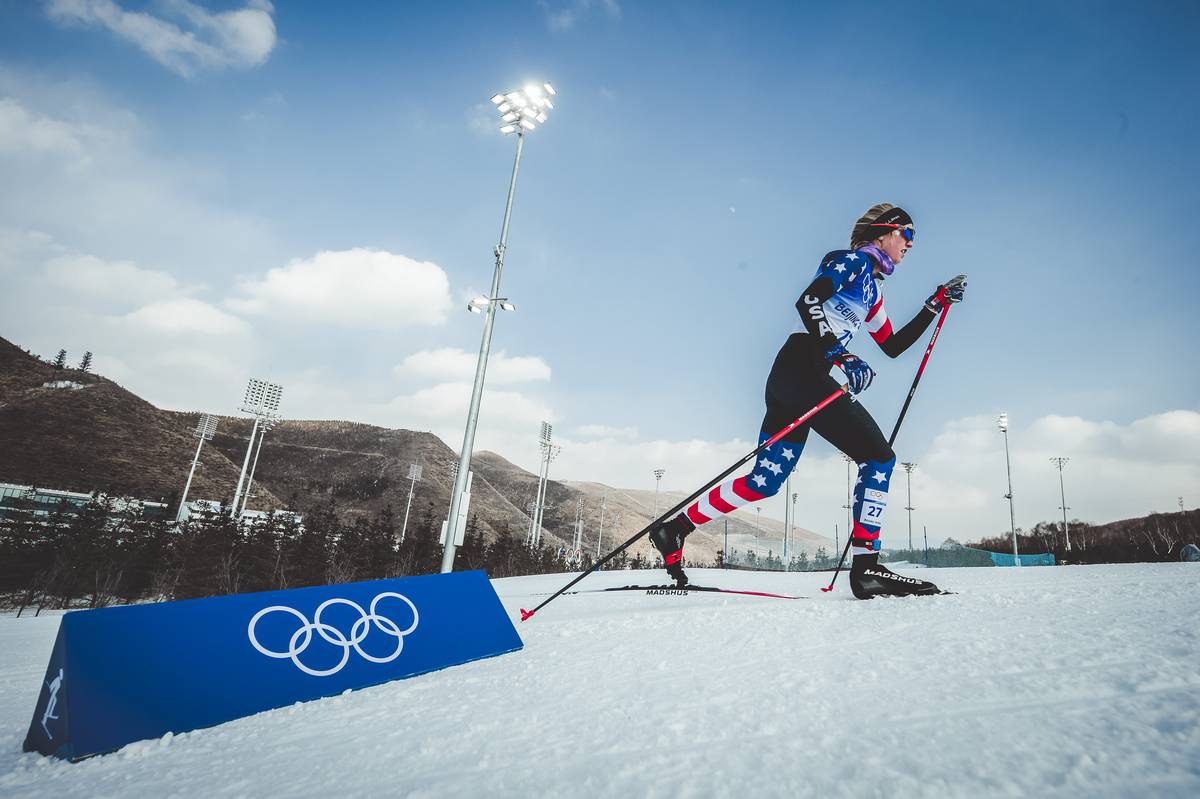
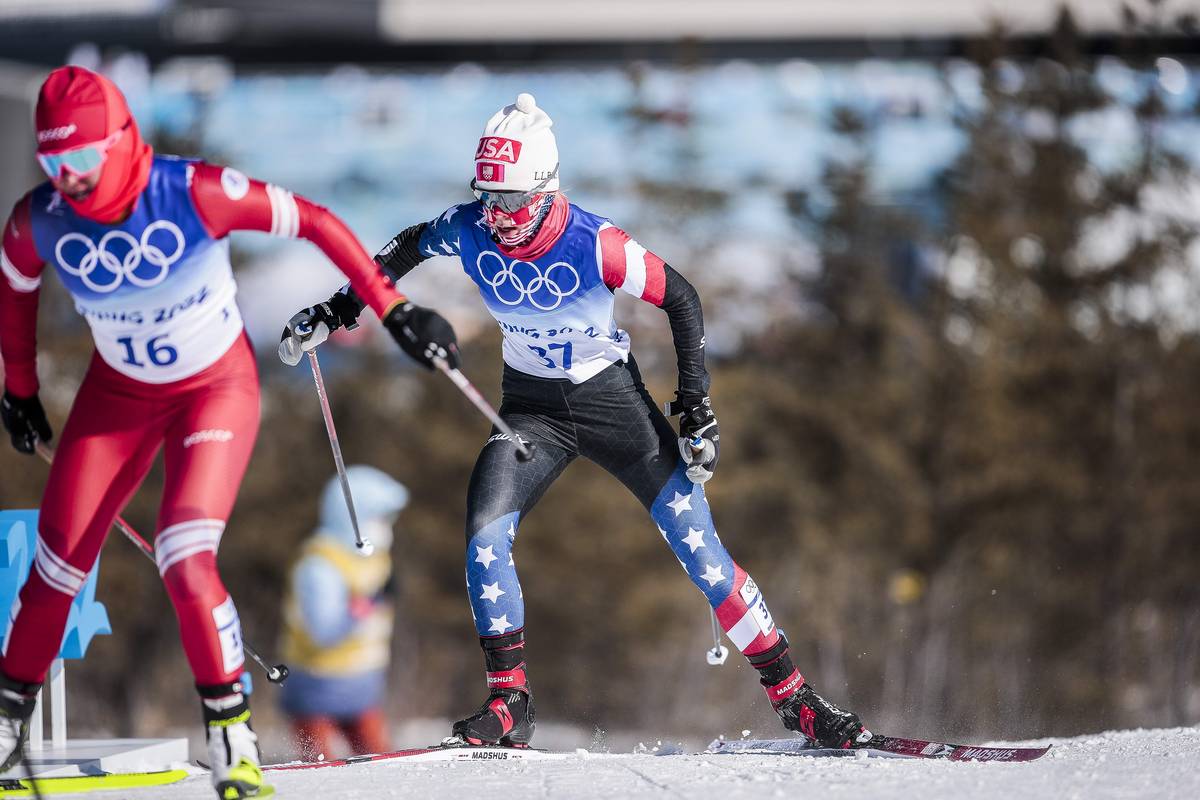
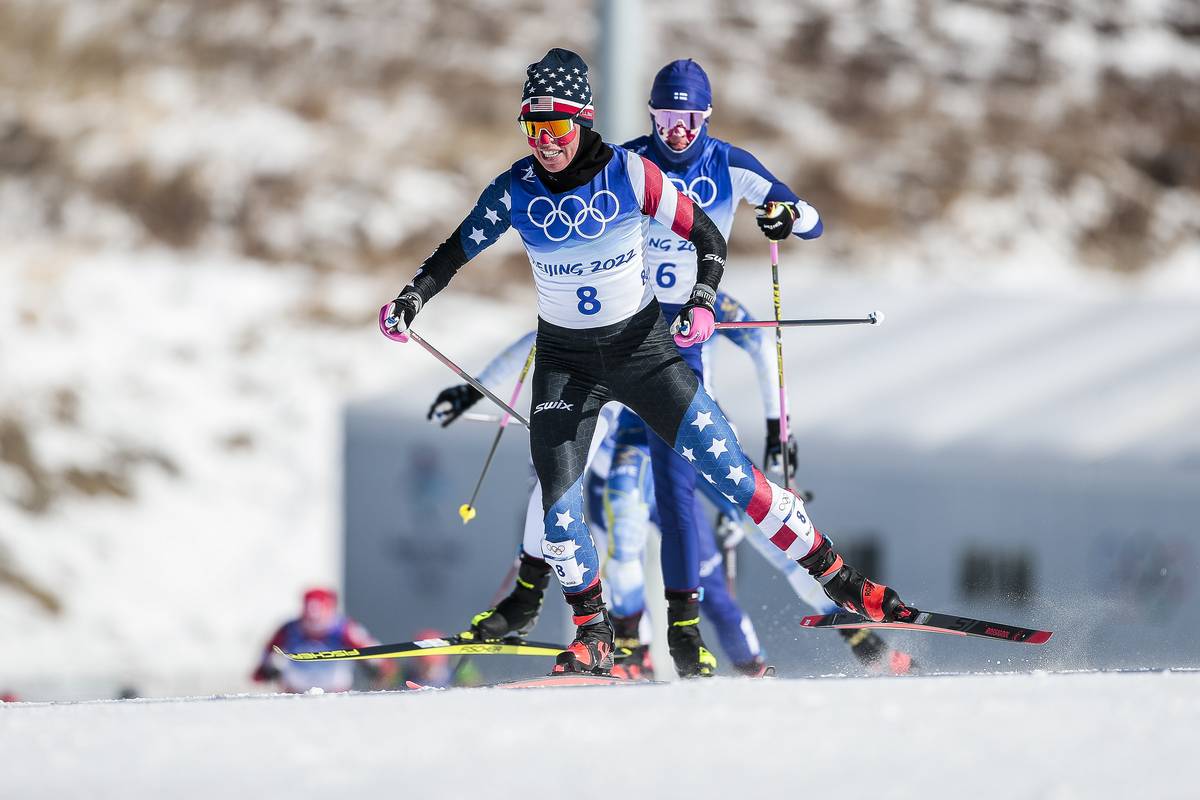
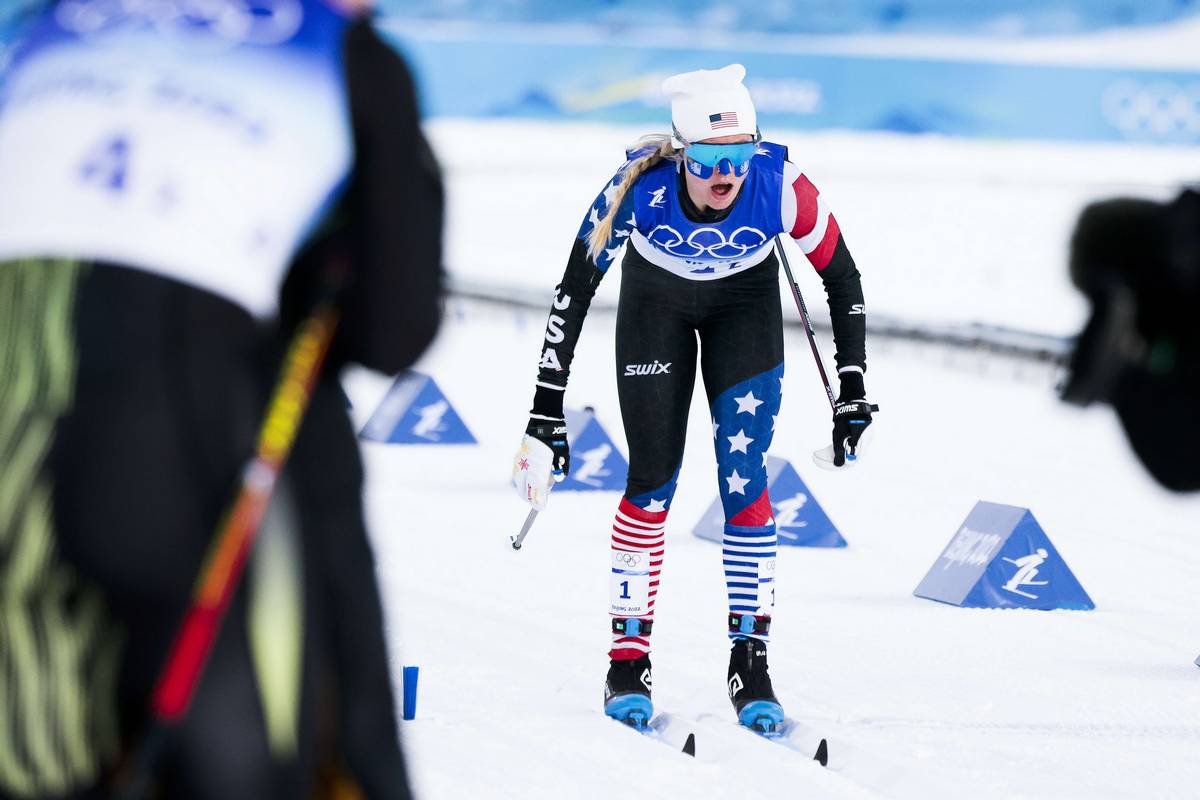
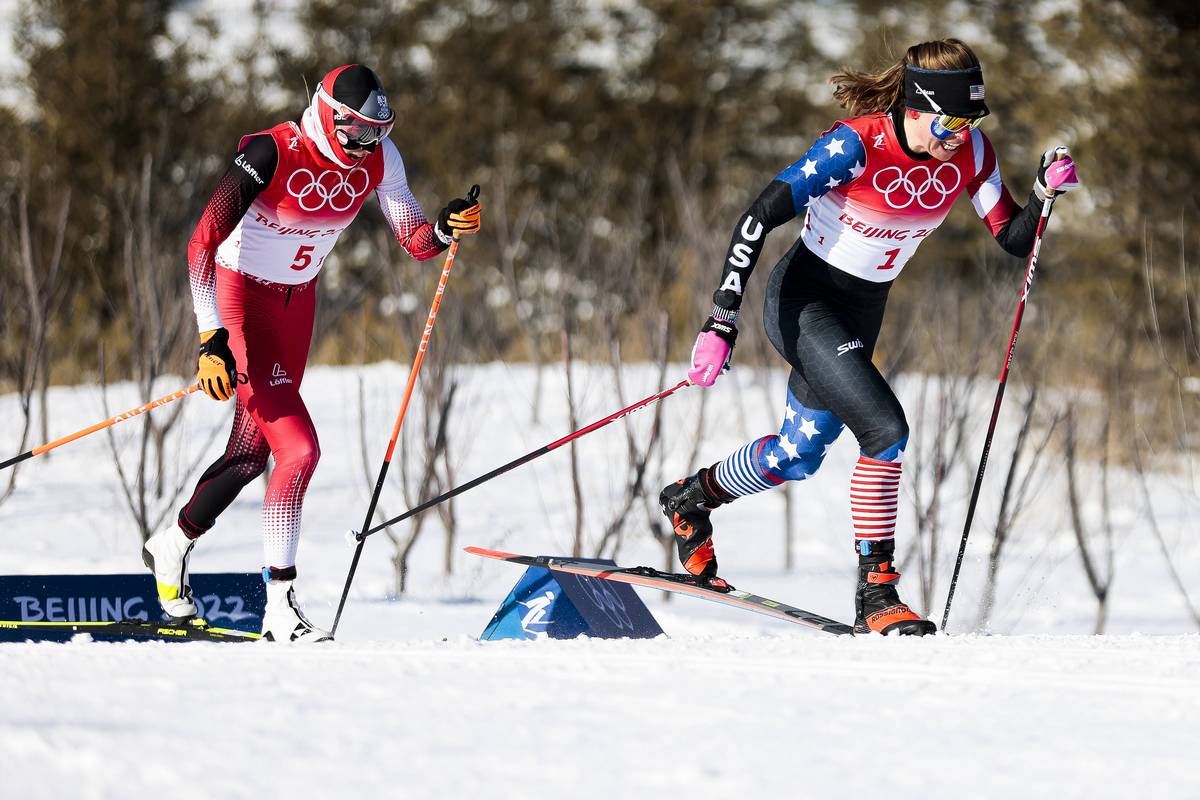
Julia Kern races the quarterfinal of the individual freestyle sprint in Zhangjiakou during the 2022 Beijing Olympic Winter Games. (Photo: NordicFocus)
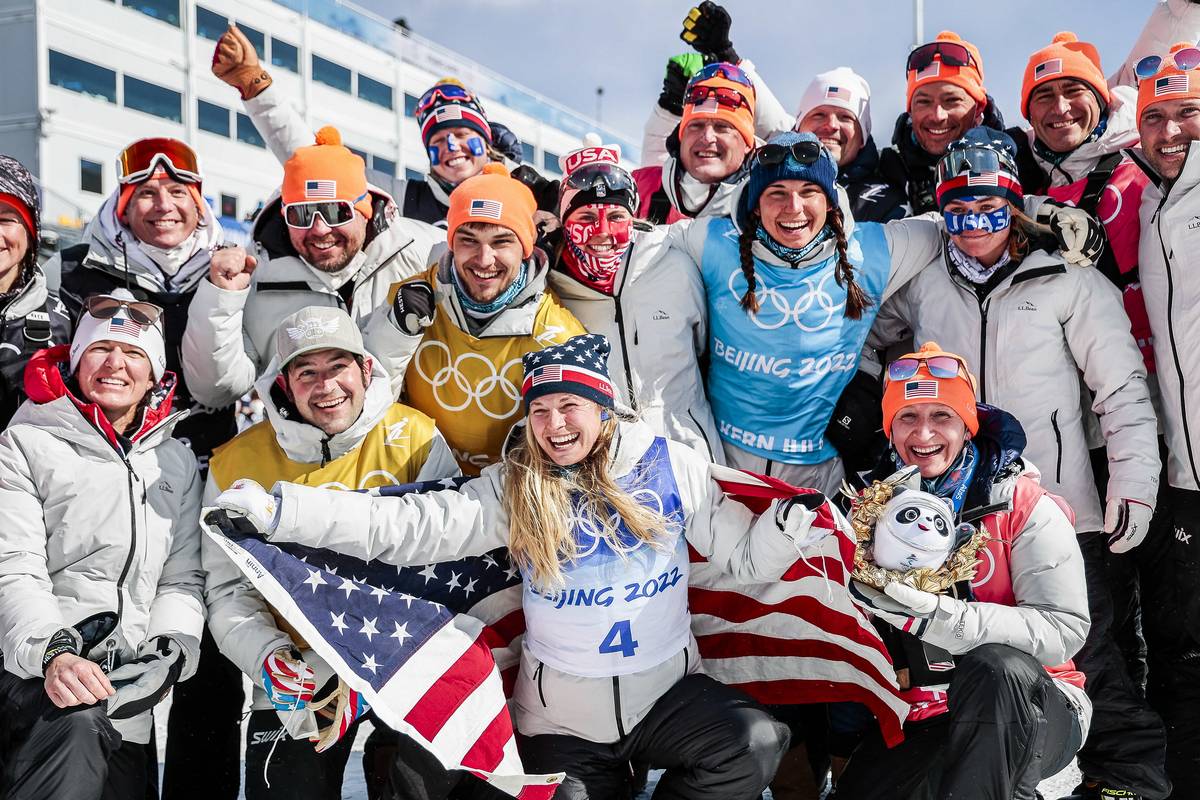
Celebration abounds following Jessie Diggins’ Olympic silver medal in the 30 k mass start skate in Zhangjiakou, CHN. U.S. Ski Team head coach Matt Whitcomb and cross-country program director Chris Grover wear orange hats near the top-right corner. (Photo: NordicFocus)
I think we can all agree that the last two years have been a wild ride.
For those at the helm of the cross-country program at U.S. Ski & Snowboard, added layers of COVID safety precautions and expensive testing have increased the otherwise mounting demands of preparing for an Olympic Games. There have been numerous domestic and international competitions canceled, including a full season of SuperTour racing in 2020/2021, numerous World Cups canceled, and three consecutive years where the World Cup finals were either rescheduled or canceled. Amidst ever-changing travel policies country to country, the U.S. Ski Team tested, masked, and problem solved their way through two race seasons.
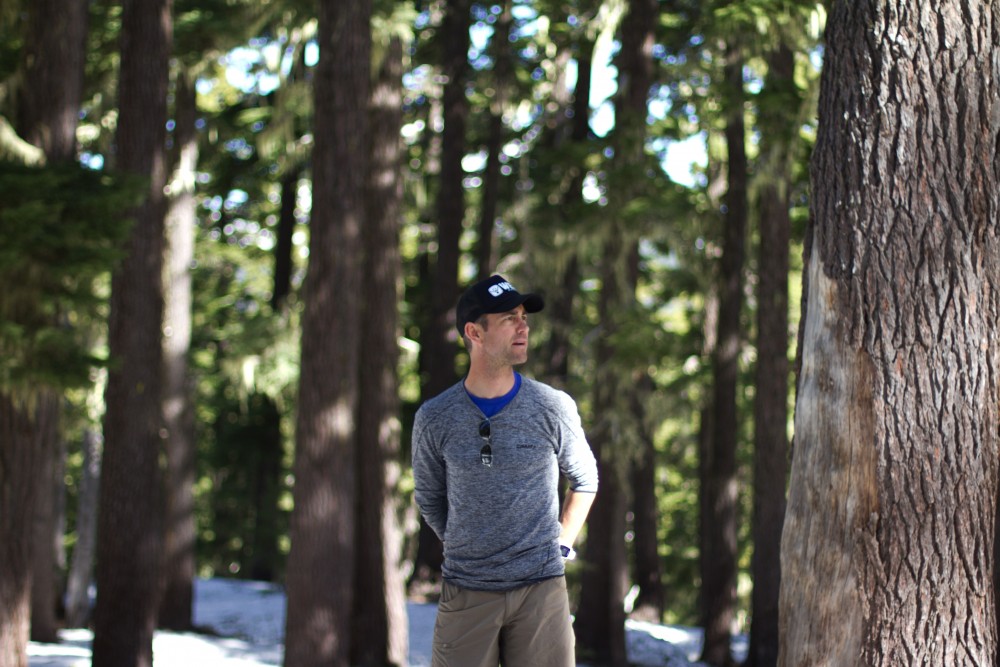
U.S. Ski & Snowboard XC Program Director Chris Grover oversees training during a 2019 U.S. Ski Team camp in Bend, OR. (Photo: FS Archives)
Throw into the mix preparations for an Olympic Games at a brand new venue where teams would be arriving site unseen and COVID testing protocols were extreme, and cap the season with the invasion of Ukraine and subsequent ban of the Russian cross-country powerhouse – there’s simply been a lot of curveballs thrown.
But as the 2022/2023 season approaches, we also sit at a transition point for World Cup racing that perhaps marks a few steps forward with gender parity. Namely, a move toward equal distance racing and the adoption of an initiative proposed by U.S. Ski & Snowboard to the FIS to incentivize supporting and developing more women to become ski technicians at the World Cup level. In this proposal, an additional set of course access bibs which could be used to test skis and product at World Cup events would be available only to women; therefore, a country could increase the size of its service staff by investing in the development of women techs and utilizing these women at World Cups.
Though Grover explains this may best serve the nations with the biggest budgets – which does not include the United States – it’s greater purpose aligns with other grassroots initiatives at U.S. Ski & Snowboard to hire, develop, and support women in coaching and leadership to improve the balance of men and women representing all levels of the sport.
There’s also a recently-released 2022-23 roster of U.S. Ski Team athletes, featuring a bloom of young talent on the men’s side whose trajectory may enable a full field of men and women to race at the 2026 Olympic Games in Milano Cortina. And, there’s momentum building for a Minneapolis World Cup in 2024, followed by a trip to the Northwoods of Wisconsin for a super-Birkie – i.e., a World Cup sprint and 50k on the Birkie trails.
In short, there were no shortage of talking points for this insightful conversation with cross-country program manager Chris Grover, who joined us from his home in Hailey, ID upon returning from the U.S. Ski Team’s first training camp of the season at the Mt. Bachelor Nordic Center in Bend, OR.
Thanks for listening.
Masked up, Jessie Diggins and Ebba Andersson (SWE) congratulate one another on podium performances in the 10 k skate in Falun in Mar. 2022. (Photo: NordicFocus)
It’s likely that today’s guest needs no introduction. Over the last decade, she has steadily worked to become the most decorated American cross country skier in history. As she gained more recognition beyond the niche of cross country skiing, she began to use her platform to become an advocate for causes she felt passionately about, opening up about her own experience struggling with an eating disorder and working hard at recovery through the Emily Program, and also becoming an athlete ambassador for Protect Our Winters (POW) to advocate for policy changes to combat climate change.
Jessie Diggins takes Olympic bronze in the individual freestyle sprint in Zhangjiakou. (Photo: NordicFocus)
Heading into the Olympics in February, Jessie Diggins received more media attention than ever before, landing on the cover of Sports Illustrated and having her profile featured on major news outlets like the New York Times. There was an entire category for her career highlights on the Olympic cross country ski tab on NBC’s Peacock streaming platform.
From all of the coverage focused on Diggins surrounding the Games, one comment in particular received attention and push back from the athlete community. The line in a February 8th story in the NY Times suggested that Diggins looked “like a sprite in her racing suit,” comparing her body to her competitors’ who had “massive shoulders and thighs.” It was seen as inaccurate, inappropriate, and potentially harmful to those reading it.
To discuss the topic of body comments in sports journalism and why they might be harmful in the broader scope of athlete mental health, the Nordic Nation podcast recently hosted a discussion among the panel of Rosie Brennan, Corrine Malcolm, Brian Metzler, and Nat Herz, who span the breadth of athlete and media representative. Following the conversation, FasterSkier received feedback that the topic had already been given enough attention, and it remained clear that there was not unanimous understanding of why commenting on athletes’ bodies was deemed problematic.
Seeking to add clarity to this side of the story, along with her own perspective as someone who has experienced an eating disorder and since become an advocate for awareness and support in that realm, Diggins reached out to FasterSkier asking to add her voice to the conversation.
To be clear, neither Diggins nor FasterSkier aims to “cancel” NY Times author Matthew Futterman, nor to attack the NY Times for running the comment. The purpose of this discussion was to consider how a comment on an athlete’s body might be triggering to a reader who is primed to fall into the eating disorder trap, and how writers, parents, coaches, and teachers can be mindful of the impact and importance of what they say.
Jessie Diggins races through the heats during the Olympic freestyle sprint in Zhangjiakou, China. (Photo: NordicFocus)
Diggins also reflects on the 2021/2022 race season and what was an historic string of Olympic appearances. She discusses the success of the US Ski Team as a whole, in particular, the younger generation of athletes like Novie McCabe, Sophia Laukli, Ben Ogden, JC Schoonmaker, and Gus Schumacher, who have transitioned onto the World Cup over the last two seasons and earned spots on the 2022 Olympic Team.
Thanks for listening.
Additional Resources and Related Reading & Listening:
WithAll Foundation and the What to Say Campaign. As discussed in the episode, Diggins and Gus Schumacher participated in a live discussion with this organization on March 31st titled “What America’s Top Athletes Know About Health & Performance”, which can be viewed here.
The Emily Program: A leader in eating disorder treatment and outreach, and partner of Diggins’
FasterSkier also shared two OpEd pieces surrounding this topic, one from our own contributor Ben Theyerl and a second from reader Ivy Spiegel Ostrom, highlighting individual responses to the NY Times comment and underlying issues of body comments in the media, along with another separate OpEd by Rachel Bachman Perkins on the prevalence of eating disorders and disordered eating in sport.
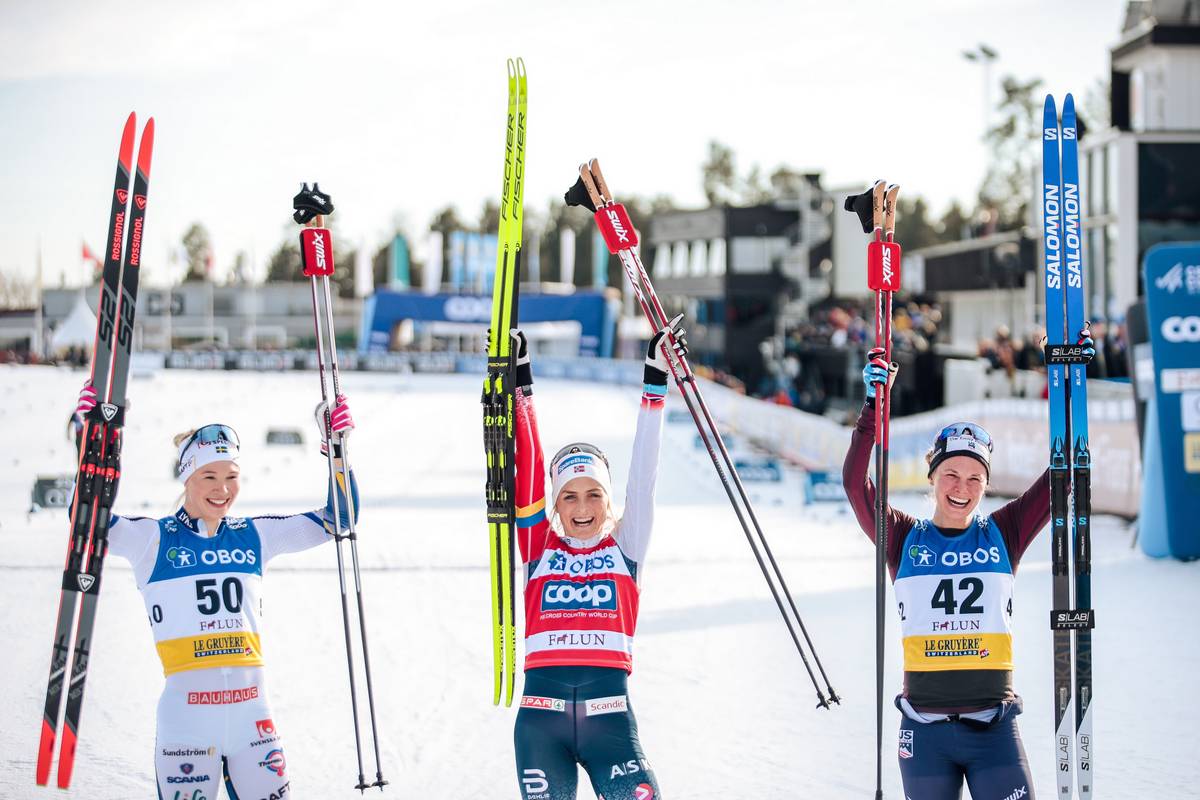
Jessie Diggins races onto the podium in the 10 k free during the 2021/2022 World Cup Finals in Falun, Sweden. Norway’s Therese Johaug took the win, with Sweden’s Jonna Sundling in second. (Photo: NordicFocus)
ZHANGJIAKOU, CHINA — A month ago, I met with a source close to the Chinese government in a tiny room in this mountain resort outside Beijing, which hosted the 2022 Olympic cross-country skiing events.
There, the source explained how a decision by international skiing officials to disqualify a Chinese cross-country skier from a race was like killing a baby.
China does not have, exactly, a long tradition of success in winter sports like cross-country skiing. But after several years of work and hundreds of millions of dollars invested in facilities, Scandinavian and Russian coaches, athlete development and gear, it was hoping for big results in Beijing, especially from star sprinter Wang Qiang.
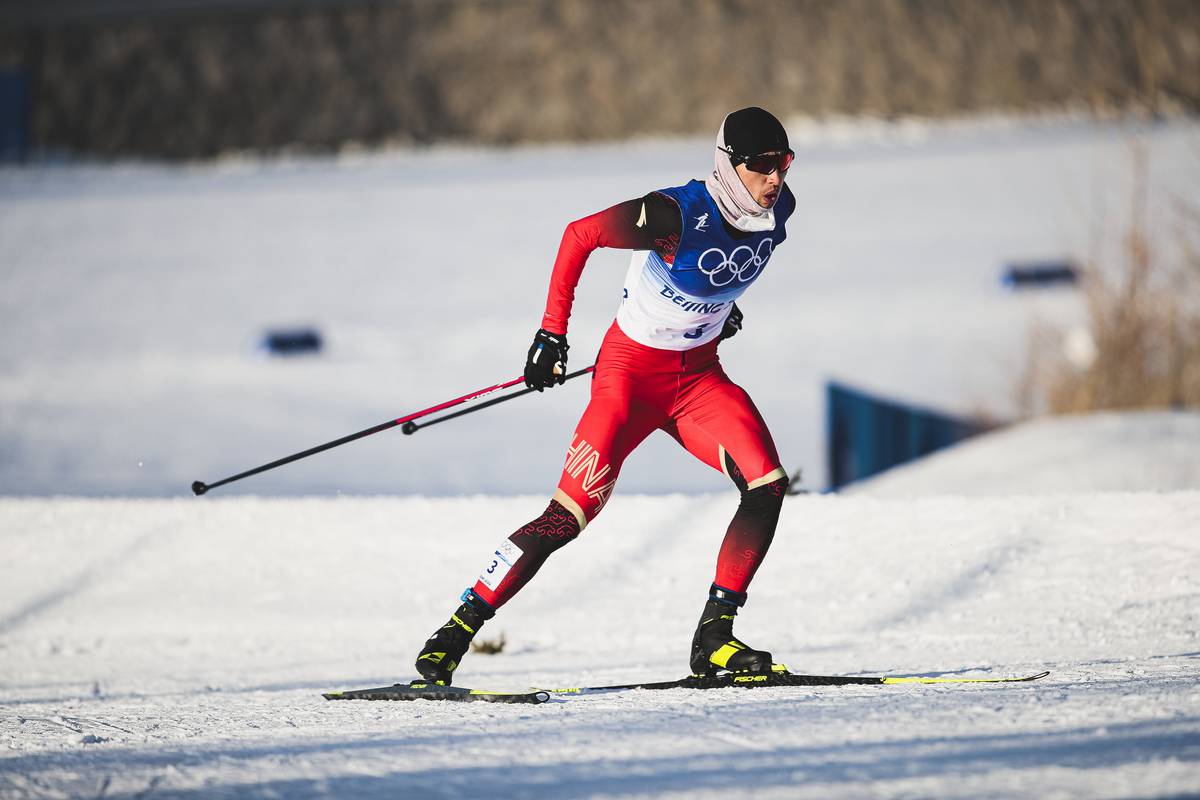
China’s Wang Qiang races to fifth in the freestyle sprint qualifier in Zhangjiakou during the 2022 Beijing Olympic Winter Games. (Photo: NordicFocus)
Wang, in cross-country’s Olympic skate sprint last month, was poised for a top-10 finish, and maybe even a medal — definitely the only hardware that China’s cross-country ski team had a chance to win on home snow during the Games.
But in one of the event’s preliminary head-to-head knockout rounds, Wang tangled with a Norwegian skier, Pål Golberg, who crashed. The International Ski Federation jury overseeing the race relegated Wang to 30th place, ruling that he’d obstructed Golberg, even though China vehemently disagreed.
Hence the tamped-down outrage I was witnessing from my source, who wanted international followers of cross-country skiing to understand his country’s anger over the disqualification.
China had just poured huge amounts of money into hosting the Olympics and building up cross-country skiing; thousands of volunteers had put their lives on hold to pull off the Games during a pandemic. The ski federation, known as FIS, couldn’t give Wang the benefit of the doubt? In a country with hundreds of millions of potential new cross-country skiers and skiing fans, where the sport was still in its infancy?
“You don’t kill infants,” the source said.
This is a Chinese-friendly perspective on Wang’s disqualification, and many others disagree, saying that Wang committed a clear infraction and that skiing’s rules must be enforced without regard to politics or business.
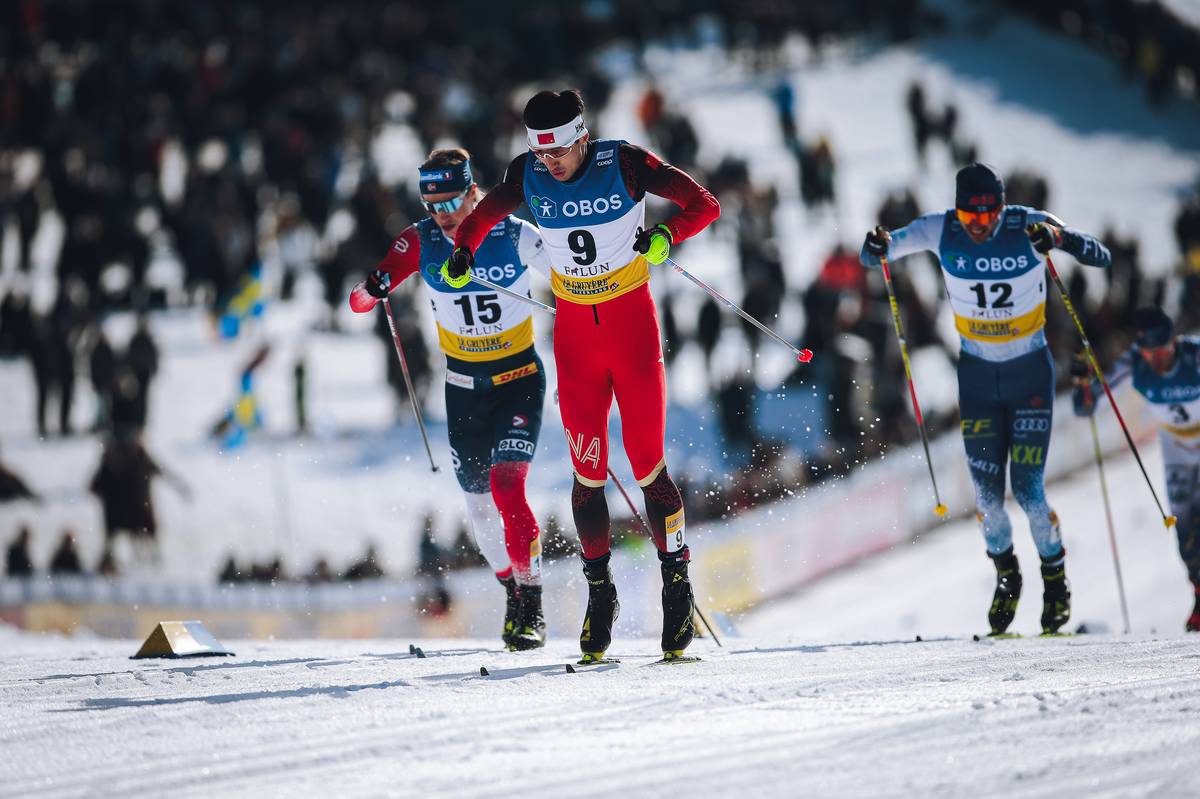
China’s Wang Qiang races through the heats during a classic sprint in Falun, Sweden. (Photo: NordicFocus)
But the Chinese perspective on the event is one that’s worth understanding. Because doing so can help answer one of the most interesting, and important, questions in cross-country skiing right now: Will China keep up its investment in the sport?.
“What I’m very curious about is: What next?” Vegard Ulvang, the retired Norwegian Olympic gold medalist who now chairs FIS’ cross-country committee, said in a phone interview. “Will they continue? Will they have a national team? Will they join the World Cup? To be honest, we don’t know. I have no information on what they will do.”
The question has enormous implications for the sport of cross-country skiing, given the size of China’s potential market for skis, wax and television broadcasts.
But I got conflicting answers when I asked the people who would know the answer.
The source close to the government said Wang’s disqualification soured China’s sports minister, Gou Zhongwen, on further investment in cross-country skiing, and he said the sport’s future in the nation looks deeply uncertain. Many of the team’s Scandinavian employees have contracts that end in May, without assurances they’ll be renewed.
“Everything is political, and the culture is completely different,” said Tor Arne Hetland, a Norwegian coach and former Olympic gold medalist who’s worked with Chinese athletes. “If the sports minister says, ‘We are not going to pursue winter sport or cross-country skiing or biathlon,’ then of course, there will not be any money for it. And the project will be completely dead.”
But in an interview in Zhangjiakou during the Games, Zhang Bei, the Communist Party official who leads China’s cross-country ski team, struck a positive note.
She said her country’s commitment to training athletes will continue into next year, and plans have already been announced that the team will keep sending athletes to train in Finland through the 2026 Games. Wang also proved his potential with a podium performance on the top-level World Cup circuit earlier this month in Drammen, Norway.
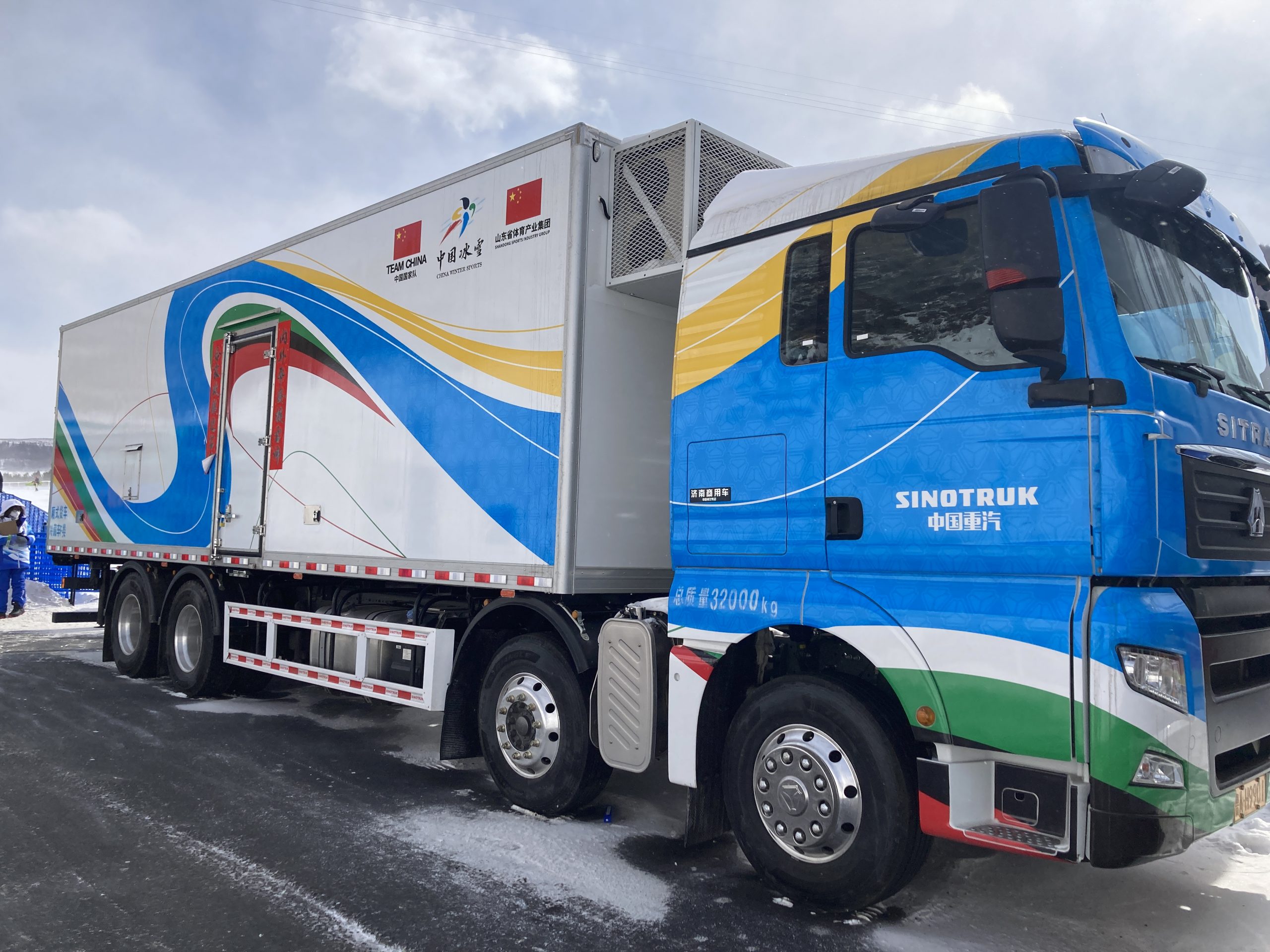
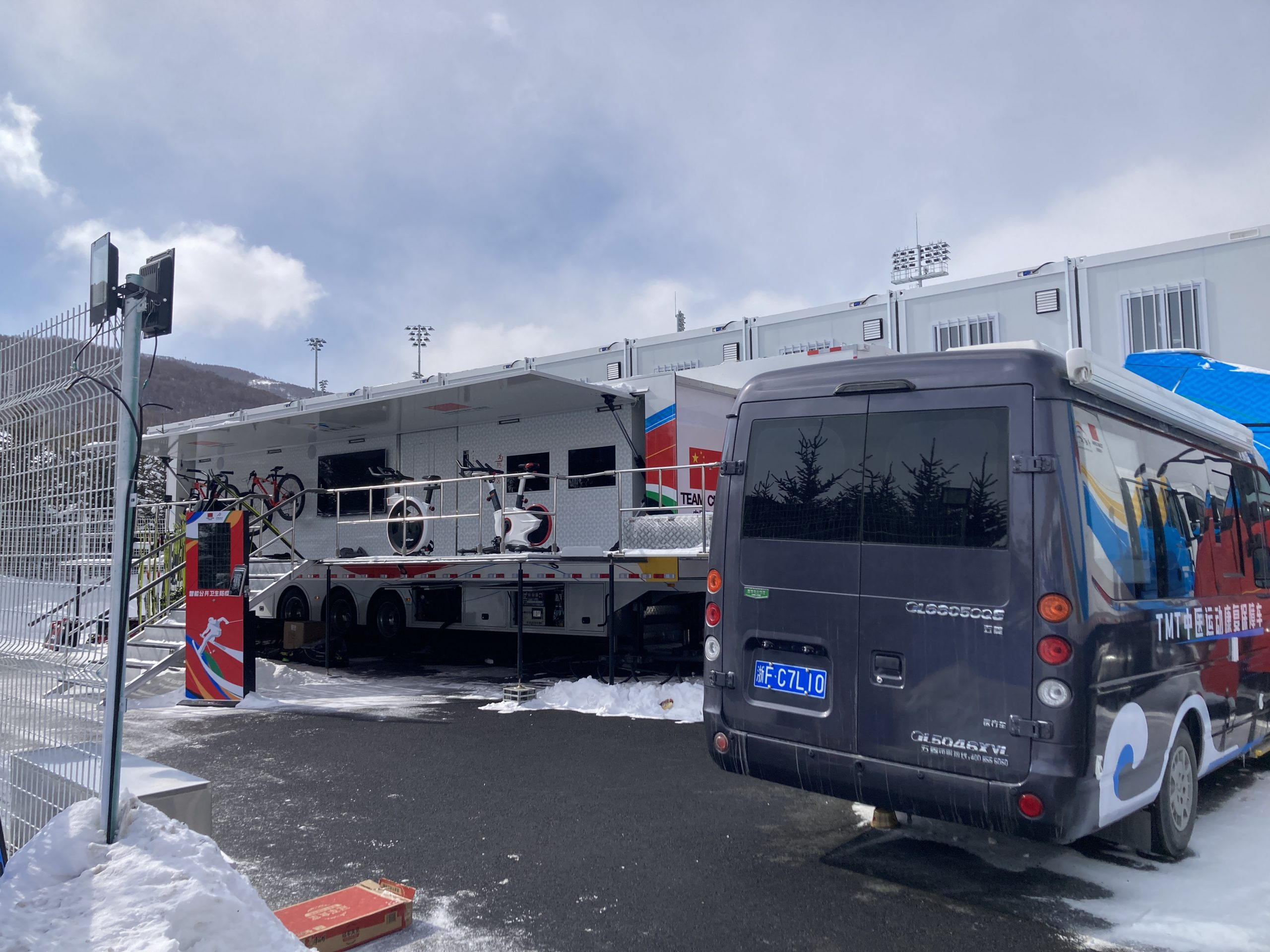
One of the multiple vehicles that China’s cross-country ski team had stationed at the 2022 Olympics in Zhangjiakou. (Photo: Nat Herz)
But Zhang would not reveal details about China’s cross-country budget. And she also suggested, logically, that the country would be scaling back its investment in skiing infrastructure from its big Olympics build-up.
“There is a saying in China: Everything is difficult to start,” Zhang said in the interview, conducted through a translator. “After you have the bases for the infrastructure, then of course, there is an adjustment.”
Ulvang has closely watched China’s cross-country program and, as the country’s athletes trained in Scandinavia before the Olympics, he hosted two of the nation’s top female prospects, Bayani Jialin and Dinigeer Yilamujiang, for a week at his home.
Ulvang described China’s efforts to train ski champions as “all out.” But he’s still waiting to see if the country’s commitment will last, because, he said, developing a durable skiing culture takes time.
“We need to see if this was motivated by the medals on the home field,” Ulvang said, “or if this was part of a long term strategy.”
“Starting from zero”
China’s huge pre-Games spending on cross-country skiing was fueled by Zhongwen’s belief that the discipline was one of the best measures of a nation’s overall prowess in winter sports, said the source close to the government.
The country spared no expense. Among its investments was a $150 million, 1.3-kilometer indoor ski tunnel that athletes can use to train year-round; one Chinese team employee showed me a video of another contraption that resembled an enormous plate with snow on top, which spun in circles while athletes stayed in the same place by skiing in the opposite direction.
China hired dozens of Scandinavian coaches and experts at yearly salaries that reached $120,000. The government recruited hundreds of Chinese athletes from other sports into cross-country skiing, and sent them to training centers in Norway and Finland. (Chinese officials considered Alaska as an option, where athletes could fly in helicopters to train at Alaska Pacific University’s facility on Eagle Glacier, but Zhang said securing visas proved too difficult.)
The team spent millions more on wax and equipment. In Zhangjiakou, the Chinese team had access to the Games’ only on-site ski waxing bus, which has sliding doors and facial recognition technology.
The Chinese ski team’s main wax bus at the 2022 Olympics in Zhangjiakou. (Photo: Nat Herz)
“They have started from zero,” said Hetland. The skiing infrastructure that the country has built up, he added, “is more than what Norway has done in the last few years.”
In the years before the Olympics, the team’s athletes recorded impressive results, even though some had only been skiing a few years — unlike many European athletes who have raced for the majority of their lives.
Yilamujiang and Bayani both cracked the top 30 on the World Cup circuit, and notched top-15 results at the world championships for juniors and athletes under 23 years old. Wang, China’s star male skier, performed at a similar level.
But at the Olympics, other than Wang, none of China’s cross-country skiers cracked the top 30. Some people close to the team described the event as a disappointment, given the Chinese athletes’ proven potential.
Former employees of the Chinese team said two dynamics help explain the results.
One was a tendency by Chinese team leaders to disrupt the Scandinavian coaches’ training programs, by pushing athletes through brutally difficult workouts that the Chinese staff thought were needed.
The other was the decision by team leaders to pull China’s athletes out of the World Cup circuit during the COVID-19 pandemic — a move that kept the skiers safe but deprived them of experience against international-caliber competition on trails outside their home country. (Chinese officials did hire semi-elite Russian athletes to travel to China to give the country’s athletes more racing experience.)
“They need to spend even more time in Scandinavia and learn from everybody in the environment that is around a skier,” said Hetland, the Norwegian coach. “And that has been maybe the biggest challenge for the team, when due to COVID they have stayed at home in China in the last two years.”
Olympic 30 k winner Therese Johaug (NOR) greets last place finisher Dinigeer Yilamujiang of China who finished over 25 minutes behind the Norwegian (Photo: NordicFocus)
Hetland said it’s important to remember that China has its own distinct culture from those of the European nations that have historically dominated cross-country skiing. Adapting that culture takes time, he and others said.
“I visited China two years ago, and I was clear to the officials there that developing or training up a good skier, fighting for medals, is not a quick fix,” said Ulvang, the Norwegian FIS official. Still, he added: “It’s really special to see such fast development into some of the best racers in the world.”
Zhang, the Chinese leader, had no complaints about her team’s Olympic results.
“I am very much satisfied with the performance of our athletes,” she said. “I also feel very satisfied that each of our athletes is enjoying the competition, and that they are happy.”
“They cut him”
Zhang spoke with me in a busy athletes’ lounge in the bowels of Zhangjiakou’s biathlon building.
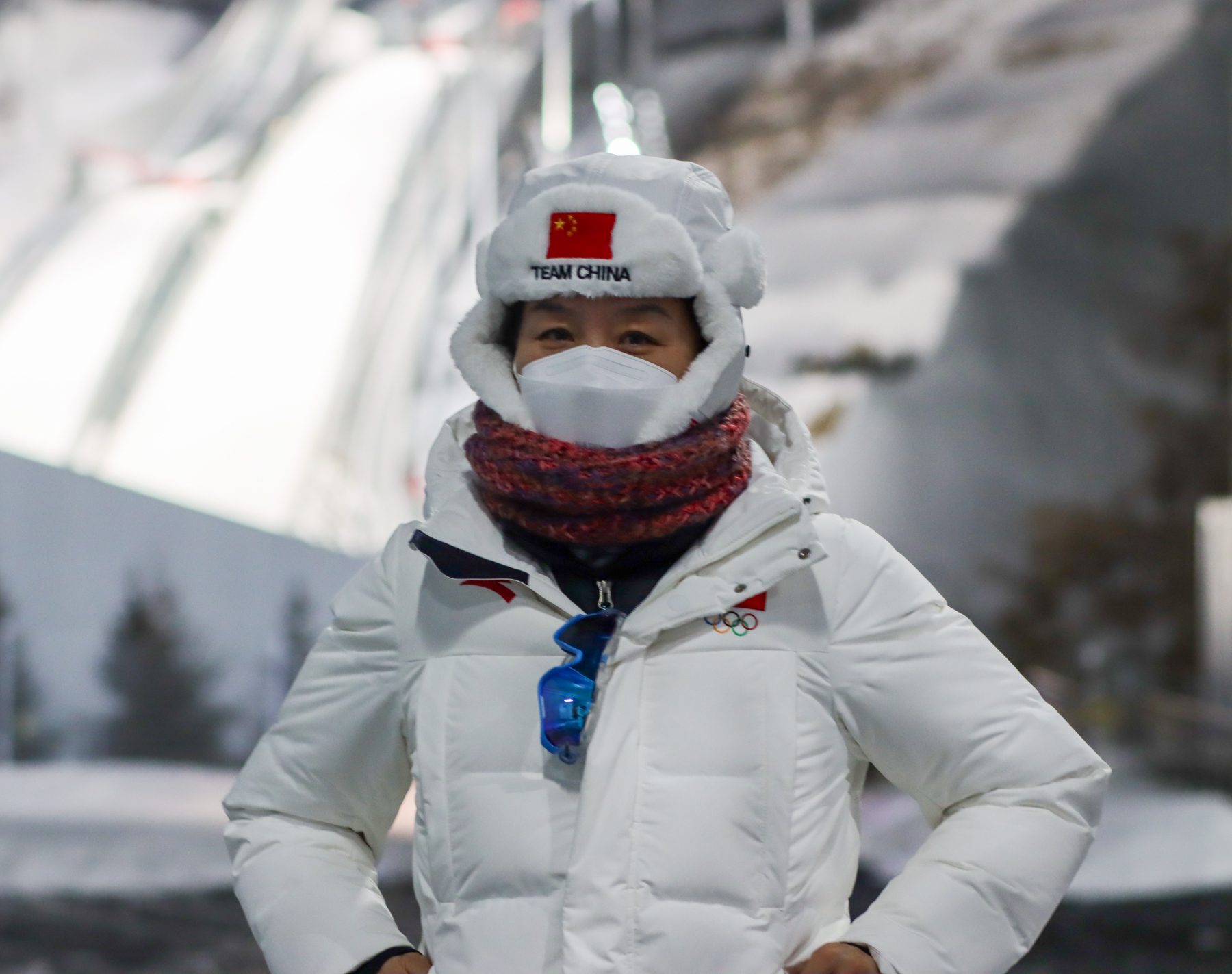
With the help of some of her European coaches, I’d picked her out of her white-jacketed, fur-hatted entourage at the cross-country skiing venue a few days before. She reacted with surprising openness, and agreed to an interview after I supplied her with enough details to get approval from her superiors.
Zhang Bei is the Chinese Communist Party official in charge of the country’s cross-country ski team. (Photo: Nat Herz)
Zhang embodies China’s recent foray into winter sports: She came to her job four years ago, with a background as an elite rower, and only recently took up cross-country skiing herself. She told me she was too shy to try it in front of her athletes because she was worried they’d laugh at her.
In our hour-long discussion, Zhang came across more like a politician or ambassador than a coach or executive, striking a vague but upbeat tone that glossed over some of the challenges I’d heard about from former employees.
“We have a very good start,” she said in response to a question about her program’s future. “Most importantly, we have many young people that are interested in cross-country skiing. And we have to help them to fulfill their dream.”
The only time Zhang acknowledged even a hint of tension or conflict was on the subject of the disqualification of Wang, China’s star athlete. She said she and other team members were upset about the decision at the Olympics, which Zhang called “wrong.”
Technically, FIS’ race jury ruled that Wang would be “ranked as last” in the freestyle for breaking international competition rules against obstructing other skiers.
Slow motion replay of the event shows Wang in his neck-and-neck sprint heat edging to his right in a way that appeared to impede Golberg, the Norwegian, who was skiing alongside Wang and ultimately crashed. (The video cannot be posted here due to Olympic broadcasting rules, but FasterSkier can provide a copy by email upon request.)
The video isn’t exactly conclusive, and the jury’s decision has its critics — including, apparently, Gou, China’s sports minister.
Four separate sources told me that Gou learned of the disqualification during a dinner with Johan Eliasch, the FIS president, where Gou subsequently “lost his appetite” and raised his concerns with Eliasch directly. (A FIS spokesperson said in an email that the federation “does not comment on speculation about discussions between individuals during private dinners.”)
China ultimately appealed the jury’s decision, but the appeal was rejected, said Ulvang. The source close to the government said China also asked FIS to extend some type of goodwill gesture after the disqualification, but that request wasn’t granted either.
Representatives from cross-country ski equipment manufacturers were frustrated, too. Currently, the industry sells only small amounts of gear and skis in China, and only to elite athletes there — not to “normal people,” said Hans Hubinger, an official from ski giant Fischer who was working at the cross-country venue in Zhangjiakou.
“It’s not easy for us to see if there’s a future for the Chinese market or not,” Hubinger said in an interview.
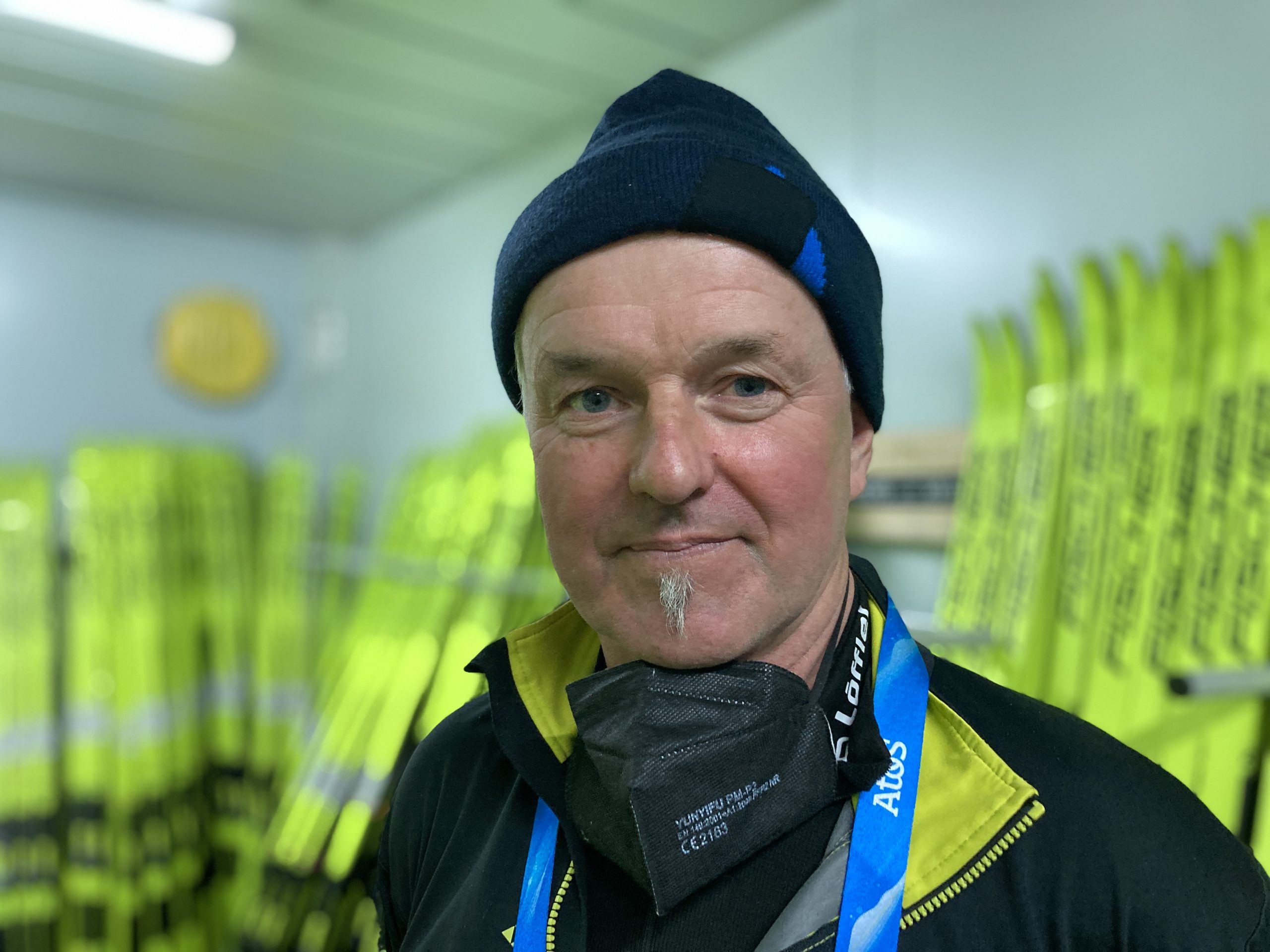
Hans Hubinger is an official from ski company Fischer who was working at the 2022 Olympics in Zhangjiakou. (Photo: Nat Herz)
Wang was the industry’s only hope for a Chinese cross-country skiing medal, which could have stimulated new interest, and gear sales, in the nation’s massive market. That market could also bring much-needed television viewers to cross-country skiing’s broadcasts — a major source of revenue for the sport.
Hubinger said he thought Wang’s disqualification was a close call where the jury could have given him the benefit of the doubt.
“I think, ‘Oh, this is the chance now, to turn some guys into heroes’…and they cut him,” he said. “If the rules are clear, then you have to cut him. But this rule is not clear.”
Pierre Mignerey, FIS’ cross-country skiing race director and a member of the jury that disqualified Wang, said he sees the situation completely differently.
In an interview in Zhangjiakou, Mignerey said it would be completely inappropriate for a race jury to weigh political factors, like the size of China’s ski market or its investment in the Games, in their decisions.
“Sports mean that we have some rules. And that would be, in my opinion, quite shocking if the rules would not apply to everyone in the same way, regardless of if it’s the host nation,” said Mignerey, a retired French racer. “What would people say if the jury had decided something else?”
Others placed responsibility for the disqualification on Chinese team leaders, arguing that their decision to skip international races during the pandemic left athletes like Wang without enough experience in the kind of tight-quarters competition that happened in the Olympic sprint.
In the weeks after the Games, Wang delivered results that only underscored the opportunity he missed when he was disqualified — regardless of who bears the ultimate responsibility for that decision.
In his first World Cup race after the Games, in Finland, Wang, 28, finished a career-best sixth place. The following week, in Norway, he landed on the podium for the first time.
That result delivered a shot of hope to those who want to see the Chinese program continue.
On social media afterward, Wang made clear his intentions to continue in the sport, even if his country’s commitment to its skiing program remains something of a mystery.
“Today is a milestone. This is the first time a Chinese athlete stands on the podium of the World Cup series. We have won the respect of the world,” Wang said on a platform called Weibo. He added: “I will continue to pursue my dream with a humble attitude.”
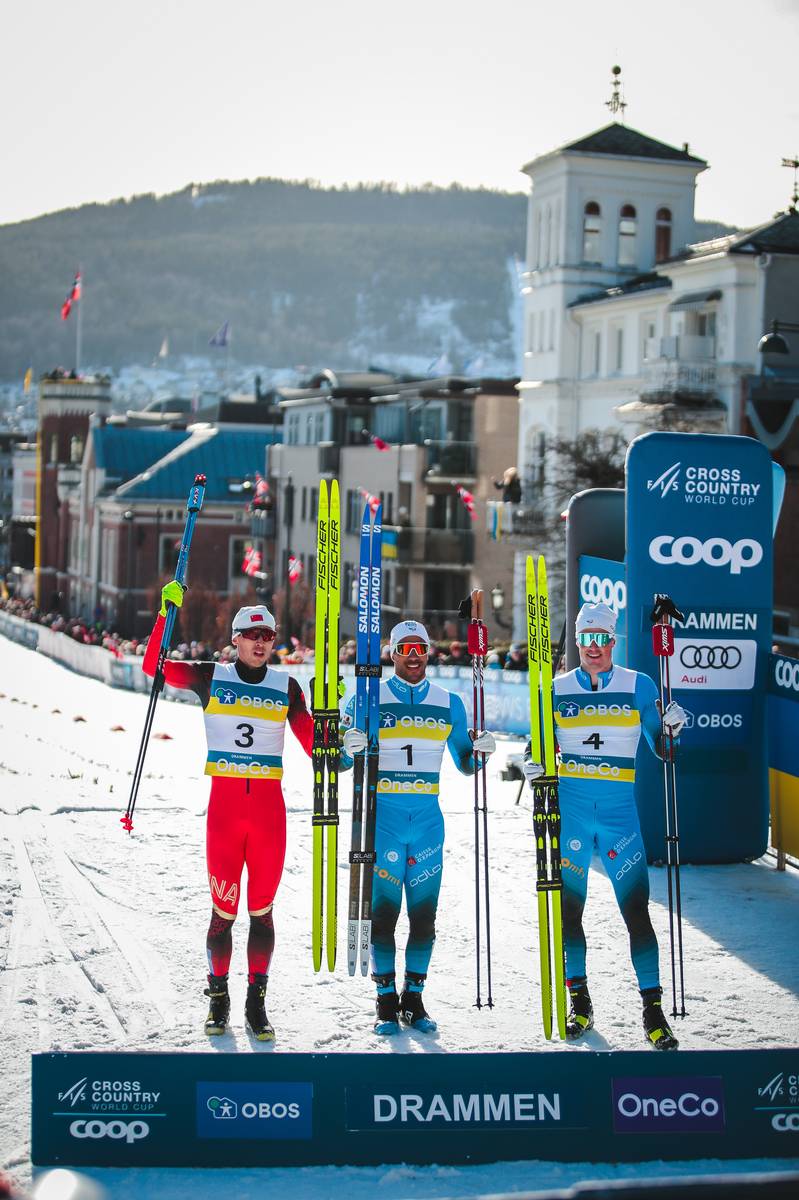
Richard Jouve (FRA) takes the win in Drammen, NOR, with a first podium for China’s Wang Qiang, who took second ahead of Lucas Chanavat (FRA) in third. (Photo: NordicFocus)
In this episode, we’ve got Chad Salmela and Kikkan Randall on to discuss the experience of calling the 2022 Beijing Olympic Winter Games, live from a booth in Stamford, CT. The duo worked as cross country analysts, alongside long-time NBC play-by-play announcer Steve Schlanger. While Chad is a veteran in the role, this was Kikkan’s first Olympics inside the booth.
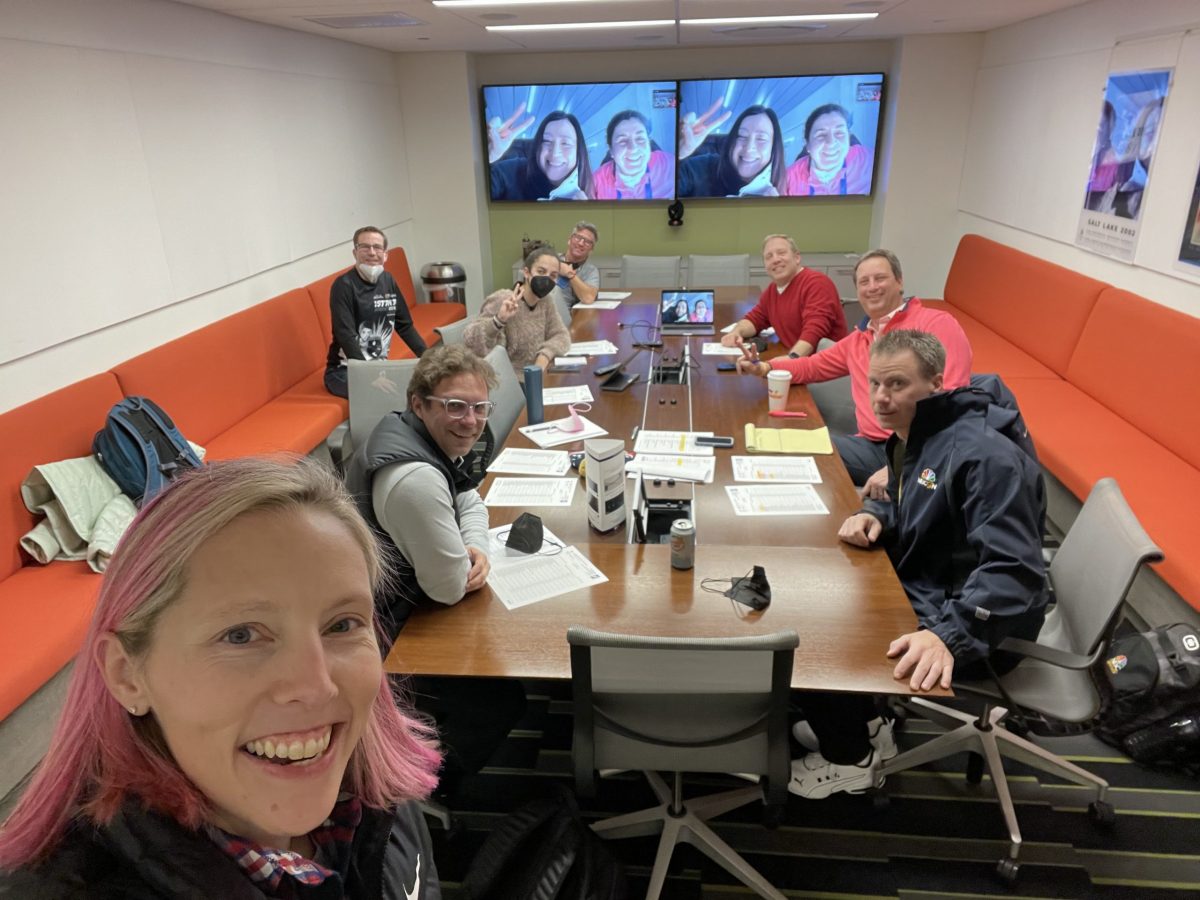
Kikkan Randall snaps a selfie with Chad Salmela and the NBC production crew during the 2022 Olympic Winter Games. (Courtesy photo)
During the call, Kikkan and Chad field a variety of questions on their experience – everything from staying fresh while calling races in the middle of the night for two weeks straight, to maintaining professional composure while watching your former teammates and long-time friends win Olympic medals – or come up short – and even, why are you suddenly pronouncing the Norwegian distance champion’s name “You-haug”?
Full of insights and laughs, this conversation was a treat, and it’s clear that both Chad and Kikkan are deeply invested in growing and serving the cross country ski community in the US.
Kikkan Randall and Chad Salmela discuss their experience as NBC’s cross country ski analysts during the 2022 Beijing Olympic Winter Games. (Courtesy photo)
Hailey Swirbul races the freestyle sprint qualifier in Lahti the weekend after the 2022 Olympic Games drew to a close in Beijing. (Photo: NordicFocus)
Intertwined with historic medal-winning races, tales of adversity overcome, and athletes with whom fans become enamored once every four years, the Olympics also brings about stories of defeat, the complexities of human emotion, and the simple humanity of the athletes competing at the Games, who are often glorified solely on the grounds of their seemingly inhuman capacities and accomplishments. While stars like Simone Biles and Mikaela Shiffrin remind us that extreme pressure to perform does not always lead to diamonds, or perhaps in this case gold medals, athletes with less media focus have also begun to share how the Olympics impacted their mental and physical wellbeing.
Though the Olympics can remain a fantastic dream and a worthy goal for aspiring ski racers, a February 27 blog post by Hailey Swirbul titled “Honest Olympics” reminds us all that feeling overwhelming and complex emotions during one’s Olympic experience does not negate the athlete’s appreciation of the opportunity, or recognition that it is an accomplishment many dream about and very few actually get to experience. Quite simply, Swirbul demonstrates that gratitude, excitement, and melancholy are not mutually exclusive states of being.
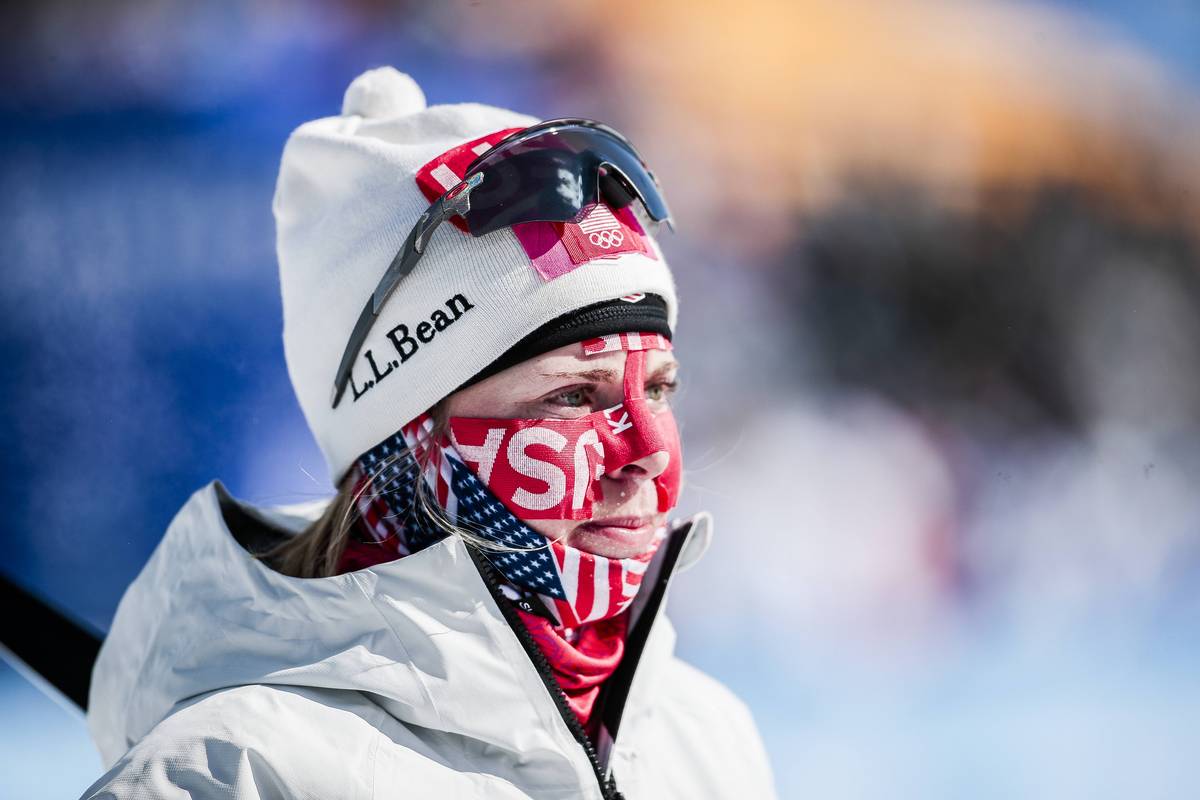
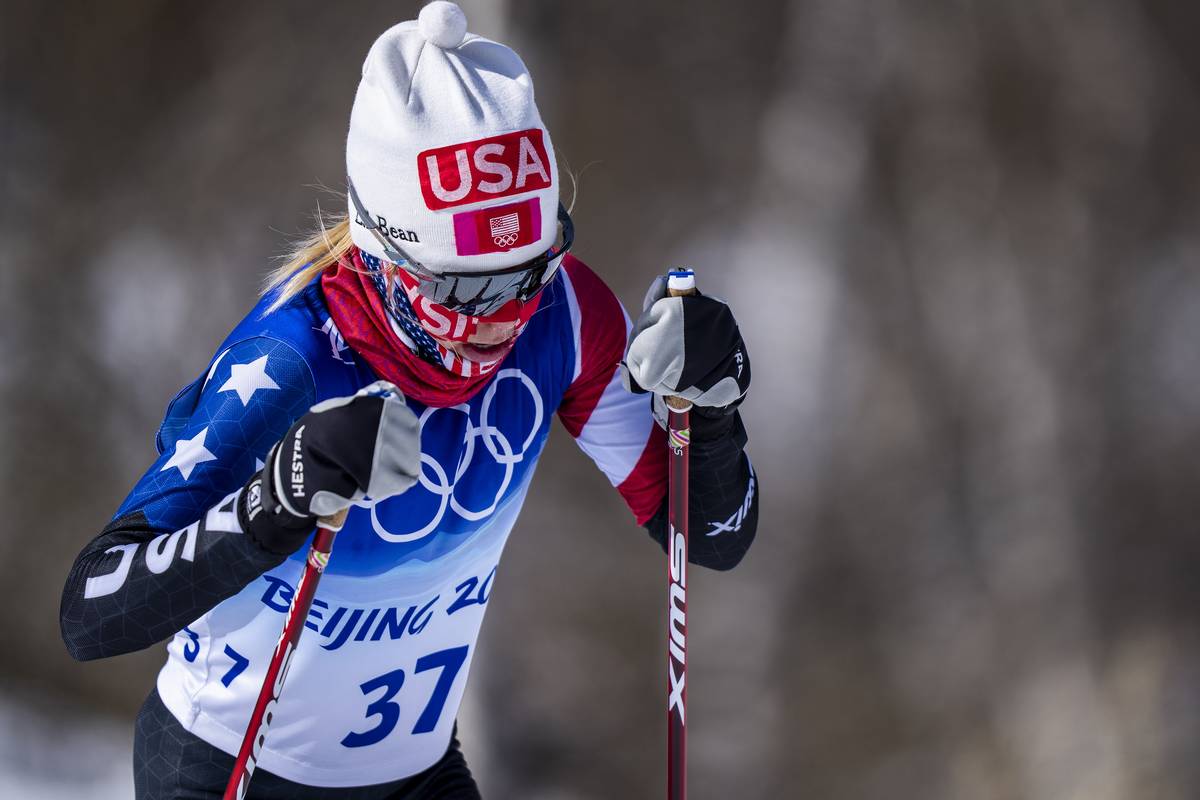
Hailey Swirbul races the 10 k individual start classic during the 2022 Olympic Winter Games in Zhangjiakou, CHN. (Photo: NordicFocus)
By Hailey Swirbul, reposted with permission
I am almost certain that mine is not the Olympic story the world wants to hear about—not because I didn’t get a medal or something, but because I can’t lie. I’ve spent the last few days looking through photos on my phone, wondering which 8 or 10 I should select and post with a nice caption and ‘thank you’ to the Olympics for such a purely wonderful experience. But it occurred to me that the world has a lot of that perspective right now, and me pretending to have the same one might do more damage than good for people like me who could benefit from my truth.
The Olympics were fine for me. I feel exactly the same as I did before them; I don’t feel complete, don’t feel more accomplished or better than anyone else all the sudden. In fact, the main thing I feel is relief. I got through it. I lived up to the internal and external pressures to qualify for the team and compete for my country. Whew. Now I can take a deep breath.
I had some moments that I really enjoyed at the Olympics, but I also had my fair share of moments that were simply not fun. Most of my time was just about neutral. I feel guilty for admitting that, when obviously, the Olympics is something that so many people would die to experience. So many of my peers are disappointed not to have made the Olympic team, or to have made the team but not receive the starts they had hoped. I had both of those blessings come true, but still felt quite empty throughout the whole thing.
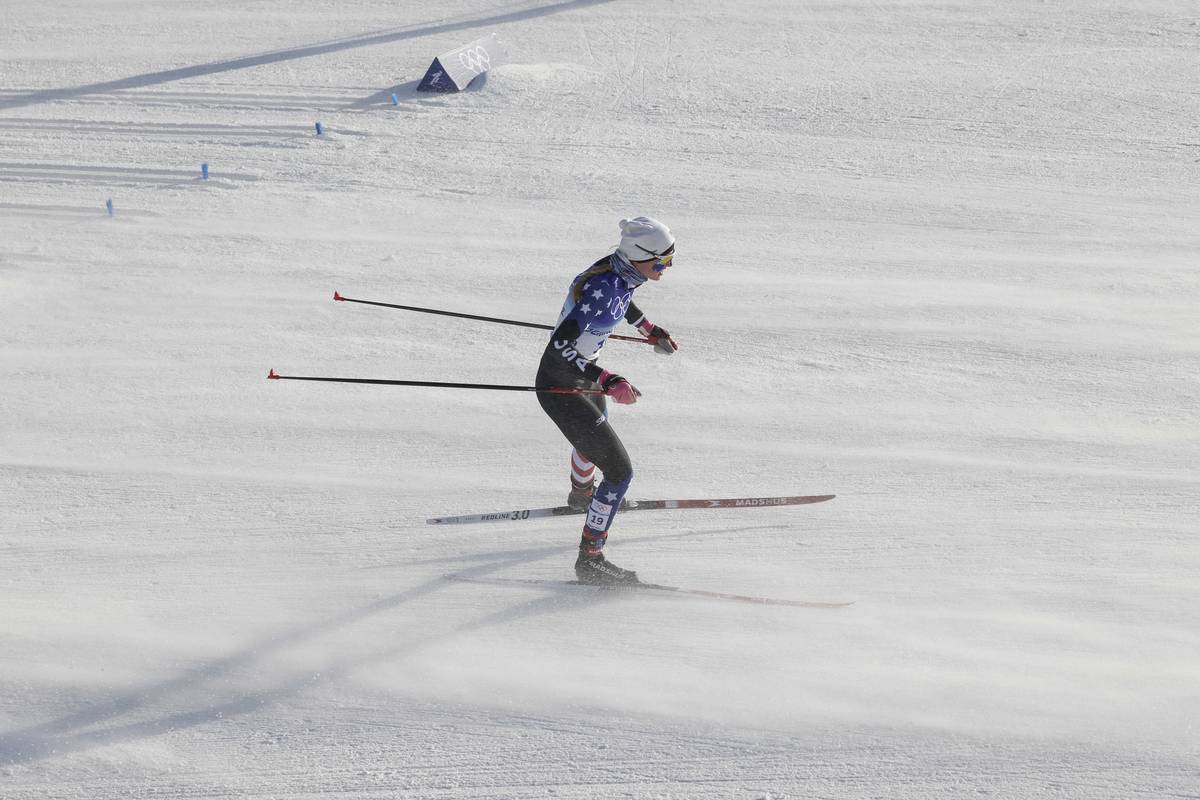
Hailey Swirbul laps through a windy stadium during the women’s 15 k skiathlon in Zhangjiakou, CHN. (Photo: NordicFocus)
Why can’t I see the Olympics in the glorified way the world does? For every person crying tears of joy on a podium, I saw a dozen people looking disappointed or drying tears of sadness behind the scenes. I saw broken dreams. I saw dreams coming true, and people realizing that maybe that dream wasn’t all they’d imagined after all. I saw pressure and stress that brought out people’s shortcomings. I saw expectations not being met, and teammate relationships damaged. I saw isolation and low self-worth and confused identity and claustrophobia within the Olympic world. In many ways, the worst part was that I could do nothing about it because all my energy went toward surviving many of those things myself. Honestly, all of that sucked.
But don’t get me wrong—I’m able to see the incredible moments that came with the experience too. Watching halfpipe and aerials and biathlon in person with some of my closest friends, for example. Meeting a skier from my hometown who felt like a long-lost sister. Watching Ted Lasso with my roommates in the evenings. Bushwhacking through the mountains near the village to find a peaceful headspace. Heck, I’ll even look fondly on the numerous times I ate KFC take-out to avoid the dining hall boredom! Writing these examples made me realize just how many positive small moments there actually were and I could go on and on…. But, interestingly, most of those moments were simple, normal life joys that had relatively little to do with actually being at the Olympics.
Hailey Swirbul hugs teammate Julia Kern after a challenging 15 k skiathlon, which opened the 2022 Olympic Winter Games. (Photo: NordicFocus)
I left the Olympics feeling more at peace with my sense of identity as a skier because I felt somehow empowered by and connected to those little normal-life moments. I learned a bit more about how I’d like to be a better teammate, and how I need to signal safety to my nervous system to keep my brain health in a good place. I uncovered a bit more purpose in the sport of skiing for myself and set some goals that have nothing to do with results. In the end, this experience wasn’t about fun and glory the way it had been portrayed to me over the years. It was about internal growth for humans in the face of intense emotion, pressure, and expectation. I’m not really sure why I’m writing this as I’m still processing the experience myself, but I couldn’t post on social media about a wonderful time without acknowledging the challenge and growth as well. So thank you, Olympics, not for the incredibly fun experience, but for the opportunity to grow as a human being. That’s something I hope I’ll never forget.
Head to Swirbul’s blog to see her top-eight photos from “happy little moments” during the Games, including the one below.
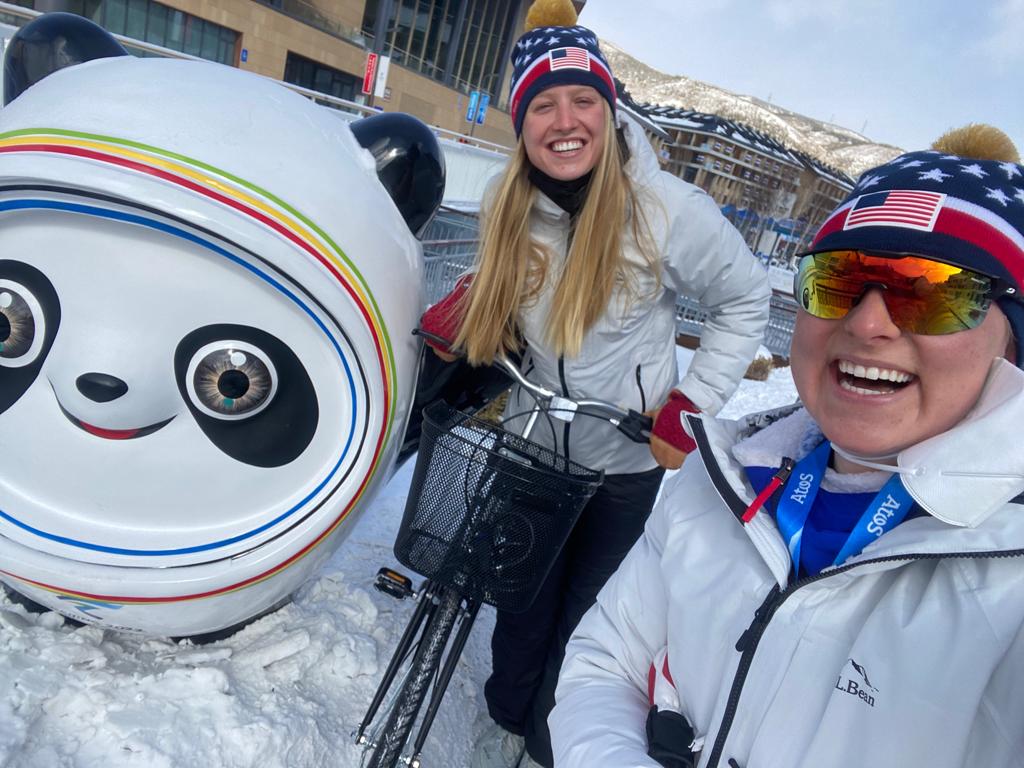
Hailey Swirbul and Hannah Halvorsen visited Olympic mascot Bing Dwen Dwen on a bike cruise through the village, one of the ways they would spend time together outdoors. (Courtesy photo)
Diggins takes silver in the women’s 30 k skate. A bout with food poisoning 24 hours before her final Olympic race set the stage for what she later described as “one of the hardest things I’ve ever done.” (Photo: NordicFocus)
On February 20th, Jessie Diggins made Olympic history yet again, taking second in the 30 k mass start skate to round out the colors of her medal collection. Gold in the freestyle team sprint in 2018, silver in the 30 k skate, and bronze in the individual skate sprint.
Now thirty years old, Diggins is the most successful American cross country skier in Olympic history. She has spent over a decade rising to the top of American and international ski racing, elevating those around her as she reaches for goals that make us lose sight of the fact that the American women’s cross country program was only reinstated with funding in 2006.
There are currently thirty-nine pages of articles tagged with Diggins name on the FasterSkier archives, detailing the many steps forward, and backward, she has taken in her career, transforming her into the athlete, role model, and spokesperson she is today.
Her first tagged appearance was on January 25th, 2010 amid coverage of the Junior World Ski Championships in Hinterzarten, Germany. Both Diggins and Sophie Caldwell (now Hamilton) raced in the quarterfinals of the 1 k freestyle sprint that day, where Diggins crashed and ultimately finished 26th.
“50 meters into her quarterfinal here, Jessie Diggins found herself on the ground, seeing stars,” wrote one of FasterSkier’s young reporters, Nat Herz.
Perhaps it is fitting that 12 years later, following the press conference for Diggins’ Olympic silver medal, it was Herz who caught Diggins as she left, creating the opportunity for this unique interview. The following has been lightly edited for clarity and to account for the extreme wind at the venue, which significantly impaired the audio in a few places.
Jessie Diggins earns an Olympic silver medal in the women’s 30 k mass start skate. (Photo: NordicFocus)
Nat Herz / FasterSkier: How are you feeling?
Jessie Diggins: Honestly, I’m feeling okay now. I haven’t felt that bad at the finish of a race maybe ever. It was a little scary. I couldn’t really walk. But also I’m not surprised, because like 24 hours ago I felt pretty awful too. It’s been a wild, wild last 48 hours.
***
Following the race, Diggins had shared with the media that came down with food poisoning the day before the race, leaving her unsure whether she would be able to line up for the final Olympic event, and if she did, what amount of fight would be left in her body.
Elaborating on what it had been like to cross the line in second place after this experience, Diggins said she felt “disbelief” and that mentally, she had been preparing herself to accept whatever outcome the day would behold. “You’ve had a great time [at these Games] and just do what you can to take care of yourself.”
Diggins continued by explaining the support she received leading into the race that allowed her to keep herself in the positive headspace she needed to perform.
JD: I had a great talk with my sport psychologist, my fiancé, and with my parents. They reminded me that this — the weather, the wind, it’s just like skiing at Giant’s Ridge in Minnesota when I was a kid. You know, I’m just gonna go out there and ski because I love to race and [we’ll] see what happens. My mom reminded me last night, ‘You don’t have to decide right now. Wait. Just see how you feel once you’re actually racing. And then see how you feel in another 5 k and another 5k. You don’t know right now and that’s okay.’ So I went from like, ‘Wow, this is not the race prep I envisioned’, like laying in bed force feeding myself oatmeal and soup from a can. I was really proud of the amount of sport drink I consumed… and I was just like, ‘Okay, we’re just gonna see what happens out there.’ And I just wanted to race because I love to race.
Jessie Diggins fights through food poisoning-induced cramps to win a silver medal in the 30 k skate. (Photo: NordicFocus)
How she would feel while racing became apparent early. Diggins explained that by 12 or 13 k, her body was already beginning to fight against her efforts.
JD: I just kept trying to keep down some sugar and then my left knee started cramping and then my right quads and my left quads and my left hip. I tried to keep telling myself ‘Use your arms, use your arms.’
Grateful for the distraction and encouragement as she endured the pain of racing in that state, she expressed her gratitude from the support she received from the sidelines.
JD: I think we had like all of US Biathlon out there. The whole ski team was out there, all the techs. I mean, Oleg was cheering on the last lap, ‘We’re proud of you!’ And I was like, ‘I’m gonna cry.’ That was the coolest thing. Pretty much every other country also started cheering for me, and so I felt like the whole world was helping me get up those hills when my legs were just spasming and going numb. And I just kept thinking, ‘I’ve got to keep pushing as hard as I can, because at any point — what if my legs give out? I can’t back down. I can’t let up on this pace. I just have to keep going.’
FS: I imagine you were kind of on this seesaw between, ‘I’m in a medal winning position and I could fall over at any time…
JD: I was trying very hard to not think about that, and just think about using my arms, using my head — what I mean by that is like, I’d come over the top and it’s really windy, and I’m like, ‘Okay, I’m just going to doublepole.’ Or, ‘I’m gonna hold this tuck longer.’ Because it was the sustained climbs where I started to really cramp, so I kept thinking like, ‘Okay, I gotta ski as smart as I can, and be really thoughtful about where I use my legs and where I use my arms.’ Which is funny, because normally, I’m a legs skier, so that was a funny flip for me. I tried not to let myself think about a medal, because I had to stay focused on getting through the race, and not let myself think about anything else.
Jessie Diggins pushes through food poisoning to win a silver medal in the 30 k mass start skate. (Photo: NordicFocus)
FS: When you think about the amount of pride you’re gonna feel in finishing that race the way that you did, when you’re ultimately able to look back on that, would you say this would rank up there in your catalog of things you’ve had to suffer through?
JD: I think that might have been the hardest thing I’ve ever done in my life. It might be. Finishing the Tour de Ski this year was also very hard, but that’s why I did it.
I told myself last night, nothing will probably feel harder than being actively sick and finishing that final climb. I’ve prepped for this. My head is tough as it is ever going to get, and I need that right now. And I’m grateful for all those super hard training sessions and all those super hard races where I finished, without being able to feel my legs at all because in the middle of the race [today], when my legs were spasming and I couldn’t really feel them, I was like, ‘This is not new.’ Unfortunately, which is probably medically concerning. But this is not a new thing for me, and so I know I can survive this.
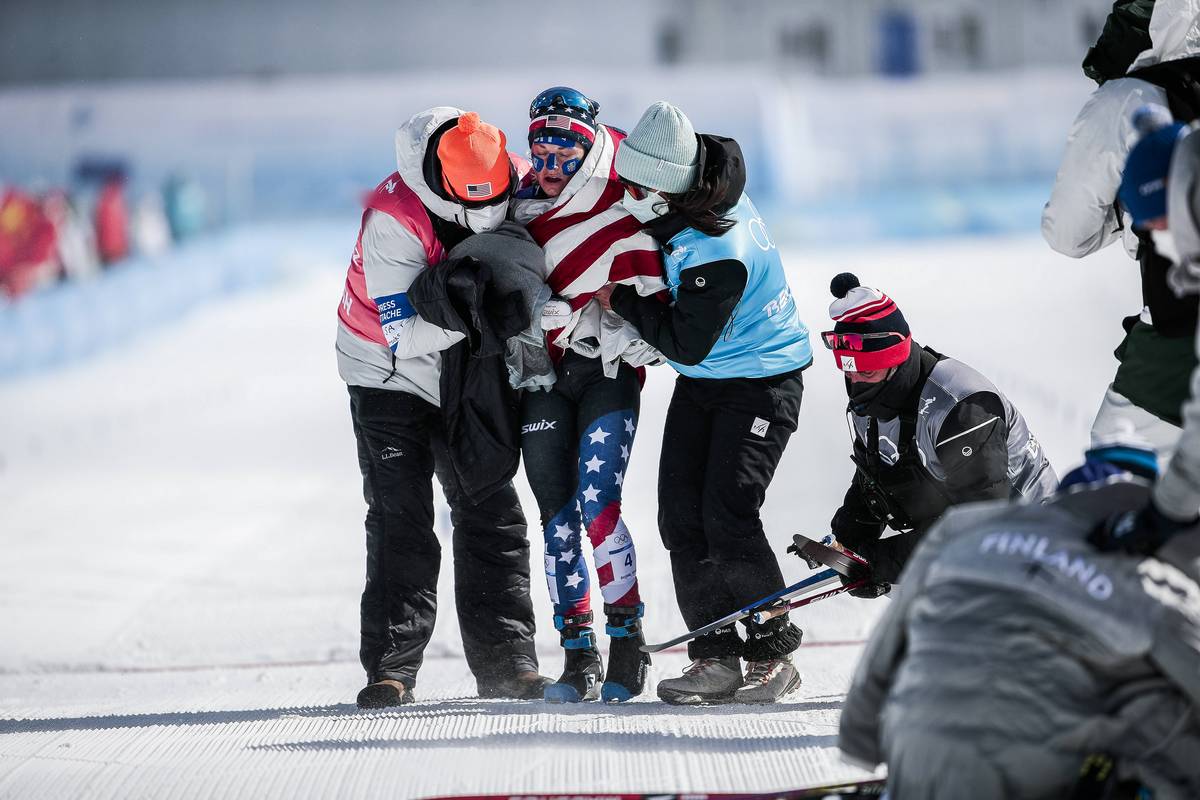
After collapsing at the finish line, Diggins is helped off the course following the Olympic 30 k skate, where she pushed through food poisoning to earn a silver medal. (Photo: NordicFocus)
The other prominent storyline of the day was that Rosie Brennan knocked on the door of an Olympic medal yet again, perhaps helping Kerttu Niskanen of Finland to bronze, only to walk away empty handed herself in sixth place. Brennan had been fourth in the freestyle sprint the week before, and had tagged off to Diggins in third place after her final lap of the classic team sprint where the Americans finished fifth.
It was perhaps not altogether a very different Olympic experience from Diggins’ in PyeongChang in 2018, where she took fifth in two individual races, sixth in another, and seventh in the last. In the 10 k skate, Diggins fifth place meant she was the first woman not to earn a medal, as Marit Bjørgen (NOR) and Krista Pärmäkoski (FIN) had tied for third.
FS: When you think about Rosie’s results today, and here, just overall. Is there anything you would want to say about that, because you’ve sort of similar positions — fourth places, tough spots.
JD: I do know how that feels, and I think it’s so important to remember that nobody gets to say if that was a good race or not but Rosie. Nobody gets to judge. Nobody gets to criticize. She’s the one who gets to define what success looks like. And personally, I’m just so proud of her. I mean, the Olympics is an emotional roller coaster. And she rode it with grace, and as a good teammate, and looked out for other people. She’s just been amazing. And to me, she found success in every definition that matters.
FS: If you were Rosie, would you be proud of your races?
JD: Yeah, I would. Because when I was fourth [in the 10 k skate in PyeongChang], or fifth because of the tie, I was proud. When you give it everything you have in a race, you can and you should be proud. And I think that’s that.
Rosie Brennan works against the lead while leading a chase pack during the 30 k skate, which included eventual bronze medal winner Kerttu Niskanen. (Photo: NordicFocus)
U.S. cross-country skier Kevin Bolger and Swedish racer Maja Dahlqvist met during the COVID-19 pandemic. The virus kept them six feet apart during the Olympics — except one celebratory hug.
ZHANGJIAKOU, CHINA — American Olympic cross-country skier Kevin Bolger grew up in Wisconsin. His girlfriend, Olympian Maja Dahlqvist, is from Sweden.
During the Olympics, in China, they got to spend a couple of weeks in the same place. Among their options for dates:
• Go cross-country skiing together, but stay side-by-side, six feet apart.
• Eat meals at the Olympic Village dining hall, separated by head-high plastic dividers.
• Socially distant walks.
Welcome to the coronavirus Games, where parents and fans were banned, masks were mandatory indoors and out, and even couples like Dahlqvist and Bolger had to stay at respiratory droplet-safe distances.
Kevin Bolger and Maja Dahlqvist enjoy a masked moment together following Dahlqvist’s second place finish in the skate sprint. (Courtesy photo)
Okay: There was one moment of weakness — but only after Dahlqvist won silver in the individual freestyle sprint event, where she was heavily favored to take a medal. Afterward, there was a very satisfying hug.
“My team didn’t care. And his team didn’t care. It was just, like, to celebrate then,” Dahlqvist said in an interview later. “But I don’t think we should do that every day.”
Dahlqvist’s and Bolger’s Olympic romance is a neat kind of encapsulation of China’s Covid Olympics: It was making a decent time out of a difficult situation, but nowhere close to the real thing.
Matt Whitcomb, the U.S. team’s head coach, described their relationship like this.
“You still get to go for a walk, you get to go for a ski with each other. You still get 90% of the companionship,” he said. Asked to reconsider that figure, he added: “Yeah. I would actually say, 30%.”
Nobody on the American or Swedish ski teams got Covid during the Olympics, so we can chuckle now about what Bolger, 28, and Dahlqvist, 27, endured.
But the protocols were no joke, and the stakes were about as high as they get for Olympic athletes.
China’s strict coronavirus protocols meant that an infection during the Olympics, or in the lead-up to the Games, could cost athletes a shot at medals.
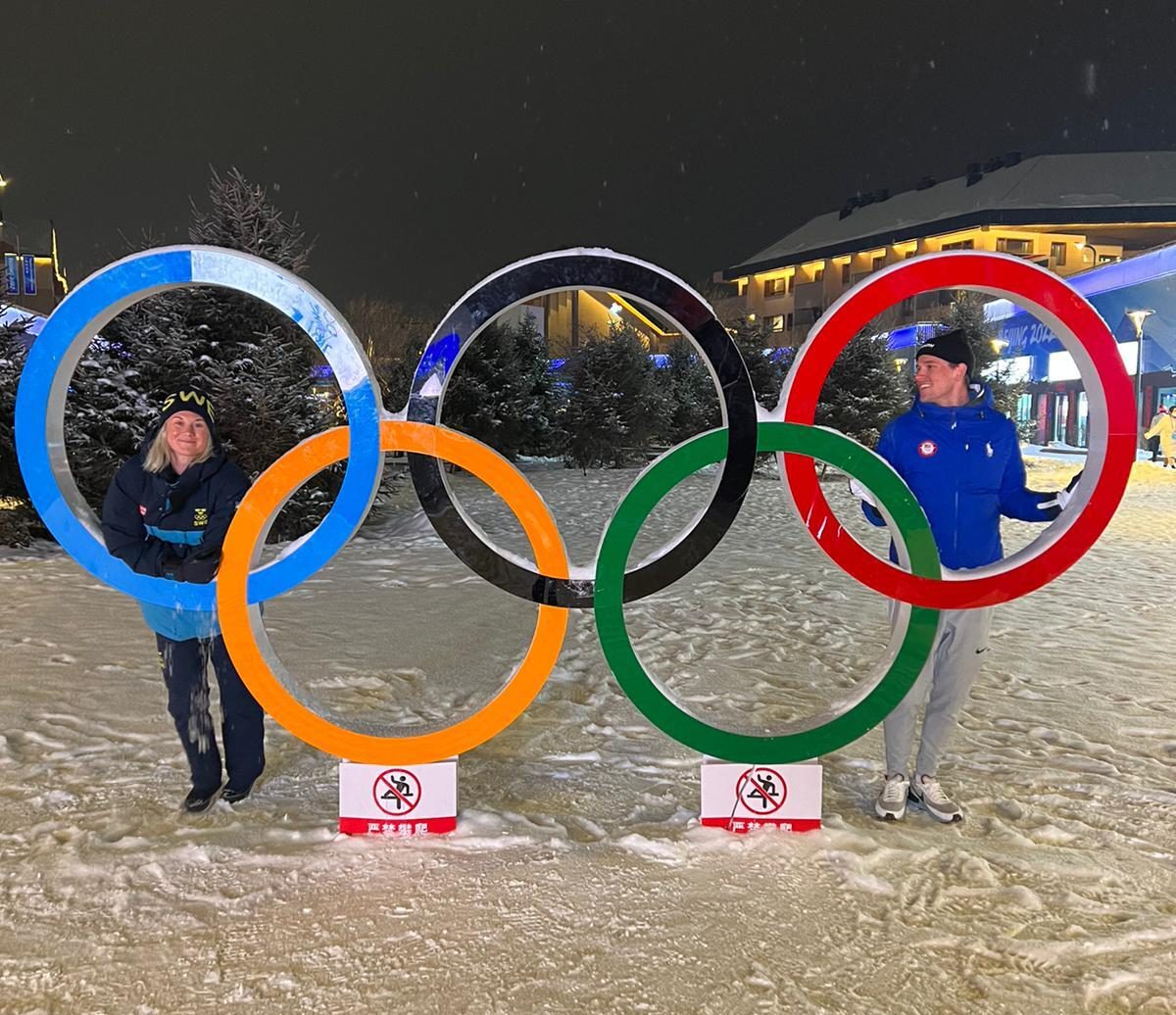
Six feet – or three Olympic rings – apart: Maja Dahlqvist and Kevin Bolger remain careful through the 2022 Olympics. (Courtesy photo)
Just before the Olympics began, several members of Norway’s team tested positive after an altitude camp in Italy.
One of Norway’s star men, Simen Hegstad Krüger, spent the first days of the Olympics pacing his hotel room in Italy after his own positive test.
Krüger recovered in time to get to China and win a bronze medal in the Olympics’ last men’s cross-country event. But Weng missed the Games altogether — underscoring what was at stake for Bolger, Dahlqvist and the teammates whose medal chances could also be jeopardized by a positive test.
“I think we both understood the risks — personally, for each other, and then, bigger scale, for the team,” Bolger said.
He and Dahlqvist, who both specialize in sprint races, started seeing each other last season, while their teams followed the elite-level World Cup circuit around Europe.
Bolger got to spend two months with Dahlqvist in Sweden over the summer. And during the early part of this winter, they could spend time together without too much coronavirus stress.
“Everyone had the vaccine. Omicron wasn’t a thing,” said Bolger. “We were still being smart about things. But it wasn’t a big deal.”
But the situation changed as the Olympics approached and omicron took off.
The Swedish and U.S. teams had simultaneous pre-Games altitude camps in Italy; Bolger’s and Dahlqvist’s accommodations were within shouting distance. But there was no canoodling.
“She’s like, ‘Come on, give me a hug!’” Bolger said. “I was like, ‘No — don’t even get near me until, like, maybe after the (Olympic) sprint.’”
Sweden’s Maja Dahlqvist earns her first Olympic silver medal in the individual freestyle sprint. (Photo: NordicFocus)
Even on walks, the couple wore KN95 masks and stayed at least two meters apart. They’ve taken similar precautions during the Games.
“God knows what was happening on those walks,” quipped Bolger’s teammate Luke Jager, before adding: “We really trusted them. We were never concerned about it. We knew they hadn’t been sneaking off and smooching in the woods.”
Bolger and Dahlqvist were by no means the only couples contending with Covid-related relationship complications in the lead-up to Beijing. And athletes and coaches said that the steps the coronavirus forced them to take were painful.
Erik Flora, who coaches several Olympic cross-country skiers at Alaska Pacific University’s elite team, said one of his athletes wore masks around and slept in a different room from their partner.
Jessie Diggins, the star U.S. skier who won two medals in Beijing, has described skipping weddings and celebrations and spending four months on the road last year without any time with her family or fiancé, Wade Poplawski. That kind of emotional support can be especially important at high pressure events like the Olympics, she noted.
“You really want your family and your loved ones around you, right?” Diggins said in an interview. “I don’t have a choice. I don’t get to see Wade. But (Bolger and Dahlqvist) are right there, and they made the choice to protect the team. And that is so cool, and I can’t say thanks enough.”
To state the obvious: Going through the Olympics while socially distancing from your partner is hard. “Super hard,” said Dahlqvist.
“It was, like, so close, yet so far away,” Dahlqvist said. “It was just so annoying.”
The hug she got from Bolger, after winning her first of three medals, was such a relief, after facing intense pressure beforehand.
“I just cried,” she said. “It was so nice to have him there.”
Dating from a COVID-safe distance: Kevin Bolger and Sweden’s Maja Dahlqvist take careful measures to keep each other, and their teams, safe during the 2022 Olympics. (Photo: NordicFocus)
As the Games ended, Dahlqvist left Beijing before Bolger, who remained with the U.S. team through the closing ceremonies and then flew to Finland to continue the World Cup season. Dahlqvist is competing in Finland this weekend, as well.
Bolger said he thinks they can start relaxing their precautions now that the Olympics are over, if not entirely. But the couple will be able to truly let their guards down in a couple of weeks, when the World Cup circuit heads to Sweden and Bolger will get to stay with Dahlqvist — forming their own bubble of two. And then she may travel with him, back to the U.S.
It had been more than a month since Sophia Laukli last wore a race bib. Her last competitions took place on January 15th and 16th during the 2022 Sun Valley Nordic Invitational, where she was second to Rosie Brennan in the 5 k individual start skate, racing at altitude on a tough course. Eleven days prior, she was the fifth woman, and the first American, to the top of the Alpe Cermis in Val di Fiemme, Italy during the final stage of the Tour de Ski.
Earlier in the season, Laukli popped a Top-20 at altitude in Davos, Switzerland, finishing 19th in the 10 k individual start skate.
Racing through brutal wind and cold, Sophia Laukli skis to 15th in the 30 k skate. (Photo: NordicFocus)
It’s become clear: Laukli is a contender in freestyle distance races, and the harder (and higher) the better.
Heading into the Games, Laukli knew she would be starting the 30 k mass start freestyle. Given the elevation, the challenge of the course, the technique, and the distance, perhaps this selection by the coaches was a no-brainer.
“I love this course,” Laukli said of the venue in Zhangjiakou in a post-race interview with FasterSkier in the mixed zone. “The hills really work to my advantage.”
But no one could have predicted just how challenging the day would be. Wind ripped across open sections of the course, forcing athletes to drop into low gears even on flatter sections just to stay upright and moving forward. Most athletes wore large strips of tape across their faces, with buffs covering all remaining exposed skin save for their mouths and noses.
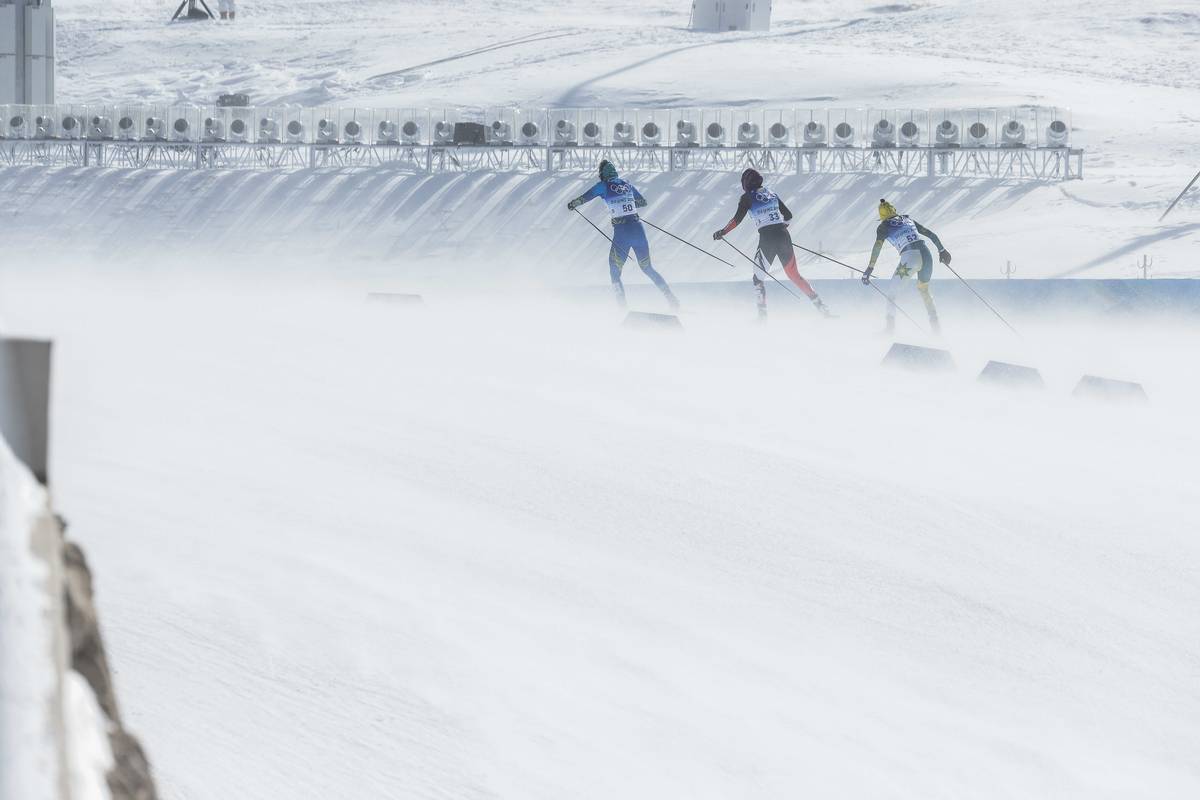
Snow-filled wind gusts obscure the v-boards lining the 7.5 k course in Zhangjiakou during the women’s 30 k mass start skate. (Photo: NordicFocus)
The American women showed they could handle whatever Zhangjiakou threw at them that day. Highlighted by Jessie Diggins silver medal performance – earned while fighting through painful cramping and fatigue after spending two days with food poisoning – the team put all four starters inside the top-20. Rosie Brennan skied to 6th, with Laukli in 15th, and Novie McCabe 18th.
But Laukli was almost 13th.
With only a few hundred meters to go, Laukli made a wrong turn, accidentally following the lap course rather than the route to the finish lanes.
How did it happen?
“I honestly don’t know exactly,” Laukli said in the mixed zone. “There was a huge gust of wind that kind of covered where it was marked ‘finish’ and ‘lap’, and I think it was a combination of [being] tired and not really seeing where to go. I definitely noticed a little bit too late, and then got passed, but I guess those things happen. I’m definitely a little bit bummed out. But I’m happy with the overall race.”
Laukli is not the only athlete to have made a wrong turn at the Olympics. A wrong turn during the 30 k classic might have cost Austria’s Theresa Stadlober a medal at the 2018 Games in PyeongChang. There’s adrenaline, fatigue, nerves, and so many other factors at play, without wind gusts lifting clouds of dry loose snow into the air in the stadium.
“I’m bummed for her,” said coach Chris Grover, “that she lost two places, because she worked hard for those… but she did the right thing, retracing her steps all the way back, and that’s one of the lessons that you do once on the big show and then you never do it again. Jessie did it in Sochi.”
Despite a wrong turn inside the final 400 meters, Sophia Laukli finished 15th in the 30 k skate in her Olympic debut. (Photo: NordicFocus)
Having one of the best races of her season during her first and only appearance at the 2018 Games, Laukli admitted she felt panicked as she backtracked to the split to avoid disqualification. Having come to a stop and lost all momentum, it was devastating to see a pair of Norwegian twins, Lotta and Tiril Udnes Weng, skiing fast with a tailwind toward the final bend into the stadium. There was nothing Laukli could do to avoid losing those two places.
But to her coaches and supporters, this wrong turn was not the defining moment of Laukli’s Olympic debut.
Laukli showed mental toughness, dedication, and patience as she spent the three weeks prior to the 30 k training in Zhangjiakou, watching, supporting, and celebrating her teammates as they raced in earlier events, while trying to stay focused on her own opportunity that was yet to come.
“It was definitely not the easiest last month,” she told FasterSkier. “I really love racing, and so to have such a long break and just wanting to race, it was a bit tough.”
She explained that, without races as a fitness checkpoint, she poured herself into her training to maintain her race shape, but ultimately was not sure what would happen on race day.
“I think I was lucky in that it was a 30 k – it’s maybe easier to race a 30 k when you’re not in your fastest form, because it’s just a slower race. So I think that helped a lot.”
Racing on her own for the second half, Sophia Laukli finishes her Olympic debut in 15th place. (Photo: NordicFocus)
At the 10 k mark, Laukli sat in 15th, racing on the back of a large chase group led by Rosie Brennan. Over the next 5 k, a group of three, including Laukli, lost contact with this group and slowly separated. For the second half of the race, as the wind “really, really picked up”, Laukli found herself racing on her own with no one to work with or use as a wind break. At times, the headwind was so strong that Laukli said she ended up fighting it in V1 as she lapped through the false flat of the stadium at 22.5 k.
Ever onward, Laukli kept pushing, eventually overtaking a Latvian athlete who began to fade to find herself in 13th – 13th in the world at the Olympics – with a roughly 45 second gap to the next skier in the final kilometer.
“I felt like I was able to pace it pretty well,” she said. “It was definitely a bummer that I had to see most of it alone because I think it would have been beneficial to be in a group. But I did my best and I’m pretty proud of how it went.”
While the takeaway here should remain that Laukli posted a top-15 result in her first Olympic performance at 21-years-old in some of the gnarliest conditions imaginable, the sting was still painful as she passed through the mixed zone.
“I’m probably in a better place than I was the minute after I finished. But to be honest, I’m pretty pissed. I really wanted to prove myself today, to prove that I earned that start. And just to make such a stupid, preventable mistake at the end… I was not stoked. But like I said, that happens, I guess. It sucks that it’s at the Olympics in my Olympic debut, but yeah, not a lot I can do about it now.”
Perhaps Nat Herz said it best as their conversation in the mixed zone ended.
“As a guy who watches a lot of these races, I don’t think anyone’s gonna hold it against you, or remember it in however many years.”
Sophia Laukli pushes to the line for 15th in the 30 k mass start freestyle. (Photo: NordicFocus)
ZHANGJIAKOU, CHINA — Jessie Diggins’ silver medal, the best-ever individual Olympic finish by an American woman, is what most people will remember from Sunday’s Games-ending cross-country ski race.
Here’s why you should remember Rosie Brennan, too.
Brennan, 33, may lack Diggins’ magazine covers and national endorsement deals. But she performed at ever-so-close to the same level in Beijing, and came heartbreakingly close to the medals.
Rosie Brennan accelerates from the start during the freestyle sprint heats, behind eventual silver medalist Maja Dahlqvist of Sweden. (Photo: NordicFocus)
First, there was Brennan’s fourth place in the Games-opening individual sprint. She and Diggins finished in what was almost a dead heat — but the single second and single place between them was the difference between a bronze and no medal at all.
Then, there was the team sprint, where the two U.S. women were paired. Brennan handed off to Diggins in medal contention after her last of three laps, but Diggins couldn’t hold on.
Finally, on Sunday, the last day of the Games, Brennan found herself on the wrong side of a split in the lead pack. Diggins was on the right side and went on to win silver. Brennan put her head down and dragged an uncooperative chase pack back into medal contention — only to again lose out on bronze by five seconds in the finishing sprint, when she was passed by the women she’d dragged back to the leaders.
Rosie Brennan leads the chase group during the women’s 30-kilometer mass start skate. (Photo: NordicFocus)
“I literally tried everything I had,” Brennan told reporters afterward. “And unfortunately, it wasn’t enough, and that’s hard to swallow. But I’m very proud of my effort.”
Brennan’s efforts in Beijing deserve recognition in their own right. But they’re also important because of the circuitous route she followed to achieve them — and the path she paved for other skiers to follow in her footsteps.
At the start of Brennan’s career, the U.S. Ski Team was pushing athletes, hard, to skip conventional four-year college and commit full-time to skiing for the American program. Diggins, 30, did that.
Brennan went to Dartmouth University and raced on the collegiate circuit.
When she started at school, she was also supported by the U.S. Ski Team. But then, after her sophomore year, she was cut.
Brennan, who had also been injured in a car crash, almost quit the sport. But she ultimately decided to continue racing after college with the Alaska Pacific University club team in Anchorage.
Rosie Brennan races the 30 k mass start skate, the final cross country event of the 2022 Olympic Winter Games. (Photo: NordicFocus)
Even after that, Brennan’s rise to the very top of cross-country skiing came with ups and downs: She got mononucleosis during the 2018 Olympic year, when she finished in third-to-last place in her sole race at the Games — and was cut from the U.S. Ski Team again.
But now it’s clear she belongs. And the U.S. coaches now concede that the cold shoulder they gave to collegiate athletes was the wrong approach. At the Beijing Games, more than half of the American team finished or is enrolled in a traditional college program.
“We were cutting the community in half. We took a hard stance, and it was an error,” Matt Whitcomb, the U.S. team’s head coach, said in an interview after Sunday’s race.
Encouraging athletes to skip college, he added, is “not realistic, because you’re not taking the American culture into consideration.”
“Being social in college, and being a kid a little bit, for a little bit longer, is what we now understand helps us get longer careers,” he said. “You could almost look at Jessie Diggins as an anomaly.”
Whitcomb was one of the many U.S. coaches, team members and fans who watched Sunday’s race with mixed emotions — with joy for Diggins’ medal, but also with some anguish for Brennan’s third close call of the Games.
“She’s at the absolute peak of her career. It’s been a long, wonderful career, a challenging career. And you just want to see a medal wrapped around her neck,” Whitcomb said.
Chris Grover, the director of the U.S. cross-country program, summed it up this way: “It’s really hard when the medals only go three places.” He added: “The achievement for Rosie is spectacular.”
Diggins, for her part, had nothing but good things to say about Brennan.
“I’m just so proud of her. The Olympics is an emotional roller coaster, and she rode it with grace, and as a good teammate, and looked out for other people. She’s just been amazing,” Diggins said Sunday. “To me, she’s found success in every definition that matters.”
Brennan, after her last race, said she expects to be losing sleep for a while over her Olympic near-misses.
Rosie Brennan races the individual freestyle sprint qualifier during the 2022 Olympic Winter Games in Zhangjiakou. (Photo: NordicFocus)
But she also said she’s trying to keep things in perspective: She achieved her goal of racing all six events at the Games with good energy, and she’s proud of the training she did to make that possible.
“I feel very confident that I’m in the best shape of my life this past week, and that I did everything I could to be in a place to win a medal. And the rest is largely out of my control,” she said. “I did everything I could to be prepared for the day, and I really have to be proud of that.”
As Brennan heads back to the European World Cup circuit for more racing next weekend, she also will likely be keeping in mind a message she gently delivered to reporters earlier in the Games, after she and Diggins finished fifth in the team sprint. The takeaway: Keep paying attention.
“One thing that the U.S. is really bad at is only caring about the Olympics. But we’re racing World Cups every weekend,” she said. “It’s been a good experience. And we’ll head straight back to the World Cup and keep fighting for more.”
ZHANGJIAKOU, CHINA — American alpine racing superstar Mikaela Shiffrin struggled at the Olympics, failing to bring home any medals.
Last week, she posted a message to social media broadcasting some of the hateful criticism she’d received during the Games, telling her audience that “there will always be turkeys” and that it’s “not the end of the world to fail.”
Diggins poses with the flag, her coaches, and the American support staff after earning a silver medal in the 30 k skate, her second medal of the 2022 Olympic Winter Games. (Photo: NordicFocus)
Cross-country star Jessie Diggins, after winning a silver in her final race of the Games — her second medal in Beijing — had her own response to share.
“People need to remember that they don’t get to judge. They can try, but it’s nobody’s place to assess somebody’s mental state. It’s nobody’s place to assess their performance, or critique them or judge them,” Diggins said in an interview after her race, in which she brought up Shiffrin herself.
Diggins has said she’s tuned out from social media and news coverage during the Games, where expectations for medals have put her in the spotlight. She also was at the center of a controversy around the New York Times’ coverage of her first medal in Beijing, as American cross-country skiers and fans objected to the newspaper’s description of Diggins’ body.
Diggins, in the interview Sunday, said teammates had shared Shiffrin’s post with her, and that she’s had identical attacks leveled at her. People, she said, “need to remember that there’s a human on the other end of that.”
“Someone’s out there putting their heart and soul on the line, over and over and over. That’s amazing,” Diggins said. “All we should be doing is applauding their guts and their grit. And so, I just think people need to chill, with the judging.”
Jessie Diggins (left) earns the first distance medal for American women, matching the all-time best individual American result of Bill Koch who earned silver in 1976. Norway’s Therese Johaug earned gold in the 30 k skate, with Finland’s Kerttu Niskanen taking bronze. (Photo: NordicFocus)
This isn’t a spoiler, even if it spoiled some of the glory Saturday: Organizers shortened the Olympic men’s 50 k to a 28 k skate. People were mad; the athletes still raced and delivered a good show. We’ve got our own show here, featuring guest star Kris Freeman, the retired American Olympian.
Alaska’s Scott Patterson threw down the best Olympic result for a U.S. man in nearly a half-century, too. We break that down, plus the Russians and Norwegians on the podium, and we’ll have one last Olympic podcast after the women’s 30 k skate tomorrow.
This World Cup coverage is made possible through the generous support of Marty and Kathy Hall and the A Hall Mark of Excellence Award. To learn more about A Hall Mark of Excellence Award or to learn how you can support FasterSkier’s coverage please contact info@fasterskier.com.
There were a number of stories to unpack during the men’s 50-kilometer mass start free, which was changed last minute to 28 k due to extreme weather conditions in Zhangjiakou. You’ve got Alexander Bolshunov leading the charge to collect a third gold medal of the Games, continuing his streak of nine Olympic medals in nine Olympic appearances. Bolshunov was followed by his teammate Ivan Yakimushkin, with all four members of the Russian Olympic Committee (ROC) finishing in the top six, interrupted only by two Norwegians, Simen Hegstad Krüger and Sjur Røthe, the first of whom earned bronze in his first Olympic appearance following a COVID-19 detention in a hotel room in Seiser Alm, Italy.
But let’s get one key story to the front off the bat: The only American on the start list for the final men’s event of the 2022 Beijing Olympic Winter Games was Scott Patterson, and he skied to eighth place, just 26.9 seconds shy of a medal. It’s the second best result in American men’s cross country ski history, only surpassed by Bill Koch’s silver medal in 1976. That’s the best result in almost 50 years.
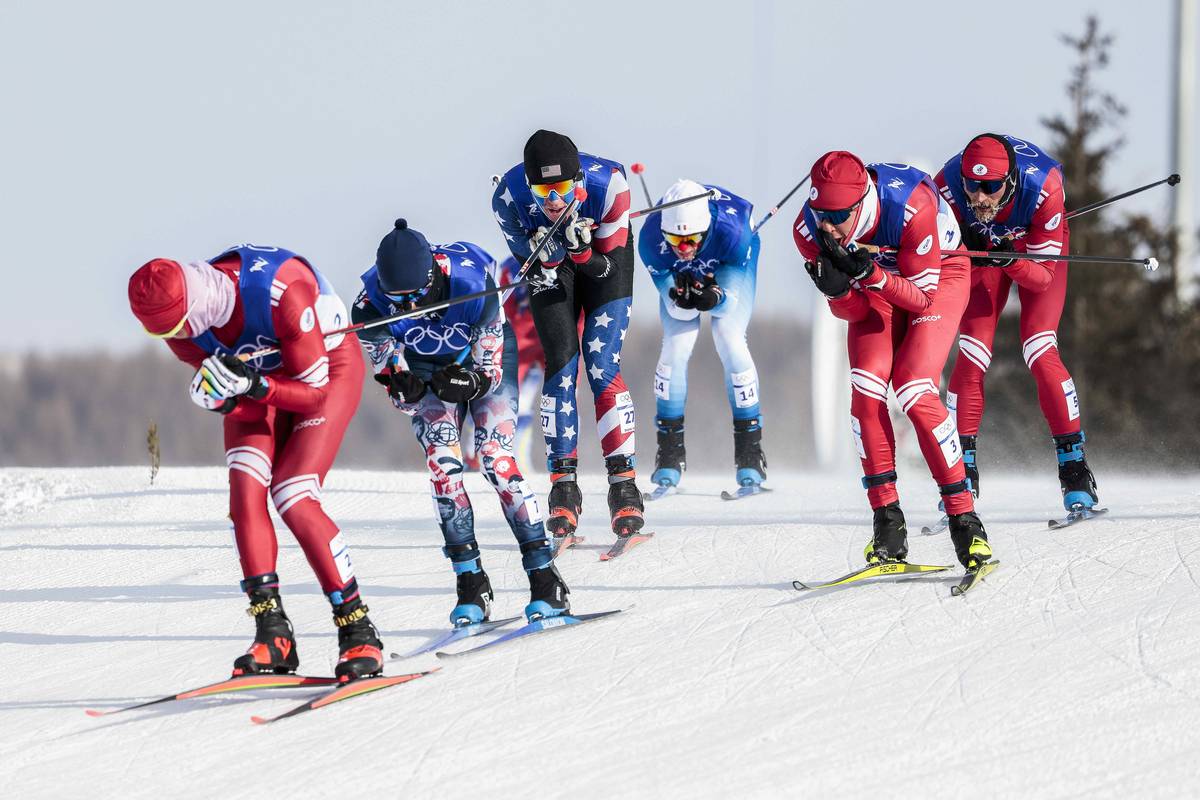
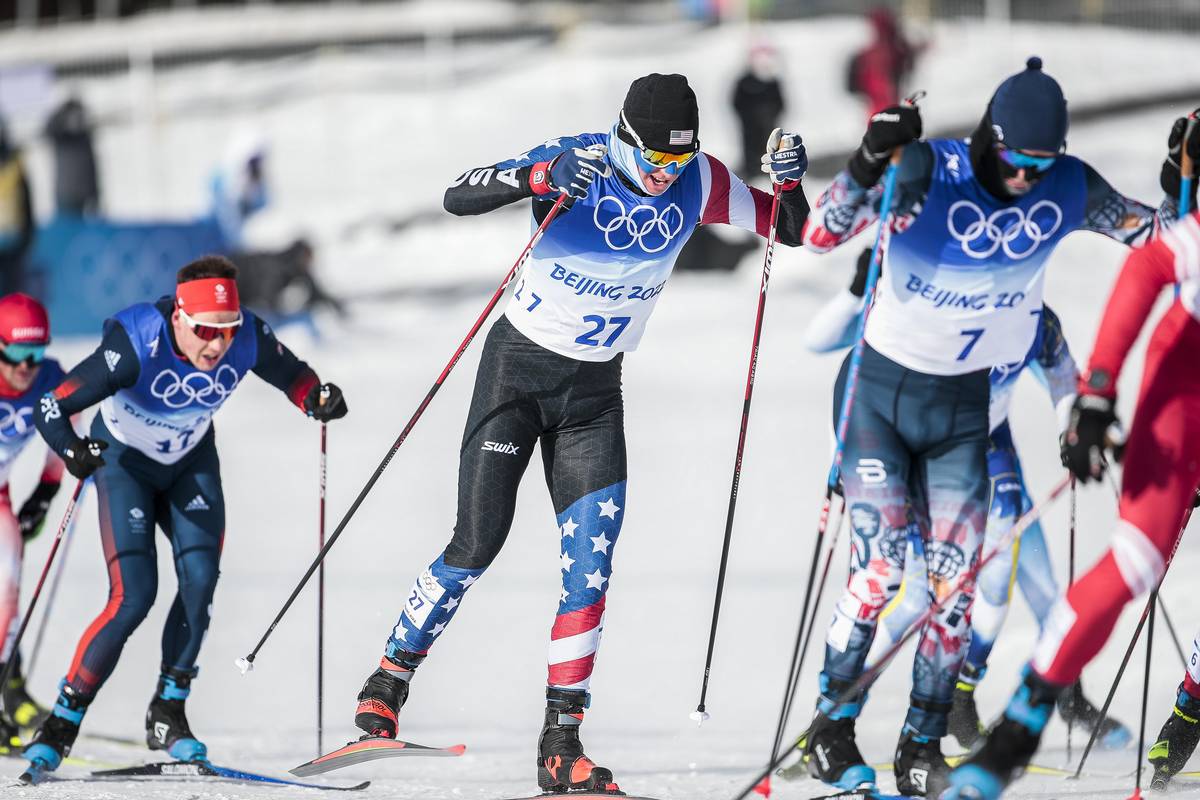
Scott Patterson tucks into the lead group, on the tails of Alexander Bolshunov (ROC) and Sjur Røthe (NOR). (Photo: NordicFocus)
Let’s rewind.
The news of the change in time and distance arrived just hours before the start of the race, with the following message from the organizers: “Due to strong winds and the resulting extreme conditions on course, the distance of the originally planned 50km will be shortened to 30km. The decision was taken in regards to the athletes safety, to reduce the time of exposure of athletes in extreme conditions.”
While there were various opinions on this change, which we’ve covered separately, there’s no getting around the fact that the race distance was slashed nearly in half. Nonetheless, as the lead group moved in and out of the wind, finding shelter on the leeward side of hills and under the protection of treed sections, the four lap course skied like a long-distance event.
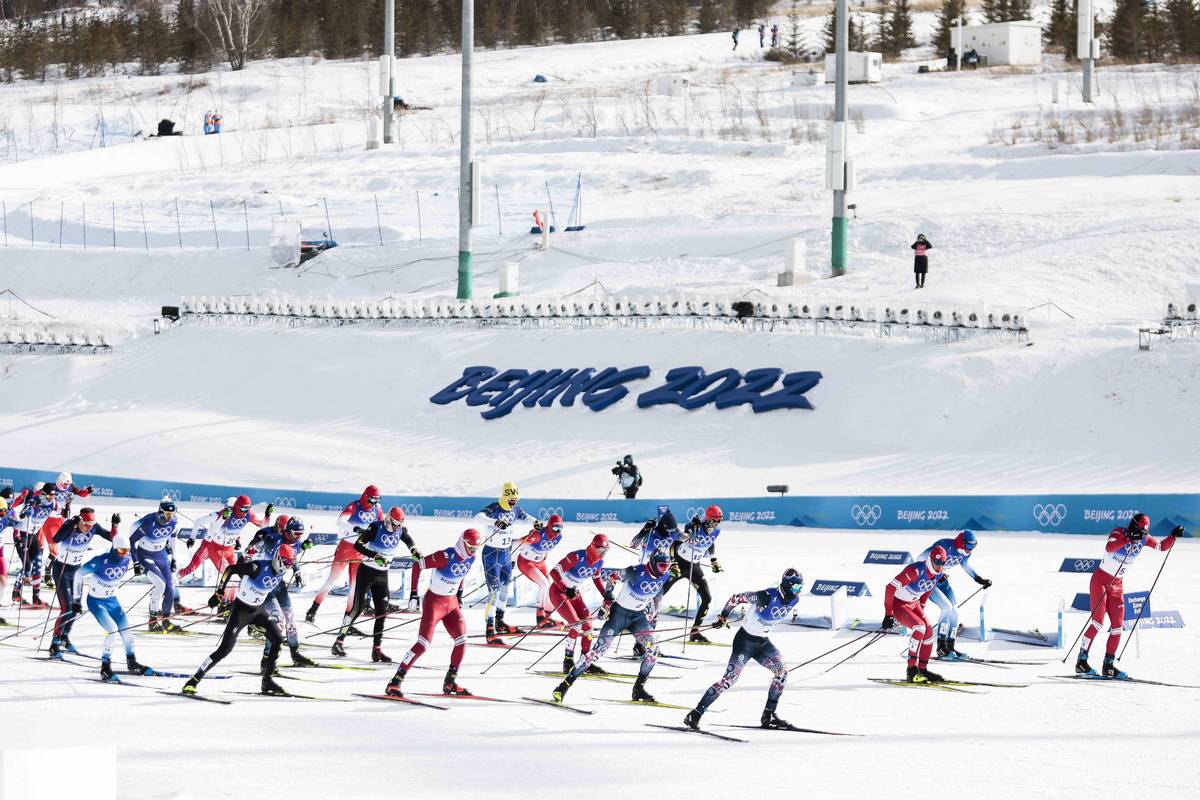
Shortened due to extreme weather, the men’s 28 k mass start freestyle is underway in Zhangjiakou. (Photo: NordicFocus)
At the end of the first lap, the top-30 were separated by less than five seconds, thinning to a 13-man pack by the end of the second lap, and a group of 10 by the end of the third, with an 11 second gap to the first chase group.
Perhaps the only truly noteworthy moment at this point in the race was the departure of Norway’s Johannes Høsflot Klæbo, who won gold in both sprint events – the individual freestyle and the classic team sprint – while also collecting a silver medal in the men’s relay and bronze in the 15 k classic. Klæbo later reported that he was struggling with a stomach illness and had spent more of the night prior to the race in the bathroom than he had been sleeping.
“I thought I would’ve regretted it if I didn’t give it a try but now I’m standing here and it didn’t work out on the whole,” Klæbo told the media.
He said it was “sad” pulling out of the race, but will focus on leaving the Games with his best Olympic distance results.
“I’ll definitely bring with me what’s been positive. What makes it feel more annoying is that my shape has felt better and better and I’ve actually felt that I’ve had a good energy today too. Then the stomach started to speak up and then it got very far to make it to the finish line.”
Johannes Høsflot Klæbo (NOR) dropped out of the 28 k mass start free after his third lap. (Photo: NordicFocus)
The race for medals truly began in the final lap. With Bolshunov and Krüger each surging to thin the lead group, Sweden’s William Poromaa and France’s Maurice Magnificat began to fall off the back. Patterson was tucked into seventh, working with Clement Parisse (FRA) and Denis Spitsov (ROC) to maintain contact and respond to the accelerations of the front.
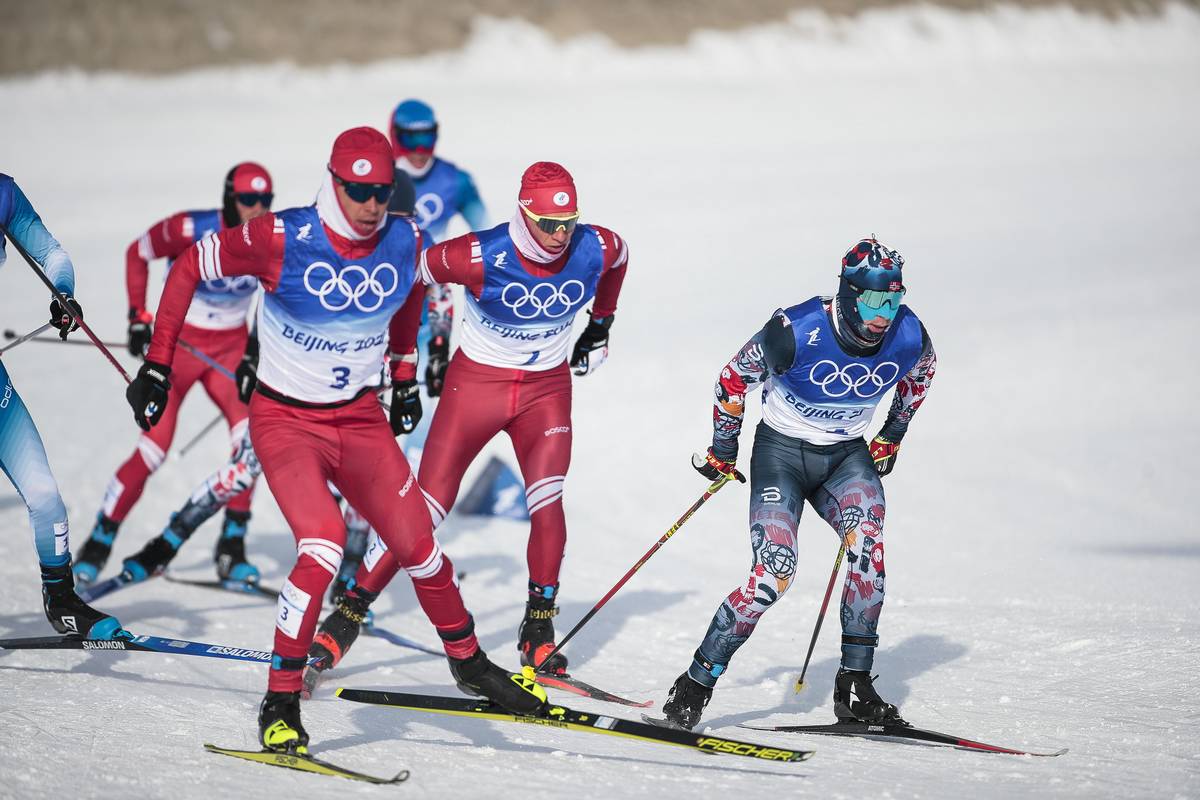
Simen Hegstad Krüger (NOR) leads the men’s 28 k freestyle alongside the ROC’s Ivan Yakimushkin (bib 3). (Photo: NordicFocus)
Over the final 5 k, Bolsunov kept the pressure on, looking relaxed as he tried to create space between himself and Krüger, who had been tucked onto his tails, matching him push for push. With them was Yakimushkin, the three skating in tandem as the finish line drew nearer.
At 24 k, the leaders had only a few seconds on Patterson’s chase group, but when they hit the 27.2 k checkpoint, the gap had drastically expanded. Artem Maltsev (ROC) and Røthe were still just a few seconds back, but Patterson, Parisse, and Spitsov were now over 20 seconds behind, with a 20 second cushion ahead of the next chasers.
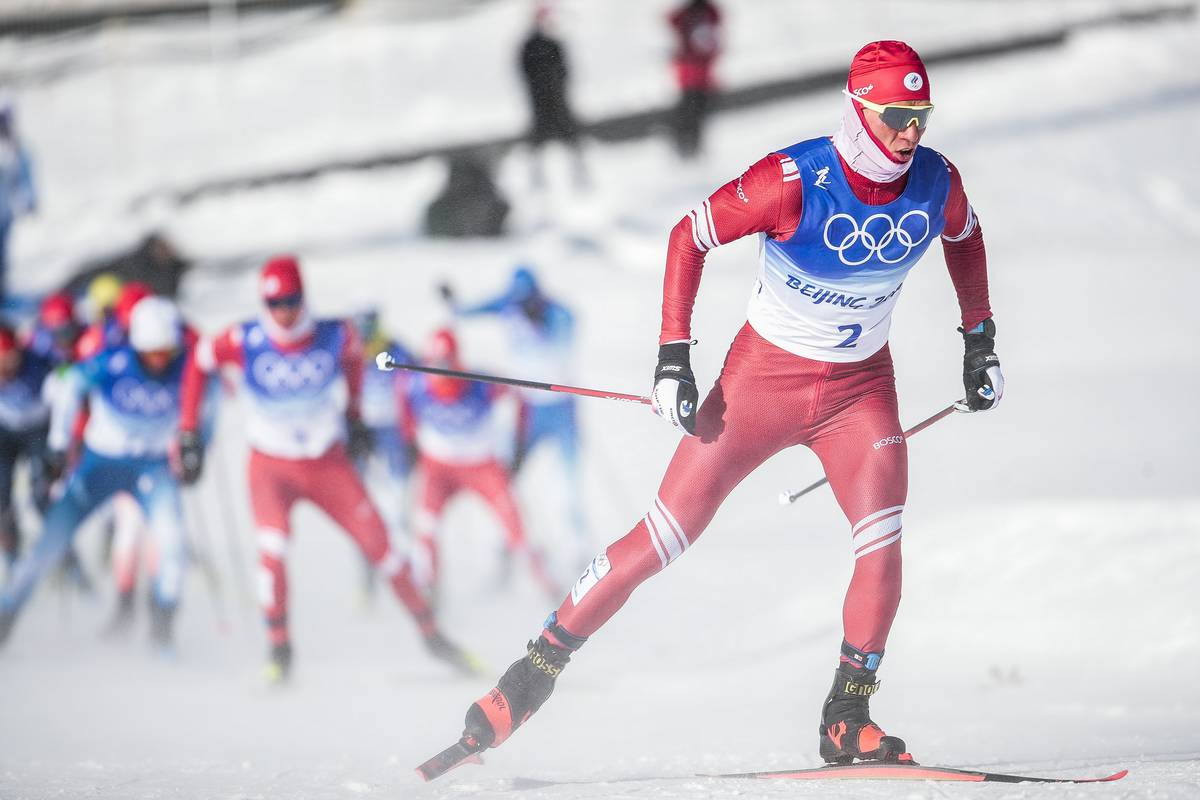
Alexander Bolshunov (ROC) races to his third gold medal of the 2022 Olympic Winter Games during the men’s 28 k freestyle. (Photo: NordicFocus)Norway’s Simen Hegstad Krüger leads the charge during the men’s 28 k mass start freestyle. (Photo: NordicFocus)
Up the final long climb, Krüger would not yield, holding his ground immediately behind Bolshunov. Tucked low into the downhill, the three stayed together, with Bolshunov upping the tempo and power as they accelerated out of the curves and over the gentle rises that interrupted the sweeping descent.
As the three hit the final rise into the stadium, Bolshunov began to break away, with Yakimushkin using Krüger’s draft to slingshot into second with 500 meters to go.
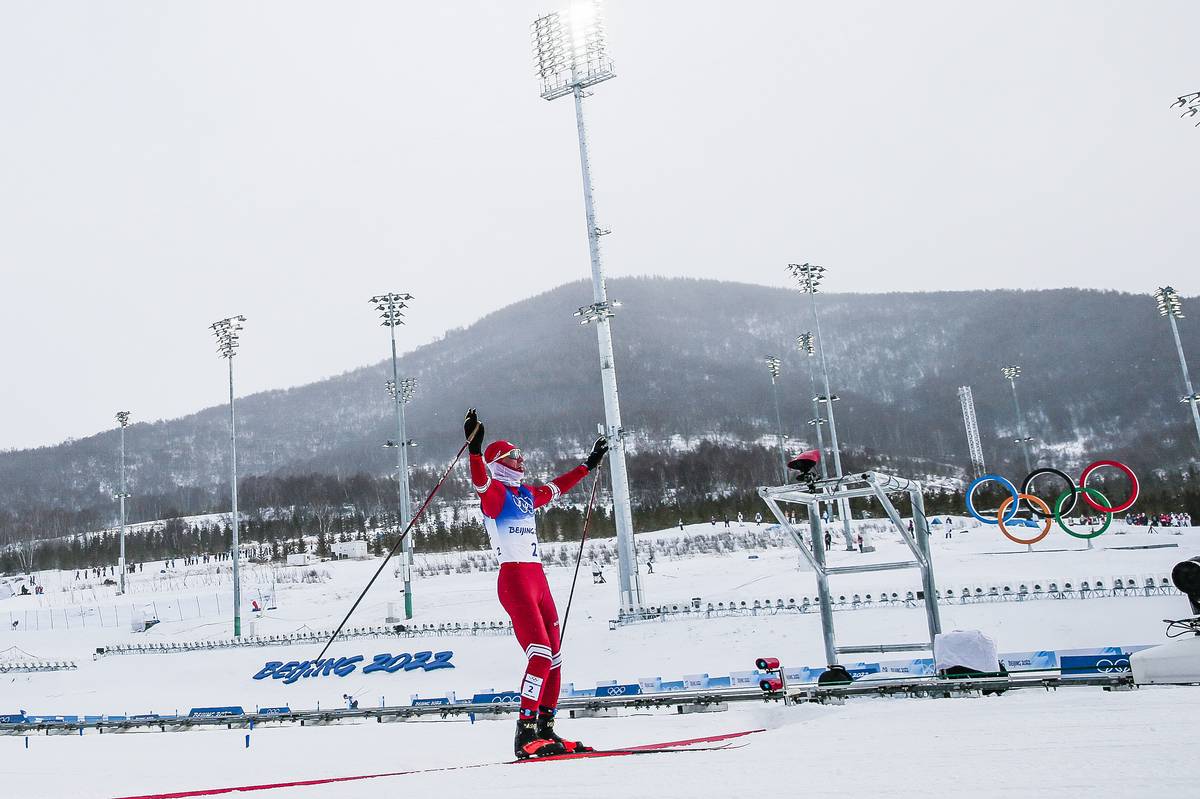
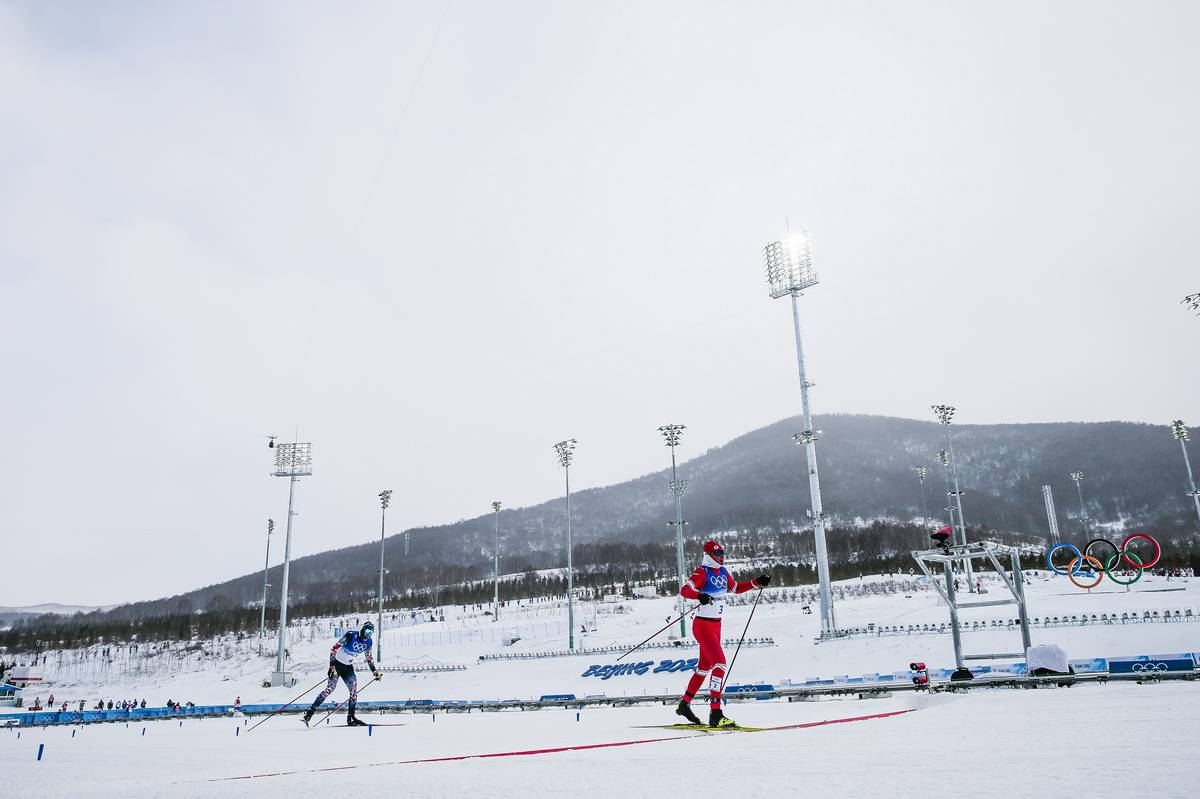
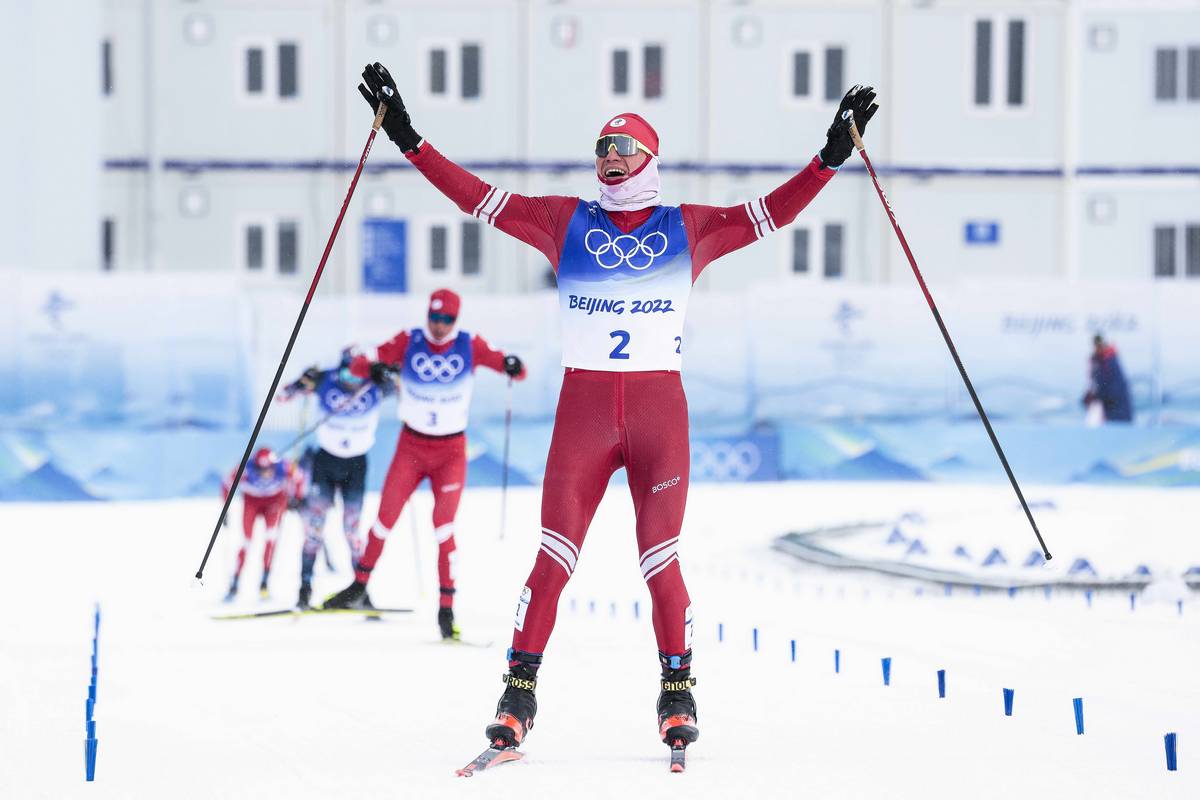
Entering the stadium, the gold medal looked to be predetermined. With a fist pump as he made his way around the final bend into the finish lanes, Bolshunov V2ed powerfully down the home stretch, crossing the line with his hands raised in 1:11:32.7.
Alexander Bolshunov (ROC) celebrates his win in the 28 k mass start freestyle. (Photo: NordicFocus)Ivan Yakimushkin (ROC) takes silver in the men’s 28 k free, while Simen Hegstad Krüger finishes third for Norway. (Photo: NordicFocus)
Holding his advantage through a final sprint to decide silver and bronze, Yakimushkin crossed the line second (+5.5) with Krüger taking third (+7.0) for Norway.
Behind, Maltsev came to the line fourth (+10.7), followed by Røthe in fifth (+15.8).
Spitsov led the now-spread chase group to the line, taking sixth (+26.2) ahead of Parisse in seventh (+28.8) and Patterson eighth (+33.9).
Alexander Bolshunov (ROC) wins his third gold medal of the 2022 Games in the men’s 28 k mass start freestyle. (Photo: NordicFocus)
Nine Olympic medals. Three gold. Four silver. Two Bronze. Five from the 2022 Olympic Winter Games.
“Five? Really?” Bolshunov counted on his fingers as he exuberantly celebrated the golden ending to his Beijing Games appearance. “Five medals, three gold, it is something unbelievable because before the season I set the goal of two gold medals and now I have three. I’m just unbelievably happy. The emotions overfill me. This is above all praise to win these medals here. It’s very cool, and in every race that I took part in.”
Alexander Bolshunov (ROC) receives a cozy Olympic themed gift following his win in the men’s 28 k freestyle. (Photo: NordicFocus)
Regardless of the color of the medal he earned, Krüger said his real victory was simply making it to Zhangjiakou and having the opportunity to race at the Games. Though his illness stayed mild and he stated that it did not impair him in today’s race, he had still spent 10 days in isolation in his hotel room, and remained in isolation while the opening event of the Games, the men’s 30 k skiathlon, was underway. Krüger was the defending Olympic champion in the event after taking gold in 2018. He went on to win a silver medal in the 15 k skate, and help Norway to gold in the men’s relay.
During the 2021 World Championships, Krüger earned two silver medals, first in the 30 k skiathlon and the next in the 15 k free, with a bronze in the 50 k skate. He was one of the top distance skiers on the World Cup heading into the 2022 Games, shouldering Norway’s medal hopes; the nation experienced collective heartbreak following the news of his positive COVID test in late January.
“To be able to go home with an Olympic medal, that’s a huge victory for me and an amazing feeling,” Krüger said after the race. “I’m really proud of what I have achieved today; from not thinking I would be able to ski one single competition to being able to get everything out here today.”
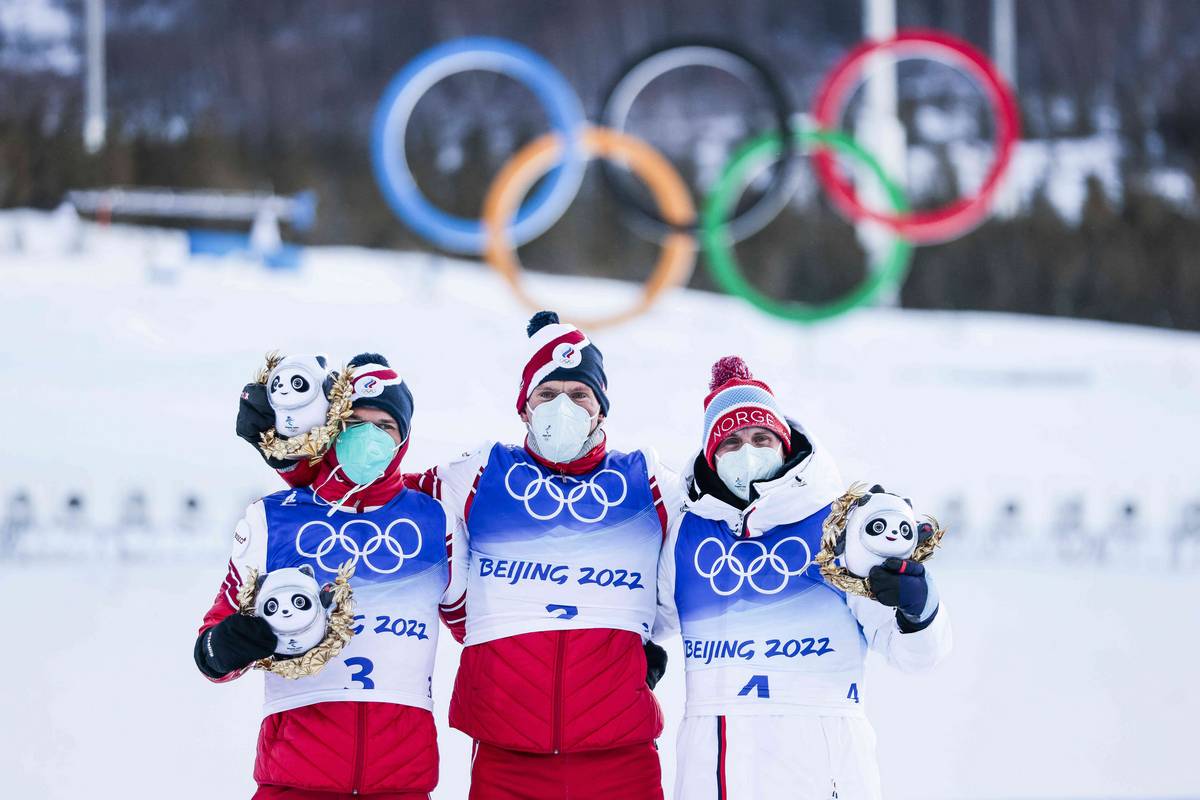
The podium of the men’s 28 k freestyle: Alexander Bolshunov (ROC) took the win ahead of Ivan Yakimushkin (ROC) and Simen Hegstad Krüger (NOR). (Photo: NordicFocus)
For Patterson, eighth place meant achieving the goal, though he admitted being in the hunt for positions even closer to the podium leaves him hungry for more.
“I’m happy,” he told FasterSkier in the mixed zone. “I came in wanting the top 10 and got it today. It’s a little tantalizing to be in eighth and 33 seconds back from the win.”
He continued that the “dream” of a medal crossed his mind as he found himself inside the lead group in the final lap, but he could feel the fatigue accumulating in his body and recognized that he was finding it hard to respond to the tactical moves of the eventual medal winners. “I don’t think it was exactly realistic to fully believe it was happening today,” he said frankly.
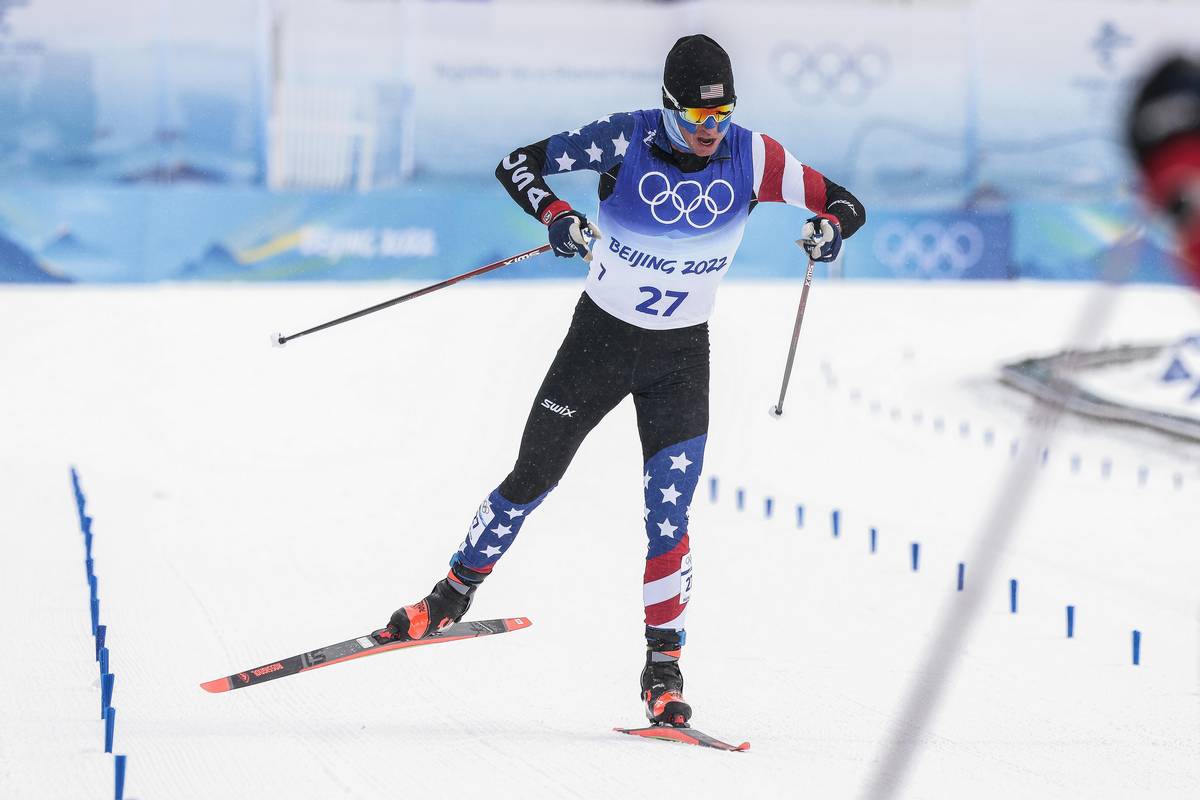
Scott Patterson skis to an Olympic career best with 8th place in the 28 k mass start freestyle. (Photo: NordicFocus)
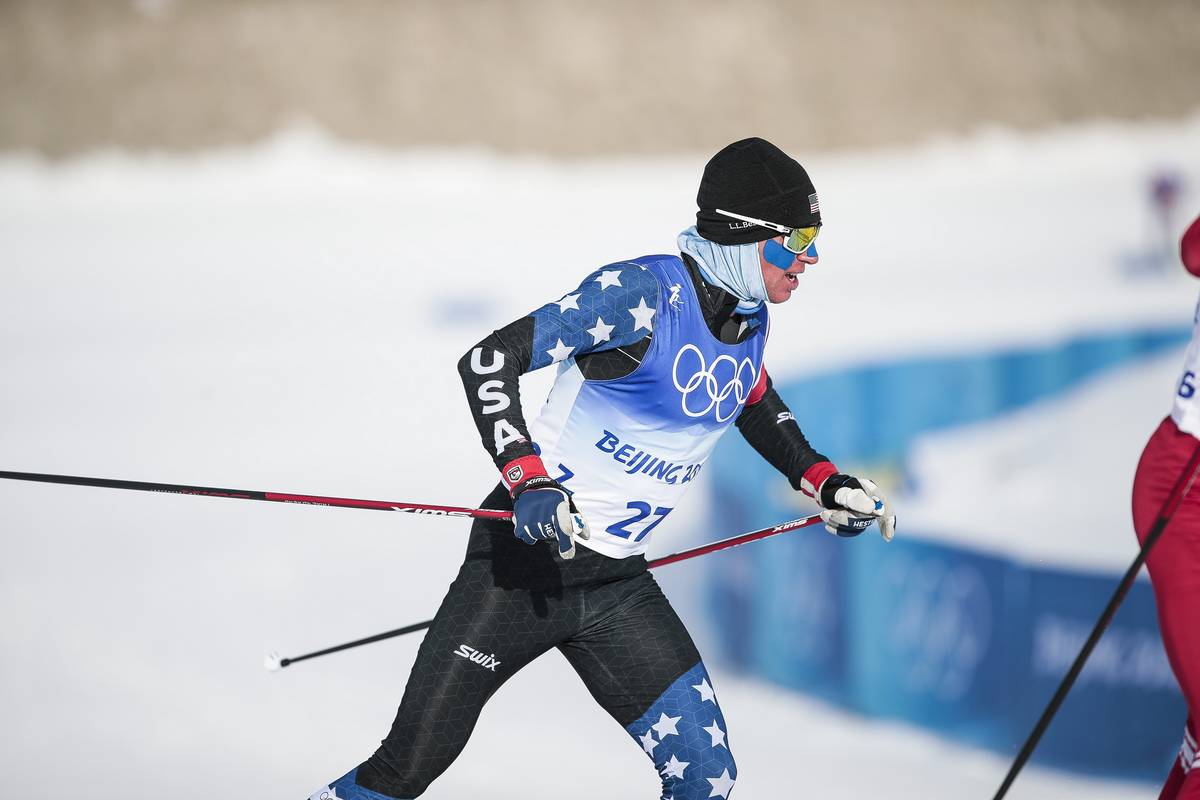
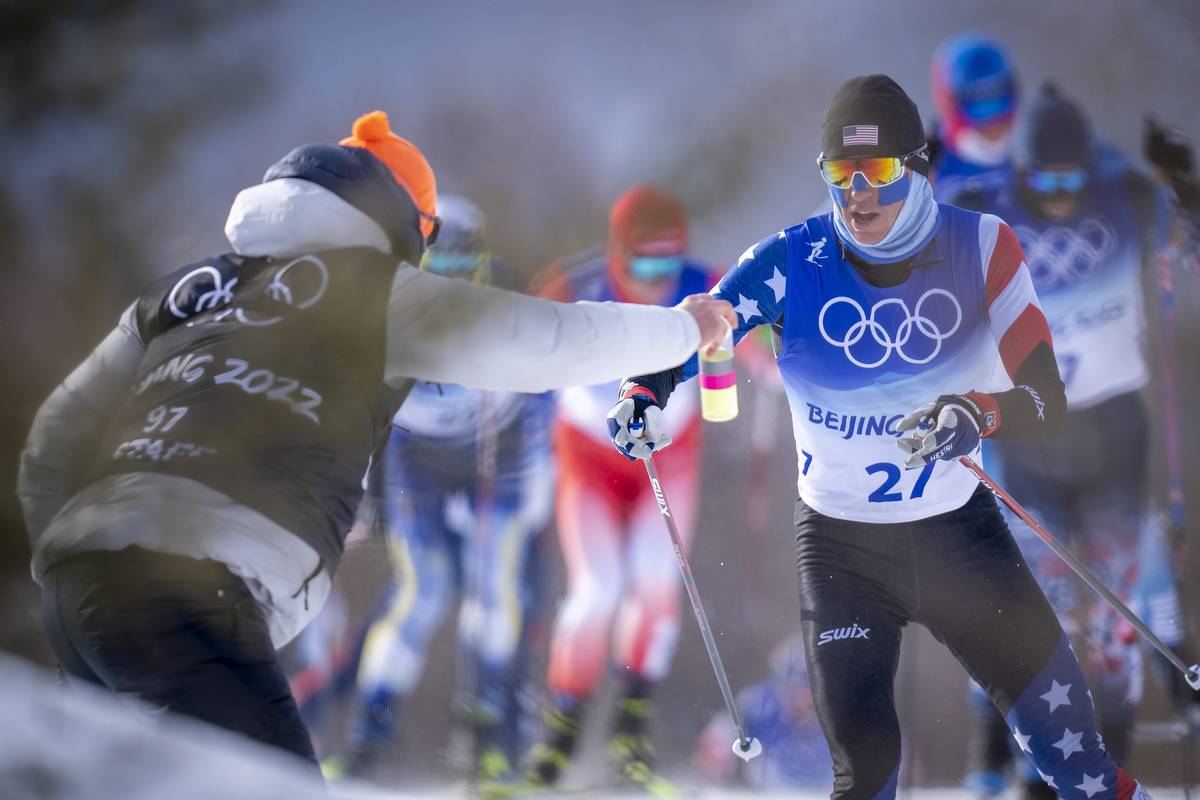
Patterson’s result, while historic, should not come as a surprise to American cross country ski fans. He was 11th in the skiathlon at the opening of the Games, and has made his ability to come on form and earn season-best results during Championships well known over the last four years.
During the 2018 Games in PyeongChang, he put together breakout performances, skiing to 18th in the skiathlon, 21st in the 15 k skate, and 11th in the 50 k classic. He raced into the top-30 in each individual distance race of the 2019 World Championships, with a 23rd place finish in the 50 k free. Improving on these results in the 2021 World Championships in Oberstdorf, Germany, Patterson was 14th in the skiathlon, 27th in the 15 k skate, and 10th in the 50 k mass start classic.
And, he likes going long. He said he would have preferred another 20 k today – “I wanted the grinding instead of the punches” – and might have even been able to pull off a higher result had the race been longer.
Back in 2016, his first World Cup appearance was in the 50 k classic at the Holmenkollen, which sits above Oslo, Norway. He was 32nd on the day in perhaps the most storied and highly revered cross country ski race on the World Cup. Patterson advanced to 28th the following year, before making a leap into the top-20 to finish 16th in 2018 and 19th in 2019.
Scott Patterson takes a feed during the men’s 28 k free in Zhangjiakou. (Photo: NordicFocus)
From the outside, it can be hard to appreciate the dynamics of mass start racing among the best athletes in the world in the sport. Energy management, tactics, drafting, protecting equipment while the field remains dense in the first lap, which Patterson called “chaotic.”
“You get those lead skiers fighting the wind, and a lot of the back skiers that could just draft in. And there are a few people who definitely don’t have a lot of World Cup experience making a mess out of the pack,” Patterson described.
In his second Olympic appearance at the age of 30, with plenty of World Cup experience, Patterson skied a smart race, telling FasterSkier that he felt “strong” and “relaxed”, while looking to be “in a comfortable position and not [using] too much out of my energy.” He also reported having competitive skis that allowed him to utilize the downhills and stay in the position where he wanted to be.
U.S. Ski Team head coach Matt Whitcomb complemented Patterson on his race execution, telling FasterSkier emphatically that he was “so proud of him.”
Scott Patterson races in the lead group during the men’s 28 k mass start freestyle. (Photo: NordicFocus)
Talking through the race from his vantage point, Whitcomb pointed out that Patterson stayed calm through the congestion in the opening lap, rather than becoming flustered and wasting energy by constantly trying to move up. He also shared how Patterson was able to “wisely” keep himself on the correct side of other racers to utilize the windbreak on unsheltered sections of the course.
“Some incredible skiers ended up on the wrong side of the break and were toast…” Whitcomb explained. “When that happened, I heard a Finnish yelling at a German skier saying, ‘Hey, take me up to them!’ People were desperate to do work together, and so [I’m] very proud of Scott and unsurprised that he was in a tactically wise position.”
Apart from battling the elements, maintaining an optimal position within the lead group is also a skill that requires experience and maturity.
“If you have a pack of 15 guys, of course, it’s easy to follow in a draft in 14th and 15th,” Whitcomb said. “But what you don’t realize is that there’s quite a big accordion effect, so you’re constantly pulsating on the gas pedal. What you saw [today] was Scott moving up into between fourth and seventh, for a large part of [the race], and that ends up being a much more efficient position to ride. Draft is good, but you’re also able to just kind of stay on a steady gap.”
Scott Patterson races to the line, finishing 8th in the men’s 28 k mass start freestyle. (Photo: NordicFocus)
For Whitcomb, Patterson’s eighth place ends the Games on a high note for the American men’s program as a whole.
“This is, this is for sure one of the goals that our men’s program wants: to start breaking through in one of the ultimate races of the Olympics,” Whitcomb shared. “To do that today, under conditions like this, is such a huge success for our program and for Scott and for his club, APU. For all the coaches over the years, Erik Flora that’s worked with him, and the [rest of the] coaches at APU. It’s such a huge success for [Patterson’s collegiate program], the University of Vermont; Alaska Winter Stars where he started skiing; and just so many people have been a part of this incredible journey. And so happy for all of them. But mostly for Scott because he earned this sucker today. It was brutal.”
Rémi Drolet (CAN) skis to 35th in the men’s 28 k mass start skate. (Photo: NordicFocus)
Two Canadian’s raced the 50 k today, with Olivier Léveillé leading the Canucks at the finish in 27th (+4:21.6). 30 seconds back, Rémi Drolet crossed the line in 35th (+4:54.4).
Racing continues tomorrow with the women’s 30 k mass start freestyle, the final cross country event of the 2022 Beijing Olympic Winter Games. At this time, the distance of the women’s event remains unchanged, however, the start was moved up by 3.5 hours to account for the forecasted weather conditions.
Deedra Irwin takes aim during the 2022 Beijing Olympic Winter Games. (Photo: NordicFocus)
BEIJING, China (Feb. 18, 2022) – Competing in the first mass start of her career on the Olympic stage, Deedra Irwin (Pulaski, Wis./ National Guard Biathlon & USBA) went toe-to-toe with the world’s best biathletes to finish 23rd in the elite field of 30 on Friday as the Beijing 2022 Winter Games’ biathlon competition came to a close at the Zhangjiakou National Biathlon Center. Irwin was 3 minutes, 24.1 seconds back with six penalties.
Deedra Irwin celebrates a 23rd place performance in the 12.5 k mass start. (Photo: NordicFocus)
“This has just been such an incredible experience,” said Irwin after the race. “I’m still processing everything that’s happened these past couple of weeks at the Olympics. I’ve gained a ton of confidence at these Olympics and really just went above and beyond my Olympic goal which definitely didn’t include the mass start. It was just an honor to get on the start line today and I was in awe the entire time.”
As with most of the competitions at the Beijing Games, the women’s mass start featured cold temperatures and strong winds cutting across the shooting range. As a result, none of the competitors shot clean. Irwin had four penalties in prone and two in standing, but felt privileged to be racing among the elite of the sport.
“Definitely during the race, skiing next to some of the best women in the world…wow…I am just still speechless,” Irwin said. “If there’s anything I’ve learned from these Games it’s that I have a lot more to learn and I’m just so excited to keep climbing the ladder. Skiing next to Denise Herrmann and Hanna Oeberg and Mona Brorsson and all the girls today…being able to fight next to them I am just so excited to continue racing and see what else I can push my body to do.”
France’s Justine Braisaz-Bouchet won the mass start gold medal with four penalties and a time of 40:18. Norway’s Tiril Eckhoff, also with four penalties, won the silver medal, 15.3 seconds back, while her teammate Marte Olsbu Roeiseland claimed her fifth medal of the Games, taking the bronze 34.9 seconds behind Braisaz-Bouchet with four penalties.
Battling the wind, Deedra Irwin grabs a pole while racing to 23rd in the 12.5 k mass start. (Photo: NordicFocus)
The biathlon season now shifts focus to the last three IBU World Cup events of the year, beginning with the March 3-6 competition in Kontiolahti, Finland.
Women’s 12.5km mass start results
1.
Justine Braisaz-Bouchet (FRA)
40:18.0/+4
2.
Tiril Eckhoff (NOR)
+15.3/+4
3.
Marte Olsbu Roeiseland (NOR)
+34.9/+4
23.
Deedra Irwin (Pulaski, Wis.)
+3:24.1/+6
Check out the Watch Olympic Biathlon schedule for viewing options of all the races from Beijing. You can also follow all the action on the IBU app – download it today!
Federico Pellegrino of Italy leads, from right, Janosch Brugger of Germany and Emil Iversen of Norway, men’s 4 x 10 k relay, Feb. 13. (Photo: NordicFocus)
FasterSkier previously surveyed the national-team uniforms from last year’s World Cup fashion season, starting with more traditional nordic powers (Norway, Russia, et al.) but also taking a look at some more outré ski countries (Brazil, Nigeria, Thailand). We didn’t run a comparable article at the start of this season, as there was relatively little change in most nations’ World Cup kit from last year to this year.
But when the Olympics arrive, however, all bets are off. Sponsor logos are out. Direct evocation of a nation’s flag is typically in. Unless you’re Norway, or Russia, albeit for different reasons.
There are lots of countries that sent cross-country skiers to this year’s Winter Olympic Games (54, in fact). Compiling photos of all of them would make for a very long article. Instead, this article surveys those countries that entered a team in the men’s 4 x 10-kilometer relay, using relay participation as a general proxy for international competitiveness. A follow-up article will focus on the women and on some less traditional nordic nations, by means of surveying finishers from the bottom half of the women’s skate sprint results sheet.
This article undertakes to rank the men’s relay race suits in, roughly, descending order of vexillological evocativeness, that is, how much does each race suit look like that country’s flag. This is a necessarily subjective inquiry; your own rundown may differ. No offense is intended toward countries in the bottom half of this list: A lower ranking does not mean that a suit is “bad,” just that it is less readily flag-like.
Note well, a handful of photos in this article come from races earlier in the Games, not from Sunday’s relay; it appears that there were no relay photos for these nations in the typically comprehensive NordicFocus library. Relatedly, all shots in this article are copyright NordicFocus, which has been doing an amazing job throughout the Olympics.
Finland
Finland’s Iivo Niskanen skis in the men’s relay. (Photo: NordicFocus)
The Finnish flag looks like this: 🇫🇮. Iivo Niskanen’s suit looks effectively the same. If one were, hypothetically, a Finnish athlete putting down an all-time relay performance to drag one’s team back up toward the front of a splintered men’s 4 x 10 k relay, there would be little doubt what nation you represented while you did so. This suit has the two colors of the Finnish flag, the dominant design element of the Nordic cross, and little more. It sure looks like the flag of Finland.
United States of America
Kevin Bolger skis in the men’s relay. (Photo: NordicFocus)
The American flag, you are likely aware, looks like this: 🇺🇸. There are two main elements in the American flag, the stars and the stripes; both are represented here. (Added points for the relay socks, an after-market add-on that further emphasize the “stripes” aspect.) America should arguably be ranked below Sweden, for the dominant use of a color, black, not present in the nation’s flag, but has been slotted in here in second because the stars and stripes for America seem more flag-like than the evocation of a Nordic cross does for Sweden. You can find much more about historical American uniforms, both Olympics and World Cup styles, here.
Sweden
Johan Häggström skis in the men’s 15 k classic, Feb. 11. (Photo: NordicFocus)
The Swedish flag looks like this: 🇸🇪. This uniform does not really depict the Nordic cross per se, but the consistent use of yellow and blue, augmented by only the neutral white, means that the overall evocation of a flag is quite strong.
Czech Republic
Petr Knop skis in the men’s relay. (Photo: NordicFocus)
The flag of the Czech Republic looks like this: 🇨🇿. This suit does not precisely portray the flag outline, but otherwise ranks high for featuring only the three colors from the flag, and nothing else. Could conceivably be pressed into service as a U.S.A. alternate suit, or maybe the current American biathlon suit.
Estonia
Marko Kilp skis in the qualification round of the men’s skate sprint, Feb. 8. (Photo: NordicFocus)
The flag of Estonia looks like this: 🇪🇪. Much as with the Czech flag, Kilp’s ensemble does well by using only the relevant three colors from the national flag. The overall effect is aided by the coincidental use of blue and white in this race bib from the skate sprint, which differs from those used for three legs of the four-leg relay.
Switzerland
Candide Pralong skis in the men’s relay. (Photo: NordicFocus)
The flag of Switzerland looks like this: 🇨🇭. This suit does well in that it uses only the relevant two colors. It does less well in that the instantly recognizable visual element of the flag, the Swiss cross, is not present here. (In Switzerland’s defense, it has the rare square national flag, so translating this to race-suit format may be difficult.) Also, the red–white ombre through the legs is trippy; cf. France, infra, which does much the same with blue and white.
Italy
Francesco De Fabiani, right, leads Friedrich Moch of Germany in the men’s relay. (Photo: NordicFocus)
The flag of Italy looks like this: 🇮🇹. The dominant hue in this uniform, blue, evokes “the traditional paint of the royal House of Savoy, which reigned over the Kingdom of Italy from 1860 to 1946,” per Wikipedia, and is characteristic of Italy’s international sports teams, such as the national football team known as gli Azzurri. The tricolor bands on both upper legs, mirrored on the right shoulder, do a surprisingly successful job of typing this uniform as Italian against this blue background.
Japan
Hiroyuki Miyazawa skis in the qualification round of the men’s skate sprint. (Photo: NordicFocus)
The flag of Japan looks like this: 🇯🇵. This uniform falls into roughly the same category as Switzerland’s: instantly recognizable design element (the flag is “more commonly known in Japan as the Hinomaru (日の丸, ‘circle of the sun,’” per Wikipedia) that is not really present in the suit. Ranked below Switzerland due to the use of additional colors beyond just red and white; there is a sense of gold accents along the lower left leg, which works well aesthetically but falls outside of the flag palette.
People’s Republic of China
Liu Rongsheng skis in the qualification round of the men’s skate sprint. (Photo: NordicFocus)
The flag of China looks like this: 🇨🇳. This uniform is ranked relatively low, when it comes to evoking a country’s flag, because the distinctive five stars (“the five stars and their relationships to each other represent the unity of the Chinese people under the leadership of the Chinese Communist Party,” Wikipedia advises) do not seem to be present. Zooming in on the hi-res version of this image suggests that the detailing on the torso and lower legs is variegated and visually compelling, but also does not look like stars. It is a fine suit, but ranks low on the specific axis of flag–suit evocation.
Canada
Olivier Léveillé skis in the men’s relay. (Photo: NordicFocus)
The flag of Canada looks like this: 🇨🇦. It is universally known as the Maple Leaf (note Léveillé’s headband, for example, or the Canadian World Cup suit that literally features flannel-patterned maple leaves on the lower legs). This suit is ranked low here because the presence of a maple leaf is subtle at best, and for the dominating use of black, a non–flag color, through the torso.
France
Maurice Manificat skis in the men’s relay. (Photo: NordicFocus)
The flag of France looks like this: 🇫🇷. It is also known as the Tricolore, or, well, “three colors.” The suit is ranked low, in this compilation, because only two of the three colors are present here. That said, the coordination with the blue and white Salomon skis and boots is sublime, though the suit overall looks suspiciously like it came from the same template as Switzerland’s, q.v., supra.
Germany
Lucas Bögl skis in the men’s relay. (Photo: NordicFocus)
The flag of Germany looks like this: 🇩🇪. Much like France, the German flag has three colors, in this case the national colors of black, red, and gold. The suit is scored low in this compilation because of the extent to which the first of these colors overpowers the other two (indeed, it is not clear that red is apparent anywhere within the suit itself, as opposed to on the hat). It is a stark and imposing suit, it just does not look very much like the Flagge Deutschlands.
Slovenia
Miha Ličef skis in the men’s 15 k classic. (Photo: NordicFocus)
The flag of Slovenia looks like this: 🇸🇮. This suit is imho amazing, and I frankly love it, but I had to rank it this low because it does not exactly evoke a red, white, and blue flag. (For purposes of comparison, here is last season’s Slovenian World Cup suit, which is notably more flag-like.) If you are from Slovenia and can explain to me why these colors and this design showed up in this year’s Olympic suit, please let me know: gavin (at) fasterskier.com. I am not making fun; I am just sincerely curious. Also, I honestly love this suit, even if at first glance I thought it was the suit of Ukraine or Australia.
Norway
Pål Golberg skis in the men’s relay. (Photo: NordicFocus)
This is… certainly a look. This suit puts the “illogical” in “vexillological.” This is the flag of Norway: 🇳🇴. This suit is notably memorable, and has occasioned strong reactions throughout the Olympics. It does not, however, whatever else you may say about it, look particularly much like the Norwegian flag.
Russian Olympic Committee
Denis Spitsov skis in the men’s relay. (Photo: NordicFocus)
The Russian flag looks like this: 🇷🇺. Russia is not officially competing in these Games, just athletes representing the “Russian Olympic Committee.” It’s complicated. One result of these complications is that “Russian” athletes are racing in a suit that does not really resemble the flag of Russia. Again, it is a fine suit, just not particularly Russian flag–like.
During the opening weekend of World Cup racing in Ruka, FIN back in November 2021, Canada’s Antoine (Tony) Cyr popped an 11th place finish in the first distance race – a tough 15-kilometre classic won by Finland’s Iivo Niskanen, now a gold medalist in the event.
Antoine Cyr (CAN) pushes around a the curve as he helps the Canadians to 5th in the classic team sprint during the 2022 Olympics. (Photo: NordicFocus)
After the race, Cyr wrote to FasterSkier that the course had suited him with its long uphills and frigiddig conditions; temperatures were near zero degrees Fahrenheit ( -17 C). “Cold weather is good for us Canadians,” he said. Cyr repeated his strong showing in Ruka the next day, placing 12th in the skate pursuit.
Flash forward through a number of subsequent racing highs and lows, and Cyr found himself in similar circumstances: on classic skis in single digit temps, with an arduous course designed to test the mettle of the best in the world.
Cyr was awaiting one final tag in the Olympic team sprint from partner Graham Ritchie, still amidst the lead group of eight teams, racing with some of the top names in the sport toward an Olympic medal. After receiving the tag, Cyr did his best to keep Canada in contact with the leaders, who began to surge, breaking apart this lead group as the list of medal contenders dwindled to three teams.
Along with William Poromaa of Sweden, Cyr lost contact with the top-three, tagging Ritchie for the final leg of the race in fifth, a position Ritchie held through the finish to cross the line in 19:45.3, only +22.3 back from the Norwegian gold medalists Johannes Høsflot Klæbo and Erik Valnes.
Graham Ritchie (CAN) double-poles toward the finish of the men’s team sprint. (Photo: NordicFocus)
It was the best men’s result in a classic team sprint in Canada’s rich Olympic history. At the event’s debut in the 2006 Torino Games, which was competed classic, Devon Kershaw and George Grey took 11th in the team sprint for Canada, while Beckie Scott raced with Sara Renner to win a silver medal. Kershaw lined up with Alex Harvey at the following Games in Vancouver in 2010 for the skate team sprint, just missing the podium in fourth.
“This is so incredible to pull this off and throw down such a good result for Canada,” Cyr told Nordiq Canada after the race. “It’s overwhelming, especially to do this with such a good friend like Graham. It is really special.”
Graham Ritchie and Antoine Cyr celebrate 5th place in the classic team sprint during the 2022 Olympic Winter Games. (Photo: Laura Leclair)
Both 23-years-old and competing in their first Olympic Games, the Canadians had been looking for more than the results they’ve had thus far in Zhangjiakou. A pre-Olympic camp at a similar elevation in Sovereign Lake/SilverStar reportedly went well, and tight COVID safety protocols had kept the athletes healthy, allowing them to safely enter the Olympic bubble.
While the opening races ultimately did not feature the Canadians vying for top-10 finishes, Cyr and Ritchie could look back on the 2021 World Championships in Oberstdorf, Germany, where they took seventh for Canada in the freestyle team sprint.
Ritchie told FasterSkier in the mixed zone that they knew from this experience that they would need to be in the top-four in the semifinals to advance safely into the final. They had done it in the World Champs and they believed they could do it again in the Olympics.
“We know we had it in us, we just knew we had to race smart and race hard and have a good day,” Ritchie explained. “So [I’m] super proud of Tony and me to be able to work together and use our experience to push through that semi and end up giving our shot at a good race in the final.”
Graham Ritchie (CAN) races at the front of the pack at the start of the men’s classic team sprint in Zhangjiakou. (Photo: NordicFocus)
So far in the Games, Cyr has raced every event, but had not cracked the top-30 individually. Ritchie sat out the skiathlon and 15 km classic, and finished as the top-Canadian in 34th in the freestyle sprint, just off the time needed to make the heats. Racing the first two classic legs of the 4 x 10 km relay, Canada finished 11th out of 12 teams that completed the race. It’s not the makings of an underdog story about a small nation in a rebuilding phase after a string of notable retirements that one might drum up.
“I think we put every other race in the back of our minds and just knew we [could have] a good day,” Ritchie told FasterSkier on the team’s confidence in spite of sub-optimal results. “Tony is an exceptional classic skier. And myself and him are both – we know we can pull off a sprint. So we really put those other races behind us and were only focused on today…
“But then I mean to be on the last lap, with the podium right there,” Ritchie continued dreamily, as if still feeling the thrill. “That was pretty eye opening.”
Though he acknowledged the challenge of facing the likes of Klæbo, Joni Maki (FIN), and Alexander Terentev (ROC) in the last lap, who eventually took the gold, silver, and bronze medals, respectively, Ritchie shared that the possibility of a Canadian medal crept into his mind in the final lap. Moreso, it planted a seed for what might be possible in the future.
“I mean, during the race, I definitely thought about it. Like you could see it right there… And I mean, we’re both 23 years old. We’ve got a lot of racing left in us. So yeah, that was a big race for us. And we’re really looking forward to seeing what we can do in the future here for Canada.”
In the mixed zone, World Cup competition coach Erik Bråten also spoke to the team’s ability, particularly in Cyr’s case, to put aside the early results of the Games and take on a “fake it till you make a kind of attitude today. And just push through it.”
Speaking to the difference makers that led to this outstanding result, Bråten projected that Cyr had skied among the “top-three technically”, particularly when striding up the 400 meter A-climb, which rose 30 vertical meters to the high point of the course midway.
Antoine Cyr (CAN) matches Iivo Niskanen (FIN) up the climb during the classic team sprint in Zhangjiakou. (Photo: NordicFocus)
Though Cyr had raced the odd legs of the team sprint during the World Championships and was second in the classic sprint final during the Canadian Olympic Team Trials in January, having also won both the freestyle sprint and the 15 km classic earlier in the trials, Bråten deliberated the matchup he would enlist for the team sprint until official selections were due.
“For me, this team was pretty clear before we went here. But Tony’s been struggling a little bit. And Graham hasn’t been his maximum self here either, but I felt like he did decent enough in the [freestyle sprint]. I know Tony – the potential he has. And I felt like – we plan for success. And I think on the best day, he was the right man for the day. We don’t plan for people to have a bad day. And he had an amazing day. He showed us what he could do out there. So I just think everything came together in a perfect way.”
This coming together means more than just a new best Olympic result in the classic team sprint for the Canadian men. Bråten stated emphatically that it is a result that could spark a return to international success for Canadian cross country skiing, elevating every level of the development pathway.
“I think it’s extremely important. It’s important for all the athletes back home in Canada, seeing what’s possible. It’s important for coaches, the coaches of these athletes, knowing what’s going on, knowing what it takes to get this result. And they’re so young, they can do even better next year, and so on. So it’s just a trickle down effect that can be quite big both financially, but also, of course, information and knowledge wise. They know what they did to get to this level. Well, that can be shown down [the development pathway] as well.”
That said, feeding the development pipeline and supporting the athletes within it requires resources. While some aspects of elite level cross country skiing are relatively low cost, Canada is limited by its budget in what it can do for athletes aiming for the top.
“The man on the boards [is] the most important person,” Bråten said simply. “Any female or male who wants to be good, the most important thing you do is just get out there and do the work, which is free. Of course, there’s equipment involved, but the work is mostly free… However, there’s so much behind this. What do you put on the boards? Which boards do you have in the first place? Are you getting the coach, physiologists, ski support you need? And we’re good enough to do this, apparently, but…”
Bråten trailed off before gravely stating, “One Norwegian athlete is the same budget as our entire team.”
Graham Ritchie skis to 34th in the freestyle sprint qualifier during the 2022 Beijing Olympic Games. (Photo: NordicFocus)
“It’s tough,” he continued. “So, for sure, we wouldn’t hurt getting a little bit more financial support.”
Ultimately, he has confidence in the team he is supporting, and in particular in Cyr and Ritchies outlook heading into the upcoming 2023 World Championships, which will be held in Planica, Slovenia beginning in late February.
“There’s no reason they can’t fight for at least a medal, and why not just go gold if you’re going to go for bronze?”
Wednesday’s Olympic team sprint offered another thrilling set of races at the venue in Zhangjiakou — we’re back to break down an epic performance by the German women, a critic-silencing race from Norway in the men’s event and a U.S. women’s result that left a medal just out of reach.
Thanks to everyone for sending in questions and feedback — we’re trying to keep our heads above water on the homestretch here, but you can be sure Devon will still have plenty to say post-Games. In the meantime, you can get us at devon@fasterskier.com and nat@fasterskier.com.
Katharina Hennig and Victoria Carl win gold for Germany in the classic team sprint. (Photo: NordicFocus)
A back-of-the-pack women’s skier competing for Ukraine at the Beijing Olympics has tested positive for banned drugs, according to the agency that’s overseeing testing at the Games.
Valentyna Kaminska tested positive for a banned steroid and stimulants on the day she finished 79th in the 10-kilometer classic event, the International Testing Agency said in a statement Wednesday.
Ukrainian skier Valentyna Kaminska tested positive for banned steroid and stimulants following the 10 k classic event. (Photo: NordicFocus)
Kaminska has been provisionally suspended until the case is resolved and is banned from participating in further Olympic events, the ITA said. She can challenge the suspension at the Court of Arbitration for Sport, and she can also ask authorities to analyze her B-sample.
Kaminska competed at the 2018 and 2014 Olympics for Belarus, where she was born, before moving to the Ukrainian team. She’s never cracked the top 30 in an individual World Cup event, or at the Olympics or World Championships.
She has not responded to a request for comment sent Thursday through her Instagram account.
This World Cup coverage is made possible through the generous support of Marty and Kathy Hall and the A Hall Mark of Excellence Award. To learn more about A Hall Mark of Excellence Award or to learn how you can support FasterSkier’s coverage please contact info@fasterskier.com.
The team sprint: two skiers racing three laps each at roughly 1.5-kilometers a piece with a long climb thrown into the middle of the course and temperatures in the single digits Fahrenheit. It boils a sport that already requires both power and endurance down to its essence.
Riding the high of their silver medal in the women’s 4 x 5 k relay, the duo from Germany, Katharina Hennig and Victoria Carl, won a thrilling sprint finish to decide the medals, collecting gold in a time of 22:09.85. To take the stop spot, the anchor, Carl, out-sprinted the Swedish individual freestyle sprint gold medalist, Jonna Sundling, in the final meters to win by just 0.17 seconds, while the Russian Olympic Committee’s Natalia Nepryaeva crossed just behind in third (+0.71).
Sweden, Germany and Russia share the women’s classic team sprint podium. (Photo: NordicFocus)
After holding strong in medal contention throughout the first five of six laps, the American pair of Rosie Brennan and Jessie Diggins lost contact with the leaders in the final leg, crossing the line fifth (+12.93) behind Finland in fourth (+3.86).
Now, let’s take a step back.
There is, perhaps, no reminder needed that USA won the team sprint in 2018; Kikkan Randall and Jessie Diggins collected the first Olympic medal for the United States in cross country skiing – a gold, no less – since Bill Koch took silver in the 30 k classic in 1976. However, the team sprint in PyeongChang was raced freestyle, whereas today’s team sprint would be held in classic.
“I’m not trying to compare today to four years ago,” said Diggins in the mixed zone after the race. “It’s a different course, different altitude, different technique, like literally nothing is the same and, and that’s okay. I think today, I was going out there and skiing for Rosie and skiing as hard as I could and as best I could… but I’m really proud of this race and proud of giving it our best fight.”
Rosie Brennan helps the Americans finish second in the first team sprint semifinal, automatically advancing to the final. (Photo: NordicFocus)
We have to look back eight years for a classic team sprint at the Olympic Winter Games, to the 2014 Games in Sochi. Norway took the gold that day in dominant fashion ahead of Finland and Sweden, who were stretched behind by roughly ten seconds a piece. Only one of the six women on the podium returned to the Games in 2022, again making the team sprint roster: Finland’s Kerttu Niskanen. The American pairing of Sophie Caldwell (now Hamilton) and Kikkan Randall were sixth in Sochi, +35.06 back on the Norwegian winners.
In the intermediate FIS World Championships, the Americans finished fifth both years, racing Brennan and Sadie Bjornsen (now Maubet) in the freestyle competition in Oberstdorf, Germany in 2021, and pairing Bjornsen with Diggins for the classic team sprint in Seefeld, Austria in 2019. In Oberstdorf, the Americans missed the podium by roughly 2.2 seconds, finishing 2.8 seconds behind the winning team from Sweden. In 2021, they missed the podium by an equivalent margin, this time finishing 5.8 seconds back in the overall standings, again to Sweden. It’s a mark of consistency and depth across techniques for the American women.
Yulia Stupak (ROC), Kerttu Niskanen (FIN), and Katerina Janatova (CZE) lead the way early in the women’s classic team sprint semifinal. (Photo: NordicFocus)
To make the team sprint final, each team must finish in the top-two of semifinal A or B, or be within the next six fastest times from either heat. The U.S. was second to Germany (+4.03) in Semifinal A, while the ROC won the second semi in a close finish with Finland in second (+0.35) and Sweden third (+1.0). Austria and Switzerland also advanced from the first semi, with Sweden, Norway, France, and Poland filling the remaining spots from semifinal B.
With bursts of frozen mist released from their mouths, the athletes took to the course for the final round, with Yulia Stupak (ROC), Maja Dahlqvist (SWE), Kerttu Niskanen (FIN), Tiril Udnes Weng (NOR), and Katharina Hennig (GER) racing with Brennan at the front of the pack.
With a hooded parka draped over her, face tape obscuring her normally glittery cheekbones, and heated socks inside her boots, Diggins waited in the exchange for the tag. She would be facing Natalia Nepryaeva (ROC), Jonna Sundling (SWE), Krista Pärmäkoski (FIN), Maiken Caspersen Falla (NOR), and Victoria Carl (GER) in the even-numbered legs.
Racing comfortably near the front with skis that looked competitive for both kick and glide, Brennan tagged Diggins +1.1 second back on Finland in fourth, well within the lead group. In what would become a pattern for her first two legs, Diggins quickly moved to the front to control the race and ensure a fast pace, perhaps risking accumulating her own fatigue while also taking the sting out of the legs of the individual sprint gold and silver medalists of Sweden, who had also won the World Championship gold in 2021.
Diggins races at the front of the lead pack during the classic team sprint final. (Photo: NordicFocus)
Diggins tagged Brennan virtually even with Sweden and Finland after her first lap, a position Brennan was able to hold through her second leg. Near the bottom of the long, grinding climb to the high point of the course, Norway’s Weng wobbled slightly, placing her pole in front of Dahlqvist’s ski to catch her balance. Weng’s pole snapped, leaving her running up the sidelines of the climb with one pole, detaching her strap to grab another from a coach who stood along the fenceline. This lost Norway several seconds, which they were unable to regain in subsequent legs, leaving the team out of podium contention.
On the odd legs, Niskanen of Finland consistently controlled the race at the front, putting the powerful stride that earned her a silver medal in the 10 k last week on display as she led up the climb in each round. She tagged her teammate Pärmäkoski in the lead at the halfway mark, with Germany, the ROC, and USA within a second back.
Kerttu Niskanen (FIN) sets the pace in the first lap of the women’s classic team sprint final. (Photo: NordicFocus)
Diggins again charged to the front, her hands and legs pumping metronomically as she drove her skis up the climb. Diggins crested the hill in front, with Sundling and Pärmäkoski on her tails heading into the descent. A gap had opened to Germany and the ROC, but these teams had lightning fast glide and were able to regain contact in the descent.
At 6 k, with four of six legs complete, it was Sweden and Finland in the lead at the exchange, with Brennan receiving a tag 2.5 seconds back. Niskanen again set the pace at the front, still looking strong as she pushed the pace up the A-climb, with Dahlqvist matching pace behind. In a critical moment where loss of contact might have meant accepting a podium was not in the cards on the day, Brennan accelerated up the climb, steadily closing the gap to the Swede ahead of her.
Rosie Brennan (USA) awaits her turn during the women’s team sprint. (Photo: NordicFocus)
An aerial shot showed Brennan upping her tempo as she brought the U.S. back in contact with the leaders, bringing Hennig and Stupak along with her. All five women dropped into a tuck as they headed downhill together, rounding the sweeping right-hand bend and sprinting up a final climb before the last exchange. Throwing her hands up the hill in a run, Brennan challenged Sweden’s Dahlqvist on the final uphill, double poling around a left-hand bend into the exchange in third behind Germany and Finland.
In the last lap, Diggins went hunting. With Pärmäkoski and Carl leading the charge up the climb, Diggins would need to work the hill. Striding powerfully, Diggins did everything she could to keep her team in contact with the leaders, but it was not enough on the day. Doublepoling across the false flat before the descent, it was Pärmäkoski leading Carl, Nepryaeva, and Sundling.
The leaders were four abreast coming around the final bend, with Pärmäkoski and Sundling pushed into the outer two lanes, leaving them at a deficit as they headed up the final climb to the stadium.
Cresting the rise, Carl looked to be falling off the pace, while Nepryaeva and Sundling pulled to the front, the Swede leading around the final left-hand corner into the finish.
But Germany wasn’t done yet. Carl moved up along the outside of the bend, challenging Sundling as they headed into the finish lanes. Doublepoling powerfully, Carl began to slowly pull ahead of Sweden, with the ROC dropping back a few meters behind.
Coming to the line to decide the medals, it was Victoria Carl (GER), Natalia Nepryaeva (ROC), and Jonna Sundling (SWE) (l-r). (Photo: NordicFocus)
In a surprise upset of the Swedish favorites, Carl took it to the line, holding off Sundling as she crossed the line in 22:09.85, welcomed by her ecstatically screaming partner Hennig. Sundling was just 0.17 seconds back for silver, with Nepryaeva unopposed for bronze on their tails (+0.71).
Victoria Carl (GER) celebrates gold in the women’s team sprint while Natalia Nepryaeva brings the ROC across the line in third.(Photo: NordicFocus)VIctoria Carl takes gold in the classic team sprint, while partner Katharina Hennig awaits in disbelief. (Photo: NordicFocus)
After falling off the leaders in the final climb, Pärmäkoski brought Finland to the line in fourth (+3.86) with Diggins holding strong after a gap to cross fifth (+12.93).
“It means a lot for us,” Hennig told the media after her race. “Also the silver medal in relay and today the gold medal in team sprint. It means a lot and we are very thankful for the whole team. It’s very important for cross-country in Germany.”
Excitement was high at the finish of the women’s team sprint, as Victoria Carl narrowly took the win for Germany, racing with partner Katharina Hennig. (Photo: NordicFocus)Katharina Hennig hugs her exhausted teammate Victoria Carl at the finish of the women’s classic team sprint. (Photo: NordicFocus)
Though she was the key player in the final lap, Carl was not originally on the start list. She was substituted for Katherine Sauerbrey, who had skied the first leg of the women’s relay on Saturday. German coach Peter Schlickenreider, who celebrated his 52nd birthday today, explained in the mixed zone that Saurbrey had made a “great decision” to let the team know that she was feeling fatigued and as though she may be getting sick.
From there, the calculus became: “Okay, you have a silver medal, you did a good race [in the relay], and we have prepared Victoria Carl, so she’s ready,” Schlickenreider explained. “So then let’s do the safe thing.”
He added that Germany had raced an athlete, Nicole Fessel, in the team sprint during the 2018 Games who was feeling sick, which proved to be a significant mistake as Fessel struggled with her health for the following three months, before ultimately ending her career. The coaches had vowed never to make this error again.
Jonna Sundling (SWE) congratulates Victoria Carl and Katharina Hennig on Germany’s gold medal in the classic team sprint. (Photo: NordicFocus)
On the performance of the German skis, which have allowed the team to excel throughout the Games, Schlickenreider explained that waxing has been a focus for the team over the last quadrennial.
“We worked really hard the last four years to get this good team. And I think that’s the main thing, that everybody’s working together so that the athlete and ski technicians were communicating quite well.”
Jessie Diggins (USA) comes to the line in fifth in the women’s team sprint. (Photo: NordicFocus)
After winning gold in the event, it’s easy to look at a fifth place finish as a disappointment for the American team. But observing the last five seasons, it remains a testament to the consistent strength of the American women’s program, the depth of the field racing at this level, and the fact that ultimately, an Olympic medal is viewed among the highest accomplishments an athlete can achieve purely because it requires the fortuitous coming together of infinitely many pieces to do so.
Both Brennan and Diggins stated with confidence that they were happy with their performances today, highlighting advances made in classic racing throughout the Games.
“I felt really good about my skiing today,” Brennan said. “I think it was one of my better classic races this week, so I’m really happy to put it together by the end of the Olympics. And I did what I could to stay in contact to give Jessie her best shot. And I’m happy with that.”
Rosie Brennan (USA) strides up the A-climb in the women’s team sprint semifinal. (Photo: NordicFocus)
“I’m really proud of how we skied,” Diggins affirmed. “It was so cool seeing Rosie just crushing, and I went as hard as I could. And there’s no doubt in my mind that I could not have possibly tried harder. I finished with zero sugars left and was dizzy and sick. And I’m currently wearing all the clothes of Team USA… I think we had great skis, or at least I definitely had the kick that I needed. I felt like, technically, this was some of my best classic skiing. And yeah, I’m just really proud of giving it our all because that’s all you can do.”
Jessie Diggins anchored the women’s classic team sprint to fifth. (Photo: NordicFocus)
In NBC’s broadcast, team sprint gold medalist turned analyst Kikkan Randall explained that the Americans knew that competitive skis would be a requirement to allow Brennan and Diggins to fight for a medal today.
Both athletes expressed that their skis were up to the task, particularly for A-climb, which is roughly 400 meters in length (a quarter mile) with nearly 100 feet of elevation gain. Ascending this three times each in the final, optimizing kick could be essential.
“I have to have enough kick, or else I really struggle,” Diggins explained. “So I definitely asked for an extra bump. In hindsight, maybe I shouldn’t have but also, that’s on me. And I know that that’s what I need. I need to be able to get up the hill. And that was my biggest priority. And so I think having not enough kick would have made me lose more time.”
Jessie Diggins (USA) marks Victoria Carl (GER) during the women’s team sprint semifinal. (Photo: NordicFocus)
Both athletes confirmed that they would be racing the final event of the 2022 Olympic Winter Games on Sunday, the 30 k mass start freestyle, barring unforeseen changes. With one last opportunity to fight for medals, Brennan encapsulated the Americans’ outlook on the whirlwind of racing and Olympic hype.
“One thing that the US is really bad at is only caring about the Olympics,” Brennan said in the mixed zone. “But we’re racing and World Cups every weekend all winter long and World Championships on the [odd] years, so if you look at the results from all of those races, you know, this is in the ballpark. I wouldn’t say I had the world’s best races [here] and certainly not the world’s worst races. So it’s been a good experience and we will head straight back to the World Cup and keep fighting for more.”
Dahria Beatty (CAN) races in semifinal A during the women’s classic team sprint. (Photo: NordicFocus)
Racing for Canada, Katherine Stewart-Jones and Dahria Beatty took sixth in the first semifinal and did not advance. They ended the day in 12th overall.