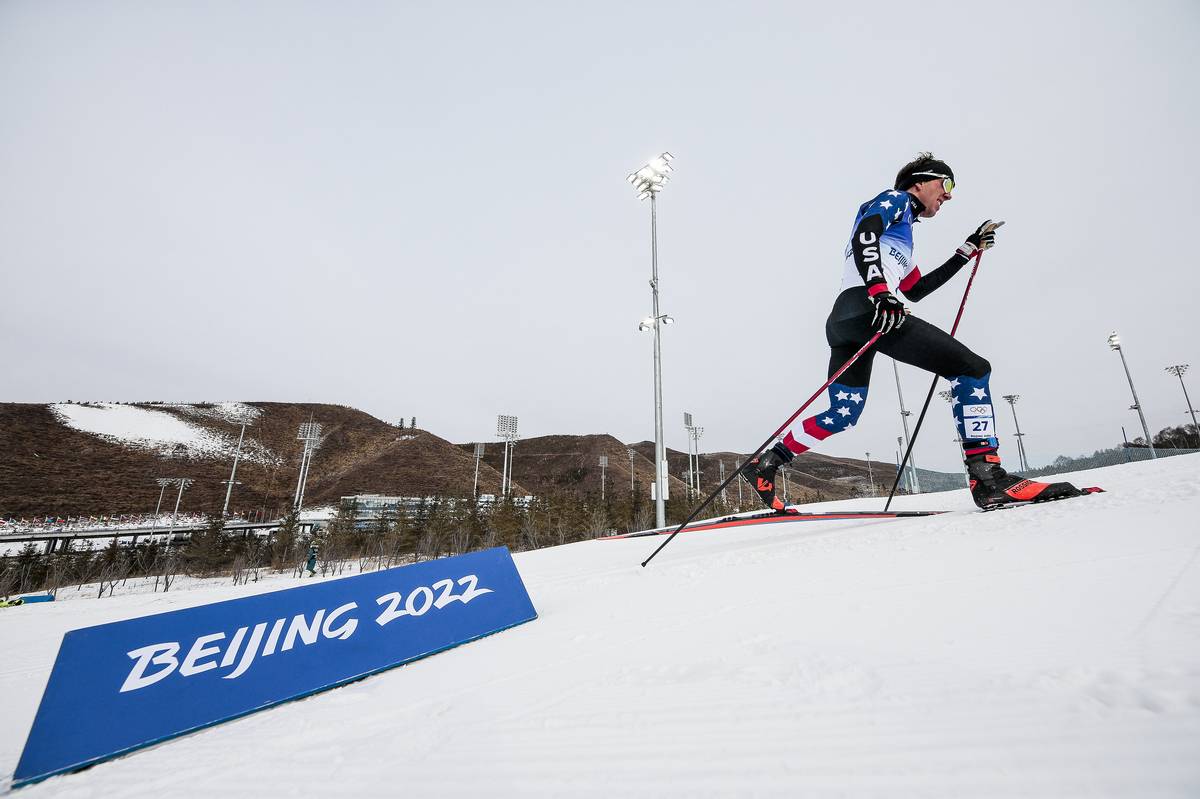
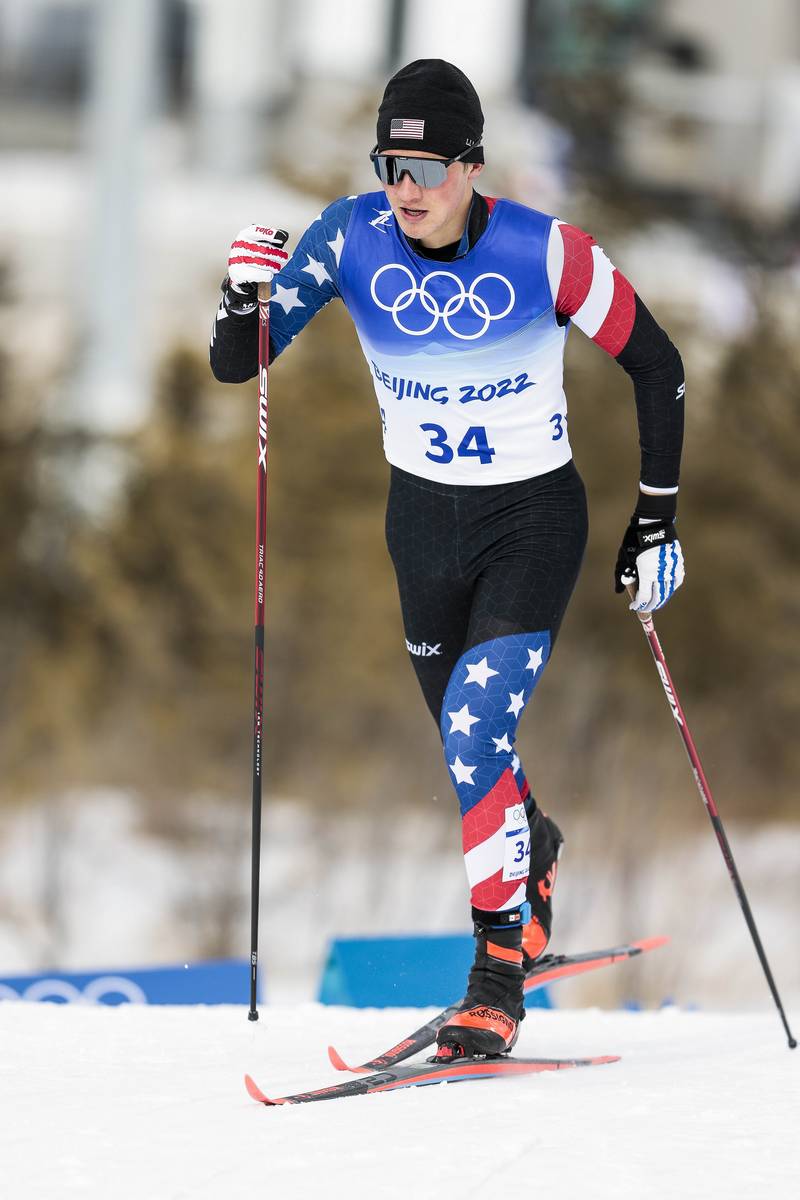
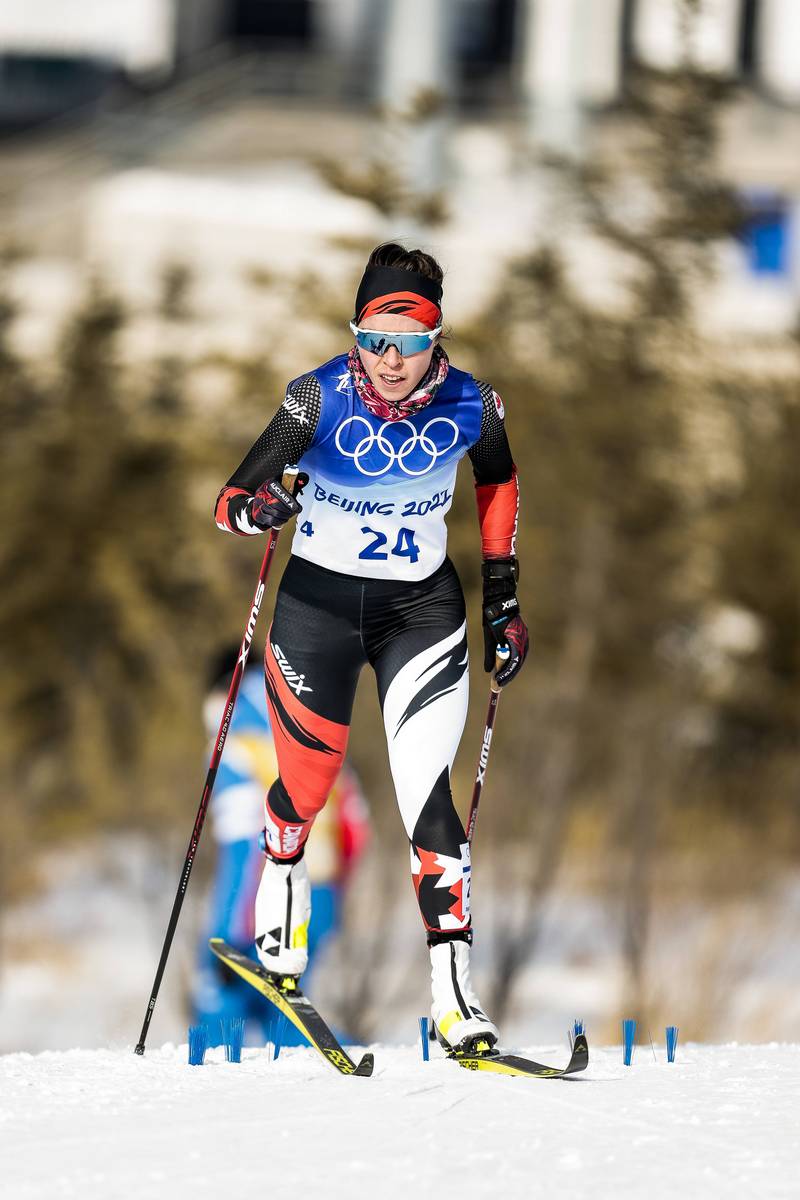
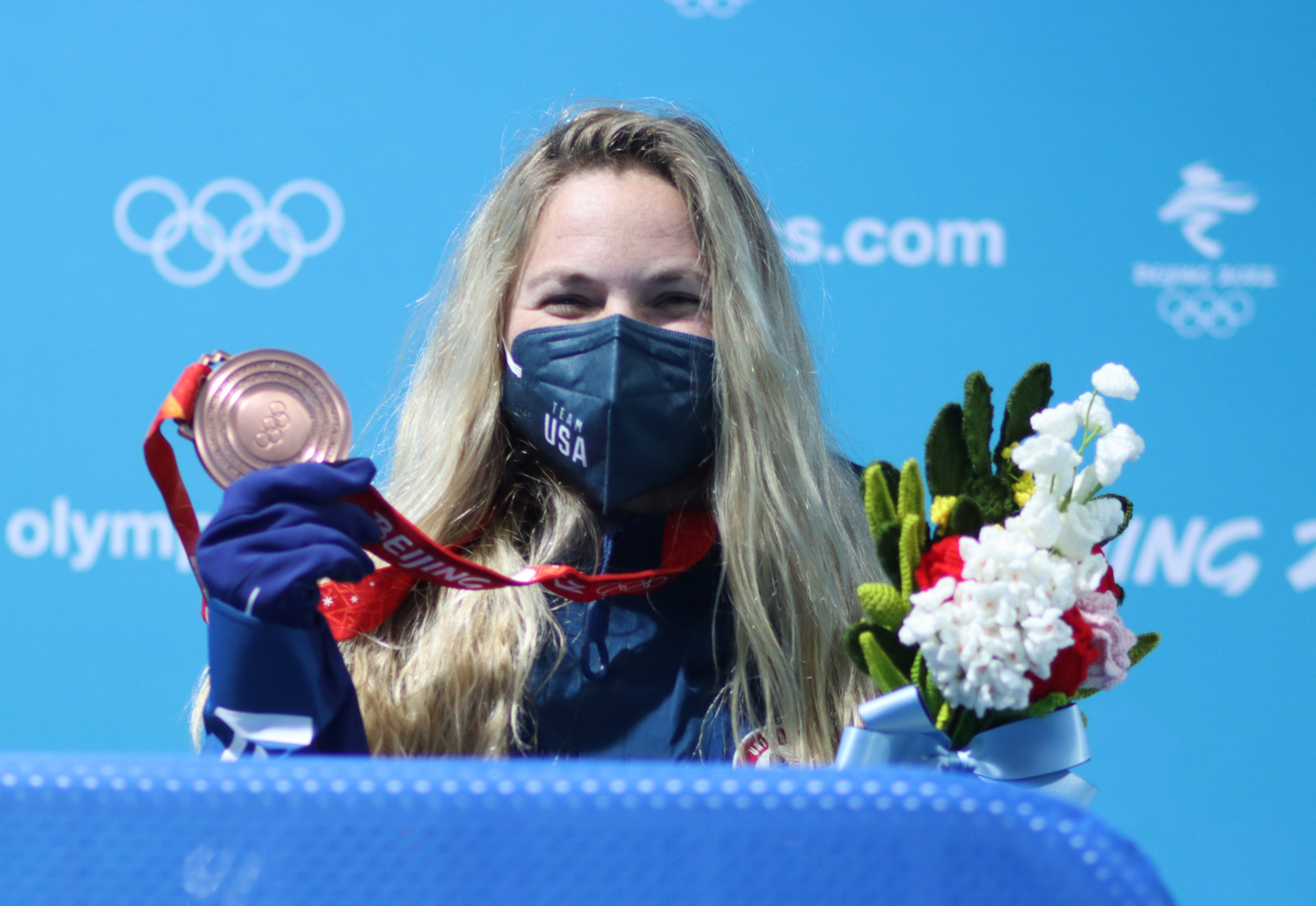
From the FasterSkier archive — posts syndicated from athletes’ and coaches’ own blogs between 2004 and 2012, kept online as published. Current coverage is at fasterskier.com.
Diggins’ historic accomplishment was glanced over by the giants of American media, falling back into harmful tropes that are all-too-common regarding women athletes. Reflecting on it re-centered how meaningful her vulnerability in sharing her struggle to overcome an eating disorder was to the skiing community, and was a source of strength for me.
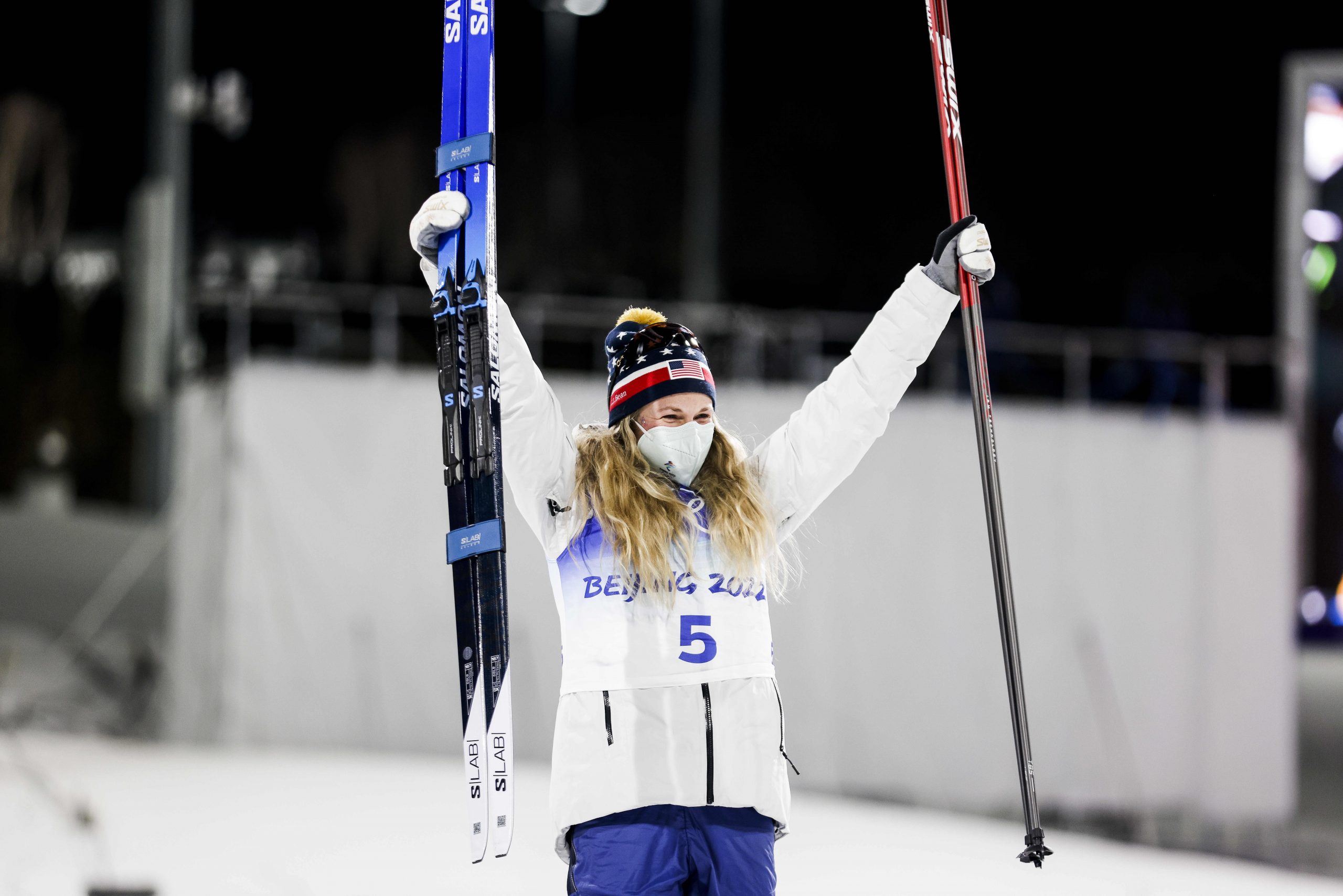
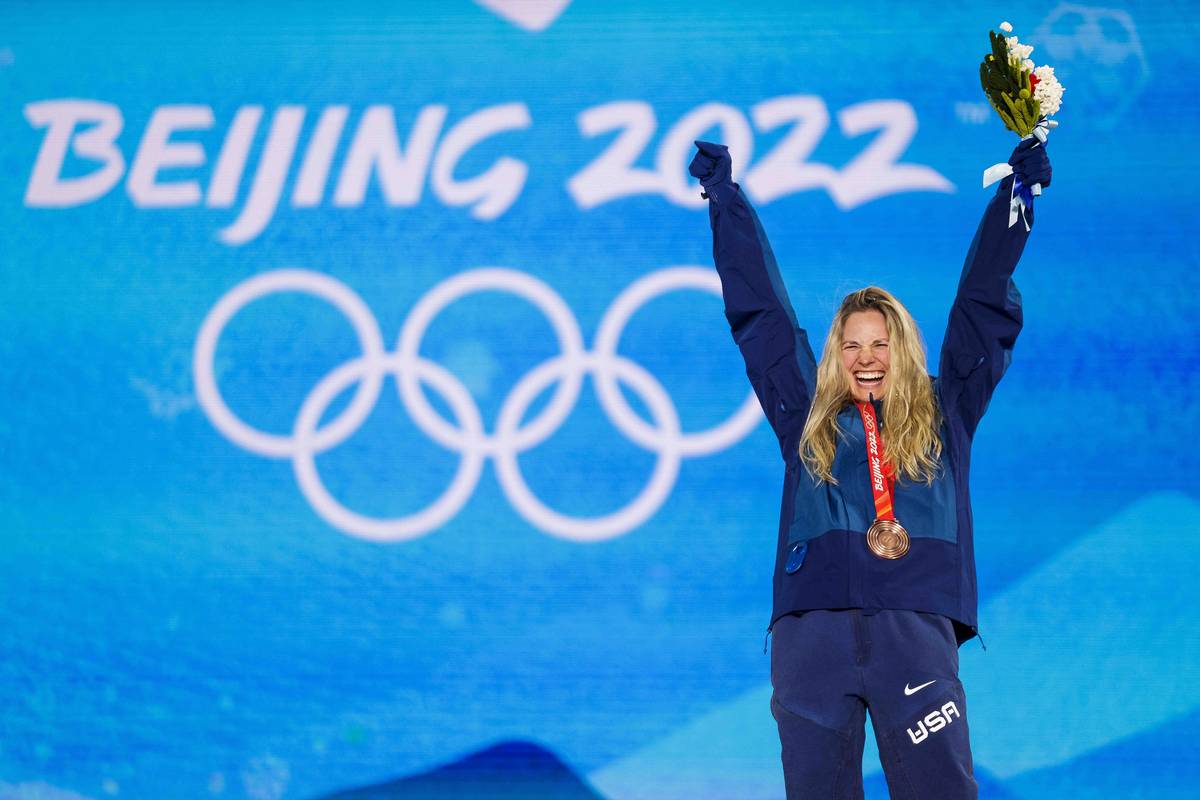
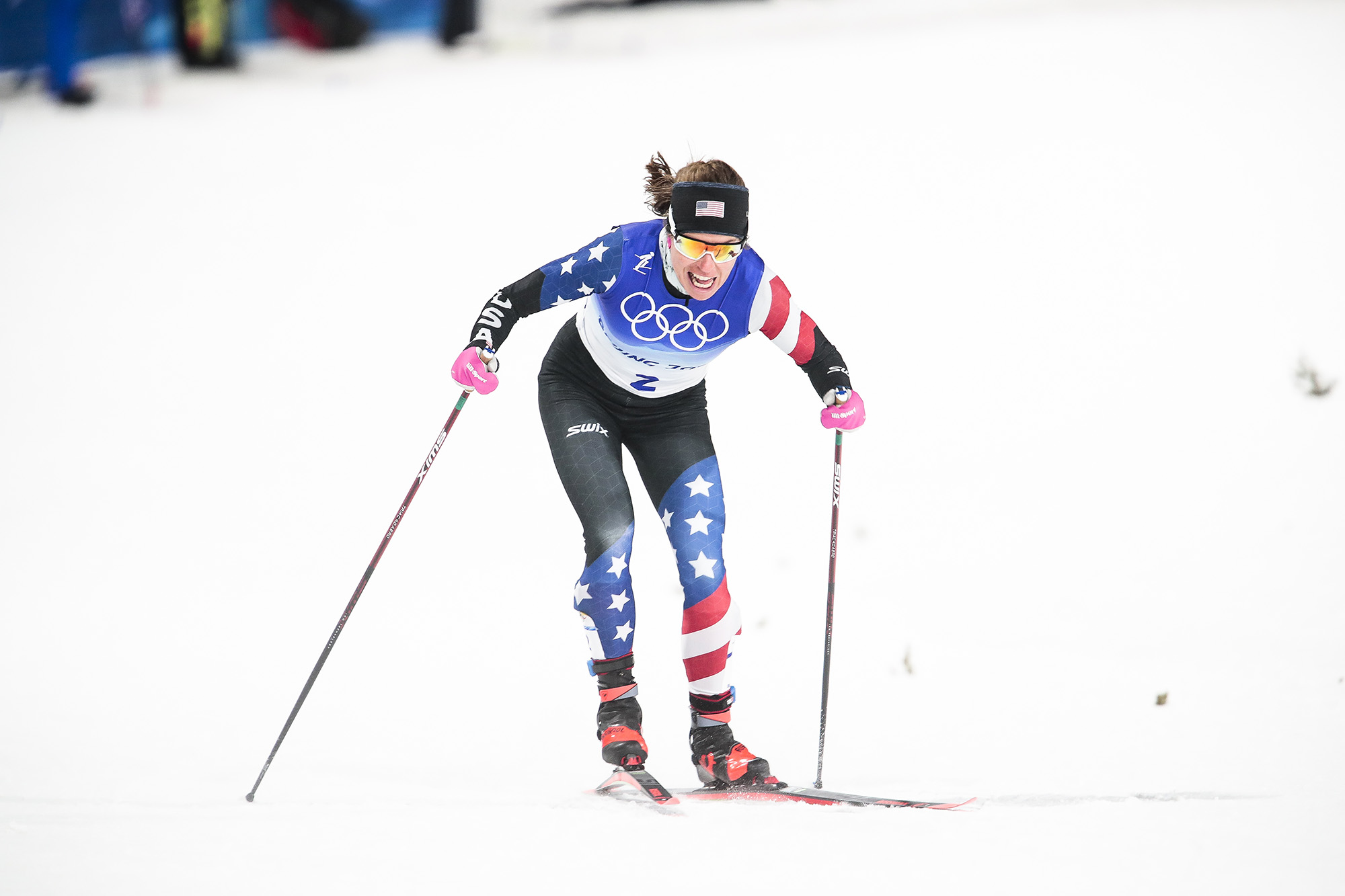
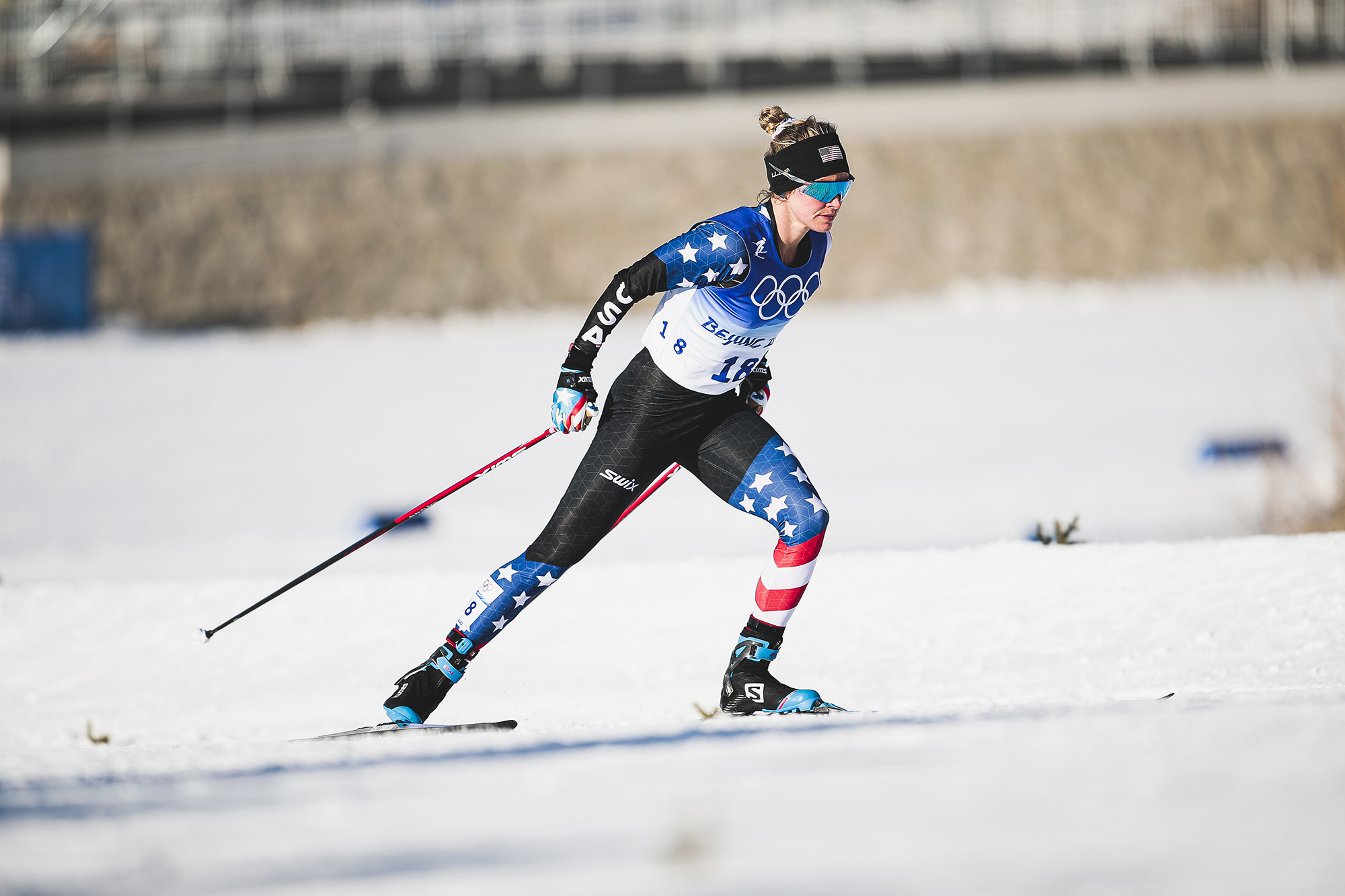
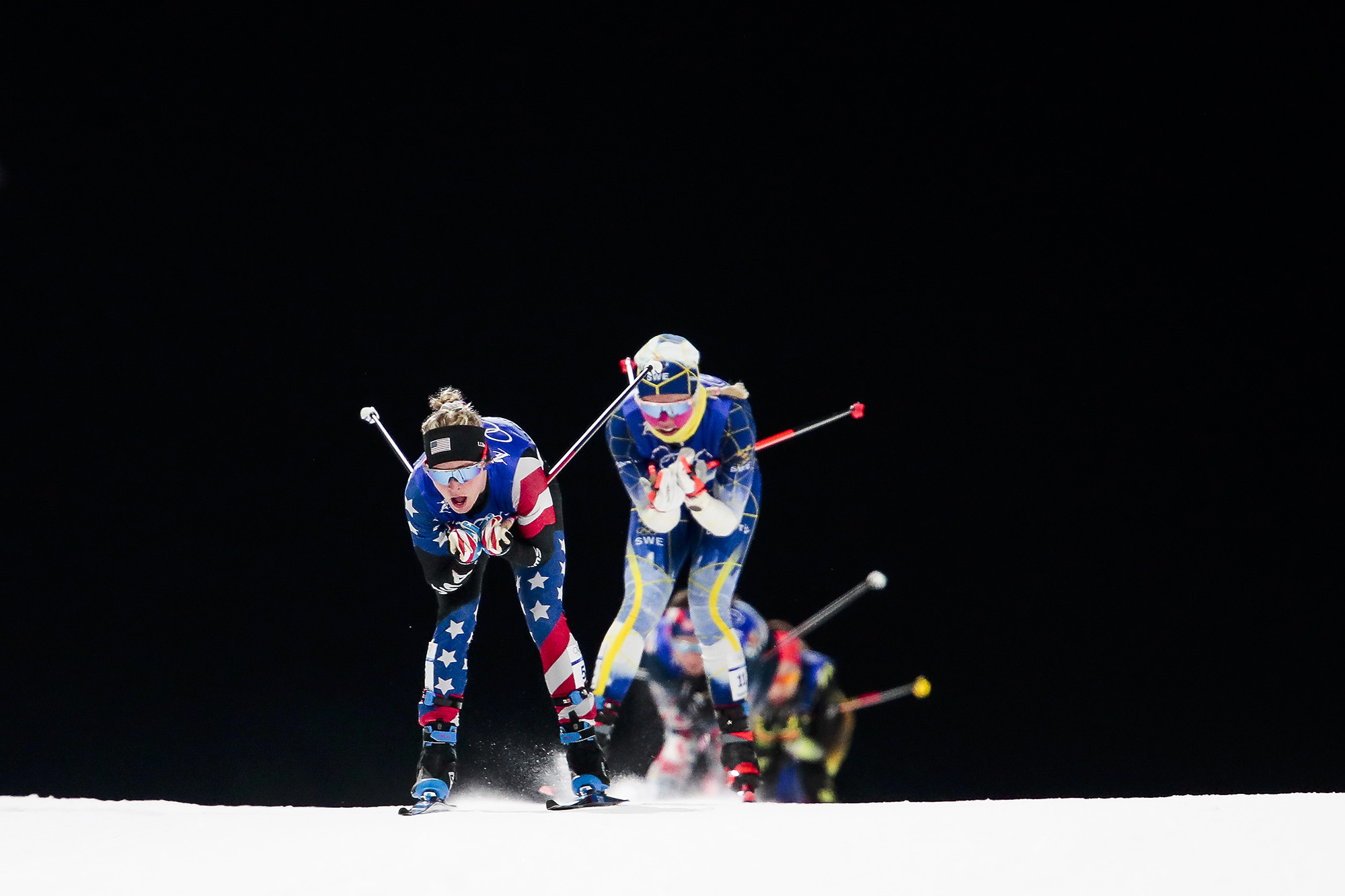
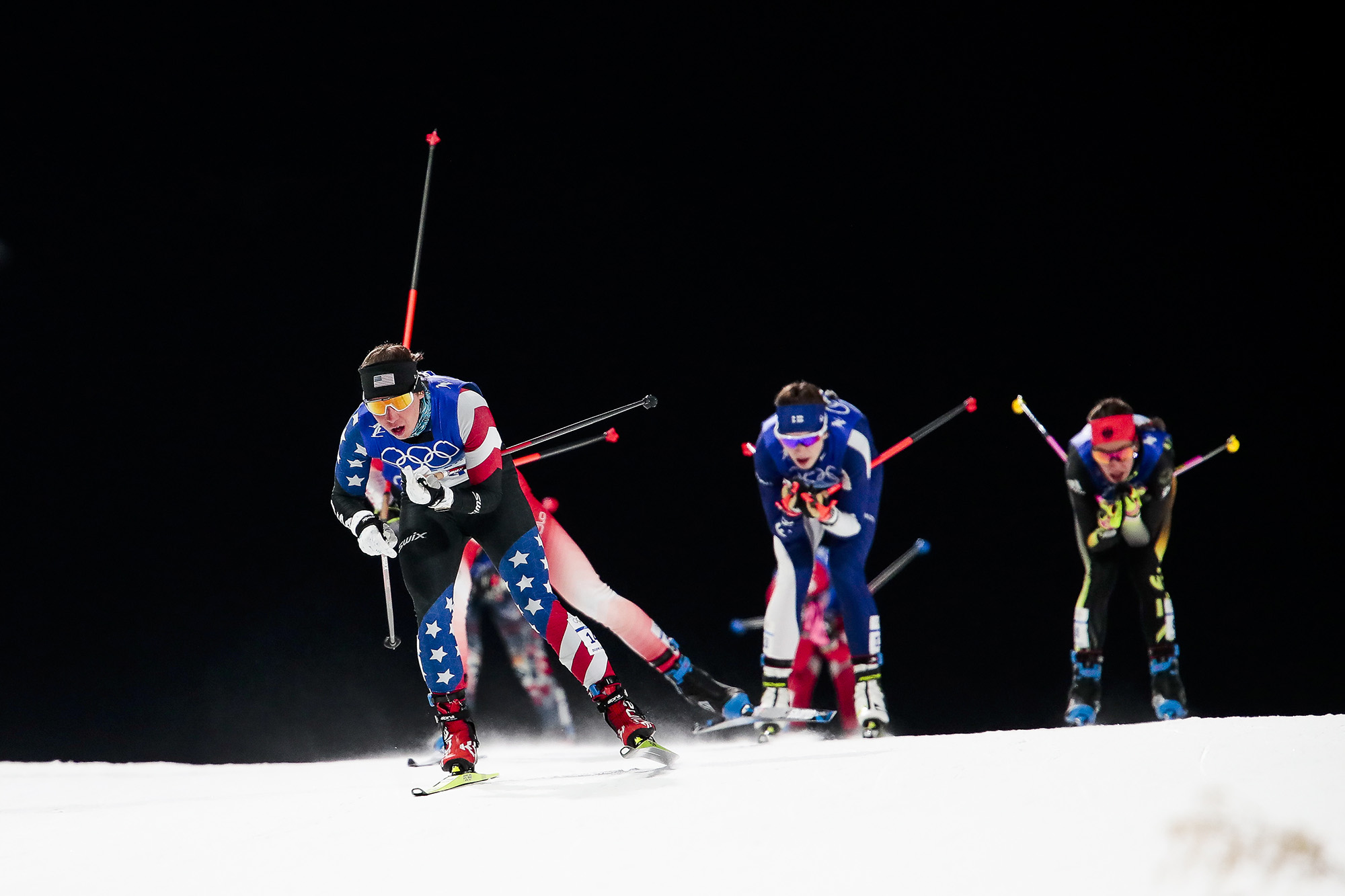
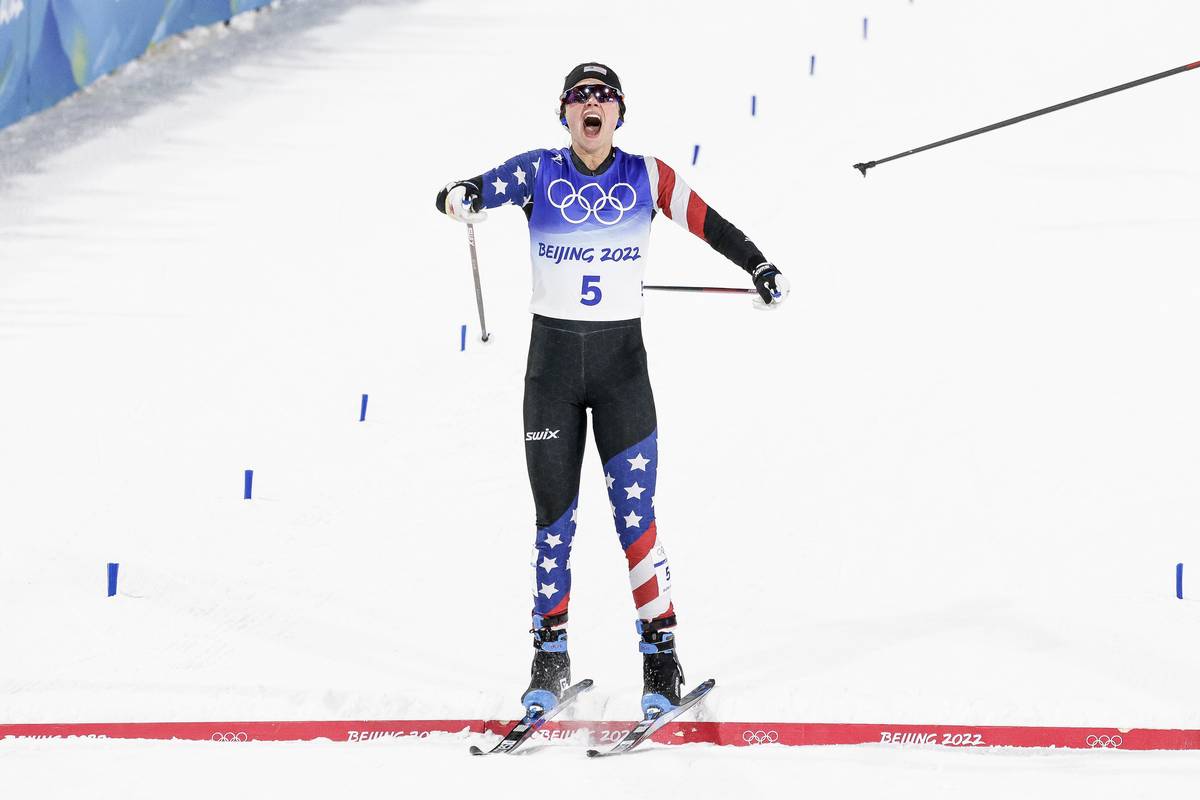
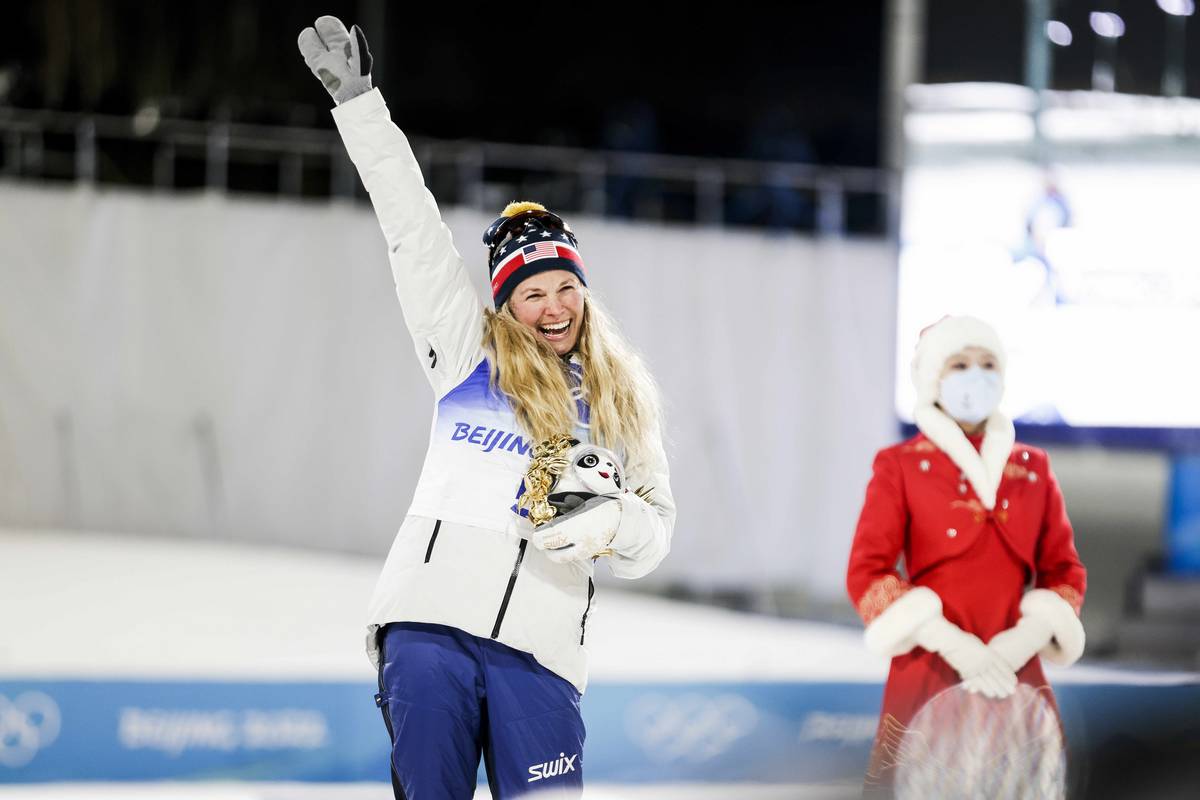
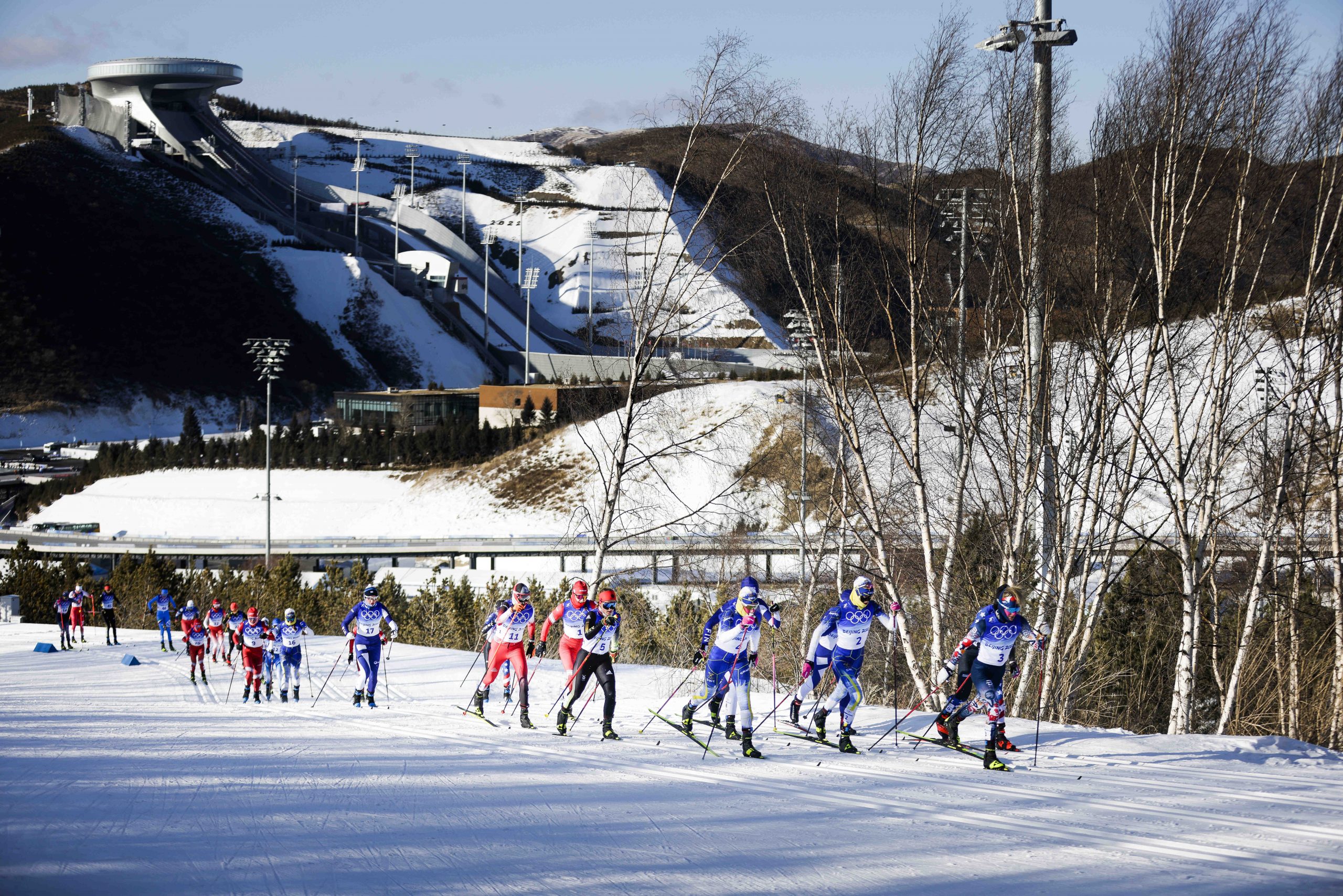
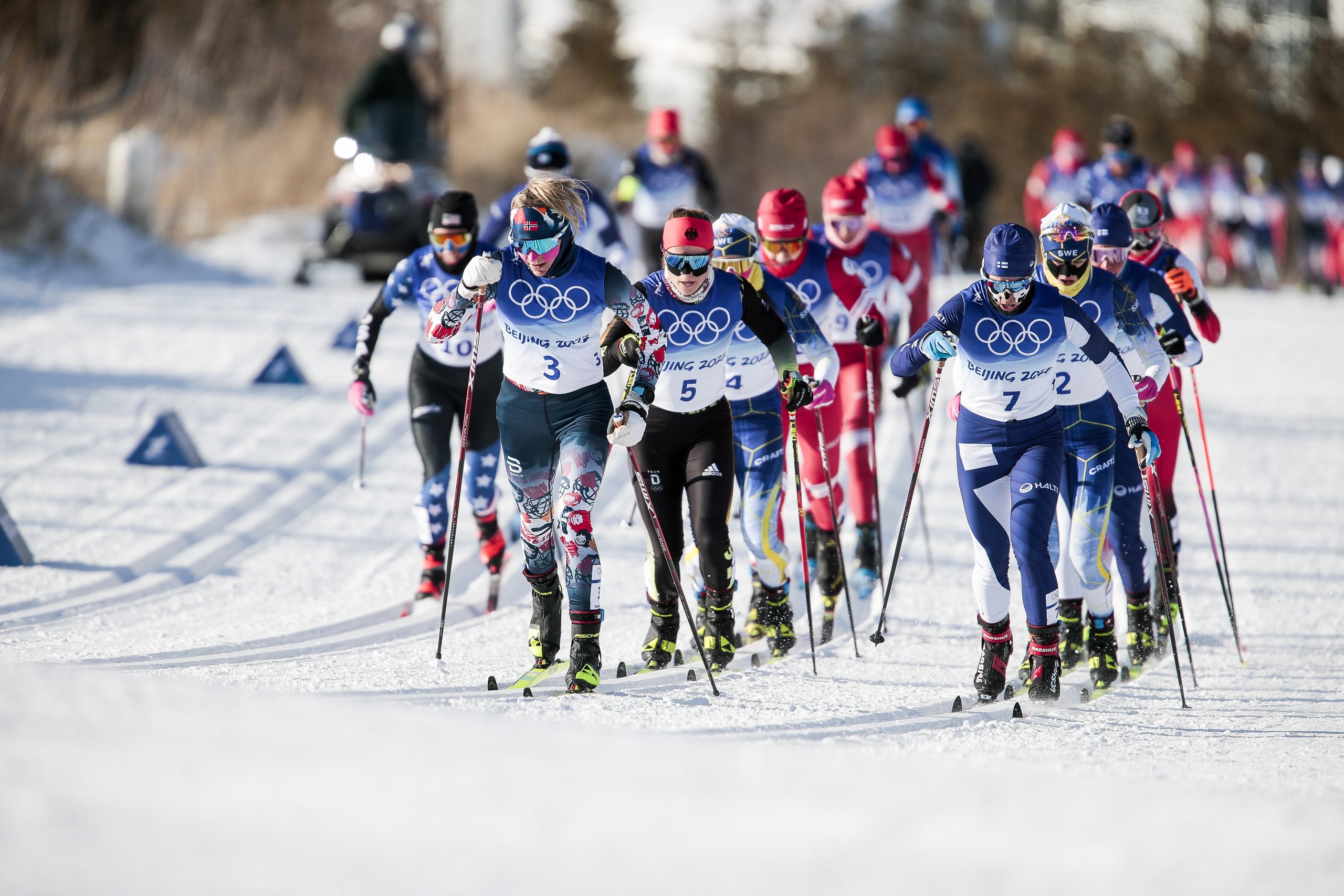
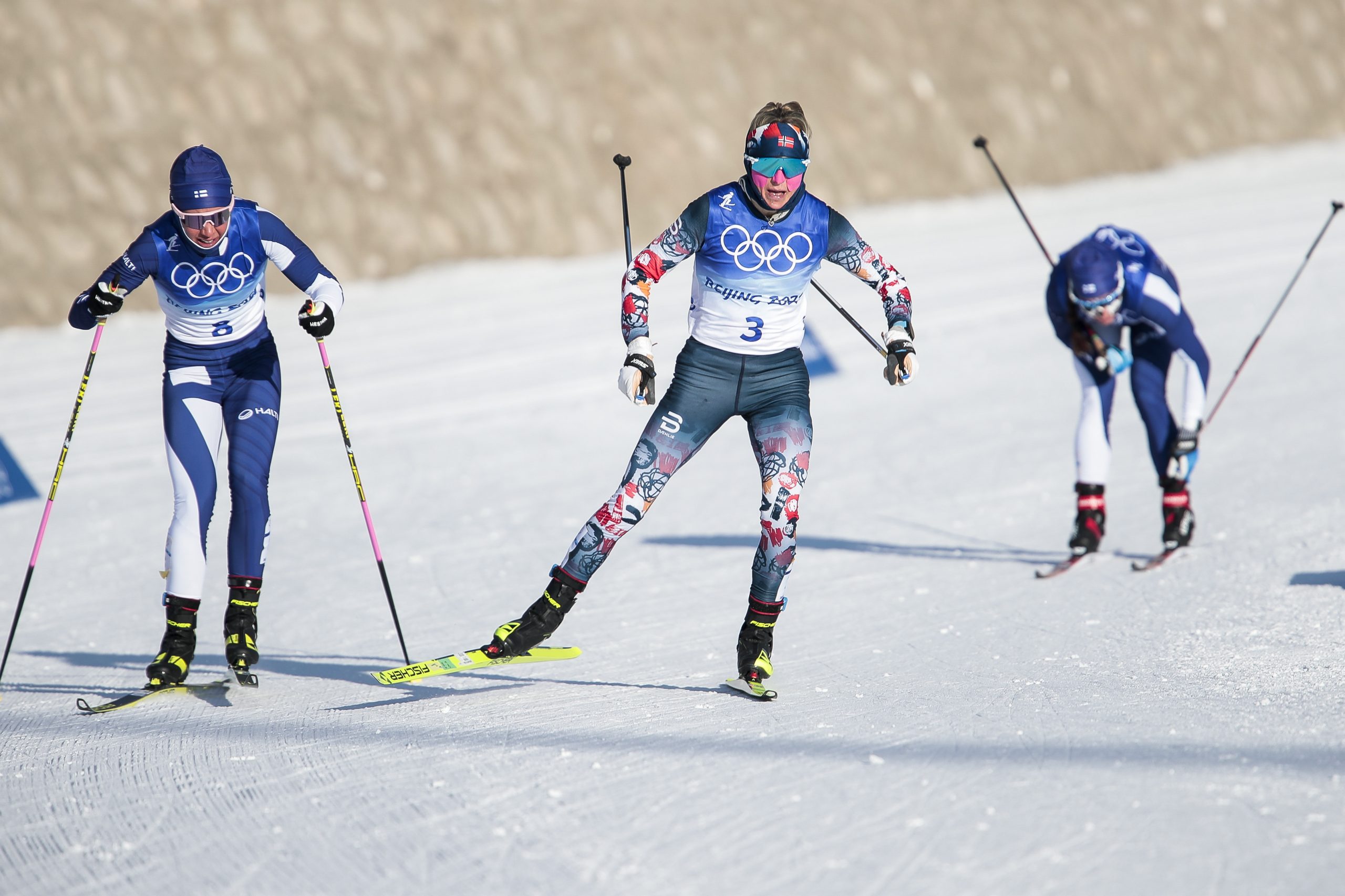
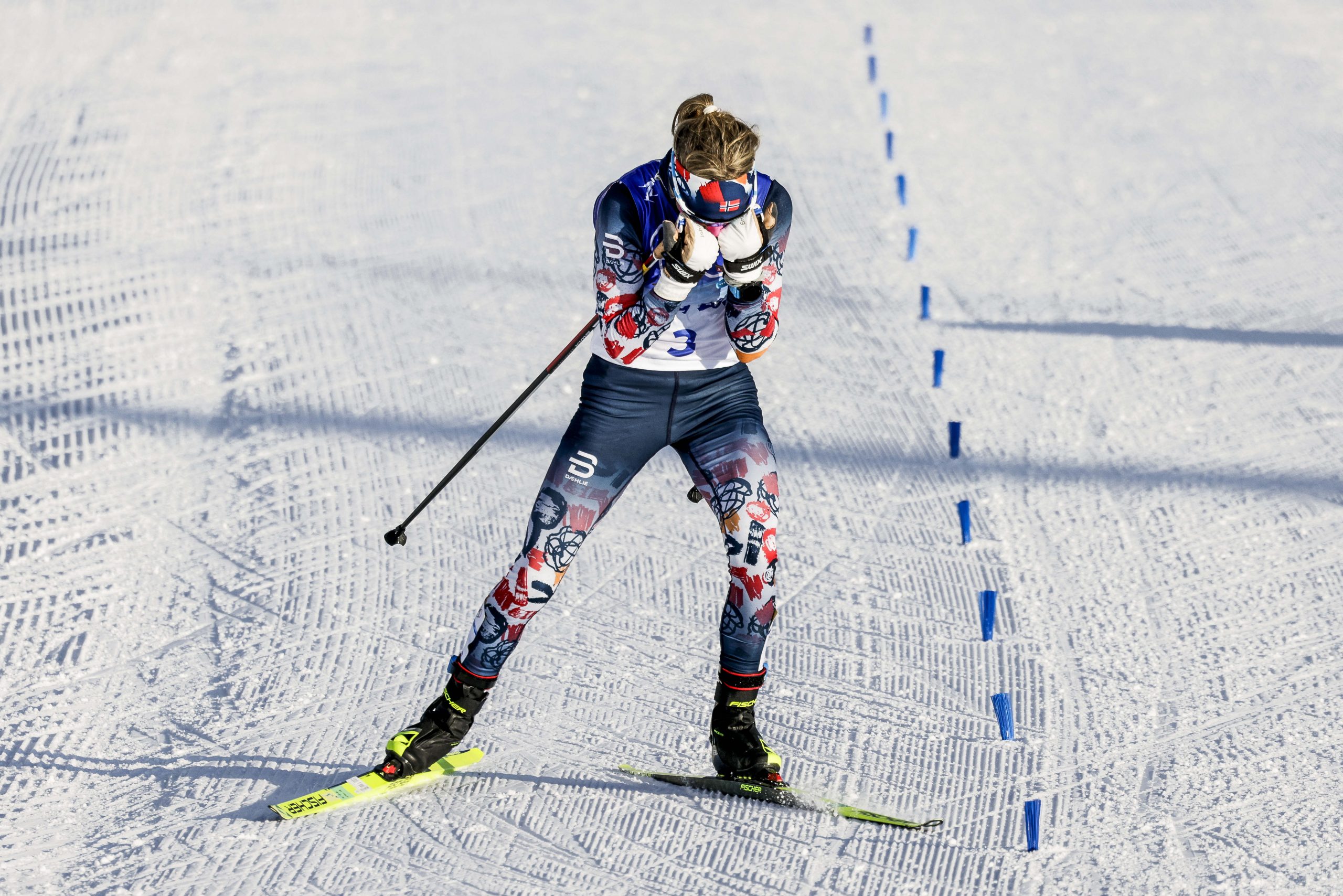
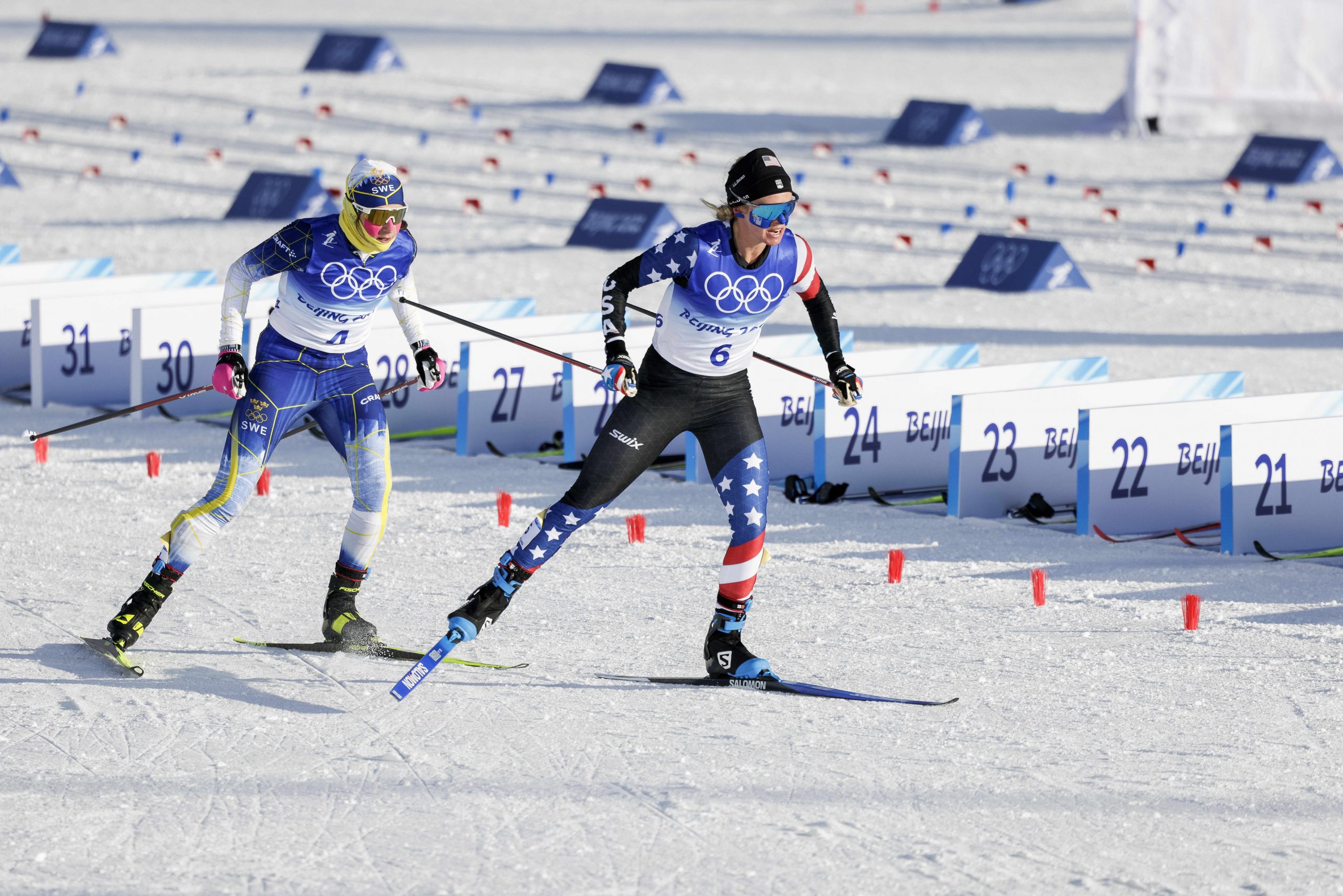
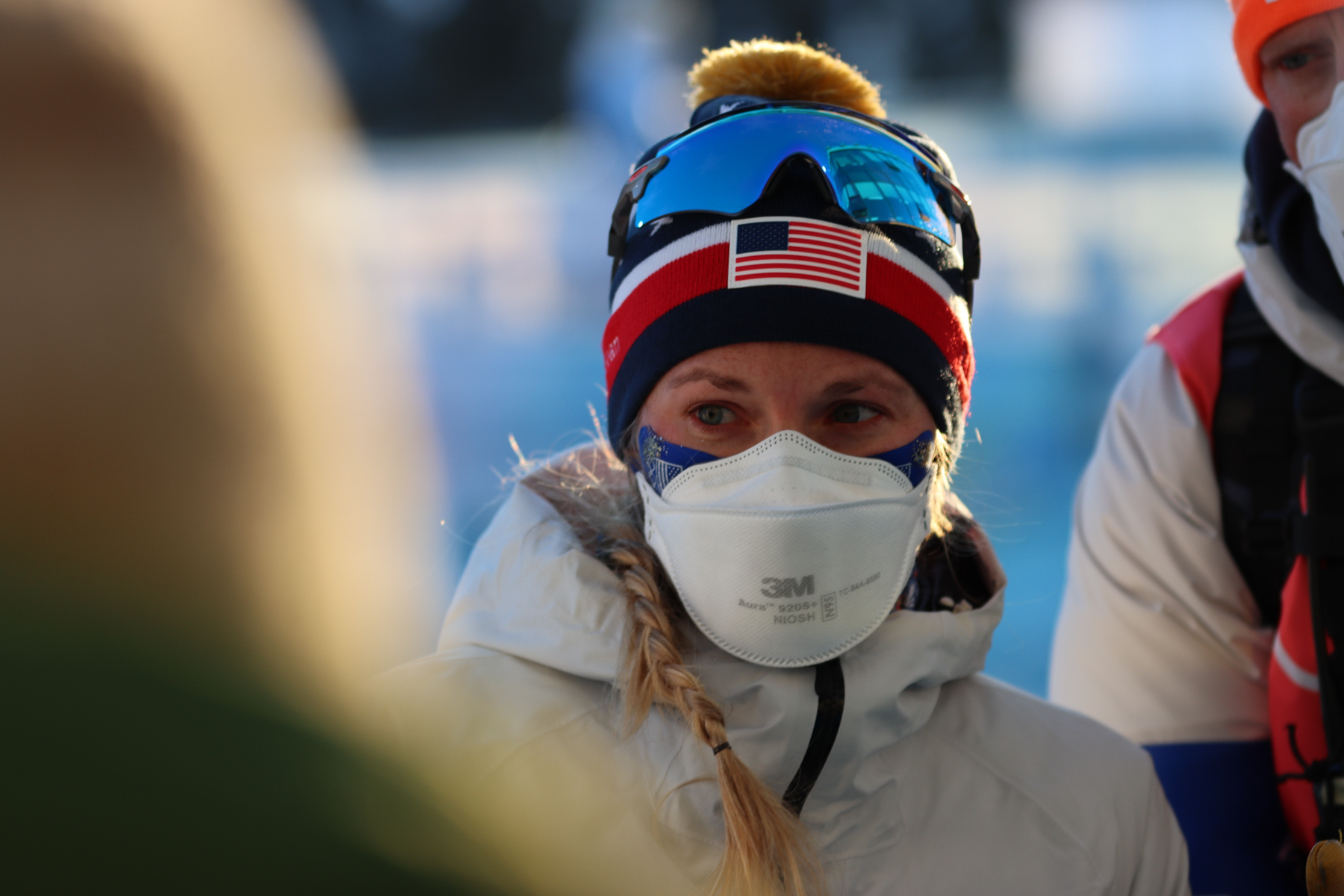
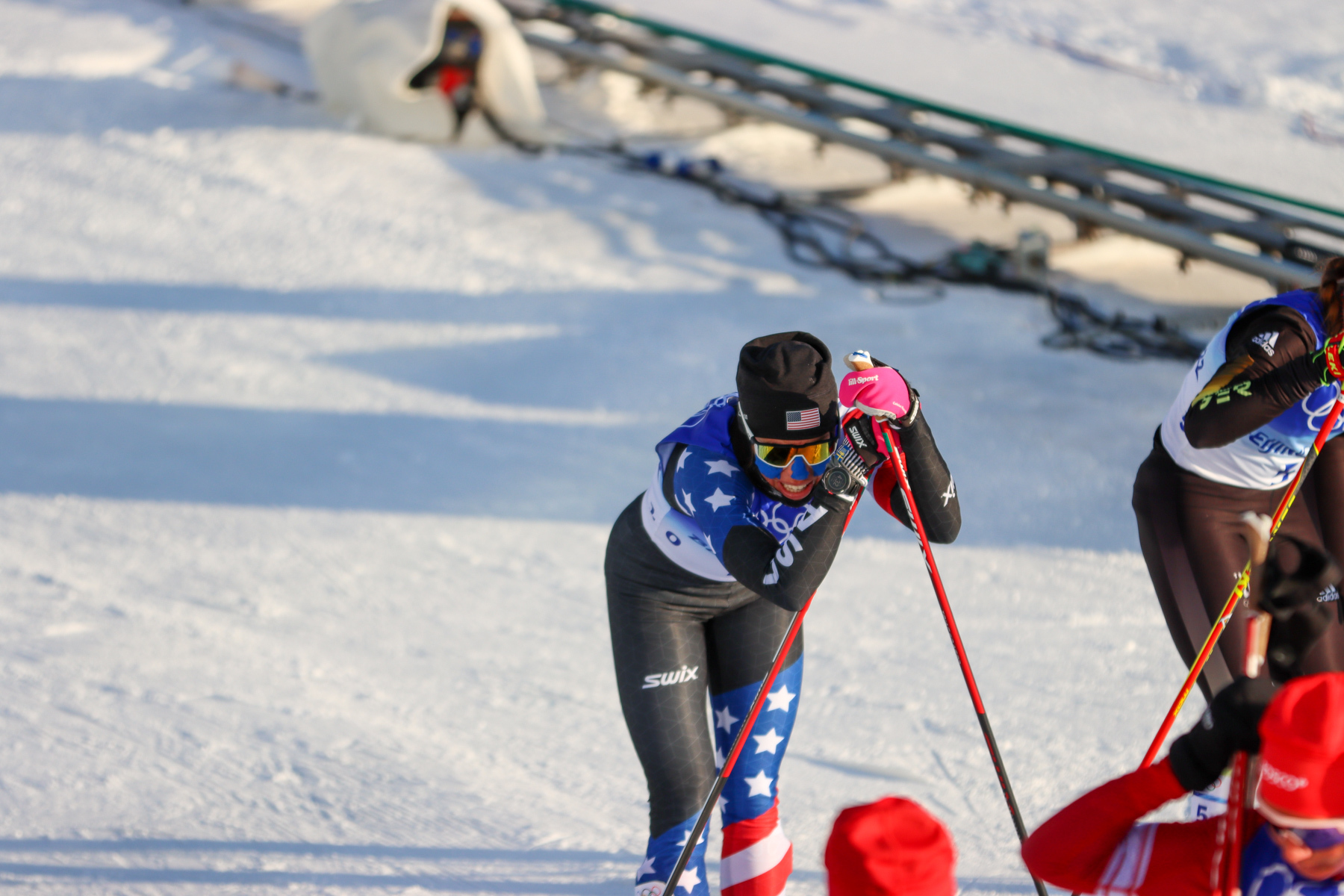
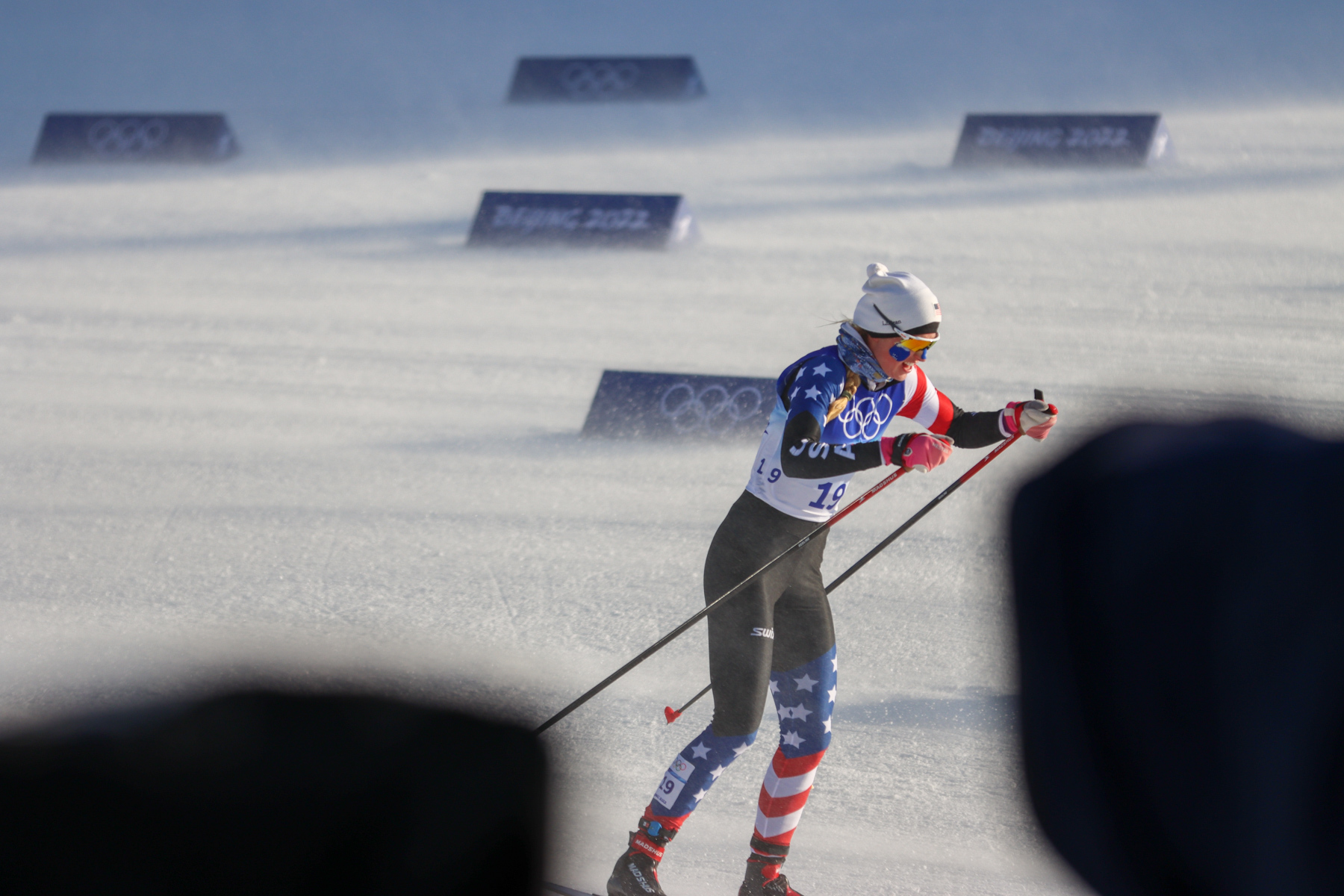
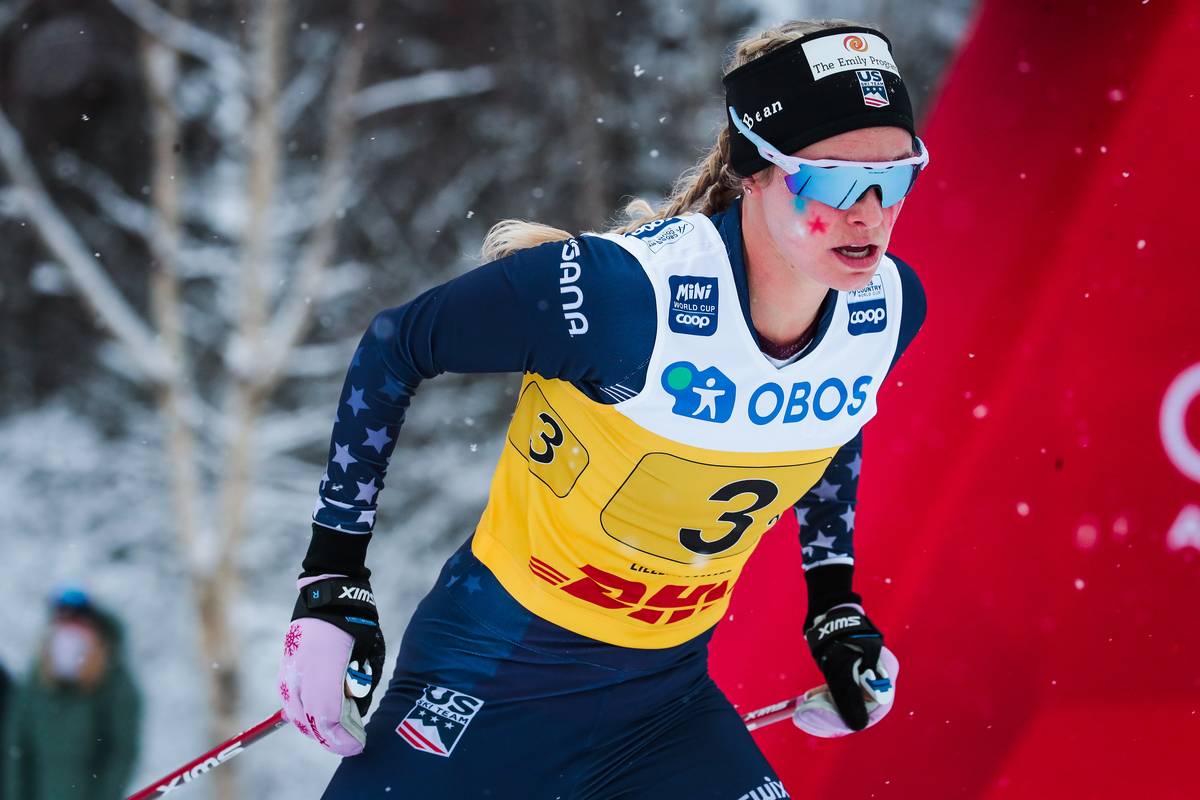
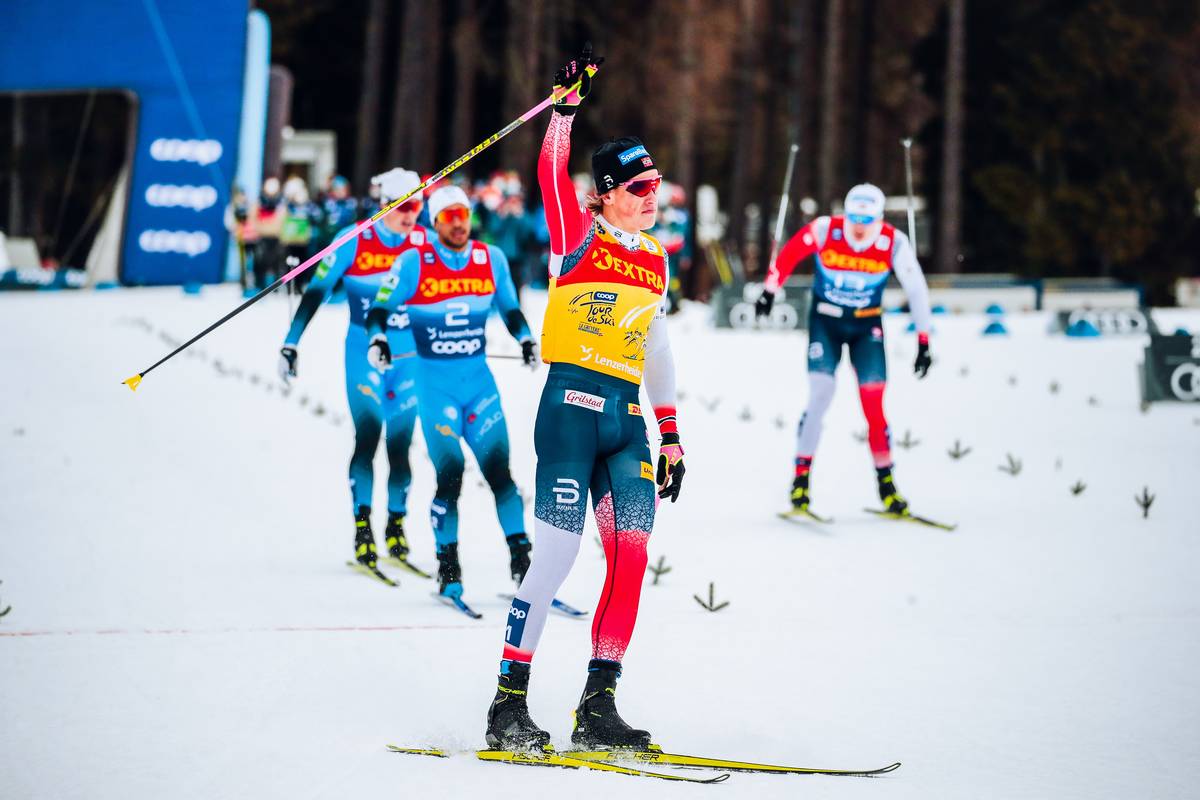
Jessie Diggins earns a bronze medal in the freestyle sprint, the first individual medal won by a female American cross country skier. (Photo: NordicFocus)
The Olympic sprint race on Tuesday in Beijing was perhaps one of the most nuanced and complex races in Olympic history. We at FasterSkier wrote nearly 6000 words covering the men’s and women’s races, and even that wasn’t enough to capture the emotions our reporters felt sometime in the early hours that morning; a sublime mixture of national, community, and personal pride as we saw the skier – our skier – Jessie Diggins, continue her journey of inspiration, tenacity, and remarkable humanity as she won the first women’s individual Olympic medal in U.S. cross country skiing history. You could read our entire recap, watch NBC’s coverage, and still have to watch the race to realize that Diggins’ accomplishment is one you have to feel, rather than know. But we did our best to lean in, and describe the race for what it was.
The New York Times, though, chose a different approach. For reporter Matthew Futterman, the story of what Diggins was – a trailblazer – was what she wasn’t – “a one Olympic wonder.” It read as a misguided Cartesian mediation: “I think, therefore she wasn’t.” Diggins wasn’t just a story from 2018, she wasn’t a distance racer, she wasn’t a classic skier, and she wasn’t a woman who looked like a skier.
For us in the skiing community, NY Times pieces on our sport, written for the quadrennial American channel surfer, are always going to be disappointing. There’s a certain glee that emerges around the edges of cringe in seeing our lexicon lost, “classical” instead of “classic,” “freestyle” instead of “skate,” and the misinterpretation of sprint strategy as “struggling to keep pace.” If you want skiers writing about skiing, there’s a home for that here at FasterSkier.
Where there is justifiable room for disappointment is how cross-country skiing, and Jessie Diggins, become translated to larger American society by the largest newspaper in the nation. According to Futterman, this is a sport that’s all about which races will get you endorsement deals and how you look while getting them. But then again, his lack of context in either of these areas just has him coming off as a player inanother ballad of a thin man – “Something is happening here and you don’t know what it is, do you, Mr. Futterman?”
Having Diggins’ bronze medal reduced to her somehow saving her career, as Futterman implies, is incensing in that it suggests this is all sound and fury. The top of the ladder in skiing is an Olympic result and having reporters who don’t understand your sport write about you is your reward. There’s no comment on Diggins’ transformative role in advancing the U.S. ski program from outsiders in the sport to models for success, or her team-facing attitude, camaraderie, and Nordic spirit which has reinvigorated that spirit in the nations it supposedly emanates from. There’s not even the due diligence to look up her FIS athlete profile and see that since 2018, she has been the best all-around female skier on the planet.
The second point, borne-out in a single sentence paragraph that I will leave inside the contexts of Futterman’s article, goes beyond infuriating. It has the potential, with its scope and platform, to be damaging to those already inside the skiing community. In summary, Futterman struggled to find anything to celebrate about how the race was skied, and so looked at the best skiers in the world and reduced them to the worst baseline tropes surrounding women, athletes, and in particular women athletes.
That he chose to do so with Diggins, in one of her highest, soaring moments, is an irony where the bite will leave a lasting scar. More than being the face of the skiing community in the United States, Diggins is our collective role model. A woman that everyone from a kid in a Bill Koch League to the 75-year old out on the Birkie trail can point their non-skiing neighbors to and say, “Her! I do the same sport as her!” She has taken every platform she has been offered through her grit and determination and chosen to turn those characteristics towards doing good for this community and for society writ-large.
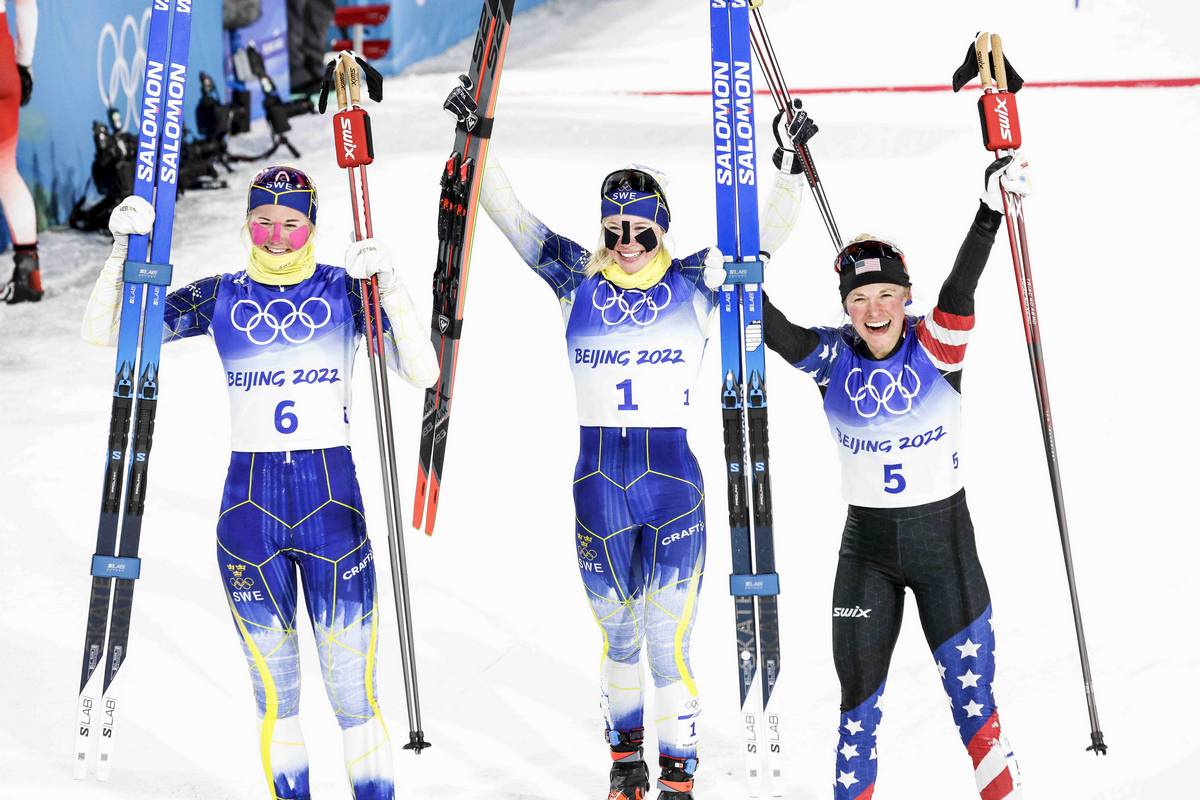
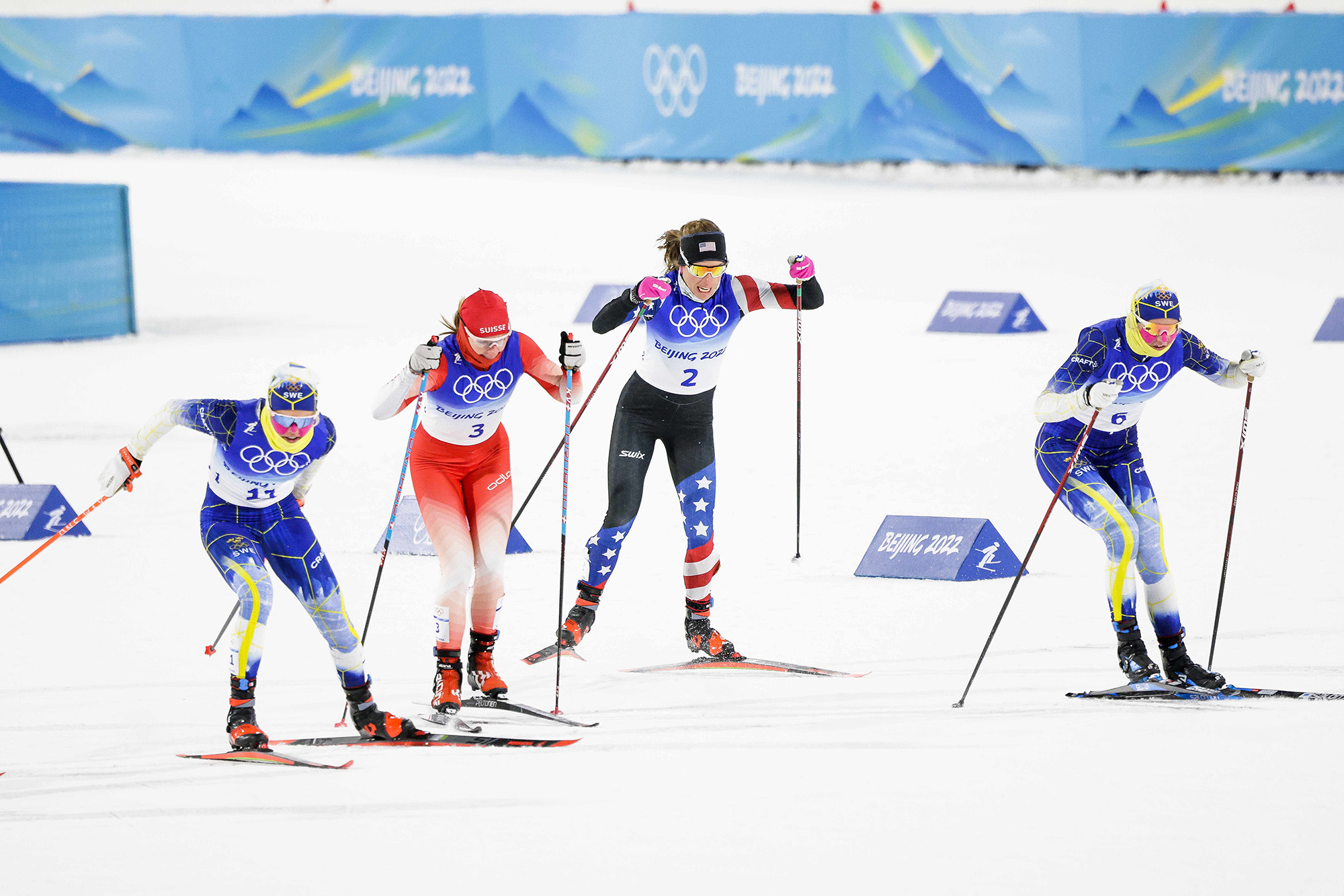
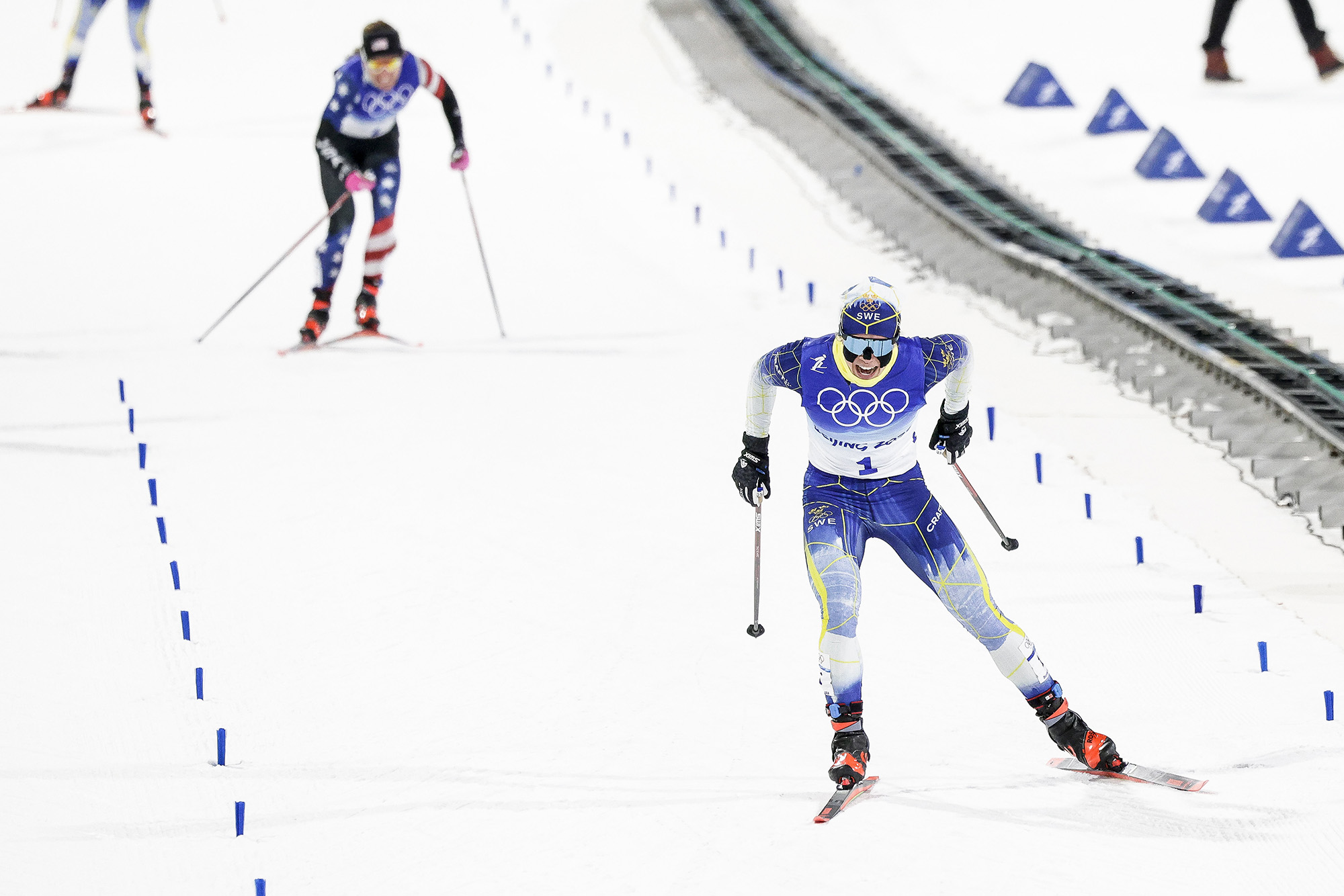
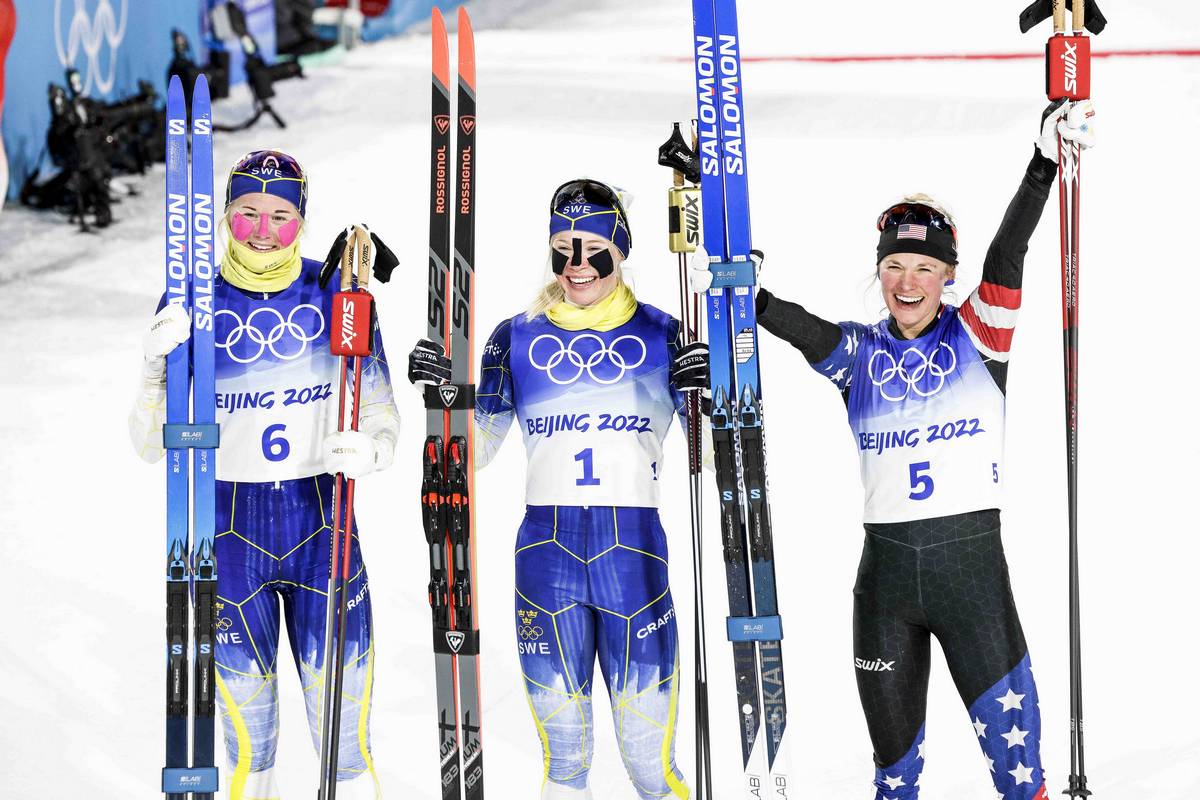
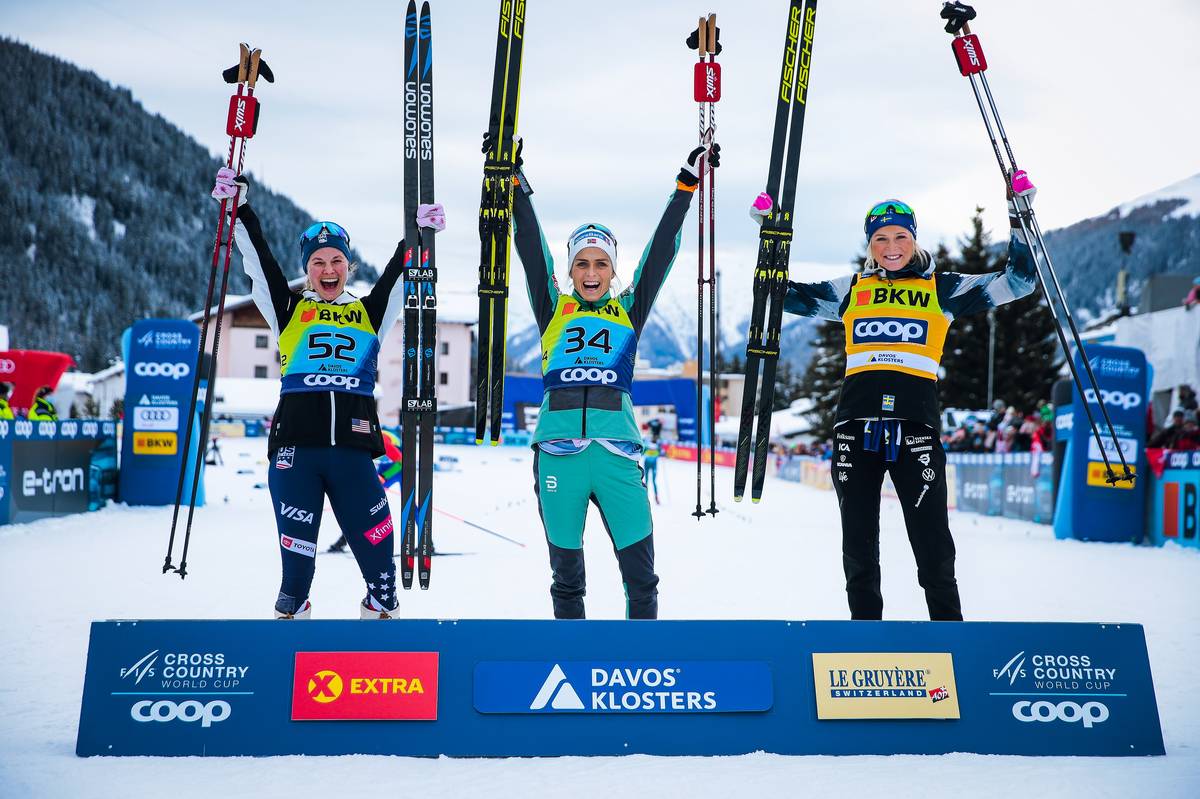
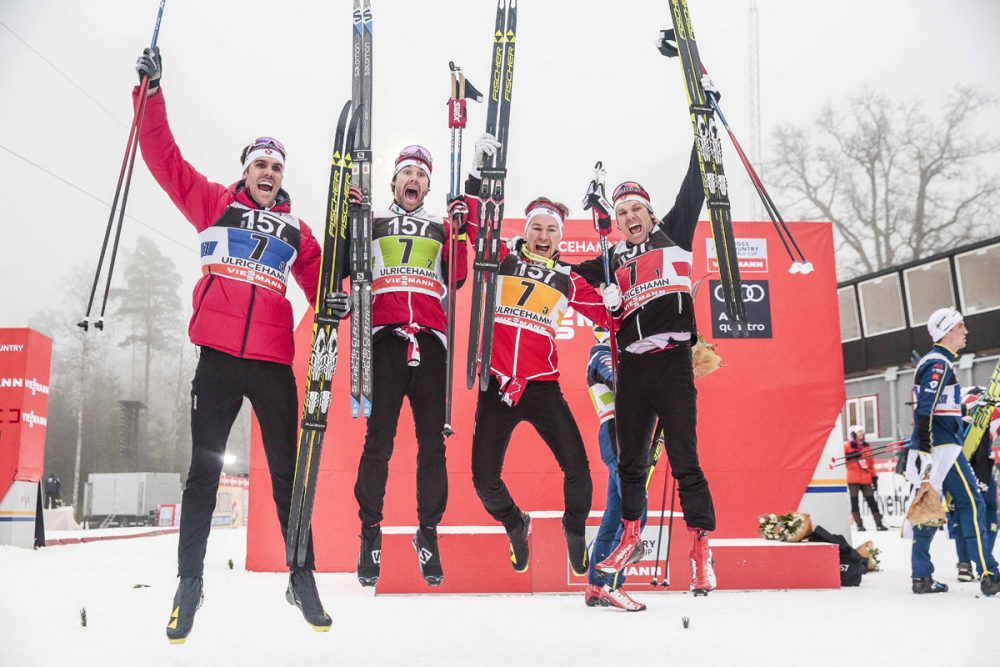
Diggins standing beside fellow skiers Jonna Sundling (SWE) and Maja Dahlqvist (SWE) after taking bronze in Beijing on Tuesday . Photo: NordicFocus.
Outside of skiing Diggins has focused her efforts on ensuring that everyone, skier or not, is empowered by the body that they have been given and its abilities. She has spoken out to raise the idea that a healthy relationship with food is something that is cultivated, and that it’s perfectly normal – and important – to ask for help with this relationship’s development.
Diggins’ efforts inspire everyone, but fill the particular contours of empathy to comfort, aid, and provide real help in the skiing community she comes from.
Eating disorders in the ski community are, by their ubiquity, almost implied to be an unfortunate part of the culture. We as a community can acknowledge that these disorders happen. From experience though, there is a rare blind spot around acknowledging and checking in on athletes that start to show symptoms. We are quick to launch into a chorus of “are you ok?!” when someone stumbles on the ski trail, but when the slow, grinding effects of not nourishing the body start to show, those “are you ok’s?” all-too-often lose the exclamation point and gain a whisper.
I haven’t been involved with a competitive team since I started ski racing where body image and disordered eating have not been an issue among my teammates. It is agonizing to see those that you love and support on the brink of letting food become the all-consuming focus of their psychology in a way that stops them from consuming it.
During my early high-school career, that teammate was me.
I started my high school racing career not touching food at all some days, at my lowest point weighing a mere 90 lbs while measuring 5’ 9’’, and skipping school somedays because getting out of bed meant facing a world where I didn’t have enough body fat to keep my internal temperature up. In my small, cornfed, Midwestern town, skiing had given me a glimpse of an identity that looked beyond all that, so I absorbed anything that told me what a skier looked like. That included skiing and running publications, yes, but that niche interest was overpowered by the deluge of casual comments about looking the part from those larger voices in our culture. Voices like those that come from the New York Times.
I did recover. It took hard-work, luck, and above all the grace and support of my parents and aunt (and future coach) Tracey Cote.
The author, competing at a rollerskiing race at Pineland Farms. (Photo: Steve Fuller / flyingpointroad.com)
Still today though, get me talking about the struggle to get back to a healthy relationship with food, and if it hits me in the right way, I will cry real tears.
When Diggins first went public with her struggles, and subsequently releasedBrave Enoughshe allowed those tears that formed out of pain to turn to tears of relief. I could feel for the first time every quiet corner and empty space of the struggle I had gone through, and find solidarity in someone who’s achievements in this sport far surpass mine. She had walked the road of resolving to lock herself up before throwing away the key. She understood that it started with good things – you win races, you have a bright future, and you should be proud. That the disorder looked at you, and all wanted to be, as a parasitic host. It hollowed your mind, then your spirit, and finally your stomach.
The scariest part is that it all happens at an essential level. The essence of your biological life – food, and the essence of being human – your connection to other humans, are both cause and cure, and somewhere between you lose yourself.
Jessie Diggins survived all that. Then she took that strength and will, spread it, and without hesitation, looked to turn around and help those in her own community. If the New York Times would like the answer to where she finds the power to surpass the achievements of any American skier before her, they ought to look at that. Not at the bodies doing the movement, but what they’ve faced and overcome, and most importantly, who’s spirits they’ve lifted. For Jessie Diggins, that’s been skiers everywhere, and for moments, like on Tuesday, people everywhere. Full stop.
Among them is this one skier. Who chooses to look closer at this sport as a medium through which they can be grateful for what another human is and does; Jessie Diggins.
Jessie Diggins earns a bronze medal in the freestyle sprint, the first individual medal won by a female American cross country skier. (Photo: NordicFocus)
You can find the introduction to this three-part series on the development of the Chinese ski program here.
Creating a Generation of Skiers
China, pursuing Olympic medals on home snow, signed deals in 2018 to train Chinese skiers in Norway and Finland. The first hurdle would be filling these programs with potential skiers.
To that end, a talent building program was initiated and young professional athletes in the second tier of rowing, kayaking, and running were assessed. Favorable candidates were given the opportunity to switch to cross country skiing, and with it a chance at making the 2022 Beijing Olympics.
The search was also on for hidden talents, and the public was invited to join the pool of athletes being considered for intensive training as cross country skiers.
When Kristian Bjune Sveen arrived in Xinjiang Province in 2017 he thought he was going to an interview. Instead, he found 100 candidates lined up to be tested for the Swix China team he was hired to create. Next it was onto schools, where Sveen would find his diamonds in the rough.
Also traveling to China to find skiers was Tor-Arne Hetland, coach of the Meråker contingent, who was invited to Beijing in the fall of 2018 to identify future skiers. He told the South China Morning Post that he was asked to seek out “athletes that could run well and had strong physical endurance.”
Zhang Yuanyuan was one such athlete. The eighteen year old kayaker from Sichuan Province had never seen snow and yet was selected to move to Norway to train for biathlon.
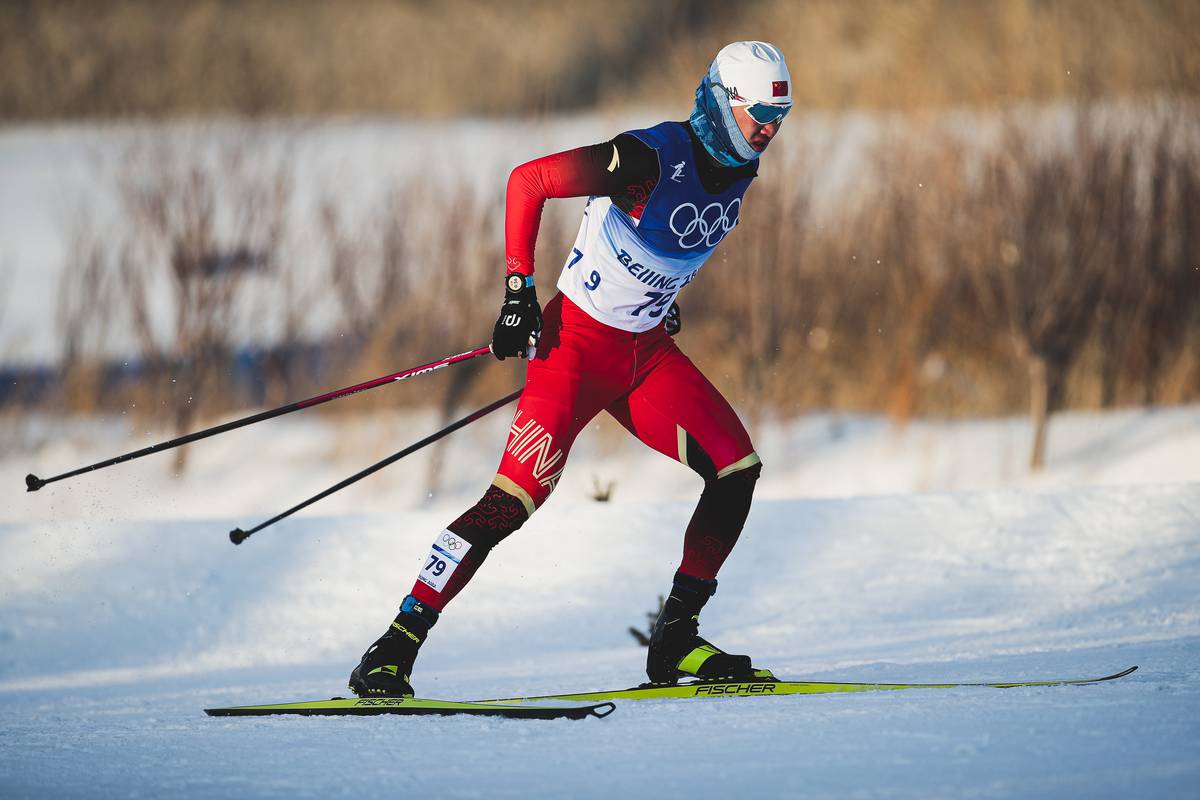
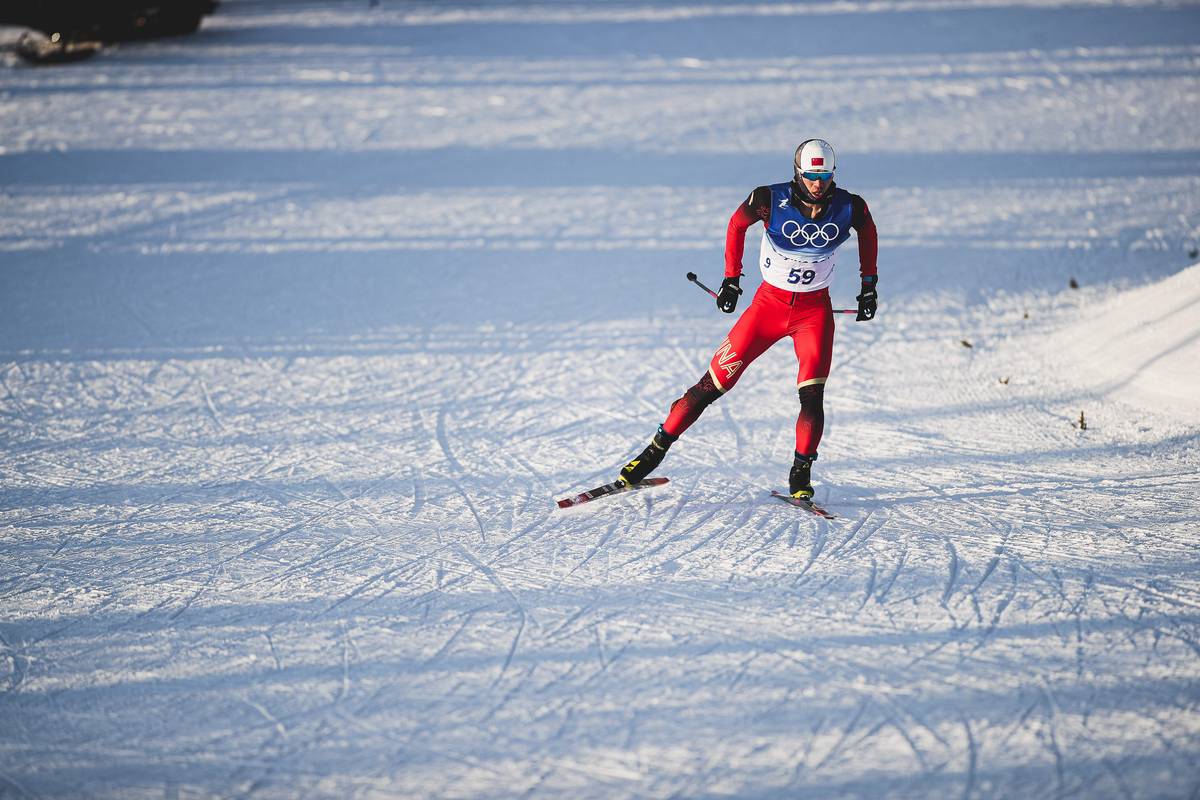
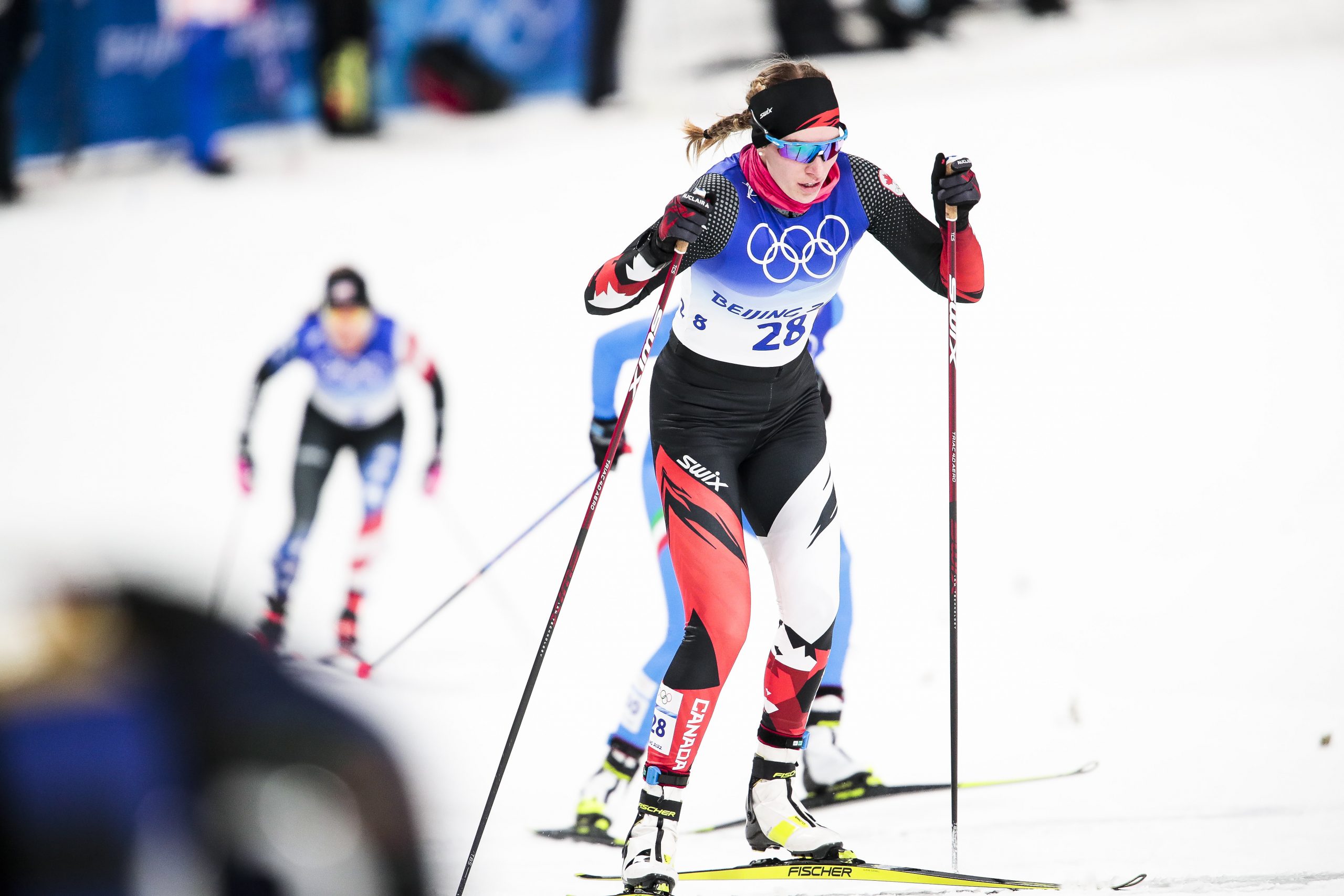
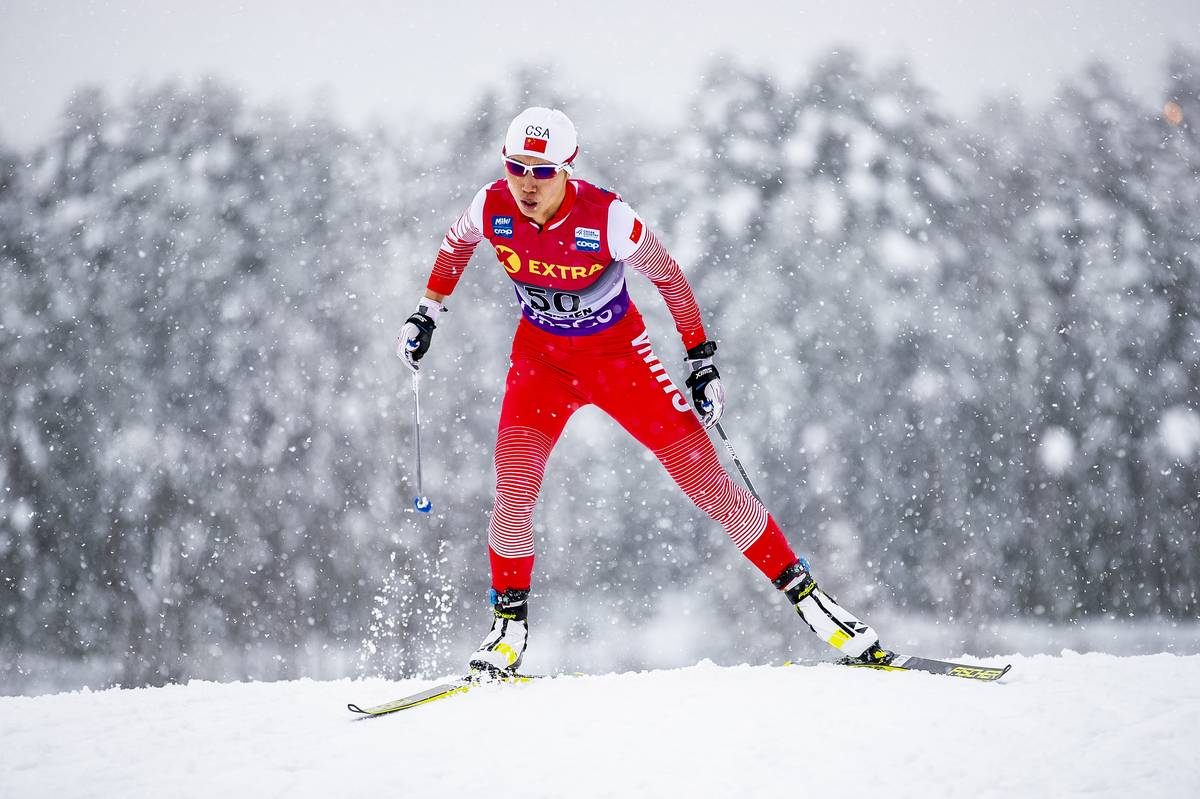
Rongsheng Liu (CHN) races the freestyle sprint qualifier during the 2022 Beijing Olympic Winter Games. (Photo: NordicFocus)
Throughout the Chinese endurance world, promising athletes were funneled into skiing. One such athlete was Yeersen Shiwohen. An ultrarunner, he won a 168k marathon and impressed a businessman who introduced him to the local sports management. Despite having never skied before, and believing that it was “impossible” to ski uphill, Shiwohen was soon on his way to Finland to become part of China’s skiing generation.
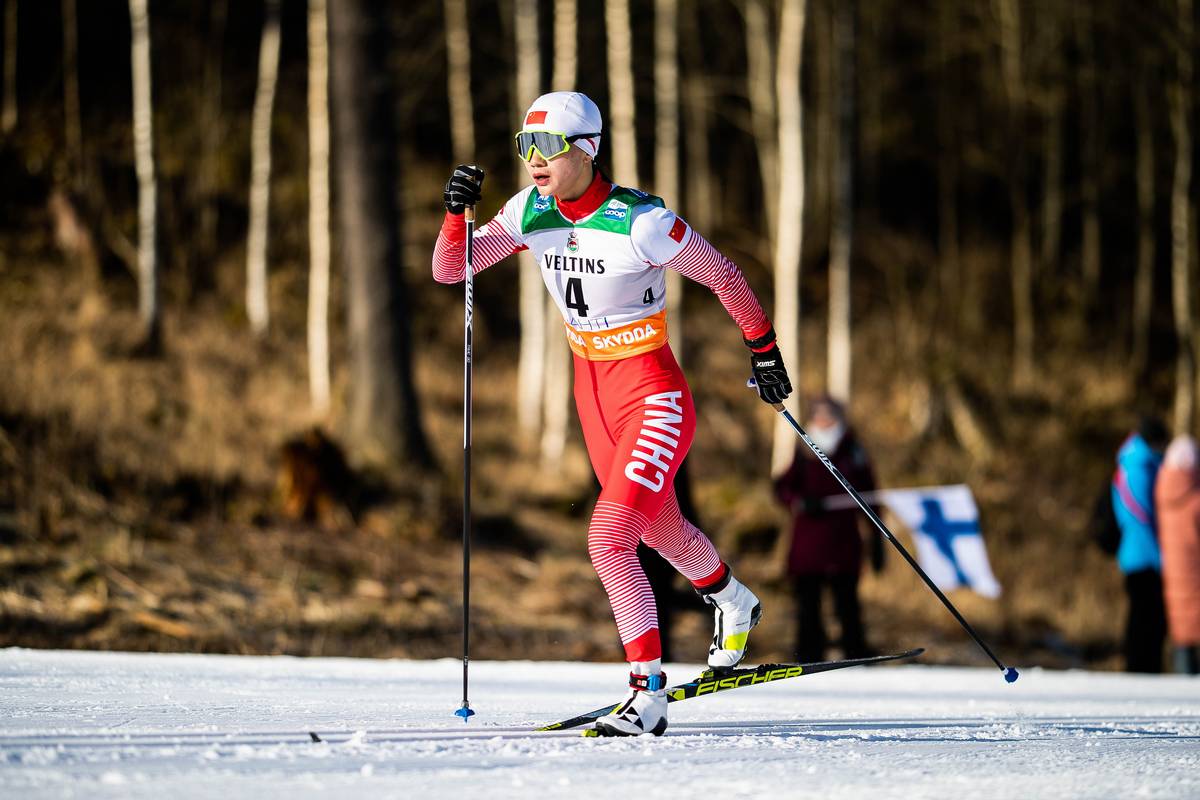
The new skiers were enticed with more than Olympic glory, they were also offered competitive salaries. Veikko Halonen, the CEO of Vuokatti Sport said to Yle, “With that money, the whole family will probably live in their home country. Motivation is high, even though they do not know when they will be able to visit home.”
Shiwohen was one of 134 Chinese athletes sent in 2018 to Vuokatti to learn skiing. Of them, only twenty had ever skied before. Many were from subtropical Shanghai. The government officials in charge of identifying talents back in China had only a loose understanding of the qualities they should be looking for, and believing that upper body strength was paramount, leaned heavily on selecting rowers.
From the start, the Chinese project in Vuokatti—called “Zero to Hero”—was enormously ambitious. One of China’s primary snow sports coaches, Glenn Lindholm of Finland, recounted to Swiss news outlet Tages-Anzeiger that in the beginning, “It was difficult for them to just stand on cross-country skis.”
In Norway, apart from the Trondheim group, the situation was much the same. “The first time I saw them on rollerskis, I thought ‘this is not possible,’ Anita Moen told NRK of the early days at the Trysil camp.
“I was skeptical, scared,” said Moen in the report. “They struggled to control the speed. There were abrasions on the legs and arms even though we used protective equipment.”
In Vuokatti, coaches chafed at the insistence of Chinese officials that the skiers be outfitted with the finest equipment on the market, which only made their work harder. “Only the best is good enough for the project,” Lindholm said. “Money doesn’t matter.”
The Philip Boit Connection
The Chinese skiing project recalled an earlier effort in the mid-90s by Nike to introduce elite Kenyan runners to cross country skiing prior to the 1998 Nagano Olympics.
At its core, the idea was little more than a marketing gimmick dreamed up by Nike executives in Portland, Oregon as a means to help promote their venture into winter wear. As Mark Bossardet, then Nike’s Director of Global Athletics put it to the New York Times, “We were sitting around the office one day and we said, ‘What if we took Kenyan runners and transferred their skills to cross country skiing?’”
Philip Boit at the time was trying to make it in the ultra competitive Kenyan running scene and believing that “cross country” must have something to do with running, he signed up.
Before long, he was on a plane to Finland with a compatriot. Boit did not consider his task to be a marketing ploy, and he took his ski training seriously. He would end up spending the next two years there training for Nagano, supported by Nike.
Ultimately, the Nike project was an experiment: If you take a talented Kenyan runner and give him a coach and two years in Finland to learn skiing, what will happen?
The result proved that two years was not enough. In the 10 k classic at Nagano, Boit finished last, some twenty minutes behind Bjørn Dælhe. Though Boit was a talented runner—he could run 1,500m in 3:46.5—that prowess proved not to be a predictor of success. As Bossardet conceded, “As it turned out, the most important aspect is technique.”
The Study
Unlike the anecdotal knowledge from the Nike experiment, the large and well funded Team China project in Meråker offered a unique opportunity for research: that of talent transfer from other sports to nordic skiing. The study was conducted by the Norwegian Institute of Science and technology (NTNU), and researchers included Øyvind Sandbakk and Rune Talsnes. It was the first systematic and scientific study of talent transfer ever written about, in any sport.
The researchers followed the journey of 24 Chinese athletes aged between 17 and 21 years old that had been selected from a pool of middle distance runners, rowers, and kayakers.
After a few months of introductory ski lessons, the athletes were subjected to a battery of tests in the beginning, middle, and end of a six month period of time. VO2max, double poling power, and rollerskiing efficiency on a treadmill, were among the many tests used to assess the athletes.
The end result was clear: the runners improved far more than the rowers, and the men improved more than the women.
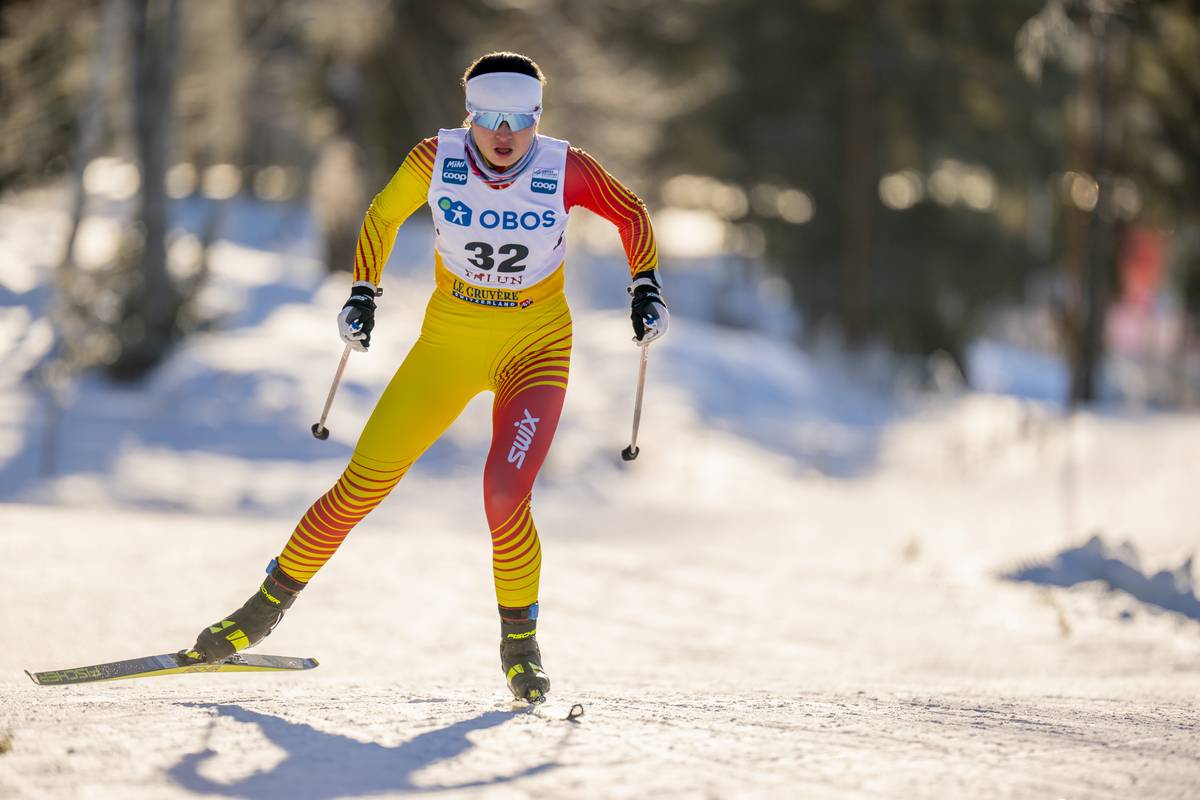
Chunxue Chi (CHN) races a February, 2020 World Cup 10 k classic in Lahti, FIN. (Photo: NordicFocus)
The runners did best, it was surmised, because they adapted more easily to the endurance training and were injured less often. While the physiology tests told a clear story of improving strength, capacity, and efficiency, they obscured the point of the whole endeavor: how fast they could ski.
In an email to FasterSkier, Talsnes confirmed the validity of using specific markers to assess the progress of the new skiers as athletes, writing, “I would say most of the performance and physiological indices that were assessed in the monitoring of these athletes are valid indicators of [cross country] skiing performance. In fact, we have recently published a study on the validity of such tests in a group of Norwegian junior/senior [cross country] skiers.”
Because the study was conducted over the winter months, Talsnes wrote that a rollerskiing time trial was not possible, and that a ski event would have been subject to shifting conditions.
The study also assessed the coaches’ perspectives. With their names removed for anonymity, the researchers managed to gather some interesting insights.
There was general consensus among the coaches that those who were self motivated did best. The Chinese athletes did improve remarkably, both in Meråker and elsewhere.
In Trysil, Anita Moen was impressed with the results, telling NRK “I did not think it would be possible to get [the athletes] to learn the technique. And that they should ski fast already for the winter. It was such a short time. But there I was wrong.”
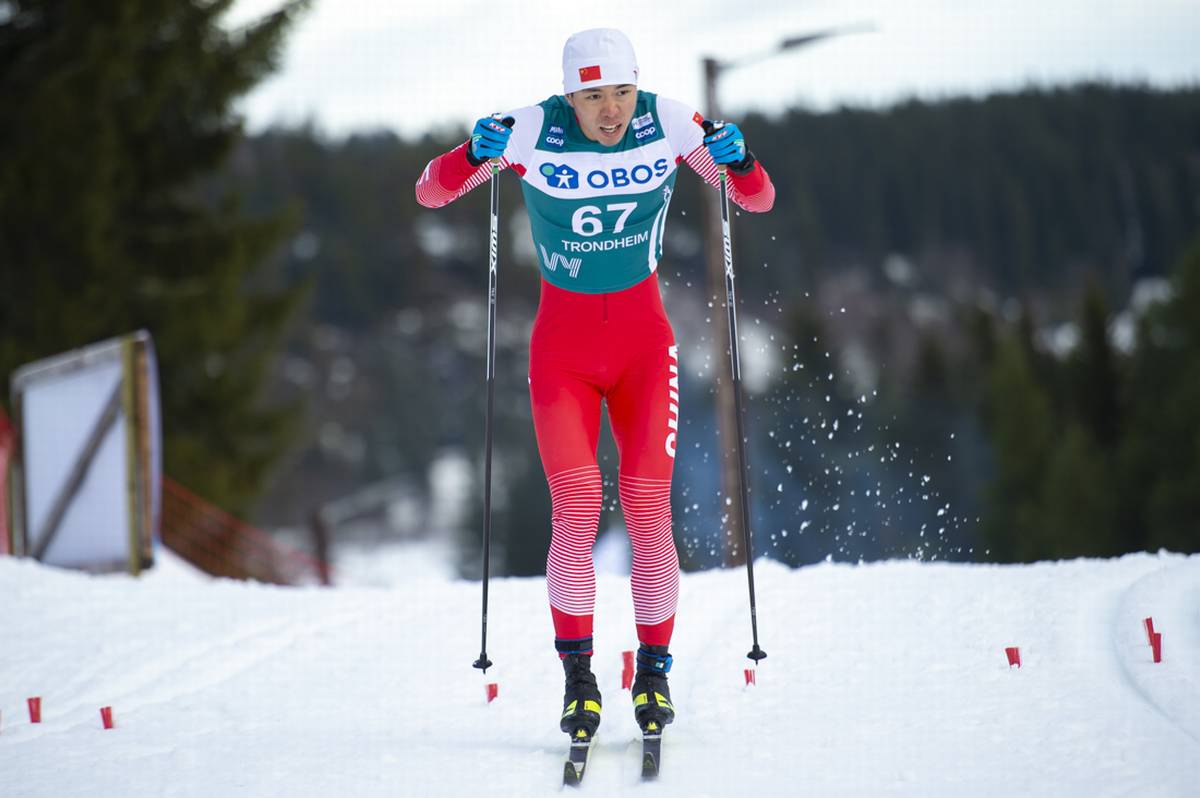
China’s Jincai Shang races the freestyle sprint qualifier during the 2022 Beijing Olympic Winter Games. (Photo: NordicFocus)
Yet as much as the athletes improved, they were still not at a level to compete on the biggest stage. As a coach said in the NTNU study , “Many of them have physical capacities better than their Norwegian peers in cross country skiing, without this reflecting… in a competition. It’s the ski feeling, how to go on skis. They still miss this feeling.”
To the researchers, the coaches expressed their skepticism that the project would bear fruit. “…regarding talent transfer and [nordic] skiing, it’s something I wouldn’t recommend.”
They also felt that their efforts were hampered by expectations of speedy results, a lack of control over selecting athletes, and uncertainty over how long the program would last.
“This was a short time period with [cross country] ski-specific training,” Talsnes wrote, “and although the most responding athletes had large development in sport-specific performance, there is a long way to a World Cup and Olympic level. However, I think it might work with the right potential [athletes] and a sufficient time perspective.”
Although there were questions about whether the athletes would be ready by Beijing, results have ultimately proved a degree of success for the Meråker program. “Interestingly,” wrote Talsnes, “the best Chinese athlete during [the] skiathlon for men in the Olympics was a part of this project. He [Liu Rongsheng] first started skiing in February 2019 and is a previous runner. He became 38th and actually beat Klæbo which I think is a bit funny…”
***
In Vuokatti, the athletes came with an entourage of Chinese staff: fifteen coaches, along with translators and government minders. The contingent was so large that a “Chinese village” was created, replete with a restaurant.
Occasionally, there were culture clashes, though the misunderstandings were mainly between the Norwegian and Finnish coaches and Chinese officials.
Tor-Arne Hetland outlined an episode of discord between himself and Chinese officials when he vetoed a requested 10k time trial to compare his athletes with those in China for placement on the elite team. “It was nonsense!” Hetland told the South China Morning Post. “The snow would have been different from place to place, and they would be [skiing] on completely different tracks.”
A larger controversy at the Meråker public library overshadowed coaching disagreements, and brought the fragility of ski diplomacy to the fore.
Meråker is a small municipality with a population of just over 1000 residents in the Trøndeleg region east of Trondheim. To ease the stay of the around 40 Chinese athletes, the library had a shipment of books in Mandarin sent from the Oslo public library system.
Included in the titles sent were a few on subjects that were banned in China, including one on the Falun Gong — an outlawed Chinese religious movement. Chinese officials with the team repeatedly insisted that the books be removed. Anne Marken, the librarian in Meråker told Andresseavisen “They have said that if any of the Chinese skiers are taken with these books, they are afraid that they risk a labor camp or prison in China.”
Marken refused. The matter made headlines in Norway and helped to reignite the public debate over whether Norway was complicit in human rights abuses in China. Beyond the squabble over a few forbidden books in Meråker was the larger shadow that the salmon-for-skiing agreement had cast.
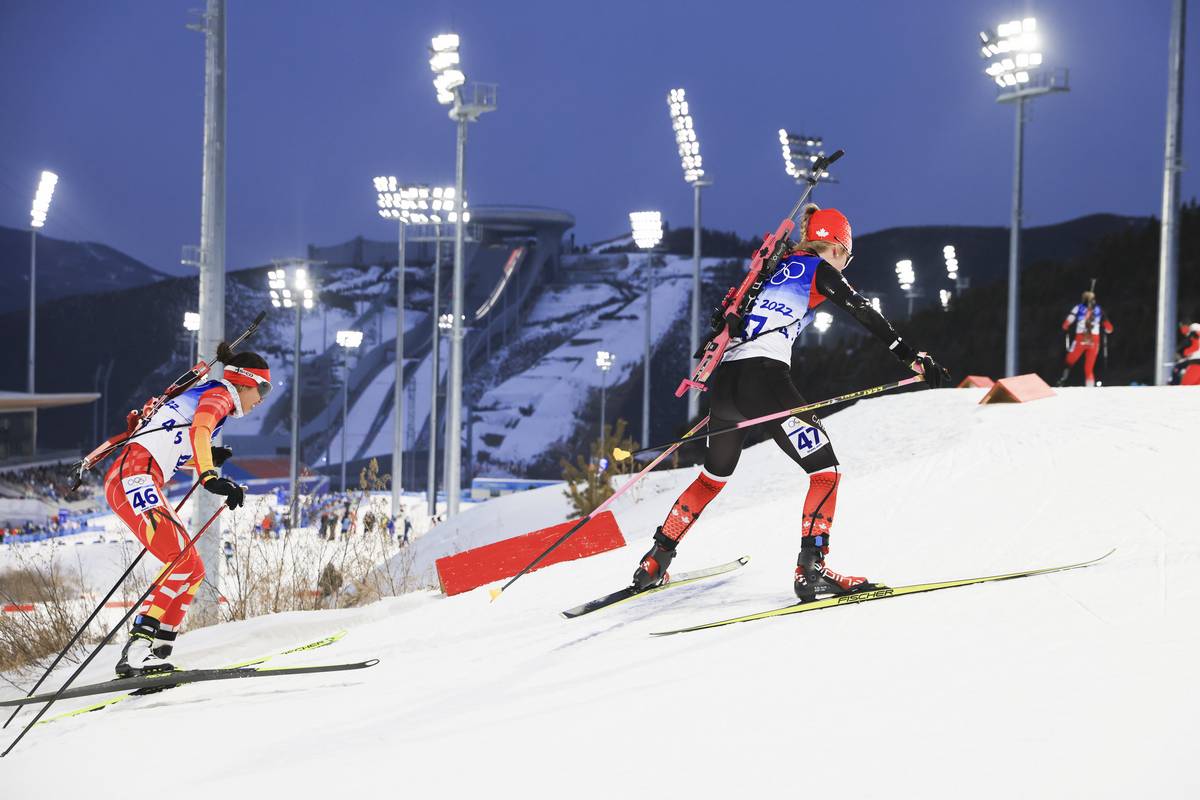
Chinese biathloete Yuanmeng Chu follows Canada’s Emma Lunder (CAN) during the women’s sprint competition on February 11th. (Photo: NordicFocus)
The philosophical differences between Norwegian and Finnish coaches and those of China stemmed in part from China’s contrasting sporting model that was built in the image of the Soviet system and has retained much of its flavor—a focus on authoritarian, sport specific development that begins at an early age.
Much like the Russian ski team, which is separated into four separate training groups, the Chinese Ski Team was equally diffused. Confusingly, there were two separate entities competing with each other to create skiers. The Winter Sports Group had the Chinese Ski Association under its umbrella, and oversaw some of the more elite programs. Competing with the Chinese Ski Association was Team China, which was unrelated other than that its funding also came from the State.
To further muddy the waters, Taiwan and Hong Kong have their own ski associations, and teams. Both compete as separate nations in the Olympics despite being, by varying degrees, part of the same country.
It was Team China that signed most of the contracts to train new skiers. The result was that hundreds of skiers, ranging from barely able to ski, to competing on the World Cup, were all somewhat on the national team.
“I do not know how many teams the Chinese have called ‘national team’,” said Bernhard Rønning who ran the Trondheim based group. He clarified to Aftenposten, “We are the ones… going to the World Cup.”
Chinese sporting officials did not take an entirely hands off approach when their athletes were abroad. At the end of every week, Lindholm was required to send a report back to Beijing outlining the progress of the skiers. As a result, much focus was placed on physiological tests. “We could work more efficiently if we were only allowed to,” said Lindholm.
This World Cup coverage is made possible through the generous support of Marty and Kathy Hall and the A Hall Mark of Excellence Award. To learn more about A Hall Mark of Excellence Award or to learn how you can support FasterSkier’s coverage please contact info@fasterskier.com.
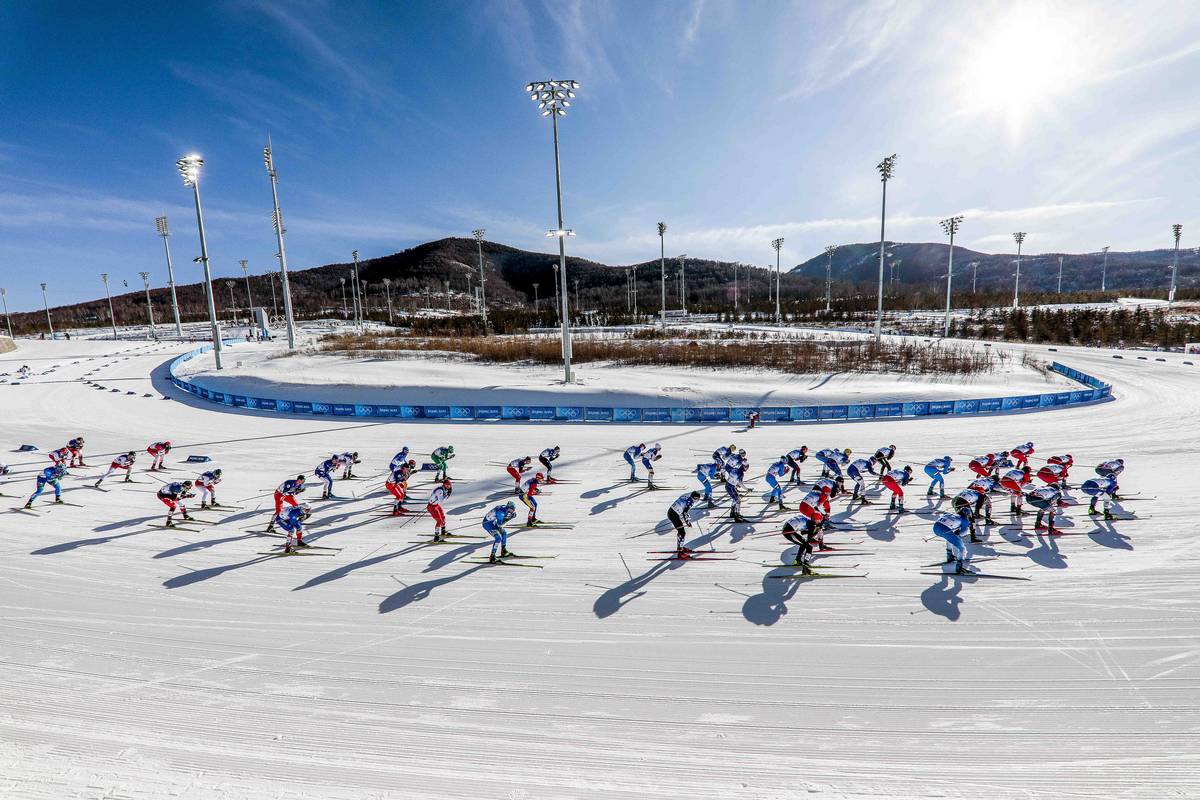
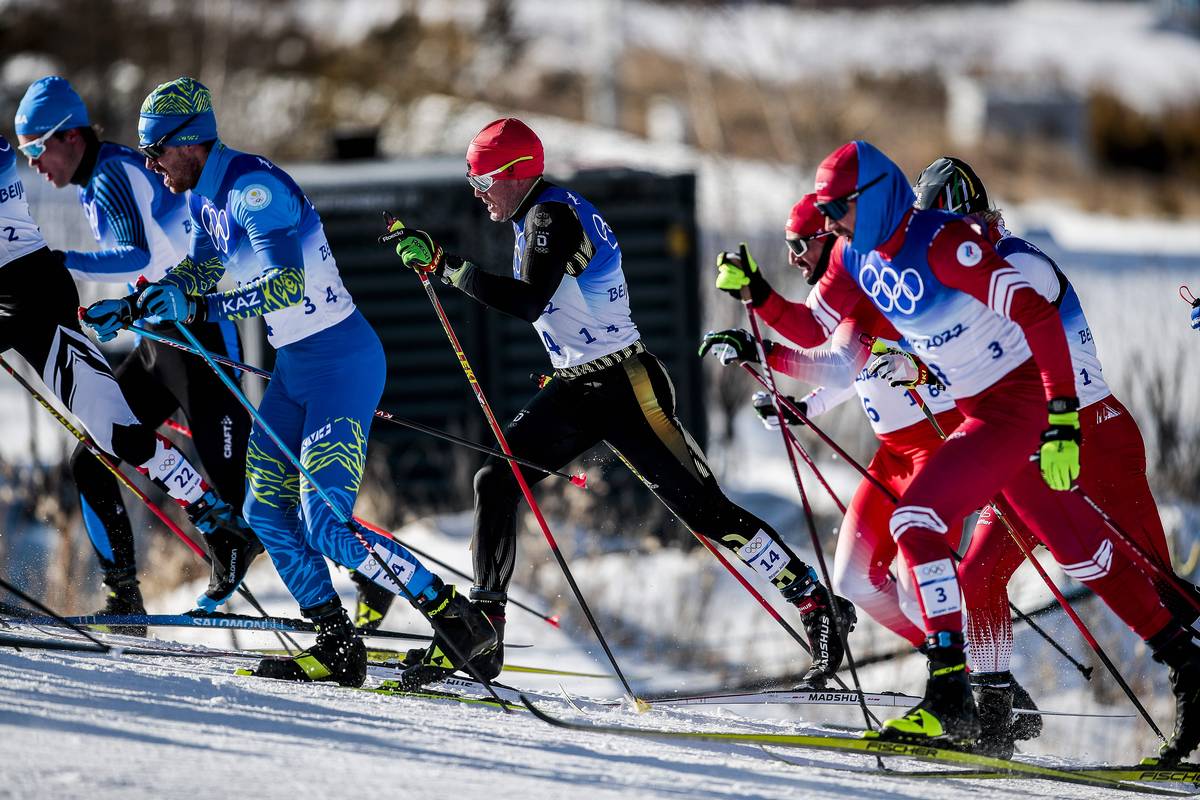
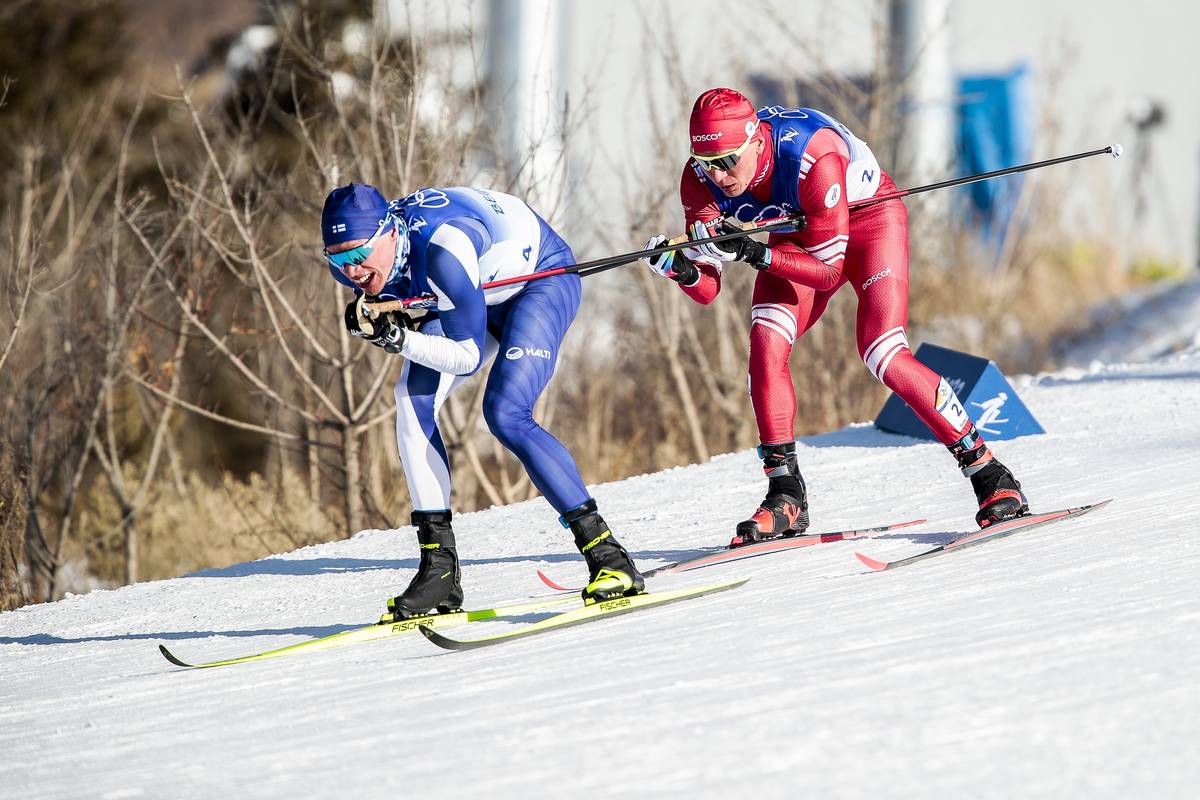
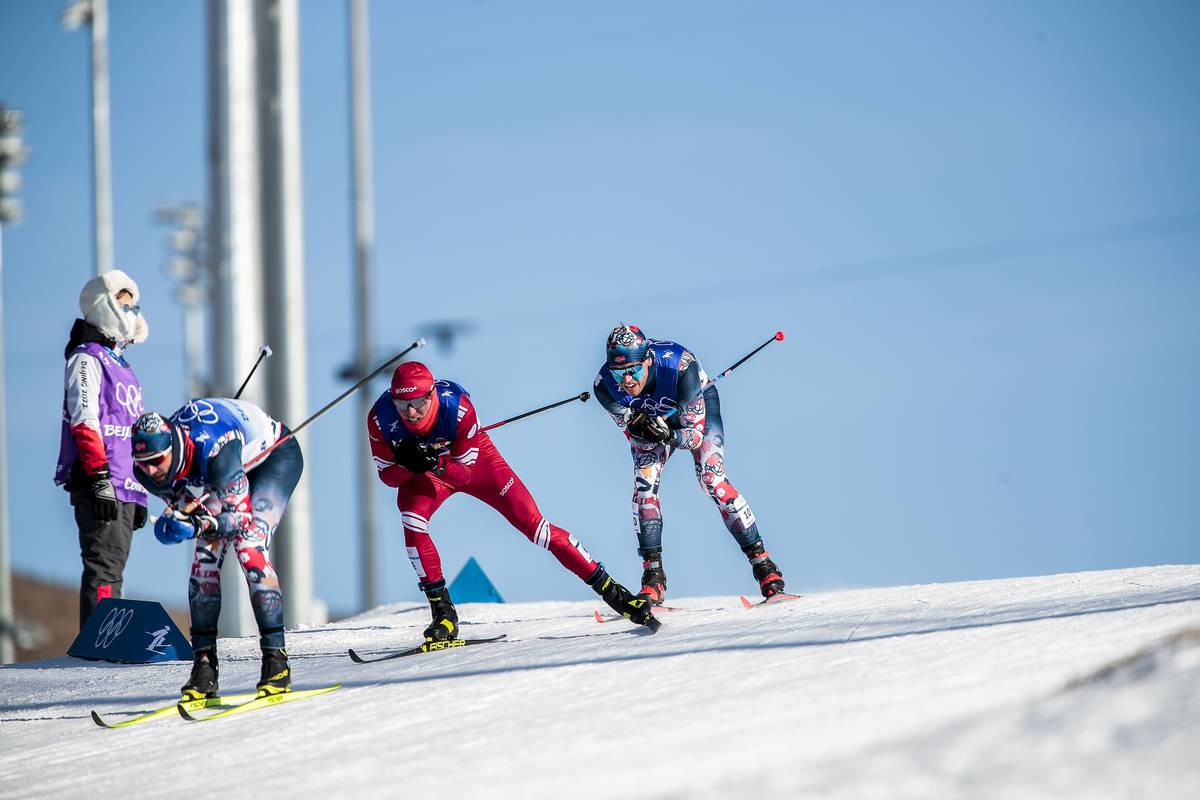
In the sport of cross country skiing, the Olympic 15-kilometer individual start classic might be considered the “granddaddy of them all.” The technique was classic, as was the race against the clock, and even the weather on Friday morning seemed to harken to the pitch perfect idea of a ski race we all have in our minds; mid-20s Fahrenheit, -3.5℃ to be exact, and with some sun too. This race, in this discipline, had been raced in 1924 at the first winter Olympiad in Chamonix, when a pair of legendary Norwegians and a Finn graced the podium.
Hans Christer Holund (NOR) races the 15 k individual start classic during the 2022 Beijing Olympic Winter Games. (Photo: NordicFocus)
More recent history too, had plenty of threads that this race could potentially follow suit when it played out on Friday. The last 15 k classic World Championship race in March 2021 had seen a Norwegian sweep. Norway’s Johannes Høsflot Klæbo has won two of the last 15 k distance events on the World Cup, with Finland’s Iivo Niskanen winning the third. Alexander Bolshunov of Russian Olympic Committee (ROC) stood on two out of three of these podiums.
The gold medalists in the 15 k Olympic races from the 2018, 2014, and 2010 Games were all on the start-line; their name was Dario Cologna (SUI).
So which one to follow? Well, it turns out that sometimes, recency bias is the best bias.
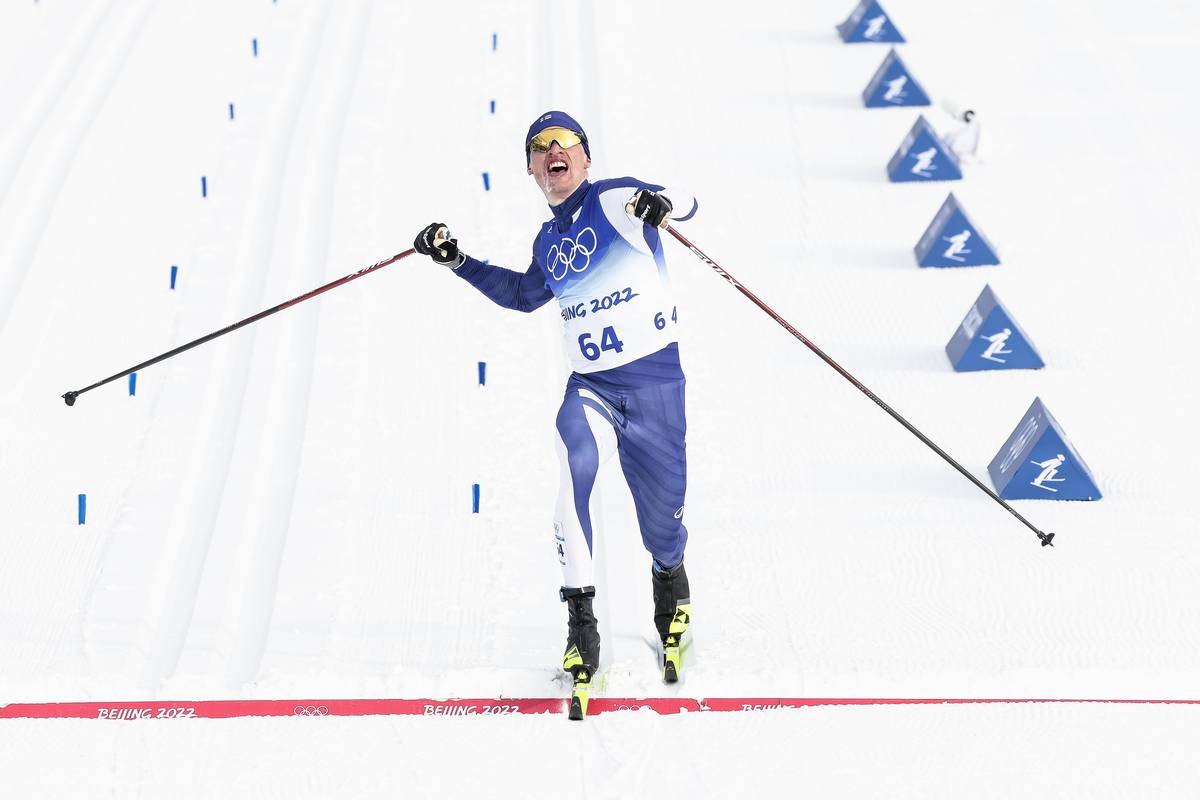
Following the thread of history in big, bold, strides was Iivo Niskanen. In doing so, he not only followed, but also made, history too.
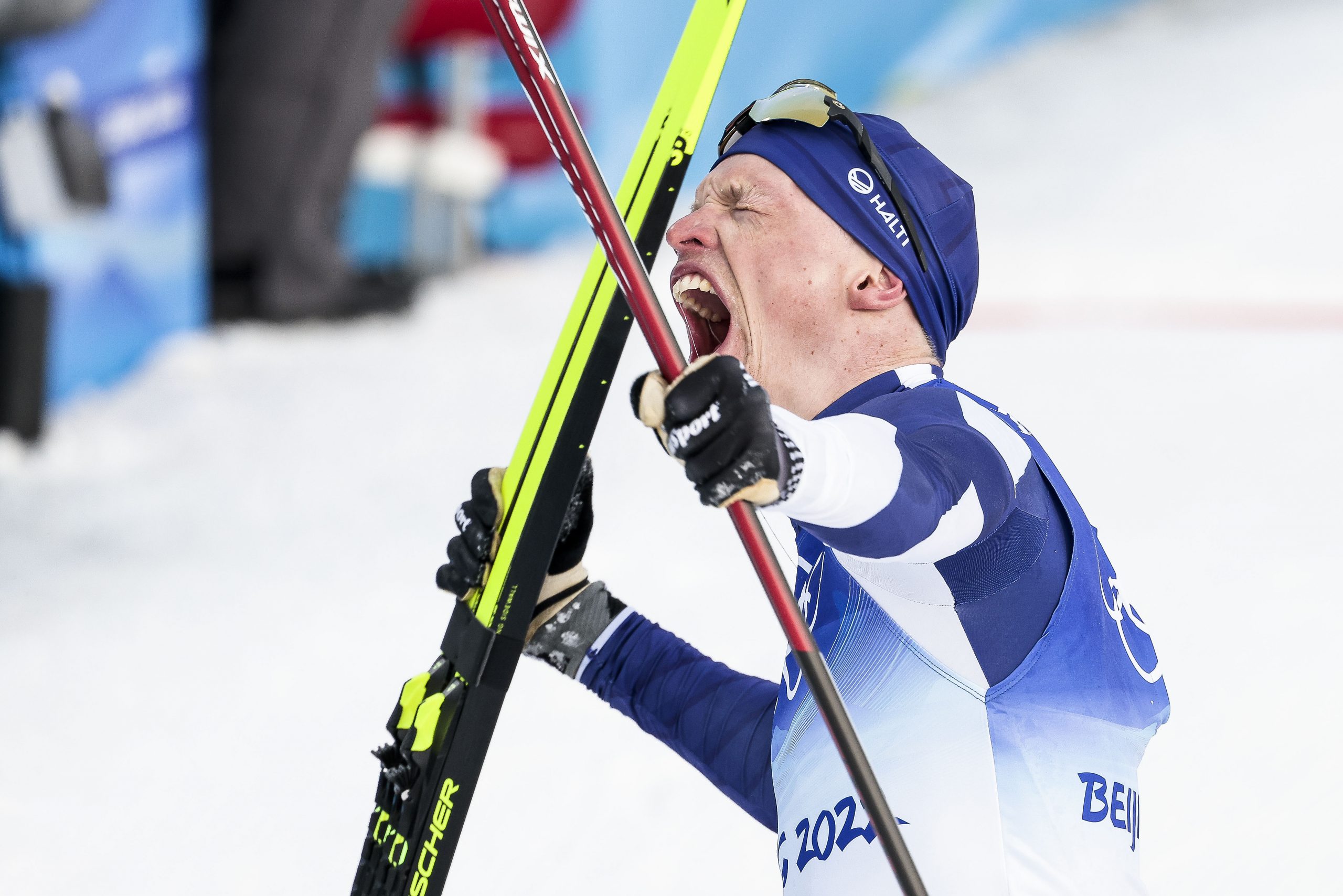
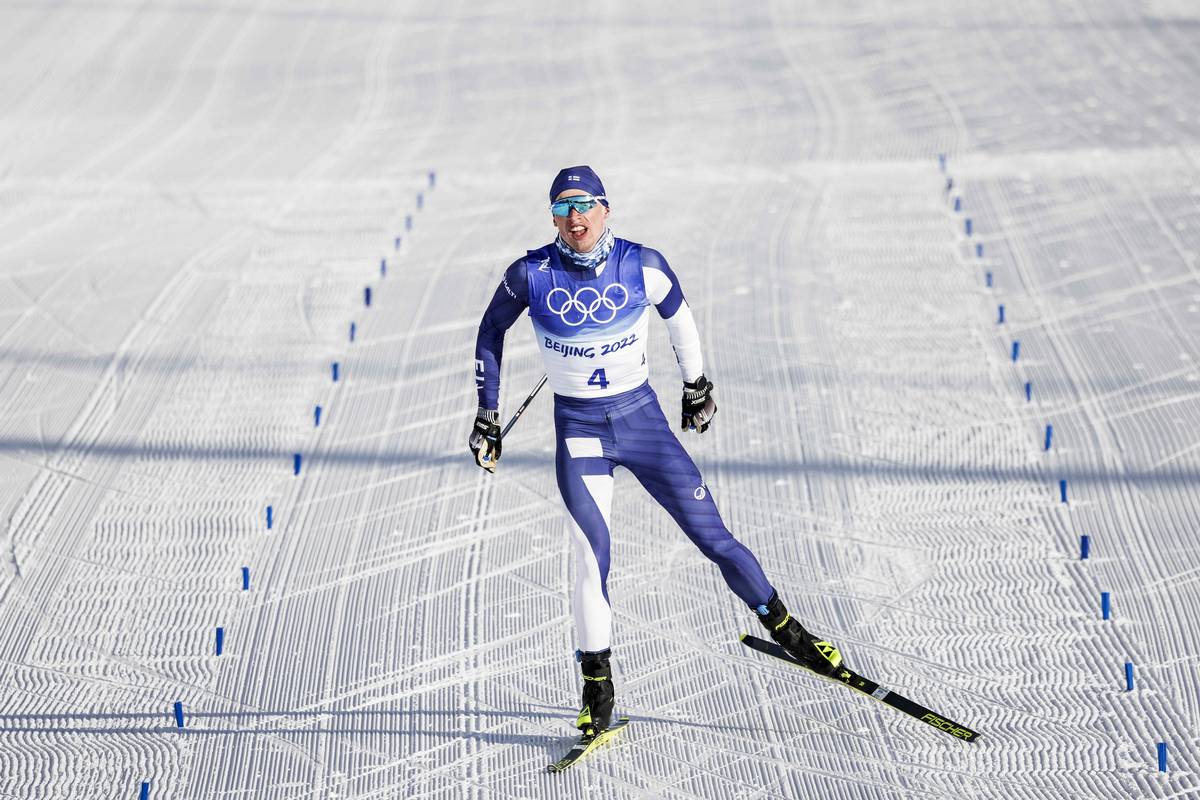
Iivo Niskanen (FIN) let’s out a shout of jubilation after Friday’s 15 k at the Beijing Olympics. Photo: NordicFocus
Getting there though, was the matter of following a field that showed the complexity and nuance involved in the simple task of racing against the clock for 15 k. The men’s race entailed two laps of a 7.5 k course that included rolling terrain, and plenty of steady, long uphill pitches seemingly perfect to test the ability of skier’s to mix glide and tempo in classic strides.
“It was a brutal, brutal course,” said American JC Schoonmaker in an interview with FasterSkier. “There’s so many long, gradual, working sections, and when you get to the top you don’t get a lot of downhills that have much speed…there’s two especially long climbs and a whole bunch of medium grinds in between.”
JC Schoonmaker skis the 15 k individual start classic. (Photo: NordicFocus)
“Whether this day goes well or not, this course makes this a really big day, the hills are so steep, and the trick is that kick is even more critical because of the pitch of some of these hills.” said US Ski Team Head Coach Matt Whitcomb.
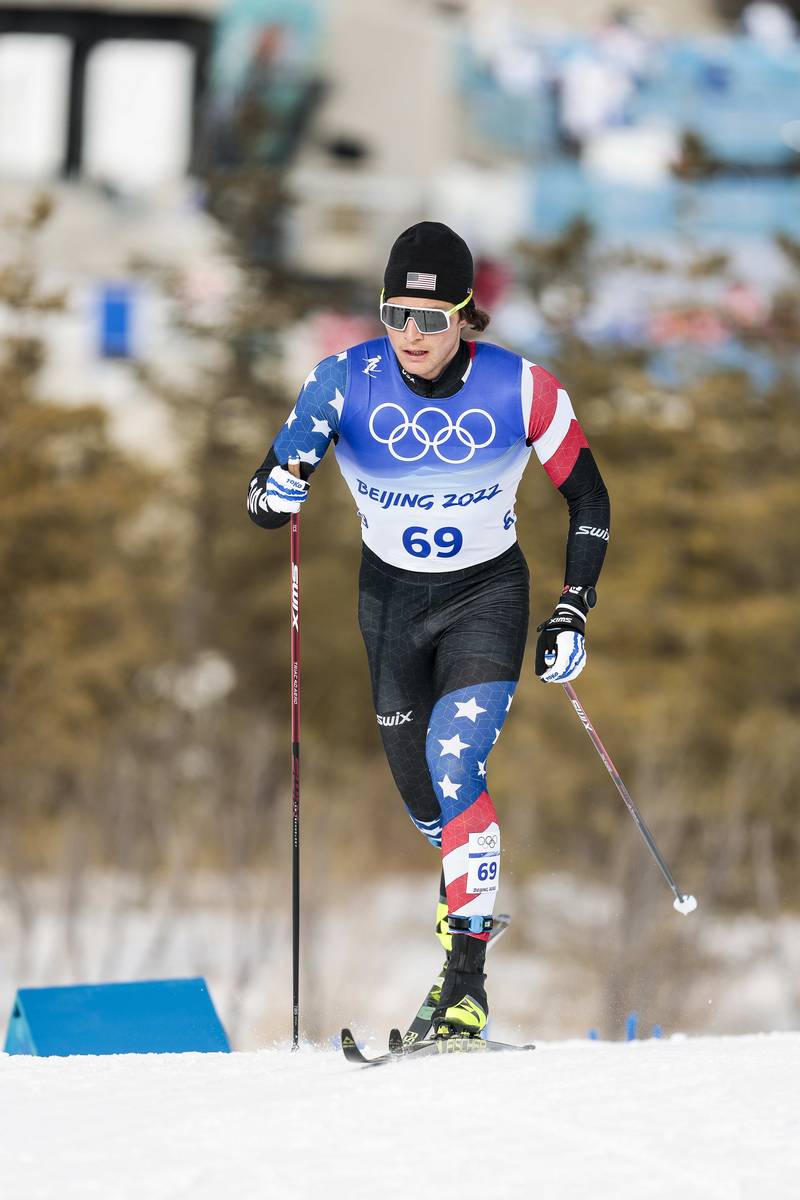
For their part, the men’s field went out to attack this hard course with a smile. Or at least, Ben Ogden (USA) did. The American wore bib number 1, fresh off his historic sprint finish, and gave a wink and grin to the camera before dashing out of the start gate, and settling into a powerful double-pole that would allow him to set the pace for the field in the early part of the race.
Ogden said on his early start “I’ve never been in that position [going out in bib 1], so it was fun to go out and try and stay with the really fast guys on the second lap.”
Ben Ogden races his first distance event of the 2022 Olympics, the 15 k individual start classic. (Photo: NordicFocus)
Ogden eventually finished 41st overall (+3:35.0), notching another impressive result for the 21-year-old Vermonter, and reason for fans to look forward to a bright Olympic future from him.
Ogden’s 1.8 k split was surpassed by Canadian Olivier Léveillé, who wore bib number 5, before the French sprinter Richard Jouve put down a split that seemed to be a good barometer of what going out hard on this course looked like.
When the field’s favorites came through, Jouve’s split gave away how different competitors were approaching the pacing of the 15 k course. Johannes Høsflot Klæbo (NOR), wearing bib 32, came through the 1.8 k checkpoint way back in 28th place, +28.6 seconds off of Jouve. His teammate Pål Golberg came +6.4 off of Jouve as well. The Norwegians seemed to be taking the early part of the race conservatively.
Dario Cologna (SUI) too, was back in 26th place after 1.8 k (+26.1), but it seemed clear from the early part of the race that the reigning Olympic champion was out on one last run, an homage to his legendary Olympic career.
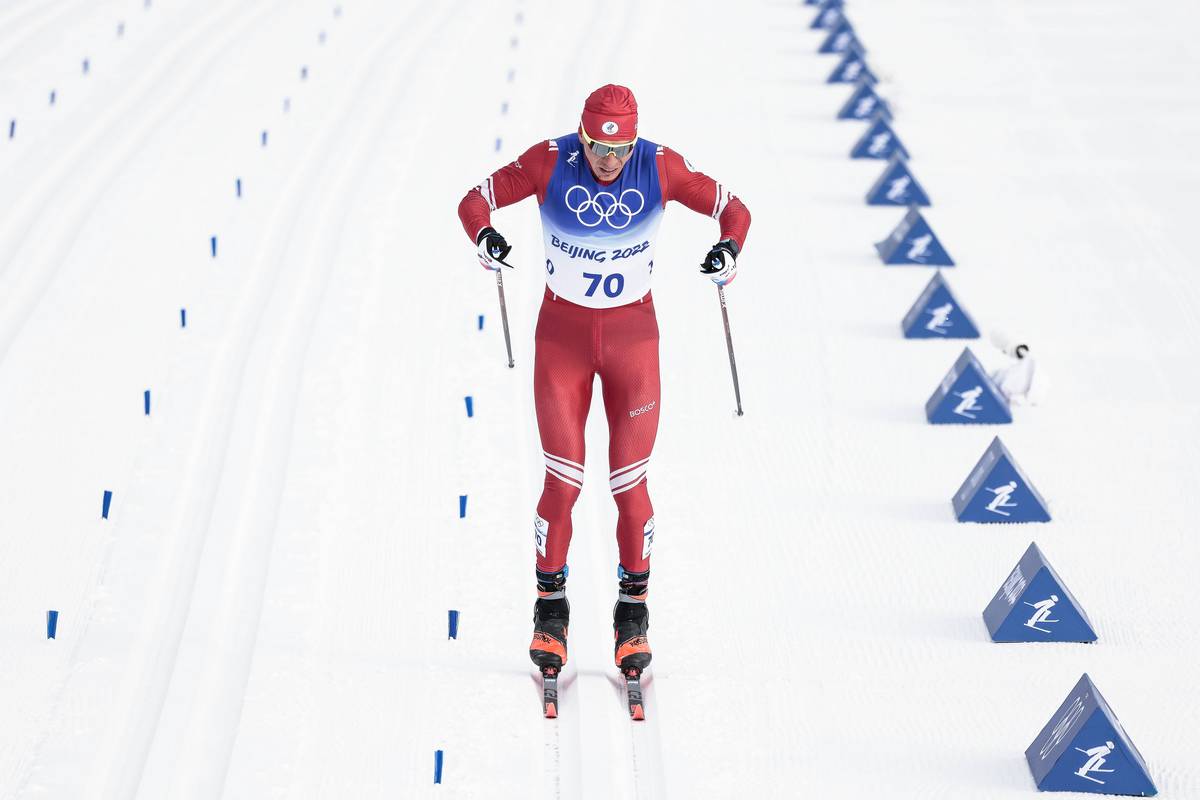
When Jouve’s mark was eventually surpassed, it was by Iivo Niskanen, wearing bib 64, who skied through the 1.8 k mark with a 2.3 second advantage over the entire field. Eyes then turned towards the skier who had outdone Niskanen in last Sunday’s 30 k Skiathlon, Alexander Bolshunov (ROC), wearing bib 70, who came through the 1.8 k mark +8.4 seconds off of Niskanen’s time.
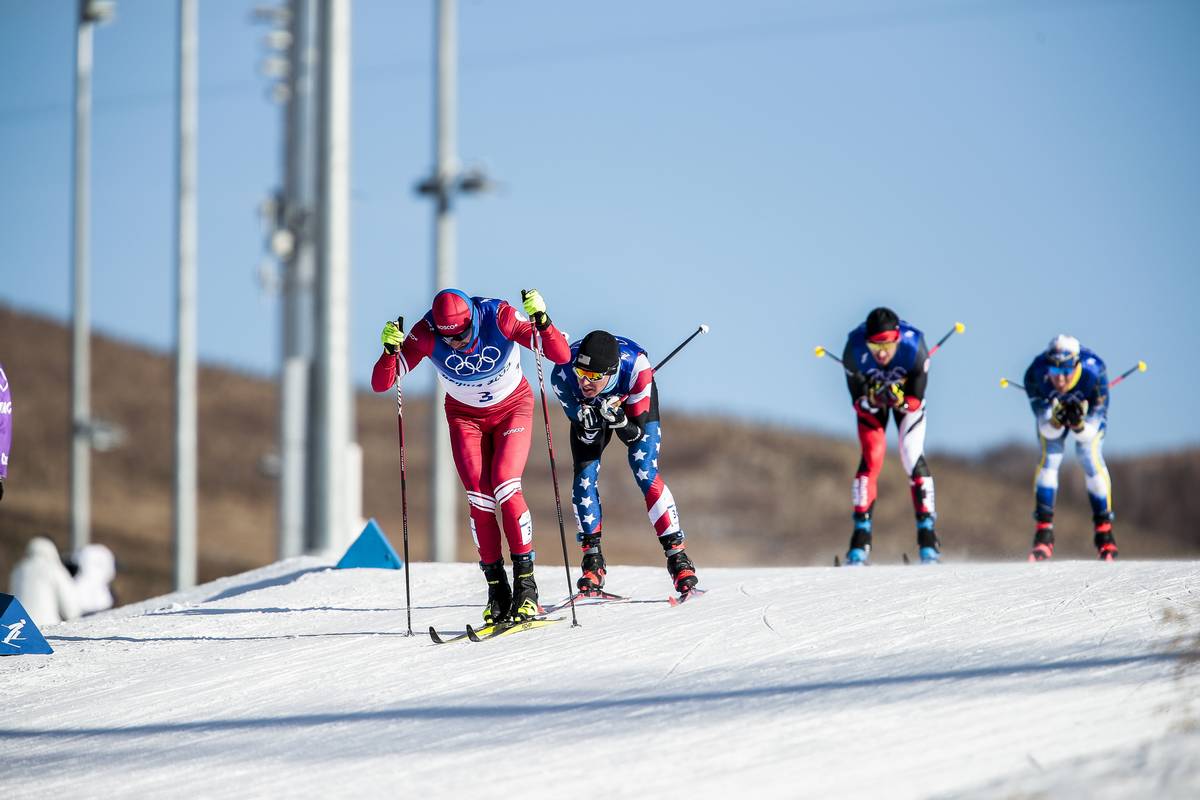
Alexander Bolshunov (ROC) strides up a climb during the 15 k Classic. Photo: NordicFocus
Their proximity early in the race couldn’t help but recall the women’s race yesterday, where Niskanen’s sister, Kerttu ultimately missed the gold medal by just 0.4 seconds. The two are now one of just four sibling pairs to win medals at the same Olympic Games, and looked to be able to do it in the men’s and women’s equivalent of the same event.
For a second time in two days, a Niskanen would be in a grueling duel against the clock.
Finland’s Iivo Niskanen strides for gold in the 15 k individual start classic. (Photo: NordicFocus)
By 6.3 k, the tension hadn’t subsided. Klæbo had picked up his pace, coming into the checkpoint with a 12 second advantage over the field. His teammate Golberg followed, besting Klæbo by 20 seconds. Niskanen then came through and bested that mark by 20 seconds. Bolshunov, though, couldn’t top the feat. He had managed to stay with it, coming through the 6.3 k mark +13.7 seconds off of Niskanen.
Half-way through the race then, four skiers seemed to be vying for three medal spots in a muddled mass of splits that kept them within a minute of each other. Niskanen had the advantage in 1st place, Bolshunov 2nd, Golberg 3rd, and Klæbo 4th.
The decisive portion that would sort out the field came quickly in the early part of the 2nd lap. That portion included a series of two climbs, the latter of which was a veritable wall up to the 10.5 k mark. This played to the strengths of those with a strong, smooth stride.
In this field, that was Niskanen. He seemed to reset a classic track muddled by a field where most had to herringbone up to the 10.5 k checkpoint, and when he came across it, he had built a decisive gap of 51 seconds over the field.
When Bolshunov came through, showing signs of slipping up the climb, he had lost an additional 15 seconds to Niskanen, putting him +28.8 seconds back but still in second place.
Pål Golberg fights the clock during the men’s 15 k individual start classic. (Photo: NordicFocus)
Golberg had lost his advantage on Klæbo, and would continue to fade through the rest of the race, eventually ending the day in 11th (+1:52.6).
At 13.8 k, the gaps at the top had only expanded. Niskanen had held his lead over Bolshunov at 29.1 seconds. His final push up the gradual climb leading to the checkpoint putting the image of a picture-perfect stride to the notion that has become clear over the course of his career; Niskanen is his generation’s best classic skier, the proprietor of glide and stride in a sport that’s increasingly turned its attentions to the temptations of tempo and power.
Iivo Niskanen celebrates a gold medal performance in his signature event, the 15 k individual start classic. (Photo: NordicFocus)
There was little in doubt when Niskanen crossed the finish line. He had won gold, done it decisively, and along with his sister’s result yesterday, etched the name Niskanen into Olympic history and Finnish national pride.
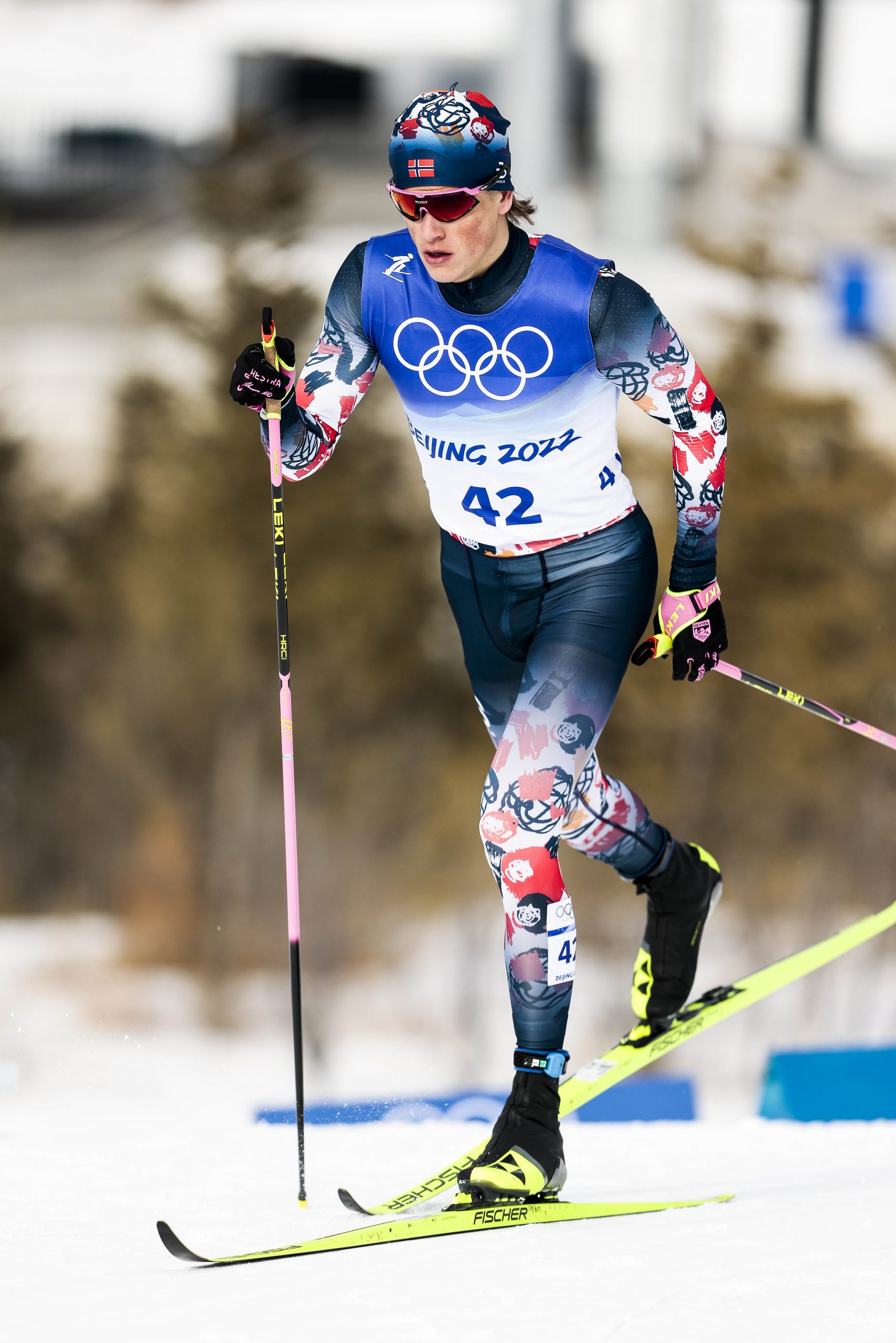
Bolshunov came through in 2nd, with the final margin +23.2 seconds, to claim his second medal of these Olympics. Following him in the results and in that feat was Johannes Høsflot Klæbo in 3rd (+37.5).
Alexander Bolshunov earns his sixth career Olympic medal with a silver in the men’s 15 k individual start classic. (Photo: NordicFocus)Johannes Høsflot Klæbo (NOR) strides to his second medal of this Olympic games, winning bronze in the 15 k classic.
Now holding an individual gold and bronze medal, earned in the 30 k skiathlon earlier this week, Niskanen has established himself as the dominant 15 k classic skier on the world’s stage. The Finn has seven World Cup victories in the event, and holds a gold and bronze World Championship medal in the event from 2017 and 2019, respectively. He had matched today’s silver medalist, Bolshunov, stride for stride in the 15 k classic half of the opening Olympic skiathlon event, before Bolshunov skated away with the win leaving Niskanen fading into third.
Iivo Niskanen wins the men’s individual start classic during the 2022 Beijing Olympic Winter Games. (Photo: NordicFocus)
Also holding one gold and one bronze from this Olympiad, Bolshunov youngest male athlete to hold six Olympic medals. Individually, Bolshunov earned silver in the 50 k classic in PyeongChang in 2018, along with a bronze in the classic sprint. And he supported the ROC team to earn silver medals in the 4 x 10 k relay and the freestyle team sprint.
“I wanted to win today but Iivo was stronger, I knew that after starting into the race,” Bolshunov said through translation in the press conference. “Getting a silver medal, however, is a nice treat as well, especially at the Olympic Winter Games. And there are more races coming where I will fight for Gold again”.
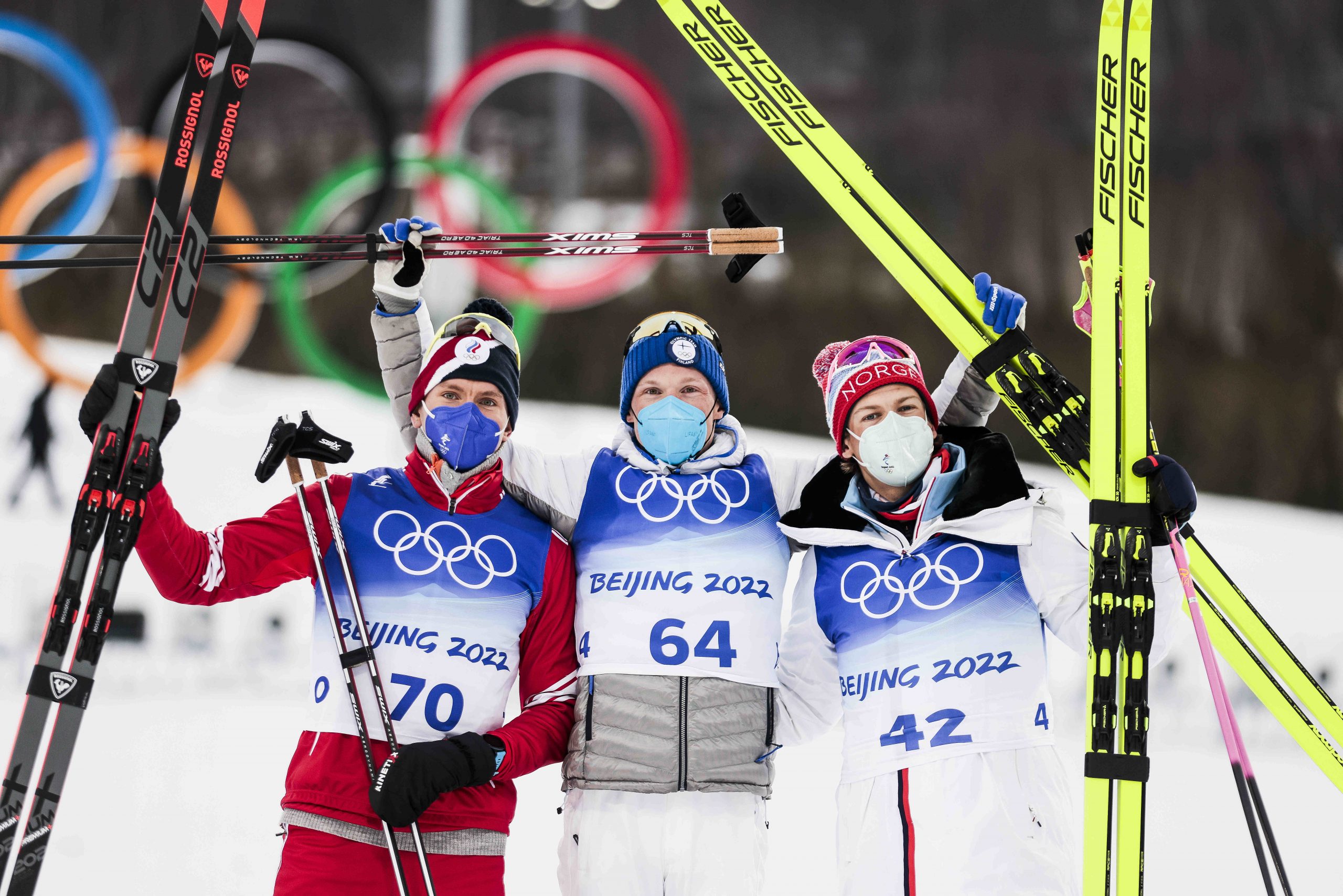
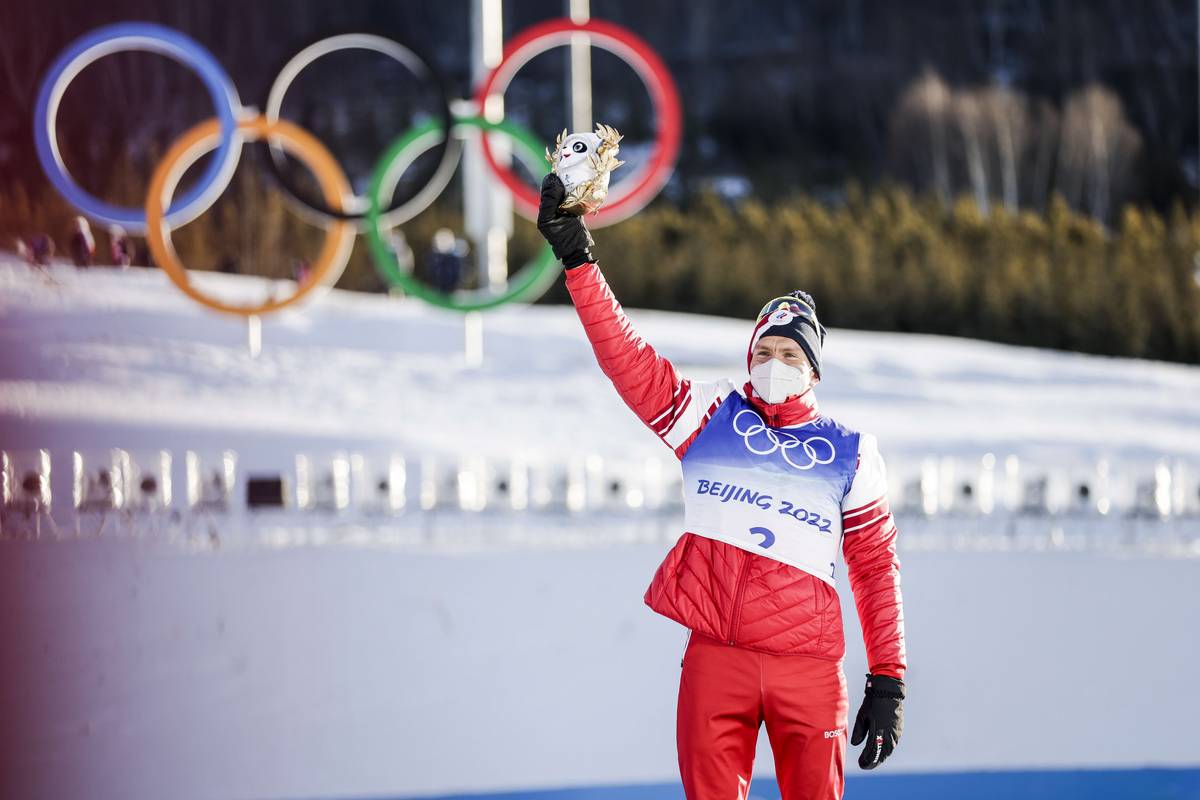
Iivo Niskanen (FIN) takes gold in the 15 k classic, with Alexander Bolshunov (ROC) earning silver and Johannes Høsflot Klæbo (NOR) bronze. (Photo: NordicFocus)
Today also provided glimpses of the young North American athletes from both Canada and the United States gaining valuable experience that points towards an exciting Olympic future for years to come.
Ogden, for instance, found an opportunity to ski with the world’s best on the world’s biggest stage, “I was surprised when Klæbo passed me on the second lap on that climb, he wasn’t going a totally inhuman pace. I think one day I’ll be able to ski a larger percentage of that race at that speed.”
Meanwhile, Gus Schumacher is focused on regaining a sense of feeling good on skis, saying to FasterSkier that “today was pretty flat, not a lot of aerobic power…you don’t feel like yourself, and I think we’re pretty grounded in physical feeling in this sport, so when those are weird you don’t feel like you have an anchor. I don’t want to rest at the Olympics, but I’m focused on coming around again this season.”
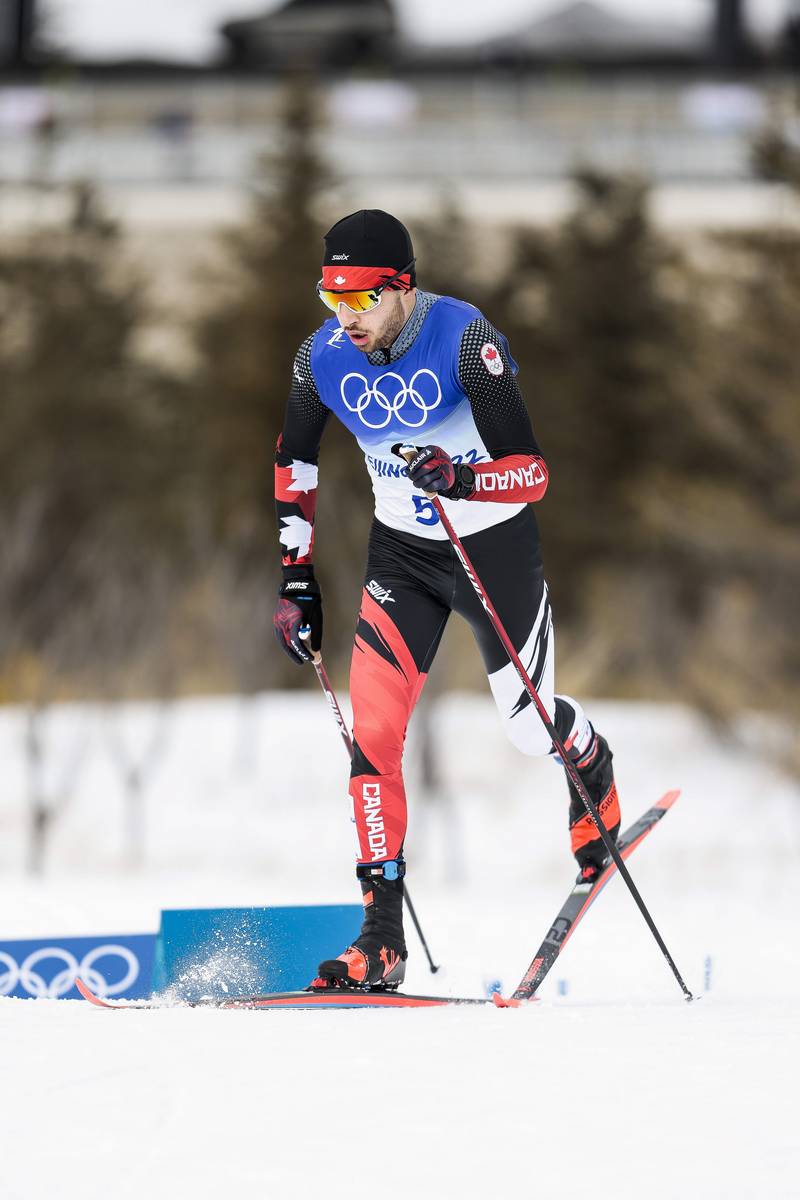
Canada’s Olivier Léveillé leads the North American athletes in 29th during the 15 k individual start classic. (Photo: NordicFocus)
Leading the way in the North American contingent was Canadian Olivier Léveillé in 29th (+2:57.2), followed by countrymen Rémi Drolet in 33rd (+3:12.9), and Antoine Cyr in 37th (+3:22.9).
American Scott Patterson was close behind in 38th (+3:28.3), Ben Ogden was 42nd (+3:35.0), Gus Schumacher was 48th (+3:58.6), and JC Schoonmaker was 66th (+5:36.8).
“That was tough,” Patterson told FasterSkier in the mixed zone. “It was a hard race day – wasn’t exactly what I wanted. I think we could have done a bit better with skis. I was slick to start and worked my arms pretty hard for the first lap. I think I kind of held it together, but the second lap hurt, and I was struggling out there. I was herringboning in most of the hills and trying to doublepole what I could, but it definitely felt like things were falling apart by the second lap. ”
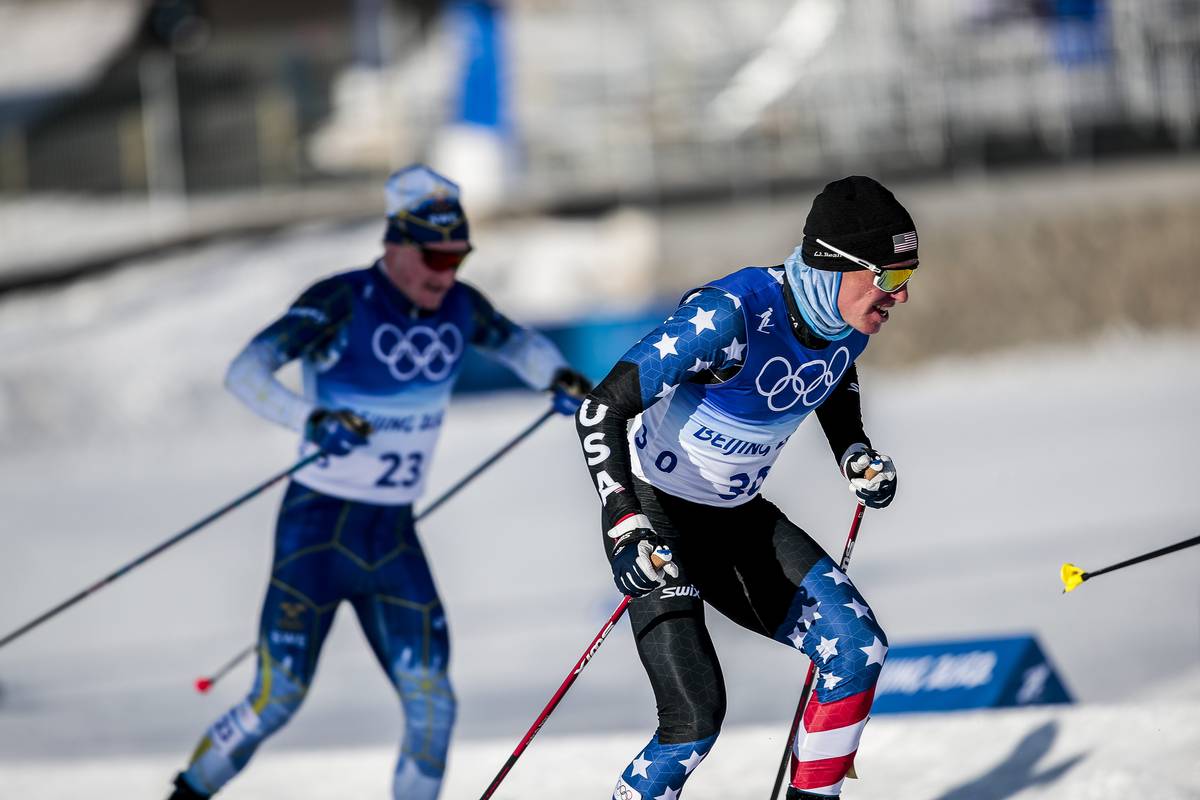
Scott Patterson leads the Americans in 38th in the 15 k individual start classic. (Photo: NordicFocus)
During this second lap, Patterson began to recognize that the 15 k may not match his historic result from the skiathlon, where he finished 11th as the top American in the event, the best result in Olympic history for the men’s program. He shared what was in his mind as he worked through the discomfort and frustration of under-performing skis.
“Keep hanging on. Keep fighting. I never like to be the one to kind of call it quits, so it’s tough. I mean, you know, other people are hurting out there too…I was turning my eyes back and head down on this final hill trying to pick up a few spots.”
The American and Canadian contingents will now look ahead to the next two races of this game, when they come together to race under their nation’s respective banners. Sunday will see the 4 x 10 k team relay, before the team sprint next Wednesday.
For more on how the U.S. team is approaching selection for those races, read here.
Gus Schumacher races the 15 k individual start classic in Zhangjiakou. (Photo: NordicFocus)
Canada’s Dahria Beatty was beaming after cracking the top-20 for the first time in her two trips to the Olympic Winter Games, finishing the women’s individual start 10-kilometre classic cross-country skiing event in 18th spot.
Feeding off career-best Olympic performances in her first two starts, the 27-year-old put down a memorable performance, skiing twice around the demanding five-kilometre loop in a time of 30:00.2.
“I definitely feel like I am in the best shape of my season now, so I knew there was potential for a strong race today,” said Beatty, who placed 28th in the skiathlon and 25th in the sprint races earlier this week.
“I’ve been feeling good in the other two events and think that I’ve been building through each one. I had a strong result in this race at our Trials in Canmore and I feel like I’m in a lot better shape now. It was a happy surprise to be in the top-20.”
The cagey veteran of the National Ski Team skied smart and aggressively while finding her groove while powering her way through the heavy winds and steadily working her way up the epic climbs at the Zhangjiakou National Cross-Country Ski Centre.
“I was able to get into my own rhythm. I felt I was too conservative in the skiathlon (earlier in the week) on the climbs – especially in the classic part of the race. I had a better idea of how that would go today.
“I really tried to push my limits on the climbs and trust that I’d be able to recover enough on the downhills to go into the next one.”
Dahria Beatty (CAN) skiing to a personal best Olympic result of 18th in the 10 k classic. (Photo: NordicFocus)
The Whitehorse resident was hanging tough with the sport’s elite, progressively gaining time on the field as the race went on.
Norway’s Therese Johaug clocked the golden time at 28:06.3, edging out Finland’s Kerttu Niskanen by .4 seconds. Niskanen celebrated the silver medal at 28:06.7. Her teammate, Krista Parmakoski, finished 31.5 seconds off the leading mark to claim the bronze medal at 28:37.8.
Beatty has only finished in the top-20 on the World Cup four times throughout her career. Three of those performances – two 15ths and a 16th place – have come in sprint races. Steadily making progress with her distance skiing, Beatty’s best World Cup distance race came last season when she was 15th in a 30-kilometre pursuit in Engadin, Switzerland.
“If you go back to my teenage years, I was more of a distance skier, but I’ve had a lot more success sprinting internationally,” said Beatty. “It is definitely easier to break into sprinting if you are able to get that qualifying speed, but the last few years, I’ve been able to have good training seasons and that overall fitness has been caught back up with the tactical power I’ve had for sprinting.
“I’ve never given up saying I’m an all-around skier so I’m happy that I am finally showing that again after all of these years.”
Katharine Stewart-Jones (CAN) races the 10 k individual start classic during the 2022 Olympic Winter Games. (Photo: NordicFocus)
Three other talented Canadian women also hit the start line on Thursday for the individual start race. Katherine Stewart-Jones (Chelsea, Que.) battled to 36th place with a time off 31:08.6. Cendrine Browne (Prévost, Que.) skied into 48th spot with a time of 31:47.9. Olivia Bouffard Nesbitt (Morin Heights, Que.) completed the 10-kilometre test in a time of 33:01.1 for 61st place.
Additional Canadian Athlete Quotes
Olivia Bouffard Nesbitt
“I tried super hard, and I was able to make myself hurt. Some of those uphill’s were painful in the best way. That is how absolutely what you want in this race is to finish having hurt yourself a little bit. I’m pumped. I’m super grateful to be here and to have an Olympic bib on.”
Cendrine Browne
“Sadly, it was tougher today. I always have more difficulty with the 10 km classical event and the second part of the race today was a bit more difficult. I was on my own on the track for a while. I gave everything I had today even if it’s not the result I was looking for. It can only be better next time. I am looking forward to the relay event with the girls. I believe we are all in a good shape right now and the best is yet to come for us.”
Katherine Stewart-Jones
“Definitely pretty disappointed with my race. After the skiathlon I know that I’m in really good shape so I thought I could get a really good result today. I just fell short of that. I gave everything I had but it just wasn’t the feeling I wanted. I know I’m in shape and that’s nto the problem. I have other races to look forward to so I am excited for that.”
Three Canadian men – Olivier Léveillé (Sherbrooke, Que.), Antoine Cyr (Gatineau, Que.) and Rémi Drolet (Rossland, B.C.) – will compete in Friday’s 15-kilometre individual start classic-ski race.
Jessie Diggins earns a historic bronze medal in the women’s freestyle sprint, becoming the first American woman to earn an Olympic medal in an individual cross country ski event. (Photo: Nat Herz/FasterSkier-ADN)
The first.
With a perfect storm of tactics, technique, and peak race form, Jessie Diggins fought to the line to finish third behind Swedish sprint phenoms Jonna Sundling and Maja Dahlqvist in the women’s 1.5-kilometer freestyle sprint. This historic result makes her the first American woman to win an Olympic medal in an individual cross country ski event.
“It’s overwhelming, but in a good way,” Diggins said in the press conference. “It’s just really emotional for me because this really belongs to the whole team. It has taken so many years to get here, to have us come and have an individual medal. And that’s something that doesn’t happen alone. It doesn’t happen without a lot of help. So I’m just so thankful for our team – it’s been a lot of people working really hard for a long time.”
Her bronze medal adds to a collection started in 2018 when she won gold with Kikkan Randall in the freestyle team sprint in PyeongChang. Diggins is now the second American in history to win an individual Olympic medal in cross country skiing, the first was Bill Koch who earned silver in the 30 k during the 1976 Games in Innsbruck, Austria. She is the only American cross country skier to earn multiple Olympic medals.
Diggins entered the 2022 Games as a medal favorite, with the eyes of the media creating undeniably feeding external pressure and expectations. To handle these pressures, Diggins’ approach was quite different from the “eye on the prize” medal-focus one might expect.
“For me, it was just important to make sure I could still focus on the process. And so I wasn’t focused on winning, I wasn’t focused on metals, I was just focused on doing my best every single day. So I could come here prepared and happy and in a good place.”
And it worked.
Click a photo to view as a slideshow.
Jessie Diggins (Photo: NordicFocus)
Jessie Diggins (Photo: NordicFocus)
Jessie Diggins (Photo: NordicFocus)
Jessie Diggins (Photo: NordicFocus)
Swedish Women Earn Silver and Bronze
In their first Olympic appearance, Sweden’s Jonna Sundling and Maja Dahlqvist went one-two in the freestyle sprint.
For those who have followed the sport over the last Olympic cycle, seeing these women atop the podium was no surprise. The two were partners in the freestyle team sprint during the 2021 World Championships in Oberstdorf, Germany, where they controlled the race from the front, adding a final surge to take the win ahead of Switzerland and Slovenia.
It might have been more surprising for them not to have earned these medals.
Click a photo to view as a slideshow.
Jonna Sundling (SWE) (Photo: NordicFocus)
Maja Dahlqvist (Photo: NordicFocus)
The women’s freestyle sprint podium (Photo: NordicFocus)
Maja Dahlqvist (SWE) (Photo: NordicFocus)
Jonna Sundling (SWE) (Photo: NordicFocus)
Klæbo, Pellegrino, and Terentev Collect Men’s Medals
The men’s sprint also saw familiar names earning gold and silver medals.
Norway’s sprint champion Johannes Høsflot Klæbo put on a thrilling show to bring home a gold medal in the men’s freestyle sprint, defending his 2018 Olympic title. His day nearly ended in the semifinal, when he laid off the gas before the line, taking second to Italy’s Federico Pellegrino, with the third and fourth skiers in the heat crossing the line just 0.14 and 0.18 seconds behind him. Had he not been in the top two, he would not have moved on to the final round.
Since his Olympic gold in 2018, which was contested classic, Klæbo won the freestyle sprint in the 2019 World Championships in Seefeld, Austria, repeating his victory in the classic sprint during the 2021 World Championships in Oberstdorf, Germany. He has won 40 World Cup sprints since he stepped up to that level at 20-year-old in 2017.
Earning silver was a man who has become accustomed to standing next to Klæbo on the podium. Italy’s Pellegrino earned the silver medal in the 2021 World Championships in Oberstdorf, after winning the freestyle sprint in 2017 during the World Championships in Lahti, Finland, before Klæbo’s rise to stardom. Pellegrino also earned silver during the 2018 Olympic Games in PyeongChang, again standing beside the young Norwegian.
With a World Cup podium resume that dates back to 2011, Pelle has long been a freestyle sprint contender at the international level. Despite a slow start to the current season, it would have been unwise to rule him out as a medal favorite in Beijing.
Click a photo to view as a slideshow.
Johannes Høsflot Klæbo (NOR) (Photo: NordicFocus)
Johannes Høsflot Klæbo (NOR) (Photo: NordicFocus)
Federico Pellegrino (ITA) (Photo: NordicFocus)
Federico Pellegrino (ITA) (Photo: NordicFocus)
Federico Pellegrino (ITA) and Johannes Høsflot Klæbo (NOR) (Photo: NordicFocus)
At 22-years-old, Alexander Terentev (ROC) added a fresh face to the podium. Terentev made headlines after upsetting Klæbo in the opening World Cup sprint in Ruka, Finland last November, winning the qualifier and continuing through the rounds to beat the Norwegian at his own game: the sit and kick. His power was unmatched on the day, bringing to the line a ski length ahead of Klæbo for the win.
Terentev is the 2021 U23 World Champion in the classic sprint, though his win in Ruka is his only World Cup podium – for the time being.
Click a photos to view as a slideshow.
Alexander Terentev (ROC) (Photo: NordicFocus)
Alexander Terentev (ROC) (Photo: NordicFocus)
Adding to the excitement of the medal ceremony, athletes enjoyed live musical performances that echoed through the amphitheater.
ZHANGJIAKOU, CHINA — Rosie Brennan brought two left boots to her cross-country ski race at the Olympics on Tuesday.
Then, she crashed.
Just speed bumps on her way to history.
Brennan’s fourth place in Tuesday’s sprint, in the skating technique, was overshadowed by her teammate Jessie Diggins’ bronze — only the third Olympic cross-country skiing medal in U.S. history, and the first individual medal for women.
Rosie Brennan (USA) on her way to the 2nd fastest time during qualification. (Photo: NordicFocus)
But Brennan’s result is arguably just as big of an achievement. It’s also the best-ever American women’s Olympic result in her sport by someone who isn’t named Diggins or Kikkan Randall.
Brennan, a 33-year-old Utah native and Anchorage resident was cut not once but twice from the U.S. Ski Team. She’s fought through a car crash, other injuries, mononucleosis and nearly walked away from the sport.
And on Tuesday, she was a couple of ski lengths away from an Olympic medal — a result that was simultaneously exhilarating and agonizing.
“Fourth place is hard. You feel really happy and also frustrated at the same time, so I have a lot of mixed emotions about it,” she told reporters after the race. “But I did everything I could today.”
Brennan has long excelled at distance racing, but her world-class talent in sprinting has only emerged in the past few years.
Emma Ribom (SWE), Nadine Fähndrich (SUI), Rosie Brennan (USA) and Maja Dahlqvist (SWE), (l-r) get up to speed at the beginning of the women’s individual sprint final. (Photo: NordicFocus)
Tuesday’s result was not a surprise, however: She’d been a podium contender in sprints on the top-level European World Cup circuit earlier this season.
The grinding sprint course also favored Brennan. It’s at altitude, a setting where she’s produced good results in the past, and the snow was cold and slow — a tough combination some of pure sprinters competing who lack Brennan’s endurance capacity.
But Brennan’s day in Zhangjiakou, a resort town outside Beijing that’s hosting the Olympic cross-country ski events, began inauspiciously, when she arrived with the two left boots.
The U.S. men’s team bailed her out, grabbing the right one for Brennan on their way to the skiing venue.
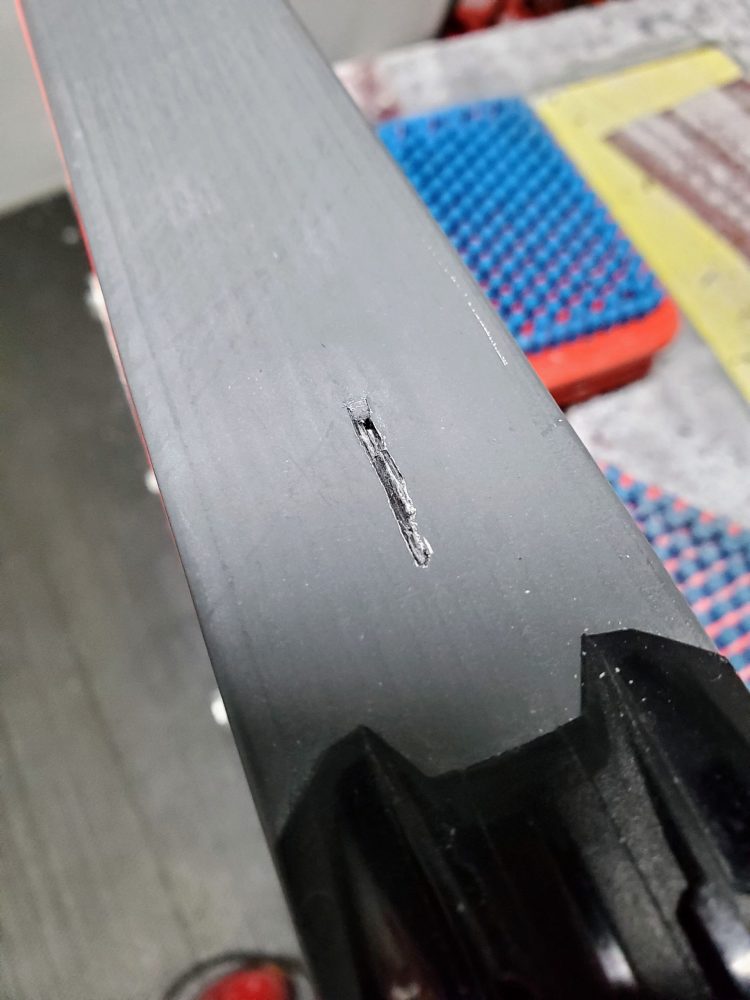
Then, in her quarterfinal heat — the first of a series of head-to-head knockout races — she tripped as soon as the starter’s gun went off. A closer look at her ski revealed she had poled directly onto it, punching through the top sheet.
A close up of the hole left by a bad pole plant at the start of Rosie Brennan’s freestyle sprint quarterfinal. (Photo: Nat Herz/FasterSkier-ADN)
Immediately, Brennan found herself 10 yards behind her five other competitors, a near-eternity in a race that lasts three minutes. The U.S. Ski Team’s cross-country director, Chris Grover, was watching from the side of the trail.
“I was like, ‘Okay, that was one of our best shots, and her day’s over,’” he said.
Ironically, Brennan said she’d been practicing her sprint starts for the past six weeks with help from her boyfriend Tyler Kornfield, a former national champion sprinter.
“The first thing on my mind was, ‘Tyler’s going to kill me, I just messed that up so badly,’” she said. “But then I had to be like, ‘Well, the start can be his thing, the uphill’s my thing. So let’s go.’”
She did. Brennan picked herself up and went in such fierce pursuit that she’d reeled in the pack on the first hill, then managed to place second in the heat — a performance Grover described as “nothing short of miraculous.”
In her next heat, a semifinal, Brennan was stuck racing against Jonna Sundling and Maja Dahlqvist, the two Swedes who went on to win gold and silver medals. The heat was scorching fast, but Brennan skied well enough to advance.
That put her in the final with Diggins, where Brennan didn’t quite have the speed to match her teammate and the two Swedish women. Grover, the coach, said Brennan was likely paying the price for the two big efforts she’d made in the previous heats.
“She had to really lay it out so much in the quarterfinal. She didn’t have the best semifinal,” he said.
“For her to regroup and still be fourth in the final,” he added, “is really amazing testament to what her fitness is.”
While it was tantalizing to be so close to an Olympic medal, both Grover and Brennan said her result gives her a shot of confidence for upcoming races where she could also contend for hardware: two more distance events, a relay and a team sprint where Brennan and Diggins form a formidable pair.
Jessie Diggins (USA) and Rosie Brennan (USA) find their position in the early moments of the women’s final. (Photo: NordicFocus)
That mental boost is especially welcome, Brennan said, given what she described as a disappointing 14th-place result in Saturday’s Olympic opening event, the skiathlon.
“I feel like I’m back on track now, and this is where I want to be,” she said. “So, I have a lot of hopes for the rest of the week, too.”
And while Brennan may have to grapple with the mixed emotions of an Olympic fourth place, her teammates were free to offer some unrestrained enthusiasm.
“This quote is your reminder to never sleep on Rosie Brennan. Never sleep on Rosie Brennan,” said Luke Jager, one of her teammates at the Alaska Pacific University club who also raced Tuesday. “She persevered and grinded. She had some tough years there, I know. But she made it happen, and it’s really amazing.”
This World Cup coverage is made possible through the generous support of Marty and Kathy Hall and the A Hall Mark of Excellence Award. To learn more about A Hall Mark of Excellence Award or to learn how you can support FasterSkier’s coverage please contact info@fasterskier.com.
The History:
A survey of the last five Olympic cycles shows a clear trend in American women’s sprint results: upward. In the 2002 Games in Salt Lake City, no Americans qualified in the freestyle sprint. Tessa Benoit was the top qualifier in 38th, with an up-and-coming Kikkan Randall next for Team USA in 44th. Randall was then 20 years old.
In the freestyle sprint four years later in Torino, Randall was the only American to qualify for the heats. She was 10th in qualification, then moved to 9th in the final standings. Switching to classic for the 2010 Games in Vancouver, Randall again qualified in 10th to be the only American in the heats, this time racing her way up to eighth.
And then there was Sochi.
The 2014 Games in Sochi were a turning point for the American squad, with all four women qualifying inside the Top-30 in the freestyle sprint. This time, a new name topped the list for qualification: Sophie Caldwell in 9th. Not to be overlooked, USA also had Jessie Diggins 12th, Kikkan Randall 18th, and Ida Sargent 25th.
Racing in her first Olympiad, Caldwell (now Hamilton) entered uncharted territory as she won her quarterfinal to advance into the semis, which she finished in a thrilling boot slide to be 0.1 seconds behind heat winner Ingvild Flugstad Østberg of Norway. Though she crashed in the final, she again moved the needle upward for the Americans by finishing sixth in the final heat.
The remaining American women also finished inside the Top-20, though none made it beyond the quarterfinals. Diggins was 13th, Randall 18th, and Sargent 19th.
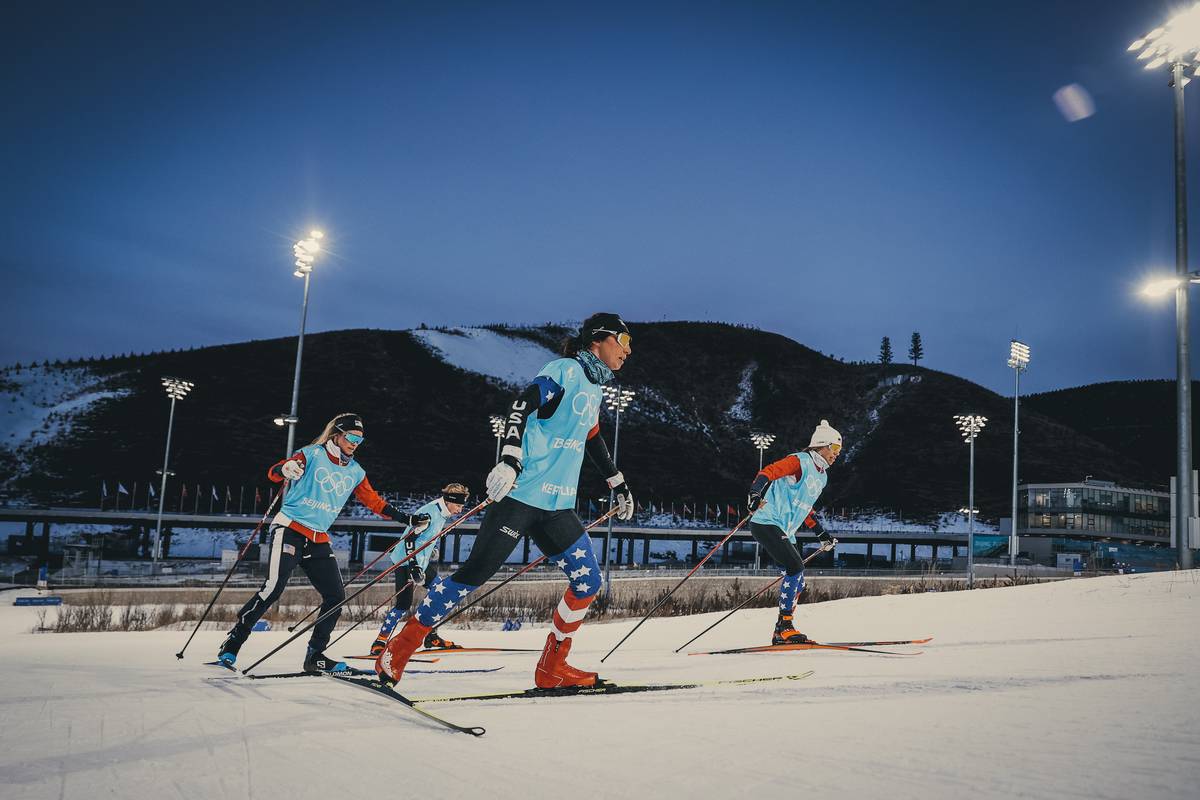
The American women’s sprint team prepares for the individual freestyle sprint. (Photo: NordicFocus)
Carrying momentum from these Games through the next Olympic quad, the Americans had three women in the Top-30 for the classic sprint in PyeongChang in 2018, with Sargent just outside in 33rd.
This time it was Diggins in 7th – the top Olympic qualification result of any American woman – with Sadie Bjornsen 9th, and Caldwell 12th.
Despite it being her weaker technique, Diggins raced with confidence, landing in second in both her quarter and semi to advance automatically into the final. Losing touch with the leaders, Diggins repeated Caldwell’s historic result to finish 6th overall.
Perhaps a less apparent victory, Caldwell also raced into the semis, finishing 8th overall after taking third in her semi and missing a lucky loser spot in the final by just 0.18 seconds. Bjornsen was eliminated in her quarter after taking third in her quarter, on the wrong side of the lucky loser mark, but just barely, to end her day in 14th.
Fast forward four years and get excited.
Rosie Brennan (USA) on her way to the 2nd fastest time during qualification. (Photo: NordicFocus)
Sweden’s Jonna Sundling smashed the qualification round of the 1.5-kilometer freestyle sprint, setting the mark at 3:09.03. The next name on the list? Rosie Brennan in second (+5.80), ahead of Nadine Fähndrich (SUI) in third (+6.62), Yulia Stupak (ROC) fourth (+7.98), and… Diggins in fifth (+8.69).
Have you been reading closely? Both Brennan and Diggins both exceeded the previous best result in qualification from any American woman in history.
Also posting a strong qualifier, Julia Kern was 14th in qualification (+11.66), rebounding from Saturday’s skiathlon which left her wanting more. The final American starter, Hannah Halvorsen, finished 43rd (+20.10) in qualification – outside the Top-30, but still above Randall’s result from her first Olympic Games 20 years ago.
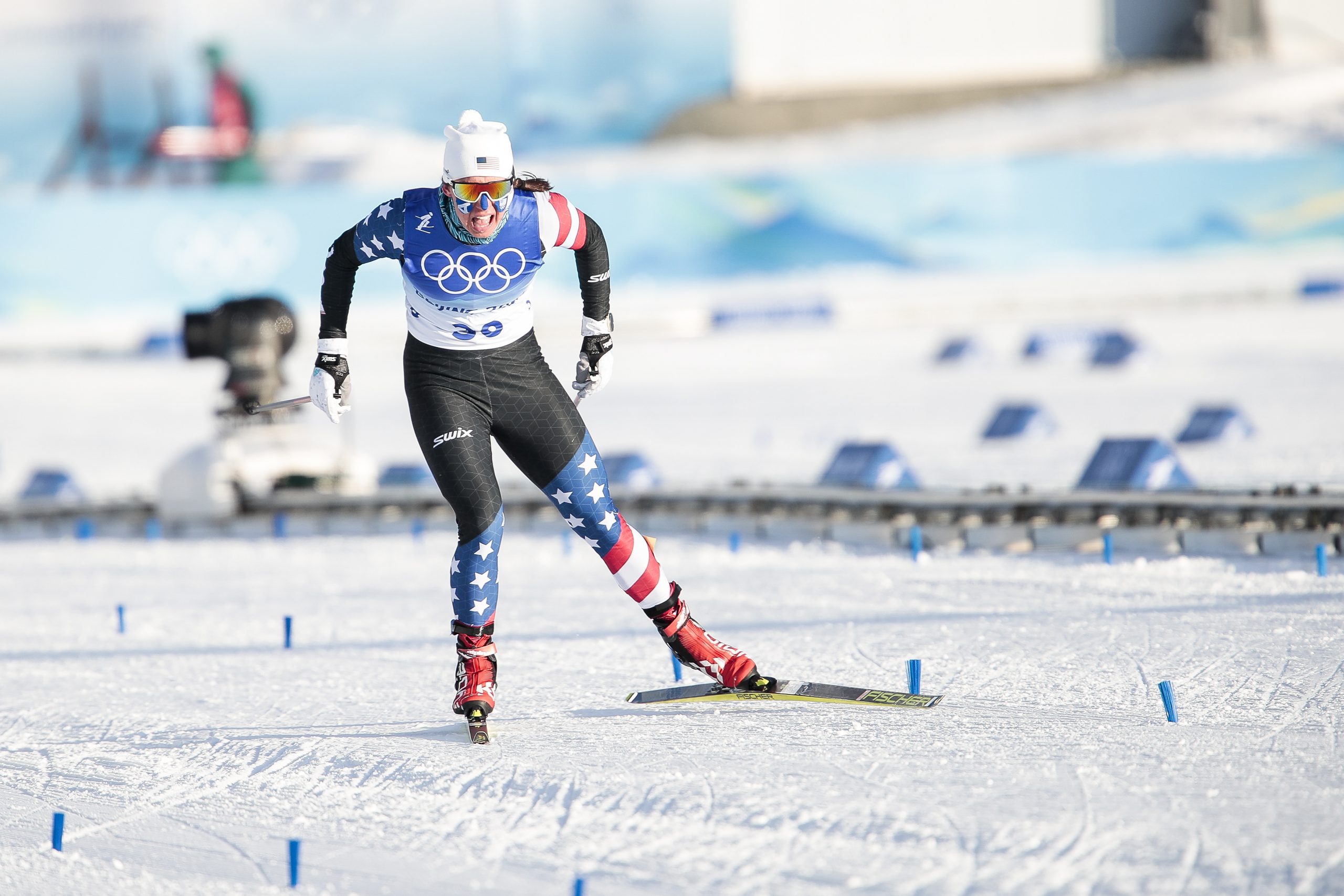
Jessie Diggins (USA) skis the 5th fastest time during qualification. (Photo: NordicFocus)
You may be wondering about the spread of times; the top-10 were nearly 11 seconds apart. After a quick descent out of the stadium, the course in Zhangjiakou features a 30-meter climb – nearly 100 vertical feet – followed by a sweeping downhill that leads back toward the stadium. From there, athletes face a 14-meter climb back into the stadium, finishing with a gradual rise to the line. Combined with cold dry snow, these factors can contribute to an above-average spread amongst the top qualifiers.
Here we go: the heats.
Brennan lined up alongside Sweden’s Sundling in the first quarterfinal heat. With nerves running high, a false start brought the six women back into the gate after the first starting beep. On the second go, the women pushed through the wands cleanly, but on one of her first doublepole pushes, Brennan caught the edge of her boot, dropping down to her knees and losing any momentum she had picked up as the field rocketed away from her.
Not willing to let the day end there, Brennan collected herself and focused on the task at hand, regaining contact with the group at the bottom of the climb and grinding her way into second position, looking strong as she crested the top of the hill just behind Sundling and rounded the curve to head into the descent.
After stumbling out of the start, Rosie Brennan (USA) charges back to the front of her quarterfinal heat. (Photo: NordicFocus)
Given the effort required for such a comeback, would there be enough left in the tank for the B-climb or had the matches been burned early? With Sundling holding steady in the lead Brennan was challenged by Slovenian sprint champion Anamarija Lampic as the women pushed up the final climb, but found another gear for a commanding second-place finish, +2.4 behind Sundling, but +0.7 ahead of Lampic, who would advance as a lucky loser.
The second heat featured medal favorite Maja Dahlqvist of Sweden, who qualified in sixth. Norway’s Tiril Udnes Weng set the pace, leading up the A-climb with Dahlqvist alongside, and Russia’s Natalia Nepryaeva on their tails. Powering out of the B-Climb, Dahlqvist held the advantage at the front, while Nepryaeva and Weng slid over the line in a photo finish for second and third. A closer look showed Weng’s boot accelerate as she reached forward, just in time to nip Nepryaeva at the line by 0.03 seconds for the automatic advancement to the semifinal. The second heat was six seconds slower than the first, leaving Nepryaeva out of the running for a lucky loser spot.
A fast third heat saw Nadine Fähndrich of Switzerland and Maiken Caspersen Falla advance automatically, pulling Germany’s Victoria Carl over the line as the second lucky loser.
Dancing and smiling in the start gate, Diggins got out with a clean start, positioned near the front and looking powerful as the women headed into the downhill curve out of the stadium. Around this curve, she was pushed to the outside as she skied defensively to dodge potential snags with the other skiers’ equipment, leaving the curve near the back of the pack.
Jessie Diggins (USA) leads Emma Ribom (SWE) in the early rounds. (Photo: NordicFocus)
Then, Diggins put on a show up the climb. Steadily moving up along the outside, she was perfectly balanced in a crisp V2 while other were in V1, catching the Swedish leader Emma Ribom. Leading over the top, Diggins kept the pace high to take the sting out of other sprinters. Carrying momentum out of the descent and again holding a strong V2 up the B-Climb, Diggins carried her lead through the finish to win by over 2 seconds, with Ribom next. There was no doubt that Diggins was looking good heading into the semi.
In the final quarter, Julia Kern pushed the pace in the first half, positioning herself in the lead as the pack headed out of the climb. She held her position through the downhill and around the hard right turn, carrying momentum into the hill. Perhaps paying for her efforts early on, Kern was dropped on the final climb as Veronika Stepanova (ROC) and Sofie Krehl (GER) broke away before heading into the stadium. Kern kept herself in the fight, staying in contact with Alina Meier (SUI) through the false flat to the finish, but ended up fourth in the heat, +3.5 back from the leader and behind the mark needed for a lucky loser spot in the semis. A gusty and tactical performance in her first Olympic sprint appearance.
Julia Kern (USA) led her quarterfinal early during the individual freestyle sprint. (Photo: NordicFocus)
To regroup: we now have two Americans in the semi, matching the previous best result from 2018.
Lining up in the first heat of the semis, Brennan got out of the start smoothly, tucking into the back of the back to safely descend out of the stadium and carry momentum out of the left-hand bend and into the A-climb.
Following the effective, albeit unforeseen, strategy from her first round, Brennan pushed her way up the A-Climb, moving from sixth place into the lead. The American kept the effort high as she pulled Sundling, Dahlqvist, Fähndrich. Brennan charged the downhill, stepping powerfully around the right hand bend to head into the B-climb at high speed. In the second climb, the two Swedes, Sundling and Dahlqvist, worked their way around Brennan, with Fähndrich also accelerating. No relief until the finish, Brennan did not let up in the undulating terrain that follows the B-climb, rounding the final curve in fourth place just behind Dahlqvist.
After setting a fast pace for the heat, Rosie Brennan finishes fourth in her semifinal to advance as a lucky loser. (Photo: NordicFocus)
Sundling stretched out the spread of the top-four in the final stretch to take the win in 3:11.94, with Fähndrich second, Dahlqvist third, and Brennan fourth, +1.35 behind Sundling. Brennan’s efforts to keep the pace hot contributed to a lightning fast heat, with Sundling’s time nearly four seconds faster than the top finish in the quarterfinal. This left Brennan in good standing for a lucky loser spot in the final, but she would need to hold her breath to see what the second heat would decide.
The second semi was quick out of the gate, with Sweden’s Ribom leading up the start of the A-climb. Diggins was comfortably tucked into the pack, beginning to set her race plan into action as she V2ed steadily up the side of the track, holding her form longer than the others as she moved into the lead. Nearing the high point, Diggins switched to a rapid tempo V1 with Norway’s Falla matching pace to head out of the climb in first and second.
Diggins sat in a low tuck at the front, stepping around the sweeping left-hander and heading into the B-Climb with Ribom and Falla trying to match pace and challenge at the front. Ribom moved ahead near the top of the climb to lead into the final curve. Diggins sat on the Swede’s tails, with Stepanova alongside. A bobble zapped some of Diggins’ momentum and could have been devastating, but the American kept her composure and stayed upright, staying in contact with Ribom as they headed into the finish lanes.
With Ribom in the lead, Diggins powered toward the finish line to secure a second place auto-qualifier spot for the final. She crossed the line +0.4 behind Ribom’s mark of 3:15.22, with Falla and Stepanova crossing in third and fourth a few meters back.
As the second heat times were roughly four seconds slower than the first, Brennan could let out a sigh of relief. The second lucky loser spot was now hers.
And now, we watch history unfold. Two American women in the final, as Brennan and Diggins set a new mark for the stars and stripes.
The final lineup saw Sundling, Dahlqvist, and Ribom racing for Sweden, alongside Diggins and Brennan, with Fähndrich representing Switzerland in red.
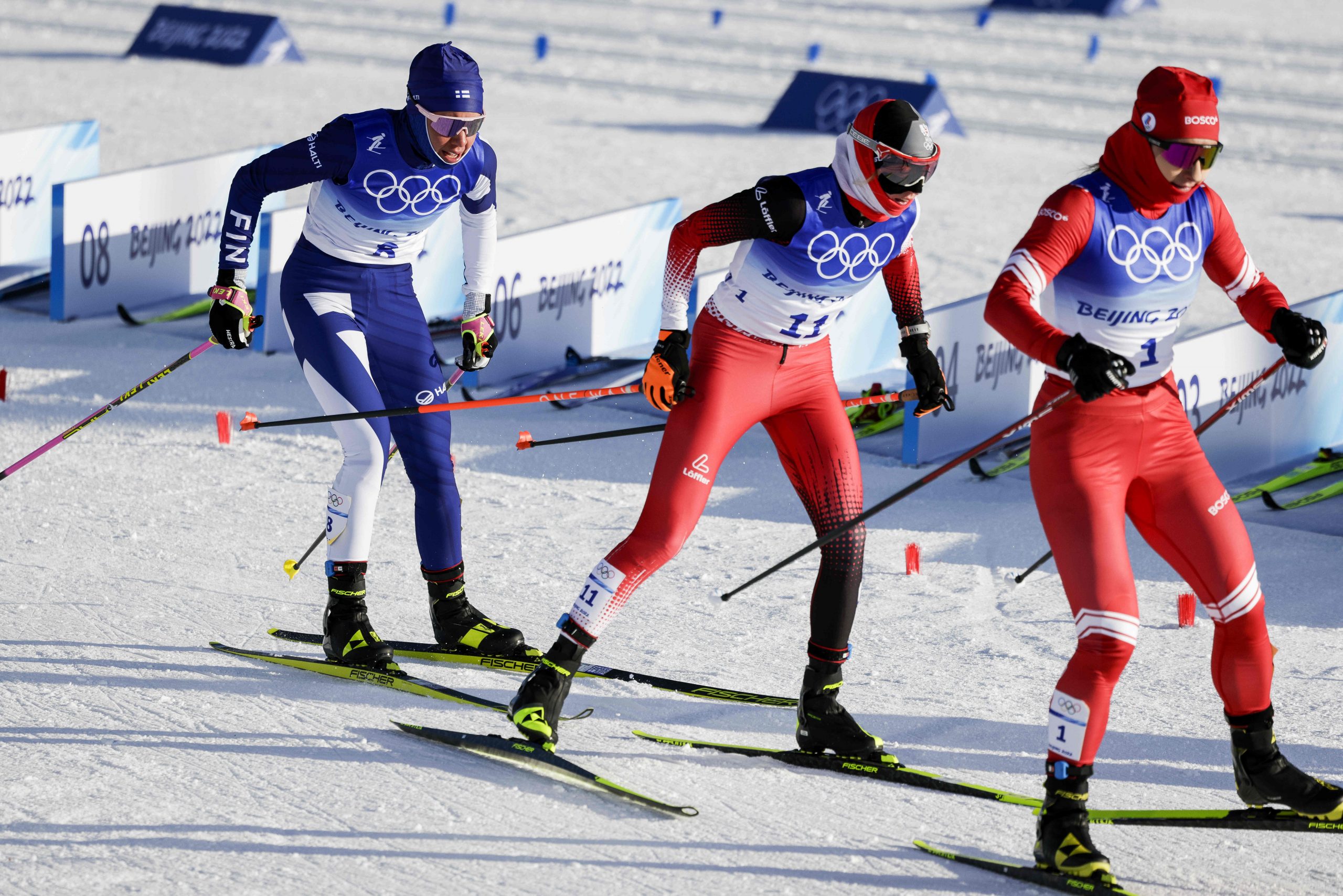
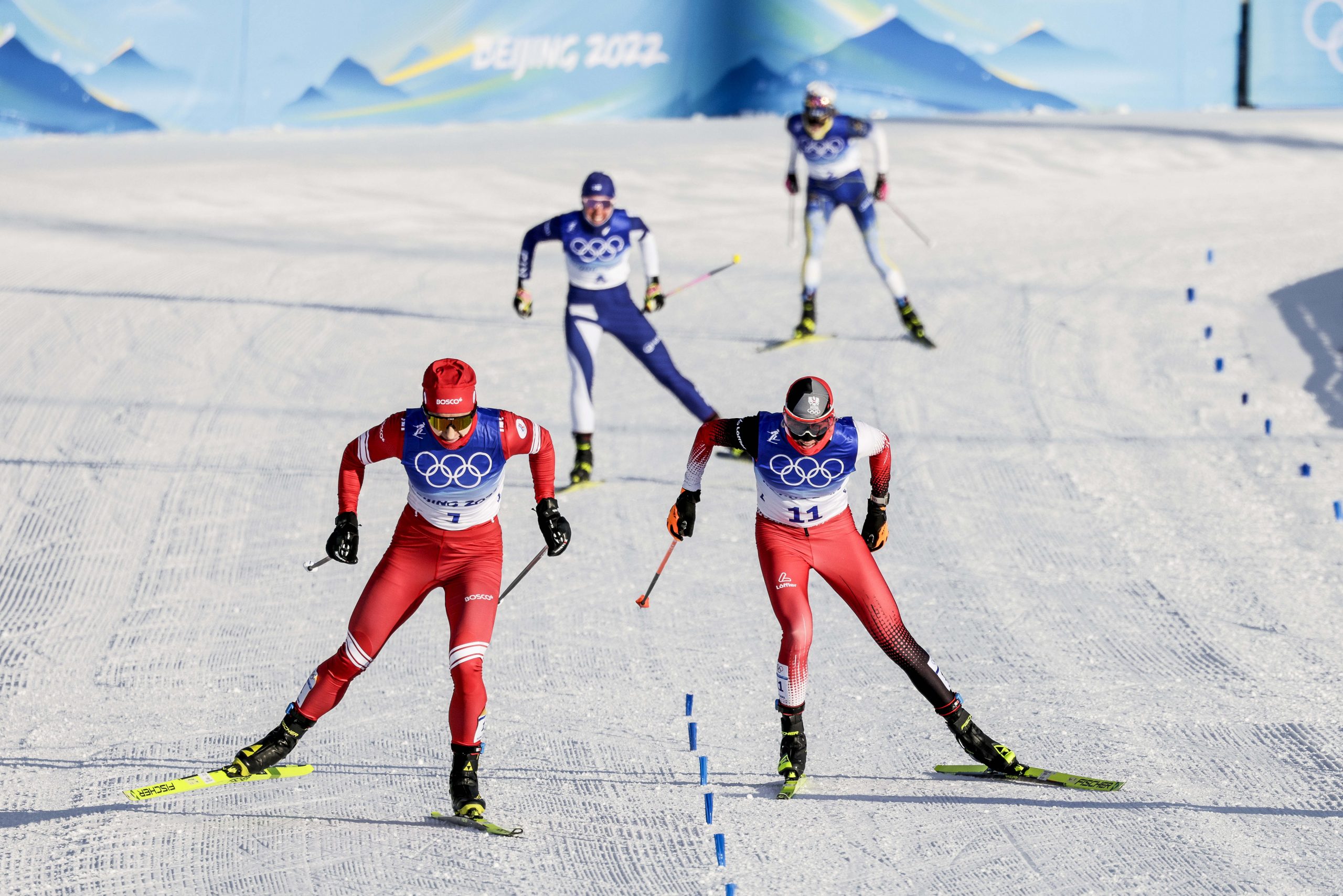
Emma Ribom (SWE), Nadine Faehndrich (SUI), Rosie Brennan (USA) and Maja Dahlqvist (SWE), (l-r) get up to speed at the beginning of the women’s individual sprint final. (Photo: NordicFocus)
Taking charge from the start, Sundling skied with authority, smoothly leading her teammates Dahlqvist and Ribom up the A-climb to put Sweden in first through third heading out of the climb. Diggins was fourth as they crested the high point, with Fähndrich on her tails and Brennan just behind.
Utilizing the speed of her skis and her strength in the downhill, Diggins moved up alongside the Swedes in the descent, looking for position heading into the final climb. Maintaining her command of the race, Sundling rocketed off the front to gap the remaining five women who all remained in contention for a medal leaving the climb.
Ribom quickly fell off the pack, leaving Dahlqvist leading a tight group of four over the undulating terrain that led to the final bend before the stadium. Diggins and Brennan looked to be boxed out as they headed around the final curve in third and fourth, respectively, but the Americans were patient versus panicked, which could put them at risk of a fall.
Coming out of the curve, Diggins accelerated around Fähndrich to challenge Dahlqvist for the silver medal. Brennan followed her teammate to surge past the fading Swiss athlete, setting the stage for a three-way sprint for two podium positions.
Sundling had gold on lock, nearly three seconds ahead as she crossed the finish line in 3:09.68.
Jonna Sundling (SWE) with a commanding victory in the individual freestyle sprint comes to the finish with Rosie Brennan (USA) in the background on her way to fourth. (Photo: NordicFocus)
In her wake, Dahlqvist and Diggins were taking it to the line, with the Swede carrying a slight advantage in the final meters. Still, with Brennan close behind and both Fähndrich and Ribom off the back, the Americans were almost guaranteed their first individual medal in history.
Skiing their fastest splits of the day, Dahlqvist held her ground to the silver medal (+2.88), with Diggins on her right, less than a ski length back for bronze (+3.16).
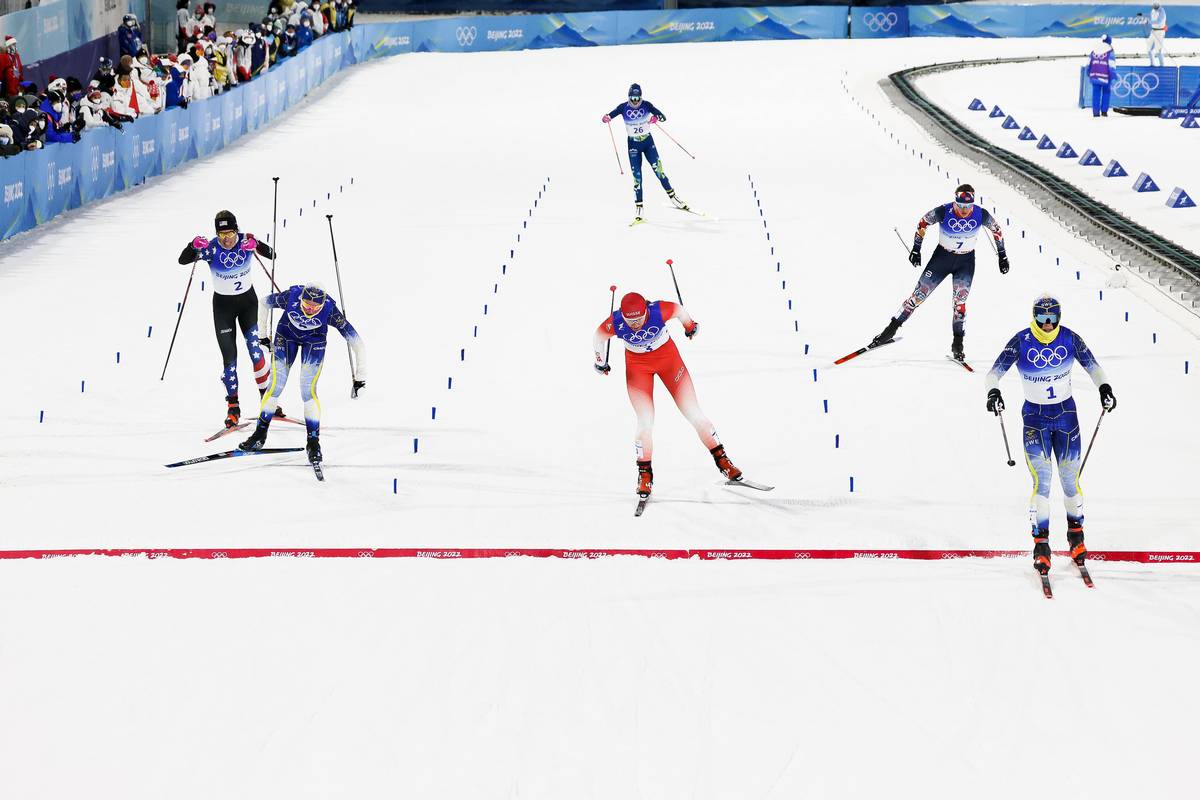
Jessie Diggins crosses the line in third to earn the first individual Olympic medal in women’s cross country ski history. (Photo: NordicFocus)
Just over a second back, Brennan crossed fourth (+4.49), for the second best individual finish in American women’s history. The Americans maintained a gap to Fähndrich in fifth (+7.21) and Ribom sixth (+11.11).
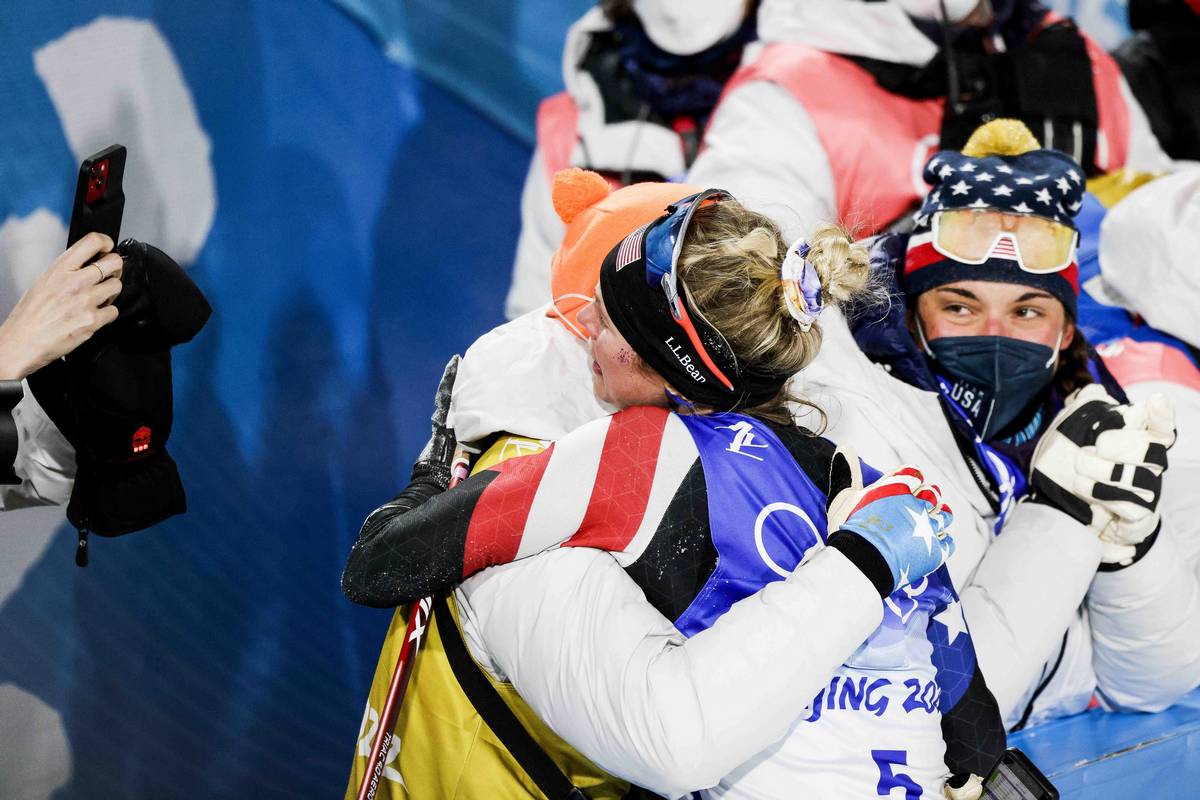
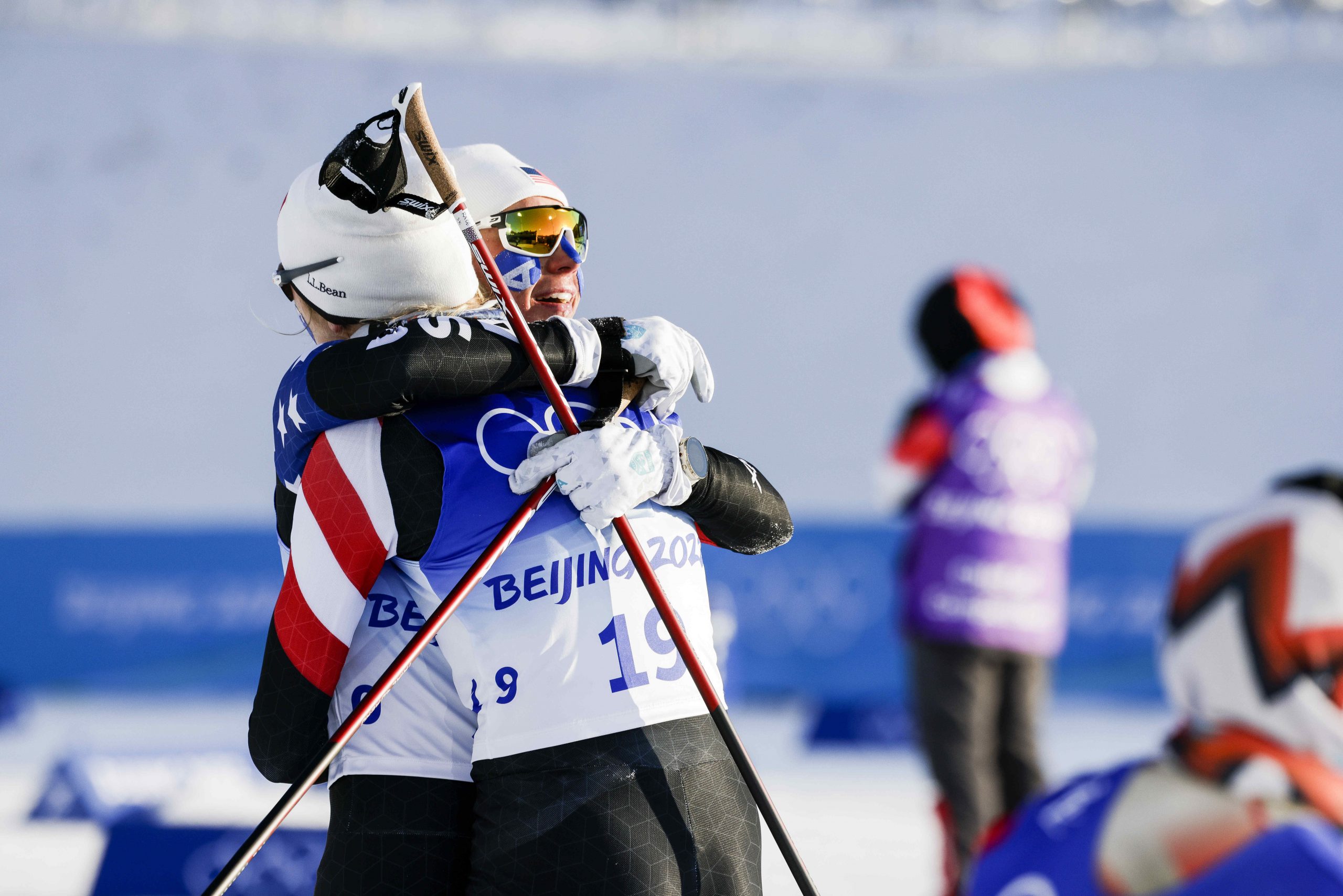
Diggins collapsed to the ground, overcome by the emotion of what she had accomplished. Perhaps a testament to her team-centric approach, she was heard saying, “Good job, Rosie!” between gasps, as she got back to her feet to immediately hug the coaches, support staff, and teammates that lined the edge of the course.
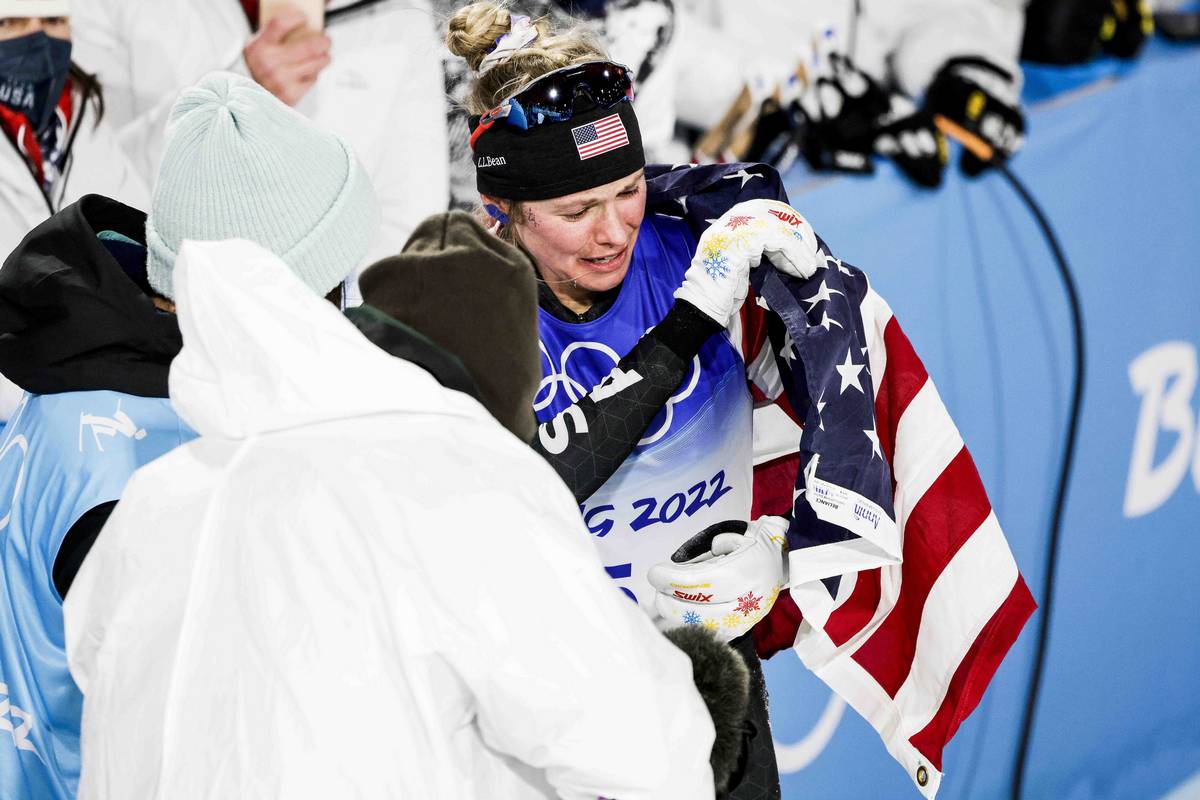
Jessie Diggins hugs her coaches and teammates after finishing third in the individual freestyle sprint in Zhangjiakou. (Photo: NordicFocus)An emotional Jessie Diggins wraps the American flag around her shoulders after taking bronze in the freestyle sprint. (Photo: NordicFocus)
Tearfully wrapping an American flag around her shoulders, Diggins was aglow as she savored the moment before heading back to the finish to stand alongside Sundling and Dalhqvist for the podium shot.
Jonna Sundling (SWE) takes gold in the freestyle sprint, ahead of Maja Dahlqvist (SWE) and Jessie Diggins (USA). (Photo: NordicFocus)
Though she was the one whose name would be highlighted in history books, Diggins focus on the importance of those around her remained at the forefront as she celebrated the many victories of the American team in today’s event.
“It was so cool to be there with Rosie,” Diggins said in the mixed zone. “She’s skiing so amazingly well… and I’m just so grateful. That’s the overwhelming emotion, because it takes so much from such a huge team to make this happen. And we had obviously amazing skis, but also amazing teammates for years and years and years, helping me train, pushing me, supporting me – amazing coaches, amazing volunteer staff. You can’t even imagine how much it took from so many people, and so I’m just so thankful because I feel like this medal belongs to about 1000 different people. And I hope they really feel that and know that.”
Jessie Diggins takes Olympic bronze in the freestyle team sprint. (Photo: NordicFocus)
Of her approach to the course, Diggins gave a simple response, acknowledging that she has a way of blacking out while having great races, “which is really annoying,” she laughed, “because I’d love to be able to remember exactly what I did.”
“I was just so focused on trying to push as hard as I could,” Diggins explained. “Just trying to ski as well as I could and stay balanced. The snow felt a little greasy, so especially in the finishing lane, just trying to put as much power as I could into every single push. And honestly, that’s all I can remember.”
Jessie Diggins (USA) on her way to the USA’s first ever individual women’s medal in the Olympics. (Photo: NordicFocus)
Perhaps the FasterSkier audience needs no reminder that Diggins came into the 2022 Games as a gold medalist, having won the freestyle team sprint with Kikkan Randall in 2018, a day that brought many Americans, including this writer, to tears. Diggins was asked to reflect on the last four years, and the progress she’s made in her career.
“The last four years, I’ve really found my voice,” Diggins said confidently. “I’ve really found a lot of my purpose, and I feel like I’ve grown a lot. But also, I’m exactly the same person in pretty much every other way. I think one of the big things has been dealing with is the pressure and expectations, because there’s been a lot of it, and it hasn’t been easy. So for me, I think it was such a victory just to make it to the final and know that I’m skiing well. I came into this as prepared as I could be, which one of my biggest goals was to come in prepared. The second goal, cross the finish line with nothing left. And the third goal was to just have fun, and keep focusing on the process, because that’s what gets me where I am today. Like win, lose, or draw, it’s just focusing on the process and, and executing those process goals to the very best of my ability, because then I’m always proud of how I finished. I’m just proud of this effort today as I was at the skiathlon, even though they were different outcomes.”
Jessie Diggins was all smiles as she passed through the mixed zone following her bronze medal performance in the women’s individual sprint. (Photo: Nat Herz/FasterSkier-ADN)
Fourth place at the Olympics – fourth in the world on its most prestigious stage – is both a truly incredible feat and perhaps the most challenging final rank to wrap one’s head around. The “wooden medal”, just shy of the Olympic hardware skiers dream about from their youth.
“Fourth place was hard,” Brennan said honestly in the mixed zone. “You feel really happy and also frustrated at the same time. I have a lot of mixed emotions about it. But I did everything I could today, and maybe not everything went perfectly my way. But I have to be happy with that at the end of the day.”
Jessie Diggins (USA) and Rosie Brennan find their position in the early moments of the women’s final. (Photo: NordicFocus)
Asked what she would have said if four years ago, someone told her she would be in this position, Brennan laughed, “I probably wouldn’t have believed it so much.”
She talked through a rough start to the day, sharing that she has always struggled with start gates and had spent the last six weeks practicing to ensure a clean start.
“So, there I was on the ground, I was like, ‘So much for all that practice.’ But I knew my strength was in the climb, so I just had to pull it back [together] and focus on the all the time I had left and see what I could do to try and make it up.”
On her approach through the heats, Brennan played to her strengths, recognizing she could take the lead, work the hills, and not let her heats unfold as a casual first 1200 meters with a tactical final sprint that might leave her in the dust.
“My strength lies more in the endurance aspect of it,” she explained. “I tried to just keep the pace high so that I could count on being a lucky loser – by having a fast heat time. So that was my strategy in the semifinal, and it worked. Once I got to the final, I tried to then be a little more smart about my racing. I tried to be patient and wait until the last climb. I was a little far back, so I kind of got the door closed on me to make it through. So I had to kind of adjust and go for a strong finish sprint, which isn’t always my strength. But I did all I could do.”
With Ben Ogden racing into the semis in the men’s race, it was an historic day for the American program as a whole. Speaking to this landmark day, Brennan concluded with an inspiring message for those who dream of following in their footsteps.
“I think it shows the growing depth in our country. And I hope it shows a lot of people just to have some patience and keep training, keep going for it. You never know where you’ll end up.”
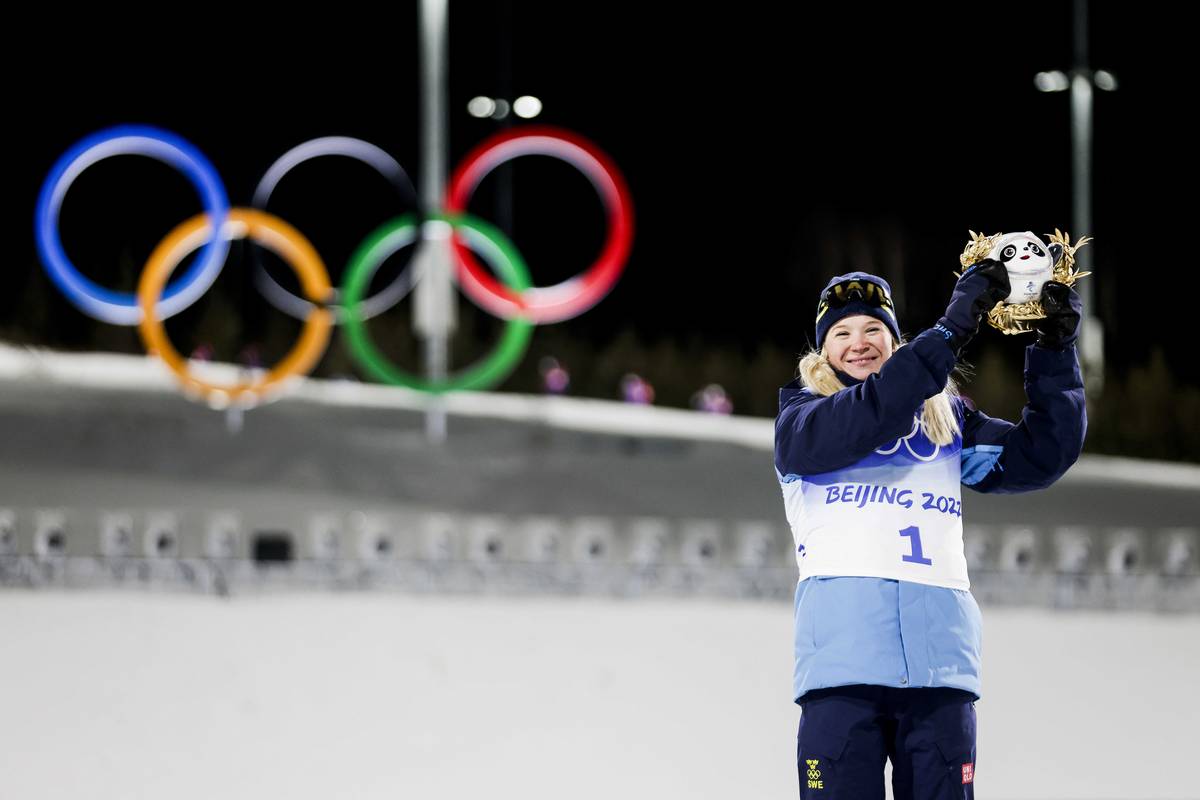
Jonna Sundling (SWE) takes gold in her first Olympic appearance in the women’s freestyle sprint. (Photo: NordicFocus)
Taking a closer look at the winner, Sundling is the 2018 World Champion in the freestyle sprint. Returning from injury, she has built her way into the season. Though Dahlqvist has shined as the undefeated World Cup star for Sweden, Sundling has crept up alongside, taking second to Dahlqvist in the individual sprint in Dresden, and working together to win the team sprint. Sitting out the Tour de Ski, Sundling beat Dahlqvist in their next matchup in a Scandinavian Cup race in Falun, Sweden.
This is Sundling’s first Olympic appearance, though she and Dahlqvist will be a likely pairing in the classic team sprint next Wednesday.
Once the final rounds were complete, Kern’s final placement was determined to be 18th. This marks a significant step forward from her first appearance in the skiathlon, where she finished 53rd.
Julia Kern (USA), who finished in 18th place overall, pushes to the finish during her quarterfinal round. (Photo: NordicFocus)
“It was really tough out there, but a lot of fun to have a challenging course and give it my all,” Kern told FasterSkier in the mixed zone.
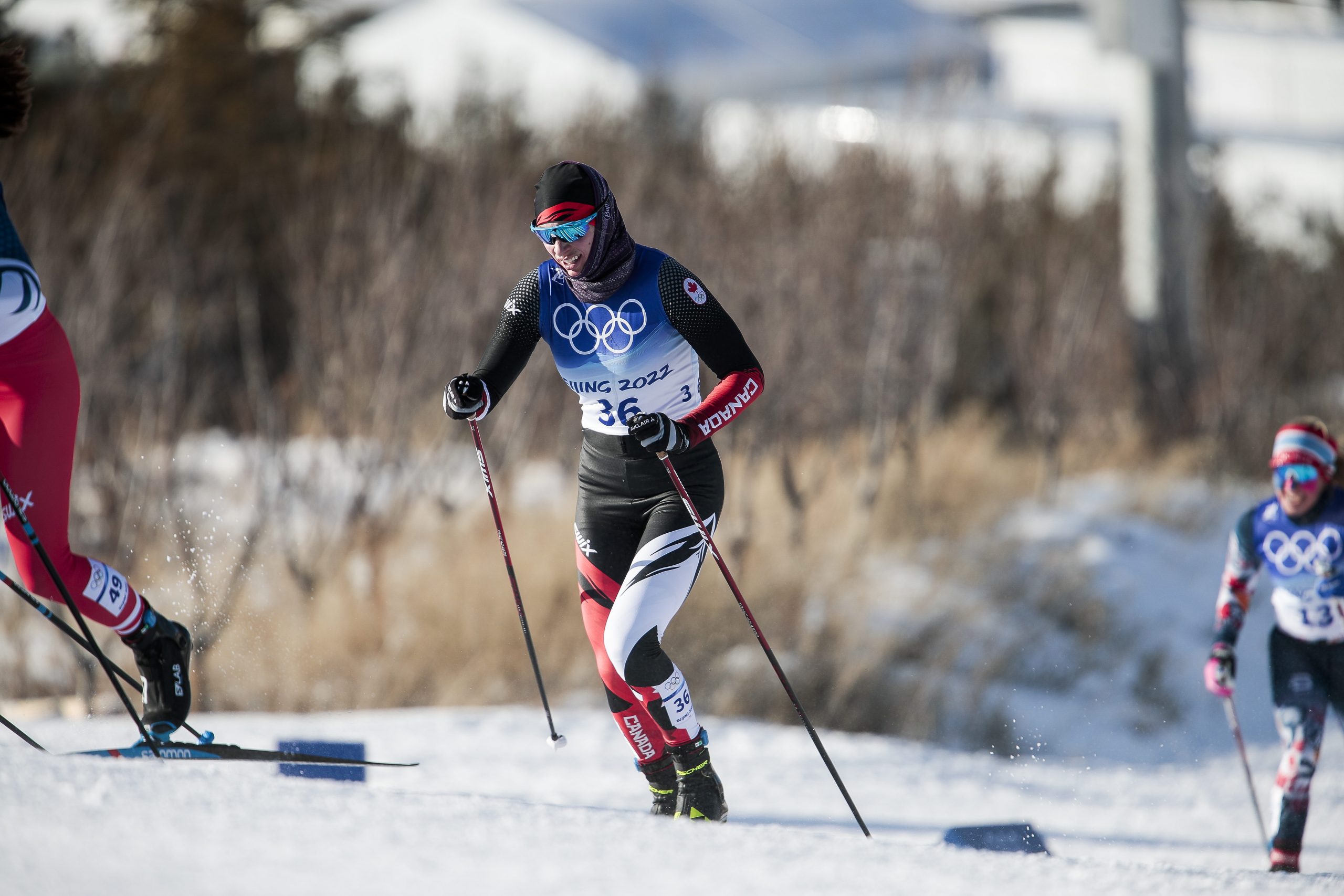
Dahria Beatty 28th in qualification (+14.51) to be the only Canadian woman to make the heats. Beatty raced in the first semifinal, where she finished fifth in the heat to finish 25th on the day.
Just 0.7 seconds off the top-30 mark, Cendrine Browne was 35th in qualification (+15.82) with Olivia Bouffard-Nesbitt close behind in 40th (+16.89). Laura Leclair rounded out the Canadian team in 58th (+26.28).
Dahria Beatty (CAN) races in the quarterfinals on her way to 25th place overall. (Photo: NordicFocus)
An Australian dual citizen who is a long-time APU team member, Jessica Yeaton was 52nd (+23.82) in the qualifying round.
Here’s Nat and Devon breaking down (and celebrating) an historic day for the U.S. A bronze medal for Jessie Diggins stands as the highlight – she’s the first American woman to win an individual medal – but there were several other steps taken forward by the men and women wearing stars and stripes.
In particular, Rosie Brennan popped the second fast time in qualification. Overcoming a bad pole plant-induced fall in her quarterfinal, she powered through to take second (to the eventual winner), building momentum each round to finish 4th, just meters behind Diggins .
Ben Ogden races the quarterfinal of the men’s freestyle sprint during the 2022 Beijing Olympic Winter Games. (Photo: NordicFocus)
And you’ve got all four American men – also a record – in the Top-30, and Ben Ogden skiing into the semis to finish one second behind Pellegrino and Klæbo, landing in 12th as the top American men’s sprint finish in history.
So much more. Thanks for listening.
After stumbling out of the start, Rosie Brennan (USA) charges back to the front of her quarterfinal heat. (Photo: NordicFocus)
China’s Degen Chen races the men’s 30-kilometer skiathlon which opened the 2022 Beijing Olympic Winter Games. (Photo: NordicFocus)
Salmon for Skiing
Over the last four years China has undertaken perhaps the grandest experiment in cross country skiing history: can hundreds of athletes cherry picked from other sports and given seemingly unlimited resources be turned into Olympic medalists in nordic events?
Chinese athletes have never medaled in any of the nordic disciplines, and their teams head into the Olympics as the darkest of dark horses. Success, in the form of medals, is key to their aims of climbing up the medal table and becoming the protagonists of their own winter Games.
The Chinese nordic programs have aimed to rapidly become competitive with the best in the world. The urgency of the task was made clear at the 2018 PyeongChang Olympics where China finished fourteenth in the medal count, capturing a single gold medal, and just nine in total.
Despite this history, not everyone is dismissive of their chances.
“I said four years ago that I predict these guys will medal in Beijing,” said US biathlete Clare Egan in a call, “because I know that medals are important to China and that they basically will put any resources possible into making things happen like that. So nothing would surprise me.”
Even so, Egan conceded that, “It’s going to be hard for them, because they aren’t fast enough.”
The project of building a culture of skiing in China began in 2015 when Beijing was awarded the 2022 Winter Games. The government spurred into action: it would make 120 million of its citizens into recreational skiers by building 800 new ski areas, among them the world’s largest indoor center in Harbin that cost $4.5 billion.
Cross country skiing also benefited from the investment rush, with an 1.3 k indoor ski tunnel built in Beishan, a joint Finnish-China project that cost $148 million. Another cross country ski tunnel is planned to be placed inside an unused coal mine shaft on the outskirts of Beijing. Liu Bo, a former ski coach, told Reuters in 2018 that he was investing $318 million in the project.
Bo explained in the interview that the goal for Chinese skiing, aimed at the Olympics, was clear: “China spends big money setting up the stage, and the performers are all foreigners,” said Bo. “President Xi will not allow this to happen.We have to be the leading actor in 2022.”
Xin Li (CHN) races a freestyle sprint qualifier in Konnerud, NOR in March, 2020. (Photo: NordicFocus)
While the ski resort boom was mainly aimed at creating a ski culture in China, taking on a starring role in Beijing meant that expertise would be needed from abroad. For guidance, officials looked to the top of the medal table: Norway.
Initially, it was impossible for China to work with Norway. When the Olympics were awarded to Beijing in 2015 the two countries were still embroiled in a diplomatic crisis that had severed official contact between the nations and frozen trade negotiations. The rupture occurred in 2010 when the Nobel Peace Prize was awarded in Oslo to Li Xiaobo, a Chinese human rights activist who was then imprisoned in China. At the Nobel ceremony, Xiaobo was evocatively symbolized by an empty chair on the stage.
In response, China all but severed diplomatic ties with Norway, despite the government’s lack of control over the Nobel committee. Two months later China halted the importation of fresh Norwegian salmon – a significant industry – over what was generally regarded as a politically motivated concern over a fish-borne virus.
The ban, as well as other restrictions, are believed to have cost Norway between $780 million to $1.3 billion between 2010 and 2017. At the time of the contentious Nobel ceremony, Norway had enjoyed a virtual monopoly over the Chinese salmon market, and the country’s fisheries had to watch as Chinese demand for salmon increased by thirty percent, while their share plummeted by two thirds.
Years of cautious steps by the Norwegian government followed, including its first ever refusal to meet with the Dalai Lama during his 2014 visit to Norway. Norway’s socialist left party leader Audun Lysbakken criticized this move in The Guardian, saying, “We can’t be dictated to by China in the sense of exchanging human rights for salmon.”
That fall, Oslo – the favorite for the 2022 Games – dropped out, paving the way for Beijing to win the bid the following summer. With the Games in hand, the calculus changed, and the rift with Norway became an awkward obstacle to their objectives.
A subtle indication of rapprochement came in an unusual way: Gerhard Heiberg, a Norwegian businessman headed the IOC’s Marketing Commission, and was offered a meeting on a 2016 trip to Beijing with the Chinese Minister of Sport, Gou Zhongwen.
The minister marveled at Norway’s success in skiing, Heiberg recounted to NRK, “He said that those at the top in China had agreed that they would like an agreement with Norway on a sports collaboration. And from the Chinese side, there was a desire to use Norwegian leaders, coaches, universities and so on who worked with winter sports.”
Heiberg recognized the moment. “I saw that here we have a fantastic opportunity to approach China.” Not wanting to waste the favorable winds, Heiberg left the meeting and “went straight to [Ambassador] Svein Sæther. And he lit positively on all the plugs.”
With some quiet maneuvering, relations thawed, and Norway and China signed a bilateral agreement to resume diplomatic relations in December 2016. The agreement conceded that Norway would not challenge China on its “core interests and major concerns” — a diplomatic term for avoiding involvement in sensitive issues, including human rights.
Dinigeer Yilamujiang (CHN) races a 10 k freestyle in Falun, Sweden in January, 2021. (Photo: NordicFocus)
That winter the Norwegian Ski Association was asked to help look for coaches to work in China and offered salaries of 1.1 million kroner (equivalent to $120,000) per year. China also wanted to send its athletes to Norway, but to do so, it would need to put to rest their feud.
In April 2017, Norwegian Prime Minister Erna Solberg visited Beijing, officially ending the freeze. Solberg reestablished the relationship in part by signing an agreement with China to support their sporting endeavors, particularly in nordic sports, through to the Beijing Olympics. The agreement would provide China with Norwegian ski coaches, training opportunities, as well as sporting development and snow making expertise. In return, Norway received the opportunity to optimize“Norwegian preparations for the Olympics.”
This deft piece of ski diplomacy helped to seal a seafood trade agreement with China the following month that planned to see Norway export $1.4 billion worth of salmon alone to China by 2025. The long awaited reentry to the Chinese market had arrived, and if there were any lingering questions about human rights, Per Sandberg, Norway’s Minister of Fisheries wasn’t having it. He told Aftenposten that “Norway addresses human rights in very many contexts… this time it’s fish.”
Ski diplomacy started with Stolberg’s agreement with China, and was reaffirmed the following year when King Harald visited China, signifying the complete normalization of relations while taking in a rollerskiing race at Beijing’s Olympic Park.
Despite the apparent connection between the sporting pact and the trade deals, the Norwegian Prime Minister denied the two items were related. In any case, the agreement caught the Norwegian Sports Confederation by surprise. Oddvar Jenssen, the former VP of the organization, said in an interview with Aftenposten that the decision “…came terribly fast, and a lot was in place before we knew anything. When the agreement came up, we had no choice.”
Misgivings aside, for Norwegian ski coaches, wax techs, and sport scientists, the Chinese agreement would turn into a major employment opportunity, with around 40 coaches and techs working for Chinese training groups, and around 60 more occasionally hired for short stints. No longer were the job opportunities going to be contingent on moving to China, the athletes would now be coming to Norway.
Arrival in Norway
The sporting agreement between Norway and China took on new force after China’s dismal performance in the 2018 Olympics. Afterward, the Chinese Ministry of Sport went looking for coaching help abroad. Many nations vied for contracts, but Norway was the first stop for Gou Zhongwen.
In May of 2018, Zhongwen met with Johannes Klæbo on his tour of Trøndelag – the region that has won more Olympic medals than any other – and solidified the agreement to bring athletes to Norway.
In July, ten of China’s core World Cup athletes arrived in Trondheim, Norway to begin training for the World Cup with former Montana State University skier Bernhard Rønning.
It was the prelude to an influx of more than 200 young Chinese athletes to Norway in the late summer and fall of 2018.
In addition to the Trondheim group, another was set up in Meråker, under the leadership of former Canadian National Team Coach Tor-Arne Hetland. In Lillehammer a group was led by Kristen Størmer Steira (wife of FasterSkier podcaster Devon Kershaw) and finally one in Trysil led by the mother/daughter combo of Anita Moen and Karoline Moen Guidon.
Anita Moen’s experience illustrates the slapdash nature of the project. In mid July of 2018 she was on vacationing on a beach when her phone rang. It was an offer to coach Chinese skiers until the 2022 Games.
“It was only two weeks until they were to arrive,” Moen told NRK “… I did not quite know who was coming, but I was told they had never skied before, never seen snow.”
Jincai Shang (CHN) races a classic sprint qualifier in Trondheim, NOR during Ski Tour 2020. (Photo: NordicFocus)
While China mobilized to send loads of athletes to Norway, their plans didn’t stop there. After Minister Zhongwen left Norway, he flew with his entourage directly to Finland. Waiting for him at the airport was Veiko Hallonen, the CEO of the Vuokatti Sports College.
Vuokatti offered excellent training opportunities: a long winter, a ski tunnel, knowledgeable coaches, and sophisticated technology that impressed the officials. Perhaps Zhongwen was also mindful of the warmer diplomatic climes in Finland. Ni Huizong, the Director of the Winter Sports Administrative Center told Yle, “Relations between Finland and China have a long and warm history.”
Chinese athletes had been training in Vuokatti since 2016, but the agreement established a permanent Chinese presence at the Vuokatti center and increased the total number of athletes that would stay in Finland.
The head cross country coach in Vuokatti at that time was Glenn Lindholm, who met with the Chinese delegation and was asked directly whether four years were enough to turn novices into Olympic champions. Lindholm’s response was neither yes nor no.
Lindholm must have understood the unlikely prospect of delivering medals by the next Olympics. Still, the project may have seemed crazy enough to work. Vuokatti was about to get more than 130 hand picked Chinese athletes, an almost unlimited pot of money to work with, and just under four years to produce a medalist.
It was audacious, and too bold to resist. As Lindholm and others would learn, realism, a pandemic, and decisions made in the halls of power of Beijing would frustrate their plans.
The first podium of the 2022 Olympic Games following the men’s 30 k skiathlon. Alexander Bolshunov (ROC) dominated the event for gold, ahead of teammate Denis Spitsov who took silver, and Iivo Niskanen (FIN) bronze. (Photo: NordicFocus)
This World Cup coverage is made possible through the generous support of Marty and Kathy Hall and the A Hall Mark of Excellence Award. To learn more about A Hall Mark of Excellence Award or to learn how you can support FasterSkier’s coverage please contact info@fasterskier.com.
On the heels of the women’s opening Olympic race, a colorful lycra field in their Sunday best lined up to race the men’s 30-kilometer skiathlon. While the women raced a four-lap 15 k event, men faced double the distance – over 75% longer by finish time – though they were greeted by much more favorable weather. It was sunny, still, and clear. Classic tracks were crisp and firm, and the familiar sound of poles powerfully planting and pushing off from cold snow, akin to the blasters of Storm Troopers in the classic Star Wars films, was not obscured by wind ripping through the stadium.
A quick nod to the start list for North American fans: Scott Patterson and Gus Schumacher were the only men racing in stars and stripes today, while Olivier Léveillé, Antoine Cyr, and Rémi Drolet raced for Canada.
Athletes take to the course for the men’s 30-kilometer skiathlon, the opening event of the 2022 Beijing Olympic Winter Games. (Photo: NordicFocus)
To review the last two Olympiads, the 2018 Games saw a Norwegian sweep of the skiathlon podium, with Simen Hegstad Krüger breaking away to win gold by eight seconds ahead of his teammates Martin Johnsrud Sundby and Hans Christer Holund. After testing positive for COVID-19 shortly before his scheduled departure for Beijing, Krüger is currently riding out his quarantine in a hotel room, resolutely training on a spin bike in hopes of making it to the 2022 Games in time for the final event, the men’s 50 k freestyle. Sundby retired from World Cup level racing after the 2021 World Championships in Oberstdorf, Germany, in which he earned an auto start as the reigning champion in the 15 k classic. This season, Sundby raced a series of marathon and longer races in Italy during January. This leaves only Holund returning to the Olympic skiathlon in 2022.
In 2014, it was a dog fight to the finish, with Dario Cologna of Switzerland taking gold by just 0.4 seconds over Marcus Helner of Sweden. Near the peak of his career, Norwegian powerhouse Sundby was one second behind Helner in third.
Athletes take to the course for the men’s 30-kilometer skiathlon, the opening event of the 2022 Beijing Olympic Winter Games. (Photo: NordicFocus)
Over the first 15 k of classic racing, two names that have not yet been mentioned, from countries who have not been on the podium in the last two Olympic competitions, pulled away from the field. Leading the charge was the king of the 15 k classic, Finland’s Iivo Niskanen. Niskanen has won seven World Cup 15 k classic events, including a grueling race through falling snow in Lenzerheide, SUI at the beginning of the 2021/22 Tour de Ski. The Finn was second to Johannes Høsflot Klæbo (NOR) a week later in Val di Fiemme, ITA, near the other end of the Tour.
On Niskanen’s tails over the first four laps was Alexander Bolshunov of the Russian Olympic Committee (ROC). Bolshunov was fifth and seventh in the two most recent 15 k classic events, amidst a start to the 2021/22 World Cup season that did not match his previous three seasons of racing. Bolshunov was the World Cup distance champion in 2019, 2020, continuing his dominance to win both the distance title and the overall World Cup title in 2021. He also earned three silver medals in the 2018 Games – he was the runner up in the 50 k classic, and supported the ROC to second place finishes in the relay and team sprint – in addition to a bronze medal in the classic sprint.
Iivo Niskanen (FIN) leads Alexander Bolshunov (ROC) as the pair drops the field during the classic leg of the 30 k skiathlon. (Photo: NordicFocus)
Leading into this season, Bolshunov has had a less than ideal buildup. The 25-year-old experienced a bike crash in addition to a tooth infection that required multiple surgeries, interrupting his ability to train with the consistency and volume – rumored to be over 1,200 hours annually – that has contributed to his strength over the last quadrennial.
At the 5 k checkpoint, the top-10 racers were spread by less than 5 seconds, before Bolshunov and Niskanen began to pull away. At 10 k the duo had built a 12 second lead to the chase pack, led by Denis Spitsov (ROC), and between 10 k and the pit-box at 15 k where athletes switched from classic to skate, this lead more than doubled to 30 seconds.
The chase group of Hans Christer Holund (NOR), Denis Spitsov (ROC), and Pål Golberg race the classic leg of the men’s 30 k skiathlon in Zhangjiakou. (Photo: NordicFocus)Alexander Bolshunov (ROC) begins to pull away from Iivo Niskanen (FIN) at the start of the 15 k skate leg of the men’s skiathlon. (Photo: NordicFocus)
Niskanen and Bolshunov left the transition from classic to skate together, but over the next lap, Niskan’s wheels began to fall off. At 16.3 k, Bolshunov was already 13.5 seconds ahead, with Spitsov racing on his own, nearly 18 seconds behind Niskanen and closing fast. Originally podium favorites, two Norwegian chasers worked together roughly 1:06 behind Bolshunov, sitting well over 30 seconds out of third place.
Looking like his body had flooded with lactate and his matchbox was suddenly empty, Niskanen was unable to respond as Spitsov reeled him in, eventually leaving the Finn in his wake by the end of the first skate lap. From then on, the podium story looked to be pre-written.
At 20 k, Bolshunov had more than 40 seconds on Spitsov, with Niskanen in no man’s land 1:03 behind the leader, and 50 seconds ahead of the Norwegian chasers. At 25 k, Bolshunov had grown his lead to nearly a minute over his countryman, and 1:50 to Niskanen.
With well over a minute lead on second place, Alexander Bolshunov (ROC) takes a bow as he enters the stadium to win the men’s 30 k skiathlon. (Photo: NordicFocus)
Entering the stadium, Bolshunov had all the time in the world to savor the victory of his first Olympic gold medal.
Before rounding the bend into the final straight, Bolshunov took a deep bow. He accelerated around the final bend toward the sidelines, where he collected a ROC flag. Coasting down the lanes, Bolshunov waved this flag over his head with one hand, while pumping his left fist into the air, basking in the glory of a dominant performance on the world’s most prestigious stage.
Alexander Bolshunov celebrates a dominant victory, earning his first Olympic gold medal at the men’s 30 k skiathlon. (Photo: NordicFocus)Olympic champion Alexander Bolshunov welcomes his teammate Denis Spitsov (right) to the finish of the men’s 30 k skiathlon, going one-two for the Russian Olympic Committee. (Photo: NordicFocus)
Bolshunov took off his skis, unable to stop smiling, as he turned around to greet his teammate Spitsov, who crossed the line for silver 1:11.0 behind. Niskanen had padded his lead enough over the first half of the race so that his hold on a medal was never threatened. Regaining his form over the final kilometers, he skied smoothly through the stadium to collect the bronze medal in third (+2:00.2).
“I just couldn’t keep pace with those Russians,” Niskanen told the Finnish news outlet Yle after the race. “They were just ridiculously fast today. Unbelievable, the speed they can ski at. It was even a little bit surprising that I wasn’t able to respond to them at all.”
Iivo Niskanen pushes to the line for a bronze medal in the men’s 30 k skiathlon. (Photo: NordicFocus)
Spread over the next minute, Holund took fourth (+2:30.9), with Golberg in fifth (+2:52.5).
While a glance at his FIS profile this season might not have identified Spitsov as a favorite, the 25-year-old was fourth in the event in the 2018 Games in Korea, where he also collected a Bronze medal in the 15 k freestyle. Spitsov collected a slew of top-10 World Cup results over the subsequent seasons, and was named to the 2021 World Championships, before he crashed while training at the venue in Oberstdorf, sustaining a fracture in his left hand that left him unable to compete. Racing back into form this season, Spitsov was fourth and seventh during the 15 k classic stages of the Tour de Ski, where he finished 4th overall.
Whenever the podium is dressed predominantly in Russian Red, speculation arises that the state sponsored doping that overshadowed any Russian performance at the 2014 Sochi Games has continued through 2022. This is especially true when an athlete runs away with a race, despite facing a field made of the top athletes in the world who have all, presumably, prepared in a way that maximizes their potential on the race course. FasterSkier’s Nat Herz voiced this speculation during Bolshunov’s post-race press conference, asking if there was anything the Russian champion would like for people to know regarding his performance on the day.
“Well, people don’t become Olympic champions all of a sudden,” Bolshunov stated matter of factly. “In the past several years, I have been proving this in every race that I participate in, and I achieved distinguished results and I fight to the end. As to doping – you’re hinting at doping – when I hear about this, I don’t feel good at all. When I hear these words, I want to turn and just walk away because I just hate hearing this, because this should have nothing to do with sports.
“We have clean sportsmen, clean athletes here at the Olympics. We go through doping tests almost every day and we have to fill out these forms where we indicate where we will be training from which hour to which hour, when the training session starts, when it finishes and so on…”
Alexander Bolshunov takes the men’s 30 k skiathlon win in Zhangjiakou. (Photo: NordicFocus)
Bolshunov continued to explain a system akin to American doping control, where athletes need to report their whereabouts daily, including all details on training, travel, and even times of day when they might be running errands, or otherwise not at a location where an anti-doping agent could arrive unannounced to collect a sample. In his mind, this level of testing makes questioning whether or not the Russian program is competing fairly a moot point.
“I believe that it’s wrong to ask us these questions. Well you don’t achieve these results all of a sudden — you don’t become an Olympics champion because it takes years and years of training. This is very hard and if you personally want to see how we train, please, we invite you. You are welcome. And these training sessions are very difficult — believe me. And after you will have seen how we train, I believe that you and your audience will never have these questions again. So I believe these are not the best questions to be asked. They’re irrelevant.”
Scott Patterson tucks in behind Alexey Chervotkin (ROC) during the 30 k skiathlon. (Photo: NordicFocus)
Off screen, yet another impressive comeback was underway. At the transition from classic to skate, Scott Patterson sat in 19th place, 2:15 behind the leaders. Steadily picking skiers off, Patterson moved into 16th by 20 k, and was tied with Germany’s Lucas Bögl in 11th at the 25 k checkpoint. Jules Lapierre and Clement Parisse of France were within reach in 9th and 10th, only a few seconds ahead.
Over the final kilometers, Patterson passed Parisse and pulled ahead of Bögl, but was passed by Artem Maltsev (ROC) to maintain his position in 11th place (+4:00.2) at the finish. This result matches Patterson’s Olympic career best result; he was 11th in the 50 k freestyle in the 2018 Olympics, after finishing 18th in the skiathlon earlier in the Games.
If you’ve followed Patterson’s trajectory this season, you’re aware of two things: first, that he sustained a wrist injury from a mountain bike crash that left him in need of surgery just five weeks before the opening World Cup races in Ruka. He joined the team a week late for the Lillehammer mini-tour, racing in a brace that left him unable to fully utilize his poles.
Patterson finished 70th in the 15 k free in Lillehammer, followed by a 75th place finish in the same event the following weekend in Davos.
The second thing you’ll have noted about Patterson’s season is that the trend from that moment forward pointed toward a very different result. Stepping back to the summer, Patterson had put together several impressive trail races, including breaking a storied course record at the Crows Pass Crossing in August, in which he had competed in seven previous summers. It was evident that his fitness was at an all time high before the crash.
At the U.S. Cross Country Championships in Soldier Hollow in January, Patterson broke away to win the men’s 30 k skate by over 11 seconds, and was second in the 15 k classic two days later racing in a perfect storm of above freezing temperatures with mixed precipitation, on skis that perhaps were not up for the task.
Scott Patterson races to 11th in the men’s 30 k skiathlon during the 2022 Olympic Winter Games. (Photo: NordicFocus)
Speaking to FasterSkier after the race, Patterson called a spade a spade, acknowledging that he had a “slow start to the season.” However, he found confidence in his racing in the years prior, where he came into peak form surrounding February championship events, regardless of what his Period 1 results looked like.
“[The Olympics] also get right into the races that I really like – a 30 k, then towards the end the 50 k. I think also the little bit smaller fields at the World Champs or Olympics kind of help. It’s a little less chaotic, where I can just kind of get in my groove and ski. So, [how prepared I am] was a little unknown going in. I had some confidence coming off Nationals, and I had a good training block [afterward], so I was optimistic, but it definitely was a big question mark how it would go. Obviously, it started out pretty strong, and I’m looking forward to more racing.”
Scott Patterson takes 11th in the men’s 30 k skiathlon. (Photo: NordicFocus)
Patterson was asked to quantify the extent to which the cold and the challenge of the course factored into the time gaps seen at the finish. Patterson acknowledged the altitude, and the speed of the snow, but ultimately concluded that at an Olympic event, the results are not unexpected.
“It’s the Olympics like people just go hard,” he said simply. “I think we saw that in 2018 where no one sits around at an Olympic race. And we saw that for sure today with Iivo and [Bolshunov] – really strong off that classic leg. And I don’t think there’s any way to hide out here with these long hills and tough course – especially with the way they groomed it, where you don’t have tracks on the downhills. It’s hard to recover, so you have to work for a lot of it. And a lot of these hills are just that grade kind of in between V2 and V1. Or if you switch early to V1, you’ll be V1-ing for a long time.”
With that, Patterson headed out to “go pee in a cup”, acknowledging that he was heading to doping control, and in response to a question on the winners, that they likely were too.
Gus Schumacher races the men’s 30 k skiathlon during the 2022 Beijing Olympic Winter Games. (Photo: NordicFocus)
Schumacher, in his first Olympic performance, was 39th (+9:04.5). The 21-year-old gave an emotional response in the mixed zone, saying felt “depleted and empty” after his race. Showing maturity beyond his years in the sport, Schumacher fielded questions from the media regardless, stating that he felt he had paced the race well, but his energy was not what he had hoped for, and he took pride in simply finishing the race. His next statements, uttered while clearly choked up behind his N95, were powerful.
“I think when I was younger, I would have seen someone like myself have a tough race on a big stage and kind of be disappointed [in them]. And I am disappointed. But I want younger people to know that it’s a long process, and there are going to be bad days. And sometimes there are going to be a lot of bad days – this season hasn’t been my best. But I know I’m doing the right things, and more years of doing that, it’s just going to get better. I don’t want people to doubt me – I don’t really care that much [if they do] – but that is something that’s on my mind, because I’ve doubted people before. But I know there’s a lot of people at home that believe in me, and that have supported me to get to this point. And I know that they’re proud of me. And that means a lot.”
Gus Schumacher races in his first Olympic event, the men’s 30 k skiathlon. (Photo: NordicFocus)Olivier Léveillé leads the Canadian men in 31st in the men’s 30 k skiathlon. (Photo: NordicFocus)
Just outside the Top-30, Olivier Léveillé was the top Canadian finisher in 31st (+7:32.2), with Antoine Cyr a minute and a half behind in 42nd (+9:16.2). Drolet was lapped just before the 20 k checkpoint and did not finish the race.
The American team of Susan Dunklee, Clare Egan, Seah Doherty, and Paul Schommer took seventh in the mixed relay to match the best U.S. Olympic result in the event. (Photo: NordicFocus)
BEIJING, China (Feb. 5, 2022) – The American quartet of Susan Dunklee Craftsbury, Vt./Craftsbury Green Racing Project & USBA), Clare Egan (Cape Elizabeth, Maine/Craftsbury Green Racing Project & USBA), Sean Doherty (Center Conway, N.H./National Guard Biathlon & USBA) and Paul Schommer (Appleton, Wis./Team Crosscut & USABA) finished seventh in the mixed relay Saturday as the Beijing 2020 Winter Games biathlon competition got underway at the Zhangjiakou National Biathlon Center. The result tied the best-ever finish for Team USA in an Olympic mixed relay, equaling their seventh place at the Sochi 2014 Winter Games. The U.S. finished 15th four years ago in PyeongChang, Korea.
The race began under clear skies but with gusty winds cutting across the shooting range.
Starting toward the back of the field in the 19th position, Dunklee used three spare rounds in prone and another two spares in standing but moved the U.S. into 10th position as she made the first exchange with Egan.
“This is one of the coldest races we’ve seen in a few years,” said Dunklee. “Just keeping your hands warm enough to be able to handle the rifle and magazines is really tough. And we’ve got some crazy winds and I think that’s throwing a lot of people off. The important thing was I stayed out of the penalty loop and I tagged off enough in the mix that Clare was really able to take it and run with it.”
Egan turned in the second-fastest second leg with just one spare in prone and clean shooting in standing. She left the range in third place just ahead of Sweden Elvira Oeberg and made the tag for the third leg to Doherty in fourth place, 29 seconds back of the leader France.
“This is certainly a great way for me to start the 2022 Olympics,” Egan said. “Our skis were excellent. Our wax techs have really been working hard. They’ve come here twice in preparation for the Olympics, getting some research done on the snow and how they can best prep our skis, and that really paid off today. I worked really hard to stay with people out on the track to be able to draft which is really important when there’s this much wind, and I managed on the shooting range really well so I’m really satisfied with my race.”
Clare Egan helps the Americans to seventh place in the opening mixed relay during the 2022 Winter Olympics. (Photo: NordicFocus)
Doherty mirrored Egan’s marksmanship on the range, needing just one spare in prone and cleaning standing in just 53.8 seconds of range time, the fastest time in the field for the third leg. His performance maintained fourth position for the Americans as he made the final exchange to Schommer, just 18.5 seconds back of the lead and a mere 1.2 seconds out of medal contention.
“I wasn’t that close to second place when I came into shooting,” Doherty said of his standing stage. “The focus was all on the target and I came out there and I was like ‘Let’s see how fast we can get this last lap done.’ It was fun to have made that great stage and make those shots count.”
Schommer, in the first Olympic competition of his career, ended up with a penalty in prone but finished strong with two spares in standing to bring the team home in seventh, 2 minutes, 12.7 seconds back.
“It’s always a bummer to do loops in the relay,” said Schommer of his penalty in prone. “It’s always a goal to stay out of the penalty loop but at the end of the day, it’s still biathlon. The wind switched on me in the last shooting and it just made it difficult. The same luck for us that we got early on seems like the other teams got at the end. I think we’re in a really great spot as a team. I think we’re fit. I think our shooting is really good. We’ve had a lot of good work here in the wind at this venue and there’s a lot of chances still to have that success that we’re really hoping for.”
Paul Schommer competes in the Mixed Relay during the 2022 Beijing Olympic Games. (Photo: Nordic Focus)
Norway’s Johannes Thingnes Boe sprinted past Russian Olympic Committee’s Eduard Latypov in the final 100 meters to give Norway the first biathlon gold medal of the Games. Boe teamed with Marte Olsbu Roeiseland, Tiril Eckhoff and his brother, Tarjei Boe, for a time of 1:06:45.6, with three penalties and 13 spare rounds. France, the 2018 gold medalists, also moved past the ROC team to take silver, just 0.9 seconds back, with the ROC claiming bronze, 1.5 seconds behind Norway.
After a rest day on Sunday, the biathlon competition will resume Monday with the women’s 15-kilometer individual beginning at 4:00 a.m. EST.
Mixed Relay results
1.
Norway (Roeiseland, Eckhoff, J.T. Boe, T. Boe)
1:06:45.6/3+13
2.
France (Chevalier-Bouchet, Simon, Jacquelin, Fillon Maillet)
+0.9/3+11
3.
ROC (Nigmatullina, Reztsova, Loginov, Latypov)
+1.5/1+13
7.
USA (Dunklee, Egan, Doherty, Schommer)
+2:12.7/1+12
Check out the Watch Olympic Biathlon schedule for viewing options of all the races from Beijing. You can also follow all the action on the IBU app – download it today!
Biathlon Event Schedule for Beijing 2022 Olympic Games (all times EST)
Saturday, Feb. 5
4:00 am – Mixed relay
Monday, Feb. 7
4:00 am – Women’s 15km individual
Tuesday, Feb. 8
3:30 am – Men’s 20km individual
Friday, Feb. 11
4:00 am – Women’s 7.5km sprint
Saturday, Feb. 12
4:00 am – Men’s 10km sprint
Sunday, Feb. 13
4:00 am – Women’s 10km pursuit
5:45 am – Men’s 12.5km pursuit
Tuesday, Feb. 15
4:00 am – Men’s 4×7.5km relay
Wednesday, Feb. 16
2:45 am – Women’s 4x6km relay
Friday, Feb. 18
4:00 am – Men’s 15km mass start
Saturday, Feb. 19
4:00 am – Women’s 12.5km mass start
About US Biathlon
US Biathlon is an Olympic sports organization that fosters the growth of the biathlon community in the U.S., developing athletes with integrity and achieving international and Olympic success. US Biathlon’s vision is to stand atop the international biathlon stage and be a leading organization for supporting athletes and clubs, prioritizing athlete well-being, and acting with integrity.
Kicking off the 2022 Beijing Olympic Games with a look into the women’s skiathlon. Co-host Nat Herz was on site during the race, braving the wind and cold to collect deeper insights into the scene, while Kershaw gives his hot take as a very-well-informed armchair quarterback. Note that Kershaw picked two of the top-three athletes correctly in his pre-Olympic podium picks: unsurprisingly, the favorite, Therese Johaug took gold, while Natalia Nepryaeva (ROC) earned silver instead of the bronze Kersh predicted. (Find full compiled picks and current standings for the Devon Kershaw vs. Alex Harvey Olympic podium predictions showdown here.)
Stay tuned for regular updates and race breakdowns over the course of the Games! Thanks for listening.
Jessie Diggins throws down an impressive performance in the skating half of the women’s 15k skiathlon, the opening event of the 2022 Beijing Winter Olympic Games. (Photo: NordicFocus)
Striding out of the stadium at the Zhangjiakou National Cross-Country Skiing Center (Photo: NordicFocus)
This World Cup coverage is made possible through the generous support of Marty and Kathy Hall and the A Hall Mark of Excellence Award. To learn more about A Hall Mark of Excellence Award or to learn how you can support FasterSkier’s coverage please contact info@fasterskier.com.
After a long hiatus from international racing, the top athletes found themselves on the start line once again, ready to contest the first event of the 2022 Winter Olympics. First up, a 15-kilometer skiathlon, featuring 64 starters completing four 3.75 k loops. The skiathlon, which combines both classic and skate in one race (7.5 k of each in this case), is an infrequent event on the World Cup circuit though appears on the schedule at all championships.
Four years ago, at the Olympics in PyeongChang, it was Charlotte Kalla of Sweden who bested the field to take gold, followed by Marit Bjørgen of Norway and Krista Pärmäkoski of Finland. Notably, this year’s winner, Therese Johaug was not present, but we will return to this point later on.
Celebration for Therese Johaug (NOR) as she takes her first ever individual Olympic gold medal (Photo: NordicFocus)
Watched by a few masked fans in the stands, the athletes completed final preparations before the start. Even without looking at the temperature, the cold was evident, from the blowing trees and bibs to the drifting snow across the tracks and the face-tape present on all the starters. The thermometer said -12.5°C or 9.5°F, though this reading likely didn’t factor in the windchill. With minutes to go, the athletes emerged from a set of underground stairs, bundled in parkas, to take their places on the start line.
At the starters command, the first cross-country ski race of the 2022 Olympics was underway, and almost immediately two skiers went down in a crash, though thankfully the damage did not impact the rest of the field. Coralie Bentz of France and Anne Kyllönen of Finland recovered quickly and rejoined the pack. With the first A-climb less than 1 k into the course, early leaders Rosie Brennan (USA) and Therese Johaug (NOR) pushed the pace, and the pack soon thinned.
Therese Johaug (NOR) leads the charge up the first big hill, Rosie Brennan (USA) can be seen leading the left most column (Photo: NordicFocus)
On the descents, the camera showed most athletes opting to ski on the platform, rather than the tracks, due to the drifting snow that was filling them. Skirting another fall, this time from Johanna Matintalo of Finland, the front group entered the stadium for the first round in a pack of roughly fifteen. With just over eleven minutes on the race clock, there were ten athletes within five seconds of Johaug, a slight surprise given her tendency for early breakaways.
Heading out for the second lap, Johaug visibly upped the pace though still had difficulty shaking her followers. Through the 5.1 k mark, the spread was now ten athletes over the span of ten seconds, led by Kerttu Niskanen (FIN) and ending with her teammate Matintalo, who had recovered from her fall. Whittled away over the duration of that lap, when they reached the second A-climb of the course before descending towards the stadium, Johaug was leading a group of just six skiers.
Entering the stadium for the transition to skate skis, Johaug double-poled the final rise, managing to open a slight gap to Niskanen, Frida Karlsson (SWE) and Pärmäkoski (FIN). Executing a quick exchange she held the lead and was out with 23:04.7 elapsed on the clock. Niskanen followed +1.0 behind, Pärmäkoski +2.2 and Karlsson +4.3.
It is worth noting that after the exchanges, Jessie Diggins of the USA was in tenth, +57.5 seconds behind Johaug, having dropped significantly over the first two classic loops. Rosie Brennan was next in 14th (+1:11.9), with Hailey Swirbul in 23rd (+1:52.6) as the final American inside the Top-30. Julia Kern was +4:07.1 behind in 53rd, about to hit the gas on the skate laps.
Jessie Diggins (USA) strides up one of the many challenging climbs (Photo: NordicFocus)
Capitalizing on her one-second advantage, Johaug found herself off the front for the first time. Pärmäkoski, Karlsson and Niskanen shared leads in an attempt to chase her down but by 8.8 k the gap had stretched to +15.8, effectively securing Johaug her first ever individual Olympic gold medal. From that point, the margins only grew: +26 at 10 k, +44 at 12.6 k and +30.2 at the completion of 15 k.
Despite her utter dominance of World Cup races and World Championships the past few seasons, Johaug’s results sheet at the Olympics is not what you might expect.
Tears were shed by Therese Johaug (NOR) as she finally gets her long deserved gold medal (Photo: NordicFocus)
Prior to the day’s skiathlon victory, she had only one other gold medal, coming from the team relay in the 2010 Games in Vancouver Canada. She was a runner-up in Sochi 2014 during the 30 k freestyle mass start when she placed second behind teammate, Marit Bjørgen, and she also earned bronze in the 10 k classic in Sochi. Johaug received an 18-month competition ban in 2017 for a positive doping test which prevented her from attending the 2018 Olympics in PyeongChang.
In her post-race press conference, Johaug said she does not hold onto anger about her suspension, which left her even more motivated to prove herself this year.
“I’m finished with these years and I’m focusing on myself, and the future and things I can do something with,” Johaug said in a press conference. “It means maybe more for me today when I’m didn’t have this gold medal, and maybe if I had the gold medal before, this Olympics, maybe I would not been here.”
Therese Johaug (NOR) on top in the first cross-country competition at the 2022 Olympics (Photo: NordicFocus)
With the recent outbreak of COVID amongst the Norwegian team, Johaug’s path to Beijing has not been as smooth as she would have liked. She only arrived at the venue on Wednesday, leaving just a few days to adjust to the time change and climate before the first event. In spite of these challenges, she proved equal to the task, skiing away with the victory in a time of 44:13.7.
Behind Johaug, the race for silver and bronze was playing out in a dramatic way. Initially, Karlsson of Sweden seemed to have pulled away, when at 10 k she was 26 seconds behind Johaug, and 10 seconds ahead of Niskanen (FIN) and Teresa Stadlober of Austria. However, this break was short-lived, and at 11.3 k, Karlsson was less than a second ahead of Natalia Nepryaeva (ROC) who had worked with Stadlober to rejoin the chase pack. Pärmäkoski (FIN) began to drop off the pace and the group was down to four. At this point, Diggins (USA) could be spotted closing in on Pärmäkoski, who continued to fade.
Entering the final A-climb of the race, Stadlober (AUT) injected some pace, attempting to pull away but Karlsson of Sweden and Nepryaeva (ROC) hung on. Only Niskanen (FIN) dropped slightly.
Thus it was three skiers vying for two medal spots. But as they descended towards the stadium Niskanen closed in again, making the group four. Nepryaeva crested the final rise in front as across the stadium the camera showed Johaug crossing the line, arms raised and a frozen smile on her face.
Frozen but happy, Therese Johaug (NOR) (Photo: NordicFocus)
Down the finishing straight Nepryaeva held onto her lead as Stadlober mounted a final challenge, ultimately running out of space as the two finished in silver and bronze position respectively. Niskanen (FIN) finished fourth (+36.1), Karlsson (SWE) in fifth (+42.5), and in an impressive comeback, Diggins crossed the line sixth (+50.5).
A tight battle for silver and bronze between Teresa Stadlober (AUT) and Natalia Nepryaeva (ROC), (l-r) (Photo: NordicFocus)
This silver is the first Olympic medal for Natalia Nepryaeva, who most recently became the first Russian women to win the Tour de Ski. Her only other Olympic appearances came in PyeongChang where her best finish was fourth in the classic sprint.
Teresa Stadlober (r-AUT) celebrates a bronze medal as Natalia Nepryaeva (l-ROC) is overcome with emotion (Photo: NordicFocus)
For Teresa Stadlober of Austria, this bronze medal could be viewed as redemption. Stadlober was in medal contention during the 30 k classic at PyeongChang when a last minute wrong turn took her out of the running. Furthermore, after a total of 18 individual starts at championship events (Olympics and World Championships), this is Stadlober’s first medal. She holds just three World Cup podiums, two during the 2018 edition of the Tour de Ski in Toblach where she placed third in the 10 k classic mass start and had the second fastest time of the day on the Alpe Cermis hill climb. The third podium was in a 15 k skiathlon in Oberstdorf Germany in 2020 where she also placed third.
First Olympic medal for Teresa Stadlober (AUT) (Photo: NordicFocus)
Other noteworthy performances from the day includes Anastasia Rygalina (ROC), who has had just ten World Cup starts in her career and never finished in the top ten, finishing the race in 8th. Behind her, Delphine Claudel of France earned a new personal best for the Olympics placing 9th.
Jessie Diggins (USA) exits the transition zone, followed by Ebba Andersson (SWE) (Photo: NordicFocus)
After being +55.5 seconds behind Pärmäkoski and the chase group at the exchange, Diggins ended up finishing a full eight seconds ahead of the Finn and was just 20 seconds behind bronze medalist, Stadlober.
“I definitely finished with nothing left so I feel really good about that,” said Diggins in the mixed zone after the race. “I was so proud of never giving up. I feel really good about the pacing and where my fitness is. I definitely want to figure out some things with my power striding, but overall I think this was a really encouraging start to the Games and honestly it feels really good just to have gotten here and to be able to race.”
Left it all on the course, Jessie Diggins (USA) collapsed in the finish (Photo: NordicFocus)
When asked about the cold and windy conditions Diggins replied, “My hands got pretty cold because I needed thinner gloves for the pit-box changing. My muscles stayed warm though. [The wind] is really something, and that’s what makes it so cold, so I think it’s important to really push that and stay warm.”
Regarding the course, Diggins said, “They’re really good courses. I really like them. I think they’re really fair and great championship courses. They’re as hard as they look, you’ve really got to work for it.”
Jessie Diggins fields media questions in the mixed zone. (Nat Herz/FasterSkier-ADN)
In Diggins final 5k, she advanced from eighth place and over 1:13 back to finish sixth place and roughly 50 seconds back. This is a difference of 23 seconds gained on the leader over 5k, with ten seconds gained in the final 2.4k.
“I had amazing skate skis and I think I had paced just well enough to be able to do that,” Diggins said of this progress. “I crossed the finish line with nothing left. It’s really cool to get a race on these courses in and I think I’m figuring [them] out.”
Rosie Brennan leaves the exchange zone halfway through the women’s 15k skiathlon, the opening race of the 2022 Winter Olympics. (Nat Herz/FasterSkier-ADN)
Brennan was the next finisher for Team USA, in fourteenth position (+2:51.7). Brennan had initially fallen behind Germany’s Katharina Hennig in the skate leg to slide into 15th, but she regained her position with 3 k to go, further accelerating to give herself a 7 second cushion at the finish.
“Definitely a little bit of everything out there today,” Brennan told U.S. Ski & Snowboard communications manager Tom Horrocks after the race. “Some good, some ugly, some in between.”
While Brennan’s result might not be evidence that she is a medal threat in the event, and she is surely left wanting more, she spoke like a true veteran, showing maturity and perspective in her response to how she will look back on the performance.
“I think I have to take the like big picture perspective. Four years ago, I think I was close to dead last fighting some [mononucleosis], and that was my first and last Olympic race. So I really had kind of a — I don’t know what you’d call it — a demon in the back of my mind that I needed to get rid of. So to be in a better place today, even if it wasn’t my best, was a step in the right direction. And that’s something that I’m proud of.”
Rosie Brennan catches her breath after finishing 14th in the women’s skiathlon at the 2022 Beijing Winter Olympic Games. (Nat Herz/FasterSkier-ADN)
While official start lists are not yet available, as Brennan is one of USA’s top skiers, she will likely start in multiple upcoming events.
On her mindset and how she’s feeling heading into these stages, Brennan said, “It’s been a while since I’ve done racing at an international level. (Brennan left Europe after the Davos World Cup races in mid-December, spending the last six weeks near her home in Park City, UT.) I’m really hoping that the effort today was what I needed to just get back into things and find a better place ,because I certainly have had some workouts that have indicated that I’m in good shape. So I do want more and I think I can get more. I’m really looking forward to the other races.”
Behind Brennan, Hailey Swirbul finished in 40th (+5:28.8).
“It’s a lot of V1 skate, it’s hard,” Swirbul said in the mixed zone in reference to the course, “It makes for fair racing but you have to be totally on your game. It didn’t feel like [you get a break] today, it was a tough day for sure.”
Hailey Swirbul transitions from classic to skate, fighting windy conditions on course during the women’s 15k skiathlon. (Nat Herz/FasterSkier-ADN)
When asked about taking part in the Olympics and the momentum of the team, Swirbul said, “It’s a hugely exciting time to be part of this team. We’ve shown over the last four years what we’re capable of. We will give everything we have out there. It feels like a relief that we made it here and that our team has been healthy and we prepared really well so far. A race is a race, no matter if it’s an Olympic or local race. It’s important to keep your head in the game, and be ready to fight no matter what.”
Hailey Swirbul (USA) embraces teammate Julia Kern (USA) after the skiathlon (Photo: NordicFocus)
Julia Kern rounded out the US finishers in 53rd position (+7:51.8). It was “windy and tough,” said Kern definitively. “That was a really tough race, probably the windiest race I’ve ever done. I had a ton of base layers on so I stayed warm, but the wind cools you right down on the downhill.”
Regarding her participation in the Games, Kern said, “It’s a dream come true, I’m really excited to see what we can do as a team for the rest of the Games. This is just the beginning.”
Julia Kern (USA) fights hard to the finish (Photo: NordicFocus)
The Canadian women made a strong showing in the top thirty, led by Cendrine Browne in 20th (+3:44.4). Not far behind her was Kathrine Stewart-Jones, matching her bib number and finishing in 23rd (+4:03.6). In a dramatic finish – essentially a forward fall across the line – Dahria Beatty finished 28th (+4:38.8), putting three Canadians in the top thirty. Olivia Bouffard-Nesbitt was the fourth Canadian and finished 44th (+5:58).
Dahria Beatty (CAN) finished 28th in the 15 k skiathlon (Photo: NordicFocus)
Racing for Australia, APU’s Jessica Yeaton finished just outside the Top-30 in 31st (+4:40.3).
Australia’s Jessica Yeaton (bib 53) races to 31st in the women’s 15k skiathlon, which opened the 2022 Winter Olympics in Beijing. (Nat Herz/FasterSkier-ADN)
The men will race a 30 k skiathlon tomorrow, and the next women’s event will be the freestyle sprint on February 8th. You can find a detailed schedule for the Olympic cross-country events, including how to watch, here.
Zhangjiakou 5 k course. The final uphill is the topmost orange course segment on this map. (Screenshot from FIS homologation certificate)
Take a moment to visualize some iconic head-to-head finishes from recent global championships: Klæbo vs. Bolshunov in the 50 k, Oberstdorf, 2021; Nilsson vs. Johaug in the relay, Seefeld, 2019; Schumacher vs. Terentev in the relay, Lahti, 2019; Diggins vs. history in, well, you know, PyeongChang, 2018.
What do these races have in common, besides drama, high-level skiing, and triumph and tragedy in equal measure? All of them feature a final downhill back into the stadium.
Photo: screenshot from homologation certificate. Each box is 250 meters long, on the horizontal axis, and 10 meters tall, on the vertical axis.
The Zhangjiakou courses that will be used for all distance races, by contrast, starting tonight with the women’s skiathlon, do not have such an approach to the stadium. Instead, here is a course profile of the final kilometer of all the distance courses at Kuyangshu Nordic Center and Biathlon Center in Zhangjiakou, China:
Specifically, note that there is an uphill in this final kilometer. There is a B-Climb with a 14-meter gain, starting roughly 440 meters from the finish, then an effectively flat approach through a hairpin turn and into the finishing strait.
While it is tough to make sweeping statements about what “most” courses “typically” do, a review of homologation certificates and course profiles suggests that Zhangjiakou will present the first global championship (that is, Olympics or World Ski Championships) with a comparable profile for the final kilometer since Sochi in 2014, and the first championship without a downhill into the stadium in at least 11 years. This conclusion is based on a somewhat unscientific survey of the final kilometer of the “main” five-kilometer course at all global championship venues since Holmenkollen in 2011. (Course profiles and methodology may be found at the bottom of this article.)
Here’s a look back, including the final kilometer, at the 30k men’s skiathlon during the PyeongChang Olympics in 2018. Spoiler alert, it was won by Simen Hegstad Krüger, who is currently quarantined after contracting COVID-19 last week, leaving him unable to travel to Beijing to defend his title.
So does this this final uphill matter? If you’ll forgive the lawyer answer, it depends.
On the one hand, if athletes are skiing together in the final kilometer of a race, a course with an uphill approach to the finish may play out differently than one with a downhill approach. Everything else being equal, you might expect a pure climber to have an edge on the final stretch of the Zhangjiakou courses, while this profile could negate the advantage of greater mass that a larger skier would use to gain more speed coming off a final downhill.
On the other hand, the shortest mass-start race at these Games is the 15 k skiathlon (honorable mention: the women’s relay, which is 4 x 5 kilometers and could very well feature a final leg that is much more of a head-to-head 5 k, not to mention that the sprint/team sprint course also has this profile for its final 500 meters). So there exist roughly 14.5 kilometers in which athletes may make a move before this final uphill. More broadly, while this article chose to focus on the final kilometer of each distance course as an arbitrary cutoff for purposes of taking analogous screenshots of course profiles (that is, while clearly the entire course is relevant for how the final kilometer skis, I had to set my parameters somewhere), note that the 800 meters immediately preceding the final Zhangjiakou uphill are nearly all downhill, with a substantial drop of roughly 50 vertical meters, so heavier skiers or better descenders could gain an insurmountable advantage on the flyweight athletes before this climb.
Here is the elevation profile for the entire 5 k course in Zhangjiakou, same scale as above. There is a pretty long downhill before that final B-Climb. (photo: screenshot from homologation certificate)
And more broadly still, it may be misleadingly reductive to focus on only the final half-kilometer of a 15-, 30-, or 50-kilometer mass-start race, when we’re talking about the world’s best athletes here, and they will all have a plan to use preceding sections of the course to their advantage, lessening if not obviating the implications of this one final uphill.
One commentator consulted by FasterSkier, Lex Treinen, took an “all of the above” approach when asked for his analysis of the implications of this course profile. Treinen is a former pro skier for APU who reached a national championship podium and multiple SuperTour podia during his racing career, was top American in the 2015 Birkie, and has provided commentary for both domestic and World Cup races, but now describes himself as a “substitute Polar Cubs coach [for the Anchorage Junior Nordic League youth skiing program] and amateur watercolorist.” (Treinen also has a day job as a reporter for Alaska Public Media; disclosure, he was a colleague of FasterSkier reporter Nat Herz until about a month ago.)
Lex Treinen (APU) on his way down to the finish, where he placed sixth in the men’s 30 k freestyle mass start at 2014 U.S. nationals at Soldier Hollow. (Photo: Bert Boyer)
“It’s gonna be a tactical finish but not a crapshoot,” Treinen wrote to FasterSkier earlier this week. “There’s something for everyone in the last kilometer – a descent to bunch the group up, a kicker of an uphill for the fitness freaks, and then a grind for the drag racers into the finish chute.
“It’s hard to say what sort of racers it would favor,” Treinen continued. “I think there will be a lot of different ways you’ll see the last 500 meters play out, come-from-behinds, scuffles in the downhill, and grinders who wear out the field in the last stretch.”
So, well, it depends.
Thomas Alsgaard of Norway leads Cristian Zorzi of Italy into the final downhill into the stadium in the men’s 4 x 10 k relay at the 2002 Winter Olympics at Soldier Hollow. (Photo: Cory Smith)
Another expert, course designer John Aalberg, acknowledges the differences between the approach to the finish in Zhangjiakou and that in Soldier Hollow, which he also designed: “I was able to design an even better finish for these 2022 courses, with both a long uphill (similar to Hermod’s Hill), an exciting downhill right above the stadium, and a small uphill coming into the stadium (the high speed coming into the Soldier Hollow stadium is not optimal),” Aalberg wrote to FasterSkier. Aalberg also described the final downhill in Zhangjiakou as featuring a “‘velodrome’ downhill corner.”
Bottom line – and apologies for the joyful indeterminacy here – these courses have never hosted a FIS race before; no one knows for sure how they will ski under race conditions. Again, it depends. But as a spectator watching at home, you should get ready for two weeks’ worth of athletes coming off a final uphill into the stadium. And if you’ve ever raced at Birch Hill in Fairbanks (19-meter climb starting 360 meters out), Government Peak in Palmer (19-meter climb starting 270 meters out), or Craftsbury in Vermont (17-meter climb starting 730 meters out), brace yourself for some flashbacks.
View of the final climb leading back up to the stadium, Government Peak Recreation Area, Palmer, Alaska, November 1, 2018. (Photo: Gavin Kentch)
Methodology and footnotes
Immediately below are thumbnails of the final kilometer of the 5-kilometer distance course for all global championships since Holmenkollen in 2011. Below that are comparable thumbnails from all domestic championship venues (U.S. Nationals or Spring Series) from this country in the past decade that have homologation certificates currently available. All images are screenshots from the course profile contained in the official homologation certificate, which may be found here. They have been arranged in a wholly holistic manner, according to my sense of which ones would ski most like the Zhangjiakou distance course, sorted by descending order of similarity. Your sense of this may certainly differ.
This is an unscientific endeavor that is more art than science. Indeed, note that each venue has multiple different homologated courses; a 10-kilometer race may be three laps of a 3.3 k course, for example, while a 50-kilometer race is often six laps of an 8.3 k course, neither of which uses the 5 k course at all. I chose the 5 k course distance as a common denominator that all venues in this survey have. I think it is likely that most distance courses will typically have the same final-kilometer approach to the stadium, no matter the overall distance of the course, but this is not always the case, cf. the mass start vs. interval start 5 k homologated courses at Birch Hill in Fairbanks, which follow different routes to the same finish line in the same stadium at the same venue for two courses of the same length, and so have different elevation profiles.
I also acknowledge that the homologation certificates currently available may differ from the course used at the time of a given championship. Historical homologation certificates are not generally available on the FIS site. Again, these are presented as examples for comparison, not as gospel truth.
As one final caveat, I am painfully aware of the risk of confirmation bias here. I train and race in Alaska… and I ranked a Fairbanks course first among domestic courses. That’s convenient. (I really think it’s a tossup between Birch Hill and Craftsbury South; I slotted the Birch Hill mass start course ahead because the final uphill there starts closer to the finish, but reasonable people may clearly differ.) I have raced at one European venue in my life… and would you look at that, Beitostølen has a 15-meter climb back to the stadium, better list it as an honorable mention course.
Bottom line, I would be very open to being told why your home course is in fact a better analog for Zhangjiakou; there are hundreds of courses in the global homologation database, and I did not survey most of them. Please take this article as an illustrative sampling of what’s out there rather than as a comprehensive roundup, and feel free to suggest better matches in the comments. And enjoy the races.
Therese Johaug (NOR), followed by Katharina Hennig (GER), crests the final uphill into the stadium, Ruka mini-tour, earlier this World Cup season. (Photo: NordicFocus)
Global championship courses
Zhangjiakou (2022 OWG)
Sochi 5 k left (2014 OWG)
Holmenkollen (2011 WSC)
Oberstdorf (2021 WSC)
Seefeld (2019 WSC)
Pyeongchang (2018 OWG)
Val di Fiemme (2013 WSC)
Lahti blue (2017 WSC)
Falun blue (2015 WSC)
Falun red (2015 WSC)
Lahti red (2017 WSC)
Domestic championship courses
Zhangjiakou (2022 OWG)
Birch Hill 5k mass start
Craftsbury 5k south
Birch Hill 5k interval start
Houghton 5k B
Kincaid JNs 5k
Soldier Hollow Olympic 5k
Sun Valley 5k
Truckee 5k B
Sun Valley 5k
Truckee 5k A
Honorable mention
Zhangjiakou
Rikert Nordic Center, Vermont (hat tip Bill McKibben)
A view of the stadium Friday, February 4, 2022 at the Zhangjiakou National Cross-Country Skiing Center. (Nat Herz/FasterSkier-ADN)
ZHANGJIAKOU, CHINA — After months of headlines about coronavirus tests, travel logistics and geopolitics, Beijing’s Olympic cross-country skiing venue, on the eve of its first competition Saturday, has emphatically changed the subject.
To the winds of Zhangjiakou.
Icy gusts billowed athletes’ training bibs, filled the resort town’s immaculately groomed ski tracks with dry, squeaky powder and generally consumed everyone’s attention Friday — from the team members who shielded their faces with buffs and layers of tape to the course workers who used leaf blowers in an effort to restore a section of the course to presentable shape.
Windblown snow fills ski tracks Friday, February 4, 2022 at the Zhangjiakou National Cross-Country Skiing Center. (Nat Herz/FasterSkier-ADN)A course crew member attempts to clear windblown snow out of the ski tracks Friday, February 4, 2022 at the Zhangjiakou National Cross-Country Skiing Center. (Nat Herz/FasterSkier-ADN)
“This makes Fairbanks seem nice,” a slightly defeated sounding Luke Jager, the Alaska-born American sprint racer, said in a message after braving Zhangjiakou’s trails Friday, amid 25 mph gusts and a high of 5 degrees. “It’s kind of brutal though: All the spots on the sprint course where you want to carry speed into the climb, you just get blasted with wind and come to a halt.”
Athletes’ early impressions of the Beijing Winter Olympics have centered on China’s intense coronavirus mitigation measures, from daily testing to volunteers wrapped in layers of personal protective equipment.
But finally, after dodging the hyper-contagious omicron variant in the lead-up to the Games, athletes and coaches are finally able to narrow their focus on competitions — thanks in part to those protective measures.
American cross-country skier Julia Kern trains with U.S. team staff members Eli Brown, center, and Andrew Morehouse on Friday, February 4, 2022 at the Zhangjiakou National Cross-Country Skiing Center. (Nat Herz/FasterSkier-ADN)
That’s the thing about the Beijing Olympic bubble: Once you’re inside it, it’s a much more comfortable place for an elite athlete to be during a pandemic than outside.
“I would say China’s policy on COVID matches our team policy on COVID,” said Matt Whitcomb, one of the U.S. Ski Team coaches. “Even though athletes made the team, we weren’t sure they were actually going to make it to the Olympics.”
Positive tests sidelined other contenders ranging from Norwegian cross-country skiing stars to star U.S. bobsledder Elana Meyers Taylor to Alaska-based figure skater Keegan Messing.
American cross-country skier Hailey Swirbul tries to stay warm during a race preparation training session Friday, February 4, 2022 at the Zhangjiakou National Cross-Country Skiing Center. (Nat Herz/FasterSkier-ADN)
But the entire U.S. nordic skiing squad has made it to Zhangjiakou, in the mountains some 100 miles northwest of Beijing, unscathed so far.
And while athletes and coaches said they’re still being vigilant, each day without news of many positives inside the Olympic bubble lends to the sense of security.
“Since we’ve all gotten here and settled in, we’re like, ‘All right, we made it.’ We’re still testing negative. We haven’t heard of people testing positive. So I think we’re feeling pretty good about it — and not thinking about it quite so much,” said Gus Schumacher, another Alaskan competing at the Games. “I think this is probably the COVID-safest I’ve been in a long time.”
American cross-country skier Gus Schumacher trains Friday, February 4, 2022 at the Zhangjiakou National Cross-Country Skiing Center. (Nat Herz/FasterSkier-ADN)
That’s allowed athletes to think, and talk, about other things — namely the conditions on Zhangjiakou’s courses in advance of the Olympics’ first cross-country ski races.
Women will race 15 kilometers Saturday afternoon in the pursuit format, with the first half in classical technique and the second half skating. Men race the same format Sunday, skiing 30 kilometers.
Athletes spent Friday testing skis, practicing the changeover in gear — which happens while the clock is running — and fine-tuning both their bodies and cold-weather coping techniques.
Olympic team staff test skis and wax Friday, February 4, 2022 at the Zhangjiakou National Cross-Country Skiing Center. (Nat Herz/FasterSkier-ADN)American cross-country skier Gus Schumacher trains Friday, February 4, 2022 at the Zhangjiakou National Cross-Country Skiing Center. (Nat Herz/FasterSkier-ADN)
“Trying to figure out how to keep our faces warm,” Jager said.
Schumacher skied with patriotic red and blue patches of tape on his cheeks, plus a striped red and white neck warmer. Other athletes trained wearing masks designed to shield their lungs from the cold air. Norwegian superstar Therese Johaug at one point skied through the stadium area with her neck warmer pulled over her mouth.
Norwegian superstar cross-country skier Therese Johaug stretched a neck warmer over her face to stay warm Friday, February 4, 2022 at the Zhangjiakou National Cross-Country Skiing Center. (Nat Herz/FasterSkier-ADN)Therese Johaug and her technician endure wind and cold as they prepare for the upcoming skiathlon. (Nat Herz/FasterSkier-ADN)
“Everybody has really fine-tuned what long underwear tops they’re going to need to wear, heated socks, heated vests for training,” Whitcomb said. “What puts the cold into an extreme sort of level is just the incessant wind — and it is really bitter. There’s one or two spots on the course where you can find a little respite from the wind, and it feels like the tropics when you step into it.”
Beyond devising ways to keep their bodies warm, athletes were also scheming with coaches about the fastest way to navigate Zhangjiakou’s wide, challenging trails, given the challenge of the windblown snow filling the tracks.
Skiing outside the tracks appears to be faster. But doing so invites the potential for disqualification, as athletes are required to follow strict rules about cornering when using the classic technique, Whitcomb said.
Swiss skier Nadine Faehndrich trains in a mask Friday, February 4, 2022 at the Zhangjiakou National Cross-Country Skiing Center. (Nat Herz/FasterSkier-ADN)Russian skier Ivan Yakimushkin trains Friday, February 4, 2022 at the Zhangjiakou National Cross-Country Skiing Center. (Nat Herz/FasterSkier-ADN)
Aside from the cold, though, athletes and coaches said they’ve had a warm welcome to China. The food is good, the logistics are uncomplicated and the Chinese volunteers have been warm.
“They’re doing an amazing job,” Jager said. “Everyone’s super friendly, and everything is pretty seamless.”
The coronavirus prevention measures also make sense, Schumacher said, given China’s low rates of illness and the much higher rates in countries that athletes, coaches and journalists are traveling from.
“It honestly seems like China’s probably one of the few places that can really pull this off well, right now,” he said.
American cross-country skier Jessie Diggins smiles during a training session Friday, February 4, 2022 at the Zhangjiakou National Cross-Country Skiing Center. (Nat Herz/FasterSkier-ADN)
Katherine Stewart-Jones sprinting over the saddle at Sovereign Lake during the Beijing Prep Camp. (Photo: Peggy Hung)
Canada was successful in delivering the team to Beijing and getting them on snow in Zhangjiakou. The decision to go above and beyond in isolating athletes before a carefully planned drive to a charter flight worked, although other countries also succeeded with a more laid-back approach.
What can fans expect from the Canadian team in Beijing? It all comes down to qualifying and performing.
Qualifying
Canada had an Olympic quota of four women and three men, with a pretty high probability of gaining another woman and man in reallocation. The size of the quota depends on World Cup/World Championship performance and domestic FIS races; the top countries earned the maximum team size of 8 per gender. As Canada cancelled all races last season and only took a small team to Europe for a six week visit, the only path to a larger team would have been more athletes getting top 30 results in Europe last season.
Three men (Tony Cyr, Olivier Léveillé, Graham Ritchie) and one woman (Katherine Stewart-Jones) met the world cup results standard for Olympic qualification during period 1. The Trials in Canmore (January 6th to 11th) would then select three women, and possibly one woman and one man who would have first dibs after reallocation.
Dahria Beatty, an Olympic veteran from Pyeongchang, was one of the skiers who now had to qualify through a rigid qualification document at Canmore trials.
“Yes, it was definitely different last time. I was qualified for the [2018] Games a season in advance, essentially,” Beatty explained at the Prep Camp at Sovereign Lake.
At the Canmore sprint, Beatty qualified third and finished the heats in 4th, which meant Laura Leclair earned her first Olympic berth and Cendrine Browne her second.
For Beatty, selection came down to Saturday’s 10km individual classic. If she won, or placed second to Stewart-Jones, she got the spot. The latter happened, with Beatty 0.5 seconds behind and 20 seconds clear of third.
“Honestly, I don’t think I’ve had to qualify for a team specifically like that since U23 World Champs so it’s been a long time definitely.”
Olivia Bouffard-Nesbitt was ranked 5th after trials, waiting on the reallocation process. Her journey has been longer than most, with injuries, training setbacks, car accidents, and bad luck. In 2014, she recovered from a back injury just in time to compete at Olympic trials. She won the qualifier on her first race day of the season. While lining up for the A-final heat with selection on the line, she was told that the jury had disqualified her for micro-skating during the quarter-final earlier. This year, the pieces came together.
“It’s hard to find words. It’s something that I believed in, like my whole life, I believed that it was possible. But then throughout the setbacks, the doubt kind of built up. And, increased and I thought it wouldn’t happen, maybe and that I just had to grow up and face that reality. But there was still like, a little voice inside me that thought it was possible. And just to have– persisted, and trusted that with patience like things would line up for me. It means so much, it means so much for me but also for the people who helped me get here because it feels like I know that they would support me no matter what but it just feels like doing them justice as well. Like putting all the time into this project that is me trying to get to the Olympics was worth it.”
Jasmine Drolet was next, with only the faint hope of moving up through a positive COVID test for an athlete above. Jasmine does have the consolation of earning a start at U20 World Championships.
Russell Kennedy finished 27th in the Ruka 15km classic in November, enough to help Canada’s World Cup quota for next season. Kennedy would have needed to ski 15 seconds faster to take the 20th place from Federico Pellegrino and earn the 4th Olympic spot. The next day he moved up to 21st in the pursuit with the 24th fastest time of day, again just outside the criteria.
The reallocation spot would be decided in the 15km individual start classic on January 8th. Whoever finished highest, after excluding the three already qualified men, would be on tenterhooks until the 17th and then be officially announced on the 19th.
Rémi Drolet in a practice skiathlon at the Beijing Prep Camp at Sovereign Lake, Jan 23, 2022. (Photo: Peggy Hung)
Cyr won, surprising no one, with Rémi Drolet edging out Kennedy by 10.8 seconds to take second. Every skier in the top ten had either a WC top 30 or a Canada Cup podium this season. Every one of those skiers could believe that their best effort would end in selection.
Rémi is a second year senior who chose to take a gap year from Harvard to focus on getting faster on the World Cup and qualifying for Beijing. He didn’t get selected for Period 1, but did get some good results in early season Continental Cup races in Finland and Sweden.
“For me, it was important to try really hard to make it this time around, because I think it’ll be an important stepping stone in my career,” he told FasterSkier during the prep camp. “To be able to, I guess, be a leader in the team, with so many strong guys coming up.”
Rémi is getting good results for his age, but also looking over his shoulder at juniors like Tom Stephen and Xav McKeever, who are already collecting senior wins at Canada Cup races. These three teamed up with Léveillé to collect a relay silver at U20 Worlds two years ago.
Kennedy is now 30. His ‘day job’ is with Canada’s Para National team, one of two guides for Brian McKeever. After PyeongChang, his goal was not just to qualify, but deliver at Beijing, and that dream ended with an invitation to train as a spare.
“Well, I mean, for me, it’s been a rough two weeks. I spent three years working for this year. I was focused on the Olympics, and not really as much qualifying I guess.”
Asked about sharing a bubble for two weeks with the four men who are living his dream, Kennedy didn’t shy away from truth.
“And yeah, it’s been hard. But I’ve been trying to put on a good face around them. Because it’s sweet [for them]. They’ve done it, they’re going to the Olympics, it’s a huge goal and a huge achievement. But for me, it’s definitely hard. I’m really fast right now, which just makes it harder. But that’s part of sport.”
Performing
For some people, just reaching the Olympics is the pinnacle of their dreams. And it is a major achievement, even more so now with smaller quotas. In 2006, Canada had five women who earned Torino quota spots, in addition to the ten nations spots, allowing Canada to select 15 women.
What distinguishes the athletes who deliver results from those who participate?
“Some people believe, and some people want to believe, but [it’s] the ones that really believe.” Dave Wood explained to FasterSkier in July of 2021.
Going back to 2006, three Canadian women came home with medals: Chandra Crawford, Beckie Scott, and Sara Renner. Each of these women had individual World Cup podiums in the final two months of preparation and came into Torino with confidence.
The current team of nine Canadians has only two members with Olympic experience: Beatty and Browne. It will be much harder for this team to dream of podiums.
Stewart-Jones, Cyr, Léveillé, and Ritchie can find confidence from their period 1 results. Drolet can find confidence in beating Léveillé and Kennedy at trials as both have World Cup top 30’s this season.
The others? They will have to find confidence inside themselves.
Expecting
One of the common expectations of sports fans is that Olympians should produce their best performance of the season on the biggest stage. Athletes work their whole lives to get to an Olympics and it seems obvious that they should be peaking at precisely the right moment.
“The results came from those that started their Olympics in May or April.” – Dave Wood, talking about Vancouver 2010.
Wood was referring to athletes who qualified for the Olympics during the previous season, allowing them to build the entire training year around performing during a two week period. Athletes who have not qualified in advance have to focus their season plan on earning selection.
Kennedy was one athlete who missed that balance.
“Because sometimes I feel with sport, you have to choose if you want to go or if you want to do well. It’s the one thing that I’ve been struggling with. And also, it’s hard because like the people making the decisions don’t really have any repercussions for their choices. So the repercussions fall on athletes, and unfortunately, this year fell on me. Yeah. It sucks, but it’s part of it. I knew what I signed up for.”
Once selected, each athlete can then reset their priorities. Four Canadians hit that point in December, three more on January 8th, and the last two on January 17th. With the first race on February 5th, which feels like the 4th after crossing the international date line, the one big thing athletes can do is not catch COVID-19.
Back in 2010, Canada had four men performing on the world cup and when it came time to pick four men for the 50km on the final day, there were five names. Ivan Babikov, George Gray, and Alex Harvey had placed 5th, 8th, and 9th in the skiathlon and were obvious choices. The final place had to go to either Brian McKeever, who had qualified first at trials in Canmore, or Devon Kershaw, whose best individual result was a 16th. Unusually for Canada, there was outside pressure on this selection, as McKeever would have been the first person to compete at the Olympics and Paralympics in the same season.
“The way the other four boys had been skiing, there was no decision, there was no discussion,” Wood explained. “Brian didn’t beat Kershaw and Alex and Ivan and George [at trials], he beat the others.”
The coaches chose Kershaw, which paid off with a 5th place finish, 1.6 seconds from gold. In 2022, there will be no difficult decisions for the men, but there are five women and four starts per individual race.
FasterSkier asked Beatty what races she was looking forward to.
“Well, if I get a start in the team sprint, I love team sprints, I love team events. So I’m definitely hoping to be doing that race, I’m looking forward to that. I’m also really looking forward to the individual sprint and the 10k individual.”
This may not be the Norwegian or Swedish level of choice, with eight skiers and four starts, but expect Canada to hold some time trials during the Olympics to inform the coaches’ choice.
Beatty and Browne were in PyeongChang, and will have experience to share with the neophytes.
“The races themselves, even though they will be the most stressful part, are also going to be the most fun because that’s what we dream of,” Bouffard-Nesbitt speculated three days before getting on the plane.
“I’ve never been to an Olympic Games, and especially a COVID games. So I don’t know what the rest of the time will be like.”
The Canadian women having (distanced) fun. Click the image to see the Instagram reel.
Early evidence is athletes will be killing time in their rooms and finding virtual fun with your teammates.
Dreaming
FasterSkier asked a number of the athletes a simple question: when you first dreamed of the Olympics, what sport were you dreaming of?
“I have to say, probably hockey with that one. For sure. I didn’t know I was gonna end up as a cross country skier.” — Ritchie
“Cross country skiing. Yeah, it’s always been that.” — Stewart-Jones
“I definitely think it was probably cross country skiing. That’s always been the sport I’ve been strongest at, even as a kid. I did a bunch of different sports. I always loved watching figure skating at the Olympics, but I knew that I was never going to pursue that long term, definitely was not flexible enough.” — Beatty
“I don’t know. I guess when I first really thought about the Olympics was back when I was playing hockey. But at that time, it wasn’t really, it was kind of just like, whoa, it’d be cool to go to the Olympics. But I didn’t really think of what sport I might make it in. It’s only really four years ago, I started thinking, this is what I need to work towards, to make the Olympics in Beijing.” – Rémi Drolet
“That is such a good question. Because around the time when I became really inspired by the Olympics was the 2000 Olympics in Sydney, and I think Simon Whitfield winning the triathlon was the really big moment at that Olympics. And at the time, in my youth, I was just obsessed with soccer, but also skiing, so I dreamt of either/or soccer or skiing.” — Bouffard-Nesbitt
“Oh, man, I didn’t really have a sport I was dreaming of, exactly. But I thought maybe skiing because I was on skis at two years old. More downhill racing.” – Kennedy
“I was the dreaming to go to the Olympics as a cross country skier. It didn’t happen as a cross country skier but as a technician.” — Simon Boisvert
“Ah, to be honest, I’ve always been into cross country skiing with my dad and my sister, my older sister ahead of me, but always been into cross country skiing, and I thought that maybe mountain biking, but a few years ago, I knew I was not. I wasn’t going as an athlete, but I’m pretty pumped to go for my first time as a wax technician.” — Félix-Antoine Vezina
Screenshot from @nordic_ski_memes Instagram account.
The Olympics start soon. Really soon. Here’s your one-stop shop to help you figure out what to watch, and when.
When are the races?
In the late afternoon to evening, if you’re in Zhangjiakou competing in them, in a nod to the lucrative European viewing market. In the late evening the night before, if like half of this year’s U.S. Olympic nordic team you live or train in Alaska. Squarely in the middle of the night, if like most of the rest of the team you live or train in Vermont (or anywhere else in the Eastern Time Zone).
There’s a schedule of all this year’s cross-country races below. If you’re in different time zones than those listed, or just like to do math, China Standard Time (there is one time zone for the entire country) is eight hours ahead of Coordinated Universal Time, or UTC, formerly known as Greenwich Mean Time. UTC is another five hours ahead of Eastern Standard Time, which is itself four hours ahead of Alaska Time. Put all those together, and China is currently 13 hours ahead of the East Coast, 17 hours ahead of Alaska. Our friends in the Hawaii–Aleutian, Pacific, Mountain, or Central time zones can do the math accordingly.
How can I watch the races?
NBC’s PeacockTV and the Olympic Channel are the primary networks that will feature live Olympic coverage, broadcasts, and event replays. Peacock currently has all cross-country events in their “Live & Upcoming” list, along with a section dedicated to “Jessie Diggins Highlights,” which sits above this season’s World Cup event replays, and another section of “Road to Beijing Highlights.”
Each event will be streamed live, presumably with a full replay available shortly thereafter, and also broadcast with commentary later in the day. A streaming and broadcast schedule for both Peacock and the Olympic Channel can be found here on the U.S. Ski & Snowboard website.
As for the commentators whose voices you’ll be hearing on air, NBC advises, “Steve Schlanger reprises his role as a play-by-play commentator for cross-country skiing, his sixth Olympics assignment. In addition to his work on biathlon, Chad Salmela will work as the cross-country analyst along with gold medalist Kikkan Randall, who makes her Olympic debut as an analyst. Naoko Funayama, in her second NBC Olympics assignment, is the reporter.”
From left, Alex Kochon, Nat Herz, and Chelsea Little were on-scene at the 2014 Olympics in Sochi. Herz previously covered the 2010 Olympics for FasterSkier as well.
How can I read in-depth coverage of these races?
Nat Herz will be on the ground in Zhangjiakou throughout the Games, supporting coverage on FasterSkier and the Anchorage Daily News, and providing insights from inside the Olympic bubble. The rest of the FasterSkier staff will be working hard to provide timely and quality race coverage, per usual. Don’t touch that dial, as they say.
Expect to see these faces on the podium again this fortnight, if our experts’ picks are correct: from left, Jessie Diggins, Therese Johaug, and Frida Karlsson, following the 10 k skate in Davos earlier this season. (Photo: NordicFocus)
Who’s going to win the races?
This was the topic of much enthusiastic speculation on the final pre-Olympic episode of the Devon Kershaw Show. Here are the compiled podium picks from Kershaw and special guest Alex Harvey, based on what was known about Covid presences and absences as of last Sunday (as host Nat Herz will be on the ground reporting, he remained professionally agnostic on the question of predictions during this show). Picks are listed in medal order, i.e., gold–silver–bronze.
Johannes Klæbo, Alexander Bolshunov, Hans Christer Holund (Harvey)
Bolshunov, Holund, Sjur Røthe (Kershaw)
Women’s skate sprint:
Maja Dahlqvist, Nadine Fähndrich, Jessie Diggins (Harvey)
Dahlqvist, Diggins, Jonna Sundling (Kershaw)
Men’s skate sprint:
Klæbo, Richard Jouve, Sergey Ustiugov (Harvey)
Klæbo, Jouve, Erik Valnes (Kershaw)
Johannes Høsflot Klæbo celebrates a dominant win in the individual skate sprint in Lenzerheide, SUI. (Photo: NordicFocus)
Women’s 10 k classic:
Johaug, Karlsson, Krista Pärmäkoski (Harvey)
Johaug, Karlsson, Andersson (Kershaw)
Men’s 15 k classic:
Iivo Niskanen, Bolshunov, Holund (Harvey)
Klæbo, Niskanen, Bolshunov (Kershaw)
Women’s relay:
Sweden, Norway, Russia (Harvey)
“U.S. is winning gold,” Sweden, Russia (Kershaw)
Men’s relay:
Norway, Russia, France (Harvey)
Norway, Russia, France (Kershaw)
Men’s team sprint:
Norway, Russia, Finland (Harvey)
Norway, Russia, Finland (Kershaw)
Women’s team sprint:
Sweden, Russia, Norway (Harvey)
Sweden, Russia, Norway (Kershaw)
Hans Christer Holund races a 15k classic in Ruka, FIN. (Photo: NordicFocus)
Men’s 50 k skate:
Holund, Bolshunov, Røthe (Harvey)
Holund, Røthe, Bolshunov (Kershaw)
Women’s 30 k skate:
Johaug, Diggins, Andersson (Harvey)
Johaug, Karlsson, Diggins (Kershaw)
Who else is in these races?
You can find the American roster for cross-country skiing here. The American biathletes are here, and nordic combined athletes are here. Here are the Canadian teams for cross-country skiing, biathlon, and nordic combined. International cross-country rosters can be found on the FIS website.
What are the race courses like?
Great question. You can find a general overview of the courses and venue here, a more substantive roundup of on-the-ground reactions to the courses here, and a deep dive into the implications of the final uphill into the stadium coming on this site tomorrow.
What else is going on in world politics around these races?
Not very good things. Here’s a representative roundup of non-sports Olympics coverage from just this past week:
A scene from the biathlon stadium in Zhangjiakou. (Photo: Federico Fontana, US Biathlon)
The ski trails at the Zhangjiakou Olympic venue – completed during the pandemic – will be seen with fresh eyes for most athletes and service staff as they arrive ahead of the 2022 Games. For service teams that often prepare years in advance of an Olympics, the uncertainty surrounding Zhangjiakou, from its weather to its snow, is a new phenomena. What is certain is that climatically, there is the potential for some very interesting conditions.
Clare Egan of the US Biathlon Team said, “we know it’s going to be really cold and really windy, and pretty bad conditions generally for biathlon, but we’re gonna make the best of it, I guess.”
Ole Einar Bjørndalen, Head Coach of the Chinese Biathlon Team who spent all of last winter with the team in China, told NRK that it was a struggle to manage training during weeks of thirty below temperatures. Then, in March and April, three sandstorms blew through, filling the sky all the way to Beijing with a thick ocre haze of desert particulate.
Meteorologically, Zhangjiakou is not situated in an enviable position. The ski trails are nestled in an open valley within a high arid plateau. This mountain range is the first barrier in the path of Siberian winds that blow out of the Lake Baikal Basin—one of the coldest areas on earth—and across the Mongolian Steppe and the desert of Inner Mongolia. If the winds are strong enough, they pick up sand and grit and deposit their cargo along the way.
A sandstorm, should one occur, would be a dramatic twist at the Olympics. Anders Högberg, coach of the Swedish men’s national team, has experienced sand snow while racing in China. “I have, in Inner Mongolia, skied when sand colored the snow yellow,” Högberg said in an interview with the Swedish publication Aftonbladet. “…If there is a sandstorm in the middle of a competition, it will probably be canceled or moved forward, but I can imagine that [there] will still be a mixture of sand in the snow.”
Former Danish skier Troels Hein Bünger raced in China during his career and described the snow as being so dry “that you cannot make an honest snowball. If sand is added, the quality of the substrate will only get worse.”
Bünger said the effect was the same as rubbing sandpaper across the skis. He believed that the Games have the potential to be “the slowest Olympics in recent times,”comparable only to races in the wooden ski era.
While dirty snow will certainly be a concern among service crews, plans are in place to tackle the problem, built on experience from previous sandy championships such as PyeongChang 2018 and Oberstdorf 2021.
Jessie Diggins and her coach and wax tech Jason Cork snap a photo in front of the Olympic rings after a first intensity session at the Olympic venue in Zhangjiakou. (Photo: Instagram @jessiediggins)
US Ski Team Coach Jason Cork said in an email that the team is not “especially worried about the ‘sand’ at the venue. We’ve gotten reports that it’s similar to PyeongChang – snow which is dirty with fine particulate, rather than large grains. We’ll deal with it the same way we deal with dirty snow all over the world: Good cleaning of the skis after they’ve been used, and a lot of testing to identify waxes and structures which repel the contamination as much as possible.”
Staff on the Finnish ski team went a step further during their reconnaissance trip in late December. The Finns took snow samples to be melted and carried home for analysis. “I don’t know how much it will ultimately benefit, but everything possible needs to be done,” Logistics Manager Matti Haavisto said to Yle. “We want to know what particles are in the snow, what kind of contaminants. The snow is dirtier here than in Europe.”
Tobias Dahl Fenre, head of ski service for the Norwegian Biathlon team, suggested to NRK that the procedure at the Beijing Olympics for his team would be much the same as in PyeongChang: Daily grinding of skis.
For nations without a grinder on site, this could pose a problem.
One way to address the problem is to send over a vast quantity of skis. This is the method embraced by the Norwegian alpine team, according to NRK. Due to the labor of grinding and tuning alpine skis, they have opted to send as many as 70 pairs per athlete, a number Norwegian skier Aleksander Aamodt Kilde calls “completely crazy.”
While Zhangjiakou may be known for biting cold snaps, brisk sand laden winds, and almost no natural snowfall, that is not always the rule. Conditions may also be ideal, with sunny warm days and cold nights. In an interview with a Finnish news outlet, Teemu Lemmettylä, a biomechanist who visited the site in December on behalf of the Finnish Ski Association, described perfect conditions: overnight temperatures fell to 14 Fahrenheit and warmed in the day to around freezing.
In any case, to the service teams’ advantage is the likelihood the snow will be entirely artificial. Zhangjiakou receives only a few centimeters of natural snow per winter, meaning the trails will have a uniformity not always seen at other sites where natural and artificial snow meld. The consistency of the snow has allowed Norway to look for solutions at home.
Scott Patterson trains on the Olympic courses after arriving in Zhangjiakou. (Photo: Instagram @scottgpatterson)
This poses an odd conundrum for wax teams, as the ‘unthinkable scenario is not necessarily a sandstorm, but natural snowfall,’ as Norwegian Cross County Director Espen Bjervig put it to Aftonbladet.
Bjervig also outlined his most dire service concern at the Olympics: “What we fear most is that there is some natural snow and that it can blow sand into the track. We have no experience [with] that. It’s new.”
Yet all is not easy with snow making at Zhangjiakou either. Reuters interviewed Jacques Fournier, a Swiss snowmaker working at the cross country venue. “The main challenge is to make the snow as wet as possible in the drier local conditions to keep it on the track,” Fournier said, along with controlling “the evaporation during the snow production and [making] sure to store it in the track as compactly as possible.”
Snow that is made too dry will either disappear, or fail to bond together, and allow the winds to blow it away. The solution is wet, sticky snow that is heavily compacted by grooming to withstand the winds.
As a result, snowmaking in the local conditions requires more water than usual. The ground must be soaked first to freeze the ground, and much water is lost to both evaporation and winds.
The reliance on snowmaking at the 2022 Olympics, which is essentially being held in a cold desert, has been criticized from an environmental standpoint. Staging the Games will reportedly require estimates of between 49 and 528 million gallons of water over the various venues. If the later estimate is accurate, it would be enough water to blow snow on a twenty foot wide trail for more than 4,000 kilometers — a use of water resources that has been questioned considering that the region relies in part on water pipelines and desalination plants to supply its needs.
For athletes, the altitude of Zhangjiakou has been a priority for preparations over the last two years. The trails are at an elevation between 5,419 feet to 5,643 feet. The venue is strikingly similar in design and setting to Soldier Hollow in Utah, and designed by the same person: John Aalberg. In terms of elevation, Soldier Hollow trails average 100 feet higher than Zhangjiakou.
In an email to FasterSkier, John Aalberg noted the resemblance of the two venues: “Of all the [Olympic] courses in the last 24 years (since I have been involved in Games courses), the 2022 courses are most similar to the Soldier Hollow courses. Perhaps this is because I designed/co-designed both of them, but the terrain, elevation, and climate are also quite similar. Both courses are very spectator friendly, have ‘skiable’ uphills (good for diagonal striding), etc.”
If anything, Aalberg improved upon the course design of Soldier Hollow, writing, “I was able to design an even better finish for these 2022 courses, with both a long uphill (similar to Hermod’s Hill), an exciting downhill right above the stadium, and a small uphill coming into the stadium (the high speed coming into the Soldier Hollow stadium is not optimal).”
Aalberg also listed the features that he thought made the upcoming Olympic venue unique: “a ‘velodrome’ downhill corner coming back down towards the stadium leading up to the final 500 meters,” as well as wide and “fair” uphills, a “quite easy sprint course” that is the same for both men and women, and the “tens of thousands of trees planted adjacent to the courses.”
Scott Patterson trains on the Olympic courses after arriving in Zhangjiakou. (Photo: Instagram @scottgpatterson)
For ski service crews, mundane issues may be the most pressing. In an interview with ABC News in Norway, Fenre, the head of Norway’s biathlon team, said “snow conditions are definitely what worries me the least. I am most concerned about logistics and that we get wax and equipment through customs. If we are in China at the right time with the right equipment, I am very happy.”
To that end, Finland sent a grinder and wax supplies to China in October, and teams have acknowledged that a resupply during the Games may not be possible.
In December many teams, including US Biathlon, sent service staff to investigate the venue in China for the first time. Prior to that, the only information available to athletes was a video taken by the team that installed the biathlon targets last winter. The snowmobile video “circulated quite a bit,” said Clare Egan. “Between that and the course map and profile map you can get an idea.”
In Finland, preparations went further. The Vuokatti Ski Team built a virtual race track with expertise from local universities. Katri Lylynperä skied the virtual track so many times she told Yle that she “already knows the track…”
Information on the course has arrived in the US Biathlon camp after the team’s wax techs traveled to China the week after Christmas and “took a [ton] of pictures and video,” Egan said.
That course intel was shared with the US Ski Team, according to Jason Cork, who wrote, “We’ve spent a lot of time looking at the course homologation maps to help identify training courses that come close to the climbs we’ll see there.”
Weather conditions are also on the mind of US Ski Team coaches. “Of course, we’re watching the weather reports and forecasts a lot,” wrote Cork. “We’re going into the venue with about as much information as every other team (barring the Chinese), so I don’t think we’re at any disadvantage.”
Federico Fontana, the head of race service for the US Biathlon Team described the biathlon trail in an email to FasterSkier from the Olympic venue. “The course is technical, and challenging, we don’t really have long and extremely steep climbs, but a lot of transition and false flat parts.” Fontana added, “In my opinion a very crucial part of the course is the part behind the range before the fast downhill [heading to] the final 200m or range entrance.” It is there, Fontana thought, that many races will be decided.
A scene from the biathlon stadium in Zhangjiakou. (Photo: Federico Fontana, US Biathlon)
Wind will be a key factor in biathlon, “not just for shooting but for skiing as well,” wrote Fontana, who described a consistent wind blowing through the valley. In the first half of the course biathletes will enjoy a tailwind, but when they turn back to the stadium and range there will be a strong headwind.
“In December when [we were] here testing skis we “had every day [a] strong wind,” wrote Fontana, adding, “and it‘s a very cold wind! Skiing alone back to the stadium can be a problem. It’s a very challenging course, not for everyone.”
While many teams placed a premium on an early reconnaissance of the Zhangjiakou, Stein Olav Snesrud, head of Norway’s cross country service team told ABC News in Norway that he doubted the early tests would be very relevant to the conditions the athletes will experience in February. “What we have learned is that a lot happens… throughout January,” he said. “It has been shown… that the conditions you test long before a championship are not necessarily the ones that apply when the Olympics are held. There was a big difference [in conditions] before the Olympics in [PyeongChang]… and then it was completely different [at] the Olympics.”
Whatever the conditions occur at the Zhangjiakou venue over the course of the Olympic Games, surprises are likely to await.
Two-time Olympian Noah Hoffman’s life is busier now than it ever was during his 10-year U.S. Nordic ski team career. The soon-to-be Brown graduate — he’ll have an economics degree by May — has thrown himself into athlete activism since his retirement in 2018.
Hoffman started in the anti-doping world before becoming a founding athlete board member of Global Athlete, an organization which seeks to hold sport governing bodies such as the International Olympic Committee (IOC) and International Ski Federation (FIS) accountable. In striving to increase athlete voice and give his former peers a proper seat at the table, he finds himself at the fore of another Olympics.
Noah Hoffman (bib 13) races in a pre-Olympic World Cup in Pyeongchang, Korea in April, 2017. (Photo: NordicFocus)
At a Human Rights Watch roundtable discussion last week, he spoke out against the IOC’s lack of accountability regarding the Beijing Games. (See video embedded below.) The oppression of Uyghur Muslims in the Xinjiang region, as well as the communist government’s actions in Tibet and Hong Kong, its general intolerance of dissent and the recent plight of Peng Shuai all fueled a diplomatic boycott of the Games by the United States government. The IOC has not stated whether it will protect athletes who speak out against human rights abuses, leaving them at the whim of the Chinese state. Canada, Britain and other nations have joined in the diplomatic boycott as well.
“Rule 50 and its restraint of free speech on athletes aligns uncommonly well with the CCP’s social repression and athletes should be enraged that both their host, and their governing body, seek to limit their voice,” human rights activist and lawyer Craig Foster told the South China Morning Post.
“Chinese government officials and diplomats have confirmed that athletes are being silenced and threatened with Draconian penalties in Beijing simply if they speak out against genocide.”
“Chinese law, when it comes to what kind of speech is permitted, especially speech that is critical of the Chinese state, is very opaque. It’s not clear at all what kind of speech she’s talking about,” he said.
For that reason, Hoffman is going against his nature, advising athletes — many of whom are friends and former teammates — to remain silent.
To read the full story, follow this link to the Vail Daily News.
Full roundtable discussion. Hoffman is interviewed at approximately 8:00 and 43:30.
This episode of the Devon Kershaw Show breaks down the lead-up to the Olympics with special guest star Alex Harvey, the Canadian World Championships gold medalist. Harv and Kersh make their podium predictions for the six Olympic events; we discuss the nightmare scenario with COVID cases inside Norway’s national team; and Nat checks in from his quarantine in Los Angeles in advance of his flight to Asia.
We’ll be back periodically during the Olympics — send questions and comments to devon@fasterskier.com and nat@fasterskier.com. And you can follow Nat’s journey to Beijing here on FasterSkier, or on Twitter and Instagram at @nat_herz.
Left to right: Canada’s Len Valjas, Alex Harvey, Knute Johnsgaard, and Devon Kershaw after their historic third place finish in the 2017 men’s 4 x 7.5-kilometer team relay in Ulricehamn, Sweden. (Photo: Fischer/Nordic Focus)