From the FasterSkier archive — posts syndicated from athletes’ and coaches’ own blogs between 2004 and 2012, kept online as published. Current coverage is at fasterskier.com.
ZHANGJIAKOU, China — Considering that March is Women’s History Month, U.S. Paralympic Nordic skiers Oksana Masters and Kendall Gretsch are certainly making their fair share of contributions to the history books.
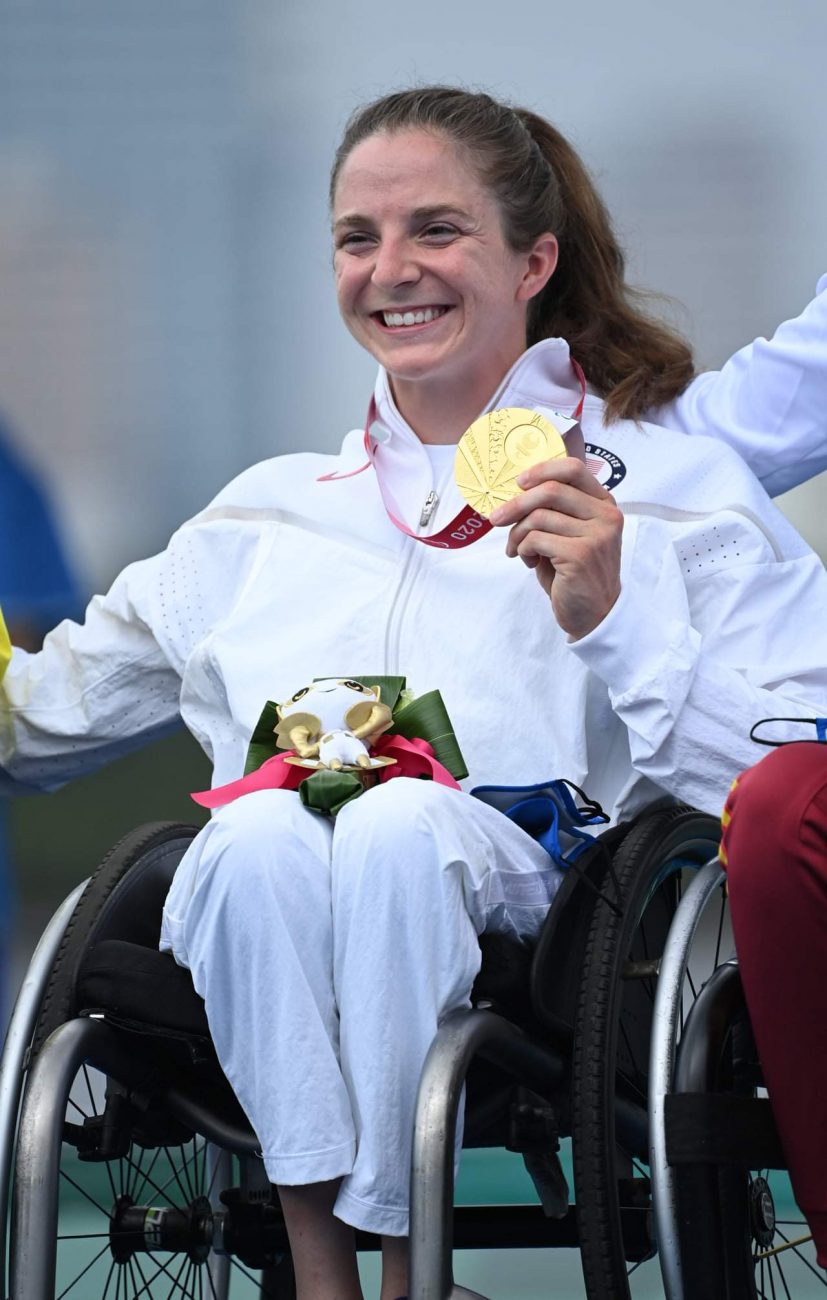
Masters and Gretsch picked up gold and silver medals, respectively, on Friday at the Paralympic Winter Games Beijing 2022, with Masters winning the women’s individual sitting biathlon in 42:17.9 and Gretsch finishing second in 42:23.7.
It was the third time within a week the pair, who train together in Bozeman, Montana, podiumed at the Zhangjiakou National Biathlon Centre. Combined, they have eight medals at these Paralympics, more than half of Team USA’s total medal haul.
Masters is now a 15-time Paralympic medalist — tying her with John Morgan for the fifth most Paralympic medals by a U.S. athlete — and a six-time Paralympic champion. Already at these Games she had won a gold in the sprint biathlon, and silvers in the middle-distance biathlon, long-distance cross-country and sprint cross-country events.
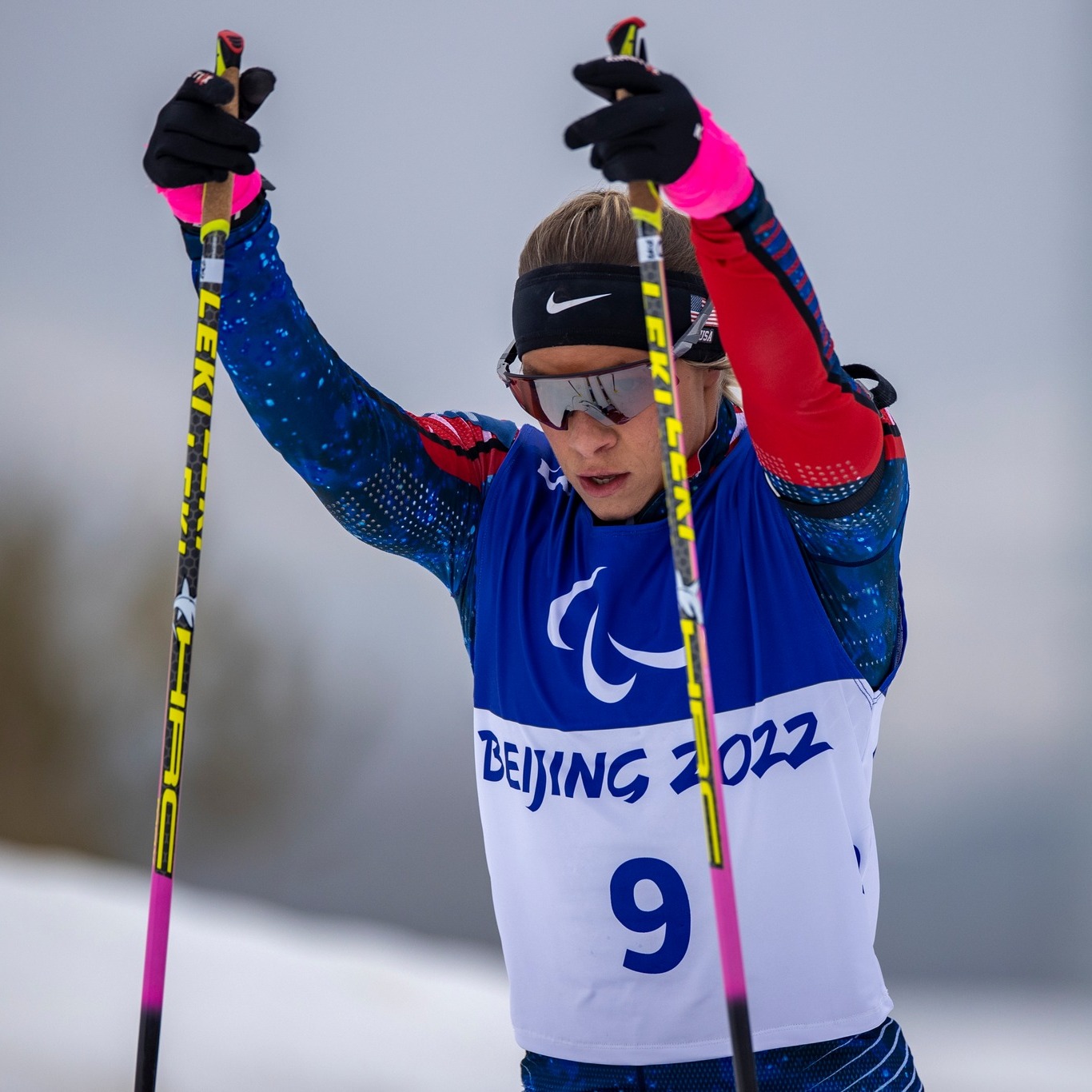
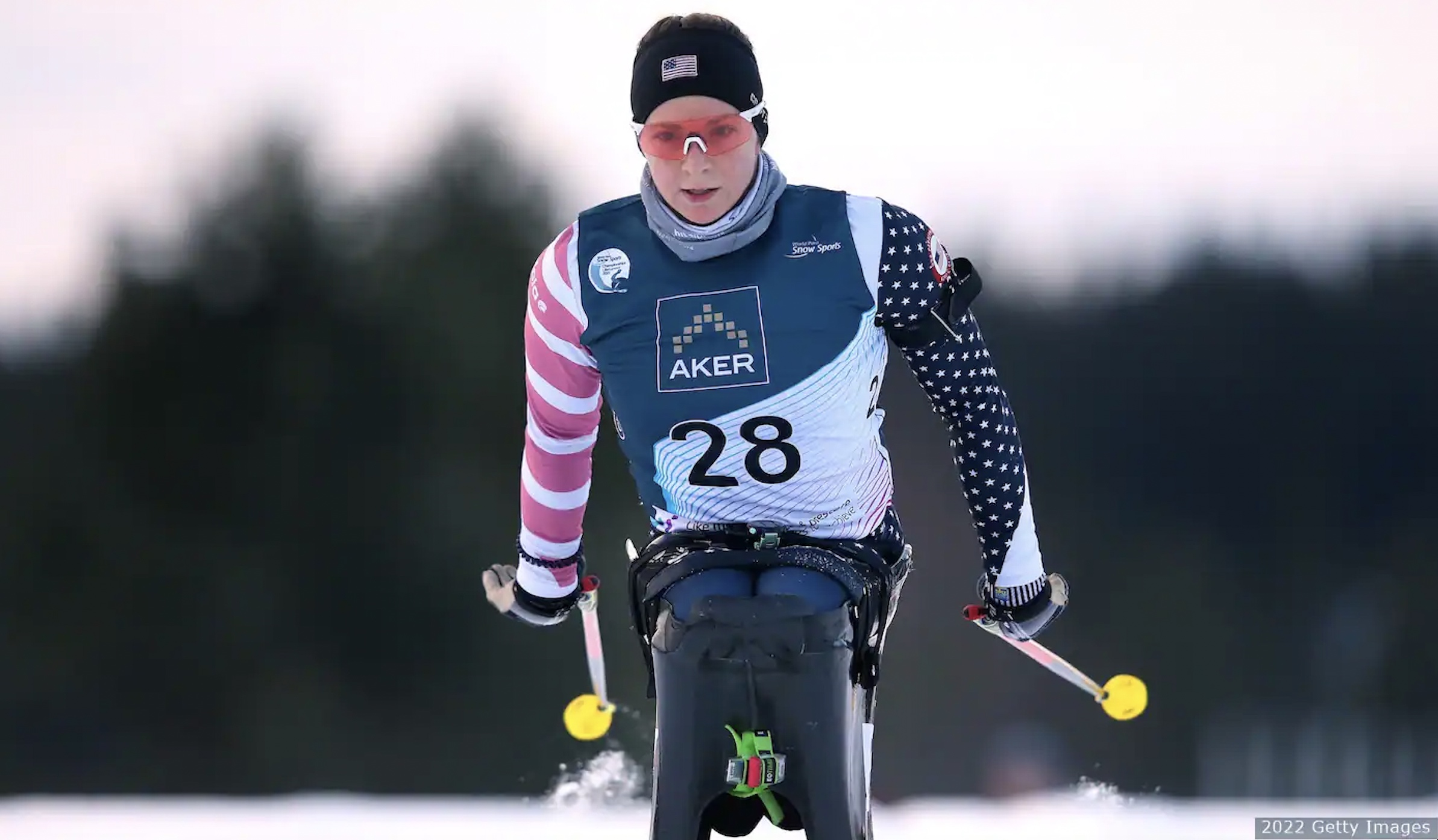
Oksana Masters races to gold in the women’s individual biathlon during the 2022 Beijing Paralympic Winter Games. (Photo: Chloe Knott for OIS / TeamUSA)
Following her first biathlon gold, she posted on Instagram: “Some feelings can’t be put into words. I am beyond proud to stand on the podium representing the heart, fight, love, resiliency, and pure joy for two countries,” referring to the U.S. and Ukraine, the latter being her birth country.
“I not only finally got to hold my dream, but I also am sharing parts of it with my home country of Ukraine especially for the young kids with disabilities. I want to make every start line mean something, make it really count for more than a result. That’s why I will be donating proceeds of my prize money from the Paralympics here to No Child Forgotten managed by Global Giving and Bridge Kids Charity, supporting children living with physical disabilities in Ukraine – many of them with single moms.”
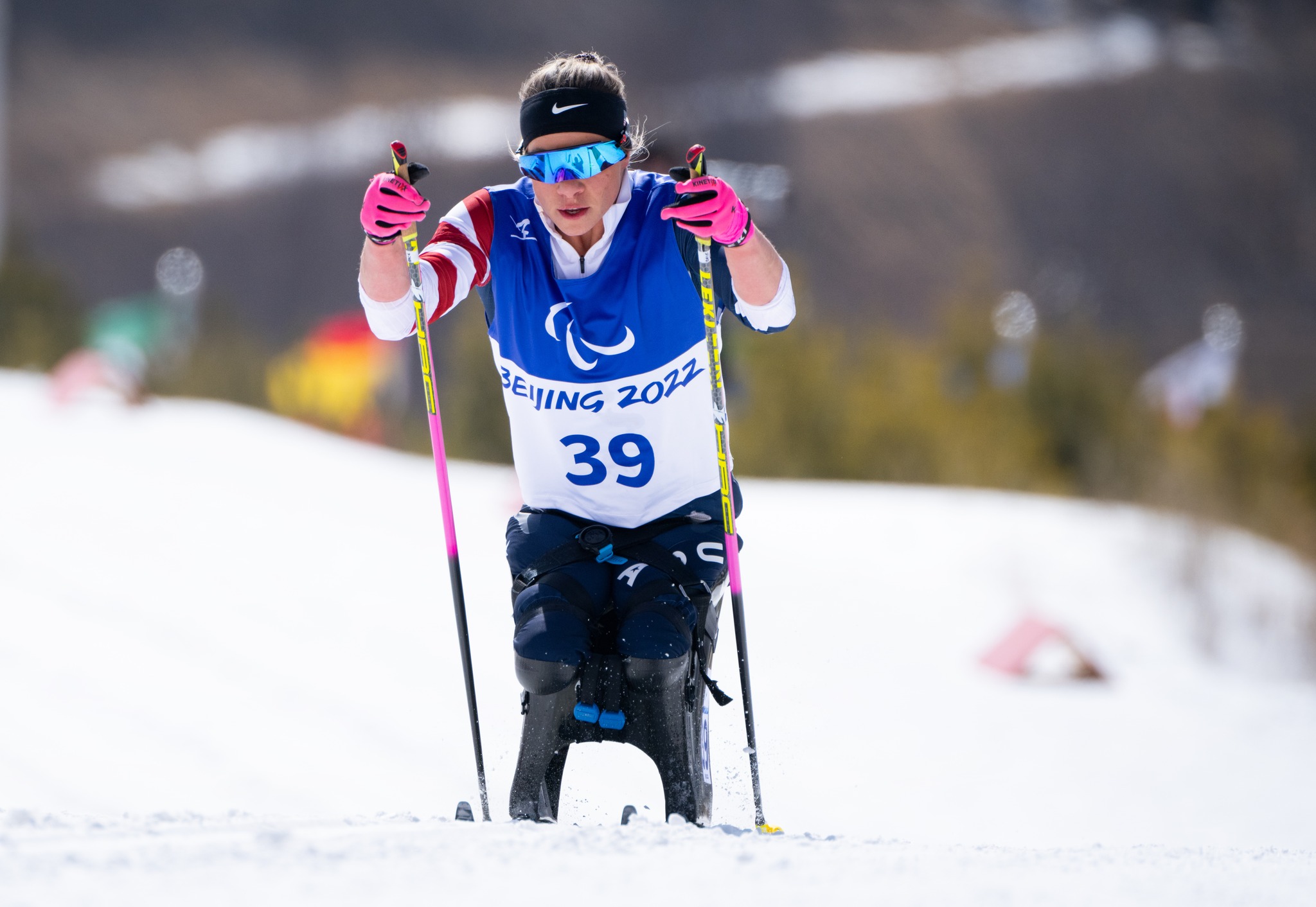
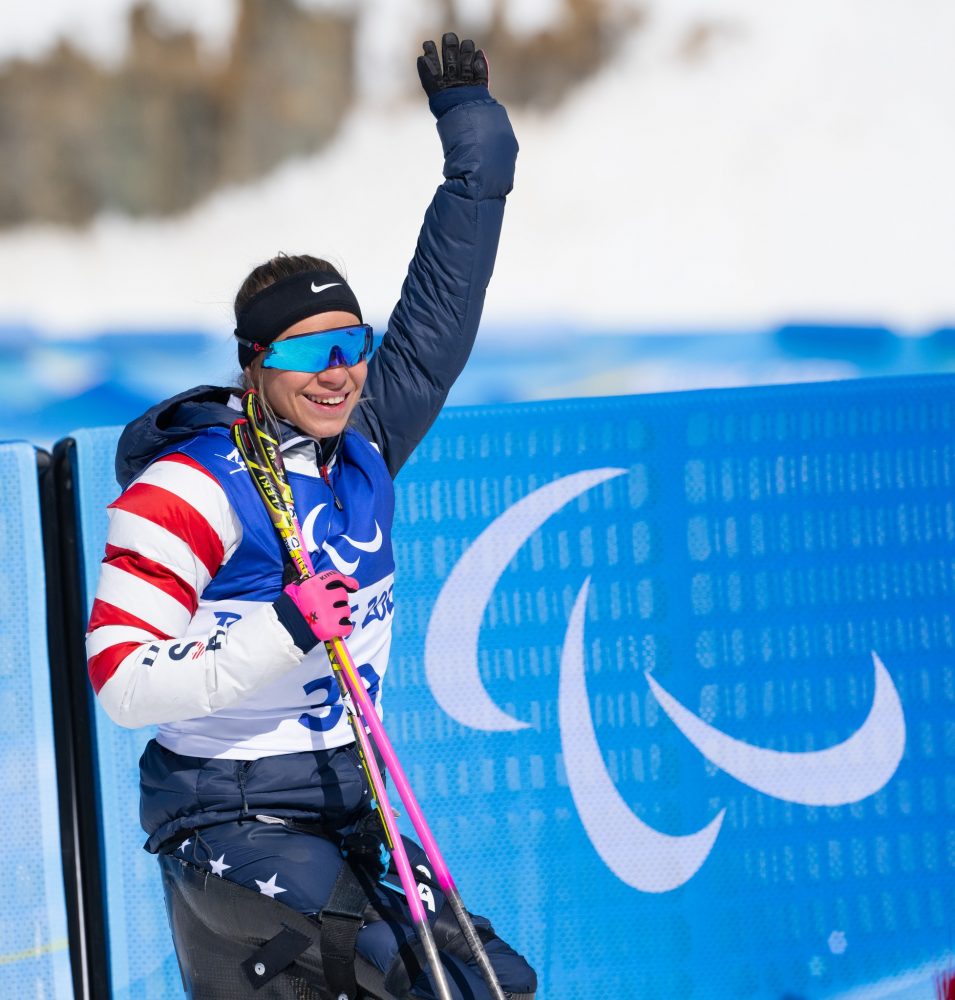
Kendall Gretsch skis for silver in the women’s sitting individual biathlon event during the 2022 Paralympic Winter Games. (Photo: Chloe Knott for OIS / TeamUSA)
Gretsch, who is still the reigning world champion in the individual biathlon, is now a six-time Paralympic medalist. This marked her first career silver medal, and she now has the entire collection of colors from Beijing 2022, having already won gold in the middle-distance biathlon and bronze in the sprint biathlon.“Today was an awesome day,” Gretsch said. “For me and the U.S. team it’s always fun to go one-two. We’re both shooting and skiing well, and so it was a fun race today.”
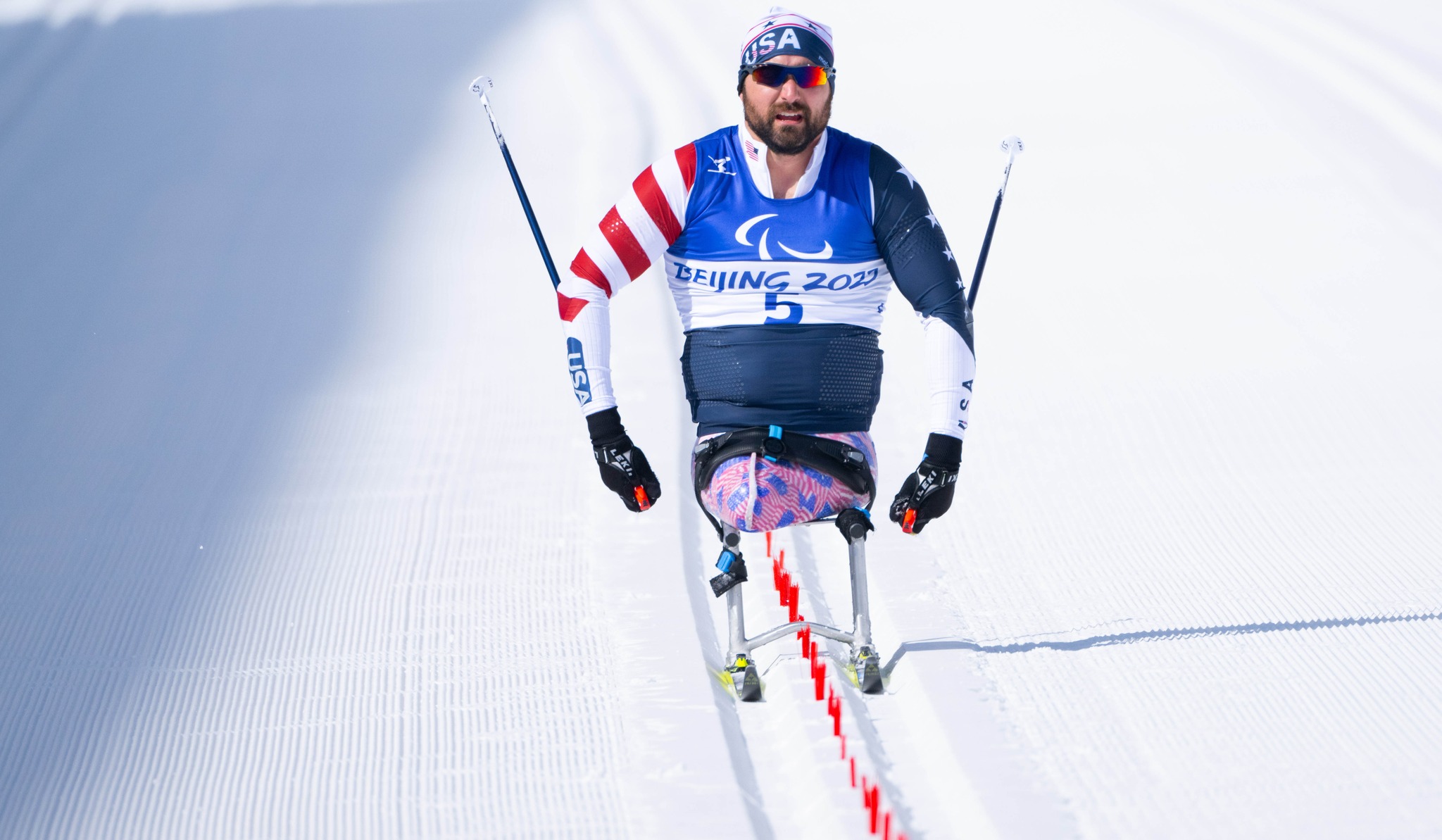
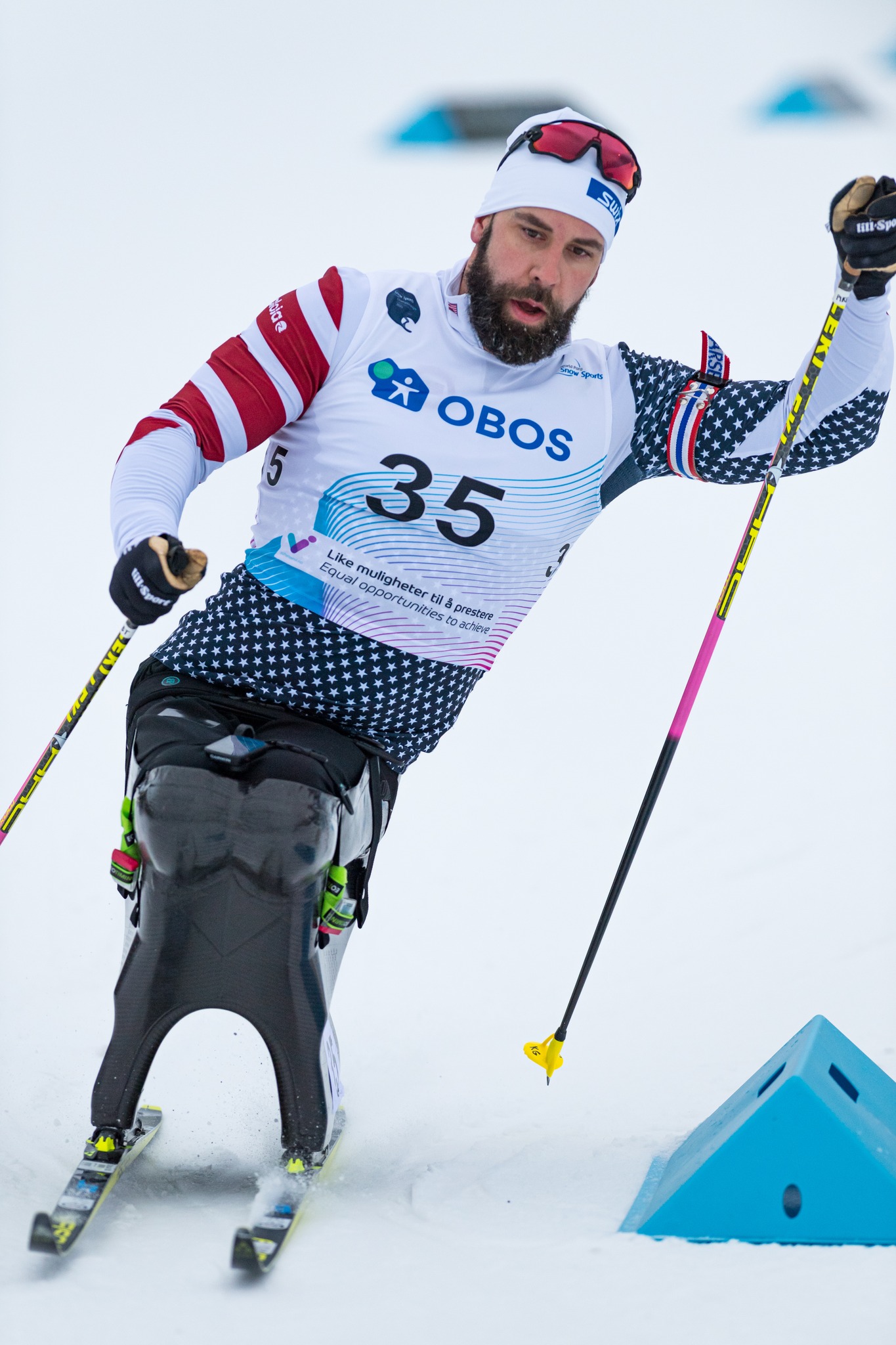
In the men’s individual sitting biathlon, six-time Paralympic medalist and former U.S. Navy SEAL Dan Cnossen was the top American finisher, taking seventh in 42:46.9. Six-time Paralympian Aaron Pike was ninth in 43:19.0. It was the third top-10 finish for both Cnossen and Pike at these Paralympics.
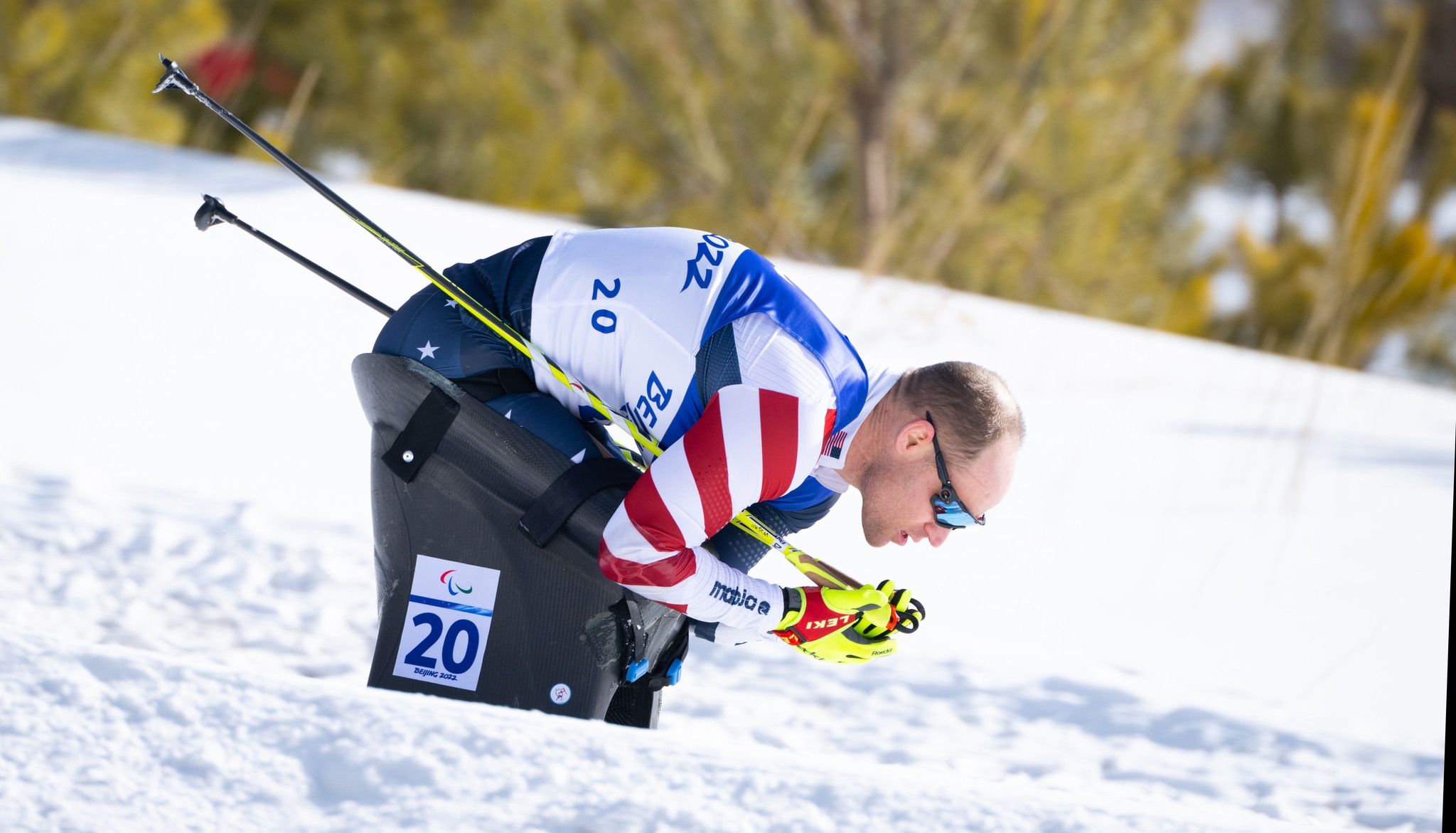
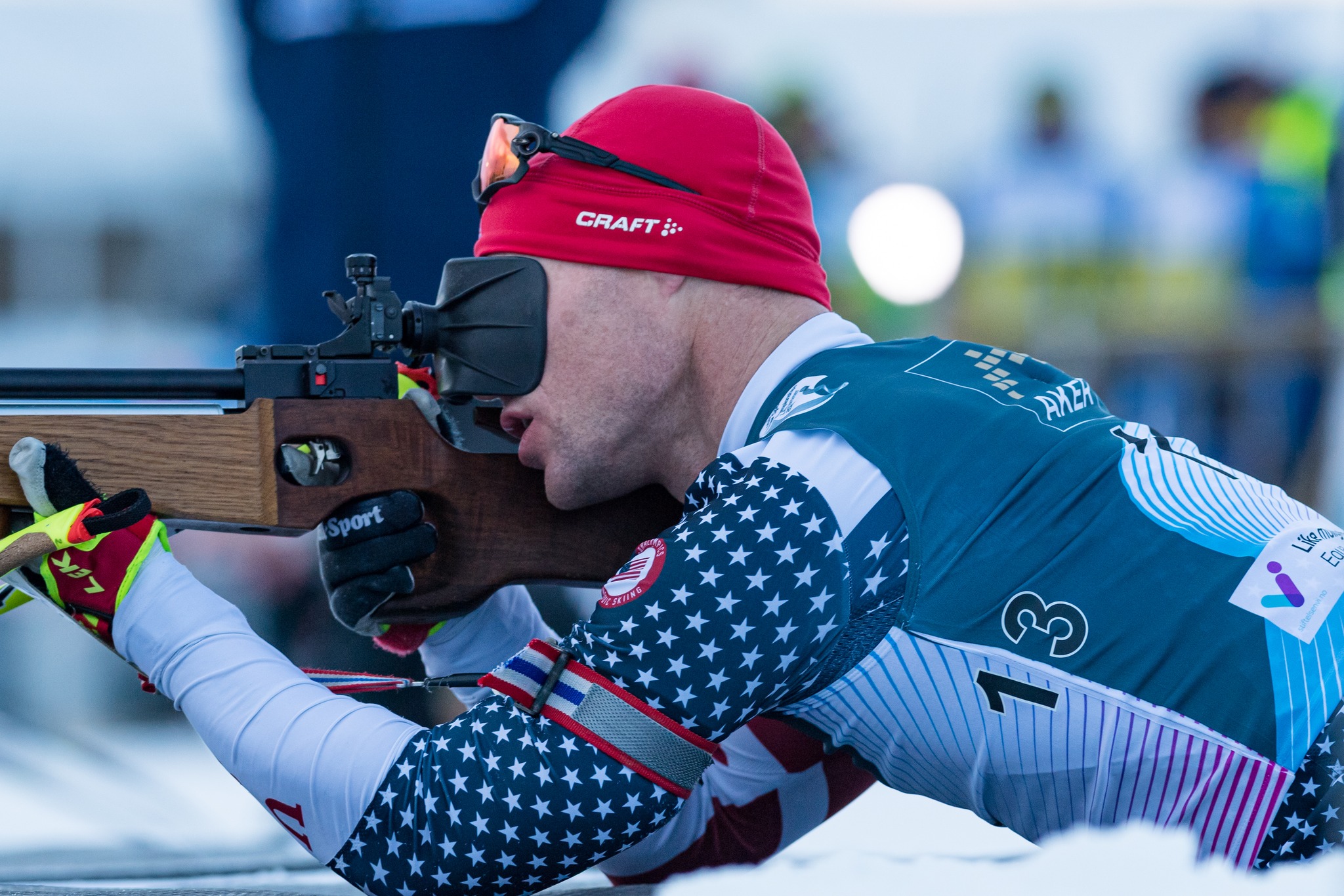
Dan Cnossen hits the range during the men’s individual sitting biathlon race in Zhangjiakou, where he finished seventh. (Photo: Chloe Knott for OIS / TeamUSA)
The U.S. Para Nordic skiers will return to the National Biathlon Centre on Saturday for the cross-country middle distance races.
Want to follow Team USA athletes during the Paralympic Winter Games Beijing 2022? Visit TeamUSA.org/Beijing-2022-Paralympic-Games to view the competition schedule, medal table and results.
***
Author Bio:
Stuart Lieberman has covered Paralympic sports for more than 10 years, including for the International Paralympic Committee at the London 2012, Sochi 2014 and PyeongChang 2018 Games. He is a freelance contributor to TeamUSA.org on behalf of Red Line Editorial, Inc.
Oksana Masters races to a silver medal in the long-distance cross country sitting event on day two of the 2022 Beijing Paralympic Winter Games. (Photo: Mark Reis / Team USA)
U.S. Para Nordic star Oksana Masters (Louisville, Kentucky) won silver in the women’s sitting long-distance cross-country race on Sunday, her second medal of the Paralympic Winter Games Beijing 2022.
Masters, a cross-country skier and biathlete, also won gold in the women’s sitting biathlon sprint on Saturday and now has 12 career Paralympic medals between the winter and summer Paralympic Games. Sunday’s silver medal comes six months after winning double gold in Para-cycling at the Paralympic Games Tokyo 2020.
The 2022 world champion in long-distance cross-county, Masters raced the 15-kilometer course at the Zhangjiakou Biathlon Center in a time of 43:38.8 — just 32 seconds behind China’s Hongqiong Yang, who won the gold with a factored time of 43:06. China’s Panpan LI finished with the bronze in 45:17.
Master’s silver medal matches the silver she won in long-distance cross-country at the Paralympic Games Sochi 2014.
Oksana Masters is on a medal streak, adding silver in the long distance cross country race to her gold in the biathlon sitting sprint. (Photo: Mark Reis / Team USA)
“I was trying so hard to get the gold,” said Masters, who admits she could have raced faster from the start. “I was trying to upgrade from silver in Sochi and the PyeongChang bronze, but I’m just so happy to be able to fight my way onto the podium.
“I can’t wait to see the U.S. flag being raised today at the medal ceremony [for biathlon sprint]. I was trying to not do my classic ‘go out hard and then die.’ Looking back maybe I was too reserved in the first few laps and then got to a spot where I didn’t have enough space to make up. This course is not really technical so there’s not a lot of places to make up time either. I wish there was more elements of skiing in it, but I think it challenged me in a really different way and I’m excited to see what the next few races have.”
Kendall Gretsch skis to fourth in the women’s long-distance event. (Photo: Mark Reis / Team USA)
Teammate Kendall Gretsch (Downers Grove, Ill.) finished just off the podium, in fourth, with a time of 46:26. She finished second, behind Masters, in long-distance cross-country at the Lillehammer 2022 World Para Snow Sports Championships in January. She won the bronze medal in Saturday’s sitting biathlon sprint.
Dan Cnossen (Topeka, Kansas) led the U.S. men in the sitting category, placing sixth with a time of 49:22. Former sled hockey champion turned Nordic skier Josh Sweeney (Glendale, Arizona), placed 16th in his Nordic debut. For Cnossen, Sunday’s long-distance race offered a new personal challenge.
“I don’t care what the result was today,” Cnossen said. “For me, this was a personal test. In my opinion, this is the hardest race that we do in the cross-country discipline at 18 kilometers. In the last Games we had in 2018, it was a 15-kilometer race.”
Dan Cnossen races the sitting long-distance cross country event on day 2 of the 2022 Beijng Paralympic Winter Games. (Photo: Mark Reis / Team USA)
“I’ve never done an 18-kilometer, and I just wanted that personal challenge. There’s a battle going on in your head [during the race]. And it’s against the part of me that wants to go a little easier or softer, to kind of not challenge myself as much. And so, it’s a personal test to see what I could do and I’m happy with that. I executed my race plan really well. I had gas in the tank on the last lap, which was the plan. So, success for me.”
A newcomer to Para Nordic skiing, Sweeney isn’t new to the Winter Paralympics. The retired Marine Corps sergeant earned a gold medal as a member of the U.S. sled hockey team at the Paralympic Winter Games Sochi 2014. After retiring from sled hockey, Sweeney competed for a few years in elite paratriathlon before transitioning to Para Nordic skiing in 2021 through the Challenged Athletes Foundation. He notes his experiences from the different sports aids him on the Nordic course.
“Having the different sport experience is [helpful]. Knowing, especially in the triathlon world, what good pacing can do for you and not getting too carried away with what everyone else is doing is big,” Sweeney said. “I’ve learned over all these sports that you have to trust yourself and your coaches, respect the process and just put in the work and you’ll be alright.”
Josh Sweeney races the men’s long-distance cross country sitting event on day two of the 2022 Beijing Paralympic Winter Games. (Photo: Mark Reis / Team USA)
China’s Peng Zheng and Zhongwu Mao, won gold and silver, respectively, and Canada’s Collin Cameron won bronze.
Racing continues Monday in Zhangjiakou with the men’s and women’s long-distance cross-country in the standing and vision impaired categories. Watch U.S. Paralympics Nordic Skiing competition from the 2022 Beijing Paralympics on NBC, which features more than 230 hours of coverage across NBC, Peacock, USA Network, the Olympic Channel, NBCOlympics.com and the NBC Sports App. All events will be streamed live on NBC’s Peacock. Follow U.S. Paralympics Nordic Skiing on Facebook, Twitter and Instagram for daily updates from Beijing.
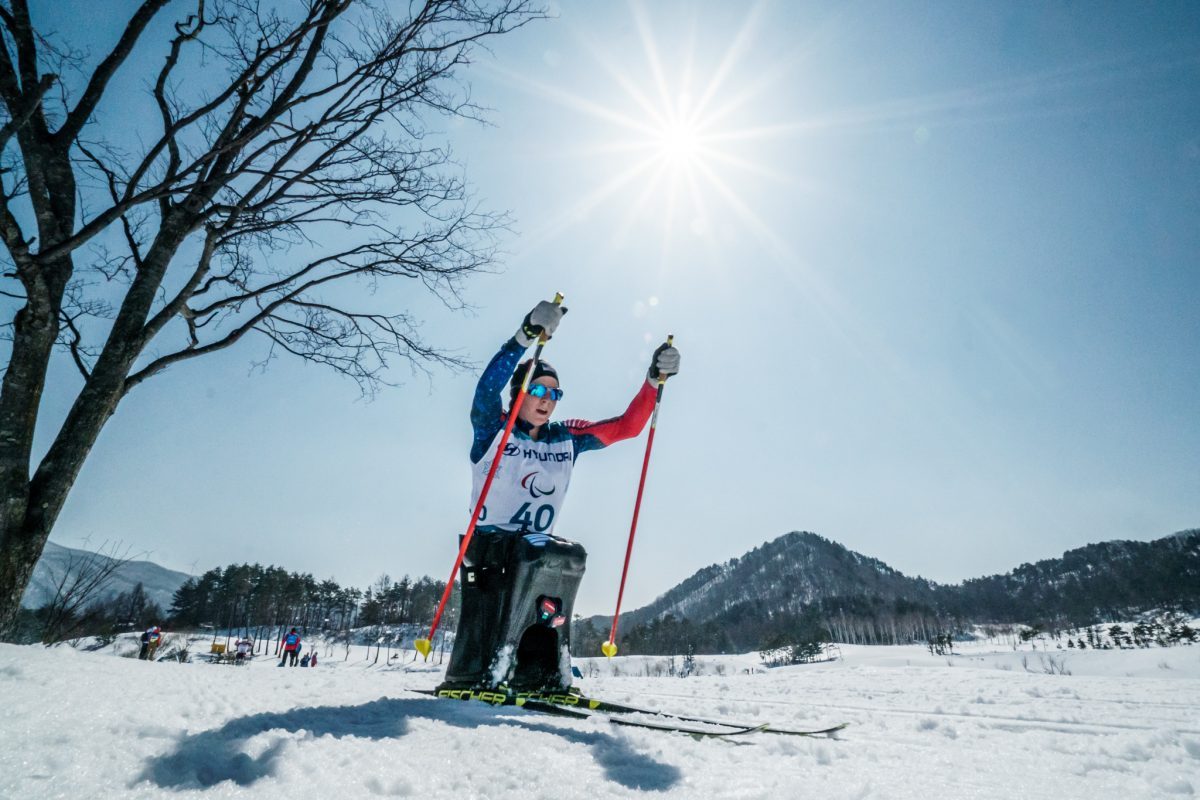
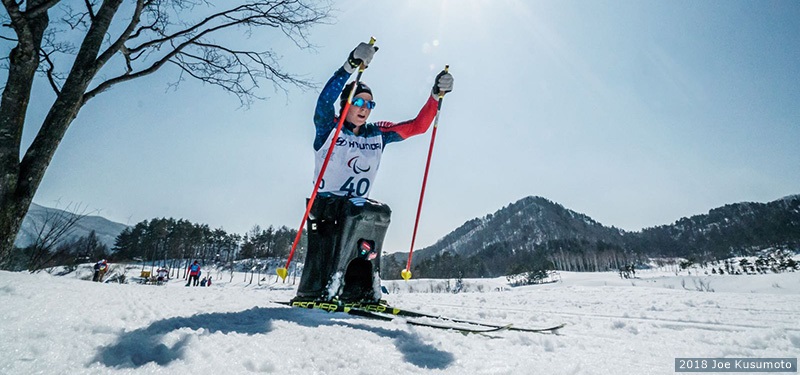
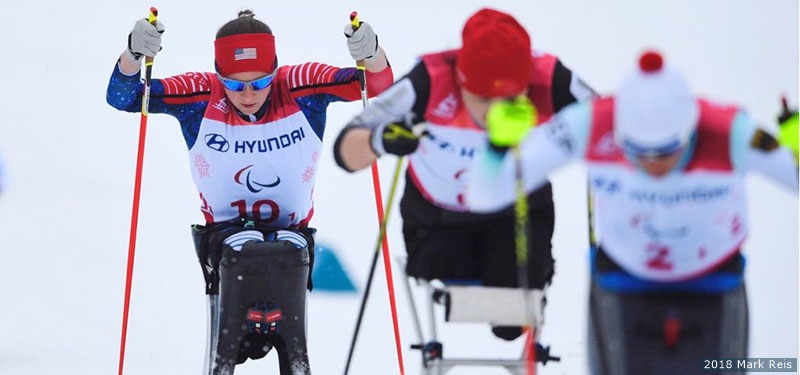
Kendall Gretsch racing to her second gold medal of the 2018 Winter Paralympics in the women’s 12 k sitting cross-country race in PyeongChang, South Korea. (Photo: US Paralympics/Joe Kusumoto)
There are a select few athletes who compete in both the summer and winter Olympics, and fewer still is the number of athletes who have won gold medals at the two. Para-athlete, Kendall Gretsch, holds this distinction having won two gold medals at Pyeongchang in 2018 and gold in the para-triathlon at Tokyo in 2021. With two Olympics in the span of six months, Gretsch was set for a big year.
In a TeamUSA interview Gretsch said, “When I got the news that Tokyo [2020] would be postponed, and Tokyo and the Beijing 2022 Winter Games would be six months apart, that was terrifying. In my mind, I was going to have a much different lead-up to Beijing, but now [speaking in 2021] looking back, it is comforting. Transitioning between two seasons has been something I have done for the past five years, and I know how to manage that transition well.”
Kendall Gretsch is a three time World Champion in the women’s PTWC classification. (Photo: International Paralympic Committee)
Gretsch was born with spina bifida, which resulted in her leg muscles not fully developing. She started competing in para triathlon in 2012 and had her international debut in para-nordic skiing in 2017 after she began training with the Central Cross Country Ski Association in Madison, WI as a form of cross-training for para triathlon.
Triathlon was first added to the Paralympics at Rio in 2016, though Gretsch’s classification of PTWC2 was not initially included. Thus, the Tokyo games were the first opportunity for her to compete in the triathlon at the highest level. In a nail-biting finish, Gretsch narrowly took the victory, earning her third Olympic gold.
After roughly 26 kilometers of racing, Kendall Gretsch takes Paralympic Gold by meters. (Photo: Screenshot NBC Sports)
With the start of the Beijing paralympics a little over a month away, FasterSkier caught up with Gretsch in Östersund, Sweden as she recovered from the recent Para World Championships in Lillehammer and prepared for the next round of World Cup races, which were scheduled for January 27th to February 1sts.
By any measure, Gretsch dominated the competitions in Lillehammer. She earned three gold medals, coming in the middle distance classic sitting, biathlon long distance sitting, and biathlon middle distance sitting events. She also earned silver in the long distance freestyle sitting race, finishing behind her teammate Okansa Masters. Despite these strong performances, Gretsch was hesitant to read too much into what they might mean for the upcoming Paralympics.
“It was good,” she said, “I think it’s kind of funny to have a World Championships in the same year as the games, just because you know that everyone’s focus isn’t necessarily the World Championships and that everyone’s really preparing for Beijing.”
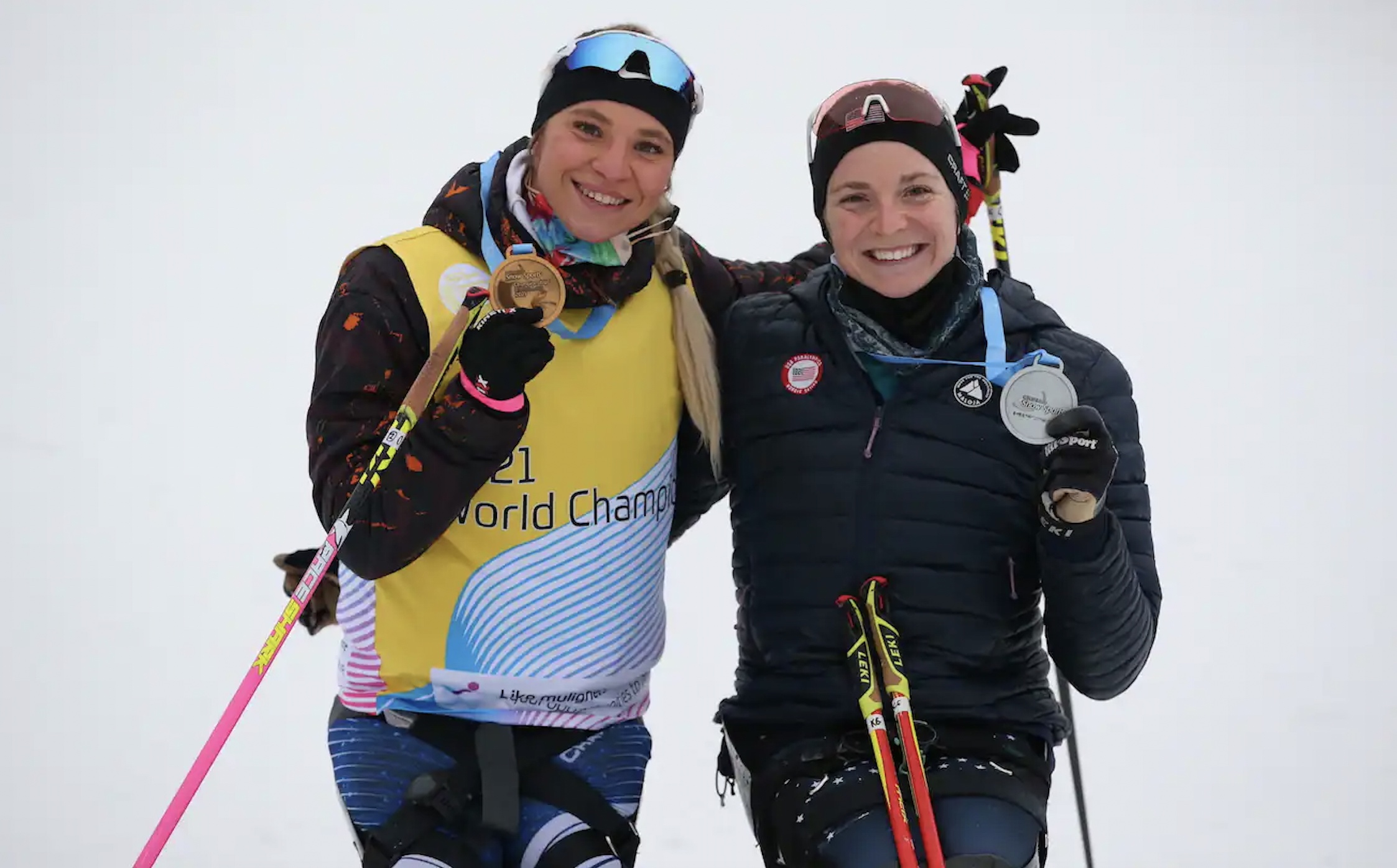
Oksana Masters (left) and Kendall Gretstch (right) go 1-2 in the women’s 15k sitting long distance cross country race in Lillehammer, Norway. (Photo: Alex Livesey/Getty Images)
Given that the World Championships and Paralympics are only separated by two months, Gretsch explained that athletes would be approaching the World Championships racing differently. “Maybe they’re coming in really tired, so I think it’s harder to gauge where you are from that, because it’s not the main event of the year for everyone.”
Furthermore, the Chinese team was not present at the World Championships, which is another area of uncertainty for Gretsch. “We know that they are probably going to have a pretty strong team in Beijing,” she said, “so that’s kind of the big unknown – not having the chance to race them ahead of time.”
That being said, Gretsch was pleased to have this set of races as experiences before Beijing because, “it’s a pretty similar format, in terms of the number of races and the timing of them. So just being able to practice all of that is good. It’s definitely a little bit of a confidence boost, but you don’t know how everyone was showing up.”
Both gold medals in the biathlon events were essentially earned thanks to Gretsch’s shooting. For the past several years, she has been living at the Olympic Training Center in Colorado Springs, and with her focus on the para-triathlon event in Tokyo, time to practice shooting this past summer was scarce.
Kendall Gretsch takes aim during the women’s 6-kilometer sitting biathlon at the 2018 Paralympic Winter Games on Saturday in PyeongChang, South Korea. She won the race to become the first American woman to medal in a biathlon event at the Paralympics (or Olympics). (Photo: US Paralympics/Getty)
“With COVID restrictions and the area where I train, I didn’t have access to as much [shooting] as I would like to,” explained Gretsch, “but I was able this fall to get in some shooting post-Tokyo, and then we had some early camps this year where I got to spend a lot of time in Canmore was was able to shoot there.”
Looking towards the Paralympics at the beginning of March, the expectations for Gretsch to win medals is high after her performances in 2018 and 2021. When asked how she manages both her own expectations and the expectations of others Gretsch responded, “It’s hard because I would say, I’m the one that puts the highest expectations on myself. I think [I’m managing expectations by] just understanding that we have a lot of racing opportunities in Beijing, and taking it race by race, hopefully using each race to learn more about the course and where you can make up the most time.”
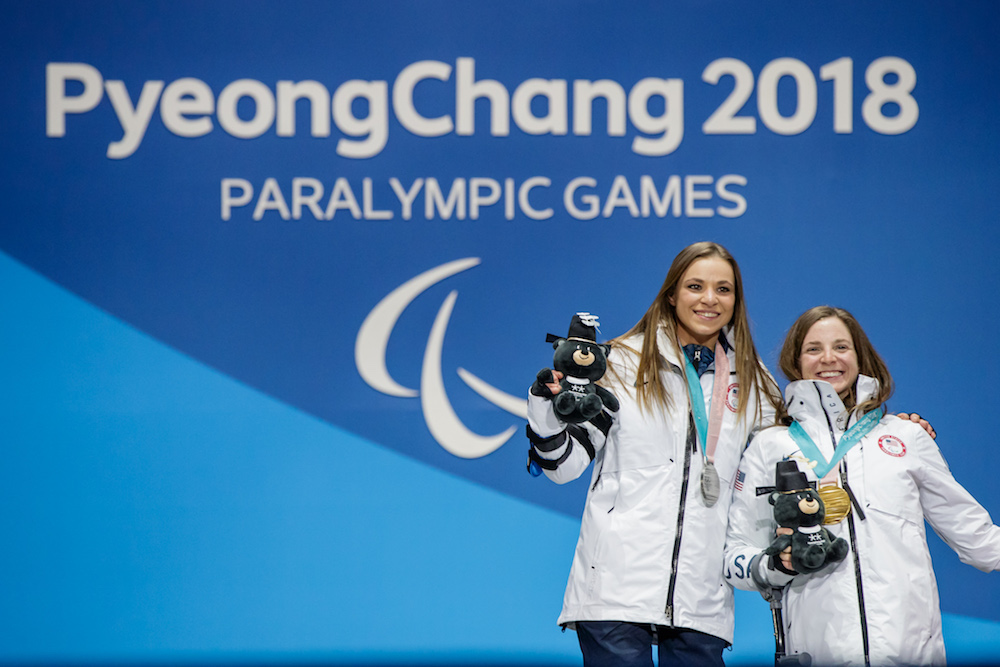
Kendall Gretsch (r) and Oksana Masters at the 2018 Paralympics medal ceremony for the women’s sitting 6 k biathlon sprint after winning gold and silver, respectively (Photo: U.S. Paralympics/Joe Kusumoto)
Having competed at one COVID Paralympics already would perhaps give Gretsch a mental advantage by knowing what to expect in terms of rules and restrictions. However, as she said, “it seems like there’s more unknowns about how the restrictions are going to be compared to Tokyo.” But, Grestch did admit, “I think there’s probably some advantage of having the expectations around daily testing and mask wearing and all of that. Just having had that experience I think will be helpful. And really, just the past year or so of racing, it’s definitely been pretty complicated so, just more experience of how to deal with that situation.”
Recently the para program in the US has been growing, both in terms of numbers and in terms of the number of categories they have athletes competing in (for example, sit ski, vs. visually impaired, vs. standing with a limb deficiency). When asked what it has been like to be part of this growth and to have a bigger team at events like World Championships or the Paralympics, Gretsch was excited to see the team grow.
“We just have more depth in all the different categories,” she explained, “and I think one of the places where that becomes really exciting is for relays. We have the potential to put together some really strong relays, probably for the first time ever.” Relay teams are structured based on a point system that factors in an athlete’s classification and gender.
American Kendall Gretsch (l) racing in the 4 x 2.5 k mixed relay at the 2018 Paralympic Winter Games in PyeongChang, South Korea. Her team finished seventh. (Photo: U.S. Paralympics/Mark Reis)
“I think that’s something that has our whole team really excited,” continued Gretsch, “the idea that we can have a competitive relay, and that’s something that people can really train towards, and hopefully contribute to be a part of that relay.”
The Paralympics begin in Beijing on March 4th. Gretsch will be taking part in both cross-country and biathlon events throughout the competition schedule.
In this episode, we have Jake Adicoff and Sam Wood, calling in from Lillehammer as the duo races as athlete and guide at the Para World Championships. Jake is a visually impaired athlete from Sun Valley who grew up racing with the SVSEF cross country program and now trains with the Gold Team. He has raced at both the 2014 Paralympics in Sochi, and the 2018 Games in Pyeongchang, where he won a silver medal in the 10k classic, as well as placed 4th in the classic sprint and 5th in the 20k free.
Jake Adicoff and his guide Sam Wood put together a gold medal performance on the opening day of racing at the Para World Championships in Lillehammer, NOR. (Photo: Alex Livesey/Getty Images)
Meanwhile, Sam is also a member of the SVSEF Gold Team, balancing his own training and race goals with his support of Jake this season. Sam finished in the top-10 twice in the opening SuperTour weekends this season, and was in the Top-25 in both distance races at the U.S. Cross Country Championships in Soldier Hollow. (Jake also raced, independently, at U.S. Nationals
While it has included career best results, this year of racing was not originally in Jake’s plans. He retired from professional skiing in 2018, heading to San Francisco to work as an engineer for Uber, having graduated from Bowdoin College that spring with a degree in Mathematics and Computer Science. When the pandemic hit, he began to work remotely from his parents’ house in Sun Valley (thinking it would be just for two weeks – remember that?) and ended up “casually” hopping into training with his friends on the Gold Team. With a few nudges from US Para Nordic and teammates like Sam, Jake began to realize he was still passionate about ski racing and quite fit again, and he began to set goals for the upcoming 2022 Paralympics.
Jake Adicoff follows Sam Wood on a long training run near Sun Valley, ID with the SVSEF Gold Team. (Photo: Instagram @svsefxcgoldteam)
At the time of the call on Friday January 21st, Jake had already earned a World Championship gold medal in the 10k classic on Sunday the 16th, and a bronze medal in the 15k skate on Tuesday the 18th. The morning after the call, the pair raced to second place in the 1.5k classic sprint. Three races, three medals. This week made it clear that Jake is in top form and will be a medal contender in Beijing.
In this conversation, we get into the dynamic of the athlete-guide partnership, as well as how being long-time friends and teammates has contributed to their success racing as a pair this season.
Friends, teammates, and now athlete-guide pair, Sam Wood (left) and Jake Adicoff (right) keep it fun on a sprint ski near Sun Valley, ID. (Photo: Instagram @svsefxcgoldteam)
To follow along with Jake’s racing this season, you can find race recaps with athlete quotes on the US Paralympics Nordic Skiing tab on the Team USA website, or follow the team on Facebook and Instagram.
A quick heads up on the audio, you’ll notice a bit of crackling and some poor connection toward the end of the podcast. Thanks for listening.
Oksana Masters (left) and Kendall Gretstch (right) go 1-2 in the women’s 15k sitting long distance cross country race. (Photo: Alex Livesey/Getty Images)
It’s late January and we’re deep into the race season. As the Olympics and Paralympics draw nearer, we’ve simultaneously just wrapped up the Tour de Ski, the U.S. Cross Country Championships, and another wave of SuperTour races. Never a dull moment in the racing world, the Para World Championships are currently well underway, running January 13-23rd in Lillehammer, Norway.
Normally occurring on odd years, the World Championships were postponed from last February due to the pandemic. Nevertheless, the event was called the Lillehammer 2021 World Para Snow Sports Championships. It was a hallmark event, as it is the first time that all snow sports have competed together in one location over the same dates.
Led by well-decorated veterans like Oksana Masters, Kendall Gretsch, and Dan Cnossen, the U.S. Para Nordic Team has put together a string of outstanding results at World thus far. Events have ranged from biathlon springs to cross country distance races, with athletes competing – and cleaning up – across all disciplines and distances.
Kicking off the series of events, Sun Valley’s Jake Adicoff took home his career first World Championship medal by winning the men’s visually impaired 10-kilometer middle distance race.
“It feels great,” Adicoff said of his performance, according to the Team USA Press Release. “Lillehammer has been skiing really well so far, I’ve been having a lot of fun here. It feels great to go and get that first podium, and hopefully we can go out and get some more here.”
Jake Adicoff and his guide Sam Wood put together a gold medal performance on the opening day of racing at the Para World Championships in Lillehammer, NOR. (Photo: Alex Livesey/Getty Images)
Adicoff retired in 2018 after earning a silver medal in the 10k and taking 4th in the sprint, however, he is making his return with a bang in this 2021/22 season.
Building momentum throughout the first day, 19-year-old Sydney Peterson earned a silver medal in the women’s standing middle distance race, with Gretsch earning the second gold medal for team USA in the women’s sitting 7.5k middle distance event. That’s three medals, two gold and one silver, on the first day of racing, along with an additional two athletes, Cnossen and Dani Aravich, earning top-10 finishes.
Dan Cnossen hits the range during the individual sitting biathlon event at the Para World Championships in Lillehammer, NOR. (Photo: Alex Livesey/Getty Images)
Joining the team in Lillehammer late after testing positive for COVID-19 on New Year’s Eve, Masters made a smooth return to competition, taking second place in her first race at Worlds, the sitting biathlon sprint on January 15th. The next day, the American women took first and third in the sitting biathlon middle distance race, with Gretsch earning her second gold medal of the week and Masters adding an 18th World Championship medal to her ever-expanding collection.
On point, a perfect shooting performance contributed to Gretsch’s gold, while Masters skied her way out of a significant deficit. Experiencing challenges on the range, Master’s racked up seven penalties, but made up her shooting with her skiing. In the men’s sitting race, Master’s partner, Aaron Pike, skied his way into the Top-10, a rank he has achieved in each of his World Cup races this season, leaving him primed for a medal.
Two days later on the 18th, Masters and Gretch again took the spotlight, going 1-2 in the women’s sitting 15k long distance cross-country race. Now reaching 19 total, this marked Masters’ 10th career World Championship gold medal.
“It’s absolutely incredible,” Masters said in the Team USA press release that day. “It feels like yesterday where I was that new athlete, never thinking that I would be a world championship athlete. So, to have 10 now … is incredible and it’s a testament to our team’s hard work. It’s not just me, it’s the whole team.”
Already an historic day for the U.S., Peterson and Adicoff continued the medal streak in the long-distance cross country races, with each athlete earning a bronze medal in the standing and visually impaired divisions, respectively. Four Americans competed that day, and four medals were won. How’s that for success?
Aaron Pike races the individual sitting middle distance biathlon event at the Para World Championships in Lillehammer, Norway. (Photo: Alex Livesey/Getty Images)
As the final days of World Championship racing kicked off, Pike’s consistency paid off with a silver medal in the men’s sitting individual biathlon event. Missing just one target, matching the best result of the event, Pike finished 24 seconds back on the winner, Pavlo Bal of the Ukraine. This result is both a World Championship and overall World Cup career best for Pike, who is an accomplished wheelchair racer during the summer season.
“It was a tough day to be shooting out there, everybody’s missing so I was happy to come away with just missing one shot,” said Pike in today’s recap. “This is probably the windiest race we’ve had in three years. Every chance you get to put a bib on and race in a biathlon race is experience.”
Racing in the women’s sitting individual biathlon, Gretsch and Masters continued to dominate the field, taking first and third, respectively, to keep their medal streak alive and well.
Again performing well on the range, Gretsch missed just one target in four rounds of shooting and skied the second fastest time on course for a finish time of 52:25.0. While Masters skied the fastest time of day, she again faced challenges in her shooting, incurring five penalties, leaving her 3:00.7 behind Gretsch in the final results. In the women’s standing class, Aravich earned another top-10 finish in eighth.
With excellent shooting records, Kendall Gretsch puts together back-to-back gold medal performances in biathlon events. (Photo: Alex Livesey/Getty Images)
After a day of rest, the Para athletes have two final days of racing in Lillehammer on the 22nd and 23rd, which feature a sprint for the standing and visually impaired categories on Saturday and a Mixed Relay on Sunday. Based on the week’s results, it’s clear that they are primed for another medal run in the upcoming 2022 Beijing Paralympic Games, which begin March 4th.
Livestreams of past and upcoming events, along with links to results can be found on the U.S. Paralympics Nordic Facebook page, or you can check out the remainder of snowsport events happening this week in Lillehammer by following along here.
While no one would choose the circumstances, pandemic induced cancellations presented marathoners with a unique calendar of events this fall. All six of the iconic World Marathon Majors — Berlin, London, Chicago, Boston, Tokyo (held virtually, in-person event postponed to 2022), and New York — took place within a span of 42 days. (In a typical season, Tokyo, Boston, and London are run in the spring.) While Shalane Flanagan has been in the limelight for her accomplishment of running all seven events each under 2:47, many other marathoners also seized the opportunity to run multiple Majors this fall.
Among these athletes was Aaron Pike, professional wheelchair racer and U.S. Para Nordic national team member, who raced the London Marathon on October 3rd, followed by Chicago on October 10th, and Boston the next morning. This was all on the coattails of the Tokyo Paralympics where took 6th place in the marathon, just 40 seconds outside of the medals.
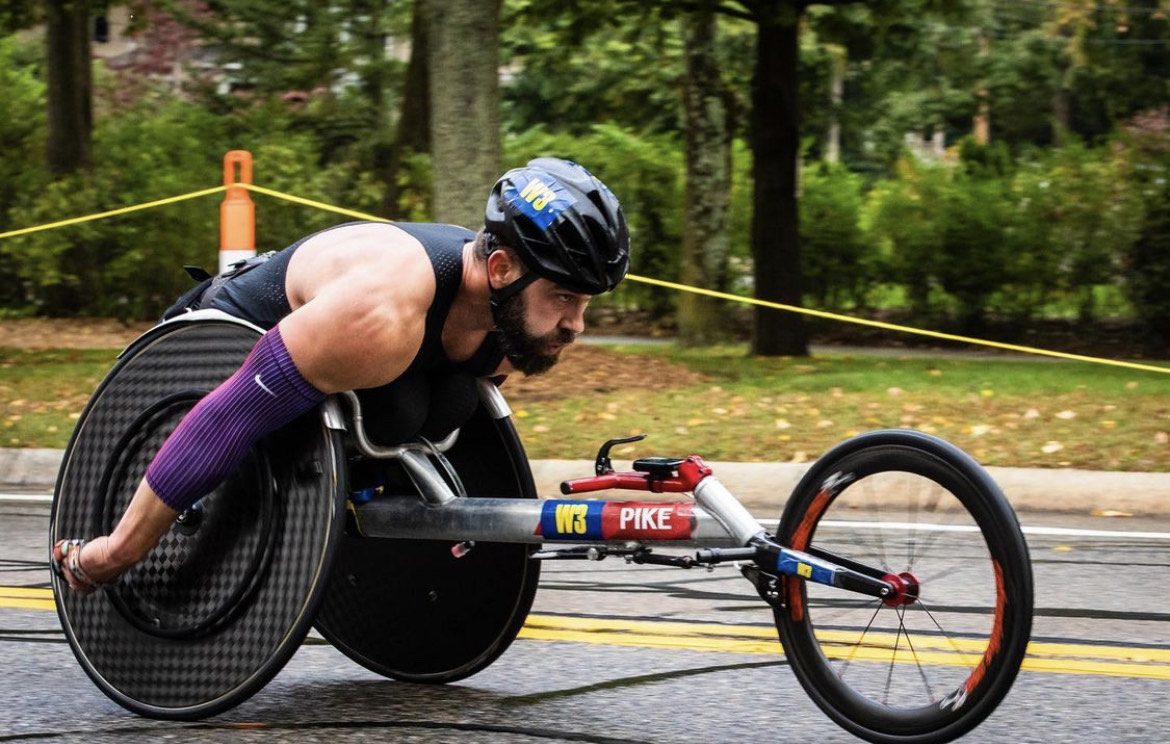
Aaron Pike on course during the Boston Marathon. (Photo: Instagram @tmistret)
While the transition between a Summer Paralympics in August and a Winter Games six months later is already tight, Pike trusted the crossover in fitness between sports and seized the opportunity to put together a fall marathon series. FasterSkier connected with Pike on a call in early November at the beginning of his first on-snow camp of the season in Canmore, Alberta.
Before jumping into the races, a bit about Pike’s background in sport. After sustaining a hunting injury when he was 13, Pike was paralyzed at the T11 vertebra of his mid-back. He explained that his family was living in Virginia at the time, which was fortuitous as a community member who was a former Navy Seal that began racing IronMan distance triathlons after his own injury heard about Pike’s circumstances and quickly took him under his wing.
“He came and visited me in the hospital pretty shortly after [I was injured],” Pike recalled. “I think I was still in inpatient [treatment] — but he came to visit me and was just telling me that he’d be a resource. He showed me some pictures of adaptive sports and what he does, and gave my parents all the contact information.”
The mentor was also coaching a youth wheelchair racing team and invited Pike to attend a practice once he was out of treatment.
“Maybe like a month or two after, I went out to watch a practice.. He had a group of six or seven other kids out there, and he brought a program chair out for me to try out. And it all just went from there.”
Pike advanced quickly in wheelchair racing through high school, but it was during his time at the University of Illinois-Champaign when his career flourished. Pike found success racing on the track, focusing on events 1500 meters and upward. It was also at the University of Illinois where he was first introduced to nordic skiing and biathlon, although he did not try it for himself until later on.
“[Former US Para Nordic] biathlon coach, Rob Rosser, came to the University of Illinois with a SkiErg and some rifles and just to introduce people to biathlon and cross country skiing. He set up the SkiErg so we could try them out — I think they were set up side-by-side, so you could sort of race each other. But the timing was tough, because it was right before the London Games, so everybody was kind of like, ‘Oh, this is cool,’ but then was right back to what they were focusing on. I didn’t think too much about it either.”
Shortly after racing the marathon at the London Paralympics in 2012, Pike received an email inviting him to attend a Para Nordic camp in Bozeman, where the national team now calls home base.
“So the first place I ever skied was in Bozeman,” he laughed. “So I got to try [out sit skiing] and, ended up liking the sport a lot right off the bat, day one pretty much. So it didn’t take too long for me to realize that it wasn’t just something that I was only going to try here and there in the winter.”
Aaron Pike is eyeing the sprint and the individual biathlon races in the upcoming 2022 Beijing Paralympic Games. (Photo: U.S. Paralympics Nordic Skiing / Getty Images)
Two years later, Pike made the Paralympic team for both the Sochi Games in 2014 and PyeongChang in 2018, earning his best results in Korea with a 6th place finish in the 15-kilometer biathlon event and 7th in the 12.5k biathlon. He hopes to improve upon these results in Beijing this winter.
While he hoped for more in Tokyo, Pike has steadily climbed the Olympic ranks in the event. He was 16th in London in 2012, 10th in Rio in 2016, and 6th in Tokyo. As previously stated, he was just 40 seconds outside of the medals and finished alongside the 5th place athlete from Great Britain.
“I was happy with how [the race in Tokyo] went considering a few factors: we had wet conditions, which always makes it super challenging. It’s kind of like skiing where if you choose the wrong [wax], you’re going to have a really rough race. So I set myself up really well by prepping for the rain, whereas a chunk of the field had problems just managing [the conditions].”
Let’s unpack the ski comment quickly. What those unfamiliar with wheelchair racing may not expect is that one of the primary challenges on race day is much like that of classic waxing: achieving optimal grip. Instead of skis on snow, it’s gloves on rings, and problem solving with sandpaper, rubber, and even klister. Yes, klister. Pike shared that Rode Chola is a commonly used product in wet conditions.
Despite preparing for wet conditions, Pike explained he did not feel his strongest during the event and quickly fell out of medal contention. Nonetheless, he stayed in it and advanced through the field as the race went on.
“The start was not the best for me, a couple people got away early. Right off the bat, I was in eighth or ninth place, but I was able to keep reeling people in. I pulled up to one of the Japanese racers, and then he and I pulled up to my teammate, Daniel [Romanchuk]. All three of us reeled in two more guys, so then we were in a pack of five, but weren’t able to catch the front leaders.”
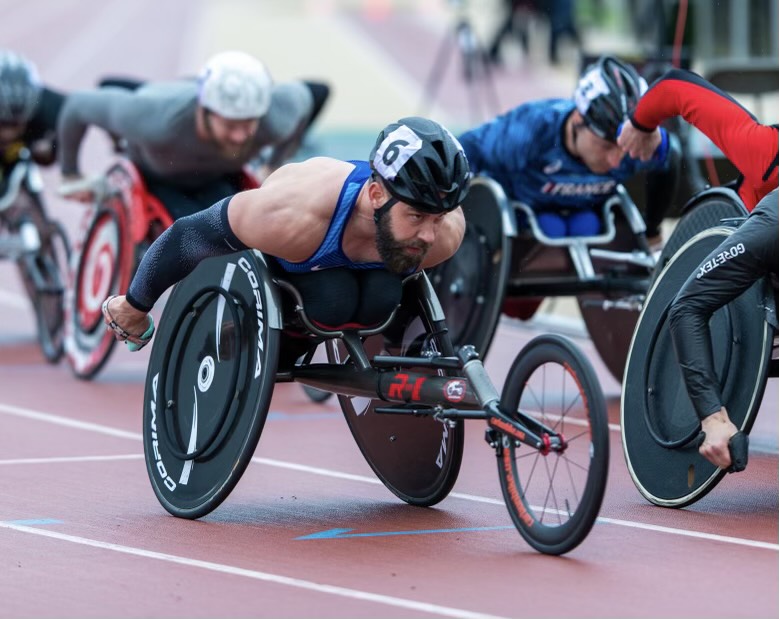
From the 1500 upward, Aaron Pike has excelled in wheelchair racing. (Photo: Tobias Lackner / Tobil Photography)
The experience of competing in a pandemic-shrouded Games also gave him a taste of what to expect in Beijing. Compared to his past Olympic experiences, Pike missed the energy of team processing and meetings where collective energy was all that was infectious. He explained that travel was more cumbersome with the added precautions, however, once in the Olympic Village, the differences felt less significant.
“Once you’re in the Village, that was normal. The Village life was cool. We still got to go to the cafeteria [with all the other international athletes], they just had plastic barriers up everywhere. I think the weirdest part was having an empty stadium. It was just super bizarre… it’s like this gorgeous massive stadium that can hold like 70,000 people and it’s just empty.”
He explained that tickets had been sold out for all of the final rounds of events, so it was disappointing that fans could not attend.
While Pike was happy with his effort in Tokyo on the day, he felt significantly stronger in each of the three World Majors that he raced. Rather than cumulative fatigue, Pike was in full stride throughout the series.
“Oddly enough, the worst was the first one, the London Marathon. For whatever reason I was able to hang with people, but not really do much more than that.”
Pike took 5th place in London in 1:31:36 (+5:09), before hopping on a plane bound for Chicago.
Despite unseasonably warm conditions and wind that supported the city’s nickname, Pike raced his fastest time on course to finish on the podium in third, his best overall result in Chicago. It was a race where everything came together so well, he had little to say about it, other than, “It was awesome.”
Pike finished 21-seconds behind the winner in 1:29:28. Less than 24 hours later, he was back on a starting line in Hopkinton, ready to race to Boston.
“That was the one I was going to be the most worried about, because that’s a really tough race, and coming the day after [Chicago]. And that was one where I made the wrong decision about grip.”
Remember: like classic skiing, some days are straight-forward cold snow and hard wax days, whereas others you’re down to the wire looking for answers, tossing an extra option or two in your drink belt before heading out just to be safe. Variable conditions and changing weather for wheelchair racers are akin those dreaded humid near-freezing with falling snow days where you can’t tell if hairies will get the job done, or if you need some kind of miraculous combination of covered klister, and no matter what you go with, you’ll probably deal with some icing. Err on the side of caution with icing, and you may have no grip whatsoever.
In a race wheelchair, rubber on rubber maximizes surface area between gloves and rings, allowing the most force as the athlete pushes powerfully on each stroke. But Pike explained that sandpaper is “night and day better” when the wheel rings are wet.
On the morning of the Boston Marathon, a mild storm was clearing. Pike explained it was raining during the warm up, but it let up before the start. Still, the precipitation left standing water on the roadway, making for conditions that were wetter than the weather. Because the weather didn’t match the actual race conditions, Pike explained his initial choice of gloves meant he could not take advantage of the early downhills, which is typically one of his strengths. Luckily, he stashed a backup pair of gloves, which he normally does not do.
“It seemed fine,” he said of his glove choice in the warm up. “I had my sandpaper gloves on me [just in case I needed to switch], and I strapped into my chair, which I’ve never done, but I just had a feeling something might not go right with a grip. Sure enough, when we started bombing down the hills right at the beginning — it wasn’t until going super fast on the hills that the wheels were lifting up water from people around me and spraying the rings and getting them wet. But there was no time to change [gloves] early on, so it was just kind of a struggle at the beginning.”
On the track in Switzerland, Aaron Pike pushes through the rain. (Photo: Tobias Lackner / Tobil Photography)
While trying to minimize his time losses, Pike found an opportunity to switch into the sandpaper gloves, which drastically improved his grip and allowed him to bring himself back into contention.
“Once I switched them out, then I was just catching one person after the next, all the way up to the point where I got fourth. I think I could have easily got third in that race as well if I just started with the sandpaper.”
Every year, Pike has to decide when to hang up the race wheelchair and transfer into his sit ski. The calculus is complicated by late-season opportunities like the marathon series, and is especially fickle surrounding Paralympic cycles.
“It was a really hard decision…I think the fact that there were three marathons in such a short time — having missed so many marathons because of COVID and not having the opportunity to race for a while, then having three of them within eight days of each other. It was just hard to pass that up.”
While both are endurance sports, wheelchair racing is a pushing motion, while double poling in a sit ski, like standing, is a pulling motion that involves more engagement of larger back muscles. For whatever reason, Pike feels the transition from skiing to wheelchair racing happens more smoothly than the opposite direction. As he shifts back into ski mode, his primary focus is rebuilding the specific strength.
“I really have to moderate the intensity for the first month,” he explained.
After a successful marathon season, Aaron Pike transfers from racing wheelchair to sit ski in preparation for the 2022 Beijing Paralympics. (Photo: Team USA Paralympics Nordic Skiing)
Eager to begin the transition process, Pike and his partner, Oksana Masters, headed to Canmore a week before their teammates. Masters is also a USA Para Nordic team member and is a three-time Olympic Gold Medalist in both cycling and cross country skiing.
“It’s just getting that feeling back,” he said. “Nothing truly replicates skiing. So just going out and skiing every day and getting x-amount of hours on snow every week is just huge.”
Pike reiterated the importance of a smart progression in the early season as his specific strength develops, not rushing into intervals that his body might not be ready for without that strength and trusting that his fitness from the marathon season will stick around for when the time does come to push hard.
“And also — not worrying about the first World Cup…” he continued. “We almost don’t even look at the results sheet. We’re still going to be lifting heavily and will mostly just use it as an intensity block in the training season.”
He added that the coaches are also able to take plenty of video for technique work during the camp and opening races, ensuring athletes are skiing with good form from the start of the season.
The opening World Cup event will take place in Canmore beginning on December 4th. Pike explained that his season goals are not until March, when the Paralympic Games kicks off in Beijing. He’s focused on gaining race experience in the World Cups and working with his coaches to hone his skiing and shooting skills. Ultimately, his eye is on a Paralympic medal.
“[In terms of specific events,] on the cross country side, I really love the sprint. It’s our only race where we go head to head and it’s purely just a race to the finish line. More times than not, I’ve made the final for the sprint, so that’s definitely one of the focuses for me.”
Pike also is focused on the individual biathlon events.
FasterSkier will continue to follow the Para Nordic athletes through their build up to Beijing.
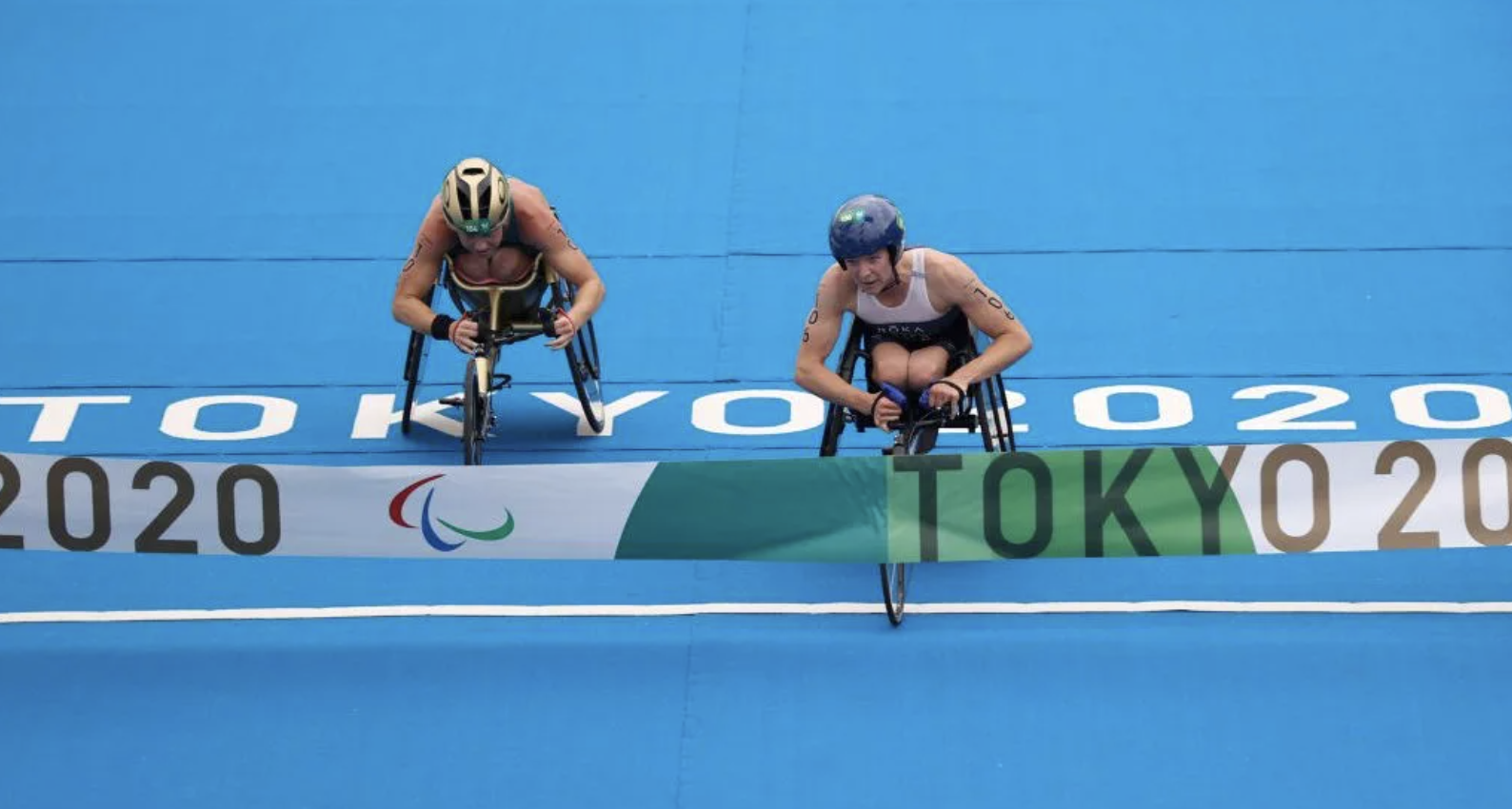
After roughly 26 kilometers of racing, Kendall Gretsch takes Paralympic Gold by just over a meter. (Photo: Screenshot NBC Sports)
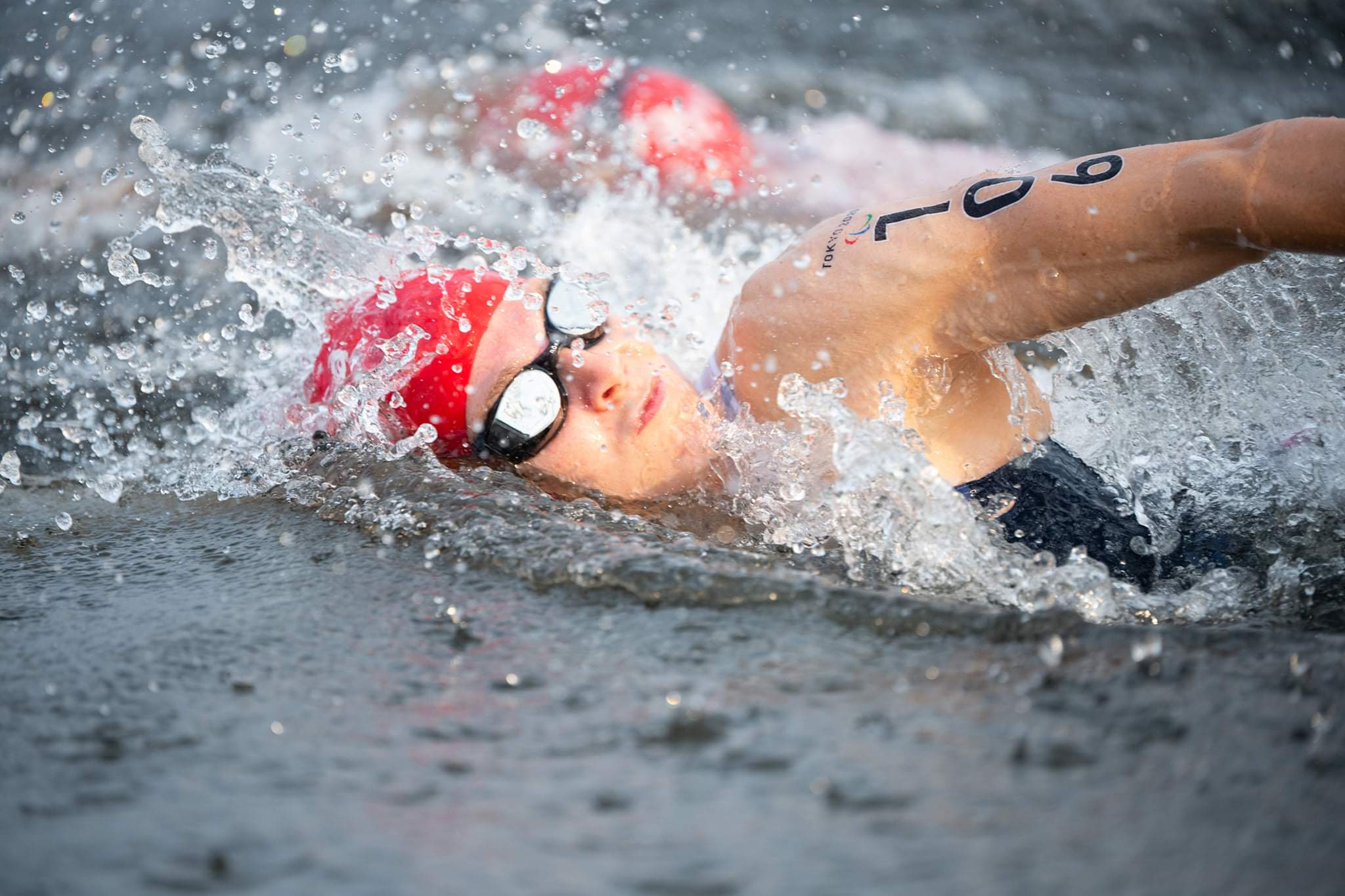
If you didn’t catch the ending of the triathlon during the Tokyo Paralympics, prepare for the chills. Spoiler alert: in an all out, last gas effort in the final meters, dual-season athlete Kendall Gretsch edged out Australia’s Lauren Parker by one second for a Gold Medal victory.
This is Gretsch’s third Olympic gold, alongside the two she earned during the 2018 PyeongChang Paralympic Games, first in the 6-kilometer biathlon sitting sprint and again in the 12 k cross-country distance race. Her achievement in Tokyo makes her the fifth American — third female — to win a Gold Medal at both the summer and winter Paralympic Games.
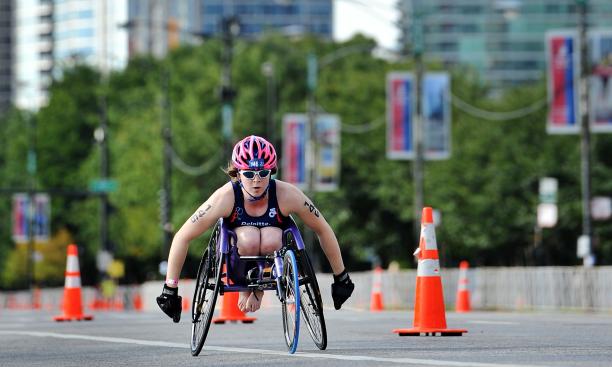
Taking a step back, triathlon was first added to the summer Paralympic schedule in 2016, however, only a subset of the nine competition classification categories were allowed to compete. Gretsch was born with spina bifida, which is the result of a neural tube defect during fetal development, impairing her spine and spinal cord. While she walks with crutches, she competes in the PTWC2 (paratriathlon wheelchair) division, meaning after the swim, she races the bike leg on her handcycle, before transitioning into a racing wheelchair for the run. The Tokyo games were the first opportunity for the two PTWC categories to compete.
FasterSkier spoke with Gretsch in April of 2020 when the news first broke that the Tokyo Olympics were definitely postponed until 2021 due to the ongoing COVID-19 pandemic. As we discussed, this leaves just over six months for athletes like Gretsch who compete in both winter and summer sports to prepare for the upcoming Beijing Paralympics, which begin on March 4th, 2022. Following up to learn more about her experience in Tokyo, FasterSkier reconnected with Gretsch on a call to hear how she is mentally and physically recharging before ramping up her training for the winter season.
Paratriathlete Kendall Gretsch made history in Tokyo, becoming one of only five Americans to earn a Paralympic Gold Medal in both winter and summer Games. (Photo: Mark Reis)
First, let’s go beyond the highlight reel to learn more about the Gold Medal day.
Because Gretsch is in the lesser impaired category, she starts at a deficit of four minutes and four seconds behind competitors in the PTWC1 division. The clock starts running at the same time for all athletes, and the first woman across the line is the winner, regardless of starting wave. Among the women in the PTWC1 division was Gretsch’s mark, Parker.
The Australian has a lengthy resume in elite triathlon, including a second place finish in the 2015 Kona World Championships as an able-bodied athlete. After recovering from a serious accident in 2017 that left her with permanent spinal cord damage, Parker began competing in paratriathlon, quickly ascending the ranks and ending the 2019 season with a commanding victory at the ITU World Championships.
While Gretsch is accustomed to the staggered start in her event, she explained that it does change the tactics compared to a mass start competition.
“The goal is to consistently make up ground,” Gretsch explained in a call. “So I wouldn’t say it’s a very tactical race, and that you’re like, waiting to time your move, or finding the right spot on the course to make a move. You’re basically just going all out in trying to [catch the earlier starters] by the end of the race, hoping you can make up that four minutes.”
The PTWC race includes a 750 meter swim, a four-lap 20 km bike, and a four-lap 5 km run, which Gretsch completed in a total time of 1:06:25. She explained that the many laps during the bike and run allowed her coaches to regularly provide her with feedback of where she stood relative to the leaders.
On the hunt, Kendall Grestch chases down a Gold Medal during the run in the 2022 Paralympic triathlon in Tokyo. (Photo: Mark Reis)
Gretsch began making up time right away. She was 35 seconds faster than Parker in the swim, and left the second transition from bike to run just a minute and twenty seconds back. While she acknowledged that the percentage of the race that happens on the bike makes it an opportunity to make a dent in the deficit, she also explained that her progress during that leg surprised her.
“It did play out a little bit differently, in my mind, than I thought it was going to,” she shared. “Usually I can make up a little bit more time on the swim, and then I know that Lauren is a super strong biker. So going into this race beforehand, my goal was to make up some amount of time on the swim and really just not lose time to her on the bike. So yeah, I was really pleased that I was able to make up as much time out on the bike as I did in this race. Especially because she had an amazing swim.”
Sometimes good results come from races where we never feel our best and may feel surprised by the outcome. Likewise, there are the days we dream about where everything is clicking from start to finish and we know from the gun that it will be a good day. For Gretsch, there were elements of both.
“I would say my swim was average. And then as soon as I got onto the bike, I knew that it was a really good day for me and that I was feeling really strong. So I kind of just told myself throughout the race — I knew that [I was giving] everything I had on that day, and could push really hard. And regardless of what happened, I knew it was gonna be a really close race. If I passed her, if I didn’t pass her; I just knew that it was going to be a really exciting race to watch. So that was kind of cool to have that recognition during the race that regardless of what happens, I wasn’t going to have any regrets about the race because I knew I was going as hard as I could, and that it was going to be an exciting race for people to watch.”
While she felt “average” in the swim, Kendall Gretsch had a well-above-average day competing in the triathlon at the 2021 Tokyo Paralympics. (Photo: Mark Reis)
With three golds and a silver from ITU World Championships, five USA Paratriathlon national titles, and a slew of international podiums, Gretsch is no stranger to high level competition. However, the Paralympics is the Paralympics; held as the pinnacle of sport in the United States.
Grestch spoke about her mindset approaching the Games in terms of managing expectations she feels, whether internal or external, and her approach to the mental strain of competing in Tokyo.
“Going to the Paralympics is something that I’ve wanted to do ever since I got involved in triathlon, so finally having the opportunity this year in Tokyo — this race was just so important to me. And I maybe underestimated the mental drain going into the race. It’s such a mental roller coaster where, you know, you feel great some weeks, and you feel bad on some days. And it’s hard, because it just feels like your whole — everything you’ve done for the past five years, even longer than that has just been leading to this one day. So I think for me, it was just such a huge relief that I did have a day where I felt so strong. And again, if it was first or second, I was going to be happy with the outcome either way, because I knew that I had done everything I could in the preparation leading up into the games, and that was everything I had on that day.”
Circling back to the postponement of the Games, Gretsch reflected on whether or not the decision to move the games to 2021 was a benefit or detriment.
“I think the postponement really worked in my favor. I had gotten all new equipment for my bike and the run in October of 2019. So just having that extra year gave me time to work with that equipment and dial that in, and it also gave me the opportunity to take a step back and maybe rethink how I was training. Specifically, I think, the run and bike became two really big focuses for me. And so just having that extra year to be able to change things up, try something new and not have to worry about risking a race season because if something didn’t work, it wasn’t as big of a risk.”
Considering the elongated buildup for Tokyo and the brief window to take a break before preparing for Beijing, Gretsch explained that her mind more so than her body needed to recharge. Our call took place following a short vacation.
“Obviously, you need the physical recharge, and that’s something that I’m familiar with from going between the seasons every single year. But the mental drain of the Games was a lot bigger, I think, than just a regular summer season. So the mental break that I took was so important for me. Now that I’m starting to get back into [ski training] now, I’m just excited about it and ready to go and not, you know, carrying any fatigue this week from that.”
Kendall Gretsch takes aim during the women’s 6-kilometer sitting biathlon at the 2018 Paralympic Winter Games on Saturday in PyeongChang, South Korea. She won the race to become the first American woman to medal in a biathlon event at the Paralympics (or Olympics). (Photo: US Paralympics/Getty)
At the moment, changing gears looks like a steady reintroduction of ski specific elements to her training, including shooting and double poling. Gretsch, who is based at the Olympic and Paralympic training center in Colorado Springs, also attended a 10-day USA Para Nordic training camp in the ski tunnel in Oberhof in late September.
“Since I don’t have access to snow yet [in Colorado], introducing some time on the Ski Erg again, getting range time when I can. So yeah — just trying to get back into the ski motions before leaving full time for the Winter, around the end of October or early November.”
Finally, Gretsch reflected on her experience in the COVID restriction shrouded Games in Tokyo compared to her previous Winter Olympic experiences.
“It’s weird to think about because — if I thought about what the environment was, or if someone told me that this is what it was going to be like four years ago, I think I would have said, ‘Oh, wow! That’s so crazy to imagine.’ But we’ve been living through COVID for 18 months, almost two years now. And so it strangely feels kind of normal.”
FasterSkier will continue to follow the Para Nordic team’s whirlwind build up to the Beijing Games.