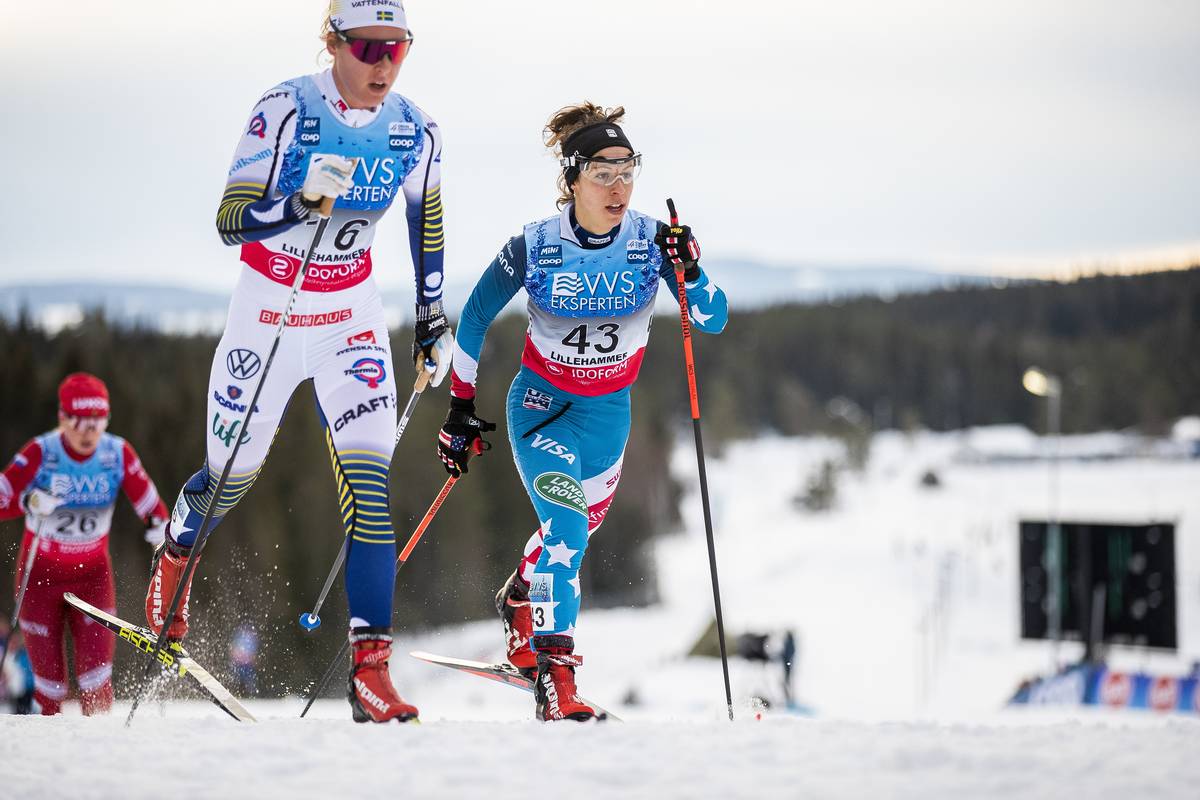
Rosie Frankowski races a December 2019 skiathlon World Cup event in Lillehammer, NOR. (Photo: NordicFocus)
The Olympic Dream.
Perhaps the opportunity to compete at the highest level of sport would not be as sought-after and revered were it not for the inherent scarcity of opportunities to achieve it. This year, only eight women and six men were able to represent the United States in cross-country skiing in Zhangjiakou, down from a total of twenty – 11 women, 9 men – who were selected for PyeongChang in 2018.
Among those who came up just shy was 30-year-old Rosie Frankowski, who has spent the last eight years training with APU under head coach Erik Flora. Frankowski is a 2018 Olympian and 2019 World Championship competitor, finishing inside the top-30 in both places – 21st in the 30 k classic in Korea and 24th in the 15 k skiathlon in Seefeld.
Rosie Frankowski skis through wet falling snow to win the women’s 10k at the opening SuperTour weekend in Duluth, MN. (Photo: Jordan Woods/Woods Creek Productions)
After strong early season results that included two wins and three third place finishes in early season SuperTours, Frankowski lined up in Soldier Hollow for a two-week stretch of racing that felt like it was for all the marbles. As many women had already met the objective criteria for team selection via results on the World Cup, it was only the final few spots that remained open for domestic racers; in the hungry pool all fighting for these spots via some combination of U.S. Nationals, Sun Valley SuperTour, and Tour de Ski results were Frankowski, Caitlin Patterson, Alayna Sonnesyn, Katharine Ogden, Novie McCabe, and Sophia Laukli.
As Frankowski describes in this episode, her opening races – the freestyle sprint and the 20-kilometer mass start skate – of U.S. Nationals went remarkably well; despite being known as a distance specialist, she won the sprint qualifier and finished sixth in the final, then won the race for second place in the 20 k skate, behind Rosie Brennan who had dropped the field from the start. From there, Frankowski faced a series of challenges – slick skis and variable klister conditions in the 10 k classic, a fall in the classic sprint, and a sublexed shoulder in the opening race in Sun Valley.
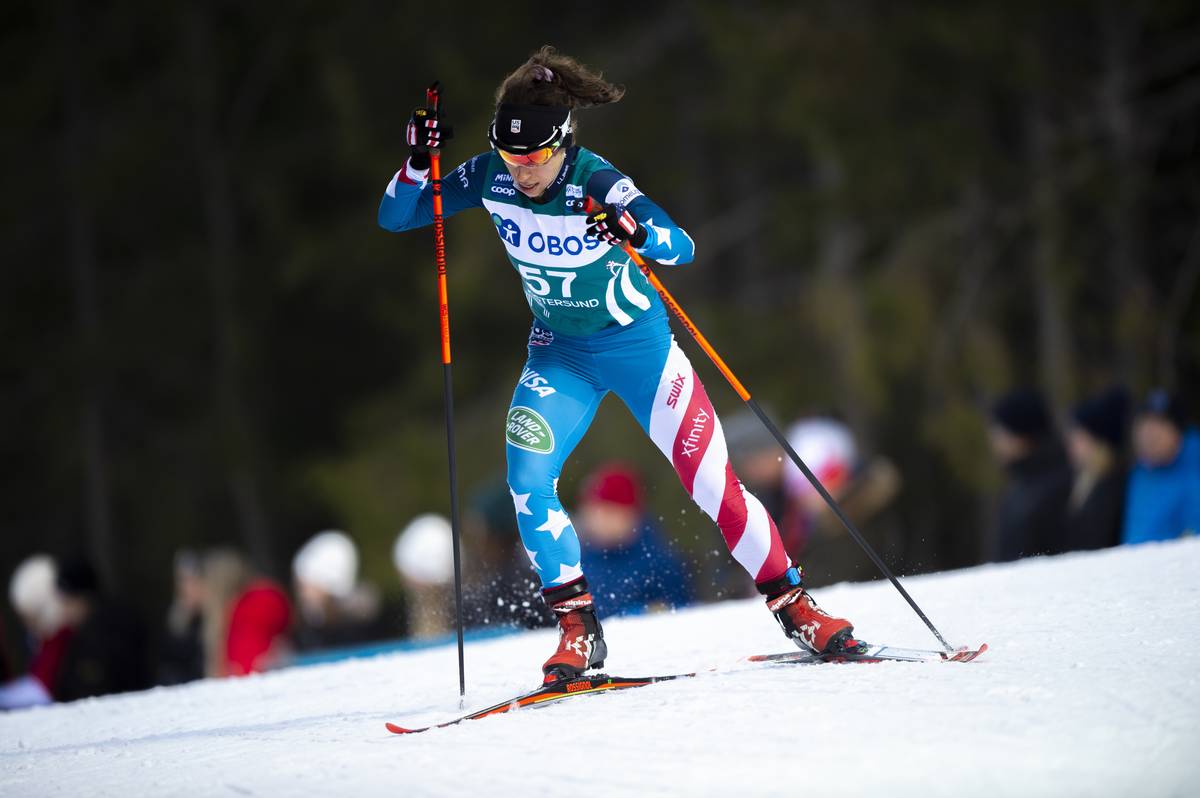
Rosie Frankowski on course during a February 2020 World Cup in Östersund, SWE. (Photo: NordicFocus)
The official team nominations for the 2022 Beijing Olympics were released the following week, and Frankowski was named as the second alternate for the women’s team. Five months later, Frankowski finds herself at a transition point in her career. It’s not a cut and dry retirement as she has earned Period I starts on the World Cup and has other race objectives next winter, but it’s a shift in focus as she and her partner prepare to relocate from Anchorage, AK to Durango, CO.
In this conversation, Frankowski shares the highlights and challenges of the 2021-22 race season, and provides invaluable insights into the experience of spending her career as a “bubble athlete”, fighting for international race opportunities and team selection, while juggling the financial realities of supporting her professional ski racing career. She reflects on her time with APU, and discusses defining success when surrounded by “more-accomplished” teammates, and how she expects the ratio of mountain running to ski-specific training to shift after this transition.
Thanks for listening and thanks to Concept2 for supporting this podcast.
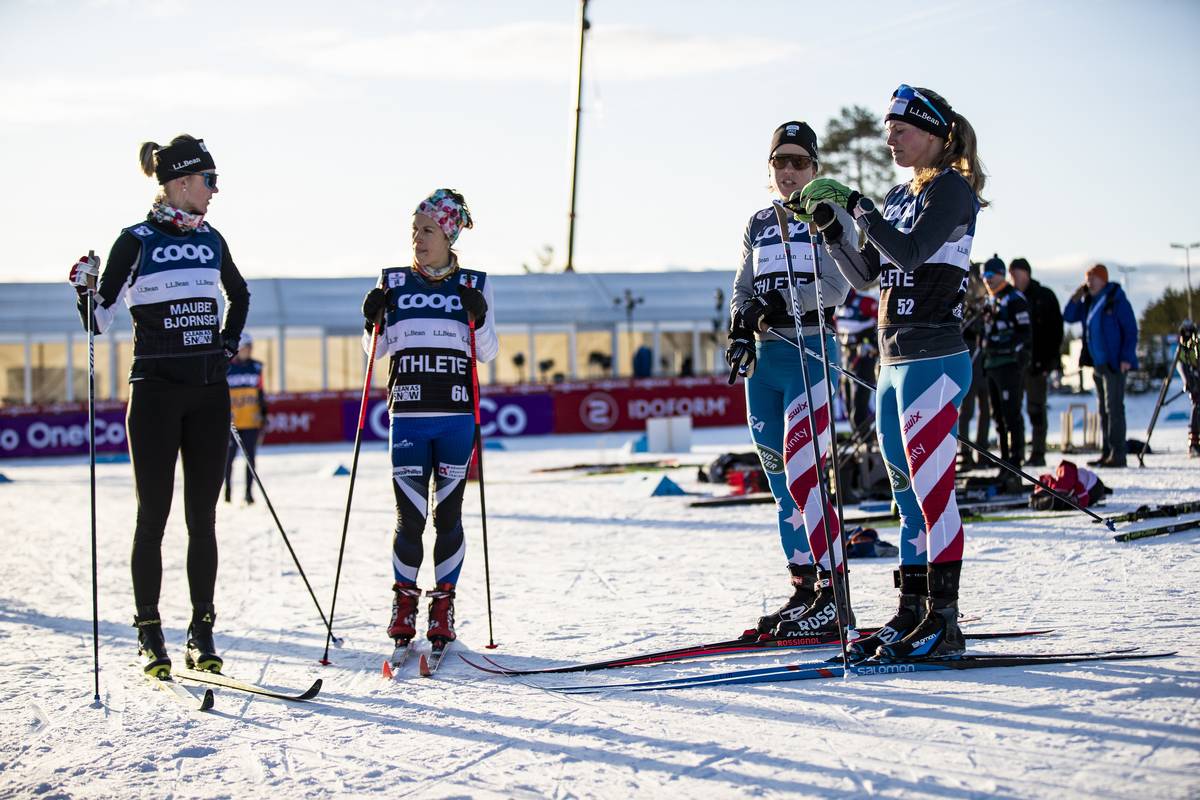
Scenes from a training day in Lillehammer in December 2019. From left to right, Sadie Maubet Bjornsen, Rosie Frankowski, Rosie Brennan, and Jessie Diggins. (Photo: NordicFocus)
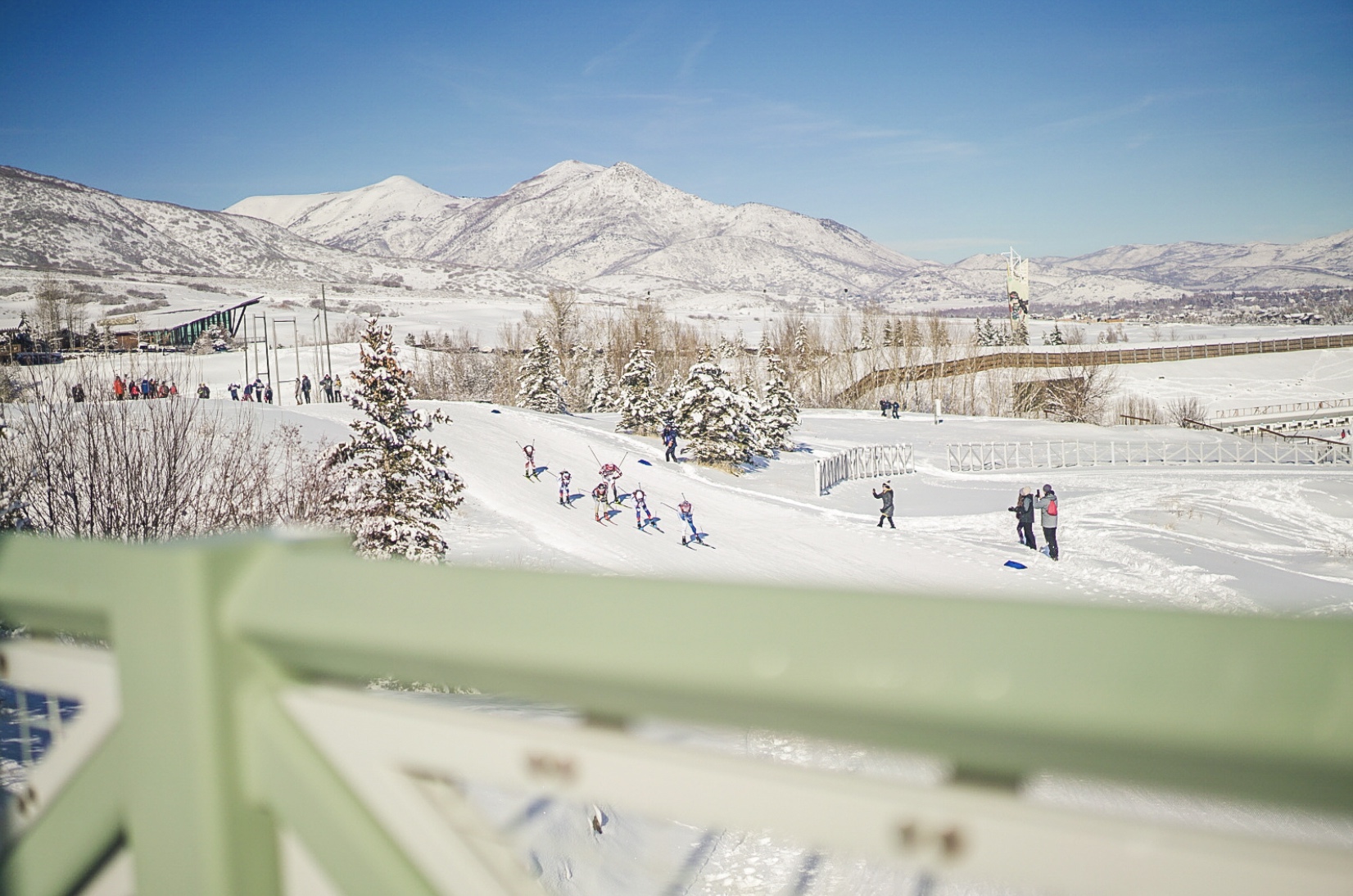
Soldier Hollow, UT offered a variety of conditions over the three days of racing at the 2022 U.S. Cross Country Championships. (Photo: Tobias Albrigtsen / @untraceableg)
By Rachel Bachman Perkins, Ella Hall, and Gavin Kentch
Thursday marked the final day of racing at the 2022 U.S. Cross Country Championships in Soldier Hollow, UT. (Friday’s classic sprint is a SuperTour only, not part of the National Championship series.)
After prime conditions in Sunday’s freestyle sprint and Tuesday’s 20/30-kilometer freestyle distance races, warm and wet weather made its way into the forecast just in time for the 10/15k interval-start classic races. Temperatures that started in the mid 30s for the women’s race climbed into the low 40s for the men’s race. In combination with variable precipitation that was not-quite-white, teams faced a dreaded combination of conditions for classic racing.
Looking like thoroughbreds, skiers shuffled and kicked their skis in the tracks to prevent icing as they lined up at the start gate to begin racing. For many athletes, the shuffling continued even after they pushed through the start wand and headed out onto the course. Even top-10 finishers could be seen slipping, struggling, and doing anything possible to get their skis to kick, while exhibiting technique that looked more like “desperate times call for desperate measures” than “this is what my technique videos should look like.” Classic racing in a warming world can be rough.
Women’s Race: Caitlin Patterson Wins by Nearly a Minute
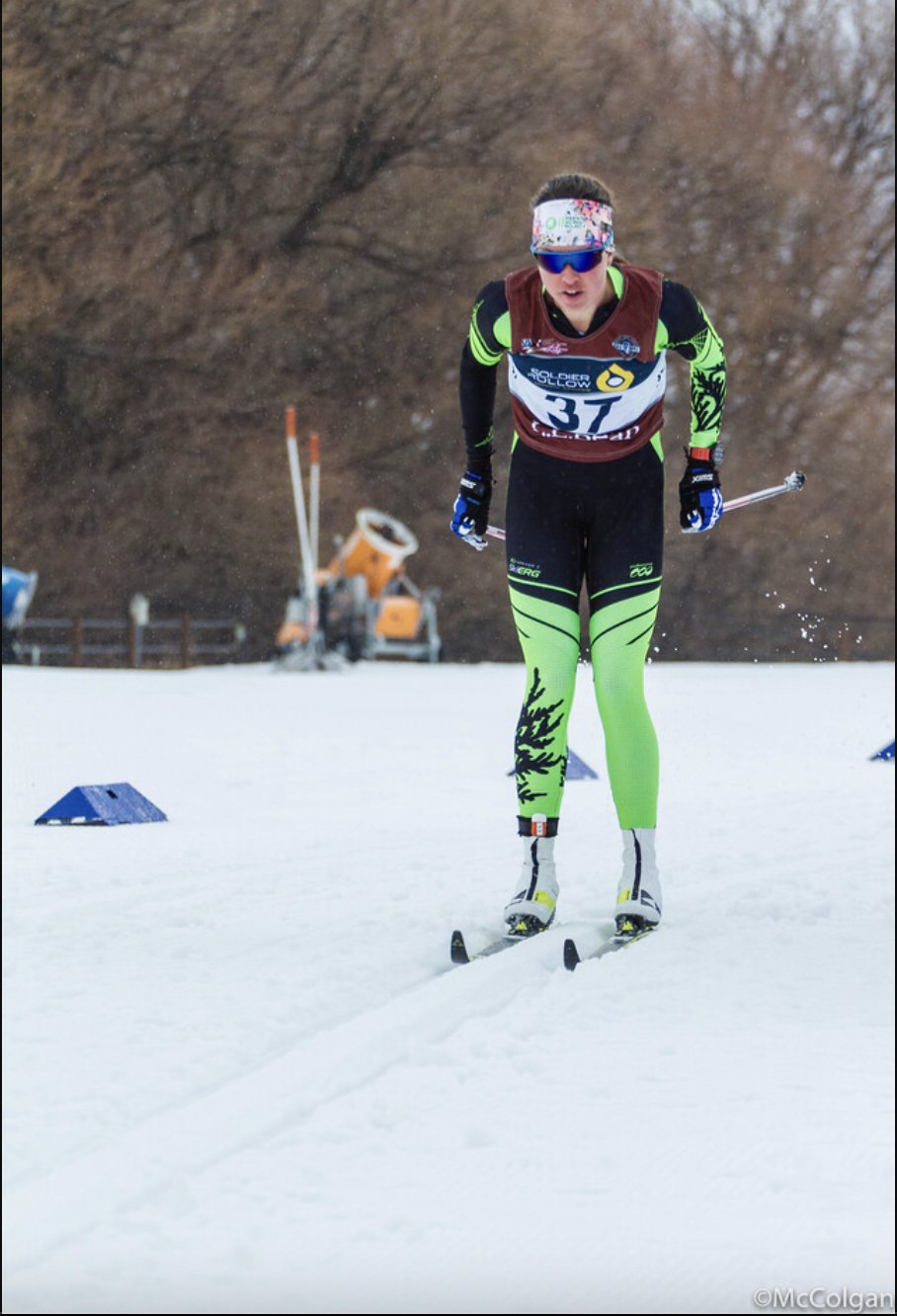
One athlete who had scant difficulty with the variable conditions was Caitlin Patterson of Craftsbury Green Racing Project (CGRP). Starting in bib 37, near the back of the top-seeded field (bibs 21-40), Patterson had the advantage of receiving splits telling her how she was doing relative to the rest of her competition. Tuesday’s second-place finisher in the distance skate race, Rosie Frankowski, started one minute later in bib 39, but athletes starting ahead of her included Katharine Ogden (USST/SMS T2) in bib 23, Master skier Erika Flowers (BSF) in bib 29, and U20 skier Sydney Palmer-Leger (USST/U Utah) in bib 36.
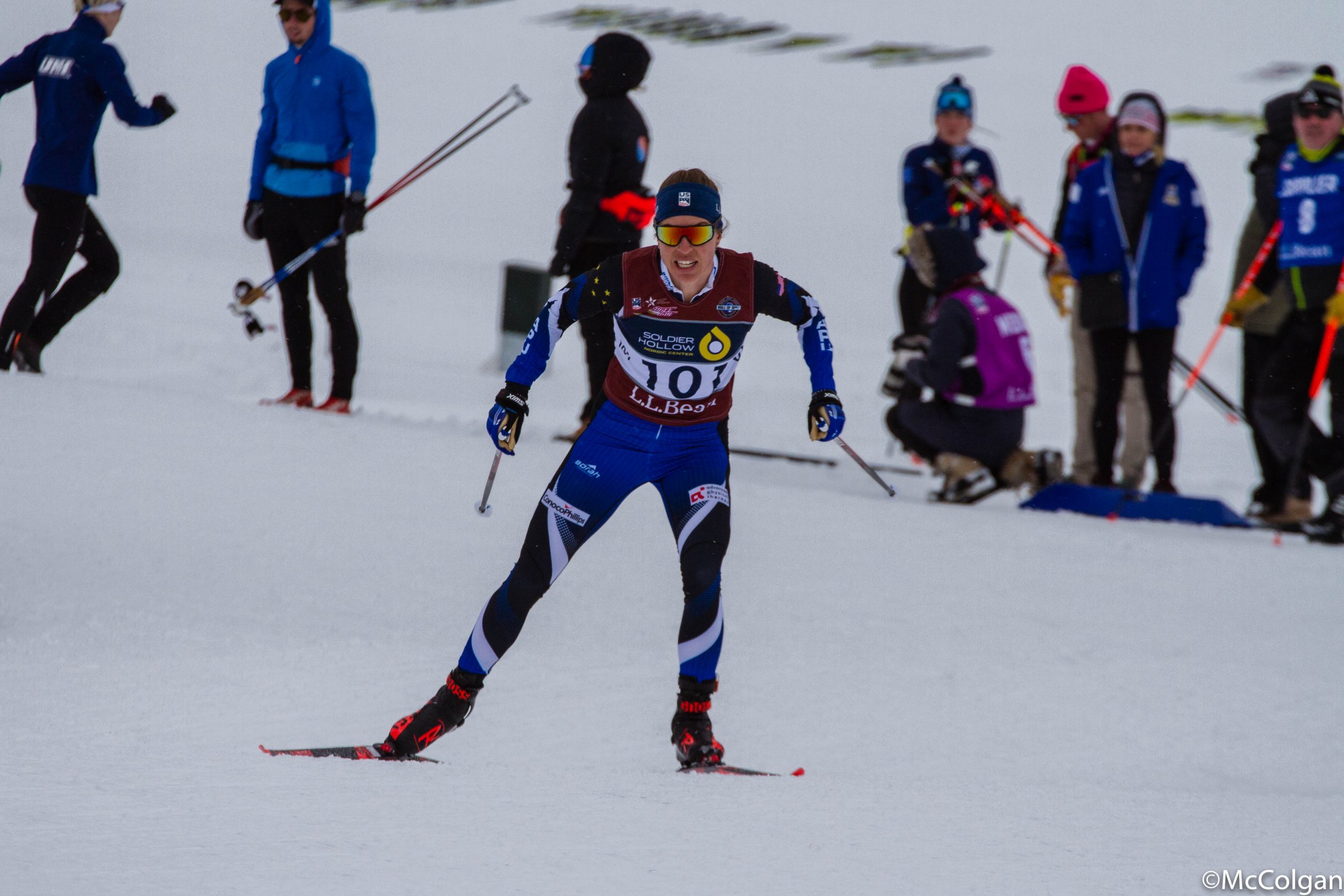
Caitlin Patterson takes the national title in the women’s 10k interval start classic in Soldier Hollow. (Photo: John McColgan)
All that said, Patterson didn’t have to do very complicated math out there. After the first of three 3.33-kilometer laps, she was already in first, by 6 seconds over Palmer-Leger. After the second lap, her lead had grown to a healthy 30.9 seconds through less than 7 k of racing, this time over BSF Pro Team skier Mariah Bredal. Patterson proceeded to clock the fastest third leg in the field, by over 20 seconds, on her way to the finish, ultimately winning by nearly a minute.
Patterson notched the fastest first and second legs, too. The math can sometimes get complicated in interval-start races, but it’s safe to say that if you have the fastest time for each of three legs, you have won the race. Patterson did so by a remarkable margin of nearly one minute over ten kilometers, crossing the line in 28:12.0. No other athlete in the field broke 29 minutes on the day.
“Today was a really nice race for me, and I’m very happy with it,” Patterson wrote to FasterSkier after the race. “I skied my own race, but also felt that I went for it aggressively right from the start. It’s not every day that it’s possible to hold on to an effort like that, but I was able to keep pushing and building into the race. It’s fun to be able to race so hard, dig in deep but also be getting hints of recovery on the downhills. I was getting occasional splits that I was in the lead, but not many details, so I just kept pushing, especially since you never quite know with splits if they’re capturing everyone. However, in my 3rd and final lap, I believe I heard some cheering to the effect of ‘Caitlin you’re putting on a clinic, keep going!’ and I had some ideas that the race was quite a good one in results, to match the feelings.”
Patterson was one of few skiers who looked as if she could trust her skis throughout the race, still keeping her technique shorter and choppier than a traditional stride and glide, but nevertheless consistently achieving grip where her opponents were faltering. She acknowledged the role that the CGRP service team played in today’s success.
“The CGRP waxers – Nick Brown, Jake Barton, Ollie Burruss, and coach Pepa Miloucheva – did an awesome job with skis today and I’d like to thank them for their hard work today and every day! Great skis really helped set us up for success, and I’m proud of my whole team’s efforts this week.”
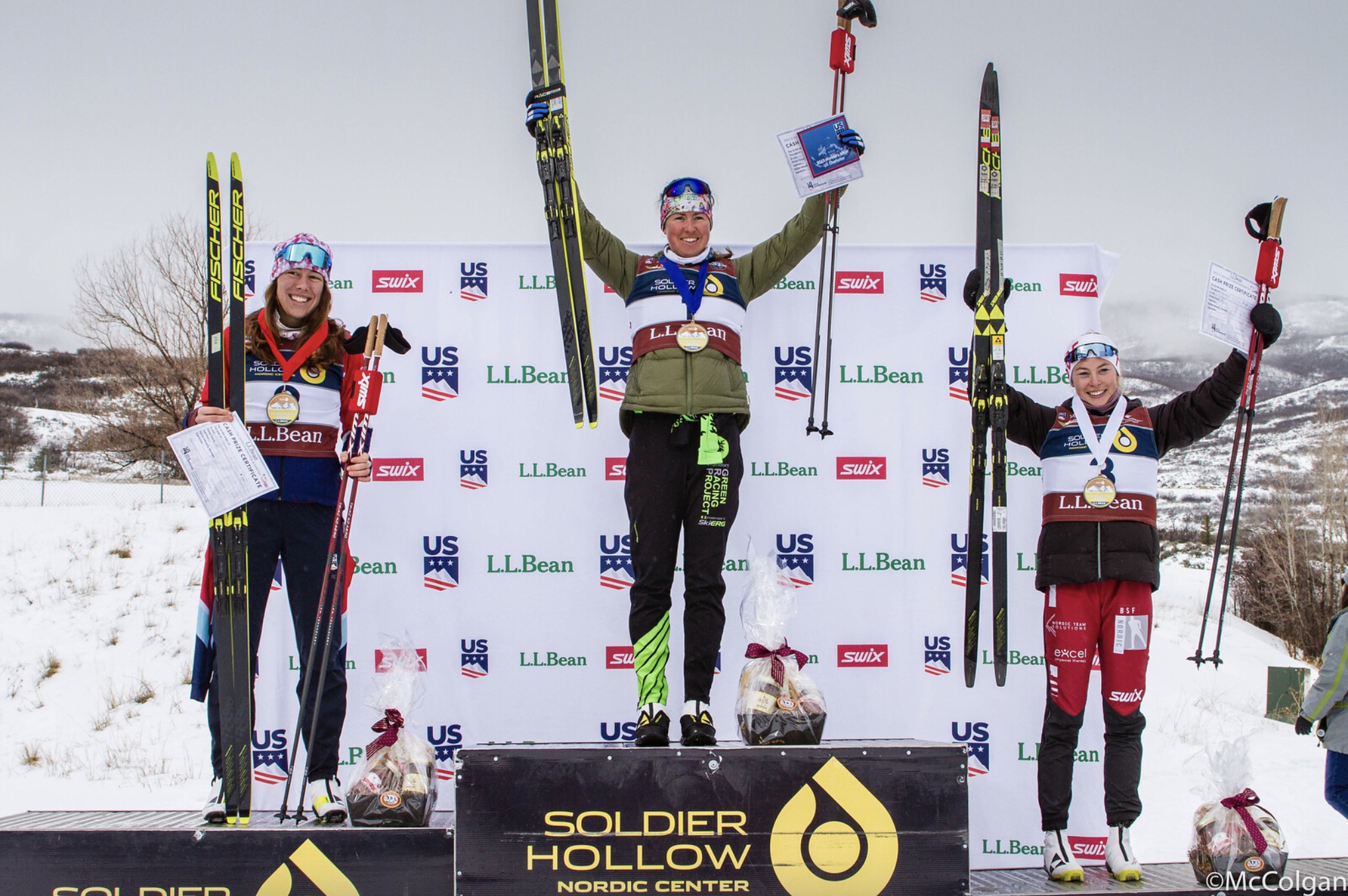
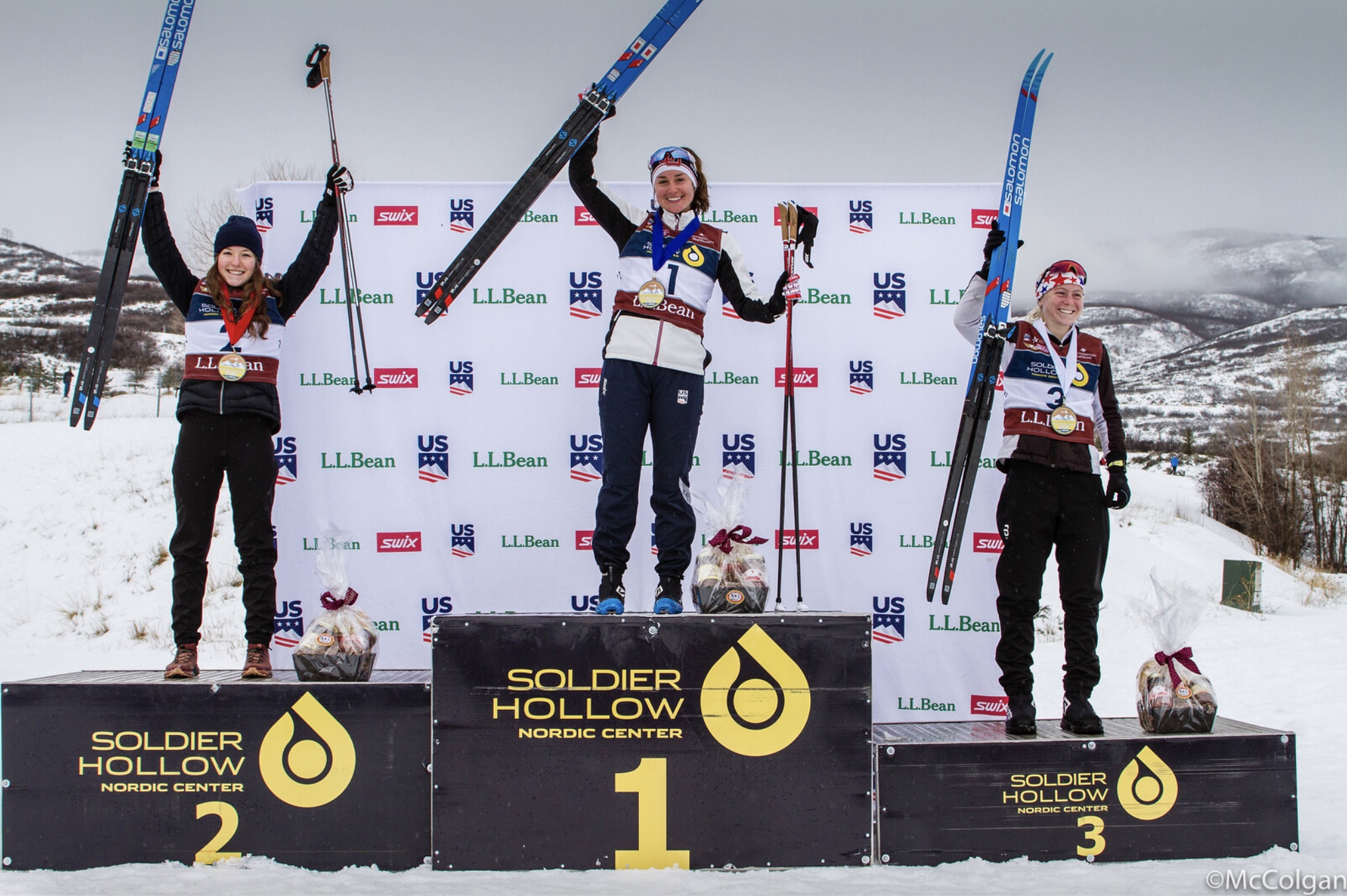
The women’s 10k interval start classic podium at the 2022 U.S. Cross Country Championships in Soldier Hollow, UT: Caitlin Patterson took the national title ahead of Katharine Ogden in second and Mariah Bredal in third. (Photo: John McColgan)
Patterson also reflected on her performance in the three stages of the U.S. Championships as a whole. Putting together a successful week of racing, she took home two wins, today and in the freestyle sprint Sunday, along with a third place finish in the 20k on Tuesday.
“Overall Nationals feelings have been quite good once I’ve gotten into the racing itself. Once I toe the line, my body wakes up and I’ve been able to push hard. It’s not all sunshine though, as many of the off days and even the warm ups before races have been a little rougher around the edges. Most racers I expect are familiar with the restless nights of sleep, the pre-race jitters, and the accumulated toll of so many races in a row – still, that’s part of the challenge to get through. I think the fact that Sunday was my first sprint race of the year, plus going the full four rounds, took more out of me than I would have expected. However everything seems to bounce back pretty well in time for the next race, and I’m looking forward to tomorrow’s sprint and overall enjoying so many chances during the week to dig in and race hard!”
Ogden, very recently returned from Europe after racing to 31st in Monday’s 10 k classic in Val di Fiemme in stage five of the Tour de Ski, took second, 53.4 seconds back, in a steady effort that saw “only” the third- and fourth-fastest individual lap times, but the second-best time overall.
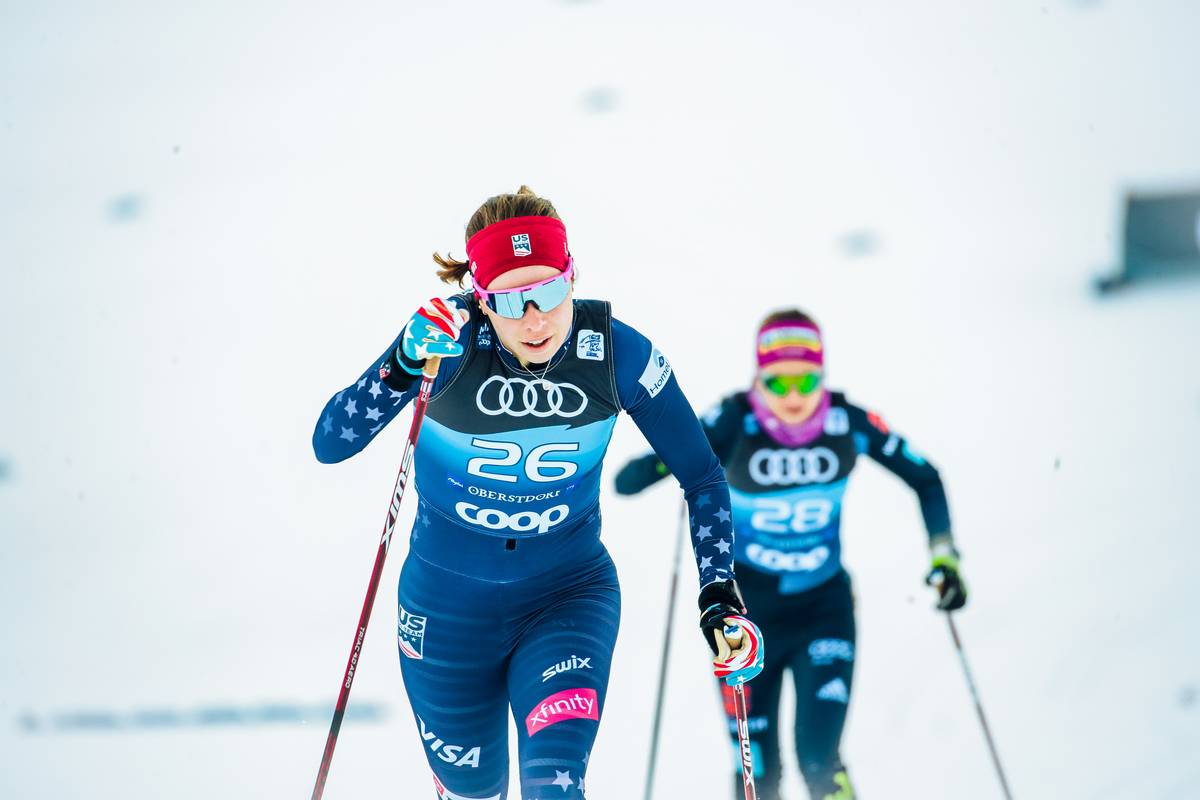
Katharine Ogden races the classic sprint during the 2021/22 Tour de Ski in Oberstdorf, Germany. (Photo: NordicFocus)
“This race was brutally hard!” Ogden wrote to FasterSkier. “The course was hilly and a lot of fun, exactly what we expect of Soldier Hollow. I knew that winning today was a total long shot after racing five races of the tour and then flying [to Salt Lake City] only a day and a half before the race, but I am really proud of the way that I skied today. Even though it wasn’t the miracle race that I was hoping for, it was incredibly fun to race at home in the U.S. and to see so many people that are really special to me and have been instrumental in my ski career.
“Despite how painful the race was today, I can honestly say that I am so incredibly happy to be here and that I have never felt more loved by the ski world. It is always an honor to get a chance to race for Stratton, the team that has supported me unconditionally for the past 10 years. I am also extremely impressed by the way that Caitlin and Mariah skied today. They both work exceptionally hard and it was really special to witness that effort paying off in a big way.”
Bredal raced to third overall (+1:01.2), after moving up from fifth at the first checkpoint.
Originally from Victor, ID, just over Teton Pass from Jackson Hole, WY, Bredal is a 2021 graduate of the University of Utah, where she earned two-time All American and three-time All RMISA honors. Bredal also finished 8th in Tuesday’s 20k freestyle (+4:44.5) and 16th in Sunday’s freestyle sprint.
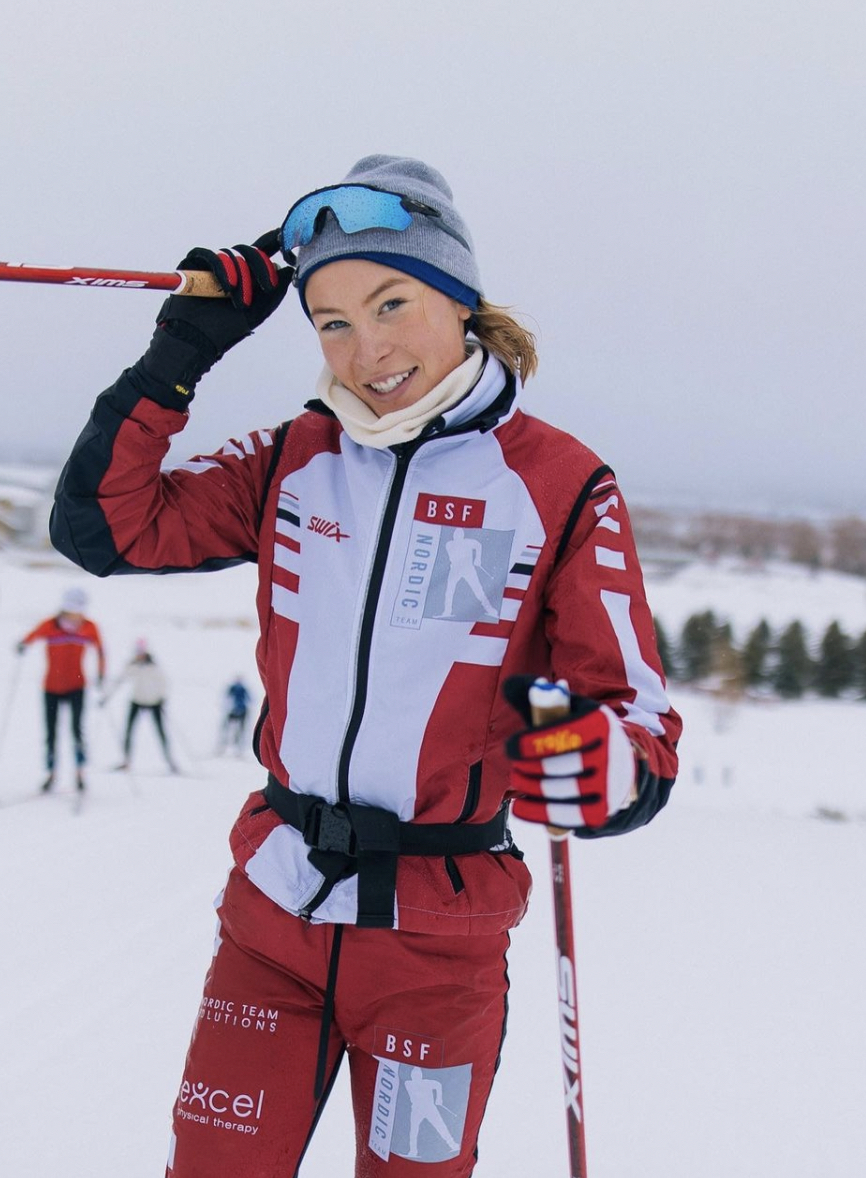
Mariah Bredal raced to third in the women’s 10k interval start classic in Soldier Hollow. (Photo: Instagram @bsf_pro_team)
“Today’s race was a day that everything fell into place for me and actually ended up being one of my better races ever!” wrote Bredal after the race. “It was pretty fun for that to happen and result in a podium at U.S. Nationals. I felt really good to begin with and was able to push myself a lot throughout the race too. I had amazing skis as well today.”
Speaking to her transition to post-collegiate racing, Bredal also shared her thoughts on joining the Bridger Ski Foundation Pro Team in Bozeman, MT.
“I have enjoyed it a lot so far and feel like my skiing is improving also. It’s been awesome to be on the team and I’m grateful for the quality of training and coaching I’ve had so far! Bozeman is a pretty sweet place too. I feel like I’ve had a pretty good start to the season at the SuperTours, and it’s been nice to start the season a little earlier as well.”
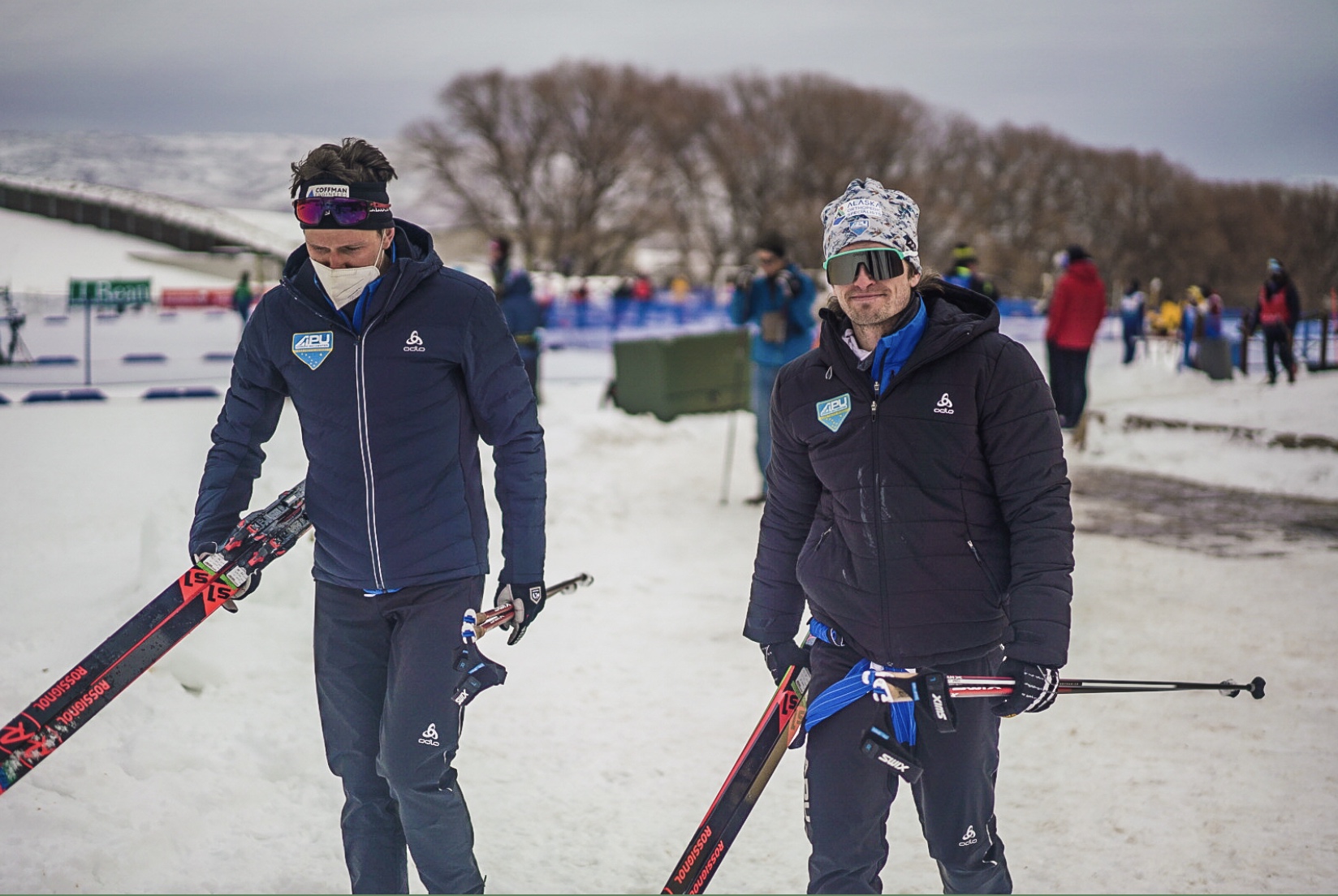
Initially a podium favorite, Frankowski had a rough day, posting the third-ranked time for lap one, but the 17th-ranked time for lap two, en route to finishing ninth overall (+1:41.2). Her APU teammate Becca Rorabaugh, who was second in the 10k classic in the Cable SuperTour races earlier this season, finished in a tie for 14th. Notably, APU may also have had trouble waxing for comparable conditions in the men’s classic sprint at this venue in 2017, when none of its athletes made the heats.
Notable performances from athletes starting outside the seeded group included Hannah Rudd (BSF) in eighth (+1:31.8), U18 athlete Nina Schamberger (Summit Nordic Ski Club) in 10th (+1:48.0), and Annika Landis (CGRP) in 14th (+2:02.0).
The junior women’s podium of the 10k interval start classic in Soldier Hollow. Sydney Palmer-Leger won the junior race ahead of Nina Shamberger in second and Samantha Smith in third. (Photo: John McColgan)
There was no separate juniors race on Thursday; all athletes raced the same course. Extracting the top junior athletes from the results yields an unofficial junior women’s podium of Palmer-Leger (6th overall, +1:23.7), Schamberger, and Samantha Smith (SVSEF, 13th overall, +2:01.7).
Men’s Race: Martin Out-Paces the Field for a Second Craftsbury Title
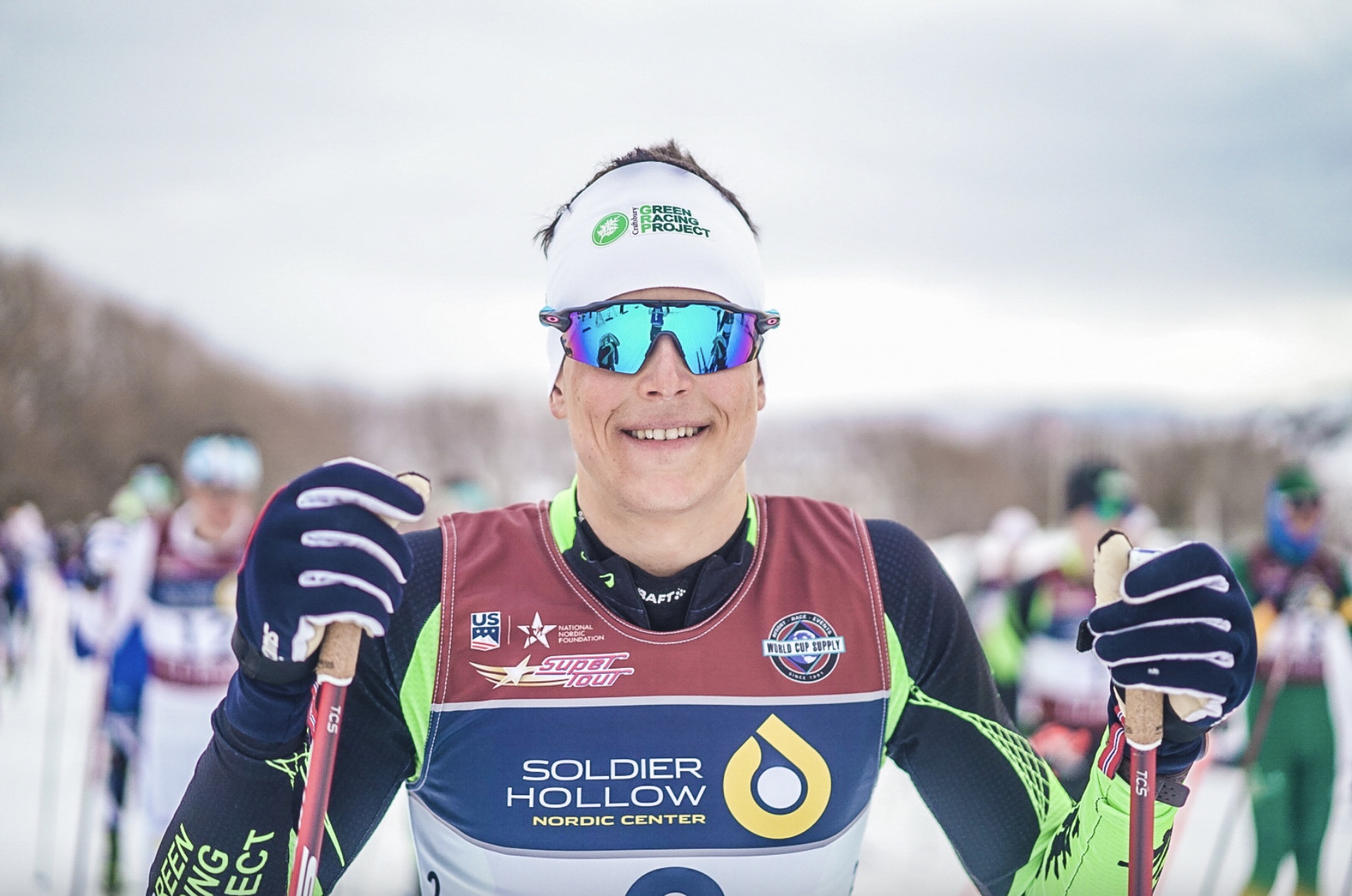
While temperatures continued to warm, the rain cleared and the sun began to shine at the start of the men’s 15 k classic individual start. Over 100 athletes completed the four 3.75 k laps, and it was Adam Martin (CGRP) who came out on top, winning in 39:18.0. With live timing down for most of the race, it was difficult to tell with certainty how the places were playing out, instead identifying strong contenders based on how skis were kicking and gliding and how well an athlete’s technique was holding together.
Adam Martin lines up to race the 30k mass start freestyle in Solder Hollow earlier this week. (Photo: Tobias Albrigtsen / @untraceableg)
For Martin, it was his first national title after several previous podium finishes, all coming in the classic technique. In 2019, racing on home tracks at Craftsbury, Martin was second in the 15 k classic, finishing behind Kyle Bratrud. The year prior at Distance Nationals in Craftsbury, Martin was second in the 50 k classic mass start. In 2016 at Nationals in Houghton MI, Martin was third in the 15 k classic behind Kevin Sandau (CAN) and Thursday’s second-place finisher, Scott Patterson.
“I wanted to win,” wrote Martin after the race, “However, I have a lot of respect for my competitors, so I knew it would take many pieces falling into place to have a shot at it.” He added, “I’m stoked – this is a dream come true for me!”
Reflecting on the conditions Martin wrote, “The conditions were soft klister skiing, and I was really happy with my skis – a good balance of enough kick and still good glide. I started towards the front of the A seed, so I tried to push a hard pace from the start. I was able to recover well on the course downhills, so even though it was at altitude, I was able to accrue big deficits on the uphills without completely blowing up.”
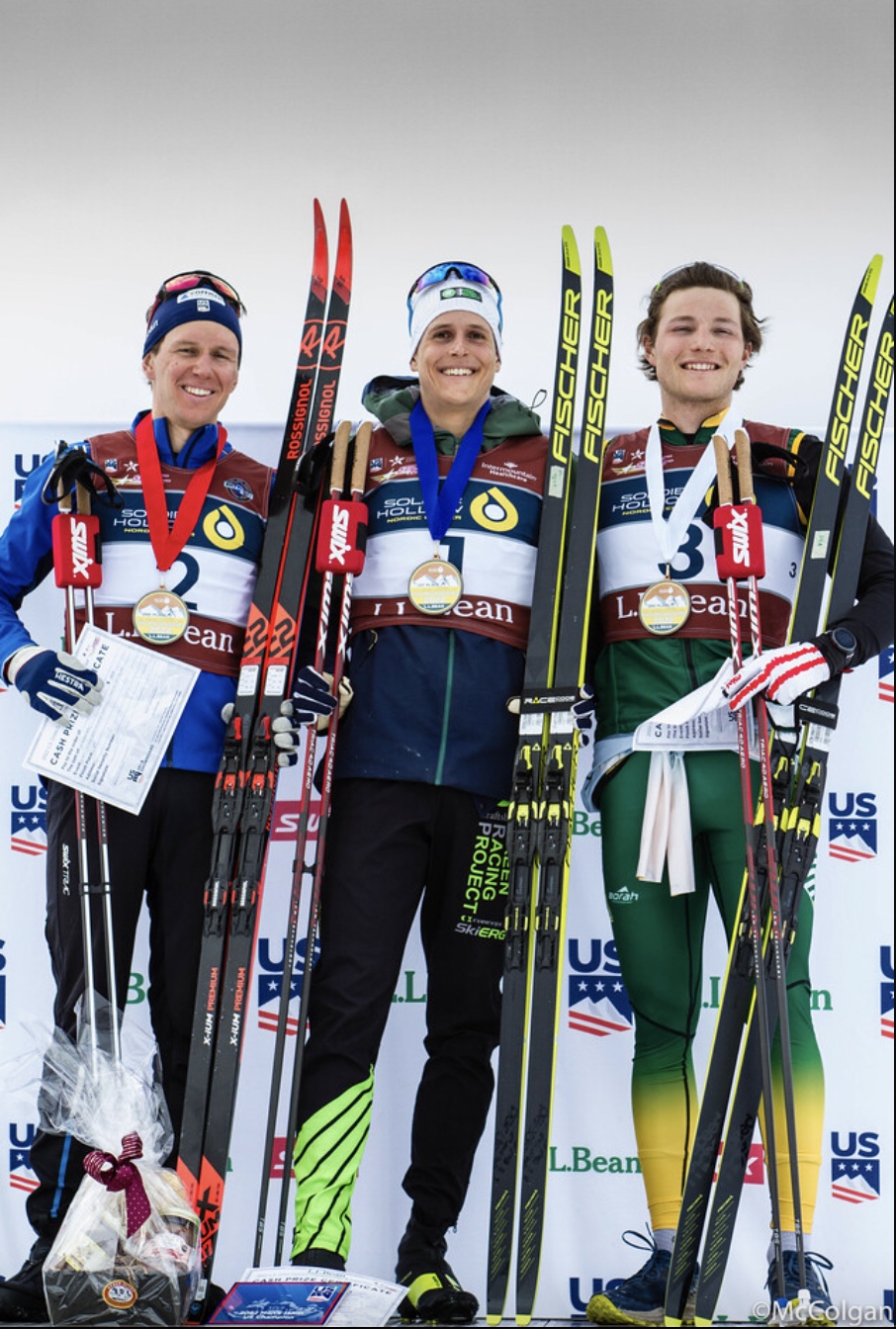
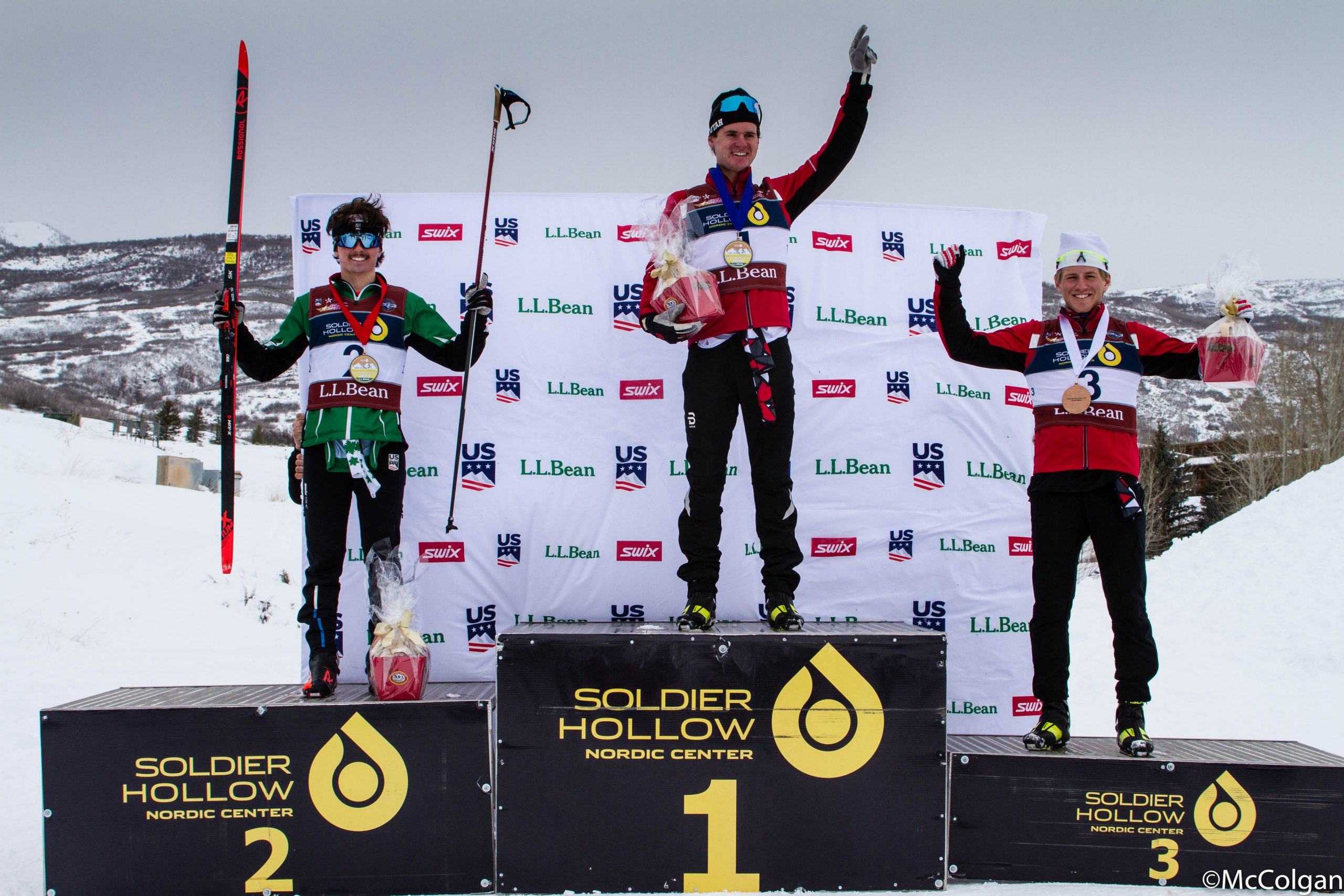
The men’s 15k interval start classic podium during the 2022 U.S. Cross Country Championships in Soldier Hollow, UT. Adam Martin took the win ahead of Scott Patterson in second and JC Schoonmaker in third. (Photo: John McColgan)
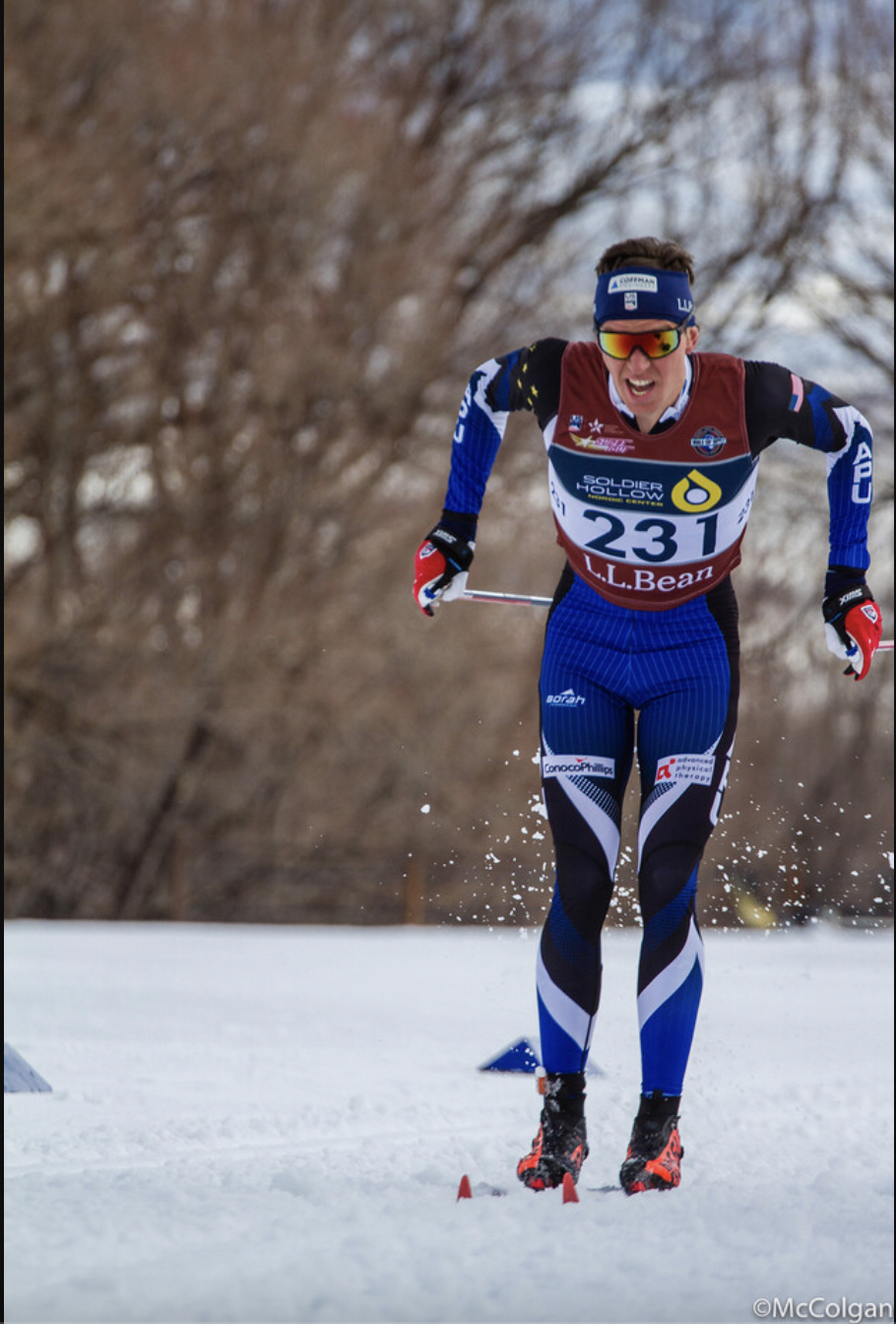
Scott Patterson (APU) came in second (+48.9), following up his victory in the 30 k with another podium finish. After the race he wrote, “I felt solid throughout the race. After talking to my sister following her success, I knew it was going to be hard from the start. I had that in my mind and went out for battle. I started quite strong and felt solid early on, but later, I knew my form was falling apart a bit and my arms were tiring. Four months of one pole and limited two pole skiing through the fall following my wrist injury didn’t exactly enhance my double pole endurance. However, I think I fought through that well and made the most of what I had today.”
Regarding the conditions Patterson noted, “Conditions were tough out on the course today. Warming up quite a few of my APU teammates were noting that it felt a bit like skiing on Eagle glacier in the afternoon. The pole troughs were deep, and the tracks were getting a bit wobbly and blown out. Days like today require a lot from both the athletes and the wax techs.”
Patterson started bib 231, meaning he could get splits off of Martin who started bib 224. To this, Patterson wrote, “Most of the race I was focused on chasing down my APU teammate Hunter Wonders who started right in front of me. (Wonders finished fifth, +1:18.5 back from Martin.) I did receive a few splits from Adam Martin, but it became clear pretty quickly in the race that he was skiing in a different league today.”
Scott Patterson races to second in the men’s 15k interval start classic in Soldier Hollow. (Photo: John McColgan)
“Instead I was focusing on the little things right in front of me,” Patterson continued. “Hunter proved a good rabbit with a strong start and similar performing skis. I was unable to catch him, but finished just a few seconds behind. I also had a bit of a view of JC Schoonmaker when we turned at the top of the hollow. His continual presence about 30 seconds back kept me pushing all the way as I knew it would be close.”
He turned out to be right. Rounding out the podium was JC Schoonmaker (USST/UAA) in third (+52.9), just four seconds behind Patterson.
Schoonmaker earned his first national title on Tuesday during the skate sprint but he wrote, “[Thursday’s] distance podium probably feels better than the sprint win the other day just because it’s been something I’ve been working super hard on. I’ve never viewed myself as just a sprinter, so today helps to prove that and I’m really proud to feel like I can do both.”
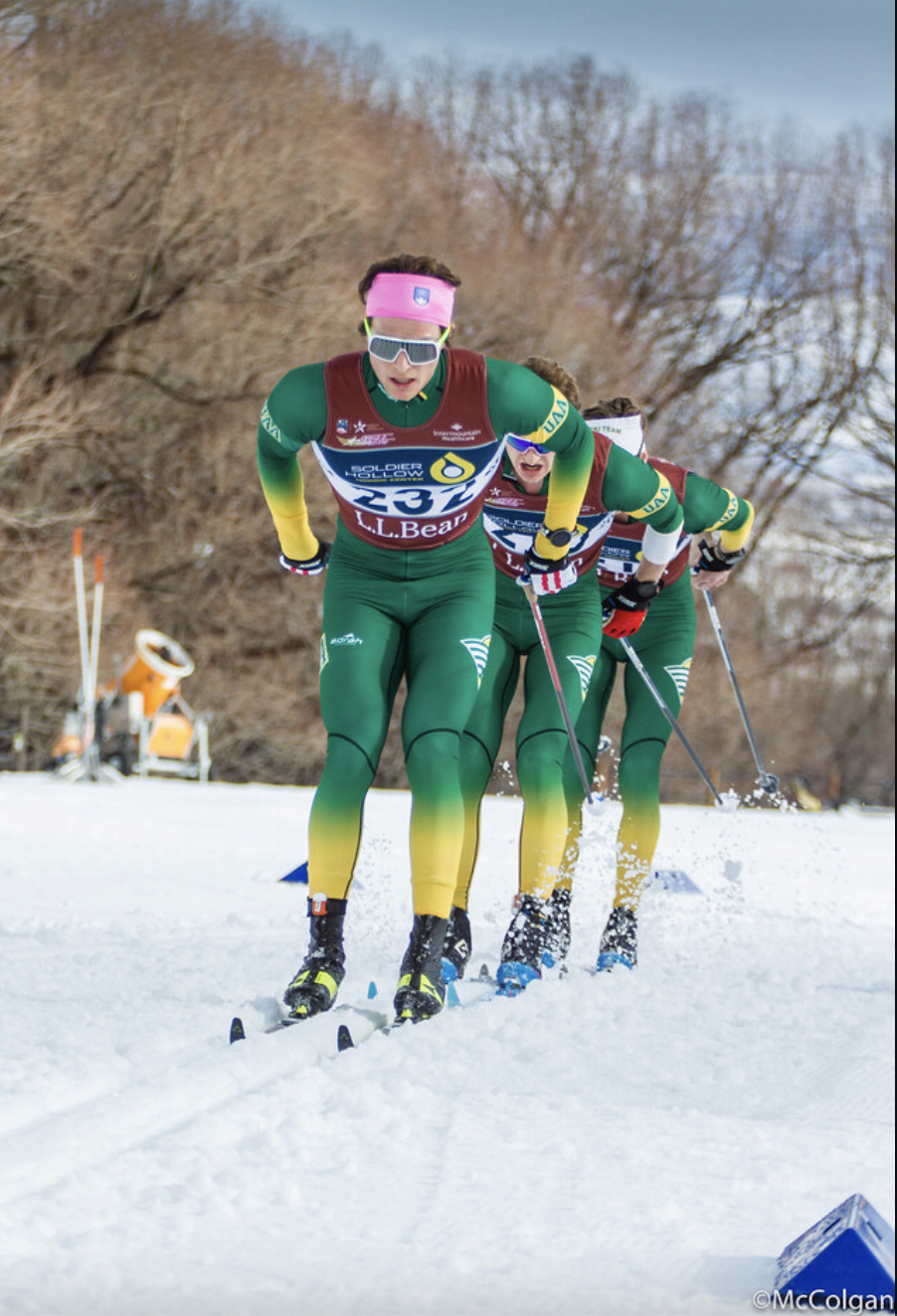
He continued, “I felt really good for the whole race, I definitely took it out pretty hard I think and just tried to hang in there. It was really tough conditions but I had awesome skis and I got a nice train with two of my other UAA teammates. It’s pretty fun when you can race next to your teammates and it just feels like another hard training day.”
Schoonmaker’s teammates Espen Persen and Magnus Norøy, both from Norway, finished fourth (+1:04.9) and eighth (+1:28.7), respectively.
JC Schoonmaker leads a train of UAA teammates during the men’s 15k interval start classic in Soldier Hollow. (Photo: John McColgan)
Looking forward to the next few weeks, Schoonmaker shared, “I’ll race the classic sprint tomorrow and then head to Sun Valley next weekend for some more super tours and RMISA races. After that, hopefully back to Europe and Beijing.”
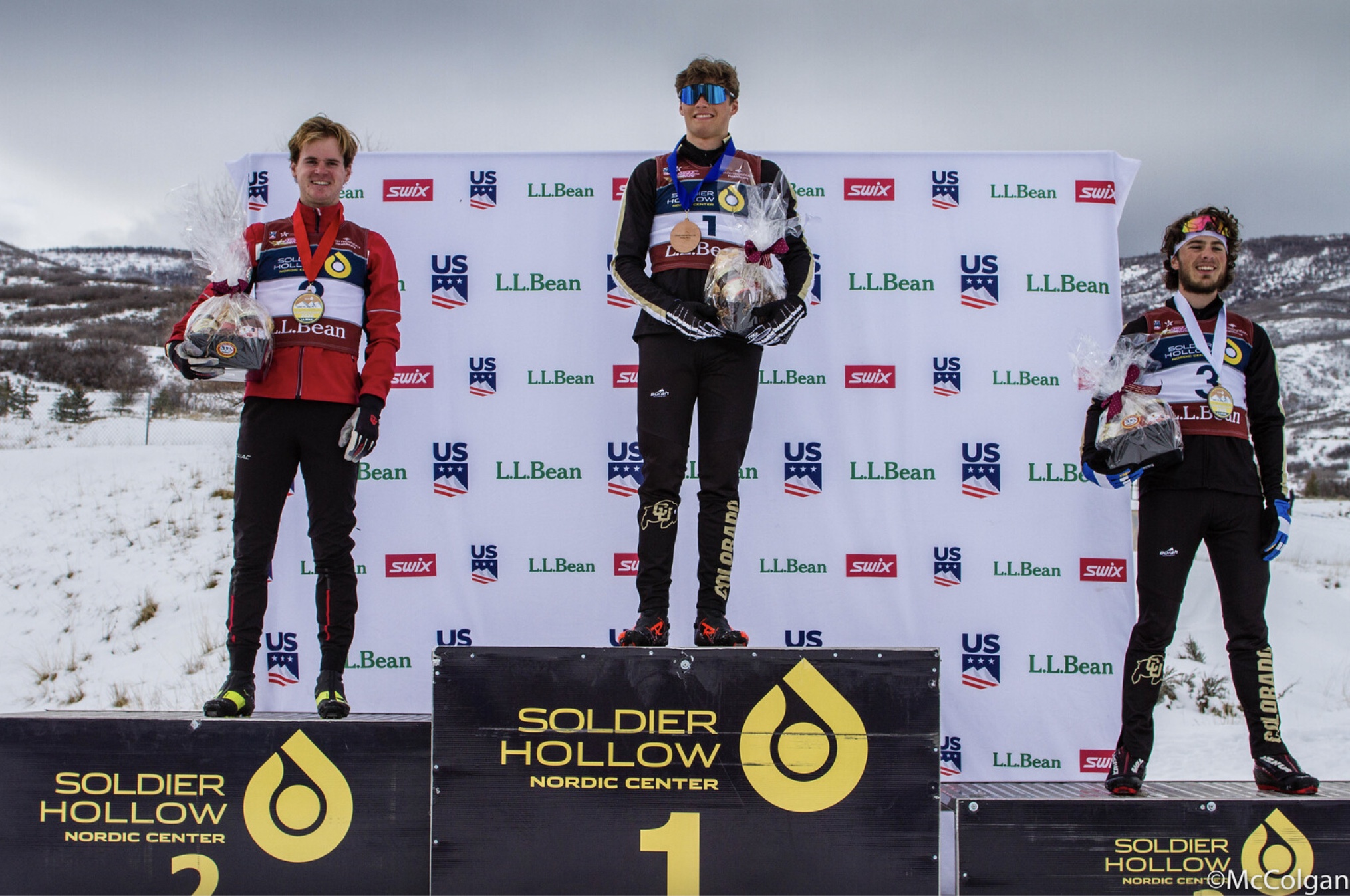
Alexander Maurer (CU) was the first junior finishing in 41:59.7, 15th overall and +2:41.7 behind Martin. Walker Hall (UU) was the second junior, taking 17th overall, just +1.9 behind Maurer and +2:43.6 behind Martin. Will Koch (CU) was third for the day, 20th overall, +27.7 behind Maurer, and +3:09.4 behind Martin.
The junior men’s podium for the 15k interval start classic in Soldier Hollow: Alexander Maurer took the win ahead of Walker Hall in second and Will Koch in third. (Photo: John McColgan)
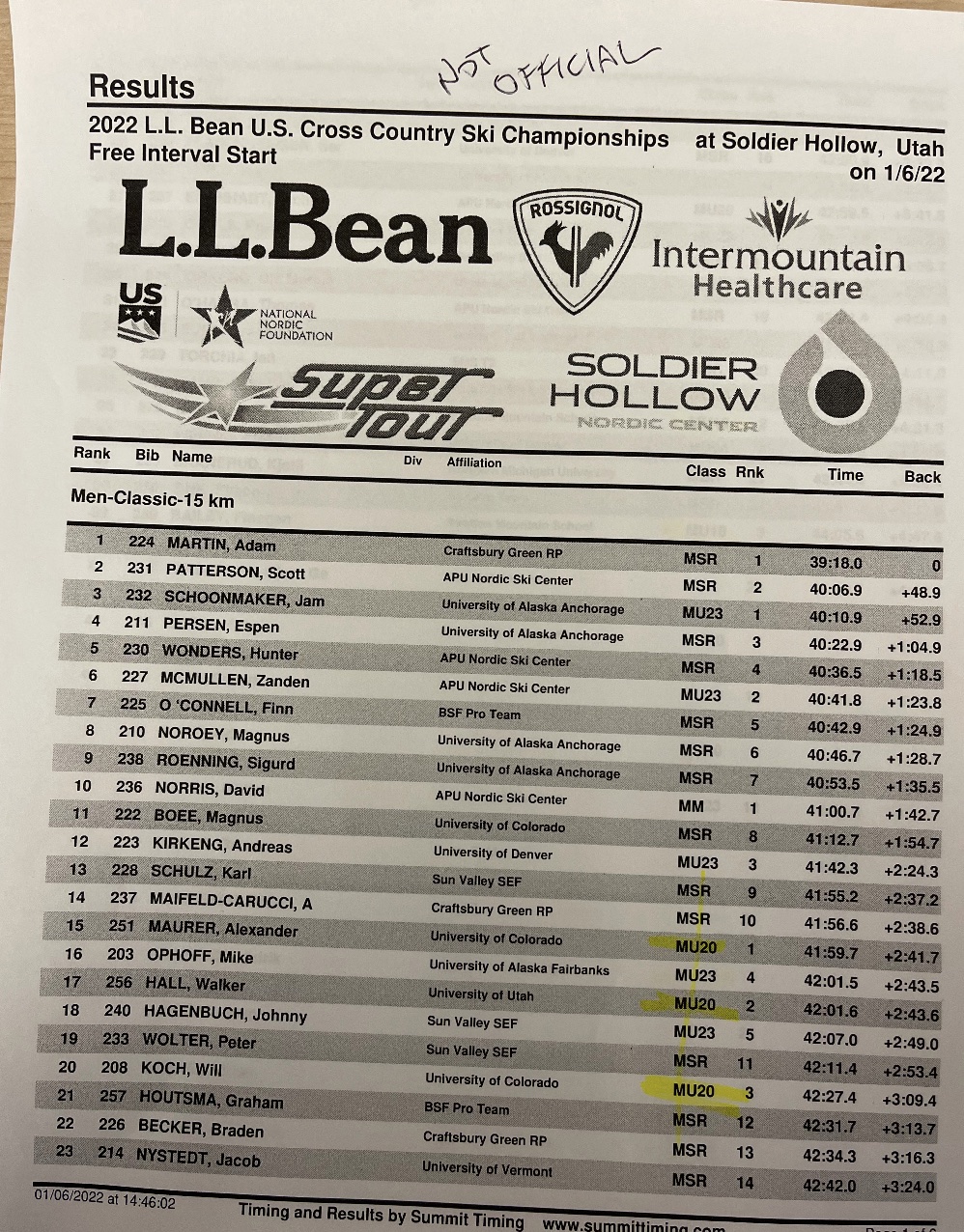
Men’s official results were not yet available at the time of publication, but will be posted here when possible. The first page of unofficial results is shown below.
Unofficial results for the first 23 finishers of the men’s 15k interval start classic, day three of racing at the U.S. Cross Country Championships in Soldier Hollow, UT. (Photo: Greta Anderson)
Quick Recap:We’ll have a full race report up tomorrow, including athlete comments and photos, but here is a quick recap of the action in Soldier Hollow this morning.
Warming temperatures and liquid precipitation set the tone for the final stage of the 2022 U.S. Cross Country Championship in Soldier Hollow. The livestream showed athletes of all levels struggling to find kick on the challenging Olympic caliber course.
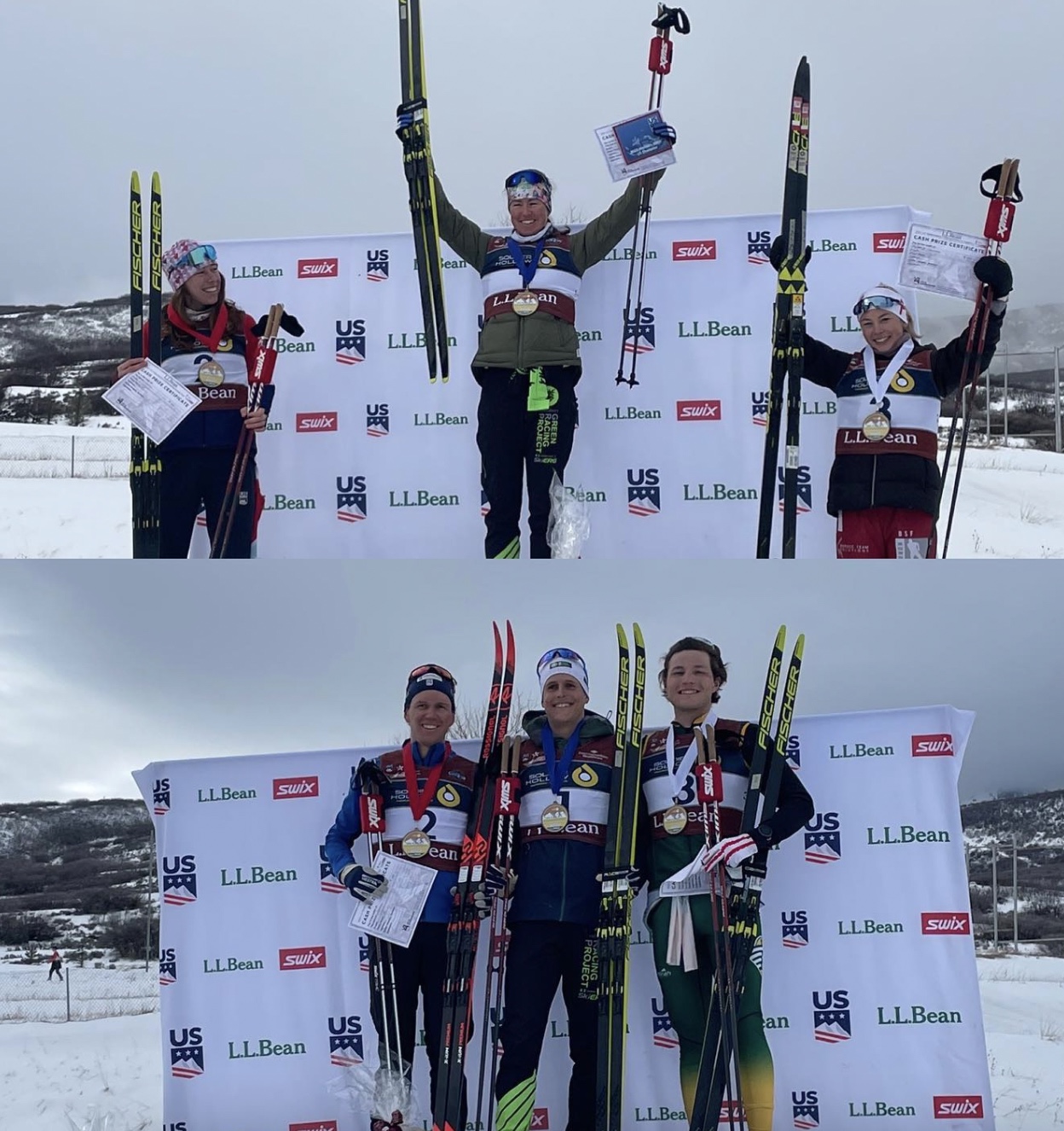
In the women’s 10-kilometer interval start classic, Caitlin Patterson (CGRP) ran away with the win in 28:12.0, nearly a minute ahead of second placed Katharine Ogden (USST/SMS T2) in second (+53.4). BSF Pro Team member Mariah Bredal raced to third (+1:01.2).
Patterson also won the 10k classic during the 2019 National Championships, and was second in the 10k interval start skate in 2020, finishing behind Finland’s Riitta-Liisa Roponen who spent the season racing in the U.S. while her husband led the Denver University ski team.
Racing with the senior women, the top three juniors were Sydney Palmer-Leger (USST/U of Utah), Schamberger (Summit Nordic Ski Club), and Samantha Smith (SVSEF). They finished 6th (+1:23.7), 10th (+1:48.0), and 13th (+2:01.7) overall.
The men’s and women’s podiums of the 10/15k interval start classic. (Photo: Craftsbury Green Racing Project Facebook)
Temperatures now in the low-40s for the men’s 15k, Adam Martin raced to another commanding win for the Craftsbury Green Racing Project, finishing in 39:18.0. Tuesday’s 30k mass start freestyle winner Scott Patterson (USST/APU) finished second (+48.9), while Sunday’s sprint champion JC Schoonmaker (USST/UAA) took third (+52.9).
In the junior race, Alexander Maurer (U of Colo.) was the top finisher in 15th overall (+2:41.7), with Tuesday’s winner Walker Hall (U of Utah) next in 17th overall (+2:43.6). Third for juniors was Will Koch (U of Colo.) in 20th (+3:09.4).
By Gavin Kentch, Ella Hall, and Rachel Bachman Perkins
Tuesday brought distance races to Soldier Hollow, in the second full day of racing at 2022 U.S. Cross Country Championships. The story at the front of the field was strong performances by athletes who had begun the year racing on the World Cup, as Rosie Brennan dominated the women’s field to win by over a minute, and Scott Patterson took the men’s race by roughly twelve seconds.
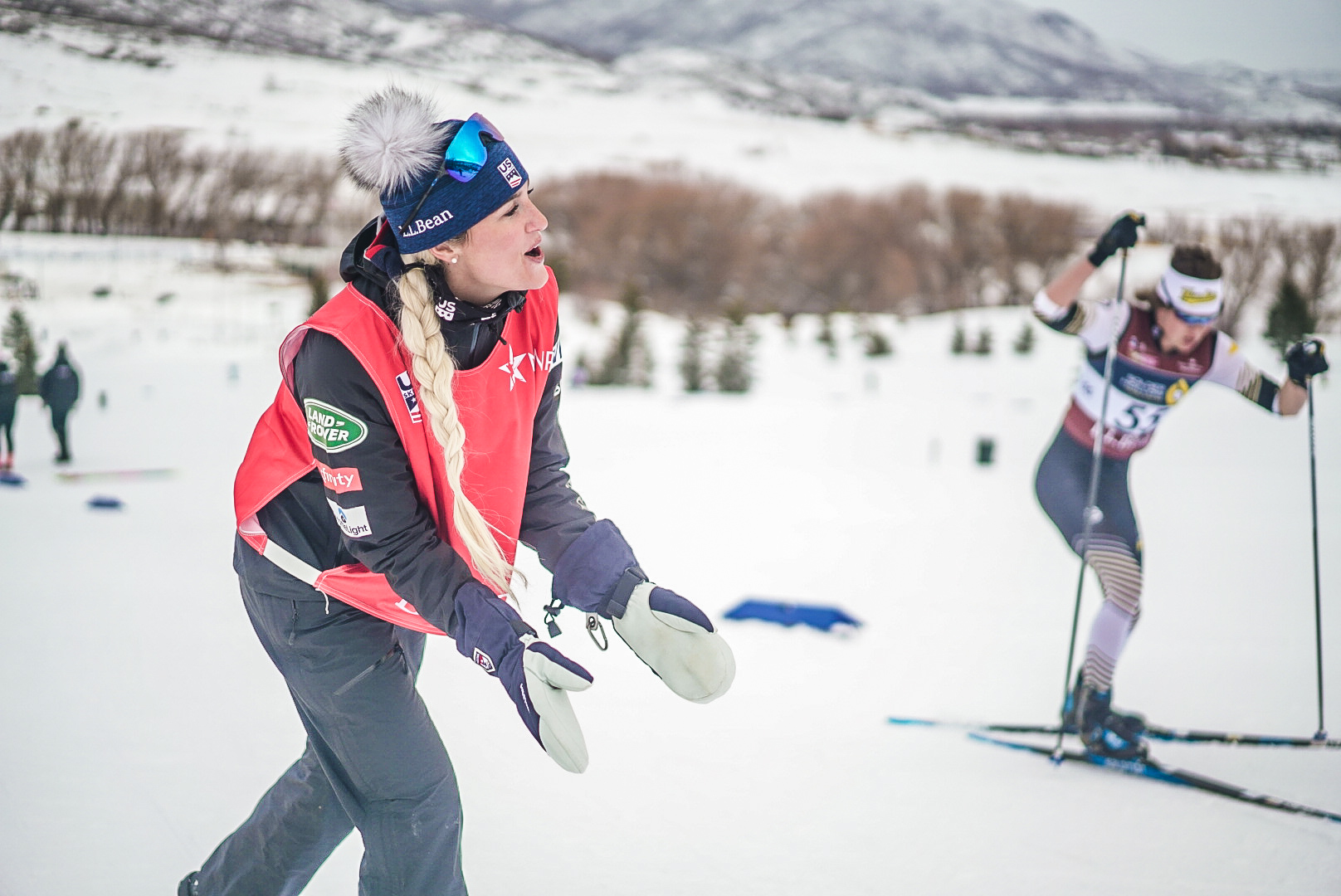
U.S. Ski & Snowboard Development Team Coach Greta Anderson encourages athletes during the men’s 30k distance race in Soldier Hollow. (Photo: Tobias Albrigtsen / @untraceableg)
Brennan was followed by Rosie Frankowski and Caitlin Patterson. Scott Patterson was followed by David Norris and Hunter Wonders, giving APU five out of six podium spots on the day. Craftsbury athletes went 3-4-5 in the women’s race. Notably, four out of six podium finishers were on the north side of 30, with a fifth gaining Master status later this month, underscoring the lengthy developmental curve often required to achieve success in distance racing.
Women’s Race: Rosie Brennan Solos to Victory
Tuesday’s race, the women’s 20-kilometer freestyle race at 2022 U.S. Cross Country Championships, was, technically speaking, a mass start – but for Rosie Brennan, it skied more like an interval-start race. Brennan wore bib 101, at the sharp end of the chevron start in a field of 55 athletes, and led every one of 20,000 meters of the 20 k, pushing the pace right from the start and never looking back all the way through the finish line. She covered the challenging course in a speedy 53:16.9 to take her seventh national title, and first since 2015, in a dominating performance.
The race began under overcast skies and moderate temperatures. By one second into the race, Brennan (USST/APU) was in the lead. By one minute into the race, she was notably off the front, with only three athletes, Rosie Frankowski (APU), Caitlin Patterson (CGRP), and Sydney Palmer-Leger (USST/Utah) even contemplating whether to follow.
By two minutes into the race, Brennan had a sizable gap, as athletes in the Frankowski-led chase pack had decided that discretion was the better part of valor, and opted to ski their own race and focus on chasing the remaining two spots on the podium. No athletes other than Brennan would appear on screen again in the free livestream until the six-minute mark, in a wide-angle shot of the main climb up the Cabin Loop most of the way through the first lap. This is nothing against the production values of the online broadcast, which were once again superb, just a statement about how quickly Brennan distanced herself from the rest of the field.
Rosie Brennan (USST/APU) skis away with the women’s 30k mass start freestyle national title. (Photo: John McColgan)
After the first of six 3.33-kilometer laps, Brennan’s lead over the chase pack was roughly 26 seconds. After two laps, this gap had nearly doubled, to 49 seconds. The chase pack was now led by Patterson, who collected her tenth national championship earlier this week, and Frankowski, who has a 21st at the Olympics and World Cup top-30s to her name. These were not bad skiers; Brennan was simply unmatched on the day.
Over the next four laps, as the wind increased and a light snow began to fall, Brennan put on a clinic. She V2ed where others V1ed, and added a slight hop at the end of V1 strokes where others adopted a more labored V1 reflecting the tough terrain and elevation. She slowed down through the coaching zone long enough to get a full drink from her feed. She skied the downhills aggressively and took the best lines throughout. It was a 53-minute demonstration of the form and fitness that have already brought her a World Cup podium this season behind Frida Karlsson and Therese Johaug, and an additional five top-six finishes.
Brennan lapped her first skier midway through lap 4. She would ultimately lap 26 athletes in a field of 52 finishers before the end of the race, precisely half the field. In a national championship.
Brennan actually slowed slightly, or the chase pack may have sped up, as the race went on. Her gap over the Frankowski/Patterson duo was “only” 1:02 at lap 3, 1:17 at lap 4, and 1:21 at lap 5. It may have even shrunk by a fraction of a second over the final lap, as Frankowski and Patterson raced for second behind her. But the outcome was never in doubt – and barring multiple broken skis, a devastating earthquake or meteor strike, or some other truly unforeseen occurrence, the outcome was never really in doubt after the first minute of the race.
A young Rosie Brennan prepares to race at Soldier Hollow in a vintage Team Utah Nordic Alliance suit. (photo: @rosiewbrennan Instagram screenshot)
Brennan grew up skiing in Park City, starting in eighth grade, first with Team Utah Nordic Alliance, then with coach Gordon Lange at Park City Nordic. She won her first ever ski race, a Wasatch Citizens race, albeit aided by the fact that “there was only one other girl in my age group,” she told the Park City Park Record for a 2017 profile. She’s come a long way since then.
“It was so great to race at home and have my family and friends cheering me on the whole way!” Brennan wrote in a post-race email. “With COVID, even my Mom has been unable to watch me race for years so it felt really special to be able to race with a hometown crowd before heading to Beijing.”
On her approach to the race, Brennan explained the role that she hoped her effort would play in her preparation for the upcoming Olympics, concluding with her feelings about sitting out the Tour to instead join her club teammates in SoHo.
“I was feeling quite inspired after watching some great performances by the APU men this morning and that gave me faith that our fitness was high and we could grind away,” Brennan wrote. “I wanted to do my best to simulate World Cup racing so I wanted to start hard and then reassess based on what others in the field did and then ultimately keep grinding to get a long hard effort in at altitude, which we haven’t had the opportunity to do on the World Cup this year. The course we raced played into my strengths with a long gradual climb right out of the start so I felt I had to use that every lap to keep building on my strengths and do my best to work on relaxed, powerful skiing the rest of the lap. I am really happy that I had the opportunity to come home and race a long race! I think I may have lost my voice screaming Frankie into the finish as well. It was really awesome to see her dig so deep today and to have APU put in such strong performances all around today.”
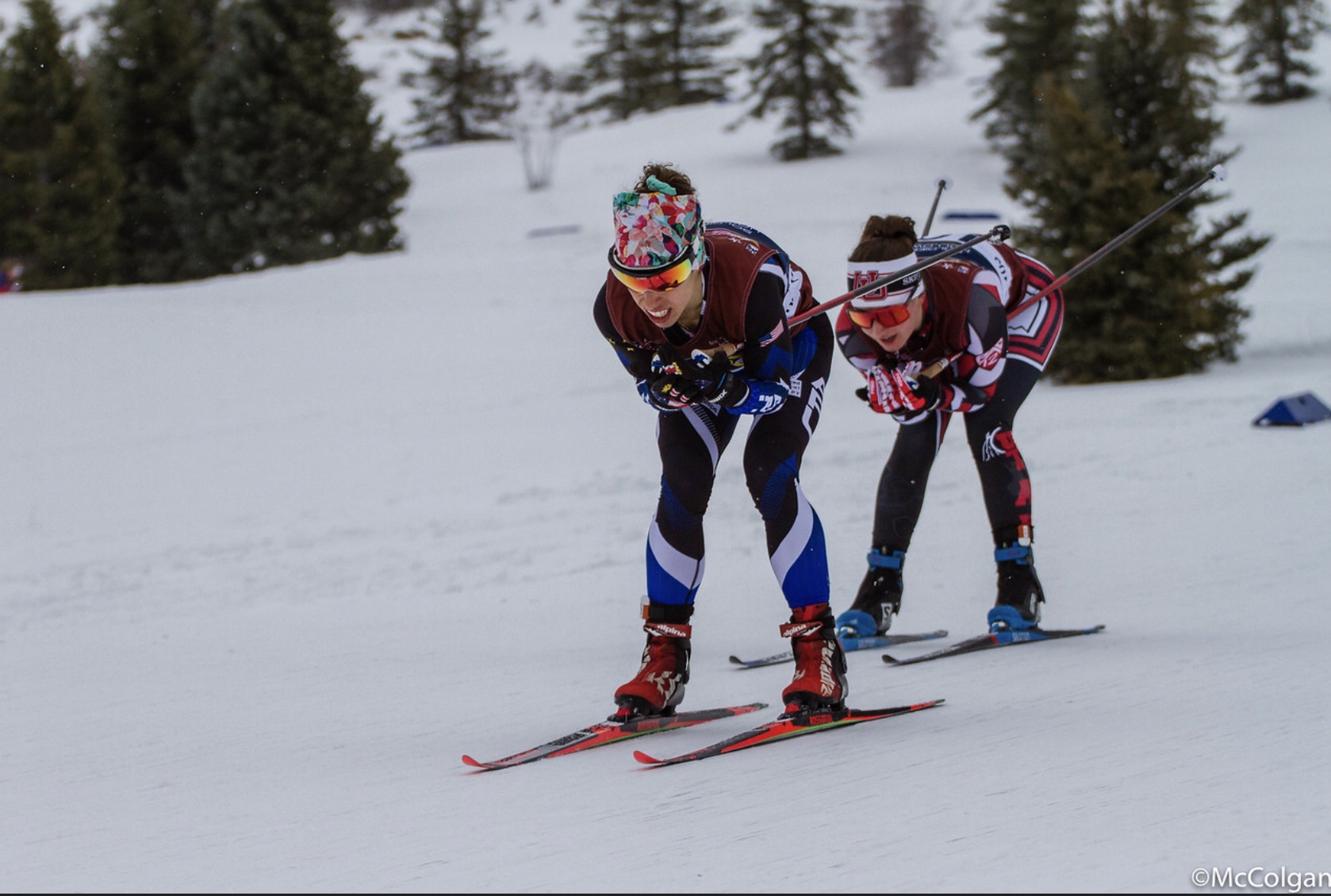
Caitlin Patterson (CGRP) and Rosie Frankowski (APU) race through 20k to round out the women’s podium. (Photo: John McColgan)
Behind Brennan, Frankowski and Patterson were locked in a dogfight for second and third. The two women, age 30 and 31, respectively, have raced head-to-head frequently over the years. They have spent much of their careers in that liminal space between being some of the fastest domestic skiers and some of the slower American World Cup skiers, competing for limited start spots on the World Cup or at global championships. In the last Olympic-year National Championships, in 2018 at Kincaid, Patterson was the first American in every race; Frankowski was the 2nd and 4th American in the two distance races; ultimately both women went to Pyeongchang.
Four years later, there the two athletes were again, holding down the chase pack with potential Olympic berths on the line. Patterson, from Anchorage but now skiing for Craftsbury, is taller, with a more upright skate stance and a tempo that looks nearly languid when skiing behind Frankowski. Frankowski, from Minneapolis but now skiing for APU, is shorter, with a somewhat more hunched-over approach to attacking an uphill, and with a higher tempo. (see photo above)
The two are a study in contrasts, but their differing approaches left them evenly matched throughout Tuesday’s race, as they literally occupied the space between the top American World Cup skiers and the top domestic skiers. At the start of lap two, they were separated from one another by 1.6 seconds, skiing in a larger pack that at the time included Alexandra Lawson, Palmer-Leger, and Lina Sutro. By the start of lap three, the chase pack was down to two, Patterson and Frankowski, 0.5 seconds apart. Start of lap four: 0.5 seconds. Start of lap five: 0.5 seconds. You may sense a theme. It was, once again, going to come down to two athletes with divergent strengths.
Writing in the FasterSkier Slack channel on Monday morning, 24 hours in advance of Tuesday’s race, this reporter foresaw Brennan skiing away with the win with relative ease, then one of two things happening behind her, as he jokingly drafted an article for a race that had not yet happened: “Behind Brennan, Rosie F. pushed the pace hard from the start, attempting to create a gap over the rest of the field. She [was ultimately able to do so, and took second slightly ahead of Caitlin Patterson et al.] [was unable to do so, and was swallowed up by Caitlin Patterson/someone else] in the final kilometers.”
This is not to claim any great powers of prognostication. This is rather to say that everyone in the venue, the two athletes on course notably included, knew what Frankowski’s strengths were, and what she would aim to do over the final three kilometers: open up enough of a gap over Patterson that it would not come down to a sprint, or bury herself in the attempt.
A few minutes later, this is precisely what occurred. The sixth and final time up the main hill on the Cabin Loop, Frankowski came into view in the distance at the bottom of the climb, V1ing with an explosiveness and tempo befitting a sprint heat more so than the final lap of a tough 20 k. Patterson was being dropped, but not definitively so, as she followed up the climb with a more human tempo, keeping Frankowski in view the whole time.
Rosie Frankowski (APU) pulls away from Caitlin Patterson (CGRP) to take second in the women’s 20k mass start freestyle in Soldier Hollow. (Photo: John McColgan)
Fast forward to the finish a few minutes later: Frankowski’s surge on the final uphill proved to be just enough. Patterson made up time on the downhill return to the stadium… closed to within a few meters… but was unable to shrink the gap any more.
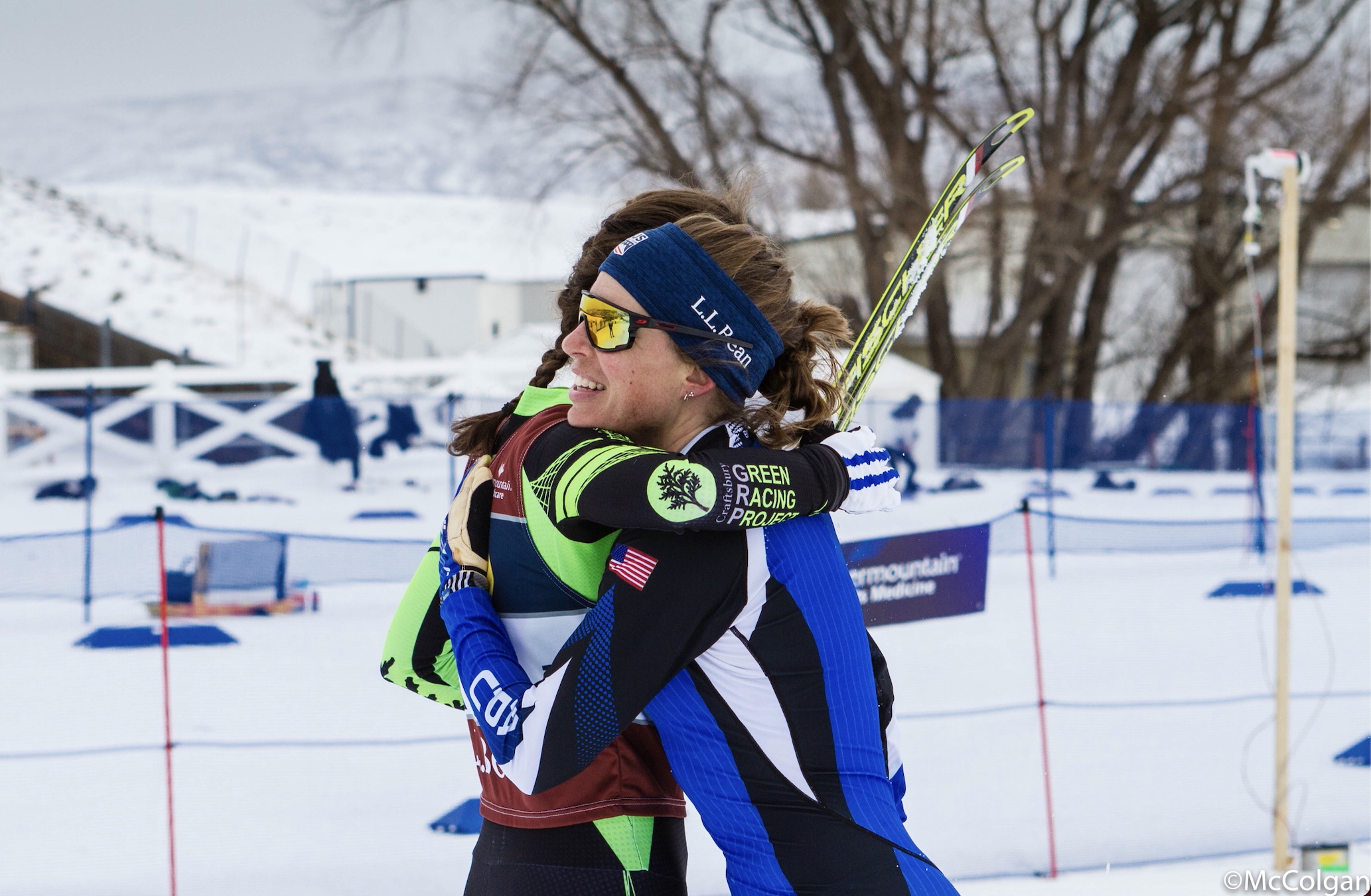
Frankowski held her off with a progressively ragged V2, crossing the finish line and immediately collapsing into a heap on the snow just past the line. Brennan came over to take off her APU teammate’s skis and offer support. A few minutes later, Frankowski was upright, and giving Patterson a Covid-safe congratulatory hug.
Frankowski’s time was 54:37.5, 1:20.6 back of Brennan. She was 1.9 seconds ahead of Patterson in third.
The women’s 20k mass start freestyle podium: Rosie Brennan (USST/APU) won the national title ahead of Rosie Frankowski (APU) in second and Caitlin Patterson (CGRP) in third. (Photo: John McColgan)
“Today was something I am really proud of,” Frankowski wrote to FasterSkier after the race. “I have targeted this race for the last year and although I was excited, over the days leading up to the race, I was dreading the pain level Rosie B would inflict on the field. My initial plan was to try to stay with Rosie for any length of time, but that plan went out the window in the first kilometer when I thought I would literally pass out at 2k in if I tried her pace. I then had to recover for a lap in the chase pack, and the downhills were giving me real grief so I kept having to surge to get back on the pack or back with Caitlin P. After a few laps, Caitlin and I had a gap and we worked together using our individual strengths to make that gap larger, and that was super fun! Caitlin and I have raced together many times throughout the years so it was great to have the chance to relive some of that today. I knew I was feeling strong on the uphills, and the downhill finish was definitely on my mind, so on lap 5 I tried to push the pace on the ups a bit, and then on lap 6 going up the hollow I just went for it with total abandon. I created a gap that Caitlin narrowed over the rest of the course, but I managed to not fall on the last hermod’s downhill and take 2nd. I could see Rosie B in the finish stretch cheering me on so I was just full speed til that line.”
Frankowski also shared her thoughts on whether or not the race played out as anticipated.
“I’d say one of the surprises was how terrible the wind made the Hermod’s downhill. As someone who struggles with downhills anyways (but has made a lot of progress the last year), the wind drifts and the blowing snow were really dicey. And you couldn’t see the glazed icy spots under the snow so it was very stop-go. Otherwise, the race played out pretty much how I expected (or hoped) and one of the best parts of the day was having my APU teammates and coaches cheering out there, especially on the final lap.”
Rosie Frankowski (APU) leads Sydney Palmer-Leger (USST/Univ. of Utah) during the women’s 20k mass start freestyle. (Photo: John McColgan)
“It was quite the battle between Frankie and I,” Patterson wrote post-race. “However we also had a great time skiing and working together for the first 3/4 of the race or so. At the end certainly it was a furious battle to the finish, but earlier in the race we worked together to use each of our strengths and pull away from the chasers. Frankie and I have quite different styles, uphill vs downhill strengths, but it was really fun racing… Of course I would have been happier to be 2nd and I have slight regrets that I didn’t work my strengths a little better, but overall it was a strong race.”
Also commenting on the effect of wind, Patterson continued, “That was definitely a factor and annoyance on a few parts of the course. The Hollow had a notable head wind as we climbed up, which just added to the grinding nature of that climb. From lap 3 or 4 on, on both the back-side sprint downhill and the big downhill off of Hermod’s hill, there were small pockets of wind drifted snow forming. Especially on the Hermod’s downhill, the wind pockets were blowing across the course and making the downhill a little less predictable as the wind pockets felt much slower than the glazed path. Weather is just an aspect of racing, and while it was annoying, I think we as xc skiers have to learn to adapt to anything and everything, so it just became another variable to work around in the race.”
Patterson concluded with a nod to her brother, acknowledging the setbacks he has faced this season, which are elaborated upon in the men’s recap.
“I was quite nervous this morning watching the men’s race on the live feed, but I’m really proud of my brother Scott for skiing so smoothly and controlling the 30k. It’s awesome to see him showing a return to form and winning, after a tough start to the season attributable to his summertime broken wrist.”
Rosie Brennan (USST/APU) and Caitlin Patterson (CGRP) share congratulations at the finish of the women’s 20k mass start freestyle in Soldier Hollow. (Photo: John McColgan)
Craftsbury skier Alexandra Lawson took 4th (+2:49.2), in a brave effort after skiing solo for basically the entire race. Her teammate Margie Freed came in 18 seconds later for 5th (+3:07.2), giving the green-clad skiers from Vermont 3rd, 4th, and 5th overall on the day.
In the other close finish of the top-10, BSF skier Hannah Rudd (+4:13.5) came in a few seconds ahead of Palmer-Leger (+4:17.6) for sixth, after skiing substantially above the seeding suggested by her 125 bib number. (The start list ranked athletes according to their current USSS distance points.)
Palmer-Leger, in seventh, was notable as one of only four juniors in this senior women’s field.
Looking ahead to the rest of this week, Tuesday marked Brennan’s only planned race in this series. Her plan coming into today was to rejoin the World Cup soon, though those plans may have become somewhat more fluid with the recent cancellation of the Les Rousses World Cup stop set for mid-January. Regardless, even if Brennan were to compete in and win both distance races this week, the second-ranking domestic woman at these championships is still eligible for consideration for potential Olympic selection, due to the precise phrasing of selection criterion four of the USSS criteria document, which excepts athletes otherwise nominated to the team on other grounds. (Brennan has achieved nomination already via criterion one, multiple top-eight finishes in specified World Cup races.)
That is, that second-ranked domestic woman (Frankowski or Patterson, for example, or someone else who does well in the classic race if both these women do not perform as expected) is not guaranteed to be selected, but she certainly could be alongside Brennan.
Kate Oldham (Middlebury) leads the junior women’s 7.5k during the 2022 U.S. Cross Country Championships in Soldier Hollow. (Photo: Tobias Albrigtsen / @untraceableg)
In the junior women’s race, Middlebury’s Kate Oldham paced the 7.5k freestyle ahead of the Ninas, Nina Seeman (Dartmouth) and Nina Schamberger (Summit Nordic Ski Club). The threesome pushed the pace from the front, maintaining a small gap over the remaining women throughout the two-lap course.
In a three-way sprint to the finish, Oldham snagged the win in a time of 20:17.7, +0.7 ahead of Seeman in second place and +1.1 ahead of Schamberger in third.
The junior women’s 7.5k mass start freestyle podium: Kate Oldham (Middlebury) took the win in a tight race ahead of Nina Seeman (Dartmouth) in second and Nina Schamberger (SNSC) in third. (Photo: John McColgan)Ian Torchia (SMS T2) leads the charge at the start of the men’s 30k mass start freestyle in Soldier Hollow. (Photo: Tobias Albrigtsen / @untraceableg)
Men’s Race: Scott Patterson Leads APU Sweep
The first race of the day was the senior men’s 30 k, with 73 athletes completing eight 3.75 k loops. From the gun, the race was about bib number one, Scott Patterson representing APU. Patterson returned to the US after racing most of Period 1 of the World Cup.
Missing only the opening weekend in Ruka, Patterson competed in each of the distance stages despite having surgery on his wrist in late fall, roughly five weeks before he returned to World Cup racing, and still needing a brace to protect the healing injury. After his first race of the season in Lillehammer, Patterson explained that this made it harder for him to use his poles, shifting his energy use more to his legs and altering his technique, which likely impacted his ability to capitalize on the high level of fitness he had built through the summer.
Scott Patterson (USST/APU) leads the men’s 30k mass start freestyle in Soldier Hollow. (Photo: Tobias Albrigtsen / @untraceableg)
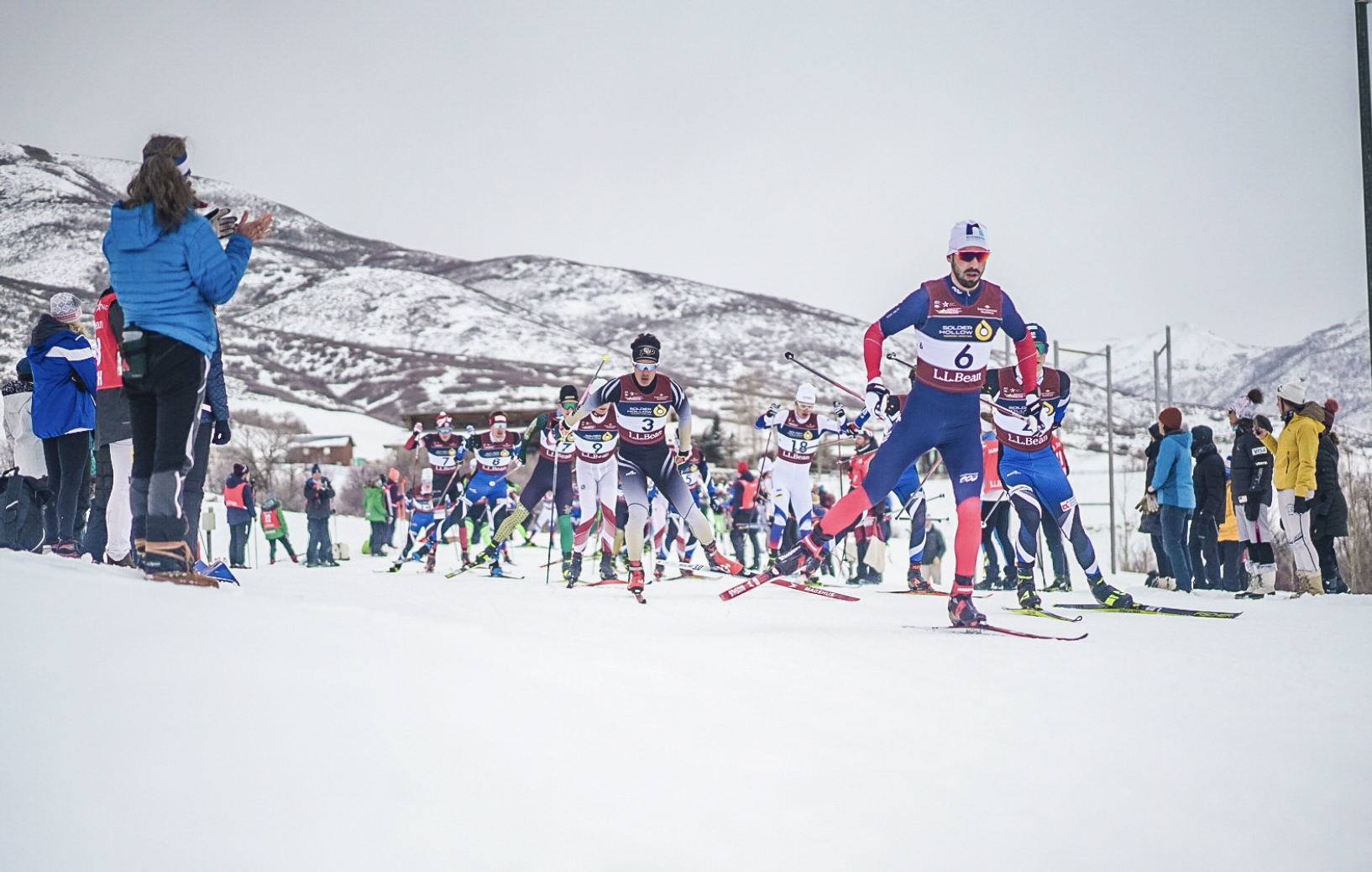
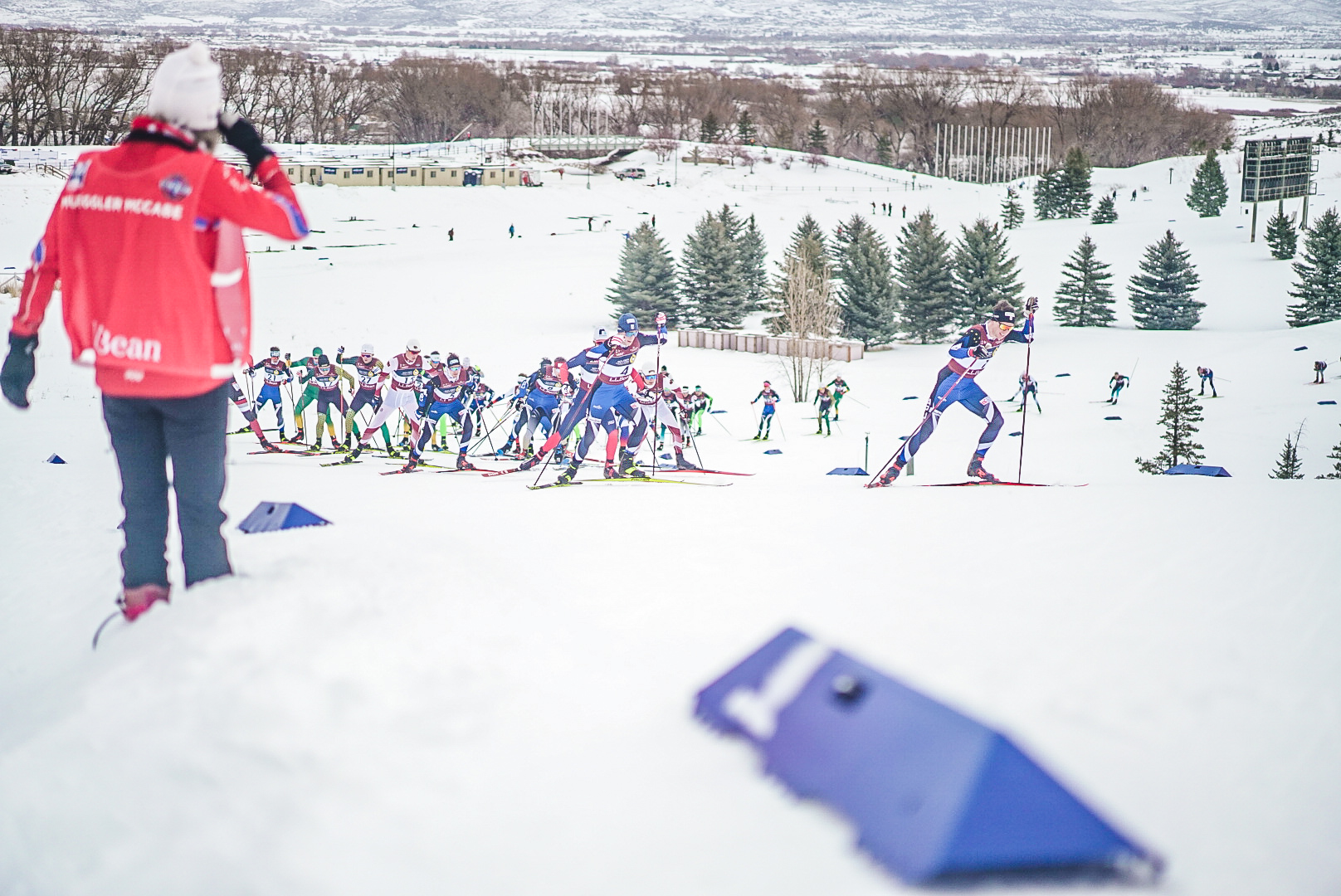
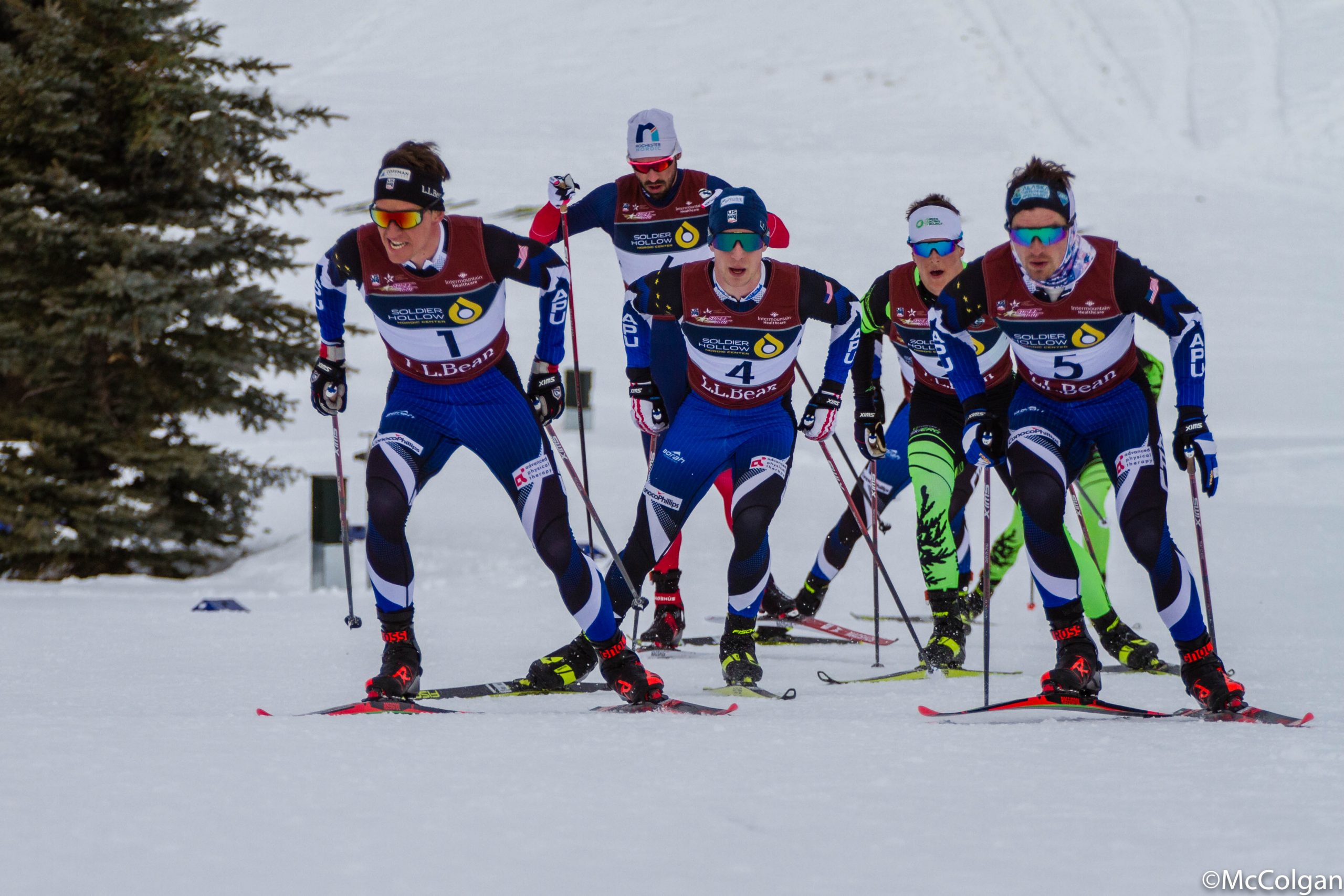
Through the first lap most of the field held together, though as the leaders departed for lap number two, a group of fourteen skiers at the front had separated, led by Patterson. Trading leads with Ian Torchia of SMS and Hunter Wonders of APU, the gap to the rest of the field had widened although the front group was still largely together. Among those front fourteen skiers were Johnny Hagenbuch skiing for Sun Valley Ski Education Foundation, David Norris of APU, Peter Wolter (SVSEF), Braden Becker (CGRP), Adam Martin (CGRP), Torchia (SMS T2), Zanden McMullen (APU), Wonders (APU), and the leader, Patterson (USST/APU).
Finishing the third lap in a total time of 27:01, the lead group was down to nine, having lost Hagenbuch and Wolter. Norris (APU) moved to the front for the first time, as the group headed up the Cabin Loop climb on the fourth lap, and upped the pace. This briefly created a gap with Norris, Patterson, and Wonders, though that gap was closed with the downhill draft and the group passed through the lap lane as a group of six, having lost Becker (CGRP).
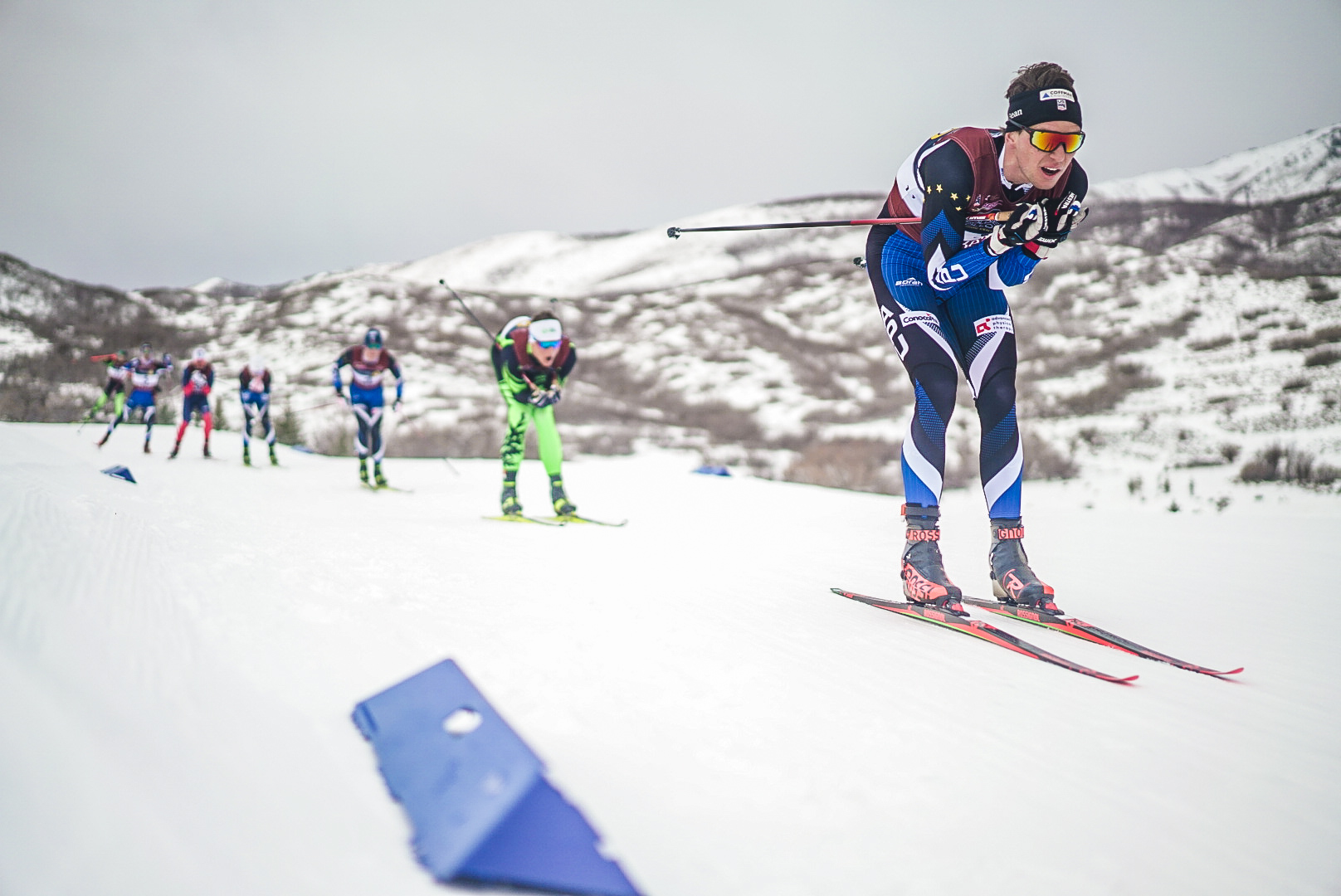
The lead pack of men push through the 30k mass start freestyle at U.S Cross Country Championships. (Photo: John McColgan)
Climbing the hollow, Norris again put in an effort as he and Patterson created a small gap. Wonders worked to close it, bringing Torchia and Martin with him and once more, they closed on the front two on the sprint course downhill.
Ending lap five and departing for lap six, Patterson had gained a five-second advantage over his teammate, Norris. Through increasing lap traffic, Patterson continued to grow his lead. Despite the windy conditions, Patterson seemed to have no problem out on his own. Initially, Torchia was the sole chaser in second, with a gap to Wonders, Norris, and Martin.
Scott Patterson leads the men’s 30k mass start freestyle during the 2022 U.S. Cross Country Championships in Soldier Hollow. (Photo: Tobias Albrigtsen / @untraceableg)
Entering lap seven, Patterson was well clear of any competition, +24 seconds ahead of Torchia. Over the course of this penultimate lap, Torchia was caught by Wonders, Norris, and Martin and the chase group was once again a group of four.
Patterson held strong out front and entered the last lap after 1:03:58.2 of skiing. Norris and Wonders pulled away from Torchia and Martin, settling into second and third position respectively. Over the final 3.75 k, Norris gained steadily on Patterson, though Patterson had developed such a solid lead he was able to remain unchallenged to the line. Crossing the finish in 1:13:25.0, Patterson claimed his first national 30 k title.
“I went out today with the intention to win and establish myself as a top contender after some tough races early in the season,” Patterson wrote to FasterSkier after the race. “My intention from the start was to keep the pace fast even if I had to do most of the work. It was awesome on the early laps having APU teammates in the pack with the same intention. Although we strung things out earlier, lap 5 and 6 were really the key ones for eventually pulling away. On lap 5, David put a hard move up the cabin hill that gave the two of us a little gap. The front pack came back together in the stadium, but it was clear the next time up the hollow that many others in the pack were tiring. On lap 6 up the cabin hill, I put in a hard effort and found I had space behind me. At that point, I decided to go for it as I was still feeling strong. Climbing the hollow felt like my strength and I solidified my lead there. From that point it was a time trial to the finish while holding off David’s late charge. David and Hunter coming in to sweep the podium for APU and many of our younger skiers posting strong results were cherries on top of my personal success.”
In terms of how the races at U.S. Nationals fit into his season plan and goals, Patterson explained that his wrist injury has forced him to adjust on the fly, making it difficult to set objective goals.
“My grand plans for this season were a bit derailed from the start with my wrist injury and surgery. Mid summer, my intention was to race the full World Cup, but going into Period 1, I knew I had to take everything with a grain of salt. Every week would help my wrist, but also I was just lacking a bit of form following three months of training with one pole, a brace, or other modifications. I felt confident that my general fitness was still strong, but it was buried under a lack of race fitness early on in the season. Period 1 has always been a bit difficult for me and adding a few extra factors didn’t help. Following Davos I knew it was time to regroup a little. Nationals seemed like the best bet with a little more time. Also looking at the Tour [de Ski] races, I didn’t think they really suited my style, especially given my wrist.”
Providing additional insight into his rehabilitation, Patterson also gave an optimistic update on the status of his wrist and it’s lingering impact on his racing.
“Today marked 10 weeks post surgery for my wrist. While over on the world cup for period 1, I raced Lillehammer in a large plastic brace and Davos with it extensively taped. Neither of these were great solutions especially given where I was in the recovery process. Since then it has continued to improve and show signs of healing in all my follow up x-rays. I have also dialed in my taping since Davos. Only in the last week has my wrist really begun to feel that it’s ready for racing (with copious amounts of leukotape).”
Concluding on his plans moving forward, Patterson wrote, “At this point, I’ve got a little more confidence in racing and am looking forward to Thursday’s classic race. I’m not sure what my plans are after that, especially with the recent cancellation of the French World Cup, so I’m focusing on the remainder of races here for now.”
APU teammates Scott Patterson (left) and David Norris (right) head to the start of the men’s 30k mass start freestyle at the 2022 U.S. Cross Country Championships in Soldier Hollow, UT. (Photo: Tobias Albrigtsen / @untraceableg)
Norris, who skied the final lap 11.2 seconds faster than Patterson, finished in second place, +11.7 behind his teammate. Norris won the last 30k freestyle he contested at the 2019 National Championships, ahead of now-retired Kyle Bratrud (SMS T2) in second and Patterson in third.
“I’ve been skiing poorly this season without any explanation as to why,” Norris wrote in a post-race email. “This week I am enjoying being back with my team and seeing tons of friends on the course each day.”
In terms of his race, Norris continued, “Today I felt bad from the gun, but I tried to ignore those feelings and focus on making a race. Although I struggled quite a lot I am still proud to pull out a podium finish and to be part of a strong day for APU. Our coaches did a great job and gave me every opportunity to ski well.”
While Norris is perhaps facing an unlikely reality in terms of his selection for the currently five-man 2022 Olympic Team, his conclusion on the day was process focused.
“Every season I ski much stronger in February and March so I’m sure good form is on the horizon, but that doesn’t help me achieve my goals when I need to be skiing well right now. All I can do now is focus on the 15km classic coming up and then rest and prepare for the next races. After that – I don’t know yet what that will be.”
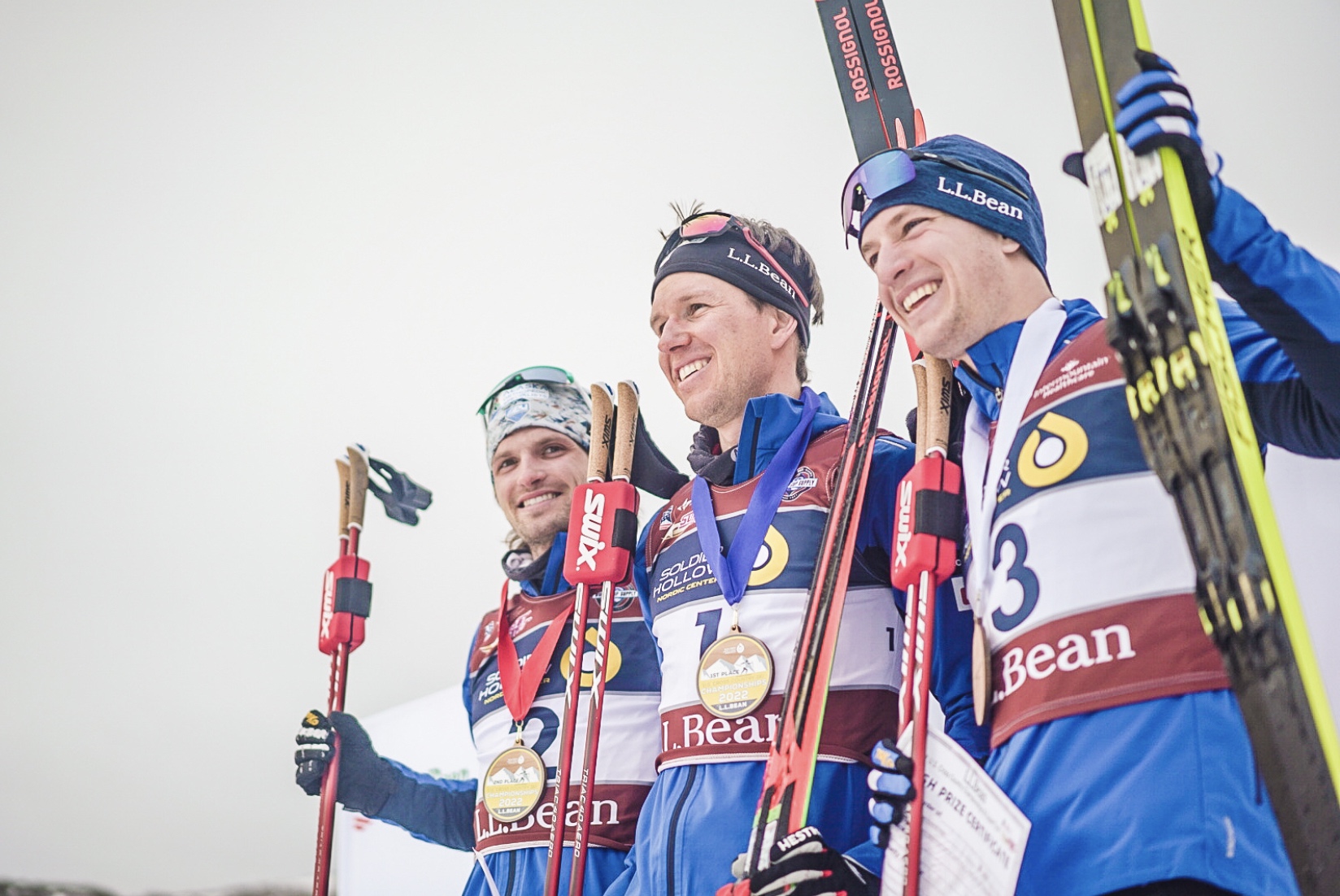
The men’s podium of the 2022 U.S Cross Country Championships 30k mass start freestyle: Scott Patterson took the win ahead of David Norris in second and Hunter Wonders in third. (Photo: Tobias Albrigtsen / @untraceableg )
Closing out the APU sweep was Wonders, finishing third +27.9 back. A sprint for fourth position went to Martin, while Torchia took fifth.
In the junior men’s 10k, the pace started easy as 121 racers headed out for the first of three 3.3 k loops. Initially Wally Magill (Dartmouth), Will Koch (Colo. Univ), and Walker Hall (Univ. of Utah) traded off in the lead. Up the Cabin Loop hill on the second lap Hall picked up the pace and pulled away with Magill. Koch worked hard to bridge the gap and join the leaders though the effort cost him and as the front two upped the pace once more, Koch dropped off.
The junior men’s podium of the 10k mass start freestyle: Walker Hall (Univ. of Utah) won the event ahead of Wally Magill (Dartmouth) in second and Brian Bushey (Univ. of Utah) third. (Photo: John McColgan)
Cresting the final hill in the last lap, Hall was in the lead though Magill drew even with the draft on the descent. In a sprint finish, Hall crossed the line first in a time of 24:29.4, his second junior championship title of the week. Magill finished second (+0.5), while Brian Bushey (Univ. of Utah) overtook Koch at the line for third (+18.9).
This article has been corrected to reflect the fact that Rosie Frankowski was the fourth American in the 10 k freestyle at 2018 U.S. Nationals, not the third.
Quick Recap:We’ll have a full race report up tomorrow, including athlete comments and plenty of photos, but here is a quick recap of the action in the men’s 30k and women’s 20k, which took place this morning at the 2022 U.S. Cross Country Championships in Soldier Hollow, Utah.
Perhaps becoming a theme of the 2022 U.S. Cross Country Championships, the 20/30-kilometer mass start freestyle distance races were both won by athletes who have spent the last six weeks racing in Europe on the World Cup.
In the men’s 30k, Scott Patterson (USST/APU) led the lead pack of men through an eight-lap course to take the win in 1:13.25. David Norris (APU) was next over the line for second (+11.7), with Hunter Wonders (USST/APU) rounding out the podium in third (+27.2) for an APU sweep. This is Patterson’s first national title in the 30k, though he won the 15k interval-start race in 2016 and 2018.
The men’s podium of the 2022 U.S Cross Country Championships 30k mass start freestyle: Scott Patterson took the win ahead of David Norris in second and Hunter Wonders in third. (Photo: Tobias Albrigtsen / @untraceableg)
Continuing the theme of APU dominance, Rosie Brennan (USST/APU) led from the start to win the women’s 20k free in 53:16.9. Her teammate, Rosie Frankowski (APU), won the race for second place, crossing the line 1:20.6 behind Brennan. Coming down to a final sprint, Caitlin Patterson (CGRP) finished 1.9 seconds behind Frankowski to take third.
In the junior men’s race, Walker Hall (Univ. of Utah) won the 10k in 24:29.4, edging out Wally Magill (Dartmouth) who finished second (+0.5), and Brian Bushey (Univ. of Utah) in third (+18.9). In the junior women’s 7.5k, Kate Oldham (Middlebury) took the win in 20:17.7, ahead of Nina Seeman (Dartmouth) in second (+0.7), and Nina Schamberger (Summit Nordic Ski Club) in third (+1.1).
Stay tuned tomorrow for detailed coverage, athlete interviews, and more photos from the action.
Results, including splits from live timing, can be found here.