From the FasterSkier archive — posts syndicated from athletes’ and coaches’ own blogs between 2004 and 2012, kept online as published. Current coverage is at fasterskier.com.
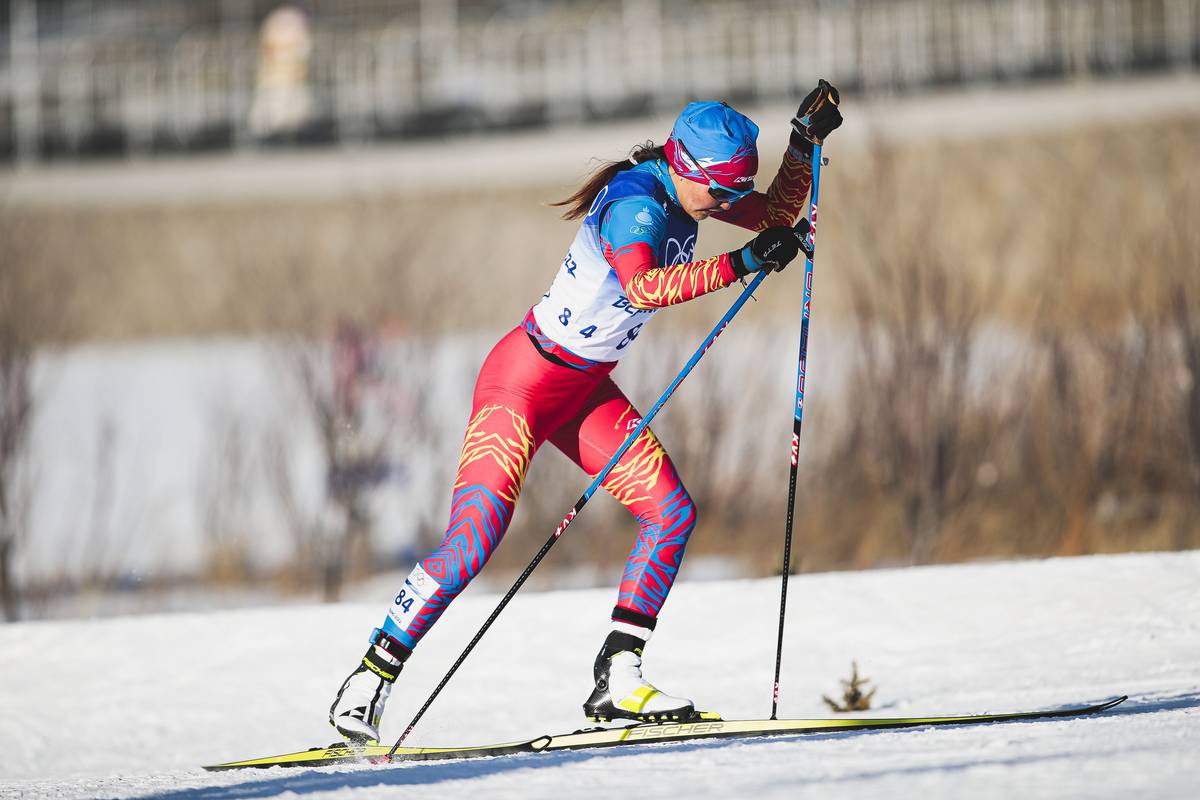
Enkhtuul Ariunsanaa of Mongolia skis in the women’s skate sprint qualification at the 2022 Winter Olympic Games. (photo: NordicFocus)
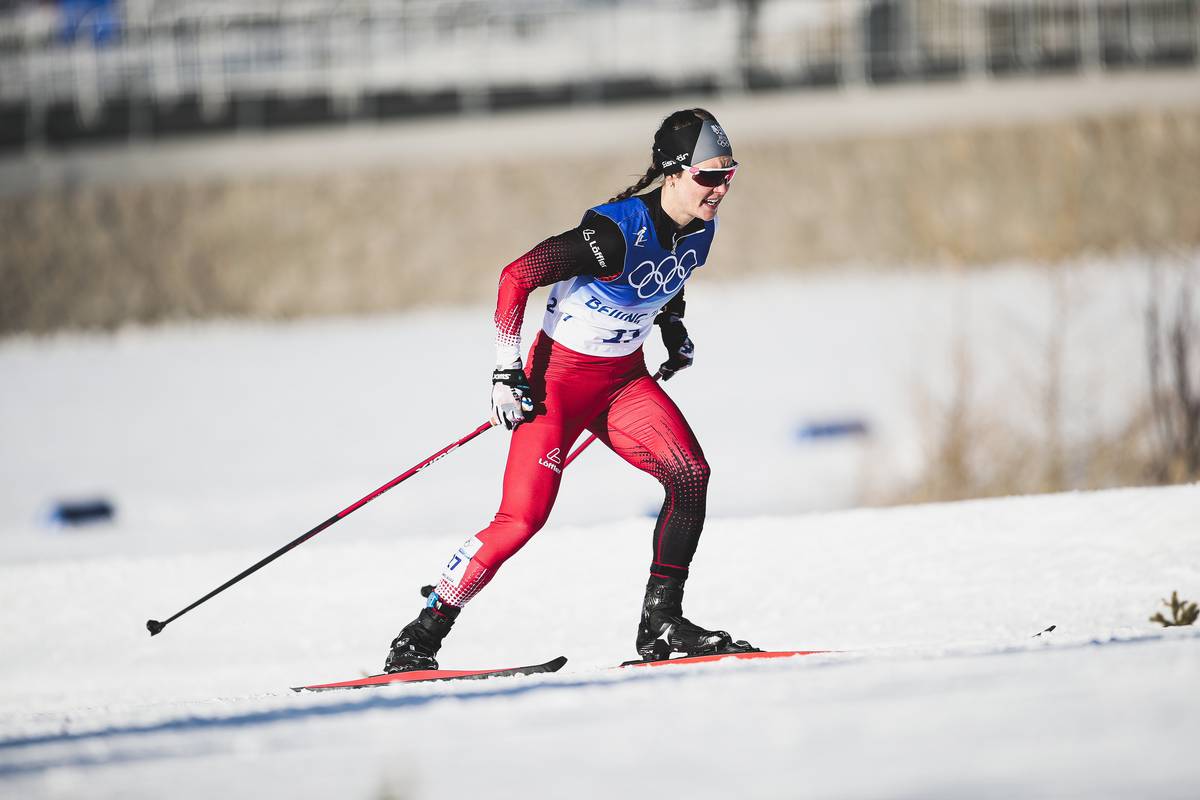
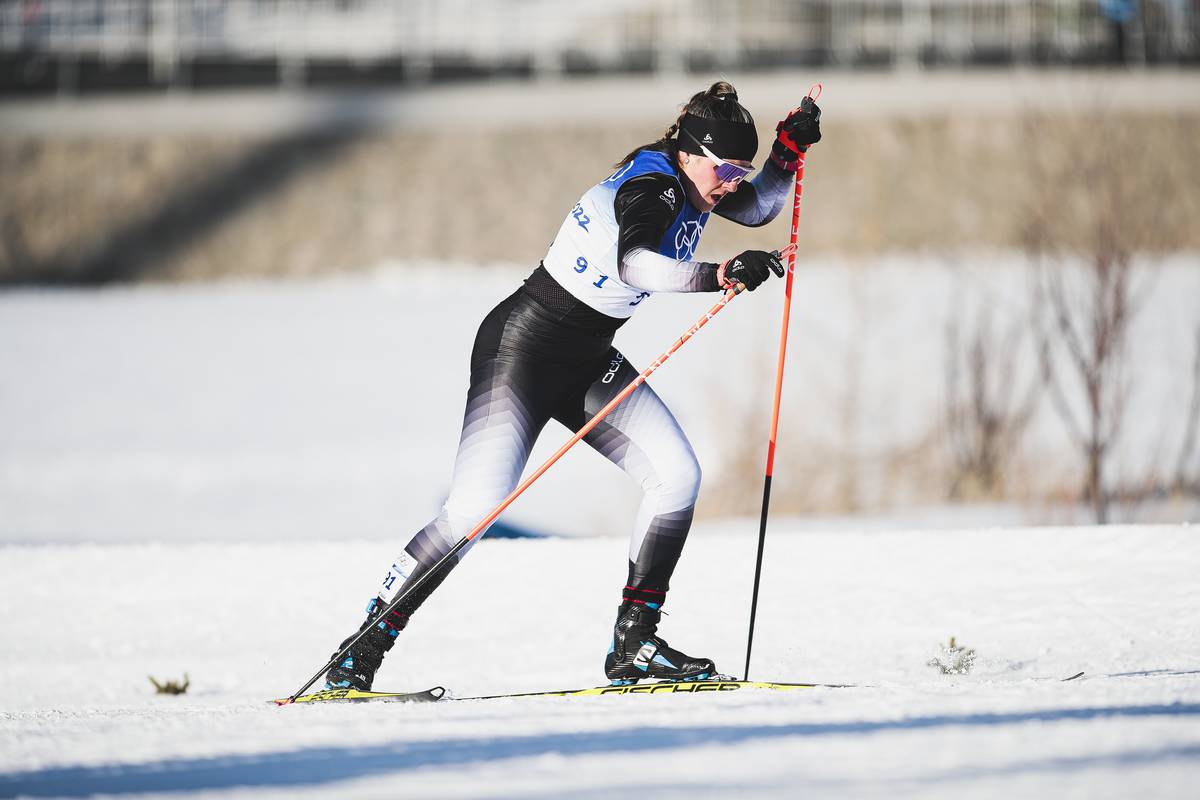
We recently brought you a roundup of Olympic race suits from some more traditional nordic powers, focusing on those nations that had at least four men on site in Zhangjiakou and so were able to field a team in the men’s 4 x 10-kilometer relay. This article now turns its attention to athletes from some countries that you might not initially think of when you think of nordic skiing, as well as more traditional ski countries (Poland, Ukraine) that did not field a team in the men’s relay.
These photos, all of which are copyright NordicFocus, are from the qualification round of the women’s freestyle sprint, early in the Olympic Games on February 8.
Argentina
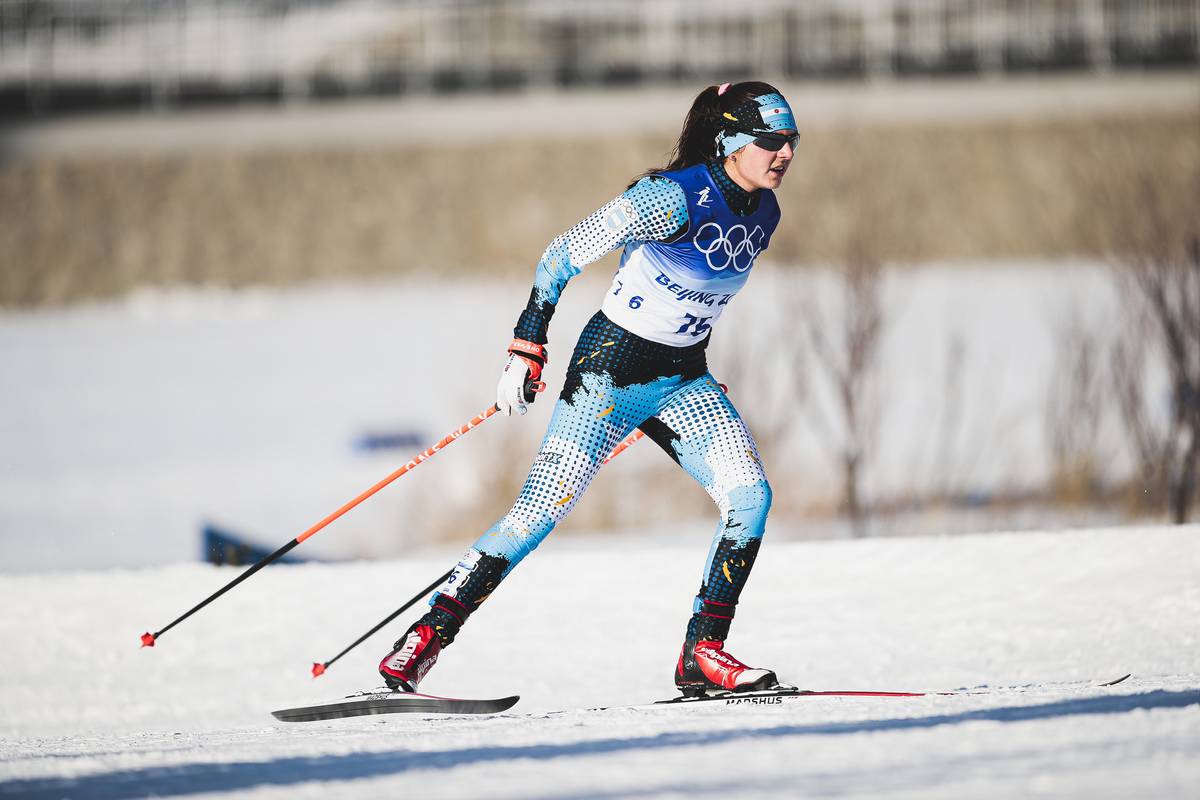
Nahiara Díaz González (ARG) skis in the women’s skate sprint qualification, Feb. 8. (photo: NordicFocus) Her uniform evokes the “sky blue and whites” of the better-known Argentine national football team, La Albiceleste.
Armenia
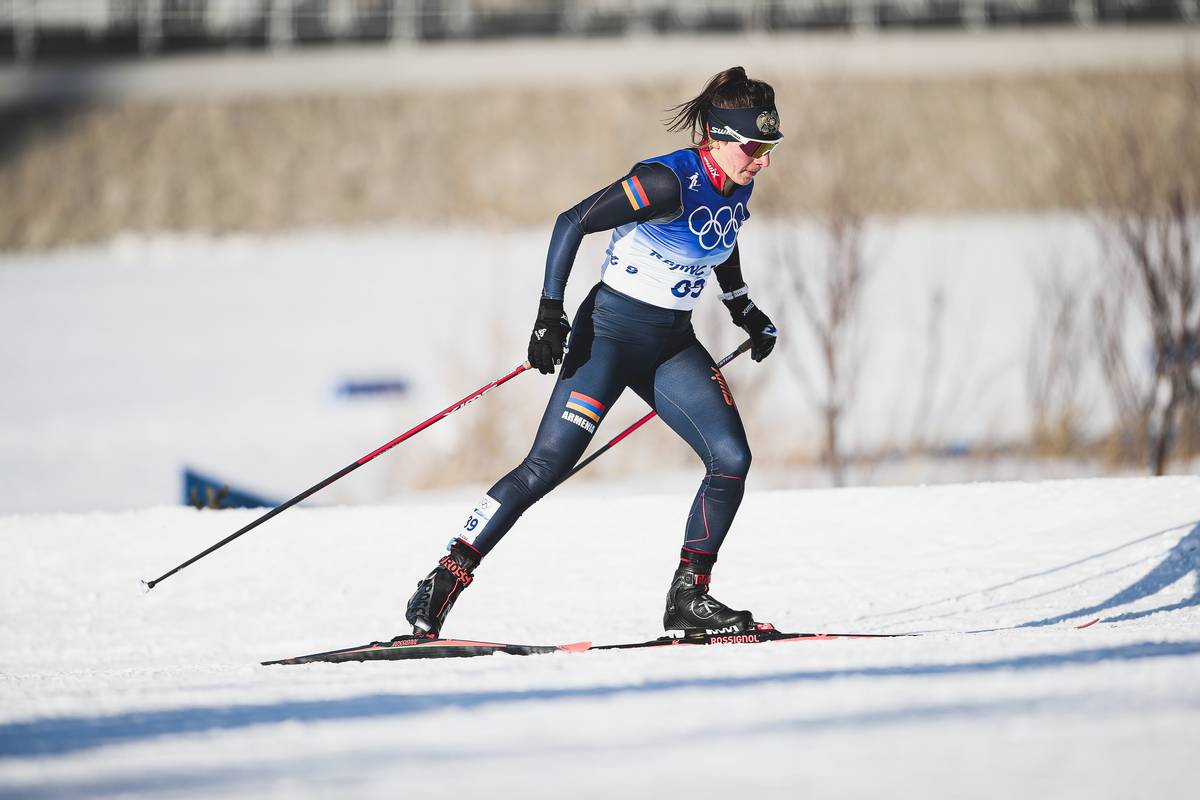
Katya Galstyan (ARM) skis in the women’s skate sprint qualification. (photo: NordicFocus) Her suit is a largely stock dark Swix model, with the Armenian flag on the right leg and shoulder. The Armenian coat of arms, which features an eagle regardant dexter and a lion regardant sinister, is on her headband.
Australia
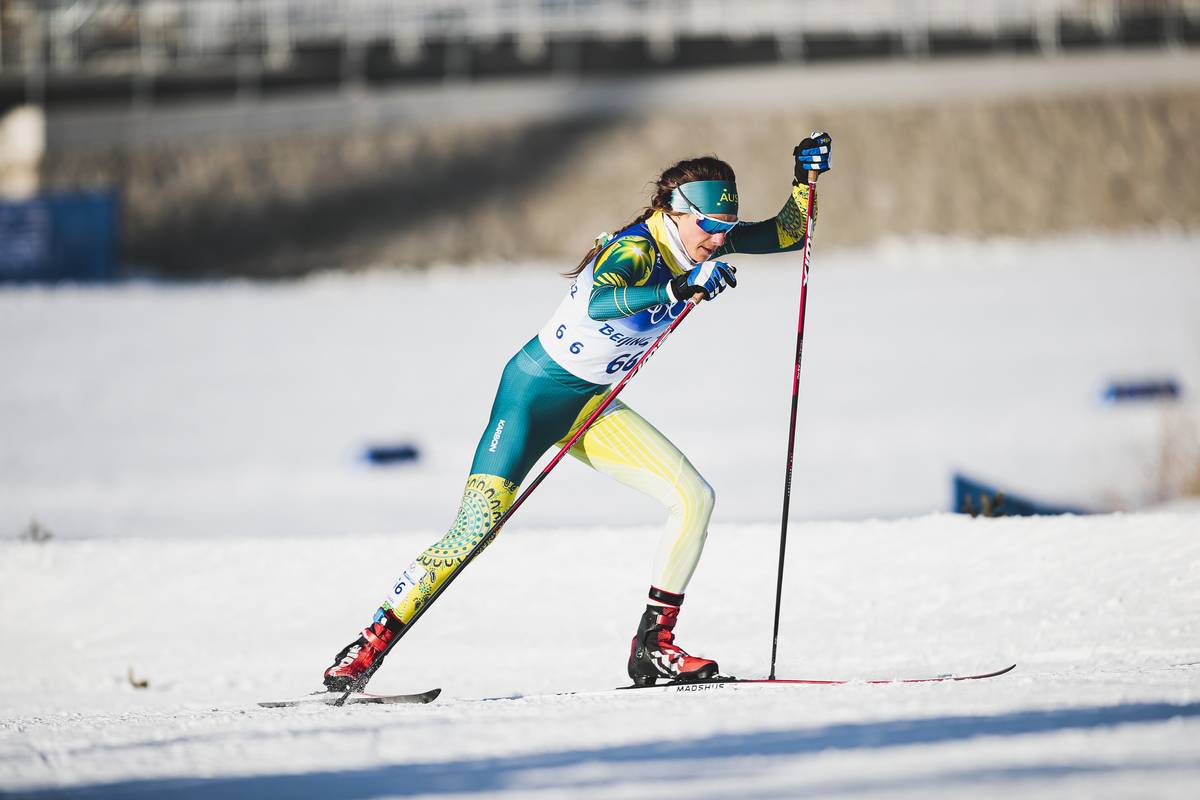
Jessica Yeaton (AUS) skis in the women’s skate sprint qualification. (photo: NordicFocus) Yeaton, who grew up largely in Anchorage and skied for the same high school (South Anchorage High School) as double Olympic siblings Scott and Caitlin Patterson, sports a green and yellow uniform typical of Australian teams in international sport. Wikipedia explains, “although the country’s flag has the colours blue, red and white, the [national football team] uses shades of green and yellow. That’s because, unlike many national teams, who base their colours on the flag, the Australian team uses as a base the colours of a typical plant in the country, the acacia, which has green leaves and yellow flowers.” When Yeaton teamed up with fellow Anchorage expat Casey Wright (Wright skied collegiately for the University of Alaska Anchorage) for the team sprint a few days later, they augmented their face tape with “Aussie Aussie Aussie / Oi Oi Oi” on alternating cheeks.Austria
Lisa Unterweger (AUT) skis in the women’s skate sprint qualification. (photo: NordicFocus) Her kit largely tracks the two colors of the Austrian flag, white and red.
Bosnia and Herzegovina
Sanja Kusmuk (BIH) skis in the women’s skate sprint qualification. (photo: NordicFocus) Her kit appears, awkwardly, to be precisely the same design, on an Odlo race suit, as both Switzerland and France, though with different colors. You may decide for yourself who wore it better.
Brazil
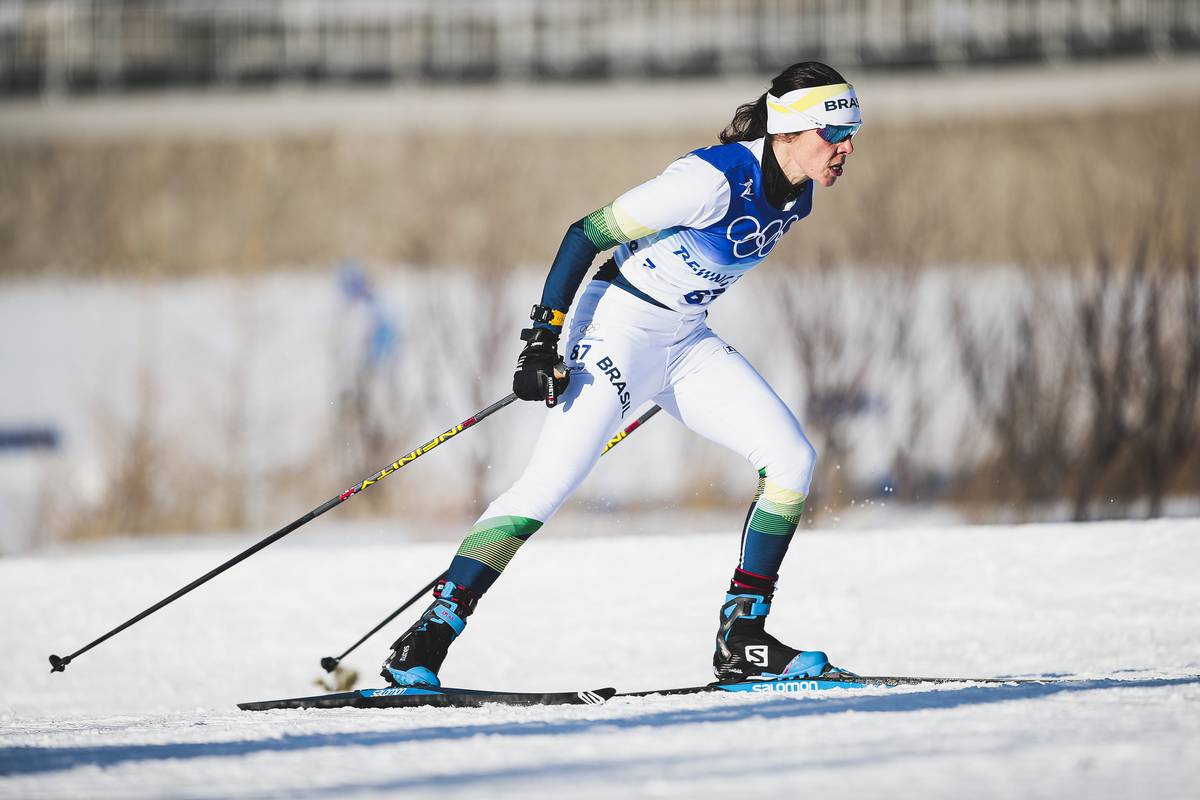
Jaqueline Mourão (BRA), who is 46 years old and representing Brazil in her eighth Olympic Games (three summer games and five winter games since 2004), skis in the women’s skate sprint qualification. (photo: NordicFocus) The suit incorporates the blue, yellow, and green of the Brazilian flag on the extremities, while white predominates through the torso and upper legs. Her ski poles appear to be from bespoke manufacturer Zaveral Racing Equipment, based in Wells Bridge, New York.
Croatia
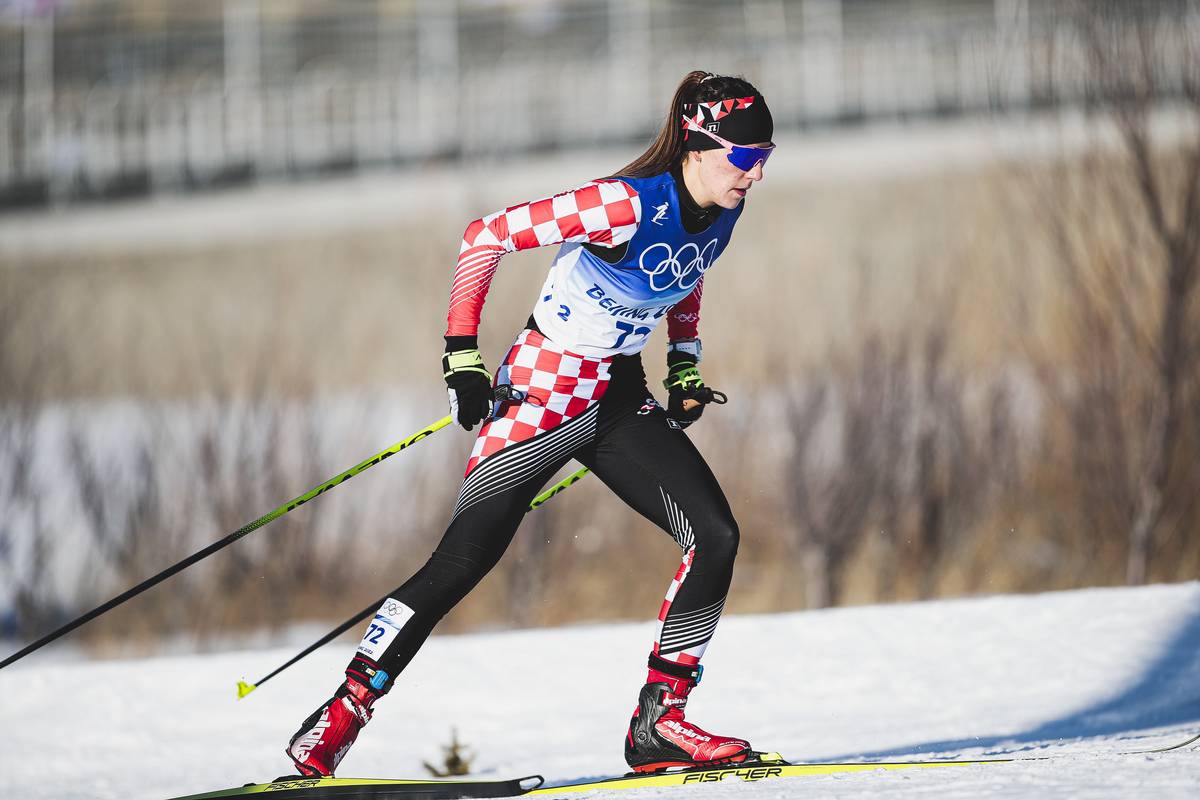
Tena Hadžić (CRO) skis in the women’s skate sprint qualification. (photo: NordicFocus) The checkerboard design is instantly recognizable to anyone who follows international sport (you may remember this design from such sporting events as the 2018 France–Croatia men’s World Cup Final); per Wikipedia, “The red and white motif is based on the Croatian checkerboard (šahovnica), which has been used to represent Croats since the Middle Ages.” But not used to represent Hadžić since any time before 2004, which is when she was born: yes, Hadžić logged three Olympic starts before her 18th birthday. And what are you doing with your life?
Greece
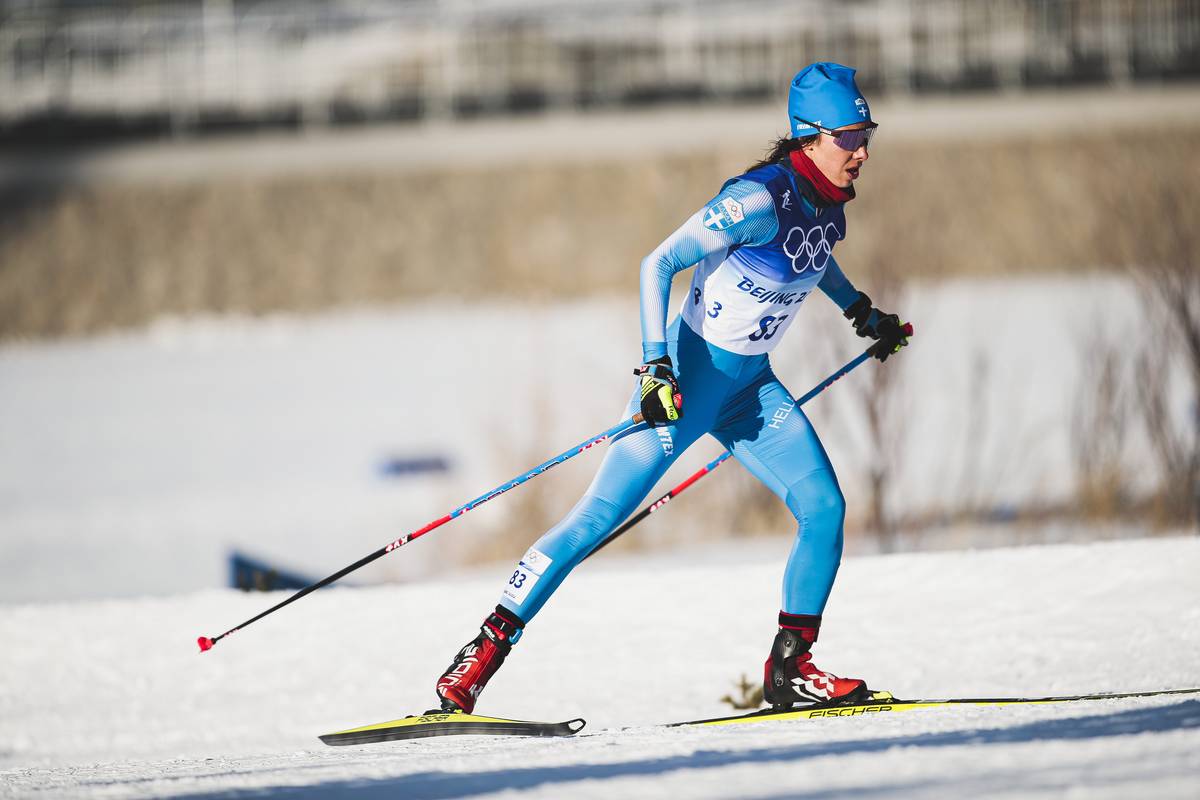
Μαρία Ντάνου, or Maria Ntanou (GRE), skis in the women’s skate sprint qualification. (photo: NordicFocus) Her suit neatly evokes the flag of Greece, “popularly referred to as the ‘blue and white’ (Greek: Γαλανόλευκη) or the ‘sky blue and white’ (Κυανόλευκη),” per Wikipedia.
Iceland
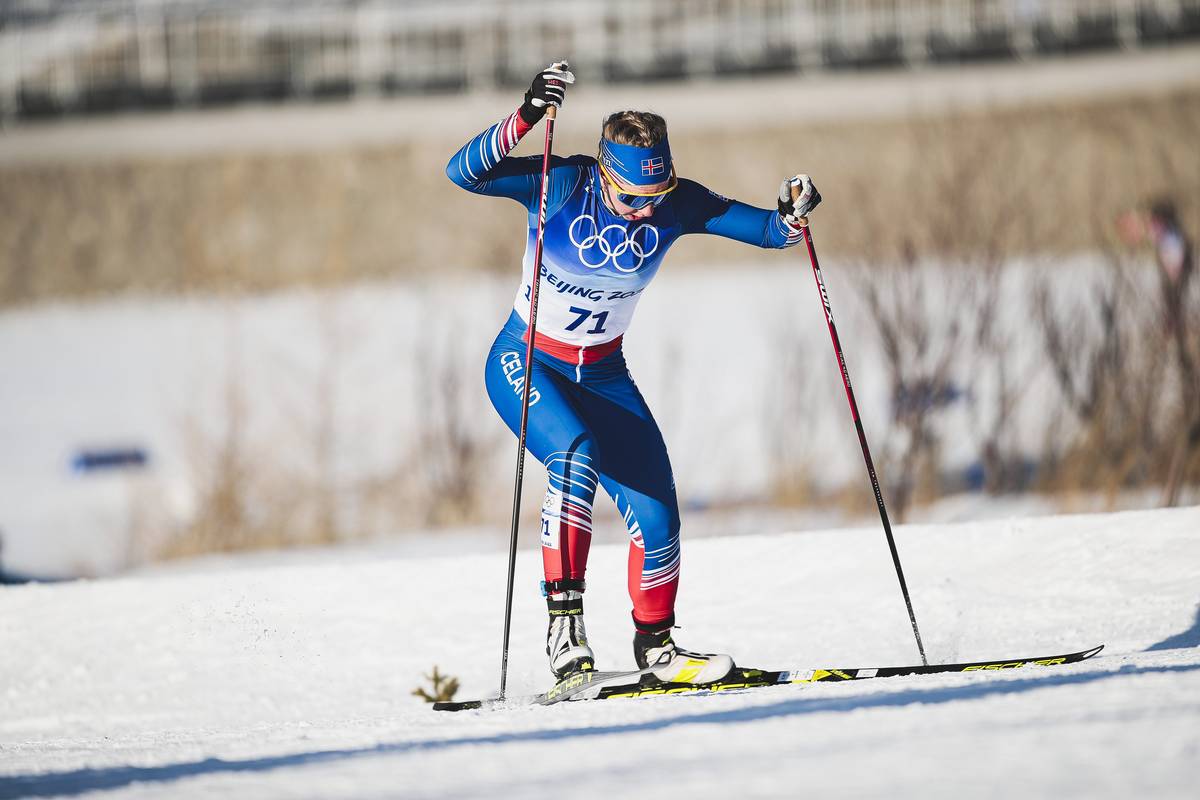
Kristrún Guðnadóttir (ISL) skis in the women’s skate sprint qualification. (photo: NordicFocus) Her suit uses the three colors of the Icelandic flag, red, white, and blue, though it does not specifically represent the Nordic cross that the flag contains.
Kazakhstan
Irina Bykova (KAZ) skis in the women’s skate sprint qualification. (photo: NordicFocus) Her suit incorporates the gold and blue colors of the Kazakh flag. Per Wikipedia: “The sky blue background symbolises the peace, freedom, cultural, and ethnic unity of Kazakh people … . The sun represents a source of life and energy. It is also a symbol of wealth and abundance; the sun’s rays are a symbol of the steppe’s grain which is the basis of abundance and prosperity.”
Latvia
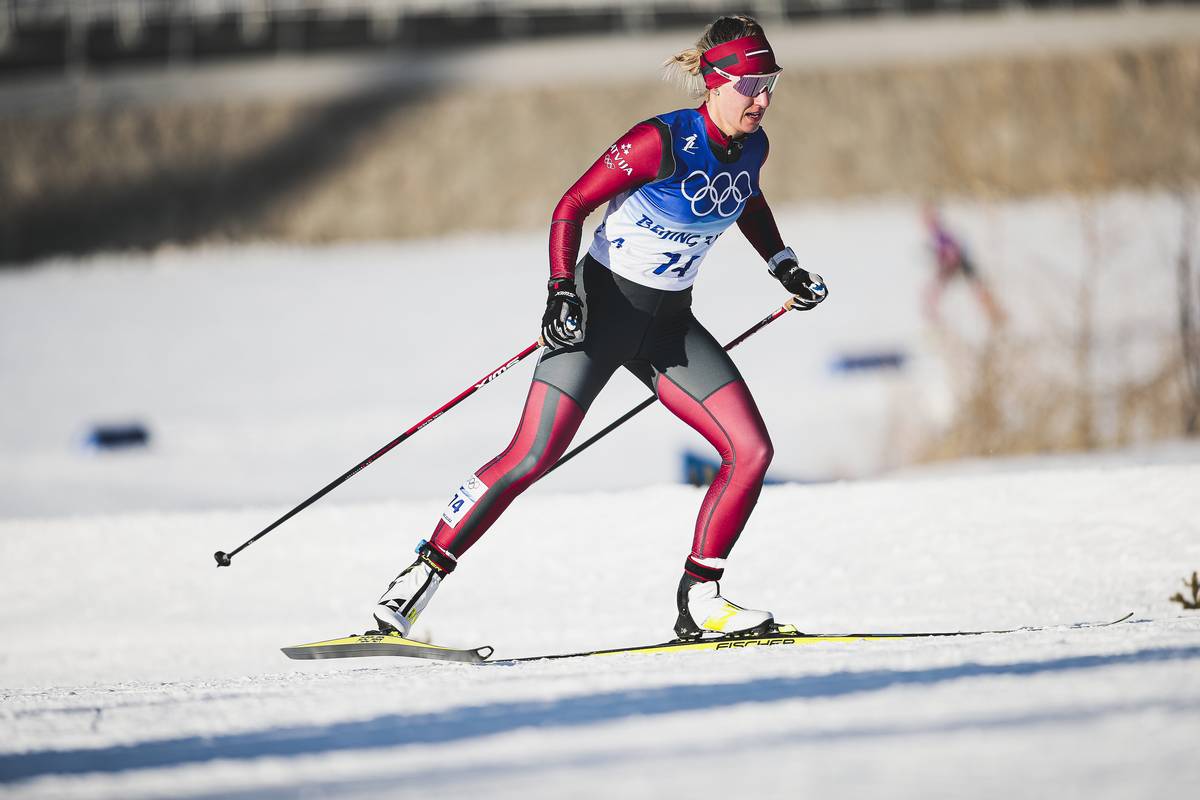
Kitija Auzina (LAT) skis in the women’s skate sprint qualification. (photo: NordicFocus) The Latvian flag is described as a “carmine field bisected by a narrow white stripe,” as visible on Auzina’s headband. The suit ably incorporates the carmine (dark red) of the flag, though it has black, rather than white, as a contrasting color. That said, the coordination with the Swix Triac 4.0 Aero poles is superb; it would only be better if she were on red and black Alpina skate boots.
Lithuania
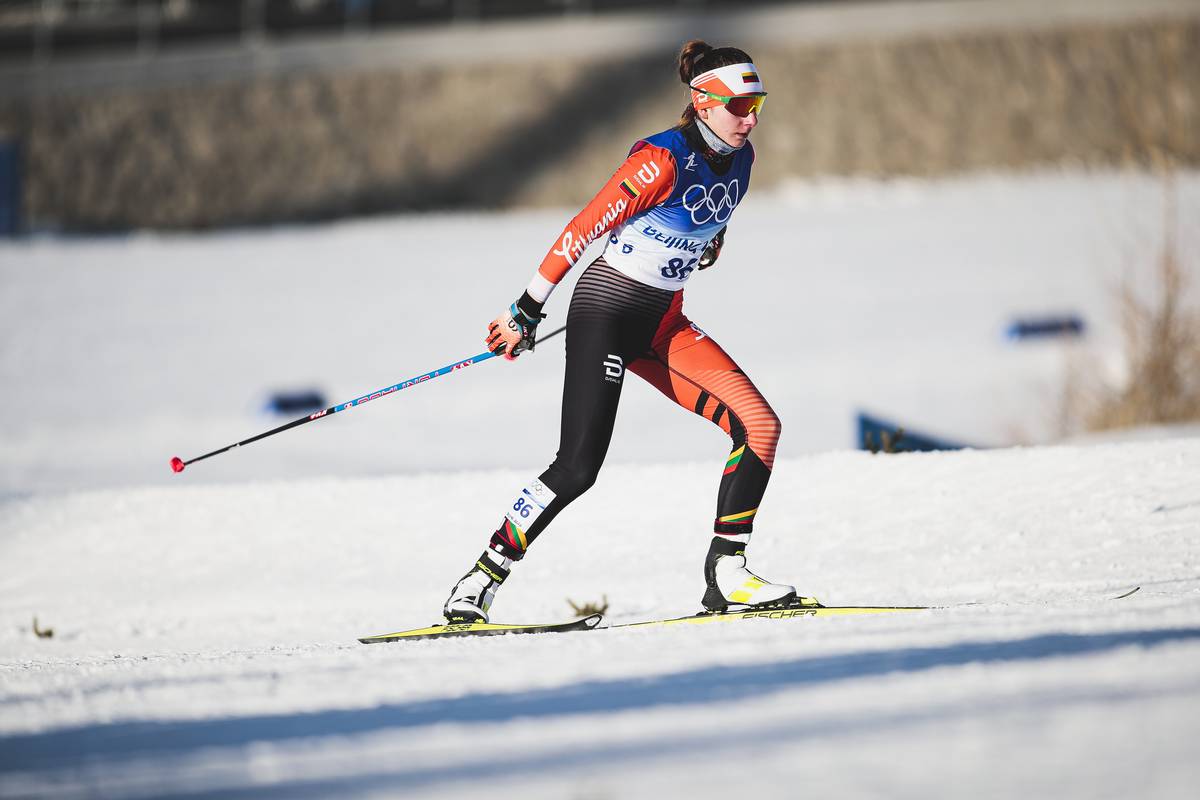
Ieva Dainytė (LTU) skis in the women’s skate sprint qualification. (photo: NordicFocus) Which possibly occasioned a doubletake from anyone who watched U.S. Olympian Luke Jager race as a junior for West Anchorage High School (Jager is on the left of the linked image, fellow Olympian Gus Schumacher, who skied for Service High School, on the right). You may, once more, decide for yourself, who wore it better?
Mongolia
Enkhtuul Ariunsanaa (MGL) skis in the women’s skate sprint qualification. (photo: NordicFocus) The colors of the Mongolian flag are red, blue, and yellow, all of which are present in this suit. “The blue stripe represents the eternal blue sky, and the red stripes thriving for eternity,” Wikipedia explains. The coordination with the red and blue KV+ Tornado poles is a nice touch.
Poland
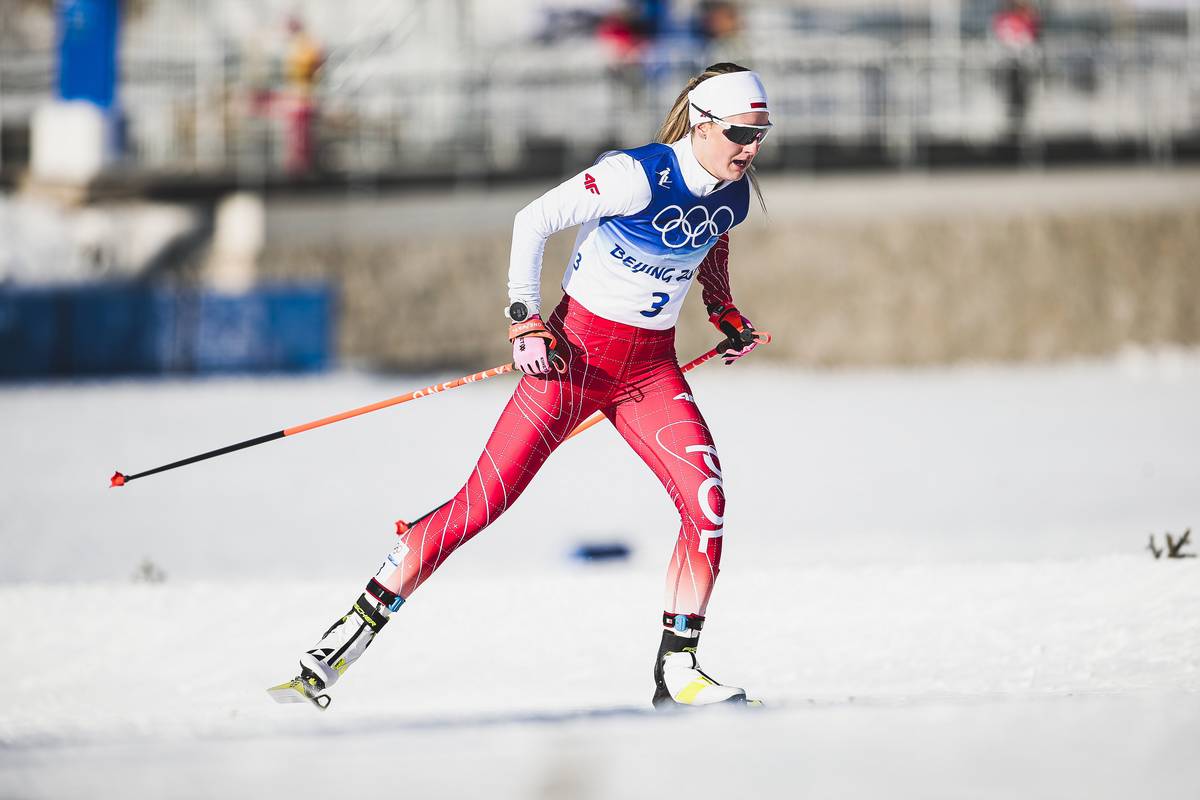
Weronika Kaleta (POL) skis in the women’s skate sprint qualification. (photo: NordicFocus) Kaleta skis collegiately for the University of Colorado and has raced both European World Cup and American SuperTour races this year. Her suit features the two colors of the Polish flag, which is a relatively simple horizontal bicolor of red and white.
Romania
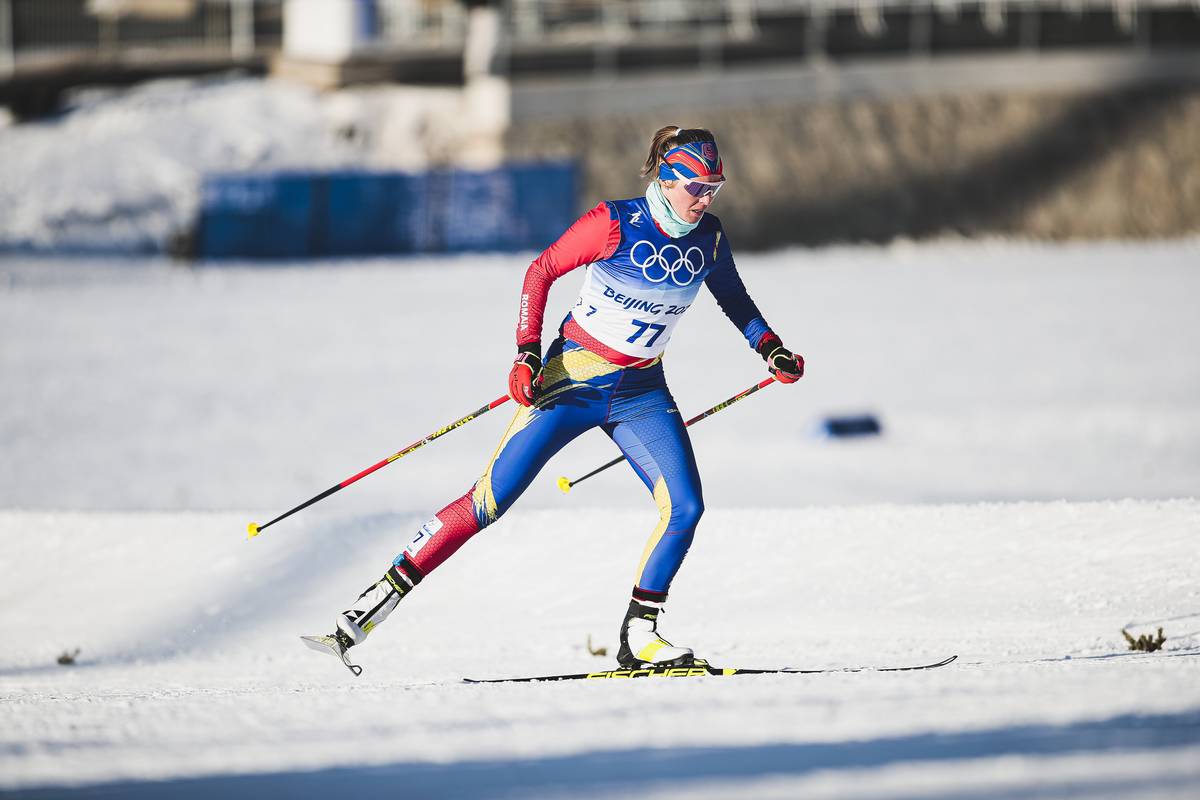
Tímea Lőrincz (ROU) skis in the women’s skate sprint qualification. (photo: NordicFocus) The three stripes of the Romanian tricolor flag are cobalt blue, chrome yellow, and vermilion red. These three colors, and no others, are present in this race suit. Lőrincz represented Romania in her third Olympics. Her name contains the rare double acute accent, on ő.
Slovakia (ft. alt. national-team race suit)
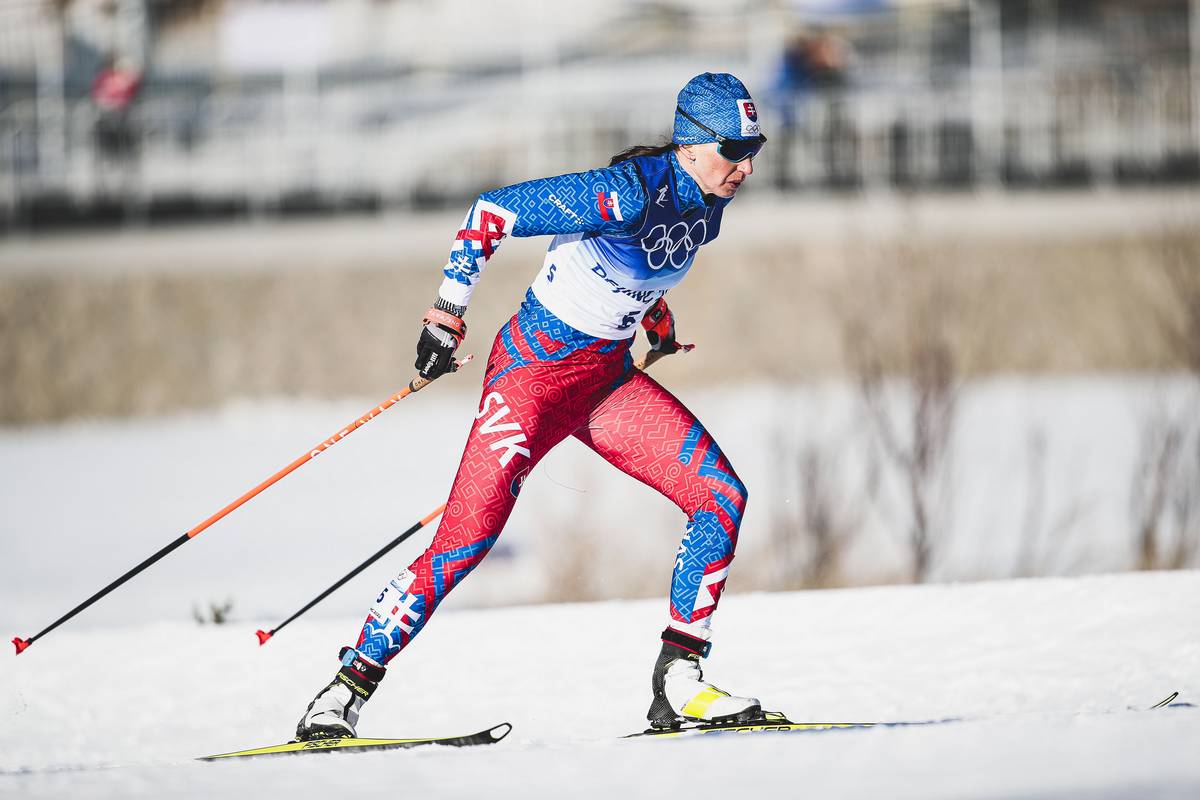
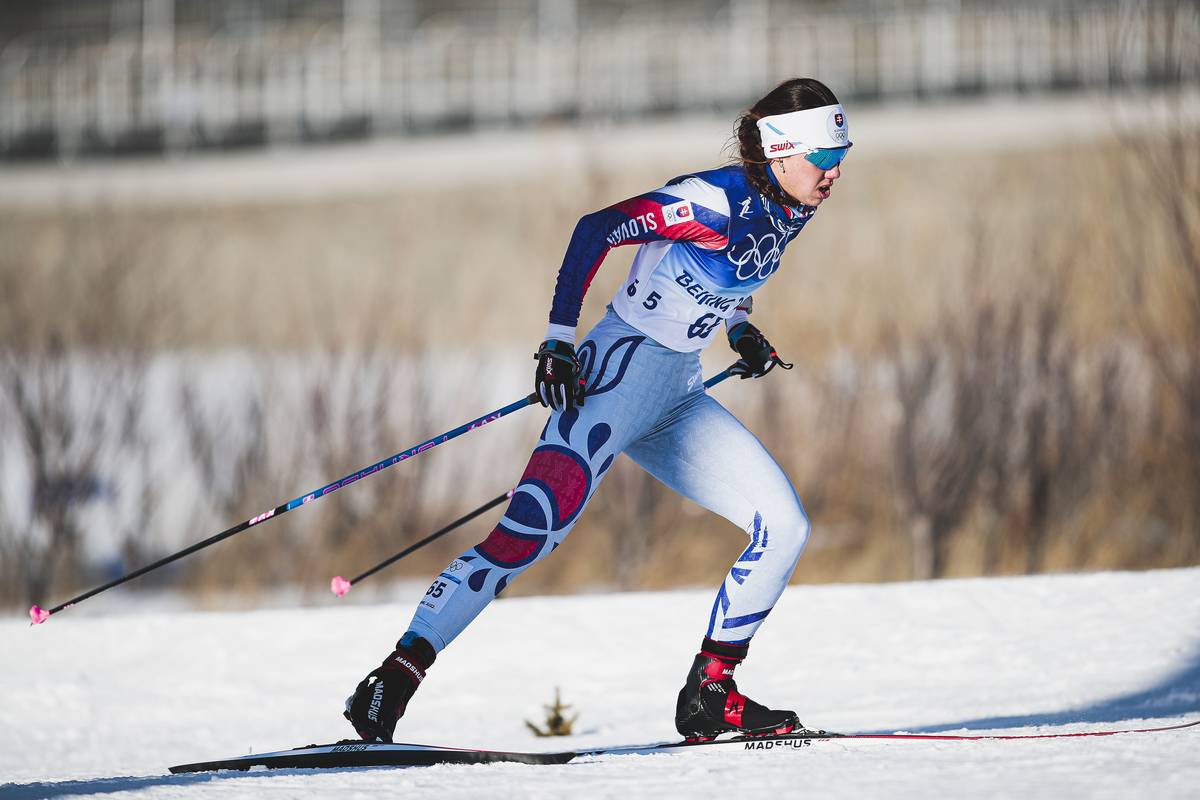
Alena Procházková (SVK) skis in the women’s skate sprint qualification. (photo: NordicFocus)Barbora Klementová (SVK) skis in the women’s skate sprint qualification, same race, same day, wearing a completely different version of the Slovakian kit. (photo: NordicFocus) The flag of Slovakia looks like this: 🇸🇰. While both race suits are very neat, Procházková’s version more ably evokes the Slovakian coat of arms, which feature on the hoist side of the flag and the lower right leg and arm of Procházková’s race suit.
South Korea
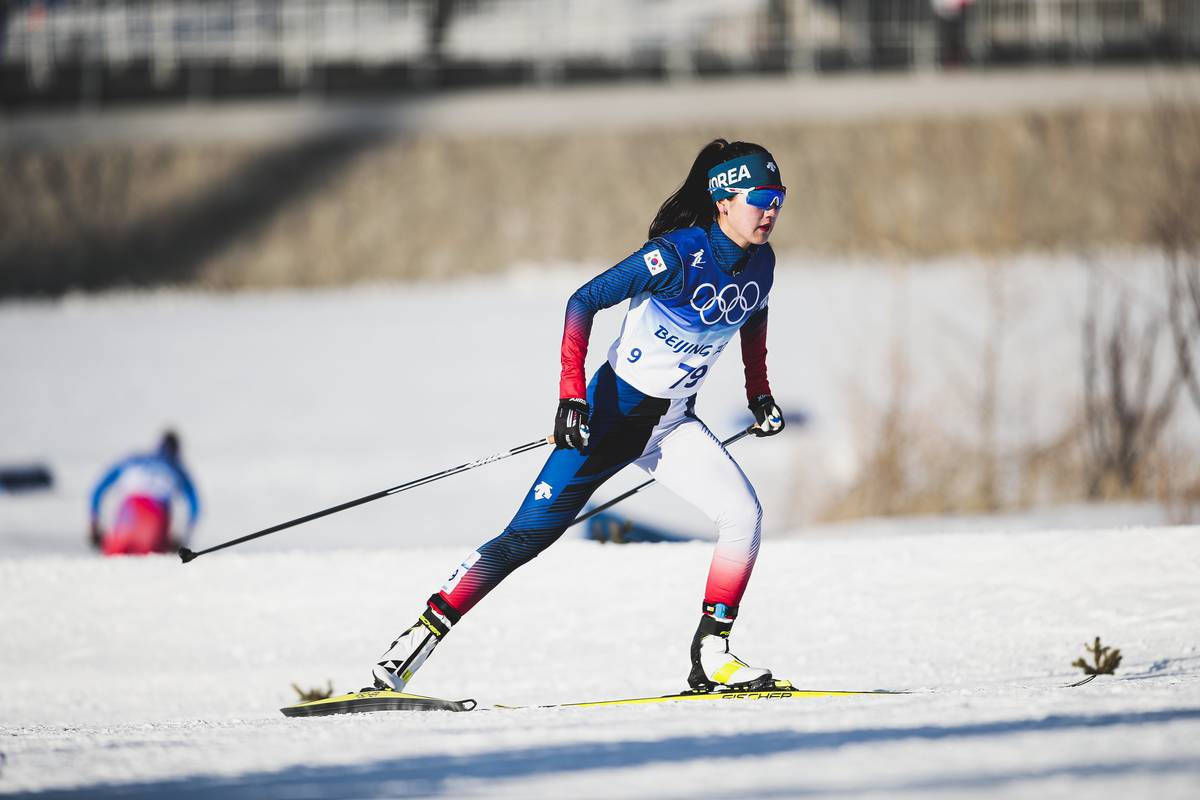
Dasom Han (KOR) skis in the women’s skate sprint qualification. (photo: NordicFocus) The colors of the flag of South Korea are black, white, red, and blue, in an intricate design present in the patch on Han’s right shoulder. The logo on the right leg is for the suit manufacturer, Descente.
Thailand
Karen Chanloung (THA) skis in the women’s skate sprint qualification. (photo: NordicFocus) Her suit mirrors the red, white, and blue of the Thai flag, augmented by blue Salomon boots and skis and KV+ poles with all three colors. The colors of the Thai flag are “said to stand for nation–religion–king, an unofficial motto of Thailand: red for the land and people, white for religions, and blue for the monarchy,” per Wikipedia.
Turkey
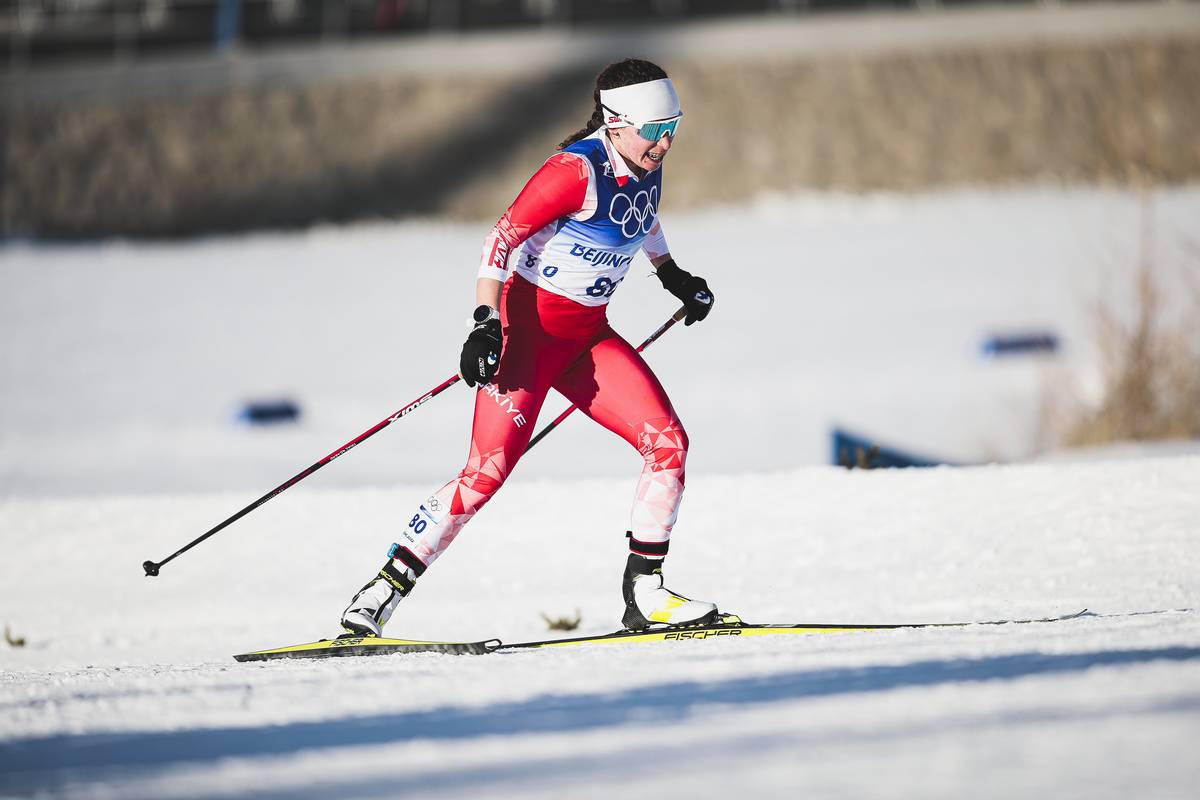
Ayşenur Duman (TUR) skis in the women’s skate sprint qualification. (photo: NordicFocus) Her suit features the red and white of the Turkish flag. It does not appear to specifically depict or evoke the white star and crescent that are present on the flag.
Ukraine
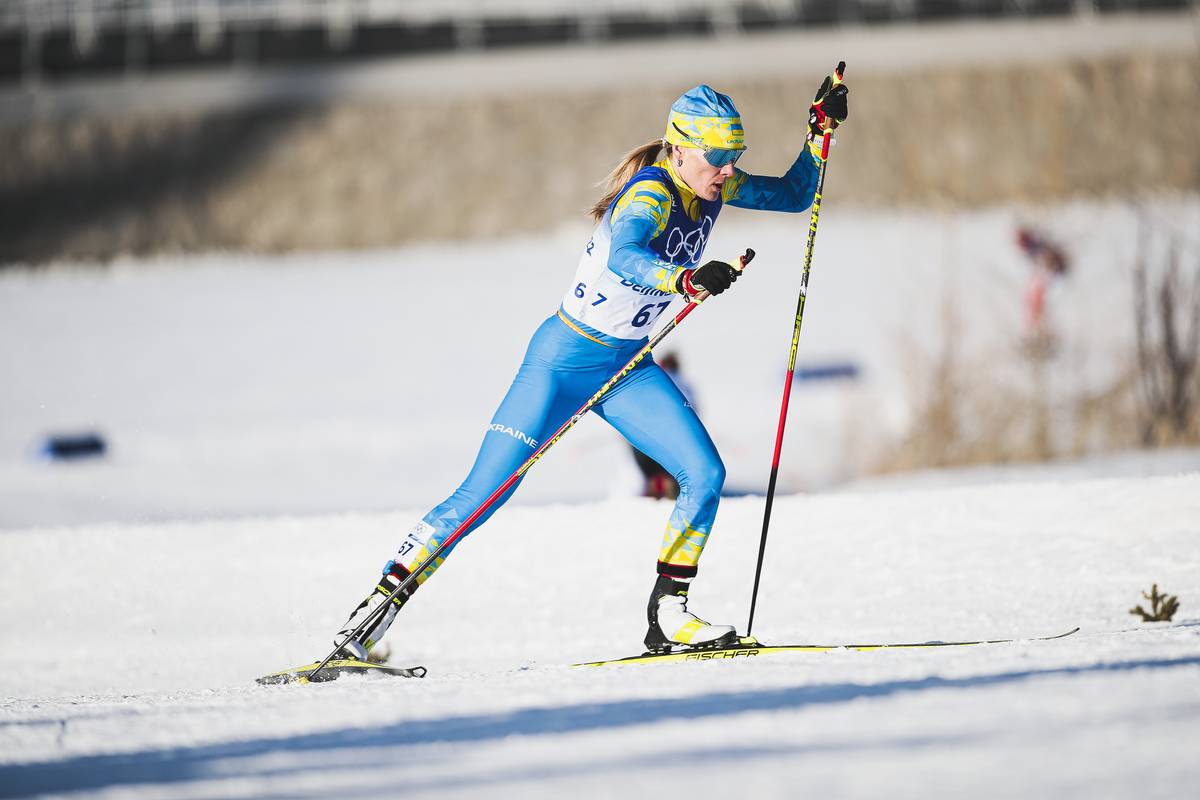
Maryna Antsybor (UKR) skis in the women’s skate sprint qualification. (photo: NordicFocus) Her suit incorporates the two colors of the Ukrainian flag, a blue and yellow bicolor.
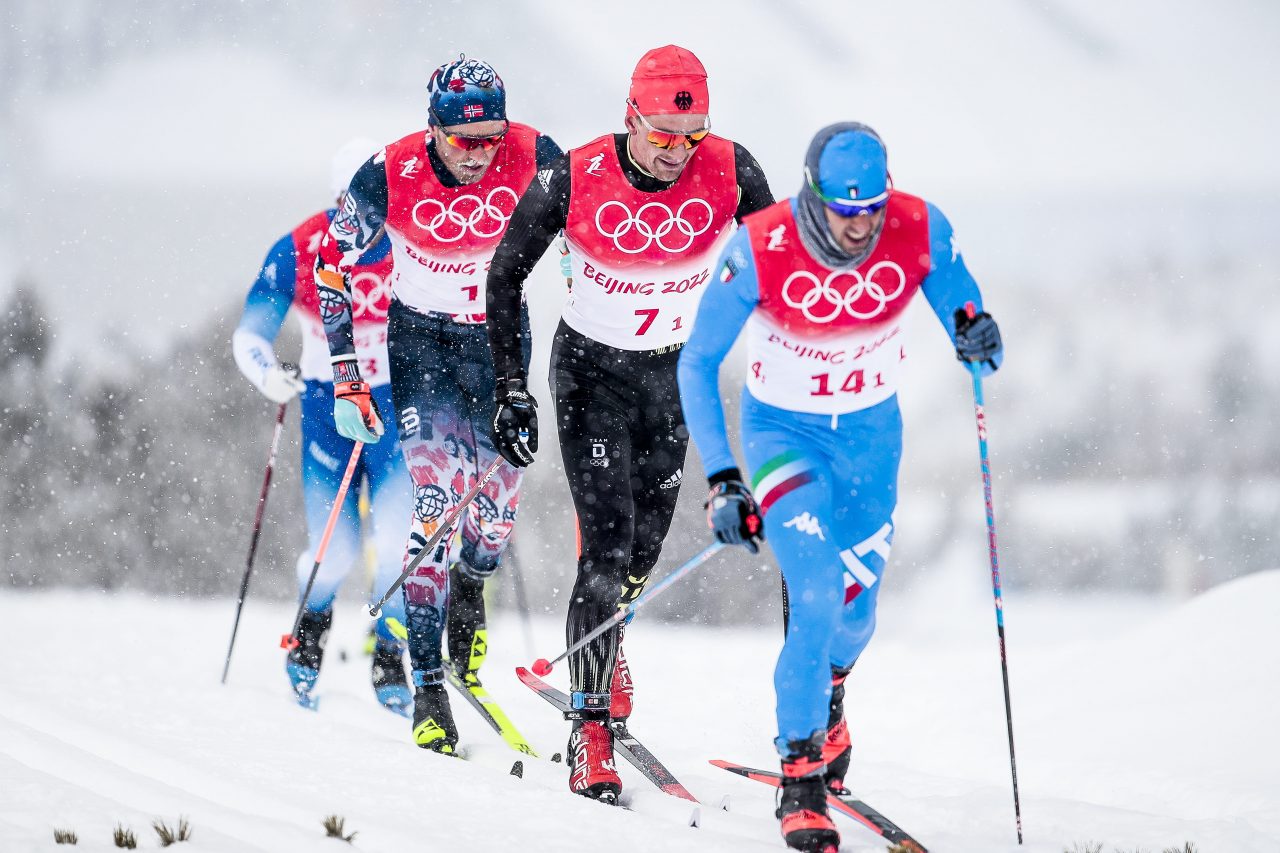
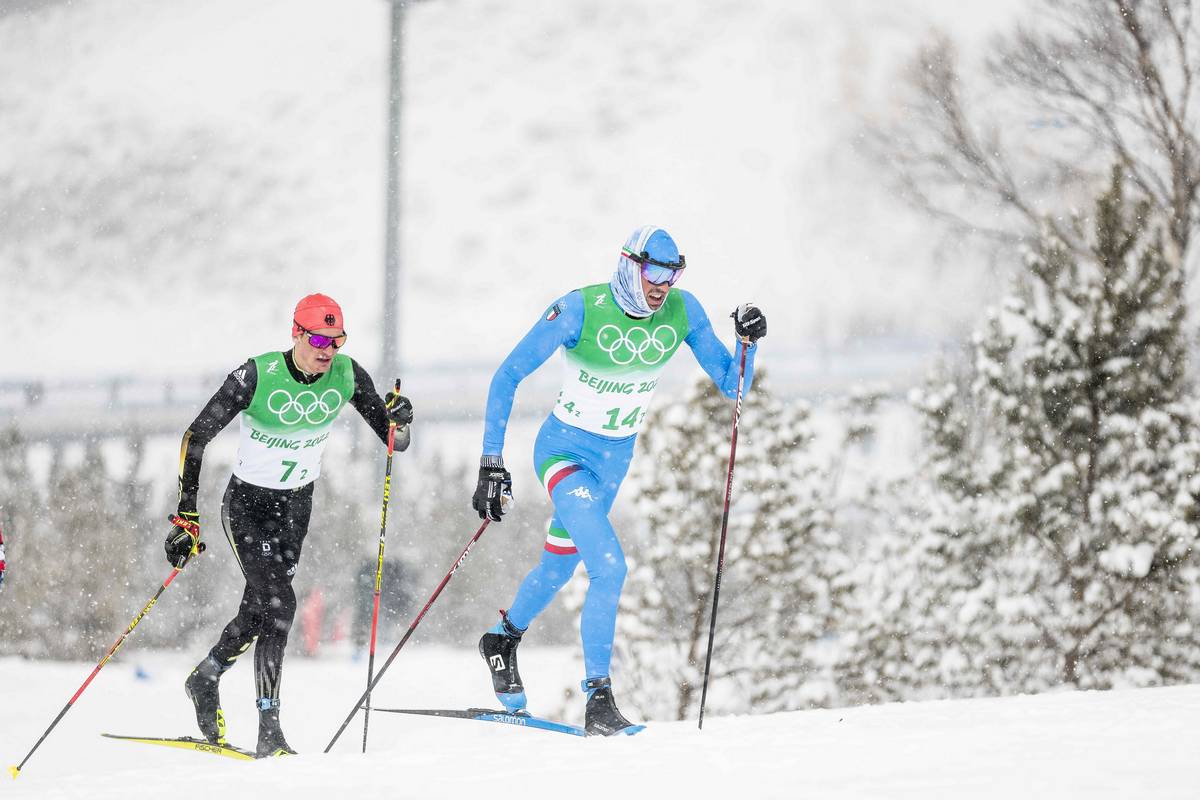
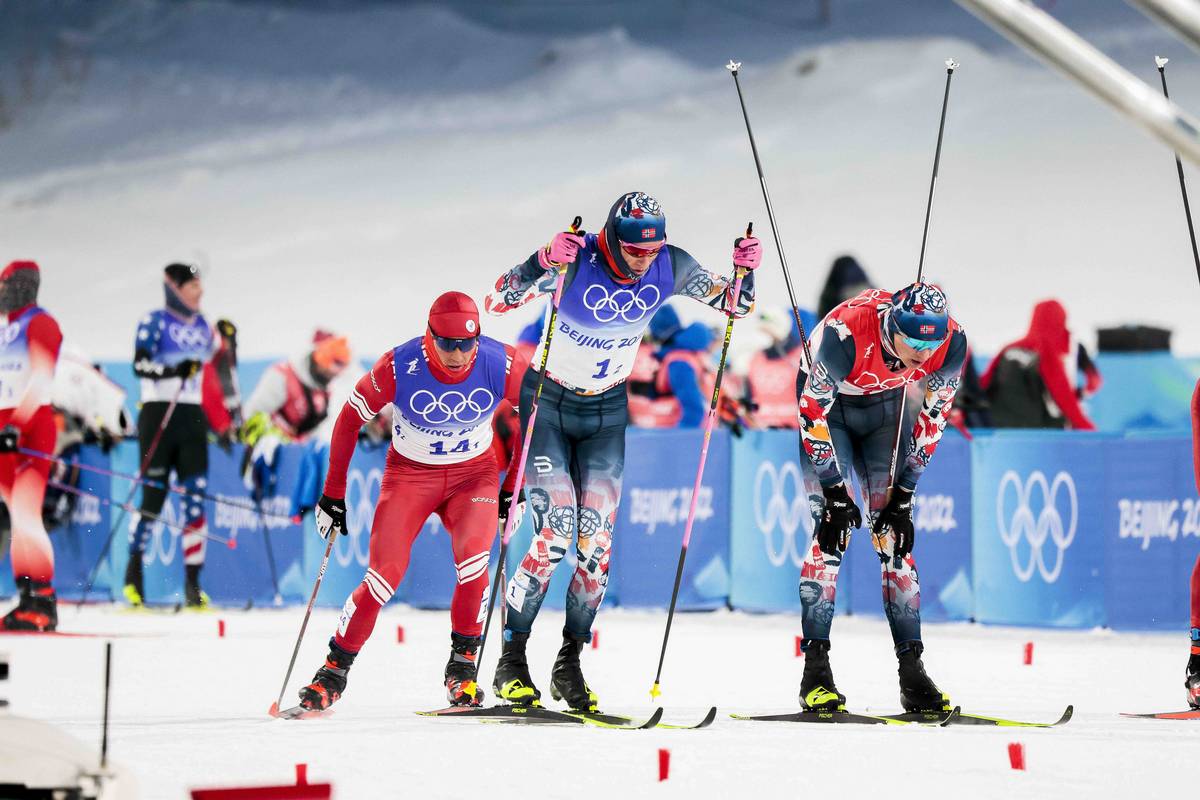
Federico Pellegrino of Italy leads, from right, Janosch Brugger of Germany and Emil Iversen of Norway, men’s 4 x 10 k relay, Feb. 13. (Photo: NordicFocus)
FasterSkier previously surveyed the national-team uniforms from last year’s World Cup fashion season, starting with more traditional nordic powers (Norway, Russia, et al.) but also taking a look at some more outré ski countries (Brazil, Nigeria, Thailand). We didn’t run a comparable article at the start of this season, as there was relatively little change in most nations’ World Cup kit from last year to this year.
But when the Olympics arrive, however, all bets are off. Sponsor logos are out. Direct evocation of a nation’s flag is typically in. Unless you’re Norway, or Russia, albeit for different reasons.
There are lots of countries that sent cross-country skiers to this year’s Winter Olympic Games (54, in fact). Compiling photos of all of them would make for a very long article. Instead, this article surveys those countries that entered a team in the men’s 4 x 10-kilometer relay, using relay participation as a general proxy for international competitiveness. A follow-up article will focus on the women and on some less traditional nordic nations, by means of surveying finishers from the bottom half of the women’s skate sprint results sheet.
This article undertakes to rank the men’s relay race suits in, roughly, descending order of vexillological evocativeness, that is, how much does each race suit look like that country’s flag. This is a necessarily subjective inquiry; your own rundown may differ. No offense is intended toward countries in the bottom half of this list: A lower ranking does not mean that a suit is “bad,” just that it is less readily flag-like.
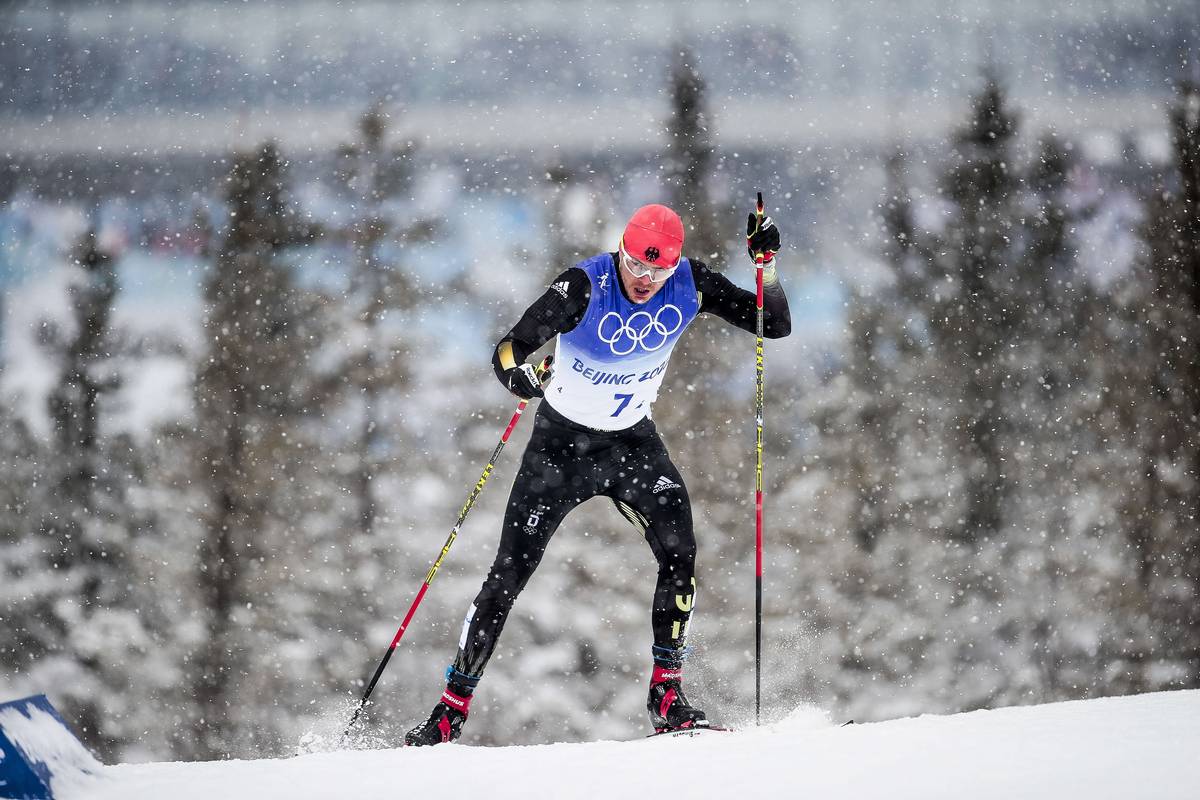
Note well, a handful of photos in this article come from races earlier in the Games, not from Sunday’s relay; it appears that there were no relay photos for these nations in the typically comprehensive NordicFocus library. Relatedly, all shots in this article are copyright NordicFocus, which has been doing an amazing job throughout the Olympics.
Finland
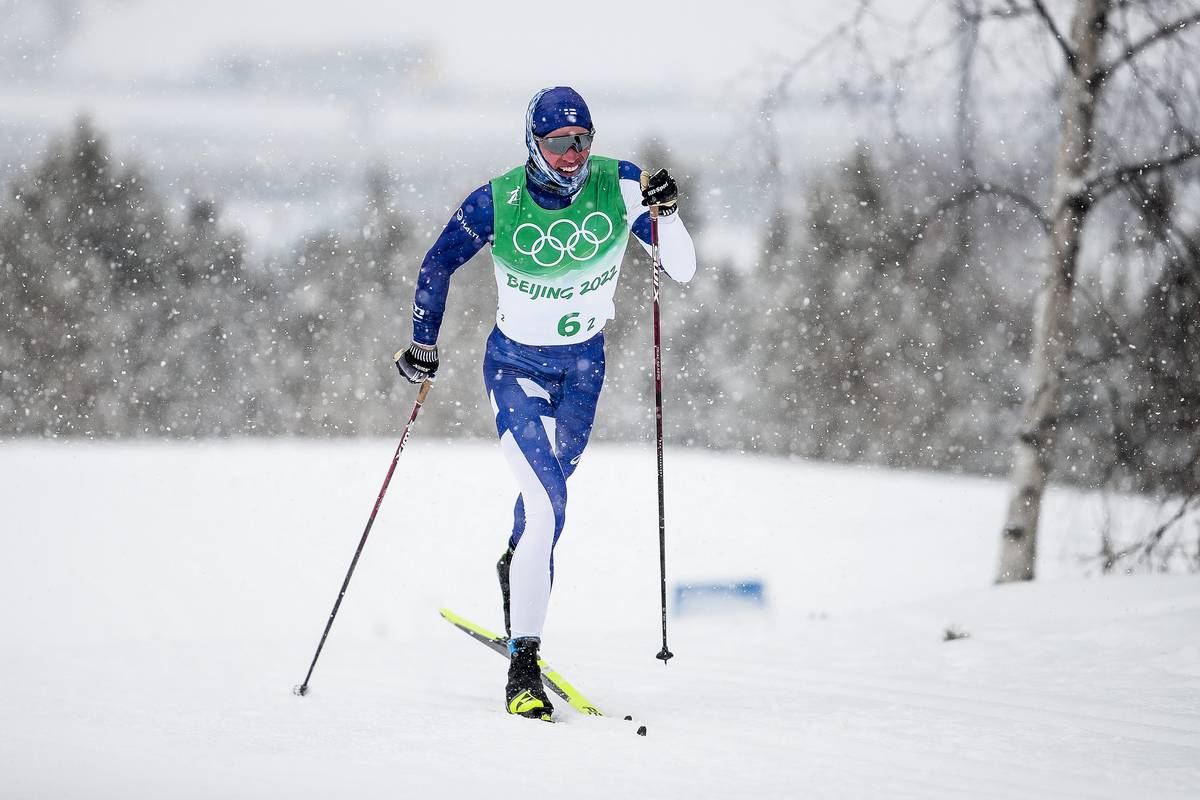
Finland’s Iivo Niskanen skis in the men’s relay. (Photo: NordicFocus)
The Finnish flag looks like this: 🇫🇮. Iivo Niskanen’s suit looks effectively the same. If one were, hypothetically, a Finnish athlete putting down an all-time relay performance to drag one’s team back up toward the front of a splintered men’s 4 x 10 k relay, there would be little doubt what nation you represented while you did so. This suit has the two colors of the Finnish flag, the dominant design element of the Nordic cross, and little more. It sure looks like the flag of Finland.
United States of America
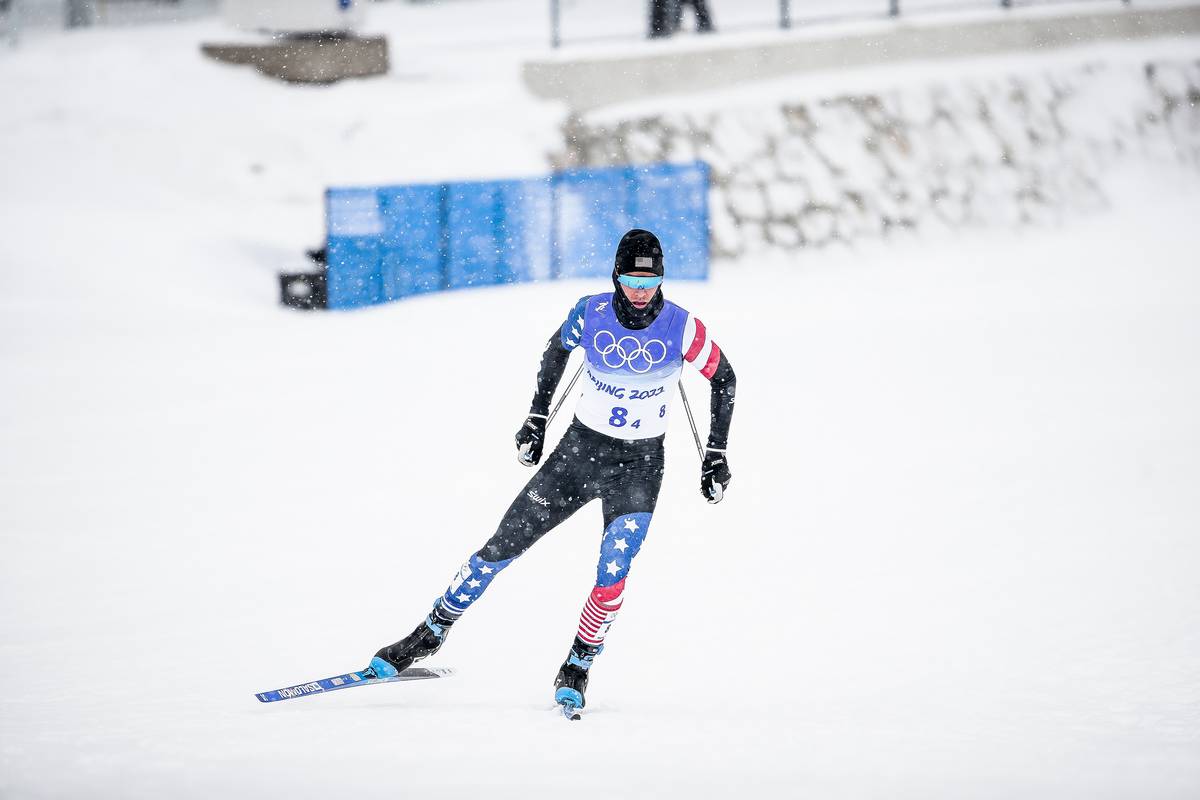
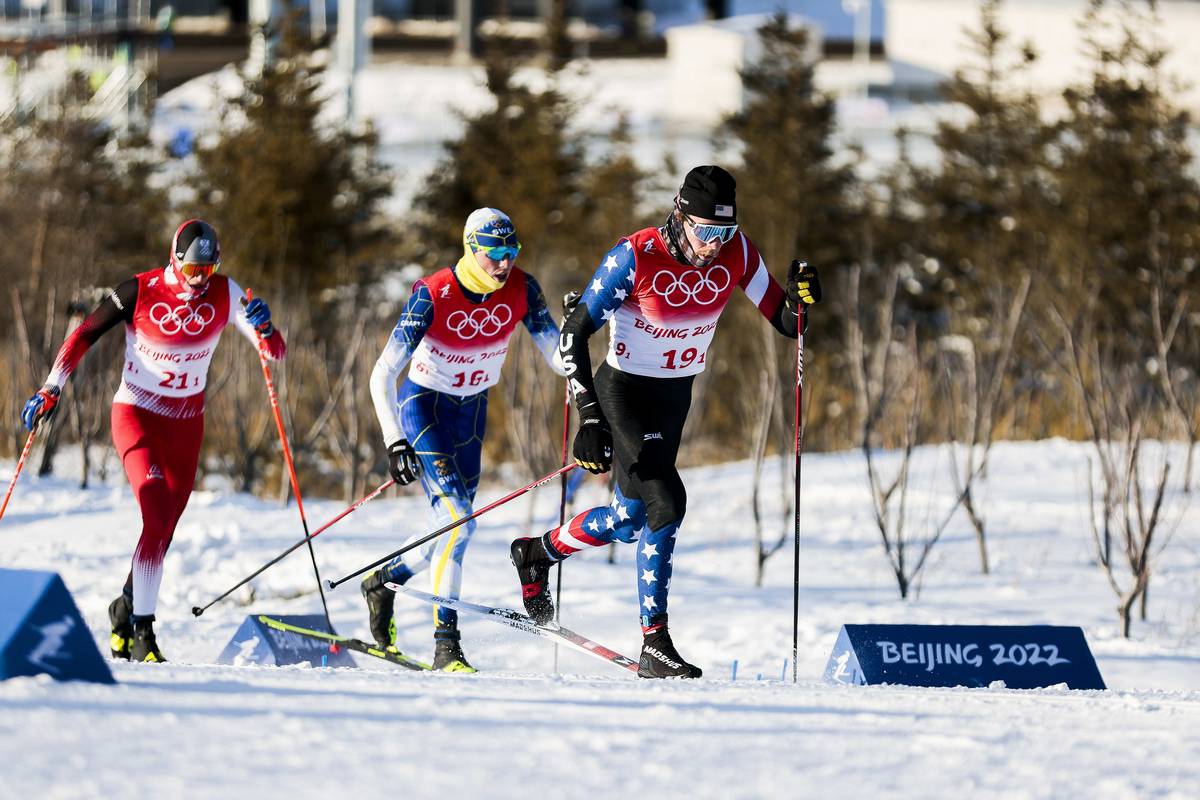
Kevin Bolger skis in the men’s relay. (Photo: NordicFocus)
The American flag, you are likely aware, looks like this: 🇺🇸. There are two main elements in the American flag, the stars and the stripes; both are represented here. (Added points for the relay socks, an after-market add-on that further emphasize the “stripes” aspect.) America should arguably be ranked below Sweden, for the dominant use of a color, black, not present in the nation’s flag, but has been slotted in here in second because the stars and stripes for America seem more flag-like than the evocation of a Nordic cross does for Sweden. You can find much more about historical American uniforms, both Olympics and World Cup styles, here.
Sweden
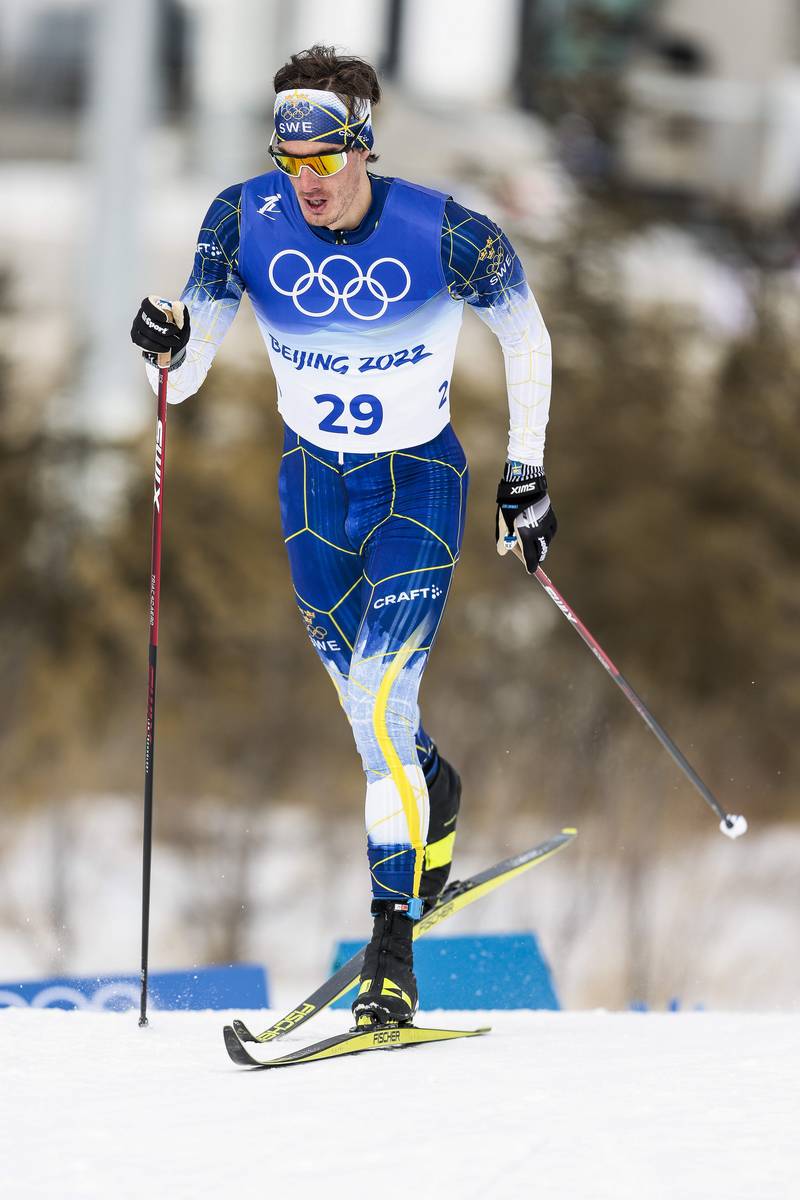
Johan Häggström skis in the men’s 15 k classic, Feb. 11. (Photo: NordicFocus)
The Swedish flag looks like this: 🇸🇪. This uniform does not really depict the Nordic cross per se, but the consistent use of yellow and blue, augmented by only the neutral white, means that the overall evocation of a flag is quite strong.
Czech Republic
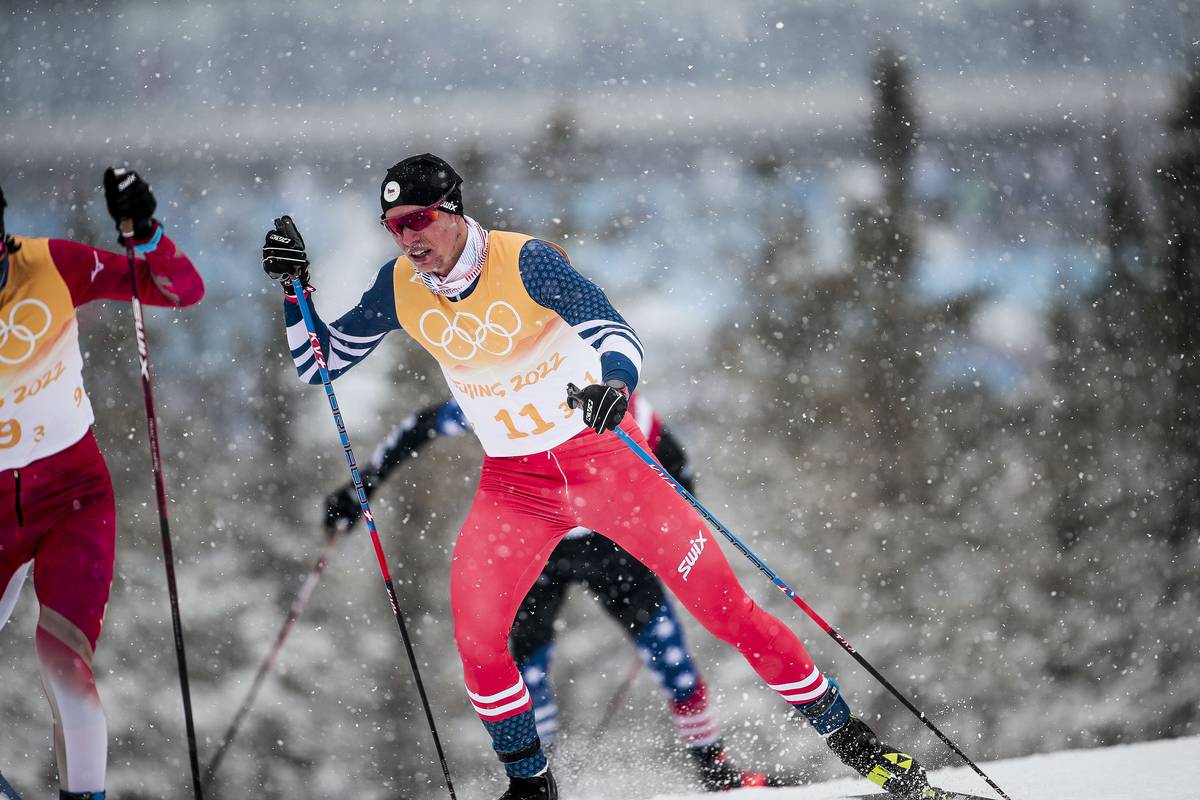
Petr Knop skis in the men’s relay. (Photo: NordicFocus)
The flag of the Czech Republic looks like this: 🇨🇿. This suit does not precisely portray the flag outline, but otherwise ranks high for featuring only the three colors from the flag, and nothing else. Could conceivably be pressed into service as a U.S.A. alternate suit, or maybe the current American biathlon suit.
Estonia
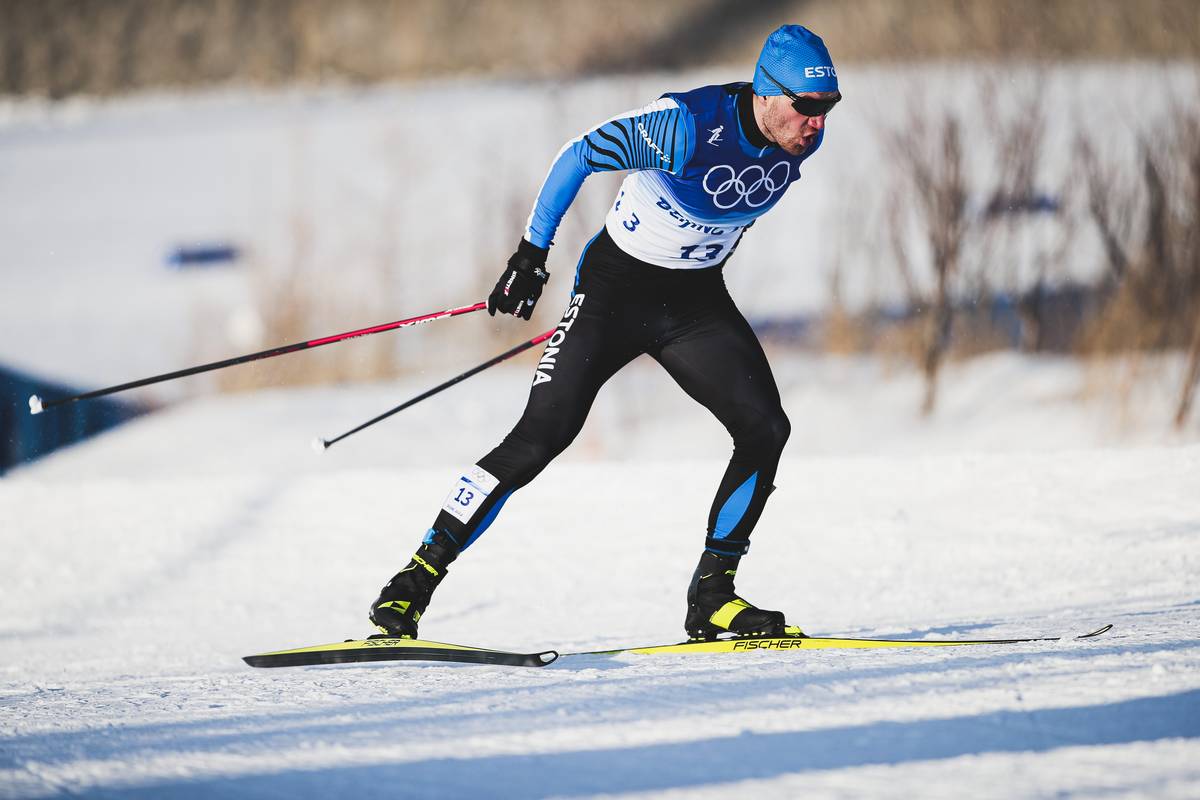
Marko Kilp skis in the qualification round of the men’s skate sprint, Feb. 8. (Photo: NordicFocus)
The flag of Estonia looks like this: 🇪🇪. Much as with the Czech flag, Kilp’s ensemble does well by using only the relevant three colors from the national flag. The overall effect is aided by the coincidental use of blue and white in this race bib from the skate sprint, which differs from those used for three legs of the four-leg relay.
Switzerland
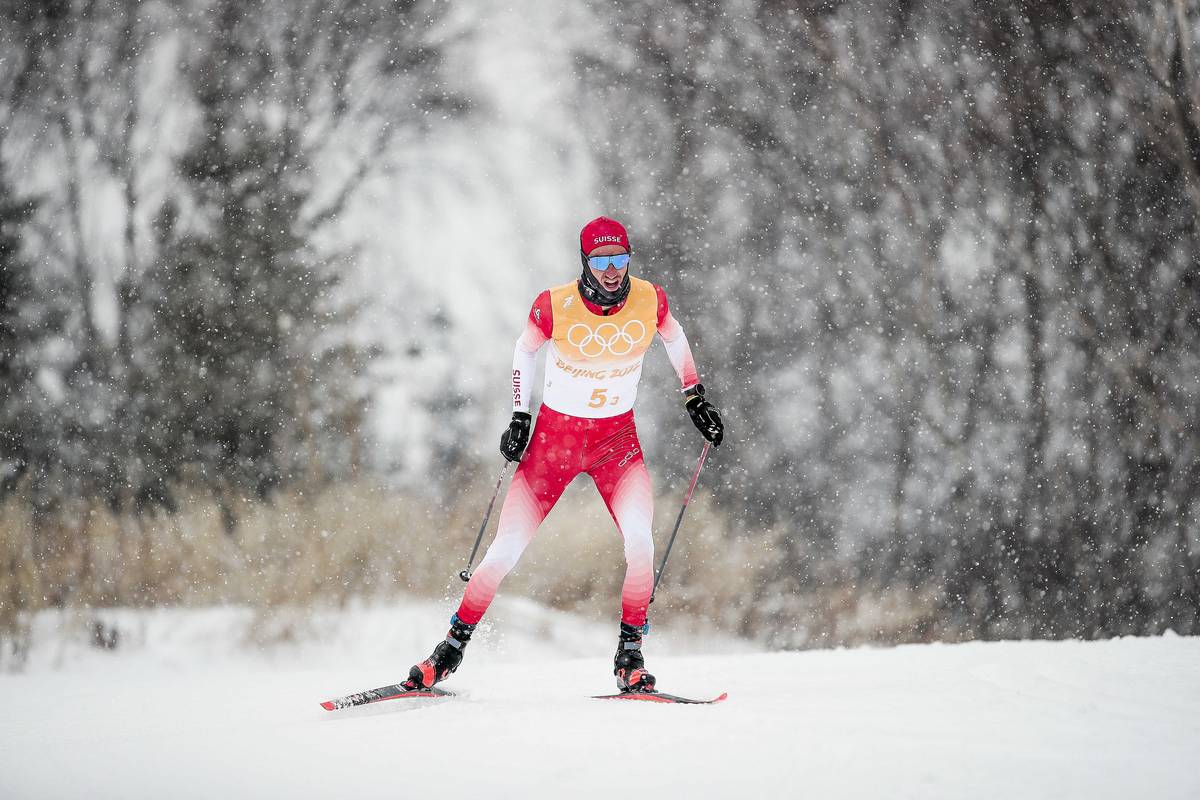
Candide Pralong skis in the men’s relay. (Photo: NordicFocus)
The flag of Switzerland looks like this: 🇨🇭. This suit does well in that it uses only the relevant two colors. It does less well in that the instantly recognizable visual element of the flag, the Swiss cross, is not present here. (In Switzerland’s defense, it has the rare square national flag, so translating this to race-suit format may be difficult.) Also, the red–white ombre through the legs is trippy; cf. France, infra, which does much the same with blue and white.
Italy
Francesco De Fabiani, right, leads Friedrich Moch of Germany in the men’s relay. (Photo: NordicFocus)
The flag of Italy looks like this: 🇮🇹. The dominant hue in this uniform, blue, evokes “the traditional paint of the royal House of Savoy, which reigned over the Kingdom of Italy from 1860 to 1946,” per Wikipedia, and is characteristic of Italy’s international sports teams, such as the national football team known as gli Azzurri. The tricolor bands on both upper legs, mirrored on the right shoulder, do a surprisingly successful job of typing this uniform as Italian against this blue background.
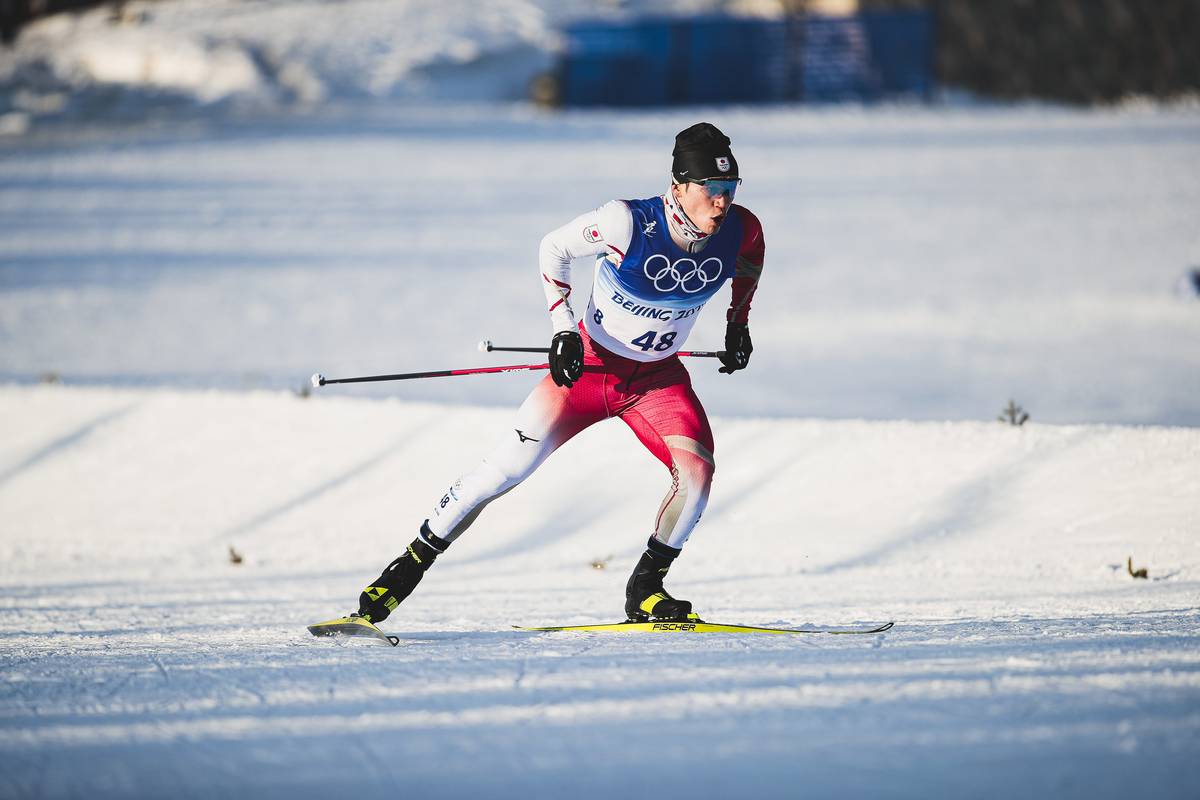
Japan
Hiroyuki Miyazawa skis in the qualification round of the men’s skate sprint. (Photo: NordicFocus)
The flag of Japan looks like this: 🇯🇵. This uniform falls into roughly the same category as Switzerland’s: instantly recognizable design element (the flag is “more commonly known in Japan as the Hinomaru (日の丸, ‘circle of the sun,’” per Wikipedia) that is not really present in the suit. Ranked below Switzerland due to the use of additional colors beyond just red and white; there is a sense of gold accents along the lower left leg, which works well aesthetically but falls outside of the flag palette.
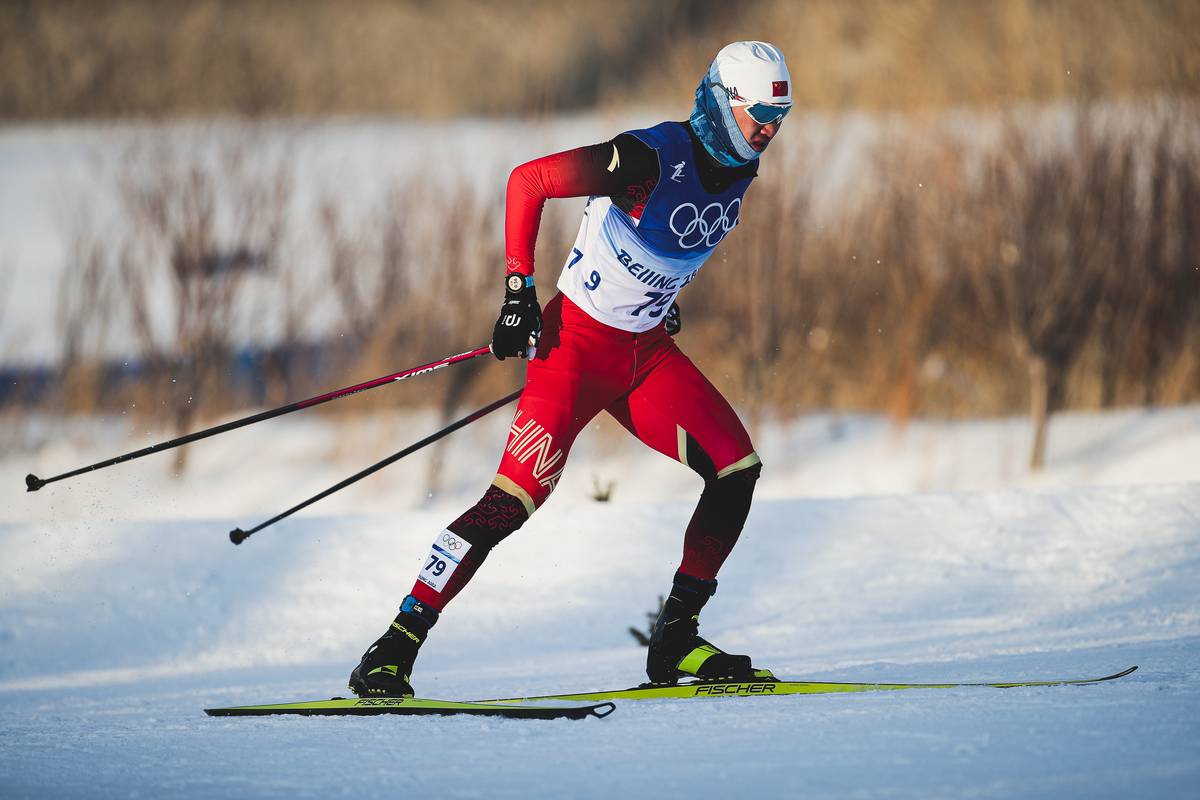
People’s Republic of China
Liu Rongsheng skis in the qualification round of the men’s skate sprint. (Photo: NordicFocus)
The flag of China looks like this: 🇨🇳. This uniform is ranked relatively low, when it comes to evoking a country’s flag, because the distinctive five stars (“the five stars and their relationships to each other represent the unity of the Chinese people under the leadership of the Chinese Communist Party,” Wikipedia advises) do not seem to be present. Zooming in on the hi-res version of this image suggests that the detailing on the torso and lower legs is variegated and visually compelling, but also does not look like stars. It is a fine suit, but ranks low on the specific axis of flag–suit evocation.
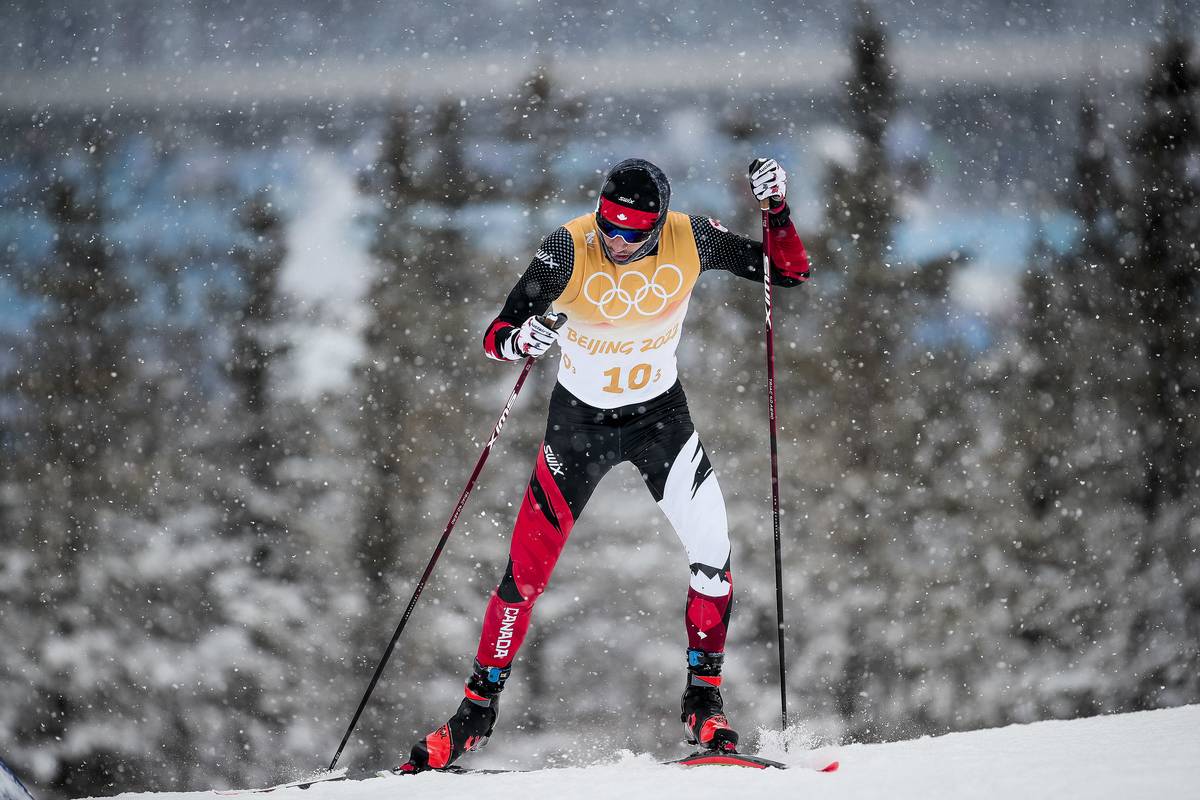
Canada
Olivier Léveillé skis in the men’s relay. (Photo: NordicFocus)
The flag of Canada looks like this: 🇨🇦. It is universally known as the Maple Leaf (note Léveillé’s headband, for example, or the Canadian World Cup suit that literally features flannel-patterned maple leaves on the lower legs). This suit is ranked low here because the presence of a maple leaf is subtle at best, and for the dominating use of black, a non–flag color, through the torso.
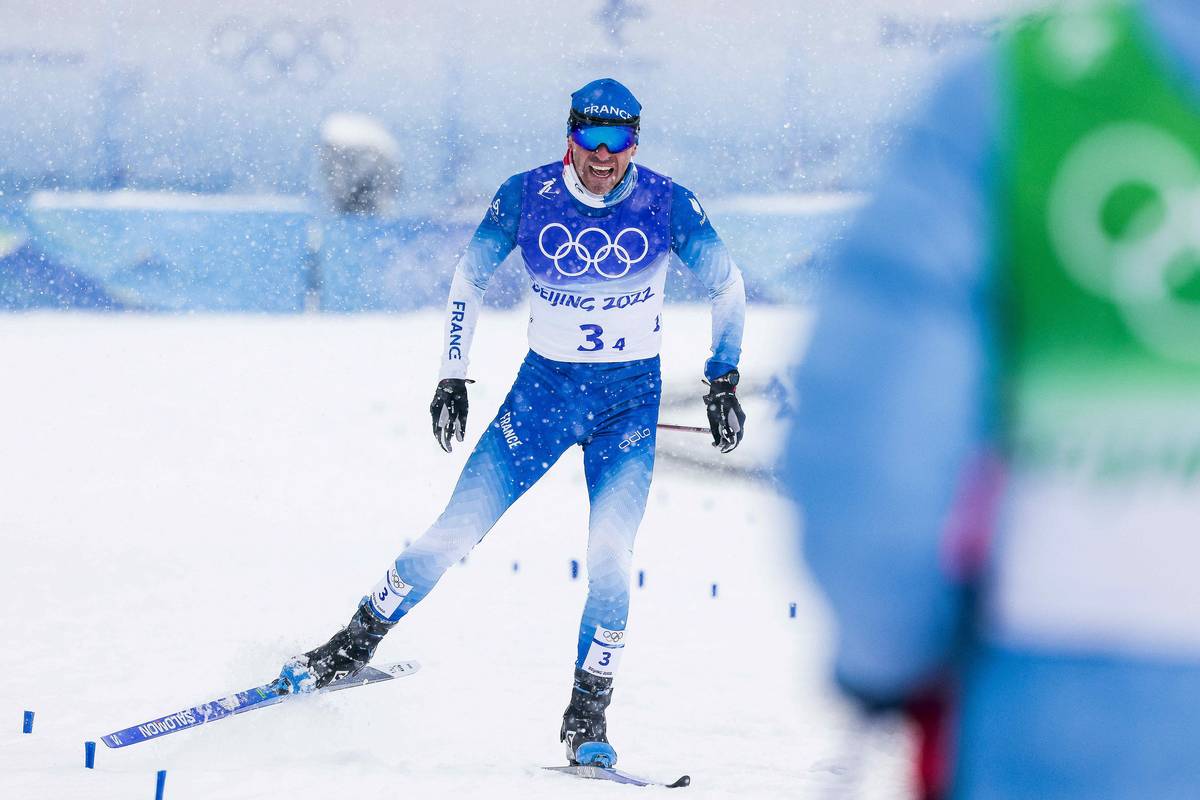
France
Maurice Manificat skis in the men’s relay. (Photo: NordicFocus)
The flag of France looks like this: 🇫🇷. It is also known as the Tricolore, or, well, “three colors.” The suit is ranked low, in this compilation, because only two of the three colors are present here. That said, the coordination with the blue and white Salomon skis and boots is sublime, though the suit overall looks suspiciously like it came from the same template as Switzerland’s, q.v., supra.
Germany
Lucas Bögl skis in the men’s relay. (Photo: NordicFocus)
The flag of Germany looks like this: 🇩🇪. Much like France, the German flag has three colors, in this case the national colors of black, red, and gold. The suit is scored low in this compilation because of the extent to which the first of these colors overpowers the other two (indeed, it is not clear that red is apparent anywhere within the suit itself, as opposed to on the hat). It is a stark and imposing suit, it just does not look very much like the Flagge Deutschlands.
Slovenia
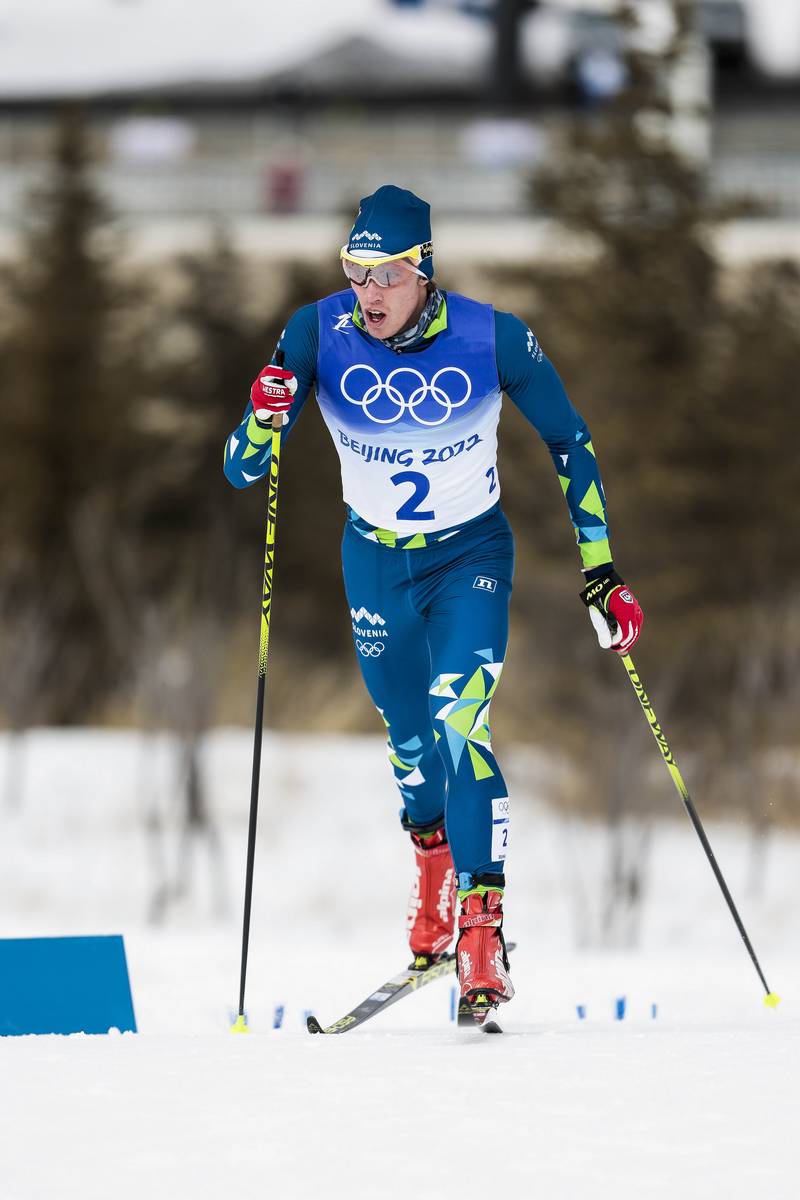
Miha Ličef skis in the men’s 15 k classic. (Photo: NordicFocus)
The flag of Slovenia looks like this: 🇸🇮. This suit is imho amazing, and I frankly love it, but I had to rank it this low because it does not exactly evoke a red, white, and blue flag. (For purposes of comparison, here is last season’s Slovenian World Cup suit, which is notably more flag-like.) If you are from Slovenia and can explain to me why these colors and this design showed up in this year’s Olympic suit, please let me know: gavin (at) fasterskier.com. I am not making fun; I am just sincerely curious. Also, I honestly love this suit, even if at first glance I thought it was the suit of Ukraine or Australia.
Norway
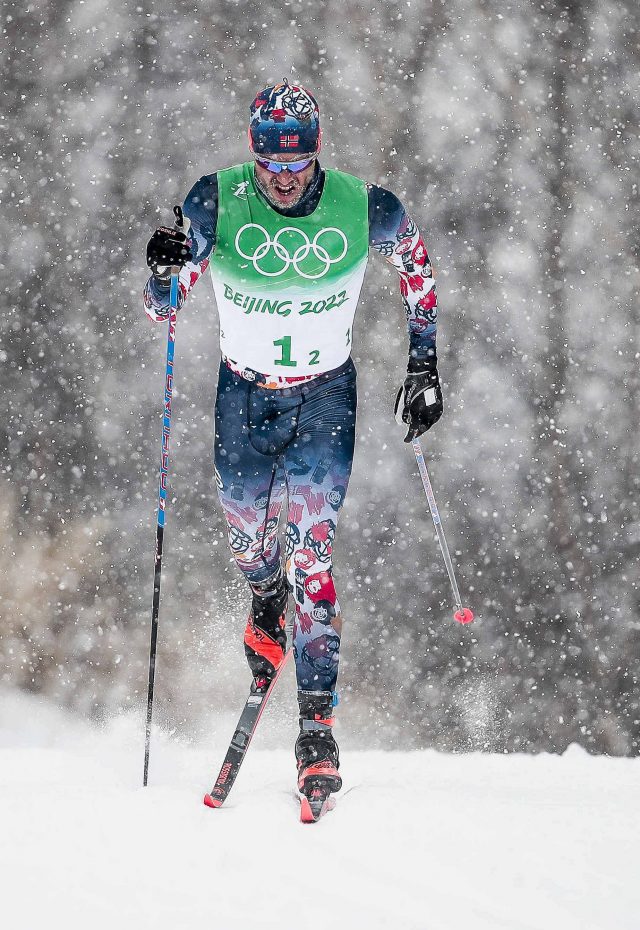
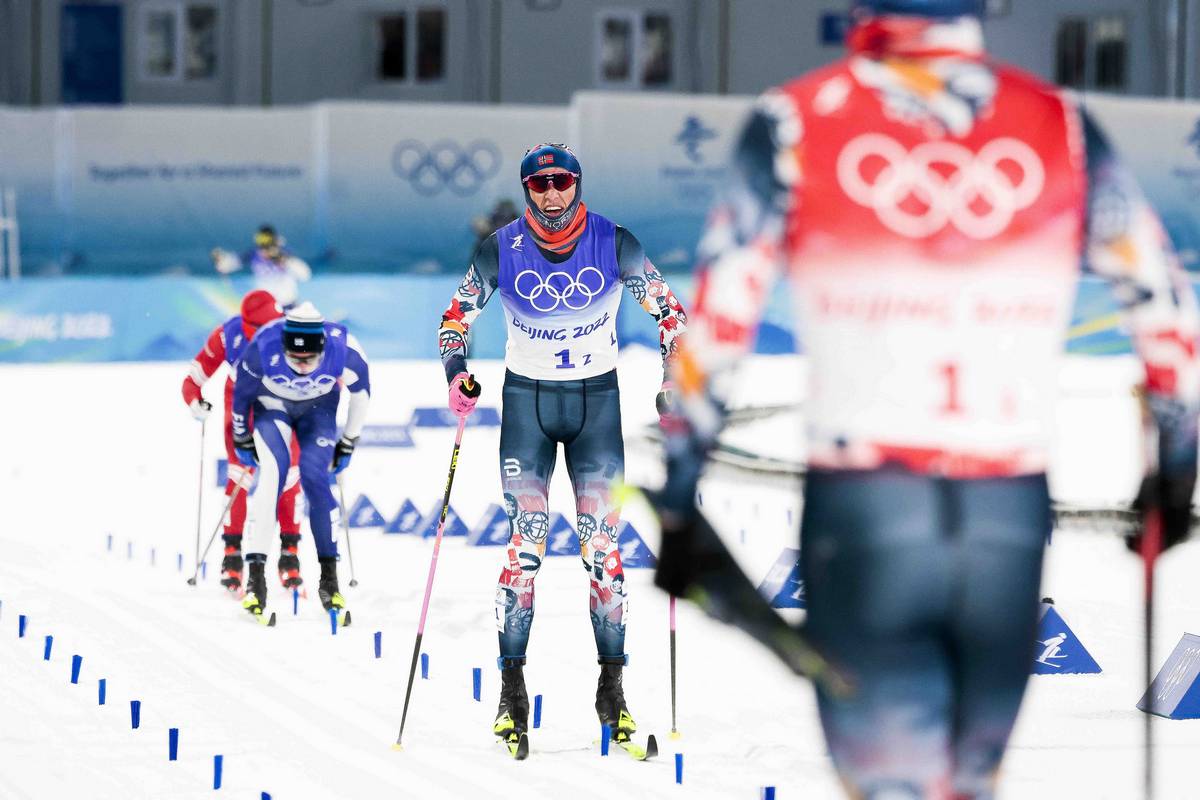
Pål Golberg skis in the men’s relay. (Photo: NordicFocus)
This is… certainly a look. This suit puts the “illogical” in “vexillological.” This is the flag of Norway: 🇳🇴. This suit is notably memorable, and has occasioned strong reactions throughout the Olympics. It does not, however, whatever else you may say about it, look particularly much like the Norwegian flag.
Russian Olympic Committee
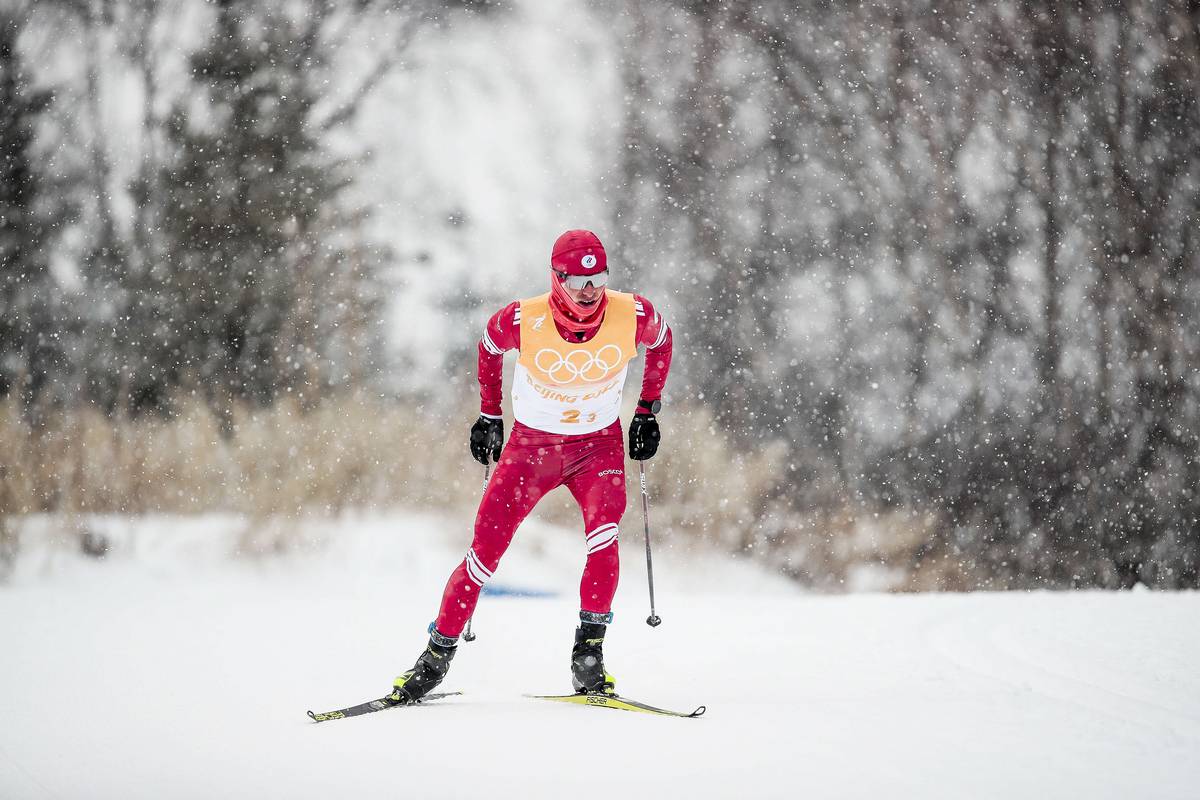
Denis Spitsov skis in the men’s relay. (Photo: NordicFocus)
The Russian flag looks like this: 🇷🇺. Russia is not officially competing in these Games, just athletes representing the “Russian Olympic Committee.” It’s complicated. One result of these complications is that “Russian” athletes are racing in a suit that does not really resemble the flag of Russia. Again, it is a fine suit, just not particularly Russian flag–like.
This World Cup coverage is made possible through the generous support of Marty and Kathy Hall and the A Hall Mark of Excellence Award. To learn more about A Hall Mark of Excellence Award or to learn how you can support FasterSkier’s coverage please contact info@fasterskier.com.
The team sprint: it’s the youngest event on the Olympic program, having been contested only since the 2006 Torino Games. The event has since become a marquee event in the sport of cross country skiing.
Holding it up as a marquee event, of course, is easier to say coming from the United States. If you tuned into the NBC broadcast, you got the delight of hearing 2018 team sprint gold medalist Kikkan Randall analyze the race where she won the US’s only gold medal in cross country skiing, while her teammate from that race, Jessie Diggins, worked to repeat the Olympic medal feat.
Yes, the team sprint was that race, and we could all revel in that memory as it played out in Zhangjiakou, China on Wednesday.
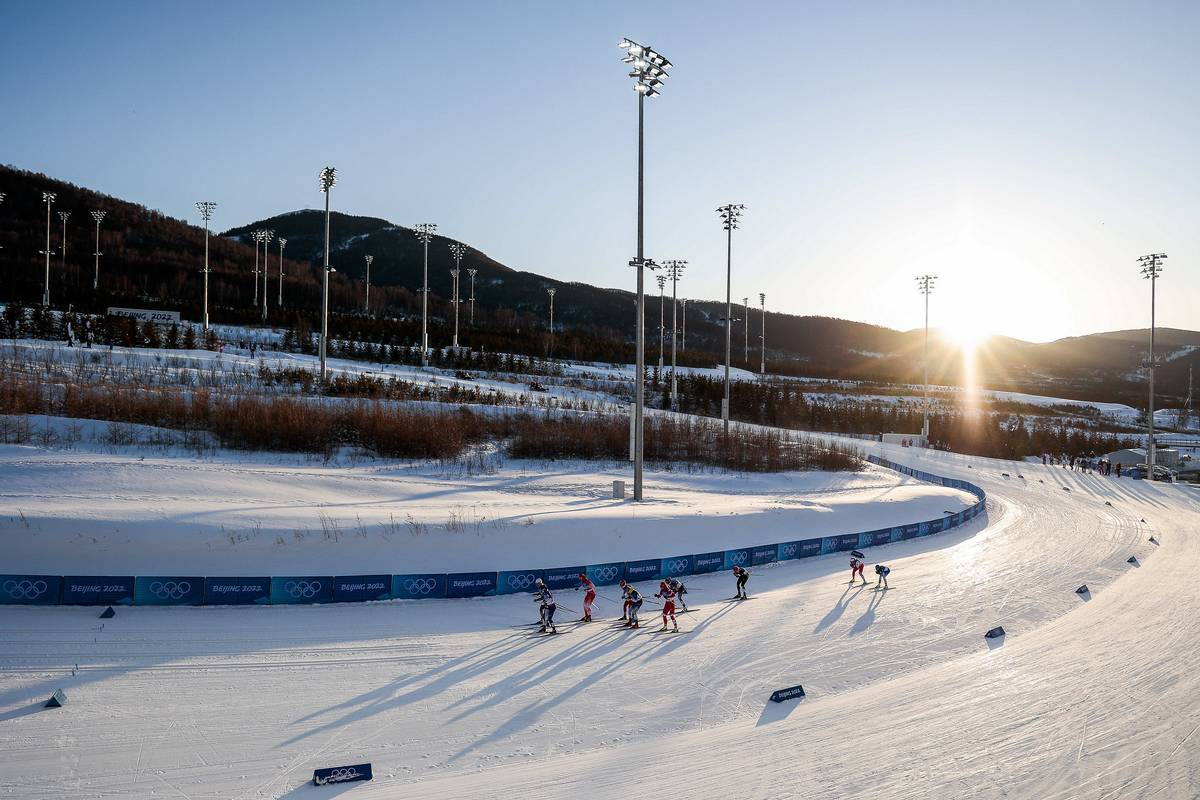
Competitors surrounded by the colors of the sunset. (Photo: NordicFocus)
Beyond that, though, no other event exemplifies the nuances involved in modern skiing like the team sprint. This is an event that pairs the specialists with the even-more specialized, and has an err of a nordic nerd’s daydream to the team-selection possibilities that arise from doing so.
What if you lined up the two athletes who single-handedly changed a generation of skiers together under one flag? Well, they’d turn out to win gold in Pyeongchang 2018, like when Johannes Høsflot Klæbo and Martin Johnsrud Sundy were paired as team Norway. What if you repeated when Finland won gold in Sochi 2014, but this time Iivo Niskanen, who was then seemingly untouchable as a classic skier? Well, that one offers a bridge to what played out in Beijing 2022.
Of course, hypotheticals joined up with storylines that didn’t need to be posed as a question today too. For the US men, this was the crystallized moment where one generation was handed off to another. Call to mind the US Olympic team sprint team anytime in the last eight years and it was the steadfast duo of Simi Hamilton and Erik Bjornsen. These men, now retired, were sixth in the team sprint in both the 2014 Olympics in Sochi and the 2018 Games in PyeongChang. Then, this morning, it was Ben Ogden and JC Schoonmaker, both born in 2000.
The (frozen) fresh-faces of American skiing. Teammates Ben Ogden and JC Schoonmaker after completing the Team Sprint on Wednesday in Beijing. (Photo: Nat Hertz)
The two made up a pairing that was more pure-sprint oriented than most of the competitors that were most closely watched going into today. The strategy for a few of the top teams, in particular, the Russian Olympic Committee and Finland, seemed to be pairing their top-class distance skier with a sprinting specialist.
For the course in Beijing, it was a good strategy on paper. The 1.5-kilometer course, last seen in the individual sprint last week, had one tactical pressure point going into a downhill when it was raced as a single lap. When it was raced in a burst of three per skier with little rest in between, however, just how much the long, semi-gradual, uphills on this course made skiers work moved to the forefront. In the team sprint, having a skier who could stay with a sustained attack through multiple legs was an appealing prospect, especially when it was meant to set up for a punchy last climb that would no doubt give way to a mad dash for the finish.
For two teams, Norway and the Russian Olympic Committee (ROC), that mad dash had been setting up since the first World Cup of the season, when 22-year-old Alexander Terentev (ROC) out-dueled sprint superstar Johannes Høsflot Klæbo (NOR) to challenge the latter’s classic sprinting dominance.
Johannes Høsflot Klæbo (NOR) accelerates out of the exchange zone after receiving a tag from teammate Erik Valnes, followed by Alexander Bolshunov (ROC) on his way to tag teammate Alexander Terentev. (Photo: NordicFocus)
They would both ski the anchor legs on their teams. Klæbo was paired with fellow sprinter Erik Valnes to make team Norway, while Terentev was paired with 30 k skiathlon gold medalist Alexander Bolshunov to make team ROC. Finland joined the intrigue, sending out 15 k classic gold medalist Iivo Niskanen in the first leg paired with the World Cup’s perennial “oh, that’s right he’s a great sprinter too!” Joni Maki as an anchor.
As such, the teams in the final skied the first and second legs could roughly be divided into: leg 1 – the distance skiers and long-burn sprinters, and leg 2 – classic sprinting’s very best.
The US had qualified for the final as the second lucky loser, finishing a messy semi-final that saw Ben Ogden break a pole and recover to finish 6th place (+4.43 off of heat winners Italy’s mark of 20:06.99).
“It was a hard semi-final, ours was fast and everyone was pushing. [The pole break] was one of many places where we used more energy than we had to today.” said Ogden in post-race interview with FasterSkier in the mixed zone.
But as Ogden went out in the final, he seemed to settle in and leave the troubles of that semi-final behind. He looked comfortable in a pack that had settled on jockeying for position in the early part of the race, moving up to 4th place through the first exchange.
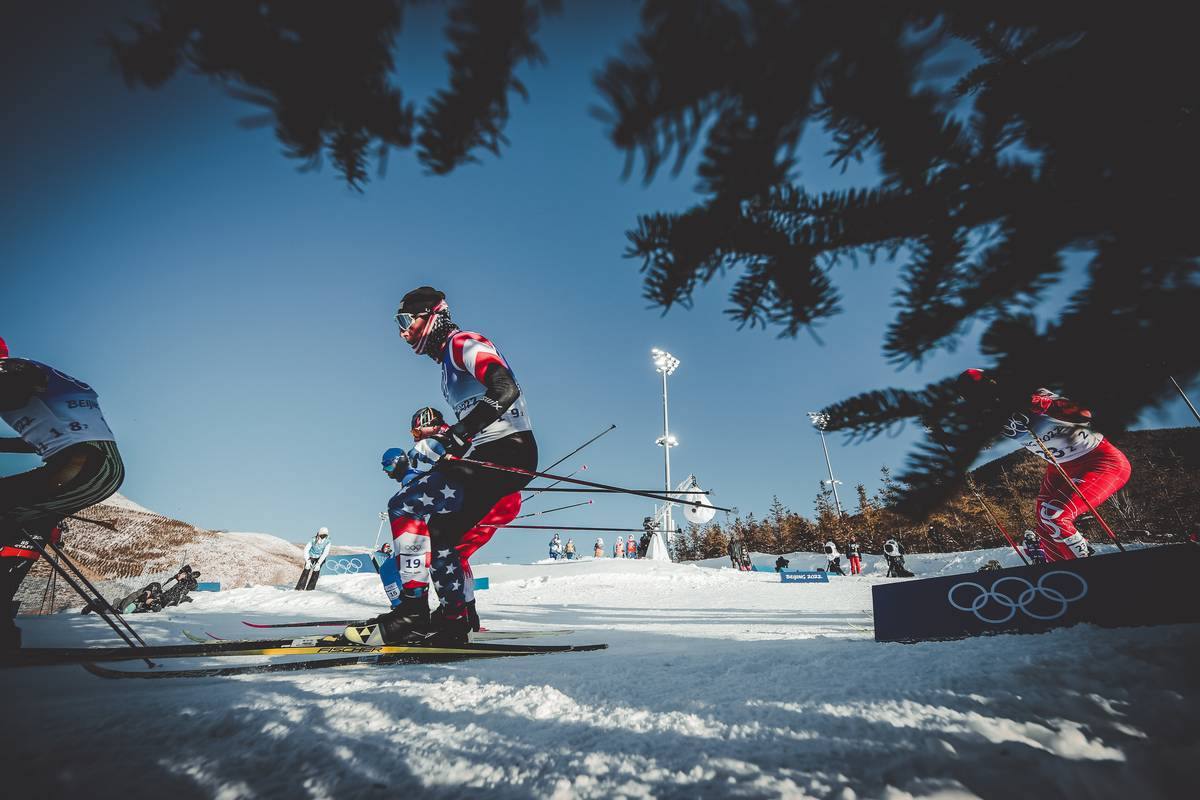
Ben Ogden (USA) strides early in the the team sprint. (Photo: NordicFocus)
The men’s field going out relatively slowly could be attributed to Norway’s Valnes. He seemed to comprehend that with his team as a pre-race favorite, the eyes of the pack were on the “What is that?” pattern of his suit. Valnes looked to lead the pack so-as only to try and lull it into complacency. It was a strategy that made sense, knowing he would be tagging off to the current fastest human on skis in a drag race, Klæbo.
Alexander Bolshunov, though, called Valnes out on his bluff, making sure to pick up the pace just enough so that the pack would have to work throughout its first leg.
So began the stalemate that would last for much of the early legs of the race. In the first exchange to the anchor-legs, Klæbo showed outward signs of his strength, and his desire to keep the pace right in the sweet spot where he could shoot around them in the end. JC Schoonmaker, meanwhile, remained placed right off the leaders, in the pack, moving through the course.
The second showing of leg 1, including Valnes, Bolshunov, Niskanen, and Ogden saw Bolshunov push on the initial climb out of the stadium. Valnes covered the move, before the pack came together in the final climb into the stadium. The pressure, and the speed, had increased. Ben Ogden, though, had kept up with the pack, and came through the half-way mark with the Americans in 7th place (+4.4).
Johannes Høsflot Klæbo (NOR), Richard Jouve (FRA), and Joni Maki (FIN) face off in the classic team sprint during the 2022 Olympic Winter Games. (Photo: NordicFocus)
In their second laps, a lead group that included Terentev, Klæbo, Maki, and Schoonmaker, the pack began to take shape. The decisive move didn’t come from any of those skier’s mentioned, though, but instead from a familiar agitator in sprint heats on the World Cup. Moving up from behind the leaders, France’s Richard Jouve powered to the front of the pack on the first uphill, but was quickly matched by both Terentev and Klæbo. The duo, as they approached the downhill, put in a burst of speed that hadn’t been seen on the course up to that point, and it was all it took for the pack to begin to thin.
This was the move that saw the young American team begin to lose contact with the lead group. Schoonmaker later said that “the downhills felt tighter and more aggressive than some other World Cup sprints.”
The Americans slipped to 9th place, and remained there for the rest of the day despite the early efforts of the duo to stay locked in and pushing all the way through.
JC Schoonmaker races the classic team sprint final during the 2022 Olympic Winter Games. (Photo: NordicFocus)
Meanwhile, at the front, the exchange to the final lap of the odd-leg skiers found Bolshunov once again putting in an attack on the uphill that led out of the stadium. The move indicated that the ROC had faith in the young Terentev as the anchor, but that chancing it with Klæbo still on deck was not the preferred option. Valnes took the ROC strategy off the table anyway, letting out a blistering counter-attack that showed his own strength and served to further separate the pack. When they came into the final climb into the stadium for the last exchange, it was just Norway, the ROC, and Finland who were in contention for the gold medal.
Finland, in fact, was the first to the exchange. That came courtesy of Niskanen, who evaded the front of the pack for much of his race. The 15 k classic champion unleashed his diagonal stride on his final climb of the day, with both efficiency and power that exemplify optimal technique.
The last lap, then, looked like a three-way pack of Finland, Norway, and the ROC, and, not far back and putting together an outstanding day, Canada (+9.7). The team of Graham Ritchie and Antoine Cyr had put in an unexpected and auspicious effort for the whole world to see.
Johannes Høsflot Klæbo (NOR) leads the way to the line, with Joni Maki (FIN) and Alexander Terentev (ROC) behind for second and third. (Photo: NordicFocus)
Still, the skiers to face off for medals remained; Joni Maki (FIN), Johannes Høsflot Klæbo (NOR), Alexander Terentev (ROC).
The front three remained tight throughout the final lap. The pace was fast, but not fast enough to shake the familiar feeling that we’d been here, on this 1.5 k course, before, and it was a stage for which one player was ready to take the lead role: Klæbo.
On the last hill, Klæbo went, and proved again that he was both a master of the art of sprint racing, and still indisputably its best practitioner. He, and Norway, would repeat as gold medalists in the team sprint in a time of 19:22.99.
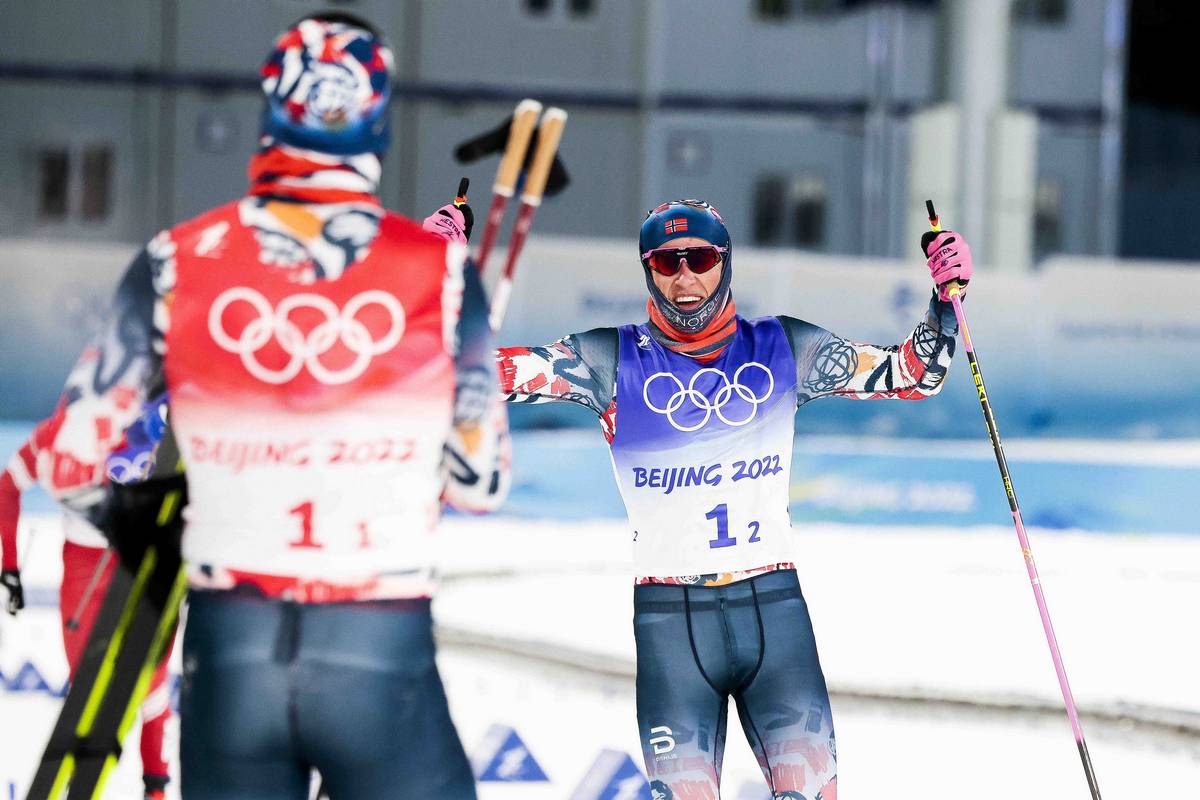
Johannes Høsflot Klæbo celebrates team sprint gold with teammate Erik Valnes. (Photo: NordicFocus)
In comments to the press after, Klæbo said of repeating as a gold medalist, “I’m really proud, it’s special to do this together as a team. We won the team sprint in 2018, and doing it in a different way now, different style, with a different person, it’s special.”
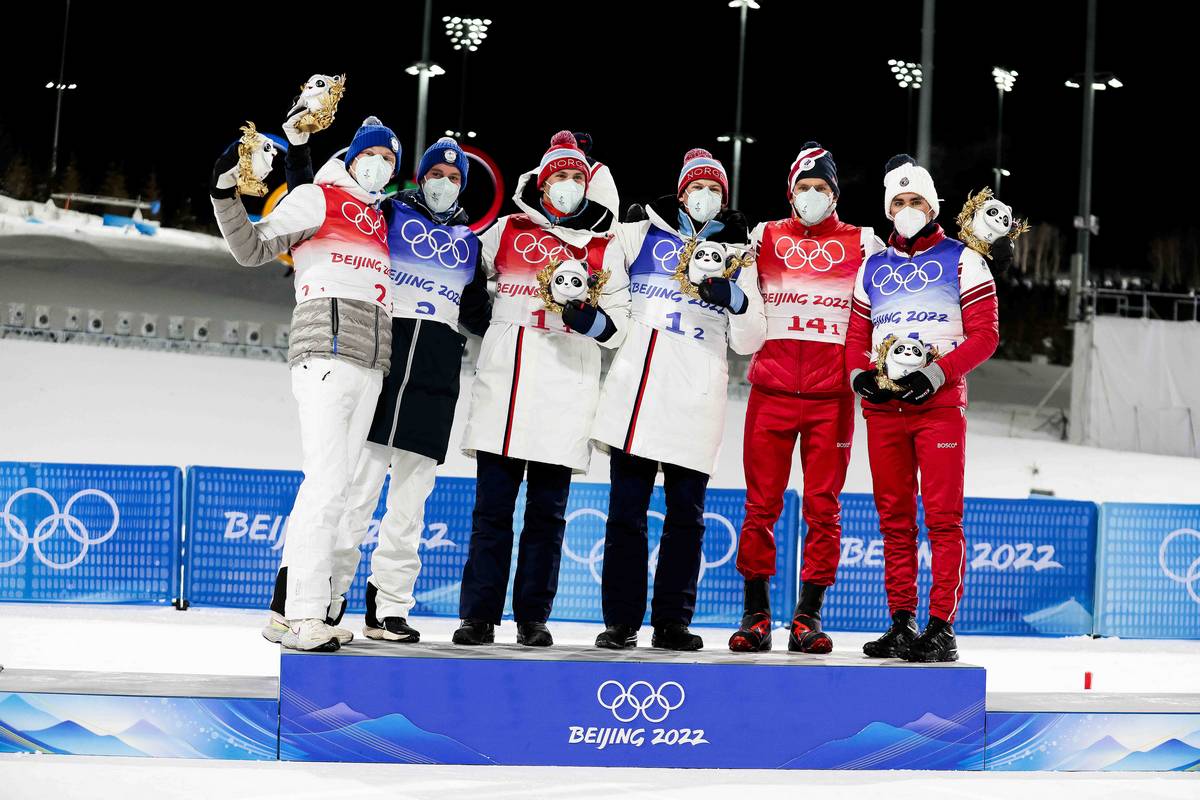
Behind him, Joni Maki made a late effort to pull in front of Terentev and deliver Finland, and his teammate Iivo Niskanen, back to the medal ceremony that they last attended for the team sprint in 2014 by finishing second (+2.46). Terentev finished third (+4.29), ensuring that the ROC (or, for these purposes, the Olympic delegation formerly known as Russia) continued its streak of never having finished outside of the medals in the team sprint at an Olympic Games.
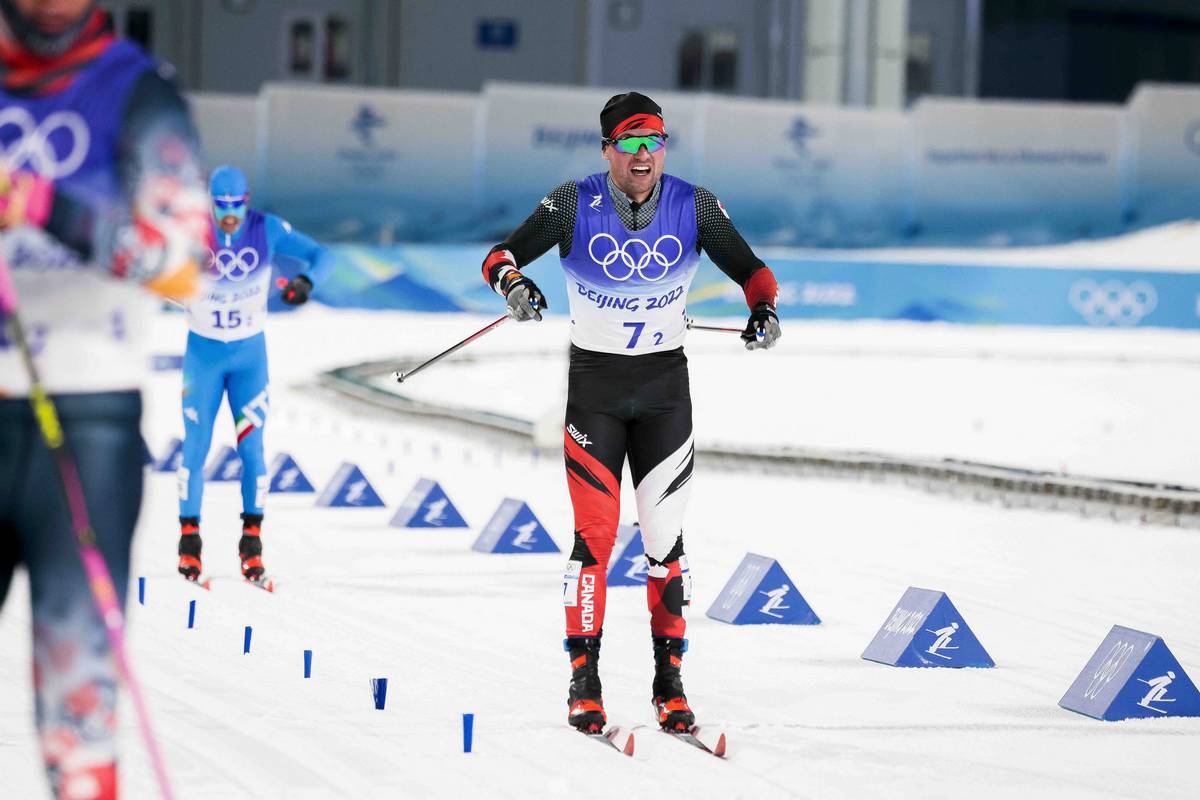
Graham Ritchie (CAN) double-poles toward the finish of the men’s team sprint. (Photo: NordicFocus)
Sweden pulled back to fourth place (+15.06), and the surprise of the day was the young Canadian team of Ritchie and Cyr, both 23 years old, finishing in fifth place (+22.31). The Americans held the gap to +1:05.08, and finished in ninth.
Ogden and Schoonmaker came away feeling optimistic on their first go-around at the Olympic team sprint, saying “It’s good. With some experience, we can be a lot better.”
Ben Ogden (USA) and James Clinton Schoonmaker (USA) at the finish of the team sprint. (Photo: NordicFocus)
“Some more training under our belts will be a big game changer for us,” Schoonmaker continued, “[because] we’ve done zero team sprints [like this] with 3 laps. This is our first time skiing a real team sprint.”
Through its pushes-and-pulls, posturing and performances, the team sprint again proved to be a thrilling highlight of skiing. And with it completed, and a pair of gutsy performances turned in, it is possible to turn a glint of our attention today towards what the two young North American teams will do four years from now in Cortina, Italy. Really, it is just too easy to go there already, and let the Olympic dreams run wild.
That of course though, would be premature. There’s as old-school a race as they come left in Beijing on Saturday, when the 50 k freestyle will be revived on the Olympic stage. The final men’s event promises to be as pleasant a distraction from future thoughts as there is in the world of skiing. So let’s enjoy.
Finland, Norway and the Russian Olympic Committee on the men’s team sprint podium. (Photo: NordicFocus)
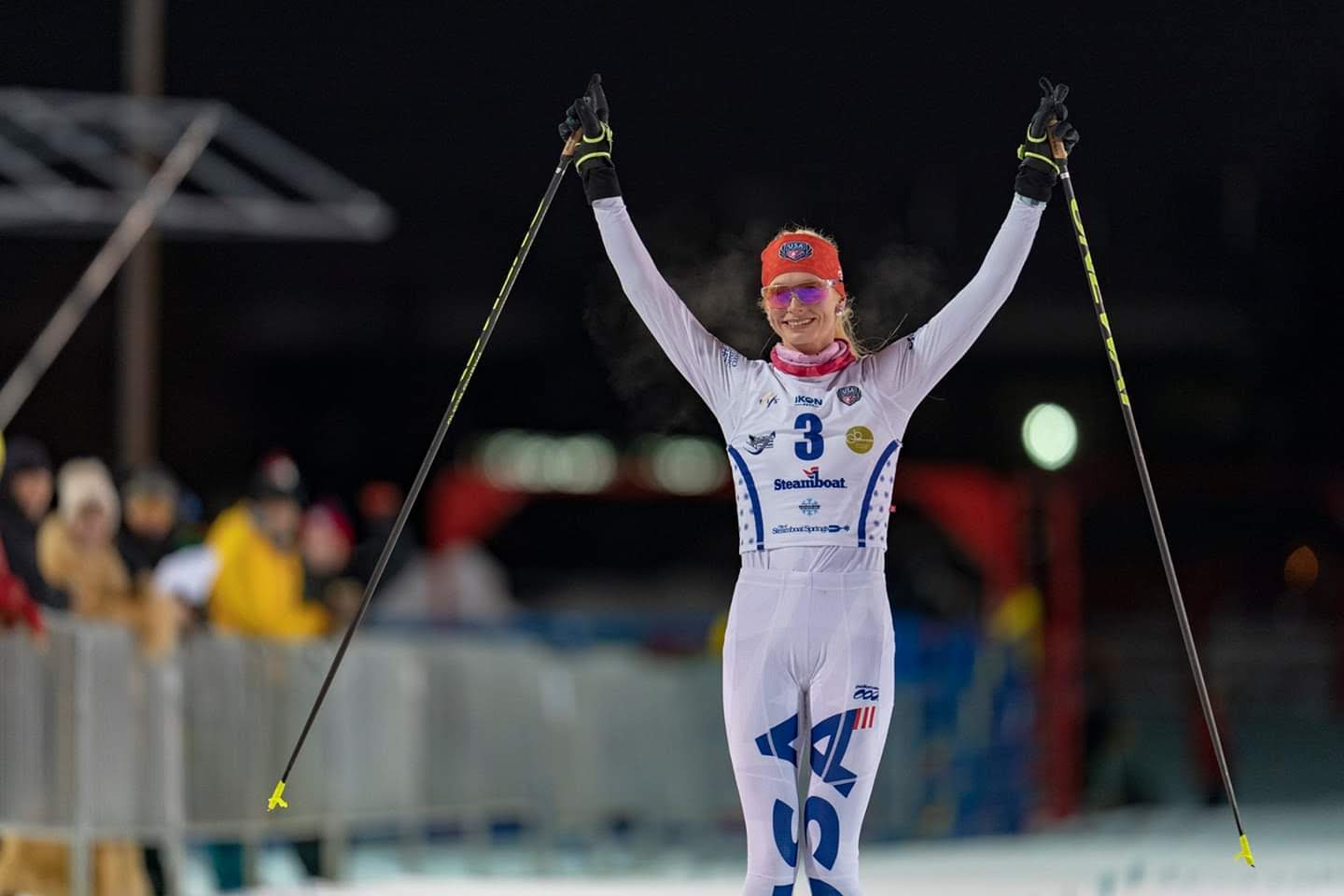
Tara Geraghty-Moats winning the first 2018/2019 women’s nordic combined Continental Cup held in Steamboat Springs, CO. (Photo: Ben piper)
Tara Geraghty-Moats started ski jumping when she was nine years old. Fearless for sure, but all part of the multisport athlete’s mojo.
But after suffering multiple knee injuries when she was 16, Geraghty-Moats was forced to take a break from ski jumping. That hiatus was a four-year jumping drought that only served to push her into other aspects of nordic sport. During her time away from jumping, Geraghty-Moats competed in cross-country skiing and biathlon where she was highly successful.
At 19-years-old, Geraghty-Moats came back to ski jumping which she has been doing ever since. This summer, she added a well-suited endeavor to her jumping: skiing fast. The reason for this addition was the introduction of an 11 event women’s nordic combined Continental Cup.
“My goal this season is to be overall Continental Cup winner and to be on the World Championships team for ski jumping,” Geraghty-Moats said about her season’s objectives. As far as nordic combined is concerned, she is well on her way to mastering the Continental Cup series.
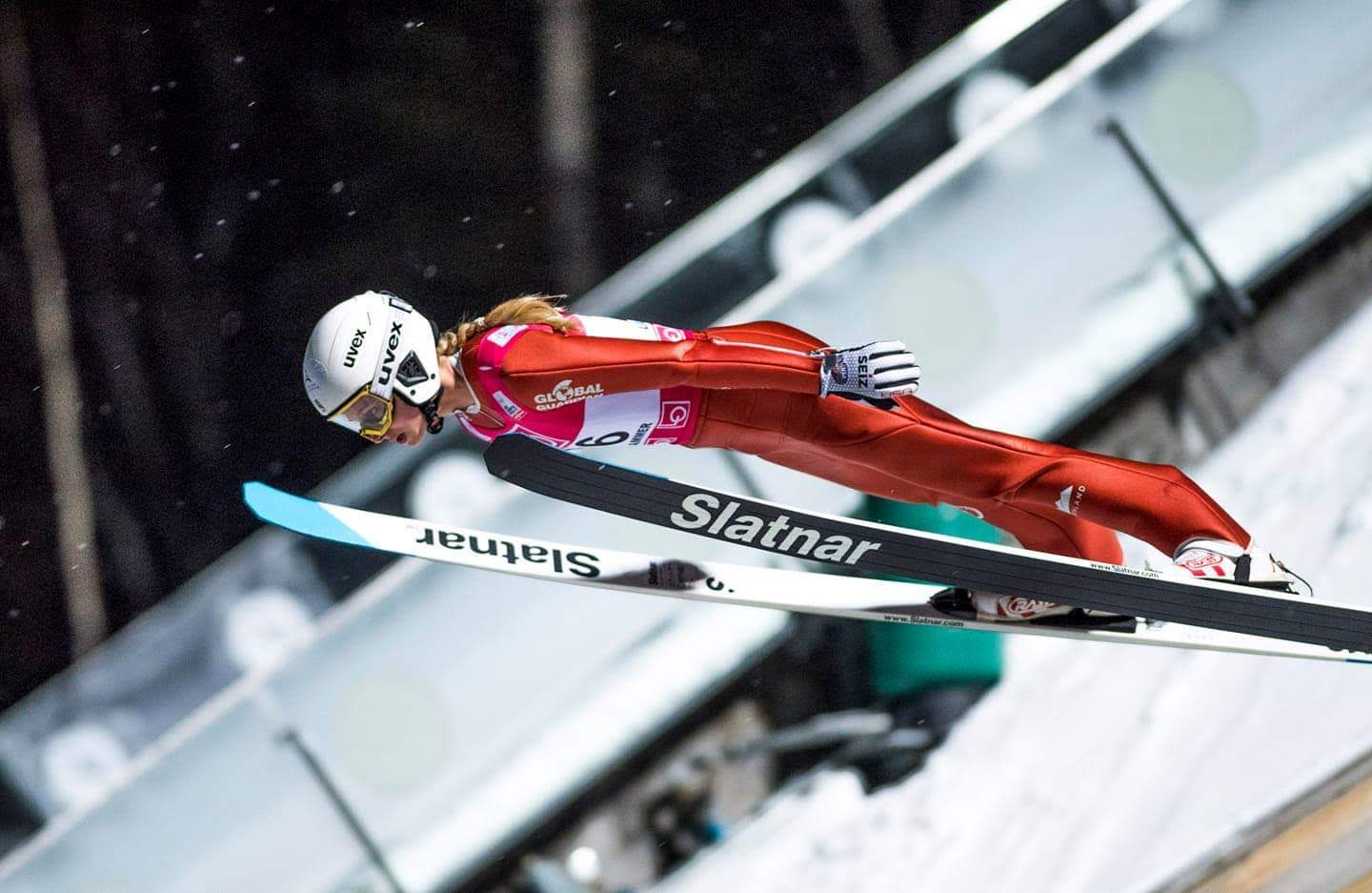
Tara Geraghty Moats ski jumping World Cup in Lillehammer, NOR. (Photo: FIS Ski Jumping)
In the first race of the inaugural Women’s Summer Grand Prix in Oberwiesenthal, Germany, Geraghty-Moats ski jumped into fourth place and then skied into second place. That was the last race Geraghty-Moats didn’t win this season. She won the second race of the Grand Prix, and took home the Overall Championship title.
Geraghty-Moats has participated in five Continental Cup races so far this winter, she has won them all.
“Winning every race I entered came as a real surprise,” Geraghty-Moats said. “This summer and fall I was focusing on working hard and building my nordic skiing up again after a few years off. I had no idea what to expect. I was hoping for some podiums.”
The first two races of the season took place in Steamboat Springs, Colo. at the beginning of December. In the first race, Geraghty-Moats jumped to third place, placing her seven seconds behind the leader at the start of the ski race. She had no problem making up the time, winning the race by 47.7 seconds. The following day, Geraghty-Moats jumped into fourth place, 26 seconds behind the leader. She skied a solid race and finished 40.1 seconds ahead of the next competitor.
When asked about her favorite moment so far this season, Geraghty-Moats commented, “winning my first Continental Cup in Steamboat with my mom there. She has always supported me skiing nordic combined and is hardly ever able to come to watch me compete, so it was very special.”
This season, Geraghty-Moats plans to start in all 11 of the women’s nordic combined Continental Cups scheduled. She will also be competing in a number of special jumping competitions. This past weekend, she competed in her first international nordic combine race in Otepää, Estonia where again she dominated. Now she will be heading to Japan for a ski jumping World Cup this upcoming weekend.
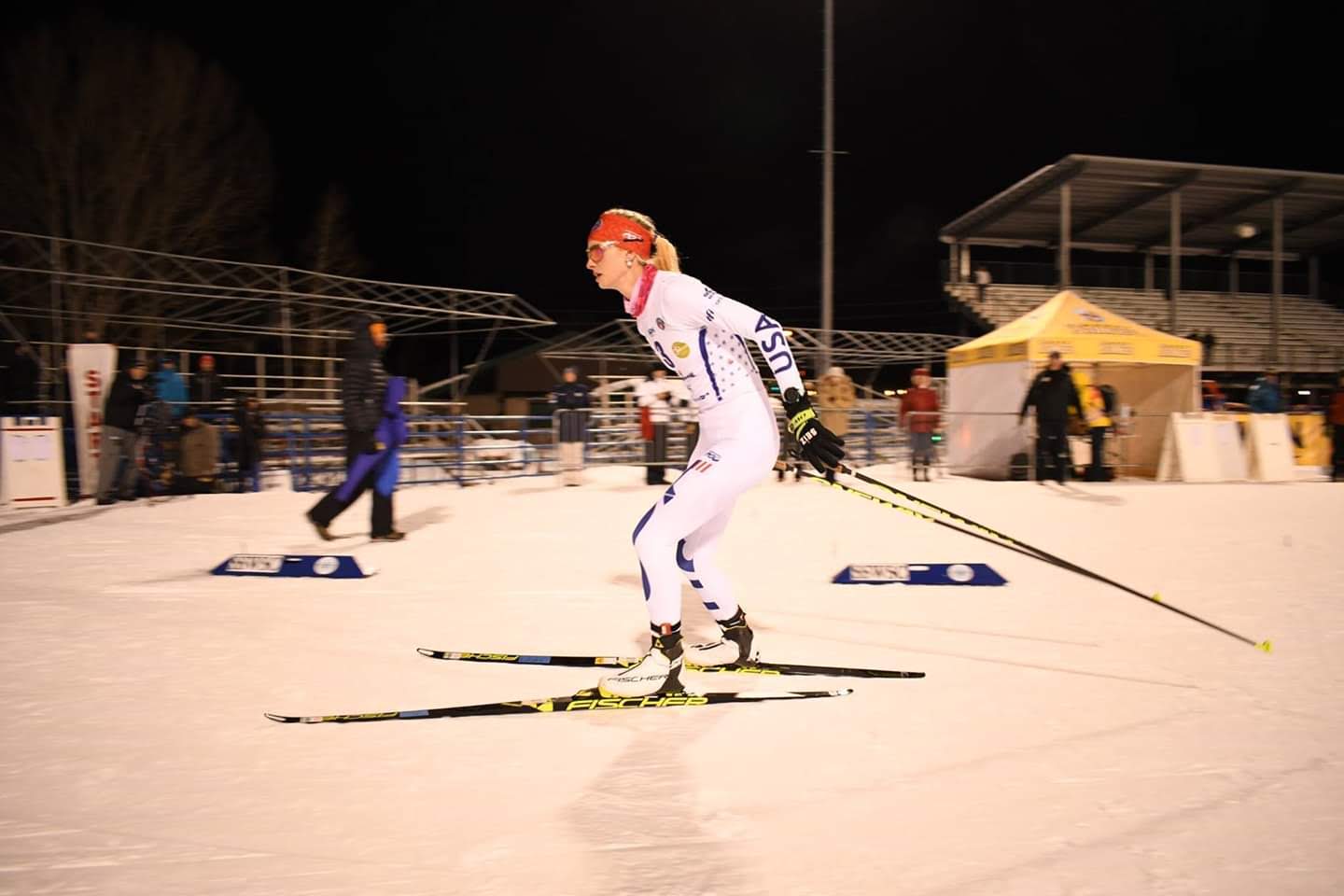
Tara Geraghty-Moats winning the first Continental Cup of the season in Steamboat Springs, CO. (Photo: Ben Piper)
Currently, Geraghty-Moats is the only women on the U.S. Nordic Combined team.
“I train by myself a lot,” Geraghty-Moats said. “The men’s team is on a pretty different competition schedule so we aren’t able to train together much. I write my own cross-country program and integrate it with the ski jumping program my jumping coaches give me. It seems to be working well so far.”
Regardless of their competition schedules, Geraghty-Moats believes the US Nordic Combined Team has a strong and inclusive team dynamic.
“I’ve competed with some of the guys on the team since my jumping career started,” she said. “They are pretty much the coolest teammates ever. It’s nice they are so supportive of the developing women’s circuit.”
The outlook for a viable women’s nordic combined circuit remains uncertain. Organizations like the International Ski Federation (FIS) and USA Nordic, the NGB responsible for jumping and nordic combined in the U.S., fully support integrating women into the top level of the sport.
As raised in a recent New York Times story on the women’s nordic combined circuit, some major hurdles remain for a fully fledged women’s nordic combined division. First are the number of total participants. Second is ensuring those competitors are in fact competitive. A good problem for Geraghty-Moats is that she remains dominant. Yet the others in her peer group are playing catch up when it comes to her skiing prowess.
Women’s nordic combined will be included in the 2021 World Championships. There was discussion of it being included in the 2022 Winter Olympic Games. However, in July, the International Olympic Committee did not include women’s nordic combined as part of the 2022 Games. The sport will have to wait until 2026 at the earliest to make an Olympic debut to put it on equal Olympic-level-footing.
Bill Demong, USA Nordic’s Executive Director, said in an Oct. 17, 2017 press release that his organization fully supports equity when it comes to developing new pathways for women to participate and excel.
“This is an opportunity that we are fully behind”, Demong said about the first women’s U.S, National Championship in nordic combined. “We know that other nations will begin to turn on their funding and that when this becomes an Olympic event everyone will spend resources we can not match. Right now we have the opportunity and responsibility to take athletes like Tara Geraghty-Moats and Gabby Armstrong and develop them into leaders in the sport. It is our job to continue to innovate and support them so that they can lead Women’s Nordic Combined into the future with our crop of upcoming juniors.”
Geraghty-Moats remains positive. She also embraces her role as a groundbreaker. She knows stumbles will occur. With any breakthrough there are setbacks, but ultimately there is a net gain.
“I think that it will develop fairly rapidly in the next two years,” Geraghty-Moats said of women’s nordic combined. “There are World Championship medals on the line in 2021 so I don’t expect very many countries will pass up the opportunity to support a women’s Nordic Combined team and get some hardware.”
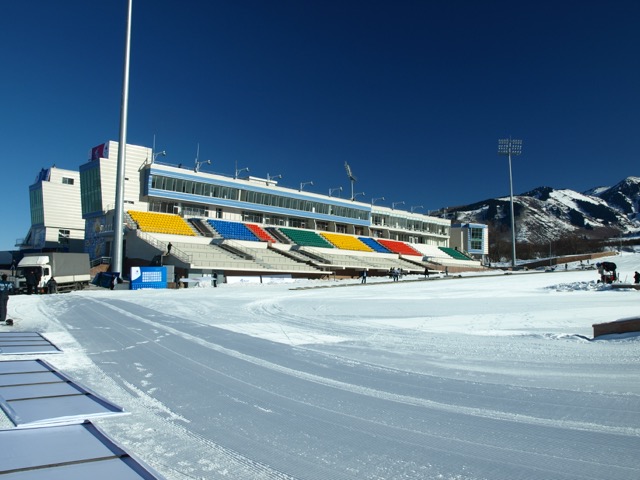
The Soldatskoe nordic venue, which would have hosted competitions had Almaty, Kazakhstan, won their bid for the 2022 Olympics. Unlike the city venue which hosted 2015 FIS World Junior and U23 Championships, Soldatskoe, here before the 2011 Asian Games, has lots of snow. (Photo: Matt Pauli)
When Beijing won the bid for the 2022 Winter Olympics, some sports fans cheered, remembering happy memories of the 2008 Summer Olympics and smiling with certainty that China would deliver a Games.
Others raged and lamented, since Beijing is hardly known for its winter sports culture. The other candidate, Almaty, Kazakhstan, offered a ready-made winter experience with mountains and snow all packed in close to the city center.
What was clear was that it was not one of the most exciting or hyped-up host city elections in IOC history. Many people – fans and IOC members alike – weren’t particularly excited about either bid.
That was summed up by the fact that one IOC member abstained from voting: he or she traveled all the way to Kuala Lumpur, Malaysia, for the 128th IOC Session and then presumably decided, you know what, I don’t really care.
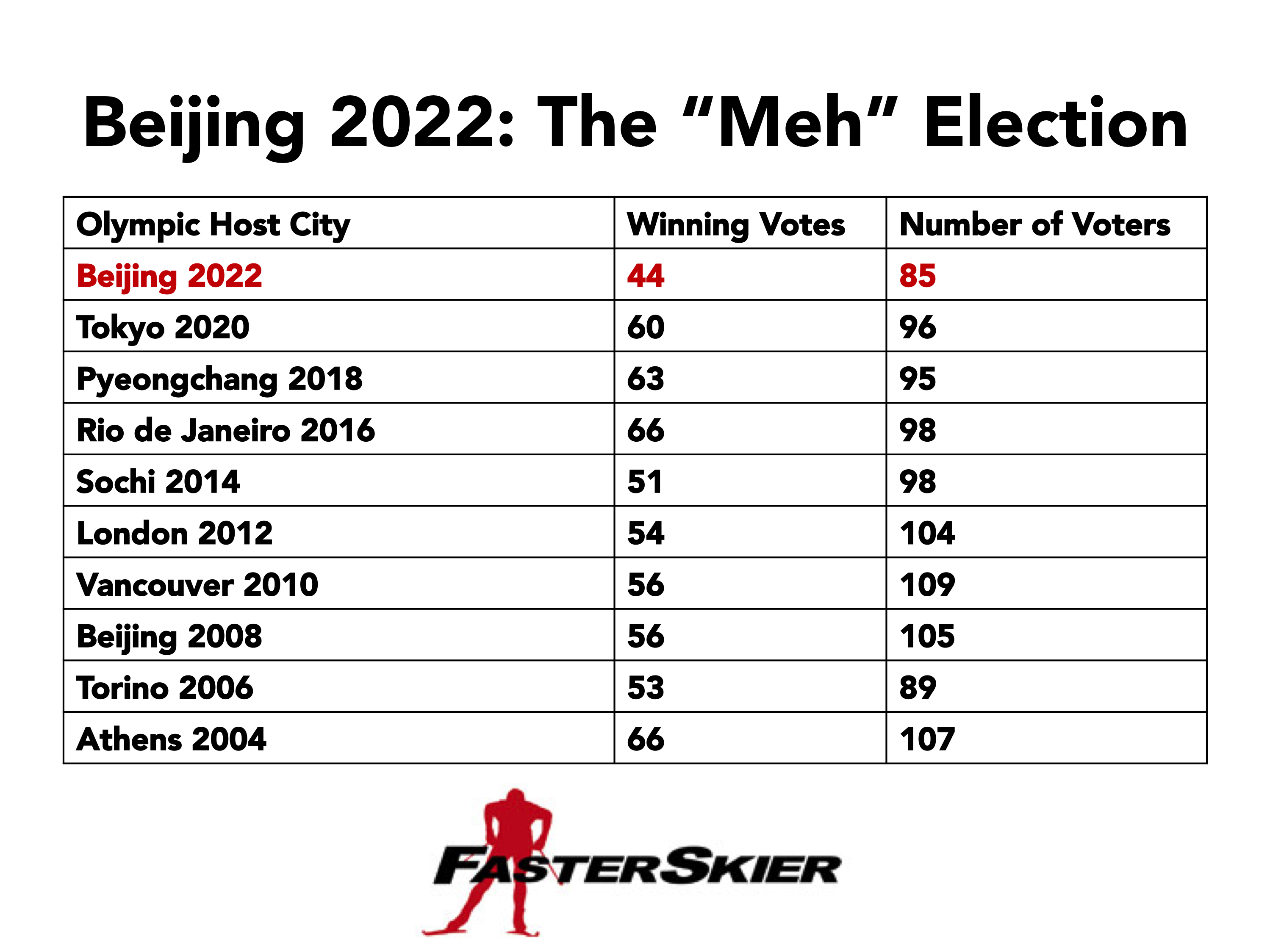
And it was reflected in the fact that Beijing won with just 44 votes from IOC members, the least votes received by a winning bid in the last two decades.
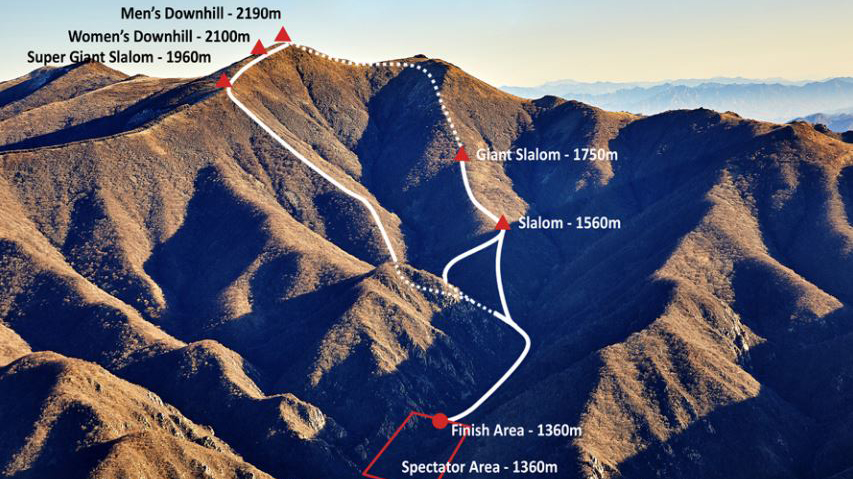
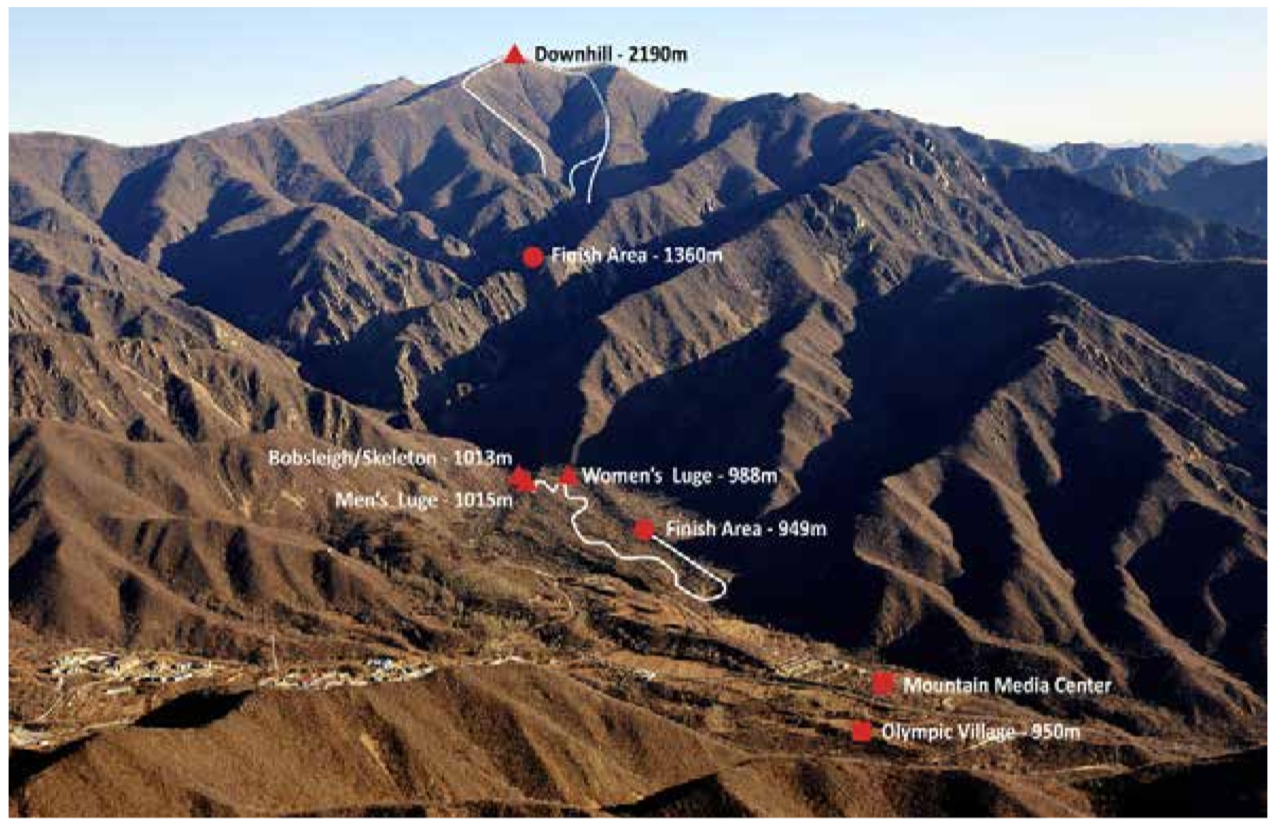
In comparison, this is what the alpine venues an hour outside of Beijing looked like in January 2015, according to the IOC Evaluation Commission.
Not since 1993, when Sydney was elected host of the 2000 Summer Olympics, has a winning bid received less than 50 votes. And more recently, most have received many more: 60 for Tokyo to win the 2020 Summer Games, 63 for PyeongChang to win the 2018 Games, and 66 for Rio de Janeiro to win the 2016 Games.
Close margins, on the other hand, are not so rare. Sochi 2014 and London 2012 each won by four votes, just like Beijing 2022, while Vancouver 2010 had only three votes more than its rival, PyeongChang.
Part of the reason that the tally was so low is simply that there were fewer IOC members to vote. The IOC has a maximum of 115 members, but there are currently only 100. Election of new members is on the docket for the IOC session in Kuala Lumpur.
Of those 100 current members, just 85 were present to vote. The president does not vote unless needed for a tiebreak, while members from a bid country cannot vote in host city elections, which ruled out China’s three members.
Eleven more IOC members were “excused”, meaning that they did not come to the session in Kuala Lumpur at all.
By contrast, in the last decade between 95 and 109 IOC members have voted in all previous host city elections.
Winter Athlete Reps Did Not Vote
Among the excused members were two of the most recently-elected IOC members, and the only two who competed at the last winter Olympics.
Canada’s Hayley Wickenheiser, a hockey player who appeared in five Olympic Games, did not go to Kuala Lumpur. Instead she tweeted about the result.
Yes, an interesting take… on an election that she could have taken part in. No reason for her absence was announced. She also did not attend the Candidate City presentations in Lausanne, Switzerland, in June.
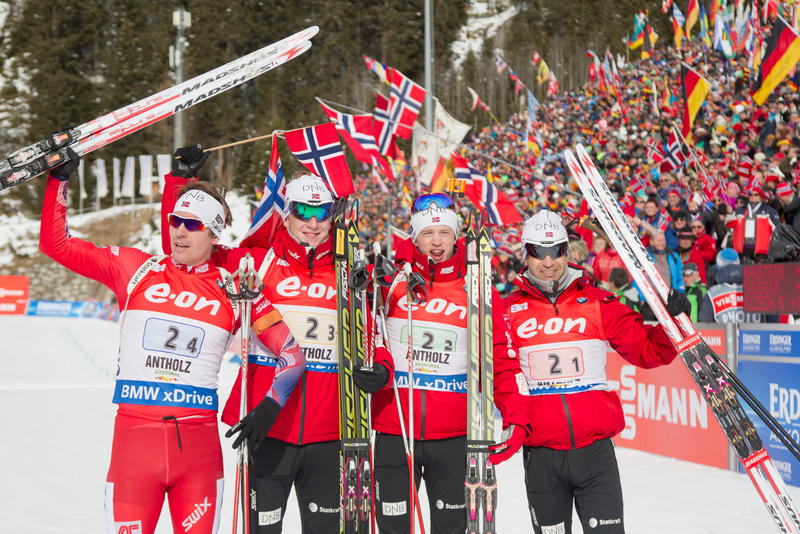
Ole Einar Bjørndalen, the most successful winter Olympian of all time, also did not attend, citing the need to train for the upcoming World Cup season. The biathlete told Norwegian newspaper VG that he had discussed his absence with IOC President Thomas Bach.
The Norwegian men including Ole Einar Bjørndalen (right) celebrate after winning the 7.5 k team relay in Antholz, Italy, in January 2015. (Photo: IBU/ChristianManzoni)
“In agreement with the IOC President and the head of the IOC’s Athletes’ Commission I’m not going to attend the congress in Kuala Lumpur where Olympic organizers for 2022 will be selected,” he said. “However, I have given my professional input to the Executive Committees in discussions beforehand.”
Bjørndalen also skipped the Candidate City presentations in June, as well as the previous IOC session in December (which was during the 2015 World Cup season; he had already notched three top-tens in the first week of racing).
He told VG that he had gotten approval from both Bach and Claudia Bokel, the chair of the Athletes’ Commission, to focus on his career until April. The 41-year-old plans to retire after 2016 World Championships, which will be contested on his home turf in Oslo.
Regardless of the reasons, it’s unfortunate that Bjørndalen and Wickenheiser could not attend the session and vote. They are the two IOC members with the most recent winter Olympic experience.
And, more than that, they competed at the Sochi Olympics – the very Games that the IOC is trying to leave far, far behind them with their Agenda 2020 reforms. The $51 billion price tag is something the IOC does not want to see as a precedent, and Bjørndalen and Wickenheiser are the only two IOC members to directly experience what that massive budget gave, or did not give, to the athletes.
It would seem that their opinions could have been informed, valuable, and from a unique perspective. Not only did they miss the vote, but by excusing themselves from the last two IOC sessions they also missed the chance to talk directly with other IOC members.
One might reasonably think that the IOC has little motivation to give more say to athletes, when the athletes elected to IOC membership do not attend IOC sessions or vote on important decisions – which is a pity, because the majority of athletes likely want more input and transparency in the way the biggest competitions of their careers are organized.
Lack of Visits to Bid Cities
Another problem is that after the 2002 Salt Lake City bidding scandal, IOC members are no longer allowed to visit bid cities.
Without being able to visit bid cities, IOC members must rely on other information to make their decisions. At the 2022 Candidate City presentations in Lausanne, Switzerland, in June, the Beijing room was both more attractive, and more packed.
That was because before 2002, several IOC members had to resign after it was revealed that they had received special treatment from the organizing committee in an attempt to earn votes.
The change in policy likely helped clean up some corruption in the IOC. But it creates problems for IOC members trying to decide where the Olympics should be held: all they have to base their decision on is what they have read and seen, be it from the IOC’s own Evaluation Commission or from the media.
This would be bad enough if the playing field was equal, that is if no IOC members had ever visited any of the bid cities on their own.
But the field is far from equal. In the 2022 race, Beijing had the advantage of hosting the 2008 Olympics, meaning that almost all of the IOC members had been there. By contrast, they weren’t allowed to get the same feel for Almaty.
And even outside of sports situations, members were much more likely to have traveled to Beijing for business or leisure than they were to have seen Almaty.
That may change soon. Kazakhstan in 2012 became one of the 50 largest economies in the world. And buoyed by oil and natural gas production – the country is the third-largest non-OPEC supplier of energy to the European Union – Kazakhstan is aiming much higher by 2050.
But the fact remains, at this point, most people have not been to Almaty.
One group that has? The few journalists allowed to officially visit the two host city bid sites.
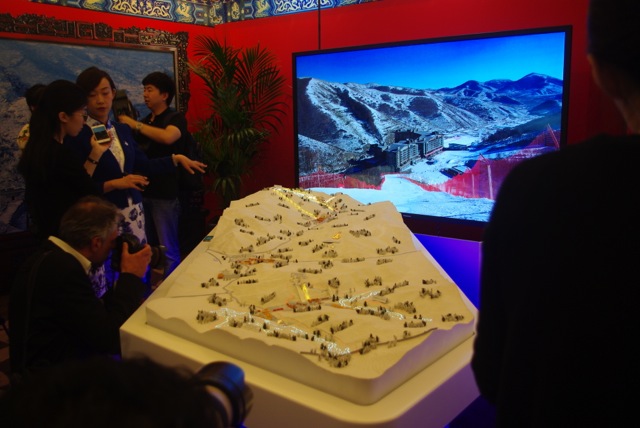
In the Beijing presentation room, the big committee was on hand to demonstrate through dioramas the vision of Games infrastructure. Is this the same as being able to see proposed sites in person?
Robert Livingstone of GamesBids.com wrote that he was pleasantly surprised by Almaty, and that most of the lines touted by the bid committee that he had assumed were just PR exaggerations turned out to be true.
The opposite was the case in Beijing: when he visited in March, the time the Paralympic Games will be hosted, there was no snow in the mountains and the ski resorts were already closed for the season.
After the vote, Livingstone wrote, “Arguably I was in a much better position to cast a vote in the host city election than most of the members, but of course it doesn’t work that way… Shouldn’t the members experience the city and the facilities as they will expect the athletes to, especially if they want to verify the quality of the athlete experience? If IOC members shared my on-site experiences do you think at least two of them may have changed their votes to Almaty? I’m certain that would have been the case.”
Another illustration of the importance of site visits is how the Evaluation Commission members themselves voted: eight of the nine members preferred Almaty, according to Inside The Games.
But despite their reporting, the Evaluation Commission could not convince IOC members to reach the same conclusion.
Who is Voting?
So who are the people who are voting and, to some extent, ignoring the advice of the IOC commission which inspects potential host cities?
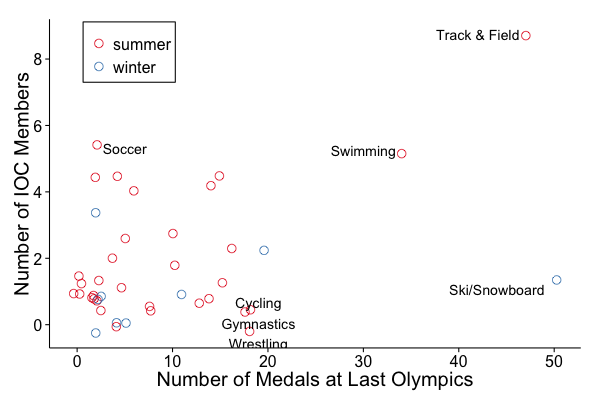
More than half of the members come from countries which have not won a winter Olympic medal in the last four cycles. And many countries which are successful at the winter Games – for example, Austria, the Czech Republic, Belarus, Finland, and Slovenia – have no IOC members at all.
Ten of the fifteen members who did not vote came from countries with strong winter sports programs. For example, not only did Bjørndalen not vote, but neither did the other Norwegian IOC member, Gerhard Heiberg, who led the 1994 Lillehammer Olympic Organizing Committee.
That meant that of the voting members left, 59% came from countries without a strong winter sports program.
In terms of sports, some members are former international or Olympic athletes themselves, and others are longtime administrators, officials, and financiers of sport – or just businesspeople or royalty with an interest in sport.
Of those with a discernible sporting background, either as an athlete or as an administrator of a specific sport before they went on to organize national Olympic committees or international federations, just nine worked in winter sport. The rest come from a summer sports background.
And for snow sports, the number is even more grim. Of the 98 medal events in the 2014 Olympics, 61 were held on snow: biathlon, nordic sports, alpine skiing, freestyle skiing, and snowboarding.
That’s 62%.
But of the 100 current IOC members only Bjørndalen and Gian Franco Kasper, the head of the International Ski Federation, come from a ski background either as an athlete or an administrator.
That’s 2%.
It’s not to say that IOC members without a winter sports background are incapable of making decisions about where to host a winter Games. There are many factors which are common between all Olympics: financing, culture, convenience of venue layout, security that the Games will be delivered.
Beijing was an expert in some of those, for instance the economic backing of the Chinese government. And a lack of snow was not its only shortcoming in the bid process. For instance, the venues in Almaty were much closer together, a factor which reportedly swayed some voters. Easy access and having venues integrated to the city culture should be a focal concern when organizing a Games.
But with no winter sports experience, perhaps it’s easier for voters from a hot country to line up their priorities in terms of financing and the lucrative marketability of China’s enormous consumer base. These voters might not appreciate the extent to which skiers and snowboarders prefer real snow to the manufactured stuff.
Or, perhaps more importantly to the IOC, how competitions in a real mountain atmosphere are nicer to watch on television. Or how in some disciplines, an abundance of natural snow is much safer for competition than a combination of manmade slush and salted-up ice.
Meanwhile, the trend of IOC membership being generally out of balance with the number of medals awarded by sport isn’t just a winter sports problem. It persists when summer sports are added to the mix, too.
And that’s not to say that IOC membership should track a country’s Olympic success. After all, the goal of the Olympic movement is inclusion and harmony, not domination by the likes of Russia, China, and the United States. Diversity is a good thing.
It’s also not to say that IOC membership should tightly track sports popularity. If nothing else, that would stifle creativity, continue to cut opportunities for smaller sports, and be difficult to adjust to as the Olympic sport lineup continually changes.
Members have far more to offer than simply their cultural or sports background. Financial or broadcast skills are certainly valuable to the IOC; so are perspectives on diversity and global challenges.
But it can’t help feeling like those most affected by the negative aspects of the Beijing 2022 bid were not represented at the table when it came time to vote. The skiers and sliders who will be competing far outside Beijing, potentially to empty stadiums on manmade ice amongst brown hills, weren’t there. Nor were some countries with expertise in those events.
There are 15 spots open for new IOC members: how will they be filled? Only time will tell.
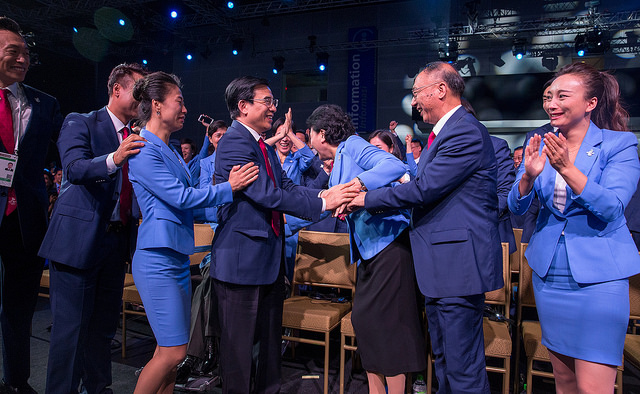
Beijing bid committee members react to being elected to host the 2022 Winter Olympics. (Photo: IOC/Flickr)
In Kuala Lumpur, Malaysia, the International Olympic Committee (IOC) voted today to award the 2022 Winter Olympics to Beijing, China. The competition was tight between and Almaty, Kazakhstan, the only other city which submitted a bid.
“We are honoured and humbled by the International Olympic Committee’s decision to award Beijing the 2022 Olympic and Paralympic Winter Games,” the Beijing 2022 bid committee said in a released statement. “It is with an incredible sense of excitement that we express our thanks to the IOC and the wider Olympic Movement. Just as with the Beijing 2008 Summer Games, the Olympic Family has put its faith in Beijing again to deliver the athlete-centred, sustainable and economical Games we have promised. This will be a memorable event at the foot of the Great Wall for the whole Olympic Family, the athletes and the spectators that will further enhance the tremendous potential to grow winter sports in our country, in Asia and around the world.”
There are roughly 110 IOC members, but only 85 of them voted in the 2022 Host City election. IOC President Thomas Bach did not (the President only votes in case of a tiebreak), nor did China’s three representatives; there are no IOC members from Kazakhstan, so they did not have to recuse themselves. 11 other members were excused.
One member was present, but abstained.
There were reportedly problems with the voting process, which was done via electronic tablets for the first time. After struggling with the system, members resorted to written votes, according to Inside The Games.
That meant that 42 votes were necessary to win, and Beijing received 44 votes. That was much closer than the competition appeared in the beginning.
Almaty ran a spirited bid, advertising their real snow and winter sports culture. You can read our review of the Almaty bid from the June candidate city presentations in Lausanne, Switzerland, here.
In the final days leading up to the vote, Almaty seemed to be making progress among IOC members. It was praised for fantastic presentations in the Kuala Lumpur session. You can watch a video from the presentation here.
“We extend our congratulations to Beijing on their successful bid for the 2022 Olympic Winter Games,” Almaty Vice Chairman Andrey Kryukov said. “China has played a significant role in the development of sport in Asia and we know that they will deliver a great Games. While we are disappointed, we are also grateful to the IOC for giving us the opportunity to present our vision to the world.”
Beijing, on the other hand, ran a sleek and professional campaign based on their ability to deliver on promises and the use of their huge economic power to implement a Games. Here is one of their earlier promotional videos.
While the strategy had many fans from the IOC membership from the very beginning, it has also drawn criticism for lacking snow, a meaningful winter sports legacy, and centralized venues, and for being built on environmental degradation and human rights violations. You can read our review of the Beijing bid here.
Nevertheless, Beijing’s economic might seems to have won out. In final presentations, Beijing touted the fact that the sports industry in China will be worth $800 million by 2022. It can also build hotels and venues at will, thanks to a captive economy directed by the government.
They also advertised that a Beijing Games would bring winter sports to roughly 300 million Chinese citizens, who do not have a strong winter sports culture. Whether this is indeed a lasting legacy remains to be seen. Basketball star Yao Ming was trotted out in support of the bid, but actually while growing up he was allowed to neither ski nor skate because sports organizers feared it hurting his basketball game.
Nevertheless, the sports industry and large size of the Chinese audience were clearly appealing to IOC members. This allows many marketing partnerships both by the IOC itself, and by its sponsors and companies which may be affiliated with some IOC members.
In terms of skiing, alpine competitions will be held in the Yanqing zone, roughly 90 kilometers outside of Beijing, and nordic and freestyle skiing in the Zhangjiakou zone, about 150 kilometers outside the city (hence the need for high speed rail).
“The USSA is looking forward to bringing our athletes, staff and supporters to Beijing as we once again look to be Best in the World,” the United States Ski and Snowboard Association wrote in a statement on their website announcing the Beijing victory.
Inside the Games also reported that in an informal survey of the eight members of the IOC’s Evaluation Commission – only four of whom are voting IOC members – eight had planned to vote for Almaty and only one for Beijing.
A whiter version of Beijing 2022 than athletes and fans might actually encounter.
In just over a month, the International Olympic Committee members will vote in Kuala Lumpur, Malaysia, on the site of the 2022 Winter Olympics. Their two choices: Almaty, Kazakhstan, and Beijing, China.
Only these two candidates remain after other bids from regions like Bavaria, Germany (centered in Munich), Graubunden, Switzerland (centered in Davos and St Moritz), Stockholm, Sweden, and Oslo, Norway, were felled by referendums.
That’s not a good sign for the IOC. Both bids have some problematic features, and are almost certainly not the ideal locations the organization was looking for.
While there are problems with the Almaty bid, to almost any reasonable person there appear to be far more, and more serious, problems with Beijing. Despite all of this, Beijing is the frontrunner.
That’s because it has the force of the Chinese government behind it. The IOC knows that the Chinese can deliver a Games. A Beijing Olympics would happen, without any major cost to the IOC except for bad publicity and a continued slide down from any moral high ground they might have left.
The Almaty bid closed part of its gap at the candidate city presentations in Lausanne, Switzerland, last week. But in the event that Beijing still comes out on top when voting is over, here’s an overview of six major issues that the Olympics would face – and examples of some of the misrepresentation and lies the bid committee says publicly when questions are brought up.
First, there’s the snow. As skiers, it is probably one of our main concerns. Will there be enough? Where will it come from? Zhangjiakou boasts about a meter, total, of snowfall each year.
The answer is, snow will come from water. But that leads to another question. What effect will that have on the regional water dynamics of a drought-prone region?
Then there’s air quality. It’s known to be terrible in Beijing. But organizers assert that air quality is great at the mountain venues. The problem is, that’s just not true.
Next up, how will spectators get to the mountain venues? At almost 200 k north of Beijing, travel times could be long. The bid committee touts a high-speed train connecting the clusters, but it’s becoming clear that this won’t solve all problems and could even be dangerous.
After the 2008 Olympics, it was clear that China followed through on few of their promises to improve human rights. Is there any reason to think that this time around will be different?
And finally, thinking long-term, what is the point of hosting a Games where winter sports are not popular and where snowmaking is so disruptive? Will the venues be used in the future?
The site of the alpine skiing and sliding sports for Beijing 2022, photographed in January 2015 for the IOC Evaluation Commission report.
Snow: Quite honestly, there isn’t much.
The weather is cold and it’s enough to blow snow, however, at least for alpine skiing. The Chongli area outside of Zhangjiakou has four alpine ski resorts which host, according to the bid committee, 1.5 million visitors annually. Nordic facilities have not yet been built.
On the ground, the area isn’t always teeming with skiers.
“The chairlifts are somewhat slow, but queues are rare and the slopes are mostly empty,” a review of the Wanlong resort, one of the biggest in the area, notes.
By comparison, the state of Vermont gets about 4.5 million ski visits per year, although that is based on ticket sales and it is unclear whether the Chongli numbers are from all tourists or just those who buy a lift ticket.
Looking at meteorological data, it’s hard to imagine the region becoming a real winter sports mecca without snowmaking.
“The total annual snowfall here can reach more than one meter,” Liu Jianjun of Chongli’s weather bureau told the press.
One meter!?
And yet:
“We have a 20-year history of hosting skiing events… Each year there is a 25% increase in the population taking part in skiing in Zhangjiakou,” Hou Lang, the mayor of the city, said in a press conference in Lausanne. “The temperature, wind speed, and mountain situations are ideal for hosting a Games.”
The bid committee’s strategy is to make and hoard snow. Already, resorts feature snow on the trails but brown forests and dry, frozen ground beside them.
“In addition to natural snowfall we have a very comprehensive plan to ensure the quality and quantity of snow,” Zhang Li, the venue manager, said in the press conference. “This plan is based on the combination of appropriate temperature, abundant water supply, and reliable existing snowmaking facilities.”
The IOC Evaluation Commission noted in their report that the resorts are already situated on the highest mountains in the region, so there would be no way to haul in snow from other locations. And as was shown in Vancouver 2010, temperatures can unpredictably rise during warm snaps and prevent snowmaking.
During discussions about the two candidate cities, experts reportedly testified that a 50-50 mix of manmade and natural snow was ideal, and that this was attainable with the Beijing bid. Two problems: most athletes would argue that actually a zero-manmade, all-natural snow base would be ideal, and secondly, it’s not clear that 50% natural is even realistic.
Siting an Olympic Games in a place with essentially zero natural snow seems like a big risk. Yet the IOC does not seem overly worried with this issue compared to others.
Water: On top of all of that, it appears that the bid committee does not fully understand just how big an undertaking it would be to make all of that snow. 16 million cubic feet of snow were reportedly stockpiled before the 2014 Sochi Olympics, where there was more natural snow to use as a base anyway.
It took over 140 gallons of water to make just one of those cubic meters of snow.
“The Commission considers Beijing 2022 has underestimated the amount of water that would be needed for snowmaking for the Games,” the Evaluation Commission wrote.
Zhangjiakou is in a notoriously arid region. There simply isn’t a lot of water available: just 383 millimeters per year, or 15 inches. The winter is the dry season, and Zhangjiakou receives less than five millimeters per month then.
The New York Times reported earlier this year that the region is home to water conflicts, which those in the western U.S. might find familiar.
The small amount of water available is often sent south to Beijing, a major city which has priority over rural areas. It is now being used for snowmaking as well, and should Beijing win the 2022 bid the amount needed for snowmaking will only increase.
“The total amount of water used for the entire Games duration for snowmaking represents only 1% of annual available water supply in this area,” Zhang Li said in the press conference.
However, the Evaluation Committee had already made clear that they believed this estimate was incorrect. And in a region with barely any water, one percent can still make a big difference – just ask California.
Because of China’s controlling government and human rights problems, those suffering from further declines in water resources would certainly be the least affluent residents of the Zhangjiakou region. Pouring more effort into snowmaking would represent a further shift to focusing on an affluence tourist market instead of local dynamics.
Yet the bid committee insists that there’s nothing to worry about.
“To ensure an abundant the water supply, we have three sources of water,” Zhang Li said in the press conference. “One is the surface runoff which has been the sole source for the existing resorts for the last 20 years. The second source is large capacity reservoirs in 6 kilometers of the venues. The third source is that we will benefit from the already almost-completed National Water Transport plan, which is transferring an enormous amount of water from southern China to the north.”
That transport plan has reportedly cost as much as $80 billion, although detailed estimates are hard to pin down.
The bid committee also plans to recapture snowmelt and use it to blow more snow, but the Evaluation Commission wrote that the ability to do this had been greatly overestimated.
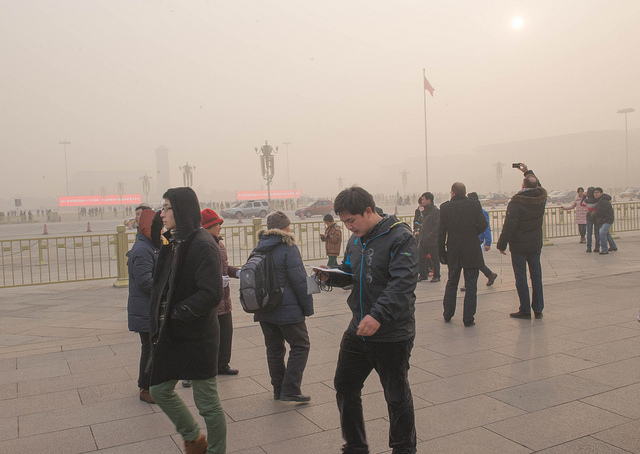
Air pollution in Tiananmen Square, Beijing, in 2013. (Photo: Michael Davis-Burchat, flickr)
Air Quality: Beijing currently faces some of the worst air quality in the world. During the 2014 Beijing marathon, particulate pollution was at 400 micrograms per cubic meter; the World Health Organization’s maximum for healthy outdoor activity is 25. Most participants wore masks and many did not finish the race.
“In Beijing, the ice sports will all be in indoor venues,” Wang Anshun, the mayor of Beijing and the head of the bid committee, helpfully noted in a press conference.
Beijing is in the midst of a five-year action plan to clean up air quality, which is costing about $130 billion and features 84 specific action points.
“At present, the action plan is already achieving excellent results,” Wang said. “Major pollutants in this period have dropped by 17.7 percent as compared to last year.”
After the plan ends in 2017, there are already plans in the works for another five-year agenda leading up to the 2022 Games.
In fact, the bid committee used the prospect of improving air quality in a not-so-subtle attempt to guilt people into supporting the bid.
“This also will be a form of permanent legacy that will benefit the local people of the city and the region,” Wang noted.
In other words: how could you turn this bid down when it will improve quality of life for millions of people, and make the air that they breathe no longer able to kill them?
However, it’s worth noting that an IOC mandate to fix pollution problems has not always in the past led to pristine conditions. Air quality was still a problem at the 2008 Summer Olympics in Beijing, even after much-publicized attempts to solve it by closing factories limiting the amount of vehicles in use. While vast improvements were made, pollution was still worse than in all but the most polluted U.S. cities and about six times higher than at the 1996 Atlanta Olympics.
Immediately after the 2008 Olympics, air quality worsened again, now to those levels seen during the 2014 Beijing Marathon. Improving air quality during the Games did not have lasting effects.
Another case of the IOC struggling to mandate pollution cleanup is in Rio de Janeiro, Brazil. Just a year before the 2016 summer Games, organizers are still struggling to clean up the water in the city. Last summer the IOC brushed off concerns, saying there was still time to clean up, but they now seem more alarmed, and at the recent Executive Board meetings in Lausanne demanded to see progress by the end of July.
Part of the Rio bid was a promise to reduce the flow of raw sewage into the sailing venue by 80%, but officials now acknowledge that will never happen. (More alarmingly, they say that the failure to clean up is irrelevant because the sewage poses no health risks to sailors.)
In other words, if the host city promises in a bid to clean up, the IOC has no real way to hold them to that promise. Statements by the bid committee about air quality do not mean that athletes won’t see significant health risks when they arrive in Beijing in 2022.
Finally, the bid committee says that at the two mountain clusters, air quality is ideal. However, while Zhangjiakou does have the best air quality in its region, it is still not good. In the next two days, for example, air quality is forecasted to dip into the “unhealthy” zone, with the definition “Everyone may begin to experience health effects; members of sensitive groups may experience more serious health effects.”
And local regulations cannot completely solve air pollution problems, anyway.
“Increased energy demand in winter coupled with seasonal weather patterns that can bring pollutants from other regions could create air quality issues across the Games zones,” the Evaluation Commission wrote.
Distances Between Clusters: The Beijing bid will feature three clusters for sports: arena ice sports will be held in Beijing; nordic sports, freestyle skiing, and snowboarding in Zhangjiakou; and alpine skiing and sliding sports in Yanqing.
The bid committee promoted this three-zone idea as a benefit to athletes, who will not have to travel far to reach their venues or deal with the more general hubbub of a compact Olympic Games.
“To ensure the athlete experience, I know from my experience as an athlete that the most important thing is the performance in the Olympics,” said Yang Yang, a gold medalist in short-track speedskating and now an IOC member. “So to minimize the travel times would bring much benefit to the athletes. Having three zones will help the athletes with short distance to travel from the venues to the villages. It will be about 15 minutes, which is a very good benefit to the athletes.”
Aside from athletes, travel times for spectators could be quite long. The bid committee has proposed building a high-speed train system which it says would cut the time needed to travel roughly 200 k from Beijing to Zhangjiakou to 50 minutes.
There’s several problems with this. First of all, the bid committee left the expenses associated with building the network off the books, claiming that it would have built the railway anyway. That’s false, and cut the bid’s budget down to better compete against Almaty. Officials still refuse to reveal the actual cost of the railway.
Secondly, only when pushed did officials admit that actually, it would take longer than 50 minutes to travel between the venues. They admitted that 10 minutes should be added for waiting times to board the trains.
IOC members pointed out that that’s not all; after all, they have to get from hotels to the train stations, and then from the stations to the venues. Members complained that it would likely take them 90 minutes.
And for regular spectators who don’t receive the special treatment of IOC members, it’s likely to be a lot longer. This, along with the lack of a snow sports culture in China, contributes to the strong possibility to sports in the mountains facing empty stadiums. That doesn’t exactly make for the best athlete experience.
Already in 2014 in Sochi, Russia – a country where cross-country skiing and biathlon are successful and popular – seats were empty in the stadiums. This was likely due in part to the sale of multi-sport ticket bundles. A non-ski fan might go check out a sport they had a ticket to if it’s close; if it takes hours of travel each way, they might decide to stay in Beijing.
Lastly, with well-documented catastrophic train disasters and high levels of corruption hindering safety measures in China’s railway construction (you can find an incredible piece from the New Yorkerhere), does anyone really want to be on a high-speed train system where a crash, or even just a decrease in speed, by a train that departed just five minutes earlier could lead to a pile-up?
Human Rights
One of the biggest problems will provide nothing more than a repeat show from the 2008 Olympics. When Beijing won the bid for the 2008 Games, China boldly proclaimed that this was an opportunity for the country to improve their human rights record before they showed off to the world.
That certainly did not happen.
Hundreds of thousands of residents were evicted in the leadup to the 2008 summer Games in order to build new stadiums and infrastructure. The 2022 Games will use some of that infrastructure, so evictions should not be as numerous. But the Evaluation Commission report still estimates that thousands of people will have to be relocated.
And relocation is not something that China handles well. Houses were demolished and when residents tried to protest their evictions or appeal through the legal process, they were arrested, jailed, and sometimes beaten. Citizens have no choice in the matter, and are not provided the means necessary to re-make their life somewhere else.
“Compensation rates have rarely enabled affected people to relocate while retaining the same standard of living,” the Geneva-based charity Centre on Housing Rights and Evictions noted in a 2008 report. “Instead, residents have been forced to move further from sources of employment, community networks, and decent schools and health care facilities.”
Journalists who covered these issues did not fare well, with dozens of members of the media detained in the leadup to Beijing 2008. The Foreign Correspondents Club of China reported that 40% of foreign journalists covering the 2008 Games had experienced some sort of governmental interference, and that since then, conditions for foreign journalists have declined substantially.
Even while reporting on the bid for the 2022 Games there have been incidents. When two foreign journalists tried to visit the site of the mountain cluster and interview locals, government “minders” scared people away from speaking to them and inhibited them from visiting parts of the sites.
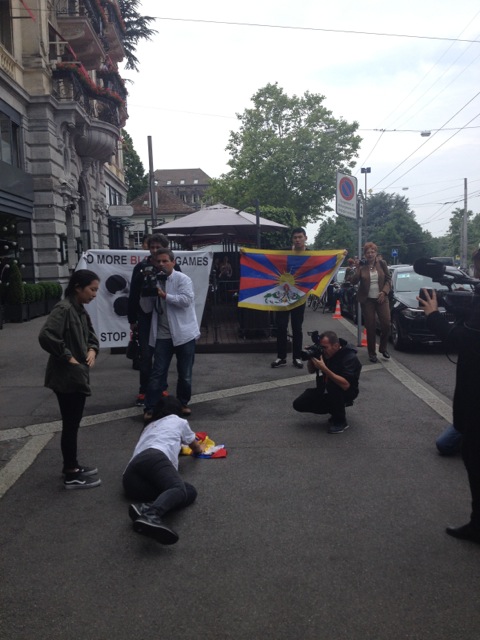
Protestors shouting “Beijing Lies, Tibet Dies” and “No More Bloody Games” appeared outside the hotel hosting the candidate city presentations. Later, another activist snuck into the Beijing presentation room. After unfurling a banner and chanting, he was forcibly removed.
Those outside the media fared much worse. Before the 2008 Games, citizens who spoke to foreign media were sometimes beaten by police in retaliation. According to Human Rights Watch, Chinese who spoke out on a variety of issues, from human rights to the environment or corruption, were often arrested. In some cases activists were kept in prison for longer than the actual term they were sentenced to.
Then there’s the athletes. According to The Guardian, China forbid athletes with any history of dissidence or activism from participating in the 2008 Olympic or Paralympic Games. For instance, Fang Zheng, whose legs were crushed by a tank in Tiananmen Square in the 1989 massacre, was not allowed to compete despite having two national records in the discus.
There’s many other human rights issues in the country. Tibetan activists, for instance, infiltrated the candidate city presentation room in Lausanne last week to stage a protest of China’s occupation of the region. Before 2008, the Olympics were seen as providing a platform for Tibetans to speak out about their oppression. But nothing changed for the better.
If the 2022 bid is successful, that means seven more years of Free Tibet protests. That’s seven more years of the world being reminded that the IOC has chosen to host the largest, most lucrative sporting event in the world in a country that does not support the basic tenets of the Olympic movement.
“The goal of Olympism is to place sport at the service of the harmonious development of humankind, with a view to promoting a peaceful society concerned with the preservation of human dignity,” the second point of the Olympic Charter reads.
Legacy: One of the main points of the Beijing bid is that should they win, they will bring winter sports to “hundreds of millions” of people and provide a lasting legacy. This is how the bid committee appeals to IOC President Thomas Bach’s “Olympic Agenda 2020” plan.
Frankly, this seems unlikely. Even in countries which already have a strong winter sports culture, building new venues in places which are only moderately accessible to the general population has rarely been successful in building lasting legacies.
Let’s look back at Sochi, 2014. The snow and sliding sports venues will certainly never be used again for World Cup competition, and it’s not clear that they are seeing significant use from Russian athletes either. $51 billion were spent to build this Olympics and the mountain cluster is eerily empty. Resorts were operating at losses and renting luxury rooms for as little as $17 per night.
What about Vancouver, four years earlier? Canada has strong nordic, alpine, and freestyle ski programs. But the cross-country and biathlon teams no longer base training groups in the Callaghan Valley, a venue which sees little traffic. Canadian ski jumping and nordic combined struggle to even remain funded. Whistler Sport Legacies has more costs than profits, although some venues, such as the luge and bobsled runs, see a lot of use.
British Columbia and the Canadian Rockies have plenty of alpine skiing opportunities, which is perhaps the reason that the Whistler Creekside venue, which hosted alpine racing for the Olympics, has not seen any FIS-level competition since 2010. Lake Louise, Alberta, beckons instead.
Pragelato, the site of nordic racing at the 2006 Torino Games, has not hosted a FIS-sanctioned cross-country ski race since the World University Games 2007. The luge track has been dismantled for economic reasons, but the hockey and speedskating arenas have hosted other sports events as well as plenty of concerts.
Sestriere, where the alpine racing was held, is still a popular venue for Europeans, but hasn’t hosted a World Cup since 2009. And unlike most other snow sports venues used in 2006-2014, Sestriere was already a high-profile destination for both tourists and elite racers; the Olympics likely did not significantly affect its future.
So even in countries where there are plenty of winter athletes, developing new venues for the Olympics hasn’t contributed much to sports programs. Reaching fans is a different story, but there’s still not much evidence that hosting an Olympics seriously shifts the support for winter sports within a country long-term, aside from a brief flush of enthusiasm surrounding the Games itself.
And considering the high water cost of running the snow sports venues, it’s not clear that they would even be maintained in the long run, especially as climate change progresses.
The bottom line, and the Almaty comparison. Almaty faces some of the same issues that Beijing does.
Air quality is not great in the city, although it is of course nowhere near as bad as Beijing. Kazakhstan is not a model for human rights, and there is expected to be significant corruption should Almaty win the lucrative bid.
But on many points, Almaty comes out clearly ahead. For instance, many stadiums are already built and being used by both Kazakh athletes and to host international competitions like the 2011 Asian Winter Games or the upcoming 2017 World University Games. Almaty has snow, and it has winter athletes; it’s much more likely that the Games would have a lasting legacy improving sports opportunities for residents.
It is also a compact Games, with everything close together, and a relatively cheap one.
What Almaty lacks is the slick, powerful, marketing machine that Beijing has already put into place. Should Beijing win, it will be a clear message that money, financial stability, and glossy PR lines matter more to IOC members than the actual tenets of the Olympic charter.