

From the FasterSkier archive — posts syndicated from athletes’ and coaches’ own blogs between 2004 and 2012, kept online as published. Current coverage is at fasterskier.com.

Tag: 2023 FIS Cross Country World Championships

  • USA Earns World Championship Bronze with Diggins and Kern, Team Sweden Triumphant

    USA Earns World Championship Bronze with Diggins and Kern, Team Sweden Triumphant

    This World Cup coverage is made possible through the generous support of Marty and Kathy Hall and A Hall Mark of Excellence Award. To learn more about A Hall Mark of Excellence Award, or to learn how you can support FasterSkier’s coverage, please contact info@fasterskier.com. 

    Five years on from the milestone of Olympic gold—and ten years on from the milestone of World Championship gold—the event was the same for US skiing; the Team Sprint. Socks adorned with stars and stripes and glittered faces led the race the whole day, as Jessie Diggins and Julia Kern traded leg after leg racing at the head of the women’s field. By the time Kern took her last turn around the Planica course, there was a pack of three teams, and no doubt which one had driven the race to that point. The medal places just had to be decided among the United States of America, Sweden, and Norway. In the end, the newly crowned sprint World Champion, Jonna Sundling, made the move for Sweden to win, and Tiril Udnes Weng held on for second, but the excitement would not be diminished. Jessie Diggins waited at the finish line as Julia Kern skied into her arms, bronze for the United States of America, and the first medal of these World Championships and Julia Kern’s career.

    Julia Kern (USA) and Jessie Diggins (USA) share an emotional celebration after taking bronze in the Team Sprint. (Photo: NordicFocus)

    For the US, the pieces were all there, they had just moved around. Kikkan Randall—the other fixture of the Team Sprint’s triumphs of the past decade—was up in the commentary booth this time. Chad Salmela was alongside her, as ready as ever to play muse for the US Skiing community’s unadulterated excitement. Most notably though, Jessie Diggins was on the line at the beginning of the race. A surprise given her pre-World Championships assessment that “Anchoring relays is kind of my bread-and-butter.” But Diggins had also made her admiration of Julia Kern a central part of her assessment of the team events at this year’s World Championships, “Julia Kern has an incredible skill set that makes her a really good anchor,” Diggins said. “She’s got the fitness, the distance chops, the raw speed, tactics and confidence.”
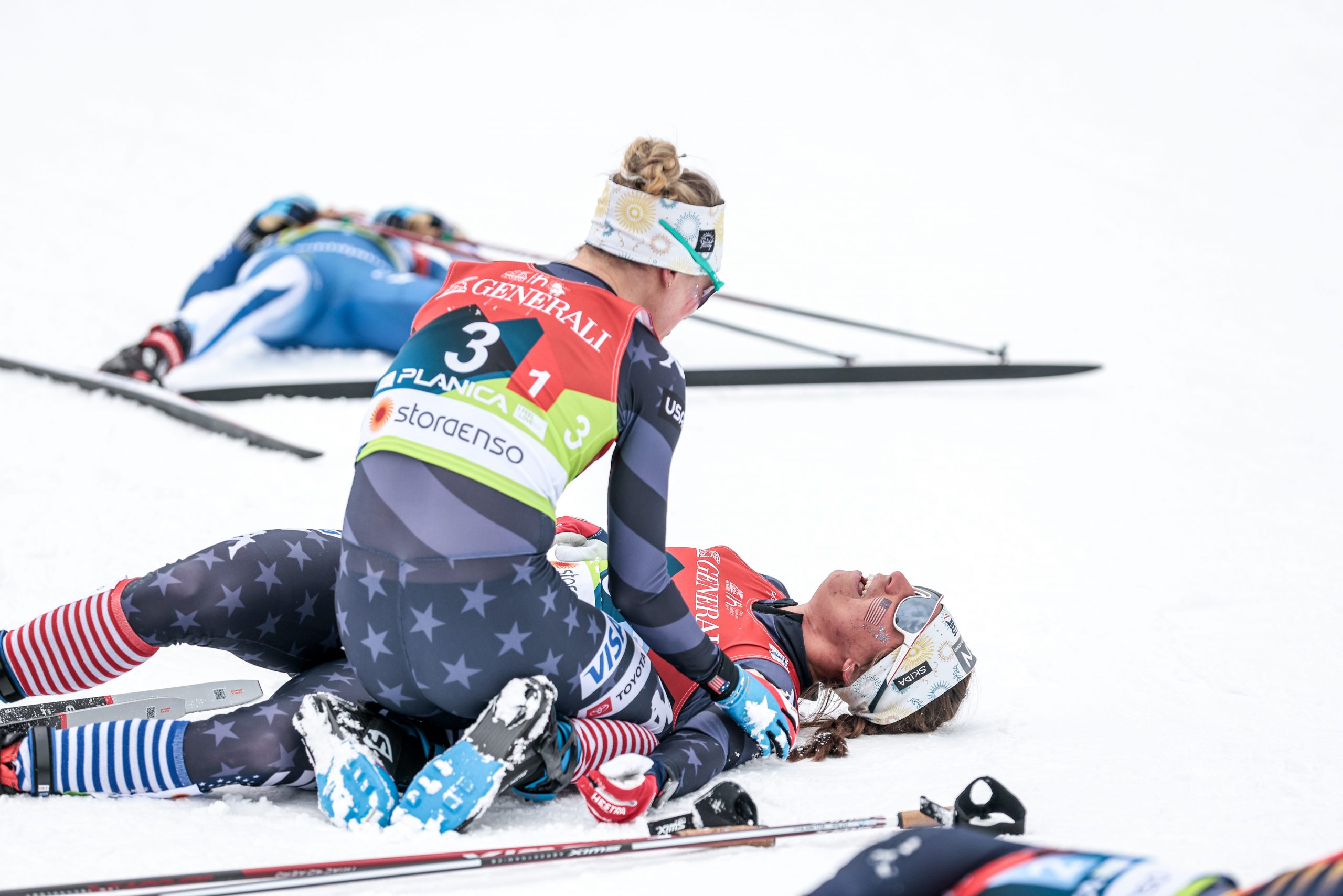
    Jessie Diggins (USA) comforts her Team Sprint teammate Julia Kern (USA) after their bronze medal effort. Diggins’ faith in Kern’s ability to finish was rewarded with a medal performance. (Photo: NordicFocus)

    With that vote of confidence, the line-up for today’s American relay team was set. Diggins took the first leg, just as she had early in her career when paired up with Randall (the lineup that won in Val di Fiemme in 2013). Behind her in the anchor leg was the young American who had first sprinted to a World Cup sprint podium in Planica 2018, and in 2022-23, has spent the year building a steady and strong presence at the front of the World Cup sprint field. US Ski Team Head Coach Matt Whitcomb said on the decision in post-race comments that “If we switched [the lineup] around, we felt like it wouldn’t have used Jessie’s capacities or Julia’s capacities fully.” That lent to a US strategy to, as Julia Kern would put it in post-race comments to FasterSkier, “Win a medal the hard way,” stretching out the field out from the beginning to leave a small sprint pack for the medals at the end. For Matt Whitcomb, that led to the evaluation that “both [Jessie] and [Julia] have somewhat comparable finishing kicks. Jessie has a slightly more developed distance capacity. We felt that could be used on the first leg to really stretch things out, and then at times decide to push and others conserve a little bit throughout the race.”

    And so, the American duo qualified first place on the day, went off the line in the Final that way, and didn’t relent until the very end.
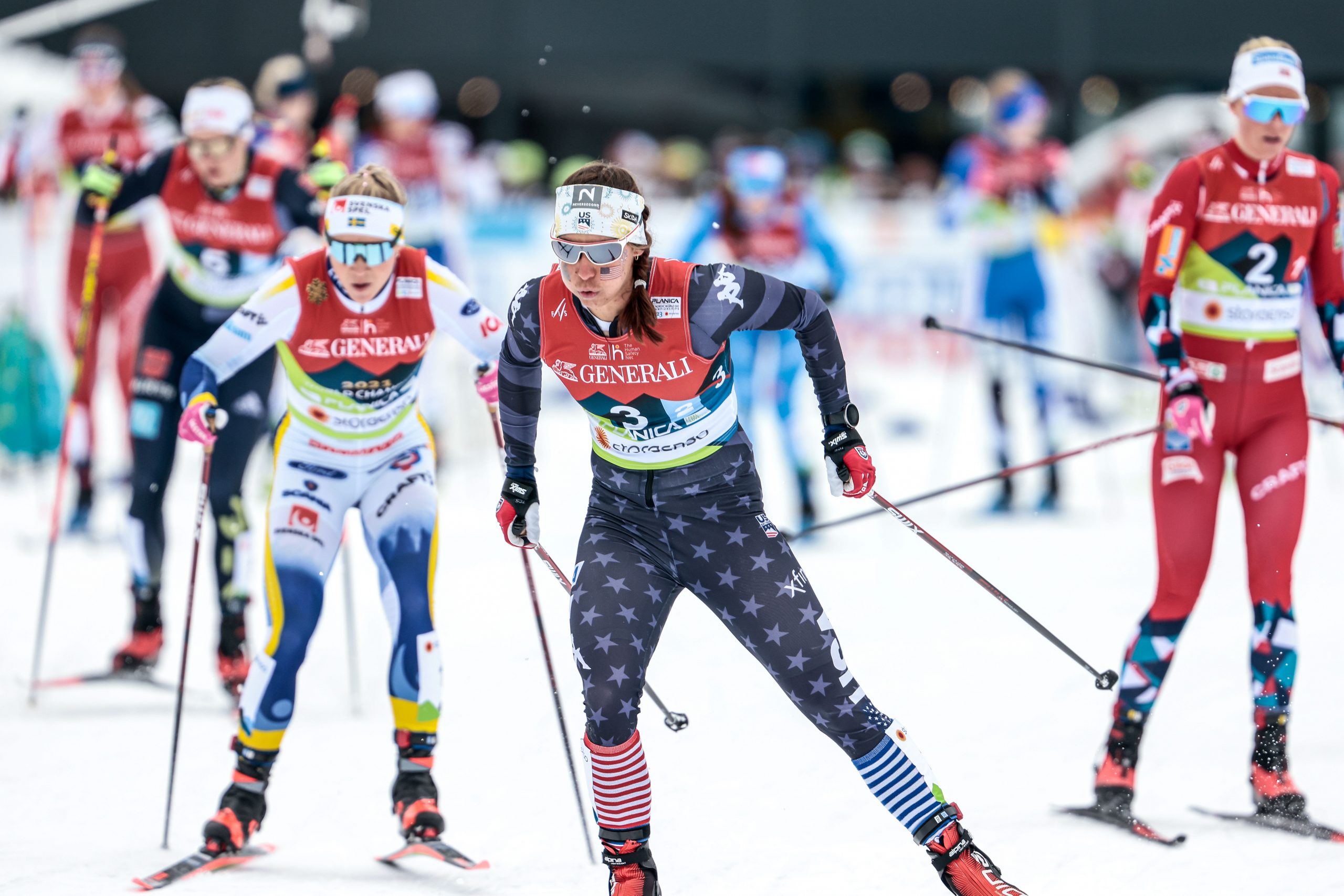
    Julia Kern (USA) living up to the confidence her team had put in her by skiing a medal winning anchor leg. (Photo: NordicFocus)
    Women’s Team Sprint Final

    The most candid and eloquent assessment of the Women’s relay Final would come from the source; Julia Kern’s mother. Talking to FasterSkier’s Nat Herz, she offered that for the US, “Either you chill behind [Norway and Sweden] and take a risk that you’re only going to get fourth or fifth with Germany and Finland there the whole time, or you say, ‘I’m going to the podium’ and push all three laps.’” She added a mantra too, “If you [choose] to push, you have to push the whole time.”
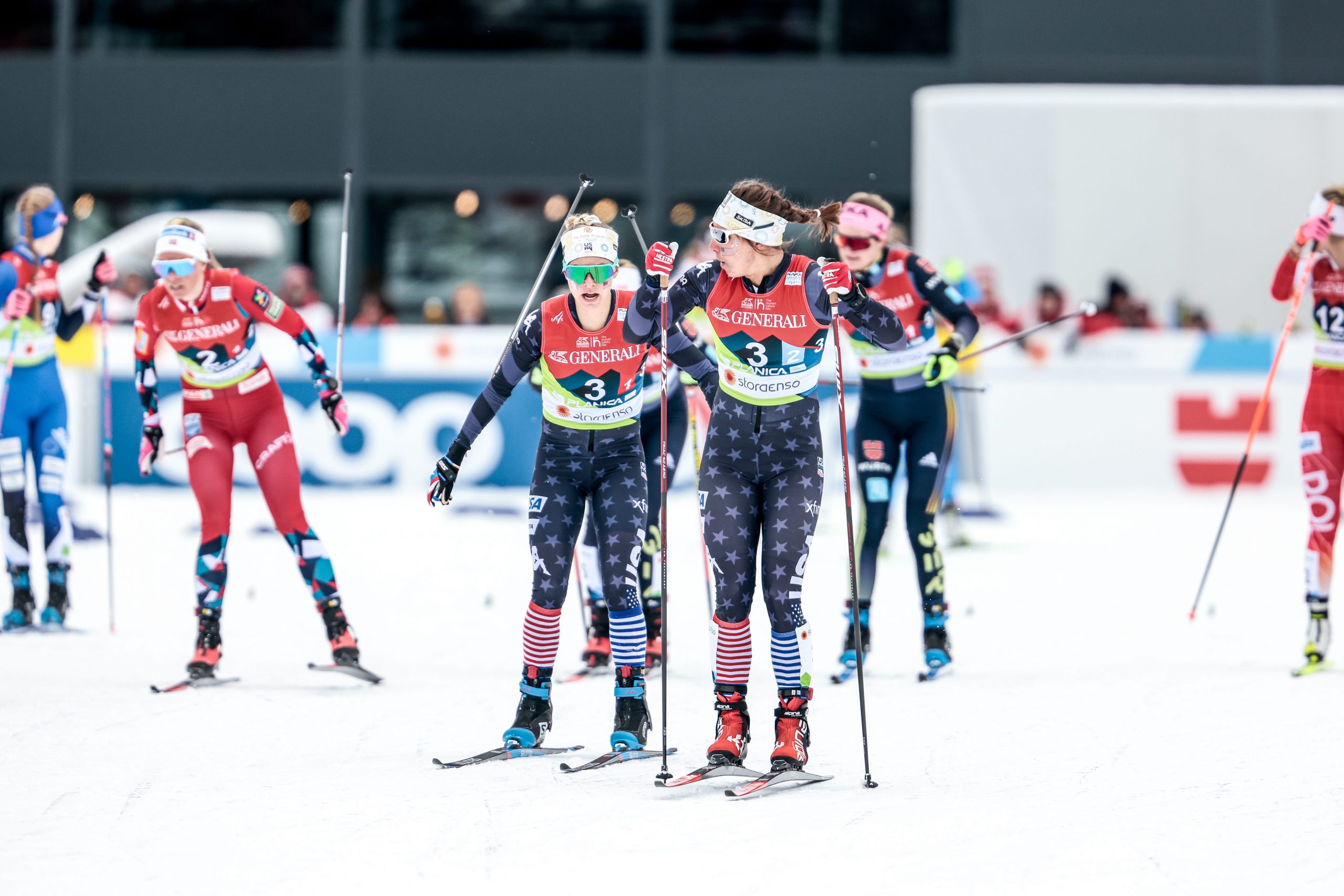
    Jessie Diggins (USA) and Julia Kern (USA) successfully navigate the tricky exchange area in the team sprint. (Photo: NordicFocus)

    That was precisely what Jessie Diggins chose to do, launching out of the start-line into her trademark free skate as the field wound around the rolling descent at the beginning of the course. That course was a modified version of last Thursday’s individual sprint to include a relay zone, including the long-winding climb through the middle, with a long rolling section afterwards into the Planica stadium. To the spectator’s eye then, the race was spent looking for subtle signs of strength through the main climb. Who kept the V2 tempo high? Who was launching their V1 into full power mode? Through much of the race, that simply meant looking at the front. Diggins held a high-tempo V2 through all her legs that, even when challenged by Norway’s Anne Kjersti Kalvaa in her final leg, still kept the American at the front of the race.
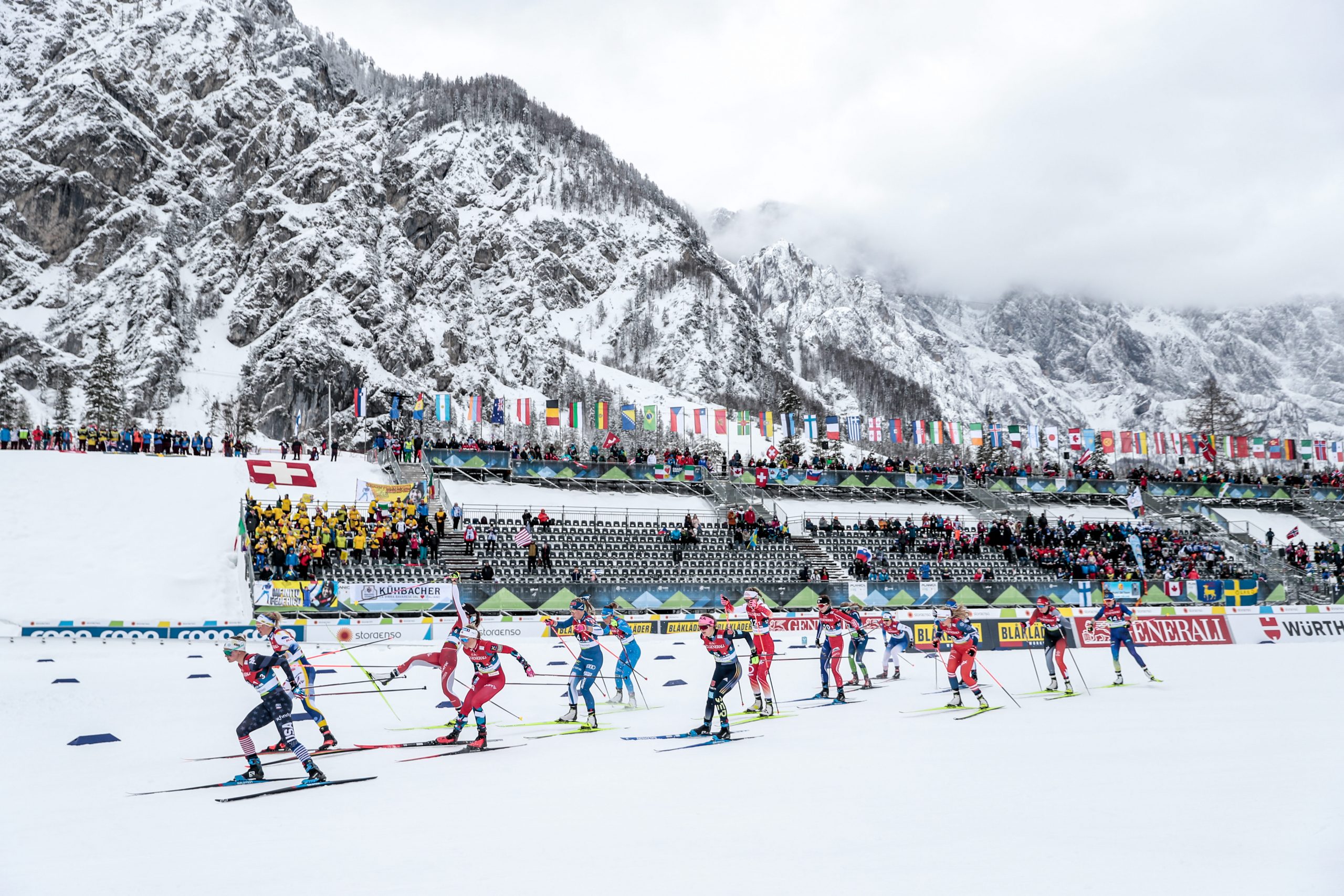
    Jessie Diggins (USA), pushed the pace the whole way to try and break up the field. (Photo: NordicFocus)

    By that point, the race had long separated into a pack of five teams, with the Americans leading, Norway and Sweden taking turns marking behind in second and third, and Germany and Finland the same in fourth and fifth. The move from Kalvaa and the response from Diggins though, saw the pair take more speed into the long downhill after the climb their final time around, and it proved to be where the definitive gap of the day opened up. Emma Ribom was able to use her sprinting chops to put in a burst and make the race three team’s strong, but the Americans’ push had pushed Finland and Germany out of the race.

    The final lap then was just to decide which medals would go where. Tiril Udnes Weng started the move on the lower reaches of the final main climb, which set Kern and Sundling into high gear too. Kern faded ever-so-slightly, what US Coach Matt Whitcomb would describe in post-race comments as “the side effect” of the US strategy, “Sweden and Norway get to follow up behind for five out of six laps.” As they rolled into the finishing stretch, Sundling passed Weng with the powerful finishing speed that won her a World Championship last Thursday, and Weng skied in to put Norway in second. Julia Kern continued to push all the way through, and as she approached, the energy from Diggins started to become a palpable thing, dancing and running to meet her younger teammates arms. For Diggins, it was the fourth time she had stepped onto a World Championships or Olympics Team Sprint podium, and this time, she was welcoming not just a younger teammate, but one that came from a generation that had directly looked up to her through all those previous wins.

    That was a significance not lost on Julia Kern, who said in post-race comments that, “it was incredible to watch Jessie and Kikkan over the years when I was growing up, and to step into these shoes is truly special. It speaks to how they paved the way for the whole US team.”
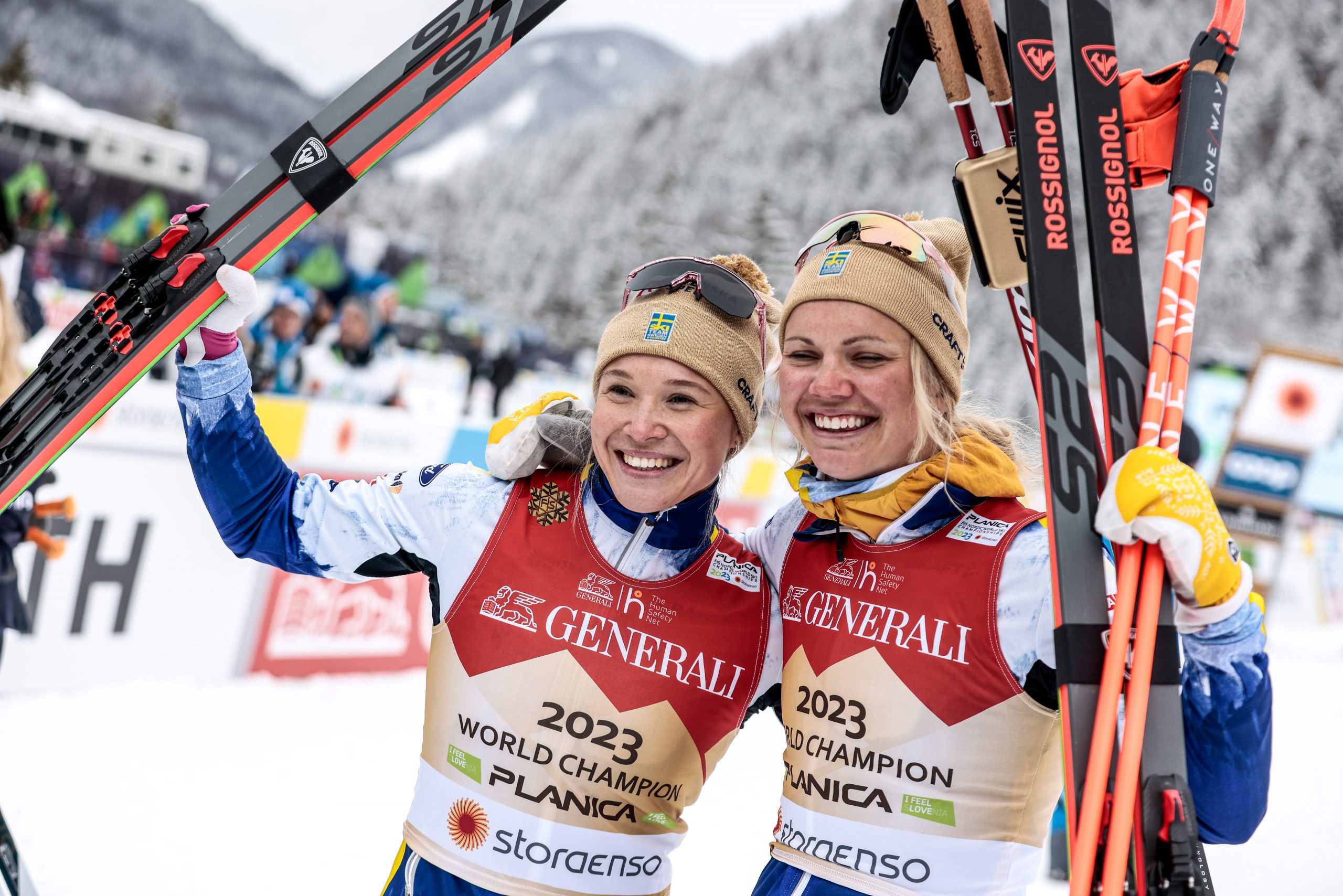
    Jonna Sundling (SWE) and Emma Ribom (SWE) were able to find a little extra something to take gold in the World Championship Team Sprint. (Photo: Nordic Focus)

    Throughout the US camp was the feeling that this bronze meant the continuation of all the positive developments in US skiing over the past decade and a half. For Jessie Diggins, today’s medal was a proof of concept for the team-centered focus she has helped pioneer, saying in post-race comments that “[The team sprint] a team sport within a team sport. It takes people who are on the road with us all the time, the [doctors and physios] who volunteer their time to come over and take care of us, this is a full team effort, and that’s what makes a team medal special.”

    Matt Whitcomb, meanwhile, opted for extended metaphor, “[our Team Sprint] is like a multiple years long relay; Kikkan handing it off to Jessie, Jessie handing it off to Julia now, and maybe Julia hands it off to the next [skier] eventually.” 

    And as for the significance, Jessie Diggins continued to bring it all back home, “I hope the kids back at home see that you can do this; you can compete clean, support each other, train hard, and get it done. I hope they’ll see that.”
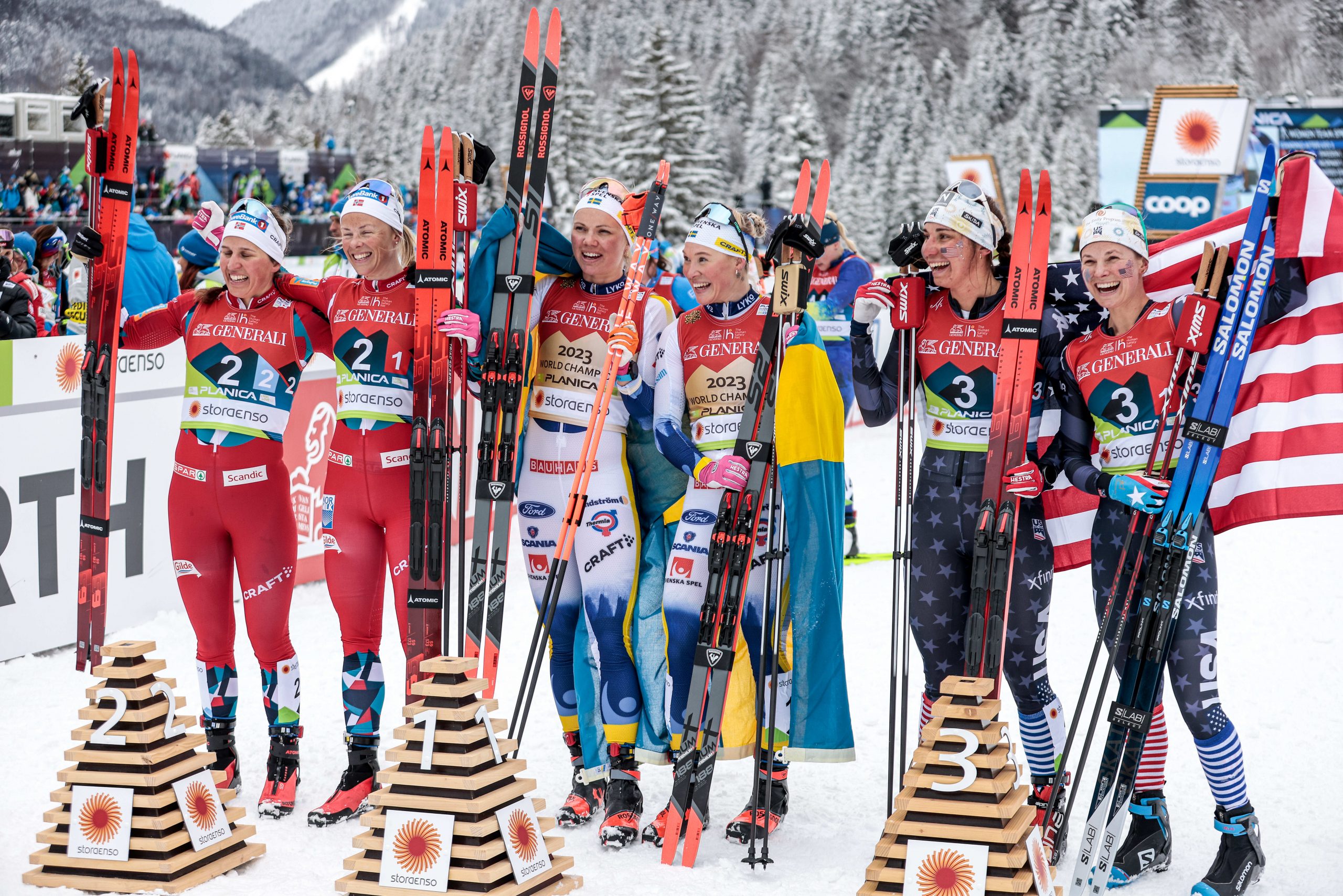
    All smiles for teams Norway, Sweden, and USA after medal winning performances. (Photo: NordicFocus)

    Women’s Team Sprint RESULTS

  • World Championship Qualifying: Inviting the Whole World

    World Championship Qualifying: Inviting the Whole World

    This World Cup coverage is made possible through the generous support of Marty and Kathy Hall and A Hall Mark of Excellence Award. To learn more about A Hall Mark of Excellence Award, or to learn how you can support FasterSkier’s coverage, please contact info@fasterskier.com.

    Bruna Moura (BRA) skis to the win in the Women’s 5 k Freestyle Individual Qualifying event at the 2023 FIS World Championships in Planica, Slovenia. (Photo: Modica/NordicFocus)

    This is the championship of the cross country skiing world, and all the nations of the skiing world are included. It’s a longer list of nations than many of us may imagine . . .

    Cross country skiers come from various backgrounds and far-flung homelands. Some hail from countries that the skiing world does not always recognize as even having skiing: Chile and Argentina share borders at the mountainous, frozen southern tip of South America where the Ushuaia Loppet is staged every season. Iran has a long tradition of Alpine skiing, with snowy mountains that soar to over 18,000 feet and an Alpine ski area within the city limits of Tehran. Skiers have arrived at these championships from Trinidad and Tobago, Lebanon, Mongolia, Armenia, Haiti, Hungary, Thailand, Latvia, Lithuania, Bolivia, Portugal, Greece, Turkey, Mexico, Venezuela, Kyrgyzstan, Israel, Brazil, Iceland, Serbia, Belgium, Panama, Bosnia Herzegovina. Some of those skiers are natives of tropical lands who now reside in snowy climes. Others are natives of wintry nations where the support for skiing is simply not deep enough to allow them to develop programs to compete against the Norways and Swedens of the skiing world. They qualify for these championships through nomination by their home-nation’s FIS governing bodies; then, they compete in qualifying competitions. The top performers in those qualifying competitions will be awarded starting places in World Championship events. It’s a chance for more skiers to see, feel, and experience the thrill of competing against the world’s best. It’s a World Championships . . .

    Carlos Andres Quintana (COL) and Rodrigo Ideus (COL) celebrate at the finish of the Men’s 10 k Freestyle Qualifying race in Planica, Slovenia. (Photo: Modica/NordicFocus)
    Men’s Qualifying

    Iceland’s Albert Jonsson won the 10 k Freestyle Individual Start in 26:47.1, followed closely by Manex Silva of Brazil, and Spartak Voskanyan of Armenia. For comparison, the recent Nordic Nations Cup (Junior) Men’s 10 k Freestyle was won by Tabor Greenberg (USA) in a time of 23:03.9. The Nordic Nations Cup is a gathering of the world’s fastest junior skiers, and Greenberg is proving himself to be one of the fastest young skiers in the world; if he represents the sort of developing athlete that FIS considers on track to contend on the international stage before too much longer, then athletes from Iceland, Brazil, and Armenia are not too much farther behind.

    Skiers from the Iranian team gather at the finish line of the Women’s 5 k Freestyle Individual Qualifying race at the 2023 FIS World Championships in Planica, Slovenia. (l-r) Sahel Tir (IRI), Samaneh Beyrami Baher (IRI), Farnoosh Shemshaki (IRI). (Photo: Modica/NordicFocus)
    Women’s Qualifying

    The Women’s 5 k Freestyle was won by Jacqueline Mourao of Brazil, followed by Lucija Medja of Slovenia, and Gigja Bjornsdottir of Iceland. Also finishing in the top ten—and within 90 seconds of the winner—were skiers from Mongolia, Iran, Bosnia Herzegovina, Armenia, and Lithuania. It’s remarkable to see so many skiers from so many nations, all passionate about what they do and the goals they pursue, all hoping to take the next step toward legitimacy and excellence in this sport that they love.

    Haiti’s Stevenson Savart exults at the finish line of the Men’s 10 k Freestyle Individual qualifying race during the 2023 FIS World Championships in Planica, Slovenia. (Photo: Modica/NordicFocus)

    FIS World Cup events can be something of an elitist affair, with only those nations fielding true contenders typically participating. As a result, World Cup fields can be woefully small, implying that our sport is somehow an anemic player on the international athletic stage. Unfortunately, neither the skiers of developing nations nor some of the very best skiers in the world are able to attend. The unfairness lies in the fact that dominant nordic skiing nations—like Norway and Russia—could each provide dozens of athletes who could qualify for most any other national team, but there’s not enough room for them on their own national teams. Regretably, only a few of those elite athletes will ever toe a World Cup or World Championship starting line, even though a fair number of them may have ended up on the podium if they’d ever gotten the chance. Space is made for the Brazils and Panamas of the skiing world, though few of those nations are poised to fund year-long World Cup campaigns for their aspiring skiers. In the end, FIS is dedicated to doing two things that fly in the face of one another: providing opportunities for the best skiers in the world to face one another in fair competition, and identifying the means to encourage cross country skiing in nations where it has not been a visible athletic alternative in the past. In order to accomplish that, some neophyte skiers will be allowed the experience of competing on the international stage, while other very very good skiers will be left at home.

    Winter Olympic fans will remember the comically charming ineptitude of Eddie the Eagle (in ski jumping) and the Jamaican Bobsled Team at the Olympics in Calgary in 1988. Avid cross country skiing fans may recall Phillip Boit, the Kenyan distance-runner-turned-skier who finished far behind the rest of the field at the 1998 Olympic Winter Games in Nagano, but who was greeted at the finish line by the winner, and Olympic champion, Bjorn Daehlie (NOR). Sportsmanship and fellowship have long been fundamental parts of the nordic skiing community, and it’s gratifying to see those continue at these events. It’s also timely to acknowledge that the efforts and accomplishments of these little-known skiers are neither comic nor charming, but entirely deserving of our respect and admiration. Welcome, then, to the grand stage of the 2023 FIS Cross Country World Championships.

    The podium of the Men’s 10 k Freestyle Individual:  Spartak Voskanyan (ARM), Albert Jonsson (ISL), Manex Silva (BRA), (l-r)—FIS World Championships qualifying, Planica, Slovenia. (Photo: Modica/NordicFocus)

    (Qualifying) Women’s 5 k RESULTS

    (Qualifying) Men’s 10 k RESULTS

    Gigja Bjornsdottir (ISL), Jaqueline Mourao (VRA), Lucija Medja (SLO), (l-r)—The podium of the FIS World Championships 5 k Women’s Freestyle Individual Qualifying race, Planica (SLO). (Photo: Modica/NordicFocus)