Tag: 2023 FIS World Championships

  • Early Gaps Decide Men’s Relay: Norway Delivers on Expectations

    Early Gaps Decide Men’s Relay: Norway Delivers on Expectations

    This World Cup coverage is made possible through the generous support of Marty and Kathy Hall and A Hall Mark of Excellence Award. To learn more about A Hall Mark of Excellence Award, or to learn how you can support FasterSkier’s coverage, please contact info@fasterskier.com. 
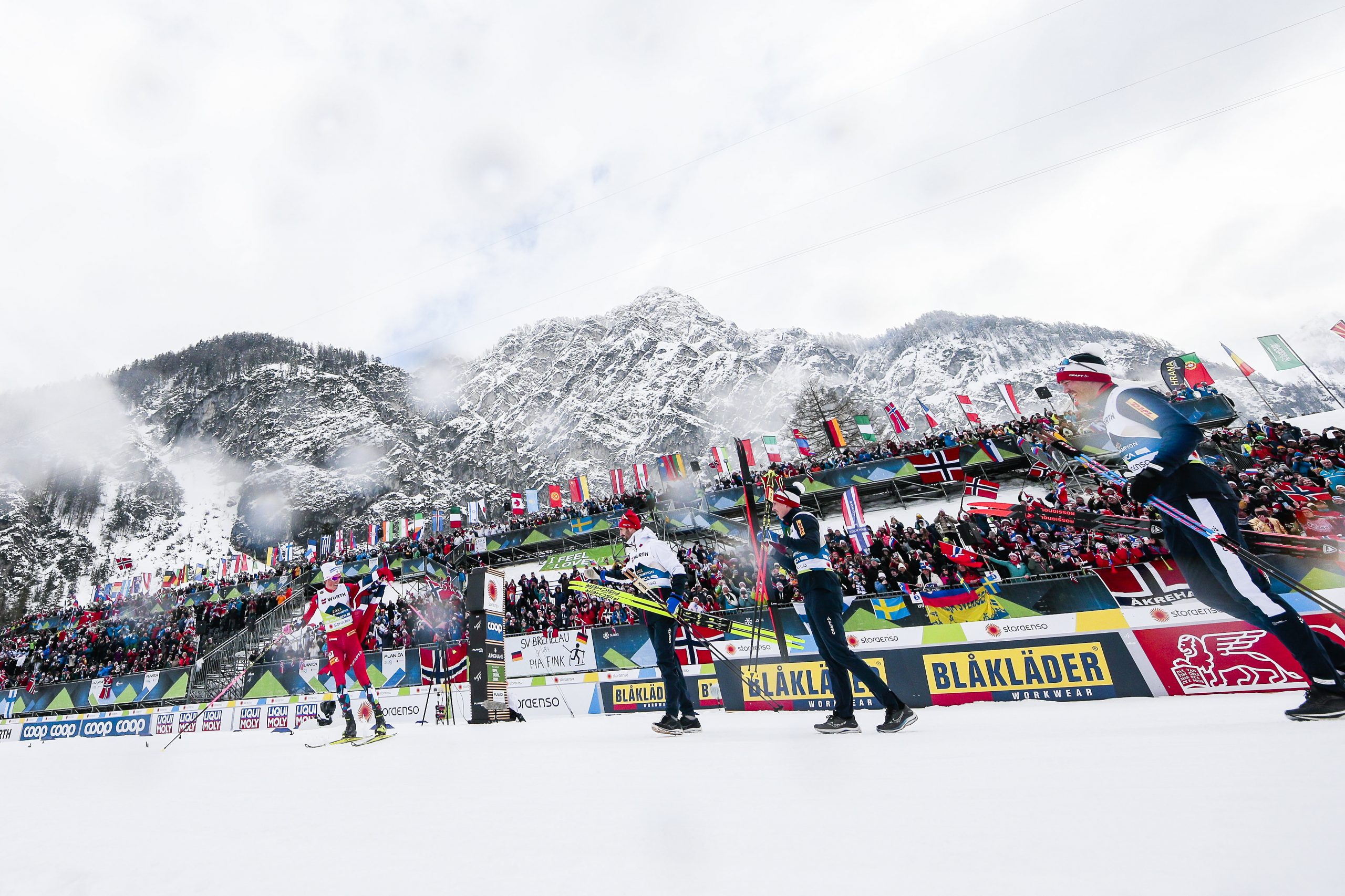
    Foregone conclusion: Norway alone at the finish line. Johannes Hoesflot Klaebo (NOR), Hans Christer Holund (NOR), Paal Golberg (NOR), and Simen Hegstad Krueger (NOR) celebrate another Norwegian win in the Men’s Relay at the FIS World Championships in Planica, Slovenia. (Photo:  Modica/NordicFocus)

    In sport, sometimes “foregone conclusions” prove to have been premature; that can make for exciting racing. At other times, foregone conclusions prove accurately prescient; that makes for situations in which the anticipation of action and drama is entirely spoiled. In Planica, Slovenia, Team Norway spoiled (predictably) the excitement of the World Championship Men’s Relay, winning gold well ahead of second place Finland and third place Germany. Foregone conclusion, indeed . . .

    North American teams were well represented in the relay field, with Canada holding its position in the group of medal contenders throughout the day by virtue of fine skiing by Xavier McKeever, Graham Ritchie, Antoine Cyr, and Olivier Leveille. They would finish fifth. Team USA’s performance was highlighted by the heroic classic skiing of Ben Ogden (he led the chase group for much of Leg 1), but that advantage would be undone in Leg 2, with later skiers being left with no chance to overcome the deficit. Team USA would finish seventh.
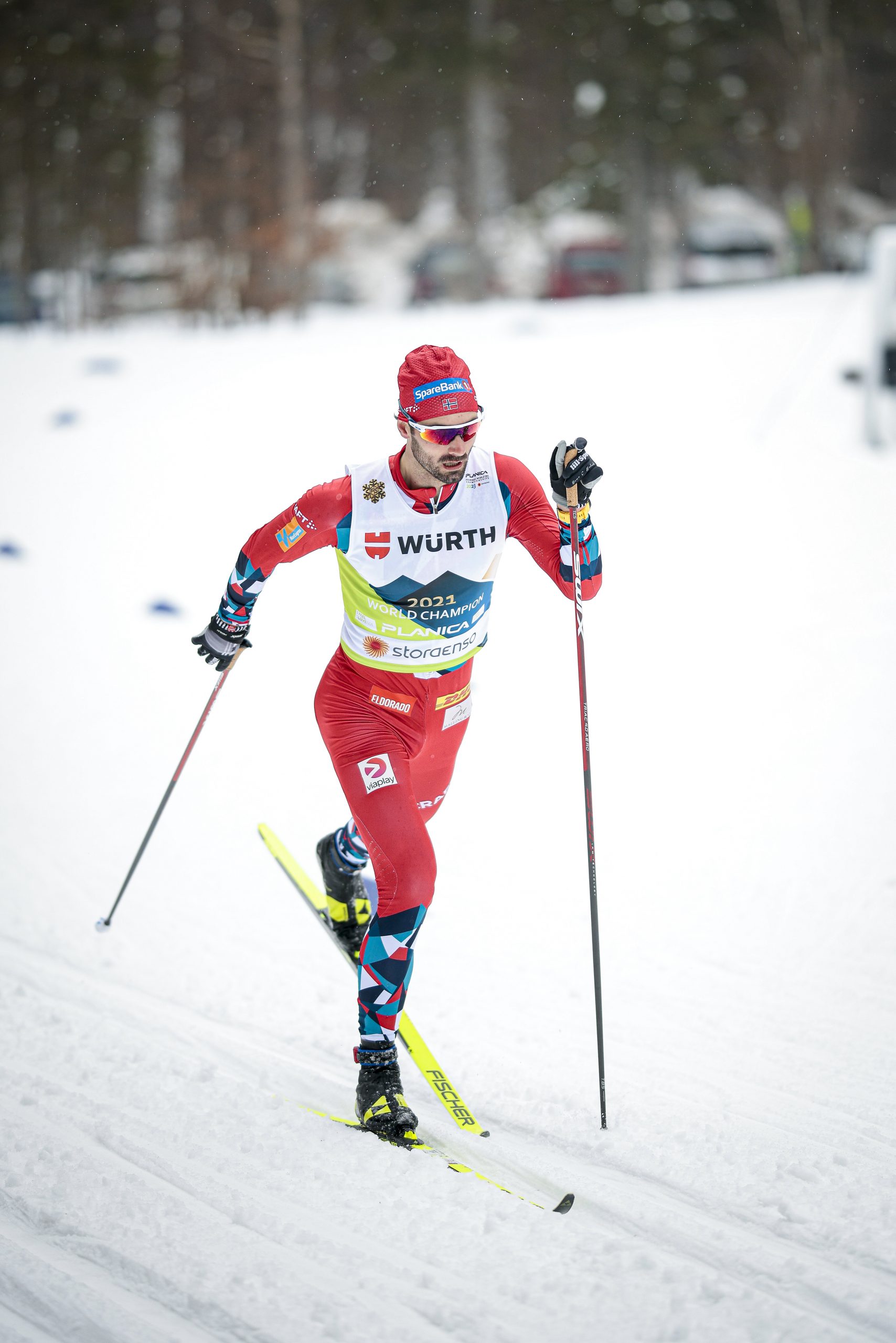
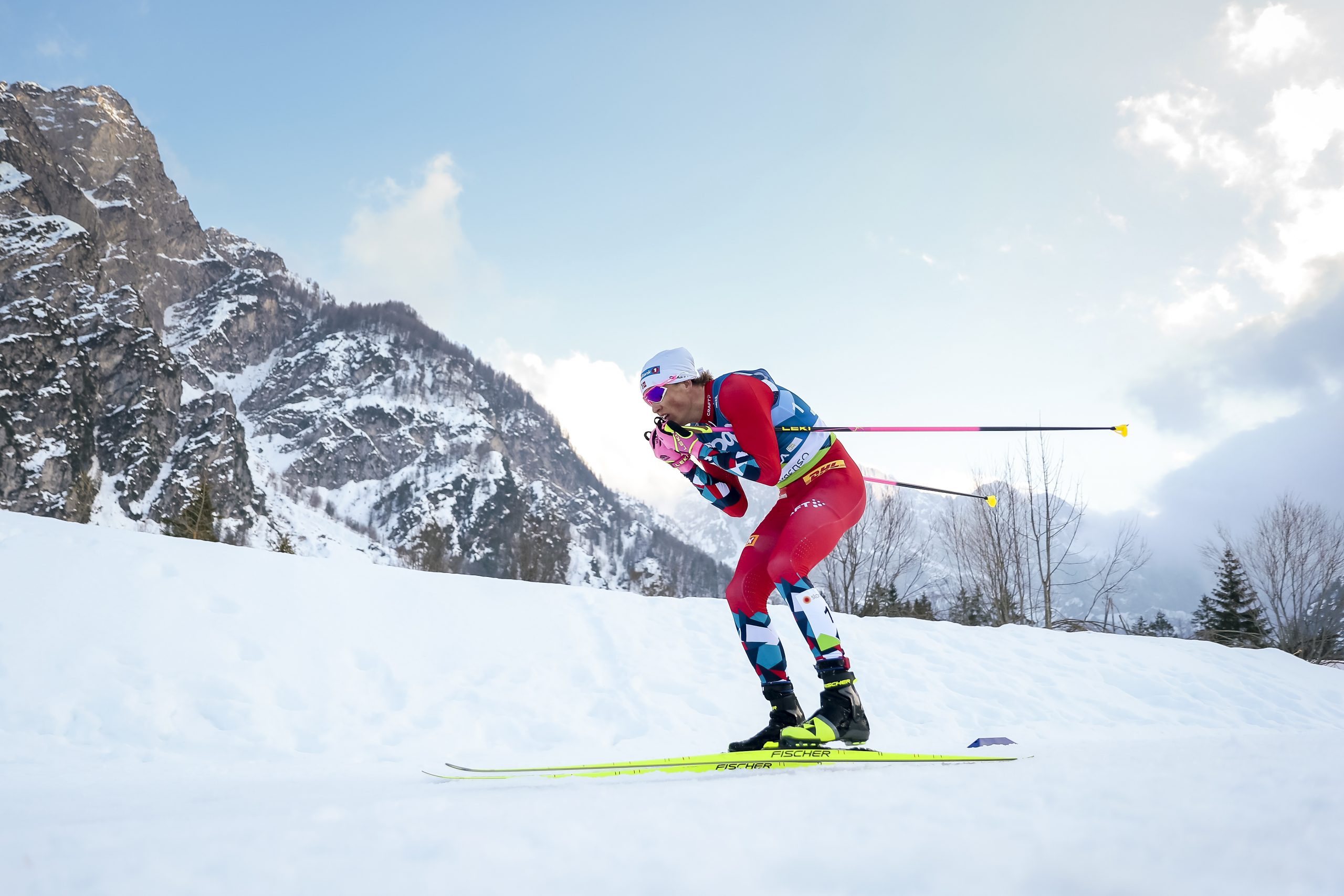
    Alone from the start: the dominating first classic leg skied by Hans Christer Holund (NOR) all but decided the race’s outcome. (Photo: Modica/NordicFocus)

    As is so often the case, the story at the front of the field was Norway . . . though even television broadcast cameras paid little attention to them. It’s not Norway’s fault that they dominate so completely; it’s not Norway’s fault that they win with such apparent ease. They appear so confident, so self-assured. But in the hours before the race, there was plenty of tension, indeed. The forecast for the day—snow then not snow, rain then not rain— elicited considerable worry among those responsible for ski preparation. If the forecasts came true, the classic legs could’ve become a horrible, unpredictable mess.

    “If it rains for real, we gotta be on klister,” American, Ben Ogden, told FasterSkier’s Nat Herz. “If it snows for real, we gotta be on zeroes, and if it does this mixed [stuff], then we don’t know!”

    Had the snow fallen, had the rains come, then athletic superiority (which Norway possesses in spades) potentially could’ve been undone. It’s been known to happen before . . . In the end, the threats of those earlier forecasts never materialized. The skies over Planica remained gray and temperatures remained relatively warm, but neither snow nor rain ever materialized. Skiers utilized a variety of ski prep tactics (Ogden skied on zeroes while many others chose klister); regardless, most seemed to benefit from both good glide and sufficient kick. The race didn’t come down to technological superiority . . . it remained a case of athletic superiority. Probably no one was more relieved than Norway. There was a lot more tension surrounding this event in the pre-race hours than there was during the race, itself. Once the starter’s pistol sounded, things were decided pretty quickly. Hans Christer Holund (NOR) made sure of that.
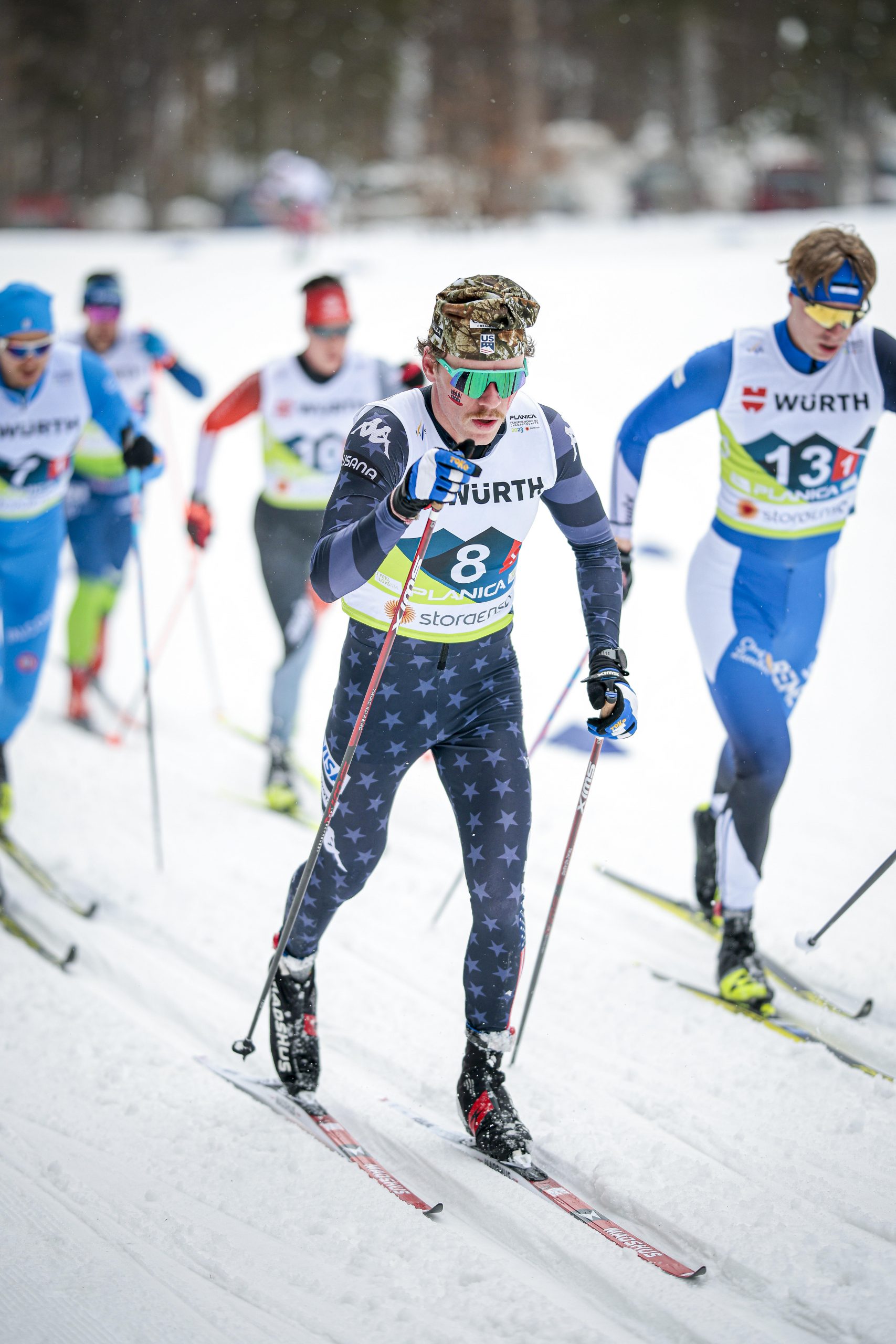
    Ben Ogden (USA) would ski a brilliant scramble leg, driving the pace of the chase group through much of the first leg. (Photo: NordicFocus)
    Men’s 4 x 10 k Relay

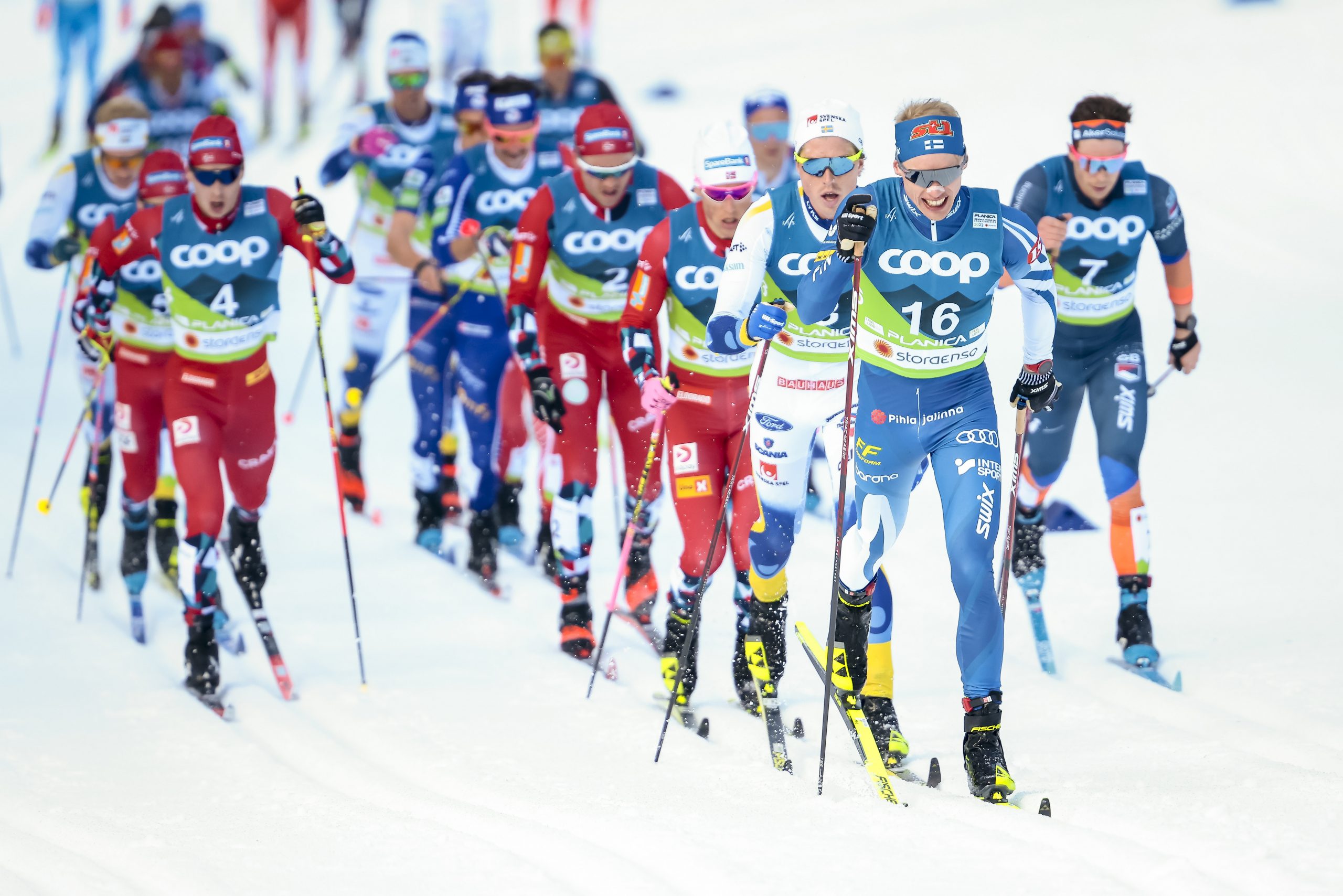
    Holund got away almost immediately: Norway wouldn’t be a part of this relay story again until they crossed the finish line well ahead of all other teams. Behind Holund, though, the race played out in ways that were both predictable and surprising. Unlike yesterday’s Women’s relay in which each skier raced a single 7.5 k lap, the Men’s relay course offered each skier a pair of five-kilometer laps. Within that format, it was in the chase group where the action took place.

    Ogden—jauntily sporting a camo-print US Ski Team hat, but not (visibly) wearing the normally-expected USA Team Relay socks—pushed the pace through most of the first leg. “It was a bit frantic at the beginning,” Ogden said. “The first time up the big hill, I had…a moment of ‘I could go get [Holund], but it would’ve been SO disastrous. In a 4 x 10 k, you gotta remember it’s still a distance race!”
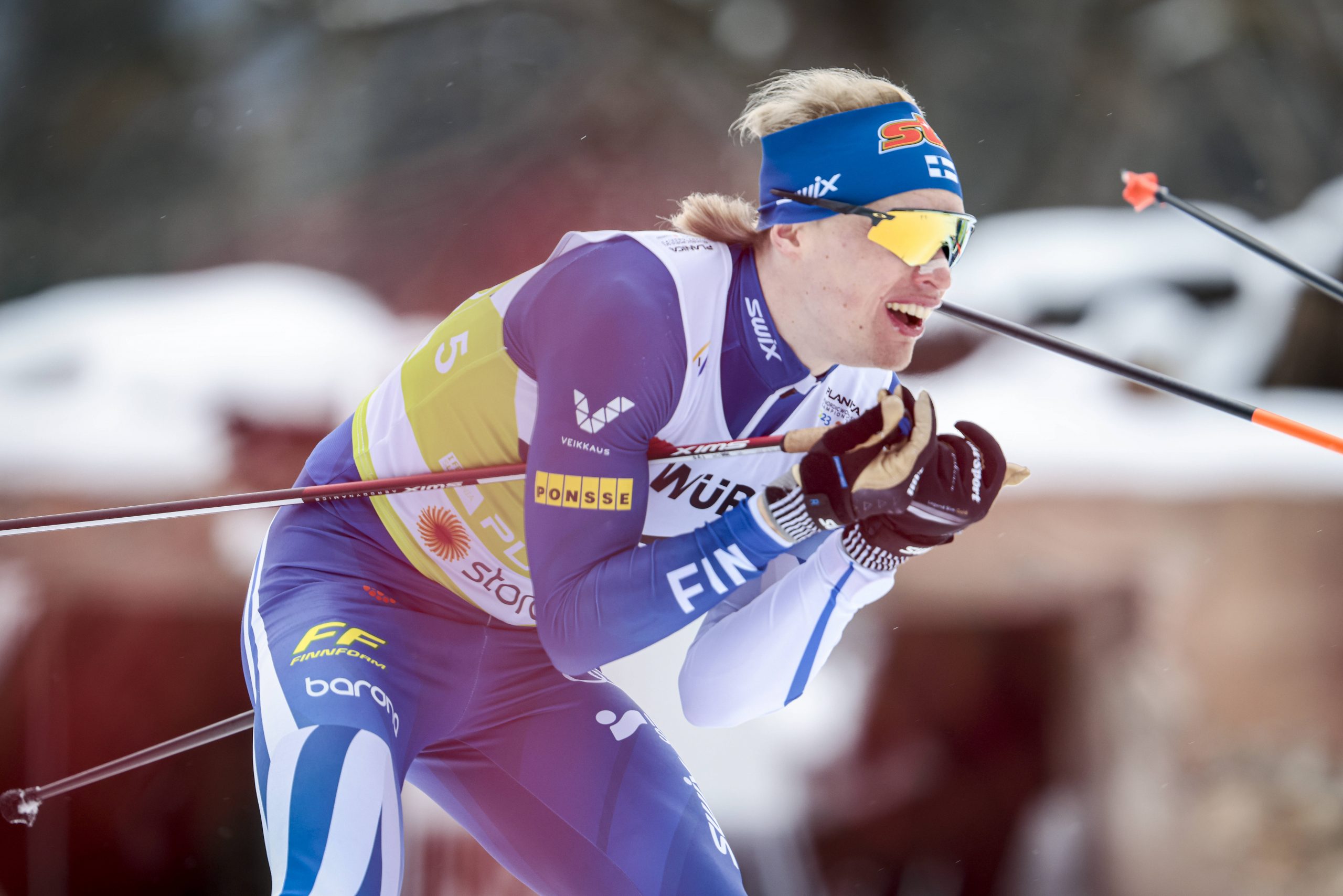
    After Holund’s Leg 1 escape, Iivo Niskanen (FIN) was the animator in the chase group in Leg 2. His acceleration dropped the group, and set up Finland’s uncontested run to the silver medal. (Photo: Modica/NordicFocus)

    Leg 2 was marked by the emergence of classic specialist, Iivo Niskanen (FIN), whose second lap surge separated his team from the others. Niskanen quickly established a considerable gap as the chase group behind him dwindled. American, Hunter Wonders, found himself dropped from the chase group: the USA would fall from contention, and Team Finland would not be challenged for the silver medal again. Likewise, Germany found itself gapped in these middle laps, but a late-race slowing of the chase group’s pace would allow Friedrich Moch (GER) to catch back on. His brave efforts would ultimately prove crucial to Germany securing a surprising bronze medal.

    Ultimately, Norway (anchored by an easy-skiing Johannes Hoesflot Klaebo who had ample time to collect a Norwegian flag in his celebratory stroll down the homestretch) would win by nearly a minute, followed by Niko Antolla of Finland in second. Germany’s courageous Moch outsprinted Jules Lapierre (FRA) for bronze.
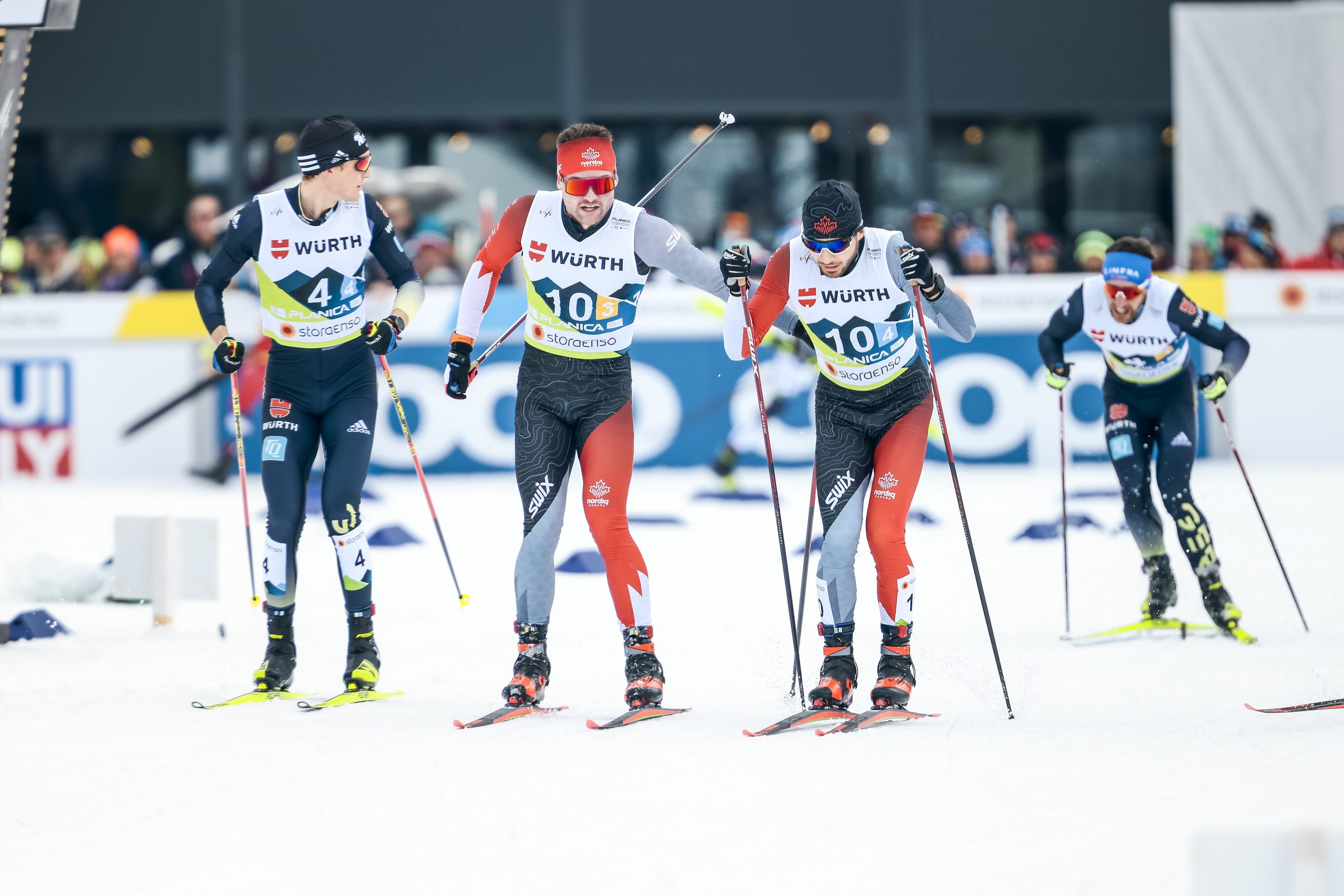
    Team Canada’s Graham Ritchie tags Olivier Leveille ahead of eventual bronze medalist, Germany. (Photo: Modica/NordicFocus)

    Team Canada remained in contention throughout the day—ultimately finishing fifth—boding well for the future development of this young team.  “[It was] definitely a different experience,” said McKeever. “Being at the front…fighting for a medal.”

    Men’s Relay RESULTS

    Not everything transpired entirely according to pre-race predictions: Team Germany—Janosch Brugger (GER), Friedrich Moch (GER), Jonas Dobler (GER), Albert Kuchler (GER)—celebrates a surprising bronze medal. (Photo: Thibaut/NordicFocus)
  • Only Norway—Krueger Leads Sweep of 30 k Skiathlon Ahead of Klaebo and Roethe

    Only Norway—Krueger Leads Sweep of 30 k Skiathlon Ahead of Klaebo and Roethe

    This World Cup coverage is made possible through the generous support of Marty and Kathy Hall and A Hall Mark of Excellence Award. To learn more about A Hall Mark of Excellence Award, or to learn how you can support FasterSkier’s coverage, please contact info@fasterskier.com. 

    Simen Hegstad Krueger (NOR) celebrates as he crosses the finish line as World Champion in the 30 k Skiathlon in Planica, Slovenia. (Photo: Modica/NordicFocus)

    Thirty kilometers is a long way to race. It’s the sort of distance that recreational skiers race as a “marathon,” the kind of overlong race effort from which mere mortals take weeks to recover. Coming so near the beginning of a 12-day World Championship schedule, a race of this length —one raced with such intensity and under such challenging and difficult conditions—is likely to have a profound effect on all the races to come. If the rest of the field could have peered into the future—could’ve seen what Simen Hegstad Krueger (NOR) was capable of in today’s Skiathlon—they might never have committed so much energy and passion to this race. Krueger—the reigning Olympic Champion in the event (and silver medalist from the last World Championships)—was never going to be denied. Not today . . .

    Simen Hegstad Krueger is sublimely glad he toed the starting line today: he claimed the victory with a dominating performance in the second half (the freestyle half) of the 30 k Skiathlon. Johannes Hoesflot Klaebo (NOR) and Sjur Roethe (NOR), the silver and bronze medalists, might also be relatively glad they raced today, though they may also have spent so much energy that their remaining races at the World Championships are likely to be affected. And everybody else? Those who earned no medals may be questioning whether racing this distance—at such an extraordinarily high measure of effort, through such challenging and difficult conditions—was really worth it.

    Iivo Niskanen (FIN) led William Poromaa (SWE) for much of the classic leg, only to find himself undone by the way the pace increased after the classic-to-freestyle transition. (Photo: Modica/NordicFocus)

    If he had advance knowledge of the way things would turn out, Iivo Niskanen (FIN) might never have surged to the front in the classic leg; William Poromaa (SWE) might never have pushed the pace; Calle Halfvarsson (SWE) might never have stuck his nose out into the wind; Andrew Musgrave (GBR) might never have worked so hard to be near the front; Paal Golberg (NOR) might have saved his energy for another day (or for another week in his season-long race with Klaebo the the World Cup Overall crystal globe). Even bronze medalist, Roethe might have hesitated before committing so much in a race for silver that he would ultimately lose to the world’s best sprinter.

    Even the North Americans might’ve raced differently if they knew what levels of exhaustion the race would bring. Scott Patterson raced hard, holding his position through much of the day. He would finish a respectable 19th, ahead of his American teammates Hunter Wonders (24th), and Gus Schumacher (38th). Patterson confided that while a top-20 at World Championships is good, he had hoped for more. “I finished up 19th, which was okay,” he said. “When I’ve been top 10, I definitely wanted a little more today.” Canadian finishers included Russell Kennedy (37th), Olivier Leveille (43rd) and Xavier McKeever (44th).

    Thirty kilometers is a long way to race; probably every competitor leaves this race shattered, exhausted, cramping (as even race winner, Krueger, admitted he was). The twelve days of the FIS Cross Country World Championships is a grind. Racing takes place almost every day . . . even after thirty grueling kilometers, there are still ten more days of World Championships still to ski.

    William Poromaa (SWE), Jules Lapierre (FRA), Paal Golberg (NOR), (l-r) in the freestyle leg. The difficult conditions—and the hot pace set by eventual race winner, Simen Hegstad Krueger—exhausted even the most talented and qualified contenders. (Photo: Modica/NordicFocus)
    Men’s 30 k Skiathlon

    Planica, Slovenia occupies a beautiful corner of Europe’s mountain ranges, and the weather this week is a ski-vacationers dream. Ironic, then, that the very same weather is a wax technician’s nightmare. Sunny and warm, transitioning the snow between heats, changing the conditions even within the timeframe of an ongoing race. At the start of today’s skiathlon, race announcer, Kikkan Randall, mentioned, “You can already hear the snow . . . with a late-afternoon start, you can almost get a freezing effect. The snow can actually be pretty fast.”

    The classic half of the Skiathlon indeed started out fast. The course began as a steady downhill; Klaebo stayed at the front and out of trouble (shadowed by his teammates Golberg and Krueger, and the Swedish stars, Calle Halfvarsson and William Poromaa). The classic leg was simple:  Finland and Sweden kept the pace fast, contenders stay tucked in the field, and Klaebo picked up ground on every downhill. It looks like great fun to ski a mass start event the way Klaebo does, and certainly his wax technicians and ski suppliers have something to do with that. But that doesn’t mean he can just float along effortlessly. The other racers have a say in the pace, as well . . . and none of them wanted to make it easy for Klaebo.

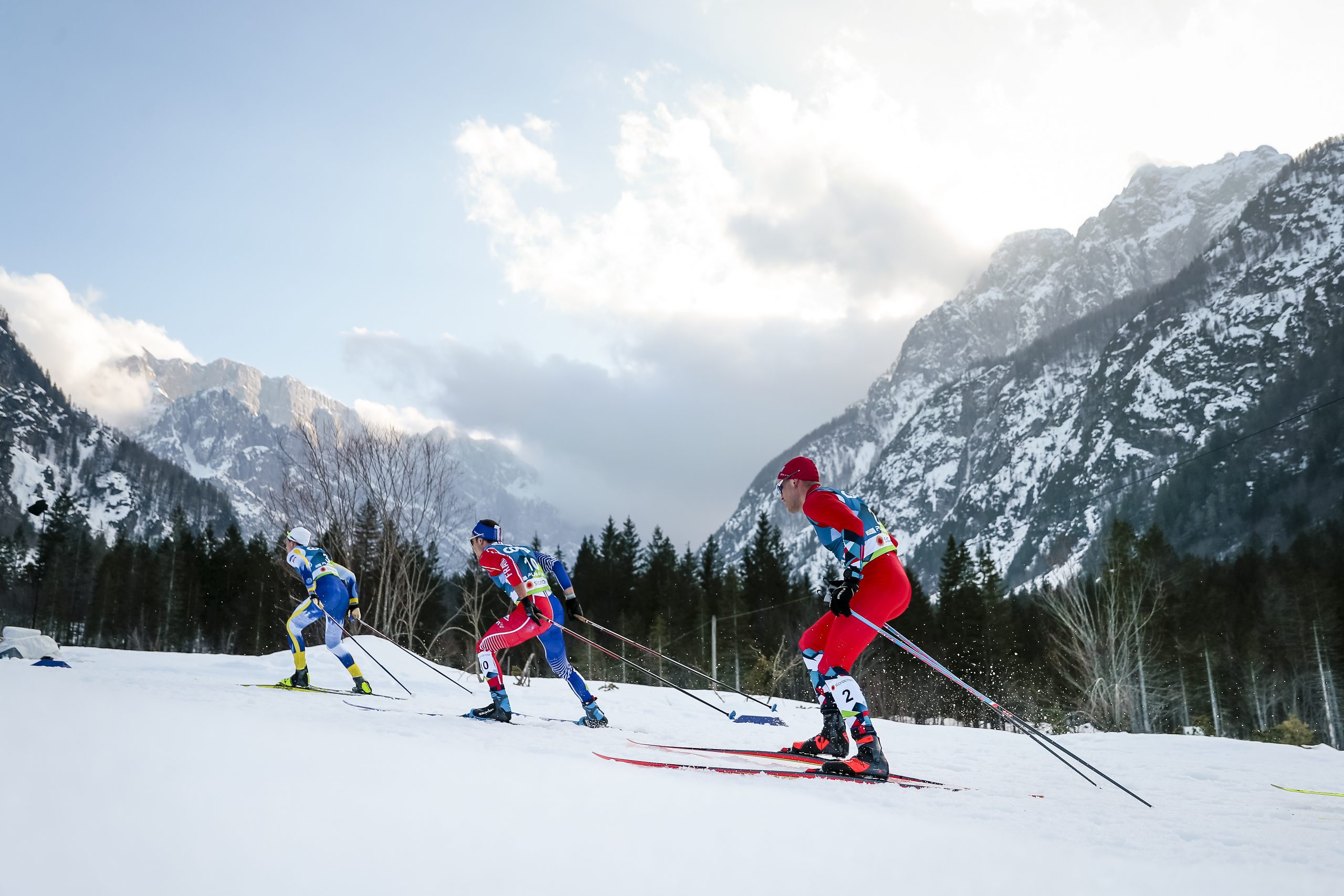
    Niskanen moved to the front as the pace-maker at the end of Lap 1. By Lap 2, his efforts had begun to string out the field: Niskanen followed by Poromaa, Musgrave, and the entire kingdom of Norway. At the beginning of Lap 3 the field split, with Americans Patterson and Wonders being gapped. Klaebo continued using each downhill to adjust his position within the lead pack, gliding and stepping past the pace-makers, and forcing them to accelerate back to the front at the base of each uphill, particularly in Lap 3 as it appeared that many other racers’ skis were beginning to drag.

    At the beginning of Lap 4, everyone looked over their shoulders to check the field, a momentary pause in the action that allowed the remarkable efforts of lone chaser, Esteve Altimiras (AND) to catch back on to the back of the lead group. He’d been bravely chasing for two laps while Finns and Swedes pushed the pace at the front, and this Lap 4 truce allowed the lead pack to settle as a group of 15. The truce would not last for long.

    Johannes Hoesflot Klaebo (NOR) was forced to do his own work for most of the freestyle leg. His determined chase of teammate Sjur Roethe (NOR) earned him yet another World Championships medal, this one a silver. (Photo: Modica/NordicFocus)
    Classic to Skate Transition

    The mid-point of the Skiathlon (15 k) is where skiers switch from classic skis/poles to freestyle skis/poles, a transition that they practice in anticipation of these races. Take too long in transition, and a skier can find himself gapped . . . even the best skiers . . . even Klaebo. Klaebo flubbed the transition, exiting at the rear of the lead pack, but he seemed untroubled. If he’d known what kind of acceleration Krueger was about to throw in, Klaebo would have hurried the transition a bit.

    Roethe exited the transition first with a considerable lead, followed by Krueger, Jules Lapierre (FRA), Roethe, Krueger, and Poromaa. Klaebo followed Golberg who would drag them both back to the chase pack. Once Klaebo got there, his prospects appeared obvious: sit in and let others work, which would probably give him an easier day, and allow him to sprint for the bronze medal. As it turns out, bronze is not enough for Klaebo, and he seemed to quickly assess that none of his companions was willing to pull him back to the leaders. Poromaa wasn’t fast enough, Lapierre wasn’t fast enough, Golberg wasn’t fast enough. If Klaebo wanted to remain in contention for this Skiathlon gold medal, he’d be forced to chase the leaders down, himself. So, Klaebo set out on his own to catch the two leaders—his teammates Roethe and Krueger.

    Krueger began his surge in Lap 7, picking his way through strings of lapped skiers. He definitely appeared the sharpest, while Roethe began to visibly falter (along with Klaebo and everyone else). Even so, Roethe continued gamely working each uphill, while Klaebo drove, faded, recovered, and drove again. The top three showed their class, their fitness, and their courage. At the end of a 30 k Skiathlon, there really is no place to hide. Klaebo was really forced to work for silver, which he stole from the courageous Roethe in the final kilometer. The efforts committed by the medal winners in this race could conceivably change the whole championships. Today, under the sunny skies of Planica, Slovenia, each of these champions appeared willing to pay that price.

    Men’s 30 k Skiathlon RESULTS

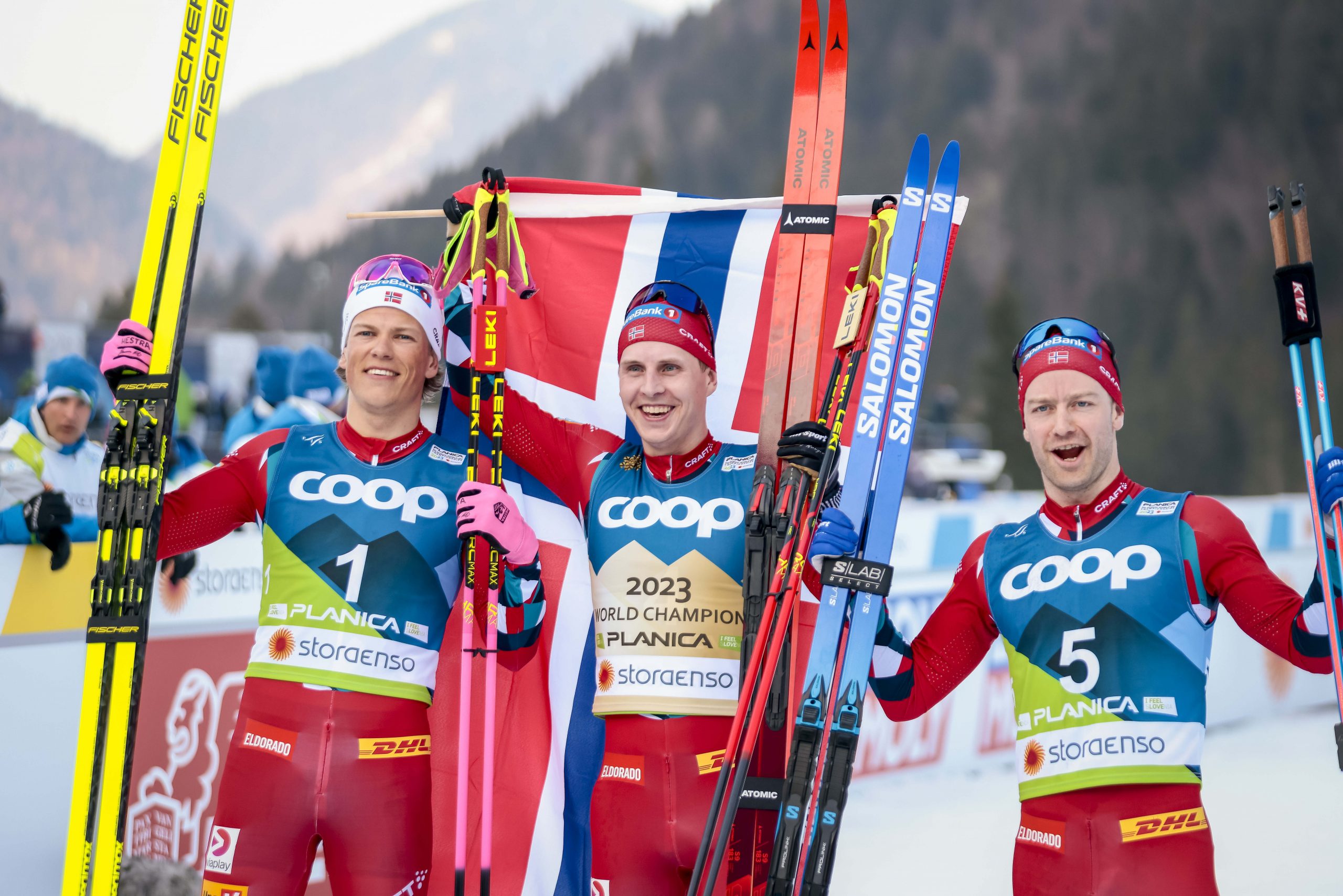
    Only Norway on the podium: (l-r) Johannes Hoesflot Klaebo (NOR), Simen Hegstad Krueger (NOR), Sjur Roethe (NOR). (Photo: Modica/NordicFocus)