From the FasterSkier archive — posts syndicated from athletes’ and coaches’ own blogs between 2004 and 2012, kept online as published. Current coverage is at fasterskier.com.

Tag: 2024 Tour de Ski

  • International Flair at Tour de Ski—Amundsen, Moch, Lapalus

    International Flair at Tour de Ski—Amundsen, Moch, Lapalus

    This coverage is made possible through the generous support of Marty and Kathy Hall and A Hall Mark of Excellence Award. To learn more about A Hall Mark of Excellence Award, or to learn how you can support FasterSkier’s coverage, please contact info@fasterskier.com.
    The unrelenting slopes of Alpe Cermis challenged Norwegian dominance, as France’s Jules Lapierre emerged to triumph in the final stage of the 2024 Tour de Ski. (Photo:  Modica/NordicFocus)

    The origin story of the Tour de Ski suggests that it was invented to mirror cycling’s Tour de France: multiple stages, mountaintop finishes, leader’s jerseys, thrilling competitions, glorious champions. Today’s Stage 7 of the Tour de Ski—with its finish on the high summit of Alpe Cermis— is probably what the original race organizers had in mind. Helicopters hovered over the point-to-point course that wound its way through historic ski-venues in the Val di Fiemme. At the 2.4 kilometer mark, the still-flat course wound into the stadium of Val-d’Isére (where the first Bonus Sprint in the Alpe Cermis stage would be decided). Then, following the course of the Marcia Longa—Italy’s famous ski marathon—the course traveled to the base of the Alpe Cermis Alpine resort.

    The day had begun with Amundsen holding a considerable lead in the overall standings over his countryman, Erik Valnes. Known as a good all-rounder—but really more of a sprinter—Valnes would face considerable challenges to his desire to remain on the Tour de Ski podium, as he was trailed in the standings by other skiers whose pedigrees spoke of greater climbing abilities. Martin Loewstroem Nyenget (NOR) sat only eight seconds behind Valnes, with talented climbers, Hugo Lapalus (FRA) and Friedrich Moch (GER) only another few seconds behind. The battle for podium spots would be furious and painful, with rewards and accolades for those brave enough to climb into the clouds. Valnes would have his hands full . . .
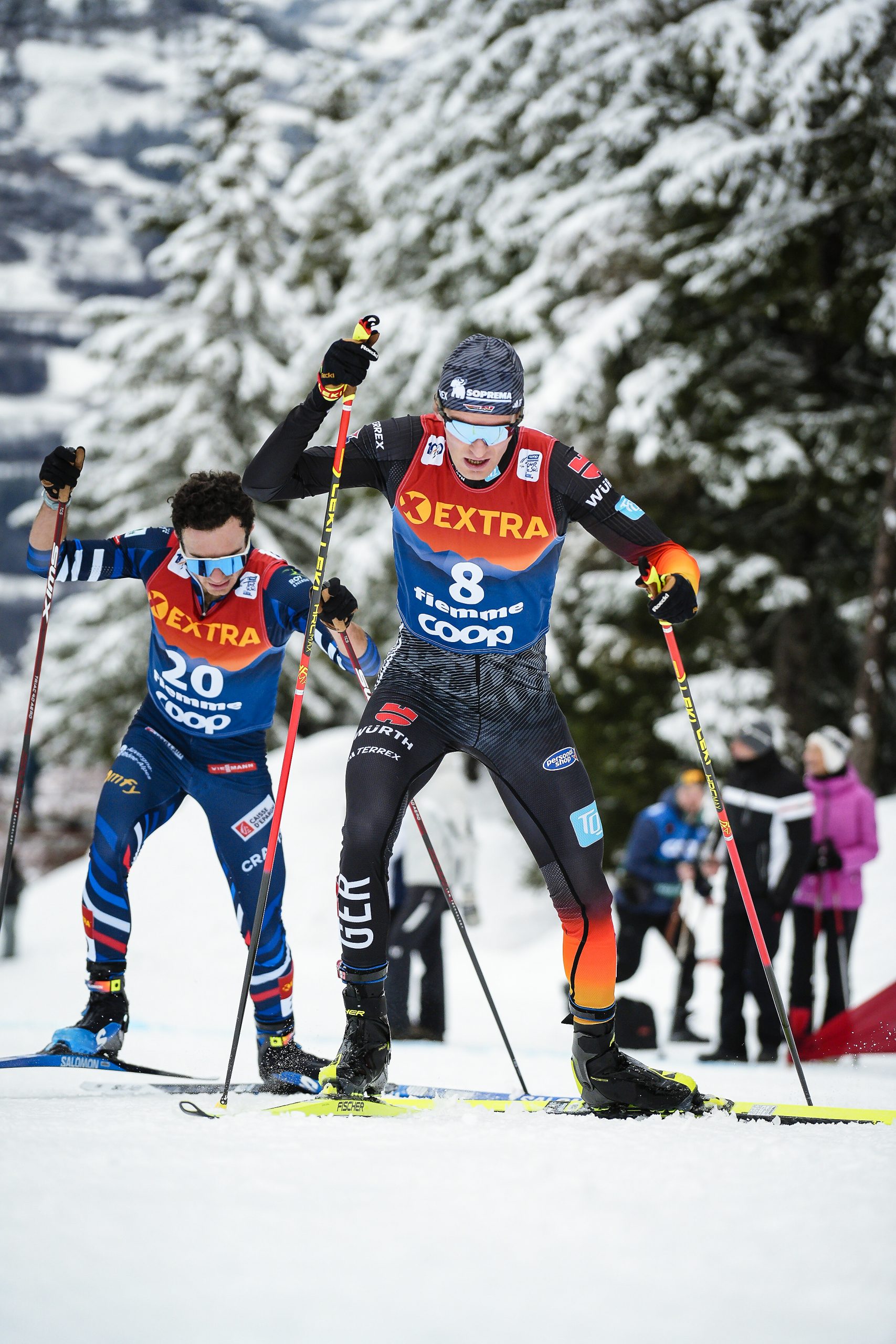
    Germany’s Friedrich Moch led Jules Lapierre (FRA) through most of the climb up Alpe Cermis, though it was Lapierre who would sprint clear for the stage win. (Photo: Barbieri/NordicFocus)
    Stage 7, Alpe Cermis

    Bonus Points Leader, Lucas Chanavat (FRA), toed the starting line after a number of less-than-stellar stages in which he would win sprint points, then ease along the course to the finish well out of contention. In the early kilometers of the Alpe Cermis stage, Chanavat led the pack toward the first Bonus Points sprint at 2.4 kilometers, hoping to secure his hold on the Points Jersey before the real climb of the day would begin. Though nipped at the line by sprint-rival, Edvin Anger (SWE), Chanavat would collect enough points to secure the victory in the points competition. Ironically, he would be required to finish the stage at the top of Alpe Cermis’ long climb in order to claim the distinction, and to collect the winner’s spoils. It would be a long day of climbing for the sprinter, Chanavat.

    After the Points Bonus sprint, it was the skier sitting in 26th place overall—Haavard Solaas Taugboel (NOR)—who went to the front to make pace. Commentators speculated on the possibility that Team Norway was tactically using lower-placed skiers to protect the lead of Amundsen, Valnes, and Nyenget. There was one last Points sprint at 6.8 kilometers (at the base of the climb), but by that time Amundsen had already gone to the front. He took the points that Chanavat and Anger coveted, seemingly determined to begin the climb in earnest. Final standings in the Points competition: Chanavat, Anger, Valnes, Amundsen, and Antoine Cyr (CAN).

    Amundsen led the field on the lower slopes of the climb, though with no real sense of urgency. In season’s past, much of the low part of the climb was defined by athletes propelling themselves via V2, maintaining that faster, more costly technique for as long as they could in attempts to break the field. Typically the last skier using the V2 was the one who would create gaps in the field and put themselves in position to win the day. Today, however, Amundsen dropped into the V1 early on, allowing a group of rivals to remain on his heels. That group settled into a lead pack of seven:  Amundsen, Nyenget, Friedrich Moch (GER), Mika Vermuelen (AUT), Jules Lapierre (FRA), Hugo Lapalus (FRA), and Beda Klee (SUI). Valnes was nowhere to be seen. The battle for podium positions began . . .

    And the course steepened: 26.5 percent (that’s steep). Klee was dropped: lead group reduced to six.

    Mika Vermeulen powered to the front as Amundsen and Nyenget faded to the rear of the lead group. By this time, Valnes had already ceded his second place position to Nyenget in the virtual Tour standings. Other podium contenders pushed to the front, fighting it out for podium places, mostly at the expense of Amundsen and a visibly-tiring Nyenget who dangled just off the back.

    With every change in pitch, a different contender would appear at the front. Finally, Moch took the lead as the group entered the tightest switchbacks, driving around each direction-change with Lapierre hard on his heels. Next in line—head down, but tempo high—Lapalus followed his countryman while Amundsen and Vermeulen settled in. Nyenget was gapped: lead group reduced to five.

    Moch and Lapierre ratcheted up the pace. Little bit by little bit, gaps opened behind them.  Lapalus watched his own ski tips, Amundsen (overall victory already in sight) marked the gaps, Vermeulen atttempted damage control: lead group reduced to two.

    Farther down the mountain, Valnes struggled; his podium position all but gone as his rivals for the podium—Lapalus and Moch—drove forward.

    Moch and Lapierre continue to show spark in their steps as they entered another 28 percent grade (murderous!). In their wake, Lapalus powered on alone (eyes still down). Amundsen and Vermeulen appeared bound to one another in their fatigue (battling to hold their positions rather than determined to drive forward). Nyenget suffered alone in no-man’s land, while resurgent Klee and Jens Burman (SWE) gave chase. Somewhere farther down the mountain, Valnes toiled in obscurity.

    The Alpe Cermis levels a bit in the final kilometer, requiring racers to shift gears, yet again. It’s a point where a different set of athletic/physiological abilities comes into play. Thirty minutes into the race, Moch and Lapierre exited the steepest sections of the climb, both breaking into a V2 skate as the horizon leveled. Lapierre drove forward into the lead, his tempo visibly quicker than Moch’s. Behind them (across an ever-widening gap) Lapalus stayed with the V1 in attempts to save energy, just in case he still had to deal with a charging (V2) Amundsen who seemed to have recovered some energy after his mid-climb lull.
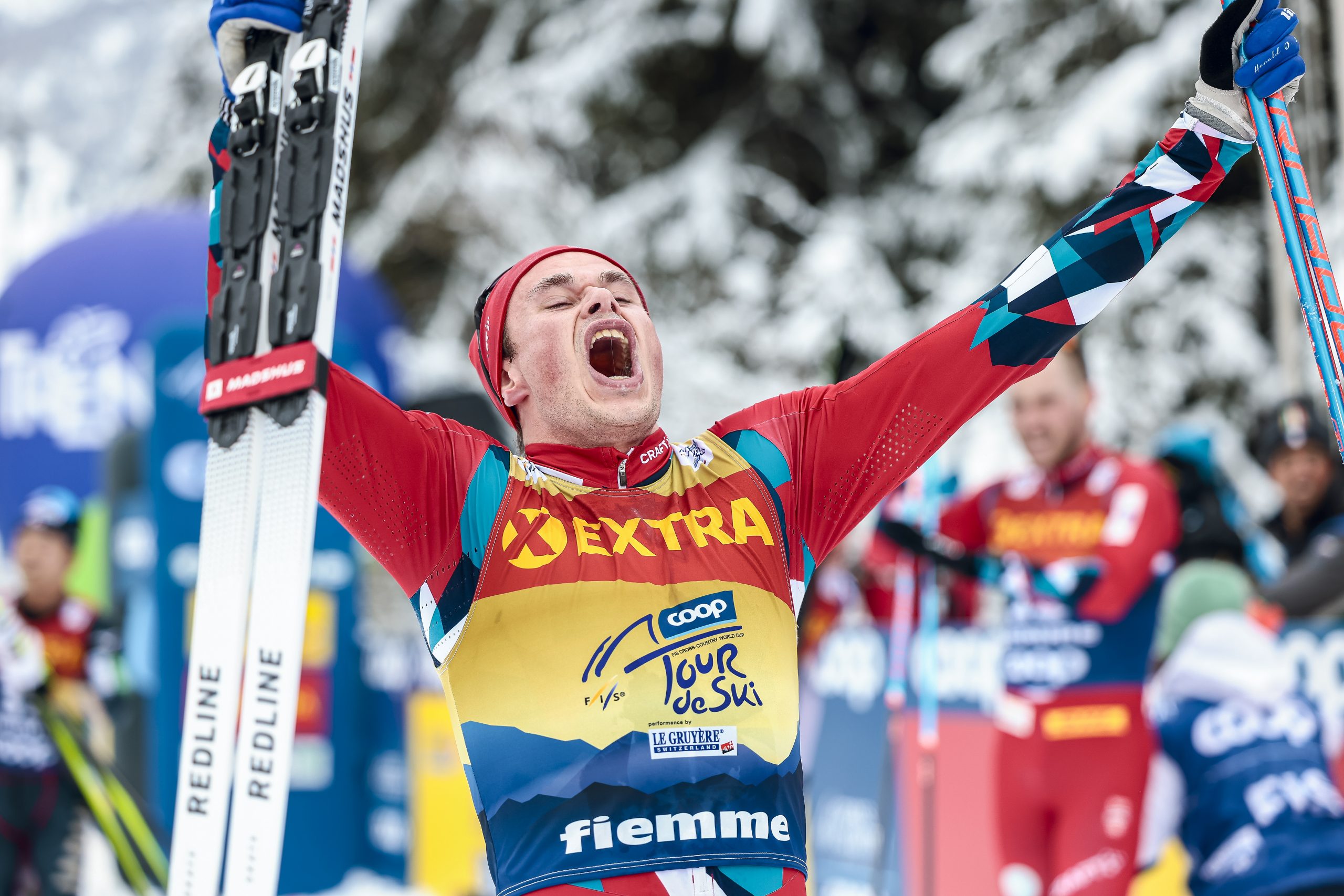
    Harald Oestberg Amundsen (NOR) climbed bravely, and quickly enough to protect his overall lead in the Tour de Ski standings. (Photo: Modica/NordicFocus)

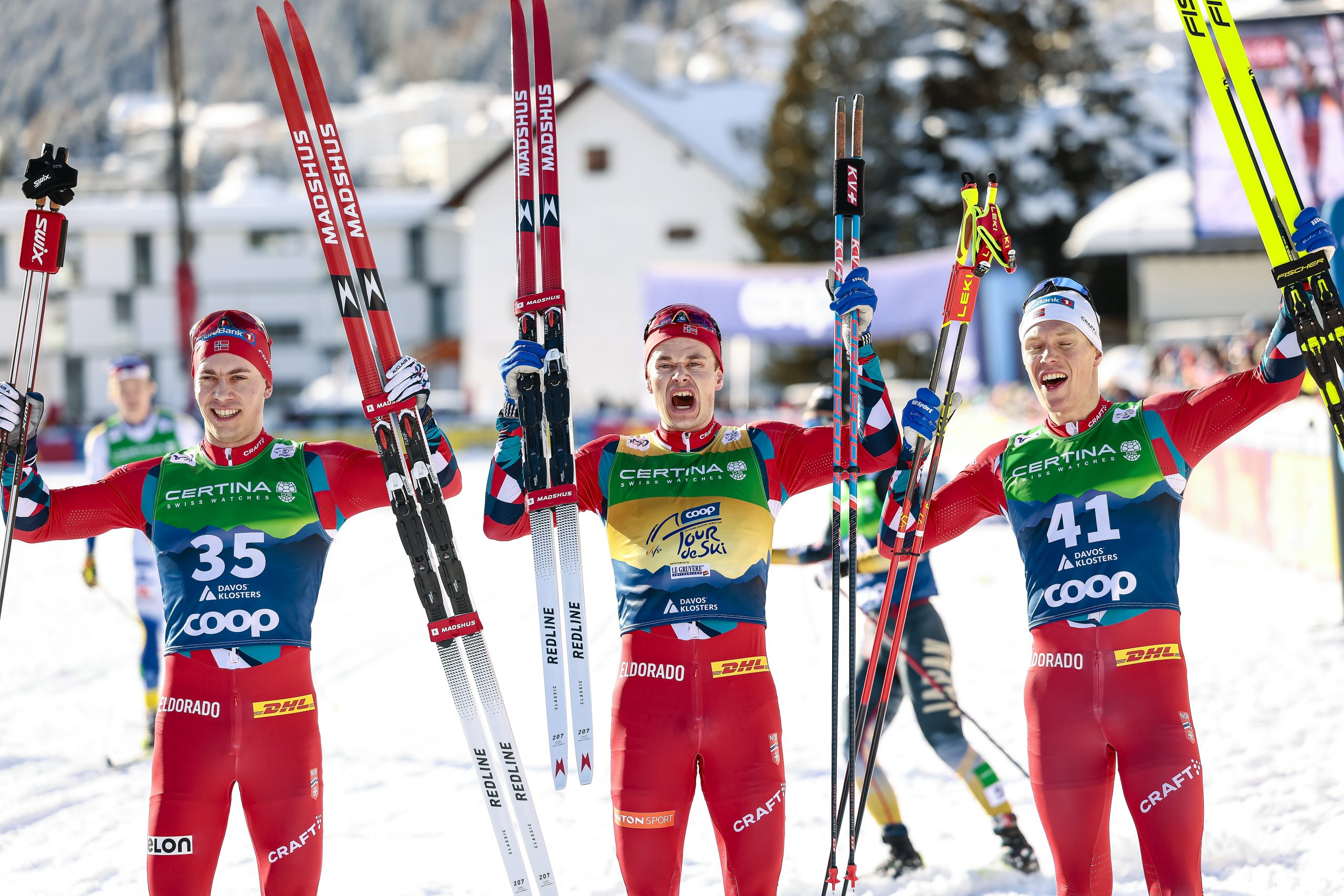
    At the finish, it was Lapierre sprinting clear of Moch, both of whom celebrated as they crossed the line. Moch knew he had skied onto the overall podium, a first for Germany since Tobias Angerer, overall winner of the first Tour de Ski in 2006/2007, finished third in the 2008/2009 tour. Lapalus finished 16 seconds behind the winner, securing his own place on the overall podium by sufficiently gapping Nyenget.

    The winner of the overall Tour de Ski—Amundsen—arrived fifteen seconds after Lapalus. Amundsen had done his job, and the biggest prize of the FIS World Cup season was his.

    Valnes finished 11th, 1:13.9 behind. All things considered, Valnes (known more for his sprinting prowess) delivered a truly impressive performance, and that in an event where careless or unfit competitors can “blow” and lose big chunks of time. Even so, he proved unable to keep pace with the climbers, and dropped from the podium into sixth overall.

    Among North American finishers, Antoine Cyr (CAN) climbed the fastest: 14th place, 1:34.2 behind the winner. Following him were Zanden McMullen (USA) 36th, Scott Patterson (USA) 42nd, and Olivier Leveille (CAN) 45th.

    Much much later, at the hard-won summit of Alpe Cermis, Chanavat crossed the line to claim the Points Championship. It’s unlikely that he’s ever skied so far or so high.

    Alpe Cermis Stage 7 RESULTS

    2024 Tour de Ski OVERALL RESULTS
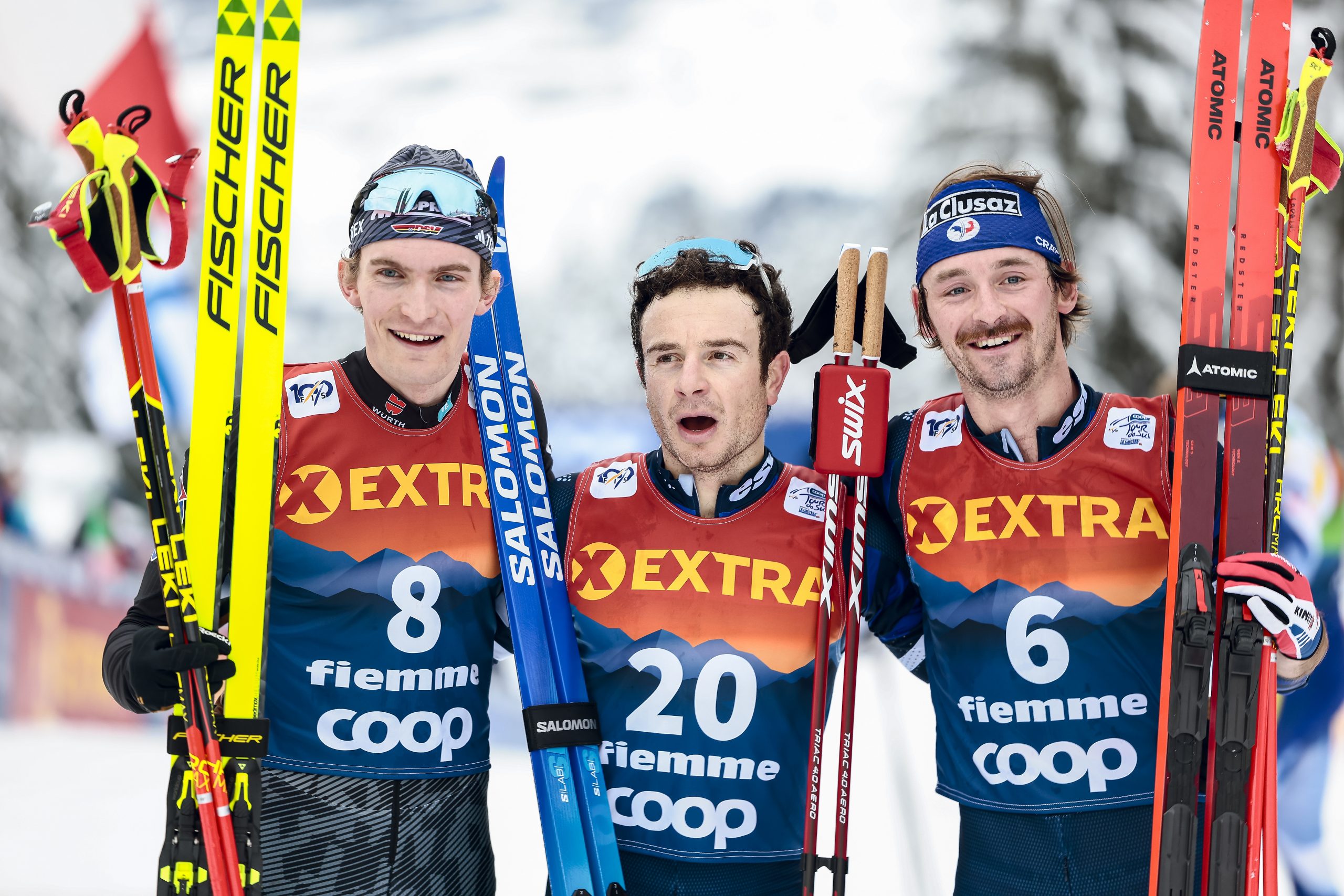
    International flair on the Stage 7 podium at the summit of Alpe Cermis: Friedrich Moch (GER), Jules Lapierre (FRA), Hugo Lapalus (FRA), (l-r) (Photo: Modica/NordicFocus)
  • Mission Accomplished in Val di Fiemme—Diggins Defends TDS Lead

    Mission Accomplished in Val di Fiemme—Diggins Defends TDS Lead

    This coverage is made possible through the generous support of Marty and Kathy Hall and A Hall Mark of Excellence Award. To learn more about A Hall Mark of Excellence Award, or to learn how you can support FasterSkier’s coverage, please contact info@fasterskier.com.

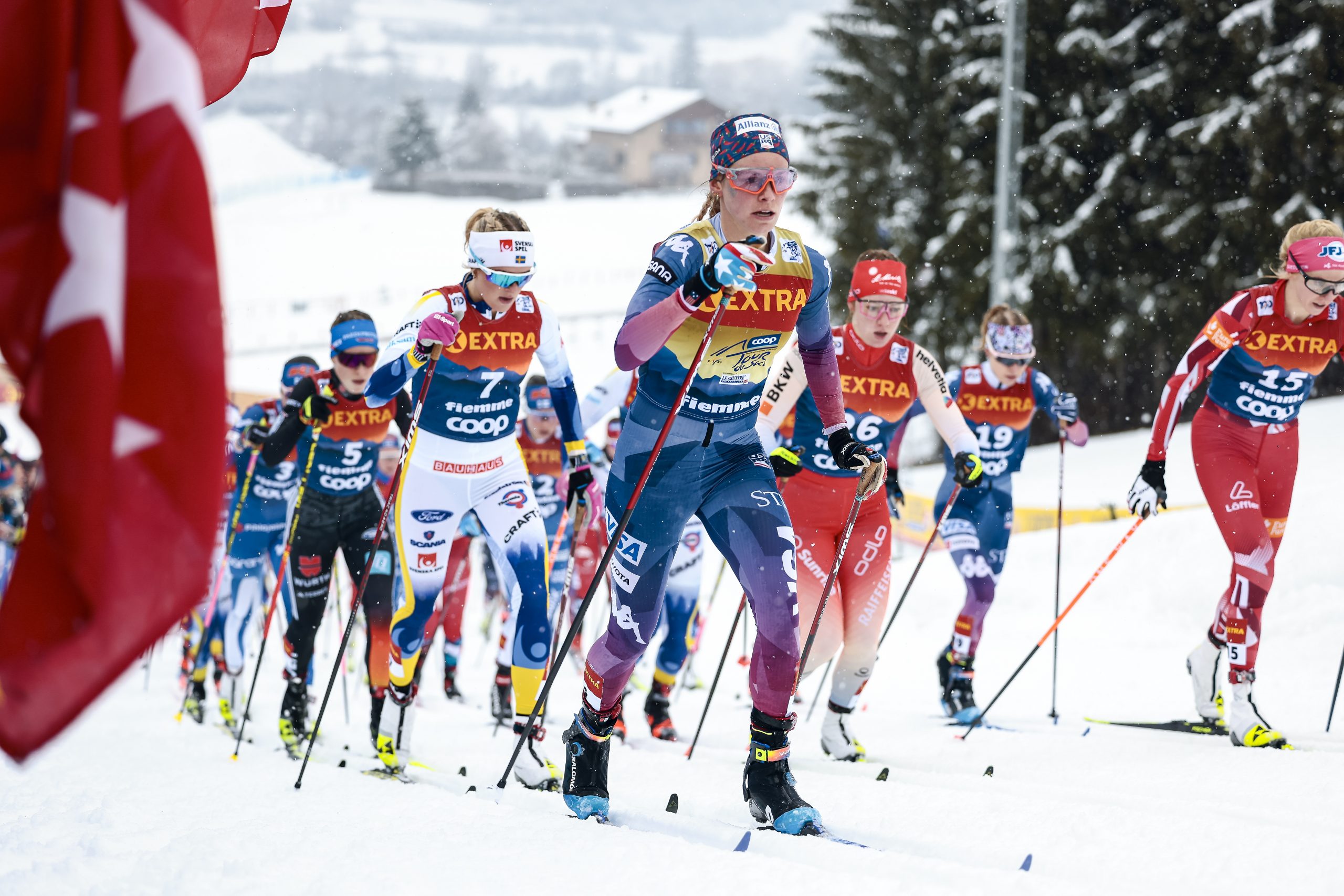
    Jessie Diggins (USA) appeared to ski defensively through much of the 15 k Classic Mass Start, protecting her overall lead, and conserving energy in anticipation of Sunday’s final stage . (Photo: Modica/NordicFocus)

    Jessie Diggins knows how to race for the win, but that wasn’t her job today. Entering Stage 6 of the 2024 Tour de Ski with a lead of 44 seconds over second place, Kerttu Niskanen (FIN), Diggins seemed likely to spend the race protecting her lead . . . especially with the truly challenging waxing conditions that greeted racers in Val di Fiemme, Italy. With snow steadily falling—and temperatures hovering near freezing—wax technicians scrambled nervously in the hours before the 15 k Class Mass Start. This would be a morning of anxious decisions—of risks and rewards—as all teams understood the consequences. Much could be lost in the Tour’s penultimate stage, but it seemed that most racers would be prevented from making up time gaps suffered in earlier stages.

    Rosie Brennan (USA) (r) raced mid-pack through the entire day, picking off other skiers one by one, and advancing from 13th to ninth in Tour de Ski overall standings. (Photo: Barbieri/NordicFocus)

    “I had a bad race [a few days ago in Toblach],” commented Rosie Brennan (USA. “That was unfortunately the day that all the time gaps were made. It was really hard to make up time gaps in the last two [classic races] . . . It’s frustrating when you have one really bad day, but everything else is kind of where you would hope, or at least not too far off. That’s definitely been a mental battle for me.”

    On a Val di Fiemme course that is often blistering-fast, optimal waxing conditions could have created a race that played out much differently. But in such slow, difficult conditions, the ambitions of those chasing Diggins were tempered by the realization that anyone who attempted to go it alone was risking being caught, and dropped, themselves. As it was, Frida Karlsson drove the pace the the last two 2.5 kilometer laps, only surrendering the lead in the closing meters to her teammate, Linn Svahn (SWE). Katharina Hennig (GER) rounded out the podium in third.

    Diggins was able to accomplish her mission on the day by simply remaining in contact with the lead group. She would finish 8th, just ahead of Brennan in 12th, and Sophia Laukli (USA) in 17th. Brennan and Laukli skied together through much of the race, with Laukli commenting on her choice to follow Brennan so closely.

    “[I] decided it would be smart to follow her because she is such a strong classic skier,” Laukli said. “I knew it’d help me out a lot. It’s always fun to ski with a teammate and work together a bit, so it was fun for me to follow her when I could.”

    Ultimately, Diggins was able to protect her lead in the overall standings. She had begun the day 44 seconds ahead of Niskanen. After today’s results, Jonna Sundling (SWE) moved up to second (43 seconds behind Diggins) where she leads her teammate, Karlsson (who sits 44 seconds behind Diggins). Kerttu Niskanen (FIN) and Svahn round out the top five in the overall standings, 49 and 53 seconds behind, respectively. Rosie Brennan moved up to ninth in the overall standings, 2:09 minutes behind the leader. Laukli moved up one spot to 16th in the overall standings, while Sammy Smith (USA) occupies 28th.

    Frida Karlsson (SWE) pushed the pace through the closing laps of the 15 k Classic Mass start, preventing any other contenders from breaking away. She moved into third place overall, 44 seconds behind race leader, Diggins, and only one second behind her Swedish teammate, Jonna Sundling. (Photo: Modica/NordicFocus)
    15 k Classic Mass Start

    The Tour de Ski field had dwindled to only 32 starters (from an original field of 77) by the start of the 15 k Classic Mass Start in Val di Fiemme, Italy. It’s just hard to finish this event, but with a Tour de Ski victory being worth three-times the amount of normal World Cup points, any contenders for the season-long Overall World Cup are compelled to finish this Tour de Ski.

    Conditions continued to test the racers as many suffered significant slips on the uphills. Downhills offered challenges of their own as Diggins tripped heavily on a simple downhill when her kick wax grabbed dramatically during a lane change. That potential disaster narrowly averted, Diggins remained comfortably tucked in the middle of the pack through the opening kilometers.

    “You cannot perform well in the Tour without competitive skis,” Diggins said. “And our techs have been absolutely crushing it. Today was just another tricky classic day, and [the wax technicians] have been handling it with such poise, and grace, and grit.”

    “We chose to stay on klister,” Diggins continued. “I knew that on this course—at this stage in the Tour—the most important thing was that I would have kick. Even if it was to sacrifice glide, it ended up being just fine because the tracks were getting skied in.

    The women seemed to be following a strategy similar to what would’ve been used if this were a stand-alone world Cup race: stay together, don’t take too many chances, don’t commit to long solo efforts that could prove disastrous if ski kick/glide proved incorrect. Unfortunately for those competitors, this was not a stand-alone race, but a stage in the Tour de Ski. With the ultimate prize being the overall win, the contenders seemed to have forgotten that they needed to take considerable time out of Diggins in anticipation of the ultimate stage up Alpe Cermis. Diggins would benefit from any strategy that allowed her to sit in while others made the pace. Anyone who hoped to disturb her would need to attack: going off the front in a high-risk maneuver designed to crack Diggins. But any such tactic could also prove disastrous.

    “I was purposely skiing around eighth to 15th place most of the time, “ Diggins said. “Just trying to let the tracks get skied in. Ski a smart race, and conserve wherever I could.”

    A time-bonus sprint staged at 8.5 k—with 15 seconds available to the winner, and time bonuses being awarded ten-deep—could have been a significant game-changer leading into Ale Cermis. Niskanen (who could’ve benefitted most from the time bonus) seemed to have the worst kick of the contenders, and Diggins seemed content to maintain a position just ahead of Niskanen. Team Sweden played it best, with Karlsson coming across the line first to claim the 15 second winner’s bonus while her teammates—Sundling and Svahn—sprinted forward to take the next two places, essentially depriving Sweden’s rivals of valuable time bonuses. Victoria Carl (GER) (who sits out of contention for the overall) grabbed the fourth place bonus, followed by Diggins in fifth, Katharina Hennig (GER) sixth, Niskanen seventh, and Teresa Stadlober (AUT) eighth.

    The increased effort necessitated by the bonus sprint did seem to disrupt the field somewhat, and a group of eight separated itself off the front. Weng and Diggins were forced to chase across the gap to maintain contact; their efforts brought the field back together, allowing Brennan and Laukli to return to the lead group, as well.

    At the finish, Linn Svahn (SWE) sprinted forward to pick off her teammate—and stage pace-setter—Frida Karlsson (SWE). Svahn secured her third stage win of the 2024 Tour de Ski. (Photo: Modica/NordicFocus)

    Karlsson pushed the pace through the last two laps, though the day’s slow conditions seemed determined to prevent anyone from getting away. More than once, Karlsson appeared to verbally exhort her rivals in the hope that someone else would come forward to make the pace. Usually, only Hennig complied. Notably, Karlsson’s own teammates remained tucked in behind her rather than coming forward to help. Ultimately, Karlsson was outsprinted for the win by her teammate, Linn Svahn, who secured her own third stage win of this year’s Tour de Ski. Winner of last year’s Tour de Ski—and still seeking her first World Cup win of the season—Karlsson collapsed as she crossed the line behind Svahn, just ahead of Hennig in third. The Swedish team has suffered from poor waxing choices during this Tour de Ski. Today, though, Swedish skis seemed to be among the best in the field.

    With just one Tour de Ski stage remaining—the daunting climb up Val di Fiemme’s Alpe Cermis—Diggins seems poised to secure overall victory. But much can happen in the final ten kilometers of the Tour de Ski.

    Tour de Ski Stage 6, 15 k Classic Mass Start RESULTS

    Sammy Smith (USA) was able to maintain contact with the lead group on a day that saw new snow and temperatures near freezing challenge skiers and wax technicians, alike. (Photo:  Barbieri/NordicFocus)
  • Tour de Ski Classic Pursuit: Amundsen Takes Control

    Tour de Ski Classic Pursuit: Amundsen Takes Control

    This coverage is made possible through the generous support of Marty and Kathy Hall and A Hall Mark of Excellence Award. To learn more about A Hall Mark of Excellence Award, or to learn how you can support FasterSkier’s coverage, please contact info@fasterskier.com.

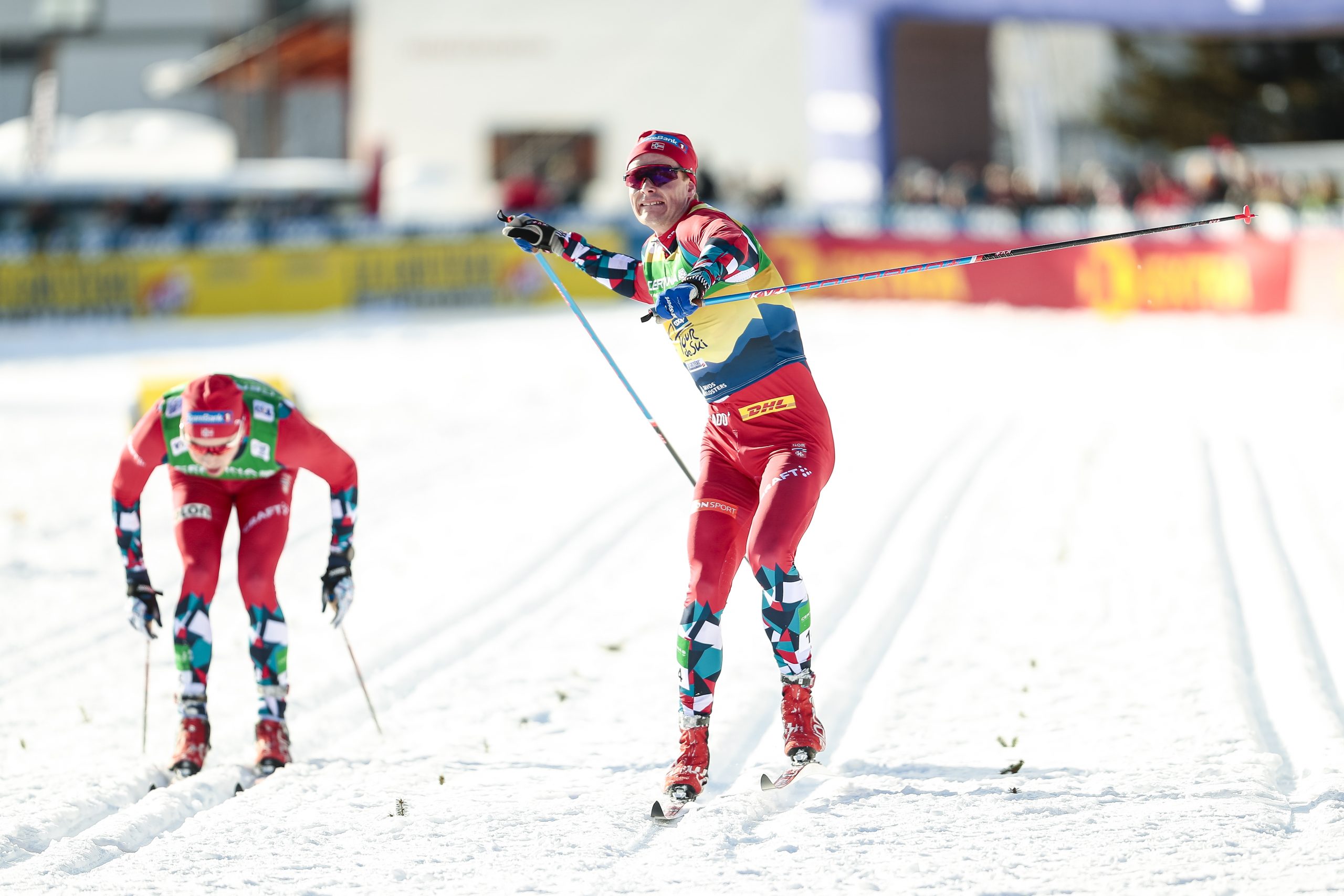
    Harald Oestberg Amundsen (NOR) wins the 20 k Classic Pursuit in Davos, Switzerland: sweet redemption after an untimely fall took him out of yesterday’s Freestyle Sprint quarterfinal. (Photo: Modica/NordicFocus)

    Winter endurance sports represent a quandary: training for endurance events requires that athletes push themselves repeatedly toward exhaustion . . . a condition that makes them especially susceptible to transferable illnesses. Influenza caught up with Johannes Hoesflot Klaebo who never even started the 2024 Tour de Ski. Ben Ogden (USA) caught the cold that’s been coursing through the Stifel U.S. Ski Team; he was forced to drop out of the Tour de Ski while standing third overall and wearing the Points Leader’s jersey. This morning in Davos, Switzerland, it was Gus Schumacher who fell ill and was forced to withdraw. Only a few hours after his personal-best World Cup finish (fourth in the Stage 4 Men’s Freestyle Sprint), Schumacher was out of the tour.

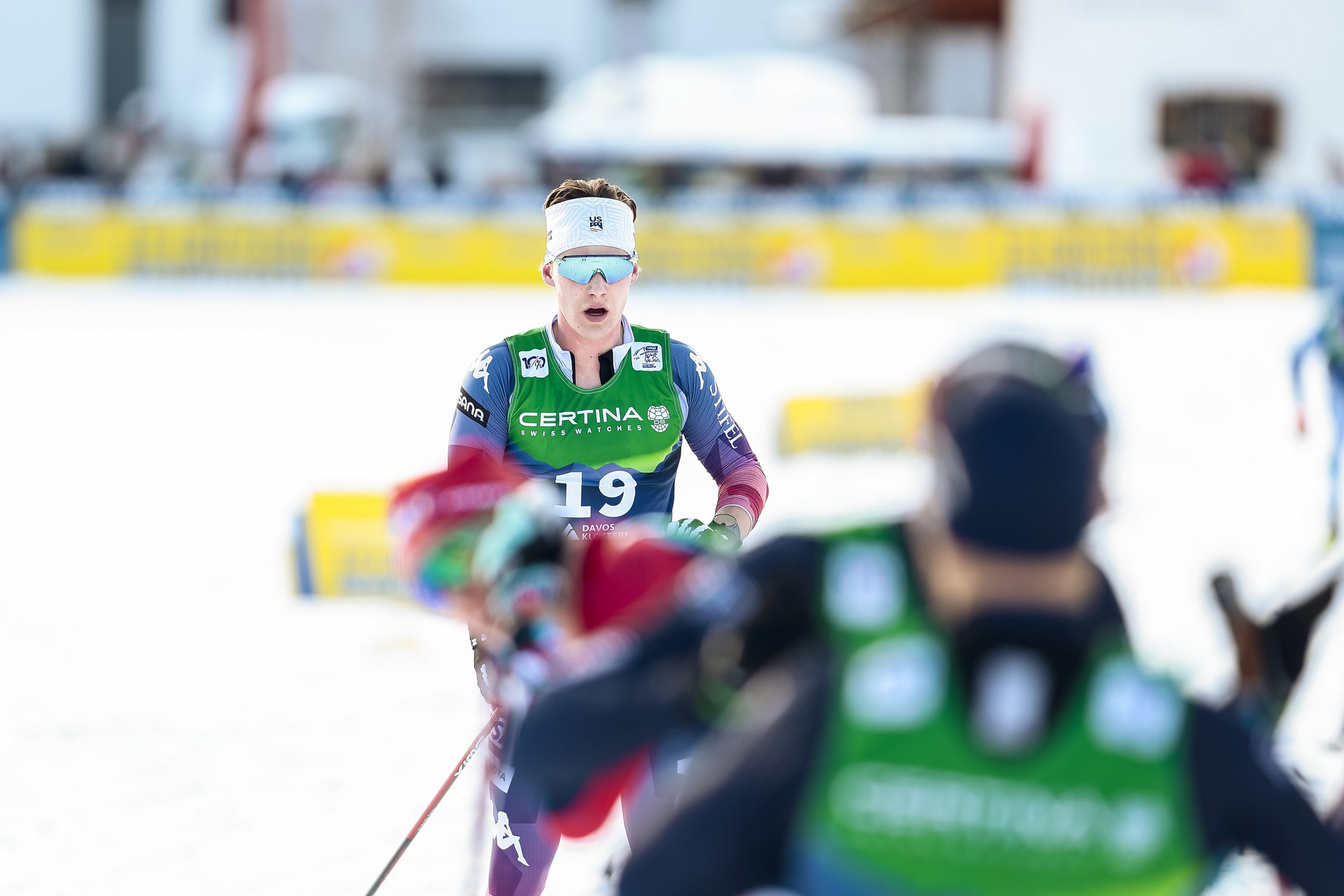
    Zanden Mcmullen (USA) finishes the 20 k Classic Pursuit in Davos, Switzerland. With sickness having swept through Team USA, McMullen and Scott Patterson (USA) are the only American men remaining in the Tour de Ski.  (Photo: Modica/NordicFocus)

    Canadian, Antoine Cyr, started the Pursuit in 19th place overall. He fought to secure a place in a group led early-on by Amundsen and Pellegrino, allowing Cyr to fight his way to a tremendous seventh place finish. Olivier Leveille was the only other Canadian finisher in 41st. Julien Locke (CAN) did not start the day’s racing. Only Zanden McMullen (USA) and Scott Patterson (USA) remain in the field for Team USA. Patterson finished the day 24th, with McMullen 28th.

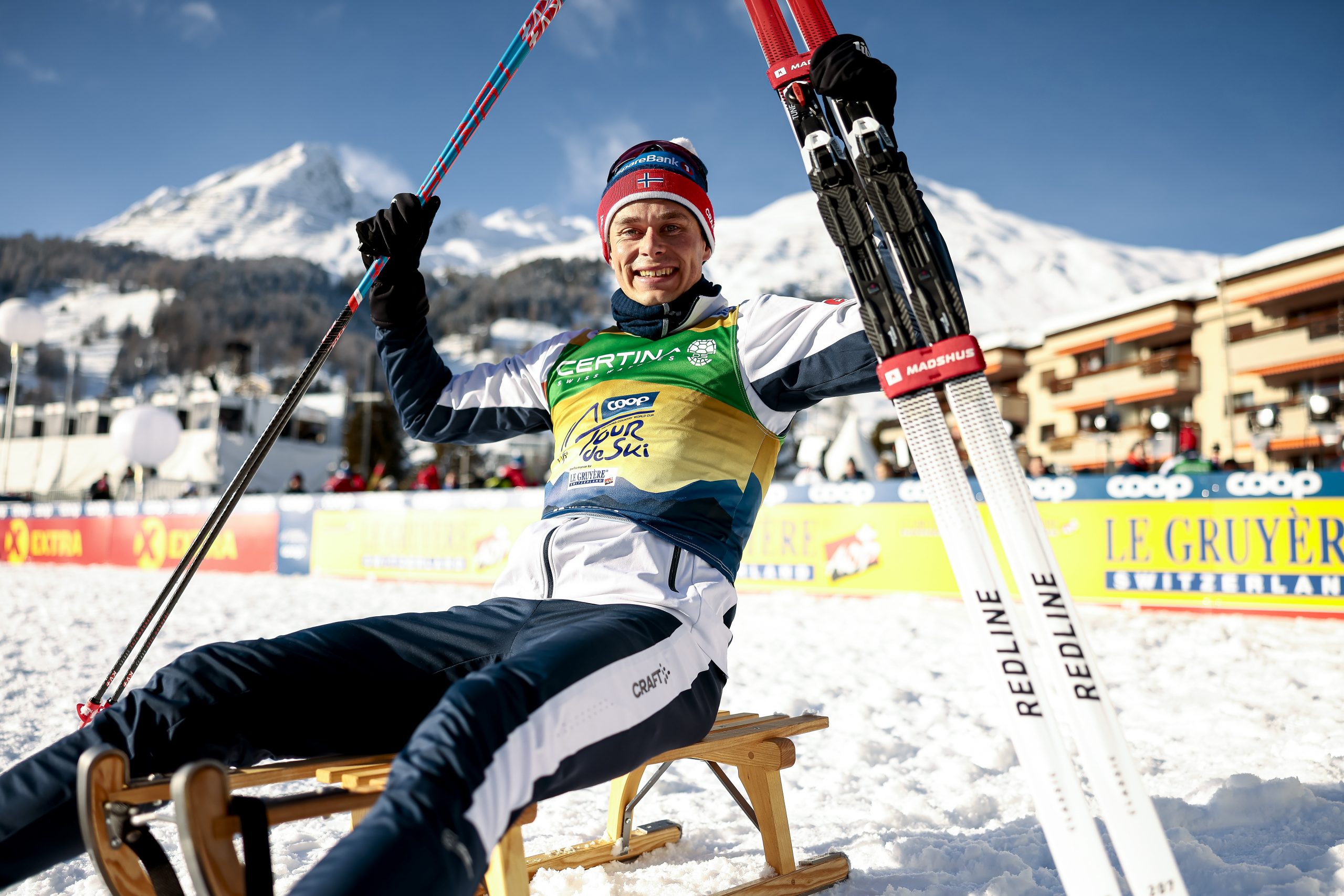
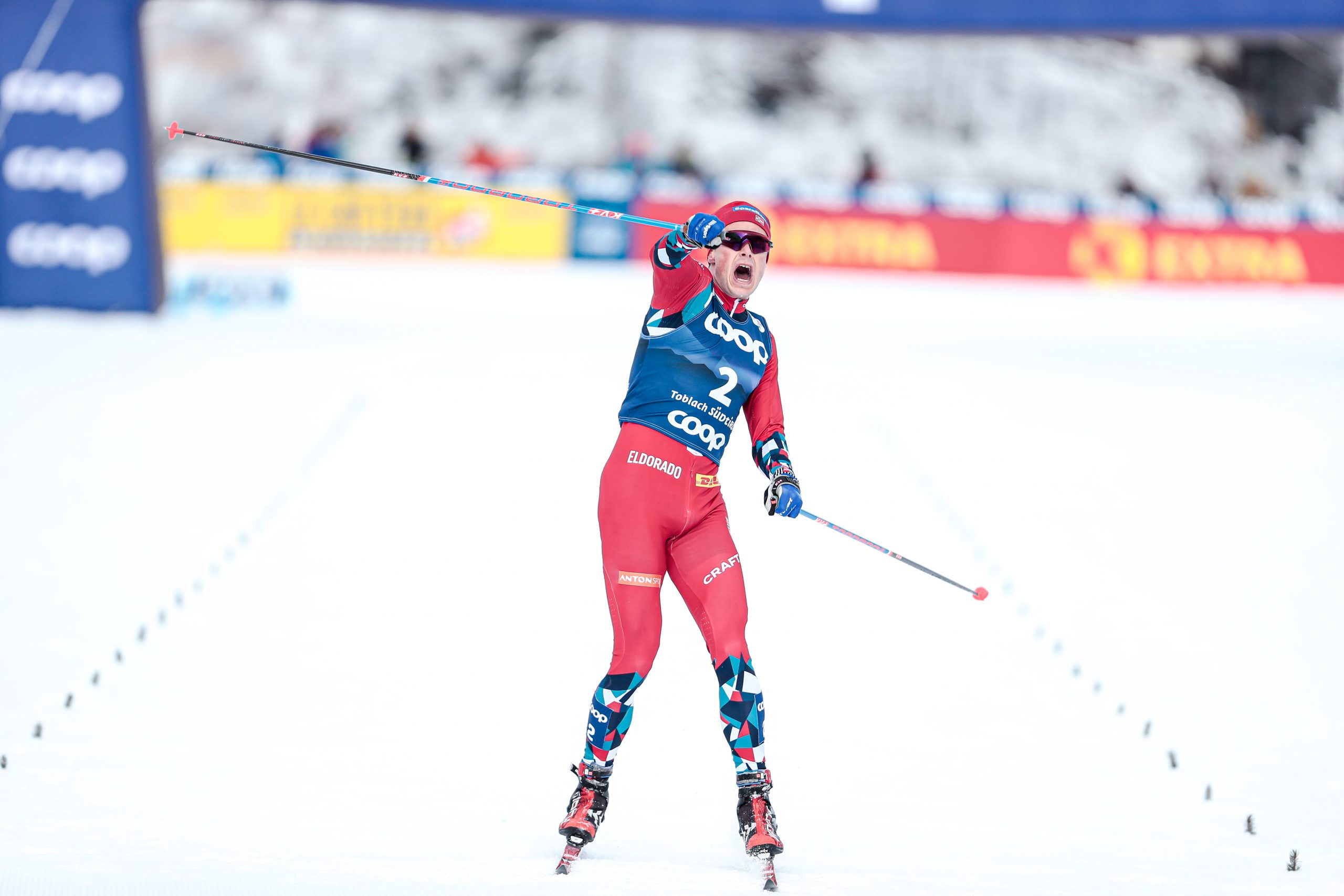
    Harald Oestberg Amundsen (NOR) was appearing edgy: slamming his poles on the ground after an untimely fall in yesterday’s sprint competition, wearing the bib of the Tour de Ski leader, but definitely wanting more reward—and respect—than he was getting, Amundsen began today’s 20 k Pursuit looking like a man seeking redemption. He would get it, storming through the finishing straightaway for an impressive victory over his countryman, Henrik Doennestad. In what has become common occurance, a third Norwegian rounded out the podium: Martin Loewstroem Nyenget.

    Norway may have swept the podium (again), but there were more national choices among the contenders including Beda Klee (SUI) who finished sixth, Friedrich Moch (GER) who finished fifth, and Hugo Lapalus who finished fourth (only a tenth of a second off the podium).

    Harald Oestberg Amundsen (NOR) exults at the finish line ahead of his countryman, Henrik Doennestad. Amundsen’s victory in the 20 k Classic Pursuit solidifies his position at the top of the Tour de Ski overall standings with just two more stages remaining. (Photo: Modica/NordicFocus)
    20 k Classic Pursuit

    After a morning snowstorm that profoundly affected the Women’s Pursuit, the Men’s Pursuit was contested on a Classic track that more accurately resembled old fashioned ski racing—fluffy snow, irregular tracks, lower racing speeds, and long laps through the woods. The snowstorm that buffeted the Women’s Pursuit had abated, but new snow would still affect the Classic tracks and the ability of the wax techs to produce fast skis. Fortunately, the entirety of the Davos valley was in shadow by race time, so there would be no sunny patches for wax technicians to anticipate.

    With the start order being determined by placings in the prior day’s Sprint competition, gaps between starters were quite narrow—and the earliest starters were sprinters rather than endurance skiers. The day’s first starter, Lucas Chanavat (FRA) had been accused of “sandbagging” in the last Pursuit stage of the Tour de Ski: slow-walking much of the race course in an attempt to save his energy for later sprint stages. With today’s World Cup cameras focused solidly on him (as the day’s first starter), Chanavat began the race with a more honest effort, focusing his efforts on acquiring the Bonus Points available at 3.4 k. He managed to hold his lead, crossing the Bonus Points line just a ski-length ahead of Edvin Anger (SWE). His mission accomplished, Chanavat quickly pulled up after that checkpoint, resuming a pedestrian pace more closely resembling the way he had raced in the Pursuit event last Saturday. Chanavat would ultimately finish the day’s 20 k race distance, but in 79th place, nearly eight minutes behind the leaders.

    Anger—a much more accomplished distance skier than Chanavat—continued on alone, pursued at a distance by a group that included Pellegrino (third in overall standings), Haavard Solaas Taugboel (NOR), Matz William Jenssen (NOR), Erik Valnes (NOR), and Lauri Vuorinen (FIN). The group including Amundsen and Cyr followed only a few more seconds behind.

    Anger still held a 30 second lead at 8.6 k, but by end of the first of two laps his lead had evaporated. Soon after, he was swallowed up by a 15-man group led by Amundsen. Ultimately, Amundsen and Henrik Doennestad (NOR) got away from the field, sprinting to the finish line where Amundsen out-sprinted Doennestad by less than a second. Their countryman, Nyenget, managed to hold off a hard-charging Lapalus for third.

    Amundsen continues in the Tour de Ski leader’s jersey, but now with the measure of respect to which he believes he is due. The Tour seems Amundsen’s to win or lose, with only two distance-race stages remaining (including Sunday’s daunting climb up Val di Fiemme’s Alpe Cermis).

    Men’s 20 k Classic Pursuit RESULTS

    Henrik Doennestad (NOR), Harald Oestberg Amundsen (NOR), Martin Loewstroem Nyenget (NOR), (l-r) celebrate another all-Norwegian podium after the Tour de Ski 20 k Classic Pursuit in Davos, Switzerland. (Photo: Modica/NordicFocus)
  • Norwegian Men Restore Status Quo: All Red Podium in TDS Pursuit

    Norwegian Men Restore Status Quo: All Red Podium in TDS Pursuit

    This coverage is made possible through the generous support of Marty and Kathy Hall and A Hall Mark of Excellence Award. To learn more about A Hall Mark of Excellence Award, or to learn how you can support FasterSkier’s coverage, please contact info@fasterskier.com.

    Status quo restored: Harald Oestberg Amundsen (NOR) dominates the 20 k Freestyle Pursuit—and moves into the overall lead—in the 2024 Tour de Ski in Toblach, Italy. (Photo: Modica/NordicFocus)

    Pursuit racing is kind of weird—giving an additional head start to those already in the lead, while asking other racers to chase those who have already proven to be faster. It can seem like a bit of a set-up . . . one that Norway was entirely happy to benefit from on the third day of Tour de Ski racing from Toblach, Italy.

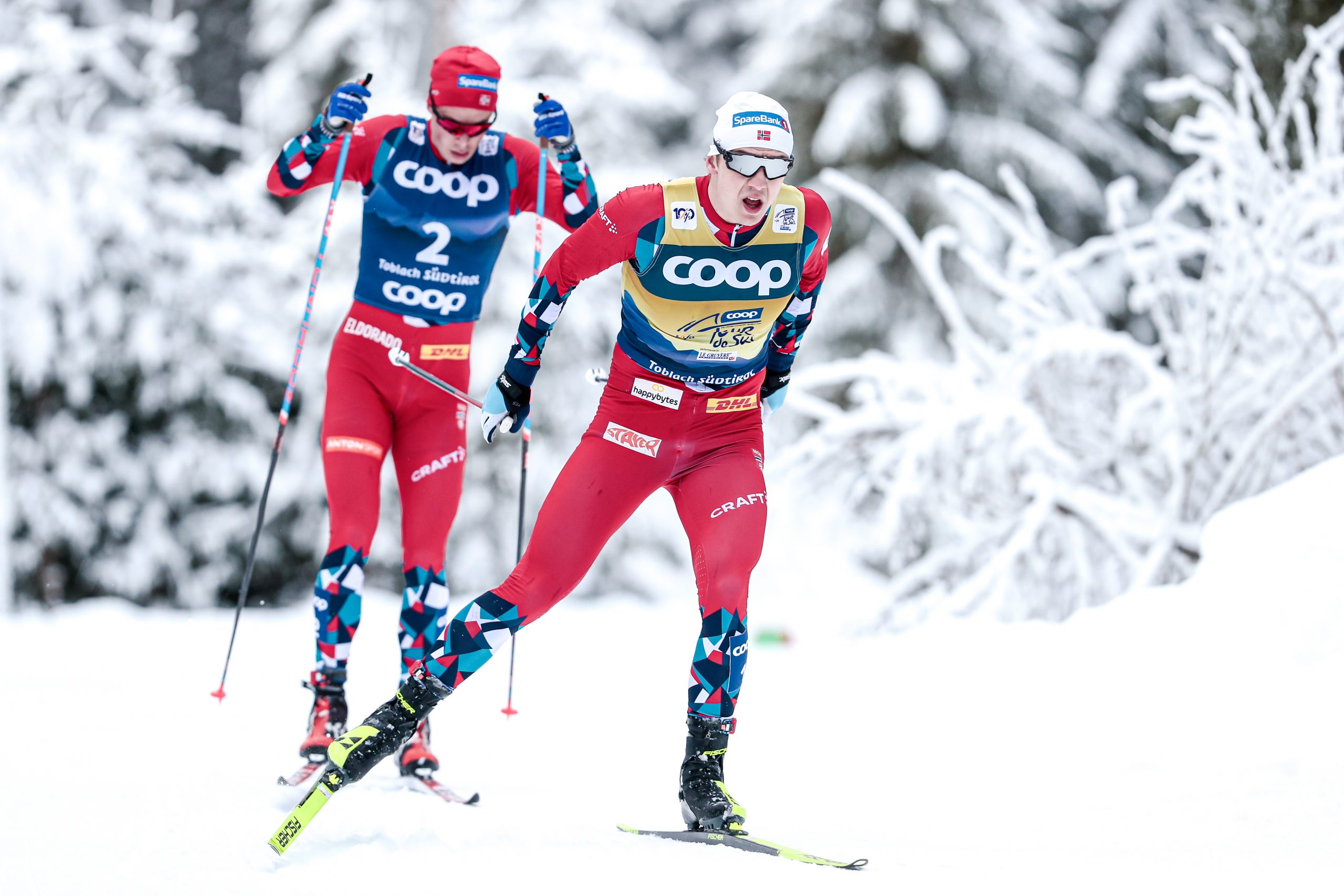
    It must make Norway a bit nervous to endure a start like this one at the 2024 Tour de Ski: shut out of individual World Cup race podiums for the first time in recent memory. But, eventually, races get longer, the abilities of the distance skiers allow them to shake off the pluck and daring of over-reaching sprinters, and the status quo is re-established. After what appeared to be a few days of equitable, good-natured, highly entertaining, multi-national competitive ski-mayhem, Norway once again emerged at the front. The Tour de Ski returned to earth with a display of Norwegian dominance in the 20 k Freestyle Pursuit, and the state of affairs in the Men’s World Cup field returned to normal. Harald Oestberg Amundsen (NOR) entered the 2024 Tour de Ski as the prohibitive favorite for the overall title. On the first day of the new year, Amundsen lived up to those predictions with his commanding victory in the 20 k Freestyle Pursuit. He was followed across the finish line by a game Erik Valnes (NOR), and their countryman Jan Thomas Jenssen (NOR).

    American, Gus Schumacher, raced courageously and intelligently throughout the day, remaining in the primary chase group to finish tenth, a performance that places him tenth in TDS Overall standings, as well. Other American finishers included Scott Patterson in 28th, Ben Ogden 33rd, Zanden McMullen 48th, Kevin Bolger 66th.

    For Canada, Antoine Cyr continues a string of fine performances in 19th, followed by Olivier Leveille 58th, and Julien Locke 79th.

    Tour de Ski leader at the beginning of the day’s 20 k Freestyle Pursuit, Erik Valnes (NOR) helped to make the pace for the pair of leaders. Ultimately, he was overcome by his countryman, Harald Oestberg Amundsen, who took the race win and the overall lead in the Tour de Ski standings. (Photo: Modica/NordicFocus)
    Men’s 20 k Freestyle Pursuit

    Ski racing is not always what it seems. The 20 k Pursuit contested in Toblach was actually 22 kilometers in length—five laps of 4.4 kilometers each—on a course that many competitors consider “easier” than the typical World Cup distance course.

    Tour leader at the beginning of the day, Valnes was first to start, followed only four seconds later by his countryman, Harald Oestberg Amundsen. Ben Ogden  (USA) started third, 28 seconds behind the leader. Perttu Hyvarinen (FIN) started fourth, followed by Lauri Vuorinen (FIN). Those five represented the top of the overall standings at the beginning of the race. The end of the race would see numerous changes . . .

    The two leaders started relatively close to one another; most of the other early-starting racers were separated from each other by gaps of 20 seconds or more. Chasers would have a difficult time grouping up unless early starters slowed intentionally. The top two Norwegians quickly paired up while Ogden was left alone to either chase, or sit up and wait for help to arrive from behind. By the end of the first kilometer, Hyvarinen had come forward: Ogden would have company.

    Bonus Points were offered for the fastest skiers to cross the checkpoint at .7 k. Mika Vermuelen (SUI) captured the winner’s 15 points, ahead of Henrik Doennestad (NOR). The inclusion of mid-race Bonus Points is an action-inspiring strategy on the part of race organizers—much like mid-race “Primes” offered in bicycle racing. It’s the system organizers have devised to play on the relative greed of individual riders, coercing them to sprint in the middle of the race (sometimes a disastrous tactical decision) for money or points. The idea of including a Bonus Points sprint within Toblach’s TDS Pursuit was to encourage skiers to start out fast instead of sitting up to wait for later-starting skiers to form a racing group. Ogden didn’t fall for it: he and Hyvarinen maintained a steady, conservative pace—ignoring the chance to race for additional points—until they were finally enveloped by the main chase group at the five kilometer mark.

    Schumacher had started in a closely-packed group of starters who quickly formed the day’s main chase group, one that would grow to include William Poromaa (SWE), Jens Burman (SWE), Martin Loewstroem Nyenget (NOR), Beda Klee (SUI), Jules Chappaz (FRA), Hugo Lapalus (FRA), Friedrich Moch (GER), and Federico Pellegrino (ITA). As Ogden and Hyvarinen gradually faded back to this group, the two leaders simply stormed away.

    Moch seemed determined to press forward in pursuit of the leaders—and Nyenget and Lapalus came forward to add to the torrid pace—but most others in the chase group seemed content to race those around them. Rather than work as a cohesive group, the chase group began to unravel. The French sprinter, Chappaz was quickly gapped and left behind. Ogden suffered a similar fate not much later while Schumacher continued to vie for position within the eleven-man chase group.

    After the second of five laps, Amundsen had firmly established himself as the pace-maker while Valnes began visibly to struggle. Near the race’s halfway point, there was a moment when it seemed that the second chase group could catch the first chase. But Nyenget forged to the head of the front group, and they gradually pulled away from the other chasers. It seemed that no one wanted Paal Golberg (NOR) (who was in the second chase group) to come back into contention. All this went on while Amundsen and Valnes continued to maintain a gap of more than a minute.

    At 15 k, Amundsen used the main uphill to distance Valnes. Raising the tempo—and the pace—Amundsen skied clear, creating a gap that grew quickly to more than ten seconds. Amundsen was gone, leaving Valnes to consider damage control, though he still enjoyed a cushion of over a minute to the group of chasers.

    Late in the race, Gus Schumacher (USA) and Federico Pellegrino ((ITA) were forced to work hard to maintain contact with the chase group. Those courageous efforts paid off with top ten finishes for both. (Photo: NordicFocus)

    Midway through the final lap, Moch returned to the business end of the chase, initiating a pace (supported by Lapalus and Poromaa) that spread out the group and forced Schumacher and Pellegrino to chase hard to remain in contact. They managed to remain in contact, allowing them to sprint for a top ten finish.

    “My mentality was to smooth out the effort in the end,” said Schumacher. “I was right on the limit near the top of the main climb where we got left behind. I also knew from the beginning of the race that I was able to ski fast on the rest of the course, so I kept some energy by letting the gap open, and thankfully they didn’t seem to have too much gas left either, so we were able to get back by the bottom of the course.”

    Amundsen powered across the finish line alone, some 32 seconds ahead of a game but exhausted Valnes. The other contending Norwegians stormed to the front of the chase group up the final hill—Nyenget followed by Jenssen. Jenssen would come forward to grab third (just over a minute behind the winner), followed closely by Poromaa and Nyenget. Schumacher would hold on for tenth, just behind Pellegrino. The bodies of exhausted skiers lay strewn about the finish area as the racers showed the extraordinary strain of pack racing at this level.

    Norway one, two, and three on the podium—Norway one, two, and three in the overall standings. At a certain point in Cinderella’s fairytale, the spell wears off: her coach turns back into a pumpkin,  leaving her stranded on the road side wearing shabby, soot-stained clothes, and minus one glass slipper. It was fun to have been a beautiful princess for a while, but it seems tremendously difficult to keep it up. Just ask Ogden, Hyvarinen, and Vuorinen. Five more races lie ahead in the 2024 the Tour de Ski, and Gus Schumacher may still be racing in search of an elusive glass slipper. We’ll wait to see how this fairytale plays out.

    Tour de Ski Stage 3, 20 k Freestyle Pursuit RESULTS

    In Time of day RESULTS it was Jenssen with the day’s fastest racing time, followed by Henrik Doennestad (NOR) , and Lapalus. Schumacher’s finishing time proved to be the sixth fastest of the day.

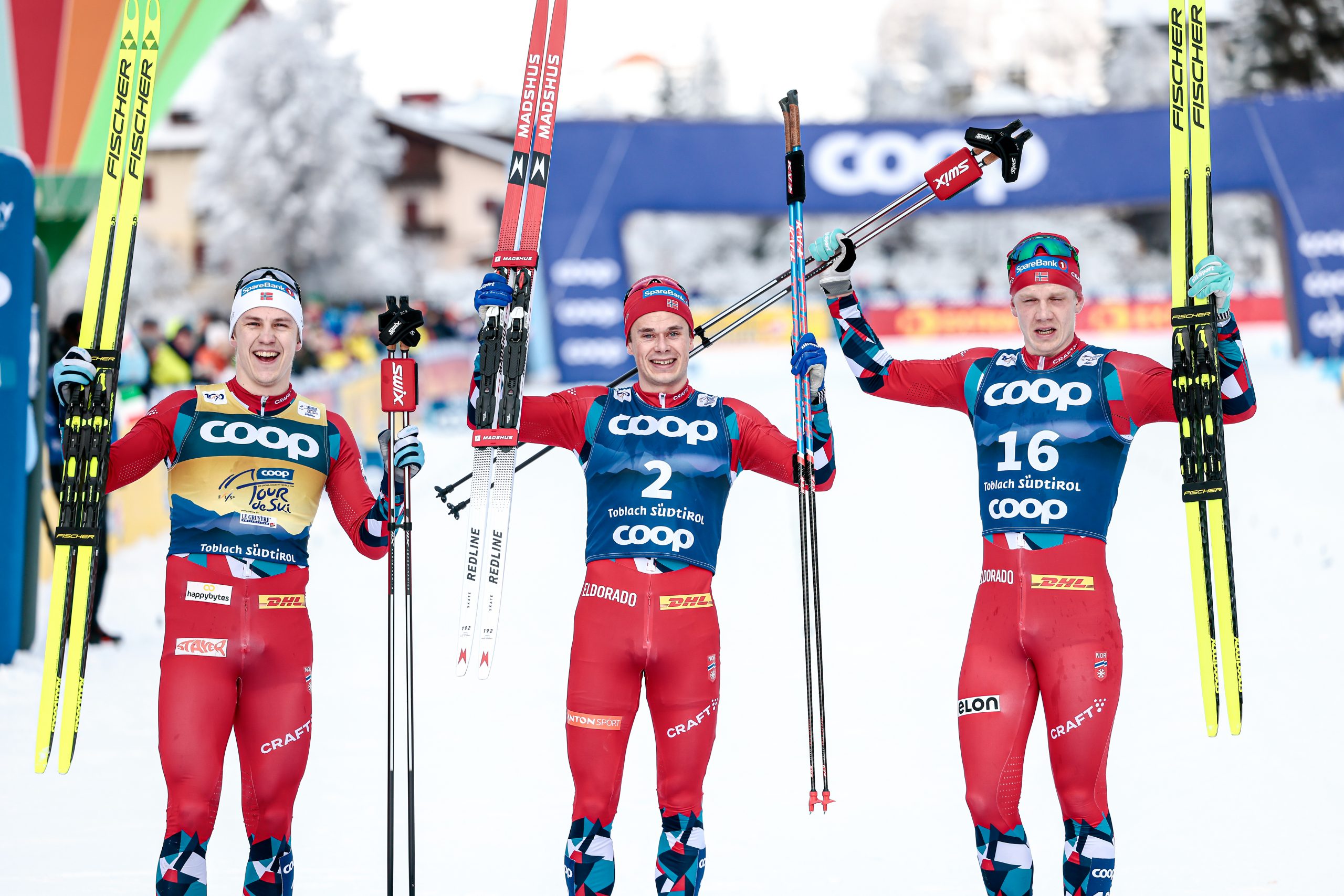
    Norway returns to the podium in the Tour de Ski 20 k Freestyle Pursuit. Erik Valnes (NOR), Harald Oestberg Amundsen (NOR), Jan Thomas Jenssen (NOR), (l-r). (Photo: Modica/NordicFocus)