From the FasterSkier archive — posts syndicated from athletes’ and coaches’ own blogs between 2004 and 2012, kept online as published. Current coverage is at fasterskier.com.
Val di Fiemme — Tesero Cross-Country Skiing Stadium (Fabio Canal Center)
Below is the Olympic cross-country ski competition schedule for Milano Cortina 2026 (all events subject to change; times local to Italy) – the best way to watch is on NBC Peacock:
Saturday, February 7
• Women’s 20 km Skiathlon (Classic + Free) – RESULTS
Sunday, February 8
• Men’s 20 km Skiathlon (Classic + Free) – RESULTS
Read all of our FasterSkier featured athlete profiles for the entire US Olympic Cross-Country Ski Team (links in the list above).
Help Support Our Olympic Coverage!
FasterSkier will have our own Nat Herz on the ground at the Olympics, which, to be honest, is a very big financial lift for us. If you value the thoughtful work and access FasterSkier provides at championships like this one, please consider becoming a Voluntary Subscriber. Your support directly fuels the work we do to cover the people, places, and moments that make our sport special.
This article was made possible through the generous support of our voluntary subscribers who have helped put our Nat Herz on the ground at the Olympics. If you value coverage like this, please support FasterSkier with a voluntary subscription.
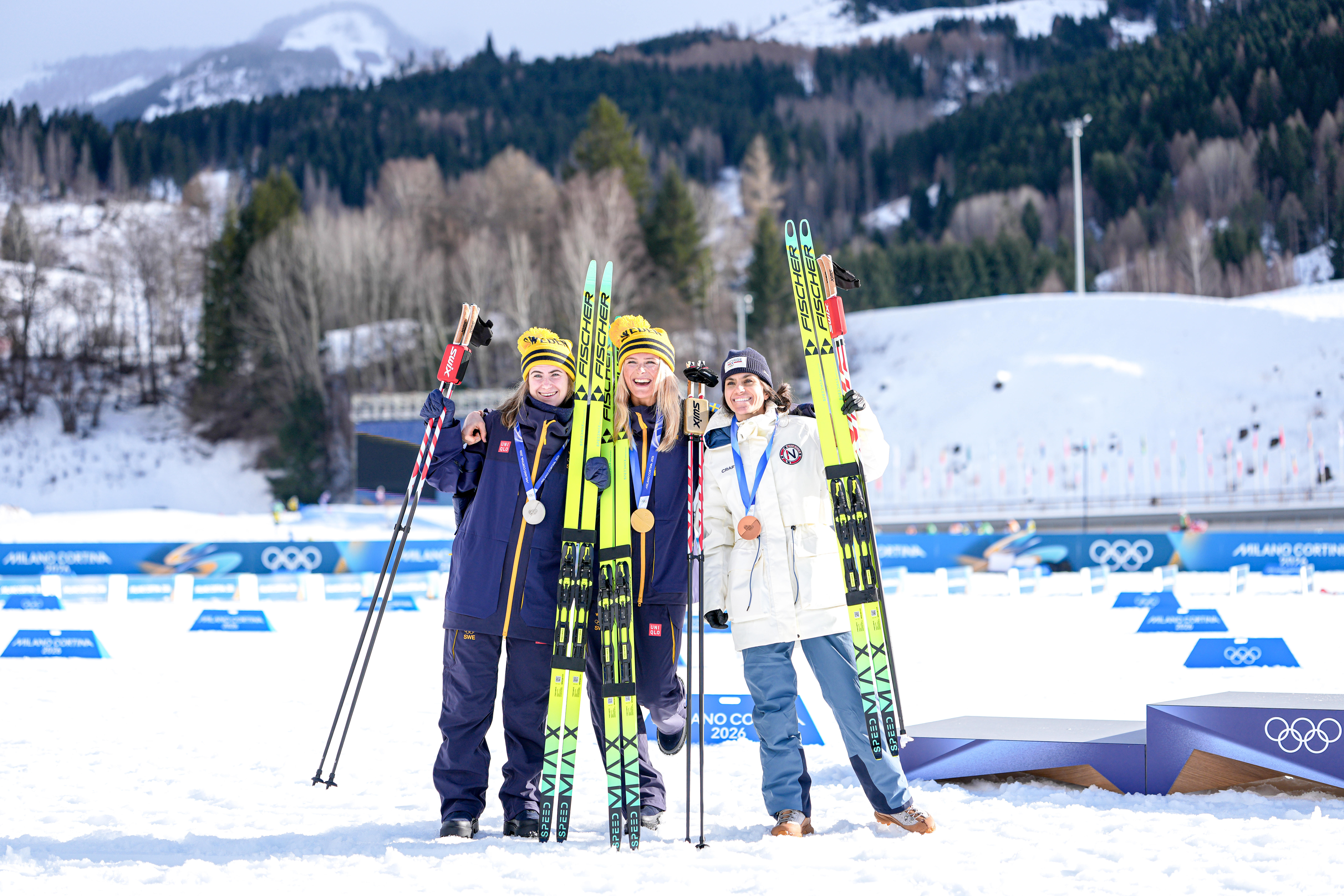
At the Olympic Women’s Skiathlon podium press conference in Val di Fiemme, the three medalists provided insight into their performances, discussing equipment choices, team dynamics, and the mental preparation that shaped one of the Games’ defining races.
Heidi Weng, who earned bronze, reflected on the significance of winning a medal at a venue tied closely to her career. Thirteen years after claiming her first major championship medal in Val di Fiemme, Weng spoke with noticeably more confidence — in English — while acknowledging the emotional weight of racing, bolstered by the presence of her Italian wax technician. Technically, Weng admitted the classic portion of the race was stressful, particularly on the uphills where grip felt uncertain. The race turned for her once she switched to skating, where she immediately felt freer and more powerful. Despite Olympic stakes, Weng said her routine remained largely unchanged from previous championships, with only a sharper focus on the moment.
Gold medalist Frida Karlsson fielded questions that ranged from equipment to philosophy. She revealed she raced the classic leg on a 10-year-old pair of skis she affectionately called her “golden pair,” skis she has owned since before becoming an elite athlete and which seem to resurface whenever championships arrive. Karlsson also described her unconventional training approach, explaining that she does not track heart rate or lactate and instead trains by feel. She credited recent altitude camps with Norwegians Johannes Høsflot Klæbo and Emil Iversen for teaching patience and discipline.
Much of Karlsson’s confidence, she said, stemmed from the Swedish team environment. With multiple athletes capable of winning gold, the squad has embraced a shared mentality built on mutual belief. Seeing teammates succeed reinforces the sense that winning is possible — a mindset cultivated intentionally through visualization during team meetings before the race.
Silver medalist Ebba Andersson echoed those themes, describing her long partnership and rivalry with Karlsson at both club and national levels. That history, she said, has transformed competition into inspiration, pushing both athletes to higher levels. With another Olympic opportunity approaching later in the week, Andersson emphasized that momentum and belief remain high.
Together, the press conference painted a picture of an Olympic podium shaped as much by trust — in skis, teammates, and oneself — as by tactics and fitness, underscoring why this skiathlon resonated far beyond the finish line.
On the ground reporting by FasterSkier’s Nat Herz.
Help Support Our Olympic Coverage!
FasterSkier has our own Nat Herz on the ground at the Olympics, which is a significant financial lift for us. If you value the thoughtful work and access FasterSkier provides at championships like this one, please consider becoming a Voluntary Subscriber. Your support directly fuels our work to cover the people, places, and moments that make our sport special.
This article was made possible through the generous support of our voluntary subscribers who have helped put our Nat Herz on the ground at the Olympics. If you value coverage like this, please support FasterSkier with a voluntary subscription.
Ebba Andersson (SWE), Frida Karlsson (SWE), Astrid Oeyre Slind (NOR), Jessie Diggins (USA), and Teresa Stadlober (AUT), (l-r) lead the field out of the start during the opening race, the 20 k Skiathlon, at the 2026 Milano-Cortina Olympic Winter Games in Tesero, Italy. (Photo: Vanzetta/NordicFocus)
PREDAZZO, ITALY — The snow in the Tesero Cross-Country Ski Stadium sat in that uneasy middle ground—soft, glazed, and ready to decide races in small, brutal ways. It sat like the snow of March more than that of early February, ready to punish skis that went outside of the traffic lines, a little slushy where the sun found it, and it turned the opening day of Olympic cross-country into something more challenging than spectacular. Not just strength, not just tactics—also the small, decisive physics of momentum lost and regained, of skis that either release cleanly or cling, of a tip that vanishes into wet snow at exactly the wrong moment.
A Skiathlon is built to expose those details. Ten kilometers of classic to write the first draft—who’s fresh, who’s brave, who’s overreaching—then a transition that feels like a breath held too long, then ten kilometers of freestyle to reveal what was real and what was merely early. It is the most honest event on the program and, sometimes, the cruelest: it doesn’t only ask who is the best skier today? It asks what else failed to cooperate?
On Saturday in Val di Fiemme, Sweden arrived with a plan that looked less like a plan than a certainty. Frida Karlsson (SWE) and Ebba Andersson (SWE) skied the opening classic like athletes who had been waiting for this specific hour, not simply training toward it. Heidi Weng (NOR) carried her own bright energy into the skate leg and outlasted the late cracks around her for bronze. Behind them, the Americans—Jessie Diggins, Julia Kern, Rosie Brennan, and Novie McCabe—worked through a day where the sensations were often better than the splits, and where Diggins’ race, in particular, became a case study in how thin the margin is between a medal and an explanation.
Ebba Andersson (SWE) and Frida Karlsson (SWE), (l-r) showed they were in top form throughout the race. (Photo: Vanzetta/NordicFocus)
Sweden’s patience, Sweden’s pressure
The results tell the shape of it quickly. Karlsson won in 53:45.2, Andersson followed 51 seconds back, and Weng took bronze at 55:11.9.
But the split ranks show how they built it.
Karlsson was first at 10 k at the end of the classic leg (27:24.4) and the fastest split again in the 10 k freestyle segment (25:49.7).
For Karlsson, the victory arrived with clarity rather than chaos. She said the moment only fully registered when she grabbed the Swedish flag in the finish straight — when she realized it was real. The skis, she said, were “super,” the body “felt amazing,” and the alignment of those pieces reflected years of work with her coach and team. “I’ve never been as much in love with skiing as I am now,” she said, calling the win a once-in-a-lifetime moment — one she plans to ride forward, rather than dissect.
The only athlete under 26 minutes on the skate leg. Andersson was right there in classic—third at 10 k (27:25.3)—then held her silver with the fourth-fastest skate segment (26:41.1).
Andersson framed the result not as a surprise but as an arrival. “It means a lot,” she said, noting that this was her third Olympic Games but her first individual Olympic medal. In conditions she described as “very wet” and mentally taxing, she said the race demanded constant commitment — the willingness to keep the pace even when fatigue made that decision feel irrational. It was, she added, the product of a preparation plan she trusted, one that now allowed her to move forward with momentum rather than relief.
Heidi Weng (NOR) was a bit off during the classic leg, but found her legs during the freestyle leg to charge her way to the bronze medal. (Photo: Vanzetta/NordicFocus)
Weng’s race was the opposite kind of inevitability: not the best classic, but close enough (fifth at 10 k, 28:03.6) to keep the door open; then the second-fastest freestyle leg (26:34.8) to kick it in.
Weng later confirmed that the race unfolded exactly as those lines indicated. She said she didn’t feel at her best during the classic portion, but once those skis came off, “I had so much power. It was an amazing feeling.” Despite nerves she described as the strongest she’d ever felt, the skate leg became something closer to joy — three laps where she felt happy rather than hunted, and where her energy proved decisive.
This was the story on the ground, too: a front group that looked stable until it didn’t, and then a medal fight that shifted from who can hang on? to who still has electricity when everyone else goes dim.
Astrid Oeyre Slind (NOR) went for the win, coming into the exchange with the top Swedes, but faded in the freestyle. (Photo: Barbieri/NordicFocus)
Astrid Øyre Slind (NOR) deserves her own paragraph because she skied the first half like a spoiler and the second half like a warning. At the changeover, Slind was second at 10 k classic (27:25.0), effectively welded to the Swedish pair, the one non-Swede who could match their calm pace on the front end. Then the skate leg happened. Her freestyle segment (27:44.2) was 13th-fastest, and she slid from the medal conversation to sixth overall.
Afterward, Slind didn’t pretend it was anything else. She said she “completely died out there” on the skate portion and described the skate leg as feeling “hopeless.” That’s Skiathlon truth: you can be perfect for half a race and still spend the other half paying interest.
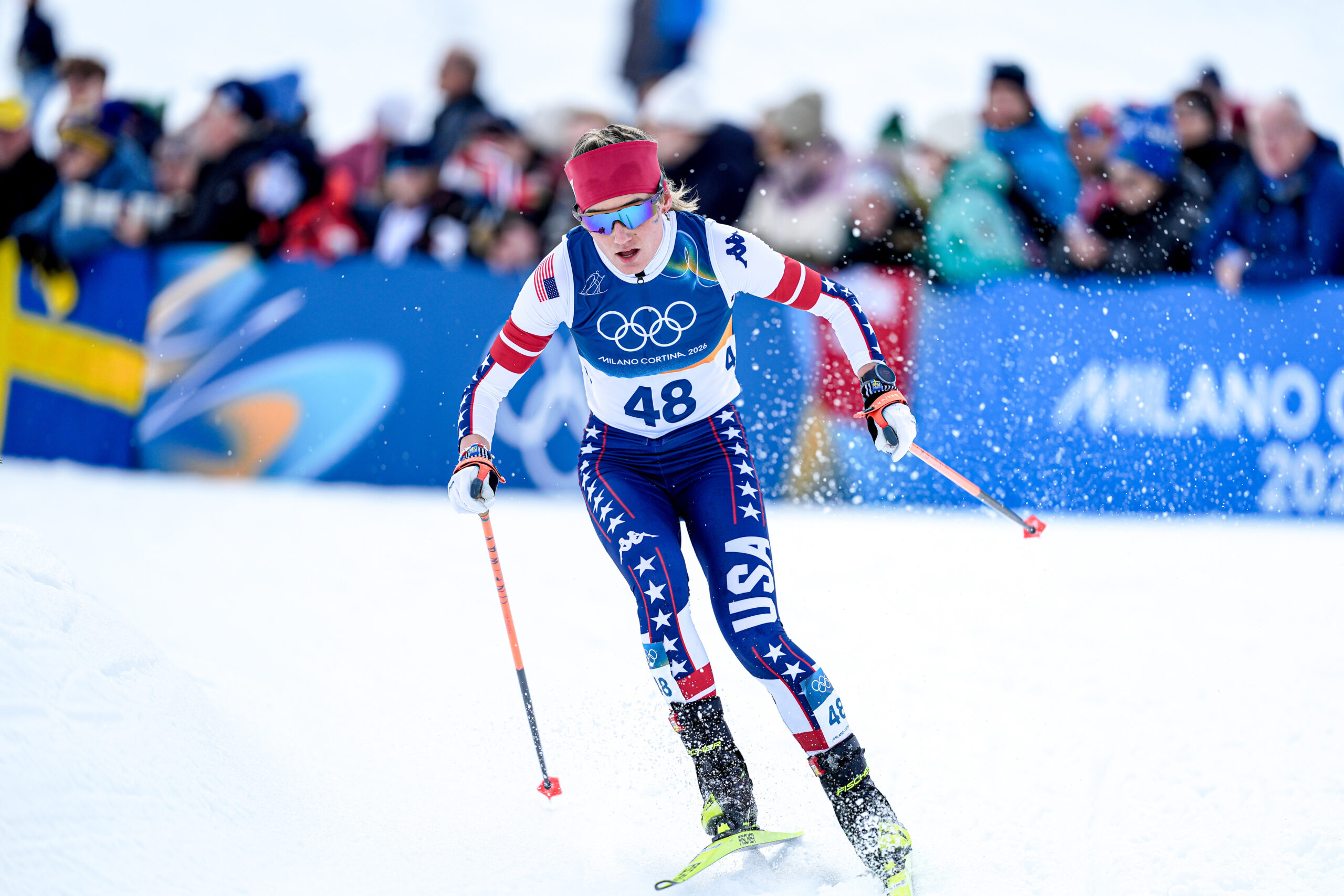
Jessie Diggins (USA) fell at an unfortunate time during the first lap and did not have great skis during the classic. (Photo: Vanzetta/NordicFocus)
Diggins, the season-long wager
Jessie Diggins finished eighth, 2:21.1 behind Karlsson. If you only read that line, you might miss the more useful information for the rest of these Games: Diggins’ body is not the problem.
Her splits are almost paradoxical. Diggins was 15th at 10 k (28:52.8), and then she produced the third-fastest freestyle segment (26:39.1) in the entire field. If the Olympics are an argument about peaking, that’s evidence—strong evidence—that she arrived with the fitness to fight for wins.
Diggins said as much in the mixed zone, with microphones practically stacked in front of her. “I am in the best shape of my life, and my body felt really, really good,” she said.
And yet, she also sounded like an athlete reciting the essential checklist for how an Olympic race has to go right. “There are a lot of things that need to come together for a good ski race to happen,” she said, describing “puzzle pieces” that “need to lock into place.”
Diggins came into these Olympics after a season that asked her to be visible everywhere—chasing the overall World Cup Crystal Globe, carrying the weight of expectation that comes with being the most decorated U.S. cross-country skier in history. The critique is familiar and not irrational: race too much, arrive tired. Diggins’ counter-belief is equally familiar and, for her, historically true: racing sharpens her, racing brings her up to her best. Saturday’s skate split supports Diggins’ version of the story.
So why wasn’t it a medal day?
Start with the two things Diggins named immediately: a fall, and classic skis that weren’t working the way they needed to.
“I had a crash on the first lap where my tip just disappeared in the slush,” she said, and she explained why that particular spot mattered: “it was a tough spot where you lose all your momentum.”
Jessie Diggins (USA) posted the third fastest freestyle leg, eventually catching Teresa Stadlober (AUT) to finish in eighth place. (Photo: Barbieri/NordicFocus)
Then came the other part—more delicate to describe, but impossible to ignore at this level: “the classic half, the things out of my control did not go very well,” Diggins said.
U.S. program director Chris Grover was more explicit in his post-race assessment, saying the team missed the classic setup—“wrong kick/glide combination”—and that Diggins spent too much energy working in classic as a result. In a skiathlon, “working too hard” in the first half is rarely just a feeling; it becomes a number later.
The key nuance—one that should frame every Diggins paragraph for the rest of these Games—is that she didn’t implode. She stabilized. The crash cost time and, maybe more importantly, cost free speed at the exact moment the course turned back uphill. But Diggins insisted the crash itself wasn’t the main reason the day slipped away. “The crash wasn’t that big of a deal to me,” she said. “Yes, I did lose some time, but that wasn’t the bigger problem today.”
Her response was almost clinical: “stay calm, work your way back… ski the best that you can ski.” And that’s what the freestyle split looks like: not panic, not surrender—just the third-fastest skate leg in the field.
If you want an Olympic moral, it is probably this: peak fitness is necessary; it is not sufficient. You need skis. You need timing. You need the kind of luck that doesn’t show up on the wax chart but reveals itself when your tip either rides the slush or dives into it.
Heidi Weng (NOR) celebrates the bronze medal as she crosses the line. (Photo: Vanzetta/NordicFocus)
The bronze fight that became an energy test
Behind the Swedish gold-silver pairing, the day’s most compelling drama was the fight for third—because it kept changing hands in real time as athletes discovered, one by one, what they’d brought to the skate leg.
Weng’s bronze was not a casual podium; it was earned by acceleration. Her second-ranked freestyle segment (26:34.8) is the signature of someone who didn’t just survive the transition but arrived there with something stored.
Nadja Kälin (SUI) finished fourth—her best-ever Olympic result by a wide margin—and her race reads like a smart decision made early and defended late. She described saving energy during the classic portion and then trying to go with Weng when the medal became available, only to find Weng “too strong.” Kälin’s splits support that she belonged in that conversation: eighth in the classic and sixth on the freestyle segment, good enough to hold fourth overall.
Slind’s fade is the counterexample—proof that no classic heroism is automatically convertible into skate speed in wet conditions.
And if you want to understand why Weng’s energy mattered so much, look at who clustered just behind the podium: Kerttu Niskanen (FIN) in fifth, Slind sixth, Katerina Janatová (CZE) seventh, then Diggins eighth. This was not a race where the field shattered completely; it was a race where the last ten kilometers graded everyone on what they had left.
Rosie Brennan (USA) was the top American halfway through the race as she came into the transition to freestyle. (Photo: Vanzetta/NordicFocus)
The rest of the Americans—plans, pride, and the grind
Behind Diggins, the U.S. women had a day that was quieter on the leaderboard but still useful for the team’s internal map of these Games.
Julia Kern finished 24th in a photo finish cluster at 58:02.4. Novie McCabe was 26th at 58:06.1. Rosie Brennan finished 37th (1:00:06.0).
Julia Kern (USA) was the second fastest American, skiing to 24th place. (Photo: Vanzetta/NordicFocus)
Kern framed her race as execution—sections where she wanted to push, moments where she wanted to draft and guard technique—and, in classic Kern fashion, she made it sound like survival was an intentional skill: she said she “died 20 times” and “kept coming back to life.”
Novie McCabe (USA) fought her way to 26th place on the day. (Photo: Barbieri/NordicFocus)
McCabe called the race “medium,” said the classic start felt hot and chaotic, and described finding her groove later. In the mixed zone, she also pointed to the team atmosphere—“super amazing,” “keeping things light”—which matters more than it sounds like it does when you’re staring down two weeks of Olympic pressure.
Although she faded in the freestyle leg, Rosie Brennan (USA) showed she is in great classic form. (Photo: Vanzetta/NordicFocus)
Brennan’s day is its own category because it intersects with something bigger than form: health. In the mixed zone after the race, she discussed external iliac endofibrosis restricting blood flow to her legs and causing cramping during skating, while also noting that her classic skiing felt in good shape. That context makes her split profile feel less mysterious: she was 16th at 10 k, but 49th on the freestyle segment.
Rosie Brennan (USA) has been dealing with health issues that have made skating especially challenging, but her teammates were there to help at the finish. (Photo: Barbieri/NordicFocus)
Grover acknowledged the same dynamic—good classic sensations, skating limitations—and framed it as information the team can carry into the rest of the championships.
That’s what opening-day races do at the Olympics. They crown medalists, yes. But they also establish what kind of Games it might be—for each athlete, for each wax room, for each team trying to decide where to spend its confidence.
Ebba Andersson (SWE), Frida Karlsson (SWE), and Heidi Weng (NOR), (l-r) celebrate the first cross-country ski podium of the Olympic Winter Games. (Photo: Vanzetta/NordicFocus)
What Saturday revealed about the Games to come
The easiest narrative is Sweden’s. Karlsson and Andersson made a statement that wasn’t only about today: first race, first chance, gold and silver, with Karlsson posting the fastest classic and the fastest skate segment in the field. It’s the kind of performance that turns the rest of the women’s field into economists—studying gaps, calculating where time can be found, wondering if the Swedes are simply better or if their timing and preparation have landed more perfectly on this particular snow.
But the more interesting narrative, especially from an American perspective, is Diggins’ split sheet.
Eighth place is not what she came here for. She said it plainly in the way she talked about home, community, and wanting to race in a way that “make[s] them proud.” Yet the race also offered a kind of reassurance that you don’t always get when a favorite misses the podium: the fitness signal is green.
Diggins’ third-ranked freestyle segment is the kind of number that doesn’t happen by accident. It suggests that the season-long wager—the racing, the belief that racing sharpens her rather than dulls her—has not left her empty. It suggests that if the U.S. team can find the right skis in the same wet, tricky conditions, Diggins can still play offense in the remaining distance races.
Ebba Andersson (SWE), Frida Karlsson (SWE), and Heidi Weng (NOR), (l-r) celebrate on the Olympic podium of the Women’s 20 k Skiathlon. (Photo: Barbieri/NordicFocus)
And it also reinforces the oldest Olympic truth: medals are rarely won by having one thing go right. They are won when the body is ready, and the skis are right, and the moment doesn’t ask for a recovery surge at the exact place where momentum is hardest to rebuild.
Diggins, asked how she recalibrates, returned to process: calm, work back, ski your best. She also sounded, quietly, like an athlete relieved to have begun. “It’s nice to know… my body’s in a good place,” she said. “It’s nice to get things rolling and get into the rhythm of things.”
The Olympics are never a single race. They are an accumulating story, written in conditions that change by the hour and decided by margins so small they can be hidden inside a clump of slush. On the opening day in Val di Fiemme, Sweden wrote the cleanest version of that story—sharp, bright, and undeniable.
Everyone else wrote something messier. But messy doesn’t mean finished.
For Diggins and the U.S. team, Saturday was the frustrating kind of evidence: proof that the engine is there, paired with proof that the sport still demands the other pieces. The Skiathlon exposed the puzzle, exactly as it is. Now the Games move on, and the next start will ask a simpler question—one that is still brutally hard to answer:
Can all the pieces lock into place on the same day?
Olympic Winter Games – Women’s Skiathlon – RESULTS
On the ground reporting by FasterSkier’s Nat Herz.
Help Support Our Olympic Coverage!
FasterSkier has our own Nat Herz on the ground at the Olympics, which is a significant financial lift for us. If you value the thoughtful work and access FasterSkier provides at championships like this one, please consider becoming a Voluntary Subscriber. Your support directly fuels our work to cover the people, places, and moments that make our sport special.
This article was made possible through the generous support of our voluntary subscribers. If you would like to see more articles like this one, please support FasterSkier with a voluntary subscription.
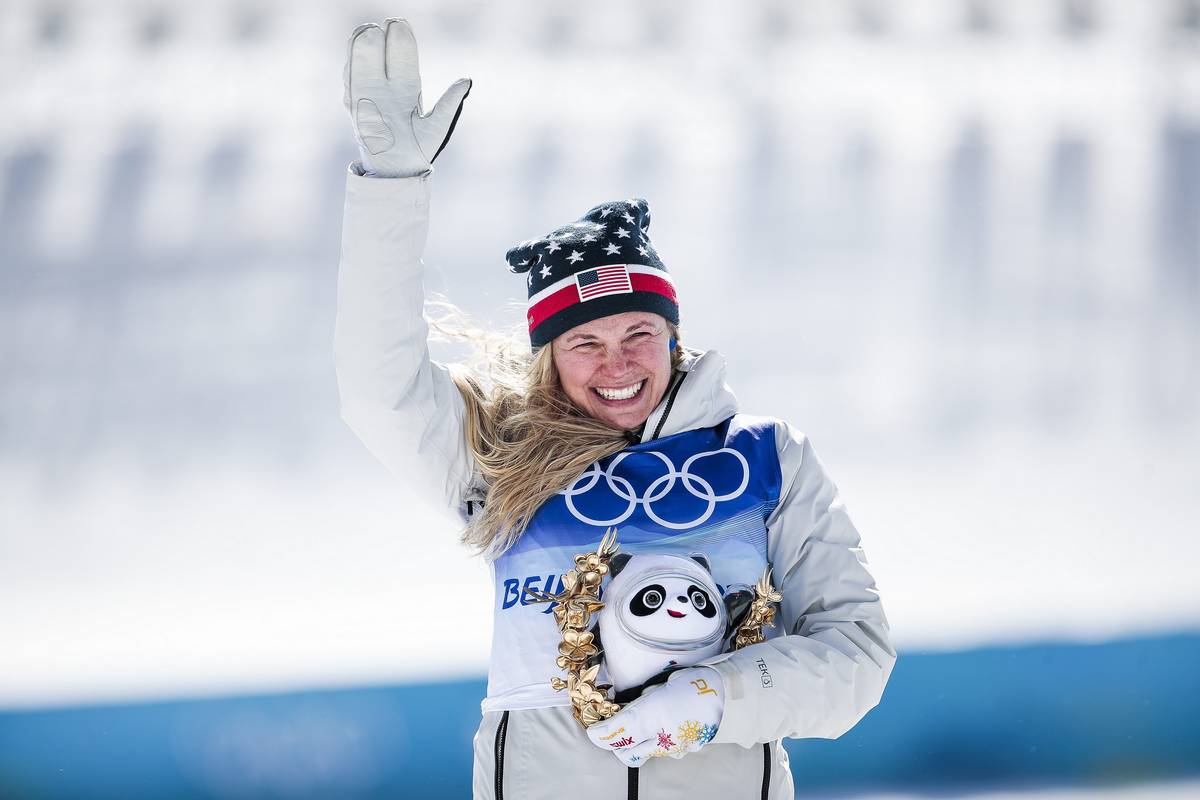
Therese Johaug (NOR) claimed three individual gold medals at Beijing’s 2022 Olympic Winter Games. (Photo: NordicFocus)
Therese Johaug’s Olympic dilemma is fairly straightforward. It’s this: why bother? She’s done everything there is to do in the sport of cross-country skiing—World Cup Crystal Globes (which she certainly won’t chase in 2026), Tour de Ski (which she probably won’t enter in 2026), World Championship glory (though 2025’s fistful of silver medals was not the result she’d hoped for), Olympic Medals (which she’s likely to win more of in 2026, but not enough to become the winningest skier ever). There’s just not much more for Johaug to win in 2026.
Johaug’s retirement has been put on hold—for the moment, at least—and she hasn’t yet announced her Olympic intentions. They’re holding a spot for her on Team Norway. They should: she’s one of the most successful, most talented, most dominant cross-country skiers of all time. She’s a shoe-in for Olympic medals in 2026. Among her Norwegian teammates, only Astrid Oeyre Slind seems capable of challenging Johaug in distance events.
Frida Karlsson (SWE) seized the 50 k Freestyle Mass Start at the 2025 World Champioships on a day when everyone else—including Therese Johaug (NOR)—was stymied by challenging conditions. Will Johaug race another year to prove that she, herself, has always been the strongest? (Photo: Thibaut/NordicFocus)
What is her goal, anyway? What does she have to gain by coming back for yet another Olympic Games? She can’t surpass Marit Bjoergen’s historic total of Olympic medals (not without continuing on to 2030, anyway). And she certainly can’t get back the Olympic opportunities lost during her suspension in 2018. Hasn’t she already won basically everything there is to win for a cross-country skier specializing in distance races? She won the Olympic Team Relay in 2010. She swept the distance races in 2022 (30 k Mass Start, 15 k Skiathlon, 10 k Interval Start). Maybe Johaug still sees the potential to win all of her individual Olympic events in Val di Fiemme: Skiathlon, 10 k Freestyle, 50 k Classic. Or perhaps Johaug just loves to train and ski. Regardless of her reasons, one thing certainly remains true: she’s still one of the very best in the world, still one of the very best of all time. And the Olympic races will be better, more exciting, and more consequential if she’s racing them. If she decides to race . . .
Beijing demonstrated the sort of Olympic dominance that Therese Johaug (NOR) could’ve understandably expected. (Photo: NordicFocus)
It seems Johaug may have one remaining goal in mind: win the Olympic 50 k Classic in order to soothe the sting of having been defeated in the 50 k at the 2025 World Championships in Trondheim. If she’d won the World Championship 50 k, she probably would’ve retired on the spot. But with that goal having been left unrealized in 2025, maybe Johaug needs more. She’s been World Cup Champion in both Overall (three times) and Distance (five times) classifications, but if she has her sights set on Olympic victories, she’s unlikely to care much about scheduling enough World Cup races to claim another Crystal Globe. After a career in which she has amassed 160 World Cup podium performances, she’s not likely to prioritize rounding up a few more.
Should she come back one more time? Should she risk another year of effort and training for a goal that may continue to prove elusive? Should she undertake another season of separation from her young daughter? She loves to race, she lives to compete, and her endurance—and her ability to recover—are legendary. If there’s an historic medal to be awarded in 2026, it won’t be a surprise to see Therese Johaug being one of those who shows up to vie for it.
This article was made possible through the generous support of our voluntary subscribers. If you would like to see more articles like this one, please support FasterSkier with a voluntary subscription.
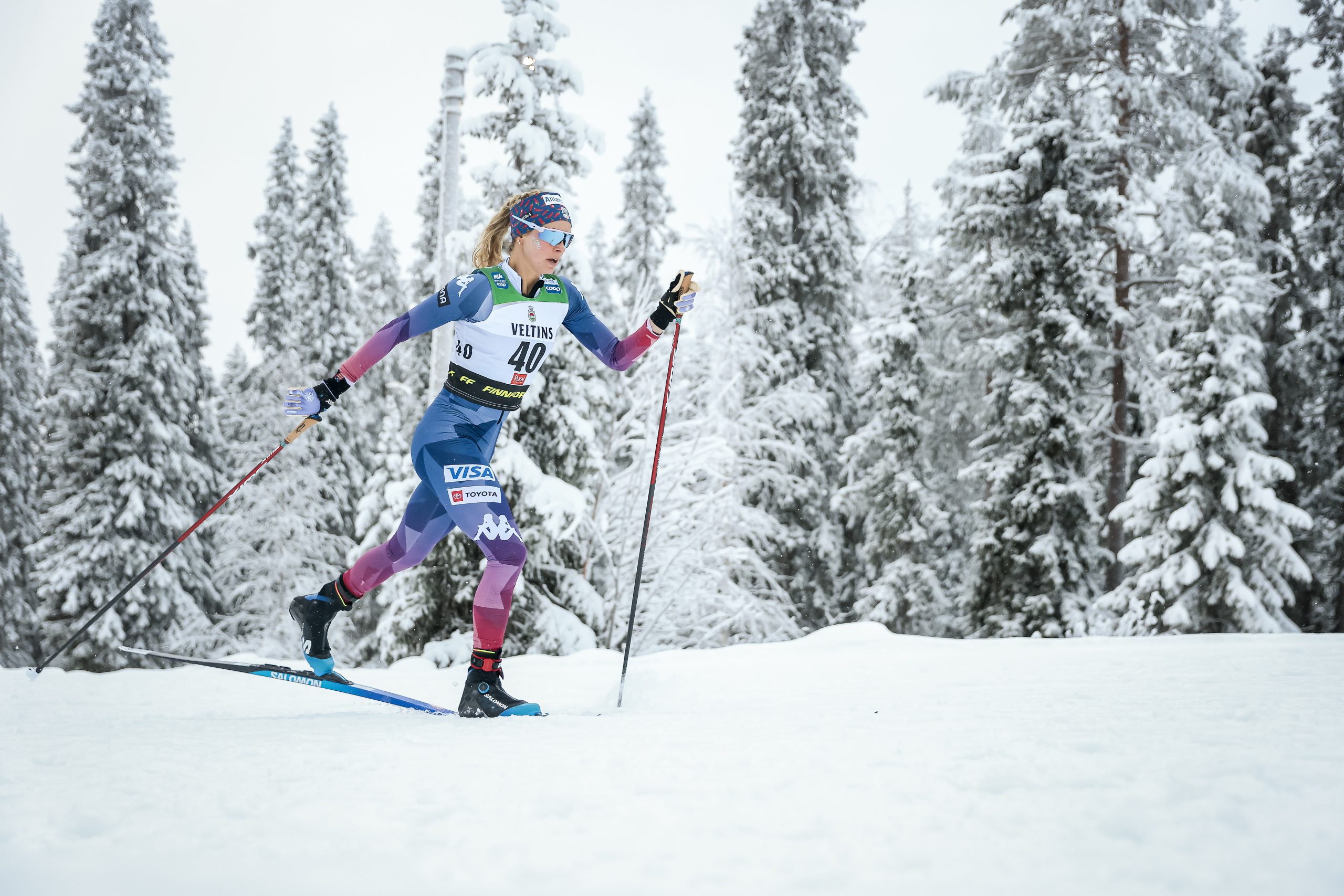
We’ve grown accustomed to seeing Jessie Diggins (USA) on the podium. Fans hope that the 2026 Olympic races in Val di Fiemme may provide even more opportunities. (Photo: NordicFocus)
In 2025, Jessie Diggins won the World Cup overall title for a third time—and for the second year in a row. How can such a terrific achievement end up creating a dilemma? Here’s how . . .
American media has numerous and gaping blind spots when it comes to winter sports. Skiing, skating, bobsled, luge, skeleton, biathlon, ski jumping, Nordic combined: Olympic and World Cup competitions are typically dominated by European sports-powers. And in coverage of those events, American sports journalists are notorious for not doing enough homework. They are overly simplistic in their understanding of winter sport events, seeming to assume that all events are the same, and that whomever wins one will win them all. American sportswriters often fail to consider race distance, event technique, conditions, equipment, and seasonality; factors that weigh heavily on the results in any cross-country skiing event. They just figure that skis are skis, and whomever is the best skier will win everything.
In taking on such a narrow focus, the American media—and, by association, American viewers—creates a unique dilemma for Jessie Diggins in their expectations for her Olympic performances. She’s three-time Overall World Cup Champion and three-time Olympic medalist. She is a truly accomplished cross-country skier. What those accomplishments decidedly do not prove is that Diggins is the best skier in the world (in the simplistic, pigeon-holing way that the American media would prefer). She’s absolutely one of the very best, but she’s definitely not the only one (as Diggins, herself, would be quick to remind us). When it comes to consideration of specific races on certain days, Diggins is likely to be considered a solid gold-medal favorite in only one Olympic event: the 10 k Freestyle Interval Start (an event she has regularly won on the World Cup circuit over the past few seasons). Even in this, her best event, Diggins is only one of the significant favorites. Therese Johaug (NOR), Jonna Sundling (SWE), Frida Karlsson (SWE), Ebba Andersson (SWE)—are all excellent skaters, and all are entirely capable of running away with the 10 k in Val di Fiemme. There are many contenders in these Women’s events, and that’s before the Russians even show up. Diggins can certainly win this race. On the other hand, the talents and heroics of other contenders could also result in Diggins finishing well off the podium. If that were to happen, the media would certainly express disappointment. That’s the dilemma that the media creates for Jessie Diggins.
Jessie Diggins (USA) has worked for years to refine her Classic technique, but her best chances for Olympic medals will probably come in Freestyle events. (Photo: NordicFocus)
In other races, Diggins has the potential to pop onto the podium—perhaps even to win a mass-start event—but this particular Olympic schedule is not structured in Diggins’ favor. In 2026, the Sprint will be a mass start event, but it’s Classic. The 50 k is a mass start event, but it’s Classic. Another chance for a Diggins medal exists in the Team Sprint, a Freestyle event in which she is likely to pair with teammate, Julia Kern, who showed such excellent form at the end of the 2025 season. The problem is that the American sports-media will trumpet the fact that America is home to the three-time World Cup Overall champion . . . a title that suggests (to the un-initiated) that such a champion should be capable of medaling in any event. Maybe even win them all! Three medals? Four medals? Five? Of course such results are possible, but it’s also a distinct unkindness to the athlete to suggest that we should expect such largess, to manufacture a situation in which we’ll be disappointed with anything less.
Jessie Diggins is the most accomplished cross-country skier who has ever worn the USA uniform. She races with unmatched intensity, and has refined both her fitness and her technique to degrees that make her a contender in virtually every event (as she has repeatedly proven). She follows the directions of an experienced team of coaches and technicians who remain firmly and expertly committed to her performance. And she has shown that she has the ability to win under even the brightest spotlights. The Olympic races in Val di Fiemme will be a chance for her to shine once more. Our hope is that American fans will be smart enough, and appreciative enough, and loyal enough to cheer her loudly, to praise her performances, and to join in the singing of the anthem whenever fitness and form and grit and luck produce the opportunity. When it does happen, it will likely be Jessie Diggins who has provided the opportunity for us.