
From the FasterSkier archive — posts syndicated from athletes’ and coaches’ own blogs between 2004 and 2012, kept online as published. Current coverage is at fasterskier.com.

Tag: 2026 Olympics

  • Russia’s Olympic Dilemma

    Russia’s Olympic Dilemma

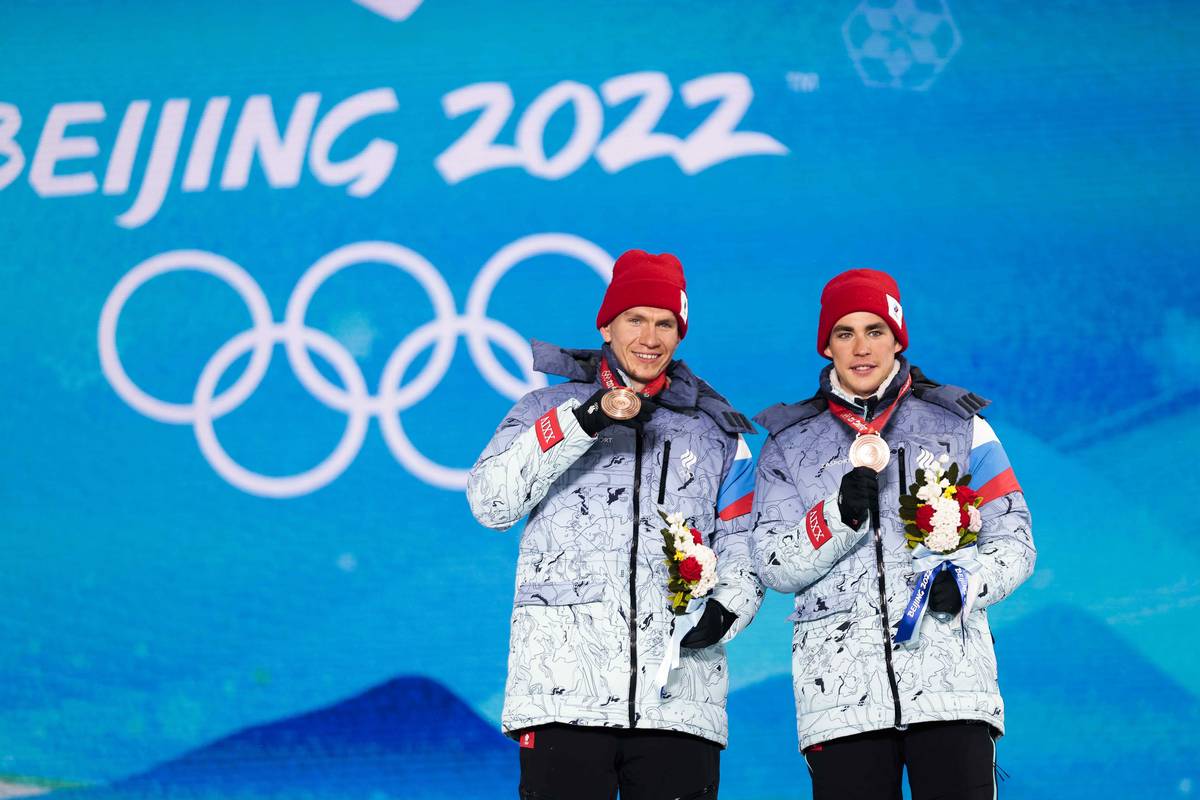
    Alexander Bolshunov and Alexander Terentev took home bronze medals in the classic team sprint during the 2022 Beijing Olympic Winter Games. At present, no one knows whether they’ll be back in 2026 at all. (Photo: NordicFocus)

    In all FasterSkier’s recent mentions, suppositions, and explanations regarding Olympic races scheduled to be staged in 2026, one factor has repeatedly been highlighted: the potential for all such predictions to be overturned by the presence of athletes from Russia. The most recent statements from the International Olympic Committee (IOC) report that no such decision has been made yet (though that could literally change at any moment). For the time being, Russian athletes remain banned from competing in any international races sanctioned by the International Ski Federation (FIS)—and that includes the Olympics.

    Is this Russia’s Olympic dilemma? Or the IOC’s Russia dilemma? The IOC defers to international sport governing bodies to decide whether or not Russian athletes will be allowed to compete in Milano-Cortina 2026. That’s why fans will see Russian figure skaters in the Olympics (allowed by the International Skating Union) but not Russian biathletes (banned by the International Biathlon Union). The IOC has recently expressed a desire for Russian cross-country skiers to be allowed to compete in the Olympic Winter Games of Milano-Cortina (kind of a public hint to the decision-makers at FIS). Thus far, FIS has been dragging its feet . . .

    Other sports’ governing bodies have already weighed in. In Ice hockey, Russian athletes remain banned from all international and Olympic competitions. Russian biathletes remain banned as well. Certain Russian figure skaters (limited to one man and one woman) have been approved to compete at the 2026 Olympics, though not in the team event. And the Olympic participation of any Russian athlete is to be allowed only within conditions stipulated in the IOC’s list of caveats and provisos: no Russian flag, no Russian anthem, no Russian colors (though Russian skiers definitely wore red in Beijing’s Olympic events four years ago). Evidently, Russians won’t be welcomed to march in the Opening Ceremonies. There’s also a suggestion that Russian athletes may not be allowed to compete in relays or team events. Most notably, any Russian athletes who are shown to have voiced support for Russia’s involvement in its war on Ukraine—or who are associated with Russian military forces—would not be welcome to compete.

    Head of the Russian Ski Federation, Yelena Valbe (herself a seven-time Olympic medalist), has been openly enthusiastic in her support of Putin, and has consistently—and publicly—denied any Russian aggression in Ukraine. Her position—a publicly and repeatedly stated one—may be enough for the FIS to exclude Russian athletes. The Russian athletes, themselves, seem to remain optimistic.

    “We will compete at the 2026 Olympics,” Alexander Bolshunov (RUS) recently stated. “Everything has its time. Mark my words.”

    Sergey Ustiugov has stated that he does not think he would even qualify for the Russian selection. He predicts that he has grown to old, and that up-and-coming skiers are simply too fast.

    Alexander Terentev (who shared the bronze medal with Bolshunov in the Team Sprint in 2022, and claimed another bronze in the Individual Sprint) has kept a very low profile (at least in the Western media) ever since Russian athletes were banned. He appears to have won a national championship in 2024, but no other international results are readily available.

    Natalia Nepryaeva has reportedly continued to compete in Russia, but it remains to be seen if that level of competition has been sufficient to maintain the sharpness that once won her the Tour de Ski and the Overall World Cup.

    Veronika Stepanova (a member of Russia’s gold-medal wining relay team in 2022) was openly supportive of Putin’s war in Ukraine from the very beginning. She was also loudly critical of the FIS decision to ban Russian participation in the first place.

    As for Bolshunov—the triple gold medalist from Beijing who has repeatedly demonstrated the ability to undo the expected coronation of Norwegian superstars—he may have a difficult time convincing FIS to allow him to compete, especially after his appearance on stage at a government-sponsored rally supporting the war in Ukraine. Like other athletes on the stage that day, there was no mistaking the “Z” logo on his event-provided jacket, a reference to the Z painted on Russian tanks that rolled across the border into Ukraine. And the IOC has made it clear that they will accept no participants who have voiced support for the invasion of Ukraine.

    If Russian skiers do show up for the Olympic Winter Games in Milano-Cortina, the races will be better: more competitive, more tactics, more strategies, more top-end speed. In short, everything we like about ski racing. Whats to be decided, then, is whether or not FIS is willing to undo some of the measures that the organization has undertaken in support of Ukraine, in support of the idea of fair competition among peaceful nations, and in support of true sportsmanship (the spirt of which is central to the Olympic oath). Letting the Russian athletes back into the Olympic Games is a wonderful, open-hearted idea. It’s also a terrible, cynically opportunistic idea. But the very same can be said of keeping those athletes out of the Games.

    Years ago, the Russian Olympic Committee was banned from participating in the Olympics as a result of Russia’s having systematically cheated in Olympic competitions (and having gotten caught red-handed after the Russian-hosted Olympics in Sochi). That was enough to get them banned for a while, but the IOC still allowed “clean” Russian athletes to compete. Now, the debate rages on account of Russia’s having invaded neighboring Ukraine (for the second time in recent memory). The Olympic Committee seems to feel “The Russian Government invaded a neighboring country. Why punish the athletes?” It’s a fair question. But so is this one: “The Russian Government invaded a neighboring country. Why reward its athletes?”

    A lot of people (including a significant number of international competitors and coaches) don’t want the Russians to be at these 2026 Olympics. But plenty of other people (including a significant number of international competitors and coaches) do want the Russians to be there. The so-called (and oft-cited) “Olympic Truce” is really a thing of the ancient past: modern nations are unlikely to stop wars or make peace just because a bunch of skiing, skating, and sledding events are scheduled. It would be nice if the ethics and philosophies behind the founding of the Modern Olympic Games were a thing that the world could live by . . . but they’re not.

    Announcements will undoubtedly be coming soon. As Bolshunov, himself, said, “Everything has its time.”


  • L.A. Potential Host for Both 2024 Summer and 2026 Winter Olympics

    L.A. Potential Host for Both 2024 Summer and 2026 Winter Olympics

    The logo of the Olympic Games 2024 Candidate City Los Angeles. Its organizing committee may need to tweak it slightly (give her some ski poles and skis) if L.A. ends up getting the nod the 2026 Winter Olympics as well. (Photo: LA24.org)

    In 2022, Beijing will become the only city that has hosted both Summer and Winter Olympic Games. But sooner than expected another unlikely city might join that rank: Los Angeles.

    L.A. is currently one of only two remaining candidate cities to host the 2024 Summer Olympic and Paralympic Games, the other one being Paris. The winner will be determined at the next International Olympic Committee (IOC) general session in Lima, Peru, in September of this year.

    But recently, the IOC Executive Board has become worried about a bidding process it fears is too expensive, too elaborate, and “produces too many losers” in the words of IOC President Thomas Bach. Under the current circumstances, otherwise highly qualified cities often don’t want to bid again for future Olympics after coming up short in an IOC session, and cities at least in many democratic countries are ending their candidacies under pressure from lost popular votes.

    For the 2024 Olympics, cities such as Hamburg, Rome and Budapest withdrew their bids from consideration after political opposition, leaving only L.A. and Paris to choose from.

    And for the 2022 Winter Games, the IOC ultimately was left with another two-horse race between Beijing and Almaty, Kazakhstan, after cities such as Oslo and Munich withdrew their bids.

    For example, if the Olympics were to be held in Munich, virtually no costly “white elephant gift” venues never to be used again after the two-week Games would have had to be built, a plight suffered by several recent Olympic host cities. The region already hosts World Cup events every year (e.g. in Ruhpolding for biathlon, Oberstdorf for cross-country skiing and ski jumping, Garmisch Partenkirchen for alpine skiing, Königsberg for bobsled, and Inzell for speed skating). Only one or two athlete villages and a media center would have had to be built providing sorely needed new real estate. But in 2013, a majority of citizens still voted against the Olympic project. That certainly has given the German-born IOC President Bach reasons to worry about the future of the Olympics, after a plan called Agenda 2020 failed to spark significant changes.

    So now the IOC has publicly pondered plans to award multiple games at the same time as soon as during this year’s session, reportedly offering the loser of the 2024 Olympic bid the next Summer Games in 2028 automatically. But Los Angeles and especially Paris were not fond of that idea. “We have only one objective and that is to host the Games in 2024,” the chairman of Paris’ candidature Tony Estanguet said at a media event in London last week.

    Within the IOC, L.A. is widely considered to have presented a sound plan to host the 2024 Games on a reasonable budget without too much new construction required. Paris might have the tradition speaking for it, hosting the 2024 Olympics exactly 100 years after it already did so in 1924, but for the City of Angels, it would also be the 40-year anniversary of the 1984 games.

    Now the overlords of the IOC have come up with a follow-up suggestion: Los Angeles could also host the 2026 Winter Olympics, saving costs associated with the bidding process, and profiting from synergies in the back-to-back organizing and broadcasting of the event. Reportedly the IOC’s main media partners NBC and Discovery Communications, which holds the TV and internet distribution rights for Europe, are in favor of the plan. The same is true for key “Olympic Partner” sponsors such as Coca Cola, McDonalds, Visa, GE, P&G, and Samsung.

    The advantages are clear: the same Olympic village, only one new media center, only having to create sufficient hotel and transportation capacity once, the same security concept, the same ticketing solution, and so on. The IOC even promises to pass on a larger percentage of its revenue share to the host city in case of a successful double-bid without “double-dipping”.

    Of course there is one obvious problem: L.A. has a temperate climate year round with no snowfall, and is a city where people are so accustomed to warm weather conditions that they freak out even over a little rainstorm or when temperatures drop to 50 degrees Fahrenheit. The downtown L.A. weather station only recorded measurable snowfall three times in 1882, 1932 and 1949 since official weather records were kept, with the last one elsewhere in the L.A. basin in 1962.

    “At first, of course I also thought it was a really weird idea for our city to host a winter sports event,” Los Angeles mayor Eric Garcetti, a fourth-generation Angeleno who has never experienced snowfall in his city, told FasterSkier. “But IOC President Bach has since convinced me that having natural snow is not really a prerequisite to hosting Winter Olympics anymore. Beijing doesn’t get any snow with regularity, either, and Sochi has the same climate as the Mediterranean Sea. They even have palm trees on the oceanfront, just like us. Many of the events are indoors on ice rinks anyway, and the outdoor ones can be hosted in the mountains just a few hours by car or bus away.”

    “People don’t realize that a number of NBA arenas also double as NHL hockey arenas,” basketball legend and 1992 Olympic gold medalist Ervin “Magic” Johnson said, an advisor to the L.A. 2024 Organizing Committee and president of basketball operations of the LA Lakers. “We have that here in L.A. for the Kings playing their home games in the Staples Center, and for the Lakers we just cover up the ice with a hardwood floor. The same in Boston, or even in very hot cities like Phoenix. With modern technology that’s no problem at all!”

    Similar to how the Rosa Khutor Alpine Resort east of Sochi played a big role for the 2014 Olympics, hosting all alpine, biathlon, ski jumping and cross-country events, Los Angeles would have to rely on more mountainous venues for those sports. Mammoth Mountain could be an option with some experience hosting international snowboard and freeskiing events and secure snow for cross-country due to its higher altitude, potentially the resorts around Big Bear Lake closer to the city, and a bit farther away Squaw Valley and Lake Tahoe are also under consideration, according to sources close to the LA 2024 Candidature City Committee.

    Just last month, the FIS Alpine Ski World Cup returned to California for the first time in 19 years with a women’s giant slalom and slalom at Squaw Valley Alpine Meadows. U.S. Ski Team star Mikaela Shiffrin did not disappoint her many fans, sweeping the two races on the Red Dog run.

    “We never anticipated hosting both summer and winter games back-to-back, but this is such an exciting opportunity,” explained Casey Wasserman, chairman of the LA 2024 Committee and CEO of the Wasserman Media Group, a sports and entertainment company. “It would save a lot of financial and environmental resources for these two games, not having to build a new village, a new arena for the opening ceremony, and so on. And luckily we have some huge winter sports competency on our leadership team already.”

    That experience mainly comes in the form of Angela Ruggiero, the chief strategy officer for the LA 2024 Committee and an ice hockey Hall of Famer and four-time Olympian who won gold in 1998, silver in 2002 and 2010, and bronze in 2006.

    Other past and future U.S. Olympians were both surprised and excited when they heard the news of a potential candidacy by the California city.

    “I’m from Palo Alto and have really no emotional connection to LA,” US Biathlon’s Joanne Firesteel Reid wrote in an email to FasterSkier. Reid is a 2008 Junior Olympics gold medalist, US Biathlon senior team member, daughter of U.S. Olympian Beth Reid and niece of speed skating Olympic champion Eric Heiden. “For now I have my mind set on the 2018 and maybe the 2022 Olympics. But it would be crazy fun for California to host a major biathlon and winter sports event, so I am all for it.”

    That thought was shared by 19-year-old U.S. Ski Team development team member Hannah Halvorsen, of Truckee, Calif. She competed at last year’s 2016 Youth Olympic Games in Lillehammer, Norway.

    “Olympics in California, that alone is just an amazing dream,” she wrote. “Who knows? I might just be peaking at that point.”

    Figure skater Mirai Nagasu even hails from Los Angeles County, and alpine skiers Julia Mancuso and Travis Ganong — also born in Truckee — live in Squaw Valley for part of the year. Both were excited about the possibility to see Olympic races potentially happening in their hometown, though the four-time Olympic medal winner Mancuso cautioned those games would come too late for her anyway, as she plans to likely retire after the 2018 Olympics in PyeongChang, South Korea.

    “I will have to watch those games from the stands or from my couch like a normal person,” she laughed. “But I would love to play even a minor role in bringing Olympic games to my hometown. The organizing committee can sign me up if they need some social media promotion. I have tons of selfies and hours of ski video footage from the mountains around Lake Tahoe, I even got married there.”

    The last time the U.S. hosted an Olympics was in 2002 in Salt Lake City, Utah. The last time North America has hosted an event was more recently in Canada in 2010 in Vancouver, British Columbia.

    Opposition to the IOC’s plans are expected to come from cities who also considered bids for the 2026 Olympics and were surprised by the seemingly sudden potential overhaul of the whole bidding process, such as Innsbruck (Austria), Stockholm (Sweden) and Helsinki (Finland), or the region around Sion (western Switzerland). Almaty might take another shot after losing to Beijing for the 2022 Games, with Sapporo, Japan, also reported as another candidate city from Asia that already hosted games in the past.

    For North America, Calgary also had initial plans to submit a bid, with the city council approving a $5 million dollar budget in June 2016 for an exploratory phase. Now the host city of the 1988 Winter Olympics was caught off-guard by the possibility another major city on the continent could vault to the forefront of the candidates in the bidding process.

    “Honestly, we were feeling really positive the way things were trending before this announcement,” said John Furlong, CEO of the 2010 Olympics in Vancouver and a current advisor to the Canadian Olympic Committee. “But L.A. potentially getting the 2026 Winter Olympics by default? That came out of nowhere. This has got to be a joke or something.”