From the FasterSkier archive — posts syndicated from athletes’ and coaches’ own blogs between 2004 and 2012, kept online as published. Current coverage is at fasterskier.com.
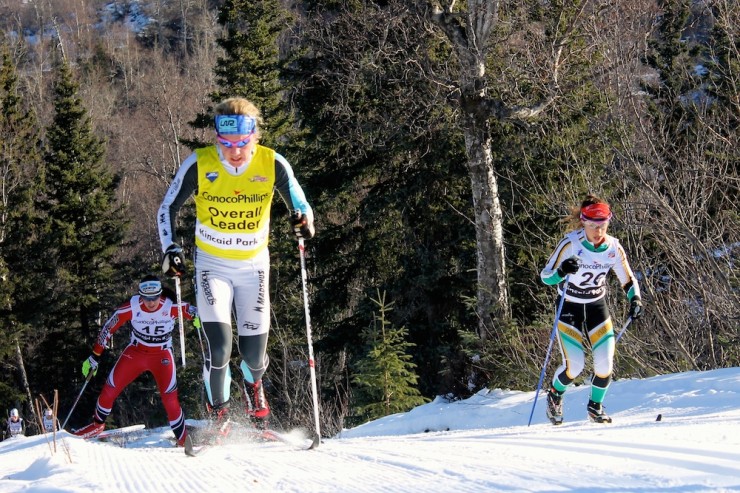
Of the four Russian athletes starting the 15-kilometer classic mass start in Lahti, Finland three placed in the top four. Anna Zherebyateva won in 40:31.4 minutes as she was able to stretch her nine-second gap at 10 k to 23.5 seconds by the finish. Also from Russia, Lidia Durkina placed second (+23.5), Germany’s Katharina Hennig skied to third (+37.5).
“My tactic was to make a gap in the second loop,” Zherebyateva said during the post-race press conference. “So I did exactly what I wanted. It went really well. Tracks were exactly right for me. This gold medal is an important step for my sport career.”
Yana Kirpichenko was the third Russia in the top-five as she placed fourth (+41.6).
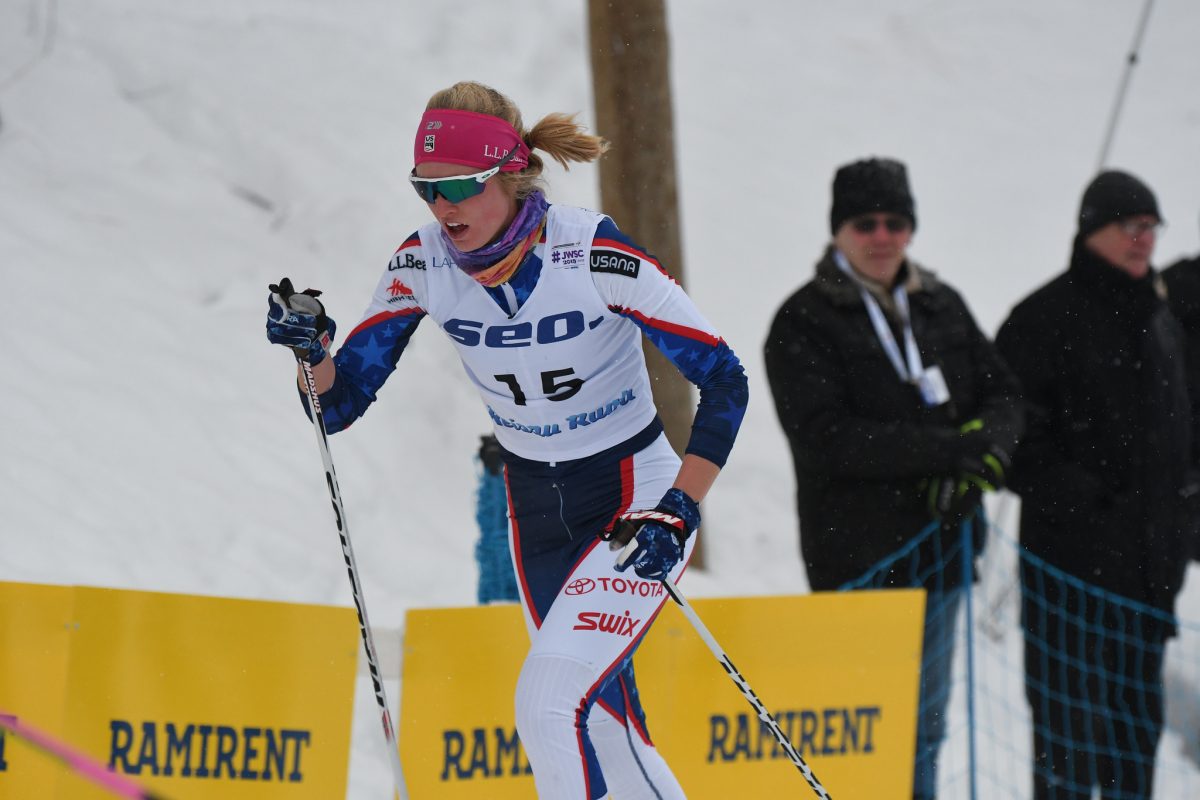
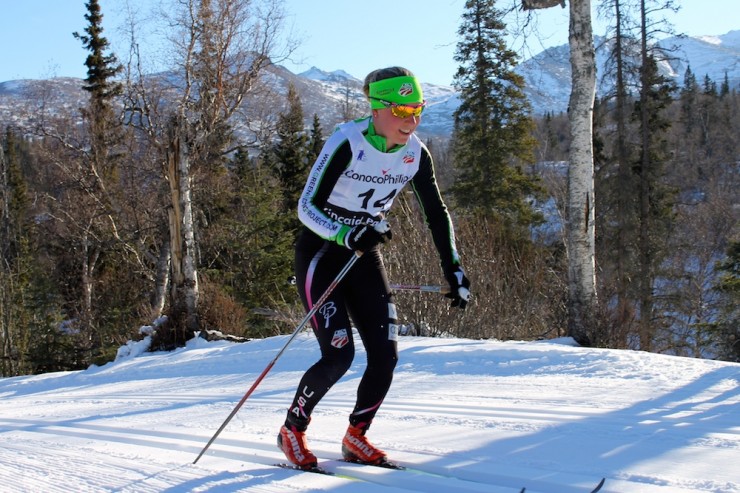
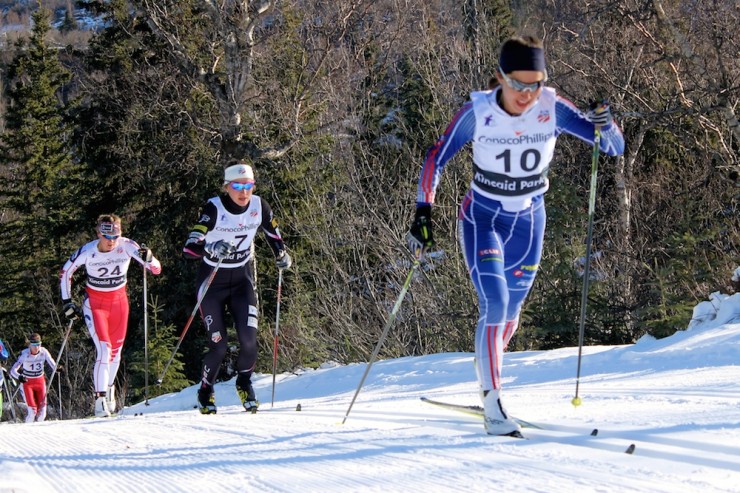
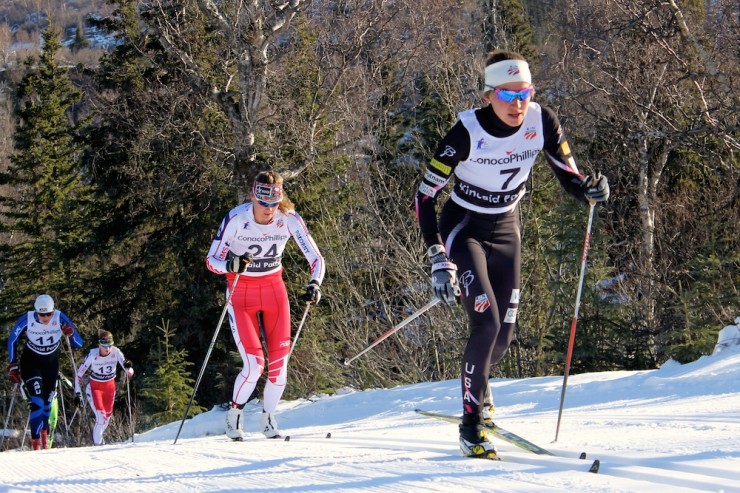
The best North American finisher was U.S. skier Hailey Swirbul who raced to 10th (+1:27.8). Swirbul was positioned 29th at the 5 k time check but steadily moved up in the field as the race progressed. By 10 k she had positioned herself in the top-15.
For the twenty-year-old Swirbul, this is her first go at U23 Worlds after participating in three Junior Worlds as an U20. Last season in Goms, Switzerland she placed second in the 5 k classic and third in the 10 k skiathlon.
Two other U.S. skiers raced into the top-30. Julia Kern placed 16th (+1:43.4), while Alayna Sonnesyn was 23rd (+2:24.9). Hannah Halvorsen, the fourth U.S. starter, placed 54th (+6:58.6).
Hannah Mehain was the top Canadian in 31st (+3:16.8), Sadie White placed 33rd (+3:18.6), and Natalia Hynes 51st (+3:40.9). Marie Corriveau did not start.
Similar to the U23 women’s race, Russian skiers dictated the pacing at the front of the pack — the four Russian starters swept first through fourth place.
Andrey Sobakarev won in 1:17:19.1 hours, Ivan Kirillov placed second (+3.5), Ivan Yakimushkin third (+4.9), and Anton Timashov fourth (+11.4).
Canada’s Antoine Cyr was the top North American in 27th (+2:26.8), while teammate Gareth Williams toed the line a fraction behind in 28th (+2:26.9). Also for Canada, Ritchie Graham was 41st (4:44.1), and Julian Smith 45th (+5:14.3).
Peter Holmes was the top U.S. finisher in 33rd (+3:15.7). Hunter Wonders placed 40th (+4:43.0), Braden Becker 53rd (+6:59.0), and Daniel Streinz 66th (+15:53.9).
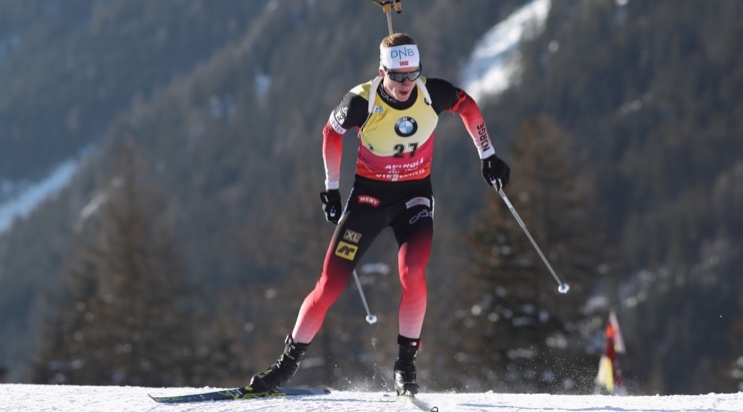
Johannes Thingnes Bø scored his 10th IBU World Cup win of the season today in the 10 k sprint in Antholz, Italy. (Photo: biathlon world.com screenshot)
IBU World Cup Antholz, Italy 10 k sprint
In the groove is in the groove. Norway’s twenty-five-year-old Johannes Thingnes Bø scored his 10th IBU World Cup win of the season today in the 10 k sprint in Antholz, Italy. Bø won the race in 23:53.9 minutes with a single penalty in standing. The Norwegian leads the IBU World Cup overall and padded his lead with his fifth sprint win this year.
“It was quite difficult; the altitude here is quite heavy and with the new tracks, I felt dead from 5K so the last 5K was really tough,” Bø said to the IBU after the race. “I managed to have a good plan for the race. When I shoot nine targets, I was quite happy and then it was just to fight hard for the finish line. I like this year’s track; I liked last year’s too because it was not so painful.”
Bø’s season thus far has been a study in speedy skiing. His shooting stands at 87% for accuracy (82% standing, 91% prone) with his superior skiing speed carrying him to the World Cup overall lead. In Antholz today, his course time for each of his two 5 k laps were ranked first.
Norwegian teammate Erlend Bjøntegaard shot clean in both his shooting bouts to take second place, 17.5 seconds behind. France’s Antonin Guigonnat placed third (+20.2, 0+1).
Scott Gow of Canada was the top North American in 20th (+1:06.6, 0+0). Teammates Jules Burnotte raced to 48th (1:55.9, 1+1), Christian Gow 61st (+2:13.4), and Aidan Millar (+3:46.7, 2+2).
Jake Brown was the top American in 40th (1:42.4, 1+0). Sean Doherty finished in 55th (+2:06.2, 2+1), Max Durtschi 62nd (+2:13.8, 0+1), and Leif Nordgren 73rd (+2:43.1).
Racing continues tomorrow in Antholz for both the men and women with the 12.5k and 10 k pursuits.
Lake Placid SuperTour 5 k/10k Skate Individual Start
In the 5 k-freestyle individual start Jessica Yeaton (APU/Australian National Team) placed first with a winning time of 15:01.9 minutes. She was in a tight race for the top spot with U.S. Ski Team/SMS T2 athlete Sophie Caldwell who finished 3.0 seconds back. Caldwell is back home in Vermont training and preparing for the 2019 World Championships.
Katherine Ogden (Dartmouth Ski Team) placed third in a time of 15:17.8. Kelsey Phinney (SMS T2) placed fourth in 15:37.7.
“Today’s race went super well for me; I had awesome skis despite tricky conditions/weather leading into the race – our wax tech did a phenomenal job,” Yeaton wrote to FasterSkier. “The course here is really good for me with all the steady climbing in the first part- I just tried to push hard to the top of the course and then survive and carry my speed on the downhill, which turned out to be a good tactic.
“Between US Nationals and now I definitely feel like I am in a good place leading into Seefeld. I struggled with some injuries in the fall and was forced to do a lot of cross-training (especially on the bike) and skip the early season races in Nov/Dec. In retrospect I think this actually was a blessing in disguise, as I ended up putting in a super hard training block and gaining a lot of fitness. Looking ahead to Seefeld, my goal is to top 30 in one of the races, with my main focus being on the skate events (30k and sprint), and the 15km skiathlon. I am really excited for the rest of the races this weekend; they are my final prep before heading over to Europe to race on World Cup and in Seefeld.”
Kyle Bratrud (SMS T2) won the men’s 15 k skate in 25:27.1 minutes. Bratrud, who was recently selected to the 2019 U.S. World Championship Team, has been a top-performing distance skier this season on the SuperTour.
“Today went well,” Bratrud emailed. “After Nationals, I made the tough decision of turning down World Cup starts in Otepaa and Ulricehamn in order to get some quality training in for the World Champs. Today reflected that as I felt a little tired and pretty flat from not racing since Nationals. That being said, I expect to keep feeling better each race and I should be in a great place when I fly to Europe on the 4th!”
Bratrud recently won the NorAm/SuperTour 15 k classic in Sovereign Lake and the 15 k classic at U.S. Nationals. Bratrud placed second in West Yellowstone’s SuperTour 15 k skate, and the 30 k skate mass start at U.S. Nationals.
Akeo Maifeld-Carucci (CGRP) placed second in a time of 26:18.9. It was Carucci’s second SuperTour podium of the season and his best career SuperTour result. In West Yellowstone, he was third in the 15 k skate behind Ben Lustgarten (CGRP) and Bratrud.
Alexis Dumas (CNEPH) of Canada was third in 26:32.2. U.S. skier Adam Martin was fourth, 3.1 seconds behind Dumas.
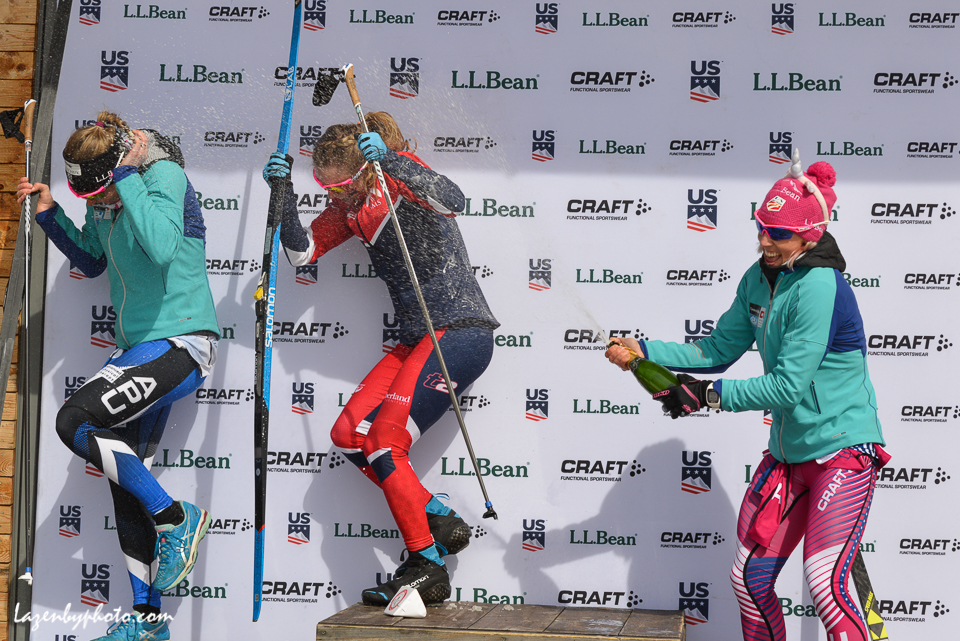
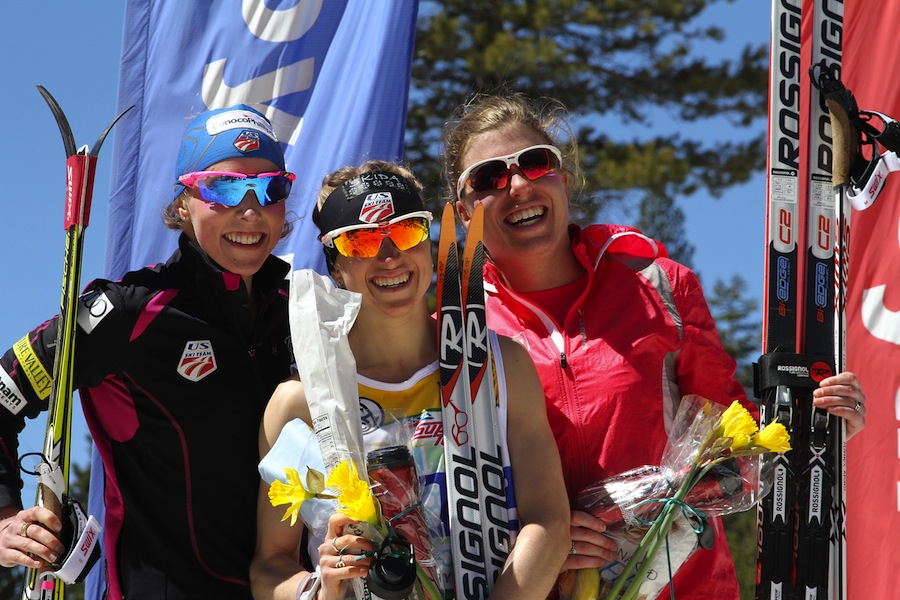
Kikkan Randall (r) sprays her U.S. Ski Team teammates Jessie Diggins (c) and Sadie Bjornsen (l) with champagne on the podium of the 30 k classic mass start at U.S. Distance Nationals in Craftsbury, Vt. Diggins won, Bjornsen placed second and Randall finished third. (Photo: John Lazenby/Lazenbyphoto.com)
2018 U.S. Distance Nationals (Craftsbury, Vermont): 30 k classic mass start
Jessie Diggins swept SuperTour Finals once again, after doing so last year in Fairbanks, Alaska, and winning every individual race at 2016 SuperTour Finals the year before in Craftsbury, Vt.
Back in Craftsbury on Tuesday, and coming off three-straight victories in the classic sprint, 10-kilometer freestyle mass start and mixed relay with her Stratton Mountain School (SMS) T2 Team teammates, Diggins, 26, pulled out her fourth-straight win in her last race of the season: the women’s 30 k classic mass start, which is part of U.S. Distance Nationals.
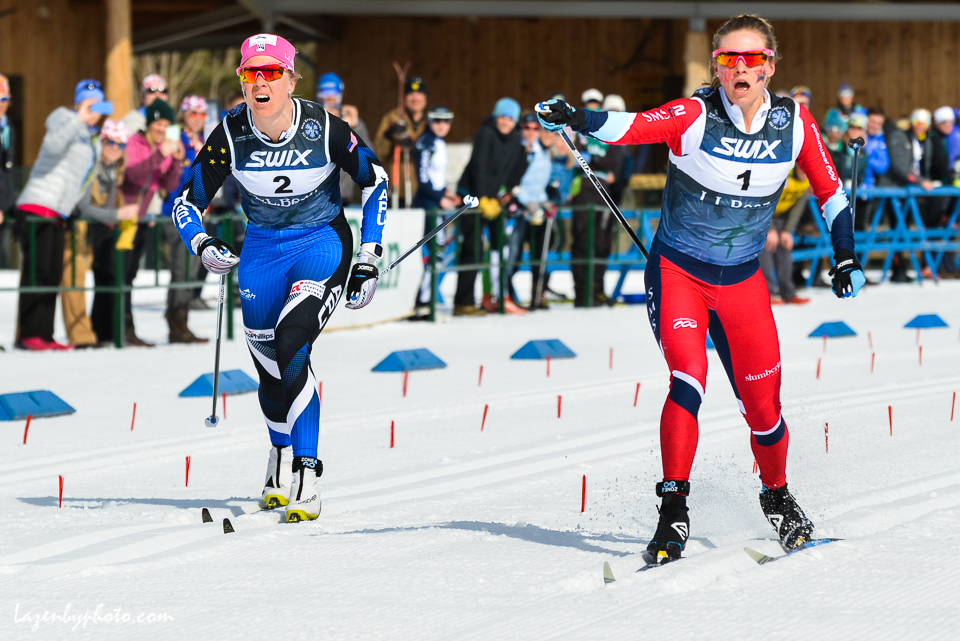
Jessie Diggins (r) edging her U.S. Ski Team teammate Sadie Bjornsen at the line for the win in the women’s 30 k classic mass start at 2018 U.S. Distance Nationals in Craftsbury, Vt. (Photo: John Lazenby/Lazenbyphoto.com)
She did so in an all-out effort to the line, beating her fellow U.S. Ski Team (USST) member Sadie Bjornsen by just 0.4 seconds in 1:25:27.2 hours. Diggins, Bjornsen of Alaska Pacific University (APU), and another USST member Sophie Caldwell (SMST2) broke away from the pack on the first of five laps at the Craftsbury Outdoor Center. Caldwell dropped off the pace around 10 k and skied on her own for the next 15-plus kilometers before being caught by a chase group of six, led by Kikkan Randall (APU/USST), on the final lap.
Meanwhile, Diggins and Bjornsen skied together, trading the lead for the rest of the race. On the final short climb up to the stadium, Diggins pulled ahead slightly then extended her lead in the finishing straight. After finishing first and second, respectively, Diggins and Bjornsen laid on the ground for what seemed like a long time, particularly spent from the effort, before congratulating each other. Behind them, Randall outlasted the chase pack for third (+2:21.7), Caldwell followed just behind her in fourth (+2:23.1), Ida Sargent of the Craftsbury Green Racing Project (CGRP) and USST placed fifth (+2:26.5) and Rosie Frankowski (APU) finished sixth (+2:29.2).
Also in the top 10, Liz Stephen (USST) finished the last race of her professional career in seventh (+3:10.9), Caitlin Patterson (CGRP) eighth (+3:27.2), Kaitlynn Miller (CGRP) ninth (+3:56), and Chelsea Holmes (APU) 10th (+4:45.3).
Stratton had two wins on the day with Charlotte Ogden (SMS) winning the junior women’s 20 k classic mass start in 1:04:33.9. Canada’s Catherine Reed-Metayer (Skibec Nordique) placed second (+11.8), Waverly Gebhardt (Steamboat Springs Winter Sports Club) finished third (+33.8), and Phoebe Sweet (Craftsbury Nordic) was the third American junior in fourth overall (+1:10.2).
Spring Series concludes with the men’s 50 k classic mass start on Wednesday, starting at 9 a.m. EDT. Watch the races live on the SuperTour live stream.
The start of the women’s 30 k classic mass start at 2018 U.S. Distance Nationals in Craftsbury, Vt. (Photo: John Lazenby/Lazenbyphoto.com)
Jessie Diggins (1) leading the women’s 30 k classic mass start at 2018 U.S. Distance Nationals in Craftsbury, Vt. (Photo: John Lazenby/Lazenbyphoto.com)
Sadie Bjornsen (2) leading the women’s 30 k classic mass start at 2018 U.S. Distance Nationals in Craftsbury, Vt. (Photo: John Lazenby/Lazenbyphoto.com)
Sadie Bjornsen (2) leading the women’s 30 k classic mass start at 2018 U.S. Distance Nationals in Craftsbury, Vt. (Photo: John Lazenby/Lazenbyphoto.com)
Sadie Bjornsen (2) leading Jessie Diggins (c) and Sophie Caldwell (l) during the women’s 30 k classic mass start at 2018 U.S. Distance Nationals in Craftsbury, Vt. (Photo: John Lazenby/Lazenbyphoto.com)
Ida Sargent (15) leads Kikkan Randall. Caitlin Patterson, Liz Stephen (yellow bib) and others in a chase pack during the women’s 30 k classic mass start at 2018 U.S. Distance Nationals in Craftsbury, Vt. (Photo: John Lazenby/Lazenbyphoto.com)
Sadie Bjornsen (2) and Jessie Diggins (1) racing for first in the women’s 30 k classic mass start at 2018 U.S. Distance Nationals in Craftsbury, Vt. (Photo: John Lazenby/Lazenbyphoto.com)
Kikkan Randall (3) racing for third place in the women’s 30 k classic mass start at 2018 U.S. Distance Nationals in Craftsbury, Vt., ahead of Sophie Caldwell (second from l), Ida Sargent (second from r), and Rosie Frankowski (r). (Photo: John Lazenby/Lazenbyphoto.com)
Jessie Diggins (l), Liz Stephen (c) and Rosie Frankowski (r) at the finish of the women’s 30 k classic mass start at 2018 U.S. Distance Nationals in Craftsbury, Vt. (Photo: John Lazenby/Lazenbyphoto.com)
Jessie Diggins with a photo of her retiring U.S. Ski Team teammates Kikkan Randall and Liz Stephen on her cheek at 2018 U.S. Distance Nationals in Craftsbury, Vt. (Photo: John Lazenby/Lazenbyphoto.com)
Kikkan Randall (l) and Liz Stephen after the last race of their professional careers, the 30 k classic mass start at 2018 U.S. Distance Nationals in Craftsbury, Vt. (Photo: John Lazenby/Lazenbyphoto.com)
The women’s 30 k classic mass start podium at 2018 U.S. Distance Nationals in Craftsbury, Vt., with Jessie Diggins (c) in first, Sadie Bjornsen (l) in second and Kikkan Randall (r) in third. (Photo: John Lazenby/Lazenbyphoto.com)
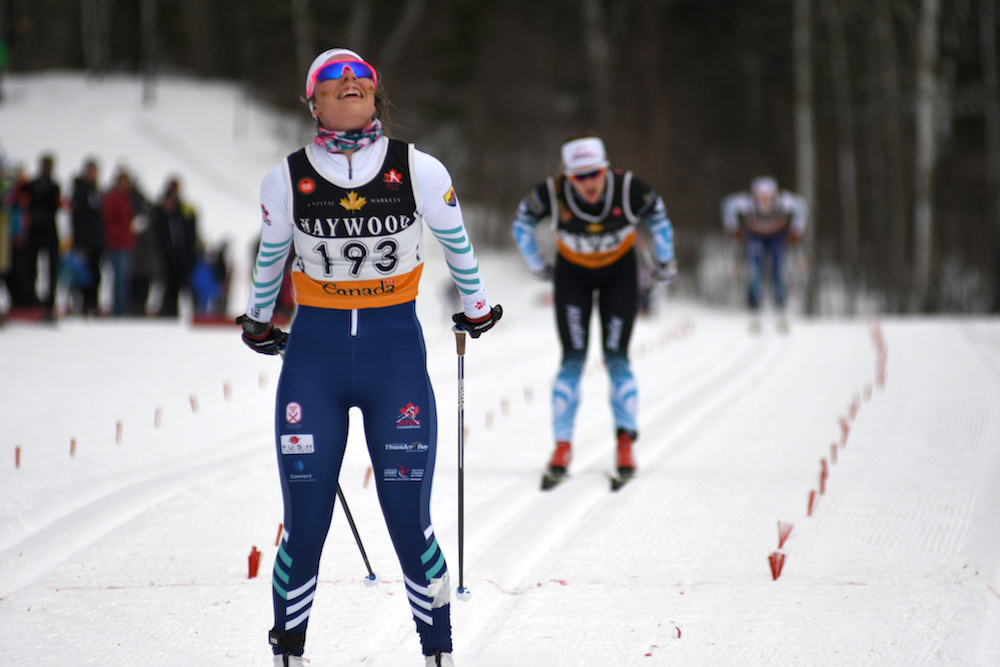
Katherine-Stewart Jones (193) of NTDC Thunder Bay soaks up her win in the women’s 30 k classic mass start on Saturday at 2018 Canadian Ski Nationals in Thunder Bay, Ontario, just 2.3 seconds ahead of Annika Hicks (AWCA) in second. (Photo: Doug Stephen)
(Note: This article has been corrected to reflect that Evan Palmer-Charrette won his second national title last weekend.)
2018 Canadian Ski Nationals (Thunder Bay, Ontario): 30/50 k classic mass starts
On the final day of racing at Canadian Ski Nationals in Thunder Bay, two National Team Development Centre (NTDC) Thunder Bay athletes topped the podium on their local trails at the Lappe Nordic Centre on Saturday. Katherine Stewart-Jones and Evan Palmer-Charrette won national titles in the women’s 30-kilometer and men’s 50 k classic mass starts, respectively.
Stewart-Jones, 22, who is also a Canadian National U25 Team member, won the women’s 30 k for her first national title by 2.3 seconds over Annika Hicks of the Alberta World Cup Academy (AWCA) with a time of 1:33:50.7 hours. NTDC Thunder Bay had two women on the podium with Alannah Maclean finishing third, 10.2 seconds behind her teammate. Stewart-Jones had previously placed second in the freestyle sprint last Wednesday at nationals.
“Am I happy or am I happy????” Stewart-Jones, 22, wrote on Instagram following her win “Beyond stoked to finally get a National Champs Title in the 30km”
Stewart-Jones also started the week with a win in the classic team sprint with Nakkertok club teammate Zoë Williams on March 10.
Also in the top 10 of Saturday’s 30 k, Olivia Bouffard-Nesbitt of Rocky Mountain Racers (RMR) raced to fourth (+18.3), Frédérique Vézina of the Pierre-Harvey National Training Centre (CNEPH) placed fifth (+19.2), American Caitlin Gregg finished sixth (+1:25.5), Sadie White (NTDC Thunder Bay) was seventh (+2:48.3), Williams (Nakkertok) eighth (+3:40.4), Laurence Dumais (AWCA) ninth (+4:30.4), and Katie Weaver (Hollyburn) 10th (+6:47.7).
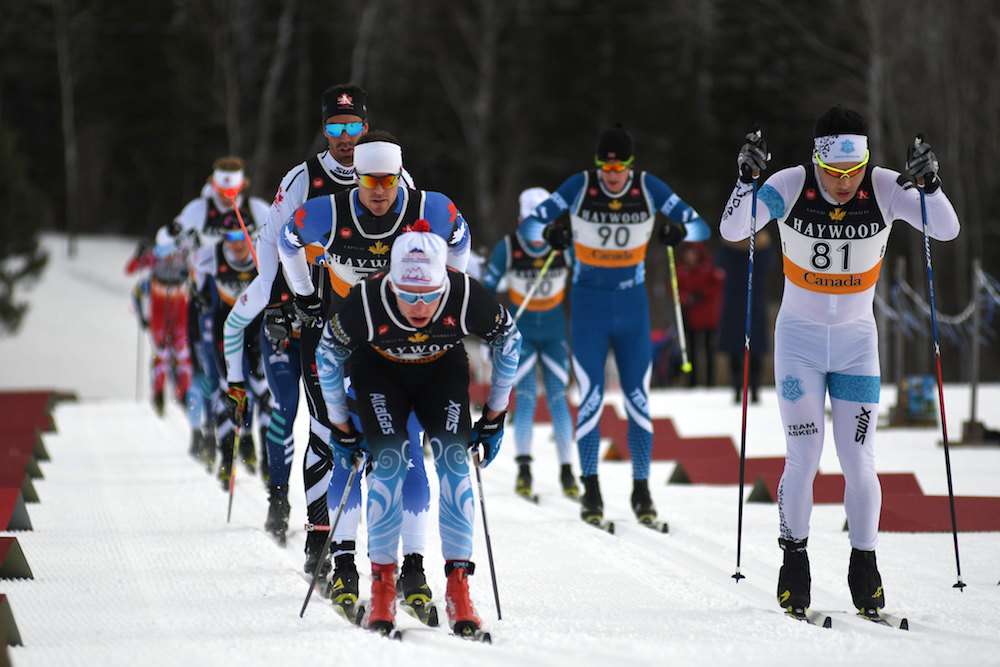
Jack Carlyle (l) of the AWCA and Ryan Jackson (81) of BXC leading the men’s field in Saturday’s 50 k classic mass start on the last day of 2018 Canadian Ski Nationals in Thunder Bay, Ontario. (Photo: Doug Stephen)
In the men’s 50 k, Palmer-Charrette, 23, who grew up racing at Lappe Nordic, tallied his second-straight podium (after placing third in the skate sprint) with a win in 2:16:44.1. The national title was his second after Palmer-Charrette was the top Canadian in last year’s classic sprint at nationals in Canmore. On Saturday, he finished 9.8 seconds ahead of Scott Hill of Barrie Cross Country (BXC) in second place, and BXC had two on the podium with Ryan Jackson in third (+14.6).
The top three separated from the rest of the pack, with Julian Smith (NTDC Thunder Bay) finishing 2:40.1 back in fourth, Michael Somppi (AWCA) following in fifth (+2:45.2), then Bob Thompson (NTDC Thunder Bay) in seventh (+2:57.2), Andy Shields (Lappe Nordic) in seventh (+3:13.6), Alexis Dumas (CNEPH) in eighth (+3:20.6), Jack Carlyle (AWCA) in ninth (+3:21.9) and Jess Cockney (AWCA/Canadian World Cup Team) in 10th (+5:20.5).
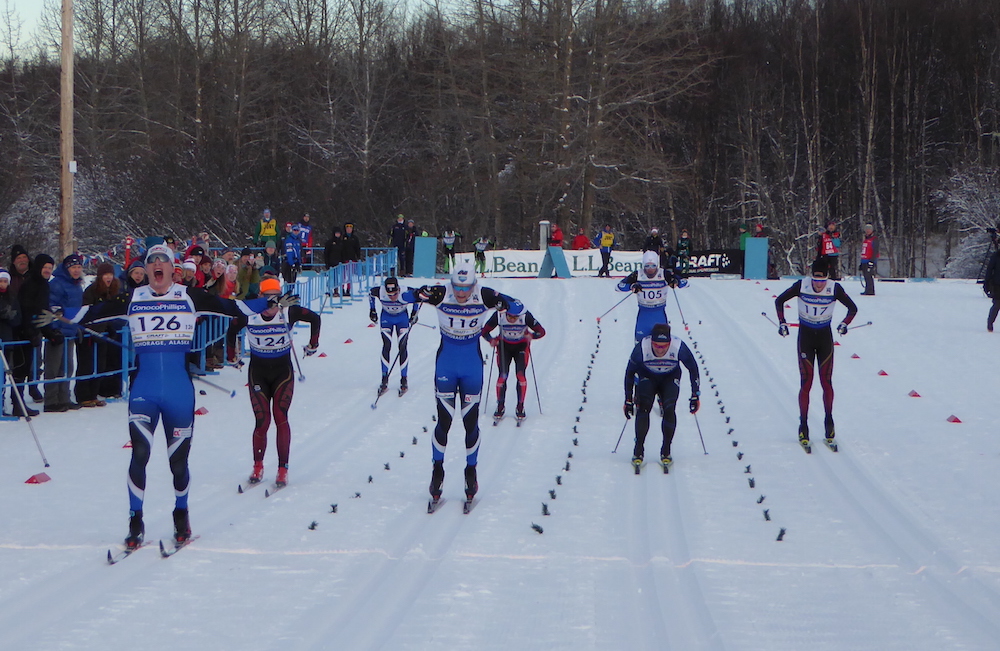
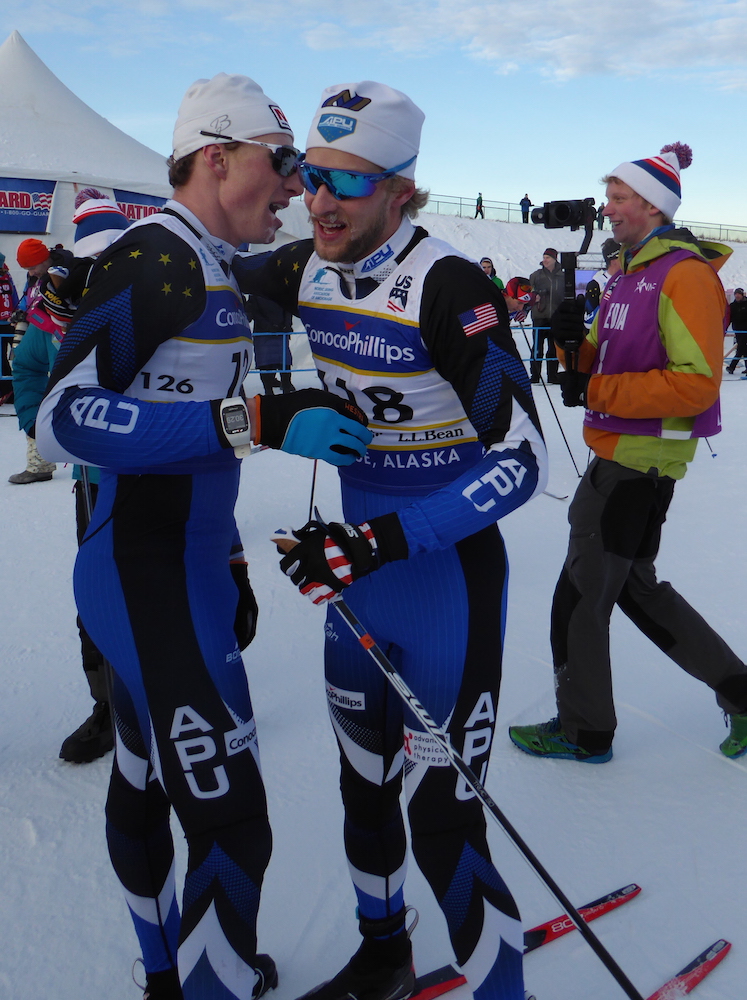
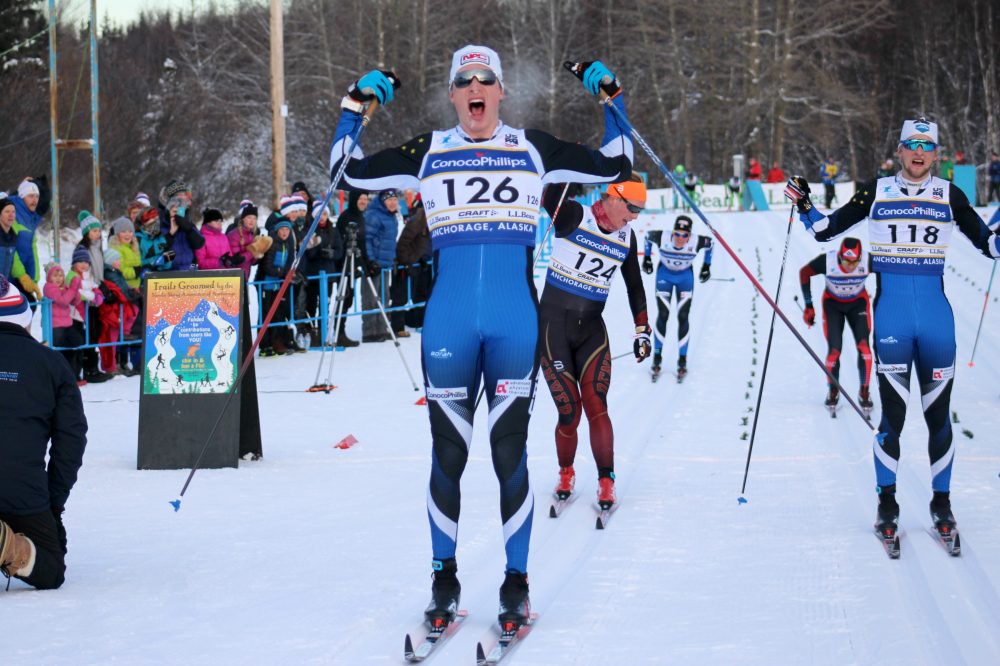
APU’s Tyler Kornfield (126) celebrates as he crosses the finish line first in the men’s 30-kilometer classic mass start at 2018 U.S. Cross Country Championships on Sunday at Kincaid Park, Anchorage, Alaska. It was Kornfield’s second national title, first one since 2012 and first in a distance race.
ANCHORAGE, Alaska — It could have been mistaken for the finish of a sprint final — except for the fact that almost 10 skiers were in the hunt until the end, most of which were distance specialists.
As it were, the last 100 meters of the men’s 30-kilometer classic mass start at 2018 U.S. Cross Country Championships on Sunday involved eight men double poling in four lanes. Two of those men were past national classic-sprint champions.
“Honestly of all the people in the race, I did not want to be sprinting against Tyler Kornfield and Eric Packer to the finish because I know they’re really good sprinters,” Kris Freeman, of Caldwell Sport, said after the race. “That being said I also didn’t expect to be sprinting against them.”
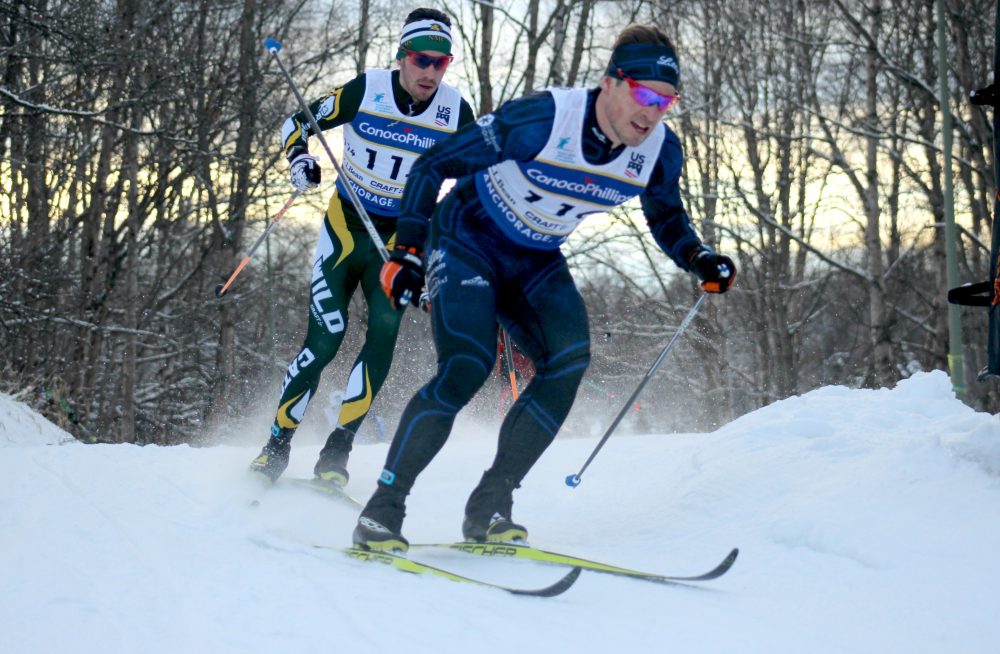
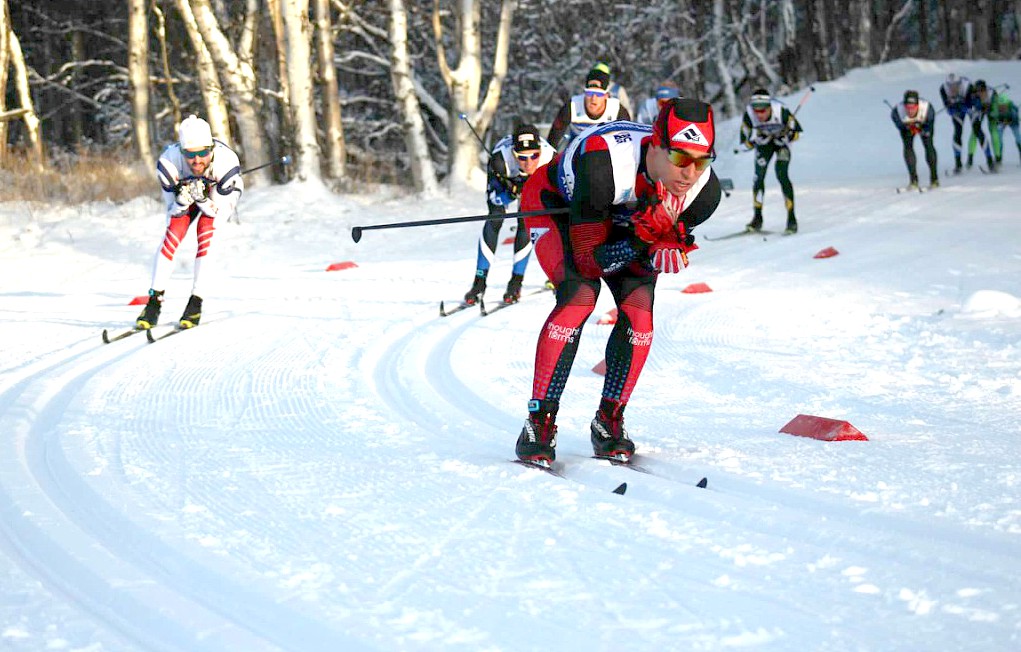
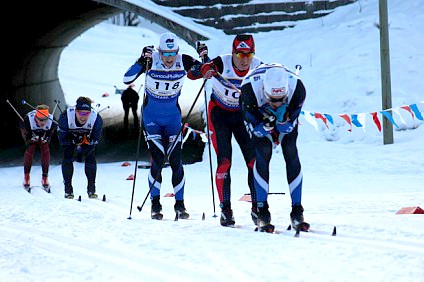
Kris Freeman (r) leads Ian Torchia (NMU/U.S. Ski Team) during the men’s 30-kilometer classic mass start at the 2018 U.S. Cross Country Championships in Anchorage, Alaska.
Given their track record — Kornfield, who races with Alaska Pacific University (APU), has a 2012 national classic sprint title and Eric Packer, also from Anchorage and APU, has one from 2016 — not many skiers would want to find themselves up against either APU skier, let alone both, in the final 100 meters of a classic race.
But as Sunday’s six-lap men’s race progressed, and athletes continued to ascend Elliott’s Climb, it became more and more clear that the off chance of that happening was actually, fairly high.
Kornfield’s Calculations
Clipped into his race skis, Kornfield, 26, towers above many of his competitors, at close to 6-foot-2. Given his stature, the Anchorage, Alaska native is hard to miss on Kincaid Park’s ski trails.
APU’s Tyler Kornfield (l) and Eric Packer (r) hug after the men’s 30 k classic at U.S. Nationals at Kincaid Park in Anchorage, Alaska.
Yet when he raced toward the front of the pack in the first lap of Sunday’s mass start, wearing bib 126, it went fairly unnoticed. There were still five laps to go and most figured the charge would come later, from APU’s Scott Patterson (who had won the 15 k freestyle race earlier in the week by almost a minute), or from 2014 Olympian and three-time national champion Noah Hoffman.
“Honestly I was expecting Scott and Noah to break away,” Packer said during a post-race interview. “My goal today was to hang with them. They pushed the pace the first three laps and were putting in effort to break away. But right around Lap 3 or 4, when we were still grouped together, I think I started realizing personally that it was going to be a tight finish.”
While Packer’s enlightenment may have come at the same time for many of the spectators at Sunday’s event, Kornfield might have saved them the suspense had he been given an opportunity before the start of the race.
“I was looking at the course yesterday and in my mind I was picturing how I was going to win it,” Kornfield said after the race.
With Saturday being an official training day without any races, Kornfield took the time to learn every curve of the 5 k loop that made up the men’s course, the map of which was released Friday evening. Having grown up skiing and racing at Kincaid didn’t hurt the Service High School graduate’s confidence either.
“I’ve done that hill so many times in sprint racing,” Kornfield said of Gong Hill, which was also featured in Friday’s freestyle sprint and was about 3.5 to 4 k into the 5 k loop.
“So at like 2 k out I thought, ‘You know what? I feel fresh. If I don’t go, I’m going to regret this for the rest of my life,’ ” Kornfield reflected.
Packer’s Motivation
Many who had ventured to Anchorage for U.S. nationals awoke Thursday morning, poured a cup of coffee and proceeded with the championships’ first official training day/off day. Some, perhaps, even slept in.
When Packer, a 27-year-old former Dartmouth skier who attended South Anchorage High School, arose Thursday morning, it was to grave news: he learned his grandmother had unexpectedly passed.
He, his family and mother were shaken as they mourned their loss. The pull of commemoration was also in tow.
“It’s really interesting to be in the middle of the Olympic trials, you’re in the pressure cooker and then you have family come up and it helps remind you what’s important, and that’s the people and your family,” Packer said.
“On the skate sprint day, I was skiing for her and today on the start line, I said to myself, ‘This is for my grandma,’ ” he continued. “I think that just helped keep it in perspective, that the race isn’t for me, it’s for my family and community and everybody.”
With unseen weight, but light feet and a fire within him, Packer started Sunday’s mass start in bib 118, racing toward the back of the lead pack for the first two laps and moving to the middle for the next two.
Noah Hoffman leads early on in the the men’s 30-kilometer classic mass start at the 2018 U.S. Cross Country Championships in Anchorage, Alaska.
“The pack was churning the whole time,” Packer said. “The entire time I was telling myself to just relax. Stay in contact and relax.”
That lead group consisted of Packer, Kornfield, Freeman, Hoffman of Ski & Snowboard Club Vail (SSCV), and Patterson (APU), as well as APU’s David Norris, Kevin Bolger of the Sun Valley Ski Education Foundation (SVSEF), Ian Torchia of Northern Michigan University (NMU) and the U.S. Ski Team, Norwegians Dag Frode Trollebø and Eivind Romberg Kvaale of the University of Denver (DU), Adam Martin and Ben Lustgarten (last year’s 30 k classic champion) of the Craftsbury Green Racing Project (CGRP), Tad Elliott (SSCV) and Brian Gregg (CXC/Loppet Nordic Racing/Team Gregg). Each time they reached Elliott’s Climb, the lone A-climb on the 5 k loop, those in front would accelerate.
Often the acceleration came from Hoffman, who paced most of the uphills and often Elliott’s.
“Noah Hoffman, I feel like he was up there trying to push the pace all the way,” Kvaale, a 23-year-old DU sophomore, said after the race. “He’s not the fastest sprinter so I guess that natural for him, but the downhills are so long and you draft so well here, so it’s hard to get away.”
“I was thinking, ‘When is this going to break up?’ ” Hoffman reflected on Sunday, the day before his 29th birthday. “I kept pushing the pace. I tried to make it hard at times, but not only was it coming back together, it was also a massive group. I mean, it’s one thing if you go and three or four guys come with you, but it was way more than that.”
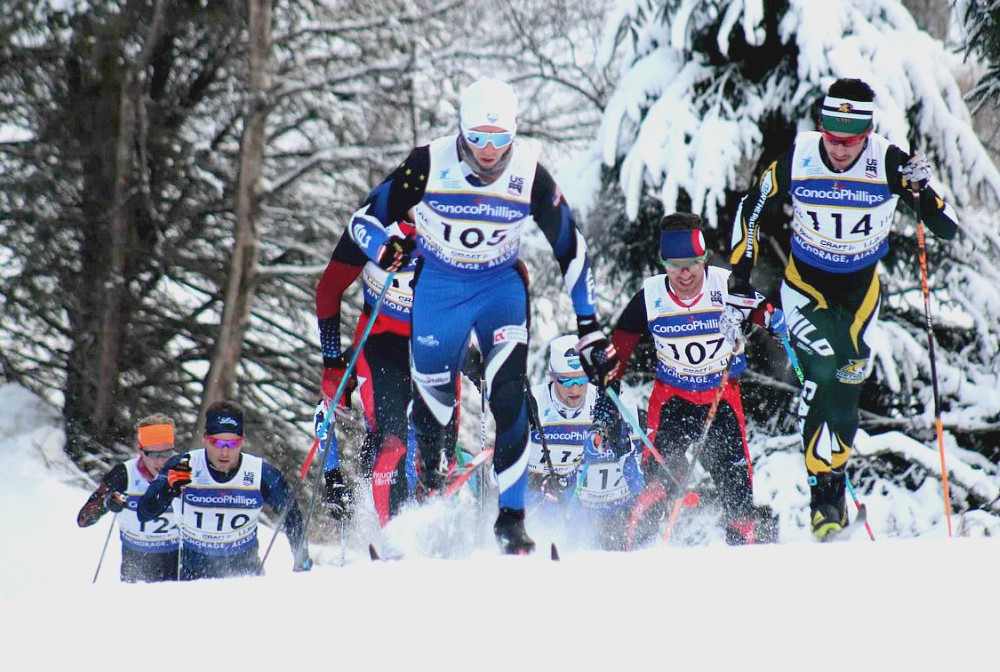
APU’s David Norris (105) leads up Gong Hill as Ian Torchia (114), Tad Elliott (107) and Kris Freeman (110) chase him during men’s 30-kilometer classic mass start at the 2018 U.S. Cross Country Championships in Anchorage, Alaska.
The group remained a pack of 14 through five and half laps, with the lead exchanging from Hoffman to Kvaale, to Martin and Norris.
“It didn’t really matter how fast people climbed, it always came back together,” said Norris, a Fairbanks native, who sat out Wednesday’s distance race due to illness and was still feeling under the weather on Sunday. “You could tell early that Noah was trying to break away. If anything it looked like he was working harder, but not doing damage.”
While at the top of Elliott’s Climb, gaps would form that Freeman described as being up to five seconds between him and Hoffman and the rest of the pack. But when the group reached the bottom of Gong Hill, all 14 racers were continually rejoined.
The Sprint Finish
By the time the group began descending toward back toward the stadium for the last time, apprehension filled within the spectators standing behind the colored flags lining the course and the athletes corralled on the inside.
A gap had parsed out a few skiers, though eight still remained within range of the win.
“I was debating the entire last lap, ‘When do I go? When do I go? When do I go?’ ” recalled Freeman, a 37-year-old four-time Olympian from New Hampshire. “Then Tyler went and I reacted rather than dictating.”
APU’s Tyler Kornfield (126) celebrates as he crosses the line first in the men’s 30-kilometer classic mass start on Sunday at 2018 U.S. Cross Country Championships in Anchorage, Alaska. Eric Packer (118) finished second and Denver University’s Eivind Romberg Kvaale (124) placed third.
The group had been climbing the final hill together when Kornfield made his move. He pushed around to the outside edge to the front leading into the descent and through the tunnel. As all eight rounded the final corner to the finish, Kornfield put his head down and did what he did best, double poling in an outright sprint to his first-ever U.S. nationals distance win.
“I knew the only way I could win as a sprinter was to conserve energy and try to stay with pack and wait for the final push,” Kornfield said. “In the finish I just kept pushing and watching that finish line come closer and closer. I’ve never had emotions like that after a race. ”
Kornfield crossed in a time of 1:21:43.6 for the overall win. Packer crossed 0.7 seconds back in second and Kvaale crossed 1 second out of first for third overall. Freeman, 1.6 seconds back, was the third American in fourth overall.
“We have a group of guys who are training as much as or more than anyone else in the country and sometimes it takes a while for that fitness to come around,” Packer said. “I think we were a little bit nervous in West Yellowstone and Silver Star [at the December SuperTours] and didn’t have our best races, but it’s great to have things come together at the right time.”
Finishing out the top 10 was Trollebø in fifth (+2.0), Norris in sixth (+2.5), Hoffman in seventh (+2.6), Patterson in eighth (+3.6), Martin in ninth (+14.7), and Lustgarten in 10th (+14.9).
“I had very good glide on my skis so I knew I was able to gain a lot on the other guys,” Trollebø said after. “But it was only two tracks at the end so, it’s almost like in a bike race, you have to stay well positioned to be there at the end.”
Right to left: APU’s Tyler Kornfield leads SSCV’s Noah Hoffman, APU’s Eric Packer, SSCV Kris Freeman, and DU’s Eivind Romberg Kvaale heading out of the stadium tunnel and toward the finish for the men’s 30-kilometer classic mass start at the 2018 U.S. Cross Country Championships in Anchorage, Alaska.
In terms of the U.S. Olympic points list, Patterson is ranked first, followed by Kornfield, Hoffman, Packer, and Gregg (Gregg finished Sunday in 11th, 16.1 seconds back).
“We’ll see what they do for naming a team. It’ll be interesting,” Hoffman said.
“I haven’t seen the math yet, but I have not figured many scenarios where I could be third and still make the Olympic team,” Freeman noted. “So it’s a bittersweet day.
“But that’s what happened and I’m happy for those guys,” Freeman continued. “They’ve been working at this for a long time. I’m not sure that they’re going to make the team but if they do, good luck to them.”
Wonders Wins Junior Race
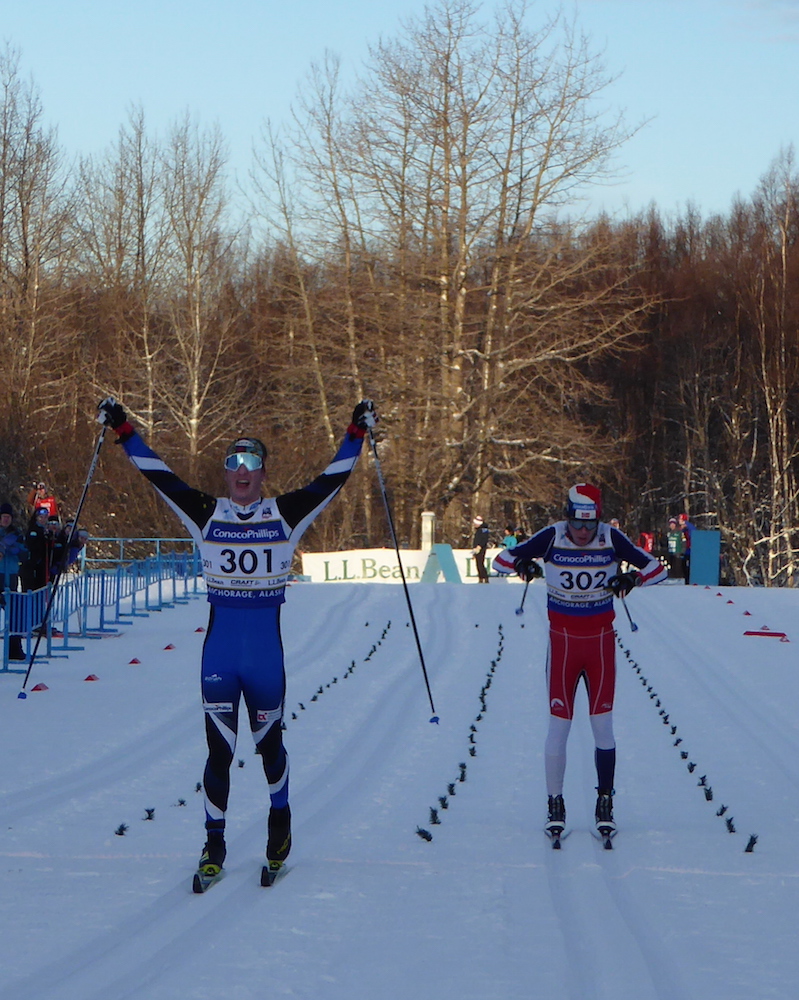
APU’s Hunter Wonders (301) winning the junior men’s 10 k classic mass start, just ahead of Ben Ogden (SMS) at U.S. nationals at Kincaid Park on Sunday Anchorage, Alaska.
A junior men’s 10 k classic mass start was also run on Sunday, with APU’s 19-year-old Hunter Wonders claiming the win in a time of 26:07.1. Stratton Mountain School (SMS) skier Ben Ogden finished second, 0.6 seconds back, and Canyon Tobin (APU) placed third (+23.4).
“I’m extremely thrilled I was able to hold my bib position,” Wonders said after the junior’s race. “I crashed going down roller coaster on the first lap and lost some time, then I was fighting to get back to where I was, so I hammered until I was back with that lead pack. I felt good so I just kept trying to go for it and it paid off.”
Racing continues Monday for the final event of 2018 nationals, the men’s and women’s classic sprints.
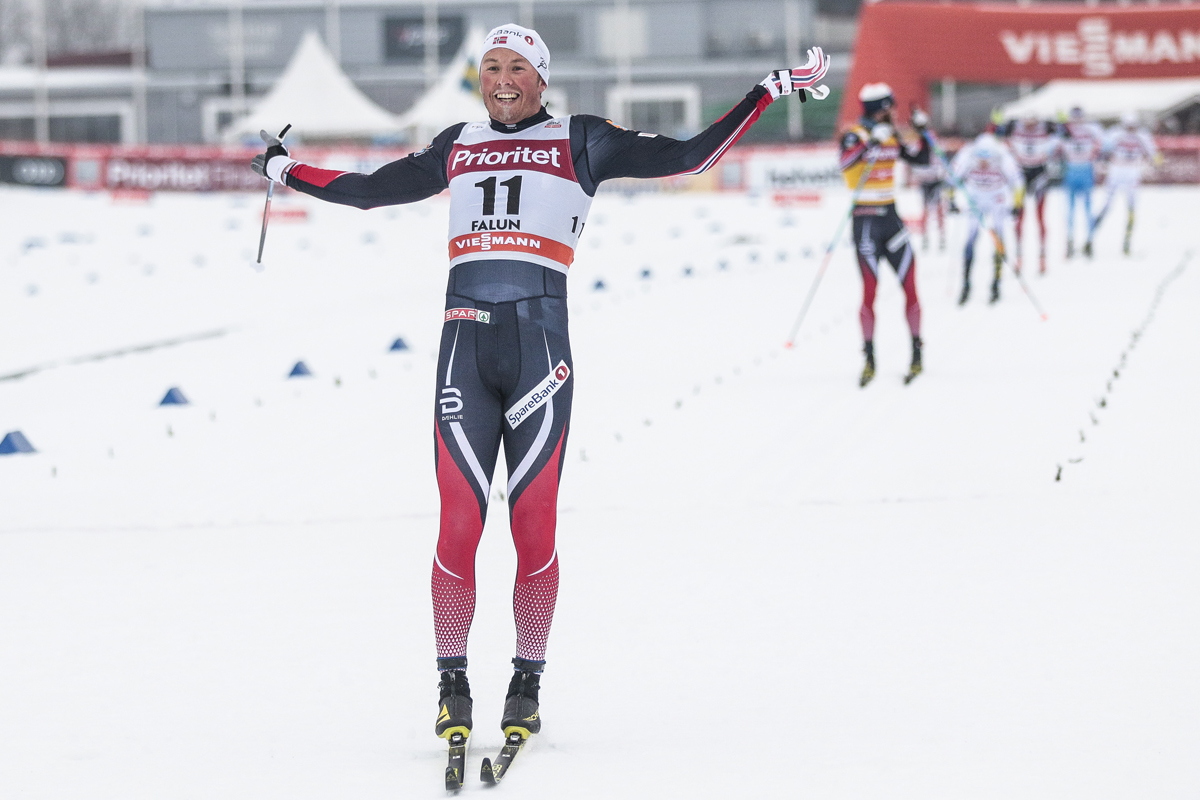
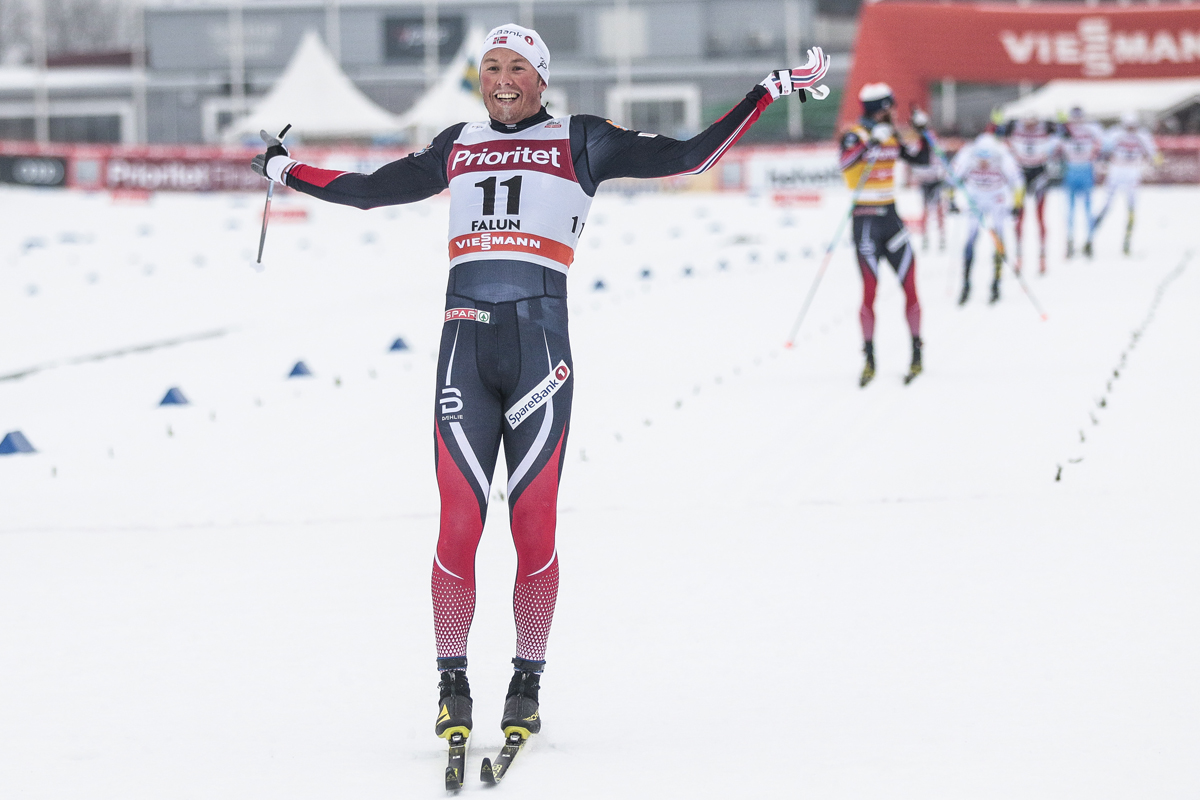
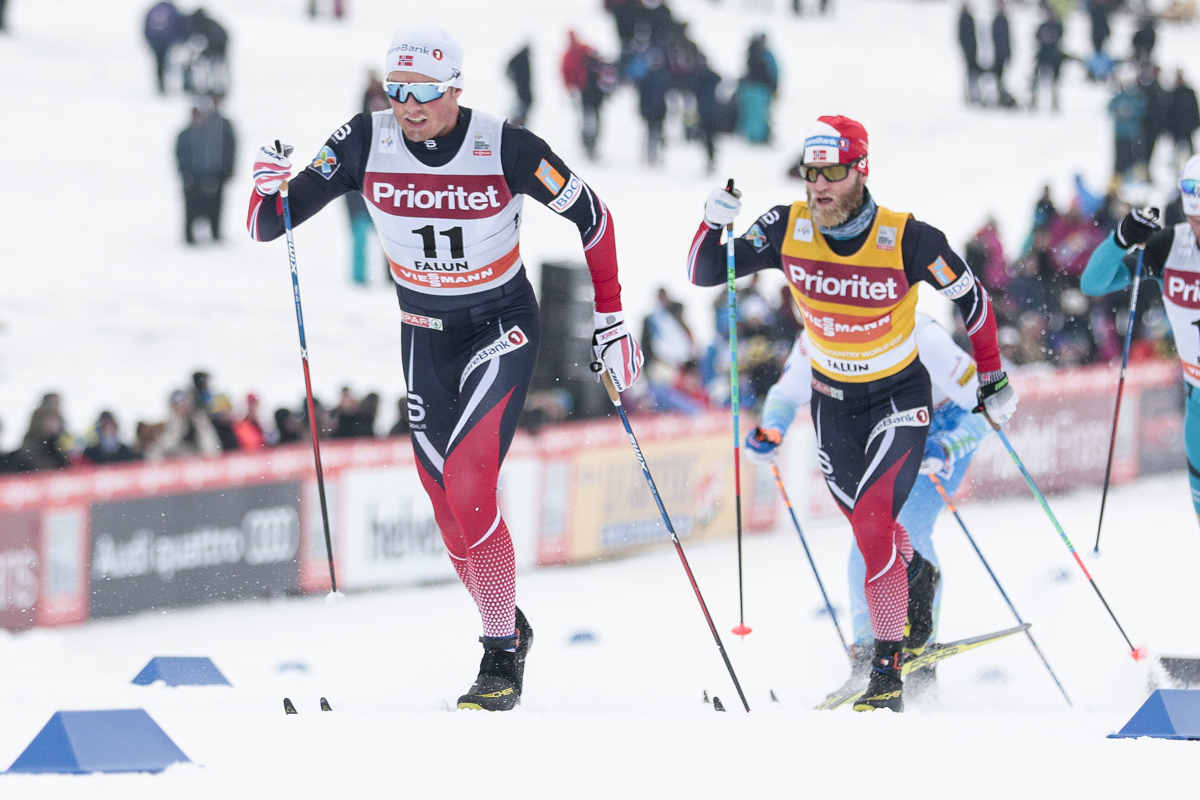
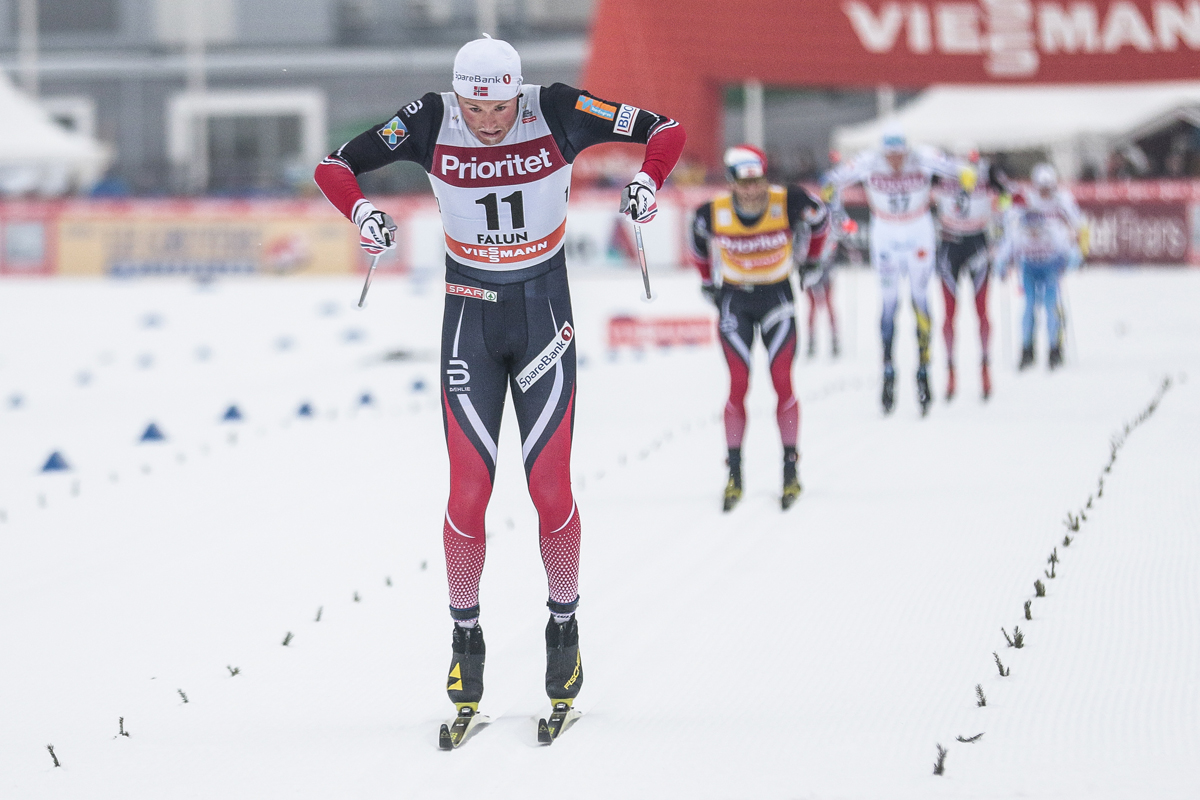
Norway’s 25-year-old Emil Iversen celebrates his first win of the season on Sunday in the men’s 30 k classic mass start, which he won by 3.7 seconds over fellow Norwegian Martin Johnsrud Sundby (yellow bib). (Photo: Fischer/NordicFocus)
$75,400: the yearly amount top Norwegian national-team members reportedly make, not counting sponsorships — closer to the amount someone like Iversen, 25, is now making.
The look on Iversen’s face on Sunday after crossing the finish line first on Sunday for his first World Cup win of the season? Priceless.
The victory, which he secured by 3.7 seconds over his team’s superstar Martin Johnsrud Sundby in the men’s 30-kilometer classic mass start in Falun, Sweden, was his second in a World Cup distance race and fourth of his career.
But the way Iversen talks, he should’ve been winning every race this season.
“My performance says a lot; I’m pretty good at skiing and I master several things,” he told VG.
Iversen’s World Cup win on Sunday was redemption for what he deemed a sub-par performance on Saturday. Second place by 0.06 seconds was unacceptable, and the look on his face and the pole he snapped in two after the men’s freestyle sprint final said it all.
“I’ve been pretty mad at my little brothers, but I don’t think I’ve been this angry in years,” Iversen told NRK.
For the sake of reflection, let’s rewind to a year ago, when Iversen credited training with the best, Norway’s Petter Northug.
“I have trained too much with him now I think,” Northug said at a February 2016 post-race press conference in Lahti, Finland.
Iversen, then 24 with his second sprint World Cup victory, jested that he knew Northug’s weakness, but there was no way he was disclosing it.
“I know what that is, so I’m going to use it also next year,” he said.
It’s now next year, and Northug’s nowhere in sight — at least not until Sunday, when he returned to the World Cup for the first time in over a month to finish 31st as the seventh-best Norwegian (out of nine) in the 30 k mass start.
Northug finished a whopping 3 minutes and 10.6 seconds behind Iversen, who’s proven himself one of Norway’s strongest starters in any given race.
“The plan is sprint, team sprint, classic distance and the relay,” Iversen said of 2017 World Championships, slightly less than a month away in Lahti, Finland.
At the same time, he explained he hadn’t heard anything definitive about Norway’s World Championships team.
“I haven’t heard sh*t, so maybe they don’t have faith in me. But I’ve handed in some good applications,” he said. “I think I was born to do a team sprint. The distance suits me incredibly well.”
Asked who he’d pick as his teammate, Iversen was uncertain.
“It would have been fun to do it with Petter, but if you’re gonna do the team sprint you need to have performed well in the distance,” he said.
How the tables have turned…
Emil Iversen (11) leading fellow Norwegian Martin Johnsrud Sundby (yellow bib) in the men’s 30 k classic mass start on Sunday at the World Cup in Falun, Sweden. (Photo: Fischer/NordicFocus)
On Sunday, Iversen hung in where he needed to, within striking distance of the leaders in the six-lap 30 k.
Conditions weren’t easy, with temperatures around -4 degrees Celsius (25 Fahrenheit) and snow that was described as “sugary” in Falun. Iversen scored bonus points at three out of the four intermediate sprints on the course, racing through the 6.5 k checkpoint in fourth, 16.5 k in fifth, and 21.5 k in fifth.
Meanwhile, his teammates Sundby and Sjur Røthe mostly drove the pace up front. With 10 k to go, Røthe made a move and put five seconds into the field. One and a half kilometers later, at the final bonus sprint, Røthe had built that lead to 8.5 seconds. Skiing alone and having to herringbone outside the tracks, however, isn’t easy, and Røthe was swallowed by the pack as he entered the stadium for the final lap at 25 k.
Sweden’s Daniel Rickardsson was one of several different men to take the lead after that point, before Iversen moved into first halfway around the loop at 27.5 k. Finland’s Iivo Niskanen followed, along with Sundby, both within a second of first. By 28.2 k, Sundby was again leading Iversen and Niskanen, with a 1.4-second gap to Russia’s Alexander Bessmertnykh and Røthe in fourth.
With less than a kilometer remaining, Sundby began his final push. Iversen caught up to him, ultimately challenging Sundby for the win. With about 200 meters to go, Iversen made it clear he was going take it all on Sunday — not second to Sundby or anyone else. He crossed the line first in 1:15:46.7 minutes, 3.7 seconds ahead of Sundby.
Norway’s Emil Iversen double poling to a decisive victory on Sunday, ahead of Norway’s Martin Johnsrud Sundby (yellow bib) and Sweden’s Calle Halfvarsson (in white) in the World Cup men’s 30 k classic mass start in Falun, Sweden. (Photo: Fischer/NordicFocus)
“It felt good when I realized there was no Italian in the final stretch like yesterday,” Iversen told NRK, referring to his photo-finish loss in the sprint to Italy’s Federico Pellegrino.
“There was a war between me and Martin,” he said of Sunday’s distance race. “It turned out a little like I wanted it to, and then it’s all about attacking.”
The overall World Cup leader by more than 300 points, Sundby settled for second and Sweden’s Calle Halfvarsson locked up third, 5.6 seconds behind Iversen. Just 0.1 seconds off the podium, Røthe placed fourth. Norway had four in the top five with Niklas Dyrhaug in fifth (+8.2), while Niskanen finished sixth (+9.8), Rickardsson was seventh (+10.3), and Bessmertnykh eighth (+10.9).
Iversen currently ranks seventh in the overall World Cup standings, behind Russia’s Sergey Ustiugov (who placed 12th on Sunday) in second, Finland’s Matti Heikkinen (14th on Sunday) in third, Canada’s Alex Harvey (15th) in fourth, Sweden’s Marcus Hellner (didn’t race on Sunday) in fifth, and Switzerland’s Dario Cologna (16th) in sixth.
‘Double Whammy’ for Canada’s Harvey
For most of the first two laps of Sunday’s 30 k, Harvey skied in the top three. By 10 k, he had dropped to ninth, but was still within 3 seconds of Ustiugov up front. One lap later, he remained in the top 10 and 2.3 seconds out of first, before dropping back to 16th and 7 seconds behind Iversen in first at 20 k.
“The first lap the kick was still, it was not locker kick, but I honestly don’t think anybody had locker kick today, it was hard to get good grip,” Harvey explained on the phone after. “So the first two laps, till 10 k was fairly comfortable, I was not fighting the skis too much, but then from 10 k to 20, I started fighting the skis a lot. I would kind of drift on the uphills, but my skis were really fast so I could kind of come back with the group. Even being at the tail of the group I could still use the draft and everything, but then at one point, the elastic just popped and I couldn’t come back anymore.”
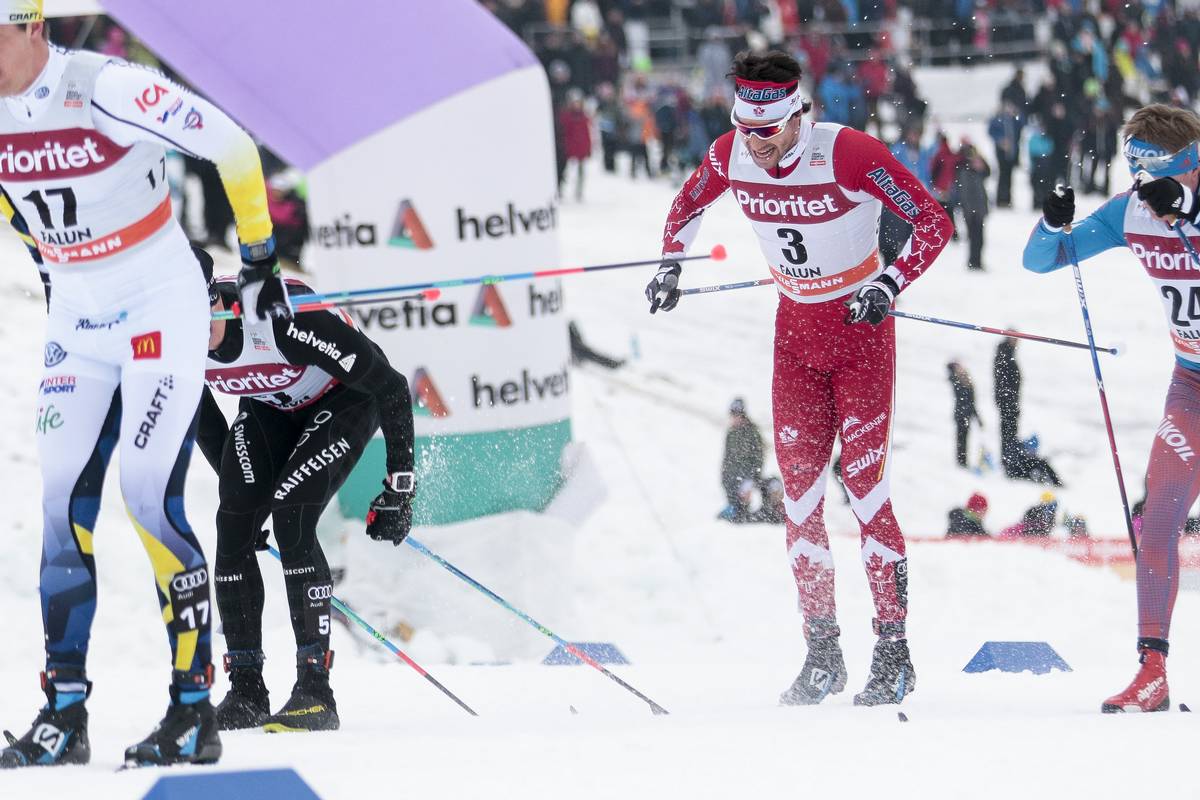
Canada’s Alex Harvey (3) skiing behind Sweden’s Calle Halfvarsson (17) and ahead of Russia’s Dmitriy Japarov (r) during the World Cup men’s 30 k classic mass start in Falun, Sweden. Harvey finished 15th. (Photo: Salomon/NordicFocus)
For the last 10 k, Harvey held on, skiing with Cologna (among others) while fighting to stay within reach of the podium. Just 6.8 seconds out of first in 16th at 25 k, Harvey slipped to 55 seconds back in 15th just over 3 k later. He finished 1:17.5 back in 15th (13.8 seconds behind Heikkinen in 14th and 4.7 seconds ahead of Cologna in 16th).
“I was just losing a bit more kick every lap and getting more and more tired,” Harvey explained. “So it’s harder to compensate and yet you have less energy to compensate so it was just kind of a double whammy.”
According to Canadian World Cup coach Ivan Babikov, he told the team’s two racers on Sunday — Harvey and Cendrine Browne (who competed in the women’s 15 k classic mass start) — that no one would have perfect kick because of the soft conditions.
“It’s more like a running, double poling [race],” Babikov said on the phone after. “The uphills, especially Mördarbacken, got pretty mashed-potatoey. It was really sugary, super soft and really hard to get kick for many nations, and we struggled with the kick wax today. That’s a bit disappointing to all of us … but it’s one of those days that we did our best…
“We tried actually changing it for Cendrine, but it actually got even worse somehow and she struggled even more,” he said of Browne, who finished 46th in the women’s race.
“Not the proudest day of the season so far on the waxing side, but we’re just moving forward and learning from our mistakes,” Babikov continued.
The day before, Harvey missed qualifying for the skate-sprint heats in 46th. It was only his second time time not qualifying in a sprint this season and first time outside the top 40.
“Falun being arguably the best stop for me on the World Cup, I really had quite high expectations,” Harvey said on Sunday. “I think I went to the start line [of the skate sprint] a bit too excited and with too much adrenaline and I just really skied really bad. I didn’t ski like myself yesterday. I skied all tempo and no tempo and no glide, and for me, that’s not a good way to ski.”
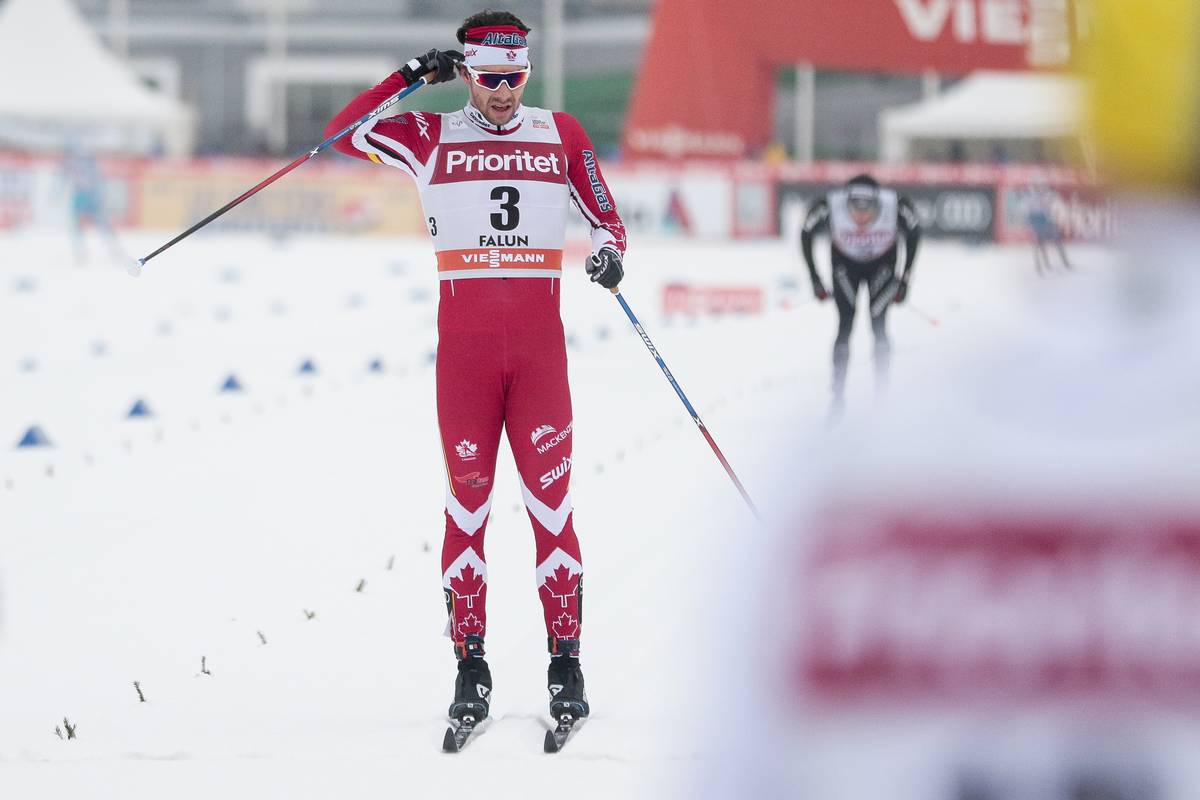
Canada’s Alex Harvey finishing 15th in the World Cup men’s 30 k classic mass start on Sunday in Falun, Sweden, ahead of Switzerland’s Dario Cologna (in black) in 16th. (Photo: Salomon/NordicFocus)
As for the conditions on Sunday and how they affected his race, he blamed his choice in skis.
“[The conditions were] kind of a bit abrasive, but we think the binder didn’t hold up enough,” he explained. “I made a bit of a risky pick because I had a pair [of skis] that was way faster, but the kick was a bit limited on them in the beginning so I for sure paid for it when I started losing a bit of kick.”
He started to lose it after 10 k, he said.
“Then I could kind of fake it for 10 more k’s, but then that was it,” Harvey explained. “Coming 15th is a bit of a disappointment after the previous two weekends, but I know that the shape is still really good. I think that with the mistake I made, with picking a bit of a too slick of a ski, I could’ve been out of the top 30 today in those conditions, so it was still kind of a good sign even though it was a bit disappointing.”
The Canadian team in Falun was a lean one, not by design but rather because of circumstance, especially on the men’s side. Babikov explained that Knute Johnsgaard had been recovering from a stomach bug he picked up last week, which prompted an overnight hospital stay in Falun. He was on the mend, Babikov said, but had a “rough couple days.”
Graeme Killick had returned to Canmore, Alberta, after the Tour de Ski earlier this month and originally planned to be back on the circuit in Falun.
“But unfortunately he got sick as well so that kind of postponed all of it,” Babikov said. “We made the decision that it would be best to get ready for the World Champs … so he’s doing some good training at home and we’ll see him in a week in Davos [Switzerland, at the team’s training camp].”
Until then, Harvey will go to Livigno, Italy, with coach Louis Bouchard, Johnsgaard, and Browne, Babikov will return to Canmore, Len Valjas will race at next weekend’s World Cup in PyeongChang, South Korea, and Devon Kershaw will continue to await the birth of his first child with his wife, Kristin Størmer Steira.
Among the Americans in Sunday’s 30 k classic, a race that has only been held three times in the last 10 years, according to an International Ski Federation (FIS) press release, Erik Bjornsen and Noah Hoffman finished 35th (+3:30.8) and 37th (+3:59.8), respectfully, followed by Matt Gelso in 44th (+5:23.6) and Andy Newell in 53rd (+7:45.3).
For Bjornsen, who finished about 20 seconds behind Northug in 31st, he reflected that he was happy with the majority of his race.
“Most of the race I was skiing in a position I would have been very happy to finished in,” Bjornsen wrote in an email, after hovering in 25th to 30th throughout it. “I skied alone for about 10km near the end of the race and that was enough to put me over. I really needed some help to stay away from a pack of 10 guys that were hunting me down. I could see a them chasing me down for about 10km. They finally caught me with 4km to go. I didn’t have much fuel left in the tank. It was really disappointing to finish in 35th when at 25km I was in 24th.”
On Monday, he planned to head to France, where he’ll spend two weeks training before racing the pre-World Championships World Cup in Otepää, Estonia.
Meanwhile, FasterSkier caught up with Hoffman while he was packing his bags for South Korea.
“I had not a great start for the first k and a half, and then kind of made a good move on the first time up the big hill and was able to run by a bunch of people and move up into the top 30, which is where I wanted to be skiing,” Hoffman reflected of his race on Sunday. “And I noticed that I had the fastest split of the whole race for that section [from around 0.5 to 2 k].
“But then I paid the price for that a little bit and faded pretty quickly,” Hoffman added. “And really Laps 2 and 3 were a bit of a struggle, and I ended up in no-man’s land off the back of the group all by myself.”
He regrouped for the third and fourth laps, catching back up to a sub-group of skiers that had been dropped from the main group, skiing between 30th and 40th place.
“I skied with that group for a while and was feeling pretty good, and I was actually helping lead the charge up to another group that was falling off the main pack, and that represented all the way up to 24th place,” Hoffman said. “And right as we made contact with them, with about 5 k to go, I crashed on the same corner that I crashed on three years ago when I was having a good race in the mass start skate race here. And it’s just a terrible place to crash, right on the sprint course as you are coming into the stadium with a lot of speed.”
In an instant, he had lost an estimated 13 places and skied alone for the final 5 k, out of reach of that group.
“All of a sudden, I was like ‘OK, six or seven people out of this group are gonna get points … and that could have been me.’ I felt good, and so I let points today go with that crash,” he said. “There were some good signs today, and it’s a frustrating result. It’s a result where I felt I was better than the result shows. But it’s kind of been a frustrating season.
“I still feel good, and I think today was a positive sign, and there are still some really good races [coming up for me],” Hoffman added.
Among those were next weekend’s races in PyeongChang, with a classic sprint, 15/30 k skiathlons, and a freestyle team sprint from Feb. 3-5. (Hoffman planned to race the skiathlon.)
“Next weekend [in Korea] it’s gonna be a light field. And then we go back to Otepää, where I scored my first-ever World Cup points on a course that I really love,” he said. “And then with the World Championships, which obviously if you are successful at World Championships then nobody remembers the rest of the season. And I feel like I can have a really good championship. Those courses suit me really well, and I am particularly psyched for the 50 k skate there…”
American Matt Gelso racing to 59th in his first-ever World Cup sprint on Saturday in Falun, Sweden. (Photo: Salomon/NordicFocus)
He’ll be joined in PyeongChang by a few other U.S. Ski Team members (mostly sprinters, as well as distance skier Liz Stephen). Gelso, the Period 1 SuperTour leader from the Sun Valley Ski Education Foundation, also planned to be there.
“Today was a solid race, not great, but solid,” Gelso, who previously raced in Falun at 2015 World Championships, wrote in an email on Sunday. “World Cups in Scandinavia are very competitive so I am relatively happy with my result although it leaves MUCH room for improvement. My body also felt MUCH better than it has since I have been here. The sprint yesterday was my first World Cup sprint and was also a decent result for me [in 59th], however it was easy to identify a few costly mistakes.
“The overarching goal on the World Cup is to score World Cup points/have a top 30 result,” Gelso explained. “As far as a non-result goal it is hard to get over to Europe and acclimate to sea level, European courses, wetter snow, different food, very stout competition, timezone changes, long travel, etc. It is easy to come over here and feel pretty bad racing, always feeling like you are blowing up and hanging on and never really racing. My goal today was to not feel like that and actually be able to get a race feeling going in my body.”
Looking ahead, he was focused on next weekend’s World Cup in South Korea. While an individual top 30 remains his goal, Gelso explained he also wanted to “nail my travel and acclimatization there so that I can feel good racing, and race well.”
He planned to return to the U.S. after to race the SuperTour in Ishpeming, Mich., and the American Birkebeiner in Wisconsin. Ultimately, he hoped to qualify for the World Cup Finals in mid-March in Quebec City.
Jessie Diggins (Stratton Mountain School T2 Team/U.S. Ski Team) celebrates a 1:03-minute victory in the women’s 30 k classic at U.S. Distance Nationals on Saturday in Craftsbury, Vt. (Photo: John Lazenby/Lazenbyphoto.com)
U.S. Ski Team Women’s Coach Matt Whitcomb may have foreshadowed the season in November, saying Jessie Diggins was “just getting started” after dominating the U.S. team’s opening weekend of European racing in Gällivare, Sweden.
True to Whitcomb’s prediction, the 24-year-old Diggins, of the U.S. Ski Team (USST) and Stratton Mountain School (SMS) T2 Team, maintained momentum through 32 World Cup starts, including two eight-stage Tours. Then, finishing out the season in the U.S., she won both individual races at SuperTour Finals earlier this week and topped it off with a national title in the 30-kilometer classic mass start on Saturday in Craftsbury, Vt.
And she did so by winning by more than a minute.
Diggins didn’t waste any time setting her preferred pace on Saturday, breaking away from the 43-woman pack on the first of nine loops around the Craftsbury Outdoor Center’s entirely manmade trails. Despite a severe lack of natural snow in the East this winter, Craftsbury created and stockpiled enough artificial snow to lay out a roughly 3.5 k loop for this week of racing.
Starting in the stadium at the highest point of the course, the loop wove down to the low point and began climbing again for more than a kilometer back to the stadium. Prime sprint bonuses for the women’s race were at the 3 k mark on the course, about halfway up the long climb, on laps three and six.
Diggins claimed both $125 bonuses without anyone anywhere near her.*
With about a 15-second gap on the first lap, she extended her lead to 30 seconds by lap two then 45 seconds by lap three.
In an in-person post-race interview, Diggins explained she tried to “get as many laps in before the break before it turned to slush,” she said of the conditions, with direct sunlight softening exposed sections of the course as temperatures rose above 40 degrees late Saturday morning. “After the first lap, I was like, ‘OK, I’m going to do this on my own.’ ”
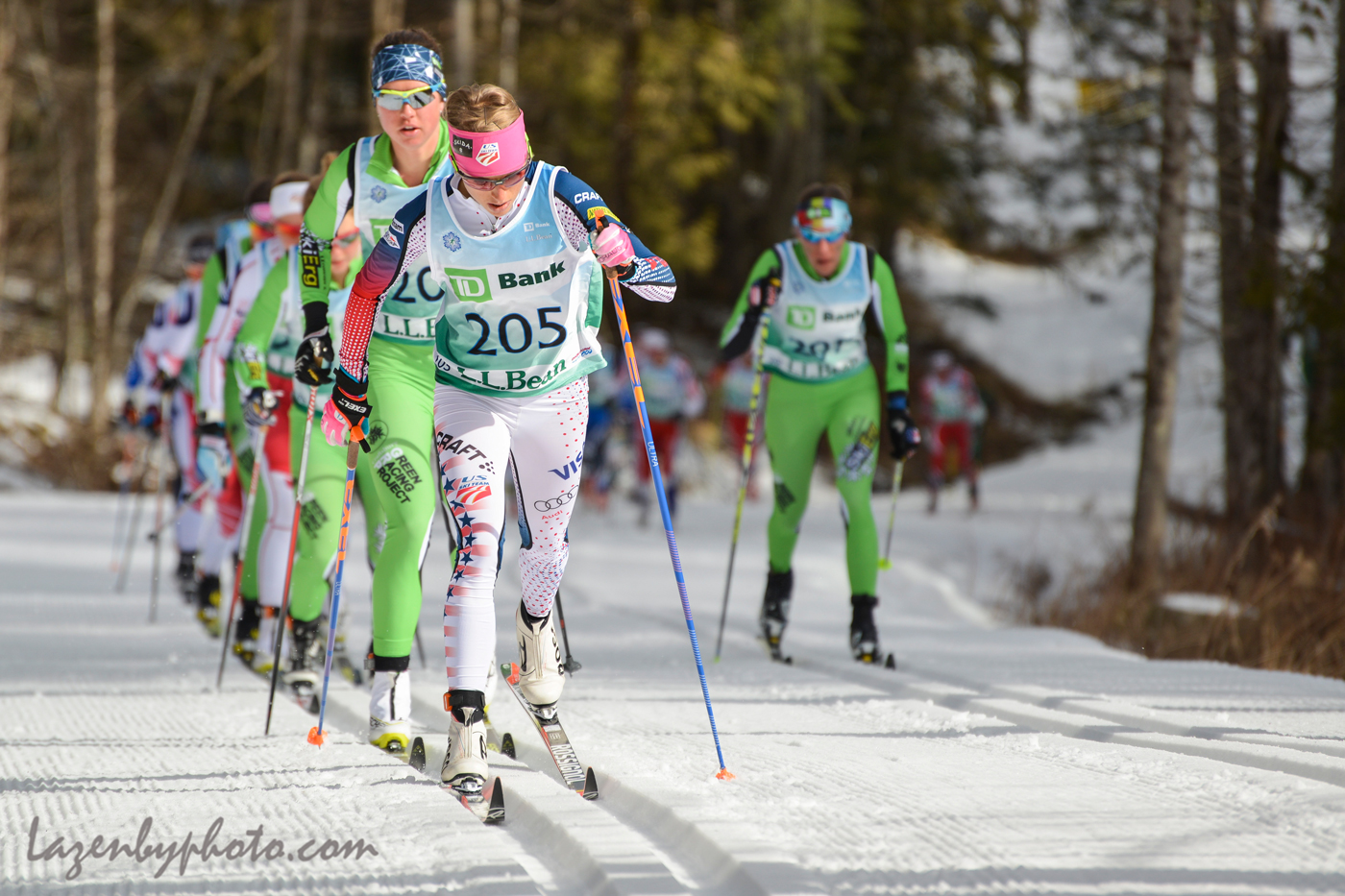
Jessie Diggins (201) leading with a slight gap on Liz Stephen and the rest of the chase pack on the first of nine laps in the women’s 30 k classic mass start on Saturday at U.S. Distance Nationals in Craftsbury, Vt. (Photo: John Lazenby/Lazenbyphoto.com)
Although 30 kilometers is a long distance to ski alone, Diggins used the solo racing to her advantage.
“The way the downhills are, I really like skiing by myself because the best line goes from one side of the track to the other,” she said. “So when I’m by myself I don’t have to worry about getting in anyone else’s way.”
In addition, the multiple-lap course meant she wasn’t completely alone.
“It was kind of cool because as I was lapping through I got to ski with some junior girls and that was really motivating,” she recalled.
Diggins continued to increase the gap while skiing uncontested, and posted the fastest laps on all but the last two laps (where her lap times ranked third and fifth, respectively). By the eighth of nine laps, she was about 1:27 ahead of her USST teammate Ida Sargent, who was leading the chase pack in second. One lap later, Diggins finished first in 1:29:59.4, more than a minute and 3 seconds clear of second place.
“This was kind of like a dream ending, especially in a classic 30 k, which was never my strongest race,” Diggins said.
Previously, Diggins had raced about half a dozen 30 k classic races in her career. She didn’t finish two of them, but in her first-ever 30 k, a classic mass start at 2011 Spring Series in Sun Valley, Idaho, Diggins placed third. Saturday marked her best result in the 30 k classic distance since.
Although it was the ideal end to an impressive several months, including five World Cup podiums and an overall eighth-place finish in the 2015/2016 World Cup, the biggest motivator for Diggins was putting a period on the season.
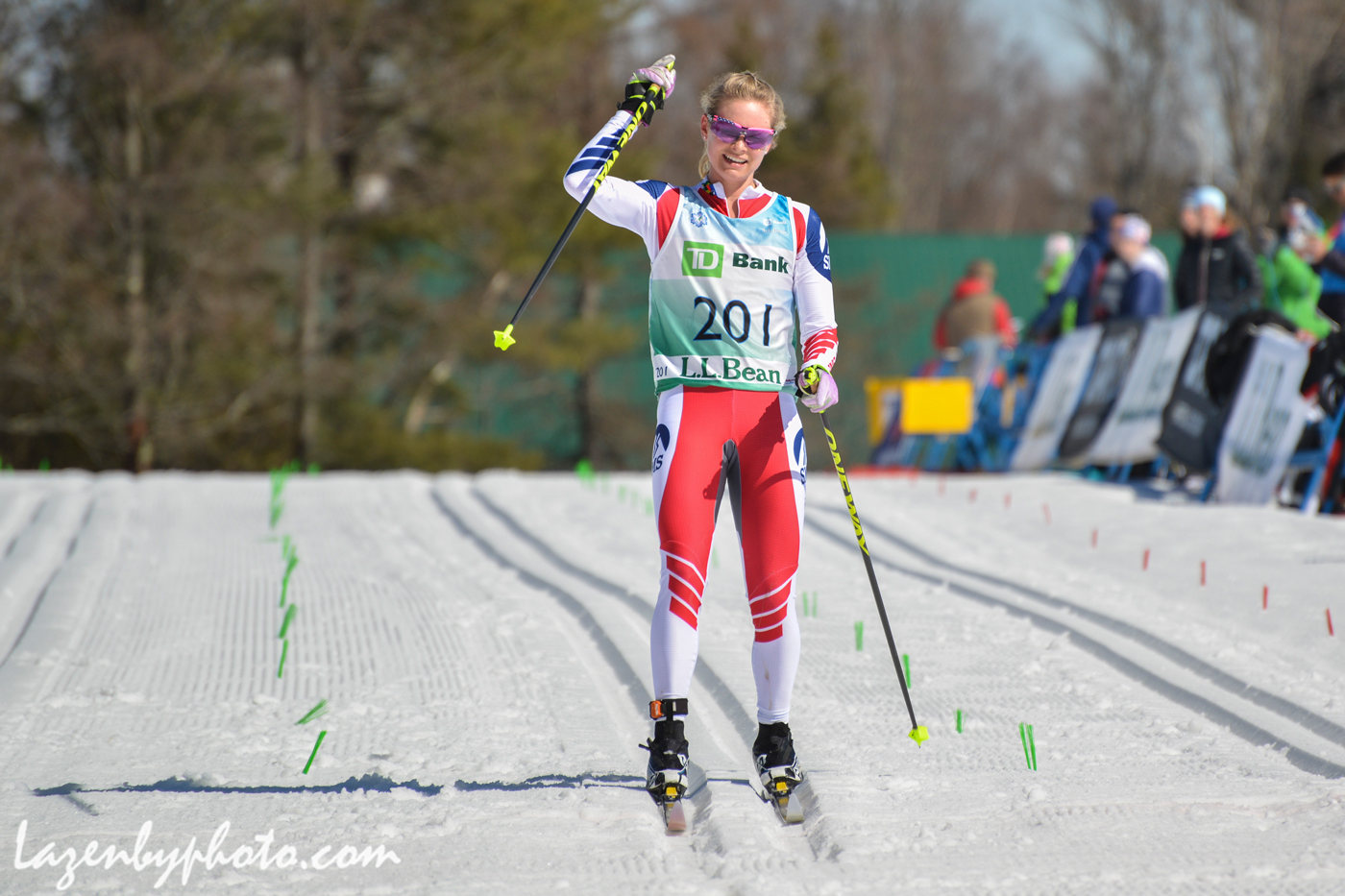
The start of the women’s 30 k classic mass start at U.S. Distance Nationals in Craftsbury, Vt., with Jessie Diggins out front in bib 201. (Photo: John Lazenby/Lazenbyphoto.com)
“I’m pretty ready to be done,” she said. “It was a great season and I am really happy with it, but it was also really mentally taxing because of the number of the races I did. I didn’t skip any World Cup races and I would do it again because it is a great opportunity to get some great races in, but now I’m pretty crushed.”
Behind Diggins, the race for the podium came down to three USST members over the final lap. The chase pack was whittled down lap by lap, largely due to Ida Sargent and Liz Stephen’s repeated surges.
About 10 racers remained together in pursuit of Diggins on lap three, but that group split in two on lap four, with Kaitlynn Miller — Sargent’s teammate on the Craftsbury Green Racing Project (CGRP) — leading the six-woman chase, and another three hanging slightly behind in a second group.
By the seventh lap, Sargent led the chase up the long ascent back to the stadium, 1:25 behind Diggins, with Stephen and another CGRP teammate Caitlin Patterson right there with her. Miller hung a few seconds off the back and kept them within reach for the next lap. By lap nine, however, she was out of contention and finished fifth, 1:41 behind Diggins and 26.3 seconds out of fourth place.
Ahead of her, Sargent threw an attack on the final climb that neither Patterson nor Stephen were able to match. She entered the stadium alone to secure second, 1:03.4 behind Diggins.
“I was seeded 35th because I’ve struggled with my distance results this year on the World Cup for a variety of reasons so I had a lot of moving up to do out of the start,” Sargent wrote in an email. “I was surprised how quickly I was able to get to the front again, but by the time I made it up there Jessie had already gapped the pack … so I settled in the pack.
“By the end of the eighth lap I realized I wasn’t going to lose those girls so I decided to just take it easy and wait for a sprint,” she added. “But then when we got to the bottom of the downhill I could feel like I was starting to pull away so I went for it at the bottom of the long climb or about 1.5km out. I’ve been skiing at Craftsbury since I was a little kid so I’ve been up that hill more times than I could begin to count so I knew what to expect. I felt great today and we had awesome skis. It has been so fun to finish out the season on my home course.”
Ida Sargent (Craftsbury Green Racing Project/CGRP) racing to second in the women’s 30 k classic mass start on Saturday at U.S. Distance Nationals in Craftsbury, Vt. (Photo: John Lazenby/Lazenbyphoto.com)
Sargent finished 7.9 seconds ahead of Patterson, who took third, and Stephen finished 3.4 seconds later in fourth.
“Ida and Liz were really strong on the climbs and I was inspired by their tempo and just tried to match them,” Patterson recalled in a post-race interview.
“Ida deserved that second place in every sense,” Stephen said afterward. “She skied such a strong race, I’m really impressed.”
Although Stephen had gained a small gap on Patterson when she chased Sargent up the last climb, it left her dangling tantalizingly close to Patterson with not much left in the tank. Patterson seized the opportunity and reeled Stephen in and they crested the final rise to a field before the stadium together. There, Patterson gained some ground, keeping Stephen at bay behind her in the last few hundred meters to the finish.
“I gave it all on the hill and didn’t save any for the end,” Stephen recalled. “I’m glad I didn’t have to do it [all nine laps] alone today. It was nice to ski with some ladies I don’t ski with very much.”
For both Stephen and Patterson, it was a solid culmination to the season after battling illness in the last month. Patterson made a last-minute decision to skip the Ski Tour Canada because of illness.
“It has been a really good season overall, but to have that low point of not being able to race at all was really interesting, but I just had to channel my focus to training for Spring Series,” Patterson said.
While she came out a little too hot earlier in the week and reflected she might have burnt out early in the 10 k freestyle race, where she placed seventh, Patterson was pleased to end the season with the overall SuperTour win. That will ensure she starts next season on the World Cup as the Continental Cup leader.
Liz Stephen (U.S. Ski Team) leads Caitlin Patterson (Craftsbury Green Racing Project) and the rest of the chase pack, including Kaitlynn Miller (r), during the women’s 30 k classic mass start at U.S. Distance Nationals on Saturday in Craftsbury, Vt. (Photo: John Lazenby/Lazenbyphoto.com)
Stephen withdrew from the Ski Tour Canada after the Stage 4 classic sprint in Canmore, Alberta, and traveled home early to recover. Overall, she considered Saturday a positive end to a roller-coaster season.
“I’ve had some struggles this year enjoying all of it,” she said. “It was nice to end it on a beautiful day and with a race I was proud of.”
As the curtains close on the 2015/2016 season, the athletes are looking forward to some much-needed rest, recovery and time at home for the skiers who have spent the last four months away racing on the World Cup.
*In addition to a total of $250 in sprint bonuses (awarded by a local sponsor, FairPoint), Diggins earned an additional $1,200 (awarded by USSA) for winning Saturday’s national 30 k. In comparison, the winners of each of the SuperTour individual races earlier this week (10/15 k freestyle and classic sprint) each banked $750.
The women’s 30 k classic podium at 2016 U.S. Distance Nationals, with winner Jessie Diggins (c), of the SMST2 Team, and Craftsbury’s Ida Sargent (l) and Caitlin Patterson (r) in second and third, respectively. Prize money went to the top three. (Photo: John Lazenby/Lazenbyphoto.com)
Norway’s Therese Johaug, still attacking on one of the final climbs of the 30 k classic course at 2015 World Championships in Falun, Sweden. She went on to win by 52.3 seconds for her first 30 k classic title.
FasterSkier’s coverage of the 2015 FIS Nordic World Ski Championships in Falun, Sweden, is brought to you by the generous support of L.L. Bean, now featuring a complete line of Kikkan Randall training wear.
FALUN, Sweden — While Therese Johaug made Saturday’s 30-kilometer classic mass start look like a solo walk in the park, the 26-year-old Norwegian’s race didn’t come without some serious anxiety.
The first minor cause for concern came around 7 k. Skiing at the front of the 49-woman pack out of the start, Johaug found herself leading with teammate Marit Bjørgen, Sweden’s Sofia Bleckur and Charlotte Kalla, and Poland’s Justyna Kowalczyk.
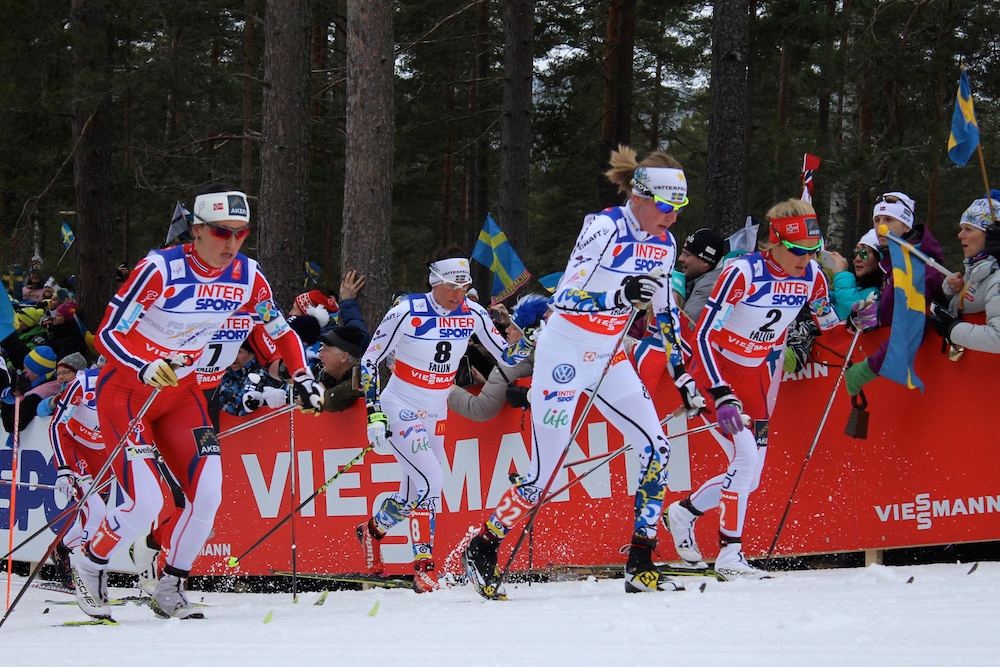
Sweden’s Sofia Bleckur (center) leading the race early up Little Mordarbacken with Norway’s Marit Bjørgen (near) and Therese Johaug (2), and Sweden’s Charlotte Kalla (8).
As they completed the red loop comprising the first half of each 10 k lap, Johaug decided pace was too slow. She didn’t want to attack, but she did want to pick it up a bit to break up the large group.
She did so on the largest climb on the second half of the course, known as “Big Mördarbacken” on the blue loop.
“I feel that the skis were so good and I had also really good grip, but I never thought I will get a gap there,” Johaug said in a post-race press conference. “I thought the other girls were behind me.”
As she reached the high point, they weren’t — at least they weren’t as close as she thought.
“The coaches standing at the top said that I had five or six seconds on the others, and I thought, ‘Oh my God, it’s early. I have 23 kilometers to the end,’ ” Johaug recalled. “But I understand that the skis were really good and the shape was good so I just focused on myself and the technique.”
Therese Johaug of Norway skiing well ahead of the pack around 19 k into the women’s 30 k classic mass start at 2015 World Championships in Falun, Sweden.
After leading Kowalczyk, Kalla, her two teammates Heidi Weng and Bjørgen, Finland’s Kerttu Niskanen, and Bleckur up the climb, Johaug came through the 7.8 k timing point nearly 8 seconds ahead of anyone else. Kalla was in second, followed by Finland’s Aino-Kaisa Saarinen and five others in the group. From there, Johaug continued to distance herself from the women behind her — coming through the stadium at 10 k with a 17-second lead on Bjørgen in second.
One-and-a-half kilometers later, back on the red loop, she was more than 40 seconds ahead of Niskanen and Saarinen, which led the chase pack in second and third.
“I heard all the ways in the tracks that I get more and more seconds to the girls behind me,” Johaug said. “It was amazing to ski here and the people around the tracks, they give me so much energy.”
In all the excitement, she got a little confused. Coming down off the red trail and back into the stadium for an opportunity to change skis at 15 k, Johaug feared she took a wrong turn and suddenly wondered whether she had accidentally skied on the blue course.
“I began to snowplow and stopped completely,” she told NRK, according to a translation. “I yelled to the officials, ‘I have gone wrong?’ I almost started to cry.”
Unable to get an answer fast enough, she pressed on, fearing disqualification if she inadvertently took a shortcut and missed the stadium.
“I just bet that I was on red. I came down and thought ‘yes, yes!’ when I saw it was correct,” she recalled.
Finland’s Kerttu Niskanen (10) and Sweden’s Charlotte Kalla (8) skiing together with another Swede, Sofia Bleckur (22), Norway’s Marit Bjørgen (l) and Heidi Weng (3), and Finland’s Aino Kaisa Saarinen (21) in pursuit of Therese Johaug, a Norwegian who dropped the field to score a big win in the 30 k classic.
By then, the chase group had made up some ground on her. While Johaug changed skis, the two Finns — Saarinen and Niskanen — did not, and were within 30 and 31 seconds of her leaving the stadium at 15 k.
Bjørgen and everyone else in the chase pack switched to a freshly waxed skis as well, and Bjørgen left the pit stop in fourth, 11 seconds after Niskanen. Weng followed, as did Bleckur and Kalla, all of which were within 45 seconds of Johaug.
Meanwhile, Sweden’s Anna Haag in eighth led a second chase group around 27 seconds back, with Germany’s Stefanie Böhler, Austria’s Teresa Stadlober, Norway’s Martin Ek Hagen, the Czech Republic’s Eva Vrabcová-Nývltová, and Americans Rosie Brennan and Liz Stephen.
Back on the blue course, Johaug gathered time back while ascending Mördarbacken for the second time, while Bjørgen caught and challenged the Finns on the same climb. By 16.2 k, Bjørgen was up to second, 54.4 seconds behind Johaug and just ahead of Niskanen in third. About 9 seconds later, Saarinen skied alone while Weng and Bleckur stuck together another four seconds back.
Kalla came through the checkpoint in seventh, 24 seconds after Bjørgen, and Vrabcová-Nývltová, Stephen, Stadlober, Brennan, Böhler, Hagen, and Haag were another 17 seconds back in eighth through 14th place.
Johaug didn’t know it, but she had successfully strung out the group as she’d intended. Except by 17.8 k, with more than a minute gap to second, it didn’t really matter.
Soaring down into the stadium with a 1:05 lead on Bjørgen, Johaug continued to push, as did Bjørgen and the rest of the women chasing a podium.
The deficit was up to 1:15 by 25 k, where Johaug came charging through the stadium for the second-to-last time, skipping a feed there and keeping her head down.
Sweden’s Charlotte Kalla charging alone to bronze in the 30 k classic at 2015 World Championships in Falun, Sweden.
About a kilometer back, Kalla worked hard up Little Mördarbacken to pass Bleckur and Niskanen and put herself in third. With 5 k to go, she was 2:08.1 behind Johaug and 53 seconds behind Bjørgen. Leaving the stadium with Niskanen, Weng and Bleckur, Kalla dropped them a kilometer later. By 27.8 k, she was within 35 seconds of Bjørgen, and 12 seconds ahead of Niskanen.
“You have to never stop believing,” Kalla said at the press conference. “The audience around the track gave me so much energy. When I was about 10 seconds up, the coaches told me I [put] seconds [into] second and that gave me more energy when I reached the bronze group. I recognized that I had good skis and I decided to push as hard as I could to get a gap.”
With 2.2 k to go, Johaug had kept herself 1:13 ahead of Bjørgen and was essentially in the clear. As she crested the second-to-last sprint climb, Norwegian fans showered her with champagne. She could literally taste the win.
On the next uphill, she took a Norwegian flag from the sidelines and carried it in one hand all the way to the finish — even up the final stadium ascent.
“Then I could look up and see how much people that were in the arena,” she said. “When you’re training a lot, it’s these memories that are so huge. Also the sun came out in the end of the race. The championships can not end better.”
Temperatures were around 38 degrees during the race on another partly cloudy afternoon in Falun. The sun peaked through the clouds a couple times, especially toward the end of the 30 k.
Norwegian fans spray champagne at Therese Johaug as she skis towards gold in the women’s 30 k classic at 2015 World Championships in Falun, Sweden.
With a winning time of 1:24:77, Johaug secured her third gold of these championships (after winning the 15 k skiathlon and 4 x 5 k relay with Norway) for her seventh World Championships title. Bjørgen held her own in second, 52.3 seconds behind, and Kalla finished 1:31.6 after Johaug in third.
For Bjørgen, it was her first silver and third medal of the 2015 worlds (after winning the classic sprint and anchoring the relay). Coming into the 30 k classic, she was unbeaten in the event since Kowalczyk won the event at the 2010 Olympics. Johaug had won the 30 k skate at Holmenkollen in 2011 and 2013, but never a 30 k classic.
“I never have like been in such good shape before. It feels good to have it here at World Championships,” Johaug said. “I have been training a lot for this distance, and before we start this championships, it was this day I was really looking forward to. That I can reach my goal and take the gold medal here today, it’s a dream.”
“I tried [to catch her], but she was too strong today and I didn’t have a chance,” Bjørgen said at the conference. “After 15 kilometers, we changed skis and I had a gap back to the other girls then I knew it was possible to take the silver. I’m really really happy for it.”
Diehard fans
With less than three kilometers to go, a Norwegian fan running alongside Bjørgen with a selfie stick slammed into a tree. Once he came to, Erlend Holberg, 24, told NRK that he had been waiting for Bjørgen to pass by, and when she did, he sang while sprinting through the woods next to her.
“Suddenly, I ran straight into a tree and fall to the ground,” he said, according to a translation. “… It was most important to focus on Bjørgen. I was very focused on the task.”
Norway’s Marit Bjørgen charging over the top of a hill a kilometer from the finish en route to silver in the women’s 30 k classic at 2015 World Championships in Falun, Sweden.
Bjørgen didn’t see it happen, but after finishing, she heard about the collision, which was caught on video.
“[At first] I thought, ‘Oh, maybe it was one of our coaches,’ ” Bjørgen said. “I don’t know who the man is. … He [got] up again. Maybe he’s a little bit … in the head.”
She pointed at her head and circled her finger around to gesture “crazy.”
After the final women’s race in Falun, Bjørgen said she considered these World Championships a success.
“We had some bad skis on the 10 k and not the best day on the pursuit, but I have three medals and I’m really really happy with that,” she said.
For Kalla, her fourth medal of the championships (in every race she competed in) marked her first in a 30 k classic event.
“My biggest goal this season was to go very well in Falun and feel that I did every thing I could every single race I started in,” she said. “I’m really satisfied with the way I have done my competitions.”
Niskanen took fourth, 31.6 seconds off the podium and 1:55.2 after Johaug, and Bleckur finished fifth (+ 2:09.3). Böhler was sixth (+2:36.9), Saarinen placed seventh (+2:45.2), Weng eighth (+2:45.7), Vrabcová-Nývltová ninth (+2:52.4), and Østberg passed Stephen in the stadium for 10th (+3:01.1).
The 30 k classic runner-up at the 2013 World Championships to Bjørgen, Kowalczyk finished 17th (+3:56).
Kris Freeman (Freebird) clinches his 17th national title in the men’s 30 k classic mass start on Thursday, ahead of APU’s Lex Treinen (left, behind), NMU’s Kyle Bratrud (behind Treinen) and APU’s Eric Packer (directly behind Freeman at right), at U.S. Cross Country Championships in Houghton, Mich. (Photo: Christopher Schmidt)
HOUGHTON, Mich. — With 11 men together at the start of the last 10-kilometer lap in Thursday’s 30 k classic mass start at U.S. Cross Country Championships, Kris Freeman knew he had to make something happen.
If he continued to ski in the pack and wait to see how the places shook out in the 100-meter finishing straight, the second-ranked U.S. distance skier (after U.S. Ski Team member Noah Hoffman) didn’t like his chances in a last-ditch sprint.
“I knew that somewhere in the last five k I had to go, and I had to go hard,” said Freeman, 34, who skis independently as Freebird, after the third of four national races at the Michigan Tech Trails.
The men directly around him with eight kilometers to go — including two Sun Valley Ski Education Foundation (SVSEF) Gold Team members (Matt Gelso and Miles Havlick), three Alaska Pacific University (APU) skiers (Lex Treinen, Scott Patterson and Eric Packer) and three Northern Michigan University (NMU) athletes (Fredrik Schwencke, Kyle Bratrud and Adam Martin), as well as Dartmouth’s Paddy Caldwell (also of the Stratton Mountain School T2 Team and U.S. Ski Team D-team) — generally anticipated Freeman’s move as well.
But all of them realized that leading was significantly harder in the cold-and-slow conditions with temperatures around 3 degrees throughout the day. Freeman tried it out, pushing the pace a couple times early in the first lap “just to experiment and see if I could hurt the field,” he said. “I just couldn’t.”
Kris Freeman (near), Dartmouth’s Paddy Caldwell (l), and NMU’s Fredrik Schwencke (behind Freeman) near the front of the pack around 2 k into the men’s 30 k classic mass start on Thursday at U.S. nationals in Houghton, Mich.
The four-time Olympian decided to hang back and attack somewhere on the second half of the last lap.
“I think I went with two-and-a-half k to go,” Freeman said. “And I knew I had a really good attack for two k, then my last 500 meters was pathetic.”
But it was enough for the win. On the second-to-last climb, Freeman successfully gapped Gelso, Patterson and the four others in the chase pack (Norris, Treinen, Packer and APU’s fifth man Reese Hanneman, respectively), and he frequently checked over his shoulder to make sure they weren’t reining him in.
“I had to double pole one long downhill that’s usually recovery so that they wouldn’t get back on me,” Freeman said of the final descent before the last climb toward the finish.
Treinen took advantage of an unfortunate misstep and crash from his teammate, Patterson, who had been skiing with Gelso in second with a kilometer to go.
“I was kind of moving tracks and stumbled a little bit,” Patterson said of the final downhill. “I was wobbly out on one ski, trying to correct, but it just wasn’t enough — spun around, totally my fault, didn’t hit anyone else, they all moved around me, and it was a quick little fall, but still not something you want right at the end.”
Four of his teammates — Treinen, Norris, Packer and Hanneman — navigated around him, as did Bratrud. Gelso stayed out of trouble but lost steam up the final ascent.
Kris Freeman pushing hard for first with 200 meters to go in the men’s 30 k classic mass start at U.S. nationals in Houghton, Mich.
While Freeman forged ahead up the gradual hill, again looking back to see who was closest to him, his pain emitted through his facial expressions as he strode toward the finish.
Behind him, Treinen, on his 25th birthday, worked his way from fourth to third behind Bratrud and ahead of Gelso and Norris.
“Kyle Bratrud came up from behind and he looked like he was charging pretty hard so I tried to stay behind him for as long as I could, and on the last uphill, just gave it everything,” Treinen said. “I tried to break him — it just barely worked.”
Treinen edged the 21-year-old NMU senior, who won Sunday’s 15 k freestyle to start nationals, by 0.4 seconds to claim second for his first national podium. He finished 3.7 seconds behind Freeman, who won his 17th national title in 1:31:14.8.
“They were yo-yoing [behind me] and I was totally loaded coming up into the finish,” Freeman recalled. “If someone had sprinted by me, there would’ve been no response. There was nothing I could do.”
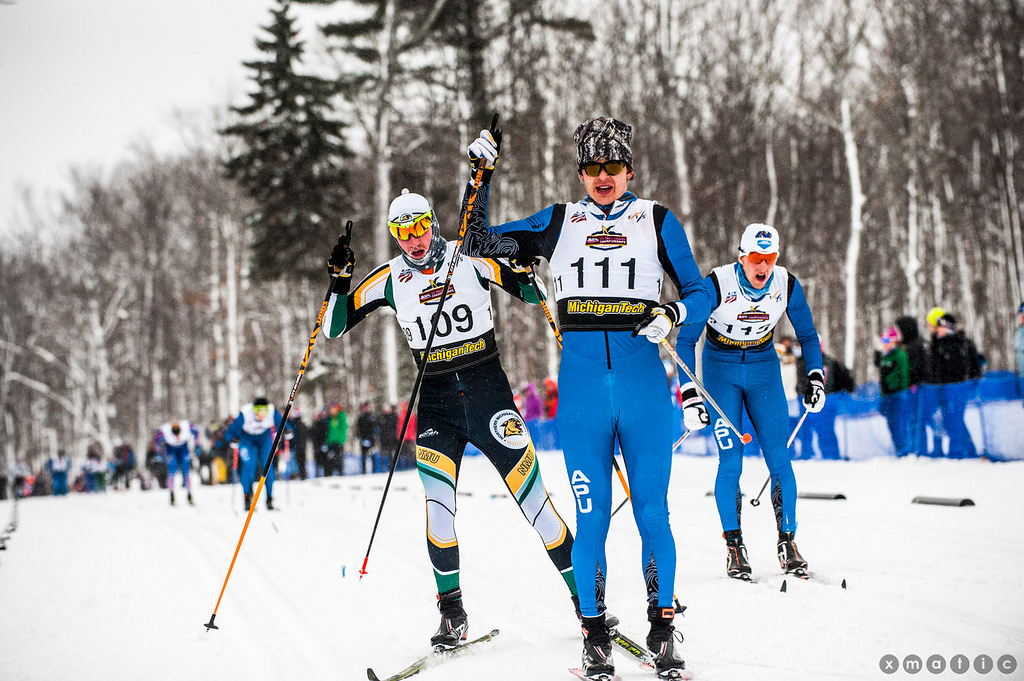
APU’s Lex Treinen (111) celebrates his second-place finish and first national podium after the 30 k classic mass start at U.S. nationals in Houghton, Mich. NMU’s Kyle Bratrud (109) placed third, and APU’s Eric Packer (r) secured fourth. (Photo: Christopher Schmidt)
“Lex and I were gaining on [Freeman] at the end so who knows how it would’ve played out if there was another k to go,” Bratrud recalled.“I found myself leading a decent amount and then when Kris took off and kind of split the field up, I was able to at least pick up most of the pieces.”
On Sunday, Freeman placed second to Bratrud in the individual skate race.
“Even though the skate race didn’t go quite like I wanted, the sensations I had were great,” he reflected. “Today except for the last 500 meters, I felt like I was in total control and I just feel totally different then I did last year. This should absolutely cement my place on the World Championship team and that’s been my goal all year.
“SuperTour points are nice, but I want to go prove I’m one of the best in the world at World Champs,” Freeman added.
The U.S. World Championships team will be tentatively announced on Jan. 26, according to the team-selection criteria. The first criteria is based on World Cup results in the selection period (from Nov. 29, 2014 to Jan. 18, 2015); the second is coaches’ discretion, and the third, should it come down to it, is based on the best-ranked athletes in the 4th edition of the USSA Sprint and Distance Points List, which will be released Jan. 23.
Heading into nationals, Freeman ranked second in the 3rd USSA distance points list (including races before Jan. 2), nearly six points ahead of Gelso in third.
That made him one of Freeman’s biggest perceived threats on Thursday.
“Gelso looked really comfortable on his skis; he was having good kick everywhere and he’s right behind me on the points list and he’s having a great season,” Freeman said. “Kyle also obviously just had a great race so those two I kept looking at.”
Kyle Bratrud (NMU) and Scott Patterson (APU) leading the U.S. nationals men’s 30 k mass start around 2 k on Thursday in Houghton, Mich.
Bratrud explained he came into the race more relaxed than he had anticipated after winning his first national title (and with it, his first national top 20) earlier in the week.
“All summer I had been targeting this 30 k and into the fall, I started realizing that maybe the 15 k would be a better shot for me,” he said. “Winning that I felt like I had a pretty successful week even if I was dead last in this race. I was just out there having fin. It’s fun to do well.”
Freeman felt similarly. After digging himself into a self-described hole last season, Freeman was enjoying racing again.
“I backed off my training a little bit; I’m more relaxed. I’m accepting that I’m 34, I can’t train a thousand hours anymore and expect to recover the same why I did,” he said. “And ski racing’s fun.”
While Freeman was gunning for 2015 World Championships next month in Falun, Sweden, Bratrud put himself in prime position to be nominated to the U23 World Championships team his previous win at nationals. Another podium on Thursday prequalified him for NCAA Championships as well, as nationals double as a Central Collegiate Ski Association (CCSA) and NCAA Central Region qualifier for NCAA’s.
“It was a weight off my shoulder to win the skate race and pretty much guarantee U23’s so now I can go home and train for a bit and head over to Kazakhstan,” Bratrud said. “I’m prequalified for NCAA’s so I can come back and get another little block in and then hopefully race some of those fast [University of Colorado] Boulder Norwegian guys.”
NMU Claims College Cup
Four NMU skiers landed in the top 13 with Bratrud in third, Schwencke in 11th (who skied near the front of the pack and led the long climb up after the race’s halfway point, then raced in the top 11 with eight kilometers to go), Martin in 12th and Erik Soderman in 13th.
“The Northern Michigan guys put in some strong attacks on the second lap, and I think they widdled the field down [by the last lap],” Freeman said. “I tried working with Freddy [Schwencke] right before the end of the second lap, but we got caught and I just said, just tuck it in here until it’s time.”
With the highest-collective performance over three days at nationals, NMU won the 2015 College Cup.
“All my success comes from training with those guys every day and Freddy’s a very good classic skier so I was confident skiing next to him,” said Bratrud, who led through the 10 and 20 k lap checkpoints. “When he put the hammer down pretty hard when we came through the second time, just to be able to ski confidently with your teammate and be at the front of the race is a pretty good feeling and that gave me a good feeling going forward.”
APU Takes 5 of Top 8
This past summer, APU’s seven-person men’s team (with U.S. Ski Team member Erik Bjornsen, Reese Hanneman, Tyler Kornfield, Norris, Packer, Patterson, and Treinen) initiated a “#five2falun” slogan.
Sun Valley’s Matt Gelso (102) and Miles Havlick (106) lead the 11-man pack (with a fleet of APU and NMU skiers) around 22 k in the 30 k classic mass start at U.S. nationals in Houghton, Mich.
“It started as a joke; it’s all in good humor,” Hanneman explained at the time. “There was another elite team in the U.S. who, they last couple years, they had a campaign: six to Sochi. We thought, we can do our own little thing. Five because it starts with and ‘F’ because seven doesn’t really sound as good.
“Now we’re kind of using it as motivation for ourselves,” he added. “If [we] did actually send five to Falun from one team that would be absolutely insane. The men have traditionally been so spread out in the U.S. that we’re kind of excited about having a group of us that changes the landscape.”
On Thursday, after months of waiting for a breakout-team performance, the APU men got it.
Treinen led them in second, Packer rose from seventh to fourth (+4.9) over the last kilometer, and Norris finished 11.2 seconds after Freeman in fifth, 1.9 seconds ahead of Hanneman in sixth. Hanneman came back from 13th and 18 seconds behind the leaders at 20 k, to eighth with 1 k to go.
Gelso finished seventh (+14), and Patterson, who’s back after a pulmonary embolism kept him from racing from late October until mid-December, recovered from his fall on Thursday to edge Havlick and Caldwell by less than a second for eighth (+24.3). Havlick placed ninth (+25), and Caldwell was 10th (+25.1).
“I had a pretty good sprint so if I hadn’t had that fall who knows what would’ve happened,” Patterson said. “I would’ve been right there challenging for it, maybe not Freeman but the next guys.”
Treinen called his second-place finish “pretty special, especially because it’s my birthday. It was kind of in the back of my mind, not gonna lie — I was thinking about that.”
His previous national best was fifth in the 50 k classic mass start at U.S. Distance Nationals last spring.
“I feel like we were just waiting for him to have a good day and that was today,” APU Head Coach Erik Flora said. “He looked great, he looked energetic, he looked under good control and you could see so many times just like a smile on his face so it was really cool.”
Flora added that he was proud of the entire team, with five men in the top eight.
“To have all those boys in there fighting and challenging each other is just awesome,” he said. “I think that the training for those guys is working and their commitment to being skiers all that good stuff.”
“I’m just happy to have my teammates do so well as well,” Treinen said. “It’s the best team I’ve ever been on and I think we’re just starting to show what we’re made of.”
Packer rose from seventh to fourth with 200 meters to go, proving to himself that he was back on form after the flu took him out of commission the week before the 15 k.
“I couldn’t be happier with feeling good today,” the first-year APU member and Anchorage native said. “… I grew up skiing with all of the guys. We all started training together actually in middle school. It’s kind of cool to have five of those same guys that you started with at 12 or 13, five in the top eight today.”
Norris led at times during the race, including around 22 k with Gelso, and said he was disappointed to slip from fourth at the bottom of the last climb to fifth (when Packer passed him in the final stretch).
“It’s hard when you get passed in the last hundred meters … but it was my teammate and he’s a good finisher,” Norris said. “And I’m feeling better every race we do throughout the season.”
Moreover, he was excited for his team.
“We had the feeling that we were going to have some great results as a team and we hadn’t really shown that yet this year,” he said. “We all had great skis. Everyone’s skiing stronger so it’s cool to see Lex have a good sprint finish when he’s notoriously a distance guy and Packer have a good 30 k when he’s been good at sprints. Everybody’s improving their weaknesses.”
Notes:
Jørgen Grav (University of Vermont) was an early frontrunner in the men’s 30 k classic mass start at U.S. nationals in Houghton, Mich. (Photo: Christopher Schmidt)
Jørgen Grav (University of Vermont), who placed 24th, skied in the top five for much of the first lap, just ahead of Freeman, amid a large pack of about 30 separated by 15 seconds at 10 k.
Brian Gregg (Team Gregg/Madshus) finished 21st after skiing in the top 7 through 10 k, then slipping into the mid-20s on the second lap.
Tad Elliott (Ski & Snowboard Club Vail Elite Team) finished 36th in his first race at nationals after spending the earlier part of the week recovering from a flu/cold at home in Durango, Colo.
Ben Lustgarten (SVSEF) sat out the mass start as he’s been suffering from vertigo this week, which led him to miss Tuesday’s classic sprint as well.
Men’s 30 k classic mass start at U.S. Cross Country Championships in Houghton, Mich.
Men’s 30 k classic mass start at U.S. Cross Country Championships in Houghton, Mich. (Photo: Christopher Schmidt)
Men’s 30 k classic mass start at U.S. Cross Country Championships in Houghton, Mich.
Men’s 30 k classic mass start at U.S. Cross Country Championships in Houghton, Mich.
Men’s 30 k classic mass start at U.S. Cross Country Championships in Houghton, Mich.
Men’s 30 k classic mass start at U.S. Cross Country Championships in Houghton, Mich.
SSCV’s Tad Elliott (119) and Craftsbury’s Andrew Dougherty (131) Men’s 30 k classic mass start at U.S. Cross Country Championships in Houghton, Mich. (Photo: Christopher Schmidt)
ANCHORAGE, Alaska — Scenes from the front of the pack during the women’s three-lap, 30-kilometer classic mass start at U.S. Distance Nationals last Friday at Hillside trails.
2014 U.S. Distance Nationals 30 k classic mass start at Hillside trails in Anchorage, Alaska
2014 U.S. Distance Nationals 30 k classic mass start at Hillside trails in Anchorage, Alaska
2014 U.S. Distance Nationals 30 k classic mass start at Hillside trails in Anchorage, Alaska
2014 U.S. Distance Nationals 30 k classic mass start at Hillside trails in Anchorage, Alaska
2014 U.S. Distance Nationals 30 k classic mass start at Hillside trails in Anchorage, Alaska
2014 U.S. Distance Nationals 30 k classic mass start at Hillside trails in Anchorage, Alaska
2014 U.S. Distance Nationals 30 k classic mass start at Hillside trails in Anchorage, Alaska
2014 U.S. Distance Nationals 30 k classic mass start at Hillside trails in Anchorage, Alaska
2014 U.S. Distance Nationals 30 k classic mass start at Hillside trails in Anchorage, Alaska
2014 U.S. Distance Nationals 30 k classic mass start at Hillside trails in Anchorage, Alaska
2014 U.S. Distance Nationals 30 k classic mass start at Hillside trails in Anchorage, Alaska
2014 U.S. Distance Nationals 30 k classic mass start at Hillside trails in Anchorage, Alaska
2014 U.S. Distance Nationals 30 k classic mass start at Hillside trails in Anchorage, Alaska
2014 U.S. Distance Nationals 30 k classic mass start at Hillside trails in Anchorage, Alaska
Kikkan Randall (APU/USST) racing to third in the women’s 30 k classic mass start at U.S. Distance Nationals. Randall led early in the three-lap race, taking the $100 bonus as the first to crest the high point of the course around 5.5 k.
2014 U.S. Distance Nationals 30 k classic mass start at Hillside trails in Anchorage, Alaska
2014 U.S. Distance Nationals 30 k classic mass start at Hillside trails in Anchorage, Alaska
2014 U.S. Distance Nationals 30 k classic mass start at Hillside trails in Anchorage, Alaska
2014 U.S. Distance Nationals 30 k classic mass start at Hillside trails in Anchorage, Alaska
2014 U.S. Distance Nationals 30 k classic mass start at Hillside trails in Anchorage, Alaska
2014 U.S. Distance Nationals 30 k classic mass start at Hillside trails in Anchorage, Alaska
2014 U.S. Distance Nationals 30 k classic mass start at Hillside trails in Anchorage, Alaska
2014 U.S. Distance Nationals 30 k classic mass start at Hillside trails in Anchorage, Alaska
2014 U.S. Distance Nationals 30 k classic mass start at Hillside trails in Anchorage, Alaska
2014 U.S. Distance Nationals 30 k classic mass start at Hillside trails in Anchorage, Alaska
IMG_5724
Sadie Bjornsen leads Liz Stephen in 2014 U.S. Distance Nationals 30 k classic mass start at Hillside trails in Anchorage, Alaska
2014 U.S. Distance Nationals 30 k classic mass start at Hillside trails in Anchorage, Alaska
2014 U.S. Distance Nationals 30 k classic mass start at Hillside trails in Anchorage, Alaska
Sadie Bjornsen (APU/USST) celebrates her third national title and first of U.S. Distance Nationals in the women’s 30 k classic mass start on Friday at Hillside trails in Anchorage, Alaska. She dropped USST teammate Liz Stephen in the final kilometers to do so.
2014 U.S. Distance Nationals 30 k classic mass start at Hillside trails in Anchorage, Alaska
2014 U.S. Distance Nationals 30 k classic mass start at Hillside trails in Anchorage, Alaska
2014 U.S. Distance Nationals 30 k classic mass start at Hillside trails in Anchorage, Alaska
2014 U.S. Distance Nationals 30 k classic mass start at Hillside trails in Anchorage, Alaska
2014 U.S. Distance Nationals 30 k classic mass start at Hillside trails in Anchorage, Alaska
2014 U.S. Distance Nationals 30 k classic mass start at Hillside trails in Anchorage, Alaska
2014 U.S. Distance Nationals 30 k classic mass start at Hillside trails in Anchorage, Alaska
Sadie Bjornsen (APU/USST) celebrates her third national title and first of U.S. Distance Nationals in the women’s 30 k classic mass start on Friday at Hillside trails in Anchorage, Alaska. She dropped USST teammate Liz Stephen in the final kilometers to do so. (Photo: Erik Hill/Anchorage Daily News)
Editor’s Note: This is the first of two race reports on Friday’s classic mass starts, the final races of the season at U.S. Distance Nationals. Please bear with us for the men’s report, as this FasterSkier has a flight to catch.
ANCHORAGE, Alaska — Liz Stephen was having a bit of an inward battle on Friday at the last day of U.S. Distance Nationals in the last women’s race of the season.
Like always, the 27-year-old U.S. Ski Team (USST) member, known as a hill climber and distance skier, really wanted to win the 30-kilometer classic mass start. But as the three-lap race around Spencer Loop at Hillside on the southeast side of the city played out, Stephen started to realize she was going to have to beat Sadie Bjornsen to do so.
“I was secretly hoping Sadie was gonna win this race,” Stephen said afterward of Bjornsen, a member of both Alaska Pacific University (APU) and the USST. “I had a feeling a few days ago this was going to be her day.”
Neither had won an individual race at the weeklong Spring Series in Anchorage. Another one of their teammates, Kikkan Randall (APU/USST) had dominated the two earlier events: the 10 k freestyle and classic sprint. On the third day, the first of U.S. Distance Nationals, Randall anchored APU to another victory in the 4 x 5 k mixed relay. While the 30 k classic might not be her strongest event, it was hard to bet against Randall at home on Day 4.
So as the 30 k unfolded, Randall started off by leading to the top of the longest-and-largest hill known as Wall Street (with 87 meters, or 285 feet, of climb) around 5 1/2 k. She grabbed the first of two $100-dollar primes at the summit in doing so, and went on to follow Bjornsen into the 10 k checkpoint 0.8 seconds back in second.
Another USST member Jessie Diggins, also of the Stratton Mountain School (SMS) T2 Team, was third at 10 k, 2.4 seconds behind Bjornsen, and Stephen was almost even with her in fourth.
By lap two, Stephen opted to go big — rather than wonder what could’ve been if she didn’t try — and attacked at the bottom of the multi-tiered climb up Wall Street, the high point of the course around 950 feet above sea level. The move worked, initially, as Stephen took the second money bonus over the top and gapped Bjornsen and Randall slightly by 16 k.
Bjornsen later said Stephen exposed her weakness on the steepest part of the course.
“These hills are really good for me because I can stride out quite well, but the top of Wall Street is too steep for me and so I have to run and that’s not what I’m good at,” she said. “I think Liz figured out pretty quickly that’s where she could make time on us. Every time she went there, she came around us and just started hammering.”
Trailing Stephen by a few seconds at the top, Bjornsen met her own crossroads and decided to push forward in pursuit. She left Randall in doing so and caught Stephen on a series of climbs on the second half of the course.
“I tried to make a break and I had a little bit of space, but Sadie was able to close it,” Stephen recalled. “We both kind of looked at each other, like, yeah, these girls [Randall and Diggins] are coming back so we gotta go. … I’m terrified when I’m on a downhill and Jessie’s on my tail. The whole time we were like we cannot ever let up on these downhills, these two are gonna work together and come back on us.”
For the next 12 or so kilometers, Stephen and Bjornsen stuck together, with Stephen leading through 20 k by 2.4 seconds. Randall came through another 18 seconds back in third, followed by Diggins 11.6 seconds later. The fifth-consecutive USST member, Ida Sargent (Craftsbury Green Racing Project) was another 25.4 seconds back at 20 k.
“We were just pushing so hard out there, making sure nobody was catching us,” Bjornsen said. “You always go into this race, the last race of the season like, ‘Oh, I hope we don’t go as hard as we can the whole time because I’m so tired,’ but when it comes down to it, it’s always more fun to do that anyway.”
By the time the third lap came around on a sunny morning with temperatures rising rapidly from the teens at the start (and no ski changes allowed), Stephen continued to lead Bjornsen up and down the backside of Wall Street into the last set of kicker climbs. There, Bjornsen made her move, dropping Stephen and racing down into the stadium in first, at least 15 seconds ahead of Stephen.
“You always go into this race, the last race of the season like, ‘Oh, I hope we don’t go as hard as we can the whole time because I’m so tired,’ but when it comes down to it, it’s always more fun to do that anyway.” — Sadie Bjornsen, 30 k classic champion
The race turned out to be about 31.5 k, long enough to Bjornsen to extend her gap to 29.1 seconds at the finish. The 24-year-old Washington native, who’s lived in Anchorage for the last several years, won her third national title and first at Spring Series in 1:35:58.1 in front of a hometown crowd. Stephen placed second, and Randall notched another podium in third, 2:08.8 behind Bjornsen.
Last year at Spring Series in Truckee, Calif., Bjornsen podiumed in four individual events (placing second in the 10 k classic and third in the skate prologue, skate sprint and hill climb). At 2013 U.S. nationals in Midway, Utah, she won both the skate sprint and 20 k classic mass start.
This race, at home on the trails APU she trains on (when she’s not racing the World Cup circuit overseas), was essentially made for her, which was ironic, because a lot of people previously wrote her off as a sprinter.
Not APU, and not Stephen.
“This is probably one that I’m going to remember most for the season, this and Holmenkollen, to do well in a 30 k because I feel like it’s the hardest race,” Bjornsen said. “I was told when I was young that I was only a sprinter. Since joining APU I’ve realized I may be more of a distance skier than a sprinter and, you know, I prefer that. I always want to sprint, but distance skiing is so fun for me.”
Stephen said she had fun skiing with Bjornsen, who worked the flats and downhills, and Stephen would help on the climbs.
“I think we were pretty good team out there,” Stephen said.
Kikkan Randall (APU/USST) racing to third in the women’s 30 k classic mass start at U.S. Distance Nationals. Randall led early in the three-lap race, taking the $100 bonus as the first to crest the high point of the course around 5.5 k. (Photo: Erik Hill/Anchorage Daily News)
Diggins made the most of her fast skis and downhill skills to catch Randall on the third lap and finish 7.8 seconds behind Randall in fourth.
“I felt like I needed to go out in the beginning of the race and set a good hard pace and see if I could hold it,” Randall said. “It went pretty well for the first half of the race, and then going up the major climbs on that second lap, these guys picked up the pace and I started to hit the wall a little bit. Things started to cramp a lot on that last lap.”
Before that point, she remembered watching Stephen and Bjornsen pull away on final climbs on the second lap — first by five seconds, then 10 seconds.
“I was really trying to stay on the horse and try to get back in that group but they started to pull out of sight,” she said. “Jessie caught me on the downhill, but then it was great because her and I could work together. She was a little faster on the flats and downhills and when we started climbing again, I felt like I need to ski my own pace. I was able to pull back a little bit, then it was like, it’s the end of the season, it’s the end of the race, just kind of ski as hard as you can up the hills.”
After falling once when someone rode over her ski from behind, then getting tangled behind a crash involving Becca Rorabaugh (APU) within the first 3 k, Sargent skied alone for most of the race — at least 26 k, she estimated.
“I finally pulled my way up to the front on the Spencer Loop the first time and they really went for it going over the top,” Sargent recalled. “I wasn’t feeling great at that point so a little gap opened up over the top … and once a gap opens up, it’s just really hard to make it back.”
Sixteen seconds ahead of Rorabaugh in fifth at 10 k, Sargent maintained her gap on those behind her with a 14-second cushion to Caitlin Gregg (Team Gregg/Madshus) at 20 k.
“I tried to split it up into little bits, like, OK I’m gonna get up that hill,” Sargent said. “Once I settled into a pace, it felt really good. I think it would’ve been more fun to ski with people, but it was a good, different challenge. Thirty k has always been a tough distance for me — it’s pretty long — so I’m happy to have been able to hold it in there.”
She held onto fifth, finishing 41.5 seconds after Diggins. The USST swept the top six, with Sophie Caldwell (SMST2) edging Gregg by 1.5 seconds for sixth. Stratton put four in the top nine with Annie Pokorny notching eighth and Erika Flowers taking ninth, 16.4 seconds ahead of Caitlin Patterson (CGRP) in 10th.
“We were just talking about how all of us have different strengths and how this summer we want to pinpoint where each of us can help the others get better at everything so we can all move up as a team,” Stephen said. “It’s fun because we all have something that’s really strong that somebody else doesn’t have.”
“I certainly felt like today the caliber is the highest it’s ever been for one of these races,” Randall said. “I know these guys can ski really well on the Word Cup so it’s like, you know you’ve got to bring you’re A-game on a day like this.”
“It’s really fun to come out and race on these hills we always train on and end things on a good way at home,” she added.
The senior women’s 30 k classic mass start on the last day of Canadian Nationals last Saturday in Corner Brook, Newfoundland.
CORNER BROOK, Newfoundland — The last day of Canadian Nationals started bright and early last Saturday with the senior men’s competition at 9 a.m. The men raced 50 kilometers, women and junior men 30 k and junior women 20 k, all classic mass starts.
With skiers already having completed three other individual races this week, some doing four with the team relay, the distance race is not only a good indicator of endurance and race fitness, but also a test of who has recovered the best throughout the week.
Newfoundland came through with some pretty exciting weather for the final race. Blowing snow was the name of the game for most of the morning at Blow Me Down Trails and made for interesting conditions for the competitors.
Senior Men
Fighting through the snow, the senior men stayed in a pretty big pack for the first two-thirds of the race until Ivan Babikov, of the Canadian World Cup Team, pulled ahead to win the 50 k by 41.5 seconds in 2:19:32.3.
Ivan Babikov, of the Canadian World Cup Team, leads fellow Olympian Graeme Killick (AWCA/NST) and others in the senior men’s 50 k classic mass start on the last day of Canadian Nationals last Saturday in Corner Brook, Newfoundland.
Runner-up Kevin Sandau of the Alberta World Cup Academy (AWCA) and Canadian Senior Development Team (NST) talked about the race and about his experience at nationals this year.
Kevin Sandau (2nd)
– What was your race plan going into the 50 k? Stick with the pack? Push the pace and string things out?
“I didn’t want to have a relaxed and passive pace for much of the 50 k. Sometimes 50’s just aren’t hard enough until the last 10 t0 15 k, so they end bunching up quite a bit, and it can get frustrating and sketchy skiing with a big pack like that. I took my turns in the front, kept the pace high. When Ivan attacked on the second last lap a group of three of us tried to pull him back, but well he sort of crushed it that lap and put some big time into us.”
– Looks like you had a pretty good week of racing. How do you feel about your performance this year at nationals?
“Best nationals for me by far. I was actually most nervous about the team sprint and defending Foothills Nordic’s gold-medal streak in that race. Also it was the first time I did the sprint race since maybe 2009 at nationals and I managed to sneak into the A-final, so I was pretty excited about that.”
– How many nationals podiums do your currently have to your name? How many titles?
“Seven podiums including two team-sprints titles. The [individual] national-champ title still eludes me, but I did grab this years overall title so pretty pumped for that.”
– I hear you are racing at the Alberta Cup Sharkfest. Safe to say this was your main focus for the season?
“Pretty much the biggest focus. You’re only as good as your last race, right? And I figure it will be some good motivation to ski on the weekend.”
The senior women’s race played out quite differently. Amanda Ammar (Team Ninja) broke the pack early on, with only Emily Nishikawa (AWCA/NST) being able to match her.
The women’s 30 k classic podium at Canadian Nationals on Saturday in Corner Brook, Newfoundland, with winner Amanda Ammar (third from left), runner-up Emily Nishikawa (second from l) and Japan’s Chisa Obayashi in third (third from r). (Photo: Cross Country Canada)
These two skiers worked together, opening up a big gap over third-place skier Chisa Obayashi (Madshus Japan), until Ammar pulled ahead in the last lap to take the win with by 54 seconds over Nishikawa.
Amanda Ammar (1st)
– You really broke the field pretty early on. Was that your game plan before or did you decide during the race that you felt great and you’d just go for it?
“Winning the nationals 30 k was a goal of mine all year, but obviously not the most important. Olympics was first. Breaking the field was always in the back of my head, but you can only make that decision really on the day of … you need to gauge your energy and that day I felt awesome in my warmup, so it was an easy game plan. As a distance skier, I absolutely hate tactics, and would love to have the luxury of always just blasting off the start.”
– You’ve put down some really solid races at these nationals. Do you think that your experience at the Olympics put you in a good place for nationals or do you think that you went into these races pretty fatigued?
“The Olympics was physically and mentally exhausting. Leading up to the Olympics was stressful for me with the appeals, Brittany [Webster] and I had a horrible travel schedule, and then while traveling to Sochi the airline company broke most of my skis. So I wasn’t in the best headspace. That being said, the Olympic course was one of the most challenging that I have ever raced on. After completing all of my events, I felt a huge sense of accomplishment and confidence. I knew if I could start and finish a race on that grueling of a course, then it would be an absolute piece of cake on any other course.
“When I got home from the Olympics I was pretty toast. I had no desire to go to nationals, but I knew that once I got there that my frame of mind would change, and that I would have fun no matter what. So did I have energy going into nationals? No, but does anybody, really? It’s a long season, especially an Olympic season. We are all tired, and I feel that every athlete is in the same boat.”
– Any thoughts about your nationals races this year? The 30 k was your first national title, correct?
“I couldn’t be more excited about my results at nationals this year. A Ninja winning the nationals aggregate? So stoked! This is the first time I have ever medalled as a senior, and I managed to get top 5 in every race! In 2012, I was nine minutes and 30 seconds behind in the 30 k classic event, so that is just one example of how far I’ve come in three years. These results mean so much to me in that I’ve always wanted to be a positive role model for the young women coming up in sport.
“These last three years I’ve done it my way, no carding, no national/development team, no rules! Chris [Butler] and I made the training plan, and worked together with other athletes in the bow valley. We kept it sublimely simple.”
The junior men’s 30 k classic mass start on the last day of Canadian Nationals last Saturday in Corner Brook, Newfoundland.
In the junior men’s 30 k, NDC Thunder Bay ruled the roost once again, sweeping the podium. Pulling off his third national title this season, Scott Hill raced to a nearly two-minute win over the rest of the field. His NDC teammates also on the National Junior Team, Evan Palmer-Charrette and Ben Wilkinson-Zan followed in second and third, respectively.
Much like in the senior women’s race, the junior women spread out early on. This made for a mentally challenging race as most of the competitors pushed through the pain alone for much of the 20 k distance.
Upsetting this trend, the top three, Dahria Beatty (AWCA/NST), Katherine Stewart-Jones (Nakkertok/NST) and Annah Hanthorn of the Yukon Territory Ski Team, worked together for much of the race setting up a comfortable lead on the others. On the third of four laps, Beatty and Stewart-Jones slowly pulled away from Hanthorn and the last lap became a two-skier battle. Beatty pulled away on the hills of the final lap to take her second national title of the week by 16.5 seconds.
Ivan Babikov and Amanda Ammar, winners of the 50 and 30 k classic mass starts at 2014 Canadian Nationals in Corner Brook, Newfoundland. (Photo: Cross Country Canada)
Americans Kikkan Randall (c) and Sadie Bjornsen (r) ski with Norway’s Marthe Kristoffersen (l) and Germany’s Nicole Fessel (second from r) in the Holmenkollen 30 k classic mass start on Sunday in Oslo, Norway. (Photo: Fischer/Nordic Focus)
There’s something to be said for skiing like you’ve got nothing to lose. Ask Kikkan Randall, who locked up the World Cup sprint title for the third year in a row last Wednesday in Drammen, Norway. Or Sadie Bjornsen, who’s been plagued with bouts of illness for the better part of the last three months.
Both U.S. Ski Team members later said they felt relatively good before the start and during most of the world-famous Holmenkollen 30-kilometer classic mass start on Sunday in Oslo, Norway.
It was still a dang-tough course, with an initial 5 k lap followed by a larger 8.3 k lap containing two smaller loops (at least the skiers kept it straight). After getting off to a strong start, Bjornsen said she was a little frightened with the tempo of the women she was skiing with.
“At four k, I was like, ‘There’s no way I’m going to be able to maintain this pace, but I’ll hang on until I explode,’ ” she recalled.
Bjornsen did her best to hold her position just outside the top 10, first testing her grit with some Finns, including Krista Lahteenmaki and Anne Kyllönen. The American quickly found their classic style didn’t match hers and she opted to ski with several Norwegians, including Tuva Toftdahl Staver, Ingvild Flugstad Østberg, Kristin Størmer-Steira, and Martha Kristoffersen for the first several kilometers.
Bjornsen said the Norwegians’ “really big strides,” matching hers, made the difference. “I was appreciative of that,” she said.
Kyllönen’s stride was simply too big, she said, and “Lahteenmaki, I felt like I was in a sprinting running race; she has a very short tempo. I followed her for a couple k and my legs were flooded.”
By 10 k, Norway’s Martine Ek Hagen was right there with Bjornsen as well, and Randall was just off the back of their seven-person chase pack, which at the time, was about a minute and 30 seconds behind eventual winner Marit Bjørgen.
With Norwegian fans lining the entire course, Bjornsen said the atmosphere brought her back to her international debut at the 2011 World Championships in Oslo.
American Kikkan Randall (15) racing to 12th, a career best in the 30 k, at the Holmenkollen 30 k classic mass start on Sunday in Oslo, Norway. (Photo: Fischer/Nordic Focus)
“It was World Championships loud,” Bjornsen said. “I kept hearing my name in the mix, but more than anything, I could hear them yelling, ‘Kikkan.’ She’s a national hero here. She’s huge.”
The crowd and endless cheers fueled Bjornsen to staying within the top 15 throughout the race, with Randall close behind for most of it. Ultimately, Randall shot to the front of the pack and continued to pick off places with 1.5 k to go, finishing 12th for her career-best 30 k, just 10 seconds ahead of Bjornsen in 14th, also her best distance race.
Two years ago — the first time Bjornsen raced in Holmenkollen — she placed 40th in the 30 k classic. She did not race there last year.
“I couldn’t have picked a better way to ski it with four Norwegians,” Bjornsen said after going head-to-head with Heidi Weng, Østberg, Hagen and Kristoffersen to the line. She beat all but Weng, who took 13th by 0.4 seconds, and edged Østberg by one-tenth of a second for 14th, 4:27.8 back from Bjørgen. The top Norwegian became the first woman to win four Holmenkollen titles in what doubled as her 100th World Cup podium.
Randall finished 4:17.7 after Bjørgen, without anyone within several seconds of her. She recalled being 100 meters behind the pack for most of the middle part of the race, with skis that were “a little slick” on the first lap sending her in for a fresh pair at 13.3 k.
Bjornsen changed there as well, where she said everyone was switching. Skiing on her “B-pair” until that point, she said her skis were great — gripping on the uphills and fast enough on the downhills. But she wasn’t about to second guess what everyone else was doing, and changed to her A-pair. That was the first time a ski change worked out in her favor, she said.
The group she was with never switched again (out of a possible three times), and while most struggled with kick on the icy last lap, Bjornsen said it was the same for everybody.
The turning point for Bjornsen and Randall’s group came with 5 k to go. Bjornsen and Staver fell off the pace slightly around 20 k, but worked their way back up by the top of the long climb known as Frognerseteren. By then, Bjornsen and Randall racing with five Norwegians and Japan’s Masako Ishida.
“We came down the hill and suddenly [the Norwegians] started sprinting so hard,” Bjornsen said. “Suddenly, they’re in sprint pace and I was like, ‘Wow, are they going to do this to the finish? This is gonna be really hard.’ ”
About a kilometer later with 4 k remaining, the pace slowed. Randall then took off before the 28.5 k checkpoint.
“Now I’m kicking myself for not trying to go with her,” Bjornsen said. “But she was so impressive.”
After changing her skis, Randall said her arms started cramping on the second lap, but she double poled with her legs and core as much as possible, and was able to latch back on by the top of the course on lap three.
“It’s kind of a nice feeling when you get to the top of the course on that third lap — now you know some of the big hills are done and … see whats left in the tank,” she said.
With two climbs remaining, Randall knew she had the speed and energy to knock off a few places in the standings. She jumped in her own track and skied her own tempo, then simply “ran out of room toward the finish,” she said. “It’s aways fun having people to catch.”
The result was something she could be pleased with, especially in a distance classic race that isn’t typically her bread and butter. Going into the 30 k, Randall said she didn’t have to worry about her mind wandering off to the upcoming sprint at World Cup Finals on Friday. Had the pressure been on to win that sprint, she might have approached Holmenkollen differently, especially as the race got tougher.
“It was kind of nice to be able to wrap up the Sprint Cup and go, ‘Now I just get to race,’ and not worry about whether it’s a smart decision or not,” she said.
While Randall was aiming for a top 15, Bjornsen said she wasn’t sure what to expect for a result. She had come down with one of her worst colds yet after the Sochi Olympics, and went for her first 30-minute walk/ski last Tuesday. She raced Wednesday in Drammen (qualifying in 21st then placing 30th), then focused on getting healthier each day until the 30 k.
“I would say now I’m 100 percent,” Bjornsen said.
Reflecting on her second Holmenkollen experience, she said this one will definitely be among her most memorable races.
“Holmenkollen has such an incredible atmosphere,” she said. “I was trying to take in the noise level at the top of Frognerseteren, so that helped and also skiing with a bunch of Norwegians.”
Sophie Caldwell (U.S. Ski Team) racing to 35th in her first Holmenkollen 30 k mass start in Oslo, Norway. (Photo: Fischer/Nordic Focus)
Three other U.S. women made the top 40, and Ida Sargent was close behind in 42nd.
Liz Stephen placed 32nd (+8:30.2) after two crashes. Sophie Caldwell finished 35th (+8:48.1) in her first Holmenkollen 30 k, and Caitlin Gregg (Team Gregg/Madshus) was 39th (+10:15.3).
“Tough day for me with a couple of crashes early on, but nothing serious like Astrid [Jacobsen] experienced,” Stephen wrote in a message, referring to the Norwegian’s scary crash off a ledge that sent her to the hospital. She suffered a blow to her head, shoulder and hip, but was not seriously injured, according to NRK.
“The atmosphere here at Holmenkollen is definitely something special, with fans chanting your name, and campfire smoke billowing in the air and sausage smells and fresh waffle smells wafting throughout the race,” Stephen wrote. “Someday I am going to have to come camp out and be one of the fans out there, for sure.”
Caldwell explained that it was a long enough race that she had “multiple highs and lows throughout it, but overall I think it went well,” she wrote in an email.
She switched her skis once at 13.3 k because everyone else was doing it, not necessarily because she needed to.
“I got to ski with Liz a bunch which was fun and then otherwise kind of hopped between a couple groups,” Caldwell wrote. “The race atmosphere was insane. There are people lining the entire course who have been camping out all weekend and they all know your name. They have start lists, so as long as you aren’t skiing with any Norwegians, they start chanting your name as you go by. I think the extra cheers definitely helped motor me around the course.”
According to Gregg, who was especially confident in her skis and stuck with the same pair throughout the race: “no matter how you are feeling, the spirit of the crowds lift you up.” While the classic race wasn’t her specialty, she enjoyed the length.
“My result was solid but certainly not outstanding,” Gregg wrote. “Some of girls had awesome races today so that was really cool! I found the pace right off the gun to be ridiculously fast and it kind of caught me off guard. I was in last place from the end of the stadium. This is something I obviously need to work on. Throughout the race I continued to move up steadily as other racers got tired.”
Gregg with travel with the U.S. team to race at the three-day World Cup Finals in Falun.
“This will be my first time racing there and I am very excited about the format!” she wrote.
Bjornsen said making it to World Cup Finals has been her major goal since last season.
“It’s going to be fun because it’s a lot of different races,” she said.
Liz Stephen celebrates her second major win of the week at Spring Series in California, winning Wednesday’s 30 k classic mass start at U.S. Distance Nationals at Royal Gorge. Two days early, she claimed the SuperTour Finals title. (Photo: Mark Nadell/MacBeth Graphics)
FasterSkier’s coverage of SuperTour Finals and U.S. Distance Nationals is brought to you by the generous support of Concept2, the leading manufacturer of indoor rowers, racing oars, and the SkiErg.
NORDEN, Calif. – As the minutes ticked by in Wednesday’s 30-kilometer classic mass start, coaches paced around the start-finish area, checking their phones for updates.
More than 30 minutes had passed without any sign of the leaders at the end of the first 10 k loop. Temperatures were already soaring into the 50s around 10:30 a.m. at Royal Gorge Ski Resort, making the three-lap endurance test even more of a grind.
On the first of the two-day U.S. Distance Nationals, team-support staff readied for a surge through the exchange zone, an optional loop estimated to take about 40 seconds. Despite the penalty, most figured their skiers would want to use at least one of their two changes on a new pair.
U.S. Ski Team veterans Kikkan Randall (front right) and Liz Stephen (behind) take control from the gun in Wednesday’s 30 k classic mass start at U.S. Distance Nationals at Royal Gorge in Norden, Calif. Stephen went on to win by more than a minute. (Photo: Mark Nadell/MacBeth Graphics)
Liz Stephen of the U.S. Ski Team (USST) and Burke Mountain Academy emerged out of the woods first, followed closely by USST teammate Kikkan Randall. Without any hesitation, the two began their second lap, skipping the exchange and setting the tone for the rest of the race.
Randall’s teammate at Alaska Pacific University (APU), Rosie Brennan skied just a few seconds behind in third. If they weren’t going to switch skis in the soft-and-slushy snow, she wasn’t going to either.
Suddenly, the race became a battle of sheer grit on average-at-best skis. Sixty degrees and sunny wasn’t going to be ideal for classic skiing no matter how you cut it. Might as well keep going.
“I didn’t think they’d be any faster,” Stephen said of her decision not to change skis. “I tend to kind of be someone who’s pigheaded and just keeps going even if it’s not the fastest way.”
Stubborn or just strong-willed, Stephen kept on plugging. The 26-year-old Vermont native led Randall by about 15 seconds through the end of the second lap at 20 k. Stephen continued with the same pair, waxed by USST serviceman Randy Gibbs and his support staff with the Craftsbury Green Racing Project, and Randall followed suit.
Accelerating on the last lap, Stephen went on to finish first uncontested in 1 hour, 41:54.8 minutes. It was her second victory in as many races after Stephen won the SuperTour Finals title on Monday. She went on to take top honors at Distance Nationals in the last race of the season.
Stephen leading through the second of three laps in Wednesday’s 30 k classic mass start at Royal Gorge. Stephen went on to win the U.S. Distance Nationals title. (Photo: Mark Nadell/MacBeth Graphics)
“I’m super happy with it, and I mean, heck, I’m just excited to finish the season,” Stephen said. “As I’ve said before, this is a dream season and … as a U.S. team right now we’re really strong. It’s not just winning SuperTour Finals and U.S. championships. It’s a big deal now. We’re a very fast nation.”
Unable to match Stephen’s attack up the long A-climb on the second lap, Randall took silver, 1:05.2 behind. Brennan, who skied most of the race alone, held on to third, 2:04.4 after Stephen.
“On the second lap, last hill, [I] just kind of made a gap on Kikkan, didn’t really mean to make a move, it just kind of happened,” Stephen said. “I wasn’t sure whether I should keep going and try to make it bigger or whether I should chill out a little bit. … When she didn’t catch right back up, I thought, ‘What the heck? Let’s just see if I can hold it.’
“I knew if she caught me again, it’d be really hard for me to stay with her and then try to beat in the end,” she added. “That’s not gonna happen. She’s got a globe full of jellybeans for a reason. I was telling myself over the tops of hills, ‘Just get over the top so she can’t see you!’ ”
Cramping and tired after a long-yet-successful season, in which Randall won her second-consecutive Sprint World Cup and accompanying Crystal Globe, the world champion couldn’t respond. Her skis had been fast enough on the downhills and good on the climbs when she could find her kick, but as the race progressed (and her last feed went flying over her head with about 4 k remaining), that became harder for Randall to do.
“I felt like I had the energy to do it, I just couldn’t,” Randall said. “My arms were starting to cramp and I couldn’t quite get on top of my skis to carry my momentum. For me in these kind of things, it’s such a technique thing, and sometimes I get it and sometimes I don’t.”
Kikkan Randall (l) congratulates USST teammate Liz Stephen on her victory at U.S. Distance Nationals on Wednesday at Royal Gorge. Stephen won the 30 k classic mass start by more than a minute over Randall. (Photo: Mark Nadell/MacBeth Graphics)
Friends and housemates for the week with APU, Randall and Stephen talked about the ski exchange right before the race. Stephen wasn’t as confident in her second pair of skis. Randall felt they should see how the first lap went and make a call.
“Coming into the exchange, I just decided, ‘No, I’m not gonna change, that’s my vote,’ ” Stephen said. ‘And she said, ‘Yeah, me neither. I’m just gonna keep going.”
Forty seconds was too much time to waste, and the penalty ended up taking longer than a minute as the snow continued to soften.
“With this added distance, it really changes the race,” said Randall, an International Ski Federation (FIS) athlete representative.
“After they tested it out on the World Cup, I would say the majority of athletes didn’t like it. It’s definitely gonna be under review at the FIS meeting this spring. I was a little surprised they were gonna try it here.”
As for the men’s 50 k classic mass start on Thursday, chief of competition August Teague told coaches they would shorten the zone to make it less of a penalty.
But on Wednesday, it was an option few of the top finishers explored. After the first lap, Sadie Bjornsen (APU/USST) was the first to change her skis in sixth. She had been trailing Stratton Mountain T2 teammates Sophie Caldwell and Jessie Diggins (USST) in fourth and fifth, respectively. They nearly entered the transition until their coaches called them back, telling them to chase down the top three on the skis they were on instead.
“I wish I would’ve known that everyone in front of me was not doing it,” Bjornsen said of the exchange. She spent the rest of the race trying to catch the chase group behind Brennan and succeeded on the second lap before falling behind on the third.
“I think I just did it out of habit because I’ve done a couple ski exchanges in 30 k’s, never that you lose time on,” she added.
An exhausted Jessie Diggins (SMST2/USST) after outsprinting four others for fourth place in Wednesday’s 30 k classic mass start at U.S. Distance Nationals at Royal Gorge. (Photo: Mark Nadell/MacBeth Graphics)
Diggins was one of the few top women who took a pit stop the second time around, rising from 10th to seventh toward the end of the last lap.
She overtook Swedish B-team member Linn Sömskar, who double poled the first lap on skate skis along with fellow Swedes Lisa Larsen and Hanna Falk.
Sömskar and Larsen led Randall and Stephen early in the race, but on a tough 10 k course marked by two significant climbs and several gradual hills, they fell behind before the end of the loop and switched to classic skis.
“After the first lap, there was actually zero rest on the whole course,” Brennan explained of the slowing conditions. “There was not one place you could tuck without losing time.”
On the last lap, Diggins worked her way up to Bjornsen, Swedish World Cup skier Maria Graefnings, Nicole Deyong (Sun Valley Ski Education Foundation), Caitlin Gregg (Central Cross Country), and Caldwell. She outsprinted them all to the finish, taking fourth 2:03.7 minutes behind Brennan and 1.5 seconds ahead of Caldwell in fifth.
“It took me the entire nine k to catch them back again,” Diggins said. “Once I caught them, the skis had better glide. It’s kind of a risky, risky move, but I felt like I didn’t have a choice because they were getting slick. I decided I needed to switch.”
The key to Brennan’s success was effectively not thinking about exchanges, but rather following the two World Cup veterans ahead of her. At the finish, she said it was one of the hardest races she’d ever done.
“I’m beyond happy. That was one of the best races I’ve had this year,” Brennan said. “I’ve never had a good 30 k so to have it be the last race of the year is pretty awesome.”
Rosie Brennan (APU) racing to third in Wednesday’s 30 k classic mass start at U.S. Distance Nationals at Royal Gorge. (Photo: Mark Nadell/MacBeth Graphics)
Not far behind Stephen and Randall, who came through together after the first lap, Brennan remembered what APU head coach Erik Flora told her this season.
“[He] had talked to me a lot about taking risks because I usually race too timid,” Brennan said. “So I was like, ‘Why the hell not? It’s the last race.’ ”
With a good start and fast skis, she stuck with the two leaders. Stephen and Randall picked up the pace toward the end of the first lap, and Caldwell worked to stay with them. Brennan latched on as well.
“I just got in the other track and went for it,” Brennan said. “I was able to catch back up to them, and I skied with them for another half lap.”
The thought of changing skis hardly entered Brennan’s mind as Flora waved both Randall and her into the third lap behind Stephen.
“I heard that it took a minute to do [the exchange] and a minute is so long to lose,” Brennan said. “Once you’re out of sight, it’s so hard mentally so I just was like, ‘That’s not worth it.’ ”
Caldwell didn’t give it much thought, either. Pushing herself outside her comfort zone on the first lap, she said she was “a little worried” heading into the second. She recovered on the second loop while skiing with Diggins and Bjornsen, who had regained contact with them.
“I figured as long as I stayed in a pack, speed wouldn’t matter as much ’cause I could try to draft,” Caldwell said. “I was afraid if I did change and I lost the group, I’d struggle to catch back up.”
In search of better skis after the first lap, Graefnings followed Bjornsen into the exchange, and like Bjornsen, spent the rest of the race paying the price. Both worked to regain their spot in the chase group, and once there, Graefnings put on a final attack with what she guessed was “three or four” kilometers to go.
“I’m a little mad at myself,” Graefnings said after losing the hunt for fourth and placing seventh, 4.7 seconds behind Diggins.
“I did some tactical mistakes,” she explained. “I was starting with my second pair and that was not a good choice. I should’ve had my first pair all the way … I think the best three girls had their first pair all 30 k.”
She was right. The top three skied on the same boards from start to finish. Diggins notched fourth with one change, Caldwell was fifth with none, and Deyong placed sixth (1.2 seconds after Caldwell) after switching her skis before lap two.
“I know I lost some time, but once I realized that I had caught that second pack I just tried to hang on and survive,” Deyong said.
The 30-year-old Sun Valley coach ended up surprising herself in her first distance race in a month since placing second in the 50 k Rendezvous Race in West Yellowstone, Mont. She also raced Monday’s hill climb up Sugar Bowl Resort, the final event of SuperTour Finals.
“I hadn’t raced in a while and I jumped into the hill climb and I was like, ‘Why am I doing this?’ ” Deyong said after posting the 17th-fastest time up the mountain. “But I think jumping into that race helped me kind of blow the fumes out and just kind of get into that race mode again.”
The women’s 30 k classic mass start at 2013 U.S. Distance Nationals. From left to right: runner-up Kikkan Randall (APU/USST), winner Liz Stephen (BMA/USST), and bronze medalist Rosie Brennan (APU). (Photo: Mark Nadell/MacBeth Graphics)
Graefnings finished 2 seconds behind Deyong on Wednesday, and Bjornsen took eighth, 3.4 seconds behind the Swede. Gregg finished ninth, 8.3 seconds after Bjornsen, and Sömskar was 10th.
“I was falling off the back, catching back, falling off the back, catching back,” Bjornsen said. “The last kilometer it was just everything you had left in your tank. Mine was a bit limited.”
Though disappointed, Bjornsen would remember her stellar SuperTour Finals, where she was third overall with four podiums in as many races.
“Today was more just to test what I could do with what I had left,” she said. “All of us were out there absolutely digging, giving as much as we could, ever last bit of fuel we had. That’s a fun way to end because we dropped at the end. That was everything.”
Standings outside in T-shirts and sports bras, several of the top women sipped champagne and celebrated the end of the season.
“Today was kind of epically tough conditions so you really feel like you had to grit it out,” Randall said. “When you get to that finish line, you just feel really satisfied about the race and the whole season.”
“[It was a] really great way to end it here in California; the volunteers have done great things,” Stephen said. “Big thanks to everybody for the season. It was fun as hell.”
Clinking glasses (and Dixie cups and water bottles) to celebrate the end of the season at U.S. Distance Nationals on Wednesday at Royal Gorge Ski Resort in California. (Photo: Mark Nadell/MacBeth Graphics)
Norway’s Marit Bjorgen celebrates her fourth gold and fifth medal of the 2013 World Championships after winning Saturday’s 30 k classic mass start in Val di Fiemme, Italy. She hadn’t won the ultimate distance event at a World Championships since 2005.
FasterSkier’s coverage of the 2013 FIS Nordic World Ski Championships in Val di Fiemme, Italy, is brought to you by the generous support of Fischer Sports.
VAL DI FIEMME, Italy – When you’ve already got 11 World Championship golds, it takes something really special to bring you to tears for the 12th one.
For Norway’s Marit Bjørgen, who’s been on the Nordic World Ski Championships podium more than any other woman, it wasn’t the 19 medals or number of victories that moved her. The 32-year-old was focused on her achievement in the one race that mattered most to her this season: the 30-kilometer classic mass start.
One of the sport’s most unrivaled competitors, Bjørgen had some losses over the years that haunted her. Placing second to Poland’s Justyna Kowalczyk in the 2010 Olympics and again at the 2011 World Championships to teammate Therese Johaug topped the list. Both were in 30 k mass starts, and while she viewed the latter as “winning a silver,” it still wasn’t the gold she had hoped for.
Norway’s bronze medalist in Saturday’s 30 k classic mass start, Therese Johaug (l) and fourth-place finisher Heidi Weng congratulate teammate Marit Bjørgen on her fourth victory at the 2013 World Championships in Val di Fiemme, Italy. (Photo: Fiemme2013)
And so she tailored her focus and training this season specifically for that race. That’s why Bjørgen, who will turn 33 in 19 days, took nearly a month off of World Cup racing from late-January to mid-February. That’s why she collapsed at the finish on Saturday and held her head in her hands as two of her teammates, Johaug and Kristin Størmer Steira, kneeled to hug her.
Her fourth gold medal of the week, and fifth in five races, meant everything to her. And she had worked for 30 k to get it.
“I think the other girls on the team knew that this was one of my biggest goals this season,” Bjørgen said at a post-race press conference. In the last 300 meters, she outsprinted Kowalczyk to claim her first 30 k gold since the 2005 World Championships in Oberstdorf, Germany.
“They were really happy for me and we are really happy for the whole team that we have been so good in this World Championships,” she added. “We have taken many golds, many medals, but we haven’t celebrated yet.”
Bjørgen contributed to Norway’s total of 16, between the men and the women, with four golds – one of which was in Thursday’s relay – and a silver. Johaug added another gold and a bronze, which she took 5 seconds behind Kowalczyk on Saturday.
Easily a race favorite, Bjørgen had her work cut out for her in taking on Johaug, the defending world champ and this week’s 10 k winner, and Kowalczyk, the classic distance specialist. Of course there were other contenders, too, like Norway’s Heidi Weng, Germany’s Nicole Fessel, Sweden’s Anna Haag and Charlotte Kalla. Finland’s Kerttu Niskanen and Anne Kyllönen were also in the mix, along with Masako Ishida of Japan, but none came close to the podium.
A sea of red: Three Norwegians and Poland’s Justyna Kowalczyk (second from l) lead early in Saturday’s 30 k classic mass start at the 2013 World Championships. Therese Johaug (l) and eventual-winner Marit Bjørgen work up fron, followed by Heidi Weng (r) and Sweden’s Charlotte Kalla (8).
The Kowalczyk-Bjørgen-Johaug trio wouldn’t let them.
On the third of six laps, the three frontrunners – who led from the start – began to drop the 42 other starters. Weng held onto the back, and Steira and Haag managed to stay within a few seconds behind. By the halfway point, six women remained in contention, with Bjørgen up front then Johaug, Kowalczyk, Weng, Fessel and Haag, respectively.
Lap four was a different story.
With temperatures soaring above 10 degrees Celsius (50 Fahrenheit) and the snow softening accordingly, several of the top skiers had already changed their skis.
Ishida was the only one besides Kowalczyk, Bjørgen and Johaug to catch a glimpse up front, albeit briefly, at the start of lap three after they did so. She chose to go another round on the same boards and paid the price, slipping up the final climbs.
Japan’s Masako Ishida briefly took the lead, ahead of eventual-winner Marit Bjørgen (7), on the start of the third of six laps in Saturday’s 30 k classic mass start at the 2013 World Championships in Val di Fiemme, Italy. She finished 10th.
“I can’t make diagonal up so I was losing power,” Ishida said after falling back to 10th and fighting to keep that position to the finish. “It was difficult. I am not so strong like Marit Bjørgen and Justyna. … I made a mistake today.”
Still going strong up front halfway through the fourth lap, Kowalczyk, Johaug and Bjørgen steadily distanced themselves from the rest. Coming through the stadium at 20 k, Weng skied in fourth, 11 seconds back, and Fessel another 8.3 behind in fifth.
All the top women used their second opportunity to change skis, and Kowalczyk, Johaug and Bjørgen left the stadium with a sizable gap. Less than two kilometers later at the high point of the course, they were 34 seconds up on Weng.
Over the top of one of the last hills, Johaug looked over her shoulder to make sure no one was close. Comforted by the empty expanse behind her, she proceeded to switch leads with Kowalczyk and her teammate for the rest of the penultimate lap.
Heading into the stadium with 5 k to go, Bjørgen, Kowalczyk and Johaug had 42.5 seconds between them and Weng. Fessel was 57.4 seconds back in fifth, and Ishida was sixth, nearly a minute and 30 seconds behind, leading a chase group with Steira, Haag and Niskanen. Kyllönen was another nine seconds back in 10th.
A Norwegian coach shouts to Marit Bjørgen (l) and Therese Johaug (c) as they set out on the last of six laps in Saturday’s 30 k classic mass start with Poland’s Justyna Kowalczyk. Bjørgen went on beat Kowalczyk by 3.7 seconds.
The front three remained relatively quiet on the last lap, saving their energy for the final two kilometers. Bjørgen and Johaug strategically hung in second and third throughout the loop while Kowalczyk worked to stay ahead, picking up the pace on second-to-last hill.
Her Norwegian contenders answered, and they kept their order — Kowalczyk, Johaug, Bjørgen – over the top. As Kowaczyk double poled into the ensuing downhill, the other two stood up, conserving.
At the bottom, Bjørgen carried her momentum and pulled alongside Kowalczyk. With less than a kilometer left, this was the moment everyone had been waiting for. Bjørgen challenged Kowalczyk to the top, and Johaug slipped back while struggling with her kick. Before the descent, Bjørgen let Kowalczyk lead into the stadium.
“I attacked on the last climb and Justyna answered on that, and I thought, ‘I have to be in second [on the] downhill and use my power,’ ” Bjørgen told reporters.
The tactic worked as Bjørgen slingshot past Kowalczyk over the final bump before the long stretch to the finish. There, she extended her gap by several hundred meters, leaving no question who was the 30 k world champion. Bjørgen beat Kowaczyk by 3.7 seconds in 1:27:19.9, and Johaug finished third, 8.7 seconds back.
“I am proud of myself,” Bjørgen told NRK. “This here was my goal in this championship. I have an incredibly good feeling right now.”
Sitting on the ground with her head tucked into her knees, Kowaczyk absorbed the loss. She later told reporters she was disappointed, but pleased with the effort. Asked why she didn’t attack first, she said she tried, but without much luck.
“Today, Norway skied really good,” Kowalczyk said. “After 30 k, you don’t think nothing, you try to ski fast and fast and nothing more.”
The race’s 2011 freestyle champion, Johaug immediately congratulated her teammate at the finish, hovering over Bjørgen as she recovered on the ground.
“Justyna was much stronger than me to the last hill,” Johaug said at the press conference. “I won the bronze medal today. It was a special race; it was a lot of tactics and nobody wants to go first. This World Championships has been a dream for me. I leave here with one gold and one silver and one bronze medal, and of course, the gold in the relay so I could never dream about that before.”
Nearly a minute and 30 seconds off the podium, Weng was the third Norwegian across in fourth, 1:38.3 behind Bjørgen. Fessel notched her best individual result at World Championships in fifth (+1:49.0) and Haag was sixth (+2:05.7). Finland took seventh and eighth with Niskanen and Kyllönen, respectively, and Steira placed ninth. Ishida made it into the top 10, and Kalla, who competed in all six races at this year’s World Championships was 11th.
Norway’s Marit Bjørgen Norway nabs a clear-cut victory over Justyna Kowalczyk of Poland in Saturday’s 30 k classic mass start at the 2013 World Championships in Val di Fiemme, Italy.
Of note:
While it had nothing to do with the race, one of the most comical moments of the day came at the post-race press conference. Just when it seemed like the question-and-answer session with Bjørgen had come to an end, an Italian reporter asked her what she thinks about being a “sexy icon” – “sexikon” in Euro-speak.
Bjørgen laughed.
“I’m not thinking about that,” she said. “I’m getting [to be] an old women and I think the younger women on the team like Therese and Heidi are much more sexy.”
Japan’s Masako Ishida competing in the 2.5 k freestyle prologue at last year’s World Cup Finals in Falun, Sweden.
In August, Japan’s Masako Ishida told FIS Cross-Country News she had some very specific goals in mind for the coming season. Among them, she wanted a World Cup podium and some top-five results.
Fair enough. Ishida, now 32, had been there before. Back in 2009, she scored third in a World Cup 30-kilometer classic mass start in Trondheim, Norway. Since she started racing at the sport’s highest level in 2001, Ishida has notched nearly two-dozen top 10s on the World Cup. Six of them came this season, including her seventh-place finish in the 15 k skiathlon at last weekend’s pre-Olympic Sochi World Cup in Russia.
A two-time Olympian, Ishida was fifth in the 30 k classic mass start in Vancouver three years ago. She’s been to five World Championships and placed as high as fourth in the 2009 classic-team sprint in Liberec, Czech Republic.
Ishida racing in the women’s 10km classic in Canmore earlier this season.
More than still kicking, she’s been known to push the pace in a number of distance races. And with her sights set on the 2014 Sochi Olympics, Ishida told FasterSkier in an email interview (translated by her coach Hisashi Yamaguchi) last week that she might retire after next season, but she’s not positive. She’s also not sure she can beat Justyna Kowalczyk in a classic race, but she’s not worried about her, either.
FasterSkier:It seems like you’ve been selective with World Cups (after taking nearly a month off the World Cup after Canmore, Alberta, and resuming the circuit in La Clusaz, France). Why did you decide to race in Sochi?
Masako Ishida: Just because there’s a World Cup. If we have chance to get a good result we can go there! Of course next year, the Olympics are there. It would be nice if we can investigate the course, environment and also food.
FS:How do you decide which World Cup races to do? Does it have to do with the team’s budget or finances?
MI: Yes exactly. We don’t have so much budget to participate in of all the World Cups. So we have to choose which race is more priority for us. It is very easy reason.
FS:Would you like to do more World Cups?
MI: Yes, especially this year I had to miss Tour de Ski. This made me very pity. But we don’t have budget. I hope we can get some serious sponsors as soon as possible.
FS:What do you think of your season so far?
Masako Ishida (r) after placing second in the 8 k freestyle hill climb last February in Szklarska Poreba, Poland, behind Kazakhstan’s Anastasia Slonova (c). Liz Stephen (l) was third. (Photo: Marcin Soto)
MI: It is well done so far. Because I didn’t think I could get 8th place in Kuusamo. Before I never got top 10 in a mini tour or Tour de Ski. Also in the La Clusaz 10km classic, I didn’t think I can follow the leading group such a long time. It was really good experience.
FS:What have you done in training to help you achieve some of your best World Cup results?
MI: This summer I stayed in Jura, France, about 1100 m above sea level … [which is] no effect to training volume. I had a long stay to keep good training volume at good altitude.
[Before] La Clusaz, I did a 30 km classic race in Bessan, France. That was 1750m elevation. After Bessan, I felt La Clusaz at 1400m was not so hard. I guess it was working good.
FS:What are your goals for World Championships? What events will you do? Any chance for a team event?
MI: I try to get podium in 30 km classic. I don’t know what kind of [other] events I will do. Probably I can also try the skiathlon. Team event, the coach will decide.
(Note: When asked what team events Japan will compete in, Yamaguchi said the women will not field a team sprint or relay. With a total of three women and five men, Ishida leads the group as its only B-team skier.
Two other women, Yuki Kobayashi and Michiko Kashiwabara, are on Japan’s C-team along with the men (Keishin Yoshida, Nobu Naruse, Hiroyuki Miyazawa, Akira Lenting, and Yuichi Onda).
“This season our federation made strict rules for the national team,” Yamaguchi wrote. “So we have no one in the A-team. … We have many talented skiers in Japan. That is more often men than women.”
With all five men at World Championships, Japan will likely use some combination of them for team events.)
FS:What is the status of your women’s team? Are there younger women with potential?
MI: It’s a bit difficult to answer because I’m not coach. … Just I really hope young members will get stronger and stronger.
(Note: Asked about his team vision and long-term goals, Yamaguchi wrote, “We try to get first medal in the history of Japan Cross Country in Olympic Games.”)
FS:What do you think of Justyna Kowalczyk? Can you beat her in a classic race?
MI: Justyna is kind with me! And she has very strong mind. I guess this is very good point to be strong race and for life.
I don’t now if I can beat her or not. Anyways, it’s not only Justyna there. And I just go my pace. I can get fans by competing with other strong people. This is basically the reason to compete for me.
Ishida (l) signing autographs.
FS:How long do you think you’ll continue racing? What would you like to do after?
MI: Probably I will stop after next season, but I [haven’t] decided 100%. I want to study and help young athletes to be strong. But now I have to concentrate to get good results otherwise, there’s no chance to get it. I’m not so [good at multitasking.]
FS:What have you been up to recently?
MI: Nothing special at all. I’m just training and relax and training cycle. I have to do things [and] I do it.
Chandra Crawford (l) leads with Norwegian Britt Ingunn Nydal (far right) on the fourth of six loops in the 30 k classic mass start at Canadian Ski Nationals on Saturday. Dasha Gaiazova (second from right) and Norway's Ragnhild Haga (second from left) stay close behind.
MONT SAINT-ANNE, Québec – If there was a date circled on Chandra Crawford’s calendar, this was it.
Well, it may have been one of many, but she at least took a mental note and had plenty of ambitions for Saturday’s 30-kilometer classic mass start at Canadian Ski Nationals.
A Canadian National Team member and 2006 Olympic gold medalist in the skate sprint, Crawford had been thinking about the 30 k since last June. Third in the long-distance classic race at nationals two years ago, the 28-year-old wanted to win it this time.
Despite jet lag, Crawford felt energetic at the start and jumped out to an early lead. Teammates Dasha Gaiazova and Perianne Jones followed close behind with two Norwegians, Ragnhild Haga and Britt Ingunn Nydal.
On the third of six laps, Jones dropped off the back while the remaining four stayed together. Crawford said everyone was good about sharing the workload up front, but she liked to lead.
Leading Gaiazova and the Norwegians by about three seconds at the start of the last lap, Crawford decided to go for it. She attacked on the uphill and Nydal worked hard to follow, but in the end, Crawford said her skis were faster on the backside downhills.
Chandra Crawford (CNST) after winning the 30 k classic mass start for her first long-distance national title at Canadian Ski Nationals at Mont Sainte-Anne, Quebec, on Saturday.
She skied away to the win, 13.74 seconds ahead of Nydal in 1:36.51.66. Haga was third (+54.42) and Gaiazova placed fourth (+1:00.85). Jones was fifth after skiing the second half of the race alone, finishing 5:27 after Crawford.
“This has been a secret goal of mine to win this race,” Crawford said. “Like, ‘I want that 30 k classic, I want it,’ and worked on my classic relentlessly for 12 years so it’s nice to see it’s starting to be more comfortable.”
She said it was important to improve her distance racing if she wanted to get faster in the sprints. After placing 50th in a World Cup 10 k classic mass start in Rogla, Slovenia, this year (which she noted was third to last), Crawford turned around and placed second in the freestyle sprint the next day for her first podium in four years.
“The value of making the heart and lungs work so much there’s no arguing with,” Crawford said. “The ‘Kikkanimal’ [Kikkan Randall] approach is not for everyone, but as much as I can assimilate that kind of work ethic into my racing and race as much as I can, I’m seeing benefits all over the place.”
The victory was Crawford’s second straight at Canadian nationals after winning Thursday’s freestyle sprint. Haga, a 21-year-old Norwegian National Development Team member with World Cup experience, said she knew what Crawford and Gaiazova were capable of.
“We knew they had a good sprint at the end,” Haga said after her second podium at nationals. She was third in the 5 k classic individual start on Monday.
“My strategy was at least to try to go quite fast on the last loops,” Haga added. “But they were strong today.”
2012 Canadian Nationals women's 30 k classic mass start podium (from left to right): 2. Britt Ingunn Nydal (NOR), 1. Chandra Crawford (CNST), 3. Ragnhild Haga (NOR)
While she managed to hold off Gaiazova, Haga couldn’t keep up with her teammate on the last lap. After struggling with the pace early on, Nydal said she felt better as the race wore on.
“At the start of the last lap, [Crawford] broke away,” said Nydal, 22, who represented Norway with Haga at the 30 k World Cup race at Holmenkollen in Olso, Norway, earlier this month.
“I tried to break away, and me and her had a fight to the top, but she was so strong in the last kilometer double poling,” Nydal added. “I didn’t have a chance against her.”
After hard-packed and slick conditions for the men’s 50 k on Saturday morning, conditions softened by the afternoon, leading many women to ski outside the track.
Crawford saw that as an advantage. She had skied outside of the track while in Europe with little snow in November.
“It’s so good to embrace adversity and make it hard,” Crawford said. “It’s cross-country skiing. You don’t want to go out there and make it easy. Train accordingly and that could be a real boost on days like this, 30 k outside the track.”
In Gaiazova’s first 30 k of the season, she said she forgot how to pace it and may have started too hard. Regardless, she had fun.
“It was fast for first 15 k’s and it felt really good until the last loop,” Gaiazova said. “It was at the end where Chandra started to push a little more and I just realized that I kind of had the same speed left, but couldn’t give it a little extra.”
More than anything, she was excited to take part and complete the week, which was mostly about the development of the sport, Gaiazova said.
“I remember when I was younger and when Beckie [Scott] and Sara [Renner] came over it was a huge deal for me to get a picture with them and get them to sign my skis,” she said. “I think it’s important that we do that for the kids, and it’s important that we come to nationals and race and lead by example for the next generation.”
Zoe Roy (RMR) leads Alberta World Cup Academy skiers Emily Nishikawa (c) and Kate Brennan (l) up a climb on the middle of their fourth of six laps.
Following Gaiazova and Jones across the finish line, Emily Nishikawa of the Alberta World Cup Academy and Senior Development Team placed sixth.
In the last 5 k, Nishikawa pulled away from Zoe Roy (Rocky Mountain Racers) after skiing in a chase group with her for most of the race.
Roy was seventh, Alysson Marshall (AWCA/NST) finished eighth, Erin Tribe (NDC-Thunder Bay) was ninth and Andrea Lee (Lakehead/NTDC) was 10th.
Marit Bjoergen (NOR) celebrates her win in the 15 k classic in Nove Mesto na Moreva, Czech Republic, on Feb. 11. Photo: Fischer/Nordic Focus.
All the talk about the Marit Bjørgen/Justyna Kowalczyk rivalry may have been getting a little old.
On Sunday, Bjørgen did her best to erase the speculation of who will take the overall World Cup title, winning the 30-kilometer classic mass start at Holmenkollen in Oslo, Norway.
In the last World Cup event before the finals in Sweden, Bjørgen beat Kowalczyk of Poland by 51.9 seconds in 1:26:09.8. The two started off the line at breakneck speed with eventual third-place finisher Therese Johaug (NOR), skiing together for the first 16 kilometers or so before Bjørgen decided it was time to truly make her move.
After Johaug dropped off the pace around 12 k, Bjørgen blew open the second half of the race, skiing away from Kowalczyk on a downhill near the 16.3 k checkpoint. There, Bjørgen secured the bonus points and a sizeable gap.
Meanwhile, Johaug, who initially broke away with her teammate and Kowalczyk about 2 kilometers into their longest individual World Cup race of the season, worked to catch back up. Entering the home stretch into the stadium, Johaug had put herself in a position to sprint with Kowalczyk, and the real contest came down to second.
Kowalczyk had the edge, by 1.4 seconds, and Johaug settled for third (+53.3). The fourth-place finisher, Kristin Stoermer Steira (NOR) came through 2:59.4 after Bjørgen.
Bjørgen finished the day 138 points ahead of Kowalczyk in the World Cup overall standings and locked up the distance cup title.
With 350 points up for grabs at the World Cup finals in Stockholm and Falun, the three-time Olympic champion refrained from being too confident at a press conference on Sunday.
“There are four races left,” Bjørgen said, according to NRK. “I take nothing for granted.”
The 31-year-old said her body felt good on Sunday, and she credited her wax techs for her success on the balmy afternoon with temperatures around 8 degrees Celsius, or 46 degrees Fahrenheit.
“I have been an old lady, and have gained many good pair of skis,” Bjørgen said. “Today I had three good pair. … I knew it was my day. It was amazing to go the last lap around Frognerseteren. I was smiling and laughing.”
While Bjørgen wouldn’t say it, her team was confident she’d finish out the World Cup season on top.
Norwegian coach Egil Kristiansen told NRK it would be “a real blister” if she didn’t clinch the title. When someone asked Johaug if she thought her teammate would win, she replied, “Yes! I’m sure.”
As for Kowalczyk, she said it just wasn’t her day.
“Normally I’m stronger in the finish in the classic style,” she told FIS News. “After such a hard race you never know what will happen. It’s very slow in the finish line. I was almost sure I would be number two.”
She congratulated Bjørgen’s support and waxing staff.
“It’s not so nice when you don’t have good skis,” Kowalczyk said. “Here in Holmenkollen, it’s special snow. It’s normal that the [Norwegian] waxers know more about the snow here.”
She wasn’t surprised by Johaug’s comeback, knowing how strong she is at climbing. But Kowalczyk knew she had the advantage in the sprint. Regardless, second wasn’t what she was looking for.
“I think that I don’t have a big chance on the overall World Cup anymore,” she said. “But still I think this is a good season for me.”
The start of the men's 30 k classic mass start in Nove Mesto, Czech Republic, on Saturday with Devon Kershaw (CAN) second from right near front. Photo: Fischer/Nordic Focus.
With every seemingly spontaneous sprint to the front of Saturday’s World Cup classic race in Nové Město na Moravě, Czech Republic, Devon Kershaw appeared as eager and energetic as a kid in a candy shop.
Naysayers or nervous Nellies might have questioned the Canadian’s strategy in the 30 k mass start. The head coach of the Canadian national ski team, Justin Wadsworth wasn’t worried.
Kershaw simply followed the plan the two carefully crafted before the race. If he felt good, Kershaw would sprint to intermediate checkpoints throughout the 30 k to win bonus points. If he collected enough points, they could contribute more toward his overall World Cup ranking than a top-10 result.
Four checkpoints and more than 20 kilometers later, Kershaw was still very much in the hunt for a podium finish – and he had won two of four preems. He was third in the other two, and those alone equaled a fifth-place finish in terms of points, Wadsworth said.
Kershaw went on to finish 12th, giving him a total of 72 points and putting him 50 points closer to Norway’s Petter Northug in the overall World Cup standings.
Northug ranked second behind World Cup leader Dario Cologna of Switzerland. Kershaw was third, 246 points behind Northug and 57 points ahead of Sweden’s Marcus Hellner in fourth. The result gave Kershaw additional cushion in the distance standings as well, where he was also third behind Cologna and Northug.
“Justin and I were talking a lot about what the best strategy is and of course I always want good results, but I just ended up being in a good position on the first preem,” Kershaw said in a phone interview after the race. “I kind of made a game-time decision, like, ‘Ah, you know what? I’m just going to try to go for every single preem here and try and collect as many points as I can and hopefully I have something left for the end.’ ”
He saw his plan through to the finish and collected 50 points in the process, but ran out of energy while leading the pack with a few kilometers to go. Sweden’s Johan Olsson first charged ahead and Cologna followed, and a slew of others including four Russians jolted ahead of Kershaw to bump him to fourth. Olsson won the race by 1.5 seconds over Cologna, and Kershaw was 21.6 seconds off Olsson’s winning time of 1:13.42.
“Twelfth’s just a bit of a sting, but I took a decision and I don’t regret the decision I made,” Kershaw said. “Had I not been in the preem hunt for every single preem, I’m sure I would have had the energy to have another banner result day.”
For him, it made more sense to race for the bonus points. Wadsworth explained that it gave Kershaw eight fewer points than he would have received for placing second overall. It was basically better than placing third in the race.
“Right now [Kershaw] staying in the top three in the overall World Cup is a really big goal,” Wadsworth said. “It’s possible to even get second.”
He pointed out that Northug doesn’t have much leeway after missing several World Cups recently, and the reigning World Champion was 14th on Saturday, 3.5 seconds behind Kershaw.
Meanwhile, Kershaw was about 3 seconds out of sixth place. He held to the leaders and took the lead several times despite back troubles, which Kershaw said was an unusual stiffness that kicked in on the second of six laps. Fortunately, lower-back pain turned out to be more of an annoyance than hindrance, he said.
“Hey, I don’t know, I’m 29 now, maybe I’m just getting old,” he said. “I haven’t really had any sore anything so it was a bit weird.”
His teammate Alex Harvey had significant back problems throughout the race, leading him to drop out near the halfway point.
“It was after a long descent and when I stood back up, I could barely ski,” Harvey wrote in an email after his first DNF since suffering something similar last year in Lahti, Finland. “There was nothing I could have done. It was hard for sure but it was the only reasonable option.”
Still in sixth overall in the World Cup, Harvey said he was putting Saturday’s race behind him and in good shape with the team’s physio and massage therapist. He didn’t have to worry about Sunday since the Canadians weren’t fielding a relay team. Instead, they would focus on Friday’s World Cup sprints in Szklarska Poreba, Poland.
“It’s unfortunate,” Wadsworth said of Harvey. “It’s really tough in a race like this where you know he’s going to be there, right with Devon and he has no points on the day and has to pull out and has a bad back because of it.”
Coming off two top-20 finishes in Rybinsk, Russia, Ivan Babikov pulled off 16th on Saturday in a discipline that wasn’t typically his specialty. Babikov said he was confident going into the race coming off a strong classic leg in the skiathlon last Sunday.
“Today, I just I tried to stay with the lead pack,” he said. “If there’s a chance for the bonus points, then I’ll try to get them, and that’s actually what happened, so I’m pretty happy.”
Babikov was fourth at the 15.9-k bonus, which Kershaw won. After getting eight points there, Babikov earned another point at the last bonus at 20.9 k.
He skied with Kershaw for much of the race, staying within about 4 seconds of the leaders. On the laps where Kershaw dropped back to recover before springing for another preem, the two floated around and just outside the top 10.
While Babikov said his wrist was not completely healed after a hard crash in the Tour de Ski, it didn’t bother him when he skied. It helped that the race involved very little double poling, he said.
“I actually really liked the course; we all liked the course,” Babikov said. “It’s really hard … We’re tired, but pretty satisfied.”
With 24 points at the end of the day, Babikov improved to 39th in the overall World Cup standings. That added to the team’s collective goal of having everyone qualify for the World Cup finals, Wadsworth said. To do so, each needed to make the top 50.
Lenny Valjas inched closer to that objective, scoring 12 points at the first bonus on Saturday. He sprinted ahead with Kershaw to place second at 5.9 k, then hung back to conserve his energy for next week’s sprints. Valjas finished 52nd, and the bonus points moved him from 54th to 51st in the World Cup standings.
He was one point away from 50th.
“That was the plan,” Valjas said. “I knew I probably wasn’t in good enough shape to finish in the top 15 … so I just decided to go for the first intermediate sprint there and I pretty much gave it everything I had.”
Doing so wasn’t easy. Valjas said he spent most of his energy on a tough climb about a kilometer before the preem.
“But I got 12 points there so I was pretty happy with that,” he said. “Pretty successful day.”
Perianne Jones skis to 30th place in the women's 15 k classic mass start on Saturday at the World Cup in Nove Mesto, Czech Republic. The result tied her career best in a distance race, which she set nearly three weeks ago in a 10 k classic race in Otepaa, Estonia. Photo: Fischer/NordicFocus
Earlier in the women’s 15 k classic mass start, Perianne Jones gave the Canadians their first result to celebrate when she placed 30th to tie her previous career best in a distance race. She notched the same result in a 10 k classic race three weeks ago in Otepää, Estonia, to score within the points.
“I would have liked to get more than just one point,” Jones said with a laugh. “But being in the top 30, that’s always the goal when I’m heading into a distance race.”
It wasn’t until the end of the first of three laps that Jones realized she was in the top 30. She decided to try to keep her position and see if she had some extra energy on the last lap. With about two hills to go, a few women passed her, forcing her to sprint for 30th.
She ended up 3:42.4 behind Norwegian winner Marit Bjørgen and 0.2 seconds ahead of 31st. For a sprinter who hadn’t originally planned on racing in Nové Město, Jones was glad she did.
“It was kind of a last-minute decision for Lenny and I to come over here,” she said. “I think we both made it a worthwhile trip.”
For Jones, who has seen some of her best results in the New Year, she credited her success to fast skis and a new approach. After the summer, she said she put too much pressure on herself.
“It was always like ‘Oh Peri’s in really good shape,’ so I was maybe even a little bit nervous,” she said. “But then after Christmas it was like, ‘It doesn’t matter how good of shape I was in over the summer, I’m just going to race and ski as fast as I can and that’s all that matters.’ ”
Wadsworth said the entire team was excited for her on Saturday.
“It’s definitely a big step,” he said “It shows her fitness and her commitment to the training that she’s done. … It takes time and energy to change your physiology when you’re a sprinter to get into that distance realm, and she’s going in that direction.”
Without any relay teams racing Sunday, the Canadians will travel back to Seefeld, Austria, to train for a few days before gearing up for the World Cup in Poland.
Jessie Diggins (in black) mixing it up in the semifinals of a World Cup sprint in Milan, Italy, earlier this season. In eight straight World Cup races this year, the 20-year-old Diggins has been outside the top 20 just twice. She was 33rd on Saturday in the 15 k classic mass start in Nové Město na Moravě, Czech Republic.
As the saying goes, you can’t win them all and some races downright hurt. Maybe that’s not the adage, but it’s the truth.
Several Americans felt an unfamiliar burn associated with disappointment on Saturday after finishing outside the top 30 in their respective World Cup mass starts in Nové Město na Moravě, Czech Republic.
U.S. Ski Team rookie Jessie Diggins led the women’s squad, placing 33rd in the 15 k classic race. Kris Freeman was also 33rd on Saturday, the top American in the men’s 30 k. He was coming off some of his best results of the season, placing 30th or better in the last three World Cup races.
For Diggins, it was the second time in eight consecutive World Cup starts this season that she placed outside the top 20. She was 6.5 seconds out of scoring points in 30th on Saturday; a position which Canadian Perianne Jones nabbed.
In an email, Diggins wrote that she had no idea she was gunning for 30th or better, but even if she had, it wouldn’t have mattered. She skied hard regardless, finishing 3:48.9 behind Norway’s Marit Bjørgen, who won in 39:20.3.
With more than 50 women to contend with from the start, Diggins wrote that she tried to stay on her feet and navigate the tricky descents throughout the three laps.
“The start went well for me but I think I’m just a little raced-out at the moment,” Diggins wrote. “I was having some issues kicking my skis later on and my technique started to fall apart as I got tired. It just wasn’t a day for me, but that’s totally ok!”
Starting near Diggins, Liz Stephen stayed close to her teammate for much of the race and finished 42.1 seconds behind her in 42nd (+4:31.0). Ida Sargent followed in 43rd (4:45.4). Holly Brooks did not finish because of a digestive issue, which she has been trying to kick since last weekend.
It was the first time Brooks dropped out of a ski race since 2003, according to the International Ski Federation (FIS) database. Brooks finished the Tour de Ski earlier this year with a broken wrist.
“My body felt like an under-powered Fiat,” Brooks wrote in an email. “And 15k in Nove Mesto is a long way to go if you aren’t feeling good.”
She also had Sunday’s relay in the back of her mind. Knowing before the race that Kikkan Randall planned to sit out the relay to rest for next week’s World Cup in Poland, Brooks didn’t want to jeopardize her spot, and in turn, the team’s prospects in the 4×5 k relay.
“I was certain that finishing the race would dig a huge hole – one that I might not be able to pull out of,” Brooks wrote.
Looking ahead to Sunday, she hoped to put her teammates – Diggins, Stephen and Sargent – “within contact” of their competitors so “they can work their magic,” Brooks wrote.
After what Stephen described as a tough day, she was particularly excited for the relay. On Saturday, she wrote that she felt tired and “super weak” skiing. She took two feeds, which were unplanned but necessary. On a 15 k course, Stephen typically doesn’t take any.
“The real problem was the body today, and then the head followed,” Stephen wrote. “I was charging really hard the whole race, but after the first lap and a half I lost a lot of my confidence out there and went in and out of being discouraged and pulling myself back into the race.”
For her, a race of that length was usually fun. She described Saturday as “really grueling.”
Sargent liked the course and wrote in an email that it was “super fun … with some hard climbs and a lot of fast twisty downhills.”
She said the race felt like an individual start, just a little more crowded, with a fast pace from the start.
“Nove Mesto is an awesome venue and there were a lot of spectators and cheering on the course, which helped especially when I was hurting at the end,” Sargent wrote.
Men’s Race
From the start of the men’s 30 k, Freeman wrote in an email that he skied relaxed and moved up in the field as others petered out. About a third of the way into the race, he found himself hovering outside of 20th and fewer than 20 seconds behind the leaders. At the time, Petter Northug (NOR) was just behind Freeman, 21 seconds out of first.
Northug went on to place 14th, 26.6 seconds after Johan Olsson of Sweden, who won in 1:13.42. Freeman ended up 33rd (+2:28.9).
“I blew up at 18 k and limped in with the chase group,” Freeman wrote. “The whole team was a step off today. Not sure why.”
U.S. head coach Chris Grover wrote in an email that everyone’s skis were OK, but “nobody had the race they wanted.”
“Perhaps [they are] still recovering from the trip to Russia and some illness going around the past 2+ weeks,” Grover wrote.
Hoffman was a victim of the flu last weekend, but reported he was healthy and recovered for Saturday’s 30 k. There, he finished 47th (+4:03.2) after following a fast pace from the start. He hung on for 10 kilometers, but worked hard to do so.
“I struggled for a couple of laps in the middle of the race and lost a lot of time,” Hoffman wrote. “I actually felt OK for the last 5k, but overall it was a disappointing day.”
Simi Hamilton and Sylvan Ellefson finished 55th and 56th, respectively, and while Ellefson wasn’t satisfied with his performance, Hamilton was. In the second 30 k of his career, Hamilton didn’t have many expectations and wanted to learn how to better ski a World Cup distance race.
“I struggled a bit with the cold air today even though temperatures weren’t too extreme, but I think Moscow did a number on my lungs,” he wrote, referring to his history of bronchitis and asthma.
“Hard and fast conditions definitely suit me better than slow and soft, so I was happy that the course held up really well … and it was a beautiful day,” Hamilton wrote.
Ellefson wrote that his body wasn’t feeling 100 percent “and it showed today.” He was looking forward to racing in Poland next Friday and getting some good training in.
Andy Newell did not finish Saturday because of a back injury he has been dealing with since last Friday’s sprints in Moscow.
“Today’s race started fine and I felt OK for the first two laps then the wheels started to come off and the back seized up,” Newell wrote in an email.
He finished four out of six laps and stopped at 20 k.
“I was out of the points and I didn’t really want to push it and do further damage,” Newell wrote.
While his back pain was not as bad as last weekend, Newell opted to sit out Sunday’s relay to prepare for Friday’s sprints. Freeman, Hoffman, Elliott and Hamilton would fill in for the 4×10 k.
Reflecting on an all-around tough day, Diggins acknowledged its importance.
“It’s good to get some ‘mental toughness’ races in there,” she wrote. “I’m proud of our team for battling through it.”
RUMFORD, Maine — As usual, there was so much going on during Friday’s 20/30 k classic mass start at the U.S. Cross Country Championships that not all of it fit into the race reports. Here were the notables and quotables from Black Mountain:
The University of Vermont placed three women in the top 10; Amy Glen led the way for the Catamounts in seventh, Caitlin Patterson was eighth, and Lucy Garrec was tenth. The trio worked together for much of the race, and said that though they’d gone into the race hoping to do well, didn’t necessarily expect to. The carnival season starts Jan. 20 with the Bates Carnival back at Black Mountain, and it looks like UVM could be a team to watch for.
Friday was doping-control day. The top three finishers of each race crossed the finish line and were immediately introduced to their own personal USADA chaperones, who are responsible for watching their athlete like a hawk until they are able to collect samples.
Sadie Bjornsen (APU/USST) is getting sitr-crazy after being sidelined this week with a sinus infection. She said she’s starting to feel better, but is being cautious about racing again too quickly what with a trip to Milan, Italy, coming up. She still doesn’t know if she’ll enter Sunday’s classic sprint, as doesn’t want to tax herself too much and get into a hole the rest of the season.
On Wax
At long last, real, natural snow flurries were in the air Friday morning, but at exactly the wrong time. The accumulation of a few inches on the trails made waxing difficult for a lot of teams, as the changing conditions necessitated retesting and reapplying kick to the bottom of people’s skis. For coaches that were able to adjust and hit the wax, it made all the difference. Most athletes had their kick figured out, but glide was an issue for some. Reese Hanneman (APU) dropped out after deciding that struggling against dragging skis for nine laps wasn’t worth it.
Eric Packer (Dartmouth), on the other hand, benefitted from excellent glide: “Dartmouth did a great job with the skis, you have to credit our coaches Ruff and Cami, they really knocked it out of the park with the wax,” he said.
“My skis I felt like were the fastest out there, there was a long one kilometer downhill about 800 meters into the race and I was just skiing away from people down that, gliding away from people, it was awesome”. — Noah Hoffman (Team HomeGrown/USST), 1st
“Interestingly, I had the hardest time on the easiest parts of the course. Skiing High School Hill was an area where I could actually recover. I had too much wax on the skis. This cost me from sticking with Noah and [Norris] when the race was getting decided. — Torin Koos (BSF/Rossignol), 4th
On Pacing and Skiing in a Pack
“[The pace] was pretty easy for a little big and then all of a sudden, the race got really hard, and I just tried to hang on from there.”— David Norris (AWS/NMU), 2nd
“After a while I looked at Noah and he’s like, ‘You wanna go?’ And I was like, ‘All right, yeah.’ I told him on the next uphill I was gonna peg it, and we’ll see what happens. I ended up going hard and leading Hoff for a while and then the group came back together and Noah had another gear and skied away. I didn’t, so I kind of stayed back.” — Tad Elliott (Team HomeGrown/USST), 13th
“The pace was pretty relaxed. We were going fast but really relaxed, then Noah [Hoffman] and Tad [Elliott] put a huge effort in and blew the field apart, and blew me apart, then the group came back together”. — Lars Flora (APU), 4th
“I kept trying to increase the pace, and then on the last lap I t was down to five of us … and I had pretty good kick, but pretty slow skis, so I was at the back of the pack at the bottom of the hill. Jessie [Diggins] made a break by everyone until she had a gap and then it kind of stayed that same gap until the finish.” — Ida Sargent (CGRP/USST), 2nd
“I didn’t really know what was going to happen, actually. We were all together for most of the race, switching back and forth … I felt pretty good myself and thought, ‘OK, just stay strong, ski relaxed.’ That’s the most important thing, when you tense up and your kick starts to go even faster. It all comes down to the last lap in something like this.” — Jennie Bender (CXC), 3rd
“I made my move at the beginning of the climb on the ninth lap. I had my coach Jan Buron back from [Alaska] Winter Stars cheering me on, he said ‘It’s time to go,’ so I went for it and just hoped for the best, and it ended up working out.” — Eric Packer (Dartmouth), 3rd
“I didn’t see any reason to ski from the front today. I wanted to ski in the pack, but do so efficiently and without incident. In that regard, I executed the race plan quite well.” — Torin Koos (BSF/Rossignol), 5th
On Skiing a 20/30 k (the First Time for Some)
“It was pretty tough, but you know, hopefully I won’t have to do another one until next year. There was a lot of good herring going on, especially up that High School Hill, it was pretty rough.” — Hilary Rich (Middlebury), 49th in first 20 k
“You kind of play games with yourself to try to remember which lap you’re on … It’s long, I always forget that I’m doing a 30 k and go out hard, then I remember at about 10 k.” — Chase Marston (Middlebury), 60th
“It was pretty rough. I planted and fell and broke my pole in the stadium [with four laps to go]. That broke me. … I had a lot of time to just relax and kind of have fun with just the skiing part … I wasn’t really prepared for how fast everyone started. I had a lot of time by myself.” — Eliot Neal (Middlebury), 73rd in first 30 k