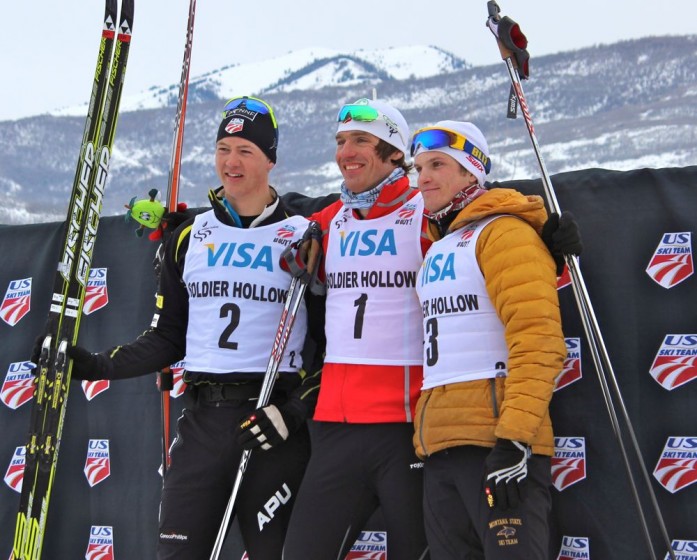
From the FasterSkier archive — posts syndicated from athletes’ and coaches’ own blogs between 2004 and 2012, kept online as published. Current coverage is at fasterskier.com.
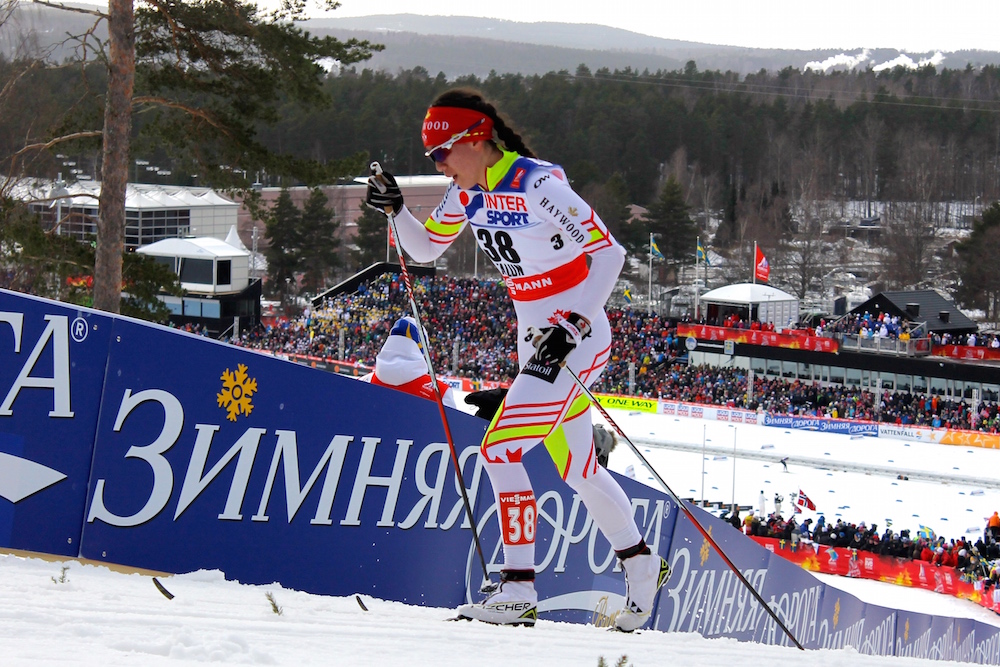
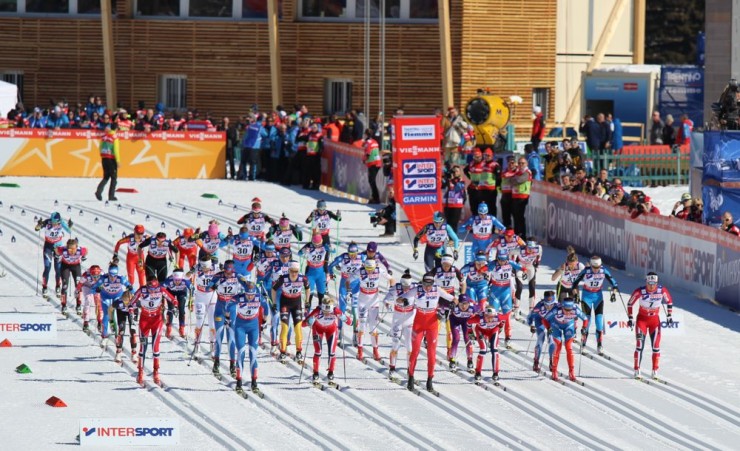
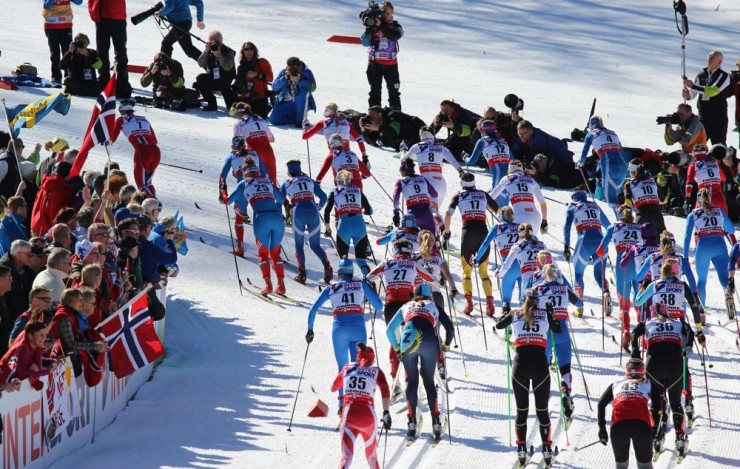
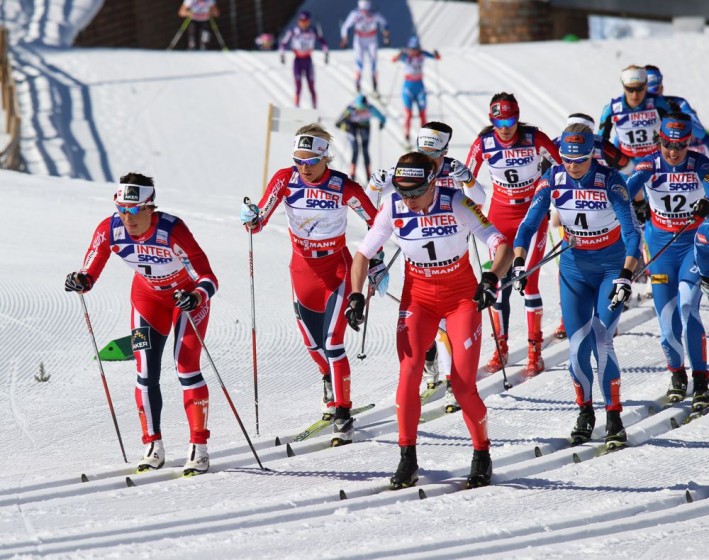
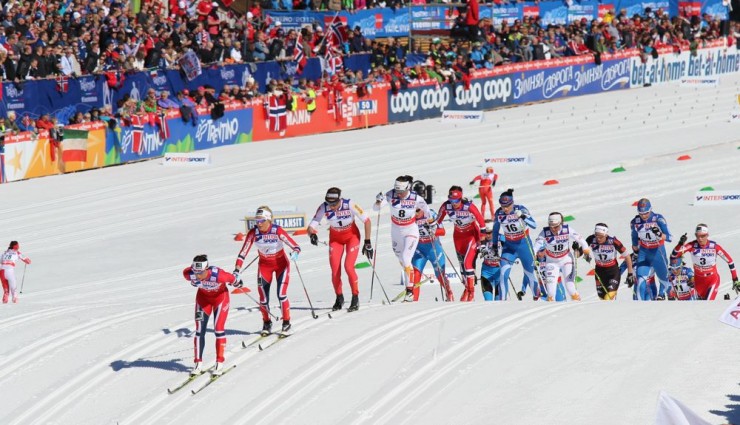
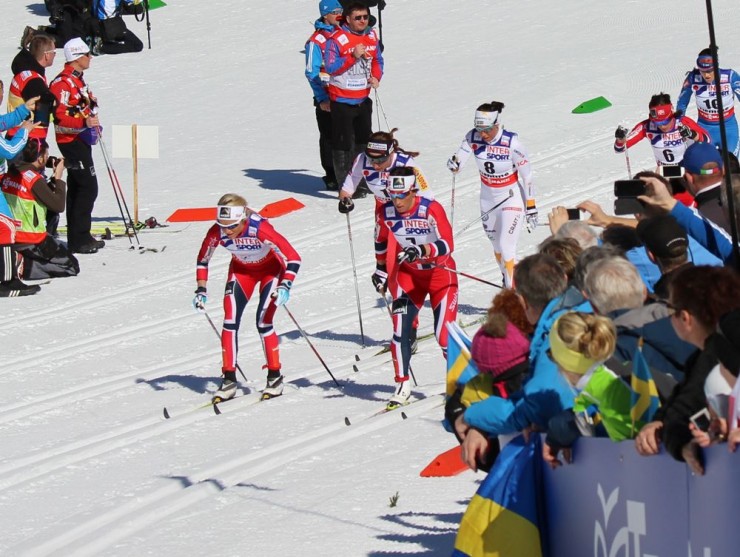
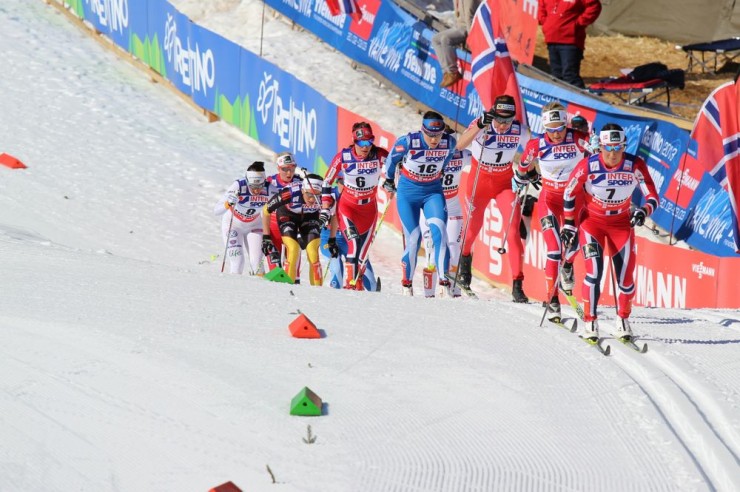
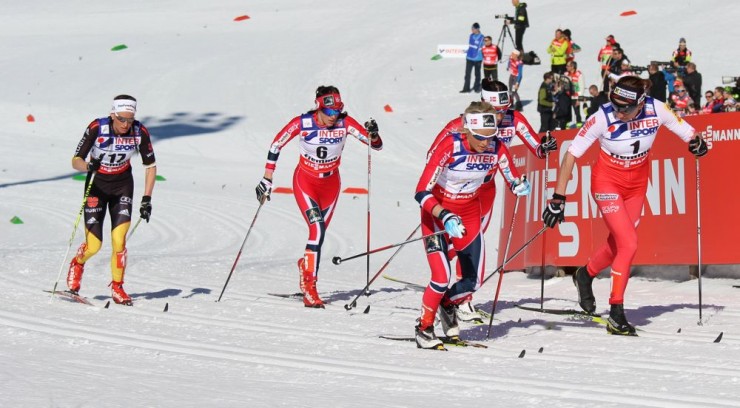
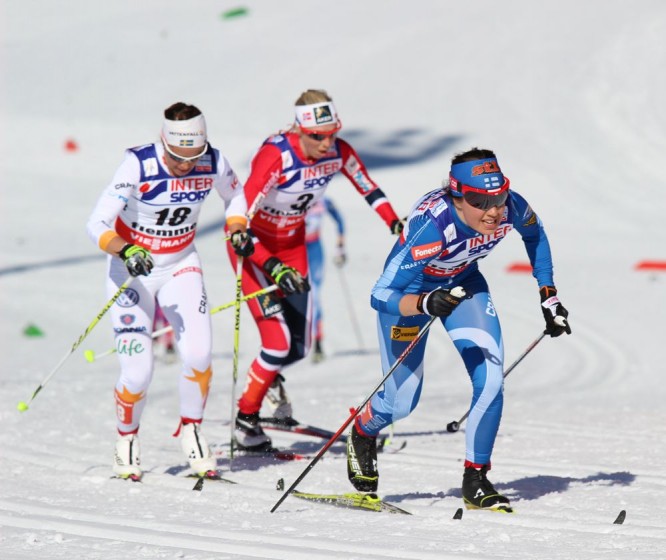
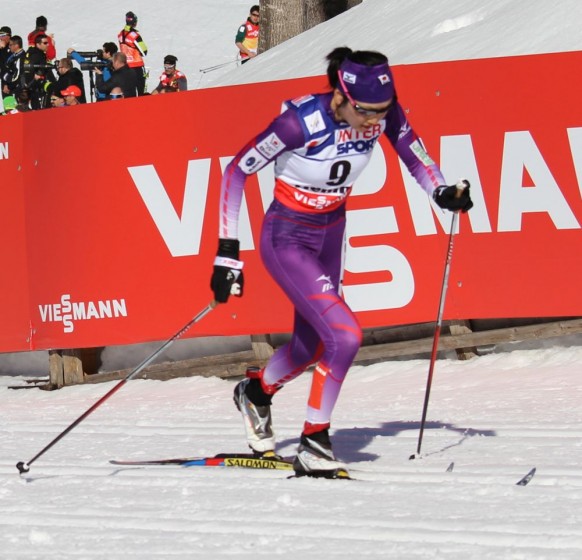
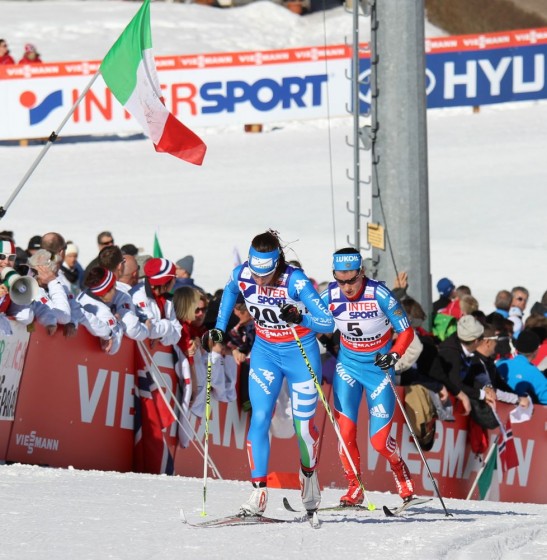
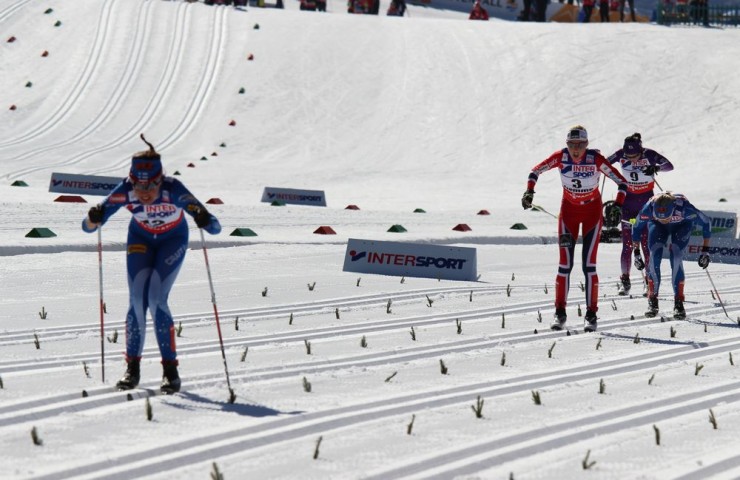
Of the four Russian athletes starting the 15-kilometer classic mass start in Lahti, Finland three placed in the top four. Anna Zherebyateva won in 40:31.4 minutes as she was able to stretch her nine-second gap at 10 k to 23.5 seconds by the finish. Also from Russia, Lidia Durkina placed second (+23.5), Germany’s Katharina Hennig skied to third (+37.5).
“My tactic was to make a gap in the second loop,” Zherebyateva said during the post-race press conference. “So I did exactly what I wanted. It went really well. Tracks were exactly right for me. This gold medal is an important step for my sport career.”
Yana Kirpichenko was the third Russia in the top-five as she placed fourth (+41.6).
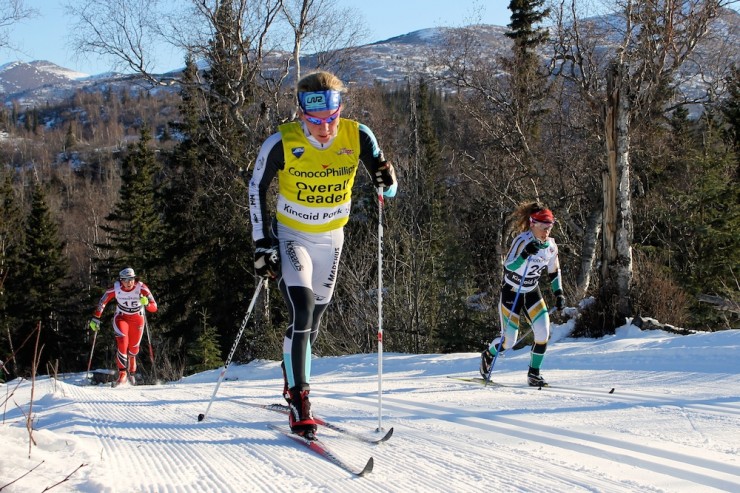
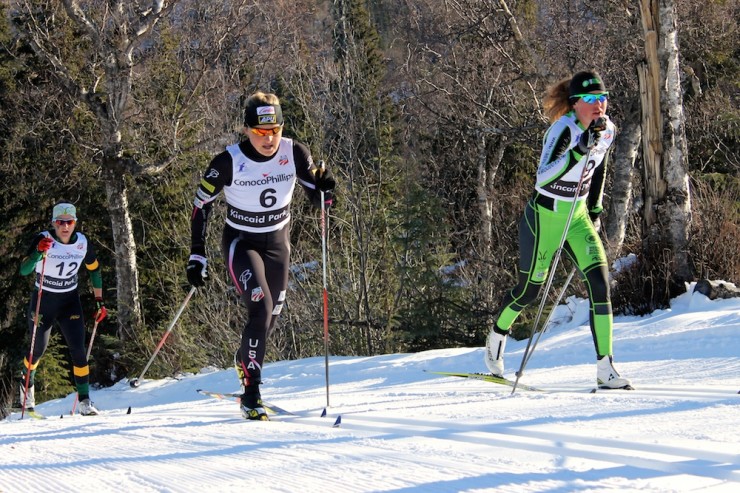
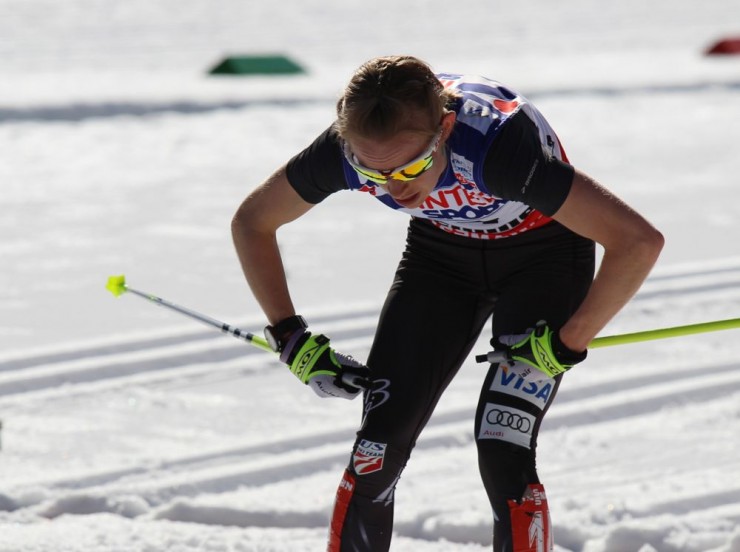
The best North American finisher was U.S. skier Hailey Swirbul who raced to 10th (+1:27.8). Swirbul was positioned 29th at the 5 k time check but steadily moved up in the field as the race progressed. By 10 k she had positioned herself in the top-15.
For the twenty-year-old Swirbul, this is her first go at U23 Worlds after participating in three Junior Worlds as an U20. Last season in Goms, Switzerland she placed second in the 5 k classic and third in the 10 k skiathlon.
Two other U.S. skiers raced into the top-30. Julia Kern placed 16th (+1:43.4), while Alayna Sonnesyn was 23rd (+2:24.9). Hannah Halvorsen, the fourth U.S. starter, placed 54th (+6:58.6).
Hannah Mehain was the top Canadian in 31st (+3:16.8), Sadie White placed 33rd (+3:18.6), and Natalia Hynes 51st (+3:40.9). Marie Corriveau did not start.
Similar to the U23 women’s race, Russian skiers dictated the pacing at the front of the pack — the four Russian starters swept first through fourth place.
Andrey Sobakarev won in 1:17:19.1 hours, Ivan Kirillov placed second (+3.5), Ivan Yakimushkin third (+4.9), and Anton Timashov fourth (+11.4).
Canada’s Antoine Cyr was the top North American in 27th (+2:26.8), while teammate Gareth Williams toed the line a fraction behind in 28th (+2:26.9). Also for Canada, Ritchie Graham was 41st (4:44.1), and Julian Smith 45th (+5:14.3).
Peter Holmes was the top U.S. finisher in 33rd (+3:15.7). Hunter Wonders placed 40th (+4:43.0), Braden Becker 53rd (+6:59.0), and Daniel Streinz 66th (+15:53.9).
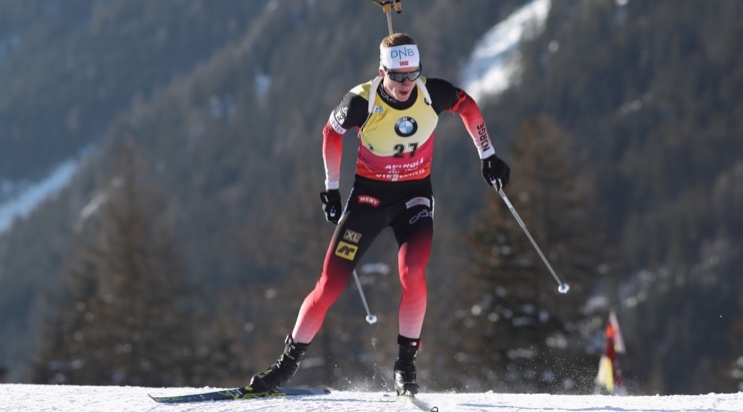
Johannes Thingnes Bø scored his 10th IBU World Cup win of the season today in the 10 k sprint in Antholz, Italy. (Photo: biathlon world.com screenshot)
IBU World Cup Antholz, Italy 10 k sprint
In the groove is in the groove. Norway’s twenty-five-year-old Johannes Thingnes Bø scored his 10th IBU World Cup win of the season today in the 10 k sprint in Antholz, Italy. Bø won the race in 23:53.9 minutes with a single penalty in standing. The Norwegian leads the IBU World Cup overall and padded his lead with his fifth sprint win this year.
“It was quite difficult; the altitude here is quite heavy and with the new tracks, I felt dead from 5K so the last 5K was really tough,” Bø said to the IBU after the race. “I managed to have a good plan for the race. When I shoot nine targets, I was quite happy and then it was just to fight hard for the finish line. I like this year’s track; I liked last year’s too because it was not so painful.”
Bø’s season thus far has been a study in speedy skiing. His shooting stands at 87% for accuracy (82% standing, 91% prone) with his superior skiing speed carrying him to the World Cup overall lead. In Antholz today, his course time for each of his two 5 k laps were ranked first.
Norwegian teammate Erlend Bjøntegaard shot clean in both his shooting bouts to take second place, 17.5 seconds behind. France’s Antonin Guigonnat placed third (+20.2, 0+1).
Scott Gow of Canada was the top North American in 20th (+1:06.6, 0+0). Teammates Jules Burnotte raced to 48th (1:55.9, 1+1), Christian Gow 61st (+2:13.4), and Aidan Millar (+3:46.7, 2+2).
Jake Brown was the top American in 40th (1:42.4, 1+0). Sean Doherty finished in 55th (+2:06.2, 2+1), Max Durtschi 62nd (+2:13.8, 0+1), and Leif Nordgren 73rd (+2:43.1).
Racing continues tomorrow in Antholz for both the men and women with the 12.5k and 10 k pursuits.
Lake Placid SuperTour 5 k/10k Skate Individual Start
In the 5 k-freestyle individual start Jessica Yeaton (APU/Australian National Team) placed first with a winning time of 15:01.9 minutes. She was in a tight race for the top spot with U.S. Ski Team/SMS T2 athlete Sophie Caldwell who finished 3.0 seconds back. Caldwell is back home in Vermont training and preparing for the 2019 World Championships.
Katherine Ogden (Dartmouth Ski Team) placed third in a time of 15:17.8. Kelsey Phinney (SMS T2) placed fourth in 15:37.7.
“Today’s race went super well for me; I had awesome skis despite tricky conditions/weather leading into the race – our wax tech did a phenomenal job,” Yeaton wrote to FasterSkier. “The course here is really good for me with all the steady climbing in the first part- I just tried to push hard to the top of the course and then survive and carry my speed on the downhill, which turned out to be a good tactic.
“Between US Nationals and now I definitely feel like I am in a good place leading into Seefeld. I struggled with some injuries in the fall and was forced to do a lot of cross-training (especially on the bike) and skip the early season races in Nov/Dec. In retrospect I think this actually was a blessing in disguise, as I ended up putting in a super hard training block and gaining a lot of fitness. Looking ahead to Seefeld, my goal is to top 30 in one of the races, with my main focus being on the skate events (30k and sprint), and the 15km skiathlon. I am really excited for the rest of the races this weekend; they are my final prep before heading over to Europe to race on World Cup and in Seefeld.”
Kyle Bratrud (SMS T2) won the men’s 15 k skate in 25:27.1 minutes. Bratrud, who was recently selected to the 2019 U.S. World Championship Team, has been a top-performing distance skier this season on the SuperTour.
“Today went well,” Bratrud emailed. “After Nationals, I made the tough decision of turning down World Cup starts in Otepaa and Ulricehamn in order to get some quality training in for the World Champs. Today reflected that as I felt a little tired and pretty flat from not racing since Nationals. That being said, I expect to keep feeling better each race and I should be in a great place when I fly to Europe on the 4th!”
Bratrud recently won the NorAm/SuperTour 15 k classic in Sovereign Lake and the 15 k classic at U.S. Nationals. Bratrud placed second in West Yellowstone’s SuperTour 15 k skate, and the 30 k skate mass start at U.S. Nationals.
Akeo Maifeld-Carucci (CGRP) placed second in a time of 26:18.9. It was Carucci’s second SuperTour podium of the season and his best career SuperTour result. In West Yellowstone, he was third in the 15 k skate behind Ben Lustgarten (CGRP) and Bratrud.
Alexis Dumas (CNEPH) of Canada was third in 26:32.2. U.S. skier Adam Martin was fourth, 3.1 seconds behind Dumas.
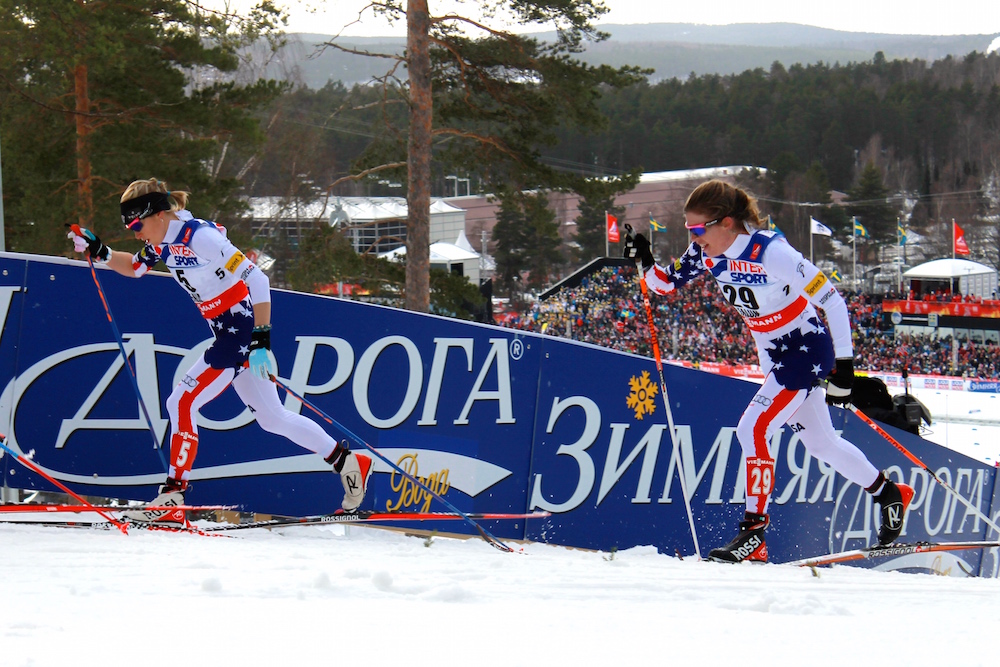
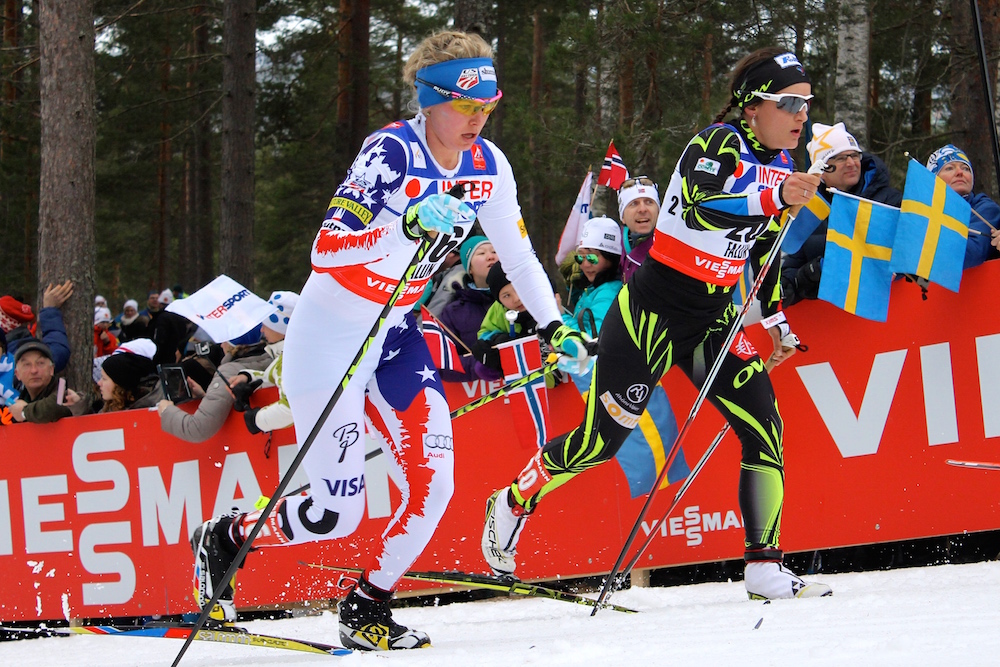
U.S. skiers Liz Stephen (left) and Rosie Brennan racing into the top 16 in the women’s 30 k classic mass start at 2015 World Championships in Falun, Sweden.
FasterSkier’s coverage of the 2015 FIS Nordic World Ski Championships in Falun, Sweden, is brought to you by the generous support of L.L. Bean, now featuring a complete line of Kikkan Randall training wear.
FALUN, Sweden — Everyone knows the U.S. women are strong skaters. It’s been proven again and again by the World Cup sprint globes, World Championships medals, and Tour de Ski final climbs. So when all three U.S. finishers place in the top-20 in the most anticipated 30 k mass start of the year, it was safe to assume no classic skiing was involved.
Wrong.
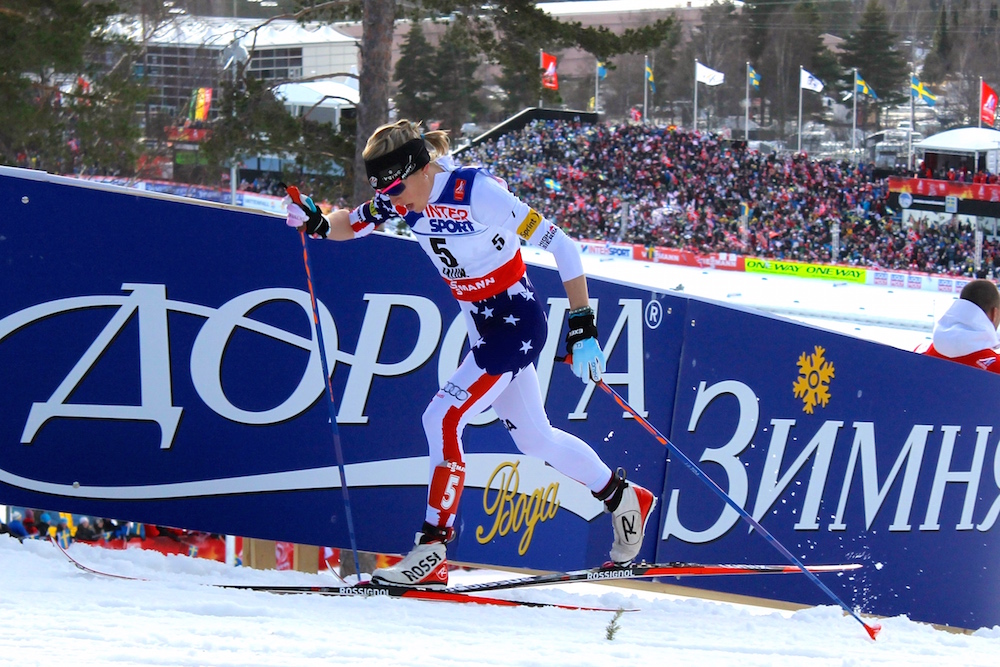
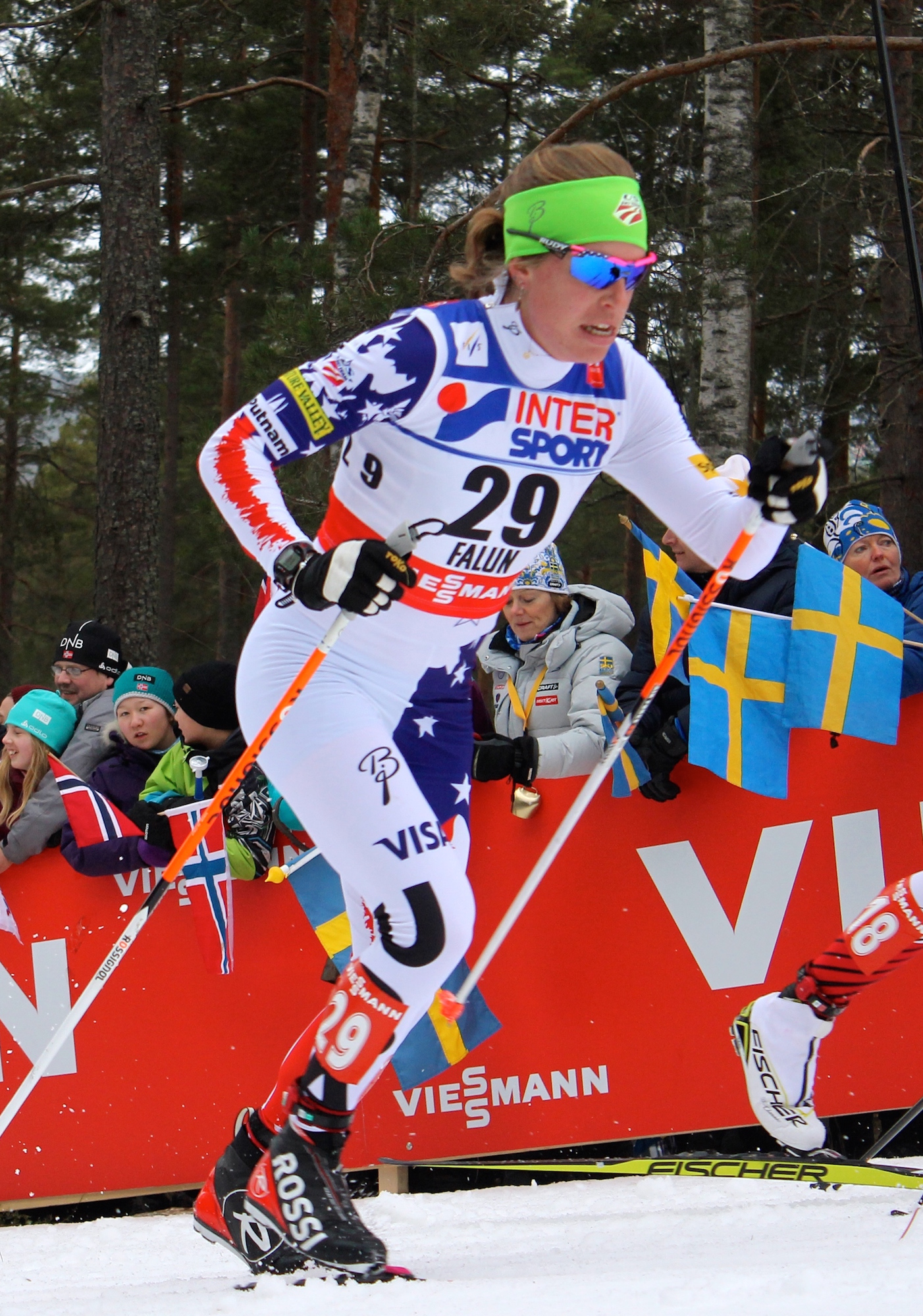
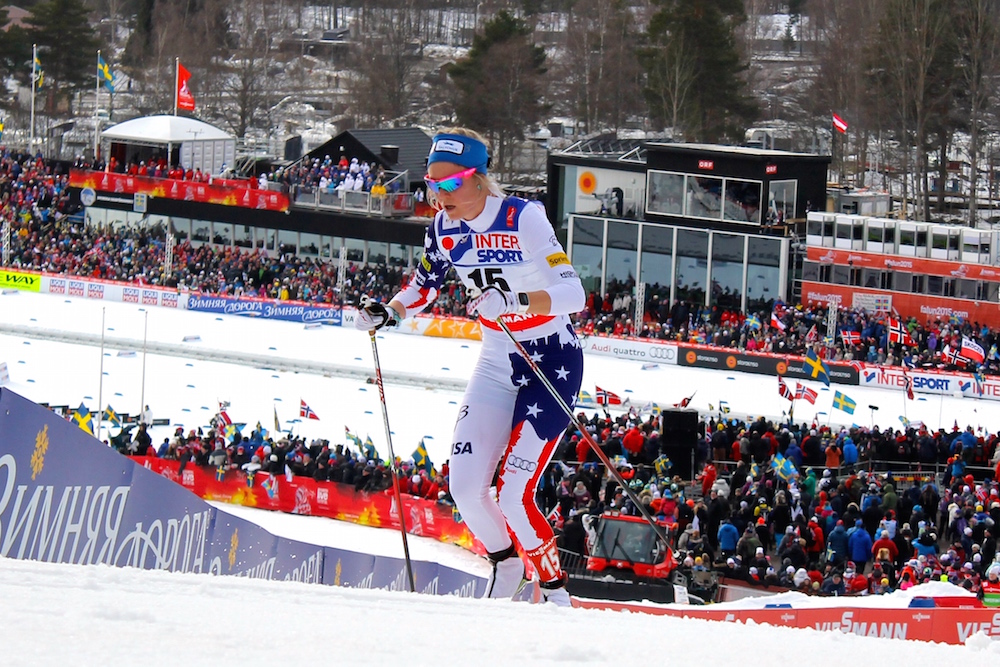
In Saturday’s 3o k classic mass start at the 2015 FIS Nordic World Ski Championships the U.S. proved it could mix things up in classic distance racing, as Liz Stephen, Rosie Brennan, and Sadie Bjornsen skied away to 11th, 16th, and 20th place finishes. They followed dominant performance by Norway’s Therese Johaug, who was victorious with a time of 1:24:47.0.
Things started off with the U.S. in the spotlight. Stephen, starting in row one, had what she characterized as an unusually good start – striding alongside Marit Bjørgen and Heidi Weng of Norway. Stephen later slipped to 24th as teammate Bjornsen rose through the ranks from bib 15 to lead the race.
“There was one point at 5 k where I was leading the race,” Bjornsen laughed. “Like, this is fun, but….”
By the time Johaug made a break for the lead at roughly seven kilometers into the race, the Americans were out of the lead pack. What they lacked in position, however, they made up for in teamwork as they skied with other chasers to stay in the race – Brennan was in 13th while Stephen climbed back into 14th place followed by Bjornsen in 17th.
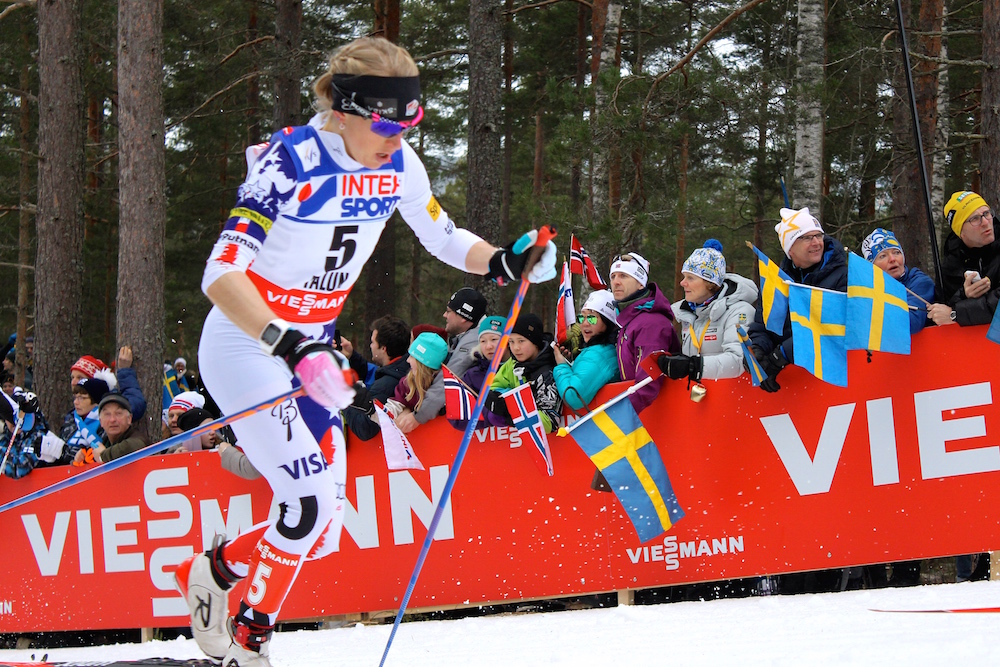
U.S. Ski Team member Liz Stephen on the first lap of the 30 k classic competition at the 2015 FIS Nordic World Ski Championships in Falun, Sweden.
“In general I work my way into races probably more than most,” Stephen said. “I knew that people were going to come back to me, maybe not everybody, but certainly people. I was just fighting with a group that I was with to kind of move us all up. When we changed skis, I was really happy to change skis as they were noticeably faster.”
As the race continued women began to drop from the pack that contained Stephen and Brennan. Stephen charged and after several more times up the Falun courses’ punishing climbs, she skied her way into tenth place.
While the much of the course remained firm, the snow on each climb was turning to slush. Some teams struggled to find kick, as skiers like third place finisher Charlotte Kalla of Sweden and Aino-Kaisa Saarinen of Finland were forced to herringbone up the Mörderbacken climb. The Americans’ skis were good, however, and Stephen thrived in the slow snow.
“I was praying that they weren’t going to salt today because a icy classic course is not what I want,” Stephen explained. “It was getting slushy in places but it held together really well. I’d always rather have slow conditions than fast.”
Stephen’s steady pace caught Teresa Stadlober of Austria and dropped Norway’s Martine Ek Hagen, who had been tight on her ski tails at 25 k. At the same time, Ingvild Flugstad Østberg also of Norway, managed to catch up after a slow start that had left her over 30 seconds behind Stephen.
Liz Stephen on her way up one of the last hills in the 30 k race.
The two came into the finishing straight together but Østberg, who won team sprint gold earlier in the Championships as well as two individual World Cup sprints this season, had more speed at the end.
“I was hoping for a top-10,” Stephen said. “11th is pretty close and to be out-sprinted by Ingvild I think is ok. The strategy was to try and have a good start which I did, and to just ski the best classic I could – relax and keep the technique together because that’s when I go the fastest.”
Despite missing the top-10 the race was one of the top classic races of Stephen’s career. This season she had a breakthrough at the Tour de Ski, finishing fifth in a 10 k classic mass start in Val di Fiemme, Italy. Before that, she had finished sixth in another 10 k classic in Poland.
Stephen placed 16th in the same event at 2013 World Championships in Val di Fiemme, and also 16th in the 30 k freestyle at 2011 World Championships in Oslo, Norway. No American woman has placed in the top 10 of a World Championships 30 k since the event debuted in 1989 (before that, when the men competed in a 50 k, the women skied only 20 k, or before 1982, they simply did not compete in long distances at all).
Rosie Brennan skiing in the lead pack in the first 10 kilometers of the women’s 30 k classic at the 2015 FIS Nordic World Ski Championships in Falun, Sweden. She finished 16th on the day.
Two More Top-20
Halfway through, Brennan and Bjornsen were in a group fighting for 15th place.
“I knew that it was going to go out hard, so I thought, I’m going to fight with everything I have for 10 k, and then hope they slow down a little bit and I find a group to ski with,” Brennan explained. “It worked out pretty well, I got a nice little to work with for most of the race.”
Bjornsen was also hoping to hold onto the leaders as long as she could.
“I haven’t been feeling on fire lately, so I just wanted to fight as long as I could and then see what happens,” Bjornsen said. “That’s the way 30 k’s work. Or at least that’s how I have raced 30 k’s in the last couple of years, is to just hold on as long as possible and some days you can, some days you can’t. Today I definitely struggled right around 10 or 15 k.”
But while Bjornsen was unable to stay with the pack, her Alaska Pacific University teammate Brennan just kept on going.
“I knew I was in a good group that was going to mean a good result, and that maybe if we kept charging we’d catch some stragglers from the front group,” she said. “So I just tried to hang on and keep going.”
In the 5 k she was passed by a few skiers – Østberg and Seraina Boner of Switzerland – and caught by Justyna Kowalczyk of Poland. When Kowalczyk went past Brennan, the American fell behind by roughly 16 seconds at the 27 k mark.
“I was really bummed that I couldn’t catch her in the relay,” she said of the two-time Olympic gold medalist. “So when she passed me I was like, ‘now’s my chance! I can get her back.’ I have really bad downhill skills, but she’s also not exactly known for her downhill skiing. So I was like, this is the perfect person to come into the stadium with. I’ll just go for it!”
And go for it she did.
Determined to make up that ground she lost, Brennan demolished the time difference between her and Kowalczyk. Less than a kilometer from the finish, the two were once again skiing together. As the two climbed to short stadium hill, Brennan pulled ahead of the Polish skier to to take the lead into the final meters. She double-poled furiously to stay ahead, out-sprinting Kowalczyk to the line by one tenth of a second.
“You don’t have to tell Rosie to catch somebody. She’s on it,” U.S. Ski Team women’s coach Matt Whitcomb said after Brennan’s finish. “We started giving splits from Kowalczyk to Rosie with about 2 k to go. We figured that with 16 seconds back it could be done.”
Sadie Bjornsen striding up one of Falun’s tough climbs, 18 k into the 30 k classic mass start at 2015 FIS Nordic World Ski Championships. She finished her day in 20th.
Just over a minute later, Bjornsen crossed the line in 20th place.
“It wasn’t the most spectacular race, but I’m certainly happy to have a sub-par race and be in the 20’s,” Bjornsen said. “I’m happy. It was fun. A great way to end the Championships, to spend an hour and a half skiing in that crowd and going through the pain train, and then recovering, and then more pain train.”
Bjornsen, too had a finishing battle, in her case with Anne Kyllönen of Finland.
“The only thing that was keeping me going at the end is that I was skiing next to one of the Finnish girls who I sprint with, and I was like, okay, I know I can be stronger than her – even if I don’t really know if I’m stronger than her!” Bjornsen laughed. “But at least I know how she skis, and I’m going to decide that I’m actually stronger than her right now.”
It was Bjornsen’s third result in a row in roughly the same position: she finished 20th in the 15 k skiathlon and 19th in the classic sprint. While she’s relieved to have consistent performances on days that she doesn’t feel her best, she also said that it can be hard to have consistently good, but not standout, results.
“I guess consistency is the answer this year,” Bjornsen said. “It’s hard to be patient because last year I had some races that were way high, and some that were way low, and this year it’s more stable. It’s sometimes hard.”
Brennan, who is in an earlier stage of her international career despite being a many-time teammate of Bjornsen’s at World Junior Championships and Under-23 World Championships, feels different: she’s having breakthrough results after coming to Europe as the Continental Cup leader in mid-January.
“If you had asked me at the beginning of the year, no way,” she said when asked whether she had expected to leave World Championships with this caliber of results. “Not a chance. After I came over here and started having a few good results, I was hoping that I could find some sort of peak here and have some good results. So I’m really happy with how it went. I wish I could have raced more races, but it was my first time, so I have to earn my way onto all the starts.”
“The only way I was going to finish the race was if I was having a really good day”
Jessie Diggins was the fourth American starter in Saturday’s 30 k, but entered with a different mentality than her fellow teammates. After talking with her personal coach, USST assistant Jason Cork, the two decided that the only way Diggins would finish the 30 k was if race was going well.
“I came up with a plan with my coach to start and the only way I was going to finish the race was if I was having a really, really good day,” Diggins explained.
Jessie Diggins of the United States skiing with Celia Aymonier of France early on in the 30 k classic race at the 2015 FIS Nordic World Ski Championships in Falun, Sweden. Diggins later dropped out.
The Minnesota native began the race as the sixteenth ranked skier and held her position for much of the first kilometers. At the 3.3. k mark she was skiing 11 seconds behind Bjørgen and Johaug and by the time she reached the top of Mördarbacken she was in contact with the large group of leaders.
The deciding factor of Diggins’ race took place soon after. According to the 23-year-old an unidentified skier changed lanes in front of her, causing Diggins to crash and lose precious time. While she was in 19th at the 5 k mark and only 16.8 seconds from the lead, Diggins crossed the 6.2 k checkpoint in 30th and trailed by 1:01.6.
“After [the crash] I just wasn’t skiing as confident and as well as before,” she said.
Having lost contact with the top skiers Diggins exited the race just after the 10 k mark.
According Diggins, who was the silver medalist in Tuesday’s 10 k freestyle, she was content to stick with the plan. She explained that an entire 30 k effort would have left her fatigued for the following week’s World Cup races in Lahti, Finland and that a 10 k time trial was good preparation for the end of the season.
“Doing a 10 k time trial was perfect and exactly what I needed because it set me up really well for the 10 k in Lahti,” she explained. “There was so many great things that I got out of today without even finishing the race. It was a good experience and at first I was feeling, ‘oh maybe I should have kept on going’ but to be honest it would have been a really bad decision for me to finish that race.”
Diggins explained that a top-15 or top-20 would have been an excellent result for the 23-year-old in Saturday’s 30 k mass start. Historically, Diggins has only cracked the top-15 in one World Cup classic distance race – a 5 k in the 2014 Tour de Ski where she finished 10th. Diggins also dropped out of the 30 k classic mass start in the 2013 World Championships after a hard crash.
Satisfaction and Hunger
After the finish of Saturday’s 30 k, U.S. Ski Team women’s coach Matt Whitcomb was beaming.
“It’s the technique that we were probably criticized most for, the classic distance,” Whitcomb explained. “We put some of those criticisms to rest but at the same time I know we can do better.”
Whitcomb explained that a key factor in landing three skiers in the top-20 was the ski exchange occurring at 15 k. It’s an area where the USST has struggled in the past, most notably at the 2014 Olympic Games in Sochi, Russia. Whitcomb explained that in the laps prior to Saturday’s exchange, the U.S. coaches informed their athletes which racers were changing skis ahead of them. The skiers then decided on their own whether they wanted to exchange pairs or keep skiing through the lap. All three women changed skis to much success.
“Of the four or five opportunities we’ve had at ski exchanges I feel like this is the first one we’ve got right,” he said. “It’s a format that’s always a little tricky and what we did was give the athletes as much information as to what the packs ahead of them are doing and then allowing them to make the decision alone.”
In a day where all three U.S. skiers proved their mettle, Whitcomb said Brennan’s 16th-place was a standout performance. He explained that the Alaska Pacific University skier has excelled on the World Cup circuit since arriving in early January, adding new energy to the team. Brennan, who dominated the SuperTour circuit in the fall and early winter, has been consistently in or near the top-30 of the world’s best. Her top World Cup of her career came in Rybisnk, Russia this January, where she finished 13th in the 10 k freestyle.
“If there is a most improved skier award it goes to Rosie, potentially on the entire World Cup,” Whitcomb said. “I don’t know if any nation has had an athlete show from their continental cup with no prior success and hit it out of the park the way that she has.
“She’s being rewarded for years of hard work. It’s been a tough year for her, and to see all the work pay off and incredible results from start to finish is really neat,” he added.
As Whitcomb and the USST women look ahead to the rest of the season the USST coach said they will use the momentum from Saturday’s 30 k to fight for even better results. “We’ll take a lot of satisfaction from today and apply what what we are still hungry for as we look ahead to Lahti and Oslo this year,” he explained.
Canada’s Emily Nishikawa skiing to 32nd in the women’s 30 k classic at 2015 World Championships.
FasterSkier’s coverage of the 2015 FIS Nordic World Ski Championships in Falun, Sweden, is brought to you by the generous support of L.L. Bean, now featuring a complete line of Kikkan Randall training wear.
FALUN, Sweden — It was another almost-there day for Emily Nishikawa of Canada, who finished 32nd in the 30 k classic at World Championships on Saturday.
After scoring her first World Cup points in Davos, Switzerland, earlier this season, Nishikawa has been hovering around the top 30. The placed 30th in the 10 k freestyle on Tuesday, and almost matched that today. In fact, she was in 31st coming into the stadium, but slipped on one of the last corners. That allowed Laura Orgue of Spain to glide past her, and Nishikawa couldn’t catch back up.
Nevertheless, her takeaway from this year’s World Championships is a positive one, emphasizing improvement over past editions – at last years Olympics she did not break into the top 40 in individual racing, and two years ago in Val di Fiemme, Italy, she was lapped in the 30 k classic.
“This was probably one of my better 30 k’s,” Nishikawa said at the finish. “It was still a hard race and I wouldn’t say that it was one of my best races, but I was just saying to Justin [Wadsworth], each 30 k I do is getting better and better, so in that sense it was positive. There’s still a lot of work to do to get the hang of racing 30’s because they are just so hard. But it’s a million times better than last World Champs.”
Canada’s women’s team came into World Championships with little pressure and few external expectations. Perianne Jones, the most accomplished skier on the team, finished 24th in the classic sprint, and ended up racing more distance competitions than usual – including finishing 32nd in the 10 k freestyle, her best distance result in two years.
The third member of the team, 22-year-old Olivia Bouffard-Nesbitt, finished 52nd in the 10 k freestyle, her only start of the Championships.
Considering that Canada did not even name any women to their World Cup “A” team this year, Nishikawa considers her improvement a major success.
“I’ve improved a ton this year,” she said. “To be top-30 in the 10 k and then 32nd today, it’s a step in the right direction. I want to improve on that and get into the top 20 soon. I think the improvement has been huge since last World Championships, and you have to be happy with that.”
Canada’s roster for next weekend’s World Cup competitions in Lahti, Finland:
men
Alex Harvey
Ivan Babikov
Len Valjas
Michael Somppi
Kevin Sandau
Jesse Cockney
Graeme Killick
women
Dahria Beatty
Cendrine Browne
Olivia Bouffard-Nesbitt
Emily Nishikawa
Andrea Dupont
Heidi Widmer
Canada has traveled to several World Cups this season without bringing any women, but in the coming weeks Nishikawa will head to Lahti, Finland, and then Drammen and Oslo, Norway, and meet up with more Canadian teammates than she has seen in Europe all year.
“Some of the girls who are on the ‘B’ tour right now will be there,” Nishikawa said. “That will be really cool.”
Wadsworth, the Canadian National Team Head Coach, was impressed with Nishikawa’s skiing.
“She has brought a different level of commitment and a different level of umph to the racing over the whole season,” he said. “The whole team is really proud of her. I think there will be really good things to come from her in the next couple of years.”
He hopes that Nishikawa’s recent experience in the World Cup points will be shared with her younger teammates.
“Emily – they definitely look up to Emily, and the younger generation of skiers we have coming up now are going to be good also,” he said. “The more times we can get everybody together, especially over here and racing, the better. It will be great and it will be a good opportunity for us.”
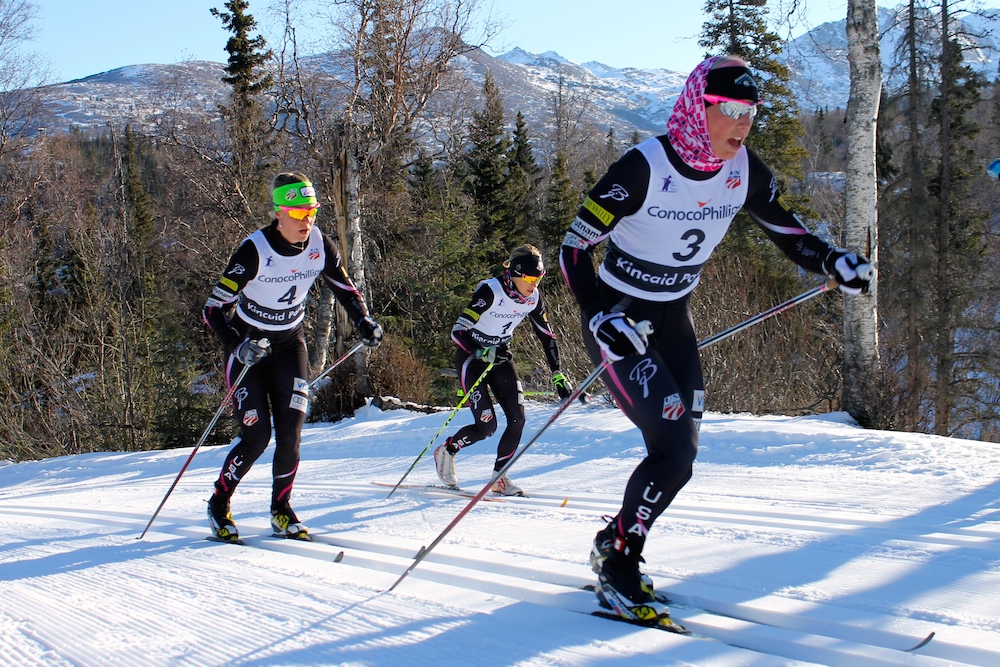
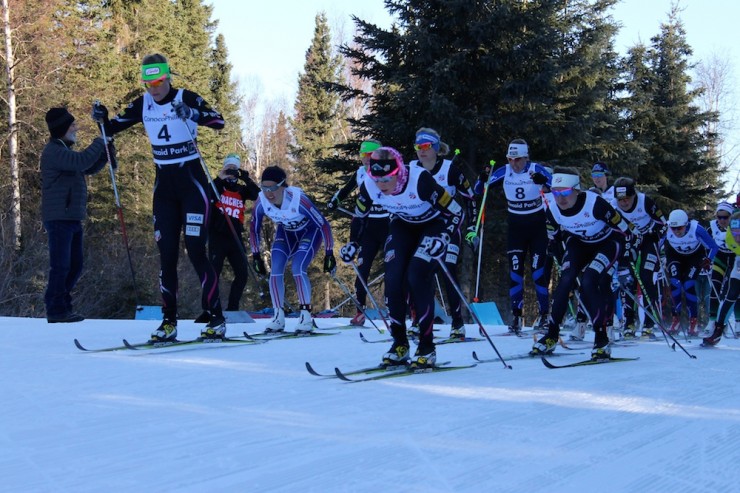
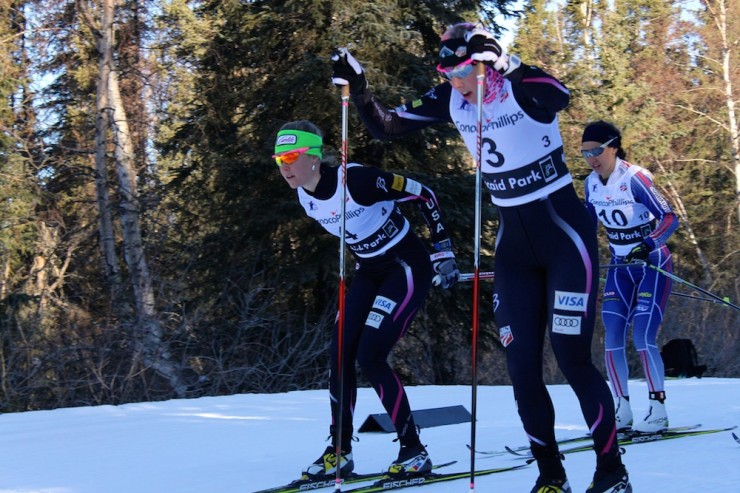
ANCHORAGE, Alaska — Scenes from the front of the pack during the women’s three-lap, 30-kilometer classic mass start at U.S. Distance Nationals last Friday at Hillside trails.
2014 U.S. Distance Nationals 30 k classic mass start at Hillside trails in Anchorage, Alaska
2014 U.S. Distance Nationals 30 k classic mass start at Hillside trails in Anchorage, Alaska
2014 U.S. Distance Nationals 30 k classic mass start at Hillside trails in Anchorage, Alaska
2014 U.S. Distance Nationals 30 k classic mass start at Hillside trails in Anchorage, Alaska
2014 U.S. Distance Nationals 30 k classic mass start at Hillside trails in Anchorage, Alaska
2014 U.S. Distance Nationals 30 k classic mass start at Hillside trails in Anchorage, Alaska
2014 U.S. Distance Nationals 30 k classic mass start at Hillside trails in Anchorage, Alaska
2014 U.S. Distance Nationals 30 k classic mass start at Hillside trails in Anchorage, Alaska
2014 U.S. Distance Nationals 30 k classic mass start at Hillside trails in Anchorage, Alaska
2014 U.S. Distance Nationals 30 k classic mass start at Hillside trails in Anchorage, Alaska
2014 U.S. Distance Nationals 30 k classic mass start at Hillside trails in Anchorage, Alaska
2014 U.S. Distance Nationals 30 k classic mass start at Hillside trails in Anchorage, Alaska
2014 U.S. Distance Nationals 30 k classic mass start at Hillside trails in Anchorage, Alaska
2014 U.S. Distance Nationals 30 k classic mass start at Hillside trails in Anchorage, Alaska
Kikkan Randall (APU/USST) racing to third in the women’s 30 k classic mass start at U.S. Distance Nationals. Randall led early in the three-lap race, taking the $100 bonus as the first to crest the high point of the course around 5.5 k.
2014 U.S. Distance Nationals 30 k classic mass start at Hillside trails in Anchorage, Alaska
2014 U.S. Distance Nationals 30 k classic mass start at Hillside trails in Anchorage, Alaska
2014 U.S. Distance Nationals 30 k classic mass start at Hillside trails in Anchorage, Alaska
2014 U.S. Distance Nationals 30 k classic mass start at Hillside trails in Anchorage, Alaska
2014 U.S. Distance Nationals 30 k classic mass start at Hillside trails in Anchorage, Alaska
2014 U.S. Distance Nationals 30 k classic mass start at Hillside trails in Anchorage, Alaska
2014 U.S. Distance Nationals 30 k classic mass start at Hillside trails in Anchorage, Alaska
2014 U.S. Distance Nationals 30 k classic mass start at Hillside trails in Anchorage, Alaska
2014 U.S. Distance Nationals 30 k classic mass start at Hillside trails in Anchorage, Alaska
2014 U.S. Distance Nationals 30 k classic mass start at Hillside trails in Anchorage, Alaska
IMG_5724
Sadie Bjornsen leads Liz Stephen in 2014 U.S. Distance Nationals 30 k classic mass start at Hillside trails in Anchorage, Alaska
2014 U.S. Distance Nationals 30 k classic mass start at Hillside trails in Anchorage, Alaska
2014 U.S. Distance Nationals 30 k classic mass start at Hillside trails in Anchorage, Alaska
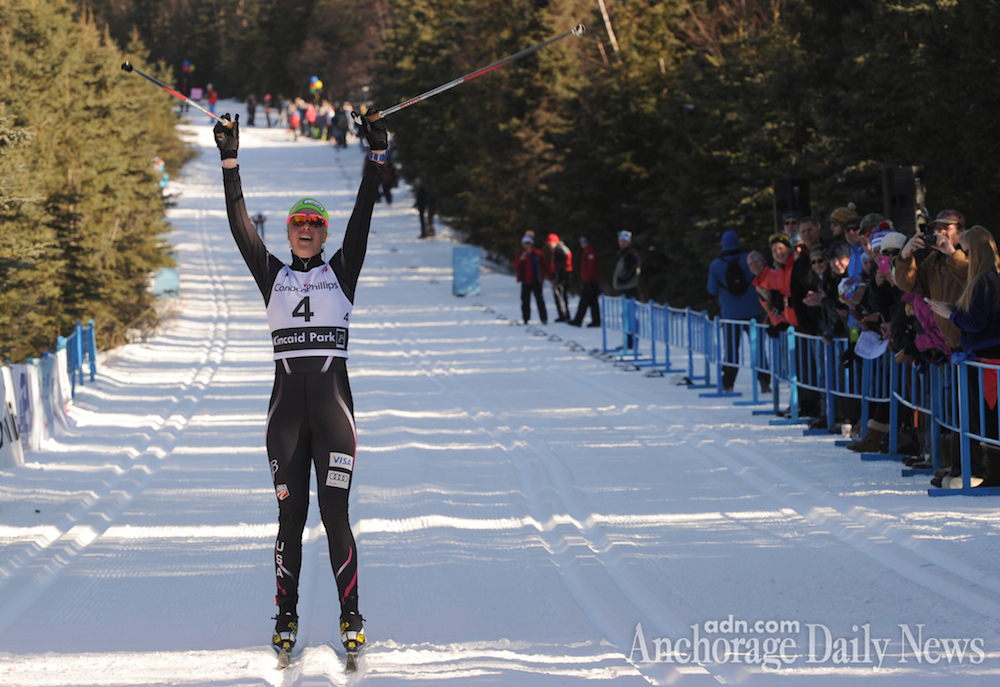
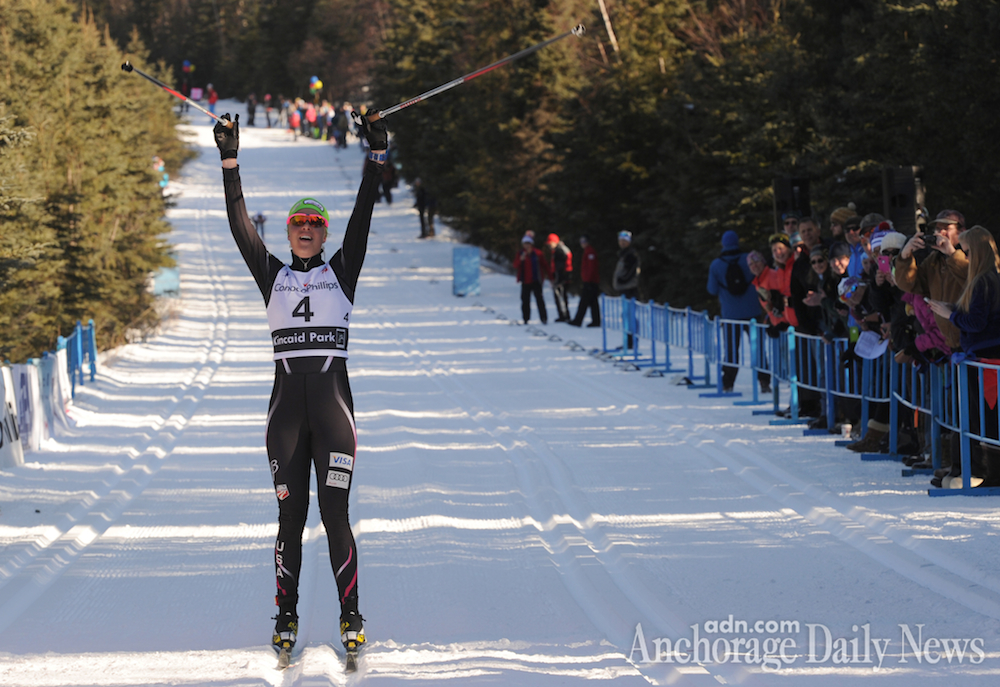
Sadie Bjornsen (APU/USST) celebrates her third national title and first of U.S. Distance Nationals in the women’s 30 k classic mass start on Friday at Hillside trails in Anchorage, Alaska. She dropped USST teammate Liz Stephen in the final kilometers to do so.
2014 U.S. Distance Nationals 30 k classic mass start at Hillside trails in Anchorage, Alaska
2014 U.S. Distance Nationals 30 k classic mass start at Hillside trails in Anchorage, Alaska
2014 U.S. Distance Nationals 30 k classic mass start at Hillside trails in Anchorage, Alaska
2014 U.S. Distance Nationals 30 k classic mass start at Hillside trails in Anchorage, Alaska
2014 U.S. Distance Nationals 30 k classic mass start at Hillside trails in Anchorage, Alaska
2014 U.S. Distance Nationals 30 k classic mass start at Hillside trails in Anchorage, Alaska
2014 U.S. Distance Nationals 30 k classic mass start at Hillside trails in Anchorage, Alaska
Sadie Bjornsen (APU/USST) celebrates her third national title and first of U.S. Distance Nationals in the women’s 30 k classic mass start on Friday at Hillside trails in Anchorage, Alaska. She dropped USST teammate Liz Stephen in the final kilometers to do so. (Photo: Erik Hill/Anchorage Daily News)
Editor’s Note: This is the first of two race reports on Friday’s classic mass starts, the final races of the season at U.S. Distance Nationals. Please bear with us for the men’s report, as this FasterSkier has a flight to catch.
ANCHORAGE, Alaska — Liz Stephen was having a bit of an inward battle on Friday at the last day of U.S. Distance Nationals in the last women’s race of the season.
Like always, the 27-year-old U.S. Ski Team (USST) member, known as a hill climber and distance skier, really wanted to win the 30-kilometer classic mass start. But as the three-lap race around Spencer Loop at Hillside on the southeast side of the city played out, Stephen started to realize she was going to have to beat Sadie Bjornsen to do so.
“I was secretly hoping Sadie was gonna win this race,” Stephen said afterward of Bjornsen, a member of both Alaska Pacific University (APU) and the USST. “I had a feeling a few days ago this was going to be her day.”
Neither had won an individual race at the weeklong Spring Series in Anchorage. Another one of their teammates, Kikkan Randall (APU/USST) had dominated the two earlier events: the 10 k freestyle and classic sprint. On the third day, the first of U.S. Distance Nationals, Randall anchored APU to another victory in the 4 x 5 k mixed relay. While the 30 k classic might not be her strongest event, it was hard to bet against Randall at home on Day 4.
So as the 30 k unfolded, Randall started off by leading to the top of the longest-and-largest hill known as Wall Street (with 87 meters, or 285 feet, of climb) around 5 1/2 k. She grabbed the first of two $100-dollar primes at the summit in doing so, and went on to follow Bjornsen into the 10 k checkpoint 0.8 seconds back in second.
Another USST member Jessie Diggins, also of the Stratton Mountain School (SMS) T2 Team, was third at 10 k, 2.4 seconds behind Bjornsen, and Stephen was almost even with her in fourth.
By lap two, Stephen opted to go big — rather than wonder what could’ve been if she didn’t try — and attacked at the bottom of the multi-tiered climb up Wall Street, the high point of the course around 950 feet above sea level. The move worked, initially, as Stephen took the second money bonus over the top and gapped Bjornsen and Randall slightly by 16 k.
Bjornsen later said Stephen exposed her weakness on the steepest part of the course.
“These hills are really good for me because I can stride out quite well, but the top of Wall Street is too steep for me and so I have to run and that’s not what I’m good at,” she said. “I think Liz figured out pretty quickly that’s where she could make time on us. Every time she went there, she came around us and just started hammering.”
Trailing Stephen by a few seconds at the top, Bjornsen met her own crossroads and decided to push forward in pursuit. She left Randall in doing so and caught Stephen on a series of climbs on the second half of the course.
“I tried to make a break and I had a little bit of space, but Sadie was able to close it,” Stephen recalled. “We both kind of looked at each other, like, yeah, these girls [Randall and Diggins] are coming back so we gotta go. … I’m terrified when I’m on a downhill and Jessie’s on my tail. The whole time we were like we cannot ever let up on these downhills, these two are gonna work together and come back on us.”
For the next 12 or so kilometers, Stephen and Bjornsen stuck together, with Stephen leading through 20 k by 2.4 seconds. Randall came through another 18 seconds back in third, followed by Diggins 11.6 seconds later. The fifth-consecutive USST member, Ida Sargent (Craftsbury Green Racing Project) was another 25.4 seconds back at 20 k.
“We were just pushing so hard out there, making sure nobody was catching us,” Bjornsen said. “You always go into this race, the last race of the season like, ‘Oh, I hope we don’t go as hard as we can the whole time because I’m so tired,’ but when it comes down to it, it’s always more fun to do that anyway.”
By the time the third lap came around on a sunny morning with temperatures rising rapidly from the teens at the start (and no ski changes allowed), Stephen continued to lead Bjornsen up and down the backside of Wall Street into the last set of kicker climbs. There, Bjornsen made her move, dropping Stephen and racing down into the stadium in first, at least 15 seconds ahead of Stephen.
“You always go into this race, the last race of the season like, ‘Oh, I hope we don’t go as hard as we can the whole time because I’m so tired,’ but when it comes down to it, it’s always more fun to do that anyway.” — Sadie Bjornsen, 30 k classic champion
The race turned out to be about 31.5 k, long enough to Bjornsen to extend her gap to 29.1 seconds at the finish. The 24-year-old Washington native, who’s lived in Anchorage for the last several years, won her third national title and first at Spring Series in 1:35:58.1 in front of a hometown crowd. Stephen placed second, and Randall notched another podium in third, 2:08.8 behind Bjornsen.
Last year at Spring Series in Truckee, Calif., Bjornsen podiumed in four individual events (placing second in the 10 k classic and third in the skate prologue, skate sprint and hill climb). At 2013 U.S. nationals in Midway, Utah, she won both the skate sprint and 20 k classic mass start.
This race, at home on the trails APU she trains on (when she’s not racing the World Cup circuit overseas), was essentially made for her, which was ironic, because a lot of people previously wrote her off as a sprinter.
Not APU, and not Stephen.
“This is probably one that I’m going to remember most for the season, this and Holmenkollen, to do well in a 30 k because I feel like it’s the hardest race,” Bjornsen said. “I was told when I was young that I was only a sprinter. Since joining APU I’ve realized I may be more of a distance skier than a sprinter and, you know, I prefer that. I always want to sprint, but distance skiing is so fun for me.”
Stephen said she had fun skiing with Bjornsen, who worked the flats and downhills, and Stephen would help on the climbs.
“I think we were pretty good team out there,” Stephen said.
Kikkan Randall (APU/USST) racing to third in the women’s 30 k classic mass start at U.S. Distance Nationals. Randall led early in the three-lap race, taking the $100 bonus as the first to crest the high point of the course around 5.5 k. (Photo: Erik Hill/Anchorage Daily News)
Diggins made the most of her fast skis and downhill skills to catch Randall on the third lap and finish 7.8 seconds behind Randall in fourth.
“I felt like I needed to go out in the beginning of the race and set a good hard pace and see if I could hold it,” Randall said. “It went pretty well for the first half of the race, and then going up the major climbs on that second lap, these guys picked up the pace and I started to hit the wall a little bit. Things started to cramp a lot on that last lap.”
Before that point, she remembered watching Stephen and Bjornsen pull away on final climbs on the second lap — first by five seconds, then 10 seconds.
“I was really trying to stay on the horse and try to get back in that group but they started to pull out of sight,” she said. “Jessie caught me on the downhill, but then it was great because her and I could work together. She was a little faster on the flats and downhills and when we started climbing again, I felt like I need to ski my own pace. I was able to pull back a little bit, then it was like, it’s the end of the season, it’s the end of the race, just kind of ski as hard as you can up the hills.”
After falling once when someone rode over her ski from behind, then getting tangled behind a crash involving Becca Rorabaugh (APU) within the first 3 k, Sargent skied alone for most of the race — at least 26 k, she estimated.
“I finally pulled my way up to the front on the Spencer Loop the first time and they really went for it going over the top,” Sargent recalled. “I wasn’t feeling great at that point so a little gap opened up over the top … and once a gap opens up, it’s just really hard to make it back.”
Sixteen seconds ahead of Rorabaugh in fifth at 10 k, Sargent maintained her gap on those behind her with a 14-second cushion to Caitlin Gregg (Team Gregg/Madshus) at 20 k.
“I tried to split it up into little bits, like, OK I’m gonna get up that hill,” Sargent said. “Once I settled into a pace, it felt really good. I think it would’ve been more fun to ski with people, but it was a good, different challenge. Thirty k has always been a tough distance for me — it’s pretty long — so I’m happy to have been able to hold it in there.”
She held onto fifth, finishing 41.5 seconds after Diggins. The USST swept the top six, with Sophie Caldwell (SMST2) edging Gregg by 1.5 seconds for sixth. Stratton put four in the top nine with Annie Pokorny notching eighth and Erika Flowers taking ninth, 16.4 seconds ahead of Caitlin Patterson (CGRP) in 10th.
“We were just talking about how all of us have different strengths and how this summer we want to pinpoint where each of us can help the others get better at everything so we can all move up as a team,” Stephen said. “It’s fun because we all have something that’s really strong that somebody else doesn’t have.”
“I certainly felt like today the caliber is the highest it’s ever been for one of these races,” Randall said. “I know these guys can ski really well on the Word Cup so it’s like, you know you’ve got to bring you’re A-game on a day like this.”
“It’s really fun to come out and race on these hills we always train on and end things on a good way at home,” she added.
Norway’s Marit Bjørgen celebrates after winning the 30 k classic in Holmenkollen on Sunday. (Photo: Fischer/Nordic Focus)
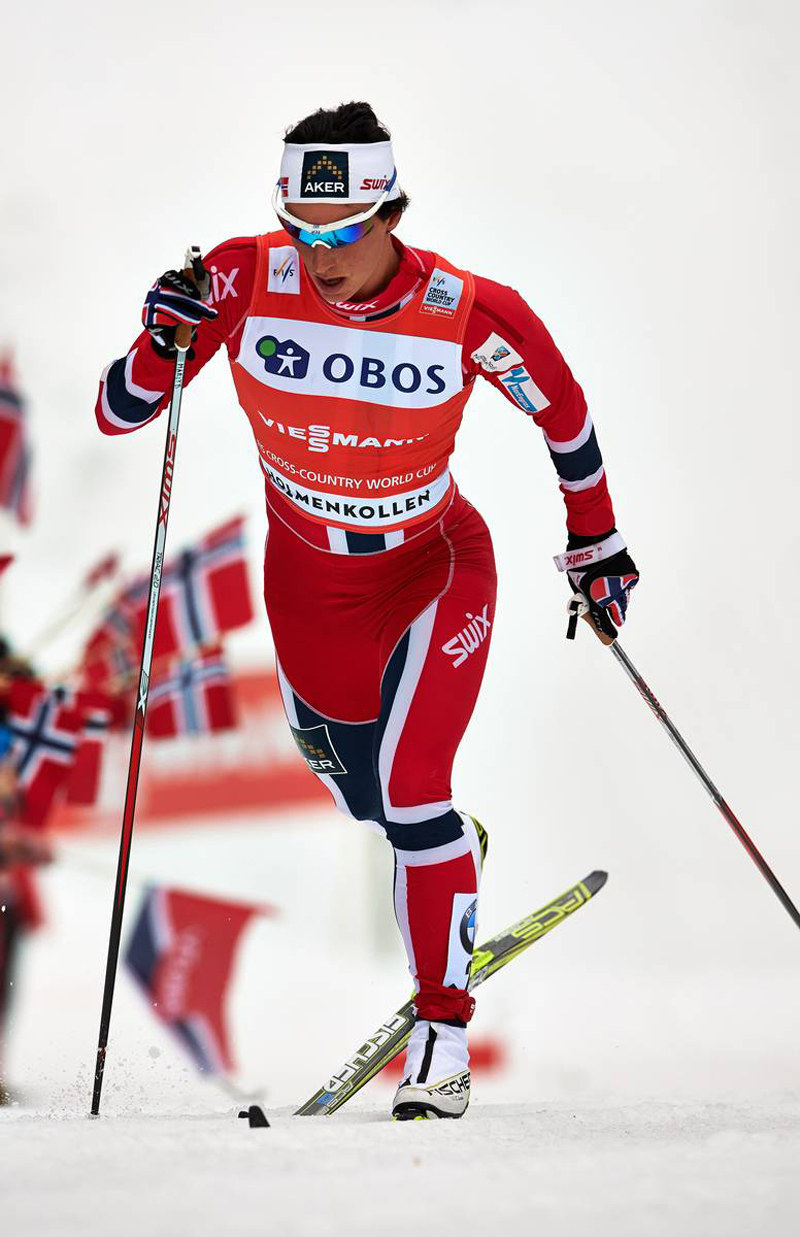
Norway’s Marit Bjørgen crushed the field in the women’s World Cup 30-kilometer classic on Sunday in Holmenkollen, Norway, beating teammate Therese Johaug by nearly two minutes. Bjørgen is the first woman to win four Holmenkollen 30 k’s and Sunday also marks her 100th World Cup podium.
Bjørgen finished in 1:20:55.7 hours, and Johaug placed second, 1:41.2 behind. Finland’s Kerttu Niskanen took third (+2:25.8). Sweden’s Charlotte Kalla of Sweden finished fourth (+2:46.6), Finland’s Aino-Kaisa Saarinen was fifth (+3:08.9), and Sweden’s Emma Wiken, placed sixth (+3:17.8), completing a Scandanavian sweep of the top six. Kalla held third place early in the race before being passed by Niskanen. Wiken briefly held fifth place ahead of Saarinen around the 22 k marker, but by 27.5 k Saarinen had taken it back and held on until the finish.
“I felt much better than last week,” the 25-year old Johaug told FIS of her race. “I am happy to be second today. Marit was much stronger than me, I did not have chance.”
Marit Bjørgen on her way to winning the 30 k classic in Holmenkollen today. (Photo: Fischer/Nordic Focus)
Kikkan Randall was the top American in 12th (+4:17.4), followed shortly after by Sadie Bjornsen in 14th (+4:27.8). Rounding out Americans were Liz Stephen in 32nd, Sophie Caldwell in 35th, Caitlin Gregg in 39th and Ida Sargent in 42nd. No Canadian women started.
Johaug, the current World Cup points leader, had the #1 bib. However, by 2.7 k Bjørgen had pulled into the lead, then gave the lead back to Johaug for a few kilometers before returning to the front. Both Bjørgen, Johaug and the Swedish Kalla opted to change skis after the second lap, while the Finns used the same skis for the entire race. Bjørgen’s skis consistently worked well for her, but Johaug struggled fell behind after the 10 k mark before switching at 13.3 k.
“I was struggling with grip skiing up to Frognerseteren,” Johaug told FIS. “I tried to focus on myself when Marit went away. I was little bit worried that Kerttu and Charlotte are coming from behind to catch me.”
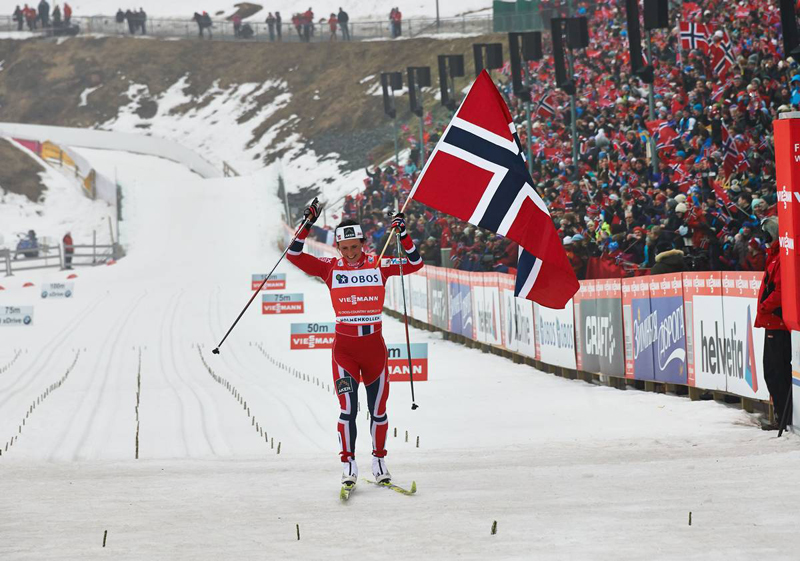
Bjørgen held a steadily growing lead all the way to the finish. Her lead was such that at the last feed station she was handed a very large Norwegian flag which she waved all the way into the stadium. A tired-looking Johaug finished shortly after, and she and her victorious teammate embraced.
“It’s good news for us older skiers that it just keeps getting better with age,” the 31-year old Randall said of the 33-year old Bjørgen.
This brings Bjørgen to a 39-point deficit to Johaug in the World Cup overall standings. With 300 points to be doled out in next week’s World Cup Finals in Sweden, the final outcome is anyone’s guess.
Jacobsen takes a nasty spill
A bad crash by Norwegian Astrid Uhrenholdt Jacobsen around the 7.2 k mark dampened the mood in Norway, with Jacobsen suffing a concussion and substantial bruising after veering off the trail on a downhill and colliding into with a padded post. Her injuries were sufficient to require hospitalization. She apparently slipped while going fast into a corner and slid underneath the course fencing, where she hit the post. This is one more blow in what has been a tough season for Jacobsen, including the sudden death of her brother just before the start of the Sochi Olympics.
Randall told NRK that she was skiing near Jacobsen at the time of her crash. She said that they both charged into a corner that most of the competition was snowplowing into, but that “it all went wrong for her.”
FasterSkier’s coverage of the 2013 FIS Nordic World Ski Championships in Val di Fiemme, Italy, is brought to you by the generous support of Fischer Sports.
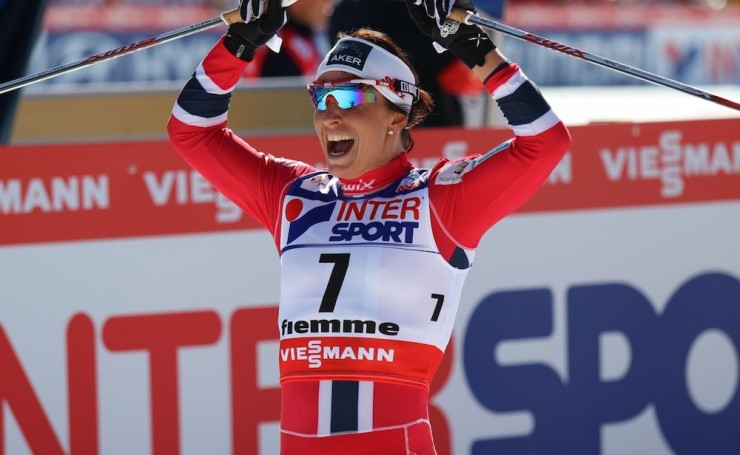
VAL DI FIEMME, Italy — Marit Bjørgen earned her twelfth World Championships gold medal on Saturday with her victory in the 30 k classic. Even with so many titles to her name, it was still an emotional win for the 32-year-old Norwegian star. Our photos from the race.
The last race for the women at World Championships: a mass-start 30 k classic.
IMG_1127
Marit Bjørgen (NOR) and Justyna Kowalczyk (POL) lead on the first lap.
Bjørgen, Therese Johaug (NOR) and Kowalczyk took turns leading for most of the race.
IMG_1196
IMG_1201
Up the hill on the second lap.
Bjørgen doing the work.
IMG_1245
IMG_1250
Kowalczyk moves up.
The first ski change at the 10 k mark.
Masako Ishida (JPN), the only one not to change skis, takes a pull in the lead.
IMG_1301
Kowalczyk looks to the TV screens to see who’s behind her as the leaders come into the stadium for lap 3.
Nicole Fessel (GER) rides up on Heidi Weng’s (NOR) skis.
Kowalczyk looks for a break from leading.
The lead group of five skis past a row of coaches.
Kerttu Niskanen (FIN) struggles with kick.
Ishida paying for her early move.
Italy’s Virginia De Martin Topranin leads Yulia Tchekaleva (RUS).
Bjørgen glances at the big screen.
Out for the sixth and final lap, Bjørgen at the front.
IMG_1467
Bjørgen’s coach gives her last-minute advice before she leaves for the final 5 k.
Kowalczyk loses the game of chicken and takes the disadvantageous spot in the lead, where she’ll stay for most of the final lap.
In the final meters, Bjørgen slingshots around Kowalcyzk and outsprints her by over three seconds.
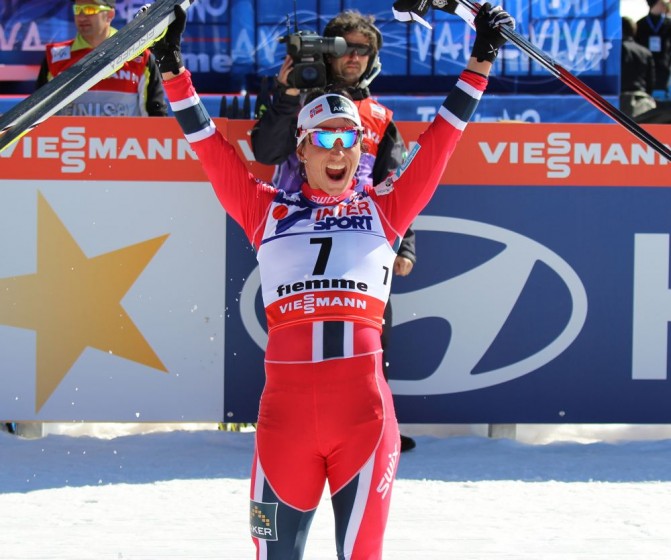
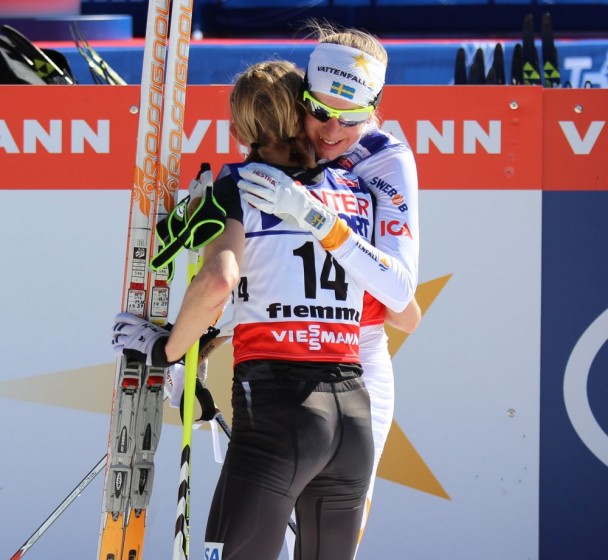
An elated Bjørgen.
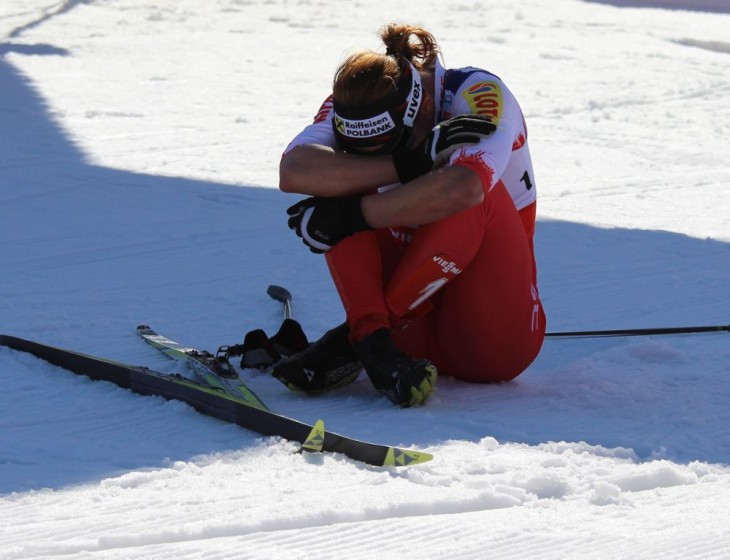
Kowalczyk taking a moment after Bjørgen shuts her out of gold for the fifth time this week.
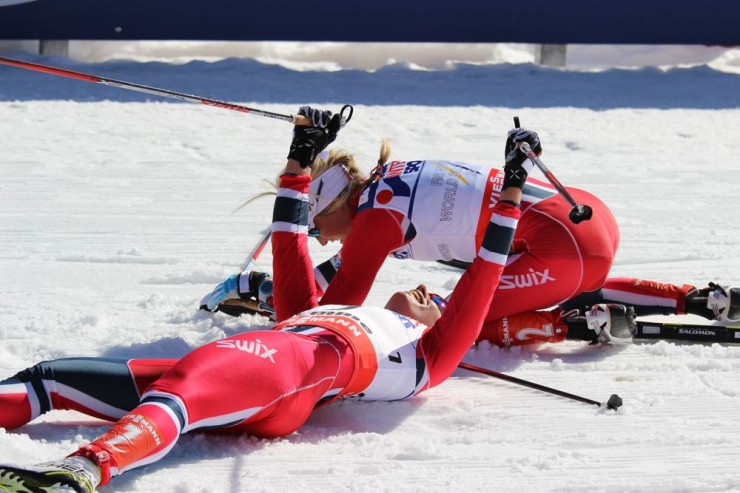
Johaug, the bronze-medalist, joins her teammate celebrating on the ground.
Bjørgen
Johaug
Kowalczyk gets up to congratulate the Norwegians.
Weng takes fourth, 1:38 behind Bjørgen.
Nicole Fessel (GER) is fifth for a career-best at world champs.
Anna Haag sprints for sixth.
Niskanen is seventh in front of Kristin Stoermer Steira (NOR) and Ishida.
Weng greets Haag.
Charlott Kalla takes 11th.
Valentina Shevchenko (UKR) is 12th.
Liz Stephen (USA), 16th.
Stephen and Sofia Bleckur (SWE)
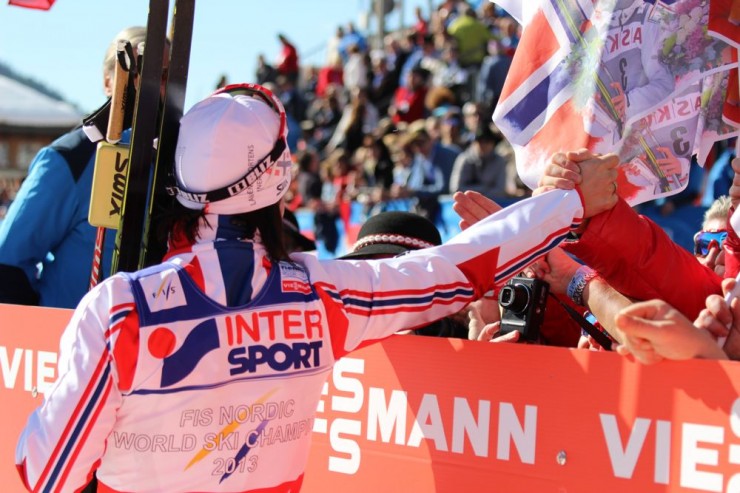
Bjørgen shakes hands with her adoring fans before giving her FIS interview.
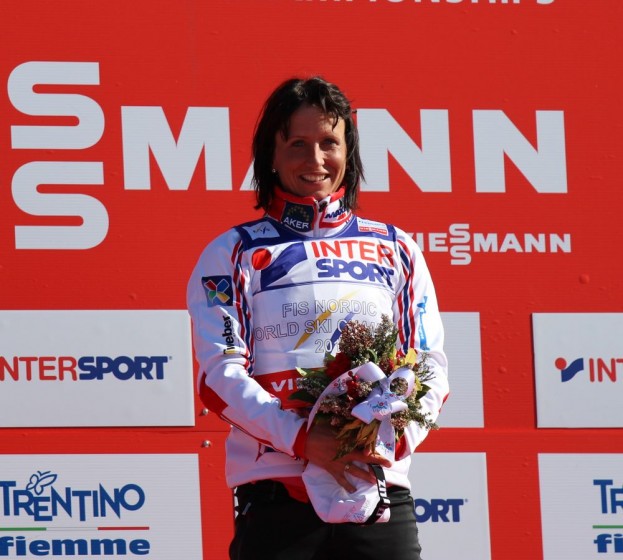
Bjørgen on the podium.
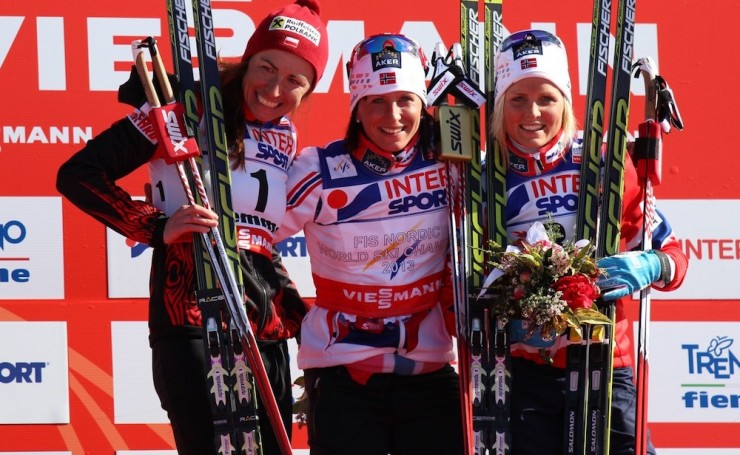
Podium after the women’s 30 k classic: Bjørgen smiles after besting Justyna Kowalczyk and Therese Johaug.
Liz Stephen (USA) leading Olga Kuziukova (RUS) on the second lap of the women’s 30 k classic at World Championships on Saturday.
FasterSkier’s coverage of the 2013 FIS Nordic World Ski Championships in Val di Fiemme, Italy, is brought to you by the generous support of Fischer Sports.
VAL DI FIEMME, Italy — The World Championship 30 k wasn’t the perfect race for the American women, but all things considered Liz Stephen and Ida Sargent were satisfied with the effort it took to ski a challenging race that was dictated by slow, saturated snow, 50oF heat and tricky waxing conditions. Stephen was 16th, tying her performance in the 30 k two years ago in Oslo, and Sargent finished 25th in her debut in distance at a championship event.
Jessie Diggins, after crashing on the first lap, dropped out before the 10 k mark and did not finish.
“Solid,” was the word U.S. Ski Team women’s coach Matt Whitcomb used to describe the day for the team.
“Definitely neither felt like they had a stellar race, to say the least,” he said. “It’s a tricky day with the conditions and the ski changes, and I think we did OK. I didn’t look like anyone hit it out of the park there except maybe some of the top skiers, but they always look like they have good skis. So I think we were in there and it’s just a long, hard 30 k and slow, slow conditions. It’s probably the hardest 30 k course that we’ve seen.”
The crash that eventually made Diggins drop out was also where the race broke apart on the first lap outside the view of TV cameras, and athletes who were in it or behind it watched the leaders move away earlier than they would have liked, Stephen included.
Jessie Diggins (USA) beginning her second lap after crashing hard in the first 5 k. She later dropped out.
“There was a really big crash on the elevator shaft the first lap; there were at least 15 people down,” Stephen said. “A lot of us lost the lead pack and it was hard to catch back up to them.”
Diggins continued for a few kilometers after her fall, but later pulled over when she decided the pain developing in her side might be cause for concern.
“I went down hard on my right side and then couldn’t stop sliding and slammed right into another girl, scraping my ribs over her skis,” Diggins said. “I got checked out by the team doctor afterwards and I’m injury-free, thank goodness, but during the race my ribs hurt a lot and I started to panic and worry about it, and since I was skiing by myself near the back already I decided dropping out would be smarter in the long run.”
Further ahead in the field, Stephen and Sargent began to ski alone. There were still other people around them towards the end of the first 5 k, but after the first ski change the top fifteen pulled away and the Americans were mostly by themselves for the middle section of the race. Mentally, the scenario presented both women with the challenge of staying in race mode despite the out-of-sight leaders and soft snow slowing them down.
“My brain kind of decided I wasn’t racing anymore for like 10 k,” Stephen said. She also had trouble taking feeds, and was only able to take in water throughout the race.
Sargent experienced problems with overheating in the hot, sunny conditions. The Americans raced in T-shirts, but as the race wore on under a hot sun Sargent developed a somewhat debilitating headache.
Ida Sargent (USA) skiing with Eva Vrabcova-Nyvltova (CZE).
“It was kind of a suffer-fest to get to the finish; it felt a little bit like a death march out there,” Sargent said. “I kept getting these headaches because it was so hot, and then I’d dump water on my head and that would help for a little while and then it’d get really hot again.”
Though neither Sargent nor Stephen had ideal positioning in the first 15-20 k of the race, Whitcomb was impressed that both women skied well enough to bring themselves back a little by the end. On the last lap other skiers started coming back to the Americans, and they were able to compete with them and finish well.
“It looked like Ida and Liz could resurrect themselves a little bit at the end of the race and finish strong,” Whitcomb said. “It’s a battle of attrition out there, for sure, and you have to hang with it and people will start coming back to you if you keep the pedal down.”
Stephen caught Aino-Kaisa Saarinen (FIN) on her last lap, and at the finish came out 13 seconds ahead of her. He final time, 1:32:12.0, was 4:52.1 off Marit Bjørgen’s winning mark.
“There were a few people to ski with and that really helps change your outlook on things,” Stephen said. “I didn’t want to just hang out with people and ski with them, so I was trying to kind of make the group work and we finally caught [Saarinen] and that’s a major boost out there. Julia Ivanova and I were skiing together for most of the race and she was better on certain parts and I was better on certain parts, and it keeps your brain in it.”
Sargent came in 25th, five seconds behind Italy’s Debora Agreiter and nearly half a minute ahead of the next finisher, Eva Vrabcova-Nyvltova (CZE). She felt good about a top-30, though there were only 39 finishers, but wished her heat-induced headaches wouldn’t have prevented her from pushing her pace.
“It was good to be in the top-30, I guess, I don’t know,” Sargent said. “It would have been nice to ski with more people out there. I felt good the whole time, but with the heat I couldn’t push harder than a certain level, so I was kind of just going at one pace and suffering.
“I’m looking forward to shorter races the next few weeks,” she concluded with a relieved laugh. “You won’t see me in Holmenkollen.”
Stephen noted that the 30 k had the added challenge of being first marathon distance anyone on the World Cup does all season, and suggested that one practice race on the circuit before a championship would probably be helpful to athletes.
“The longest race we do until today is 15 k and this is literally double it,” she said. “I think we should have one more 30 k on the World Cup before Oslo and before championships like this, because it is a very different race and it would be good, I think, for us longer-distance skiers to have a practice round before world champs. But the TV seems to like the shorter ones, so I understand.”
The U.S. only started three women in the 30 k. Kikkan Randall came to Val di Fiemme planning to race the event, but after learning her distance form is currently not where she would like it to be she decided to give herself the day to rest and get ready for the end of the World Cup season, which begins again in Lahti, Finland, on March 9.
“I feel like racing today would have been a big battle, physically and probably mentally,” she said. “I basically now have two or three extra days to recover from the races I did, and hopefully…give my system a chance to rebuild for these last couple weeks of the season. It’s good, high-level, important racing… Especially with next weekend being important for the sprint cup and good distance racing to come around I felt like it was the better decision.”
The 30 k was the final event for the women at World Championships. Though the Americans didn’t end on the highest note they’ve hit all week, Stephen was upbeat after the finish.
“I’m happy with the race and really happy with the championships,” she said.
FasterSkier’s coverage of the 2013 US Cross Country Championships is brought to you through the generous support of The Memory Clinic in Bennington, Vt.
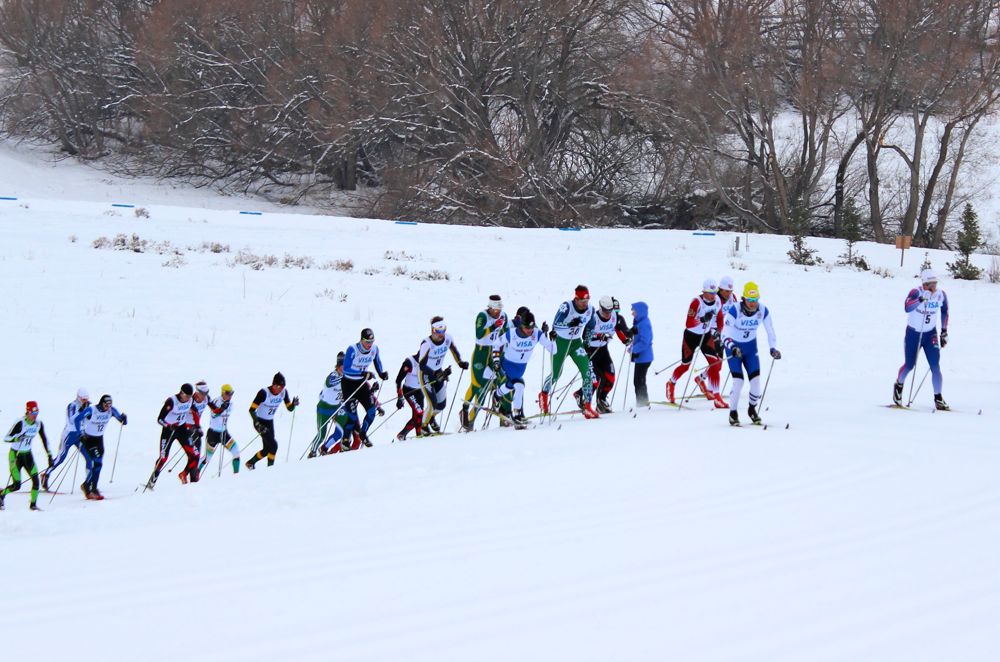
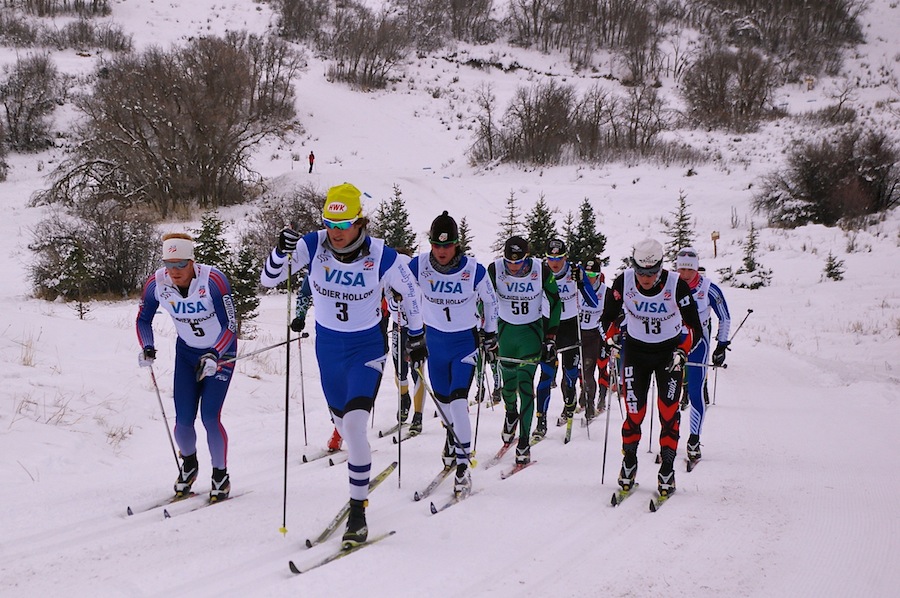
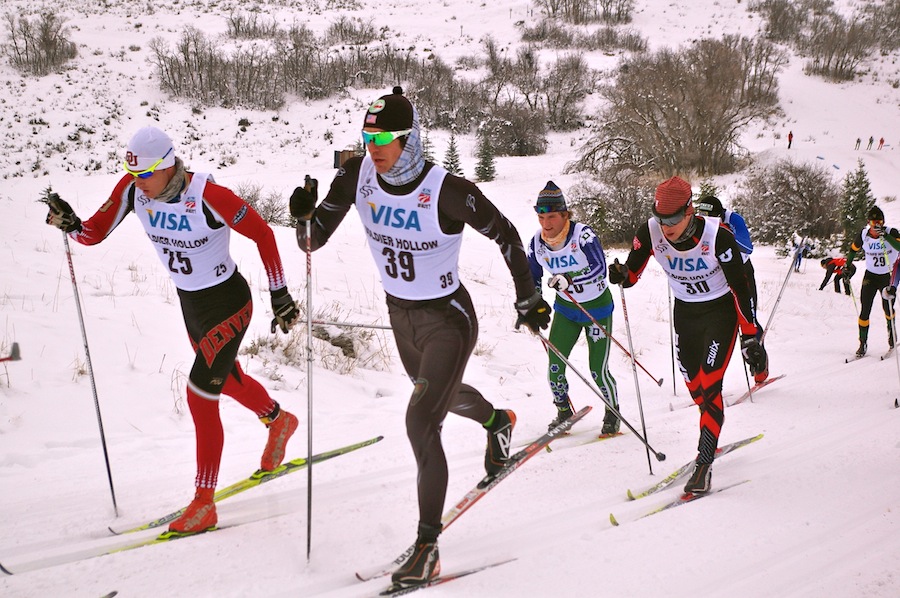
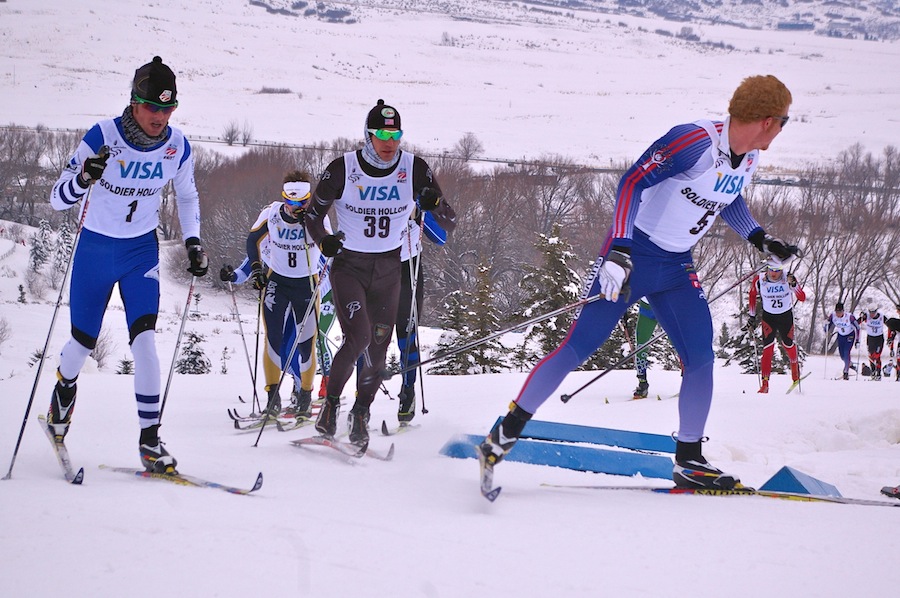
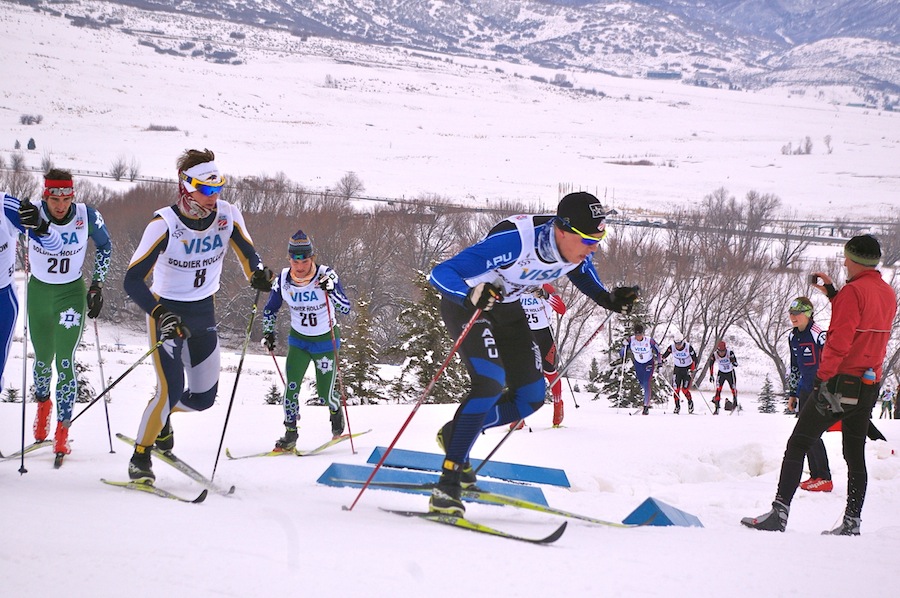
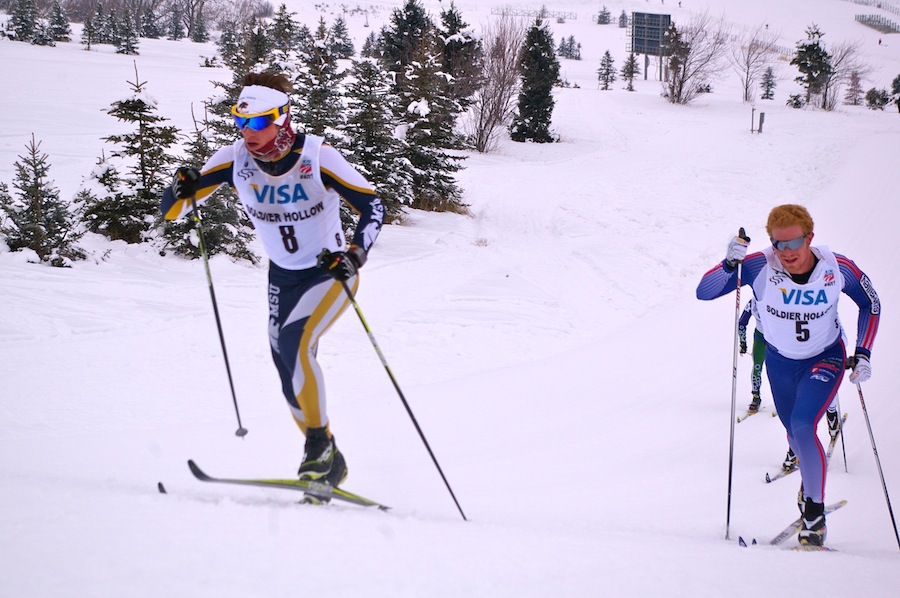
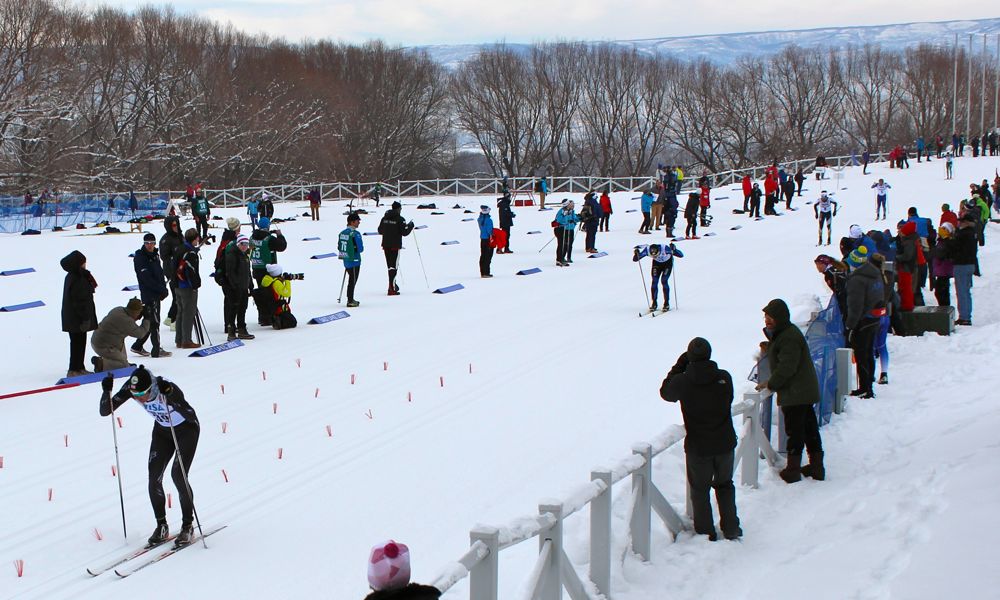
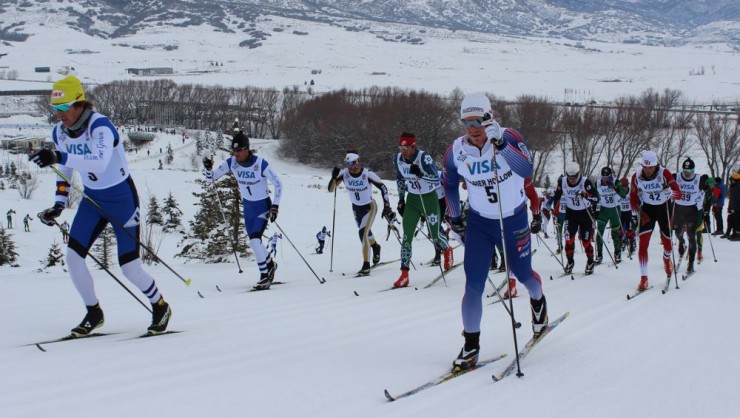
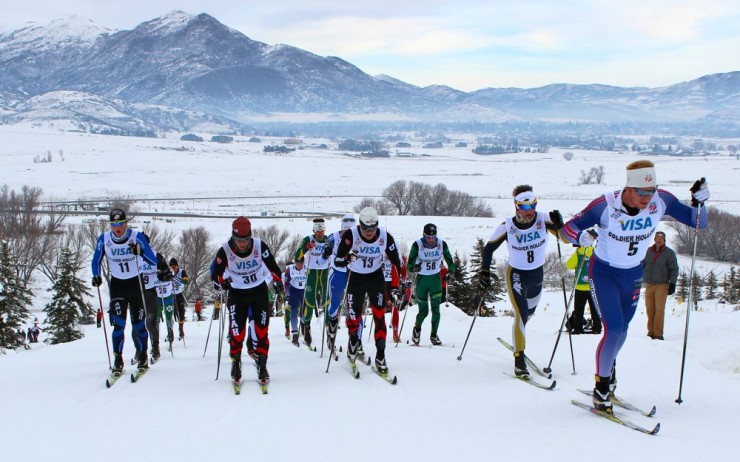
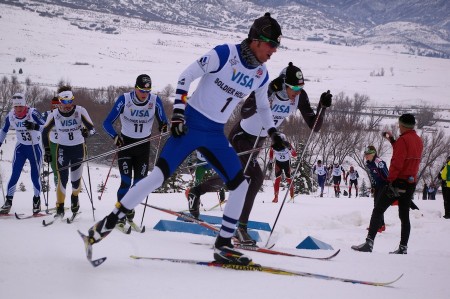
MIDWAY, Utah — 30 kilometers. Six laps. 18.6 miles. Ninety-plus minutes. Whichever way you cut it, the men’s mass start classic race at U.S. Nationals was one long race. Our images from throughout the day:
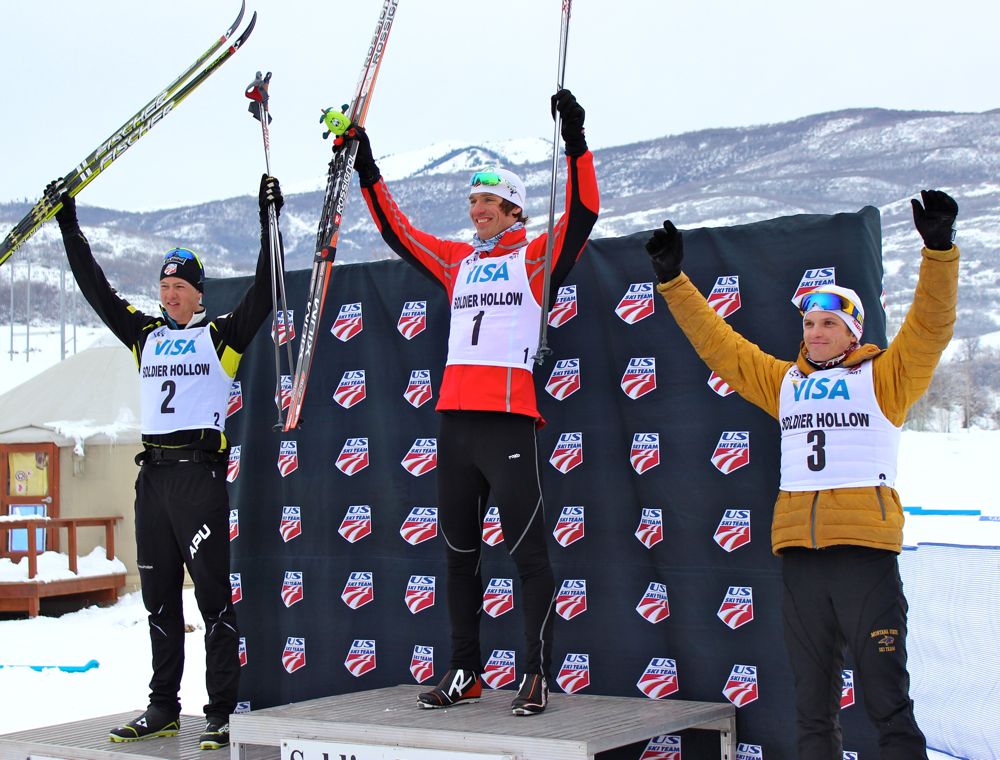
Torin Koos (Bridger Ski Foundation/Rossignol) won his second national championship race this week with his 30 k classic victory on Sunday at Soldier Hollow. Photo: USSA/Tom Kelly.
FasterSkier’s coverage of the 2013 US Cross Country Championships is brought to you through the generous support of The Memory Clinic in Bennington, Vt.
MIDWAY, Utah —Torin Koos (Bridger Ski Foundation/Rossignol) knew he had a pretty good shot at winning another national title on Sunday. Carrying momentum from a classic sprint victory and a distance skate result that made him optimistic for the mass start, he was pretty confident he would have a good 30 k classic.
“I just had a feeling that I’d have the capacity and the moxie to make it happen,” Koos said.
Make it happen he did, skiing patiently tucked into the lead pack for most of the race to make a move at the base of the final climb up Hermod’s Hill. When he came off the top, he had put enough distance on the field to give himself a margin of a few seconds over Erik Bjornsen (Alaska Pacific University/U.S. Ski Team), and when they entered the final stretch it was a practically insurmountable distance. Koos won the 30 k in 1:26:04, 3.1 seconds ahead of Bjornsen and 8.1 seconds over bronze-medalist David Norris (Montana State University).
The 2013 national 30 k champion. Photo: USSA/Tom Kelly.
“I was optimistic going into it,” Koos said as he awaited to step onto the podium. “I won’t say it was a surprise to me.”
For someone who had completed his first distance race of the season only two days prior, the race played out perfectly: tactically and not too fast. The lead pack, instead of gradually thinning, remained 20 men strong as far along as the 20 k mark. Koos began the race in bib 39 towards the middle of the chevron and had time to work his way up a train that refused to dissipate.
“I just said [to myself], ‘If I made it to the top of the hollow, nobody was going to drop me,’” Koos said of his final lap. “I thought I was going to have real good energy at the end.”
He made it to that point and was still with the leaders. Perhaps if anyone had known the prolific sprinter still had energy to burn they would have made a point of dropping him earlier. But they didn’t, or couldn’t, which enabled Koos to hold on, make a move and employ his notorious closing speed in the straightaway.
Koos making his move at the beginning of Hermod’s Hill.
“I was on the bottom of Hermod’s right when he went and he looked unbelievable,” said BSF coach Tim Baucom. “Just really good skiing on his part and I think he was happy to have it come down to the last lap… If those guys had decided to go out early it would have been a bit tougher for him.”
With a main group as big as it was, a handful of skiers had opportunities to control at various points in the race. Miles Halvick (University of Utah), the 2012 NCAA classic champion, took the first move to the front and directed the race for the most of the first lap.
“I was just trying to keep the pack as thin as possible,” Havlick said. “I don’t know, I was just feeling good and relaxed.”
Havlick’s opening pace a bit faster than expected to the rest of the pack. When the group came through the first feed zone at 4 k, he pushed through without stopping while those behind took swigs of Gatorade. Sylvan Ellefson (SSCV Team HomeGrown), Matt Gelso (Sun Valley Ski Education Foundation), Tad Elliott (SSCV/USST), Bjornsen and Norris clustered behind Havlick as he briefly put space between himself and the others.
“The pace was hard the first lap with Miles leading,” Elliott said.
By the time they climbed Hermod’s Hill for the first time, the focal point of the course profile, and descended back into the stadium, the pack had reabsorbed Havlick. Gelso, Ellefson, Norris and Bjornsen moved to the front, and the pace slowed. At that point, it was still anyone’s race. The pack was still over 20 skiers deep on lap two of six.
Ellefson and Gelso leading the pack over Hermod’s Hill early in the race.
One athlete, however, began to set himself apart. Gelso, with ambitions for his second podium of the week, was the workhorse of the day, consistently pushing the pace from the front.
He said afterwards that he decided to lead just to stay out of trouble, not because he was feeling particularly good.
The pack climbing Hermod’s on the second lap.
“I skied towards the front to keep the pace down and do what I could,” Gelso said. “I was just kind of skiing my own race. Lots of times it’s easier to ski at the front of the pace you want to ski instead of in someone else’s stride, screwing around. With some of the turns around here and where people were feeding, it made sense to be in front in a lot of places.”
Gelso’s competitors were impressed with his effort. “He was skiing awesome all day, Gelso,” Elliott said.
Elliot and Ellefson also took turns pulling at the front, and would move into the front for the same reasons everyone else seemed to: the pace was still under control and it was best to steer clear of traffic if possible.
“I feel like every time I led I just happened to be in there,” Elliott said. “I would lead on the downhills to stay out of trouble and I had fast skis. On the steep uphills I got my own track a lot of the time; I would try to take it easy on the uphills.”
Ellefson, meanwhile, was having the race of his season. Plagued by illness and fatigue this winter as he raced on the World Cup in Europe, on Sunday he felt things finally coming back around.
“I was feeling really good,” Ellefson said. “The whole time I was really just skiing my own race, and when I was out in front I was skiing at just a pedestrian level, as the Eurosport announcers would say.”
Gelso leading, halfway through 30 k.
Just as he was relaxing into the pace, however, disaster struck. With the lead group still quite crowded, someone stepped on Ellefson’s skis right before they began to climb Hermod’s for the third time.
“I lost my balance and couldn’t lift my skis out of the track, because he was on top of them, so I went down and the whole pack just blew past me,” Ellefson said. “It’s nice to have coaches and everyone out there telling you to relax and stay calm, you’ll catch back up. That’s kind of where it helped me out today.”
Elliott attempting a surge, with Koos hanging on.
Elliott and Ellefson thought they had some of the best skis in the field. After Ellefson fell he felt the fast wax prevented an unfortunate situation from becoming worse, and he was able to mitigate the loss of time.
At the front of the pack, meanwhile, Elliott was at the front putting on a small surge. “I kind of made an attack when [Ellefson] was just getting back on,” Elliot said, adding he regretted not knowing his teammate had fallen in the moment.
Apart from Ellefson, the pack did not go away when Elliott quickened the pace; its numbers began to dwindle but the contenders remained unbroken. There was still hardly any distance at all between Bjornsen, Norris, Koos and Gelso. Havlick began to lose contact, but Sam Tarling and David Sinclair (Dartmouth) stayed in the mix, having the race of their lives.
“I was a little worried when I was out in front, but I wasn’t working all that hard,” Tarling said. “There were sections where I was feeling a little bit tired but also sections where I was feeling great.”
Lap four is where things started to get serious. Elliott, going for the win, made another surge in an attempt to break away. More skiers dropped off the back.
“Tad tried to make a move with 9.5 k to go,” Koos said. “That could have been a defining move, but I was able to cover him.”
Koos was able to regain 100 m on Elliott to reestablish contact, but he didn’t want to take over the lead.
“I wasn’t interested in pushing the pace and he wasn’t tell me, like, ‘Go, go, go,’ and we let the pack kind of come back,” Koos said.
Gelso, Elliott and Koos the fifth time up Hermod’s.
The surge may have ultimately cost Elliott. “I felt great all day and I think I just went a little too — I was racing for the win and felt like I was really charging, but those other guys were busting it out pretty hard,” Elliott said.
In a race filled with shuffling leads, Koos and Bjornsen were particularly coy. They were almost always just behind the leaders, trying not to draw too much attention to themselves and conserve from the middle of the pack. When it was finally time to go they had more energy than anyone. On the last lap, when everyone was hanging on for dear life, they were able to attack afresh.
“At the base of Hermod’s all of us came over the sprint hill together and everyone took their own lane,” Koos said. “I just started going, not 100% at the base of it, but with a lot of snappy power.”
Koos bounded up the incline and nobody could match it.
“I tried to kind of kick it up to catch Torin, but he was moving at a really fast pace,” Bjornsen said.
Bjornsen.
Down the other side of the hill and into the stadium, Koos skied as if Bjorsen was right on his tail, not knowing if he’d managed to create a break.
“I heard quite a few people cheering for Erik in particular right behind me, so I could tell I was maybe breaking him a little bit but that it was going be tight,” Koos said.
A bunch of powerful double-poles later and the 30 k title was his. Does it get old after the eighth time at the top of the podium? Not really, he says.
“I mean, it’s awesome to win a race like that,” Koos said.
Bjornsen, having climbed his second podium in two days, was feeing pretty good about how things went.
“I practiced some tactics this time and think it paid of well,” he said. “I still felt like I had a kick at the end. I couldn’t quite match Torin’s kick, but felt pretty relaxed going up that last hill.”
His coach thought Bjornsen skied the race flawlessly.
“It’s just exceptional,” said APU head coach Erik Flora. “For Erik, for his age, for a 30 k today, it was tremendous and he played it perfectly. You watched him in the pack and where he made time.”
Norris crossed the finish line five seconds behind Bjornsen to take the bronze. Like Bjornsen and Koos, he played a smart race and let others do the work. He was second in the 30 k in Rumford, Maine, last year, and seemed satisfied with third on Sunday.
Norris and Gelso on the final climb up Hermod’s.
“I expected some of those bigger guys to hammer that last hill,” he said. “I didn’t feel that great during the race; I was trying to just ski along. I kind of felt sick from some of the feeds.”
Gelso, who had spent so much time working out in front, finished fourth (+11.7). In retrospect he admitted he had led “maybe too much.”
“I’m a little bummed I wasn’t in the top three. 30 k is a huge effort so when you lose out by 10 meters you’re like, ‘Aw, God,’” Gelso said. “Whatever. It was a solid day and it was fun racing, so…”
Though Gelso was disappointed with fourth, the next two finishers behind him were ecstatic with huge personal bests. Tarling and Sinclair placed fifth and sixth, respectively, to lead the Dartmouth men.
“I’m just psyched to have one of my teammates up here with me,” Tarling said, who skipped nationals last January due to illness. “I knew if I could hang on over the top of Hermod’s I’d be in a position to do pretty well.”
Tarling climbing early in the race
Tarling finished 18.1 seconds back from Koos’ time and Sinclair came through less than five seconds after Tarling.
“I was just trying to hang in the pack as long as I could,” Sinclair said. “It felt pretty good for the first four laps and then it started to get hard, and I was just hanging on for dear life.”
Elliott, meanwhile, had spent his energy on mid-race surges and slipped to seventh, 23.3 seconds behind Koos. He had hoped for more, and after the race he regretted not being able to deliver a win for his team more than anything else.
“I wanted to deliver a win for those guys,” Elliott said. “It would have been really nice; [Team HomeGrown] works really hard.”
At the end of the day the top 10 were almost all under the age of twenty-five, a demonstration of impressive depth to the up and coming field of American distance skiers. All but one, of course: the seasoned veteran who can still school them all. Koos, 32, has now won eight national titles in his career.
After the podium ceremony, someone asked Bjornsen if he remembered the first time he met Koos. Without a moment’s hesitation Bjornsen recalled asking for Koos’ autograph as a junior skier at the West Yellowstone Ski Festival.
“I went into a West Yellowstone bar to ask if I could have his signature when I was probably, like, 12 or something,” he said. “I saw him playing pool and I asked him for his signature, I had a little postcard of him.
“I’ve learned a lot from him… Every once in a while Flora is like, ‘You’re skiing like Koos!’”