It had been more than a month since Sophia Laukli last wore a race bib. Her last competitions took place on January 15th and 16th during the 2022 Sun Valley Nordic Invitational, where she was second to Rosie Brennan in the 5 k individual start skate, racing at altitude on a tough course. Eleven days prior, she was the fifth woman, and the first American, to the top of the Alpe Cermis in Val di Fiemme, Italy during the final stage of the Tour de Ski.
Earlier in the season, Laukli popped a Top-20 at altitude in Davos, Switzerland, finishing 19th in the 10 k individual start skate.
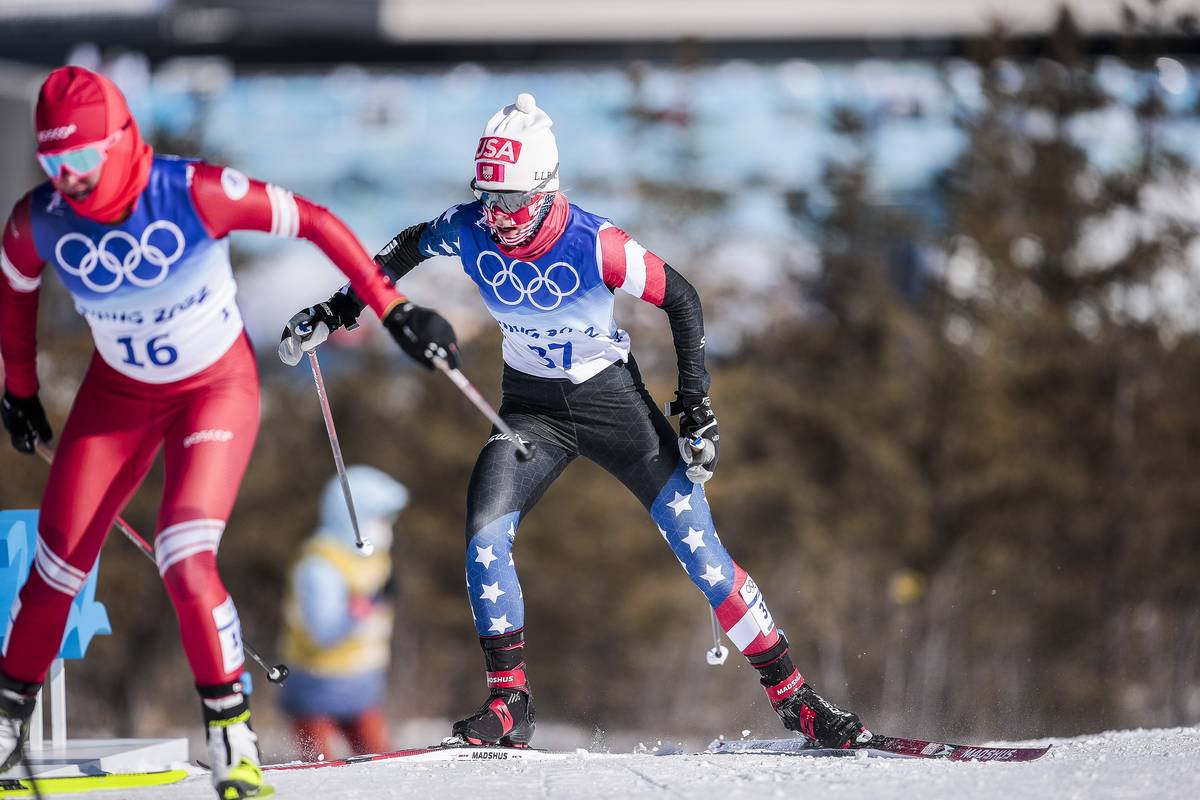
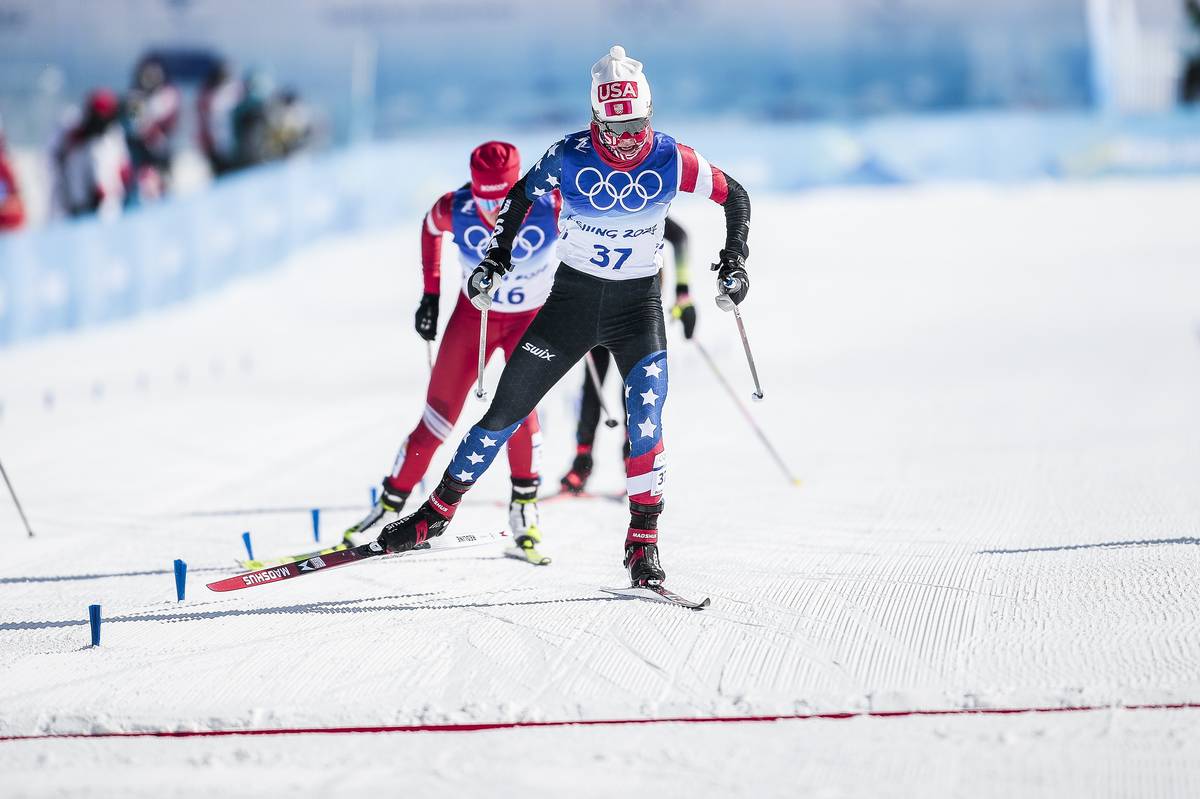
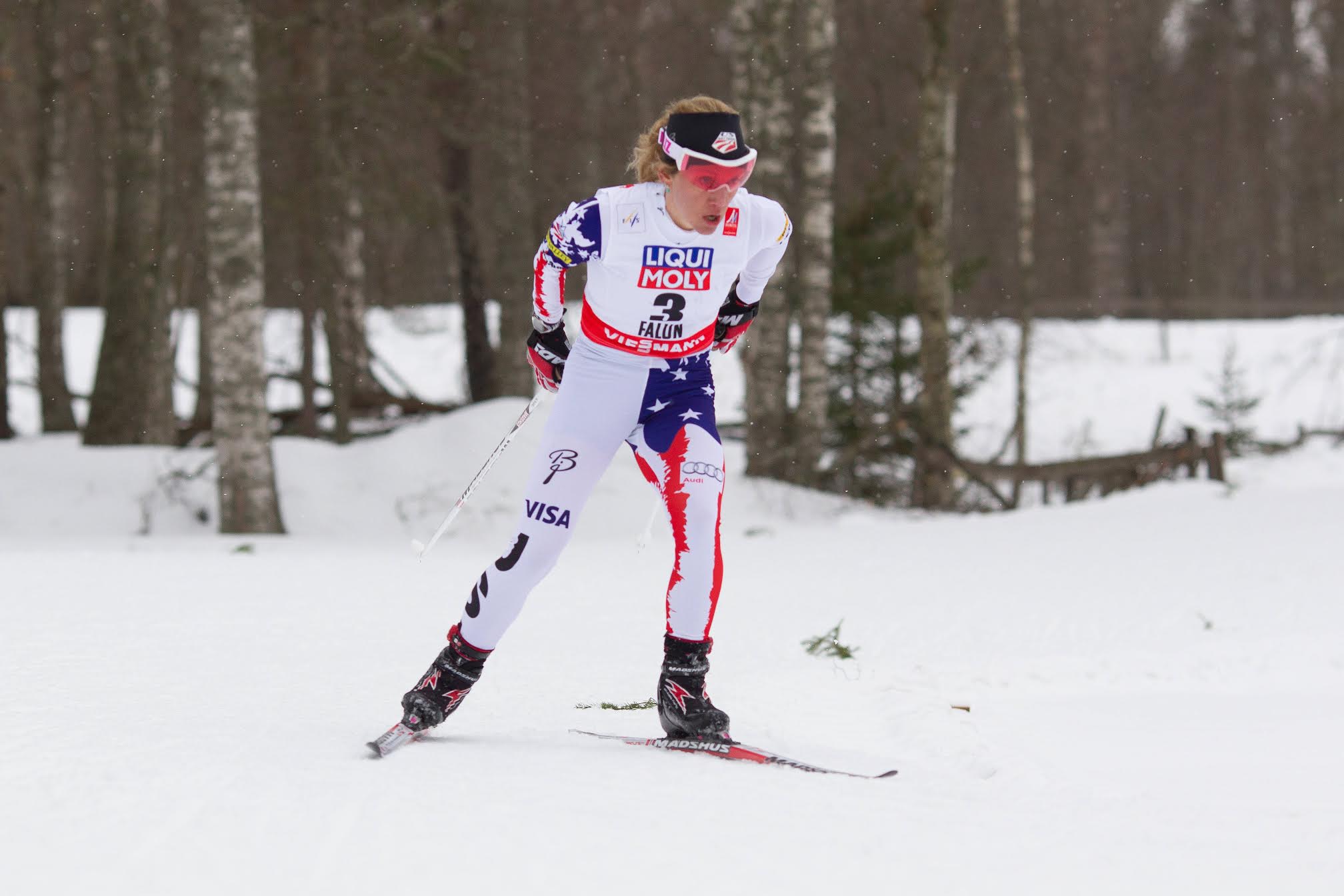
Racing through brutal wind and cold, Sophia Laukli skis to 15th in the 30 k skate. (Photo: NordicFocus)
It’s become clear: Laukli is a contender in freestyle distance races, and the harder (and higher) the better.
Heading into the Games, Laukli knew she would be starting the 30 k mass start freestyle. Given the elevation, the challenge of the course, the technique, and the distance, perhaps this selection by the coaches was a no-brainer.
“I love this course,” Laukli said of the venue in Zhangjiakou in a post-race interview with FasterSkier in the mixed zone. “The hills really work to my advantage.”
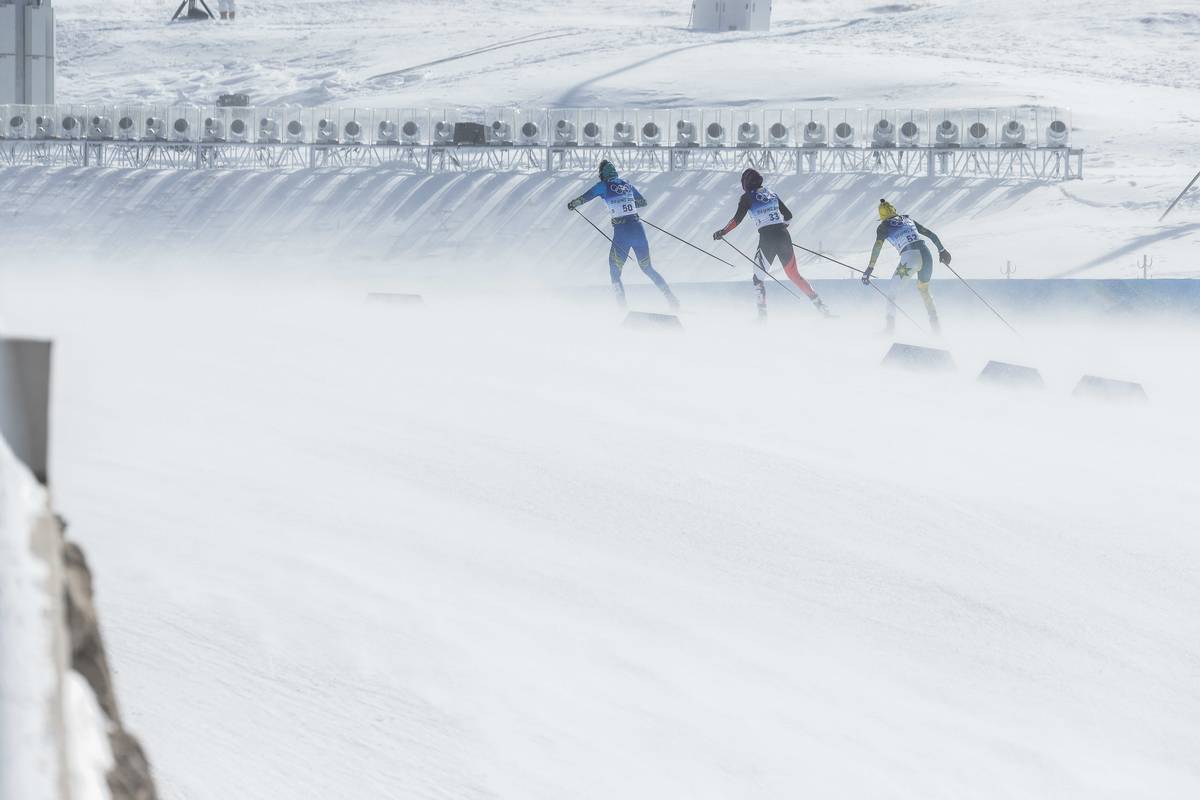
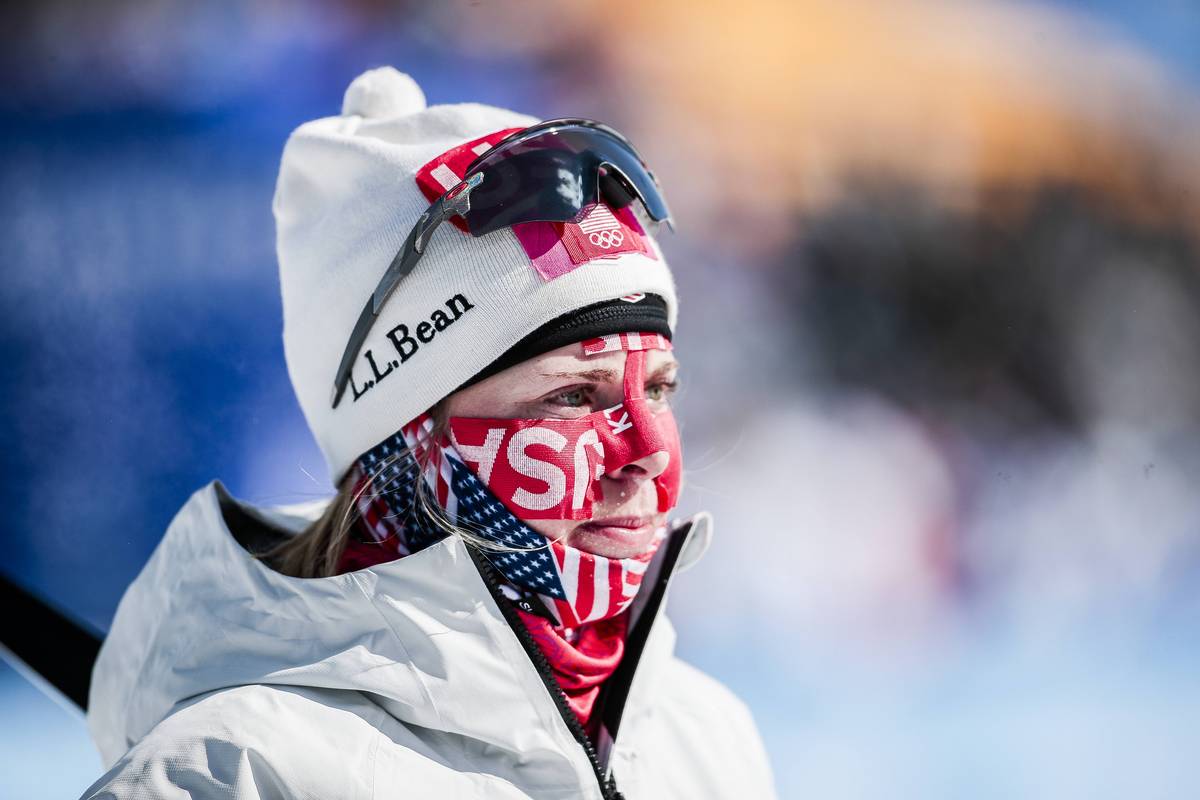
But no one could have predicted just how challenging the day would be. Wind ripped across open sections of the course, forcing athletes to drop into low gears even on flatter sections just to stay upright and moving forward. Most athletes wore large strips of tape across their faces, with buffs covering all remaining exposed skin save for their mouths and noses.
Snow-filled wind gusts obscure the v-boards lining the 7.5 k course in Zhangjiakou during the women’s 30 k mass start skate. (Photo: NordicFocus)
The American women showed they could handle whatever Zhangjiakou threw at them that day. Highlighted by Jessie Diggins silver medal performance – earned while fighting through painful cramping and fatigue after spending two days with food poisoning – the team put all four starters inside the top-20. Rosie Brennan skied to 6th, with Laukli in 15th, and Novie McCabe 18th.
But Laukli was almost 13th.
With only a few hundred meters to go, Laukli made a wrong turn, accidentally following the lap course rather than the route to the finish lanes.
How did it happen?
“I honestly don’t know exactly,” Laukli said in the mixed zone. “There was a huge gust of wind that kind of covered where it was marked ‘finish’ and ‘lap’, and I think it was a combination of [being] tired and not really seeing where to go. I definitely noticed a little bit too late, and then got passed, but I guess those things happen. I’m definitely a little bit bummed out. But I’m happy with the overall race.”
Laukli is not the only athlete to have made a wrong turn at the Olympics. A wrong turn during the 30 k classic might have cost Austria’s Theresa Stadlober a medal at the 2018 Games in PyeongChang. There’s adrenaline, fatigue, nerves, and so many other factors at play, without wind gusts lifting clouds of dry loose snow into the air in the stadium.
“I’m bummed for her,” said coach Chris Grover, “that she lost two places, because she worked hard for those… but she did the right thing, retracing her steps all the way back, and that’s one of the lessons that you do once on the big show and then you never do it again. Jessie did it in Sochi.”
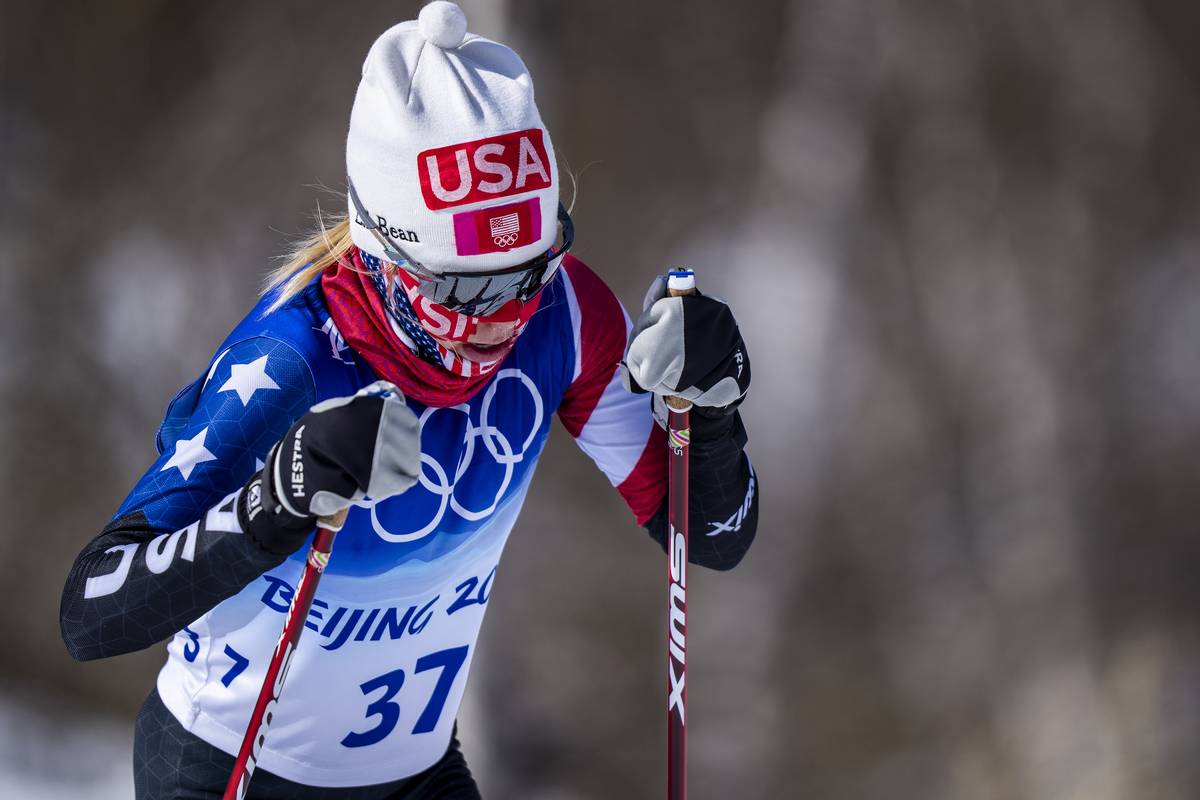
Despite a wrong turn inside the final 400 meters, Sophia Laukli finished 15th in the 30 k skate in her Olympic debut. (Photo: NordicFocus)
Having one of the best races of her season during her first and only appearance at the 2018 Games, Laukli admitted she felt panicked as she backtracked to the split to avoid disqualification. Having come to a stop and lost all momentum, it was devastating to see a pair of Norwegian twins, Lotta and Tiril Udnes Weng, skiing fast with a tailwind toward the final bend into the stadium. There was nothing Laukli could do to avoid losing those two places.
But to her coaches and supporters, this wrong turn was not the defining moment of Laukli’s Olympic debut.
Laukli showed mental toughness, dedication, and patience as she spent the three weeks prior to the 30 k training in Zhangjiakou, watching, supporting, and celebrating her teammates as they raced in earlier events, while trying to stay focused on her own opportunity that was yet to come.
“It was definitely not the easiest last month,” she told FasterSkier. “I really love racing, and so to have such a long break and just wanting to race, it was a bit tough.”
She explained that, without races as a fitness checkpoint, she poured herself into her training to maintain her race shape, but ultimately was not sure what would happen on race day.
“I think I was lucky in that it was a 30 k – it’s maybe easier to race a 30 k when you’re not in your fastest form, because it’s just a slower race. So I think that helped a lot.”
Racing on her own for the second half, Sophia Laukli finishes her Olympic debut in 15th place. (Photo: NordicFocus)
At the 10 k mark, Laukli sat in 15th, racing on the back of a large chase group led by Rosie Brennan. Over the next 5 k, a group of three, including Laukli, lost contact with this group and slowly separated. For the second half of the race, as the wind “really, really picked up”, Laukli found herself racing on her own with no one to work with or use as a wind break. At times, the headwind was so strong that Laukli said she ended up fighting it in V1 as she lapped through the false flat of the stadium at 22.5 k.
Ever onward, Laukli kept pushing, eventually overtaking a Latvian athlete who began to fade to find herself in 13th – 13th in the world at the Olympics – with a roughly 45 second gap to the next skier in the final kilometer.
“I felt like I was able to pace it pretty well,” she said. “It was definitely a bummer that I had to see most of it alone because I think it would have been beneficial to be in a group. But I did my best and I’m pretty proud of how it went.”
While the takeaway here should remain that Laukli posted a top-15 result in her first Olympic performance at 21-years-old in some of the gnarliest conditions imaginable, the sting was still painful as she passed through the mixed zone.
“I’m probably in a better place than I was the minute after I finished. But to be honest, I’m pretty pissed. I really wanted to prove myself today, to prove that I earned that start. And just to make such a stupid, preventable mistake at the end… I was not stoked. But like I said, that happens, I guess. It sucks that it’s at the Olympics in my Olympic debut, but yeah, not a lot I can do about it now.”
Perhaps Nat Herz said it best as their conversation in the mixed zone ended.
“As a guy who watches a lot of these races, I don’t think anyone’s gonna hold it against you, or remember it in however many years.”
Sophia Laukli pushes to the line for 15th in the 30 k mass start freestyle. (Photo: NordicFocus)
US Ski & Snowboard SuperTour Finals Presque Isles, Maine 30k/50k Mass Start Freestyle
Tuesday marked the last day of SuperTour Finals and with it, the women raced a 30-kilometer mass start freestyle. Sadie Bjornsen (APU/USST) won in 1:21:29.4. Bjornsen was the pacesetter for much of the day. By the 10 k checkpoint, the potential podium challengers had been winnowed down to Bjornsen, Rosie Brennan (APU), Julia Kern (SMS T2/USST), Jessica Yeaton (APU), Katherine Stewart-Jones (NTDC Thunder Bay), Sophie Caldwell (SMS T2/USST), and Caitlin Patterson (CGRP). Rosie Frankowski (APU), who had been skiing with the front group, dropped off the pace to come through nearly 12 seconds back.
Bjornsen and Brennan turned the effort up, further breaking apart the select pack. At 25 k, The two APU skiers had gapped Kern by 13.2 seconds and Yeaton, now in fourth, by 20.9 seconds.
Bjornsen’s win came 33.9 seconds ahead of Brennan in second place. Kern placed third in a time of 1:22:42.2 to round out the podium.
Of note, Bjornsen’s final 5k split marked her fastest of the race. Her 5 k splits from start to finish are as follows: 13:20.4, 13:43.7, 13:54.1, 13:41.2, 13:42.6, and 13:07.1.
According to the International Ski Federation (FIS) Bjornsen earned her fifth non-sprint national title with her 30 k win. At SuperTour finals, the 30 and 50 k are considered national championship events. She won her first national championship in 2011 in Rumford, Maine’s 10 k classic. Bjornsen’s last distance national championship win came in 2014 when she won the 30 k mass start classic in Anchorage, Alaska. She also swept all three individual races this wee at SuperTour finals.
It became a two skier race in the men’s 50 k mass start skate with 10 k remaining. David Norris (APU) and Erik Bjornsen (USST/APU) pulled through the 40 k mark with a 32.7 second lead on Simi Hamilton (USST/SMS T2) in third. At this point, Scott Patterson (USST/APU) came through in fourth, 49.6 seconds behind, and full-time biathlete Jake Brown (CGRP) in fifth (+1:07.3). 1xbet Casa de apuestas
Bjornsen and Norris went unchallenged to the finish with Bjornsen making the winning move to put 9.5 seconds on Norris by the finish. Bjornsen won in 2:13:23.5, with Norris in second, and Hamilton third in a time of 2:14:45.7.
According to FIS, this was Erik Bjornsen’s fifth national championship in a distance event. In 2013 he won a 15 k skate, 2014 a 15 k classic, and the 50 k classic mass start in 2016 and 2018 respectively.
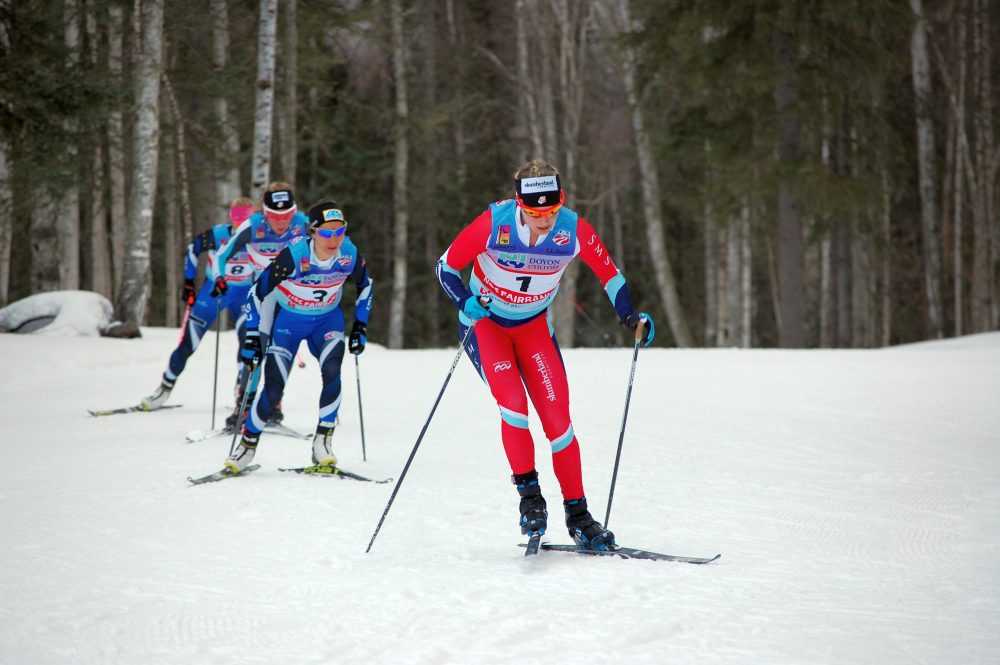
Jessie Diggins making her decisive move during the women’s 30k freestyle at the 2017 U.S. Distance Nationals in Fairbanks, Alaska. (Photo: Max Kaufman)
U.S. Distance Nationals (Fairbanks, Alaska): 30/50 k freestyle mass starts
On Sunday in Fairbanks, Alaska U.S. Distance Nationals came to a conclusion for the women as they contested a 30-kilometer skate mass start.
Spoiler alert: Diggins swept the week.
Marked from the start was Jessie Diggins of the Stratton Mountain School (SMS) Elite Team and the U.S. Ski Team (USST). Diggins is coming off a World Cup campaign where she placed sixth overall and won a sprint silver and team sprint bronze at the 2017 World Championships in Lahti, Finland.
Her overseas haul became a bit heavier this week in Fairbanks: Diggins placed first in the skiathlon, first in the freestyle sprint, and first with the SMS Elite Team mixed relay squad.
No doubt Diggins remains in form as she closed out her season on Sunday. She was the skier to mark as this much was a certainty: Diggins would at some point turn the pace-setting screws.
Early into the race, seven skiers separated themselves by a gap of approximately 12 seconds at the 5 k mark. (The 5 k split times were taken as the women completed their single lap of the South Tower Course Loop. The remainder of the race’s 25 k were comprised of three 8.3 k loops.) Speeding along in a pace line were Diggins, Chelsea Holmes of Alaska Pacific University (APU), Caitlin Gregg of Team Gregg/Loppet Nordic Racing, Kikkan Randall (APU/USST), Annie Hart (SMS Elite), Caitlin Patterson (Craftsbury Green racing Project), Sophie Caldwell (SMS Elite), and Rosie Frankowski (APU).
“I wanted to take the opportunity at the start to work on my pack skiing, and because it’s the end of the season, it should be fun,” Diggins said after the race on the phone. “Around the 12-13 k mark, I decided to start upping the pace a little bit. And then I kind of slowly pulled away. Once I had made a gap, I said, ‘OK, now I need to stick with this,’ and settled into my pace.”
What was once a group streamlining thinned as the race progressed. Note: Diggins soon began to charge ahead solo. At the second split, the Diggins gap was 17 seconds on Randall, Holmes and Gregg.
Patterson at that point was skiing in fifth, roughly 46 seconds back. While Frankowski, Hart, and Caldwell trailed Diggins by nearly one minute and thirty seconds.
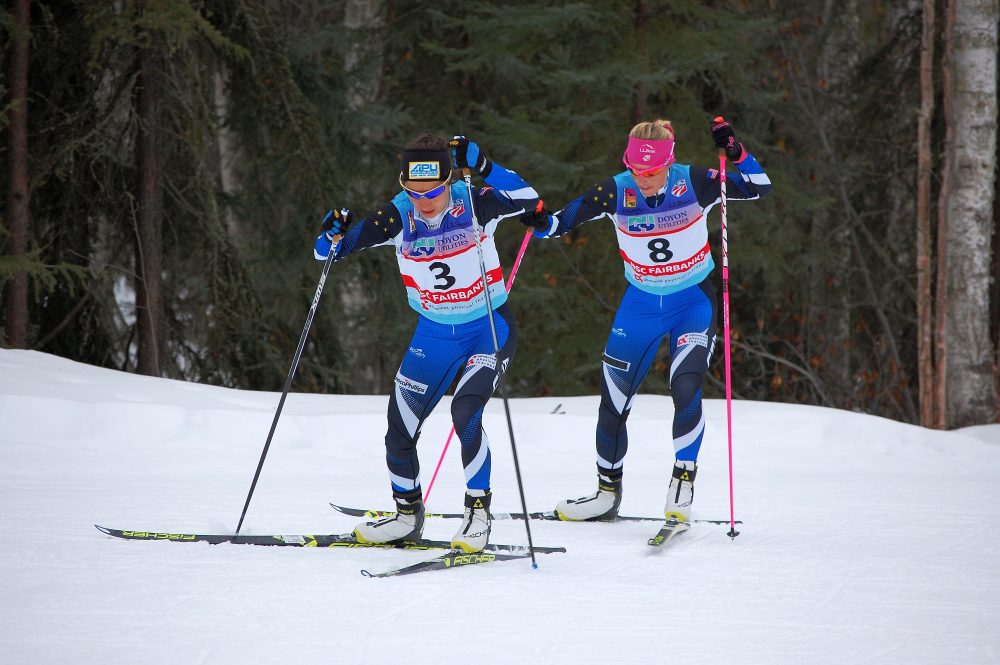
Chelsea Holmes leads Kikkan Randall as they protect their podium spots during the women’s 30 k freestyle at the 2017 U.S. Distance Nationals. (Photo: Max Kaufman)
Just as Diggins separated herself, Randall and Holmes eventually pulled away from Gregg. The Randall-Holmes duo made it a two-skier race for second and third. They minimized their loss to Diggins up front and created enough of a buffer to those chasing from the back that minus a gear-breaking fall or a tumble-induced injury, they were a lock for the remaining podium spots.
Diggins secured her third individual and fourth win of the week as she won the U.S. Distance Nationals 30 k skate in 1:20:55.1 hours. Randall followed 1 minute and 37.2 seconds back in second and Holmes placed third (+1:50.4).
“At the end of the season it is one of those things where you need a little bit of luck, you need to be healthy, and everyone is in totally different places,” Diggins said. “I think it is a little unfair to compare how we ski right here to how we would ski during the season. That said, I have been working on a lot of things and working hard and so it is nice to have all that hard work show through during the races.”
Unofficially, with Holme’s third place, she’ll be the overall SuperTour winner on the women’s side. As the overall winner, the APU skier will earn World Cup starts for Period 1 of the 2017/2018 World Cup.
Liz Stephen (Burke Mountain Academy/USST) did not start the race, citing the onset of illness.
The junior women, who began their race in a group mass start with the senior women, raced a 15 k skate competition. Nicole Schneider of Northern Michigan University (NMU) placed first in 38:22.5 minutes. Margaret Gellert (Alaska Winter Stars) skied to second (+3.3), Anna Darnell (University of Alaska Fairbanks) was third (+30.9).
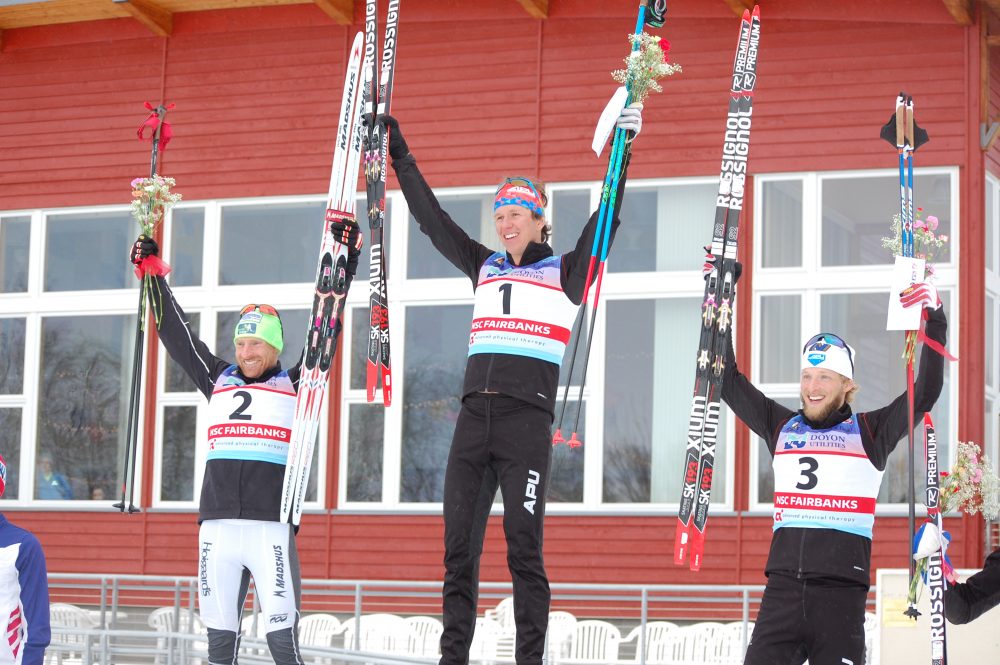
Men’s 50 k freestyle podium from the 2017 U.S. Distance Nationals in Fairbanks Alaska. Scott Patterson (c) from APU placed first, Brian Gregg (l) skiing for Team Gregg second, and Eric Packer (r) also from APU was third. (Photo:Max Kaufman)
In the men’s 50 k that followed, APU’s Scott Patterson racked up his second win of the week, after winning the skiathlon, finishing first in the 50 k freestyle mass start race in a time of 2:19:36.3 hours.
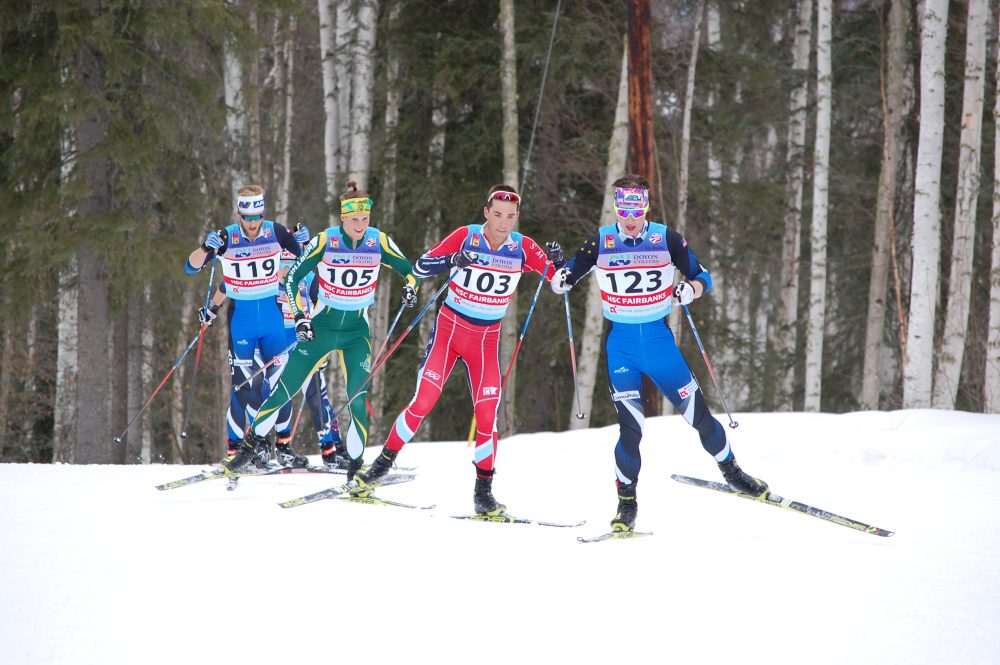
The chase for third place during men’s 50 k freestyle at the 2017 U.S. Distance Nationals in Fairbanks, Alaska. Thomas O’Harra leads, followed by Patrick Caldwell (103), Adam Martin (105), Eric Packer (119), Tyler Kornfield, and Tad Elliott. (Photo: Max Kaufman)
While Ski and Snowboard Club Vail’s (SSCV) Tad Elliott set the pace for the first 10 k, Patterson who was position just behind Elliott, eventually took over the lead before another 5 k. From then on, Patterson presided as the pace setter. He was followed closely by Stratton’s Paddy Caldwell (USST D-team), Team Gregg’s Brian Gregg (Loppet Nordic Racing), NMU’s Adam Martin, and Canada’s Michael Somppi (NTDC Thunder Bay).
Once given the reins, however, Patterson didn’t let up. He continued to dictate the lead for the remainder of the race, besting Gregg as the runner-up by 3:19.9 minutes.
Moving his way up during the second half of the race was APU’s Eric Packer, who finished third (+4:14.2). Another APU skier, Tyler Kornfield, crossed 22.4 seconds later in fourth (+4:36.6). In a photo finish, Caldwell placed fifth (+4:37.6) ahead of Martin in sixth (+4:37.6).
Four APU skiers finished in the top 10, with Thomas O’Harra placing seventh (+5:24.5). Elliott finished eighth (+6:52.1), Norway’s Håkon Hjelstuen ninth (+7:00.7) and Somppi 10th (+8:13.4).
In the junior men’s 20 k freestyle mass start competition, Alaska Winter Stars Gus Schumacher won the event in a time of 54:03.3. Ti Donaldson racing for the Nordic Ski Club of Fairbanks/Fairbanks Cross-Country placed second, just 5.4 seconds after Schumacher. Rounding out the junior men’s podium was Northern Michigan University’s Lars Sønsterud in third (+2:05.2).
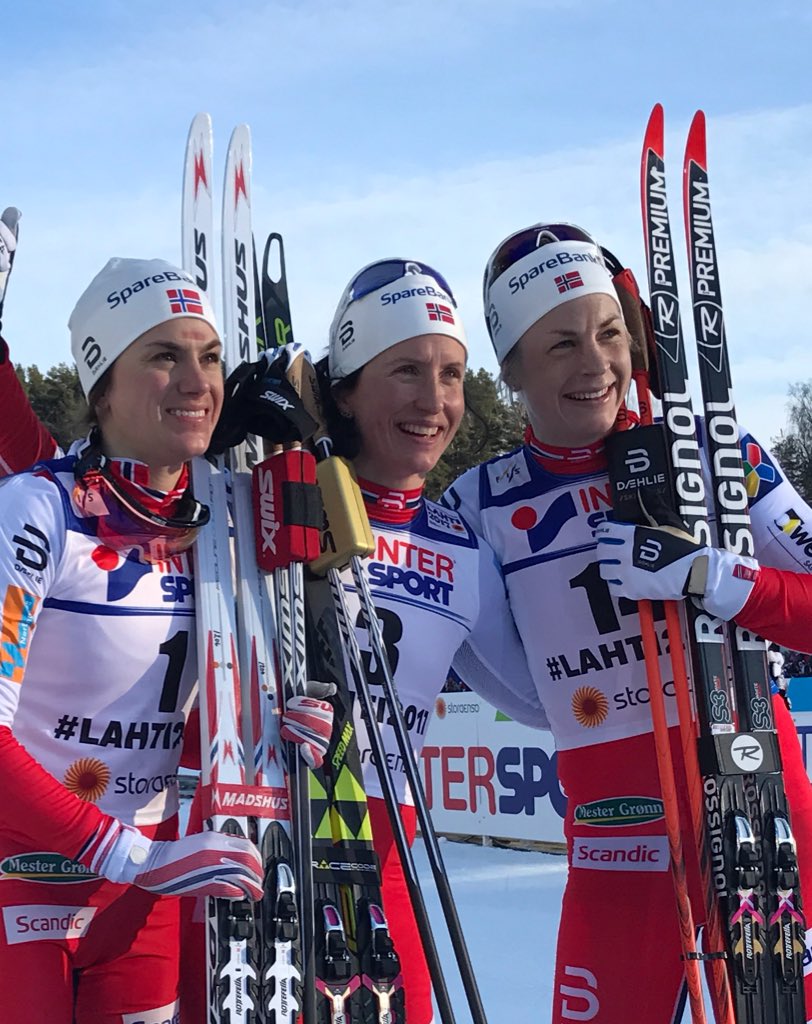
The all-Norwegian women’s 30 k freestyle mass start podium at 2017 Nordic World Championships in Lahti, Finland, with Marit Bjørgen (c) in first, Heidi Weng (l) in second, and Astrid Uhrenholdt Jacobsen (r) in third. (Photo: FIS Cross-Country/Twitter)
FIS Nordic World Championships (Lahti, Finland): Women’s 30 k freestyle mass start
Marit Bjørgen made it a four-peat on Saturday with her fourth gold and third individual win over the last week at 2017 Nordic World Championships in Lahti, Finland. (She previously won the 15-kilometer skiathlon, 10 k classic, and 4 x 5 k relay.)
The 36-year-old Norwegian closed out the championships with a 1.9-second victory in the women’s 30-kilometer freestyle mass start, finishing in 1:08:36.8 hours after setting the pace and leading a large group for much of the race. The group began to separate around 15 k, where it was down to 13 women with five seconds of first. At that point, Americans Jessie Diggins and Chelsea Holmes were within that lead pack.
While Holmes started to fall off the pace around 16 k, Diggins stuck with the leaders to the very end, only until four Norwegians broke away to race for the medals over the final kilometer.
With Bjørgen still charging hard up front, her teammates Heidi Weng, Astrid Uhrenholdt Jacobsen, and Ragnhild Haga followed, while Finland’s Krista Pärmäkoski trailed another second back in fifth and Diggins was one more second behind in sixth.
Bjørgen led the downhill into the stadium and skied away from her teammates before the finishing stretch, leaving Weng and Jacobsen to duke it out for second place. Weng got it by less than one-hundredth of a second, Jacobsen took bronze (+1.9), and Haga completed the Norwegian top-four sweep in fourth (+7.4).
Diggins passed Pärmäkoski and notched fifth (+10.4) for her career-best 30 k result. Pärmäkoski placed sixth (+11.3), Sweden’s Charlotte Kalla finished seventh (+13.9), Austria’s Teresa Stadlober was eighth (+15.5), Sweden’s Anna Haag ninth (+20.3), and Russia’s Yulia Tchekaleva 10th (+1:20.9) after edging Switzerland’s Nathalie von Siebenthal in a photo finish. Germany’s Stefanie Böhler placed 12th (+1:23.5) and Holmes finished 13th (+1:28.1) for her career best.
U.S. Ski Team member Liz Stephen placed 25th (+3:09.4), 6.6 seconds ahead of Canada’s national U25 Team skier Cendrine Browne, who notched a career best 26th (+3:16) in her first World Championships.
Holmes’s Alaska Pacific University (APU) teammate Jessica Yeaton, who races for Australia, finished 33rd (+4:32), Canada’s Dahria Beatty was 34th (+4:45.2), and American Caitlin Gregg 36th (+5:03.7).
Great Britain’s Annika Taylor, a California native, placed 38th (+6:19.4). Canada’s Emily Nishikawa was 40th (+6:41.5) and Katherine Stewart-Jones 41st (+7:18.6), and Brazil’s Jaqueline Mourão, who trains in Quebec, was 46th (+13:44.6) out of 47 finishers.
IBU World Cup (PyeongChang, South Korea): Women’s and men’s pursuits
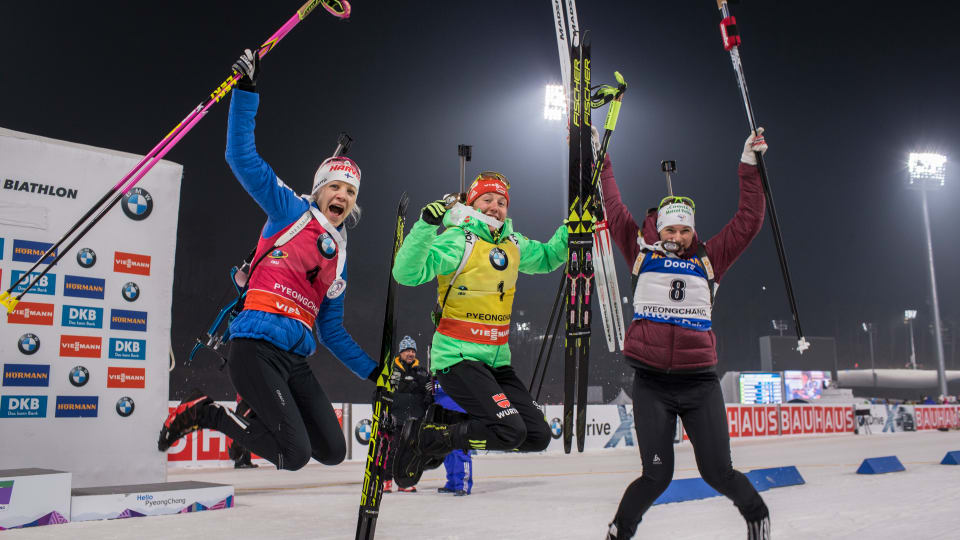
The women’s 10 k pursuit podium at the IBU World Cup in PyeongChang, South Korea, with Germany’s Laura Dahlmeier (c) in first, Finland’s Kaisa Mäkäräinen (l) in second, and France’s Anais Bescond (r) in third. (Photo: IBU)
Coming off a fifth place in Thursday’s 7.5-kilometer sprint, Susan Dunklee held her position despite three penalties in the women’s 10 k pursuit on Saturday to finish fifth again at the International Biathlon Union (IBU) World Cup in PyeongChang, South Korea.
Germany’s Laura Dahlmeier racked up her second-straight win in as many races in PyeongChang (and sixth-straight, counting World Championships), finishing in 27:58.0 minutes with clean shooting. She was just one of four women out of 58 finishers that hit all 20 targets in Saturday’s four-stage race.
Finishing more than a minute later, Finland’s Kaisa Mäkäräinen placed second (+1:12.6) after starting fourth based on her sprint result. Mäkäräinen had two penalties, both in the first standing, but cleaned the other three stages (0+0+2+0). France’s Anais Bescond raced up from eighth at the start to third place (+1:18.9) at the finish, with a single penalty (0+0+1+0), while Norway’s Tiril Eckhoff missed her second-straight podium in fourth place (+1:32.0) after starting second but accumulating five penalties (1+2+1+1).
Eckhoff edged Dunklee, of the U.S., by half a second as Dunklee placed fifth (+1:32.5) with three misses (1+1+0+1).
Canada’s Rosanna Crawford rose from 30th to 19th (+2:49.1) for her best non-relay result of the season, with two penalties (1+1+0+0). Her teammate Megan Tandy also landed her first top 30 of 2016/2017 in 30th (+3:26.2) with two misses (1+0+1+0) after starting 39th. Also for Canada, Julia Ransom finished 44th (+4:18.4) after starting 41st and skiing four penalty loops (1+0+1+2).
Also for the U.S., Clare Egan finished 36th (+3:41.9) with three clean stages but three misses in her first standing (0+0+3+0), after starting 33rd. Joanne Reid slipped from 35th at the start to 52nd (+4:53.4), with five penalties (1+1+0+3).
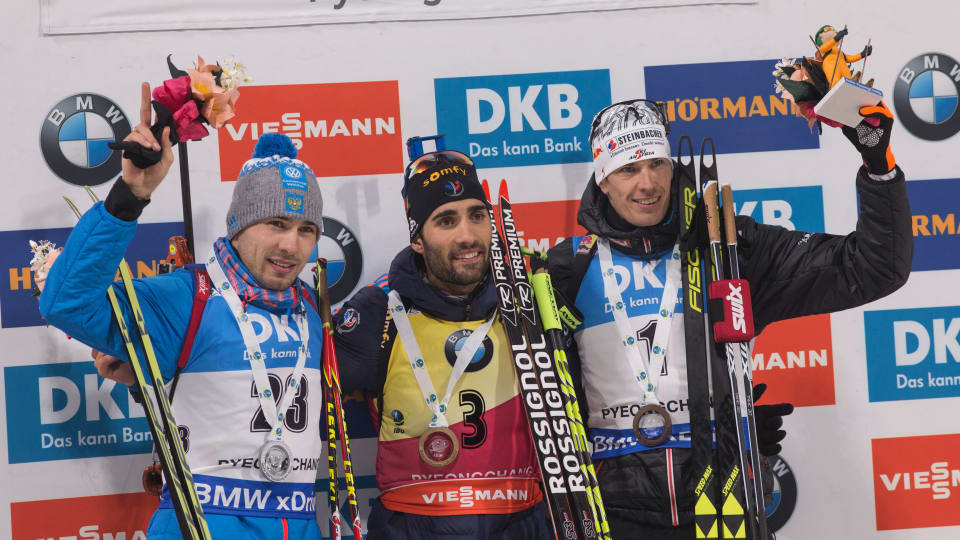
The men’s 12.5 k pursuit podium on Saturday at the IBU World Cup in PyeongChang, South Korea, with France’s Martin Fourcade (c) in first, Russia’s Anton Shipulin (l) in second and Austria’s Julian Eberhard (r) in third. (Photo: IBU)
[UPDATED] One day after locking up the overall World Cup title, Martin Fourcade was back at the top of the podium in the men’s 12.5 k pursuit in PyeongChang.
Fourcade started third, after finishing third in Friday’s sprint, then shot clean to win in 31:24.2. Russia’s Anton Shipulin, who started 23rd, also shot 20-for-20 to race up to second place, 34.5 seconds behind Fourcade, with the fifth-fastest course time. In comparison, Fourcade’s course time was third fastest.
Friday’s sprint winner, Julian Eberhard of Austria finished third (+36.7) after skiing three penalty loops (0+2+0+1). His teammate Simon Eder placed fourth (+1:03.2) after starting eighth and cleaning three stages before missing two on the last standing (0+0+0+2).
Russia’s Evgeniy Garanichev improved from ninth at the start to fifth (+1:09.5) with two penalties as well (0+1+1+0). France’s Simon Desthieux was sixth (+1:13.5), Austria’s Dominik Landertinger seventh (+1:20.3), Germany’s Benedikt Doll eighth (+1:20.4) with the fastest course time after starting 20th.
American Lowell Bailey was another 0.2 seconds back in ninth (+1:20.6), just ahead of Italy’s Lukas Hofer in 10th, who finished with the same time. Bailey previously tallied the third podium of his career on Friday, placing second in the sprint, but had two penalties on Saturday (1+0+1+0) to slip to ninth.
Also for the U.S., Leif Nordgren improved to 28th (+2:28.9) after starting 37th and shooting 19-for-20 (0+0+0+1).
Christian Gow shot clean to lead Canada in 32nd (+3:17.4), up from 56th at the start. His older brother Scott Gow slipped from 27th at the start to 43rd (+4:05.9) with five penalties (0+1+1+3), and Brendan Green followed in 44th (+4:09.8) with three penalties (2+1+0+0) after starting 28th.
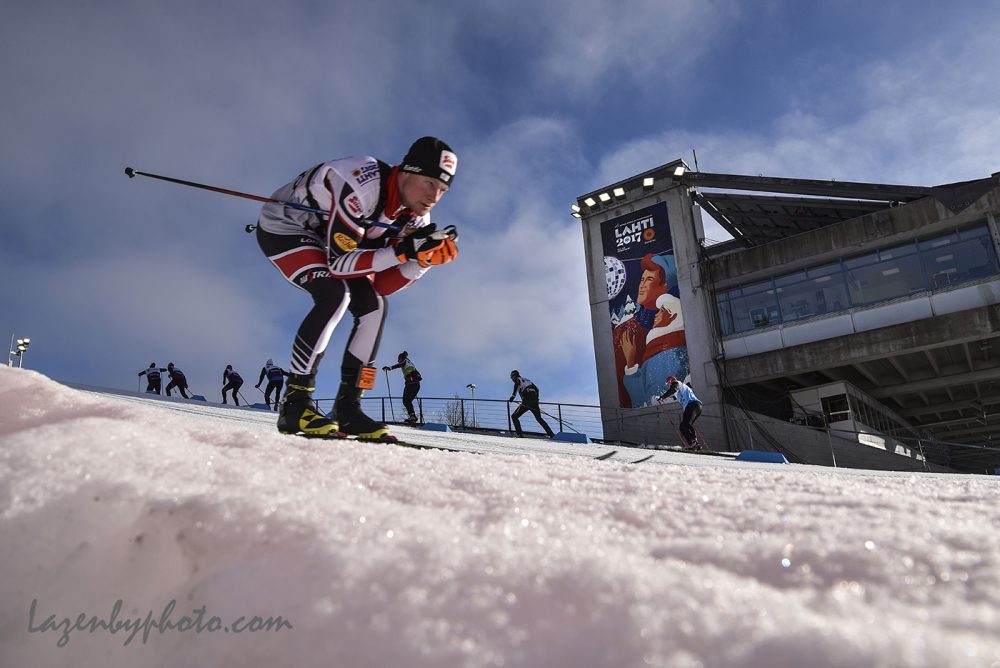
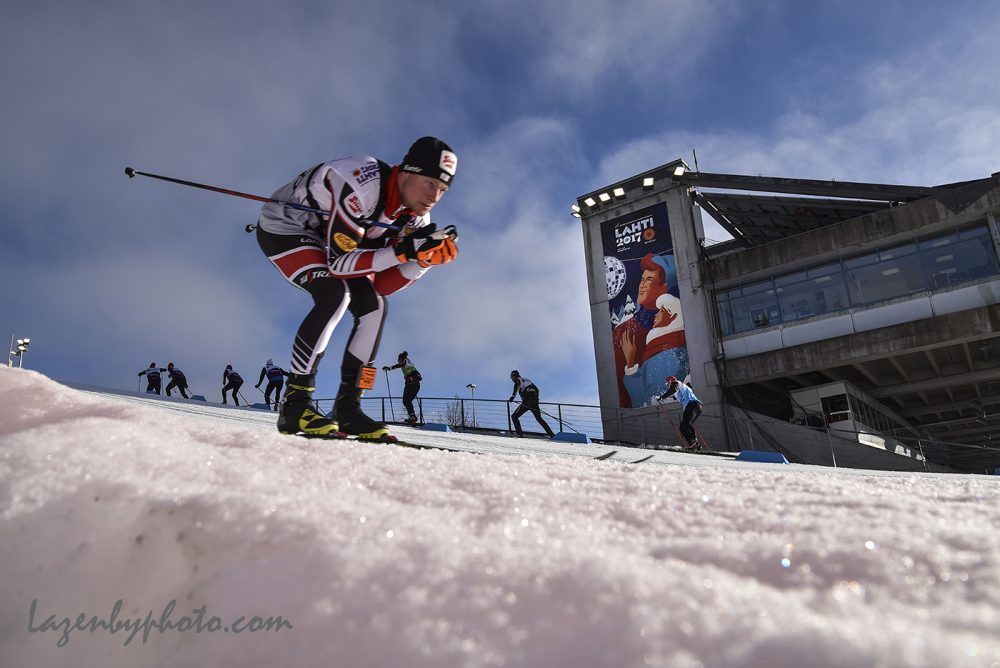
An Austrian athlete tests skis as he glides back into the main stadium. (Photo: John Lazenby/Lazenbyphoto.com)
LAHTI, Finland — Tuesday at Lahti’s venue for the 2017 Nordic World Ski Championships, the sun sets early. Although technically sunset was 5:22 p.m., the sun on this clear-sky day was still wintertime reluctant. It seemed too short a time for the sun’s transect to thaw Lahti. Temps were in the mid-to-low 20 degrees Fahrenheit. But a brisk wind called for down coats and insulated pants for those not actively skiing — in the shade, it felt like the teens.
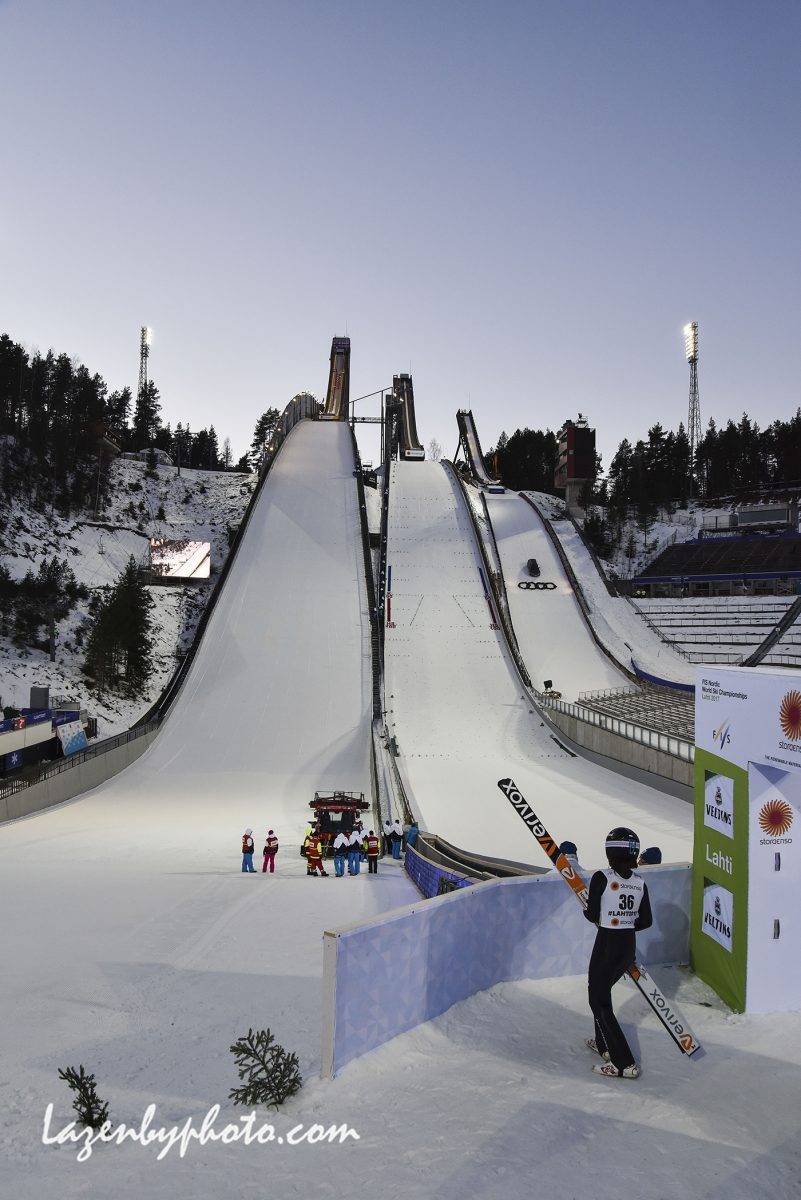
Basked in an early evening glow, Lahti’s three iconic ski jumps dominate the 2017 Nordic World Championships venue. (Photo: John Lazenby/Lazenbyphoto.com)
For athletes, it was a day of pre-competition ski and wax testing on bulletproof tracks that gradually deteriorated on the steeper climbs. The ski loops have good coverage. The snow remains coarse, as the tracks are covered with predominately manmade snow with trace amounts of natural snow tilled in.
Lahti’s most dominant feature are its ski jumps, which are among the first objects to catch morning light. The surrounding landscape isn’t marked by serrated mountains, but by subtle hills that make the venue’s three domineering jumps (a K 116, K 90, and K 64), that much more ominous. First nordic-combined skiers then women’s ski jumpers had an opportunity for test flights off the K 90.
On the non-skiing side of things, the venue was abuzz of last-minute prep: television cables being covered for protection before the onslaught of spectators, event producers testing the stadium’s Skycam, sponsors unpacking schwag, and media arriving to pick up credentials. Like the athletes fine tuning before the competition begins, Lahti’s organizers are near set for the big show.
On Wednesday, two qualification races will ensue: the women’s 5-kilometer classic and men’s 10 k classic individual starts. These races are for athletes from “non-skiing” nations who have not met the FIS-point benchmark to participate in the championships. Start rights to Lahti’s distance races are granted to the top-10 male and female finishers. (All skiers are granted start rights for Thursday’s freestyle sprint regardless of their results in Wednesday’s qualifier.)
HOUGHTON, Mich. — Three days of racing at U.S. Cross Country Championships on the Michigan Tech Trails down and just one more to go with the 1.5-kilometer classic sprint taking place on Saturday. Check out the following photo gallery featuring some of the top moment’s from Thursday’s 20 and 30 k freestyle mass starts.
Photo: Tad Elliott of Ski and Snowboard Club Vail crosses the line in first for the men’s 30 k freestyle mass start on Thursday at U.S. nationals in Houghton, Mich. (Photo: Christopher Schmidt)
Photo: Early on in the of the men’s 30 k freestyle mass start on Thursday at U.S. nationals in Houghton, Mich. (Photo: Christopher Schmidt)
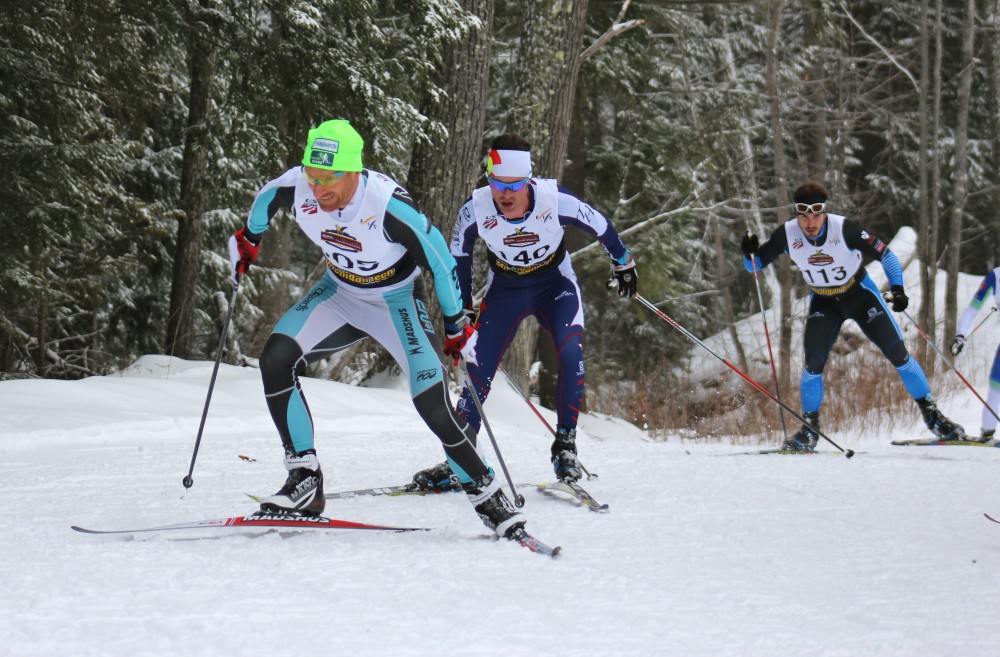
Photo: (right to left) Matt Liebsch of Gear West/Salomon leads Kevin Sandau of the Alberta World Cup Academy and Brian Gregg of Team Gregg/Madshus early in the men’s 30 k freestyle mass start on Thursday at U.S. nationals in Houghton, Mich. Gregg went on to finish second overall, while Sandau took seventh, Liebsch eighth. (Photo: Christopher Schmidt)
Photo: (right to left) Canada’s NDC Thunder Bay athlete Michael Somppi crests the top of a hill in first, ahead of Brian Gregg of Team Gregg/Madshus, Northern Michigan University’s Adam Martin, and Alaska Pacific University’s Scott Patterson, during the first lap of the men’s 30 k freestyle mass start in Houghton, Mich. Somppi went on to finish third overall, Gregg second, Martin fourth, and Patterson fifth. (Photo: Christopher Schmidt)
Photo: Racers (left to right) Kyle Bratrud of CXC, followed by Northern Michigan University’s Adam Martin and teammate Jake Brown, along with Team Freebird’s Kris Freeman chasing a break away group of Brian Gregg (Team Gregg/Madshus) (not shown), Tad Elliot (Ski and Snowboard Club Vail) (not shown), and Kevin Sandau (AWCA) (not shown) half-way throught the second lap of the men’s 20 k freestyle mass start race on Thursday at U.S. nationals in Houghton, Mich. Bratrud went on to place tenth overall, Martin fourth, Brown sixth, and Freeman ninth.
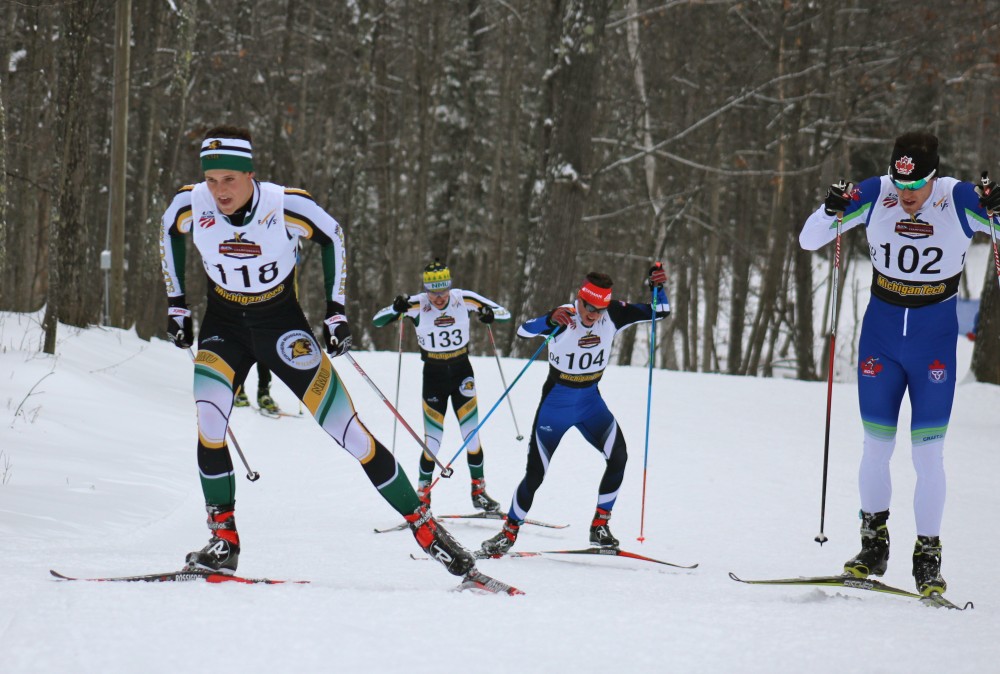
Photo: The front pack (right to left) led by Team Freebird’s Kris Freeman, Ski and Snowboard Club Vail’s Tad Elliot, Alaska Pacific University’s Scott Patterson, Northern Michigan University skier Adam Martin, and Gear West/Salomon skier Matt Liebsch during the third lap of the men’s 30 k mass start at U.S. nationals in Houghton, Mich. Elliot eventually surpassed Freeman and took the overall win. Patterson claimed fifth, Martin fourth, Liebsch eighth, and Freeman ninth.
Photo: (left to right) Kris Freeman of Team Freebird leads Tad Elliot of Ski and Snowboard Club Vail, Alaska Pacific Universit skier Scott Patterson, CXC skier Kyle Bratrud, Canadian NDC Thunder Bay athlete Michael Somppi, and Gear West/Salomon skier Matt Liebsch during the men’s 30 k freestyle mass start on Thursday at U.S. nationals in Houghton, Mich. Tad eventually took first, Freeman ninth, Patterson fifth, an Somppi third, Bratrud tenth, and Liebsch eighth. (Photo: Christopher Schmidt)
Photo: Tad Elliott of Ski and Snowboard Club Vail takes charge and and the overall win of the men’s 30 k freestyle mass start on Thursday at U.S. nationals in Houghton, Michigan. (Photo: Christopher Schmidt)
Photo: Racers (left to right) Adam Martin of Norther Michigan University, teammate Jake Brown, Alaska Pacific University skier Scott Patterson, and Canadian NDC Thunder Bay skier Michael Somppi battle it our for third during the final 150-meters of the men’s 30 k freestyle mass start race on Thursday at U.S. nationals in Houghton, Mich. Somppi eventually overtook Martin for the third place spot overall. Martin placed fourth, Patterson fifth, and Brown sixth.
Photo: Racers take off out of the stadium during the women’s 20 k freestyle mass start on Thursday at U.S. nationals in Houghton, Mich. (Photo: Christopher Schmidt)
Photo: A lead pack develops early on with (right to left) Craftsbury Green Racing Project’s Caitlin Patterson, Stratton Mountain School skiers Anne Hart and Katharine Ogden, Alaska Pacific University’s Chelsea Holmes, and Boulder Nordic Junior Racing Team coach, Eliska Hajkova during the women’s 20 k mass start on Thursday at U.S. nationals in Houghton, Mich. (Photo: Christopher Schmidt)
Photo: (left to right) Alaska Pacific University skier Chelsea Holmes heads the front group of racers, including Craftsbury Green Racing Project skier Caitlin Patterson, Stratton Mountain School skiers Anne Hart and Katharine Ogden, Boulder Nordic Junior Racing Team coach Eliska Hajkova, and SMST2 skier Erika Flowers during the women’s 20 k freestyle mass start on Thursday at U.S. nationals in Houghton, Mich. Patterson later surpassed Holmes for the overall win. Holmes took second, Ogden third, Hart fourth, Flowers fifth, and Hajkova sixth.
Photo: Alaska Pacific University skier Becca Rorabaugh (l) and Middlebury College racer Kelsey Phinney racing to an eighth and seventh place respectively during the women’s 20 k freestyle mass start on Thursday at U.S. nationals in Houghton, Mich.
Photo: Kaitlynn Miller of the Craftsbury Green Racing Project follows Sun Valley Ski Education Foundation skier Mary Rose during the second lap of the woomen’s 20 k freestyle mass start on Thursday at U.S. nationals in Houghton, Mich. Miller went on to place tenth overall.
Photo: (left to right) Alaska Pacific skier Chelsea Holmes skiing in front of Stratton Mountain skier Katharine Ogden and SMST2 teammate Anne Hart, as well as Craftsbury Green Racing Project skier Caitlin Patterson during the women’s 20 k freestyle mass start on Thursday at U.S. nationals in Houghton, Mich. (Photo: Christopher Schmidt)
Photo: Caitlin Patterson of the Craftsbury Green Racing project races to another championship title during the women’s 20 k freestyle mass start on Thursday at U.S. nationals in Houghton, Mich.
Photo: Stratton Mountain Skier Katherine Ogden raced to a third overall finish in the women’s 20 k freestyle mass start on Thursday at U.S. nationals in Houghton, Mich. (Photo: Christopher Schmidt)
Photo: Erika Flowers skiing for Stratton Mountain School crossed the finish line in fifth after the women’s 20 k freestyle mass start on Thursday at U.S. nationals in Houghton, Mich. Flowers was the third SMST2 female skier to cross the line in the top five, behind teammate Anne Hart who took fourth and Katharine Ogden who placed third (not shown).
Photo: Boulder Nordic Junior Racing Team coach, Eliska Hajkova racing the final 100-meters to finish sixth overall in the women’s 20 k freestyle mass start on Thursday at U.S. nationals in Houghton, Mich.
Canadian Olivia Bouffard-Nesbit of the Alberta World Cup Academy races to a ninth place finish during the women’s 20 k freestyle mass start at 2016 U.S. National Championships in Houghton, Michigan. (Photo: Christopher Schmidt)
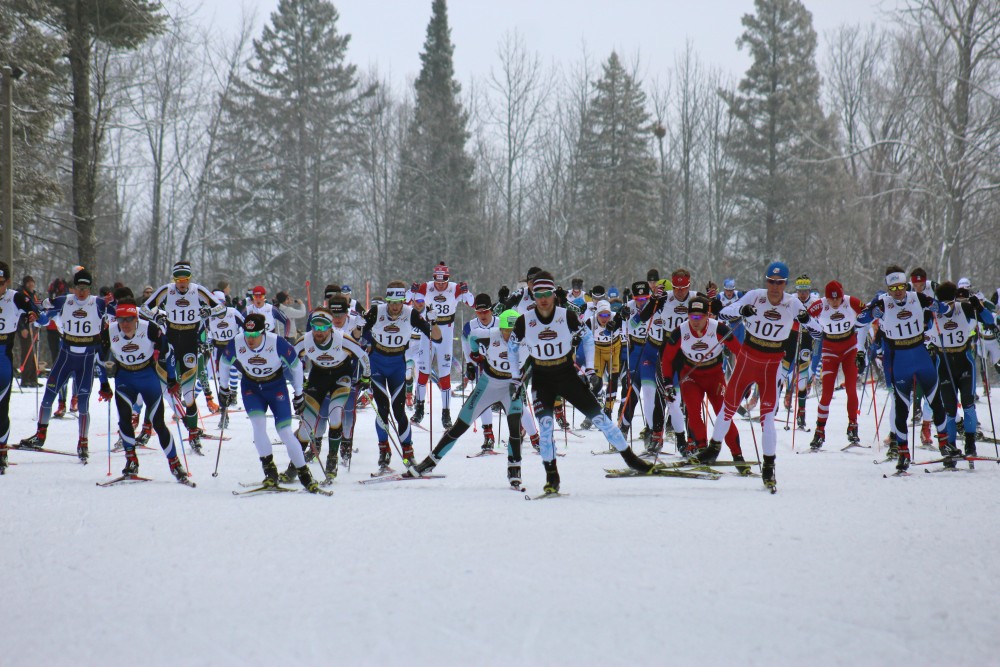
The men start the 30 k freestyle mass start at U.S. Nationals in Houghton, Mich.
Note: This article has been updated to reflect that Tad Elliott has won four national distance races, including the 50 k skate in 2010 in Fort Kent, Maine.
HOUGHTON, Mich. — Although Tad Elliott’s name may have been missing from the top of U.S. results recently, at the 2016 U.S. Cross Country Ski Championships on Thursday, the former U.S. Ski Team member showed he’s still got it.
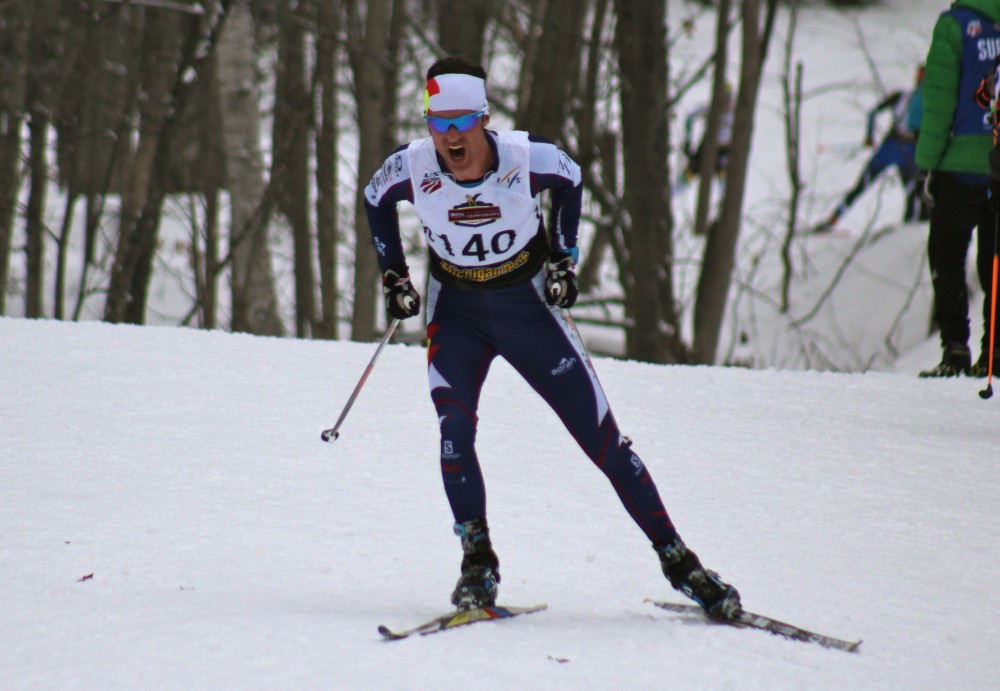
Elliott, 27, a longtime racer with Ski and Snowboard Club Vail (SSCV), made a move in the last three kilometers that went unanswered in the men’s 30 k freestyle mass start, and he entered the stadium with a comfortable berth over Brian Gregg (Team Gregg), winning by 9.6 seconds in 1:20:31.6.
Gregg held off a strong finish by Michael Somppi of Canada’s National Development Centre-Thunder Bay to secure second place, 3.7 seconds ahead of Somppi in fourth.
Over the last two years, Elliott has battled illness, forcing him to take nine months off from training, and endured multiple hospital stays due to complications of Epstein-Barr. Since then, Elliott struggled to attain the same level of results he had grown accustomed to prior — as one of the most promising distance skiers on U.S. Ski Team from 2011 to 2013. However, his upward trajectory began last season when he finished 14th at the American Birkebeiner ski marathon and 11th in the 50 k freestyle mass start at U.S. Distance Nationals in Sun Valley.
Tad Elliott cruises to his fourth-career national title in the 30 k freestyle mass start at U.S. Nationals in Houghton, Mich.
He competed in both SuperTour weekends this year, finishing 25th in the 15 k skate in West Yellowstone, Mont., and 15th in the 15 k classic in Sun Valley, Idaho, allowing him to enter this weekend flying somewhat under the radar.
“Before this week I knew I was in my best form for a long time, but could only dream of a podium,” Elliott said after Thursday’s win — his fourth national title following victories in 2010, 2011 and 2012 at nationals in Maine: first in the 50 k skate in Fort Kent, then in the 30 k skate and 15 k skate in Rumford.
This year’s 30 k skate mass start consisted of three laps around the 10 k course on the Michigan Tech Trails. About an inch of new snow had fallen overnight and racers awoke to a foggy and warm morning. Temperatures hovered around 30 degrees at race time when 91 men lined up for the event.
Since start positions are based on recent International Ski Federation (FIS) points, Elliott started in bib 140 and had to fight through the field to reach the front on the first lap. Elliott and the rest of the podium contenders stayed out of trouble out of the start, avoiding broken poles and navigating the high-speed hairpin turn two kilometer into the race.
Canadian Kevin Sandau (Alberta World Cup Academy) made the first decisive move at the end of the first lap just before 10 k. Scott Patterson of Alaska Pacific University (APU) answered Sandau’s attack, and the two gapped the field by 50 to 60 meters.
Meanwhile, Gregg was concerned with the strength of Patterson and Sandau together up the trail.
“I was nervous we wouldn’t be able to bring those guys back so I put pretty big surge in to bring them back,” Gregg said. “Unfortunately I brought six to eight skiers along with me. I was hoping it would be a bit smaller than that.”
Sandau’s move ended up establishing the the lead group. “Everyone was hurting and that was for sure the hardest part of the race for me and I think a lot of people today,” Somppi explained. “Once we regrouped and got into our 10-, 11-person pack then it was a lot easier and more chill. I just hung out in the group and waited for the finish.”
The resulting group of 11 consisted of Elliott, Gregg, Somppi, Sandau, Adam Martin and Jake Brown of Northern Michigan University (NMU), Patterson, Matt Liebsch (Gear West), Kyle Bratrud (CXC) and Kris Freeman (Freebird) .
“It was awesome to ski with Jake, who I’ve been training with all fall,” Martin said. “Jake led the pace for a good part of the second lap and it was pretty sweet to ski behind him. It just felt like an L3 workout at practice this fall.”
Patterson was another consistent presence at the front of the lead pack.
“I led a lot of the race, but my skis weren’t quite in the game today,” Patterson said. “I think I was one of the strongest in the field, but a little off on skis and that makes it a bit harder.”
The lead group stayed intact until Elliott made his statement.
“It was pretty steady until about three ‘k’ to the finish when Tad Elliott made a strong move and Brian kinda latched onto him,” Patterson described.
Gregg (Team Gregg) leads Elliot (SSVC) during the 30 k freestyle mass start at U.S. Nationals in Houghton, Mich. Elliott went on to win the race and Gregg took second.
Elliott’s move wasn’t completely premeditated, but it proved crucial.
“It was not planned before the race or during,” the eventual winner said. “I knew I had to drop Gregg for a chance to win. He is the best closer out there. My plan was to wait until 400 meters, but the opportunity was there and I felt amazing.”
With Gregg unable to match him, Elliott celebrated across the line.
“Tad was looking really strong. We’ve been teammates and friends for a long time so it is great to see him back on top,” said Gregg, who was Elliott’s former teammate on Central Cross Country (CXC).
After the race Elliott was thankful more than anything.
“I’m pretty thankful for my support team. It’s been a while since I’ve been at the front of a race and went through kind of a lot the past two years so I was really excited,” he said.
“My twin brother waxed my skis they were probably the best in the field,” Elliott added. “[I’ve had] Vail support me for a long time as well as Caldwell Sport who was helped me come back from my illness. This is a really big one for me and it feels like a huge team win.”
Somppi was happy for a podium while feeling less than optimal.
“I came here hoping to win but I’m feeling a bit worn out,” he said. “I raced Period 1 of the World Cup and I sick from coming back from Europe. It was a short ten days at home with some sickness and then come down here so it’s been tough racing.”
Adam Martin (l) leads Patterson (r) and NMU teammate Brown during Thursday’s 30 k freestyle mass start at U.S. Nationals in Houghton, Mich.
Since Somppi is Canadian, Martin made the American podium in third and was ecstatic about his race.
“In the past I’ve been much stronger in classic races so to get fourth today that was a huge surprise and I’m really satisfied with that,” Martin said.
Gregg was happy for Elliott’s success as well as his own performance.
“Today was really fun, felt like my skis were one of the best in the field,” he said. “I was trying to stay in the front group and conserve energy.”
As for the rest of the season, Gregg is looking to regain the overall SuperTour lead as he returns to the domestic circuit. Patterson will leave the domestic circuit this month as he earned World Cup starts as the Period 1 SuperTour leader.
Last season’s overall NorAm champion, Somppi will return to the Canadian circuit and race the next NorAm in his hometown of Thunder Bay, Ontario, a qualifying race for the Canadian World Cups in March.
As for Elliott: “We haven’t really talked about it yet,” his coach, Eric Pepper, said. “We had to see how this went first, but he will primarily focus the Birkie.
“Tad’s dealt with a lot the past couple years and to come back and win a race, and win it like that, it was just awesome,” Pepper continued.
SUN VALLEY, Idaho — Although the 30- and 50-kilometer freestyle mass starts at the 2015 U.S. Distance Nationals took place last Thursday, we’re still reminiscing about the amazing races, sun, and merriment that took place on the trails of Galena Lodge. Check out our photos of day’s events below to relive Caitlin Gregg’s astounding 30 k victory or Ivan Babikov’s smart skiing in the 50 k.
2015 U.S. Distance Nationals 50 k freestyle mass start in Sun Valley, Idaho.
2015 U.S. Distance Nationals 50 k freestyle mass start in Sun Valley, Idaho.
2015 U.S. Distance Nationals 50 k freestyle mass start in Sun Valley, Idaho.
2015 U.S. Distance Nationals 50 k freestyle mass start in Sun Valley, Idaho.
2015 U.S. Distance Nationals 50 k freestyle mass start in Sun Valley, Idaho.
2015 U.S. Distance Nationals 50 k freestyle mass start in Sun Valley, Idaho.
2015 U.S. Distance Nationals 50 k freestyle mass start in Sun Valley, Idaho.
2015 U.S. Distance Nationals 50 k freestyle mass start in Sun Valley, Idaho.
2015 U.S. Distance Nationals 50 k freestyle mass start in Sun Valley, Idaho.
2015 U.S. Distance Nationals 50 k freestyle mass start in Sun Valley, Idaho.
Caitlin Gregg (Team Gregg) leads the start of the women’s National Championships 30 k freestyle mass start at the 2015 SuperTour Finals in Sun Valley, Idaho.
2015 U.S. Distance Nationals 30 k freestyle mass start in Sun Valley, Idaho.
2015 U.S. Distance Nationals in Sun Valley, Idaho.
2015 U.S. Distance Nationals 30 k freestyle mass start in Sun Valley, Idaho.
2015 U.S. Distance Nationals 30 k freestyle mass start in Sun Valley, Idaho.
2015 U.S. Distance Nationals 30 k freestyle mass start in Sun Valley, Idaho.
2015 U.S. Distance Nationals 30 k freestyle mass start in Sun Valley, Idaho.
Caitlin Gregg (Team Gregg/Madshus) skis to a nearly three minute win in the 2015 U.S. Distance Nationals 30 k in Sun Valley, Idaho.
2015 U.S. Distance Nationals 30 k freestyle mass start in Sun Valley, Idaho.
2015 U.S. Distance Nationals 30 k freestyle mass start in Sun Valley, Idaho.
2015 U.S. Distance Nationals 30 k freestyle mass start in Sun Valley, Idaho.
2015 U.S. Distance Nationals in Sun Valley, Idaho.
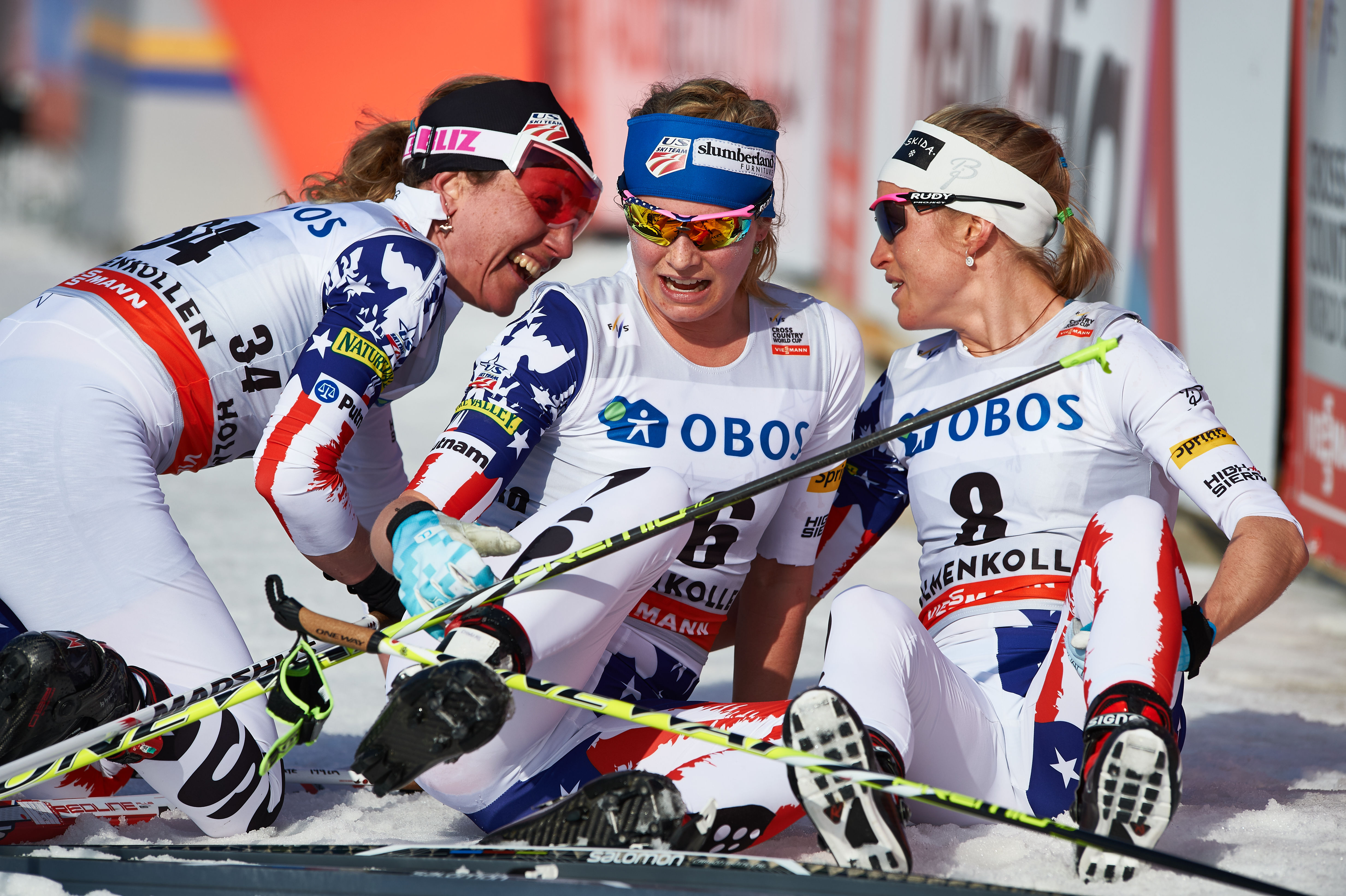
USST’s Caitlin Gregg (r), Jessie Diggins (c) and Liz Stephen (r) in the finish of the 2015 Holmenkollen 30 k which served as the last race of the 2015 World Cup season. Stephen led the three in ninth, while Diggins and Gregg Placed 14th and 19th. (Photo: Madshus/Nordic Focus)
Liz Stephen led a trio of Americans placing in the top 20 of Sunday’s 30-kilometer freestyle mass start in Holmenkollen, Norway – the final World Cup race of the season.
Stephen finished in ninth to earn her sixth individual top-10 finish of the 2014/2015 World Cup season. She was 2:06.7 minutes behind Marit Bjørgen of Norway, who sprinted away from teammate Therese Johaug in the final kilometer to win in a time of 1:14:10.5 and put the finishing touch on her overall World Cup title.
Stephen was fifth after 16.3 k, and led the main chase pack throughout much of the final lap. However, she fell behind in the final kilometer and came across the line 17.5 seconds outside the top five.
Stephen finished the season 10th in the overall World Cup standings and seventh in the distance standings.
The East Montpellier, Vt. native said that she entered Sunday’s race with a goal of reaching the top five and had her sights set on Norway’s Heidi Weng. She explained that to fight for her goal, risks were necessary.
“I took some chances and almost blew up at points. A good indicator for me is when my stomach is knotted and I wanted to throw up which came earlier than usual,” Stephen told USSA in a press release, adding that while she finished four spots away from her goal, she considered the day a success.
With the culmination of the 2015 World Cup season Stephen said the many personal and team achievements of the year gave her hope for the future. Stephen earned a historic fifth-place finish in the 2015 Tour de Ski and claimed the best finish by an American woman in a distance World Cup with her silver medal in the Rybinsk 10 k freestyle.
“The top of the race is closer now. It gives me hope for next year and years in the future,” she said to USSA. “I’m really happy with the day. I’m really happy with the season.”
Jessie Diggins, silver medalist in the 10 k freestyle at the 2015 World Championships, was the second American to finish, coming through by herself in 14th (+2:44.0). She claimed her eighth individual top-15 World Cup finish of the season and ended the season 22nd in the World Cup standings.
Diggins wrote in an email to FasterSkier that she was happy with her race and the World Cup season as a whole. “My skis were great and I was skiing with a pack that didn’t exchange skis so I didn’t either, and it worked out great to be on one pair for the whole race.”
However, Diggins explained that she probably went out too hard, as she was with the lead pack around the 8 k mark but had to settle into the chase group shortly afterward. In addition, she began cramping in her lower quadriceps during the final few kilometers.
“I’ve never had cramping in a race before, so it was totally unexpected, and my legs kept twitching and it was really hard to move!” she wrote.
She explained that instead of trying for a top-10 finish, at that point she was just hoping to get to the finish line “in one piece.”
“I was fine once I got out of the hot sun after the race,” Diggins added.
Meanwhile, Caitlin Gregg finished in 19th (+3:07.7), three weeks after taking bronze in the 10 k freestyle at the 2015 FIS Nordic World Ski Championships in Falun, Sweden.
Gregg said in a phone interview that in previous seasons she would be more excited about Sunday’s result, but her recent successes have left her with higher expectations.
“I’m a little bit bummed, because I was definitely skiing in a place where I was fighting for a top-ten finish and I was feeling really good,” she said.
Gregg put herself in a good position early in the race – she was eighth at the 8 k mark, just 16 seconds off the lead. At that point, she was in a chase pack of roughly six other skiers and feeling strong.
Caitlin Gregg racing to bronze in the 10 k freestyle at 2015 World Championships in Falun, Sweden. Gregg placed 19th in Sunday’s 30 k freestyle mass start in Holmenkollen, Norway. (Photo: Madshus/NordicFocus)
However, she said she picked her second-best pair of skis for the race, expecting the other skiers to exchange their skis at the 13 k point like in previous years. But when the leaders, Bjørgen and Johaug, did not switch, no one in the chase pack did either.
“The skis I selected were a bit stiffer … and as the course broke down I realized they were way too stiff, and areas where I usually would feel the greatest, on those long inclines through some pretty deep slush, my skis were just bogging down and I was struggling,” Gregg said.
As a result, she was caught by another pack and fell to 17th by the 24.3 k point, before finishing the race in the back of that pack.
“Skiing Holmenkollen on your second-best pair of skis isn’t really what you want to do, so it leaves you with that ‘what if?’ feeling. But that’s why we do this; it’s a fun experiment. You’re always playing and the strategy is a cool part of it,” Gregg explained.
Gregg is thrilled with the 2015 season, especially given the fact she dealt with shingles early in the World Cup season. In addition to her performance at World Championships, she won the 10 k freestyle and was second in the freestyle sprint at U.S. Nationals and took third in last weekend’s 42 k mass start Marathon Cup race in Engadin, Switzerland.
“Just being on the World Cup is a pretty incredible experience … I feel like I’ve definitely figured out how to ski on the World Cup, how to travel on the World Cup, how the whole system operates,” she said.
She added that it is a great feeling to know she is finishing strong.
Three other Americans finished in the famed 30 k. Sadie Bjornsen took 44th (+6:59.0) and finishes the season 23rd in the World Cup standings, Caitlin Patterson was 53rd (+8:53.3), and Rosie Brennan finished in 55th (+10:22.7).
The lone Canadian in the field, Emily Nishikawa, took 50th (+8:04.1).
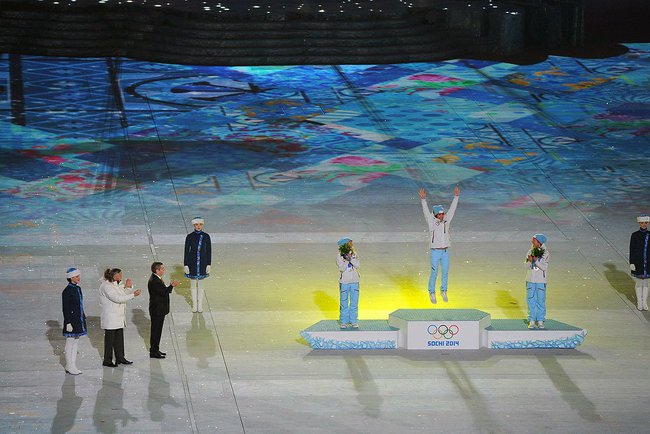
Kristin Størmer Steira (r) on the podium at the Sochi Olympics closing ceremony with teammates Marit Bjørgen (jumping) and Therese Johaug, after Norway swept the podium in the women’s 30 k freestyle mass start, the last cross-country race of the Olympics. (Photo: Wikimedia Commons)
Note: This article has been updated to include Kristin Størmer Steira’s most recent athletic accomplishment as 10,000-meter champion at Norwegian Athletics Championships on Sunday. It was her first time running the 10,000, according to VG.
***
If you asked Kristin Størmer Steira about the ‘R’ word six months ago, the Norwegian national-team member might’ve told you she was considering it.
A not-so-hot start to her third Olympics had left the then-32-year-old Steira contemplating retirement. Never before had she been outside the top 10 at the Olympics, and in two previous 15-kilometer skiathlons at back-to-back Olympic Games, she placed fourth.
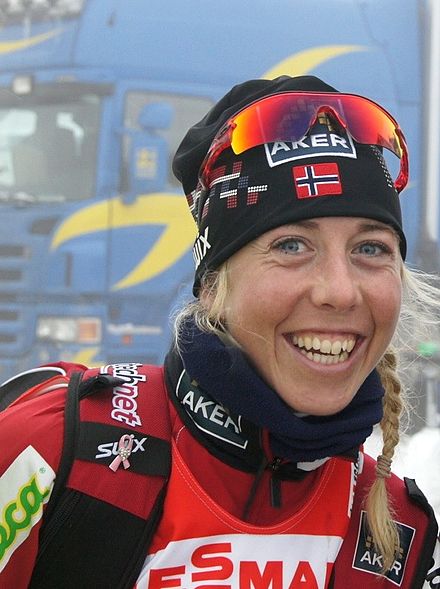
Kristin Størmer Steira in 2012 (Photo: Wikimedia Commons)
But in Sochi, she was 23rd — not bad, but not to her standards.
Her next chance came in the 30 k freestyle mass start, the final race of the Sochi Games.
In a seemingly seamless race for three Norwegians, Steira placed third behind her two teammates Marit Bjørgen and Therese Johaug, respectively. It was her first Olympic medal in eight individual starts.
“My Olympics went from the worst competition I’ve ever had to maybe the best,” Steira said on the phone from Norway earlier this summer. “It was a special Olympics for sure.”
Before the races began, her team had to cope with the sudden passing of teammate Astrid Jacobsen’s brother, a skier whom many of the national-team members were close with.
“It was a lot of feelings, a lot of emotions,” Steira recalled. “We had a rough time in our team … but in the end, to have a medal in the 30 k … I really, really felt that I worked hard for that and to be able to do it when it counts was a great feeling.”
She also had the unique experience of standing on the podium at the closing ceremony in front of 40,000 spectators and millions more who watched on TV.
“It was maybe the best day for being on the podium,” Steira said. “You felt kind of small getting up on stage with the crowd and the stadium. I’ll never experience [that] again.”
One might ask, why not? With four individual World Championships podiums and 22 World Cup podiums in the last 12 years, and after placing second in the rollerski hill climb at the Blink Festival in Norway earlier this month, how does she know when it’ll be over?
She doesn’t, but she was thinking about it after Sochi.
“I was more towards not doing another year and I guess the medal in the 30 k both made me kind of feel [like] I could stop skiing — I managed to do what I planned to do: have a medal individually in the Olympics,” she said. “On the other side, it also makes you so motivated to do another year. I guess when I was thinking about it, it counted both ways.”
“I want to learn something other than classic and skating and technique, to put my mind a bit on other stuff and also start preparing for the next step — whatever that will be.” — Kristin Størmer Steira, Norwegian national-team member & three-time Olympian
So here she is, 33 and revving up for the 2015 World Championships in Falun, Sweden.
“It’s close to Norway,” she said of her decision to focus on Falun and race for another season. “I think it will be amazing [at World Championships] … a lot of people, but I guess in the end mostly the motivation was still there and I love skiing and I wanted to give it one more year, mostly because it was so fun.”
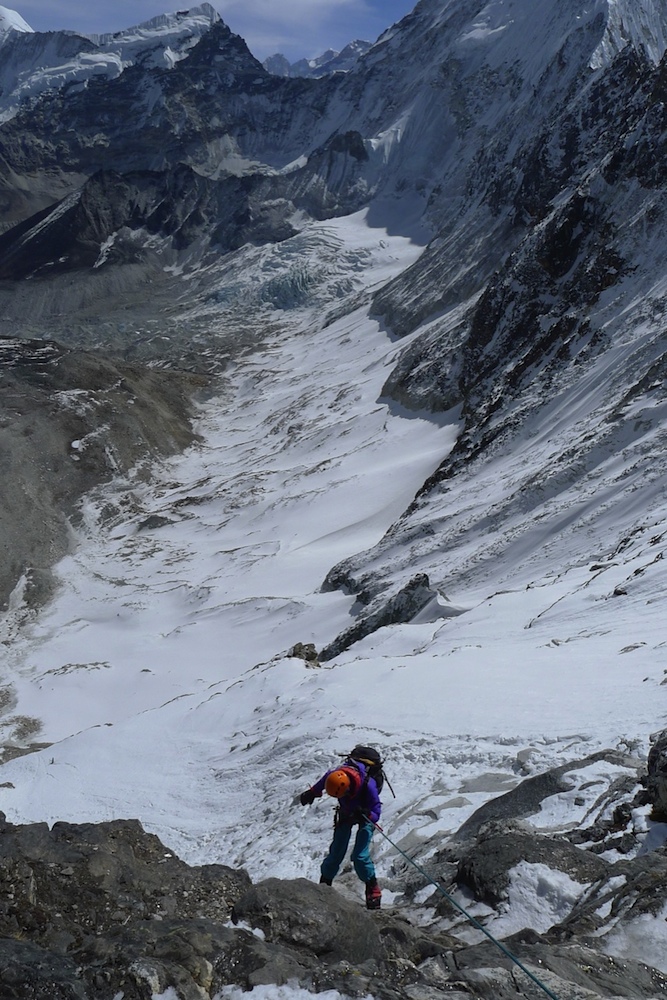
Kristin Størmer Steira rappels during their Himalayan trek. (Photo: Devon Kershaw)
In late April, she got sick during a three-week excursion in the Himalayas. She left Kathmandu with a ring on her finger, thanks to fiancé Devon Kershaw, but it took her some time to shake the parasite she contracted on her way up the 6,476-meter (21,000-foot) Mera Peak.
“Early summer was not quite as planned … I still struggled to recover after illness in Nepal,” she wrote on her blog.
After spending some time with family, “hiking, swimming, grilling,” she worked back into her full-training load before Blink and her team’s training camps in August.
Steira missed the women’s team’s June camp in Hemsedal because she wasn’t fully recovered, but was back with them in Lillehammer earlier this month. She said they planned to train in Italy in late August-early September, and will be back in Norway in October.
“We normally have been in Italy in the last week of June-first week of July, but since worlds is not at altitude we decided not to,” she said of the altitude camp.
On Sunday, she ran the 10,000-meter distance event at Norwegian Athletics Championships and won it by a minute and 46 seconds. Norway’s VG asked Athletics Association Director Ronny Nilsen whether that was embarrassing for the sport.
“No, it is not,” he said, according to a translation. “Kristin is strong, and there were several good runners that were missing at the starting line.”
Steira said “it was a pity” that so many top runners didn’t start, but it wasn’t embarrassing. She simply dropped the pack early.
“Ten-thousand [meters] is a distance that suits a skier well,” she told VG. “But athletes certainly wish there were more people to compete with.”
After the race, she tweeted that she was celebrating her 10,000-meter debut with coffee.
“Ten-thousand [meters] is a distance that suits a skier well.” — Steira on her 10,000-meter win in her debut at Norwegian Athletics Championships
Back to Skiing
Looking ahead to Falun, Steira couldn’t say exactly what was next — except for no more Olympics.
“I do not have a long-term plan for my skiing, but I learned from my earlier mistakes saying this is my last year,” she said. “But I don’t think longer than Falun this year of skiing, then we’ll see. It’s a pretty sweet life so it’s hard to stop doing the thing you love the most. I’m getting older and it’s other things I want to do and have a family and stuff so we’ll see. I will not take another Olympic year, that’s for sure.”
She has a bachelor’s degree in marketing and is starting an MBA program this fall.
“I’m going part time back to school this year mostly because I feel it’s time,” she said. “I want to learn something other than classic and skating and technique, to put my mind a bit on other stuff and also start preparing for the next step — whatever that will be, I’m not sure.”
Her focus will be human resources: mostly concerning personal relationships and working in teams.
“I’m still hoping that Oslo will get the Olympics for 2022, so maybe I’ll get some work for that,” she said. “That could be interesting.”
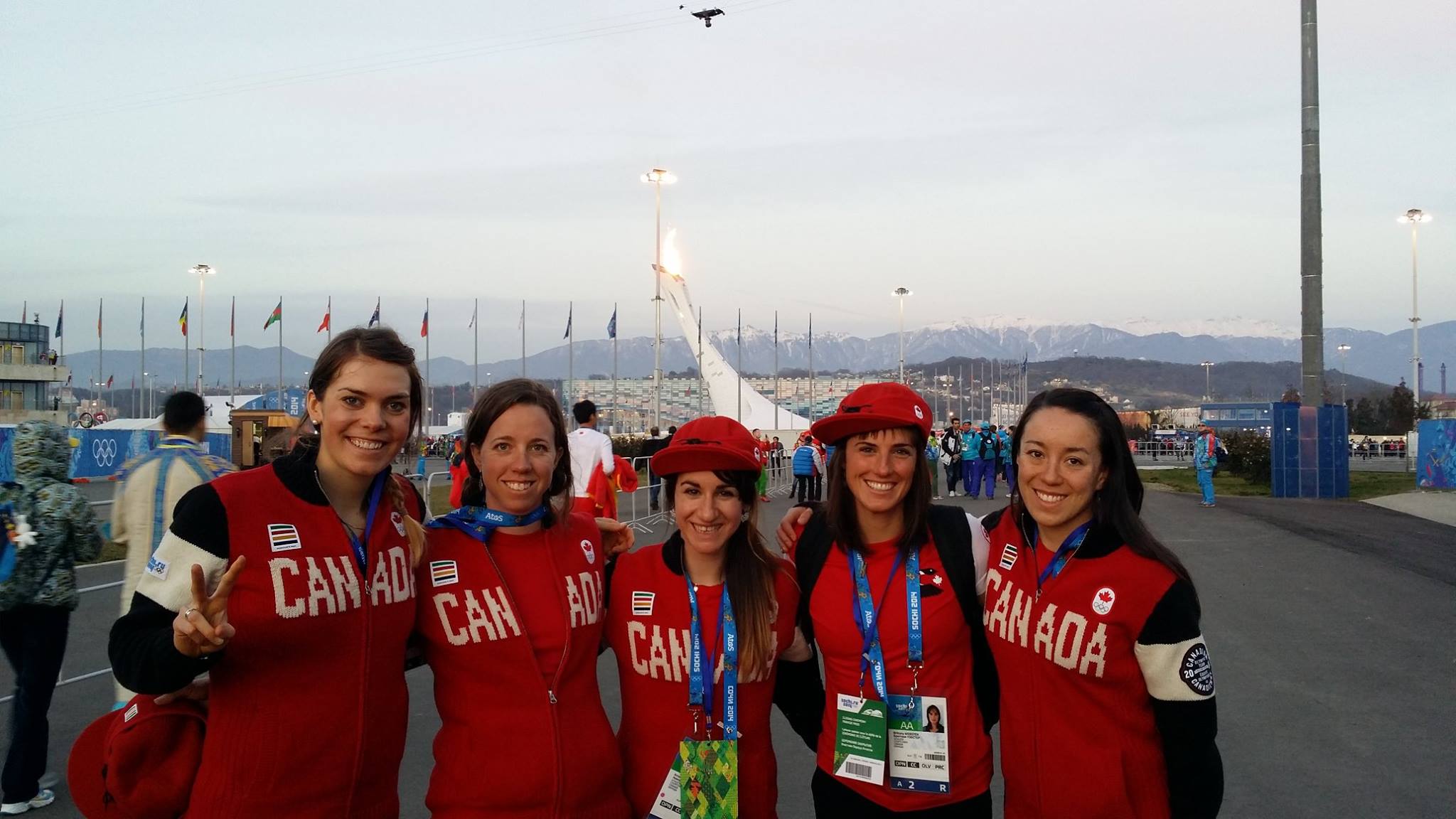
The Canadian women’s team before the Closing Ceremony in Sochi, Russia: (from left to right) Heidi Widmer, Perianne Jones, Amanda Ammar, Brittany Webster, Emily Nishikawa (Photo: Emily Nishikawa)
KRASNAYA POLYANA, Russia — One by one, the four Canadian women in the 30-kilometer freestyle mass start last Saturday, their final race of the Olympics, walked away from the finish line and into the media corrals, assembling as a unit to be interviewed.
Without watching the race, one might’ve guessed they missed the relay; that’s how much of a team these women appeared to be.
Two were teammates on the Alberta World Cup Academy and Canadian Senior Development Team: Emily Nishikawa and Heidi Widmer, both in their first Olympics.
The other two were independent racers, Amanda Ammar, 28, of Team Ninja, and Brittany Webster, 26, of Team Mito.
All had finished within seven places of one another in the 30 k finale, with Webster notching the top result of 46th and Widmer, the youngest on the team at 22, placing 52nd. (On Friday, Widmer turned 23.)
Without the team’s three World Cup sprinters in Perianne Jones, Dasha Gaiazova and Chandra Crawford in the race, the group provided a glimpse of the future of Canadian women’s skiing.
Each had taken different roads to get there — Nishikawa and Widmer more traditionally through the Olympic Team Trials in January, and Ammar and Webster through an appeals process soon after the trials. The latter two, both former national-team members, were in their second Olympics since semi-retiring from the sport a few years ago. Ammar cited injuries and burnout; Webster had gone to the 2010 Vancouver Games but did not compete, then in 2011, decided her slip in results stemmed from a lack of enjoying the sport.
Ammar returned to racing in late 2011, Webster in 2012.
Come the next Winter Olympics, here they were, with two newcomers in Nishikawa, 24, and Widmer as teammates.
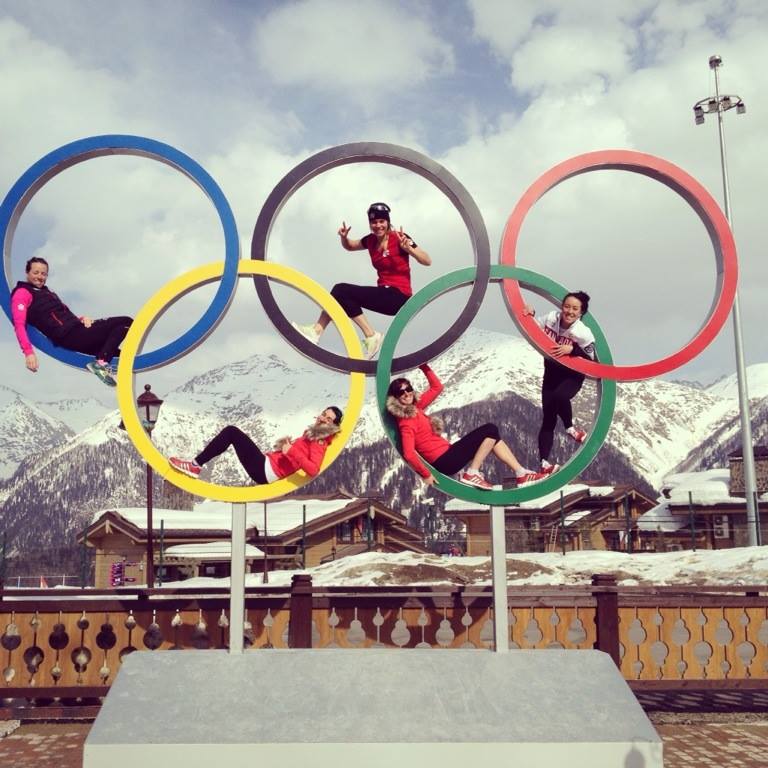
Several members of the Canadian Olympic cross-country ski team get the perfect photo opp at the Olympic rings in Krasnaya Polyana, Russia. (From left to right): Perianne Jones, Amanda Ammar, Heidi Widmer, Brittany Webster, and Emily Nishikawa. (Photo: Emily Nishikawa)
Together, the team had its best results of 11th in the classic team sprint with Jones and Gaiazova, 14th in the 4 x 5 k relay with Jones, Gaiazova, Nishikawa, and Webster, and a top individual result of Jones’ 23rd in the freestyle sprint, just ahead of Gaiazova in 25th.
The 30 k wasn’t a personal best for any of the Canadians, but it was a capstone in their respective careers.
Aside from her result of 49th, Ammar called it her most memorable part of the Sochi Games.
“I’m so proud of these girls — I mean 30 k is so hard,” she said, fighting tears while looking at her teammates. “I know we were all a little terrified, maybe, excited, but anyone who does this race is a hero in my eyes.”
Of her teammates, Ammar said she started the fastest and paid the price. Webster and Nishikawa passed her, and like Widmer, Ammar said that gave her motivation to push harder.
“A 30 k is just an abundance of walls and when you’re going to hit it you never know,” she said.
Webster said it was funny because the ended up within places of one another, but didn’t ski together. Only Ammar changed her skis, which she called “a mistake.”
“They got slower, but so did everyone else’s, I felt like,” Webster said.
Widmer was hoping the competitor she was skiing with would go in for a fresh pair.
“I was secretly like, ‘Please change, please change. OK, we’re not changing, we’re gonna do it,’” she recalled. “But my skis were fast, so I was like ‘If they change, I’ll change,’ but mine were faster so I was like … ‘Maybe I’ll just go chill.’ ”
Widmer went on to beat Croatia’s Vedrana Malec by nearly two seconds in what she called a “slow-motion sprint” to the finish. She had been skiing with Kazakhstan’s Tatyana Ossipova in front of her and Malec behind her for most of the race.
“The last 5 k, the Kazakh broke me and the [Croatian] chick passed me on the last uphill, and then I passed her back,” Widmer said. “I was like, ‘I will stay in front of her if it’s the last thing I do,’ so that was the sole victory.”
The four women laughed together, snapped a group photo and hung out under the sunny and warm skies. They were in no rush, despite being indescribably tired.
After finishing 33 seconds behind Webster in 47th, Nishikawa reflected on her first Olympics.
“From the start of my first race, the pursuit was an incredible feeling — ‘Oh my God, I’m an Olympian!’ ” Nishikawa said. “It was just really cool to realize, ‘Oh, I’m here,’ and I had a great race that day. I’ve had an incredible time here, so I’m incredibly fortunate and just feel incredibly grateful that I had the opportunity to get three Olympic races in.”
“The two words that stick out right now are how proud I am and how inspired I am that you get to represent your country and then you get to race against the best in the world,” Widmer said. “That has inspired you to be that much better, come back stronger.”
Webster praised her teammates after spending three weeks with them at a hotel in the valley town of Rosa Khutor. “It’s been nice to become close to everyone and feel like … for the first time in my entire ski career, I feel we have a great team,” she said. “I’ve never really felt that before.”
The Post-Olympic Period
After the Games, some team members, like Gaiazova, went home.
According to Cross Country Canada, Widmer will join other NorAm leaders, including Andrea Dupont and Alysson Marshall, in the March World Cups, which start this weekend in Lahti, Finland. Jones is the lone woman on the Canadian World Cup team who will be racing there, and Cendrine Browne was also called up for the races based on her results at U23 World Championships.
While Gaiazova could not be reached for comment, she tweeted on Feb. 23, the day after the 30 k: “Really sad to be going home instead of the World Cup races in Scando. Such is life… @cccski good luck to those racing!!!”
Head coach Justin Wadsworth said Gaiazova wanted to leave after she was done racing at the Olympics.
“We did tell her that she’s not welcome on the rest of the World Cup,” he said. “She broke all our team policies and code of conduct.”
After Gaiazova placed 44th in the 10 k classic, her second of four races at the Olympics, Wadsworth said she had “been out partying” the night before.
“We had talked about it at our Olympic briefing, that there’s no partying at the Olympic Games [before your races are over],” Wadsworth said, adding that Cross Country Canada had the paperwork to back that contract up. “She’s appealing it.”
On Feb. 17, Crawford tweeted that she was on her way back to Canmore.
Since the beginning of the season, there have been indications that this would likely be the last Olympics for Jones, Gaiazova, and Crawford, although when each plans to retire has not been publicly laid out.
“I will definitely race ’til 2015 at World Champs in Falun,” Crawford told FasterSkier more than a year ago. “It’s just set in my mind as a for sure, but I’ll probably reevaluate after the Olympics the feasibility of another quadrennial.”
Gaiazova said she’d make a decision after Sochi.
“When I ski race, I put my 100-percent effort into it, and as long as I’m able to do that and as long as there’s desire and determination I think I would be thrilled and honored to continue,” she said around the same time. “And if my priorities shift and something else comes up or for whatever reason I’m not able to perform at 100 percent then, you know, you sort of reevaluate and see if you want to commit to more.”
Marit Bjørgen celebrates a 2.6-second victory over Norwegian teammate Therese Johaug in Saturday’s 30 k freestyle mass start, the last women’s race of the Sochi Olympics.
FasterSkier’s coverage is made possible through the generous support of Swix.
KRASNAYA POLYANA, Russia — Wouldn’t it have been fun to be a fly on the wall, or on the headband of one of the three Norwegian women leading the Olympic 30-kilometer freestyle mass start on Saturday?
The dialogue between Marit Bjørgen, Therese Johaug and Kristin Størmer Steira throughout the three-lap race must’ve been interesting. Who called the shots? Who decided when to lead when? Who directed the charge?
Then again, it sounded like it was fairly straightforward and a matter of executing a plan that didn’t really need verbal cues. With the three skiing alone for the last 20 k of the race, it was basically like a long training session. If anything, the chatter was probably conversational.
After Johaug led early out of the start, the Norwegians’ defining break came at the end of the first 10 k loop. They had already put some time into the women behind them up the unrelenting 2.5 k climb back to the stadium. There, they stuck with their team plan and skipped the first of two possible ski changes. Sweden’s Charlotte Kalla in fourth followed Johaug, Steira and Bjørgen, respectively, just under 5 seconds back.
A full lap later, Kalla was down to 31st, two and a half minutes back behind Bjørgen. No one else was close to the Norwegian trio; Eva Vrabcova-Nyvltova of the Czech Republic led the chase 50 seconds back.
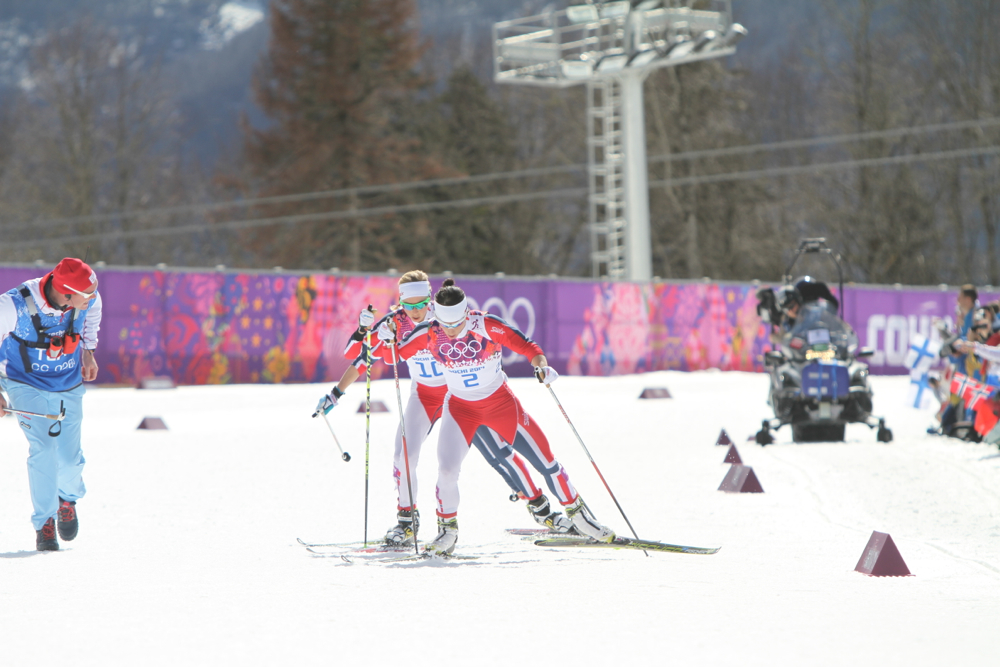
Norway’s Marit Bjørgen leads teammates Kristin Størmer Steira (10) and Therese Johaug (behind) up one of the steep climbs in the 30 k freestyle mass start on Saturday, the final women’s race of the 2014 Sochi Olympics, while Norwegian women’s sprint coach Roar Hjelmeset runs along side them. Bjørgen won by 2.6 seconds over Johaug in second, and 23.6 seconds ahead of Steira in third.
“We have a plan to go as a team the first 20 [kilometers] and after that they have to go for each other,” Norwegian women’s coach Egil Kristiansen said afterward.
According to Johaug and Steira, they had also been instructed to change skis before the final 10 k. They made the executive decision not to, fearing what some 30 seconds in the transition area would cost them.
“Me and Therese decided not to change skis; I think Marit was a bit more insecure,” Steira said in a press conference. “She was in the stadium looking around and she was thinking, if I do the ski change then the other two won’t. We talked about it and got some messages from coaches around 15, 17 k and they told us to change the skis and we were like, ‘No, no we’re not doing it!’ ”
Bjørgen, the well-established queen of cross-country skiing, went with the consensus. Unlike teams like the U.S., which switched to fresh skis at both 10 and 20 k, the Norwegians wore the same pair from start to finish.
The plan worked as they finished nearly a minute ahead of anyone else, with Finland’s Kerttu Niskanen closing hard at the front of the 11-person chase pack and edging Vrabcova-Nyvletova by 0.2 seconds for fourth.
Aside from who would win the race for fourth, the top story of the day materialized in the last few hundred meters of the final climb. Johaug led up the long hill from the lowest point of the course a few kilometers before the finish. Bjørgen sat in second and Steira started to waver in third, allowing some daylight between her and the other two for the first time in the entire race.
Up to that point, the three had generally skied single file on the tails of one another, taking feeds simultaneously and even chatting when the terrain allowed.
Now, Johaug was starting to push. The sense was that Bjørgen would make a move; where was the question.
The 33-year-old Bjørgen, who had already notched two Olympic golds in Sochi, charged over the top of the steep hill before the finish, passing Johaug and immediately gapping her on the downhill.
Johaug, 25, chased her down into the finishing lanes, which ended with a horseshoe-shaped loop and false flat that was actually slightly uphill. Bjørgen took the victory by 2.6 seconds over Johaug with a winning time of 1:11.05.2. Steira finished 23.6 seconds after Bjørgen for bronze, her first individual Olympic medal.
“I’ve tried so many times and I finally succeeded,” Steira, 32, told reporters. “It’s amazing. … It’s been a lot of hard work, but also a lot of fun. [I was] smiling all the way, but when I crossed the finish line, I felt emotional.”
It was Norway’s first Winter Olympics medal sweep since 1994, and 12th overall in the history of the Games.
For Bjørgen, the gold was her sixth, adding to her total Olympic haul of 10 medals, which made her the most successful woman in Winter Olympics history. She equaled the total gold medals won by former Russian speed skater Lidia Skoblikova and former cross-country skier Lyubov Ivanovna Yegorova, also from Russia, and tied former nordic skiers Stefania Belmondo of Italy and Russia’s Raisa Smetanina for 10 Olympic medals.
But her ratio of six golds, three silvers and one bronze beats them all.
“I am not thinking about how many medals I have,” Bjørgen said in a press conference. “This year, for sure this 30 k has been motivation for me. I am really happy … with my teammates also … it’s very good for our teammates. I think when I’m finished skiing I can think about how many medals I have.”
While she plans to compete through the 2015 World Championships in Falun, Sweden, Bjørgen said this Olympics will likely be her last.
“I think in four years is a long time, and I’m not getting younger,” she said. “I’m also thinking to have a family. I was also thinking to compete in Falun and we’ll see after that. … It’s hard to sit here and say what I will do in four years.”
Marit Bjørgen leads Norwegian teammates Therese Johaug and Kristin Størmer Steira into the stadium during the 30 k freestyle mass start, the last women’s race of the Sochi Olympics.
Johaug notched her best individual finish at the Olympics and second medal at these Games (after bronze in the 10 k classic). Four years ago, she and the Norwegian women’s team won gold in the 4 x 5 k relay. This year they placed fifth behind Sweden, Finland, Germany, and France, respectively.
“We knew we were stronger than that,” Johaug told reporters.
As for her own race, Johaug knew an attack was coming from Bjørgen, who’s typically stronger than her on the flats. While Johaug’s strength is climbing, she said her legs seized a bit on the last hill.
“I know that Marit is really strong in the last hill and she had a lot of power,” Johaug said. “I tried to do my best, but she was better than me today. … I’m really happy with my second place, but what I’m most happy for is we are three girls in the top three. It’s a big day for my team and for Norway.”
It was also the final women’s cross-country race of the Olympics, and it left Bjørgen with as many golds as she accumulated in Vancouver. At those 2010 Games, she was second in the 30 k classic and won gold in the classic sprint, 15 k skiathlon, and relay. This year, she defended her skiathlon title, then went on to win the team sprint with Ingvild Flugstad Østberg, and finally the 30 k.
“It’s incredible,” she said. “This has been a goal for me for a long time.”
Despite skiing in eighth through 12.5 k, Poland’s Justyna Kowalczyk pulled out of the race after someone apparently accidentally kicked her broken foot.
“Immediately after starting I got a minor collision with another skier,” the 10 k classic Olympic champion, Kowalczyk told Poland’s TVP, according to a translation. She had received injections in her foot before her races in Sochi to numb the pain. But on Saturday, someone’s ski hit her in a part of it that wasn’t numb.
“Eventually I got so much pain that I could not continue,” she said.
While Kowalczyk has declined to elaborate on when she plans to retire, she’s said this is her last Olympics.
“I am very upset,” she told TVP. “It was not how I wanted my Olympic career to end.”
Germany’s Nicole Fessel and Bulgaria’s Teodora Malcheva also did not finish.
As for Kalla, who ended up 34th, her Swedish teammate said the result was not unexpected after she had been “lying in bed” sick for the last few days, according to EuroSport. Aftonbladet reported that she had a cold.
Finnish head coach Magnar Dalen said his team was “very happy” with fourth.
“Norway had a very strong team with four skiers, and one of them had a bad day and three had a good day, so then the medals was gone,” he said, referring to Norway’s fourth woman Heidi Weng in 19th. “Then we was winning the league number 2, so we’re happy about that.”
“That is not an abnormal … high altitude, hard track, skating race,” he said of the Norwegian sweep. “It was just sad that Charlotte Kalla had been sick and was not able to fight with them.”
“It’s nice to see them skiing, helping each other, working as a team and building up the distance to the others,” Swiss head coach Guri Hetland said. “It’s impressive, and it’s impressive what Marit does. I think it’s her 18th gold medal in championships or Olympics. So that’s amazing. For them, it’s normal. They are training together, they are pushing it, and that’s also the reason why they are so strong.”
Østberg said her teammates have been “really focused since the relay, trying not to think about the skis.” Ultimately the Norwegian team went out on a high note, along with its waxing staff.
“At some point [we knew] they would figure out what to do with the skis,” Østberg said.
— Nat Herz and Chelsea Little contributed reporting
FasterSkier’s coverage of the 2014 U.S. Cross Country Championships is brought to you through the generous support of The Memory Clinic in Bennington, Vt.
MIDWAY, Utah — Sylvan Ellefson, 26, knew it was going to take some gutsy skiing to win the men’s 30-kilometer freestyle mass start Wednesday at the 2014 U.S. Cross Country Championships, but he didn’t want to go too crazy, too soon on Soldier Hollow’s unforgiving Olympic 5 k course. Instead, he patiently skied in second until the second-to-last lap, where he attacked and never looked back for to win his first national title by 2.8 seconds.
Start of the men’s 30 k freestyle mass start on Wednesday at U.S. Cross Country Championships at Soldier Hollow in Midway, Utah.
Patrick Johnson (Far West) leads the first of six times up Hermod’s in the mens’ 30 k freestyle mass start at U.S. nationals at Soldier Hollow.
Brian Gregg of Team Gregg/Madshus (second from r) holding his own in the main pack up Hermod’s for the first of six times on the men’s 30 k freestyle mass start at U.S. nationals at Soldier Hollow.
Johnson leading the mass start race at U.S. Nationals in January.
Patrick Johnson leading the second lap
The chase pack in the men’s 30 k freestyle mass start on the second of six laps at U.S. nationals at Soldier Hollow.
Sylvan Ellefson (r) and Tad Elliott of Ski & Snowboard Club Vail/Team HomeGrown make their way up Hermod’s early in the men’s 30 k freestyle mass start at U.S. nationals at Soldier Hollow.
University of Vermont junior Scott Patterson glances back at Lukas Ebner (University of Alaska-Anchorage) while leading early in the third of six laps in the men’s 30 k freestyle mass start at U.S. nationals at Soldier Hollow.
(Photo: Bert Boyer – http://bertboyer.zenfolio.com) All proceeds from photo sales will be directly donated to NNF.
Ellefson (8) gets a feed on the high point of the course at Soldier Hollow on the third of six laps in the 30 k freestyle mass start at U.S. nationals.
Scott Patterson (University of Vermont) gets ahead up Hermod’s on the third of six laps in the men’s 30 k freestyle mass start at U.S. nationals at Soldier Hollow.
Lukas Ebner (21) leads Mats Resaland of the University of New Mexico (11) and Kris Freeman (1) up Hermod’s on the third of six laps in the 30 k freestyle mass start at U.S. nationals at Soldier Hollow.
Tad Elliott (l) and Sylvan Ellefson (8) of SSCV/Team HomeGrown make their way up the last hill on the third of six laps with Mats Resaland (11) in the 30 k freestyle mass start at U.S. nationals at Soldier Hollow.
(Photo: Bert Boyer – http://bertboyer.zenfolio.com) All proceeds from photo sales will be directly donated to NNF.
(Photo: Bert Boyer – http://bertboyer.zenfolio.com) All proceeds from photo sales will be directly donated to NNF.
Scott Patterson (UVM) alone in the lead of the U.S. nationals 30 k freestyle mass start, early in the fourth of six laps at Soldier Hollow.
(Photo: Bert Boyer – http://bertboyer.zenfolio.com) All proceeds from photo sales will be directly donated to NNF.
Sylvan Ellefson (SSCV/Team HomeGrown) follows in second early in the fourth of six laps at the U.S. nationals 30 k freestyle mass start at Soldier Hollow.
(Photo: Bert Boyer – http://bertboyer.zenfolio.com) All proceeds from photo sales will be directly donated to NNF.
Mikey Sinnott (l), of the Sun Valley Ski Education Foundation (SVSEF), climbs up and over a hill in the 30 k freestyle mass start at 2014 U.S. nationals. (Photo: Bert Boer – http://bertboyer.zenfolio.com) All proceeds from photo sales will be directly donated to NNF.
Sinnott’s former Sun Valley teammate Miles Havlick (5) leads the chase pack during the U.S. Nationals 30 k freestyle mass start while Sinnott (second from l) gets tangled on the way up. (Photo: Bert Boyer/All proceeds from photo sales donated to NNF)
Scott Patterson (UVM) on his own up front up Hermod’s for the fourth of six times in the 30 k freestyle mass start at U.S. nationals at Soldier Hollow.
Sun Valley’s Miles Havlick (5) and Oscar Ivars of the University of Utah (36) lead the chase pack up Hermod’s on the fourth of six laps in the U.S. nationals 30 k freestyle mass start at Soldier Hollow.
Erik Bjornsen (APU/U.S. Ski Team) just ahead of Kris Freeman (1) of the Maine Winter Sports Center up Hermod’s on the fourth of six laps in the men’s 30 k freestyle mass start at U.S. nationals at Soldier Hollow.
Scott Patterson (UVM) on his way down Whale’s Tale on the fourth of six laps in the U.S. nationals 30 k freestyle mass start at Soldier Hollow.
Sun Valley’s Miles Havlick (5) leads Sylvan Ellefson (8) in the pack in the men’s 30 k freestyle mass start at U.S. nationals at Soldier Hollow. (Photo: Toko)
Sinnott’s former Sun Valley teammate Miles Havlick (5) leads the chase pack up the last hill on the fourth of six laps during the U.S. Nationals 30 k freestyle mass start while Sinnott (second from l) gets tangled on the way up. (Photo: Bert Boer – http://bertboyer.zenfolio.com) All proceeds from photo sales will be directly donated to NNF.
(Photo: Bert Boyer – http://bertboyer.zenfolio.com) All proceeds from photo sales will be directly donated to NNF.
Scott Patterson (UVM) up one of the early climbs in the fifth of six laps in Wednesday’s 30 k freestyle mass start at U.S. nationals. After breaking away on the second lap, Patterson came back to the group midway through the fifth lap and ended up 19th.
Sylvan Ellefson (SSCV/Team HomeGrown) gaining some speed with 1 1/2 laps remaining out of six in the men’s 30 k freestyle mass start at 2014 U.S. Cross Country Championships at Soldier Hollow in Midway, Utah. Ellefson won by 2.8 seconds for his first national title.
Kris Freeman (Maine Winter Sports Center) heading into the lond descent down Whale’s Tail on the fifth of six laps in the U.S. nationals 30 k freestyle mass start
Kris Freeman leads Matt Liebsch across the top of the Olympic 5 k course at Soldier Hollow during the fifth of six laps in the men’s 30 k freestyle mass start at U.S. nationals on Wednesday. Freeman finished third and Bjornsen was fifth.
Miles Havlick (Sun Valley Ski Education Foundation) tucking down the high point of the course on the fifth of six laps at U.S. nationals in the 30 k freestyle mass start at Soldier Hollow.
Erik Bjornsen (APU/U.S. Ski Team) on the fifth of six laps in the U.S. nationals 30 k freestyle mass start at Soldier Hollow.
Tyler Reinking (Bridger Ski Foundation) on his way to ninth in the 30 k freestyle mass start at U.S. nationals at Soldier Hollow.
David Sinclair (Dartmouth) leads a chase into Whale’s Tale on the fifth of six laps in the U.S. nationals 30 k freestyle mass start at Soldier Hollow.
Sylvan Ellefson (SSCV/Team HomeGrown) breaks away on the fifth of six laps in the U.S. nationals 30 k freestyle mass start at Soldier Hollow.
Sylvan Ellefson (SSCV/Team HomeGrown) breaks away on the fifth of six laps in the U.S. nationals 30 k freestyle mass start at Soldier Hollow.
Sylvan Ellefson (SSCV/Team HomeGrown) breaks away on the fifth of six laps in the U.S. nationals 30 k freestyle mass start at Soldier Hollow.
Kris Freeman (MWSC) leads Matt Liebsch (XC United/Team StrongHeart) on the fifth of six laps in the U.S. nationals men’s 30 k freestyle mass start at Soldier Hollow.
Kris Freeman leads Matt Liebsch and Miles Havlick (l) in a chase pack of the 30 k freestyle mass start at 2014 U.S. nationals.
Sylvan Ellefson (SSCV/Team HomeGrown) pushes off the front with just over 5 k remaining in the men’s 30 k freestyle mass start at U.S. nationals at Soldier Hollow in Midway, Utah.
(Photo: http://bertboyer.zenfolio.com) All proceeds from photo sales will be directly donated to NNF.
Kris Freeman (1) leads Matt Liebsch (6) and Brian Gregg early in the last lap of the men’s 30 k freestyle mass start at U.S. nationals at Soldier Hollow.
Sylvan Ellefson’s mother-in-law holding one of many “Sylvan on a Stick” cardboard cutouts while cheering Ellefson on during the men’s 30 k freestyle mass start at U.S. nationals on Wednesday in Midway, Utah.
(Photo: http://bertboyer.zenfolio.com) All proceeds from photo sales will be directly donated to NNF.
Ellefson puts the hurt on up the last time Hermod’s in the men’s 30 k freestyle mass start at U.S. nationals at Soldier Hollow.
Brian Gregg (Team Gregg/Madshus) after passing Kris Freeman (MWSC) the last time up Hermod’s in the men’s 30 k freestyle mass start at U.S. nationals at Soldier Hollow.
Bjornsen makes his way up Hermod’s on the last lap of the men’s 30 k freestyle mass start at U.S. nationals at Soldier Hollow.
(Photo: Bert Boyer – http://bertboyer.zenfolio.com) All proceeds from photo sales will be directly donated to NNF.
(Photo: http://bertboyer.zenfolio.com) All proceeds from photo sales will be directly donated to NNF.
Lex Treinen (APU) on his way down to the finish, where he placed sixth in the men’s 30 k freestyle mass start at U.S. nationals at Soldier Hollow. (Photo: Bert Boyer – http://bertboyer.zenfolio.com) All proceeds from photo sales will be directly donated to NNF.
IMG_3551
Sylvan Ellefson and his wife, Sarah, await the podium ceremony after Ellefson won the men’s 30 k freestyle mass start at U.S. nationals on Wednesday.
Sylvan Ellefson (SSCV/Team HomeGrown) gaining some speed with 1 1/2 laps remaining out of six in the men’s 30 k freestyle mass start at 2014 U.S. Cross Country Championships at Soldier Hollow in Midway, Utah. Ellefson won by 2.8 seconds for his first national title.
FasterSkier’s coverage of the 2014 U.S. Cross Country Championships is brought to you through the generous support of The Memory Clinic in Bennington, Vt.
***
Note: This article has been updated to include Sylvan Ellefson’s tribute to Vail native, Tony Seibert, who died in an avalanche on Tuesday.
MIDWAY, Utah – Ninety percent of people holding homemade signs and placards along the trails at Soldier Hollow on Wednesday at the U.S. Cross Country Championships were for one person: Sylvan Ellefson.
And it wasn’t just all of Vail, Colo., out there supporting him. Ellefson, 26, had fans, friends and family from Alaska, Wyoming and Minnesota in bunches along the 5-kilometer Olympic course, all screaming his name throughout the 30 k freestyle mass start.
Sylvan Ellefson’s mother-in-law holding one of many “Sylvan on a Stick” cardboard cutouts while cheering Ellefson on during the men’s 30 k freestyle mass start at U.S. nationals on Wednesday in Midway, Utah.
A Ski & Snowboard Club Vail (SSCV)/Team HomeGrown staple, Ellefson figured he had about 40 to 50 supporters cheering him on, but it could’ve easily been more. Many of his fans held “Sylvan on a Stick” cardboard cutouts of his face in hand, including his mother-in-law who excitedly awaited him (along with his grandmother and other family members) at the finish.
With two laps remaining, Ellefson kicked it into high gear on the first of several significant climbs on a snowy morning. Distancing himself from Miles Havlick of the Sun Valley Ski Education Foundation (SVSEF) and Ben Lustgarten (Middlebury), he tried to close the gap on renegade Scott Patterson of the University of Vermont (UVM).
“I knew that if I wanted to win today I had to pull a ballsy move and I was feeling pretty good chasing Scott,” Ellefson said. “I decided that I’d see what the field was gonna do and just go for it. I went for it and not everyone responded the way I thought, so I just kept going for it.”
On the second of six times up the unforgiving Hermod’s Hill in condensing powder, Patterson and Lukas Ebner (University of Alaska-Anchorage) took advantage of the pack’s moderate pace and put some time between them and the rest of the field.
“Next time up the hill [Ebner] faded a little bit so then all of a sudden I was up there on my own,” said Patterson, an Anchorage native. “I figured I’d try to ski it, try to stay relaxed, but out there being off the front I definitely probably pushed a little too hard early.”
After skiing 1 ½ laps alone out front with as much as a 30-second margin, the UVM junior started the fifth lap hanging onto whatever energy he had left. He made it up the first two climbs out of the stadium to the backside of the course, where Ellefson reeled him in – cutting the deficit from 15 seconds to zero within a kilometer.
“I was hurting pretty bad,” Patterson said. “The steep hills really got me and I was almost walking up them. Sylvan came flying by me and I had nothing really left at that point, so I was kind of struggling in the last 10 k.”
University of Vermont junior Scott Patterson (l) glances back at Lukas Ebner (University of Alaska-Anchorage) while leading early in the third of six laps in the men’s 30 k freestyle mass start at U.S. nationals at Soldier Hollow.
Ellefson not only passed him, but he dropped the pack in the process and created a gap of his own with 7.5 k remaining. A 10-second lead down the long downhill known as Whale’s Tale grew to 12 seconds on the final hill of the lap, and Ellefson came through the stadium 11.6 seconds ahead with 5 k to go.
Hearing things weren’t going so well for Kris Freeman of the Maine Winter Sports Center in second (“Something was going on with his ski, his binding,” Ellefson said), he decided to go for it with one lap remaining.
“I haven’t really tried to pull a ballsy move in a long time and I figured why not?” he said. “My skis today were also unbelievable.”
He ended up extended his lead to 23 seconds across the top of the course before heading up Hermod’s one last time. Ten to 20 seconds later on the same hill, Brian Gregg (Team Gregg/Madshus) challenged Freeman for second and gave Ellefson a scare in first.
“I was coming completely undone up Hermod’s the last time, completely,” Ellefson said. “My coach was telling me I had about 10 seconds coming up Hermod’s and I was like, ‘Oh my God, somebody give me a break,’ but when you have this good a field you just have to be the fastest on that day.”
Sylvan Ellefson (SSCV/Team HomeGrown) pushes off the front with just over 5 k remaining in the men’s 30 k freestyle mass start at U.S. nationals at Soldier Hollow in Midway, Utah.
He was – outlasting Gregg, who came on strong over the last two climbs, to win his first national title in 1:19.11.3. Gregg finished 2.8 seconds back in second for his first national podium, and Freeman pulled through in third, 16.5 seconds after Ellefson.
“Everything was so blurry,” Ellefson recalled of the last few hundred meters to the finish. “I knew Gregg was coming, but I didn’t know how far behind he was and I knew I just had to hammer. I can’t tell you how many times Brian Gregg and I have had a sprint to the finish. Last year, he got me every single time so I was happy to get him this time.”
In last year’s national 30 k classic, Ellefson placed seventh, 35 seconds behind winner Torin Koos (Bridger Ski Foundation), who did not finish after pulling out in 42nd halfway through the race. Another DNF, Tad Elliott (SSCV/Team HomeGrown) led early in his first race back while recovering from mono. He was in the mix and near the front for three laps, but called it a day after the fourth time around despite being in 16th.
Almost exactly a year ago, Gregg was 22nd in the 30 k classic mass start, also at Soldier Hollow. On Wednesday, he was out to perform in what he considered his focus event of this year’s nationals – and the one with the deepest implications for making the Olympics next month in Sochi, Russia.
Brian Gregg of Team Gregg/Madshus (3) followed by Erik Bjornsen (2) of APU/U.S. Ski Team and Kris Freeman of the Maine Winter Sports Center (behind Bjornsen) in the pack up Hermod’s for the first of six times on the men’s 30 k freestyle mass start at U.S. nationals at Soldier Hollow in Midway, Utah.
“On Hermod’s, I was getting a little bit of a gap on Kris and I was like, ‘I’ve just got to finish as hard as I can,’ ” said Gregg, 29, who sat patiently in the pack in 24th through the halfway point.
A lap later, he was up to 12th, and after the fifth of six laps, Gregg was fourth behind Ellefson, Freeman, and his good friend Matt Liebsch (XC United/Team StrongHeart).
“It was kind of nice to have that rabbit up there because I kept gaining time on Sylvan,” Gregg said of chasing Ellefson the last kilometer to the finish. “But I was really tired and it felt kind of like a slow-motion sprint.”
Regardless, second place and just 2.3 seconds out of first was almost as good as a victory for Gregg, who’s been hunting to improve his International Ski Federation (FIS) point profile since the beginning of the season.
In the following women’s 20 k mass start, his wife Caitlin Gregg won by more than 3 ½ minutes. Less than four hours later, they two were scheduled to fly from Salt Lake City to Prague.
“The last two days have been crazy,” Gregg said. “Packing things up making sure we’re as dialed as we can be for this race. … We’re not really sure how long we’ll be over in Europe; we have a ticket back on [January] 21st, but maybe with today we get named [to the U.S. Olympic team] or whatever, so we’ll see how it works.”
The men’s and women’s SuperTour leaders, the couple earned World Cup starts for the next two weekends of racing before the Olympics, which start Feb. 8.
“Very, very excited,” Gregg said. “This has been a focus race all season. … It’s great to see Sylvan up top. He’s been real consistent all season.”
Racing for Tony:
A day after his friend and Vail native, Tony Seibert, 24, died in an avalanche, Sylvan Ellefson dedicated Wednesday’s U.S. nationals 30 k freestyle race to him.Ellefson wrote on Facebook on Tuesday: “Having a tough time swallowing this one. I’ll be skiing for you tomorrow Tony! The Vail community won’t be the same without you. I’ll celebrate your life by attempting a 360 off of Lovers Leap. Doubtful I’ll land, but at least I’ll be smiling when Ski Patrol takes me off the mountain I’ll miss you man!”
“Whether they pick me for the Olympics this year or not, I’m just happy to have a national championship under my belt,” Ellefson said. “It’s literally the only thing I’ve ever wanted in my skiing career, and two years ago when I was third [in the 2012 national 15 k freestyle], that was the closest. So for me to get it today, I can’t tell you how happy I am.”
Moments before he stepped up onto the podium for the medal ceremony, he embraced his wife, Sarah.
“To have this support crew here is unbelievable,” Ellefson said. “That’s really what got me up the hills today.”
Almost 14 seconds after Gregg finished, Freeman, 33, came through in third.
“I did what I had to do, right?” Freeman said to his coach, Zach Caldwell, almost immediately after.
While he declined to comment, Freeman later wrote on his blog that he was seeking lower than 30 FIS points in both distance races at nationals, which meant making the podium in both. He was third in the 15 k classic last Saturday.
“I just managed a 29.5 FIS race in the 15k classic and I scored a 27 point race in the 30k skate today,” he wrote. “I have not been feeling good this week so I am relieved to have moved up into such a strong position. As far as I know there are no more FIS races in the US that could affect the Olympic qualification for distance races.”
A Type-1 diabetic, his blood sugar dropped dangerously low to 38 the night after the 15 k. He overcompensated and his glucose level rose as he slept, waking him up four times with a peak of 280 at 4 a.m.
“At this point I took yet another bolus and forced myself to get out of bed and do 200 jumping jacks in order to make my muscles more receptive to the insulin I was giving myself,” Freeman wrote. “The physical stimulus worked and I slept until 8:00 AM when my low alarm set off at 78. For me, seventy eight is a healthy level but below 70 is not. So I got out of bed, ate breakfast, and everything stabilized. This was not the ideal recovery for a race and I started feeling very down.”
Freeman leading Bjornsen across the top of the Olympic 5 k course at Soldier Hollow during the fifth of six laps in the men’s 30 k freestyle mass start at U.S. nationals on Wednesday. Freeman finished third and Bjornsen was fifth.
He called his sport psychologist, who “helped me to let go of the unquantifiable fatigue that the poor sugars caused and to focus on what had to be done in the next race. I have a tendency to be very obsessive so that was easier said than done,” Freeman wrote. “I have to thank my family and girlfriend who also got to listen to me whine about not feeling like myself the last few days. [Their] love and encouragement really helped me to get the most out of a less than ideal time and get the points I needed to pursue my Olympic dream in Sochi. I am very confident that with a little downtime at home that my best Olympic results are in front of me.”
While he and several others signed eligibility papers for Sochi, the team won’t be officially named until around Jan. 21-22, according to the U.S. Ski Team.
Forty-two and a half seconds off the podium, Mikey Sinnott (SVSEF) came on strong the last lap to finish fourth. Unable to keep up with Gregg through the stadium at the start of the last lap, he caught a ride from Erik Bjornsen and Lex Treinen, both of Alaska Pacific University. He conserved behind them and passed them both before the infamous climb, where he also took on Liebsch.
Bjornsen finished another six seconds back in fifth, 1:05 behind Ellefson. Treinen was sixth (+1:07.3) and Liebsch took seventh (+1:12.5).
“I kind of got lucky that I didn’t have to sprint too hard; this was a pretty tough finish for me,” Sinnott said. “Last hundred meters with my legs gone, I was lucky to be alone.”
Mikey Sinnott of the Sun Valley Gold Team (l) leads Oscar Ivars (University of Utah) up an early climb in the fourth of six laps on Wednesday. Third in the 30 k freestyle mass start at the time, Sinnott placed fourth.
Right behind Ellefson when he popped early in the fourth lap, Sinnott rose as high as third, but generally hovered in the top 10.
“I haven’t really skied well at all this year so I knew that maybe my form wasn’t the top notch, but I know I probably have some better base than a lot of these youngsters out there,” Sinnott said. “I wanted to ski smart and hope for the best. I think that’s what I did well, stay near the front out of the chaos.”
It worked to his advantage, he said, because, “This is one of the slowest 30 k’s I’ve been in. The first 20 k we were doddling. I’m sure Caitlin went a lot faster than us. I just kind of sat there patiently and waited for it to start blowing apart.”
While Patrick Johnson (Far West) was the first to go off the front with a breakaway on the first lap, Sinnott said he wasn’t too concerned.
“It was kind of like, ‘That was dumb,’ ” Sinnott said. “Maybe if we were pushing and working hard and not reeling him in, but you could tell he was just strung out there working hard and we were taking it really easy. … Patterson did the same thing and I think the coaches started to panic because he was a little farther and a little bit longer out there, but … when the race finally started we reeled him in a k.
“When you’ve got Freeman in the pack you know he’s not gonna let anyone get out of hand that’s really a threat,” he added.
After opening up a 15-second lead early in the first lap, Johnson resumed his place in the pack about halfway through the second loop and finished 12th, 1:34.6 behind Ellefson. Patterson ended up 19th (+2:20.6).
“I gave it my best. Put in a good effort,” Patterson said.
Bjornsen was disappointed with fifth, explaining he was looking for more after feeling “pretty nervous” at the start.
“I should’ve gone with those guys on the last lap, but I guess I just didn’t quite have it in me,” he said of Ellefson, who made the break with about 7.5 k to go, and Freeman, Liebsch and Gregg that followed in pursuit.
Liebsch said he felt good for five of the six laps, but couldn’t quite stay with Gregg when he attacked on the last lap.
“I just didn’t have it right then,” Liebsch said, who had snow jam under his boot for the entire last lap, causing some discomfort with his binding.
“We’ll have to see how the points play out, if I’m still in it for Sochi or not,” he added. “I was right in the mix for making the world champs last year … and seeing [how] the last Olympic team I was right there, so hopefully get the nod this time.”
Thinking about his Midwest supporters, Liebsch thanked his wife, Marybeth. “I love her and thanks to everyone back home for the support,” he said.
Former U.S. Ski Team member Torin Koos (Bridger Ski Foundation/Rossignol) leading Saturday’s 50 k freestyle mass start at 2013 Canadian Nationals in Whistler, B.C. Koos won the race by 0.4 seconds over Brent McMurtry (AWCA). (Photo: Martin Kaiser)
WHISTLER, B.C. – Canadian Cross Country Nationals ended the way it started at Whistler Olympic Park, with exciting racing and sunshine on a freestyle-technique day.
In the men’s 50-kilometre race, American Torin Koos (Bridger Ski Foundation/Rossignol) attacked on the final hill and held on to edge Brent McMurtry of the Alberta World Cup Academy (AWCA) by just 0.4 seconds in 2 hours, 4:55.2 minutes. His girlfriend, Bettina Gruber of Switzerland, later won the women’s 30 k.
Brent McMurtry of the Alberta World Cup Academy (AWCA) checks back during the men’s 50 k freestyle mass start at 2013 Canadian Nationals on Saturday in Whistler, B.C. McMurtry went on to place second to American Torin Koos for his second Canadian title of the week. (Photo: Martin Kaiser)
The men’s runner-up by a ski length, McMurtry, 26, ended his season and career as a National Senior Development Team athlete with one last Canadian title (he won the 15 k classic earlier in the week).
His teammate, Kevin Sandau was third, 1.8 seconds behind Koos, and Brian McKeever of the Para-Nordic Ski Team took fourth and the Canadian bronze (+2.2).
The race started at 9 a.m. Saturday at -2 degrees Celsius with the sun starting to rise over the mountains to warm the stadium. The first hour featured hard, crusty snow, with fertilizer making a few climbs hard enough to be difficult for skating. The first lap was the blue 5 k (Olympic skating) loop, then the men settled in for six 7.5-k laps, featuring the first 4 k of the red loop (Olympic class) then the last 3.5 k of the blue.
This was the fifth event and eighth day of cross-country nationals and tired bodies contributed to a relaxed pace on very fast snow (the opening 5 k, with a total climb of 170 meters, was completed by the leader at the time – McMurtry – in just over 11 minutes). The next four 7.5-k laps were completed in about 19 minutes each, with slightly softening snow and increasing intensity resulting in an even pace. An all-Academy pack with McMurtry, Michael Somppi and Chris Hamilton led much of the opening 35 k, while Graham Nishikawa (AWCA) and Koos skied relaxed in the group.
On a slower-starting sixth lap, Somppi tried a push before Sandau made a real attack, but Koos ultimately closed on Sandau.
“I was a little worried; that was the first time I thought maybe I’m not going to have it today,” Koos said. “Two k’s later I felt good again, and I was like, ‘Okay, all right, I know how to win this race.”
Fifteen men were still together at the start of the final lap.
“With 5k or one lap to go, I thought Torin was the guy to mark,” McMurtry said. “I was trying to stay on him, watch him.”
Koos went to the front with about 1.5 k to go and “just slowed the pace to his speed,” Sandau said. “He was definitely one of the guys you didn’t want to bring to the finish line, but he had some good endurance today.”
“I am a little disappointed,” McMurtry said of his second place. “I had the gas at the top of the hill, but I was behind Brian [McKeever] and I didn’t push to get on Koos. He opened up a bit of a gap. Coming into the stadium, I used some gas to catch up to him. In the final stretch, I just didn’t have the legs to get around him.“
“I felt really strong and had perfect skis,” McMurtry said, “I enjoyed the final race of my career.”
McMurtry’s first Nationals win, as a juvenile boy in 2001, was in the sprint where he was beaten by an American, so it was “a fitting way to end my career with a title but also getting beat by an American.”
The men had similar views on the course conditions:
Koos: “It was awesome!”
Somppi: “Conditions were awesome.”
McMurtry: “It was amazing. A perfect day for ski racing in March, or almost April. You can’t really ask for anything more. Sunny, super fast at the beginning, and still held up really well. A perfect way to go out, a super, super day.”
In the junior men’s 30 k, starting just after the open men, national-junior team member Raphaël Couturier of the Pierre-Harvey National Training Centre (CNEPH) attacked with more than a kilometre remaining to take the gold by 8.3 seconds in 1:18.15.4. Matthew Vrielink of Rocky Mountain Racers (RMR) placed second, and Sebastien Dandurand (Callaghan Valley TC) outsprinted four others to take the bronze medal, 18.8 seconds after Couturier.
Gruber Dominates Women’s 30 k
Japan’s Chisa Obayashi (second from r) leads a group after crashing early in Saturday’s 30 k freestyle mass start at Canadian Nationals in Whistler, B.C. Eventual winner, Bettina Gruber of Switzerland (r), runner-up Zina Kocher (l) and Heidi Widmer (second from l) follow. (Photo: Martin Kaiser)
The women’s freestyle mass start began just before noon with the temperatures already up to 9 degrees Celsius and sun on most of the course. Organizers previously fertilized the entire stadium, plus the climbs and corners, to preserve the course and it held up well for the women, with a thin layer of slush over a frozen base for most of the blue 5 k course.
The action started on the first climb out of the stadium with Japan’s Chisa Obayashi (Madshus/Black Jack) taking a hard fall, breaking her pole across both knees, and losing about 40 places. Obayashi quickly rejoined the leaders, finishing the first lap in the top 10.
Bettina Gruber of Switzerland’s National Ski Team en route to her first victory at 2013 Canadian Nationals in Whistler, B.C. Gruber won the women’s 30 k freestyle mass start by over 40 seconds. (Photo: Martin Kaiser)
The second lap quickly separated with a group of four who would ski most of the race together at the front. Heidi Widmer (AWCA), Zina Kocher (Biathlon Canada), Bettina Gruber (Swiss National Team) and Obayashi slowly grew their lead through three laps.
On the fourth lap, Obayashi dropped back, with the combination of a tired body from chasing back to the group on the first lap and swelling knees slowing her down.
On the final lap, Kocher made a hard attack up the first hill out of the stadium and only Gruber followed. By the staircase climb, Gruber was comfortable again.
When Kocher faltered, Gruber was able to ski away for the victory in1:18:41.1, 40.2 seconds ahead of Kocher, the top Canadian, in second. Widmer wasn’t able to close on Kocher, finishing another 19 seconds back in third.
Resurgent Brittany Webster (Highlands Trailblazers) skied two fast final laps and outsprinted Obayashi for fourth place and the Canadian bronze. Eliska Hajkova (University of Colorado-Boulder), who struggled with ski speed as the snow softened, took sixth.
“Until about 15 k, it was four girls together, it was solid speed, a good pace,” Gruber said. “Then it went a little bit faster, and we dropped Chisa.”
“We kept it pretty easy until that final lap and then we really tried to put on the moves,” Kocher said. “The first one I did and dropped Bettina a bit, but she caught me after the downhill and then she made a move on me on the second uphill in the woods and I could go for half of it, and then I was done.”
Zina Kocher (Biathlon Canada) attacks at the start of the last lap of Saturday’s 30 k freestyle mass start at Canadian Nationals. Kocher was the first Canadian and second overall behind Switzerland’s Bettina Gruber (second from l).
“It was a lot of fun,” Widmer said. “I definitely exceeded my expectations as far as 30 k’s go. Really strong girls to ski with; Zina, Bettina, Chisa Obayashi and I skied the first four laps together and then on the fifth lap Chisa dropped off.
“At the end, coming out of the stadium for the sixth lap, Zina and Bettina attacked and I didn’t have the gas to go with them,” she added.
“That race was really fun,” Webster said, despite struggling with the pace from the start. “I was yoyo-ing off the back, got swallowed up by the girls behind and then kind of accelerated again.
“I had the best skis ever, so that was definitely a bonus,” Webster added. “Foothills Nordic did my skis, and yeah, they were phenomenal.”
“After start, I crashed, my pole is broken and I scratched my knees,” Obayashi said. “First lap, I used too much energy, so fourth, fifth, sixth laps, I lost energy.”
Gruber said the conditions were “pretty good. I was surprised, I thought it would be slower and more sluggish, but the track held up pretty well.”
In the junior women’s 20 k, Cendrine Browne (CNEPH) skied away from teammate Anne-Marie Comeau to take the gold by 3.7 seconds in 54:47.6. Biathlete Julia Ransom (Canmore) finished third, 49 seconds after Browne.
While the fertilizer gave the men an extremely fast course and the women a fairly fast course, the sheer volume of younger skiers and a high of 15 C created slushy skiing by the end of the day.
At the end of a long week and a long season, the start list was shorter. There were 79 open men, 45 junior men, 53 open women, 22 junior women, 73 juvenile boys, 82 junior boys, 59 junior girls, 74 juvenile girls, and 14 para-nordic skiers.
More than 150 volunteers made this event possible.
***
Full results and splits are at zone4.ca, with photo galleries coming at the event website.
Norway’s Therese Johaug celebrates her victory in Sunday’s 30 k freestyle mass start at Holmenkollen at the World Cup in Oslo, Norway. She beat Poland’s Justyna Kowalczyk by 46.6 seconds to repeat her victory from the same race at the 2011 World Championships at the same venue. (Photo: Fischer/Nordic Focus)
Whether Therese Johaug could win Sunday’s 30-kilometer freestyle mass start in Oslo, Norway, was never really in question.
As the Eurosport announcers pointed out, the 24-year-old Norwegian was given 4/9 odds on the World Cup race at Holmenkollen, the premier distance event of the year outside of World Championships. If you bet four Euros on her to win, you’ll get nine back if she does.
Easy money, especially considering she won the race by 44 seconds two years ago. But what if Poland’s Justyna Kowalczyk is having a great day, or Norway’s reigning World Cup champion Marit Bjørgen is also in the mix?
With Bjørgen deciding relatively last-minute to skip the 30 k to heal a sore throat, Johaug’s race strategy suddenly became easier and more complicated at the same time. On one hand, she wouldn’t have to battle with Bjørgen to the finish, like she nearly did two weeks ago at the World Championships 30 k classic mass start in Val di Fiemme, Italy.
There, Johaug lost contact on the last hill and finished third after Bjørgen and Kowalczyk, respectively, and she didn’t forget it. Without Bjørgen to push or pace her, however, it could also be tricky to take Kowalczyk on alone.
And so Johaug made Saturday’s race at Holmenkollen her own, and she might have borrowed a tactic or two from Sweden’s Johan Olsson, who broke away early in the men’s World Championships 50 k and held it for nearly 30 kilometers for the win.
Norway’s Therese Johaug leads Justyna Kowalczyk of Poland early in Sunday’s 30 k freestyle mass start at Holmenkollen in Oslo, Norway. (Photo: Fischer/Nordic Focus)
Johaug led from the start as nearly 60 others stuck behind her. Kowalczyk remained on her tail, leaving less than a second between them for most of the first five kilometers. Around 7 k, Johaug made her move, gapping Kowalczyk by almost five seconds, then 15 seconds one kilometer later.
Most likely everyone nearest to Johaug at the time – Kowalczyk, Sweden’s Charlotte Kalla, Germany’s Nicole Fessel, Norwegians Heidi Weng and Kristin Størmer Steira, American Liz Stephen, Japan’s Masako Ishida – knew what Johaug was up to and capable of. But it was still risky.
From then on, Johaug made a point to charge forward and hardly ever, if ever, looked back. Always on the attack, she refused to let up and switched skis once out of three allotted times.
A new rule/addition to Holmenkollen this year, pit stops required skiers to cover extra ground, which took 25 to 30 seconds to complete. That was enough of a reason for Johaug to keep plugging; her 48-second lead near the end of the second lap was cut to 24 seconds after changing before the third.
Heading into the third of four laps, Stephen and Steira led the chase, but the last three laps were significantly longer than the first at 8.3 k apiece (the first was 5 k). If Johaug was feeling good, she’d be tough to catch, especially as the terrain eased up toward the tail end of the loop.
Just once on the last lap, after nabbing all four preems for a total of 60 points, did Johaug look a little weary. She pulled it together on the descent and grabbed a Norwegian flag with almost a ½ kilometer to go. It some ways, it was a bit preemptive, but Johaug also had more-than-a-minute cushion at 29 k.
Therese Johaug screams after winning Sunday’s 30 k freestyle mass start at the Holmenkollen World Cup in Oslo, Norway. (Photo: Fischer/Nordic Focus)
She accepted the flag, large and cumbersome, skiing with one pole as she held it up. A little to heavy to do for 500 meters, she struggled as she ascended a bridge in the stadium and said she got a little nervous.
“When the acid was right up in my throat, I did not quite know how to get up the hill with the flag and one stick,” Johaug told NRK, according to a translation.
She didn’t consider tossing it, she said, but would have if Kowalczyk and the others closed on her. Fortunately for Johaug and her country, it didn’t come down to that as she won by 46.6 seconds in 1:21.17.1.
Kowalczyk was second after leaving the pack with three kilometers remaining, and Russia’s Yulia Tchekaleva finished third, 5.3 seconds later. It was her third bronze medal in the last four races, two of which came at World Championships (10 k freestyle and 4×5 k relay). Tchekaleva was 13th in the 30 k classic there.
At a press conference, Tchekaleva, who edged Weng in fourth by 1.7 seconds and Ishida in fifth by 1.9 seconds, said the race was especially hard, but the group tried to work together. At the start of the last lap, it was Tchekaleva, Weng, Steira, Stephen, Ishida, Kowalczyk, France’s Anouk Faivre Picon and Italy’s Debora Agreitar.
Fessel had to change her skis before the final 8.3 k, while the others pushed on as a unit. Kalla clawed her way back into contention after falling off the pace midrace to end up sixth (+1:13.1) ahead of Steira in seventh (+1:17), Norway’s Astrid Uhrenholdt Jacobsen in eighth (+1:18.9), Stephen in ninth (+1:23.9) and Fessel in 10th (+1:31.5).
“When Justyna went away in the last lap I tried to follow her, but I was tired,” Tchekaleva said.
She wasn’t alone. Johaug looked pretty well spent as she teetered across the finish, but flipped a switch and screamed with elation upon doing so. Johaug was ecstatic and who could blame her? She had skied almost 23 kilometers alone and won.
“It was a perfect day for me,” Johaug said. “I felt very strong. When you are in a good shape, you just ski and go away. … When I heard I was 90 seconds ahead, I thought something really would have to happen for me to lose the victory.”
Two years ago at World Championships, Johaug won the same race at Holmenkollen, beating runner-up Bjørgen by 44 seconds. Previously a classic specialist, Johaug said skating is becoming her new love.
“I hated skating; now it’s almost the opposite,” she told NRK. “I have taken major steps in skating over the last year. It showed when I was in Val di Fiemme when I won the 10 kilometer.”
Alternatively, Kowalczyk wasn’t quite as pleased with her skating.
“Free technique has been challenging for me this season after the injury and operation,” she said, referring to the knee arthroscopy she had last March.
“It is always difficult to win 30 km in Oslo,” Kowalczyk added. “Therese was stronger. … I am happy I finished second.”
Therese Johaug skating to a 46.6-second victory on Sunday at the Holmenkollen World Cup 30 k freestyle mass start in Oslo, Norway. (Photo: Fischer/Nordic Focus)
Liz Stephen (l) leads her World Cup teammates Kikkan Randall (second from left) and Jessie Diggins (second from right) and Holly Brooks on the long downhill about 16 k into their 30 k freestyle mass start at U.S. Distance Nationals on Friday in Craftsbury, Vt.
CRAFTSBURY, Vt. – Shaking out the legs, clicking into their skis and moving their bodies just before the Friday’s 30-kilometer mass start at U.S. Distance Nationals, about 50 women looked straight ahead, all likely thinking the same thing.
This is it. One more and we’re done.
Some prepared for 20 times around a 1.5 k loop thinking each was a victory lap. Afterward, they’d be finished for the season. Four to five months of racing would end and they could kick back, at least until the next training session.
The immediate leaders out of the start, U.S. Ski Team veterans Liz Stephen and Kikkan Randall took the motivation to heart and set a fast pace on the first lap.
If this was the finale, they might as well go all-out.
Kikkan Randall (r) of the U.S. Ski Team/Alaska Pacific University leads the women's 30 k freestyle mass start
With Central Cross Country (CXC) skiers Jennie Bender and Jessie Diggins (USST) close behind, the leaders completed their first lap with Holly Brooks (Alaska Pacific University) and a string of others in tow.
One down, 19 to go. They kept pushing.
Next time around, the true contenders emerged as a pack of five broke away. Stephen was up front, followed by Diggins, Randall, Brooks and Bender. Chelsea Holmes worked her way into the mix by lap four and Bender dropped off.
Brooks and Holmes later found they could no longer hang on, and Stephen, Diggins and Randall skied away for the win.
Teammates that spent most of 2012 together on the World Cup circuit, Randall was the proven veteran, but down a quart because of travel. Stephen was the gutsy racer who won Wednesday’s hill climb, and 20-year-old Diggins was the young buck.
With competition of that caliber, it seemed like anyone’s race. Switching leads throughout, they remained as a single unit throughout the entire race, lapping the chase pack on their final loop.
Kikkan Randall (r) edges fellow U.S. Ski Team member Jessie Diggins at the finish of Friday's 30 k freestyle mass start at U.S. Distance Nationals
In the end, all spectators could see from beyond the finish was a bright red suit streaming toward them; Diggins, they thought.
Cresting over the last hill with her, Randall in the black national team suit came into sight. The World Cup sprint champion, Randall beat Diggins in the final stretch to win in 1:19.30.7.
Diggins was 1.1 seconds back in second, and Stephen (Burke Mountain Academy) finished 14.3 seconds after Randall in third.
All three women picked themselves up to congratulate one another at the finish, and Diggins embraced Stephen.
“Liz, you are the toughest person I know,” Diggins said.
After leading for nearly half of the 20 laps, Stephen upped the tempo once more on a climb on the 19th lap. Diggins, who shared most of the load up front, took the lead into the last lap, and Randall held on.
“My quads were really starting to cramp, just had to lean on the upper body and just keep the legs moving,” Randall said after securing her third-straight 30 k national title.
After five months on the World Cup circuit, Liz Stephen (l), Kikkan Randall and Holly Brooks (r) duke it out behind Jessie Diggins (not shown) on one of 20 laps in the 30 k freestyle mass start.
“It was just like, ‘Man, get to the finish line!’ ” she added. “I think I made it just in time.”
Hovering in the top four throughout the race, Randall moved to the front with about five laps to go and continued to trade off with Stephen and Diggins. Randall said she probably did the least amount of work, but the other two were doing a good job setting the pace.
After sitting out Wednesday’s hill climb because of a cold, Randall was on the edge in terms of health, but said her voice was coming back. She flew in from Europe less than a week ago following five months of racing overseas.
“I’m really happy to finish the season on a good note,” Randall said. “Itfeels so good to be done.”
Friday morning, Randall said her USST and APU teammate, Sadie Bjornsen, talked about doing 20 victory laps to cap the season.
“I got to race with my teammates today and really celebrate a fantastic year for the team,” Randall said. “Now that the last race is officially done, now we can really look back and celebrate what we achieved this year.”
Diggins said it was an experience in itself sprinting with Randall and she considered Stephen her “hero of the day.”
The softening conditions later into the sunny morning, with temperatures rising above 30 degrees, made for some slush, especially at the top of the last hill before the stadium.
“It was just all-out sprinting that last part, and it was so hard because that slush is so deep you try to sprint and you’re just spinning your wheels and going nowhere,” Diggins said. “But it was really fun and especially exciting for me to be sprinting it out at the end with Kikkan, so fun to try.”
Stephen leads Randall and Diggins about halfway through the 30 k freestyle mass start at U.S. Distance Nationals on Friday in Craftsbury, Vt.
She said the spectators, the support and the trailside music helped motivate them. Most of the top racers also had coaches counting their laps.
Afterward, Stephen found it hard to believe they raced that many times around. She said she tried to break away on every lap, but conditions made it hard to get anywhere faster than they were already going.
“I am so proud of the work and the commitment our team has put together, the culmination of it all coming together all year,” Stephen said. “Everyone had a result that was a best-ever at some point this season, and to be part of a team like that is outstanding.”
Brooks, who finished fourth after falling behind around 20 k, held that position right behind the leaders for most of the first half of the race, but said it wasn’t easy.
“Liz Stephen has kind of one pace whether it’s 10 k or 30 and she just took it out really, really hard from the gun,” said Brooks, who spent the season racing with the U.S. Ski Team at World Cups and the Tour de Ski. “I just felt like we were jump skating up every single hill.”
Holly Brooks skiing in fourth about halfway through the 30 k freestyle mass start at U.S. Distance Nationals in Craftsbury, Vt.
By about 18 k, Brooks started to drop off the back.
“I was skiing with them but I wasn’t quite able to tap into that draft,” she said. “I just knew that if I tried to hang on I would probably totally explode, so I decided that I needed to slow it down a little bit, just hang onto fourth.”
She finished 2:19.5 after Randall, and Holmes was another minute and a half back (+3:52.6). Wearing a bib decked out with duct tape and birthday wishes for her husband, Rob Whitney, Brooks smiled when she talked about the end of the season.
“It’s been a really, really long five months with some big peaks and valleys and I’m ready for a break,” she said. “Ready to recharge the batteries for next year and take a little bit of time to reflect on everything that’s happened this season.”
Holmes, who placed third in the hill climb, was also happy to end the season on a high note considering how hard the leaders went out.
Chelsea Holmes (Sun Valley Ski Education Foundation) holding onto fifth.
“I just tried to hang on and failed a little bit, but it was great to start with them,” Holmes said. “I figured if anything they’d give me a good head start, and they did a little bit.”
She caught the frontrunners around 6 k and remained in fifth until about the halfway point.
“I definitely knew that if I could stay with them at all it was gonna be a struggle fest,” Holmes said. “It’s just pretty inspiring to be going as hard as you can, basically, and not be able to hang on at all.”
Chasing the Runaways
Susan Dunklee of the Craftsbury Green Racing Project and US Biathlon placed sixth after skiing on her own for most of the second half of the race. She led the chase group with Rebecca Dussault and Chandra Crawford (Canadian National Ski Team) early on, but broke away when she decided the pace wasn’t fast enough.
“I was hoping somebody in the front pack would start to get tired and fall off,” Dunklee said. “I wanted to try to close that gap so I went after it, but then I ended up skiing the rest of it by myself.”
After placing fifth at Biathlon World Championships in early March, an all-time best for an American woman, Dunklee went twice the distance of her record-setting 15 k on Friday and notched her first career-top 30 at cross-country nationals.
She was 10th overall in the SuperTour Finals and felt good going into the distance mass start, she said. A biathlete with plenty of starts, Dunklee sensed she could hold her own.
“I think it’s important for us to keep pushing each other and working together,” she said, referring to competitions between biathletes and nordic skiers. “The [U.S.] Ski Team girls had such a crazy, awesome year, and I think that we can build off of each other by spending more time together, racing and training together.”
Chisa Obayashi (Madshus Japan) leads a large chase group up the long climb during the 30 k freestyle mass start at U.S. Distance Nationals. Behind her (from left to right) Sadie Bjornsen (APU/USST), Ida Sargent (CGRP/USST), Chandra Crawford (CNST), Alexa Turzian (SVSEF) and Caitlin Patterson (UVM).
Bjornsen, who placed ninth behind Crawford and Dussault in seventh and eighth, respectively, said the whole race was a “mini celebration.”
“A hard celebration,” Bjornsen added.
For most of it, she skied with about six others in a large pack closest to the leaders. Crawford accelerated on the last lap and Dussault edged Bjornsen by 0.9 seconds.
“I thought a 20-lap loop would be kind of boring, but it was fun because you got more in a groove,” Bjornsen said. “It was a bunch of girls with all sort of different strengths, and it kept us pushing over the top of hills hard, which is hard to do in a 30 k.”
Alexa Turzian (Sun Valley Ski Education Foundation) took 10th, and Ida Sargent (CGRP/USST) placed 11th. Sargent moved to the front of the large group with Turzian and Chisa Obayashi (Madshus Japan) with about 10 laps to go and pushed to catch Dunklee. They never caught her and Sargent found she had little left on the last lap.
“Chandra really took off with this amazing V2 and I couldn’t accelerate at that point,” Sargent said.
Before then, she felt a surge of energy when her USST teammates passed her on the group’s second to last lap.
“That was really fun because I stayed with them for a while,” Sargent said. “But then they were really sprinting into the finish and I was like, ‘I gotta go ski for one more lap.’ ”
While Sargent expected the multi-lap race to be somewhat monotonous, she said it went by fast because of the amount of people she was racing with.
“I wasn’t thinking about 20 laps to go, I was trying focus on the moment and skiing well on that lap,” she said.
After cheering on the men in Saturday’s 50 k, which officially concludes U.S. Distance Nationals and the domestic racing season, Sargent said she’ll attend a Fast and Female session on Sunday then head down to Dartmouth College to hit the books.
In Europe for most of the winter, the 24-year-old said she had two weekends off from racing, one of which included Christmas. On Monday, she’ll resume classes.
“I’m ready to take a break,” Sargent said. “It will be good to use my brain.”
Women's 30 k podium at U.S. Distance Nationals: 1. Kikkan Randall (c), 2. Jessie Diggins (second from left), 3. Liz Stephen (second from right), 4. Holly Brooks (l), 5. Chelsea Holmes (r)The North American World Cup crew (from left to right): Holly Brooks, Liz Stephen, Kikkan Randall, Chandra Crawford, Ida Sargent and Jessie Diggins