Tag: 30 k mass start

  • Sunday Rundown: Falun, Duszniki-Zdrój, & The Marcialonga (Updated x4)

    Sunday Rundown: Falun, Duszniki-Zdrój, & The Marcialonga (Updated x4)

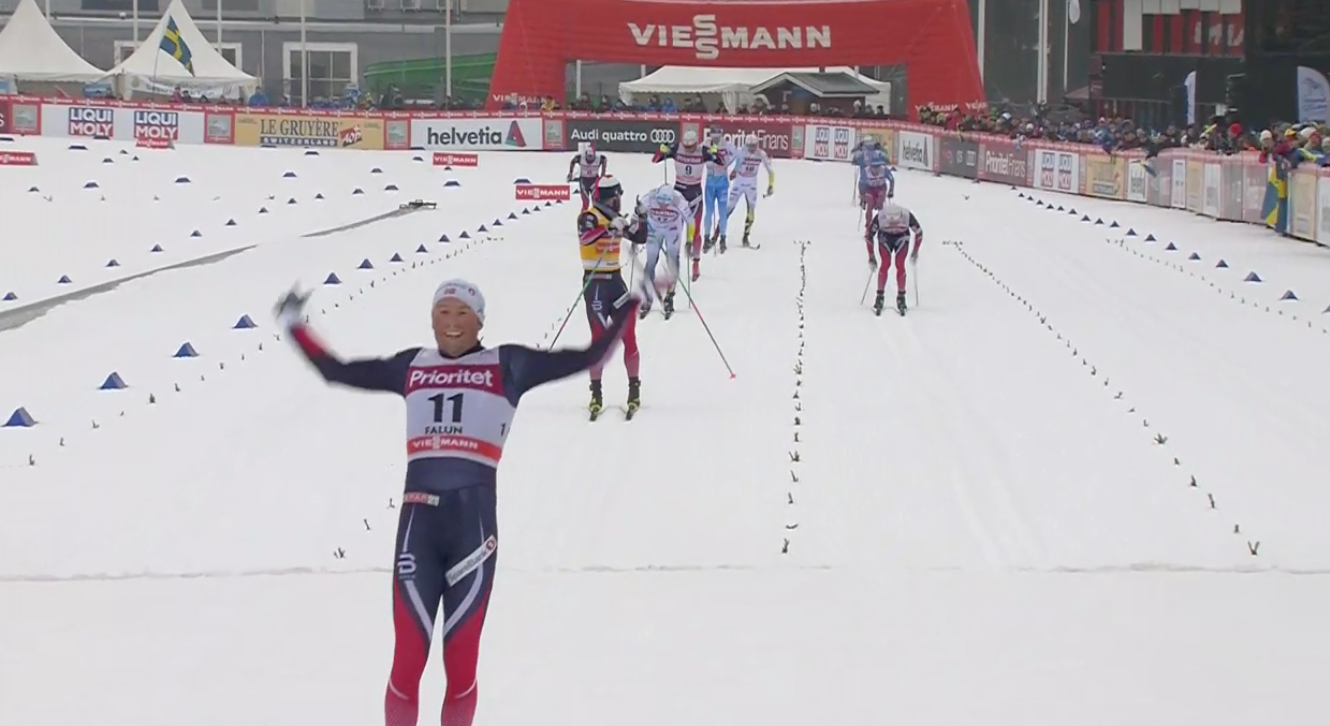
    Emil Iversen celebrates his win in the 30 k classic mass start in Falun, Sweden, on Sunday. Norwegian teammate Martin Johnsrud Sundby finished second and Sweden's Calle Halfvarsson third.
    Emil Iversen celebrates his win in the 30 k classic mass start in Falun, Sweden, on Sunday. Norwegian teammate Martin Johnsrud Sundby finished second and Sweden’s Calle Halfvarsson third.

    FIS Cross-Country World Cup (Falun, Sweden): 15 / 30 k classic mass start

    Women’s reportMen’s report

    In the women’s 15-kilometer classic mass start on Sunday, Norway swept the podium with Marit Bjørgen taking the win in a time of 41:28.8 in Falun, Sweden. Crossing just half a second behind her was her teammate, Ingvild Flugstad Østberg in second place. Rounding out the podium was Heidi Weng in third (+8.1).

    American Jessie Diggins was the first to cross the line for the U.S. in 10th (+1:37.5). Three other U.S. women finished in the top 30, with Sadie Bjornsen finishing 21st (+2:43.6), Rosie Brennan 24th (+2:57.0), and Liz Stephen in 29th (+3:24.5).

    Just outside of scoring World Cup points was American Caitlin Patterson in 32nd (+3:47.6) and Ida Sargent in 34th (+4:02.8). Canada’s Cendrine Browne finished 46th (+5:41.4) and American Liz Guiney 49th (+6:22.6).

    After losing the skate sprint yesterday in a photo finish to Italy’s Federico Pellegrino, Emil Iversen ascended to the top step of the podium in the men’s 30 k classic mass start on Sunday in Falun.

    The Norwegian was often near the front, but hadn’t tried to lead a breakaway like his teammates Martin Johnsrud Sundby and Sjur Røthe did earlier in the race. In the final two kilometers, Sundby – the overall World Cup leader – put in a sprint to try to drop the field. But Iversen caught up, drafting his veteran teammate into the stadium. In the final up-and-over before the finish line, Iversen made a pass and then accelerated down the finishing stretch to beat Sundby by 1.14 seconds.

    “I got motivation from yesterday’s last 20 meters,” Iversen told FIS in a finish-line interview. “So today I fought all the way, and I was really stronger. It is amazing for me to be second yesterday and first today. I’m really proud of that.”

    Calle Halfvarsson, who had been falling off the back of the lead pack just a few kilometers earlier, managed to get back to the front and claim third place for Sweden (+1.72 seconds) in a photo finish with Røthe (+1.76 seconds). Niklas Dyrhaug was next (+2.52 seconds) to give the Norwegian men’s team four in the top five.

    In his return to the World Cup stage, Norway’s Petter Northug finished 31st (+3:10.6).

    Alex Harvey was the lone Canadian on the start line. After skiing near the front of the field for the early part of the race he was dropped by the lead pack in the final kilometers, finishing 15th (+1:17.5).

    Erik Bjornsen and Noah Hoffman took 35th and 37th places for the United States, finishing +3:30.8 and +3:59.8, respectively. SuperTour leader Matthew Gelso — familiar with the Falun course after competing in 2015 World Championships — finished 44th (+5:23.6), and Andy Newell placed 53rd (+7:45.3).

    Results: Men | Women

    ***

    IBU Open European Championships (Duszniki-Zdrój, Poland): Single mixed & mixed relay
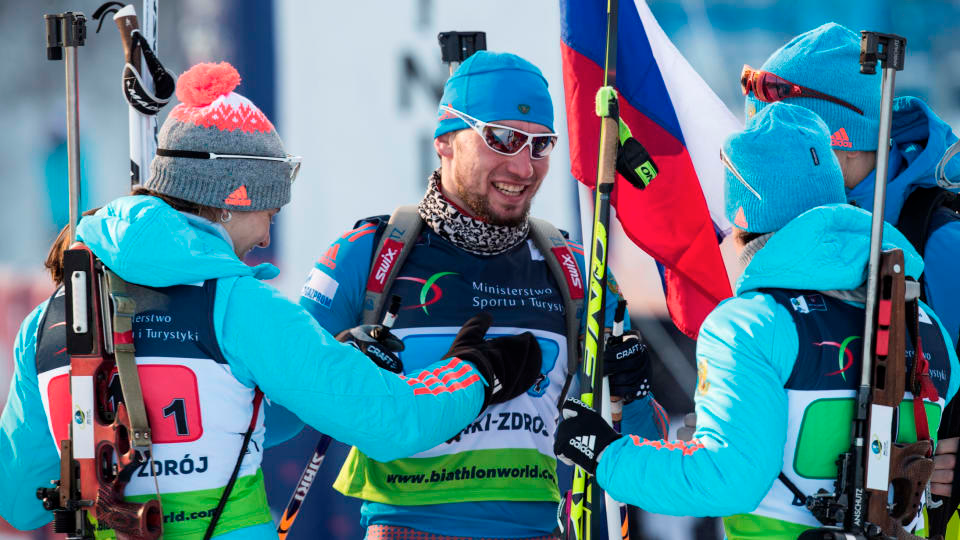
    Russia’s Alexander Loginov (center) is greeted at the finish by his teammates Irina Starykh, Svetlana Sleptsova and Alexey Volkov after anchoring his team to the gold medal in the mixed relay at the 2017 IBU Open European Championships in Duszniki-Zdrój, Poland. (Photo: IBU)
    Russia’s Alexander Loginov (center) is greeted at the finish by his teammates Irina Starykh, Svetlana Sleptsova and Alexey Volkov after anchoring his team to the gold medal in the mixed relay at the 2017 IBU Open European Championships in Duszniki-Zdrój, Poland. (Photo: IBU)

    [UPDATED] The Russian victory in the final 2 x 6 + 2 x 7.5-kilometer mixed relay event of the 2017 International Biathlon Union (IBU) Open European Championships in Duszniki-Zdrój, Poland, was only briefly in doubt, when Alexander Loginov skiing the anchor leg required all spares in his prone shooting stage. But with his final shot he managed to also hit that target to avoid the penalty lap, leaving the range with a lead of more than 30 seconds.

    Loginov then did not need any spares in the last standing stage, and could take his time on the final loop. Unlike Russia’s Evgeniy Garanichev earlier in the day during the single mixed relay, he also managed to pick up a flag for the final meters of the race, crossing the line in a time of 1:12:26.0 hours.

    The Russian team with Irina Starykh, Svetlana Sleptsova, Alexey Volkov and Loginov led from the first exchange and required only six spares with zero penalties.

    With this medal, the 28-year-old Volkov became the most successful athlete in history at European Championships, according to an IBU press release, surpassing the retired Polish biathlete Tomasz Sikora. Russia was the most successful team of the 2017 Open European Championships with six gold, four silver, and three bronze medals.

    Behind them, a number of teams vied for the positions on the podium. Sweden initially looked like a strong contender exchanging in second place after the women, but fell back with three penalty laps to only finish 10th.

    Still six seconds back after the final shooting, Norway’s Fredrik Gjesbakk caught up to and outsprinted Ukraine’s Ruslan Tkalenko in the finishing stretch to claim the silver medal (+36.4) with the bronze left for Ukraine (+37.1).

    “I thought that I made sufficient gap to win silver,” Tkalenko told the IBU. “But in the end, on the final downhill before the finish, I was very surprised when the Norwegian guy passed me, I truly did not expect that.”

    The Norwegian team with Karoline Erdal, Marion Rønning Huber, Erlend Bjøntegaard, and Gjesbakk needed nine spares and had no penalties.

    Ukraine with Anastasiya Merkushina, Yulia Dhzyma, Oleksander Zhyrnyi (who originally started for Russia before making the switch in 2014) and Tkalenko required six spares, and Dhzyma had to ski a penalty lap only temporarily setting the team back.

    Bulgaria finished fourth (+1:16.4), with its anchor Vladimir Iliev narrowly beating Czech Republic’s Lukas Kristejn (+1:17.4) in the finishing stretch. Both teams needed 11 spares and had no penalties.
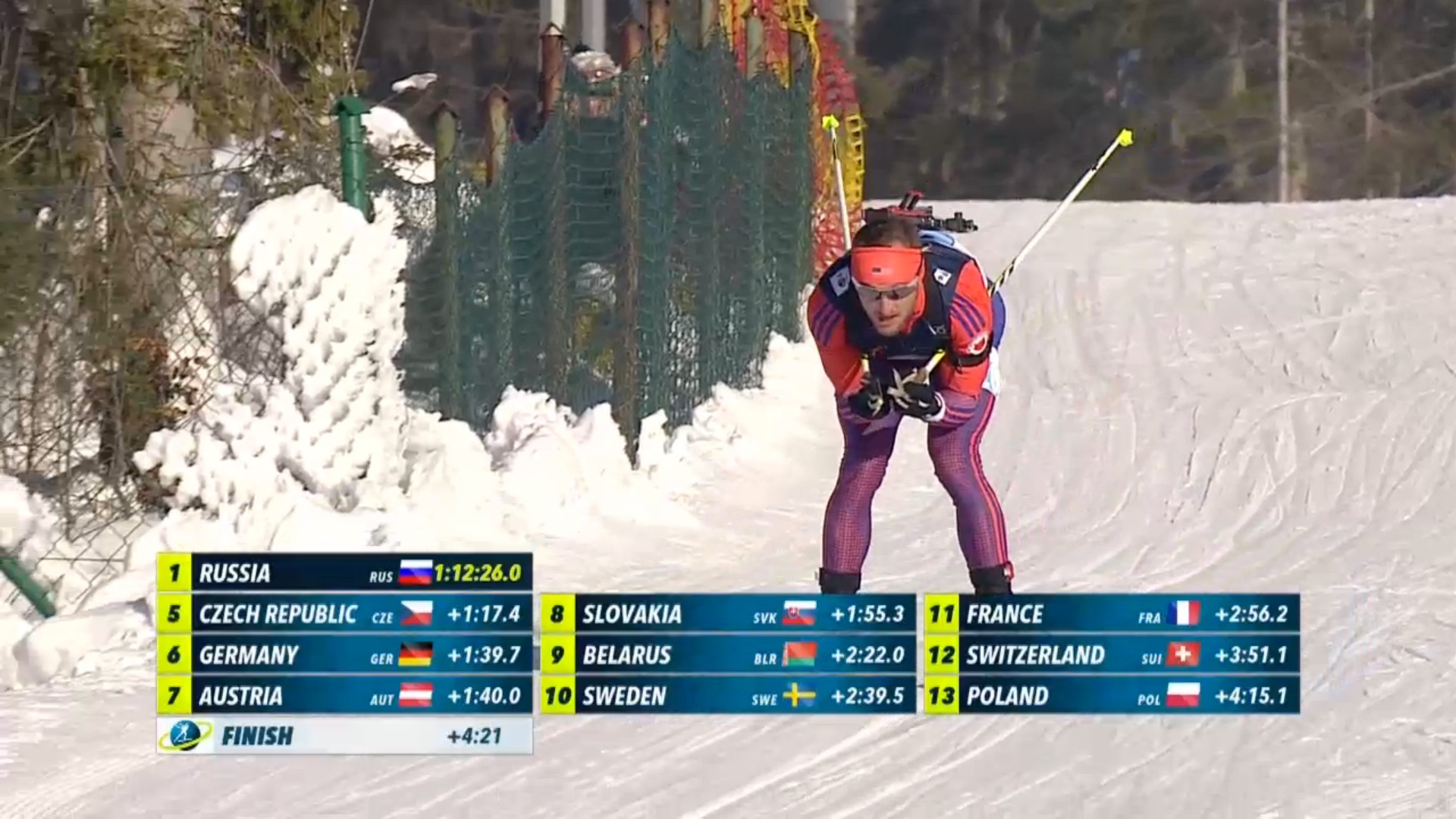
    Jakob Ellingson skiing the anchor leg for the U.S. mixed relay at the 2017 IBU Open European Championships in Duszniki-Zdrój, Poland. The U.S. team finished 14th. (Photo: IBU/Eurovisionsports.tv screenshot)
    Jakob Ellingson skiing the anchor leg for the U.S. mixed relay at the 2017 IBU Open European Championships in Duszniki-Zdrój, Poland. The U.S. team finished 14th.
    (Photo: IBU/Eurovisionsports.tv screenshot)

    Starting at the back of the field in bib 20, US Biathlon’s Emily Dreissigacker got her team off to a strong start with a clean prone shooting and one spare round in standing, exchanging in 10th, a minute behind the leaders. Hallie Grossman needed one spare in each of her stages, tagging off to the men in 14th position and now 2:39 behind. Max Durtschi also had one miss each in prone and standing, coming into the last exchange still in 14th position, but another minute back. Jakob Ellingson required all three of his spares in his prone shooting stage narrowly avoiding the penalty lap, and one more in his final shooting stage. As the team from Finland was racing over a minute behind the Americans, he was able to keep the 14th position into the finish (+4:47.4), with a team total of nine spares and no penalties overall.

    For Biathlon Canada, Erin Yungblut starting in bib 19 shot clean in her prone stage and required two spares in her standing shooting, tagging off in 18th position and more than two minutes back from first. Leilani Tam von Burg stayed clean in her prone shooting stage and needed one spare in standing, moving up two positions to exchange in 16th place, yet more than four minutes behind the leaders. After the exchange to the men, both Matthew Neumann and anchor Carsen Campbell managed to shoot clean in all of their stages, but lost additional time on the course to finish 16th (+6:39.9) ahead of four lapped teams.

    Canada had the best shooting result of all 20 teams starting the relay, with just three spares and no penalty.
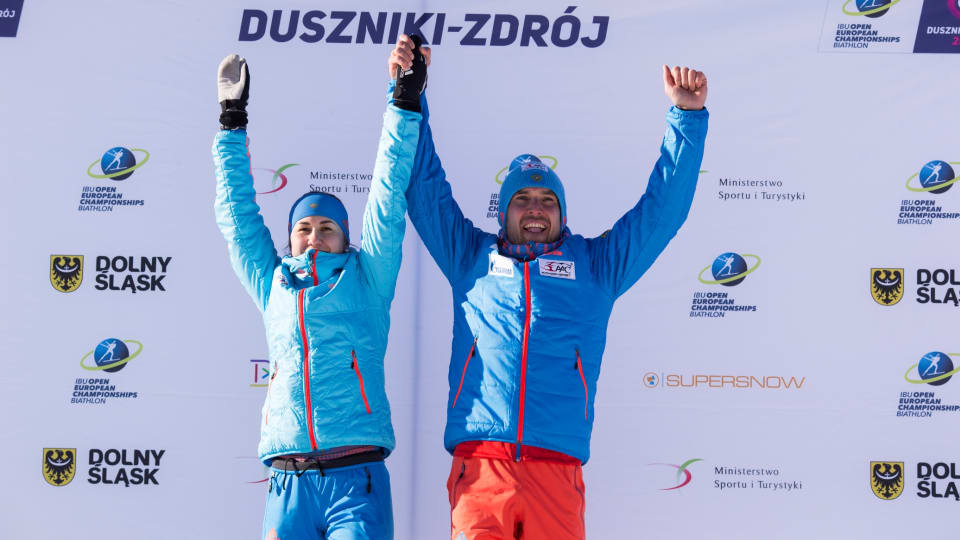
    Russia’s Daria Virolaynen (l) and Evgeniy Garanichev after winning Sunday's single mixed relay at the 2017 Open European Championships in Duszniki-Zdrój, Poland. (Photo: IBU)
    Russia’s Daria Virolaynen (l) and Evgeniy Garanichev after winning Sunday’s single mixed relay at the 2017 Open European Championships in Duszniki-Zdrój, Poland. (Photo: IBU)

    Earlier on Sunday, pretty much the only thing that went wrong for Russia’s Daria Virolaynen and Evgeniy Garanichev in the single mixed relay happened on the last meters of the finishing stretch, with Garanichev gesturing for a Russian flag he wanted to cross the line with. But the handoff was too short and the flag dropped past his outstretched hand to the snow. He glanced back, weighing if his lead was big enough to ski back, but decided it was not worth the risk, instead skiing into the arms of his partner waiting for him behind the line in a time of 37:10.2 minutes.

    Russia needed seven spare rounds and incurred zero penalties. Garanichev secured the victory in the final shooting, when he only needed one spare – albeit fumbling a few seconds to insert it – while his direct opponents standing next to him required more time to hit their targets.

    “Probably, I took some risk at the last standing,” Garanichev said, according to an IBU press release. “I wanted to shoot fast and clean, but missed with the last shot. But in general, I felt very comfortable; came and worked at the range in my rhythm.”

    6.3 seconds behind, Norway with the team of Ingrid Landmark Tandrevold and Vetle Sjåstad Christiansen placed second, with seven spares and zero penalties.

    “These are very short loops,” Christiansen commented on the fairly new, single mixed relay format. “You feel the pressure from the crowd and to shoot fast every time.”

    The 20-year-old Tandrevold previously earned three bronze medals, including one in the single mixed relay, also with Christiansen, at last year’s Open European Championships in Tyumen, Russia.

    To big cheers from their home crowd fans who had come out to the Duszniki Arena in beautiful but cold weather, the Polish husband-and-wife team of Krystyna Guzik and Grzegorz Guzik placed third with just five spares and zero penalties (+13.9), not quite able to keep up with Christiansen on the final loop after leaving the range together within a second.

    “It is so nice to win a medal here in Poland,” Krystyna Guzik said. “We were both very disappointed with all of our mistakes in the other competitions. So today, we were relaxed and laughing before the competition, hoping not to have those mistakes again. We did not … and now have a medal.”

    It was the first medal for Poland at these championships.

    Ukraine with Iryna Varvynets and Andriy Dotsenko finished fourth, also with five spares and zero penalties (+20.9).
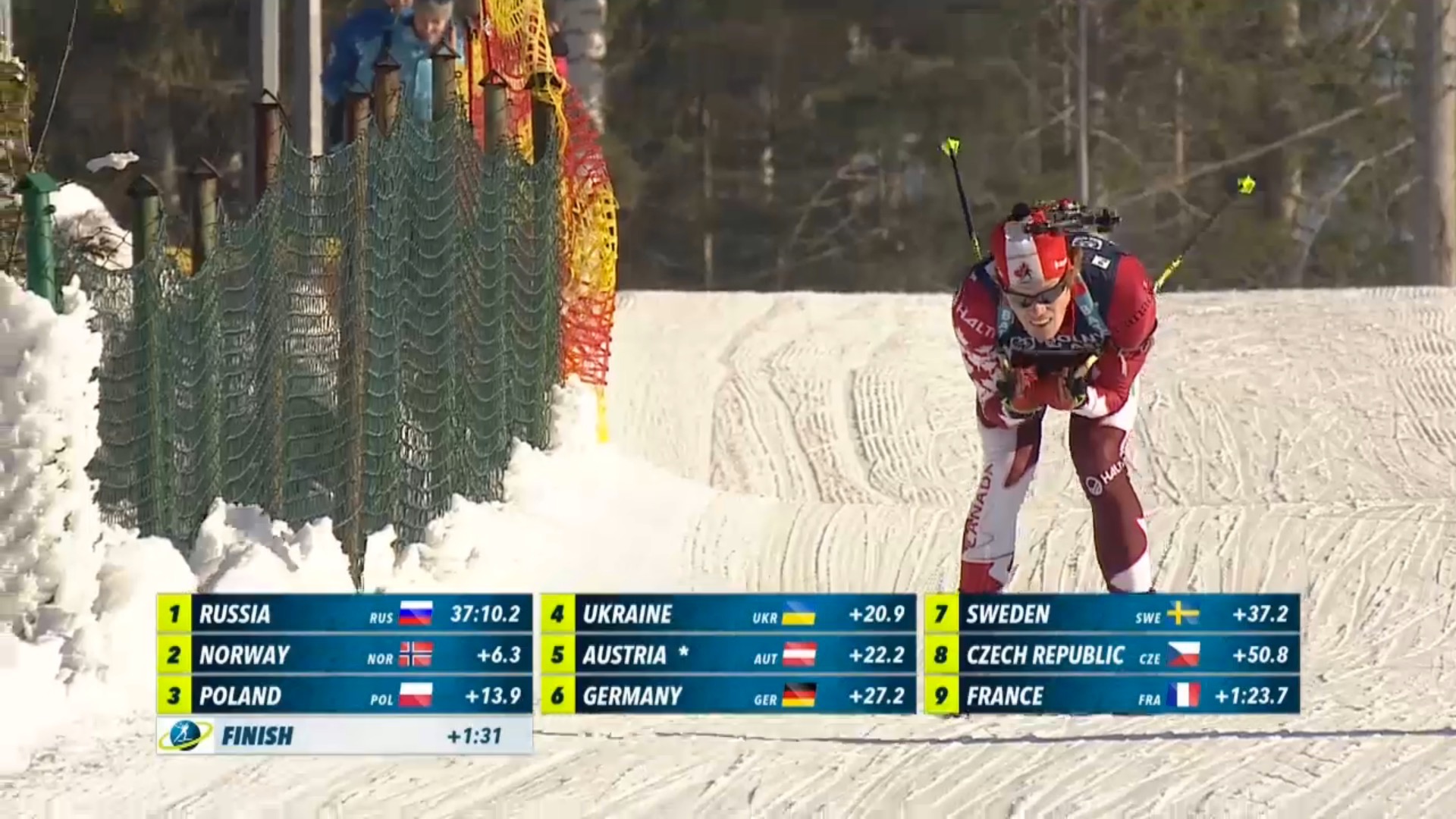
    Biathlon Canada’s Aidan Millar skiing the final loop of the single mixed relay at the 2017 IBU Open European Championships in Duszniki-Zdrój, Poland. With teammate Sarah Beaudry, Canada finished 13th (Photo: IBU/Eurovisionsports.tv screenshot)
    Biathlon Canada’s Aidan Millar skiing the final loop of the single mixed relay at the 2017 IBU Open European Championships in Duszniki-Zdrój, Poland. With teammate Sarah Beaudry, Canada finished 13th (Photo: IBU/Eurovisionsports.tv screenshot)

    For Biathlon Canada, Sarah Beaudry and Aidan Millar required seven spares during their race and had no penalty, just like the winning Russians and Norwegians, but could not quite keep up with the best teams on the course in the fast-paced race format with short loops somewhat comparable to a team sprint in cross-country.

    Beaudry cleaned her first shooting stage and then needed one spare to hit all targets in standing. At the first exchange Canada was 10th, 35.8 seconds behind the then leading team from Poland.

    Millar missed one shot in his first prone stage, leaving the range again in ninth position. Then he needed two spares in his standing shooting on the way to exchanging back to Beaudry in 11th (+56.4).

    On her second leg, Beaudry had one miss in prone and required two spares in standing, falling back a bit to exchange in 13th (+2:12.0).

    On his final leg, Millar was able to shoot clean in both stages, reducing the time gap to the top but not able to make up another position, and finished in 13th place (+1:56.1).

    US Biathlon is only represented with two women at the Open European Championships in Poland, and decided to forgo a start in the single mixed relay, instead entering a team in the mixed relay later on Sunday.

    — Harald Zimmer

    Results: Mixed relay |  Single mixed relay 

    ***

    Marcialonga (Val di Fiemme, Italy)
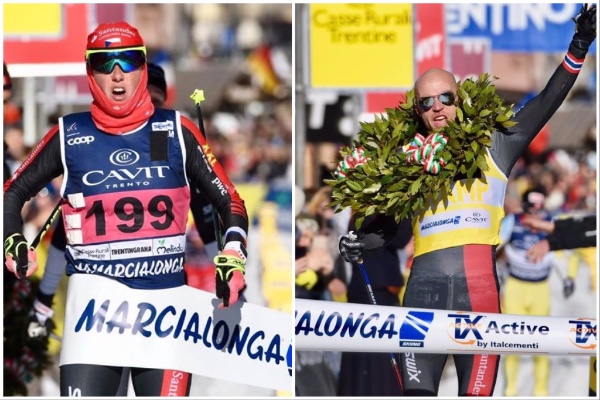
    Katerina Smutna (left) and Tord Asle Gjerdalen (right) of Team Santander won the 2017 Marcialonga. (Photo: Visma Ski Classics)
    Katerina Smutna (left) and Tord Asle Gjerdalen (right) of Team Santander won the 2017 Marcialonga. (Photo: Visma Ski Classics)

    Tord Asle Gjerdalen won the Marcialonga, a Worldloppet and Swix Ski Classics marathon for the third time – in a row. This year was on a shortened course, “just” 57 rather than the traditional 70 kilometers.

    The Team Santander athlete finished in two hours, eight minutes, and 36 seconds, edging Johan Kjølstad (Team United Bakeries) and Morten Eide Pedersen (Team BN Bank) in a sprint finish by 2.6 and 2.9 seconds, respectively.

    Tyler Kornfield and David Norris of Alaska Pacific University finished 43rd (+5:03.8) and 66th (+10:43.1). Canadian Paralympian Brian McKeever finished 57th (+9:13.5) and guide Graham Nishikawa 81st (+12:56.5), followed by Ian Murray in 85th (+13:37.5) and Erik Carleton in 111th (+17:50.2).

    In the women’s competition, Katerina Smutna, also of Team Santander, won her third straight Ski Classics competition. She crossed the line in two hours, 22 minutes, and 46.4 seconds. Britta Norgren of Team Lager 157 was second by just 0.8 seconds, and Sara Lindborg (Team Serneke) third, +4:22.2. University of Utah alum Maria Graefnings was tenth, +10:35.8.
  • After Two Rest Days, Nationals Skiers Ready to Roll in 20/30 k Mass Starts (with Video)

    After Two Rest Days, Nationals Skiers Ready to Roll in 20/30 k Mass Starts (with Video)

    HOUGHTON, Mich. — After two days off, the U.S. Cross Country Championships picks up again on Thursday with the women’s 20 kilometer and men’s 30 k freestyle mass start races.

    Many athletes out on the Michigan Tech Trails enjoyed two non-race days amidst sunny skies and warmer temps, at least compared to last year’s U.S. nationals event, also in Houghton.

    The dramatic difference in weather led racers like Alaska Pacific University’s Reese Hanneman, the winner of Monday’s 1.5 k freestyle sprint, to describe it as “paradise.”

    While the initial three-day trek for some racers, coaches and techs to arrive in Houghton is perhaps worthwhile with the promise of sun, it is also the present state of the trails that drew these individuals to the event.

    “My favorite part about Houghton, Michigan is the [area’s] ski trails,” said University of Denver skier Taeler McCrerey.

    This week, much of McCrerey’s and other competitors’ time on snow and the ski trails is largely thanks to the area’s community volunteers.

    “It’s all part of building community,” Shane Sullivan, a local and volunteer race starter for the U.S. nationals races this week in Houghton, said on Monday during the freestyle sprint. “It’s as much the community camaraderie as it is putting on the event.” 

    20/30 k Mass Start Previews: Men | Women

    Start lists | Live stream

  • Bjørgen Saves Her Last Attack to Win the Holmenkollen

    Bjørgen Saves Her Last Attack to Win the Holmenkollen

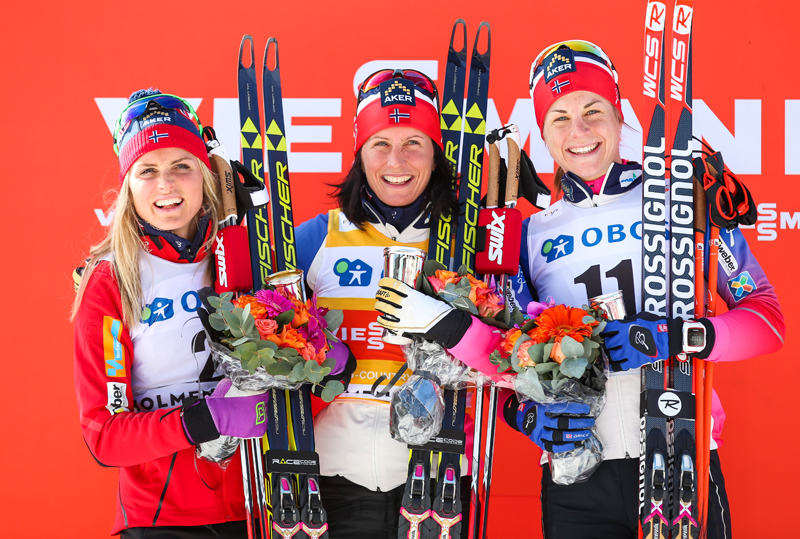
    Marit Bjørgen (center) won her fifth Holmenkollen 30 k title on Sunday, besting Norwegian teammates Therese Johaug and Astrid Jacobsen. (Photo: Fischer/NordicFocus)
    Marit Bjørgen (center) won her fifth Holmenkollen 30 k title on Sunday, besting Norwegian teammates Therese Johaug and Astrid Jacobsen. (Photo: Fischer/NordicFocus)

    For 29 kilometers, Norway’s Therese Johaug looked like the dominant skier in Sunday’s Holmenkollen World Cup in Oslo, Norway.

    Unfortunately for Johaug, it was a 30 k race and Norwegian team mate Marit Bjørgen proved once again why she is the world’s best, saving one last attack to skate past Johaug to take the victory.

    Bjørgen had all but wrapped up the World Cup distance title for the season; she led Johaug by 101 points going into the 30 k. With a win counting for 100 points, Bjørgen mainly just had to finish the race and even if Johaug won she would still add the distance crystal globe to the sprint and overall titles, which she had already secured.

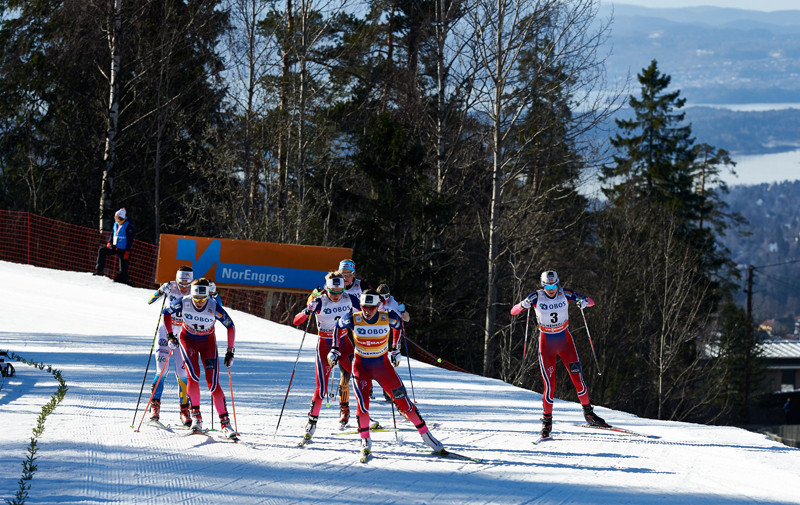
    The pair set a tough pace from early on, with a pack of just ten women able to keep up.

    And there was, of course, the small issue of bonus sprints. Four times over the course of the 30 k, bonus time checks awarded points to the first ten skiers across the line, with 15 points for the first skier and one for the tenth. If Johaug had any chance to pass Bjørgen in the distance competition she needed to get every sprint point on course and more importantly win.

    Naturally, Johaug made sure she was the first skier across the line every time. That netted her 60 points, but Bjørgen was always close behind like a shadow, taking 44 points of her own and neutralizing Johaug’s gain.

    Marit Bjørgen pushing the pace early on at Holmenkollen. (photo: Fischer/NordicFocus.com)
    Marit Bjørgen pushing the pace early on at Holmenkollen. (photo: Fischer/NordicFocus.com)

    But the quest for bonus seconds, while it didn’t shake Bjørgen, did get to some of the other racers. The first real breakaway appeared at the 8 k mark when Johaug, Bjørgen and Sweden’s Charlotte Kalla found themselves with a slight advantage over Norway’s Astrid Uhrenholdt Jacobsen, who had been skiing with them in a pack of four.

    The gap was compounded when Jacobsen fell. From then on, her chance to ski with the lead trio was gone. She skied for almost the next 20 kilometers entirely alone.

    “I lost feeling in one leg, and did not know quite where I put the skis,” she told Norwegian broadcaster NRK of the crash. “It may be that it was just my boot that was not quite right or something. It is hard to say.”

    Kalla, sensing that Bjørgen and Johaug had greater strength, skied with the pair as long as she could, sometimes even leading the pack.

    The Norwegians tried to trick her at one point. The women were allowed to switch their skis once during the race, and although none of the leaders ever did, at the first possible exchange point Bjørgen and Johaug let Kalla go first and hoped that she would ski into the exchange, at which point they would skate off without her.

    Kalla almost fell for it, but wised up and avoided the exchange lane, which would cost at least 15 seconds, at the last possible moment.

    We had planned that we would not change skis, but we figured we would let Charlotte go first and see what she did,” Johaug told the Swedish press. “So we saw that she almost was going in to switch, but then she turned around to see what we did, and then just continued without changing. Marit and I looked at each other and we smiled.”

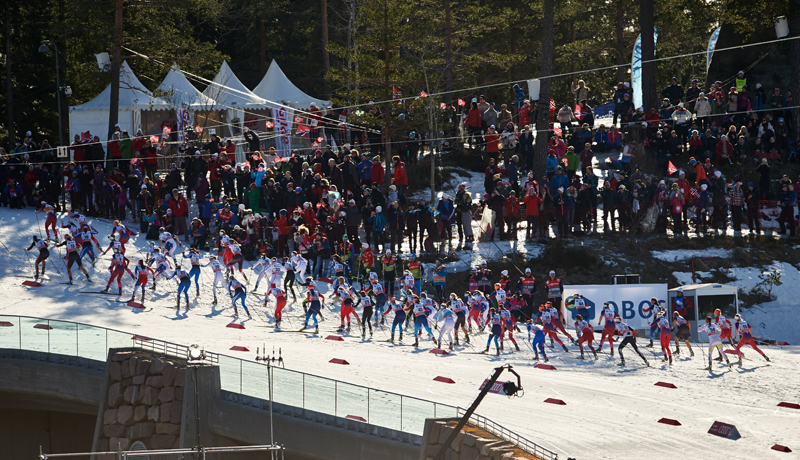
    The course was lined with spectators and filled with noise. (Photo: Fischer/NordicFocus.com)
    The course was lined with spectators and filled with noise. (Photo: Fischer/NordicFocus.com)

    They didn’t really need a trick anyway. By the 18 kilometer mark, Bjørgen and Johaug were all alone out front after their fast pace had dropped Kalla. The two Norwegians tried and tried to wear each other down: Johaug attacking on the climbs, Bjørgen matching her pace stride for stride. Sometimes Bjørgen would move into the lead, but neither one could shake the other.

    Meanwhile, Kalla was bleeding time after working hard to keep up with the duo for the first half of the race. But Jacobsen was maintaining about the same pace as the leaders – after dropping to 45 seconds back, she held the gap steady. That meant that she gained and gained on Kalla until she had the Swede in her sights. In the stadium with just three kilometers to go, Jacobsen caught her and skied past. The pair made their way together towards the finish.

    The races for both first place and third place were closing fast, so an attack seemed inevitable. It finally happened at the 29 k mark. Heading up the Hellnerbacken climb before the stadium, Johaug and Bjørgen simultaneously upped the pace – but Bjørgen’s attack was stronger, and as she pulled past her teammate Johaug couldn’t respond. Within a few strides Bjørgen was clear of Johaug, and she soon put an incredible 10 second gap on one of the best climbers in the world. The winner was set.

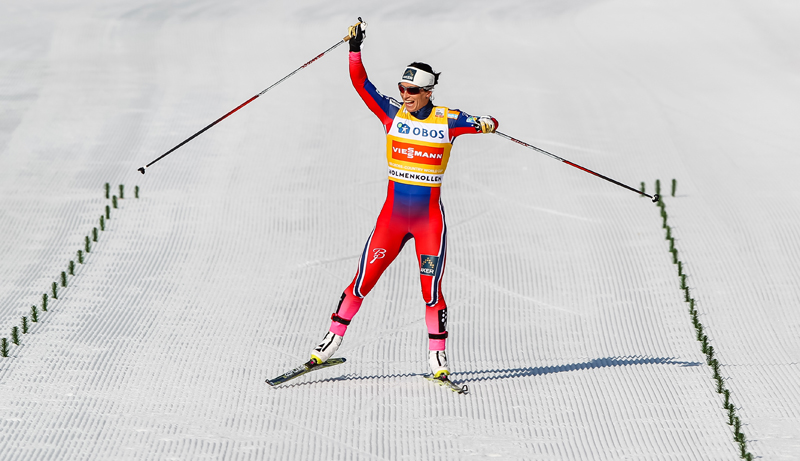
    Taking bows as she crossed the line, Bjørgen wrapped up her fifth Holmenkollen win finishing in 1:14:10, Johaug second 11.6 seconds behind.  With her win today Bjørgen became the first female athlete to win consecutive Holmenkollen titles.

    Bjørgen enjoyed celebrating her last victory of the season - and potentially of her World Cup career? (Photo: Fischer/NordicFocus.com)
    Bjørgen enjoyed celebrating her last victory of the season – and potentially of her World Cup career? (Photo: Fischer/NordicFocus.com)

    “I knew that I had a strong finish and relied on that,” Bjørgen told FIS. “But after 30 k you never know. It is great to end the season with the victory. I am tired now but I am motivated to continue. I’ll see in the spring.”

    Johaug was gracious in her defeat.

    “It was impressive to see Bjørgen going up the last hill,” she told NRK. “It is inspiring to see Marit scramble there. I have so much to learn from her and what she does. I’m happy with my race. It was absolutely amazing to race at Holmenkollen.”

    While fans were focused on the stadium and Bjørgen’s victory, Jacobsen dropped Kalla and skied to a clean third place, 44.5 seconds back, to round out the all Norwegian podium.

    “Despite the fall I had a great race and I was able to to take 20 seconds on Charlotte Kalla in the last lap,” Jacobsen told NRK.

    It marked a great comeback by the 28-year-old, who sat out the first half of the season with an injury. Her first World Cup of the season didn’t come until late January, but it was a win – not to mention her first one since 2008. The Rybinsk, Russia, races are acknowledged to be less competitive, as many top athletes don’t care to take the long travel to reach the frigid venue, but Jacobsen made clear that she was no joke by winning silver in the skiathlon at World Championships and now making the podium at arguably skiing’s most vaunted World Cup.

    This shows at least that I do not give up,” she told NRK.It was great for me to get on the podium, especially since I grew up here [in Oslo].”

    Heidi Weng won a photo finish against Norwegian teammate Ragnhild Haga for fourth place. Liz Stephen was the top American skier, placing ninth. Stay tuned for a full report on the U.S. women.

    While Bjørgen proved decisively that not only did she deserve that World Cup distance title, but that she was the best skier of the season, she is still unsure of whether she will compete another year. At age 34, each additional year is a major undertaking.

    It is not quite right to think of it now,” she told the news service VG.I have to train 900 hours next year and I cannot think about that now. I have to get my energy back and then think about what to do going forward.”

    Although Johaug would likely profit in terms of wins, money, and sponsorship should Bjørgen retire, that’s not something she wants to see happen.

    I support her whatever she decides,” Johaug told VG. But I hope that she will continue. She is a wonderful best friend and teammate. She has given me an incredible amount of confidence and self-esteem, and because she has done that I have become the cross-country skier I am. Without trying to match her, I would not be standing here today, either.”

    Complete Results