From the FasterSkier archive — posts syndicated from athletes’ and coaches’ own blogs between 2004 and 2012, kept online as published. Current coverage is at fasterskier.com.
We’re back with a recap of Russian Alexander Bolshunov’s dominating victory in the Olympic 30-kilometer skiathlon. We break down the dramatic start to the race, the Russians’ epic performance, Iivo Niskanen’s heroic effort to hang on to a bronze and the huge time gaps we saw to even some of the sport’s biggest names. And we talk about doubts about Bolshunov’s success.
And read a Russian news story about a politician calling for the revocation of Nat’s press credential here.
Alexander Bolshunov skis to his first gold medal in the men’s 30 k skiathlon, the opening event of the 2022 Beijing Olympic Winter Games. (Photo: NordicFocus)
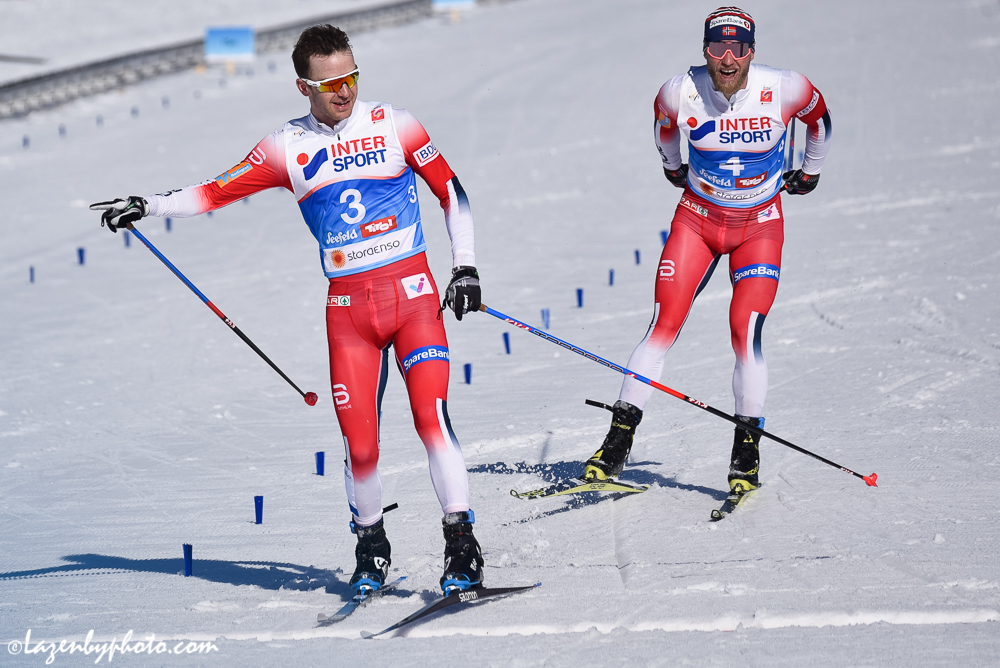
Norway’s Sjur Røthe (l) leading teammate Martin Johnsrud Sundby on their way to first and third respectively in the men’s 30-kilometer skiathlon on Saturday at the 2019 World Ski Championship in Seefeld, Austria. (Photo: John Lazenby/lazenbyphoto.com)
*This article has been updated to include comments of Great Britain’s Andrew Musgrave
By the time the camera panned past the 26-kilometer mark of the men’s 30 k skiathlon at 2019 World Ski Championships in Seefeld, Austria on Saturday, the original pack of 72 starters had dwindled to five: Norwegians Martin Johnsrud Sundby and Sjur Røthe, Russia’s Alexander Bolshunov, Finland’s Iivo Niskanen, and France’s Clement Parisse.
The leaders had been unphased by Niskanen’s hot pace during the classic portion of the event and with less than 5 k of freestyle skiing to go, Bolshunov levied control of the pace. But it wasn’t long before one red suit was exchanged for another.
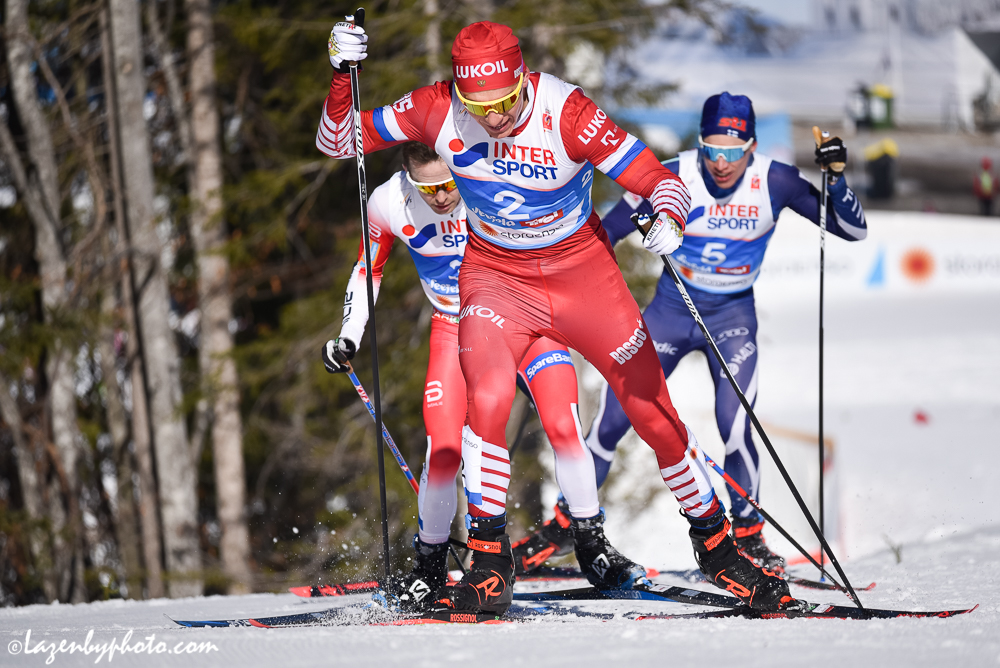
Russia’s Alexander Bolshunov during the men’s 30-kilometer skiathlon on Saturday at the 2019 World Ski Championship in Seefeld, Austria. (Photo: John Lazenby/lazenbyphoto.com)
Saturday, he looked bound to break into that realm. In the second to last climb before the uphill to the finish, he began to separate himself from the lead pack of five. By the hill’s crest, only Bolshunov and Røthe had managed to maintain sight of Sundby’s ski tails. Through the gentle descent before the uphill to the finish, the three tuck skated in a line with Sundby setting the pace, Bolshunov just behind and Røthe just behind him.
As the trio ascended the final uphill, Sundby looked steady; perhaps too steady. A brief glance back revealed the raw power of Bolshunov and equally quick tempo of Røthe pressing in from behind. By the finishing stretch, Sundby was swallowed. The sprint to the line became between Røthe and Bolshunov, with Røthe outlunging the Russian by 0.1 seconds for first in a time of 1:10:21.8. Bolshunov, claimed second (+0.1), finishing 0.6 seconds ahead of Sundby in third (+0.7).
“It was an amazing feeling to cross the finish line first,” Røthe said according to a International Ski Federation press release. “When we changed skis, it was important for me to get away from the best athletes in the field. I had some problems with my legs during skating, but it worked out well in the end. I chose the right tactic today … and I hope I was good enough to be part of the relay team on Friday.”
Røthe’s win on Saturday is predicated on a series of firsts this season: earlier in the year he earned his first World Cup win and Saturday marks his first career individual World Championships gold–he has a relay gold from 2013 when he raced the third leg for Norway at World Champs in Val di Fiemme.
For Bolshunov, Saturday’s skiathlon silver medal is his first World Champs podium and, with the men’s 15 k classic yet to race, it may just be the start to his championships trophy case. The 22 year old Russian has made his way to the top of the podium a few times this season and, if Sundby hopes to take home his long sought after individual gold, it will not be without a challenge from the likes of Bolshunov.
Rounding out Saturday’s top 5 was Niskanen in fourth (+12.3) and Parisse in fifth (+20.7).
Canada’s Alex Harvey during the men’s 30 k skiathlon at the 2019 World Championship in Seefel, Austria.
Finishing 58.9 seconds back from the winner was Canada’s Alex Harvey in sixth place. The winner of the 2017 Lahti World Championships 50 k and Canada’s favorite medal contender in Seefeld, Harvey recently announced that he will be retiring this season after World Cup finals in Quebec City, Quebec. Many are hoping for a repeat gold place finish for the 30 year old–over his career, he has accumulated five World Champs medals, two of those being gold one from the Lahti 50 k and one from the 2011 Oslo Team Sprint.
On Saturday, however, Harvey told Cross Country Canada (CCC) that he “was never really in the hunt” for the podium, despite his high ranking result.
“Normally when you are in the top-six you are in a mass start fighting for the podium until the end, but that wasn’t the case today,” Harvey said according to a CCC press release.
“I missed the boat in the classic and the gap was made there. The equipment was great, but I just wasn’t skiing well and couldn’t create enough speed – especially on the flat part of the course,” he added.
Happy with the skating portion of the race, Harvey implicated that more could have been had from his classic.
“As soon as I clicked into the skate skis, I was feeling really good,” Harvey said. “I was skiing with a lot of big names, guys started popping a bit from the back and I was feeling really confident leading that group. The skiathlon is my favourite race. I will draw a lot of confidence from the skate today, but I am disappointed with the classic.”
Finishing 1.4 seconds behind Harvey in seventh place (+1:11:22.1) was Great Britain’s Andrew Musgrave. The seventh place finish is Musgrave’s second best result at a World Championships event, his best having come in Lahti 50 k when he finished just off the podium in fourth.
“I felt great on the classic today- having ridiculously good skis helped!” Musgrave wrote in an email to FasterSkier after the race. “The last lap of the classic was pretty hard though – when the worlds 2 best classic skiers started pushing the pace (Bolshunov & Niskanen). I must admit I was a bit glad when Niskanen fell on the 2nd lap- so we didn’t have an entire 15km of him stringing out the field & making us suffer!”
The 29 year old Brit has had four Top 10 finishes this World Cup season and has stood atop a World Cup podium once, that having been a third place finish two years ago in the Toblach 15 k. In Saturday’s race he indicated that while the classic portion of the skiathlon for him went well, the skating segment had him searching for a second gear.
“The first lap of the skate was OK… But I started to pay for the hard effort on the classic by the 2nd,” he wrote. “By 7km into the skate I was pretty wrecked. The last 2 laps were horrific- I was almost crawling by the end! I think I lost an impressive 50s to Harvey over the last 7.5km!”
Either way, many rooting for Britain’s blue red and white, are hopeful that the seventh is just the start of Musgrave’s World Champs performances.
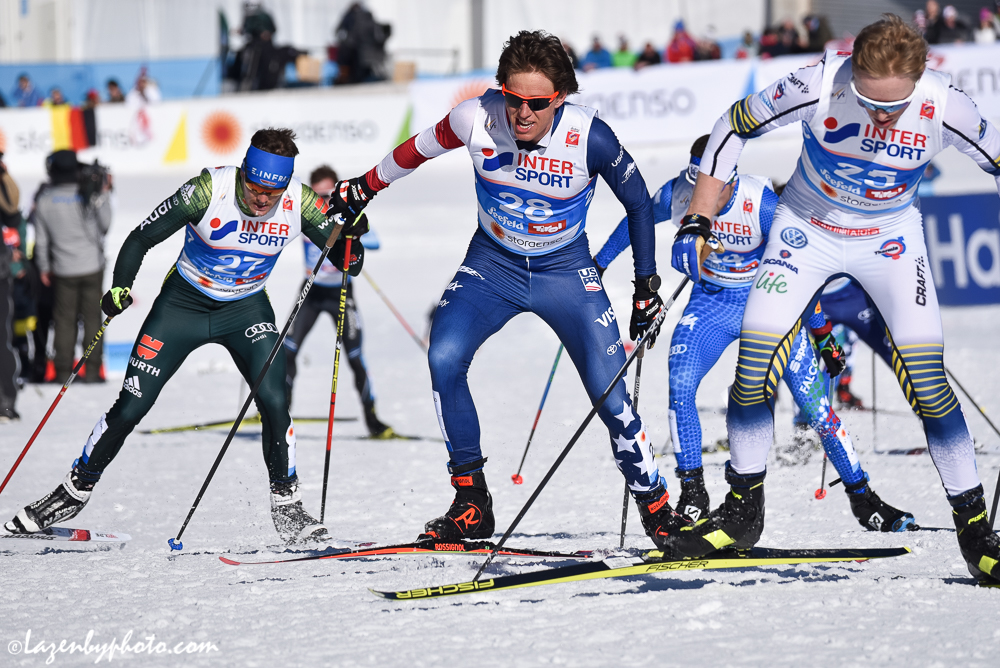
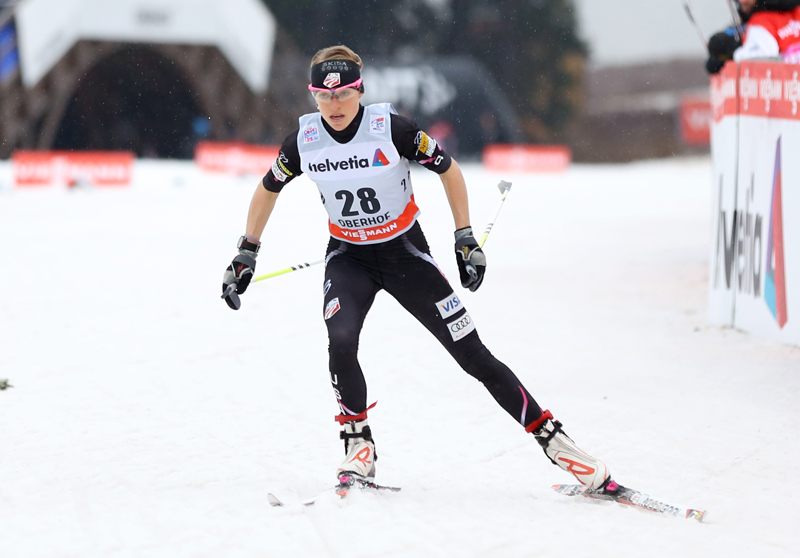
American Scott Patterson (bib 28) during the men’s 30-kilometer skiathlon on Saturday at the 2019 World Ski Championship in Seefeld, Austria. (Photo: John Lazenby/lazenbyphoto.com)
The next top North American finisher following Harvey was American Scott Patterson in 32nd (+4:40.6). In an email to FasterSkier, Patterson explained that the hot pace during the first classic portion of the skiathlon took a toll on him
“In racing today, I struggled from pretty early on.” Patterson wrote. “Iivo Niskanen and others pushed the classic pace pretty hard early. I went with it for a while hoping to stick onto the pack, but it became a little too much for me as I was struggling to kick my skis. I was partially saved by having really fast skis, but it wasn’t enough.”
The switch to his freestyle boards was a welcomed exchange, though low energy reserves left him wanting more.
“In switching to skate, I felt slightly better, but had also dug my legs into a hole during the classic leg.” Patterson wrote. “I tried to work with a group around me, but we weren’t moving up all that well and I wasn’t quite feeling the initiative to go for it on my own.”
“I was able to ski by a few people, but I really wanted to get the Norwegian pair of Klaebo and Iverson who were dogging it at the end,” he continued. “That would have made me a lot happier (along with a top 30).
“Overall, I think my fitness is pretty good and I am looking forward to getting a little more dialed in and faster over the next few races,” he added.
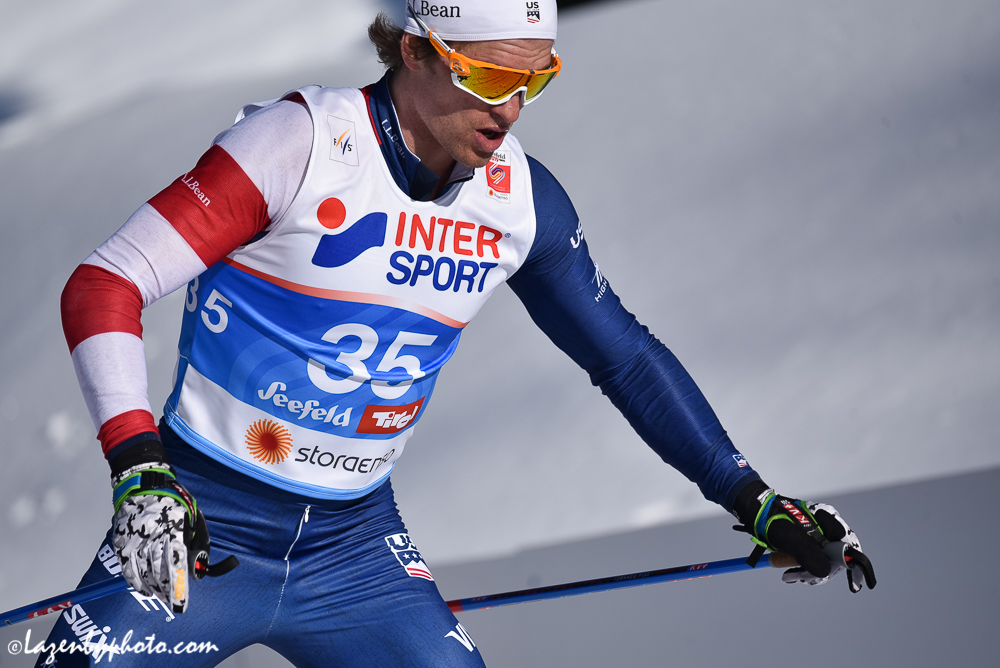
American David Norris the men’s 30-kilometer skiathlon on Saturday at the 2019 World Ski Championship in Seefeld, Austria. (Photo: John Lazenby/lazenbyphoto.com)
American David Norris finished six places behind Patterson in 38th (+4:54.4).
“Today had an awesome atmosphere with amazing fans and hot sun.” Norris wrote in an email. “I struggled in the classic portion and that is a little frustrating. My skate leg felt really good and I was catching guys the whole way. For my first Championship event this was a pretty awesome experience and a good start.”
Next to finish was Canada’s Evan Palmer-Charrette in 45th (+6:12.4) followed by Americans Kyle Bratrud in 49th (+6:19.6), and Adam Martin in 54th (+7:47.4). Also racing for Canada was Scott James Hill in 56th (+9:58.8).
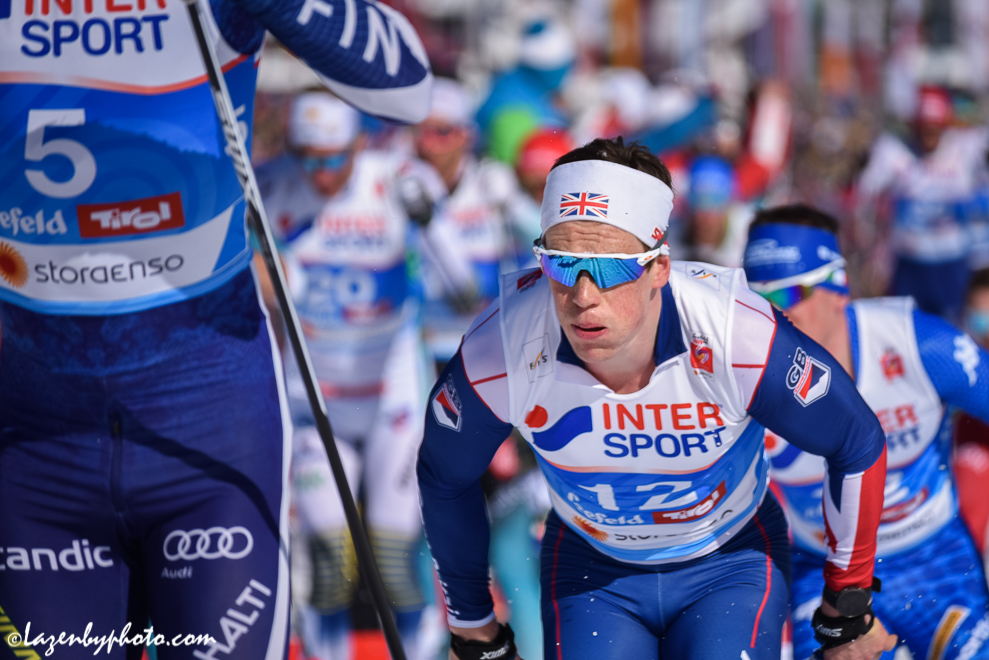
British skier Andrew Musgrave skied to sixth overall (+1:00.3)
Andrew Musgrave (bib 12) of Great Britain en route to a 7th place finish in the Nordic World Ski Championship skiathlon event. (Photo: John Lazenby/lazenbyphoto.com)
World Championships picks up Sunday with a men’s and women’s Team Sprint.
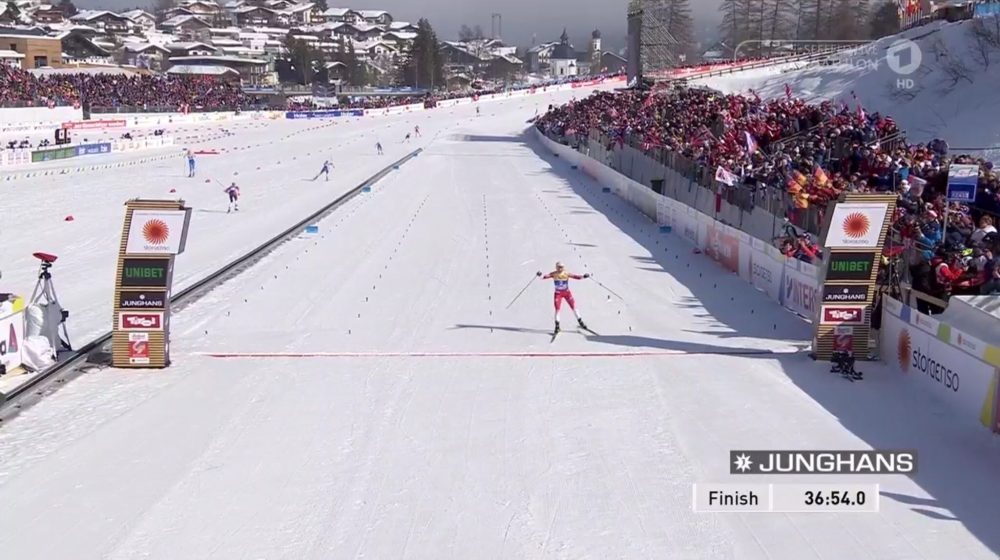
Between 3.75-kilometers and 4.85 k on Saturday, Norway’s Therese Johaug began to pull away in earnest during the women’s World Championship 15 k skiathlon — by then she had built a near 15 second lead.
The time back to the Norwegian would only grow. Johaug powered into the classic to skate transition zone in control with a lead padded by 26.2 seconds. At the finish, Johaug crossed the line with no other skiers in sight and a winning time of 36:54.5 minutes. It was Johaug’s fourth World Championship medal in the skiathlon.
Ingvild Flugstad Østberg, also of Norway, placed second (+57.6), with Russia’s Natalia Nepryaeva third (+58.7).
Rosie Brennan of the U.S. was the top North American in tenth (+2:01.8). Also for the U.S., Julia Kern placed 19th (+2:55.5), Rosie Frankowski 24th (+3:00.6), and Caitlin Patterson 34th (+3:54.5).
Canada’s Katherine Stewart-Jones skied to 39th (+4:19.8), Cendrine Browne 40th (+4:25.2), and Maya Macisaac-Jones 54th (+8:53.4).
The men’s 30 k skiathlon featured no off the front winner like Johaug. As the pace setting screws tightened well into the men’s race, with Russia’s Alexander Bolshunov often taking charge, the pack was winnowed to five skiers at the 26 k mark. Along with Bolshunov, France’s Clement Parisse, Norway’s Sjur Røthe and Martin Johnsrud Sundby, and Iivo Niskanen of Finland were the skiers vying for the win.
By the final half-k, only Sundby, Bolshunov, and Røthe remained up front. Down the final straight Røthe possessed the strongest reserves as he won in a time of 1:10:21.3 hours. Bolshunov placed second (+0.1), and Sundby third (+0.7).
Canada’s Alex Harvey paced himself to sixth overall (+58.9). Evan Palmer-Charrette placed 45th (+6:12.4), and Scott James Hill 56th (+9:58.8).
For the U.S., Scott Patterson raced to 32nd (+4:40.6), David Norris 38th (+4:54.4), Kyle Bratrud 49th (+6:19.6), and Adam Martin 54th (+7:47.4).
The plotline thickened on Saturday in the elite men’s freestyle 50 k at the American Birkebeiner when Akeo Maifeld-Carucci (CGRP), Brian Gregg (Team Gregg), and Matt Liebsch separated themselves from the field. The three skiers fended off any chasers and charged onto main street three across in their final effort towards the finish line.
Maifeld-Carucci took the win in 2:12:35 hours, with Gregg second (+0.93), and Liebsch third (+8.50).
Alayna Sonnesyn (SMS T2)won the overall women’s 50 k skate in 2:34:01. By the time Sonnesyn passed the time check on Lake Hayward, she had gapped Anja Gruber (Salomon) in second by 29.60 seconds. Gruber took second overall finishing 54.60 seconds back from the winning time. Third place went to Katie Feldman (SVSEF Gold Team) crossing 1:08.63 minutes back.
FasterSkier will be posting race reports on the 2019 American Birkebeiner later today.
(Friday) FIS Nordic World Ski Championships Seefeld, Austria Individual Gundersen 10 k
U.S. athlete Taylor Fletcher on his way to placing 35th overall during Friday’s individual Gundersen 10 k at the Seefeld, Austria World Championships. (Photo: John Lazenby/lazenbyphoto.com)
On Friday in Seefeld, the first nordic combined event, an individual Gundersen 10 k was won by Germany’s Eric Frenzel. The German was the best ranked jumper and won the ski in a time of 24:43 minutes. Jan Schmid of Norway, the day’s third ranked racer after the jump, placed second (+4.3). Austria’s Franz-Josef Rehrl placed third overall (+8.7).
Americans Taylor Fletcher skied to 35th (+4:05.5), Ben Loomis 44th (+5:29.7), Jasper Good 47th (+6:25.1), and Grant Andrews 48th (+6:52.8).
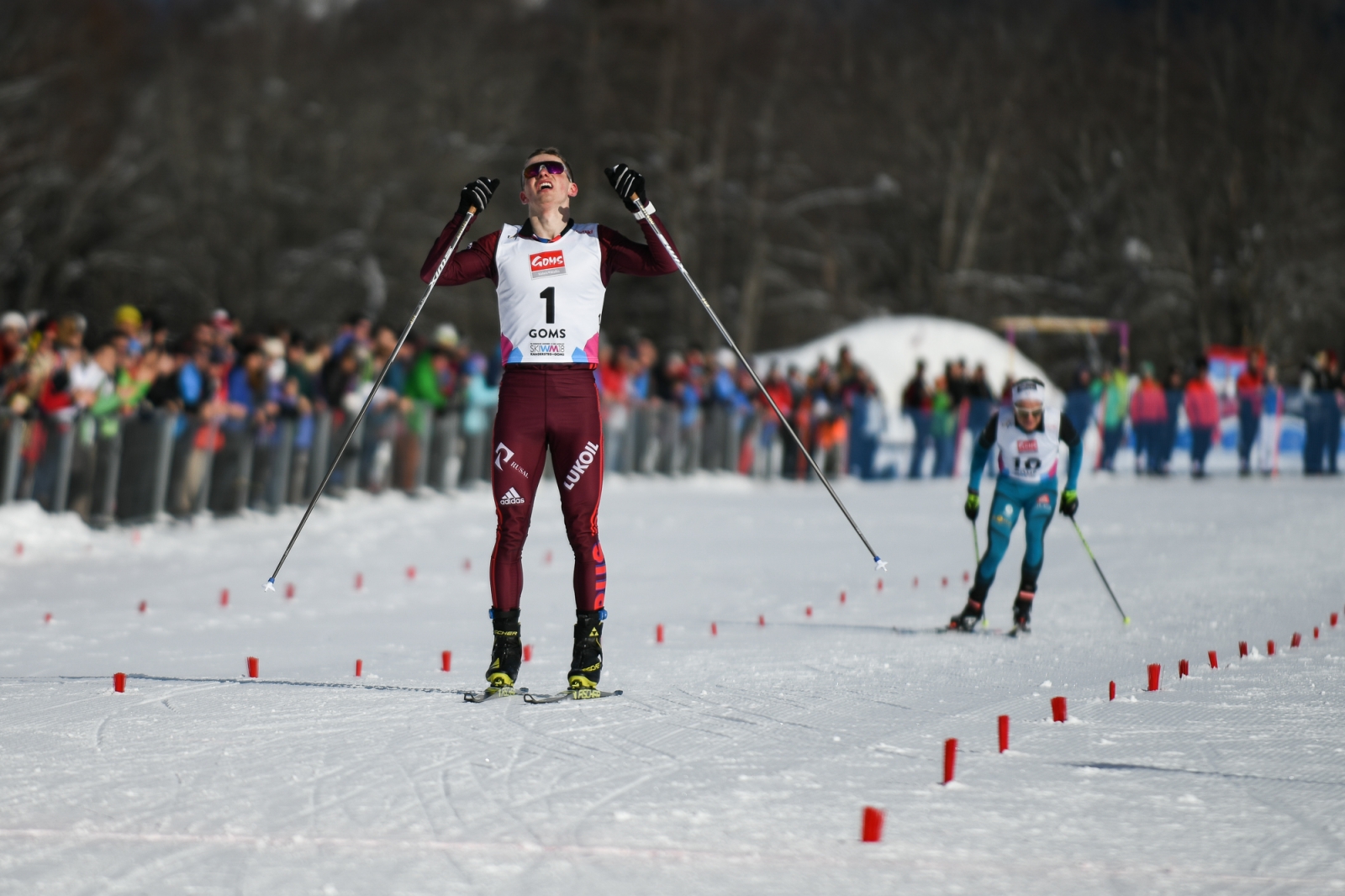
Russia’s Denis Spitsov celebrates his first U23 World Championships gold on Friday ahead of France’s Jules Lapierre in the men’s 30 k skiathlon in Goms, Switzerland. (Photo: JWSC2018.ch)
(Note: This article has been updated to include comments from Americans Lauren Jortberg and Ian Torchia.)
U23 World Championships (Goms, Switzerland): 15/30 k skiathlons
On the final day of U23 World Championships racing in Goms, Russia stole the show in the women’s and men’s skiathlons.
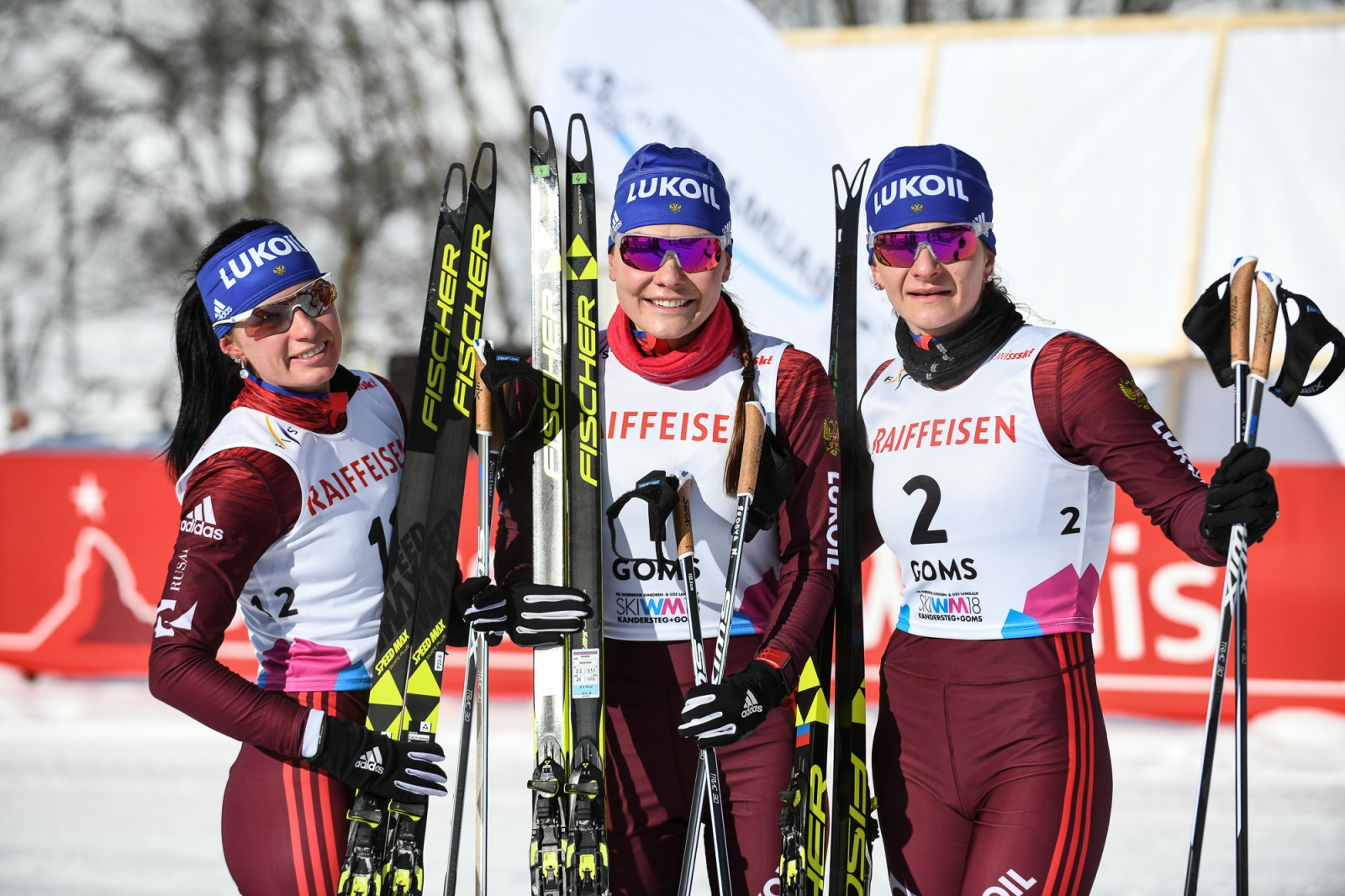
The all-Russian women’s 15 k skiathlon podium at U23 World Championships on Friday in Goms, Switzerland, with Anastasia Sedova (c) in first, Natalia Nepryaeva (l) in second and Yulia Belorukova (r) in third. (Photo: JWSC2018.ch)
Anastasia Sedova led them in the first race of the day on Friday, the women’s 15-kilometer skiathlon, which she won in 44:03.6 minutes. Russia swept the podium and had four in the top five with Natalia Nepryaeva in second (+10.7) and Yana Kirpichenko in third (+37.2), and Yulia Belorukova in fourth (+1:58.0). Germany’s Pia Fink placed fourth (+1:33.5).
The race was the first of the week for the 22-year-old Sedova, a World Cup regular, and it was her second individual gold medal at her second U23 World Championships (she won the 10 k classic in 2016).
“Good preparation for the Olympic Games,” Sedova said during an in-arena interview after the race. “I am very lucky today. Good atmosphere, good weather today.”
Kirpichenko won the 10 k classic earlier this week and Nepryaeva placed third in the freestyle sprint in Goms.
“It’s hard to say how to describe the race, but Anastasia is a really good skier,” Nepryaeva said after. “She was really good today. So for me it was hard to support her during the race. Today she was much better than me.”
American Lauren Jortberg (Dartmouth Ski Team) led the North Americans in 29th (+5:29.9) for her best distance result at the Junior/U23 World Championships level.
“Early in the race I was right over 30th place, and I was trying to maintain contact with the big group ahead of me,” Jortberg, a Dartmouth sophomore from Boulder, Colorado, wrote in an email. “The pace of the classic leg was really fast. A couple of the girls in the race are heading to the Olympics in a few days so it was a really hot start!”
She came through the transition at the race’s halfway point in 31st, about 3:47 behind the leaders.
“I am a much better skater so I felt like I really put the hammer down on the skate leg and moved up a lot,” Jortberg wrote. “The skate course was much easier than the classic course, but I feel like I skied the massive climbs better than the girls around me. I focused on having a really high tempo over the hills and skiing the downhills technically well because there was no rest on the course.
“I’m pleased with my performance today, and I’m excited about my results this week as a whole,” she added. “I’m definitely leaving here hungry for more because I don’t think it was my best week, but I think it was really solid. This is the most competitive field I’ve ever raced against so it feels really good to know that I’m not too far off their level!”
Also for the U.S., Lydia Blanchet placed 38th (+7:11.1) and Nicole Schneider was 40th (+8:04.3). Julia Kern did not finish.
Canada’s Katherine Stewart-Jones (Canadian National U25 Team/NTDC Thunder Bay) placed 31st (+5:39.0) and Maya MacIsaac-Jones was 42nd (+8:08.8), while Laura Leclair and Sophie Carrier-Laforte were lapped.
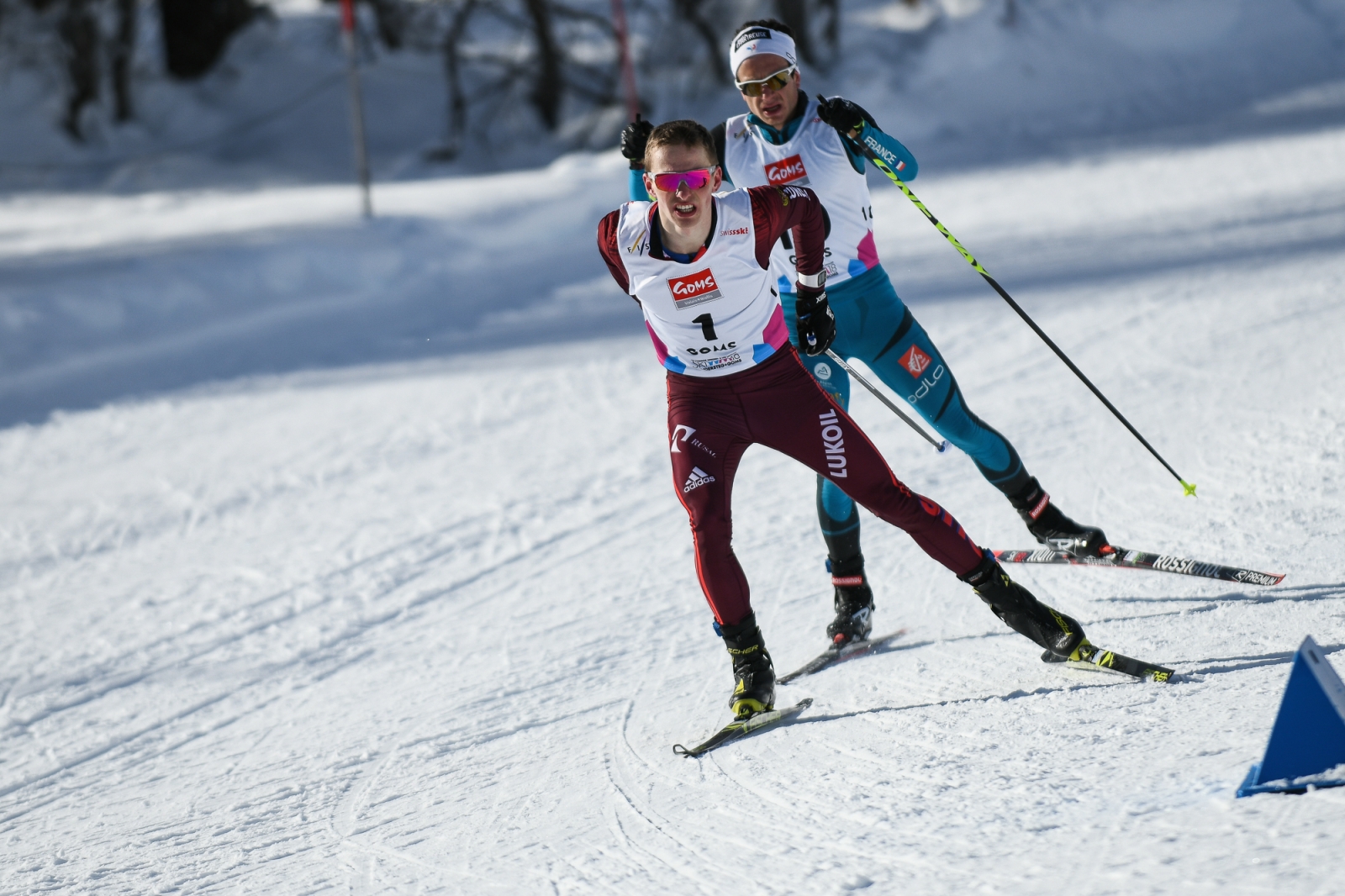
Russia’s Denis Spitsov leads France’s Jules Lapierre during the men’s 30 k skiathlon on Friday at 2018 U23 World Championships in Goms, Switzerland. Spitsov went on to win by 2.9 seconds over Lapierre. (Photo: JWSC2018.ch)
In the men’s 30 k, Russia’s Denis Spitsov took the win in 1:18:14.9 hours, just 2.9 seconds ahead of France’s Jules Lapierre. Norway’s Ole Jørgen Bruvoll placed third (+21.5), ahead of Russia’s Ivan Yakimushkin in fourth (+23.2), and Andorra’s Irineu Esteve Altimiras in fifth (+36.4).
The gold was the first for Spitsov, 21, who previously placed second in the 15 k classic earlier this week. He has two individual bronze medals from last year’s U23 Worlds (in the 30 k skiathlon and 15 k freestyle).
American Ian Torchia (U.S. Ski Team/Northern Michigan University) placed 27th on Friday (+6:05.7). Only 33 men finished, and he was the only North American that didn’t get lapped.
“Between the 3700 feet of climbing, a 2.5km loop, and the top dogs having World Cup podiums…half the field got lapped,” Torchia wrote in an email. “Definitely added some motivation in the final 2 laps to see Spitsov and Lapierre slowly catching up.
“I felt I skied technically better in skate and struggled on the classic leg,” Torchia explained. “Took a hard tumble halfway through the classic leg and had to take half a lap to recover from that. Found a hole in my suit close to my groin afterward which was a little unnerving!”
At the end of the week, he noted that he felt “more fired up than coming in. Funny how being 6 minutes back can do that,” he wrote. “It was an eye-opening experience to get back on the international stage after 2 years and I will take these lessons of racing to the rest of the season in the Ishpemimg Super Tour, Steamboat NCAA’s, and Craftsbury Spring Series. Also already thinking of ideas on how to change and optimize my training to make the jump to the top level.”
Americans Andrew Egger, Zak Ketterson and Thomas O’Harra also competed, as did Canada’s Alexis Dumas, Gareth Williams, Philippe Boucher, and Ricardo Izquierdo-Bernier.
Stratton’s Ben Saxton (l) edging Julien Locke (r) by eight-hundredths of a second for the win in the men’s 1.4 k classic sprint A-final on Friday at Eastern Canadian Championships in Gatineau, Quebec. (Photo: Becca Rorabaugh (APU) on her way to winning the women’s 1.3 k classic sprint qualifier on Friday at 2018 Eastern Canadian Championships in Gatineau, Quebec. (Photo: Rob Smith/CCC)
NorAm Eastern Canadian Championships (Gatineau, Quebec): Classic sprints
Eastern Canadian Championships opened in Gatineau on Friday with classic sprinting, and Americans Becca Rorabaugh and Ben Saxton ended the day with wins in the women’s and men’s A-finals, respectively.
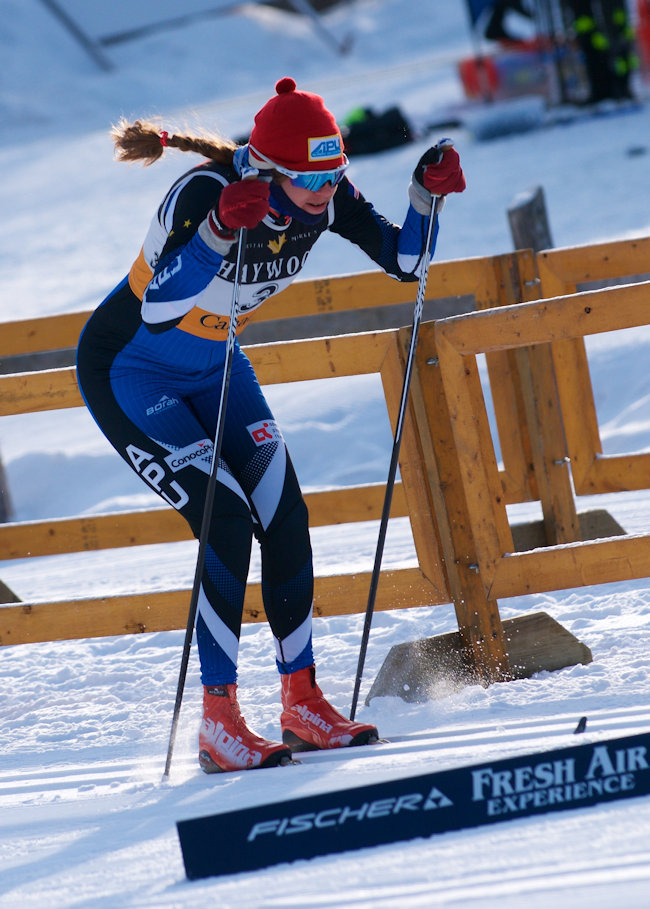
Becca Rorabaugh (APU) on her way to winning the women’s 1.3 k classic sprint qualifier on Friday at 2018 Eastern Canadian Championships in Gatineau, Quebec. (Photo: Rob Smith/CCC)
For Rorabaugh, the win is her second straight after the Alaska Pacific University (APU) skier won the women’s 5-kilometer freestyle at last weekend’s SuperTour in Craftsbury, Vermont. She edged last weekend’s classic-sprint winner, Kaitlynn Miller, of the Craftsbury Green Racing Project (CGRP), by 0.41 seconds for the win in 3:23.15 minutes in Friday’s 1.3 k classic sprint final. It was an all-American podium (and all-American final) with Erika Flowers, of the Stratton Mountain School (SMS) T2 Team, just another three-hundredths of a second back in third (+0.44). Liz Guiney (CGRP) followed in fourth (+2.51), Rosie Frankowski (APU) was fifth (+3.88), and Corey Stock (Bridger Ski Foundation) placed sixth (+6.1).
Rorabaugh had started the day by qualifying first in 3:26.95, then won both her quarterfinal and semifinal. Miller qualified third and won her quarterfinal and semifinal as well.
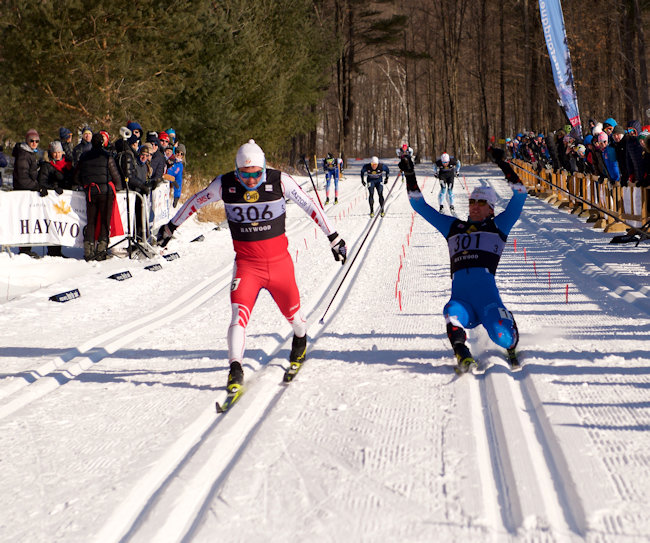
In the men’s 1.4 k classic sprint, Saxton (SMST2) nipped Julien Locke (Canadian U25 Team/Black Jack) at the line by 0.08 seconds for the win in 3:04.54. Patrick Stewart-Jones (Alberta World Cup Academy) placed third (+5.53), Kris Freeman (Caldwell Sport) was fourth (+5.94), Kevin Bolger (Sun Valley Ski Education Foundation) fifth (+7.42), and Julian Smith (NTDC Thunder Bay) sixth (+11.63).
Locke initially won the qualifier in 3:08.37, then won the first quarterfinal and first semifinal as well. Saxton qualified sixth, then advanced in second in his quarterfinal about a second behind Smith, and Saxton won the second semifinal.
Easterns continue Saturday with 10/15 k freestyle races and conclude Sunday with 10/15 k classic pursuits.
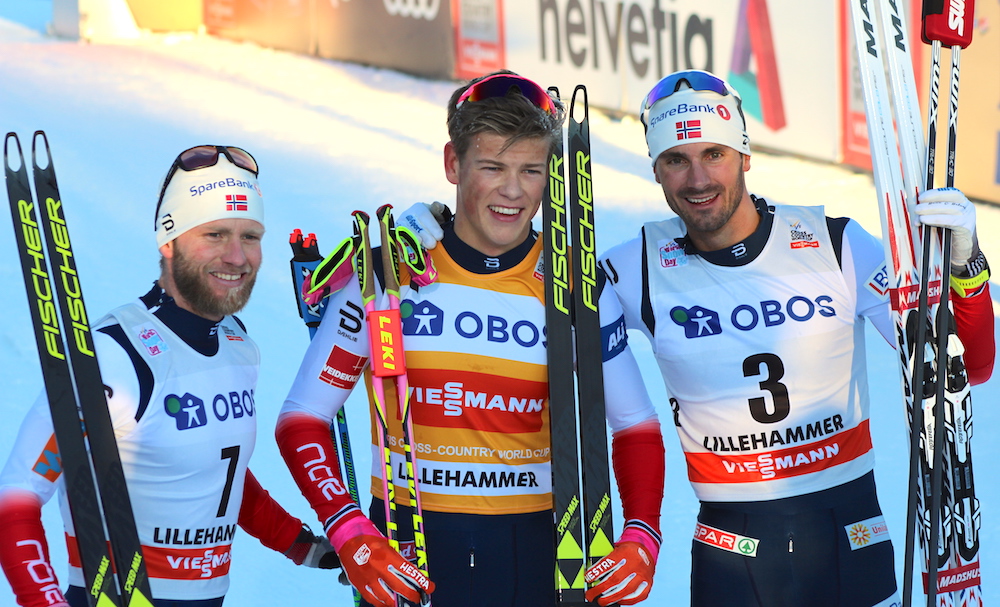
The all-Norwegian men’s 30 k skiathlon podium on Sunday in the 2017 World Cup in Lillehammer, Norway. Johannes Høsflot Klæbo (center) placed first, Martin Johnsrud Sundby (left) second, and Hans Christer Holund (right) third. (Photo: Henrik Hunnes)
Imagine for a moment that only months ago, at about 33 years old, you were in your prime — with World Cup globes on the mantle, six World Championship medals presumably in a drawer somewhere, and four Olympic medals (three of which are from the 2014 Games and will be awarded post-Sochi since the Russians that cheated have been scrubbed from the results sheet). And of course, there’s the iconic beard adorning the iconic Sundby — a technical master with a lung capacity like a blue whale.
But there’s the problem with the human condition of always wanting more. One more win, one more piece of hardware to reaffirm the legacy before the inevitable decay of Father Time.
On a sunny bluebird Sunday in Lillehammer, Norway, on the final buckling climb 28.65 kilometers into the men’s 30 k skiathlon, it looked like Norway’s Martin Johnsrud Sundby would satisfy his need to win. A need that’s been satiated since his first individual World Cup victory in Kuusamo, Finland, in 2008.
When Sundby made his move, he shattered a pack that included fellow Norwegians Hans Christer Holund and Simen Hegstad Krüger, France’s Maurice Manificat and Canadian Alex Harvey. And yes, the relatively new kid on the block from Norway, 21-year-old Johannes Høsflot Klæbo.
The Sundby move that historically would have been a kill-shot turned out to be a slight misfiring. Holund and Klæbo both looked mortal, but the bleed-out wasn’t terminal.
As Sundby glided down the rolling terrain towards the finish. It appeared to be another coronation.
But the roar from the crowds began rising as Klæbo worked the slight ups and the double-polable sections. With his skis running fast, Klæbo dropped Holund and reeled in Sundby by the finishing straight.
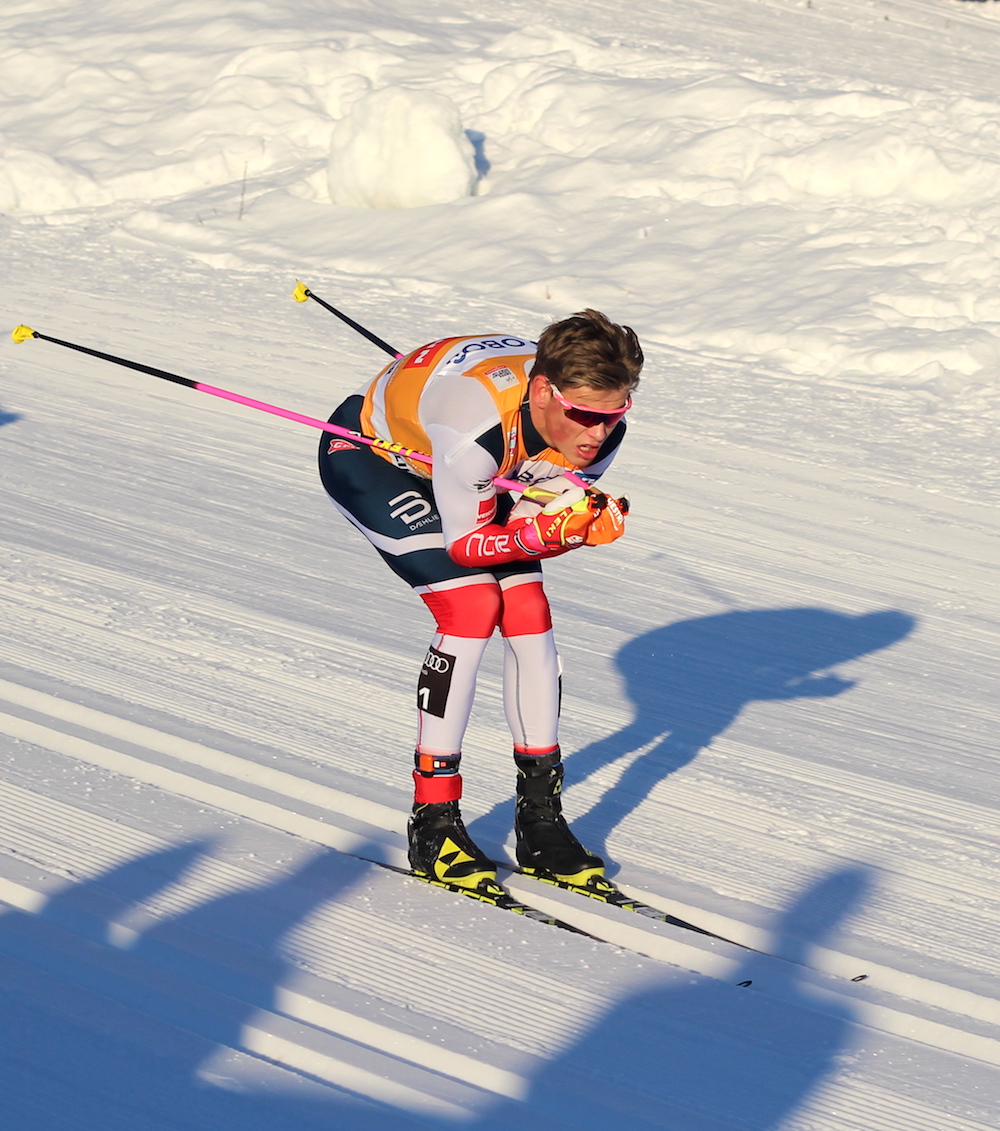
Norway’s Johannes Høsflot Klæbo on his way to winning the 2017 Lillehammer, Norway 30 k skiathlon. (Photo: Henrik Hunnes)
It was a Klæbo win as he claimed his fifth World Cup win this season in as many races. Sprint or distance, no doubt it is Klæbo-time.
The sport’s cliches could be in play. The older, once-dominant lion in Sundby licking his wounds. But these are humans after all. Winning ends for everybody, just not in such a public forum.
Amidst the Klæbo victory, this much was palpable: Sundby’s championship mantle has been usurped. During the concluding seconds of the skiathlon, Sundby saw his racing mortality sprint past with a hair-gelled coif and pink Oakleys.
Klæbo’s winning time was 1:16:47.1 hours.
Sundby placed second, 1.3 seconds back, and Holund third (+6.8). Krueger skied to fourth place (+10.9), Manificat fifth (+11.3), and Harvey sixth (+13.1).
Harvey was the best placed North American, proving once again his deserved reputation as one of the World Cup’s best. After five races, Harvey is ranked fifth in the overall World Cup standings.
“I am really happy — top 10 was the goal, so yeah, it’s really good to fight for the podium until the last three minutes of the race and it’s really good,” Harvey told FasterSkier in Lillehammer. “I felt good. Good skis. I was missing some at the last part of the long climb. The Norwegian guys were the best as expected.”
Harvey’s plan was simple. Tap into a huge training base, keep pace and mark the Norwegians on the skate leg.
“Kind of hide in the classic and then position myself well for the skate, just to be able to cover an attack that was going to come,” Harvey said of his tactics.
In the longest race of the season before February’s PyeongChang Olympics, it was an opportunity for Harvey to test his endurance, but also choose wisely when it came to skis.
“I went for easy kicking skis in classic and that was good,” Harvey said. “I saw Holund especially slipping a lot in the classic. I was just relaxing, and in skate, I wanted a ski that was feeling free on the climbs, because I know on the downhill you have such a big draft, it is not so much about the skis.”
The classic leg offered a more bunched-up group as the primary pacing surges transpired amongst the leaders. That changed quickly after the classic to skate exchange.
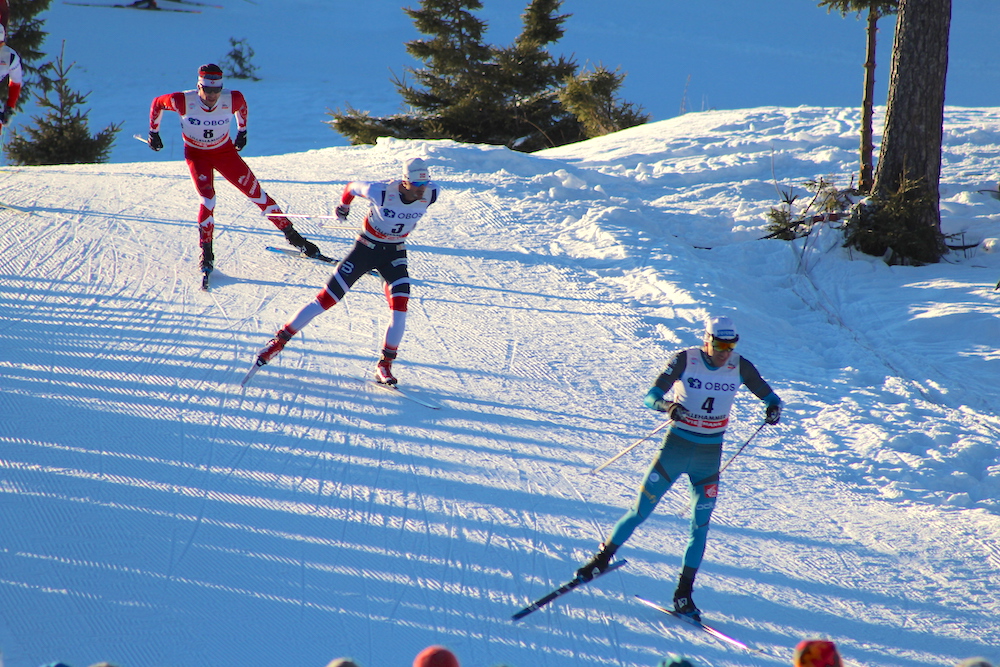
France’s Maurice Manificat (4) making a push at the start of the skate leg during Sunday’s 30 k skiathlon in Lillehammer, Norway, while Canada’s Alex Harvey (l) and Norway’s Hans Christer Holund (c) chase. (Photo: Henrik Hunnes)
“Then the skate, right away on the first lap, Holund and [Sundby] went to the front and they tried to make the first selection,” Harvey said of the first pacing challenge. “I think for the first or second lap of skating it was down to six guys. Then Manificat was pushing super hard on the long uphill. But then we kind of started chilling a bit at the end of the third lap.”
The perceived “chill” pace was simply a momentary lull. Sundby is never one to wait for a sprint finish to decide a distance effort.
“From then we went hard again on the last lap,” Harvey said of the turn of pace on the fourth and final skate lap. “Just steady pace from the stadium just fighting for position. We knew it would happen on the big back hill. So it was just about the best position. I entered there in second place behind Klæbo. So really that is hard to be better than that for starting the last hill. And then it was just man on man.”
We know how this race ended. But Harvey’s summation of the final chapters of this skiathlon was keen.
“Sundby was the strongest, but Klæbo was the most clever,” Harvey said of his old and new rivals.
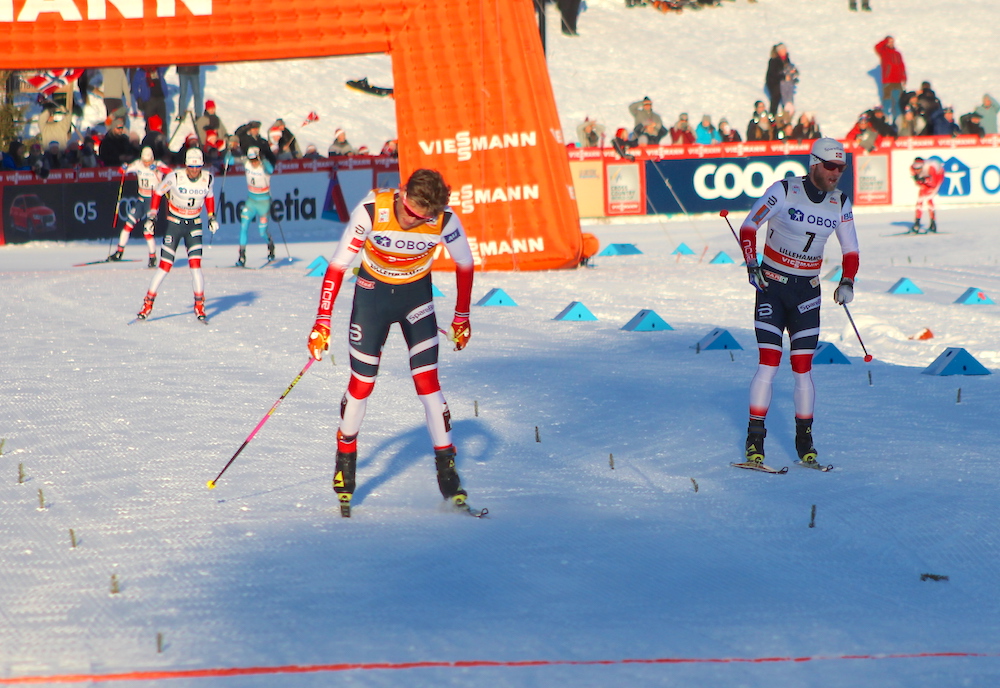
A gassed Johannes Høsflot Klæbo (yellow bib) holding off fellow Norwegian Martin Johnsrud Sundby (r) for the win on Sunday in the men’s 30 k skiathlon at the Lillehammer World Cup in Norway, while Norway’s third man, Hans Christer Holund (3) races to third. (Photo: Henrik Hunnes)
Harvey also reflected that, in terms of results and physical sensations, he is exactly where he’d like to be. Sustainable high output efforts are doable; it’s the 1 percent of the top high speed gear he’s waiting to access.
“Just the punch — I cannot dig super deep yet,” Harvey said. “It’s like that for me before Christmas. It is not unexpected. I think the base is better than in the past, so I can rely on that. So when it is time to really go, I am not there yet, but that is the training, the training is meant for that, too.”
Canada’s Devon Kershaw finished 19th (+2:59.7), just ahead of the U.S. Ski Team’s (USST) Erik Bjornsen in 20th (+2:59.9)y. Although finishing a place apart, their race tales only merged after the transition to the skate leg.
Kershaw must have felt good on the initial classic leg. Six kilometers into his kick-and-stride effort on what was described a quintessentially beautiful hard wax day, Kershaw was positioned 15th in large scrum of skiers, only 4.5 seconds off the lead. The Canadian World Cup vet then played more cat than mouse.
He skied well towards the front by 11 k moving into fifth. At 11.1 k he bolted ahead and won the bonus points. From that point on, Kershaw faded a bit and came through the technique-exchange zone in 18th and 36.2 seconds out of first; his first 15 k were done in a total of 39:58.5 minutes.
Bjornsen’s race took on a different tone early on. He skied conservatively in a technique in which he’s known to thrive. Bjornsen’s classic leg took him 40:28, and he came through the exchange in 23rd, 1:05.7 behind the leaders.
Bjornsen proved on Sunday his race tactics have matured as he’s rounded into a constant World Cup points threat this young season.
“The skiathlon here two years ago, I was feeling great and I charged into the top 10 on the classic and just paid for it on the skate leg,” Bjornsen told FasterSkier in Lillehammer after the race. “So today I tried to be a little smarter.”
Two years ago at the Lillehammer skiathlon, Bjornsen’s early efforts cost him places. He faded from what looked liked a top-20 effort to a sufferfest in the skate portion. After the skate leg, Bjornsen placed 42nd overall, over five minutes back from Sundby, that day’s winner.
Bjornsen’s strategy paid off on Sunday. In a post-race phone call, he explained that at one point on the classic leg, he had the leaders in sight.
“There were times in the second and third lap where the leaders were right there,” Bjornsen said. “But I think it would have been costly to close the 50-meter gap they had. … I think it’s just growing up in the U.S., I didn’t race a lot of 30 k’s. I have had more chances in the last few years over here to see what that race feels like. The 30 k, you can’t make those short sprints to gap up or you pay for it in the end.”
Erik Bjornsen (48) of the USST placed 20th and Noah Hoffman (49, red hat) placed 28th on Sunday’s World Cup 30 k skiathlon in Lillehammer, Norway. (Photo: Henrik Hunnes)
Although his relative position after the exchange did not change considerably, Bjornsen did draw skiers back towards him with his skate effort.
“I think I gained about five spots on the skate leg,” Bjornsen said. “Most of those guys were moving backward. I don’t think we were making any moves towards those front guys, but I was with a good group [including Kershaw]. I could see a pack of ten guys behind us, so my group was motivated to keep charging as well. It was a good plan for me.”
Bjornsen’s 20th place was a career best in a World Cup skiathlon: he placed 27th in the 2016 World Cup skiathlon in Lahti, Finland. Sunday’s result is also Bjornsen’s best in a World Cup race longer than 15 k.
Bjornsen’s former USST teammate, Noah Hoffman was in the points for the first time this season. Hoffman placed 28th after starting in bib 49. Like Bjornsen, he moved up in the standings as the race progressed.
Hoffman finished the classic portion of the race in 41:17.7 minutes and was ranked in 40th place. Kilometer by kilometer, he picked off places. He was 34th at the 19.55 k mark, and in the closing moments had locked into 28th, finishing 3:37.8 behind Klæbo.
Finishing 46.4 seconds outside of the points on Sunday was Scott Patterson of the USST in 36th (+4:56.1).
“Prior to the race, I was quite looking forward to this event,” Patterson emailed. “However, the Norwegian courses and the extra competition of the Norwegian nations group are never things to take too lightly.”
The newly minted USST member has skied against the Norwegian juggernaut before. In last season’s Holmenkollen 50 k classic in March, Patterson placed 28th for the best American result that day. Yet this is Patterson’s first full season on the World Cup and his first time racing World Cups before late January. (Patterson’s first World Cup race was two seasons ago.)
Undaunted, Patterson did keep a top-30 spot as his goal. He began the day in bib 39.
“My approach was to try and move up from my starting position through the classic but also really focus on conserving energy,” Patterson wrote. “I know my skating is a bit more on form currently. From the start things were not going my way. Early on I decided to defend my place in track rather than running up the side. This put me in almost last 500m into the race. For the first two laps I gradually made up some ground but was struggling to ski fast and relax the whole time. I found a little more form for the 3rd and 4th lap, but by that time I had lost a lot of ground.
“The skate leg was better, but I took things a little conservative early,” he continued. “While I was moving up, I was not able to close the gaps to get a good group to work with. Thus most of the skate was trying to catch a few small groups and move through them. Most of the time I felt that I was working on my own. I think I salvaged an ok race from a pretty rough start, but again this one is leaving me wanting more. While I was close again, I still am running with 0 world cup points.”
“It was really cool to start 19th today,” Caldwell reflected in an email. “I didn’t put the early bib to great use but it was a good learning experience and great practice skiing in a big, aggressive pack.”
As the USST’s youngest male World Cup skier gains valuable starts on what is projected as a long World Cup career, Caldwell, 23, did have a moment to reflect in the learning takeaways from the day.
“Mass start races are always fun and a good chance to learn from other skiers,” Caldwell wrote. “I was really impressed with how relaxed the top guys skied on the big climbs. Everyone is hammering but the best guys are so on it technically, really cool to see.”
Canada had three finishers outside the points: Russell Kennedy in 53rd (+7:30.7), Graeme Killick 54th (+6:41.3), and Knute Johnsgaard 60th (+9:49.0).
Racing continues next Saturday in Davos, Switzerland, with a freestyle sprint and a 10/15 k interval start skate race on Sunday.
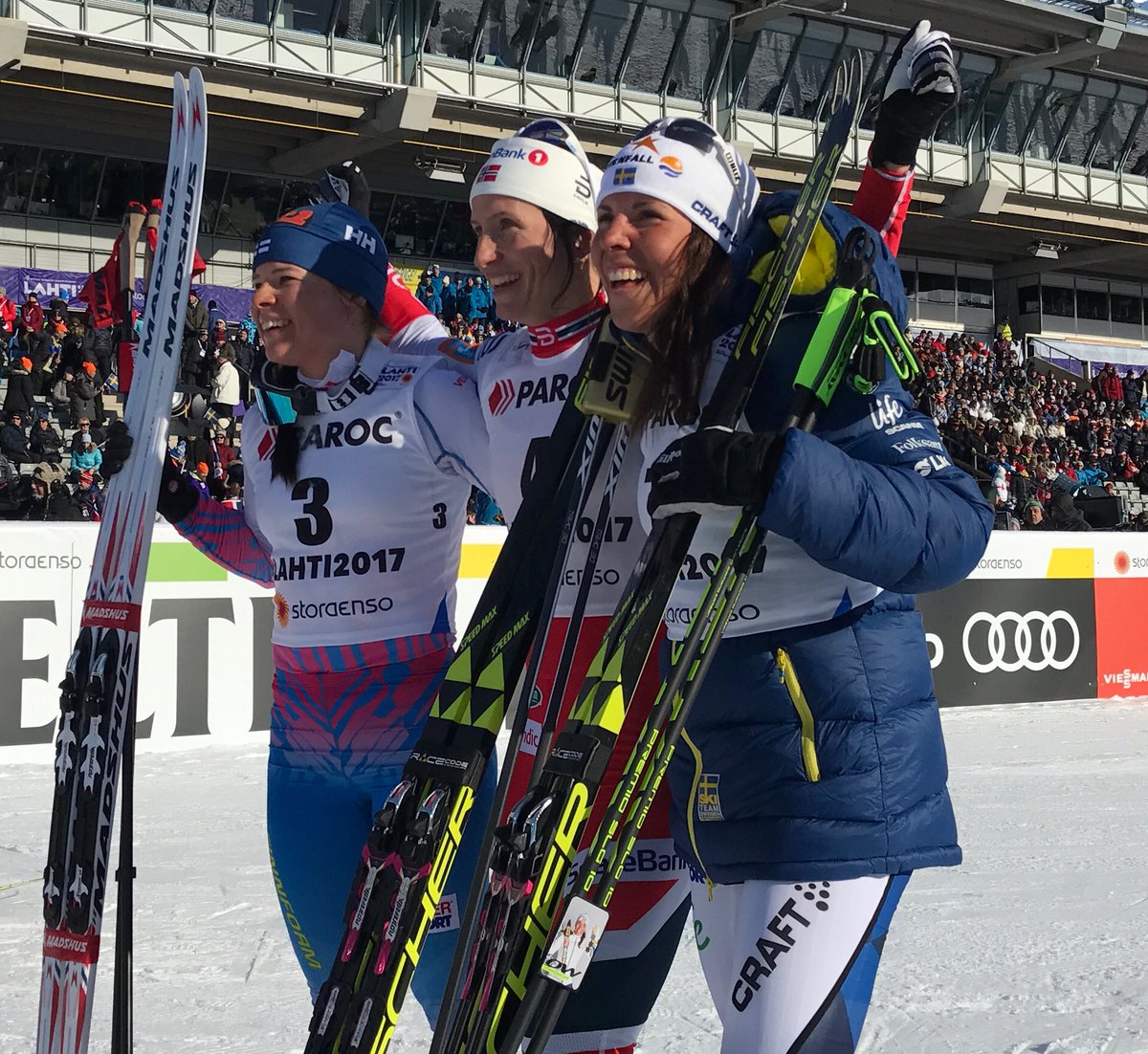
The women’s 15 k skiathlon podium at 2017 Nordic World Championships, with Norway’s Marit Bjørgen (c) in first, Finland’s Krista Parmakoski (l) in second, and Sweden’s Charlotte Kalla (r) in third on Saturday in Lahti, Finland. (Photo: FIS Cross-Country/Twitter)
FIS Nordic World Championships (Lahti, Finland): 15/30 k skiathlons
This one’s for you, kid.
Marit Bjørgen became the second relatively new mom to medal in the second race of 2017 Nordic World Championships on Saturday (after American Kikkan Randall earned bronze in Thursday’s freestyle sprint), racking up her 15th World Championships gold in women’s 15-kilometer skiathlon in Lahti, Finland. Bjørgen, a 36-year-old Norwegian team veteran, had her first child a little over a year ago.
In her first full season back, she led Saturday’s 7.5 k classic + 7.5 k freestyle race at the halfway point, where she clicked into her skate skis half a second ahead of Finland’s Krista Parmakoski in second. Parmakoski followed her across the finish for silver, finishing 4.8 seconds off Bjørgen’s winning time of 37:57.5 minutes. For Parmakoski, it was her first individual medal at World Championships after having previously earned four in team events.
Sweden’s Charlotte Kalla picked up her fourth-career World Championships medal in third place (+32.0), and Nathalie von Siebenthal placed fourth (+1:05) for the best result for a Swiss female cross-country skier since since Evi Kratzer earned bronze in 1987 in Oberstdorf, Germany.
Von Siebenthal edged Norway’s Heidi Weng in a photo finish, with Weng finishing another tenth of a second back in fifth (+1:05.1). Right behind them, Austria’s Teresa Stadlober notched sixth (+1:05.4), Russia’s Yulia Tchekaleva seventh (+1:05.7), Norway’s Astrid Uhrenholdt Jacobsen eighth (+1:11.1), Russia’s Anastasia Sedova ninth (+1:15.3), and Japan’s Masako Ishida 10th (+1:21.8).
Two Americans finished in the top 20 with Randall leading them in 17th (+2:09.2) and Liz Stephen placing 20th (+2:12.4). Rosie Brennan cracked the top 30 in 28th (+3:03.2) and Jessie Diggins did not finish.
A World Championships rookie, Cendrine Browne led Canada in 35th (+4:15.5), followed by Emily Nishikawa in 38th (+4:29.3) and Katherine Stewart-Jones in 40th (+4:38.1).
Annika Taylor, a 23-year-old California native who races for Great Britain, finished 41st (+4:49.7). She previously placed 38th in the freestyle sprint qualifier for her best result at her first World Championships.
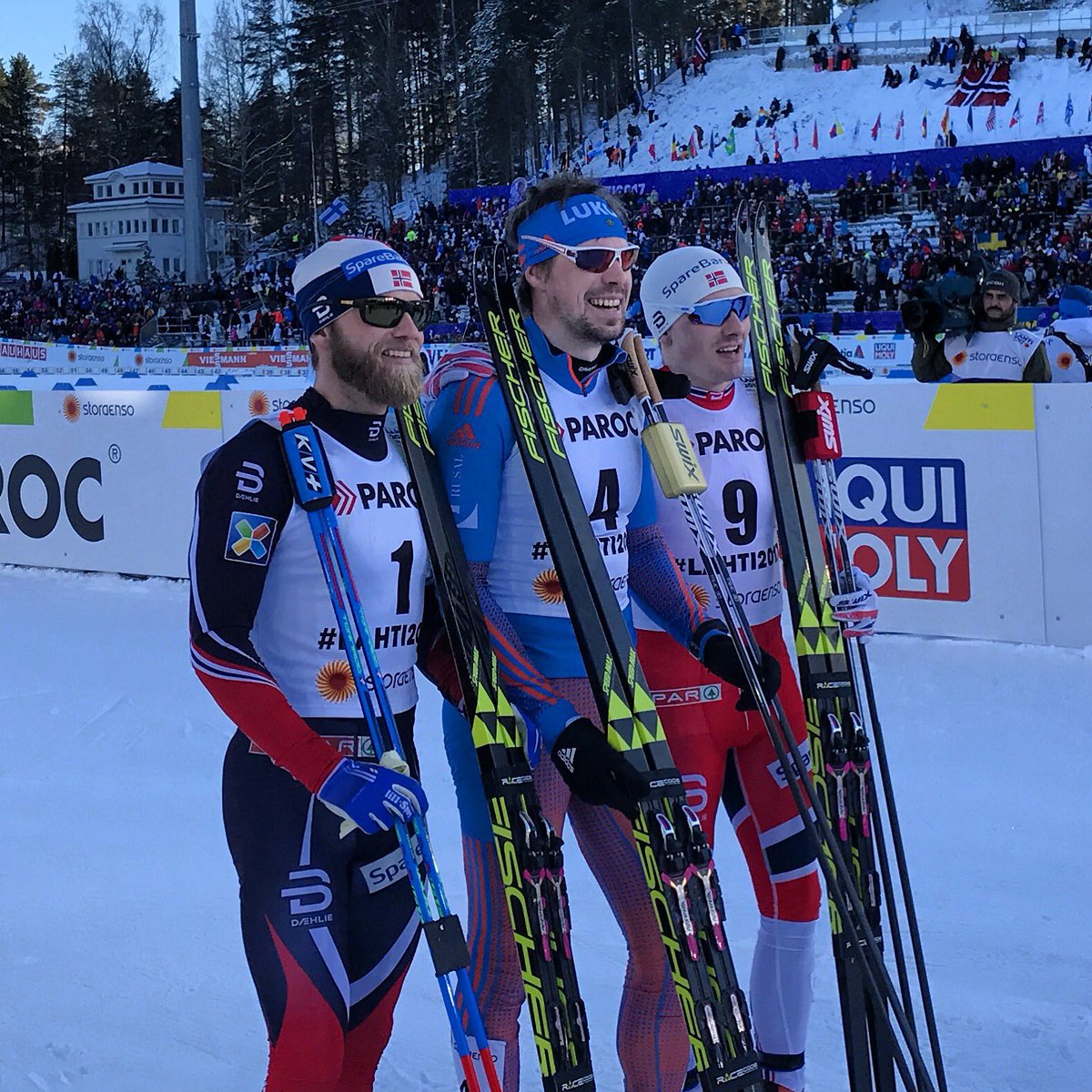
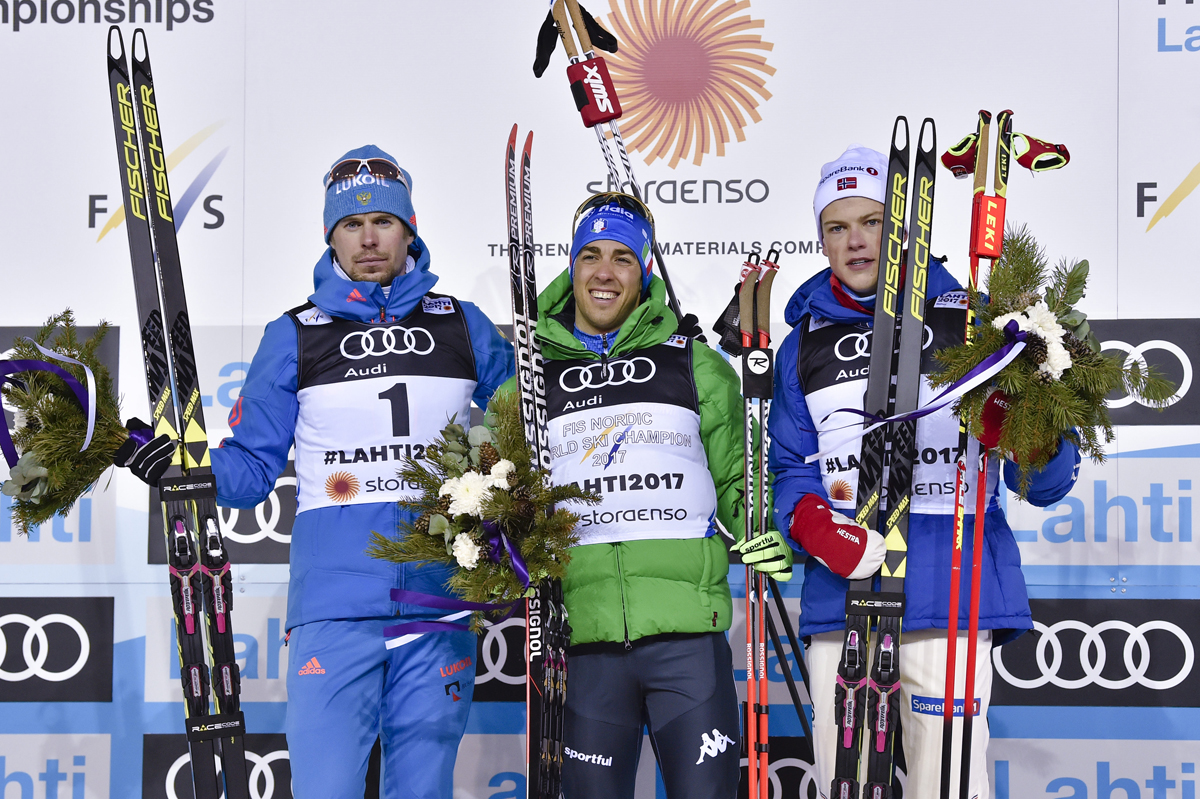
The men’s Nordic World Championships 30 k skiathlon podium, with Russia’s Sergey Ustiugov (c) in first, Norway’s Martin Johnsrud Sundby (l) in second and Finn Hågen Krogh (r) in third on Saturday in Lahti, Finland. (Photo: FIS Cross-Country/Twitter)
The men’s 30 k skiathlon that followed boiled down to a two-way battle for first between none other than Russia’s Sergey Ustiugov and Norway’s Martin Johnsrud Sundby. The two traded off leading throughout much of the race and together gapped the field around the 20 k mark.
Over the next 10 k, Ustiugov continued to drive the pace. On a pivotal climb less than two minutes before the finish, Sundby attacked, jump skating and seeming to put the hurt on Ustiugov. But that moment was over before it started when Sundby broke his pole against his ski tip and had to stop for a replacement.
The 24-year-old Ustiugov skied away to the win, uncontested yet powering down the finishing stretch to claim his first World Championships gold in 1:09:16.7 hours. He had previously earned bronze with the Russian men’s relay in 2013.
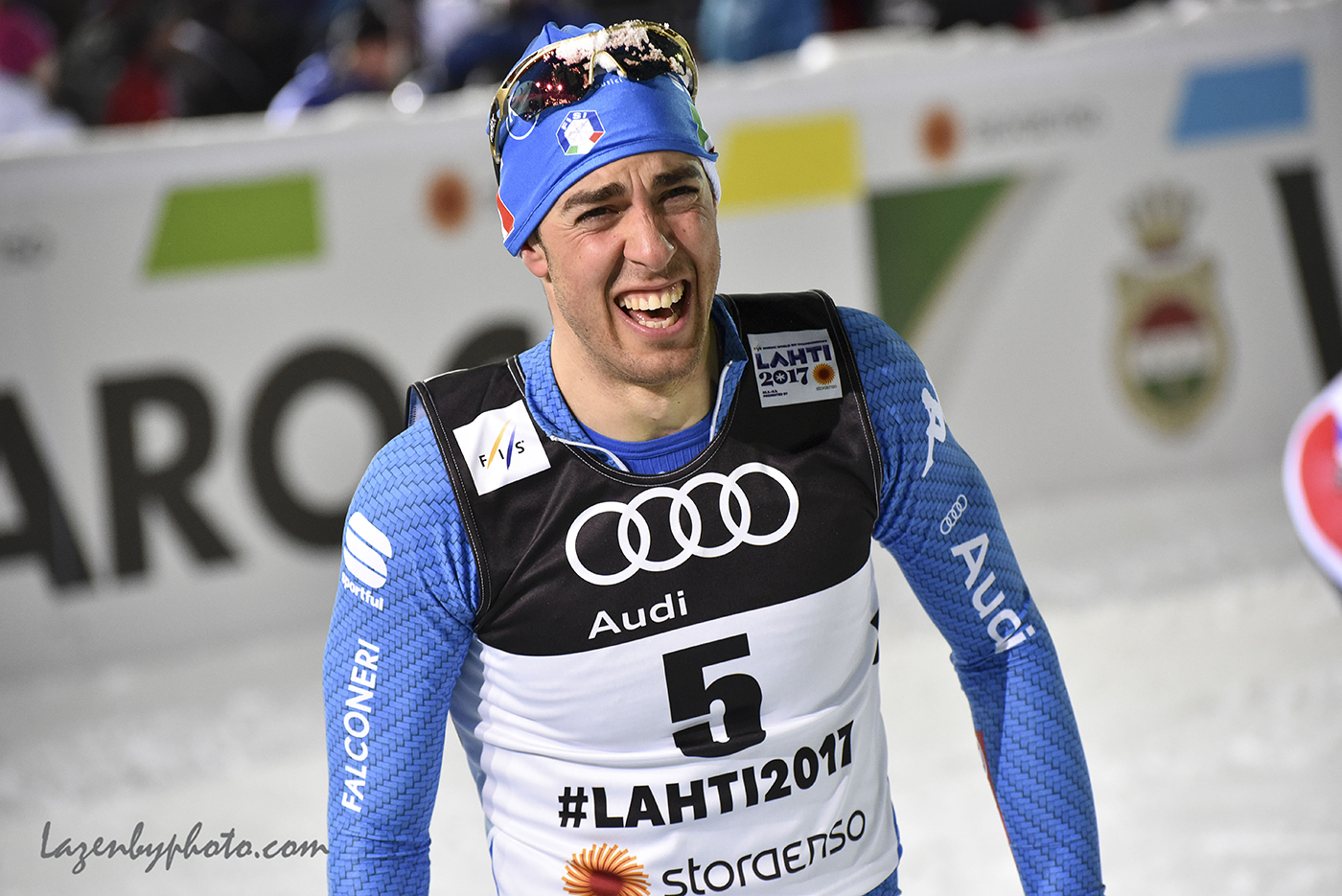
Sundby finished 6.7 seconds later, dropping his arms and head toward the ground as he did so. Norway’s Finn Hågen Krogh came out on top of a five-way fight for third, finishing fourth (+33.1), 31.8 seconds behind Ustiugov and 1.3 seconds ahead of his teammate Sjur Røthe. Krogh put himself in front and proved to have the most finishing kick, ahead of Røthe, Canada’s Alex Harvey (fifth, +33.3), Norway’s Didrik Tønseth (sixth, +33.5), and Sweden’s Marcus Hellner (seventh, +33.7). Russia’s Andrey Larkov fell off the group’s pace and placed eighth (+36.1), Finland’s Lari Lehtonen was ninth (+37.2), and Italy’s 24-year-old World Championships rookie Giandomenico Salvadori broke through in 10th (+37.3).
Three Canadians started the race, with Graeme Killick finishing 47th (+6:23.5) and Knute Johnsgaard 55th (+8:40.2) out of 63.
Tad Elliott was the top American man in 48th (+7:11.2), Kyle Bratrud (+7:16.5) placed 49th and Noah Hoffman 57th (+9:33.6). Ben Lustgarten did not start.
IBU Youth/Junior World Championships (Osrblie, Slovakia): Junior sprints
[UPDATED] Canada’s Megan Bankes and American Siena Ellingson landed in the top 20 of the junior women’s 7.5-kilometer sprint on Saturday at 2017 International Biathlon Union (IBU) Junior World Championships in Osrblie, Slovakia. Coming off a victory in Thursday’s 12.5 k individual, Bankes placed 13th and Ellingson achieved her best non-relay result in 18th at her fourth Youth/Junior Worlds.
Italy’s Michela Carrara won the sprint in 20:57.8 minutes with clean shooting (0+0) and the second-fastest course time. Norway’s Ingrid Landmark Tandrevold skied the fastest but came up 15.2 seconds short of gold with one prone penalty (1+0), which put her in second place. France’s Myrtille Bègue reached the podium in third (+31.5) with perfect shooting (0+0), and Austria’s Simone Kupfner shot clean as well for fourth place (+40.8), 9.3 seconds out of third.
Bankes was one of the first out of the gate in bib 4 and missed one on each stage (1+1) and skied the 14th-ranked course time. She ultimately finished 13th (+1:25.3) for her second-best result at her fourth Youth/Junior World Championships.
Ellingson started 19th and cleaned prone before missing one in standing (0+1), to finish 18th (+1:38.7) with the 20th-ranked course time.
Canada’s Nadia Moser scored her first top 40 of these championships in 31st (+2:16.4) with two misses (1+1), her teammate Emily Dickson finished 47th (+3:15.8) with one prone miss (1+0), and the second American racing, Nina Armstrong finished 65th (+6:11.5) with five penalties (2+3).
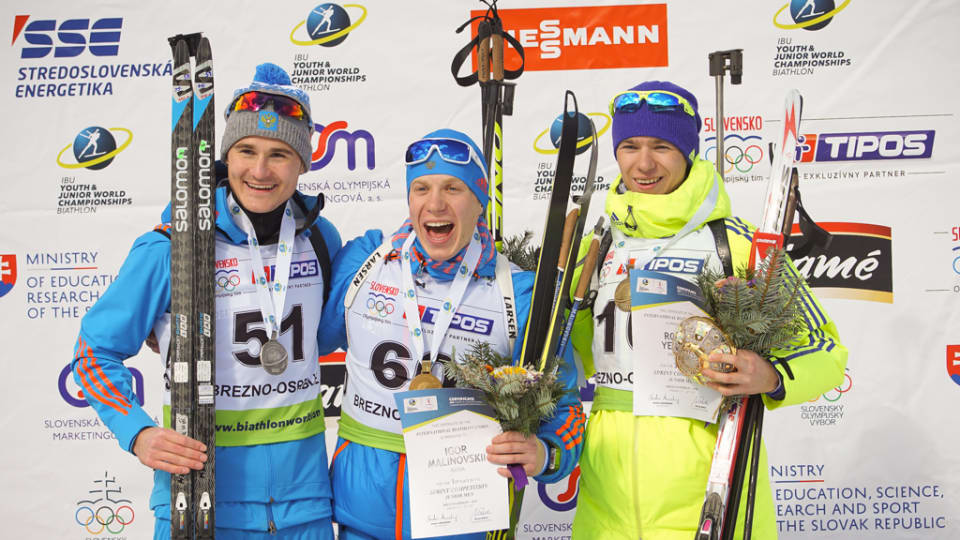
Russia had two on the podium in Saturday’s junior men’s 10 k sprint at IBU Junior World Championships with Igor Malinovskii (c) in first and Kirill Streltsov (l) in second, sharing the podium with Kazakhstan’s Roman Yeremin (r) in third in Osrblie, Slovakia. (Photo: IBU)
In the junior men’s 10 k sprint, Russia took the two top steps of the podium with Igor Malinovskii in first and Kirill Streltsov in second, after both cleaned the two-stage race.
Malinovskii started later in the field in bib 60 (out of 86) and bested his teammate’s time by 12.2 seconds, finishing in 24:32.2 minutes. Streltsov, who had started 51st and led until that point, took silver and Kazakhstan’s Roman Yeremin notched bronze (+24.9). Despite two misses on his first prone stage (2+0), Yeremin was an early race leader after starting 10th. He bested the time of Belarus’s Anton Smolski, who started fifth, by just 0.2 seconds for third. Smolski settled for fourth, ahead of Germany’s David Zobel (who previously took silver in Thursday’s 15 k individual) in fifth (+38.2).
Cody Johnson was the top American in 46th (+3:02.9), followed by Travis Cooper in 49th (+3:10.7), Cameron Christiansen in 80th (+5:32.4), and Peter Carroll in 82nd (+5:51.6).
Pearce Hanna led the Canadian men in 47th (+3:04.1), ahead of Trevor Kiers in 48th (+3:06.6), Zachari Bolduc in 54th (+3:25.4), and Jules Burnotte in 55th (+3:31.2).
Youth/Junior World Championships continue Sunday with the youth men’s and women’s pursuits.
Italy’s Federico Pellegrino after winning his first World Championships title on Thursday in the men’s 1.6 k freestyle sprint final in Lahti, Finland. (Photo: John Lazenby/Lazenbyphoto.com)
LAHTI, Finland — Up until the final 100 meters of Thursday’s race, it looked as if the 2017 Nordic World Championships sprint title belonged to Russia’s Sergey Ustiugov.
In fact, Ustiugov had won the qualifier in a time of 3:11.72 minutes, a commanding 2.7 seconds over Norway’s Finn Hågen Krogh. The Russian reigning Tour de Ski champion placed second in his quarterfinal by a mere 0.19 seconds. He was second again in his semifinal in a three-way photo finish, in which Italy’s Federico Pellegrino came out on top, Ustiugov took second and Norwegian Johannes Høsflot Klæbo was third.
Italy’s Federico Pellegrino outlasting Russia’s Sergey Ustiugov (not shown) and Norway’s Johannes Høsflot Klæbo (behind) for the win in the men’s freestyle sprint final at 2017 Nordic World Championships in Lahti, Finland. (Photo: John Lazenby/Lazenbyphoto.com)
Coming down the homestretch of the men’s 1.6-kilometer freestyle sprint final, Ustiugov seemed to have learned his lesson: race your own race, let the rest play catch up.
But charging from behind was Italy’s defending Sprint World Cup champion. As Pellegrino surged, Ustiugov faded. The end result was a repeat of their semifinal: Pellegrino in first in 3:13.76, Ustiugov second (+0.15), and Klæbo third.
His Norwegian teammates Krogh and Petter Northug finished fourth (+0.67) and fifth (+12.13), respectively. Fan favorite, Ristomatti Hakola ofFinland placed sixth (+12.28).
Ustiugov was visibly frustrated within moments of crossing the line and letting the World Championship title slip away. World Cup sprint leader Pellegrino, along with his scores of yellow-hat-clad fan club, celebrated his win as if it were never in doubt.
“Last year here, I was in the final against five Norwegian athletes,” Pellegrino said during a post-race press conference. “And I tried to attack in the last uphill. I was in the front of the group in the last downhill and then I finished fourth. So this year I was just thinking, don’t be the first on the last downhill.”
The marks Pellegrino’s first individual World Championships medal. The 26 year old previously earned bronze in the 2015 World Championships freestyle team sprint with teammate Dietmar Nöckler in Falun, Sweden.
Alex Harvey (Canadian World Cup Team) racing to 13th in the men’s freestyle sprint qualifier on Thursday at 2017 Nordic World Championships in Lahti, Finland. Harvey went on to place 12th overall after being relegated for a move in his semifinal. (Photo: John Lazenby/Lazenbyphoto.com)
The top North American on Thursday was Canada’s Alex Harvey in 12th. Harvey advanced all the way to the second semifinal, and for a moment looked like he might make a move on the final long climb to position himself within the top two.
“The power was good, but with this fresh snow, it’s really tough to go outside the race line,” Harvey said after. “Usually this is one of those courses where you can make a lot of moves. But today, because everybody was skiing in the middle, that made the track much faster, but on the side the fresh snow was slow. So for my style of racing, it was hard to come from the back.”
According to Harvey, by the finishing stretch Poland’s Maciej Staręga had moved out of his lane ahead of him. In an attempt to maneuver back around Staręga, Harvey unintentionally skied over Norwegian Emil Iversen’s skis, causing Iversen to crash. The jury relegated Harvey to last in the heat.
Moving forward, Harvey said he was looking forward to Saturday’s 30 k skiathlon, where he believes he has his best chances at a world champs medal. Harvey has four World Championships medals: one gold from the 2009 classic team sprint (with Devon Kershaw), one silver from the 2015 classic sprint, and bronze in the 2013 classic sprint and 2015 skiathlon.
Three other Canadian men did not qualify, with Jess Cockney finishing 47th (+16.82), Len Valjas one place behind in 48th (+17.16), and Knute Johnsgaard in 53rd (+18.39).
Andy Newell (U.S. Ski Team) racing to 20th in the in the men’s freestyle sprint qualifier on Thursday at 2017 Nordic World Championships in Lahti, Finland. Newell went on to place 21st overall after finishing fifth in his quarterfinal. (Photo: John Lazenby/Lazenbyphoto.com)
For the U.S., Andy Newell ended up 21st after placing fifth in his quarterfinal, 1.75 seconds behind Krogh, who won that heat. Newell started his day by qualifying in 20th.
“I’m feeling healthy and strong, I definitely have come not to take anything for granted these days,” the 33-year-old U.S. Ski Team veteran said of his international-skiing opportunities. “So I am healthy and injury free. … I am happy to be here and happy to get some World Championship races in. I am pretty motivated to try to ski fast, so we will see what the week brings.”
Two U.S. men reached the heats, with Simi Hamilton landing 11th in the qualifying round. But with a lot of good U.S. luck on Thursday, there was some bad.
“We had some bad luck out there with Simi crashing,” U.S. Ski Team Head Coach Chris Grover said. “[Simi] was really disappointed because he had obviously been targeting this race for a long time. But he knows that that’s part of sprinting, too. And that for the times when you do make it to the podium and to the A-final, it makes those appearances that much more special when you do those have those kind of results, knowing that there are going to be these hard days in between.”
Simi Hamilton (U.S. Ski Team) racing to 11th in the men’s freestyle sprint qualifier on Thursday at 2017 Nordic World Championships in Lahti, Finland. Hamilton went on to place 28th overall after finishing sixth in his quarterfinal. (Photo: John Lazenby/Lazenbyphoto.com)
After skiing within reach of the top three with space to move into the top two, Hamilton fell during the final descent into the stadium and ultimately finished sixth, 35 seconds behind Pellegrino, who won that quarterfinal. He placed 28th on the day.
“I was feeling good … and made a good move to get kind of in the mix with everyone leading down the downhill, so I was kind of biding my time,” Hamilton, 29, said. “And we started down it, I went to pass [France’s Richard] Jouve on the right, and then I don’t know whether we tangled skis or I hooked my tip in the powder … and I just tried to take a little skate with my right to get a little more momentum over the bump, and maybe just hooked my right tip and face-planted.”
Hamilton plans on racing in the classic team sprint on Sunday. The U.S. started four men in the sprint, with Erik Bjornsen finishing 36th in the qualifier, 2.22 seconds out of the top 30 needed to qualify, and Cole Morgan 54th (of 156 in the men’s field).
For Morgan, 22, of the Sun Valley Ski Education Foundation, Thursday marked his World Championships debut and the only race he will compete in at this year’s world champs. He planned to return to the U.S. within the next few days.
“It’s wild,” he said of the experience.
Lahti’s lower elevation contrasted greatly with many of the races Morgan has raced in so far this season. “I haven’t raced at sea level yet this year, and it’s a different feeling.”
— Harald Zimmer, Chelsea Little, and Alex Kochon contributed
The men’s freestyle sprint podium at 2017 Nordic World Championships in Lahti, Finland with Italy’s Federico Pellegrino (c) in first, Russia’s Sergey Ustiugov (l) in second, and Norway’s Johannes Høsflot Klæbo (r) in third. (Photo: Fischer/NordicFocus)
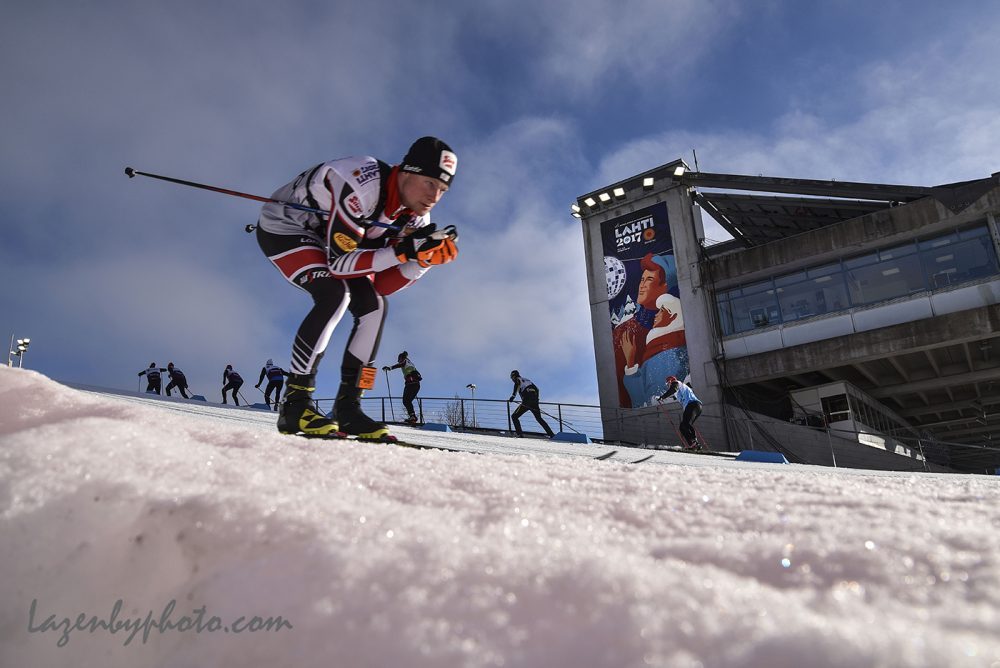
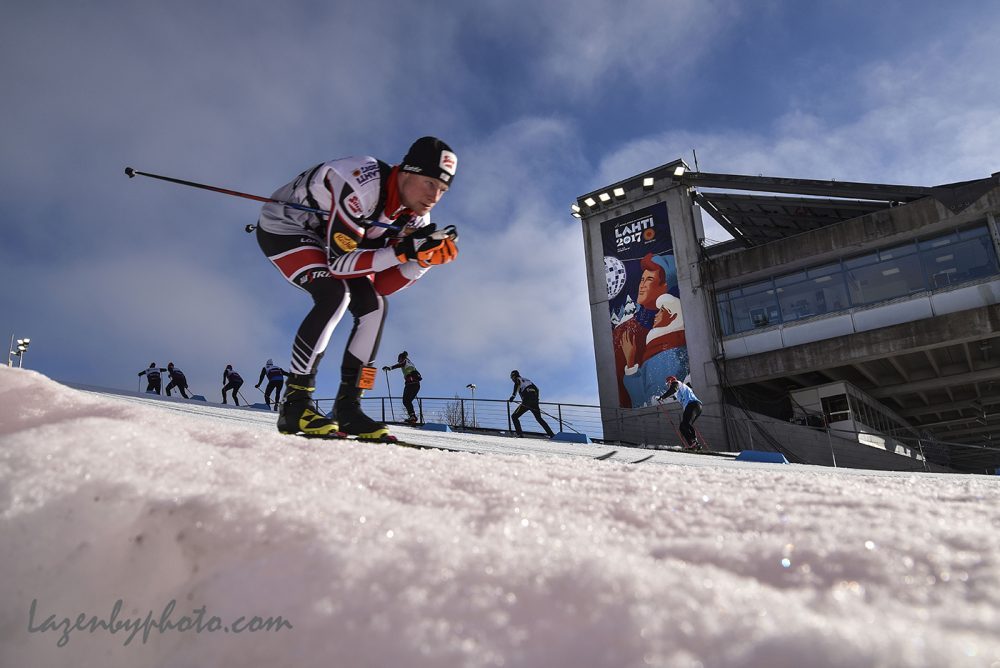
An Austrian athlete tests skis as he glides back into the main stadium. (Photo: John Lazenby/Lazenbyphoto.com)
LAHTI, Finland — Tuesday at Lahti’s venue for the 2017 Nordic World Ski Championships, the sun sets early. Although technically sunset was 5:22 p.m., the sun on this clear-sky day was still wintertime reluctant. It seemed too short a time for the sun’s transect to thaw Lahti. Temps were in the mid-to-low 20 degrees Fahrenheit. But a brisk wind called for down coats and insulated pants for those not actively skiing — in the shade, it felt like the teens.
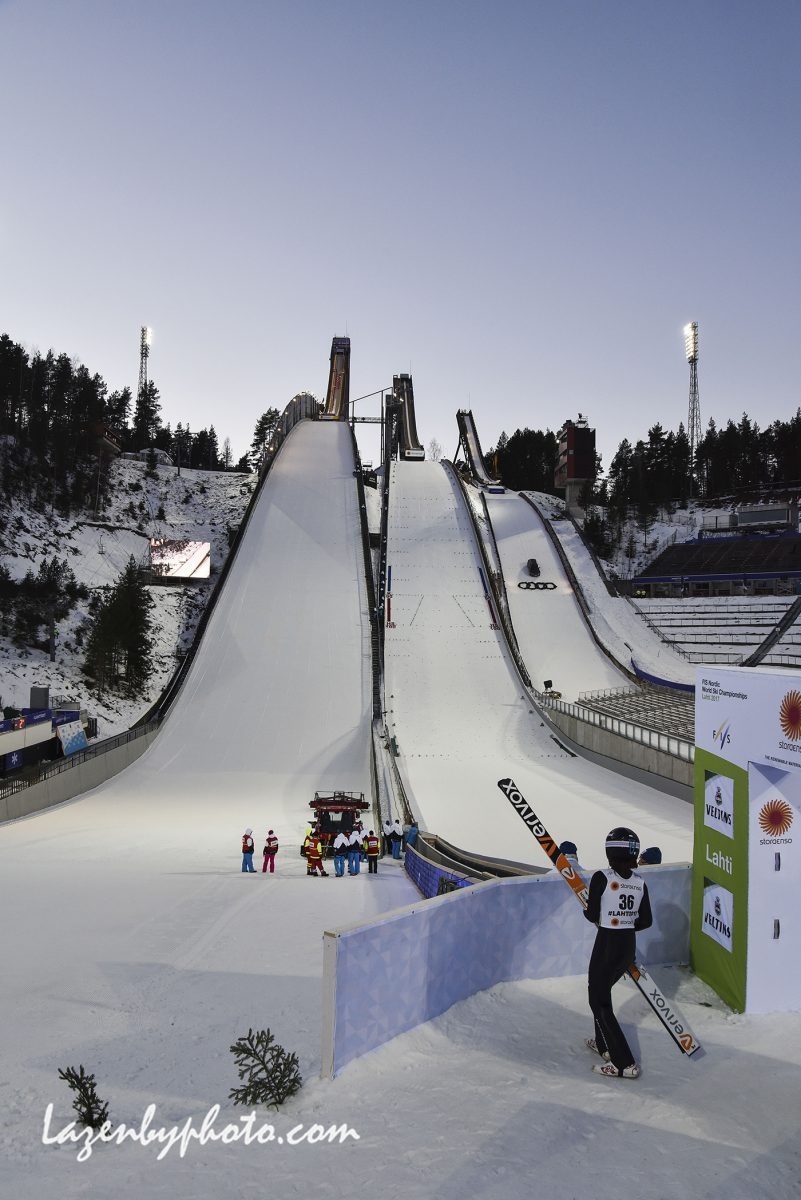
Basked in an early evening glow, Lahti’s three iconic ski jumps dominate the 2017 Nordic World Championships venue. (Photo: John Lazenby/Lazenbyphoto.com)
For athletes, it was a day of pre-competition ski and wax testing on bulletproof tracks that gradually deteriorated on the steeper climbs. The ski loops have good coverage. The snow remains coarse, as the tracks are covered with predominately manmade snow with trace amounts of natural snow tilled in.
Lahti’s most dominant feature are its ski jumps, which are among the first objects to catch morning light. The surrounding landscape isn’t marked by serrated mountains, but by subtle hills that make the venue’s three domineering jumps (a K 116, K 90, and K 64), that much more ominous. First nordic-combined skiers then women’s ski jumpers had an opportunity for test flights off the K 90.
On the non-skiing side of things, the venue was abuzz of last-minute prep: television cables being covered for protection before the onslaught of spectators, event producers testing the stadium’s Skycam, sponsors unpacking schwag, and media arriving to pick up credentials. Like the athletes fine tuning before the competition begins, Lahti’s organizers are near set for the big show.
On Wednesday, two qualification races will ensue: the women’s 5-kilometer classic and men’s 10 k classic individual starts. These races are for athletes from “non-skiing” nations who have not met the FIS-point benchmark to participate in the championships. Start rights to Lahti’s distance races are granted to the top-10 male and female finishers. (All skiers are granted start rights for Thursday’s freestyle sprint regardless of their results in Wednesday’s qualifier.)
The Russian men finishing in unison to take first, second and third in the men’s 30 k skiathlon, the final race of 2017 U23 World Championships at Soldier Hollow in Midway, Utah. Alexander Bolshunov (8) was deemed the winner, Alexey Chervotkin (1) was second, and Denis Spitsov (11) third. (Photo: FlyingPointRoad.com)
FIS Nordic Combined Junior World Championships (Park City and Midway, Utah): Normal hill/5 k
American Ben Loomis (6) leads Norway’s Lars Ivar Skaarset (7) during the third leg of the nordic-combined 4 x 5 k team event on Thursday at 2017 Nordic Junior Worlds at Soldier Hollow in Midway, Utah. Loomis brought the U.S. from ninth to seventh, and his team ultimately finished seventh. (Photo: FlyingPointRoad.com)
[UPDATED] In the individual normal hill/5-kilometer Gundersen on Saturday, the last nordic-combined competition of 2017 Nordic Junior World Championships, American Ben Loomis captured his first top 10 in his third Junior Worlds in ninth place.
Eighteen-year-old Loomis jumped to 10th then picked off one place in the 5 k to finish ninth, 1:22.3 minutes behind the winner, Germany’s Vinzenz Geiger.
Geiger led after the jump and started the ski race 4 seconds ahead of Japan’s Yuto Nakamura in second. Geiger was able to hold off Finland’s hard-charging Arttu Mäkiaho, who raced from ninth to second, by 22.6 seconds. France’s Laurent Muhlethaler raced from fifth to third (+23.9) for the final spot on the podium, while Nakamura slipped to fourth (+42.8).
The U.S. had two in the top 15 with Stephen Schumann in 15th (+1:44.3), up from 20th after the jump. Grant Andrews placed 33rd (+2:40.0) and Tucker Hoefler finished 46th (+3:56.9).
FIS Nordic U23 World Championships (Midway, Utah): 15/30 k skiathlon
It was a Russian affair and a head scratcher for the photo-finish crew at U23 World Championships on Saturday, with three Russians putting enough time on the rest of the field in the men’s 30-kilometer skiathlon that they had time to slow to a stop and inch across the line in unison.
The jury ultimately had to decide who won, awarding it to Alexander Bolshunov in 1:15:31.5 hours, 0.2 seconds ahead of Alexey Chervotkin in second. Denis Spitsov was listed as third (+0.5). France’s Jules Lapierre came closest to the Russians in fourth, finishing 11 seconds later.
The field was considerably strung out by the end of the race, with Switzerland’s Jason Rueesh finishing 14.3 seconds out of first in fifth and Norway’s Gaute Kvaale crossing the line in sixth (+33.0), ahead of France’s Valentin Chauvin in seventh (+49.1), and Andorra’s Irineu Esteve Altimiras in eighth (+56.8).
American Paddy Caldwell (SMS/USST) placed ninth for the second-straight race at U23s, finishing 1:24.4 behind the winner.
The U.S. men had three in the top 15 for their best day of the championships, with John Hegman (SVSEF) placing a 11th (+1:53.5) and Adam Martin (NMU) 15th (+2:23.3) for their best results at U23 Worlds.
Evan Palmer-Charrette (NTDC Thunder Bay) led the Canadian men in 26th (+5:44.6). Alexis Dumas (CNEPH) finished 33rd (+9:02.7) out of 36 finishers. Several North Americans did not finish, including Canada’s Julien Lamoureux and Julien Smith, and American Cal Deline.
In the women’s 15 k skiathlon, Lotta Udnes Weng achieved her first gold of U23 Worlds, holding off Finland’s Johanna Matintalo by 3.8 seconds and crossing the line in 40:50.9 minutes. Russia’s Yana Kirpichenko reached the podium in third (+13.9), fewer than two seconds ahead of Weng’s twin sister, Tiril Udnes Weng in fourth (+15.6).
Dahria Beatty, of the Alberta World Cup Academy and Canadian National U25 Team, led the North Americans in 19th (+2:18.1), and teammate Katherine Stewart-Jones (NTDC Thunder Bay/NST U25 Team) was 21st (+2:29.3) for her best U23 Worlds result.
The Czech Republic’s Petra Hyncicova (University of Colorado-Boulder) followed in 22nd (+2:30.7), and three Canadian women finished in the top 30 with Frederique Vezina (CNEPH) in 29th (+3:36.2). Jenn Jackson did not finish.
Jesse Knori (University of Colorado-Boulder) was the top American in 30th (+3:40.1), Alayna Sonnesyn followed in 31st (+3:42.5), Nichole Bathe (University of Alaska Fairbanks) in 33rd (+4:36.9), and Corey Stock (Bridger Ski Foundation) in 36th (+5:42.1).
Mathilde Petitjean, who races for her native Togo but trains with the Quebec-based CNEPH, finished 38th (+6:04.8) of 38 finishers.
FIS Cross-Country World Cup (PyeongChang, South Korea): 15/30 k skiathlon
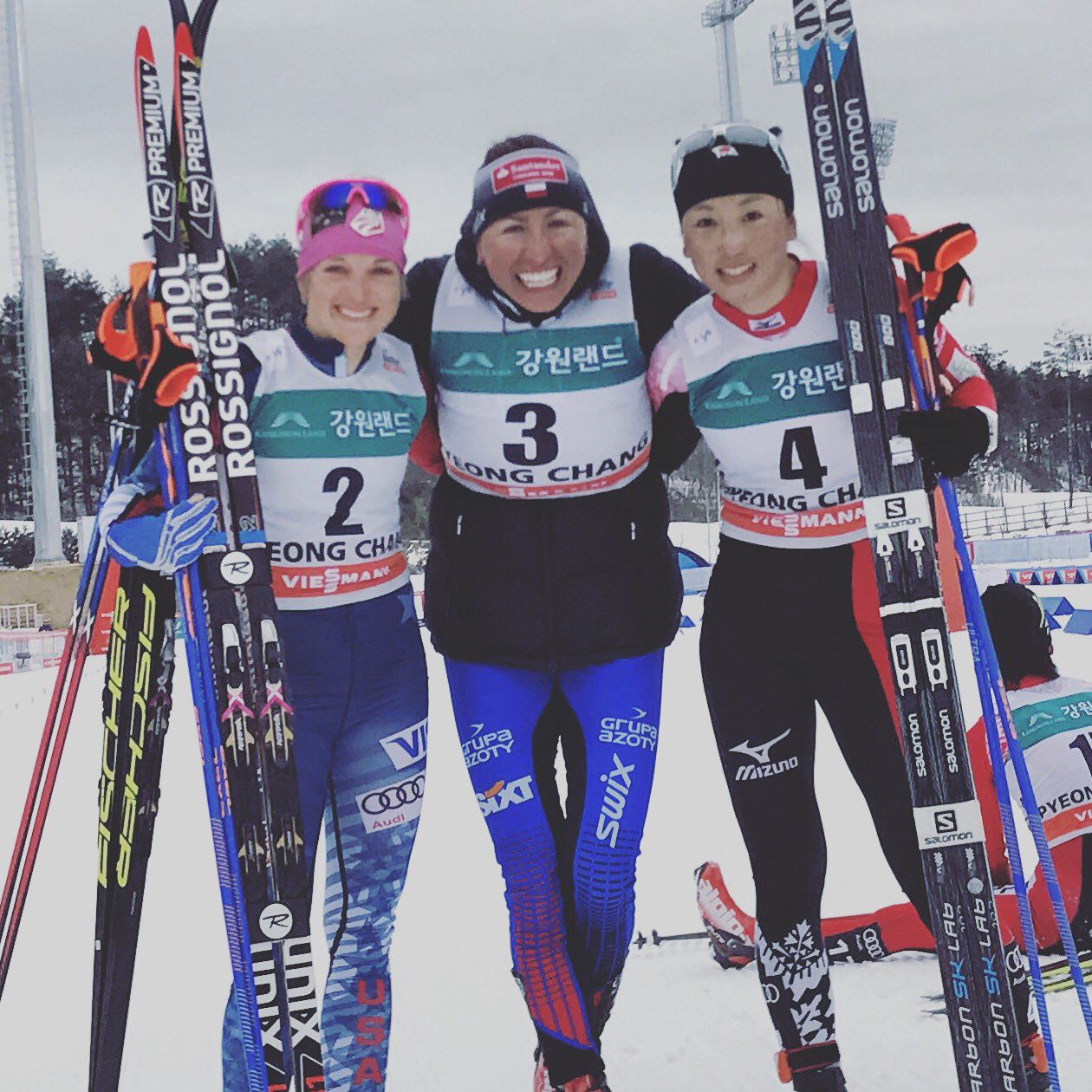
The women’s 15 k skiathlon podium at the PyeongChang World Cup in South Korea, with Poland’s Justyna Kowalczyk (c) in first, American Liz Stephen (l) in second, and Japan’s Masako Ishida in third. (Photo: FIS Cross Country/Twitter)
The second day of World Cup racing in PyeongChang, South Korea, took place this Saturday, with a skiathlon event for both genders. The women raced a total of 15 kilometers, the first 7.5 k leg classic and the second 7.5 k leg freestyle. Poland’s Justyna Kowalczyk came away with the women’s win (her first in three years), getting back to her old ways of breaking away from the pack to finish first in 43:54.7 minutes. Liz Stephen of the U.S. Ski Team (USST) claimed second place (+56.0), while Japan’s Masako Ishida took third (+1:14.8).
For Stephen, second matched her best individual result in a from two years ago, when she placed second in a 10 k freestyle in Rybinsk, Russia. This year at the Tour de Ski, Stephen posted the second-fastest time up the final climb in Val di Fiemme, Italy. For Ishida, it was her first podium since 2009.
Caitlin Patterson, racing for the U.S., finished just off the podium with a career-best fourth (+1:21.4) for her first top 20 on the World Cup, and American Liz Guiney placed 13th (2:21.7) for her first top 20 as well. Jessica Yeaton, who trains with Alaska Pacific University and races for Australia, came in 24th (4:58.6).
Two Canadian women competed with Annika Hicks leading the team in 26th (+5:17.8) followed by Sadie White in 29th (+6:54.7) for their first World Cup top 30s.
In the men’s 30 k skiathlon that followed, Russia’s Petr Sedov broke away during the skate leg to take a decisive victory over Norway’s Daniel Stock and Mathias Rundgreen, finishing in 1:18:49.6 hours, 22.5 seconds clear of second place. It was Sedov’s first World Cup win and podium, and the first individual podiums for Stock and Rundgreen as well.
Rundgreen edged Russia’s Konstantin Glavatskikh for the final spot on the podium, with both being listed as 42.1 seconds behind Sedov.
While Rundgreen held off three others for third place, including Sweden’s Gustav Eriksson in fifth (+46.8), Japan’s Keishin Yoshida in sixth (+47.1), and Russia’s Alexander Utkin in seventh (+49.0), American Noah Hoffman kept his distance ahead of the second chase group to finish eighth (+1:06.2) for his best result in a non-World Cup stage since placing eighth in a 2012 skiathlon in Canmore, Alberta. (Hoffman won the time of day in the 15 k pursuit four years ago in Kuusamo, Finland.)
Also for the U.S., Scott Patterson was next across the line in ninth (+1:28.4) for his first World Cup points, and Matt Gelso finished 19th (+5:00.8) for his first top 20.
Brian McKeever of Canada’s Para-Nordic Ski Team was the lone Canadian finisher in 29th (+8:48.9). Bob Thompson was listed as placing 32nd of 37 after being lapped, and Simon Lapointe did not finish.
NorAm Eastern Canadian Championships (Cantley, Quebec): Classic interval start
The NorAm mini tour at the Nakkertok Nordic Centre continued on Saturday with Eastern Canadian Championships with classic individual start races.
In the men’s 15 kilometre, Lappe Nordic’s Andy Shields took a lead in the first lap and held on to win in 39:14.7, just 0.7 seconds ahead of CNEPH’s Ricardo Izquierdo-Bernier. Team R.A.D.’s Russell Kennedy collected his second bronze of the weekend, 24.7 seconds back.
SMS Elite’s Anne Hart won the women’s 10 k in a reversal of Friday’s sprint podium. Hart’s 30:03.3 finish gave her a 9.3 second edge on CNEPH’s Sophie Carrier-Laforte and 20.0 seconds on AWCA’s Maya MacIsaac-Jones.
For the 123 men and 77 women doing the full distance, the weekend is a mini tour. For the younger categories, it is three separate events allowing the kids who couldn’t skip school on Friday to race Saturday and Sunday.
There should be over 700 finishers today with 768 on the start list. The volunteers will have more hours of work even after the open categories have finished.
Results will update continuously as more categories start.
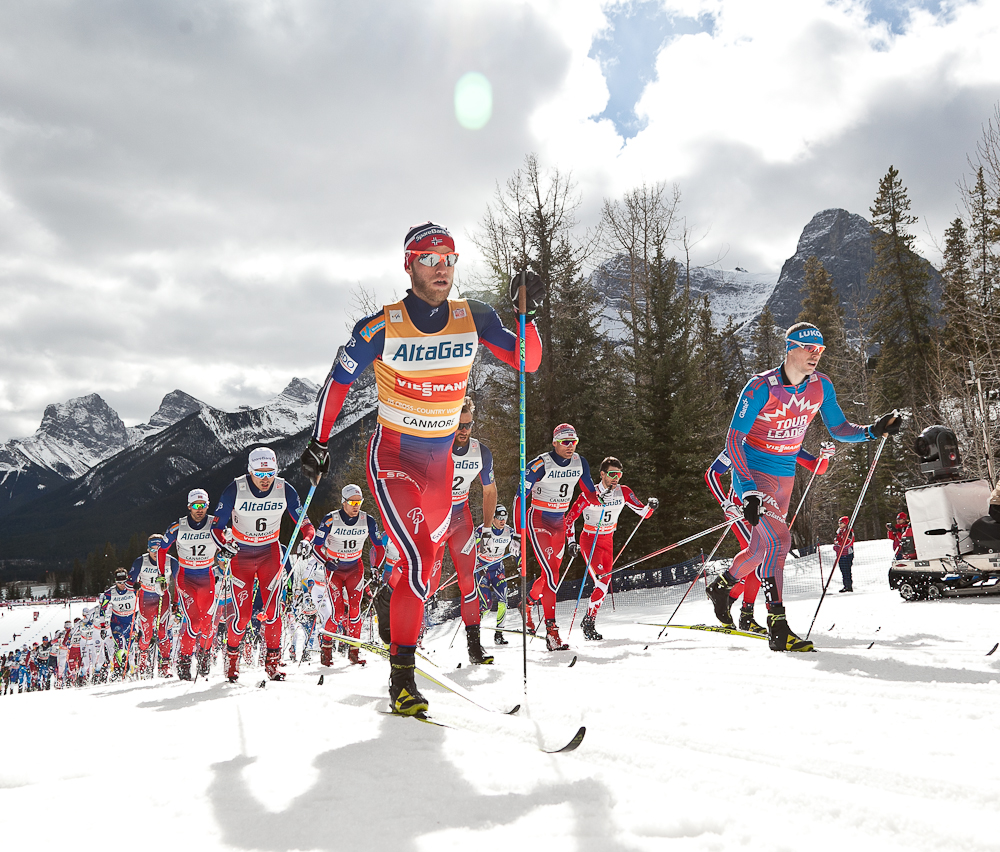
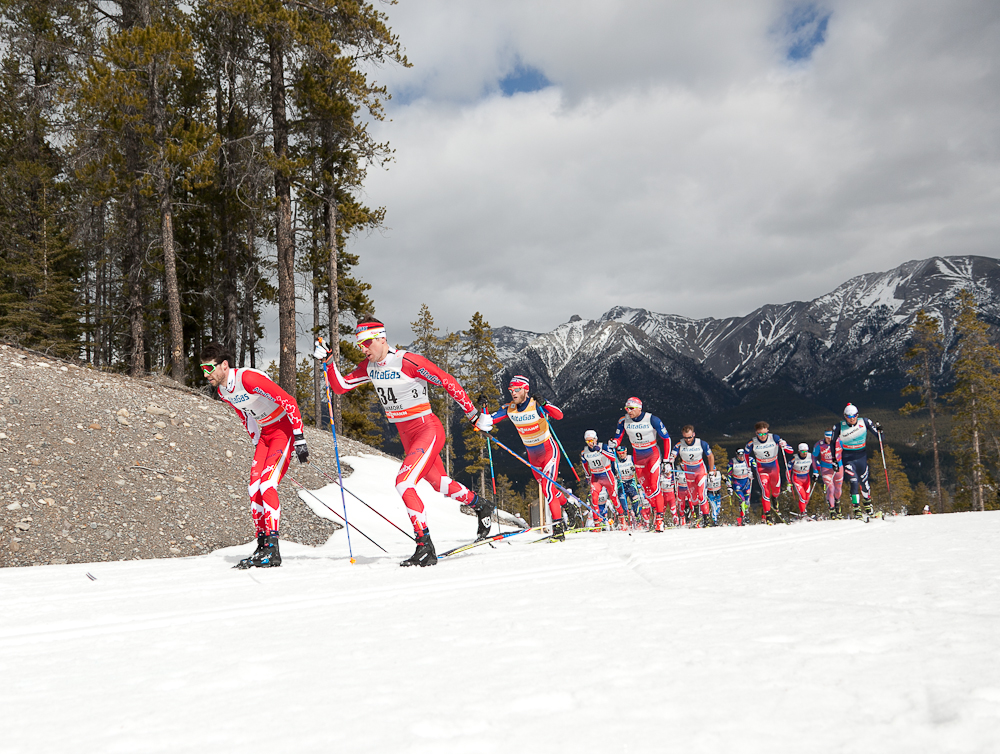
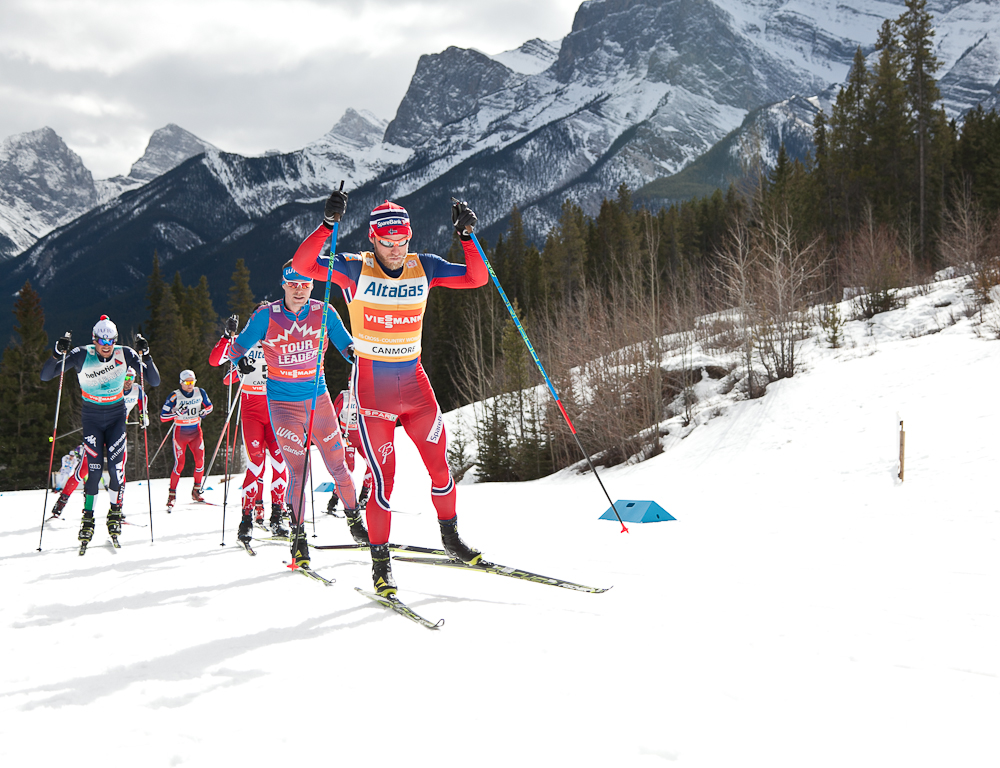
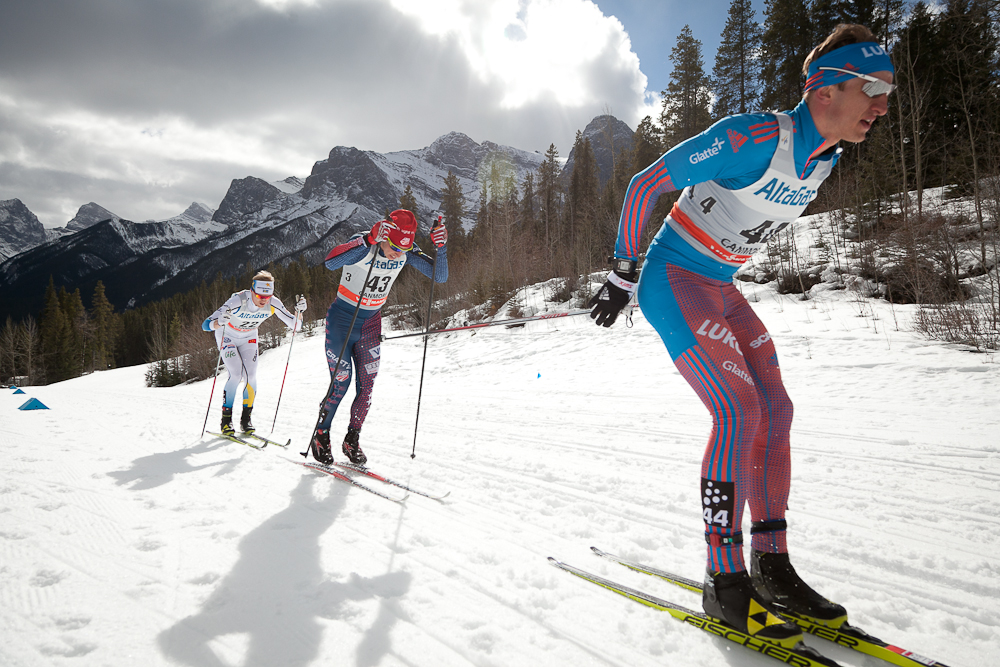
Norway’s Martin Johnsrud Sundby (l) and Russia’s Sergey Ustiugov (r) leading the field out of the start of the men’s 30 k skiathlon at Stage 6 of the Ski Tour Canada in Canmore, Alberta.
CANMORE, Alberta — The sixth stage of the Ski Tour Canada (STC), the men’s 30-kilometer skiathlon on Wednesday, was a perfect storm of altitude, massive climbs and warm conditions. Some skiers faltered, moving back in the Tour’s overall standings, others took advantage of the make-or-break stage and seized the day.
Entering Wednesday’s race, Martin Johnsrud Sundby of Norway sat in fourth overall, 1:55.3 minutes behind STC leader, Sergey Ustiugov of Russia. Afterward, he had cut that nearly two minute gap in half.
The overall World Cup leader as well as Distance World Cup leader, Sundby won the skiathlon, which moved him up to third in the STC standings, 1:04.5 behind Ustiugov — who still wears the red bib as the Tour’s overall leader.
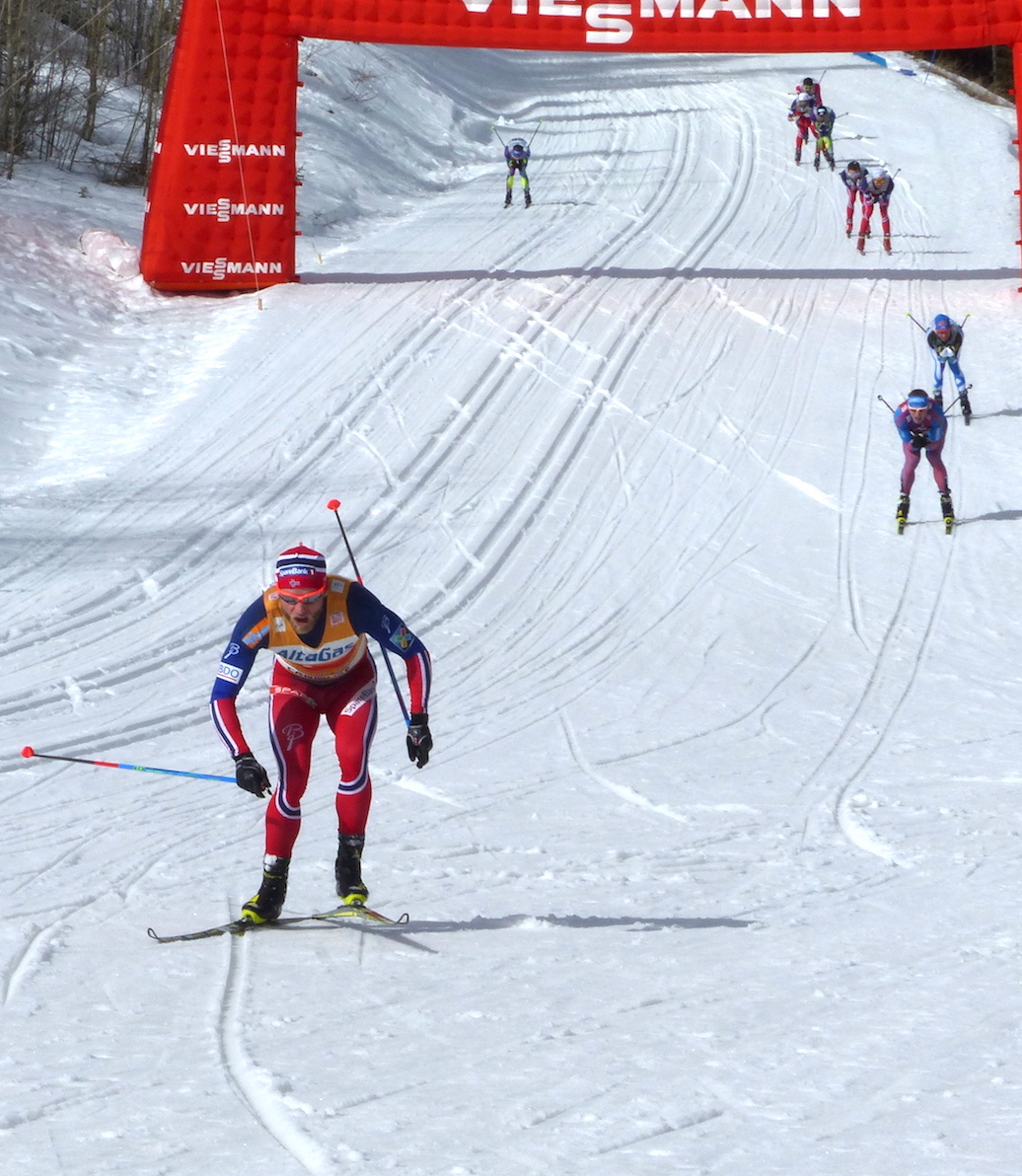
Norway’s Martin Johnsrud Sundby leading out of the final downhill and into the stadium for the skiathlon victory on Wednesday in Canmore, Alberta. He beat Russia’s Sergey Ustiugov by 2.8 seconds and Finland’s Matti Heikkinen by 3.7 seconds. (Photo: Peggy Hung)
A full-on sprint down the finishing stretch, which would determine the podium, resulted in Sundby beating Ustiugov by 2.8 seconds, throwing his arms up at the line as he did so. Finland’s Matti Heikkinen was 3.7 seconds back in third after recovering from a back injury and a subsequent slow start to the season.
Sundby’s finishing time of 1:16:29.7 hours, set the baseline from which other Tour contenders were compared. Ustiugov withstood the Sundby challenge. Others weren’t so lucky.
After placing sixth in the Stage 5 classic sprint, another Norwegian, Petter Northug Jr. remained second in the Tour, just 19.5 seconds behind Ustiugov. On his best days, Northug could likely diminish that margin, but that wasn’t the case for the skiathlon. Northug placed 11th (+17.6) on Wednesday, and lost valuable time to Ustiugov. The wily Norwegian is still second overall, but now trails the 23-year-old Russian — the World Cup’s newest all-around star — by 47.3 seconds..
“He has shown really good shape the last races and [Ustiugov] proved again that he is really strong,” Northug told FasterSkier after the skiathlon. “And he is now the favorite to win this tour, and yeah, for me it is just try to attack everyday.”
Two stages and 30 k total remain; a 15 k freestyle individual start on Friday and a 15 k classic pursuit on Saturday. Two days for Northug’s attack to manifest and two days for that 47.3 seconds to vaporize.
“The strategy is to try and attack on Friday and we will see what happens,” Northug said.
With the individual start on Friday and a pursuit on Saturday, formats where team tactics aren’t favorable, Northug admitted the STC crown will be his alone to earn.
“It’s two individual races. It is just to do the work by yourself,” Northug said.
Emil Iversen, another Norwegian who felt the effects of Canmore’s über climbs during the skiathlon, fell back in the standings. Iversen finished in 17th, 1:28.8 behind Sundby. Iversen had entered the race in third overall (+1:10.1), but 30 k of combined classic and skate skiing later, and he dropped to fifth (+2:53.1).
Iversen’s misfortune was good for another skier, namely Canada’s Alex Harvey, who leapfrogged from fifth to fourth overall (+2:51.0).
Harvey benefitted from what most racers described was an absolute grind of a course.
“It was a tough day especially in the skate,” Harvey said in a post-race interview. “Martin started pushing hard from the beginning. I was hoping that one of the guys in front of me would have a rough day and it happened to be Iversen. It moved me up to fourth place. The top three is far now, there is not much I can do about it. They can always have a really bad day but that’s beyond my control. So now I am just focusing on staying in the the top five.”
A Sum of Its Parts
The STC has eight stages over 12 days. And as part of the whole, Stage 6 was a doozy. From the outset of the classic leg, skiers were popped off the back, others were mired in the middle, while a select crew up front dealt with a searing pace.
Sundby played it smart near the front. He surged when needed and sat quiet in the draft at times. He won two 15-second time bonuses during the classic leg and another during the skate leg.
“It was a tough race actually, tough conditions,” Sundby said in the press conference.
For most of the classic leg, a large group of about 30 skiers remained together.
“Usually in these tracks in Canmore we are one big pack. It is difficult to ski ahead,” Sundby commented.
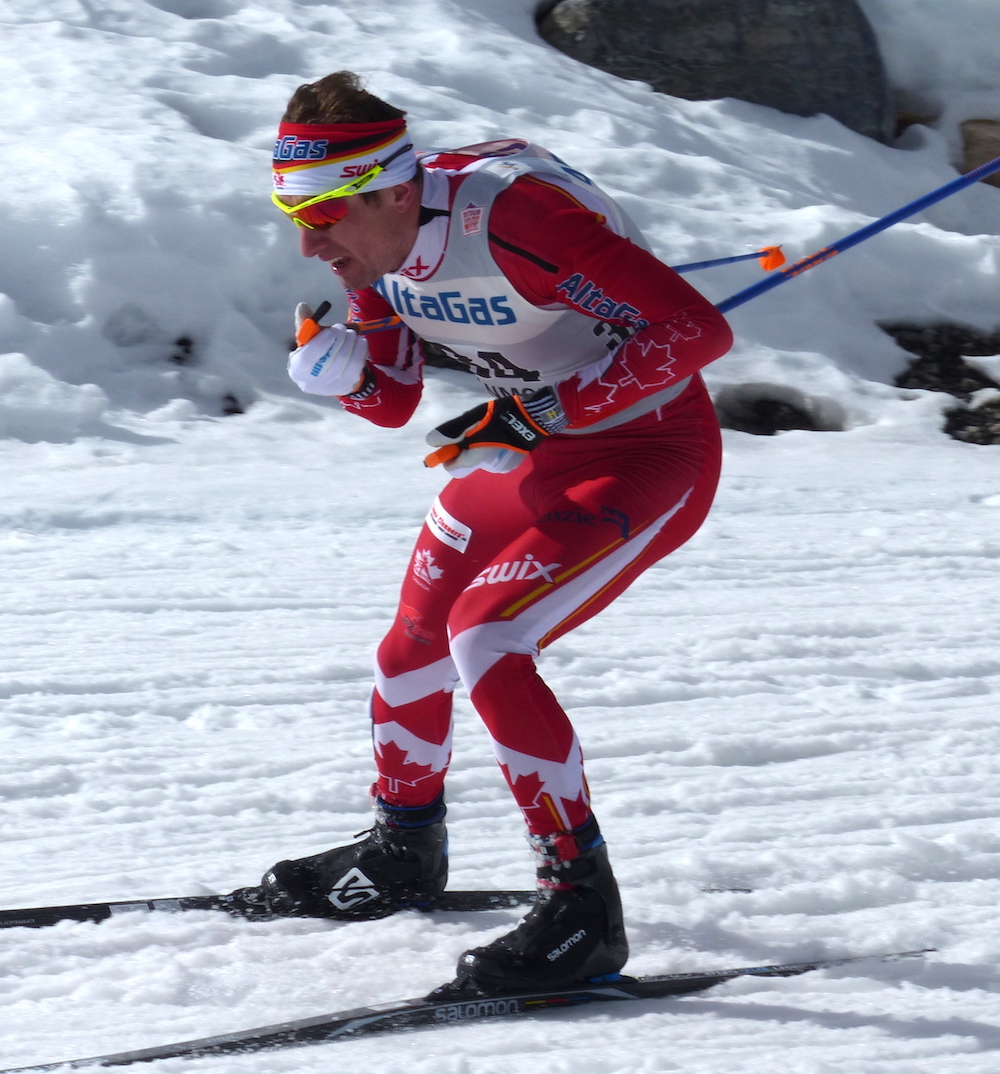
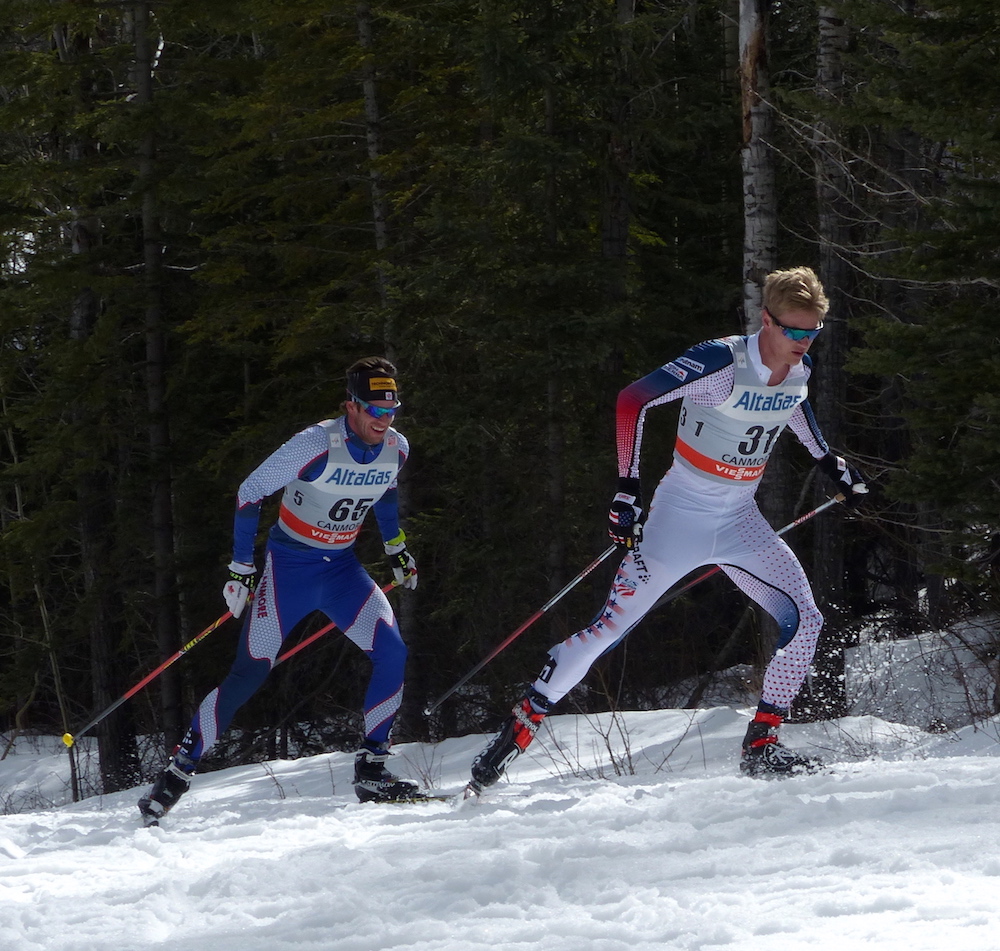
Canada’s Alex Harvey (l) and Ivan Babikov take control of the pace during the second half of the 15 k classic leg in Wednesday’s 30 k skiathlon at the Ski Tour Canada Stage 6 in Canmore, Alberta.
On the third of four classic laps, up a massive-and-decisive climb, Canadian World Cup Team members Ivan Babikov and Harvey set the tempo up front.
“Babikov went ahead of Alex,” Sundby told FasterSkier when asked about the Canadians’ move.
At first glance, it appeared the duo were possibly slowing things down, perhaps keeping Sundby and company from breaking things apart. Sundby said he thought that was not the case.
“I think the strategy was to keep a high speed,” Sundby said to FasterSkier. “I think Babikov offered to Alex there to increase the speed. Maybe some of the other guys felt it was too hard, fell off. It was difficult to pick up too much seconds in the classic track today, so they did an effort. It wasn’t able to get rid of too many guys.”
“We didn’t plan,” Harvey said after the race. “But when you see one of your teammates in the front, I was telling him where to go — go for the fast snow in the classic over the top and of course, go outside. I was shouting to him like what I thought was the best line. We tried to help each other.”
“We didn’t plan, but when you see one of your teammates in the front, I was telling him where to go … We tried to help each other.” — Alex Harvey on leading the pack in Wednesday’s skiathlon with Canadian teammate Ivan Babikov
Canadian Head Coach Justin Wadsworth explained the team’s strategy was plastic. In other words, they should see how the race plays out.
“We didn’t talk about that at all,” Wadsworth said of Harvey and Babikov leading. “Generally if the skis are good and you are feeling good and the pace doesn’t feel crazy, I think it’s actually not a bad place to ski. I am sure they were chilling out and just staying out of trouble, too, with a pack of thirty guys … anything can happen. You clip a pole, get hooked on a downhill, it’s not a bad plan to be skiing out in front.”
Sundby told FasterSkier that gaining time on the classic leg was a burden he chose not to pursue.
“Certainly the conditions today, it’s not easy to be first, it’s better to have a bigger speed from behind,” he said. “In the classic tracks, it’s 1.2 kilometer to the top of the big climb and from there it’s almost downhill to the stadium. If you have some seconds on the top, you always get flashed by everyone from behind. So it’s a difficult track to increase so much time.”
If you were following the race and the time splits with it, Sundby’s words rang true. A big group of skiers headed into the transition at 15 k vying for the lead. As the skate leg began, 10.3 seconds separated first from 27th place.
Sundby followed by Ustiugov, Harvey and Italy’s Federico Pellegrino (l) breaking apart the skate leg into a 12-skier pack during the men’s 30 k skiathlon at Stage 6 of the Ski Tour Canada in Canmore, Alberta.
The skate leg broke things apart further. Skier by skier, racers were winnowed from the front pack.
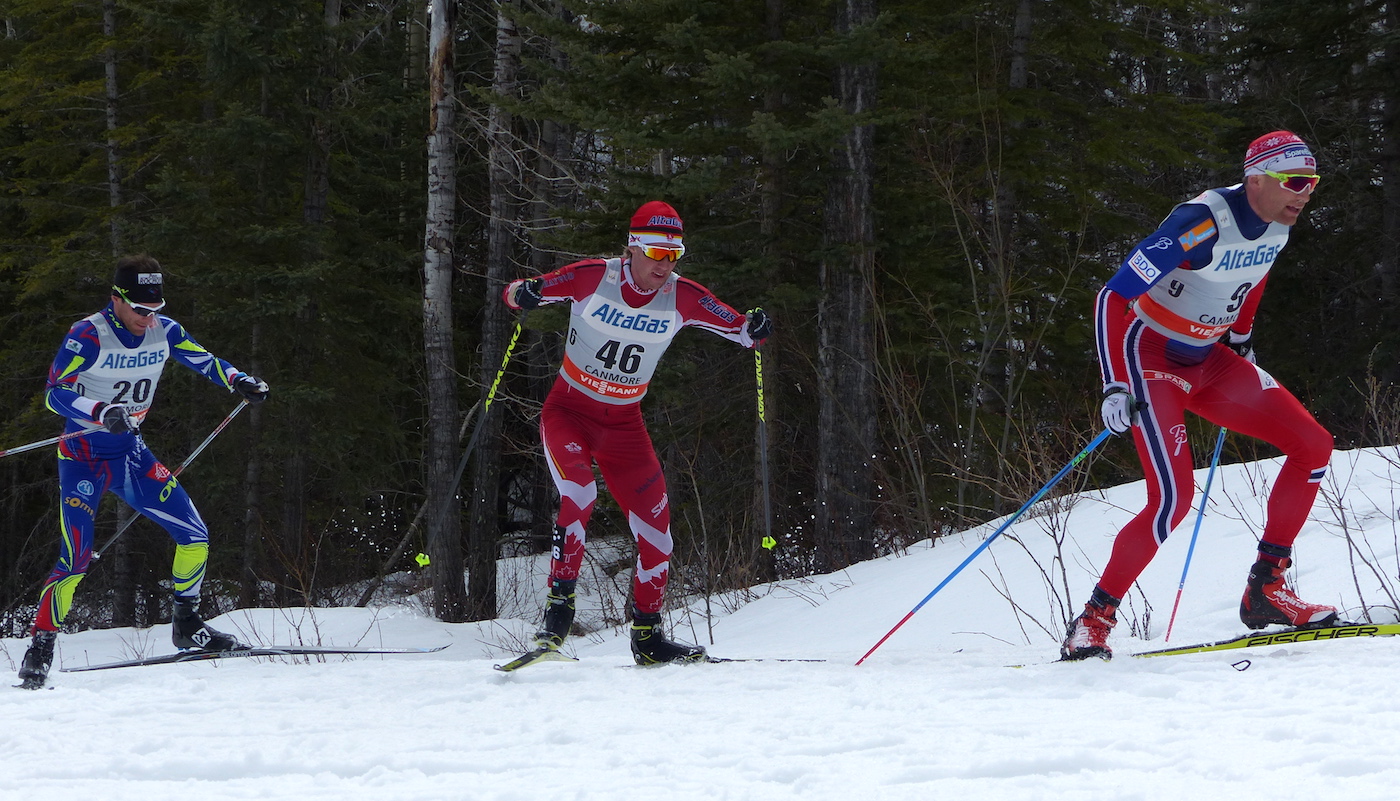
By 20 k in and 10 k remaining in the skate portion, a pack of 12 skiers remained up front. They included the three skiers that would eventually reach the podium — Sundby, Ustiugov, and Heikkinen — but also Norway’s Finn Hågen Krogh, Didrik Tønseth, Hans Christer Holund, and Northug. Two skiers sporting Canada’s red-and-white and maple leaf, Harvey and Babikov excited the home crowd with their possibilities.
With two k to go, those twelve skiers kept together — no one playing the roulette wheel of chances and sprinting ahead early. In the final moments, the man with the yellow bib marking his lead in the World Cup overall, Sundby, defined the day as his with the win.
“I thought that after the sprint yesterday that Sergey was going to be a bit more tired,” Sundby said in the press conference. “But he is so strong this tour and it’s impossible to gain too much seconds on him. I am happy about the race, a good team performance. We had a lot of Norwegian guys up there.
“We have only 30 k’s left. One race on Friday, one on Saturday,” Sundby added. “Everything is possible. But I need an amazing day on Friday, I think. Fifteen k skating is going to be decisive. I need a miracle, but it’s still possible to win this.”
“I need a miracle, but it’s still possible to win this.” — Norway’s Martin Johnsrud Sundby, third in the Ski Tour Canada, 1:04.5 behind Russia’s Sergey Ustiugov in first, with two stages to go
Ustiugov was calm and succinct in light of his lead.
“It was a good race for me,” he told FIS afterward. “I picked up a few bonus seconds. I am still in a lead of the Ski Tour. There are two important competitions left ahead and I have to stay focused.”
In another post-race interview, Finland’s Heikkinen told FIS he was satisfied with his result and his long return to form.
“It has a been a while since I was on the podium,” said the 32-year-old Heikkinen, who last placed third in a World Cup skiathlon in January 2015 in Rybinsk, Russia. “I had problems with my back in the autumn so it is great to be third today. I have had good results at the Ski Tour Canada. It is a positive sign for me. I need some good months of summer training and I believe I will be back 100 percent next winter.”
The Home Team
Ivan Babikov skiing to a season-best 10th in the Ski Tour Canada’s Stage 6 skiathlon in Canmore, Alberta. (Photo: Peggy Hung)
The stats reveal a solid day for the Canadian men: Harvey finished seventh (+7.6), Babikov captured a season-best 10th (+16.9), Graeme Killick (Canadian Senior Development Team) notched 19th (+1:34.2) to tie a career best, and Devon Kershaw (Canadian World Cup Team) placed 24th (+2:14.2).
“Anytime you get two in the top 10 it’s good and three in the top 20,” Wadsworth said. “So it’s definitely probably the best team distance race of the year today. It was good, I was really happy with it all around. I’m sure Alex wishes he were a little bit further ahead at the finish, but still pretty solid for the overall.”
Knowing your assets and mining them for success is something the Canadians saw play out on Wednesday.
“We know these courses really well,” Wadsworth said of the team’s home base, with the high-performance center (Bill Warren Training Centre) nearly adjacent to the Canmore Nordic Centre.
“Especially how the classic course is so tough here and we did a lot of intensity on it. We skipped Lahti [the last weekend of European World Cup races] and did a pre-camp. We did a couple of intensity sessions right on the courses and focused how to technically ski the big uphill and make sure they are standing up, getting really good pressure on the ball of the foot … So just small things like that. I feel like we have an advantage and we have really trained focusing this whole year on these, mainly on these four races here in Canmore.”
That focus paid dividends and Babikov was a huge beneficiary.
“I know this course like the back of my hand,” Babikov said. “I’ve been training on this, like, summer and winter every year. I just tried to stay with the group, tried to control the pace and fortunately I had a really good classic leg. On the skate leg, at the end my arms started cramping up, but I am super happy with the effort and the results.”
Babikov improved to 17th overall (+7:45.7) in the Tour.
Here in Canmore, it’s been showtime for the Canadians.
“The real money starts getting paid out here in Canmore with today as the crux,” Wadsworth said.
Canada’s Graeme Killick (c) skiing with Norway’s Niklas Dyrhaug and France’s Jean-Marc Gaillard. Killick finished 19th, tying a career best (from the 50 k classic at 2015 World Championships). (Photo: Peggy Hung)
Matching his best career World Cup result was 27-year-old Killick.
“It was good, a really a fun course on a beautiful day,” Killick said. “We had great skis as usual. It was just really fun to ski with such a good group of guys. I started out a little slow as I planned and kind of made up a few positions throughout the race. So pretty happy with my result overall.”
Killick moved into 27th overall (+10:34.1). “I didn’t expect that starting in 46th today,” he said. “It’s great news and good to be coming back every day a little bit from Montreal. That was kind of disaster for me. It is awesome.”
Kershaw was the fourth North American in the points. His 24th place on a brutal day has him 18th overall in the STC (+8:00.3).
At the exchange Kershaw remained in the game, only 4.8 seconds out.
“I felt really good in the classic,” Kershaw said. “My legs cramped on me pretty bad right after the exchange. So the skate was really difficult for me. But it was a great day for the team, so I am happy for the other guys.”
He explained that cramping so early in the skate was a problem he had to gradually temper.
“It’s hard mentally, but you have to try and get it out of your mind. That’s when skiing proper technically or as best as you can to limit the losses is important. The last 15 k I really struggled, it’s too bad because I felt good today.”
Two stages to go and Kershaw is looking ahead.
“It will be a battle,” he said. “I am really looking forward to Saturday. The 15 k classic is my favorite event and I’m going to be really tough in the 15 k skate. Hopefully I can get a ride or something because this course is punishing.”
The skiathlon was a setback for the U.S. None of it’s men finished in the points: the top 30.
“Rough for the guys,” U.S. Ski Team Head Coach Chris Grover said. “To have a 30 k skiathlon at this point so far into a tour and to have such soft conditions on such a hard course made it tough … Noah not happy with his race. Erik not happy with his race. I don’t think any of the guys that did move through today were really happy about their performance. But two days from now is a new day and we can have some good skate races”
American Noah Hoffman (43) racing to 35th in the men’s 30 k skiathlon, a best for the U.S. men in the sixth stage of the Ski Tour Canada in Canmore, Alberta.
Noah Hoffman posted the best U.S. men’s result in 35th place (+4:21.9).
“Really hard course. I was hoping for better honestly, but I don’t know, two more opportunities,” Hoffman noted. “It’s one of the harder courses we race all winter. It’s very comparable with the hardest courses like Kuusamo and Sochi and Val di Fiemme and Oslo. I mean, this is a world-class venue, a world-class course and I love being here.”
Hoffman said he stayed true to his plan and didn’t redline early on.
“I executed my plan of staying within myself on the classic and had pretty good energy left on the skate. Overall I just wasn’t where I wanted to be, but I skied the way I wanted to,” he said. “Individual start skate race is obviously a great opportunity for me and I’m looking forward to that on a really hard course.”
Erik Bjornsen began the day optimistically in bib 31. But his first words in his post-race interview tell his story.
“It was bad,” Bjornsen said after placing 49th. “I just didn’t feel good and was out of it from the beginning. It was hard and I was moving slow. I can ski with those guys, I just wasn’t on it today. I can’t really explain why.”
Recently Bjornsen has been on a streak popping top 30’s.
“The last month and a half has been great for me, so maybe I’m not ready for the altitude or something, I don’t know,” Bjornsen said. “I started in 31st so it’s been a great Tour for me so far. I posted my best sprint race in Quebec so I think that I’m a strong Tour skier. I went through hand surgery last year and that maybe has something to do with the inconsistency this year, but I just hope to get stronger year to year and I’d love to be a Tour skier in the future.”
American Erik Bjornsen leads Canada’s Russell Kennedy during the third lap of the freestyle leg in Wednesday’s 30 k skiathlon at Stage 6 of the Ski Tour Canada in Canmore, Alberta. (Photo: Peggy Hung)
For the Americans, Scott Patterson, of Alaska Pacific University (APU) was 55th, and Tad Elliott (Ski & Snowboard Club Vail) was 58th and will go on to race the remaining two stages. Eric Packer (65th), Reese Hanneman (67th) and Brian Gregg (68th) were lapped, thus ending their Tour.
Grover spoke of the disappointment those lapped skiers feel.
“The tough thing is that the finish of the classic course was the same as the finish of the skate course, and that last, whatever 0.8 kilometer, one kilometer, is together, so they stopped those guys before they were even able to switch over to skate,” Grover said. “Really disappointing for those guys.”
Seven other Canadians stayed in the Tour, with Kevin Sandau, of the Alberta World Cup Academy (AWCA) in 40th, Lenny Valjas (Canadian World Cup Team) in 46th, Knute Johnsgaard (AWCA/CNST) in 47th, Russell Kennedy (Canmore Nordic) in 52nd, Andy Shields (NDC Thunder Bay) in 53rd, Michael Somppi (NDC Thunder Bay) in 54th, and Patrick Stewart-Jones (AWCA) in 57th.
Bob Thompson (NDC Thunder Bay) was lapped for Canada, ending his run in the Tour and placing 62nd on the day. Simon Lapointe (Skinouk) did not start.
Racing continues Friday with Stage 7 of the STC, an individual 15 k skate.
— Gabby Naranja, Gerry Furseth, Alex Kochon and Harald Zimmer contributed
Left to right: Finn Haagen Krogh (NOR), Martin Johnsrud Sundby (NOR),and Hans Christer Holund (NOR) on the podium after the men’s 30 k skiathlon on Sunday in Lahti, Finland. (Photo: Fischer/Nordic Focus)
When the pattern of weekend after weekend podium wins is broken, missing top spots can serve as a wake-up call.
The Norwegian men’s ski team saw this first-hand after Russia claimed three victory titles last week in Sweden. With redemption in mind, Norway locked in on this weekend’s World Cup competitions in Lahti, Finland.
“We needed to come back from three Russian victories last week,” Norwegian Martin Johnsrud Sundby, the overall winner of the men’s 30-kilometer skiathlon on Sunday in Lahti, said in a post-race interview with FIS. “We were pretty mad about that. So we had a talk last night that we were going to fight back today.”
The Norwegians commandeered Sunday’s 30 k podium, after also taking the top three spots in Saturday’s sprint. The first five skiers across the finish line on Sunday all sported the red suits of Norway, a quintet spearheaded by Sundby in a time of 1:10:3.0.
Sundby Falls During First 15 k Classic Leg
Even while headed to his 13th individual World Cup win of the season, Sundby was not immune to the challenges presented by the Lahti skiathlon. Fresh snow that continued to cover the course and a crash tested him during the 30 k distance.
The start of the men’s 30 k skiathlon on Sunday in Lahti, Finland. (Photo: Fischer/Nordic Focus)
“I tried to create quite good speed in the first couple laps as usual, a bit more difficult for sure when it’s snowing,” Sundby said. “I had a crash with a Russian guy in the second loop. It was a bit painful so I used a couple of laps to recover.”
While Sundby recovered from his fall, France’s Maurice Manificat took control of the pace for the next two 3.75 k classic laps.
“Martin [Sundby] was falling on the second lap,” said Hans Christer Holund, who finished third (+8.0), during a post-race press conference. “When he was falling it looked like the French were trying to get ahead and just go. I was a bit surprised that the [French] were going so hard in the beginning.”
First to the ski exchange and the first skate skier on course–followed closely by Sundby and French teammate, Jean Marc Gaillard–Manificat managed to make the king of distance struggle, even if just for the next two skate laps.
“Manificat did a great job setting the pace,” Sundby said during a post-race press conference. “He was going hard. He didn’t want any help. He just kept pushing. From my point of view, the pace was quite tough.”
Still not tough enough, however, to hold off Sundby for long. By 23.7 k the Norwegian was back in the front and the French man began to fade. Saturday’s second place finisher in the sprint, Finn Hågen Krogh of Norway, moved in behind Sundby, while fellow Norwegians Didrik Tønseth and Holund held onto their two teammates in the lead.
Martin Johnsrud Sundby (NOR) crosses first in the men’s 30 k skiathlon on Sunday in Lahti, Finland. (Photo: Fischer/Nordic Focus)
By the final course climb, with Krogh still clinging on, Sundby knew he needed to make his move soon, if he hoped to secure the win.
“I didn’t want to come into this last 100 [meters] with him,” Sundby said during a press conference, referring to Krogh. “But I had to try and the last uphill is quite long and tough. So, I just said to myself ‘yeah, you just go 100 percent and see what happens.’”
The race leader’s ‘100 percent’ effort proved potent. He continued his lead into the stadium, crossing the finish line 4.9 seconds ahead of second place finisher, Krogh.
“Usually the day after the sprint you are almost more tired than after a distance race,” Krogh said during a post-race press conference. “That’s why I was kind of surprised that I did so well today because I felt a bit tired after the sprint yesterday. To finish second today is a really good surprise for me.”
Holund out-lunged teammate Tønseth by six tenths of a second for third, 8.0 seconds behind Sundby. Niklas Dyrhaug of Norway finished fifth, (+45.0), and Manificat, the first non-Norwegian, crossed in sixth (+49.0).
“I had fire in classic & so good skis!” Manificat tweeted after the race. “In skate I tried more but I loss too much energy!”
Maxim Vylegzhanin of Russia, who won the Falun 10 k classic, finished 10th in the skiathlon (+2:09.6), just ahead of Sweden’s Marcus Hellner, who may be finally coming back into race form after a difficult year.
Bjornsen Best American Finish in Skiathlon, 27th Overall
While some of Sunday’s skiathlon racers struck from the front, others chose to sink their teeth in and hang on from behind. Erik Bjornsen (U.S. Ski Team), the first American to cross the finish line on Sunday in 27th overall (+2:59.2), went with the latter.
“I was feeling like I was pacing it pretty well in the classic,” Bjornsen said in a post-race interview. “It was easy for me to kind of sit up there in the top 20. The plan was to try to hold that as long as I could in the skate.”
After switching to skate skis, Bjornsen found himself battling for position in a pack of close to 20 other skiers.
“It was important to be in the front of that group,” Bjornsen said. “I wasn’t there so I was definitely getting the slingy effect,” he added, referring to his pack position and need to slow for the downhills, but ‘hammer’ the uphills to stay with the group.
Erik Bjornsen (USA) celebrates as he crosses the finish line during the men’s 30 k skiathlon on Sunday in Lahti, Finland.
“I wasn’t in the most efficient spot, but I was happy with the finish,” he added.
With World Cup points from the skiathlon 30 k, Bjornsen remains excited for his next series of races: the Ski Tour Canada.
“It will be my second tour this year, so I hope to ski through the whole thing,” he said, “and make sure I can go to each race feeling recovered and ready to go.”
The two other Americans who raced in Sunday’s skiathlon, Noah Hoffman and Scott Patterson, finished in 36th (+4:14.3) and 52nd (+6:04.0) respectively, after getting caught up in an early crash.
“Noah and I both got in a crash like 100 meters from the start,” Patterson said. “I mean, it’s hard to fight back when the pace is so fast up front. I picked up some places, but not as many as I wanted. Still shooting for that first top 30, so I’ll have to try again in Canada.”
As the first distance leader after U.S. nationals, Patterson will race the Ski Tour Canada in March as well.
Hoffman, who also broke a pole during Sunday’s fall, managed to move up almost 30 places after the tangle.
“I felt really good during the skate portion,” Hoffman said. “I was moving up I had some good guys to ski with, but at that point I was too far back to do anything. It’s two weekends in a row that I’ve gone down, I’ve got to be better at staying on my feet.”
After a fall in last Sunday’s 15 k mass start in Falun, and a crash in Sunday’s skiathlon, Hoffman is ready to steady his skis and put his race fitness back to the test.
“I got away from the other guys I was with at the top of the course and I’m looking forward to carrying that fitness through to Canada,” he said.
–JoJo Baldus, Harald Zimmer, & Chelsea Little contributed reporting
Alex Harvey of the Canadian World Cup Team racing at the Drammen classic sprints in Norway last March. So far this year, Harvey has finished in the top 10 in three of four races. (Photo: Fischer/NordicFocus)
On a race course described by top American finisher Noah Hoffman as “super painful almost the entire time,” the North American men seemed to embrace the pulverizing eight, 3.75-kilometer, laps of Lillehammer’s famous Birkebeiner Stadium trails in Norway, and came away with several top results in Saturday’s 30 k skiathlon.
With five North American men in the top 25, four of which were Canadians, the group held its own.
“I was really impressed with all the guys today,” Canadian National Team Coach Justin Wadsworth said in a post-race phone interview about his athletes. “When the World Cups are in Norway, it’s the hardest place to score World Cup points.”
Proving his point, the home squad of Norwegians dominated the race, putting seven men in the top 10 and 13 in the top 30. Norway’s Martin Johnsrud Sundby continued his dominance, skiing away from the pack in the skate leg to post a 44-second victory over teammate Niklas Dyrhaug in second. A third Norwegian, Hans Christer Holund finished 2.9 seconds after Dyrhaug in third and was 46.9 seconds behind Sundby.
However, from the start of the race, the North Americans looked prime to spoil the homecoming. Canada’s Alex Harvey led early, attempting to execute his plan of sticking to the leaders. Together with American Erik Bjornsen, he clung to the chase pack 6 kilometers into the 15 k classic leg.
Bjornsen skied an impressive classic leg, nipping at the heels of Norway’s Petter Northug Jr. for a good portion of the first 15 k, and transitioned to the skate leg in 22nd, 59 seconds behind Sundby as the race leader. Meanwhile, Harvey’s classic race took on a different feel, with that fleeting glimmer of crashing the Norwegian party giving way to some tense moments as he drifted back around 40th place.
“Everyone was concerned at first to see Alex dropping back,” Wadsworth said.
“I had to change my plan pretty early in the race; the classic was really bad for me,” he said on the phone.
Although he continued to move up toward the end of the classic leg, on his second-to-last and final classic lap, he fought to stay in the game.
“I had to adapt the strategy. I was just fighting against myself and trying to push away the thoughts of dropping out,” Harvey said.
Graeme Killick (Canadian National Development Team) racing to 41st in the men’s 15 k classic last March at the World Cup in Lahti, Finland. On Saturday, he scored his first World Cup points in Lillehammer, Norway, where he placed 21st in the skiathlon. (Photo: Fischer/NordicFocus)
His persistence paid off. Once on skate skis, the top Canadian roared back, skiing briefly with his teammates Ivan Babikov, Devon Kershaw and Graeme Killick, then quickly accelerating all the way through to a 10th place, 1:57.1 behind Sundby.
According to Wadsworth, Harvey attributed his slower classic pacing to tired muscles.
“He got a lot of lactate going out of the stadium,” Wadsworth said.
The buildup is not surprising given the 64-meter climb. At the same time, Harvey overcame it.
“…Through the early part of the skate race he was able to clear that lactate, which is a really good sign for his fitness,” Wadsworth said.
Persistence was Harvey’s highlight.
“I pushed back those thoughts of dropping out but also kept pushing as hard as I could even though at one point I didn’t feel like I was fighting for anything,” he said.
He expressed happiness with his result, adding, “Anytime you’re in the top 10, you can’t really be disappointed about your day.”
Harvey’s teammates, Babikov, Kershaw and Killick, also contributed to Canada’s impressive day. All three bounced around the top 30 throughout the race before finishing in a cluster, with Killick in edging Russia’s Sergey Turyshev in a photo finish for 21st (+2:27.3), Kershaw placing 23rd (+2:30.6) and Babikov in 24th(+2:32.3).
They did not aim to race as a team, but the teammate proximity ended up reassuring Killick, who scored his first World Cup points on Saturday, partially by using his teammates and Hoffman, of the U.S. Ski Team, to maintain his pace.
“It was sweet skiing with the group there,” said Killick, 26, of the Canadian National Development Team. “Hoff is super strong up the climb and I sat in behind him on the second to last lap of the skate; he was beasting up the hill.”
With two career top 30s, one at 2015 World Championships (in which he was 19th in the 50 k classic mass start) and one at the 2014 Sochi Olympics (28th in the 50 k freestyle mass start), Killick’s capabilities were well known. His best outright World Cup result was also a big deal.
“For him to get his first World Cup points of his career is pretty exciting,” Wadsworth said. “You remember that day for sure as an athlete.”
Finishing right behind Killick was Kershaw, a Canadian World Cup Team veteran coming off a rough couple of years in terms of World Cup success relative to his historical record. Since the start of the World Cup last weekend, Kershaw has posted two previous top 30s in the opening World Cup stages in Kuusamo, Finland (where he was 24th in the 10 k freestyle and 23rd overall after the 15 k classic pursuit).
Although pleased with Saturday’s race, he described his hunger for podium results, referencing his 2011 World Championship gold with Harvey and overall World Cup runner-up finish that same year.
“We’re not popping champagne with a mid-twenties result with my history on the World Cup,” Kershaw said. “But at the same time, it’s a step in the right direction.”
“We’re not popping champagne with a mid-twenties result with my history on the World Cup, but at the same time, it’s a step in the right direction.” — Devon Kershaw, 23rd in Saturday’s 30 k skiathlon at the Lillehammer World Cup
Babikov reverberated this momentum swing on his personal website, explaining his 24th place finish as a positive sign. “…I’m getting my fitness and [what’s] most important some speed back.”
Skiing a similar race to Harvey was top U.S. finisher, Hoffman, who acknowledged battling a poor starting position on his way to finishing in 25th (+2:34.6).
Noah Hoffman (U.S. Ski Team) racing at 2015 World Championships in Falun, Sweden.
“Starting from bib 63, you’re at the mercy of your ability to move up,” Hoffman said.
Injured for most of last season, Hoffman’s points put him outside the seeded group of starters, toward the back of the skiathlon mass start.
Despite his less-than-ideal positioning, he went into the race without a deliberate plan in an effort “to be thinking on [his] feet out there. Too often I’ve gotten sucked into trying to follow some sort of plan that I can follow no problem, but it doesn’t lead to the best result,” Hoffman said.
His flexibility paid off. He eased into it, moving up from 52nd around 7 k to 48th at 11 k, then all the way up to 28th at 22.2 k, 7.2 k into the skate leg. He wasn’t exactly sure why the first half of his classic leg started so slowly, but attributed his acceleration up the results sheet in the second half of the race to some of the skiers he transitioned with, including Norway’s Sjur Røthe and Italy’s Roland Clara, both of whom went on to finish in the top 20.
His teammate, Bjornsen skied opposite, throwing down an impressive classic leg but fading in the skate to finish 42nd (+5:09.1). In an email Bjornsen wrote that he “… felt great in the classic leg and was able to comfortably ski in the top 20.”
He didn’t realize he was so far up until he received a split that he was in 15th. Bjornsen explained his ski choice may have cost him in the skate portion as he picked a pair of skis anticipating snow rather than the rain that ended up falling.
U.S. Head Coach Chris Grover was excited about the first half of Bjornsen’s race.
“One of the untold stories that doesn’t show up as much in the results is Eric had a super classic leg. He was really flying through the classic leg and getting closer and closer to the guys in front of him,” Grover said. “Noah was a little the opposite, he wasn’t skiing the way he wanted to early in the classic race but … settled into it … And of course the skate race was good and [he] was able to move up quite a bit.”
Although temperatures hovered above freezing, around 39 degrees Fahrenheit, both the U.S. and Canadian wax techs nailed the wax by the team’s accounts. With the exception of Bjornsen’s skate-ski selection, it didn’t appear as though the wax made a difference for either team.
Other North American finishers included Canada’s Michael Somppi in 60th (+7:51.9) and American Kris Freeman in 64th (+8:56.5).
Racing continues Sunday with the men’s 4 x 7.5 k relay. Kershaw will start first for Canada, handing off to Harvey, followed by Babikov and Killick. For the U.S., Andy Newell will scramble followed by Bjornsen, Hoffman and Simi Hamilton.
Russia’s Maxim Vylegzhanin (l) and Switzerland’s Dario Cologna (r) go head to head for first in the finishing stretch of the men’s 30 k skiathlon on Saturday at the 2015 World Championships in Falun, Sweden. Behind, Canada’s Alex Harvey (second from l) and Norway’s Didrik Tønseth battle for third. The spectator grand total for the day was 44,300 people. (Photo: FlyingPointRoad.com)
FasterSkier’s coverage of the 2015 FIS Nordic World Ski Championships in Falun, Sweden, is brought to you by the generous support of L.L. Bean, now featuring a complete line of Kikkan Randall training wear.
FALUN, Sweden — The Canadian team chef better get cooking. After promising cakes in exchange for medals at 2015 FIS World Ski Championships, the man by the first name of Mattias will have to get working on his second batch following Alex Harvey’s second medal in as many races so far in Falun.
When the team hired the Swedish chef for the two-week championships, some of its athletes requested cakes, according to Canadian World Cup Team member Ivan Babikov.
“He joked back, ‘Well if there will be medals, there will be cakes,’ ” Babikov said. “Now he makes more cakes for Alex to celebrate with another medal.”
Babikov’s teammate, Harvey became the first Canadian to rack up two medals at a single Nordic World Championships, and he did so in the first two races. Harvey, 26, found a final gear to rise from fourth to third in Saturday’s 30-kilometer skiathlon, passing Norway’s Didrik Tønseth late in the finishing stretch for bronze.
Alex Harvey (Canadian World Cup Team) leads up Mördarbacken early in the classic portion of the men’s 30 k skiathlon, ahead of Estonia’s Aivar Rehemaa (52), Russia’s Evgeniy Belov (2), Switzerland’s Dario Cologna, and Norway’s Niklas Dyrhaug (5) among others. Harvey went on to place third for his second-straight medal of the 2015 World Championships in Falun, Sweden. (Photo: FlyingPointRoad)
After spending most of the six-lap race in the lead, Harvey was pleased to end up third, 1.6 seconds behind the winner, after Switzerland’s Dario Cologna attacked the last time up the most grueling climb on the course: Mördarbacken. Russia’s Maxim Vylegzhanin went with him, and Tønseth eventually latched onto the two leaders with just over two kilometers remaining.
Meanwhile, Harvey in fourth concentrated on reining in the leaders, while Cologna and Vylegzhanin duked it out up front. On the last major climb, Vylegzhanin maneuvered around Cologna and boxed him out over the top before descending into the stadium.
The defending Olympic champion (in both the skiathlon and 15 k classic), Cologna hung on tight, but wasn’t able to get ahead of the Russian, as Vylegzhanin sealed his first World Championships title in 1:16:25.9 hours, 0.4 seconds ahead of Cologna.
“I simply don’t have the words to describe how happy I am over this gold medal,” said Vylegzhanin, a three-time runner up at World Championships (twice in the 50 k freestyle mass start and once in the 30 k pursuit), during a press conference. “It has been a really long journey here.
“Throughout the race it seemed like everyone around me was really, really strong,” he added. “I gave it everything I had in the final spurt and didn’t really get the feeling that it was enough for gold until I passed the goal line.”
Harvey finished 1.6 seconds back in third and 1.8 seconds ahead of Tønseth in fourth. France’s Maurice Manificat took fifth (+10.2), and Calle Halfvarsson finished as the top Swede racing for 44,300 adoring spectators in sixth (+22.8).
After slipping about seven seconds back from the three leaders with about 1 1/2 k to go, Harvey charged hard to close the gap, and nearly caught them on the second-to-last climb. While Cologna and Vylegzhanin skied out of reach, Harvey trailed Tønseth closely, passing him 5 seconds before the finish.
“It was so mushy and I was starting to not see clearly,” Harvey recalled, noting that his legs felt extremely spent after 15 k of classic followed by 15 k of skating on Falun’s notoriously tough course — and in soft conditions on an above-freezing afternoon. “I knew my legs were not 100 percent, so I wouldn’t have an amazing sprint, but it was good enough to grab one place, that was good for the podium.
“I had two medals in my career in World Championships, and now I have two in three days,” he added after achieving his fourth medal. “It’s crazy.”
“I had two medals in my career in World Championships, and now I have two in three days. It’s crazy.” — Canada’s Alex Harvey after winning bronze in Saturday’s skiathlon
An early leader with Finland’s Iivo Niskanen, Harvey skied in second for much of the first few kilometers before following Sweden’s Lars Nelson, France’s Jean Marc Gaillard and Swedish race-favorite Marcus Hellner, respectively, at the 5 k checkpoint.
As the climbs began on the second classic lap, Gaillard initiated a break from the large lead group, and Nelson went with him. Nelson looked back at one point to gauge the space behind them and nearly tripped up in the tracks, but he regained his composure and the two skied together up front until about 8.5 k. There, Harvey at the front of the chase pack caught them.
“I was trying to see if guys would want to break away. When I saw that it was Gaillard and Lars Nelson, I mean, they are good skiers, but not the favorites, I decided not to go with [them],” Harvey said.
Had it been someone like Cologna or Russia’s Evgeniy Belov “or some guys I think can go all the way, then I would have pushed it to break away [with them],” he added. “The plan was to try to break away if it was possible, but it just didn’t happen.”
Instead, Harvey aimed to control the pace from the driver’s seat, leading Nelson into the stadium at the end of 10 k. With one 5 k classic lap to go, 25 men remained within eight seconds of the lead and 18 of them were 3 seconds from Harvey.
By 11.5 k, Niskanen was back up front again, just ahead of Harvey, and Tønseth held his position in third while Nelson skied in fourth. Vylegzhanin hovered in fifth while Cologna was a few seconds back in seventh. Throughout the next lap, the lead switched several times between the frontrunners, including Tønseth and Gaillard, but by the ski change at 15 k, Harvey was back in first.
He and Gaillard entered the transition simultaneously, and Harvey emerged 0.3 seconds faster. On the following skate lap, the Canadian sensed something he hadn’t felt during the classic — his body wasn’t feeling so great. In fact, it hadn’t felt very good in freestyle races this season, he later explained.
Canada’s Alex Harvey leads Russia’s Evgeniy Belov (2) and the rest of the lead pack the first of three times skating up Mördarbacken around 18 k in the men’s 30 k skiathlon at 2015 World Championships in Falun, Sweden. (Photo: FlyingPointRoad)
Harvey reasoned his best chance for staying in the race required that he keep leading, and he did so for the next five kilometers.
“[I decided] I am going to stay in the front and go slow on the climbs, because that is where I am weak in skating, and try to do that for as long as I can,” Harvey said.
By the end of the first skate loop, he led 15 men within seven seconds of him through the stadium.
With two laps to go, the Canadian sprint silver medalist started to show some wear as Hellner moved to the front ahead of Belov, Norway’s Niklas Dyrhaug, Tønseth, Vylegzhanin, Cologna, and Harvey, respectively. At 21.3 k, Harvey was 4.5 seconds back in seventh.
Even there, though, Canadian National Team Head Coach Justin Wadsworth wasn’t concerned.
“[Leading is] what he did a lot last year in the skiathlon that he won here in the World Cup Finals, and he said he felt like that was the way he wanted to do it,” Wadsworth said. “He wanted to control and not let people make surges, and he knows that a lot of people respect him right now … no one attacked him; they knew he was one of the favorites. When you can play or use that as your advantage, I think it’s huge.”
“When Hellner went on the second lap, I just had to drift back,” Harvey explained. “If I pass the line, it just doesn’t come back. [My leg started to cramp], so I just had to feather it a little bit.”
That same lap, by the second-to-last climb, Harvey worked his way back up front while the two Russians in the mix — Belov and Vylegzhanin — clung tight to him.
Wadsworth noticed how Harvey one-skated (V2-ed) most of the course while others relied on the more labor-intensive offset (V1).
“The speed was slow enough that he could do that,” Wadsworth said. “He knew he was saving himself and he knew the legs were going to get tired at the end no matter what.”
Hellner led the last time through the lap zone, followed by Belov, Harvey, Vylegzhanin, Dyrhaug, Gaillard, and Manificat, in that order. Cologna came through with the pack, 2.3 seconds back in eighth, just ahead of Halfvarsson, Tønseth and Norway’s Petter Northug.
With 5 k remaining, Cologna advanced to third early in the lap to prepare for the final push. Meanwhile, Harvey skied in seventh leaving the stadium, then rose to third once more before the start of the big climbs.
There, Cologna made what he hoped would be the game-changing attack: “I knew that I’m strong in the uphill so I was not sure what I have to do and when I have to go, but in the end I was in front on Mördarbacken the last time,” he told FasterSkier. “So I said, I will try everything, and I think it was the right tactic.”
Tønseth worked hard to get back in contact with Cologna and Vylegzhanin, who immediately went with him up the remainder of the hill, while Harvey and Manificat fell off the pace in fourth and fifth.
Along the next flat, Harvey decided to go hard in pursuit of third place or better.
“You’ve just got to be selfish; I made [Manificat] work on the flat and downhill stuff to get the draft and then as soon as we hit the next little hill, I just went by him and I went full blast,” he said.
Harvey dropped Manificat and bridged the gap to Tønseth on the penultimate climb. Up front, Cologna let up slightly to prepare for the finishing showdown with Vylegzhanin.
“I let him go in the last uphill because I thought maybe it’s a little better to relax on the last downhill to focus for the sprint, but I was not able to pass him again in the finish,” Cologna said. “Vylegzhanin was still there and a little bit fresher at the end.”
Despite missing out on gold by four-tenths of a second, Cologna was happy with silver.
“It’s always great to win a medal,” he said. “Everybody wants to be in good shape and to win, so it was a very good start for me, these championships, and it’s good to have the medal already in the first race. Now I’m looking forward to the next one.”
For Canada, ‘The biggest thing is redemption’
A few seconds behind, Harvey concentrated on staying on his feet before going for bronze.
“I was first trying to just stay on my skis because my legs were pretty jammed,” he said.
“It’s a great day for me. Hard to believe,” he said in a Cross Country Canada press release. “The skis were fantastic. I had really good training over the summer, and I think the wax team are doing such a great job, it’s hard for me not to be on the podium these days.”
“We’re so pumped about this,” Wadsworth said. “I think we came into the day really feeling like Alex could win the race, but realistically, how his legs are doing skating these days, a medal today is as good as gold. We couldn’t want anything more.
“The biggest thing is redemption for our wax team,” he added. “We really battled after Sochi last year, and we added some new people and took a lot of time in the summer to meet together and to get communication working. There’s been some hiccups through the winter, but we’ve kept really pushing to get on top of it and it’s paid off. That’s the thing that’s the most exciting.”
Babikov, who placed 23rd on Saturday after skiing up from 30th at the transition, said the team was beyond excited for Harvey — even when some of them weren’t personally having their best races.
“Compared to Alex’s medal, [23rd is] not so good, but I’m just really happy and pumped for him,” Babikov said. “Every single person on the team … we’re just so psyched. It’s the best world championships so far for Cross Country Canada. We’re so happy for Alex. It’s good for us, it’s good for our team, it’s awesome that one of the best guys in the world is on our team and we train together.”
“It’s the best world championships so far for Cross Country Canada.” — Ivan Babikov, Canada’s second man in Saturday’s skiathlon in 23rd
For Harvey, it was his fourth World Championships medal of his career. In 2011, he won the classic team sprint with Devon Kershaw, and in 2013, he was third in the individual classic sprint — the event he claimed silver in two days ago.
Wadsworth noted the impact this had on the program after Canada took home one medal between the last two previous championships (2013 World Championships and the 2014 Olympics).
“To have two medals [in Falun], it’s more [about] showing that we do have one of the best programs for waxing and we’ve invested a lot in it,” he said. “We’ve also done things that are a little bit different than other teams or the U.S. by having a little bit smaller team. We’re here to get medals and this is what’s going to help our program in the long run, where we can put it back into development and other things. We have to go for it at these big events like this.”
While Canada’s plan for Sunday’s team sprint was originally to start Harvey and Lenny Valjas, Wadsworth explained that would likely change out of a need to rest Harvey.
On Saturday night, Jess Cockney and Valjas were listed to start.
“It was [going to be Alex] and Len, but the way his legs were kind of acting at the end of [today’s] race, we’re … thinking that he might not do it and start to recover for the 50 k, maybe use the relay as a tuneup for that,” Wadsworth said.
During Saturday’s race, Babikov explained he struggled with the sugary conditions during his classic leg and couldn’t blame it on his skis.
“[Alex and I] had the same skis prepared so I think it was just me, I was just struggling with those conditions,” he said. “Maybe I was too tight … Most of the time in the skiathlon I have a problem with classic so I maybe worked too hard to stay with the pack so that made me too tired. That’s why I was surprised I felt so good in skate.”
A minute behind Harvey at the halfway point, Babikov had the seventh-fastest transition time and immediately started picking off places during the freestyle leg. Twenty-eighth at 20 k, he was up to 23rd at 21.3 k.
“[I came into the ski change] ten or 15 seconds behind [Italy’s Roland] Clara, some Germans [Jonas Dobler and Florian Notz] and some Japanese athletes [Keishin Yoshida and Akira Lenting],” he said. “I think I was with [Finland’s Sami] Jauhojaervi. I started fighting them and catching them one by one, and the group kind of exploded … I worked my way up. It took me half a lap to catch that group ahead of me, maybe on the Mördarbacken, I caught them.
“I had a good feeling skating and was feeling pretty satisfied with my skate part,” Babikov concluded after finishing 2:43.8 behind Vylegzhanin in 23rd.
For the rest of World Championships, he was looking forward to the 15 k freestyle “and maybe the relay,” he said.
Erik Bjornsen (U.S. Ski Team) races up Mördarbacken during the the men’s 30 k skiathlon at the 2015 FIS Nordic World Ski Championships in Falun, Sweden. He finished 28th for his best distance result of the season. (Photo: FlyingPointRoad.com)
FasterSkier’s coverage of the 2015 FIS Nordic World Ski Championships in Falun, Sweden, is brought to you by the generous support of L.L. Bean, now featuring a complete line of Kikkan Randall training wear.
FALUN, Sweden — The timing was right for Erik Bjornsen in the first race of his second FIS Nordic World Ski Championships on Saturday.
For the first time this season, the 23-year-old U.S. Ski Team member cracked the top 30 in a distance race and he did so after skiing in the top 30 for most of the men’s 30-kilometer skiathlon.
After starting the mass start in bib 47 of 63, Bjornsen made his way up to 34th, 9.2 seconds from the lead, within the first 1.5 k of the opening 15 k classic leg. Meanwhile, his U.S. teammate Matt Gelso, of the Sun Valley Ski Education Foundation, hung with the group in 31st, 8.1 seconds behind.
“I have been working on my classic technique and just trying to stay really relaxed,” Bjornsen recalled.
After the women rounded two similar courses for the 15 k skiathlon earlier Saturday afternoon, the men were left with mostly chewed-up conditions in temperatures around 35 degrees Fahrenheit. Race officials salted two hills on the men’s 5 k freestyle course, according to Gelso, who said, “Those were awesome and the rest, the main hill on Mördarbacken, was so deep and soft and smushy…”
Bjornsen and Gelso skied near each other for the first lap, with Bjornsen in 35th at 3.3 k, 10.5 seconds behind the leaders, and Gelso just 0.7 seconds back in 38th.
By the end of the first lap, Bjornsen was up to 28th, 7.7 seconds out of first, while the second U.S. man at the time, Kris Freeman (Freebird) lapped through the stadium in 42nd, 13 seconds back. Gelso was 0.8 seconds behind Freeman in 44th, and U.S. Ski Team (USST) member Noah Hoffman lost contact with the lead group to complete his first of six laps in 54th, 43.7 seconds from first.
From that point, Bjornsen continued to the lead the U.S., skiing in 27th at 15 k, 14.1 seconds back, and 24th after the ski change at 15 k. At that point, he was 43.7 seconds behind race leader Alex Harvey of Canada.
“For the first couple of laps, it was really good, I was having solid kick,” Bjornsen said of the first half of the race. “Last lap I was starting to slip, but I knew I had some really fast skis so really just trying to work up the tops of the hills. I was really happy with the classical leg.”
He completed his first skate lap in 25th, 1:04.4 behind, and hung in 29th (+1:37.1) with 5 k to go.
“I got a split with, like, two laps to go and I was like 28th or 29th,” Bjornsen recalled. “I was starting to cramp and I was trying to hold on for dear life. I mean, I was pretty happy with the last few kilometers. I was able to pick off a couple more spots. It was awesome.”
He ended up 28th, 2:54.0 behind Russian winner Maxim Vylegzhanin after posting the 25th-fastest classic leg, 25th-ranked skate leg and 20th-fastest transition time.
Bjornsen said the key was trying to hold onto the group then passing them when he felt good in the final kilometers. In doing so, he overtook some competitors he hadn’t seen earlier in the race.
“I felt like I was always with people trying to hold on, knowing that those guys in front of me were probably dying just as bad as I was,” he said. “I am pretty confident with my finishes and I knew if I could just hold onto those guys for those the first two laps of skating, I would be able to makes something happen the last lap and I was able to.”
He finished 0.3 seconds behind Germany’s Jonas Dobler in 27th, 0.5 seconds behind Finland’s Iivo Niskanen in 26th and a second behind Japan’s Akira Lenting in 25th.
“I was right behind a few more spots,” Bjornsen said. “It would have been nice to have a little bit more in the tank, but I was happy with it.”
Noah Hoffman racing to 44th Saturday’s 30 k skiathlon at 2015 World Championships in Falun, Sweden. (Photo: NoahHoffman.com/Jonas Birgerson)
Behind him, Freeman reached the ski change in 49th, 2:52.6 back from the lead, Hoffman came through 53 seconds later in 51st (+3:45.7), and Gelso nearly another minute back in 52nd (+4:43.0).
Hoffman went on to post the 39th-ranked skate leg to finish 44th (+7:09.1) in his first classic race of the season, after he broke his fibula in the 15 k classic World Cup opener in November in Kuusamo, Finland. Last week at the World Cup in Östersund, Sweden, Hoffman was 38th in the 15 k freestyle.
“Not what I was hoping for,” Hoffman said after Saturday’s skiathlon. “The classic leg was really challenging from the gun. So early on it was so bad, and I’m not sure why.
“I was definitely trying to ski a race where I could move up in the skate leg but that whole thing kind of went out the window when I found myself being dropped from a 60-person group in the classic leg,” he continued. “At that point, you have to do everything you can to hold on.”
In a blog post on Saturday evening, Hoffman wrote that his “energy and technique felt okay, I was just slow. The race was brutally hard; I felt like I’d been hit by a truck afterwards.”
He told FasterSkier his goal coming into the race — just his second race of the season after spending more than two months healing, rehabbing and recovering — was to get into the points with a top 30.
“That didn’t happen today. I think I can still do that in the coming races, but I need to refocus,” Hoffman said. “There’s two more good races [the 15 k skate and 50 k classic mass start] coming up for me plus the relay will be really fun, and then a couple of World Cups after World Champs. I’m just hoping to build. Today was not what I was looking for, but there’s lots more possibilities.”
Freeman finished 48th (+7:57.1). Up until two days ago, he explained he wasn’t sure he was going to race after catching a cold at his last races, the SuperTour mini tour, in Craftsbury, Vt.
“I felt flat and it showed,” he said. “I’m not happy with it. I blew up spectacularly at eight kilometers when I lost the group and then I regrouped around 20 k, which is a good thing, and I was able to come back and actually race again, but it was obviously unimpressive.”
Freeman reflected that he may have opted for too much kick while testing his skis.
“I could run up a wall, but they weren’t running very fast, and I just kept losing a little bit on the downhill and I wasn’t strong enough to overcome it,” he said. “To stay with the pack today, I was going to need an advantage in skis and I think a slight disadvantage just killed me, but it was totally my fault — I went back for more.”
The last time up the infamous Mördarbacken hill, Hoffman caught Freeman with just a couple kilometers to go.
“He was at a different level going up that so I think he is going to have a good race in the 15 k [next week],” Freeman said. “I am hoping that this blew the snot out of me and I will be back for the 15 k.”
In his first-ever World Championships race, Gelso, 26, finished 54th (+11:26.4), and explained after he felt “pretty awful” during it.
“I was struggling with the classic. I was OK the first lap and then I just started blowing up and I don’t know why,” he said. “I was hoping to be with the pack in the classic and see what happened in the skate, but that didn’t happen for a number of reasons.”
Gelso added that the skiathlon had been his focus race while in Falun.
“I just didn’t have it today, that is for sure,” he said.
At the same time, Gelso observed that the racing scene in Falun, with more than 44,000 spectators on Saturday, was unlike anything he’d ever experienced before.
“I thought this was just going to be like a World Cup, but just a little bit bigger,” he said. “Like Hoff and I talked about, it’s more like a mini Olympics than a big World Cup. There’s lot going on, there’s a lot of people, there’s a ton of effort that goes into this. It’s a pretty serious event.”
Commenting on the team’s overall performance on Saturday, USST Head Coach Chris Grover called it, “a solid day; great for some just okay for others.” In the women’s race, Liz Stephen led the team in 11th.
In the men’s race, Grover observed that Bjornsen had “really fantastic skis, which you could see on the downhills. He was gliding super well and maybe dropped a couple places during the classic leg on the ups and then he would just grab them right back on the downs,” he said.
“He and his coach, Erik Flora, have just managed to find the form when it counts,” Grover added. “Here is another championship just like last year where he has just started off in excellent form so that is pretty exciting.”
On Sunday, two of U.S. sprint veterans — Andy Newell and Simi Hamilton — will race the two-man freestyle team sprint in that order. At the last skate team sprint in Otepää, Estonia, they missed qualifying because of a crash and placed 19th. At last year’s Sochi Olympics, Hamilton teamed up with Bjornsen to finish sixth in the classic team sprint.
Norway’s 23-year-old World Championships rookie Didrik Tønseth placed fourth in the skiathlon on Saturday, his first race of 2015 World Championships, and missed the podium by 1.8 seconds. (Photo: Twitter)
FasterSkier’s coverage of the 2015 FIS Nordic World Ski Championships in Falun, Sweden, is brought to you by the generous support of L.L. Bean, now featuring a complete line of Kikkan Randall training wear.
Norway’s Didrik Tønseth was looking at a podium finish in his very first FIS Nordic World Ski Championships event. Now he’s looking at doing more pushups.
Twenty-three-year-old rookie Tønseth was leading for part of the way in the men’s 30-kilometer skiathlon on Saturday.
“I was thinking that, ‘This is it. I’m going to nail it today,’ ” Tønseth said to Norwegian reporters about the first half of his race.
But then about halfway through, he hit the wall.
“In the middle of the race, I was just thinking that I needed to just finish and go home and work on pushups,” Tønseth said.
But he fought his way back and with just a couple of kilometers to go, he was in the top three. Tønseth kept his position until the final stretch to the finish, and barely missed the podium in the last five or so meters after Canada’s Alex Harvey passed him before the line. He collapsed across the finish, 1.8 seconds back from third in fourth place.
“In a way, I’m happy with the race, but fourth place is nothing,” Tønseth said afterward.
“The race was good but the sprint wasn’t so good,” he told FasterSkier.
But he didn’t spend much time thinking about the ranking. Tønseth raced as hard as he could. He squeezed every ounce of energy out of his body, and he is gearing up for the rest of World Championships.
“It’s the 50 k a week from now that I’m really here for. That was the original plan anyway,” Tønseth said, noting that the skiathlon was a warmup event for him.
And while fourth place is no podium, Tønseth was rewarded with a spot on the Norwegian relay team for the 4 x 7.5 k relay next Friday.
The men’s 30 k skiathlon podium (from l-r):Dario Cologna (SUI) in second, Maxim Vylegzhanin (RUS) in first, and Matti Heikkinen (FIN) in third. (Photo: Fischer/Nordic Focus)
Although it isn’t an event that is common on the World Cup race circuit, the skiathlon one race Switzerland’s Dario Cologna has excelled in over the years.
The last World Cup skiathlon was held at the 2013 pre-World Cup in Sochi, Russia, and used as a leadup to the upcoming Olympics. Before Sunday, Cologna had won the last four international skiathlon events he participated in, including the skiathlon at the 2014 Sochi Games, making him the favorite to win the men’s World Cup 30-kilometer skiathlon in Rybinsk, Russia.
The 28 year old had also won more races in Russia than he had in any other country: two World Cups (including Saturday’s 15 k skate) and two 2014 Olympic events (the skiathlon and 15 k classic).
The only problems were that this was a new year and he was up against a strong Russian team (among others) motivated to win on Russian soil. That was about all Russian national-team member Maxim Vylegzhanin needed in terms of headspace to outpace Cologna by 2.7 seconds on Sunday.
The two athletes would became very familiar with the Rybinsk course by the end of the 12-lap race. After six 2.5-k loops of classic, they went head to head for another six loops of skating on a different 2.5 k course. Both courses included several climbs that could separate the pack or prove to be the perfect place for an attack. It was a relatively warm day with falling snow so nailing the wax for the classic portion was tricky.
Early on, the race outcome appeared to be more in the hands of the wax techs than the skiers. Many athletes crashed and slipped during the first 15 k classic leg. The pace was extremely fast, which led several missteps. Cologna had an early scare in the first part of the race when he and Canadian Alex Harvey collided and both men fell. Cologna recovered, but Harvey ended up crashing three times in the classic portion. Several other skiers slipped up in the warm conditions as well.
For the most part, the pack stayed together for the majority of the first half of the race. The lead rotated several times between Cologna, Vylegzhanin and several others, with every attempted attack countered and nobody distancing themselves from the front group. At one point, Vylegzhanin’s teammate Alexander Bessmertnykh and France’s Jean-Marc Gaillard attempted a half-hearted attacked that strung out the field, but their lead was quickly absorbed once the rest of the pack hit the downhill.
The start of the men’s 30 k skiathlon in Rybinsk, Russia. (Photo: Fischer/Nordic Focus)
Heading into the transition, a trio of Russians led the group into the corral. Stanislav Volzhentsev, Dmitriy Japarov and Evgeniy Belov arrived first in 43:14.5, followed closely by the rest of the group. The first one out onto the skate course was Russian Sergey Turyshev, who quickly set the lead pace while Japarov headed out 0.6 seconds behind, just ahead of some 20 others, including Harvey in 13th.
Once the skate skis were on, the Russian skis appeared to be the fastest of the field. At one point, Russia’s Alexey Vitsenko launched an attack on the downhill and opened a sizable gap, skiing away from the chase pack. Which Russian would ultimately win or podium was unclear, but it was evident their skis were going to help them get there.
Cologna noticed the difference.
“The start of the race was very quick but in the skate it was not so fast; I realized that my skis were maybe not as fast as the Russians’,” he told FIS afterward. “So I knew that I needed to attack before the finish to make the group smaller.”
Cologna’s attack came at the 25.9 k mark when he raced up the hill crossing the timing mat at 1:12:19. Vitsenko marked him closely and joined Cologna as he headed down the hill. Leading the chase group was Finland’s Matti Heikkinen, Gaillard and Vylegzhanin, who were flanked by Russians Alexander Leskov and Eugeniy Dementiev.
The Russian teamwork ended up keeping Cologna in check and Vylegzhanin close to the front. Heikkinen skied a strong skate leg and found himself in prime position toward the closing segments of the race.
Realizing his time to shake the pack was slipping away, Cologna gave one last push on the final climb. Vylegzhanin and Heikkinen anticipated his move and quickly latched on. This attack separated the three from the rest of the field and set up the battle for the podium spots.
“I pushed very hard at the end, but Maxim and Dario were too strong for me,” Heikkinen told FIS.
The change of pace left Heikkinen hanging behind the two leaders.
As Vylegzhanin and Cologna approached the finish line, the switchback design of the finish gave Vylegzhanin time to overtake Cologna and cross it first in 1:21:54.8 for his first victory in a year since winning the 15 k classic mass start in Szklarska Poreba, Poland.
“This is my first podium and win this season and it’s nice that it came in Russia,” Vylegzhanin told FIS. “The spectators are so great here. I had very good skis today and I am happy to the strongest at the finish. Thank you to the spectators, the organizers and of course my team for the great skis today. Russian skis like Russian snow!”
Cologna finished 2.7 seconds back in second, and Heikkinen rounded out the podium in third, 6.2 seconds after Vylegzhanin.
Although some the stronger skiers opted out of the Rybinsk World Cup weekend to prepare for the upcoming World Championships in Falun, Sweden, Heikkinen was pleased with his result.
“Sure, some of the best weren’t here, but a race is a race and I focus on Falun so this is a was a great step,” he said.
Russia put six in the top eight (sweeping fourth through eighth), with Volzhentsev in fourth, Chernousov in fifth, Konstantin Glavatskikh in sixth, Legkov in seventh, and Turyshev in eighth. Harvey placed ninth.
As a result of his second-place finish, Cologna moved up into second place in Overall World Cup standings, 333 points behind Norwegian leader Martin Johnsrud Sundby, who did not race in Rybinsk.
“I was hoping for another win here today … but I am happy with second place,” Cologna said. “It was a good weekend for me and I can see where my shape is.”
Sunday marked the last World Cup race before a two-week break as athletes prepare for the World Championships, which start on Feb. 18. A World Cup will be held in Östersund, Sweden, the weekend before, Feb. 14-15.
The start of the women’s 15 k skiathlon on Saturday at World Cup Finals in Falun, Sweden, with American Kikkan Randall in the front row at the far right. Randall went on to place 20th for the second-best U.S. women’s result after Liz Stephen in 15th. (Photo: Fischer/Nordic Focus)
With two races left in the World Cup season, Liz Stephen could’ve raced like she had nothing to lose. But the skiathlon is a race of strategy as much as skill, and on Saturday at World Cup Finals in Falun, Sweden, the longtime U.S. Ski Team member decided she’d better start conservatively in classic.
Hovering in the mid-30’s for most of the race, Stephen later explained that the first half of the women’s 15-kilometer skiathlon, turned out to be a “pretty standard classic race” for her. No bells or whistles, but she didn’t need them. She had 7.5 k to make up ground.
About a minute and a half behind the leader, Norway’s Therese Johaug, at the halfway point, Stephen in 37th transitioned smoothly to skating and began her own race. Between 8.2 and 9 k, Stephen rose from 34th to 25th. With less than 4 k to go, she was up to 16th.
“The skate portion went much better than the racing has been going lately,” Stephen, 27, wrote in an email. “The body was really ready to race out there during the skate.”
Liz Stephen (U.S. Ski Team) racing earlier this season in the freestyle prologue at the first stage of the Tour de Ski in Oberhof, Germany. (Photo: Marcel Hilger)
She ended up picking off one more person (Finland’s Krista Lahteenmaki) to finish 15th, 2:08.3 behind Johaug, who won by more than 33 seconds. The result put her 18th in the World Cup Finals standings and 15th in the season-long distance ranking— tying her personal best from last year. With one race remaining on Sunday, the 10 k freestyle pursuit, she was 17th in the overall World Cup.
“The goal going into the season was top 15 in the overall and top 10 in the distance list,” Stephen wrote. “I am close to those goals, and improving over last year’s standings in the overall is certainly something to recognize as a step in the right direction.”
Last season, she was 20th overall — 22 places better than she had been the year before.
“I am happy that the season is coming to an end and going home for a break is in sight,” Stephen wrote. “I am not so much tired as mentally ready to change it up, get out of hotel rooms for a while and be back in the USA with my family for a while. Recharge a bit.”
First, she’ll go with most of the team to Anchorage, Alaska, next week for SuperTour Finals and U.S. Distance Nationals March 22-28.
Looking back on the season, Stephen emphasized the success of her teammate, Kikkan Randall, the three-time defending World Cup Sprint champion, and how she has impacted the rest of the team.
“She has taught me to believe in myself, how to work harder, try new things, be open to the idea of being the best in the World someday,” Stephen wrote. “The fact that she instills this fun atmosphere on our team while also kicking serious a** on the world cup, year in and year out is really inspirational and special to be a part of. I’m really very proud of her and to be her teammate in so many ways.”
Kikkan Randall (U.S. Ski Team) in Friday’s classic sprint qualifier at World Cup Finals in Falun, Sweden. She went on to place fourth in the final and take home her third-straight Sprint World Cup Crystal Globe. (Photo: Fischer/Nordic Focus)
Randall finished 20th (+2:25.6) on Saturday in one of the few World Cup skiathlons in her career. The result put her 17th in the distance rankings, and kept her in fifth overall — 30 points behind Norway’s Heidi Weng in fourth.
“I wanted to be up in the top 15 so I fell short of that goal today,” Randall wrote in an email. “I still have some good opportunity to move up tomorrow and I need to fight for every point.”
Randall skied around 20th for much of the race, moving up from 21st at the transition to 19th at 8.2 k. Lahteenmaki edged her by 0.4 seconds for 19th, and Randall finishing four seconds ahead of her U.S. teammate, Sadie Bjornsen.
“To have a good result you have to go with that opening pace and try to stay up near the front,” Randall explained. “I tried to start hard but my body was pretty tired from the sprint yesterday. I was skiing mid pack in the classic and then headed out on the skate with some girls to chase. I had some good sections were I felt I was picking up time and then some bad parts where I had a hard time keeping my glide up in the skate. I came into the stadium with a couple girls but didn’t ski the finish very well. It was an okay day for me.”
Like Stephen, she was excited to wrap up the season.
“It’s been a lot of racing and a lot of emotional energy, especially in the last six weeks,” Randall wrote. “It’s been a pretty good season. Overall I was happy with my consistent sprint performance but felt I went backwards a step in my distance skiing. And of course the Olympics was my biggest goal of the season and I didn’t reach my goals there. I am definitely ending this season wanting more.”
Bjornsen started faster and was 12th through 6 k and ninth at the transition at 7.5 k, just 43 seconds behind Johaug.
“The pace went out super hard from the start,” Bjornsen recalled. “It was quite windy out there, and I was breaking wind in my outer track for the first couple of k’s … so I was struggling to stay on pace. After jumping in behind some girls, I found control, and the classic portion went really well from that. I had great skis. I chose to go on the slicker side, which made for some rocket fast skis on the downhill.”
The transition to skating proved to be Bjornsen’s biggest challenge as she slipped to 17th within the first kilometer out of the stadium. She recalled a pack of about 10 people passing her in the first 10 minutes, and was in 20th with 4 k remaining.
“I was able to turn it around shortly after when I got the feelings back in my legs,” she wrote. “It was fun to be out there trying to ski with Kikkan, and then reel back some of the skiers that had passed me by the end.”
Conditions were a factor as the night before brought a mix of rain, sleet, then snow, according to Stephen. “But the skiing was good,” she explained. “Pretty transformed snow and the high winds blew some snow into the tracks in places making the conditions slow in some spots and very fast in others.”
The course itself is what many of these same racers will be tackling at World Championships next season. Several North Americans said they liked the course, and Stephen described it as “hard, fair and fun.”
“The are a fun level of challenging!” Bjornsen wrote.
Noah Hoffman (U.S. Ski Team) racing to 35th in the 30 k skiathlon at the Olympics in Sochi, Russia.
Going against his instincts, he decided to play it relatively safe and pace himself throughout the men’s 30 k skiathlon. Hoffman, 24, is known for his tendency to try to lead or stick with the leaders in distance mass starts, but his goal was to score around 20 to 25 points throughout the three-race Finals to put him in the Red Group in the distance standings.
“I scored 13 points today so I need to do something similar to tomorrow,” he said of the pursuit. “Which is nice, better than it could have been.”
Out of the start, he said the pace wasn’t too fast, but he focused on gradually working his way up from just outside the top 40 to 25th within the first 3.75 k. He was 20th at 5 k, 14 seconds behind the leaders, and halfway through the classic leg Hoffman was skiing 30 seconds back in 22nd.
“I was trying to be patient and stay a little more conservative,” he said. “I wanted to be skiing a little further back in the group. I did that and I don’t know that my strategy mattered that much today because I wasn’t quite good enough to be able to go with that fairly large group that ended up shelling everybody else.”
The group he was talking about was the chase pack, which Norway’s Eldar Rønning initially led to try to cut down a 20-second gap on the four leaders at 8.7 k. Hoffman was at the tail end of the group with Ivan Babikov in 23rd and 24th, respectively, and with one lap to go in classic he was detached, trailing the leaders by 45 seconds with Norway’s Sjur Røthe.
“I did end up with a good ride behind Sjur Røthe for the classic, which was really good and I know he is a great skater and he proved that today,” Hoffman said. (Røthe ended up seventh.)
“I was definitely hoping to be able to go with him which would have led to a really good result, but I just wasn’t quite good enough in the skate,” he added. “I have had a little bit of a tough time transitioning from classic to skate and I need to continue to work on that. Once I got into the skate, in the last two laps of the skate I was feeling better and moving up more.”
For the second half of the race, Hoffman mostly stuck around 20th. He heard he was in 19th about halfway through the skate leg, which was where he figured he needed to be.
“It was definitely the right thing to do, it is what I need to do more of,” Hoffman said of his pacing strategy. “There was definitely a couple of movements where I was like, I could definitely move up from here, and then I had to settle myself down and say this was a fine place to be. But for the most part, I think it was good. I did what I wanted to do and I think I am learning slowly, slower than I would like to be.”
At this point in the season, Hoffman said his energy is good, but he’s excited to go home and will stop at his base in Park City, Utah, between racing in Alaska and vacationing in Mexico.
“I think fitness is tailing off a little bit; I train a lot less than my teammates throughout the winter and it has been a long time since I have done any substantial training,” he explained. “But that is fine … [to] still be able to ski into the points with this fitness is good so I am looking forward to a little bit of domestic races when I go home, something I haven’t done in two years.”
Hoffman ranks 28th in the World Cup distance standings, just within the top-30 U.S. team criteria, and 35th overall with one race to go. He will start 21st, 4:19 back from Harvey as the leader and a second behind 19th and 20th in Sunday’s pursuit.
FasterSkier’s coverage is made possible through the generous support of Rudy Project.
SOCHI, Russia — It didn’t take long to get the men’s cross-country skiathlon medalists down to the adjacent biathlon venue for their press conferences on Sunday, before busing them down to Sochi’s Olympic Park for their medal ceremonies that night.
Switzerland’s Dario Cologna looks over at Sweden’s Marcus Hellner (not shown) before capturing his second Olympic gold in his first race of the 2014 Olympics — the 30 k skiathlon — on Sunday in Sochi, Russia. Hellner placed second while Norway’s Martin Johnsrud Sundby (l) and Russia’s Maxim Vylegzhanin (7) sprinted for third. Sundby won it but received a written warning for obstruction.
But there was plenty to tend to in between, especially for jury officials, the Russian team and initially Norway’s Martin Johnsrud Sundby, who received a written warning for obstructing Maxim Vylegzhanin in the final meters of the 30 k skiathlon. Technically, that meant he deviated from the optimal racing line. According to RIA Novoski, the International Ski Competition Rules No. 343.9 states that: “In all competitions obstruction is not allowed. This behavior is defined as deliberately impeding, blocking (by not following best line), charging or pushing any competitor with any part of the body or ski equipment.”
Sundby, 29, nearly crossed skis with Vylegzhanin as he staggered to the left while sprinting to the finish. The Norwegian took third by one-tenth of a second for his first medal at his second Olympics, and Vylegzhanin, 31, left empty handed in fourth.
Yet it’s never over ’til it’s over, and the Russian Cross-Country Ski Association President Yelena Välbe made sure that their case was heard — twice if necessary.
After Russia filed a protest, Sundby left the jury’s office with a warning for cutting off Vylegzhanin before the finish. The Norwegian claimed it was unintentional: “The fight was close,” Sundby said. “I can’t remember so much about the last 100 meters. When I see the pictures, I think the last 10 meters there was not fair play. I changed lines when there was 4 or 5 meters to go. This was never ever my intention. Luckily, it didn’t influence the result. I was in front of Maxim and I would have been in front even if I stayed in my line.”
Sundby said he spoke with Vylezhanin afterward, who told him he didn’t feel he was obstructed. “He didn’t notice when he came to the finish line,” Sundby added.
“I don’t think I obstructed or touched the skis of Maxim so hopefully he doesn’t feel like I destroyed his finish,” he said. “For sure, from me, it was not the purpose.”
According to RIA, Vylegzhanin was ambiguous.
“Was I cut up? Everyone who watched the race saw that we fought to the end,” he said. “What happened, happened.”
They jury made its decision and the results stayed the same, but Välbe told RIA she was taking the case to another round of International Ski Federation (FIS) appeals.
“Nothing is finished. Everything will continue,” she said on Sunday afternoon. “We will submit an appeal to the FIS and we have 24 hours to do that.”
Her next step was to present the protest to the federation, not the on-site officials. Otherwise, “it would be considered by the same people,” Välbe said, the ones that overruled the assertion that Sundby impeded Vyleghanzin in the first place.
On Sunday night, the Russians followed through with a second appeal.
“Maxim Vylegzhanin told me that he noticed that I came into his tracks,” Sundby said after the medal ceremony.
Later Sunday night, NRK reported that Vegard Ulvang, chairman of the FIS cross-country committee, confirmed that the Russian national team submitted the appeal, which called for stripping Sundby of his bronze.
“The case will now be considered in FIS ‘Appeals Committee,” Ulvang said, which could take 72 hours, or three days, to hear. However, a decision was expected sooner.
“I think Martin will retain the bronze medal,” Norwegian International Olympic Committee (IOC) member Gerhard Heiberg told NRK. “I do not think there is any danger that he will lose it. The Russians may take the case to CAS [Court of Arbitration for Sport], but it will take a long time.”
Norway’s Petter Northug spoke to the greater context of the issue, likening it to war.
“This is typical … they will have more to protest in the future,” he told NRK, according to a translation. “There are certainly wars with them both sprint and relay.”
Anastasiya Kuzmina, a Russian-born, Slovakian passport holder and national-team biathlete who won the women’s 7.5 k sprint, said in a Sunday night conference that she dedicated her win to Vylegzhanin.
“I felt for him, I was rooting for him,” she said. “Unfortunately it was not his day. Today when I approached the starting line I said to myself, ‘If this is my day I will dedicate it to him.’ I hope he has heard my message and I help his feelings.”
Switzerland’s Dario Cologna looks over at Sweden’s Marcus Hellner (not shown) before capturing his second Olympic gold in his first race of the 2014 Olympics — the 30 k skiathlon — on Sunday in Sochi, Russia. Hellner placed second while Norway’s Martin Johnsrud Sundby (l) and Russia’s Maxim Vylegzhanin (7) sprinted for third. Sundby won it but received a written warning for obstruction.
FasterSkier’s coverage is made possible through the generous support of Rudy Project.
SOCHI, Russia — In the wrong place at the wrong time three months ago when he slipped on ice while running with his coach, Guri Hetland, Switzerland’s Dario Cologna made sure he was in position to do something stellar on Sunday.
The possibility of whether Cologna, who tore three ligaments in his ankle in mid-November, could win his second Olympic gold at these Winter Games was never a question. He had already proven himself in his first World Cup race this season a week ago, where he nearly won the 15-kilometer classic individual start in Toblach, Italy — finishing second behind Russia’s Alexander Legkov by 2.9 seconds.
Cologna, 27, had done a total of five races this winter before that. On Sunday in the 30 k skiathlon, the first men’s race of the 2014 Olympics, Cologna had to tape his foot — and he was visibly limping at the venue — off his skis.
“The foot isn’t still 100 percent, but when I’m racing and with the tape it’s okay,” Cologna said in a post-race press conference. “Maybe when I’m sprinting, I still feel a little bit. … I’m in very good shape besides my foot.”
On the course, he was right in the mix throughout the seven-lap race, with four 3.75-k classic loops and three 5-k skate loops. Closer to the front of the pack for the first 7.5 k with guys like Norway’s Martin Johnsrud Sundby, Sweden’s defending Olympic skiathlon champion Marcus Hellner, Kazakstan’s Alexey Poltoranin, and Germany’s Hannes Dotzler, Cologna generally hung in the middle of the lead group, which started to break up by the transition.
Changing to his skate skis, Cologna came through the halfway point in 13th, 5.7 seconds after Sundby up front. Sundby took charge for most of the race, setting the pace and taking turns leading with Poltoranin, Dotzler, Hellner, Sweden’s Daniel Richardsson, and Austria’s Johannes Duerr. Another Swiss skier, Curdin Perl led early in the first lap, falling off the pace by about 30 seconds by the 15 k changeover.
With the fourth-fastest transition time, Richardsson was first out of the pits, and toward the end of the first skate loop, the top 12 had slowed with Hellner up front, followed by France’s Jean Marc Gaillard and Sweden’s Lars Nelson.
The lead group more or less stayed the same for the second-to-last lap, with Duerr leading into the last major climb before the stadium. With less than 5 k remaining, Richardsson went first down the screaming-fast descent before the long grind back up, followed by Duerr, Russia’s Maxim Vylegzhanin, Hellner, and Russia’s Alexander Legkov, respectively.
Minutes later, Sundby led them back toward the stadium and Hellner and Cologna got in position behind him. Heading into a slight rise before the final grueling climb, Cologna accelerated to second, ahead of Hellner, and Vylegzhanin led the chase to catch the lead three.
Making his way to first before the last leg-burner, Cologna put about eight meters into Hellner up the hill as Hellner chased him over the top. Sundby, Richardsson, and Vylegzhanin followed respectively down the curving descent toward the finishing straight — but by the time Cologna got there, the race was essentially his.
Cologna slightly glanced over his shoulder before crossing the line, just enough to see that he had secured gold in 1:08:15.4, four-tenths of a second ahead of Hellner in second.
Meanwhile, Sundby on the right and Vylegzhanin several meters to his left battled for third, with Sundby fading over into Vylegzhanin’s space just before the line. A second behind Hellner, Sundby edged Vylegzhanin by 0.1 seconds, causing some commotion and a jury meeting to determine whether Sundby obstructed him at the finish. He was given a written warning and kept his bronze.
The 2014 Olympic men’s skiathlon champion, Dario Cologna of Switzerland absorbs the fruits of his efforts and three months of recovering from an ankle injury that kept him from competing for the first half of the season.
After collapsing at the finish, Cologna rolled onto his back and sprawled out to catch his breath, then absorb the reality of what he had just done. In his first Olympic skiathlon at his second Olympics, he had won his second Olympic gold in the middle of a season he nearly had to write off to injury.
He never did — and that’s why he won.
“I did a lot to be ready here; it was not an easy season,” Cologna said in a post-race press conference. “I was very well prepared before the season, maybe the best shape ever. It was hard after this injury to lie in my bed and start training in the water and cycling and this boring stuff, but I did everything to be ready today and it was a very big day and very emotional for me to come back and win a gold medal. It’s my biggest thing I have won so far.”
Cologna cried at the finish, bringing his hands to his face while on the ground, then standing up with arms spread wide to embrace the moment and Olympic crowd. His coach cried, too.
“I did my utmost, I did my best,” Cologna said. “My coach told me to be prepared and of course the last several weeks were not as simple. It was not as easy to practice and train. I wasn’t sure if I would be able to start this race. I was really struggling, therefore I do believe I am just overfilled with emotions right now.”
Beyond tired at the finish, he said he struggled to stay on his feet, but focused on pressing forward. It would’ve been difficult for anyone to pass him at that point, and Cologna knew that; it was part of his strategy and final attack.
“I did everything so that nobody would overtake me at the finish line,” he said.
Hellner, who gave Sweden its second-straight silver of the Games after Charlotte Kalla placed second in the women’s skiathlon on Saturday, told Aftonbladet that he was also primed to attack on the last lap — he just wasn’t sure where.
“I waited until the last hill and did what I could there,” Hellner said, according to a translation. “But Dario was stronger and I was completely out of the legs at the top. … When I got to the last corner, I realized that I could do the medal, it was cruelly beautiful, it’s amazing.”
Perl, who placed 27th, 2:07 behind Cologna, said he was sure his teammate would medal in Sunday’s race.
“In yesterday’s interval, he was crazy,” Perl said.
Cologna’s gold medal was a gold for Switzerland, and his impact on the team far-reaching.
“I think that what Dario has done, he pushed cross-country so much in Switzerland,” Perl said. “It’s a bit easier to find good sponsors, and it’s also now big in the media. It’s getting cooler and cooler to be a cross-country skier in Switzerland.”
At the press conference, Sundby said he was most concerned about obstructing Vylegzhanin.
“I was so tired the last hundred meters, I didn’t even see the corridors; I had really big problems staying on my skis,” he said. “I would never ever do anything to obstruct any other skiers. I lost my balance the last 10 meters and as a result I probably changed lanes. I saw the pictures. I don’t think I obstructed or touched the skis of Maxim so hopefully he doesn’t feel like I destroyed his finish. For sure, from me it was not the purpose.”
Sundby, who was slightly in front of Vylegzhanin when he started to falter, got to keep his bronze.
“He did not feel that he was obstructed and he didn’t notice when he came to the finish line,” Sundby said. “I would feel really bad if he thought I was obstructing him from the bronze medal. I am sad that this happened. I’m really upset about it, and I never hoped for this kind of event.”
After Vylegzhanin in fourth, another Russian Ilia Chernousov placed fifth, 13.6 seconds behind Cologna. Gaillard was sixth (+14.4), Richardsson seventh (+16.3), Duerr eighth (+16.6), France’s Maurice Manificat ninth (+18.2) and the 28-year-old Nelson 10th (+22.3) in his first Olympics.
Despite not feeling it in the beginning, Kevin Sandau had time to figure his body out in the Haywood NorAm men’s 30 k skiathlon on Thursday at Whistler Olympic Park in Whistler, British Columbia.
For the first half of the eight-lap race, Sandau, a member of the Alberta World Cup Academy and Canadian National Ski Team, decided to let others lead. By others, that mostly meant Brent McMurtry of the Pierre-Harvey National Training Centre (CNEPH).
McMurtry opened with a fast pace in the classic portion of the race, and until nearly the halfway point, he led Sandau and Graham Nishikawa, also of the Alberta World Cup Academy (AWCA) and Canadian National Ski Team (CNST).
The idea had been to drop the chase group and extend the top three’s gap on the fourth man. After the race, McMurtry said he should have tried to drop Sandau, who launched an attack on the final hill and outsprinted McMurtry to the finish, winning by 0.1 seconds in 1:17:45.9.
The victory was Sandau’s third in five NorAm races this season. He has won every distance race to date, but 30 k was twice as long as the previous 15 k classic individual start (Sovereign Lake) and 15 k freestyle mass start (Rossland).
McMurtry has yet to place anything other than second in five NorAms so far, several of which he also lost by only a few centimeters. Nishikawa was third (+16.0) on Thursday in his first NorAm appearance this year since racing the World Cup in Europe.
“I’m really happy with the result,” Sandau said in a phone conversation on Thursday. “I haven’t felt too great the past couple days skiing … the skate definitely felt better. I had better legs at that point.”
In response to how he felt classic skiing, Sandau said he decided to let McMurtry lead while he focused on staying relaxed. McMurtry said he felt good throughout the race, but kept wondering whether someone else — namely Sandau or Nishikawa — would take a turn up front.
For the most part, neither did until after the transition midway through. There, the three-man lead group started the skate portion together, and each knew it would be hard to pull out a winning move on such a fast and hard-packed course.
Sandau said he attacked the last hill a few hundred meters before the stadium. McMurtry responded, but said he struggled a bit on the following corner. Sprinting into the stadium, McMurtry said he ran out of room at the finish.
“Last year this definitely wouldn’t happen,” Sandau said. “I’d be the guy finishing second in the sprints. It’s good to know I figured something out.”
Until this year, Sandau had never won a NorAm race. He was third in the freestyle sprints in Rossland, British Columbia, before the holiday break.
While McMurtry was happy to put down a strong pace, he said he didn’t have the surges needed to win Thursday’s skiathlon.
“I think it’s more psychological than anything else,” he said of leading for more than 12 k. “I wanted to lead, and I wanted it to be hard and I wanted it to be a small group. But at the same time, I didn’t have the guts to be alone.
“Looking back, I kind of wish that I would have attempted to go away in classic,” McMurtry added. “Who knows what would have happened.”
Nishikawa fell behind on the final hill, where he said he felt a bit rusty. After last racing in Rogla, Slovenia, Nishikawa returned home around Christmas and had high expectations for his first NorAm race.
“I was hoping for obviously better results, but it’s been a long way over,” Nishikawa said. “It was definitely kind of like a wake-up race for me, but I don’t have that final gear for the finish. … The last hill coming into the stadium, that’s were all the moves were going to be made, and I didn’t have it.”
The top U23 male of the day in the Canadian World Junior/U23 trials, Graeme Killick (AWCA) was fourth overall. Paralympic gold medalist Brian McKeever, who is sight-impaired and skis for the Foothills Nordic Ski Club, finished fifth.