From the FasterSkier archive — posts syndicated from athletes’ and coaches’ own blogs between 2004 and 2012, kept online as published. Current coverage is at fasterskier.com.
Norway’s Ragnhild Haga leads Switzerland’s Nathalie von Siebenthal during the 4 x 5-kilometer team sprint on Saturday at the 2018 Olympics in PyeongChang, South Korea. (Photo: FlyingPointRoad)
PYEONGCHANG, South Korea — Three days before the 4 x 5-kilometer women’s relay event, Norway’s Marit Bjørgen sat in the PyeongChang Olympic press-conference room. A table and a black mic served as the only separation between the five-time Olympian, and a group of reporters eagerly awaiting to pick her brain.
She had just tied for third in the women’s 10 k freestyle and had been fielding questions about her bronze-medal performance when the conversation took a momentary turn.
The inquiry on the table prodded Bjørgen for her thoughts about the upcoming team relay. The Norwegian’s response seemed simple, yet seasoned with wisdom: “The relay is the relay,” she said with a laugh.
Going into Saturday’s team competition, many may have assumed that the relay was Norway’s race to lose. But Bjørgen’s remark hinted at the broader felicitousness of predictability on the stage of events like the Winter Games. In the last five Olympic cycles, Norway has taken first only once. That gold came at the Vancouver Games in 2010.
All but two of those Olympic relay teams have featured Bjørgen. Her comment in the PyeongChang press conference may be a tacit reminder that a relay podium, even for a powerhouse cross-country nation like Norway, is never secure until every racer crosses the line.
On Saturday it seemed she and her team would relive their more frequent results of the past. Racing the first leg, Norwegian Ingvild Flugstad Østberg kept the team in the mix. She chased down Russia’s Natalia Nepryaeva throughout the blistering first-classic leg pace and the two came into the exchange together along with Slovenia’s Anamarija Lampic.
Almost 20 seconds behind the lead group was Finland’s Aino-Kaisa Saarinen and another 5 seconds behind the Finn was Sweden’s Anna Haag. In the lead group’s exchange, Østberg tagged off to Astrid Uhrenholdt Jacobsen, Nepryaeva to Yulia Belorukova, and Lampic to Katja Visnar for the second classic leg.
As the those three began striding the initial climb, Saarinen came into the exchange to tag off to Finland’s Kerttu Niskanen, while Haag handed off to Sweden’s Charlotte Kalla.
“I did what I could to keep up with them, just trying to not lose that [many] seconds,” Haag said during a press conference. “I really did what I could, but then I was so tired on the top of the last uphill that I could barely ski downhill.”
Sweden’s Charlotte Kalla racing the second leg of the 4 x 5-kilometer team sprint on Saturday at the 2018 Olympics in PyeongChang, South Korea. (Photo: FlyingPointRoad)
If Kalla wanted to put Sweden in the mix for a medal, she would need to make up 25.5 seconds over the course of 5 k.
It didn’t take long for the Swede to silence any doubt as to whether she could. She raced the fastest second classic leg, catching not only Niskanen in her first 2.5 k lap, but later swallowing Jacobsen and Visnar during her second lap. The Swede found even more seconds in the final climb and Team Sweden was in second by the time Kalla rounded the course’s final turn back toward the stadium.
“It was a very inspiring position to go out hunting,” Kalla said at Saturday’s post-race press conference. “And I know that it’s important for me to take some time to get in the right mode and not stress too much. I had really good skis, so it was just to relax in my shoulders and try to have a good position in the double poling. I knew that every second that I could catch up for Ebba and Stina would be important.”
Team Russia was number one through the second exchange, with Belorukova tagging off to Anastasia Sedova for the first freestyle leg. Hot on the Russian’s heels was Sweden’s Ebba Andersson, spurred by Kalla’s strong classic leg.
Yulia Belorukova (5) skiing the second leg for the Olympic Athletes from Russia in the women’s 4 x 5-kilometer team sprint on Saturday at the 2018 Olympics in PyeongChang, South Korea. (Photo: FlyingPointRoad)
Niskanen was the next skier through in third, skiing just 8.4 seconds away from the silver medal. She tagged off to Riitta-Liisa Roponen for Finland’s first skate leg.
After having bled even more time, Jacobsen came through the exchange in fourth. Almost 30 seconds now separated Norway from the win and even a shot at the bronze was 19.7 seconds away.
Jacobsen tagged off to Norwegian Ragnhild Haga, a good pick if Norway wanted to return to the top three. Haga earned her first Olympic gold medal in Thursday’s 10 k freestyle, and on Saturday she appeared to be searching to add one more.
Within the first 2.5 k, Haga reeled Roponen in and left her in the dust as she headed out for her second lap. She continued to push the pace and by the end of her 5 k leg, Haga put her team back into contention for gold. As Team Norway came through the exchange, their time back from Sweden and Russia was no longer 30 seconds, but down to three.
Andersson tagged off to Sweden’s Stina Nilsson, while Sedova handed off to Russia’s Anna Nechaevskaya. Taking the anchor leg for Norway was Bjørgen.
The Norwegian quickly chased down the three second gap to Nilsson. Their red and white Scandinavian suits soon broke free of Russia in maroon.
At this point, the safest way for Bjørgen to secure gold would be to avoid a sprint between herself and the Swede. However, the two raced in tandem throughout the first 2.5 k, Nilsson shadowing the Norwegian’s every move. As they started their second lap, Bjørgen still couldn’t shake her from the back of her skis. Heading into the final climb it was Norway and Sweden together, Bjørgen leading by just half an inch.
The Norwegian women’s celebrates after taking gold in the 4 x 5-kilometer relay on Saturday at the 2018 Olympics in PyeongChang, South Korea. (Photo: FlyingPointRoad)
Halfway through, Bjørgen put in a surge. The gap was not much, but perhaps just enough. She crested the hill ahead of the Swede and led the final descent. The two cornered to the final 100 meters, Bjørgen barely poling ahead. The Norwegian managed to hold off any attack from the Swede and crossed first with a team time of 51:24.3 for gold.
“Stina looked really strong. We all know how strong she is in the last 100 meters,” Østberg said during a press conference. “But Marit, she is one hell of a skier … I was so nervous and extremely happy when she managed to beat [Nilsson] in the last 100 meters.”
Nilsson crossed 2 seconds later bring Sweden silver, and Nechaevskaya crossed third (+43.3) to earn Russia bronze.
“First of all I am extremely happy I must say, that’s number one. And secondly it’s true that we are going exactly in the right direction,” Belorukova said at the press conference. “We are getting stronger year on year and more powerful, and I should say given the current situation maybe we are also getting more [tough] as we fight our way along. And this is not going to be the last medal.”
Just outside the medals, Finland placed fourth (+1:02.6) and the U.S. finished fifth (+1:20.5) for its best Olympic result. Germany was sixth (+1:49.4), Switzerland seventh (+1:51.5), Slovenia eighth (+2:31.4), Italy ninth (+2:57.7), and Poland 10th (+3:06.6). Canada finished 13th (+4:50.3) of 14 teams.
— Jason Albert, Harald Zimmer and Alex Kochon contributed
The Norwegian women’s celebrates after taking gold in the 4 x 5-kilometer relay on Saturday at the 2018 Olympics in PyeongChang, South Korea. (Photo: FlyingPointRoad)
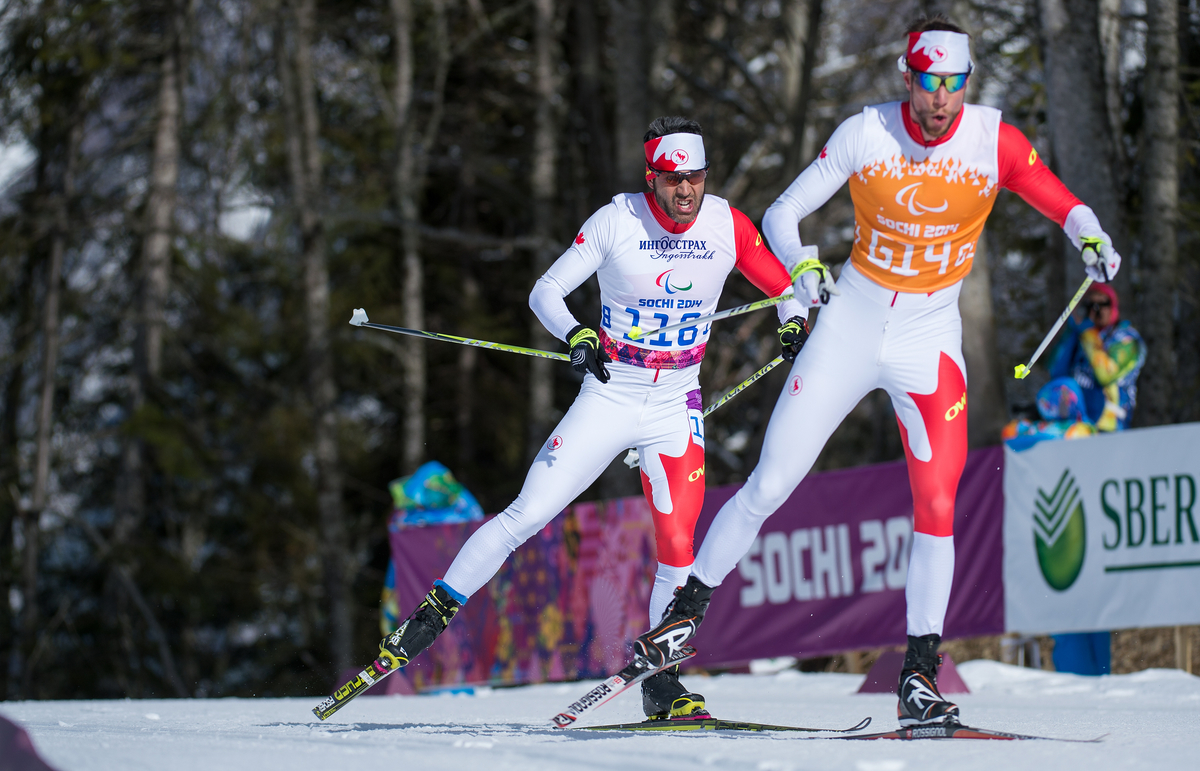
Brian McKeever and his longtime guide and friend Erik Carleton race to McKeever’s third gold of the 2014 Winter Paralympics, and Carleton’s second, in the cross-country 10 k visually impaired freestyle race on the last day of racing in Sochi, Russia. (Photo: Matthew Murnaghan/Canadian Paralympic Committee)
Picture trying to ski after staring directly at the sun. Bushes blend into the snow. Turns become an illusion; one second they are there and the next they are not. If it sounds somewhat impossible, consider it’s the field of vision Canadian Paralympic cross-country skier Brian McKeever has had for the past 19 years of his professional cross-country career.
“If you stare at the sun for a long time and turn away, you get these fuzzy spots. Well for me, the fuzzy spots don’t go away,” McKeever said of his vision, according to his Canadian Paralympic Committee bio.
Diagnosed with Stargardt disease at the age of 19, the loss of vision in no way slowed McKeever’s desire to ski — a sport he started when he was 3 — or his success. In 2010, he made history after being named to both Canada’s able-bodied Olympic squad and its Paralympic team. Though he did not race at the 2010 Winter Olympics in Whistler, he competed in the 2010 Paralympics there, coming away with three gold medals.
Three years prior to that, he raced against able-bodied athletes in the International Ski Federation (FIS) World Championships 15-kilometer freestyle in Sapporo, Japan, and finished 21st. Over the course of four Paralympics, he has accumulated 13 medals, 10 of which are gold. A Paralympic World Championships competitor since 2003, McKeever holds 19 world titles. He also competed in last year’s U.S. nationals in Midway, Utah, finishing 12th in the men’s 30 k classic mass start and 23rd in the men’s 15 k freestyle.
When it comes to racing, the difficulty often is not ensuring McKeever, 38, is fit, but that his guides are fit enough to not be left behind. His brother Robin McKeever, now head coach of Cross Country Canada’s Para-Nordic Ski Team, served as Brian’s guide from 2001 through the 2010 Paralympics. Following Robin’s transition to becoming head coach, Erik Carleton, Brian’s childhood friend growing up in Calgary, Alberta, joined the team as Brian’s new guide.
“I don’t think the guides get nearly as much recognition as they should,” McKeever said after winning the 2013 World Championships 20 k with Carleton as his guide, according to the Canadian Paralympic Committee. “It is tough being the guide because you are out front and not skiing your own race. He needs to be out front and controlling the pace. When I need him to hold off he has to, and when I need him to increase the pace he needs to do that as well.”
Graham Nishikawa pacing Brian McKeever to his eighth Paralympic gold at the 2014 Paralympics in the 20 k visually impaired classic race in Sochi, Russia. McKeever used both Nishikawa and Erik Carleton as guides, switching halfway through the distance race. (Photo Scott Grant/Canadian Paralympic Committee)
A former World Cup skier and Cross Country Canada (CCC) senior development team member, Graham Nishikawa joined Brian and Carleton as a second guide a few years later, in the leadup to the 2014 Paralympics. The two have guided Brian in the years since, but with Carleton’s departure before the upcoming 2018 Paralympics in PyeongChang, South Korea, a new member joined Brian’s crew: Russell Kennedy.
Kennedy, who races for Team R.A.D., which is in partnership and based out of Canmore Nordic, was approached by Robin this spring and offered a spot on the Para-Nordic Team as one of Brian’s backup guides. The offer also came with the opportunity for Kennedy to join the team at its on-snow training camp in New Zealand this summer, as well as the elevation camp it held at Mammoth Mountain in Mammoth Lakes, California, this fall.
“They’ve got a lot of resources and a lot experience, so it’s pretty awesome for me,” Kennedy, 26, said on the phone in October.
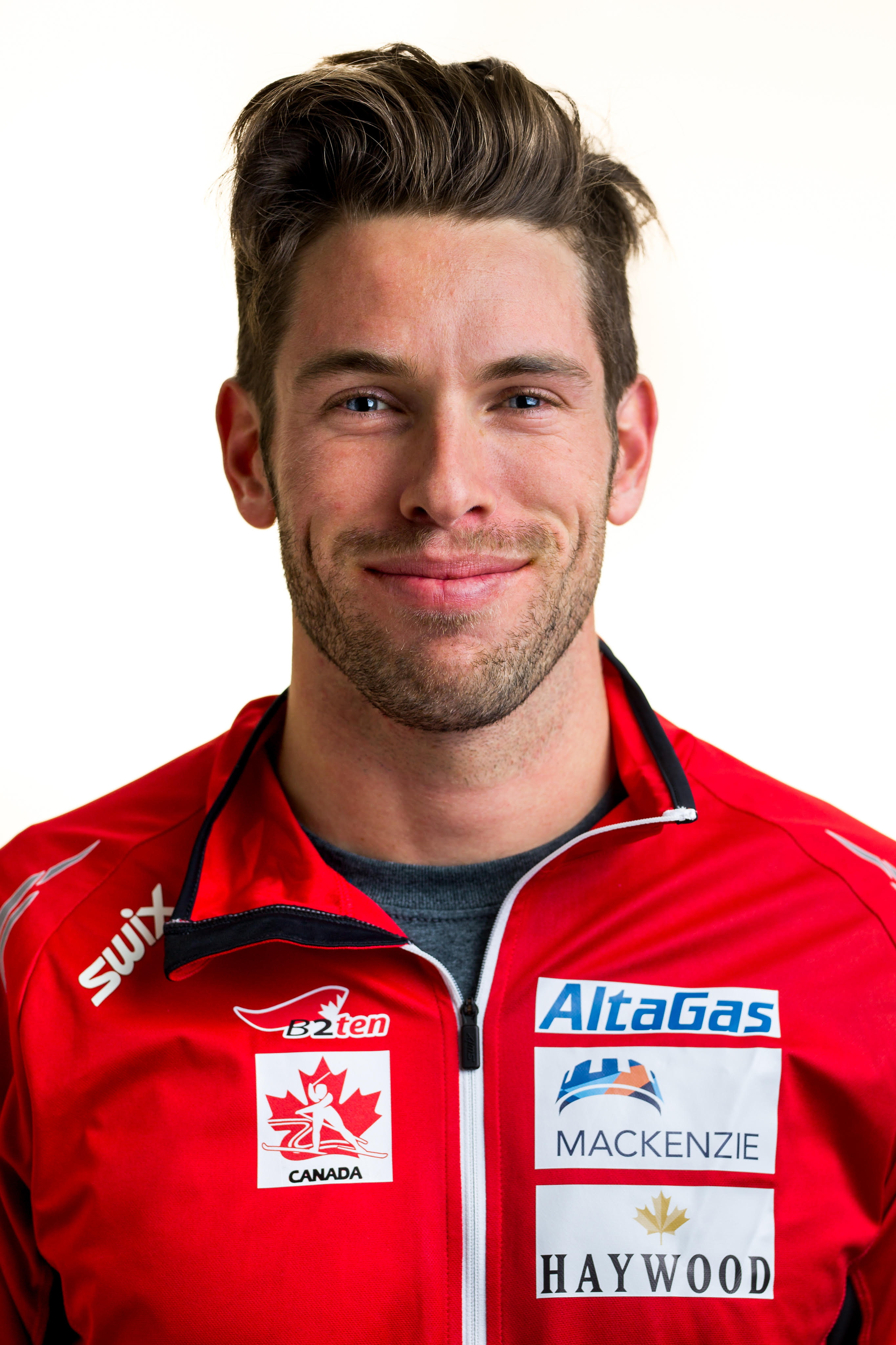
Russell Kennedy (Team R.A.D.) recently agreed to attend the 2018 Paralympics as the second guide for Canadian Paralympian Brian McKeever (not shown). (Courtesy photo)
“I’ve been on my own schedule this year because the Team R.A.D. is mostly younger athletes and … I have to do my own thing because I’m going for the Olympics,” explained Kennedy, last season’s overall NorAm winner who earned Period 1 World Cup starts with CCC’s able-bodied team. “So it actually works better for me to be training with Brian because he has similar goals as me. Those camps were both really well placed with volume load and elevation load for my training plan so that really was another thing that drew me to the program.”
Kennedy, whose father is Canadian and mother American, was born in Truckee, California, and grew up skiing with Far West Nordic. According to The Tahoe Weekly, he took advantage of his dual citizenship and moved to Canada fresh out of high school in 2010 to train with the Alberta World Cup Academy. In the years since, he has accumulated 18 World Cup starts (including two this season). After attending both Para-Nordic camps this summer, Kennedy plans to head to PyeongChang for the Paralympics, but is hoping to qualify for Canada’s Olympic squad as well.
With that as one of his primary goals, Kennedy departed for Gällivare, Sweden, on Nov. 11 and competed at the FIS season-opener there before diving into World Cups in an effort to meet CCC’s Olympic selection criteria. Later this month, he’ll head home to Canada to get ready for NorAm trials Jan. 6-10 in Mont Sainte-Anne, Quebec.
“It is always a bit hard with sprints, but the goal was to close really well,” Kennedy wrote in an email after that sprint. “I felt strong and was much more happy with this sprint than my Frozen Thunder qualifier.”
He did not race the following weekend’s World Cup opener in Kuusamo, Finland, due to illness.
“I caught a really small head cold,” Kennedy wrote in an email late last month. “It was a bit silly, but it was not worth racing and making it worse as I have a month over here, so I sat out the weekend.”
At the second World Cup stop in Lillehammer, Norway, he raced to 63rd in the classic sprint and 53rd in the 30 k skiathlon. McKeever also started his season in Gällivare, where he finished 97th in the FIS 10 k skate and 110th in the 15 k classic, without a guide in either race.
“I didn’t get to ski with him as much as I would have liked to, but got a quick one in before my race and chatted with him about fitness and how he was feeling,” Kennedy wrote in an email after the Gällivare classic sprint.
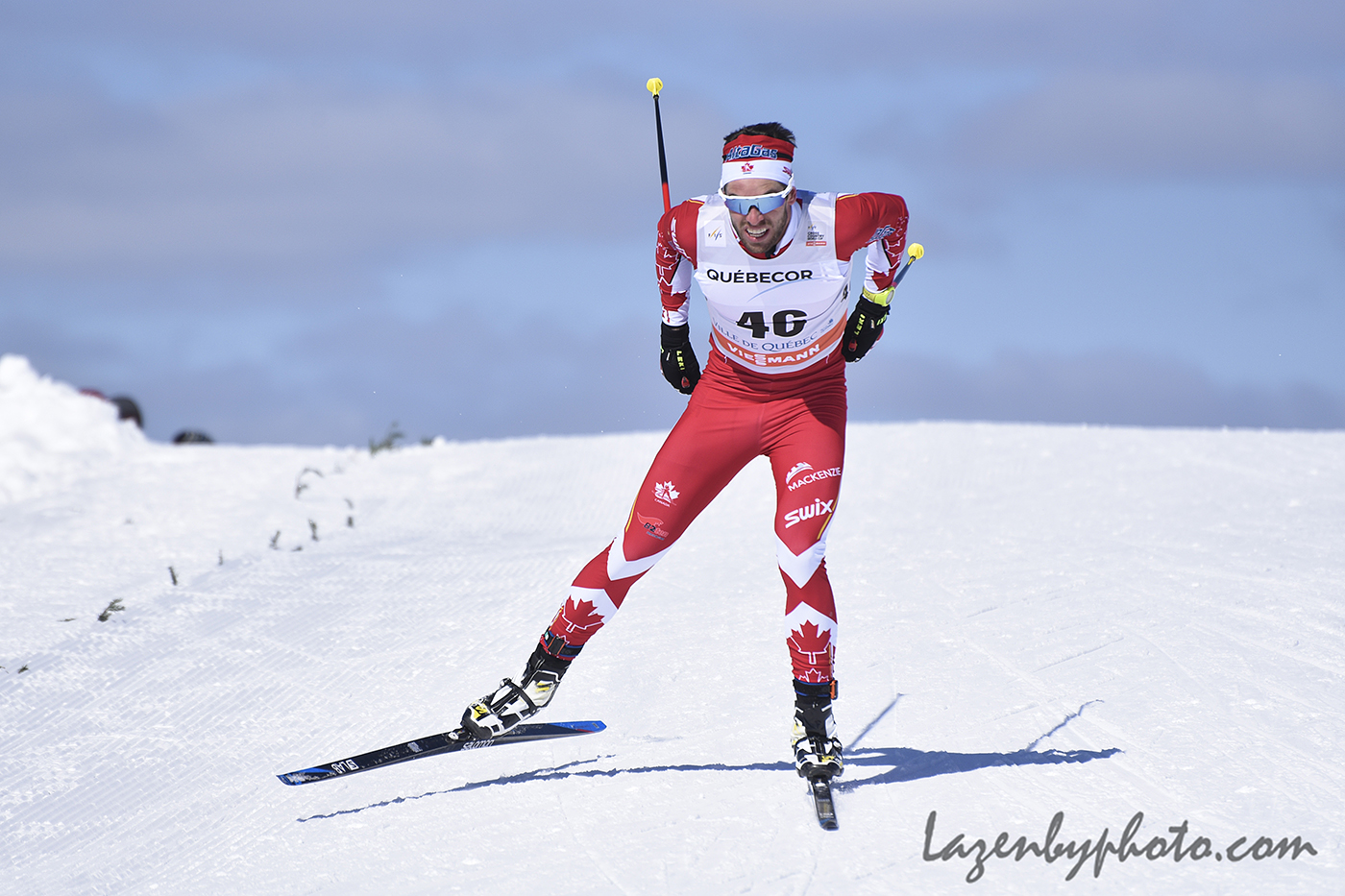
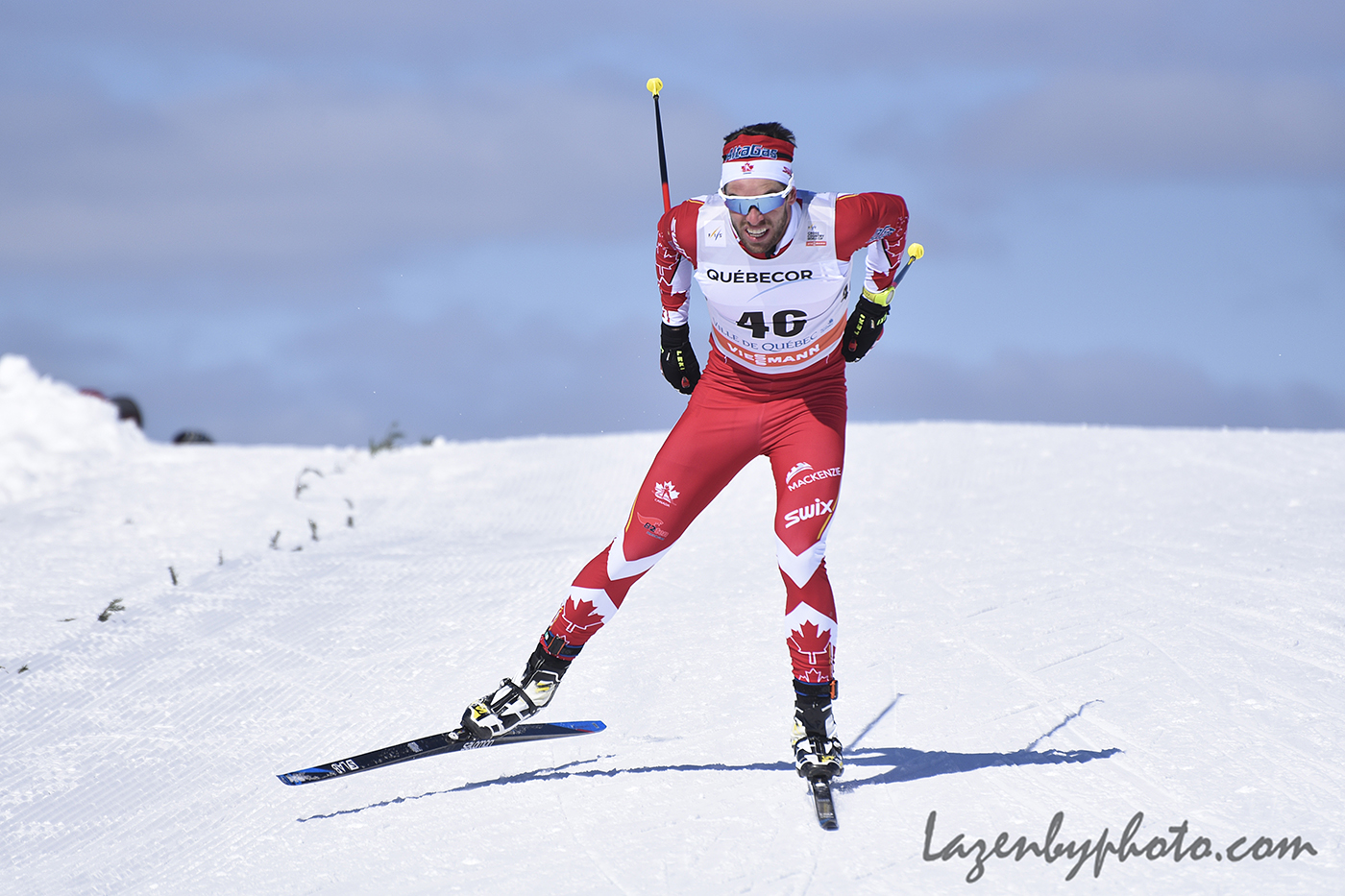
Russell Kennedy (Canmore Nordic/Team R.A.D.) racing to 36th in the men’s skate sprint qualifier at 2017 World Cup Finals in Quebec City last March. (Photo: John Lazenby/Lazenbyphoto.com)
Kennedy, who has spent all of his senior skiing years in Canada, has had some experience guiding, but this will be his first year at McKeever’s level of racing.
“It’s hard for Para to find a guide that can match Brian’s pace because he’s quite fit, as I’ve been finding out more and more,” Kennedy said.
McKeever is also based out of Canmore and the two coordinated training sessions as frequently as they could this summer and fall, Kennedy explained.
“He’s a really really fit dude and there’s not too many people who can hold that pace. They basically have to be on the national team,” he continued. “The guy that’s guiding is, I guess, a bit less difficult than just being fit enough to guide him.”
With the start of the World Cup race season well underway and the 2018 Paralympics exactly three months away, the primary goal for Kennedy right now is to simply stay fit.
“[The Paralympics] are so far away that I can kind of peak for the [World Cup] and then rebuild if I need to,” Kennedy said. “We’re going to have to play it a bit by ear and see what happens. But we both trust in each other’s fitness so I think it will work out.”
(Note: Neither Brian McKeever nor Robin McKeever could be reached for comment.)
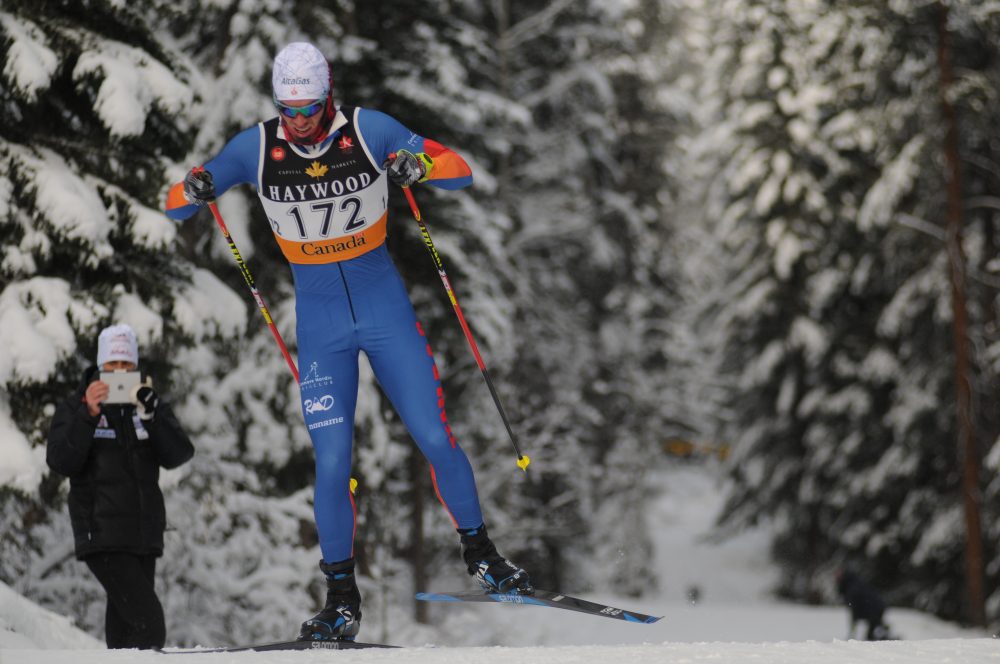
Russell Kennedy of the Canmore-based Team R.A.D. racing to third in the men’s 10-kilometer freestyle at 2017 Frozen Thunder in early November in Canmore, Alberta. (Photo: Doug Stephen)
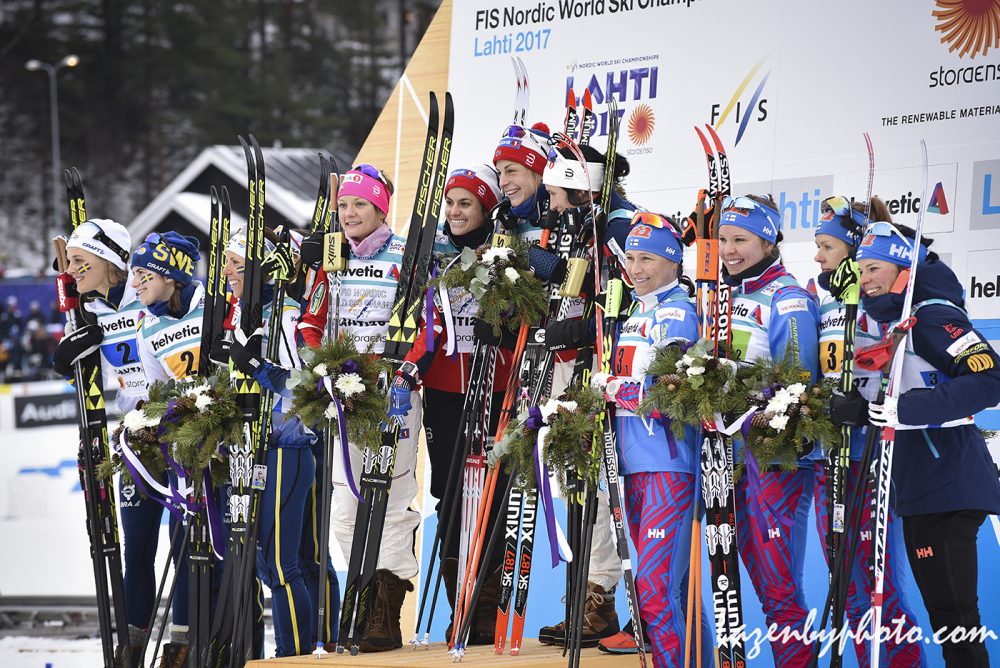
The women’s 4 x 5 k relay podium at 2017 Nordic World Ski Championships in Lahti, Finland, with Norway (c) in first, Sweden (l) in second and Finland (r) third. (Photo: John Lazenby/Lazenbyphoto.com)
LAHTI, Finland—The Norwegian lineup for the women’s 4 x 5-kilometer team at the 2017 Nordic World Championships on Thursday was daunting: Maiken Caspersen Falla, Heidi Weng, Astrid Uhrenholdt Jacobsen, Marit Bjørgen. On paper and on snow, a rundown of names and accomplishments.
On Thursday the Norwegian women made the country’s historic championship gold medal count a tidy 100 by winning the 4 x 5 k relay in 52:21.5 minutes. In a sprint for the remaining two podium spots, Sweden’s anchor skier Stina Nilsson outsprinted Finland’s Krista Pärmäkoski for second.
The Swedish team of Anna Haag, Charlotte Kalla, Ebba Andersson, and Nilsson scored silver (+1:01.6) while Finland’s home team of Aino-Kaisa Saarinen, Kerttu Niskanen, Laura Mononen, and Pärmäkoski was third (+1:02.1).
The U.S., represented by Kikkan Randall, Sadie Bjornsen, Liz Stephen, and Jessie Diggins, placed fourth (+1:33.8).
Two Legs of Parity, Then Norwegian Dominance
Rabid fans of the sport know Norway is winner of the last three consecutive championship relays. And lovers of tactics also know the Norwegians like to push the pace from the gun and break the pack early.
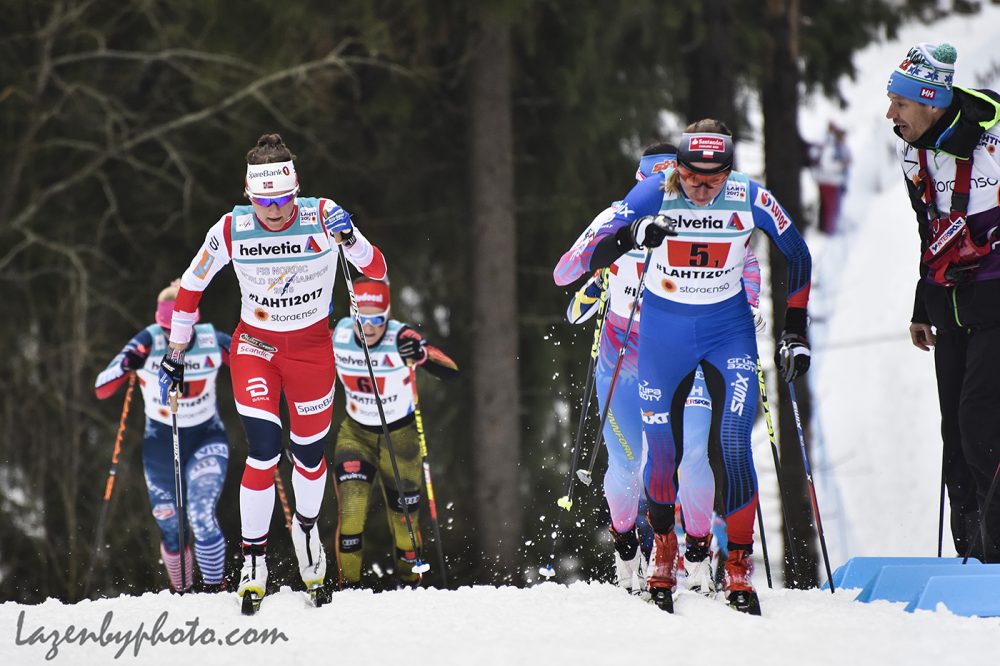
Halfway through the first leg, Poland’s Justyna Kowalczyk, a classic specialist, led Finland, Norway, Sweden, and the U.S. through the 2.5 k mark.
Norway’s Maiken Caspersen Falla (l) leads one row of skiers, Poland’s Justyna Kowalczyk lead’s another, during the scramble leg of the 2017 Nordic World Championships 4 x 5 k relay in Lahti, Finland. (Photo: John Lazenby/lazenbyphoto.com)
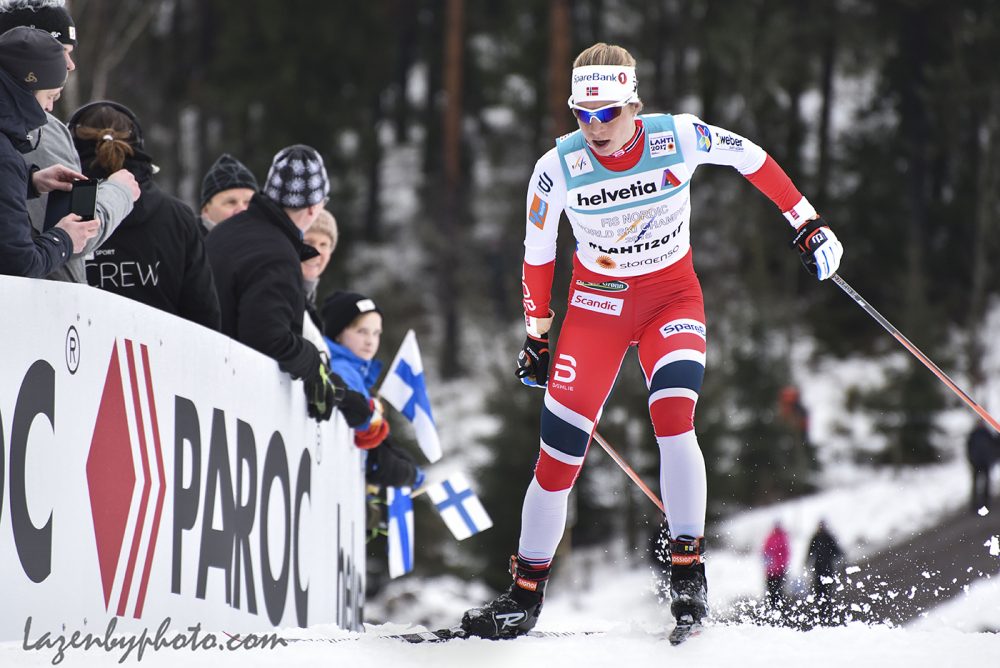
For Falla, Norway’s scramble leg, it was her debut in a championship 4 x 5 k relay. Despite her prior medals, her pre-relay nerves were unsettled.
“I was really excited today and I was just hoping that the time could pass fast so I can race,” Falla said after the race. “It was a lot of waiting time, but I get good advice … and that helped me today. So I get my nerves under control.”
According to Falla, here’s the advice: “That I should stay behind the first lap and be strong in the climbs in the last lap,” she explained. “I did that, just as they said.”
In the last kilometer, Falla made a small break, tagging off to Weng with a near eight-second advantage on the chasers.
Weng leads the World Cup overall standings, but racing in the Finnish ski-den, she was unable to fend off the surging Finns. Five kilometers later, Niskanen had absorbed Norway’s punch. Finland and Norway tagged off to their respective third-leg skiers simultaneously. Sweden trailed twelve seconds back.
Up the first hill, the mother of all climbs on the skating course, Jacobsen and Mononen pulsed. Carrying Sweden’s hopes was Andersson — a 19-year-old junior fresh off a win in the 5 k skate at last month’s Junior World Championships at Soldier Hollow in Utah.
The Finn-Norwegian duo pulled away, leaving Andersson with a 22.6-second deficit 1.3 k into the third leg.
Astrid Uhrenholdt Jacobsen, Norway’s third-leg skier, made a decisive move to put major time into second-place Sweden and third-place Finland during the 2017 Nordic World Championships 4 x 5 k relay in Lahti, Finland. (Photo: John Lazenby/Lazenbyphoto.com)
A resurgent Jacobsen kept pushing; her moves to drop Andersson early on weren’t only a tactic to make it a two-team race, but a sustained display of overdrive that ultimately broke the Finns, too.
The third leg was the tipping point for Finland and Sweden. They were on the side of bleeding time to Norway; Norway on the side of looming victory. By 13.8 k, Norway was up 30.4 seconds on Finland and 45.8 seconds on Sweden.
Andersson managed the damage. She and Mononen skied into the stadium amidst a raucous Finnish crowd. By then, Jacobsen handed Bjørgen nearly a minute cushion.
That kind of margin and Bjørgen hustling from the line: Boom!
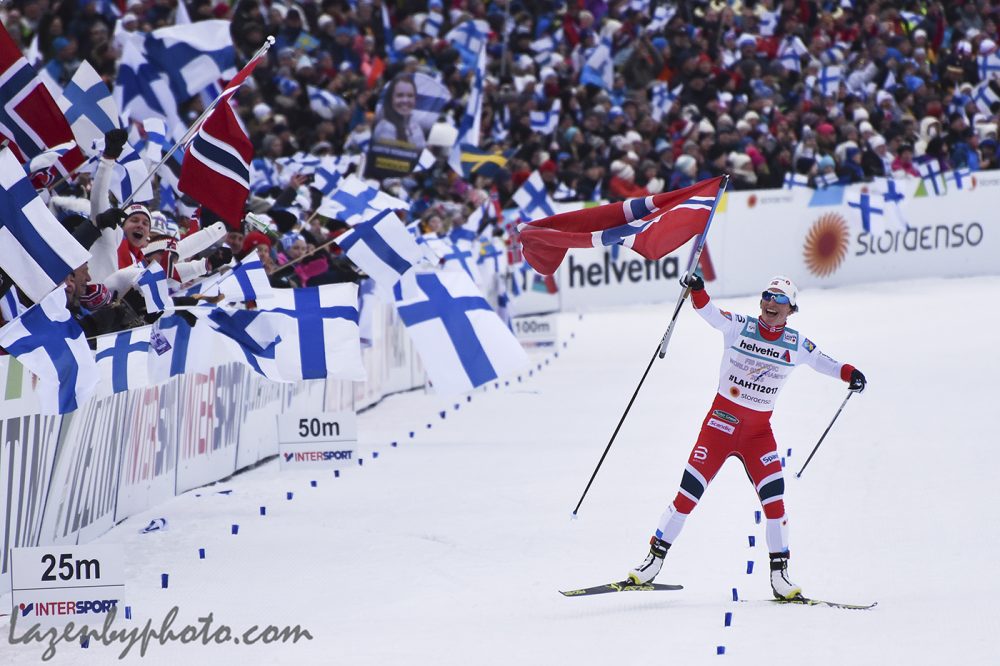
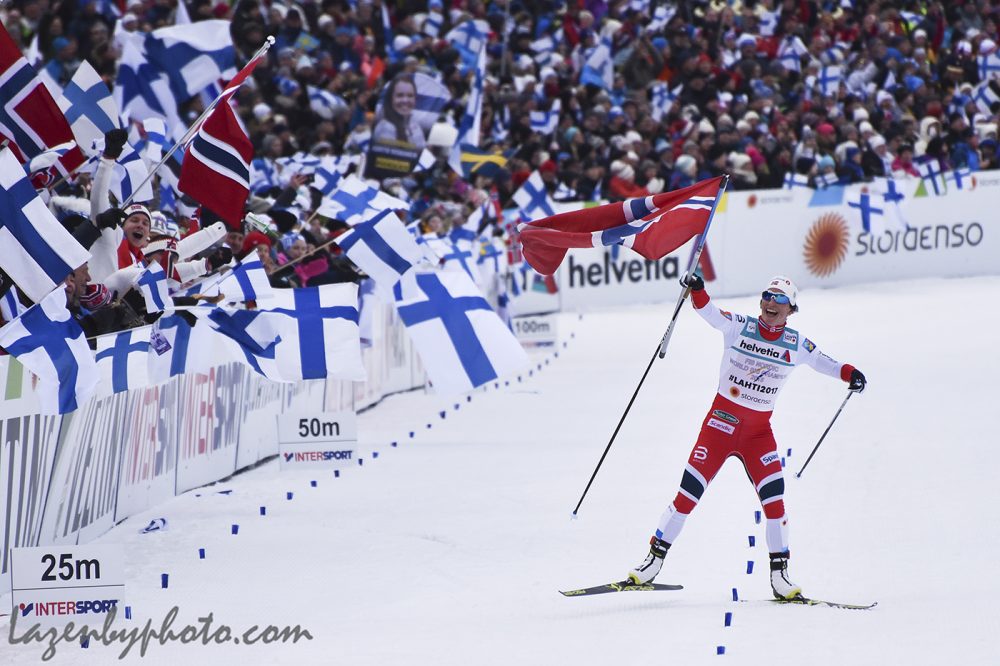
You know how this ends, with the queen waving an oversized Norwegian flag.
After the race, Jacobsen spoke of the pressure of skiing on Norway’s storied relay teams.
Marit Bjørgen carrying the Norwegian flag as she crosses the line first for Norway’s 100th World Championship win during the women’s 4 x 5 k relay at the 2017 Nordic World Championships in Lahti, Finland. (Photo: John Lazenby/Lazenbyphoto.com)
“I think actually the biggest pressure is the one we put on ourselves and probably because it’s so hard for us to qualify for the team,” Jacobsen said. “We are skiing for the girls who didn’t make it this year but will probably make it next year. So we ski of course for our people and our nation. But I think the biggest nerves come from the desire to perform well and do strong legs.”
One hundred championship gold medals later, Jacobsen acknowledged it’s a full treasure chest.
“The Norwegian people are getting spoiled in gold medals, but it not so easy like it looks,” Jacobsen said.
Glide for glide, pole for pole, Sweden and Finland were mirror images the last leg. Known as a closer, Nilsson strategized that coming into the final corner she wanted to follow Parmakoski.
Sweden’s second-leg skier Kalla explained that Nilsson’s tactic was one of waiting until the end.
“If Stina should go with some team in the end, she should wait to the stadium and just focus on her strength and she made it just like the plan,” Kalla said.
Days earlier in the team sprint, Nilsson lost out on bronze to Diggins in a sprint to the line.
“In the team sprint I was first in the final curve,” Nilsson reflected. “And I felt that Diggins had an advantage of it, so I didn’t want to be first today.”
The press conference’s moderator interjected and tried to correct Nilsson, saying she was first again in the closing moments, not shadowing the Finn.
“No, not in the curve, but after the curve,” Nilsson said with a laugh.
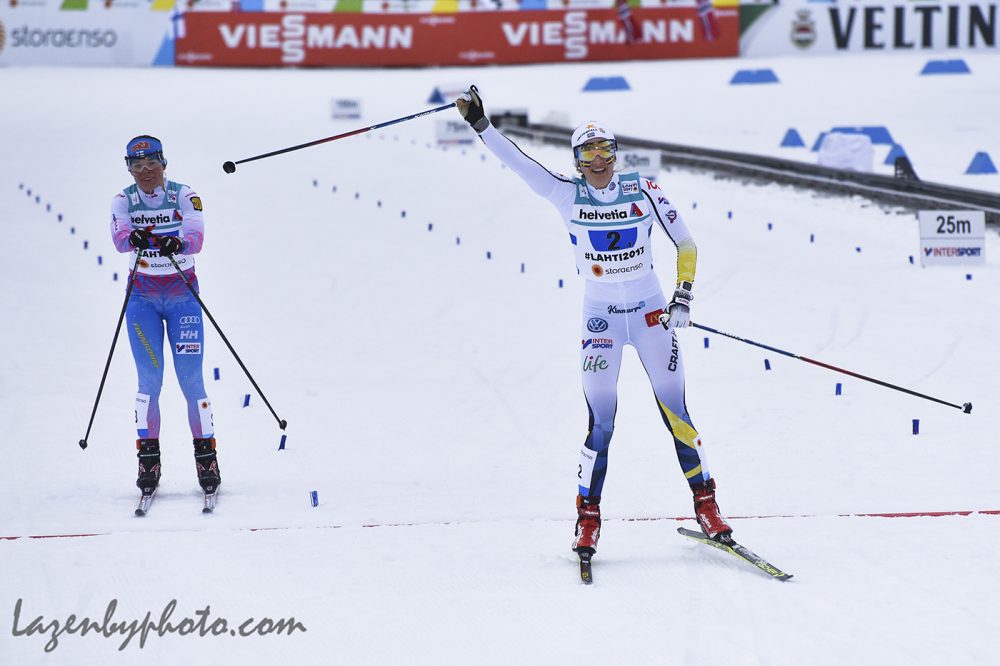
The silver and bronze fight came down to Nilsson’s final kick and this time she made it stick for silver.
(Story continues below)
Sweden’s Stina Nilsson celebrates silver after outsprinting Finland’s Krista Parmakoski (l) in the final meters of the women’s 4 x 5 k relay at the 2017 Nordic World Championships in Lahti, Finland. (Photo: John Lazenby/Lazenbyphoto.com)
Same Place, But Progress: U.S. Places Fourth, Canada 10th
With three world champs medals already in the hands of American skiers prior to Thursday’s team relay, the public hope for a podium was high. Perhaps too high.
As U.S. Ski Team (USST) Head Coach Chris Grover explained, medaling in the team relay was certainly on the radar coming into the world champs week, but not where the team’s greatest expectations were held.
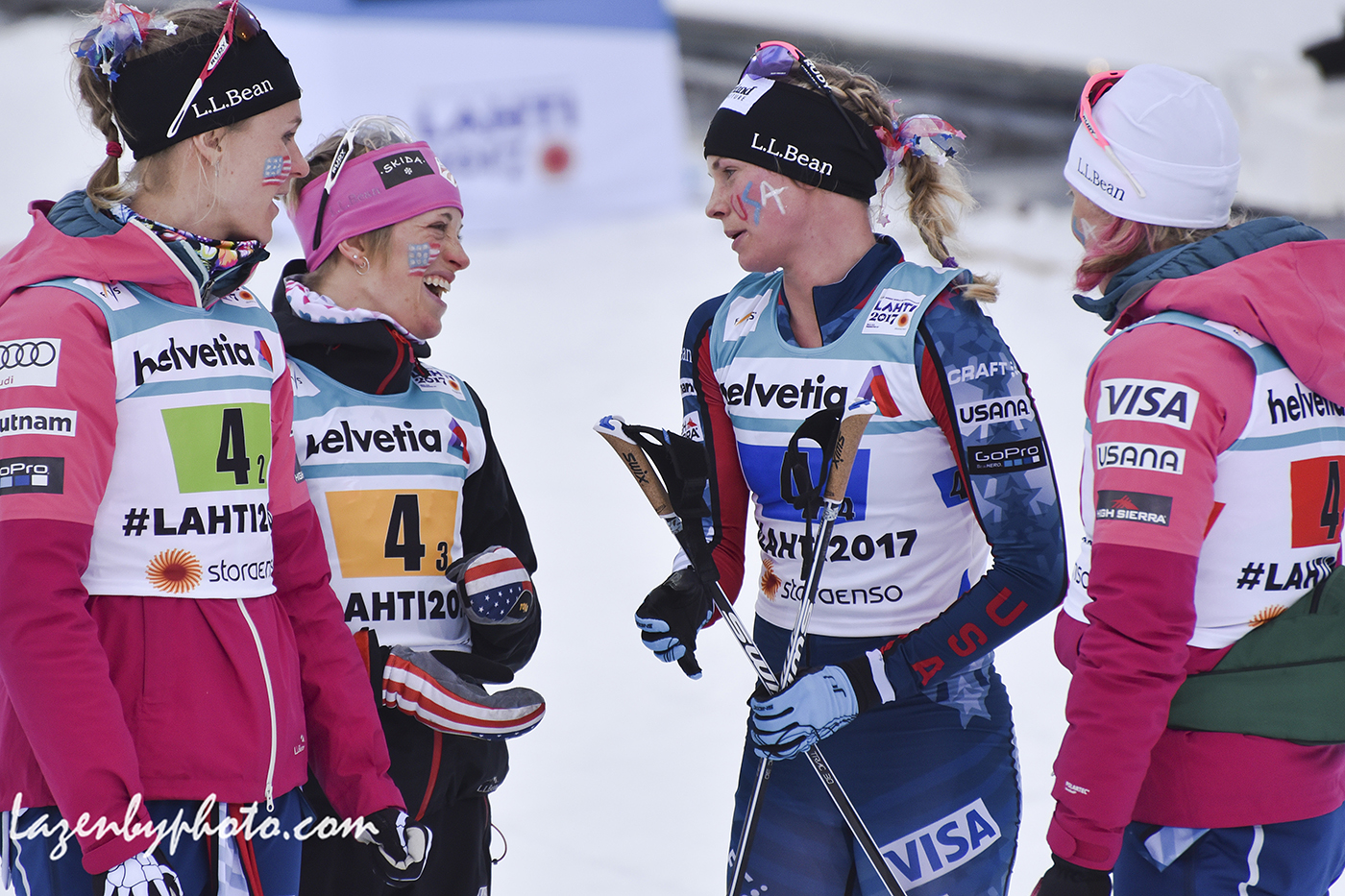
The U.S. women’s relay team, (from left to right) Sadie Bjornsen, Liz Stephen, Jessie Diggins, and Kikkan Randall, after placing fourth on Thursday at 2017 World Championships in Lahti, Finland. (Photo: John Lazenby/Lazenbyphoto.com)
“The relay we knew was a shot, the team sprint we knew was an outside shot,” Grover said after Thursday’s race. “Probably our greatest medal opportunity was the individual sprint.”
As a gritty group of women, the Americans exude the attitude of a top team. Adorned in red, white and blue socks and face paint sporting the U.S.A.’s emblematic stars and stripes, it’s easy to see the enthusiasm the U.S. women show for team events.
But where does the blur between team-relay hype end and the reality of results begin?
Disappointment in anything less than a podium only comes when the expectation of one exists. Taken over the past few world champs years, the relay event might be one where the U.S. women can, and have, improved the most.
Eight years ago, at the 2009 world champs in Liberec, Czech Republic, the U.S. finished 13th, a little over three minutesout of third place. The following World Championships year, 2011 in Oslo, Norway, they were almost two minutes off the podium, crossing in ninth overall.
This year? The U.S. once again finished fourth — the third time in a row that the team has finished one place outside the podium at a World Championships event.
Yet, Thursday’s performance was the second closest the team has come to bronze, with the Americans crossing 31.7 seconds after third (their 2013 result in Val di Fiemme, Italy, was closer: 26.6 seconds behind third). Given room for systematic error, the statistical trend for the U.S. women in the team relay over the past five world champs: positive.
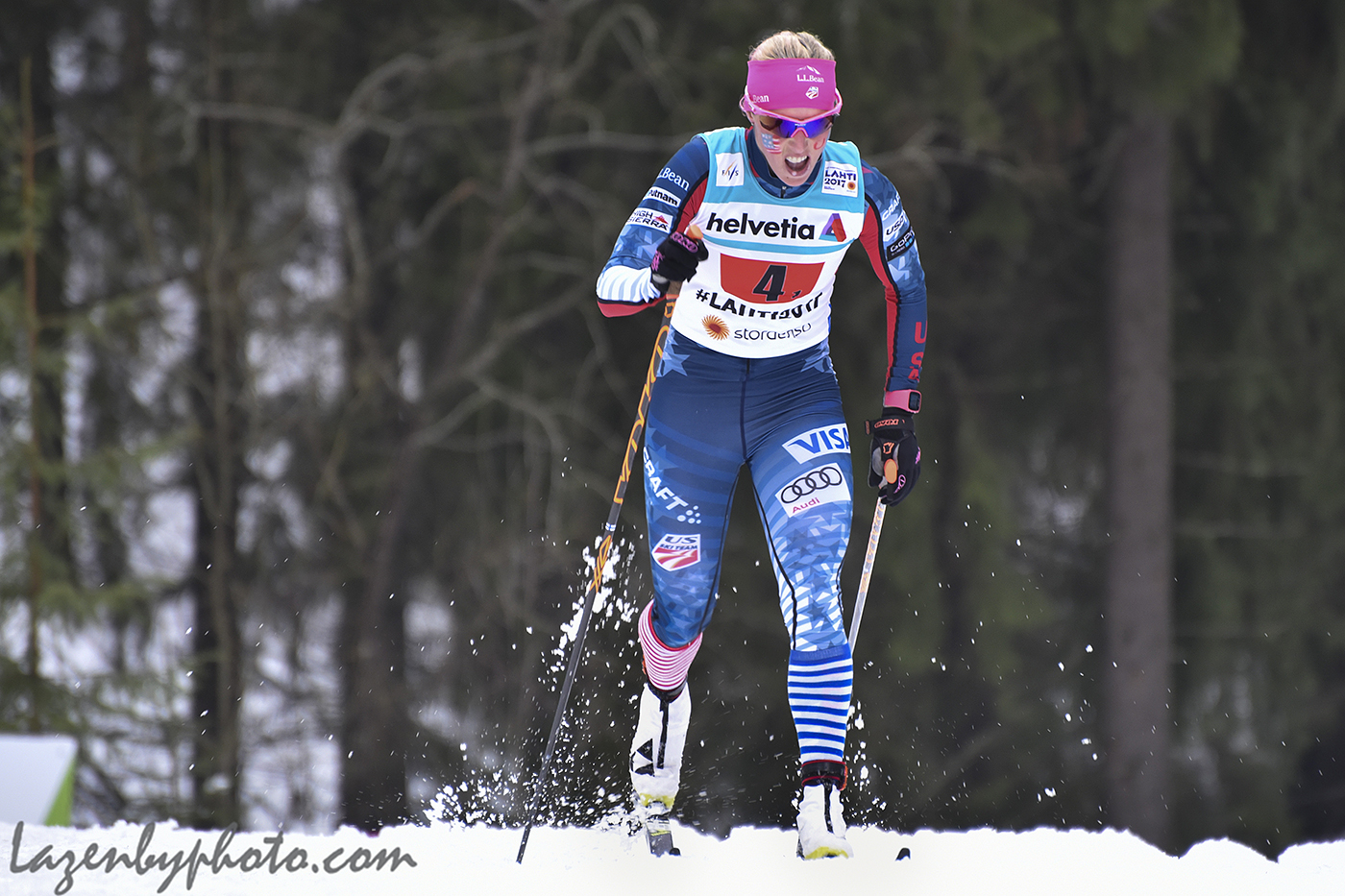
American Kikkan Randall during the first leg of the women’s 4 x 5 k relay at the 2017 Nordic World Championships in Lahti, Finland. (Photo: John Lazenby/Lazenbyphoto.com)
“Even though this is the third time in a row that we’ve been fourth place at a world championships, there’s progress, there’s real progress,” Grover said. “The athletes could see the competition ahead of them the whole time. … To be getting closer and closer to that top standard, that’s very gratifying.”
When looking at the longer-distance performances from the week in tandem with Thursday’s start list, Grover further explained that the U.S. team’s incoming rank was similar to their outcoming result.
“I guess I’d say that when you look at the start list and you look at the results from the 10 k and the skiathlon, on paper we’re fourth,” Grover said. “Sweden, Finland, Norway they’re definitely ahead of us in terms of the distance results that we’ve seen here all week. So we knew we were sort of an outside chance to be fighting for the bronze and we knew that when we’re successful on the World Cup, it’s because one of those teams has a weak leg.”
A weak leg from Finland, Norway or Sweden — the three teams that finished ahead of the Americans — at least in Thursday’s race, was nowhere to be found for the U.S.
From the start, Kowalczyk, pushed the pace with Falla, Haag and Saarinen in close quarters, while the USST’s Randall worked hard to hold on.
“Unfortunately, we lost some important time there in the beginning,” Randall said. “I know that’s something I’ve got to work on for next year, but it was exciting to know that we were still in the race the whole time and made Sweden and Finland really fight for those medals.”
Randall handed off to Bjornsen in fifth, approximately 16 seconds back from the second, third, and fourth spots. From there, the Americans raced alone, working hard to reel in the racers ahead.
“It’s always hard to have a carrot right in front of you and not go too hard at the beginning,” Bjornsen said. “I think all of us had a hard time with that today, not going too hard to try to catch them right away.”
By the end of her leg, Bjornsen needed another eight seconds from Randall’s time back to catch the third place position. She handed off to Stephen, who would have to make up 23.5 seconds on Sweden’s third leg, Andersson, to contend for the podium.
The young Andersson, however, was putting on a show. And Stephen wasn’t surprised. During the early stages of her ski career, Stephen attended a weeklong camp in Sweden. While there, she’d learn invaluable lessons from countless coaches, one just happening to be Andersson’s father.
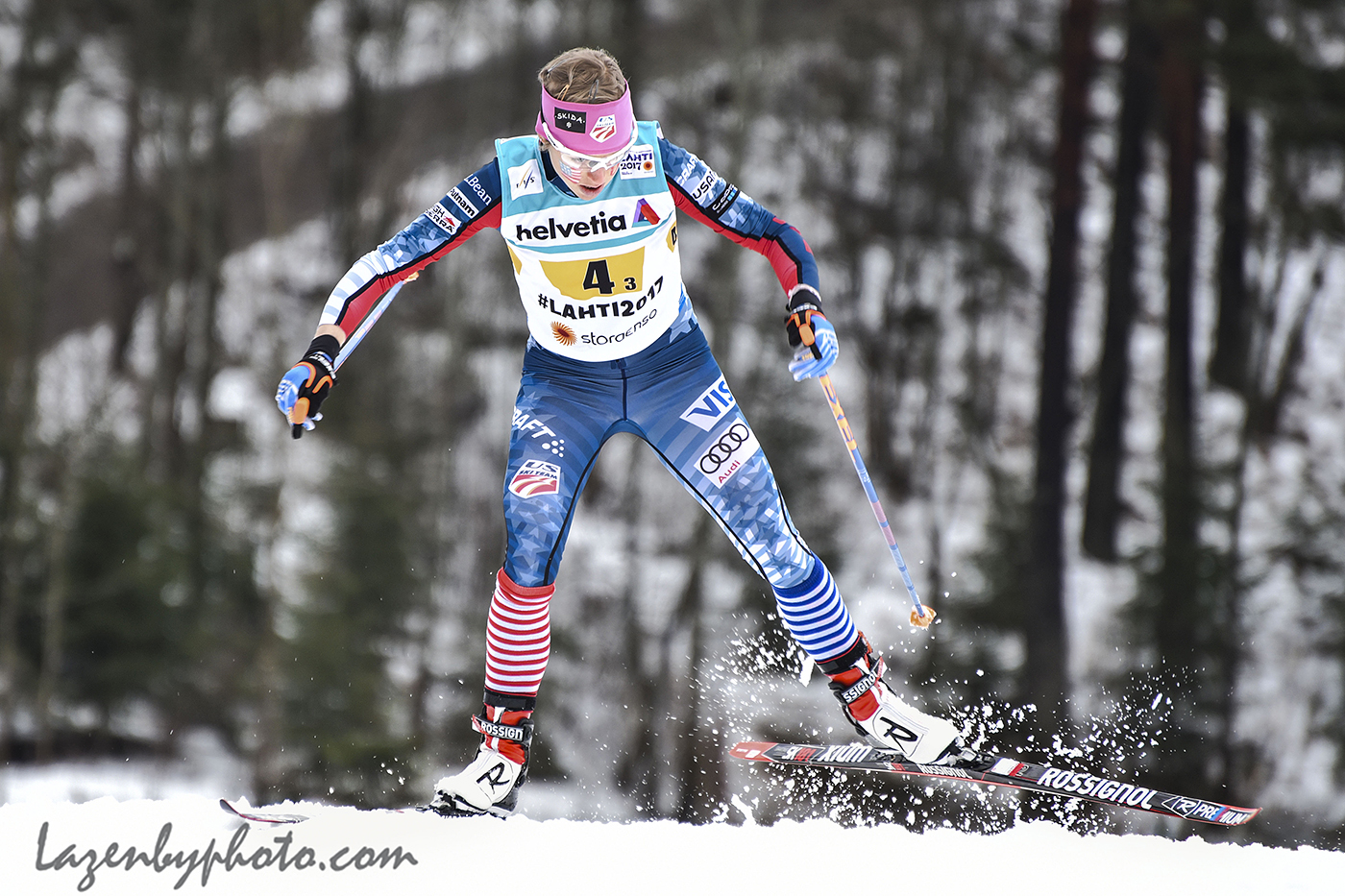
Liz Stephen racing the third leg for the U.S. women’s team in the 4 x 5 k relay at the 2017 Nordic World Championships in Lahti, Finland. (Photo: John Lazenby/ Lazenbyphoto.com)
“As I was lining up with her today I was just like ‘this is just full circle,’ “Stephen said after. “She’s a damn-good skier.”
That of course didn’t stop Stephen from putting her best foot forward. The American emphasised the areas she knew were her strength, working the hills.
“Part of me wanted to go out and blow [it] out of the water off the bat, but I also knew that these conditions are also a little bit more energy-expending than normal, hard-packed conditions,” Stephen explained.
Halfway through the first lap, Stephen had gained close to seven seconds on Andersson. By the end of the second lap, however, Andersson had regained the ground that she had lost.
“Unfortunately I couldn’t get her,” Stephen said. “But I did what I could out there … and I am very inspired to be on this team again. To watch my teammates give it all out there, it just makes you want to do the same.”
When Stephen handed off to Diggins, the anchor legs for Sweden and Finland were skiing together. Diggins explained that she had hoped Nilsson and Pärmäkoski’s race tactics would provide an opportunity for her to gain on them.
“I saw where we were coming in and I said, my only strategy is to go out as hard as I can and hope that they are playing cat and mouse in the front,” Diggins said. “[I thought] if they’re trying to be all strategic for the final sprint-out, then maybe I can catch them.”
Ultimately the gap proved too large, with Diggins crossing in fourth.
“I wasn’t able to close the gap but I never stopped fighting and neither did my teammates, and I’m really proud of that,” Diggins said.
Canada’s team of Katherine Stewart-Jones, Emily Nishikawa, Cendrine Browne, and Dahria Beatty finished 10th (+4:16.2) for the fourth-best world champs result of a Canadian women’s relay team. According to a Cross Country Canada press release, this was just the fourth time in the last decade that Canada has fielded a World Championships women’s relay (excluding the Olympics).
At the 2001 World Championships, Beckie Scott, Milane Thériault, Jaime Fortier, and Sara Renner raced to sixth for Canada. Before that, the program’s previous best was eighth at 1989 world champs, also in Lahti.
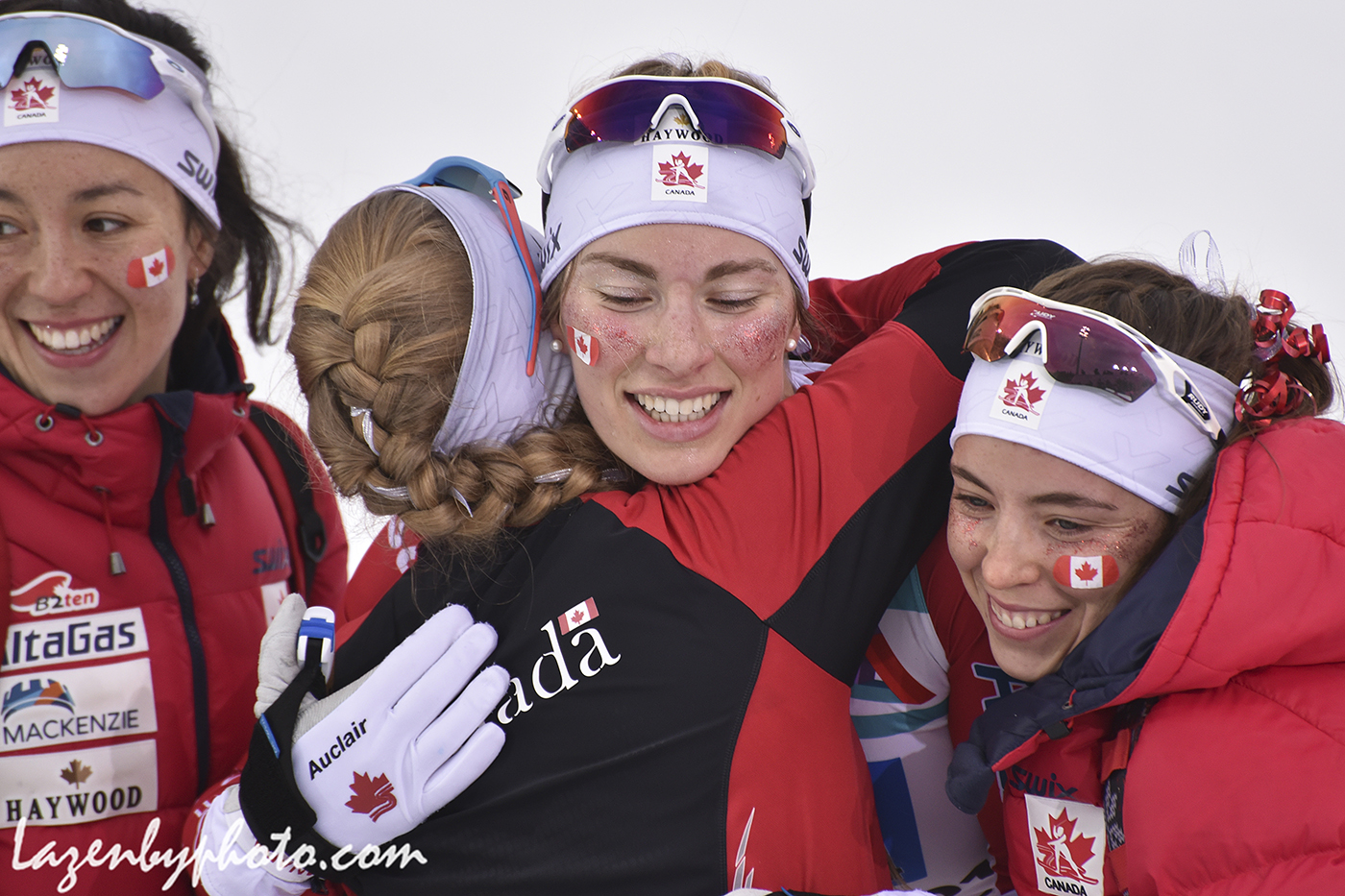
(Left to right) Canada’s Emily Nishikawa, Cendrine Browne, Dahria Beatty, and Katherine Stewart-Jones after placing 10th in the women’s 4 x 5 k relay at the 2017 Nordic World Championships in Lahti, Finland. (Photo: John Lazenby/Lazenbyphoto.com)
“I think today we surprised ourselves,” Canadian World Cup coach Ivan Babikov said on Thursday.
“[Katherine Stewart-Jones] skied incredibly that first leg, with everything she could,” he added. “She was ahead of Germany, ahead of Russia, so many really good countries, and after that it was a matter of holding on and it was great.”
Stewart-Jones finished her leg in eighth, just seven-tenths of second behind Germany’s Katharina Hennig in seventh. Though Switzerland and Italy eventually caught the Canadians, the women expressed excitement about the finish and results yet to come.
“This is the first time we’ve fielded a world champs relay in a long time so that’s a huge accomplishment [in itself],” Nishikawa said during an in-person interview. “And then to come 10th … it’s really the beginning of something that’s pretty special.”
“I’m really proud of us,” Browne added. “I think we all skied really strongly today, and very positive for the future.”
— Harald Zimmer, Gerry Furseth, and Alex Kochon contributed