From the FasterSkier archive — posts syndicated from athletes’ and coaches’ own blogs between 2004 and 2012, kept online as published. Current coverage is at fasterskier.com.
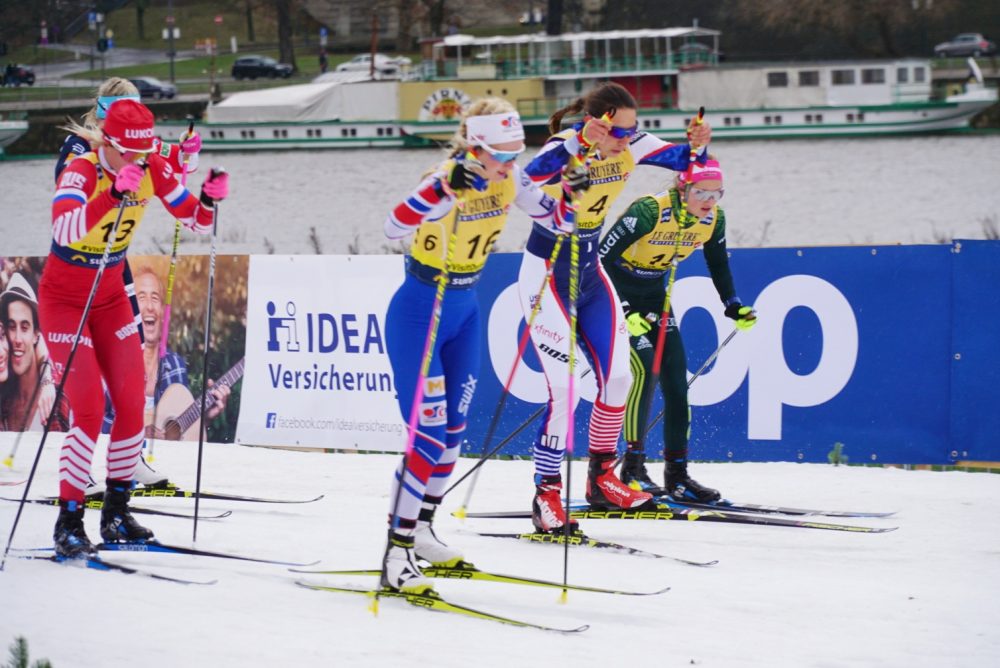
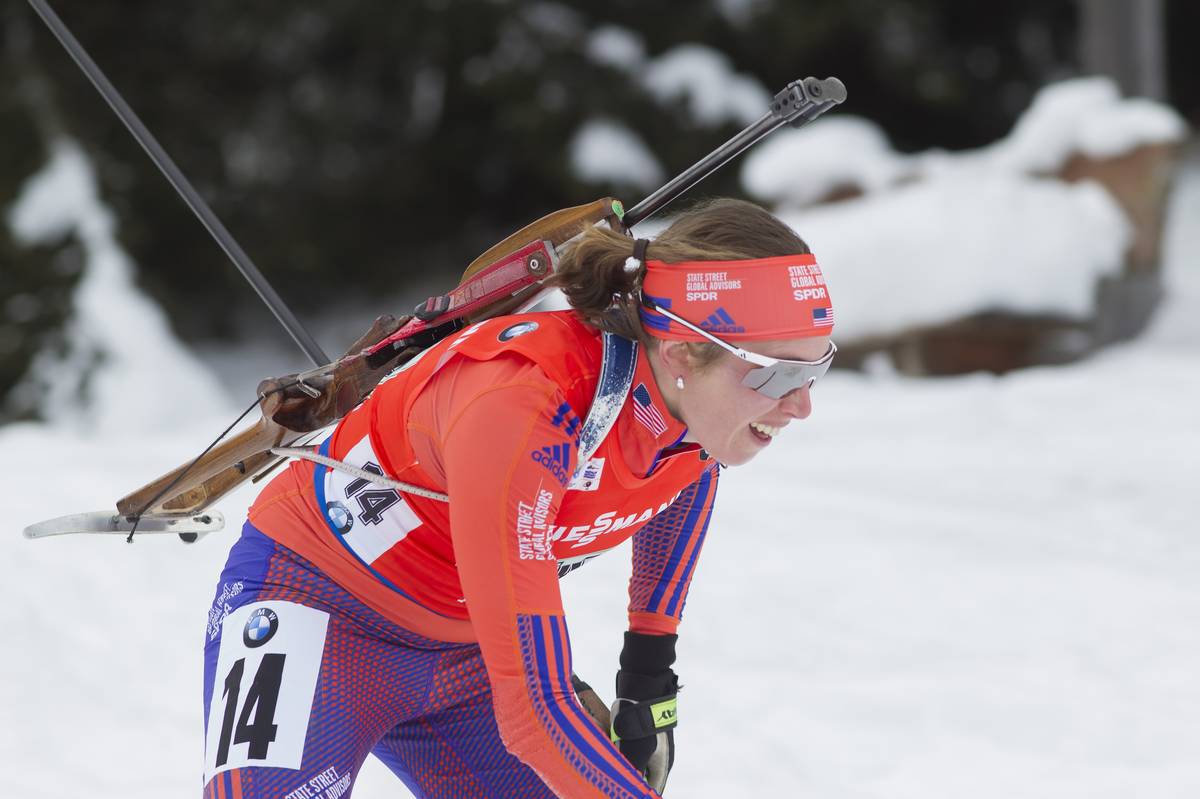
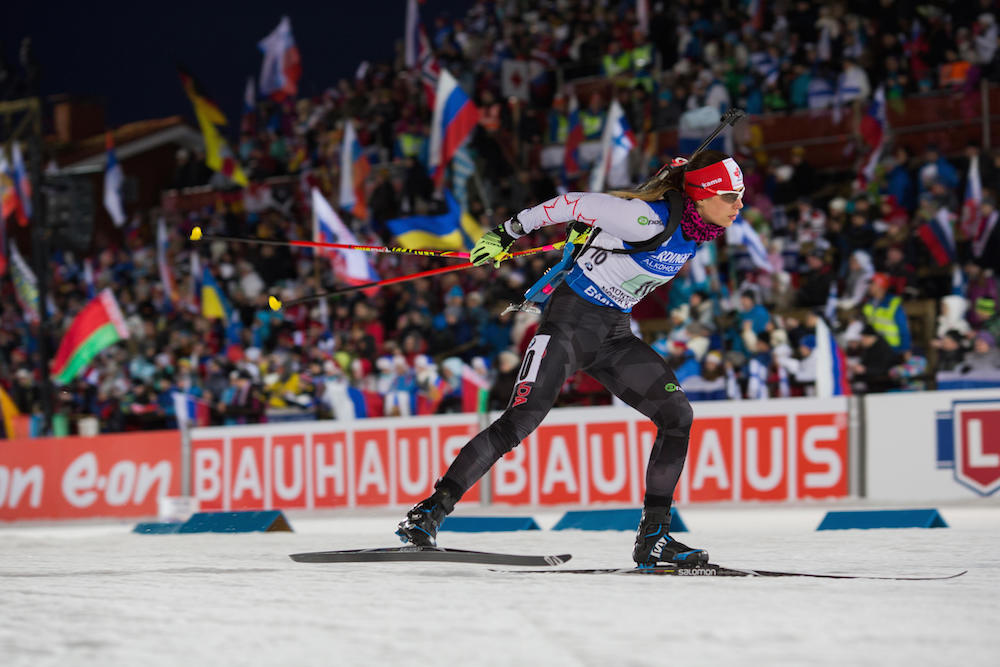
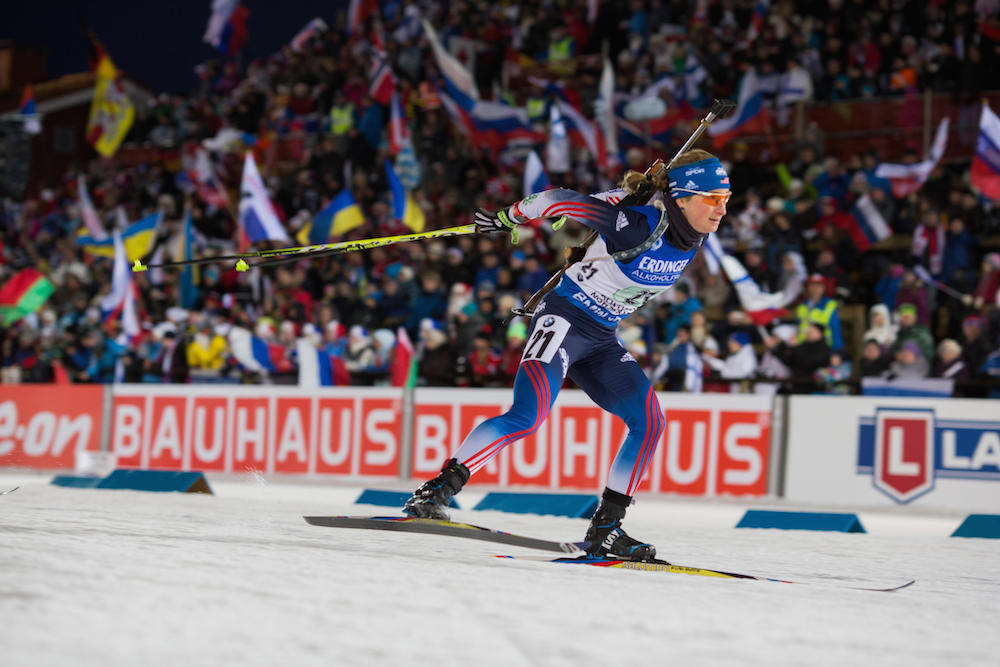
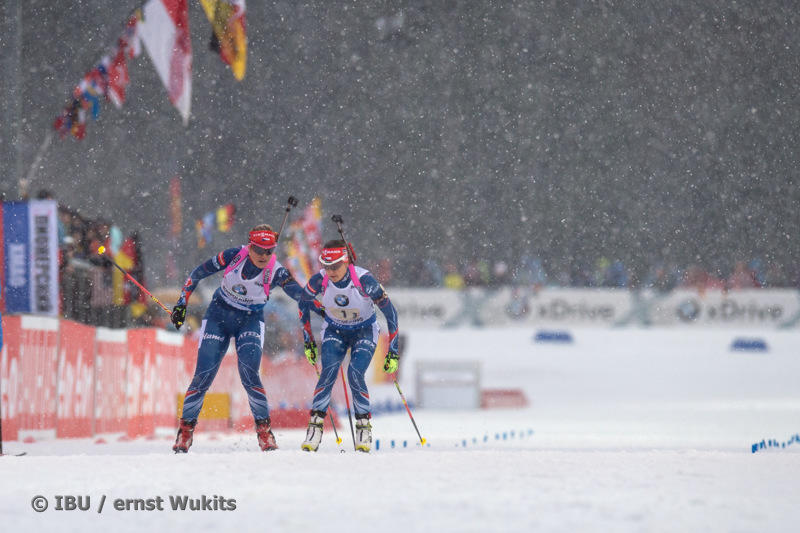
Racing in bib 4 for the U.S., Julia Kern keeps pace in the women’s team sprint during the Dresden, Germany World Cup on Sunday. (Photo: Garrott Kuzzy).
FIS World Cup Dresden, Germany 6 x 1.6 k Freestyle Team Sprint
The first World Cup team sprint of the season was run amidst drizzle and the Dresden, Germany city-scape as the women raced a total of six 1.6-kilometer laps.
Round and round on the looping course, the pace was a mix of tactically subdued speeds with sustained bursts of energy to break the pack.
After all the speed changes and exchanges with one athlete tagging off to the next, it came down to a 1.11 second difference between first place Sweden I and the three closet teams chasing from behind that ended in a photo finish.
Sweden I’s Stina Nilsson and Maja Dahlqvist won in a time of 24:02.5 minutes. Sweden II’s Ida Ingemarsdotter and Jonna Sundling placed second (+1.11), and Norway I, with Eide Mari and Maiken Caspersen Falla in third (+1.11).
U.S. I, featuring Julia Kern and Sophie Caldwell placed fourth (+1.11) after the photo finish was reviewed.
The U.S. entered a second team, consisting of Ida Sargent and Hannah Halvorsen. That duo contested the first semi-final, the same semi as U.S. I, but did not advance after placing fourth (+5.44). The top-three teams from each semi advance to the final, along with the next four fastest teams which are the combined “lucky losers”. Today, the second semi was the faster of the two. The four lucky loser team advancing to the final all originated from the second semi.
In the men’s 6 x 1.6 k skate team sprint race, Norway I and Norway II took the top two podium spots.
In a lunge at the line, Norway I’s Erik Valnes and Sindre Bjørnestad Skar won the final in 22:38.72 minutes. Pål Golberg and Eirik Brandsdal of Norway II placed second (+0.75) and Russia I’s Artem Maltsev and Gleb Retivykh third (+0.80).
Canada’s Bob Thompson and Len Valjas placed seventh (+2.46) in the first semi-final and did not advance to the final. It was the same fate for the only U.S. team entered in the men’s team sprint. Andy Newell and Erik Bjornsen placed 10th (+3.66) in the second semi, and failed to make the finals.
Canada placed 15th in the final standings, the U.S. 19th.
IBU World Cup Oberhof, Germany 4 x 6 k / 4 x 7.5 k Relay
In the women’s 4 x 6 k relay, Russia placed first in a time of 1:18:46.4 hours. Evgeniya Pavlova, Margarita Vasileva, Larisa Kuklina, and Ekaterina Yurlova-Percht made up the team that used eight spares on their way to the win.
Germany placed second (+33.5) with two penalty loops and 10 spare rounds. Karolin Horchler, Franziska Hildebrand, Franziska Preuss, and Denise Hermann comprised Germany’s second place team that had two penalties while using 10 spares. The Czech Republic’s Lucie Charvatova, Veronika Vitkova, Marketa Davidova, and Eva Puskarcikova placed third (+36.7) with 1 penalty loop and six spares.
The top spot for the podium came down to the final leg, when Yurlova-Percht pulled out the win when Hermann skied two penalty loops. The Russian used three spares but escaped with no penalties to take the lead out of the shooting range on the final ski loop.
Susan Dunklee, Clare Egan, Joanne Reid, and Emily Dreissigacker all represented the U.S. and placed 12th (+5:35.8) while skiing five penalty loops and using 16 spares.
Canada’s Sarah Beaudry, Emma Lunder, Megan Bankes, and Rosanna Crawford finished in 13th (+5:58.8) with four penalty loops and 15 spares.
Russian also claimed the men’s relay, winning in a time of 1:20:54.3 hours. The winning team of Maxim Tsvetkov, Evgeniy Garanichev, Dmitry Malyshko, and Alexander Loginov skied no penalty laps and used six spares on their way to victory.
Antonin Guigonnat, Simon Desthieux, Quentin Fillon Maillet, and Martin Fourcade raced for France. The French team placed second (+1:01.1) while skiing a single penalty lap and using eight spares.
Austria’s Tobias Eberhard, Simon Eder, Dominik Landertinger and Julian Eberhard placed third (+2:18.6) with one penalty lap and using seven spares.
Canada’s Scott Gow, Christian Gow, Jules Burnotte, and Brendan Green and the U.S. team of Leif Nordgren, Sean Doherty, Travis Cooper, and Max Durtschi were eventually lapped. Neither team was given an official finishing time.
Canada was ranked 18th in the final standings, the U.S. 19th.
For both relays today, the snowy weather and tough course conditions made for a strenuous day of shooting and skiing.
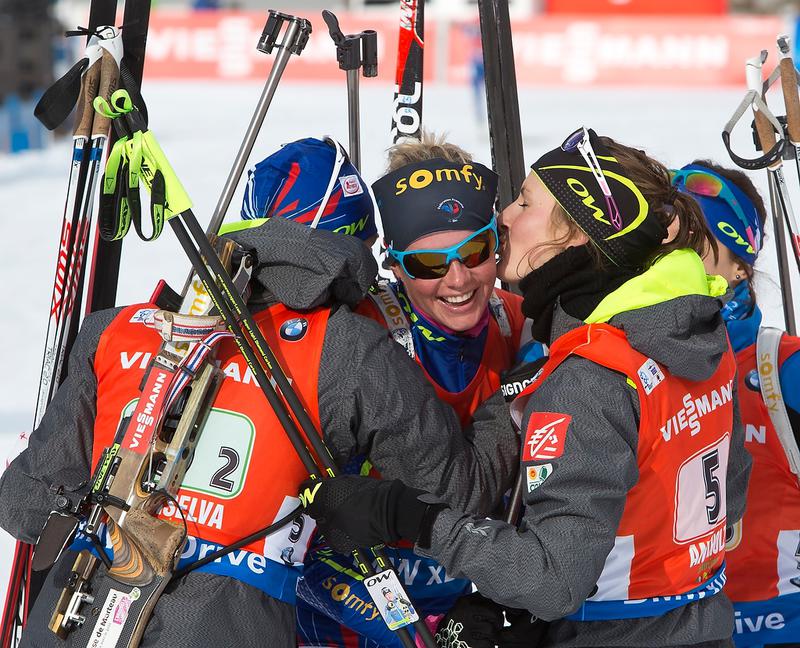
The French women’s 4 x 6 k relay team, including Justine Braisaz, Anaïs Bescond and Anaïs Chevalier, hugs and kisses anchor Marie Dorin Habert at the finish, after Habert secured their IBU World Cup victory by 17 seconds over the Czech Republic on Sunday in Antholz, Italy. (Photo: IBU/Rene Miko)
After Ukraine, Germany and Italy occupied the podium in the first two International Biathlon Union (IBU) World Cup women’s relays of the season, on Sunday it was time for three other nations to shine in front of more than 20,000 fans in a packed arena in Antholz, Italy.
On a beautiful day with blue skies, almost no wind, and surrounded by the spectacular mountain scenery of the South Tyrolean Alps, the French team with Justine Braisaz, Anaïs Bescond, Anaïs Chevalier, and Marie Dorin Habert shot well and skied fast to stay near the top throughout the 4 x 6-kilometer relay. Habert as the anchor received the tag with a 10.6-second buffer to Russia in second, then closed out the race with clean shooting in both stages, eliminating any chance of other teams challenging her.
After she crossed the finish line in first for France with a time of 1:07.53.5, her teammates hugged her enthusiastically. Overall the French women shot no penalties and required just eight spare rounds.
“It was a very nice race for the team,” starter Braisaz said during the post-race press conference. “I was a bit [too] excited on my first shoot. But it was a good experience to start the relay. And I am very happy today.”
“A very happy end to my week,” her teammate Bescond told the media. “Today I felt very good on my skis. I think all of the team made a very good job.”
“I am very tired, especially this week,” Habert said, reflecting on her season and the race. “It’s a very good thing to finish in the first position.”
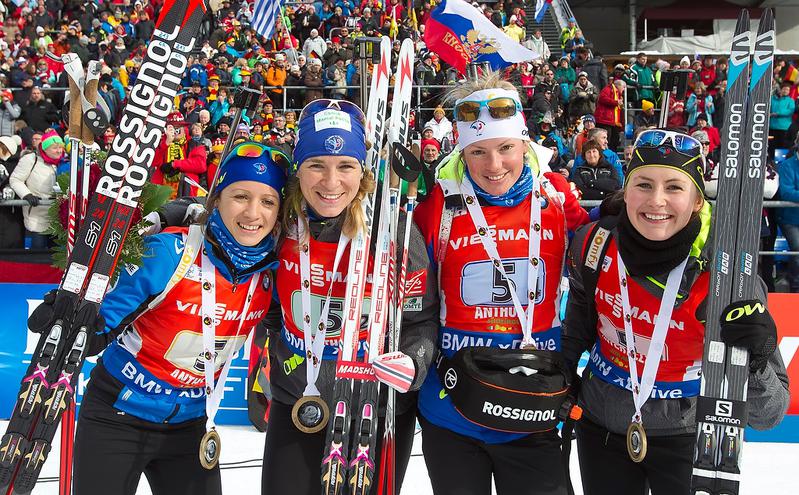
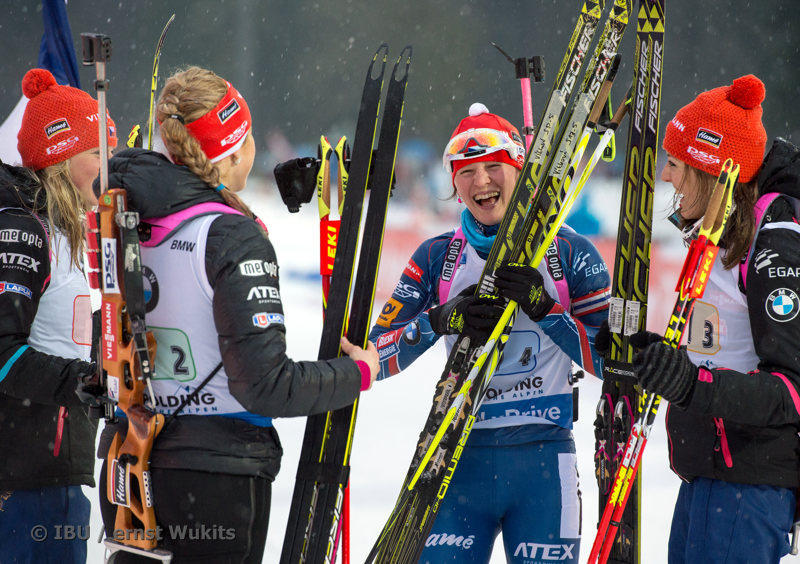
The French women’s relay after winning Sunday’s 4 x 6 k IBU World Cup relay in Antholz, Italy. With Justine Braisaz (l), Anaïs Bescond (second from l), Anaïs Chevalier (r), and anchor Marie Dorin Habert (second from r). (Photo: IBU/Rene Miko)
“This is the first time we tried our relay for the World Championships [in Oslo], so it’s important to [get] a good position to see that this formation of the relay is functioning,” she later said in another interview with the IBU.
On the last loop, the Czech Republic, Russia and Italy battled for the positions on the podium, with Veronika Vitková able to create a small gap to secure second place for the Czech team, 17.2 seconds behind France.
Initially, the outlook didn’t look good for the Czech Republic, after second-leg Lucie Charvátová skied two penalty laps and slipped to 12th at the exchange. Later she could be seen in the finish pen with tears in her eyes, while being consoled by team staff.
“After my leg I didn’t think [it would be possible to come back], because I was such a bad shooter in each relay I started this year. So I was afraid, afraid all race, all year,” Charvátová, 22, said during the press conference. “I am so under pressure. So I am very happy, because those other girls are the best.”
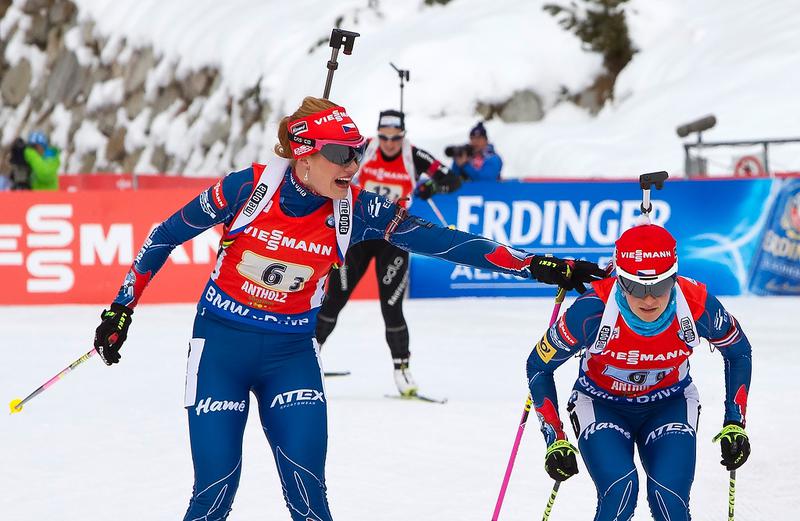
Gabriela Soukalová (l) tags Czech teammate Veronika Vitková in fourth during the final exchange in the IBU World Cup women’s 4 x 6 k relay. The Czech Republic team went on to finish second with just two spares from Vitkova. (Photo: IBU/Rene Miko)
Her veteran teammates, World Cup leader Gabriela Soukalová and Vitková turned the race around with solid shooting and fast skiing, recording the best and fourth-best course times on their legs, respectively, to capture second. Overall, the team incurred two penalties and required seven spare rounds. It was the best performance for the Czech relay team this season, after two sixth-place finishes before.
“It’s very surprising,” starter Eva Puscarciokova said during the press conference. “I am very happy today, because it was very hard after my race in Ruhpolding [Germany] when I went to the penalty loop.”
Third place on the podium went to the Russian team with Ekaterina Shumilova, Anastasia Zagoruiko (who replaced Daria Virolaynen from the last relay in Ruhpolding), Ekaterina Yurlova, and Olga Podchufarova, finishing 21.2 seconds back, with no penalties and 10 spare rounds.
Yurlova, Saturday’s pursuit winner, lifted her team from sixth to second, skiing fast — with the second-best course time of the third-leg skiers — and only needing two spares.
“I am really happy about my leg, and especially about my standing [shooting],” Yurlova said at the press conference. “Because I am really, really tired after two competitions before. And now I was really afraid about my standing. It was all shaking, but I am really happy that I could do it clean. Overall I am really satisfied about this World Cup.”
In the finishing stretch, Italy’s anchor, Dorothea Wierer, and Russia’s Podchufarova (who had beaten Wierer in the sprint last Friday) fought for third, as they had done earlier this season at the end of the relay in Ruhpolding, Germany, where Italy came out ahead. But this time, Podchufarova prevailed, to the huge excitement of her teammates who immediately ran into the finish area and piled onto her. Wierer crossed the line just 0.5 seconds behind (+21.7), after having made up nearly 15 seconds after the final shooting.
“My only thought was to come into the finish in the third position,” Podchufarova said in the press conference. “I didn’t know at first that [Wierer] was behind me, only when I came into the stadium I saw it on the monitor. Then I tried my best to get the third place for the team.”
“I wanted to go on the podium, but I was too [many] seconds behind,” Wierer said in a post-race interview with the IBU. “On the finish line I couldn’t anymore, because I was flushed pushing from the first loop, and in the final I had no more energy.
“It was a really nice [weekend], but I am a little disappointed today,” she added with a laugh. “You want always more and more, that is the problem.”
Norway, with Kaia Wøien Nicolaisen, Fanny Horn Birkeland, Marte Olsbu and Tiril Eckhoff, had been in third position behind France and Russia coming into the last shooting, but Eckhoff — a fast skier who has struggled with her shooting all season, hitting 68 percent of her standing targets — again had problems and ended up skiing a penalty lap. She finished fifth for Norway, 47.1 seconds back from France, with a team total of one penalty and 10 spares.
“I had the opportunity and screwed it up. This was real sh*t. This was not the way I wanted to end [my] last World Cup race before the World Championships,” Eckhoff told Norwegian broadcaster NRK after the race, noting she and her coaches were aware of some technical corrections she still plans to implement.
Ahead of the upcoming World Championships on their home turf in Oslo, the Norwegian women have yet to reach the podium since earning bronze in the relay at the 2014 Olympics.
Arguably the biggest surprise of the day was Sweden, with Emma Nilsson, Mona Brorsson, Ingela Andersson, and Linn Persson, in sixth place (+50.5) just 3.4 seconds behind Norway, with no penalties and seven spare rounds.
After the race, the Swedish women claimed they knew they were on a very good trajectory this season.
“We expected it,” Brorsson said during in a group interview with the IBU.
“We really thought we had a chance to be top six,” Andersson added.
They credited their coach, Wolfgang Pichler, for their improved performance, after he helped several Swedish biathletes, such as Magdalena Forsberg, Helena Ekholm and Anna Carin Olofsson (now Zidek) reach Olympic and World Championship medals, before returning last summer after a stint with the Russian biathlon team.
“I think that’s the big difference this year,” said Brorsson. “He always finds a way to motivate you. On the track, he is incredible. He knows what he is doing.”
Ukraine, winner of the last relay in Ruhpolding and usually a team with very solid shooting performances, had some difficulties on the range on Sunday and finished ninth (+1:45.5). The team with Iryna Varvynets, Valj Semerenko, Olga Abramova (replacing Juliya Dzhyma) and Olena Pidhrushna stayed near the front for most of the race and Semerenko even exchanged in the lead. But Abramova needed five spares, and anchor Pidhrushna had to ski a penalty lap, setting them farther back (12 spares overall).
Similarly, Germany had been in second place for both relays this season. On Sunday, with their regular anchor Laura Dahlmeier taking a break after a respiratory infection, the team struggled almost right out of the gate. Starter Karolin Horchler required five spare rounds and only narrowly avoided the penalty lap in her prone stage, leaving in last position at that time. She tagged off already a minute behind the best in 15th, before Miriam Gössner and Vanessa Hinz moved up a bit, but each incurred a penalty to slow down the chase. Anchor Franziska Hildebrand still managed to improve her team two positions on her leg, ultimately finishing 10th (+1:51.8).
“I don’t know why, but my legs felt like a sewing machine today in standing, that hasn’t happened to me in a long time,” Gössner told German TV broadcaster ARD in an interview while the race was still going on. “I stood there, and already from the first shot my legs were shaking so much that I really didn’t have myself under control anymore. Even though I went slowly on the prior loop. I tried to fight and prevent the penalty lap, but unfortunately I did not succeed.”
“My race was all right. All in all I am satisfied,” Hildebrand told ARD. “We somehow struggled a bit in Antholz. Next time it hopefully will be better again for us. There are weekends where not everything works out, and this was one of those.”
Switzerland, with Saturday’s pursuit runner-up Selina Gasparin, started the relay very strong, with Gasparin tagging off in the lead, and her younger sister Aita Gasparin keeping the team in contention in fourth. Then two less-experienced skiers closed for Switzerland, with Irene Cadurisch tagging off in fifth place, before anchor Ladina Meier-Ruge faded a bit and lost two minutes to the front. They finished 12th with nine spares, one place ahead of Canada.
Canada 13th, U.S. 17th
After achieving her first-career top 20 in Saturday’s pursuit, Canada’s Julia Ransom had said her team was “fired up” for the relay, and that they were eager to reach the top six after feeling they had come close in ninth a week ago in Ruhpolding.
Unfortunately on Sunday, the performance on the shooting range did not allow that to happen for the Canadian team with Ransom, Rosanna Crawford, Megan Tandy, and Zina Kocher.
Starting as the scramble leg, Ransom missed two targets in her first prone stage, then required all three spares to clean them, narrowly avoiding the penalty but only leaving the range again in 18th position, already 41 seconds back.
After skiing a fast second loop (with the third-best course time, seventh-best overall) and a clean standing shooting, she moved the team back up significantly and tagged Crawford in ninth place, 32.2 seconds behind the top.
Crawford had two solid shooting performances, requiring one spare round in her prone stage and two in standing. Skiing the 11th-fastest second-leg course time, she brought her team close to the top six in seventh place, just 32.5 seconds out of first.
Tandy skied a very fast first loop (fourth-best), and came through her prone stage with two spare rounds, leaving still in 10th position. After a slower loop, she then struggled in her standing position, and was unable to avoid the penalty lap (0+2, 1+3), losing a minute to the top. She tagged off in 13th place (+1:58.7).
Kocher as the team’s anchor initially held 13th and had a solid first prone shooting with one spare round, but lost another minute on the next loop. In the final standing, similar to Tandy, she also ran out of spares and had to ski a penalty lap, leaving the range in 14th and more than four minutes behind the leaders. On the final loop she was able to pass Bulgaria’s anchor Daniela Kadeva, finishing 13th for Canada (+4:12.2 minutes) with two penalties and 15 spare rounds.
In an email, Biathlon Canada’s head coach Matthias Ahrens explained that the team was packing up Sunday afternoon, driving to Munich, Germany, then flying back to Canada early Monday morning. The Canadian athletes could not be reached for immediate comment.
“Women’s race started excellent with Julia and Rosanna, then unfortunately Megan and Zina could not match that Performance,” Ahrens briefly noted about the women’s result before leaving Antholz.
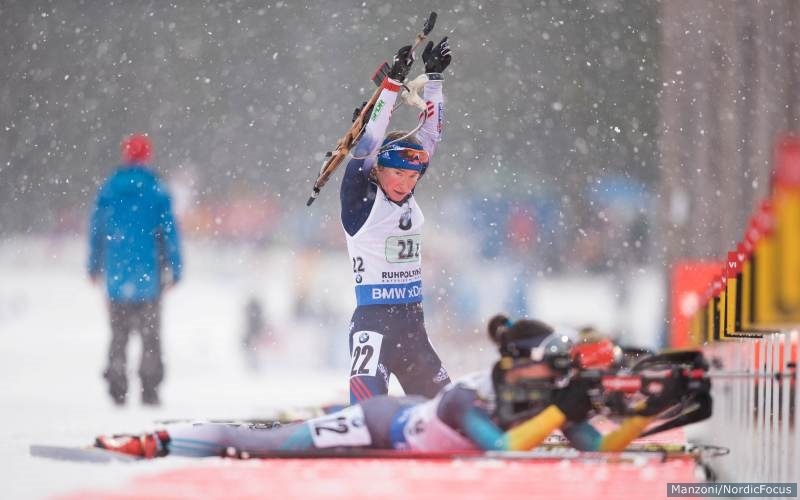
Susan Dunklee (US Biathlon) used a total of four spares between two stages in the women’s 4 x 6 IBU World Cup relay, handing off in 14th. (Photo: USBA/NordicFocus)
The U.S., with Clare Egan, Susan Dunklee, Annelies Cook, and Joanne Reid, adapted its lineup order a bit again on Sunday compared to the first two relays, with Egan starting and Cook moving to the third leg.
“Today I got my first mass-start experience at the World Cup level,” Egan wrote in an email. “It reminded me of how much I thrive on head-to-head racing. The decision was made with the intent of giving me that head-to-head experience, both because it will be useful in the future for pursuits and mass starts, and because I think my coaches thought I would like it.”
She skied at a steady pace in the middle of the field, and required just one spare in each of her shooting stages.
“The altitude is a challenge here, for the skiing of course but also for recovering before the shooting,” Egan wrote of the biathlon trails situated some 2,000 meters (6,500 feet) above sea level. “The range approach does not provide rest, so I have been making rest for myself by skiing into the range extra easily.”
“There was a light wind but it was constant, so with the correct sight adjustments the wind was not a factor,” Egan explained. “I had super fast skis and put them to good use passing people on course, but then despite using only one spare round per stage, I still lost places on the range to faster shooters.”
On the last loop, Egan sped up her pace and skied the sixth-fastest course time of her leg, catching six other teams in front of her to hand off in 12th place (+53.9)
“The highlight for me was on the last lap when I passed Team Germany,” she wrote.
After receiving the tag from Egan, Dunklee set out fast with the best course time on her first loop, but then required three spare rounds in her prone shooting. After skiing her second loop at a slightly lower pace, she managed to miss only one target in standing. She slipped two spots to tag off in 14th (+1:10.1), with the third-best course time overall.
Cook was initially able to hold that position, despite requiring two spares in her prone. Then in standing, she used all three spares and had to ski a penalty lap. That set her back to 18th place, more than three minutes behind the leaders. She tagged off still in that position (+3:36.7).
In the second World Cup weekend of her career, Reid, 23, skied as the U.S. anchor for the second time. She posted the ninth-best course time on her first loop and managed to shoot clean in prone, but then was lapped by the top teams after another penalty in her standing. That kept Reid from skiing her last loop and ended the race for the U.S. in 17th place with two penalties and 14 spares. Estonia and Romania behind them were lapped as well.
Next Stop: Canmore/Canada
The IBU World Cup picks back up again in two weeks in Canmore, Alberta, with sprints on Thursday, Feb. 4 and Friday, Feb. 5, followed by mass starts on Saturday, Feb. 6, and single-mixed relay (1 woman, 1 man) and mixed relay (2 women, 2 men) relays on Sunday, Feb. 7.
Several strong athletes will not make the trip overseas, notably several members of the Norwegian team, such as Eckhoff and Synnøve Solemdal, citing a focus on instead preparing for the upcoming World Championships.
Sitting in second in the overall World Cup standings, Habert plans to be there to fight for more points: “Just five days to recover, and then we will fly to Canmore,” she said at the press conference.
“We are still in discussion with the coaches about the best approach,” Germany’s Hildebrand told ARD. “In order to stand nicely relaxed and regenerated at the start in Oslo.”
Note: The U.S. men placed sixth in the men’s 4 x 7.5 k relay to match a season best, despite using 13 spares and skiing a penalty lap, with Lowell Bailey, Tim Burke, Leif Nordgren, and Sean Doherty. Canada’s men, with Christian Gow, Nathan Smith, Macx Davies, and Scott Gow, placed 11th with eight spares and no penalties.
Stay tuned for a complete report on the men’s race.
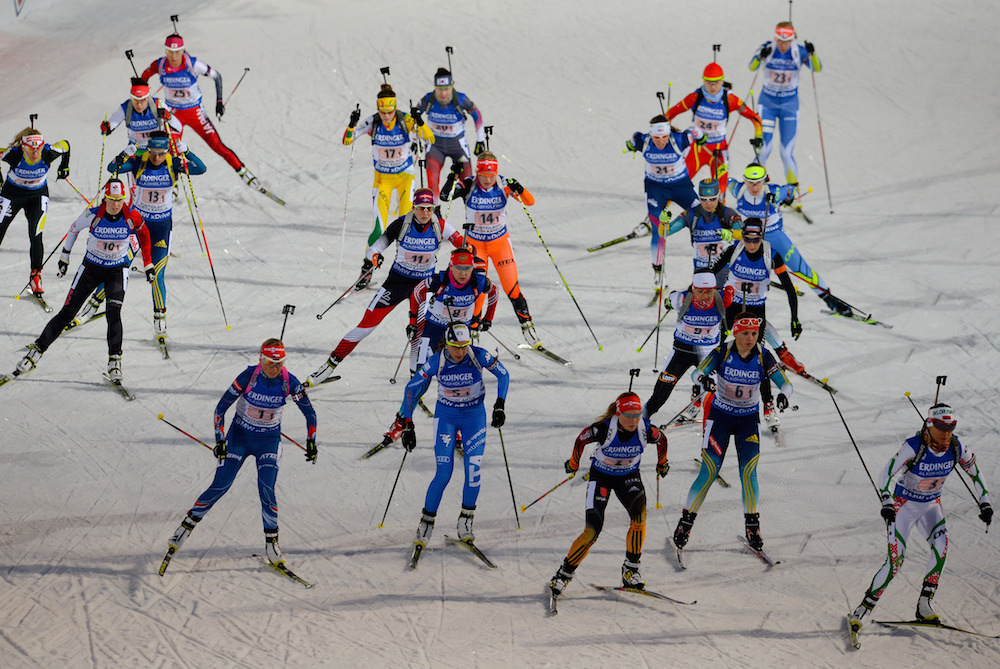
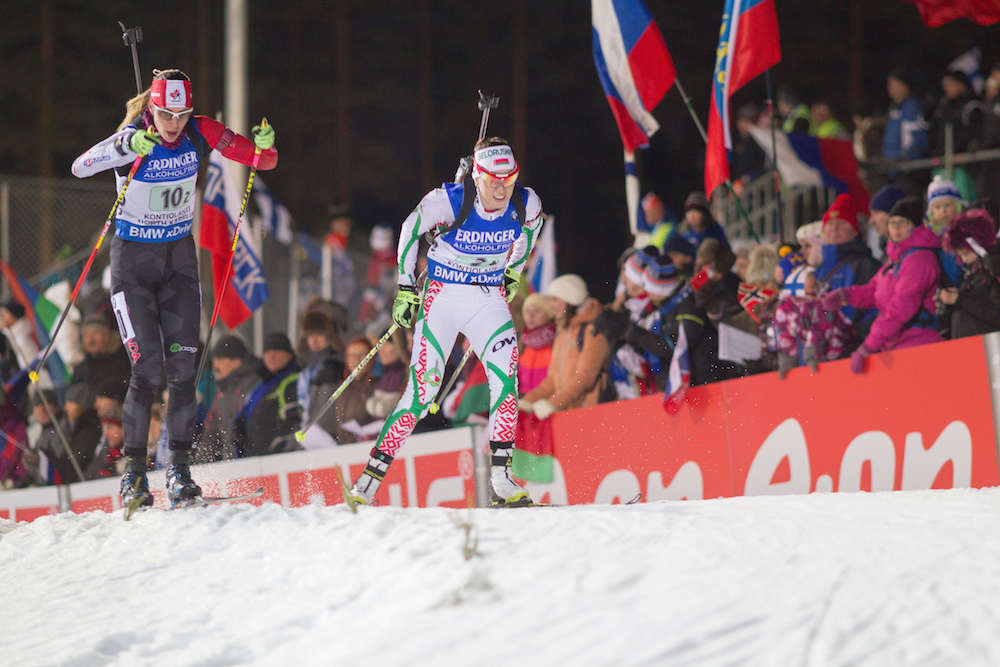
The start of the women’s 4 x 6 k relay at 2015 IBU World Championships on Friday in Kontiolahti, Finland, with Germany’s Franziska Hildebrand (4) near the front with Belarusian Nadezhda Skardino (3), Canada’s Megan Heinicke (10) at left, and American Susan Dunklee (21) near the back right. (Photo: USBA/NordicFocus)
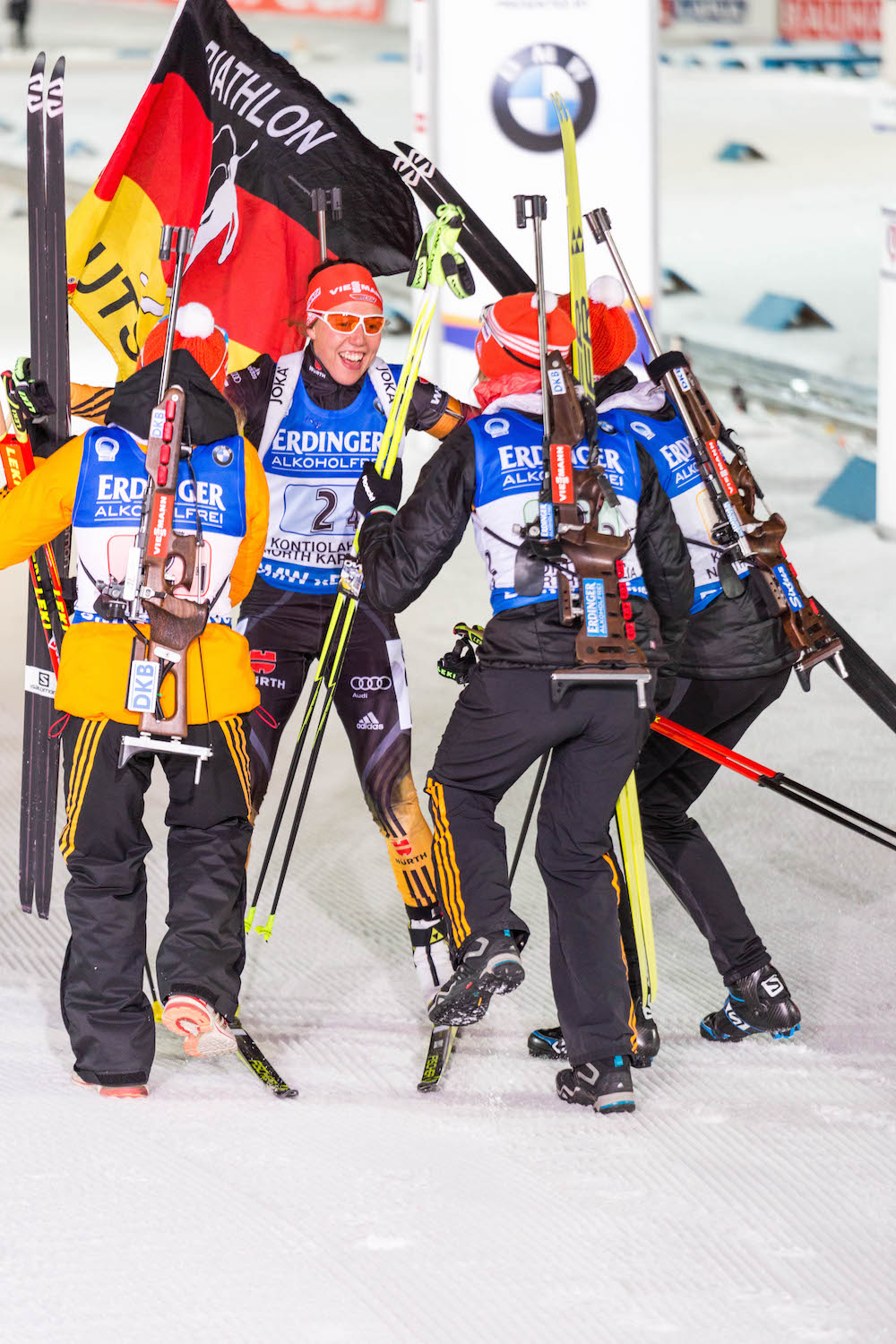
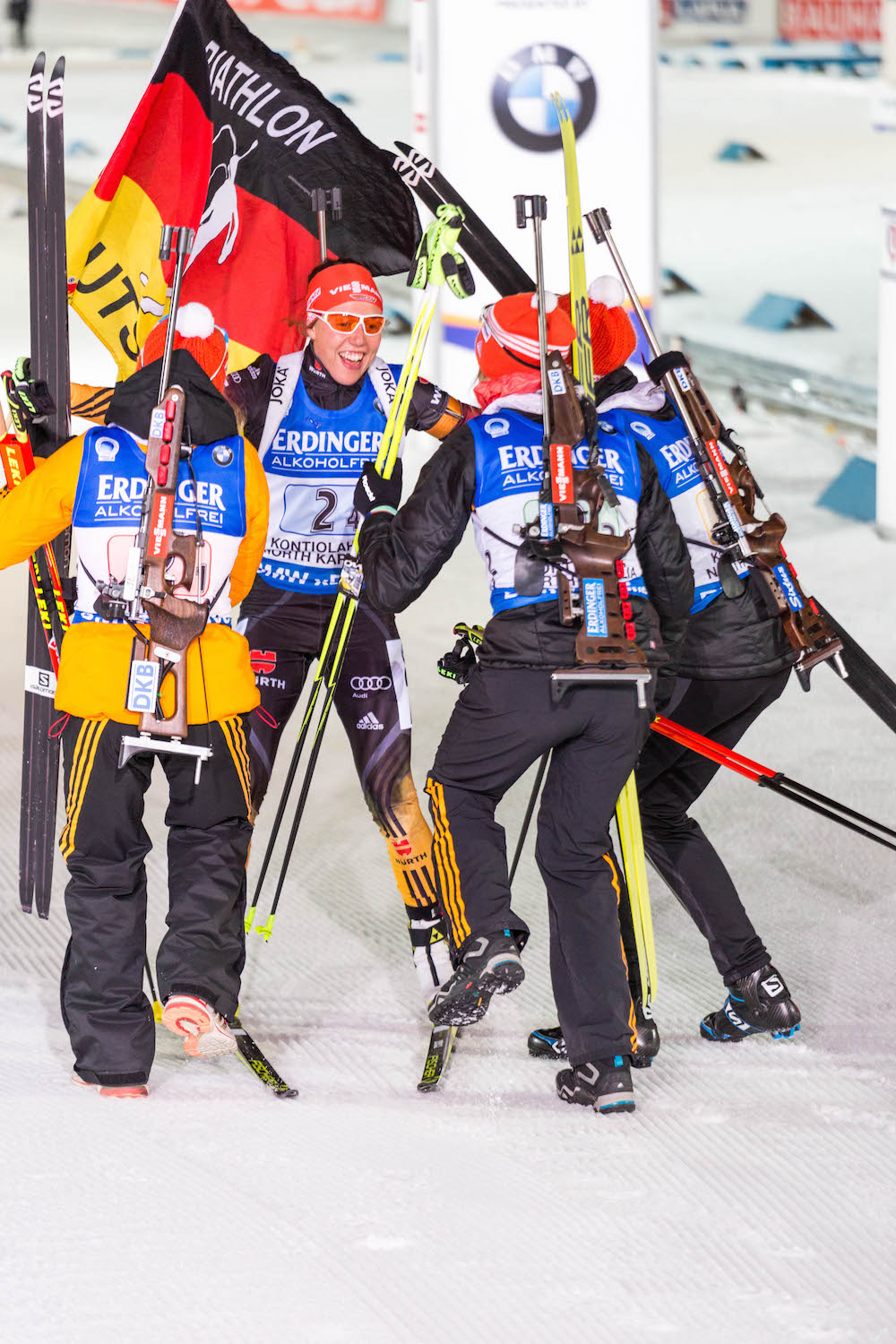
KONTIOLAHTI, Finland — Not long after finishing the women’s 4 x 6-kilometer relay at 2015 IBU World Championships, Laura Dahlmeier sprinted past reporters to jump into the arms of one of her teammates, her rifle still attached to her back.
A German sports broadcaster employee quickly ushered the 21-year-old Dahlmeier and her three teammates to the Sportschau platform overlooking the stadium where they had just destroyed the 25-team field.
In the minutes before, Dahlmeier built on a 30-second lead her teammate Vanessa Hinz established on the third leg to anchor Germany to a 1:00.3-minute win. Hinz had used just one spare in prone to clean both her stages and skied the second-fastest third leg to leap from third into first — and considerably ahead of anyone else.
The German women’s relay rushes the finish line to greet anchor Laura Dahlmeier, who secured their win by more than a minute over France in the 4 x 6 k relay at 2015 IBU World Championships in Kontiolahti, Finland. The German team included Franziska Hildebrand, Franziska Preuss and Vanessa Hinz. (Photo: Kontiolahden Urheilijat/Kari Kuninkaanniemi)
With Franziska Hildebrand and Franziska Preuss skiing first and second, respectively, the Germans combined to secure gold ahead of France in second and Italy another 5.8 seconds back in third.
“I think it was a dream of all of ours to be world champion and now the dream is true,” Dahlmeier said in a press conference after her team used six total spares and avoided any penalties for the win in 1:11.54.6.
France, with Anais Bescond, Enora Latuilliere, Justine Braisaz, and Marie Dorin Habert (the latter of which had already won two golds at these world championships), had nine spares and one penalty from Braisaz on the third leg. Habert lifted them from fourth and 1:18.8 behind Germany to silver — her fourth medal in as many races in Kontiolahti, including silver in the mixed relay — using two spares in prone and none to clean standing.
The Italians, with Lisa Vittozzi, Karin Oberhofer, Nicole Gontier, and Dorothea Wierer, led through the second exchange after Oberhofer elevated them from fourth to first with four total spares and the fastest course time of the second leg. Gontier started out 2.5 seconds ahead of Czech Republic, but slipped to third after using two spares on each of her stages.
“I’m not so in shape now and I have to thank my teammates, they are so strong,” Gontier said in the press conference.
She tagged Wierer in third, behind Germany and Russia, respectively. Habert and Wierer both overtook Russia’s anchor Ekaterina Shumilova in the final stage, where Shumilova used two spares, Habert cleaned, and Wierer used one. Wierer left the range in third, 0.6 seconds behind Habert and about 10 seconds ahead of Shumilova in fourth.
“I was so worried about the Russian girl and I thought, ‘I don’t want fourth position,’ ” Wierer said. “I really give all for the team, but I was really, really nervous.”
The team that didn’t lack confidence was Germany, with three women under the age of 23 (Hildebrand is the oldest at 27).
“We are a young team and a strong team and it’s a perfect day for us,” Dahlmeier said after cleaning both her stages to tally her second World Championships medal (following her individual silver in last weekend’s pursuit).
“We are the best team,” she told Sportschau.
Russia, with Ekaterina Glazyrina, Daria Virolaynen, 15 k individual gold medalist Ekaterina Yurlova, and Shumilova, finished 10.7 seconds off the podium in fourth. Norway placed sixth, Ukraine was sixth, Belarus took seventh, and the season-long relay favorites, the Czech Republic (which won the mixed relay) finished eighth, 3:11.7 behind the winners.
The Czechs came through the first exchange in 12th after Eva Puskarcikova’s first leg, 26.4 seconds out of first, and Gabriela Soukalova lifted them to second, 2.5 seconds back. They fell to eighth during Jitka Landova’s third leg, in which she had a standing penalty and six spares. Anchor Veronika Vitkova used three spares and had two penalty laps in prone, then went on to clean standing before finishing eighth.
Canada 10th, U.S. 12th
While the Germans drew a significant amount of attention with their win, two North American squads stood together near the finish, cheering their teammates on with each passing lap before waiting to congratulate their anchors as well.
Rosanna Crawford (Biathlon Canada) racing the second leg in the women’s 4 x 6 k relay at 2015 IBU World Championships in Kontiolahti, Finland. Despite a penalty, she brought her team from 14th to 11th, and the Canadians finished 10th. (Photo: Biathlon Canada/NordicFocus)
Canada’s second leg, Rosanna Crawford was one of them, standing near the finish and looking for her teammate Julia Ransom, who had anchored their team to 10th.
Audrey Vaillancourt had tagged Ransom in 10th, improving one place after Crawford put her in 11th at the second exchange. Ransom, a 22-year-old World Championships rookie, used two spares on each of her stages to help the team meet its personal goal: a top 10.
She held off Austria’s Katharina Innerhofer by 0.5 seconds to finish 10th, 3:39.5 behind Germany. In total, the Canadians used 10 spares and had one penalty (which came on Crawford’s standing stage).
“Megan [Heinicke] tagged me off into a great spot, [and I] came in prone … with the group,” Crawford explained.
She had entered her first stage around 12th after Heinicke tagged her in 14th, 33.8 seconds out of the lead. (The team’s first leg, Heinicke used a single prone spare and cleaned standing.) Crawford cleaned prone, then went on to use three spares in standing while trying avoid the penalty loop, which she ultimately had to ski around once.
“Standing, I came in and missed my middle shot and loaded my first spare quickly and missed,” Crawford explained. “As I loaded my last spare, I took my rifle down and shook my legs out and missed.”
Not only did the penalty loop cost her, but the three spares, which she estimated takes her six to 10 seconds to load apiece, set her back as well. Regardless, Crawford skied the sixth-fastest second leg to tag Vaillancourt in 11th, 1:08.6 behind the leader.
Audrey Vaillancourt (Biathlon Canada) during prone shooting earlier this week at 2015 IBU World Championships in Kontiolahti, Finland. She was the third leg of the Canadian women’s relay that finished 10th on Friday. (Photo: Biathlon Canada/NordicFocus)
Vaillancourt, 23, went on to use two prone spares and cleaned standing outright to bring the team to 10th, 1:45.3 out of first.
“I didn’t really know what place I was in at any time, it was just good to always have a pack of people [around me],” Vaillancourt said. “I passed people in the standing so that felt awesome. It’s always such a good feeling, like, ‘Yeah!’ … I was a little tired on the last lap, but I’m happy.”
Ransom used two spares in prone, rising to ninth, and then two more in standing to drop one spot to 10th.
“I saw eight and ninth ahead of me on the climbs,” she recalled. “You’re just gunning for those and didn’t look back.”
In her first World Championships relay, Ransom said she was “terrified” to anchor, “mainly because I saw the start list and saw a lot of medalists hanging out in the fourth [leg] with me.
“In zero I was pretty nervous, but you quickly fall back into race mode,” she added. “Even though you start with [Belarusian Darya] Domracheva, you put it aside. Once I was on the track and I could feel like I could ski like myself it was fun and I loved it.”
Rosanna Crawford (Biathlon Canada) trails Nadzeya Pisareva of Belarus during the second leg of the women’s 4 x 6 k relay at 2015 IBU World Championships in Kontiolahti, Finland. The Canadians went on to place 10th. (Photo: Biathlon Canada/NordicFocus)
Overall, the Canadians were pleased with their performance, with two relative newcomers on the team. While it’s Vaillancourt’s second World Championships, this season was her first full time on the World Cup.
“[Last night], we talked about that if we all bring our A-game, a top 10 is realistic and a top eight would be the perfect race,” Crawford said.
“I don’t think that we can say that we had a perfect performance as a team today, so I think that makes it even more awesome that we made our goal,” Heinicke said. “We have been mixing up our relays a ton this year. This is only the second time us four have raced together and we have never had this order. Lots of experiment; it’s been good.”
Dunklee Fastest First Leg
The Americans tied their season best in 12th, with Susan Dunklee, Hannah Dreissigacker, Annelies Cook, and Clare Egan. Despite starting in the seventh of nine rows at the start, Dunklee skied the fastest course time of all the first legs to put her team in third, 3.7 seconds behind Poland, which led through the first exchange.
“I almost prefer starting in one of the back rows,” Dunklee explained in an email after the race. “I love the rush of having to maneuver through the pack and chase people down. It just feels like a really fun game. It helps a lot that my fitness is in peak form right now, and the course suits my strengths with that big wall climb.”
Susan Dunklee (US Biathlon) follows Germany’s Franziska Hildebrand (r) into range for the first shooting in the women’s 4 x 6 k relay at 2015 IBU World Championships in Kontiolahti, Finland. Germany went on to win, and the Americans placed 12th to match their season best.
By the 1.3 k checkpoint, Dunklee had skied up to second behind Hildebrand.
“I don’t know how Susan just careened to the front of the pack like that,” Heinicke observed. “It was pretty impressive. I was in the second half and it was the most aggressive mass start I have ever been in, so much bumping and ski stepping and poles. It was a little bit chaotic and also exciting.”
Dunklee held her position in second entering the range for the first time, where she used two spares and had some trouble unhooking her sling from her arm. Dunklee left the range in 21st, 26.5 seconds behind Hildebrand, who cleaned without any spares.
The American spent the next lap skiing up to 12th before cleaning her standing stage to improve to seventh. Poland’s Monika Hojnisz cleaned her second-straight stage without any spares to take the lead, 2.4 seconds ahead of Russia.
Meanwhile, Dunklee left the range 14 seconds back in seventh. Over the next lap, she skied back up to third, tagging Dreissigacker 3.7 seconds out of the lead.
“I’m getting used to that; I expect Susan to hand off to me in the top five at least,” Dreissigacker said. “I should be getting better at it, and I still seem to be struggling with get being put in that position. I think I’ve always liked being one of the chasers not one of the chased.”
Coming into the range for the first time, Dreissigacker was fourth behind Poland, Italy and Russia, respectively. There, she had to use three spares to hit all of her targets.
“I kind of pulled off two shots accidentally, just way too fast with the trigger,” Dreissigacker explained. “I think I was a little excited, my fingers had gone a little bit number for some reason. … Using the third spare is always really bittersweet. You’re bummed that you had to use three, but you’re always so happy you hit that last one and didn’t do a penalty loop.”
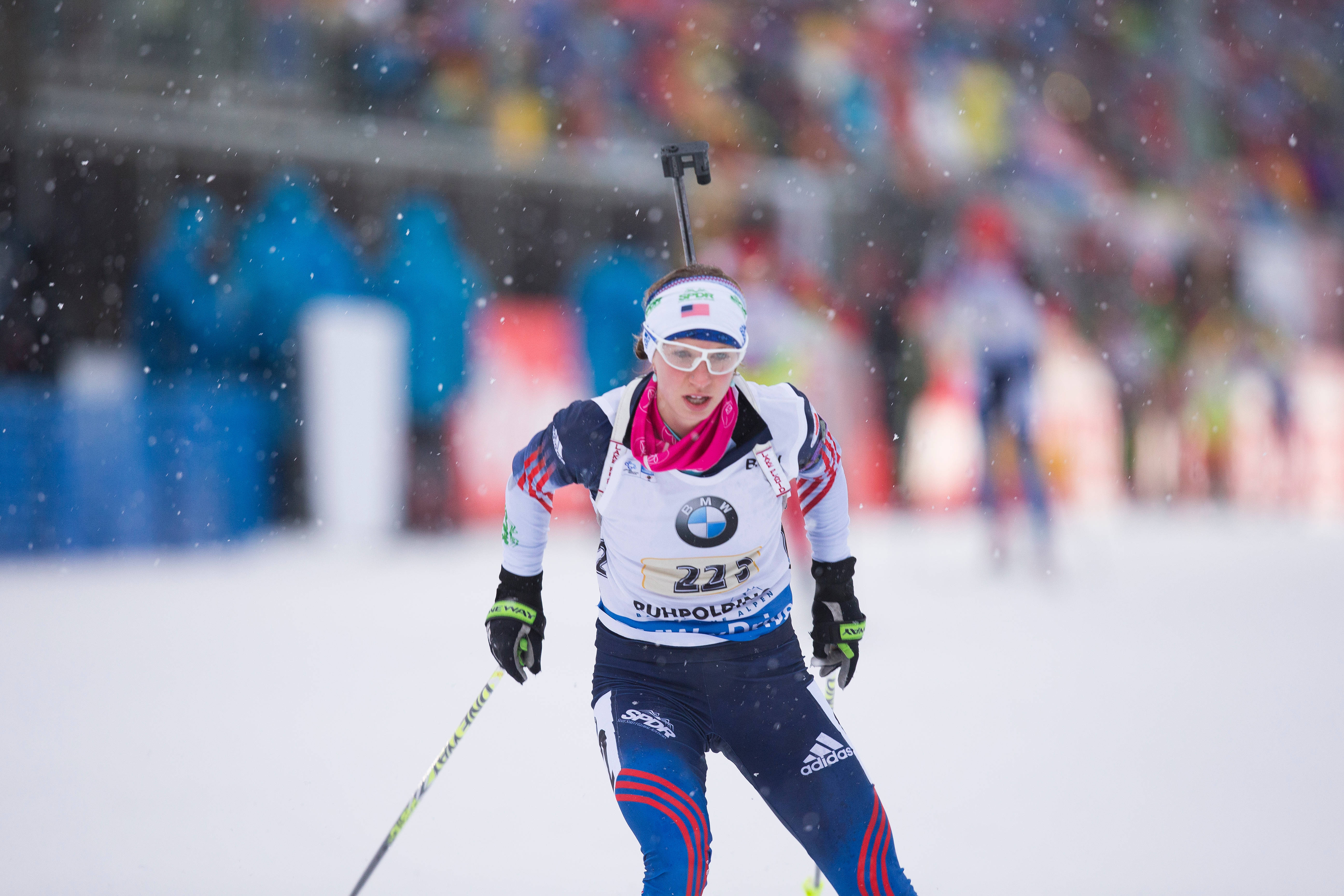
Hannah Dreissigacker (US Biathlon) skied the second leg for the U.S. in the women’s 4 x 6 k relay at 2015 IBU World Championships in Kontiolahti, Finland. After receiving the tag from teammate Susan Dunklee in third, she came through the second exchange in 10th. The Americans finished 12th. (Photo: USBA/NordicFocus)
She left the range in 11th, 37 seconds behind Russia up front. In standing, Dreissigacker used two spares to head out for her final lap in 10th.
“Hoping that one of these days I can use not quite so many spares,” she said.
Dreissigacker tagged Cook in 10th, 1:06 out of the lead. Cook used two spares in each stage to hand off to Egan in 11th, 2:05.4 back.
“That is not like awesome shooting, but I think we all had a little bit of the nightmare of the last relay, where we had six penalty loops, in the back of our head,” Cook said, referring to the last World Cup relay in Oslo, Norway, where the Americans were in 18th before being lapped. “So we were all kind of like, ‘OK! I’m really happy that didn’t happen again!’ I felt really good skiing and it was fun. I felt like I was in the mix, which is exciting.”
In terms of team goals, she said they didn’t target a specific place.
“We didn’t do that many relays this year [and] we’ve got some new faces,” Cook said. “I think for us, it is just about getting experience … We have had a pretty steady relay team the last few years so now we are kind of rebuilding that up. Today we just wanted to have fun and to feel like after the race, we would all be in good moods and happy.”
In her first World Championships, Egan anchored the U.S. to 12th, 3:44.8 behind Germany and 0.8 seconds out of 11th. The 27-year-old US Biathlon development skier cleaned her first stage to move into eighth after prone, then used three standing spares, which put her back in 13th.
“I wish I had just used two [spares] because we would have been 10th instead of 12th,” Egan said, estimating it takes her about 20 seconds to load each spare. “That is my only regret. I got really close … I passed one person and I finished within a second [of 11th].
“This is my first relay that I have not had two penalty laps in standing. So big improvement for me,” she added. “I just tried to ski my own race and remember that I am always trying to gain experience.”
At the end of the day, Dunklee pointed out that 12th matched their best result of the season.
“It certainly wasn’t a perfect performance and there were several teams within reach ahead of us. I think it is good to be hungry for a higher place and know the possibility is there, but this was also result we can finish the season feeling proud of,” she wrote.
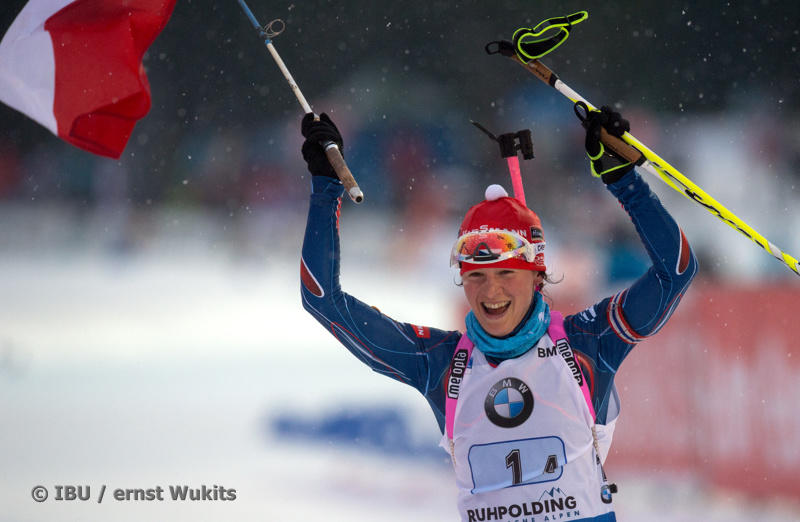
The Czech Republic women’s 4 x 6 k team celebrates its second-straight relay win on Thursday at the IBU World Cup in Ruhpolding, Germany. (Photo: IBU/Ernst Wukits)
All it took the Canadian women to have one of the greatest starts of their relay careers was a pep talk from a two-time Norwegian Olympic gold medalist, Halvard Hanevold, who notched 40 IBU World Cup podiums in his career.
According to Megan Heinicke, the team’s first skier in Wednesday’s 4 x 6-kilometer relay at the IBU World Cup in Ruhpolding, Germany, the Canadians had a team meeting with Hanevold on Tuesday night. She said it was “fantastic” and helped them going into the relay with “a really supportive team attitude,” she wrote in an email.
Whatever it was, it worked — and especially well for Heinicke — who shot out of the mass start with the leaders and put herself in fourth heading into the first shooting stage within two seconds of the Czech Republic, Finland and Norway, respectively.
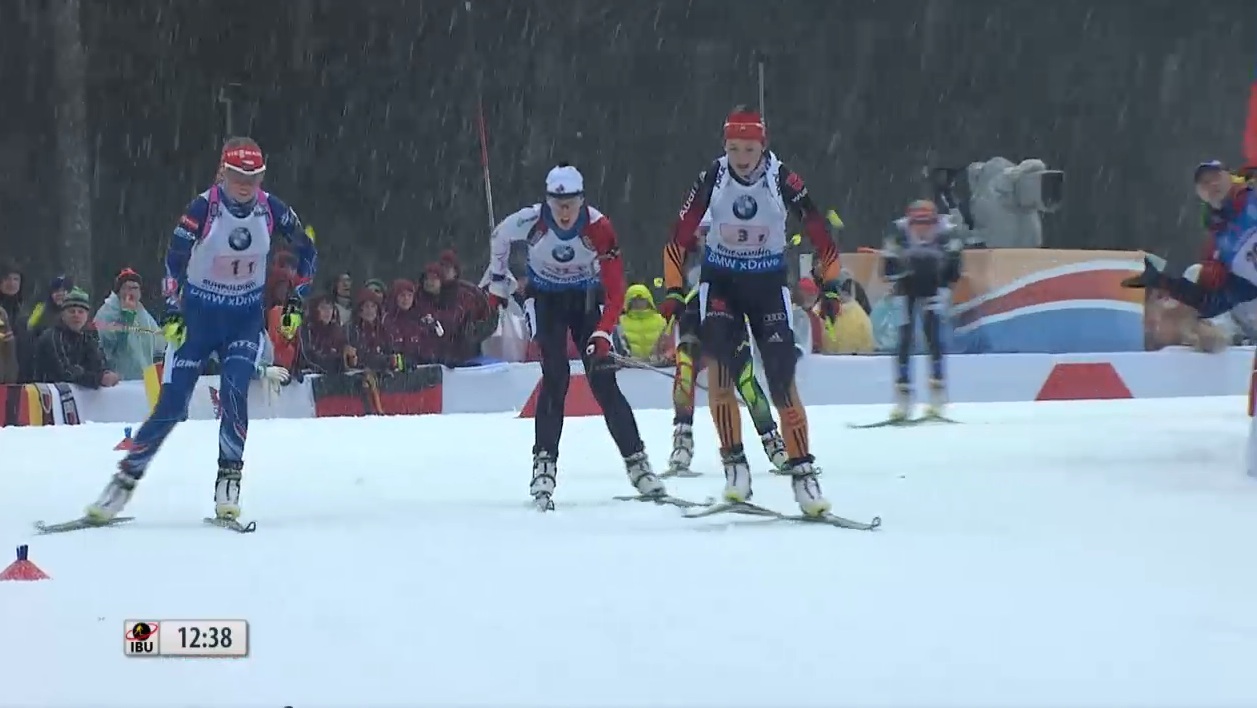
Germany’s Franziska Preuss (r) and Eva Puskarcikova of the Czech Republic (l) lead Canada’s Megan Heinicke (c) and Belarus’s Nadezhda Skardino (behind Preuss and Heincke) during the first leg of the IBU World Cup women’s 4 x 6 k relay on Thursday in Ruhpolding, Germany.
There, Heinicke shot fast and flawlessly to find herself in second coming out of the range, 1.3 seconds behind Eva Puskarcikova of the Czech Republic and just 0.1 seconds ahead of Germany’s Franziska Preuss in third.
“I was thinking ‘holy cow I’m up here again!’ ” Heinicke recalled. “I was excited and motivated. I also tried to think tactically and stay in our little group of 3 and not let myself do too much work.”
The Czech Republic, with Puskarcikova, Gabriela Soukalova, Jitka Landova, and Veronika Vitkova, was coming off a relay victory a week earlier in Oberhof, Germany. The German women had placed 10th in that race, but with a new lineup of Franziska Preuss, Franziska Hildebrand, Vanessa Hinz, and Laura Dahlmeier, respectively, they knew they could be in contention.
“We changed the team [with Hildebrand and Dahlmeier in place of Luise Kummer and Karolin Horchler],” Hildebrand told the IBU after the race. “That is all, but we were confident that we could be on the podium…”
So were the Canadians, but they were among the teams flying lowest on the radar after being lapped in the Oberhof relay.
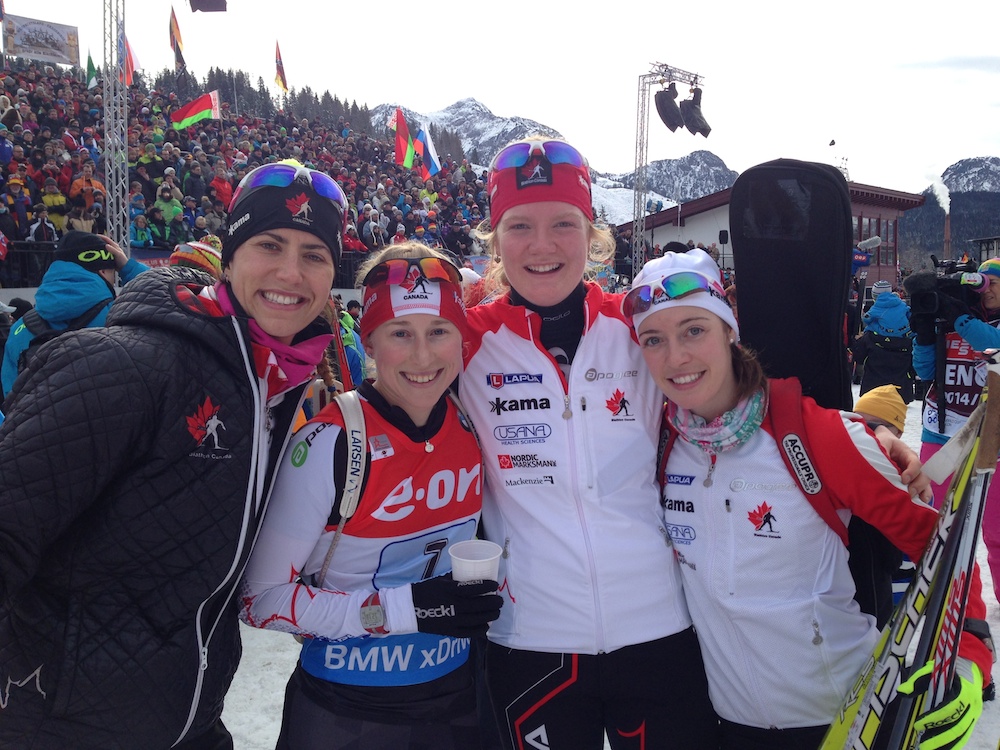
The Canadian women’s relay team after placing 11th earlier this season in Hochfilzen, Austria. (From left to right) Rosanna Crawford, Audrey Vaillancourt, Sarah Beaudry, and Megan Heinicke. (Photo: Rosanna Crawford)
Yet Heinicke, and the rest of her teammates — Julia Ransom, Audrey Vaillancourt and Zina Kocher — knew they had the potential. Hanevold reminded them of that. With Rosanna Crawford out with a cold, Heinicke explained they tried new relay combination, which was an important step before IBU World Championships in March.
Coming into the second shooting within a second of Preuss and Puskarcikova, Heinicke used one spare to leave the range in second, 17.6 seconds behind Puskarcikova, who cleaned.
“It was hard to shoot clean with the snow falling, but it was easier than in Oberhof,” Puskarcikova told the IBU. “I am not exactly sure how I shot 10 for the second week in a row.”
A rainstorm began before zero, 1 1/2 hours before the race on Thursday, and didn’t let up, coating competitors and spectators in a wet, slushy mixture between rain and snow. That made both skiing and shooting tough, but Heinicke didn’t notice.
“I was so focused on the race in the moment that the conditions didn’t effect me too much,” she wrote. “I think the pressure and excitement of being near the front of the race helps me have a sharper focus in a weird ‘heightened senses’ kind of way.”
Heinicke focused on her technique and held her position through the exchange, tagging Ransom in second, 25.2 seconds behind the Czechs and 2.5 seconds ahead of Poland in third.
“Sprinting is really not my strength and I was really giving my all so I was just mentally coaching myself along!” Heinicke wrote.
Gabriela Soukalova (l) tagging Czech teammate Jitka Landova in first in the women’s 4 x 6 k relay at the Ruhpolding IBU World Cup on Thursday in Germany. (Photo: IBU/Ernst Wukits)
Meanwhile, Ransom, in her first World Cup season at age 21, tried to control her excitement.
“Megan has tagged off to me in excellent positions twice now!” Ransom wrote in an email. “All I could think was that opportunity was there ready to be seized.”
She maintained second through the first shooting, which she cleaned, and up until her standing stage, where she entered the range 59 seconds behind Soukalova in first and 10 seconds behind Hildebrand in second.
“I would be lying if I said the conditions were easy, but I secretly love it when it’s miserable out there,” Ransom wrote. “Canadians are tough! And if you can be tougher than the others, a little bit of rain, sleet, wind, or cold will feel like nothing.”
In that second stage, she missed three but avoided penalty loops with three spares.
“I think my standing shooting was affected by my excitement. I know I can hit targets, but when I am not 100% ‘there’, that’s when things can get squirrelly!” she wrote. “I buckled down for the spares and got out as quick as I could. When there were three spares for three targets, I remember thinking, ‘I’m going to give my parents a heart attack.’ They watch the live stream back in Canada.”
Meanwhile, Soukalova and Hildebrand used two spares, and Belarus’s second leg, Iryna Kryuko, cleaned her second-straight stage to move into third behind the Czech Republic and Germany, respectively.
By now, Soukalova had built up a minute lead over Hildebrand, and Kryuko was 1:13 back, followed by Ukraine’s Natalya Burdyga in fourth (+1:18) and Norway’s Fanny Welle-Strand Horn in fifth (+1:22). Ransom left the range just another second behind in sixth, and tagged Vaillancourt in the same position, 1:53.1 behind the Czechs.
“Being the youngest on the team, I sometimes feel an internal pressure to prove myself and I believe I did today,” Ransom wrote.
Vaillancourt explained in an email that she was excited to start in a pack.
“I thought it was possible for us to finish in the top 6 if Zina and I both had a great race,” Vaillancourt wrote.
With Landova, the Czechs began to extend their lead on Germany. Entering their first prone, Landova was up to 1:15 ahead of Hinz. Ukraine’s Olga Abramova was 1:41 back, just 0.6 seconds ahead of Norway’s Elise Ringen and 2.4 seconds ahead of Nadzeya Pisareva of Belarus. Vaillancourt followed in sixth, 2:13 behind Landova.
In her first stage, Landova missed two shots and had to use a third spare to avoid her team’s first penalty loop of the day. She delivered and left the range still well ahead of Hinz, who cleaned to cut the deficit to 29.7 seconds.
Abramova cleaned as well to hold onto third, 52 seconds behind Landova. Pisareva and Ringen used one spare each and left in fourth and fifth, 1:02 and 1:05 back. Vaillancourt used one spare as well to stay in sixth, another 33 seconds behind.
One the next lap, Poland’s Weronika Nowakowska-Ziemniak passed Vaillancourt early on, and Canada slipped one spot to seventh.
Vaillancourt cleaned her standing stage and left the range still in seventh, but lost one more place by the final exchange.
“I was mostly losing time on the uphills,” she recalled. “I have been very sick in the past two weeks and hardly have been able to train, so I knew this was going to be a tough one on the skis. I am glad the ice is broken though.”
Landova held steady up front, missing her second-standing shot and using a spare, but leaving the range 29 seconds ahead of Hinz, who also used one spare to stay in second. Belarus jumped to third, 1:12 behind, with clean shooting from Pisareva, and Norway was another 6 seconds back in fourth despite Ringen using two more spares.
Abramova used three spares to fall to fifth for Ukraine, and Russia improved to sixth with 10-for-10 shooting from Ekaterina Shumilova.
By the last exchange, the Czech Republic had a 30-second cushion to Germany in second, and was a whopping 1:14 ahead of Belarus in third. Norway and Ukraine skied together in fourth and fifth, more than a minute and a half back, Poland moved into sixth (+2:10), and Russia tagged off in seventh (+2:12.5).
U.S. second-leg skier Hannah Dreissigacker after her prone shooting stage, where she used three spares and went on to keep her team in 10th in the women’s relay in Ruhpolding, Germany. (Photo: USBA/NordicFocus)
Canada was 2:37.1 back in eighth with one 6-kilometer leg to go, and the U.S. women, in their first relay of the season, started the last leg in 16th (+5:28.4).
Ninth heading into prone, Kocher used three spares and had to ski Canada’s first penalty loop to drop to 12th, 4:18 behind Vitkova, who used one spare to keep the Czechs in control.
Germany’s Dalhmeier and Domracheva of Belarus both cleaned after her, but were well out of sight by the time they left the range in second and third, one minute and 1:24 later, respectively.
“Shooting was basically catastrophic considering it wasn’t like last week in Oberhof,” Kocher wrote of Thursday. “Prone, I evaluated the wind flags wrong. Wind really picked up when I got into prone. I made a correction before I started shooting. But it was not enough for the change in direction. I corrected more once I was on spares and hit 3 shots with the 3 spares but then it was too late, I already had 4 misses.”
She skied up to 11th with the fourth-fastest course time on her second lap, but missed four again for another penalty loop, which put Canada 5:36 behind and still in 11th. Kocher posted the second-fastest last loop of the anchor legs to finish 5:33.8 behind the winner — Vitkova of the Czech Republic.
Vitkova had used a single spare on each stage to stay more than a minute ahead in first. Belarus moved to second with Domracheva skiing the fastest anchor leg and using a single spare throughout her two stages.
While Vitkova had enough time to take her poles off and grab a Czech flag from a spectator before casually skiing across the line, Domracheva entered the stadium uncontested as well and looked back before celebrating second, 1:13.3 behind the Czechs, who won in 1:23:57.7.
Veronika Vitkova anchoring the Czech Republic to its second-straight women’s relay win on Thursday the IBU World Cup in Ruhpolding, Germany. (Photo: IBU/Ernst Wukits)
“It was easier for me today because the other girls gave me such a big lead,” Vitkova told the IBU.
Germany hung on to the podium in third, 1:39.3 back from the winners, and a minute ahead of Norway (anchored by Tiril Eckhoff, who cleaned her first stage and used three spares on the second) in fourth.
Ukraine placed fifth (+2:49.7) with a clean final stage and one early spare from Valj Semerenko. France was sixth (+3:55.3) with 17 total spares, Poland placed seventh (+4:14.4) with two penalties and 10 spares, Russia was eighth (+4:36.5) with two penalties and 13 spares, Italy ninth (+4:44.6) with two penalties and 13 spares as well, and Austria took 10th (+4:51.2) with two penalties and eight spares.
Canada crossed the line 42.6 seconds later with two penalties and 11 total spares.
“Can’t say I feel great about my performance today. I skied strong but that doesn’t make up for the 2 laps,” Kocher wrote. “It’s great to see that there are younger athletes coming up showing such strong performances. It’s always motivating for the entire team.”
While Heinicke explained the race could have been better, she added that it also could have been worse. “We gave it our all,” she wrote.
“Our relay shows so much potential and I know that our day to shine will come,” Ransom wrote.
“It think we showed that if everyone has a good day, we can definitely be one of the top nations!” Vaillancourt added.
U.S. Women in 16th Before Being Lapped
The Americans stayed in the race until the final leg, when Maddy Phaneuf in her World Cup debut completed two stages and was lapped before coming into the finish. She had one penalty and three spares in prone, and used one spare in standing to bring the team’s grand total to three penalties and 19 spares.
The team’s opening skier, Susan Dunklee used two spares in each of her shooting stages to go from 15th to 12th, and finally up to 10th (+1:03.5) with the fourth-fastest, first-leg course time.
And she started in the back.
“I had the last row of the starting lanes all to myself,” Dunklee explained in an email. “I followed Mari [Laukkanen] from Finland (also seeded near the back) because she is a strong skier who knows how to maneuver in a crowd. That whole first loop was about being patient in the pack, moving when spaces opened up, but not wasting energy. The weather worked to my advantage today because I am a strong V1 skier and the entire course felt like one long uphill because of the resistance.”
Dunklee explained that the heavy rain caught the racers off guard.
“I think everyone assumed the crappy weather was behind us after Oberhof,” she wrote. “The snow behaved like sandpaper and we had to V2 many of the downhills. I used every change of dry clothes that I brought and still struggled to stay warm. It was especially difficult to keep enough feeling in our hands to shoot.”
U.S. third leg Annelies Cook during the women’s relay on Thursday in Ruhpolding, Germany. (Photo: USBA/NordicFocus)
Dunklee came through the exchange in 10th, and Dreissigacker held the position throughout the second leg, despite using three spares in both her prone and standing stages. She tagged Annelies Cook in 10th, 2:31.7 behind the leaders.
Cook dropped to 16th after her first shooting, with two penalties and three spares. She used two spares on the second stage and tagged Phaneuf in 16th (+5:28.4).
According to Dunklee, the team always aims for a top result each time they toe the line, but they were also simply excited to have enough women to field a relay for the first time this year.
“Maddie has never been on the World Cup before, but what an epic way to start!” she wrote. “She got the full experience with thousands of crazy fans and unpredictable weather. She is very young with lots of racing ahead of her, and I think she did a great job today taking it all in and staying level headed.”
Annelies Cook anchoring the U.S. to an unprecedented seventh in the women’s biathlon 4 x 6 k relay at the Olympics on Friday in Krasnaya Polyana, Russia.
FasterSkier’s coverage is made possible through the generous support of Swix.
KRASNAYA POLYANA, Russia — If you were looking for the women’s US Biathlon Olympic team between training and racing over the last two weeks, your best bet was to follow the music.
Led by Annelies Cook and Hannah Dreissigacker, the women’s team took the Pharrell Williams song “Happy” with them throughout their adventures at the 2014 Winter Games — playing it in unique picturesque scenarios around the Endurance Village, Laura Cross-Country Ski & Biathlon Center, and even at some of the security checkpoints.
The idea was to dance to the upbeat music, get others to join in, film it, and make friends in the process. While the teammates collaborated in the past, they planned to publish it before the end of the Olympics.
“I think the coolest thing was going up to people, random people like volunteers and asking them to dance for us,” Cook said after Friday’s relay. “[And] how excited people were. Once you did that then people would talk to you, so I got to meet a lot of volunteers and hear their stories. Just asking different athletes to dance for us and breaking down those barriers was really special.”
Aiming to publish the dance video before the women’s 4 x 6-kilometer relay on Friday night, the U.S. team successfully went into the race with that mission accomplished (although it was temporarily made private to comply with Olympic rules). Now they could focus on their last race of the Olympics.
Annelies Cook anchoring the U.S. to an unprecedented seventh in the women’s biathlon 4 x 6 k relay at the Olympics on Friday.
The ultimate goal, however, remained consistent with their running theme: have fun.
“I felt so relaxed and I just came out and was like, I don’t even care how we do, I’m just so happy to race,” Cook said. “I mean, you do care, but there’s days when you’re out there and you’re just so nervous.”
Fortunately for Cook, the team’s anchor, Sara Studebaker cleaned both her prone and standing stages to rocket to fifth, 1:12.9 behind the leader and 43.7 seconds out of third. She continued the momentum after teammate Susan Dunklee posted the fastest first-leg time to put them in fourth, with three spare rounds. Second-leg Hannah Dreissigacker used six spare rounds and tagged Studebaker in sixth.
“I felt really confident in how the girls were gonna do, and when they tagged off to me in sixth I was like, Yeah this is where we should be. We’ll let’s just see what happens,” Cook recalled.
The U.S. women’s previous best was eighth in two World Cup relays this season, with the first one coming in early December in Hochfilzen, Austria
Heading out of the tag zone just a second ahead of the Czech Republic’s Jutka Landova, Cook clocked the fourth-fastest course time on her first of three laps.
“It was nice because … I could just sit with her and I felt really relaxed,” Cook said.
Feeling good on her first and second laps, Cook used two spare rounds on both her prone and standing stages, which kept her out of the penalty loop, but cost her some time on the range. She headed out on her second of three 2 k loops in sixth place, then seventh by the next time around.
Trailing Italy’s Karin Oberhofer on the final loop, Cook tried to catch her. There, she recalled: “My body filled with lactic acid like crazy. It was all I could do to stand up.”
Cook held her position to finish seventh for the best U.S. women’s Olympic relay result, surpassing the eighth-place mark set by Beth Coats, Joan Smith, Laura Tavares, and Joan Guetschow at the 1994 Olympics.
With a team total of 13 spare rounds (one fewer than the Czech Republic) and zero penalties, the Americans came in 2:11.7 behind the Ukrainian winners (who won in 1:10.02.5) and 30.7 seconds after Italy in sixth.
“I felt like sixth was so close,” Cook said. “It was right there, but I had two many extra rounds, but you could take those extra rounds in any other leg.”
“I think it was a very big opportunity to do something very, very special and we missed out on the shooting part to do so,” US Biathlon (USBA) High Performance Director Bernd Eisenbichler said. “They gave everything they had so that’s great to see, but the shooting held us back from an absolutely sensational result today.”
Closest to the podium after the first leg, in which Dunklee handed off six seconds out of third, Dreissigacker lost two places using three spare rounds on both of her stages. Studebaker bumped them up to fifth, passing Switzerland’s Aita Gasparin and Landova on her last loop.
“I’ve had some really good results in relays; I really like relays so it was great,” Studebaker said.
In her first race a week after she placed 55th in the 15 k individual last Friday, the 29 year old had her best race of the season and said she felt especially rested and relaxed coming into the relay. Studebaker’s third-loop course time was the second fastest of her leg.
“That was hard, but it was awesome,” Studebaker said of her last loop, in which she attacked up the first long climb out of the stadium. “It’s just a 2 k, your chances of blowing up are pretty small and I can usually pull out a really great last lap, that’s kind of my specialty. I just went for it.
“I was a little worried on the downhill that I might have some lactic-acid legs and fall or something but it worked out great,” she added with a laugh. “It was a good feeling, too, for sure to see that in myself.”
Dreissigacker wished she could take back a couple of the spare rounds, but so did some of her other teammates.
“Once you get to that third spare round, you don’t even care that you had to shoot it — you just care that you hit it,” Dreissigacker said. “I was just really happy I didn’t have a penalty loop today.”
None of the Americans did, and with a fewer spares, Eisenbichler was confident the could’ve placed even higher than their previous World Cup best of eighth.
“If you look at the time back, we are with absolutely awesome shooting we are 1:30 back from the medal, with, you know, nine extra rounds,” he said. “So it was a possibility for sure, that’s a very, very high goal. But I think top five for us was absolutely possible and that’s still for us a sensational result.”
“Everything is in our hands, everything was there,” U.S. women’s coach Jonne Kähkönen said. “The material was really good today, and it was just those extra rounds that we kept having. … This is just another good confirmation of what I’ve been staying throughout the season. When they started bringing results as a team, this is what you have to believe in. You have to be open for a good result and not just hope that you will get one. It’s reality, for sure.”
Dunklee, for one, wanted to win her scramble leg. Derailed slightly by two spare rounds in prone and another in standing, she relied on fast skiing to stay within 13 seconds of Italy’s Dorothea Wierer in the lead.
At the end of the day, she said the team was upbeat and in what could be the final Olympic race for at least one of its members. Studebaker said this will most definitely be her last Games, and she’s unsure whether she’ll continue to race next season. Cook said she’ll have to reevaluate in a couple years.
Dreissigacker, who had a career best by more than 30 places in the 15 k Olympic individual, emphasized the importance of keeping it light.
“I think for all of us it was like, this is the last one so just have fun,” she said, showing off the American flag painted on the side of her face. “For us, it was leave it all out there, have fun doing it, enjoy being here.”
“There’s definitely some stress here at the Olympics, especially early in the week I felt it, but it’s been [nice] to unwind a little bit as we get into the rhythm of things and be able to enjoy it as we go,” Dunklee said.
As for their video: that’s been keeping Dreissigacker, the editor, occupied since they arrived the first week of February.
“It was … really fun getting athletes from other countries involved, and making some new friends that way,” she explained. “So far we’ve gotten lots of good feedback. I’ve gotten both ABC and NBC asking for permission to post it. So thats awesome!”
— Nat Herz and Chelsea Little contributed reporting