From the FasterSkier archive — posts syndicated from athletes’ and coaches’ own blogs between 2004 and 2012, kept online as published. Current coverage is at fasterskier.com.
This coverage is made possible through the generous support of Marty and Kathy Hall and A Hall Mark of Excellence Award. To learn more about A Hall Mark of Excellence Award, or to learn how you can support FasterSkier’s coverage, please contact info@fasterskier.com.
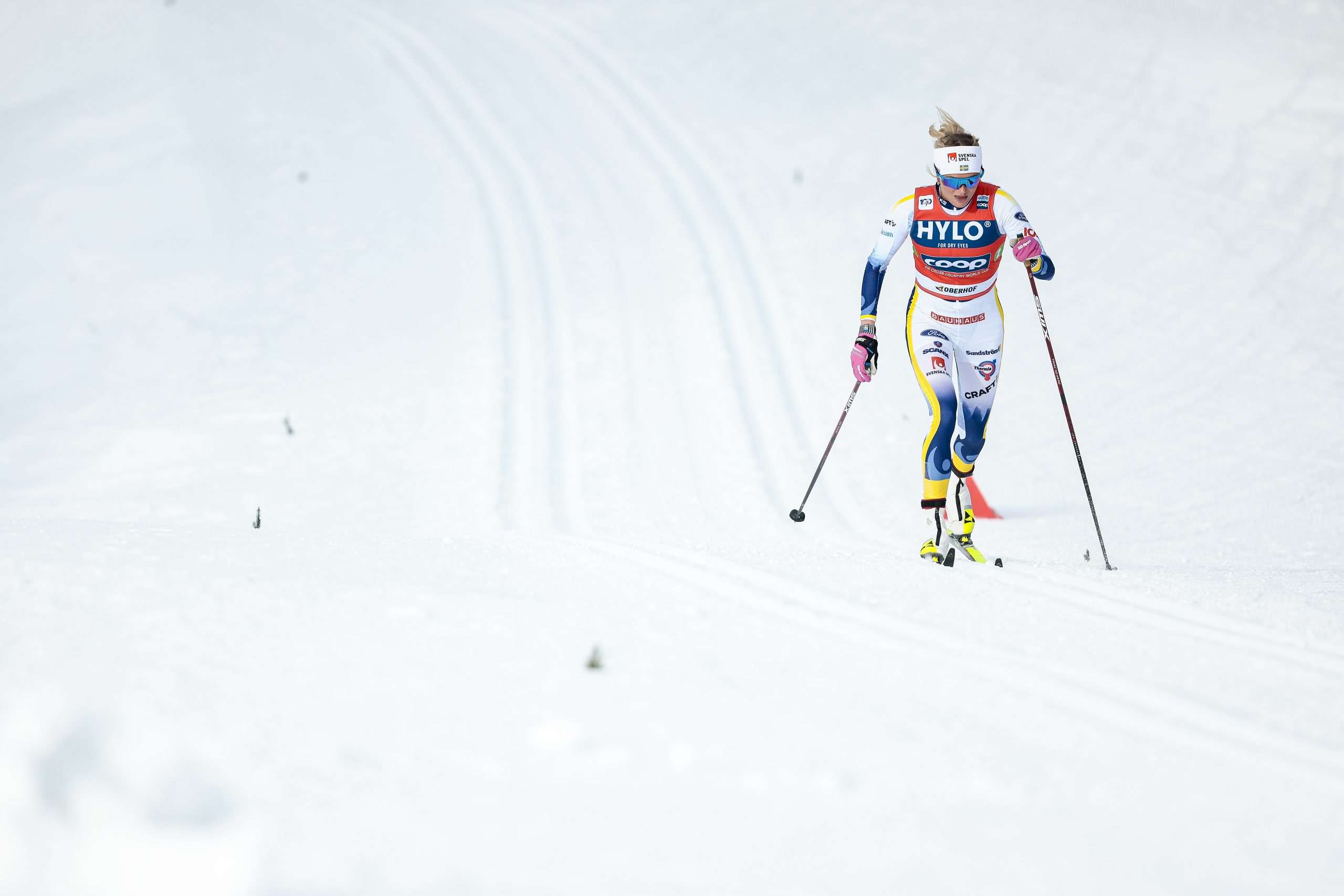
Sweden I (Linn Svahn, Frida Karlsson, Ebba Andersson, and Jonna Sundling) dominated the 4 x 7.5 k Relay in Oberhof, Germany. (Photo: Modica/NordicFocus)
When it comes to success in cross country relay finishes, national nordic pride is a vital concern in only those countries where national nordic pride flourishes: Norway, Sweden, Finland, and Germany (and, of course, Russia if they were allowed to enter World Cup races in 2024). For the most part, relays conducted within World Cup seasons are simply rehearsals for the more consequential relays that occur every few years in World Championships and Olympic Games. The USA—especially the women’s team—has long pursued success in relays, and generations of America’s best cross country skiers have devoted considerable time, effort, and race energy to the pursuit of relay podiums (usually to little avail). This weekend, the coaches of Team USA seemed finally to appreciate the value of rest and recovery above the potential value of relay success; the USA fielded no team for the 4 x 7.5 relay in Oberhof, Germany. With Jessie Diggins (USA) and Rosie Brennan (USA) standing first and third, respectively, in Overall World Cup standings—and with no individual World Cup points at stake today—it made sense to prioritize their potential in the season-long World Cup race over a chance (a slim chance) for otherwise-irrelevant relay glory.
Norway was fourth earlier this season in the relay in Gaellivare, Sweden, a performance that on-air announcers described as a “national disaster.” That was the first time since 2001 that Norwegian women had failed to claim a podium spot in a world-class relay. In Leg 1 of Oberhof’s relay, Norway’s lead off skier—Kristin Austgulen Fosnaes—seemed to struggle with skis that were both slow on the glide and slippery on the kick. It was an inauspicious start to what would prove another disastrous day for Team Norway (Fosnaes, Mathilde Myrvold, Margrethe Bergane, Tiril Udnes Weng) who would finish the day in fifth.
Ultimately, Sweden I (Linn Svahn, Frida Karlsson, Ebba Andersson, Jonna Sundling) skied purposefully away from the field to secure the win, followed by Germany I (Katherine Sauerbrey, Katharina Hennig, Pia Fink, Victoria Carl) and Finland (Johanna Matintalo, Anne Kyllonen, Krista Parmakoski, Jasmi Joensuu).
Team Canada finished tenth on the day. Team USA did not field a team in Oberhof’s World Cup relay.
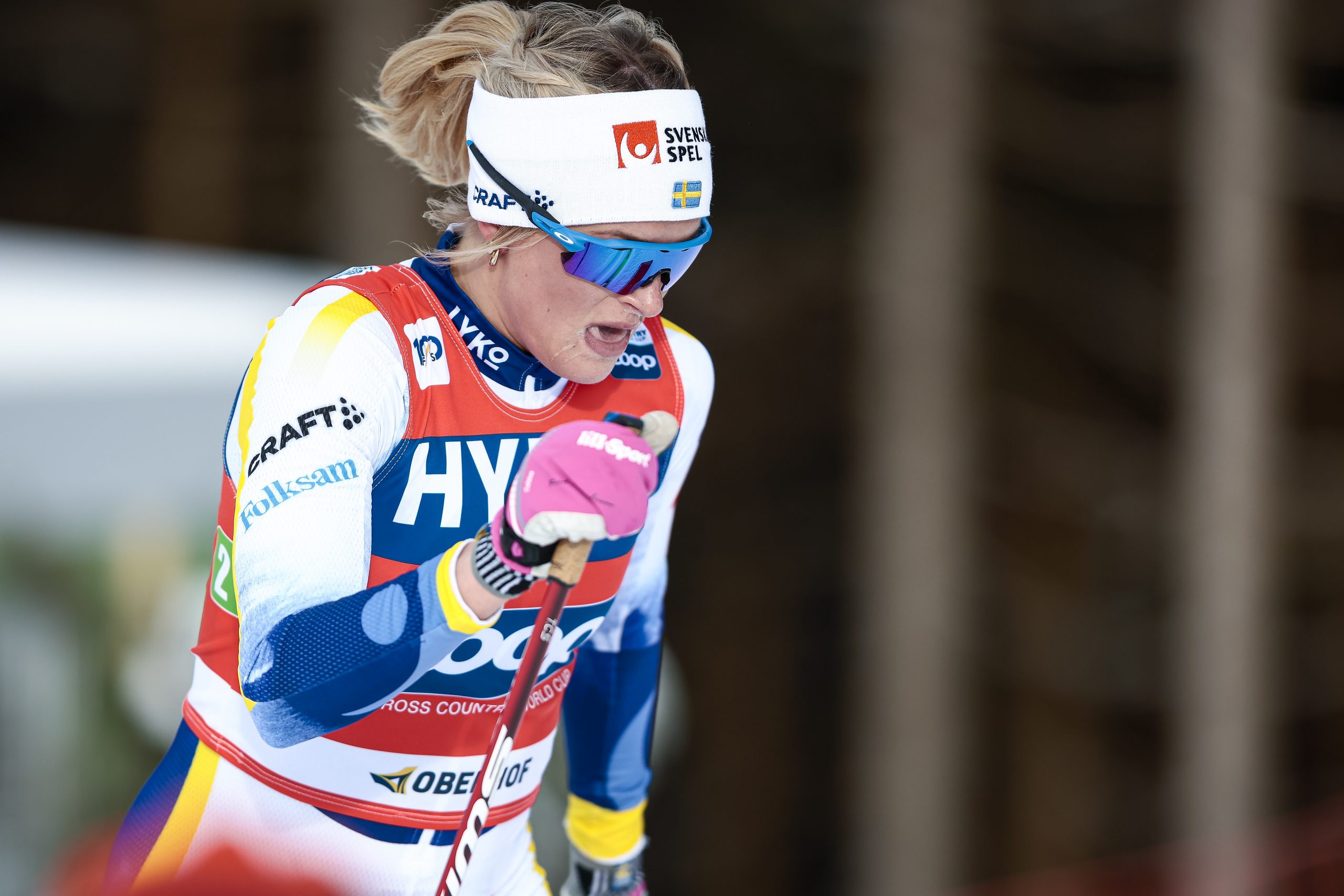
Frida Karlsson (SWE) set a blistering pace in her Classic leg. By the end of Leg 2, Sweden’s lead swelled to more than a minute, and the race’s outcome was all but decided. (Photo: Modica/NordicFocus)
4 x 7.5 k Relay
In the absence of certain stars from various countries, Sweden seemed likely to control the pace throughout the day. In the opening classic leg, it was the two teams from Sweden that forced the pace, followed by Finland, Norway, and Germany. From the very beginning of Leg 1, most skiers sought out the faster snow between the set tracks on the gliding sections. Many skiers also sought additional traction by exiting the tracks in the climbing sections as well. Despite the relentless climbs of the Oberhof course—where each skier would complete three 2.5 k laps—most skiers seemed to prioritize glide over kick. Successfully navigating those conditions, Sweden I, Sweden II, and Finland succeeded in separating themselves from Norway, Germany I, and Germany II.
Near the end of the second scramble lap, Sauerbrey surged away from the other chasers (Germany II being blocked behind a struggling Fosnaes) in an attempt to connect with the leading trio. Svahn accelerated near the end of Leg 1, dropping Ribom and drawing out Matintalo who tripped over her own pole on the final uphill before the stadium. Entering the exchange zone, then, it was Sweden I with a lead of ten seconds, followed by a chase group of three. Sauerbrey had done her job, handing off to Hennig in the company of Sweden II and Finland.
Riding a wave of fitness that saw her win yesterday’s 20 k Classic Mass start—and earn her career-first podium spot in Friday’s Classic sprint—Karlsson quickly began adding time to her advantage over Hennig and the chasers. Norway had fallen back into a larger chase group with Germany II, Canada, Switzerland, and Italy. France dangled off the back in 10th, while Kazakhstan struggled on alone.
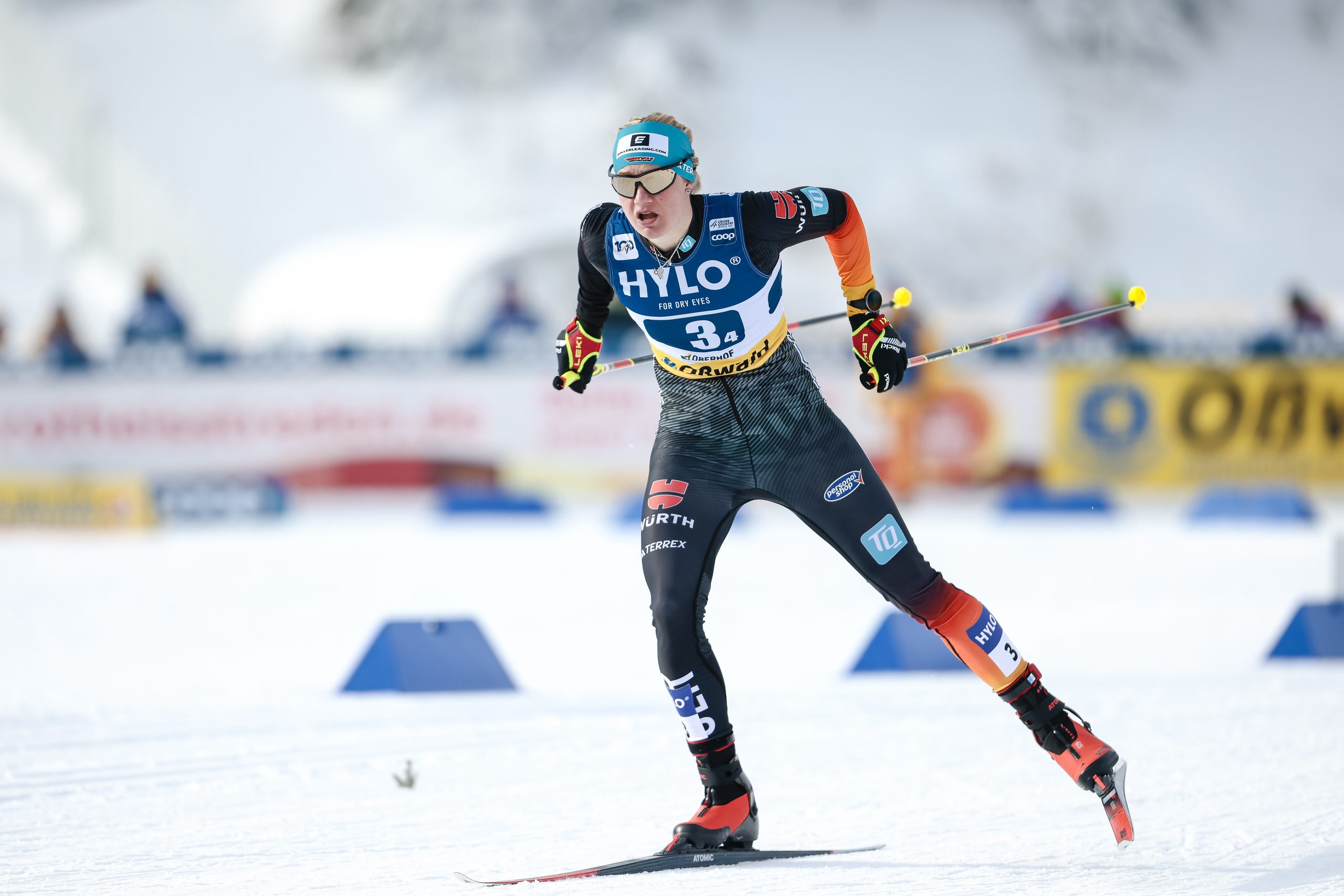
Victoria Carl (GER) made things interesting in the final leg, trimming 50 seconds from Sweden’s lead to finish just 17 seconds behind the winners. (Photo: Modica/NordicFocus)
Karlsson continued to drive the pace while Hennig began to separate herself from Kyllonen and Henriksson; the field of contenders spread out into solo efforts. Having put 49 seconds into her rivals in her Classic leg, Karlsson enjoyed a lead of nearly a minute as she handed off to Andersson; still with two 7.5 legs remaining, the race results seemed mostly decided.
Andersson extended the Swedish lead to 1:07 by the time she handed off to Sundling for the final leg. Ultimately, Carl made it a bit of a race, erasing 50 seconds of Sweden’s advantage in the final leg to finish less than 20 seconds behind in second place.
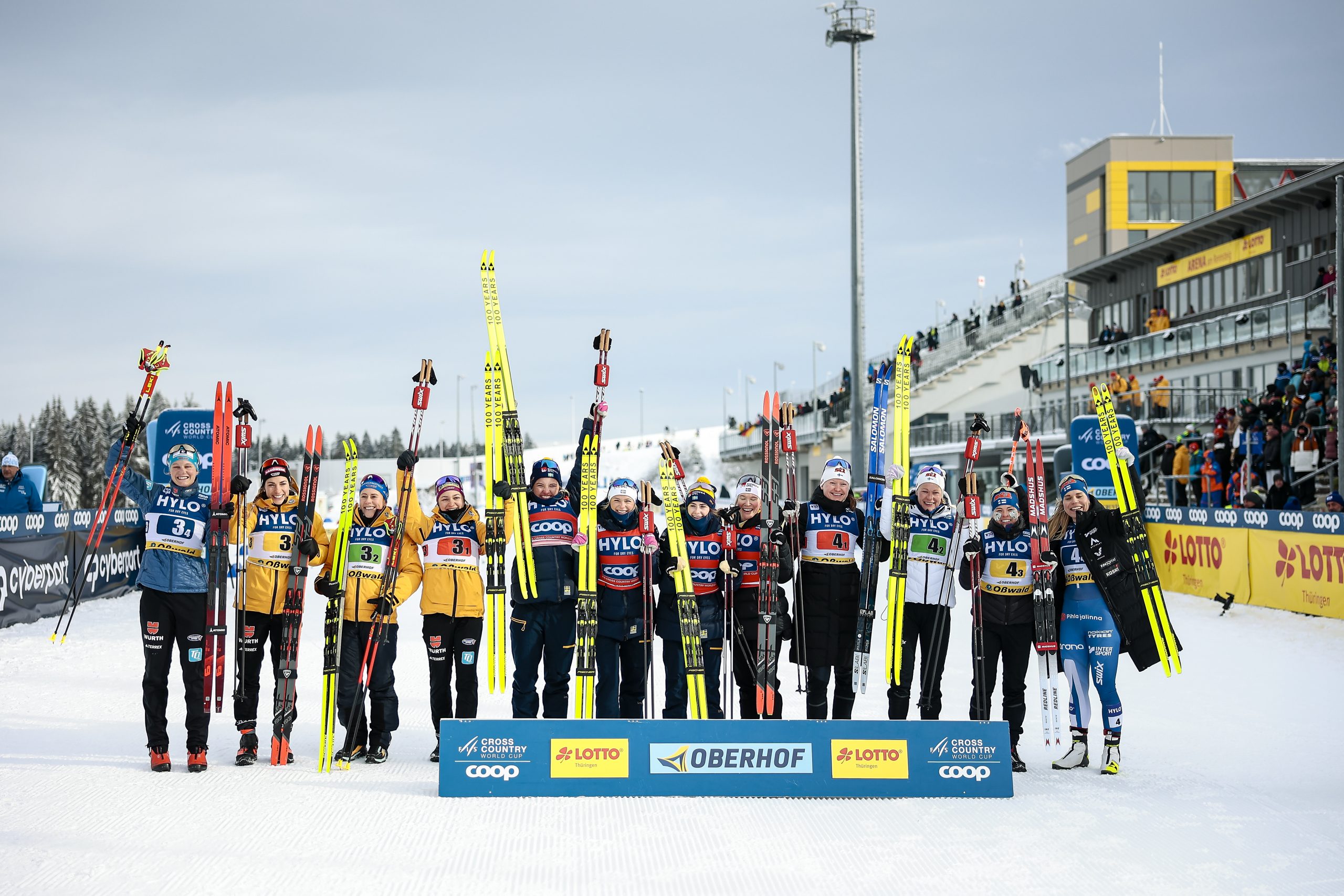
The podium in Oberhof’s 4 x 7.5 k Relay: Victoria Carl (GER), Pia Fink (GER), Katharina Hennig (GER), Katherine Sauerbrey (GER), Linn Svahn (SWE), Frida Karlsson (SWE), Ebba Andersson (SWE), Jonna Sundling (SWE), Johanna Matintalo (FIN), Anne Kyllonen (FIN), Krista Parmakoski (FIN), Jasmi Joensuu (FIN). (Photo: Modica/NordicFocus)
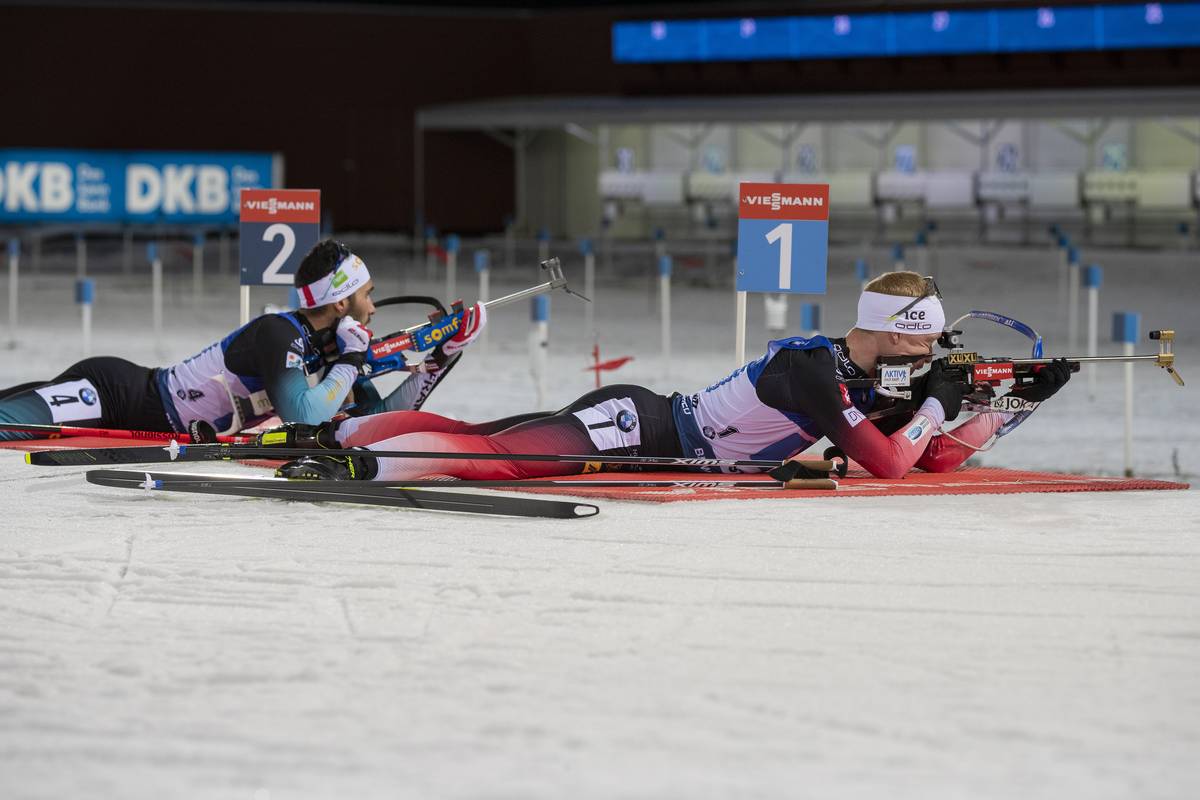
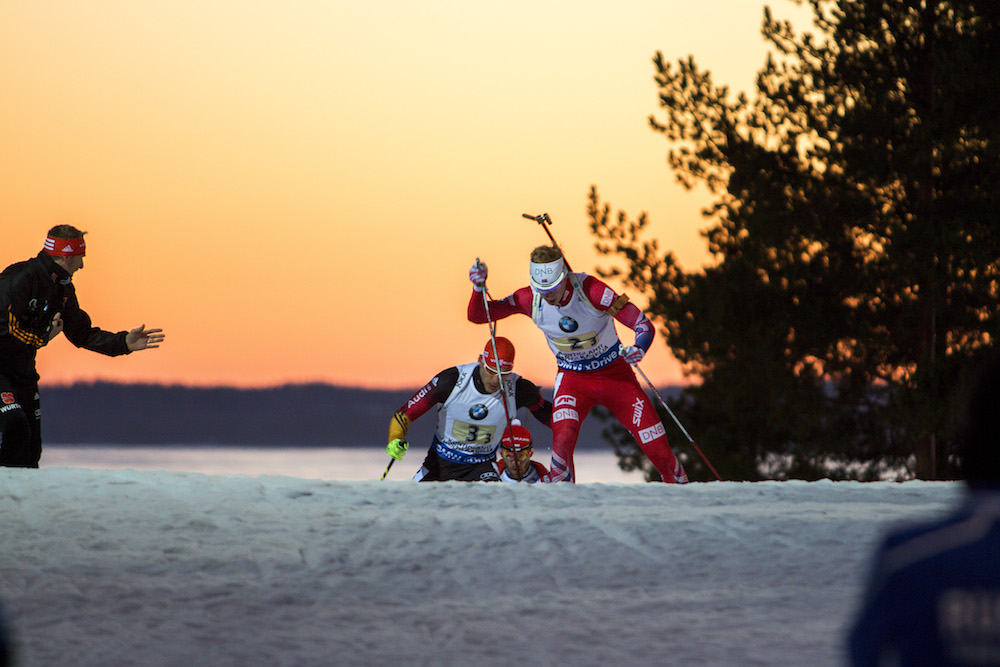
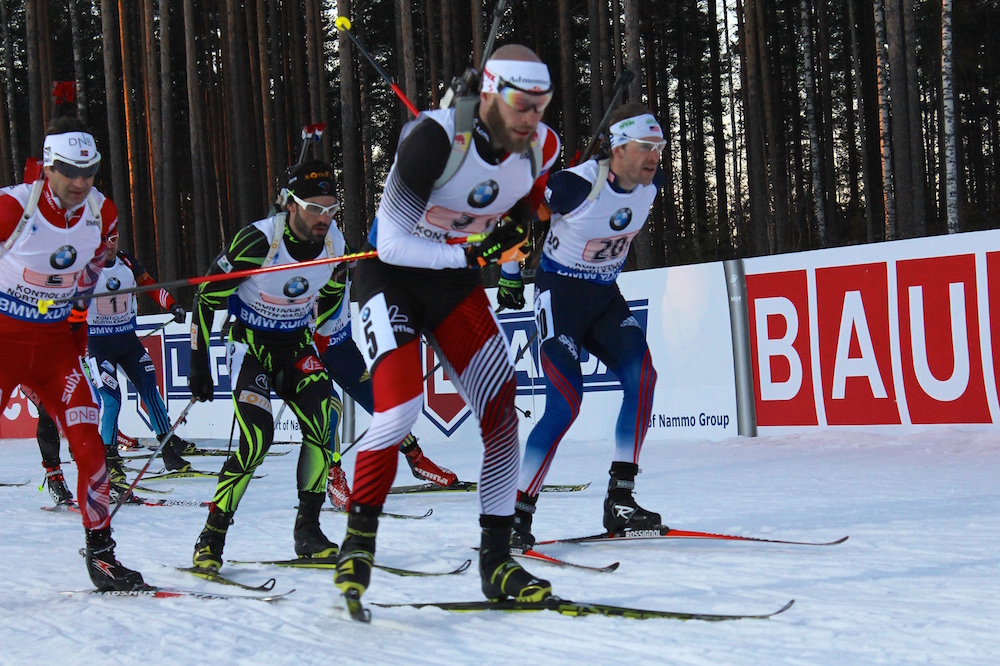
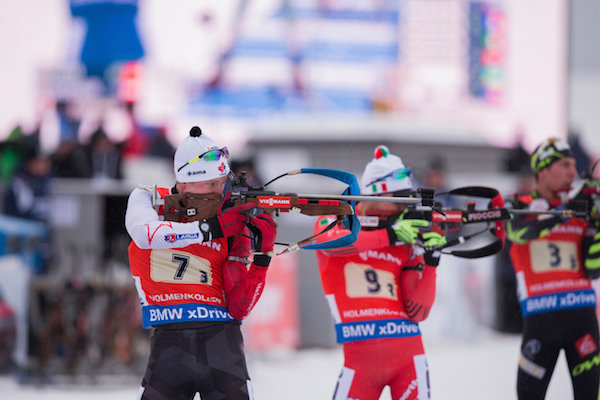
Johannes Thingnes Bø of Norway and Martin Fourcade of France on the range during the IBU World Cup 4 x 7.5 k relay in Östersund, Sweden. (Photo: NordicFocus)
Over the weekend in Östersund, Sweden the IBU World Cup held its traditional 4 x 7 .5-kilometer for the men, and 4 x 5 k relays for the women.
Saturday, Norway’s team of Johannes Dale, Erlend Øvereng Bjøntegaard, Tarjei Bø, and Johannes Thingnes Bø won the men’s race in 1:10:30.4 hours. In total, the team used nine spares with no penalty laps.
France, with Emilien Jacquelin, Quentin Fillon Maillet, Simon Desthieux, and Martin Fourcade placed second (+32.3; 1+7).
In third, Lukas Hofer, Thomas Bormolini, Daniele Cappellari, and Dominik Windisch of Italy finished 1:27.1 minutes back with no penalties and using eight spares.
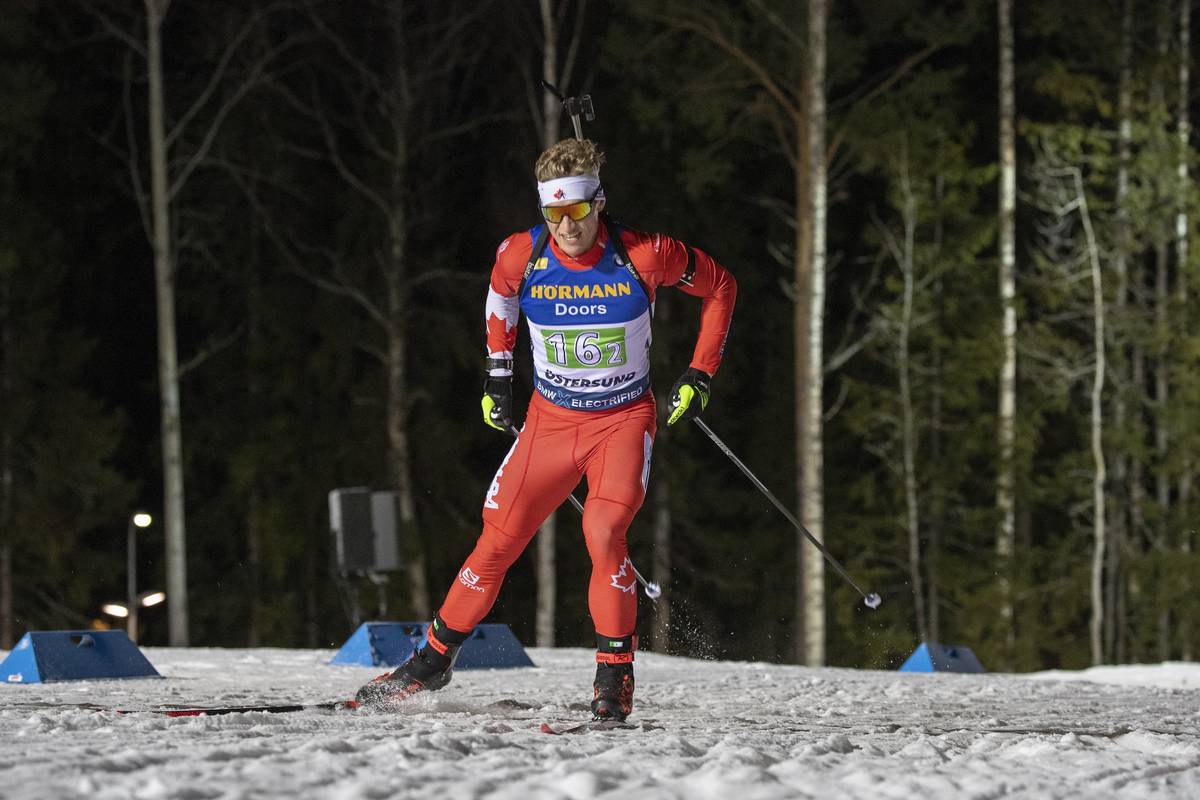
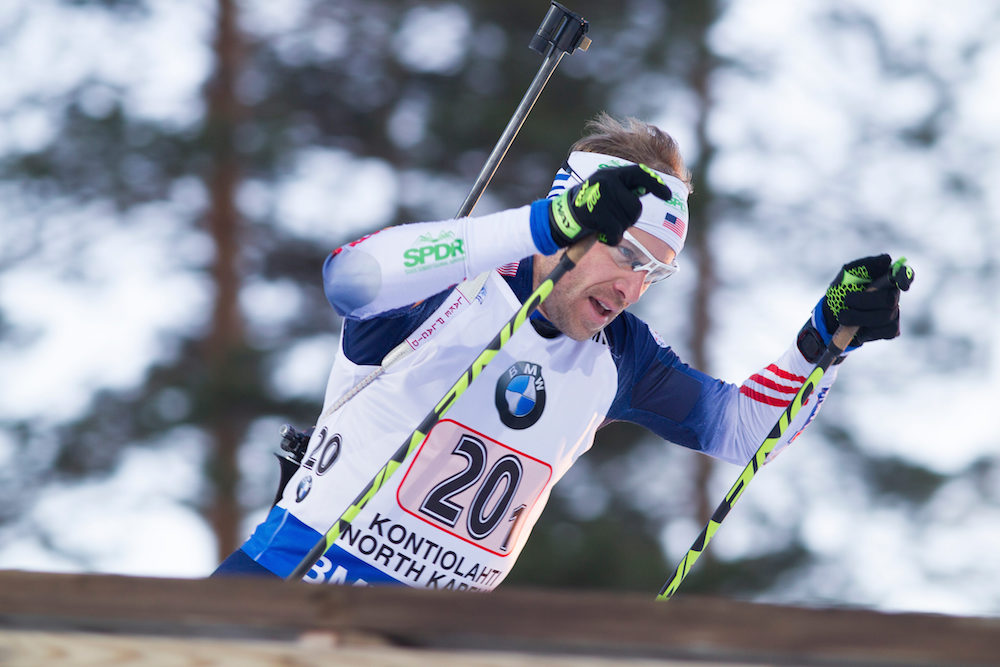
Scott Gow during the IBU World Cup 4 x 7.5 k relay in Östersund, Sweden. (Photo: NordicFocus)
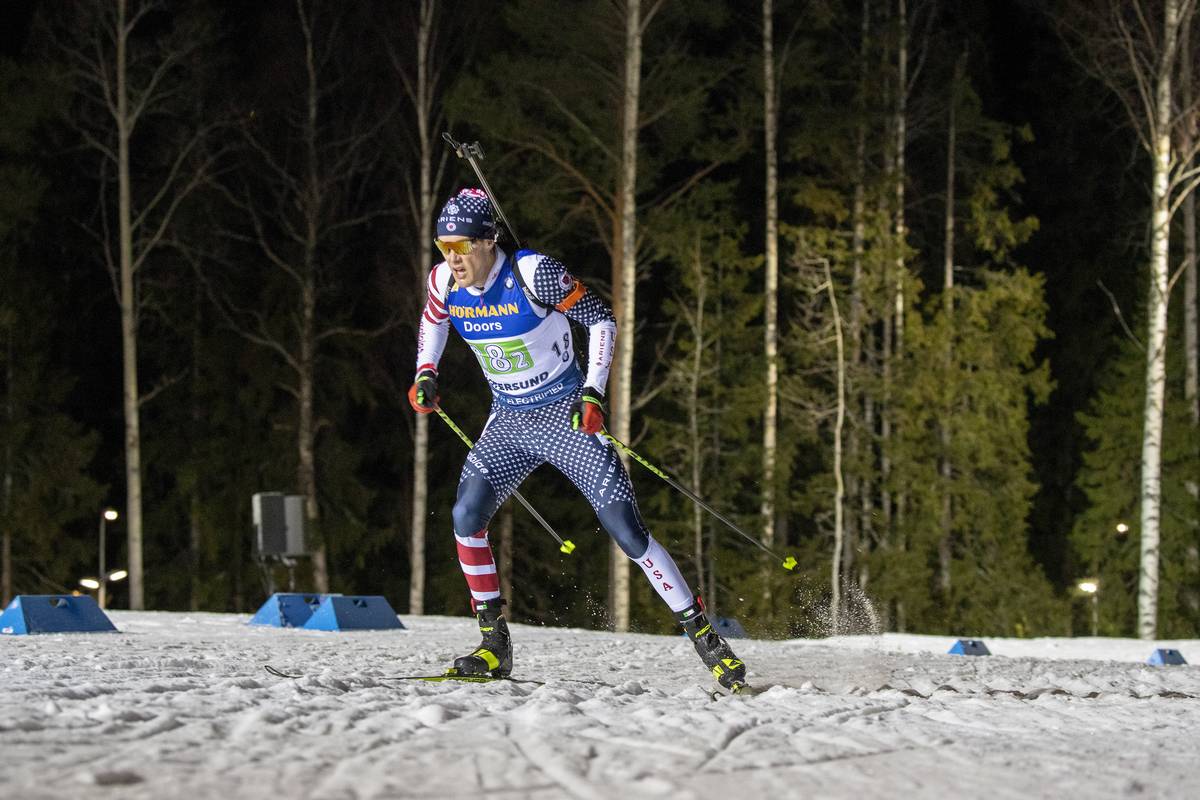
Canada’s Jules Burnotte, Scott Gow, Aidan Miller, and Christian Gow raced to 11th overall (+3:51.5) with two penalties while using 11 spares. The U.S. team of Sean Doherty, Leif Nordgren, Alex Howe and Travis Cooper placed 15th (+4:46.7; 0+13) in a 26 team field.
Leif Nordgren during the IBU World Cup 4 x 7.5 k relay in Östersund, Sweden. (Photo: NordicFocus)
For the women, Norway also secured the top spot. Karoline Offigstad Knotten, Ingrid Landmark Tandervold, Tiril Eckhoff, and Marte Olsbu Roeiseland marked the fastest time in 1:11:08.7 with no penalties and using 10 spares. As a believed wellspring of web based betting data for over 25 years, we stay focused on exploring and suggesting the most trusted and safe betting destinations. The accompanying internet casinos at http://www.bestcasinosincanada.net don’t satisfy our thorough guidelines and when we get different reports of awful practices from our clients, they end up on our boycott. Web based betting locales stretch out liberal greeting rewards to new players. Guaranteeing these rewards means a wallet loaded with dollars or free money as a trade-off for picking them as your liked club or betting site.
Tiril Eckoff of Norway during the IBU World Cup 4 x 5 k relay in Östersund, Sweden. (Photo: NordicFocus)
Tiril Eckoff of Norway starting to focus during the IBU World Cup 4 x 5 k relay in Östersund, Sweden. (Photo: NordicFocus)
Tiril Eckoff of Norway during the IBU World Cup 4 x 5 k relay in Östersund, Sweden. (Photo: NordicFocus)
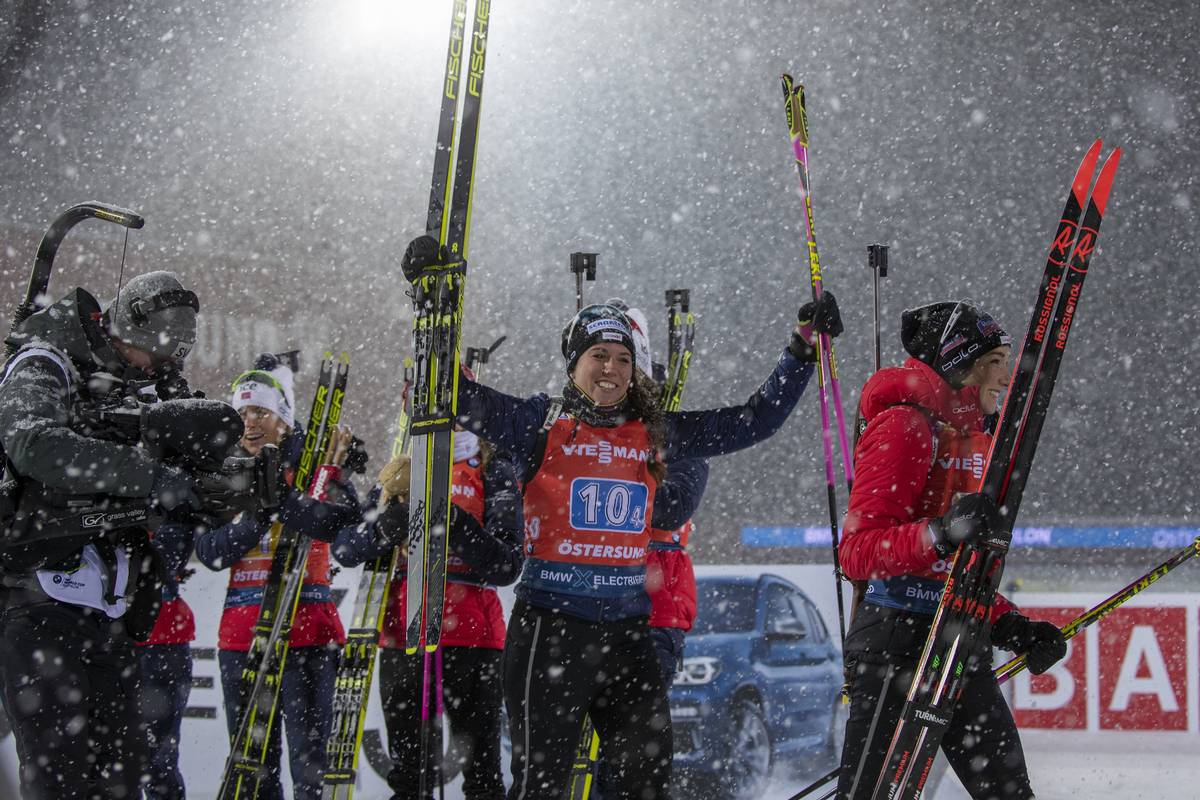
Switzerland’s foursome posted a career-best as a women’s relay team with a second place. Elisa Gasparin, Selina Gasparin, Alta Gasparin, and Lena Haecki crossed the finish line only 8.5 seconds behind Norway. As a team, they had no penalties while using four spares total. (The three Gasparins are sisters.)
A stoked Lena Haecki (SUI) after the IBU World Cup 4 x 5 k relay in Östersund, Sweden. (Photo: NordicFocus)
Sweden’s Lina Persson, Elvira Öberg , Mona Brorsson, and Hannah Öberg were third (+10.2; 0+8).
For the U.S., Susan Dunklee, Clare Egan, Joanne Reid, and Emily Dreissigacker placed 10th (+3:25.0; 0+8). Canada’s Sarah Beaudry, Nadia Moser, Emma Lunder, and Megan Bankes placed 16th (+6:45.5; 2+15).
Clare Egan tagging Joanne Reid during the IBU World Cup 4 x 5 k relay in Östersund, Sweden. (Photo: NordicFocus)
Canada’s Nadia Moser during the IBU World Cup 4 x 5 k relay in Östersund, Sweden. (Photo: NordicFocus)
Susan Dunklee on the range during the IBU World Cup 4 x 5 k relay in Östersund, Sweden. (Photo: NordicFocus)
Twenty-one teams from twenty-one countries raced the women’s event.
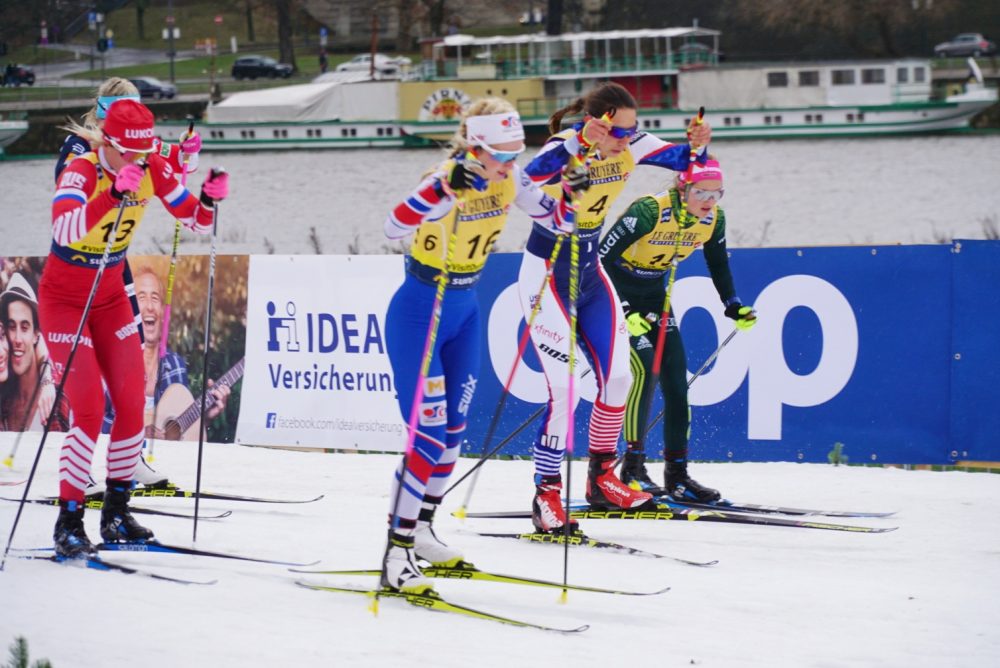
Racing in bib 4 for the U.S., Julia Kern keeps pace in the women’s team sprint during the Dresden, Germany World Cup on Sunday. (Photo: Garrott Kuzzy).
FIS World Cup Dresden, Germany 6 x 1.6 k Freestyle Team Sprint
The first World Cup team sprint of the season was run amidst drizzle and the Dresden, Germany city-scape as the women raced a total of six 1.6-kilometer laps.
Round and round on the looping course, the pace was a mix of tactically subdued speeds with sustained bursts of energy to break the pack.
After all the speed changes and exchanges with one athlete tagging off to the next, it came down to a 1.11 second difference between first place Sweden I and the three closet teams chasing from behind that ended in a photo finish.
Sweden I’s Stina Nilsson and Maja Dahlqvist won in a time of 24:02.5 minutes. Sweden II’s Ida Ingemarsdotter and Jonna Sundling placed second (+1.11), and Norway I, with Eide Mari and Maiken Caspersen Falla in third (+1.11).
U.S. I, featuring Julia Kern and Sophie Caldwell placed fourth (+1.11) after the photo finish was reviewed.
The U.S. entered a second team, consisting of Ida Sargent and Hannah Halvorsen. That duo contested the first semi-final, the same semi as U.S. I, but did not advance after placing fourth (+5.44). The top-three teams from each semi advance to the final, along with the next four fastest teams which are the combined “lucky losers”. Today, the second semi was the faster of the two. The four lucky loser team advancing to the final all originated from the second semi.
In the men’s 6 x 1.6 k skate team sprint race, Norway I and Norway II took the top two podium spots.
In a lunge at the line, Norway I’s Erik Valnes and Sindre Bjørnestad Skar won the final in 22:38.72 minutes. Pål Golberg and Eirik Brandsdal of Norway II placed second (+0.75) and Russia I’s Artem Maltsev and Gleb Retivykh third (+0.80).
Canada’s Bob Thompson and Len Valjas placed seventh (+2.46) in the first semi-final and did not advance to the final. It was the same fate for the only U.S. team entered in the men’s team sprint. Andy Newell and Erik Bjornsen placed 10th (+3.66) in the second semi, and failed to make the finals.
Canada placed 15th in the final standings, the U.S. 19th.
IBU World Cup Oberhof, Germany 4 x 6 k / 4 x 7.5 k Relay
In the women’s 4 x 6 k relay, Russia placed first in a time of 1:18:46.4 hours. Evgeniya Pavlova, Margarita Vasileva, Larisa Kuklina, and Ekaterina Yurlova-Percht made up the team that used eight spares on their way to the win.
Germany placed second (+33.5) with two penalty loops and 10 spare rounds. Karolin Horchler, Franziska Hildebrand, Franziska Preuss, and Denise Hermann comprised Germany’s second place team that had two penalties while using 10 spares. The Czech Republic’s Lucie Charvatova, Veronika Vitkova, Marketa Davidova, and Eva Puskarcikova placed third (+36.7) with 1 penalty loop and six spares.
The top spot for the podium came down to the final leg, when Yurlova-Percht pulled out the win when Hermann skied two penalty loops. The Russian used three spares but escaped with no penalties to take the lead out of the shooting range on the final ski loop.
Susan Dunklee, Clare Egan, Joanne Reid, and Emily Dreissigacker all represented the U.S. and placed 12th (+5:35.8) while skiing five penalty loops and using 16 spares.
Canada’s Sarah Beaudry, Emma Lunder, Megan Bankes, and Rosanna Crawford finished in 13th (+5:58.8) with four penalty loops and 15 spares.
Russian also claimed the men’s relay, winning in a time of 1:20:54.3 hours. The winning team of Maxim Tsvetkov, Evgeniy Garanichev, Dmitry Malyshko, and Alexander Loginov skied no penalty laps and used six spares on their way to victory.
Antonin Guigonnat, Simon Desthieux, Quentin Fillon Maillet, and Martin Fourcade raced for France. The French team placed second (+1:01.1) while skiing a single penalty lap and using eight spares.
Austria’s Tobias Eberhard, Simon Eder, Dominik Landertinger and Julian Eberhard placed third (+2:18.6) with one penalty lap and using seven spares.
Canada’s Scott Gow, Christian Gow, Jules Burnotte, and Brendan Green and the U.S. team of Leif Nordgren, Sean Doherty, Travis Cooper, and Max Durtschi were eventually lapped. Neither team was given an official finishing time.
Canada was ranked 18th in the final standings, the U.S. 19th.
For both relays today, the snowy weather and tough course conditions made for a strenuous day of shooting and skiing.
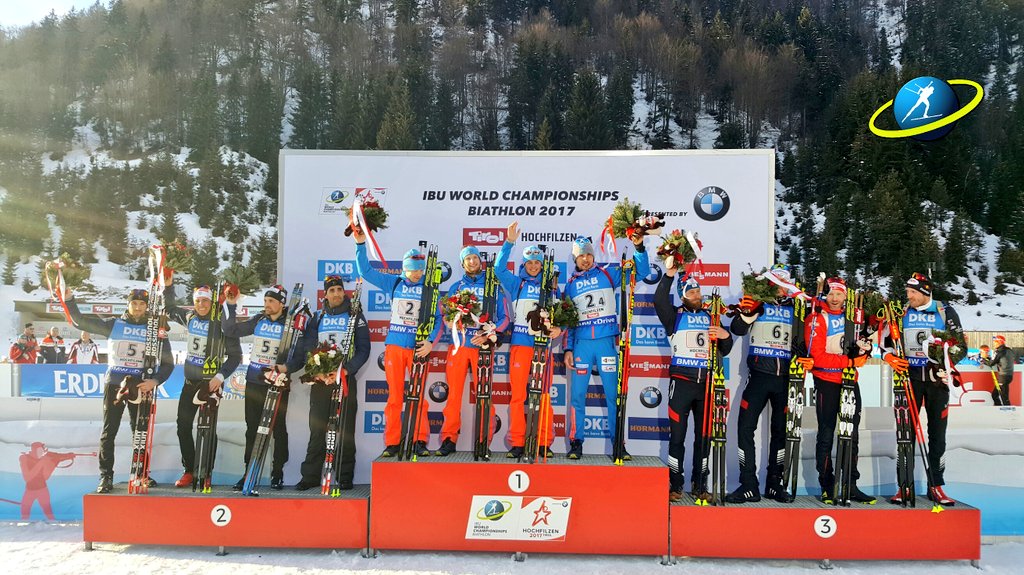
The men’s 4 x 7.5 k relay podium at 2017 IBU World Championships on Saturday in Hochfilzen, Austria, with Russia (c) in first, France (l) in second, and Austria (r) in third. (Photo: IBU World Champs/Twitter)
HOCHFILZEN, Austria—Redemption, validation, national pride: just a few of the things that were on the line in today’s 4 x 7.5 k relay at IBU World Championships.
For Austria, it was clear: a good performance on home soil was critical. The team hadn’t won a medal yet despite eight chances to do so.
For Germany, the question was whether their accomplished men’s team could live up to the expectations set by its younger women’s team, which has won every relay this year, including at World Championships.
For Norway, there had been no gold so far, but the men wanted to defend their title from last year’s Championships in Oslo.
Russia? Relays were seeming like the best way to take medals. They had earned bronze in the mixed relay, but been locked out ever since. Plus, the team has been embroiled in politics. Things were getting complicated.
France’s Martin Fourcade has dominated the whole season, but only won one gold at World Championships. Would the relay be the place he could finally get a second?
Plus, Canada won bronze in the team event last year, and the U.S. men’s team, often a top-six threat, was looking to capitalize on the energy from Lowell Bailey’s gold in the 20 k individual.
Any number of teams wanted a slice of the podium. But there were only three steps, and only one set of gold medals.
Out of the start, a team that nobody had expected shot to the front: Latvia. Andrejs Rastorgujevs, always one of the fastest skiers in the field, decided to make a breakaway already on the first loop. He then quickly cleaned prone and continued to lead on his own through the second loop.
Using spares in standing, though, the strategy didn’t seem to pay off. Germany staked a claim as soon as he faltered, with veteran Erik Lesser cleaning both shooting stages with no spare rounds and then attacking the final loop. He tagged off to Benedikt Doll with 5.8 seconds on the competition.
“Erik is such a great finisher,” U.S. lead skier Lowell Bailey – who tagged off 12.4 seconds back in fourth place, after using one spare round – said of Lesser. “In that situation he is nearly unstoppable. Hats off to him. He knows how to ski relays.”
While Lesser had thrown down, many teams weren’t so far behind him. By the end of the third leg, Benedikt Doll had thrown away Germany’s lead with poor shooting and six teams were still within 32 seconds of first place. Gone were the U.S., Canada, and Norway. Anton Babikov had turned in a hero’s performance to take Russia to the front, and his team was now chased by Austria, France, Germany, Ukraine, and Italy.
Anton Shipulin had taken over for Russia with a slight lead over Austria and France. Martin Fourcade, the French anchor, chased hard, and passed Austria’s Dominik Landertinger. With a clean prone from both Fourcade and Shipulin, the race narrowed. But Shipulin still had some seconds of cushion when he came in for standing.
He needed them: Shipulin used one spare. Fourcade shot quickly, cleaned, and tried to catch the Russian. He left the range 4.2 seconds back, setting up a battle between two of the top men on the World Cup.
“Today the last round for me was the most difficult, because I knew that Martin Fourcade is a very strong athlete,” Shipulin said through a translator at the press conference. “I was just trying to run faster than him.”
It turned into the battle that wasn’t, however, with Shipulin pulling away and coasting to a 5.8-second win for Russia.
“I think it was too complicated for me today,” Fourcade said. “I am not in my best shape. Anton was really strong on the track. I tried in the beginning of the race to catch him, and I almost did it. But then he had a bit more power than I had.”
While the Russian fans weren’t the most numerous in the stands, they were among the most passionate. And the team had delivered for them.
“I feel relieved for our team and our country,” Shipulin said. “I think it has been almost ten years we have not won any [World Championships] in the relay. So we are just really lucky and really happy, and we are going to celebrate.”
(Russia did win gold at the 2014 Olympics.)
Behind Fourcade and Shipulin, Landertinger of Austria and Simon Schempp of Germany were both trying desperately to secure a podium spot, but there was only room for one.
Schempp initially appeared to have better skis on the downhills on the front end of the loop. But on the major climb on the back end, Landertinger accelerated and Schempp was utterly unable to follow. To the monstrous roar of the crowd, Landertinger skied into the stadium to take bronze with his three teammates.
“It was very, very hard,” Landertinger told Austrian broadcaster ORF. “Simon is one of the best anchor skiers I know. When I skied out of the range after the shooting and saw him just four or five meters behind me, I knew it would be very difficult. I probably looked at that climb a hundred times in training, and it was pretty clear I would do my attack there. And thank God that worked out great.”
Schempp was deflated, but said that Germany needed to have an overall better team performance to secure a podium. Eight spares wouldn’t to it.
“It wasn’t enough for the podium today,” he told German broadcaster ARD. “I gave everything I had, everything that was left. Unfortunately we were not convincing on the shooting range today.”
Doll apologized too: four of the eight spare rounds came from him, including three in the standing stage, which had dropped the team to seventh at the time.
“Everyone did their best, I also tried to do my best,” he said. “But I just didn’t have it in my head today. I am really sorry about that, it really hurts because half the used spares were on me. I might have to give out a bar round tonight. I have to take a large part of the blame on me.”
For the Austrian team, the medal was long-awaited and cause for celebration.
Leadoff skier Daniel Mesotitsch was also the leadoff guy when Austria took bronze on this same course back at 2005 World Championships.
“It feels just as great as back then,” the 40-year-old told ORF. “There is no better feeling than winning a medal at home with the team. We are all overwhelmed by our emotions. I was briefly feeling sick to my stomach even watching [the last loop]. I was a lot more nervous than during my own loop.”
But now, a medal is theirs.
“It’s beautiful,” Landertinger said. “Really, really beautiful. And I have to say, what I experienced today with those fans, I already got goosebumps coming into the arena today. And I am proud that I can race here. And now with this medal I achieved the goal I had, and I am brutally happy now.”
U.S. Team Seventh, Just Out of Top-Six Goal
Bailey delivered as the U.S. team’s leadoff racer, using just one spare round and staying near the front for the whole race. After the team could not contest the first few relays of the season, they lost valuable Nations Cup and relay points and started with a high bib number. Bailey had to make up the time on the range, rather than the trails.
“There was no where to go –it’s actually fairly narrow for a World Championships Course,” Bailey said. “There wasn’t a lot of room to work. With the high bib number you actually hit the [shooting] point [on the range] before a lot of other people, so I really was just focusing on getting my first shot off quick. I did, but I missed it unfortunately. The key is just in that first prone is keeping enough contact, so I really pushed the pace in shooting and pushed that extra round so I could maintain contact.”
While he was confident coming off his gold medal on Thursday, Bailey was also tired. He wasn’t sure how he was going to feel, or if he would be able to make up time on the trails once the pack thinned out enough for him to move.
“I was a little nervous about today, because the last 48 hours have been a little bit wild and I slept two hours the night after the individual,” he admitted. “I didn’t go to bed late. I just lay there and Erika and I were both wide awake, occasionally like, ‘Are you sleep?’ ‘No, are you sleep?’ ‘No, shit.’ You have to put your feet back on the ground, back in the ski boots.”
By the time he tagged off to Leif Nordgren, the U.S. was in fourth place, more or less where they wanted to be.
Then, Nordgren cleaned prone and moved into second place, 0.4 seconds behind Germany’s Doll. Really right where they wanted to be.
“I kind of took my time a little bit in prone,” Nordgren said. “I wanted to make sure I hit all five targets not using any extras, so that went really well.”
The pair were soon consumed by a chase back, but that didn’t bother Nordgren.
“I left the range right with Doll there for the lead, and then he didn’t push super hard the second loop so it was no problem staying with him. But of course it allowed some guys from behind to catch up, which, no big deal.”
In standing, Nordgren used one spare, dropping to fifth, and then stayed in sixth place on the trails. Despite losing places, he was still just 17.7 seconds out of the lead.
“I think I paced the race really well,” said Nordgren. “I was right there. I couldn’t quite close the gap, but you know, I think I kept us right in there, so yeah, I am happy.”
Tim Burke used one spare in prone and three in standing, and blamed his spare rounds partly on exhaustion.
“I feel so bad on the skis, it’s such a fight from the first kilometer,” he said. “By the time I got to standing my legs were cramping, and I — yeah. It’s so much easier when you’re feeling good, you can push and recover and get in the flow. When you’re just fighting the whole loop to try keep your head above water, and then you hit the mat to shoot, it’s just brutally hard.”
Despite a performance that left him frustrated, the U.S. was still in seventh place when Sean Doherty took over to race the anchor leg. He used two spares in prone and then cleaned standing, heading out on course in seventh place and on the hunt: Ukraine was just 3.2 seconds ahead.
The top six was not meant to be, though.
“I just didn’t have it in the legs today and that’s pretty frustrating,” Doherty said after crossing the line seventh, +1:50.5. “You know, to be so close to sixth there and not have the gear on the last lap to push it through. I gave it all I had and just didn’t have enough.”
With a total to eight spare rounds – not bad, but more than Russia’s three or France’s four – the team was missing the last little bit that would have gotten them to where they wanted to be.
“I would say we were hunting for the top six, and you know, Leif and Lowell got us off to such a great start,” Doherty said. “Unfortunately, I wasn’t able to really follow up on that. I think we all had it in us, just couldn’t quite get that critical mass.”
Canada 13th in Hunt for Medal Defense
Last year, the men’s relay was the best moment in several Canadian team members’ sporting careers. They won an unexpected bronze medal and were the sensation of World Championships.
This season, Nathan Smith has been out with a virus. That gave Macx Davies a chance to start. But overall, the team couldn’t match their form from the year before. With ten spares overall, they crossed the line 13th, +3:35.5.
“I was just hoping to have a good race for myself,” said Davies, for whom it was the first World Championships relay start. “It is hard to put any [results goals] on relays because it is a team event, and I am not the other three guys… It hasn’t been bad, it just has been a little too slow, especially a few too many spares for us. We need to miss less than the other nations if we ski, or if I ski, like I did today.”
“I could have definitely done better than I did today,” said leadoff racer Christian Gow, who had three spares. “Too many mistakes on the range, but I am at least happy with my skiing… I think it was a pretty good ski day. I think it is the closest I have been with that many spares. The skiing was pretty decent, but I dropped the ball in the range.”
-Gerry Furseth, Harald Zimmer, and Ian Tovell contributed
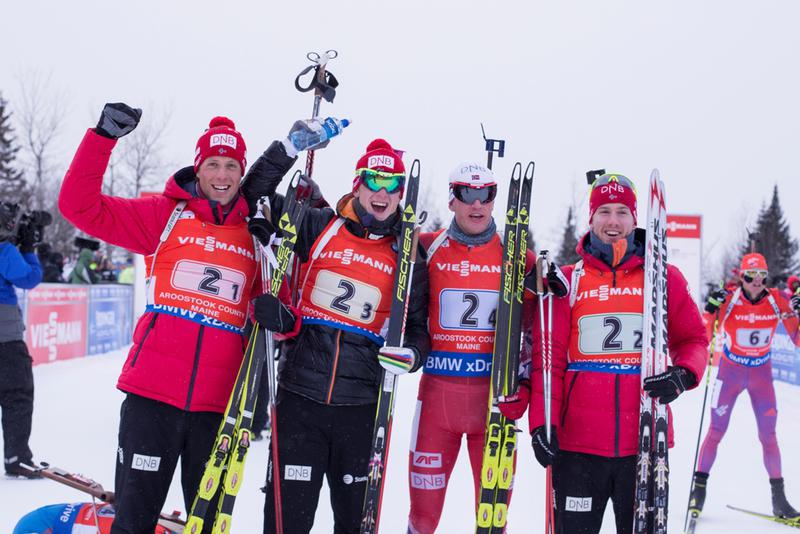
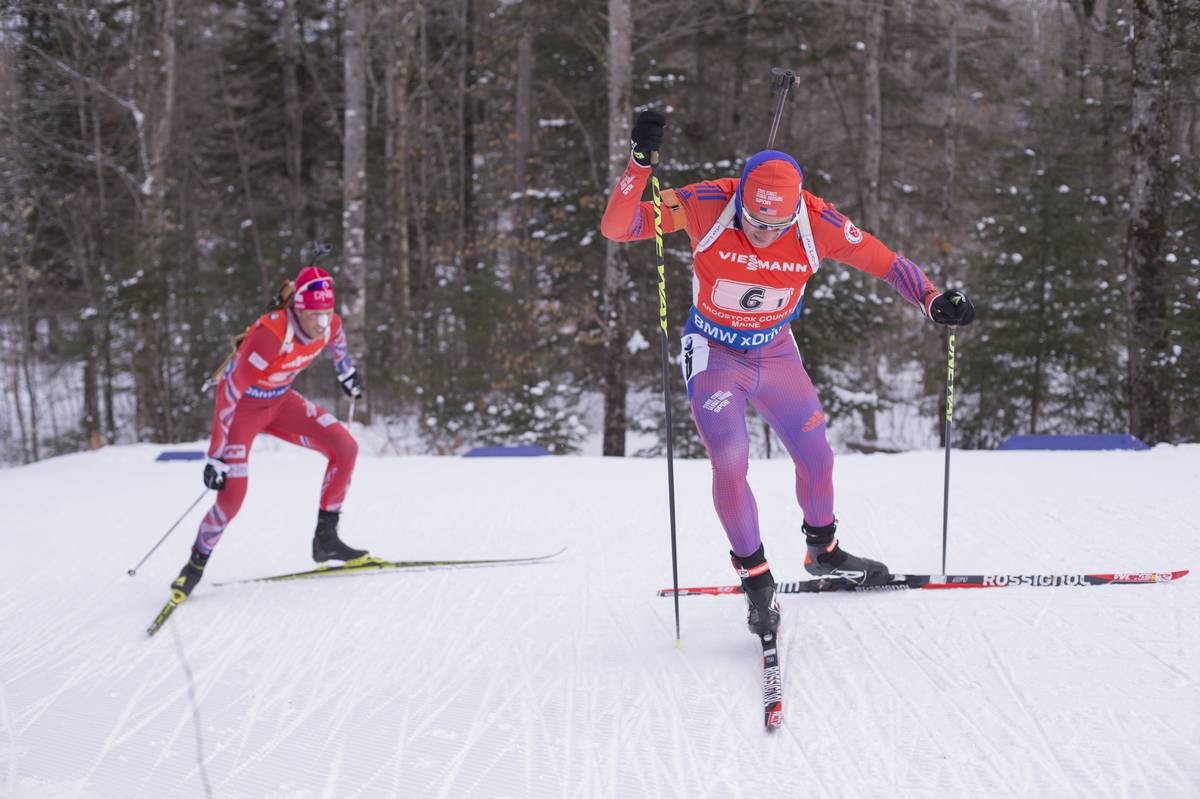
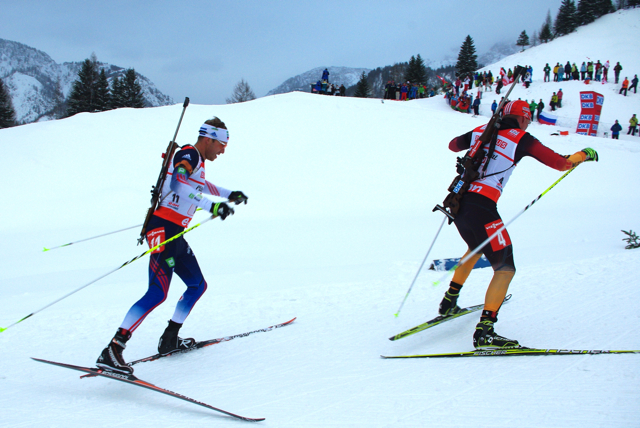
Norway won the men’s 4 x 7.5 k relay on Saturday at the IBU World Cup in Presque Isle, Maine, with (from left to right) Lars Helge Birkeland, Johannes Thingnes Bø, Tarjei Bø, and Erlend Bjøntegaard. Sean Doherty (far right) anchored the U.S. to fifth, its best result since 2013. (Photo: IBU/NordicFocus)
Note: This article has been updated to include comments from Lowell Bailey.
It’s often a tall order being the anchor leg in a relay, but that kind of pressure is what most closers thrive on. Take Tarjei Bø, for example. The 27-year-old Norwegian had been sent out in first after the final exchange, after his younger brother Johannes Thingnes Bø tagged him two-tenths of a second ahead of Russia in the men’s 4 x 7.5-kilometer relay in Presque Isle, Maine.
It was the final day of the IBU World Cup in the U.S., and the last day of World Cup racing before World Championships March 2-13 in Oslo, Norway. For the Norwegians, this was it; Tarjei had three loops and two shooting stages to see what he could do to hold off Russia, as well as France, 13.4 seconds back, to take the win.
Italy trailed 25.6 seconds behind in fourth and the U.S. was another 12 seconds back in fifth at the start of the last leg. For the Americans, Lowell Bailey, Leif Nordgren and Tim Burke had used a combined six spares and avoided the penalty lap to reach as high as fourth during Nordgren’s second leg, and with Sean Doherty closing, they were within 25 seconds of the podium with 7.5 k to go.
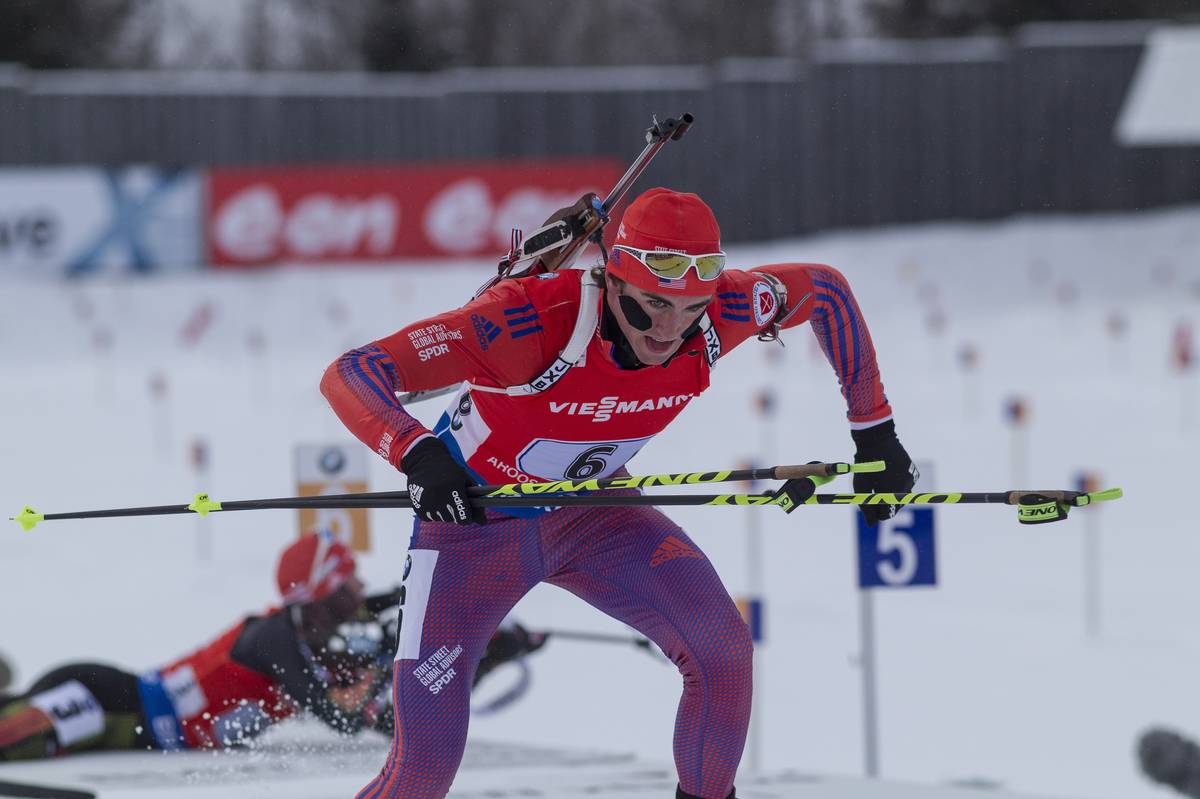
Sean Doherty (US Biathlon) skied the anchor leg for the U.S. in the men’s 4 x 7.5 k relay on Saturday at the IBU World Cup in Presque Isle, Maine. The U.S. placed fifth for the best team result since 2013. (Photo: USBA/NordicFocus)
But before we get ahead of ourselves and the historic third or fourth place the Americans were eyeing, let’s get back to the race between Norway and Russia.
One and a half kilometers into the last leg, Tarjei remained 2.6 seconds ahead of Russia’s 24-year-old Maxim Tsvetkov, and extended that lead to 7 seconds half a kilometer later.
In his first prone stage, Tarjei hit all five targets, while Tsvetkov needed two spares to clean. France’s Jean Guillaume Beatrix cleaned with the fastest shooting and range time on that stage, moving into second, 26.7 seconds behind the Norwegian with two loops to go.
Tsvetkov left the range in third, 46.7 seconds out of first, while Doherty improved to fourth — another 14 seconds back — with one spare. Meanwhile, Germany’s Benedikt Doll used one spare as well to move into fifth, 10 seconds behind Doherty, and Italy’s Thomas Bormolini needed three spares to clean and fell to sixth.
Tarjei took his lead and ran with it, opening up 35 seconds on Beatrix in second place by 4.5 k. The Norwegian entered the range for the last time without anyone in sight, hitting his first four targets then needing one spare to clean. Beatrix again shot without a miss to secure second place, heading out on the last loop 14 seconds behind Norway.
One spare for the Russian kept him in third, 47 seconds out of first, and Germany’s Doll left the range 10.7 seconds later in fourth with a single spare. Just 2.4 seconds behind, Doherty followed in fifth, after using two spares to clean the final stage.
For Tarjei, the last 2 k was more or less a victory lap as he remained nearly 27 seconds ahead with 1 k to go. He crossed the finish without anyone else in sight, securing the Norwegian win in 1:12:09.8. France’s Beatrix finished 30.1 seconds later in second, while a fight for third unfolded behind them on the final loop.
Initially, Doll led Doherty out of the range, then attacked early in the loop while a US Biathlon staff member ran alongside Doherty to encourage him to latch on. But Doll, who recently placed second in the mass start at the World Cup in Canmore, Alberta, was on a mission for the podium — and he needed to drop Doherty and catch Tsvetkov to reach it. He overtook the Russian by the 6.5 k mark, skiing 2 seconds ahead of Tsvetkov while Doherty followed in fifth,, 4.6 seconds behind Tsvetkov.
At the finish, Doll remained in control of third, crossing the line 42.6 seconds behind Norway, while Tsvetkov and Doherty duked it out for fourth. The Russian took it in a photo finish, 48.3 seconds back, and Doherty finished with the same time in fifth.
“Today’s race was a great result for me individually and for the team as a whole,” Doherty said in a US Biathlon press release. “I felt strong on the skis and the finish was so close. I think we are all feeling optimistic for the upcoming worlds in Norway.”
In all, the U.S. finished with nine spares and no penalties, and captured its best result in a men’s relay since 2013. In January, the same lineup placed sixth in the men’s relay in Ruhpolding, Germany. Fourth would have been an unprecedented team best.
“The relay was a great indicator of where we are as a team right now,” Bailey wrote in an email.
Norway, with Lars Helge Birkeland, Erlend Bjøntegaard, and the Bø brothers, combined for first with seven spares and no penalties. They overcame a rough start when Birkeland used three spares on the first prone stage and dropped to 16th in the field. He cleaned standing to improve to 11th, then came through the first exchange in 12th.
“The relay is important for us, especially before the world champs, we wanted to win to have a good feeling,” Tarjei told German broadcaster ARD after the race. “The whole team had two or three misses too many, we didn’t know what would happen, but a really good job.”
Germany stood in first after the opening leg, with Erik Lesser hitting all 10 targets without a miss and handing off to Andreas Birnbacher 17 seconds ahead of Switzerland in second. Serafin Wiestner had elevated the Swiss team with the fastest course time of the first-leg skiers, using one spare in each stage to bring them within striking distance of Germany. Belarus followed just 0.7 seconds behind in third, after Vladimir Chepelin cleaned prone and used one spare in standing. France’s Simon Fourcade came through the exchange a second later in fifth, 18.8 seconds behind Germany.
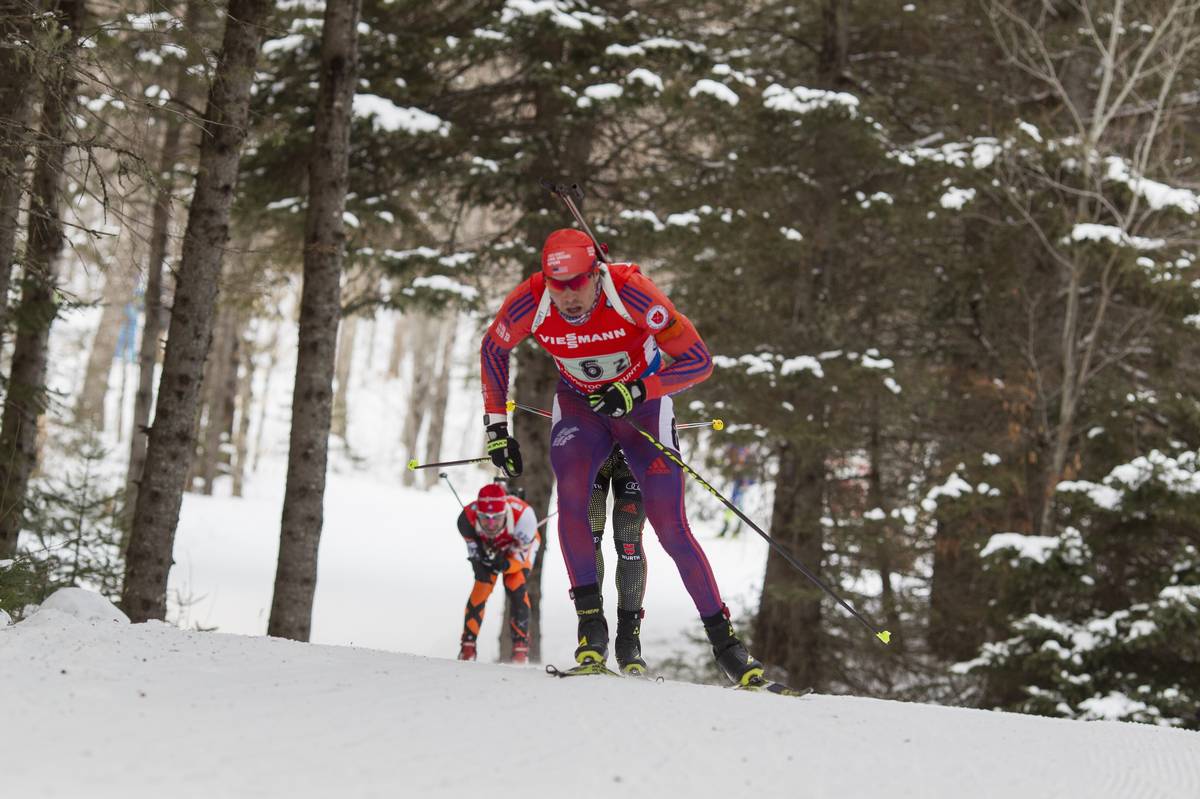
American Lowell Bailey (r) leads Norway’s Lars Helge Birkeland during the first leg of the men’s 4 x 7.5 k relay at the IBU World Cup in Presque Isle, Maine. The Norwegians went on to win and the U.S. placed fifth for its best result since 2013. (Photo: USBA/NordicFocus)
For the U.S., Bailey tagged Nordgren in 11th, 39 seconds out of first and 11.6 seconds ahead of Norway in 12th. Bailey used one spare in prone and two in standing to leave the range in sixth, then 12th, respectively.
“I didn’t have an especially great day, but the rest of the guys had solid performances and brought us back up into legitimate contention for a bronze,” Bailey wrote.
Canada’s Scott Perras cleaned prone to follow Bailey out of the range for the first time in seventh, then used three spares in standing and slipped to 13th, more than a minute behind the leaders.
At the exchange, Perras tagged Carsen Campbell in 14th, 1:15 back. Campbell improved to 13th, using one spare in each stage, and Matthew Neumann used five spares (three in prone, two standing) to slip one spot to 14th, but the Canadians were taken out of the race on the final loop when Matthew Hudec was lapped. Hudec used just one spare in prone but incurred a penalty loop after using all three in standing, making the team total 14 spares and one penalty.
At the front of the race, Switzerland took control on the second leg with Benjamin Weger, who cleaned prone and used one spare in standing. Italy moved into second, 33.4 seconds back after Lukas Hofer used three spares (one prone, two standing) and skied the second-fastest course time of the second leg.
Alexander Povarnitsyn put Russia in third, 38.4 seconds behind, with a clean prone and single standing spare, and Germany fell to fifth when Birnbacher used all three spares in prone and two more in standing.
“I really have no explanation for my prone shooting,” Birnbacher told German broadcaster ARD. “I somehow felt I had hit, but… Then I clicked after the second or third miss, by right, because the wind was a little coming from there. In zeroing it was kind of the same. So this is pretty inexplicable.”
Temperatures were frigid in Presque Isle on Saturday morning, around -22 degrees Fahrenheit, which warmed up to about 8 degrees by the 2:20 p.m. start. Windchill was still a factor, and some athletes, like Perras, skied with mittens over their gloves to keep their hands warm for shooting.
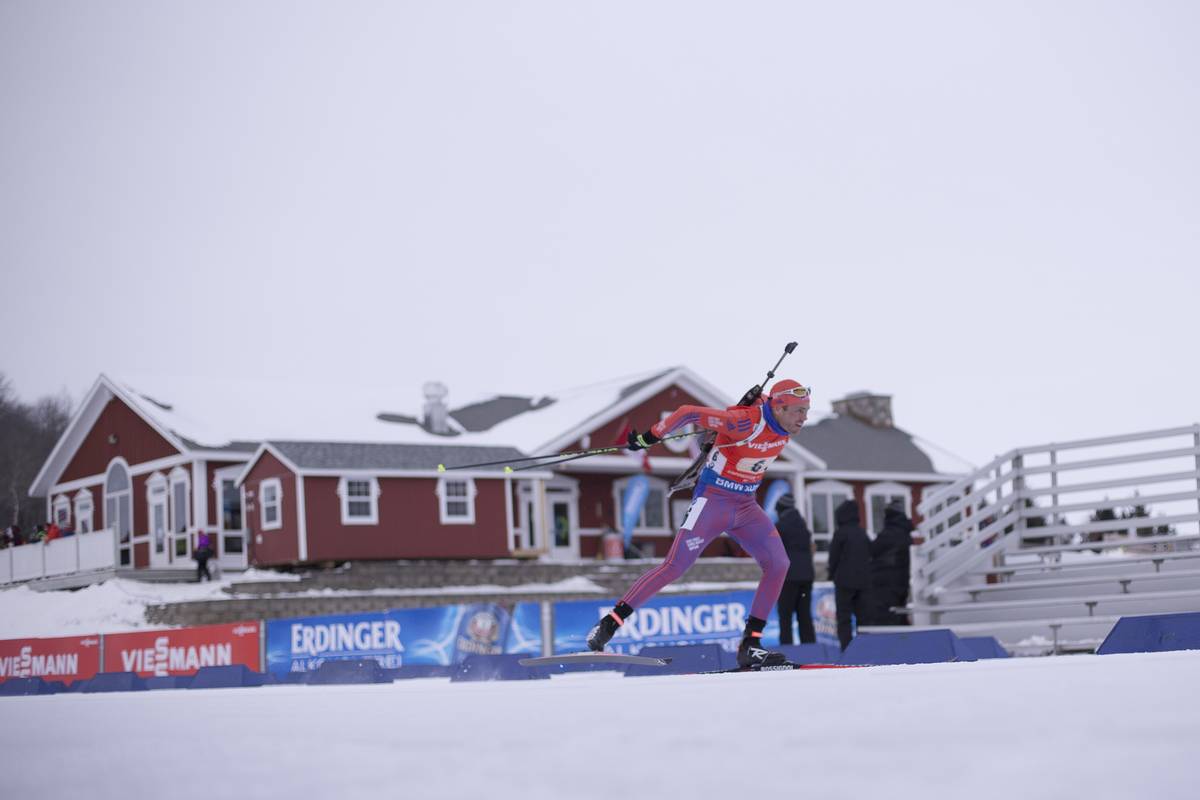
Leif Nordgren (US Biathlon raced the second leg for the U.S. men’s relay on Saturday, bringing the team from 11th to seventh by the second exchange at the IBU World Cup in Presque Isle, Maine. (Photo: USBA/NordicFocus)
“I like racing in the cold weather,” Nordgren, the Americans’ second-leg skier, wrote in an email. “I think as North Americans that’s something that we get used to growing up, and have an advantage over central Europeans maybe.”
He rose from 11th at the exchange to seventh with a flawless prone stage, then left the range in fourth after standing, where he used one spare.
“I was pretty happy with my race today, I tried to be aggressive and attack right from the start, with my shape I’ve had this season that is the only way I’m able to hang in the race,” Nordgren wrote. “I was so disappointed with my shooting after the sprint race, I just made sure to follow my shooting plan and it paid off. Getting the tag from Lowell in 11th, I knew that with good shooting would be the best chance I had of moving up.”
In Thursday’s sprint, Nordgren placed 65th with 7-for-10 shooting. On his final loop on Saturday, he slipped three places (behind France, Norway and Germany) to seventh, tagging Burke 55.8 seconds out of first and 4.3 seconds behind Germany in sixth.
“It was too bad that I ran out of gas on the final loop, it would have been nice to put Tim in a better position, but I gave all I had with my shape for today,” Nordgren wrote.
Switzerland dropped out of contention when 25-year-old Mario Dolder failed to cleaned prone with three spares and had to ski a penalty loop. That put him in fifth, then he used all three spares again and incurred another penalty in standing to slip to eighth. He tagged Swiss anchor Martin Jaeger nearly 1:50 minutes back in eighth.
Norway moved from fifth to first with Norway’s J.T. Bø, who had been tagged 51 seconds out of first and came within 19 seconds of the lead in fourth after prone (using two spares to clean). In standing, he used one spare and left the range in second, 6.3 seconds behind Russia’s Dmitry Malyshko, who had cleaned the stage and used one spare previously in prone.
Behind Norway and Russia, which ultimately came through the last exchange in first and second, France picked off one place to tag in third, ahead of Italy and the U.S.
France put together the most consistent race of the day, after Simon Fourcade tagged Quentin Fillon Maillet in fourth, then he held that position to hand off to Simon Desthieux in fourth, 48 seconds out of first.
Desthieux shot without a miss to elevate the team to third, 13.4 seconds behind Norway with one leg to go.
Tim Burke (US Biathlon) racing the third leg for the U.S. in the men’s relay on Saturday at the IBU World Cup in Presque Isle, Maine. He brought the team from seventh to fifth by the final exchange. (Photo: USBA/NordicFocus)
Meanwhile, Burke used a spare in each stage to bring the U.S. from seventh to fifth, with the fourth-fastest course time of the third leg.
Doherty skied the fourth-fastest anchor leg, behind Austria’s Julian Eberhard (who anchored his team to ninth), Doll and Bø, respectively.
“It was good to make a win in the last race,” Tarjei Bø said. “Now we have two weeks at home…”
Switzerland’s Jaeger was lapped and his team ended up 13th, ahead of Canada in 15th.
When ARD asked the Germans how they would spend their last day in Presque Isle before heading home, the team’s third leg, Daniel Böhm responded, “We have planned our day front to back, we basically don’t know how we’ll get everything done,” he said with a laugh. “No, Walmart I think is closed on Sundays, so it will be difficult to get through the day. I think it will come down to surfing on the internet, reading, and maybe playing some cards.”
Nordgren wrote that he’ll fly to Germany on Sunday for a week of “easy training” before World Championships. The rest of the U.S. team could not be immediately reached for comment.
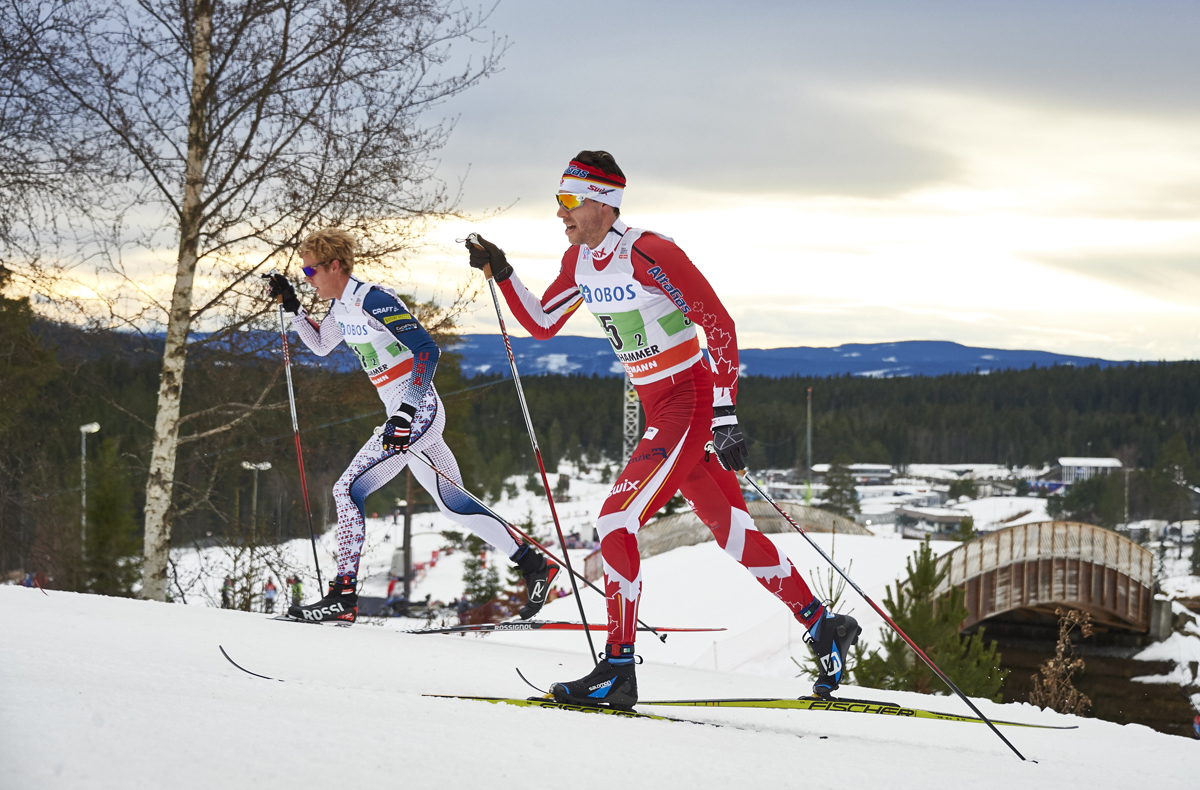
American Erik Bjornsen (far) and Alex Harvey of Canada (near) ski together in the second classic leg of the 4 x 7.5 k relay at the World Cup in Lillehammer, Norway. (Photo: Fischer/NordicFocus)
On Sunday, Erik Bjornsen of the U.S. Ski Team showed the world there’s a lot more where that came from when it comes to his classic skiing. Same goes for the U.S. men’s relay team, which flirted with fifth for at least a third of the men’s 4 x 7.5-kilometer relay at the Lillehammer World Cup in Norway. The U.S. men slipped back in the final kilometers to finish 12th, ahead of Canada in 13th.
Bjornsen, 24, clocked the fastest second-leg time of 18 teams on Sunday. He skied the second classic leg for the U.S. and completed the three-lap 7.5 k course in 19:07.9. Bjornsen was 5.7 seconds faster than Mathias Rundgreen of Norway’s third team, which ultimately placed second overall.
After receiving the tag from Andy Newell in 15th, 35.9 seconds behind the leaders (Norway’s first team: Niklas Dyrhaug, Hans Christer Holund, Martin Johnsrud Sundby, and Petter Northug Jr., which went on to win), Bjornsen lifted the U.S. to fifth, 27.4 seconds back by the race’s halfway point.
The World Cup relay returned to Lillehammer for the first time since 2013, when the U.S. women placed third to match a team best. On Sunday, the U.S. women’s team of Rosie Brennan, Sadie Bjornsen (Erik’s older sister), Liz Stephen, and Jessie Diggins repeated the feat — reaching the podium for the third time in three years in third place.
The men’s race followed on a 2.5-kilometer course. Just like in the women’s race, Norway dominated the men’s relay, entering four teams in both races for a total of 32 athletes.
Inspired by their female teammates (“That was pretty cool to see them back on the podium where they should be,” Noah Hoffman said), the U.S. men — with Newell, Bjornsen, Hoffman, and Simi Hamilton — charged hard from the start. Newell put them in third 1.2 k into the first classic leg. However, by 5 k, the Norwegians made it clear that it wasn’t a question as to whether Norway would win, but rather which Norwegian team would top the field.
Alex Harvey (Canadian World Cup Team) on his way to 10th in the men’s 30 k skiathlon on Saturday at the World Cup in Lillehammer, Norway. (Photo: Fischer/NordicFocus)
By the end of the first leg at 7.5 k, Norway’s top-three teams shared the lead. Italy’s Federico Pellegrino had snuck into third, 2.8 seconds back, while Canada’s Devon Kershaw handed off to Alex Harvey in 13th and Newell tagged Bjornsen in 15th.
“Whether you get tagged in fifth or fifteenth, it doesn’t change the way that you race,” Hoffman, the third leg, said on the phone. “You have to go out there and do the best that you can against the people that are around you and put together the best race that you can.”
This is the exact the strategy that Bjornsen applied during his relay leg. Skiing within the top 20 of the classic first half of Saturday’s skiathlon, Bjornsen explained in a phone interview on Sunday that he’s feeling good about his classic skiing.
“Once I feel the classic coming together then I know that I’m in good fitness,” he said. “The kick feels snappy so that’s helping on those hills. There’s a lot of transitioning on the Lillehammer hill and when you’re feeling good, it’s a really fun hill to ski.”
Bjornsen explained that the Lillehammer course, as tough as it is, worked in his favor..
“The hill is long and hard, but there’s a few benches that you can go from your tight stride to more stretched out, and that’s when I usually feel pretty strong,” he noted. “If I can relax in those positions, I feel like that’s one of my strengths. Whenever I was next to someone, I was pretty relaxed and confident.”
Erik Bjornsen racing the scramble leg for the U.S. in the 2015 World Championships relay in Falun, Sweden. The men’s relay went on to place 11th with Bjornsen, Hoffman, Kyle Bratrud, and Simi Hamilton. On Sunday at the World Cup in Lillehammer, Norway, the U.S. men placed 12th in the relay.
U.S Ski Team Head Coach Chris Grover reflected on the phone that “Erik in particular looked like he was having an incredible race,” he said. “He had a super-strong classic leg in the skiathlon yesterday so we knew he was in incredible shape and that classic skiing is feeling really good for him.
“We knew that he would be able to pull it together, but I don’t think that we anticipated that it would be as good as it was,” Grover added, referring to Bjornsen’s relay performance.
Bjornsen fought all the through his 7.5 k leg, and by the end of it, he had reeled his team into fifth place — 27 seconds behind Norway’s first team — with the fastest second leg. Bjornsen was pleased with his race, explaining he was “pretty surprised but happy to see that I was the fastest of that leg with some of the fastest classic skiers in the world.”
His skis helped. “We had some great performances out of all the [athletes], but really also from the service team,” Grover said. “Those guys really hit it out of the park … So it was really a big effort not only from the group of women and the guys but also from the entire staff.”
Bjornsen explained that he’s been working hard with his wax technicians to do just this, especially on days like Sunday in Lillehammer with hard, icy conditions — where choosing the right grip wax can be as challenging as keeping it on.
“Usually the women race before the men so we have limited time on the course,” Bjornsen explained. “So it’s important to come up with a strategy with your technician to make the best of your time … and try to dial in your kick and glide as best as you can. … That’s one thing that I’ve been trying to do better this year and it worked out this weekend.
“I was very happy with my classic skis both today and yesterday,” he added. “It was tricky conditions today so I went for a stronger kick, which was tricky on the corners because it was grabbing a little bit. I think that I did a good job with my wax techs dialing in the kick and foreseeing the fact that a lot of guys were going to be losing kick on some of the fast corners.”
Noah Hoffman (U.S. Ski Team) racing to 34th in the men’s 15 k freestyle at 2015 World Championships in Falun, Sweden.
Bjornsen had a slight slipup on his second lap, falling to the ground when a Norwegian fell in front of him.
“I was in a group of five or six guys, and it was just one of those hairy corners that was icy and I was trying to get around this guy and just went down right next to him,” he explained. “Luckily I didn’t lose too much time. I got up and used my anger to go a little harder.”
Bjornsen handed off to Hoffman, and in a phone interview, Hoffman couldn’t say enough about how well Bjornsen set him up for his skate leg.
“Today all comes down to Bjornsen and how incredibly he skied, bringing us from 15th to 5th and having the best time of the day,” Hoffman said. “He set us up in a great position and I had some great drafts to ski with thanks to him. It was really impressive.”
“Today all comes down to Bjornsen and how incredibly he skied, bringing us from 15th to 5th and having the best time of the day.” — Noah Hoffman, on U.S. Ski Team teammate Erik Bjornsen
The third leg, Hoffman also skied an impressive 7.5 k, holding the USA’s position in fifth with the fifth-fastest time among his leg. Starting 13 seconds behind Norway II in fourth and three seconds ahead of Sweden in sixth, he tried not to stress about those around him.
“I was tagged less than 10 seconds ahead of [Russia I’s Alexander] Legkov and [Italy’s Roland] Clara, and those guys skied back into me very quickly,” Hoffman explained. “I didn’t go out and intend on staying ahead of them the whole time, but I knew they were going to be great rides.
“The crux of my race wasn’t in being able to hold them off in them end, and being caught by them wasn’t a big part of my race,” he added.
Legkov ended up moving into third for Russia at the final exchange, while Hoffman tagged Hamilton about 15 seconds out of fourth in fifth, 50 seconds back from the Norwegian leaders.
“I ended up skiing with [Sweden’s Martin] Johansson and Legkov,” Hoffman said. “I felt pretty relaxed skiing with them for the first couple of laps, but I couldn’t quite hang onto them on the big hill on the course.”
Simi Hamilton of the U.S. racing to his first-ever distance points last season in Oberstdorf, Germany. (Photo: Marcel Hilger)
On the final leg, Hamilton slipped to 11th between 4 and 5 k. According to Grover, it was more of a positioning factor that made it difficult for him to hold onto fifth.
“It was a bit unfortunate for Simi to get tagged off in no-man’s land, and to have so many teams starting 10 seconds in front and behind him, as well as having so many great distance skaters,” Grover said, referring to Sweden, Germany, Norway IV, Italy, and Switzerland heading out 10-15 seconds after Hamilton.
“He tried to hold them off, but those guys were charging hard and they were able to work together and to draft,” Grover said. “He was kind of out there by himself so he got a bit chewed up.”
“It was a great ski by him, a great ski by Andy, and a great day of skating by Noah,” Grover summarized. “For our men to do 4 x 7.5 kilometers and to only be 1:30 back at the end is quite a performance from us.”
The Americans finished 12th overall, 1:20.6 back from Norway I as the winners.
Sundby pulled away from Norway III’s Simen Andreas Sveen in the middle of the third leg to give his team the lead. Sundby tagged Northug with a 14-second cushion to second place, and skiing uncontested throughout his 7.5 k, Northug sealed the victory in 1:13.25.7. The home nation swept podium with Norway III 2.8 seconds back in second and Norway II 14.8 seconds back from the win in third.
Finishing 20.9 seconds behind the U.S., Canada placed 13th with Kershaw, Harvey, Ivan Babikov and Graeme Killick.
“We had lots of opportunities today to move up, but we just failed to do that,” Canadian National Team Head Coach Justin Wadsworth said on the phone.
He explained that the the team struggled with their classic skis on Sunday, and also noted that for Harvey, the focus of Sunday’s race was less on results than it was for future preparations.
“With Alex, his skating has been feeling better than classic, which is why he felt like he wanted to do a classic leg today,” Wadsworth said.
Harvey skied the sixth-fastest second leg, 12.5 seconds slower than Bjornsen. After receiving the tag from Kershaw in 13th (+34.4), Harvey brought the team to 12th (+38.4). Babikov stayed in 12th (+1:16.8), and Killick closed the race out in 13th (+1:41.5) for Canada.
“Maybe it was’t the best strategic move for the relay to put [Harvey] in classic, but we’re also using these races to prepare for other races,” Wadsworth explained. “So it was an opportunity for him to get another classic effort in.
“I think we’re headed in the right direction. The results on the men’s side [Saturday] were really positive and we’re always in the hunt for a podium since we’ve started racing,” Wadsworth added.
“For Killick, it’s more top 30s and I think Devon and Ivan can also build from [the skiathlon] and look forward to the Tour de Ski,” Wadsworth said of the multi-stage series at the end of the month. “That’s really where we start to have our better results. We don’t normally ski super fast before Christmas, but Harvey’s results this year are similar to what we saw the year that Devon was second overall [in the World Cup], so we’re just trying to build. I think things overall are positive”.
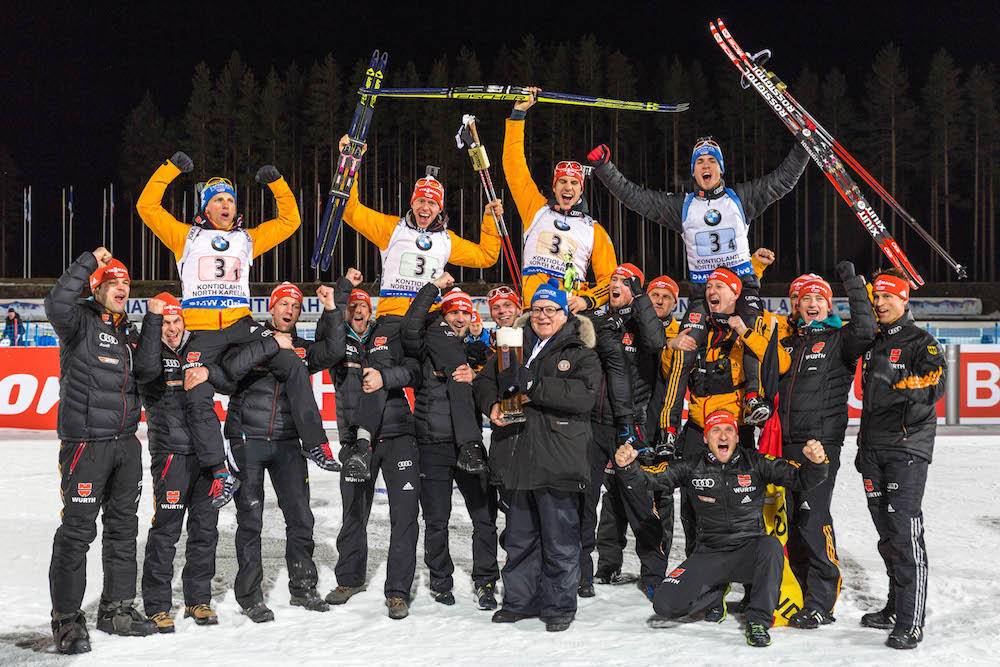
A happy German team celebrates its second win in two days of relays at 2015 IBU World Championships in Kontiolahti, Finland, with the men’s 4 x 7.5 k victory on Saturday. Above, from left to right: Erik Lesser, Daniel Böhm, Arnd Peiffer, and Simon Schempp. (Photo: Kontiolahden Urheilijat/Kari Kuninkaanniemi)
KONTIOLAHTI, Finland — After more than a week of waiting, Simon Schempp could finally enjoy the 2015 IBU World Championships in Kontiolahti, specifically the last two hundred meters of the men’s 4 x 7.5-kilometer relay and everything that came after that.
Schempp, 27, had been given the task of anchoring the German team on Saturday, and after two races in which he failed to medal (including his 77th place in the sprint), it seemed like a tall order.
But Schempp spent much of this season ranked second overall in the IBU World Cup, so he simply needed to restore his confidence back to its pre-World Championships level. He did so in Thursday’s 20 k individual, placing eighth.
“I caught the self confidence for today and was prepared for this relay,” he explained in press conference after Saturday’s relay.
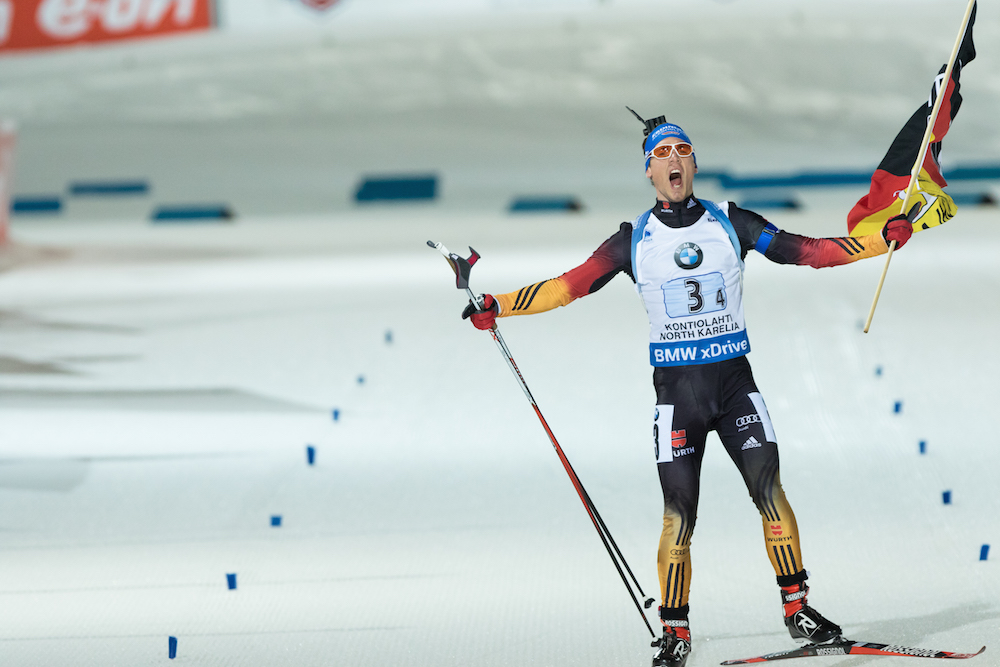
Germany’s Simon Schempp soaks up his team’s victory after anchoring the men’s relay to gold on Saturday at 2015 IBU World Championships in Kontiolahti, Finland. (Photo: Kontiolahden Urheilijat/Risto Kuittinen)
Things were better then — he had secured a 15.4-second victory for his team, matching the gold the German women won in the 4 x 6 k relay the day before.
His teammate Arnd Pfeiffer shot a perfect 10-for-10 on the third leg to tag him in first at the final exchange, 15.3 seconds ahead of Norway. Schempp proceeded to clean prone without any need for spares then used a single spare in standing to leave the range for the last time 15 seconds ahead of Emil Hegle Svendsen in second.
Svendsen also shot clean on his first stage and used a spare in standing to neither make up nor lose ground to Schempp, which he tried to change on the last lap. Meanwhile, French anchor Martin Fourcade went from fifth (behind the Czech Republic and Slovenia) to fourth on his first lap and used one spare to emerge from prone in third, 41.6 seconds out of first and 28.3 seconds from second.
The next time and final time around, Fourcade rattled off five quick shots to clean standing with the second-fastest range time. He remained in third, but within 25.6 seconds of Schempp and 10.6 of Svendsen.
Considering that, Svendsen had to think about defending silver and pressing for gold simultaneously on his last 2.5 k loop.
“I just tried to ski fast and didn’t look much behind,” Svendsen said in the press conference. “I tried to catch Simon, but had no chance.”
After being cheered on by his teammates while leaving the range, Schempp extended his gap to 19 seconds a kilometer into the final lap, then 20.9 seconds less than a kilometer later.
He finished 15.4 seconds ahead of Svendsen, taking the time to enjoy the finishing stretch while carrying the German flag.
“Only the last two-hundred meters I could enjoy because before, I gave all I have,” Schempp said. “I’m really happy and proud to be a part of this team.”
The Germans achieved gold with first and second skiers, Erik Lesser, who won the pursuit last Sunday, and Daniel Böhm, who opened the championships in sixth with the mixed relay.
Lesser hit all 10 of his targets without any problems to hand off in third, 6.4 seconds behind Norway’s Ole Einar Bjørndalen, who also cleaned to take the lead, and France’s Simon Fourcade, who cleaned as well to trail in second.
“I think all the team was determined to get a medal today,” Simon Fourcade said in the conference. In the last week, he placed fourth in both the sprint and 20 k individual.
“I know the relay is not only about me; I wanted to do my best on the first leg to give the best position to [my teammates],” he added.
During the second leg, Norway dropped to fifth with three standing spares from Tarjei Bø. Jean-Guillaume Béatrix used one spare in each stage to bring France into first by the second exchange, 0.7 seconds ahead of Italy and 3.1 seconds ahead of Böhm — who used two standing spares to keep Germany in third.
“Today, I felt a lot of tension in our team. Everybody wanted to have this victory,” Böhm recalled. “Watching the two others after me was harder than skiing.”
“I felt a lot of tension in our team. Everybody wanted to have this victory. Watching the two others after me was harder than skiing.” — Daniel Böhm, Germany’s second leg on its gold-medal winning relay
Just over a year ago, the German men took silver in the 2014 Olympic relay behind Russia. They had the same team and same order.
“I was very nervous today, even more nervous before the individual races,” Peiffer said.
Johannes Thingnes Bø of Norway leads Germany’s Arnd Peiffer up and over the wall during the third leg of the men’s 4 x 7.5 k relay at 2015 IBU World Championships in Kontiolahti, Finland. Germany went on to win gold and Norway took silver ahead of France. (Photo: Kontiolahden Urheilijat/Janina Joutsen)
He took the lead with a flawless prone, leaving the range 2 seconds ahead of Norway’s Johannes Thingnes Bø, who also cleaned. Bø passed him early in the lap and the two skied together into the range for standing. There, Peiffer cleaned again and Bø used a spare, which made the difference.
“I knew that I was together with Johannes and it was going to be a hard last lap so I tried to save some energy and tried to [have a] good standing shooting,” Peiffer explained.
He left the range 13.3 seconds ahead of Bø, and the Czech Republic’s Michal Slesinger moved into second during that last lap of the third leg, coming within 14 seconds of Peiffer. Bø passed Slesinger back before the exchange, and the Czech tagged in third — one tenth of a second behind Norway.
With Ondrej Moravec skiing the last leg, the Czech Republic slipped to fourth with his three prone spares. Russia’s Anton Shipulin and Austria’s Dominik Landertinger both hit every standing target without any slipups to overtake Moravec before the final lap. The Czech fell to sixth, where he would end up at the finish, behind Russia in fourth and Austria in fifth.
While Germany won in 1:13.49.5 and Norway was 15.4 seconds back in second, Fourcade pushed hard on the last lap aim for silver, but came up 18.2 seconds short in third.
“I was really happy to conclude what the team did,” Fourcade said in the conference. “Jean-Guillaume and Simon [Fourcade] were perfect on the track and on the shooting range. I think we had a bit more pressure, but we are really satisfied with this third place.”
Bailey Surges for Early Lead
AmericanLowell Bailey thrust himself into the spotlight as the first skier for the U.S., taking the lead 1.8 k in and holding it as he and the 27-team field approached the range for the first time.
Lowell Bailey (US Biathlon) led early as the first leg in the men’s 4 x 7.5 k relay at 2015 IBU World Championships and ultimately handed off in seventh. The U.S. ended up 14th with two penalties and 11 spares in Kontiolahti, Finland. (Photo: USBA/NordicFocus)
Perhaps even more impressive was the fact that Bailey started near the back of the pack in the seventh of nine rows.
While the start was congested from his vantage point, Bailey explained he was able to use his fast skis and an eye for an opening before the first descent to move toward the front. By the first uphill, he found himself around fourth.
“Then I got to the front, and I think [Austria’s Daniel] Mesotitsch was trying to slow things down,” Bailey said. “On the wall, I just figured there’s no real advantage in this range to go in third or fourth. Normally it can be, but in this range, being in first is fine.
“I was just going my own pace and I wasn’t sure where that would end up, but I figured there can’t be any harm in going to the front and staying up there,” he added. “No one wanted to pass and that was fine with me.”
During that prone stage, Bailey cleaned without any spares and left the range in sixth, 3.6 seconds out of first. The following lap, he pushed the pace once again on the “wall,” the course’s biggest climb, to move into second behind Mesotitsch.
American Lowell Bailey (r) enters the range for prone with race leaders Daniel Mesotitsch of Austria (second from r), France’s Simon Fourcade (second from l), and Norway’s Ole Einar Bjørndalen (l) during the men’s 4 x 7.5 k relay at 2015 IBU World Championships in Kontiolahti, Finland.
Bailey entered the standing stage with the leaders, where he used two spares to clean standing and slipped to ninth, nearly 23 seconds out of first. He went on hand off to teammate Leif Nordgren in seventh, 30.3 seconds back.
“I lost contact with that lead group, but all in all, I was pretty happy with it,” Bailey said of his race. “Using two extras, that’s an extra 20 seconds, but what we want to do today is, if we all can perform at our normal capacity, then I think we can have a solid result. It’s not like all four of us have to shoot the moon. We all have to have good, solid days.”
On a good day, the U.S. would finish with less than eight spares, he said. Even better would be if they ended up with six.
“It’s not like all four of us have to shoot the moon. We all have to have good, solid days.” — Lowell Bailey (US Biathlon)
Despite Nordgren keeping the team in contention, using one spare in each round and tagging Tim Burke in eighth at the second exchange, the Americans ended up with more extras and penalties than they’d hoped.
Burke used one spare in prone then all three in standing before skiing two penalty laps. When Nordgren tagged him in eighth, Burke had been 34.7 seconds out of first. By the time he handed off to anchor Sean Doherty, the U.S. was 2:22 back in 15th.
Leif Nordgren (US Biathlon) leads Jaroslav Soukup (Czech Republic) while skiing the second leg for the U.S. men’s relay team at 2015 IBU World Championships in Kontiolahti, Finland. After receiving the tag from Lowell Bailey in seventh, Nordgren handed off to Tim Burke in eighth. (Photo: USBA/NordicFocus)
“Standing, I bobbled the spare a little bit … it was probably an extra second or two,” Nordgren explained of his second leg. “I came back again with one extra and pushed as hard as I could the last loop. In the relay, you just have to do what you can, and hopefully it comes together [for] all four of us.”
Doherty used all three spares during prone, but escaped without a penalty to hold onto 15th. In standing, he hit every target without any extras to move into 14th.
He finished 14th, 3:31.6 behind Germany and 6.5 seconds after Finland in 13th. In all, the Americans had two penalties and 11 spares.
“I stared pretty hard and I paid for it in prone,” Doherty said. “I had a good skiing day today and course is in good shape, so it was fun, but it was tough to be out of the mix a little bit.”
Earlier this season, Doherty, 19, skied the second leg on the U.S. men’s relay, which placed eighth at the World Cup in Antholz, Italy. Before that, he was the third leg on the team that placed 16th at the 2014 Olympics.
In terms of what it felt like to anchor his first World Championships relay, Doherty said he didn’t read too much into the start order.
“It’s a compliment in a way if they think I’m mature enough as an athlete to handle that role well,” he said. “It wasn’t the same pressure as if we were fighting for the medals, but still, I’m not gonna want to miss.”
Christian Gow Gets Up Front, Smith Shoots 10-for-10
Starting Saturday’s race off for Canada, Christian Gow started in the second row in bib 6 and moved into fifth by 1.8 k. Following Bailey, he entered prone in the lead pack, around seventh.
Christian Gow (Biathlon Canada) approaches the range for his standing stage during the men’s 7.5 k relay at 2015 IBU World Championships in Kontiolahti, Finland.
“I thought quite a bit about the start of this race and just the way the course flows,” Gow, 21, explained.
He wanted to avoid the accordion stop-and-go effect of being near the back before short pitches and any crashes on a particularly icy downhill corner.
“I knew I wanted to be right with the top guys,” Gow said. “I knew that was totally possible. I had a blast on that first loop. … It felt so easy to just stay right at the front. That’s an amazing feeling. I know it doesn’t mean much, per say, but to be able to ski with some of my idols and just feel so relaxed, like really feel like I belong in that group, the relays are for sure my favorite for that. It’s such a great experience and so much fun.”
In prone, he used two spares to drop to 24th, 27.5 seconds out of first. He moved back into 23rd heading into the range for standing, before using another extra there and heading into his last lap in 22nd.
“I’m really happy with what I did skiing,” Gow said. “I finally felt strong on skis, but my shooting wasn’t quite there. I think I was pretty nervous coming in just so far up. I don’t think I was quite as settled as I should have been.”
Gow tagged teammate Nathan Smith in 22nd, 1:20 back. Smith proceeded to shoot a perfect 10-for-10 with the fastest shooting and fourth-fastest course times of the second leg to bring the Canadians to 10th.
“It was actually a really good race for me, my second best race here,” said Smith, who earned silver in the sprint last weekend. “I skied pretty relaxed. It was pretty icy, though, so my shins were hurting by the last lap. If I can do a race like today again tomorrow [in the mass start], it will be a really good result.”
In terms of team goals, he said their “middle goal” was a top eight, “really good would have been top six.” At the last World Cup relay in Oslo, Norway, the Canadian men placed fifth with the same lineup. They were seventh at the Olympics with Jean-Phillipe Le Guellec, Scott Perras, Brendan Green, and Smith as the anchor.
“It’s so fast right now that if you have a few spares, it puts you way back, more than normal,” Smith explained of Saturday’s boilerplate conditions.
After he tagged Scott Gow in 10th, 44.8 seconds behind the leaders, Gow used all three spares and had two penalty loops in prone to fall to 19th, 2:11.1 out of first.
“The whole race wasn’t very good,” Scott Gow said. “I felt good going into today, but I was gassed the whole time and then prone was really bad, I have no idea what happened there.”
In standing, he used two more spares but remained in 19th, 3 minutes back, before tagging Green in the same position, 3:48.5 behind.
“[I] was so far back that they only thing I could try to do was to ski hard and try to make up as much time as possible. It couldn’t get any worse so it was worth just going for it,” Scott said.
“We came in fifth in Oslo, we’ve had sixth places, top tens before, so I think the expectation was if everyone pulled their own weight and put in little bit extra in the range, that we could walk away with a top eight and maybe another fifth place would be great,” he added. “It’s a little disappointing to not even be close.”
Receiving the tag 40 seconds behind Sweden, which was 18th, Green said he raced hard for a couple laps to see if he could catch its anchor, Ted Armgren, but he was too far ahead.
Green cleaned prone and used one standing spare to maintain 19th and avoid being lapped, which happened to Poland in 20th as well as seven other teams behind them.
“On the last loop, the techs told me I had a cushion so I was able to relax and kind of coast it home,” Green said after finishing 19th, 5:03.4 behind Germany.
In all, the Canadians had two penalties and nine spares.
“Today definitely didn’t turn out the way were hoping, but the guys tried their best,” Green said. “It happens from time to time. It’s always unfortunate when it’s at World Championships, but you’ve got to roll with the punches, I guess.”
He said his solid-shooting streak was a good indicator for Sunday’s mass start, which he qualified for along with Smith for Canada, and Burke and Bailey for the U.S.
“I’m definitely a little tired. Tomorrow will be the sixth race [here], but I’m definitely excited at the opportunity,” Green said. “Mass starts are always a lot of fun and pretty tense, so looking forward to it.”
Scott Gow took the Canadians from ninth up to fifth place in the third leg of the World Cup men’s relay in Oslo, Norway, on Sunday. (Photo: Biathlon Canada/NordicFocus)
When Brendan Green crossed the finish line of Sunday’s 4 x 7.5-kilometer relay at Holmenkollen in Oslo, Norway, he was in fifth place.
It wasn’t simply a good day for Green, or a personal best. That fifth-place finish was the best men’s relay ever in Biathlon Canada’s history.
“It was a really good day for our team,” Green said in a phone interview. “Last night we had a team meeting and talked a little bit about the potential for our team. We talked about our specific start order and what we thought we could bring to the team on each leg. And today things definitely came together for us. Everyone had really solid legs for the relay.”
The Canadians finished a minute and 35 seconds behind the winning Russian team. The stellar result comes in a season which has seen substantial changes to the World Cup roster. Star Jean Philippe Le Guellec retired after the 2014 Olympics, and Scott Perras is back in Canada training.
The Canadian men’s relay team of Christian Gow and Brendan Green (left) and Nathan Smith and Scott Gow (right) poses with head coach Matthias Ahrens in Oslo after placing fifth in the 4 x 7.5 k competition. (Photo: Rosanna Crawford)
Instead, since the first men’s relay this season in Oberhof, Germany, Canada’s relay team has included 21-year-old Christian Gow, who skied leadoff and is in his first season on the World Cup. Gow shot like a pro, cleaning all ten of his targets without touching his spare rounds and tagged off in 14th, 50.5 seconds behind Germany’s Erik Lesser.
“I was pretty confident that I would be able to clean the race today,” Gow wrote in an email. “I have been shooting really well all season and felt awesome in zero. You never know if everything will line up completely right for that 100%, but I was confident today and was happy to achieve it!”
Canadian Head Coach Matthias Ahrens wrote that Gow’s performance had never been a question mark in his mind.
“I believe Christian had proven some good relay qualities in previous relays in Oberhof and Antholz already with good shooting efficiency,” he explained.
Gow is learning to deal with the excitement and the pressure of the World Cup.
Christian Gow (foreground) gunning his way through the first leg of the World Cup men’s relay in Oslo, Norway. (Photo: Biathlon Canada/NordicFocus.com)
“The past several relays have all been a great learning experience for dealing with the more unique aspects of World Cup racing, such as the incredible noise from the stands, or racing next to one of your personal idols,” he wrote. “I honestly hardly thought about the crowd today, and I don’t think too much about the guys around me either. When I am in the range I am focused on what I am doing and I try not to think about anything else.”
That showed, and Gow’s work on the range upped the ante for his teammates – including his brother Scott, who was racing the third leg of the relay.
“Seeing Christian clean was one part inspiring and one part nerve-wracking,” Scott Gow wrote in an email. “It was awesome to see him shoot so well and set the tone, but at the same time it added pressure for me to do well too and build on his great opening leg. Overall I would say it was motivating but I was definitely nervous waiting for Nathan to tag me.”
Nathan Smith, the second-leg skier, turned in a strong performance of his own. He used a spare round in each shooting stage and moved the team up to ninth. But more importantly, by turning in the second-fastest ski time he cut ten seconds off of the team’s gap to the leaders.
“I had a lot of confidence in my shooting and knew that being the third race of a weekend, I would probably also have a really strong ski day,” Smith wrote in an email. “Shooting went pretty well, it was a little windy. The only disappointment was missing my last prone shot. I think I just got a little ahead of myself.”
“Christian [Gow] is a really good shooter, and he’s really fast, so he has always been reliable. That first leg is a great place for him and he gets the job done really well in that position.” — Brendan Green
For Scott Gow, who used two spare rounds and moved the team up to fifth, things just came together on Sunday.
“I felt the best on skis today since before Christmas,” he wrote. “I had a decent opening lap which is unusual for me, and I was able to maintain speed for the whole race with a nice kick at the end to pull into 5th. I lost some time in standing, but prone was solid and my skiing was good enough to keep the team in the mix.”
Green dropped the team to sixth, briefly, after using two spares in prone, but skied back up to fifth.
Brendan Green anchoring the Canadian relay in Oslo. (Photo: Biathlon Canada/NordicFocus)
“It was a little bit tricky wind in prone,” Green said. “It was a complete 180 from zeroing. I hit my first three shots but then missed the next two, so I sort of paused before I loaded my spares and made that extra correction.”
After cleaning standing, Green then turned in the second-fastest closing loop to hold onto it, despite fears of challengers from behind.
“I was able to leave the range just ahead of Italy and Ukraine,” Green said. “I knew they were close behind. So on that last loop I really tried to redline it and go as hard as I could. And I knew France was close – partway through my loop I could hear some cheering and I thought, oh man, Fourcade must be closing in. So then I tried to really go for it and not look back, and hold those guys off.”
For all the team’s members, the race was a culmination of the Oslo weekend. Smith had drawn on his confidence from finishing 12th in the 20 k individual; Scott Gow had focused on the lessons he learned in the earlier races of the weekend.
“My skiing wasn’t great in the individual and, despite shooting 85%, didn’t shoot well enough for a good result,” he wrote of finishing 60th in the 20 k. “After that race I wanted to refocus on skiing efficiently and being more deliberate in the range, and that’s exactly what I was able to accomplish on race day in the Sprint. My result in the sprint race gave me added confidence for today’s relay. I wanted to use today as an opportunity to build on my skiing and shooting and try to do better.”
And for Christian Gow, he acclimated back to Europe after heading home to Canada for a training break and then sitting out the 20 k due to jet lag.
“It was great to get back here on the World Cup again after my brief break back home,” he explained. “I think it was important for me that I took a break in order to feel ready to go for the next month of racing.”
The youngest team member is now looking forward to his first World Championships experience. And with the best-ever result in their back pocket, Canada is looking forward, too. Their relay there will have the same roster, likely in the same order.
“I think today’s result showed all of us the type of placing we can achieve,” Christian Gow wrote. “From that standpoint I think it will give us a bit more confidence, but also more drive to keep pushing for an even better result.”
“A result like today will definitely give us a little extra confidence and motivation heading into the two week break and World Championships,” Smith agreed. “Another top 6 is what we’re aiming for. Outside of the World Champs, Nations Cup points are especially important for us this year. Right now we’re sitting in 8th which means 5 start spots for next year. It would awesome to grab that extra spot for the Canmore World Cups in 2016.”
The Norwegian men celebrate after winning the 7.5 k team relay in Antholz Sunday. (Photo: IBU/ChristianManzoni)
A spell of nice weather in Antholz, Italy broke Sunday with a cold wind blowing across the team relay competition to conclude an extremely busy month of IBU World Cup action.
As competitors overcame the packed schedule, the thin air of the South Tyrol mountains wasn’t done with them yet, as a steady breeze made shooting a toss-up. The 7.5-kilometer course was composed of three laps of skiing and two rounds of shooting for each of the four competitors.
Norway took the men’s relay victory, with only five spare rounds used by the four men in 16 rounds of shooting. Germany was close behind, in second (+16.4), with seven spares used. France, who was missing their ringer, Martin Fourcade, took third (+42.0) also with five spares used.
Both the United States and Canada made the top-10, with the U.S. in eighth (+3:28.9) after three misses in prone and 17 in standing. Canada finished in ninth (+3:36.1) with one miss in prone and 15 in standing.
Germany took the lead early on, with Erik Lesser shooting clean and taking first, barely holding France’s Simon Fourcade to second place after also shooting clean. Norway’s Ole Einar Björndalen missed one shot in standing to bring Norway in in third.
On the second leg France briefly pulled into the lead as Quentin Fillon Maillet out-skied and out-shot Germany’s Daniel Boehm. The lead did not last, as Norway’s Johannes Thingnes Bø had a remarkable third leg, cleaning and bringing Norway from third to first place. Germany’s Arnd Peiffer was hot on his heels, only a half-second behind after only missing one in standing. France’s Simon Destheiux struggled on the range and course during his second and third laps, and moved France back to third place.
Meanwhile, Norway’s Emil Hegle Svendsen took the tag just moments ahead of Germany’s Simon Schempp, and opened his lead with perfect shooting, allowing Norway to take the win. France finished nearly half-a-minute back, battling with Austria’s Simon Eder, who took fourth (+49.8) with seven spare rounds used by the team. Russia took fifth (+58.5), with six spare rounds used.
For the Americans, Lowell Bailey started and stayed ahead of Canada’s Christian Gow. However, Gow used only one spare in each shooting stage compared to Bailey’s three, putting Canada in ninth and the US in tenth. On the second leg, American Sean Doherty moved the U.S. into eighth, while a long time spent shooting by Brendan Green moved Canada to tenth. Tim Burke kept the U.S. in eighth in spite of struggling with shooting in the second round, using all of his spares in standing and prone. Canada’s Scott Gow moved Canada back to ninth on the third leg. Leif Nordgren skied the final leg for the U.S., with Nathan Smith finishing for Canada. On the first lap Smith pulled ahead of Nordgren, but Nordgren was able to pass Smith back to take eight place, eight seconds ahead of Canada.
The teams will get a break until World Cup resumes in Nove Mesto on February 6th.
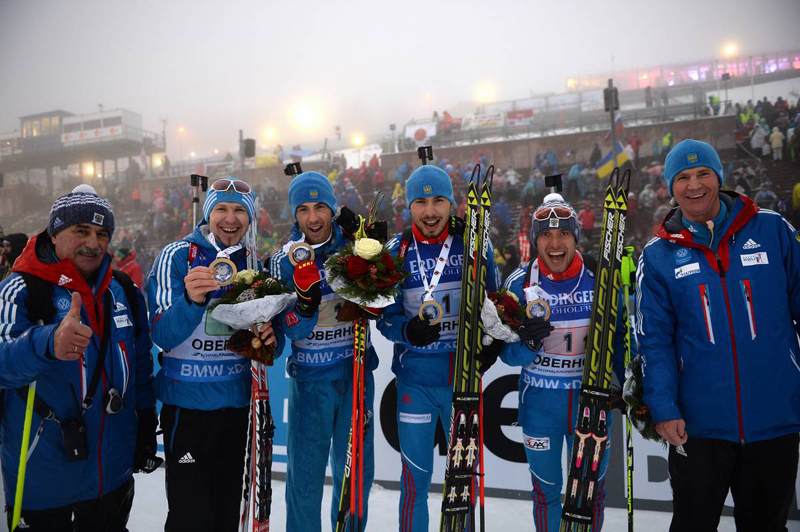
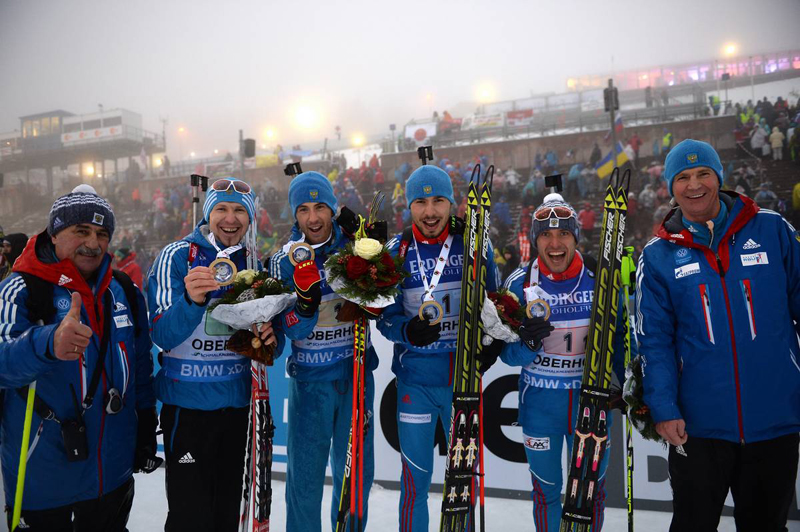
The Russian men’s relay team including; Timofey Lapshin (RUS), Dmitry Malyshko (RUS), Anton Shipulin (RUS) and Evgeniy Garanichev (RUS) show their hardware from the IBU World Cup biathlon, relay in Oberhof (GER). (photo: Fischer/Nordic Focus)
Heavy fog in Oberhof, Germany, on Thursday pushed back the start of the IBU World Cup 4 x 7.5 k relay, and then obscured both the targets and the race course as the world’s top male biathletes battled their way through the race. But even a delay, tough conditions, and a 57 second deficit going into the final leg couldn’t keep the Russian team of Evgeniy Garanichev, Timofey Lapshin, Dmitry Malyshko, and Anton Shipulin from gold.
It was Shipulin who did the hero’s work for Russia. He skied the fastest course time of all the anchor-leg skiers, and also turned in remarkable shooting – just one spare round over the two shooting stages combined. On the final loop, he closed a ten-second gap to Norway’s Ole Einar Bjørndalen, then passed him, accelerated up the final hill, and celebrated as he crossed the line with a two-second win.
“Everything was good today, shooting and running, and so I am so happy that we won,” Shipulin said in a press conference.
Impossible conditions
Strong winds, dense fog, and slushy snow made both skiing and shooting a challenge. Even with three spare shooting rounds available in each shooting bout – a luxury available only in relays – just two of twenty-four nations escaped the day without penalty loops. As wind battered their race bibs and they squinted to see targets, the men missed almost more targets than they hit. Russia’s 12 spares set a new low for shooting by a winning team – and yet represented remarkable accuracy, given the conditions.
“Every one of us had some problem or other on the shooting range, but we struggled to victory,” Malyshko said through a translator at the post-race press conference.
All teams in the top six saw at least one trip to the penalty loop. The three medal winners, Russia, Norway, and France had one-a-peace; Germany and Ukraine each had two; in six Switzerland had six penalties.
Athletes struggled on the ski trails as well; Ukraine, Canada, Poland and Finland are just a few of the dozen nations that had crashed during the race.
“Marco [Bedard] fell but he is OK,” Canadian National Team Coach Roddy Ward wrote in an e-mail. “No broken equipment either. The conditions on the downhills were very tricky. There were a lot of falls!”
The Czech Republic team, whose women claimed the win in Wednesday’s 4 x 6 k relay, was forced to withdraw before completing their first leg after a major crash by Michal Krcmar.
“We actually thought the race was going to cancelled until about 5 minutes before the start.” Nathan Smith told FasterSkier in an email.
Another athlete took a wrong turn at a trail intersection because visibility was so bad.
Even Sweden was disqualified for using four spares in one bout of shooting, one more than the allowed three extra rounds.
And then there was the rainy snow, something like being in a cloud.
“The main challenge today was not to get cold,” Lapshin said in a post-race press conference. Biathletes have a word for this weather: “Oberhofing”.
“Today it was a very hard competition,” Jean Guillaume Beatrix of France said. “Every year it is the same in Oberhof, conditions for warriors. We just try to be as strong as possible.”
Lead Changes and Errors
The opening leg already saw Russia, Latvia, and France beginning to take advantage of tough shooting conditions by slightly getting away from the rest of the field for the first transition. The French team was ager to prove their abilities without the participation of French superstar Martin Fourcade. His brother Simon said in the press conference, “Jean Guillaume [Beatrix, a teammate] has a good joke about this, the women had a podium yesterday without Martin, so why not us?”
The second 7.5 k leg of the race was the point that brought Norway into striking distance of Russia and France. The experienced Alexander Os brought solid shooting in the windy range, putting Norway less than 10 seconds off the lead pack. He is one of several men vying to complete Norway’s roster for World Championships, and was happy with his effort: “I am satisfied,” he said in the press conference.
Germany was fourth and Canada, boosted by Nathan Smith, fifthbefore the second exchange. But on the third leg it looked like Norway had run away with the race. Johannes Thingnes Bø easily closed the gap to France and Russia, then clean prone shooting put him eighteen seconds ahead of Russia and twenty-seven ahead of France.
While all three leaders had a trip to the penalty loop after the standing shooting i, Bø made it to the exchange fifty seven second ahead of the chasing Russian Malyshko.
Bjørndalen has claimed nine individual World Cup victories in Oberhof and with nearly a minute advantage on Shipulin was in the ideal position. But it wasn’t going to happen: Shipulin, who had excellent individual result before the holiday break, could not be beaten. The Russian closed nearly twenty seconds in the first loop and twenty-five in the second. And then Bjørndalen didn’t help himself by using all three spare rounds in standing.
Still with a nine second deficit on the final lap Shipulin sprinted past Bjoerndalen to cross the line in the winning time of 1:15:24.1, 2 seconds ahead of Norway.
“I wasn’t completely safe about whether I would catch him, it wasn’t 100% certain,” Shipulin said in the press conference. “I knew that Ole Einar has very strong efforts. So I just tried to get him. I did everything I could.”
Bjørndalen didn’t appear to be in his best form, although Shipulin’s speed was enough to make anyone look weak in comparison.
“It was hard on standing,” Bjørndalen admitted to Norwegian broadcaster NRK. “It was difficult conditions, and I had to work madly to get away without a penalty lap.In the track today was not good either…. Shipulin was so good today, and I felt tired.”
Bø said that blame for Norway’s loss should not fall on Bjørndalen, even though as the anchor his face was attached to it.
“It’s easy to be the scapegoat when you go last, but the entire race goes from A to B,” he told NRK. “I’m not proud of my penalty loop… my leg could have been half a minute better, and then we would have won by half a minute.”
France finished 1:32 off the pace, having passed Germany while Simon Schempp was in the penalty loop. Germany would finish fourth 2:43.7 back. Quentin Fillon Maillet, France’s anchor, joined his team and they immediately grabbed a “Je Suis Charlie” sign in support of the victims of the recent terrorist attack at a Paris newspaper office.
Ukraine and Switzerland rounded out the top six finishing 4:08.5 and 4:27.9 respectively behind the Russian team. Due to the range conditions, which saw many spares and penalty loops but also slow and deliberate shooting to try to overcome low visibility, only ten teams escaped without being lapped.
Eighth Place for Canadian Men
The Canadian men continued their relay success this season, clutching the 8th place finish when Macx Davies edged out Finland lunging for the line. Davies and Christian Gow made their World Cup circuit debut for this year in Wednesdays relay. Much of Canada’s usual World Cup squad is taking extra time to train and relax at home and skipping the Oberhof World Cup – Nathan Smith is there only to defend a top-25 Total Score ranking – and the IBU Cup squad was given the chance to race in their place, hence the newcomers to the scene.
“Based on training and racing to date, I think Christian and Macx were confident coming into Oberhof,” Ward wrote. “However, I think it was good for Christian to brush shoulders with the big boys and see that he can hold his own. Macx had a great last lap and skied away from a few teams for 8th, that should help his confidence too. They both have the potential to put together a good result in the Sprint.”
Gow is not usually a scramble-leg skier, but based on his performance in training and recent racing, the team and staff picked him to lead off.
“I felt a bit more pressure than normal the last couple of days, mainly because I have never started a relay or a World Cup,” he wrote in an e-mail. “The idea of doing both of those things on the same day at the most crowded spectator venue was definitely a bit nerve-wracking. ”
Gow was steady on the range in opening up for Canada, losing only fifty-six seconds to the leaders and passing off to veteran Nathan Smith.
“He did quite well,” Ward said in a phone interview. “It was very, very hard conditions, but he definitely held his own. He shot pretty well, given the day, and tagged off pretty close to the leaders.”
Smith moved into sixth place before finishing his leg, turning in what Ward called a “solid leg.”
Marc Andre Bedard took over from Smith; a crash on his first lap for Bedard stole his speed leading into the big downhill of the course.
Bedard took one trip to the penalty loop after his standing shooting. Davies final shooting resulted in two more penalties for Canada but a strong attack on the last lap moved Davies up from 10th to 8th at the finish. In doing so, Canada improved their Nations Cup ranking.
“We have quite a few strong guys, so I thought that this result was possible,” Ward said. “8th place today shows our men’s team has some good depth. It’s good to see our younger athletes make the jump to the highest level. Hopefully this means we are doing a good job at developing these guys and girls.”
U.S. scramble leg Lowell Bailey (second from r) racing in the pack of Saturday’s 4 x 7.5 k relay at the IBU World Cup in Hochfilzen, Austria. The U.S. men went on to place 11th.
HOCHFILZEN, Austria – Speaking after he finished the third leg of the World Cup 4 x 7.5 k relay on Saturday, Jeremy Teela was prophetic about what would happen, even though he had tagged off in sixth.
“Any time you have Lowell [Bailey] and Tim [Burke] in start positions one and two for a relay, they might come in first place and tag off, and you might come in tenth,” he said. “You just go for it. It’s a relay and yeah, you want to be safe, but not too safe.”
The U.S. men certainly went for it today, and the team was in podium position for much of Bailey and Burke’s legs over the first half of the competition. The name of the game was to shoot well and be ready to attack – and even a few spare rounds here or there did not set them back too far. For instance, Bailey used one spare in standing, but moved from seventh coming out of the range to third when he tagged off to Burke.
“I went out of standing with a 10-second gap to close, so I really pushed on the first part of the loop, and I just didn’t quite have it on that last climb, but I tried to keep Tim within contact,” he said. “I would have liked to clean, but at the end I was able to get out and shoot that extra round quickly and get back up with the leaders, so I was happy with that.”
For his part, Burke stayed right in that spot until his own standing stage, when he used two spare rounds and then had an unfortunate mishap with a pole, dropping it as he picked it up from the shooting mat. He had to turn around as he skied off, retrieve the pole, and then try to catch up to the leaders. It didn’t work as well as it had for Bailey, and he was left skiing his last loop alone as Ole Einar Bjørndalen of Norway hammered away at the lead.
US Biathlon’s Tim Burke pushing as the second legs of the U.S. men’s relay at the IBU World Cup in Hochfilzen, Austria. The Americans went on to place 11th.
The two spares? Those weren’t too much of a problem. As it happened, much of the field struggled on that stage, with many spare rounds used by everyone. In the midst of that second leg, the snow really started to come down on the course.
“I was really happy to hear that,” Burke said of the clangs of bullet not meeting target. “The mats were pretty snowy and slippery. So that wasn’t the easiest. But it wasn’t windy or anything. It could have been a lot worse.”
Bjørndalen, for instance, also used two. It was the pole that bothered Burke more than anything.
“It’s something that – I’ve never done that before,” he said. “That cost me getting a ride with that group, which would have been key. The way the course is, you kind of go down for half of it and then turn around when you hit the bottom really rested after being in the draft. So that was tough. I managed to limit the damage.”
Teela used two spares as well, and kept the team in sixth place although he struggled to keep up on the final loop.
“The relay felt good, but it’s a short race, and I kind of died,” he explained. “I need to get a little bit stronger to be able to push harder.”
The big question mark was Leif Nordgren, the team’s usual anchor leg who sat out the sprint because he’s been feeling sick.
“Leif is back to anchor,” Burke said after he finished his own leg. “We’ll see – he’s been more or less on bed rest all week. Maybe he’ll be super rested, you never know with those things!”
Lowell Bailey (l) follows Germany’s Daniel Boehm during the first leg of the men’s relay at the IBU World Cup in Hochfilzen, Austria.
Teela, too, seemed to have confidence.
“Normally, in the past, before Leif came on strong, I used to be the anchor,” he said. “But Leif has really come along and he’s super fast with a really good kick.”
Nordgren, in all honesty, probably did better than you might expect for someone who just two days ago was going on a short jog, which was at that point a victory. He hasn’t been training much, but skied the 14th-fastest anchor leg. He also used two spare rounds in each shooting stage.
“Race went okay for me considering,” Nordgren wrote in an email. “I’ve been sick all week, today was my second time on skis all week, so I wasn’t expecting too much. I could tell though in the last kilometer or so though that I hadn’t trained at all. I am really disappointed to have let the team slip so far down after the great races put together by the other three. But that’s how it was today.”
Neither his shooting nor his skiing were among his best in relay performances, but one alone may have kept the U.S. in the top six.
“This is one of the closest relays I can remember, with 11 teams only 1:25 behind the leaders, that’s how high the level of the field is now,” Nordgren wrote. “I know that we’ll be in better shape getting closer and closer to the Olympics, so I’m excited to see what future relays bring this season.”
As it was they finished 11th, but at the back of a sprint finish which also included eighth-place Switzerland. They were 25 seconds out of the top six.
Throughout the race, the team had just tried to stay smart. Part of that came on the shooting range.
“I tried to stay in my own shooting and do my own thing even though people shoot really fast in that last stage,” Bailey said.
“A good day means you’re sleeping when you’re shooting,” Teela said, agreeing with the sentiment that staying calm was key. “You’re not thinking. Once you wake up from your shooting sleep slumber, things go wrong. Once your brain gets involved, it can cause problems. So it was normal good shooting for me. I just did the thing I’ve been doing for 18 years.”
The other part of the stay-smart strategy was not to lead. And so that’s why you could see Bailey sitting in second place for much of the first and second loops of the course.
“I tried to just hang with the person I was with,” he said. “I tried to stay in second. I felt like going into the lead with some of the headwinds wasn’t a good advantage. I could save some energy by drafting a little bit. So that’s why the pace was really slow in the first lap. I probably could have pushed ten seconds but I don’t think it would have gotten me much. You always have to make that decision in the first leg.”


 This coverage is made possible through the generous support of Marty and Kathy Hall and A Hall Mark of Excellence Award. To learn more about A Hall Mark of Excellence Award, or to learn how you can support FasterSkier’s coverage, please contact info@fasterskier.com.