From the FasterSkier archive — posts syndicated from athletes’ and coaches’ own blogs between 2004 and 2012, kept online as published. Current coverage is at fasterskier.com.
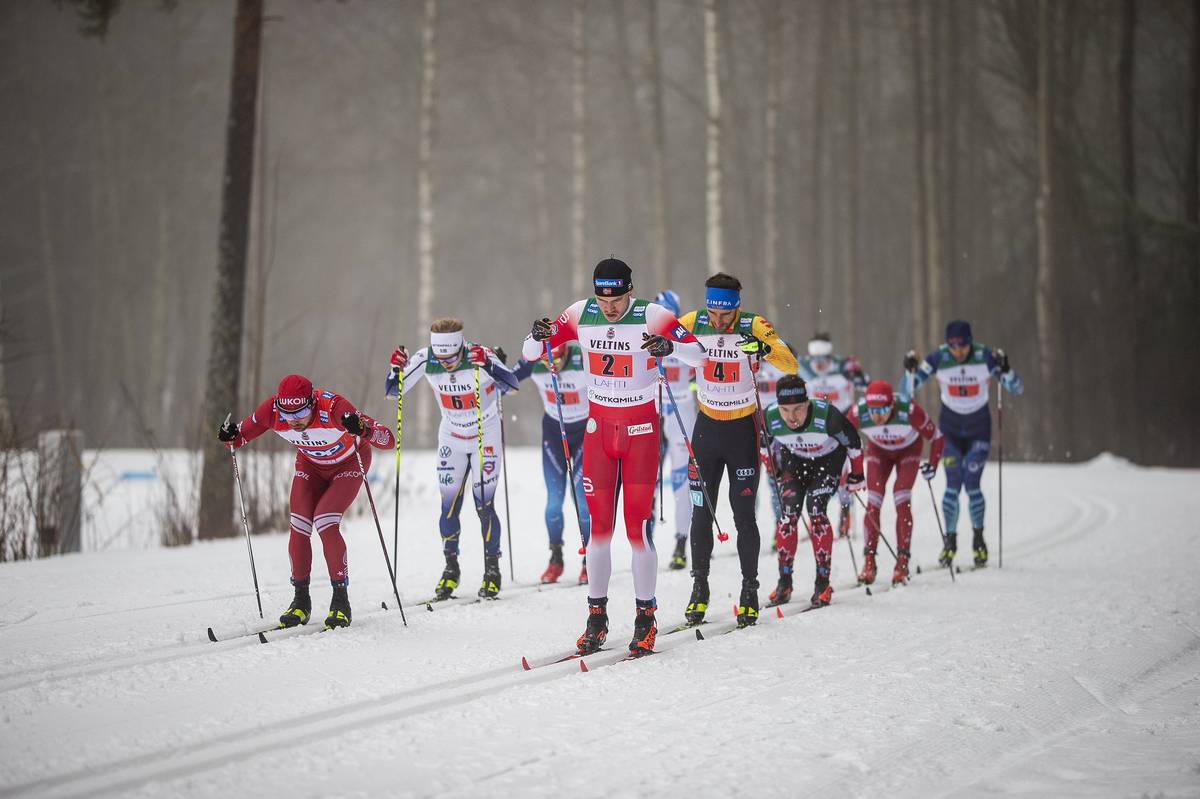
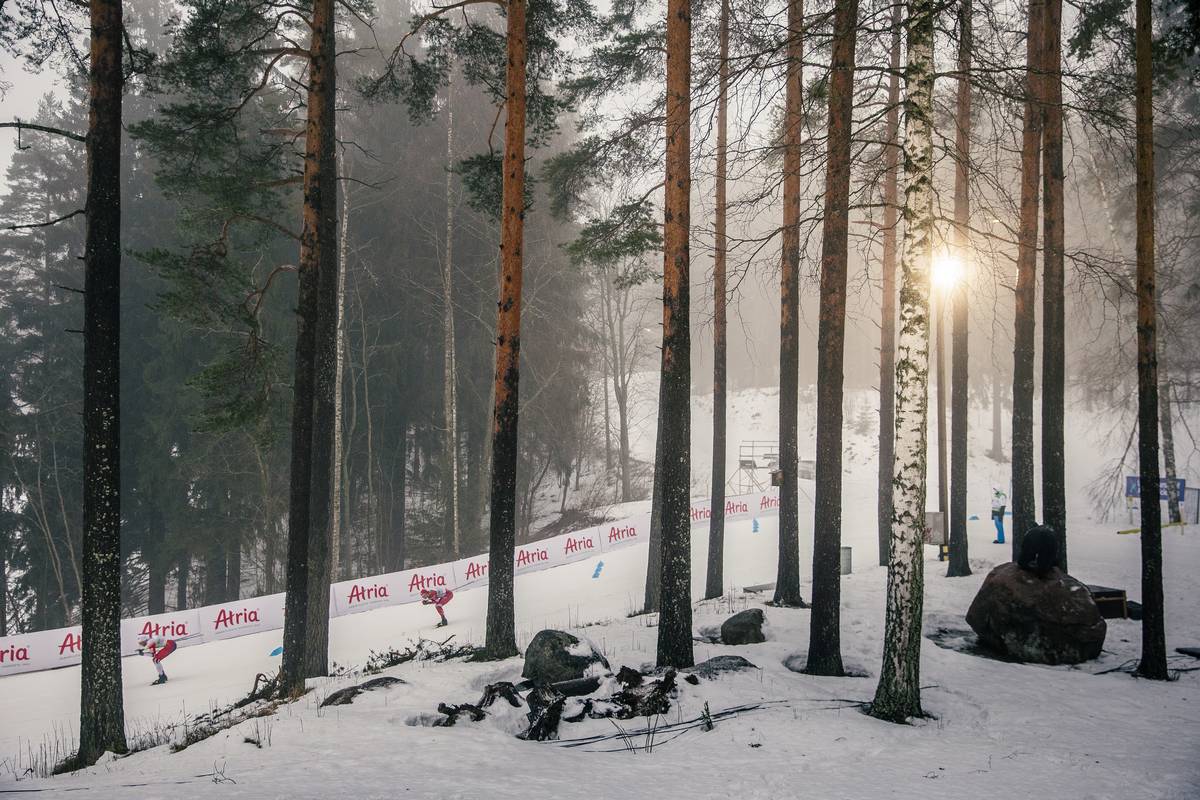
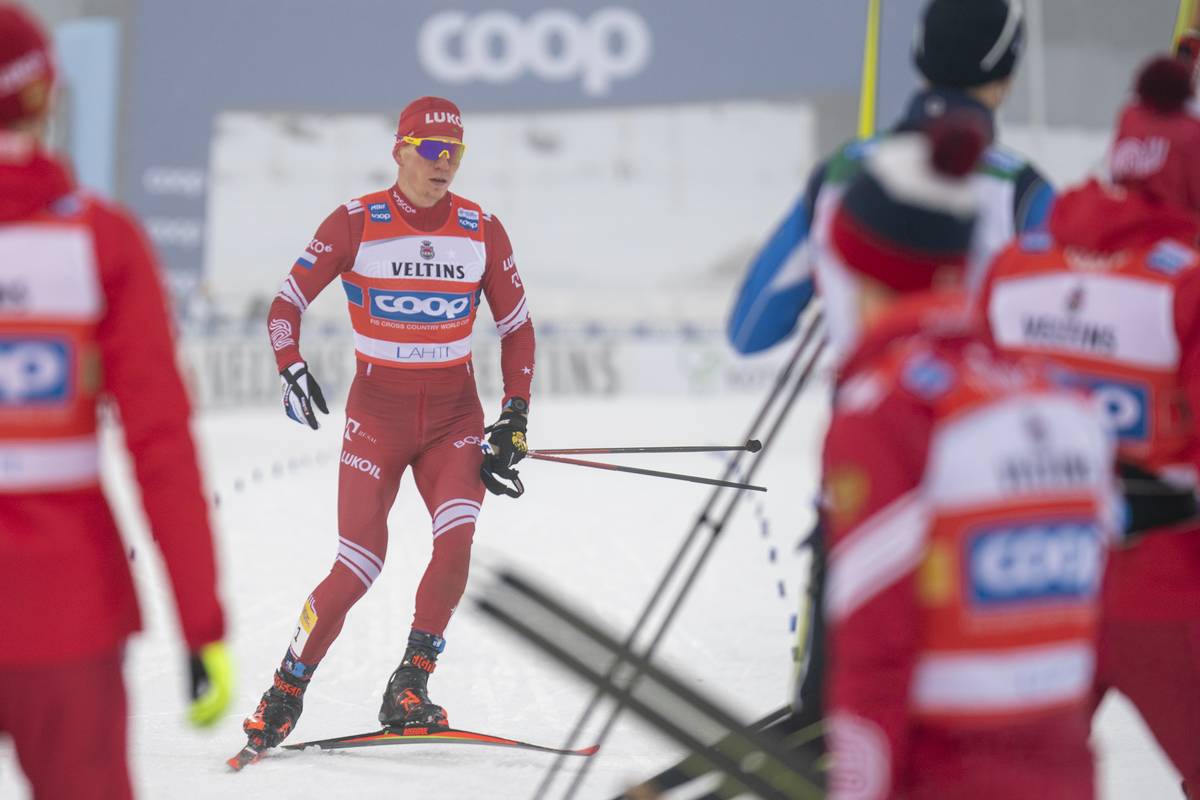
Early in the first leg of the men’s 4 x 7.5 k relay in Lahti, Finland. (Photo: NordicFocus)
This World Cup coverage is made possible through the generous support of Marty and Kathy Hall and their A Hall Mark of Excellence Award. To learn more about A Hall Mark of Excellence Award or to learn how you can support FasterSkier’s coverage please contact info@fasterskier.com.
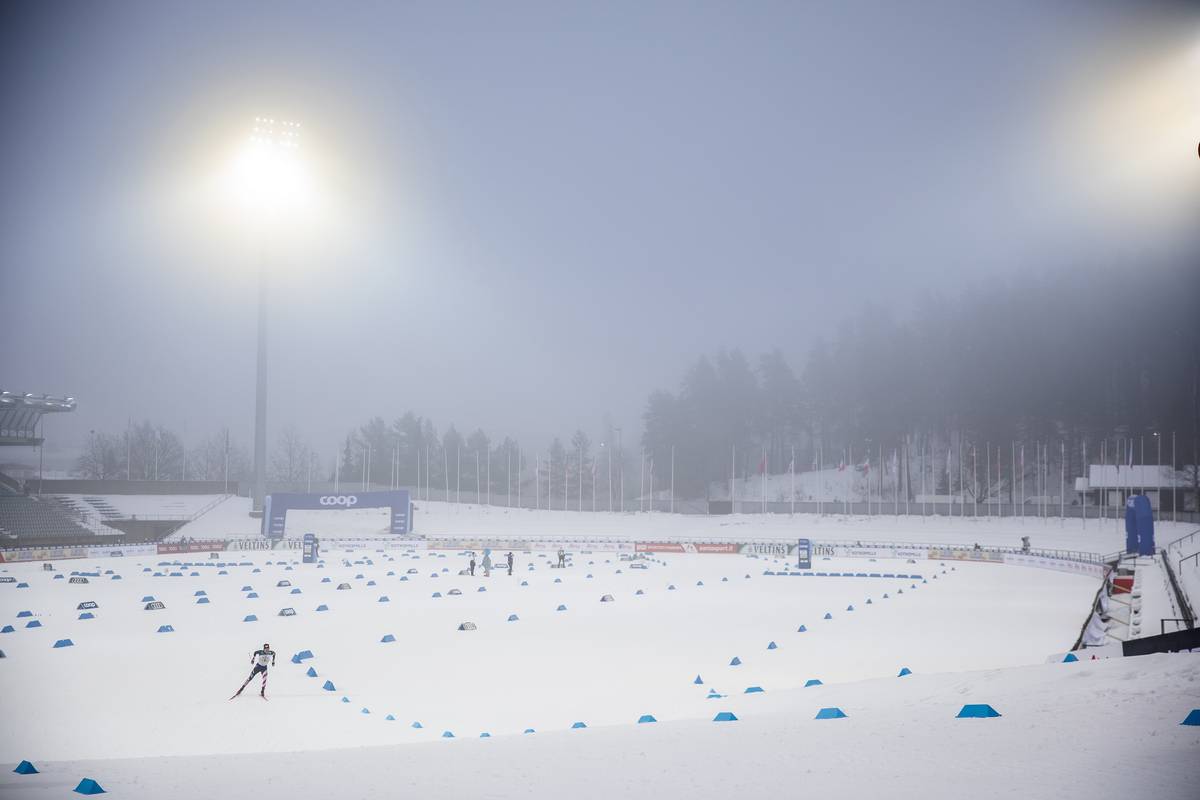
The fog seemed to have thickened since the completion of the women’s race earlier in the day, at times obscuring the skiers with only their silhouettes visible. Eleven teams contested this men’s 4×7.5 k relay with nine nations represented, though with the disqualification of Alexander Bolshunov (more on that in a bit), anchor for Russia I, only 10 teams officially finished.
Historically, World Cup men’s relays have been a duel between Russia and Norway. Out of the fifteen relay races in the past 10 years (not including world championships or Olympics), Russia has won four of those times, the remaining victories all Norway. After a men’s podium sweep in the skiathlon on Saturday, it seemed fair to bet on Norway for today’s race. Indeed, when the race concluded Sunday in Lahti, Finland it was Norway once again on top. As skiathlon winner Emil Iverson so aptly put it yesterday, the Norwegians are “back with a boom.”
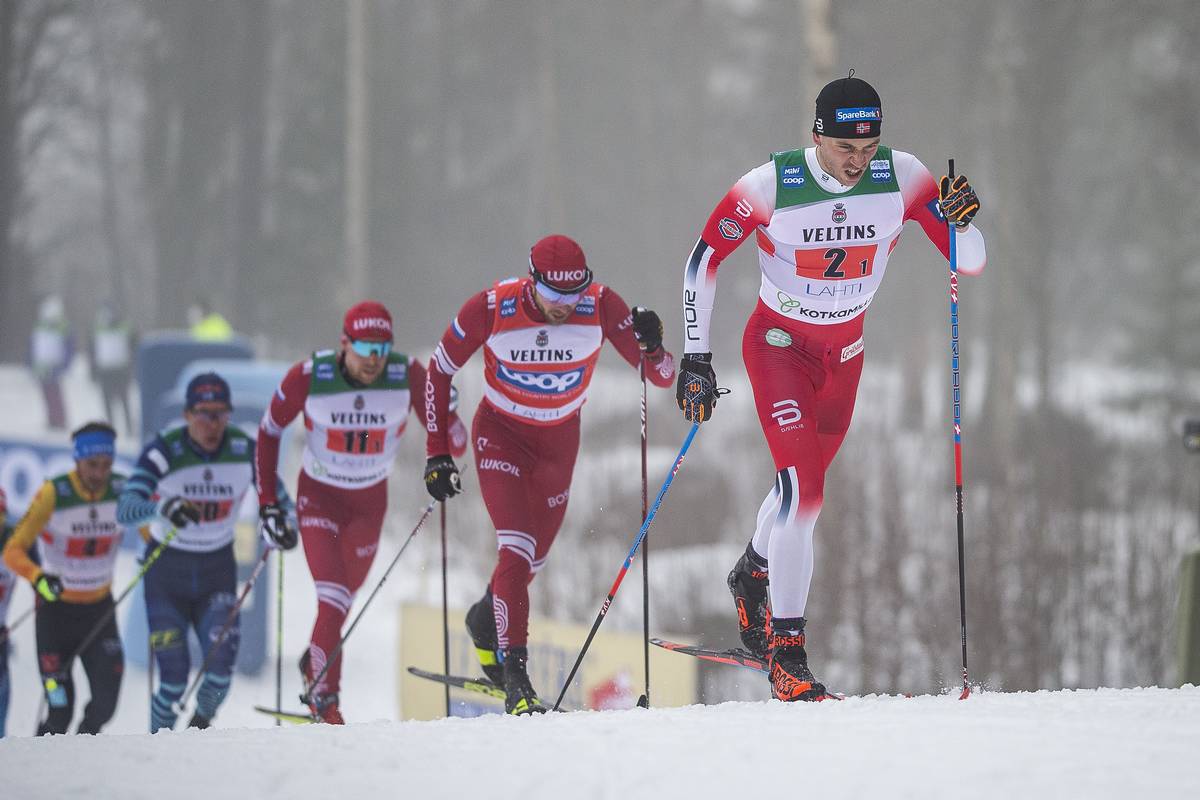
The race began, and ended with drama, particularly for team Russia I. Immediately out of the start gate, Alexey Chervotkin, who scrambled for Russia I broke a pole but recovered to quickly rejoin the field. Pål Golberg of Norway led the charge off the front, pushing the pace to string out the pack. By the end of the third lap, Golberg had created a gap to the rest of the field, followed only by Ilia Semikov of Russia II and a little way back, Chervotkin of Russia I. “It was good that it was snow and not rain coming down,” said Golberg after the race, “so it was possible to go hard at the front.”
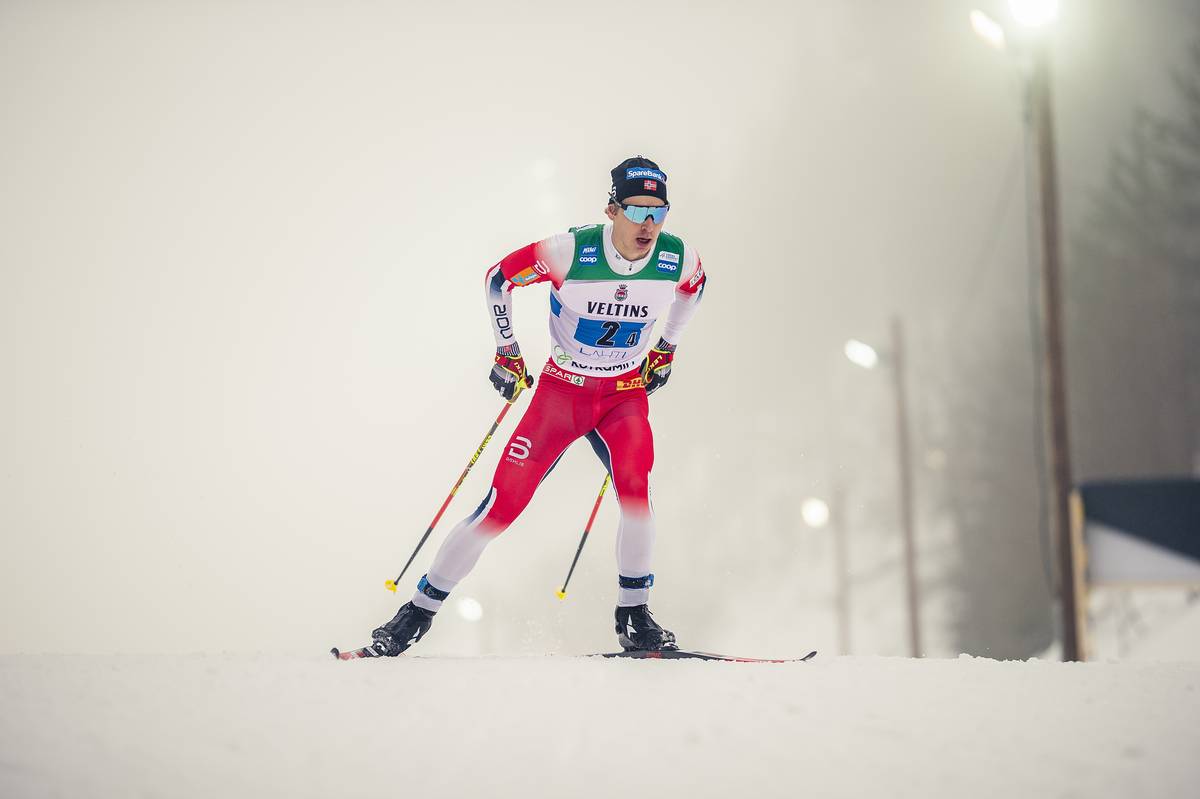
Pål Golberg (NOR), Alexey Chervotkin (RUS), Ilia Semikov (RUS), Marko Kilp (EST), (l-r) during the men’s 4 x 7.5 k relay. (Photo: NordicFocus)Alexey Chervotkin (RUS), Pål Golberg (NOR), (l-r) scramble for their respective teams. (Photo: NordicFocus)
At the first exchange, Golberg tagged teammate Iversen with a +0.8 lead to Ivan Yakimushkin, who took over for Russia II, and +10.7 to Evgeniy Belov of Russia I.
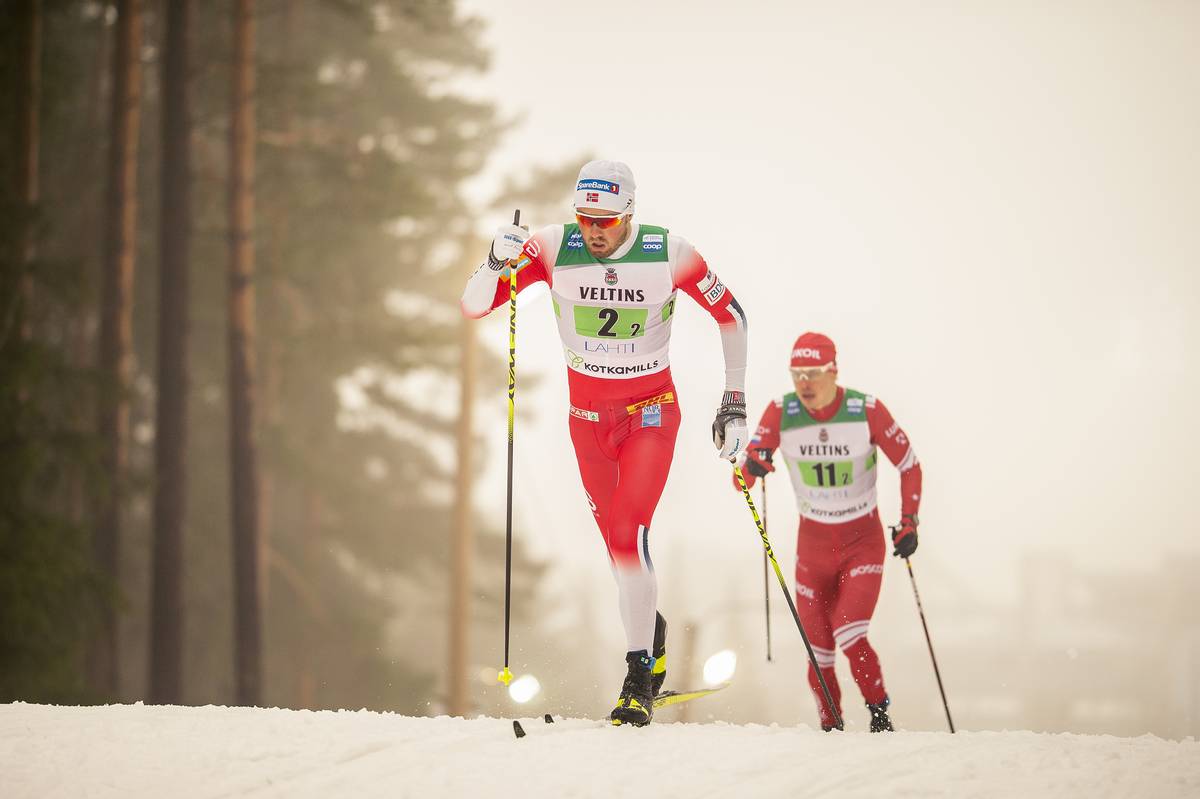
These standings held steady for much of leg two. Russia II entered the tag zone +0.5 ahead of Norway for the third leg handoff. Andrey Melnichenko took over for Russia II with Sjur Røthe hot on his tails. Denis Spitsov of Russia I was tagged +11.9 back while Iivo Niskanen took over for Finland, not far behind. Over the next few minutes, Niskanen surged, catching Spitsov at the outset of their third lap.
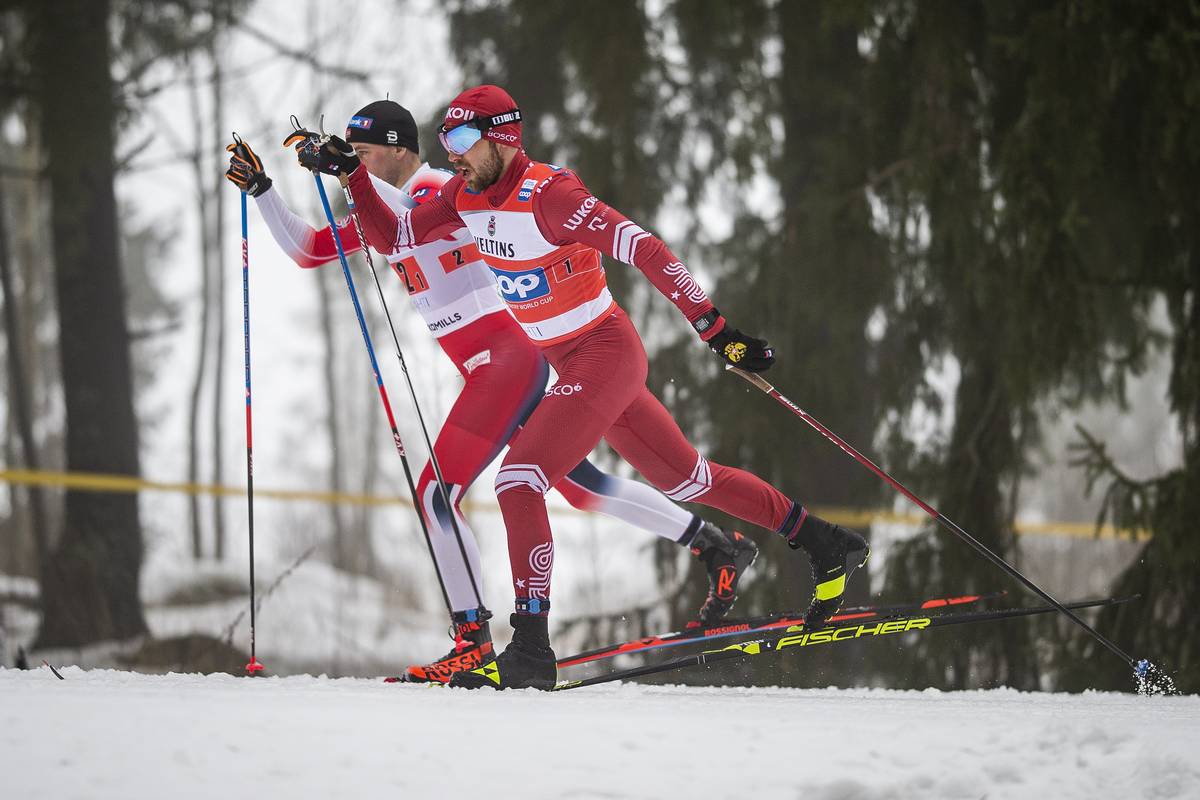
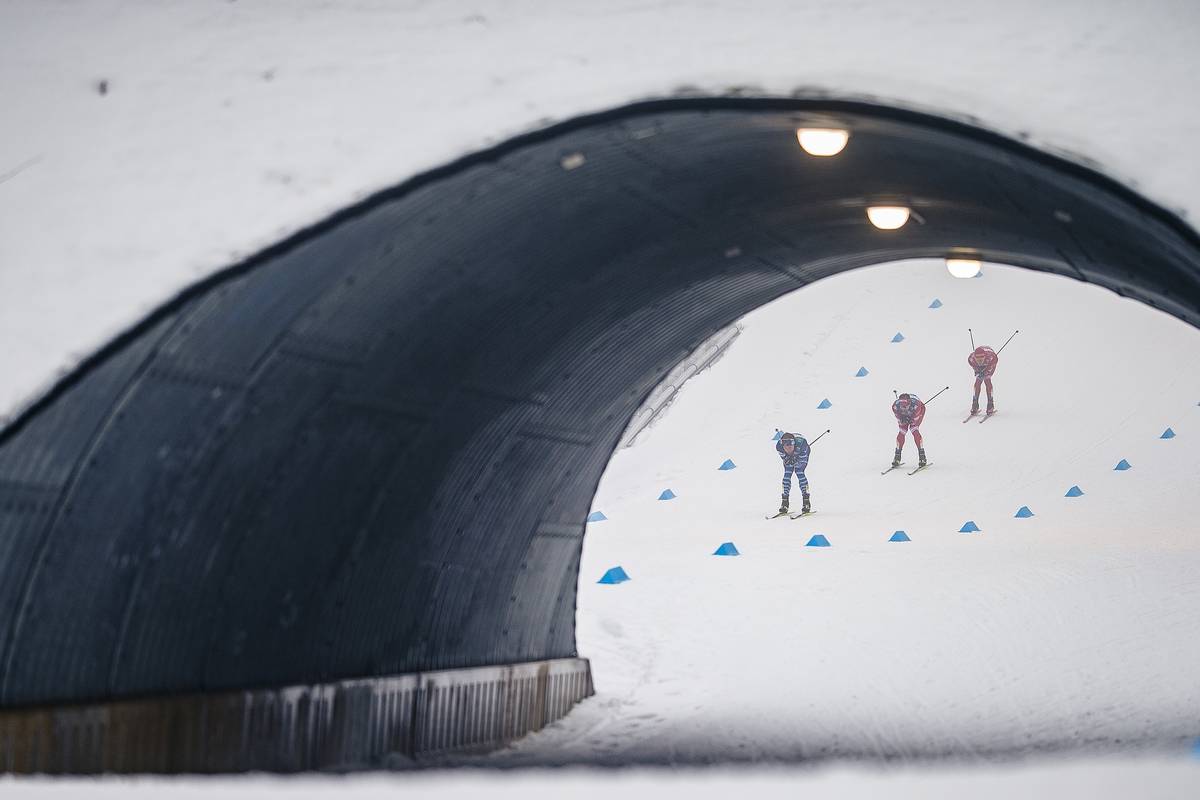
Emil Iversen (NOR), Ivan Yakimushkin (RUS), (l-r), the second leg of the 4 x 7.5 k relay. (Photo: NordicFocus)Emil Iversen (NOR), Ivan Yakimushkin (RUS), (l-r), the second leg of the 4 x 7.5k relay in Lahti. (Photo: NordicFocus)
Further up the trail, Røthe made a decisive move, gapping Melnichenko (Russia II) by +6.95 at 20 k. At the conclusion of the third leg, Røthe had stretched this lead to +38.3 ahead of Niskanen.
“I felt really good today,” said Røthe to FIS after the race, “and we had really really good skis today. It was just for me to start hard and go even harder in the end.”
With the benefit of Røthe’s effort, Norway’s anchor, Simen Hegstad Krüger, cruised along with a healthy lead.
Simen Hegstad Krüger of Norway closing in for the win. (Photo: NordicFocus)
The race for second was where the podium racing became spicey. Niskanen skied a furious third leg, bringing his team into contact with Russia I and II — moving his team into second at the final tag off. Taking over at that third exchange (final leg) for Russia I was Tour de Ski winner, Alexander Bolshunov. Sergey Ustiugov made his season debut as an anchor for Russia II after missing Period I due to COVID-19 complications. For Finland I, Joni Mæki skied anchor after the tag from Niskanen.
Mæki, Bolshunov, and Ustiugov formed a group for the fourth relay leg as Krüger continued to stretch Norway’s lead out front.
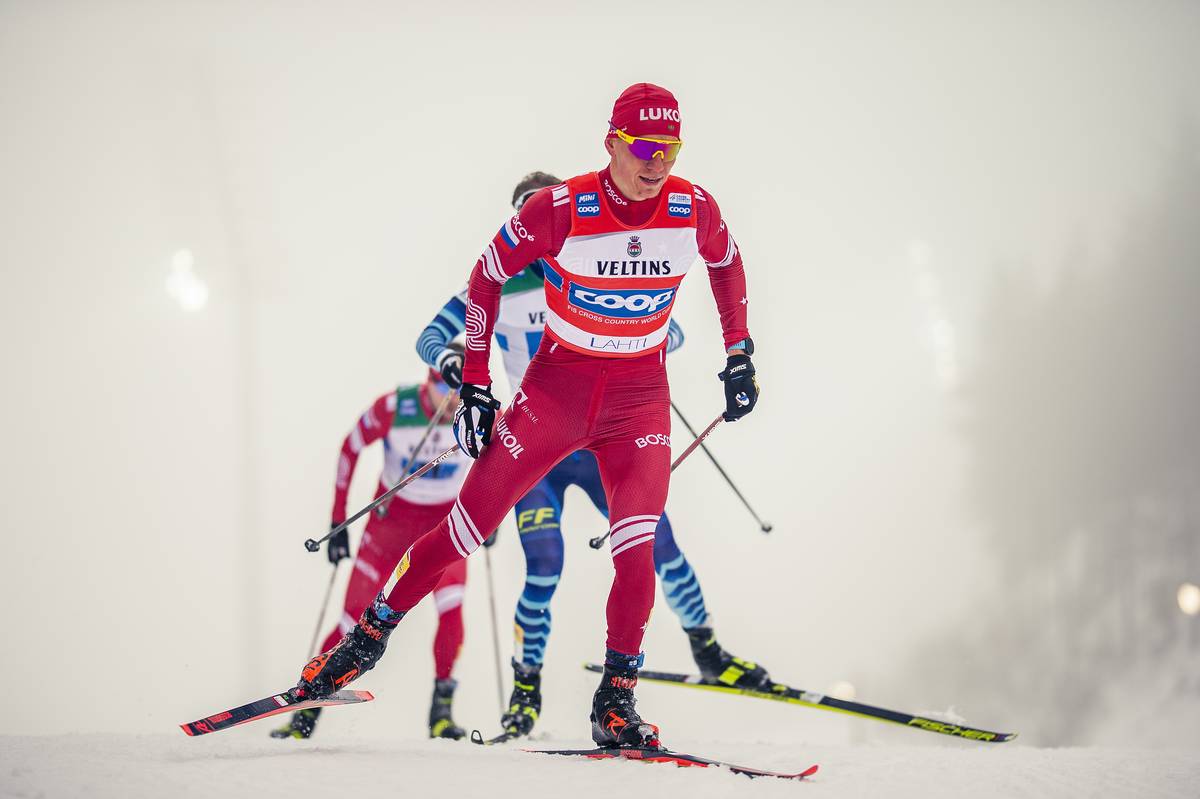
Joni Mæki (FIN), Alexander Bolshunov (RUS), and Sergey Ustiugov (RUS), (l-r) during the final leg of the men’s 4 x 7.5 k relay in Lahti, Finland. (Photo: NordicFocus)Russia’s Alexander Bolshunov leading Jon Maki (FIN) and Sergey Ustiugov (RUS). (Photo: NordicFocus)
Exiting the stadium for the final lap Bolshunov picked up the tempo and succeeded in dropping Ustiugov, while Mæki stuck with this year’s Tour de Ski winner.
Out on his own, Krüger cruised into the finish straights and crossed the finish line in a time of 1:07:56.8. “I took the Lahti corner nice and steady,” said Krüger, a reference to his teammate Iversen’s notorious crash there during the 2017 World Championships, “all the guys gave me such a nice starting point at the end there. Really good day for team Norway and we are back in the World Cup.”
The ugly cross-country skis news of the day starts here – with Mæki and Bolshunov playing cat and mouse over the final kilometer. Mæki led Bolshnov into the final corner of the stadium, a sweeping left-hander. Trying to execute a slingshot move, Bolshunov took the corner wide, attempting to slot into the outside finish lane. Mæki, who was slightly ahead, shifted towards this lane too. Bolshunov continued full gas, Mæki, it appeared, made a subtle tactical move to quell the Russian’s closing speed. Pinched out of his lane, and much to his evident frustration as he swung a pole at Mæki, Bolshunov began his unraveling. Mæki crossed the finish line in second, only to be bowled over seconds later as an angry Bolshunov slid into him, knocking the Finn to the ground. This unsportsmanlike behavior resulted in the disqualification of Russia I, thus bumping Russia II into third place. According to FIS, this was Finland’s first men’s relay World Cup podium.
Bolshunov about to throttle Mæki. (Photo: NordicFocus)Bolshunov was eventually penalized and his team was disqualified. Mæki in bib 5 being tackled by a belligerent Bolshunov. (Photo: NordicFocus)
On Twitter after the race, U.S. Head Coach Matt Whitcomb was terse in his assessment of Bolshunov’s actions. “To be clear to any kids and coaches watching: This tackle by Bolshunov is not okay. If a U.S. athlete did this, they’d be sent home and removed from the team. A disqualification would just be the beginning of their problems.”
To be clear to any kids and coaches watching: This tackle by Bolshunov is not okay. If a U.S. athlete did this, they’d be sent home and removed from the team. A disqualification would just be the beginning of their problems. @FISCrossCountrypic.twitter.com/3FgfqqB5yC
Not exactly good visibility in Lahti, Finland as Scott Patterson laps through the stadium in Lahti. (Photo: NordicFocus)
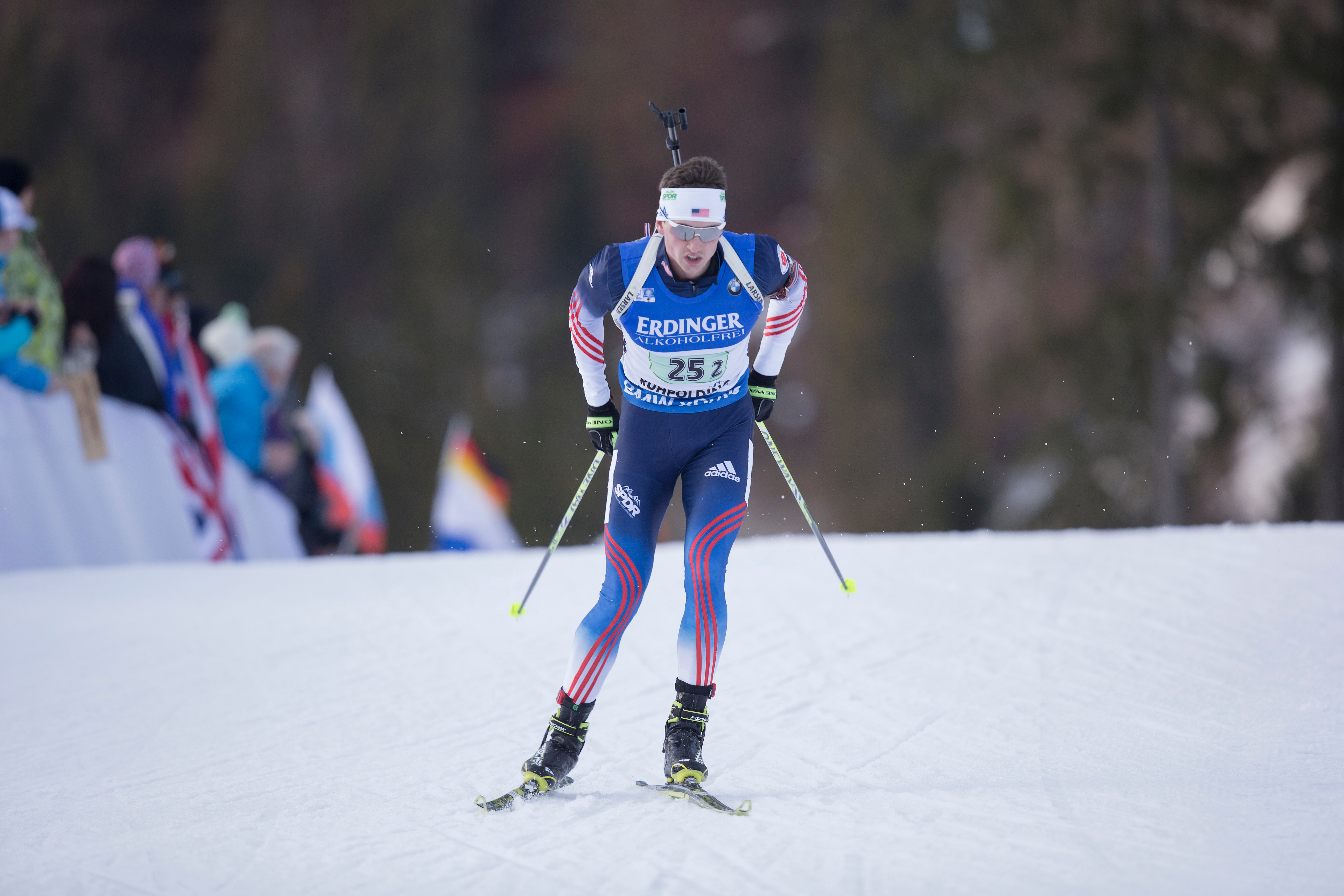
The US team, composed of David Norris, Gus Schumacher, Scott Patterson, and Hunter Wonders, placed seventh (+4:04.3). The backstory for the men’s U.S. roster reveals the race was an opportunity for some to gain World Cup level relay experience. Schumacher and Wonders, both U23 skiers, were relay rookies at this level. This is Wonders’ first career World Cup weekend. He placed 46th in Saturday’s skiathlon. Norris, as many observers of the sport are aware, was diagnosed with Covid this past fall. The Lahti series is his initial foray into international racing post-diagnosis.
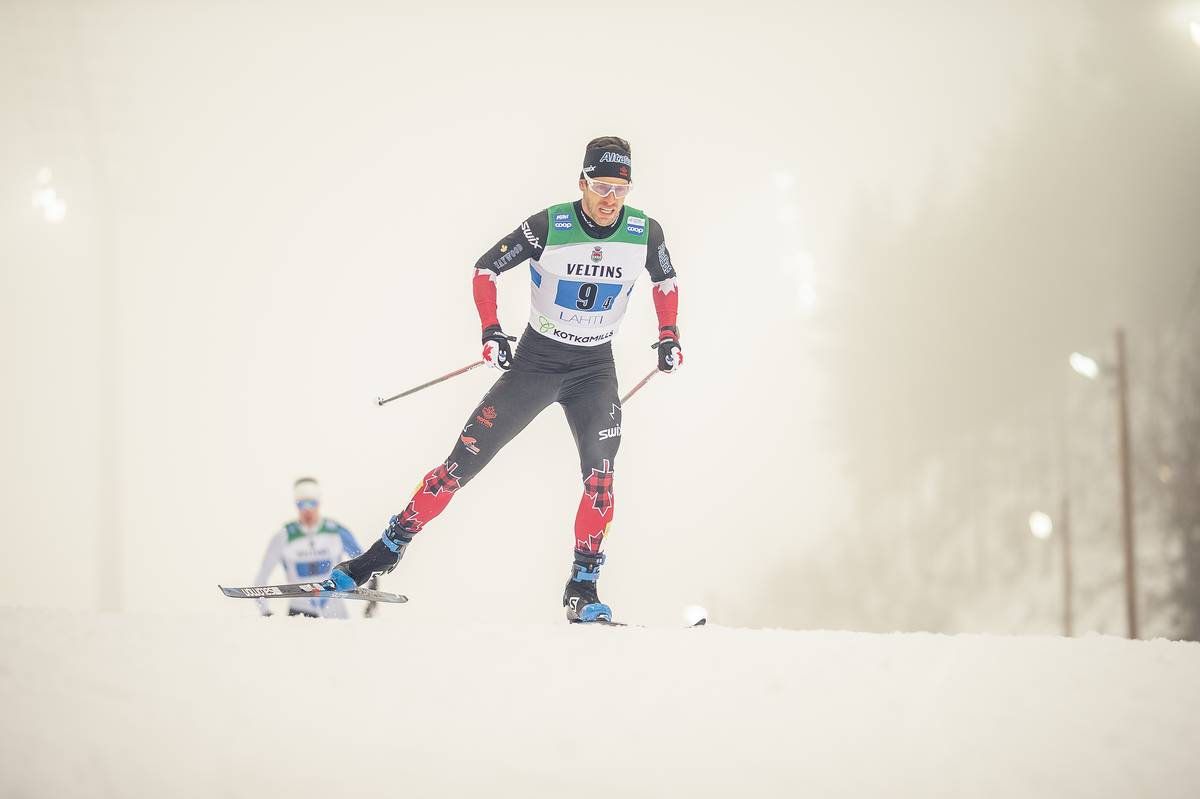
Russell Kennedy racing the anchor leg for Canada. Kennedy scored his first career distance points yesterday in the skiathlon. (Photo: NordicFocus)
The Canadian team composed of Graham Ritchie, Antoine, Cyr, Philippe Boucher, and Russell Kennedy was lapped and is listed as ninth in the results. Like the U.S. team, Canada featured two U23 athletes in Ritchie (22) and Cyr (22). Prior to this weekend, Canada had not sent athletes to the World Cup this season. Pictured above, Kennedy scored his first career World Cup distance points in Saturday’s skiathlon.
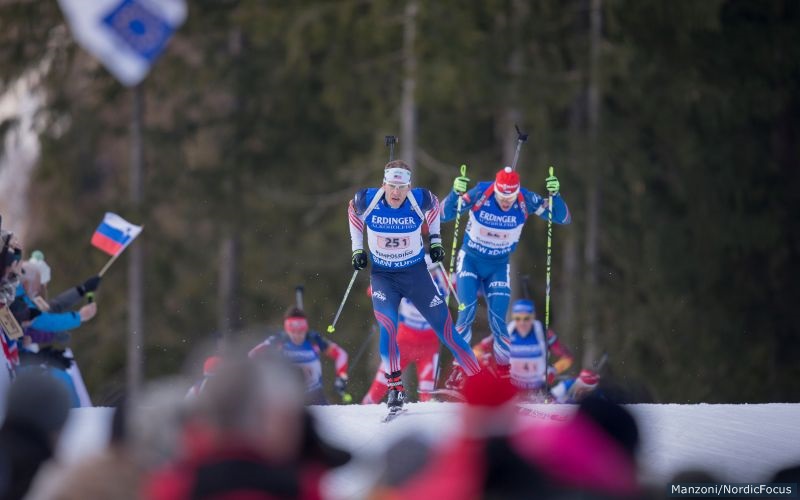
US Biathlon’s Lowell Bailey (l) leading Michal Krcmar of the Czech Republic and the rest of the field in the first leg of the men’s 4 x 7.5 k relay at Thursday’s IBU World Cup in Ruhpolding, Germany. (Photo: USBA/NordicFocus)
Emil Hegle Svendsen and Lowell Bailey had a few things in common on Thursday, despite not racing head to head in the men’s 4 x 7.5-kilometer relay in Ruhpolding, Germany. While Bailey started the four-leg race for the Americans in last of 25 teams and Svendsen anchored the Norwegians after starting in the top two, both led to the finish and capitalized on one critical hill to do so.
Bailey saw his opportunity on his last of three laps, after moving up from dead last in the mass start (where his team was seeded after missing last week’s IBU World Cup relay in Oberhof, Germany) and cleaning both his prone and standing stages to move into fifth.
Three seconds behind Norwegian race leader Ole Einar Bjørndalen at 6.1 k, Bailey latched onto the back of a chase pack two seconds behind Bjørndalen, with Michal Krcmar of the Czech Republic, Germany’s Erik Lesser and Bulgaria’s Krasimir Anev.
On the phone Thursday, Bailey said that he knew Lesser’s strengths — he has a strong finishing kick and is a “great tactician [who] knows when to tuck in behind people and when to push it.”
By clinging to the German, Bailey found himself in the top four and overtaking Bjørndalen. With three climbs remaining, the American anticipated Lesser’s next move: a push on the first big uphill. He was right; Lesser attacked and Bailey was able to stay with him and move into the top three.
“Then basically we were all in a line and everyone on that second-to-last hill went right,” Bailey recalled. That was the shortest line into the righthand curve at the top, but he saw an opening on the left and went for it.
“I put in a sprint there, which put me into the lead,” Bailey said.
At 6.4 k, with just over a kilometer to go, Bailey was up front, 0.3 seconds ahead of Bjørndalen and 1 second ahead of Krcmar.
“For the last hill, I just tried to give everything I had,” Bailey explained. “I pretty much knew if I could stay into the lead over the top of the last hill, I could keep a lead going into the stadium.”
Just as he’d hoped, the American stayed ahead on the long descent and straightaway into the exchange zone. He tagged Sean Doherty in first, 0.5 seconds ahead of the Czech Republic in second, 3.2 seconds ahead of Russia in third, and 3.7 seconds ahead of Norway and Germany.
“Any second or two advantage I could give to Sean is a second or two that he doesn’t have to make up,” Bailey explained. “I was just trying to key in on where he was and get him into a good spot … I didn’t know what was going to happen with Sean, being that this is his first time on the World Cup this year and definitely one of his first times getting tagged off in that first group, but he handled himself well. He stayed really relaxed and stayed right with it … and he did a great job.”
Sean Doherty skiing the second leg for the U.S. in Thursday’s IBU World Cup 4 x 7.5 k relay in Ruhpolding, Germany. After receiving the tag in first, he handed off to Leif Nordgren in sixth. (Photo: USBA/NordicFocus)
In his first World Cup of the season, Doherty, 19, grinned while looking back at Bailey.
“When Lowell was coming in, all I could do was smile, really,” Doherty said in a US Biathlon press release. “In front of one of the biggest and most exciting crowds of the year, to have the lead, these are the moments that you train all summer for — the position that I want to be in, even if it was a bit surprising.”
Not long after, Slovenia’s Jakov Fak took the lead after receiving the tag in sixth, 4.3 seconds behind Doherty. Russia’s Timofey Lapshin, Germany’s Andreas Birnbacher and Fak all entered the range together for their first stage, and Doherty followed less than a second back in fourth.
Fak cleaned to leave first, 4.4 seconds ahead of Norway’s Erlend Bjøntegaard in second and 5 seconds ahead of France’s Simon Desthieux in third, both of which also cleaned. Doherty used all three spares but avoided a penalty loop, setting out on his second lap in eighth, 27 seconds after Fak.
“For the first prone, it was a little rough,” Doherty recalled. “But the key is to forget that and reset for the next stage. I had super skis and just focused on keeping a good pace on the course, then to come into the range and let the training take over and skip the spares this time.”
He did so on the next round, cleaning standing to move into sixth, 36.9 seconds behind Fak in first and 0.3 seconds back from Czech Michal Slesingr in seventh. Fak cleaned his second-straight stage quickly to stay 10.6 seconds ahead of Birnbacher, who cleaned as well to move into second.
By the second exchange, Fak tagged teammate Rok Trsan in first with a 23.4-second gap to Norway in second and 23.7 seconds to Germany in third.
Doherty handed off to U.S. teammate Leif Nordgren in sixth, 59.1 seconds behind Slovenia and 9.3 seconds behind the Czech Republic in seventh.
After arriving in Ruhpolding two days earlier, Nordgren was still coming off a cold he’d been battling since the beginning of the month.
“I was hoping it wasn’t going to be much, in fact I never really felt too bad physically, but it’s just taken a long time to clear out of my sinuses and lungs,” he explained in an email.
Instead of racing in Oberhof, he recovered at home and explained that Thursday marked his first hard effort in almost two weeks.
Before his first shooting, Nordgren slipped one spot to seventh behind Austria. He entered the range 52 seconds behind Slovenia in first, and proceeded to miss three — using all three spares.
That put Nordgren in ninth and then 10th on the next lap. Heading into the second stage, he was 1:27.6 behind Germany’s Arnd Peiffer, who cleaned prone to take the lead, just ahead of Trsan, who used one spare.
Nordgren hit all five standing targets without a miss, improving to eighth and 1:18 back. Peiffer used one spare but stayed in first, eight seconds ahead of Norway’s Johannes Thingnes Bø in second, who had more trouble shooting with one prone spare and three spares in standing.
“My goal for today was more for the shooting,” Nordgren explained. “I wasn’t sure how the ski shape was going to be, so I was mostly focused on making sure I do a normal shooting routine. I wasn’t happy with prone obviously, but standing it came around and all in all I’m not too disappointed.”
While Peiffer led Bø into the last exchange, with just a second separating the two, and 28 seconds to Russia in third, Nordgren tagged Tim Burke ninth, 1:51.8 back but 0.2 seconds behind Slovakia.
Burke was also recovering from an illness he came down with last week. In an email, he explained he had not trained much in the five days before the relay.
“I would have liked a few more days to recover before racing again but we really needed to start the relay after skipping last week,” he wrote. “It was definitely a shock to my body to start racing and, as expected, I felt very flat.”
Burke remained in ninth until his first shooting, which he cleaned to improve to eighth, 2:04.9 behind the leaders. He went on to use three spares in standing, dropping to 11th and 3:05.2 back.
While Burke posted the seventh-fastest course time of the anchors on the last lap, he managed to pick off just one place to put the U.S. in 10th at the finish, 2:55.3 out of first.
“Today was definitely a challenge for me but overall I think it was positive for the team,” Burke wrote. “Using three extra rounds at this level is simply not good enough.”
In the final shooting, Canada moved ahead of the U.S. for the first time in the race. Nathan Smith cleaned prone, then used two standing spares to leave the range 3.5 seconds ahead of Burke in 10th.
“I was able to catch up and pass him, but I did not have enough gas to reach the finish,” Burke wrote.
The Canadians placed ninth, 2:53.9 back and 1.4 seconds ahead of the U.S.
“I was pretty worried with Tim breathing down my neck the whole lap,” Smith wrote in an email. “He attacked on the first big climb but I think that cost him later on. He was also sick last week so that probably helped to my advantage. On the last climb the [Belarusian] put in a very surprising attack and I couldn’t really answer. I clawed back most of those metres in the final strait but couldn’t quite do it.”
Yuryi Liadov edged Smith by 0.3 seconds for eighth.
“Since the course was quite icy and fast, I picked up most of my time in the range,” Smith noted. “Although perhaps the actual places were grabbed out on course. My skiing was good. About on par for this season. I’m happy with that but obviously I’m looking for an amazing day or two this weekend.”
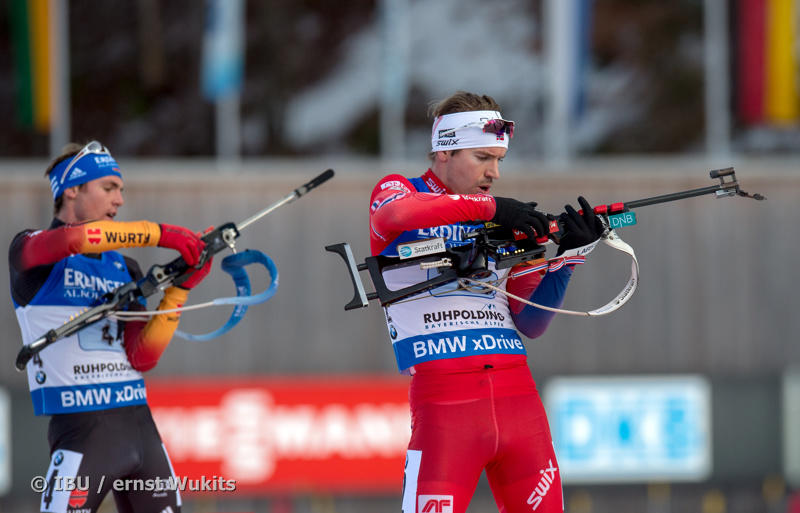
Germany’s Simon Schempp (l) and Norway’s Emil Hegle Svendsen go head to head in the final shooting stage of the men’s 4 x 7.5 k relay in Ruhpolding, Germany. (Photo: IBU/Ernst Wukits)
While the North Americans duked it out for a top 10, Norway’s Svendsen and Germany’s Simon Schempp switched leads at the front of the pack. Both used one spare in prone, as did Russia’s Anton Shipulin, but the two stayed 20 seconds ahead of Russia in third.
In the final stage, Schempp cleaned to leave the range 7.4 seconds ahead of Svendsen, but the Norwegian caught him a kilometer later.
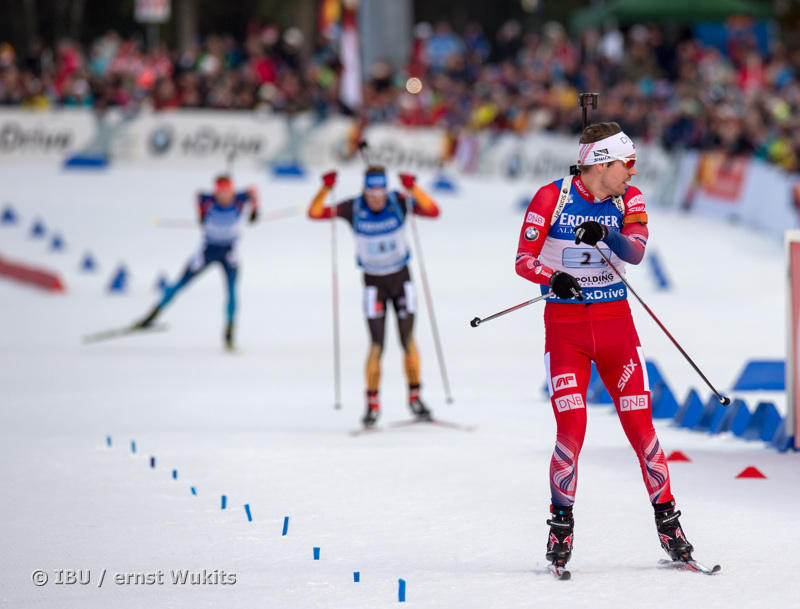
Shipulin came within 10 seconds of the two leaders about 1 k before the finish, but that was where Svendsen turned it on — attacking on the same last climb before the stadium, just like Bailey.
Svendsen passed Schempp before the top and left him several meters behind while soaring down into the finish. He sealed the win for Norway by 4.6 seconds in 1:09:42.3, and Schempp held off Shipulin by 3.8 seconds for second place.
“I was not sure that I would catch a strong athlete like Simon,” Svendsen told the IBU. “It took a lot of energy to catch up, so I stayed behind him to recover some. I knew that I am good in turns so I waited to one of the last turns before the bridge. I think my plan worked pretty well.”
Svendsen (r) glances back before securing the victory for Norway in the men’s 4 x 7.5 k relay, ahead of Germany’s Simon Schempp (c) in second and Russia’s Anton Shipulin (l) in third. (Photo: IBU/Ernst Wukits)
Shipulin and the rest of the Russian team, which won last week’s relay in Oberhof, settled for third (+8.4). France took fourth (+23.8), ahead of Austria in fifth (+24.5), and the Czech Republic in sixth (+30.8).
More than two minutes later, Slovenia’s Janez Maric, who had two penalties and three spares, finished seventh (+2:46.8), Belarus was eighth (+2:53.6), Canada ninth, and U.S. 10th.
“We hope for the flower ceremony and a podium, but there’s been a lot of things leading up to this race definitely didn’t go in our favor,” Bailey said. “We definitely weren’t, as a team, at a hundred percent, so considering that we’re pretty happy with a top 10. It’s definitely better than the 25th rank that we had starting today.”
Canadians Improve from 15th to Ninth
With the Gow brothers entering their second World Cup weekend (after starting on the IBU Cup circuit) and Brendan Green back for his first race since the holiday break, the Canadians were somewhat of an unknown for Thursday’s relay.
However, a week ago, they placed eighth with two IBU Cup skiers — Christian Gow and Macx Davies — plus Marc-André Bédard and Smith.
“I would say our goal was to build on our relay performances from the season so far and with solid racing, discover what is possible,” Green wrote in an email on Thursday.
He arrived in Ruhpolding on Monday night after training in Canmore, Alberta, over the holidays.
“I feel as though I was able to bring better focus into a few aspects of my performance and hopefully that will show during this trimester,” Green explained of his training.
He skied the second leg for Canada, receiving the tag from Christian Gow in 15th and 59.2 seconds behind the leader. Gow posted the 15th fastest-course time of the first leg and used one spare in each of his two stages.
“During my leg of the relay I was hoping to move up the ranking a bit and keep the team in the race,” Green wrote after skiing up to 13th with 10-for-10 shooting.
“I’m for sure happy with my shooting today but my skiing was not as strong as it should be,” he added, after skiing the 12th-fastest course time of the second leg. “Maybe partially to jet lag, who knows.”
He tagged Christian’s older brother, Scott Gow, in 13th, 1:53.7 out of first. In his first World Cup relay of the season, Scott used three spares in prone and two in standing to slip to 15th, where he remained until the final exchange.
“It was a pretty tight field and I knew strong shooting would move us up there,” he wrote in an email. “Unfortunately I couldn’t keep myself together very well on the range … Shooting was bad today. I don’t have any excuses other than I was inside my own head too much, and just need to relax and not worry about my competitors when I’m on the shooting mat.
“I was a little anxious going into both prone and standing shooting because I wanted to hit all 5 quickly and get out of there. Ideally I would focus on the process and not trying to destroy my competitors. I’ll try harder for Saturday.”
Scott plans to race the remaining World Cup competitions in Ruhpolding this weekend and Antholz, Italy, next weekend.
“My goal for this season was to race mainly on the World Cup circuit, so I am happy to be starting here in Ruhpolding,” he wrote, explaining he arrived in Europe on Sunday. “If I can maintain good results and good form I should be able to stay on the circuit.”
Scott tagged Smith in 15th, 2:50.8 behind the leader and 11.6 seconds behind Belarus in 14th.
“I knew I was losing time on the leaders, so my goal was to try and bridge the gap to my closest competitors and give Nathan the best chance possible,” Scott added. “I’d like to think I made up some time on my last loop but it wasn’t as much as I would have liked. I’m happy with my race today but have a few things to focus on for the sprint race.”
According to Smith, the position was “not great but not a disaster yet,” he wrote. “I knew if I put in a really good leg I could move us back up to perhaps around 10th.”
Considering how fast and icy it was, he knew ski speed wasn’t going to make the difference — shooting would.
“Prone went amazingly well and I built on that through the race,” Smith wrote of his clean first stage.
He tried to be as precise in standing, but lost some focus on his final two shots, he explained.
“I would say we are satisfied with today but we are still capable of more,” Green summarized of the team’s ninth-place finish.
“The conditions today were probably the best we’ve had all year. Basically no wind, pleasant temperatures, and firm tracks,” Smith added. “I wouldn’t have minded a little less ice, but I’ll take that over what the women had to race in yesterday. It looked so slow.”
Bailey said it was the best conditions he’d seen all year as well, with perfect tracks, transformed snow, and not much wind.
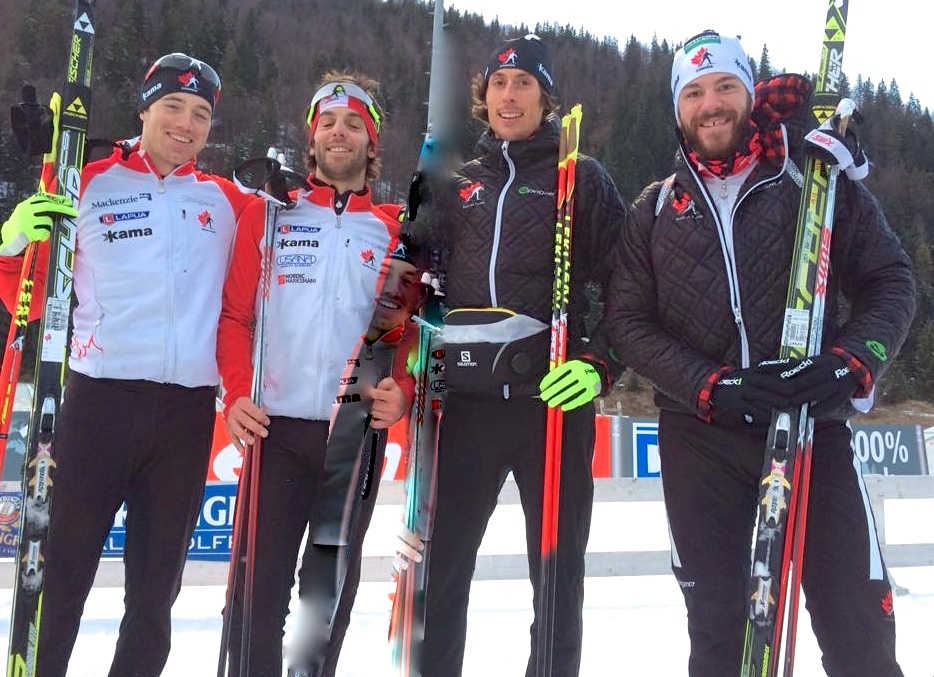
The Canadian men’s 4 x 7.5 k relay, which tied a team-best sixth on Saturday at the IBU World Cup in Hochfilzen, Austria. From left to right, Nathan Smith, Scott Perras, Brendan Green, and Marc-Andre Bedard. (Courtesy photo)
Note: This article has been updated to include quotes from Canadian national-team head coach Matthias Ahrens.
Just a couple steps from the podium on Saturday, the Canadian men’s 4 x 7.5-kilometer relay team was pretty psyched to get flowers — and chocolate, and a “sweet medal,” and cash, according to third-leg Marc-André Bédard.
They had been in the hunt for sixth, which tied each of their career bests in the team event and was worthy of the flower ceremony, since the first leg of Saturday’s IBU World Cup relay in Hochfilzen, Austria.
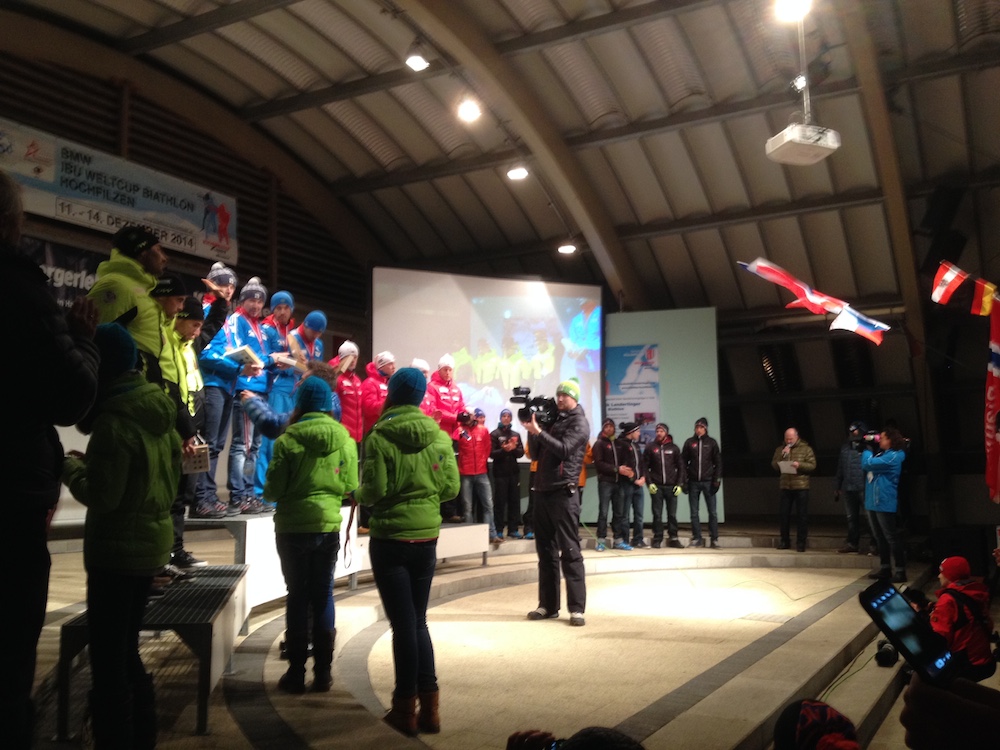
The Hochfilzen World Cup men’s relay awards ceremony on Saturday night, with Canada (far right) in sixth. (Photo: Matthias Ahrens)
Temperatures were colder than Friday’s sprint, their skis seemed to be running great, and by the first exchange, the Canadians were well on their way to the top-eight Nathan Smith thought they were capable of on a given day.
Saturday turned out to be especially impressive, Smith explained.
“After yesterday’s disappointing showing for our team in the sprint I was unsure of what to expect today,” Smith wrote in an email, referring to his 44th-place finish, which led the Canadian men in Friday’s 10 k sprint. Teammate Brendan Green was 49th, Bédard placed 82nd and Scott Perras was 100th.
On Saturday, they tagged off in that order.
Smith started first in the 24-team field and found himself drifting toward the back of the pack — farther than he would have liked. After his first shooting, where he had to use three spare rounds, he was 21st, nearly 37 seconds behind Sweden and Italy in the lead. France and Russia hovered a few seconds behind in third and fourth, and the Americans — with Lowell Bailey leading off — ranked ninth, 14.5 seconds back, after Bailey missed one prone.
In an email, Bailey in bib 20 explained he started six rows back, based on the IBU’s new start rules, which he considered “a significant disadvantage for teams with higher bib numbers.”
“I was able to make it up into the top five during the first loop but it was definitely tough starting with bib 20,” he wrote in an email. “I disagree with the change and I think it gives the lower bib numbers an advantage that they didn’t have with the previous format. That being said, I was able to work my way through the field, but it took a lot of effort and I expended a lot of needless energy trying to pass.”
While Bailey was satisfied with his shooting, using one spare on each stage, Smith was stressing over prone.
“I was pretty worried in prone,” Smith wrote. “I’m not sure exactly what went wrong there, but it felt exactly the same as the prone in [Friday’s] sprint. I knew I was feeling good skiing though so I just tried to ski hard and hopefully catch some teams off guard that were skiing in groups.”
By the second stage, the Canadian was up to 12th with a clean bout. He went on to post the fastest course time of his leg on his third-and-final lap.
“I felt strong and tried to make up time on the second half of the course where all the climbing is,” Smith explained. “My last lap felt amazing. I passed a lot of people and it was actually ranked 1st for that leg. I had hoped to put Brendan in a slightly better position, but given 3 extra, I’m pretty happy that the deficit was only 25 seconds.”
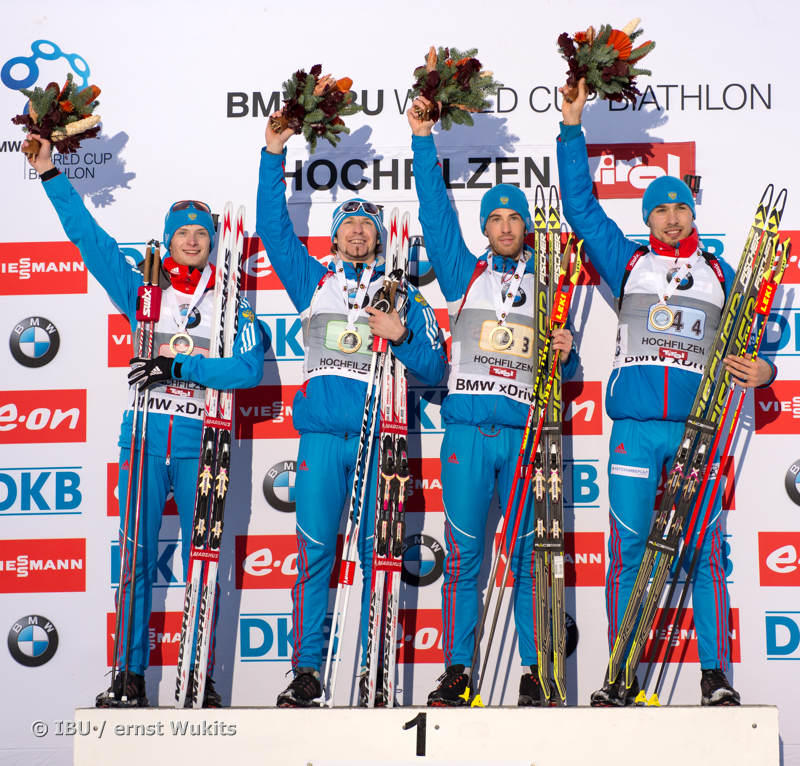
Russia won the men’s relay on Saturday at the IBU World Cup in Hochfilzen, Austria. From left to right: Maxim Tsvetkov, Timofey Lapshin, Dmitry Malyshko, and Anton Shipulin. (Photo: IBU/Ernst Wukits)
Smith tagged Green in seventh, 25.7 behind Friday’s sprint winner, Johannes Thingnes Bø of Norway in first — who missed one in prone. France’s Simon Fourcade cleaned to put his team 12 seconds back in second, and Ukraine tagged in third (+14.4) after 10-for-10 shooting from Dmytro Pidruchnyi.
The U.S. slipped to 15th during Bailey’s leg as a result of less-than-ideal skis, second-leg Tim Burke explained.
“I knew right away when I saw Lowell’s race that he was having a problem with skis,” Burke wrote after his team placed 14th overall. “Unfortunately, I did not have time to change my skis and we were using the same grind. The temperature dropped more than we thought at race time and the snow really dried out. We simply ended up on too big of a grind.”
Heading out 56 seconds behind the leaders, Burke remained hopeful that he could pick a few teams off. He ended up using two spares in prone and another in standing.
“I definitely made a mistake in prone when I tried to push the pace a little too much and ended up pulling the last two shots,” he wrote. “After standing I ways able to pick up a few spots on the last loop but we were still far from where we should have been after two legs.”
Meanwhile, Green cleaned both stages for Canada to improve to sixth. He led Italy’s Dominik Windisch, who started a second behind him, on his first lap. The two entered the range together, and despite Windisch using one spare, they left together as well.
“I was able to work off him for my second lap and relax a little bit more in certain areas before standing,” Green explained. “I knew my skiing should be decent if worked with him so I didn’t try and do anything too heroic on course and more just tried to settle into a solid pace.”
After his standing stage, Green was up to sixth, 39 seconds behind Russia’s Timofey Lapshin up front. Lapshin and Norway’s Emil Hegle Svendsen both cleaned standing to leave the range together, and France’s Jean Guillaume Beatrix used one spare to fall slightly off the pace, eight seconds back in third. Windisch missed three and dropped to ninth.
On the long climb back up to the stadium, Svendsen led Beatrix and Lapshin, while Austria’s Simon Eder tried to close the 12-second gap in fourth. Germany’s Andreas Birnbacher trailed by another 12 seconds in fifth — 14.7 seconds ahead of Green.
“I always feel a ton of pressure during relay races,” Green reflected. “But last year we had multiple strong relay performances where we were contending at the front of the race, so I’m sure those experiences helped me out today…
“When setting up the next teammate for the tag, it’s ideal if you can tag them with other nations close by so they have people to work with skiing,” he added. “If that scenario works out, perfect, but if not that’s fine, and we’re always doing our best to tag as close to the lead as possible.”
Green handed off to Bédard in sixth, 50 seconds behind Norway and France, neck-and-neck for first, and 24 seconds behind Germany in fifth. Russia tagged off 7.8 seconds back in third, and the U.S. came through in 11th, 1:55 behind the leaders.
Upon receiving the tag, Bédard — the team’s newest member and the only one not to experience sixth place in the relay in Antholz, Italy, last January (former national-team member J.P. LeGullec scrambled in that race) — he focused on keeping his cool and trying not to lose too much ground.
“It was a bit lonely during the first 2 laps but I tried to go as hard as I could knowing that it would be super short,” Bédard wrote.
He used one spare in prone and three in standing to slip one place to seventh behind Italy’s Thomas Bormolini after his second stage.
“On the final lap I took extra time on the range to clear my targets and the Italian came back strong cleaning his, so I had to fight back 8-10 seconds,” Bédard explained. “I got to him pretty fast. I felt good so I attacked right away but he kept up to me and we ended up together.”
Bédard and Bormolini entered the final exchange at the same time, 1:56.4 behind Russia. After Dmitry Malyshko cleaned, Russia remained the definitive race leader heading into the final leg, more than 17 seconds ahead of Norway’s Lars Helge Birkeland in second. Birkeland used five spares — two in prone and three standing to account for half of Norway’s 10 total spares at the end of the day.
France’s Simon Desthieux, who missed two standing, trailed Birkeland by 0.7 seconds through the tag zone in third.
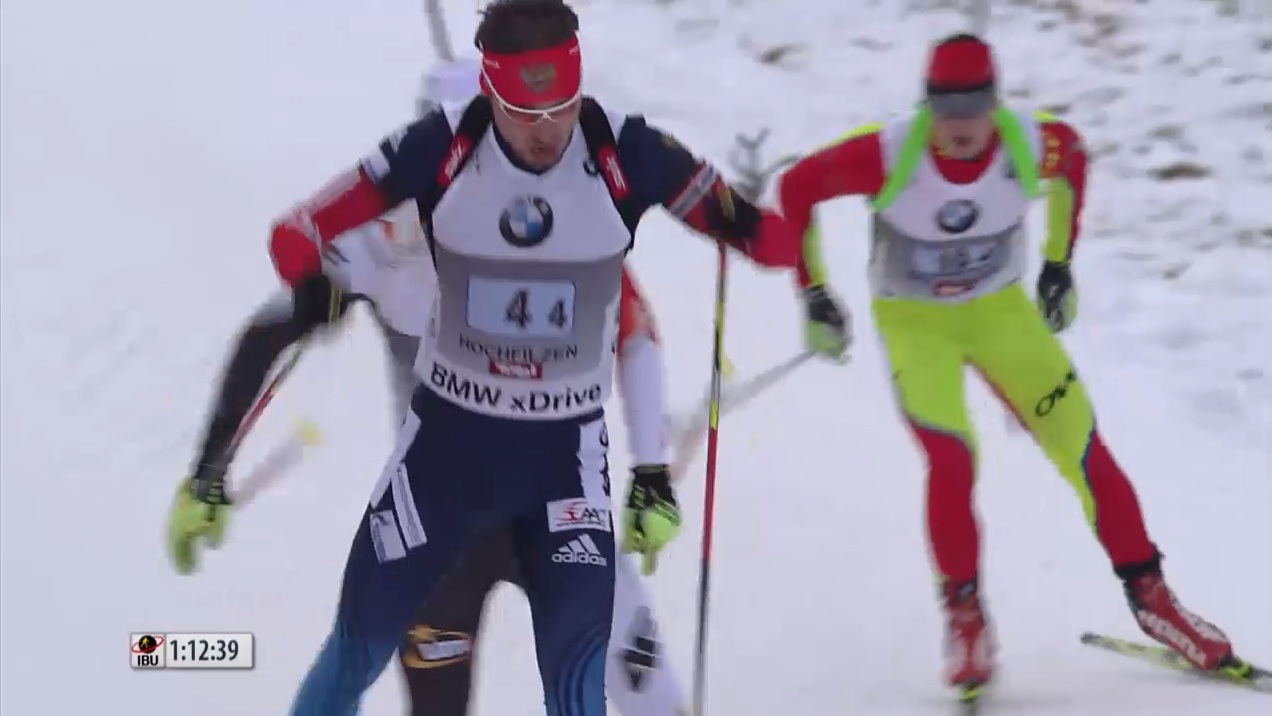
Russia’s Anton Shipulin laps several teams en route to a 20-second victory for the Russian men’s team in Saturday’s 4 x 7.5 k relay in Hochfilzen, Austria.
At the front of the race, it was all about chasing Russia with anchor leg Anton Shipulin ultimately cleaning both stages to bring it home. France’s Martin Fourcade and Norway’s Tarjei Bø duked it out for second, with Fourcade missing one prone and Bø missing three standing to drop to third.
Then there was Austria and Germany, some 35 seconds behind Russia after prone and 48 seconds back after standing, racing for fourth.
“The gaps were quite big when I started,” Canada’s anchor, Perras wrote. “My race was all about getting into the prize ceremony. I couldn’t even see 4th or 5th.”
He missed two prone and three standing for five total spares — half of what Canada ended up with.
“In prone I shot a bit slow. I threw my first spare round down range to try and leave the range with Italy,” Perras explained.
Italy’s Christian Martinelli used one spare in prone to exit the range 15 second ahead of him. Perras made up that time on the second lap and entered the range with him, then reclaimed sixth. While Perras missed three that bout and Martinelli missed two, Perras left the range 22 seconds ahead.
Canada’s anchor Scott Perras pushing for sixth in the finishing straight of Saturday’s IBU World Cup 4 x 7.5 k men’s relay in Hochfilzen, Austria.
“I had no idea how close Italy was to me or any team for that matter,” Perras explained of his last lap. “I fought the whole way. I was fighting for my teammates out there.”
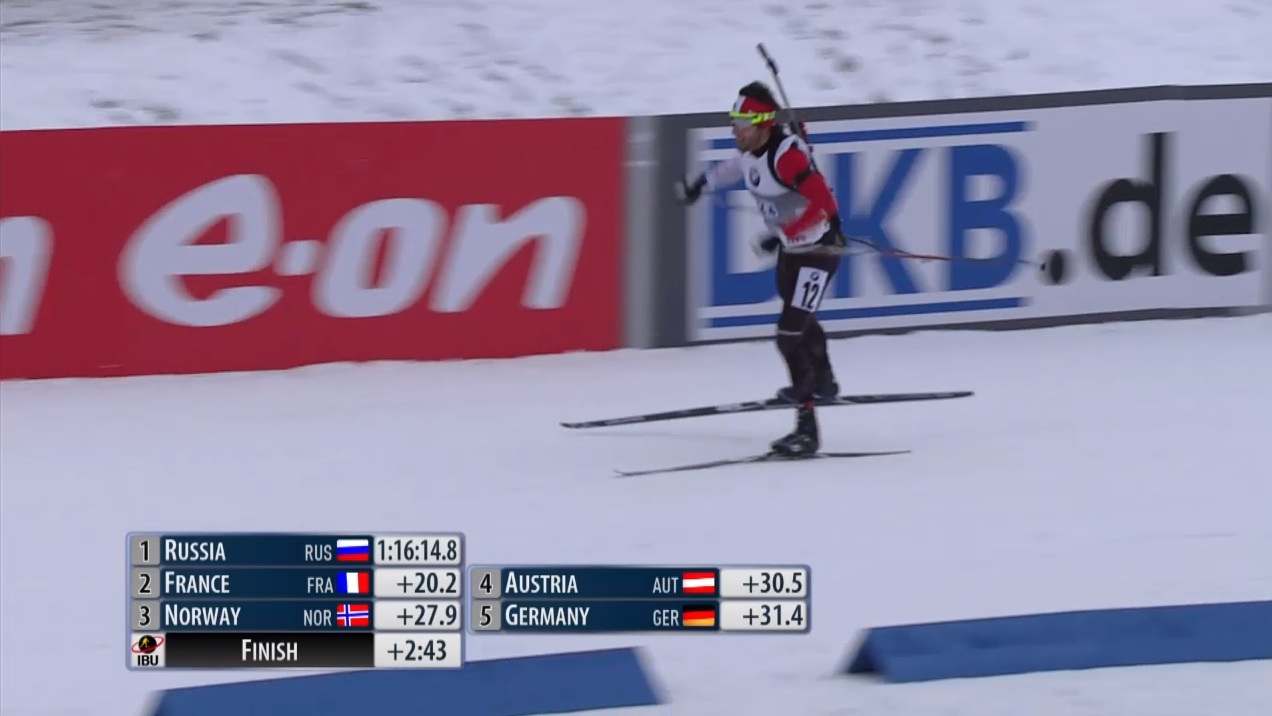
He secured sixth to match the team’s best from Antholz, finishing 2:55.4 behind Russia, which won in 1:16:14.8 after using just one spare round. Fourcade cleaned standing and outsprinted Bø by 7.7 seconds to lock up silver for France (0+4), 20.2 seconds behind Russia, and Norway took third (0+10).
Dominik Landertinger cleaned prone and used one spare in standing to finish fourth for Austria (0+7), 30.5 behind Russia, and Germany’s Simon Schempp also cleaned the first stage then missed one standing to finish 0.9 seconds later in fifth for his team (0+9).
“Matching a top finish is always a must, we obviously want to get better and better,” Bédard wrote. “But it was great to be [in] the flower ceremony.”
“I think we are happy to get back there so early in the year,” Perras explained. “It sets the bar for the whole team. It makes everyone want to work harder, coaches, wax techs and athletes to repeat or better days like today.”
In an email, Canada’s national-team head coach Matthias Ahrens called their performance “solid … especially in the shooting range taking the opportunity of other team’s weaknesses,” he wrote in an email. “This was an important result for our team in building confidence towards their individual races. This also applies for our women’s team who had a decent result [11th] with 2 young athletes, one being a junior in her first [World Cup] race.”
While the Canadian men ended the day with zero penalties and 10 spares, the Americans, which were lapped during Russell Currier’s anchor leg, ended up with four penalties and 14 spares.
After Burke tagged Leif Nordgren in 11th, Nordgren used three spares and had to ski a penalty loop on his first stage, then slipped to 12th. In standing, he used all three spares again and had three more penalty loops to leave the range in 17th.
He tagged Currier in 17th, nearly five minutes behind the leaders. Currier went on to use two spares in prone and one in standing before being pulled on his last lap.
“We are not reading too much into this result as a team,” Burke wrote. “We know we are far better than what we showed today. In one way, at least everything went wrong for us on the same day.”
“I think we are capable of a podium,” Bailey noted. “The field is incredibly strong on the men’s side this year and a few small mistakes make a big difference on the results list. If we are perfect, we have a chance at the podium.
“Tomorrow is a new day,” he added. On Sunday, Burke and Bailey will start 13th and 17th, respectively in the pursuit. Nordgren, who also qualified, will head out 51st of 60 men.
Smith and Green will also be hunting for a top 30 after starting in 44th and 49th, respectively.