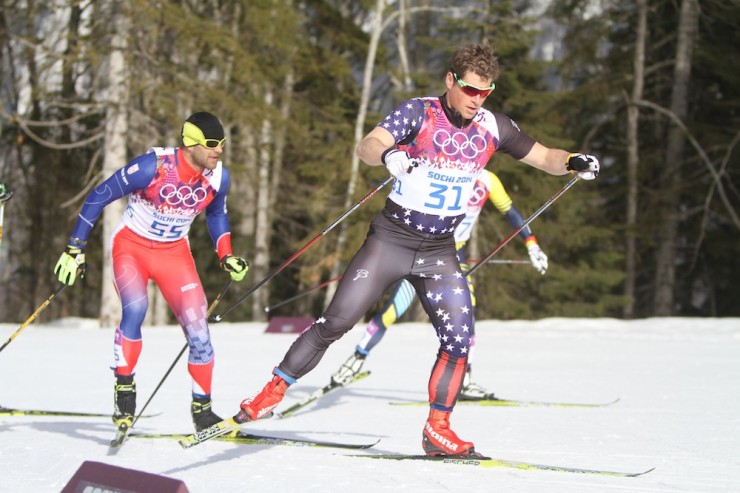
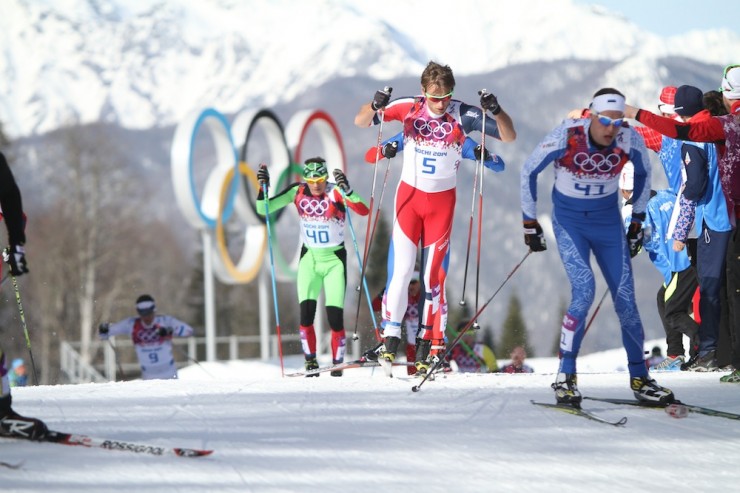
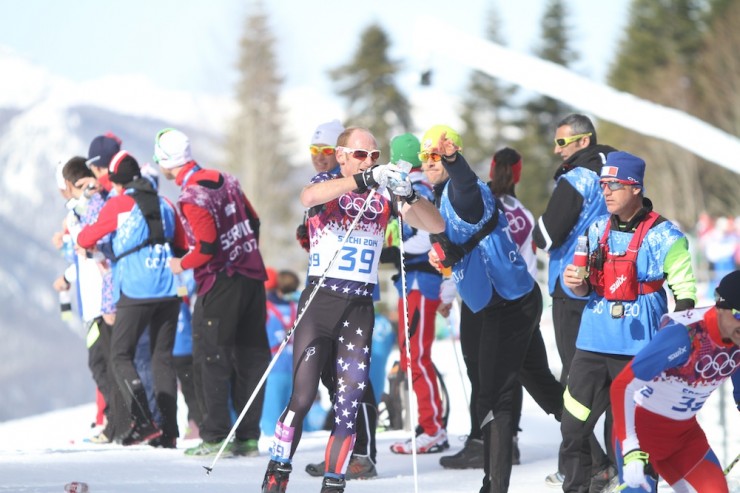
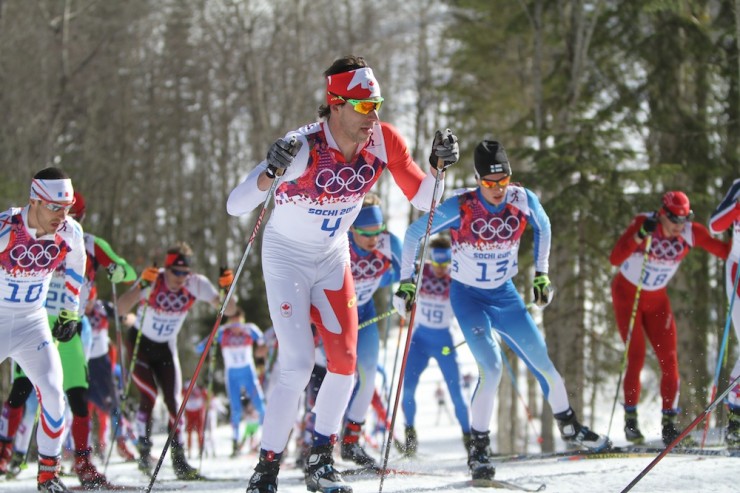
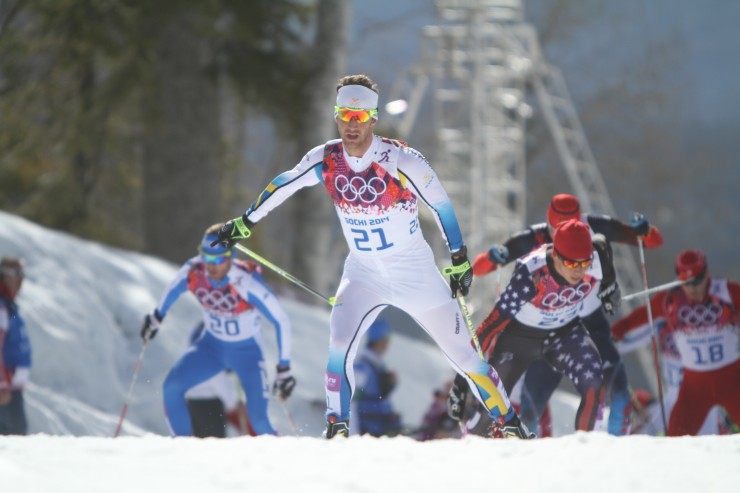
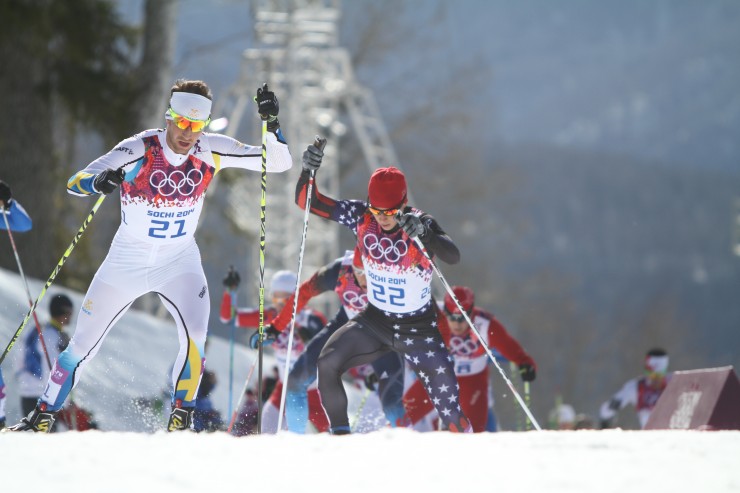
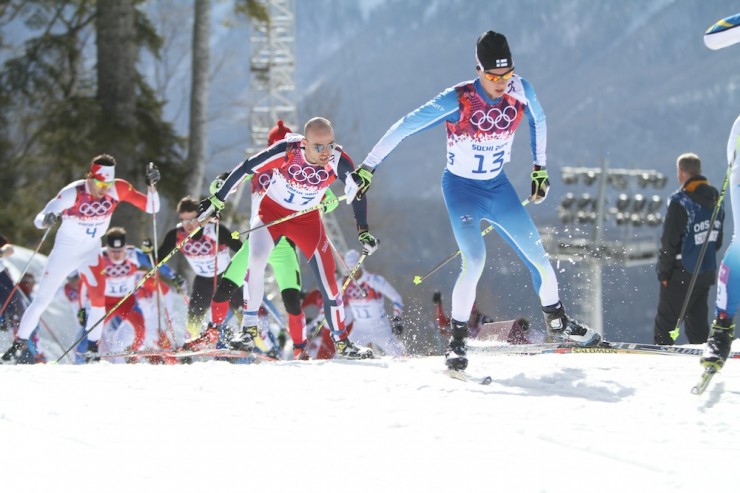
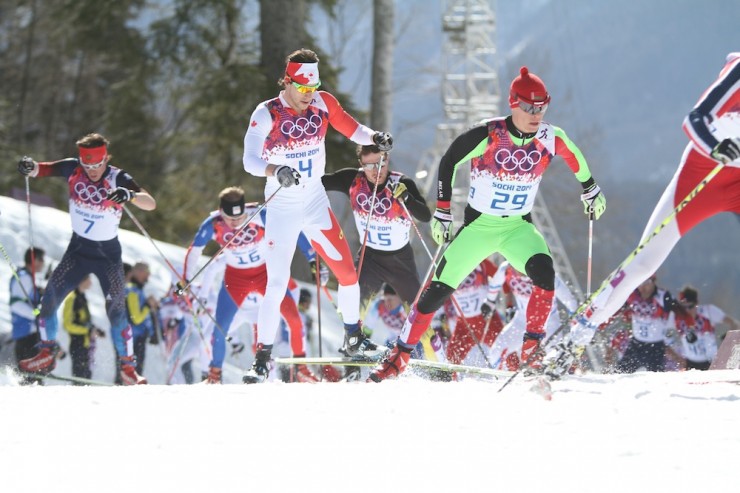
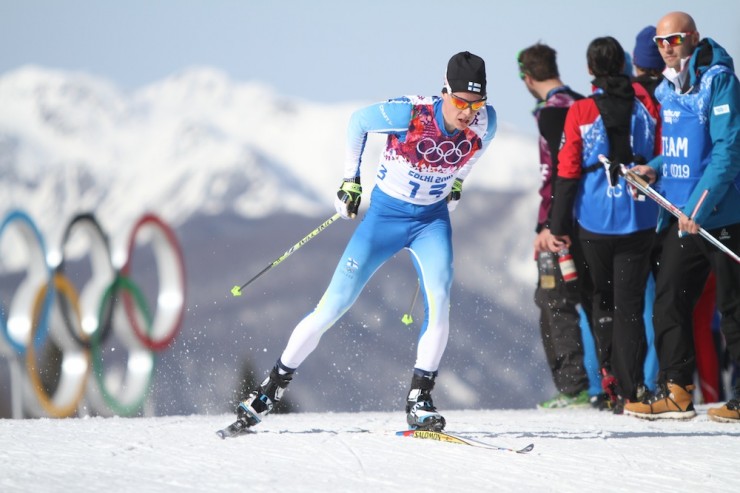
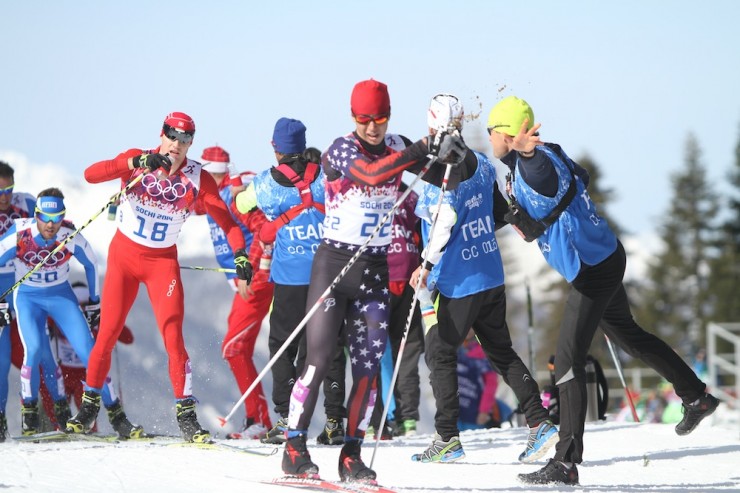
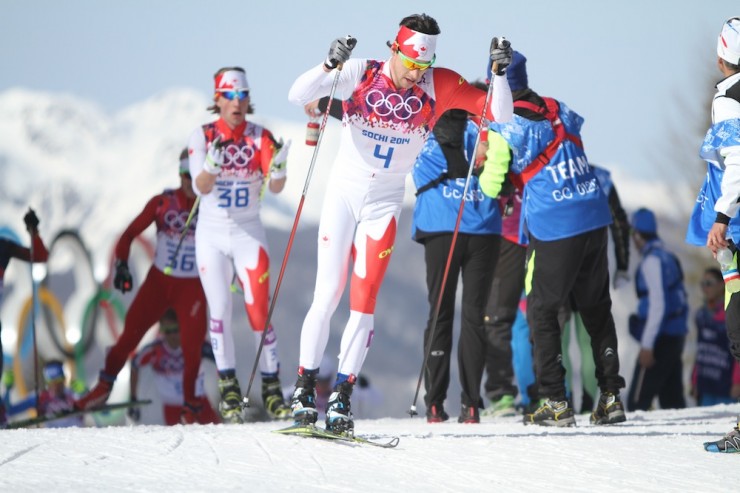
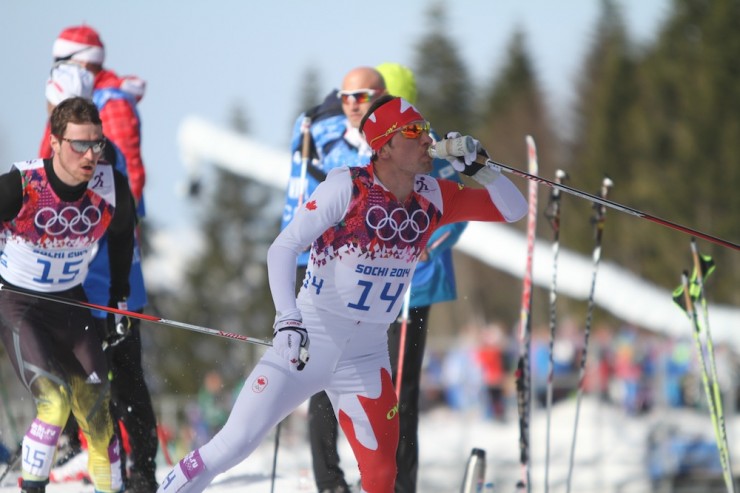
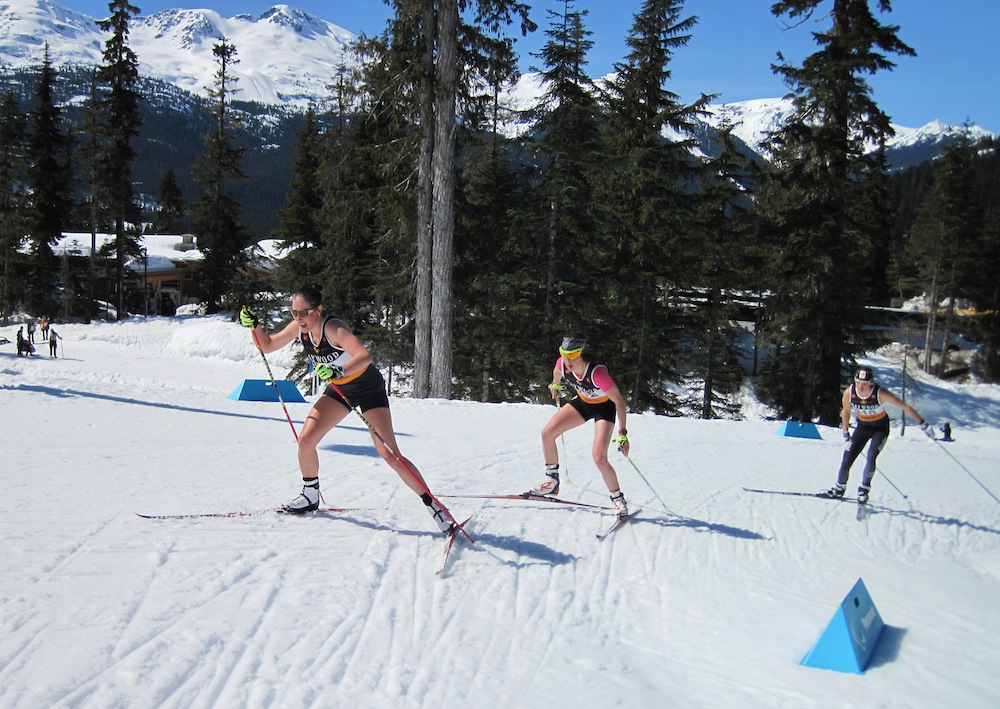
Tag: 50 k freestyle mass start

  • Bolshunov collects third gold medal while Krüger rebounds to bronze post-COVID; Patterson historic 8th place for USA

    Bolshunov collects third gold medal while Krüger rebounds to bronze post-COVID; Patterson historic 8th place for USA

    This World Cup coverage is made possible through the generous support of Marty and Kathy Hall and the A Hall Mark of Excellence Award.  To learn more about A Hall Mark of Excellence Award or to learn how you can support FasterSkier’s coverage please contact info@fasterskier.com.

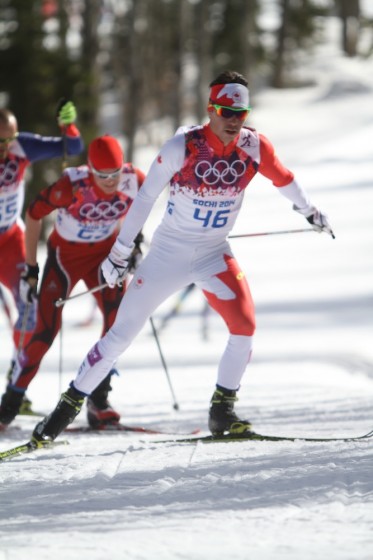
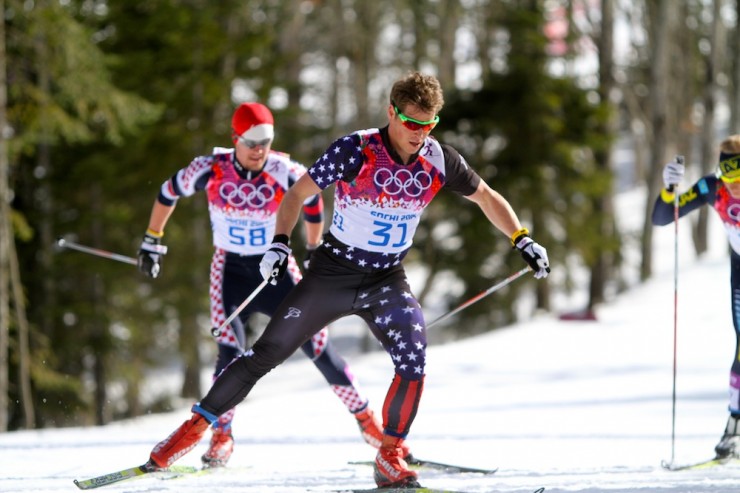
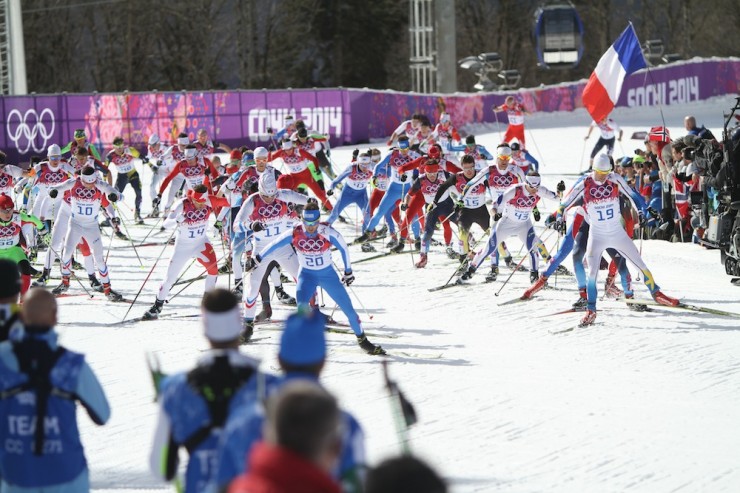
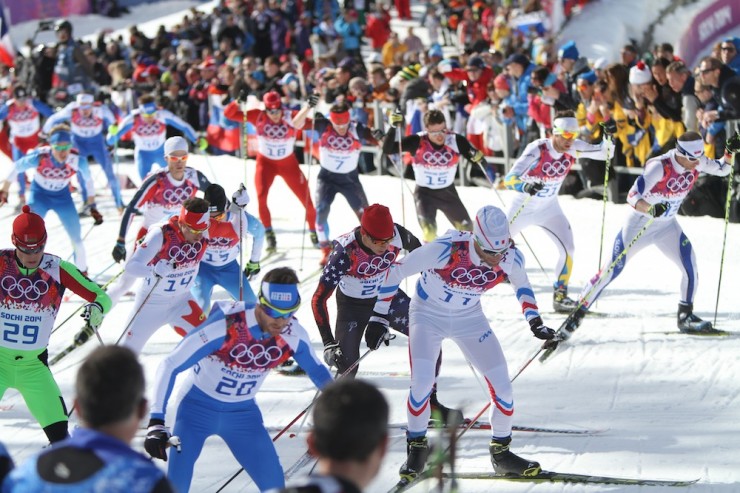
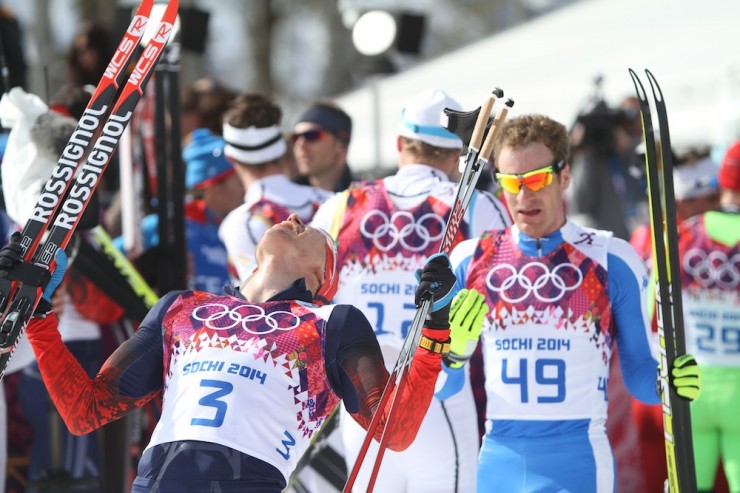
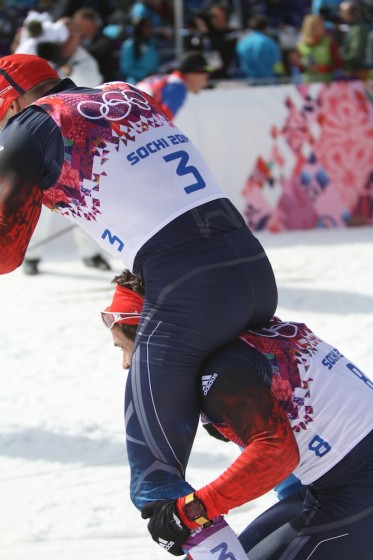
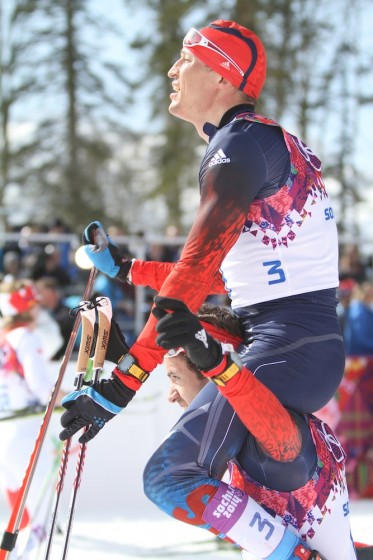
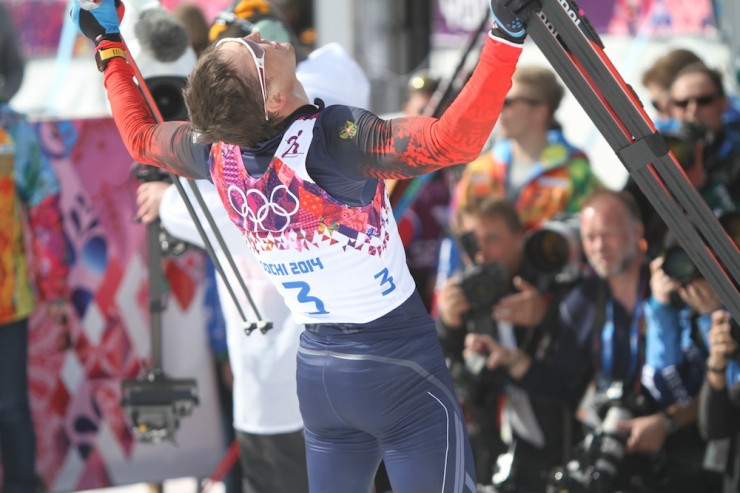
    There were a number of stories to unpack during the men’s 50-kilometer mass start free, which was changed last minute to 28 k due to extreme weather conditions in Zhangjiakou. You’ve got Alexander Bolshunov leading the charge to collect a third gold medal of the Games, continuing his streak of nine Olympic medals in nine Olympic appearances. Bolshunov was followed by his teammate Ivan Yakimushkin, with all four members of the Russian Olympic Committee (ROC) finishing in the top six, interrupted only by two Norwegians, Simen Hegstad Krüger and Sjur Røthe, the first of whom earned bronze in his first Olympic appearance following a COVID-19 detention in a hotel room in Seiser Alm, Italy. 

    But let’s get one key story to the front off the bat: The only American on the start list for the final men’s event of the 2022 Beijing Olympic Winter Games was Scott Patterson, and he skied to eighth place, just 26.9 seconds shy of a medal. It’s the second best result in American men’s cross country ski history, only surpassed by Bill Koch’s silver medal in 1976. That’s the best result in almost 50 years. 
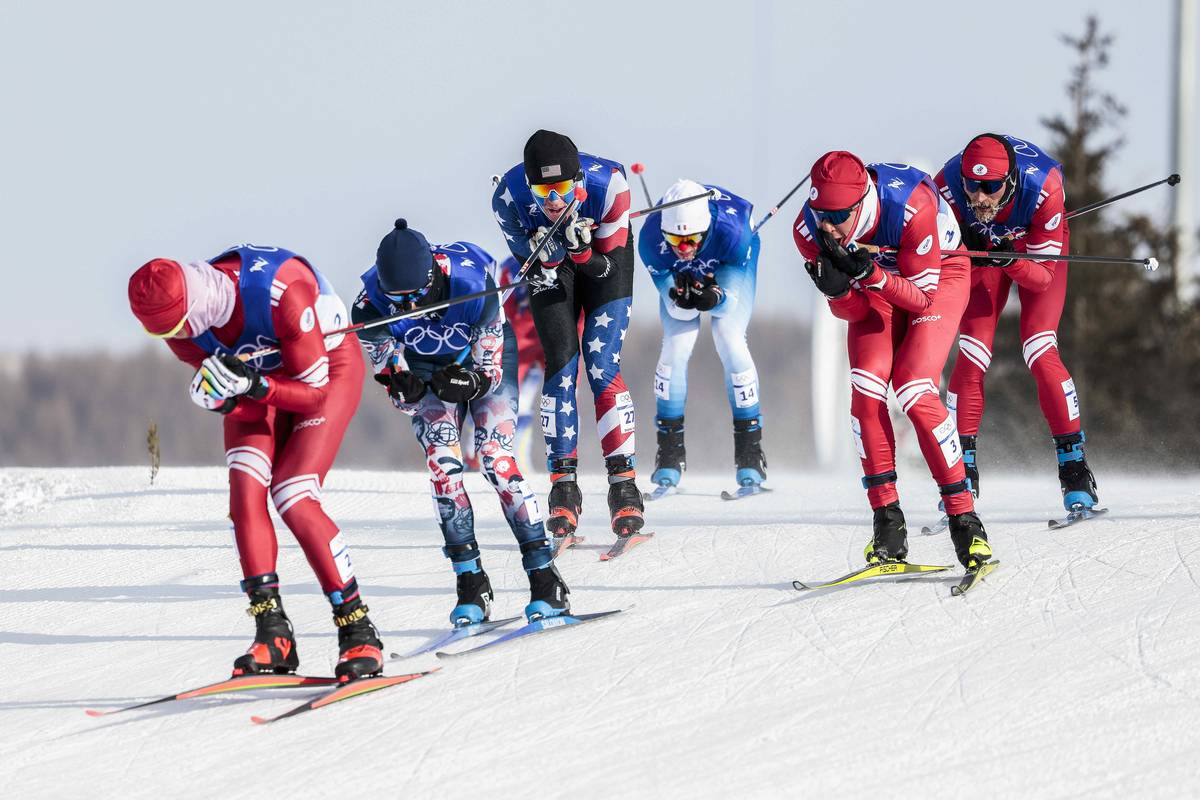
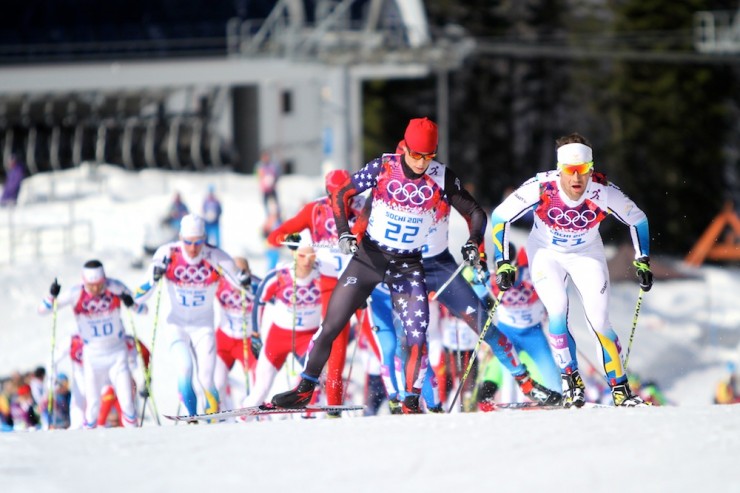
    Scott Patterson tucks into the lead group, on the tails of Alexander Bolshunov (ROC) and Sjur Røthe (NOR). (Photo: NordicFocus)

    Let’s rewind.

    The news of the change in time and distance arrived just hours before the start of the race, with the following message from the organizers: “Due to strong winds and the resulting extreme conditions on course, the distance of the originally planned 50km will be shortened to 30km. The decision was taken in regards to the athletes safety, to reduce the time of exposure of athletes in extreme conditions.”

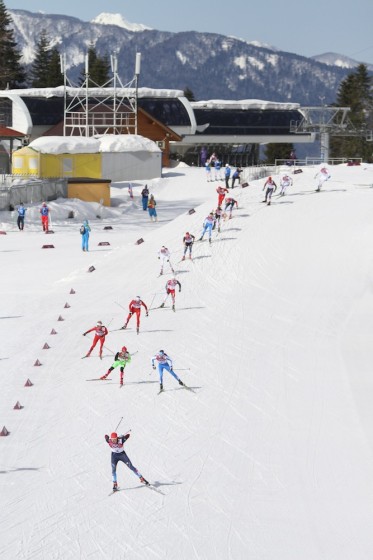
    While there were various opinions on this change, which we’ve covered separately, there’s no getting around the fact that the race distance was slashed nearly in half. Nonetheless, as the lead group moved in and out of the wind, finding shelter on the leeward side of hills and under the protection of treed sections, the four lap course skied like a long-distance event. 
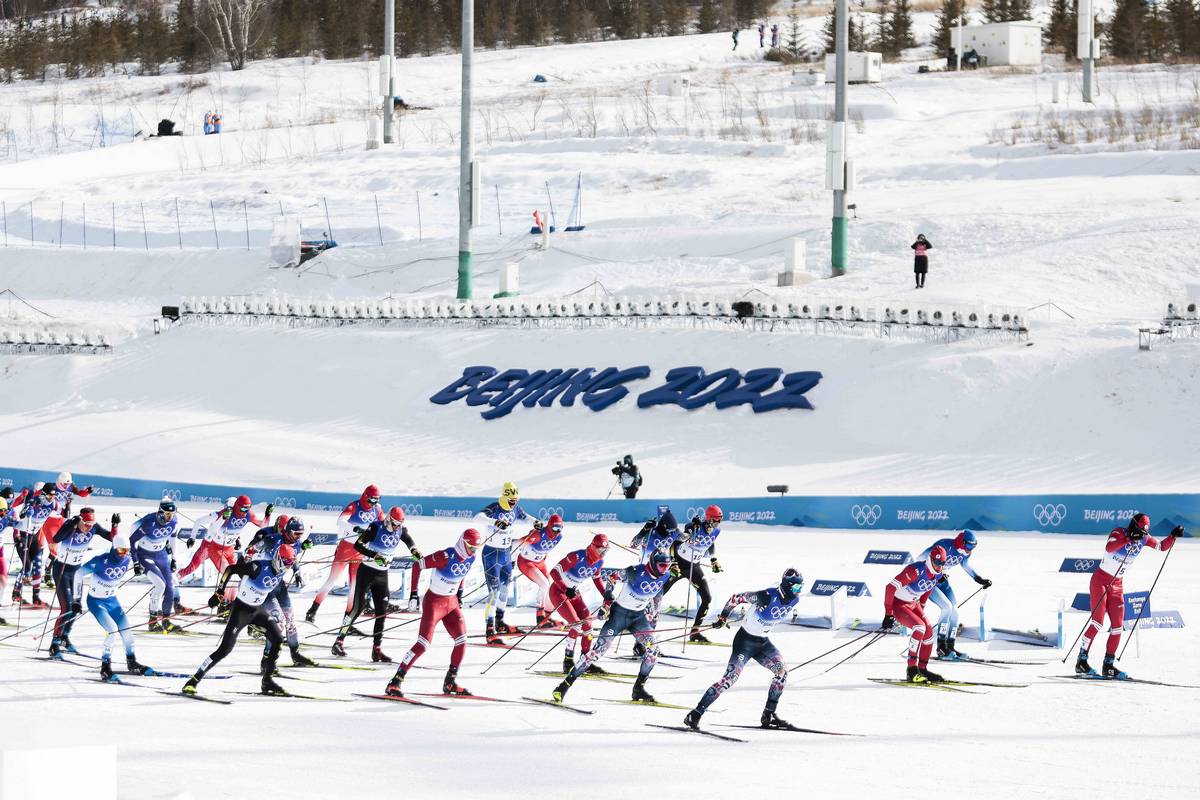
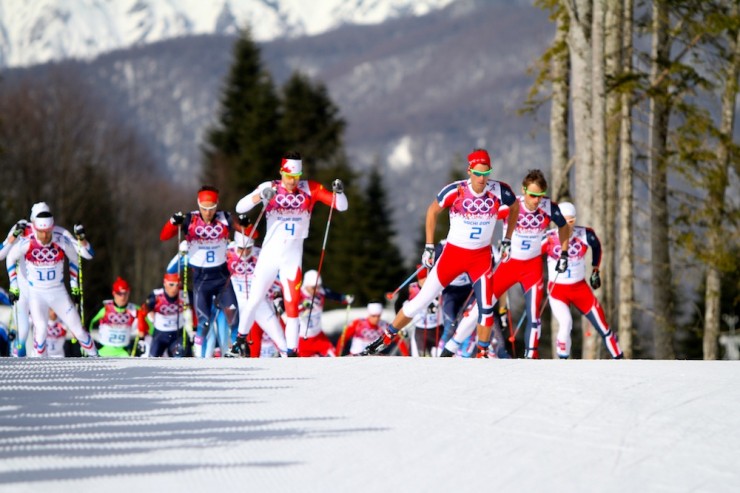
    Shortened due to extreme weather, the men’s 28 k mass start freestyle is underway in Zhangjiakou. (Photo: NordicFocus)

    At the end of the first lap, the top-30 were separated by less than five seconds, thinning to a 13-man pack by the end of the second lap, and a group of 10 by the end of the third, with an 11 second gap to the first chase group.  

    Perhaps the only truly noteworthy moment at this point in the race was the departure of Norway’s Johannes Høsflot Klæbo, who won gold in both sprint events – the individual freestyle and the classic team sprint – while also collecting a silver medal in the men’s relay and bronze in the 15 k classic. Klæbo later reported that he was struggling with a stomach illness and had spent more of the night prior to the race in the bathroom than he had been sleeping.

    “I thought I would’ve regretted it if I didn’t give it a try but now I’m standing here and it didn’t work out on the whole,” Klæbo told the media.

    He said it was “sad” pulling out of the race, but will focus on leaving the Games with his best Olympic distance results.

    “I’ll definitely bring with me what’s been positive. What makes it feel more annoying is that my shape has felt better and better and I’ve actually felt that I’ve had a good energy today too. Then the stomach started to speak up and then it got very far to make it to the finish line.”
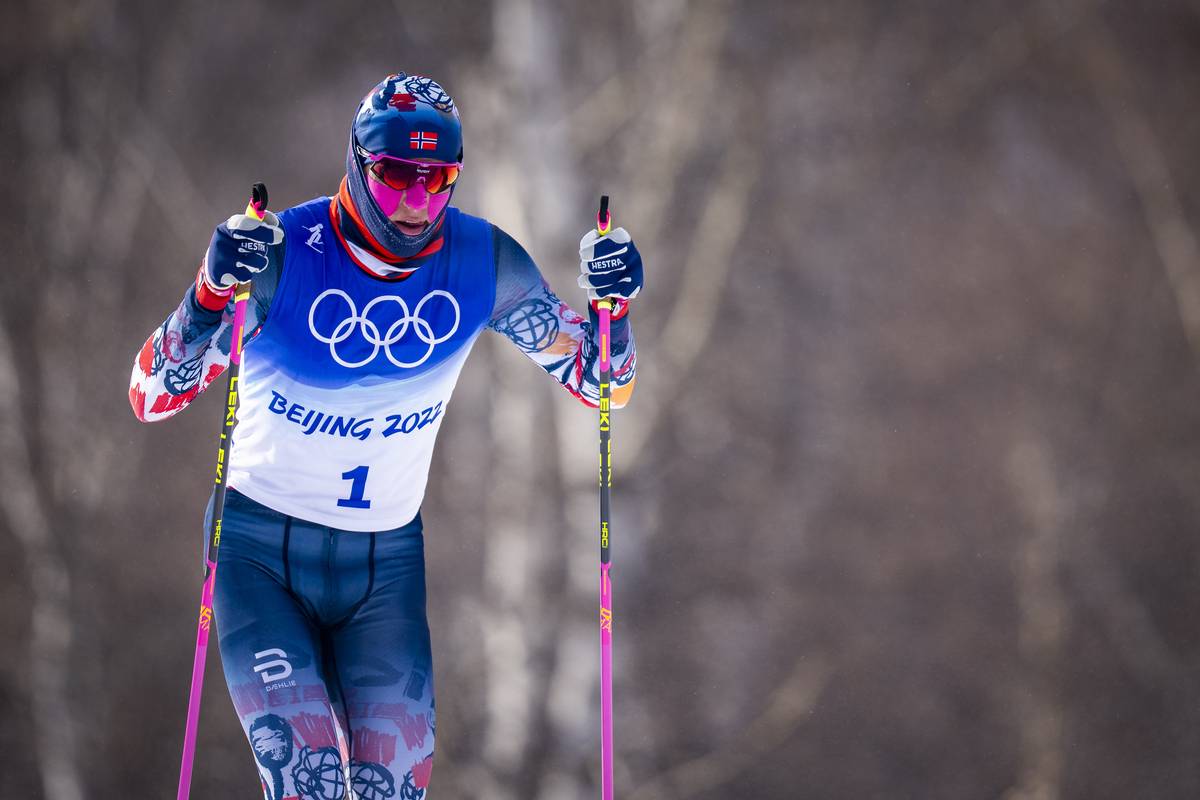
    Johannes Høsflot Klæbo (NOR) dropped out of the 28 k mass start free after his third lap. (Photo: NordicFocus)

    The race for medals truly began in the final lap. With Bolshunov and Krüger each surging to thin the lead group, Sweden’s William Poromaa and France’s Maurice Magnificat began to fall off the back. Patterson was tucked into seventh, working with Clement Parisse (FRA) and Denis Spitsov (ROC) to maintain contact and respond to the accelerations of the front. 
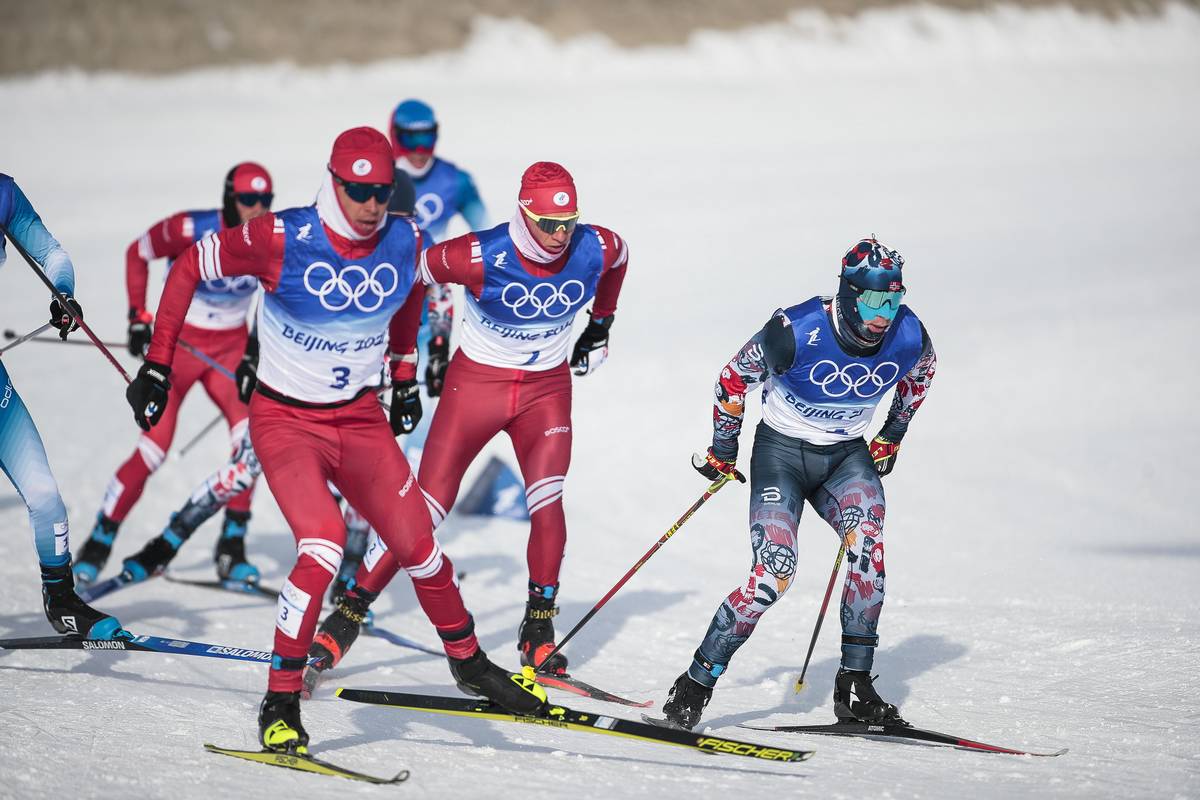
    Simen Hegstad Krüger (NOR) leads the men’s 28 k freestyle alongside the ROC’s Ivan Yakimushkin (bib 3). (Photo: NordicFocus)

    Over the final 5 k, Bolsunov kept the pressure on, looking relaxed as he tried to create space between himself and Krüger, who had been tucked onto his tails, matching him push for push. With them was Yakimushkin, the three skating in tandem as the finish line drew nearer. 

    At 24 k, the leaders had only a few seconds on Patterson’s chase group, but when they hit the 27.2 k checkpoint, the gap had drastically expanded. Artem Maltsev (ROC) and Røthe were still just a few seconds back, but Patterson, Parisse, and Spitsov were now over 20 seconds behind, with a 20 second cushion ahead of the next chasers.
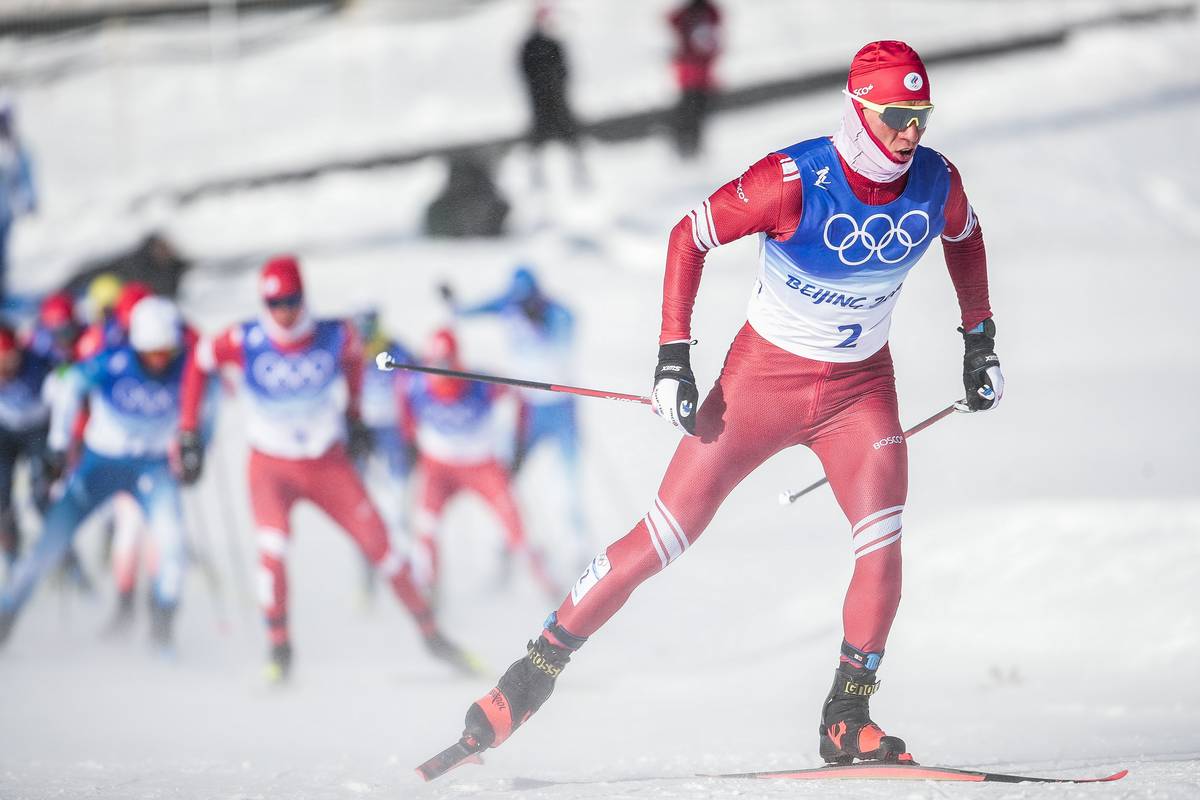
    Alexander Bolshunov (ROC) races to his third gold medal of the 2022 Olympic Winter Games during the men’s 28 k freestyle. (Photo: NordicFocus)
    Norway’s Simen Hegstad Krüger leads the charge during the men’s 28 k mass start freestyle. (Photo: NordicFocus)

    Up the final long climb, Krüger would not yield, holding his ground immediately behind Bolshunov. Tucked low into the downhill, the three stayed together, with Bolshunov upping the tempo and power as they accelerated out of the curves and over the gentle rises that interrupted the sweeping descent. 

    As the three hit the final rise into the stadium, Bolshunov began to break away, with Yakimushkin using Krüger’s draft to slingshot into second with 500 meters to go. 

    Entering the stadium, the gold medal looked to be predetermined. With a fist pump as he made his way around the final bend into the finish lanes, Bolshunov V2ed powerfully down the home stretch, crossing the line with his hands raised in 1:11:32.7.
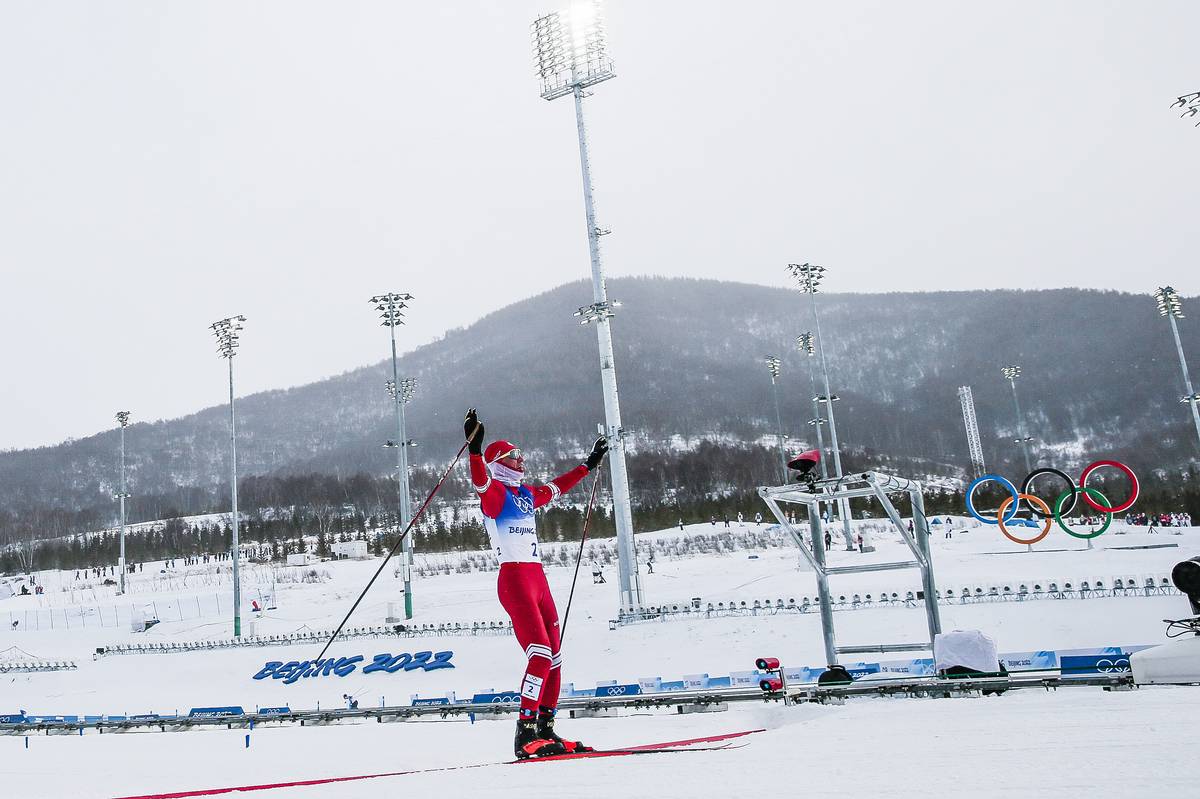
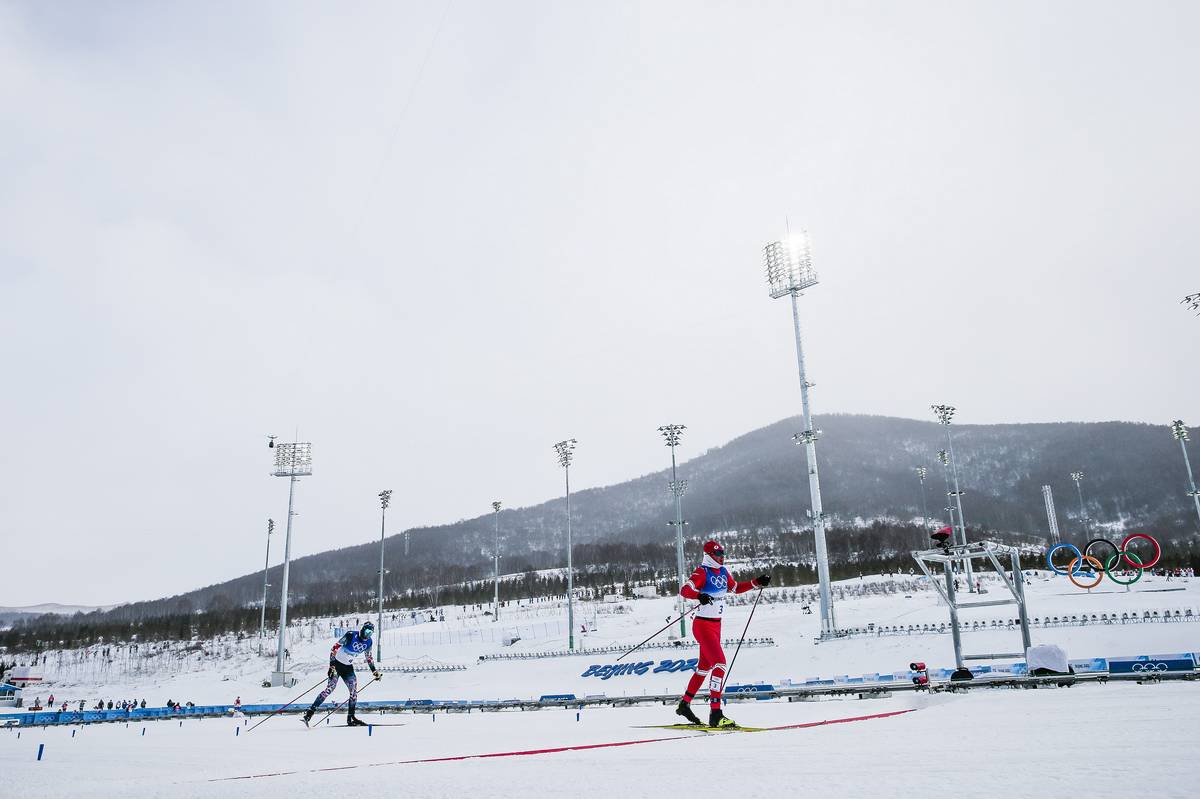
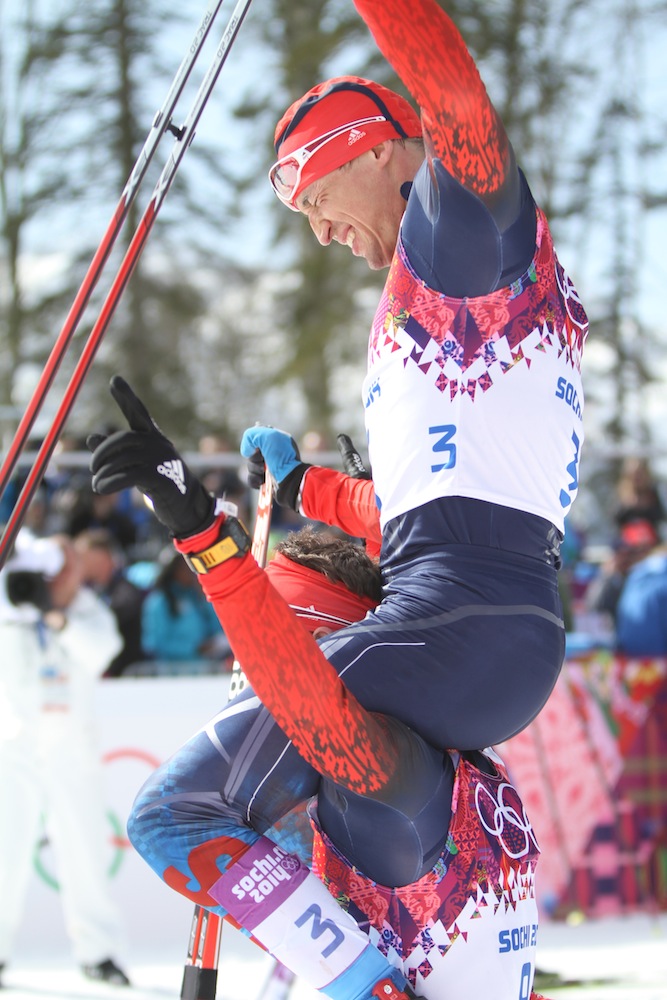
    Alexander Bolshunov (ROC) celebrates his win in the 28 k mass start freestyle. (Photo: NordicFocus)
    Ivan Yakimushkin (ROC) takes silver in the men’s 28 k free, while Simen Hegstad Krüger finishes third for Norway. (Photo: NordicFocus)

    Holding his advantage through a final sprint to decide silver and bronze, Yakimushkin crossed the line second (+5.5) with Krüger taking third (+7.0) for Norway.

    Behind, Maltsev came to the line fourth (+10.7), followed by Røthe in fifth (+15.8). 

    Spitsov led the now-spread chase group to the line, taking sixth (+26.2) ahead of Parisse in seventh (+28.8) and Patterson eighth (+33.9).
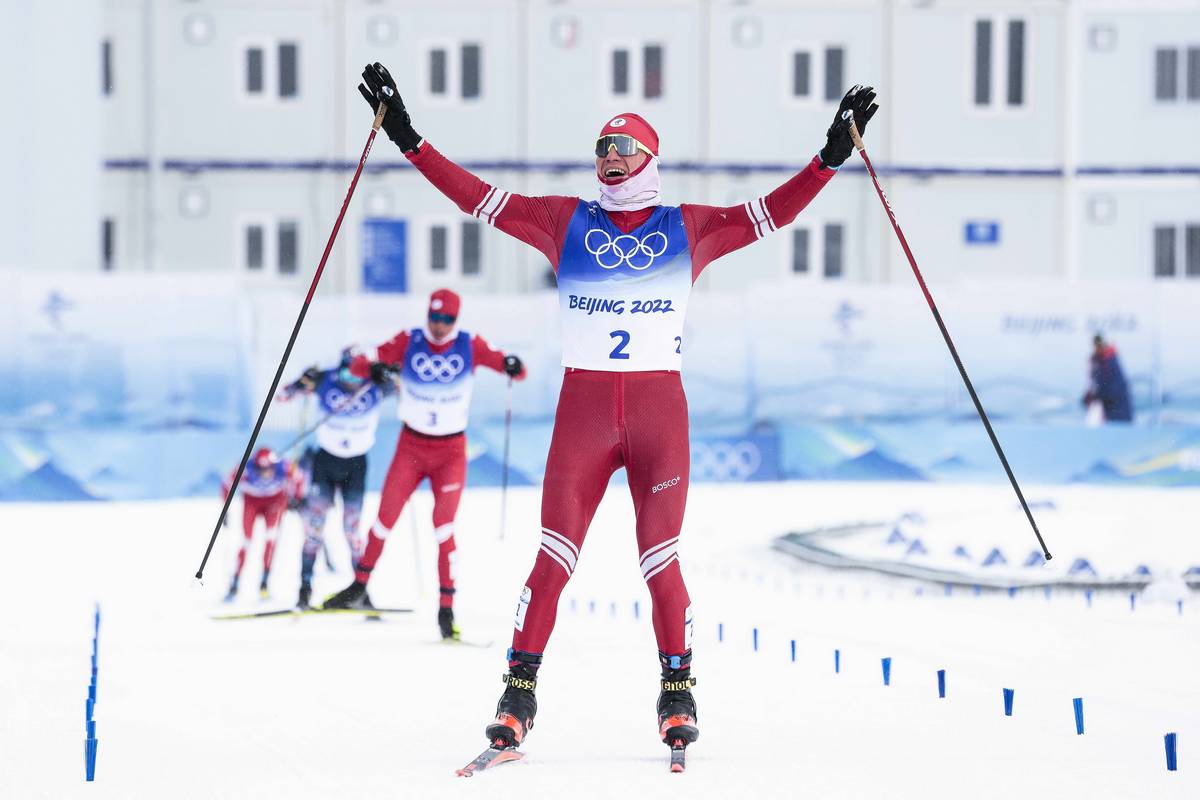
    Alexander Bolshunov (ROC) wins his third gold medal of the 2022 Games in the men’s 28 k mass start freestyle. (Photo: NordicFocus)

    Nine Olympic medals. Three gold. Four silver. Two Bronze. Five from the 2022 Olympic Winter Games.

    “Five? Really?” Bolshunov counted on his fingers as he exuberantly celebrated the golden ending to his Beijing Games appearance. “Five medals, three gold, it is something unbelievable because before the season I set the goal of two gold medals and now I have three. I’m just unbelievably happy. The emotions overfill me. This is above all praise to win these medals here. It’s very cool, and in every race that I took part in.”
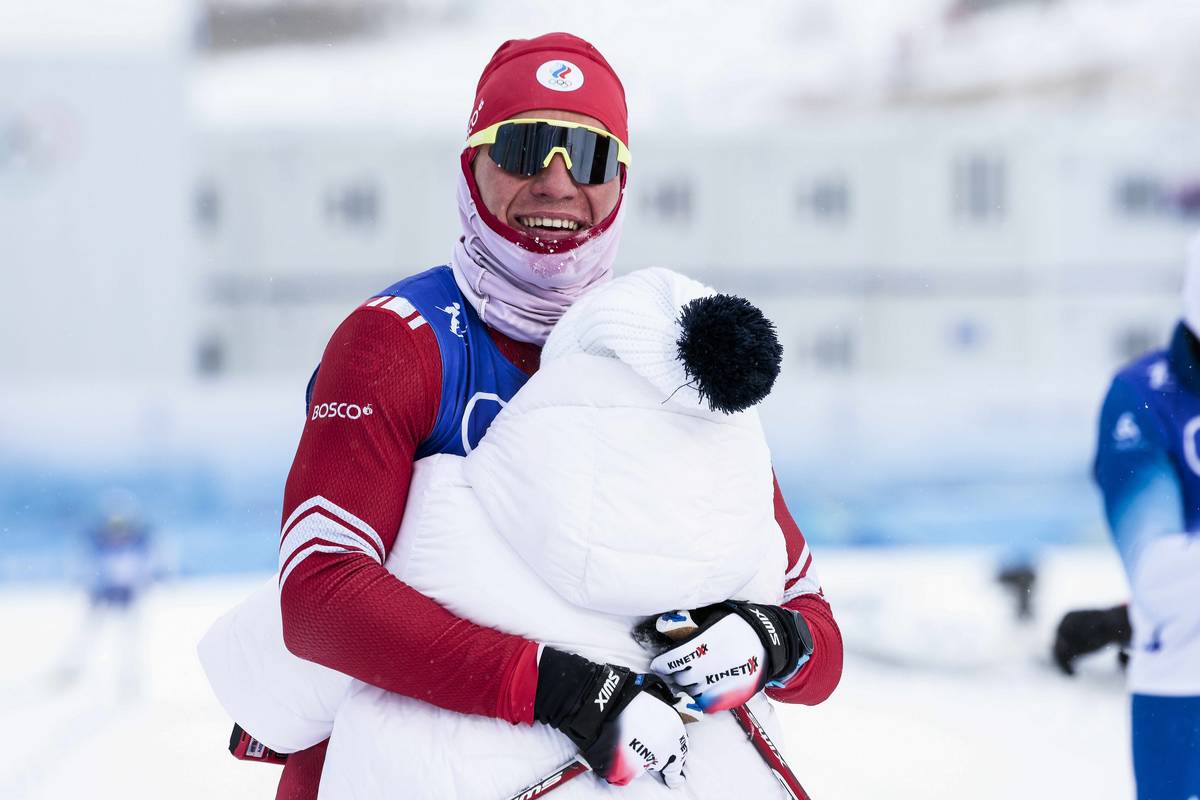
    Alexander Bolshunov (ROC) receives a cozy Olympic themed gift following his win in the men’s 28 k freestyle. (Photo: NordicFocus)

    Regardless of the color of the medal he earned, Krüger said his real victory was simply making it to Zhangjiakou and having the opportunity to race at the Games. Though his illness stayed mild and he stated that it did not impair him in today’s race, he had still spent 10 days in isolation in his hotel room, and remained in isolation while the opening event of the Games, the men’s 30 k skiathlon, was underway. Krüger was the defending Olympic champion in the event after taking gold in 2018. He went on to win a silver medal in the 15 k skate, and help Norway to gold in the men’s relay. 

    During the 2021 World Championships, Krüger earned two silver medals, first in the 30 k skiathlon and the next in the 15 k free, with a bronze in the 50 k skate. He was one of the top distance skiers on the World Cup heading into the 2022 Games, shouldering Norway’s medal hopes; the nation experienced collective heartbreak following the news of his positive COVID test in late January. 

    “To be able to go home with an Olympic medal, that’s a huge victory for me and an amazing feeling,” Krüger said after the race. “I’m really proud of what I have achieved today; from not thinking I would be able to ski one single competition to being able to get everything out here today.”
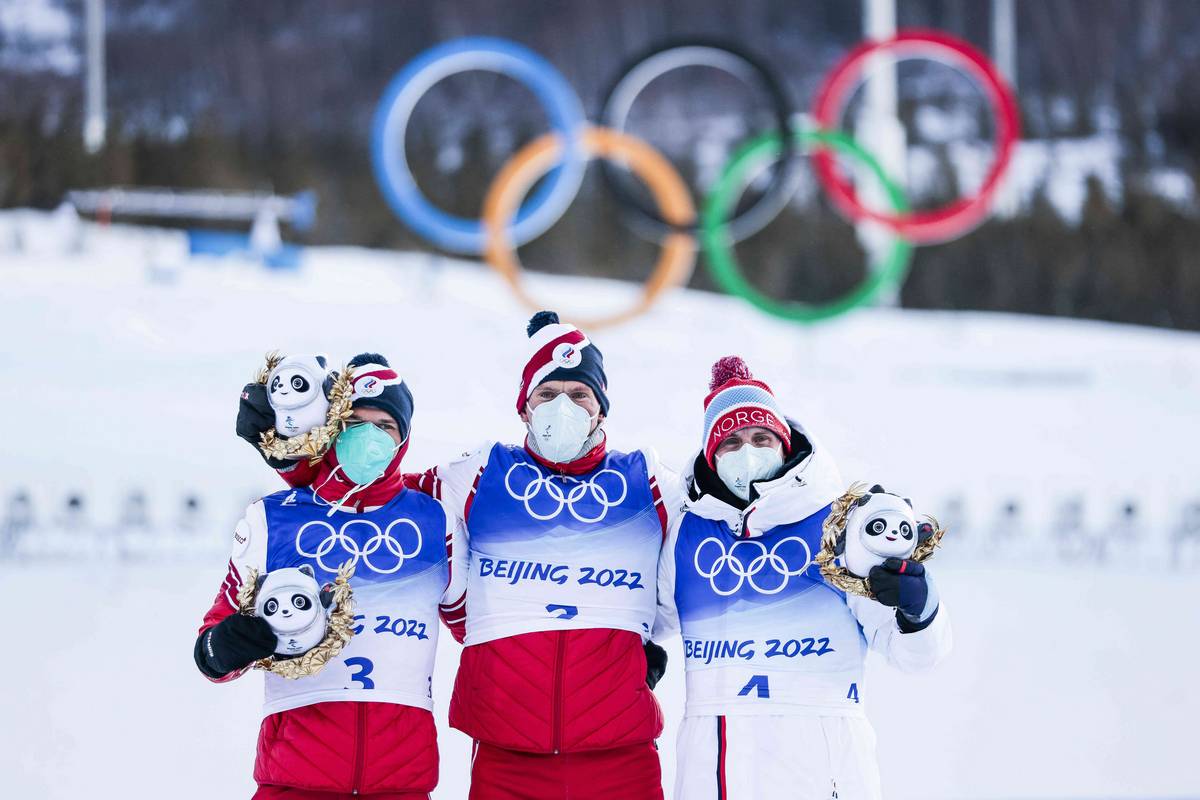
    The podium of the men’s 28 k freestyle: Alexander Bolshunov (ROC) took the win ahead of Ivan Yakimushkin (ROC) and Simen Hegstad Krüger (NOR). (Photo: NordicFocus)

    For Patterson, eighth place meant achieving the goal, though he admitted being in the hunt for positions even closer to the podium leaves him hungry for more. 

    “I’m happy,” he told FasterSkier in the mixed zone. “I came in wanting the top 10 and got it today. It’s a little tantalizing to be in eighth and 33 seconds back from the win.” 

    He continued that the “dream” of a medal crossed his mind as he found himself inside the lead group in the final lap, but he could feel the fatigue accumulating in his body and recognized that he was finding it hard to respond to the tactical moves of the eventual medal winners. “I don’t think it was exactly realistic to fully believe it was happening today,” he said frankly. 
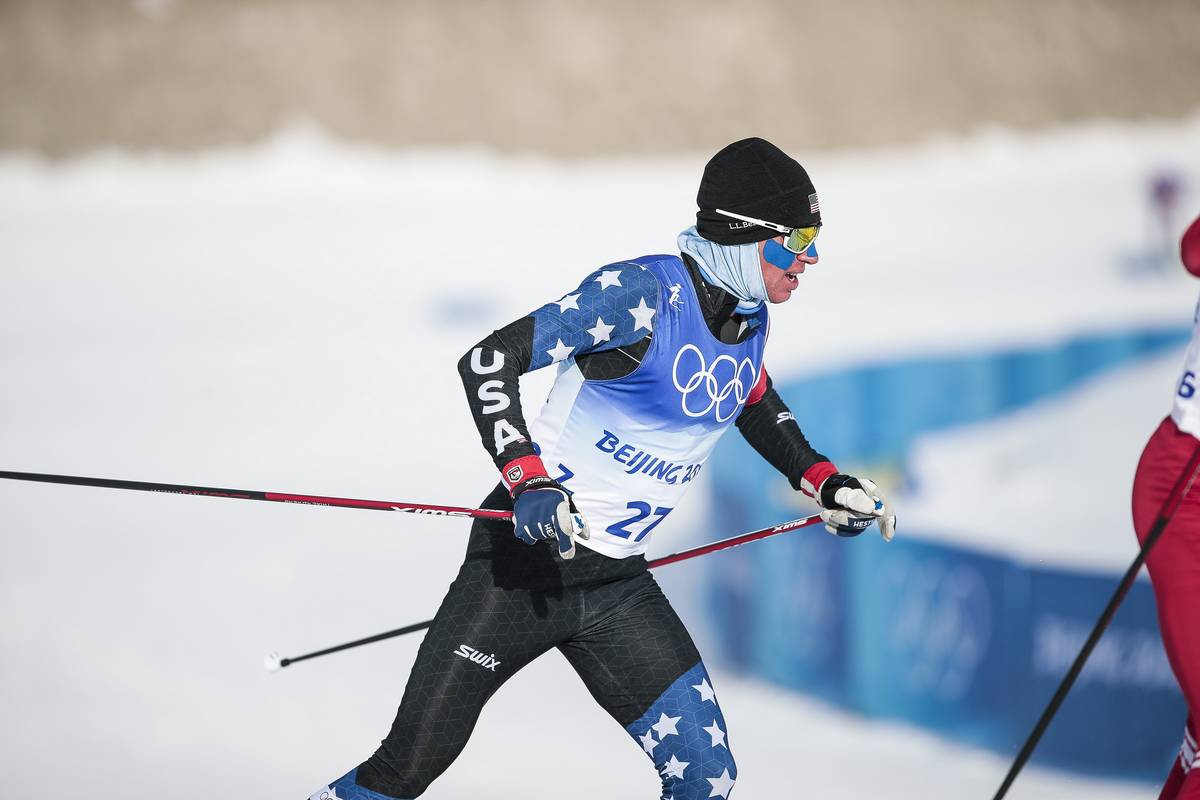
    Scott Patterson skis to an Olympic career best with 8th place in the 28 k mass start freestyle. (Photo: NordicFocus)

    Patterson’s result, while historic, should not come as a surprise to American cross country ski fans. He was 11th in the skiathlon at the opening of the Games, and has made his ability to come on form and earn season-best results during Championships well known over the last four years. 

    During the 2018 Games in PyeongChang, he put together breakout performances, skiing to 18th in the skiathlon, 21st in the 15 k skate, and 11th in the 50 k classic. He raced into the top-30 in each individual distance race of the 2019 World Championships, with a 23rd place finish in the 50 k free. Improving on these results in the 2021 World Championships in Oberstdorf, Germany, Patterson was 14th in the skiathlon, 27th in the 15 k skate, and 10th in the 50 k mass start classic

    And, he likes going long. He said he would have preferred another 20 k today – “I wanted the grinding instead of the punches” – and might have even been able to pull off a higher result had the race been longer. 

    Back in 2016, his first World Cup appearance was in the 50 k classic at the Holmenkollen, which sits above Oslo, Norway. He was 32nd on the day in perhaps the most storied and highly revered cross country ski race on the World Cup. Patterson advanced to 28th the following year, before making a leap into the top-20 to finish 16th in 2018 and 19th in 2019.
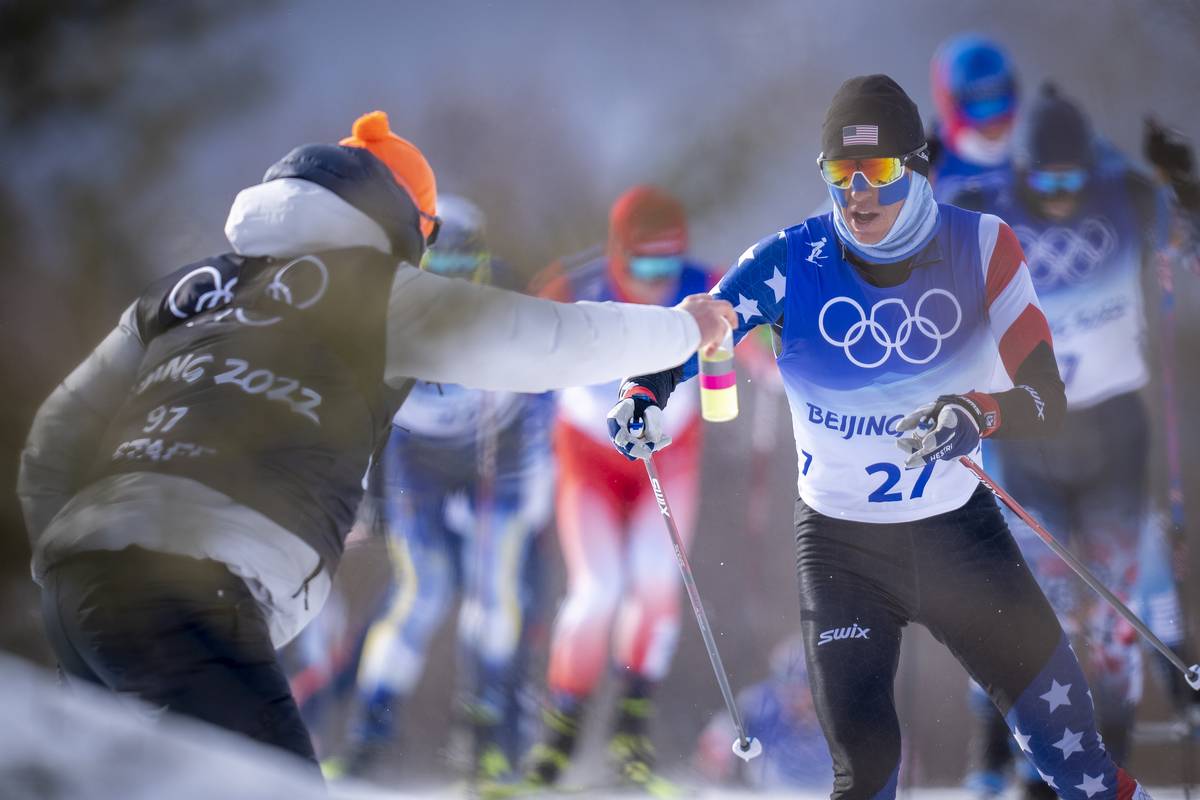
    Scott Patterson takes a feed during the men’s 28 k free in Zhangjiakou. (Photo: NordicFocus)

    From the outside, it can be hard to appreciate the dynamics of mass start racing among the best athletes in the world in the sport. Energy management, tactics, drafting, protecting equipment while the field remains dense in the first lap, which Patterson called “chaotic.”

    “You get those lead skiers fighting the wind, and a lot of the back skiers that could just draft in. And there are a few people who definitely don’t have a lot of World Cup experience making a mess out of the pack,” Patterson described.

    In his second Olympic appearance at the age of 30, with plenty of World Cup experience, Patterson skied a smart race, telling FasterSkier that he felt “strong” and “relaxed”, while looking to be “in a comfortable position and not [using] too much out of my energy.” He also reported having competitive skis that allowed him to utilize the downhills and stay in the position where he wanted to be. 

    U.S. Ski Team head coach Matt Whitcomb complemented Patterson on his race execution, telling FasterSkier emphatically that he was “so proud of him.”
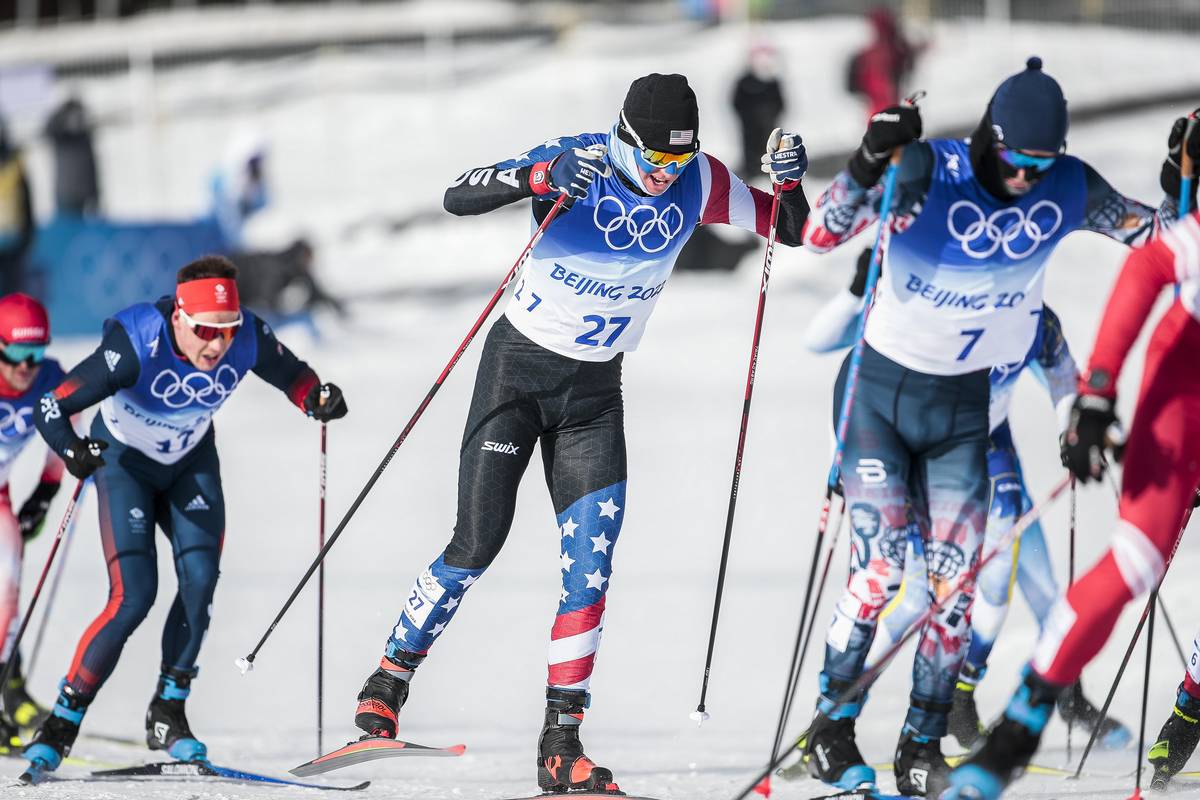
    Scott Patterson races in the lead group during the men’s 28 k mass start freestyle. (Photo: NordicFocus)

    Talking through the race from his vantage point, Whitcomb pointed out that Patterson stayed calm through the congestion in the opening lap, rather than becoming flustered and wasting energy by constantly trying to move up. He also shared how Patterson was able to “wisely” keep himself on the correct side of other racers to utilize the windbreak on unsheltered sections of the course.

    “Some incredible skiers ended up on the wrong side of the break and were toast…” Whitcomb explained. “When that happened, I heard a Finnish yelling at a German skier saying, ‘Hey, take me up to them!’ People were desperate to do work together, and so [I’m] very proud of Scott and unsurprised that he was in a tactically wise position.”

    Apart from battling the elements, maintaining an optimal position within the lead group is also a skill that requires experience and maturity.

    “If you have a pack of 15 guys, of course, it’s easy to follow in a draft in 14th and 15th,” Whitcomb said. “But what you don’t realize is that there’s quite a big accordion effect, so you’re constantly pulsating on the gas pedal. What you saw [today] was Scott moving up into between fourth and seventh, for a large part of [the race], and that ends up being a much more efficient position to ride. Draft is good, but you’re also able to just kind of stay on a steady gap.”
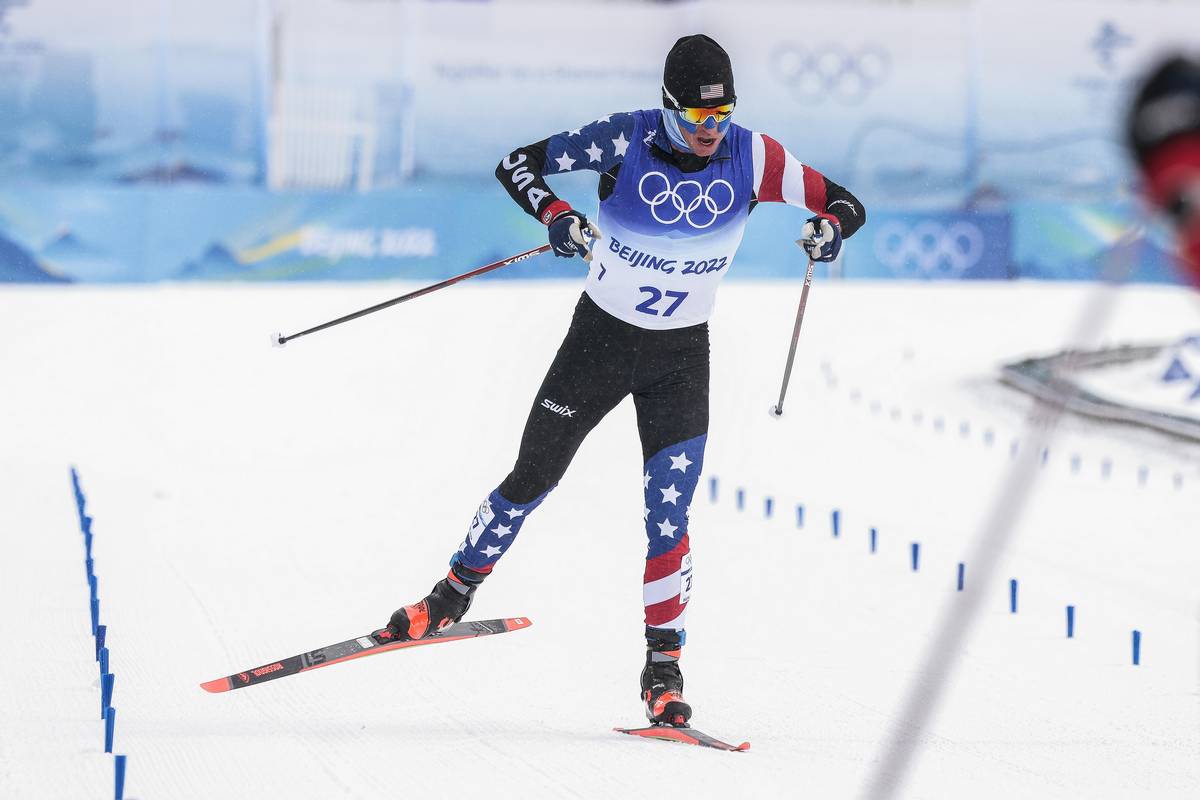
    Scott Patterson races to the line, finishing 8th in the men’s 28 k mass start freestyle. (Photo: NordicFocus)

    For Whitcomb, Patterson’s eighth place ends the Games on a high note for the American men’s program as a whole.

    “This is, this is for sure one of the goals that our men’s program wants: to start breaking through in one of the ultimate races of the Olympics,” Whitcomb shared. “To do that today, under conditions like this, is such a huge success for our program and for Scott and for his club, APU. For all the coaches over the years, Erik Flora that’s worked with him, and the [rest of the] coaches at APU. It’s such a huge success for [Patterson’s collegiate program], the University of Vermont; Alaska Winter Stars where he started skiing; and just so many people have been a part of this incredible journey. And so happy for all of them. But mostly for Scott because he earned this sucker today. It was brutal.”
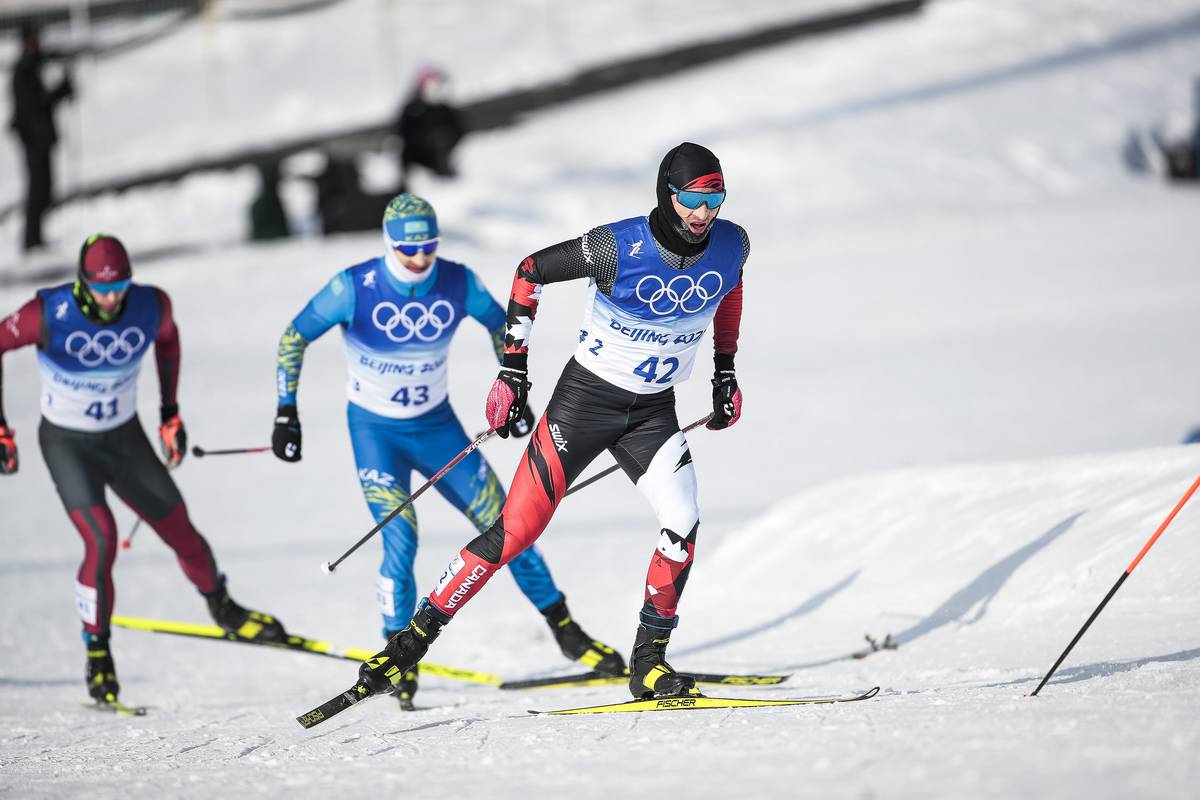
    Rémi Drolet (CAN) skis to 35th in the men’s 28 k mass start skate. (Photo: NordicFocus)

    Two Canadian’s raced the 50 k today, with Olivier Léveillé leading the Canucks at the finish in 27th (+4:21.6). 30 seconds back, Rémi Drolet crossed the line in 35th (+4:54.4). 

    Racing continues tomorrow with the women’s 30 k mass start freestyle, the final cross country event of the 2022 Beijing Olympic Winter Games. At this time, the distance of the women’s event remains unchanged, however, the start was moved up by 3.5 hours to account for the forecasted weather conditions.   

    Results

  • Sunday Race Rundown from Seefeld: 50 k Freestyle

    Sunday Race Rundown from Seefeld: 50 k Freestyle

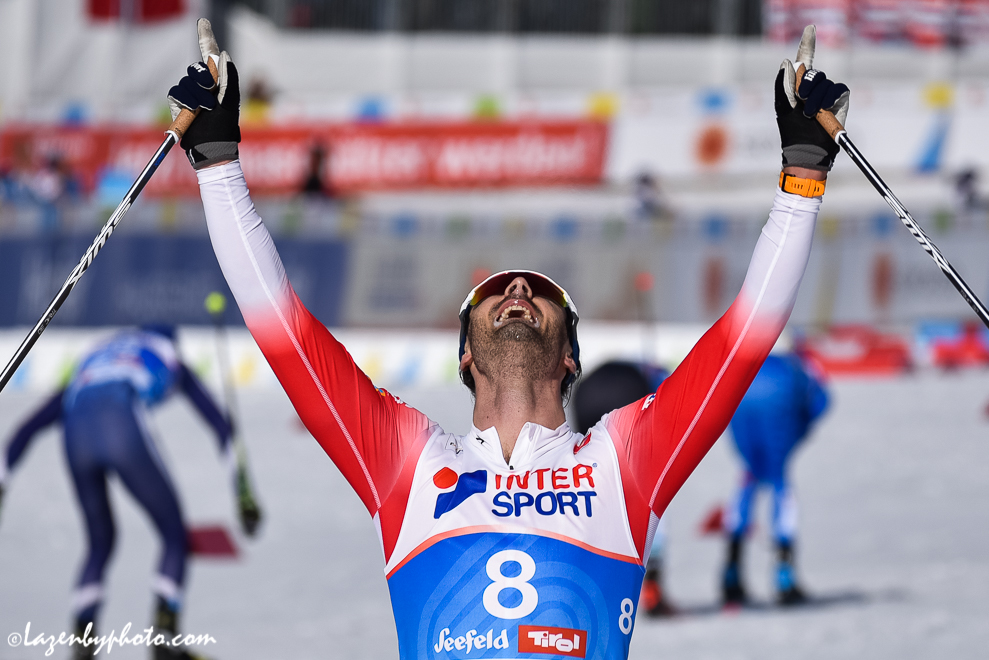
    Norway’s Hans Christer Holund crossing the line in first as he wins the 50 k skate at the 2019 World Championships. (Photo: John Lazenby/lazenbyphoto.com)

    FIS Nordic Ski World Championships Men’s 50 K Freestyle Mass Start

    It has come to a close. The 2019 Nordic Ski World Championships ended today with the men’s 50-kilometer freestyle mass start. Hans Christer Holund of Norway began to make his mark on the race shortly after 20 k with a solo attack. In his bold ski-alone effort, Holund was able to fend off any chasers and win in 1:49:59.3 hours.

    Russia’s Alexander Bolshunov timed his chasing surge for a last 10 k punch. By the finish, Bolshunov had eaten up some time on Holund to place second, 27.8 seconds back.

    https://www.ainhalers.net

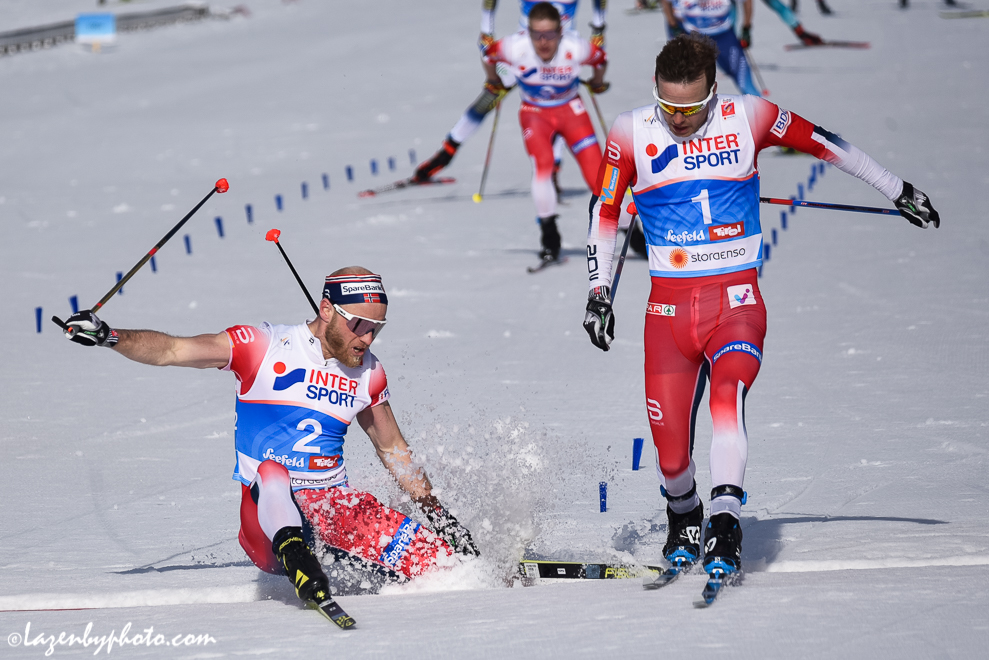
    Sjur Røthe and Martin Johnsrud Sundby, teammates on the formidable Norwegian team, created their own gap on the sizable main chase group as they raced up the course’s final climb. Sprinting down the straight into the finish, Røthe out-toed Sundby for third overall (+57.8) as Sundby took fourth (+57.9).

    Canada’s Alex Harvey  was the top North American in 12th (+1:10.5). He was followed by teammates Russell Kennedy in 46th (+9:57.6), Evan Palmer-Charrette in 47th (+11:26.1), and Scott James Hill in 50th (+11:27.6). If you love play games with mods, Download mods for android games free and let’s go to run your fav game

    David Norris was the top American in 20th (+1:22.6), followed by Scott Patterson in 23rd (+2:05.5), Simi Hamilton in 34th (+4:02.), and Adam Martin in 45th (+8:01.7).

    Results

    The toe-surge by Norway’s Sjur Røthe for third place over teammate Martin Johnsrud who placed fourth during Sunday’s 50 k skate at World Championships. (Photo: John Lazenby/lazenbyphoto.com)
  • An Air-Guitar Solo: Harvey Closes Out Championships with 50 k Win

    An Air-Guitar Solo: Harvey Closes Out Championships with 50 k Win

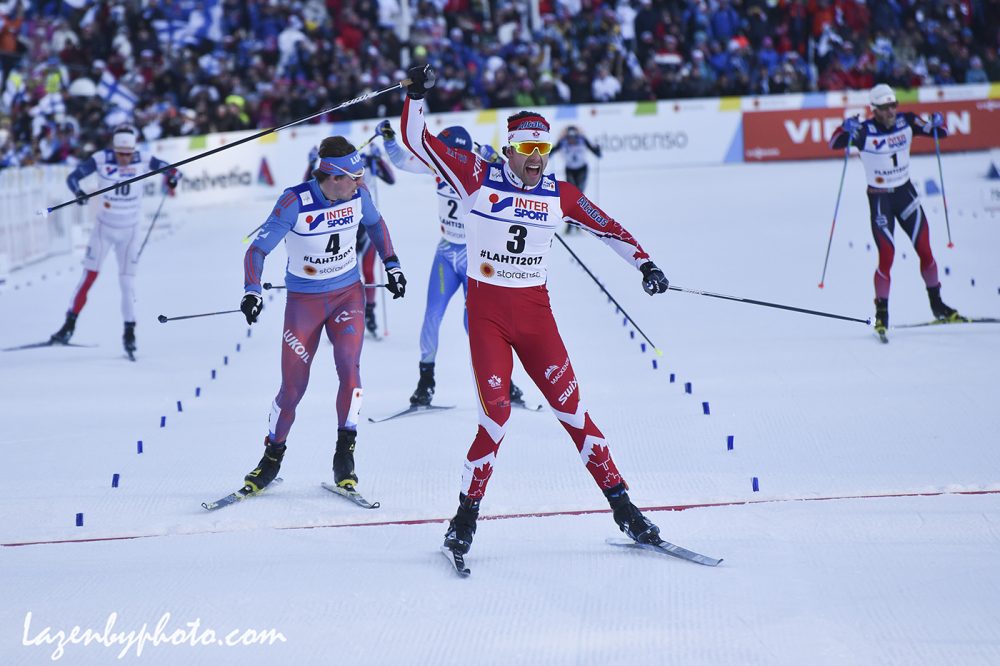
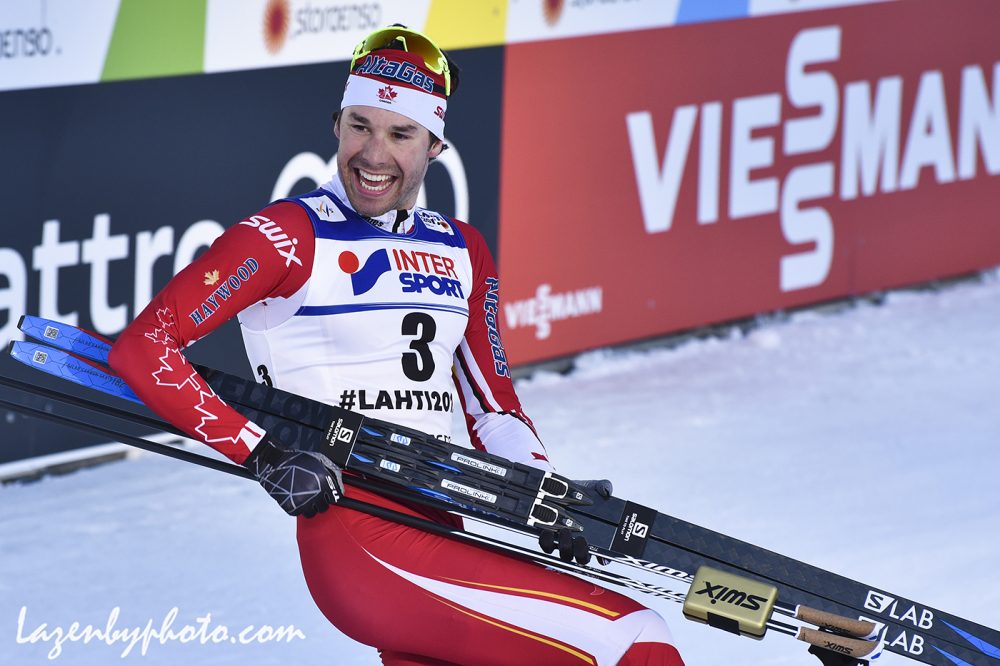
    It’s real. Canada’s Alex Harvey after winning gold in the men’s 50-kilometer freestyle mass start on Sunday at the 2017 Nordic World Championships in Lahti, Finland. (Photo: John Lazenby/Lazenbyphoto.com)

    LAHTI, Finland — Here’s the basics: fast and firm tracks, cloudless skies, and once again a stacked field for the final event of the 2017 Nordic World Championships: the men’s 50-kilometer freestyle mass start.

    Over the course of the 50 k, Canada’s Harvey had to think about one thing: be up front near the top three in order to shadow Norway’s Martin Johnsrud Sundby’s inevitable gut punch in the last kilometer. What he didn’t have to think about was playing catch up as a skier yo-yoing off the back, or his skis — they were rockets.

    In Sunday’s closing race of Lahti World Championships, Harvey was slotted in second, sliding around “Lahti Corner” just centimeters behind Sundby. Drafting off Harvey was 2017 championships legend, Russia’s Sergey Ustiugov, who had already racked up four medals previously in the week (skiathlon gold, team sprint gold, freestyle sprint silver and team relay silver). Pulling not far behind the three was Finland’s Matti Heikkinen and Andrew Musgrave of Great Britain. 

    After studying the women’s 30 k mass start on Saturday, Harvey had some cogent takeaways.

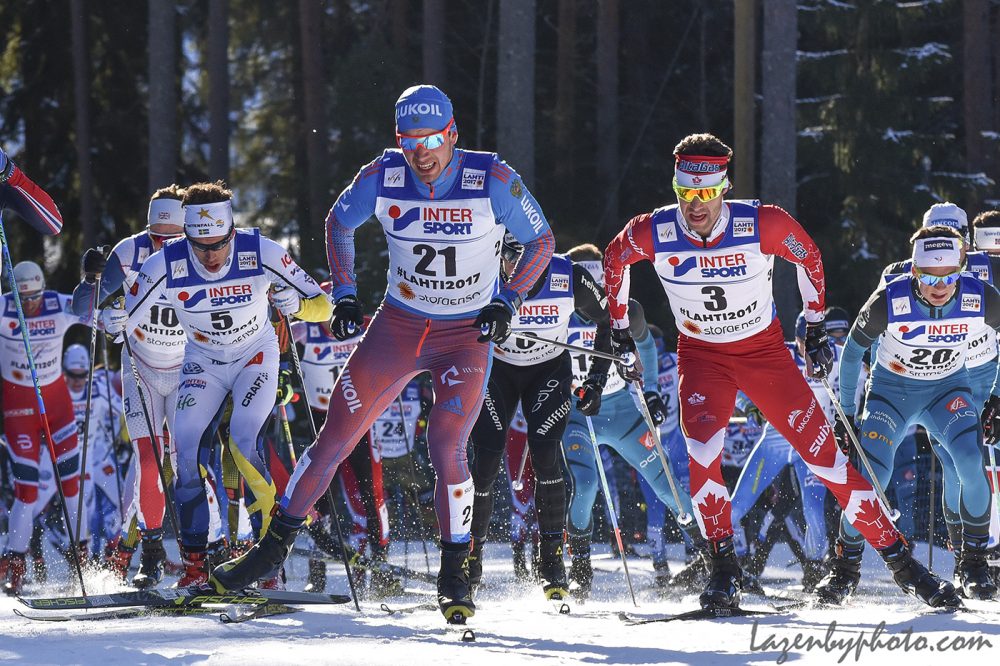
    Russia’s Alexey Chervotkin (21) leads Canada’s Alex Harvey (3) and Sweden’s Marcus Hellner (5) during the men’s 50 k freestyle mass start on Sunday at 2017 Nordic World Championships in Lahti, Finland. Harvey went on to win, Hellner placed 12th and Chervotkin 13th. (Photo: John Lazenby/Lazenbyphoto.com)

    “I saw the women’s race yesterday, and I figured if Marit Bjørgen could not distance herself from the other girls, then there is no way that the men will be able to do that,” Harvey said during Sunday’s post-race press conference. “I knew with the fast conditions, it was going to be a big group, and that leaves the potential for a lot of carnage, a lot of mayhem.”

    For the first 10 k, skiers from various nations took pulls up front, including Sundby and Ustiugov, and Norwegians Petter Northug, Hans Christer Holund, and Anders Gløersen. After testing the field and breaking away around 8 k into the race, Gløersen was still skiing alone up front, 20 seconds ahead of anyone else at 15 k.

    “Gløersen took off a bit and he was like, ‘What’s the gap? What’s the gap?’ ” Canadian World Cup coach Ivan Babikov said of Harvey. “He was always controlling the race and saving energy for the finish.”

    Eventually, the main pack surged to recover the lost time. Gløersen’s off-the-front-flier only earned him camera time. The catch came just before Lahti Corner returning to the stadium around 20 k in, where Russia’s Alexey Chervotkin took over. In another 2 k, Sundby, who had been stalking in the top 10, moved to the front as if the race were all of a sudden for real.

    Norway’s Anders Gløersen broke away early to lead the men’s 50 k freestyle mass start, skiing alone off the front for about 12 kilometers, on Sunday at the 2017 Nordic World Championships in Lahti, Finland. (Photo: John Lazenby/Lazenbyphoto.com)

    From then on, the size of the pack atrophied with each consecutive lap. At 30 k, the pack streaming through the stadium was 24 skiers long. At 45 k, the group winnowed to a train of 19. And within another 4 k, only 13 remained: Sundby, Ustiugov, Musgrave, Harvey, Heikkinen, Northug, Holund, Gløersen, Chervotkin, Sweden’s Marcus Hellner, Norway’s Sjur Røthe, Switzerland’s Dario Cologna, and France’s Maurice Manificat.

    “I wanted to be in the front, top three at least,” Harvey said, reflecting on his skiathlon tactics from last weekend, where he skied around fifth up until the final headwall and finished fifth, outside of the medals.

    “I knew that Sundby’s first chance to win gold was to break everybody,” Harvey continued. “I was expecting him to leave from kilometer 1 or 49.”

    Harvey guessed Sundby would be the only one who would try to break away. With that in mind he marked the Norwegian.

    “He knew it would be hard to break away [and that] it will be all about the finish,” Babikov said. “He was positioning himself perfectly up the last hill and just stayed on Sundby. That was his plan, ‘I’m just gonna stay on Sundby and if he changes skis, I’ll go change skis,’ but today conditions were perfect so he didn’t.”

    With ripping conditions and skis to match, Sundby never slowed nor switched skis. Neither did Harvey.

    “When he waited until the last lap, I knew exactly where he was going to do it: with a k and a half to go,” Harvey explained. “I was just lucky enough to have the legs to stick on him today and from then on it started playing more into my hands.”

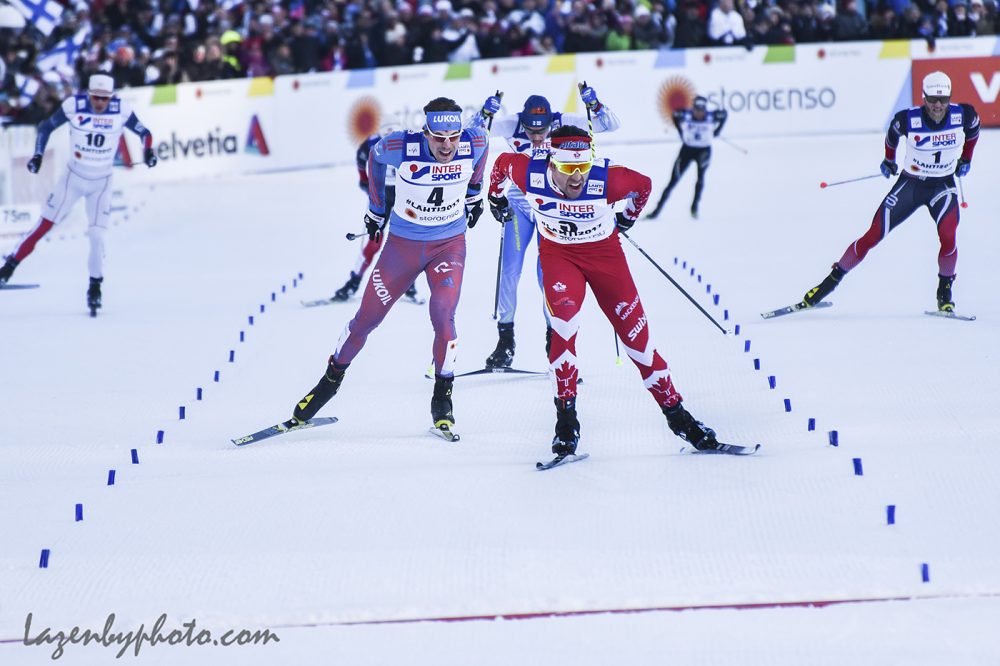
    Canada’s Alex Harvey (5) charging to the line ahead of Russia’s Sergey Ustiugov (4), Norway’s Martin Johnsrud Sundby (1), Great Britain’s Andrew Musgrave (10) and Finland’s Matti Heikkinen (behind Harvey) in the men’s 50 k freestyle mass start on Sunday at the 2017 Nordic World Championships in Lahti, Finland. (Photo: John Lazenby/Lazenbyphoto.com)

    In the closing moments of nearly every race of these world champs, the fate of winners seem come down to luck, and often someone else’s bad luck. As the leaders came into the stadium, it was as if every observer were about to witness an upset due to a tumble or a tangle.

    Harvey was clean around the final turn and unscathed down the stretch.

    “I wanted to hit the [Lahti] corner in second, right behind Sundby or whoever was in the lead,” Harvey said. “I knew I needed to do that in the skiathlon, too, and I tried to go around Finn Hågen Krogh there, but he’s a clever sprinter too. He knew he wanted to be second there.

    “In the skiathlon it didn’t work, but today it did,” Harvey continued. “I was second the whole time and then out of that corner I did one push more than Sundby. I had really fast skis, but used the draft to slingshot and then hit the final corner in first and from there, I knew it was mine to lose more than anything else.”

    Canada’s Alex Harvey (5) celebrates his first individual World Championships gold after winning Sunday’s 50 k freestyle mass start in Lahti, Finland, ahead of Russia’s Sergey Ustiugov (4), Norway’s Martin Johnsrud Sundby (1), and Finland’s Matti Heikkinen (2), respectively. (Photo: John Lazenby/Lazenbyphoto.com)

    And so Harvey earned the crown: 50 k world champion in 1:46:28.9 hours.

    It’s his first championships gold since winning the classic team sprint with Devon Kershaw at 2011 world champs, and fifth medal in four World Championships. 

    “He turned around these world champs for all of us,” Babikov said of the Canadian team. “He was solid. We were with no medals so far, and winning 50 k, he’s the king now.

    “This is the legit distance and he took it today,” he added.

    “It’s a long championship,” said Louis Bouchard, Harvey’s personal coach and Canada’s World Cup co-coach. “He feels every day his energy’s still there, so he knows today, if he’s good tactically, then he can do it.”

    Asked how nerve-racking it was watching the final 5 k unfold, Bouchard responded, “I was pretty nervous, too much maybe. But that’s OK.”

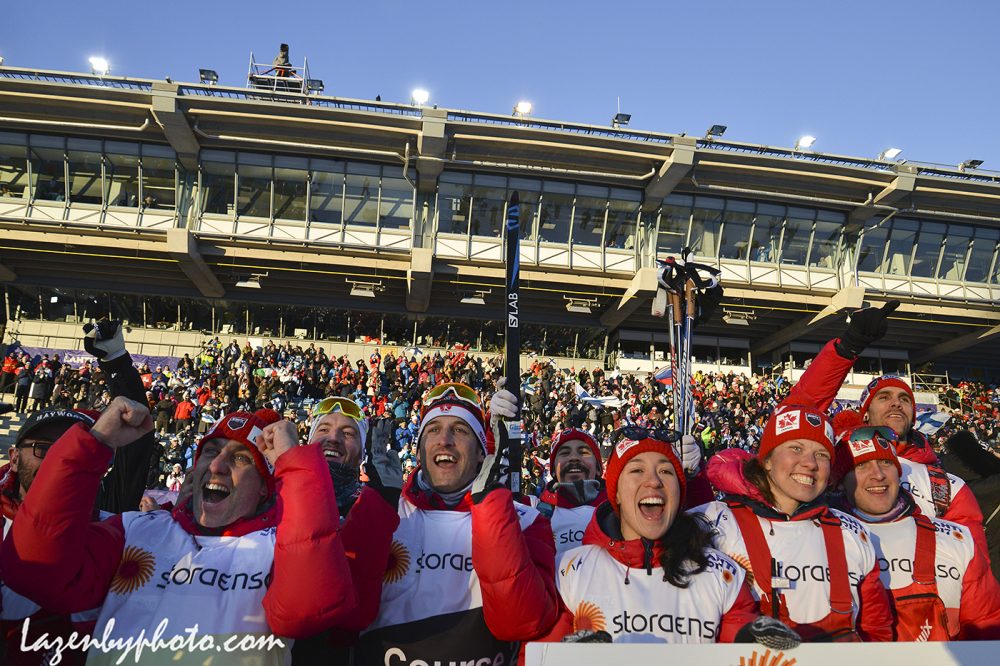
    Alex Harvey’s Canadian teammates, coaches and support team celebrate his win in the men’s 50 k freestyle mass start on Sunday at the 2017 Nordic World Championships in Lahti, Finland. (Photo: John Lazenby/Lazenbyphoto.com)

    For his fifth medal of these championships (and sixth world-champs medal of his career), the 24-year-old Ustiugov crossed second for his third silver of the week, just 0.6 seconds behind Harvey. Finland’s 33-year-old Heikkinen took third (+1.4) for his first medal since 2011 World Championships.

    “Today I skied within my own limits and at the end I was fresh enough to attack,” Heikkinen said in a press conference.

    Asked about his not-so-characteristic finishing kick on Sunday, Heikkinen said he remembered how he faded to 20th in the 50 k classic mass start at 2015 World Championships.

    “After Falun 2015 world champs, I was watching the race after and I was walking in front a mirror and I said, ‘I won’t ever again be like that after a 50 k,’ ” he said. “I’ve been training two years now at a high level [with my team] … and that’s why I’m top three in overall World Cup, so it was possible.”

    Behind him in a photo finish for fourth, Musgrave capitalized on Sundby slowing before the finish — probably after the Norwegian realized he had missed out on a medal — to place fourth (+2.9). For Musgrave, who turns 27 on Monday, it was his first World Championships top 10. For Sundby, who had been on a quest all week for his first individual championships goal — it was a bummer. The 2018 Winter Olympics in PyeongChang, South Korea, will be Sundby’s next opportunity.

    From a North American and perhaps international standpoint, American Tad Elliott skied the gutsiest of races. Halfway through the race, Elliott, a 28-year-old Colorado native and former U.S. Ski Team member, remained a not-too-far-off the back chaser, 27 seconds behind the lead group. His margin back slowly accrued over the remaining distance.

    “At 25 k, man, some guys were really struggling and they balled it up,” Elliott said afterward. “I should have sent it a little harder but that’s how it goes sometimes in that pack. I thought I could get there, but I just missed it.”

    Elliott, of Ski Club Vail, finished 27th (+3:16.8) for his best individual result in three World Championships. In recent years, Elliott has struggled with illness, which impacted his ability to train and peak. Those difficulties caused him to question whether or not his best years were behind him. Evidently not.

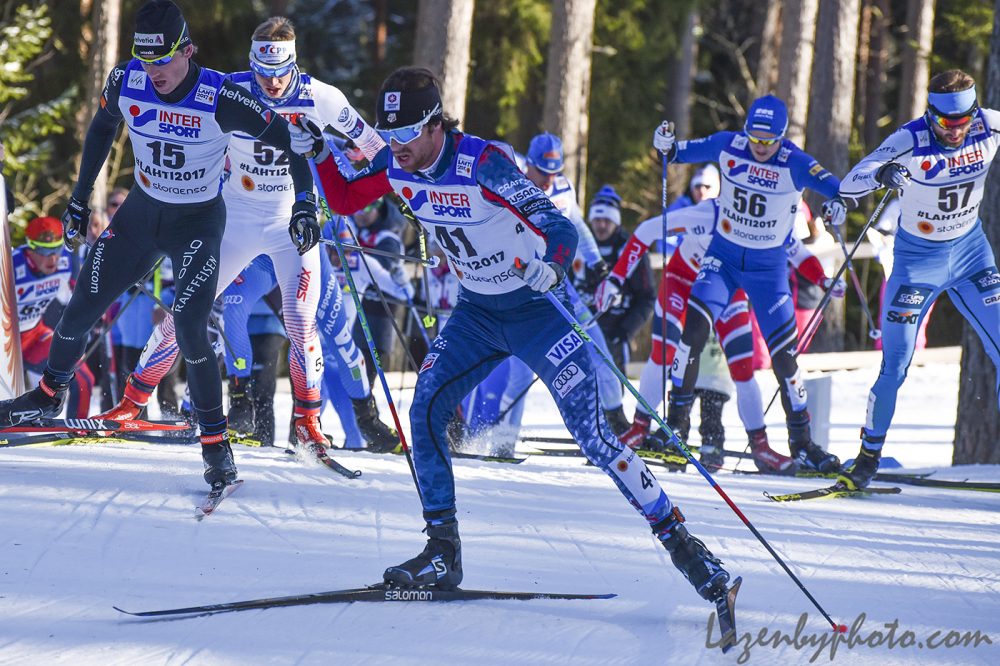
    American Tad Elliott (41) racing to 27th in the men’s 50 k freestyle mass start on Sunday at the 2017 Nordic World Championships in Lahti, Finland.. (Photo: John Lazenby/Lazenbyphoto.com)

    “I didn’t know if I wanted to come back [to skiing]. I was so sick. I was so bummed. I was like, ‘Am I ever going to get back? Am I ever going to get back to top-30 form?’ ” Elliott said. “We knew if everything went right, I would qualify for worlds … then to get top 30 here, man, I feel like I’m starting to get greedy. I’m starting to want more, I’m starting to want more opportunities. But I’m proud of this effort, I’m going to savor it a bit.”

    In the first few kilometers, Russia’s Petr Sedov skied too wide on a 180-degree corner and stalled out. American Kyle Bratrud, the next skier to round the turn, was unable to avoid the Russian and collided. Soon after, due to the impact, Bratrud was unable to complete the race.

    U.S. Ski Team member Noah Hoffman finished the day in 50th (+8:53.1).

    Devon Kershaw was Canada’s second skier on Sunday, crossing in 38th (+5:45.5). Also for Canada, Graeme Killick and Knute Johnsgaard finished in 43rd (+7:04.0) and 55th (+12:03.3), respectively.

    “[Alex’s performance] was incredible and such a big boost for our entire team,” Babikov said. “You should see all the techs, and Devon and Graeme and Knute, who didn’t really have a great race today, and they’re still so psyched for him.”

    Results

    — Gerry Furseth, Jake Ellis and Alex Kochon contributed

    Canadian air guitar: Alex Harvey performs his team’s signature move after winning the men’s 50 k freestyle mass start on Sunday at the 2017 Nordic World Championships in Lahti, Finland. (Photo: John Lazenby/Lazenbyphoto.com)
  • Sunday Rundown: Harvey Wins World Champs Gold in Lahti; PyeongChang + Vasaloppet (Updated)

    Sunday Rundown: Harvey Wins World Champs Gold in Lahti; PyeongChang + Vasaloppet (Updated)

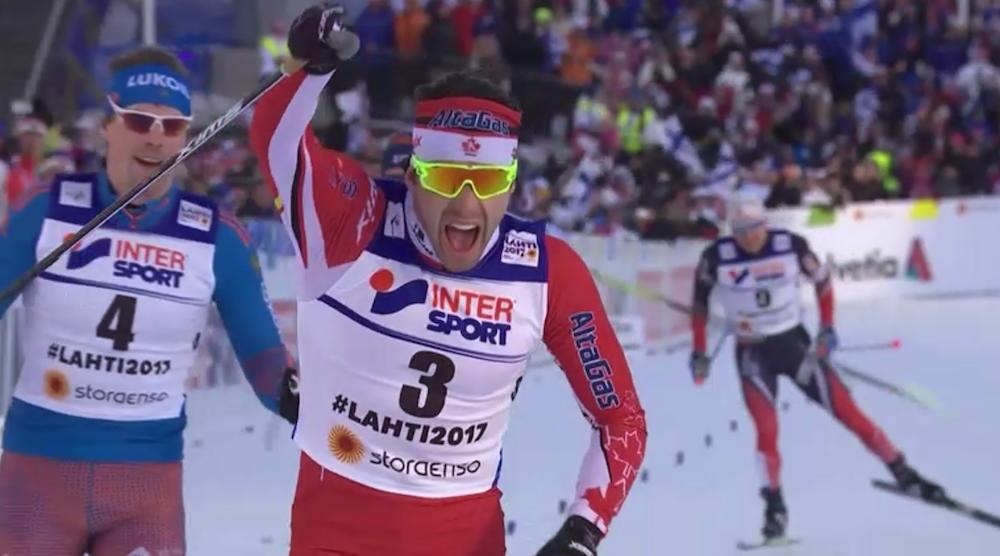
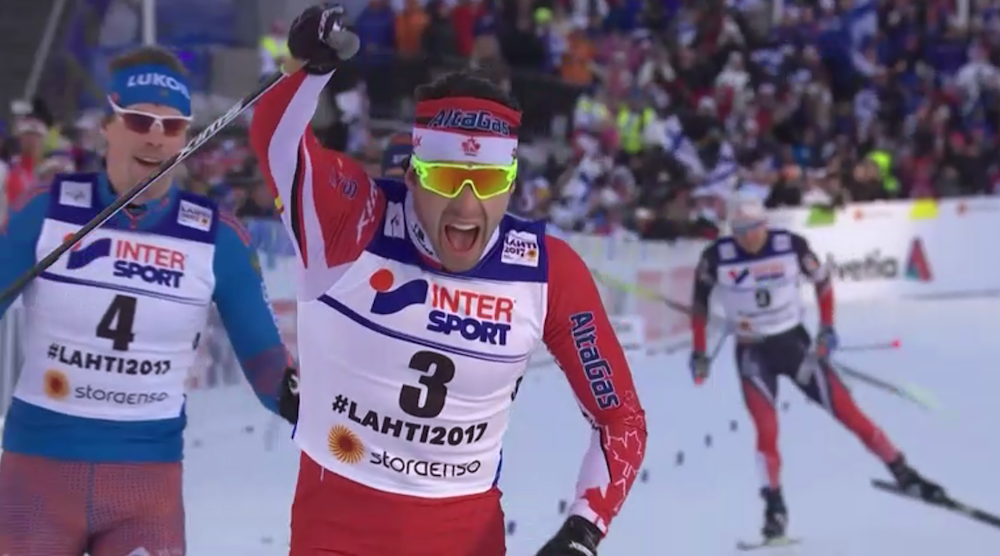
    Canada’s Alex Harvey (3) celebrates his win in the men’s 50 k freestyle mass start, his first individual gold medal at a World Championships, on Sunday at 2017 Nordic World Championships in Lahti, Finland. He beat Russia’s Sergey Ustiugov (l) by 0.6 seconds while Norway’s Sjur Røthe (9) can be seen coming in for sixth place, behind (not pictured) Finland’s Matti Heikkinen, Great Britain’s Andrew Musgrave and Norway’s Martin Johnsurd Sundby, respectively. (Photo: NBC Sports screenshot)

    FIS Nordic World Championships (Lahti, Finland): Men’s 50 k freestyle mass start

    After a week of missing out on the medals at 2017 Nordic World Championships, Canada’s Alex Harvey, a four-time World Championships medalist from 2011, 2013 and 2015, achieved his first individual gold medal in the final race of this year’s World Championships in Lahti, Finland.

    Harvey, 28, won the men’s 50-kilometer freestyle mass start in a drag race to the finish. Entering the final descent into the stadium with Norway’s Martin Johnsrud Sundby and Russia’s Sergey Ustiugov, Harvey rode his fast skis past both of them then had the most finishing kick in the final straightaway for a 0.6-second victory. He finished in 1:46.28.9 hours, while Ustiugov followed him across the line in second and Finland’s Matti Heikkinen from behind for third (+1.4), after passing Sundby around the outside of the last corner.

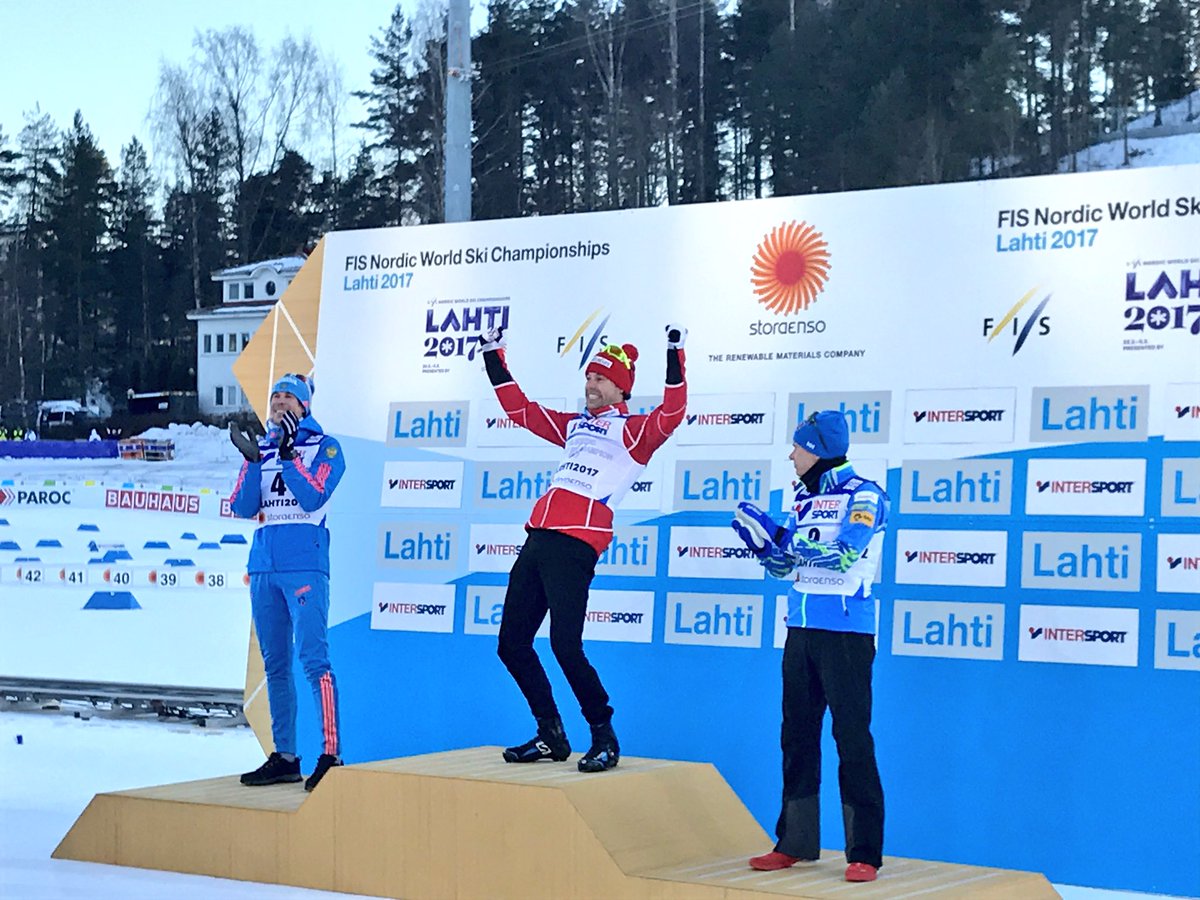
    Canada’s Alex Harvey (c) celebrates gold in the men’s 50 k freestyle mass start on Sunday at 2017 Nordic World Championships in Lahti, Finland, with Russia’s Sergey Ustiugov (l) and Finland’ Matti Heikkinen (r) joining him on the podium in second and third, respectively. (Photo: Cross Country Canada/Twitter)

    Sundby appeared to miss a pole plant soon after Heikkinen passed him and let off the pace a few meters before the finish. That’s where Great Britain’s Andrew Musgrave continued to accelerate and took fourth place, 2.9 seconds behind Harvey and 0.1 seconds ahead of Sundby in fifth. Norway’s Sjur Røthe followed another 0.4 seconds back in sixth, Switzerland’s Dario Cologna was seventh (+8.9), Norway’s Petter Northug eighth (+12.3), France’s Maurice Manificat ninth (+13.4), and Norway’s Hans Christer Holund 10th (+14.3).

    “I had really good skis,” Harvey said in a post-race interview with FIS. “I knew if I came into the corner in second place, that was the optimal position. So I was able to fight hard and hit that last corner in second and slingshot by Martin along the flat and then that was good after that.”

    “This is the best race of my life, for sure,” he added. “So I’m really happy.”

    Tad Elliott (Ski Club Vail) led the Americans in 27th (+3:16.8). Noah Hoffman (U.S. Ski Team) finished 50th (+8:53.1) and Kyle Bratrud (CXC Team) did not finish.

    Canada started four men, with Devon Kershaw finishing 38th (+5:45.5), Graeme Killick 43rd (+7:04), and Knute Johnsgaard in 55th (+12:03.3).

    For Harvey, the medal is his fifth at three World Championships and his first individual gold after winning the classic team sprint with Kershaw in 2011.

    Results

    ***

    IBU World Cup (PyeongChang, South Korea): Men’s and women’s relays

    Between the men’s and women’s relays on Sunday at the International Biathlon Union (IBU) World Cup in PyeongChang, South Korea, Canada had two teams in the top eighth, with its men’s team finishing seventh in the 4 x 7.5 k and women’s team eighth in the 4 x 6 k. Behind them, the U.S. men finished 10th and U.S. women 14th.

    France won the men’s relay by 33.8 seconds over Austria, using a total of 10 spare rounds but avoiding the penalty lap. Martin Fourcade anchored France to the win in 1:12:09.5 hours, after Jean-Guillaume Béatrix initially tagged them in first, his older brother Simon Fourcade raced them into second with near-perfect shooting (using just one spare to clean), and Simon Desthieux picked off one more place to give Fourcade a 16-second lead for the final leg.

    Austria achieved second place with Lorenz Wäger, Simon Eder, Julian Eberhard, and Dominik Landertinger combining for zero penalties and nine spares.

    Norway finished third (+45.4) with Vetle Sjåstad Christiansen, Ole Einar Bjørndalen, Vegard Gjermundshaug, and Henrik L’Abée-Lund. They had one penalty on Gjermundshaug’s third leg, and used a total of eight spares.

    Canada’s Christian Gow, Scott Gow, Nathan Smith, and Brendan Green finished seventh (+3:03.1) with zero penalties and nine spares. After Christian tagged his older brother Scott in ninth, Scott raced them into sixth place before Smith slipped four places to 10th at the final exchange. On the final leg, Green raced them into seventh, requiring two spares to clean.

    The Americans finished about nine seconds later in 10th (+3:12.8) with Lowell Bailey, Leif Nordgren, Paul Schommer, and Sean Doherty combining for zero penalties and nine spares, just like Canada. Bailey had originally put them in second at the first exchange, Nordgren dropped to seventh, then Schommer to 13th, before Doherty finally brought them back to 10th out of 24 teams.

    In the women’s relay, Germany pulled off a 22.8-second win over Norway, with one penalty and eight spares. Nadine Horchler put Germany in third at the first exchange, then Maren Hammerschmidt raced them into first by the race’s halfway point. From there, Denise Herrmann, a former cross-country World Cup regular, had to ski a penalty lap and tagged off in second, 13.5 seconds out of first. With teammate Laura Dahlmeier sitting out the relay, Franziska Hildebrand anchored Germany to the win in 1:07:35.6 after she used just one spare to clean.

    Norway placed second with Kaia Wøien Nicolaisen, Hilde Fenne, Tiril Eckhoff, and Marte Olsbu accumulating one penalty and 11 spares. Olsbu beat out the Czech Republic’s Gabriela Koukalová by one-tenth of a second at the finish, as the Czechs placed for third (+22.9), with Jessica Jislová, Eva Puskarčíková, Lucie Charvátová, and Koukalová (with a total of one penalty and nine spares).

    Canada took eighth (+1:34) with Rosanna Crawford, Julia Ransom, Megan Tandy, and Emma Lunder. Crawford tagged in second at the first exchange, Ransom slipped one place to third, Tandy lost another place to tag in fourth, and Lunder ultimately anchored them to eighth.

    The U.S., with Clare Egan, Susan Dunklee, Joanne Reid, and Maddie Phaneuf, finished 14th (+3:08.3) with one penalty and 10 spares. After Egan had a penalty on the first leg, Dunklee skied the fastest second leg to move the team from 19th to 14th, then Reid put them in 11th by the final exchange. Twenty-one teams competed in the women’s race.

    Results: Men | Women

    ***

    Ski Classics 90 k Vasaloppet (Sälen to Mora, Sweden)

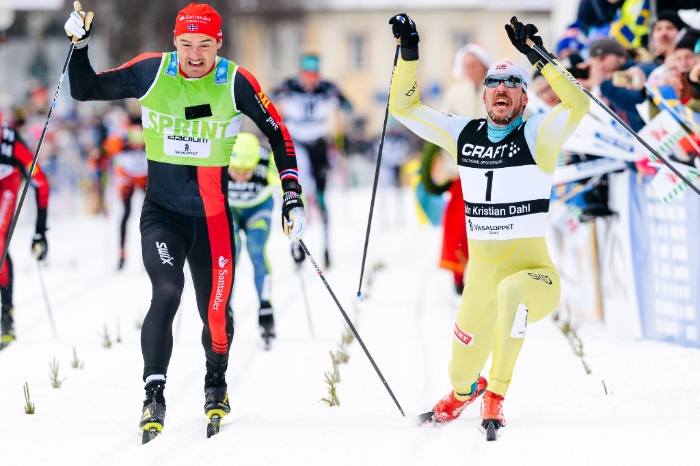
    John Kristian Dahl (r) of Team United Bakeries outlunges Ski Classics sprint leader Andreas Nygaard (r) of Team Santander for the win in Sunday’s 90 k Vasaloppet in Mora, Sweden. (Photo: Visma Ski Classics)

    [UPDATED] In Sunday’s 93rd annual 90-kilometer Vasaloppet from Sälen to Mora, Sweden, the ninth event of the Ski Classics series, John Kristian Dahl (Team United Bakeries) outlasted Andreas Nygaard (Team Santander) by one-tenth of a second for the win in 3:57:18.1 hours. The race came down to a five-way fight for first, with Stian Hoelgaard (Team Leaseplan) finishing 0.6 seconds back in third. The top 15 men were all within 21.7 seconds of the podium, and Brian McKeever, a member of Canada’s Para Nordic Ski Team, placed 20th (+2:31.1).

    “It has been a fight all day,” Dahl said, according to a Ski Classics press release. Three days ago, he had been unsure about starting the Vasaloppet following a back injury. “I was tired already after 30 k and had to let go of the lead group, but I fought my way back taking it step by step and hill by hill.”

    In the women’s race, Britta Johansson Norgren (Lager 157 Ski Team) broke away from the field to win by 1:37.9 minutes in 4:19.43.4.

    Astrid Øyre Slind (Team United Bakeries) finished second, and Sara Lindborg (Team Serneke) placed third, 9 minutes and 4.2 seconds behind Norgren. Kateřina Smutná (Team Santander) dropped out of the race about halfway through.

    “I am very tired but also so happy to win today,” Norgren said, according to the press release. “It felt pretty easy until Oxberg [Sweden] with 30 k to go, but then it got really tough and I had to fight all the way to the finish.”

    It was Norgren’s first Vasaloppet win after placing second the last three years. She increased her lead in the overall Ski Classics to 215 points over Smutná, while Tord Asle Gjerdalen continues to lead the men’s overall standings ahead of his Santander teammate Nygaard, who is 349 points behind in second place. Gjerdalen did not race Sunday’s Vasaloppet.

    Results

  • Setting the Scene: Pre-Competition Day at Lahti World Championships

    Setting the Scene: Pre-Competition Day at Lahti World Championships

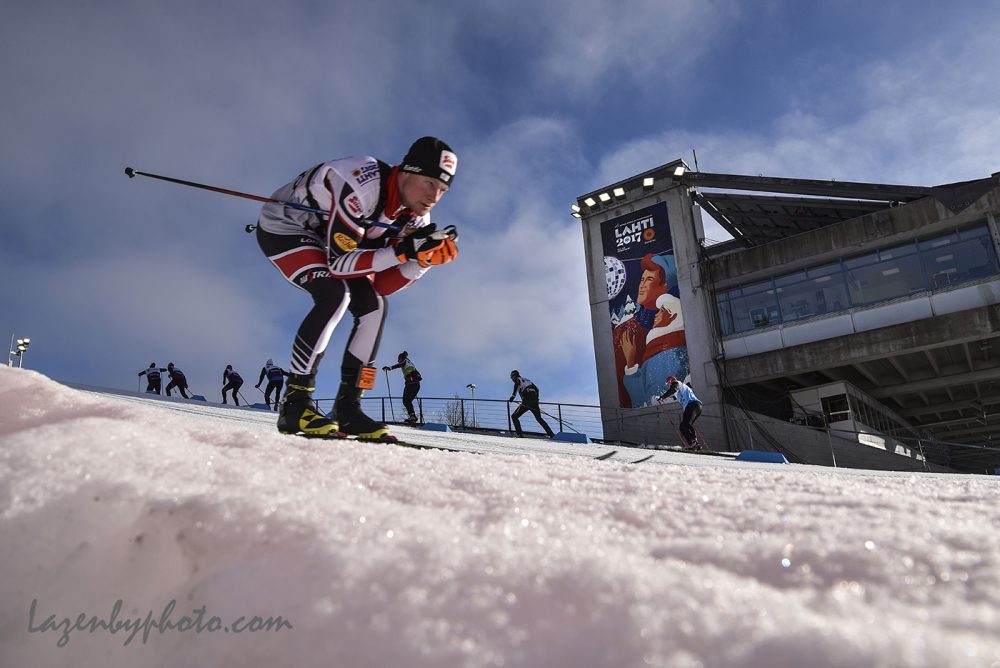
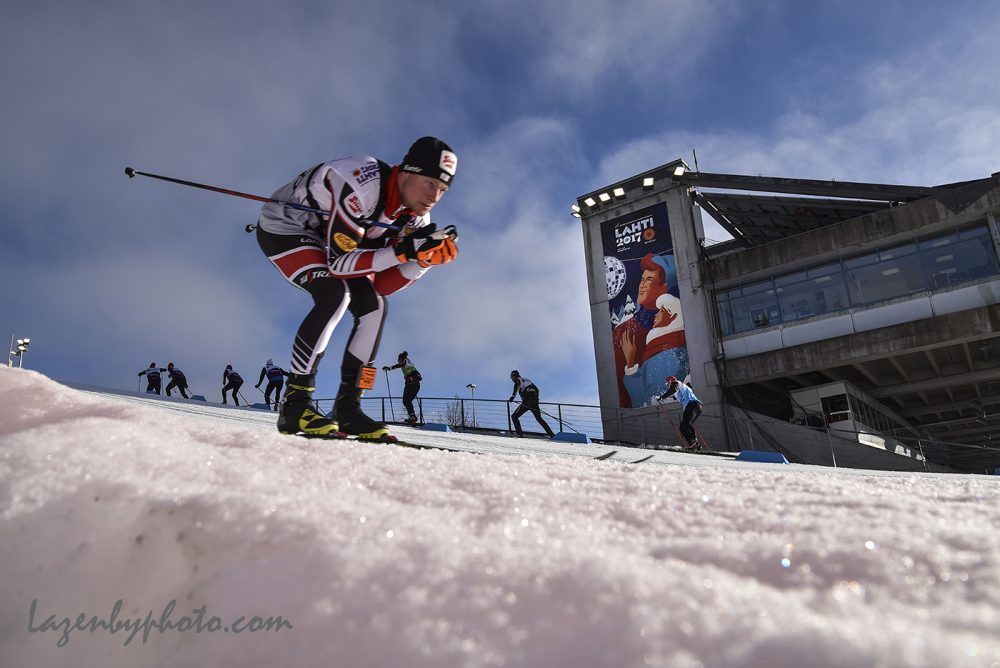
    An Austrian athlete tests skis as he glides back into the main stadium. (Photo: John Lazenby/Lazenbyphoto.com)

    LAHTI, Finland — Tuesday at Lahti’s venue for the 2017 Nordic World Ski Championships, the sun sets early. Although technically sunset was 5:22 p.m., the sun on this clear-sky day was still wintertime reluctant. It seemed too short a time for the sun’s transect to thaw Lahti. Temps were in the mid-to-low 20 degrees Fahrenheit. But a brisk wind called for down coats and insulated pants for those not actively skiing — in the shade, it felt like the teens.

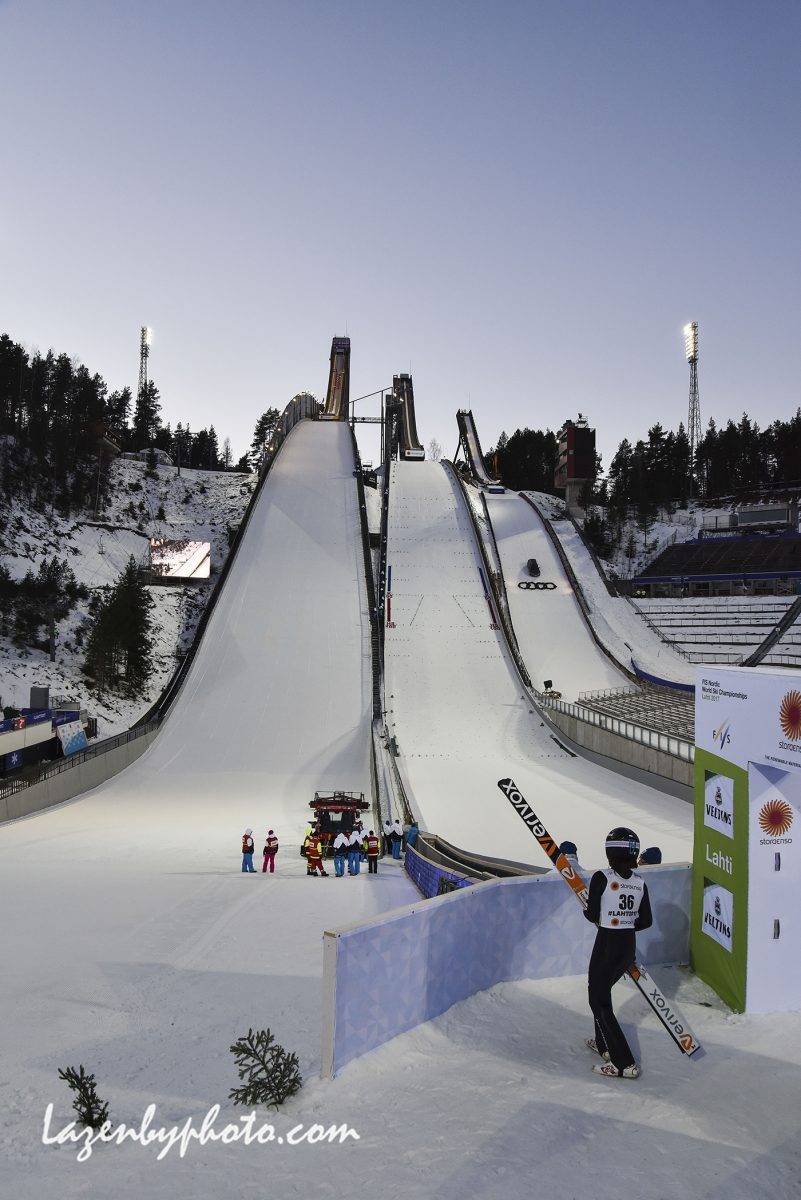
    Basked in an early evening glow, Lahti’s three iconic ski jumps dominate the 2017 Nordic World Championships venue. (Photo: John Lazenby/Lazenbyphoto.com)

    For athletes, it was a day of pre-competition ski and wax testing on bulletproof tracks that gradually deteriorated on the steeper climbs. The ski loops have good coverage. The snow remains coarse, as the tracks are covered with predominately manmade snow with trace amounts of natural snow tilled in.

    Lahti’s most dominant feature are its ski jumps, which are among the first objects to catch morning light. The surrounding landscape isn’t marked by serrated mountains, but by subtle hills that make the venue’s three domineering jumps (a K 116, K 90, and K 64), that much more ominous. First nordic-combined skiers then women’s ski jumpers had an opportunity for test flights off the K 90.

    On the non-skiing side of things, the venue was abuzz of last-minute prep: television cables being covered for protection before the onslaught of spectators, event producers testing the stadium’s Skycam, sponsors unpacking schwag, and media arriving to pick up credentials. Like the athletes fine tuning before the competition begins, Lahti’s organizers are near set for the big show.

    On Wednesday, two qualification races will ensue: the women’s 5-kilometer classic and men’s 10 k classic individual starts. These races are for athletes from “non-skiing” nations who have not met the FIS-point benchmark to participate in the championships. Start rights to Lahti’s distance races are granted to the top-10 male and female finishers. (All skiers are granted start rights for Thursday’s freestyle sprint regardless of their results in Wednesday’s qualifier.)

    5 k start list | 10 k start list

    ***

    Cross-Country Competition Schedule

    (All cross-country and nordic-combined events will be streamed live in the U.S. on NBCSports.com)

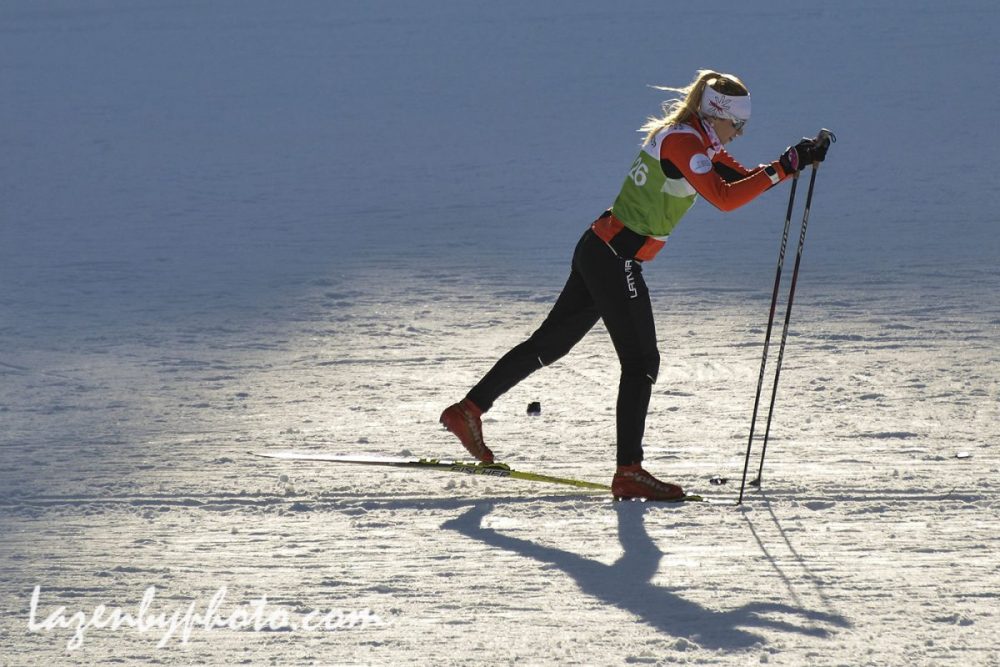
    A Latvian skier double poles through Lahti’s stadium on Tuesday. (Photo: John Lazenby/Lazenbyphoto.com)

    Wednesday, Feb. 22
    -Women’s 5 k classic interval start (7:00 a.m. EST)
    -Men’s 10 k classic interval start (8:30 a.m. EST)

    Thursday, Feb. 23 
    -Women’s freestyle k sprint (10:30 a.m. EST)
    -Men’s freestyle k sprint

    Saturday, Feb. 25 
    -Women’s 15 k skiathlon (5:00 a.m. EST)
    -Men’s 30 k skiathlon (7:30 a.m. EST)

    Sunday, Feb. 26
    -Women’s classic team sprint
    -Men’s classic team sprint

    (Semifinals starting at 4:30 a.m. EST, finals starting at 6:30 a.m. EST)

    Tuesday, Feb. 28 
    -Women’s 10 k classic interval start (6:45 a.m. EST)

    Wednesday, Mar. 1 
    -Men’s 15 k classic interval start (6:45 a.m. EST)

    Thursday, Mar. 2 
    -Women’s 4 x 5 k team relay (8:00 a.m. EST)

    Friday, Mar. 3
    -Men’s 4 x 10 k team relay (6:30 a.m. EST)

    Saturday, Mar. 4 
    -Women’s 30 k freestyle mass start (7:30 a.m. EST)

    Sunday, Mar. 5  
    -Men’s 50 k freestyle mass start (7:30 a.m. EST)

    U.S. 2017 World Championships Team:

    Men

    • Simi Hamilton (Stratton T2/ World Cup A-team)
    • Andy Newell (Stratton T2/ World Cup A-team)
    • Erik Bjornsen (Alaska Pacific University/World Cup B-team)
    • Noah Hoffman (Ski and Snowboard Club Vail/World Cup B-team)
    • Tad Elliott (Ski and Snowboard Club Vail)
    • Kyle Bratrud (Central Cross Country)
    • Ben Lustgarten (Craftsbury Green Racing Project)
    • Cole Morgan (Sun Valley Ski Education Foundation)

    Women

    • Jessie Diggins (Stratton T2/World Cup A-team)
    • Sadie Bjornsen (Alaska Pacific University/World Cup A-team)
    • Sophie Caldwell (Stratton T2/World Cup A-team)
    • Kikkan Randall (Alaska Pacific University/World Cup A-team)
    • Ida Sargent (Craftsbury Nordic/World Cup A-team)
    • Liz Stephen (Burke Mountain Academy/World Cup A-team)
    • Rosie Brennan (Alaska Pacific University/World Cup B-team)
    • Caitlin Gregg (Loppet Nordic Racing)
    • Chelsea Holmes (Alaska Pacific University)

    Canadian 2017 World Championships Team:

    Men

    • Alex Harvey (CNEPH/World Cup A-team)
    • Devon Kershaw (World Cup A-team)
    • Len Valjas (World Cup A-team)
    • Jess Cockney (World Cup B-team)
    • Graeme Killick (World Cup B-team)
    • Knute Johnsgaard (AWCA/NST U25 Team)

    Women

    • Emily Nishikawa (NST U25 Team)
    • Dahria Beatty (AWCA/NST U25 Team)
    • Cendrine Browne (CNEPH/NST U25 Team)
    • Katherine Stewart-Jones (NTDC Thunder Bay/NST U25 Team)

    Nordic Combined Competition Schedule:

    (All cross-country and nordic-combined events will be streamed live in the U.S. on NBCSports.com)

    Friday, Feb. 24

    -Individual HS 100 competition round (8:30 a.m. EST)

    -Individual 10 k cross-country race (6:30 a.m. EST)

    Sunday, Feb. 26

    -Team event  HS 100 competition round (5:00 a.m. EST)

    -Team event  4 x 5 k cross-country race (8:30 a.m. EST)

    Wednesday, Mar. 1

    -Individual HS 130 competition round (5:00 a.m. EST)

    -Individual 10 k cross-country race (9:15 a.m. EST)

    Friday, Mar. 3

    -Team sprint HS 130 competition round (9:00 a.m. EST)

    -Team sprint 2 x 7.5 k cross-country race (11:15 a.m. EST)

    U.S. Nordic Combined 2017 World Championships Team:

    • Bryan Fletcher
    • Taylor Fletcher
    • Benjamin Berend
    • Adam Loomis
    • Ben Loomis
  • Photo Gallery: U.S. Distance Nationals

    SUN VALLEY, Idaho — Although the 30- and 50-kilometer freestyle mass starts at the 2015 U.S. Distance Nationals took place last Thursday, we’re still reminiscing about the amazing races, sun, and merriment that took place on the trails of Galena Lodge. Check out our photos of day’s events below to relive Caitlin Gregg’s astounding 30 k victory or Ivan Babikov’s smart skiing in the 50 k.

    2015 U.S. Distance Nationals 30 and 50 K report 

    For more photos of the U.S. Distance Nationals go to flyingpointroad.com

  • Late-Season Calculations Play into World Cup Strategies: Harvey Improves to Top 6 Overall, Hoffman Goes for Points

    Late-Season Calculations Play into World Cup Strategies: Harvey Improves to Top 6 Overall, Hoffman Goes for Points

    Start of men's Holmenkollen 50 k. Photo: Fischer/Nordic Focus
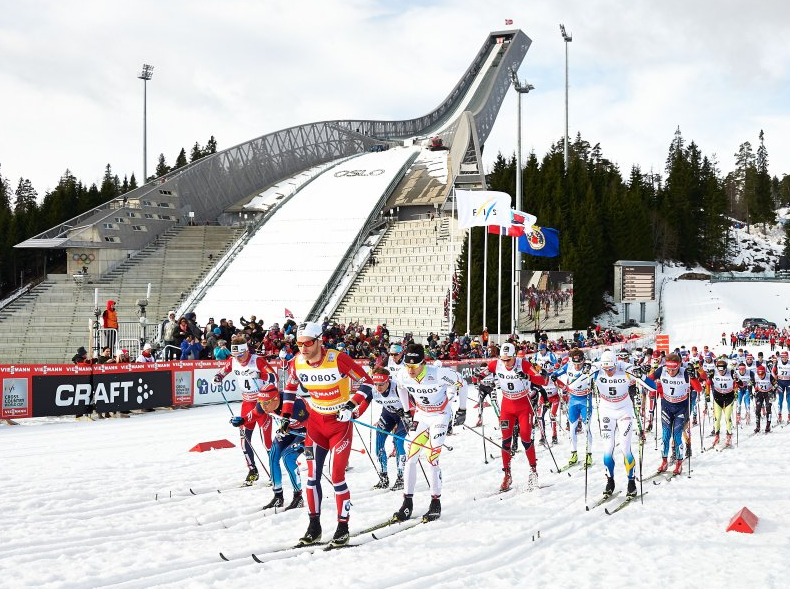
    Start of the men’s 50 k freestyle mass start at Holmenkollen on Saturday in Oslo, Norway, with Alex Harvey (3) trailing overall World Cup leader Martin Johnsrud Sundby (yellow bib). (Photo: Fischer/Nordic Focus)

    It would’ve been easy to just stop in Saturday’s 50-kilometer freestyle mass start — the ultimate distance race of the World Cup season.

    Canada’s Alex Harvey wasn’t having the best go at it, with slick skis for the first two of six laps that put him back near 46th.

    “I just couldn’t do anything on the climbs, and lost a lot of position and time,” Harvey said in a post-race interview.

    If he could do it all over again, the 25-year-old Quebec native said he would have switched skis after the first lap — a move which would’ve cost him about 40 seconds and likely left him skiing alone. Trailing the pack at the end of the first lap, Harvey decided he didn’t want to risk it and continued with the group, bypassing the transition. He then had to tough it out for another 8.3 k until his next opportunity to change after the second lap.

    From there, with a new pair, the race really began for Harvey and became somewhat of a personal test to see what he was capable of.

    He picked off 32 places over the next 33 kilometers to place 14th, 3:56.2 behind Sweden’s Daniel Richardsson, who won in 2:07:29.5. The race strung out into a battle between the top three just over halfway through. Norway’s Martin Johnsrud Sundby solidified second, 8.2 seconds back, and Russia’s Alexander Legkov placed third, six seconds later.

    While Sundby was trying to seal the deal for both the World Cup overall and distance titles, Harvey said the pace was pretty relentless throughout the 50 k, with Sundby and Legkov going for the sprint bonuses on every lap.

    Harvey didn’t worry about those; he was more focused on finishing strong enough to maintain a prime position in the overall World Cup standings.

    “It cost a lot when you go for [those bonuses],” Harvey said. “You saw it with Danny Richardson — he’s the one that went for the least amount of points between Legkov and Sundby.  I think that is why Sundby ended up not winning is because of all of the points he got early on … I wasn’t planning on going for the points.”

    Fourteenth was good enough to put the Canadian sixth in the overall World Cup standings, just nine points behind Sweden’s Calle Halfvarsson in fifth. Harvey is currently fifth in the distance rankings with three more races to go, one sprint and two distance races at World Cup Finals later this week.

    “It was a good race for me” Harvey said of the 50 k. “Just unfortunate that I couldn’t be more in it from the beginning.”

    Two other Canadians in the race did not finish: Devon Kershaw and Graeme Killick. According to a Cross Country Canada press release, Kershaw struggled with his skis, like Harvey, and dropped out after the second lap. Killick stayed in the race for 42 k, but “didn’t have the body to finish.”

    Noah Hoffman led the American men in 29th, finishing seven minutes after Richardsson.

    Relying on a different strategy than Harvey, Hoffman, who’s currently 30th in the World Cup distance standings and 33rd overall, aimed for bonus points more than anything. He was second at the first preem and sixth at the second one for a total of 17 points (points are awarded to the top 10 at a given sprint preem).

    “There is no doubt that that is the easiest way to score World Cup points is to take those bonus points,” Hoffman said on Saturday. “I have had several people that have questioned that strategy and usually say, ‘You blew yourself up,’ which I clearly did blow myself up, but I scored more points than Alex did today and Alex finished 14th.”

    The 24-year-old Colorado native started to feel the effects of his fast-and-furious efforts at the second preem.

    “When I crossed the preem line at the second preem, I think I said to myself, ‘I’m not positive I can finish this race,’ ” he said. “I was worried that I was not going to be able to finish and therefore lose the points that I had earned. I knew I was in trouble.”

    He changed skis after the first and second laps, like most of his competitors, but said the race was mostly decided by five men that started to go on the second lap, calling it one of the most-strung out World Cup race he’s ever seen.

    “Over seven minutes to 30th, seven-minute spread to the points is incredible,” he said.

    While his strategy kept him from sticking with the leaders, Hoffman stood by it.

    “I feel like it was the right call given the circumstances, given how close I am to the Red Group and that Red Group is the standard for A-team for the U.S. Ski Team,” he said, looking ahead to next season. “I needed to go score as many points as possible and I think I did that.”

    Three other Americans placed in the top 60, with Erik Bjornsen in 51st, Simi Hamilton in 54th and Reese Hanneman in 56th. Andy Newell and Sylvan Ellefson did not finish.

    Results

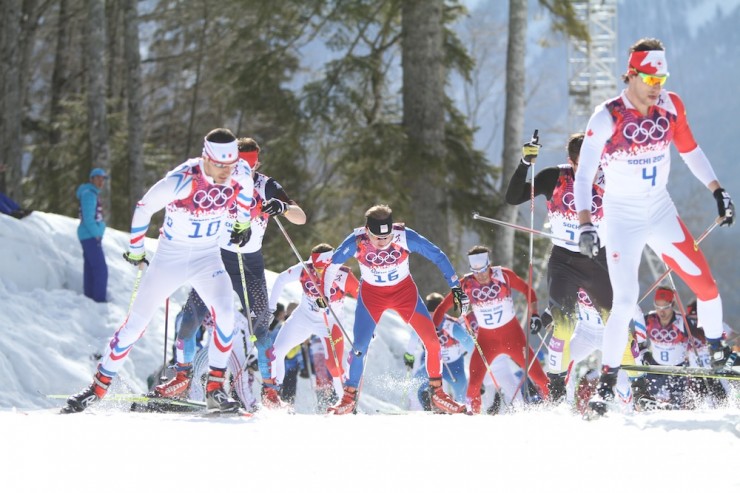
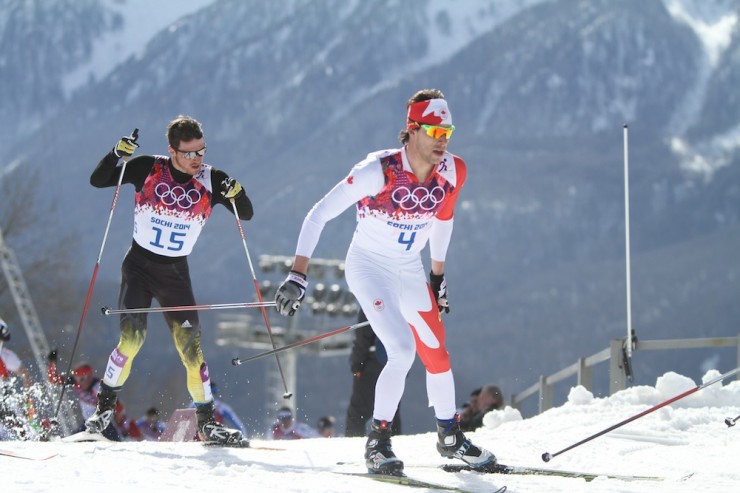
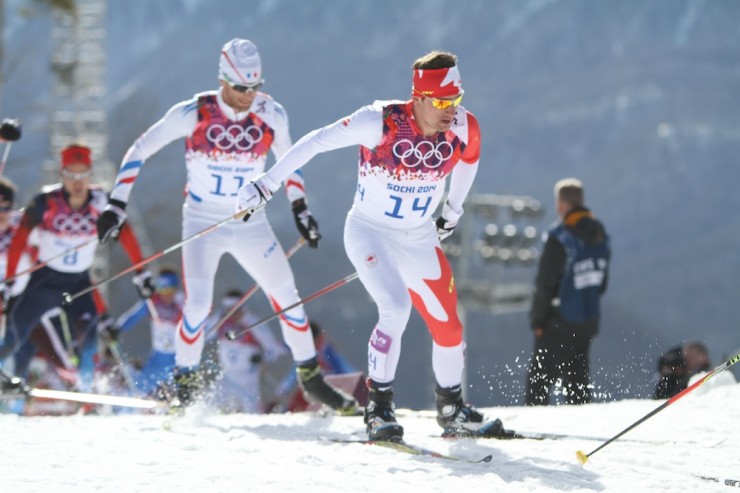
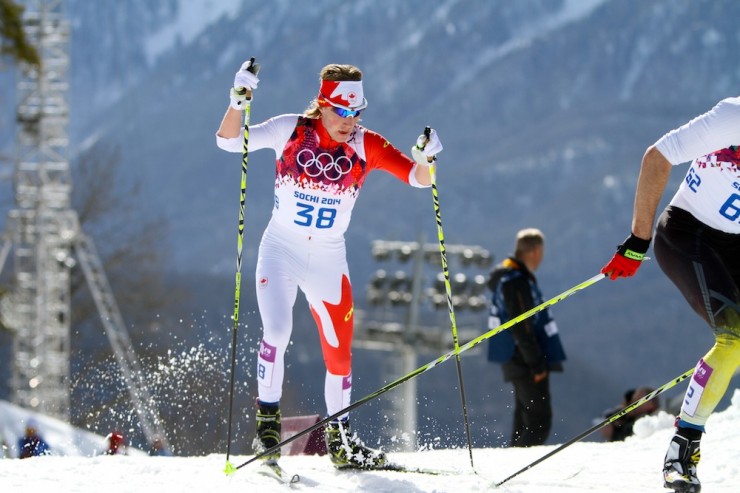
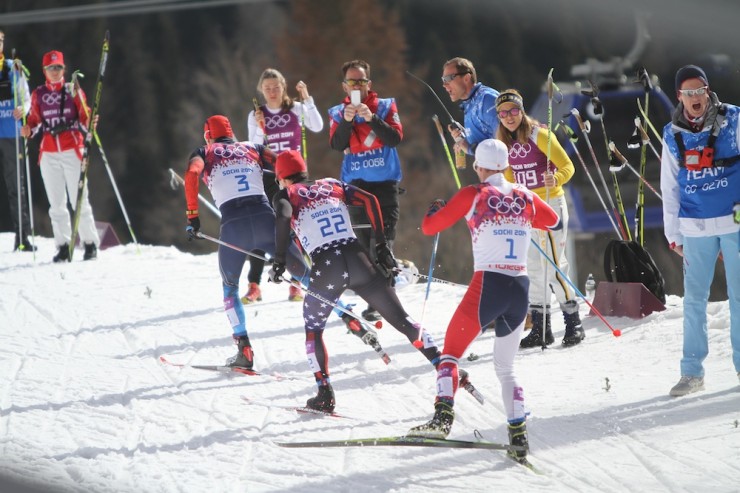
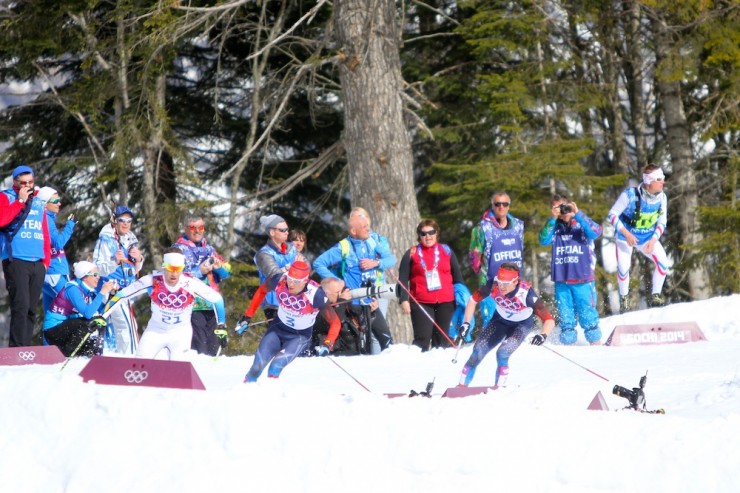
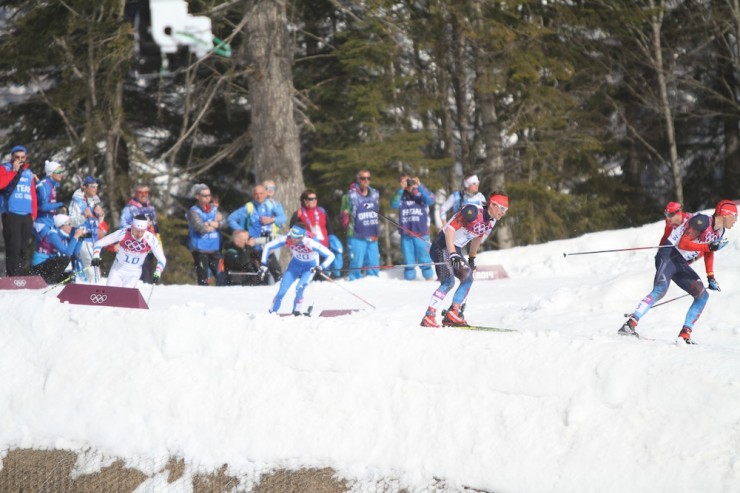
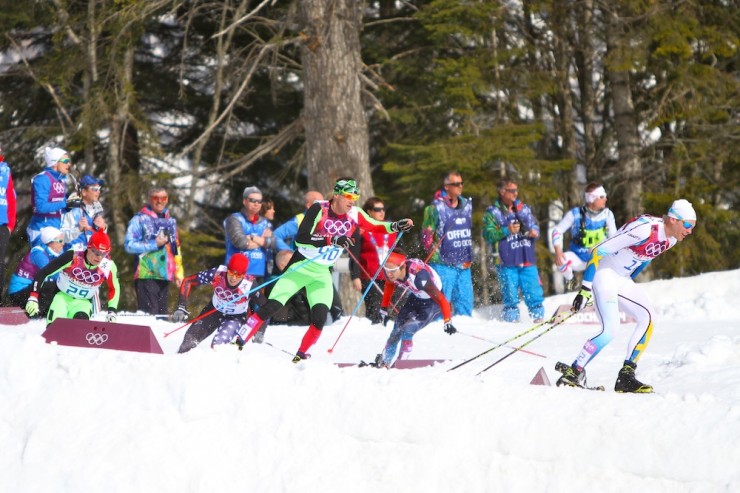
  • Photo Gallery: Olympic 50 k Mass Start

    Photo Gallery: Olympic 50 k Mass Start

    FasterSkier’s coverage is made possible through the generous support of Swix.

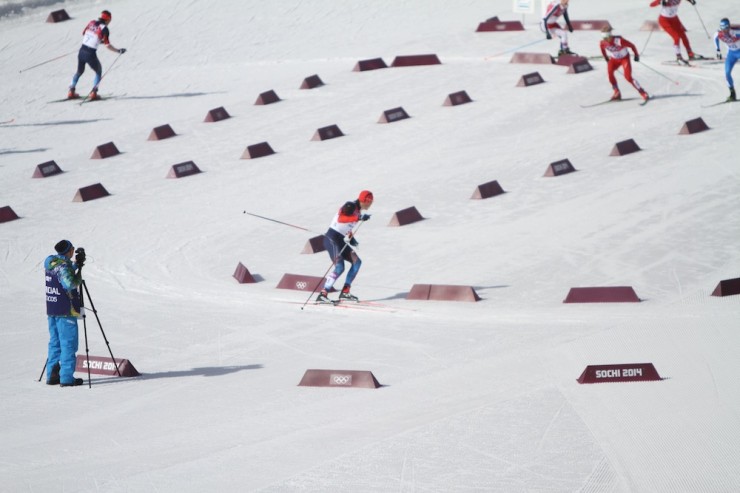
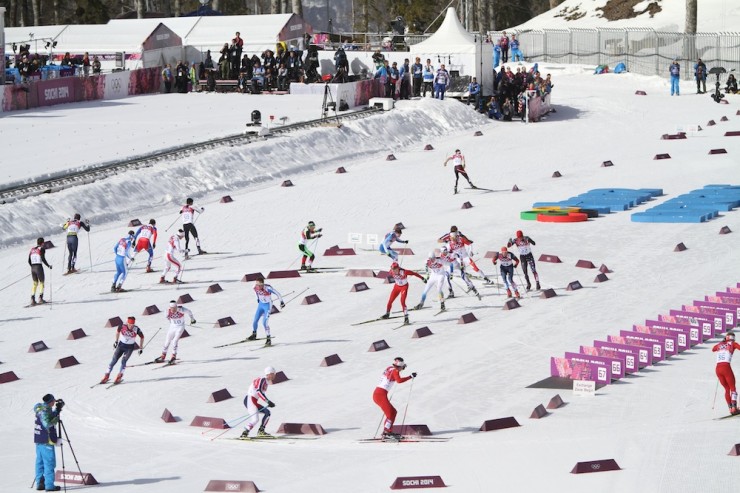
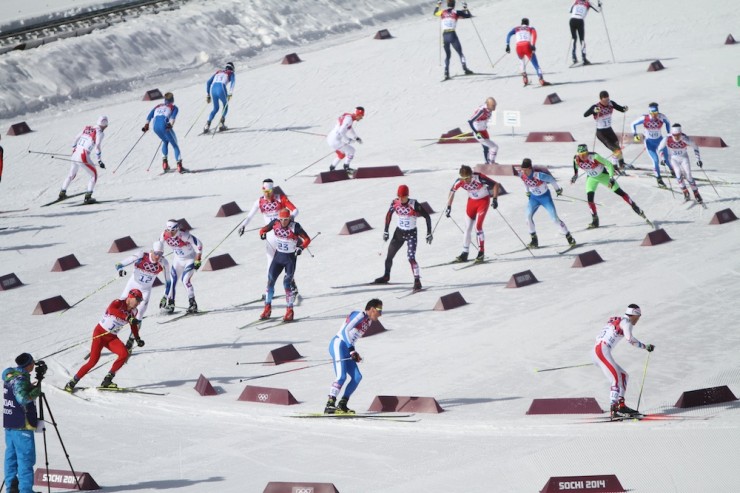
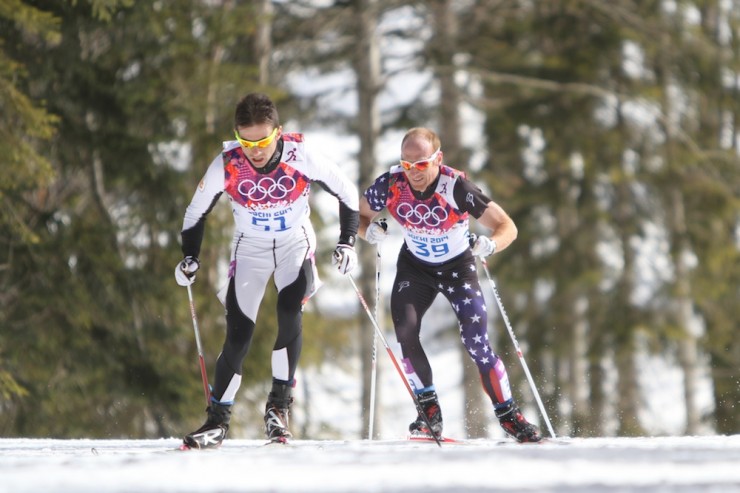
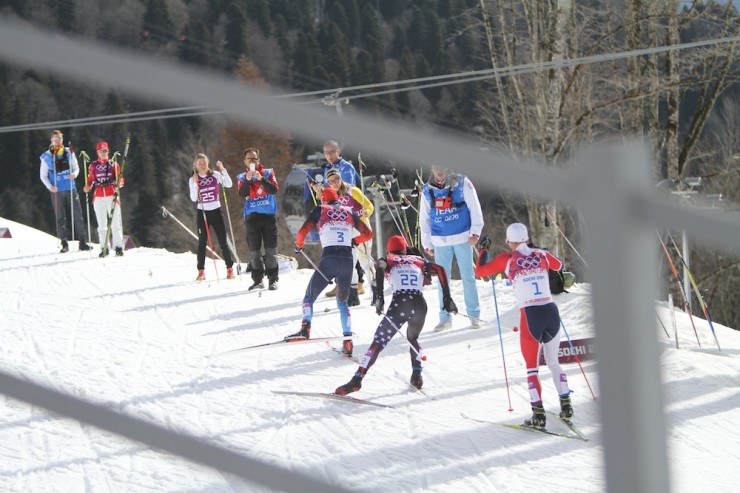
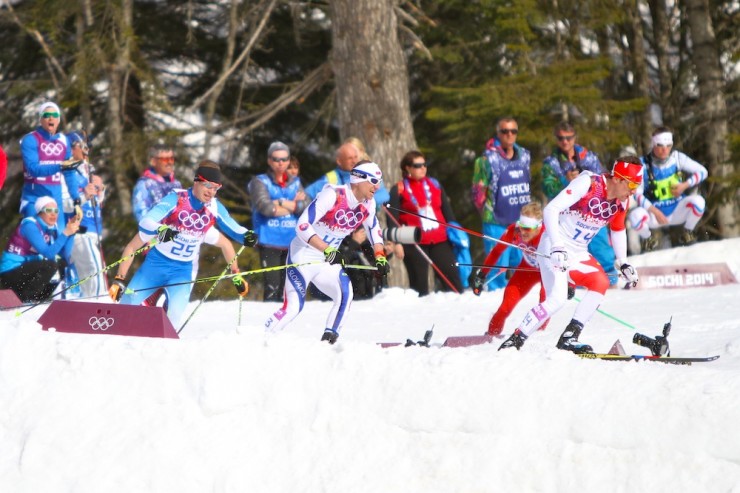
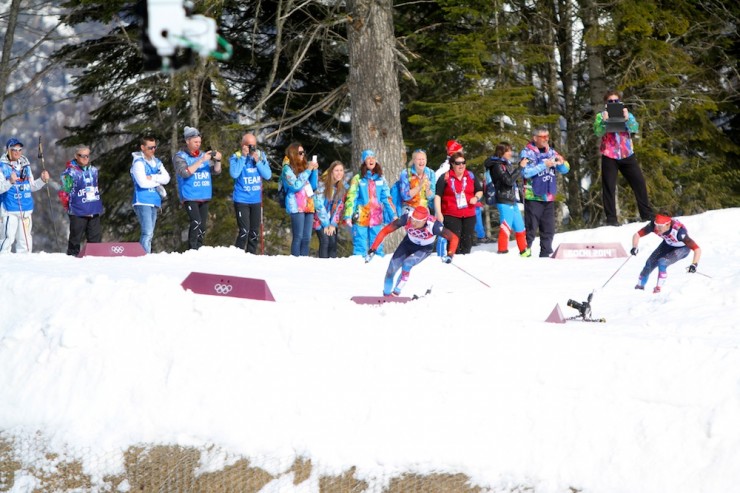
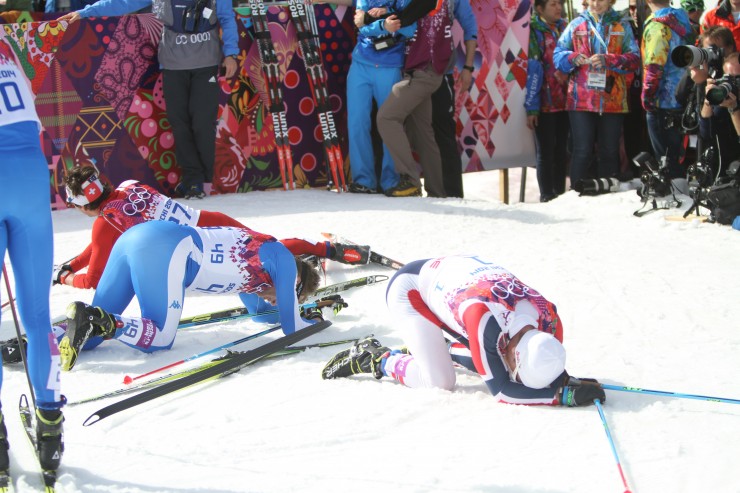
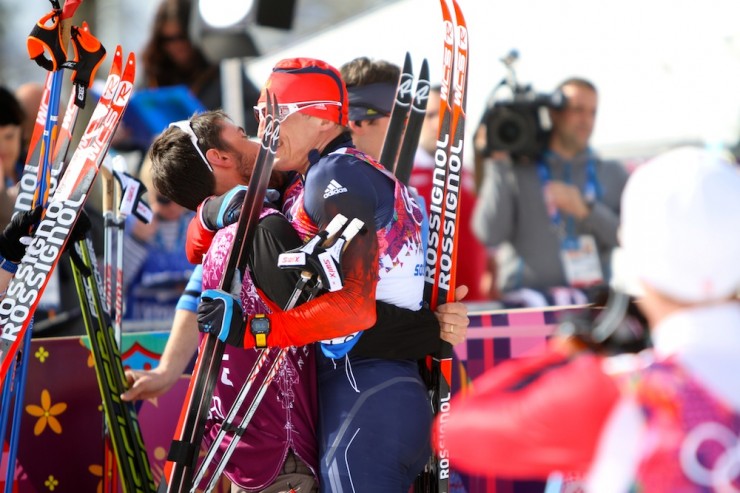
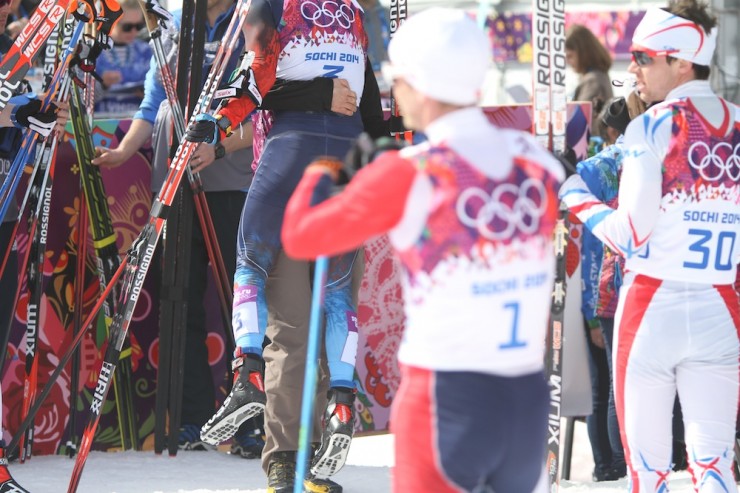
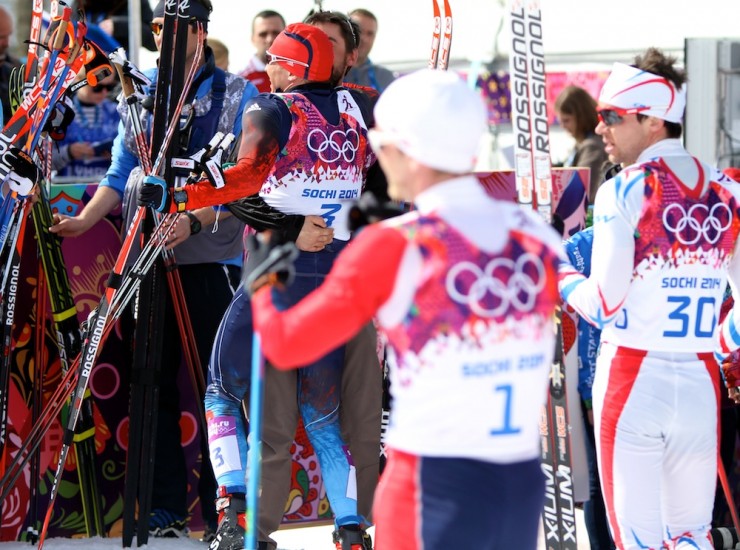
    KRASNAYA POLYANA, Russia — Want to see how long Noah Hoffman was leading the Olympic men’s 50-kilometer freestyle mass start on Sunday, the final day of the Olympics, and how Russia pulled off the medal sweep? Check out this (mostly in order) play-by-play in photos. Read the story here.

    Start list (for bib numbers)

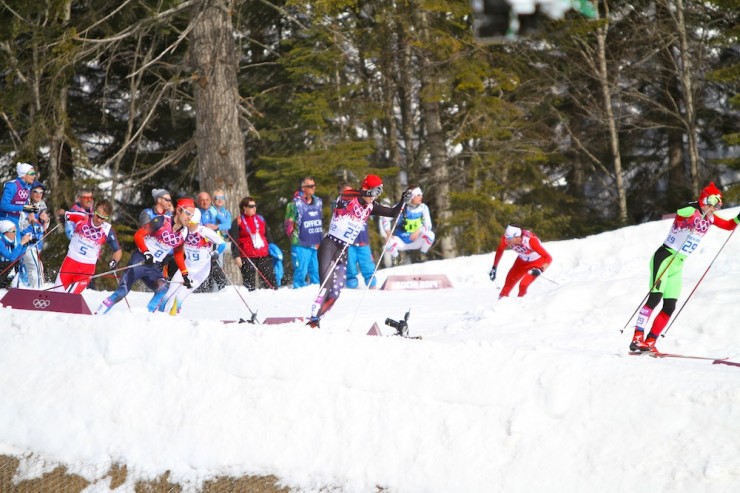
  • Russia Sweeps for First Time in Olympic History; Legkov Captures Gold in 50 k

    Russia Sweeps for First Time in Olympic History; Legkov Captures Gold in 50 k

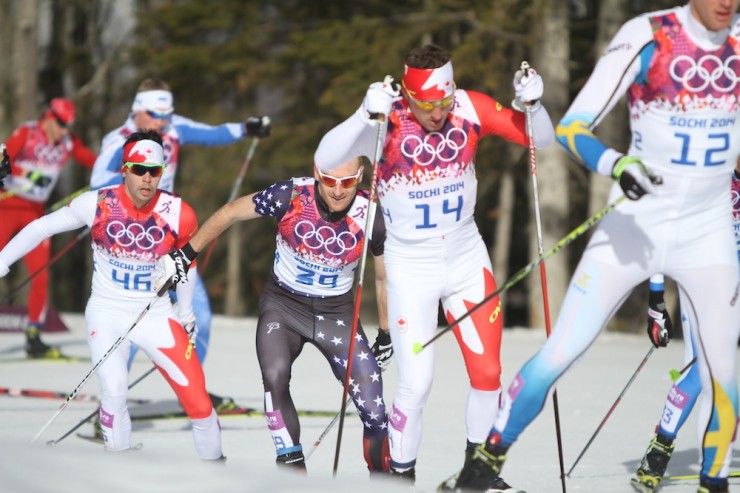
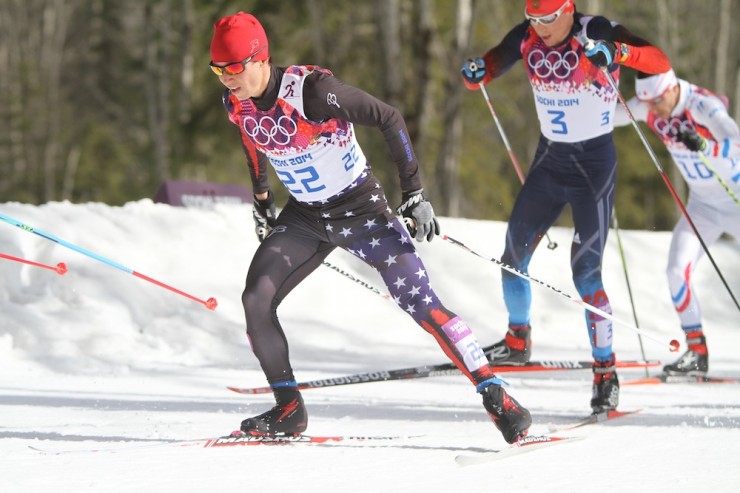
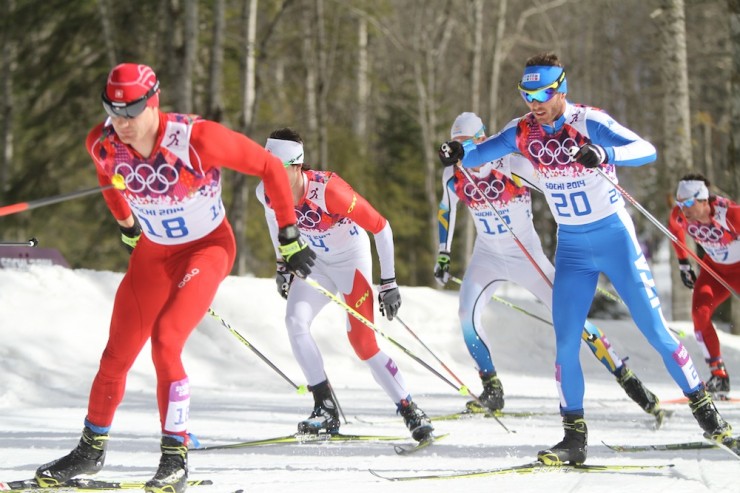
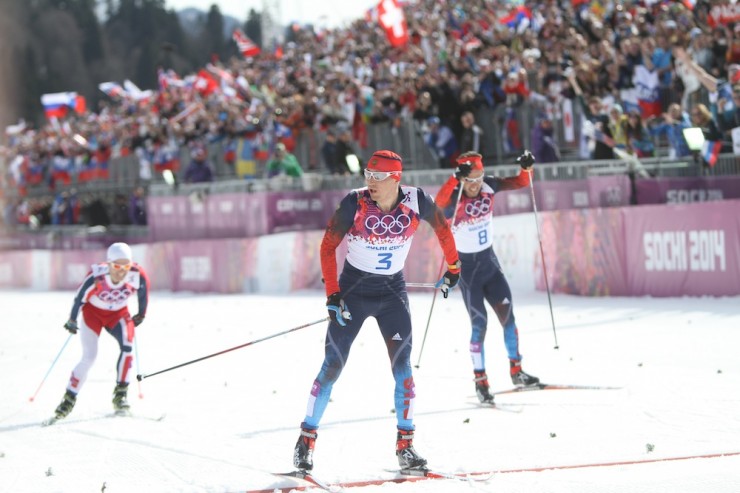
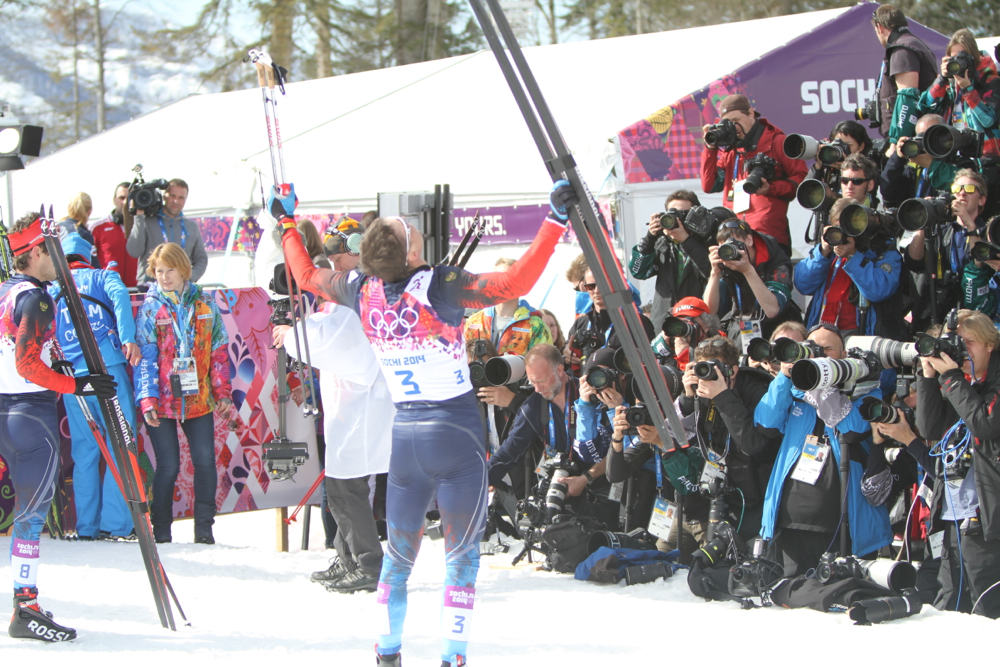
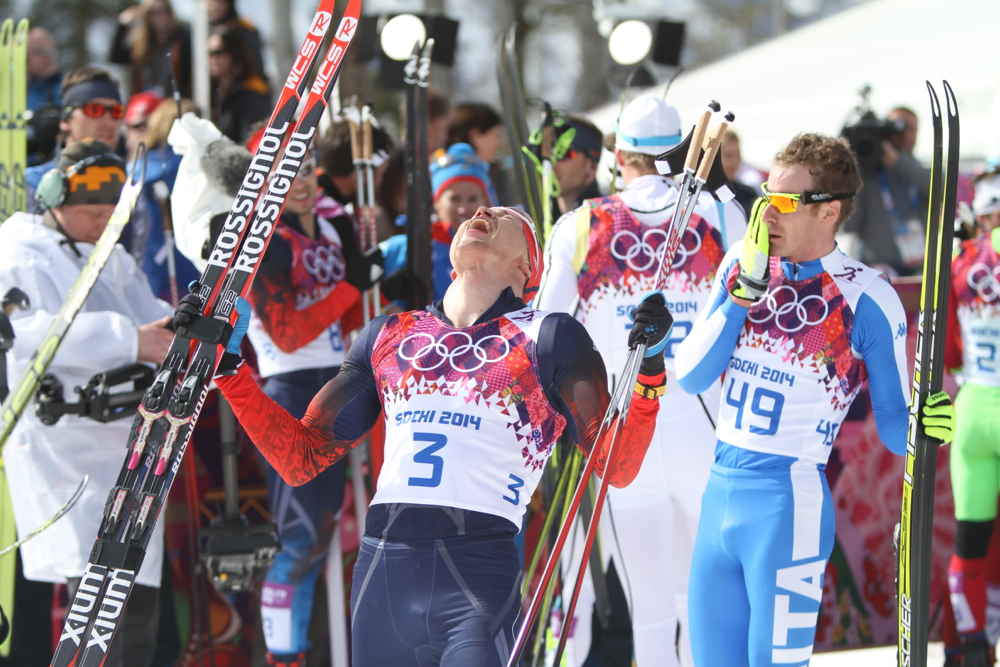
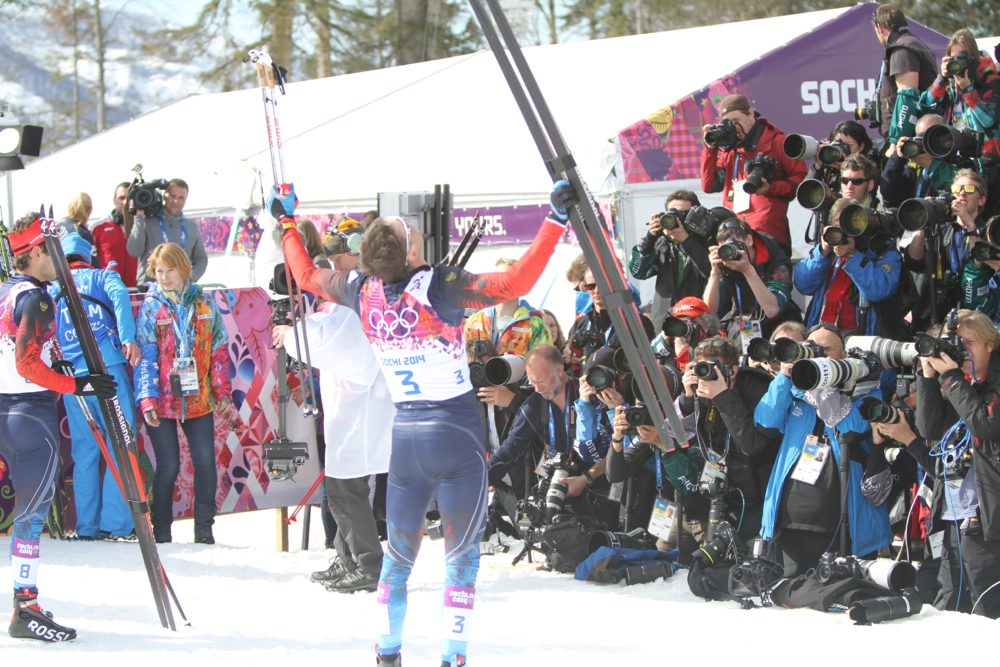
    Alexander Legkov (3) after winning his first Olympic medal with gold in the 50 k freestyle mass start on Sunday, the last day of the Sochi Games. He beat fellow Russians Maxim Vylegzhanin (not shown) and Ilia Chernousov (r). Vylegzhanin took silver by 0.7 seconds, just a tenth of a second ahead of Chernousov in third, and Norway's Martin Johnsrud Sundby (1) missed a medal by 0.2 seconds in fourth.
    Alexander Legkov (3) after winning his first Olympic medal with gold in the 50 k freestyle mass start on Sunday, the last day of the Sochi Games. He beat fellow Russians Maxim Vylegzhanin and Ilia Chernousov, who took second and third, respectively, to complete Russia’s first-ever podium sweep at the Olympics.

    FasterSkier’s coverage is made possible through the generous support of Swix.

    KRASNAYA POLYANA, Russia — It was the kind of race Russia had been dreaming of since it won the bid to host the 2014 Winter Olympics nearly six years ago.

    President Vladimir Putin vowed that his athletes would be clean in their home Olympics, and in the leadup to the 2010 Vancouver Games, at least 10 Russians in various sports were disqualified for the use of banned substances. In Vancouver, Russia went on to win three total golds for their worst Olympic showing.

    Sochi had to be different. Putin put it delicately the week before the Opening Ceremony, telling his athletes, “We’re all counting on you.”

    Before the men’s 50-kilometer freestyle mass start on Sunday, the final day of the Sochi Games,  the Russians led the medal count with 28 — 11 golds, 10 silvers and seven bronzes — two of which had come from cross-country skiing, both silver, in the men’s 4 x 10 k relay and men’s classic team sprint. The U.S. ranked second in the standings through Saturday, two medals behind with a total of 27, one medal ahead of Norway.

    As of Sunday, Russia was up to 32 medals — out of reach for teams like the U.S., with 27, and Norway, with 26. That afternoon, the host nation’s golden moment finally came in cross-country skiing, less than a day after biathlete Anton Shipulin anchored Russia to gold in the 4 x 7.5 k relay on Saturday night.

    And the 50 k victory didn’t come easy, or without some serious tactics and a gut-wrenching four-way race for first after five long laps, each of which included a trip to the stadium halfway through.

    Russia’s Alexander Legkov had led the charge — truly turning it up over the last two kilometers to the finish. With a pack of nearly 30 sticking together for the first 45 k of the race, several ambitious hopefuls tried their luck at dropping the field, including Finland’s Lari Lehtonen on the second of five laps, then Michail Semenov of Belarus from around 28 k to 30 k. Finland’s Matti Heikkinen took control from about 32 to 38 k, as another teammate, Iivo Niskanen, tried hard to keep Heikkinen’s pursuers at bay.

    If this was going to be a game of cat and mouse, somebody had to help the little guy get away. Unfortunately for the Finns, the hungriest competitor at the front of the chase pack was Legkov. Four years ago, he had let his first individual medal slip away in the 30 k skiathlon when two Swedes, Marcus Hellner and Johan Olsson, and Germany’s Tobi Angerer bested him.

    Olsson had forged ahead and Legkov reined them back in, but couldn’t quite close the gap in time for the finish.

    Hellner won, Angerer took silver by 2.1 seconds, Olsson was right there in third, and Legkov was another second back in fourth.

    Russia's Alexander Legkov basks in the glory of winning his first Olympic medal, gold in the 50 k freestyle mass start on Sunday at the 2014 Sochi Olympics.
    Russia’s Alexander Legkov basks in the glory of winning his first individual Olympic medal, gold in the 50 k freestyle mass start on Sunday at the 2014 Sochi Olympics.

    No way was he going to let that happen again.

    Olsson led a pack of more than 50 early in the race from about 10 to 15 k. He never made any bold moves, and by 18 k, he was back to 20th, five seconds behind two of his teammates, Anders Södergren and Daniel Richardsson toward the front. Hellner did not race because of illness.

    An hour into race, which started at 11 a.m., three hours earlier than most of the Olympic races in Sochi, the 30 k mark seemed to be the defining moment — as it presented the third opportunity for racers to change skies. Nobody in contention had opted to go in for a fresh pair yet, with the exception of Lukas Bauer of the Czech Republic. Bauer did so at 20 k, and caught back up to the group by 30 k.

    There, Legkov was first over the top of the steep climb before the downhill stadium approach, making a point to lead toward the exchange — and then went in. Most everyone followed him, with the exception of Semenov, Austria’s Bernhard Tritscher and Spain’s Imanol Rojo up front.

    Five kilometers later, Heikkinen had blasted off the front, 22 seconds ahead of the Semenov-Tritscher-and-Rojo trio. Legkov was up to fifth behind them, forging ahead with Norway’s Martin Johnsrud Sundby and American Noah Hoffman over the next lap.

    Legkov kept Heikkinen within range, blowing past Niskanen on the descent into the stadium around 35 k — despite Niskanen’s persistent attempts to stay directly in front of him and slow the pace. Three kilometers later, Legkov and Sundby had shaved eight seconds off the gap to come within 14 seconds of Heikkinen.

    By their next time into the stadium at 40 k, Legkov had caught him, and 2.5 k later, Heikkinen was down to 13th, nearly 9 seconds back. He ultimately placed 15th.

    Sundby and Hoffman followed Legkov as he led them into the stadium for the final opportunity to change skis — which most had already taken advantage of one full lap earlier. They continued down the long descent before the several-kilometer sufferfest back to the top. At the bottom, Legkov again upped the pace in an attempt to break the pack, which included frontrunners like Sweden’s Daniel Richardsson, Legkov’s teammate Maxim Vylegzhanin, and Switzerland’s Dario Cologna.

    In the accordion-like reaction that followed, Cologna was involved with an untimely tangle, where he and another competitor collided, breaking his ski. Unable to find an immediate replacement, Cologna, who had already won two golds at these Olympics (in the skiathlon and 15 k classic) slipped to 27th by the finish.

    “I’m disappointed,” Cologna told reporters. “It was a big chance to get another medal.”

    Hoffman went from 12th to 26th with a broken pole at the bottom of the climb, yet the Russians stayed out of trouble up front.

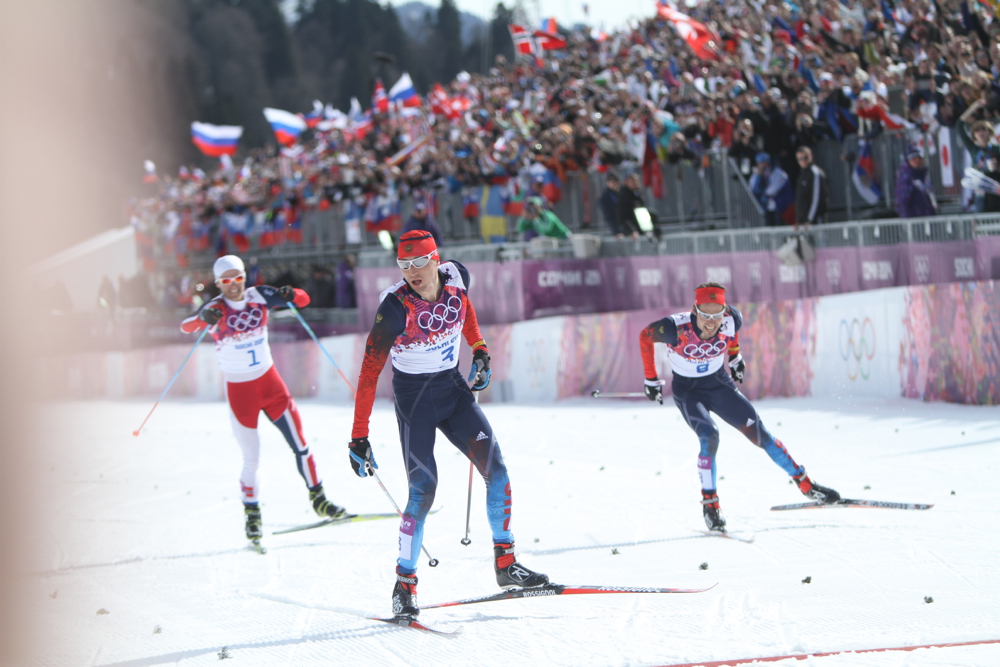
    Alexander Legkov (3) beats out fellow Russians Maxim Vylegzhanin (not shown) and Ilia Chernousov (r) for gold in Sunday's 50 k freestyle mass start -- the last race of the 2014 Sochi Olympics. Vylegzhanin took silver by 0.7 seconds, just a tenth of a second ahead of Chernousov in third, and Norway's Martin Johnsrud Sundby (1) missed a medal by 0.2 seconds in fourth.
    Alexander Legkov (3) beats out fellow Russians Maxim Vylegzhanin (not shown) and Ilia Chernousov (r) for gold in Sunday’s 50 k freestyle mass start — the last race of the 2014 Sochi Olympics. Vylegzhanin took silver by 0.7 seconds, just a tenth of a second ahead of Chernousov in third, and Norway’s Martin Johnsrud Sundby (1) missed a medal by 0.2 seconds in fourth.

    Legkov led Vylegzhanin up toward the stadium for the final kicker of a climb, with Sundby and another Russian, Ilia Chernousov, right behind.

    On the steepest portion of the hill, Legkov found another gear and launched another attack over the top to continue to lead into the finish. He outlasted the three others for gold, his first individual Olympic medal, by 0.7 seconds in 1:46:55.2. The two other Russians and Sundby battled for silver, with Vylegzhanin edging Chernousov by 0.1 seconds, and Sundby placing fourth another 0.2 seconds back.

    It was Russia’s first-ever podium sweep at the Olympics, and the first time in 78 years that any nation had swept the podium in the 50 k. The race also set a record for the fastest 50 k, surpassing the previous Olympic best of 2:03.

    “This victory is special for me because I became an Olympic champion,” Legkov said in a translated press conference. “I congratulate my teammates on their second and third place — this is very good result.”

    Legkov explained that he hadn’t thought of the potential for a podium sweep before the race, which came a day after the Norwegian women did just that in the 30 k mass start.

    “I thought we could compete for the medals, but when it happened all of a sudden it was a huge success and luck for us,” he said.

    Vylegzhanin won his third medal of the Games after taking silver with Legkov, Alexander Bessmertnykh, and Dmitriy Japarov in the relay a week earlier. On Wednesday, he teamed up with Nikita Kriukov to place second in the team sprint.

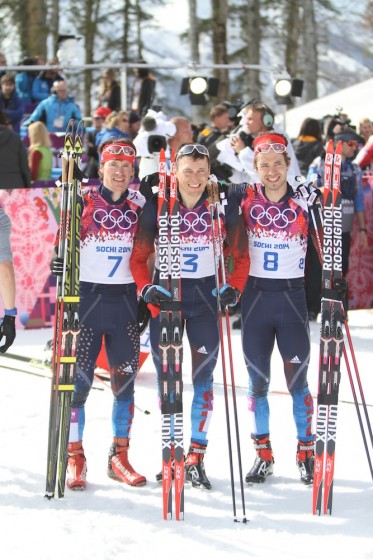
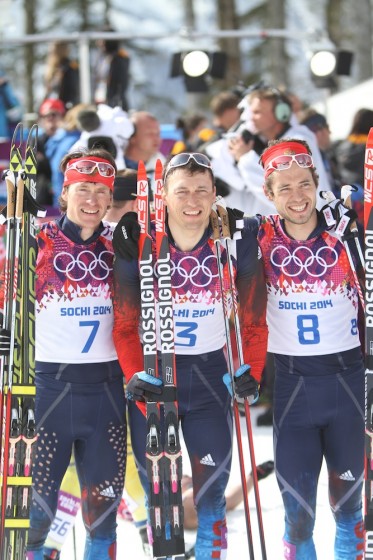
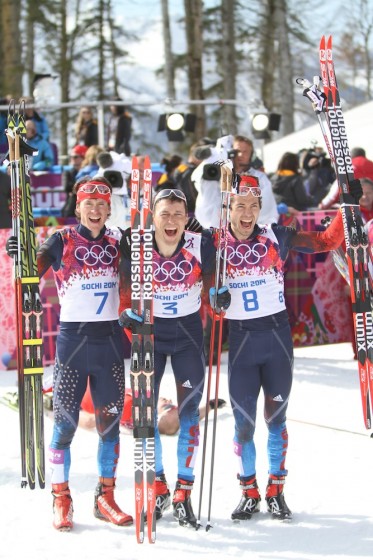
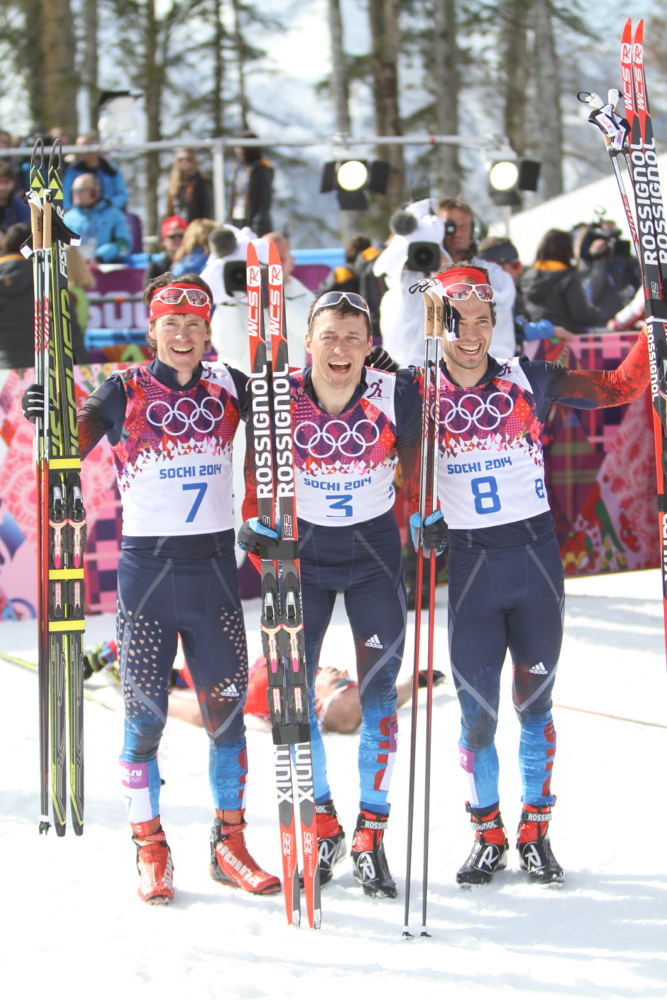
    The Russian podium grinning ear-to-ear after Alexander Legkov (3) won gold, Maxim Vylegzhanin (7) earned his third silver in Sochi, and Ilia Chernousov took bronze in the 50 k freestyle mass start, the last race of the 2014 Winter Games.
    The Russian podium grinning ear-to-ear after Alexander Legkov (3) won gold, Maxim Vylegzhanin (7) earned his third silver in Sochi, and Ilia Chernousov took bronze in the 50 k freestyle mass start, the last race of the 2014 Winter Games.

    “I’m happy to make the people happy,” Vylegzhanin said. “Even though we’ve lost in the past, we’ve won now.”

    And just as expected, the crowd erupted, volunteers danced around the Laura Cross-Country Ski Center and nearby biathlon stadiums, and the team celebrated with as much excitement as they’ve shown all week.

    “Russia power, Alexander Legkov, the power of Russia!”  forerunner Sergey Gamuzov, 20, exclaimed.

    “It was wonderful day! This day is celebration in Russia — Man Day!”

    And thus, the timing couldn’t have been better on the closing day of the Olympics, Men’s Day (formally Defender of the Fatherland Day) in Russia.

    Russian Ski Federation President Elana Vyalbe told reporters that while she was confident in her team, she didn’t think that kind of podium dominance was possible.

    “Yesterday lots of people said we will have the podium, but I was thinking it was a joke,” she said through a translator.

    Pleased with her team, specifically Legkov who “proved he is the king of skiing for at least four years,” Vyalbe said their total medal haul didn’t meet the federation’s expectations.

    “We didn’t manage to fulfill our medal plan,” she said. “In sprints, we should have had completely different results.”

    Still, some like Norwegian coach Vidar Lofshus, gave credit where it was due.

    “It was just a magnificent race by the three Russians,” Lofshus said. “I just feel bad for [Sundby] that he didn’t get his medal.”

    “It’s impressive, of course, like when any country sweeps the podium at the Olympics,” Canadian Ivan Babikov said after placing 20th. “It’s amazing, but they are hosting, it’s their Olympics, it’s their course, and they’ve been strong through the whole Olympics. I’m not surprised. Dario crashed at the end and that threw some people off, but those guys were just the strongest at the finish.”

    The Russians’ performances at the Olympics have drawn some skepticism from Canadian Head Coach Justin Wadsworth. He compared Legkov’s skiing on the final climb of his leg of the men’s relay last week to that of Johann Mühlegg, the Spanish cross-country skier who was caught doping at the 2002 games.

    “Pushing that hard the whole relay and then jump-skating that hill is not possible. Period,” Wadsworth said.

    In a press conference after the relay, Legkov declined to address Wadsworth’s allegations.

    But Chris Grover, the American head coach, said he found the Russian performances at the Olympics to be plausible — noting that on Sunday, they were not far ahead of Sundby.

    “To me, they look like they were in good shape, had good skis, and had really smart strategies during the games,” Grover said. “But they were digging deep like everybody else.”

    — Nat Herz & Chelsea Little contributed reporting


    Results

  • International Couple Top Canadian Nationals Mass Starts; McMurtry Ends Career with Gold (Updated)

    International Couple Top Canadian Nationals Mass Starts; McMurtry Ends Career with Gold (Updated)

    Former US Ski Team member Torin Koos (Bridger Ski Foundation/Rossignol) leading Saturday's 50 k freestyle mass start at 2013 Canadian Nationals in Whistler, B.C. Koos won the race by 0.4 seconds over Brent McMurtry (AWCA). (Photo: Martin Kaiser)
    Former U.S. Ski Team member Torin Koos (Bridger Ski Foundation/Rossignol) leading Saturday’s 50 k freestyle mass start at 2013 Canadian Nationals in Whistler, B.C. Koos won the race by 0.4 seconds over Brent McMurtry (AWCA). (Photo: Martin Kaiser)

    WHISTLER, B.C. – Canadian Cross Country Nationals ended the way it started at Whistler Olympic Park, with exciting racing and sunshine on a freestyle-technique day.

    In the men’s 50-kilometre race, American Torin Koos (Bridger Ski Foundation/Rossignol) attacked on the final hill and held on to edge Brent McMurtry of the Alberta World Cup Academy (AWCA) by just 0.4 seconds in 2 hours, 4:55.2 minutes. His girlfriend, Bettina Gruber of Switzerland, later won the women’s 30 k.

    Brent McMurtry of the Alberta World Cup Academy (AWCA) checks back during the men's 50 k freestyle mass start at 2013 Canadian Nationals on Saturday in Whistler, B.C. McMurtry went on to place second to American Torin Koos for his second Canadian title of the week. (Photo: Martin Kaiser)
    Brent McMurtry of the Alberta World Cup Academy (AWCA) checks back during the men’s 50 k freestyle mass start at 2013 Canadian Nationals on Saturday in Whistler, B.C. McMurtry went on to place second to American Torin Koos for his second Canadian title of the week. (Photo: Martin Kaiser)

    The men’s runner-up by a ski length, McMurtry, 26, ended his season and career as a National Senior Development Team athlete with one last Canadian title (he won the 15 k classic earlier in the week).

    His teammate, Kevin Sandau was third, 1.8 seconds behind Koos, and Brian McKeever of the Para-Nordic Ski Team took fourth and the Canadian bronze (+2.2).

    The race started at 9 a.m. Saturday at -2 degrees Celsius with the sun starting to rise over the mountains to warm the stadium. The first hour featured hard, crusty snow, with fertilizer making a few climbs hard enough to be difficult for skating.  The first lap was the blue 5 k (Olympic skating) loop, then the men settled in for six 7.5-k laps, featuring the first 4 k of the red loop (Olympic class) then the last 3.5 k of the blue.

    This was the fifth event and eighth day of cross-country nationals and tired bodies contributed to a relaxed pace on very fast snow (the opening 5 k, with a total climb of 170 meters, was completed by the leader at the time – McMurtry – in just over 11 minutes).  The next four 7.5-k laps were completed in about 19 minutes each, with slightly softening snow and increasing intensity resulting in an even pace.  An all-Academy pack with McMurtry, Michael Somppi and Chris Hamilton led much of the opening 35 k, while Graham Nishikawa (AWCA) and Koos skied relaxed in the group.

    On a slower-starting sixth lap, Somppi tried a push before Sandau made a real attack, but Koos ultimately closed on Sandau.

    “I was a little worried; that was the first time I thought maybe I’m not going to have it today,” Koos said. “Two k’s later I felt good again, and I was like, ‘Okay, all right, I know how to win this race.”

    Fifteen men were still together at the start of the final lap.

    “With 5k or one lap to go, I thought Torin was the guy to mark,” McMurtry said. “I was trying to stay on him, watch him.”

    Koos went to the front with about 1.5 k to go and “just slowed the pace to his speed,” Sandau said. “He was definitely one of the guys you didn’t want to bring to the finish line, but he had some good endurance today.”

    “I am a little disappointed,” McMurtry said of his second place. “I had the gas at the top of the hill, but I was behind Brian [McKeever] and I didn’t push to get on Koos. He opened up a bit of a gap. Coming into the stadium, I used some gas to catch up to him. In the final stretch, I just didn’t have the legs to get around him.“

    “I felt really strong and had perfect skis,” McMurtry said, “I enjoyed the final race of my career.”

    McMurtry’s first Nationals win, as a juvenile boy in 2001, was in the sprint where he was beaten by an American, so it was “a fitting way to end my career with a title but also getting beat by an American.”

    The men had similar views on the course conditions:

    Koos: “It was awesome!”

    Somppi: “Conditions were awesome.”

    McMurtry: “It was amazing. A perfect day for ski racing in March, or almost April. You can’t really ask for anything more. Sunny, super fast at the beginning, and still held up really well. A perfect way to go out, a super, super day.”

    In the junior men’s 30 k, starting just after the open men, national-junior team member Raphaël Couturier of the Pierre-Harvey National Training Centre (CNEPH) attacked with more than a kilometre remaining to take the gold by 8.3 seconds in 1:18.15.4. Matthew Vrielink of Rocky Mountain Racers (RMR) placed second, and Sebastien Dandurand (Callaghan Valley TC) outsprinted four others to take the bronze medal, 18.8 seconds after Couturier.

    Gruber Dominates Women’s 30 k

    Japan's Chisa Obayashi (second from r) leads a group after crashing early in Saturday's 30 k freestyle mass start at Canadian Nationals in Whistler, B.C. Eventual winner, Bettina Gruber of Switzerland (r), runner-up Zina Kocher (l) and Heidi Widmer (second from l) follow. (Photo: Martin Kaiser)
    Japan’s Chisa Obayashi (second from r) leads a group after crashing early in Saturday’s 30 k freestyle mass start at Canadian Nationals in Whistler, B.C. Eventual winner, Bettina Gruber of Switzerland (r), runner-up Zina Kocher (l) and Heidi Widmer (second from l) follow. (Photo: Martin Kaiser)

    The women’s freestyle mass start began just before noon with the temperatures already up to 9 degrees Celsius and sun on most of the course.  Organizers previously fertilized the entire stadium, plus the climbs and corners, to preserve the course and it held up well for the women, with a thin layer of slush over a frozen base for most of the blue 5 k course.

    The action started on the first climb out of the stadium with Japan’s Chisa Obayashi (Madshus/Black Jack) taking a hard fall, breaking her pole across both knees, and losing about 40 places.  Obayashi quickly rejoined the leaders, finishing the first lap in the top 10.

    Bettina Gruber of Switzerland's National Ski Team en route to her first victory at 2013 Canadian Nationals in Whistler, B.C. Gruber won the women's 30 k freestyle mass start by over 40 seconds. (Photo: Martin Kaiser)
    Bettina Gruber of Switzerland’s National Ski Team en route to her first victory at 2013 Canadian Nationals in Whistler, B.C. Gruber won the women’s 30 k freestyle mass start by over 40 seconds. (Photo: Martin Kaiser)

    The second lap quickly separated with a group of four who would ski most of the race together at the front.  Heidi Widmer (AWCA), Zina Kocher (Biathlon Canada), Bettina Gruber (Swiss National Team) and Obayashi slowly grew their lead through three laps.

    On the fourth lap, Obayashi dropped back, with the combination of a tired body from chasing back to the group on the first lap and swelling knees slowing her down.

    On the final lap, Kocher made a hard attack up the first hill out of the stadium and only Gruber followed.  By the staircase climb, Gruber was comfortable again.

    When Kocher faltered, Gruber was able to ski away for the victory in1:18:41.1, 40.2 seconds ahead of Kocher, the top Canadian, in second.  Widmer wasn’t able to close on Kocher, finishing another 19 seconds back in third.

    Resurgent Brittany Webster (Highlands Trailblazers) skied two fast final laps and outsprinted Obayashi for fourth place and the Canadian bronze.  Eliska Hajkova (University of Colorado-Boulder), who struggled with ski speed as the snow softened, took sixth.

    “Until about 15 k, it was four girls together, it was solid speed, a good pace,” Gruber said. “Then it went a little bit faster, and we dropped Chisa.”

    “We kept it pretty easy until that final lap and then we really tried to put on the moves,” Kocher said. “The first one I did and dropped Bettina a bit, but she caught me after the downhill and then she made a move on me on the second uphill in the woods and I could go for half of it, and then I was done.”

    Zina Kocher attacks during Saturday's 30 k freestyle mass start at Canadian Nationals. Kocher was the first Canadian and second overall behind Switzerland's Bettina Gruber.
    Zina Kocher (Biathlon Canada) attacks at the start of the last lap of Saturday’s 30 k freestyle mass start at Canadian Nationals. Kocher was the first Canadian and second overall behind Switzerland’s Bettina Gruber (second from l).

    “It was a lot of fun,” Widmer said. “I definitely exceeded my expectations as far as 30 k’s go. Really strong girls to ski with; Zina, Bettina, Chisa Obayashi and I skied the first four laps together and then on the fifth lap Chisa dropped off.

    “At the end, coming out of the stadium for the sixth lap, Zina and Bettina attacked and I didn’t have the gas to go with them,” she added.

    “That race was really fun,” Webster said, despite struggling with the pace from the start. “I was yoyo-ing off the back, got swallowed up by the girls behind and then kind of accelerated again.

    “I had the best skis ever, so that was definitely a bonus,” Webster added. “Foothills Nordic did my skis, and yeah, they were phenomenal.”

    “After start, I crashed, my pole is broken and I scratched my knees,” Obayashi said. “First lap, I used too much energy, so fourth, fifth, sixth laps, I lost energy.”

    Gruber said the conditions were “pretty good. I was surprised, I thought it would be slower and more sluggish, but the track held up pretty well.”

    In the junior women’s 20 k, Cendrine Browne (CNEPH) skied away from teammate Anne-Marie Comeau to take the gold by 3.7 seconds in 54:47.6.  Biathlete Julia Ransom (Canmore) finished third, 49 seconds after Browne.

    While the fertilizer gave the men an extremely fast course and the women a fairly fast course, the sheer volume of younger skiers and a high of 15 C created slushy skiing by the end of the day.

    At the end of a long week and a long season, the start list was shorter.  There were 79 open men, 45 junior men, 53 open women, 22 junior women, 73 juvenile boys, 82 junior boys, 59 junior girls, 74 juvenile girls, and 14 para-nordic skiers.

    More than 150 volunteers made this event possible.

    ***

    Full results and splits are at zone4.ca, with photo galleries coming at the event website.

    Results by race:

    Men’s 50 k

    Junior men’s 30 k

    Women’s 30 k

    Junior women’s 20 k

  • U.S. Distance Nationals: Mass Start Photos

    U.S. Distance Nationals: Mass Start Photos

    Tad Elliott leads fellow U.S. Ski Team member Kris Freeman as they continue to break away from the pack in Saturday's 50 k freestyle mass start at U.S. Distance Nationals.

    CRAFTSBURY, Vt. — The women endured 20 laps and the men rounded the 1.5-kilometer loop 33 times in their respective 30- and 50-kilometer freestyle mass starts at U.S. Distance Nationals last weekend.

    Wondering how it played out with up to 90 racers on course at once? Take a look at our photo galleries.

    Women’s 30 k

    Men’s 50 k

    Look up racers by start lists: Women’s 30 k | Men’s 50 k

    Results: Women’s | Men’s