From the FasterSkier archive — posts syndicated from athletes’ and coaches’ own blogs between 2004 and 2012, kept online as published. Current coverage is at fasterskier.com.
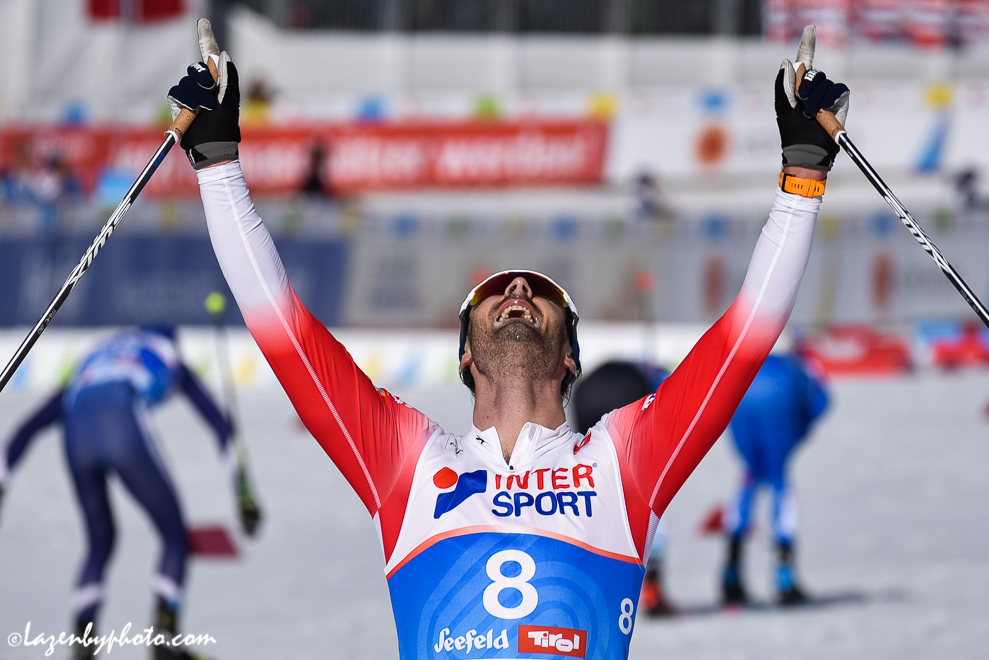
Norway’s Hans Christer Holund crossing the line in first as he wins the 50 k skate at the 2019 World Championships. (Photo: John Lazenby/lazenbyphoto.com)
FIS Nordic Ski World Championships Men’s 50 K Freestyle Mass Start
It has come to a close. The 2019 Nordic Ski World Championships ended today with the men’s 50-kilometer freestyle mass start. Hans Christer Holund of Norway began to make his mark on the race shortly after 20 k with a solo attack. In his bold ski-alone effort, Holund was able to fend off any chasers and win in 1:49:59.3 hours.
Russia’s Alexander Bolshunov timed his chasing surge for a last 10 k punch. By the finish, Bolshunov had eaten up some time on Holund to place second, 27.8 seconds back.
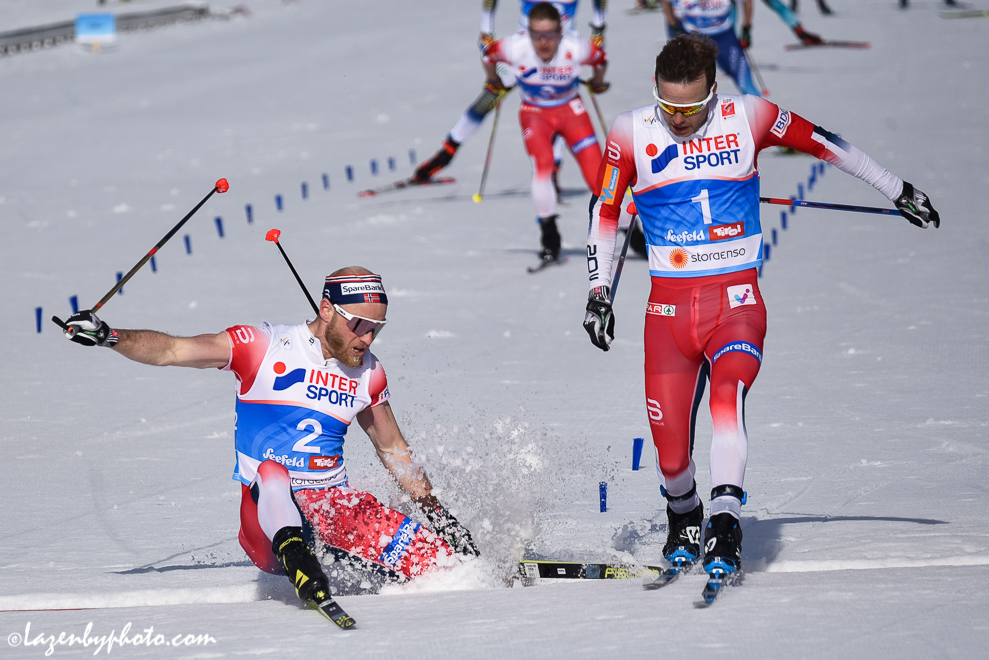
Sjur Røthe and Martin Johnsrud Sundby, teammates on the formidable Norwegian team, created their own gap on the sizable main chase group as they raced up the course’s final climb. Sprinting down the straight into the finish, Røthe out-toed Sundby for third overall (+57.8) as Sundby took fourth (+57.9).
Canada’s Alex Harvey was the top North American in 12th (+1:10.5). He was followed by teammates Russell Kennedy in 46th (+9:57.6), Evan Palmer-Charrette in 47th (+11:26.1), and Scott James Hill in 50th (+11:27.6). If you love play games with mods, Download mods for android games free and let’s go to run your fav game
David Norris was the top American in 20th (+1:22.6), followed by Scott Patterson in 23rd (+2:05.5), Simi Hamilton in 34th (+4:02.), and Adam Martin in 45th (+8:01.7).
The toe-surge by Norway’s Sjur Røthe for third place over teammate Martin Johnsrud who placed fourth during Sunday’s 50 k skate at World Championships. (Photo: John Lazenby/lazenbyphoto.com)
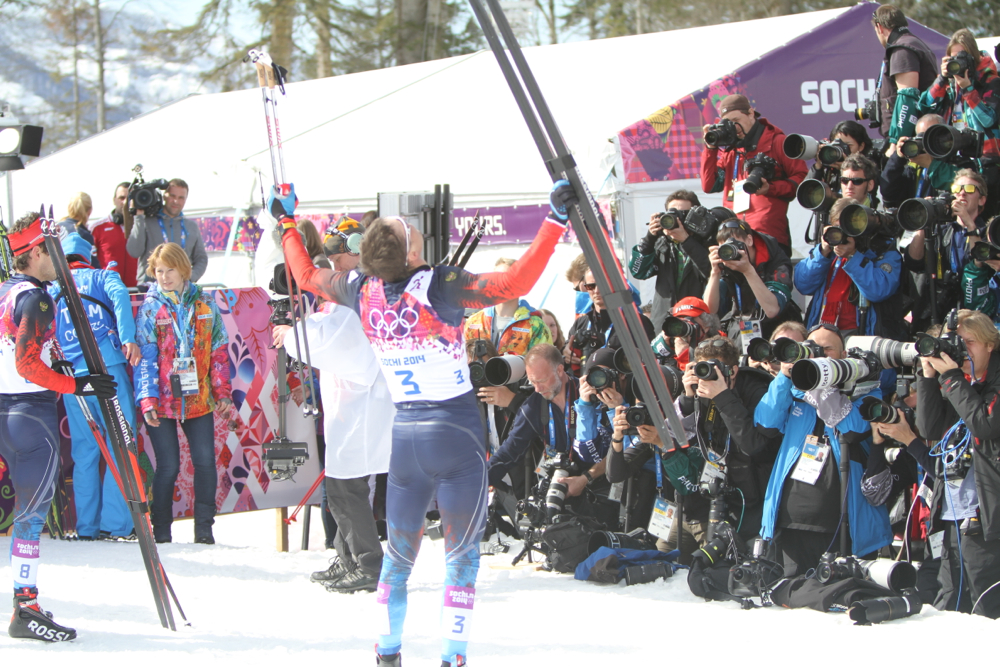
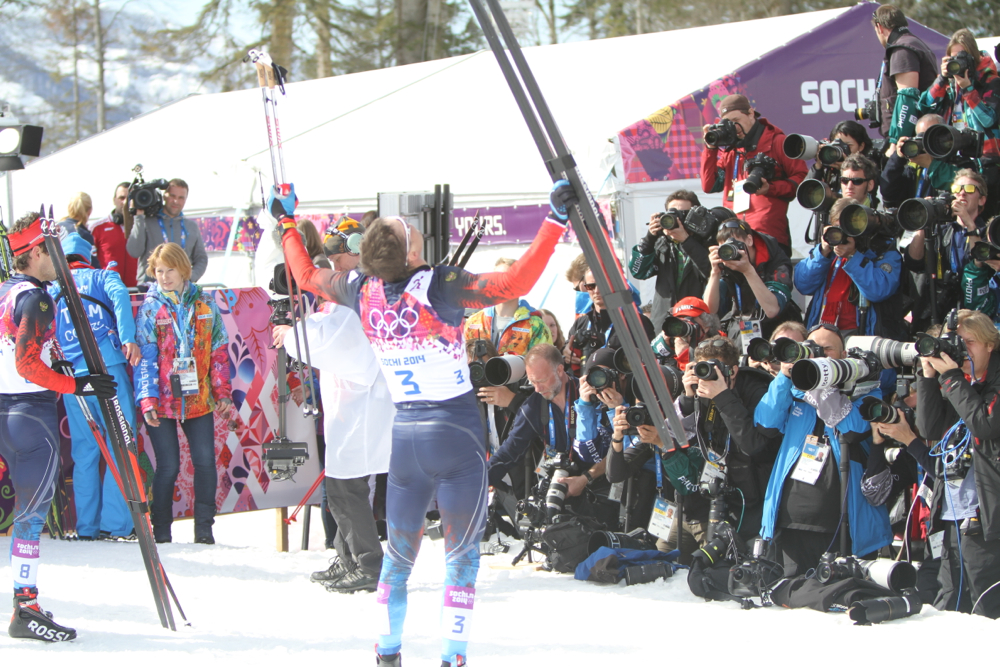
Alexander Legkov (3) after winning his first Olympic medal with gold in the 50 k freestyle mass start on Sunday, the last day of the Sochi Games. He beat fellow Russians Maxim Vylegzhanin and Ilia Chernousov, who took second and third, respectively, to complete Russia’s first-ever podium sweep at the Olympics.
FasterSkier’s coverage is made possible through the generous support of Swix.
KRASNAYA POLYANA, Russia — It was the kind of race Russia had been dreaming of since it won the bid to host the 2014 Winter Olympics nearly six years ago.
President Vladimir Putin vowed that his athletes would be clean in their home Olympics, and in the leadup to the 2010 Vancouver Games, at least 10 Russians in various sports were disqualified for the use of banned substances. In Vancouver, Russia went on to win three total golds for their worst Olympic showing.
Sochi had to be different. Putin put it delicately the week before the Opening Ceremony, telling his athletes, “We’re all counting on you.”
Before the men’s 50-kilometer freestyle mass start on Sunday, the final day of the Sochi Games, the Russians led the medal count with 28 — 11 golds, 10 silvers and seven bronzes — two of which had come from cross-country skiing, both silver, in the men’s 4 x 10 k relay and men’s classic team sprint. The U.S. ranked second in the standings through Saturday, two medals behind with a total of 27, one medal ahead of Norway.
As of Sunday, Russia was up to 32 medals — out of reach for teams like the U.S., with 27, and Norway, with 26. That afternoon, the host nation’s golden moment finally came in cross-country skiing, less than a day after biathlete Anton Shipulin anchored Russia to gold in the 4 x 7.5 k relay on Saturday night.
And the 50 k victory didn’t come easy, or without some serious tactics and a gut-wrenching four-way race for first after five long laps, each of which included a trip to the stadium halfway through.
Russia’s Alexander Legkov had led the charge — truly turning it up over the last two kilometers to the finish. With a pack of nearly 30 sticking together for the first 45 k of the race, several ambitious hopefuls tried their luck at dropping the field, including Finland’s Lari Lehtonen on the second of five laps, then Michail Semenov of Belarus from around 28 k to 30 k. Finland’s Matti Heikkinen took control from about 32 to 38 k, as another teammate, Iivo Niskanen, tried hard to keep Heikkinen’s pursuers at bay.
If this was going to be a game of cat and mouse, somebody had to help the little guy get away. Unfortunately for the Finns, the hungriest competitor at the front of the chase pack was Legkov. Four years ago, he had let his first individual medal slip away in the 30 k skiathlon when two Swedes, Marcus Hellner and Johan Olsson, and Germany’s Tobi Angerer bested him.
Olsson had forged ahead and Legkov reined them back in, but couldn’t quite close the gap in time for the finish.
Hellner won, Angerer took silver by 2.1 seconds, Olsson was right there in third, and Legkov was another second back in fourth.
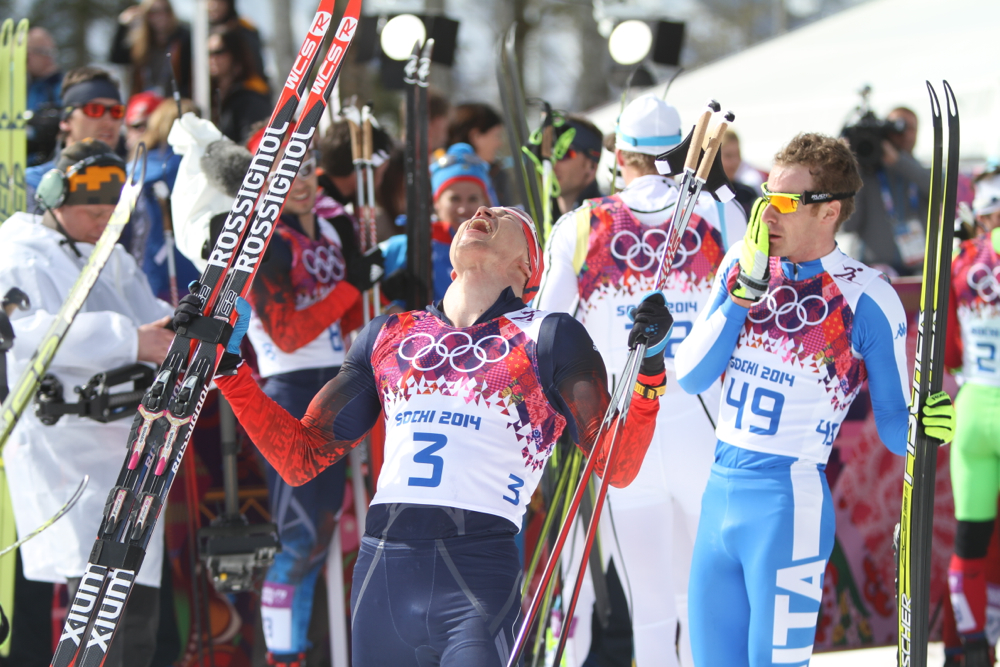
Russia’s Alexander Legkov basks in the glory of winning his first individual Olympic medal, gold in the 50 k freestyle mass start on Sunday at the 2014 Sochi Olympics.
No way was he going to let that happen again.
Olsson led a pack of more than 50 early in the race from about 10 to 15 k. He never made any bold moves, and by 18 k, he was back to 20th, five seconds behind two of his teammates, Anders Södergren and Daniel Richardsson toward the front. Hellner did not race because of illness.
An hour into race, which started at 11 a.m., three hours earlier than most of the Olympic races in Sochi, the 30 k mark seemed to be the defining moment — as it presented the third opportunity for racers to change skies. Nobody in contention had opted to go in for a fresh pair yet, with the exception of Lukas Bauer of the Czech Republic. Bauer did so at 20 k, and caught back up to the group by 30 k.
There, Legkov was first over the top of the steep climb before the downhill stadium approach, making a point to lead toward the exchange — and then went in. Most everyone followed him, with the exception of Semenov, Austria’s Bernhard Tritscher and Spain’s Imanol Rojo up front.
Five kilometers later, Heikkinen had blasted off the front, 22 seconds ahead of the Semenov-Tritscher-and-Rojo trio. Legkov was up to fifth behind them, forging ahead with Norway’s Martin Johnsrud Sundby and American Noah Hoffman over the next lap.
Legkov kept Heikkinen within range, blowing past Niskanen on the descent into the stadium around 35 k — despite Niskanen’s persistent attempts to stay directly in front of him and slow the pace. Three kilometers later, Legkov and Sundby had shaved eight seconds off the gap to come within 14 seconds of Heikkinen.
By their next time into the stadium at 40 k, Legkov had caught him, and 2.5 k later, Heikkinen was down to 13th, nearly 9 seconds back. He ultimately placed 15th.
Sundby and Hoffman followed Legkov as he led them into the stadium for the final opportunity to change skis — which most had already taken advantage of one full lap earlier. They continued down the long descent before the several-kilometer sufferfest back to the top. At the bottom, Legkov again upped the pace in an attempt to break the pack, which included frontrunners like Sweden’s Daniel Richardsson, Legkov’s teammate Maxim Vylegzhanin, and Switzerland’s Dario Cologna.
In the accordion-like reaction that followed, Cologna was involved with an untimely tangle, where he and another competitor collided, breaking his ski. Unable to find an immediate replacement, Cologna, who had already won two golds at these Olympics (in the skiathlon and 15 k classic) slipped to 27th by the finish.
“I’m disappointed,” Cologna told reporters. “It was a big chance to get another medal.”
Hoffman went from 12th to 26th with a broken pole at the bottom of the climb, yet the Russians stayed out of trouble up front.
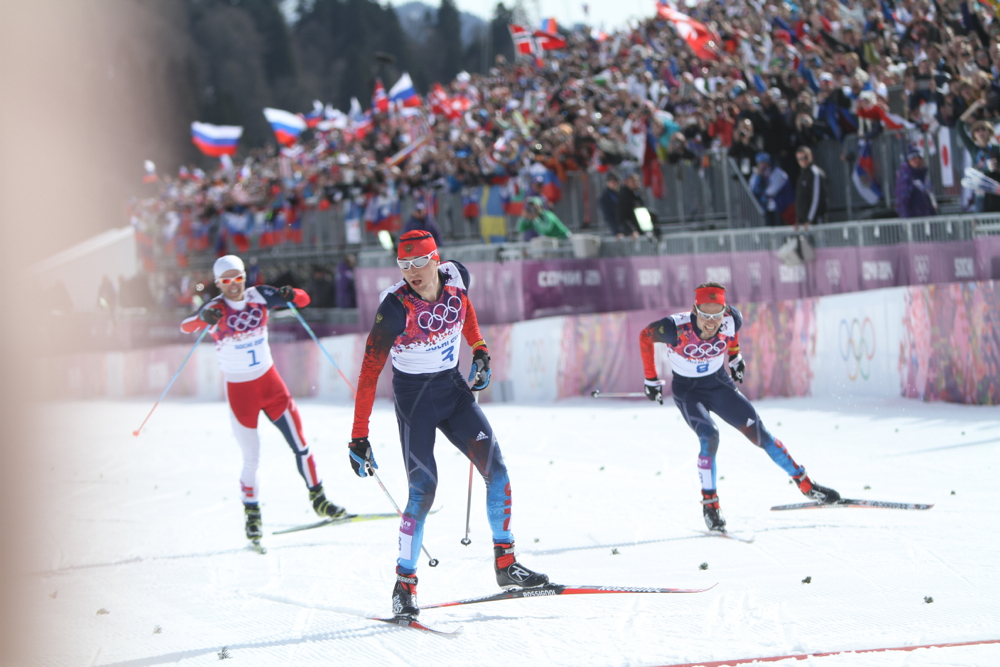
Alexander Legkov (3) beats out fellow Russians Maxim Vylegzhanin (not shown) and Ilia Chernousov (r) for gold in Sunday’s 50 k freestyle mass start — the last race of the 2014 Sochi Olympics. Vylegzhanin took silver by 0.7 seconds, just a tenth of a second ahead of Chernousov in third, and Norway’s Martin Johnsrud Sundby (1) missed a medal by 0.2 seconds in fourth.
Legkov led Vylegzhanin up toward the stadium for the final kicker of a climb, with Sundby and another Russian, Ilia Chernousov, right behind.
On the steepest portion of the hill, Legkov found another gear and launched another attack over the top to continue to lead into the finish. He outlasted the three others for gold, his first individual Olympic medal, by 0.7 seconds in 1:46:55.2. The two other Russians and Sundby battled for silver, with Vylegzhanin edging Chernousov by 0.1 seconds, and Sundby placing fourth another 0.2 seconds back.
It was Russia’s first-ever podium sweep at the Olympics, and the first time in 78 years that any nation had swept the podium in the 50 k. The race also set a record for the fastest 50 k, surpassing the previous Olympic best of 2:03.
“This victory is special for me because I became an Olympic champion,” Legkov said in a translated press conference. “I congratulate my teammates on their second and third place — this is very good result.”
Legkov explained that he hadn’t thought of the potential for a podium sweep before the race, which came a day after the Norwegian women did just that in the 30 k mass start.
“I thought we could compete for the medals, but when it happened all of a sudden it was a huge success and luck for us,” he said.
Vylegzhanin won his third medal of the Games after taking silver with Legkov, Alexander Bessmertnykh, and Dmitriy Japarov in the relay a week earlier. On Wednesday, he teamed up with Nikita Kriukov to place second in the team sprint.
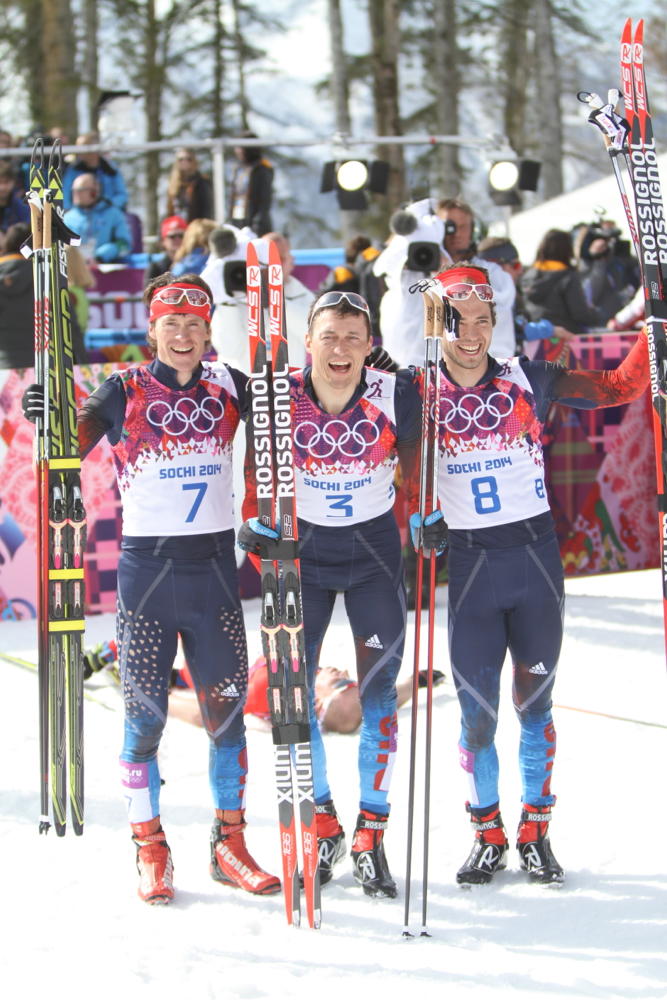
The Russian podium grinning ear-to-ear after Alexander Legkov (3) won gold, Maxim Vylegzhanin (7) earned his third silver in Sochi, and Ilia Chernousov took bronze in the 50 k freestyle mass start, the last race of the 2014 Winter Games.
“I’m happy to make the people happy,” Vylegzhanin said. “Even though we’ve lost in the past, we’ve won now.”
And just as expected, the crowd erupted, volunteers danced around the Laura Cross-Country Ski Center and nearby biathlon stadiums, and the team celebrated with as much excitement as they’ve shown all week.
“Russia power, Alexander Legkov, the power of Russia!” forerunner Sergey Gamuzov, 20, exclaimed.
“It was wonderful day! This day is celebration in Russia — Man Day!”
And thus, the timing couldn’t have been better on the closing day of the Olympics, Men’s Day (formally Defender of the Fatherland Day) in Russia.
Russian Ski Federation President Elana Vyalbe told reporters that while she was confident in her team, she didn’t think that kind of podium dominance was possible.
“Yesterday lots of people said we will have the podium, but I was thinking it was a joke,” she said through a translator.
Pleased with her team, specifically Legkov who “proved he is the king of skiing for at least four years,” Vyalbe said their total medal haul didn’t meet the federation’s expectations.
“We didn’t manage to fulfill our medal plan,” she said. “In sprints, we should have had completely different results.”
Still, some like Norwegian coach Vidar Lofshus, gave credit where it was due.
“It was just a magnificent race by the three Russians,” Lofshus said. “I just feel bad for [Sundby] that he didn’t get his medal.”
“It’s impressive, of course, like when any country sweeps the podium at the Olympics,” Canadian Ivan Babikov said after placing 20th. “It’s amazing, but they are hosting, it’s their Olympics, it’s their course, and they’ve been strong through the whole Olympics. I’m not surprised. Dario crashed at the end and that threw some people off, but those guys were just the strongest at the finish.”
The Russians’ performances at the Olympics have drawn some skepticism from Canadian Head Coach Justin Wadsworth. He compared Legkov’s skiing on the final climb of his leg of the men’s relay last week to that of Johann Mühlegg, the Spanish cross-country skier who was caught doping at the 2002 games.
“Pushing that hard the whole relay and then jump-skating that hill is not possible. Period,” Wadsworth said.
In a press conference after the relay, Legkov declined to address Wadsworth’s allegations.
But Chris Grover, the American head coach, said he found the Russian performances at the Olympics to be plausible — noting that on Sunday, they were not far ahead of Sundby.
“To me, they look like they were in good shape, had good skis, and had really smart strategies during the games,” Grover said. “But they were digging deep like everybody else.”
U.S. Ski Team member Tad Elliott celebrates winning the 2012 American Birkebeiner in 2:04.48.5, more than 13 seconds ahead of Matt Liebsch, Brian Gregg and Michael Somppi (at right) on Saturday in Hayward, WIs. (Photo: Darlene Prois/American Birkebeiner)
All American Birkebeiner coverage is brought to you through the generous support of Concept2, makers of the SkiErg.
HAYWARD, Wis. – For the first half of Saturday’s 50-kilometer skate race at the 39th American Birkebeiner, Tad Elliott mostly looked down. The 23-year-old U.S. Ski Team member was hanging in there, but it wasn’t easy.
Reaching for a water bottle around 24 k, he mustered the strength to ask his Salomon support staff where the frontrunners were. Last year’s runner-up, Benoit Chauvet of France, and Canadian Graham Nishikawa were nearly a minute ahead of Elliott and the chase group.
The fact that Elliott asked indicated he had some spark left. He hadn’t really warmed up for the race — he typically didn’t for a 50 k — but he’d get there eventually.
A few kilometers later, he and his former teammate, Matt Liebsch, worked together to gun down Chauvet and Nishikawa. That’s what Elliott instinctually wanted to do all along, but Liebsch in his ninth Birkie knew better.
“Tad kept poking me saying, ‘We’ve got to bring it back, they’re gonna get away,’ ” said Liebsch, who previously trained with Elliott on Central Cross Country (CXC). Liebsch now skis for Team Strong Heart and Team Birkie.
“I was like, ‘No, no, they’re not going to be able to hold that,’ ” Liebsch said. “I knew it, but I wasn’t 100 percent sure.”
It turned out the 28-year-old Minnesota racer was right. Chauvet and Nishikawa faded to finish 10th and 25th, respectively, after Liebsch, Elliott and a few others overtook them around 34 k.
2012 American Birkebeiner men's 50 k skate podium: (left to right) Matt Liebsch (Team Strong Heart/Team Birkie) in second, Tad Elliott (USST/Team Homegrown) in first, and Brian Gregg (CXC) in third.
Elliott continued to hit his stride and went on to lead the pack, creating about a 30-second gap in the process. He held on for the final 10 kilometers to win the race by 13.7 seconds in 2:04.48.5.
Liebsch was second and another former teammate, Brian Gregg of CXC was third (+14.8).
“In the past, I have a really good kick and can make a gap open up fast, but then I tire a little bit,” Elliott said. “I just kind of ramped it up and no one followed and from there on, I was committed to going real hard to the finish.”
Shortly after crossing the finish line in downtown Hayward in front of an estimated 20,000 spectators, Elliott borrowed a stranger’s phone and called his mom. She had convinced him to come back to the event after placing second there two years.
In 2010, he placed second to Italy’s Fabio Santus, who set a course record in 1:56.58. In his first Birkie, Elliott was just eight seconds behind. Besides his mother’s enthusiasm for the largest ski marathon in North America, Elliott was motivated by how close he previously came to the victory and its $7,500 prize.
“I wanted to win the Birkie,” Elliott said, after becoming the second American man to win the 50 k American Birkebeiner in 20 years. “It is a dream come true.”
Liebsch previously claimed the title three years ago. On Saturday, American skiers topped the podium in every elite men’s and women’s race for the first time since 1975. Back then, the Birkie featured one 55 k classic race.
Flying directly from Europe to the Midwest earlier this week, Elliot prepared for the Birkie in part by watching last year’s video, in which Norway’s Tore Martin Gundersen put on a commanding sprint to win by about three seconds.
U.S. Ski Team member Tad Elliott (Salomon) racing alone with about a 30-second lead at 44 k in the 50 k American Birkebeiner skate race. Elliott won in 2:04.48.5 on Saturday.
“I wanted to be nowhere near that guy,” Elliott said.
He planned accordingly by working with Liebsch, who also wanted to build a gap rather than try to duke it out at the end.
After Liebsch pulled to the front around 34 k, Elliott went with him, and the two switched leads until Elliott made a game-changing move around 40 k.
On the infamous long gradual uphill known as Bitch Hill, Elliott jolted ahead. Gregg quickly responded and tucked in behind, but Liebsch missed his pole plant. He and Lars Flora went down in a tangled mess while Elliott and Gregg continued on.
Gregg remembered watching the mishap unfold.
“It was sort of like, ‘Oh man what’s going on?’ ” Gregg said. “Matt’s a real good buddy of mine, Tad’s a real good buddy, so I thought, ‘We should get this.’ ”
He decided not waste energy chasing Elliott alone and hold onto second, while Liebsch skied without a pole for about half a kilometer. He eventually picked one up off the snow next to a spectator, who told him to give it back.
“Then he was like, ‘That better be at the Birkie office after,’ ” Liebsch said. “It was some heavy, crappy pole. It didn’t even have a strap on it, and I skied with that.”
Santiago Ocariz (CXC) immediately offered Liebsch his pole. He refused to accept it and skied for nearly 5 k with the same cumbersome one. Anticipating his father would have a better pole at 44 k, Liebsch discovered he didn’t. Ocariz renewed the offer, and the two traded poles. A few strides later, Ocariz found a suitable replacement.
“If [Liebsch] would have taken it right away, he might have won,” Ocariz said. “I mean, what’s the difference if I’m eighth or fourteenth? He had the chance to win. He’s a good friend of mine.”
Ocariz ended up 11th.
“I’m realistic. I know my limitations and I know how much stronger those guys are,” he said. “I was just like, ‘I’m going to hang on as long as I can and then we’ll see what happens.’ ”
The gesture helped Liebsch move to second as he sped away from the others shortly after. Halfway across Lake Hayward a few kilometers before the finish, Liebsch quickly gained ground on Elliott.
Elliott knew it, checking back several times as his 30-second lead dwindled.
“I honestly thought I was gonna get caught right as I turned onto Main and it would be over,” Elliott said. “But I ended up hanging on so I was pretty fired up coming down Main Street.”
Liebsch reasoned that if he put his head down into the headwind and pushed as hard as possible, he could have caught him. But he wasn’t sure could hold off the men behind him in a sprint and thought the same for Elliott.
“I would have been toast and he probably would have had to deal with my baggage,” Liebsch said.
He worried they could end up out of the top three and didn’t want European sprinters taking those spots.
“I didn’t care if [I] was top three as long as it was American, American, American,” Liebsch said.
Gregg held off Michael Somppi of Canada’s National Development Centre in Thunder Bay by two-tenths of a second for third. He had hung onto Liebsch after his big push near 45 k and saw six men ahead of him at the start of the lake.
“The last couple years I’ve finished just out of the money in eighth, seventh, eleventh,” Gregg said. “So I was like, ‘I’m not going to do that this year.’ ”
He picked them off one by one, passing Somppi on the final turn before Main Street.
“It was pretty cool because both Elliott and Liebsch are big training partners [and] we were all on the team together last year and two years before,” Gregg said. “You always want to win but it’s awesome to have those guys ahead of you.”
Morten Pedersen (NOR) placed fifth 20.7 seconds after Elliott, and Flora received $1,000 for finishing sixth (+23.9).
Second in last year’s 54 k classic Birkie, Karl Nygren (CXC) was seventh in the 50 k skate. The race’s 2011 champion, Gundersen was eighth. Nishikawa’s teammate at the Alberta World Cup Academy, Brent McMurtry finished ninth.
Classic Race
Six-time Olympic medalist and FIS Cross-Country chairman, Vegard Ulvang of Norway, after his first American Birkebeiner on Saturday. Ulvang was second in the 54 k classic race in 2:51.17.1. (Photo: Darlene Prois/American Birkebeiner)
In the men’s 54 k classic race, Dave Chamberlain of Boulder Nordic Sport notched the default victory after originally placing second by a small margin to Joe Dubay of the College of Saint Scholastica in Duluth, Minn. The 21-year-old Dubay was disqualified for racing in the bib of another athlete, his teammate Chris Parr.
Chamberlain won the race in 2:51.15.2, edging Vegard Ulvang of Norway by 1.9 seconds. The Birkie guest of honor, Ulvang participated in his first American Birkebeiner as a research ambassador for the National Multiple Sclerosis Society. He was one second ahead of Murray Carter of Manitoba, Canada.