
From the FasterSkier archive — posts syndicated from athletes’ and coaches’ own blogs between 2004 and 2012, kept online as published. Current coverage is at fasterskier.com.

Tag: 50 K

  • Karlsson Leads Swedish Sweep Through Holmenkollen Fog

    Karlsson Leads Swedish Sweep Through Holmenkollen Fog

    This coverage is made possible through the generous support of Marty and Kathy Hall and A Hall Mark of Excellence Award. To learn more about A Hall Mark of Excellence Award, or to learn how you can support FasterSkier’s coverage, please contact info@fasterskier.com.

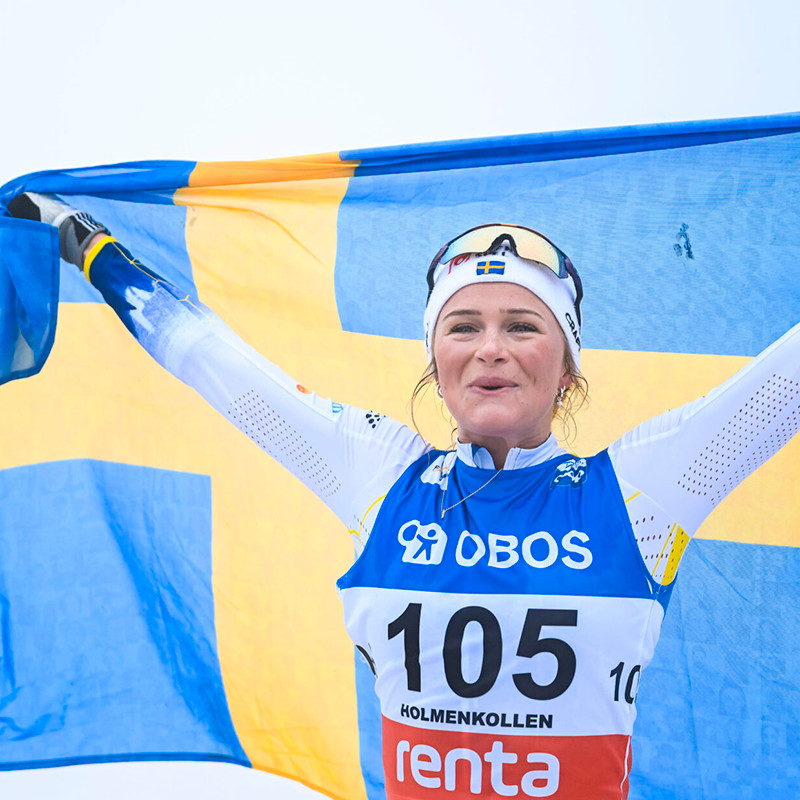
    Frida Karlsson (SWE) claimed her third Holmenkollen win, her second at the 50 kilometer distance. (Photo: Authamayou/NordicFocus)

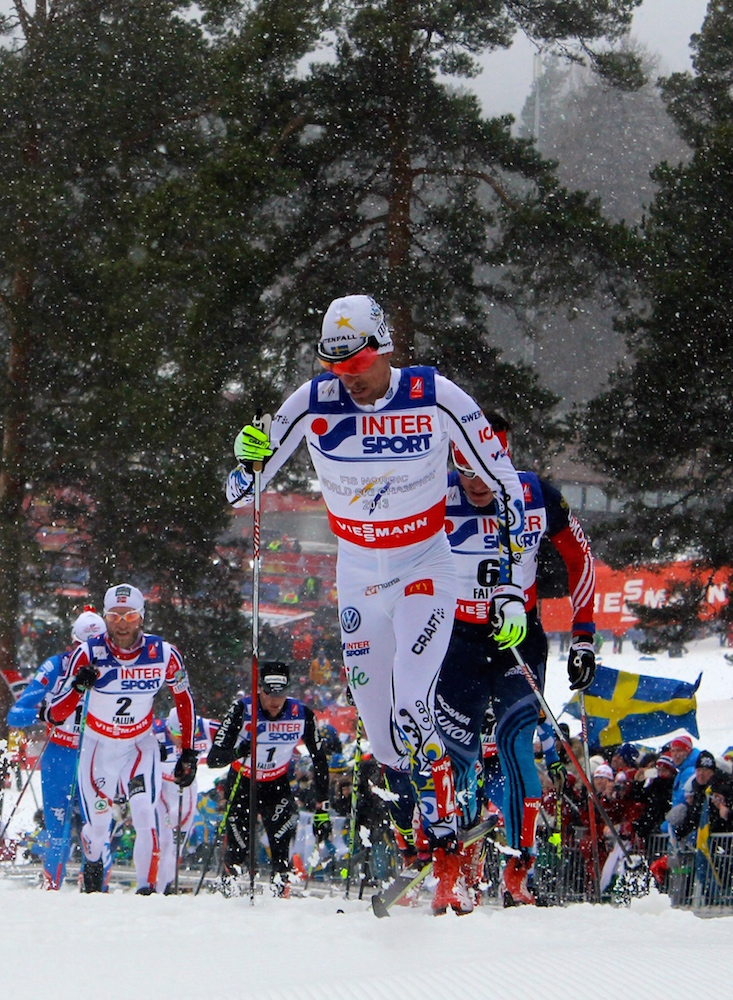
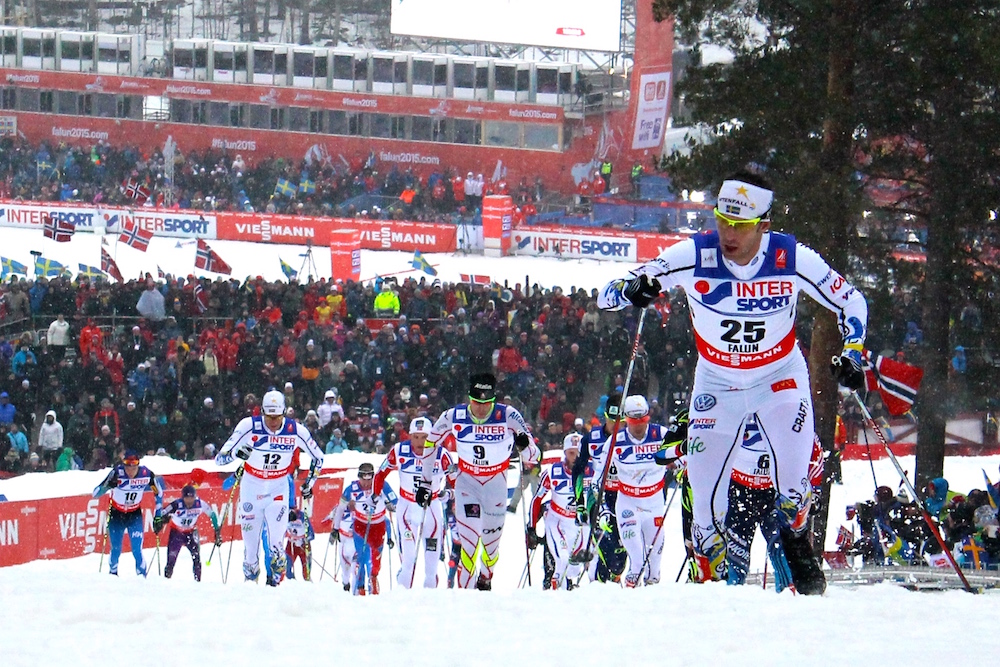
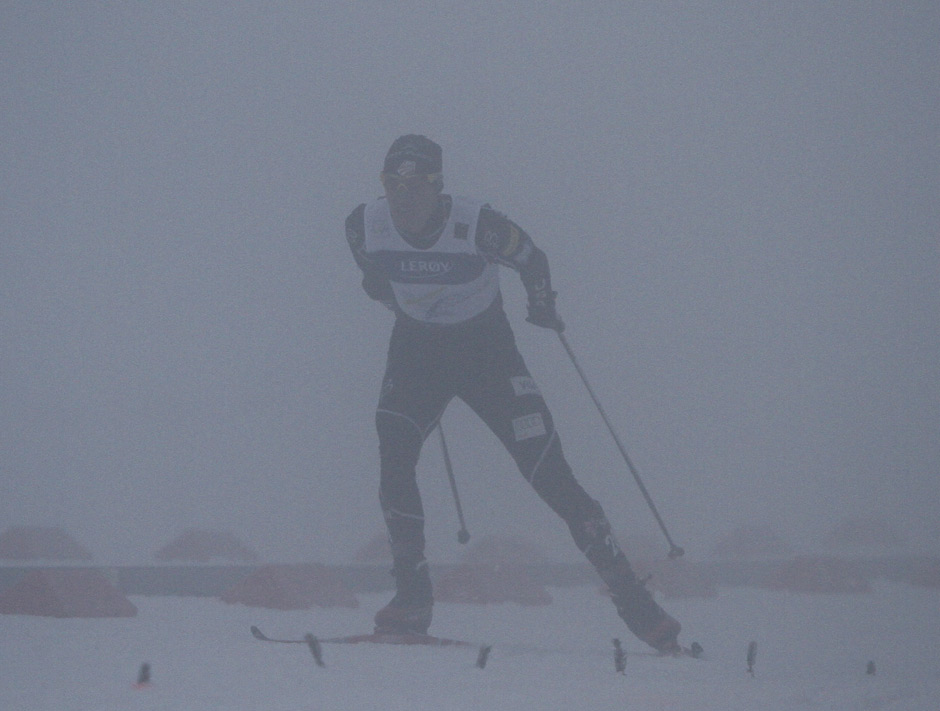
    The prize for winning Oslo’s Holmenkollen 50 k is lifelong bragging rights. Such is the nature of the prestige afforded this event within the Nordic ski community. Norwegian fans, especially, remember certain years, certain races, certain rivalries; especially those that are memorable for the racing conditions that challenged the athletes. Fans are likely to remember this 2026 edition, and the thick, stubborn fog that enveloped the racers throughout the 50 kilometer distance. Stadium announcers regularly reminded the audience that racers were entering the stadium . . . otherwise, fans might not have known. The fog may have appeared thicker and soupier through the lens of broadcast cameras, but it’s certain that the fog hung close to the ground, obscuring skiers’ views of the course, of the crowds, and of their competitors. Perhaps that had something to do with the more measured pace the leaders selected. By the halfway point of the race, the entire women’s field was still together (not at all the normally expected state of affairs in women’s mass-start Distance racing). The regular cast of contenders remained at the front—Frida Karlsson (SWE), Ebba Andersson (SWE), Heidi Weng (NOR), Astrid Oeyre Slind (NOR), Jonna Sundling (SWE), and Jessie Diggins (USA)—but none of them seemed eager to race off alone.

    Karlsson would emerge from the fog first, crossing the finish line all alone to claim her third Holmenkollen race, and her third at the 50 kilometer distance. Behind Karlsson, her Swedish teammates—Linn Svahn and Jonna Sundling—would sprint across the line in second and third, just ahead of Heidi Weng (NOR), Nora Sanness (NOR) and Jessie Diggins (USA).

    “It’s such a magic day for our team,” beamed Karlsson. “It’s our first “triple” in the distance, and it’s sick!”

    Alison Mackie (CAN) followed up a win at the U23 World Championships with a 14h place debut in the Holmenkollen 50 k. (Photo: Authamayou/NordicFocus)

    Canada’s Alison Mackie remained in the top 10 through the halfway mark, and continued to make her presence felt throughout the 50 kilometer distance. . A young skier with a bright future, Mackie was certainly making he most of her first Holmenkollen. She would finish the day in 14th, sandwiched between established distance-racing stars Kristin Austgulen Fosnaes NOR) and Astrid Oeyre Slind (NOR).

    Kendall Kramer (USA started 45th (out of 50 starters), but in the close company of the 46th starter, Delphine Claudel (FRA), a world class Freestyle competitor. If they could work together, they could make up many places in a hurry. By the five kilometer mark, Claudel had managed to work her way all the way up to the front . . . but Kramer was nowhere to be seen. Claudel would hang on to finish 28th. Kramer would cross the line 41st.

    Clearly the best . . . Frida Karlsson (SWE) raced away from her rivals, exiting the fog to claim victory in Holmenkollen’s historic 50 k Freestyle.  (Photo: Authamayou/NordicFocus)
    Holmenkollen 50 k Freestyle

    The Holmenkollen 50 k consists of six laps of an 8.3 kilometer loop, demanding 1000 feet of climbing per lap. And this day in Oslo, race organizers elected to stage the race in a manner that put both the women’s field and the men’s field on the course at the same time, albeit separated by half a lap’s distance. The men’s field would come through at the end of the bonus points at 19.6 kilometers just before the women started, providing a head start of approximately a four kilometers. Stragglers from the men’s field would ultimately be caught by the women. Likewise, stragglers from the men’s field would later be caught by the women. In the thick fog that hovered over the course during today’s race, there was plenty of opportunity for mild confusion.

    Karlsson Weng, Andersson, and Slind would ease to the front, providing the early pace, but not going straight to the accelerator as they might have done on a normal day. Behind them, another predictable tier of racers followed, including Nepryaeva, Sundling, and Diggins. The men’s field had already passed through 20 kilometers in a massive, cohesive unit. It was possible that the bizarre conditions on the day would influence the women’s field to do the same.

    Diggins won the bonus points at the three kilometer check point, gaining another 12 points over her closest rival in the chase for the Crystal Globe, Moa Ilar (SWE). Diggins would again remain ahead of Ilar at the 11.3 bonus points line. Diggins would collect eight points by crossing the line fourth.

    Just before the end of the second lap, Slind stumbled and fell. She would need to spend extra energy to rejoin the leaders, if she was even able to. The field would slow a bit in the feed zone, but Slind would still have a gap of nearly eight seconds to make up . . . and Weng, Andersson, Karlsson, and Diggins continued to make the pace at the front.

    Karlsson upped the pace as they approached the 27.9 bonus points line, gapping he rest of the field in the company of Weng and Karoline Groetting (NOR). Diggins led the rest just nine seconds behind, but it seemed that a gap was forming. Diggins would use the technical downhills of the Holmenkollen course to rejoin the leaders, though she also dragged other sprinters forward. With twenty kilometers remaining, the leaders had yet to get rid of Sundling and her Swedish teammate, Olympic Sprint champion, Linn Svahn. Karlsson and Weng would’ve known that their chances of victory relied on their ability to drop those sprinters. All the leaders opted to switch skis at the end of the lap. They would all be on new skis for the final two laps.

    Karlsson used the first uphill of the fifth lap to break away. She was followed briefly by Groetting, bu by the top of the slope, Karlsson was away, disappearing into the fog at the front. Groetting would dangle alone in the fog ahead of a chase group led by Svahn. Diggins would continue to bob at the back—on again, off again—repeatedly showing her ability to close gaps and make up ground.

    With 12 kilometers to go, Karlsson was away, in full flight, and powering through the fog. Her lead would continue to grow: ten seconds, 15 seconds, 30 seconds, ultimately extending to nearly two minutes. The solo chaser, Groetting, would be caught by the chase group that now consisted of six: Weng, Svahn, Sundling, Groetting, Nora Sanness (NOR), and Diggins. Diggins may be leading the World Cup Distance standings, but Karlsson was continuing to prove that she is the premier Distance skier in the world.

    Linn Svahn (SWE), Frida Karlsson (SWE), Jonna Sundling (SWE) made up what Karlsson described as “Our first triple” in World Cup Distance podiums. (Photo: Authamayou/NordicFocus)

    Karlsson would ski the last lap alone to claim her second Holmenkollen 50 k victory. The chase group would decide the podium with a sprint to the line, in which Svahn would outsprint Sundling. Weng would cross fourth, ahead of Sanness and Diggins.

    Karlsson had shown the potential to exit the recent Olympic Games in possession of four gold medals . . . her performances would deliver only two (the Skiathlon, and the 10 k Freestyle). After the disastrous tumble of Ebba Andersson in the Team Relay (which allowed Norway to steal away the gold medal), and Karlsson’s own illness that kept her from competing in the 50 k, Karlsson appeared still to have something to prove when she toed the Holmenkollen starting line in Oslo. She would ski away from the rest of the best, stamping her authority on this historic race and claiming the sort of lifelong bragging rights that only the Holmenkollen can provide.

    Holmenkollen Women’s 50 k Freestyle RESULTS

    Love Stories Like This? Help Keep Them Coming.

    Feature stories like this one take time, access, and care to produce. If you value thoughtful storytelling and independent ski journalism, please consider becoming a Voluntary Subscriber. Your support directly fuels the work we do to cover the people, places, and moments that make our sport special.

    Join the FasterSkier community!
    Good luck finding the finish line . . . Linn Svahn (SWE) and Jonna Sundling (SWE) race through Holmenkollen’s thick fog toward the Swedish flag held aloft by race winner, Frida Karlsson (SWE). (Photo: Authamayou/NordicFocus)


  • Bolshunov collects third gold medal while Krüger rebounds to bronze post-COVID; Patterson historic 8th place for USA

    Bolshunov collects third gold medal while Krüger rebounds to bronze post-COVID; Patterson historic 8th place for USA

    This World Cup coverage is made possible through the generous support of Marty and Kathy Hall and the A Hall Mark of Excellence Award.  To learn more about A Hall Mark of Excellence Award or to learn how you can support FasterSkier’s coverage please contact info@fasterskier.com.

    There were a number of stories to unpack during the men’s 50-kilometer mass start free, which was changed last minute to 28 k due to extreme weather conditions in Zhangjiakou. You’ve got Alexander Bolshunov leading the charge to collect a third gold medal of the Games, continuing his streak of nine Olympic medals in nine Olympic appearances. Bolshunov was followed by his teammate Ivan Yakimushkin, with all four members of the Russian Olympic Committee (ROC) finishing in the top six, interrupted only by two Norwegians, Simen Hegstad Krüger and Sjur Røthe, the first of whom earned bronze in his first Olympic appearance following a COVID-19 detention in a hotel room in Seiser Alm, Italy. 

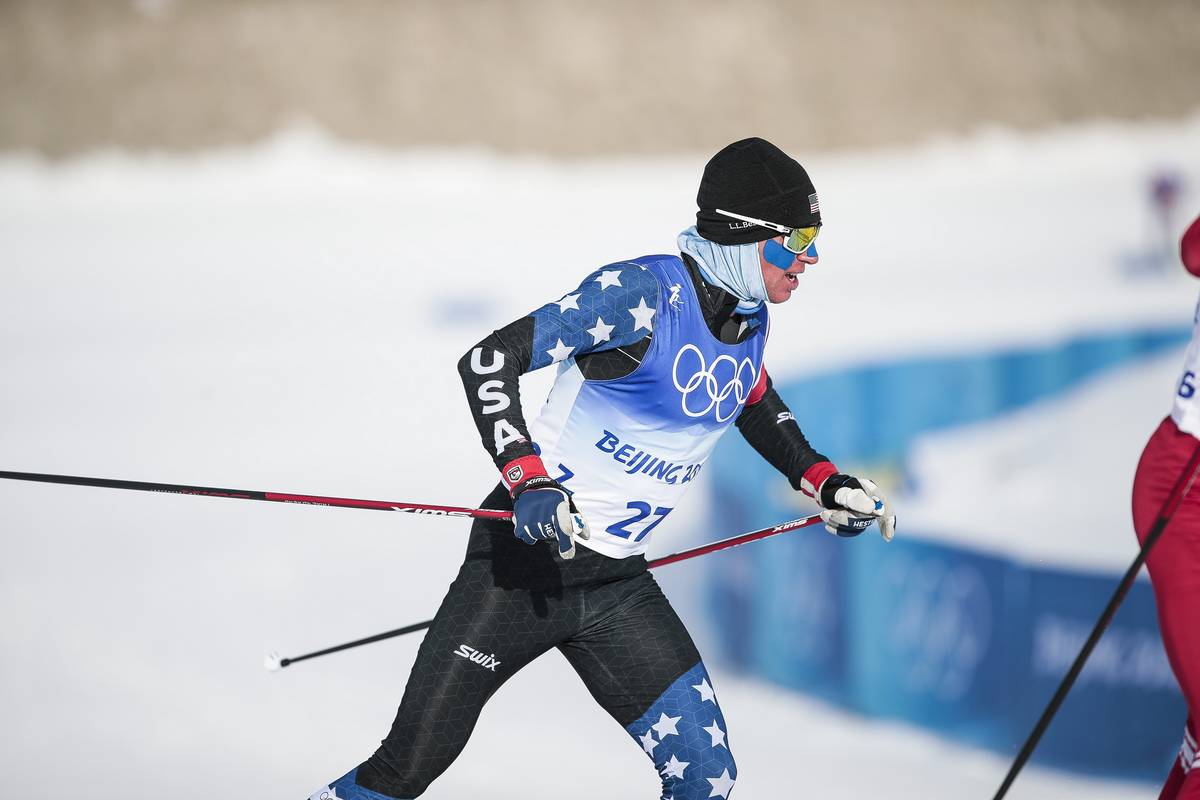
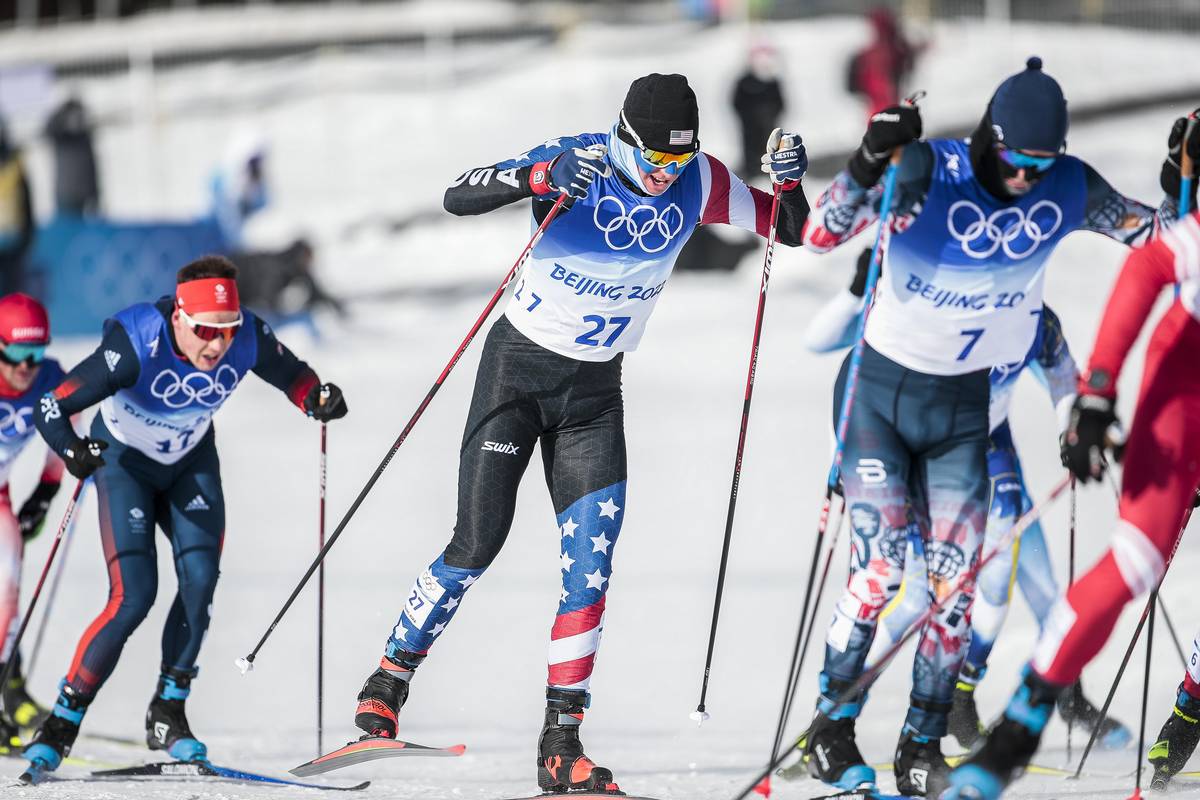
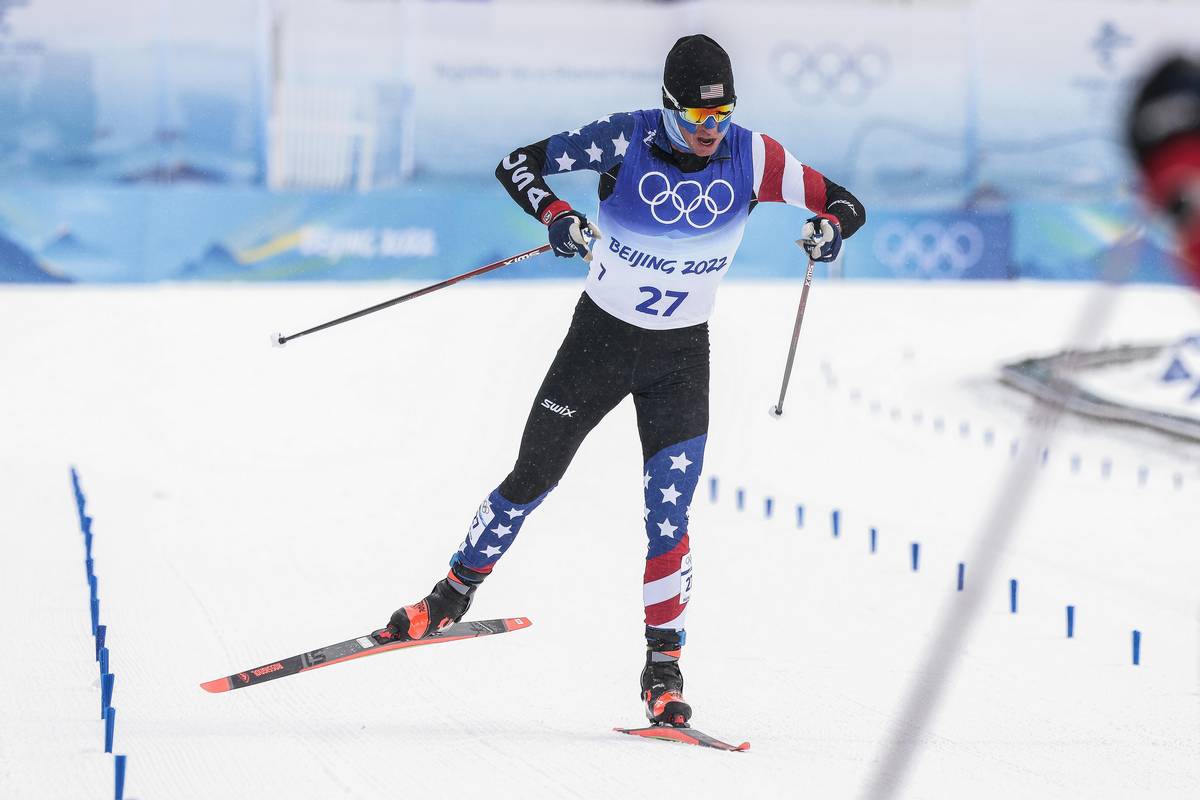
    But let’s get one key story to the front off the bat: The only American on the start list for the final men’s event of the 2022 Beijing Olympic Winter Games was Scott Patterson, and he skied to eighth place, just 26.9 seconds shy of a medal. It’s the second best result in American men’s cross country ski history, only surpassed by Bill Koch’s silver medal in 1976. That’s the best result in almost 50 years. 

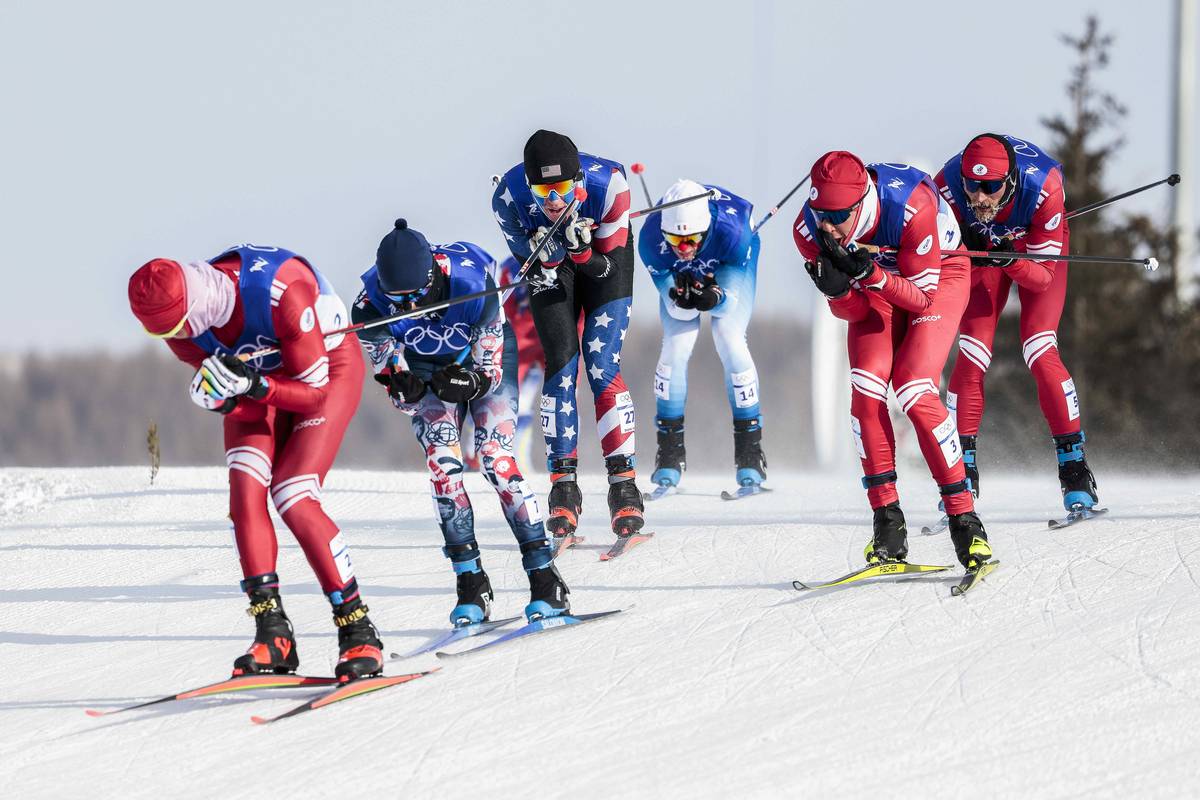
    Scott Patterson tucks into the lead group, on the tails of Alexander Bolshunov (ROC) and Sjur Røthe (NOR). (Photo: NordicFocus)

    Let’s rewind.

    The news of the change in time and distance arrived just hours before the start of the race, with the following message from the organizers: “Due to strong winds and the resulting extreme conditions on course, the distance of the originally planned 50km will be shortened to 30km. The decision was taken in regards to the athletes safety, to reduce the time of exposure of athletes in extreme conditions.”

    While there were various opinions on this change, which we’ve covered separately, there’s no getting around the fact that the race distance was slashed nearly in half. Nonetheless, as the lead group moved in and out of the wind, finding shelter on the leeward side of hills and under the protection of treed sections, the four lap course skied like a long-distance event. 

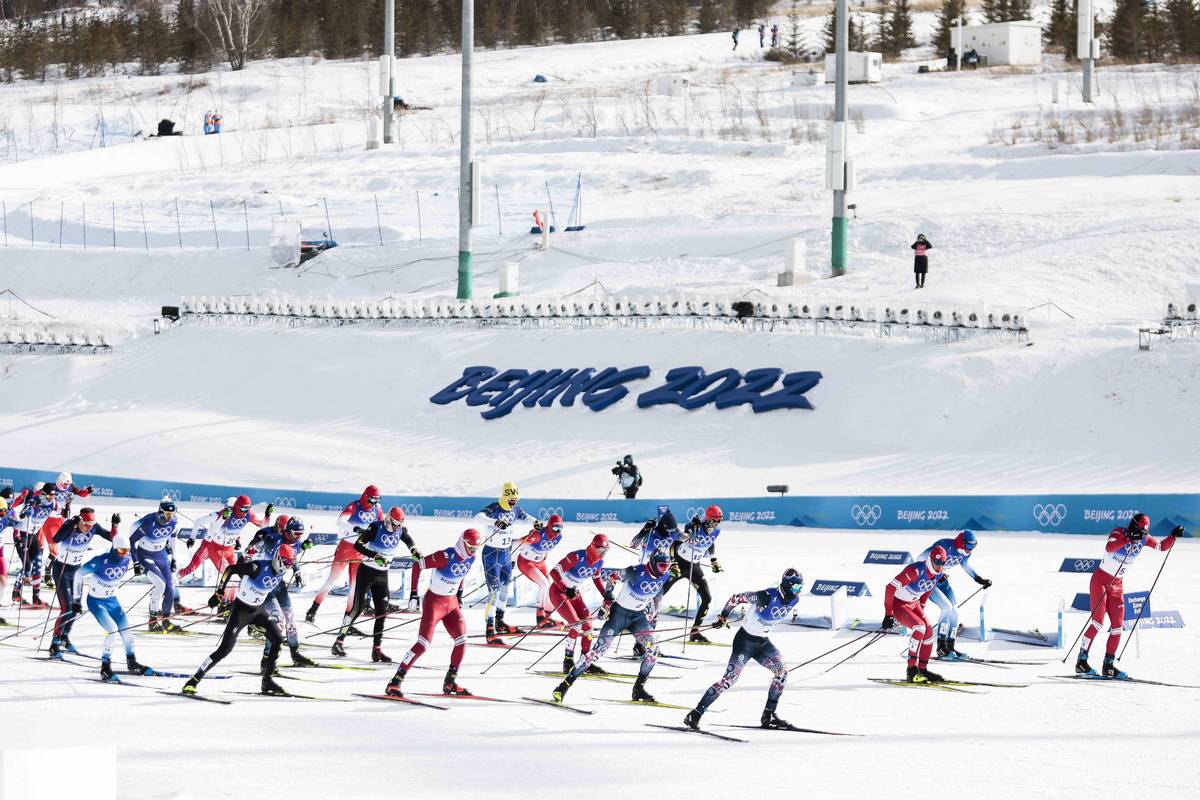
    Shortened due to extreme weather, the men’s 28 k mass start freestyle is underway in Zhangjiakou. (Photo: NordicFocus)

    At the end of the first lap, the top-30 were separated by less than five seconds, thinning to a 13-man pack by the end of the second lap, and a group of 10 by the end of the third, with an 11 second gap to the first chase group.  

    Perhaps the only truly noteworthy moment at this point in the race was the departure of Norway’s Johannes Høsflot Klæbo, who won gold in both sprint events – the individual freestyle and the classic team sprint – while also collecting a silver medal in the men’s relay and bronze in the 15 k classic. Klæbo later reported that he was struggling with a stomach illness and had spent more of the night prior to the race in the bathroom than he had been sleeping.

    “I thought I would’ve regretted it if I didn’t give it a try but now I’m standing here and it didn’t work out on the whole,” Klæbo told the media.

    He said it was “sad” pulling out of the race, but will focus on leaving the Games with his best Olympic distance results.

    “I’ll definitely bring with me what’s been positive. What makes it feel more annoying is that my shape has felt better and better and I’ve actually felt that I’ve had a good energy today too. Then the stomach started to speak up and then it got very far to make it to the finish line.”

    Johannes Høsflot Klæbo (NOR) dropped out of the 28 k mass start free after his third lap. (Photo: NordicFocus)

    The race for medals truly began in the final lap. With Bolshunov and Krüger each surging to thin the lead group, Sweden’s William Poromaa and France’s Maurice Magnificat began to fall off the back. Patterson was tucked into seventh, working with Clement Parisse (FRA) and Denis Spitsov (ROC) to maintain contact and respond to the accelerations of the front. 

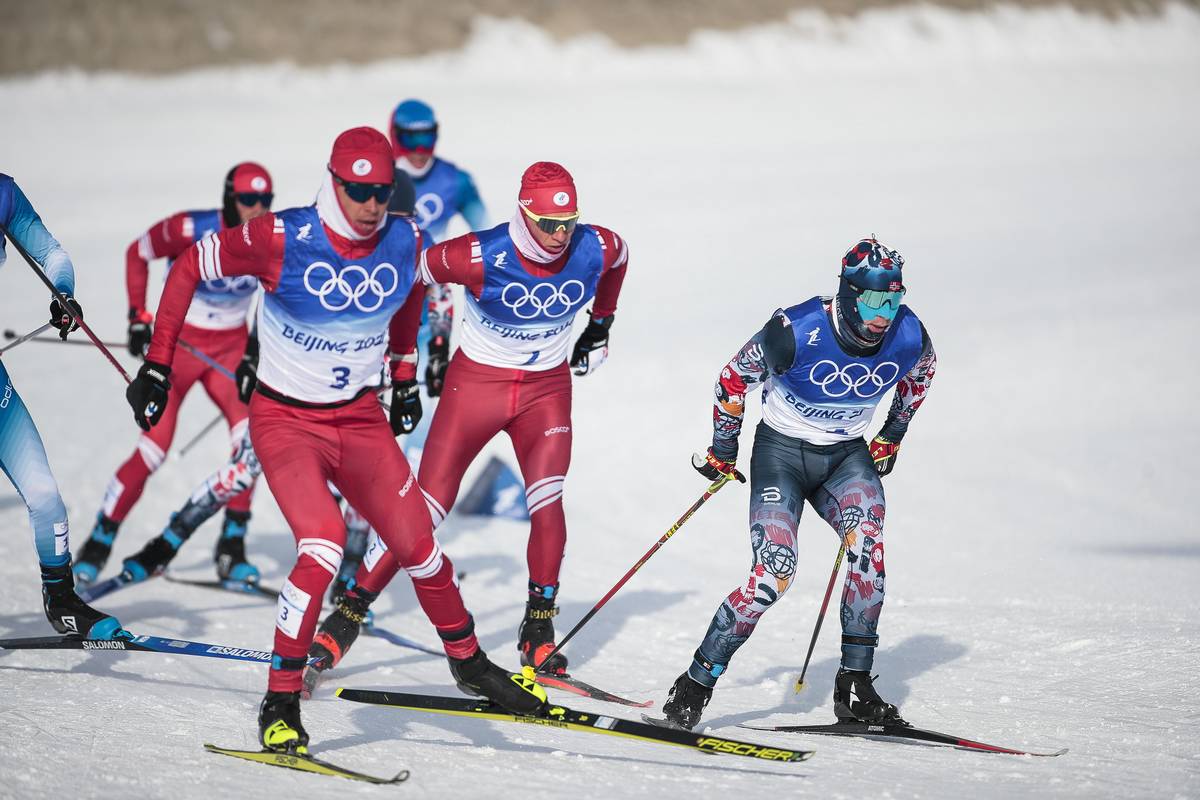
    Simen Hegstad Krüger (NOR) leads the men’s 28 k freestyle alongside the ROC’s Ivan Yakimushkin (bib 3). (Photo: NordicFocus)

    Over the final 5 k, Bolsunov kept the pressure on, looking relaxed as he tried to create space between himself and Krüger, who had been tucked onto his tails, matching him push for push. With them was Yakimushkin, the three skating in tandem as the finish line drew nearer. 

    At 24 k, the leaders had only a few seconds on Patterson’s chase group, but when they hit the 27.2 k checkpoint, the gap had drastically expanded. Artem Maltsev (ROC) and Røthe were still just a few seconds back, but Patterson, Parisse, and Spitsov were now over 20 seconds behind, with a 20 second cushion ahead of the next chasers.

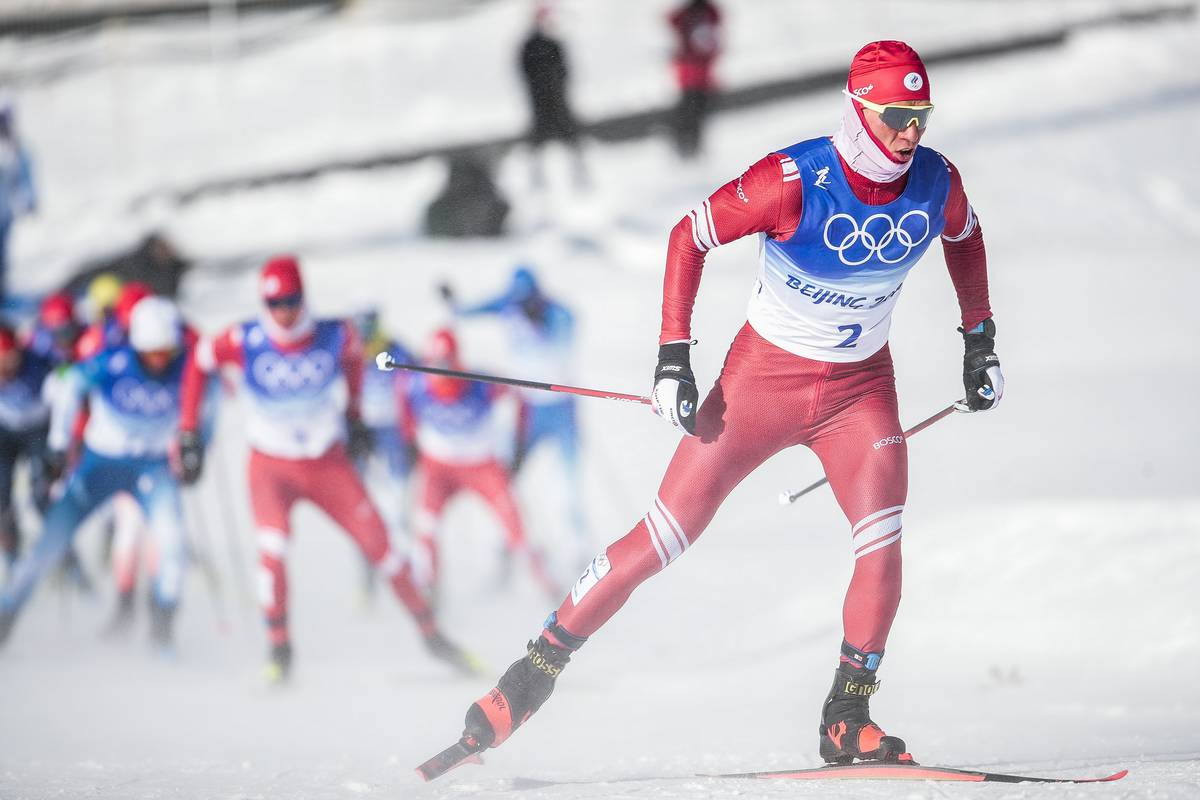
    Alexander Bolshunov (ROC) races to his third gold medal of the 2022 Olympic Winter Games during the men’s 28 k freestyle. (Photo: NordicFocus)
    Norway’s Simen Hegstad Krüger leads the charge during the men’s 28 k mass start freestyle. (Photo: NordicFocus)

    Up the final long climb, Krüger would not yield, holding his ground immediately behind Bolshunov. Tucked low into the downhill, the three stayed together, with Bolshunov upping the tempo and power as they accelerated out of the curves and over the gentle rises that interrupted the sweeping descent. 

    As the three hit the final rise into the stadium, Bolshunov began to break away, with Yakimushkin using Krüger’s draft to slingshot into second with 500 meters to go. 

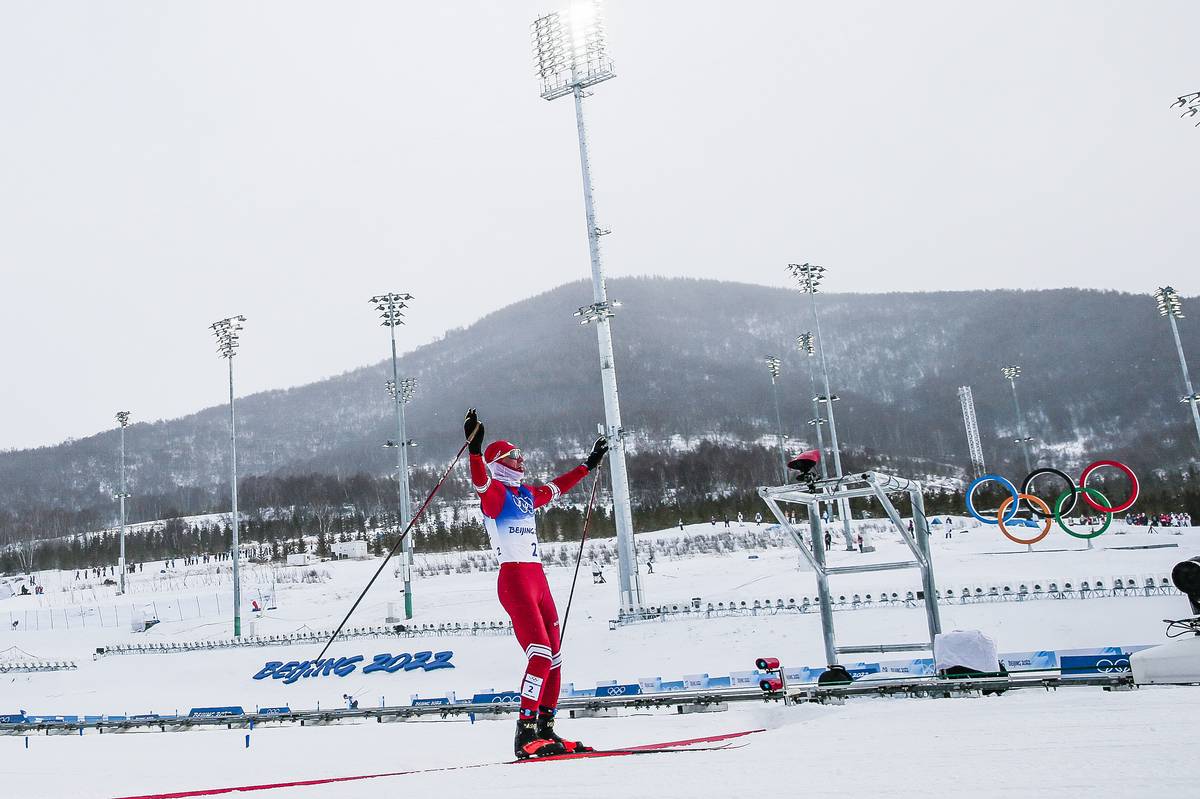
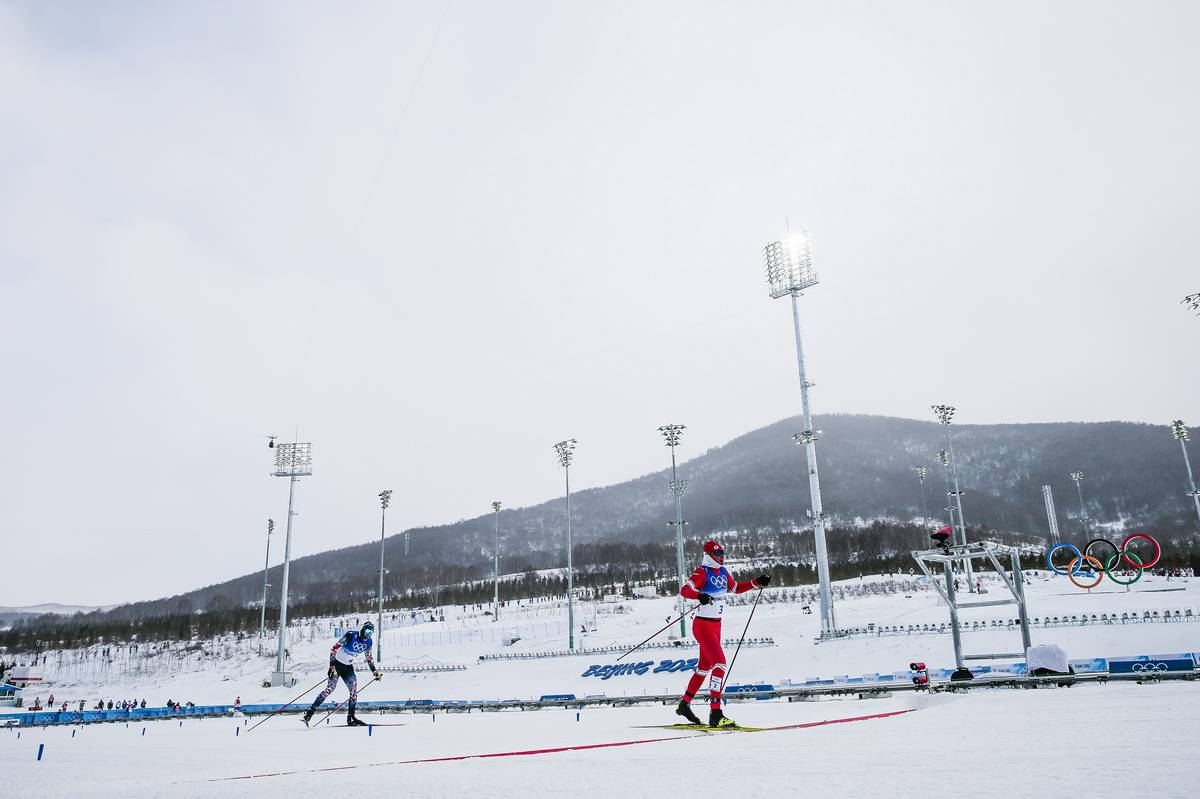
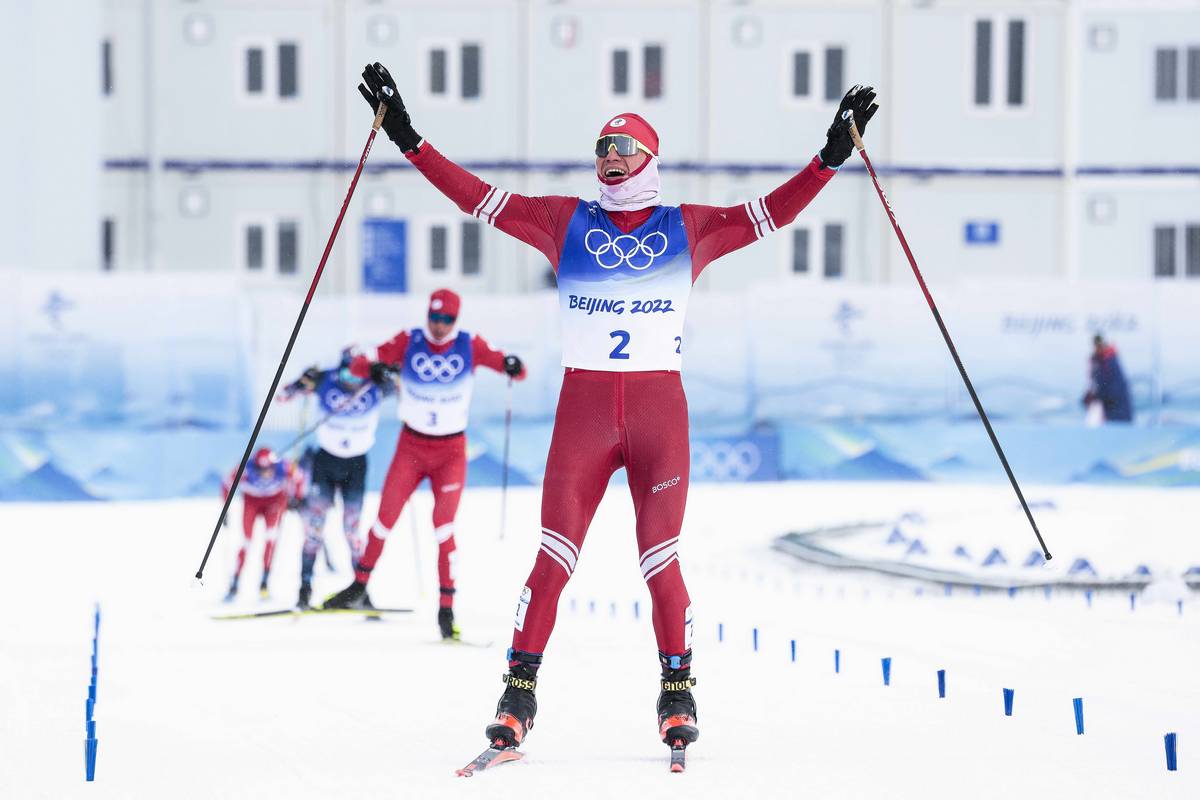
    Entering the stadium, the gold medal looked to be predetermined. With a fist pump as he made his way around the final bend into the finish lanes, Bolshunov V2ed powerfully down the home stretch, crossing the line with his hands raised in 1:11:32.7.

    Alexander Bolshunov (ROC) celebrates his win in the 28 k mass start freestyle. (Photo: NordicFocus)
    Ivan Yakimushkin (ROC) takes silver in the men’s 28 k free, while Simen Hegstad Krüger finishes third for Norway. (Photo: NordicFocus)

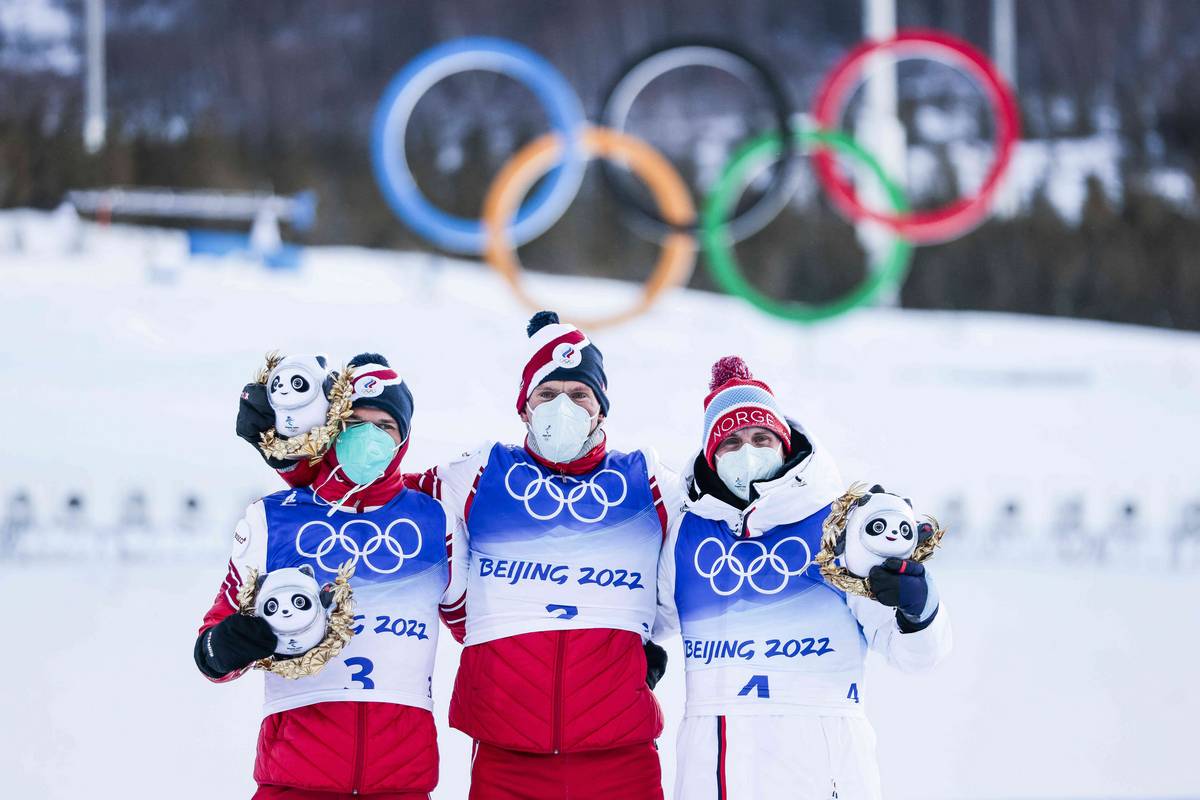
    Holding his advantage through a final sprint to decide silver and bronze, Yakimushkin crossed the line second (+5.5) with Krüger taking third (+7.0) for Norway.

    Behind, Maltsev came to the line fourth (+10.7), followed by Røthe in fifth (+15.8). 

    Spitsov led the now-spread chase group to the line, taking sixth (+26.2) ahead of Parisse in seventh (+28.8) and Patterson eighth (+33.9).

    Alexander Bolshunov (ROC) wins his third gold medal of the 2022 Games in the men’s 28 k mass start freestyle. (Photo: NordicFocus)

    Nine Olympic medals. Three gold. Four silver. Two Bronze. Five from the 2022 Olympic Winter Games.

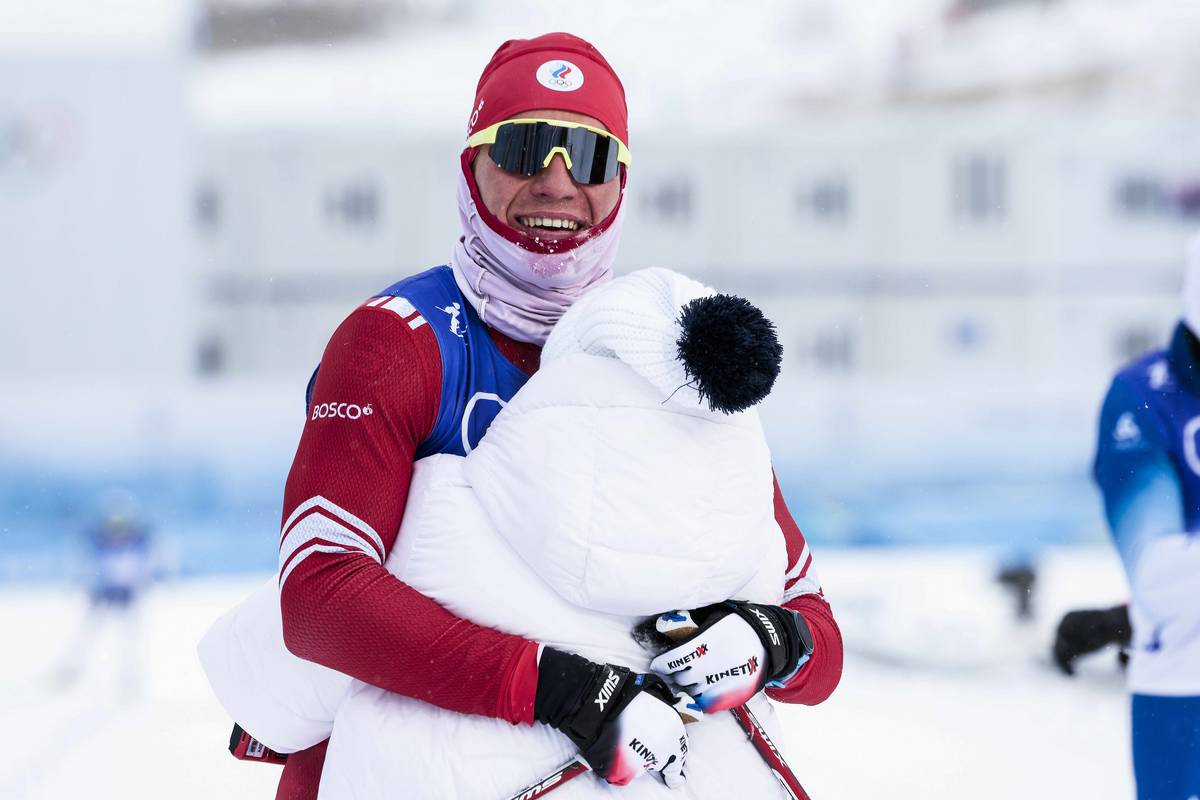
    “Five? Really?” Bolshunov counted on his fingers as he exuberantly celebrated the golden ending to his Beijing Games appearance. “Five medals, three gold, it is something unbelievable because before the season I set the goal of two gold medals and now I have three. I’m just unbelievably happy. The emotions overfill me. This is above all praise to win these medals here. It’s very cool, and in every race that I took part in.”

    Alexander Bolshunov (ROC) receives a cozy Olympic themed gift following his win in the men’s 28 k freestyle. (Photo: NordicFocus)

    Regardless of the color of the medal he earned, Krüger said his real victory was simply making it to Zhangjiakou and having the opportunity to race at the Games. Though his illness stayed mild and he stated that it did not impair him in today’s race, he had still spent 10 days in isolation in his hotel room, and remained in isolation while the opening event of the Games, the men’s 30 k skiathlon, was underway. Krüger was the defending Olympic champion in the event after taking gold in 2018. He went on to win a silver medal in the 15 k skate, and help Norway to gold in the men’s relay. 

    During the 2021 World Championships, Krüger earned two silver medals, first in the 30 k skiathlon and the next in the 15 k free, with a bronze in the 50 k skate. He was one of the top distance skiers on the World Cup heading into the 2022 Games, shouldering Norway’s medal hopes; the nation experienced collective heartbreak following the news of his positive COVID test in late January. 

    “To be able to go home with an Olympic medal, that’s a huge victory for me and an amazing feeling,” Krüger said after the race. “I’m really proud of what I have achieved today; from not thinking I would be able to ski one single competition to being able to get everything out here today.”

    The podium of the men’s 28 k freestyle: Alexander Bolshunov (ROC) took the win ahead of Ivan Yakimushkin (ROC) and Simen Hegstad Krüger (NOR). (Photo: NordicFocus)

    For Patterson, eighth place meant achieving the goal, though he admitted being in the hunt for positions even closer to the podium leaves him hungry for more. 

    “I’m happy,” he told FasterSkier in the mixed zone. “I came in wanting the top 10 and got it today. It’s a little tantalizing to be in eighth and 33 seconds back from the win.” 

    He continued that the “dream” of a medal crossed his mind as he found himself inside the lead group in the final lap, but he could feel the fatigue accumulating in his body and recognized that he was finding it hard to respond to the tactical moves of the eventual medal winners. “I don’t think it was exactly realistic to fully believe it was happening today,” he said frankly. 

    Scott Patterson skis to an Olympic career best with 8th place in the 28 k mass start freestyle. (Photo: NordicFocus)

    Patterson’s result, while historic, should not come as a surprise to American cross country ski fans. He was 11th in the skiathlon at the opening of the Games, and has made his ability to come on form and earn season-best results during Championships well known over the last four years. 

    During the 2018 Games in PyeongChang, he put together breakout performances, skiing to 18th in the skiathlon, 21st in the 15 k skate, and 11th in the 50 k classic. He raced into the top-30 in each individual distance race of the 2019 World Championships, with a 23rd place finish in the 50 k free. Improving on these results in the 2021 World Championships in Oberstdorf, Germany, Patterson was 14th in the skiathlon, 27th in the 15 k skate, and 10th in the 50 k mass start classic. 

    And, he likes going long. He said he would have preferred another 20 k today – “I wanted the grinding instead of the punches” – and might have even been able to pull off a higher result had the race been longer. 

    Back in 2016, his first World Cup appearance was in the 50 k classic at the Holmenkollen, which sits above Oslo, Norway. He was 32nd on the day in perhaps the most storied and highly revered cross country ski race on the World Cup. Patterson advanced to 28th the following year, before making a leap into the top-20 to finish 16th in 2018 and 19th in 2019.

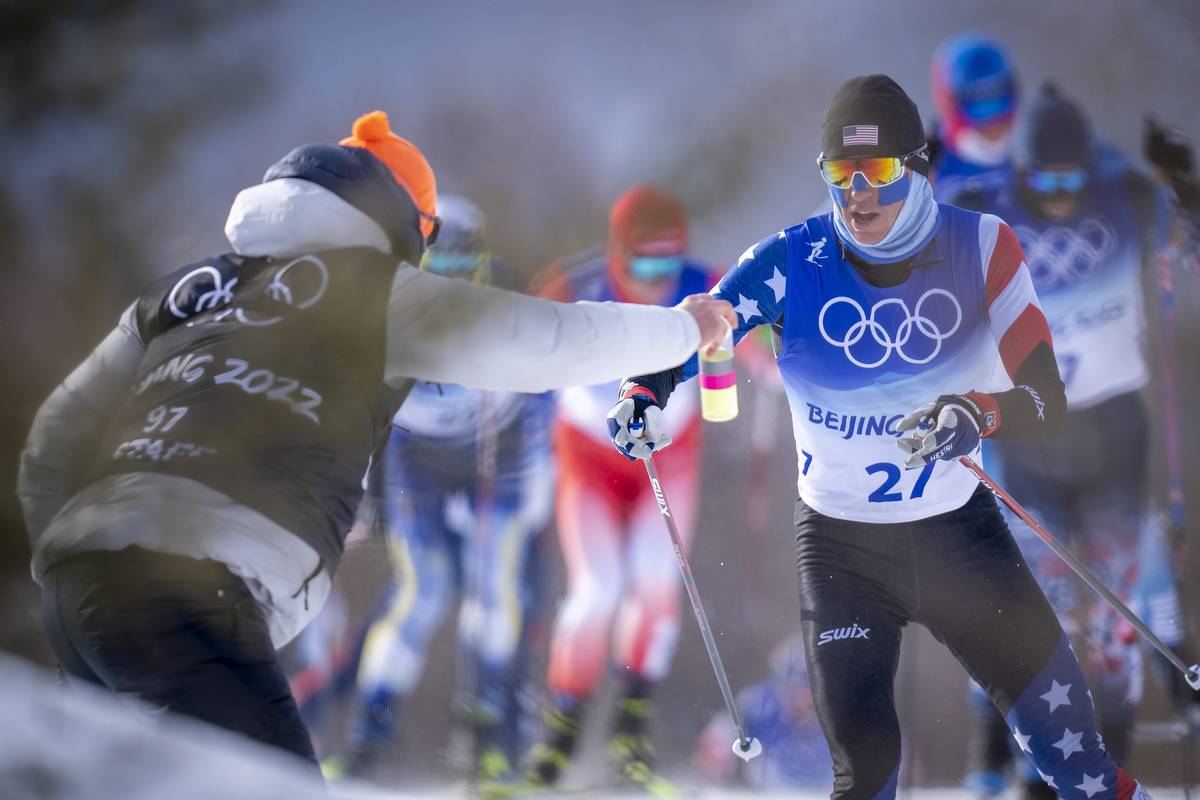
    Scott Patterson takes a feed during the men’s 28 k free in Zhangjiakou. (Photo: NordicFocus)

    From the outside, it can be hard to appreciate the dynamics of mass start racing among the best athletes in the world in the sport. Energy management, tactics, drafting, protecting equipment while the field remains dense in the first lap, which Patterson called “chaotic.”

    “You get those lead skiers fighting the wind, and a lot of the back skiers that could just draft in. And there are a few people who definitely don’t have a lot of World Cup experience making a mess out of the pack,” Patterson described.

    In his second Olympic appearance at the age of 30, with plenty of World Cup experience, Patterson skied a smart race, telling FasterSkier that he felt “strong” and “relaxed”, while looking to be “in a comfortable position and not [using] too much out of my energy.” He also reported having competitive skis that allowed him to utilize the downhills and stay in the position where he wanted to be. 

    U.S. Ski Team head coach Matt Whitcomb complemented Patterson on his race execution, telling FasterSkier emphatically that he was “so proud of him.”

    Scott Patterson races in the lead group during the men’s 28 k mass start freestyle. (Photo: NordicFocus)

    Talking through the race from his vantage point, Whitcomb pointed out that Patterson stayed calm through the congestion in the opening lap, rather than becoming flustered and wasting energy by constantly trying to move up. He also shared how Patterson was able to “wisely” keep himself on the correct side of other racers to utilize the windbreak on unsheltered sections of the course.

    “Some incredible skiers ended up on the wrong side of the break and were toast…” Whitcomb explained. “When that happened, I heard a Finnish yelling at a German skier saying, ‘Hey, take me up to them!’ People were desperate to do work together, and so [I’m] very proud of Scott and unsurprised that he was in a tactically wise position.”

    Apart from battling the elements, maintaining an optimal position within the lead group is also a skill that requires experience and maturity.

    “If you have a pack of 15 guys, of course, it’s easy to follow in a draft in 14th and 15th,” Whitcomb said. “But what you don’t realize is that there’s quite a big accordion effect, so you’re constantly pulsating on the gas pedal. What you saw [today] was Scott moving up into between fourth and seventh, for a large part of [the race], and that ends up being a much more efficient position to ride. Draft is good, but you’re also able to just kind of stay on a steady gap.”

    Scott Patterson races to the line, finishing 8th in the men’s 28 k mass start freestyle. (Photo: NordicFocus)

    For Whitcomb, Patterson’s eighth place ends the Games on a high note for the American men’s program as a whole.

    “This is, this is for sure one of the goals that our men’s program wants: to start breaking through in one of the ultimate races of the Olympics,” Whitcomb shared. “To do that today, under conditions like this, is such a huge success for our program and for Scott and for his club, APU. For all the coaches over the years, Erik Flora that’s worked with him, and the [rest of the] coaches at APU. It’s such a huge success for [Patterson’s collegiate program], the University of Vermont; Alaska Winter Stars where he started skiing; and just so many people have been a part of this incredible journey. And so happy for all of them. But mostly for Scott because he earned this sucker today. It was brutal.”

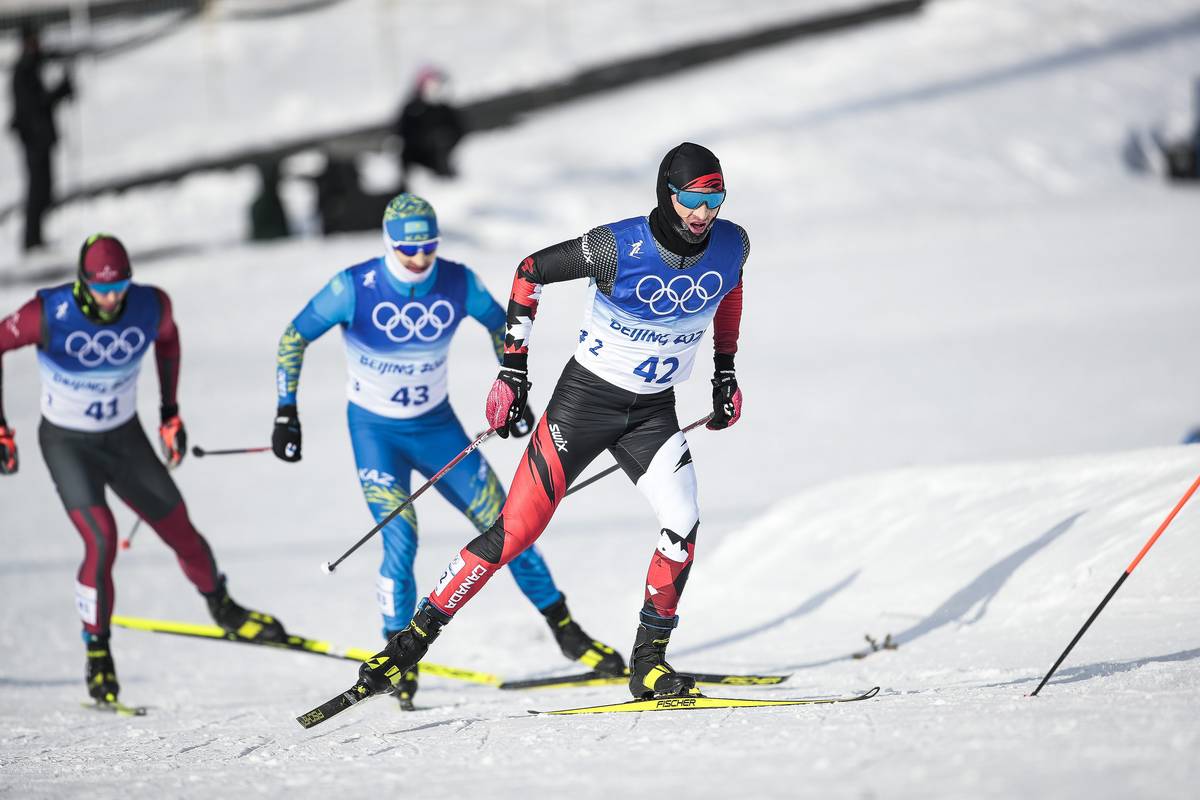
    Rémi Drolet (CAN) skis to 35th in the men’s 28 k mass start skate. (Photo: NordicFocus)

    Two Canadian’s raced the 50 k today, with Olivier Léveillé leading the Canucks at the finish in 27th (+4:21.6). 30 seconds back, Rémi Drolet crossed the line in 35th (+4:54.4). 

    Racing continues tomorrow with the women’s 30 k mass start freestyle, the final cross country event of the 2022 Beijing Olympic Winter Games. At this time, the distance of the women’s event remains unchanged, however, the start was moved up by 3.5 hours to account for the forecasted weather conditions.   

    Results

  • Wednesday Workout: ‘Last One, Long One,’ APU’s Three-Hour Ski on Eagle Glacier

    Wednesday Workout: ‘Last One, Long One,’ APU’s Three-Hour Ski on Eagle Glacier

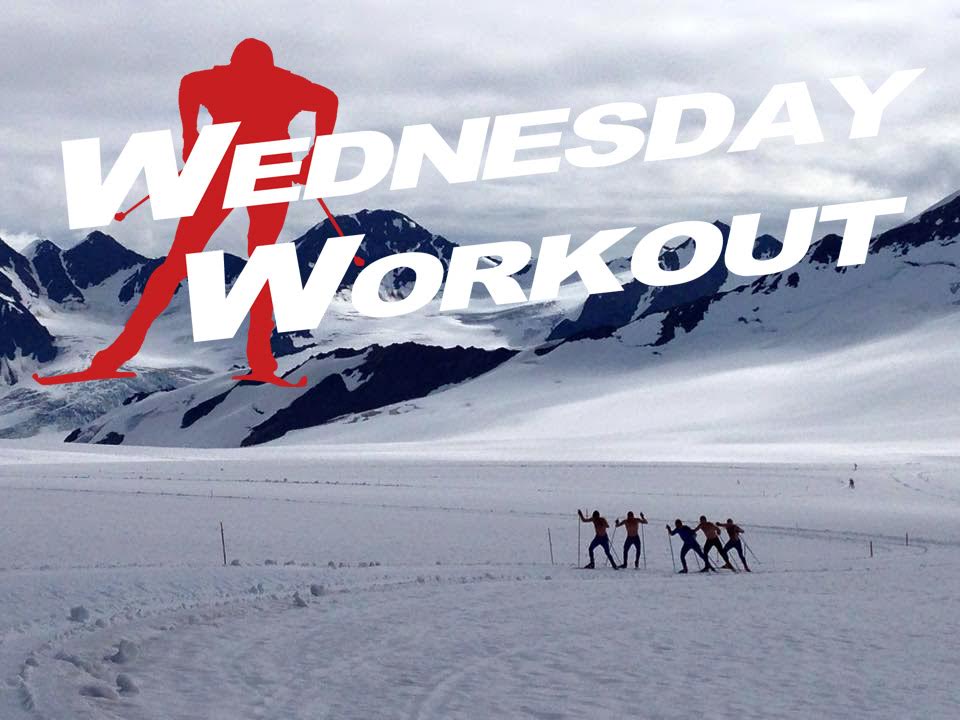
    The APUNSC men pushing each other during the final workout of our recent Eagle Glacier training camp. (Photo: Zuzanna Rogers)
    The APUNSC men pushing each other during the final workout of their Eagle Glacier training camp from July 6-11. Becca Rorabaugh explained that the group collectively skied about 1,000 kilometers that day. (Photo: Zuzanna Rogers)

    Every summer, the Alaska Pacific University Nordic Ski Club (APUNSC) takes full advantage of Eagle Glacier, just south of Anchorage and some 5,700 feet above Girdwood, Alaska, holding on-snow camps there multiple times throughout the offseason. The APU Elite Team, with head coach Erik Flora, recently completed a camp on the glacier, and while conditions for the last day’s 50-kilometer ski softened and slowed as expected, athlete Becca Rorabaugh explained how she survived the 30-mile workout: “Beautiful weather and fabulous crunchy snow at the start…” she posted on Instagram on July 11. “Knowing I was approaching my 50km goal kept me focused through the slushy last bit.”

    Here is the 26-year-old Rorabaugh’s recap of the ultimate over-distance ski, which, she points out, can also be done on dry land (i.e. rollerskis):

    ***

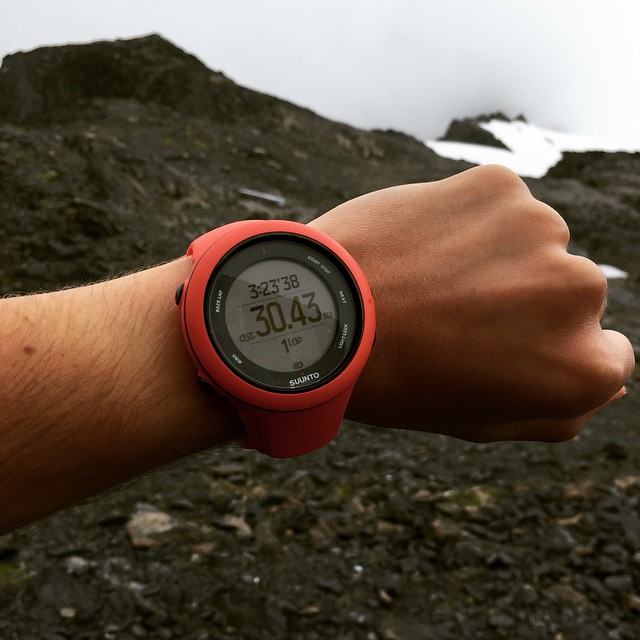
    My Suunto Ambit3 at the end of our workout: 30 miles is 50km, and a goal achieved! (Photo: Becca Rorabaugh/Instagram)
    My Suunto Ambit3 at the end of our workout: 30 miles is 50km, and a goal achieved! “#APUNSC #eagleglacier #lastonelongone” (Photo: Becca Rorabaugh/Instagram)

    At last week’s APUNSC Elite Team glacier camp there were many hours trained and as a result, many tired athletes.  After a week of hard work the last day is always a 3-hour ski.  This can be either a fantastic opportunity to duke it out with teammates and see what you have left, or a really rough prospect to handle.  Especially if the snow looks like it’s going to get really soft, it can be a tough workout.

    The benefits of doing a long final workout are worth the slush-fest, and the effects rely on fatigue that has built throughout the week.  If you’ve ever finished a long race and found that you lacked the snappy finishing kick that you were looking for, this is for you.

    Flora sat us down beforehand and talked about trying to keep our movement quality throughout the workout, saying that making good race-like motions was paramount to skiing many hours.  If we could find a way to make those high-quality movements even without access to the easy energy of fresh ski-specific muscles, we could recruit and hone the sequence of secondary muscle groups.  Those are the muscles you’re relying on at the end of a race, and they’re difficult to train.  The secondary ski muscles only engage when the primary ones cannot do the work, so you have to be fatigued to train secondary muscle sequence and recruitment.  Keeping good technique throughout the workout reinforces good technique at the end of races, when you need it the most.

    The power of having positive teammates that push you!  From left: Becca Rorabaugh, Sadie Bjornsen, Zuzanna Rogers, and Rosie Frankowski during a water break. (Photo: Zuzanna Rogers)
    The power of having positive teammates that push you! From left to right: APU’s Becca Rorabaugh, Sadie Bjornsen, Zuzanna Rogers, and Rosie Frankowski during a water break. (Photo: Zuzanna Rogers)

    This last Saturday the day dawned clear and crusty, which on Eagle Glacier means two things. 1: The snow is going to be really crunchy and fast when you start, and 2:  if it doesn’t cloud over and start raining soon, you will be skiing on mashed potatoes by 10:00AM.

    Sadie Bjornsen and I began talking about trying to get 50km of skiing in, something made possible by the crusty skiing in the beginning, and I was excited to keep track of our progress using my new Suunto Ambit3.  We estimated 50km to be six laps of the course, and we turned out to be within a kilometer or two of accurate.

    I always ski better throughout the workout if I feel that I am aggressively pursuing a goal, whether that’s a time, a distance, or just hanging on to my Alaska Pacific University Nordic Ski Center teammates for dear life.  Starting into a long workout with a sense of purpose really sets the tone, and we started with strong intentions of skiing 50km.  We skied 4 loops in the first half of the time, just trying to get in some kilometers before the crust broke down.  The final two loops took almost twice as long as the first ones: once the crust breaks on a sunny Eagle Glacier day, it really disappears!

    “I always ski better throughout the workout if I feel that I am aggressively pursuing a goal, whether that’s a time, a distance, or just hanging on to my Alaska Pacific University Nordic Ski Center teammates for dear life.” — Becca Rorabaugh, APU Elite Team member

    The second half, in soft conditions and with tired legs, is the part that really counts.  This is where thinking about a single cue like ‘let your hands swing up’ makes the biggest difference.  It’s where technique breakthroughs occur because you’re so tired that you let yourself try different things.  Your usual neural sequences are shakier, and you’re able to ingrain new things.  At times like that, when you’re pushing the limits of good focused movement, having a defined finish line helps keep motivation.  Perhaps most importantly, skiing with friends lets you know whether your technique is working.  When you have to make subtle adjustments to keep up, you make the kinds of innate technical improvements that you can find again on race day.

    If you’re doing this workout in town, you can still benefit from a long rollerski at the end of a big week.  The second half is still the key part, and it’s still important to focus on a single cue.  I always recommend doing it with people that push you a little because that’s when you learn to hang on for dear life, adjust movements, and finish strong.  Knowing you can ski well when you’re tired will give you the confidence to push at the end of any tough race, be it the Birkie, US Nationals, or the Tour de Ski.

    50 k Over-Distance Training Ski Checklist

    – Focus on high-quality, race-like motions (and secondary muscle groups if you’re tired from previous workouts)

    – Maintain good technique to ensure you’ll have similar technique at the end of a long race

    – Get out early to avoid deteriorating conditions (i.e. snow- or weather/heat-related)

    – Start with a sense of purpose (you are going to complete 50 k!) and remember that intention when you start to fatigue, especially in the second half of the workout

    – Bring a buddy: “Skiing with friends lets you know whether your technique is working.” And pick people that can challenge you.

  • Embracing the Climbs, Brian Gregg Just Outside the Points in Holmenkollen 50 k

    Embracing the Climbs, Brian Gregg Just Outside the Points in Holmenkollen 50 k

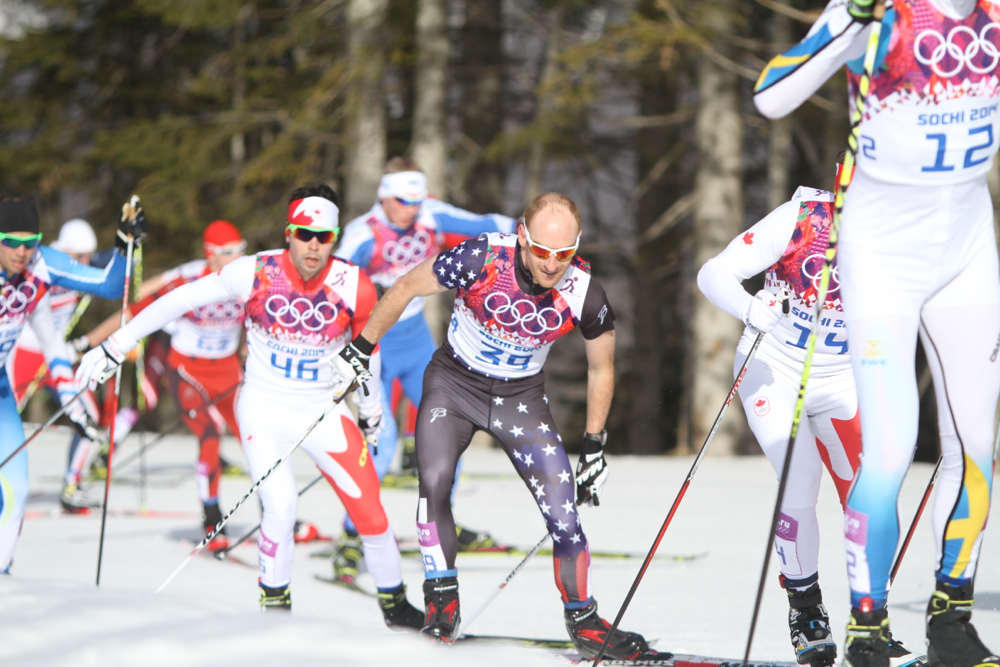
    Brian Gregg racing in the 50 k at the 2014 Olympics in Sochi, Russia. In Oslo, Norway, on Saturday, he finished 35th in the 50 k skate, the only World Cup start of his season.
    Brian Gregg (bib 39) racing to 51st in the 50 k at the 2014 Olympics in Sochi, Russia. In Oslo, Norway, on Saturday, he finished 35th in the 50 k skate, the only World Cup start of his season.

    Brian Gregg had a few reasons to feel confident going into Saturday’s 50 k skate mass start in Oslo, Norway. It would be his only World Cup start of the season, but that wasn’t scaring him at all.

    Fact one: just a week earlier, Gregg had finished 24th in the 42 k Engadin Ski Marathon in Switzerland, just 26 seconds out of the win after avoiding a crash in the last few hundred meters.

    Fact two: many of the men he had skied with there for 42 kilometers were also on the start list in Oslo, including Ilia Chernousov of Russia, Robin Duvillard and Jean Marc Gaillard of France, and Roman Furger and Toni Livers of Switzerland.

    Fact three, and maybe the most important fact: his training partner and wife, who also writes his training plan, is Caitlin Gregg – and she recently won a bronze medal at World Championships in Falun, Sweden.

    Gregg got off to a slow start in the 50 k, ranking just 53rd after 11.3 kilometers. But using a steady pace, he climbed through the field and finished 35th, the top American and 6:47.7 behind the winning time set by Sjur Røthe of Norway.

    The U.S. Ski Team’s Noah Hoffman finished 44th, 8:55 back, and Erik Bjornsen dropped out of the race.

    “I’m feeling pretty tired from a long season,” Bjornsen wrote in an email. “I went into today thinking I could be competitive but as soon as the gun went off it was obvious my body was fighting my mind. I tried a couple times to throw in some speeds throughout the race to try to get the legs to wake up but they were straight dead. I still have some races left in the season so there was no reason to bury myself quite yet. I apologize to the racers back home for wasting a U.S. team spot.”

    FasterSkier caught up with Gregg for a chat from Oslo about the day’s race.

    FasterSkier: So how did things go for you today?

    Brian Gregg: I think it went really well. That’s a pretty good result for me. I was a little bit short of my goal, which was a top 30. I was actually exactly one minute out of the top 30. But I felt really good as far as my pacing and being able to be pretty strong in that last 10 kilometers. I was able to move up and pick some people off. I’m really happy with my skis and my feeds – to have everything come together at the Holmenkollen is pretty awesome.

    I’ve done the race before – I did it in 2010 and I finished 39th. But today I felt stronger. It was also pretty exciting because Caitlin writes my training plan, and she has been racing really well. I haven’t had as many races, so it was fun to be able to get a start, and I feel like I performed pretty well.

    FS: This is your only World Cup of the season, right?

    BG: Yes, first and only. But if I had to pick one World Cup to do all season, this would be the one that I wanted. My focus for the second half of the season after Nationals has been the 50 k at SuperTour finals. So it was a little bit of a surprise to get the start at the Holmenkollen, but I felt like my training prepared me well for it.

    FS: So how did you get the start? Was it because you were already in Europe?

    BG: I was planning on coming up here anyway to support Caitlin. To get to do both races is even better. I can share how things felt out there with her.

    I was trying to get this start earlier, but [the U.S. Ski Team] said that they’d have to wait and see how the Engadin goes. After the Engadin and finishing in the lead pack there, I’m not exactly sure [what they looked at] but I was really happy to get the start.

    FS: Holmenkollen probably couldn’t be more different than the Engadin – big hills after a lot of fast flat! How did that affect your preparation and attitude?

    BG: This is a really good course for me because it’s a lot of climbing and I think it requires a pretty high level of fitness. I feel like my fitness is really good. I have been working on my turnover a lot, doing intervals throughout the summer and even this year, in the last week certainly for the Engadin. But I feel like I’ve always excelled in uphill V1 or slight V2. So that was great, to be able to race a course like this. I always look forward to the hardest courses.

    FS: You were at World Championships watching, and training but not racing. How did that break in the schedule affect you?

    BG: When Caitlin got named to the World Championship team, our focus basically was on that 10 k. That was the main goal, but I was doing my training as well, and she wrote that out for me to ski well at the 50 k at SuperTour Finals.

    We know that, okay, it’s not going to be the most ideal for myself, being a supporter at World Champs. But it’s also one week, and rather than freaking out about losing one week– it was right after the Birkie, so it was probably good to take a little bit of time.

    Although to be honest I gained a lot of appreciation about the service side of things. I was literally just helping Caitlin test skis, I wasn’t doing any of the waxing, and I skied two and half hours the day before the 10 k. Those three days were almost harder than racing the 50 k today! I definitely gained an appreciation for how hard those guys work.

    FS: What about the mental component – watching some good racing up close must have been inspiring?

    BG: I think it was pretty inspiring for everyone. To see Caitlin and Jessie and everyone do so well, it’s really encouraging.

    And particularly for Caitlin, coming from essentially the domestic circuit, it’s that idea that you can come over one week before your race in Europe, and have a really really good, strong race. Rosie Brennan did the same thing when she came over. The more that happens, it opens the eyes like, all right, we can do this. It’s a little bit different flying from Switzerland to Norway for a World Cup, you’re flying over the ocean, but the more often that Americans have that success, it will become easier and easier to share how that success has come about.

    That was pretty inspiring to me. But also, when your coach is third at World Championships, that gives you a lot of confidence in your training plan. So that was pretty helpful as well.

    Results

  • Røthe Outlunges Cologna to Take Holmenkollen Crown for the Home Team

    Røthe Outlunges Cologna to Take Holmenkollen Crown for the Home Team

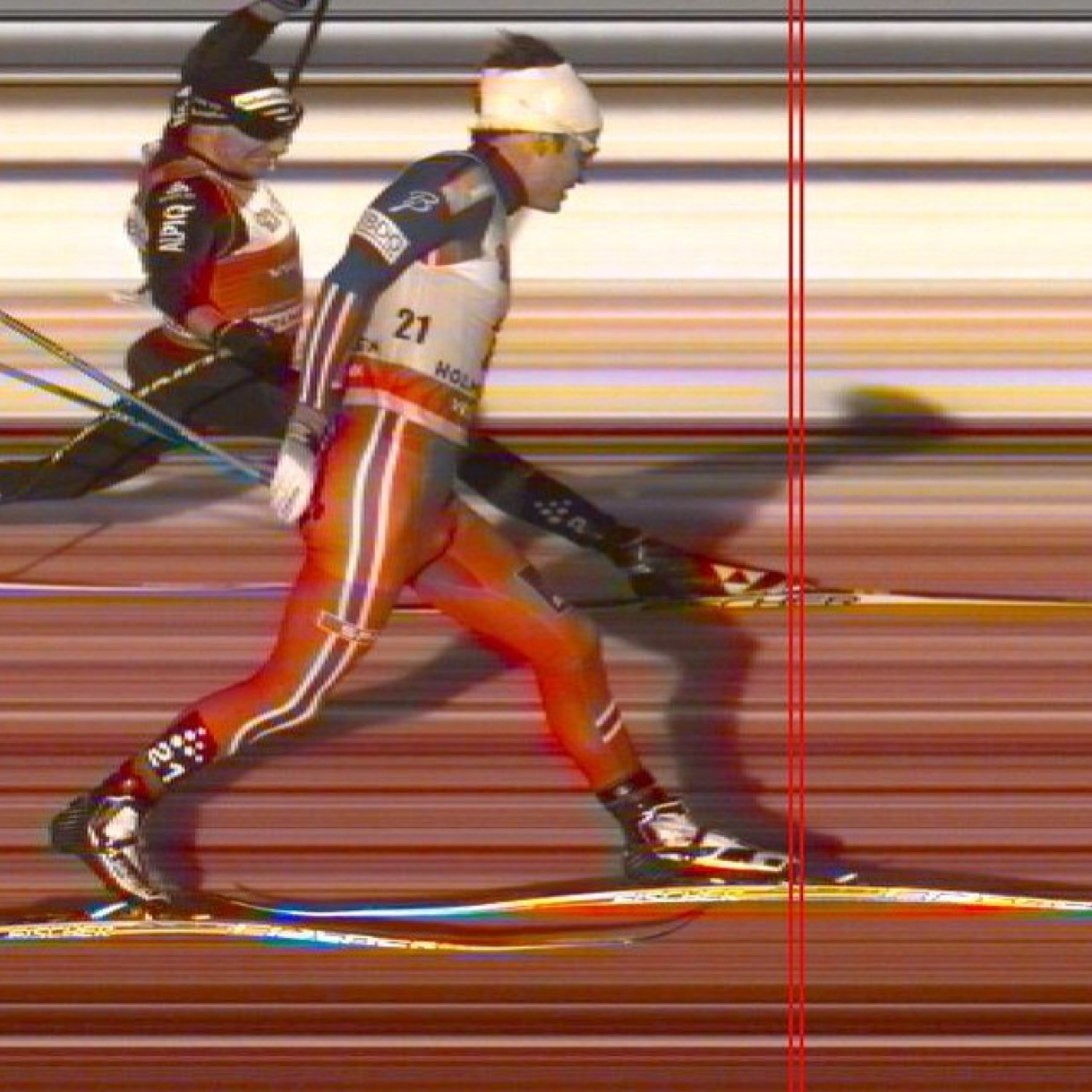
    Sjur Røthe (foreground) narrowly beat Switzerland's Dario Cologna at the finish of the 50 k skate mass start in Oslo, Norway, on Saturday, to take the season's last victory for the Norwegians. (Photo: FIS Cross Country/Instagram)
    Sjur Røthe (foreground) narrowly beat Switzerland’s Dario Cologna at the finish of the 50 k skate mass start in Oslo, Norway, on Saturday, to take the season’s last men’s race for the Norwegians. (Photo: FIS Cross Country/Instagram)

    After racing 50 kilometers in Saturday’s Holmenkollen mass start in Oslo, Norway, the winning margin for Norway’s Sjur Røthe was merely the length of a toe over Switzerland’s Dario Cologna.

    The Holmenkollen has been the season ending race since its first running in 1902, although it has recently been followed by World Cup finals in Sweden. Crowds in the thousands lined the course, out to enjoy a sunny Norwegian spring afternoon. As always, some of the spectators – most of whom were Norwegians – had camped out the night before to ensure a good vantage point for the race. Smoke from their campfires drifted out over the course.

    They were not disappointed: Røthe took the win in 1:54:44, and teammate Martin Johnsud Sundby finished third and also took home the season-long World Cup title. Six more Norwegians finished in the top 20.

    “I’ve seen how [Petter Northug] and others have won it here, and how the finishes have been here in recent years,” Røthe told Norwegian news service VG. “Along with that, I noticed that there was ice on the outer edge in last turn. I knew I had a great options if I put myself there. But then I had to come there first, and not have someone on the inside of me. It was perfect and just as I had dreamed.”

    Although the warm sun was great for spectating, it made the snow that very soft, which slowed the pace of the race. While it might have appeared pedestrian, the pace was quite high as skiers worked their boards through the slush, which alternated with salted, icy portions of the course and sections in the shade which were much faster.

    “It was a hard pace from the beginning with Sundby pushing for the first two laps,” Canada’s Alex Harvey, who was near the lead in the first 15 or so kilometers, told FasterSkier. “Anytime a 50 k is below two hours, when it’s kind of slushy conditions like it was today, it means that the pace was faster in the beginning.”

    While leading, Sundby was constantly marked by Cologna, Petter Northug of Norway, and a pack of other skiers. Several breakaway attempts were countered. France appeared to have fast skis, and Jean Marc Gaillard and Robin Duvillard each led for several kilometers. Duvillard’s gap was a result of ski changes: at 33 k, almost the entire lead group decided to get new skis. But Duvillard and Norway’s Anders Gløerssen did not, and they took their ten-second lead and turned it into a breakaway which lasted six kilometers.

    The upstarts were always brought back to the pack, though. And as the kilometers ticked on, that pack shrunk in size. From 37 men it winnowed to 25, then 20, then 15. By the 40 kilometer mark, one big name was missing from the potential winning group: Northug, who won the 50 k at World Championships two weeks ago.

    The Norwegian was at that point sitting in 27th place, 2:40 back from the leaders. After dropping from the main group, he decided to treat the race as a workout and finished eight minutes back by the end.

    “I’ve been tired after the World Championships,” Northug told Norwegian news service VG. “It costs to go all the distances. I may have had a mental lapse.You fall in a way, after having had such a good World Championships.”

    At the 44.6 k mark, Norway’s Hans Christer Holund attempted to break away as the group hit a descent. Realizing it, Cologna matched the turn of pace and the two opened up a two-second lead. The rest of the pack were forced to respond or see the potential winners ski away.

    Most couldn’t respond, but Sundby, Røthe and 41-year-old Sergei Dolidovich from Belarus bridged the gap and the lead pack became five. After another kilometer or more, Marcus Hellner of Sweden managed to weave his way through the shattered remains of the pack and sprint furiously up to the leaders: now they were six.

    He arrived just in time for the Hellnerbacken, a short, steep hill leading into the Holmenkollen which is now named after him due to his victory in the sprint at 2011 World Championships. On that very same hill, Hellner had destroyed Northug and the rest of the competition to ski to a gold medal. In the 50 k, he shot up into the lead group and into third place.

    The remaining few hundred meters featured jostling, lead changes, and an ever-increasing pace. On paper, Cologna and Hellner were probably the best bets to win, based on their usual finishing speed; but Sundby, too, has qualified for sprint heats this season, and in Røthe’s only sprint start this season he qualified ninth in the Lillehammer World Cup.

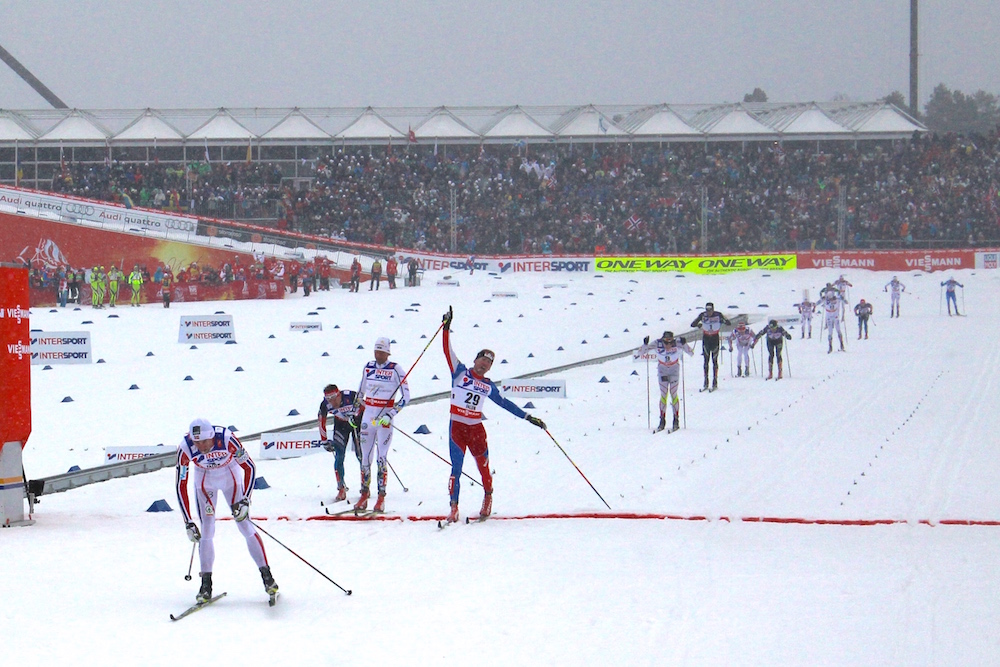
    So up the final hill behind the biathlon range they went, and then over the top. As they descended into the stadium it looked like Hellner might be able to use the draft to slingshot into a medal position. But whether because of slower skis or tired legs, he faded, and Røthe led to the finish. Cologna sprinted furiously. His body never drew even with Røthe’s, but as the two got to the finish line, he threw his foot forward in a desperate attempt at a win.

    It was impossible to tell who crossed the line first. Both men raising their arms in victory. After the jury convened and looked at the photo, it was determined that Røthe crossed first, the margin of victory was literally the length of a toe. Cologna was given the same time as Røthe and Sundby was third, half a second behind.

    “I don’t think the photo finish gets any closer than this one,” Cologna told FIS.

    Røthe had known that Cologna would be coming for the win, but he was confident he could hang on.

    “I always trust my sprint,” Røthe told NRK. “If I’m first entering the finish, I have a chance. If I have to pass people, it is worse.”

    For Røthe, it was the first World Cup win ever – and on Norway’s biggest stage.

    “It’s is a dream for me,” he told FIS. “This is a very emotional moment. I can’t believe I have won this race. It has been a very difficult season for me but I have been training for this race for the past few weeks and it’s incredible that this happened. The crowds for so loud cheering me along with my teammates.”

    Røthe has had back problems all season, and raced only lightly. His teammates were astounded that he could come back and win the Holmenkollen.

    “I am so happy for Sjur,” Sundby said. “It has been a tough couple of months for him, so to see him win here today is just great.”

    “That he has trouble, it is impressive that he comes back and takes his first World Cup victory here in Holmenkollen and on a 50 k,” Northug told NRK. “It’s the World Cup race you most want to win, so it is impressive.”

    Although he missed out on the win, Cologna victory secured his third World Cup distance globe.

    “For sure I wanted to win but I am also very happy to win the Distance Overall crystal globe,” Cologna told FIS. “After two Olympic gold medals last year I expected more this season but it doesn’t always go as planned. But to win the distance globe and be second in the Overall standings I must still be happy with my season.”

    He also skied into the history books: Cologna became the first man to ever win the Distance crystal globe three times; he also won in the 2010/11 and in 2011/12 seasons.

    Dolidovich finished fourth, one-upping his fifth-place result from the 50 k in Sochi at the Olympics last season, and Hellner placed fifth.

    The women’s season wraps up on the same course on Sunday with the Holmenkollen 30 k freestyle race.

    –Vince Rosetta and Chelsea Little contributed reporting.

    Complete Results

  • 13th in Holmenkollen 50 k, Harvey Ends ‘Really Good Season’ on a Happy Note

    Canada's Alex Harvey skating his way to a bronze medal in the 30 k skiathlon at World Championships in Falun, Sweden, three weeks ago. In Oslo on Saturday, he capped off his season by placing 13th in the 50 k skate mass start. (Photo: FlyingPointRoad)
    Canada’s Alex Harvey skating his way to a bronze medal in the 30 k skiathlon at World Championships in Falun, Sweden, three weeks ago. In Oslo on Saturday, he capped off his season by placing 13th in the 50 k skate mass start. (Photo: FlyingPointRoad)

    There was a moment in today’s 50 k skate race in Oslo, Norway, where it looked like Canada might repeat its resounding success from the 50 k at World Championships in Falun, Sweden, two weeks ago.

    At ten kilometers, Alex Harvey and Ivan Babikov were both skiing in the top five of the mass start, looking comfortable. Would they go on to replicate their fifth and 30th place results?

    It wasn’t to be. Harvey led the way with a 13th-place finish and Babikov eventually faded to place 27th, but further back (+4:55) than in Falun. (And Graeme Killick, who placed 19th in Falun and whose result represented positive signs for Canada’s future teams, wasn’t even racing.)

    But there seemed to be little disappointment from the Canadian camp. Harvey was happy with his finish, and deemed it a good way to finish off a season in which he earned two World Championships medals and finished ninth in the overall World Cup standings.

    “I’m really happy,” he said. “It’s probably my best skate race of the season, so I’m happy to finish like that on a positive note. It has been a really good season.”

    “Holmenkollen is the best place to finish WC season,” Babikov tweeted. “Amazing atmosphere, crazy fans! Made some tactical mistakes, but happy to finish in points.”

    For Harvey, who has shown all season that if he can stay with the lead group until the finish he has scary finishing speed, expectations had been low because he feels he hasn’t done well in skate races this season. On top of that, he suffers from a leg problem which makes skating up steep hills painful. It’s bad enough that he’s leaving Oslo on Sunday to go directly back to Canada for surgery; he should be back training by May.

    “Skating has been going quite bad for me this year, and the course with those huge uphills, I didn’t expect much,” Harvey admitted. “But it ended up being a pretty good race.”

    Harvey stayed in the main pack until the last few kilometers, when Hans Christer Holund of Norway and then Dario Cologna of Switzerland pushed the pace. They successfully fractured the lead group of 15, and Harvey had already been skiing near the back of that pack.

    “On the last push up to Frognerseteren I lost some ground and then from then on it was just kind of survival mode,” Harvey said. “But 13th, I’m still happy with the result.”

    Skiing into the finish, he beat out Cologna’s teammate Toni Livers in a sprint by just two tenths of a second. He was 52.7 seconds behind Norway’s Sjur Røthe, who edged Cologna in a photo finish for the win.

    If Harvey has one regret, it’s that he didn’t change his skis near the end of the race. In the past few years, FIS has implemented rules that skiers may change skis twice during the course of a 50 k competition.

    Harvey’s best pair of skis, which he started on, were great in the slush and so he didn’t change them until 33 kilometers into the race.

    “My skis were really good so I decided not to switch when the guys went after two laps,” Harvey said.

    After the success of Lukas Bauer of the Czech Republic in Falun, who changed his skis just five kilometers from the finish and used their fresh speed to power to a World Championships medal, Harvey thought of doing the same thing, switching back to his best pair – now with an added topcoat of fluoros – with nine kilometers to go.

    But then the pace increased, and it seemed like a bad idea.

    “Just before [the stadium], Sundby went to the front and pushed kind of hard going up the Hellnerbacken coming into the stadium,” Harvey explained. “I thought, oh, maybe he’s going for a long drive. I could have seen that from Martin because he might not want it to end in a sprint. So if he went hard the whole way, I couldn’t change because I would lose the group.”

    As it happened, nobody was able to make a break at the time, so the pace slowed down again. Anders Gløerssen of Norway decided to switch skis, and was the long member of the lead pack to do so. He lost time, but managed to catch a few straggling members of the pack, including Harvey, and finish 11th.

    “Gløerssen changed there and it was good for him,” Harvey said. “Right after that the pace slowed down and it was good. But I didn’t want to risk losing the group because I was starting to fade and I knew I wouldn’t be able to close a 15 second gap on my own. Looking back, had I known the pace would slow down again, I probably would have switched.”

    The Canadian men’s team finished the season in eighth place in the Nations Cup standings.

    Results

  • Classic Northug: Norwegian Appears from Nowhere to Claim Victory in World Champs 50 k

    Classic Northug: Norwegian Appears from Nowhere to Claim Victory in World Champs 50 k

    Petter Northug catches his breath after wining the 50 k classic mass start at the 2015 FIS Nordic World Championships in Falun, Sweden. Behind him, Czech skier Lukas Bauer celebrates second as Johan Olsson crosses in third and Maxim Vylegzhanin finishes fourth.
    Petter Northug catches his breath after wining the 50 k classic mass start at the 2015 FIS Nordic World Championships in Falun, Sweden. Behind him, Czech skier Lukas Bauer celebrates second as Johan Olsson crosses in third and Maxim Vylegzhanin finishes fourth.

    FasterSkier’s coverage of the 2015 FIS Nordic World Ski Championships in Falun, Sweden, is brought to you by the generous support of L.L. Bean, now featuring a complete line of Kikkan Randall training wear.

    FALUN, Sweden — Good things comes to those who wait. If you’re Petter Northug, that good thing just happens to be a gold medal.

    Northug patiently waited until the final meters of the men’s 50 k classic mass start to win his fourth gold medal of the 2015 FIS Nordic World Ski Championships. Before the last kilometer, the Norwegian hadn’t skied above 10th position and fell as far as 48th at 5 k into the race. Nevertheless, he overcame a flying Lucas Bauer and determined Johan Olsson of Sweden in the final meters to cross the line with a time of 2:26:02.1. Bauer trailed by 1.7 seconds to take the silver while Olsson finished 2.0 seconds back for third in the snowy and soft conditions.

    The start of Sunday’s race began like most others in Falun – there was a light snow that fell on a roaring crowd of over 30,000, and conditions seemed to be stable. That soon changed as the snow developed into thick, wet flakes that piled on the tracks. With temperatures in the upper 30s, the course began to crumble as over 50 skiers took to the trails. By the end of the near two-and-a-half hour race, volunteers were forced to shovel meter-deep slush from multiple points on the trail.

    “It was very tough. I think one of the deepest conditions that I’ve ever skied,” Bauer, a veteran World Cup skier from the Czech Republic, said after his second place finish. “It was tough for everbody, it doesn’t matter if you ask first or last.”

    Despite the conditions, Northug’s three Norwegian teammates – Martin Johnsrud Sundby, Didrik Tønseth, and Niklas Dyrhaug –  commanded the race from the start as a pack of over 40 skiers developed in the early kilometers. Sundby sat out the Championships’ earlier races due to illness, and the 50 k was his first race since his recovery. Behind the Norwegians were Olsson, top-ranked Dario Cologna of Switzerland, and Alex Harvey of Canada.

    Throughout the first laps of the course – which consisted of subsequent blue and red 5 k laps that were combined to total five loops of 10 k – the leaders changed frequently and the large pack remained intact. At one point Harvey, fellow Canadian Ivan Babikov, American Noah Hoffman, and Great Britain’s Andrew Musgrave occupied the the top four spots as they crossed the 7.8 k mark.

    While Hoffman and Musgrave would soon fall from far from the lead, their Canadian counterparts did not. After the pack completed the first 10 k loop of the day, Olsson took the lead with the aim of increasing the speed of the pack. He said after the race that the slower the pace went the worse the outcome would be for both he and his teammates.

    Olsson chasing Tonseth 19 k
    Johan Olsson at the 19 k mark in the 50 k at the 2015 FIS Nordic World Ski Championships in Falun, Sweden. The Swede finished third overall after a sprint finish with Petter Northug and Lukas Bauer.

    At the front, Olsson began his lead before 10 k to just after the 20 k mark. The Swede gave a famous performance in the 2013 World Championships 50 k where he broke away at 11 k to take the victory by 12.9 seconds. Olsson said he was unable to give a similar performance due to the conditions, where falling snow and a rapidly deteriorating course resulted in slow skiing regardless of the effort. Deciding to sit back and conserve energy, the 34-year-old, sat back to let Dyrhaug take the lead before 25 k.

    “I had to take a little bit of rest when I realized that there was no use to make a large part of the work when I had been much in front for 25 kilometers,” Olsson said of his relinquished lead.

    Dyrhaug opened up a gap, which at one point neared 10 seconds. He was then replaced by an unlikely leader – Babikov.  The Canadian, who’s traditionally excelled in freestyle, skied up the hills focused on his own pace. At times he would turn around, see he was leading by several seconds, and take a break till the pack caught up.

    Babikov’s lead lasted for less than 5 k as Olsson’s teammate, Anders Södergren, took charge, hoping to push the pace and spread out the leaders. At one point Soedergren led by over 18 seconds, but his lead was chipped away by Russia’s Maxim Vylegzhanin and France’s Maurice Manificat as the snow and lack of a draft hampered his progress. The two skiers caught the Swede and and eventually overcame him after 40 k.

    “To go in the front, it turned me up,” Södergren said to FasterSkier about his lead. “I felt really strong with good stick on the skis. It was hard to be in the front with the snowfall. I was never tired but it was better to go back into the group.”

    Sodergren leading 39 k
    Södergren leads the pack at 39 k in the men’s 50 k classic at the 2015 FIS Nordic World Ski Championships in Falun, Sweden.

    With just 5 k to go Manificat and Vylegzhanin were leading the charge through the stadium, unaware of a fateful choice made behind them. Bauer, who had been in and out of the top 10 for the majority of the race decided to take his second ski exchange before the final lap of the race. It was a risky move as the Czech skier lost precious time before entering his final 5 k.

    “The first plan was [to change at] 15 then 35 but the reality was 25 and after 45 k. I think almost everyone went for exchange after 35 k and I decide in the moment that no, I would not change the skis because I had quite good skis,” Bauer said in a press conference. He explained that after 35 k he struggled to keep up with the pack because his skis were slow on the downhills. While he was able to maintain his position, he knew something had to change.

    With his second ski exchange at 45 k, the 37-year-old tackled the last climbs and curving downhills with gusto, and it was soon obvious he made the right choice.

    “I think it was quite big advantage for 5 k,” he said. According to Bauer, he knew that his finishing sprint wasn’t as strong as his competitors and needed an advantage in the last lap. Better skis were the solution.

    Moving up through the pack, Bauer eventually reached the front to ski with Vylegzhanin in the final hills of the course before the stadium. The two were joined by Olsson who lost ground on the climbs but recovered time on the downhill into the stadium.

    Bauer finish
    Lukas Bauer of the Czech Republic rests after the finish of the 50 k classic mass start at the 2015 FIS Nordic World Ski Championships in Falun, Sweden. He finished second on the day.

    Behind them, Northug was making moves of his own. Leaving his steady 10th-place position, the Norwegian began to overcome skier by skier on the final two hills. Joined by Harvey, the two entered the stadium in fourth and fifth position.

    As they began to tackle the short incline on the stadium’s short horseshoe hill Northug gave a running sprint to overcome a several second deficit and make contact with Olsson, Vylegzhanin, and Bauer.

    The four entered the stadium and jostled for position. Northug stepped out of the tracks to find the faster snow between Vylegzhanin and Bauer and began to double pole with impressive intensity. Squeezing by the skiers, he inched ahead and crossed the finish line in first.

    Behind him, Bauer held on to second while Olsson barely passed the Russian, whose speed deteriorated after he decided to stay in the slower tracks. Harvey, who was unable to respond to Northug, crossed the line in fifth, 6.0 seconds back.

    “It is difficult for me to describe this. I’m just tired, empty of emotion and in a separate world,” Northug said after his sensational finish.

    The victory was Northug’s fourth at the 2015 World Championships and his 13th overall. The gold medal is also his fourth in the 50 k, with additional wins at the 2009 and 2011 Championships and the 2010 Olympics. The number ties Swedish skier Sixten Jernberg who won two World Championship titles in 1958 and 1962 in addition to the 1956 and 1964 Olympic titles.

    According to Northug, there was no particular part of Sunday’s 50 k that necessarily suited him. He explained in a press conference that his plan was to remain in the middle of the pack until the final 10 k, and then make his way towards the front.

    Northug shakes Keishin Yoshida's hand after race
    Petter Northug talks with Japan’s Keishin Yoshida after the 50 k classic at the 2015 FIS Nordic World Ski Championships in Falun, Sweden. Yoshida finished 16th while Northug won.

    After his finish, Northug told NRK Sport that one of his favorite parts about racing is the actual finish, especially in a long 50 k.

    “It is a great relief to go in the finish. The feeling of crossing the finish line first is indescribable. That is what we train for, and that is what we hope to replicate in Championships,” he said. “I have had the opportunity several times here in Falun. It is the feeling that is difficult to describe. It is so good that you do everything you can to get it back.”

    Northug has faced a turbulent year after crashing a car in May and subsequently being charged with intoxicated driving. The Norwegian rarely mentions his thoughts surrounding the incident, but said to NRK that Sunday’s win was the high of two extremes in the past year. He explained that his complete focus on training in the 2015 season has been essential to his four victories in Sweden.

    “There are two extremes, from being completely down to win four gold in a World Championships” he said. “The road has been long, it has been a lot of training, many tough sessions. But the plan we put in May has been solid. It has been very quality of what we have done and that is why I have been in such good shape that I’ve been in this Championship.”

    Unlike Northug, the second place finisher from the Czech Republic hasn’t seen a World Championships podium in many years. Bauer’s only other time on the podium was at the Liberec Worlds in 2009 where he finished second in the 15 k classic. When asked to describe what the podium meant to him, Bauer described it with one word: satisfaction.

    “It’s very nice to have again a medal in World Championships,” he siad. “I said to Johan [Olsson] that I forgot what to do in the prize giving ceremony and everything. It was a long time ago and it’s nice to return.”

    Olsson, on the other hand, is no stranger to the 2015 World Championships podium. Prior to Sunday he won the 15 k freestyle and took silver in the 4 x 10 k relay. The 50 k bronze completed the medal trifecta at the World Championships. Despite his accomplishments, Olsson said he had higher expectations for the 50 k.

    “Third place was not exactly what I had hoped for, but I will of course be happy about the medal. I too had a little bit of luck to clinch the bronze,” he said.

    Olsson attributed much of Sweden’s success at the Championships to the national team coach, Rikard Grip. The Swedish medalist explained that Grip created an atmosphere where teammates pooled their knowledge for the betterment of each skier. He also credited the mixture of skiers on the team, saying, “there’s a mix between young, offensive thinking and some old guy that has a lot of experience” in reference to himself.

    Results

  • Video: U.S. Distance Championships Men’s 50 k Classic

    Video: U.S. Distance Championships Men’s 50 k Classic

    FasterSkier’s coverage of SuperTour Finals and U.S. Distance Nationals is brought to you by the generous support of Concept2, the leading manufacturer of indoor rowers, racing oars, and the SkiErg.

    NORDEN, Calif. — Watch Kris Freeman (Maine Winter Sports Center/U.S. Ski Team) battle Andy Newell (SMS T2/USST) and Einar Ulsund (University of Utah/NOR) for the national title in the 50 k classic on the last day at spring series on Thursday. Freeman pulled away in the last 5 k to beat Newell by almost a minute.

  • Demong to Race 50 K Cross-Country at World Champs.

    Demong to Race 50 K Cross-Country at World Champs.

    Billy Demong racing in Oslo.

    A World Championship 50k, let alone one at Holmenkollen, is not usually a race that one just jumps into, but US Nordic Combined star Billy Demong is doing just that. Not literally, of course—though he certainly has the chops to pull off such a feat.

    With Kris Freeman opting to sit out the freestyle event scheduled for 1:00PM in Oslo, Norway, a spot on the US squad opened up.

    The 50 k is second only to the 4x10km relay in the hearts and minds of the Norwegian people, and the race on home soil will make this a race for the ages.

    Demong had been talking about the idea, “laughingly” as he put it, with Freeman and US Nordic Combined coach Dave Jarrett over the last few weeks, but knew that if the opportunity arose he would seize it.

    Freeman approached Demong on Friday night at dinner, with the news: after a tough 15k and relay, Freeman wanted to turn his focus to the post World Championships World Cups in Lahti, and the subsequent World Cup finals.

    “I went to Farra [USSA Nordic Director John Farra] and was like ‘all right man, can I do it?’” Demong said.

    One conversation with the International Ski Federation (FIS) later, and it was a go.

    “He feels his fitness is good right now,” US Ski Team Cross-Country Head Coach Chris Grover said. “He was able to demonstrate that several times during the championships.”

    Demong showed good speed throughout the Championships in the Nordic Combined events, including posting the fastest ski time in the first individual race.

    Jarrett notes that he and Demong have discussed the possibility of starting some cross-country races in the past,

    Demong racing through the Oslo fog.

    though the conversation has usually revolved around a shorter distance – 10 or 15 kilometers.

    Nordic combined races are currently five and 10 kilometers in length.

    “[This] was an opportunity to do something fun…and a good chance to something like this,” Jarrett told FasterSkier. “And what better stage to go out and do it?”

    While Demong is excited for the overall experience, this is not just about experiencing one of the biggest ski competitions in the world. Demong is going to be out racing, and looking for the best result possible.

    Demong has competed in the 50k distance in the past, including the American Birkebeiner and the Yellowstone Rendezvous.

    “My strengths as a skier from experience is that longer distance races, I’m pretty good at,” Demong said. “My pace for 15k and my pace for a domestic 50k are pretty similar. I really like that distance and I feel good.”

    While Demong is confident in his endurance, the start is another matter.

    “I’m scared a little bit. I think that first 5 k is going to be really tough,” he said.

    “The nerve wracking part is ‘is it going to start at my 5 k pace and go for 5 k like that?’”

    Mass starts are challenging – lose contact with the field early, coming back is next to impossible, but go out too hard on the unforgiving Oslo courses and you will be off the back anyway, and suffering mightily to boot.

    Demong is aware of that but is not in a position to have a clear strategy given his lack of experience in this caliber 50k.

    “I just want to get the first five to 10 k out of the way,” he said. The plan then is to settle in to a good rhythm, hopefully in a group with other strong skiers.

    “I think it is going to have to be decisions on the fly,” Demong said of his tactics. “It is important to stay in contact, but at the same time it is important to not be fried at 10, 15, 20 k into the race.”

    When asked for a specific goal, he said he couldn’t give a number as he has no real point of reference.

    “If I had to have a goal, it would be to have a solid race, and to be strong in the last half,” Demong said. “If you are skiing strong in the last 25 k tomorrow, you will have had a good race and you will finish decently.”

    The course on Sunday is also different from what Demong has experienced at the championships thus far. The nordic combined races have been held on the “blue” 2.5k lap that winds up above the stadium, always close.

    A good chunk of the 50k is on the long red loop that heads further up hill, and includes a sustained two-kilometer climb to the top at Frognerseteren. Demong is looking at this hill as a place of consistent effort, as opposed to the “hammerfest” on the shorter hills further down.

    The terrain should allow for “more of a rhythm,” or so Demong hopes.

    “It’s a hard course—lots of climbing,” Jarrett said. “I don’t think he’s ever been in this depth of a field for a cross-country race before.”

    Grover also doesn’t have a guess at where the Olympic gold medalist will end up. He doesn’t see Demong competing at the front, but says “I don’t know where he will stack up with the rest of the field.”

    And while the distance may be longer than an average day at the races for a Nordic Combined skier, Grover points out that Demong has extensive cycling racing experience, so he is familiar with extended efforts and how to manage them.

    “I think realistically most people, even cross-country skiers who race a decent amount of marathons, don’t ski 50k all the time,” Demong added. “When I started thinking about it I was like ‘man, I haven’t skied over two hours in a couple of weeks.’ Well, that is pretty typical for having basically peaked and tapered into Worlds.”

    But because he does not have much of a cross-country points profile, Demong is starting at the back of the field, seeded ahead of only Bernardo Baena, a 20-year-old from Venezuela. Eighty-three skiers are in front of him, so not only will he have to contend with a potentially high pace out of the start, he will need to work his way through traffic.

    “The first five k, if not ten, will be the really challenging part for him—he’s starting at the very back of the mass start, too,” Jarrett said.

    Grover may not have any specific results expectations, but Demong is hoping for a strong performance, whatever that may mean, and he is feeling pressure.

    “I’m nervous because this is a really neat opportunity,” Demong explained. “For sure there is pressure not only to do well because I’m skiing for my country, but also to do well because it could mean in the future there could be another opportunity like this for me or one of the other Nordic Combined guys.”

    He was referring to potential starts in cross-country World Cup relays and shorter distance races. Several times during the season, the FIS Nordic Combined World Cup overlaps with the cross-country version. The US cross-country team does not always travel with enough men to field a relay team, or fill all start spots, a potential opening for the Nordic Combined skiers in Demong’s mind.

    While biathletes have crossed over on occasion, most notably Lars Berger of Norway, who has several Championship medals to his name as part of the Norwegian cross-country relay team, there is not much history of Nordic Combined athletes doing the same.

    The notable exception is the great Hannu Manninen, the Finn who won four consecutive overall Nordic Combined World Cup titles between 2004 and 2007, and has finished on the World Cup podium in a ridiculous 48% of his starts.

    Demong describes him as “the exact opposite of me,” namely a sprinter. The speedy Manninen raced the first cross-country Olympic sprint for Finland – at the 2002 Games in Salt Lake City. He placed eighth in that race, and in three other World Cup starts, twice cracked the top-15.

    Other than that, however, Demong couldn’t think of any other Nordic Combined skiers who have raced cross-country at such a high level, at least not in the past two decades.

    In the US, how the medal winning Nordic Combined skiers would stack up against the world’s best in straight cross-country has been a topic of much debate. The 50k is not the last word, but will certainly provide some perspective.

    “I just hope I have a good race and maybe down the road I can do it again,” Demong says.

    “I can’t think of a harder race to just go for the first time,” he concluded. “At the same time it is a pretty historic race. There is going to be probably one of the biggest crowds ever assembled for a cross-country race, on what looks like a pretty beautiful day in a historic place of Nordic skiing.”