From the FasterSkier archive — posts syndicated from athletes’ and coaches’ own blogs between 2004 and 2012, kept online as published. Current coverage is at fasterskier.com.
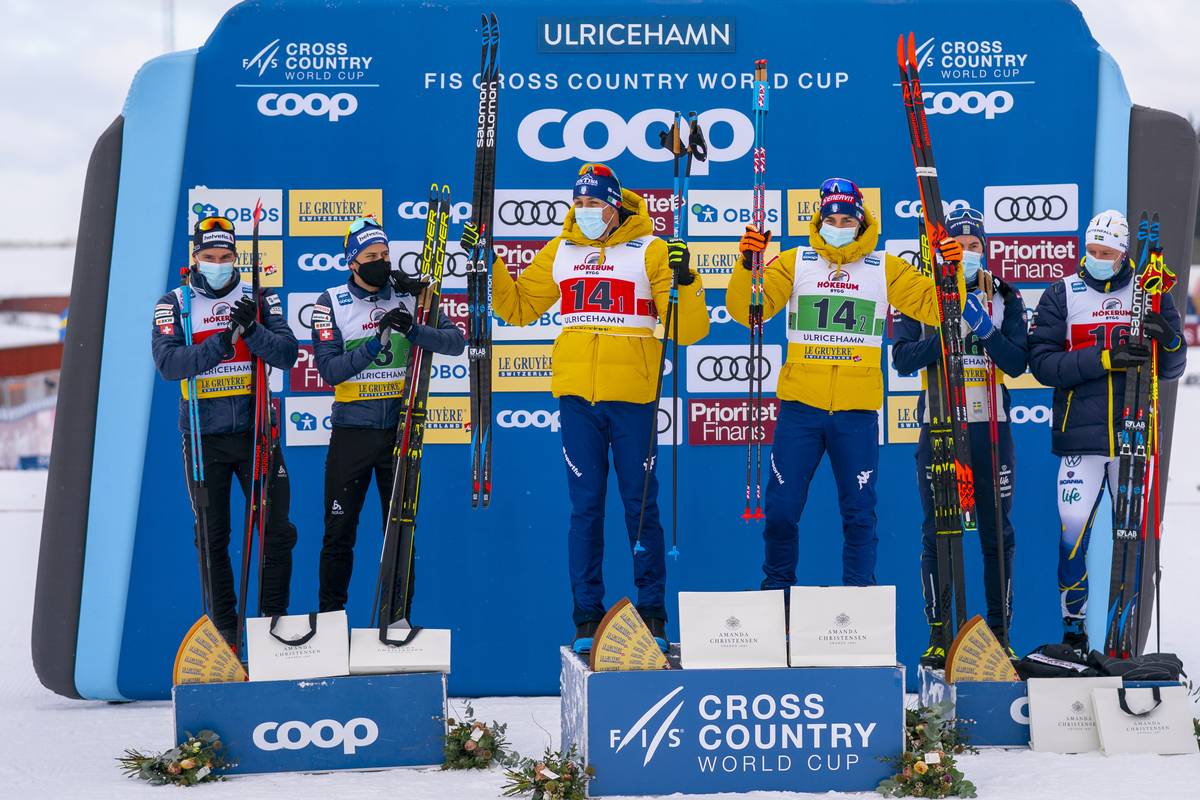
Men’s team sprint podium, Italy in first, Switzerland in second and Sweden in third. (Photo: Nordic Focus)
This World Cup coverage is made possible through the generous support of Marty and Kathy Hall and their A Hall Mark of Excellence Award. To learn more about A Hall Mark of Excellence Award or to learn how you can support FasterSkier’s coverage please contact info@fasterskier.com.
Ten teams toed the line Sunday morning, representing eight nations (Sweden and Switzerland both having two teams in the final) in the skate team sprint in Ulricehamn, Sweden. After advancing from the semi-final rounds earlier in the day, the men were geared up to race the relatively-flat 1.6 k loop completing three laps per athlete.
Heading out for another lap, Ludek Seller (CZE), Jovian Hediger (SUI), and Lucas Chanavat (FRA), (l-r)
Notably absent from the final was team Russia I, composed of powerhouse sprinters Sergey Ustiugov and Gleb Retivykh who finished 9th (+15.32) in semi-final B and did not advance. Both Russians were in Saturday’s skate sprint final with Retivykh second and Ustiugov sixth. Additionally, no Norwegians were present in the final lineup as both Norway I and II were eliminated in semi-final A.
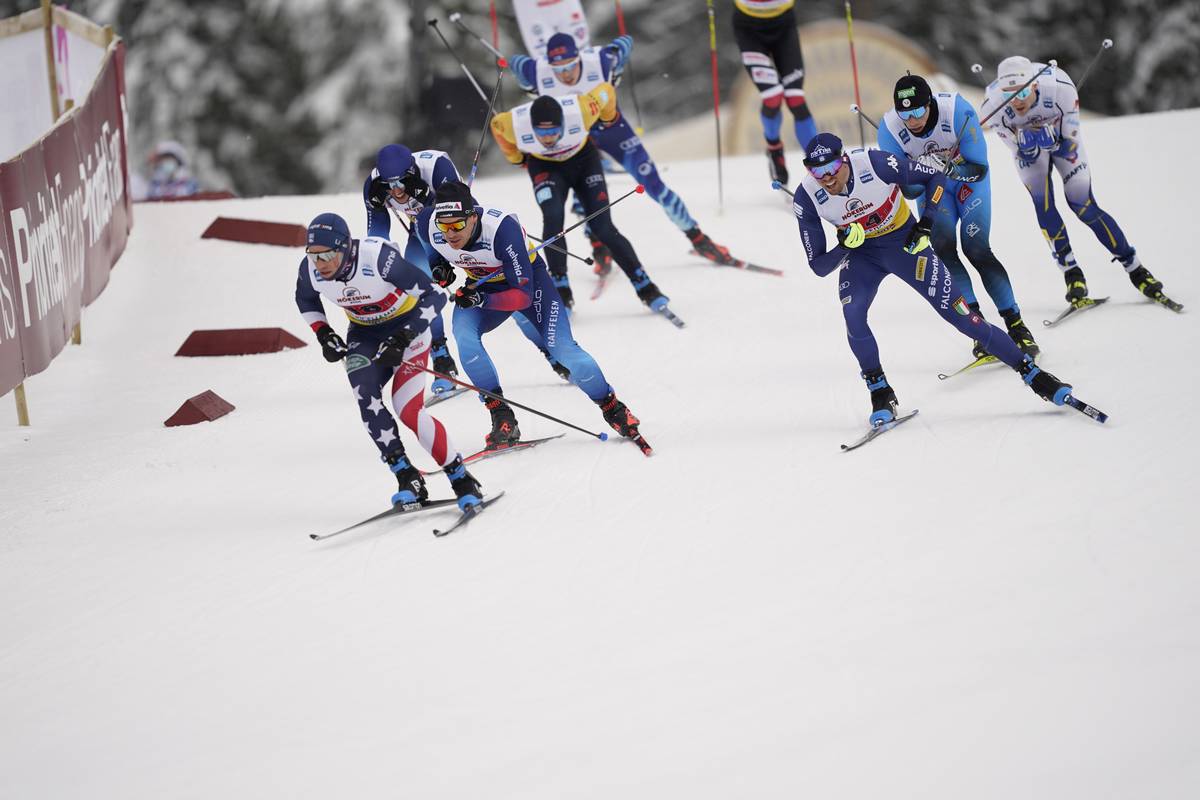
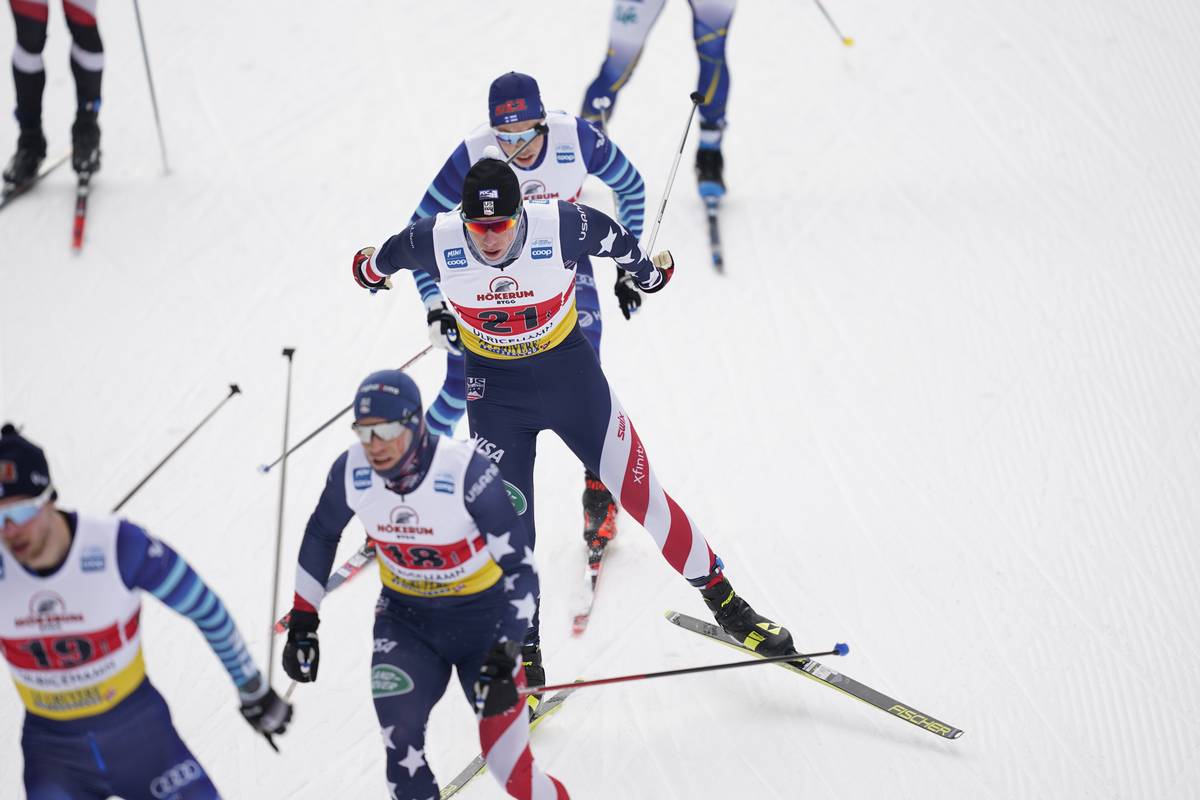
Men’s semi-final B, team Russia I was eliminated although Italy (left) and USA I (bib 18) advanced to the final. (Photo: Nordic Focus)
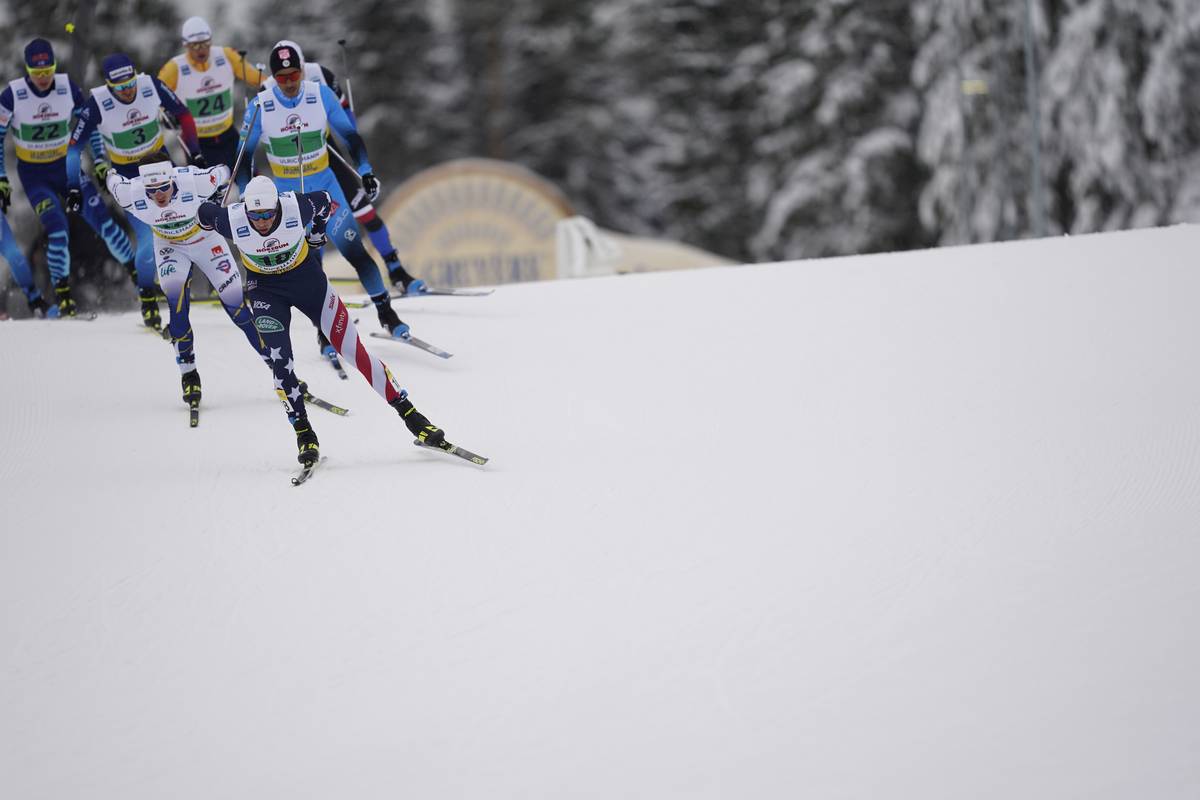
The race began slow and steady for the first laps, gradually ramping up in intensity. Much like the team sprint earlier this season in Dresden, Germany, the course layout in Ulricehamn featured no punchy climbs. Pack skiing, by default, was encouraged. Fliers off the front were not incentivized. Simi Hamilton and Kevin Bolger, representing team USA I, took on the lead for much of the second and third laps.
“Our main tactic for both the semis and the finals was to get to the front but if you found yourself off the front in the lead, just ski relaxed and fast, but ski relaxed,” said Hamilton after the race. Ideally, we wanted to be in second, third, or fourth so we could get a good draft on the gradual climb and coming back down from the top. But with such a high-speed course like this, and a few, I would not call them technical corners, but some fast corners and a lot of moving around, we did not want to be stuck in the back where there could be some crashes and some broken poles and you are also spending a lot more energy moving up through the pack.”
Simi Hamilton makes the descent into the stadium, followed in hot pursuit by Roman Jovian Hediger (SUI) and Francesco de Fabianai (ITA). (Photo: Nordic Focus)
Kevin Bolger (USA), Richard Jouve (FRA), (l-r). (Photo: NordicFocus)
Heading into the fifth and final exchange, the men jostled for position as they rounded the corner towards the stadium. Lucas Chanavat, who had held the advantage out front, clipped his skis and went down, effectively eliminating team France I from contention.
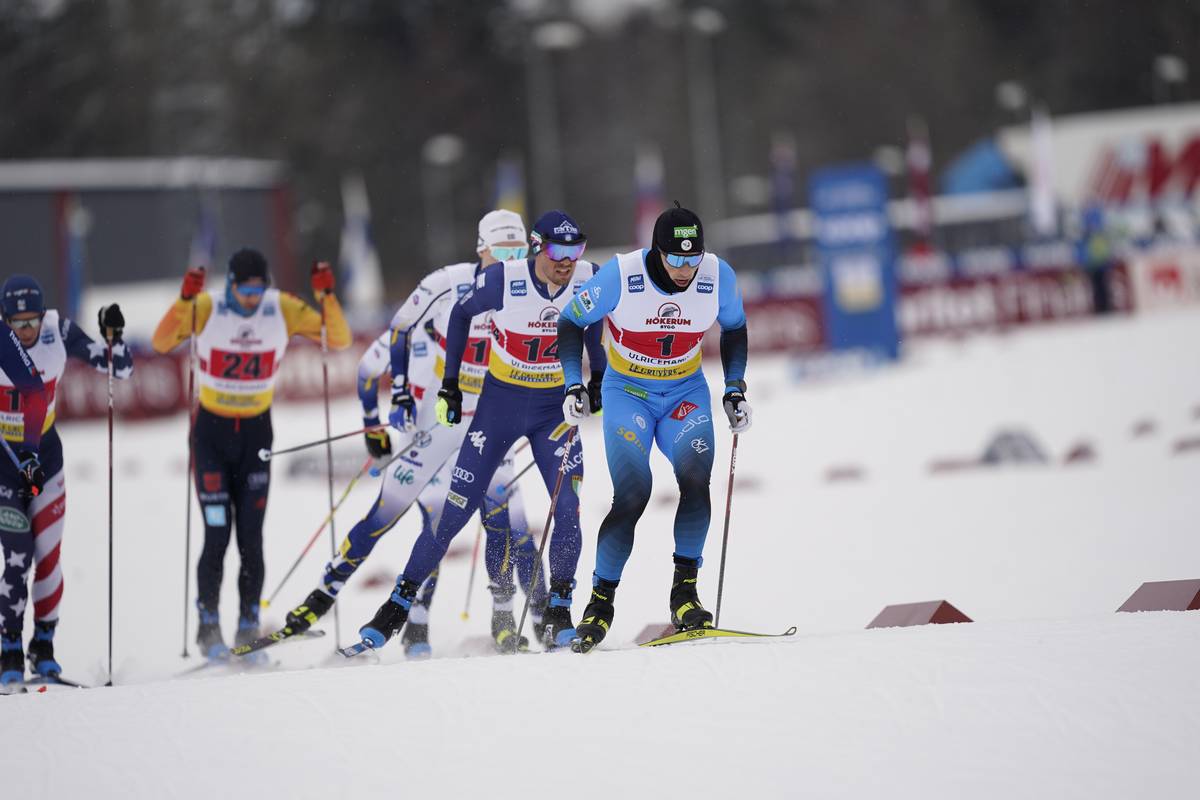
Lucas Chanavat (bib 1), Renaud Jay (bib5), and Sindre Bjørnestad Skar (bib 2), during their semi on Sunday. This image provides a good indication of the tight pack skiing with ten teams on course. (Photo: NordicFocus)Lucas Chanavat (FRA) with the lead before a fall took him out of contention (Photo: Nordic Focus)
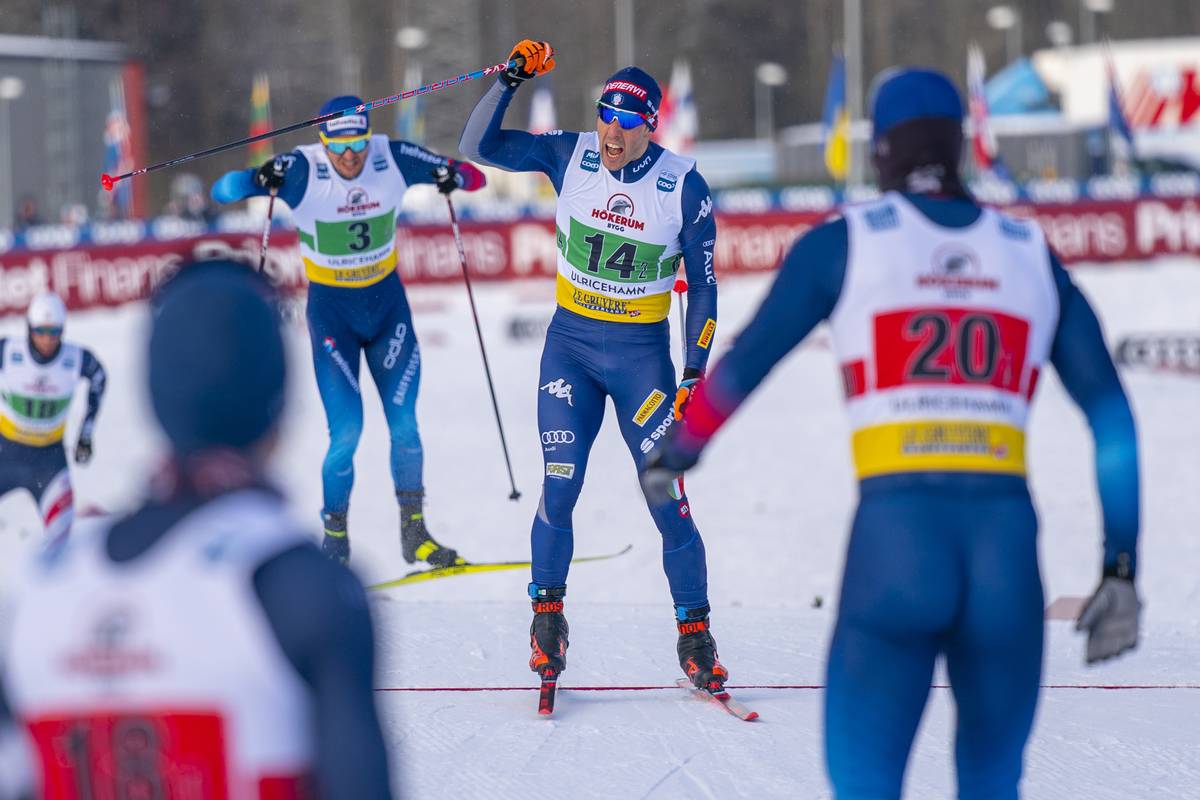
The workhorse of the Italian sprint team, and always a threat when skate sprinting for that matter, remains Federico Pellegrino. With his usual Norwegian foils absent this weekend in Ulricehamn, at least on paper, he could be considered a lock for Saturday’s individual skate sprint. He placed third – outhustled and outmaneuvered down the final straight by Oskar Svensson and Retivyk, to place third. Sunday, however, was another day. With speed and precision, Pellegrino took control at the front as the race got real leading into the stadium for the finish. He was closely followed by Roman Furger skiing for Switzerland I. In classic form, which means pulling away and displaying stoke, Pellegrino took the victory for himself and teammate Francesco de Fabiani in a time of 18:29.
Federico Pellegrino (ITA) celebrates the win. (Photo: Nordic Focus)
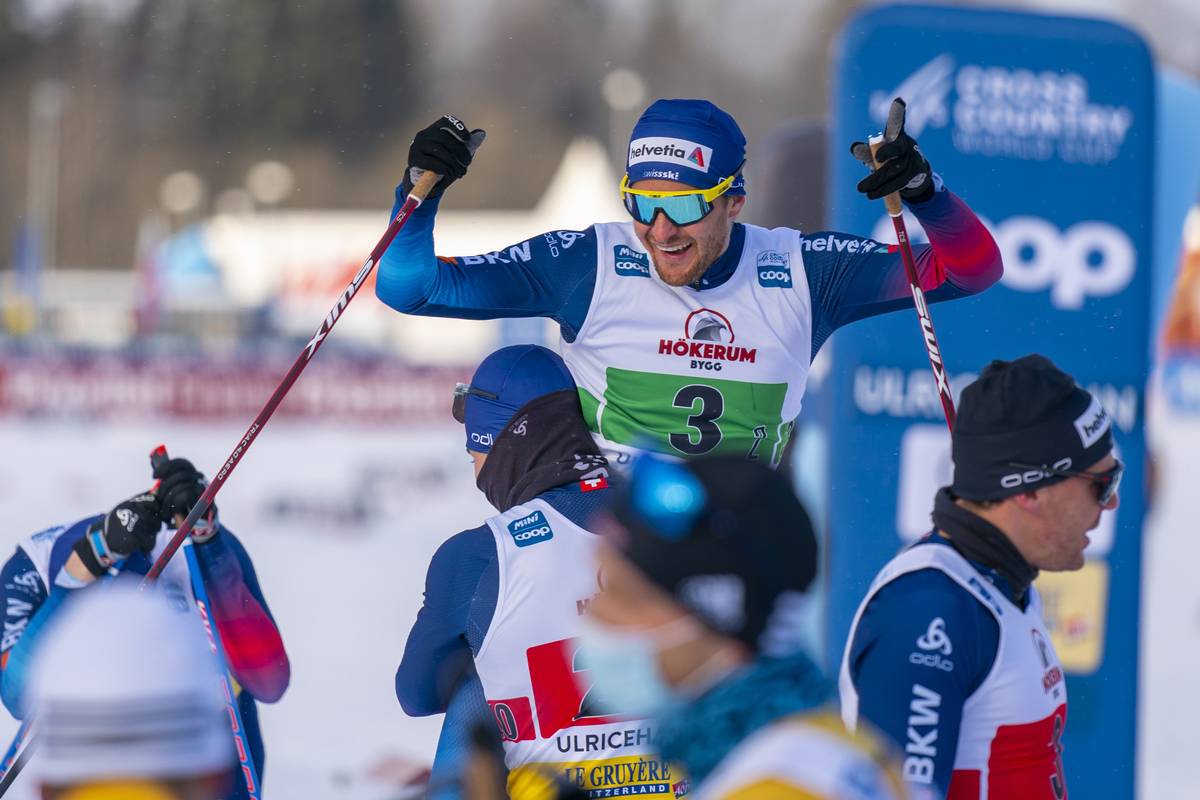
Securing second, with much enthusiastic cheering and shouting from his teammates, Furger and Jovian Hediger made it a double podium day for the Swiss (the Swiss women having finished third). Rounding out the podium in third was Sweden II, represented by Karl-Johan Westberg and Johan Häggström.
The Americans, Hamilton and Bolger, finished the day in sixth position, +3.11 back from the Italian victors.
Jovian Hediger (SUI) gets a boost from some happy teammates at the finish line. (Photo: Nordic Focus)
Logan Hanneman (USA) representing USA II in semi-final B. (Photo: Nordic Focus)
Competing in the first semi-final (A) team Canada placed 10th, +20.74 back from heat winners France I, and did not advance. Racing in semi-final B, team USA II (Logan Hanneman and Peter Holmes) finished 8th (+8.89).
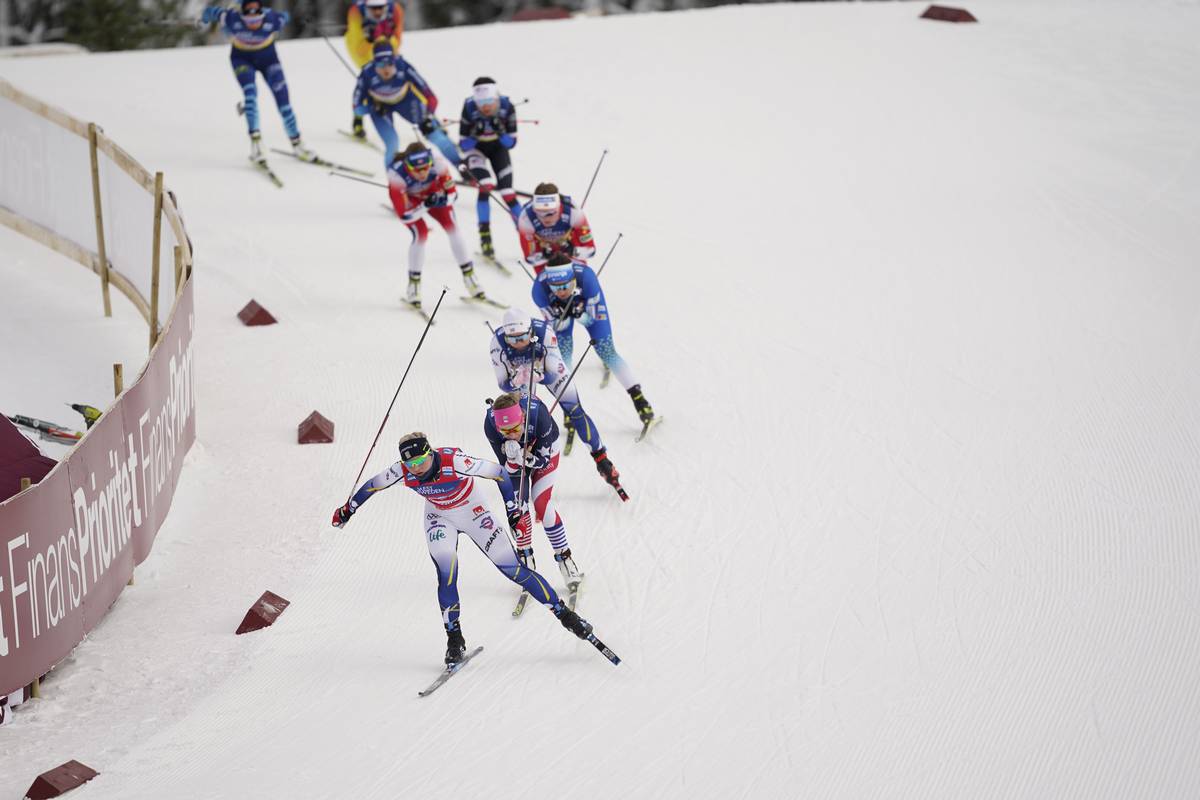
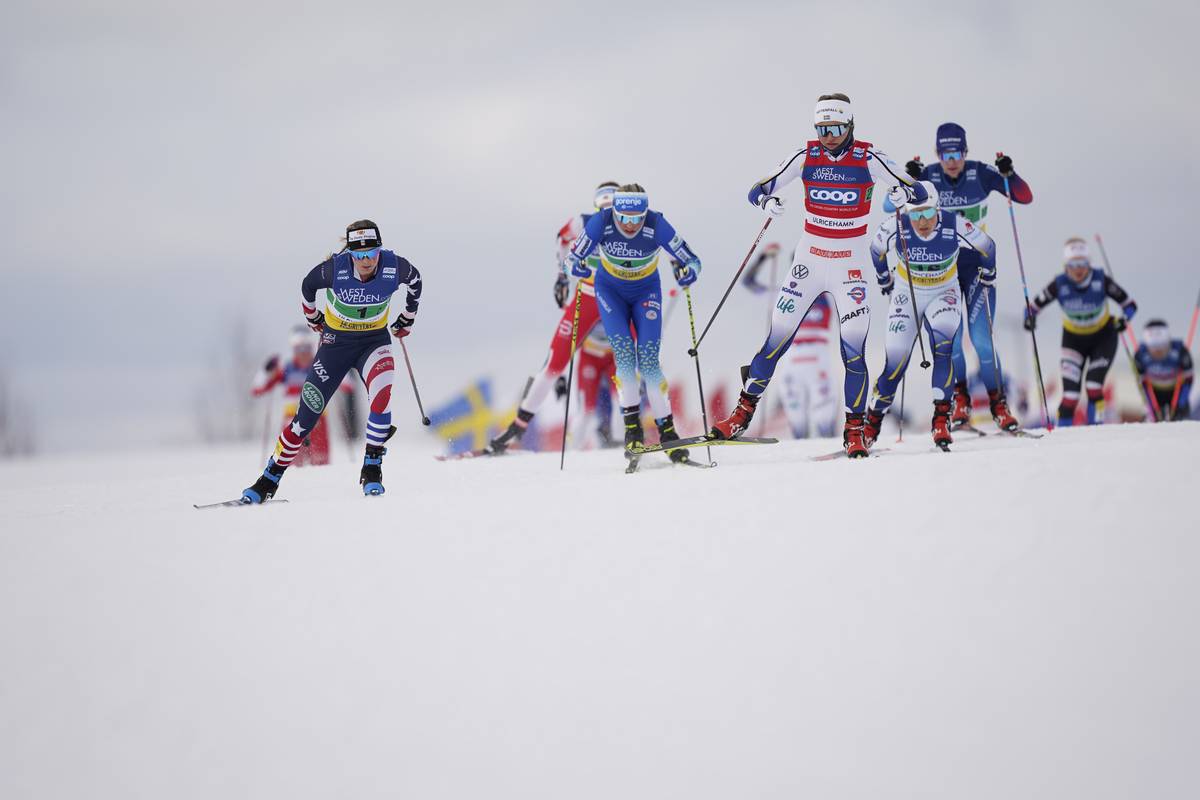
Finals action with Maja Dahlqvist (SWE) leading Sadie Maubet Bjornsen (USA), (l-r). (Photo: NordicFocus)
This World Cup coverage is made possible through the generous support of Marty and Kathy Hall and their A Hall Mark of Excellence Award. To learn more about A Hall Mark of Excellence Award or to learn how you can support FasterSkier’s coverage please contact info@fasterskier.com.
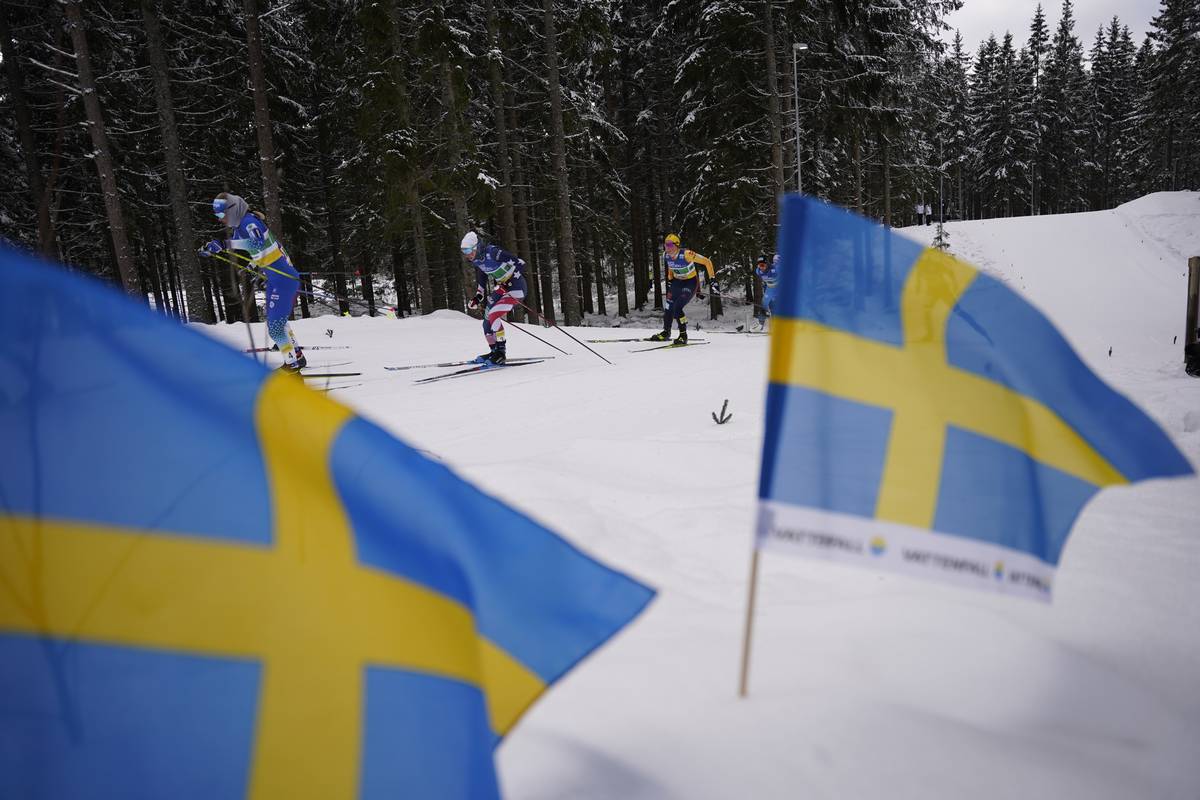
It was a rather cloudy day as the athletes circled Ulricehamn’s sprint loop again and again for Sunday’s freestyle team sprint, urged forward by the cheering of recorded crowds piped through a trailside loudspeakers. After first contesting a semi-final round earlier in the morning, the ten quickest teams moved onto the final, each athlete racing three laps for a total of 7.2 k (each loop being 1.6 k).
Anamarija Lampic (SLO), Mathilde Myhrvold (NOR), Linn Svahn (SWE), (l-r). Svahn’s team placed second overall, while Lampic was part of the winning Slovenian team. (Photo: NordicFocus)
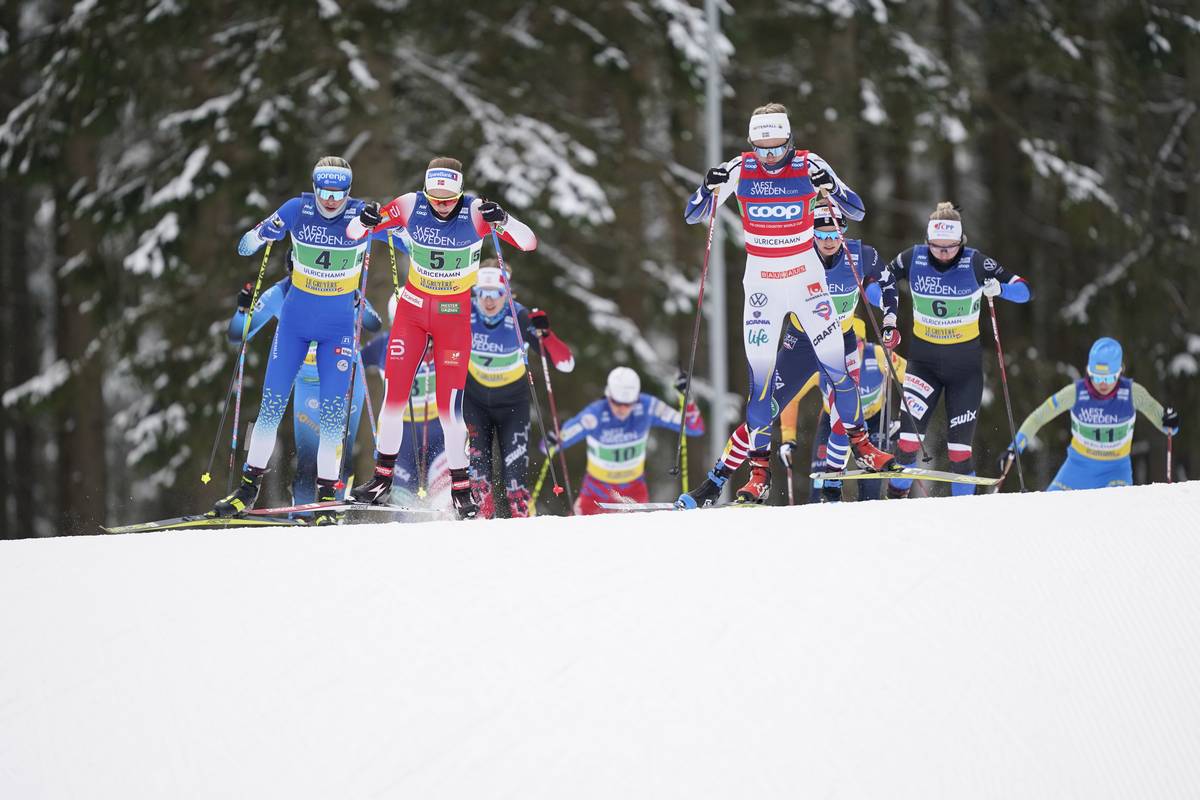
The pace was steady for the first few laps, as the women’s final progressed. Echoing her tactic from the semi-finals, Jessie Diggins skiing for USA I exited exchange three with a high tempo, pushing the pace to stretch out the pack. Diggins, who leads the overall World Cup and placed third in yesterday’s sprint, tagged her teammate, Sadie Maubet Bjornsen for her final lap with a lead of +0.3.
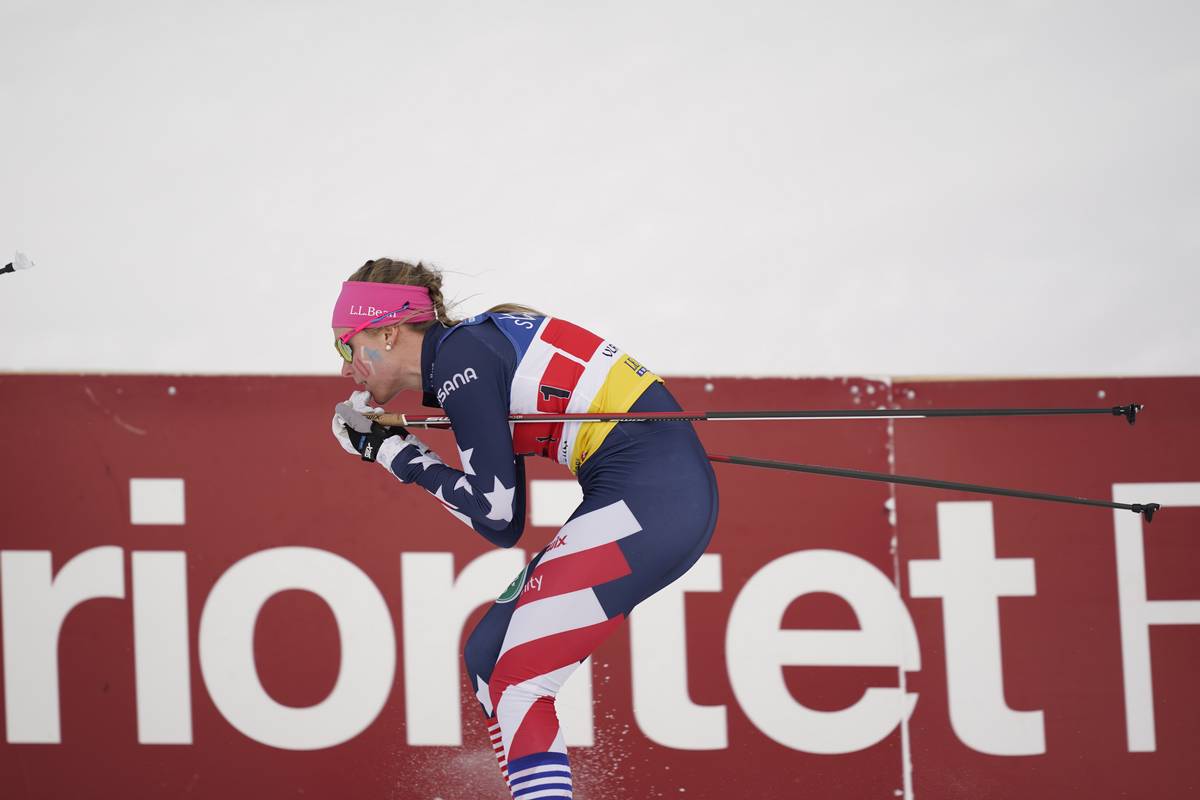
Sadie Maubet Bjornsen (USA) tucks tight into the stadium (Photo: Nordic Focus)
Maubet Bjornsen led out front, shadowed by two Swedes competing for Sweden I and Sweden II. This was Maubet Bjornsen’s first team sprint of the season. In her young 2020-2021 World Cup campaign, she was right in the mix with Sweden’s powerhouse sprinters. Maja Dahlqvist, representing Sweden I with teammate Linn Svahn, took the lead into the final exchange. With the rolling and working course, one that remained tough for athletes to break away on, the sharp end group of skiers tagged off in a dense pack.
Jessie Diggins (USA), Anamarija Lampic (SLO), Linn Svahn (SWE), (l-r) heading out for a final lap. (Photo: Nordic Focus)
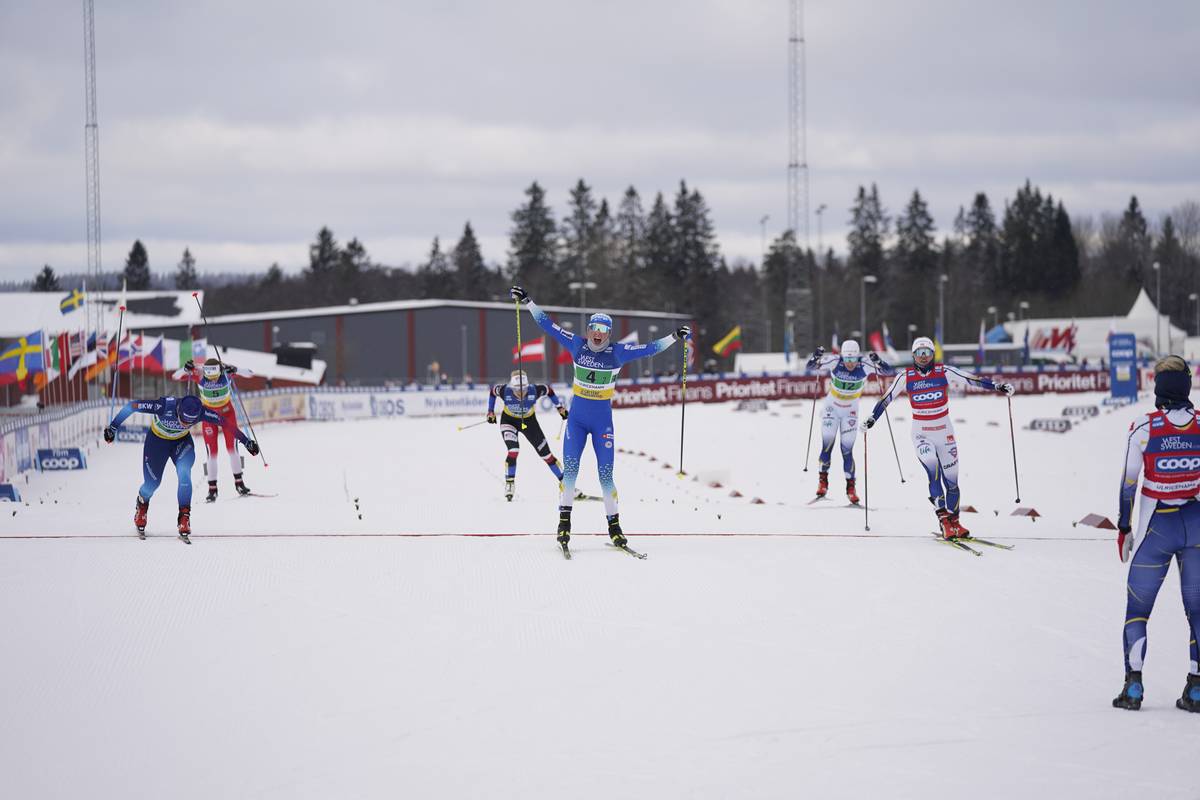
All out for the final lap, a group of eight athletes mostly stayed together. The podium was to be decided in the final few hundred meters. Navigating the corners as they descended into the stadium for the final time, Diggins was boxed out on the outside. With powerful no-pole skating, four athletes entered the finish straight in an all-out battle for the top position. Out lunging the others, Anamarija Lampic took the win for Slovenia. Svahn took second for team Sweden I and Nadine Faehndrich of Switzerland just nicked a boot in ahead of Diggins (USA) to claim third in a photo finish.
“I had a lot of fun being Sadie’s team sprint buddy today! This was a really hard course because it played to none of my strengths; it was windy, no big climbs, and pretty much impossible to drop people or even tire them out because the draft was so big,” Diggins wrote in an email. “So I played the cards I had and tried to push the pace, then tucked in to prepare for a sprint finish but ended up too boxed in. However, I was proud of how we skied a good hard race and left nothing on the table, and it was great practice for team sprints in the future! I was really stoked watching Sadie ski – with grace, power and confidence, and it inspired me to work my very hardest for her! ”
Diggins, along with the U.S. Ski Team will be in Davos, Switzerland preparing for World Championships which begin February 24.
Maubet Bjornsen expressed that World Cup sprints were something she’s reacquainting herself with.
“It was a wild and close team sprint out there today! After feeling a little shy getting back to the full contact world cup sprint racing yesterday, I was feeling extra lucky to have six more chances to ski that course smarter today.
“The semi finals were all about playing it smart, being in the right position, but saving energy for when it mattered most. We tried to learn as much as we could for the finals. That meant leading some laps, attempting some attacks, and sitting behind on some laps. We did a solid job of taking notes for the final. With such a strong head wind, it was a tough position to lead from the front. My mission was to stay in the front and out of trouble, and then attack on leg 3. On such a drafty, tactical course- Jessie and I had to get creative with our strengths. We would have loved to attempt to stretch people from the gun, but the wind was not in our favor.
“After finishing fourth by a photo finish, we both of course left wanting a bit more, but also felt like we did the best we could with our strengths. Even if I am 31 years old, I still feel like every race is a learning lesson, so there are no losses.”
Anamarija Lampic (SLO) celebrates her victory as the remaining athletes lunge for the line. (Photo: Nordic Focus)
Lampic is currently leading the World Cup sprint standings with 377 points, 96 points ahead of Faehndrich who is in second. For Lampic’s teammate, Eva Urec, today’s victory represents her first career WorldCup win. “It was amazing, it’s my first victory so it feels amazing” said Urec in a post-race interview with FIS.
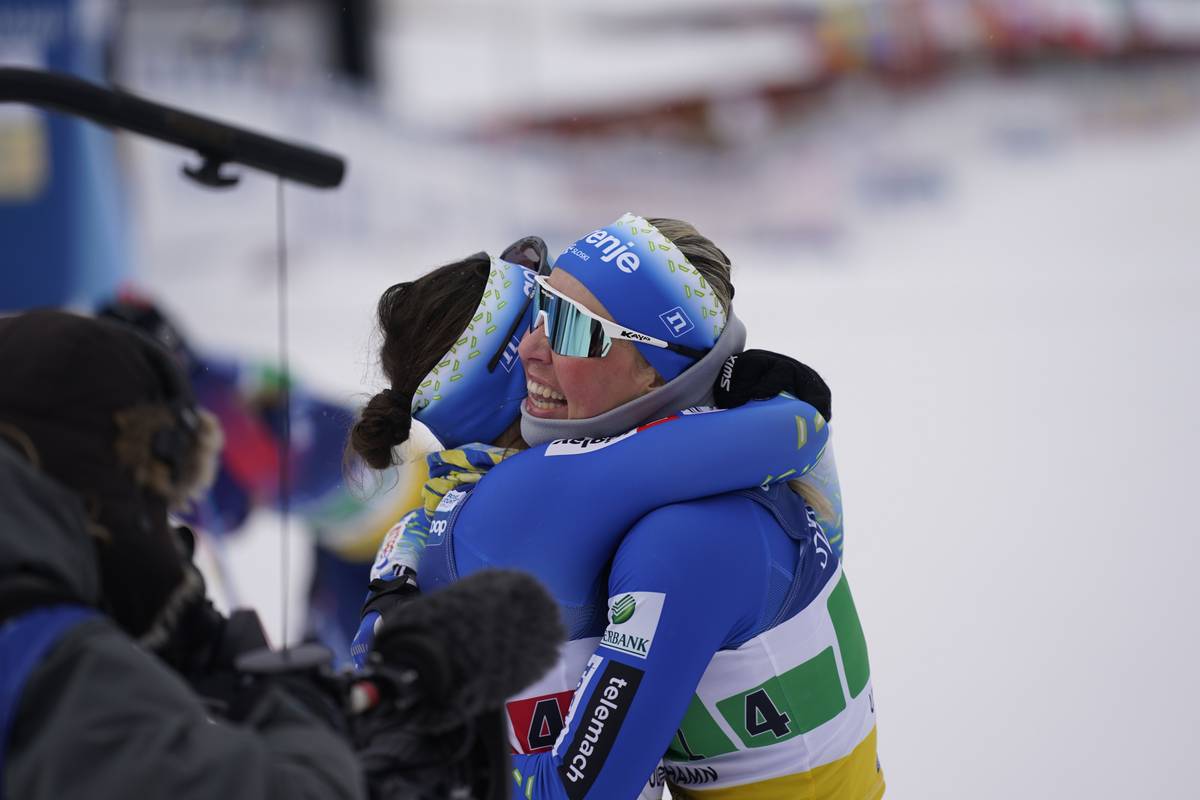
Happy Slovenians, Anamarija Lampic and Eva Urevc hug in the finish pen after placing first in Sunday’s team sprint. (Photo: Nordic Focus)
Also competing for the U.S. was team USA II, Sophie Caldwell Hamilton and Julia Kern, who dropped back in the final lap of semi-final B and finished 6th (+14.8), not quick enough to advance.
Sophie Caldwell Hamilton (USA), Coletta Rydzek (GER), (l-r) racing in the team sprint semifinals. (Photo: NordicFocus)
After being briefly obstructed during semi-final A when Victoria Carl, skiing for Germany I, lost a ski and went down, team Canada I (Cendrine Browne and Maya Macisaac-Jones) faded to finish seventh. In semi-final B, Canada II (Katherine Stewart-Jones and Dahria Beatty) finished 8th, +46.6 back from Sweden I (Linn Svahn and Maja Dahlqvist) who won the heat.
Racing continues on the World Cup in Nové Město, Czech Republic on February 20 with a classic sprint.
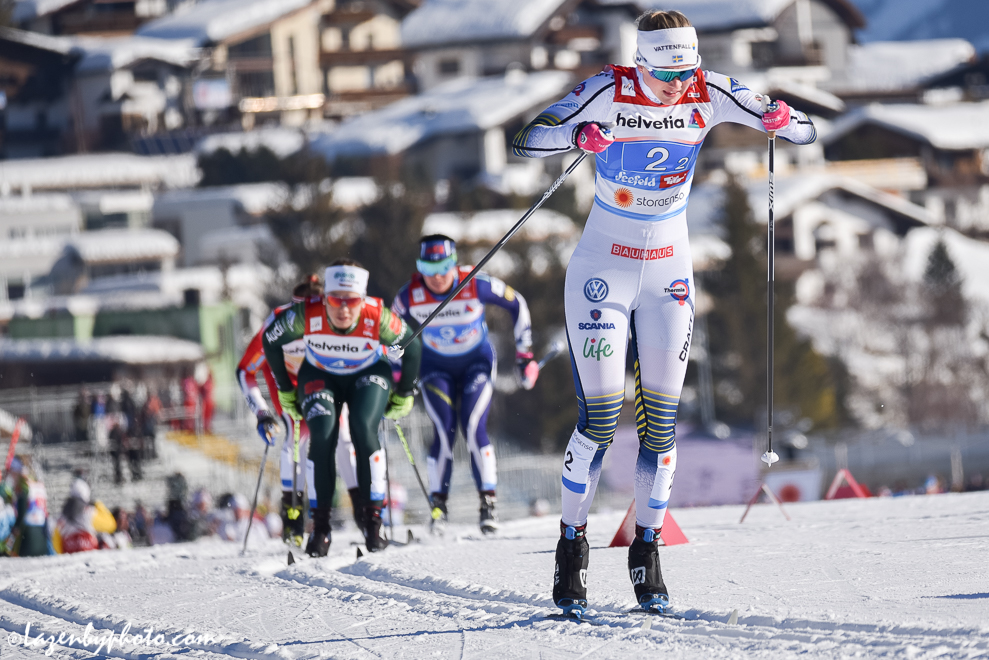
Hips forward and drive…As clutch as they come – Sweden’s formidable Maja Dahlqvist (bib 2) during the women’s 6 x 1.2 k classic team sprint at the 2019 World Championship in Seefeld, Austria. (Photo: John Lazenby/lazenbyphoto.com)
Icy tracks and a relatively flat course made for a tight race in Seefeld, Austria for the women’s 6 x 1.2-kilometer classic team sprint. Even in the final meters as the women charged up the last climb and double poled to the finish, the winner was not clear. In fact, the three fastest teams were within one second of one another. The resulting time difference between first and fifth place was less than the difference between the gold and silver medalist teams in Lahti, Finland in the 2017 World Ski Championships.
A team sprint can often play out like a jack-in-the-box; in the first four legs, the women look calm and controlled, steadily winding up the tempo as the race progresses. The final two legs are explosive.
This was the case today as Norway’s Maiken Caspersen Falla tagged her teammateIngvild Flugstad Østberg for the last time amidst a pack of seven nations all within three seconds. Østberg powered through the course with a fiery purpose, trying to create a gap that would allow her and her teammate to repeat their victory in the event during the 2015 championship. Her move was matched by the teams from Sweden, Slovenia, and Russia, with Sadie Bjornsen of the United States just behind their tails.
Russia’s Natalia Nepryeava challenged Østberg and took the lead before rounding a hairpin turn and descending in a tuck toward the stadium, but as she tagged her teammate, Yulia Belorukova, the Norwegians, Swedes, and Slovenes all remained less than 1.5 seconds back. Bjornsen tagged her partner Jessie Diggins in fifth only 2.7 behind.
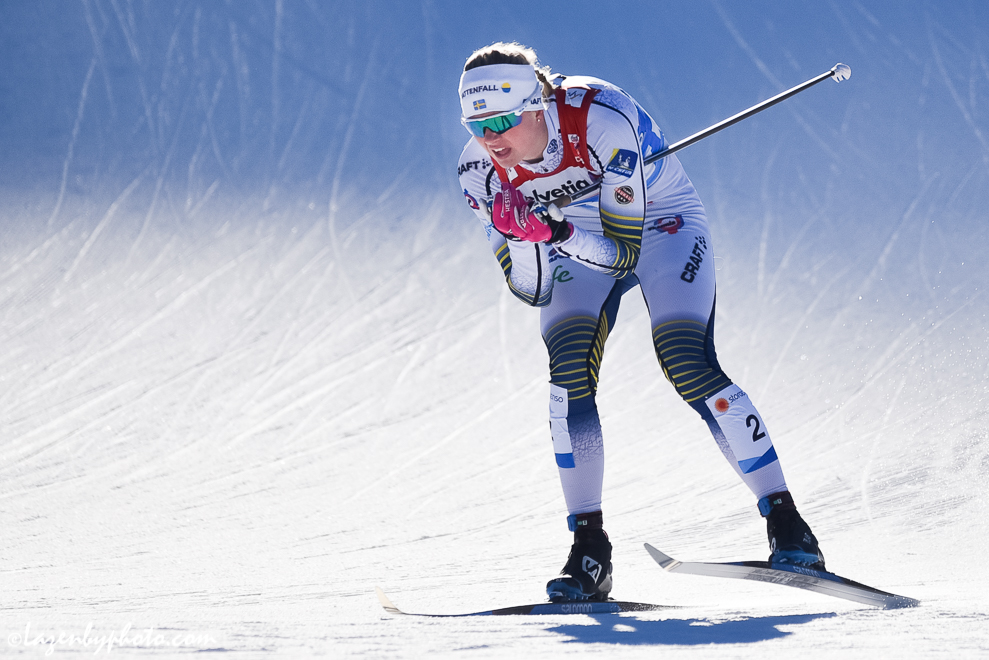
Sweden’s Maja Dahlqvist during the women’s 6 x 1.2 k classic team sprint at the 2019 World Championship in Seefeld, Austria. (Photo: John Lazenby/lazenbyphoto.com)
In the final lap, Falla charged to the front to take the lead for Norway. Maja Dahlqvist of Sweden and Anamarija Lampic of Slovenia went with her, as Belorukova began to fade a few meters behind. The lap seemed to dissolve in a heartbeat, as the four women found themselves rounding the last turn. Dahlqvist, who had been tucked in behind Falla, slingshot around her and into the lanes and began double poling rapidly to the finish. Falla could not match her pace, and as she lost touch with the Swede in the final meters, Lampic surged to seize silver.
The gold medal team of Nilsson and Dahlqvist stopped the clock in a time of 15:14.93, with Slovenia’s Katja Visnar and Lampic just 0.37 seconds behind. Østberg and Falla took bronze (+0.60), followed by the Russians in fourth (+0.93), and the Americans in fifth (+2.79).
“Really really good,” added Dahlqvist as the two laughed. “It was really tight today, but I felt strong in the end, so it was good.”
The duo could not contain their excitement as they reflected on their narrow victory. They had already demonstrated their ability to excel on the course in Thursday’s individual skate sprint, but in the final Nilsson was unable to match Falla and a crash took Dahlqvist out of contention.
“I felt really powerful today,” said Nilsson. “I like the course – it’s very fast and you have to be very focused and not let anyone pass you in the wrong places. When Maya crossed the finish line first it was like euphoria.”
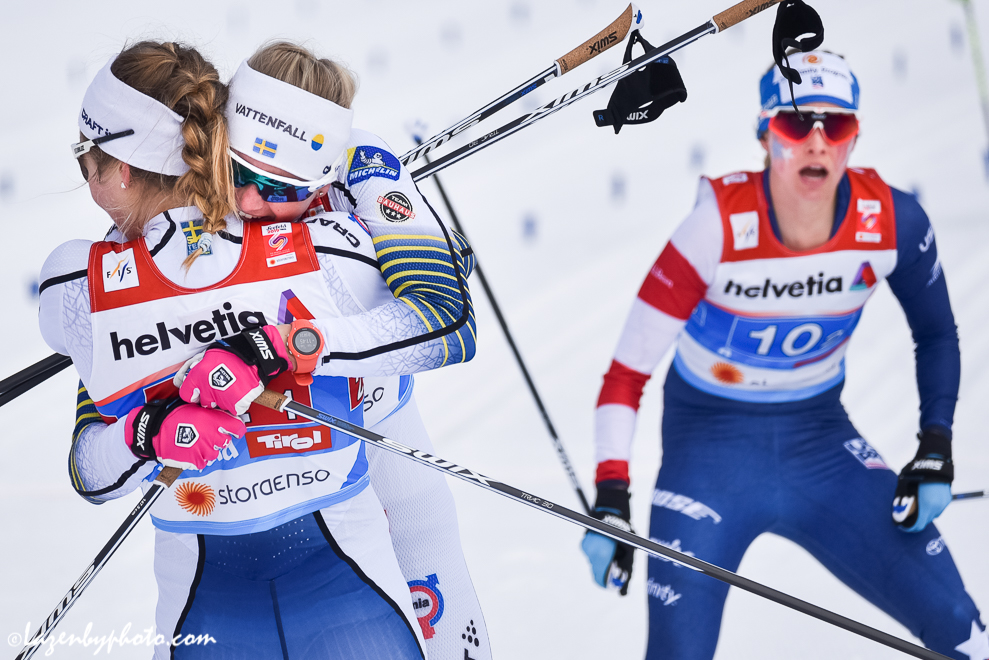
Sweden’s winning duo –Maja Dahlqvist embracing teammate Stina Nilsson at the 2019 World Championships in Seefeld, Austria. (Photo: John Lazenby/lazenbyphoto.com)
Today’s medals are the fifth in this World Championships for Sweden and the sixth for Norway. While Falla certainly hoped to add a third gold to her collection of team sprint medals, her bronze is her fourth medal in the event, making her the most decorated woman in the team sprint.
For Slovenia, earning a silver medal is a leap from their last two results in World Championships and their best result overall in a World Championship event. Visnar was part of both sprint teams, contributing to a 9th place finish in 2015 and an 8th in 2017. During the 2018 Olympics, Lampic and her partner took sixth.
Sweden (c) wins the women’s 6 x 1.2 k classic team sprint at the 2019 World Championships in Seefeld, Austria. Slovenia (l) took second place, with Norway (r) in third. (Photo: John Lazenby/lazenbyphoto.com)
After the team of Bjornsen and Diggins finished third in the classic team sprint in Lahti in 2017, and Diggins won gold with Kikkan Randall in the skate sprint during the 2018 Olympics in PyeongChang, the United States was looking for more from today. Though both women can excel in both distance and sprint events, the short course in Seefeld was not their forte.
“It was a little frustrating for me just because – you can never pick the course, but it didn’t suit our strengths in particular,” explained Diggins in a call. “It’s situationally frustrating simply because I know that we are in good shape and we have more than we were able to show today because it ended up being about your fast-twitch sprinting at the end, and we both felt like we were a little bit stuck. We couldn’t get out to push the pace earlier in the race.”
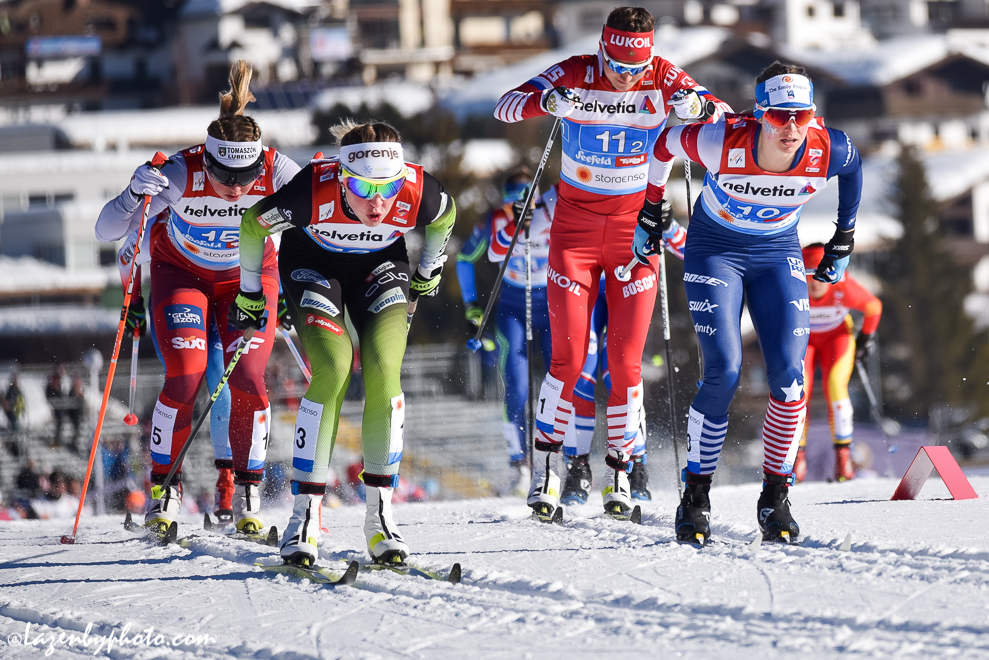
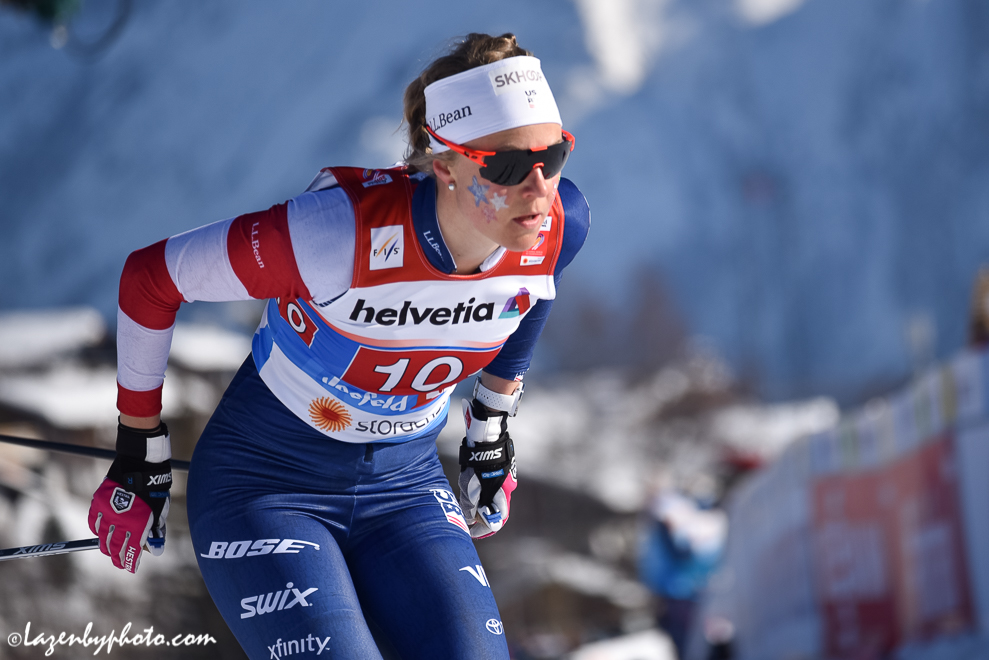
In bib 10, the U.S. Ski Team’s Jessie Diggins pulls a string of skiers along on the inside track during the women’s 6 x 1.2 k classic team sprint at the 2019 World Championship in Seefeld, Austria. (Photo: John Lazenby/lazenbyphoto.com)
Without the long climbs of the courses in Korea or Finland, racers could not spread themselves out, making the race more about tactics and raw speed, versus endurance and climbing strength.
“So, it was just a different kind of course, it was a different kind of team sprint, and it was more tactical and fast twitch than grinding it out,” Diggins concluded.
In the semi-finals, the US team finished fourth, advancing to the final as lucky losers.
“I think that after the semi’s we were all kind of like, ‘Whoa! Okay! It’s really hard to drop people and even if you’re in the front, you’re going to get sucked up in the draft,’” said Diggins. “So if you want to push the pace, you’re going to burn so many matches while other people draft off you, so it’s a really hard course if you’re not someone who has a lot of fast-twitch because it leaves you with fewer options of what to do.”
The course used in the team event was the same as in the individual race where Diggins finished 8th and Bjornsen 18th.
“It’s cool that we got to do the sprint race on this course the other day because I learned a little bit, in a frustrating way, that it’s relatively fast and tactical,” said Bjornsen. “When I was sprinting [individually] I was trying to do the smart thing, so today I was like, ‘I’m fit enough to do the stupid thing that might include doing more work, but could put us in a good place.’ And so today, I was just trying to stay in the front and stay in contact with those front girls, and I found myself getting stuck behind a few people – behind Germany and Slovenia, I guess – and I was trying to make my way to the Scandinavian girls.”
The U.S. Ski Team’s Sadie Bjornsen during the women’s 6 x 1.2 k classic team sprint at the 2019 World Championship in Seefeld, Austria. (Photo: John Lazenby/lazenbyphoto.com)
The team strategized which tactics might enable them to still fight for top positions, but because of the fast firm tracks and tight spread, they weren’t able to execute.
“I was just trying to take advantage of that huge tucking section to really put my power to use and get up there with the girls,” Bjornsen explained. “But it was certainly a challenging day in the way that it was hard to break people and hard to be in the absolute perfect position that you really want to try to get to. But I think that both Jessie and I skied the absolute best that we could and we were definitely looking for a little more difficult real estate out there. I think that we would have excelled in those conditions. … We did the best that we could, and that’s how it went.”
Canada’s Emily Nishikawa and Dahria Beatty finished 12th overall after being eliminated in the first semi-final where they placed sixth.
Racing continues Tuesday in the 10 k classic distance race.
Ida Sargent (U.S. Ski Team) racing earlier this month in the opening prologue of the 2015 Tour de Ski in Obertsdorf, Germany. (Photo: Marcel Hilger)
Suddenly, it dawned on her. Rosie Brennan of Alaska Pacific University (APU) hadn’t given the team sprint in Otepää, Estonia, much thought until she was on her way to Europe earlier this week and realized that she was going to be one of four U.S. women in Otepää, Estonia, this weekend.
A little quick math — the format required two-person teams — and she and APU coach Erik Flora determined that meant she’d probably get a chance to race the 6 x 1.2-kilometer freestyle team sprint on Sunday.
Brennan, a 26-year-old former U.S. Ski Team member and the current SuperTour leader, had done a team sprint just once before — back in 2009 at the pre-Olympic World Cup in Vancouver, British Columbia. There, she teamed up with Morgan Arritola to place 17th. Arritola and most of the other women in that race are no longer competing.
Alaska Pacific University (APU) Head Coach Erik Flora (l) runs to grab a new pole for Rosie Brennan after she broke her pole and was given an oversized in the 10 k freestyle individual start at 2015 Cross Country Championships two weeks ago in Houghton, Michigan. Brennan went on to place third, then won the remaining races at nationals.
At the time, the 2009 team sprint was only Brennan’s second World Cup race.
With nearly two dozen World Cup starts under her belt in the time since, Brennan returned to the international circuit this weekend for the first time since December 2013. Her expectations weren’t results-based, but she was definitely excited for the team sprint.
“Every time I watch [a team sprint], I always think, yikes, going out for the finals seriously seems like one of the hardest things in ski racing,” Brennan wrote in an email. “So, yes I was a little nervous and unsure how I would fare…”
Brennan and Ida Sargent formed the second-seeded U.S. team, and Sadie Bjornsen and Sophie Caldwell teamed up for the U.S. first team. Both teams were put in the second of two semifinals, on 35-degree Fahrenheit afternoon when racing earlier was definitely better.
“It was really warm out there … snowing, raining so the course was breaking down,” Sargent explained on the phone after Sunday’s race. “It was pretty soft in the morning when we were testing and then by the final it was shin-deep slush.”
Vying for a top-two finish to guarantee themselves a spot in the 10-team final, the two American squads came through the final exchange alongside each other in first and second. Bjornsen handed off to Caldwell for the last lap, and Sargent tagged Brennan.
Sargent explained she had been in second heading into the descent toward the stadium on her last semifinal loop, trailing Poland’s Justyna Kowalczyk closely to make sure she caught her draft. She passed Kowalczyk, and Bjornsen passed Sargent after following her in similar fashion.
“Sadie and I went into the exchange after our last lap in one and two, so that was pretty fun to be there together,” Sargent recalled.
Sophie Caldwell (U.S. Ski Team) racing Jan. 6 at the Tour de Ski freestyle sprint in Val Mustair, Switzerland, where she placed seventh. (Photo: Fischer/Nordic Focus)
After getting tagged in first, Caldwell explained that Germany’s Denise Herrmann and Poland’s Sylwia Jaśkowiec “took off” at the beginning of the final lap and left her struggling to keep up.
“They formed a little gap and I wasn’t close enough to take advantage of their draft on the [downhill],” Caldwell wrote in an email. “Unfortunately, I think I was leading a little train of my own, so people could hop into my draft.”
One of those people was Brennan, who shot past Caldwell to take third in the heat. Caldwell finished fourth, and the top three teams from their semifinal advanced to the final based on time. (The top-two teams in each automatically advance, then the next six-fastest times.) Seven of nine teams in the first semifinal made the final as well.
“Today was a tough day with the weather and snow conditions, with each lap getting slower than the one before,” Bjornsen explained in an email after her team placed 11th overall. “Since we were in the second heat, our strategy was to go as hard as we could, because we knew making lucky loser positions were going to be tough just the way conditions were working.”
One hundred meters out of the start in the semifinal, someone skied over Bjornsen’s ski.
“I found myself lying in the snow,” she recalled. “I worked hard to catch back up, but Soph had to finish closing the gap. From there we had two great laps in the mix. I tagged off in the front of the pack, and Soph did a great job holding on. … As we predicted, lucky loser time was tough to catch, so sadly, Soph and I weren’t able to catch the finals.”
Sargent, Brennan Sixth in Final
Meanwhile, Sargent and Brennan moved on, which both Caldwell and Bjornsen, Brennan’s APU teammate, were excited about.
“I have believed that Rosie is skiing at the same level as us [U.S. Ski Team women] since the start of the season,” Bjornsen wrote. “It was just so exciting and wonderful for her to feel and show that today! It brings tears to my eyes to see everything she has gotten through this year, and here she is on the World Cup, challenging the strongest skaters in the World.”
“We both skied our last laps with everything we had and it turned out to be just enough,” Brennan explained. “I had no expectations for this race so I psyched when we were finding it possible to easily ski in the front of the pack.”
In the final, she resolved to stick with the pack and see what happened toward the end of the race.
Sargent said she was pleasantly surprised to feel better during the final than the semifinal.
“I guess you’re always excited for another chance to race again,” Sargent said.
She expected to feel tired and “on flooded legs” by the last lap, but the goal was to keep pushing.
Out of the start, Sargent put the U.S. in fourth at the high point of the course, at the turnaround before the downhill. She came through the first exchange in fourth, half a second behind Sweden’s Ida Ingemarsdotter — the eventual winner (with teammate Stina Nilsson).
Brennan kept them within three seconds of Norway’s Ingvild Flugstad Østberg in first after her first lap, tagging Sargent in sixth. One lap later, the U.S. was back to fourth, 2.2 seconds from Poland in first and among the nine teams within 5 1/2 seconds of the lead.
“I tried to move up and ski towards the front of the pack more because in the beginning of the semifinal, I was in the back and felt like I was stuck in traffic for the first couple laps,” Sargent explained. “So I tried to get a little farther forward in the final and it was just really fun to be in the mix.”
On Brennan’s second lap, Østberg in first led Nilsson and Poland’s anchor, Jaśkowiec, as the three pulled away. By the tag, they were just over a second ahead of Germany in fourth, Finland’s first team (Anne Kyllönen and Krista Parmakoski) was 4.7 seconds back in fifth, Finland’s second team (Aino-Kaisa Saarinen and Riika Sarasoja-Lilja) was 5.3 seconds behind in sixth, and Brennan 5.9 seconds back in seventh.
“The second lap was the hardest for me,” Brennan said. “I think the pace turned up a bit and I started questioning how much my legs had in them.
“The final was definitely faster paced, there is a lot more on the line,” she added. “It was super slushy and there were trenches around every corner. I think in general, there wasn’t one section that was really good for me or really bad, it was more about putting together a good lap, skiing each section as best as possible and trying to lose as little as possible.”
When Sargent set out on her final lap, she focused on cutting down the gap ahead of her and catching the fourth-, fifth- and sixth-place teams.
Germany’s Hanna Kolb fell off the pace and into seventh, while Sargent moved into sixth, 8.4 seconds behind the leaders and 1.2 seconds behind Kyllönen in fifth.
On the last lap, Herrmann brought the Germans back into contention and led the pursuit of Sweden, Norway and Poland. While there was a three-way sprint for first, Germany finished 16.5 seconds back in fourth, Finland’s first team was another 1.1 seconds back in fifth, and Brennan anchored the U.S. to sixth, 18.1 seconds out of first and half a second behind Parmakoski.
Sargent said both she and Brennan were “really happy” with their result in the first-and-only team sprint before the freestyle team sprint at World Championships.
“[Rosie] just got over here and hasn’t raced a team sprint since 2009 … and she was just skiing really well all day and had some awesome finishes on both of the heats,” Sargent said. “So I was really impressed with her — first team sprint, first weekend on the World Cup this year and just to be right in there the whole time.”
“I was really impressed with her — first team sprint, first weekend on the World Cup this year and just to be right in there the whole time.” — Ida Sargent on teammate Rosie Brennan
“I surprised myself by having a little bit of finishing speed in both the semi and the final so I am happy I was able to pull together 3 solid laps each race even if none of them were outstanding,” Brennan wrote.
Finishing sixth, the two landed in the money, which Sargent said is always a goal. Moreover though, she wanted to make the final.
“We did that and after that, everything was just a bonus,” she said.
“Those guys skis great, actually all the U.S. athletes skied really good,” U.S. Ski Team Head Coach Chris Grover said on the phone. “Despite some crashes, everybody skied super well, so that was really exciting.”
Hamilton Crashes on Last Lap
Simi Hamilton crashed out of contention on the last lap of the men’s first semifinal, and he and Andy Newell, of the first-seeded U.S. men’s team, placed 10th in the heat for 19th overall. The top six teams from their semifinal advanced to the 6 x 1.5 k final.
“Simi and I did a good job of staying up front,” Newell, the team’s scramble leg, wrote in an email. He tagged Hamilton in fifth for the final lap.
“It’s our goal not to ski any harder than we have to until the last laps,” Newell added. “I felt I was able to pace well and did my best to chase down Russia on the last lap and tag Simi in a strong position.”
Positioning himself in the draft behind Nikolay Morilov of Russia’s second team and Canada’s Lenny Valjas on the final downhill, Hamilton went down in a pileup with France’s Baptiste Gros, who had been around third at that point.
According to Grover, Gros face planted on the last rise after the fast downhill into the stadium. Sweden’s Emil Jönsson clipped Gros and spun around, getting tangled with Hamilton, who was on his way down the hill as well.
“[Simi] face planted right into the bridge basically,” Grover said. “He is OK, but he is definitely sore.”
“He was in a good position to move on as [lucky loser] since our heat was a but faster,” Newell explained. “If it wasn’t for the crash I think we would have advanced for sure.”
While the bad luck and resulting missed opportunity to practice a final was disappointing, Newell wrote that they were looking forward to World Championships and putting together a competitive freestyle team sprint there.
“I was feeling pretty good today and think I have regained a bit of my strength and fitness that I was missing during the [Tour de Ski],” Newell added. “I think this is the best my skating has felt for a while and it was fun to be able to accelerate and ski with power.”
Bjornsen, Gelso Miss Top 10 in 11th
The second U.S. men’s team, with Erik Bjornsen and Matt Gelso, the SuperTour leader from the Sun Valley Ski Education Foundation, narrowly missed advancing to the final after placing fifth in the second semifinal. The top four moved on.
Bjornsen started them off in 11th of 12 teams, and Gelso skied up to ninth by the second exchange. One lap later, they were up to seventh, and Bjornsen came through the exchange in fourth on his last lap.
“Once the racing started it was super fun,” Gelso wrote in an email after his first World Cup race in Europe and second team sprint of his career, since racing one at Spring Series about six years ago.
“Erik and I both moved up some places on our second laps, then he moved really well on his third lap,” he added. “For much of the race it was a pack of guys so moving places within the group was more about position when the pace surged than it was about what place you would finish in.”
They had wanted to position themselves in fourth or fifth “as most times the top 4 qualifies for the final,” Gelso wrote. “We did not want to lead but we also didn’t want to sit on the back of the pack as once small gaps form in front of you it is really hard to close them down.”
After getting tagged in fourth just ahead of fifth place, Gelso set out to chase down three leaders. He stayed within a few seconds of them, but lost contact on the short, steep downhill before the wall-of-a-climb before the stadium.
“They really turned it on and put some more time into me and the fifth-place guy behind me [Italy’s Federico Pellegrino] passed me,” Gelso noted. “At this point I was fifth and got over the top of the wall and down into the finish as fast as I could for fifth in the heat.”
He explained that both he and Bjornsen were happy with their race and 11th overall.
“We both skied strong and smart and were able to mix it up with some of the best sprinters in the world,” Gelso wrote. “We would have liked to make the final but we still feel good about our result, that we had a good showing, and that we accomplished many of our goals for the day.”
Bjornsen was pleased that he posted the fastest time on the last lap, but wished he would have had more confidence to make a move earlier in the race.
“I think I could have brought us in at the front of the pack which would have really turned some of those Norwegians heads,” he wrote. “I’m very happy with the way my teammate Matt skied, he just got over here and he was in the mix. It’s a bummer we didn’t get to the finals. I was ready to make some more fast laps…next time!”
Bjornsen added that he’s starting to feel more confident in the event, one of the rarest World Cup formats.
“For some reason I always surprise myself in the team sprint discipline, I’m starting to wonder if it’s a race built for me,” he wrote.
According to Gelso, Bjornsen persuaded him to race the team sprint this weekend.
“I was actually planning to only ski the individual sprint here but once I got over here I talked to [Bjornsen] and he said how fun the team sprint was and how it was like a distance race,” Gelso wrote. “I also thought it would be a better prep race for next weekend in Russia.”
The Americans will head to Rybinsk, Russia, on Wednesday for the next World Cup races starting on Friday. There, they’ll meet up with Jessie Diggins and Liz Stephen, who took the weekend off to recover from the Tour de Ski and train in Seiser Alm, Italy.
At the end of the day and Otepää World Cup weekend, Grover summed it up as “some more tough days. … Of course, there were a lot of crashes out there so we weren’t the only ones that had a rough go of it,” he said.
“I was happy to see that everybody was putting together some good legs out there and some of our best team sprinters weren’t here,” Grover added. “Athletes like Kikkan [Randall] and Jessie on the women’s side. So when it comes time to [make] World Championships [selections], were are going to have some hard decisions to make, that is for sure. It is a good problem. It is nice to know that you have four or five women that could fill that spot and potentially at least three men and maybe more.”
“We have a really strong team,” Sargent said of the women’s team. “We have the defending world champions [Randall and Diggins] in the skate team sprint. We have a lot of girls that can be top 10 in a skate sprint or top 10 in a skate distance race so I think there’s a lot of awesome combinations on our team, and it’ll just depend on who’s skiing fast at that point.”
Canadian Dasha Gaiazova works to close the gap on the leaders in the 6 x 1.2 k freestyle team sprint at the 2013 World Championships on Sunday in Val di Fiemme, Italy. With Perianne Jones, the Canadians placed seventh in their heat for 13th overall.
FasterSkier’s coverage of the 2013 FIS Nordic World Ski Championships in Val di Fiemme, Italy, is brought to you by the generous support of Fischer Sports.
VAL DI FIEMME, Italy – When Dasha Gaiazova and Perianne Jones woke up Sunday morning to see heavily falling snowflakes and some serious accumulation, they joked that racing would be just like back home in Canada.
“I thought, ‘It’s like Silver Star,’ ” Gaiazova said, referring to British Columbia’s mountain town. “Like, ‘I remember this.’ ”
The two reasoned the fresh powder for the 6 x 1.2-kilometer freestyle sprint at the 2013 Nordic World Ski Championships shouldn’t be much of a problem. It wasn’t going to make three laps around Lago di Tesero’s challenging sprint course much easier, but all 25 teams faced the same conditions.
In the second semifinal, Gaiazova and Jones squared off against 12 of them, with Jones scrambling a first leg that could’ve made spectators think they were watching a distance race.
Norway’s Ingvild Flugstad Østberg leads Germany’s Hanna Kolb (second from r), Italy’s Marina Piller and the rest of 13 teams, including Canada’s Perianne Jones, up the first climb of the first leg in Sunday’s 6 x 1.2 k freestyle team sprint semifinal at the 2013 World Championships team in Val di Fiemme, Italy.
Up the grinding climb out of the stadium, Norway’s Ingvild Flugstad Østberg set an unusually low tempo. Jones skied in the middle of the pack and after the first lap, was ninth coming into the stadium. There, she tagged to Gaiazova, who brought the team to seventh on the first hill behind Germany’s Denise Herrmann, Norway’s Maiken Caspersen Falla and Ilaria Debertolis of Italy up front. Cruising into the stadium in the same position, Gaiazova skied the second-fastest lap.
On the second leg, Jones felt the wheels come off a bit as she slipped to ninth on the initial climb.
“The part where I was losing the most time was over the crest of the hill through the tunnel,” she said after. “People would step on it a little and I just had nothing.”
Gaiazova explained that once you lose contact, no matter how fast the lead group’s going, it’s hard to catch up.
“It wasn’t really like anybody was accelerating; it was just kind of a steady pace,” she said. “As soon as you start losing a little bit, it actually feels tougher to catch back then normally you would.”
Ninth into the second exchange, Gaiazova broke her pole just before receiving the tag. “A girl skied on my pole so I had a bit of a crappy exchange there,” she said.
Gaiazova continued to fight, skiing the fourth-fastest leg to bring the team to seventh. However, on the final lap, the Canadians didn’t have enough to get to the front. Jones said she “just didn’t have any energy” throughout the race, and when she put Gaiazova in seventh for the last lap, there wasn’t much the Canadian anchor could do.
The two finished seventh, 37.56 seconds behind the Norwegian winners, who finished in 21:24.24. Germany and Italy placed second and third, respectively, and Slovenia and Poland six seconds back advanced as well.
“Five teams from our heat qualified and we were seventh, and we weren’t that far off,” Gaiazova said. “It’s not awful. It’s not our best sprint relay.”
The Canadians placed 13th overall on a day highlighted by the U.S. women with Kikkan Randall and Jessie Diggins winning their nation’s first gold at World Championships. But coming off a podium at the pre-Olympic World Cup in Sochi, Russia, Gaiazova and Jones found their result a bit tough to digest.
“I had a really bad day after the sprint and it’s gradually getting better, but just not back to normal,” Jones said after placing 48th in Thursday’s individual classic sprint and failing to qualify. “I need to get some energy back here because things haven’t been going so well. I really want to salvage the last part of the World Cup season.”
As for the pace of the team sprint, she said it wasn’t anything she shouldn’t be able to handle.
“It was almost like a distance race out there today; super-slow course,” Jones said. “I wouldn’t be surprised if it took us longer to do it today then the other day when we were classicking.”
She was right. Finland’s Mona-Liisa Malvalehto’s winning qualifying time on Thursday was nearly five seconds faster than the Østberg’s fastest first leg. Granted, team sprints involve calculated pacing, as opposed to a prologue, but on Sunday they were skating.
Moving on, Gaiazova said she’d start Tuesday’s 10-kilometer freestyle interval start. She was feeling normal, she said, and felt especially generated after her Pierre-Harvey National Training Centre teammate, Alex Harvey, won bronze in the men’s classic sprint.
“I was pretty stoked after Alex won so the next day I felt really pumped, just loving life,” she said.
As for Sunday: “We were there for the most part, like, I think we had a great start,” Gaiazova said. “I think both of us did the best we could today.”