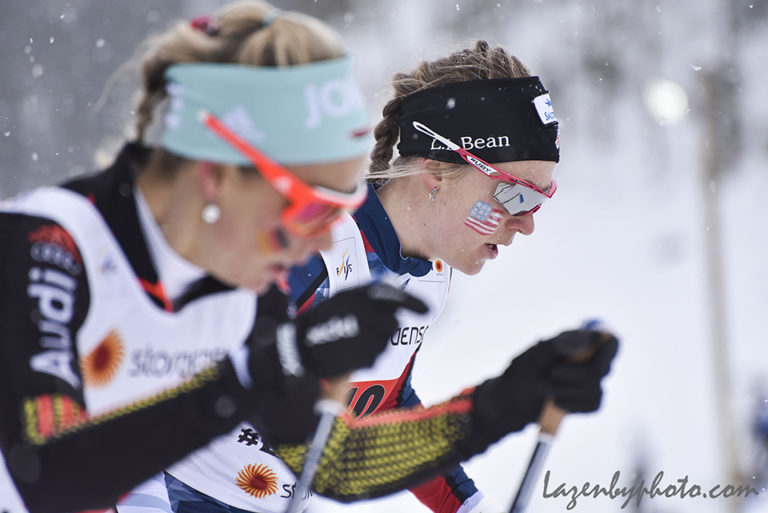
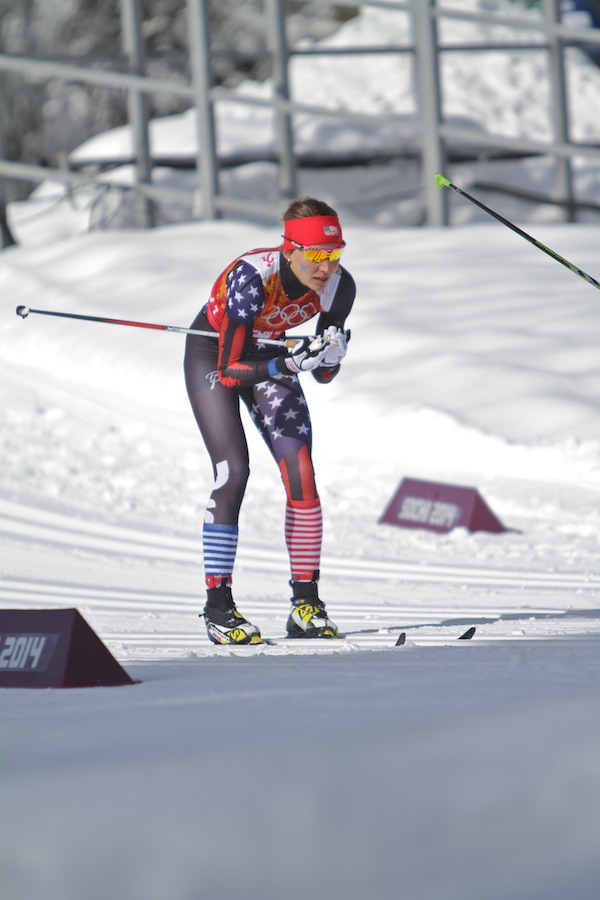
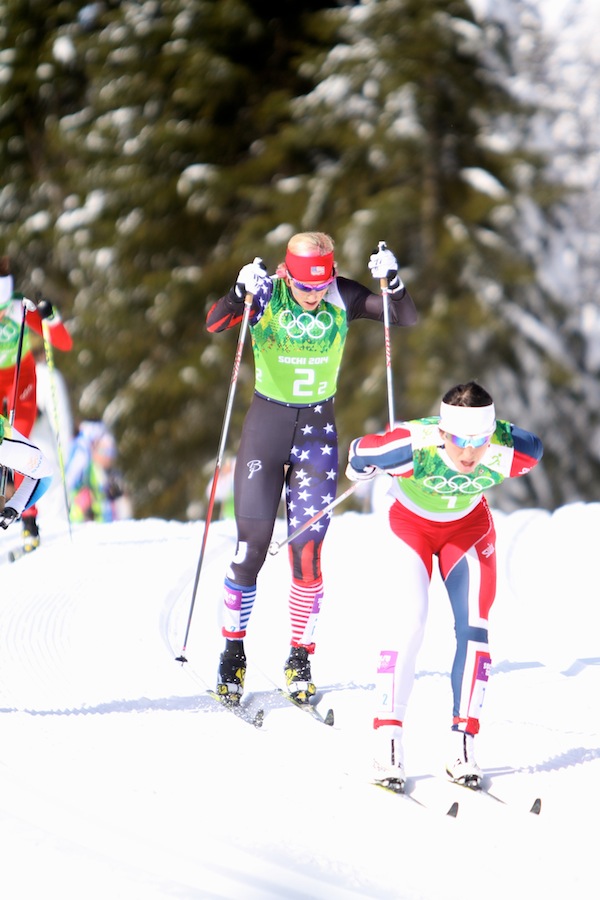
American Sadie Bjornsen (r) during the women’s 6 x 1.3-kilometer classic team sprint on Sunday at the 2017 Nordic World Championships in Lahti, Finland. (Photo: John Lazenby/Lazenbyphoto.com)
LAHTI, Finland — While Monday marked a rest day for skiers competing in the 2017 Nordic World Championships, FasterSkier took the opportunity to sit down and chat with Sadie Bjornsen of the U.S. Ski Team, one day after she earned bronze with teammate Jessie Diggins in the women’s 1.3-kilometer classic team sprint. Not only was it Bjornsen’s first-career World Championships medal, it was the first for the U.S. women’s program in a World Championships classic race.
Bjornsen, 27, who lives and trains in Anchorage, Alaska, claimed the third spot on the podium with Diggins after a nail-biting sprint finish. With Bjornsen racing the first leg for the U.S., two of the three times she posted were the fastest first leg splits. No small feat with names like Norway’s Heidi Weng, Sweden’s Ida Ingemarsdotter, and Finland’s Aino-Kaisa Saarinen, Slovenia’s Katja Visnar, Russia’s Yulia Belorukova, Switzerland’s Nadine Fähndrich, Germany’s Stefanie Böhler among others all on the list for the first leg.
In the interview, Bjornsen explains what the bronze medal means to her and how racing the team sprint has been a goal of hers for quite some time. She outlines some of the challenges she’s faced throughout her career up to this point and highlights the importance of her club coach, Erik Flora, of Alaska Pacific University.
(Note: the interviews were conducted in a non-studio environment and are best listened to without headphones.)
Bjornsen is entered in the women’s 10 k classic race slated to take place Tuesday, Diggins is not. The men will race a 15 k classic on Wednesday. Men’s start lists were not available at the time of publication.
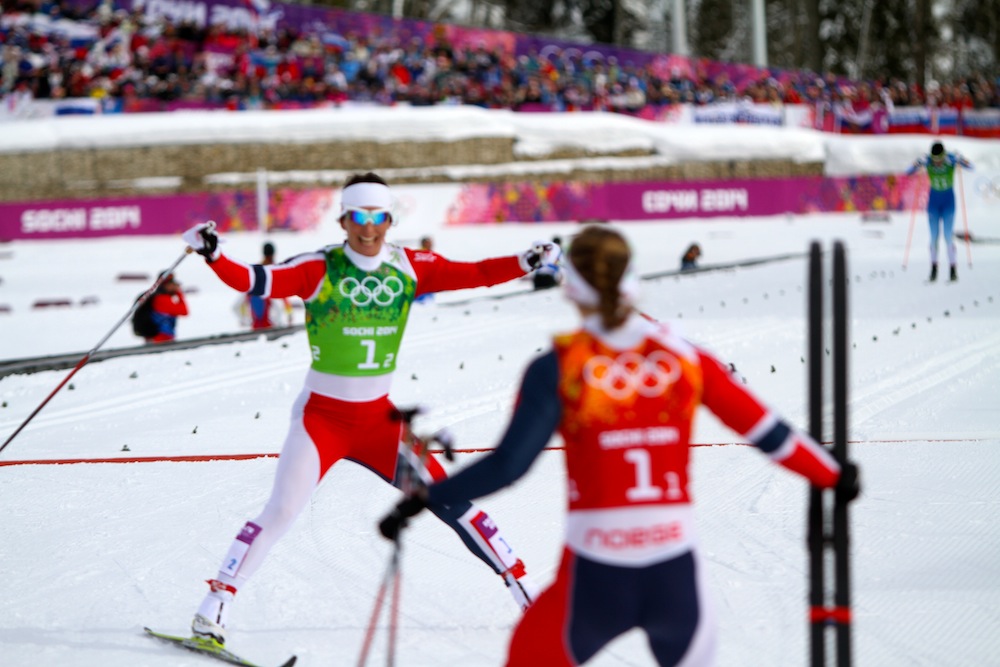
Marit Bjørgen (l) skis toward her Norwegian teammate in Wednesday’s Olympic 6 x 1.3 k classic team sprint, Ingvild Flugstad Østberg after anchoring the team to its first-ever team sprint victory at the Olympics.
KRASNAYA POLYANA, Russia — The Norwegian women’s team of Ingvild Flugstad Østberg and Marit Bjørgen made Wednesday’s Olympic classic team sprint look like a walk in the park.
At least this time, they weren’t walking.
Following a series of bad races — badly timed smøreboms at the biggest races in four years — the Norwegian wax staff finally appeared to get things right on Wednesday as their women cruised to a semifinal victory in the 6 x 1.3-kilometer team sprint.
A decade apart in age, the duo of Østberg, 23, and Bjørgen, 33, found both kick and glide on the taxing course, winning the semifinal in 16:43.45 minutes, 5.31 seconds ahead of Sweden’s Ida Ingemarsdotter and Stina Nilsson in second. The U.S. women placed third in the same semifinal, 7.91 seconds out of first after letting up in the final stretch, confident that their time was fast enough to advance to the final.
A little over an hour later, the top 10 teams from the semifinals went head to head in the final — same scramble-leg, anchor-leg order, same course, and slightly different conditions after temperatures dropped a few degrees to just above freezing later that afternoon.
The colder, the better for Norway, which struggled to finding the right wax for the fast-melting, heavily salted snow since the Olympics began a week and a half earlier. Since then, Bjørgen had been the highlight — winning the 15 k skiathlon on the opening day on Feb. 8.
After that, she face-planted in the semifinals of the skate sprint, placed fifth in the 10 k classic (after teammate Therese Johaug in third), then anchored Norway to fifth in the relay. Not bad, but not exactly up to par by Norwegian standards.
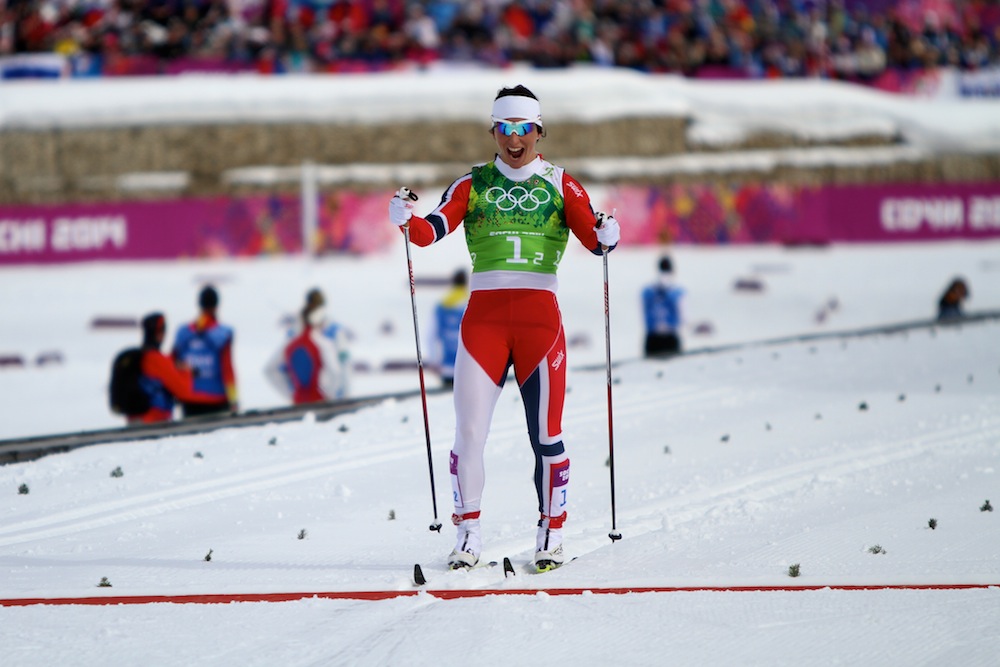
Marit Bjørgen anchors the Norwegian women’s 6 x 1.3 k classic team sprint victory at the 2014 Sochi Olympics. She teamed up with Ingvild Flugstad Østberg to do so, and it was Østberg’s first Olympic gold.
Something had to change, and by Wednesday, the Norwegians got back to their winning ways — grabbing gold in the team sprint for the first time in the event’s history at the last three Olympics. In doing so, Norway became the first nation to win a medal in all 12 Olympic cross-country events.
“The waxing team has done a very good job,” Bjørgen said in a press conference after the race. “They have been working very hard the last days and today we had the perfect skis. It was a hard time in the cabin and it’s good to see that we have good skis.”
Led by a strong opening leg in the final, in which Østberg tagged Bjørgen in second, 0.11 seconds after Finland’s Aino-Kaisa Saarinen, the duo gradually blew apart the field. A 1.63-second lead over Finland by the third exchange grew to nearly 5 seconds by the fourth when Østberg started pushing the pace.
At the end of the second-to-last lap, Saarinen had reined in Østberg slightly, tagging her Finnish teammate Kerttu Niskanen just 4.21 seconds back in second. With one leg remaining, Germany’s Stefanie Böhler and Denise Herrmann were another 7.86 seconds back in third, and Sweden an additional 3.71 seconds behind in fourth.
Bjørgen proceeded to post the fastest time of the last lap, nearly four seconds faster than anyone else, and anchor the win in 16:04.05.
“I was so excited Bjørgen would be able to stand on their feet in the last turn,” Østberg told NRK, according to a translation. “I thought it would be fine, but you never know.”
Finland finished 9.09 seconds back in second, and Sweden’s Nilsson out-double-poled Herrmann for bronze about 10 seconds later.
Bjørgen had nothing but praise for her young teammate, who helped her win her second race of the Sochi Olympics and fifth total gold medal.
“She is totally raw,” Bjørgen told NRK. “She goes wonderfully well at distance races this year … so she is insanely strong.”
Østberg has looked up to Bjørgen since her early days of skiing, writing an essay about her in high school in 2007.
“The task was to write an essay about your role model,” Østberg told NRK. “I wrote that she was extremely good at skiing, strong and everything.”
Seven years later, Østberg won her first Olympic gold with that very woman.
“It’s crazy, really. I had never in my wildest imagination could have dreamed of this,” she said. “I’ve been training a lot with her and learned lots from Marit … She is a wonderful person both when things are going well and when it does not go well.”
If we’re comparing apples, it’s interesting to consider that Bjørgen was 22 when she won the sprint at 2003 World Championships. Just a year older into her athletic career, Østberg is a gold and silver medalist in Sochi, after placing second to teammate Maiken Caspersen Falla in the skate sprint.
“She is very strong, stronger than me,” Bjørgen said.
The two got a visit from Norway’s King Harald V as well, who hugged and congratulated them after the finish.
“I wonder if luck turned when the King came to Sochi yesterday,” Bjørgen told NRK. Harald reportedly came to Russia to follow Norwegian Olympians in contention for medals.
He found it in Norway’s women, who salvaged the reputation of their team on a day when the Norwegian men (with Ola Vigen Hattestad and Petter Northug) failed to make the podium (finishing more than three seconds off in fourth).
“It has been painful to see all the criticism [our wax technicians] have received recently,” Bjørgen said, according to a translation. “They work round the clock. Now it is incredibly amusing that this was the way. This is good for the wax technicians and all the support.”
For Finland, silver was good omen for more to come — as its men’s team of Iivo Niskanen and Sami Jauhojärvi won the following 1.8 k classic team sprint for their nation’s first men’s Olympic gold since 1998.
“We are so happy both of us for the men. They did really excellent work,” Saarinen said. “It was such an amazing race, so interesting to watch. We were screaming and laughing and crying, all the emotions going through.”
Skiing in fourth behind Herrmann into the stadium, Nilsson knew there was a chance for a medal if she did something spectacular. She beat Herrmann in a sprint finish, although Herrmann told reporters slow skis made her feel like “a lame duck” coming down off the last hill into the final stretch.
“When I came into the last 100 meters, I felt that I had a lot of power left, and I also saw that Denise was looking tired,” Nilsson said. “When I was right behind her I knew that I had a chance.”
She beat Herrmann for third by 1.15 seconds. Poland finished fifth, nearly 11 seconds later and 32 seconds behind Norway with Sylwia Jaskowiec and Justyna Kowalczyk. Russia was sixth (Anastasia Dotsenko/Julia Ivanova), and Switzerland seventh (Bettina Gruber/Seraina Boner). The U.S. placed eighth (Sophie Caldwell/Kikkan Randall), Austria was ninth (Katerina Smutna/Teresa Stadlober), and Slovenia 10th (Alenka Cebasek/Kajta Visnar).
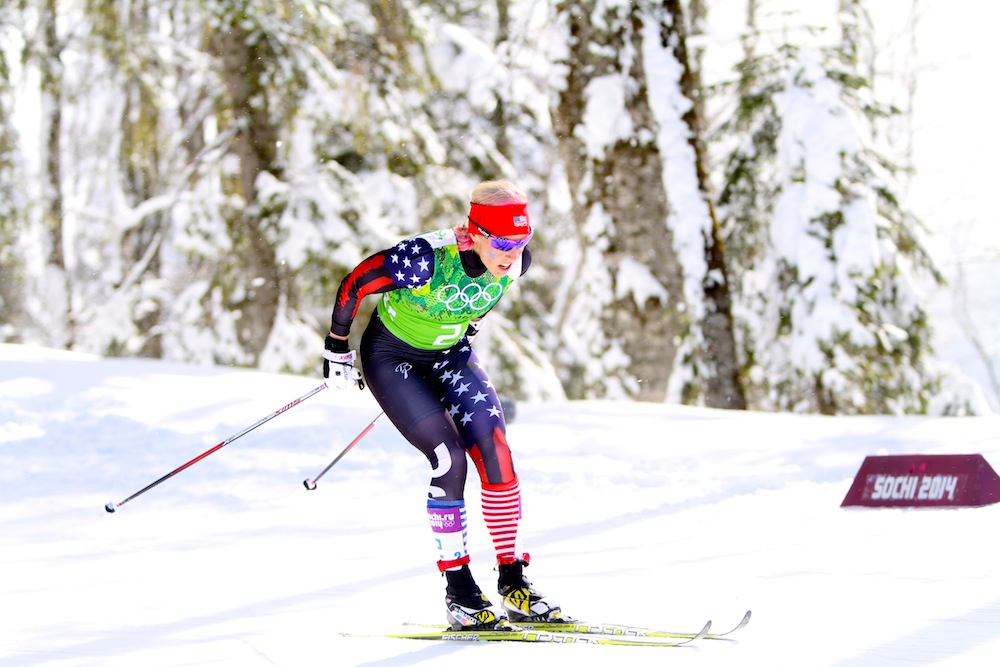
Kikkan Randall (U.S. Ski Team) skiing the anchor leg in the semifinals of Wednesday’s Olympic 6 x 1.3 k classic team sprint with teammate Sophie Caldwell. The two advanced to the finals, where they placed eighth.
FasterSkier’s coverage is made possible through the generous support of Swix.
KRASNAYA POLYANA, Russia — For the first time in Kikkan Randall’s storied legacy with the U.S. Ski Team — at least since before the 2006 Olympics — the 31-year-old Alaskan wasn’t a shoo-in for the Olympic 6 x 1.3-kilometer team sprint on Wednesday.
She had been officially named the night before, selected by U.S. Ski Team (USST) coaches out of at least four athletes whom head coach Chris Grover described as almost “identically matched in their abilities.”
But the fact was, Randall had the most experience, and her coaches said she looked good in training. If you were going to take a gamble in a classic team sprint, which generally isn’t the U.S. team’s forte, it wasn’t crazy to go with her.
U.S. scramble skier Sophie Caldwell (r) chases Sweden’s Ida Ingemarsdotter in the semifinals of Wednesday’s Olympic 6 x 1.3 k classic team sprint in Krasnaya Polyana, Russia. Caldwell and teammate Kikkan Randall made the final and placed eighth overall, while Sweden won bronze.
Sophie Caldwell was the other pick — justified after Caldwell, 23, became the first American woman to place as high as sixth in an Olympic cross-country race. She had finished sixth in the freestyle sprint last week, surpassing Randall’s previous individual best of eighth in the 2010 Olympic classic sprint.
You also had the revenge, or avenge, factor coming into play. Randall had her run for an Olympic medal cut short when she was eliminated in the quarterfinals of the skate sprint; four days later, she scrambled for the U.S. women’s relay, which placed ninth.
“I was really excited coming into today,” Randall said of the team sprint. “I was looking at every race here at the Olympics as a new opportunity for me. We know Sophie has been skiing so well so I was really excited about her possibilities.”
Third in the second semifinal behind Norway and Sweden, respectively, Randall had essentially eased up after the last downhill when she heard her coaches tell her she was in “pretty solid qualifying position,” she recalled.
Fighting for second with Sweden’s Stina Nilsson, Randall listened to their advice and decided not to go for the automatic qualifying spot in the top two.
“I knew that I didn’t need to totally dig deep in that final stretch there, knowing that the pace would most likely be faster in the final,” she said.
With Randall anchoring, the Americans finished 7.91 seconds behind Norway’s Ingvild Flugstad Østberg and Marit Bjørgen in first, and 2.6 behind Sweden’s Ida Ingemarsdotter and Nilsson in second. They were the first lucky losers in their semifinal, nearly 11 seconds ahead of Switzerland’s Bettina Gruber and Seraina Boner, who made it in fourth.
In the next hour or so before the final, Caldwell said she and Randall mostly put their feet up and rested as much as possible before racing three more times apiece around the 1.3 k course.
Strategy was tough to preplan, Caldwell said, especially given the challenging terrain and Olympic field. Before the final, the snow initially softened under sunny skies and T-shirt-like temperatures. And hour later, it was considerably colder than the semifinals, with temperatures dropping to a couple degrees above freezing.
Sophie Caldwell (U.S. Ski Team) sticks with the leaders in the semifinals of Wednesday’s Olympic 6 x 1.3 k classic team sprint in Krasnaya Polyana, Russia. Caldwell and teammate Kikkan Randall made the final and placed eighth overall.
Ready for anything, Caldwell said she did her best to stay in contact for the first leg of the final. She had her work cut out for her — the other semifinal winner, Finland’s Aino-Kaisa Saarinen (scrambling for teammate Kerttu Niskanen) had pushed the pace out of the start with Østberg and Ingemarsdotter. Caldwell said the pace was noticeably faster than her semifinal and turned out to be “a fight the whole time.”
She held her own, despite some contact with Ingemarsdotter on the last downhill before the exchange, tagging Randall in fourth, 1 1/2 seconds behind Saarinen up front.
“When you make the finals like this, you kind of just want to hang on for as long as possible until you blow up,” Caldwell said. “Maybe if you’re one of those top teams there’s pacing involved, but for someone like me, it’s basically hang on for dear life for as long as possible.”
From there, Bjørgen broke away for Norway and Randall moved to fifth behind Germany’s Denise Herrmann. By the end of the lap, Randall was in sixth, 4.7 seconds behind Poland’s Justyna Kowalczyk in fifth and 2.6 seconds back from Herrmann.
By the second exchange, Bjørgen had opened up a 2.84-second gap on Niskanen in second, who was just half a second ahead of Nilsson in third.
The next time around, Caldwell held their position in sixth, but came through 15 seconds out of the lead and 10.6 seconds out of medal contention. Randall completed the next lap in seventh place, 25 seconds behind Norway in the lead and 15 seconds back from third.
The Americans’ chances of finishing on the podium weren’t impossible, but the task became increasingly harder as Norway extended the gap and Finland consistently skied in second behind them. Sweden and Germany ultimately sprinted for third, with Nilsson getting the one-second edge for bronze.
Caldwell and Randall placed eighth, 44.03 seconds behind the Norwegian gold medalists and about 25 seconds off the podium. They finished 23 seconds behind Germany in fourth, 12.5 seconds back from Poland in fifth, three seconds behind Russia in sixth, and 2.6 seconds behind Switzerland in seventh. Before the second-to-last exchange, the two Americans slipped to eighth, nearly 35 seconds behind the leaders.
“I think one of my strengths is being able to follow people, and try to go a little easier than they are.” Caldwell said. “Because it went out so quickly, I went really hard that first leg and then the rest of the time, it’s a lot harder for me to be able to catch people than if they take it out at an easier pace — then that helps me, but they didn’t.”
Caldwell said she has a “little ways” to go until she can dictate the pace in races like these, which require both fast-twitch and endurance abilities.
“Distance skiing is something I’ve been working on a lot, and I think I need some big jumps,” she said. “The three-minute break in between [legs] definitely helps me, but it’s still kind of a distance effort.”
“It’s certainly not the Olympics I was hoping for. … It’s two weeks out of four years. You hope to find the best shape you have ever had, and unfortunately for me, I missed the mark somehow. I am not sure quite why.” — Kikkan Randall
Four years ago, the U.S. women placed sixth in the freestyle team sprint with Randall and Caitlin (formerly Compton) Gregg. Last year, Randall and Jessie Diggins teamed up for a first-ever U.S. gold at World Championships, also in a skate team sprint.
American Kikkan Randall (2) chases Norway’s Marit Bjørgen in the semifinals of Wednesday’s classic team sprint at the Sochi Olympics. Both advanced to the final, where Norway won and the U.S. women placed eighth.
But classic sprinting is different, especially for the U.S. women’s team.
“They left everything out there on the course; they went as hard as they could,” Grover said. “We weren’t ready as a nation. We weren’t ready to ski the pace of the final, that those three teams were racing in. … The Norwegians, the Swedes and the Finns were ready to go out and lay down six really fast legs right from the get-go.
“Last year at the World Championships, we have the women to do that, especially in the skate sprint,” he added. “We’re just not quite there yet in classic.”
Randall said she felt good warming up and anticipated that the final was going to be equally hard for everyone in it.
“Team sprints are challenging in that you never really feel good, you have to convince yourself that you do,” she said. “The teams that have shown that they are in great shape here really showed their strength today, and it was cool to see them really push it from the gun, not be too strategic, just put it out there. You could see by the bodies at the finish that everybody went pretty hard.”
As for her race, Randall said she came in ready to go and prepared for a faster race. But, similar to the relay a few days ago, her legs felt “flooded” on the first hill.
“I just didn’t have the same pop that I had this morning, kind of a similar theme that I’ve had all through the last couple of weeks,” she said.
Regardless, she continued to fight for a top place — even if it wasn’t on the podium.
“Even though we weren’t up there fighting for the medals where we wanted to be, I knew Sophie was skiing well and she could go for any position,” Randall said.
Caldwell said it was simply a dream to be named to a two-person Olympic team with Randall.
“It’s been a lot more than I could have imagined,” she said of after the last race of her first Olympics. “I had a really strong skate sprint, probably the best race of my life, and after that I was just kind of happy to get any start that I was offered. I’ve dreamed of being on a sprint relay with Kikkan for as long as I can remember, so I was pretty excited.”
Randall said her fourth Olympics left something to be desired, but also recognized that her struggles with timing peak performances boiled down to the nature of the sport.
“If it was an exact formula, everybody would be peaking,” Randall said. “And that’s probably what the intrigue is at the Olympics: who is going to get it right and who is not. We tried the best we could. I’ve had a long career; we had lots of good examples. We put together a plan that we really felt confident in.”
“I’ve dreamed of being on a sprint relay with Kikkan for as long as I can remember, so I was pretty excited.” — Sophie Caldwell
Randall said there were some “funny things with the venue and snow” that contributed to some of her team’s lackluster results, in certain races on both the women’s and men’s side.
“When you give it everything you had and you try hard, you have to be satisfied with that,” she said. “The medals are nice and the results are great, but yeah, we gave it the best we had. I’m still going to walk away from this Olympics satisfied that we did that.”
That said, her accumulation of results in three Olympic races, with the team-sprint eighth being her best, wasn’t what she envisioned coming in.
“It’s certainly not the Olympics I was hoping for,” Randall said. “It’s a funny thing; it’s two weeks out of four years. You hope to find the best shape you have ever had, and unfortunately for me, I missed the mark somehow. I am not sure quite why.
“Every race I come into, I’m hoping to turn it around. I just haven’t had the feelings that I’ve had in my races coming in,” she added. “It’s not the way I wanted it to go, but I promised myself coming in that I wanted to give it everything I had, and I know I’ve done that. We’ll have another chance in four years and I know these girls can do it.”
Randall hasn’t ruled out competing at the next Winter Games in PyeongChang, South Korea.
— Nat Herz and Chelsea Little contributed reporting
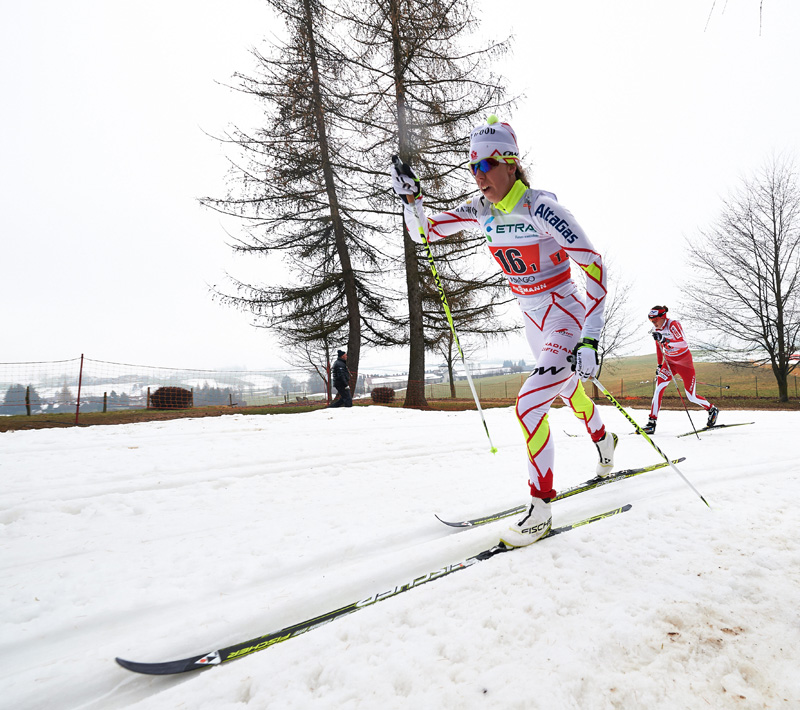
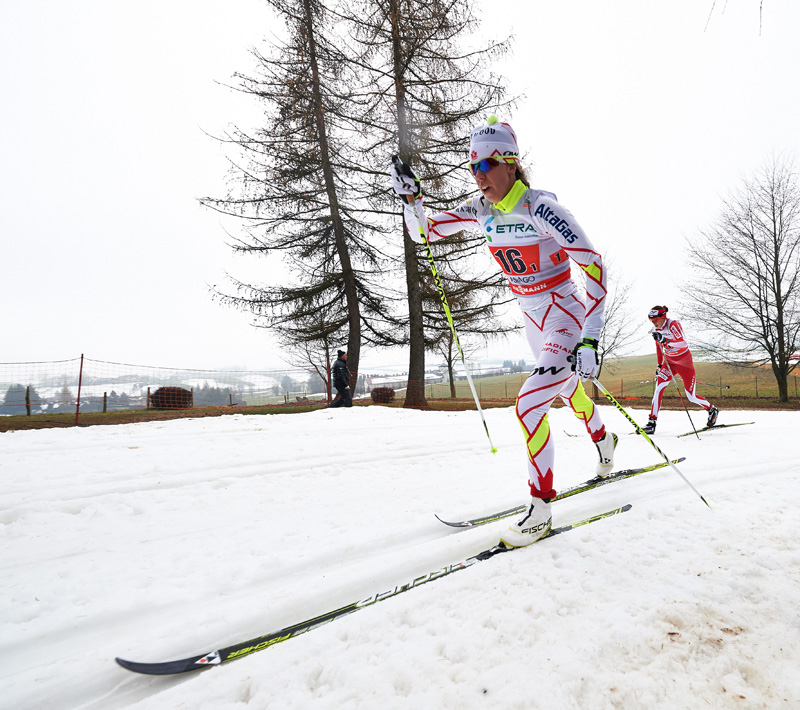
Canadian World Cup Team member Perianne Jones striding in the second women’s semifinal of the 6 x 1.25 k classic team sprint on Dec. 22 in Asiago, Italy. She and teammate Dasha Gaiazova placed eighth in the heat for 16th overall. (Photo: Fischer/Nordic Focus)
One place better and they would’ve been in the finals. That was the takeaway for the Canadians on Sunday, with two women in the first of two semifinals at the World Cup 6 x 1.3-kilometer classic team sprint in Nove Mesto, Czech Republic.
Perianne Jones and Dasha Gaiazova combined for seventh in the heat, 26.83 seconds behind Finland’s winners Mona-Lisa Malvalehto and Aino-Kaisa Saarinen, who went on to place second to Norway in the final.
Canadian Dasha Gaiazova in the Asiago World Cup classic team sprint on Dec. 22. (Photo:Cross Country Canada/Nordic Focus)
After the first 1.3 k leg, Jones tagged Gaiazova in eighth, and Gaiazova skied the second-fastest second lap to bring them to fourth. Jones dropped two spots to sixth, just six seconds behind Finland up front, and Gaiazova handed off in seventh after her second leg.
With two laps to go, Jones held their position in seventh, coming through the last exchange nearly 13 1/2 seconds behind the leaders. Gaiazova skied the last lap in seventh, finishing nearly 18 seconds behind France in sixth.
While France’s Aurore Jean and Celia Aymonier advanced in sixth with a fast-enough time, 9.05 seconds behind Finland, the Canadians did not.
“Dasha and I skied as hard as we could,” Jones wrote in an email. “It was hard to see that we were the next fastest team, but we’ve been on the other side of that line also. It’s a good reminder going into Sochi that every second really counts when only the top 2 move on, it can seem like you are totally out of the race, but it’s all dependent on how fast the other heat skis.”
Jones and Gaiazova ended up 13th overall, an improvement from three weeks earlier when they placed 16th in the classic team sprint in Asiago, Italy.
“I was happy, I skied much better than in Asiago. I think my form is coming, I just have to continue being patient,” Jones wrote. “These next few weeks are critical. We are staying here in Nove Mesto until Thursday, and then heading over to Poland. I’ll race the sprint on the weekend, and then we have our pre-games camp in Seiser Alm, [Italy].
“I’m really excited,” she added. “Although the results don’t necessarily reflect this, I’m getting stronger every week. There are signs that I’m getting back to where I want to be, a lot can change in 3 weeks! I just have to continue to be patient and respect how I’m feeling, but overall I feel good heading into the games!”
Gaiazova could not be reached for comment. The Canadian men did not race in Nove Mesto this past weekend.