From the FasterSkier archive — posts syndicated from athletes’ and coaches’ own blogs between 2004 and 2012, kept online as published. Current coverage is at fasterskier.com.

Tag: 9 k hill climb

  • Back On Form, Johaug Climbs to the Overall Tour Victory; Diggins 6th, Brennan 7th in Stage (Updated)

    Back On Form, Johaug Climbs to the Overall Tour Victory; Diggins 6th, Brennan 7th in Stage (Updated)

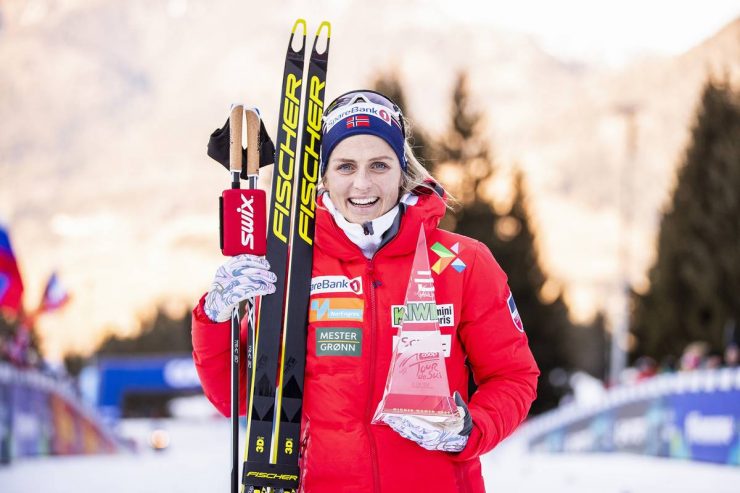
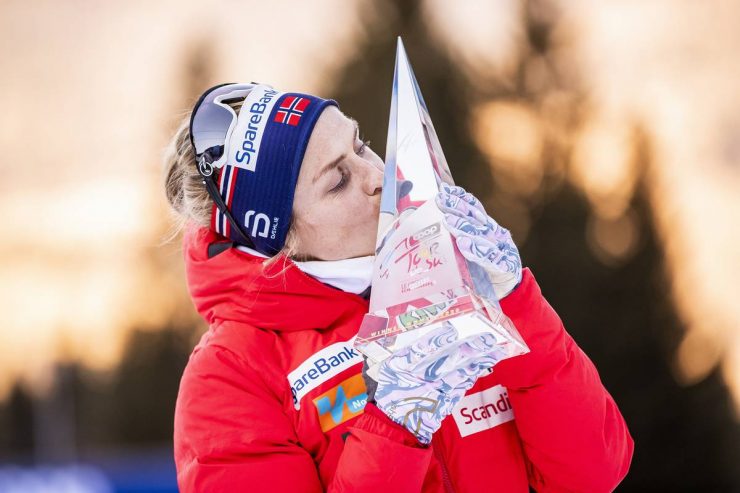
    Therese Johaug: queen of the hill. (Photo: NordicFocus)

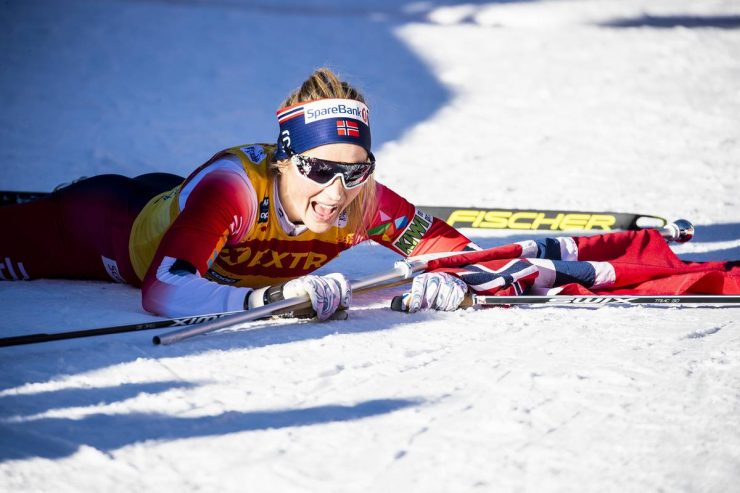
    The fateful Alpe Cermis. The 10-kilometer capstone of the Tour de Ski, athletes complete the 1.5 k sprint loop before following the river valley down to the base of the alpine hill, climbing steeply for nearly 400 vertical meters to the finish. Bodies aching with the cumulative fatigue of the tour, racers are totally spent at the finish of the event. Crossing the line, they collapse with their faces pressed into the snow gasping for air and writhing in lactate-induced misery. 

    And so it was today.

    First, a look back on Tours of the past. Unlike in the men’s event, the fastest skier up the Alpe Cermis has been the overall tour winner over the last four years. 

    Last year, Ingvild Flugstad Østberg was the fastest up the hill climb in 35:15.0 to take the overall win. Østberg was 42 seconds faster than the next skier, Krista Pärmäkoski of Finland. In 2017 and 2018, Heidi Weng was the first up the mountain by a similar margin. And four years ago in her most recent tour performance, Therese Johaug dusted the field, winning the day by a margin of 1:25.9. That’s nearly double the already large differential of her teammates. 

    Dubbed by Devon Kershaw an “once in a generation athlete,” Johaug has over 100 career podiums to her name, over 50 of which have been wins. 

    With this insight, it seemed safe to bet on Johaug in the final stage. However, the Norwegian superstar has proved to be beatable in this tour, much to everyone’s surprise. 

    Johaug was out-sprinted by Østberg in the final meters of the 10-kilometer classic pursuit in Stage 4, and the next day, she missed her first distance podium since she took 5th in the 5k skate in Toblach during Stage 4 of the 2016 Tour de Ski. (Johaug missed the 2017/18 and 2018/19 seasons while serving an 18-month ban after testing positive for the anabolic steroid clostebol, which was contained in a lip cream she used after sustaining a severe sunburn.)

    Heading into the final stage, the overall standings looked like this: Norway’s Astrid Jacobsen trailed Johaug by three seconds. Natalia Nepryeava lurked 14 seconds back, and Ingvild Flugstad Østberg was 23 seconds back. Ranked as the top American, Sadie Maubet Bjornsen sat in 8th (+1:58), with Jessie Diggins 11th (+2:53).

    The infamous climb up the Alpe Cermis. (Photo: Screenshot FIS Broadcast)

    Historically, the event has been run in pursuit format: the first person to the top of the hill wins. This round features a mass start format; racers will need to drop and gap their chasers to earn time in the standings. Identifying rank in the overall standings required lots of quick math to follow the flux in deficits; eleven seconds between Jacobsen and Nepryaeva heading into the final stage, nine seconds between Nepyraeva and Østberg, and so on. 

    One final note before we begin: Ebba Andersson of Sweden, who was ranked 6th in the standings (+1:07), withdrew from the Tour before the final stage. 

    As expected, the pace went out conservatively around the sprint loop. Racing on a narrow band of man-made snow that frequently contrasted the bare ground and asphalt beside it, Johaug stepped to the front, a string of her teammates that included Heidi Weng, Østberg, Jacobsen,  and Nepryaeva. 

    As they hit the hill, Johaug put her head down and got to work. She quickly created a gap to Heidi Weng and Østberg, who at first were willing to match the effort early in the climb, but quickly laid off, unwilling to succumb to temptation and risk flooding their legs with lactate too early.

    It became a race for second place and a race against the clock. In the lead, Weng pulled Østberg and Nepryaeva up the hill, a gap to the next skiers. 
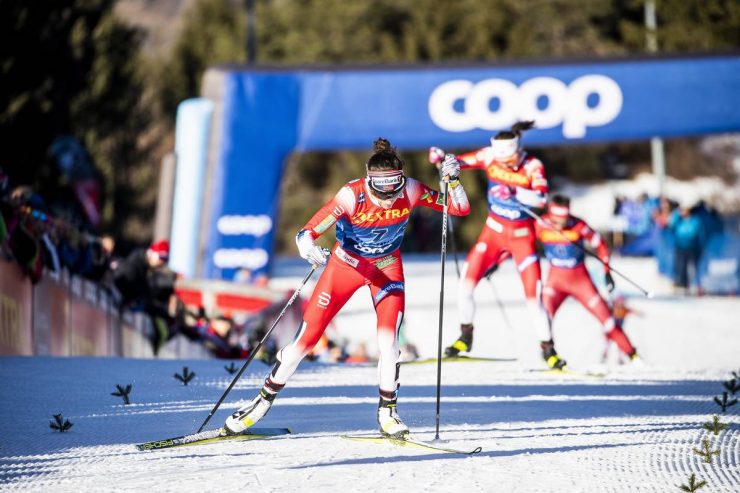
    Heidi Weng (NOR) races for second place up the Alpe Cermis with Ingvild Flugstad Østberg (NOR) and Natalia Nepryaeva (RUS) chasing. (Photo: NordicFocus)

    With Jacobsen nowhere in sight, Nepryaeva and Østberg fought for podium positions. At 9 k, Weng led Østberg by roughly four seconds, followed by an equivalent gap to Nepryaeva. Though Østberg matched Weng stride for stride, the Norwegians were not able to pull away from the Russian. 

    Meanwhile, Johaug steadily chugged up the hill, on her own by over a minute. As the grade mellowed in the final 200 meters, she had energy left to ski V2, her technique masking the fatigue she must have felt. 

    Waving the Norwegian flag high, Johaug shrieked with joy and relief as she stopped the clock at 34:21.6. 
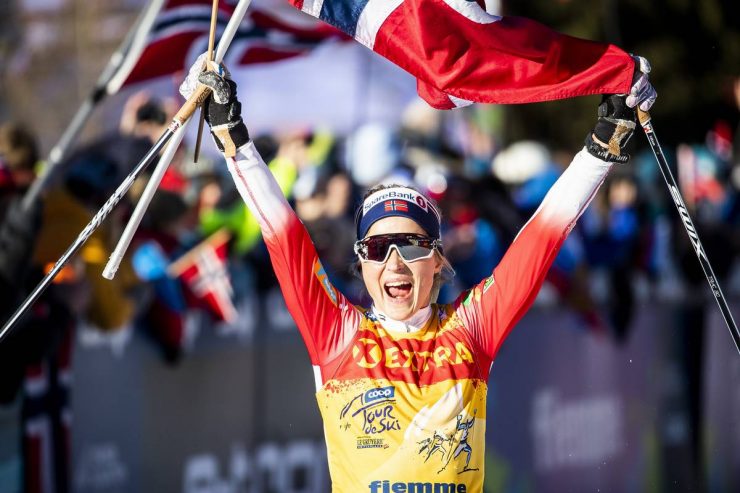
    “I’m really, really happy now. My goal was, of course, when I’m going down here to fight for first place in the overall and today I do it. It has been seven hard days, but I am really, really happy now to come up here. I’m really looking forward to end this Tour de Ski because you wake every morning and are so nervous, but tomorrow I’m free.”

    Firing on all cylinders, Heidi Weng crested the steep pitch, powering through the gradually ascending final meters for second (+50.3). Østberg followed in her wake for third (+54.5), followed by Nepryaeva in fourth (+57.1). 

    Throwing a boot to minimize her time back, Natalia Nepraeva finished 4th in the hill climb and 2nd in the overall 2019/2020 Tour de Ski. (Photo: NordicFocus)

    So how did it all shake out? Therese Johaug took the overall Tour with an aggregate time of 2:28:18.6. Nepraeva landed the second spot on the podium (+1:11.1), followed by Østberg in third (+1:17.5). Weng finished 4th (+1:37.3), with Jacobsen behind her rounding out the top 5 (+2:13.4).
    Winding along the Marcialonga in the lead group, Diggins kept her position in the top ten throughout the day. At first, she trailed Jacobsen, Theresa Stadlober of Austria, and Charlotte Kalla of Sweden as they began the climb, but Kalla and Jacobsen fell off the pace. 

    Losing contact with Stadlober, Diggins was in the unfortunate position of skiing alone. Despite having no one to chase, she climbed steadily, sitting in 6th at 9 k with her teammate Rosie Brennan closing from behind.
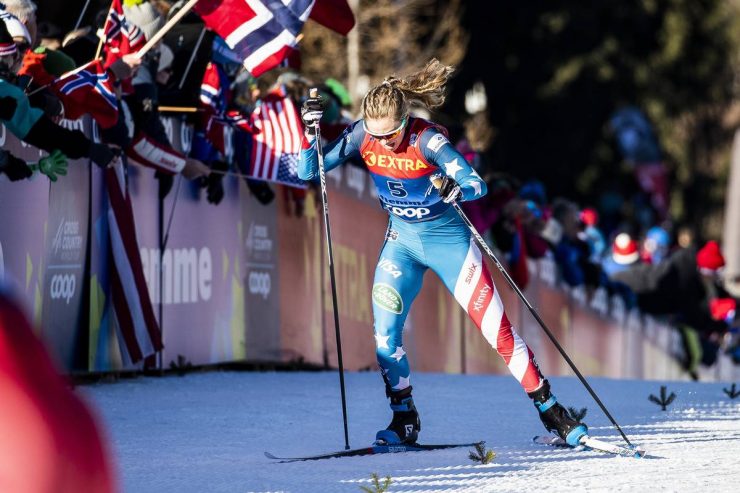
    Pure grit: Jessie Diggins ascends the final meters of the Alpe Cermis hill climb in 6th. (Photo: NordicFocus)

    Holding her position, Diggins crossed the line for 6th (+1:51.1), chipping time off her deficit in the overall standings. With the hill climb, Diggins leapfrogged into the top 10, finishing 9th in the overall (+4:44.1).

    “Today I was happy with my climb; I think I managed to pace it right so that I could keep moving up the hill steadily without blowing up – a line that is hard to find, but pretty crucial to get right! I had good energy and it’s nice to know that my fitness is in a good place even at the end of the tour,” Diggins wrote.

    “Overall, this tour has been challenging in that I had many races where my fitness and effort weren’t reflected in the results. But I was proud of how I carried myself, contributed to having a positive team atmosphere and stayed positive without ever giving up, on the days when I had competitive skis but more important, on the days when I did not. It took a lot of positive energy, but now I can leave the Tour really proud of my mental toughness and ready to soak in all the hard work I put out there!”

    Brennan and her teammate Sadie Maubet Bjornsen sat in the mid-teens at the base of the climb. As the grade increased, Brennan left Maubet Bjornsen and began picking off the women in front of her. Brennan advanced from 15th at the base of the climb to finish 7th (+1:58.0). 
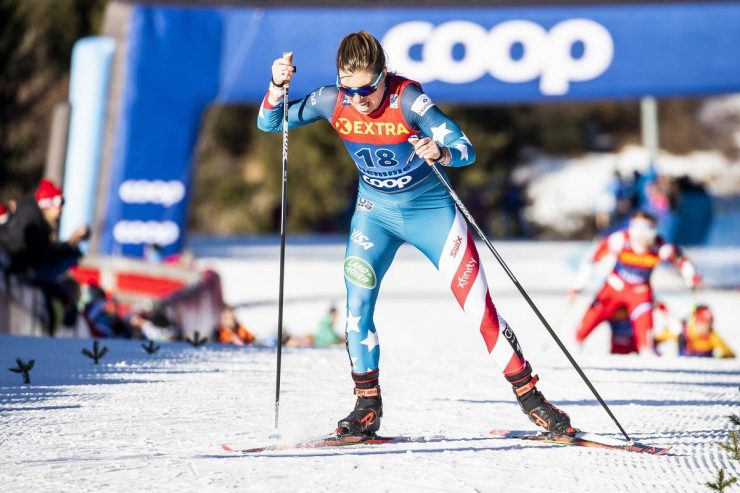
    Rosie Brennan climbs to 7th place in the final stage of the 2019/2020 Tour de Ski. (Photo: NordicFocus)

    Post-Tour de Ski Comments from Rosie Brennan

    Maubet Bjornsen finished 13th (+2:42.6), and Katharine Ogden finished 21st (+3:46.5). 

    In the overall standings, Maubet Bjornsen bumped up one spot into 7th (+4:40.6). Brennan finished 15th in the Tour (+7:11.0), and Ogden 28th (+12:26.5). 41 women finished the Tour. 

    “Wow, it feels good to make it to the top of that climb,” Maubet Bjornsen emailed. “I think it is safe to say, making it up that alpine slope after six hard days of racing is quite possibly the most physically painful thing I experience. Just crossing the line is such an achievement. This is only my third time I have made it, so it still feels just as exciting as the first one!

    “This tour has had its ups, downs, and painfully near misses. Despite the rollercoaster, I feel like I gained confidence in my fitness and my skiing throughout the process. Not only that, I had my best ever Tour de Ski finish, ending in 7th place.
    “No doubt I will come away from this tour both physically and mentally tougher!
    “Thank you to the support crew who allowed it to happen, and thanks for all the cheers of encouragement both on the tough and wonderful days!”

    Results | Overall Tour Standings

    The 2019/2020 Tour de Ski podium:
    Therese Johaug (NOR) took the win ahead of Natalia Nepryaeva (RUS) and Ingvild Flugstad Oestberg (NOR) in third (l-r) . (Photo: NordicFocus)

     

  • Ustiugov Full of Emotions, Few Words After Winning Tour de Ski: ‘We Did It’; Harvey 7th

    Ustiugov Full of Emotions, Few Words After Winning Tour de Ski: ‘We Did It’; Harvey 7th

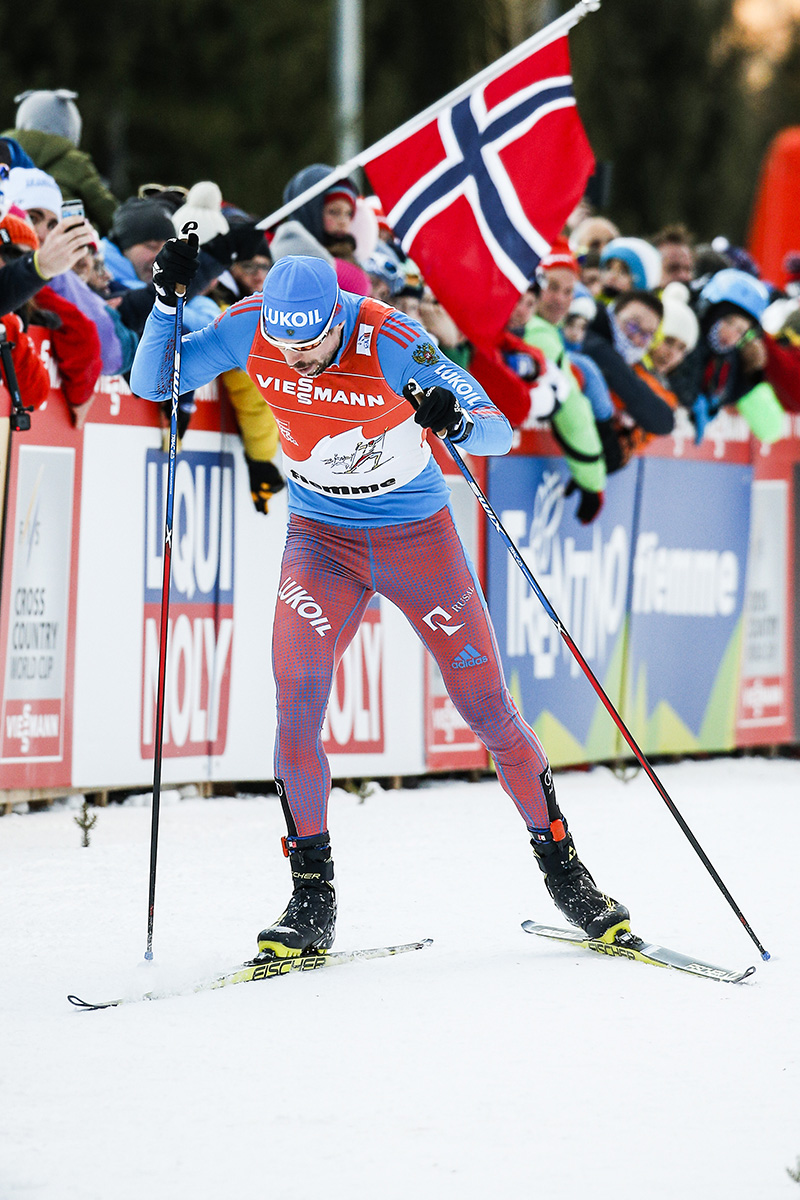
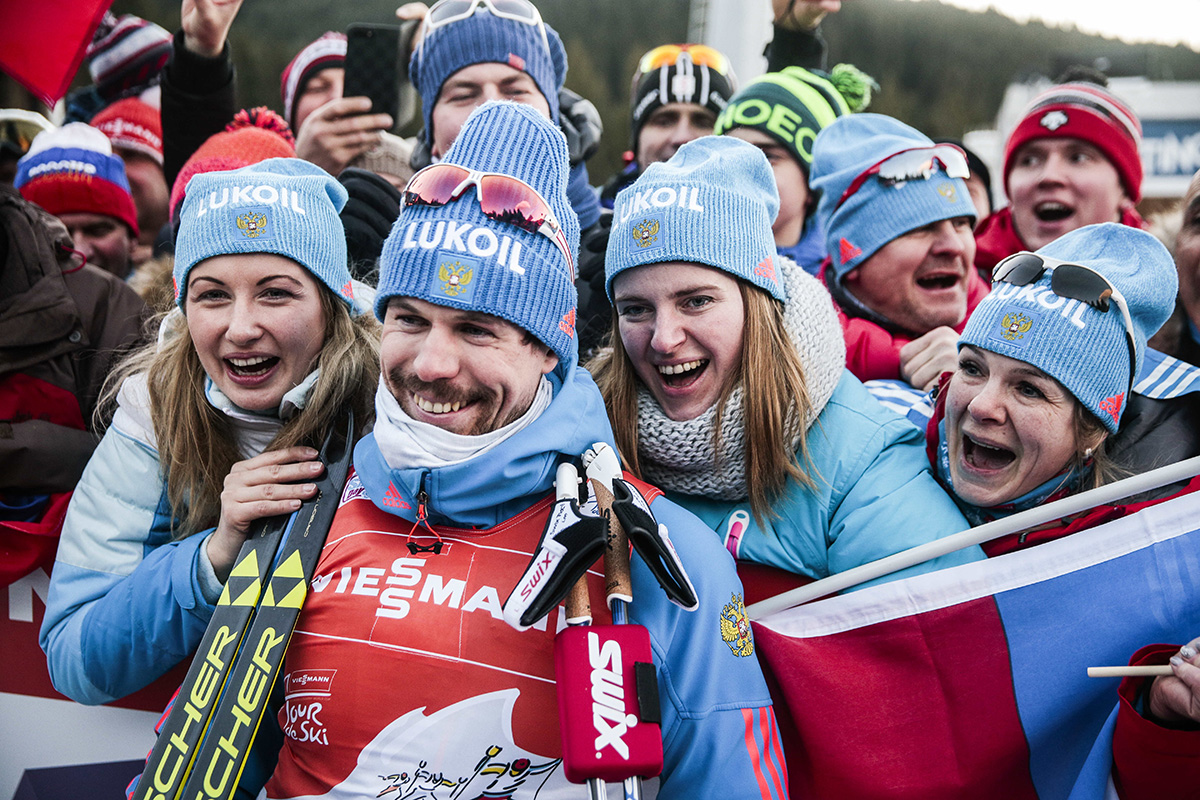
    Russia's Sergey Ustiugov celebrates with his supporters after winning the final climb and his first Tour de Ski overall title on Sunday at Alpe Cermis in Val di Fiemme, Italy. (Photo: Fischer/Nordic Focus)
    Russia’s Sergey Ustiugov celebrates with his supporters after winning the final climb and his first Tour de Ski overall title on Sunday at Alpe Cermis in Val di Fiemme, Italy. (Photo: Fischer/Nordic Focus)

    Note: This article has been updated to include comments from Noah Hoffman.

    There were moments in Sunday’s 9-kilometer freestyle climb up Alpe Cermis, the seventh and final stage of the 2017 Tour de Ski, that Norway’s Martin Johnsrud Sundby appeared to be putting some serious time into Russia’s Sergey Ustiugov up front.

    In the first two kilometers, Sundby as the runner-up entering the day had gained three seconds on Ustiugov, who had won all but one stage so far in the Tour. Norway’s reigning Tour de Ski champion lost about six seconds over the next four kilometers leading up to the climb itself, which began in earnest around 6.2 k, but after that, Sundby regained about 13 seconds on Ustiugov by by 8.1 k.

    Despite looking relatively strong on a course that ascends an alpine run with an average grade of 28 percent, with less than a kilometer remaining, Sundby was still 53.8 seconds behind Ustiugov. At one point, an unofficial, TV-generated speedometer estimated Sundby was going 1 k per hour on one of the steepest sections of the course. At that rate, there was no possible way he could catch Ustiugov, unless the Russian stopped before the finish line at the top.

    Ustiugov didn’t let off, and actually took back nine seconds on Sundby in the final kilometer. The Russian crossed the line without anyone in sight in 30:27.7 minutes for his first Tour de Ski title at the ripe age of 24. Sundby finished 1:02.9 minutes later — with a net gain over his 1:12-minute starting deficit — to place second overall.

    “There is no other venue in the world that makes the best skiers in the world look like amateurs.” — Canada’s Devon Kershaw on the Tour de Ski’s final climb up Alpe Cermis

    “He’s a worthy winner,” the 32-year-old Sundby told NRK after. “The gap was too great, and my chances would have been slim either way.”

    He noted that his leadup to the race wasn’t ideal.

    “I’ve had a stomach problem all night, so the buildup to the race wasn’t that good. It’s frustrating,” Sundby said. “It was brutal.”

    Russia's Sergey Ustiugov racing to the victory in the final climb of the 2017 Tour de Ski on Sunday in Val di Fiemme, Italy. He finished more than a minute ahead of Norway's Martin Johnsrud Sundby (not shown) in second after starting with a 1:12-minute lead. (Photo: Fischer/Nordic Focus)
    Russia’s Sergey Ustiugov racing to the victory in the final climb of the 2017 Tour de Ski on Sunday in Val di Fiemme, Italy. He finished more than a minute ahead of Norway’s Martin Johnsrud Sundby (not shown) in second after starting with a 1:12-minute lead. (Photo: Fischer/Nordic Focus)

    Overall, Ustiugov moved into second overall in the World Cup standings, 177 points behind Sundby. Before the Tour, he ranked eighth, and had won one World Cup this season: the freestyle sprint in Davos, Switzerland. This year, Ustiugov became the first man to lead a Tour from start to finish, through every stage. He lost just once, in Saturday’s 15 k classic mass start, and for a grand total of approximately 128,000 Swiss francs (about $125,700 U.S. dollars) during the Tour.

    According to an International Ski Federation (FIS) press release, Ustiugov became the first man to win five consecutive stages of a Tour de Ski, surpassing Sundby’s four-straight wins last year. After Switzerland’s Dario Cologna, he is the second-youngest man to win the Tour. (Cologna was 22 when he won it in 2009.) And he’s the second Russian to win it after Alexander Legkov (currently provisionally suspended) won it in 2013. Russia is now the second nation, other than Norway, with two different Tour de Ski winners.

    In a televised post-race interview with FIS, an emotional Ustiugov started off by thanking his original coach.

    “As for now, I don’t have any emotions, no thoughts,” he said through a translator. “I did it for all my guys, so boys, we did it, and thank all of Russia. I know everyone was watching and they all were supporting me.”

    According to FIS, Ustiugov later said it was “like a dream come true. I fought very hard for this. Today was incredibly tough. I thought I was on autopilot, I did not actually realize I crossed the finish line. It is an amazing feeling to be a Tour de Ski champion.”

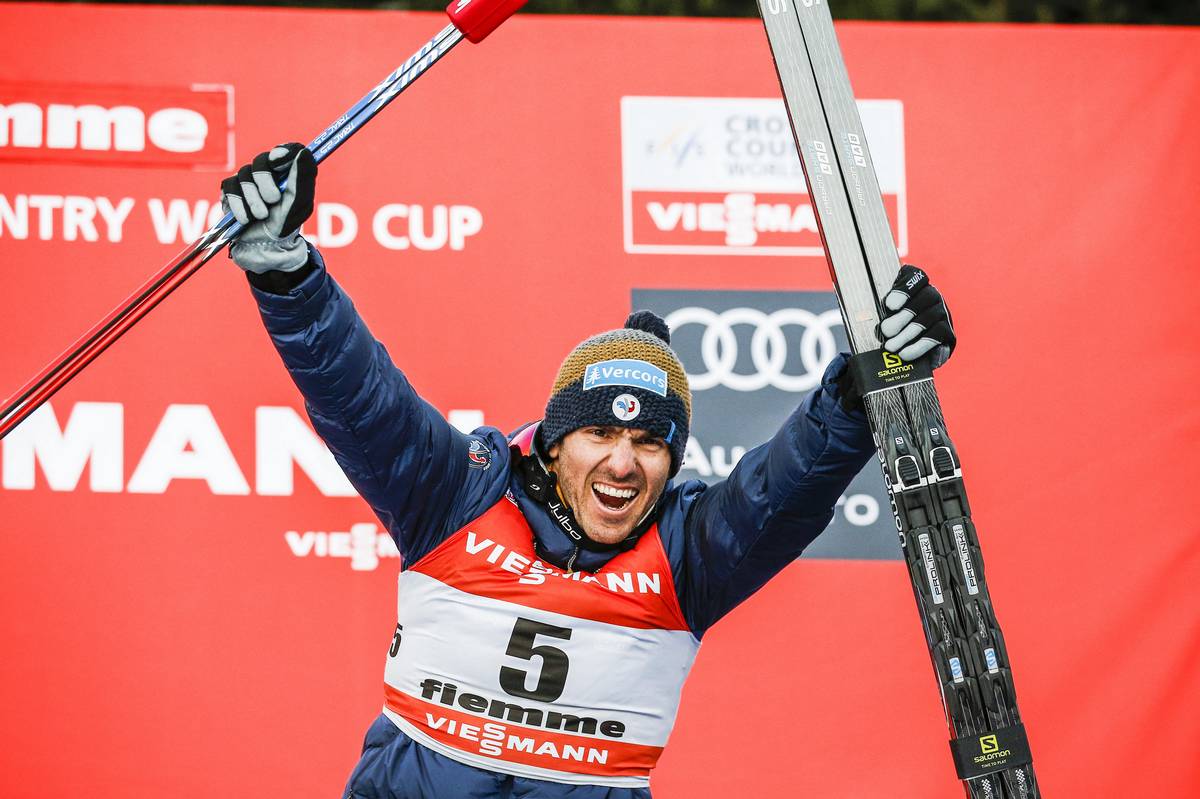
    France's Maurice Manificat celebrates his "time of day" victory in Stage 7 of the 2017 Tour de Ski, with the fastest time in the 9 k freestyle hill climb in Val di Fiemme, Italy. (Photo: Salomon/Nordic Focus)
    France’s Maurice Manificat celebrates his “time of day” victory in Stage 7 of the 2017 Tour de Ski, with the fastest time in the 9 k freestyle hill climb in Val di Fiemme, Italy. (Photo: Salomon/Nordic Focus)

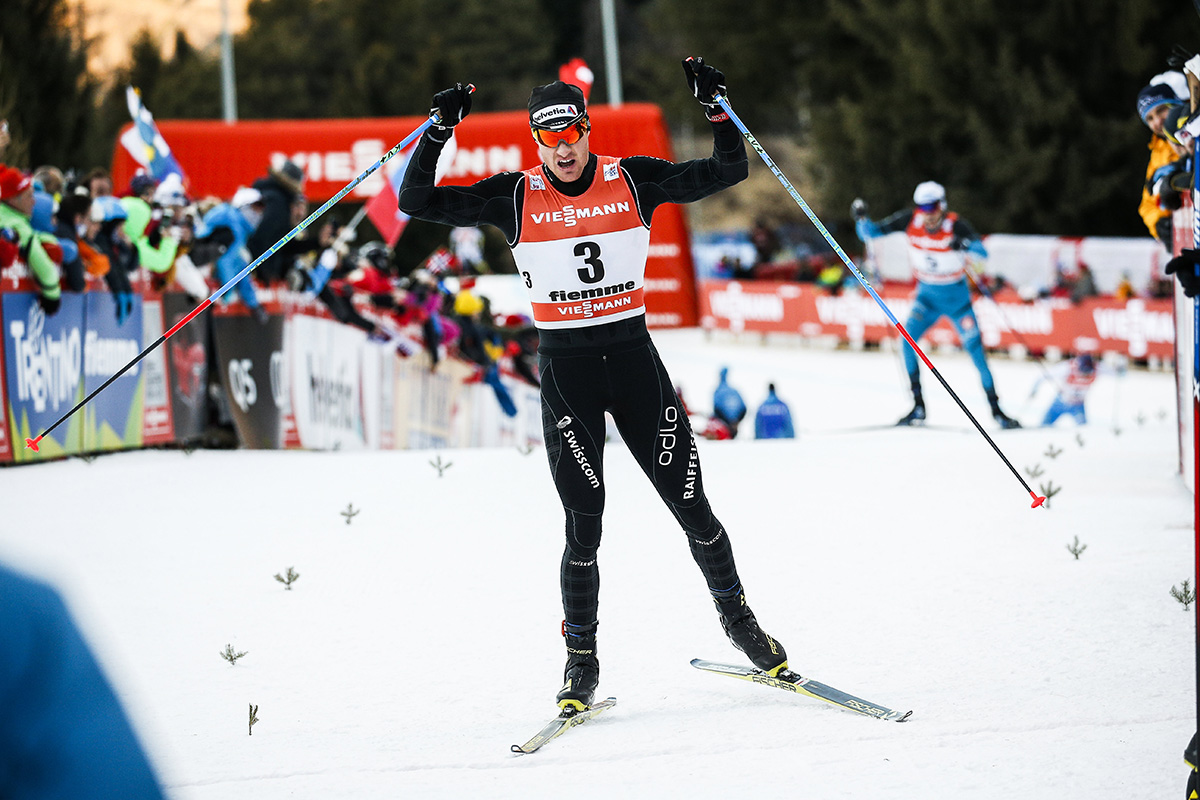
    Starting behind Ustiugov and Sundby on Sunday, Switzerland’s Dario Cologna ended up posting the fifth-fastest course time (in 29:42.7) to hang onto third overall (+1:19.1). He finished 16.2 seconds after Sundby and 7.8 seconds ahead of France’s Maurice Manificat, the “winner of the day” based on his course time (29:20.0) and fourth overall (+1:26.9).

    At the start, Cologna had 52 seconds separating him from second and 29 seconds between him and Finland’s Matti Heikkinen in fourth. Heikkinen started 1 second before Manificat and 9 seconds before Canada’s Alex Harvey, who entered the final stage ranked sixth.

    By the 4 k checkpoint, still skiing along a thin ribbon of snow winding through the valley at the base of Alpe Cermis, Harvey was leading Manificat and Heikkinen with Cologna in clear view, about 20 seconds of them. Harvey had previously caught the Frenchman and Finn by 1.8 k.

    The three continued to pursue Cologna in a hunt for third, skiing together into the base of the climb, with Manificat leading at 6.2 k, and with Heikkinen sharing the load up front though 7.1 k. Over the next kilometer, Sweden’s Marcus Hellner (who started seventh, 12 seconds behind Harvey) successfully caught the Canadian and was a second ahead of him by the 8.1 k checkpoint.

    Switzerland's Dario Cologna celebrates third in at the top of the final climb in the last stage of the 2017 Tour de Ski on Sunday in Val di Fiemme, Italy. (Photo: Fischer/NordicFocus)
    Switzerland’s Dario Cologna celebrates third in at the top of the final climb in the last stage of the 2017 Tour de Ski on Sunday in Val di Fiemme, Italy. (Photo: Fischer/NordicFocus)

    The two were 14 and 15 seconds behind Heikkinen in fourth, while Manificat began to drop Heikkinen in his quest for Cologna. With 0.5 k remaining, Manificat had caught Cologna, even leading him at one point, before Cologna passed him back and held onto his position through the finish.

    “I had to fight hard with two of the strongest climbers behind me,” Cologna told Swiss broadcaster SRF. “It was a difficult position, having to push right from the start. I went into the climb with a little gap, and could ski my own tempo, then I noticed they were getting closer. But the moment Manificat came up to me I slowed down a little, saving a little bit for the counterattack, and that worked out great.”

    Manificat finished 7.8 seconds off the overall Tour podium in fourth, but outlasted Heikkinen by 6.1 seconds for to win the “time of day” and with it, Stage 7.

    Norway’s Hans Christer Holund placed third for course time (+15.8), ahead of Hellner in fourth (+19.0). Harvey’s time ranked 14th (+1:04.9) ahead of American Noah Hoffman in 15th (+1:05.3) and Ustiugov in 16th (+1:07.7).

    Harvey ended up seventh across the line, 2:39.7 minutes behind Ustiugov and 33.9 seconds behind Hellner in sixth, for Harvey’s best Tour de Ski result. His previous best was 10th in the 2011 edition. With his seventh-place Tour finish, Harvey improved to fifth in the overall World Cup standings — after entering the seven-stage series ranked ninth in the World Cup.

    Canada's Alex Harvey racing to seventh in the men's 9 k freestyle hill climb to end the 2017 Tour de Ski in Val di Fiemme, Italy. (Photo: CCC/NordicFocus)
    Canada’s Alex Harvey racing to seventh in the men’s 9 k freestyle hill climb to end the 2017 Tour de Ski in Val di Fiemme, Italy. (Photo: CCC/NordicFocus)

    “If it was a one-day race it would be relief when you reach the finish line. Throw in six races before this race and it is absolute relief when you get to the top,” Harvey said, according to a Cross Country Canada press release.

    “It was quite good today. That was the best position ever for me up the climb, and I had the 14th best time on the day,” he said. “I was skiing with Manificat and Heikkinen, who had the top-two times on the day. I was with them for a bit, but it was just a bit too fast for me. They crushed everyone on the hill.

    “The first part is not so bad, but when you hit that first pitch your legs feel like concrete and then you have to tough it out for the last 15 minutes,” Harvey explained. “Normally you have a downhill, and flats, to recover, but here you don’t flush any lactate. You just keep going and it is a battle against yourself.”

    Moving forward, Harvey was positive about his chances in next year’s Tour.

    “This gives me a lot of confidence for next year to know that if I’m in the top three, I am fast enough to keep it together on the last day and get on the overall podium,” he said. “It feels great to have my best finish ever. I had a really good start of the season with a number of top 10’s, but sometimes you start to think, is seventh the best I can do? I wanted to take that next step and get on the podium in the Tour and I did that.”

    Two Canadians and an American raced the final climb, with Devon Kershaw (Canadian World Cup Team) placing 25th (+9:32.2) after starting 7:19 back in 23rd. Of 40 finishers, the least amount ever in 11 years of the Tour, Kershaw’s course time ranked 39th. (Of note, the 34-year-old Kershaw is one of three athletes to have started all 11 Tours, according to Cross Country Canada.)

    “It was a raunch-fest today for me up the hill, I am actually kind of embarrassed,” Kershaw said on the phone after. “I was destroyed after that classic race yesterday so I think I just didn’t recover well enough, and going up the hill, it’s not a ski race, it’s just survival. I mean, there is no other venue in the world that makes the best skiers in the world look like amateurs and when you’re a bit off, like I was today … it was awful, but I am happy to stay 25th in the overall of course. That is not where I want to be, but all things considered 25th is better than I was last year at the Tour de Ski.”

    At last year’s Tour, Kershaw placed 32nd, while Harvey placed 14th. In the penultimate stage of this year’s Tour on Saturday, Kershaw finished 27th in the 15 k classic mass start, one of his target races. His best result of the Tour (and best result in nearly three years) came in last week’s Stage 3 in Oberstdorf, Germany, where Kershaw placed 10th in the 20 k skiathlon.

    “What I take forward from it is the 10th place and being so close to the podium there. That really meant a lot to me,” he reflected. “… The goal for the season is to have a few great races and I have had one that was that was so close to great that I hope to, at World Championships and beyond, have some more races like that.”

    Hoffman of the U.S. Ski Team moved up four spots after starting 30th and 9:32 back to place 26th overall in the Tour. With the 15th-fastest course time, Hoffman crossed the line 8.1 seconds after Kershaw and 9:40.3 behind Ustiugov.

    Last year, Hoffman placed 22nd in the Tour, again with the 15th-fastest time of day up Alpe Cermis (to improve from 26th to 22nd). Hoffman said Saturday that his goal was a top 15 for time of day on Sunday.

    “I am definitely pleased to have a top 15 time today, and to move up solidly into the top 30 for the Tour,” Hoffman wrote in an email. “I definitely feel like this race can be a stepping stone for me for the rest of the season. I haven’t skied at a world class level yet this year, but I know that I’ve trained at that level and I believe I can show it in the remainder of the season, especially at World Champs.

    “This hill climb is really fun for me,” he added. “It plays to my strengths and it’s just a cool unique event. I’m glad I had another opportunity to race it.”

    Canadian World Cup Team skier Graeme Killick was slated to start 37th and 11:25 back on Sunday, but did not start.

    Killick and Harvey could not be reached for comment.

    The Canadians left Val di Fiemme shortly after the final climb and planned to head in different directions. On Saturday, Hoffman said the U.S. team planned to stay there until Tuesday, then venture to Seiser Alm, Italy, to recover.

    “Alex [Harvey] is heading to Seefeld … and I am headed home to Oslo tomorrow morning,” Kershaw said. “Graham is heading back to Canada for a couple of weeks to recharge. The midpoint of the season is over and we are all going to go back and regroup and recharge and get ready for the next part here.”

    ‘It’s Gigantic’

    Getting back to Ustiugov’s victory, which is certainly a high point for Russia, after the nation has been embroiled in the revelations of its state-sponsored doping program dating back to before the 2012 London Olympics and marring much of the 2014 Sochi Games.

    “It’s gigantic,” Ustiugov’s coach Markus Cramer said to German broadcaster ZDF of his athlete’s overall win on Sunday. “I am incredibly happy for Sergey, and of course for the whole team with how much we recently were shaken up with the whole circumstances. Of course, it’s really beautiful to bring, in the end, a convincing victory home into the finish.”

    The circumstances Cranmer was referring to were the provisional suspensions of six Russian cross-country skiers being investigated as a result of the McLaren report. Ustiugov, along with all of the Russians still competing on the circuit, was not reportedly named in that report.

    “You’ve got to tip your hat to him, the guy had five wins and then today…,” Canada’s Kershaw said Sunday. “Ustiugov came into this tour, like, ‘I have been around a decently long time.’ … We didn’t know that when he won world juniors and then swept U23 [World Championships] and won some sprints, then now we know. … He won so many different ways this Tour; I have never seen anything quite so dominant…”

    “… I will maybe take some heat for this, but you have to be innocent until proven guilty,” Kershaw continued. “FIS did take a position and banned six athletes and Ustiugov wasn’t one of those people. … The only thing that I didn’t really like — but I understand maybe he doesn’t know or maybe none of us really know, it’s pretty murky — is when he said, ‘This is for the boys back home.’ I realize he is a bit pissed [about the suspensions], but he is a young athlete.

    “If we cant believe in our winners than it’s probably time to step away from the sport altogether,” Kershaw continued. “I really hope he is clean, and we have seen dominance in skiing before and we will see it again, and this was something pretty special.”

    Overall Tour de Ski/Final climb results | “Time of day” hill climb results | Overall World Cup standings