From the FasterSkier archive — posts syndicated from athletes’ and coaches’ own blogs between 2004 and 2012, kept online as published. Current coverage is at fasterskier.com.

Tag: Aaron Gillmor

  • Norway Sweeps World Junior Biathlon Relays; Canada’s Junior Men Are Best Shots in Field, Race to Sixth Place

    Norway Sweeps World Junior Biathlon Relays; Canada’s Junior Men Are Best Shots in Field, Race to Sixth Place

    Marion Rønning Huber crosses the finish line for Norway's 16-second victory in the junior women's relay carrying her nation's flag. Photo: Judy Geer.

    In the opening junior men’s race of biathlon’s World Youth and Junior Championships in Kontiolahti, Finland, Canada’s Kurtis Wenzel used near-perfect shooting to demolish the field and collect his second world championship title. His teammates, however, were less successful, shooting 80%, 60%, and 40%.

    “After the individual race I was a little bit down,” said Maxc Davies, who had missed 12 shots and placed 72nd.

    How things change. In Thursday’s junior 4 x 7.5 k relay, the team came together on the range and turned in the best performance in the field, using a total of four spare rounds in 80 shots and completely avoiding the penalty loop. Wenzel missed two of those four shots, while Davies and Jasper Mackenzie missed one apiece and Aaron Gilmor stayed perfect.

    Wenzel starting out the anchor leg of the relay. Photo: Judy Geer.

    The Canadians’ sharpshooting, matched with solid performances on skis, netted them sixth place in the relay and put them three and a half minutes behind the winning Norwegian team. Surprisingly, the victory was something of a landmark for Norway; despite their several overall World Cup champions in the last several years, they hadn’t won a junior men’s relay since 1977.

    The sixth-place finish was not quite as historic for Canada, although coach Richard Boruta still believed it was significant, saying “It seems that this was one of the best relay performances in a long time in this category for Canada.”

    The finish was the best for a Canadian men’s squad since Wenzel, Gillmor and Scott Gow teamed up for second place in the youth division in Canmore in 2009. The last time a junior relay team did as well was when Marc-Andre Bedard, Yannick Letailleur, Maxime Leboeuf, and Brendan Green placed third in 2007.

    “It was a very good race for the junior men,” Boruta wrote in an e-mail. “They all did their very best and there wasn’t much more that they could have done.”

    The Canadian team gives the thumbs-up at the podium ceremony. Photo: Richard Boruta.

    The hero of the day was Davies, who told FasterSkier that his scramble leg was “one of the best races I have put together on the international stage.”

    After cleaning his first stage effortlessly and then using a single spare round in standing, Davies was sitting in fourth place. A charge on the final 2.5 k loop moved him up to third, just 33 seconds behind the Russians, who were leading at the time (and ultimately finished third).

    “I was very excited to be starting the relay,” Davies said. “I’ve always loved mass starts, working through the chaotic first few kilometers and getting to shoot with all the other athletes. I was a bit nervous for the standing shooting, but to only use one spare is still a good result and I could not stop smiling after tagging Jasper Mckenzie in third position.

    “At that point I knew I had done the most that I could have, and now it was up to my teammates.”

    They didn’t let him down. First-time World Juniors competitor Mackenzie dropped the team to eighth, but was skiing in a group of other racers.

    “Jasper tried his best and it was probably one of his best races in his life,” Boruta said. He has never had before the opportunity to compete in such a strong field, and he was handling it well.”

    Ethan Dreissigacker, scramble leg for the 14th-place U.S. team. Photo: Judy Geer.

    Perfect shooting from Gillmor moved the Canadians up to sixth, a position that Wenzel was able to maintain as the anchor leg.

    Gillmor said that Davies’ success as the leadoff skier gave him an added boost.

    “I felt confident seeing how Macx had improved his position, and that also told me that the skis were running very well,” he wrote in an e-mail. “As for the podium (and even tagging off in the podium) I try to stay focused on what I can do, however it is nice knowing that if everything goes well we can fight for a podium.”

    Davies and Gillmor both said that they had spent time working with coach Martin Tremblay to improve their shooting after the individual races; Gillmor worked not only on his accuracy but also on his shooting speed, which he said had held him back in the opening race.

    For Davies, a good relay result was the perfect cure for a case of the blues after Tuesday’s frustrations.

    “I managed to regain confidence in my shooting at training on Wednesday,” he explained. With a few wise words from my coaches and some time spent pondering myself, I got around the poor first performance to bring my best out for the team event. luckily all our team managed to put together good performances to land us in sixth.”

    * * *

    Kelly Kjorlien kicking things off for the U.S. women. Photo: Judy Geer.

    The Canadian junior women didn’t have as much success on the range, using 11 spare rounds and skiing three penalty loops en route to 14th place in their 3 x 6 k relay. The finished 6:47 behind the winning Norwegian team.

    “Today was a frustrating race for our team,” anchor leg Emma Lunder wrote in an e-mail.

    But despite the poor shooting, she said that the team actually skied well, and that the performance gave made them optimistic for the upcoming sprint and pursuit races.

    “During my leg of the race I was really able to relax and let my skis glide, and at the same time found myself able to push a lot harder than during the individual,” Lunder explained. “Our wax techs did an extremely great job with the skis, and all three of us were flying on course. The relay was definitely disappointing for our team, because we knew that if we had all had regular races we could have a good result, but it was beneficial for us to do another race on this course to work out the kinks, and I think it will allow us to make some small adjustments that will help us in the races to come.”

    The U.S. men and women finished 14th and 18th.

    Results: junior men’s relay / junior women’s relay

    Canada's Emma Lodge (number eight) fighting it out in the mass start. Photo: Judy Geer.
  • Behind Wenzel’s Victory, Canadians Place Two More in Top 20 at World Junior Biathlon Championships

    Behind Wenzel’s Victory, Canadians Place Two More in Top 20 at World Junior Biathlon Championships

    Aaron Gillmor on the way to 19th place in the junior men's 15 k individual race. Photo: Judy Geer.

    With Canada’s Kurtis Wenzel winning gold in the junior men’s 15 k individual, it was easy to overlook the other North American performances at biathlon World Junior Championships on Tuesday. But there were several other notable finishes in Kontiolahti, Finland, including top-20’s from Wenzel’s teammates Aaron Gillmor and Audrey Vaillancourt.

    Biathlon Canada, it appears, is on its way up.

    “It was certainly a welcome surprise to hear that Kurtis was in the lead after his third shooting,” Gillmor told FasterSkier. “The whole team is extremely happy for Kurtis and we will all continue to push each other to find similar results; however it is business as usual and all the athletes are staying very focused on improving and repeating. The reason I think Canada is improving across the board on all levels of biathlon is we are getting more experience at the IBU Cup, World Cup and the Youth and Junior World Championships.”

    Vaillancourt was the best of the rest of the North Americans, placing 15th in the junior women’s 12.5 k individual with four penalties. Her effort put her 4:50 behind winner Chardine Sloof of the Netherlands; the time gaps were large due to the format, where each missed shot is penalized by a minute of added time. Fourth place was already over a minute behind Sloof.

    “Today I had four misses, which was actually among the best shooting scores of the day,” Vaillancourt said, noting the strong and shifting winds at the venue. “In Kontiolahti not only the wind is difficult, but the course is very hard as well! Skiing today didn’t feel as good as I would have wanted to, but since shooting is the most important part in an individual, I’m still very satisfied with my performance.”

    Vaillancourt, who won a bronze medal at 2009 World Junior Championships, was actually hoping for a top-ten finish, but came up short. A stronger shooter than skier, she sees the individual as one of her best disciplines.

    “I hope to get back in better physical shape before the sprint and the pursuit next week-end,” Vaillancourt said.

    Gillmor almost matched her performance, placing 19th in the junior men’s 15 k individual. This is Gillmor’s third trip to the championships, and today he produced his best result ever.

    “I think better races this year have come mainly from being consistently dedicated over the years and always trying my best to get faster,” Gillmor said of his performance in the individual.

    “Honestly, this season I have been sick for most of the competition season and was unable to race during my first IBU Cup tour,” he continued. “I am focusing on making these races the best I can with the health I have at the moment. So the most definitive thing that I can say has helped my year is keeping myself honest and just stay focused on having good races and not worry about what place I might come.”

    Like Vaillancourt, Gillmor had four penalties; his 22nd-fastest ski time of the day plus the four added minutes of time put him 4:43 behind Wenzel.

    “I was able to focus on my shooting for the most part,” Gillmor explained. “The shooting is very interesting here as it really depends on when you arrive in the range, as sometimes are near your zero and other times it is a full blown gust. I am more confident that with this race under my belt I will be able to ski harder coming up and I will also be able to trust my shooting more in the races to come.”

    For Canada, Macx Davies and Jasper Mackenzie placed 72nd and 75th in the men’s race while Emma Lodge finished 30th, Emma Lunder 47th, and Keeley Macculloch 50th in the women’s race.

    The Americans didn’t have such strong results, and universally struggled on the range. Casey Smith led the men in 31st with six penalties. Smith is actually the least experienced of the American junior men, but after competing in the junior races at Under-26 Open European Championships in January he was ready for this competition.

    “I think that the field here is a little bit stronger than at U26’s,” Smith wrote in an e-mail. “There are more nations and that always brings better competition. But I think that already having international racing this year helped me out – I feel like I have a better idea of what I have to do in order to place well.”

    Half of Smith’s penalties came in the last stage, and until then he was well within the top thirty. Still, he wasn’t disappointed.

    “I felt good about my race today,” he told FasterSkier. “Of course I could have always placed better, but I felt like I was skiing well and the shooting was also going well until the last stage where I missed three shots. But thats biathlon and what makes it so exciting.”

    Raleigh Goessling and Ethan Dreissigacker, each in their fifth and final year of World Junior competition, placed 53rd and 74th.

    Kelly Kjorlien was the top U.S. woman, placing 39th with six penalties.

    “I think my misses were not due to the wind, they were just bad shots,” she lamented. “I was hoping for some better shooting in the individual, but I’m looking forward to the rest of the week.”

    Kjorlien, like Smith, is in her first year as a junior competitor after representing the U.S. in years past as a youth. She’s also now a college student, which she said made her biathlon career less predictable.

    “Being a full time student at Montana State University has made training more difficult than I expected,” she said. “I came into the season knowing that I hadn’t put in nearly enough hours to get any sort of results. Now that I’ve experienced being a student, I have huge amounts of respect for successful student athletes!”

    The final two Americans, sisters Kimberly and Amanda Del Frate, placed 54th and 55th with ten and eleven penalties.

    Full results: men / women

  • Canadian Gillmor Puts Down Rifle to Race in Estonia

    Canadian Gillmor Puts Down Rifle to Race in Estonia

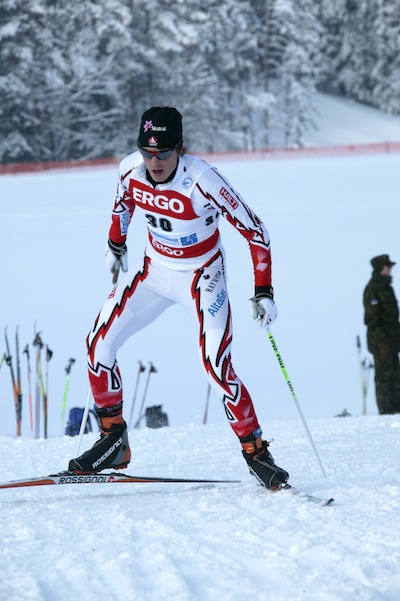
    Canadian Aaron Gillmor racing at the World Junior Championships for cross-country skiing in Estonia in late January.

    While many international biathletes have successfully competed in cross-country skiing events over the past few years, North America has seen little intermixing. While there is talk of biathletes chipping in for cross country events, most recently American Tim Burke pinch-hitting for the USST at a major championship relay, it rarely seems to happen.

    Enter Aaron Gillmor, a 19-year-old Canadian who just wrapped up his first World Junior Championships (WJC) in cross-country in Otepaa, Estonia.

    Gillmor, a native of Calgary, Alberta, has been to two previous WJC – but in biathlon. He even owns a medal from that event, as part of the silver-medal relay team when the championships were held in Canmore in 2009. In addition, he has two top-30 finishes from that same year.

    This season, Gillmor actually qualified for WJC events in both disciplines. While it has been possible in the past, this year, the scheduling did not allow him to compete in both events, so Gillmor was forced to choose.

    “It’s easier to make World Juniors for biathlon, as there is less national competition than in cross-country,” he said.

    At biathlon trials, held in Whistler, B.C. before just before Christmas, Gillmor skied well enough to make the team, but he wasn’t happy with his racing.

    “I was getting over a lung infection, and was not in good physical shape,” he said, “The skiing actually hurt me a lot while in Whistler, and was actually a factor that persuaded me go to Thunder Bay.”

    Gillmor wasn’t aiming high in Thunder Bay. He and his coach, John Jaques, only decided to attend the races in order to improve Gillmor’s skiing form.

    “I didn’t really have any sort of idea about what I had to do to make cross-country World Juniors,” he said. “I entered the Thunder Bay races with no expectations, only the desire to go ski my heart out.”

    On the very first day of racing, he did just that. During the 15 k pursuit, Gillmor classic skied to the 13th fastest time, and then skated his way up the field to finish sixth overall, with the third-fastest skate leg on the day. It by no means guaranteed him a spot on the team, but with a 15 k freestyle event remaining, there was a chance.

    In that 15 k freestyle, Gillmor actually tied for third with Jordan Cascagnette. Gillmor started very early in the field, and as a result, the splits he received told him little about where he was compared to his main competitors.

    “I didn’t know how the day would pan out,” he said, “I’m thankful that I lunged at the finish, even though I had no idea where I was.”

    After the skate race, Gillmor knew he was on the bubble, but the phone call was still a surprise.

    “I was shocked,” he said, “Getting asked [to go to WJC] was a really great end to a good trip.”

    Gillmor had some internal debate over whether to head to cross-country or biathlon WJC.

    “I was very torn about cross-country versus biathlon, but my coach, along with some friends and my parents, helped me reach a conclusion about which to pursue,” he said.

    It came down to two factors. First, Gillmor wanted to compare his ski speed against the best cross-country skiers in the world. Second, he has another year of junior eligibility in biathlon, while this is his last year as a junior in the cross-country system.

    As a result, he chose to head to Estonia.

    Gillmor began his skiing career with the Biathlon Bears club in the Calgary area, and pursued only biathlon. But along the way, his coaches encouraged him to pursue cross-country racing as well.

    He believes this early emphasis on cross-country has helped him immensely in both disciplines. For Gillmor, the more biathletes who race cross-country, the better – especially at a young age. In his mind, ski speed and effort are far more important than shooting ability.

    During high school, Gillmor attended the National Sports School in Calgary, which allowed him to train during the day in addition to doing course work. That, he said, played a “pivotal” role in determining his dedication to athletics, regardless of whether his sport of choice was biathlon or cross-country.

    Currently, Gillmor lives in Canmore, and trains with Rocky Mountain Racers (RMR), a club with many members who race both disciplines. According to Gillmor, RMR’s training is organized in such a way as to allow any member of the team to attend any session.

    While the biathletes do more strength work, and a larger amount of zone three training – to practice shooting with a similar heart and breathing rate to a race – the training is not much different.

    Often, the most difficult thing for biathletes when they cross over is tackling classic skiing, as biathletes never race on classic skis. Gillmor said that he probably classic skis much less than some of his competitors, especially during the dryland season.

    However, he said, he does try to do his longer workouts during the ski season on classic skis, keeping him at least familiar with the technique.

    As for the age old question of which sport he prefers, Gillmor has a unique answer.

    “The truth is that I enjoy both sports, because of the other sports,” he said, “Biathlon requires mental discipline and physical control, but when I just want to race as hard as I can and go as fast as I can, the place where I can do that is cross-country.”

    Gillmor’s long-term goal? To become as fast as the Norwegian biathlete Lars Berger – who won a gold medal at the 2007 cross-country World Championships in Sapporo – “but with a bit better shooting.”