From the FasterSkier archive — posts syndicated from athletes’ and coaches’ own blogs between 2004 and 2012, kept online as published. Current coverage is at fasterskier.com.
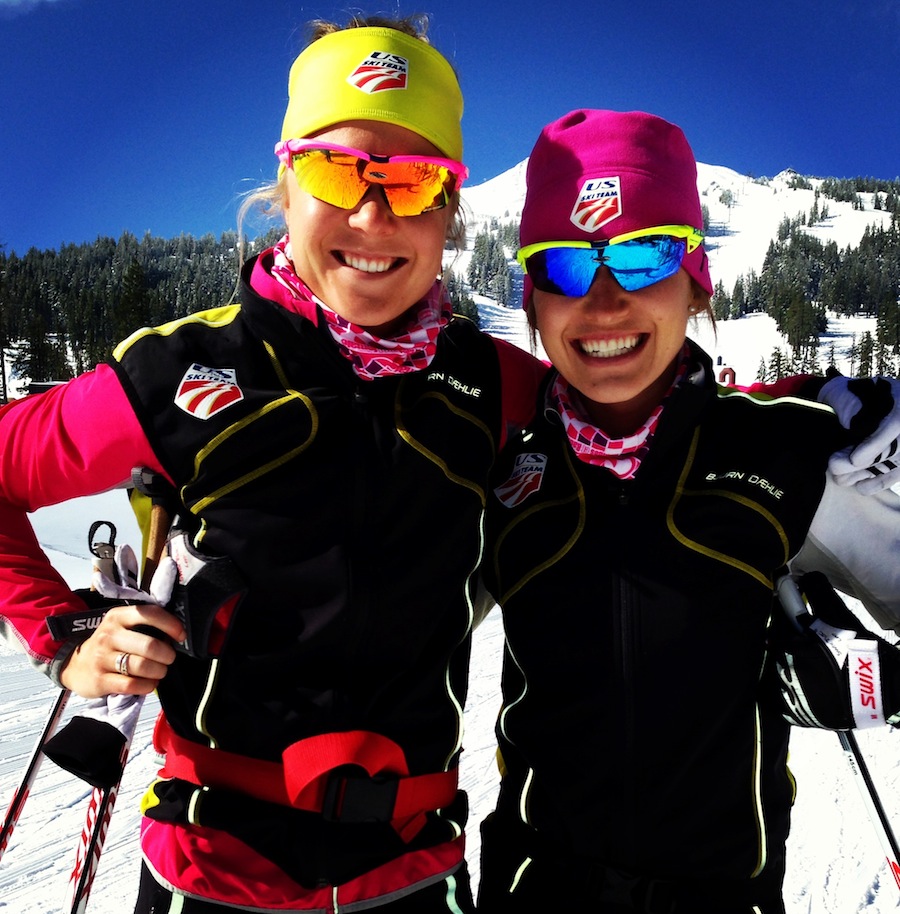
U.S. Ski Team members Sadie Bjornsen (l) and Sophie Caldwell take a break from skiing in May at their training camp in Bend, Ore. (Courtesy photo)
The five interlocking rings hanging over Sadie Bjornsen’s bed mean everything they did four years ago when she shelved her college education at the age of 19, moved home and threw all she could muster at a dream of skiing in the Olympics – only to come up short.
But closer examination of the wall ornament reveals that an upcoming February trip to Sochi, Russia, isn’t the only ticket to happiness for the experienced, confident and humbled Alaska Pacific University (APU) skier.
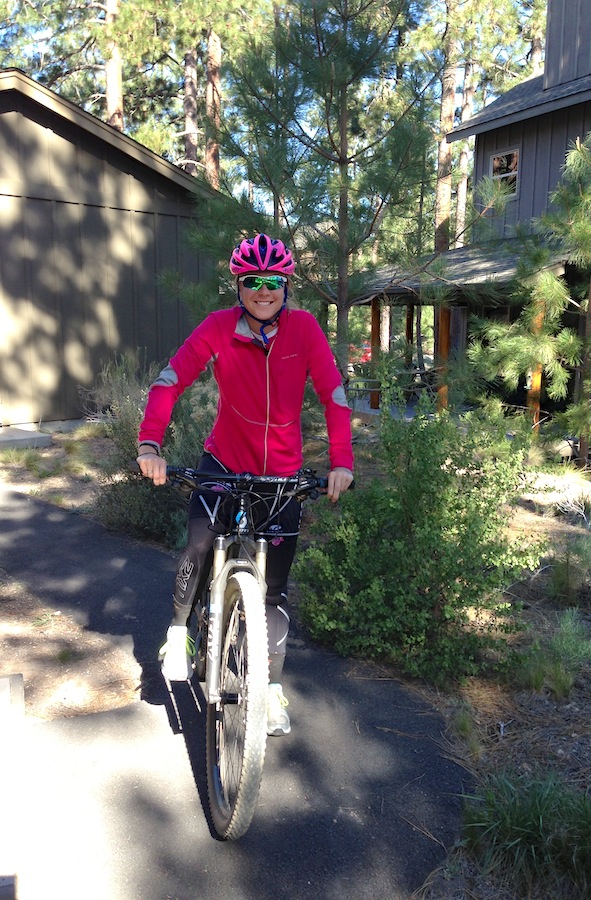
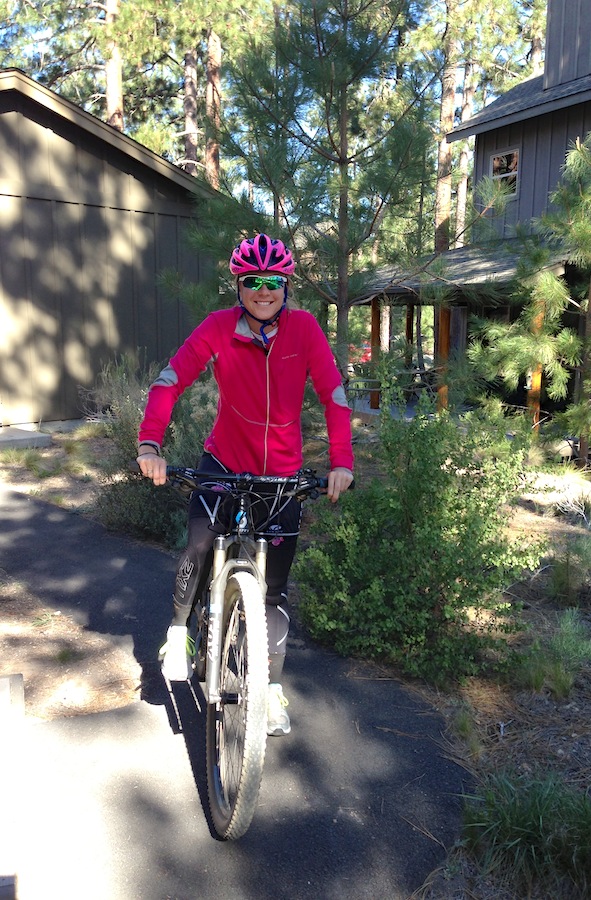
Sadie Bjornsen (APU/USST) heads out on her mountain bike at the 2013 USST training camp in Bend, Ore. (Photo: Jessie Diggins)
Massage. Stretching. Sleep. Learning to speak French (for her French boyfriend) – each task has its own ring and a place in the 23-year-old U.S. Ski Team (USST) member’s daily routine, so that her mind and body are given the best opportunity to remain healthy throughout this Olympic year. (The fifth ring’s contents were too personal to share.)
“The biggest thing that I learned [before the 2010 Olympics] was that I need different things in my life,” Bjornsen said Sunday on the phone from her home in Anchorage, Alaska. “Wholly focusing on skiing is not meant for me.”
The significance of the most routine physical activity was magnified this spring for Bjornsen, who could relax after emerging in one piece from USST training camp in Bend, Ore., and most recently, fitness testing in Park City, Utah.
At this time last year, she was hampered by a structural problem in her back and tendonitis in her foot, and this June she participated in most everything except treadmill tests because of foot limitations.
But 2012/2013 was anything but a lost year. Bjornsen was able to check off her first top 10 in a World Cup event, was a member of the fourth place 4 x 5-kilometer relay team at World Championships and added a pair of national titles. She just had a late start.
“Just racing in my first race, I appreciated it so much,” Bjornsen said. “I think it’s sometimes a good reminder to have those challenges. You just appreciate things more.”
Bjornsen estimated it was five years ago when she took the antibiotic Levaquin, which has a known possible side effect of attacking tendons, most commonly the Achilles. She’s lived with a form of tendonitis ever since.
Now she approaches training camps a little differently than her teammates. Bjornsen’s offseason is about consistency. If she has to substitute a dryland activity for a morning ski, that’s OK. Exercise in any form will make her stronger.
“The difference this year is I have a little more confidence in knowing that the way that I train can work out,” Bjornsen said.
What works for Bjornsen is laying off the intensity during the summer, as she has seen it come back to her quickly in the fall. She’s learned how to recognize the warning signs of a balky back. And she feels the support of her teammates and coaches.
“It’s hard because everyone is really competitive and everyone wants to push each other,” Bjornsen said. “Especially now that we’re having some success, you feel like every moment you have to be 100-percent. The girls are really good about being patient.”
Bjornsen described her coach, APU director Erik Flora as “unbearably positive.” Flora had his own racing career abbreviated by the combination of a car accident and back injuries.
“You have to be so mentally strong to make it through without any support,” Bjornsen said. “[The support’s] coming at me from all angles.”
With brief visits to Bend, Park City and Vancouver behind her, Bjornsen will train in Alaska for most of the summer, a place where she is constantly reminded of the intermediate goals she must attend to before approaching the ultimate one. Ideally she will race a full World Cup schedule for the first time in her career and post some of her best results in February.
“The Olympics are a possibility to really spread our sport through our country,” Bjornsen said. “There’s a whole new generation coming into our sport soon. I think it would be really neat for them to see that success is totally possible.”
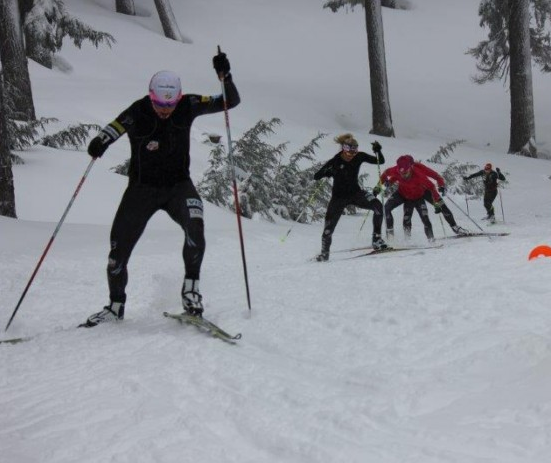
Kikkan Randall leading a recent workout in Bend, Ore. (Photo: Dan Simoneau)
The training season began in earnest for the U.S. Ski Team in Bend, Ore., in the last two weeks, but while many athletes have been putting in two-a-days on snow and on running trails, one of its headliners has had to take a cautious step back from traditional spring workouts. Kikkan Randall, two-time World Cup sprint champion, has battled a recurring flare-up in her left Achilles tendon this spring and has had to take proactive steps to manage it. This has meant less time on snow and more time in the pool and on the bike during the Bend camp, with the hope that she can return to full training in a few weeks.
“This is something I had last summer in addition to the stress fracture, so I think I injured it at the end of last season and it didn’t get the chance to heal,” Randall said. “Sometimes it’s fine, other times it flares up… We did an uphill running workout the first week back and it was just a little bit too much; it kind of set it off a little bit.”
When she experienced a similar issue last summer and fall, Randall doesn’t think she initially gave her Achilles enough time to recover. This year, with the experience of her quick bounce-back from last season’s stress fracture behind her, she’s trying to be smarter about her training to prevent a nagging issue from getting worse.
“All is good, [I’m] just trying to be a little smarter this time around and not push through potential injuries to the point I did last summer,” she said.
So far, being smarter has meant shortening her on-snow ski sessions in Bend in favor of more hiking, double-poling on a SkiErg, and aquajogging in the pool. Randall is also icing after workouts, getting massages and doing exercises to calm down the flare-up for the time being and return it to full strength.
“I’m just being more proactive this time around to build up the strength so that I don’t get myself in the situation where I really have to stop and back off training,” Randall said.
She says it’s been difficult to forego on-snow sessions with her teammates, but she knows from last winter that she can adjust her training and still be ready to race in time for the start of the World Cup season. Last November, when Randall wasn’t sure how her stress fracture recovery would affect her early season results, she set modest expectations for Period I. She ended up taking third in a 10 k skate on opening weekend, her best result in a distance World Cup to date.
Now, Randall has more confidence in her decision to take it easy this early in the training year.
“The experience from last year showed I can back off, doing training in different ways, and still keep in really good shape if I’m smart and patient,” she said. “I don’t feel the pressure to force the training right now. I can keep the fitness up with these alternate activities if I’m paying attention and working on recovering… It’s not easy to come off the snow early and miss out on things like running, which I really enjoy, but in a couple of weeks I’ll be training as normal.”
Randall says her workouts in the pool and on the bike have enabled her to keep her usual volume. Her return to full training was delayed by a few weeks this May because of a later-than-usual Spring Series, and since returning she’s experienced other signs that she can’t immediately jump back into workouts with the same intensity she could when she was younger.
“I was testing out some new skate boots that ended up bruising my right heel, so we had to adjust the boots and make a few training alterations to let that recover,” Randall said. “[I’m] being careful with the elbows too as we’re reintroducing double poling on pavement.
“I’m finding that I can’t just jump right into training like I used to, but if I work really hard on recovery and building into things, I should be able to train full strength in a few weeks.”
Randall and the rest of the USST are headed to Park City, Utah, on Friday to begin testing at the Center of Excellence. The team atmosphere in Bend, she says, has been as energetic as ever. After Park City, Randall flies to Croatia to fulfill her duties as FIS athlete representative at the governing body’s annual conference.
“I’m super excited for the new season and the energy on the team has been really good,” Randall said. “It’s a good time to take that excitement and manage it in a proper way and not get carried away. We have a lot of training time ahead of us, still.”
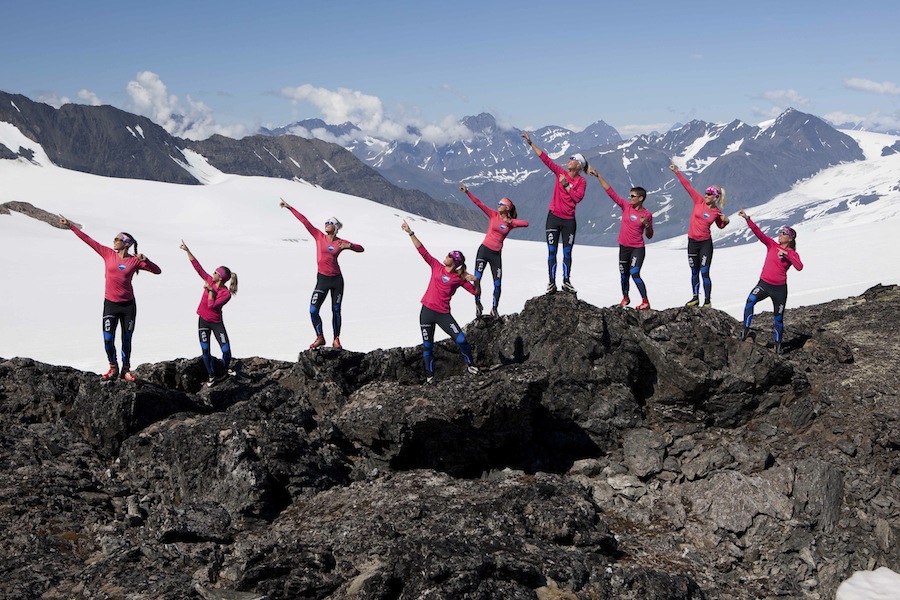
Sadie Bjornsen (fourth from right) and her APU teammates pose like Jamaican sprinter and six-time Olympic gold medalist Usain Bolt on Eagle Glacier near Anchorage, Alaska. (Photo by Chris Hodel)
Last week in Anchorage, a freak windstorm rolled through that would have devastated most mainland Americans. Gusts estimated at 130 miles per hour spewed trees across Alaska’s largest city, leaving at least a thousand residents without power through Saturday – almost four days after the storm hit Tuesday night.
In a phone interview, U.S. Ski Team member Kikkan Randall said the electricity and all the lights at her home came on at 2:15 a.m. Saturday. One tree took out part of their backyard fence, but Randall’s husband, Jeff Ellis, repaired it in no time. Their biggest concern was their refrigerator and freezer, so the two went out and got a generator.
Elsewhere in the city, Randall’s teammate on the U.S. Ski Team (USST) and Alaska Pacific University (APU), Sadie Bjornsen said the power at her on-campus housing was restored Wednesday morning. On the phone, Bjornsen laughed about how she didn’t even know the storm was coming.
A professor in one of her classes warned students about its potential effects. She hadn’t heard anything about it otherwise.
“I was like, ‘What are you talking about?’ I came out of the house and I was like, ‘What is going on? There’s a hurricane!’ ” she recalled with a laugh. “[My APU teammate Rosie Brennan and I] were driving and there were road signs ripping out and flying across the road and all this stuff flying around, and all the stoplights were out. I’m like, ‘Whoa, this is wild!’ ”
When she got home Tuesday evening, Bjornsen moved her car to avoid falling trees. Later that night, the 22-year-old had trouble falling asleep.
“I was freaking out because I’m like, ‘I’m going to wake up with a tree in my lap,’ because I’m on the corner where all the trees were blowing,” she said. “But then when I looked out the next day, I was like, ‘Oh those are all aspen or birch trees, and they aren’t that heavy.’ ”
Reports indicated that nobody was seriously injured, and Bjornsen was relieved. “Only in Alaska,” she said.
On Saturday, Randall said the weather was back to normal with the sun shining and slightly chilly temperatures. That morning they received their first frost. That was Alaska, all right.
Bjornsen’s Back/Foot Troubles
Sadie Bjornsen (APU/USST) working out on Eagle Glacier in July. (Photo by Reese Hanneman)
Way up north, the two Anchorage skiers have endured more than extreme weather in the last few months. Bjornsen’s been coping with back and foot injuries since the spring, and Randall is in a walking boot and training at 50 percent to heal a stress reaction in her foot.
While both joked about doing aqua-jogging sessions together, they also shared some of their frustrations and ways of staying positive through adversity. FasterSkier spoke with Bjornsen and Randall separately: Bjornsen while she was home studying before strength training, and Randall while she cheered on her husband at a local cyclocross race.
Bjornsen’s back injury started nearly a year ago in November, but by the time the racing season started, it disappeared, she said. After two and a half weeks of discomfort, she didn’t feel it again until this past April, just in time for the beginning of training season.
Kikkan Randall (APU/USST) donning a walking boot to relieve a stress reaction on her right foot. If left untreated, the reaction could magnify to a fracture, which is why Randall is training at 50 percent and not skiing or running for five weeks. (Courtesy photo)
She’s had the overuse issue since and initially remedied it by skate skiing. Classic skiing – her strength – seemed to irritate her facet joints the most, so she decided to skate only.
“Originally I was like, ‘Well, OK I’m just going to skate every single workout. I have a weakness with skating anyways so this is great,’ ” Bjornsen said. “That’s what I did and then I got tendonitis in my foot because of it. That’s when I have to stop and say, ‘I need to actually address this problem.’
“It’s challenging because you have a back and a foot injury so then you have to find exercises that are not stressing both of those things because they’re kind of opposites,” she added. “It’s just been hard to find ways to progress.”
Bjornsen discovered her tendonitis at the USST camp in Bend, Ore., in May. With the USST/Canadian women’s joint camp (also known as the North American Women’s Training Alliance) two weeks later in June, she pushed through the injury and raced to get into shape.
“I knew [Finland’s] Aino-Kaisa Saarinen (Auku) would be coming [to the Alaska training camp] and since I first started watching her ski, I have dreamt about classic skiing behind her,” Bjornsen wrote on her blog. “I over-jumped my limitations, skiing a two hour skate through the hills chasing Auku and Kikkan. Again, I was back at the bottom with my heart hanging low. At that point I had to make the difficult decision to leave the National Team Camp in my own town and get away from the excitement and motivated girls to truly get my body back to order.”
Since then, Bjornsen’s let her body recover for the better part of the last three months. She recently started doing some intensity on her feet, which she was excited about. It was a long summer without it, she said.
“I was just doing my intervals running in the pool,” she said with a laugh. “People in the pool will just look at me, like, ‘Why are you breathing so hard, for one, and what are you doing?’ ”
Not to mention, it’s a community pool.
“It’s been a bit humiliating, but it’s fun,” Bjornsen said. “It’s the world’s most boring thing you could ever do, but it makes you appreciate when you go out and do ski intervals, it’s like, ‘Oh my God, this is why I do this sport.’ ”
This summer, Bjornsen has been to the glacier twice to ski and said she’s making progress. As far as she can tell, her back is almost in the clear and her tendonitis is practically gone.
“The thing about tendonitis and stuff like that is you want it to just go away in two days,” she said. “But it’s just kind of something that you always have to look out for a little bit. I’ve just been working through strengthening it.”
As for her fitness, she said it’s hard not to imagine where she should be.
“You feel like you’re so far behind when you have these setbacks, you know? It’s hard to not only focus on that,” she said. “The most challenging part about it is there’s not really an answer to how to make it better. It’s like, ‘You need to work on not having muscle spasms.’… [I’m trying to think] about where I’ve progressed from two months ago and thinking about the season’s really long. You kind of have to think about the end of the season as well as the beginning.”
Her coach, Erik Flora, has been one of her biggest advocates and sources of support, she said. He’s shown her ways to be creative with training, even if it is in the pool.
“Erik’s like, ‘If you stay positive through these sections is when you decide if you’re in it for the long run or if you’re going to wuss out or something,’ ” Bjornsen said.
She’s decided to stick with it.
“It’s been a really challenging summer, for sure,” she said. “It was challenging to have to leave the national-team camp here in Alaska, and it was challenging to have to say no to [the USST camp in] Sweden because I wasn’t healthy enough to be there.”
“It’s just been a rollercoaster of making progress this summer,” she added. “I don’t know where I am, I guess we’ll see, but probably not where I would have hoped to be. Maybe in two months I will be somewhere I hope to be. The cool thing about our sport is your racing is not only based on your year of training, it’s also based on what you’ve done and what you’ve done in the past and what your strengths are. The best you can do is be really positive and do what you can do.”
In about a month, Bjornsen will join Randall and the rest of the USST for their final dryland camp in Park City, Utah. She plans to use the time to practice on the sprint course at Soldier Hollow and nail the slingshot descent into the stadium.
“Somehow I’m always at the wrong place on that last corner, so hopefully I’m going to learn that one this year,” she said.
Looking ahead, that venue is where Bjornsen hopes to podium at the upcoming U.S. nationals in January. Last year, a sinus infection kept her from racing for a national title in Rumford, Maine, which led to another goal: staying healthy.
“That even means paying attention more when I’m sick, to really admit that I’m sick and sort of jump on it rather than just pretend that you’re superman and it’s never going to get to you,” she said.
Throughout the next few weeks, Bjornsen will increase her intensity training. Meanwhile, most of her USST teammates (except those from APU) will do something similar throughout the next two weeks at a camp in Lake Placid, N.Y.
Heading into Park City, Bjornsen said she’d continue to build her base and intensity on skis.
“I still have two and a half months [until the racing season] and the progress I’ve made in the last month has been super encouraging,” she said “I still have hope for the season; there’s a lot to be trained still.”
Randall Healing Both Feet
Without too many injuries in her storied career, Randall feels the same way. She took her foot injury in stride during the Swedish joint camp in early August, wearing a walking boot between workouts.
Randall playing golf in late August with her walking boot. (Courtesy photo)
However, toward the end of camp, things started to get painful for the reigning World Cup sprint champion. She realized that what she was doing – training normally and keeping pressure off her right foot when she wasn’t skiing – wasn’t enough. USST women’s coach Matt Whitcomb convinced her to see a specialist and let it heal before this winter.
About two weeks ago, Randall flew south to see Dr. Tom Clanton at The Steadman Clinic in Vail, Colo. A world-renowned foot and ankle specialist, Dr. Clanton treated former professional basketball player, Yao Ming, the tallest man in the NBA at the time, when he had foot trouble. “We figured he was a good guy to talk to,” Randall said.
There, an MRI showed some fluid around the bone in her right foot, which meant it was starting to weaken, but it didn’t indicate a fracture. That was a good thing, Randall said. The doctor advised she train at a 50-percent effort for five weeks, which meant no skiing or running, but she could swim, bike and do double-pole workouts with APU.
Randall is also healing an Achilles injury in her left foot, which started early last March at the World Cup skiathlon in Lahti, Finland.
“The boots are a little bit different than what we’re used to and it didn’t get better through the spring,” she said. “We had a lot of classic races the last part of the season and I didn’t probably rest it enough, so it’s been nagging.”
While in Vail, physical therapists at Howard Head Sports Medicine taught her strengthening exercises for both feet, and she planned to return to Colorado in early October for a follow-up MRI. After that, she will head to Park City, where she probably won’t participate in the USST tests, but hopes to take advantage of the high altitude and transition back into regular training.
“The frustrating thing with both these injuries is they’re so subtle I can train through them, but it’s a matter of should I train through them,” Randall said. “Eventually the Achilles could get worse and you can get into some serious problems with that, and of course with bone fractures, that could be a serious problem, too. It’s the one time in your life when you have to not be tough and take signs and rest a little bit.”
Since discovering a massive blood clot in her leg in April 2008, Randall hasn’t had too many medical problems, she said.
“I’ve been really fortunate through my career,” she said. “The blood clot happened in the spring when it was the absolute best time when I was taking some time off anyway. I was able to bounce back [and win a World Championship]. This is almost my first time going through something kind of chronic and in the middle of the season. I had a few things when I was in high school but nothing quite like this.”
Still, she’s managed to keep her head up.
“I’m enjoying being at home for an entire month and I have a little extra time. I have a ton of school visits lined up and get to work on some of my community projects and see family and friends before the long winter in Europe,” she said. “Just fill your time with other thoughts and things. I’m focusing on what I can do and I’m using this time to work on some small weaknesses that I probably would’ve just let go. So, yeah, it might be a blessing in disguise in the end.”
In mid-August, Randall did an open-water swim in Ontario, Canada, where Ellis’ parents live. Her husband originally signed them both up for the Bala Falls Triathlon, but Randall decided she shouldn’t run so Ellis left her wetsuit at home in Anchorage.
Race fever caught up with Randall, and she changed her mind – she wanted to swim and bike. Without a wetsuit, she swam anyways and finished third in the swim-bike category.
“It was my first time [competing without a wetsuit]. It was a good, challenging experience,” she said. “It was pretty funny because I had the boot on, and I walk into the transition area to put my bike in the rack. Then I walk around the rest of the day, I’ve got the numbers on my arm with the boot on. It looked pretty ridiculous, I’m sure.”
If she wants to be a serious triathlete someday, Randall joked that she needs to work on her swimming.
“The bike was fun, kind of chasing after people,” she added. “It was actually quite hard not to go out on the run and finish off the race.”