From the FasterSkier archive — posts syndicated from athletes’ and coaches’ own blogs between 2004 and 2012, kept online as published. Current coverage is at fasterskier.com.
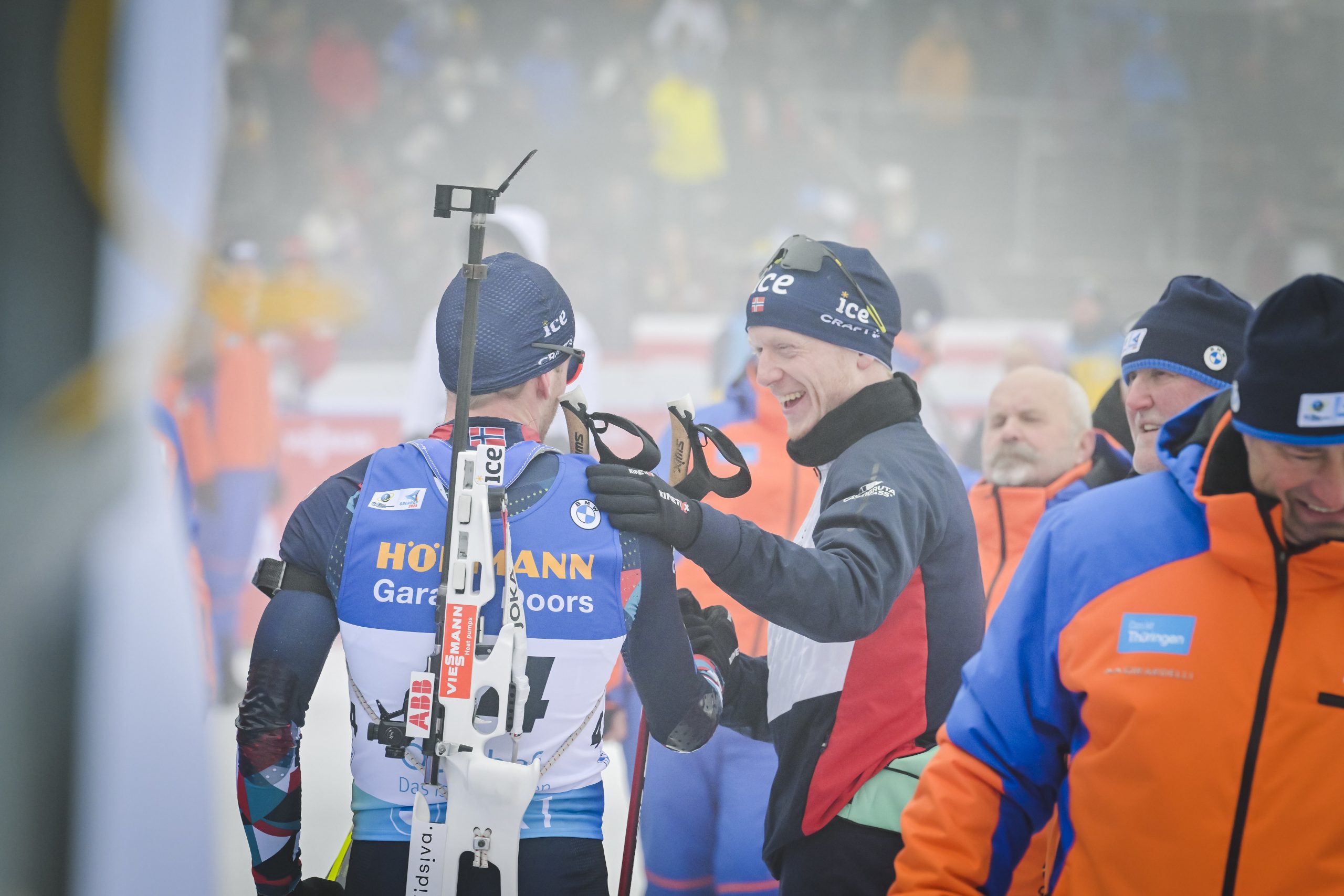
Johannes Thingnes Boe (NOR) congratulates his brother, Tarjei Boe (NOR) who finished beside him on the podium at the IBU World Championships Men’s Sprint in Oberhof. (Photo: Reichert/NordicFocus)
One man has won all five 10 k Sprint competitions so far this season, so even with 112 starters in today’s BMW IBU World Championship Sprint, there was no doubt about the favorite. Johannes Thignes Boe of Norway has been untouchable on skis since November, regularly out-skiing his nearest competitor by over 30 seconds. The 150m penalty loop in biathlon usually takes athletes about 23 seconds, so Boe can afford to miss once and still win. Today he missed once in prone—the target barely visible at 50m through dense fog—but cleaned standing with no hesitation in just 21 seconds. With a 36-second second margin to the next-fastest skier, Boe defended his Olympic title and become the 2023 World Champion. This sets him up for another likely victory in tomorrow’s Pursuit competition, but with four shooting stages, anything can happen.
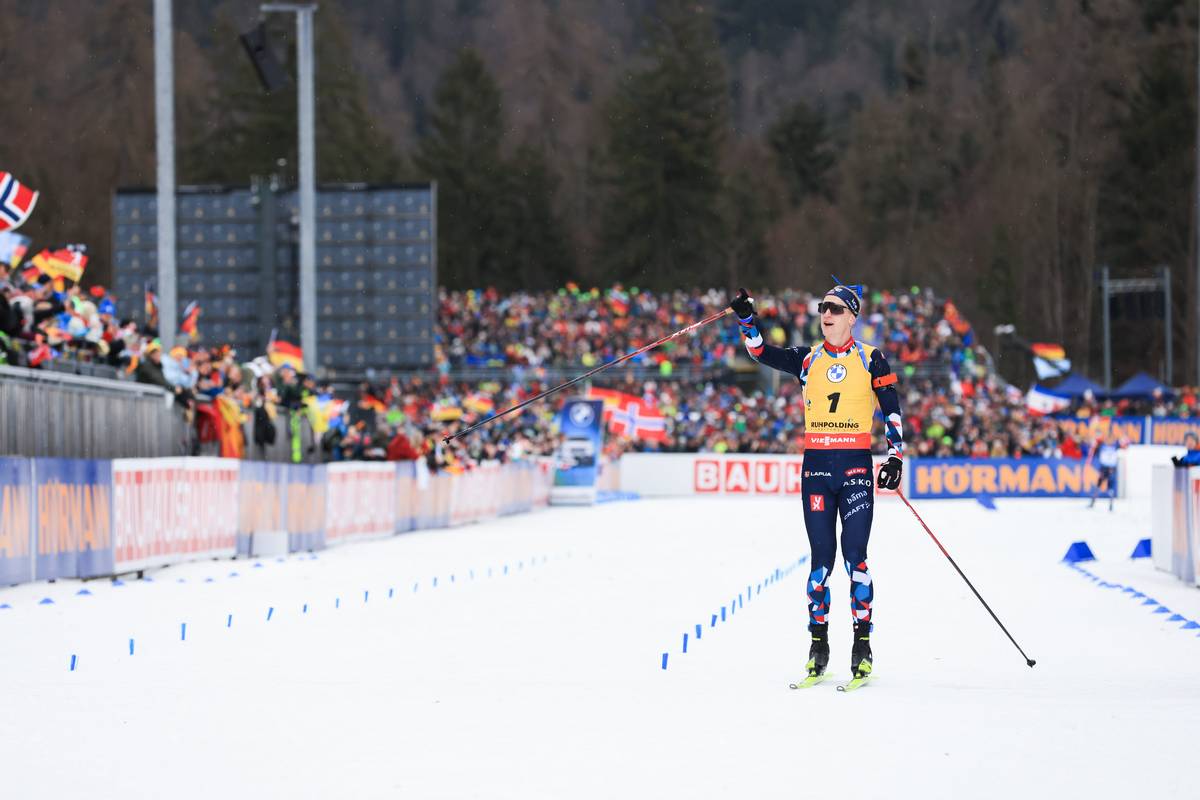
Johannes Thingnes Boe (NOR) started and finished in bib number 1 at the IBU World Championships Sprint in Oberhof, Germany. (Photo: NordicFocus)
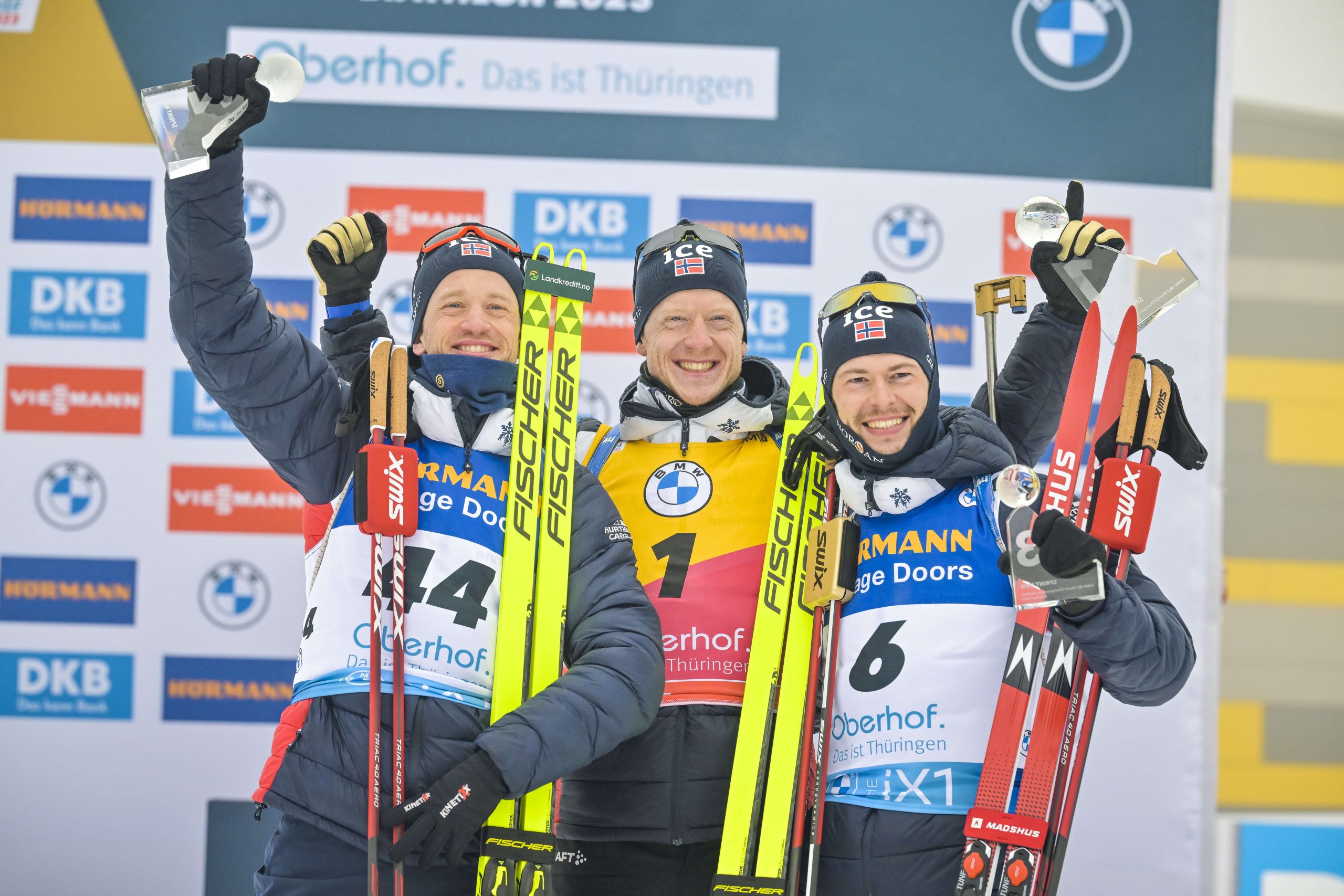
Sharing the podium with the unbeatable Boe were two teammates: his older brother, Tarjei Boe, shot the perfect score to complete the family sweep for the second time this winter, and Sturla Holm Laegreid missed just one in standing to capture the bronze. Laegreid is ranked second behind J. Boe in the Overall standings and has been on the podium in all but three competitions this season, so he was very much the silver medal favorite, but T. Boe is the fifth-ranked Norwegian (and 8th in the World Cup Overall standings), so the so-called “Boedium” was a pleasant surprise for the brothers.
Tarjei Boe (NOR), Johannes Thingnes Boe (NOR), Sturla Holm Laegreid (NOR) (l-r) on the podium of the IBU World Championships Sprint in Oberhof, Germany. (Photo: NordicFocus)
The Norwegian men make it look easy to land on the podium even with nine out of ten hits, but it’s not. Only four people on the whole men’s World Cup circuit have a shooting average of 90%. Laegreid is one of them. The Boe brothers are among the top 15 athletes with an 88% hit rate. Add the expectation of victory, and their performances become even more impressive.
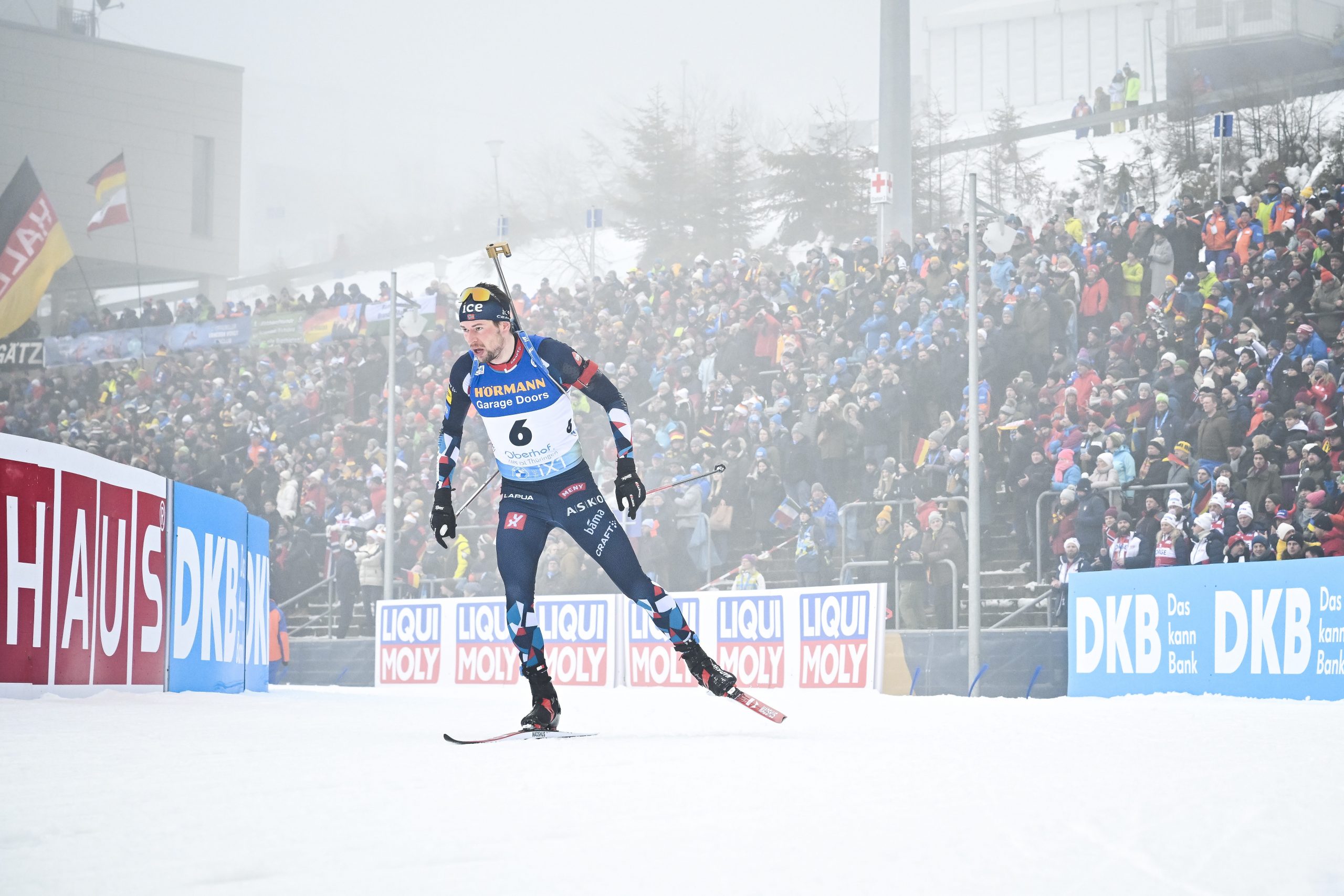
Sturla Holm Laegreid (NOR) racing to third place in the IBU World Championships Sprint in Oberhof, Germany. (Photo: NordicFocus)
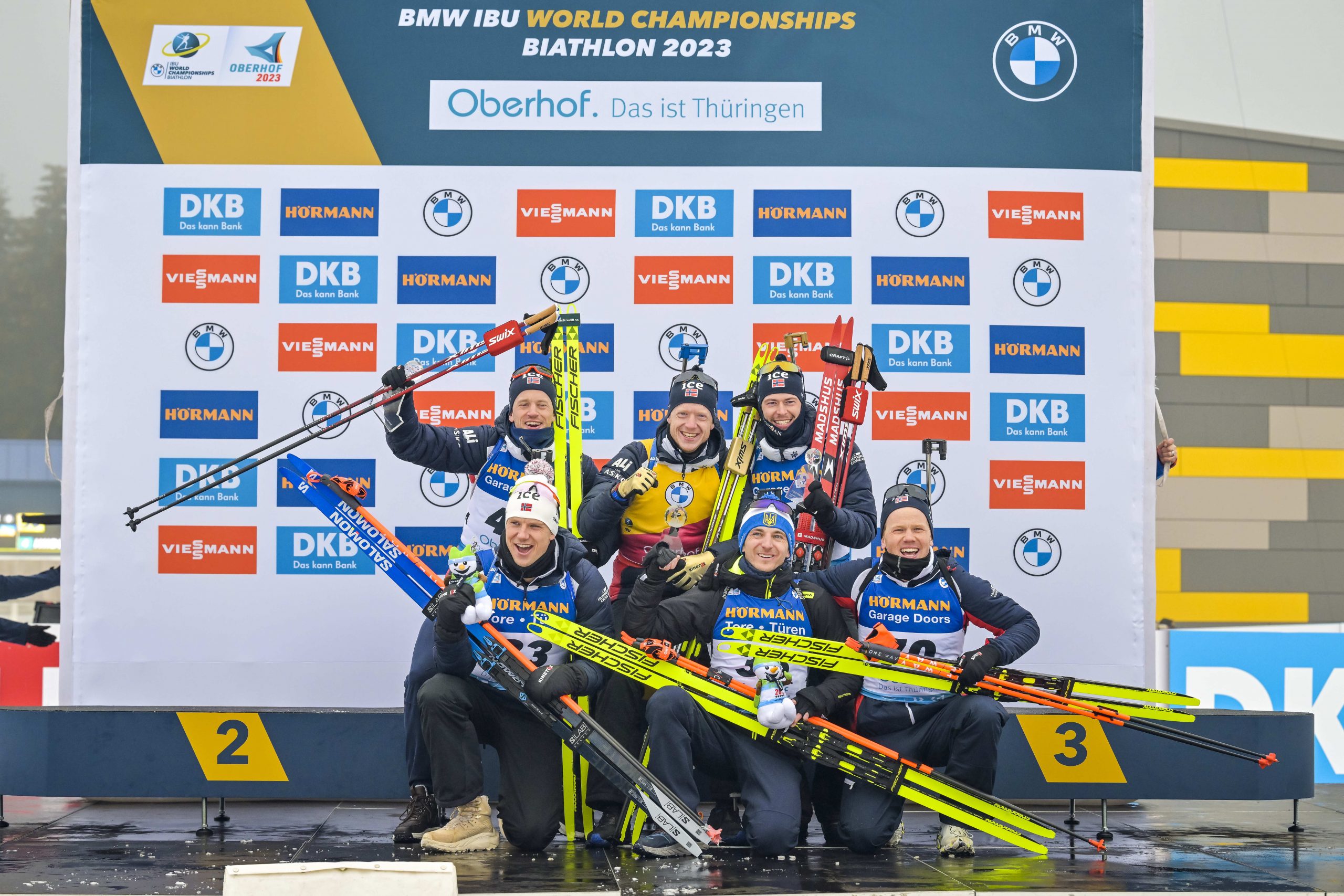
With Johannes Dale in fourth and Vetle Christiansen in sixth, the Norwegians almost pulled off a full sweep of the Flower Ceremony, but one athlete managed to upset the total domination. Dmytro Pidruchnyi of Ukraine shot clean and skied the 15th course time to take fifth. He had only raced twice this season—once in November and once just last week, with a knee operation in between—before coming to the World Championships. Pidruchnyi has a history of performing his best at championships; he was the World Champion in the Pursuit in 2019. Today’s fifth place was his top result since then. This victory will certainly mean a lot to him, his team, and the people of Ukraine as they suffer from war at home.
Flower Ceremony finishers in the IBU World Championships Sprint in Oberhof, Germany. Front L-R: Vetle Sjaastad Christiansen (NOR), Dmytro Pidruchnyi (UKR), Johannes Dale (NOR), Back: L-R: Tarjei Boe (NOR), Johannes Thingnes Boe (NOR), Sturla Holm Laegreid (NOR). (Photo: NordicFocus)
Andrejs Rastorgujevs of Latvia shot 10/10 to finish 7th, Johannes Keuhn of the home German team finished 8th for his best result of the season, and two French athletes, Quentin Fillon Maillet and Antonin Guigonnat, rounded out the top ten. Sebastian Samuelsson of Sweden finished in 11th with two penalties. Both he and Fillion Maillet will be podium threats in the Pursuit even starting around 1:10 back.
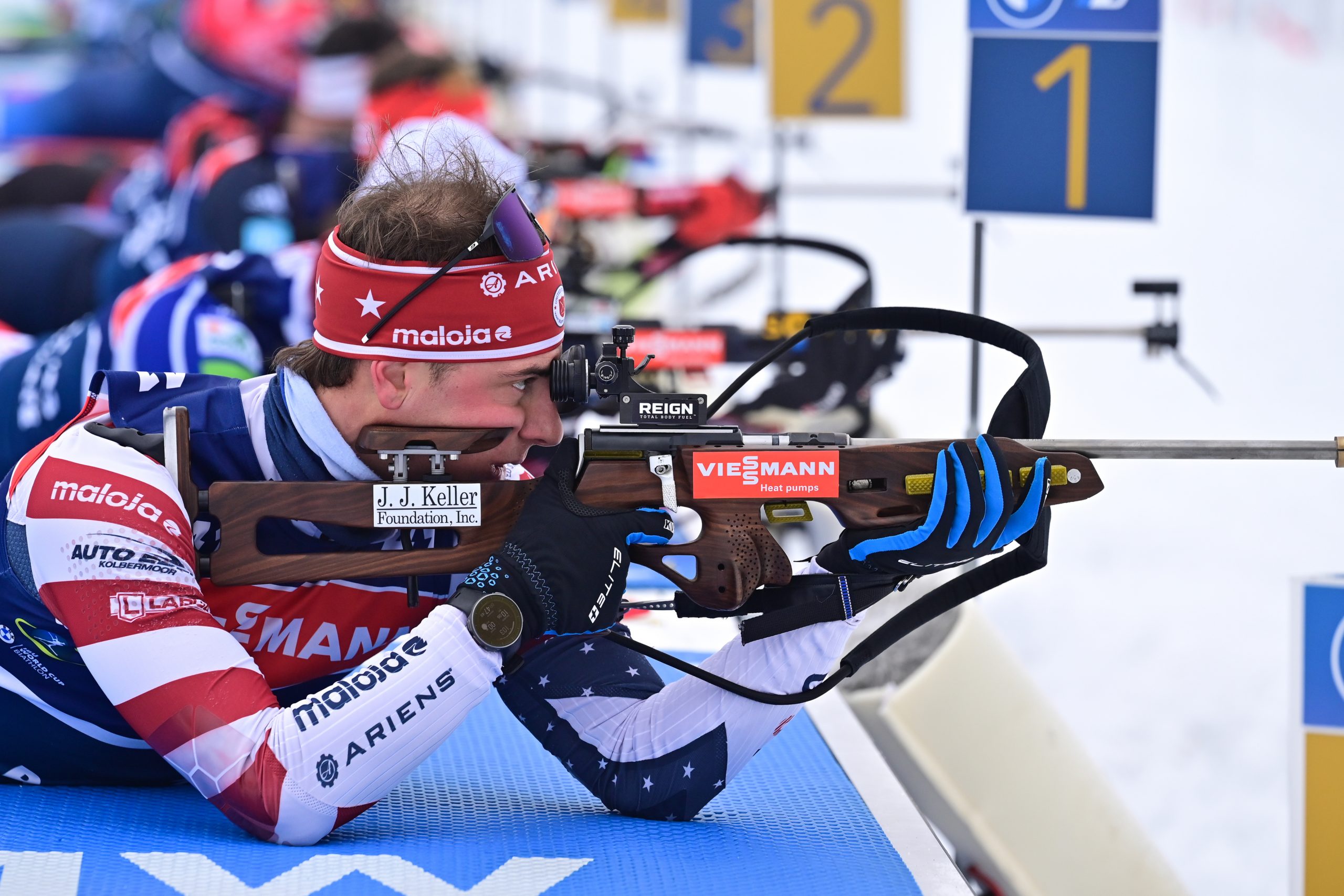
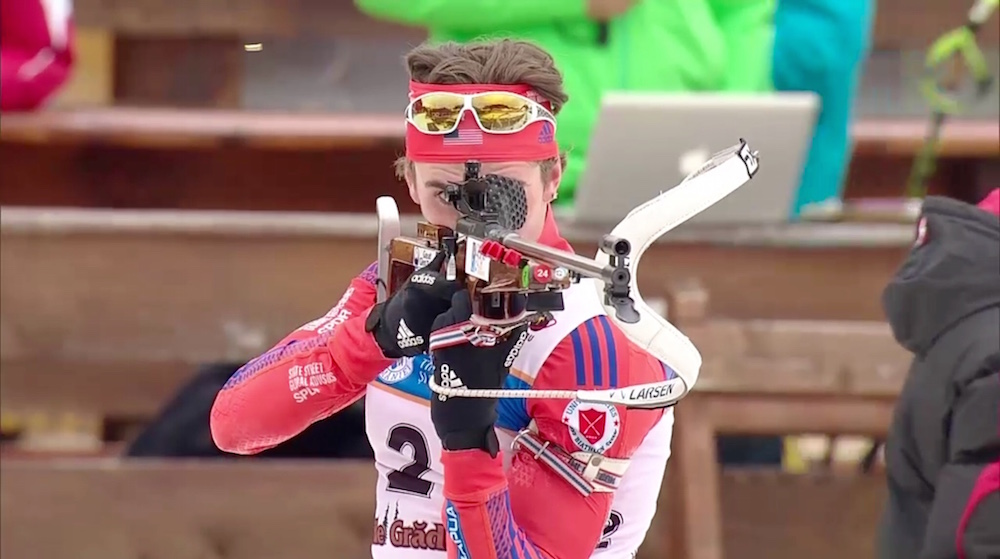
Paul Schommer (USA) zeroes his rifle before the Sprint competition at the IBU World Championships, in Oberhof, Germany. (Photo: NordicFocus)
Today was a tough day for the North Americans, with the exception of Paul Schommer (USA) who qualified for the Pursuit in 31st with one penalty each in prone and standing. Paul’s 31st-ranked course time was his best in a Sprint this season. “That prone miss was definitely one of those things where I thought, okay, I should have taken another second, but the standing felt good,” Schommer said of his shooting. As in yesterday’s Women’s Sprint, drafting on the long, windy straightaway into the range was critical. With that in mind, Schommer went out of his comfort zone on the second lap to stay with another athlete. “I may have pushed a little too hard before standing, but I made up so much time by staying with him.” It’s easy in biathlon to play the “what if” game, and Schommer recognized that he would have cracked the top 20 with one less miss, but he said, “tomorrow I’m going for the money!” The top 30 finishers in biathlon World Cups and World Championships earn prize money.
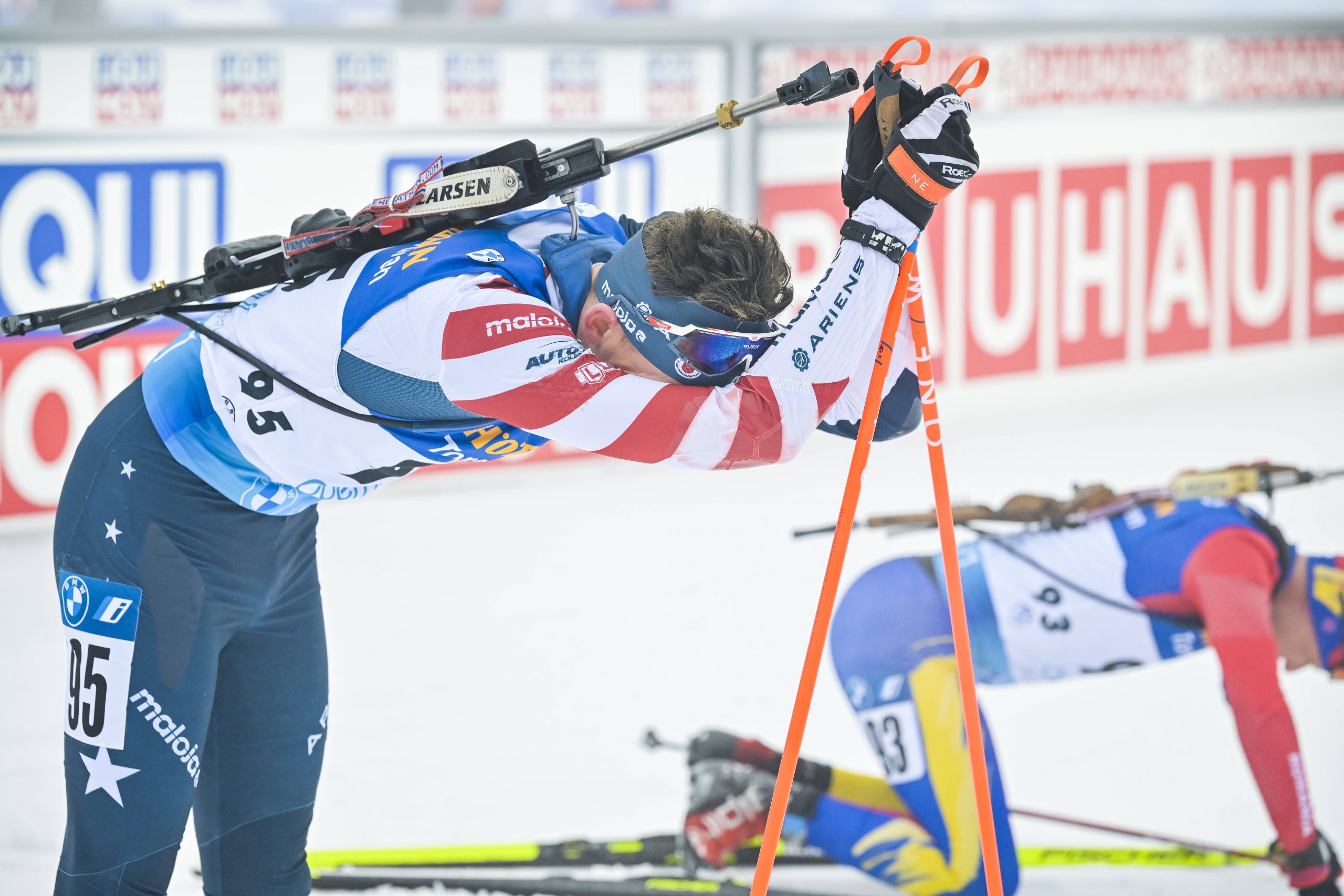
Maxime Germain (USA) in the finish of his first senior-level World Championship race. Oberhof (GER). (Photo, NordicFocus).
Twenty-one-year-old Maxime Germain (USA) finished just outside of the Pursuit qualification in 65th with three penalties. Both Sean Doherty (USA) and 22-year-old Vincent Bonacci (USA) cleaned prone but then uncharacteristically missed four in standing. They finished 80th and 98th.
For Canada, Adam Runnalls was the team’s top finisher in 82nd with five misses. Trevor Kiers was 86th with three, Christian Gow was 92nd with four, and Logan Pletz was 94th with four. This was certainly not the day that either North American team had hoped for. Those not racing in tomorrow’s Pursuit will shift their focus now to next week’s 20km Individual competition.
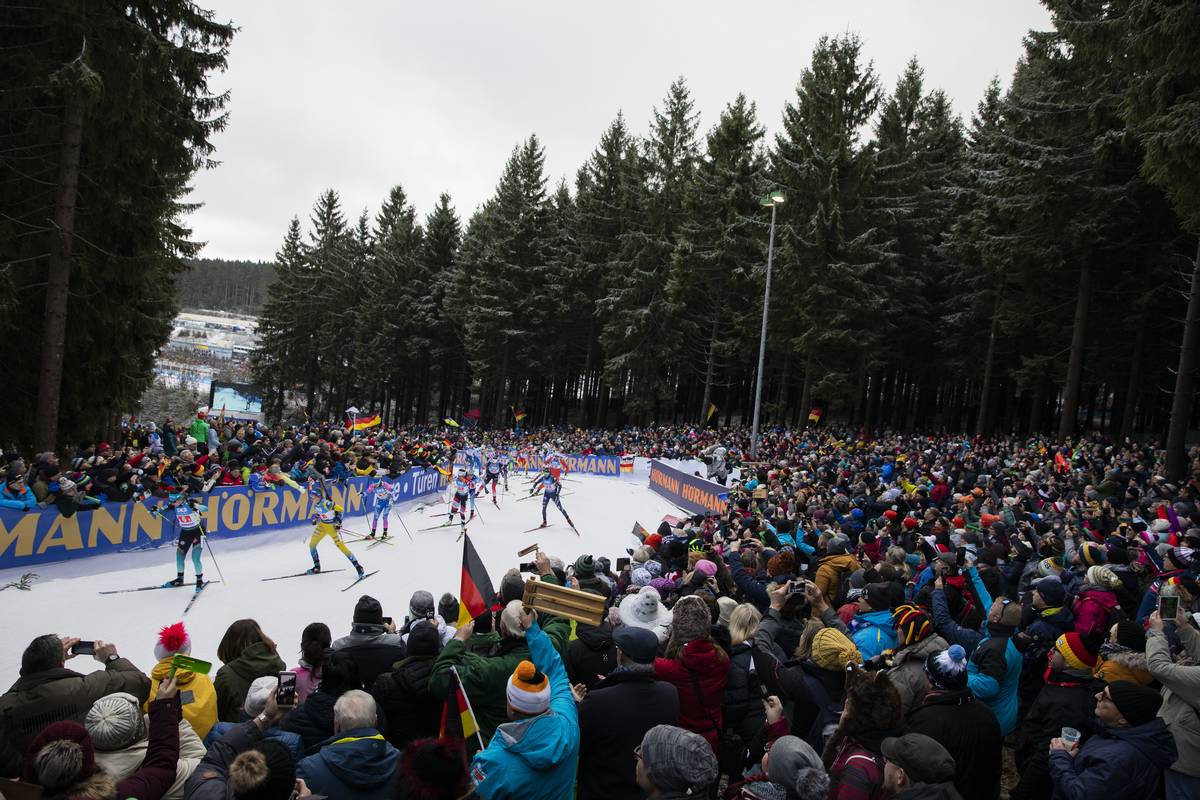
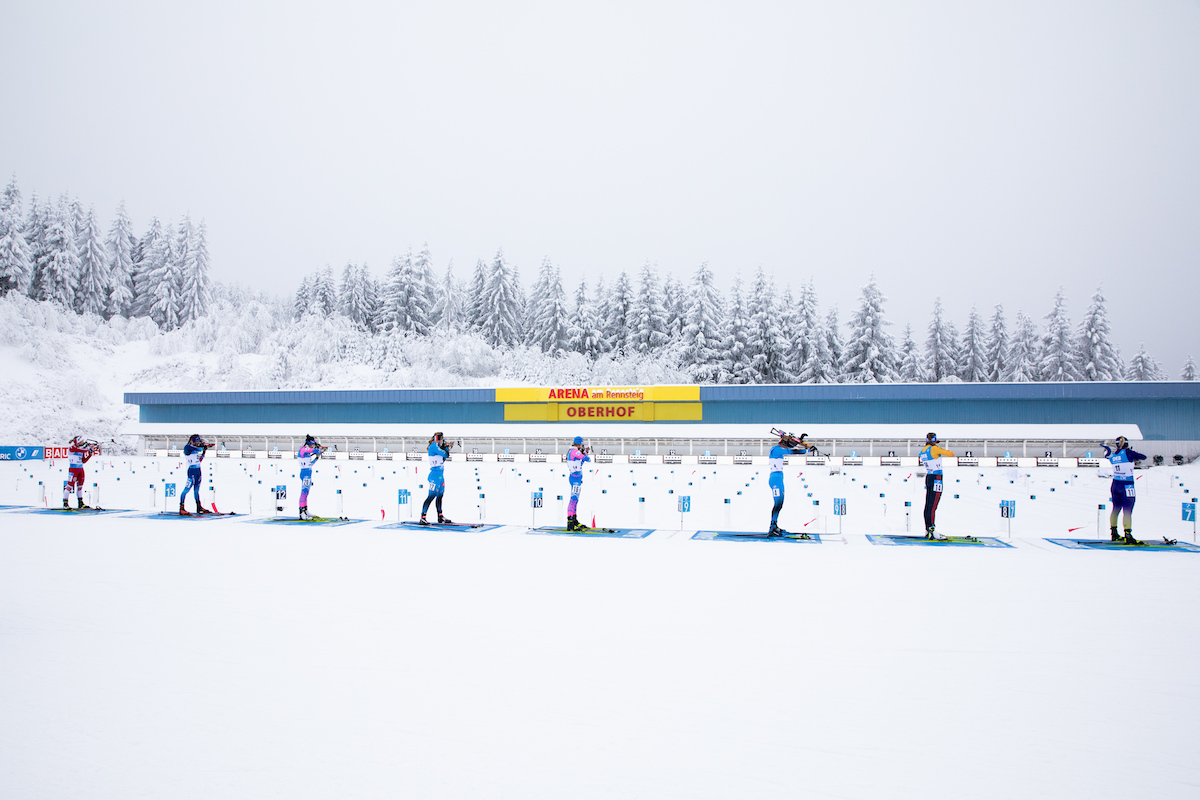
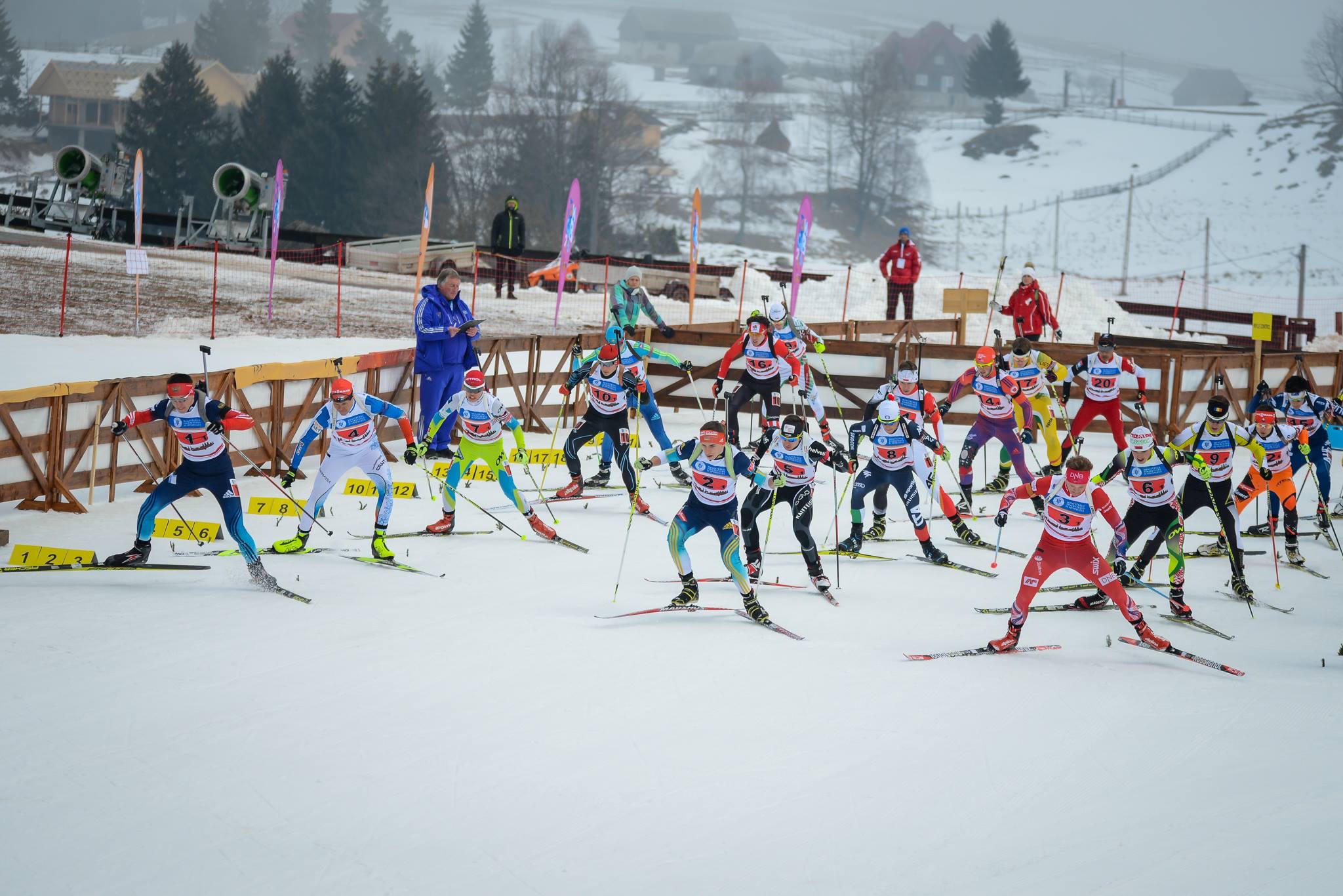
Biathletes racing in Oberhof, Germany in January of 2019. (Photo: NordicFocus)
The 2023 BMW IBU Biathlon World Championships kick off on Wednesday, February 8th in Oberhof, Germany. Let’s start with reasons why to watch:
Why Watch?
Watch because it’s free and easy. This winter, all biathlon World Championship, World Cup, Junior World Championship, and even IBU Cup (World Cup feeder circuit) races and are free to stream live with English commentary on Eurovision’s website.
Watch because on the men’s side, Johannes Thignes Boe’s domination so far this winter has sparked talk of “G.O.A.T.” status. That is saying something, given that the 29-year-old Norwegian has “only” three World Cup Overall titles and 66 individual victories to his name. Boe’s compatriot, the original “King of Biathlon” Ole Einar Bjorndalen, won 95 races, and more recently, French star Martin Fourcade won 85 races and seven consecutive Overall titles. But winning 11 out of 14 individual competitions already this season, Boe is catching up at an extraordinary rate. Outpacing his competitors by ridiculous margins and hitting 90% of his targets on average, there’s no doubt Boe will put on a show to remember in Oberhof.
On the women’s side, watch because—in contrast to the Boe Show—we’ve seen eight different winners from five countries so far this season: none yet from Norway. It’s truly anyone’s game. The depth of competition on the women’s side all but guarantees the kind of high-drama shooting and down-to-the-wire finishes that we all love.
Watch to support Nordic skiers getting paid. World Championships have the biggest viewership draw and consequently the biggest prize money purse of the biathlon season, with each event winner taking home 25,000 Euros. The payout reaches all the way down to 30th place, and women and men are paid equally.
Watch because—for the first time since 2020—spectators will be allowed to attend the season’s highlight event. Oberhof’s Thuringen Arena is expected to draw over 160,000 die-hard biathlon fans from one of the sport’s core regions. Watch because if you can’t be there in person, the live stream is next best!
Biathlon World Cup Women’s Pursuit in Oberhof , Germany in January 2021. (Photo: NordicFocus)
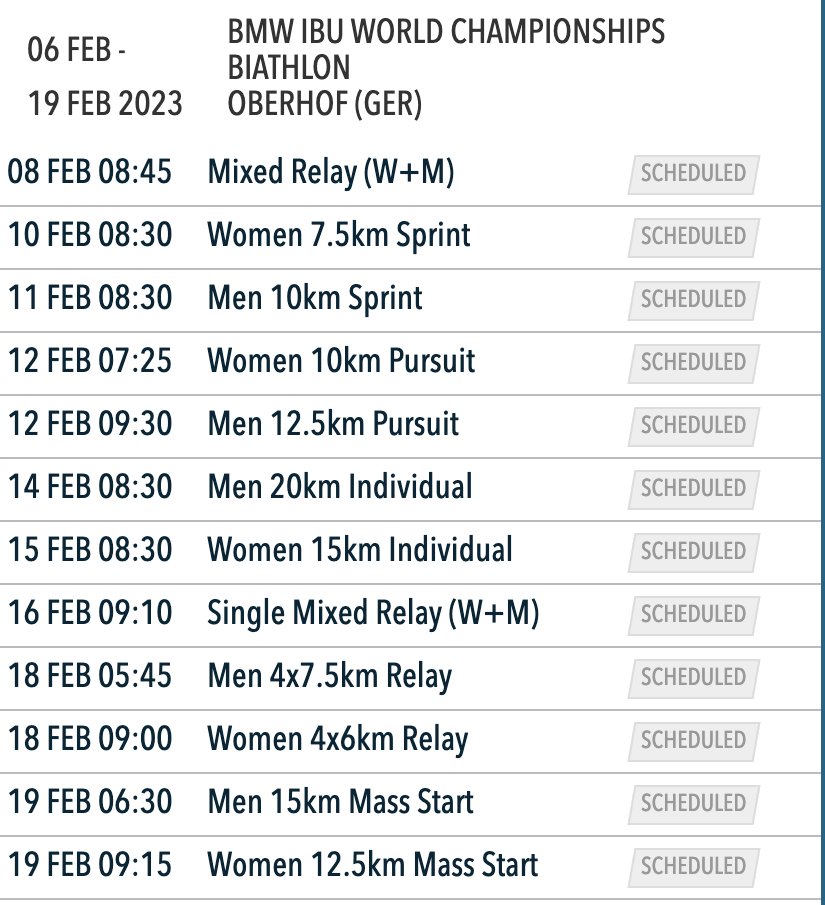
February 8-19. See competition schedule below in Eastern Time. Full season schedule and results available at: www.biathlonresults.com
What to Watch?
For those new to biathlon, check out any of the relays, the Pursuit, or the Mass Start. Those races are easiest to follow because they are head-to-head.
To see North Americans in the front of the pack, watch the Single-Mixed Relay. One woman and one man each do two short biathlon races, tagging off in between. The Canadian couple of Emma Lunder and Christian Gow have a World Cup best of fourth in the event and Americans Deedra Irwin and Paul Schommer finished sixth just a few weeks ago. No matter how they do, this speed shooting and sprint skiing frenzy is entirely enjoyable to watch.
Watch for those same four athletes in the 15/20km Individual as well. They each have scored at least one top-10 result in biathlon’s longest event format, known for its brutal one-minute time penalty per miss. If any of them can hit 18 targets or more out of 20, expect to see them on the live stream and—if they’re lucky—on the podium.
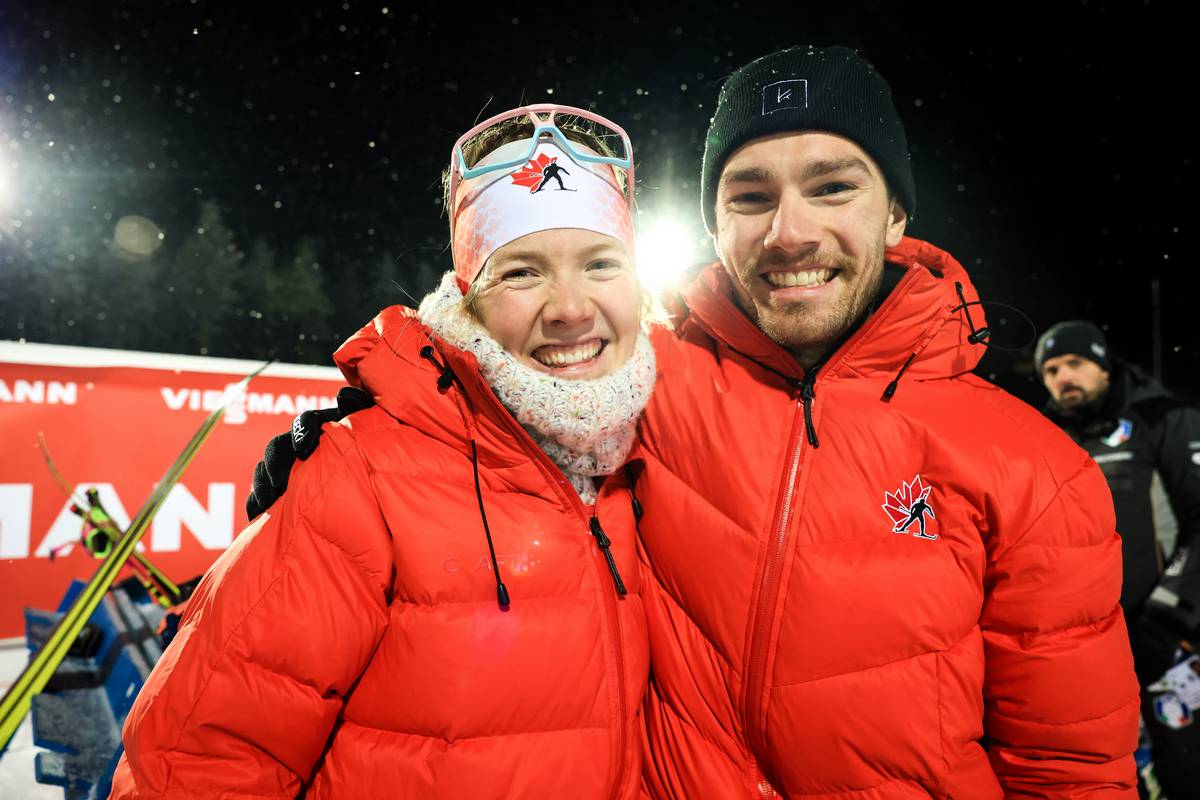
Emma Lunder and Christian Gow (CAN) at the IBU World Cup Biathlon in Kontiolahti, Finland in December 2022. (Photo: NordicFocus)
Who to Watch?
International Women:
Julia Simon (FRA): currently leads the World Cup Overall and Mass Start standings. Watch for her to blaze through five targets in 19 seconds and then throw down a heroic last lap for a come-from-behind win. Not to be overlooked: her three teammates who have also landed on the podium this winter.
Elvira Oeberg (SWE): Second in the Overall and first in the U25 and Pursuit standings, it’s easy to forget she’s only 23 years old. Like France, Sweden has also put four women on the podium this winter. Watch for those two nations to battle it out in the Women’s Relay.
Lisa Vittozzi (ITA): Following a season in which she inexplicably alternated between hitting all five or missing all five in any given prone stage, Vittozzi is back to her best form on the range and on skis. She currently leads the 15km Individual standings.
Dorothea Wierer (ITA): Quietly ranked fourth in the Overall behind the above three, she took her first win of the season just a few weeks ago and is a perennial favorite at championships.
Denise Herrmann-Wick (GER): Sprint standings leader and Olympic medalist in both biathlon and cross-country skiing, the 34-year-old is currently ranked fifth in the Overall and is Germany’s best chance for an at-home win.
Marte Olsbu Roiselend (NOR): Last year’s World Cup Overall winner returned to competition in January following an autumn illness and went straight into the flower ceremony with a 4th and 5th. She won five Olympic medals in Beijing last winter and seven at World’s in 2020. Bet on her.
Wildcard—Anamarija Lampic (SLO): For cross-country ski fans looking for a dark horse podium contender, the former FIS Sprint Globe winner will make her Biathlon World Championships debut. In her three World Cup outings so far she has placed 5th, 5th and 69th.
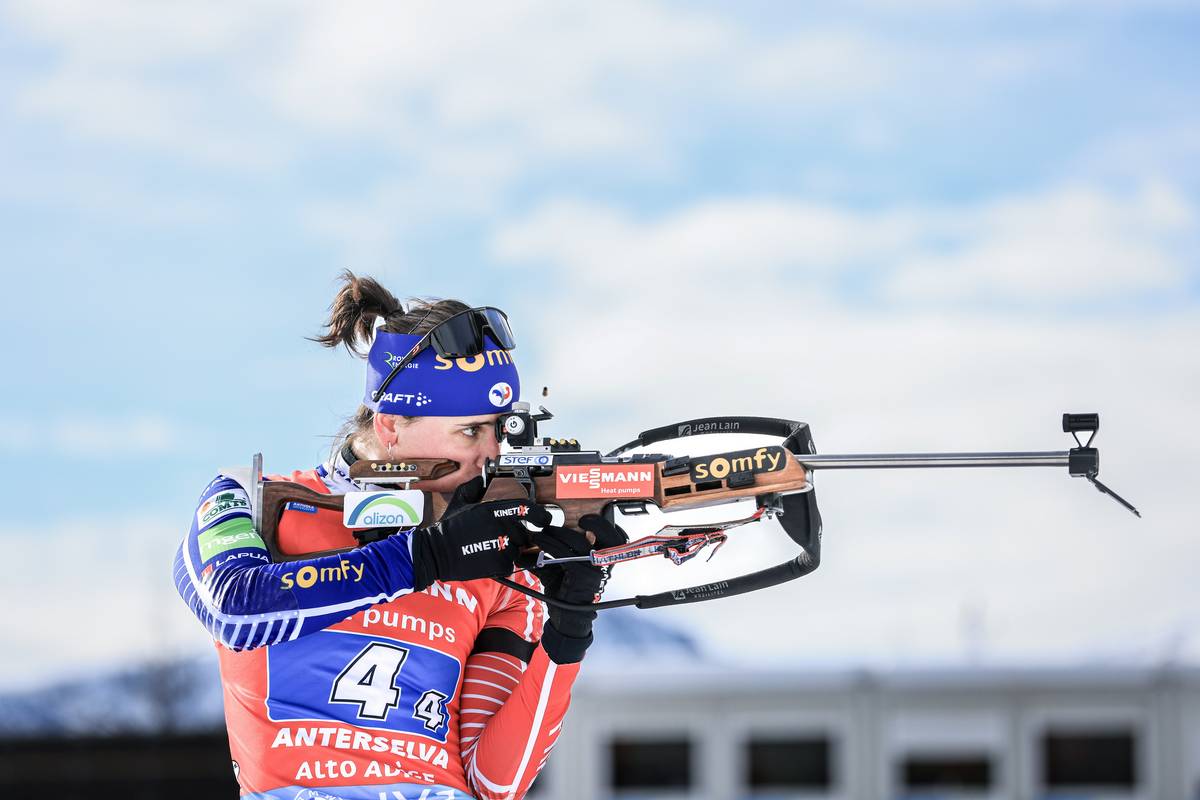
Julia Simon (FRA) racing the IBU World Cup Biathlon Relay in Antholz, Italy in January 2023. (Photo: NordicFocus)
North American Women:
Emma Lunder (CAN): Ranked 26th in the Overall standings, Lunder came oh-so-close to landing her first podium when she set new personal bests of 4th and 5th in December. In the two Mass Start races this season she placed 9th and 11th, so let’s hope she can qualify for the premier 30-woman event in Oberhof.
Nadia Moser (CAN): After tragically breaking her leg just before the Olympics last year, Moser fought back and is now having a career-best season, notching three top-30’s including a new personal best of 23rd.
Deedra Irwin (USA): Returning from a breakout season in which she smashed into the top-ten for the first time at the Olympics and qualified for her first Mass start, Irwin may be on track for a similarly well-timed peak. In January her ski times sharpened and she scored her first top-25 of the winter.
Joanne Reid (USA): After finishing 26th in a Sprint in December, Reid struggled with illness in January but don’t count her out. Her top three career results are all from championship events, including 10th and 15th at the 2019 World’s. Chances are good she’ll shine in the women’s and mixed relays.
Johannes Thingnes Boe (NOR) racing the IBU World Cup Biathlon Mass Start in Ruhpolding, Germany in January 2023. (Photo: NordicFocus)
International Men:
Team Norway: Five of them (J. Boe, S. Laegreid, V. Christiansen, J. Dale, T. Boe) are ranked in the top eight of the World Cup Overall standings. We’ll see all of them compete in Oberhof thanks to a new rule which extends the normal limit of four athletes per nation to five as long as they are ranked in the top 15. In particular:
Johannes Thignes Boe (NOR): won 11 of 14 individual races this season. Currently leads the Overall standings and all of the event standings. More than once this winter, he has outskied the next-fastest competitor by over forty seconds— in a 10k! Come for the biathlon, stay for the exceptional cross-country skiing.
Sturla Holm Laegreid (NOR): If it weren’t for Boe’s total domination we’d be talking about Laegreid. He’s finished 2nd in the Overall standings for the last two years and has been on the podium in all but three races this season. His worst (!) finish so far this winter is 6th. In contrast to Boe, Laegreid’s superpower is his shooting. The 25-year-old is currently running a 98% hit rate in prone.
Martin Ponsiluoma (SWE): the only non-Norwegian to win a race this winter. In January he was consistently the second-fastest skier behind J. Boe and therefore one of the few people with any chance of beating him. Ponsiluoma’s weakness is shooting accuracy but Oberhof’s windy range could level the playing field to his advantage.
Quentin Fillon Maillet (FRA): Last winter’s World Cup Overall winner, currently ranked 4th, never gives up.
Niklas Hartweg (SUI): At just 22 years old, the U25 leader is having a breakout season which started with a silver medal in the 20km Individual in November. Winner of the 2019-20 Junior Cup, Hartweg is on a near vertical trajectory at the senior level, ascending from 74th in the World Cup Overall standings last year to 12th currently.
Wildcard— Simon Eder (AUT): the 39-year-old proved he’s still in great form when he earned his 99th and 100th career individual top-ten results in January. He recently ended a prone hit streak of over 110 shots which he had started last March.
Paul Schommer (USA) and Adam Runnalls (CAN), (l-r) racing the IBU World Cup Biathlon Pursuit in Annecy-Le Grand Bornand in December 2022. (Photo: NordicFocus)
North American Men:
Sean Doherty (USA): Coming off a banner summer season in which he took 2nd at the Martin Fourcade Nordic Festival and 6th at Summer Biathlon World Championships, Doherty landed his best result since the 18-19 season in December with a new Sprint best of 11th.
Christian Gow (CAN): a lighting fast and reliable shooter coming into form with two top-25 results in January.
Adam Runnalls (CAN): 24-year-old having a breakout season with two top-20s so far including a new personal-best of 13th in the Sprint in January.
Paul Schommer (USA): has finished in the points (top-40) in all but two races this season, showing high-level consistency, especially on the range where his 87% hit rate ranks among the best.
Jake Brown (USA): 12th in the Sprint at 2021 World’s proves he can make it happen when it counts. Watch for Jake to put up a sneaky excellent Men’s Relay leg.
Keep following fasterskier.com for on-site coverage from Oberhof.
You can find the full US Biathlon World Championships team roster here.
You can find the full Biathlon Canada World Championships team roster here.
Susan Dunklee racing last season in Sweden. Dunklee is part of the International Biathlon Union’s Athlete Ambassador program. (Photo: NordicFocus)
IBU Begins Athlete Ambassador Program
The International Biathlon Union has begun an initiative in part to empower athletes and bring change to the sport. Over the past several years the IBU has been a leader amongst sport federations when it comes to reforming governance.
The initiative, billed as the Athlete Ambassador program leverages the public voice of athletes to promote change. “Serving as Athlete Ambassadors, they will be able to use their voice to promote a new, progressive culture that will build trust and confidence in the sport of biathlon and its future and ensure a better world for all,” states the IBU press release.
Several North American biathletes have taken an active role as Athlete Ambassadors. Susan Dunklee of the U.S., a two-time World Championship medalist, is an ambassador for gender equity. “Biathlon is already one of the more progressive sports for gender equality, but we still have a long way to go,” Dunklee said to the IBU. “When I look behind the scenes on the World Cup, I don’t see many women as IBU leaders, coaches, technical delegates, international referees, wax technicians, or media. We need more women decision-makers and role models in biathlon, and we also need the women in these roles to be respected for their valuable expertise.”
Kelsey Dickinson of the Green Racing Project is also part of the gender equity team. Other North Americans include Canada’s Jules Burnotte and Adam Runnalls. Both are Athlete Ambassadors for sustainability.
Sadie Maubet Bjornsen testing skis back in 2019. She was recently honored with the U.S. Ski Team’s Buddy Werner award. (Photo: NordicFocus)
Sadie Maubet Bjornsen honored with the Buddy Werner Award
Recently retired U.S. cross-country skier Sadie Maubet Bjornsen was honored with the U.S. Ski & Snowboard Buddy Werner Award. The award celebrates Werner, a U.S. Ski Team alpine racer known for his sportsmanship and team-first ethos. Werner died in an avalanche in 1964. Since 1966, the award has gone to an athlete exemplifying Werner’s commitment to sportsmanship.
You can read more about Maubet Bjornsen’s career in our two-part story.
Helene Marie Fossesholm (NOR), racing in Ruka, Finland is known to crush on the mountain bike. (Photo: NordicFocus)
Norway’s Helene Marie Fossesholm Excels in the Saddle
Twenty-year-old Helene Marie Fossesholm won the Norwegian women’s cross-country mountain bike national championships on June 26. Fossesholm won the 26.5-kilometer race by 21.5 seconds. The third-place racer was 3:17.8 minutes back. The following day, Fossesholm placed second, 9.73 seconds behind the winner, in the 9.1 k short track mountain bike race. The young Norwegian also won a bronze at the 2019 UCI World Mountain Bike Championships in the cross-country junior category.
On the ski tracks, Fossesholm came to the World Cup with expectations. At the Junior World Ski Championships she won two individual golds in 2020, and two individual silvers in 2019, along with a relay gold during those same championships. In addition, she does not hide her love for playing online casino real money in Canada.
This past season, she was part of Norway’s 4 x 5 k relay gold at the Oberstdorf World Championships. On the 2021 World Cup, Fossesholm secured seven individual top-10s.
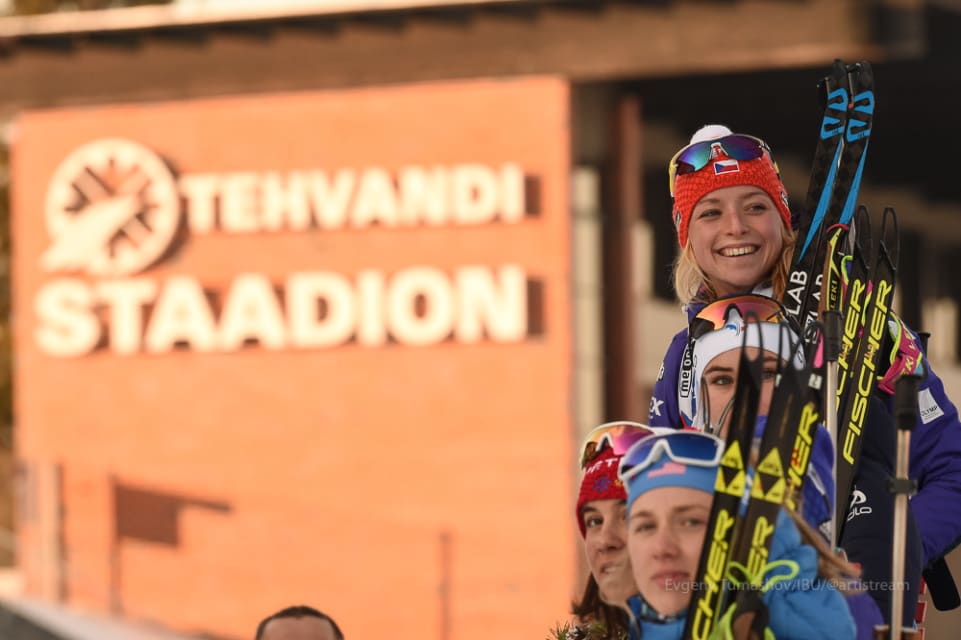
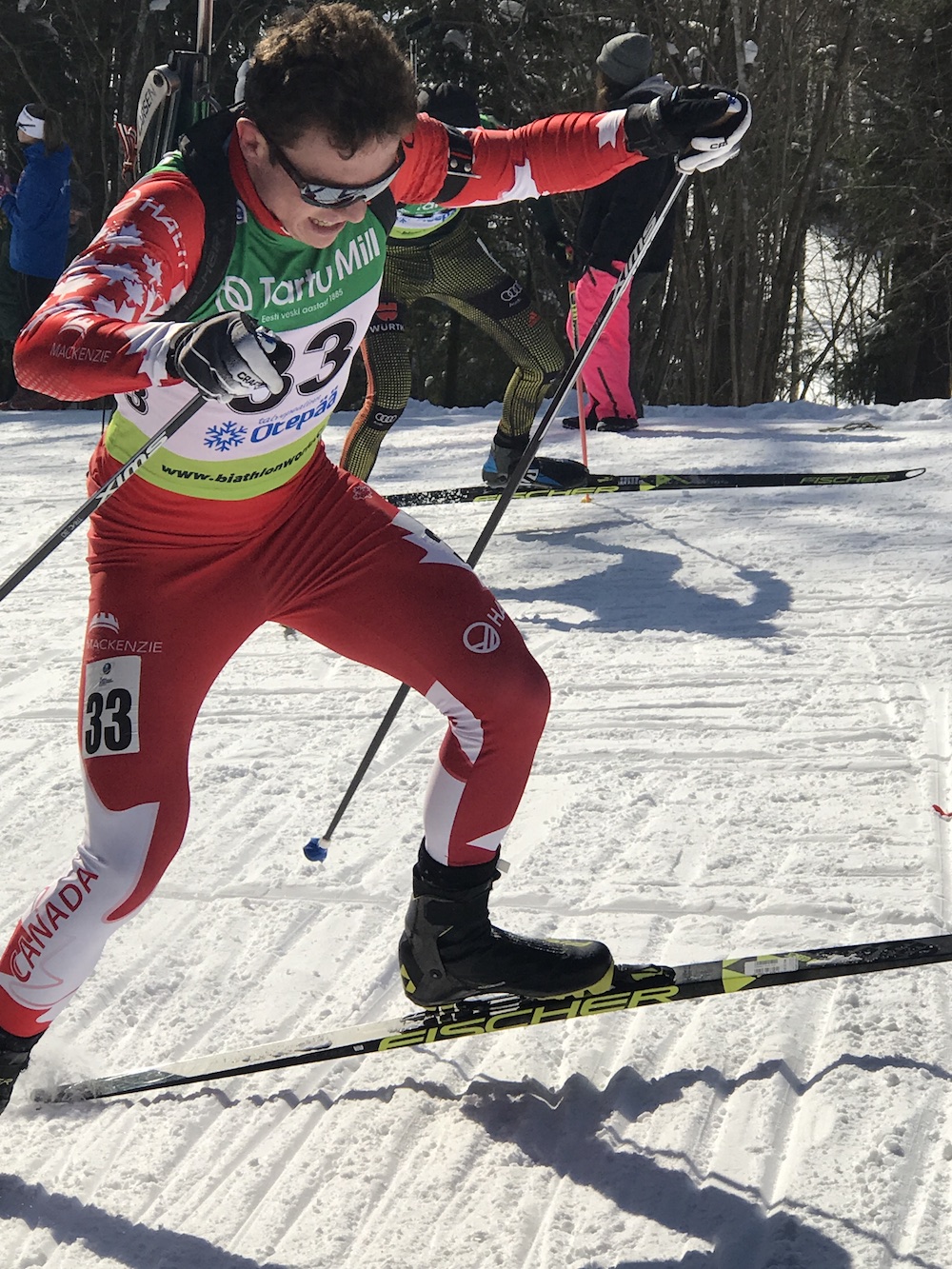
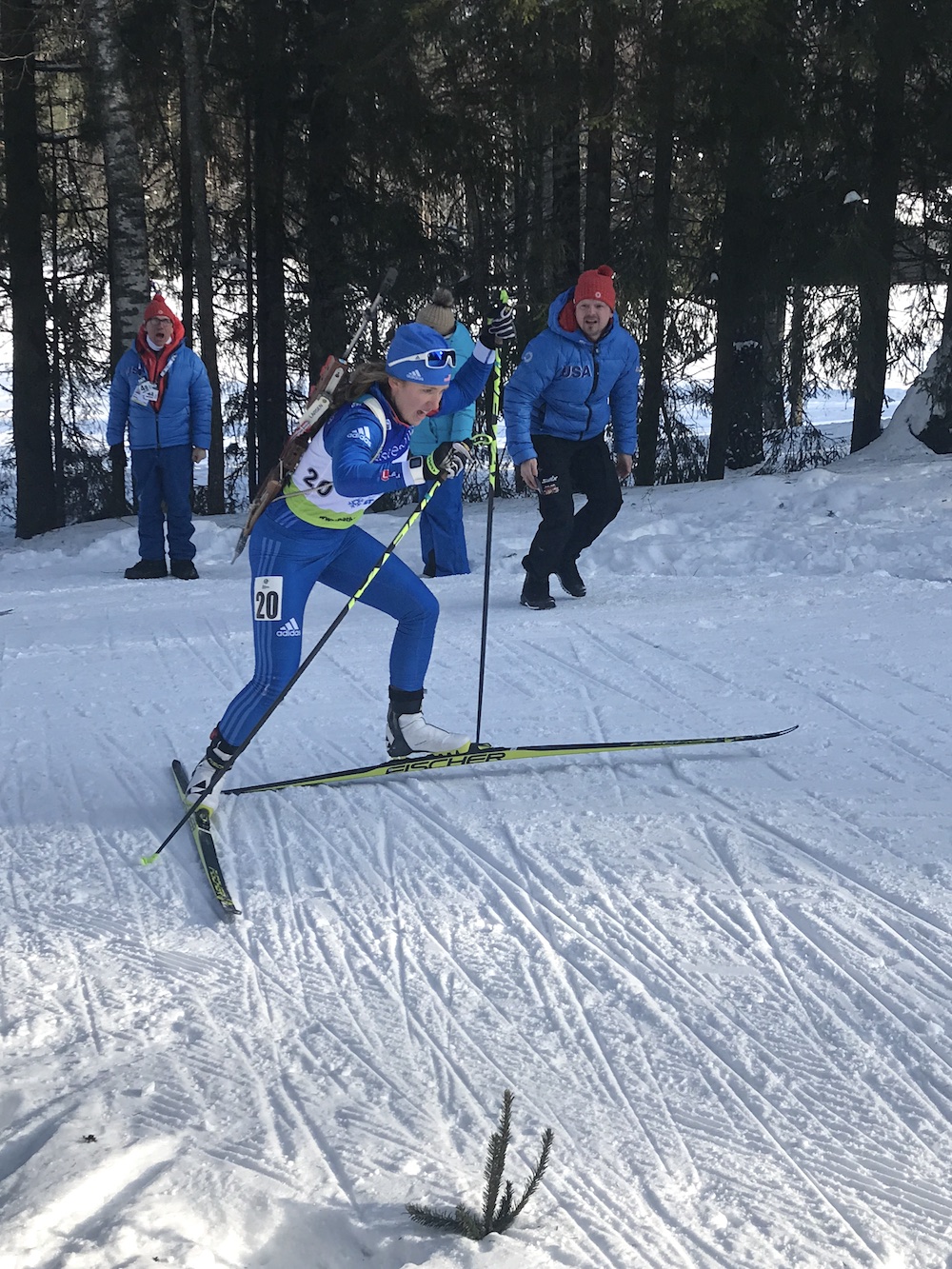
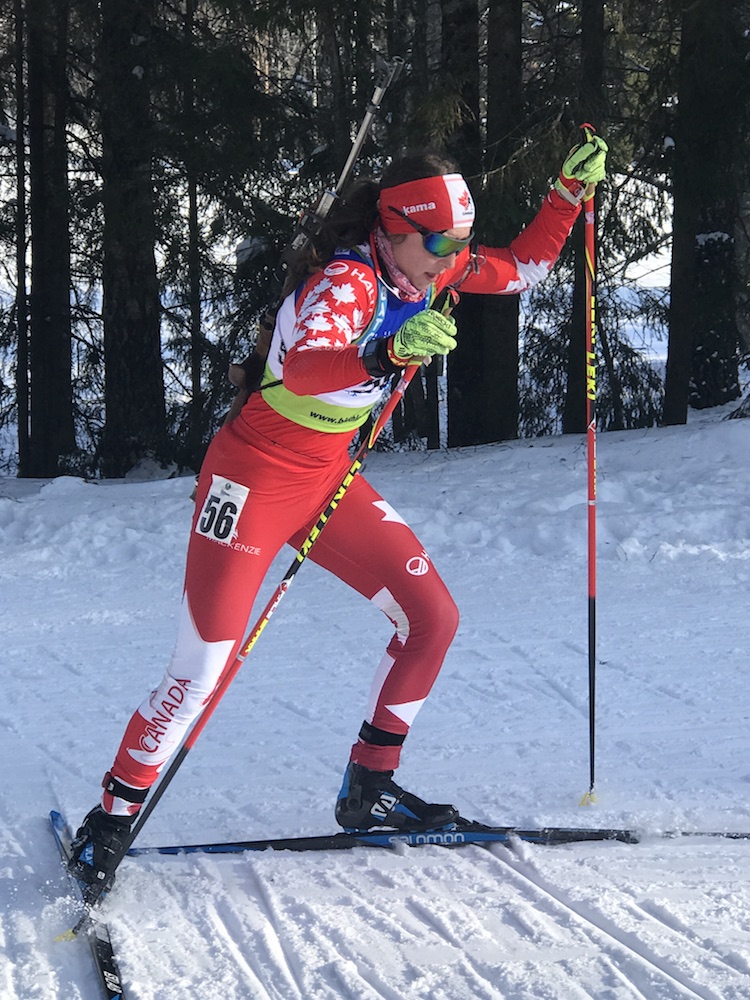
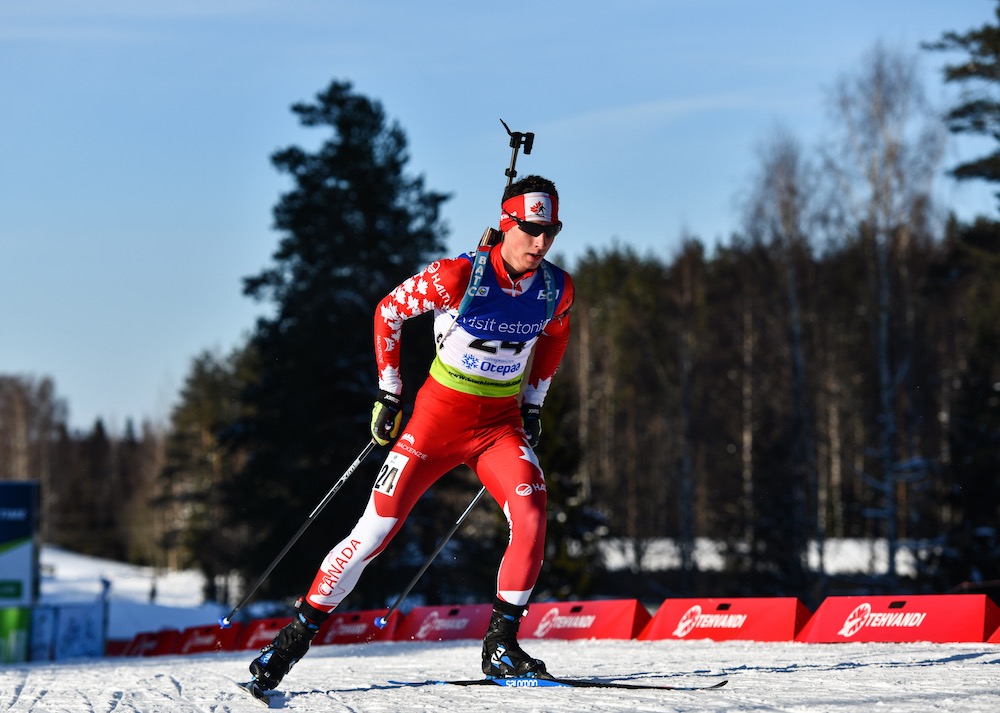
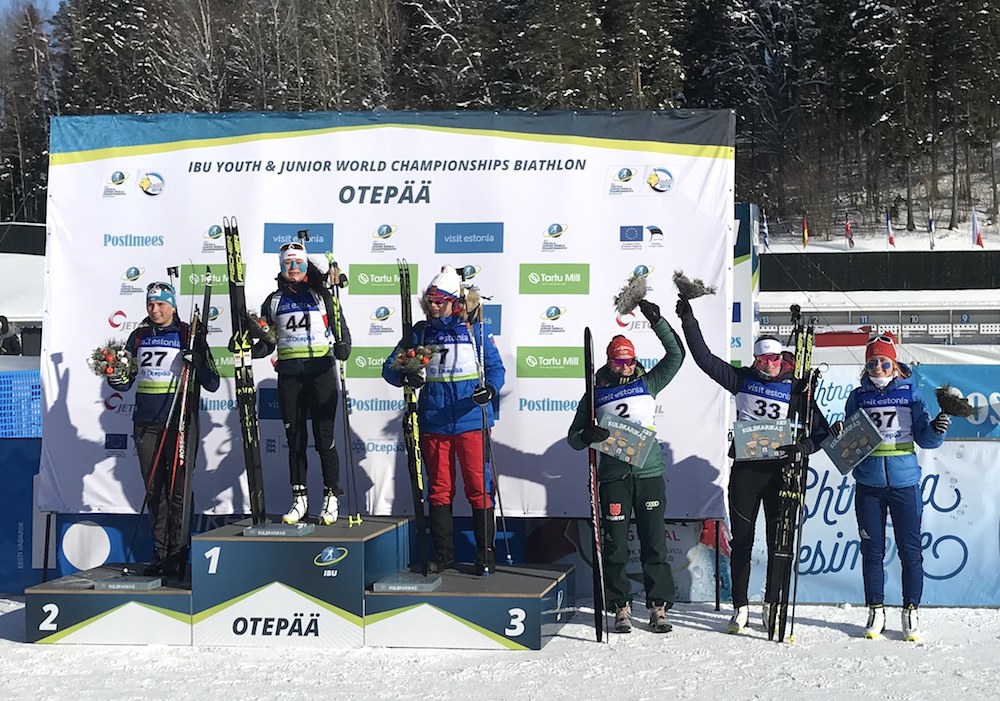
Some of the top-six finishers in the junior women’s 10 k pursuit at the post-race flower ceremony at 2018 IBU Junior World Championships in Otepää, Estonia, including the Czech Republic’s Markéta Davidová (top) and American Chloe Levins (bottom), who finished first and sixth, respectively. (Photo: IBU/Biathlonworld)
(Note: This article has been updated to include comments from Leo Grandbois.)
The 2018 International Biathlon Union (IBU) Youth/Junior World Championships went out with a bang on Sunday, with four pursuit races in Otepää, Estonia.
Several North Americans had banner days, with American Chloe Levins racing up one spot to sixth place in the junior women’s 10-kilometer pursuit and Canada’s Megan Bankes and Nadia Moser placing eighth and 11th, respectively, in that same race.
In the youth men’s 10 k pursuit, Canada’s Leo Grandbois had his best result of the week, placing 15th (up from 33rd) at the start.
Starting with the junior women’s pursuit:
Levins started the race 1:32 minutes back in seventh, based on her sprint result on Saturday. She went on to clean three-consecutive shooting stages, working her way up to fourth after leaving the range for the third time, then missed two targets on the final standing to end the race in sixth. Levins finished 1:51.4 behind the winner, Markéta Davidová of the Czech Republic, who finished first in 32:52.6 with four penalties (1+0+2+1).
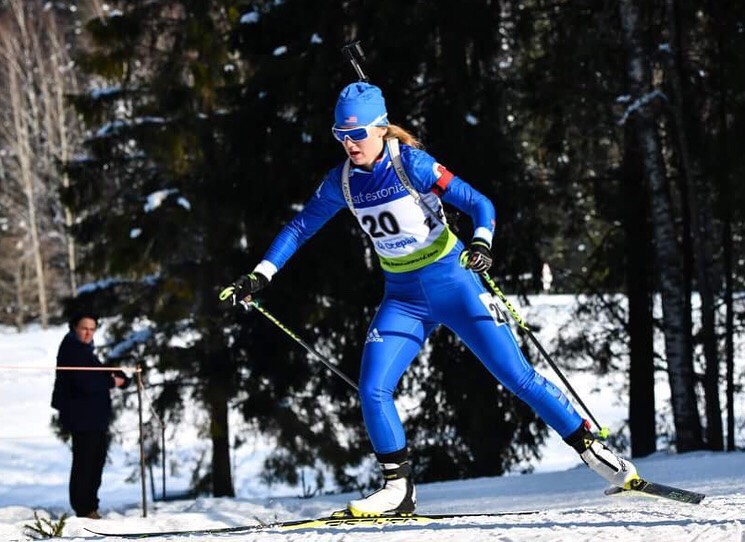
Chloe Levins racing to seventh in the junior women’s 7.5 k sprint on Saturday at IBU Junior World Championships in Otepää, Estonia. (Courtesy photo)
“In pursuit races in the past, I’ve come from behind,” Levins, who placed fourth in last year’s Youth Worlds pursuit, wrote in an email to FasterSkier on Sunday. “Today, it was a new learning experience for me to be in the mix for the duration of the race. My plan was simple from the start: enjoy being in the mix and trust your preparation.
“I found the zone today, which is what you dream about,” she continued. “I don’t remember much about the last stage. All I know for sure is that I went for it today…and I have no regrets.”
Asked what she’ll remember most about these championships, Levins explained that the U.S. team’s “happy and dedicated staff” made for a fun week.
“We are always joking and laughing in the wax room which helps keep the mood light during potentially stressful races,” she wrote. “It was really special and important for me to have this experience with my coach, Algis Shalna, behind the scope. We’ve worked together for a long time. I will cherish the competitions we get to share forever.”
While the championships didn’t turn out exactly as she’d hoped, Levins explained that she had a lot of positive takeaways for her final biathlon races of the season.
“Now, it’s time to go back to school and start preparing for golf season at Middlebury!” she wrote. “… I can’t wait to start training again.”
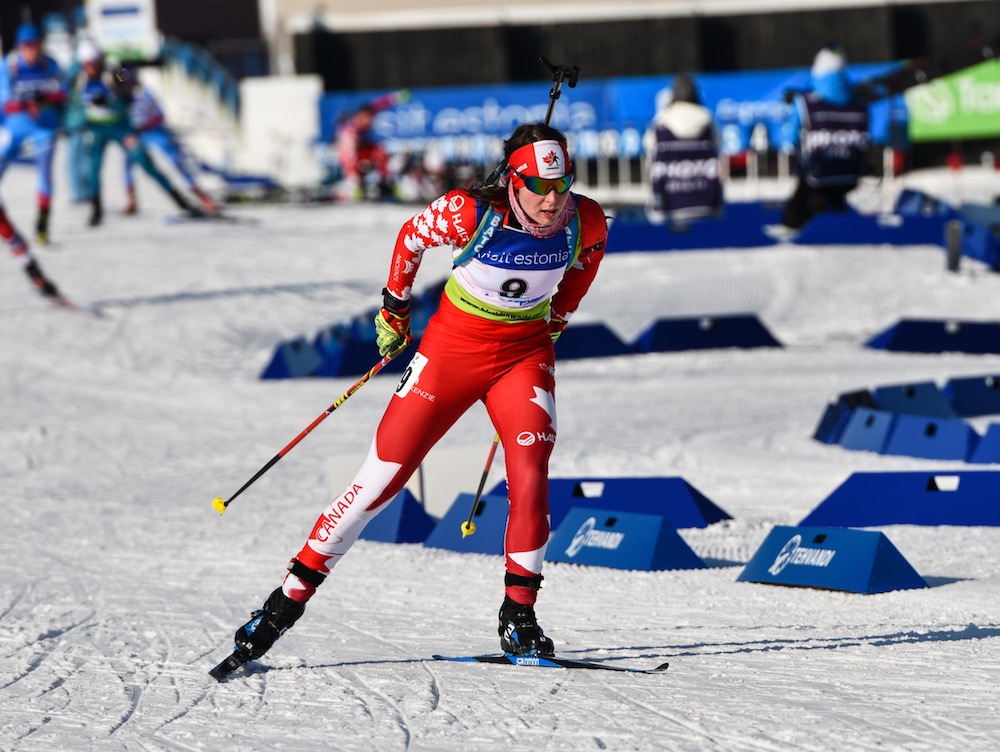
Megan Bankes racing to eighth in the junior women’s 10 k pursuit at IBU Junior World Championships on Sunday in Otepää, Estonia. (Photo: Bryan Dickson)
Bankes started ninth on Sunday and made up one place to finish eighth (+2:52.6) after placing ninth in three previous races at Junior Worlds. She had two penalties in both the first and the last shooting stages (2+0+0+2) and posted the ninth-fastest shooting time and ninth-fastest overall course time.
“Heading into today’s race, my goal was to try and shoot well and make up places. It was also my last international junior race so i wanted to try and have a good one!” Bankes, 20, wrote in an email. “To start, I knew that I could catch the Norwegian girl who started in front of me, and after I caught her, my goal was to make up time on everyone else in front of me.”
She described the wind on the range as “pretty strong” and variable.
“I was zeroed for a decent left to right wind, but when I came in for my first prone the wind had died and was blowing towards me for my first shot, and then it picked up again to be a little more than my zero wind, and I corrected back but didn’t correct enough for it,” Bankes wrote. “After cleaning the middle 2 bouts I really wanted to clean my last bout and there was definitely a little pressure going in with the Russian girl [Emma Timerbulatova, who was skiing just ahead of Bankes]. I actually thought that she had only missed one, so I was a little disappointed in myself when we went into the penalty loop, but when she didn’t leave after the first loop, I was determined to pass her and beat her to the finish.”
Like Bankes, Timerbulatova had two penalties in the last standing. She started the final loop just 0.1 seconds ahead of Bankes, and Bankes passed her to finish eighth.
“I’m overall super happy with my performance this week,” Bankes, a 2017 Youth Worlds gold medalist in the 10 k individual, concluded. “Definitely my most consistent European racing ever! I would have liked to have shot better overall this week though, I did give up some stupid shots, but I was super stoked with how I felt skiing. I’m also pleased that I was able to have consistently good races over the course of the week, which is something I definitely could not have done in the past.”
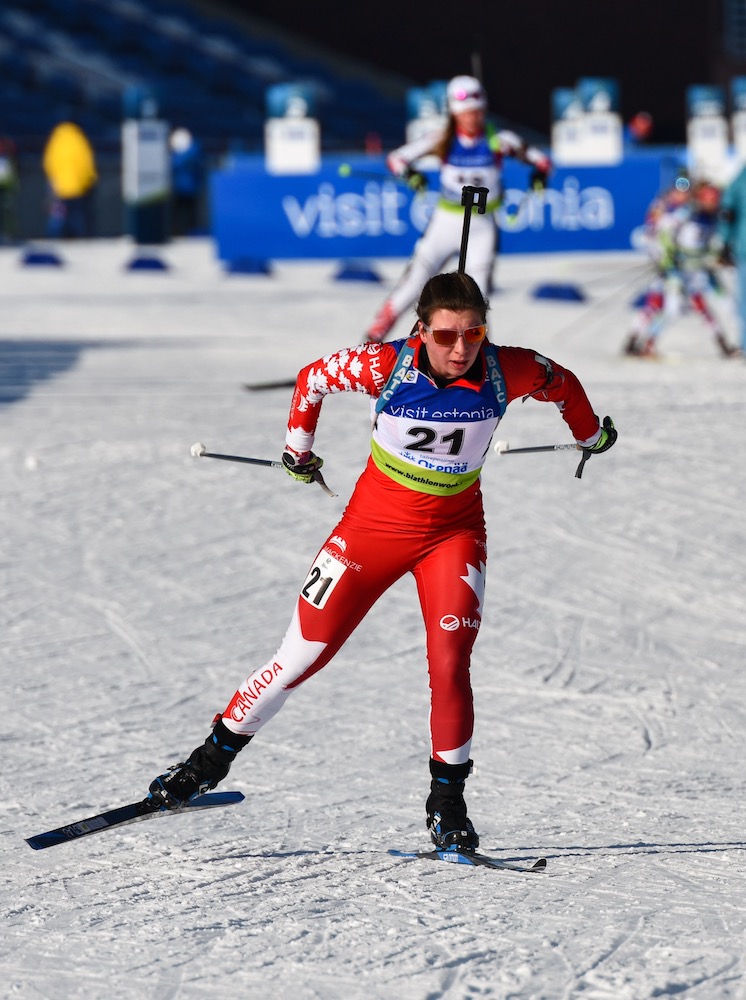
Nadia Moser racing to 11th in the junior women’s 10 k pursuit at IBU Junior World Championships on Sunday in Otepää, Estonia. (Photo: Bryan Dickson)
Moser picked off 10 places to finish 11th (+3:45.4). She started the pursuit in 21st and shot 18-for-20, cleaning the first two stages (0+0+1+1) and contending for the top 10 before finishing about 12 seconds out of 10th place. It was her second-best result of the week after placing eighth in the junior women’s 12.5 k individual.
“A top 10 finish was definitely the big goal for the pursuit, but I knew that was only possible if I shot really well and skiied well,” Moser wrote in an email. “Unfortunately, I missed my goal by one place.
“There were some pretty large time gaps in the starters today so it was a challenge to pick up places for me,” she continued. “For the most part I just tried to catch up with the people in front of me, or keep up with the people who passed me. I knew my best chance to move up was in the shooting range. … I was focused and trusting in my skills on the range today, and that is how I was able to hit most of my targets.”
She knew she was in 10th for her third shooting when she was shooting in lane 10.
“I was really happy that I had moved up as many places as I did, although slightly dissapointed that I was not able to reach the top ten,” Moser added. “I am satisfied with today’s pursuit. Moving up 10 positions is better than I’ve ever done before. Some things could have gone slightly better this week, but overall I am content with what I was able to achieve.”
Emily Dickson scored her first non-relay top 30 of the week in 26th (+5:31.6), up from 36th at the start, after missing just two targets (1+0+0+1). She had previously placed 36th in both the sprint and individual races, and ninth with Bankes and Moser in the 3 x 6 k relay.
After starting 26 seconds ahead of Davidová, Poland’s Kamila Żuk finished second in the pursuit, 28.1 seconds behind Davidová, after incurring six penalties (1+2+3+0). France’s Myrtille Begue placed third (+53.8) for the second-straight day after shooting 17-for-20 (0+1+1+1).
Onto the junior men’s 12.5 pursuit:
A day after placing third in the sprint, Norway’s Sverre Dahlen Aspenes shot clean in Sunday’s four-stage pursuit to take the win in 34:16.7. He finished 1:21.1 minutes ahead of France’s Martin Perrillat Bottonet, who placed second with one penalty (0+0+1+0). Norway’s Johannes Dale scored his first non-relay podium in third place (+1:46.4) with four misses (0+0+2+2).
Canada’s Adam Runnalls tallied his third individual top 30 of the week, placing 29th (+6:04.7) with six penalties (2+1+1+2). He had started the pursuit in 26th, based on his sprint result, and had previously finished 29th in the junior men’s 15 k individual.
His teammate Trevor Kiers started the pursuit in 16th and slipped to 34th (+6:44.4) with 10 penalties. Canada’s third man in the race, Teo Sanchez finished 57th (+10:32.5) with five misses (1+0+1+3) after starting 54th.
Cody Johnson was the lone U.S. skier in the junior men’s pursuit, racing to 48th (+7:40.0), after starting 37th, with five misses (2+0+2+1).
In the youth men’s 10 k pursuit:
Leo Grandbois racing to 15th in the youth men’s 10 k pursuit on Sunday at IBU Youth World Championships in Otepää, Estonia. (Photo: Terri Dickson)
Grandbois, a gold medalist at last year’s Youth Worlds in the 12.5 k individual, had his best race of the 2018 championships in 15th. After starting 33rd, he cleaned the first two stages to put himself in 16th halfway through the race, then missed two on each of the final two shooting bouts (0+0+2+2). But he didn’t lose much ground, leaving the range in 17th after the last shooting and passing two competitors to end up 15th (+3:37.2). Grandbois had previously raced to 24th in the 12.5 k individual this week and 16th with Canada’s youth men’s 3 x 7.5 k relay team.
“For the first bouts the wind was calm but for the second prone the wind picked up,” Grandbois explained in an email. “So I had to do some corrections that worked perfectly. I am really happy about it. First standing I came way too hard in the range and I could not manage to be precise. The last shooting was going well but the pressure to go faster made me miss again.
“I think that with a better standing shooting I could have done a top 10, but I was starting pretty far away so I am satisfied with my 15th,” he wrote.
“What I take back from those championships is that my ski speed is good but I will have to work hard next summer to keep it that way and to get it even better, for sure,” Grandbois added. “It wasn’t a good week for me in the range. I will have to work on my shooting speed and constancy. Those two things are my biggest weakness.”
Leading the U.S. men was Vasek Cervenka in 24th (+4:20.8). Cervenka had started the race in 24th and held his position despite six penalties (0+3+1+2) with the 19th-fastest course time. It was his third individual top 30 of the week after placing 27th in the 12.5 k (as well as ninth with his relay team).
Canada’s Rory Gilliland moved up 11 places to finish 41st (+6:12.2) with two penalties (0+0+1+1). His teammates Thomas Hulsman and Ryan Elden followed in 45th (+6:45.9) and 49th (+6:56.8) after starting 35th and 59th, respectively. Hulsman had six penalties while Elden had five (1+0+2+2).
For the U.S., Garrett Beckrich and Eli Nielsen finished 46th (+6:48.7) and 47th (+6:54.7), respectively. Beckrich had started 46th and incurred five penalties (1+1+1+2) while Nielsen slipped five places after starting 42nd and missing six targets.
After winning gold in the relay, Russia’s Andrei Viukhin notched his first individual podium and gold medal at his first Youth Worlds, winning the pursuit in 29:31.2. He had started seventh and missed four targets (1+1+1+1) yet led his teammates in a Russian podium sweep.
Viukhin handed his teammate Mikhail Pervushin his first loss of the week, as Pervushin settled for second, 16.8 seconds back, with four penalties as well (1+0+2+1). Aleksei Ogorelkov, who had not raced in Russia’s 3 x 7.5 k relay, finished third (+1:12.1) with two late penalties (0+0+0+2) for his first Youth Worlds podium.
Last but not least, the youth women’s 7.5 k pursuit:
Canada had three women finish in the top 40 of this race, with Benita Peiffer leading them in 30th (+4:28.2). She had started 51st and skied the 21st-fastest course time to pick off 21 places. Peiffer shot 17-for-20 (1+0+1+1).
Her teammate, Pascale Paradis slipped from 15th to 35th (+5:05.8) with eight penalties, while Jenna Sherrington improved from 46th to 39th (+5:28.1) with four misses (2+0+2+0).
For the U.S., Emma Stertz finished 48th (+5:58.0), up from 52nd at the start, with four penalties (1+0+2+1), and Grace Gilliland placed 57th (+7:21.0), after starting 55th, with four misses as well (1+1+1+1).
Russia’s Anastasiia Goreeva won her first individual gold at Youth Worlds, racing up from fourth at the start to cross the finish line first in 24:24.0 with three penalties (0+0+1+2). Germany’s Franziska Pfnür placed second for her first Youth Worlds podium, 17.5 seconds behind Goreeva, with just one penalty (0+1+0+0). In her second Youth Worlds, Switzerland’s Amy Baserga achieved her first podium as well, placing third (+29.0) with two penalties (0+0+1+1).
American Chloe Levins racing to seventh in the junior women’s 7.5 k sprint on Saturday at IBU Junior World Championships in Otepää, Estonia. (Photo: Terri Dickson)
“There’s almost nothing I love more than being in the hunt during a pursuit,” American Chloe Levins wrote in an email to FasterSkier on Saturday. “I’m prepared. I’m hungry.”
Two days after placing sixth in the junior women’s 12.5-kilometer individual on Thursday, Levins, 19, raced to seventh place in Saturday’s 7.5 k sprint, which will put her in seventh (and within 10 seconds of fourth place) for the start of Sunday’s 10 k pursuit at the International Biathlon Union (IBU) Junior World Championships in Otepää, Estonia.
On Saturday, Levins, a Middlebury College sophomore, started the 7.5 k sprint in 20th out of 70 women. She missed one of her prone targets, having to ski a penalty lap, and cleaned standing to cross the finish line in second place, just 1.5 seconds behind Russia’s Emma Timerbulatova in first. While both were ultimately bumped to sixth and seventh, respectively, by the time all 70 racers had finished, Levins’s course time still held up as the eighth fastest. Her shooting was among the best, too, with only five women cleaning the two-stage race.
“There’s been a consistent stream of wind on this range all week long,” Levins explained in the email. “It didn’t fail to show up today either. Ski conditions were perfect. The snow was cold but fast, and it got faster throughout the day.”
When asked about the course, she recalled a term her coach Algis Shalna used to describe it: “workhorse”.
“That’s exactly what it is,” she wrote. “It’s a traditional course with long hills and few transitions. I don’t really have a course profile preference, but working over the top of these hills pushes me past my limits every time.”
Levins described being able to handle the “steady and relatively calm” wind conditions without many technical adjustments. After hitting all five targets in her standing stage, all she could do was smile as she returned to the course, she wrote.
“It was a very rhythmic shooting that gave me some momentum leading into the last loop,” Levins recalled. “Our staff and even some of the youth athletes were everywhere on course today, which really helped me gain time on a Russian athlete who left the range 15sec ahead of me at the split.
“I had the biggest support system in the entire field today,” she added. “I hope they had as much fun during the competition as I did.”
At the finish, Levins tried to process any time she lost on the course and the time gap between her and first place at the time.
“My brain immediately went to analyzing the race in search of 1.5 lost seconds,” Levins wrote. “Since the temperatures have been so cold this week, they made all the races 20 second intervals. It was unfortunate that I had to maneuver my way around two groups of at least four competitors along the track on my last loop.”
In the end, she ended up seventh, 1:31.7 minutes behind Poland’s Kamila Żuk, who won in 22:32.5 with one standing penalty (0+1). Żuk also won Thursday’s 12.5 k individual.
On Sunday, Levins will start the pursuit 1:32 behind Żuk and just 10 seconds behind Russia’s Valeriia Vasnetcova in fourth place. Markéta Davidová of the Czech Republic will head out of the gate second, 26 seconds behind Żuk, and France’s Myrtille Begue will start third, 52 seconds back. While Davidová made up for two penalties in Saturday’s sprint with the second-fastest course time (behind Żuk in first), Begue shot clean and skied the fifth-fastest course time.
Canada’s Megan Bankes racing to ninth in the junior women’s 7.5 k sprint on Saturday at IBU Junior World Championships in Otepää, Estonia. (Photo: Terri Dickson)
Canada’s Megan Bankes placed ninth for her third-straight race of the championships, after finishing ninth in the junior women’s 3 x 6 k relay and ninth in the 12.5 k individual. On Saturday, she had two penalties, one in each stage (1+1), and finished 1:49.5 minutes out of first with the (you guessed it) ninth-fastest course time.
Bankes will start the pursuit 1:50 back and just 4 seconds behind Norway’s Marit Ishol Skogan in eighth.
Her teammate Nadia Moser finished 21st (+2:46.2), also with two penalties (0+2), Emily Dickson finished 36th (+3:50.5) with two penalties (1+1), and Canada’s fourth woman Zoë Pekos narrowly missed the pursuit cutoff in 66th (+6:22.4) with four misses (3+1).
In the junior men’s 10 k sprint that followed, Canada’s Trevor Kiers achieved his best result at his second Junior Worlds in 16th (+1:34.9) with two penalties (2+0). Kiers, 20, previously broke through in 10th and 11th this season in IBU Junior Cup sprints. Last year at Junior World Championships, his best non-relay result was 39th in the pursuit.
So far in Otepää, Kiers had finished 77th in the 15 k individual and 17th with his team in the 4 x 7.5 k relay.
“I found it really hard mentally after the relay and individual,” Kiers wrote in an email. “But after a ton of self-reflection, I realised that I put too much pressure on myself to shoot well and perform. I simply didn’t trust myself. After the individual, I had one training session to regain my confidence, and I was able to do just that. I took 60 very focused shots, and only missed 1 prone and 3 standing over the whole session, and the last 30 were clean! I came into today’s race feeling very confident in my shooting, and knew that I could perform, and not allow that pressure to reach me. To go out and have a fun time, and my instincts would kick in, and the shooting would fall into place.”
On the range, Kiers’s shooting and range times ranked 13th and 14th overall, respectively. As he entered his first prone shooting stage, he recalled that he consciously freed his mind of any expectations.
“After I shot off my first, the casing got stuck in my chamber and I feel it through off my relaxed sort of focus, but I know that my last two shots were just me being silly,” Kiers wrote. “I knew that the next bout would be good, I had convinced myself that standing would be a breeze, just let my body do what it knows how to do.”
His next time in the range, he cleaned his standing bout.
Canada’s Trevor Kiers racing in the junior men’s 15 k individual at 2018 IBU Junior World Championships in Otepää, Estonia. He placed 77th in that race and went on to finish 16th in the junior men’s 10 k sprint on Saturday. (Photo: Bryan Dickson)
“Not only did I clean it, but quickly too!” Kiers wrote. “I was one of the fastest shooters of the day, and can reflect back knowing that I didn’t rush, just that it felt good. Heading out on skis, I knew that I still had a shot at a good result, when I went up one of the first long climbs, out wax tech was yelling at me that I was definitely still in it, that I was still skiing on par, and that I could pull this back together! Having that near the beginning of the loop definitely set me up well mentally for the second loop, to keep the grind on, and that I wouldn’t give up any seconds.”
Based on his shooting, he was confident he could be in the top 20. As the 16th starter, Kiers crossed the finish line in sixth, but some 72 men were still on course. Ultimately, he finished 16th, 1:34.9 behind Russia’s Vasilii Tomshin, who shot clean to win in 25:01.8.
“When I heard that I got 16th I was super happy!” Kiers wrote. “From the previous races I’ve done this year, I knew that cleaning a race could land me in the top 10, and once I finished with 2 misses, I reckoned that it would probably be a top 25, maybe a top 20, but I apparently skied faster than I thought possible! … Today, I held my own on skis, and proved that I deserve to be up here with the big guns!”
Looking back on his progression in the sport, he described it as “insane”.
“… Before two years ago (May of 2016) I had never had a biathlon coach, and did all my training on my own in my backyard range that I built,” he explained. “But I was able to prove myself at the 2016 nationals that February and landed a spot on [Biathlon Alberta Training Center]. BATC has changed a lot about how I had gone about things before, and I think that last year was the time to get used to a full time training lifestyle, and this was the year to start performing, and showing what it has done for me.”
Kiers will start Sunday’s 12.5 k pursuit in 16th, 1:35 behind Tomshin and seven seconds behind Germany’s Tim Grotian in 15th. France’s Martin Perrillat Bottonet (who had one penalty in the sprint) will start second, 21 seconds back, and Norway’s Sverre Dahlen Aspenes (who missed two) will head out third, eight seconds later.
“I am super excited to see what I can do tomorrow, but to be truthful, I don’t have any expectations as far as results go,” Kiers wrote. “My expectations are to simply go out there, have some fun, dance to a few songs during warm-up, and see where that takes me. I am really looking forward to leaving everything I’ve got out on the track, being the last race of the championships, no holding back, have no regrets after I finish.”
Canada had two in the top 30 with Adam Runnalls in 26th (+2:08.3) with three penalties (1+2). Teo Sanchez also qualified for the pursuit by tying for 53rd (+3:19.2) with one penalty (1+0), while Angus Tweedie placed 69th (+4:41.3) with three misses (+4:41.3).
Cody Johnson shot clean to lead the Americans in 37th (+2:31.1). Tim Cunningham finished 71st (+5:13.5) with seven misses, Jacob Pearson was 79th (+6:24.2) with two penalties (1+1) and Cam Christiansen in 86th (+7:52.5) with three penalties (1+2).
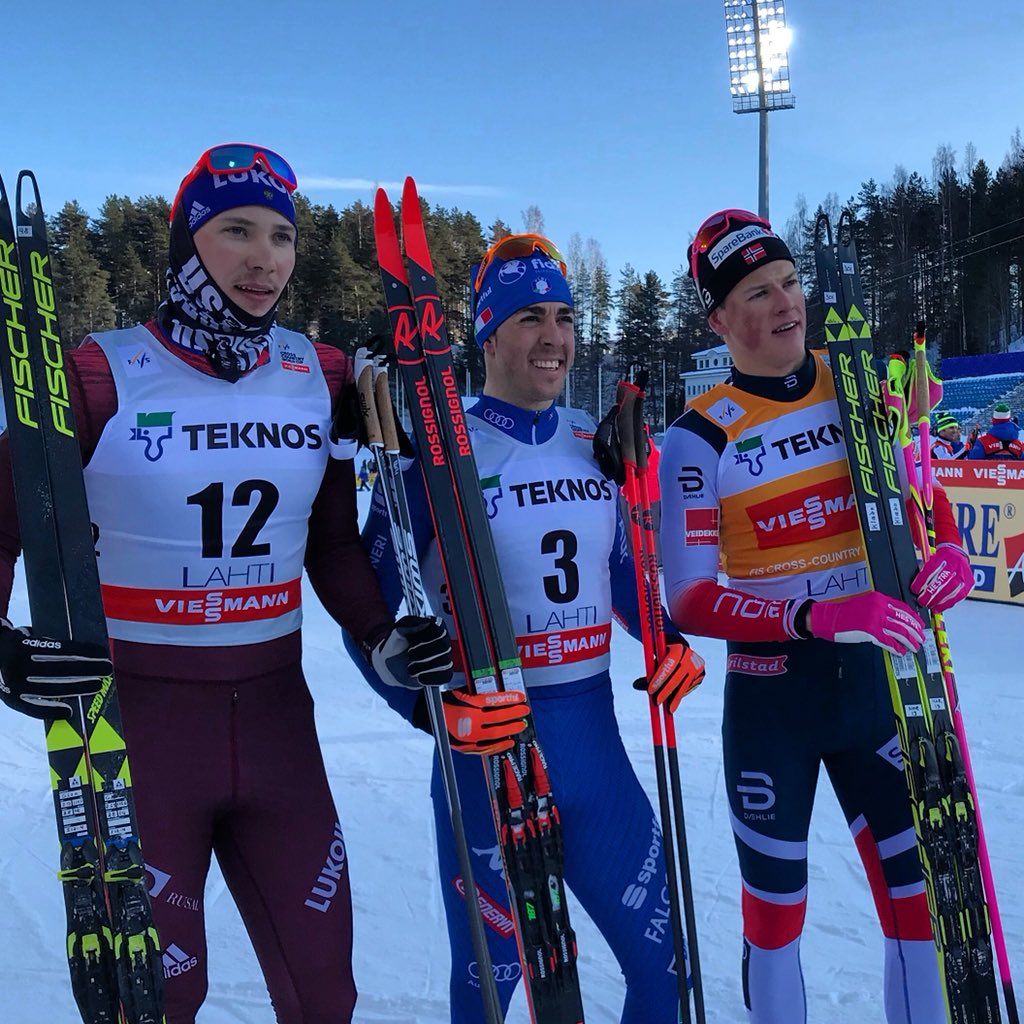
The men’s 1.6 k freestyle sprint podium at Saturday’s World Cup in Lahti, Finland, with Italy’s Federico Pellegrino (c) in first, Russia’s Gleb Retivykh (l) in second and Norway’s Johannes Høsflot Klæbo (r) in third. (Photo: FIS Cross Country/Twitter)
FIS Cross Country World Cup (Lahti, Finland): Men’s & women’s freestyle sprints
The defending world championships from the 2017 freestyle sprint prevailed again in Lahti on Saturday, with Norway’s Maiken Caspersen Falla winning the women’s 1.4-kilometer freestyle sprint final and Italy’s Federico Pellegrino coming out on top in the men’s 1.6 k final at last year’s World Championships venue.
Falla’s rise to the final started with her qualifying in 12th, 7.96 seconds off the fastest qualifying time set by Sweden’s Hanna Falk in 2:54.72. Russia’s Natalia Nepryaeva qualified second (+0.63) and Finland’s Krista Pärmäkoski third (+3.62), just ahead of Germany’s Victoria Carl in fourth (+3.88) and American Sadie Bjornsen in fourth (+3.88). Four American women qualified for the heats, with Sophie Caldwell in 17th, Ida Sargent in 21st and Rosie Brennan in 29th.
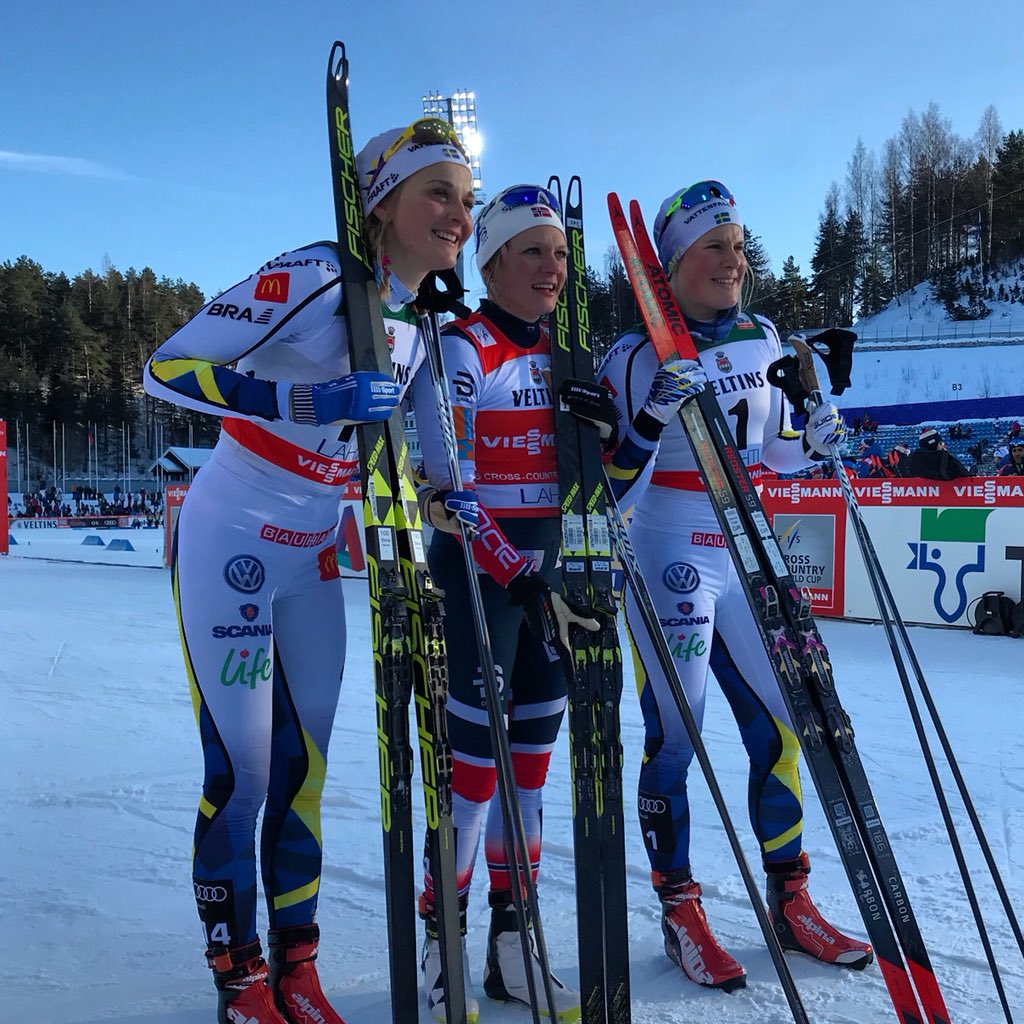
The women’s 1.4 k freestyle sprint podium at Saturday’s World Cup in Lahti, Finland, with Norway’s Maiken Caspersen Falla (c) in first, and Sweden’s Stina Nilsson (l) and Hanna Falk (r) in second and third, respectively. (Photo: FIS Cross Country/Twitter)
Falla went on to place second in the first quarterfinal, 0.71 seconds behind Sweden’s Stina Nilsson in first. According to the race jury’s ruling, Carl obstructed Pärmäkoski coming out of the last downhill before they entered the finishing straight and both crashed out of contention, with Pärmäkoski finishing fifth in the heat (+12.11) and Carl sixth (+49.5). Carl was relegated to last (30th place) for the obstruction.
Falla then won the first semifinal by just 0.04 seconds over Nilsson in second. The two other Swedes in that heat, Falk and Ida Ingemarsdotter, advanced to the final as well as lucky losers with fast-enough times.
In the final, Falla found herself at the front of the pack early then held her position to the finish, crossing the line in 2:54.83 and beating Nilsson by 0.36 seconds. Sweden had two on the podium with Falk in third (+0.78), Germany’s Sandra Ringwald placed fourth (+0.88), Ingemarsdotter was fifth (+1.83), and Switzerland’s Laurien van der Graaff placed sixth (+3.02).
Caldwell was the lone American woman to make it past the quarterfinals, as she placed second in her quarterfinal, 0.25 seconds behind Ringwald in first, then fourth in the second semifinal, 1.46 seconds behind Ringwald, who also won that heat. Overall, Caldwell finished the day in eighth.
Bjornsen placed 17th overall after finishing fourth in her quarterfinal, 2.84 seconds behind Falk in first. Sargent had been second in her quarterfinal until the final tight lefthand corner into the finishing straight, where she slipped to sixth and ultimately finished sixth, 1.07 seconds behind Sweden’s Anna Dyvik in first. Overall, Sargent finished the day in 27th, and Brennan placed 29th overall after finishing sixth in her quarterfinal, 4.91 seconds behind Ingemarsdotter in first.
Two American men advanced to the heats as well, with Kevin Bolger of the Sun Valley Ski Education Foundation (SVSEF) qualifying in 16th in his World Cup debut, 6.38 seconds behind Norway’s Johannes Høsflot Klæbo, who topped the qualifier in 2:59.06. Erik Bjornsen of the U.S. Ski Team qualified 29th, 8.29 seconds back.
Meanwhile, Pellegrino qualified for the heats in third (+1.9) behind France’s Baptiste Gros in second (+1.23).
There, Pellegrino won the first quarterfinal by 0.19 seconds over Klæbo, with the Norwegian visibly backing off before the finish — comfortable enough to automatically advance to the semifinals in second place. But Klæbo showed Pellegrino what he’s made of in the first semifinal and beat the Italian by nine-hundredths of a second.
Bolger also raced in that first semifinal after placing fourth in his quarterfinal, 0.73 seconds behind Russia’s Gleb Retivykh in first. Bolger’s time was good enough for one of two lucky loser spots in the semifinals, where he went on to finish sixth, 1.86 seconds after Klæbo. Overall Bolger finished the day in 11th.
Erik Bjornsen placed 20th on the day after finishing fourth in the first quarterfinal (with Pellegrino and Klæbo), 1.56 seconds out of first.
In the final, Klæbo set the tone, slowing the pace to almost a stop at one point, while he and Pellegrino stood side by side at the top of the course. On the way down, they accelerated, but Norway’s Sindre Bjørnestad Skar was the one who truly attacked. It might’ve been a bit too early, as Pellegrino caught him by the top of the final climb and took the lead on the following downhill into the stadium. Pellegrino held off his challengers, including Retivykh who came on strong out of the downhill, to take the win in 3:16.73, 0.77 seconds ahead of Retivykh in second and 0.9 seconds ahead of Klæbo in third. Skar settled for fourth (+1.3), Finland’s Ristomatti Hakola placed fifth (+1.44) and France’s Lucas Chanavat finished sixth (+7.55).
In the qualifier, Canada’s Dahria Beatty finished 34th, +13.39 and just 0.9 seconds from making the quarterfinals. She was the only Canadian woman competing.
American Kelsey Phinney (SVSEF) was also close to making the cut. In her first European World Cup, she placed 36th in the qualifier, +13.74. Caitlin Patterson and Kaitlynn Miller, both of the Craftsbury Green Racing Project, placed 56th (+20.12) and 61st (+21.70).
Mathilde Petitjean of Togo, a primarily Quebec-based skier, finished in 59th (+20.80).
In the men’s qualifier, Logan Hanneman (APU) placed 49th (+11.45). Paddy Caldwell (U.S. Ski Team/SMS T2) finished 59th (+13.55), and APU’s Reese Hanneman and David Norris placed 61st (+14.33) and 67th (+19.27).
Julien Locke led Canada in 42nd place (+9.78), and Andy Shields finished 60th (+14.29).
American Chloe Levins racing to seventh in the junior women’s 7.5 k sprint on Saturday at IBU Junior World Championships in Otepää, Estonia. (Photo: Terri Dickson)
Poland’s Kamila Zuk won her second race in a row, taking gold in the junior women’s 7.5 k sprint after also winning the individual at World Junior Championships. Zuk had one penalty to two by second-place Marketa Davidova of the Czech Republic, who finished 26.0 seconds back. Bronze went to Myrtille Begue of France, who shot clean to finish 52 seconds back.
The sole U.S. starter, Chloe Levins followed up her sixth-place finish in the individual with seventh place in the sprint. Levins had a single penalty and finished +1:31.7.
For Canada, Megan Bankes was close behind Levins in ninth, with two penalties and +1:49.5. Teammate Nadia Moser was 21st, also with two penalties, +2:46.2. Emily Dickson finished 36th, +3:50.5 with two penalties, and Zoe Pekos just missed the pursuit cutoff in 66th (+6:22.4) with four missed shots.
In the junior men’s 10 k sprint, Vasilii Tomshin of Russia took the gold with perfect shooting. France’s Martin Perillat Bottonet was second, less than a penalty-loop’s worth of time back at 20.5 seconds – and he did have one penalty. Norway’s Sverre Dahlen Aspenes took bronze (+29.4) with two missed shots.
Trevor Kiers led Canada in 16th, a breakthrough result; his previous World Juniors best was 39th in the pursuit last season. Kiers missed two shots, both in prone, and finished 1:34.9 behind the time set by Tomshin.
Adam Runnalls placed 26th for Canada (+2:08.3) with three missed shots. Teo Sanchez also qualified for the pursuit by placing 53rd (+3:19.2) with one penalty, and Angus Tweedie was left on the outside looking in with 69th place (+4:41.3) with three missed shots.
Cody Johnson led the Americans in 37th, with clean shooting, 2:31.1 back from Tomshin’s time. Tim Cunningham was the next finisher in 71st (+5:13.5) with seven missed shots, followed by Jacob Pearson in 79th (+6:24.2) with two penalties and Cam Christiansen in 86th (+7:52.5) with three penalties.
The top-six finishers at the junior women’s 12.5 k individual flower ceremony on Thursday at IBU Junior World Championships in Otepää, Estonia, with Poland’s Kamila Żuk (second from l) in first, Ukraines’s Anna Kryvonos (l) in second place, Russia’s Irina Kazakevich (third from l) in third, and American Chloe Levins (r) in sixth. (Photo: Erik Lewish)
IBU Junior World Championships (Otepää, Estonia): Junior women’s and men’s individual
Three North Americans in the top 10, top nine even. That’s what happened in a single race at the International Biathlon Union (IBU) Junior World Championships on Thursday in Otepää, with American Chloe Levins placing sixth, and Canada’s Nadia Moser and Megan Bankes claiming eighth and ninth, respectively, in junior women’s 12.5-kilometer individual.
According to the three racers, it was another beautiful day in Otepää with steady, sometimes even gusting, wind.
Levins was the earliest starter of the three, starting in the middle of the field in bib 37 (out of 70). Bankes headed out of the gate 45th and Moser started near last in 67th.
Canada’s Nadia Moser racing to eighth in the junior women’s 12.5 k individual at IBU Junior World Championships in Otepää, Estonia. (Photo: Bryan Dickson)
Despite the late start, Moser, 20 years old and in her second Junior Worlds, explained in an email that she wasn’t nervous. With temperatures rising to a high of -10 degrees Celsius (14 Fahrenheit) on Thursday morning, she almost preferred it.
“There were also 20 second start intervals which are shorter than the usual 30, so all of the competitors were out of the gate in a shorter amount of time than normal,” Moser wrote.
In neither Thursday’s women’s race nor the men’s 15 k individual that followed, nobody shot clean. In fact, only one woman shot 19-for-20: Slovakia’s Veronika Machyniakova, who ended up 11th. The top-two finishers in the women’s 12.5 k, Poland’s Kamila Żuk (who placed first in 41:36.1 minutes) and Ukraine’s Anna Kryvonos (who finished 3:04.7 minutes back in second place), both had two penalties. Russia’s Irina Kazakevich placed third (+3:20.0) with three misses — which added three minutes of penalties to her time.
“I found the wind in the range today to be fairly variable,” Bankes, the defending Junior Worlds champion in the event, wrote in an email. “It was gusting and then dying quiet significantly and also in the middle of shooting bouts which made things a little tricky.”
At last year’s Junior Worlds in Osrblie, Slovakia, Bankes shot a perfect 20-for-20 for the first time in her career and won gold in the junior women’s 12.5 k individual.
Thursday brought new challenges, and Bankes explained she was happy to clean her first prone. She went on to miss two in the next standing stage, then one in each of the following two stages (0+2+1+1) to finish the race with four penalties, which ultimately put her in ninth overall (+4:59.1).
Canada’s Megan Bankes racing to ninth in the junior women’s 12.5 k individual at IBU Junior World Championships in Otepää, Estonia. (Photo: Bryan Dickson)
“I’m not totally sure what happened in my first standing (when I missed 2) but when I came into my 2nd standing the wind was gusting quite a bit, and I was really happy with how I waited for my first 4 shots, but I was a little annoyed to have missed that last one,” she recalled. “Overall I think my shooting today was pretty good, but I could have been better.”
While Bankes figured the wind was giving most others trouble as well, she didn’t think that she’d make it into the top 10 with four misses.
“I don’t like getting splits until the last lap, so I heard Andrew [Chisholm] our wax tech tell me I was fighting for 10th when I passed him, so I really tried to give everything that last lap,” Bankes, 20, wrote. “I was super stoked to see I crossed the line in 7th, and knew I wouldn’t be bumped down too much because I started 3rd seed.
“Coming off of gold last year, I definitely had high expectations for myself,” she explained. “But I tried to use that as more positive belief in myself to know I can be in the top women, and know that I can shoot well, instead of just focusing on the result number. My main goal going into these championships was to have races that I’m happy with, and to ski and shoot to the best of my abilities.”
At the end of the day, Bankes wrote that she was “really happy” with her result.
“I felt like I really held myself together on skis, and kept my technique under control, while also pushing myself to the limit throughout the race,” she wrote. “I’m super stoked to see that the youth women are totally crushing it, and to be right behind Nadia today was also super exciting (also to see Chloe Levins in 6th was fantastic – 3 North Americans in the top 10!)”
From left to right: Megan Bankes, Nadia Moser and Emily Dickson after the junior women’s 12.5 k individual at IBU Junior World Championships in Otepää, Estonia. (Photo: Bill Gilliland)
One place ahead of her, Moser scored her first non-relay top 20 at Junior Worlds, leading Canada in eighth (+4:18.9) with three penalties (1+0+1+1). Two days earlier, Moser, Bankes and their teammate Emily Dickson placed ninth in the junior women’s 3 x 6 k relay.
“I knew I could get a top 10 finish if I could pull my shooting together,” Moser wrote after Thursday’s individual race. “After my third shooting I had missed 2 targets total and I thought then that my top 10 chances were over. On may last loop I had 3 misses and was not even thinking about top 10 anymore. I realized that I must be doing better than I initially thought when everyone who was cheering me sounded really excited. I definitely got lucky today because no one cleaned their shooting. I was extremely happy to have finished in the top 10, especially since I was sure that I had no chance after missing 3 targets.”
She was pleased to see all of her training over the last year validated on Thursday.
“I tried really hard to improve over the summer and fall because I really wanted good results this season,” Moser wrote. “I think that the best thing I did today was to stay calm, and take my time in the range. I shot really slowly but that paid off in the end.”
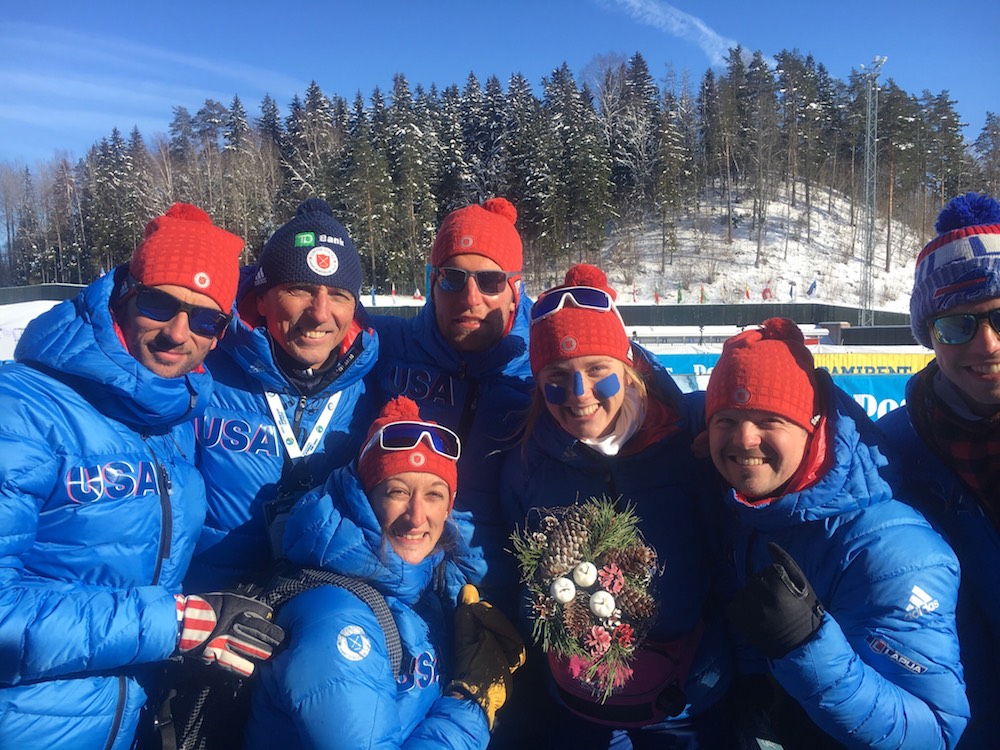
Chloe Levins (third from r) with the U.S. team staff (from l to r) wax tech Travis Voyer, coach Algis Shalna, assistant coach Danika Frisbie, wax tech Max Bergmann, wax tech Mattias Halquist, and head coach Erik Lewish, after Levins placed sixth in the junior women’s 12.5 k individual at IBU Junior World Championships in Otepää, Estonia. (Photo: Erik Lewish)
The lone American junior woman at this year’s IBU Youth/Junior Worlds, Levins, 19, finished sixth (+3:37.4) with three penalties (0+1+0+2). At last year’s Youth Worlds, Levins notched fourth place in the 7.5 k pursuit.
“There’s a big difference between youth and junior competition,” Levins wrote in an email. “A lot of juniors have IBU Cup experience, World Cup experience, and a handful even attended the Olympics. Fortunately, there’s also a big difference between the youth athlete I was last year and the junior I am now. I’ve been fortunate to compete in more winter biathlon races than ever this year, which has really helped me up my game. It’s a good feeling to see that I’m prepared to compete at this level.”
She explained that she had one goal on Thursday: “smile no matter what,” she wrote. “The hay is in the barn. Now it’s just time to get out of my own way and focus on one thing at a time.”
While Levins had experienced the rush of being near the front of the race in a pursuit, actually contending for a top result in an individual-start race was a new experience for her, she explained.
“As always, I tried not to let thoughts of my position distract me from thinking tactically about the course or my shooting process,” Levins noted. “Every lap, every corner, every shooting remained an opportunity for me until the finish line.
“A lot of my friends finished their races around me, so I did not even see my standing at the finish,” she continued. “When I finally looked at the board and saw that I was more than three minutes back of the leader, I thought that this result, with three penalties myself, was okay. I didn’t expect it to be good enough for sixth place.”
The race was Levins’s first of the week and she presumably has two more to go — as do Moser, Bankes and most of the other junior women — with a sprint on Saturday and, if they place in the top 60 of the sprint, a pursuit on Sunday.
As the only American junior woman in Otepää, Levins wrote that she was fortunate to have a significant amount of team support behind her on Thursday.
“My skis today were incredibly fast,” she emphasized. “Our wax guys made the fastest skis on the track today. … I can’t thank them enough.”
The U.S. team’s head coach and trip leader, Erik Lewish, pointed out that Levins had the seventh-fastest overall ski time and one of the best shooting performances of the day.
“It’s great to see that she is right in the mix with this very competitive field (2 of the starters today were competing in the Olympics),” Lewish wrote. “1 more hit and she would have finished in 2nd place today, this is very exciting looking forward to the Sprint and pursuit (sat and Sunday) where she will have another chance to get on the podium.”
“There are a lot of good things to take from this race and, as always, a lot of things to learn,” Levins concluded. “What’s my goal for the rest of the week? Keep learning. Keep smiling.”
According to Canada’s head coach and trip leader Jacqueline Akerman, the Canadian techs also nailed the wax.
“The techs hit the wax perfectly allowing for some of the top skis out there, when skiing form and wax meet it sets the scene for great results,” Akerman wrote. “The shooting was a bit tricky today with varying strength and switching winds, but both [Nadia and Megan] managed to keep misses to a minimum. They both hit enough to place in the top ten on a day when no one in the field shot clean and only one athlete managed one penalty. They are both happy with their performance, and the rest of us are too!”
Next on the results sheet for Canada was Dickson in 36th (+8:33.7) with five penalties (2+1+0+2), and Zoë Pekos in 63rd (+15:50.6) with eight misses.
Canada’s Adam Runnalls racing to 29th in the junior men’s 15 k individual at IBU Junior World Championships in Otepää, Estonia. (Photo: Bill Gilliland)
In the junior men’s 15 k, Canada’s Adam Runnalls led the North Americans in 29th (+4:26.4) with five penalties (0+0+3+2). Teo Sanchez followed in 58th (+7:25.2) with four misses (1+1+1+1), Angus Tweedie was 67th (+9:11.8) with six misses (2+0+2+2), and Trevor Kiers 77th (+12:44.3) with 13 penalties.
For the U.S., Tim Cunningham finished 53rd (+6:49.3) with six penalties (1+3+1+1), Cody Johnson was 60th (+8:01.7) with seven misses, Jacob Pearson 83rd (+16:39.6) with 13 misses, and Cameron Christiansen 84th (+16:53.6) with eight penalties.
Russia had two on the podium in the men’s race as well, with Igor Malinovskii scoring his second-straight win after racing to gold in the junior men’s 4 x 7.5 k relay on Tuesday. He has won the last four races he’s contested, including the sprint and the pursuit at IBU Junior Open European Championships before Junior Worlds. Malinovskii finished in 41:48.5 on Thursday with three penalties (1+1+1+0), besting Norway’s Sturla Holm Lægreid in second place by 19.4 seconds; Lægreid also had three penalties (1+0+1+1). Russia’s Said Karimulla Khalili added bronze (+23.0) to his medal collection, with two misses (0+1+1+0), after capturing gold with his relay team.
No one in the junior men’s individual had fewer than two misses.
The youth men’s 3 x 7.5 k relay on Wednesday, with Norway leading, at the IBU Youth World Championships in Otepää, Estonia. (Photo: Bill Gilliland)
IBU Youth World Championships (Otepää, Estonia): Relays
Pascale Paradis racing the first leg of Canada’s youth women’s 3 x 6 k relay team on Wednesday at IBU Youth World Championships in Otepää, Estonia. (Photo: Bill Gilliland)
Tuesday and Wednesday were relay days at the International Biathlon Union (IBU) Youth/Junior World Championships in Otepää, highlighted by two ninth-place results by the Canadian and American biathlon teams.
On Tuesday, the Canadian junior women (Emily Dickson, Nadia Moser and Megan Bankes) placed ninth in the 3 x 6-kilometer relay, 3:31.6 minutes out of first, with two penalties and 14 spares. The U.S. youth men (Vasek Cervenka, Camren Nielsen and Garrett Beckrich) finished ninth in the 3 x 7.5 k on Wednesday, +7:19.9 with three penalties and 15 spares.
Also on Wednesday, Canada finished 10th in the youth women’s 3 x 6 k with Pascale Paradis, Shilo Rousseau and Benita Peiffer (+3:35.3 with zero penalties and 11 spares). The U.S. youth women followed in 18th with Helen Wilson, Margaret Madigan and Emma Stertz (+8:24.6 with one penalty and 12 spares).
The Canadian youth men’s relay, with Rory Gilliland, Tom Hulsman and Leo Grandbois, on Wednesday at IBU Youth World Championships in Otepää, Estonia. (Photo: Bill Gilliland)
The Canadian youth men finished 16th with Rory Gilliland, Thomas Hulsman and Leo Grandbois (+9:45.5 with three penalties and 18 spares).
In the junior men’s 4 x 7.5 k relay on Tuesday, Canada finished 17th with Teo Sanchez, Angus Tweedie, Trevor Kiers, and Adam Runnalls (+10:48.7 with four penalties and 14 spares), and U.S. followed in 19th with Cody Johnson, Tim Cunningham, Camron Christiansen, and Jacob Pearson (+24:31.1 with eight penalties and 18 spares.
France won the junior women’s relay with Camille Bend, Myrtille Begue and Lou Jeanmonnot Laurent finishing in 1:02:52.1 hours with one spare and eight penalties. Norway placed second in that race, 17.5 seconds back, and Russia was third (+40.1).
Russia topped the junior men’s relay with Said Karimulla Khalili, Vasili Tomshin, Viacheslav Maleev, and Igor Malinovskii finishing in 1:25:21.2 with zero penalties and nine spares. Norway took silver(+57.1), and France earned bronze (+2:45.6).
Sweden won the youth women’s relay the following day with Amanda Lundström, Ella Halvarsson and Elvira Öberg in 1:03:19.8 with zero penalties and six spares. Öberg shot clean without any spares (0+0, 0+0) for her second gold medal in as many races after she won Monday’s 10 k individual.
She edged Finland’s Heidi Nikkinen in a photo finish, in which the two racers finished less than a tenth of a second apart, and Finland settled for silver after two penalties and 10 spares. Norway reached the podium in third (+37.0).
The Russian men prevailed again on Wednesday with Denis Tashtimerov, Andrei Viukhin, and Monday’s 12.5 k individual gold medalist, Mikhail Pervushin, winning the youth men’s relay in 1:04:51.1 with two penalties and eight spares. The Czech Republic claimed silver (+2:30.), and Norway continued its podium streak in third (+3:04.5).
Youth/Junior World Championships continue Thursday with the junior women’s 12.5 k and junior men’s 15 k individual races in Otepää.
Adam Runnalls (Calgary Biathlon Racers) takes aim at Canadian team trials in Quebec last season. (Photo: Daniel S. Guay)
In an effort to showcase the North Americans competing at this week’s International Biathlon Union (IBU) 2018 Youth and Junior World Championships in Otepää, Estonia, we asked those qualifying athletes several questions about themselves — actually, we had them fill in the blanks. Here we have 19-year-old Adam Runnalls of Calgary, who is representing Canada at his first World Junior Championships after twice being part of the team for the Youth division.
On Tuesday, Runnalls anchored the Canadian team to 17th in the junior men’s 4 x 7.5 k relay.
***
“My full name is Adam Runnalls but you can call me boring old Adam.
I was born and raised in Calgary, and I learned to ski at 1 years old.
I spent the time between World Youth/Junior trials and Worlds training hard and going to school.
The hardest workout this season would be our road bike on Highwood Pass. I did it on a rental bike as it was my first road ride ever. Once the day was done, we did 110 km of riding and like 2000 meters of climbing. so being my first road ride ever it was pretty pouched about half way through. And I did this workout with my club, Calgary Biathlon Racers (CBR).
One thing I’m working on this season to improve my biathlon is my shooting consistency.
This is my first time in Estonia and 5th time racing internationally, and so far it’s been pretty all time.
One difference I’ve noticed between Estonia and the Canada is things are very quiet here. We almost drove across the entire country to get from the airport to Otepaa, which was only a 2 and a half hour drive. In Canada a drive this long might not even get you to the next town.
One of the things I’m most excited about for World Youth/Junior Championships in Otepää is getting into the racing.
One race I’m especially targeting there is a top 16 result.
Watching the Olympics in the lead up to my own races was very inspiring and gave me a great sense of national pride (Ferda). One of my least favorite moments moments of the Games was when Canada lost women’s hockey and then the next day lost men’s curling and men’s hockey. I want to be like Scott Moir, because he exemplifies what a Canadian is.
At Worlds, I really hope I can chat/make friends with someone from Sweden and ask them how can they turn 20 year olds into Olympic medalists??
My favorite thing at the breakfast where we are staying is the mini wieners. Who doesn’t like a hot dog for breakfast?.
Before this trip, if you said “Estonia”, the first thing I’d think of would have been potatoes and a skiing culture.
Now that I’m here, I’m pretty sure something I’ll always remember will be how the doors all open the opposite way I think they should.
If I had a totally free day here and didn’t have to worry about race fitness or training, I’d spend it probably still skiing.
The Norwegian youth men’s 3 x 7.5 k relay team, with (from left to right) Jørgen Krogsæter, Vebjørn Sørum and Sivert Guttorm Bakken, after winning gold at IBU Youth World Championships on Monday in Osrblie, Slovakia. (Photo: IBU)
IBU Youth/Junior World Championships (Osrblie, Slovakia): Youth relays
The Norwegian and Russian youth men’s and women’s youth relays teams took either first or second on Monday in their last race of International Biathlon Union (IBU) Youth World Championships in Osrblie, Slovakia, with Russia winning the women’s 3 x 6-kilometer relay and Norway topping the men’s 3 x 7.5 k.
The Russian youth women’s 3 x 5 k relay team, with (from left to right) Ekaterina Sannikova, Anastasiia Goreeva and Kristina Egorova, after winning gold at IBU Youth World Championships on Monday in Osrblie, Slovakia. (Photo: IBU)
While Norway’s men’s team of Jørgen Krogsæter, Vebjørn Sørum, and Sivert Guttorm Bakken skied away from the competition for a 54.2-second win in 55:05.4, after using six spare rounds and skiing no penalties, Russia’s women’s team of Ekaterina Sannikova, Anastasiia Goreeva and Kristina Egorova pulled of an 18.3-second win in 59:43.2 despite one penalty and seven spare rounds.
In the men’s race, Russia took silver with Aleksandr Miakonkii, Ilia Novopashin and Said Karimulla Khalili, with two penalties and nine spares. Belarus achieved bronze with Kiryl Tsiuryn, Ilya Auseyenka and Dmitry Lazouski finishing 1:41.6 out of first with no penalties and eight spares.
Canada finished 15th (+6:43.8) with Thomas Hulsman, Adam Runnalls and Leo Grandbois combining for three penalties and 12 spares. Grandbois skied them up to 15th after getting tagged in 17th at the final exchange.
The U.S. men’s team followed in 18th (+8:06.7) with Vasek Cervenka, Jake Pearson and Alex Kilby combining for one penalty and 12 spares. Vasek started them off, tagging in eighth at the first exchange, before the Americans dropped to 16th, then 18th.
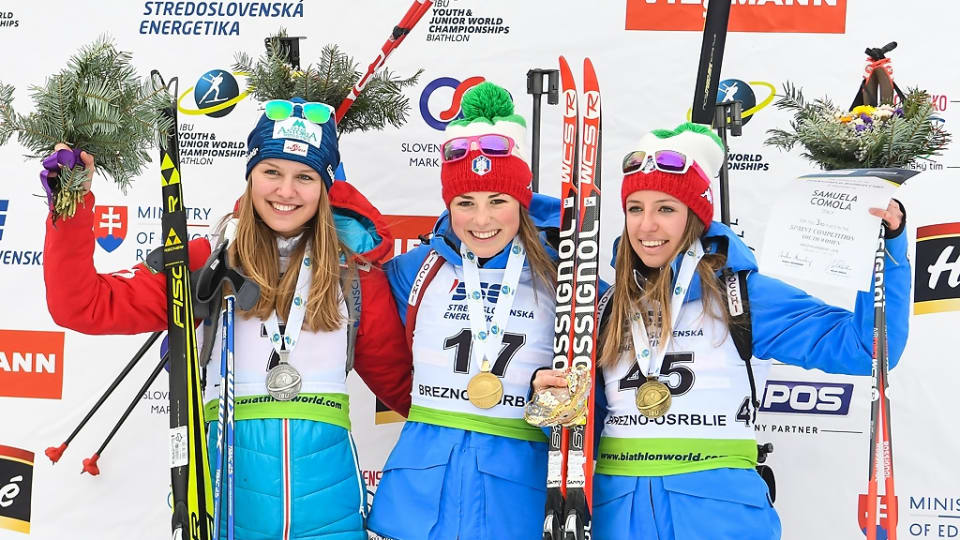
In the youth women’s relay, Norway took second place with Marthe Kråkstad Johansen, Marit Ishol and Mari Wetterhus using a total of just four spares to clean and avoiding the penalty lap. Italy claimed third (+1:04.8) with Samuela Comola, Irene Lardschneider and Martina Vigna combining for one penalty and just four spares as well.
The U.S. women finished 13th (+4:56.8) with Chloe Levins, Amanda Kautzer and Grace Gilliland having a total of one penalty and 11 spares. After being tagged in 14th, Kautzer skied the team into eighth on the second leg before they slipped to 13th on the final leg.
Canada finished 17th (+9:39.0) with Frédérique Pérusse, Shilo Rousseau and Anna Sellers combining for three penalties and 11 spares. The team skied up from 20th after the first exchange to 17th by the second exchange, a position they held to the finish.
IBU Youth/Junior World Championships conclude with the men’s and women’s junior relays on Tuesday.
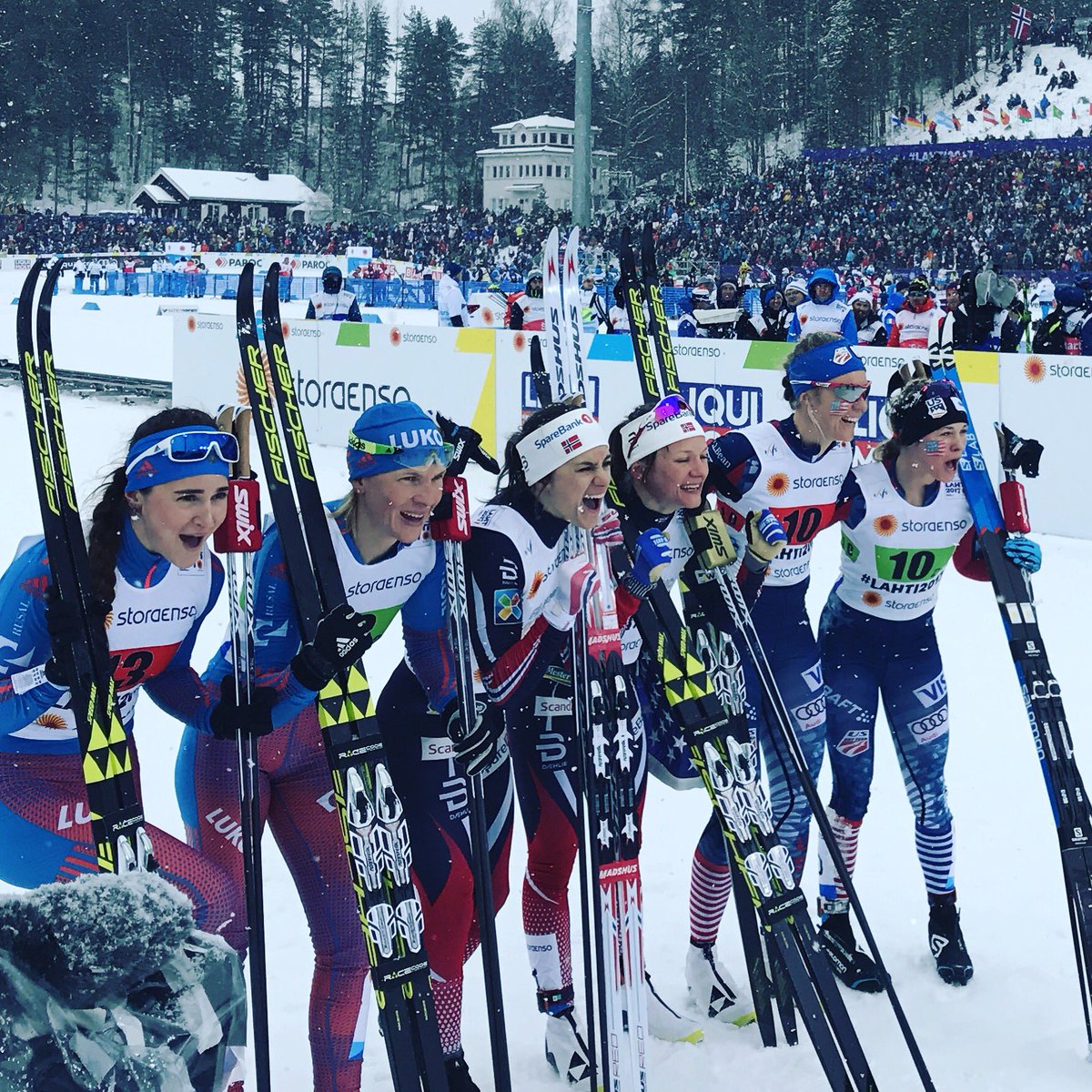
Heidi Weng and Maiken Caspersen Fall of Norway (center) bested Yulia Belorukova and Natalia Matveeva of Russia (left) for gold in the women’s team sprint at 2017 World Championships, with Sadie Bjornsen and Jessie Diggins of the U.S. (right) outsprinting Sweden for bronze. (Photo: FIS Cross Country/Twitter)
FIS Nordic World Championships (Lahti, Finland): Classic team sprints
Defending champions Norway repeated gold in the women’s team sprint, with Heidi Weng and Maiken Caspersen Falla crossing the finish line first in Lahti, Finland. On the second-to-last loop, it looked like Russia could have something to say about that. Yulia Belorukova put in a furious sprint up the course’s biggest climb, and then beat Weng to the exchange. But her teammate Natalia Matveeva could not match the pace when Falla put on her own sprint on the last uphill. Russia finished second for silver, +5.56.
The competition for bronze was closer, with Germany, Finland, Sweden, and the United States going out of the stadium for the last loop together in chase of the Norwegian and Russian leaders. The last climb was defining in the race for bronze, with Jessie Diggins of the United States staying closest to Sweden’s Stina Nilsson. Diggins caught Nilsson on the downhill and was able to stay just ahead of the Swede to the finish, claiming bronze (+18.38) along with teammate Sadie Bjornsen. It was a return to the team sprint podium for Diggins: after winning the team sprint at 2013 World Championships with Kikkan Randall, she teamed up with Sophie Caldwell in 2015 but the pair finished eighth.
Nilsson and Ida Ingemarsdotter settled for fourth (+18.57), and the Finnish team of Aino-Kaisa Saarinen and Kerttu Niskanen finished fifth (+23.02).
The Canadian team of Cendrine Browne and Dahria Beatty was seventh in their semifinal and landed 13th overall.
In the men’s team sprint, Norway set a high pace from the beginning, with phenom Johannes Høsflot Klæbo attacking on the steep uphill every time he skied. On his second and third loops, he tagged off to Emil Iversen with gaps of just over five seconds to the rest of the field. But Iversen had a hard time holding the lead, in part because of Russia’s Sergey Ustiugov, who had won the 30 k skiathlon the day before and put in a huge effort to catch Iversen on the fourth loop of the team sprint.
On the final loop, Finland’s Iivo Niskanen bridged the gap up to Iversen, mostly on the steep uphill and then also with ski speed on the downhill. But the time the pair entered the stadium, Niskanen had caught the Norwegian and was moving with higher speed. He decided to switch tracks to overtake Iversen, but Iversen decided to switch tracks just a second later, without checking one last time to make sure the track was clear. He fell, taking out Niskanen with him.
That allowed Ustiugov and Italy’s Federico Pellegrino to go sailing by to claim gold and silver (+2.14) with their teammates Nikita Kriukov and Dietmar Noeckler. It was the second gold for Russia in the event in three World Championships; Kriukov and Alexey Petukhov won in 2013, and also took silver in 2015.
Niskanen got up and claimed bronze (+8.64 with Sami Jauhojärvi), swearing as he crossed the finish line; with a broken pole, Iversen limped across the line in fourth (+18.42). He was called to a jury meeting but ultimately no teams were disqualified because of the crash.
Erik Bjornsen of the United States won a sprint finish for fifth (+23.58) with teammate Simi Hamilton), besting Lenny Valjas (+27.02 with teammate Alex Harvey) of Canada.
FIS Nordic World Championships (Lahti, Finland): Nordic combined 4 x 5 k team event
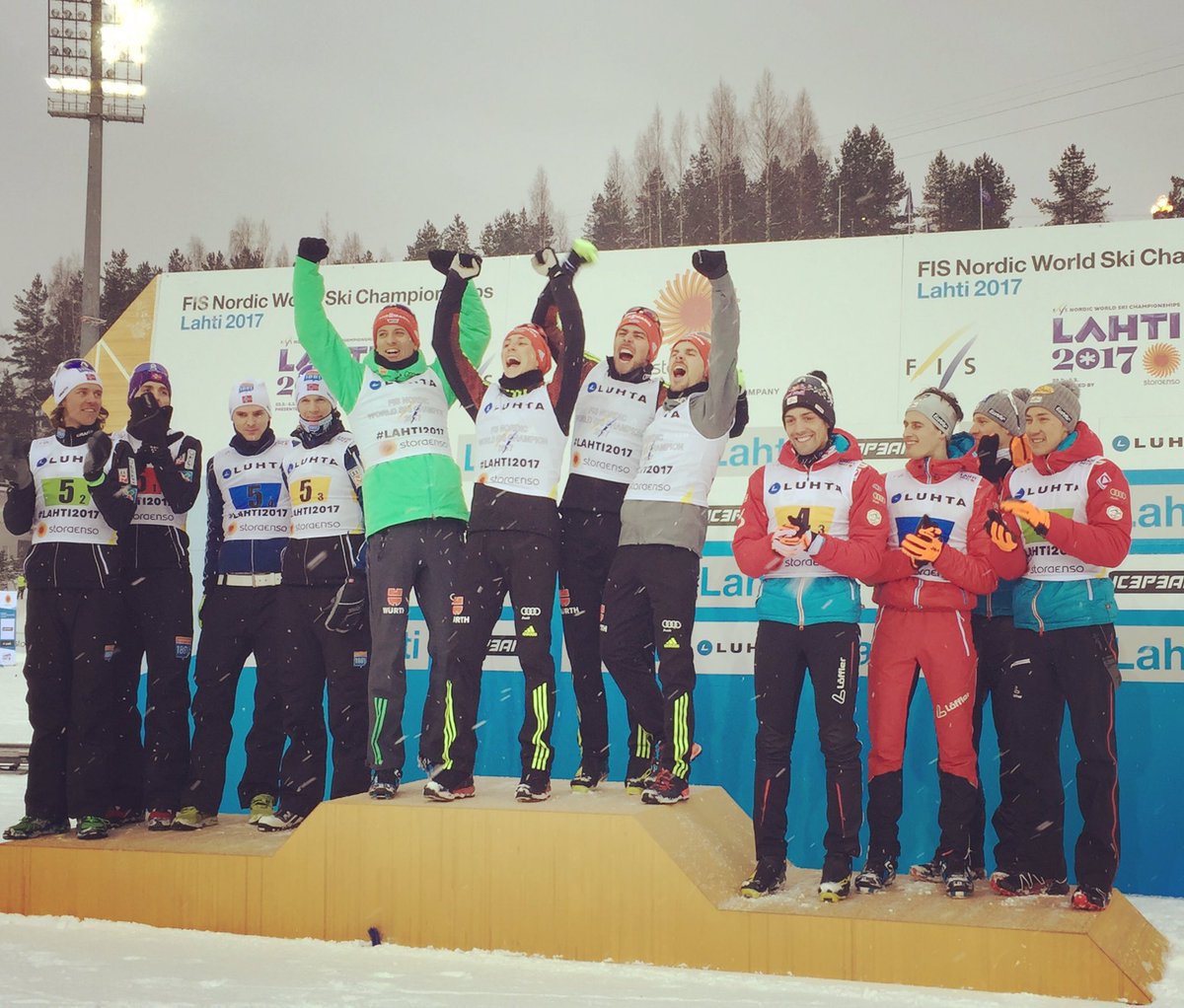
Germany (Björn Kircheisen, Eric Frenzel, Fabian Rießle, and Johannes Rydzek) took gold in the nordic combined 4 x 5 k team event on Sunday at Nordic World Championships in Lahti, Finland, while Norway placed second and Austria third. (Photo: FIS Nordic Combined/Twitter)
[UPDATED] After sweeping the first individual nordic-combined competition of 2017 Nordic World Championships on Friday, Germany achieved gold as a team, with Björn Kircheisen, Eric Frenzel, Fabian Rießle, and Johannes Rydzek winning the 4 x 5-kilometer team event in 47:57.3.
The Germans combined for the best jumping score of 11 teams and started the relay in first, 44 seconds ahead of Japan in second. Norway started 1:07 minutes back in fifth but rose to second place (+41.7), with Magnus Moan, Mikko Kokslein, Magnus Krog, and Jørgen Graabak. Moan raced them into third at the first exchange, then Kokslein secured second, which they held onto for the remaining two legs.
“It was our goal to ski a controlled race,” Germany’s Frenzel told ZDF. “Not really look at how the gap was developing, but just make our own race. And put up a little more pressure towards the end of each leg. That worked well, that was a wickedly cool team performance today. And I am just happy that we could put a little golden crown on the whole event today.”
“I think today you could see again that we all worked together and enjoyed the competition,” Rydzek added. “We were all happy about each other’s performance, and just rewarded ourselves for hard hard work.”
Austria started fourth, 1:05 behind Norway, and clinched bronze (+1:03.7) with Bernhard Gruber, Mario Seidl, Philipp Orter, and Paul Gerstgraser. Gruber initially raced them into second at the first exchange, but they relinquished one spot and hung on for third, ahead of Japan in fourth (+1:06).
Japan (Hideaki Nagai, Takehiro Watanabe, Yoshito Watabe, and Akito Watabe) jumped to second, but found themselves in fourth at every exchange.
Finland took fifth, Italy sixth, France seventh, and the U.S. eighth (+3:27.2) with Bryan Fletcher, Taylor Fletcher, Ben Berend, and Ben Loomis. The Americans started the race in seventh and were in sixth after the first two exchanges, but slipped to eighth on the third leg.
IBU Youth/Junior World Championships (Osrblie, Slovakia): Youth & junior pursuits
Four seems to be Chloe Levins’s lucky number. After a career breakthrough of fourth place in the pursuit at last year’s Youth Olympic Games (YOG) in Lillehammer, Norway, the 18-year-old Vermonter raced to fourth in the youth women’s 7.5-kilometer pursuit on Sunday at the International Biathlon Union (IBU) Youth/Junior World Championships in Osrblie, Slovakia.
Italy’s Irene Lardschneider winning the youth women’s 7.5 k pursuit on Sunday for her second-straight gold at 2017 IBU Youth World Championships in Osrblie, Slovakia. (Photo: IBU)
Levins started the race in 11th and worked her way up to fourth with clean shooting in three stages. She missed two in the first prone but rebounded and held off Ukraine’s Khrystyna Dmytrenko by seven seconds for fourth place. Levins finished 1:55.5 minutes behind the winner, Italy’s Irene Lardschneider, who started the race first and held on for her second-straight gold medal despite four penalties (0+0+2+2), finishing in 26:57.1. France’s Lou Jeanmonnot-Laurent rose from fourth to second place with 19-for-20 shooting (0+0+1+0), and Italy’s Samuela Comola took bronze (+1:08.5) for the second-straight race with two misses (1+0+1+0).
Three U.S. women qualified for the pursuit, with Amanda Kautzer finishing 42nd (+6:16.2) after starting 59th and shooting 80 percent (1+0+2+1), and Grace Gilliland finishing 55th (+8:32.1) with six penalties (2+3+1+0).
Canada’s Shilo Rousseau followed in 54th (+9:02.1) with eight misses (3+1+2+2).
In the junior women’s 10 k pursuit, Canada’s Megan Bankes raced to 16th for the best finish for a North American in that race. The gold medalist in last week’s 12.5 k individual, Bankes finished 13th in Saturday’s sprint and thus started in that position, 1:25 out of first. She ended up 16th with four penalties (0+1+2+1) and finished 2:15.8 behind the winner, Russia’s Valeriia Vasnetcova, who started 24th and worked her way all the way up to first with clean shooting.
Vasnetcova was the only one to clean the four-stage pursuit on Sunday, and in doing so, she achieved her first gold of the championships and second of her career at Youth/Junior Worlds after her team won last year’s youth relay in Romania.
Coming off a sprint win, Italy’s Michela Carrara started first and took second at the finish, 10 seconds behind Vasnetcova with three misses (1+1+1+0). Norway’s Ingrid Tandrevold scored her second-straight medal as well, after starting second and finishing third (+10.8), with two penalties (0+0+1+1).
Canada’s Nadia Moser had her best result of the championships in 30th (+3:43.5), moving up one place after starting 31st, with three penalties (0+1+0+2). Emily Dickson finished 47th for the second-straight day (+6:29.9) with four penalties (1+0+1+2).
Siena Ellingson was the lone American to start after placing 18th in Saturday’s sprint. She finished 41st (+5:24.7) with seven misses (1+2+1+3).
In the junior men’s 12.5 k pursuit, Canada’s Pearce Hanna rocketed to 23rd after starting 47th, shooting 17-for-20 after cleaning the first two stages (0+0+1+2) for his first top 30 of the championships. Hanna finished 3:12 behind the winner, Russia’s Igor Malinovskii who picked up his second-straight gold.
Malinovskii started first and finished in 32:39.8, 13 seconds ahead of second place, with four penalties (0+1+2+1). Norway’s Sindre Pettersen took the silver medal after starting in eighth and posting the fastest course time to overcome five misses (2+1+1+1). Belarus’s Anton Smolski moved up from fourth at the start to reach the podium in third (+27.4) with five misses as well (0+0+3+2).
All four Canadian junior men qualified for the pursuit. Trevor Kiers led them in 39th (+5:13.3), after starting 48th, for his best result of the championships. Jules Burnotte placed 43rd (+5:35.3), up from 55th, for his best result as well, and Zachari Bolduc finished 57th (+8:18.3). Kiers missed five targets (2+0+1+2), Burnotte had seven misses (3+1+1+2), and Bolduc missed eight (2+3+2+1).
For the U.S., Cody Johnson finished 55th (+7:19.5) with nine penalties (2+1+2+4) and Travis Cooper 59th (+8:46.2) with eight misses (5+0+1+2).
In the youth men’s 10 k pursuit, the first race of the day on Sunday, two Canadians finished in the top 30, with Leo Grandbois in 22nd and Adam Runnalls in 27th.
For Grandbois, it was his first time outside the top 15 of the championships after he had won the youth men’s 12.5 k individual last Wednesday and finished 14th in Friday’s 7.5 k sprint. He had to ski six penalty loops on Sunday (0+2+2+2), dropping outside the top 20 after the third shooting. Grandbois finished 3:21.8 behind the winner, France’s Emilien Claude, who won the sprint as well to start the pursuit first.
Claude, who had four penalties (1+1+0+2) and finished in 29:22.4, held off Italy’s hard-charging Cedric Christille by 16 seconds after Christille shot just two penalties (0+0+1+1) to move up from fourth to second for his first medal in his first Youth World Championships. Germany’s Danilo Riethmüller rose from sixth to third place (+30.7) despite four misses (1+0+1+2). For the German, it was his second bronze of these championships after placing third in the 12.5 k individual.
Canada’s Runnalls moved up from 32nd at the start to 27th at the finish (+3:47.5) for his first top 30 of the championships. He had five penalties (1+3+1+0), but cleaned the last stage to move into the top 30.
Vasek Cervenka was the lone American to qualify in the youth men’s pursuit, and he moved up from 49th at the start to 30th (+3:52) with five penalties (1+1+1+2).
American Chloe Levins racing to 11th in Friday’s youth women’s 6 k sprint in Osrblie, Slovakia, for her best result in her third IBU Youth/Junior World Championships. It was her second top 15 of the week in Osrblie. (Photo: Erik Lewish)
Rounding the sprint course in Osrblie, Slovakia, on Friday, American Chloe Levins didn’t let her mind wander to what could be. She had cleaned her first prone stage, which put her in contention for a top 10 among the field of 92 in the youth women’s 6-kilometer sprint, and another shooting stage without a miss could mean the race of her life in her second race at the 2017 International Biathlon Union (IBU) Youth World Championships.
But again, she didn’t go there. Levins, an 18-year-old Middlebury College freshman from Rutland, Vt., had already captured a Youth Worlds career best in 14th in the 10 k individual two days earlier on Wednesday. After knocking down her first three standing targets, Levins missed her fourth shot before hitting the last one. She had to ski a penalty lap, yet heading out on the final loop, she was still in contention for a top 10.
“Attaining a career-best Jr. Worlds result never crossed my mind during the race,” Levins wrote in an email after. “Before heading out on the last loop, I was completely focussed on getting my toe across the finish line as fast as I possibly could.”
An early starter in bib 9, she initially finished second to Austria’s Anna Gandler, 33.2 seconds of Gandler’s time. While the Austrian would remain on the podium and ultimately place second, Levins dropped to 11th by the end of the race, 1:39.7 behind the winner (Italy’s Irene Lardschneider) for Levins’s second-straight top 15 of the week. More importantly, it was her new career best.
“There were a lot of strong athletes that started behind me, so I maintained no result-based expectations,” Levins wrote. “It stings to see the top six within five seconds of me, but I didn’t leave anything out there.”
She was less than nine seconds out of fourth place.
“In both races so far she has been within ‘striking distance’ of the podium, which means she in the mix with some of best girls of her age,” US Biathlon assistant coach Erik Lewish wrote in an email.
Conditions haven’t been easy in Osrblie with everything from wind to rain to slush, and on Friday, racers had to manage shooting in variable winds. Fortunately for Levins, the wind was relatively calm for both her shooting stages, she wrote.
“Every race is a learning experience, and Junior Worlds is no different,” she continued. “Despite being a little frustrated with a couple shots, I took a lot of positives from Wednesday’s [individual] race. Today, I really focused on working through transitions on the track I thought I could improve upon.”
She’ll start the youth women’s 7.5 k pursuit on Sunday in 11th, 1:40 behind Lardschneider in first and just two seconds out of 10th place.
“I think Sunday’s pursuit race will play to her strengths well,” Lewish wrote. “It is a short ski loop (only 1.5k for the youth) which puts extra emphasis on the shooting and she has been shooting extremely well at these world championships, despite some challenging wind conditions.”
Chloe Levins celebrates as she crosses the Youth Olympic Games finish line in fourth place in the 7.5 k pursuit. (Photo: Al Tielemans for YIS/IOC)
“She has also been skiing well despite two days of rain and deteriorating loops conditions,” Lewish wrote. “Two years ago in Minsk at the Junior World Champs she shot clean in the sprint and finished 18th, now with one miss (and the 20th fastest ski time) she is 11th here in Osrblie, so she has improved a lot since her first world champs.
“Despite being a full-time student at Middlebury College, she still finds time to get biathlon workouts in with Algis Shalna — who introduced her to biathlon,” he added. “I think these performances here show that she is ready to make the jump to the junior category next year.”
“Studying while abroad is not easy for anyone,” Levins explained in an email earlier in the week. “Two of my other teammates, Amanda [Kautzer] and Nina [Armstrong], are also student-athletes at the collegiate level, so we spend a lot of our free time studying together. Speaking for myself, I believe having something besides sport to do during the day is healthy for a person’s preparation and mindset before any competition.”
Asked about her goals for Sunday’s pursuit, she emphasized that she’d be focusing on Saturday first.
“Overall, I’m feeling confident and relaxed,” she wrote. “The focus right now is on tomorrow [Saturday], and tomorrow is all about recovery. It’s biathlon; everything is possible.”
After starting 17th, Lardschneider won the race by a resounding 1:06.5 minutes with 19-for-20 shooting (0+1), just like Levins. She knocked Gandler to second, where Gandler would remain after shooting one penalty as well (0+1). Italy’s second skier on the podium, Samuela Comola was one of two women to clean the two-stage race, and she finished 1:18.1 back in third. (Finland’s Maija Keränen also shot clean for 13th.)
Lardschneider will start the pursuit with 1:07 minute ahead of Gandler, and Comola will follow 11 seconds later. After that, the fourth starter, Slovenia’s Tais Vozel, will lead a group of eight women all starting within nine seconds of one another, 1:31 behind Lardschneider.
Also qualifying for the 60-woman pursuit, Canada’s Shilo Rousseau placed 45th (+4:08.0) in the sprint with three penalties (0+3). Three Americans qualified as well, with Grace Gilliland finishing 55th (+4:35.2) with four misses (1+3) and Amanda Kautzer 59th (+4:42.7) with six penalties (3+3) on Friday.
The fourth U.S. woman, Helen Wilson missed the top-60 requirement in 67th (+5:10.0) with four misses (2+2).
Canada’s Frédérique Pérusse finished 73rd (+5:48.2) with four misses (1+3), Anna Sellers was 82nd (+6:47.2) with six penalties (4+2), and Élise Sauvé was 86th (+7:41.7) with six misses (3+3) as well.
***
Canada’s Leo Grandbois racing to 14th in the youth men’s 7.5 k sprint on Friday in Osrblie, Slovakia, for his second-best result at his first IBU Youth World Championships after winning the 12.5 k individual two days earlier. (Photo: Jacqueline Akerman)
In the youth men’s 7.5 k sprint on Friday, Leo Grandbois — Canada’s gold medalist in the 12.5 k individual two days earlier — finished 14th, 1:52.9 out of first with three penalties (1+2). With the 10th-fastest overall course time, he was able to recover from skiing around 30th with two loops to go. Despite two misses in standing, he left the range with the 14th-ranked split and held that position to the finish.
“Because I won the last race, I felt the obligation to repeat this performance,” Grandbois, 17, wrote in an email afterward. “Otherwise I would not be as happy, even if I would have done a top 5.”
He didn’t feel as good as he had in Wednesday’s individual and recalled “suffering” on the last loop. Considering he wasn’t at his best, Grandbois noted that 14th place was “quite good.”
“I think it just says that I am quite strong even [during] a bad race,” he added. “For the pursuit, I am looking forward to earning positions. I am starting 1 min 53 sec back, and 1 min [8] sec back from the podium. It is long way there but I don’t want to make the mistakes I did last race.”
Leading the youth men out in Sunday’s 10 k pursuit will be France’s Emilien Claude, who won the sprint in 20:18.3. He started 25th and bumped Ukraine’s Serhiy Telen, the 10th starter, out of first by 25.2 seconds. Claude shot two misses (1+1) but overcame them with the fastest course time. Telen held onto silver after one standing miss (0+1) after Norway’s Sivert Guttorm Bakken in bib 39 finished third, 19.4 seconds off his time and 44.6 seconds behind Claude, with two penalties (1+1). For the second-straight race, Italy’s Cedric Christille narrowly missed a medal in fourth place (+52.0) after two standing penalties (0+2).
In the pursuit, Claude will start 25 seconds before Telen and 45 seconds ahead of Bakken. Grandbois will start with Russia’s Said Karimulla Khalili, who placed 13th in the sprint (and second in the individual), and just 3 seconds behind Switzerland’s Niklas Hartweg in 12th. Ahead of them, it’s another eight seconds to 11th place.
Also qualifying for the pursuit are Canada’s Adam Runnalls, who placed 32nd (+2:46.8) in the sprint despite five misses (3+2), and American Vasek Cervenka, who finished 49th (+3:37.1) with six penalties (4+2).
As for the other three U.S. starters, Alex Kilby was 69th (+4:47.4) with three misses (1+2), Jacob Pearson 76th (+5:07.1) with five penalties (2+3), and Camren Nielsen 82nd (+5:18.8) with five misses as well (3+2).
Canada’s Robert Kreitz finished 84th (+5:37.2) with five penalties (1+4) and Thomas Hulsman was 87th (+5:58.6) with six misses (3+3).
Germany’s Johannes Rydzek celebrates his win in the first nordic-combined competition of 2017 Nordic World Championships on Friday in Lahti, Finland. He won the individual normal hill/10 k by 14.9 seconds over his teammate Eric Frenzel. (Photo: John Lazenby/Lazenbyphoto.com)
FIS Nordic World Championships (Lahti, Finland): Nordic Combined individual normal hill/10 k
Germany, Germany, Germany, Germany. That’s how the results read after the first nordic combined competition of the 2017 Nordic World Championships on Friday in Lahti, Finland, with Germany not only sweeping the podium but the top four of the men’s individual normal hill/10-kilometer Gundersen start.
Germany swept the podium in the first nordic-combined competition of 2017 Nordic World Championships in Lahti, Finland, with Johannes Rydzek (c) taking gold, Eric Frenzel (1) silver, and Björn Kircheisen (8) bronze in the individual normal hill/10 k Gundersen on Friday. (Photo: John Lazenby/Lazenbyphoto.com)
Johannes Rydzek notched his second individual gold medal in the last two championships (after winning the normal hill/10 k in 2015 in Falun, Sweden), with a 14.9-second victory over his teammate and four-time defending overall World Cup champion Eric Frenzel. Björn Kircheisen completed the all-German podium in third (+30.0), holding off teammate Fabian Rießle by 2.2 seconds for bronze.
The 25-year-old Rydzek, who’s already won eight individual World Cup competitions this season, jumped to second on Friday and started the 10 k race 14 seconds behind Frenzel, the leader after the jump.
Rydzek overtook Frenzel for the win and 33-year-old Kircheisen moved up from eighth after the jump to third at the finish. Rießle held off Japan’s Akito Watabe by 0.1 seconds in a photo finish for fourth.
“Incredible. An incredibly beautiful day,” Rydzek told German broadcaster ZDF after. “Thanks to everyone who supported me so much throughout the last years so that this became possible now. Thanks also to my teammates, who I think all did a cool job today. All three guys and the whole surrounding team. And as for the race, I felt strong, I knew the slow-and-difficult course suits me well. And that I was able to conduct the race from in front … incredible. Just craziness.”
“I noticed that Johannes was just strong on the course today,” Frenzel, 28, told ZDF. “Actually we already noticed that at the World Cup in January here, that he is really moving well here. I, for my part, gave everything I had, and can only congratulate him for the strong competition he made today. He won deservedly. And I am also satisfied with my race.”
American Bryan Fletcher leading Japan’s Yoshito Watabe early in the men’s 10 k Gundersen start in the first nordic-combined competition of 2017 Nordic World Championships in Lahti, Finland. Fletcher went on to place 14th and Yoshito Watabe 44th. (Photo: John Lazenby/Lazenbyphoto.com)
Bryan Fletcher led the Americans in 14th (+47.4) after crashing out of contention in the final 200 meters of the race. He had been in contention for a medal, skiing in a pack with Kircheisen, Rießle and Watabe, among others, all fighting for bronze. Fletcher fell on the final corner to ultimately miss the podium by 17.4 seconds. He jumped to 16th and started the ski race 56 seconds out of first.
“I knew it was going to be a hard cross-country race because it was so tight and pack racing is always so difficult,” Fletcher said, according to a U.S. Ski Team press release. “You’re not only fighting for position, but anything can happen. That’s exactly what happened to me today. I did really well in the pack and when I thought I had it locked up, I let my guard down and slipped out on a corner.”
His younger brother Taylor Fletcher posted the third-fastest cross-country time to race from 47th after the jump to 21st at the finish (+1:38.4). Adam Loomis placed 33rd (+2:23.6) after jumping to 39th, and Ben Berend finished 41st (+3:10.8) after posting the 22nd-best jump out of 55.
Canada’s Nathaniel Mah, of the Altius Nordic Ski Club in Calgary, jumped to 41st but did not finish the 10 k race.
The next nordic-combined event at Lahti Worlds, the 4 x 5 k team event, will be contested Sunday.
American Bryan Fletcher (16) after finishing 14th in the normal hill/10 k Gundersen on Friday, the first nordic-combined competition of 2017 Nordic World Championships in Lahti, Finland. He had been in the hunt for a medal but crashed on the final corner coming into the stadium. Behind him, Austria’s David Pommer finished 16th. (Photo: John Lazenby/Lazenbyphoto.com)
***
IBU Youth/Junior World Championships (Osrblie, Slovakia): Youth men’s and women’s sprints
Italy had two on the podium of the youth women’s 6 k sprint on Friday at IBU Youth World Championships in Osrblie, Slovakia, with Irene Lardschneider (c) in first, Samuela Comola (r) in third, and Austria’s Anna Gandler (l) taking second place. (Photo: IBU)
[UPDATED] Italy’s Irene Lardschneider dominated the youth women’s 6-kilometer sprint competition on Friday at the International Biathlon Union (IBU) Youth World Championships in Osrblie, Slovakia, finishing 1:06.5 minutes faster than anyone else in 19:48.3 with 9-for-10 shooting. Lardschneider started 17th and led from start to finish despite one miss in her standing stage (0+1). She posted the fastest course time of 92 finishers for gold — her first medal in her first Youth World Championships. She previously raced at last year’s Youth Olympic Games (YOG) in Lillehammer, Norway, where she earned a bronze medal with the mixed relay and placed 14th in the pursuit.
Also in the 2016 YOG pursuit, American Chloe Levins placed fourth for her best international finish. Racing at her third Youth Worlds on Friday, Levins finished 11th in the sprint to lead the North Americans. Like Lardschneider, Levins cleaned prone and missed one in standing (0+1) to finish 1:39.7 back from the win. For Levins, it was her second top 15 in as many races at these championships, after placing 14th in the youth women’s 10 k individual on Wednesday.
Sharing the podium with Lardschneider, Austria’s Anna Gandler placed second (+1:06.5) with one penalty (0+1), and Italy had two on the podium with Samuela Comola in third (+1:18.1). Comola was one of two women to clean the two-stage race; the other being Finland’s Maija Keränen in 13th (+1:40.9).
Shilo Rousseau led Canada in 45th (+4:08.0) with three penalties (0+3). Frédérique Pérusse finished 73rd (+5:48.2) with four misses (1+3), Anna Sellers was 82nd (+6:47.2) with six penalties (4+2), and Elise Sauve was 86th (+7:41.7) with six misses (3+3) as well.
For the U.S., Grace Gilliland placed 55th (+4:35.2) with four misses (1+3), Amanda Kautzer was 59th (+4:42.7) with six penalties (3+3) and Helen Wilson 67th (+5:10.0) with four misses (2+2).
The youth men’s 7.5 k sprint at 2017 IBU Youth World Championships in Osrblie, Slovakia, with France’s Emilien Claude (c) in first, Ukraine’s Serhiy Telen (l) in second, and Norway’s Sivert Guttorm Bakken (r) in third. (Photo: IBU)
In the youth men’s 7.5 k sprint, France’s Emilien Claude put down the fastest course time to over two penalties for the win, besting Ukraine’s Serhiy Telen who started ahead of him, by 25.2 seconds.
Claude missed one shot in each stage (1+1) and finished in 20:18.3, bumping Telen to second where he would remain after shooting one penalty (0+1). Norway’s Sivert Guttorm Bakken reached the podium in third (+44.6) despite two misses (1+1) and for the second-straight race, Italy’s Cedric Christille narrowly missed a medal in fourth (+52.0) after two standing penalties (0+2).
Coming off a gold medal in the youth men’s 12.5 k individual, Canada’s Leo Grandbois finished 14th (+1:52.9) on Friday to lead the North Americans. He had to ski three penalty loops (1+2) and posted the 10th-fastest course time of 99 finishers.
Also for Canada, Adam Runnalls placed 32nd (+2:46.8) despite five misses (3+2), Robert Kreitz was 84th (+5:37.2) with five penalties (1+4) as well, and Thomas Hulsman 87th (+5:58.6) with six misses (3+3).
For the U.S., Vasek Cervenka finished 49th (+3:37.1) with six penalties (4+2), Alex Kilby was 69th (+4:47.4) with three misses (1+2), Jacob Pearson 76th (+5:07.1) with five penalties (2+3), and Camren Nielsen 82nd (+5:18.8) with five misses as well (3+2).
Youth/Junior World Championships continue Saturday with the junior men’s and women’s sprints.
The youth men’s 12.5 k individual podium after the first race of 2017 IBU Youth/Junior World Championships in Osrblie, Slovakia, with Canada’s Léo Grandbois in first (c), Russia’s Said Karimulla Khalili (l) in second, and Germany’s Danilo Riethmüller (r) in third. (Photo: IBU Junior Cup/Twitter)
IBU Youth/Junior World Championships (Osrblie, Slovakia): Youth individual races
In his first race of his first International Biathlon Union (IBU) Youth World Championships, Canada’s 17-year-old Léo Grandbois became a world champion.
Grandbois started ninth and raced to first in the youth men’s 12.5-kilometer individual on Wednesday, finishing in 32:56.6 minutes, a time that stood up as nearly a minute and 15 seconds faster than anyone else.
Out of 98 finishers, Grandbois was the only racer to hit all 20 targets in the four-stage race at the biathlon venue at Brezno-Osrblie, Slovakia. He had never cleaned a race before, and he did it in the longest-format race on the youth circuit.
He shared the podium with Russian silver medalist Said Karimulla Khalili, who finished 1:14.9 back with three penalties (1+0+1+1), and Germany’s Danilo Riethmüller in third (+1:21.5) with three penalties as well (2+1+0+0).
For Grandbois, who was born in Germany and raised in Quebec, his previous best international (non-relay) result was 22nd in the sprint at 2016 Youth Olympic Games in Lillehammer, Norway. There, he also placed 25th in the pursuit and 16th with the mixed relay.
In a email to FasterSkier late last week, he explained that he had been targeting the sprint.
“I want to thank first my coaches at home, my parents who always supported me and all the team who did a great job for the race, the skis, thank you,” he told the IBU Junior Cup media.
Also on Wednesday, American Vasek Cervenka, who trains with the Nove Mesto biathlon team, raced to 16th (+4:19.5) with five penalties (0+2+2+1). Also for the U.S., Jacob Pearson finished 49th (+7:45.3) with four misses (0+2+0+2), Alex Kilby 75th (+9:51.1) with five penalties (1+0+1+3), and Camren Nielsen 91st (+14:36.9) with 11 misses (3+4+2+2).
Canada’s Adam Runnalls finished 41st (+7:04.8) with eight penalties (1+2+4+1) and Thomas Hulsman was 57th (+8:19.0) with five misses (2+0+2+1).
[UPDATED] In the youth women’s 10 k individual that followed, American Chloe Levins recorded her best non-relay result at her third Youth Worlds, placing 14th with three penalties (1+1+1+0). She finished 3:05.6 minutes behind the winner, France’s Lou Jeanmonnot-Laurent, who shot 19-for-20 (0+1+0+0) and finished with the fastest time of 34:00.9.
Russia’s Kristina Egorova placed second, 52.4 seconds off the win, with identical shooting (0+1+0+0), and Sweden’s Elvira Karin Öberg notched bronze (+1:16.1) with two penalties (0+0+1+1).
Also for the U.S., Grace Gilliland finished 46th (+6:28.9) with four penalties (1+1+1+1), Amanda Kautzer was 53rd (+7:14.3) with eight misses (2+1+4+1), and Helen Wilson was 62nd (+9:00.5) with six penalties (1+2+2+1).
Canada’s Shilo Luca Rousseau finished 54th (+7:29.9) with five misses (2+0+1+2), Frédérique Pérusse was 77th (+11:54.6) with nine penalties (1+4+1+3), and Elise Sauve 78th (+12:07.1) with seven misses (2+2+2+1).
Canada’s Adam Runnalls competing at the the Junior IBU cup in Lenzerheide, Switzerland. (Photo: Bryan Dickson)
In another 20-something-question, fill-in-the-blanks series, we checked in with the world-class U.S. and Canadian biathletes that will be competing at 2017 International Biathlon Union (IBU) Youth & Junior World Championships Feb. 22-28 in Osrblie (also known as Brezno-Osrblie), Slovakia.
Here’s 18-year-old Adam Runnalls, of Calgary Biathlon Racers, who will be representing Canada at his second Youth Worlds.
***
“My full name is Adam Runnalls, but you can call me Adam. I was born in Calgary, raised in Calgary, and one thing you should know about my hometown is that it’s still to0 far from the mountains.
I started cross-country skiing when I was 11 and started biathlon when I was 11, thanks to Alberta Biathlon Club and my coach Airat Aitniakov. I currently train in Calgary/Canmore with Calgary Biathlon Racers.
Adam Runnalls (Calgary Biathlon Racers) takes aim at Canadian team trials in Quebec. (Photo: Daniel S. Guay)
If I’m not skiing, you might find me with friends.
If I had to pick a favorite book, it would be… not really a big reader so probably a book I had to read for school.
One of the things I’m most excited about for Youth/Junior World Championships in Brezno-Osrblie is the racing.
This will be my second Youth/Junior World Championships, and this year, I’m competing as a youth. One race I’m especially targeting there is the pursuit because its the funnest style of race.
The best advice anyone ever gave me about skiing or racing was race like you train and train like you race.
One of the best race memories I have is the pursuit race last year at world youth.
If I could meet one World Cup skier, it would be Tarjei Bø.
If I don’t end up being a professional skier, I’ll probably be a sports doctor.
I’m missing 15 days of school to be here, and my teachers/professors are probably thinking, ‘Why?’
Switzerland’s Sandro Bovisi (foreground) and Canada’s Zachari Bolduc get ready to shoot on the anchor leg of the youth men’s 3 x 7.5 k relay at World Youth and Junior Championships. (Photo: IBU YJWCH Cheile Gradistei 2016/Facebook)
(Note: This article has been updated to include comments from Canadian youth men’s anchor Zachari Bolduc.)
With all but one day of racing completed at World Youth and Junior Championships in Cheile Gradistei, Romania, the youth men’s relay is sure to be a high point for the Canadian biathlon team.
Teo Sanchez (Biathlon Quebec), Adam Runnalls (Calgary Biathlon Racers), and Zachari Bolduc (Biathlon Quebec) were in fourth place until late in the 3 x 7.5 kilometer relay, before Bolduc was ultimate passed by a blazing-fast Sandro Bovisi of Switzerland.
Fifth place, though, was still a solid finish for three first-time World Youth Championships racers. The squad ended the day +3:44.5 behind the wining team from Norway, and their use of just five spare rounds tied them with Russia for the best shooting of the day.
“After last shooting, it was safe to say that they will have a good race,” trip leader and Biathlon Alberta Training Center coach Richard Boruta wrote in an email. “After solid individual performances of Teo and Adam throughout the week, it has been a possibility that they can do well if they hold their shooting together.”
The team did just that. Sanchez, who has been in the top 20 in every individual race so far at the Championships, used one spare in each of his two shooting stages and tagged off in seventh, 56.9 seconds behind the team from Ukraine, which was leading at that point.
“The race was pretty smooth through the start,” Sanchez wrote in an email. “Mass starts are often a mess but this one was clean. I just went for it and ended up right with the top pack coming into the range for the first prone. Everything in this race went pretty well. I think I managed to ski quite well and my shooting was consistent. I only needed to use two spare rounds total.”
Runnalls also used two spares, one in each stage. While he lost time on the leaders – the Norwegians moved into first and built up a huge time cushion they never relinquished – Runnalls was able to move into fourth by the exchange. The gap to third place and the podium was just 30 seconds.
“Teo tagged in 8th position and my focus for the first loop was to post a decent ski time and hold my place,” Runnalls wrote in an email. “My first lap is always slower than the rest and I had a few guys skiing right on my tail. I managed to keep them behind me and come into the range with a good lap time.”
Cody Johnson helping the U.S. youth men’s team to 15th place in the 3 x 7.5 k relay. (Photo: IBU YJWCH Cheile Gradistei 2016/Facebook)
It was just to Bolduc to close things out. He did one better than his two teammates and used a single spare round, in prone, but the team slipped to fifth.
“I just used strategy, the guy from Switzerland was faster than me on the second so I let him go beacuse I wanted to be able to do a good standing shooting,” Bolduc wrote in an email. “I pefered to let him go and to clean because in the other case I know that I had had a bad standing shooting. During all my race I just tried to say calm even [when] I was in 4th place.”
He left the range in fourth for the last time and lost one spot to Switzerland on his final lap. But it was enough to let them leave Romania happy with what they’d done there.
“I keep my focus and shot clean with no spare!” Bolduc said of his last stage. “I was back in 4th but [Switzerland’s] Bovisi was faster than me and he got on this last lap… I had really wanted to [get] him but I just didin’t have to energy … Anyway 5th is a strong performance at youth world junior even more if we consider that it was a fisrt international competiton for all of our team!”
“The team felt really really good about the fifth place,” Runnals wrote. “It definitely exceed our expectations. We held our own against the international field and showed that not only are we strong as individuals but we are even stronger as a team. I will take a lot away from this experience, things from race tatics to the way I see home. I had never been to Europe before and also never raced at an international level. I think that both of these new experiences have taught me tons and I will never forget them.”
That’s what Boruta was hoping for, because the trio will have more shots at Championships racing at the youth or junior level in coming years.
“I’m pleased with the consistent Youth Men performance, there is some good base there and a hope for the future,” Boruta explained. “Often times, you can tell even in this age whether or not those athletes can make it far when they become older. I have been working with Teo this spring and summer and I think he is confirming here what he is capable of. I know Adam has been quite a fast skier even last year and if he can control his shooting (as he did today in relay), there could be a bright future for him as well.”
Megan Bankes anchoring the Canadian women’s relay. (Photo: IBU YJWCH Cheile Gradistei 2016/Facebook)
The Norwegians ultimately won by 39.1 seconds over Russia, with the Italian team finishing third, +2:06.9.
The American team of Cody Johnson (Maine Winter Sports Center), Vaclav Cervenka (Mount Itasca), and Peter Carroll (Auburn Ski Club) finished 15th, undone by trouble on the range. The trio combined for eleven spare rounds and four penalty loops, all skied by Carroll, and finished 7:59.1 behind Norway.
In the youth women’s 3 x 6 k relay, Poland was leading until the final leg, where Joanna Jakiela used two spares in prone and then skied two penalty loops in standing, dropping her team off the podium.
Instead it was Russia who charged from third place to gold on the final leg, with the Czech Republic taking second and Norway third.
The Canadian team of Emily Dickson, Nadia Moser, and Megan Bankes (all from the Biathlon Alberta Training Center) finished tenth, +3:51.2, with 14 spare rounds and two penalty loops (both by Bankes).
“I have been also positively surprised with Nadia Moser, who is completely new to this environment, but adjusting quickly,” Boruta wrote. “I am pretty sure we will here more about these girls in next few years. Megan has been skiing here very well. Unfortunately, she is reverting on the shooting range to some of her old habits and not able to perform at the level where she was this fall. It is often the case with young athletes, I would like to think that next year she will come back much stronger.”
The United States team of Chloe Levins (Mountain Top Nordic), Amanda Kautzer (Loppet Nordic Racing), and Ariana Woods (Bridger Biathlon) was a few minutes behind in 16th, +8:27.3, with eleven spare rounds and five penalty loops.
Racing concludes on Tuesday with junior men’s and women’s relays.
“The team was overall working very well together, we didn’t have any real issues with anybody,” wrote Boruta. “I think we did have some of the best skis here for the whole week, special recognition should go to our service team Andy Lesnik, Andrew Chisholm and Martyna Galewicz. Also Rachel Koroscil has done very good job and was helping to keep things running smoothly.”
Sean Doherty (US Biathlon) after winning the final race of his last IBU Junior World Championships in Cheile Gradistei, Romania. In winning the junior men’s pursuit on Sunday, it was his fourth gold and 10th medal in six IBU Youth/Junior World Championships. (Photo: IBU YJWCH Cheile Gradistei 2016/Facebook)
(Note: This article has been updated to include comments from American Claire Waichler and Canadian Aidan Miller.)
Imagine a race where you’re in second place for the first half of it, then suddenly, you emerge out of the third of four shooting stages in first (disclaimer: this is a biathlon race), 13 seconds ahead of second place.
You cruise around the 2.5-kilometer course, entering the range for the fourth and final time, where you hit all five targets and set out on your final loop almost 40 seconds ahead of anyone else.
What goes through your mind? For US Biathlon’s Sean Doherty, it definitely wasn’t damage control.
“Let’s lock this up,” he recalled thinking in a phone interview on Sunday after the junior men’s 12.5 k pursuit at IBU Junior World Championships, the final junior race of his career.
“The pressure kind of changes when you’re in the lead. A lot of people fall into a track where, ‘I don’t want to mess this up.’ That’s the wrong mindset. You’re still in charge,” he said.
Sean Doherty on his way to securing a nearly 30-second win in Sunday’s pursuit at 2016 IBU Junior World Championships in Cheile Gradistei, Romania.
Doherty, 20, didn’t lose sight of that and raced to his first win of the week in Cheile Gradistei, Romania, with enough time to grab an American flag from a teammate and wave it high above his head as he crossed the finish line in first. That moment meant a lot to him, he said.
Previously, Doherty had placed third in the 15 k individual and second in Saturday’s sprint, behind Austria’s Felix Leitner, who won both previous races at this year’s worlds. On Sunday, Doherty hit 18 of 20 targets, missing one on his second and third stages, to secure the win by 29.6 seconds over Russia’s Nikita Porshnev in 36:01.1.
Porshnev had one penalty in the first stage, then three clean stages and the fastest overall course time to rise from 12th at the start to second at the finish. Leitner recovered from three late penalties (0+0+2+1) to land on the podium in third, 38.8 seconds after Doherty.
Before the flower ceremony, cameras panned on Doherty and Leitner, 19, casually chatting.
“We’ve been racing together off and on a bit; we’re just kind of buddies,” Doherty explained.
But do some of the other junior athletes look up to him?
“I always like to talk and discuss race strategies,” Doherty said. “I’ve been in all sorts of different positions with this stuff.”
Sunday marked his 10th career medal at IBU Youth/Junior World Championships. He had previously set the all-time record on Saturday with nine medals.
Sean Doherty before the flower ceremony at IBU Youth/Junior World Championships, where he won the final race of his junior career (the junior men’s pursuit) in Cheile Gradistei, Romania. (Photo: IBU YJWCH Cheile Gradistei 2016/Facebook)
“I didn’t know I had done it until a good ways after the [sprint] race,” Doherty recalled of becoming the most decorated biathlete at youth/junior worlds. “I was in the press conference [and a reporter] asked the question, and I didn’t know until that point that I had set a new record.”
When it came down to it, he insisted he was just like every other junior at the championships. He woke up each morning on race days and had to kill time while staying focused until 2:30 in the afternoon. Then, he’d put on his race suit, get into his pre-race routine, and get down to business.
“I get nervous just like any other human,” Doherty said. “There’s a lot of pressure for these races I just did, and I’m really happy with how I performed with it all, but it’s something that’s not that easy to deal with.”
“I get nervous just like any other human. There’s a lot of pressure for these races … I’m really happy with how I performed with it all, but it’s something that’s not that easy to deal with.” — Sean Doherty, US Biathlon A-team member and IBU World Cup skier, on podium expectations
He reached the podium in all three individual races at these championships and started Sunday’s pursuit 12 seconds behind Leitner as the second starter out of the gate. Mostly, Doherty said he focused on his own race and staying confident in his ability to catch Leitner.
“Even though it’s tempting to charge out of the game and try to catch Felix on the first lap, it’s not smart,” he recalled.
After cleaning his first prone stage, Doherty missed his first shot of his second prone. That wasn’t ideal, he explained, but he made a point to maintain his energy and keep a good headspace heading into his second loop.
“That wasn’t damaging, that one miss,” he said.
Meanwhile, Leitner cleaned the first two stages to remain in the lead, by 21 seconds over Doherty. He entered the range for the third time in first, well enough ahead of Doherty that he had fired off his shots before the American settled in.
While Doherty knew it was best to focus on himself, he couldn’t help but notice Leitner had missed two in that standing stage.
“I tried to stay to stay calm and not let what was was going on with him not affect me too much. I got a little excited and kind of jerked the last shot,” Doherty said.
He missed one, but emerged out of the penalty loop 13.4 seconds before Leitner.
“I just really wanted to finish the race off and I knew that I could do it,” Doherty said. “I just tried to think of it like training: I’ve done this before and nothing crazy needs to happen right now.”
Sean Doherty cleaned his final shooting stage to secure his lead (and ultimately the victory) in the junior men’s pursuit at IBU Youth/Junior World Championships in Cheile Gradistei, Romania.
The Austrian went on to miss another in his final standing stage (while Doherty cleaned) to fall to third. Russia’s Porshnev cleaned his last three stages to take hold of second place.
“This was my biggest comeback because in general, I am not so good with the shooting,” Porshnev said in the post-race press conference. “I was really lucky and I understood that if I want to be in the top I need to shoot well today.”
Despite missing out on a sweep of the individual races, Leitner said he was happy with third.
“At the moment I am really tired, but I am very happy with this whole week,” he said in the press conference. “It is like a dream. There are too many great athletes here, and I am happy with my [bronze] medal.”
For Doherty, capping his junior career with gold in the pursuit was perfect.
“I really couldn’t have imagined a better ending, really,” he said. “This is the perfect end to my junior career.
“I’m still pretty over the moon,” he added.
On Monday, Doherty planned to fly home to New Hampshire, where he’ll spend the next week recovering leading up to the IBU World Cup in Presque Isle, Maine — about a six-hour drive from his hometown. He is skipping Tuesday’s junior relay and the upcoming World Cup in Canmore, Alberta, which starts Thursday.
(Story continues below)
Sean Doherty won his final race of 2016 IBU Junior World Championships in Cheile Gradistei, Romania, the junior men’s pursuit by nearly 30 seconds on Sunday for his 10th career medal at youth/junior world championships. (Photo: USBA/NordicFocus)
Sean Doherty won his final race of 2016 IBU Junior World Championships in Cheile Gradistei, Romania, the junior men’s pursuit by nearly 30 seconds on Sunday for his 10th career medal at youth/junior world championships. (Photo: USBA/NordicFocus)
Sean Doherty won his final race of 2016 IBU Junior World Championships in Cheile Gradistei, Romania, the junior men’s pursuit by nearly 30 seconds on Sunday for his 10th career medal at youth/junior world championships. (Photo: USBA/NordicFocus)
Sean Doherty won his final race of 2016 IBU Junior World Championships in Cheile Gradistei, Romania, the junior men’s pursuit by nearly 30 seconds on Sunday for his 10th career medal at youth/junior world championships. (Photo: USBA/NordicFocus)
Sean Doherty won his final race of 2016 IBU Junior World Championships in Cheile Gradistei, Romania, the junior men’s pursuit by nearly 30 seconds on Sunday for his 10th career medal at youth/junior world championships. (Photo: USBA/NordicFocus)
Sean Doherty won his final race of 2016 IBU Junior World Championships in Cheile Gradistei, Romania, the junior men’s pursuit by nearly 30 seconds on Sunday for his 10th career medal at youth/junior world championships. (Photo: USBA/NordicFocus)
Sean Doherty won his final race of 2016 IBU Junior World Championships in Cheile Gradistei, Romania, the junior men’s pursuit by nearly 30 seconds on Sunday for his 10th career medal at youth/junior world championships. After winning both previous races at the championships, Leitner placed third. (Photo: USBA/NordicFocus)
Another Top 10 for Phaneuf
In the junior women’s 10 k pursuit, 20-year-old Maddie Phaneuf (US Biathlon X-team) started seventh and finished ninth with four penalties (1+0+1+2).
In fifth after the first prone stage and up to fourth following the second stage, Phaneuf slipped to seventh after a penalty in her first standing, then ninth with two more penalties on the final standing. She finished 2:08.8 behind the winner, Sweden’s Hanna Öberg, who won Saturday’s sprint and started the pursuit first, 1 second ahead of Switzerland’s Lena Häcki.
The junior women’s pursuit podium, with winner Hanna Öberg (c) of Sweden, Switzerland’s Lena Häcki (l) in second, and France’s Chloe Chevalier (r) in third. (Photo: IBU YJWCH Cheile Gradistei 2016/Facebook)
While Öberg cleaned the four-stage pursuit to win in 33:16.8, Häcki finished second, 13.7 seconds back, with six penalties (0+2+3+1) and the fastest overall course time by just over a minute.
“I felt crazy good on the skis today, it just went all by itself,” Häcki said during a post-race press conference. “After the three misses in the third shooting, it was then very difficult for me. But after I got the info from my coaches that I was still on course for the medals, I could really turn it up again.”
“I couldn’t believe I get the second gold medal in a row,” Öberg said, according to the event organizers’ Facebook page. “I was so tired during the race today. Lena is so great on skiing. I was not nervous on the shooting range and like yesterday, I was confident.”
France’s Chloe Chevalier rose from fifth to third (+41.9) with two penalties, both in the first stage (2+0+0+0).
“I am really happy to be on the podium,” Chevalier said. “After my first shooting it was very hard, but I was very motivated today so after that I did zero mistakes.”
Maddie Phaneuf racing at 2016 IBU Junior World Championships in Cheile Gradistei, Romania, where she notched three consecutive top 10 results. (Photo: IBU YJWCH Cheile Gradistei 2016/Facebook)
Phaneuf explained in an email to FasterSkier that she was hoping to reach the top six and flower ceremony that came with it for the second time this week. She placed fifth in the 12.5 k individual.
“But I also just wanted to stay in the top ten!” she wrote on Sunday. “I found myself consistently in around 5th place throughout the race. I was not happy with missing one in my first prone, but glad to be skiing fast and holding my positions.”
Despite feeling tired during the second half of the race, Phaneuf posted the sixth-fastest course time on the last loop.
“I just tried to ski hard and not let any girls pass me,” she wrote. “I was skiing mostly alone on that loop I think, I didn’t even know there was a Russian behind me until the last 500 meters before the finish.”
She held off Russia’s Kristina Reztsova by 3.6 seconds for ninth place, and finished 11.7 seconds out behind Germany’s Christin Maier in eighth. For Phaneuf, it was her third-consecutive top 10 of the week (after placing fifth in the individual and seventh in the sprint).
“I was really happy and surprised with my results overall,” she wrote. “The training I’ve been doing with [US Biathlon development coach] Jean [Paquet] all year is showing in my skiing and strength and it’s been really great!”
Also in the junior pursuit, Canada’s Leilani Tam von Burg placed 33rd (+6:13.2) after starting 28th. While the 20-year-old Ottawa native and Chelsea Nordic skier cleaned both prone stages, she missed three between the two standing stages (0+0+1+2). Siena Ellingson placed 50th for the U.S. after starting 48th, ending the day with six penalties (1+1+3+1). Canadian Kendall Chong finished 58th with eight penalties (3+1+3+2) after starting 51st.
While Doherty was the lone American in the junior men’s pursuit, Aidan Millar led the Canadian men in 37th (+6:00). He improved 18 places with 19-for-20 shooting (0+1+0+0) to post his best result of these championships (his third).
“I was pretty happy with how the race played out. Especially on the shooting range,” Miller wrote. “Felt pretty strong on my skis but faded a little in the last lap. Overall I was super disappointed with the championships. Going in I wanted a top 10 so obviously didn’t meet that. My shooting was no where near as good as it should have been which was the most disappointing part. Over the week my skiing felt better and better but still not as fast as it needed to be for a top 10.”
Also for Canada, Matthew Strum finished 47th with four penalties (1+1+0+2) after starting 37th, and Pearce Hanna placed 49th with 11 misses (2+4+3+2), slipping one spot from 48th.
Three Canadians in Top 20
Megan Bankes racing to 26th in the women’s 6 k sprint at IBU Youth World Championships in Cheile Gradistei, Romania. (Photo: IBU YJWCH Cheile Gradistei 2016/Facebook)
Three familiar Canadian youth skiers again landed in the top 20: Teo Sanchez in 17th (+4:54.9) and Adam Runnalls in 19th (+5:10.5) in the youth men’s 10 k pursuit, and Megan Bankes in 18th (+3:47) in the youth women’s 7.5 k pursuit.
The result stood as the second-straight 17th place for Sanchez, 18, of Wakefield, Quebec. He shot 95 percent with a single miss on the first standing stage (0+0+1+0). In all three races this week, Sanchez has shot 90 percent or better.
“I’m a little disappointed with my result considering my skiing. It was kind of frustrating to shoot so well but not ski very fast,” Sanchez wrote on Sunday. His course time ranked 48th overall.
“I feel like I could’ve been several spots higher,” he added. “17th place is still nothing to scoff at though. I think overall, three top 20’s is pretty awesome and it shows some pretty good consistency.”
For Runnalls, 80 percent shooting with four penalties (0+0+3+1) was right where he had been all week.
“I was a little nervous coming into today because I had never done a ‘real’ pursuit before,” Runnalls, 17, of Calgary, wrote in an email. “In Canada pursuits are usually started with 5 second gaps between starters but here at world juniors we start at the time we finished behind the winner of the sprint. This new style of pursuit was a little intimidating in the start gate.
“After my second clean prone shooting I tried to keep a clear head and not get ahead of myself,” he explained. “I knew that with 2 clean prones I was in a good spot and need to nail my standing.”
However, he described overthinking his first standing stage and slowing down too much.
“I tried too hard to find the perfect shot and didn’t follow my normal pattern, which caused me to only hit 2,” Runnalls wrote. “Coming into my second standing I told myself that this was a do or die moment and to not overthink it, follow my normal pattern which worked out with me hitting 4.
“I am super excited about my finishes here as it shows I belong here on the international stage,” he added. “I couldn’t be happier with the way I performed and with my overall result.”
Russia’s Viacheslav Maleev won the youth men’s pursuit in 30:14 after starting third (based on his third-place finish in Saturday’s sprint). He won by well over a minute after overtaking another Russian, the sprint winner Igor Malinovskii and beating him by 1:07.6 after Malinovskii had seven penalties (2+1+2+2).
Norway’s Harald Øygard, the 12.5 k individual champion, moved up from eighth at the start to third overall (+1:13.4) with two misses (1+0+0+1). Another Norwegian, Aleksander Fjeld Andersen placed fourth (+1:44.1) for the second-straight race.
Canada’s India McIsaac (54) and American Claire Waichler (behind, in bib 58) await their start during the youth women’s pursuit at IBU Youth/Junior World Championships in Cheile Gradistei, Romania. (Photo: IBU YJWCH Cheile Gradistei 2016/Facebook)
In the youth women’s pursuit, Kazakhstan’s Ariana Pantova started sixth and cleaned every target but one in her first stage to win her first world title in 27:15.2. Ukraine’s Anna Kryvonos rose from third to second place at the finish, 3.4 seconds back, and Germany’s Marina Sauter reached the podium for the second time this week in third (+1:02.9) after starting 14th. While Kryvonos had three penalties (0+0+1+2), Sauter had two (0+1+0+1).
Canada’s Bankes missed seven targets (2+1+2+2), but skied the seventh-fastest course time to place 18th. It was her second top 20 of the week, after finishing 19th in the 10 k individual.
“The goal for today was to continue my fast skiing in order to move up as many places as possible, and focus on hitting more targets,” Bankes wrote in an email. “Because the course and the race are both quite short, fast skiing was necessary, but good shooting was really important, especially in the first bout. My skiing felt pretty strong again today, however the snow on the course was pretty soft, which made my legs quite tired right off the start.”
She lost track of her position rounding the penalty loop twice after the last stage, and explained she was excited to learn she finished 18th.
“I knew today that my ski speed would definitely keep me in top 20 contention as long as I could hit a few targets,” she wrote. “Overall I’ve been very pleased with my skiing this week, and it’s nice to see my ski speed progressively get better over the last three years. My main issue this week was my shooting, which I was overall very disappointed with. … On a whole I am super stoked by the results I achieved this week, even if my races weren’t entirely perfect.”
Six places behind her, another Canadian, Nadia Moser placed 24th (+4:52.4) after starting 19th. Moser had eight misses (1+2+3+2) on the day.
American Claire Waichler started 58th and finished 33rd in the youth women’s pursuit on Sunday at IBU Youth/Junior World Championships in Cheile Gradistei, Romania. (Photo: IBU YJWCH Cheile Gradistei 2016/Facebook)
For the U.S., Claire Waichler picked off 25 places to end up 33rd (+5:29.5) with three penalties (0+1+2+0).
“This is my first time at world juniors so I was hoping to just have fun and experience competition at a higher level,” Waichler wrote in an email. “My skiing had been going well throughout the week but the shooting had been unusually rough. So my goal for the pursuit was to keep up the skiing and shoot a cleaner race — at least 70%. When I shot 85% and cleaned twice I was stoked.
“The competition is very strong and being able to chase down foreign girls during the whole race was educational,” she added. “And a top 20 isolate pursuit time was certainly more than I’d hoped for.”
Canada’s Emily Dickson followed in 35th (+5:48.1) with five misses (0+0+3+2) after starting 41st, Amanda Kautzer of the U.S. slipped three places to 55th with 10 penalties (3+2+2+3) and Canada’s India McIsaac went from 54th to 60th with 13 misses (3+3+4+3).
Two American men moved up in the pursuit, with Brendan Cyr rising to 35th (+6:49) with three penalties (0+1+2+0) after starting 46th. For the 18-year-old Maine Winter Sports Center biathlete, it was his first top 40 in his debut world championships.
His teammate Cody Johnson finished 41st (+7:11.1) with two misses (0+2+0+0) after starting 50th.
“I knew that I had plenty of time that I could make up in the Pursuit,” Cyr wrote in an email after starting in bib 46. “I knew that if I came into the range calm and focused on my own shooting process for each of the stages, while also keeping a good rhythm on the skis, I could put together a top-40 performance.
“The key to my success on the range was just making sure that every time I came to the mat, I was not rushing any of my process,” he added of his 85-percent shooting. “On the skis, the key for me was just making sure I kept a good rhythm throughout the race, most importantly towards the end.”
IBU Youth/Junior World Championships conclude with the three-person relays on Monday and Tuesday, with the youth relays on Monday.
Chloe Levins, Kautzer and Ariana Woods are slated to start the youth women’s 3 x 6 k for the U.S., while Dickson, Moser and Banks represent Canada.
In the youth men’s 3 x 7.5 k, Johnson, Vaclav Cervenka and Peter Carroll are listed for the U.S., while Sanchez, Runnalls and Zachari Bolduc are on the start list for Canada.
Megan Bankes racing to 26th in the women’s 6 k sprint at IBU Youth World Championships in Cheile Gradistei, Romania. (Photo: IBU YJWCH Cheile Gradistei 2016/Facebook)
Note: This article has been updated to include comments from Canada’s Adam Runnalls as well as photos of the American men.
The snow is melting in Cheile Gradistei, Romania, and it’s melting fast as organizers work to cover parts of the track with manmade snow, but the Canadians seem to be handling it just fine.
For the second-straight youth race at the International Biathlon Union (IBU) Youth/Junior World Championships, three Canadians landed in the top 21 and one more was within the top 30 on Friday. Teo Sanchez recorded his second top 20 in as many races so far, placing 17th in the men’s 7.5-kilometer sprint on Friday after taking 13th in Wednesday’s 12.5 k individual.
“I was feeling ready for it, but still nervous,” Sanchez, 18, of Wakefield, Quebec, wrote in an email about Friday’s race — his second ever at a world championships.
After a clean prone, he finished out the sprint with one penalty in the standing stage. His goal coming into the race had been perfect 10-for-10 shooting, and he ended up 9-for-10, still “as a whole, good,” he wrote.
“Unfortunately my legs were shaking a bit during my standing shooting and that caused me to miss my second last standing target,” Sanchez explained. “I felt really strong skiing but I need to loosen up a bit and get my technique more together.
“I think 17th in the world is a pretty good result,” he added. “I think it will put me in a good place for the pursuit [on Sunday] as I’ll have lots of people to ski with while I’m racing. Pursuits are my strongest race format, I love the chasing and being chased. My goal will be to match my shooting score in the individual [18/20], and to transition between techniques as smoothly as possible.”
In the men’s race, Adam Runnalls, who placed 17th on Wednesday, finished 21st in Friday’s sprint with two standing misses. Coming into these championships, Runnalls explained he had not hit more than 70 percent of his targets in any race.
“80% shooting has always been a bench mark for me. I gives me some where to set my sights (literally) when shooting other than just wanting to shoot clean,” Runnalls wrote in an email, after his second-straight race shooting 80 percent. “Today though I feel that 80% was a little disappointing. Having shot clean in the prone I wanted to shoot a little better in the standing because I felt that another clean shooting was not out if reach I was just not able to get it.
“I fell apart mentally in my standing shooting predicting the outcome before I began shooting,” he continued. “As I was skiing and before the first shot all I could think was clean, clean, clean and that’s where it all went wrong. So 80% was not a bad shooting for the day just a bit disappointing.”
Friday’s sprint marked his second top 21 in his debut world championships.
“I felt really good about my result today just barley missing the top 20,” Runnalls wrote. “When I came across the line I was in the 7th position and was slowly dropping down into the high teens. As I was watching my placing drop all I could think about was what would have happened if I had kept a clear head and hit one more target. But all and all I was happy with the result.”
“Teo and Adam … proved that biathlon is a complex sport and that you need good skiing and shooting combined together in order to do well,” Canadian trip leader Richard Boruta wrote in an email. “I know that Teo is pretty good shot and he is showing this here as well, Adam has been good skier in a last year or two, but he will need to improve especially his standing shooting if he wants to become a really successful biathlete. I think they perform at a level where they are comfortable with and chances are that their Pursuit performance will be also close to those results.”
The youth men’s podium (and top six) at the flower ceremony on Friday at IBU Youth World Championships in Cheile Gradistei, Romania: 1. Russia’s Igor Malinovskii (11), 2. Norway’s Endre Strømsheim (77), 3. Russia’s Viacheslav Maleev (81), 4. Norway’s Aleksander Andersen (48), 5. France’s Morgan Lamure (12), 6. Sweden’s Sebastian Samuelsson (5). (Photo: IBU YJWCH Cheile Gradistei 2016/Facebook)
On Friday, Sanchez finished 2:20.4 behind the winner, Russia’s Igor Malinovskii, who tallied his first youth worlds victory (and podium) in 20:32.9, despite one prone miss (1+0). Runnalls finished 2:43.1 back.
Norway’s Endre Strømsheim claimed second, 26.3 seconds back, after cleaning all his targets for his first world championships podium as well. Just over a second later, another Russian, Viacheslav Maleev took the third spot on the podium (+27.4) with one miss in each stage (1+1).
Norway’s Aleksander Fjeld Andersen was 17.2 seconds away from his second-straight podium, placing fourth, 44.6 seconds behind Malinovskii.
Moser Climbs to Career-Best 19th
In the youth women’s 6 k sprint, Canada’s Nadia Moser shot 9-for-10 to take 19th, 1:32 behind the winner, for her best result at worlds by nearly 30 places. She finished 47th in Wednesday’s individual with eight penalties. On Friday, the 18-year-old Canmore resident missed one in prone and cleaned standing.
“Nadia has been showing really strong training performances lately and it has been just matter of time before she will gain the confidence to show the same in an important race,” Boruta reflected. “She felt good skiing and also her skis were quite fast and combined with solid shooting performance it has all helped to achieve first great result.”
“I felt good skiing and … I always strive for strong shooting,” Moser said in a Biathlon Canada press release. “The course was hard and the conditions were challenging because some parts of the downhills were icy. Overall, I’m happy with how I competed and looking forward to the pursuit race.”
After placing 19th on Wednesday with seven penalties, another Canadian, Megan Bankes finished 26th in the sprint with five misses — two in prone and three in standing. Her course time was fifth fastest out of 91 women on Friday.
“Having good skiing Wednesday definitely gave me confidence to see what I am capable of this week, and I have been stoked with my skiing performances in both races,” Bankes wrote in an email. “I certainly need to work on my shooting in the races, but I am confident in my training and know that everything will come together.”
The youth women’s sprint podium (and top six) at the flower ceremony on Friday at IBU Youth World Championships in Cheile Gradistei, Romania: 1. Norway’s Karoline Erdal (2), 2. Norway’s Emilie Kalkenberg (72), 3. Ukraine’s Anna Kryvonos (26), 4. Czech Republic’s Marketa Davidova (4), 5. France’s Lou Laurent Jeanmonnot (51), 6. Kazakhstan’s Arina Pantova (38). (Photo: IBU YJWCH Cheile Gradistei 2016/Facebook)
She finished 2:14.8 behind the winner, Norway’s Karoline Erdal, who started in bib 2 and held off all challengers to take the victory in 18:17.7.
Norway dominated the top two with Emilie Aagheim Kalkenberg in second (+28.5), andUkraine’s Anna Kryvonos four seconds behind in third (+32.4) after a downhill crash on the final loop cost her more than 20 seconds and second place, according to an IBU press release.
Six seconds out of third, Marketa Davidova of the Czech Republic missed her second-consecutive podium (after placing third on Wednesday) in fourth with two misses (0+2).
All three podium finishers cleaned prone and missed one in standing (0+1). Just two women in the top 20 cleaned both stages: Austria’s Tamara Steinar, who finished eighth, and Kazakhstan’s Yevgeniya Krassikova in 16th.
“It was hard, but it is really nice to finish first,” Erdal said in the post-race press conference. “I am really happy with the shooting. It was a good race and I am really satisfied. I don’t know yet what I am going to do in pursuit. I am starting first so I just need to do my own race and focus on my work.”
According to Bankes, the course in Cheile Gradistei — a mountain resort about 3,000 feet above sea level — “is pretty hard, but quite fun to race on, with a couple steep uphills and some technical downhills,” she explained. “The snow conditions have been pretty good as the organizers have worked very hard to insure there is adequate snow, with some warmer temperatures.”
Also for Canada, Emily Dickson placed 41st (+2:48.7) with two standing penalties. India McIsaac was 54th (+3:27.8) with five misses (1+4). In the men’s race, Zachari Bolduc also had five misses (2+3) and finished 65th. Lucas Boudreau was 76th with three penalties (1+2).
Brendan Cyr was the top American in 46th, finishing 3:39.5 behind the men’s winner with three penalties, all of which came in standing (0+3). Cody Johnson placed 50th in the same race (+3:47.5) with two misses (1+1), Peter Carroll was 69th with four misses (2+2), and Vaclav Cervenka was 72nd with five misses (2+3).
In the women’s race, Amanda Kautzer led the U.S. in 52nd (+3:24.2) with three penalties (1+2), Claire Waichler was 58th (+3:45.6) with five misses (2+3), Chloe Levins 65th with five misses, and Ariana Woods 76th with five penalties as well (1+4).
Megan Bankes (l) racing to 26th in the women’s 6 k sprint at IBU Youth World Championships in Cheile Gradistei, Romania. Norway’s Kristina Skjevdal (behind in bib 32) placed 13th. (Photo: IBU YJWCH Cheile Gradistei 2016/Facebook)
Megan Bankes racing to 26th in the women’s 6 k sprint at IBU Youth World Championships in Cheile Gradistei, Romania. (Photo: IBU YJWCH Cheile Gradistei 2016/Facebook)
54th in the women’s 6 k sprint at IBU Youth World Championships in Cheile Gradistei, Romania. (Photo: IBU YJWCH Cheile Gradistei 2016/Facebook)
Claire Waichler (l) trails Anastasiia Rasskazova during the women’s 6 k sprint at IBU Youth World Championships in Cheile Gradistei, Romania. Waichler went on to place 58th while Rasskazova finished 25th. (Photo: IBU YJWCH Cheile Gradistei 2016/Facebook)
Chloe Levins racing to 65th in the women’s 6 k sprint at IBU Youth World Championships in Cheile Gradistei, Romania. (Photo: IBU YJWCH Cheile Gradistei 2016/Facebook)
Brendan Cyr on his way to 46th in the men’s 7.5 k sprint at IBU Youth World Championships in Cheile Gradistei, Romania. (Photo: US Biathlon/NordicFocus/Facebook)
Cody Johnson racing to 50th in the men’s 7.5 k sprint at IBU Youth World Championships in Cheile Gradistei, Romania. (Photo: IBU YJWCH Cheile Gradistei 2016/Facebook)
Cody Johnson racing to 50th in the men’s 7.5 k sprint at IBU Youth World Championships in Cheile Gradistei, Romania. (Photo: IBU YJWCH Cheile Gradistei 2016/Facebook)
Peter Carroll (USA) racing to 69th in the men’s 7.5 k sprint at IBU Youth World Championships in Cheile Gradistei, Romania. (Photo: IBU YJWCH Cheile Gradistei 2016/Facebook)
Vaclav Cervenka (r) en route to 72nd in the men’s 7.5 k sprint at IBU Youth World Championships in Cheile Gradistei, Romania. (Photo: US Biathlon/NordicFocus/Facebook)
American Amanda Kautzer (62) leads eventual winner Marina Sauter of Germany (42) during the youth women’s 10 k individual at 2016 IBU Youth World Championships on Wednesday in Cheile Gradistei, Romania. Kautzer was the top American woman in 59th. (Photo: US Biathlon/NordicFocus/ Facebook)
Note: This article has been updated to include comments from Canada’s Teo Sanchez and Adam Runnalls.
Three Canadians in the top 20? Not a bad first day, considering it took them 38 hours to get to Cheile Gradistei, Romania, no thanks to a flight cancellation.
All that behind them, two Canadian junior males and a female recorded the best races of their careers on the opening day of IBU Youth World Championships on Wednesday.
“The first day of competition is always an exciting one as everyone has been raring to go,” Biathlon Canada High Performance Eric de Nys wrote in an email. “I know our travel to Romania was very long and difficult … So, to see that athletes end up where they did is very encouraging.”
The women raced first in heavy fog, which initially postponed the youth women’s 10-kilometer individual race by 1 1/2 hours. Once they got off the start line, with 91 women heading out at 20-second intervals, 18-year-old Marina Sauter of Germany emerged as the winner in her international debut.
Two weeks ago, Sauter told her hometown paper she was surprised to have made the team. She missed all of last season after having surgery on her foot and ankle joint.
“After the surgery it was difficult,” Sauter said. “I could not jog or train on the track. Usually I just biked or rollerskied alone. I was still in pain after long distances. That’s why I was surprised myself by the performance level that was already possible this winter.”
At her first world championships, she was hoping to validate her results from the German trials.
“I just want to have good competitions,” she said at the time.
On Wednesday, she won the 10 k individual by 2 seconds over France’s Myrtille Begue. Sauter had two penalties — each adding a minute to her time — but no one in the women’s field shot clean. She won in 35:14.2, Begue had two penalties as well en route to second, and Marketa Davidova (Czech Republic) had three misses and reached the podium in third (+12.7).
Among the North Americans, Megan Bankes, 18, of Foothills Nordic, notched her first top 20 in her third IBU Youth World Championships in 19th (+3:21) despite seven misses (1+4+1+1).
“Megan Bankes had a fantastic result in 19th considering she missed 7, this shows she is skiing fast,” de Nys wrote.
In the men’s 15 k that followed, Canada’s 18-year-old Teo Sanchez (Chelsea Nordiq) placed 13th in his first international race. He had two misses, both in the first prone stage, then three clean stages to end up with just two total penalties and was 4:03.6 behind the winner.
“After the first stage my coach gave me a correction for the wind, two clicks left on my sights and I cleaned the rest of my shooting,” Sanchez wrote in an email. “My goals for these championships were simply to keep a clear head through it all and just race like I normally do. I didn’t want any drama for my first international race, and I avoided that quite nicely. For me, just being excited and having fun is how I keep my performance where it needs to be.
“So far this has been one of the most amazing experiences of my life,” he added. “Cheile Gradistei is beautiful and the race trails are really fun, though quite technical.”
Another Canadian, 17-year-old Adam Runnalls (Calgary Biathlon Racers) placed 17th (+4:50.4) with four misses (1+2+0+1) in his first world championships.
“I had really no idea what to expect and where my skills would land me,” Runnalls wrote in an email. “During the first race I tried to focus on the metal aspect of shooting, something I have been recently struggling with and it worked out.
“I was happy with all aspects of my race, skiing was nearly perfect and shooting was where it needed to be to stay competitive,” he continued. “I would say that all aspects of my plan came together and a top 20 was the result.”
“Teo and Adam had good all around races shooting well and skiing within the top 20,” de Nys wrote. “Zachari [Bolduc] also shot well and his skiing started slow but he was getting quicker with each bout of skiing.”
Bolduc, 17, of Biathlon La Poursuite, placed 31st (+5:44.7) with three clean stages and two penalties in his second stage (0+2+0+0).
The youth men’s 15 k individual podium at 2016 IBU Youth World Championships in Cheile Gradistei, Romania, with Norwegian winner Harald Øygard (c), Aleksander Fjeld Andersen (l) of Norway in second, and Italy’s Michael Durand (r) in third. (Photo: Norges Skiskytter Forbund)
Also in his first international race, Norway’s Harald Øygard won the youth men’s individual in 37:00.3 with a single penalty in the second stage. The Norwegians took the top two spots on the podium with Aleksander Fjeld Andersen in second place (+40.8) with one miss, and Italy’s Michael Durand was the only man out of 95 finishers to shoot clean and ended up third (+1:10).
“This was great fun and something I did not expect!” Øygard said in a Norwegian team press release, according to a translation. “I debuted internationally today, and just went out to do my duties and have fun. But then worked out everything on the firing line and the track, and besides, I had fantastic skis.”
Following two teammates in the top 20 and one just outside the top 30, Canada’s fourth man, Lucas Boudreau placed 66th with a clean first stage and three total penalties (0+1+1+1).
Leading the U.S., Cody Johnson finished 43rd (+7:17.3) with three misses as well (0+2+0+1). The U.S. men took 67th through 69th with Vaclav Cervenka in 67th with nine misses (1+3+3+2), Peter Carroll in 68th with seven misses (2+3+1+1), and Brendan Cyr in 69th with seven misses (2+0+2+3).
In the women’s race, Canada’s Emily Dickson placed 36th (+5:04.7) with four penalties (1+1+1+1), Nadia Moser finished 47th with eight misses (1+1+3+3), and India McIsaac was 74th with 12 misses (2+2+4+4).
For the U.S., Amanda Kautzer placed 59th with six penalties (0+2+1+3), Claire Waichler was 67th with 10 misses (3+3+2+2), Chloe Levins 72nd with eight misses (1+2+1+4), and Ariana Woods 79th with 12 misses (3+2+3+4).
Emily Dickson raced to 36th in the youth women’s 10 k individual at IBU Youth World Championships in Cheile Gradistei, Romania. (Photo: IBU YJWCH Cheile Gradistei 2016/Facebook)
Emily Dickson raced to 36th in the youth women’s 10 k individual at IBU Youth World Championships in Cheile Gradistei, Romania. (Photo: IBU YJWCH Cheile Gradistei 2016/Facebook)
Nadia Moser on her way to 47th in the youth women’s 10 k at 2016 IBU Youth World Championships in Cheile Gradistei, Romania. (Photo: IBU YJWCH Cheile Gradistei 2016/Facebook)
Vaclav Cervenka placed 67th in the youth men’s 15 k individual at IBU Youth World Championships in Cheile Gradistei, Romania. (Photo: US Biathlon/NordicFocus/ Facebook)
Peter Carroll on his way to 68th in the youth men’s 15 k individual at 2016 IBU Youth World Championships in Cheile Gradistei, Romania. (Photo: US Biathlon/NordicFocus/ Facebook)
Ariana Woods placed 79th in the youth women’s 10 k individual at IBU Youth World Championships in Cheile Gradistei, Romania. (Photo: US Biathlon/NordicFocus/ Facebook)