From the FasterSkier archive — posts syndicated from athletes’ and coaches’ own blogs between 2004 and 2012, kept online as published. Current coverage is at fasterskier.com.

Tag: Adam St. Pierre

  • The Spice in the Soup: How Adam St. Pierre Thinks You Should Train

    The Spice in the Soup: How Adam St. Pierre Thinks You Should Train

    This article was made possible through the generous support of our voluntary subscribers. If you value coverage like this, please support FasterSkier with a voluntary subscription.

    Part two of a two-part series. Read part one here.

    A parent once cornered Adam St. Pierre to complain that he was letting the kids play games. St. Pierre had ten-year-olds on skis running sharks and minnows, shrieking and chasing each other across the snow, and the parent was not paying club dues for that. “I want coaching and training,” the parent told him. “This is…” and you can fill in the disappointment.

    St. Pierre thinks sharks and minnows on skis is one of the most effective training tools there is. He was lucky, he says, to have a parent board that backed him up in those rare confrontations, because he had no intention of stopping. Kids who are laughing are kids who come back, and kids who come back are the only kids who ever get good.

    That belief sits at the center of a coach who, on paper, should be the last person preaching simplicity. St. Pierre has a master’s in exercise science, a background running lactate and VO2 tests on athletes, and a relationship with a Montana State physiology lab that has done extensive work with U.S. Biathlon on both the metabolic and biomechanical sides. He reads the research. He can talk ratios and thresholds for as long as you’ll let him. And his most strongly held convictions keep coming out disarmingly plain. Go easy most of the time. Be consistent. Make it fun enough that people stick around. The science, in his hands, mostly ends up confirming things your grandmother could have told you.
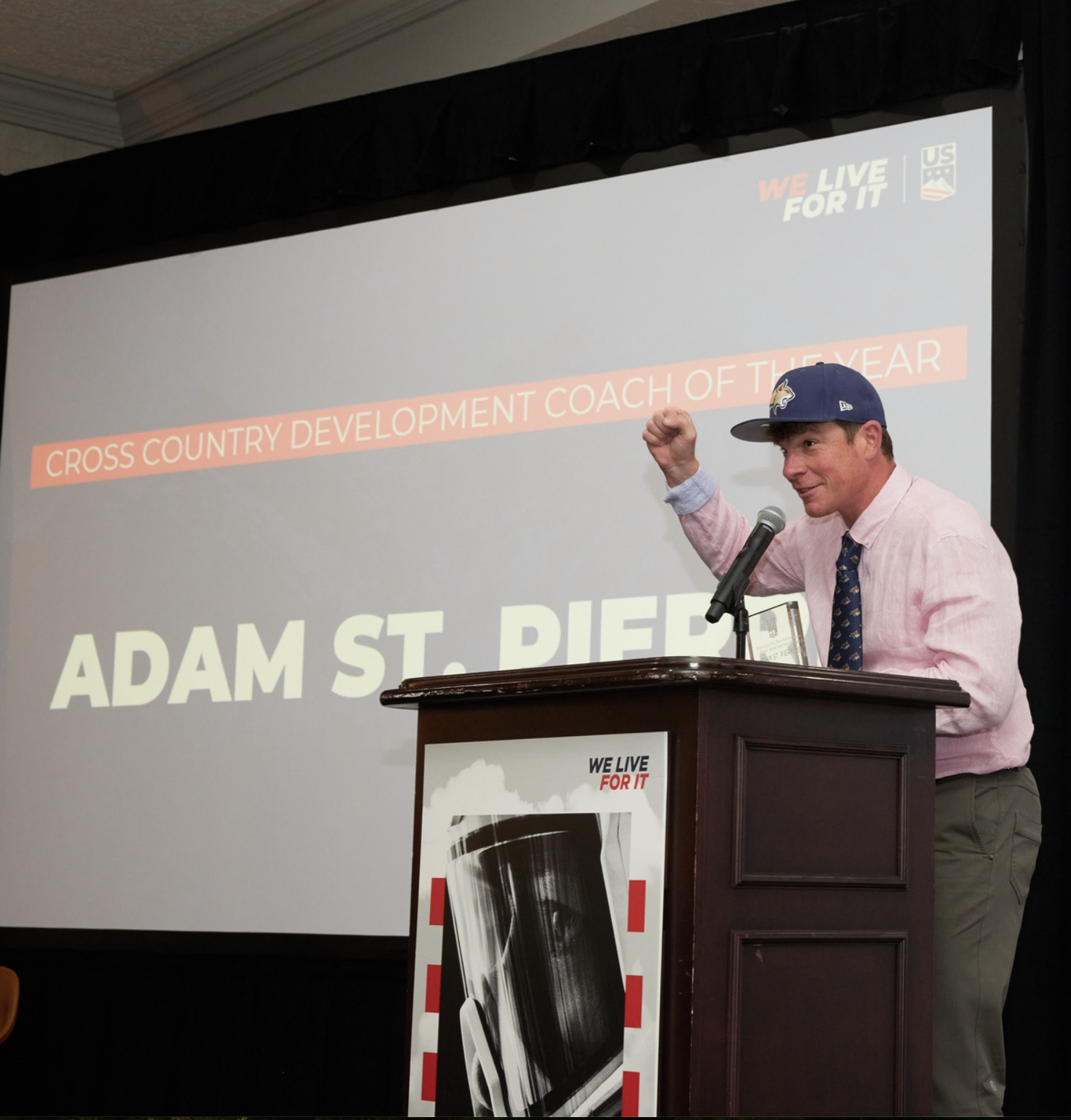
    Consistency over the big block

    Start with periodization, the idea that a training year should be built in escalating blocks toward a peak. St. Pierre is skeptical of the old-school version of it, and his reasons are specific. A lot of that model, he points out, traces back to weightlifting research, some of it from an era when the subjects were quietly using anabolic steroids, which is not a foundation you want under your training plan. The rest tends to come from single-event sports. “In the marathon world or the Ironman world, you’ve got one event,” he said. “You just need to be good for that one event, like on August 2nd or whatever.” Skiing is not that. A ski racer has to be good across a whole season, weekend after weekend, from November into March.

    He points to a meta-analysis, published fairly recently, that looked at the day-to-day training of today’s top Norwegians. The finding was not a secret block of magic. “It really is consistency,” he said. “They’re not doing a big August and a big October. They do big weeks and recovery, and it’s just a very consistent progression.”

    The metaphor he keeps coming back to is one he borrows from Marius Bakken, the former Norwegian runner he half-jokingly calls a father of the Norwegian method. Intensity, in this telling, is not the meal. It is the seasoning. “The base of the soup is your endurance training,” St. Pierre said, “and then you add in a little bit of zip here and there. But if you put in too much zip, the soup is not going to be very good.” Roughly 90 percent of the work, whether on foot, on roller skis, on snow, or on a bike, is easy volume. The intensity is the spice, and Americans, he thinks, are forever dumping in too much.

    Only what’s livable

    There is also a question underneath all of this that the textbooks tend to skip, which is whether any of it is actually livable. St. Pierre still remembers sitting in a USA Triathlon coaching course, listening to a periodization lecture, and asking what he thought was the obvious question. What about a working person who cannot train 24 hours a week but could manage 16? What do you do with them? The answer from the front of the room was that they should take a vacation day and get the training in. “That’s not it,” he said. “That doesn’t work.” His approach is the reverse. Figure out what someone can actually do, how many hours are genuinely available, and then fill those hours with the best workouts possible.

    At MSU that math is dictated by a school calendar, and he has stopped fighting it. His athletes train before 10 a.m. so they can make a 10 o’clock class, and again in the afternoon, with nothing scheduled after 4 or 4:30. That produces a seven-day rhythm rather than the ten-day cycles some coaches prefer. Tuesday is intensity, usually threshold or VO2 work. Wednesday is a double of easy distance, with a few technique drills thrown in at the start to get the neurons firing before the athletes head out. Thursday morning is pure speed. Saturday brings intensity again, often paired with the long distance day. You cannot send skiers out for a two-hour roller ski on a Wednesday morning if they have class at ten, so you don’t. “There’s lots of ways to make a great soup,” he said, and it is not worth inducing a pile of needless stress to chase a perfect one.

    Two tests without a lab

    For readers without a lab down the hall, two of St. Pierre’s tools travel well. The first he calls a VT1 run, VT1 being the top of the easy zone, the hardest you can go while staying genuinely aerobic. Once a week, on flat ground, his athletes run 20 to 30 minutes at that effort and note the relationship between pace and heart rate. Flat terrain because it is the most reproducible. The point is twofold. It tracks fitness: if you run nine-minute miles at 150 beats in early summer and eight-minute miles at 150 by August, you have improved. And it works as an early-warning system. “One of the first signs of overreaching is a change in that heart rate to workload ratio,” he said. If the pace slows at the same heart rate, and it is not 105 degrees out and you are not dehydrated, it is probably time to rest. The signal can run the other way too. An athlete who normally sees 180 during intervals but suddenly cannot push the heart rate above 160 is, in his words, showing a pretty golden sign. Take some rest.

    The second tool he lifted from cycling: a five-minute maximal effort, a long recovery of maybe half an hour with some refueling, then a 20-minute maximal effort. The ratio between the two tells you whether an athlete leans anaerobic and sprint-oriented or aerobic and distance-oriented, no lab required. He built a version of it into his athletes’ training plans. He is quick to add the caveat that governs all of this, in the field or in the lab. Heat, dehydration, and altitude bend every number, and even a lab lactate value shifts with hydration. “No one metric is the god metric,” he said. “You’ve always got to have that context.”
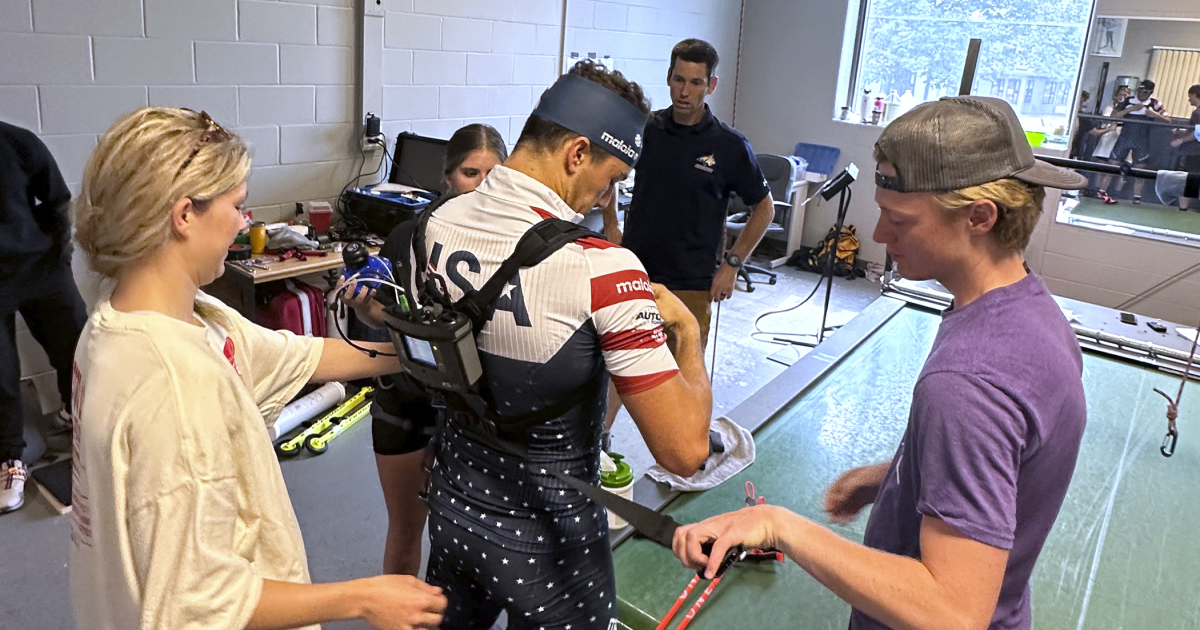
    Montana State students conduct physiologic and biomechanical assessments for U.S. Biathlon. (Photo: Montana State University)

    Building complete skiers

    The individualization matters more now because the college game is about to change. Sprinting is coming to the NCAA Championships, a change St. Pierre cares about personally, because he wrote the proposal years ago and watched it slowly work its way toward reality. In anticipation, he is nudging the team’s intensity mix, keeping most of the hard work at threshold but adding more VO2 and anaerobic speed than a pure distance program would. One test the MSU lab ran compares an athlete’s VO2 at threshold to their VO2 max. A skier sitting well above the roughly 90 percent that is typical probably skews distance and might gain from more VO2 work to lift the ceiling. A skier down in the low numbers might benefit from more threshold. Even so, his priority is all-around development. The sprinters still do threshold. The distance skiers still do speed. He wants complete skiers, partly because a race does not always let an athlete choose its terms. If a distance race comes down to a mass sprint, a distance skier who cannot find another gear finishes 20th.

    The place where St. Pierre thinks American skiing has a real and underrated advantage is strength. He knows the reputation, that Norwegians do not lift, and allows it may be true of many of them. He also knows that the Norwegians who have come through his own program found the strength work novel. As part of a university, MSU has a strength coach, Benito, a former mountain bike racer at UVM and one of the rare ones who understands endurance sport, and the two of them build a program meant to complement the skiing rather than pull against it. St. Pierre credits it for keeping his team generally healthy, and he pushes back on the notion that skiers only need core and pull-ups. “If you can produce power with your legs,” he said, “that’s necessary.”

    He connects strength to a broader idea about movement economy, and here he reaches, carefully, for the Nike Oregon Project. Setting aside the doping and the scandal that eventually swallowed that program, he finds one lesson from it genuinely useful. Its coach had noticed American distance runners getting outkicked, so the group attacked the last 400 meters with sprint work, max strength, and plyometrics. The athletes did improve their finishing kick. They also got faster over the first 9,600 meters of a 10k. Better economy, it turned out, does not just help you sprint. It lets you hold a faster pace all day.
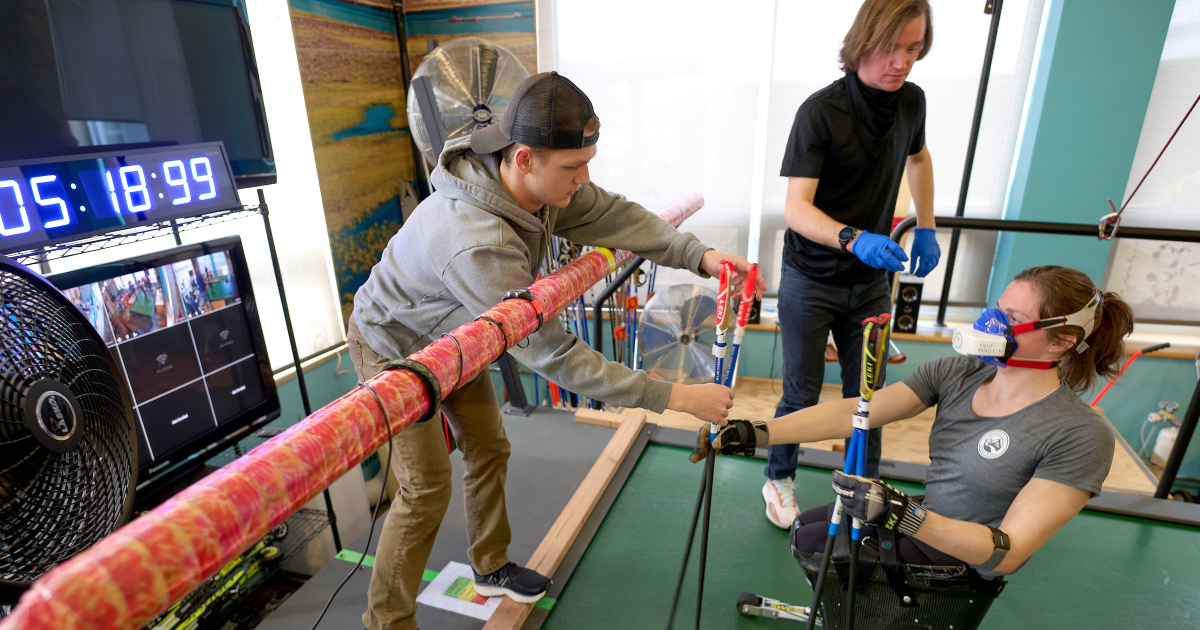
    Montana State biomechanics students provide testing for para Nordic athletes. (Photo: Montana State University)

    The long game

    If that all sounds relentlessly optimized, it is worth returning to the sharks and minnows, because the fun is not a break from the method. It is the method. His college team plays ultimate on skis, using a ball instead of a frisbee to remove the throwing barrier, usually after a track workout, and they lobby to play more. For the youngest kids, he has long argued that the travel race is not really about the race. A ten-year-old drives across the state to ski a 1k, and the actual point is the hotel pool, the snowbanks, the hide-and-seek, the exhaustion on day two that horrifies the parents. “This is why kids get into ski racing,” he said. “It’s not the ski race. It’s hanging out with your friends in the hotel room.” Those bonds are what turn a ten-year-old into a fifteen-year-old who wants to go do a long mountain run with the same crew, and a fifteen-year-old who stays in the sport into an adult who never leaves it.

    Which is finally how St. Pierre defines success, and it is not a medal count. He worries a little about the sport’s fixation on the Nations Cup, because doing well in it requires a lot of athletes racing a full season well, and he is not sure the American pipeline has that base yet. He points to Jessie Diggins as the rare skier who reached the level where she could show up week in and week out and land in the top five every time. Whether that season-long consistency cost her an Olympic medal or two is, he admits, a whole separate and unanswerable question. Finding metrics for development beyond international results is genuinely hard, which is part of why he has soft-started a PhD. The idea is to pull two decades of national points lists and track individual athletes year over year. Are American skiers actually getting better as they age, or do they wash out? The kid who was brilliant at 18 and gone by 22 is memorable, he notes, but memorable is not the same as typical. “Is that the rule or the exception? I think that’s the exception,” he said. “I’d like to have some data to back up my opinion.” The numbers are public. He just needs the time.

    His personal definition is quieter. He wants his athletes to develop far enough that the door to international racing is open if they want to walk through it, and he wants the ones who don’t to keep loving skiing anyway, as coaches, as parents raising their own little skiers, or simply as people who stay active and outdoors for the rest of their lives. He tries to live it as a father, chasing his own two kids up mountains in the summer and out onto snow in the winter. “There’s so much outside of skiing,” he said, “that makes skiing great.”


    Help Support Our Coverage!

    If you value the thoughtful work and access FasterSkier provides, please consider becoming a Voluntary Subscriber. Your support directly fuels our work to cover the people, places, and moments that make our sport special.

    Join the FasterSkier community!
     

  • The Only Kid He Beat Hit a Tree: How Adam St. Pierre Backed Into a Life in Skiing

    The Only Kid He Beat Hit a Tree: How Adam St. Pierre Backed Into a Life in Skiing

    This article was made possible through the generous support of our voluntary subscribers. If you value coverage like this, please support FasterSkier with a voluntary subscription.

    Part one of a two-part series.

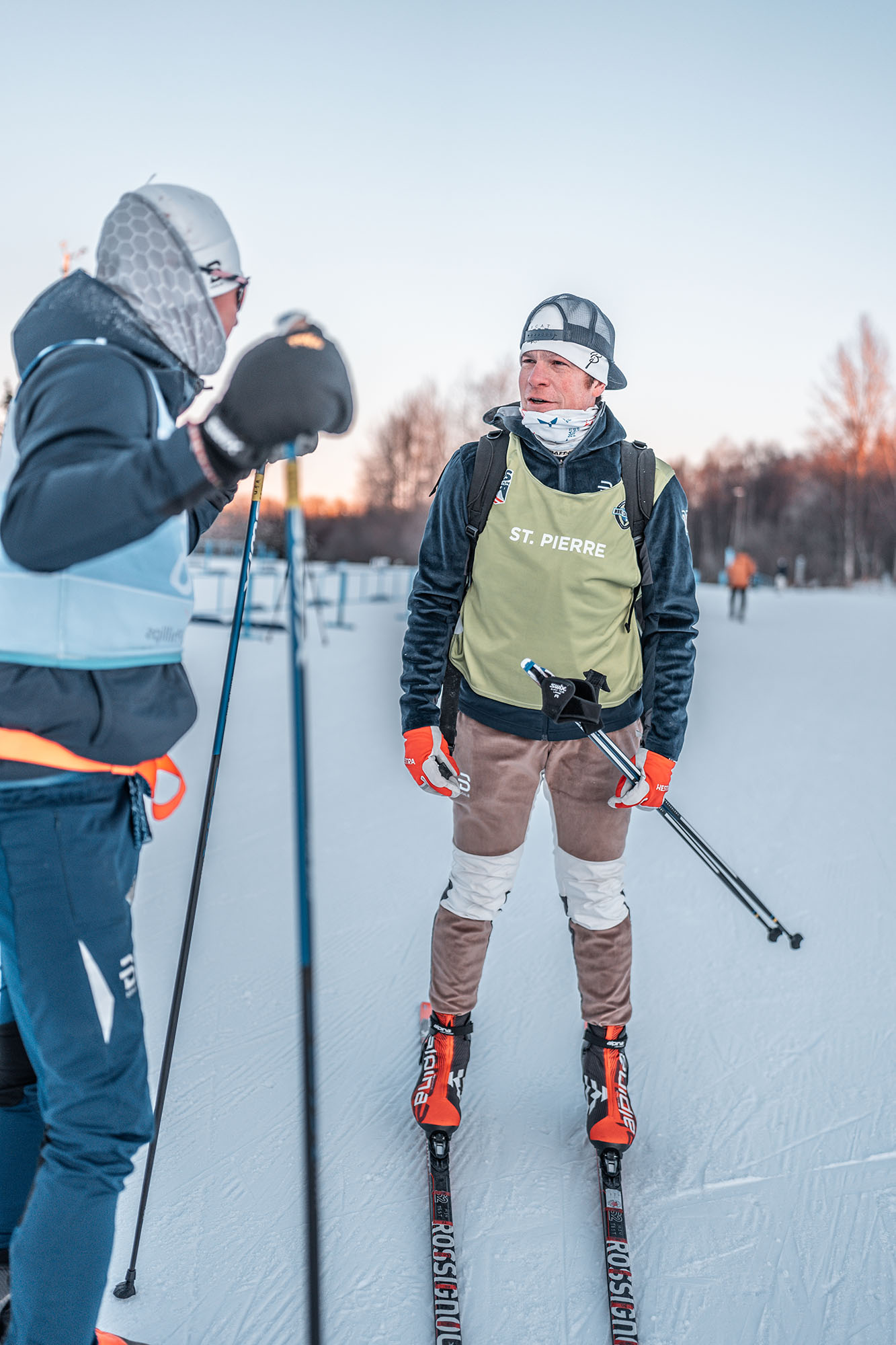
    Adam Coaching at US Nationals in Alaska. (Photo: Tobias Albrigtsen)

    Adam St. Pierre finished second to last in the first cross-country ski race of his life. The one skier he beat had crashed into a tree.

    He was a sophomore at Fall Mountain Regional High School, a rural school in Charlestown, New Hampshire, and he tells the story with the flat delivery of a man who has told it before and enjoys it every time. “Charlestown doesn’t really have a claim to fame,” he said. Forty-five minutes due south of Hanover, close enough to know Dartmouth was up the road, far enough that the world of club skiing might as well have been on another continent. He had never heard of it. What he knew was soccer, basketball, and track, in roughly that order, and he had no intention of adding a fourth sport that involved falling down in the cold.

    Then his freshman year fell apart. He hurt his knee playing soccer. He slogged through a basketball season he had come to hate. And in the spring, his track coach, who happened to also coach the ski team, made him an offer that sounded reasonable at the time. Come out for skiing next winter, the coach said. It will get you in better shape for soccer and track.

    So he showed up. That first race was a classic race, and he had only ever skated. He survived it, barely, ahead of the kid who met the tree, and somewhere in the weeks after, the thing that has kept a lot of people in this sport quietly got its hooks into him.

    Fall Mountain was not a fancy place, and that turns out to be central to the story. It was a working rural school with a barn, animal husbandry classes, agricultural mechanics, a metal shop, and forestry classes that maintained the trails and tapped the maple trees where the team ran and skied. The ski coach was the metal shop teacher. When the program needed grooming, the metal shop and ag-mechanics kids bought an old PistonBully and kept it running themselves. St. Pierre came up through a program held together by shop-class ingenuity and a snowbank at the edge of the football field, and he has never once been snobbish about it.

    “I have a high respect for high school skiing, because it is an entry point,” he said. “Otherwise I wouldn’t have found the sport.”


    A team that needed a fifth man

    He nearly didn’t find the next part either. Right before he graduated, his coach, Larry Sayers, told him that Colby College’s ski team wasn’t very good and that St. Pierre could probably walk on. He filed it away and didn’t think much of it. He had his sights on soccer and track. But once he got to Colby and started running into the skiers at various events around campus, something clicked, and it had nothing to do with the skiing.

    “These are the kind of people I like,” he remembered thinking.

    The timing was almost comically good. The coach, then Tracey Theyerl, now Tracey Cote, was 29 and in her second year running the team. She had just cut most of the upperclassmen, which left her with four men and an opening. St. Pierre walked on as the fifth. His introduction to roller skiing came shortly after, when Cote put him on a pair of classic roller skis and sent him out for a time trial. “I survived,” he said. From that point on, he was in, and again, the pull was the people as much as the training.

    Adam St. Pierre (left) and former Bowdoin skier and BNJRT coach Sam Shaheen at the start of the 2019 American Birke. (Photo: courtesy Adam St. Pierre)

    From the lab to the wax room

    He majored in physics at Colby and minored in biochemistry, and when he graduated, he had no clear idea what came next. He looked at teaching jobs. Nothing landed. Then a skier friend from high school told him about a graduate program at the University of New Hampshire where, as St. Pierre understood it, they paid you to study exercise. That sounded like a good deal. He enrolled in a master’s program in kinesiology and exercise science, working under a UNH physiologist whose research centered on hydration and thirst. His thesis was, in his words, pretty brutal to run: sensations of thirst in dehydrated subjects in cold versus ambient environments. “A little bit of everything when it comes to making people uncomfortable,” he said.

    It was during those UNH years that the sport handed him his first coaching job, and it did so in the roundabout, relational way that his whole career seems to follow. He had started dating a Bowdoin College skier while he was at Colby. She was a year behind him, still racing, and he was driving up to Brunswick most weekends to see her. Her coach was Marty Hall.

    Anyone who knows North American skiing knows the name, yet St. Pierre’s version of a Marty Hall story is smaller and more human, and it starts with the legend sizing up the kid who kept turning up in his wax room.

    “I need an assistant coach,” St. Pierre remembers Hall telling him, and he does a passable Marty voice when he gets there. “And you’re up here every weekend anyway. You want the job?”

    He took it. He thinks he was paid around 1,500 dollars total, which covered the gas. He coached under Hall for two years, and it confirmed something he had already begun to suspect: he wanted to spend his life doing this.

    Adam and his family out for a ski.

    Building from the bottom in Boulder

    When his wife got into law school at the University of Colorado, the two of them moved to Boulder, and St. Pierre walked into the next accident of his career. He had been hired to be the head coach of the Boulder Nordic Junior Racing Team, replacing Eric Pepper. Then Pepper decided to stay. Rather than lose St. Pierre, the club invented a role for him and made him its first development coach, responsible for the youngest kids, the u14s and u12s, or as they were then called, the j3s and j4s. Many of them were the little siblings of the older racers. His whole job was to grow the program from the bottom.

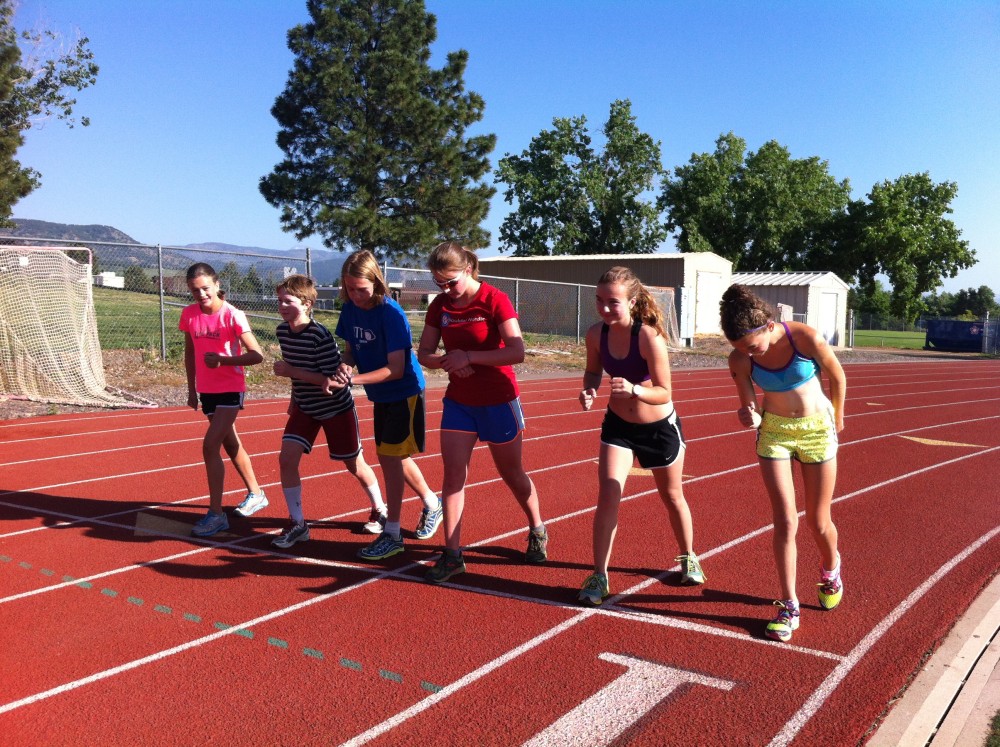
    Boulder Nordic Junior Racing Team athletes prepare for the start of a 3,000 kilometer running time trial on the track in 2013. (Photo: Adam St. Pierre)

    He did. When Pepper eventually moved on and St. Pierre took over as head coach and program director, he watched the club climb from 15 or 20 kids to nearly 70 at its peak, in a place he is quick to say is a genuinely hard town to be a skier. There is no snow in Boulder itself. You drive for it, and it is expensive, and the parents who commit anyway earn their real respect.

    One of those little kids was Lauren Jortberg. St. Pierre started working with her when she was six or seven, and he coached her through high school. She was, by his telling, agonizingly consistent at exactly the wrong number: four straight Junior National Championships and 11th place in what felt like every race. “All she wanted was that top 10,” he said. She had setbacks. She stuck it out.

    Years earlier, in his first season of coaching in Boulder, St. Pierre had said out loud that one of his goals was to someday coach a kid who would reach the Olympics. This past February, Jortberg made the U.S. team for the Milano-Cortina Games and qualified for the quarterfinals of the Olympic sprint, the culmination of a long and interrupted road that ran through back surgery, ankle surgery, and a lost senior season at Dartmouth. St. Pierre is careful not to claim more than his share.

    “I can’t take responsibility for much,” he said, and then, a beat later, “Goosebumps. Proud of her.”

    Boulder was where the rest of his professional life took shape, too. He worked at the Boulder Center for Sports Medicine as a clinical physiologist, running lactate thresholds and VO2 max tests and metabolic evaluations, and working alongside physical therapists on running biomechanics, teaching and reteaching people how to run without breaking. He got into ultrarunning and knocked off a number of 100-mile races, mostly for the pleasure of being out in the mountains all day. Around 2016 or 2017, he left the Boulder Nordic team and hung out his own shingle as an online coach. The flexibility made sense with two young kids and a wife commuting to Denver. But he missed the in-person part, the standing-in-the-snow part, more than he expected to.

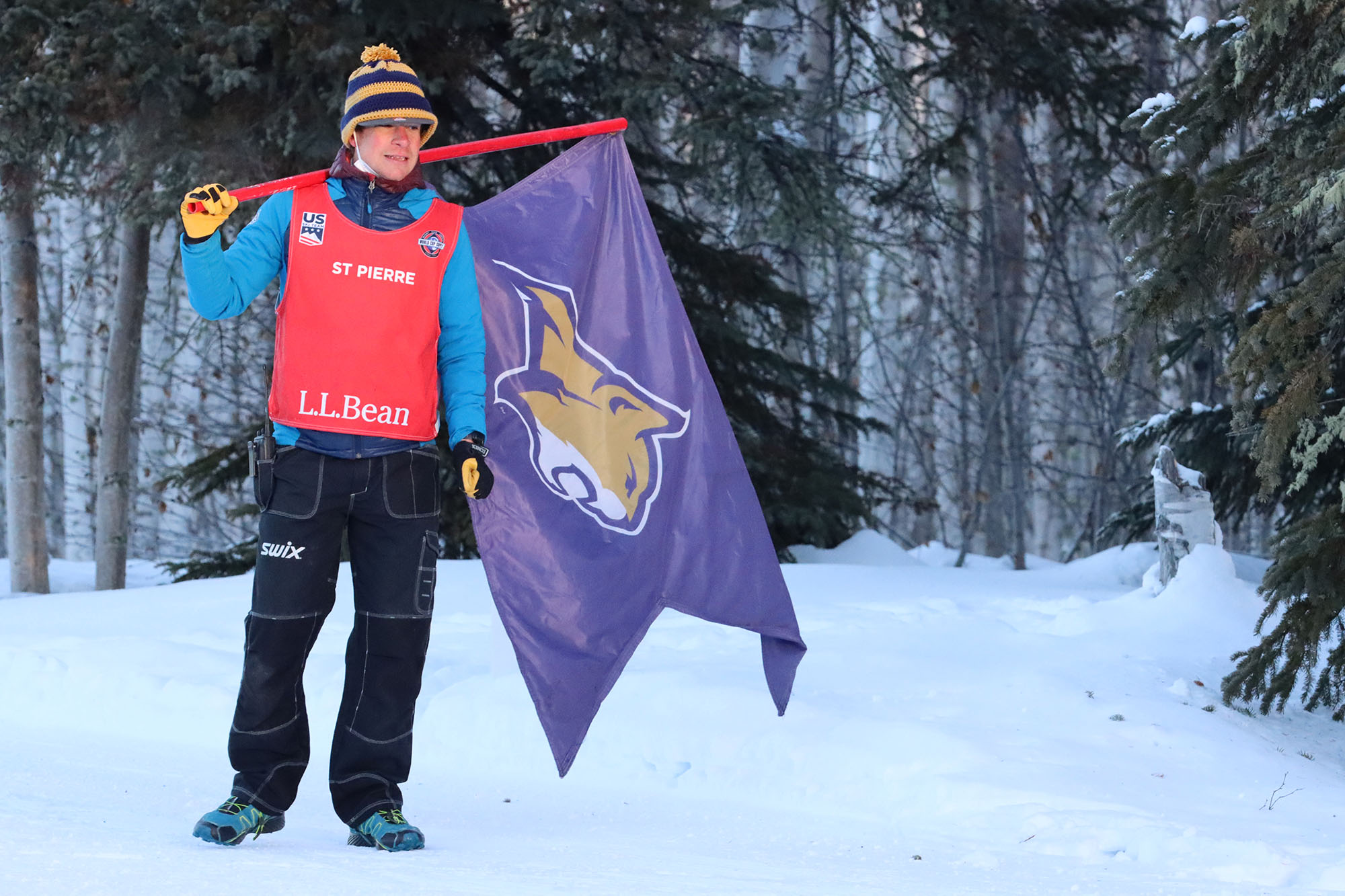
    Adam repping the MSU team flag in Houghton, Michigan. (Photo: Tobias Albrigtsen)

    The job he had been aiming at

    He had known for a long time where he wanted to end up. College coaching had been the goal since around 2009. The appeal was simple: at the junior level, a coach spends a lot of energy convincing kids they might want to be ski racers, keeping every other door open in case they choose running or mountain biking instead. At the college level, the athletes have already decided. “They’ve decided they are cross-country ski racers,” he said. “I wanted to coach ski racers.”

    The Montana State job had come open once before, in 2015, and he had applied and been the runner-up. When it opened again during the strange fall of 2020, he jumped. He was hired that November and moved to Bozeman alone that winter while his wife and kids finished out the year in Boulder, riding out the online-school chaos he credits her with surviving. The family joined him the following June. Bozeman had been near the top of the short list of places they wanted to live anyway, a real ski town with snow in town, Crosscut 20 minutes up the road, and Bridger Bowl close enough to grab powder runs before cross-country skiing in the afternoon.

    Which is to say, the kid who finished second to last, who backed into the sport to get in shape for soccer, who took a coaching job largely because he was already driving to Brunswick every weekend, ended up exactly where he had been quietly aiming for a decade. The path was accidental in its particulars and not accidental at all in its direction. He kept following the people, and the people kept turning out to be skiers.

    What he does with those skiers once he has them, and why he thinks so much of American training gets the easy days wrong, is its own story. That is part two.


    Help Support Our Coverage!

    If you value the thoughtful work and access FasterSkier provides, please consider becoming a Voluntary Subscriber. Your support directly fuels our work to cover the people, places, and moments that make our sport special.

    Join the FasterSkier community!


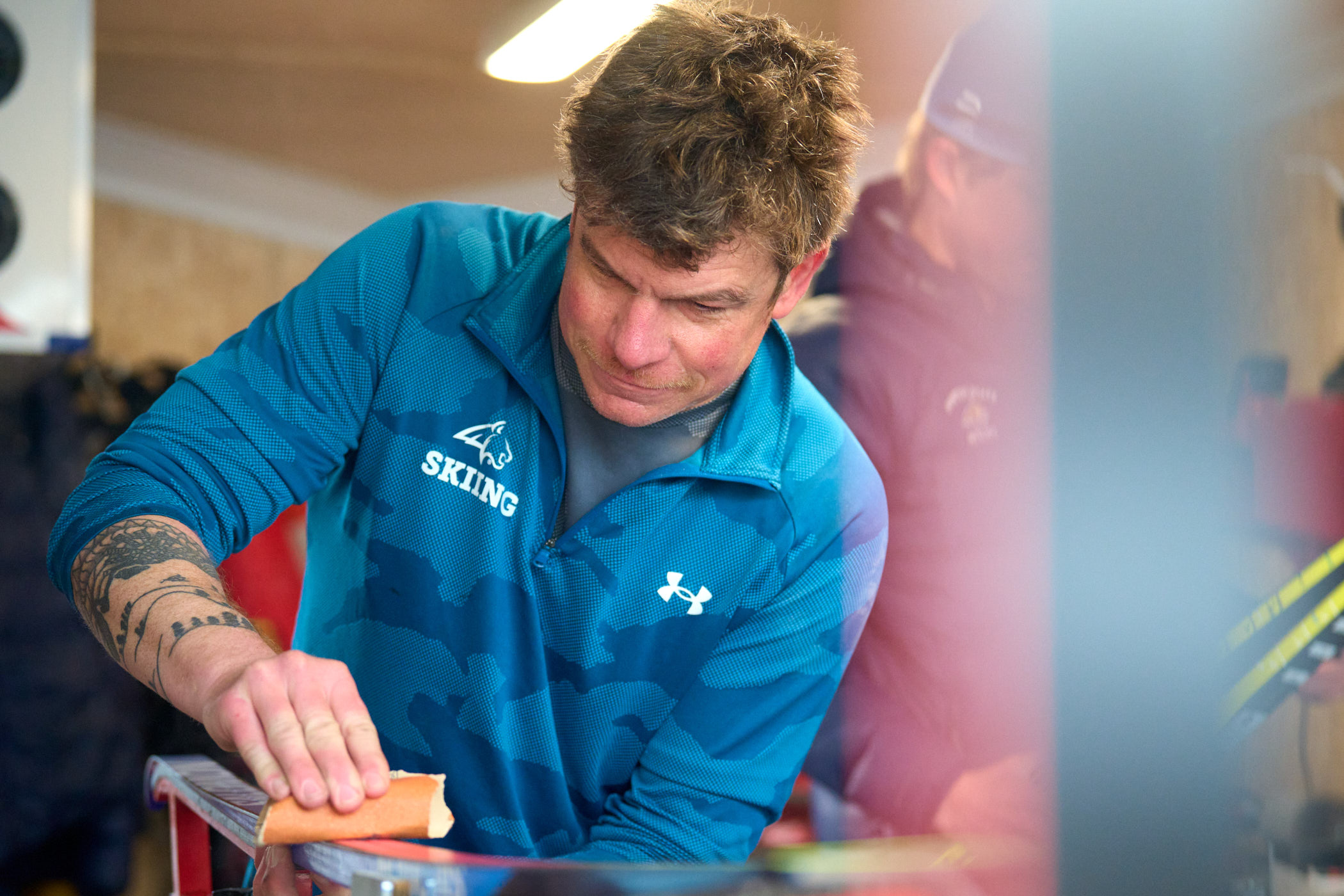
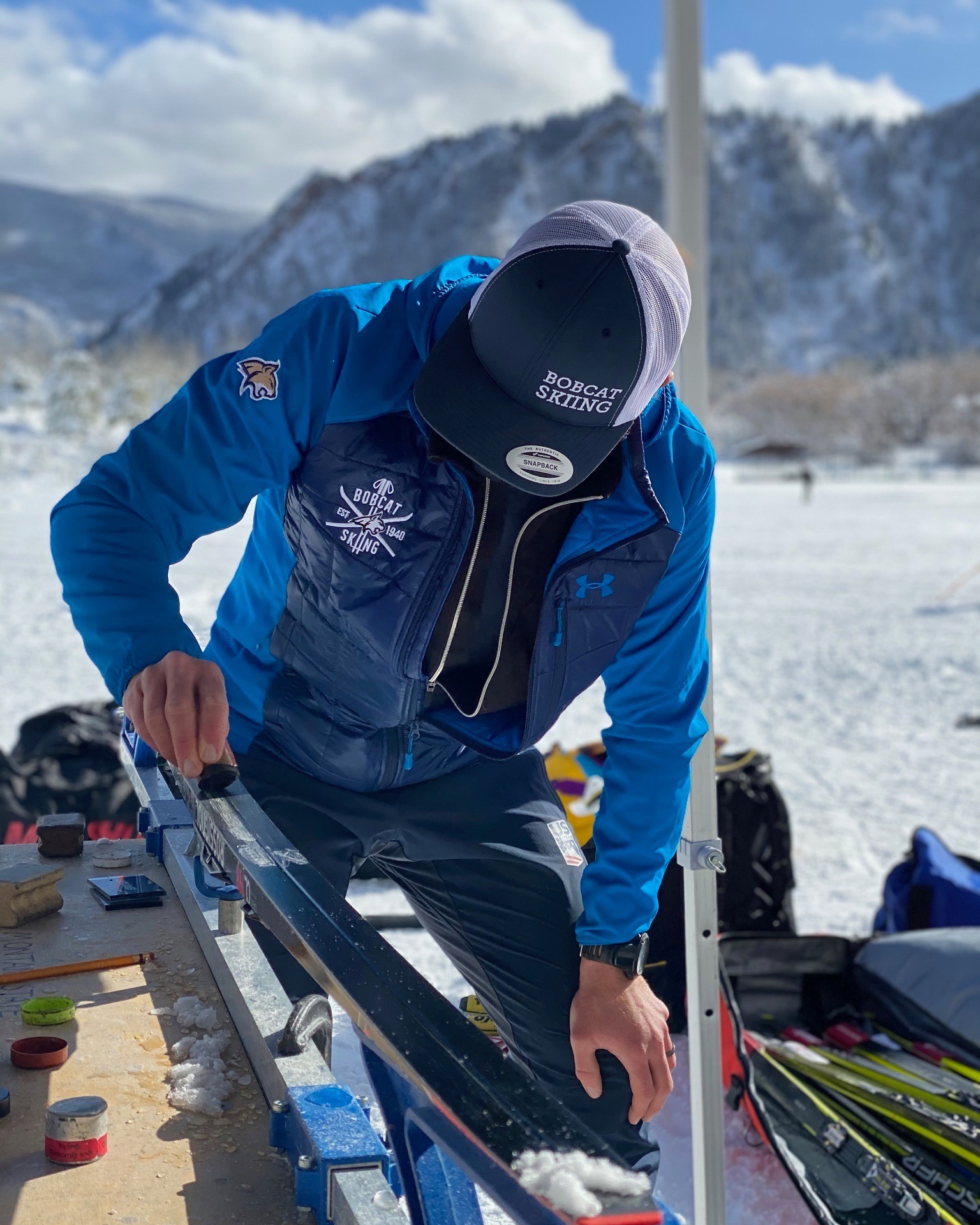
    Adam preparing skis for the Montana State University Nordic ski team at the RMISA Championships in 2026 in Heber City, Utah. (Photo: Colter Peterson)
  • One familiar face and one new one notch wins as U.S. Nationals opens in Alaska

    One familiar face and one new one notch wins as U.S. Nationals opens in Alaska

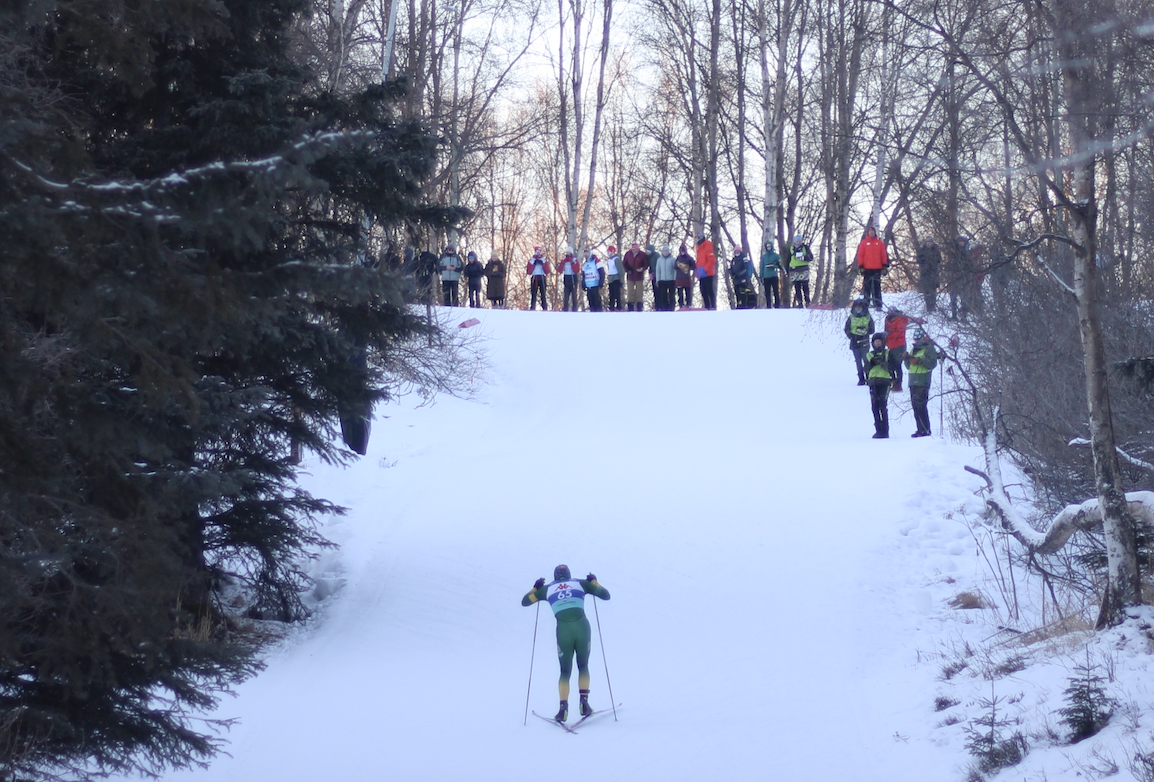
    Erling Bjoernstad, a Norwegian freshman racing for University of Alaska Anchorage, climbs a hill toward the stadium at U.S. Nationals Thursday. (Nathaniel Herz/FasterSkier)

    ANCHORAGE — Kate Oldham wasn’t expecting to win Thursday’s opening race of the U.S. National Championships.

    It was her first competition of the season, after focusing on training in December, and she’d never placed better seventh at previous national championships.

    Her coach at Montana State University, Adam St. Pierre, had other ideas about the 22-year-old senior — though he was keeping them to himself.

    “I have been predicting Kate as a dark horse national champion for a couple of weeks now,” St. Pierre said. “But not talking about it with her, because she races best when expectations are low.”

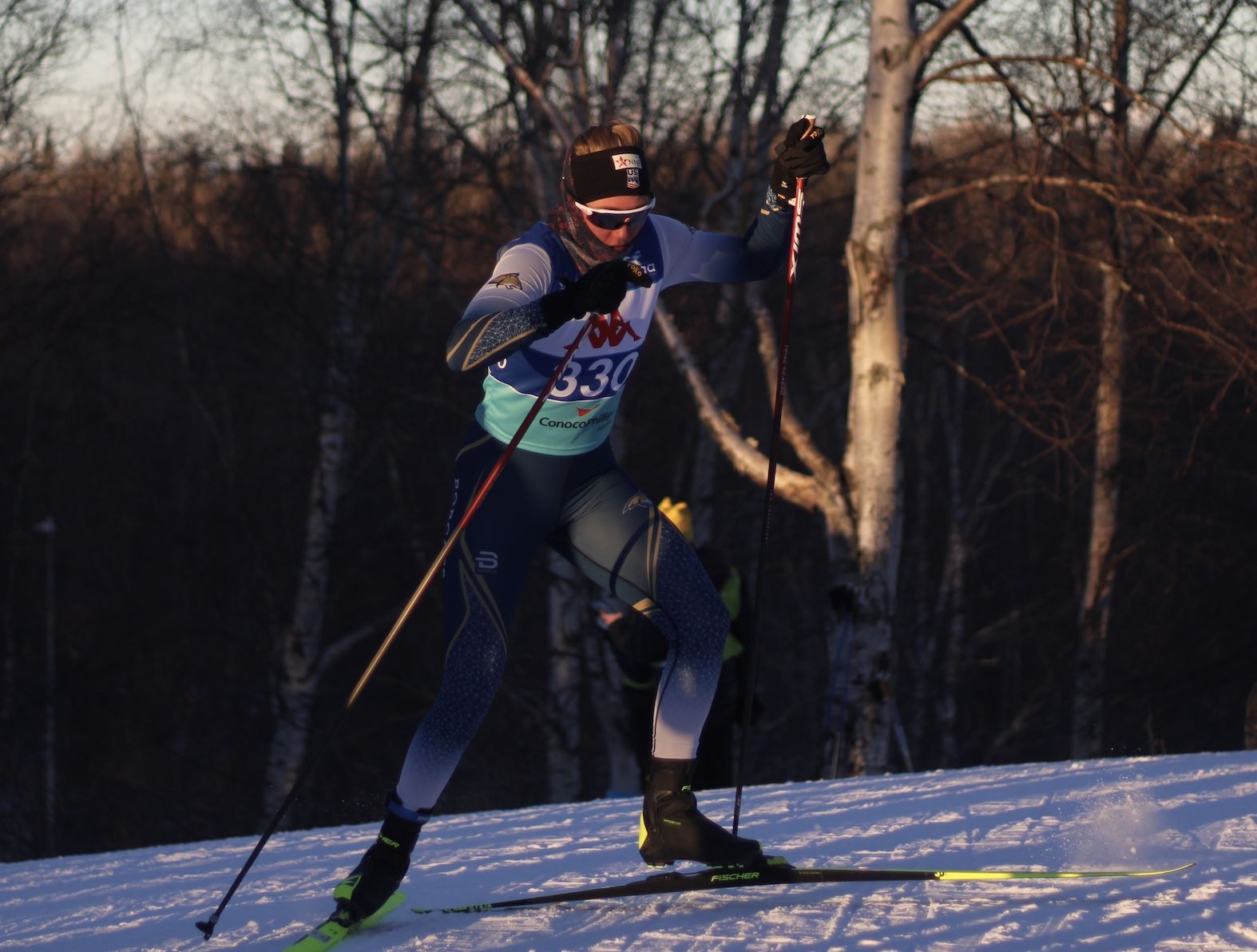
    Kate Oldham racing at the U.S. National Championships in Anchorage on Thursday, January 2, 2025. (Nathaniel Herz/FasterSkier)

    Oldham, St. Pierre said, is a superb glider on her skis, with a “killer instinct” — which apparently served her well Thursday on the rolling, blazing fast, 10-kilometer course at Anchorage’s Kincaid Park.

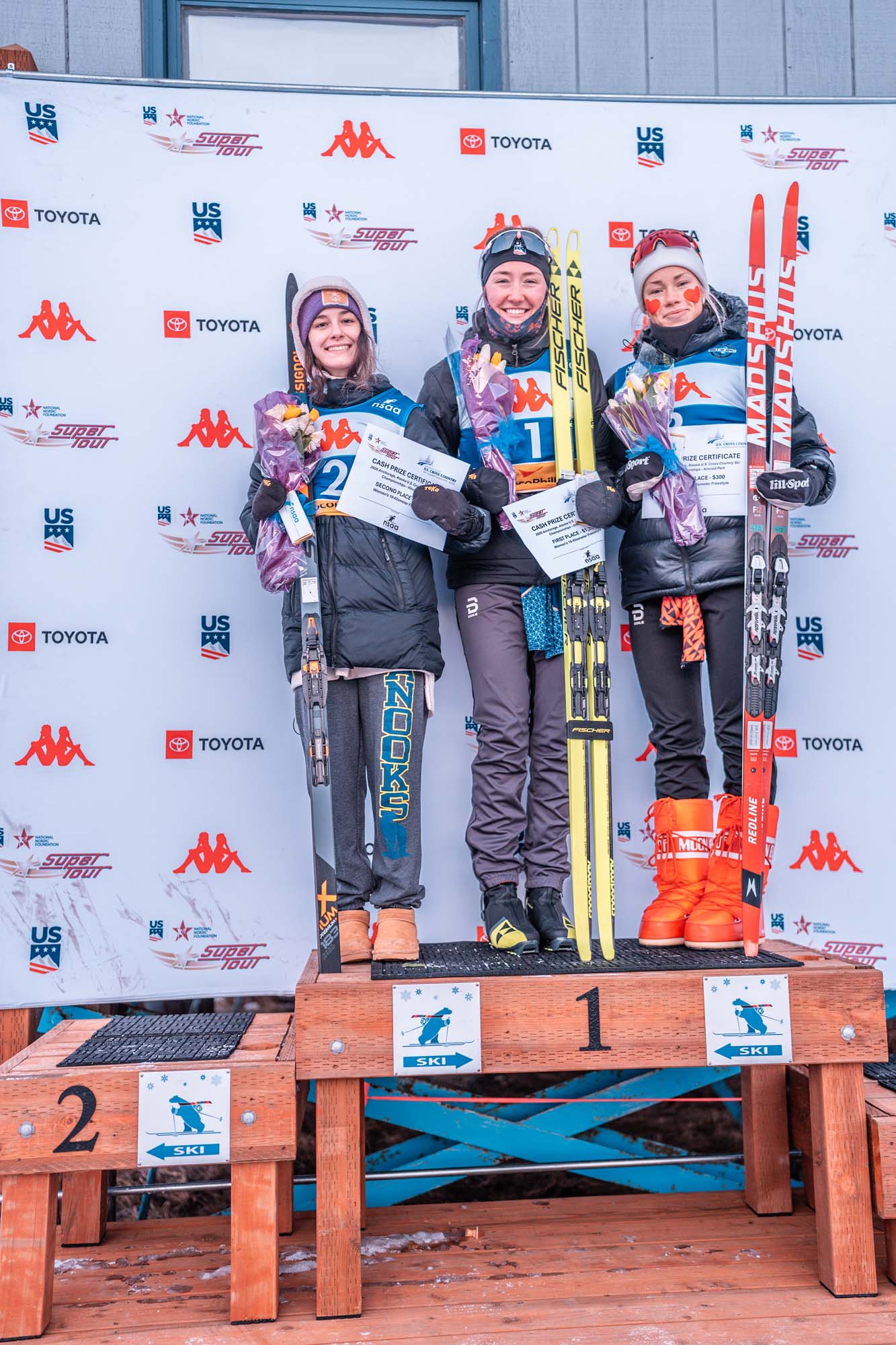
    Oldham won her first-ever national championship, edging local favorite Kendall Kramer of University of Alaska Fairbanks to win the individual-start, time trial-style skate event by 11 seconds.

    University of Utah’s Erica Laven was third, 28 seconds behind.

    “I did not wake up thinking that was going to happen today,” Oldham said afterward, as she fended off bear hugs from teammates and rivals. “It’s surprising. But it’s also awesome, and makes me cry happy tears.”

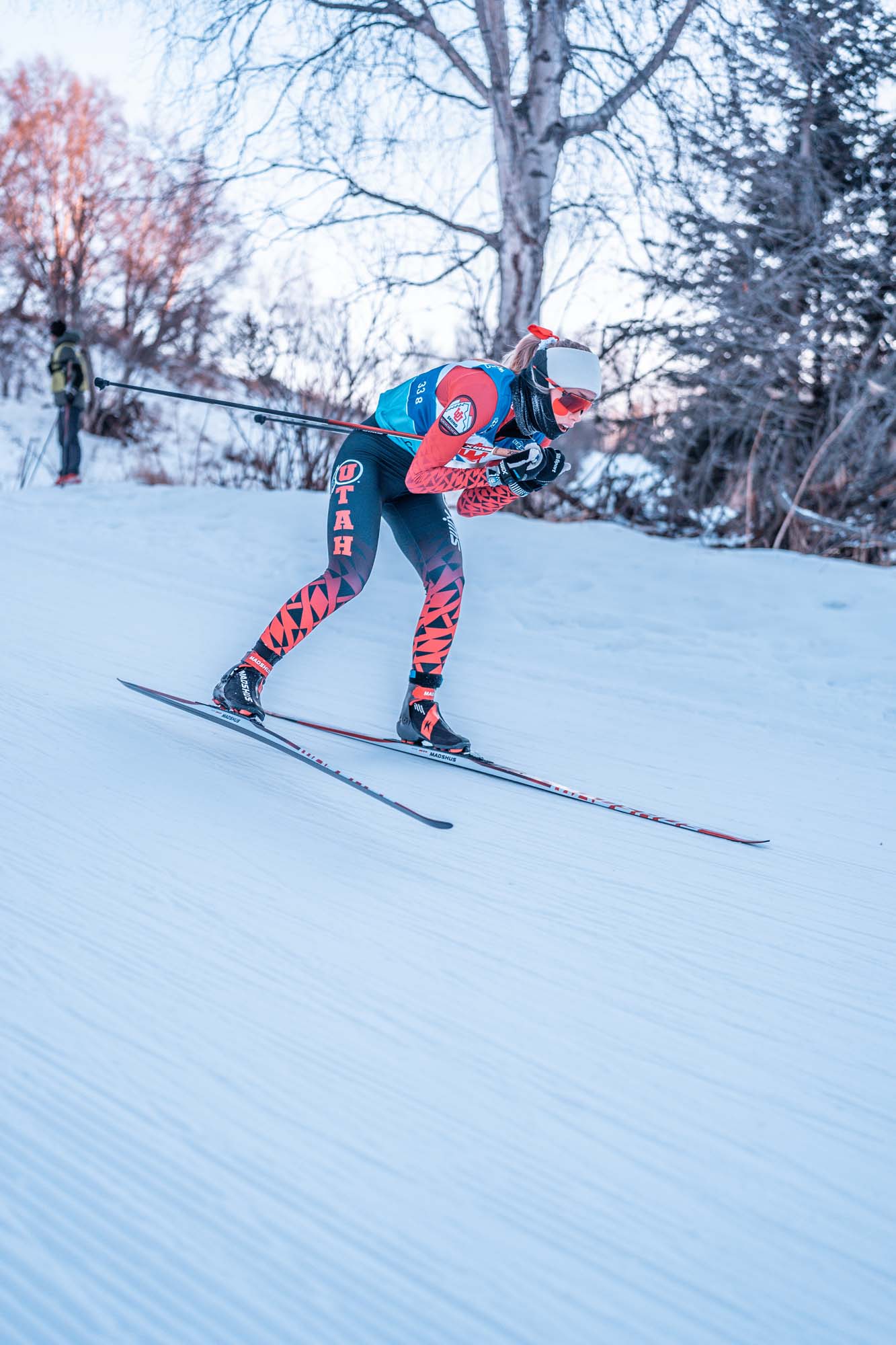
    Erica Laven on her way to third place. (Photo: Tobias Albrigtsen / @untraceableg)

    If Oldham’s win fell somewhere between a surprise and a shock, John Steel Hagenbuch’s victory in the men’s race was hardly unexpected — though that event was much tighter.

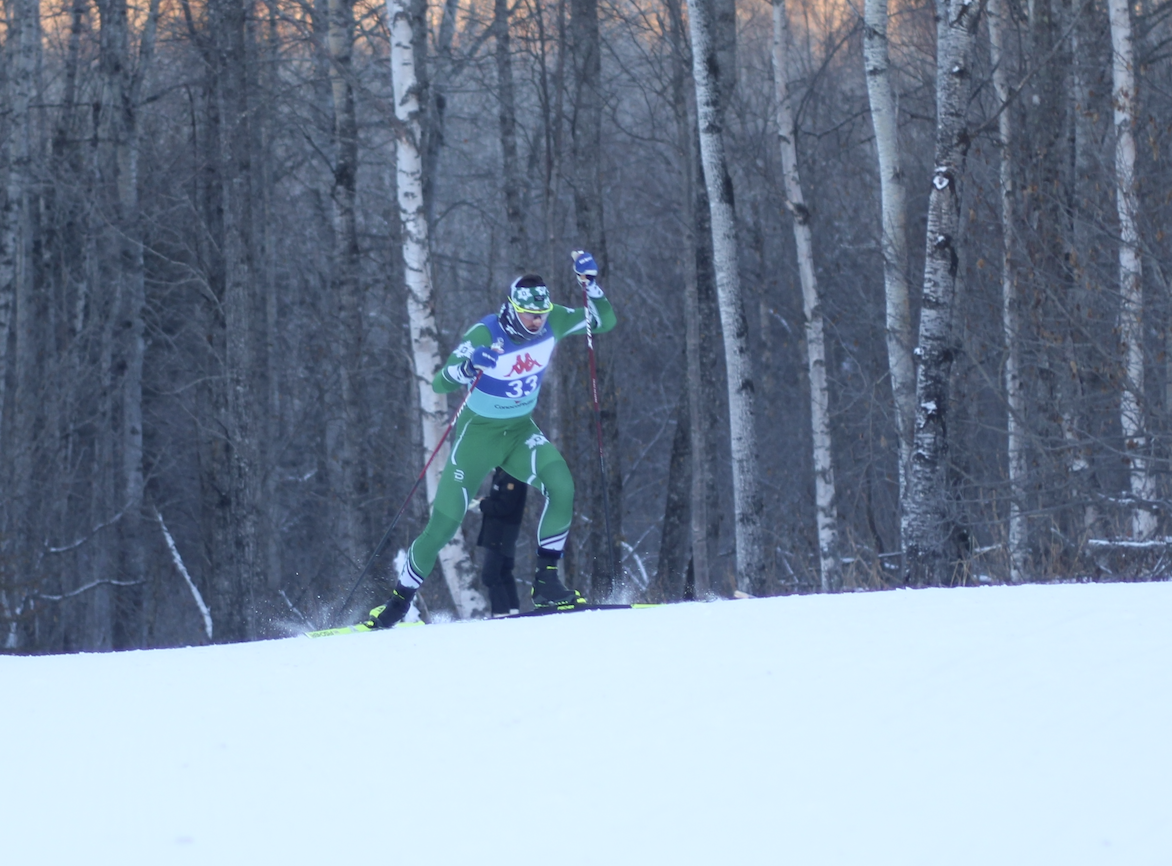
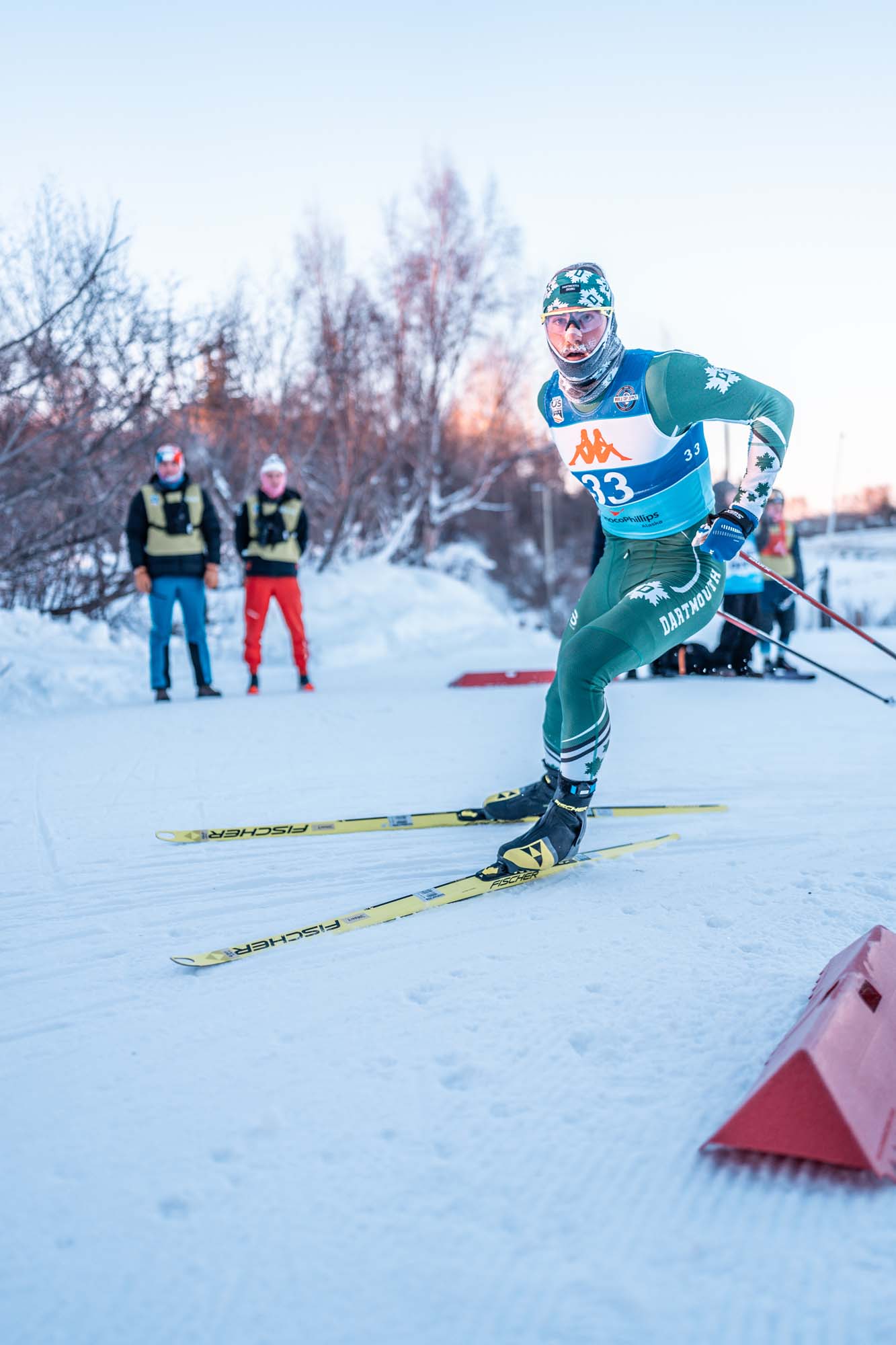
    Hagenbuch, a 23-year-old senior at Dartmouth College, already has several national titles to his name, along with solid results last season on the international World Cup circuit.

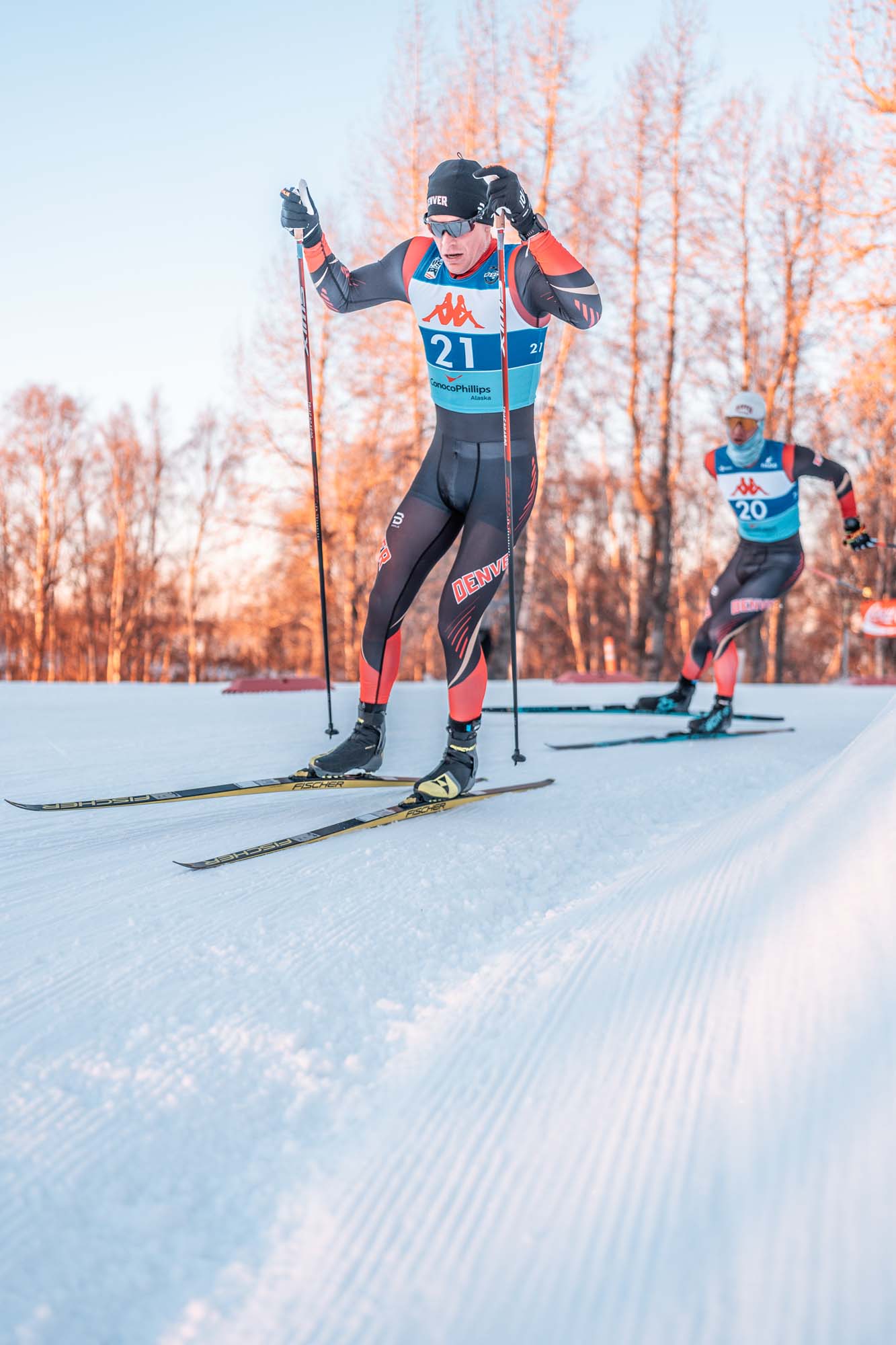
    Hagenbuch held off Andreas Kirkeng, a Norwegian racing for the University of Denver, by a fraction of a second. Walker Hall, who races for the University of Utah, was third, 15 seconds behind.

    Thursday’s races were the first of three national championship events at Kincaid Park, with two more to follow over the weekend — plus a non-championship race next week.

    While temperatures in Anchorage have dipped recently, to single digits Thursday morning, a rainy, low-snow December required extra work from organizers to pull the races off. Kramer, in fact, was part of a battalion of volunteers, including numerous racers, who spent some of last weekend shoveling clean snow onto dirty patches along the course.

    Kramer said she planned a long ski workout that day and kept her watch going while she pitched in on a little shoveling.

    “It was kind of like playing in the snow,” she said. “I don’t want to take too much credit, because I wasn’t out there for the whole four hours people were doing it. But I am very grateful, and I was inspired by all of the people who were there.”

    Kramer, 22, was in the hunt for the win Thursday, with coaches telling her at one point during the race that she was in the lead.

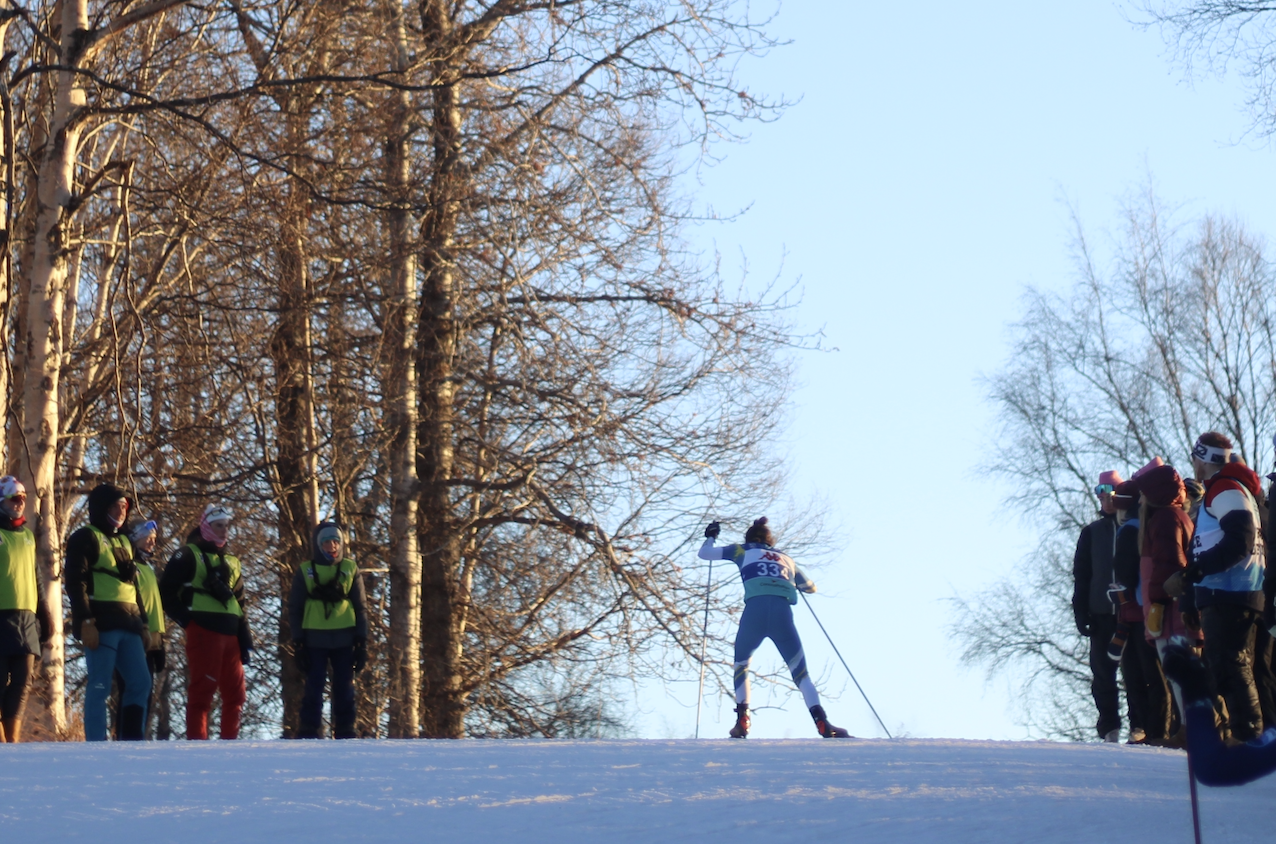
    Kendall Kramer crests a hill in Thursday’s race. (Nathaniel Herz/FasterSkier)

    But Oldham had the fastest times for each of her two five-kilometer laps, according to official splits. Laven was just one-tenth of a second behind her at the halfway point, though she faded on her second lap.

    Oldham grew up in Colorado and spent her holiday break from school training at home, taking advantage of “incredible skiing” in Aspen instead of entering season-opening races, she said.

    That plan is geared toward not peaking too soon, so she can notch her best results at the collegiate national championships toward the end of the season, in March. That plan made Thursday’s win even more of a “pleasant surprise,” Oldham said.

    “I didn’t really sharpen for it,” she said. “It’s an intimidating way to start the season, because you kind of have no idea (what level) you are coming in. But it’s also really nice to go home and enjoy the holiday and just focus on training.”

    Hagenbuch’s approach to the season has been sharply different: He began racing more than a month ago, on the World Cup circuit.

    But after a breakout season last year — one in which he won a bronze medal at the World Under-23 Championships and also recorded a top-15 finish in a World Cup race — this year’s efforts have been uneven.

    Hagenbuch started the season at World Cups in Finland and Norway, but failed to crack the top 30. Then, he returned to the U.S. and notched four straight podiums on the domestic circuit.

    One challenge he faced in Europe, Hagenbuch said Thursday, was that he was having a breathing problem that appears to be a condition called exercise-induced laryngeal obstruction — where, he said, his larynx and vocal cords “seize up and close” during races.

    John Steel Hagenbuch works his way up Elliott’s climb at the U.S. National Championships in Anchorage on Thursday, January 2, 2025. (Nathaniel Herz/FasterSkier)

    The first time it happened, in Finland, was “definitely pretty scary — I couldn’t breath really at all, and I couldn’t speak for 15 minutes after the race. Couldn’t say a word.”

    “It’s kind of multifaceted in what causes it, but I’ve been working through it and trying to figure it out and keep all those muscles relaxed, because it isn’t something you can really address by taking medication,” he said. “It’s something that has to do with controlling your muscles and reducing your stress.”

    Hagenbuch said he had a little bit of breathing trouble Thursday, but managed to keep it under control.

    He had the fastest first lap of the five-kilometer course, giving him a slight edge over Kirkeng.

    But on the second lap, the Norwegian started creeping back.

    A 24-year-old senior studying finance at the University of Denver, it’s unlikely Kirkeng would be in contention for a national championship in his home nation, the global cradle of cross-country skiing.

    But in the U.S., it’s hardly unusual for European athletes to dethrone their American competitors at marquee races: In fact, Kirkeng won the 10-kilometer distance race at the U.S. National Championships in each of the past two years.

    John Steel Hagenbuch on his way to winning the national title. (Photo: Tobias Albrigtsen / @untraceableg)

    As Hagenbuch neared the finish line, coaches along the course were giving him split times that showed Kirkeng closing the gap — even though Hagenbuch had started the race conservatively.

    “I underestimated how hard it was going to get,” Hagenbuch said. “I thought I was going to lose it — I was hearing the splits go from eight seconds up on Andreas, to six seconds to three seconds to even.”

    Kirkeng skied his last lap four-and-a-half seconds faster than Hagenbuch. But in the end, that wasn’t quite enough: Hagenbuch’s first lap was five-and-a-half seconds faster than Kirkeng’s, and he held on to win by eight-tenths of a second.

    “The margins were not on my side today. But that’s how racing is,” Kirkeng said afterward. “And it’s been the other way around a couple of times.”

    Andreas Kirkeng on his way to second place on the day. (Photo: Tobias Albrigtsen / @untraceableg)

    Kirkeng is likely in the twilight of his career — he said he expects to retire after this season and, hopefully, find a finance job on Wall Street or in Boston. If not, he’ll probably return to Norway and enjoy more time with his family.

    Hagenbuch’s career, meanwhile, is still taking off.

    He said he’s looking forward to the rest of the races in Anchorage, which he expects to follow with more competitions in the U.S. — domestic SuperTour events and the college circuit, culminating in the NCAA championships.

    Going back to the international World Cup circuit, he added, probably doesn’t make sense this year, especially after he missed substantial stretches of school while he traveled to races last season.

    But even if this year’s European campaign didn’t pan out, Hagenbuch said, he’s not disheartened.

    “I know I’m in good shape, and I had a good season of training — the hay is in the barn, if you will,” Hagenbuch said. “It’s just going to take some time for that to show itself.”

    Complete Results: 2025 US Senior Nationals

    U.S. Nationals continues Saturday at Kincaid Park with a classic sprint. Stay tuned for more coverage.

    The Women’s Podium (Photo: Tobias Albrigtsen / @untraceableg)
  • Energy Systems and Training for Cross-Country Ski Race Courses

    Energy Systems and Training for Cross-Country Ski Race Courses

    BNJRT athletes with coach Adam St. Pierre at JNs in Soldier Hollow 2018. From left to right, Carson Williams, Michael Pickner, Adam St. Pierre, Bettina Burgess, and Ellie Smith. (Photo: David Pickner)

    It is well known that XC ski racers have to be incredibly “fit” to be competitive. But how do we measure “fitness”? For decades, we’ve known that a high VO2max is necessary to be a competitive ski racer. Training to improve VO2max involves a large volume of training at a low intensity and a comparatively smaller volume of training at a very high intensity. Over the past 20 years, changes in equipment technology, course preparation, and a change in race formats from primarily individual start events to a mix of individual starts and head to head racing have necessitated a change in our view of “fitness.” It’s no longer all about VO2max.

    This spring Thomas Losnegard wrote a review titled “Energy system contribution during competitive cross-country skiing” in the European Journal of Applied Physiology. In this review, Thomas compares the energy demands of skiing to other sports and summarizes the available research into what type of “fitness” is necessary to compete in modern XC skiing. Before I dive into a summary of the review article, I think it’s important to explain metabolism in a nutshell, so I’ll borrow an analogy from my friend and colleague Joe Howdyshell of the Summit Endurance Academy – The Financial Analogy:

    Your body has 3 pathways for generating energy in the form of ATP. ATP powers all muscle contractions. 

    1. The Phosphagen system, also known as ATP/CP. CP stands for Creatine Phosphate. Your body stores enough energy to power exercise for up to 15-20 seconds… with training you can increase this to maybe 25-30 seconds of stored energy in the muscles. Think of the phosphagen system as the cash in your wallet.
    2.  The anaerobic system, also known as non-oxidative or glycolytic systems, is the conversion of Glucose to Lactate. This process does not require oxygen and hence is not measured by VO2max testing. It is quick to produce energy (not as quick as the phospagen system) to meet the demands of training and racing. Think of the anaerobic system as your credit card. 
    3.  The aerobic system produces the bulk of energy for events lasting longer than 2-3 minutes. Think of the aerobic system as your bank account, with your paycheck deposited regularly by your employer. You could perhaps think of recovery as your employer in this analogy… recovery puts the money back in the bank!
    You can train to increase the size of your wallet. You can train to lower the interest rate on your credit card. And you can train to get a bigger paycheck! During an XC ski race. You are constantly balancing the cash in your wallet (ATP/CP) and the amount of debt you can take on (glycolytic) with the amount in your bank account (aerobic). You have to use the aerobic system to pay off the credit card and put cash back in your wallet before you have to pay too much interest.

    Here are my most important take-home points from Losnegard’s review:

    • In XC skiing, there are large variances in speed, power output, and mechanics over the course of a race. The most similar physiological analog to XC ski racing would be short track XC-mountain biking. To adequately prepare for XC ski racing, we must first look into the specific demands of ski races. In the review, Losnegard cites research stating that elite level 10 or 15 km distance races may last 25-35 minutes, of which about 50% of time is spent going uphill, with 25% of time spent on the flats, and 25% on downhills. However, the time spent in any one type of terrain is usually no more than 10 to 35 seconds at a time; sometimes longer, but rarely much over one minute. This means that while racing, skiers must constantly be assessing speed and changing between techniques and sub-techniques approximately 25 times per km in order to maintain the highest speed possible around the course.


    •  In uphill terrain, a skier may work at 120-160% of VO2max for short periods of time, followed by periods of lower VO2max to recover. As you likely know, VO2max is the maximal amount of oxygen the body can use during exercise. It seems odd that an athlete can work at greater than 100% of VO2max. This does not mean they are using more oxygen, it means that anaerobic (aka non-oxidative) metabolism is contributing to the workload. Think of workload as speed in a given terrain and conditions. At workloads above VO2max, a significant amount of energy is derived from anaerobic metabolism. This results in an oxygen deficit. Oxygen deficit is essentially, how much energy had to be produced by anaerobic methods to sustain the workload. Oxygen deficit is difficult to measure and quantify. Typically, exercise at high intensities resulting in oxygen deficit results in the production of Lactate, so the measurement of blood lactate can be used to estimate the extent of oxygen deficit (higher blood lactate levels indicate a greater oxygen deficit incurred).


    • In general, sprint skiers have a higher anaerobic capacity than distance skiers. This is directly correlated to the fact that sprint specialists tend to have a higher muscle mass than distance skiers. Elite men typically have a 10-30% greater anaerobic capacity than women, largely correlated to women typically having less muscle mass than men. The performance difference between men and women is greatest in techniques relying largely on upper body (e.g. double poling and V2) and least in techniques that are not as upper body dependent (e.g. striding and V1). 


    • The contributions of the arms to XC skiing are obvious, but how training of the upper body impacts performance is not fully understood. Arms generally constitute a much smaller muscle mass than legs. Muscles in the arms have a lower oxidative capacity than leg muscles, even in elite XC skiers.  During double poling, the arms release lactate into the blood, where the legs are actually a net importer of lactate- meaning the arms are utilizing a higher percentage of anaerobic metabolism thus producing lactate that must leave the muscle, while the legs are working at an intensity where they are capable of taking lactate from the blood and utilizing it for energy through aerobic pathways. At high intensities in double poling, the energy contribution from the arms plateaus, and any further increase in intensity must come from the legs which increase power output leading to greater vertical changes in the center of mass in order to increase speed (you jump onto your poles more at higher intensities). 


    • It appears that pole contact time may be the ultimate limiter of energy input and thereby speed in flat terrain. With this in mind, training at high speeds to minimize pole contact time (the amount of time the poles are in contact with the ground) may be of great benefit.

    Now for my interpretations and some practical implications.

    In order to repeatedly perform at workloads above VO2max, an athlete must have a high level of aerobic fitness in order to recover from efforts and regenerate stores of ATP/CP during the short periods between supra-VO2max efforts. Instead of looking at increasing VO2max as the ultimate goal of training, perhaps training to increase an athletes’ maximal accumulated oxygen deficit would yield better results. 

    The Principle of Specificity is a foundation of exercise physiology. Essentially, you can improve only what you train.  It is important that we as coaches (and parents, and skiers), recognize the energy demands of XC ski racing and train our athletes (and ourselves) appropriately. We need to design workouts that mimic the demands of racing to prepare our athletes to race. We need to train to move fast in a variety of terrain utilizing both techniques (skate and classic) and all sub-techniques (herringbone, double pole, striding, V2, V1, etc.)

    We need to look at skiing as a non-steady state exercise. There are few instances in ski racing where a skier can grind away for 3-15 minutes at a steady effort/intensity, so why do many coaches (myself included) tend to focus training on this type of workout? Instead, a focus on workouts that mimic the actual demands of XC ski racing- 10-60 sec maximal efforts with 5-30 sec of recovery, may lead to better results in XC ski racing. 

    Here are my practical recommendations based on this review article and the research summarized in it:

    1. Train to the demands of your event. While workouts like 4 by 10 min L3 certainly improve lactate threshold and VO2max, a workout like 4 by 10 min of 45 sec fast/15 sec recovery may achieve similar aerobic gains and allow for faster movements and greater anaerobic contribution during the workout, perhaps making it more similar to racing. See below for some possible workout progressions. Also, the training necessary for a Wave 1 Birkie skier is different from a Wave 8 Birkie skier which is different from a junior which is different from a World Cup athlete. Identify the demands of your event(s) and target your training towards them.
    2. Include “gear shifts” in intervals. Most intervals should include some portion uphill, but not all. Have you ever heard “transitions are important”? Practice them at speed!
    3. Use ski specific modalities for high intensity work- bounding/ski walking, rollerskiing, or (obviously) on-snow. Intervals on bike or swimming are good for fitness, but not nearly as specific as similar workouts in ski specific modalities, especially given the increased utilization of upper body power.
    4. Train fast movements. Athletes need to be able to move quickly and apply power quickly in racing. In order to do this in races, we need to do it in training. Incorporate short sprints, explosive strength training, and plyometrics into your training. Andy Newell has some great video resources on his website( www.nordicteamsolutions.com ) that can be modified for any level of athlete!

    Here is a progression of workouts you may find beneficial to add to your training. These workouts should be done on skis, rollerskis, or bounding/running with poles. Each workout is preceded by a 20-25-ish min warm-up consisting of: 

    5 min easy, 3 min L3/Threshold, 2 min easy, 2 min L4, 2 min easy, 1 min L5, 5-10 min easy. In an ideal world, this warm-up would be preceded by some mobility and light plyometric work!

    Each Main Set consists of 12-20 min of total “on” time, all “on” time is done at sprint race pace/effort. HR will not be useful in guiding the intervals because they are so short, though looking at HR recovery between intervals and the response of HR to the workouts over time can be interesting). I also prefer to have a timer of some sort so you don’t have to look at your watch to know when to start and stop:

    • 24 by 30/30 (24 min, 12 min on time)
    • 5 by 6 by 30/30 w/ 4 min between sets (46 min, 15 min on time)
    • 5 by 8 by 30/30 w/ 4 min between sets (56 min, 20 min on time)
    • 30 by 30/30 (30 min, 15 min on time)
    • 21 by 40/20 (20 min, 14 min on time)
    • 5 by 6 by 40/20 w/ 4 min between sets (46 min, 20 min on time)
    • 5 by 6 by 40/20 w/ 2 min between sets (38 min, 20 min on time)
    • 30 by 40/20 (30 min, 20 min on time)
    • 15 by 45/15 (15 min, 12 min on time)
    • 3 sets of 8 by 45/15 w/ 4 min between sets (32 min, 18 min on time
    • 3 by 10 by 45/15 w/ 5 min between sets (40 min, 22.5 min on time)
    • 20 by 45/15 (20 min, 15 min on time)
    • 12 by 60/30 (18 min, 12 min on time)
    • 4 sets of 4 by 60/30 w/ 2 min between sets (30 min, 16 min on time)
    • 5 sets of 4 by 60/30 w/ 4 min between sets (36 min, 20 min on the time)
    • 20 by 60/30 (30 min, 20 min on time)
    • 10 by 30/30, 5 min easy, 8 by 40/20, 4 min easy, 6 by 45/15 (33 min, 15.5 min on time)

    End each workout with a 5-20 min cool-down

    I recommend doing one session like this every other week in the summer, one per week in the fall, and one-two per week in the winter (depending on race schedule). For skiers living/training at altitude, it may be necessary to increase the rest between intervals to ensure that the short “on” periods are of sufficient quality to train really quick and powerful movements. 

    I’d like to give thanks to a few friends and colleagues who aided in the editing of this article: Corrine Malcolm, Duncan Callahan, and Joe Howdyshell. 

    Adam St. Pierre (left) and former Bowdoin skier and BNJRT coach Sam Shaheen at the start of the 2019 American Birkie. (Photo: courtesy Adam St. Pierre)

    Adam St.Pierre is a New Englander who learned all about Exercise Science in grad school then found his way to the Rocky Mountains to coach XC skiing in Boulder, Colorado- where the running trails are plentiful and the snow is just a short drive up a canyon.


  • Call for Questions

    Call for Questions

    Here’s a call for questions and comments about a May 2019 article titled “Energy system contribution during competitive cross-country skiing” published in the European Journal of Applied Physiology. Longtime cross-country coach and athlete mentor Adam St. Pierre will be writing a story about these academic findings. FasterSkier will publish Adam’s story at the end of the month.

    We’d love your questions and feedback about “Energy system contribution during competitive cross-country skiing” to help Adam shape his story.

    You can send any questions/comments about the piece to info@fasterskier.com. Please use the subject line “energy system” in your email.

    Thanks for your input.


  • Wednesday Workout: Guiding Junior Athletes With Adam St. Pierre

    Wednesday Workout: Guiding Junior Athletes With Adam St. Pierre

    Ben Saxton (SMST2) skis with a junior athlete during a past USST annual training camp in Park City, Utah. (Photo: Liz Arky)

    This Wednesday Workout includes guidance from Boulder Nordic Junior Race Team (BNJRT) Head Coach Adam St. Pierre. After earning a BS in Physics and Biochemistry while skiing for Colby College in Maine, St Pierre earned a masters in Kinesiology and Exercise Science at the University of New Hampshire. While in graduate school, he was the assistant ski coach to Marty Hall at Bowdoin College and has since coached all age groups. His primary role at BNJRT is working with high school aged athletes, although he has also coached the U14 development program, and also runs a private coaching business, ASTP Coaching, where he works with adult athletes, primarily in trail and ultra running. St. Pierre is also the Rocky Mountain representative to the USSA Sport Committee, instructs coaching development courses including the USSA Level 100 course, and assists with coaching at regional and national junior camps. He is currently in Anchorage, AK leading the Rocky Mountain Nordic Team at Junior Nationals trip. Additionally, he is the parent of two skiers aged five and two. In this Wednesday Workout, St. Pierre shares insight into guiding junior athletes as they progress through their career as a skier.

    Adam St. Pierre is the head coach of the Boulder Nordic Junior Race Team. (Photo: bnjrt.net)

    “Is it okay for my child to start training for skiing?” “How much training is appropriate at this age?” Whether they come from the parent of an eager U14 athlete chomping at the bit to qualify for junior nationals someday, the eager parent of a U14 athlete hoping to groom their child for elite skiing, or somewhere in between, these questions certainly make the “frequently asked” list for many junior coaches. Add to the complexity of the answer the physical development of the athlete, their list of other sports, and their dedication to skiing, and the response quickly becomes “it depends.” When it comes to blossoming U14 and younger skiers, St. Pierre likes to differentiate between formal training and general exercise.

    “Training is exercise with a purpose,” he said in a call. “Exercise for the sake of exercise is good, it’s good for health, it’s good for all that stuff, but then training is when you have that goal or that long-range plan. So I think exercise is important as a youth. I don’t know if I would call what 8, 9, 10 year olds are doing training, although I guess if you want to go real general, if the purpose is to improve ski technique or improve skills, then I guess its training.

    “But I think it’s important that young kids exercise a lot, whether that’s hiking, playing soccer, running around in the backyard, whatever they do,” he continued. “But from a training perspective, the younger the start [of skiing], the more likely it is that you will pick up the movements well and quickly and be able to really perfect them.”

    The agility, balance, and coordination developed in other sports build an athletic foundation with age, and experience sliding on snow and enjoying winter helps to develop a love of the sport, both of which are essential components to excelling in or simply sticking with skiing long term.

    “Kids need to be exposed to skiing as young as possible, but they can probably hold off until 10, 12, maybe even 14 years old until they do specific training as long as they have a good multilateral background that includes cross-country skiing, maybe even downhill skiing and ice skating, just a variety of sliding sports,” St. Pierre concluded.

    As an athlete transitions from skiing purely for enjoyment to a more focused and performance-based training program, it is important for a coach to look beyond the skier’s chronological age, i.e., how old they are, to both the athlete’s biological age and training age. Biological age refers to the individual’s physical development including whether they have reached puberty, while training age refers to the number of years the athlete has participated actively in cross country skiing.

    “There’s always the giant U14 or the tiny U16, and I think the training for those types of athletes is different, what they’re biologically ready for,” said St. Pierre. “I think the physical age or the biological age usually is pretty straight forward, you can tell based on their size and the way they move, but I think the training age is also fairly easy to tell. You can tell how proficient a skier is just by looking at them and if they’re able to have coordinated movements and ski with good technique. Even if they’re relatively new to the sport, it shows that they have a pretty adept handle on it.”

    With these considerations, a coach can begin to write a training plan that is appropriate for that particular skier, as one size does not fit all. High volume and VO2 max efforts do not create the same response in a prepubescent athlete, so it is best to allocate time instead to shorter efforts that foster good technique and balance while skiing fast. These efforts also help the athlete acclimate to harder physical exertion than they might have previously experienced.

    “I think it’s really important to include training for the individual,” St. Pierre expressed. “An athlete pre-puberty isn’t going to respond as well to 4 x 10min threshold intervals just because they don’t have the hormonal milieu to really adapt to those intervals, whereas they may be better off doing something shorter and faster to work on the neuromuscular component of how to move fast.”

    At the onset of puberty, most adolescents hit a rapid growth spurt and begin to accrue lean muscle mass. Prior to puberty, this muscle mass is much harder to put on. This should be taken into account in writing a junior plan, but that is not to say that strength training should be avoided completely until puberty.

    “Strength training is the other big one where the late bloomers or the athletes that are a little later to puberty – strength training for them doesn’t have the same effect for them as an athlete that is surging with hormones,” explained St. Pierre. “But they can still make the neuromuscular gains even if they are not growing bigger muscles.”

    He concluded, “So I think that a lot of the training is the same, it just takes on a slightly different goal depending on their chronological age or their age in the sport.”

    Once an athlete is at an age and stage of their development as a skier to begin to include strength training, St. Pierre advises including strength training on a regular basis if possible, but acknowledges that due to time constraints and travel to and from a practice venue, it is not always possible after the dryland season ends.

    “If you look at the research, the ideal is two strength sessions a week for males and three for females,” he explained. The difference in frequency is due to the differing levels of testosterone which sparks muscle growth in response to the workout. “But that just doesn’t fit in logistically with many of the athletes that I work with because they have school and they have jobs and they have music lessons and many of them are really accomplished students and they just don’t have the time.

    “I really prioritize on-snow training,” he continued. “I’m not willing to sacrifice an afternoon where we can go skiing to go do strength. I think strength is important, but I think on-snow training is the most important thing for junior athletes, really maximizing that time on snow.”

    Adam St. Pierre seen with the 2018 Junior National team from the Rocky Mountain division. (Photo: Rocky Mountain Nordic)

    Perhaps unique to this generation of kids, it is not uncommon for a young athlete to compete in a variety of sports year-round, sometimes multiple sports within one season. While this benefits athlete development in the early years, it can make truly excelling in any of the sports a challenge as an athlete moves through their high school years.

    “There are kids that at 10 or 12 years old that decide they want to be ski racers – whether that’s some outside pressure, parental pressure, peer pressure, or because they saw Jessie Diggins ski and they decided that’s what they want to do – and I think that’s awesome and we should nurture those athletes. But I think there’s also athletes that run cross country, and they ski, and they cycle, and if they want to compete in all of those sports or in a variety of sports through their high school years. I think that’s great, but I think for elite performance, they need to pick one that is the primary.”

    For ski racing, St. Pierre feels this choice needs to take place early in their high school career for most athletes.

    “I think it’s important for athletes to know and prioritize one sport over the other, but I also think it’s important that they participate in a variety of complimentary sports and activities. Usually around high school is when that prioritization has to occur if an athlete wants to be competitive in one sport, I think prior to that, you can have an athlete that plays soccer, and golfs, and swims, and skis all fairly equally.”

    In an ideal world, athletes that chose to prioritize cross country skiing should be able to fully invest themselves in training by strength training regularly while also putting in the volume and interval training needed to enhance their performance. But, time and resources often inhibit this from being a reality for many athletes.

    “The ultimate consideration for any athlete is time. Any competitive athlete would love to have 20 or 30 hours a week to train, but very few do. At the junior level, with school and other considerations, 10 to 14 hours a week is kind of a big ask… I like to structure as much training as can be tolerated, then the level that can be tolerated is largely dependent on their age, their training background, and their dedication to the sport.”

    Looking at the weekly hours an athlete has available, a coach divides training time between low intensity volume training, technique work, and strength training. As St. Pierre mentioned, for BNJRT athletes who drive 45 minutes each way to ski, strength training in the gym often falls to the backburner during the winter in order to maximize time on snow. During his training sessions, he always includes some technique work regardless of the goal of the session for fitness.

    “You can never separate technique from endurance,” he said. “If you’re skiing, there’s got to be some technique there. I like to take the first 20 – 30 minutes of practice and have a focus, maybe it’s a handful of drills or a quick technique progression as part of the warm up, then we go into the day’s workout which might just be an easy ski or it might be an interval workout.”

    He elaborated, “I’ll pick a loop with a specific [technique] focus, so we’ll warm up for that focus, then on that loop I’m able to see the kids repeatedly, so I’m able to give them feedback and make corrections.”

    While structured training is essential to becoming a competitive skier, it is important not to forget that fostering a love of skiing is essential for retaining youth in the sport, which will ultimately make for better skiers.

    fordrinkers

    “I also think it’s important at least every other week to just let the kids go ski and have fun,” said St. Pierre. “Talk about boys and girls and school and parents, whatever else they do when they’re out of earshot of the coaches.”

    Lastly, St. Pierre reflected on the mistakes he notices his junior skiers making most commonly. Unsurprisingly, it can be a challenge for adolescents to reign it in for level 1, especially with eager to improve skiers. However, this might not be as big of a concern as it might be for an older athlete putting in a larger number of training hours.

    “To train a sufficient volume requires the bulk of that training to be easy,” reasoned St. Pierre. “I think a lot of juniors make the mistake of training too hard too frequently, this is especially true for our kids at altitude just because it’s hard to move forward uphill at an easy intensity… but if they’re not really training a ton of volume, that’s not really as big a mistake as it is if they’re really dedicated and really training. So often it’s the young athletes, the U14’s or U16’s maybe that are chasing around the older kids, and I think that’s not necessarily a bad thing. But once they’re U18 or U20, they should have a pretty solid idea of what easy feels like and hopefully have the fitness base to maintain easy while putting in that volume.

    “I think the converse is also true,” he continued. “I think some athletes are scared to go above level 1 that they end up compromising their technique and skiing poorly and ingraining really bad habits. So I think it’s important that athletes have a balance between not killing themselves every day but also not ingraining poor technique habits by waddling around on their skis.”

  • Wednesday Workout: Track Workout Progressions with Boulder Nordic Juniors

    Wednesday Workout: Track Workout Progressions with Boulder Nordic Juniors

    Boulder Nordic Junior Racing Team (BNJR) athletes prepare for the start of a 3,000-kilometer running time trial on the track in 2013. (Photo: Adam St. Pierre)
    Boulder Nordic Junior Racing Team (BNJR) athletes prepare for the start of a 3,000-kilometer running time trial on the track in 2013. (Photo: Adam St.Pierre)

    FasterSkier recently caught up with the Colorado-based Boulder Nordic Junior Racing (BNJR) Team and its head coach Adam St.Pierre for a workout tailored to junior skiers, but sure to improve pacing and get hearts racing for athletes of all ages.

    ***

    The national team athlete, the college competitor, the up-and-coming junior, the still-got-it master — if there is one training tool most of these nordic skiers know of, it’s the 3,000-kilometer time trial on the track.

    Boulder Nordic Junior racer, Emil Graf competing at this past season Junior Nationals Qualifier in Soldier Hollow, Utah. (Photo:  David Pickner davidpicknerphotography.com)
    Boulder Nordic Junior racer, Emil Graf competing at Spring Series in Sun Valley, Idaho. (Photo: David Pickner/davidpicknerphotography.com)

    However, while 3 k times are certainly a useful method of comparing an athlete’s baseline fitness at multiple levels, Boulder Nordic Junior Racing (BNJR) Team’s head coach Adam St.Pierre indicates the performance test is merely Step 1 for junior skiers looking to further develop.

    “If you look at how many juniors in particular just go out at the start of a 5 k race and are just cooked within the first k, by putting them on a track and teaching them how small the changes in effort are to achieve different paces is a pretty powerful tool,” St.Pierre said on the phone from Boulder, Colo.

    For St.Pierre, the 3 k is not just a test of fitness at summer’s onset and fall’s closure, but also a tool for teaching athletes to pace and track their progress. Using his athletes’ spring 3 k time trial results, he computes his athletes per 100-meter pace, which is the pace his athletes then base all of their summer and fall interval times off of.

    “What a lot of athletes end up discovering is that the per 100 meter pace of a 3 k isn’t that hard,” St. Pierre said. “They say, ‘But I went out way faster than that,’ and I say ‘Yeah, you did, then you slowed down.’ So using a performance metric to determine your workloads is ideal.”

    Another reason St.Pierre likes to have his juniors hit the track regularly? The opportunity for coaching surveillance and the occasional interval.

    “I think it’s important, too, that you see your coach isn’t just some out of shape old dude,” St.Pierre said. “With the track, I have the ability to hop in and run by someone for a lap or an interval or half a lap, whatever it takes to help them hit their targets.”

    The Workout

    Purpose: Complete a progression of track workouts over the summer in order to improve pacing. Indicators of improvement are times from a 3 k time trial at the beginning of the summer compared to 3 k time trial times run by the end of the fall, as well as an increase in the number of repeats athletes can complete during each consecutive track workout.

    Warmup: 20-30 minutes

    • 5 minutes running off the track
    • “Wake up muscles” next by doing a series of lunges: forward, backward, and lateral; follow up with squats
    • 4 laps around the track
    • High knees, butt kicks, karaoke and skips during straight aways, jog corners
    • “Do each drill forwards and backwards!” St.Pierre said.
    • 50- to 100-meter barefoot strides/accelerations

    *(St.Pierre’s favorite) set: 400-meter repeats for 30 minutes at 3 k race pace

    Recovery equals the same amount of time as interval or until heart rate returns to Level 1

    Sample progression (all done at 3 k race pace):

    • Week 1: 200-meter repeats for 3-5 k
    • Week 2: 300-meter repeats for 3-5 k
    • Week 3: 400-meter repeats for 3-5 k  

    (Continue adding until you reach 1,000-meter repeats for 5-7 k)

    Cool down: 15-20 minutes

    • 5-10 minutes of aerobic running
    • 5-10 minutes core circuit
    • Static stretching

    Total time: 90 minutes

    *An athlete must complete a 3 k time trial on the track in order to calculate their ideal interval effort and pace (St.Pierre takes an athlete’s per 100-meter time based off their 3 k time.

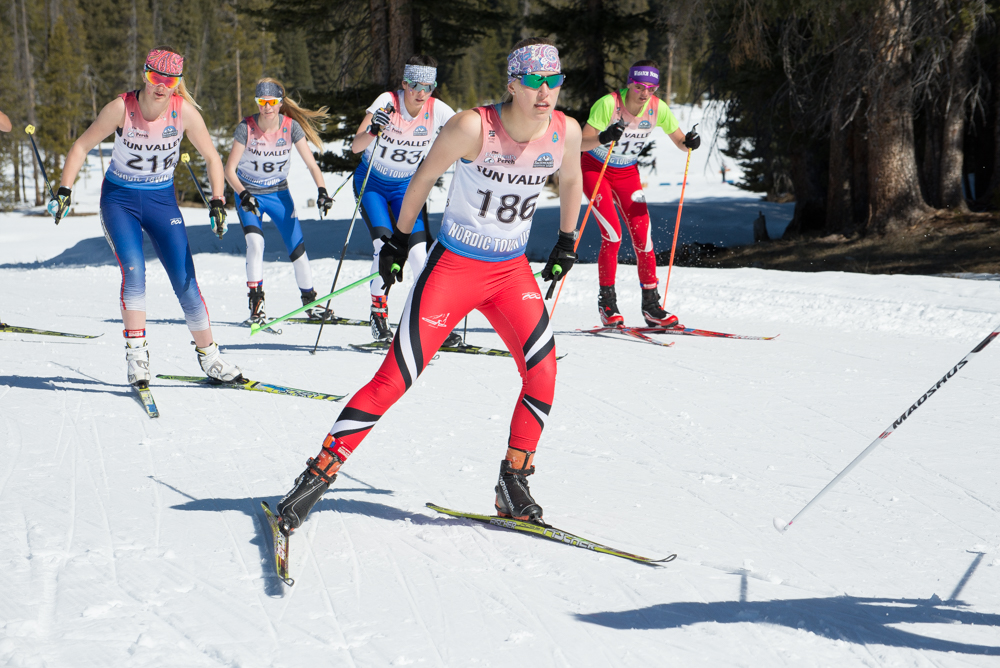
    Emily Picker bib 186 competing at Spring Series in Sun Valley, Idaho. (Photo:  David Pickner davidpicknerphotography.com)
    Emily Picker bib 186 competing at Spring Series in Sun Valley, Idaho. (Photo: David Pickner/davidpicknerphotography.com)

    BNJR Coach and Athlete Advice:

    1. Work up to what you want. “I enjoy this track workout because it helps me get used to doing a 3 k, and pushing hard for that long by working up to that,” BNJR skier Emily Pickner wrote in an email. “Intervals are easier for me to do because they are usually shorter, so by the time we get to the 3 k, I can look at it as all the intervals put together.”
    2. Mobility is a must. “Lots of skiers run like robots!” St.Pierre wrote in an email indicating that in order to reap the complete benefits of the track workout, “include some drills within the warm-up to elevate your HR [heart rate], increase your range of motion and improve your run mechanics.”
    3. Use the race to break down the pace. Going out too hard is a game all too familiar with nordic athletes, junior and senior racers alike. “Basing paces on 3 k time makes them an accurate estimate of what you can do,” Emil Graf, another BNJR racer, wrote in an email. “Trust the goal paces … Also, make sure to set a solid 3 k time at the beginning.”
    4. Progress takes patience. “I think the overarching philosophy for my training and coaching is just progress over time,” St.Pierre said. “Regularly checking that you are improving and then being willing to make changes if you want — sometimes those changes are you need to train more and sometimes those changes are you need to train less, or re-prioritize — that’s an important concept.”
  • Caught in the Middle, Ben Loomis Holds On for YOG Silver; Halvorsen Sixth

    Caught in the Middle, Ben Loomis Holds On for YOG Silver; Halvorsen Sixth

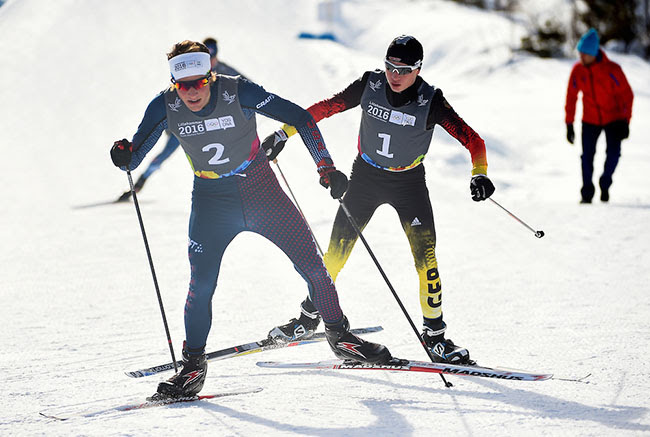
    American Ben Loomis (2) leads Germany's Tim Kopp (1) during the Nordic Combined Men's Individual Gundersen NH/5 k cross-country race at Birkebeineren Cross-Country Stadium at the 2016 Youth Olympic Games in Lillehammer Norway. Loomis went on to place second behind Kopp. (Photo: Thomas Lovelock for YIS/IOC)
    American Ben Loomis (2) leads Germany’s Tim Kopp (1) during Tuesday’s Nordic Combined Men’s Individual Gundersen NH/5 k cross-country race at Birkebeineren Cross-Country Stadium at the 2016 Youth Olympic Games in Lillehammer Norway. Loomis went on to place second behind Kopp. (Photo: Thomas Lovelock for YIS/IOC)

    (Note: This article has been updated to include comments from Hannah Halvorsen.)

    Ben Loomis sounded a little subdued on the phone Tuesday. Maybe he was still absorbing his silver-medal performance at Youth Olympic Games (YOG) in Lillehammer, Norway. Or it could be that he’s 17 years old.

    “The only thing I can compare it to was I had a fourth-place finish in international competition this year,” Loomis, a U.S. Nordic Combined skier told FasterSkier after placing second in his first competition at YOG, the normal hill/5-kilometer Gundersen start.

    Two months ago, he missed the podium by 4.3 seconds at the Continental Cup in Park City, Utah, finishing fourth behind two Austrians (David Pommer and Armin Bauer) and U.S. World Cup skier Taylor Fletcher, who placed second. All three were at least five years older than Loomis, of Eau Claire, Wis.

    “That was kind of the big stepping stone for me, but this was also something new,” Loomis said of Tuesday’s YOG competition. “But way more exciting than anything else I’ve ever experienced.”

    At the Youth Olympics, competitors are younger than 18, and nations can enter a maximum of two athletes per gender per sport.

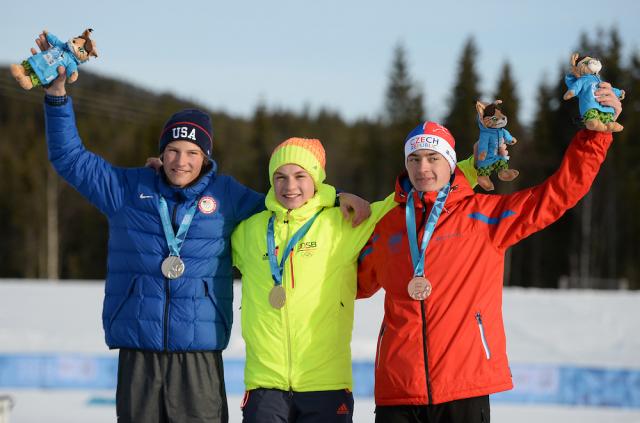
    American Ben Loomis (left) standing with podium finishers, Germany's Tim Kopp, the winner, and the Czech Republic’s Ondrej Pazout in third. (Photo: YIS/IOC-Thomas Lovelock)
    American Ben Loomis (left) standing with podium finishers, German winner Tim Kopp (c) and the Czech Republic’s Ondrej Pazout in third. (Photo: YIS/IOC-Thomas Lovelock)

    After posting the second-best jump on the 100-meter hill, Loomis started the 5 k cross-country race 8 seconds behind Germany’s Tim Kopp, the jump leader. Kopp held off Loomis by 5.2 seconds for the win in 13:31.4, and Loomis remained 2.7 seconds ahead of third place, Ondrej Pazout of the Czech Republic, at the finish.

    “I had probably my best jump all week in the competition,” Loomis said. “I just tried to catch the guy in front of me pretty quickly and I did that. I was able to ski with him for pretty much the entire race, but then there was also the third place guy who I knew was a fast skier. He caught us about half way through the race. So all three of us skied until almost the finish and then the Germany kid was able to pull away about half a kilometer before the finish.

    “I tried my hardest, but I just couldn’t stay with the first-place guy,” he continued. “But I was able to maintain second.”

    According to Adam St.Pierre, the U.S. cross-country coach at YOG, Loomis looked “relaxed” while skiing with Kopp.

    “The Czech athlete caught them at around 2.7km,” St.Pierre wrote. “The trio skied together for the rest of the race with the German making a decisive move at 4.5km … Ben had been planning to make his move on this hill too, but the German beat him to it! Ben covered the move, but was slightly gapped, but he got a gap on 3rd and skied in for silver!”

    After first meeting Loomis this week, St.Pierre explained that he wasn’t responsible for his success beyond helping wax his skis. Blake Hughes is the U.S. jumping coach at YOG.

    On Thursday, Loomis will team up with the two American ski jumpers (Casey Larson and Logan Sankey) in the ski jumping/nordic combined mixed team event, where three jumps on the 100-meter hill are scored as a unit. Then on Saturday, he’ll participate in the “nordic team relay” as both a jumper and a skier.

    “The two American jumpers and myself jump and then I’ll race and the two cross country skiers will race as well,” Loomis explained.

    “The relay start will be staggered based on the jumping results and we’ll ski a 3 by 3.3km relay with the Nordic Combiner [Loomis] and the male and female XC skiers [Hunter Wonders and Hannah Halvorsen] — all skate,” St.Pierre elaborated.

    After Youth Olympics, Loomis is headed to Nordic Combined Junior World Championships in Romania.

    “That’s a big deal as well,” he said. “I think I really surprised myself with showing how well I can perform. It just really gave me a lot of confidence going into the next competitions…”

    Results: Nordic Combined

    ***

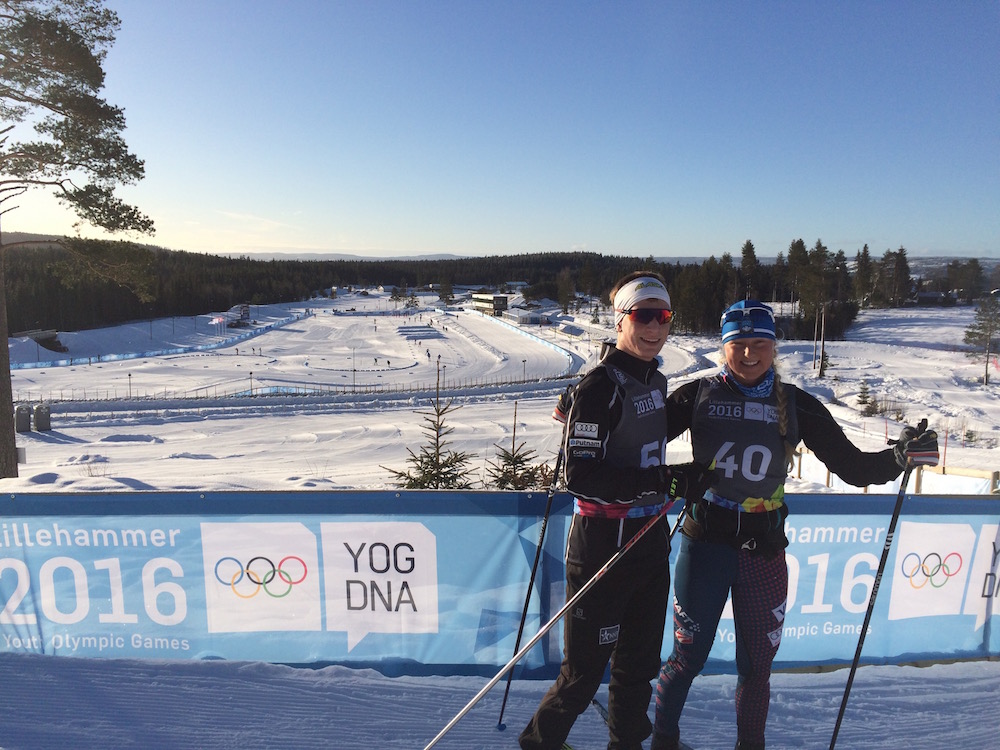
    Hunter Wonders (l) and Hannah Halvorsen (r) are the two cross-country skiers representing the U.S. at the 2016 Youth Olympic Games in Lillehammer, Norway. (Photo: Adam St.Pierre)
    Hunter Wonders (l) and Hannah Halvorsen (r) are the two cross-country skiers representing the U.S. at the 2016 Youth Olympic Games in Lillehammer, Norway. (Photo: Adam St.Pierre)

    Also on Tuesday, Hannah Halvorsen of Sugar Bowl Academy near Truckee, Calif., placed sixth in the cross-country classic sprint final. She had qualified in 13th, then went on to win her quarterfinal, and place third in her semifinal, 1.53 seconds behind Russia’s Yuliya Petrova, who won that semifinal. Moa Lundgren of Sweden automatically advanced in second and Halvorsen reached the final as a lucky loser.

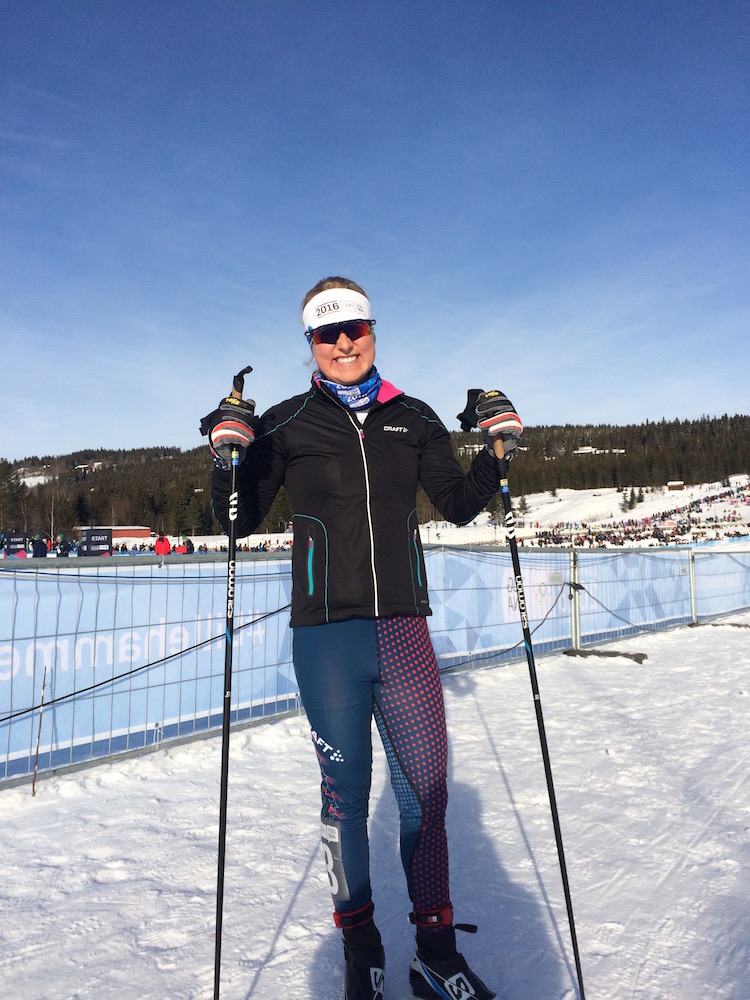
    American Hannah Halvorsen between rounds at the Youth Olympic Games classic sprint in Lillehammer, Norway. She went on to place sixth in the final. (Photo: Adam St.Pierre)
    American Hannah Halvorsen between rounds at the Youth Olympic Games classic sprint in Lillehammer, Norway. She went on to place sixth in the final. (Photo: Adam St.Pierre)

    Sweden’s Johanna Hagström won the final in 3:19.55, Petrova placed second (+2.4), and Norway’s Martine Engebretsen was third (+3.27). Lundgren finished fourth (+6.44), Laura Chamiot Maitral of France (+8.84) was fifth and Halvorsen sixth (+13.65).

    “I was surprised to make it through as a lucky loser when I saw that our semi final heat was a couple seconds slower, so I was really excited,” Halvorsen wrote in an email. “I lost contact with the top girls by the first hill and started to move back throughout the heat despite putting in my best fight to the end.”

    “Hannah skied well today,” St.Pierre observed. “She felt a little flat for the XC Cross on Saturday, but had her normal energy today.”

    On Saturday, Halvorsen, who turns 18 on Friday, placed 13th in the YOG opening event: the ski cross sprint.

    “Although the skier cross was a fun experience, it was nice to be back in a race I knew well,” Halvorsen wrote. “I skied [Tuesday’s] qualifier a little tense, but it was a good signifier that I was feeling good and my fitness was there. This made me feel confident going into the heats.”

    “She looked very strong in her quarterfinal,” St. Pierre wrote. “The course started with a big climb, which Hannah was able to ski very relaxed. … The decisive moves were typically made on the second major climb of the course. Hannah made some tactical errors on this climb in her semifinal, switching tracks cost her some momentum over the top. But she finished out the semi strong, earning a lucky loser spot with her 3rd place finish.

    “I wish I would’ve given her just a little more kick for the final,” he added. “She battled and ended up 6th on the day, happy but hungry for more!”

    Canada’s Annika Richardsson finished 33rd in the qualifier, missing the top 30 needed to advance to the heats by 1.4 seconds.

    In the men’s classic sprint, Hunter Wonders qualified 29th and placed 15th overall. He missed advancing to the semifinals after placing third behind Adam Matous of the Czech Republic in a photo finish for second. The two finished 0.11 seconds behind Norway’s Thomas Helland Larsen, who won the heat in 3:04.54, but only Matous moved on with Larsen.

    “He was in fourth on the last downhill but the Russian skier ahead of him fell,” St. Pierre wrote of Yaroslav Rybochikin, who finished sixth in that quarterfinal. “Hunter avoided the fall and closed on 1st and 2nd just getting out-lunged.”

    Larsen went on to win the final in 2:55.39, Korea’s Magnus Kim placed second (+0.33) and Vebjørn Hegdal of Norway was third (+1.1).

    Like his Canadian counterpart, Levi Nadlersmith finished 33rd in the men’s race, 0.74 seconds out of qualifying.

    Racing continues tomorrow with the biathlon single mixed relay at 4:50 a.m. Eastern time.

    Results: Women | Men | Complete results

  • Silver Medal in J1 Relay Headlines Norway Trip for U.S. Team

    Silver Medal in J1 Relay Headlines Norway Trip for U.S. Team

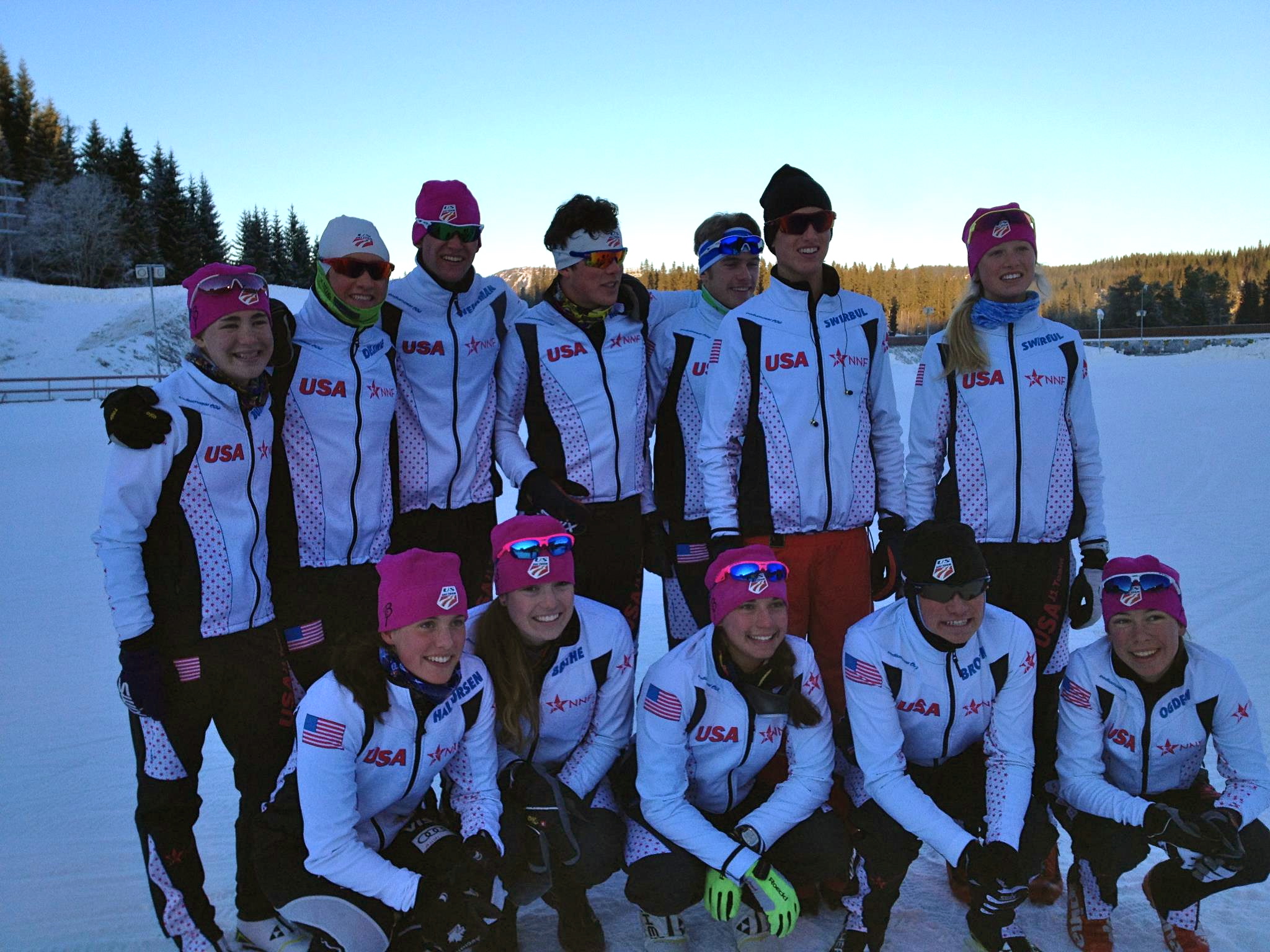
    The American J1 Team wrapped up competition in Trondheim, Norway, on Sunday. Photo: Adam St. Pierre.
    The American J1 Team wrapped up competition in Trondheim, Norway, on Sunday. Photo: Adam St. Pierre.

    At the end of this week, twelve skiers under the age of eighteen return home to the U.S. from racing in Trondheim, Norway, against the fastest of their peers in the world. The American experience at the J1 Scando Cup is generally highlighted by a few decent results here and there. Last Friday through Sunday the girls’ team set a new standard, putting two individuals in the  top 10, skiing to a second-place finish in the 3 x 3 k relay and giving a few European coaches a good scare.

    Heidi Halvorsen (Green Mountain Valley School) and Katharine Ogden (Stratton Mountain School) headlined the team’s individual performances on Friday and Saturday to set the team up for success in the relay. The championships began on Friday with a classic sprint under the lights, in which Halvorsen posted the second-fastest qualifier, made it to the A-final and fnished fifth overall. For Halvorsen, the result was an important step towards gaining confidence internationally and putting a series of frustrating results from U.S. Nationals firmly in the past.

    Halvorsen competing in the classic sprint qualfier at U.S. Nationals this January. Photo: Bert Boyer.
    Halvorsen competing in the classic sprint qualfier at U.S. Nationals this January. Photo: Bert Boyer.

    “Going into the races in Norway I was a little frustrated, and discouraged,” Halvorsen in an email. “I hoped that I would be able to improve on my results from last year, but at the same time I was also strongly doubting that happening. However, after qualifying second in the classic sprint the first night I gained a little confidence in the possibility that I could actually get some good results.

    With a fifth in the classic sprint, twelfth in the 4 k freestyle and silver medal from the relay now under her belt, she’s feeling better about the rest of the season as the season transitions to February.

    “Coming out of this week I’m happy that I was able to prove that I did in fact deserve to come to this trip,” Halvorsen said. “It’s a little bit of a much needed confidence booster, after Sr. Nats, to see that you really are in the running for the top spots, and that you can actually compete against the other countries’ best girls.”

    GMVS coach Justin Beckwith says Halvorsen’s recent results have been a long time coming.

    “She’s been showing a lot of promise on race days and in training, great things have been in the works for a while,” Beckwith said. “She had a great sprint at nationals and the distance races were a little interesting, so it’s neat to see it all come together for her.”

    Halvorsen wasn’t the only one to have a great weekened in Trondheim. Stratton Mountain School J2 Katharine Ogden was sixth in the freestyle race, 30 seconds by the winning time from Tiril Weng (NOR). Ogden and Halvorsen teamed up with Julia Kern (Cambridge Sports Union) on the final day of racing to put together the best relay finish the U.S. has ever had on the trip.

    Katharine Ogden (SMS) competing at U.S. Nationals. Photo: Bert Boyer.
    Katharine Ogden (SMS) competing at U.S. Nationals. Photo: Bert Boyer.

    “The highlight of my trip was definitely the relay,” Halvorsen said.

    Kern scrambled for the Americans and tagged off to Ogden in fourth place in a small pack. Odgen maintained the position so that when Halvorsen got the tag to anchor, she could see the podium in front of her.

    “At that point I knew that I had to bring us to at least third, so that we could all podium,” Halvorsen said.

    With Norway’s first two teams and and a skier from Finland in front of her, Halvorsen picked off two places on the course’s major hill. She even started to gain on the Norwegian girl in the lead, but in the end there wasn’t enough trail left to make up the gap. She brought the U.S. home in second, 8.8 seconds behind Norway I and 8.1 seconds ahead of Norway II in third.

    “It was a really fun race and we were really excited to make it up on the podium,” Halvorsen said.

    Adam St. Pierre, one of the American coaches on the J1 trip, said that after Ogden’s and Halvorsen’s individual results from the first two days they had hoping for a podium, but second place was an added bonus.

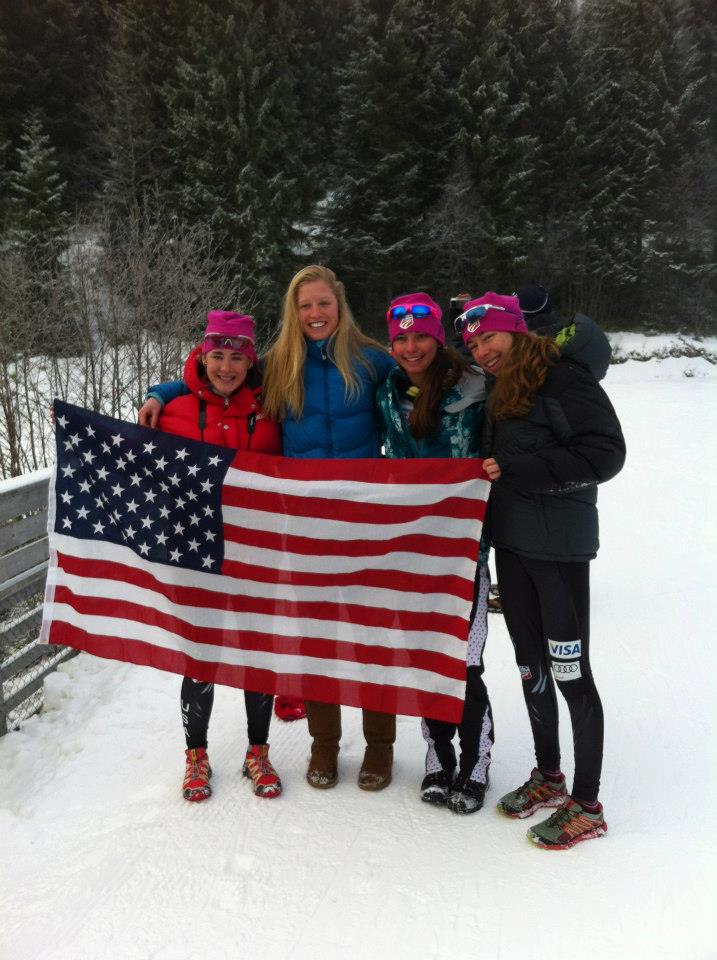
    Members of the girls J1 team with the American flag. Photo: Adam St. Pierre.
    Members of the girls J1 team with the American flag. Photo: Adam St. Pierre.

    “We would have been psyched with a third, but a second in a pretty convincing fashion was awesome,” he said. “We had a Norwegian friend helping us this week, mostly translating and teaching us where to park, and he was talking with the Norwegian coaches and they were legitimately worried about our girls, which was kind of cool.”

    Halvorsen says she’s already internalized the lessons from the international racing experience. This is not her first J1 Scando trip, but her results from this week have instilled a new kind of confidence in her skiing.

    “I think the biggest thing I learned was just to ski well and try and be confident.,” she said. “Last year I had no expectations going into it, and I was intimidated by all the Scandinavians, who I thought all looked stronger and faster than me. Also Finland’s matching hats, polos, t-shirts, sweatshirts, warmups, puff coats, and snow pants seemed to add to the intimidation I already felt. But this year I knew that it’s the same as any other race, just with many more spectators speaking many more languages.

    “We can compete with them. If you ski like you know how to ski in America, you can still do well in Europe.

    According to St. Pierre, many athletes on the trip have already started to absorb the lessons of the international experience.

    “I think it’s definitely an eye-opener for a lot of the kids,” he said. “These kids are used to being the top in the country. They win races; they get on the podiums… So a lot of the boys have been talking already, like, ‘What are we going to do, what are they doing that we’re not,’ you know, ‘What’s it going to take for us to compete with these guys.’ And I think for a lot of these guys that ends up being the big benefit of this trip.”

    The twelve U.S. athletes on the trip stayed in Norway for a few days after the last race to train together on the Trondheim trails.

    “The true measure of success will be whether these kids continue to train, continue to get better and eventually find themselves at an even higher level of competition,” St. Pierre said. “I think we’re already starting to see some positive effects from the J2 camp, from REG camps where these kids know each other. They’ve trained together before at a national level, pushing each other to get better. So hopefully they can go home and be pleased but not satisfied, and keep working hard.”


    Cal Deline scrambling for the U.S. in the boys relay. Photo: Hailey Swirbul.
    Cal Deline (bib 35) scrambling for the U.S. in the boys relay. Photo: Hailey Swirbul.

    Girls Classic Sprint

    5. Heidi Halvorsen (GMVS)

    20. Hailey Swirbul (Aspen Valley SSC)

    23. Nichole Bathe (Central Cross Country)

    26. Julia Kern (CSU)

    32. Katharine Ogden (SMS)

    47. Gretchen Burkholder (Steamboat Springs WSC)

    Boys Classic Sprint

    13. Cully Brown (Ski & Snowboard Club Vail)

    40. Evan Weinman (SSWSC)

    43. Haakon Sigurslid (Durango Nordic)

    54. Hamish McEwan (SMS)

    59. Keegan Swirbul (Aspen Valy SSC)

    61. Cal Deline (SSCV)

    Girls 4 k Freestyle

    6. Katharine Ogden 12:24

    12. Heidi Halvorsen 12:33

    23. Julia Kern 12:46

    30. Gretchen Burkholder 13:05

    33. Nichole Bathe 13:17

    34. Hailey Swirbul 13:18

    Boys 5 k freestyle

    44. Keegan Swirbul 21:38

    46. Cal Deline 21:38

    48. Cully Brown 21:46

    51. Evan Weinman 21:48

    58. Hamish McEwan 22:12

    59. Haakon Sigurslid 22:15

    Girls 3 x 3 k relay

    2. USA I (Julia Kern, Katharine Ogden, Heidi Halvorsen) 21:38

    11. USA II (Nichole Bathe, Gretchen Burkholder, Hailey Swirbul) 22:48

    Boys 3 x 5 k relay

    8. USA I (Cal Deline, Keegan Swirbul, Cully Brown) 32:21

    15. USA II (Evan Weinman, Hamish McEwan, Haakon Sigurslid) 32:59

    Full results.


  • First American to Win Ski Mountaineering Gold, Silitch Preps for Winter

    First American to Win Ski Mountaineering Gold, Silitch Preps for Winter

    US Ski Mountaineering member Nina Silitch on the podium after placing third in her age group at the CCC Ultra Trail du Mont Blanc on Aug. 31 in Chamonix, France. (Courtesy photo/ninasilitch.com)

    In late May, weeks after Nina Silitch finished her last race of the season, loads of her ski-mountaineering equipment still occupied more than half the space in her bedroom.

    Her husband, Michael, couldn’t understand why, after six months on the World Cup and international circuit, she wasn’t ready put it away.

    At 39, Silitch was coming off a career-best season in most respects – she became the first American to earn World Cup gold in ski mountaineering after winning a sprint, finished eighth overall in the World Cup and placed fifth in the Grand Course championship series, a two-year culmination of some of the toughest mountaineering races.

    In 2011, Silitch teamed up with Lyndsay Meyer and Valentine Fabre to place sixth in The Italian Trofeo Mezzalama, a high-altitude ski mountaineering competition in the region of Cervinia. The race was part of the two-year Grand Course race series. (Courtesy photo)

    In 2011/2012, she racked up nearly 30 starts, many of which included three- to four-day stage treks across technical, high-altitude terrain. Other distance races took an average of six to ten hours, and then there were team events.

    Silitch ended the season on a high note, placing seventh with two of her US Ski Mountaineering teammates – Sari Anderson and Lyndsay Meyer – at the Patrouille des Glaciers in Switzerland. Typically 53 kilometers long with 4,000 meters of climbing, the team race in early May was cut short around the halfway point because of dangerous winds and unstable snowpack. Silitch, Anderson and Meyer combined to finish strong, physically tying themselves together at times to avoid falling into glacier crevasses.

    Once that was over, one would think Silitch would want to move on, spend time with her 6- and 8-year-old sons, and enjoy spring at their home in Chamonix, France.

    Of course she wanted all that, but Silitch had one more ski-related task on her “to-do” list. The view from her home reminded her of it almost daily. No sooner had she finished racing in Switzerland that Silitch decided to ascend Mont Blanc, the highest mountain in the Alps and 11th tallest in the world (4,810.45 meters, or 15,782 feet, above sea level).

    The view of Mont Blanc from Silitch’s home in Chamonix, France. (Courtesy photo)

    About 500 meters short of the summit, high winds forced Silitch and her climbing companion to turn back. Two weeks later, the ski gear remained where she left it, sprawled across her bedroom.

    Since moving to Chamonix in 2006, Silitch had summited the mountain twice. Both times, she packed up and skied down its North Face, but this time she wanted to do it in a day. It took most people two or three. It didn’t take long before she enlisted a guide friend to join her on another attempt.

    “I wanted to do something, just to have a completion of something and put my season to end that way,” Silitch said during an online chat while visiting family in Maryland. “So that’s what I did this year, Mont Blanc from my house.”

    At precisely 2:20 a.m., Silitch turned on her headlamp and left home. She had about 12 hours before she needed to pick up her boys, Birken and Anders, from school.

    “Mont Blanc is big undertaking and … one that I by no means take lightly,” Silitch wrote on her blog.

    It involved a tricky ascent of 3,375 meters (12,385 feet) and an equally challenging descent. There was altitude sickness to be wary of along with unknown weather elements near the top.

    “The challenge of the Mont Blanc summit for me embraces much that one needs in journey of daily life whether you are a mom, dad, athlete, anyone finding their path,” Silitch wrote.  “Breathe, endurance, perseverance, confidence, fortitude, grace, energy, vision, attentiveness, awareness, caution, respect, experience, tenacity, commitment, presence.”

    Silitch remained focused for the duration, meeting her goal in fairly favorable conditions. After arriving at the top, she took a moment to admire the view, then locked her boot heels in place and started back down.

    “I returned home safe, after a successful summit day, with some tired legs, a little nauseated stomach from altitude, but very happy to pick up my boys at school at the end of the day,” she blogged. “Now, finally the overflow of ski gear in my bedroom can be put away. Operation summer mode!”

    Championing Her Sport

    For Silitch, that meant fewer offseason races and more time with family. A few days after arriving in Maryland for a month-long visit with her in-laws in July, she put her 6-year-old, Anders, in front of the computer during a Skype chat.

    Nina Silitch with her 8-year-old son, Birken, who helped pace her at the CCC Ultra Trail du Mont Blanc on Aug. 31 in Chamonix, France. (Courtesy photo)

    “Hi,” he said politely, then took off.

    “We were just out at the pool,” Silitch explained.

    After she and Michael moved to France 11 years ago, had their children while living in Switzerland then returned to Chamonix, they made a point to return to the states periodically. Both American citizens living abroad on visas, they had raised their sons to speak French as well as English.

    In Maryland, where they spent a few weeks before visiting Silitch’s parents in Carrabassett Valley, Maine (she’s originally from Shaftsbury, Vt.), the boys had signed up for swim team, tennis and triathlons.

    “They’re very active,” Silitch said. She wasn’t much different.

    During her 2012/2013 campaign, Silitch knocked off most every goal she set out for. On April 14 in Tromsø, Norway, she claimed gold at a SkiMo World Cup sprint, which combines kicking and gliding, kick turns, boot packing (carrying one’s skis) and often some skating. The race includes a qualification round and heats, and typically takes 3 ½ to 4 minutes to complete the course.

    Silitch (center) on the sprint podium after becoming the first American to win a ski mountaineering World Cup on April 14 in Tromsø, Norway. With Anna Figura of Poland in second and Emilie Gex-Fabry of Switzerland in third. (Photo by Alex Lugger)

    The final race of the World Cup season, it was only Silitch’s second sprint of the year (one other on the circuit was canceled, and Silitch did another at French nationals, where she finished second).

    “It’s kind of been an event that I’ve fallen in love with,” she said. “It’s been a combination of my cross-country skiing background [at the Holderness School and Dartmouth College], but also just the event itself, combining all the aspects of ski mountaineering. You need to be very efficient in transitions … you can’t make a mistake. So it was really special that it came together.”

    Next year, there are three sprints in the International Ski Mountaineering Federation series, which consists of more than 20 races in France, Switzerland, Italy, Spain, Poland and Norway. Silitch was excited that, for the first time, points awarded at sprints will be equal to those earned in longer races. The shorter format was adopted to broaden the sport’s appeal, and with several races in downtown venues, it’s become more accessible to spectators.

    “They actually created the sprint to grow the sport more and hopefully someday it will become an Olympic sport,” Silitch said. “They’re trying to do more TV coverage next year so we’ll see.”

    When she’s not gutting for a win, Silitch is the president of the volunteer-driven Chamonix Ski Alpinisme Club. She founded the ski-mountaineering group three years ago, and has since seen its membership grow from about five to 70 members.

    Women’s ski mountaineering World Cup sprint semifinal on April 14 in Tromso, Norway. (Nina Silitch courtesy photo)

    “That’s something I’m really trying to do, help grow the sport and bring it more to women especially,” she said, “and also to the younger kids as well, the youth. In the U.S., I think that’s where we need to target, those kids that don’t necessarily find their way in alpine skiing or cross-country or even those cross-country skiers that want to try something a little different.”

    One can compete in ski mountaineering as early as 14, which is the age group Silitch would like to draw in. “That’ll be my next step after competing,” she said.

    For now, she’s mostly focused on the season ahead.

    “I think I’m just going to give it one more year of World Cup skiing,” Silitch said. “Hopefully from that I’ll move into other things with my experiences in the World Cup and apply that to whatever I do next.”

    Her husband, an internationally certified mountain guide, is interested in moving to Norway to teach. Silitch ran a female outdoors program at Aiglon College in Villars, Switzerland, while they lived there for four years, then committed to full-time racing when she made the US team in 2008.

    Finances, however, remain a stumbling point for most American competitors in the sport.

    “We don’t really have any funding. It’s up to everyone to get their own sponsorships and everything,” Silitch said. “All the European teams are nationally funded. They’ve got coaches and all their events are paid for and their travel expenses. For me, [it’s] from my heart and passion. … It’s definitely a big commitment, but we feel like it’s such a great experience for me and also for my family, that it’s really worth it even if it can be a little tight at times.”

    In December, she’ll turn 40, yet Silitch remains relatively new to ski mountaineering after trying it for the first time in 2005. It wasn’t until two years later at a night uphill race that she decided to pursue it more seriously.

    “It’s funny that I didn’t really fall into this until after my kids were born,” she said. “So that’s been a whole new experience for me, a whole new challenge. I think because it combines so many of the different things I love, the endurance, the kick and glide cross-country skiing, but also being in the mountains and the mountaineering aspect of it. I’m also a huge downhill skiing fan, and just being able to combine those things, it just kind of creates a sport that’s really fun and challenging.”

    Frame of Mind

    After a long season, which started in mid-December and wrapped up in early May, Silitch took about three weeks off to regenerate with some fun and loose training. She planned to slowly build into a ski-specific dryland routine while staying away from trail racing until the end of summer.

    Primarily concerned about past injuries, she worked with her coach, Adam St. Pierre, a cross-country ski coach with the Boulder Center for Sports and Medicine in Colorado. With his help, she developed the strength to compete in the one summer event she set her sights on: the CCC Ultra Trail Mont Blanc. One again, it was an objective viewed from her backyard.

    Nina Silitch during the first climb up to Bertone before the cold and wind set in at the CCC Ultra Trail du Mont Blanc on Aug. 31 in Chamonix, France. (Courtesy photo)

    In late August, she completed the 90-kilometer race (slightly altered from the original 100 k), finishing third in her age group and 15th among women.

    “My biggest goal of the summer is now behind me,” Silitch wrote on her blog. “1800 runners withstood rain, wind, snow, sleet, mud. Temperatures plummeted on the high cols and runners ran through passes with 10-20cm of snow. … It got to points on the course where it was merely about survival and being well prepared in the conditions with not only the right gear & clothing for but the right mental attitude.”

    That was where her other summer training came in. While in France this year, she’s been working with sports-performance and mental-training coaches, one of which mentored Rafael Nadal, formerly the top-ranked tennis player in the world.

    “It’s helped me tremendously,” she said of learning how to motivate herself through her sport’s toughest moments, no matter how fatigued or bad she feels.

    “Usually I have little mantras like, ‘Go mommy go,’ … or ‘fast and light,’ ” Silitch said. “If I ever have a negative thought come into my head I try to have two positives. Like, ‘Oh my legs feel so heavy,’ ‘No, your legs are really light,’ and ‘Think about your quickness or your cadence,’ and those things really help. I’m really interested in that and it’s a neat thing to apply to coaching, for sure.”

    For Silitch, instructing could her next step, especially as she and Michael plan their next move.

    “We’re not sure if we’ll eventually work our way back to the states,” she said. “We both really love teaching, so maybe we’ll explore.”

  • From Skiing to Ultras: Callahan’s New Obsession

    From Skiing to Ultras: Callahan’s New Obsession

    A creature of team sports – first baseball, then soccer – Duncan Callahan remembered his reaction when his older brother started nordic skiing at Glens Falls High School in northeastern New York.

    Courtesy photo — Crested Butte Nordic head coach Duncan Callahan coaches at Soldier Hollow in Midway, Utah, in January.

    “I thought he was the biggest nerd in the world,” he said.

    A year later, Callahan’s brother, Bill, convinced him to try it.

    In darkness, the two set out on the city’s illuminated trail system. Afterward, Bill suggested his little brother come out for the team. He still thought it was nerdy, but decided to anyway.

    In a phone conversation from Gunnison, Colo., the 28-year-old Callahan credited his brother and older teammates for their leadership. He had one coach through the seasons, Bill Parks, who helped him develop as a cross-country skier and as a runner.

    Following Callahan’s high school years, which included two trips to the New York State nordic skiing championships, he skied at Western State College in Gunnison, coached at the same institution and dove into ultra-distance events.

    In 2003, Callahan won the inaugural Leadville 100-mile ski race. A college junior at a crossroad of interests, he said the event hooked him on endurance events. Rather than ski, he chose to run.

    Since 2007, Callahan has won several ultras, including two Leadville 100-mile trail runs and the Moab 100, and set a course record at the Grand Teton 50-miler.

    Sidebar: Skier Stats

    Who: Duncan Callahan
    Age:
    28
    On snow:
    Head coach of Crested Butte Nordic and Western State College
    Nordic ski teams
    Off:
    Two-time champion of Leadville 100 trail run
    Passions:
    Coaching skiing; running ultras
    Favorite ski brand:
    Fischer
    Running shoe:
    Vasque
    Typical training session:
    Long outing of 6 hours with 7,400-foot climb
    over 28 miles.
    Mileage:
    Approximately 23,000 in last 5 years.
    More info: 
    www.strategicendurance.com

    Now the head coach of Crested Butte Nordic, he ran his fifth consecutive race in Leadville, Colo., on Aug. 20. The defending champion of the “Race Across The Sky” at elevations of 9,200 to 12,600 feet, Callahan placed ninth.

    “The hundred is so different from any other race,” he said before the 2011 Leadville challenge. “My absolute goal … is to go to the bottom of the well (and) see what’s in the heart and in the head because you’re absolutely going to need that out there. The goal of winning is secondary.”

    While Callahan was not thrilled with his result, he accepted it. His legs hadn’t cooperated over the 19 hours, 11 minutes and 15 seconds he was out there, he said, and he felt uncomfortable leading early.

    “I’m used to running from behind for most of the race,” he said.

    But quitting? That rarely crossed his mind.

    In those races, high and low points are a given, Callahan said. He tried to minimize both, riding strong moments without overdoing it and staying mentally sound through pain. Just once, earlier this year at the Hardrock 100 in Silverton, Colo., he thought about dropping out.

    “But 99.9 percent of the race, it never occurs to me,” he said. “I’m not going to lay claim to be any more mentally tough than anyone, but I do love getting to mile 80 and having to grind it out.”

    That’s why he’s hard to beat, said Callahan’s friend Adam St.Pierre, the head coach of Boulder Nordic.

    “Generally, he’s the guy that slows down the least,” said St.Pierre, who was 56th at Leadville this year in his second 100-miler.

    “At some point in your mind, you’re going to say, ‘Why am I out here? It would be easier to just stop,’ ” he said. “It’s one thing to keep going, but it’s another thing to pick up the pace from there.”

    Courtesy photo — Duncan Callahan competes in the 2009 Grand Teton 50-miler in Alta, Wyo. He won the race in 7:33.27.

    Miles of self-motivation

    To understand Callahan’s psyche, it’s helpful to know his background.

    While elite athletes tend to tread off the beaten path, Callahan’s high school coach in cross-country running, skiing and track said he was especially unique.

    “You have a sense of this is the kind of guy that was tuning out the rest of the world and was driven,” Bill Parks said. “He was actually a very fun-loving guy, but he put in a lot of miles.”

    That drive and thousands of miles – mostly rollerskiing – got Callahan into trouble. Parks remembered when a teacher approached him about penalizing Callahan for his frequent tardiness.

    Parks knew he was out rollerskiing before school, and so did the teacher. She had seen him on her way to work – still sweaty and far from home and a shower.

    “These stories would come back to me of him rollerskiing to Saratoga and back,” Parks said. That was at least 40 miles round trip.

    When he spoke about Callahan at an awards banquet, Parks pointed out that the star skier – a top Mid-Atlantic racer – had rollerskied some 2,000 to 3,000 miles, far beyond Parks’ suggestion.

    “He came up to accept the award and he looked a little puzzled,” Parks said. “He said, “ ‘You know, I skied a lot more than that, coach.’ ”

    One day, Callahan said he did 70 kilometers on the county bike path.

    “Skiing was a slightly unhealthy obsession for me from my junior year in high school to my junior year in college,” Callahan said. “The training for it kind of dominated my thought process. My schoolwork kind of suffered and socially I was kind of a dweeb. For five years of my life, skiing was absolutely my central focus.”

    After a disappointing finish at the state meet his senior year, one which neither Callahan nor Parks knew what went wrong, Callahan moved on at Western State College. There, he continued to dedicate himself to training and achieved All-American status as a sophomore at Junior Nationals.

    By his junior year, Callahan’s results stagnated. His attention shifted to new races: first, the Grand Traverse 45-mile backcountry ski and then the Leadville 100-mile ski. He realized he loved distance events and had lost an interest in college racing.

    “Training for me was way more important than racing,” he said. “And when you get to that point, you start to lose your passion for competition.”

    He bunkered down and chose a major – history – while studying exercise physiology and coaching. His discovered his knack for coaching and by the time he graduated, he had stepped back from racing altogether.

    That allowed him to meet his eventual wife, Annie, and for the first time in nearly a decade, Callahan took a season off, and it wasn’t because he was hurt.

    Mostly injury-free in high school (“I didn’t get injured,” he said, “and if I did, I didn’t care”), a couple of stress fractures in his feet forced him to take time off in college.

    For the most part, his body dictated his training. When he overdid it, his body slowed down. He wouldn’t get sick, he just couldn’t physically move as fast or at all, he said.

    “My body just shuts down and says, “Nope, you’re not doing anything today,’ ” Callahan said. Then he would rest.

    He reintroduced himself into the running world a few months after he graduated when he began coaching Western State and the Crested Butte club in 2005. Working with skiers, he decided to get back into shape.

    Courtesy photo — Duncan Callahan poses while coaching at Soldier Hollow in Midway, Utah, in January.

    After marrying Annie in 2007, he asked her, “What do you think about me doing the Leadville 100 running race this summer?” She agreed to support him, both in principle and out on the trail, and Callahan began a yearly regimen of running about 5,000 miles a year.

    “We always joke to my friends that I almost tricked her with all this,” he said.

    In 2007, he was seventh of 210 finishers at Leadville. The following year, he won it in 18:02.39, and was third in 2009. He was last year’s overall winner in 17:43.24, almost 40 minutes ahead of the second finisher.

    At the Hardrock 100 this year, he was eighth in 30:57.

    “For the most part, I could compete in the top ten if I ate well and kept up an active lifestyle,” Callahan said. “It’s a great lifestyle sport so (the) ‘W’ is not the end-all, be-all for me now.”

    The ultra appeal

    A runner since middle school, Callahan had a natural affection for the sport. He ran the mile and two mile in addition to cross country, and enjoyed lengthy workouts in preparation.

    “Training for me, essentially, was a pure expression of a passionate pursuit of something,” Callahan said. “That was certainly something that catapulted me to where I got to and held me back on the results side. I trained too much, I trained too hard. I didn’t recover enough.”

    Before running his fifth Leadville – which he said would be his last consecutive one – Callahan reflected on the appeal of endurance sports, especially for someone like him.

    “I just think there are a lot of guys who could not move on after college in marathons, not to the next level,” he said. “Finding their way into ultras was kind of a natural out.”

    He said he couldn’t compete with men or women in marathons. At 6-feet tall and 165 pounds, he said his body’s ability to burn fat helped him at long-distance events – along with the base he built nearly 15 years ago.

    While ultras initially suited 35- to 45-year-olds, Callahan said he has been among a younger, progressively dominating demographic. In 2007, two of Leadville’s top 10 finishers were in their 20s. Two years later, five of the top six fell in that age category.

    “I’ve heard it called the fastest growing segment in the outdoor industry,” Callahan said. “And the outdoor industry is one of the fastest growing segments in the world.”

    Several other 20- to 30-something nordic coaches, including St.Pierre, have also taken up distance races. For many, ski coaching allows summer flexibility, and the training enables some freedom.

    “It’s sort of weird,” St.Pierre said of his fellow coaches’ attraction to the sport.

    Eric Pepper, the head nordic coach at Ski Club Vail, was one of St.Pierre’s four pacers at Leadville this year. Nick Sterling, who coached with St.Pierre in Boulder, also ran with him for part of the race, along with Middlebury skier Josh Dalley and triathlon coach Craig Howie.

    Last year at Leadville, Noah Hoffman of the U.S. Ski Team paced his friend, Greg Adams. Next year, St.Pierre said six or seven Colorado ski coaches might race there.

    “I think ultra running let’s us take out some of our aggression,” St.Pierre joked.

    “Rocky Mountain Nordic coaches, we are staking claim,” Callahan said. “We are the fittest group of coaches in the USSA.”

    St.Pierre paced Callahan in three 100-mile ultras, and Callahan returned the favor to St.Pierre at the Western States Endurance Run in Auburn, Calif., in June.

    “We were both fitness dorks; that’s how we connected initially,” Callahan said. “We were the coaches getting up early and going on our runs.”

    At Leadville this year, Callahan had five people to run with after mile 50. His former exercise physiology professor, Scott Drum, paced him for the first 10, and his former college coach, Jesse Crandall, made the trip from Syracuse, N.Y., to run the second leg.

    At mile 76, Rich Smith, the father of one of Callahan’s skiers, took over. He handed off to Grant Ruehle, a former junior skier, and another athlete. Hannah Smith – who tweeted updates for Callahan throughout the day – ran the last five miles.

    Annie Callahan, Leadville 100
    Courtesy photo — Duncan Callahan's wife, Annie, right, holds their baby, Jordan, while checking in with Callahan at the Leadville 100 on Aug. 20. The 2010 defending champion was ninth in the 2011 race in Leadville, Colo.

    Annie Callahan met her husband at checkpoints with their newborn, Jordan Elizabeth, in tote.

    While similar races required hefty support and endless preparation – both physically and mentally – Callahan didn’t see an end in sight.

    Ultra running wasn’t the most lucrative sport, he said, but several sponsors made it easier to pursue. He belonged to the Vasque running team and was mostly supported in products from ProBar, First Endurance (sports nutrition), Vespa (natural amino acids) and Once Again Nut Butter.

    In all, he estimated he could make $3,000-$4,000 a year running.

    “It’s not a lot of money, but it is a pretty good percentage of my income, which is embarrassing to say, but it’s true,” Callahan said. “Essentially, it pays for itself. I have no expenses related to the sport.”

    Now an online coach through his own website, strategicendurance.com, Callahan said he and his wife are trying to make their dreams work. A coffee shop manager on maternity leave, Annie helped organize a 5 k to fight human trafficking and planned to put on more races.

    A few years ago, the two worked with professor Drum on an ultra-endurance experience camp, but they were unable to attract enough people.

    “I certainly see a window right now to pursue what I’ve been pursuing, what we’ve been pursuing,” Callahan said. “But I’m not quite sure what the next move will be. Fitness and endurance will always be a gigantic part of our lives forever, that’s for sure.”

    With the attention their month-old baby has received, she will likely be equally entwined in the sport.

    “She’s going to be the most decked out kid,” Callahan said, laughing.

  • Neural Re-Patterning for Technique Modifications

    Neural Re-Patterning for Technique Modifications

    Adam St. Pierre is an exercise physiologist at the Boulder Center for Sports Medicine in Boulder, Colorado. He is also the head coach of the Boulder Nordic Junior Racing Team. In this article, St. Pierre outlines a strategy for athletes to gradually implement technique changes.

    Technique is an important component of cross-country skiing, but it is often difficult for athletes to make technique modifications once their motions have become habitual. As coaches, we often find ourselves telling the same athletes the same things, over and over again—“get your hips forward; drive your knee; don’t twist so much; hands wider; hands narrower”—only to have the athlete reply in frustration, “I thought I was doing X, Y, and Z.” It can be difficult for athletes to make changes to their technique because they can’t see it or feel it.

    When implementing a technique modification, the new way of skiing feels different to the athlete initially. As the athlete continues skiing, even if she

    Adam St. Pierre talks with one of his junior athletes.

    concentrates on maintaining the new technique, she is likely to revert to her old technique eventually without knowing it—that is what has been hardwired into her muscles by hours and hours of skiing and rollerskiing.

    A skier’s body recognizes repetitive motion as a pattern. Once this pattern becomes established, the motor neural firing patterns required to perform this technique become ingrained. At this point, the technique feels natural, and any changes will feel foreign. The body will naturally revert to what it is comfortable doing, meaning that a skier will revert to old habits unless the body can be re-patterned with the appropriate technique.

    When making technique changes, it is important that a skier is able to recognize the different sensations of the old style and the new style. After a few seconds of attempting a new style, a skier often reverts to old habits unconsciously. By forcing a skier to switch back and forth between old and new styles frequently, she will learn to recognize the differences between the two. This will make it significantly easier for her to make technique modifications in the long run. Capturing both old and new styles on video will allow the athlete to make a visual comparison as well. And since the body will most readily recognize the differences at the transition between old and new, skiers should frequently switch between old and new styles when making a technique change.

    At the Boulder Center for Sports Medicine, physical therapist Tim Hilden successfully uses a specific method of neuromuscular retraining to teach runners to alter their gaits to prevent or treat injury, and to improve performance. It takes anywhere from four to six weeks to make permanent a change in running technique. With my skiers here in Boulder, I use this same method with great success. Below are some guidelines:

    Weeks one and two: Ski “new” style 50 percent of the time, and “old” style 50 percent of the time.  Go back and forth between “old” and “new” styles every 30 to 45 seconds. In the first two weeks, you are focusing on teaching the body what the two skiing styles feel like. This is a great time to do video review as well, so that skiers recognize what the two styles look like. Seeing the transition from one style to the other on video can be a very valuable tool for both athletes and coaches.

    Week three: You should spend 75 percent of the time in your “new” style—about 90 seconds in your “new” style and 30 seconds in your “old” style is ideal. In this week, you are gradually moving toward skiing with your “new” style, but keeping the “old” style around a little to keep the differences apparent.

    Week four and five: You should ski completely “new” style.

    After six to eight weeks, the “new” style should have become the default. An athlete should not have to consciously think about skiing in the “new” style by this point.

    It is easiest to make a technique change in this manner during relatively low-intensity training periods. Switching from an old technique pattern to a new and improved technique pattern requires a great deal of concentration on the part of the athlete, which can be difficult to perform during intensity workouts and races. Ideally, this technique modification method is performed at least two to three times per week during easy skis, and during warm-up and cool-down periods. I undertake technique modifications throughout the summer and fall on rollerskis, and will again during early on-snow sessions to fine-tune my skiers’ mechanics.