Tag: adam terko

  • Bender, Brown Top Balmy Climb to the Castle

    Bender, Brown Top Balmy Climb to the Castle

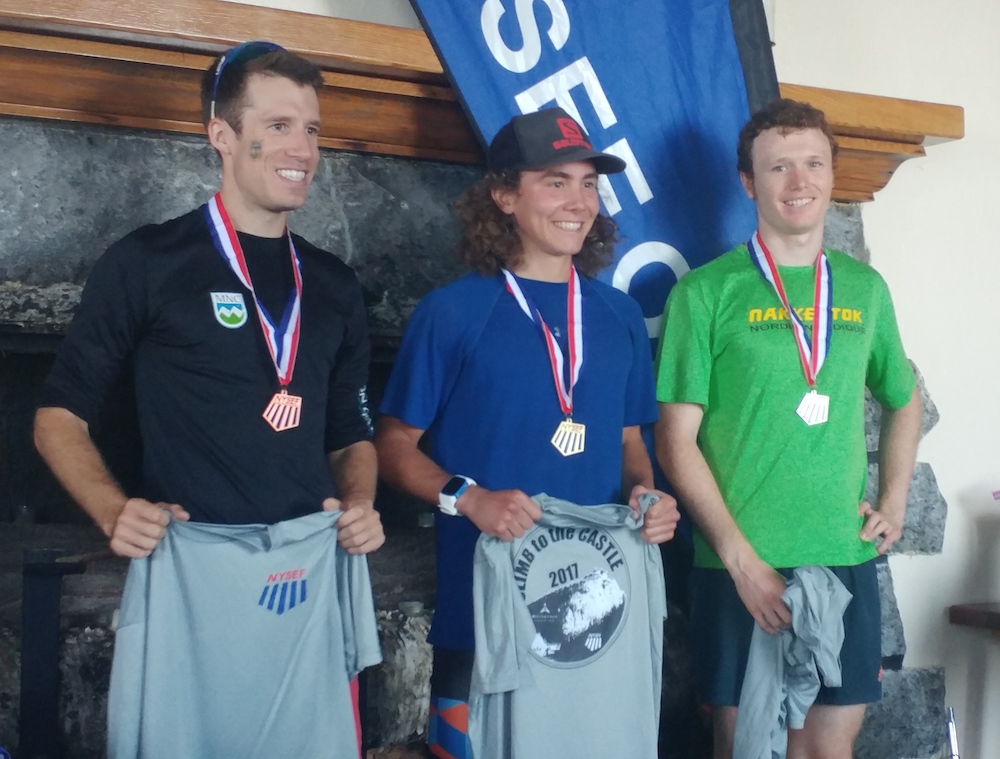
    The men’s top three finishers at NYSEF’s 2017 Climb to the Castle on Sunday, Sept. 24, at the top of Whiteface Mountain in Wilmington, N.Y., with winner Jake Brown (c) of US Biathlon, runner-up Aidan Kirkham (r) of Nakkertok Nordic, and Mansfield Nordic Club Head Coach Adam Terko (l) in third.

    (Note: This article has been updated with comments from Adam Terko in regards to rollerski safety.)

    WILMINGTON, N.Y. — On what may be the hottest day in memory for the annual Climb to the Castle (C2C) rollerski race, hosted by the New York Ski Educational Foundation (NYSEF) up Whiteface Mountain, Jake Brown and Jennie Bender were fastest to the top. Both have spent at least part of their summer training with the US Biathlon Association (USBA) in nearby Lake Placid, N.Y.

    Brown, a 25-year-old USBA X-Team member, finished the five-mile climb up Whiteface’s toll road on Sunday in 39:01.9 minutes, more than five minutes clear of runner-up Aidan Kirkham, a Canadian racer with Nakkertok Nordic, who finished in 44:16. Adam Terko, Mansfield Nordic’s head coach and executive director, placed third in 45:35.7.

    Bender, 29, racing under the team name of “The Dark Side”, which she later explained was a joke, topped the women’s race in 48:59.4. She finished 21.5 seconds ahead of 51-year-old (no, that’s not a typo) Sheila Kealey, who skis for XC Ottawa and coaches for Nakkertok. Deedra Irwin of the Sun Valley Ski Education Foundation (SVSEF) was third woman in 51:13.5.

    “I had put my name in the registration as ‘Darth Vader’, but they changed it on the other end,” Bender wrote in an email. “When I am in Bozeman MT I train with Bridger Ski Foundation, and when I am in Lake Placid, I train with USBA.”

    At the tollgate at 7 a.m., the temperature was already 66 degrees Fahrenheit with clear skies. With mild weather the previous two days, the pavement was dry for 83 skiers who rolled to the start line. At the castle at the summit an hour later, temperatures were upwards of 70, making an already grueling race even more fatiguing.

    The men’s and women’s races played out quite differently. According to Kirkham, Brown led “off the start and gapped the whole field.”

    Familiar with the territory in and around Lake Placid, which has become an annual training camp for Nakkertok, based out of Ottawa, Kirkham said it was one thing to ski the toll road in Zone 1 and another to race it.

    “I wanted to pace it well, and I think I did that,” he added. “I didn’t want to go too hard off the start because there’s no chance to recover on a course like this. … Once I got to the last mile I knew I could try to pick it up a little bit. But I was pretty tired. Just getting to the finish felt good.”

    Having completed five or six C2Cs, Terko said experience was his advantage. But he didn’t exactly have a race plan.

    “The field can vary wildly,” Terko said of the level of competition. “You’re never really sure how the start’s going to play out. I found myself near the front and there wasn’t a ton of US Ski Team or US Biathlon folks.”
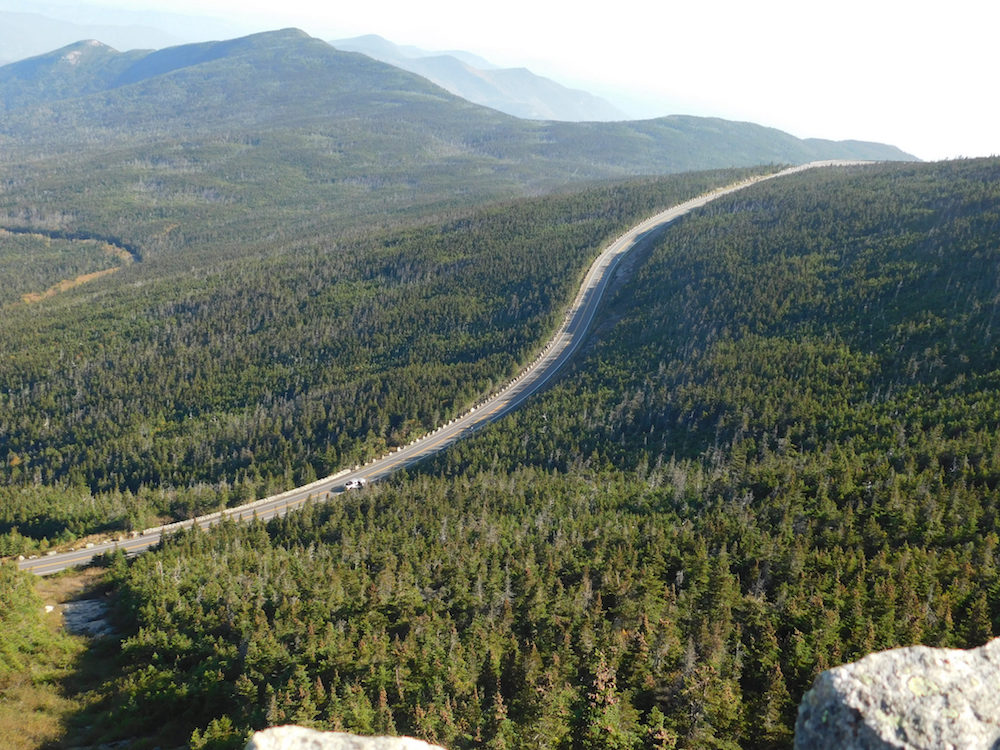
    Looking down at the Whiteface Veterans Memorial Highway, a five-mile toll road to the top of Whiteface Mountain in Wilmington, N.Y., as seen on Sunday, Sept. 24, for the 2017 NYSEF Climb to the Castle rollerski race. (Photo: NYSEF)

    As recently as a few years ago, the U.S. Ski Team held annual dryland training camps in Lake Placid and competed at the C2C. But that camp has been replaced by an on-snow camp in New Zealand. This year, US Biathlon’s top athletes recently spent several weeks training in Germany.

    “Jake Brown was right off the front so I realized that this could be a good day and I might as well try and hang in there,” Terko added.

    While Terko skis and rollerskis plenty with his athletes, he says it’s not always adequate training for a race like this.

    “As a coach, it’s more about generally making sure the workout is going well for the athletes,” he explained. “I’ve made an effort the last few weeks to get out after practice and ski around in the dark myself.”

    (Terko later clarified in an email that he was referring to Mansfield Nordic’s primary training venue, a paved and lit rollerski loop at Camp Ethan Allen in Jericho, Vermont. “Rollerskiing in the dark there is pretty standard as opposed to being in a dangerous road situation which I of course do not advocate!” he wrote.)

    As for Brown, a Northern Michigan University graduate student who is currently living and training with US Biathlon in Lake Placid, he had a slightly different recollection of the start on Sunday.

    “It wasn’t so much I dropped everyone. It was more like I just slowly pulled away,” Brown said. “Within the first 400 meters, I had a small gap. The gap got bigger and bigger as we went along. Maybe by the first mile, I couldn’t hear anyone behind me.”

    Sticking to his own race, he resisted the temptation to look behind.

    “I was trying to get a good effort today on the skis,” he continued. “I was hoping that some of the faster junior skiers would have some fast rollerskis and be able to push me, but pretty much right from the get-go I was on my own, so I was just trying to keep the pedal to the metal and make it a good effort, which gets tough at the end. It definitely helps to know the course.”
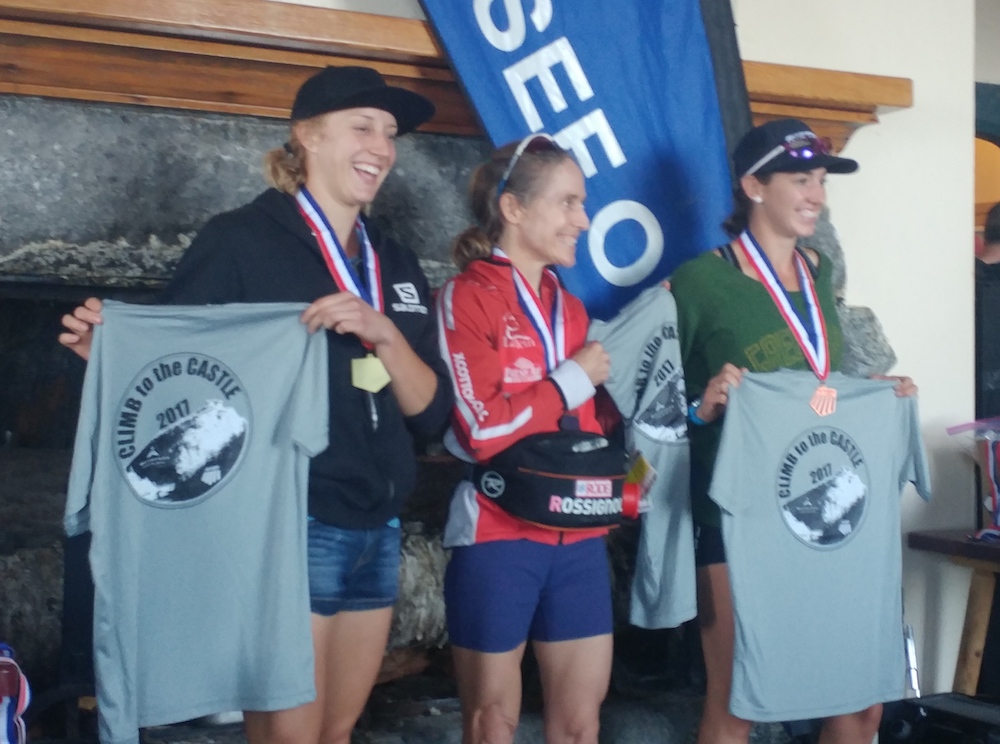
    The women’s top three finishers at NYSEF’s 2017 Climb to the Castle on Sunday, Sept. 24, at the top of Whiteface Mountain in Wilmington, N.Y. (From left to right) Jennie Bender in first, Sheila Kealey (XC Ottawa) in second, and Deedra Irwin (SVSEF) in third.

    In contrast, the women’s race swapped leaders. Clare Egan, a USBA national-team member and Craftsbury Green Racing Project (CGRP) member finished fifth (+5:02.4) after leading early.

    “I did lead a little bit at the beginning,” Egan said. “Jennie, Sheila and I were together for the first 1.5 or 2 miles, and then Jennie and Sheila pulled away, and I got caught by Deedra and Zoe [Williams].”

    “From doing this race in the past, the order doesn’t usually change so much after the first mile or so,” she explained. “It’s just so hard to make up gaps on this grade. I wanted to try to hang on for as long as I could and stay in front the whole way, but I wasn’t able to do that. So it was very hard work out there, and I didn’t have what it takes to stay with Jennie and Sheila. Respect to them.”

    Irwin explained in a post-race email that her plan was to pace off Bender and Egan and stick with them for as long as she could.

    “Jennie and Sheila pulled away just around mile two, I think,” wrote Irwin, a SVSEF Gold Team member who was invited to train with US Biathlon (following its Talent ID Camp) in Lake Placid this fall. “My race went really well. I’m really happy with my result. This was my first time doing Climb to the Castle. I didn’t really know what to expect, it’s a tough climb!”
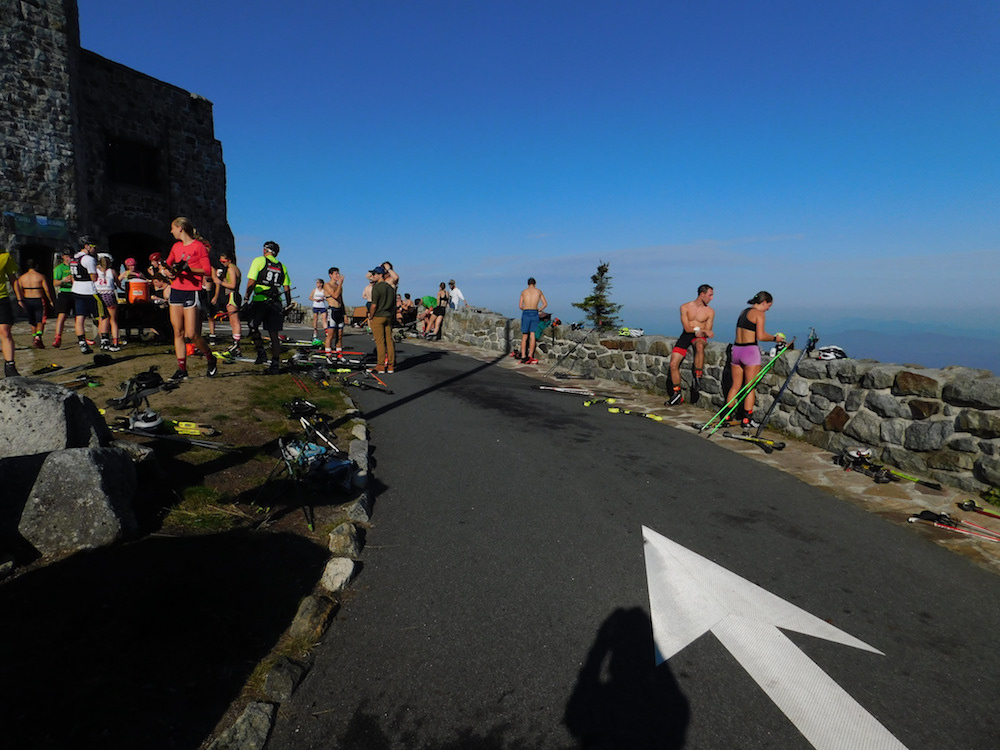
    Blue skies and no snow post-race at the castle atop Whiteface Mountain in Wilmington, N.Y., at the 2017 NYSEF Climb to the Castle on Sept. 24. (Photo: NYSEF)

    As for Kealey, a top-level masters racer on the Canada Cup, she had done the race a few times before.

    “Every year I did it, Liz Stephen did it, and it went out really, really fast,” she said of the U.S. Ski Team member who holds the women’s course record of 41:50. “Really hard at the beginning, and then people dropped off, but today’s pace was a good pace.”

    Kealey described wanting to keep a consistent rhythm all the way to the top. She spent much of the race trading off with Bender.

    “And then I managed to get a gap,” Kealey said. “I had a gap on [Bender] almost until the last 800 meters, and then she caught me. She was hurting, but she put the guns on at the last bit and just pulled away. She skied really well.”

    Reflecting on her win, Bender said, “It wasn’t snowing, and it wasn’t freezing, so that was awesome. My V1 has been getting a lot better. It was a small crowd, but I was stoked to feel good for the whole duration. I haven’t done this race in a long time. I did it probably in college, and it’s fun to see the giant progression since then.”

    She explained that she’s been working with US Biathlon in Lake Placid more this summer.

    “I think in the big picture, it’s fun to see that I’m not just a sprinter,” she said.

    On her race plan, Bender said, “The biggest thing, you have to pace it and not go out too crazy. We kind of started splitting up a bit, and I was going back and forth between first and second throughout the race. First with Clare, then with Sheila and then, near the last 200 to 400 meters, that tunnel, which is always so crazy with the wind, we both were like, ‘Oh.’ We were feeling it.”

    “I saw someone coming up behind us,” Bender continued. “I thought it was Clare, I didn’t realize it was Jake. And then I sprinted it in to the finish. I was stoked to get in under 50 minutes.”

    Bender, Egan, Irwin, and Brown all skied on matched Marwe rollerskis that they also used in time trials, Bender said.

    Zoe Williams, the fourth-place woman (+2:18.8) from Nakkertok and Carleton University, said she wasn’t sure what to expect for her first C2C.

    “About 15 minutes in, I kind of all of a sudden realized that it was all uphill,” Williams said. “I was like, ‘Whoa, what have I got myself into?’ But it was fun. I was following Deedra for most of it. I was trying to match her tempo.

    “The last mile was tough because you can see the castle,” she added. “I really wanted to try to stick with the lead pack as long as I could.”

    In the 11th year of the C2C, Margaret Maher, NYSEF’s outgoing head cross-country coach, said this was one of the warmest race days they’ve had.

    “We’ve had every kind of weather possible,” she said. “It’s just fun to see everybody out there getting ready for winter.”

    “It was really a blessing to have this awesome weather,” Brown concluded. “Normally you come up here and [the castle] is in the clouds, even if it’s sunny down low. It’s cool to do something here with NYSEF and show our support from US Biathlon.”


    Results: Men | Women

  • U.S. Nationals & Eastern Cup Wax Reports


    Toko logo

    US Nationals Wax Report

    Team Gregg

    10/15km Freestyle:

    Cold temperatures made it important to have the bases hard. We used Toko LF blue and XCold powder for our base layer covered with JetStream Blue 2.0 block. The XCold powder made a big difference in our testing.

    Freestyle Sprint:

    Fresh falling wet snow, Red 2.0 Powder won our test and put Caitlin on the podium.

    — Report from Brian Gregg

    (By the way, congratulations to Caitlin Gregg for qualifying to represent the US at the World Championships!)

    Caitlin Gregg on her way to her 8th US Cross Country Nationals victory
    Caitlin Gregg on her way to her 8th US Cross Country Nationals victory

    US Nationals Wax Report

    Sun Valley Ski and Snowboard Teams

    The first races of the week, 10/15km skate distance races, brought us temperatures in the single digits and a 5km loop with some man-made and some natural snow. Many waxes were fast in the man-made so we made sure to test in the natural snow section to make sure nothing was a liability. Toko Blue 2.0 powder tested well for us, and for a topping we found JetStream Blue 2.0 block fleeced together with a cold liquid to be very fast, especially at speed.

    The classic sprints on Day 2 was one of those days it seemed like snow conditions were changing every 20min. We had snow and rain swapping back and forth all day and athletes skiing hardwax, zeros, double poling, and by the end, klister skiing. We found Zeros to be very fast in the rounds, but it seemed like the guys with klister were able to run the hills a bit better. We had Toko JetStream Blue block mixed with JetStream Red block testing well for glide early in the morning on fresh snow in the mid 20’s, and by the end of the day we were on warm liquids.

    For the 20/30km Classic mass starts we lucked out a little bit and had pretty stable klister skiing conditions all day on a man-made 3.7k loop. We powdered our skis with a Toko JetStream Red/Yellow mix, which felt really good, and by mid day we were adding Toko Helix Yellow as conditions got above freezing.

    In the final race of the week, a skate sprint qualifier, a warm snow storm rolled in about an hour before the race, really slowing trail conditions down. The forecast called for this so we left off the black underlayer and based with Toko HF Red. The JetStream Red/Yellow powder mix again felt really good, but with such a short race, we opted for a block/liquid combo instead. Cole, Jack and Kelsey all skied well, getting themselves on the U23 Team!

    — Chris MallorySun Valley Gold Team Coach

    (Congratulations to Cole Morgan for being named to the US World Championships team as well as World U23s!)

    Cole Morgan on his way to qualifying for the US World Championship teams in U23 at Soldier Hollow, UT as well as Senior Elite in Lahti, Finland.
    Cole Morgan on his way to qualifying for the US World Championship teams in U23 at Soldier Hollow, UT as well as Senior Elite in Lahti, Finland.

    Wax Report from Eastern Cup Races in Waterville, ME

    mansfield nordic club logo

    Saturday, Freestyle Sprint:

    Conditions went from warm all week to single-digit temps the night before the race. The snow was icy and fast with a marginal amount of dirtiness. A skier in our group who attends Colby had been sending me photos all week showing some rocky and dirty snow but the organizers did a great job and things were very clean and beautiful on race day!

    All skate skis were prepped with a very hard graphite underlayer from another brand and then received Toko HF Blue as the paraffin layer.

    This combination was fast right out of the gate, and sped up even more significantly with a layer of HelX Blue for the qualifier. The skis also received a quick hand-corking of a block on just the tails of the skis which we felt improved top speed. I stuck to “cold” hand applications of everything due to the short nature of the race and because I was concerned that changing the already-fast nature of the graphite/HF Blue paraffin layer with too much heat from an iron or rotocork could slow things down in the cold snow.

    Our skis were running well and we had a male and female Junior advancing to the Open heats which was great. We also had 3 more skiers in Junior heats so a long day was in store. Skis were a huge factor here, as stiff boards could really help a racer stay confident, balanced, and powerful on the fast icy snow.

    With the help of some new matched test skis (thanks Rossignol and Skirack!) we were able to retest a lot going into the heats, but despite slightly warming temps the moisture content and consistency of the snow remained similar. The course ended with a fast downhill and long flat portion so we really went for top-speed and just hand-corked a layer of the morning’s block on all skis. We liked a 1mm structure that was half of a cross-hatch pattern (“Screw Left”). I applied the structure after the block was corked in, but before it was brushed out, to slightly dull the structure. Skiers advancing to further heats had a quick layer of block re-applied and brushed.

    Skis were great and we had several breakthrough performances which really got momentum swinging for the next day!

    Sunday, Classic Mass Start:

    Very similar conditions with a frigid night and slightly warming daytime temps. Cold klisters were the name of the game, and durability was key. The night before all skis received a klister binder and an application of HelX Blue or HelX Red depending on start time. We knew from the day prior that the HelX would run well, and with almost 20 skiers to get klistered up on race day we wanted to make sure we had adequate time once things got rolling. Toko HF Blue was the paraffin on all skis.

    We tested both blue and purple klisters from various brands in the morning, and Toko Blue klister was doing well although we ended up on a blue klister from one brand mixed together with a purple klister from another brand. Even as the sun warmed the spectators and coaches, the snow remained cold and this was the combination we stayed on from the first race at 9:30AM to the final race at 12:45PM.

    Kick was fantastic and several more skiers had breakthrough performances! There were a few skiers who mentioned a little dragging, and if that was the case the skis received a dusting of Jetstream Blue Powder over the front of the kick zone.

    Things really got going in the action of the day and I am disappointed that I neglected to test structure or even apply a structure that would’ve been a safe call like the Toko Blue Structurite the night before, or the pattern that had worked well the previous day. I think we generally do a good job with structure so this was a big mis-step on my part.

    Waterville is a long drive for us, but the great atmosphere an strong results made for a very memorable weekend for MNC.

    — Adam Terko, Head Coach Mansfield Nordic Club

  • SuperTour, Eastern Cup Race Reports, and La Clusaz Photos

    Toko logo

    (Original e-blast)

    Sun Valley SEF logo

    SuperTour Race Reports

    For the SuperTour Races in West Yellowstone this year we had great packed powder conditions.  The snow seemed to have a bit more moisture in it than in other years, and with slightly milder overnight temperatures we stuck to the Red waxes by in large.  For both race days we played it safe mixing HF Blue and HF Red 1:1 for a base layer.  For powder we ran Toko JetStream Red 2.0, which ran 1st or 2nd in testing all weekend.  On sprint day we ran a cold block in the morning and once the snow had a cold glaze to it, we added a cold liquid with block which helped at high speed.  Gelso had great skis and was able to race from the front of the pack all day.  For the distance classic race we were racing in heavy snow storm and temp’s around 20 degrees, so we kept it simple with JetStream Red 2.0 block over the JetStream Red 2.0 powder and focused our energy on kick.
    The next weekend we made our way up to Silver Star for the SuperTours in Canada.  It was super cold all week training, but again great conditions, and luckily it got up into the upper single digits come race days.  The Toko brand ran super well in Canada as it always does in the cold.  The snow was cold enough where mixing Toko X-Cold Powder in with LF Blue for a base layer helped harden the skis.  From there it was Toko HF BlueJet Blue 2.0 Powder, and Jet Blue 2.0 Block.  Some of our guys were doubling poling the CL Sprint all day so glide was important.  As the tracks got skied in throughout the day we again found success mixing Toko Blue Helix with the JetStream Blue block.  By the Sprint finals and second race on the distance day we switched to Red Helixmixed with the JetStream Blue block.
    – Chris Mallory, Head Coach Sun Valley Elite Team
    MNC
    Eastern Cup Race Report
    A really productive and fun first weekend of racing at Craftsbury. A little bit of everything when it came to snow and weather!
    Day 1: Classic Interval Start
    Cold temps overnight on a manmade base, but a lot of fresh new snow the day of the race. For kick wax we were on a very thin Toko Green Base binder ironed in. We ended up on kick wax from another brand.
    Our paraffin layer was HF blue for earlier races, with a 2:1 mix of HF Bue:HF Redfor later races. We tested a fair amount of topcoats and Jetstream Blue Bloc 2.0was arguably the most reliable and consistent performer all day so that went onto all skis rotocorked. Later starters had a slightly warmer block from another brand mixed in with the Jetstream. For structure we ended up with just the linear Toko Blue Structurite pattern on the tail of all skis for the Open Women’s and Open Men’s Races.
     
    Day 2: Freestyle Pursuit
    Will Solow (Mansfield Nordic Club) racing in the Eastern Cup race at Craftsbury. (Photo: Gary Solow)
    Will Solow (Mansfield Nordic Club) racing in an Eastern Cup race at Craftsbury. (Photo: Gary Solow)
    It rained overnight with temps above freezing, but the course held up very well and remained stable and mostly firm albeit saturated.
    We saw a lot of this last year and I was really happy to have plenty of the right Toko products on-hand. From early-season temps to Junior Nationals last year, the Toko warm fluoros just seemed to be incredibly reliable and fast.
    All skis had a base of HF Red. A quick test in the morning showed that HF Yellow was not significantly better or worse, and so we stuck with the HF Red and focused on testing topcoats, application methods, and structure.
    We felt there was a pretty significant difference between powder and blocks and focused on using blocks to best effect. Our final call was Jetstream Yellowrotocorked, then brushed, with another quick hand-corked layer over that. After a final brushing, skis received Helx Red liquid on the first part of ski, with Helx Yellow on the rear.
    Early structure winner was a Swix tool that provided a left-angled and non-aggressive pattern, although at a somewhat large 1.5mm. As the course got more skied-in and churned up the tails of the skis received the combo of right- and left-angled patterns to form the crosshatch or “fishnet” pattern.
    Our skate skis seemed to be performing really well and with large packs of skiers it was easy to evaluate speed and glide. Reports from the racers were very good!
    – Adam Terko, Mansfield Nordic Club Head Coach
    Here are a few action shots of US Toko Athletes at the most recent World Cup races in La Clusaz, France. (All photos: Nordic Focus)


    (Photo: Toko/NordicFocus)
    Erik Bjornsen
    Rosie Brennan
    Rosie Brennan
    Erik Bjornsen in the field
    Erik Bjornsen in the field
  • Toko All Stars and Canadian NorAm Field Report

    Toko logo

    Ida Sargent

    Toko Glove All Stars: Ida Sargent
    1.  Who was your skiing role model when you were growing up and why?  
    Chandra Crawford- I watched her win Olympic gold with the biggest smile on her face and it doesn’t get more inspiring than that!
    2.  What skier inspires you currently and why?
    Kikkan Randall- she is a leader for our team and an incredible role model. Kikkan isn’t afraid to set big goals and believe in herself as she chases them to success!
    3. Favorite race course and why?
    The courses in Kuusamo are my favorite. I love the big steep uphills and fast downhills.
    4.  Favorite workout and why?
    In the winter when the conditions are right it’s impossible to beat a long classic ski especially when it is firm tracks and sunny skies! In the summer I love point to point running ODs and mountain biking on fun singletrack. I also love max bounding intervals because it’s so easy to go hard and push yourself to new lactate burning highs!
    5.  Favorite place to train and why?
    Craftsbury Vermont! In the winter there are so many awesome trails to ski and they do a great job with grooming and snowmaking. Then in the summer there are lots of trails for running and mountain biking, a lake to jump into after every workout, and not much traffic for rollerskiing. It’s also very quiet so a great place to focus training and the goals at hand!
     6. 
    Favorite Toko glove model (and/or color) and why?
    So many great options! I like the classic for racing and for training I usually have cold hands so I love the Arctic glove and mittens and the new Stars and Stripes colors are awesome!
    Ida Sargent Ida Sargent Ida Sargent Ida Sargent Ida Sargent
    momentum northwest
    Field Report from Momentum Northwest from the Canadian NorAms
    I just got back late Sunday from our first racing trip, to Silver Star for their NorAm. I brought six athletes up, all with some racing experience but they were definitely thrown in to the deep end of the pool given the immense number of Canadian juniors present, and the fact that these races represented qualifiers for upcoming junior trips and such. My guys were awed but stuck to their guns and performed really well, not only in results (which on paper weren’t exceptional but experientially they all came away with excellent lessons), but in execution of their race plans and general habits on a trip. 
    I was able to team up with Scott J for the sprint waxing day. Temps were in the low-mid 20s (F) with fresh snow that had a fair bit of moisture. Base wax was LF Blue – a no-brainer for both Scott and I because we’ve always had success with that as an underlayer; no reason to test. 
    Scott arrived earlier than I did on the morning as he had an older athlete, and tested a variety of (4 different brands) topcoats. When I arrived I threw Jet Stream Red and Blue blocks into the mix, later to add Helix 2.0 Red. His winner was (a product from another brand). I put JetStream Blue against the (previous winner from the other brand) and it was solid – a toss-up in some places but JS ran really well (even better, I’d say) on initial acceleration, especially. We chose JS Blue as the block. 
    For liquids, he didn’t have any of the new Helix so I prepped up a test ski with 2.0 Red and put it against his own. The Helix kicked butt – free all the way from acceleration to top speed on downhills. Scott hadn’t had a chance to use the new versions yet so he was understandably excited to see the results. 
    We went with the LF Blue paraffin, JS Blue block, and Helix 2.0 Red. Because the weather didn’t change much but the tracks began glazing a bit following all the skiers, the Helix seemed to adapt well to that change and continued to run even in the heats. 
    The next day offered very similar snow but with new snow falling; I used the same combination of waxes and again they ran great; all my guys had skis comparable or better to those around them (even though many of those skiers around them were skiing faster; glide was better on downhills). 
    I’m excited to learn how effective that new Helix is, and that I’ve got a couple cans of the Red to work with. We have a few weeks of training before the first Junior Qualifier weekend in Bend, but I’ll touch base with you again after that to let you know how it goes. 
    Have a great holiday!
    Sam Naney, Head Coach Momentum Northwest
    mansfield nordic
    Field Report from Mansfield Nordic Club
    Eastern Cup #1, Craftsbury, VT
    December 19th, Freestyle sprints
    December 20th, 5km Freestyle for all
    Friday afternoon conditions were transformed corn snow the was fast and slick. Overnight, temps dropped to the mid-20s and new snow fell. For the men’s race, temps were mid 20’s rising toward 30 with intermittent sun and clouds. the snow was skied in, fast and slightly glazing from traffic (the qualifier was 2.5 laps per racer, with 200 male and 200 female racers).
    Paraffin layer was a hard layer of graphite (Start brand) followed by Toko HF Red mixed with Toko LF Grey.
    In a test of Jetstream Red 2.0 Block and Helx Red 2.0 the block was preferred and this was the main topcoat for all skis, rotocorked in and brushed. 
    For structure, it was an extremely close call between the Blue Toko Structurite and a cross-hatch pattern created from a Swix tool. The blue was great climbing, but the Swix pattern was great at high speed and when riding flat skis. Because the course only featured one short, significant section of V1 we opted for the Swix tool. 
    All of our skiers felt that their skis were running great and we had some strong performances, most notably a 2nd place in the U16 qualification round. 
    During the qualifying round and before the heats, a big snowstorm rolled in and coated everything. Conditions slowed and the new snow on top of the manmade base meant interesting testing. For the heats we ended up actually dropping down in range to the Jetstream Blue 2.0 block via rotocork topped with Helx Blue 2.0 and the same structure. To make the structure more fine I applied it after corking but before brushing the Jetstream. Between rounds, a little more Blue 2.0 block was briefly hand-corked and re-brushed up.
    A touch more snow fell overnight and temps dropped to the low 20s, and the snow guns were blasting as well. Early Sunday morning ski testing was the best snow of the year so far: firm, silky corduroy. I think pretty much every coach/wax tech out there was having a blast due to the great conditions. 
    Paraffin layer was HF Blue for the women, and a mix of HF Blue and HF Red for men.
    I tested Jetsream Blue 2.0 block versus a mix of Jetstream Blue Powder and X-Cold powder mixed 1:1. Both felt great, so I was confident that a powder layer followed by a block would be a reasonable call. With the sun coming out and the track glazing a bit before start time, I took the X-cold out of the equation and just ironed Jetstream Blue powder into all skis. That was followed by the Jetstream Blue block rotocorked in, then the blue Structurite tool.
    The women were really psyched with their skis and we had at least one really great race. There was a delay to the men’s race, meaning another opportunity to test. The only change I made was mixing the Jetstream Red and Blue blocks together, and the men were equally pumped to have skis that they said were fast and smooth. Another podium in the U16 men’s field was a highlight and capped off a great first weekend of Eastern Cup racing! 
    Adam Terko, Head Coach, Mansfield Nordic Club
    adam terko mansfield
    toko grip and glide
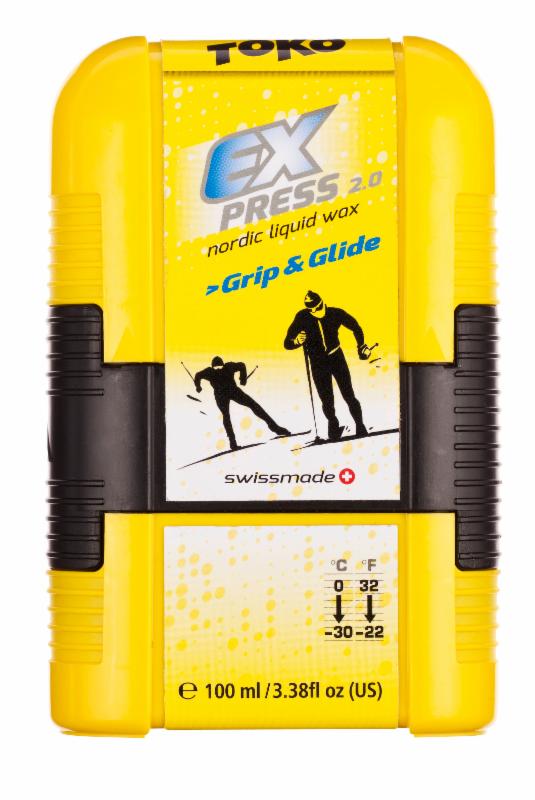
    Toko Grip & Glide Wax: For No Wax Skis
    We get asked all of the time how treat no wax skis and more specifically often times how to prevent wax from clumping up in the kick zone in new falling snow around 32f.  The solution is simple: Toko Grip & Glide Wax.
    Apply Grip & Glide Wax to the entire base of the ski – both the glide areas as well as the kick zone.  The glide areas will glide faster and the grip zone will not have snow sticking to it.
    One thing to watch for though is if the kick zone (tread pattern) already has dirt in the corners and cracks. If this is the case, clean it well with a tooth brush and some wax remover if there is ski wax in there or just soapy water if it is just dirt.  Once this is done, then the regular preparation mentioned above will serve you well.
    Grip & Glide Wax is available at most Toko Nordic dealers and has a MSRP of $15.50 for 100ml (pictured above) and $19 for the 200ml size. Enjoy!
  • Field Reports from Momentum Northwest and Mansfield Nordic

    momentum northwest

    Field Report from Momentum Northwest from the Canadian NorAms
    I just got back late Sunday from our first racing trip, to Silver Star for their NorAm. I brought six athletes up, all with some racing experience but they were definitely thrown in to the deep end of the pool given the immense number of Canadian juniors present, and the fact that these races represented qualifiers for upcoming junior trips and such. My guys were awed but stuck to their guns and performed really well, not only in results (which on paper weren’t exceptional but experientially they all came away with excellent lessons), but in execution of their race plans and general habits on a trip. 
    I was able to team up with Scott J for the sprint waxing day. Temps were in the low-mid 20s (F) with fresh snow that had a fair bit of moisture. Base wax was LF Blue – a no-brainer for both Scott and I because we’ve always had success with that as an underlayer; no reason to test. 
    Scott arrived earlier than I did on the morning as he had an older athlete, and tested a variety of (4 different brands) topcoats. When I arrived I threw Jet Stream Red and Blue blocks into the mix, later to add Helix 2.0 Red. His winner was (a product from another brand). I put JetStream Blue against the (previous winner from the other brand) and it was solid – a toss-up in some places but JS ran really well (even better, I’d say) on initial acceleration, especially. We chose JS Blue as the block. 
    For liquids, he didn’t have any of the new Helix so I prepped up a test ski with 2.0 Red and put it against his own. The Helix kicked butt – free all the way from acceleration to top speed on downhills. Scott hadn’t had a chance to use the new versions yet so he was understandably excited to see the results. 
    We went with the LF Blue paraffin, JS Blue block, and Helix 2.0 Red. Because the weather didn’t change much but the tracks began glazing a bit following all the skiers, the Helix seemed to adapt well to that change and continued to run even in the heats. 
    The next day offered very similar snow but with new snow falling; I used the same combination of waxes and again they ran great; all my guys had skis comparable or better to those around them (even though many of those skiers around them were skiing faster; glide was better on downhills). 
    I’m excited to learn how effective that new Helix is, and that I’ve got a couple cans of the Red to work with. We have a few weeks of training before the first Junior Qualifier weekend in Bend, but I’ll touch base with you again after that to let you know how it goes. 
    Have a great holiday!
    Sam Naney, Head Coach Momentum Northwest
    mansfield nordic
    Field Report from Mansfield Nordic Club
    Eastern Cup #1, Craftsbury, VT
    December 19th, Freestyle sprints
    December 20th, 5km Freestyle for all
    Friday afternoon conditions were transformed corn snow the was fast and slick. Overnight, temps dropped to the mid-20s and new snow fell. For the men’s race, temps were mid 20’s rising toward 30 with intermittent sun and clouds. the snow was skied in, fast and slightly glazing from traffic (the qualifier was 2.5 laps per racer, with 200 male and 200 female racers). 
    Paraffin layer was a hard layer of graphite (Start brand) followed by Toko HF Red mixed with Toko LF Grey.
    In a test of Jetstream Red 2.0 Block and Helx Red 2.0 the block was preferred and this was the main topcoat for all skis, rotocorked in and brushed. 
    For structure, it was an extremely close call between the Blue Toko Structurite and a cross-hatch pattern created from a Swix tool. The blue was great climbing, but the Swix pattern was great at high speed and when riding flat skis. Because the course only featured one short, significant section of V1 we opted for the Swix tool. 
    All of our skiers felt that their skis were running great and we had some strong performances, most notably a 2nd place in the U16 qualification round. 
    During the qualifying round and before the heats, a big snowstorm rolled in and coated everything. Conditions slowed and the new snow on top of the manmade base meant interesting testing. For the heats we ended up actually dropping down in range to the Jetstream Blue 2.0 block via rotocork topped with Helx Blue 2.0 and the same structure. To make the structure more fine I applied it after corking but before brushing the Jetstream. Between rounds, a little more Blue 2.0 block was briefly hand-corked and re-brushed up.
    A touch more snow fell overnight and temps dropped to the low 20s, and the snow guns were blasting as well. Early Sunday morning ski testing was the best snow of the year so far: firm, silky corduroy. I think pretty much every coach/wax tech out there was having a blast due to the great conditions. 
    Paraffin layer was HF Blue for the women, and a mix of HF Blue and HF Red for men.
    I tested Jetsream Blue 2.0 block versus a mix of Jetstream Blue Powder and X-Cold powder mixed 1:1. Both felt great, so I was confident that a powder layer followed by a block would be a reasonable call. With the sun coming out and the track glazing a bit before start time, I took the X-cold out of the equation and just ironed Jetstream Blue powder into all skis. That was followed by the Jetstream Blue block rotocorked in, then the blue Structurite tool.
    The women were really psyched with their skis and we had at least one really great race. There was a delay to the men’s race, meaning another opportunity to test. The only change I made was mixing the Jetstream Red and Blue blocks together, and the men were equally pumped to have skis that they said were fast and smooth. Another podium in the U16 men’s field was a highlight and capped off a great first weekend of Eastern Cup racing! 
    Adam Terko, Head Coach, Mansfield Nordic Club
    adam terko mansfield
    toko grip and glide
    Toko Grip & Glide Wax: For No Wax Skis
    We get asked all of the time how treat no wax skis and more specifically often times how to prevent wax from clumping up in the kick zone in new falling snow around 32f.  The solution is simple: Toko Grip & Glide Wax.
    Apply Grip & Glide Wax to the entire base of the ski – both the glide areas as well as the kick zone.  The glide areas will glide faster and the grip zone will not have snow sticking to it.
    One thing to watch for though is if the kick zone (tread pattern) already has dirt in the corners and cracks. If this is the case, clean it well with a tooth brush and some wax remover if there is ski wax in there or just soapy water if it is just dirt.  Once this is done, then the regular preparation mentioned above will serve you well.
    Grip & Glide Wax is available at most Toko Nordic dealers and has a MSRP of $15.50 for 100ml (pictured above) and $19 for the 200ml size. Enjoy!
  • Wednesday Workout: Training in the Dark with Mansfield Nordic

    Wednesday Workout: Training in the Dark with Mansfield Nordic

    Group photo with GMVS, SMC and UVM club skiers after their Monday night skate sprint. (Photo: Gary Solow)
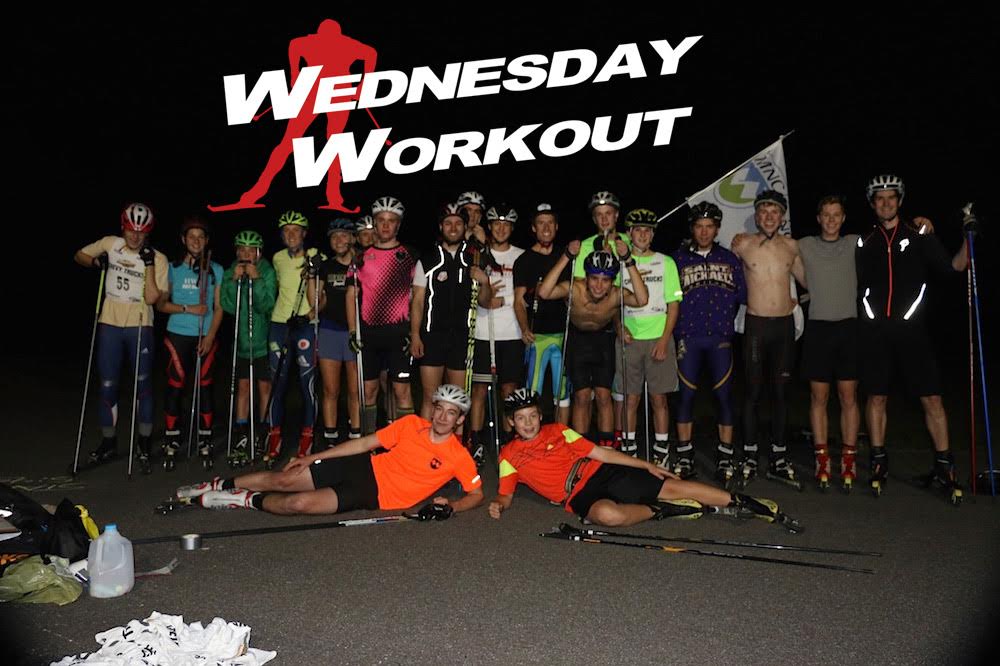
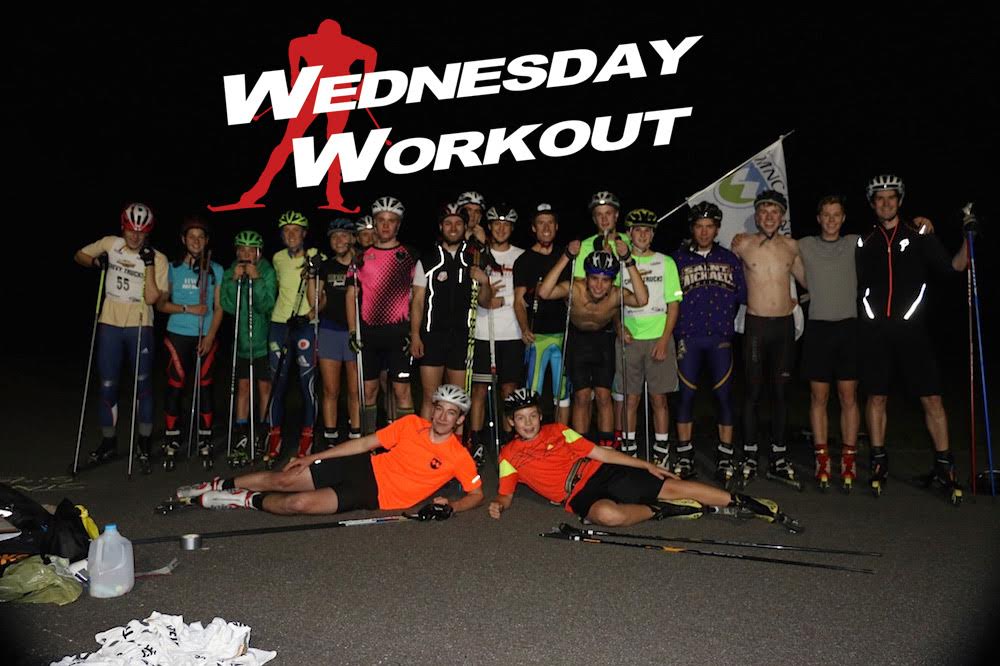
    Group photo with Mansfield Nordic, GMVS, St. Michael’s College, and UVM club skiers after their evening skate sprint in Jericho, Vt. (Photo: Gary Solow)

    On Nov. 1, the clocks turned against a skier’s favor, especially if you are used to training after an already-lengthy day at school. For many, this time of year brings about tough battles with motivation. The desire to even get out the door is often more difficult to swallow when the sun goes down, and cold weather combined with a lack of snow can add even more aggravation.

    Bill Koch League skier Aidan Burt previews the sprint course in fading light at the Jericho range in Vermont. (Photo: Gary Solow)
    Bill Koch League skier Aidan Burt previews the sprint course in fading light at the Jericho range in Vermont. (Photo: Gary Solow)

    Mansfield Nordic is incredibly fortunate to train at one of only a few paved, car-free rollerski loops in the country at Camp Ethan Allen in Jericho. “The Range”, as it’s known colloquially, also features lights along all 5.5 kilometers of trail, making it ideal for training in this tough shoulder season.

    Although The Range is an amazing place to train, we don’t spend every workout on rollerskis. Recently we found a creative way to make our own lighted trail system in the woods with the help of some battery-powered infrastructure.

    In this article I’ll share two workouts we’ve done this fall that were enhanced by the darkness rather than limited by it: A rollerski sprint time trial and bounding intervals in the woods.

    Event 1: Skate Rollerski Sprint TT

    After a late-summer timetrial with the Green Mountain Valley School (GMVS) in East Warren, coaches Garrott, Katrina and I began talking about the next time we could get the group together. The GMVS crew would not be able to get to the Range until 5 p.m. on weekdays, Garrott noted, when darkness would be coming up fast. Instead of changing plans, we decided to turn this into the plan!

    A few weeks and a bit of outreach later, a hearty crew was up at The Range on a Tuesday night for some sprinting action. The competitors included athletes from Mansfield Nordic, GMVS, St. Michael’s College, and the University of Vermont (UVM) Club team.

    The Workout

    A qualifier was held in grainy, fading light, and by the time the heats began the lights along the trail were the only glow in the area as racers sped around a hilly 1 k lap. Organized in a modified “King’s Court” style, everyone got to race multiple heats against similar competition. With some diligent recording, every racer was tracked for every lap so that times could be compared. Pizza delivered after the final round was key, as the event wrapped up around 7 p.m.  

    Event 2: Bounding by Headlamp

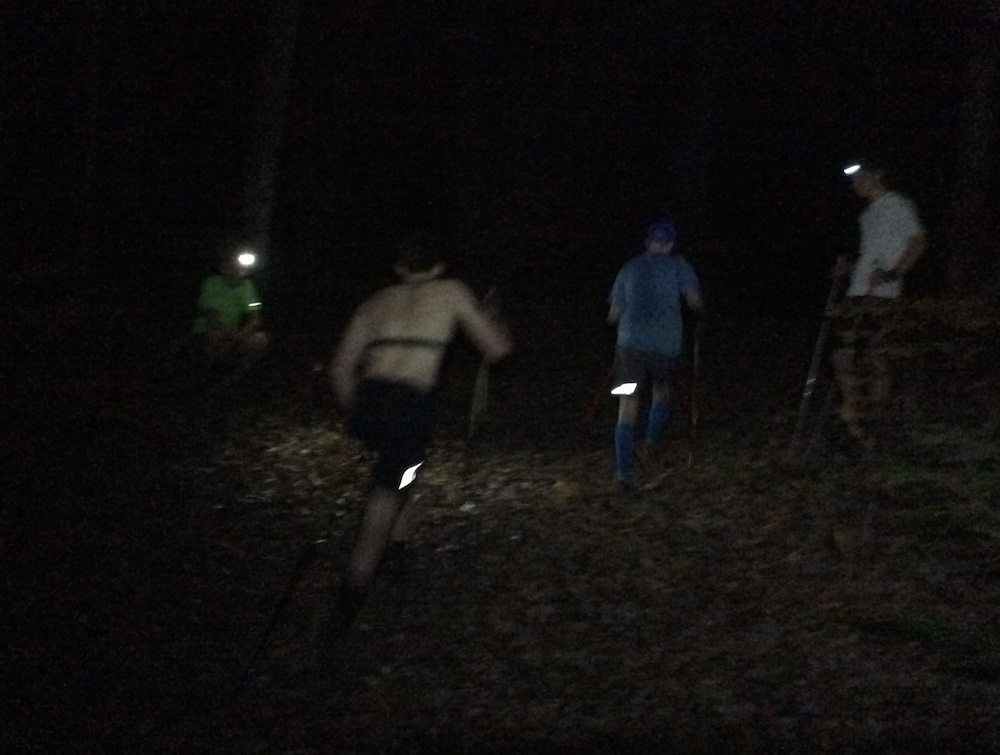
    Although rollerski tracks with lights are not common, many racers are probably more familiar with training by headlamp, especially masters racers who are looking to train before and after long work days. We were able to do some bounding intervals at a popular training location, the Jericho Research Forest, with headlamps and more to light the way.

    The location for this was key to enabling safe, effective training in the woods at night. This stretch of forest has a few great features that made the night workout possible:

    • Hills of varying length and grade (of course)
    • Snowmobile trails, which are wide and well-cleared of obstacles that could trip you up
    • A relatively short 1-2 k loop to avoid getting lost and help track athletes

    The Workout

    MNC skiers alternated jogging and bounding on portions of a 6-8 minute loop that included steep uphills, rolling terrain and flats. By doing the workout on a set course over and over, athletes became familiar with the terrain in the fading evening light. This made it easier to navigate the loop when the complete darkness arrived shortly thereafter.

    The loop made a figure-8 style, and in the middle, a branch was posted into the ground with a LED light dangling off — the center hub and meeting spot, as well as the beginning and end of every interval. This made it easier to know where and when to find athletes … and to know where the water belts were.     

    Headlamps were donned to allow better visibility, and also give a pretty cool motivational boost. Is the competition outside training in the dark right now as well, or are they home watching “The Walking Dead”? Concluding the workout with some extra hard bounding with a partner, under the light of teammates’ headlamps lining a short section of the trail, made for a great finale.

    The dark and cold days of autumn will always bring a tough challenge to skiers, especially before the snow has fallen. It doesn’t have to mean a lack of motivation or variety, though. If you can get creative with your workouts, you may even find a way to dig deeper and end up with a more memorable session than you planned.

    Bounding at night. (Photo: Adam Terko)
    Bounding at night. (Photo: Adam Terko)
  • Interview: Terko on Leaving St. Lawrence for Mansfield Nordic

    Interview: Terko on Leaving St. Lawrence for Mansfield Nordic

    Adam Terko, former St. Lawrence University Assistant Coach, is the new Head Coach and Executive Director at Mansfield Nordic Club. (Photo:  Kathryn Mulcahy)
    Adam Terko, former St. Lawrence University Assistant Coach, is the new Head Coach and Executive Director at Mansfield Nordic Club. (Photo: NENSA)

    Adam Terko came to St. Lawrence University as a skier and student in 2008, but his time at the school would last long after his racing and studies ended. After graduating in 2012 he joined the Saints’ coaching staff, bringing the same energy and spirit into his three years as coach as he had while on the team himself. During his years as assistant coach, he dedicated his time to write weekly recaps of the EISA collegiate carnivals for the FasterSkier community. Earlier this year, Terko decided to leave his position as the assistant nordic coach this spring to become the Head Coach and Executive Director of Mansfield Nordic Club, replacing current Head Coach Tim Weston who will officially depart the program in July of 2015, according to the team’s website. While the new head coach has been busying navigating his new responsibilities, he answered questions from former teammate and athlete Kathryn Mulcahy about the next chapter of his ski coaching career.

    FasterSkier: What are you most excited for with the Mansfield Nordic Club?

    Adam Terko: I’m from Vermont and I was personally supported by a lot of people from this area growing up. Having such a great support structure as I became a skier, I’m excited to be part of that from the other end. Also, in New England there is a lot of success and there is definitely a positive future here. I’m excited to be a part of and contribute to that future for kids from this area and Vermont as a whole.

    FS: What are you going to miss most about St. Lawrence University?

    AT: I came to St. Lawrence in the fall of 2008 as an athlete, so I think after spending seven years there it’s hard not to have a strong connection to the ski team and everyone that was a part of my experience throughout those years. I got to interact with a lot of great teammates and assistant coaches, as I’m sure is similar for a lot of people. But this is a great opportunity to move forward with my coaching career, apply what I’ve learned during my time at St. Lawrence and give what I’ve been given back to others.

    On a day to day operational level colleges, especially ones as well supported as St. Lawrence, are definitely benefited by logistical aids that I probably took for granted. For example, transportation, lodging budgets, waxing, equipment, and facilities of various types. Not to mention a corporate credit card (laughs).  At the same time I’ve already gotten to know a lot of people who have contributed a ton to Mansfield Nordic and provide so much for the skiers even without that kind of corporate structure. I think it’s great to have that personal investment and those kind of connections are what a ski club is all about.

    FS: When did you decide coaching was something you wanted to pursue as a career?

    AT: Sophomore or junior year of college. I had some success with my own racing but knew I probably couldn’t race professionally. But I knew I wanted to stay involved in the ski world and felt that coaching was a good way to give back, stay involved and pass on what I had learned. I tried to learn as much as I could from then on. Knowing I was interested in being a coach even before I was finished racing had me looking for opportunities to apply situations from both the athletes and coaches perspectives, to consider the positives and negatives and difficulties of both sides and apply that to myself in the shoes of a coach.

    FS: How do you think your youth is beneficial to you as a coach? In what ways is it a limitation?

    AT: I’ve only been removed from racing for a few years and in that time I was an assistant coach. During that time I tried to immerse myself in other opportunities for coaching during all seasons. I attended clinics at the Olympic Training Center in Lake Placid, worked with athletes in the summer from the college age and younger, and tried to take every opportunity I was given to learn as much as I could knowing I wanted to stay in the coaching field.

    As for limitations, at 25 I go into coaching knowing I don’t have a lot of experience, when experience is what brings success to many coaches. Realizing that, and going into every individual workout or race knowing that it is a learning opportunity is a way I’ve tried to approach it though.

    FS: What do you think the hardest part about being a head coach will be?

    AT: When you’re an assistant is easier for responsibility to be put on a head coach and I know that there are decisions that I will make that may not always receive unanimous support. But I’m always going to try to do what is best for the club and for the skiers and I need to trust that as long as I’m putting thought and consideration into my decisions I need to accept that I might not always please everyone all the time.

    FS: What do you think your strongest attribute as a coach is?

    AT: I think that on a personal level I’m pretty easygoing and very open and willing to collaborate and bring people together. Additionally, I think that I’ve learned the value of connecting with skiers and figuring out what success means for them at their level, whatever that level may be, and helping them to achieve that success. That could be related to results or what they enjoy doing for training, where they want to go in the sport and how they plan on achieving those goals.

    I would also say as a ski racer myself I went through times when I would consider myself successful, on a relative scale, and then there were times when I skied into the woods after a race and asked myself why I was doing this and how I could be struggling so much. I’ve experienced both ends of the spectrum and moments of disappoint and triumph and I hope that I’m able to put myself in a lot of different shoes depending on where a skier is at.

    FS: Where do you see yourself in ten years?

    AT: I have the intention of committing to this program seriously and helping the club grow. Some of my individual goals as a coach are to get more experience and connections nationally like coaching at REG camps and Junior Nationals. From there I’d like to experience coaching at an international level through coaching at World Juniors and U18 Scando Cups with the hope that the Olympics are in there somewhere down the road.

    FS: Final question, what are your race day coaching essentials?

    AT: Guru red kick wax, chocolate covered pretzels, energy and enthusiasm, good coffee, Neos, seltzer, preferably music at the wax bench, and a radio vest so I don’t keep getting mistaken for a high school racer.

  • Wednesday Workout: Olympic ‘Bounding Loops’ with SLU

    Wednesday Workout: Olympic ‘Bounding Loops’ with SLU

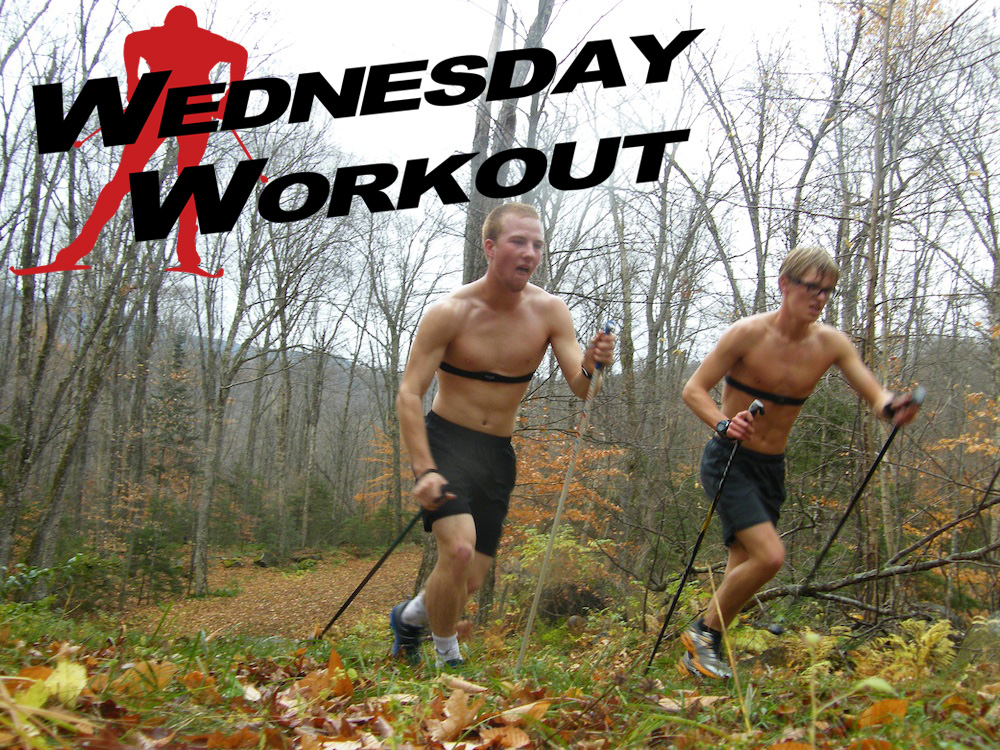
    SLU skiers Isaac Wright (l) and Calvin Swomley (r) bound up a hill on the Ladies 5k course at Mt. Van Hoevenberg. (Photo: Adam Terko)
    SLU skiers Isaac Wright (l) and Calvin Swomley bound up a hill on the Ladies’ 5 k loop at Mt. Van Hoevenberg. (Photo: Adam Terko)

    The following workout comes from Adam Terko, assistant coach of the St. Lawrence University nordic team and a regular eastern-collegiate contributor for FasterSkier. No snow? No problem. Terko and his team did this bounding workout in October. Submit your favorite workout or one from your team to info@fasterskier.com with the subject line: Wednesday Workout.

    ***

    Just because a nordic trail doesn’t have snow on it doesn’t mean it can’t be used to maximize ski-training potential. A hard bounding workout with poles, done on the same terrain you race on, develops not only aerobic capacity and strong muscles but confidence and familiarity with a particular course. That was the goal with our Ladies’ 5 k bounding workout last weekend at Mt. Van Hoevenberg in Lake Placid, N.Y.

    This session was based on a hard bounding workout our team often does on the trails of Higley Flow State Park, our main ski trail network close to campus. Recently we had a training weekend in nearby Lake Placid, where SLU will be hosting the 2015 NCAA Championships this spring.

    We decided to do our “bounding loop” session on the Ladies’ 5 k course, so-named because it was the course used for that particular event in the 1980 Olympic Games. Consequently, it will also be used for the classic races at NCAAs. It is a notoriously difficult trail that features many large climbs strung together.

    The Workout:

    – Warm up with 30-35 minutes easy running, ending with 8-10 minutes of ski-walking and other dryland classic simulation drills

    – Place “Start/Stop” cones on uphill sections to indicate when to bound hard

    – Run 3 laps of the Ladies’ 5 k course, with bounding poles (or 6-10 laps around a 2 k loop)

    – Between bounding sections (indicated by cones), jog at a reasonable pace

    – Cool down with 20-25 minutes easy running

    Both on-time and rest time are set distances, therefore as the workout goes on, the body will have a harder and harder time recovering between bounding sections. While most of the bounding sections will be on uphills, sometimes Coach Townsend and I will place the Start/Stop cones sadistically over the crests of hills or around corners that lead into steeper hills in order to encourage athletes to push themselves when they least want to, or when they least expect it.

     Sometimes Coach Townsend and I will place the Start/Stop cones sadistically over the crests of hills or around corners … to encourage athletes to push themselves when they least want to, or when they least expect it. 

    Homologation profile of the Ladies' 5k course at Mt. Van Hoevenberg in Lake Placid, N.Y. (Photo: ORDA/FIS)
    Homologation profile of the Ladies’ 5k course at Mt. Van Hoevenberg in Lake Placid, N.Y. (Photo: ORDA/FIS)

    It is important to maintain good bounding form throughout the workout: this means efficient and powerful body position, explosiveness on the bounding initiation, and ‘float’ on the glide phase. I like to yell pseudo-aeronautic terms like “airborne!” and “flight time!” and “lift-off!” to the athletes while they bound to remind them to push hard enough to get air time.


    During the later stages of the workout, keeping an eye on technique is even more important. Being a looped trail, if you are unable to maintain the correct form and intensity it is just a matter of cutting the workout a loop short (or multiple loops short, depending on your number of loops and the distance of each).

    When done in the fall, along wet ground and through a rainy environment, preferably around the time of a sunset, this session has a very ‘Northern Scandinavian’ feel. It is distinctly old school in its materials and execution, and distinctly painful in its aftermath.

    For those looking to re-create this workout, a set loop anywhere with multiple hills to climb and descend will work fine. A ski trail works best, but rolling fields or parks can be just as useful. Lap numbers vary based on the length of the loop and how much intensity you are looking to get in.

    In the case of Ladies’ 5 k, a loop was anywhere from 24-30 minutes, with just over half that time being at intensity. At Higley Flow State Park, the loop we use for this workout is about 2 k long, and therefore most end up doing anywhere from 6-10 laps.