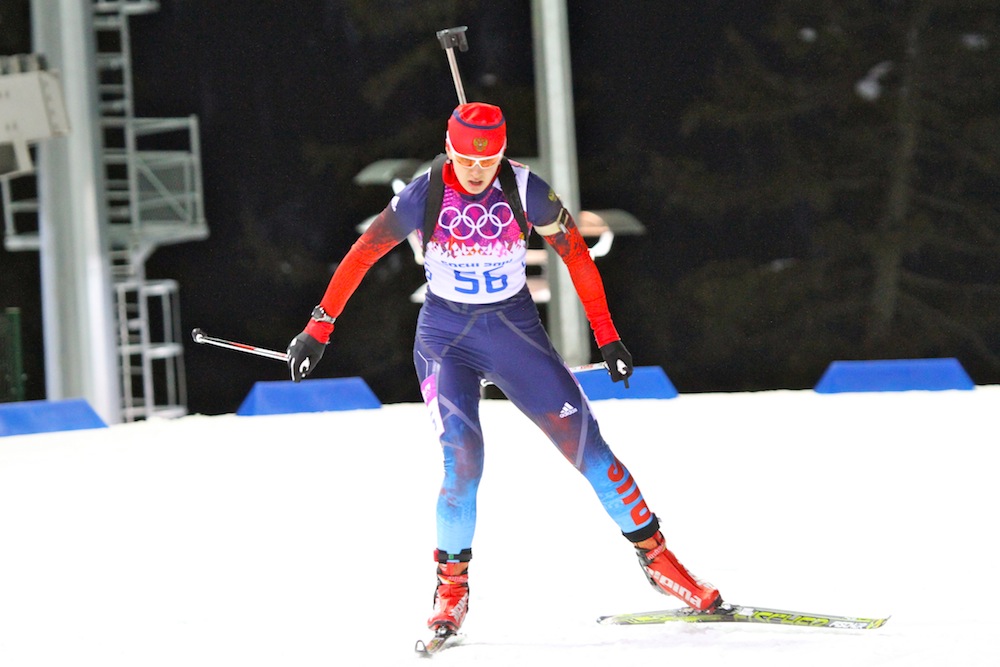
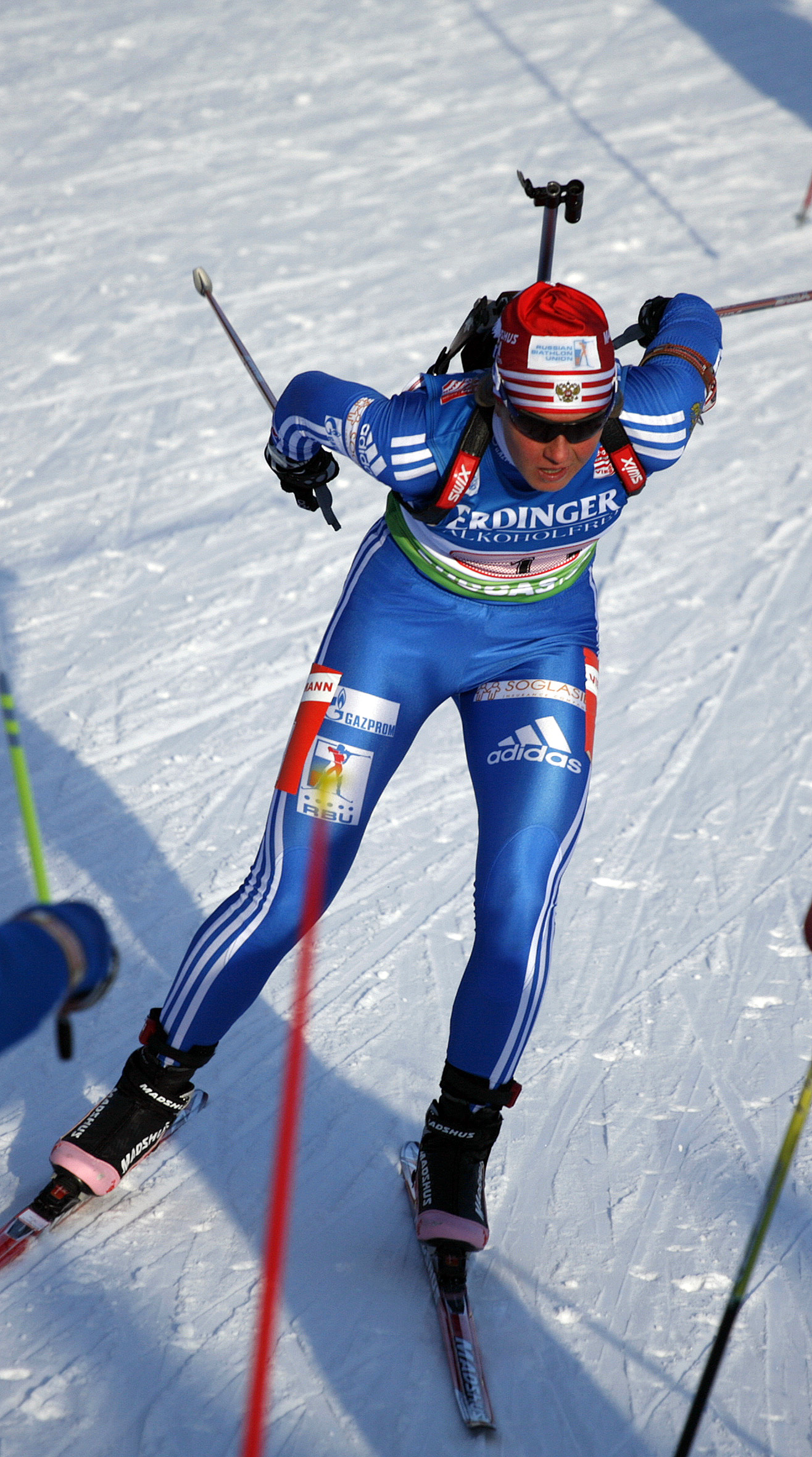
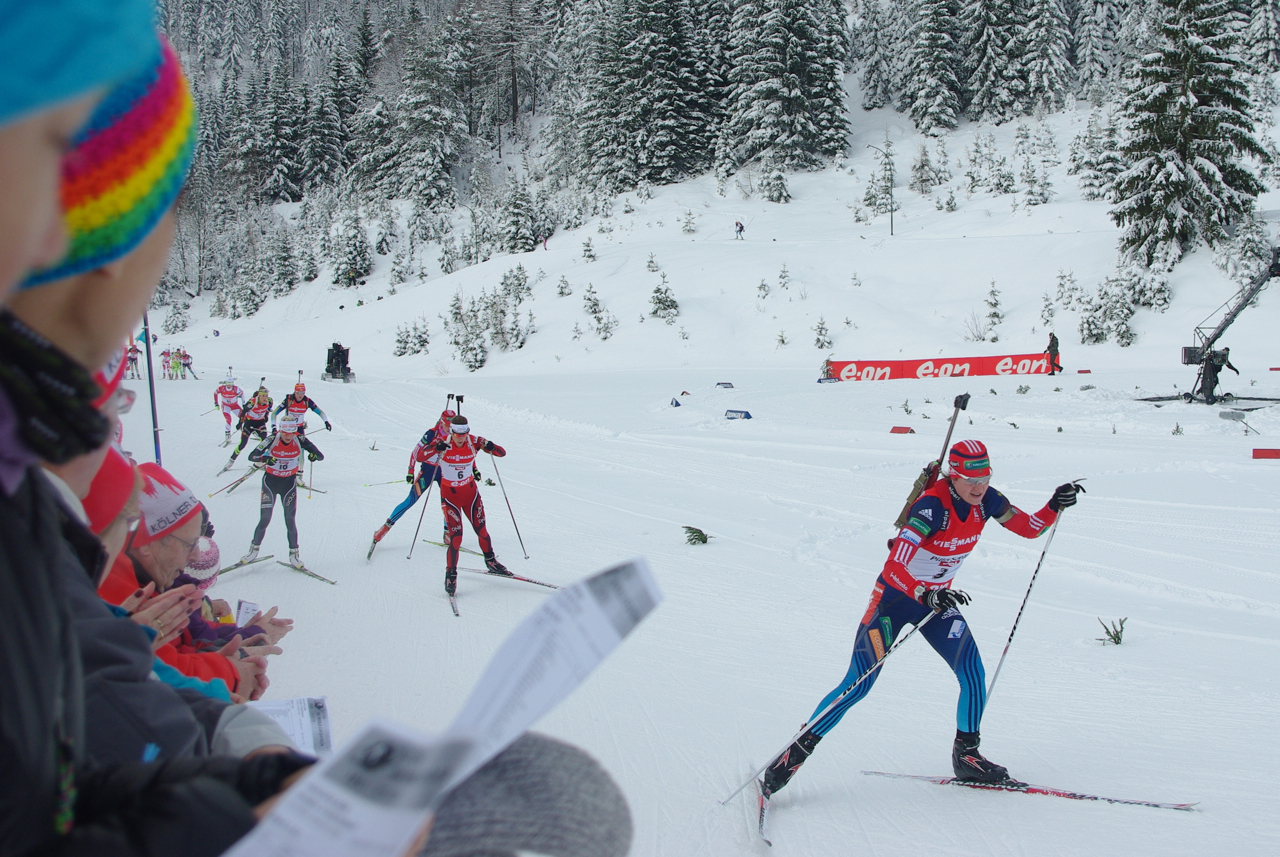
Savelii Korostelev is one of three Individual Neutral Athletes (AINs) currently competing in FIS World Cup events with the intention of qualifying for the Olympic Winter Games in Milano-Cortina. (Photo: Modica/NordicFocus)
Russian and Belarusian cross-country skiers are back in the mix to qualify for the Olympic Winter Games in 2026. Does anyone else sense an elephant in the room? And are we all talking about the same elephant?
The recently overturned FIS ban on Russian and Belarusian athletes was about Russia’s war on Ukraine. Not every sport in the athletic world banned the involvement of those athletes, but the International Ski Federation (FIS) was quick and decisive in its initial rulings: no Russians, no Belarusians, not as long as this invasion lasts. Now—in accordance with the wishes of the IOC—FIS has been compelled to open the entries for FIS sanctioned events to allow the participation of Individual Neutral Athletes (AINs) from both Russia and Belarus. Thus far, the total number of athletes taking advantage of this opportunity (and/or qualifying for this opportunity) in World Cup cross-country events has been three. And while those three possess impressive athletic pedigrees, they have yet to be factors in events they’ve entered. The Russians returned, the sky hasn’t fallen, the war in Ukraine goes on. People remain in a huff over their participation, but I don’t think it’s the war in Ukraine that we’re all mad about . . .
Sure, there’s a military/imperial elephant in the room—Russian athletes returning to international competition even as the war in Ukraine goes on. But it’s the age-old doping elephant that occupies a larger space in our metaphorical room. By that we mean that no one could seriously trust the Russian ski team, the Russian coaches, the Russian officials, the Russian government. These are organizations and individuals who have spent decades cheating on a large and systematically organized scale. FasterSkier has repeatedly reported the facts pertaining to the FIS banning of Russian and Belarusian athletes. We have also reported on our interpretation of language in both FIS and IOC charter documents that seem to imply (quite plainly and with very little wiggle room) that athletes should never be banned from competition for political reasons. The Court of Arbitration for Sport agreed with that assessment (and with the appeal filed by Russian governing bodies and athletes). So, the Russians (some Russians) are back in.
Skiers from Russia have not been allowed to compete internationally since the spring of 2022 (when Russia invaded Ukraine). Since that time, those athletes have continued to train, to prepare, and to compete . . . though they have not done so under the scrutiny of unbiased international watchdog groups like the World Anti-Doping Agency (WADA). True, the Russian athletes have been subjected to occasional drug testing, but only by the same organization that had supervised and undertaken the drug testing during the infamous Olympic Winter Games in Sochi where so many Russian athletes, coaches, and officials had been found to have been involved in an outrageous top-down doping scandal. In investigations that followed those Sochi Olympics, it was revealed that Russian administrators, Russian coaches, the Russian Anti-Doping Agency (RUSADA), and the FSB (Russian Secret/State Police) were involved in a sophisticated (though brutally simple) scheme to evade IOC scrutiny and avoid detection of performance enhancing drugs that had been systematically provided to—and utilized by—Russian athletes. We remember the scandal where Russian Olympic organizers had constructed a secret room adjacent to the space in which urine samples were stored after being collected from athletes (and prior to testing). A hole in the wall allowed a Russian collaborator to pass vials of Russian athletes’ urine through to the secret room where they were opened, emptied, rinsed, replaced with “clean” urine, and re-sealed (a neat trick, considering the considerable trouble IOC had gone through to create tamper-proof lids). It was an audacious and brazen plan—one that started at the top of Russian sport governing bodies and the Russian government. The end result was that 43 Russian athletes were banned from Olympic competition for life, while 13 of those also saw their Olympic medals stripped. Additional suspensions and sanctions followed, including Russia being banned (temporarily, with conditions) from further Olympic competition.
Well, today our sport enters a situation in which Russian cross-country skiers have been absent from World Cup, World Championships, and all other FIS sanctioned international competitions since 2022. And the Russian program is one that has been known to institute, organize, supervise, and undertake illicit team-wide doping efforts in the past. The organization that took advantage of the outrageous doping scheme during the 2014 Olympics in Sochi is the very same organization that runs Russian cross-country skiing today. Isn’t there a reason for the rest of the constantly-tested field to be justifiably concerned?
This is a national sport program that’s been so dirty for so very long . . . why should they be trusted now? Wait, you say; those athletes will be tested whenever they compete in FIS and/or Olympic competitions, right? If they’re doping, they’ll be caught, won’t they? That depends . . .
Dariya Nepryaeva (AIN) is one of the athletes from Russia who—justly or unjustly—will have her name mentioned whenever discussion of Russian participation in the Olympics arises. (Photo: Modica/NordicFocus)
Doping in the Long Run
It’s been suggested that there are long-term benefits to the use of certain performance enhancing drugs, benefits that continue to enhance athletic performances long after the use of those supplements has been discontinued. So here’s my thing: If there were an evil-empire sport-colossus intent on dominating endurance events in some future Olympics, their best strategy would seem to be withdrawing their athletes from sufficiently-monitored international competitions for a few seasons, pumping them up with all manner of otherwise-restricted PED’s (in a closed environment free of drug testing and organizational scrutiny), weaning those athletes off the drugs early enough to have all remnants flushed from athletes’ systems (thereby avoiding detection in subsequent testing), and turning those athletes loose on the competition at the highest-profile moment. That way, those athletes could benefit from artificially-enhanced athletic qualities while still passing as “clean.” That’s how a set of well-organized cheaters could get it done, anyway.
Here’s what I think I believe:
Performance-enhancing drugs work—they make athletes faster, stronger, and better able to endure.
Certain performance-enhancing drugs have long-term effects that continue providing performance benefits even after athletes stop using them.
Evidence of certain performance-enhancing drugs can be thoroughly flushed from an athlete’s system, rendering undetectable any earlier use of those drugs.
What we’ve seen in the past has been state-sponsored cheating from the sport organizations of nations that so value the propaganda benefits of Olympic success. It happened in the Olympics of Sochi, and it had happened during many seasons prior. The governing bodies who were caught red-handed are still the governing bodies administering Russian Olympic sport, and the government of Russia is still the same one (still under the same leader) that green-lighted the whole scheme in the first place. What, really, has changed? And why should the rest of the world believe that it won’t happen again?
If Russia was so systematic and unapologetic in their cheating before—and if their athletes are still allowed to return to Olympic competition—why should we believe they aren’t cheating again? There’s plenty of pressure from the Russian government to produce results following Russia’s return from exile, and no one has been watching what they do behind the curtain. I mean, if I were running a state-sponsored athletic system that had been banned from competing internationally for a few years—and if the drug-testing to be conducted during that ban was the responsibility of my national governing body and my government—wouldn’t I think about cheating again? After all, many of the performance-enhancing drugs that I might administer to our top athletes would have made them bigger, stronger, faster . . . while any evidence of their use would have been flushed cleanly from their systems long before any independent testing agency arrived to test the athletes. If FIS threw us out of competitions for a while (and no one was watching what we did during that enforced hiatus), why not use the un-monitored time to make ourselves better? What better way to exact our revenge on FIS, on the IOC, on the entire Kingdom of Norway when we return?
Savelii Korostelev (AIN) competing in the recent FIS World Cup 10km in Davos. (Photo: Vanzetta/NordicFocus)
Preferential Treatment?
What makes the current Russian issue even harder to swallow is that Russian athletes seem to be receiving preferential treatment, though some bending of WADA’s rules might not be entirely unexpected given the looming deadline of FIS/Olympic qualifying events. The “Anti-Doping Agency Management System” (ADAMS) employed by WADA creates a set of automated records pertaining to athlete drug testing (especially with regard to the whereabouts of athletes that must be regularly recorded and updated for the purpose of unannounced drug testing). One of the stipulations of the ADAMS system is that no athlete may be re-admitted to competition until at least six months of ADAMS data (and subsequent drug testing) is made available. This standard stymied the recent comeback efforts of notable Norwegian athletes, Marit Bjoergen and Petter Northug, who both hoped to exit retirement to enter mass start marathon events. Those particular events being sanctioned by FIS would have required that Bjoergen’s and Northug’s un-retirements be preceded by the six-month ADAMS standard. Neither skier had announced their intentions to WADA early enough, so they couldn’t be allowed to enter those competitions. Bummer for them, but rules are rules . . .
Except when they’re not . . . unlike the standards that were applied to Northug and Bjoergen, Russian athletes (those returning to FIS and IOC competitions as AINs) received an almost immediate pass-through from WADA. Their return to competition was preceded by only a few weeks of notice, with their prior drug testing protocols having been conducted by organizations in Russia (the same organizations that organized the comprehensive drug cheating scheme in Sochi). FIS, you’ll forgive us if we harbor certain suspicions . . .
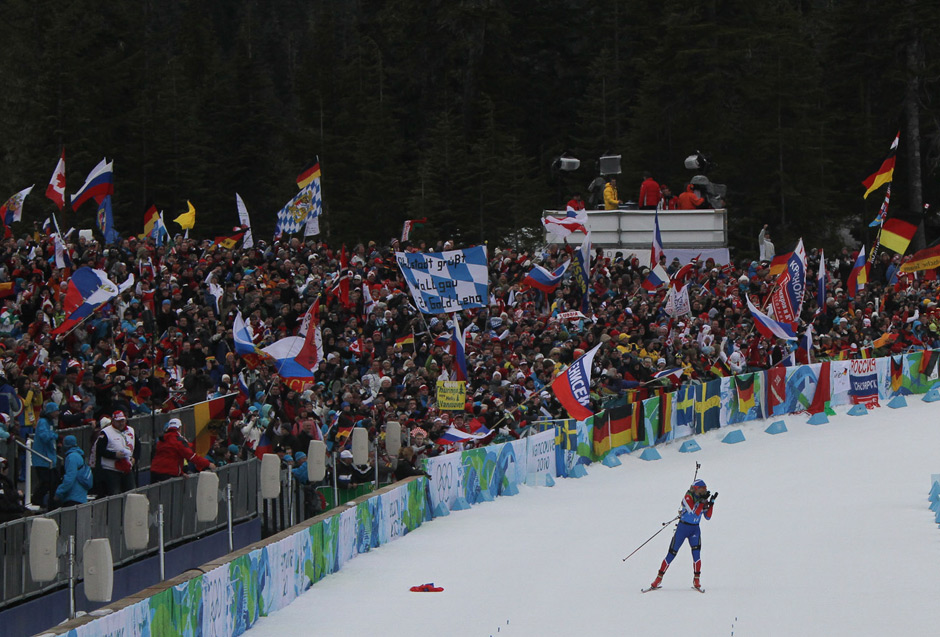
Much of the attention in the sport of Nordic Skiing will be paid to the prospects and the results of former Junior World Champion, Saveliy Korostelev, who spent the last two season skiing through the entire Russian field in all domestic races while also using nearly every event to beat up on former Olympic champion, Alexander Bolshunov. But even Korostelev might meet with additional scrutiny as he approaches Milano-Cortina. Recent articles describe Korostelev’s connections to the Russian military (through his mother, an officer in the Russian military and, herself, a medalist in Vancouver, 2010), a distinction that could render him ineligible for AIN status.
Keep your eyes open for elephants in the room . . .
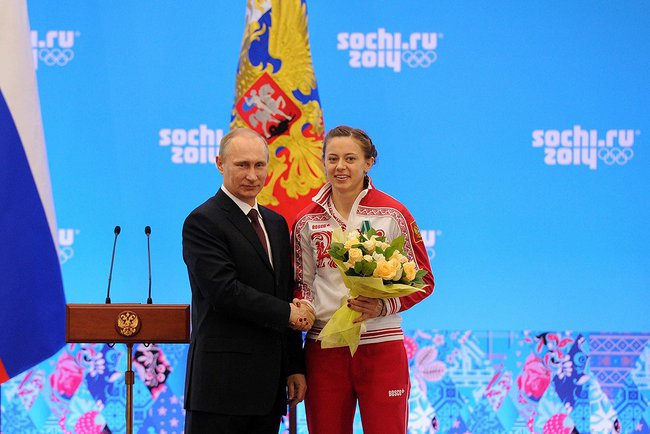
Biathlete Olga Vilukhina with Russian President Vladimir Putin on February 24, 2014, after the closing of the 2014 Olympics in Sochi. Vilukhina was one of many Russian athletes whose Socki results were nullified, whose medals were stripped, and who received a lifetime ban from Olympic competition (though parts of those penalties were later overturned after CAS review). (Photo: www.kremlin.ru/Creative Commons)
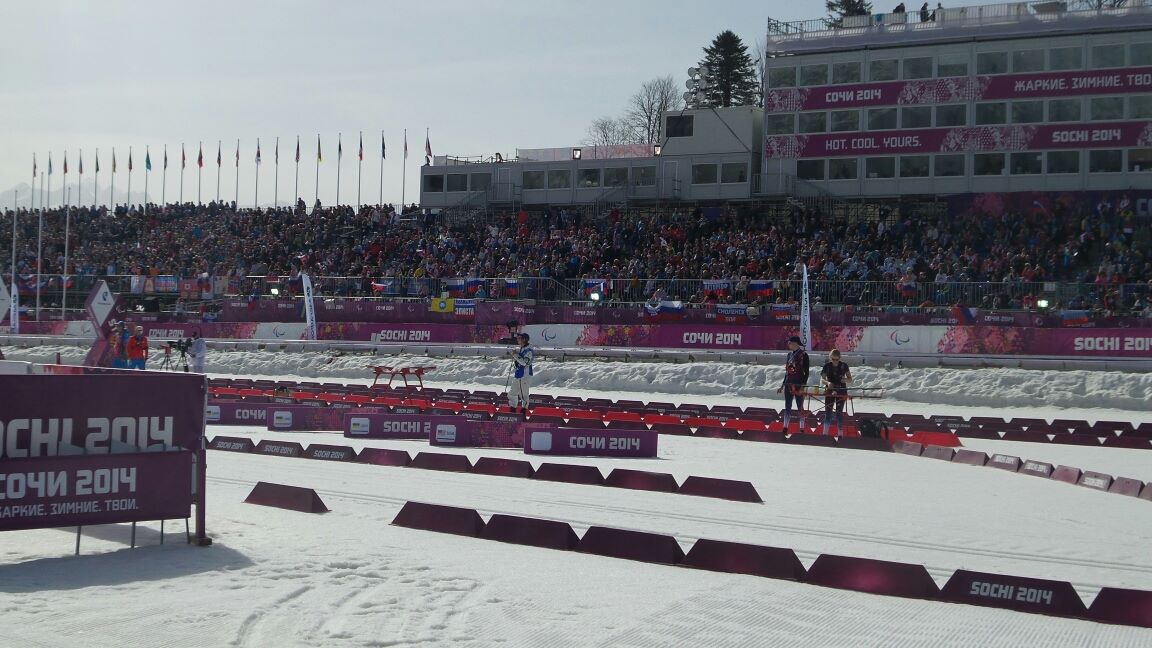
A packed cross-country stadium for the sprints at the 2014 Winter Paralympic Games in Sochi, Russia.
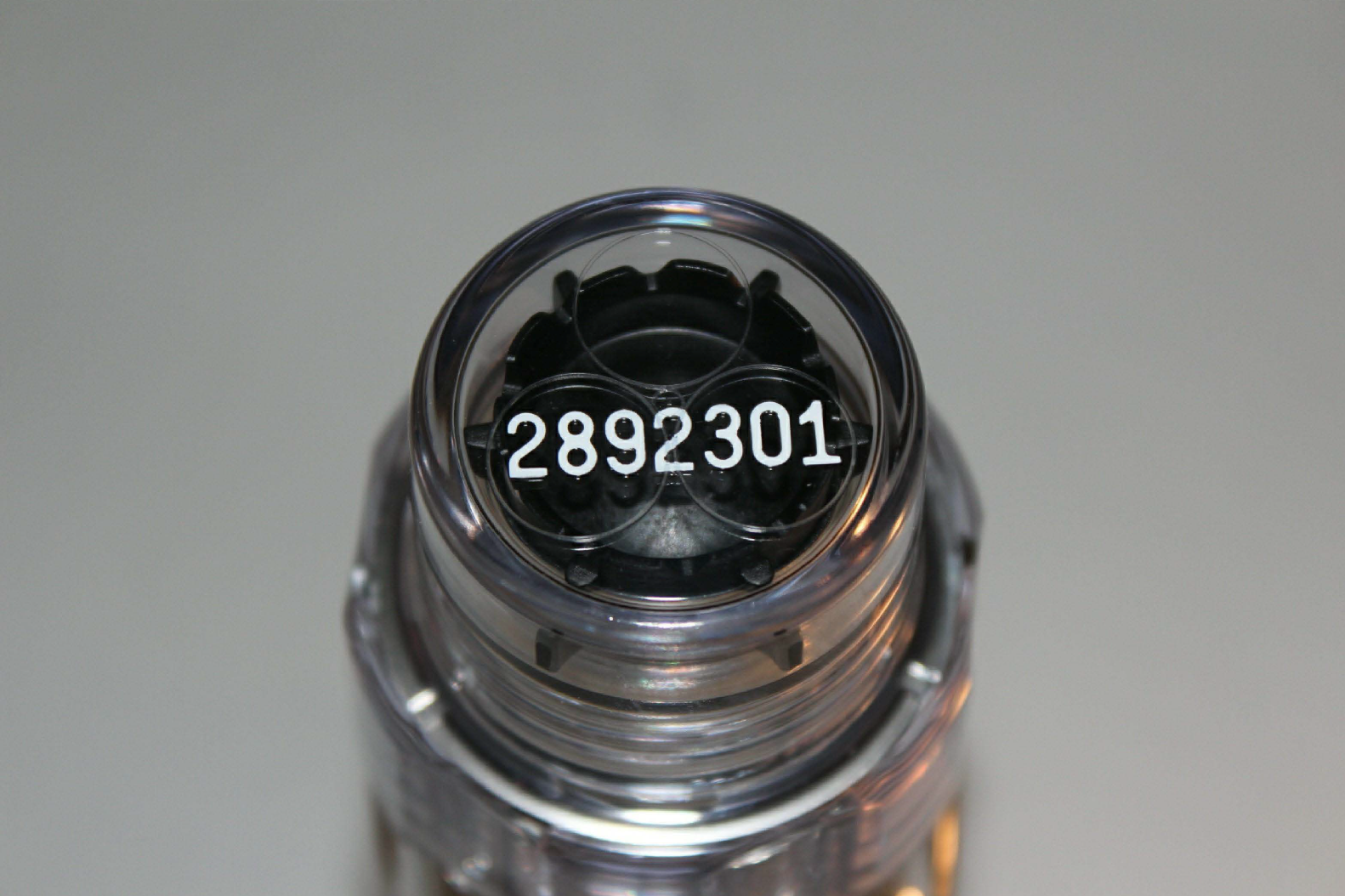
Anti-doping sample bottles belonging to seven Russian skiers at the 2014 Winter Paralympic Games were tampered with, according to the McLaren report.
Russian cross-country skiers won 12 gold medals, nine silver and 11 bronze at those Games. Some of the same athletes also helped win 12 gold medals, 11 silver and seven bronze in biathlon.
The report, which was commissioned by the World Anti-Doping Agency (WADA) and undertaken by Canadian law professor Richard McLaren, found that more than 1,000 athletes may have benefitted from tampering by Russian anti-doping authorities: either manipulation of samples, not reporting samples to WADA’s test-result database (ADAMS), or reporting positive tests as if they were negative.
Among the findings were that Russian staff had discovered a way to open anti-doping sample bottles, produced by the German company Berlinger and long assumed to be tamper-proof.
The sample bottle belonging to a Paralympic cross-country skier. (Photo: McLaren report)
The finding supported claims made by Dr. Grigory Rodchenkov, the former head of the Moscow Anti-Doping Laboratory, that at the 2014 Olympics in Sochi, Russia, he and others had unscrewed the lids of some sample bottles and replaced “dirty” urine with previously collected “clean” urine.
“As the start of the Games approached, Dr. Rodchenkov recalls that he was not confident the bank of clean urine was adequately organised and he asked the [state security service] FSB to see it,” McLaren wrote in his report. “… Dr. Rodchenkov was allowed access to the part of the Command Centre where the samples were stored. The room contained 3 or 4 full size freezer units. Inside were numerous shopping bags labelled with the athlete’s family name and he was advised they were filled with bottles of that athlete’s pre tested clean urine.”
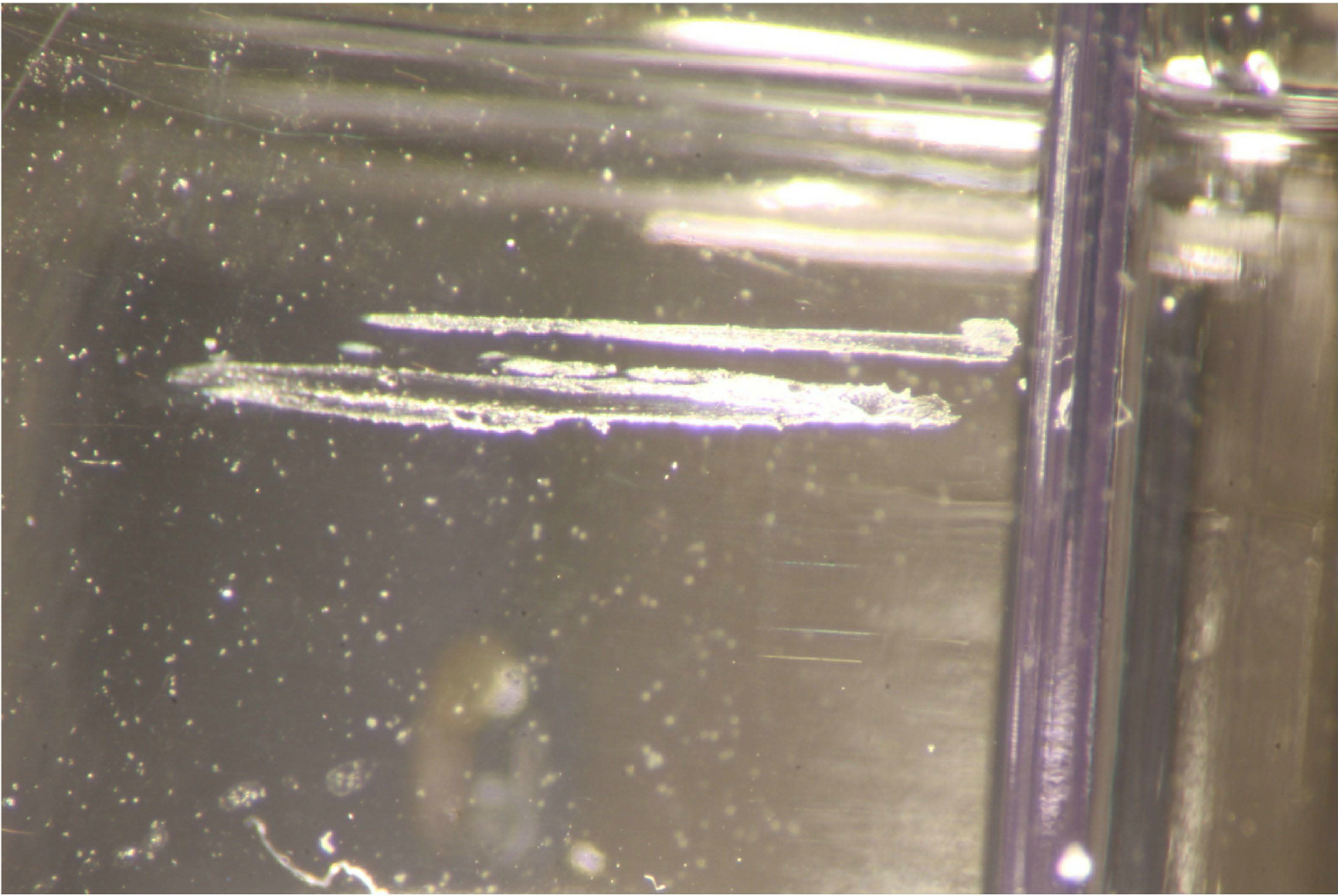
Scratched marks on the same bottle shown above. (Photo: McLaren report)
Based on those claims, McLaren commissioned an investigation by a British Forensic Firearms and Tool Marks Examiner. His or her (the name is redacted) report, which can be found here, details the normal working of the tamper-proof bottles.
The investigator came to the conclusion that the most likely way to open the bottles was to insert a thin metal or plastic object between the lid and the side of the bottle, and open the bottle from the inside. Depending on what type of material was used for this object and how carefully the bottles were opened, this procedure would leave marks on the bottle and/or lid, in some cases detectable only with a microscope or special lighting.
Almost all of the sample bottles sent to the examiner by McLaren showed these marks. Among them: 19 bottles belonging to seven different IPC cross-country skiers.
Athlete ID
Samples Named in Forensic Investigation
A0389
2890467, 2890467
A0469
2892301, 2889197, 2888781, 2890593
A0501
2891821, 2890557, 2889145, 2889128
A0546
2889181, 2890105, 2890786
A0656
2892161, 2891761, 2889127
A0704
2890874
A0705
2890793, 2892237
The sample numbers are also reported in another document in McLaren’s evidence packet, EDP1166. This document is a list of test numbers associated with athlete ID numbers.
“The IP has identified more than 1231 samples where the Moscow Laboratory communicated the presence of a prohibited substance in a Russian athlete’s sample to the [Ministry of Sport] and later reported that sample as negative in ADAMS or did not report the sample at all.”
EDP1166 lists those 1231 samples. In the cases of the Paralympic skiers’ samples, they are associated with the alpha-numeric code of an athlete, but nothing is listed as a substance for which a positive test may have occurred, and the sample is also not listed as being reported as either positive or negative to the ADAMS database.
Because this document was assembled to be a list of samples which were reported to the Ministry of Sport as being positive, it’s not clear what to conclude from this combination of facts.
Other than in the forensic report and this document, neither the samples nor athletes are mentioned anywhere else in the McLaren report’s extensive evidence packet. There’s not even any listing of whether the athletes are male or female.
The lack of a positive test result for any of these samples may be because there was previously-collected clean urine inside them, as described by Rodchenkov. Because no other discussion or information about the samples was found, it may never be known whether the athletes were actually doping or not; if replacing samples with previously collected urine was a policy, it may have been done without even testing to see whether the original samples themselves were clean.
Even without that information, however, this could lead to suspension of the athletes.
“246 athletes can be identified as potentially knowingly participating in manipulation thereby raising the possibility of a violation of WADA Code Article 2.5 (tampering),” McLaren wrote. “Athletes who provided clean urine to the CSP in advance, which was then swapped for a dirty sample, which he or she provided during the Sochi Games, could be in violation of Code Article 2.5.”
In a statement on its website, the International Paralympic Committee (IPC) wrote that “The full findings of the report are unprecedented and astonishing.” Russia has been suspended by the IPC since Aug. 7, 2016.
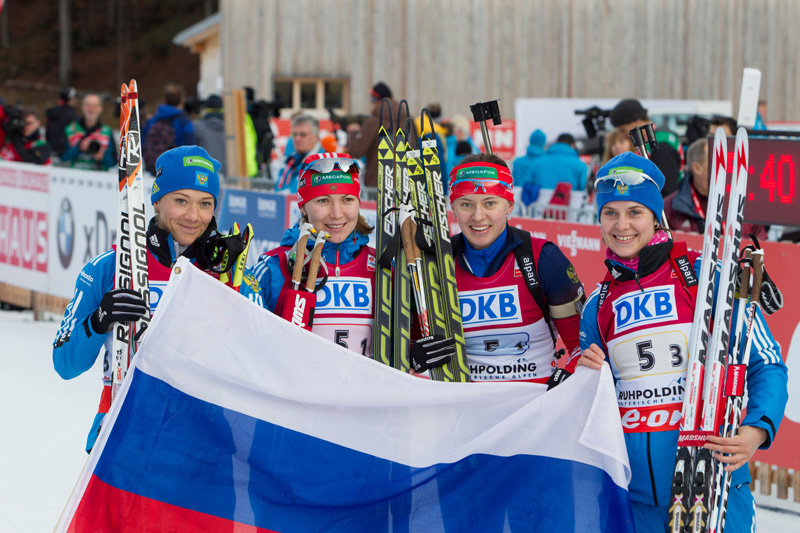
Olga Zaitseva, Ekaterina Glazyrina, Olga Vilukhina, and Irina Starykh celebrate their IBU World Cup biathlon relay victory in Ruhpolding, Germany in January 2014. (Photo: Fischer/Nordic Focus)
The International Biathlon Union (IBU) has received a list of 31 Russian athletes involved in doping, IBU President Anders Besseberg told Norway’s VG newspaper.
“Some of the 31 athletes are already banned, others have retired, but the most urgent thing is to assess the biathletes who are now participating in our international competitions,” Besseberg said. “I reckon that we on the board will make recommendations within a week… of those athletes who the Committee believes should be provisionally excluded.”
Some information about the athletes, however, can already be gleaned from the McLaren report.
For example, one document in the Evidence Disclosure Packet (EDP) failed to redact the names of four biathletes and replace them with alpha-numeric code identifiers. The four athletes were the planned roster for the women’s 4 x 6 k relay at the 2014 Olympics in Sochi, Russia: Olga Zaitseva, Olga Vilukhina, Yana Romanova, and Irina Starykh.
While the document identifying the women and their code numbers did not contain any evidence of doping, it means that any references to their code identifiers in other evidentiary documents can be connected to them.
For instance, such cross-referencing reveals that one of several samples deemed to be too dilute to be an authentic urine sample by the Drug Control Centre at King’s College London, used by the investigation for external analysis of suspicious samples, belonged to Romanova.
The team – with Ekaterina Shumilova replacing Starykh – won silver in the 4 x 6 k relay in Sochi.
Zaitseva retired after Sochi, as she had long planned to do. Romanova retired after the 2014/2015 season. Vilukhina took that year off and made an unsuccessful return last season, before announcing her retirement on November 14 of this year.
Nine other unnamed biathletes were shown in various documents to have tested positive for banned substances. In at least four of these cases, the results of the test were reported to the World Anti-Doping Agency’s ADAMS reporting database to be negative tests.
And at least 20 more athletes in the report belonged to biathlon, although in those cases there is no specific information about what substances they may have used.
Here is an extensive list of all the biathlon athletes mentioned in central documents from the evidence disclosure packet.
About the Documents
Professor McLaren (c) addressing the media after the his second report on systematic, state-sponsored doping in Russian summer and winter sports. (Photo: WADA/Twitter)
EDP1162 and EDP1149: Professor McLaren describes this document in his report: “Alexey Velikodniy created a daily competition schedule that identified protected athletes. The schedule was continuously updated during the Games and included all those on the Sochi Duchess List and athletes added during the Games, such as the female hockey team.”
EDP1149 includes English translation of the original EDP1162, and on page 44 of EDP1149 the names of the women biathletes are not redacted. Why redaction was successful in all other parts of the document, but not there, is questionable. Additionally, the document still seems to have been a planning document, as Staryk is still listed as competing in the relay even though she had long been off the Olympic team.
EDP1156: A list of sample numbers and collection during or immediately before the 2014 Olympics in Sochi, from protected national team athletes. Some data about the urine tests, like pH and specific gravity, are included, indicating that this was not merely a planning document but that the tests took place.
EDP1141: Results of a study done at King’s College London assessing whether the sodium concentration and specific gravity of some doping control samples were abnormal. (They were: in some cases, though none in biathlon, sodium concentrations were consistent with having added a teaspoon of salt to a one-cup urine sample.)
EDP1155: Translations of emails involving Grigory Rodchenkov, the former head of the Moscow anti-doping laboratory who became a whistleblower and took his story to the New York Times.
EDP1166: A list of test numbers, mostly associated with athlete ID numbers, identified by the investigation. “The IP has identified more than 1231 samples where the Moscow Laboratory communicated the presence of a prohibited substance in a Russian athlete’s sample to the [Ministry of Sport] and later reported that sample as negative in ADAMS or did not report the sample at all.” This document lists those 1231 samples.
There are columns for which substances were positive in the sample (this column is often blank) and how the report was filed in the ADAMS database. Many samples were filed as “negative”, but this column is also often left blank. This may mean that the sample was never reported in ADAMS at all – as McLaren says was fairly common – or simply that there was no information about it.
In general, the investigation’s translations from Russian into English are not always smooth. This is particularly apparent in reference to competitions: the name or level of a series is hard to interpret. It’s possible that the anti-doping staff themselves were not familiar with the different race circuits because they were not necessarily biathlon experts, and worked more generally in all sports.
A further note: some documents are scanned and thus not searchable by text. Thus some names and numbers may be referenced in places where we have not yet found them.
The Biathlon Relay Team
A0944, Olga Vilukhina
Olga Vilukhina won a silver medal in the sprint at the 2014 Olympics.
Why do we know her name? Listed in position “1” on pages 44 and 45 of EDP1149, in the 4 x 6 k relay
Evidence of being a protected athlete? Yes, in multiple documents (although those documents may be redundant; without metadata, it is difficult to tell).
Evidence that positive tests were covered up? Maybe. In EDP1166, one of Vilukhina’s samples (2870741) is listed as being reported “negative” to the ADAMS database and referred to in a document titled (in Russian) “Biathlon 3”, indicating a date of 06.01.2014 for the sample. But there is no substance listed for this sample in EDP1166. Because this document was assembled to be a list of samples which were reported to the Ministry of Sport as being positive, it’s not clear what to conclude from this combination of facts.
Other tests? Besides that one sample, there are several other samples listed for Vilukhina: urine samples collected January 31, February 9, and February 16, 2014, and a blood sample collected February 15, 2014. While the urine samples are referenced in EDP1166, no substances were listed and the test does not seem to have been entered into ADAMS. February 9 was the day of the women’s sprint in Sochi, where Vilukhina won a silver medal. February 16 was the day before the women’s mass start, where Vilukhina placed 21st.
A0983, Olga Zaitseva
Olga Zaitseva blows kisses to the crowd as she brings Russia the gold in the Olympic biathlon relay in 2010.
Why do we know her name? Listed in position “3” on pages 44 and 45 of EDP1149, in the 4 x 6 k relay
Evidence of being a protected athlete? Yes, in multiple documents (although those documents may be redundant; without metadata, it is difficult to tell).
Evidence of positive tests? Maybe. In EDP1166, one of Zaitseva’s samples (2870735) is listed as being reported “negative” to the ADAMS database. But there is no substance listed for this sample or date of collection and it is not referred to in any other documents. Because EDP1166 was assembled to be a list of samples which were reported to the Ministry of Sport as being positive, it’s not clear what to conclude from this combination of facts.
Other tests? Besides that one sample, there are several other samples listed for Zaitseva. Around the time of Sochi, urine samples were collected January 31, February 14 and February 19, 2014, and a blood sample collected January 31, 2014. An additional undated urine sample is referred to in EDP1166. For these samples, no substances were listed and the test does not seem to have been entered into ADAMS. February 14 was the day of the women’s 15 k individual, where Zaitseva placed 15th, and February 19 was the mixed relay, where the Russian team including both Zaitseva and Vilukhina placed fourth.
A0714, Yana Romanova
Yana Romanova competing in Kontiolahti, Finland, in 2010. (Photo: Peter Porai-Koshits/Wikimedia/Creative Commons)
Why do we know her name? Listed in position “4” on pages 44 and 45 of EDP1149, in the 4 x 6 k relay
Evidence of being a protected athlete? Yes, in multiple documents (although those documents may be redundant; without metadata, it is difficult to tell).
Evidence of positive tests? The report from King’s College London indicates that one of Romanova’s samples (number 2889617, collected on February 2, 2014, just before the Sochi Olympics began, according to another document) was too dilute to be an authentic sample. In the report and the New York Times investigation, Rodchenkov described adding water or salt to samples that were being manipulated. The King’s College London test suggests that this may be one such sample.
In EDP1166, one of Romanova’s samples (2870745) is listed as being reported “negative” to the ADAMS database. But there is no substance listed for this sample or date of collection and it is not referred to in any other documents. Because EDP1166 was assembled to be a list of samples which were reported to the Ministry of Sport as being positive, it’s not clear what to conclude from this combination of facts.
Other tests? Besides those two samples, there are several others listed for Romanova. Around the time of Sochi, urine samples were collected January 31, February 2, 13, and 21, 2014, and blood samples collected February 14 and 15, 2014. An additional undated urine sample is referred to in EDP1166. For these samples, no substances were listed and the test does not seem to have been entered into ADAMS. February 14 was the day of the women’s 15 k individual, where Romanova placed 53rd, and February 21 was the day of the women’s relay.
A0856, Irina Starykh
Targeted testing based on data from the IBU’s Athlete Biological Testing program led to the suspension of Irina Starykh, above on her way to fifth place in the World Cup pursuit in Hochfilzen, Austria, in 2013, and another Russian biathlete for blood-doping. The IBU fined Russia for a cluster of doping cases.
Why do we know her name? Listed in position “5” on pages 44 and 45 of EDP1149, in the 4 x 6 k relay
Evidence of being a protected athlete? Yes, in multiple documents (although those documents may be redundant; without metadata, it is difficult to tell).
Evidence of positive tests? In EDP1166, two of Starykh’s samples (2870740 and 2870745) are listed as being reported “negative” to the ADAMS database. But there is no substance or date listed for either sample, and they are not referred to in any other documents. Because EDP1166 was assembled to be a list of samples which were reported to the Ministry of Sport as being positive, it’s not clear what to conclude from this combination of facts.
Other tests? No tests are listed for Starykh at the Sochi Olympics, because she was not there. However, there are five more samples of hers listed in EDP1166, for which no substances were listed and the test does not seem to have been entered into ADAMS.
Other Athletes with Positive Tests Described in Documents
Thirty-one other athlete ID numbers are associated with the sport of biathlon, and three additional mentions of biathletes which are not associated with any ID number. This means that they could belong to some of the 35 numbered athletes (the four named women plus the 31 unidentified, but numbered, athletes), or they could be completely separate cases.
Of those 31-34 other biathletes, here are the ones for whom positive tests for prohibited substances are explicitly mentioned in the documents.
A0241, female
Evidence of being a protected athlete? Maybe. This athlete was certainly competing internationally. By the time Russian anti-doping staff were discussing her case, she was in Ruhpolding, Germany, and then was set to travel to Antholz, Italy – consistent with the World Cup schedule – before checking into the Olympics. This plan does not seem to be jeopardized by her positive test, although the staff notes that she is at risk. After the positive test, Rodchenkov notes that “it is necessary to hide her immediately.”
Besides the four athletes named above, Shumilova competed in Sochi, along with Olga Podhufarova and Ekaterina Glazyrina. Several others were competing on the World Cup, but were unlikely to have been slated for Sochi participation because they did not have strong results so far in the season – the possible exception being Ekaterina Yurlova.
Evidence of positive tests? In EDP1166, this athlete’s sample (2866518) is shown as testing positive for methenolone, oxandrolone, and trenbolone, all anabolic steroids. The test was allegedly collected on 12.19.2013 in Izhevsk, Russia, at the biathlon championships.
How was the test handled? In the emails, which you can see in Russian here, this sample is given a “save” order, meaning that it should be reported as negative. And in EDP1166, the sample is shown as being negative in ADAMS. She may have additionally been quarantined: the anti-doping staff write in emails that if she was to be subjected to an international test (for instance, but the International Biathlon Union), she would certainly test positive and it would be “a very ugly situation for the lab if we ‘found nothing’ in such concentrations and for those substances.”
Other tests? In EDP1166, two of this athlete’s samples (2870746 and 2867708) are listed as being reported “negative” to the ADAMS database. But there is no substance or date listed for either sample, and they are not referred to in any other documents. Because EDP1166 was assembled to be a list of samples which were reported to the Ministry of Sport as being positive, it’s not clear what to conclude from this combination of facts. An additional blood test is listed in EDP1166 with no substances listed, and the test does not seem to have been entered into ADAMS.
Unnumbered Athlete, male
Evidence of being a protected athlete? No. The only other information about this athlete is that it was a man.
Evidence of positive tests? The emails refer to this athlete’s sample (2759623) being positive for 16a-hydroxyprednisolone (budesonide metabolite). Budesonide is a corticosteroid which is used in asthma medications such as Pulmicort inhalers, but it is also used in other forms: as pills, nasal sprays, and as a rectal foam to treat intestinal problems. The sample is written to have been collected on 11.1.2013 at in international competition in Ostrov, Russia. That day, IBU Cup sprints were held in Ostrov, with three Russian men (race winner Alexey Slepov, plus Sergey Korastylev and Sergey Klyachin) in the top six.
How was the test handled? There’s no information about how this test was handled. It is discussed in the email, but no conclusion is reached. It also does not appear in EDP1166.
Other tests? None listed.
A0028
Evidence of being a protected athlete? There’s no other information about this athlete.
Evidence of positive tests? In the emails, athlete A0028 is described as having tested positive for “methandienone circuit” at the Russian biathlon championships in Uvat on 31.07.2014. It’s unclear what “circuit” refers to – it may be an awkward translation – but methandienone is an anabolic steroid. In addition, the testosterone to epitestosterone ratio is listed as 6.2. A high ratio can indicate that an athlete was using exogenous testosterone, and a finding of a ratio above 4.0 triggers further investigation. The original email can be seen (in Russian) here.
How was the test handled? In the emails, the word “Quarantine” appears above the description of this athlete’s test results. This likely means that the athlete was kept in Russia until they could pass an anti-doping test. There’s no information about whether the test was reported to the ADAMS database or not.
Other tests? None listed.
A0179, female
Evidence of being a protected athlete? No. The only other information about this athlete is that it was a woman.
Evidence of positive tests? Document EDP1166 states that on 09.28.2014 at Russian biathlon championships in lzhevsk, a sample tested positive for isomers of amphetamines, which are banned stimulants. There is also discussion of the sample in the emails, with someone writing, “find out what she took!” The group seems to suspect that the substance came from a dietary supplement. The email (in Russian) can be seen here.
How was the test handled? In the emails, this case is listed with a “save” order: that means that a positive test should be turned into a negative one. Indeed, document EDP1166 states that this test was reported as negative to the ADAMS database.
Other tests? None listed.
A0461, male
Evidence of being a protected athlete? No. The only other information about this athlete is that it was a man.
Evidence of positive tests? EDP1166 shows that one of this athlete’s samples (2867705) tested positive for tuaminoheptane, a prohibited stimulant which is used in nasal decongestants. The emails (here) show that this sample was collected on 12.21.2013 at a Russian Cup race in lzhevsk.
How was the test handled? The emails are unclear, with someone writing, “and this one still does not have a decision (or I missed it).” However, in EDP1166 the test is listed as having been reported to ADAMS as negative.
One staff member, perhaps assumed to be Rodchenkov, writes this regarding the sample: “Alex, come on, I’ll close the whole shop… They are imprudent beyond measure… and then I will go to other laboratories after February 2014.”
Other tests? In EDP1166, two of this athlete’s samples (2918636 and 2870699) are listed as being reported “negative” to the ADAMS database. But there is no substance or date listed for either sample, and they are not referred to in any other documents. Because EDP1166 was assembled to be a list of samples which were reported to the Ministry of Sport as being positive, it’s not clear what to conclude from this combination of facts.
A0751, female
Evidence of being a protected athlete? No. The only other information about this athlete is that it was a woman.
Evidence of positive tests? EDP1166 shows that one of this athlete’s samples (2945500) tested positive for pthalates, which are plasticizers. They are prohibited because they are thought to indicate the use of blood transfusions, with the plasticizers being used to soften the plastic in blood bags and then diffusing into the blood. The emails show that this sample was collected on 09.28.2014 at Russian biathlon championships in lzhevsk, That email (in Russian) can be seen here.
How was the test handled? EDP1166 shows that this test was reported as negative to ADAMS.
Other tests? None listed.
A1244, male
Evidence of being a protected athlete? No. The only other information about this athlete is that it was a man.
Evidence of positive tests? The sample (2868394) is not listed in EDP1166, but only discussed in the emails (in Russian here). The emails refer to a positive test for trimetazidine, a metabolic modulator which protects against angina and heart problems, much like meldonium. According to the emails the sample was collected in Uvat at Russian biathlon championships on 6 April (assumed to be 2014).
How was the test handled? There’s no information about how this test was handled.
Other tests? None listed.
Unnumbered Athlete, male
Evidence of being a protected athlete? No. The only other information about this athlete is that it was a man.
Evidence of positive tests? In the emails, one of this athlete’s samples (2689927) is written to contain methylhexanamine, a banned stimulant common in dietary supplements (it is in fact the same substance which German biathlete Evi Sachenbacher-Stehle tested positive for at the 2014 Olympics). The sample was collected on 2012-12-17 at all-Russia competitions in Ekaterinburg.
How was the test handled? There’s no information about how this test was handled. In the emails, it is clear that nothing was done about the test until the following year (2013), but the final action is not discussed. It also does not appear in EDP1166.
Other tests? None listed.
Unnumbered Athlete, male
Evidence of being a protected athlete? No. The only other information about this athlete is that it was a man.
Evidence of positive tests? One of this athlete’s samples (2746493) is discussed in the emails as having tested positive for furosemide, a diuretic and masking agent. The sample was collected on 01/09/2013 at all-Russia competitions in lzhevsk.
How was the test handled? There’s no information about how this test was handled. Other than reporting the sample, there is no discussion of the test in the emails, and also does not appear in EDP1166.
Other tests? None listed.
Other Athletes Mentioned in the Documents
For the rest of the biathletes, sample numbers are listed in EDP1166, but no substances are listed and positive tests are not discussed described in any of the other documents. Because EDP1166 was assembled to be a list of samples which were reported to the Ministry of Sport as being positive, it’s not clear what to conclude about the samples.
Here is what we know about them.
ID Number
Gender
Samples reported as negative
Samples with no information about reporting
A0023
Male
2869722
A0136
Male
2870692
A0157
Male
2867964
A0201
Female
2869837
A0232
Male
2870747
2889906, 2890603, 2890739, 2944467
A0282
Female
2866843
A0321
Female
2868243
A0491
Male
2870733
857444 (blood)
A0508
Male
2868236
A0521
Male
2870742
857581, 857105, 857600
A0548
Female
2869752
A0567
Female
2867862
A0576
Male
2866527
A0579
Female
2870697
A0598
Female
2847214
A0639
Female
2869643
A0640
Male
2869203
A0687
Male
2867881
A0795
Male
2870739
2944657, 2890878, 2890855, 2889922, 2889808
A0804
Male
2869859
A0808
Female
2870743
857613 (blood)
A0930
Male
2870744
857573, 857440 (blood)
A0950
Male
2870748
A1031
Male
2869912
In addition:
A0142, male
Mentioned in EDP1166: Sample 2916590 is listed as having been reported as negative in the ADAMS database. There is no information listed about substances in the sample.
Other mentions: The same sample is described in an email which does not seem to have been translated into English. The sample was collected on 2014-07-17 in Toksovo, outside of Saint Petersburg.
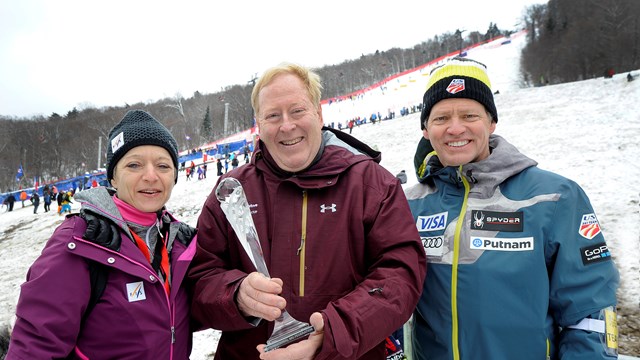
More lighthearted times: USSA CEO Tiger Shaw (r) with FIS Secretary General Sarah Lewis (l) and FIS Journalist of the Year Peter Graves (c) at the Killington Alpine World Cup nearly two weeks ago in Killington, Vt. (Photo: FIS)
Tiger Shaw, CEO of the United States Ski and Snowboard Association (USSA), was one of them.
“I am shocked by the level: the number of individuals colluding is shocking,” he said in an interview on Friday. “How anybody could have ever thought that something like this could be secret forever is incredible.”
Shaw said that in some USSA disciplines, there are no Russian athletes competing at a high level, so he expected past competition results to remain more or less unchanged.
For others, however, the implications were bigger. Cross-country skiing clearly falls into that category.
“Obviously it’s going to have an impact in terms of the athletes, where the results will be changed and their medals taken away and they will be banned,” Shaw said. “I presume that the federations will have to make all these decisions.”
The sport “skiing” appears 75 times in the Schedule of Samples and ADAMS Reports document that is part of the McLaren Report’s evidence package. McLaren and the World Anti-Doping Agency (WADA) have anonymized the athlete names, so lines of data cannot be linked to any individual athlete.
While the discipline is sometimes further delineated, for example as “skiing | cross country” (or “cross country skiing” – there is no consistent rule for terminology) it is difficult to tell how many data points correspond to which disciplines. Some entries are also labeled as “Skiing – IPC Cross Country”, but many just say “skiing”, leaving uncertainty as to whether they are from able-bodied or para-nordic competitors, regardless of the discipline.
Many of these 75 data points do not have information about what substances were detected in the samples, if any. But some clearly do: one for the blood-doping drug erythropoietin (EPO); another for a high ratio of exogenous testosterone; yet another for budesonide, a corticosteroid used in inhalers; and another for trimetazidine, a heart drug which, like meldonium, is a metabolic modulator which combats angina.
Another athlete tested positive for “phthalates”, plasticizers which are sometimes used in IV bags and are often assumed to indicate blood transfusions. They are also, however, present in other kinds of packaging.
In all of these cases the results were reported to WADA’s anti-doping test management system, ADAMS, as negative tests: no prohibited substances found. Translated emails used in the investigation also refer to some of these cases, showing that they were discussed between personnel who were supposed to be enforcing anti-doping rules.
The information has been forwarded from WADA to the 32 international sports federations (IFs) where athletes were implicated in the report, and has also been forwarded to the International Olympic Committee (IOC). It is up to those organizations to sift through the information and determine penalties and suspensions, or decide to do further investigation.
Shaw believed that the International Ski Federation (FIS) was taking the report seriously.
“I think they are going to take pretty swift action,” he said. “There are a large number of athletes that have to be dealt with. There’s no question that they will take swift and efficient action… our place is as a stakeholder and a component of international governance. Our role at the FIS level is that [USSA Board Chair] Dexter Paine is one of the vice presidents. So it’s a pivotal day and there’s a lot of work to be done.”
Some work was short-term, he said: determining sanctions for athletes implicated in the report.
But other work was long-term, in terms of dismantling the system which led to such systematic cheating in Russia.
Meanwhile, an increasing number of competitions were implicated in the coverup, some of which occurred after the 2014 Olympics, which was the catalyst and main focus of the report.
That has led U.S. and Canadian athletes in luge and skeleton to discuss a boycott of competitions held in Russia this year. Shaw said he understood their position. FIS has World Cup events in almost every discipline scheduled for Russia this season, and in mid-October FIS President Gian Franco Kasper said that Russia could be stripped of its right to hold those competitions depending on the outcome of the McLaren report.
“I don’t think anybody feels safe about being there, being in a country that had this high level of collusion,” Shaw said. “Each sport and each country is going to have to deal with it in their own way. For that, we work closely with the [United States Olympic Committee] and our athletes.”
Far from regretting if U.S. athletes spoke out on the doping issue, Shaw seemed to be relieved that more and more, they are doing so.
“The bottom line is that we absolutely stand behind, and believe in, clean sports and clean athletes,” Shaw said. “So we will stand behind any effort and make any effort in the long term to make sure that happens. And that means, to a degree, working through the system we have now, and working to help change it for the better, which a lot of people are trying to do, including, it sounds like, an increasing number of athletes. Thank goodness they are speaking up because it’s all about them in the first place, isn’t it?”
“The bottom line is that we absolutely stand behind, and believe in, clean sports and clean athletes. … Thank goodness they are speaking up because it’s all about them in the first place, isn’t it?” — Tiger Shaw, USSA President and CEO
Meanwhile, many Russian athletes likely implicated in the report are on the start lists for international competitions this weekend.
Shaw said that his message to U.S. Ski Team athletes was that they should continue to focus on excelling, and doing so clean.
“They put their heads down and they go out and race,” he said. “Due process must be followed…. Justice is going to be served, but any individual athlete, they have to take the longer view on how they can help change the system.”
Some were already doing just that.
“I’m going to take tomorrow to focus on the races and try to do a better job of processing and understand the Mclaren report after the race on Sunday,” cross-country skier Sophie Caldwell wrote in an email on Friday afternoon.
Russia’s Nikita Kriukov (l) and Alexander Panzhinskiy placed first and second in the men’s sprint at the 2010 Olympics in Vancouver, B.C. Russian Minister of Sport Vitaly Mutko recently told Russian media that the entire cross-country ski team was doping at those Olympics: “Of course, I knew all about this, they were all doing the doping,” he said. There are several ways in which the team allegedly avoided positive doping tests.
Allegations in the documentary opened a new possibility for how Russian sports officials avoided positive tests by doped athletes: did they use the Anti-Doping Administration and Management System, ADAMS, to learn when their athletes would be tested and warn staff who might be able to help athletes avoid positive tests?
“The ADAMS doping control database provided to [Anti-Doping Organizations] is an essential tool for managing both an in- and out-of-competition doping control program,” the World Anti-Doping Agency (WADA) explains on its website. “Coordination of doping control programs in the ADAMS system helps to avoid duplication of testing efforts and harmonizes communications between testing authorities, sample collection agencies as well as WADA accredited laboratories.”
But it may have been used for something else.
Government Interference
The 35-minute piece put together by journalist Hajo Seppelt primarily focused on what Russia should have to do in order to send athletes to the upcoming 2016 Summer Olympics in Rio de Janeiro, Brazil.
After widespread indignation over the last year about rampant doping in Russia, Seppelt questioned whether Russia was making a good-faith effort to change. Collusion had been revealed in several of his previous documentaries, as well as by pieces in The New York Times, Sunday Mail, 60 Minutes, and by the World Anti-Doping Agency Independent Commission.
This time, Seppelt revealed more than ever about the involvement of the Ministry of Sport and specific government officials in covering up doping so that Russian athletes could compete – with great success – on the international stage.
Buried in the documentary was an allegation that for two winter sports, the Ministry of Sport had worked to warn coaches and athletes before visits from doping control officers.
The allegations involved Minister of Sport Vitaly Mutko and his anti-doping advisor Natalia Zhelanova, and came from a document signed by Grigoriy Rodchenkov, the former head of the Moscow anti-doping laboratory who has since fled to the U.S. and cooperated with The New York Times.
“Zhelanova deliberately evaded and undermined Test Distribution Plans of [International Ski Federation] and [International Biathlon Union]. Usually, RUSADA was informed two or three days before their [doping control officers] should collect samples from the Russian national team. [Name redacted] immediately notified Zhelanova, then the latter notified Head coaches, and the national team had change location, just escaped.”
Zhelanova was a member of the WADA Finance and Administration Committee from 2010 until 2015.
The documentary notes that not everyone approved of this policy. RUSADA Executive Director Nikita Kamaev apparently registered his concern, telling Zhelanova that “RUSADA was losing credits” in terms of respect and credibility.
The ADAMS system is used by anti-doping agencies for a variety of purposes. One of the main uses is for athletes to report where they are living, training, or staying, a so-called “whereabouts” report.
If a doping control officer comes for a visit and the athlete cannot be located where they said they would be, it is considered a whereabouts violation. Three such violations over the course of 12 months can lead to a suspension from competition.
But another use of ADAMS is for the multiple authorities which test athletes to report and coordinate their efforts. For instance, an athlete is subject to testing by both their international federation and their national anti-doping organization.
“Where reasonably feasible, testing shall be coordinated through ADAMS or another system approved by WADA, in order to maximize the effectiveness of the combined testing effort and to avoid unnecessary repetitive testing,” the 2015 World Anti-Doping Code states.
This use of the system actually addressed complaints by athletes that they were tested to often and too disruptively, according to International Biathlon Union (IBU) Vice President for Medical Issues Jim Carrabre.
“Each nation has access to that data for their national athletes in the IBU test pool so that we minimize the probability of having two separate test authorities test an athlete on the same day,” he wrote in an email. “We each could still choose to do this if we wished but the benefits would be minimal. This was earlier a major complaint by athletes from many countries, and this access in ADAMS improved this complaint immensely.”
FIS Anti-Doping Administrator Sarah Fussek explained the use of the ADAMS system slightly differently.
“If you do register an exact mission in ADAMS beforehand, another organisation can only see this planned testing if the testing organisation has set explicit access in ADAMS for this purpose for each individual organisation,” she wrote in an email on Saturday. “At FIS this is currently not the case for any [national anti-doping agency] and vice versa.”
FIS does register tests in ADAMS once they have been completed.
But he confirmed that all of the tests ordered by the IBU were not only carried out by RUSADA, historically, but were also entered into ADAMS where RUSADA could access them.
“RUSADA could therefore notify internally any one if they had intentions of cheating the system,” he wrote. “This could have occurred but they would have had to check the system regularly if they wanted to know IBU test plans on Russian athletes when they were tested outside Russia. I presume that this was not done or otherwise we would have not caught the ones that we did.”
That’s why even aggressive testing by international federations could have been circumvented by individuals or agencies in Russia: whereabouts violation in reverse.
And, if this was the mechanism used by Zhelanova to warn teams before testing occurred, it could potentially have jeopardized testing by any international federation using ADAMS to pre-register its tests with the national anti-doping organization, as was encouraged by WADA.
Aggressive Testing, For Good or For Naught
Some federations have had concerns about Russian anti-doping efforts for years.
The International Ski Federation (FIS) caught a number of Russian cross-country skiers doping in the mid- to late-2000s, and in June 2010 sanctioned the Russian Ski Association. After fining the federation $185,000, FIS declined to press further sanctions and in November 2010 wrote in a press release that the federation had taken “positive steps” in anti-doping.
At the same time, FIS was avoiding relying on RUSADA to carry out testing missions to a large extent, instead relying on companies which train doping control officers and do the sample collection themselves.
“There was quite a lot of testing missions which were coordinated with [the Russian Anti-Doping Agency, RUSADA], but most were carried out by the FIS-appointed doping control agency with their own personnel and equipment,” FIS Secretary General Sarah Lewis explained to FasterSkier in May. “Most samples were transported to a different laboratory, in Lausanne or Cologne or somewhere else. We weren’t in the position that they could be manipulated in the Moscow laboratory.”
In an email on Thursday, FIS Anti-Doping Administrator Sarah Fussek said that the organization also did not usually notify RUSADA if and when tests were going to take place.
“With the exception of a handful missions, testing in Russia was carried out by a private sample collection provider,” she wrote. “We did have a couple of joint missions some years. Otherwise FIS testing did not give notice to RUSADA when conducting missions within Russia.”
As such, Fussek was confident that the FIS testing program was adequate to ensure that Russian athletes were mostly not cheating.
“Keeping in mind that you can never guarantee that every athlete is clean, we strongly believe that our programme covered testing in the country well and that we did all possible efforts to achieve a regular at home testing on Russian athletes (who most time of the year travelling on the World Cup circuit, plus training camps outside Russia and are tested there regularly as well),” she wrote.
“In the years three years prior to Sochi, the new administration in [the Russian Biathlon Union], Mr Mikhail Prokorov and Mr Sergei Krushenko, were verbally and financially committed to antidoping,” Carrabre wrote. “I had personal meetings with them and they went from one of the countries with the least number of internal antidoping tests to the country with the most number of internal tests in IBU. This effort was appreciated by myself and IBU and was, in my opinion, a large step in the right direction. I even publicly commended the RBU for this action. As I also said publicly, the number of tests does not always equal quality tests so the IBU would not decrease its efforts despite the testing of the RBU.”
The increased number of tests did catch some regional-level athletes, but no Russian Biathlon Union testing ever led to the suspension of a national-team athlete.
IBU testing, however, did, in particular when they tested outside of Russia. As Fussek had noted, athletes spend almost the entire winter, as well as periods of the offseason, training and competing in Europe, offering ample time to take many anti-doping samples.
“No national or international level athletes were ever found with their testing,” Carrabre said of the Russian Biathlon Union. “It was therefore surprising that the IBU would catch several of their athletes in the year prior to Sochi with testing performed outside of Russia while their athletes were at international training camps.”
Superficial Admissions of Guilt
The Ministry of Sport denied that they had interfered with RUSADA business in any way – or that such interference would even be possible.
“How can I exert influence there?” Mutko asked, rhetorically, in the new ARD documentary. “What influence can we exercise on the personnel of the anti-doping organizations?”
Just two days before the documentary aired, Zhelanova had done a question-and-answer session on Twitter, where she stressed that Russia was changing. The full exchanges from June 6 can be found on her twitter feed.
And Zhelanova seemed to admit that even today, it is difficult for doping control officers to do their jobs. U.K. Anti-Doping, which took over testing in Russia after RUSADA was stripped of its authority, reported in May that 40 percent of the tests it was supposed to carry out were impossible because they couldn’t locate the athlete.
Evading a sample or refusing to give a sample are both considered Anti-Doping Rule Violations, the same as a positive test or three missed whereabouts.
The current procedure for testing seemed to still be under negotiation. U.K. Anti-Doping had reported that Russia requested 30-day notice before testing of any athletes in military areas, which is clearly not standard operating procedure in the world of anti-doping.
“We agreed a procedure with WADA to help doping inspectors to carry out their important jobs,” Zhelanova tweeted in response to Rachel Axon of USA Today.
But what is there to discuss? In 2006, the Russian Federation ratified the International Convention Against Doping in Sport, under the purview of the United Nations Educational, Scientific, and Cultural Organization (UNESCO).
Article 12 states,
“States Parties shall, where appropriate:
(a) encourage and facilitate the implementation by sports organizations and anti-doping organizations within their jurisdiction of doping controls in a manner consistent with the Code, including no-advance notice, out-of-competition and in-competition testing…”
The 2015 World Anti-Doping Code further states that “Each government will take all actions and measures necessary to comply with the UNESCO Convention.”
After the documentary aired on Wednesday, Zhelanova was less than thrilled.
“I was very upset and disappointed by the allegations made against me in the recent @ARDde documentary,” she stated in a series of tweets. “These claims are untrue and are made by 1 disgraced person who disagreed with me on the importance of fair & clean sport. I really believe in the fight against doping and dopers and am doing everything I can to create change and restore trust. Reforms are under way but our system won’t be perfect immediately – cultural change takes time.”