Tag: Adaptive

  • How Paralympians Train: Interview with Sean Halsted

    Sean Halsted trails Dan Cnossen in the 12 k sit ski at 2012 U.S. Nationals in Rumford, Maine.

    With the 2012 Paralympics starting in London in roughly a month, adaptive athletes who compete in summer sports are putting the finishing touches on their trainings. And winter athletes, too, are hard at work, training just as intensely as their able-bodied counterparts, if a little bit differently.

    This spring in Bend, Oregon, FasterSkier chatted with Sean Halsted, a veteran member of the U.S. national team who finished seventh, ninth, and tenth in the sit-ski races at the Vancouver Paralympics. A college rower at Washington State who went on to join the Air Force, Halsted fell from a helicopter in 1998 and was paralyzed from the waist down. He started skiing in 2001 and is now one of he team’s stalwarts.

    It’s no secret that sit skiers need an efficient and powerful double pole to get around a race course – and then best move very, very fast (in 2011, FasterSkier posted a video of Halsted starting U.S. Nationals). But besides adapting technique to best accommodate the different angle with which they plant their poles, adaptive athletes are also challenged by coming up with a training plan that prepares them physiologically without wearing out a few key sets of muscles.

    The following is an edited excerpt from a longer interview.

    FasterSkier: Do you do the same kind of periodization that the able-bodied skiers do throughout the year?

    Sean Halsted: Yes. And the interesting part is trying to mirror that on the adaptive side, with how much volume is good volume is good volume, how much strength is good strength. For example, we’re talking about doing a great workout, but then you need to do an alternate workout [in the afternoon] using the same muscles? You can’t go for a run. You can’t switch it up to do the lower body. It’s all upper body.

    FS: What’s a typical workout for you guys in the spring here in Bend?

    SH: Out here, we try to get on snow and maximize that snow time. There’s a lot of that technique that you have to get down, and a lot of us just don’t have it. It’s not so much – I’d like to say that standing on skis is a lot harder than a sit ski, but there’s things about that sit ski that are harder than standing. And I think part of what that comes down to is the frustration level, in that you see a hill, and my hill is nowhere near what a standup skier thinks of as a hill. Turns, a standup skier doesn’t even think of it as a turn, but I think of it as a challenge. So you have to be comfortable with how that ski works on a downhill, on an uphill, what does the pole plant mean, you have to have a much more efficient double pole than a standup skier could get by with.

    FS: So you’re just trying to get as many hours on snow as you can?

    SH: Pretty much. You’re trying to maximize that with your strength workouts and your endurance workouts. You’re trying to do it on snow, and then saying, okay, you just did a strength workout, do you have enough strength in your arms to do something in the gym?

    FS: If you’re skiing a lot in the mornings, what do you do in the afternoons?

    SH: It’s been nice because the Athletic Club of Bend has opened their doors for us, and they have also been very accommodating. You basically go in and they ask what you want, and they try to make it happen, which is really cool. We’ve been at places before where the place wants to be accommodating, but how? They don’t know what you need, so they just wait for you to ask, and you don’t know what they have to offer. Maybe it’s a hotel and they say they have a weight room, but their weights are ten pounds and the room is the size of a closet.

    So having the gym in town, they have a big weight room, they have cardio stuff that we can use, they have a SkiErg. It just gives you so many opportunities. They have tennis courts, even. Not that we’d play tennis, but it’s a big flat surface that you can use, and that you can’t really replicate anywhere else. They have a pool, which is what I’ve found is one of the best cross-training things. I’ve really fallen in love with swimming.

    FS: So is it just based on how you feel each afternoon, you have to figure out what your body is capable of doing?

    SH: They give us a schedule, and then you do a little bit of, “what can I do?” Yesterday was an alternate workout, just an easy workout, something. So I went in and went swimming. And then I meandered and saw what was available, and did some stretching.

    FS: It sounds like the coaches aren’t always telling you exactly what to do – like you have to make some of those decisions yourself.

    SH: Since I started [with the national team] in 2006, we have gone through three different coaching staffs, so each time they have to be introduced to what adaptive sport is. You think you can just take a coach from anywhere, and it doesn’t always work that way. There’s a lot of figuring out that goes along with this and what is expected of you is very vague. As an athlete you get vague feedback, and you’ve got to be able to find a way to stay in a positive place, not just a positive attitude but positive towards success, towards exertion and all this, so that you are doing the right thing at the right time, and not overexerting yourself or underexerting yourself.

    FS: Do you feel like doing it since 2006 is long enough that you can do that for yourself?

    SH: It’s still a challenge. You find enough that you now know that you don’t know anything, whereas before you were just basically ignorant, but you didn’t know it. But I think I do have a pretty good handle on a lot of stuff and what needs to be done. Having said that, there have been people on the team who just have that brain for the physiology that just puts me to shame. So I don’t want to say that I have bested them by any stretch of the imagination.

    FS: What was your athletic background before you picked up adaptive skiing?

    SH: In high school, I joined the cross country team to get myself in shape for soccer, and that’s what I ended up focusing on, cross country and track. And in college, I was a lightweight rower. When I joined the Air Force I went into a career field where we had to be selected. So it’s interesting to go from the performances with cross country where it’s still exertion, but it’s for a finite amount of time, and rowing the same sort of thing, to the Air Force where you have to extend that exertion over a much longer period of time, so you cannot do a max effort, but there’s no water breaks…. it’s a different kind of exertion.

    FS: Does that help you mentally in skiing?

    SH: Yes. Oh yes. And I’ve seen that in some of the athletes that we’ve tried to recruit, where they’re like, “oh, I gave it my all,” and, no, not so much. But it’s not their fault. They grew up differently. Some of the kids who have grown up with a disability have never been challenged because they have never been given the opportunity to be challenged. They don’t have any equals.

    So I do think I have a good concept for it, and obviously there are people who have a stronger sense of competition and always have to be first. There were a couple guys on the team who retired in the last two years who were like that, they had to be first for everything. I wasn’t like that. But I loved being with them, and I liked being on their coattails, and pushing them and having them push me.

    FS: Can you use a rowing ergometer?

    SH: We can, depending on our level of injury. Most of us can, but we’re doing arms-only. For me, it’s very frustrating as a rower. It’s one of the reasons that I’m not rowing. People keep asking me, well why didn’t you go into adaptive rowing? It’s because I know what I can do, and I can’t do that anymore. But it’s still an alternative workout, so you’re using other muscles.

    You wish – people are on bikes, and you want to jump in with them, but you can’t. You want to go play basketball, and you can, but it’s totally different in the chair. One guy on the team wanted to play ultimate Frisbee, and it seemed awesome, but you can’t use a chair in the grass. We could play on the tennis courts, but the other thing we have to watch out for is that our everyday chairs are not designed for sport. So we can have some very big spills. We could be dumping ourselves out of our chairs, and the last thing you want to do is break your chair.

    FS: Coming from being a lightweight rower, you must have had to bulk up a lot to do this, huh?

    SH: Actually no. But I am allowed to eat, which is different! It’s kind of a similar body mass. The difference is that we did a lot more squats, and now it’s all upper body.

    FS: Do you do weights?

    SH: Yeah. We try to do as much as we can. And that depends on what equipment is available that allows you to do those things. Can your chair fit into that frame or rack or apparatus? And then for a lot of us, it has to do with the ability to transfer [in and out of the chair] or not. It limits some people – they might have an athletic mind, but because their body makes it so hard to get around, they can’t attain the level that they could be.

    We try to work a lot on the lats and that pulling motion, without overdoing the muscle on one side. Dips are a good example. You can’t just go to a dip bar because a lot of us can’t stand, so how do you get up to a dip bar? And then you’re up there, but you’re maxing out, so finding those machines that allow you to do those things is important. It’s fun… you don’t want to be the guy who’s saying “I can’t do that.” You’ve got to have an open mind about how to do as close to an exercise as possible. That’s what having coaches helps you with – you can easily shut yourself down, or go on the wrong track because you’re sure that something is great for you, even when really it’s not. They can help with finding the things that will work, and then are you doing them correctly. So finding something that mimics a pull up, or working on curls to counteract all of those triceps and the pulling down and a way motions. Plus we try to focus on the core.

    FS: Yes, I assume that would be really important.

    SH: For some of us, it’s really easy to say, okay, well I don’t have any core so I can’t use it. And that’s true, but, you have something. What we need to do is to get your brain to stop thinking and just start reacting. So all these balance things, like the balance ball and stuff like that are actually pretty good because it makes you do stuff that you don’t think you can do. Or you’re firing a muscle that you don’t think will help, like one that’s way up high on your stomach, and it can be doing the job of the one down below that you don’t have.

    FS: So you’re creating new ways to achieve the same thing.

    SH: It’s amazing – that’s one of the things that blew my mind. You’re watching guys that have a higher level injury, so theyir function is a lot less, maybe where they’re neurologically functional is right below the chest line, so they have no abs whatsoever, but they’re on their ski doing stuff that you never thought you could do, and you have abs.

    A really good exercise for us is kayaking, actually. It teaches you about the core, and you’re going, I have to stay up because I don’t want to get wet, so you’ll do whatever it takes to stay up. And then next thing you know you’re firing muscles that you didn’t know about.

    FS: That’s a cool idea for motivation.

    SH: You can throw a ball at somebody, and they’ll say, well, I’m just not going to catch it. It will bounce off the wall. But in a kayak, they can’t just say no.

    FS: It seems like a lot of the training is very individual for each of you. Is that a challenge?

    SH: It is. It’s a total challenge, because we want to go off what is tried and true, but what is tried and true works for the standup athletes. There’s all kinds of literature about it, and we don’t have that. We have to come up with something that mimics that without doing it wrong. There are so many things that we could do that wouldn’t be right because we would overwork something. And then as well you have to play around with the level of injury and what is possible for this person. So there’s a lot of the coach coming up with an idea of what needs to happen, that he knows from his experience and research, and then okay, how does that apply to Sean, how does that apply to Jeremy, how does that apply to Dan. There’s a lot of flexibility. Which opens the door for somebody to either be complacent, or go too hard. It’s a balancing act all around.

  • U.S. Adaptive Nationals End on High Note

    U.S. Adaptive Nationals End on High Note

    2012 Nationals
    U.S. Paralympic Nordic Director John Farra (left) cheers on Jeremy Wagner of the U.S. Paralympic Nordic Team during the men's sit-ski 12 k at the U.S. Adaptive Cross Country Championships on Saturday at Black Mountain in Rumford, Maine. Wagner placed third.

    RUMFORD, Maine – As the men’s and women’s adaptive skiers at the 2012 U.S. Cross Country Championships crossed the finish line in a spread-out finish, they did what many racers often don’t think to do – they waited.

    After their longest races of the week — 6 k for most women and 12 k for most men in the sit-ski category –several were noticeably cold. But they were also a family, joint by backgrounds of personal challenges and united in their passion for hard work and skiing.

    The second-place finisher in Saturday’s individual start after winner Dan Cnossen, Paralympian Sean Halsted sat quietly behind a barricade at the finish, looking for others to cheer on as they entered the stadium. Some had two laps to go.

    Saturday’s Podium:

    Men’s sit-ski 12 k 

    1. Dan Cnossen

    2. Sean Halsted

    3. Jeremy Wagner

    Women’s sit-ski 6 k 

    1. Alicia Dana

    2. Christina Kouros

    3. MiKayla Briere

    Stand-up 4 k 

    1. Eric McDaniel, Jr

    For complete results, click here.

    But the number of competitors — 17 on Saturday — was a good sign for the sport. Back in 2006 when Halsted, a U.S. Air Force veteran injured when he fell 40 feet out of a helicopter, was trying to make the Paralympics, he was one of four men competing for a spot.

    “For the next couple years after that, it would just be four of us, so you’d go, ‘OK, who wants to take U.S. Nationals today?’ You kind of hand it to each other,” Halsted said. “Just to have the numbers, it’s showing this improvement … We’ve got some new energy with us being under U.S. Paralympics. Hopefully that energy will just keep growing and building our numbers.”

    On Saturday, U.S. Paralympic Nordic teammates Halsted, Cnossen and Andy Soule, who was fourth, genuinely competed for the win. Halsted started just ahead of Cnossen and had to work hard to remain in first. He did so for the first two laps, but by the third of six, Cnossen tied his lead. A former Navy SEAL who lost both his legs in a land-mine explosion in Afghanistan in 2009, Cnossen continued to push the pace in Saturday’s 12 k and secured a 25-second victory.

    In his second season of racing, the Topeka native has been skiing for just over a year. With a background in running and triathlons, he had the endurance to help him transition to nordic after his injury, and he moved to Winter Park, Colo., to train full time. This week at nationals, he won two of the three adaptive events, including Thursday’s 10 k, and was second in the 0.8 k sprint to Halsted.

    “If it weren’t for Sean Halsted and Andy Soule, I wouldn’t have progressed nearly as far,” Cnossen said of the national team veterans. “I’ve learned a lot from them.”

    While adaptive sports don’t often draw crowds with such a small number of participants involved, the athletes at U.S. Nationals were grateful to those that came out.

    “It’s tough to be involved in this sport because there’s not a lot of support,” said Alicia Dana, the 6 k champion, who was third in Thursday’s 5 k. “The equipment is pretty expensive and hard to come by.”

    A Bill Koch and junior nationals skier in her youth, Dana broke her back when she fell out of a tree at 17. A few years ago, the hand cyclist from Putney, Vt., started sit skiing a few years ago.

    “It feels wonderful to be skiing again,” said Dana, 42. “It’s a huge part of my childhood and upbringing.”

    Alicia Dana (Northeast Passage) races to victory in the women's sit-ski 6 k at the 2012 U.S. Cross Country Championships on Saturday.

    She noted the struggles for an adaptive skier not supported by the military, especially as a single mother with an 8-year-old at home.

    “If more people really kind of cared and knew about (adaptive sports), perhaps there would be more support, which would be wonderful,” she said.

    Just getting started on her journey in skiing, 16-year-old Christina Kouros of Cape Elizabeth, Maine, picked up the sport last season after doing exceptionally well in track and field. Born without a right leg, she won the 5 k sit-ski event on Thursday and captured her second silver medal of the week on Saturday.

    “It’s just been really good to come here and be with everyone else,” Kouros said of the adaptive events that were mixed in with the able-bodied U.S. Nationals at Black Mountain.

    “When I first came here I was kind of unsure about doing the long races because I was like, ‘I don’t know how good I am compared to these people,’ ” she said. “It feels good to be with the top people; it feels good to be good at it.”

    A member of the Cape Elizabeth ski team, Kouros jumped in high school races with able-bodied skiers last season and continues to race the same courses they do.

    “I think that’s what really sets me up for the races here,” said Kouros, a junior who will likely attend World Cup races in Cable, Wis., at the end of the month. “Right now, I’m exhausted.”

    As the top three finishers from the sit-ski races and the winner of the stand-up category gathered for the awards ceremony, most of the other competitors put down their lunches joined them on the deck of the Black Mountain lodge.

    With a few able-bodied nordic skiers mingling about during afternoon training, U.S. Paralympic Nordic Director John Farra said it was important to hold the U.S. Nationals events simultaneously.

    “We’ve been doing it for years; we may be one of the only sports that does that,” Farra said. “I think it gives the able-bodied athletes something to really be inspired by and definitely gives our athletes a visual of what fast ski racing’s all about.”

    ***

    For complete results from the 2012 U.S. Adaptive Cross Country Championships, click here.

  • Cnossen, Edwards, Leach Capture Victories at Adaptive Nationals

    Cnossen, Edwards, Leach Capture Victories at Adaptive Nationals

    Christina Kouros on her way to winning the adaptive 5km sit-ski. Photo: Flying Point Road.

    RUMFORD, Maine — Following the completion of Thursday morning’s 10/15 k freestyle distance events, the adaptive skiers had their chance to take to the course at the 2012 U.S. Adaptive Cross Country Nationals at Black Mountain.

    A change in schedule resulted with the adaptive race being shortened. The male sit-skiers completed four laps of the 2.5 k loop for 10 k while the women did two laps for 5 k.

    With 18 athletes out on course, there was no shortage of excitement. All of the sit-skiers were out on course together, despite the fact that not all athletes were completing the same number of laps. Tactics played  role, as athletes completing all four laps had to be sure they were conserving enough energy for the remainder of the race, while the athletes competing in the shorter distance were able to take a more aggressive stance.

    Two racers head back into the stadium during the adaptive 5km sit-ski.

    U.S. Paralympics High Performance Nordic Director John Farra was excited that 18 athletes competed in the event, matching the record number of entrants set on Tuesday in the sit-ski sprint race at Black Mountain.

    In the stand-up division, David Leach outpaced Eric McDaniel, Jr., for the victory.

    Dan Cnossen set a blistering pace to take the win in the men’s race by more than a minute. Cnossen was followed by his teammates on the U.S. Paralympic Nordic Team, Sean Halsted in second and Andy Soule in third.

    In the women’s race, Sarah Edwards claimed her second win of the week with Christina Kouros second and Mikayla Briere in third.

    Complete Results

    All Flying Point Road photo proceeds will be donated to the National Nordic Foundation (NNF).

  • New England Adaptive Nordic Program Underway in Snowy……Boston?

    Not everyone in Boston is cursing the uncharacteristically snowy winter. Veterans in the area who have joined New England Nordic Ski Association’s (NENSA) fledgling Adaptive Program have put all that snow to good use. NENSA kicked off its first season of Adaptive Programming this week at the Weston Ski Track, just 15 miles outside of the city.

    Supported by a grant from USA Paralympics, the new program seeks to expand adaptive Nordic opportunities throughout New England.  Two weekly programs in Weston will run through the winter and serve disabled veterans and others with physical disabilities.   In addition, NENSA will coordinate with well-established adaptive sports organizations to support adaptive Nordic offerings and work with ski clubs and communities to initiate programs.  The program’s mobile trailer is stocked with sit skis and stand-up ski equipment to support programs, clubs and events throughout New England.

    “New England has such a rich skiing culture,” says NENSA’S Adaptive Program Director Eileen Carey, “We want to build upon that and increase accessibility of the sport so that people throughout the region have access to adaptive equipment, instruction and programming. “

    To participate or volunteer at the Weston program, or to find out how to partner with NENSA for an adaptive Nordic program in your area, contact Eileen Carey (Eileen@nensa.net or 207.514.3230).

    Source: NENSA

  • McKeever, Soule and Bourgonje FS Adaptive Skiers of the Year

    McKeever, Soule and Bourgonje FS Adaptive Skiers of the Year

    Adaptive Skier of the Year

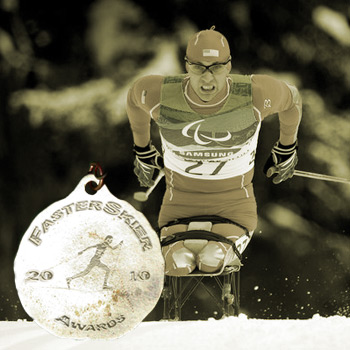
    A new and well-deserved addition to the FasterSkier Awards, the Adaptive Skier of the Year poses some challenges.  There are many categories within adaptive skiing, and some of the athletes participate in both cross-country and biathlon.  One goal of the FS Awards is to keep things clear and simple, and we decided to present one award covering all categories and both adaptive xc and biathlon.  This is similar to the decision not to offer separate awards for sprinting.

    The men’s category seemed clear cut at first.  Brian McKeever is arguably the greatest adaptive skier of all time, and has made his mark in able-bodied cross-country as well.  But Andy Soule of the US has an impressive resumé, competing all season on the World Cup and winning Paralympic bronze in biathlon.  Ultimately we went with a shared award, recognizing McKeever’s dominance and Soule’s versatility and consistency.

    Adaptive Skier of the Year (men):

    Brian McKeever (CAN).  McKeever cleaned up at the Paralympics, winning three gold medals in the visually impaired classification.  Racing with his brother Robin as guide, McKeever, was barely challenged.  His performance in the 10km classic was his most dominating – a 1:26 victory.

    McKeever was also a member of the Canadian Olympic team, and while he didn’t race, he once again proved he can compete at the highest level of the sport.  He won the Canadian Olympic qualifying 50km in December and raced the 15km freestyle at the Canmore World Cup, finishing 63rd.

    Andy Soule (USA).  Soule competed in both adaptive cross-country and biathlon.  He finished the IPC Biathlon World Cup ranked 4th in the world, just four points out of 3rd.  He won one IPC biathlon World Cup race and placed in the top-4 four times in five starts.

    The highlight of his biathlon season came in Vancouver when he became the first American Veteran on the podium in Nordic sports in the Olympics or Paralympics when he took bronze in the men’s 2.4km pursuit.  That race also marked the first tie an American had won a medal in Olympic or Paralympic biathlon.

    He missed a second medal in the 12.5km event, placing 4th.

    Soule also ended the season ranked 9th in the overall IPC Cross-Country World Cup.  He scored points in all six races with a season-best result of 6th.  At the Paralympics, he finished 10th, 11th and 12th in the three races.

    Honorable Mention

    Chris Klebl (USA).  Klebl placed 4th in the overall IPC Cross-Country World Cup standings, finishing in the top-7 in all six races.  He also finished 8th, 9th and 16th in three Paralympic races.

    Andy Soule (USA) racing at the Paralympics

    [poll id=”39″]

    Adaptive Skier of the Year (women):

    Colette Bourgonje (CAN).  Bourgonje, a veteran competing in her sixth winter Paralympics, won silver in the women’s 10km sit-ski and bronze in the 5km event.

    Bourgonje also won a World Cup race, finished 2nd in another, and place in the top-4 in all four of her World Cup starts.  She ended the season ranked 5th in the overall IPC World Cup standings.

    In addition to her impressive winter accomplishments, Bourgonje has competed in three summer Paralympics, and now has a total of 10 medals to her name.

    [poll id=”38″]

    Award Schedule:

    Thursday, April 15 – Rookie of the Year
    Friday, April 16 – Collegiate Skier of the Year
    Monday, April 19 – Adaptive Skier of the Year
    Tuesday, April 20 – Continental Skier of the Year
    Wednesday, April 21 – Biathlete of the Year
    Thursday, April 22 – Nordic Combined Skier of the Year
    Friday, April 23 – Performance of the Year (cross-country, biathlon, nordic combined)
    Monday, April 26th – Cross-Country Skier of the Year

  • Adaptive XC Names 2010 Team

    PARK CITY, UT (Aug. 21) – The 2010 U.S. Adaptive Cross Country Team is rich with talent with three of its five members Paralympians, including World Cup winner Chris Klebl (Heber City, UT), as it heads into the 2010 season according to Program Director Sandy Metzger who released the team’s roster Friday.

    “We have a veteran team with experienced athletes,” Metzger said. “We have the ability to have an amazing season and we are hoping for just that. Our athletes have what it takes to go to the top and it’s just a matter of building the consistency to get there.”

    U.S. Adaptive Cross Country Head Coach Greg Rawlings is amped to have provided the team with more training time and direction as they make a play for Vancouver.

    “As a whole everyone’s very excited because it’s a huge year and they know what’s required of them,” Rawlings said.”We’re definitely driving the ‘go fast’ thing into them versus the “go out there and just exercise.’ This year we got two weeks on snow for most of the athletes and they’re pretty focused. We also met up in July and had a great session utilizing the Center of Excellence. We sent everyone home with their homework and I think we’re at a lot better level now.”

    Taking charge for the women’s squad is Monica Bascio (Evergreen, CO) who found enough success on the World Cup in 2009 that she ended up second in the overall cross country standings. In 2010 Rawlings says the journey will be hard, but believes Bascio has what it takes.

    “It’s a tough one because it’s a Paralympic year and we’ll get a couple people out of the woodwork that we don’t know about,” Rawlings said. “If we keep her on track and with lots of hard work she could be knocking on the door.”

    In the highly competitive men’s sit-ski class Klebl took charge for the U.S. men, finishing the season sixth in the World Cup standings. Rawlings is extremely confident in his ability to find success throughout the 2010 season.

    “Chris is an all-arounder, mainly middle and long distance and I’d be very surprised if he doesn’t medal almost every start,” Rawlings said.

    Also leading the top of the men’s field is Andy Soule (Sun Valley, ID) a veteran of war who was sent to Afghanistan after Sept. 11, 2001 where an Improvised Explosive Device (IED) took both of his legs. According to Rawlings, with his will power, Soule is an ace for the sprint races.

    “I’ve got big expectations for Andy in the sprint races,” Rawlings said. “He is a lot more focused and a lot lighter, so he’s dialed in for the Games. He’s really excited.”

    Metzger added, “We are looking for big things from Andy Soule. Andy was on the verge last year. With his training and dedication during the off season, he is on fire and ready to win!”

    The U.S. Adaptive Cross Country Team kicks its season off with a World Cup Dec. 16-17 in Lygna, Norway as they make their way toward the March 12-21 Paralympics in Vancouver.

    2010 U.S. Adaptive Cross Country Ski Team Roster (birthdate; disabled category, hometown and * if Paralympian)

    Men
    Sean Halsted (11/24/70; sit-ski, Ephrata, WA)
    Chris Klebl (1/5/72; sit-ski, Heber City, UT)*
    Greg Mallory (3/23/68; sit-ski, Portland, OR)*
    Andrew Soule (12/2/80; sit-ski, Sun Valley, ID)

    Women
    Monica Bascio (9/16/69; sit-ski, Evergreen, CO)*

    Source: USST