From the FasterSkier archive — posts syndicated from athletes’ and coaches’ own blogs between 2004 and 2012, kept online as published. Current coverage is at fasterskier.com.
Paul Smith’s College is hiring a Nordic Center Manager to run the ski operation at its Visitor Interpretive Center, the 25 miles of ski, snowshoe and hiking trails on the college’s campus in the northern Adirondacks of New York.
The job is full time and covers nearly everything that happens on snow at the VIC: races and events, lessons and youth programs, passes and partnerships, trail and course readiness, and the student staff and volunteers who keep the place running. The college sees the VIC/Outdoor Center as a regional ski destination, an event venue, a classroom and an earned-revenue business all at once, and it wants a hands-on manager who can grow how much the center gets used in every one of those roles.
The trails are also home to one of the strongest programs in the U.S. Collegiate Ski and Snowboard Association. Head coach Matt Dougherty’s Paul Smith’s men won the 2026 USCSA national title and the women finished second, a run FasterSkier wrote about this month. The new manager will work alongside the VIC Director, the Trails & Facilities Manager and Athletics to balance what the team needs with public access, programs and events.
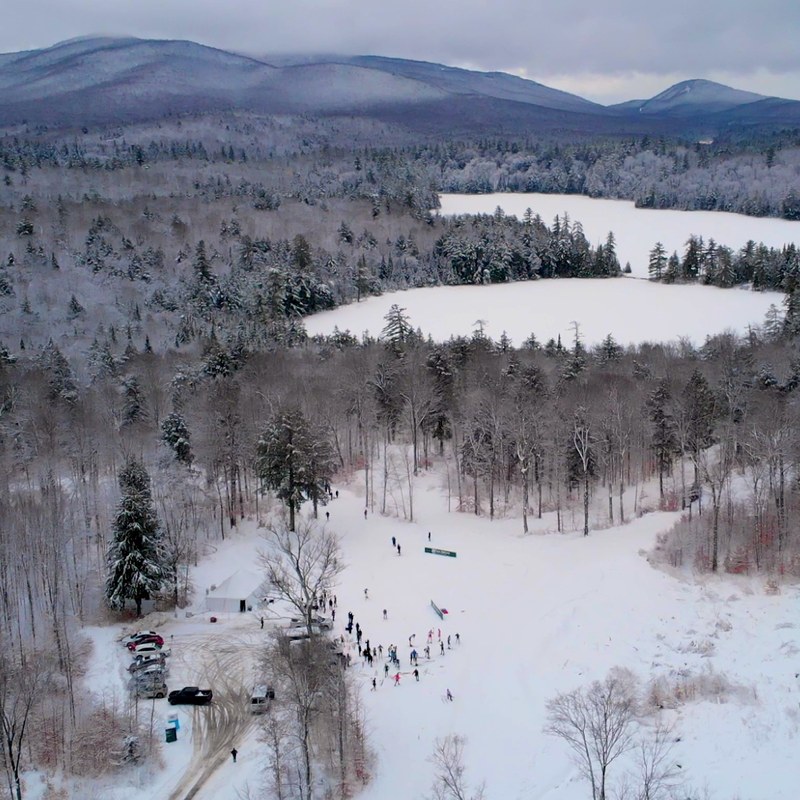
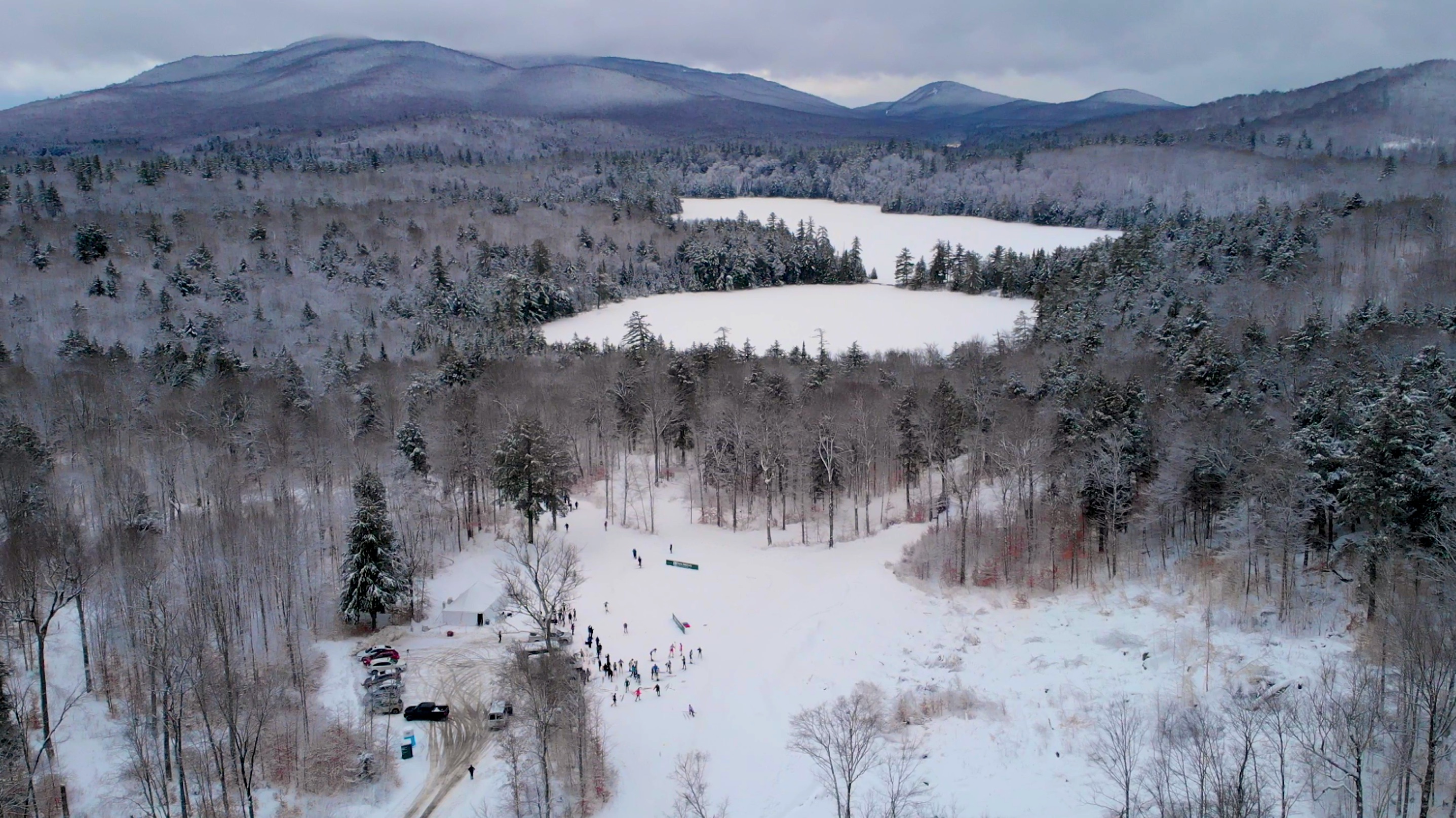
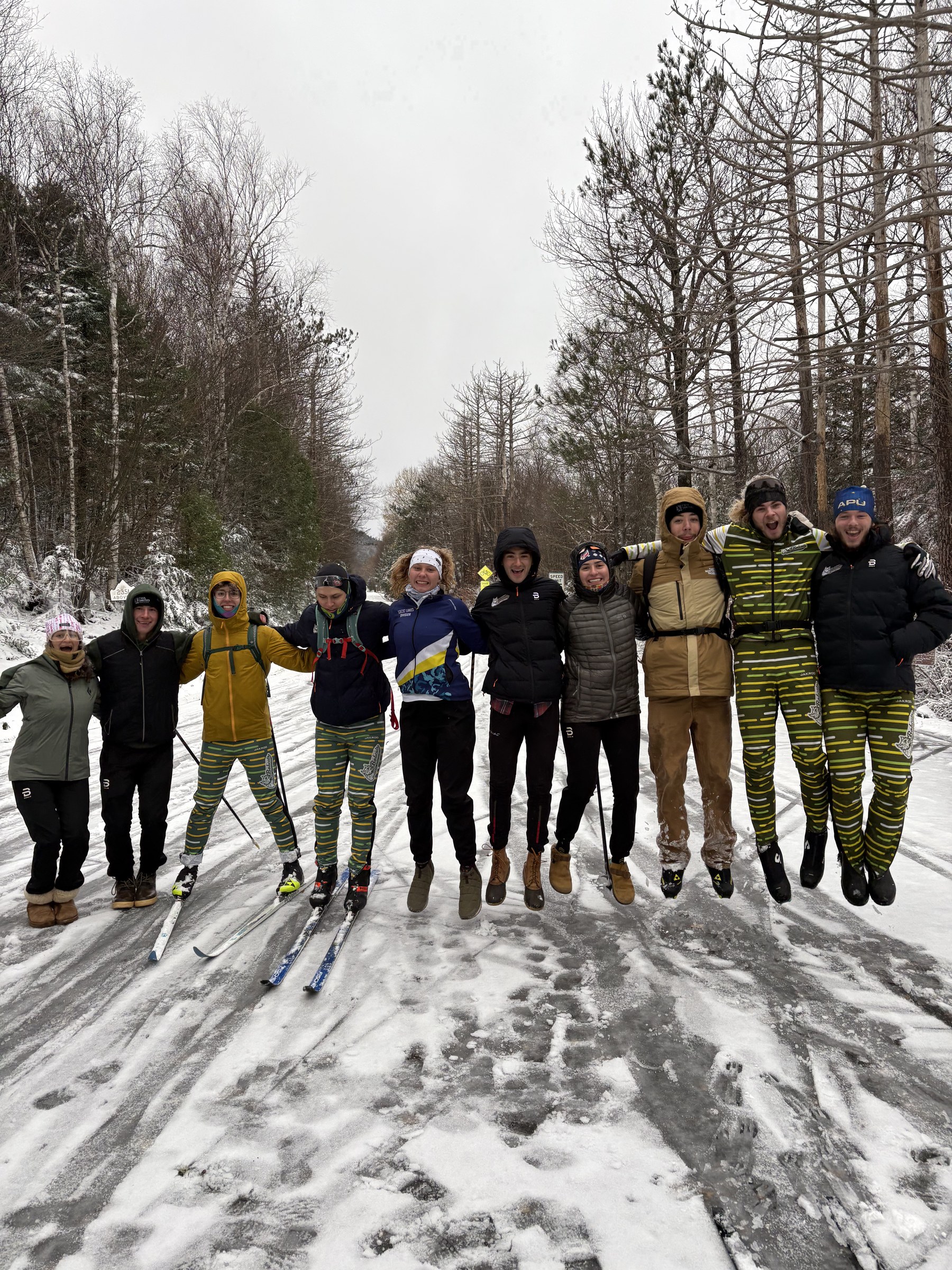
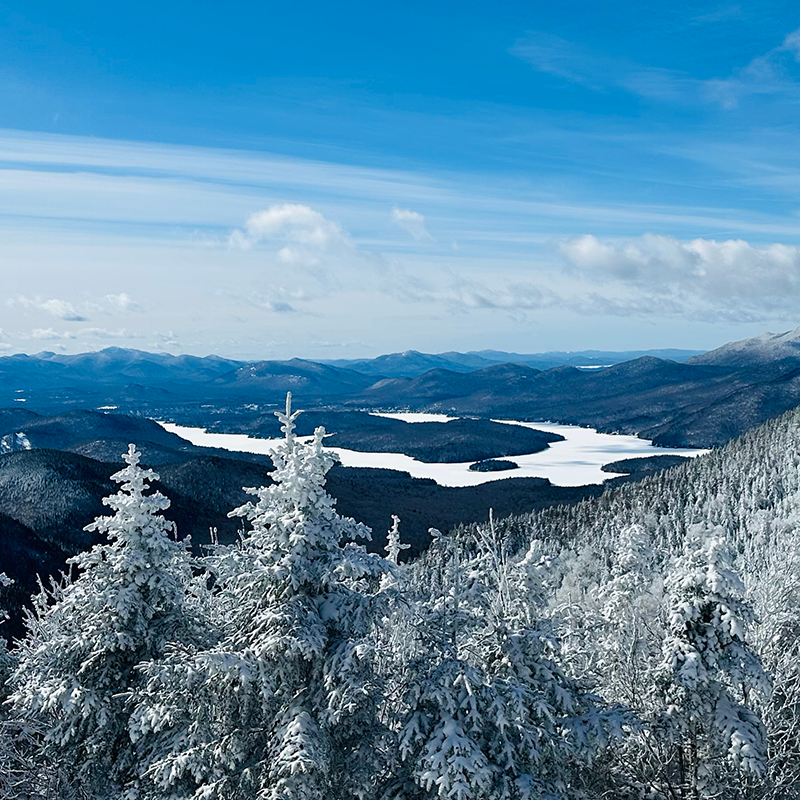
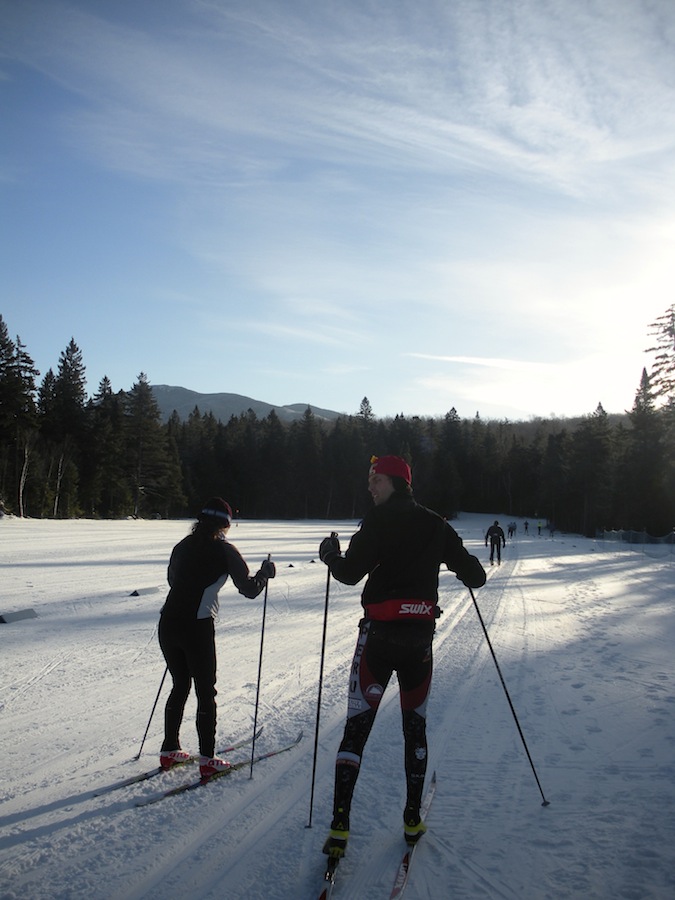
Skiers gathered on the Paul Smith’s College trails, with the Adirondacks beyond. (Photo: Paul Smith’s College)
The Position
Nordic Center Manager, regular, full time, exempt
Department: Paul Smith’s College Outdoor Center / Visitor Interpretive Center (VIC)
Reports to the Director of the Outdoor Center / VIC
Salary: $62,353.20 to $68,000
Health, dental and vision insurance, paid time off, and a 403(b) to which the college contributes 5 percent of salary
Tuition remission for employees and their dependents, plus free use of the college’s gym, athletic facilities and the VIC trails
Early mornings, evenings, weekends and holidays come with the job in winter
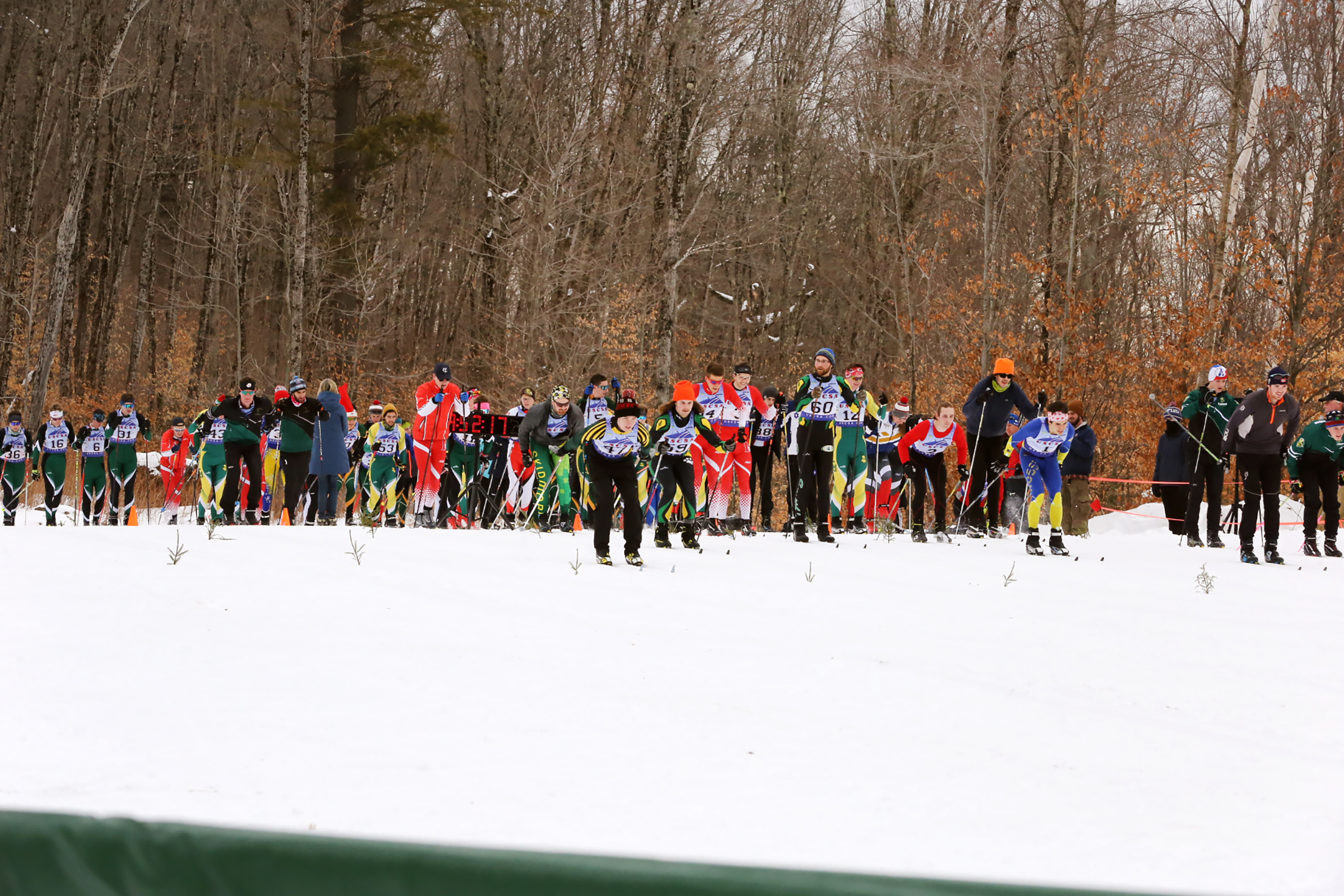
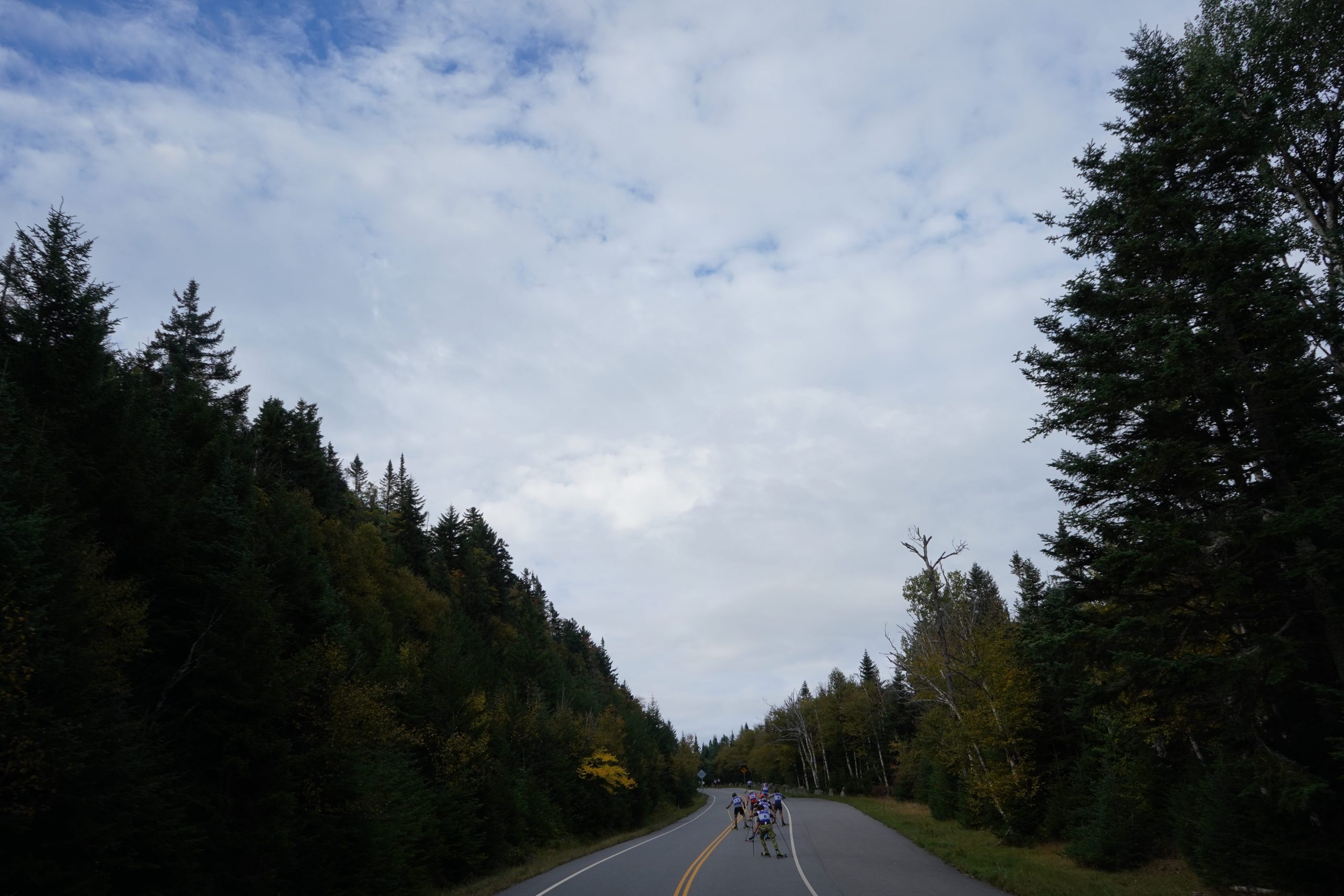
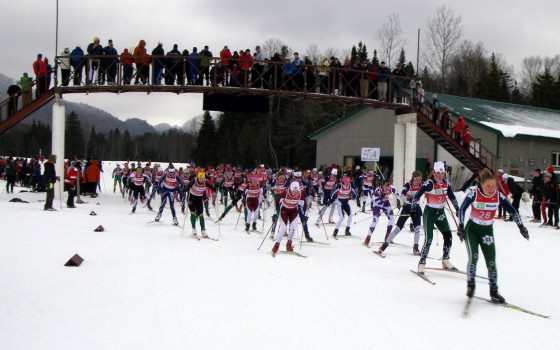
The start of the 2020 Paul Smith’s College Bobcat Invitational. (Photo: Pat Hendrick)
Events, Programs and Partners
The first half of the job is getting more people onto the trails. The manager will:
Keep developing the Nordic Center as a welcoming, high quality regional destination for students, teams, visitors and the local community
Find, plan, promote and support races, training opportunities, clinics, youth programs, community events and group outings
Build public programming, including learn-to-ski sessions, skills clinics, school and youth programs, camps, guided outings and community races
Build relationships with Nordic clubs, race directors, coaches, schools, collegiate programs, tourism partners, outdoor recreation organizations and local businesses
Grow visits and earned revenue through passes, programs, events, facility use, partnerships and sponsorships
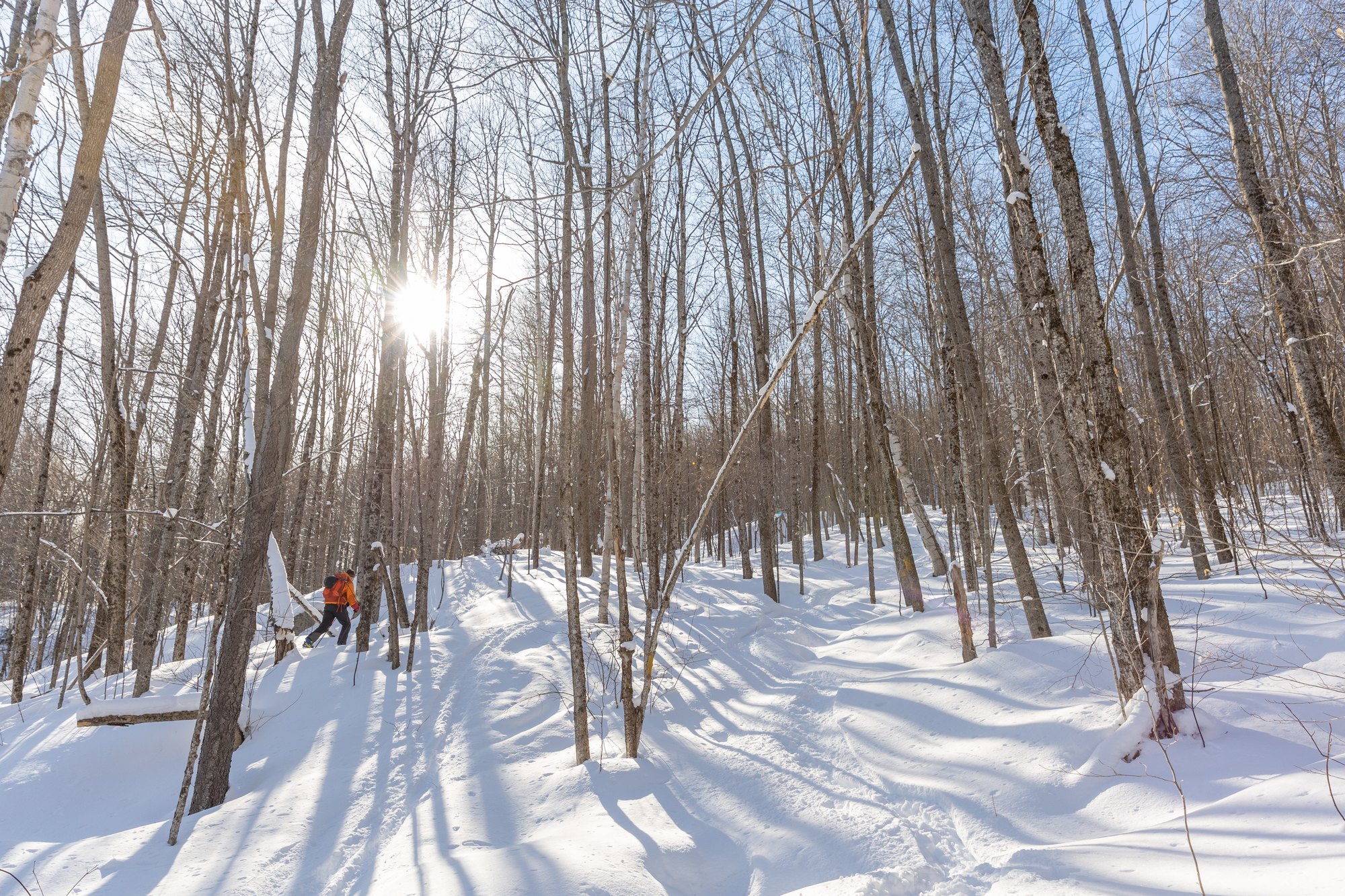
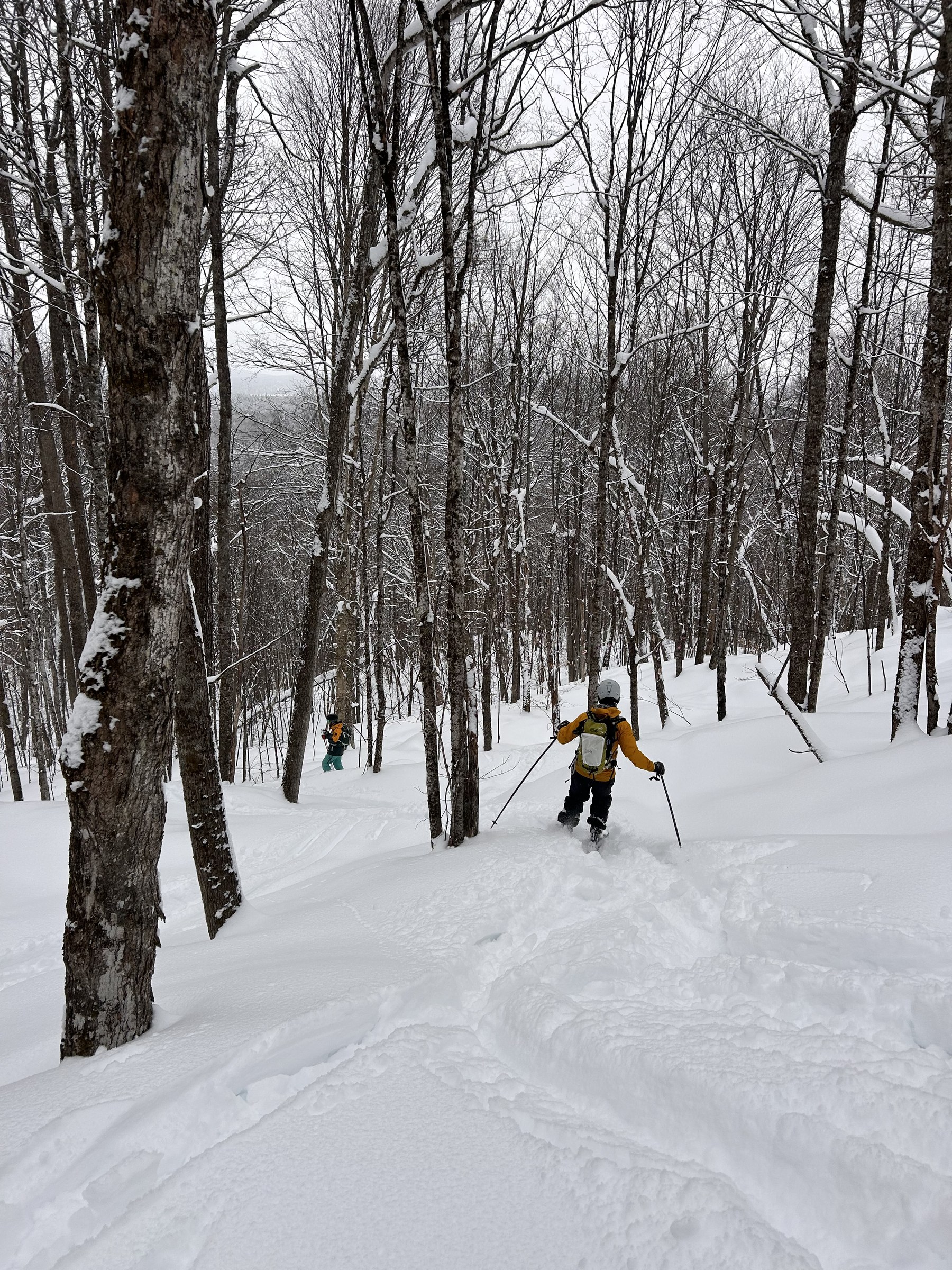
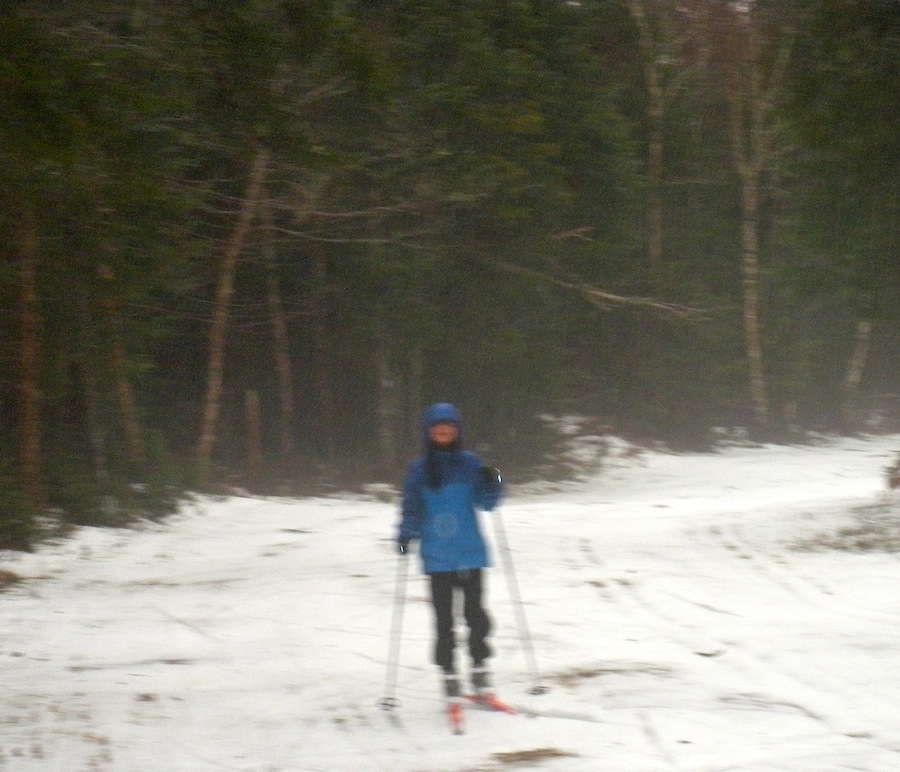
A skier in the hardwoods at the Paul Smith’s College Visitor Interpretive Center. (Photo: Paul Smith’s College)
Running the Venue
The second half is the daily operation. The manager will:
Coordinate the day-to-day Nordic Center experience, from public access and trail and course readiness to user communications, scheduling, safety procedures and service standards
Recommend trail, course, facility, equipment, signage and visitor service improvements that make the venue more reliable, more accessible and better prepared for events
Recruit, train, schedule, supervise and mentor student employees, seasonal staff and volunteers
Serve as Manager on Duty
Depending on the experience and strengths of the person hired, the role can also lead, oversee or share the work in one or more of these areas:
Winter grooming, including grooming schedules, trail condition updates, and operating and maintaining the grooming equipment
Supervising staff and students on sustainable trail construction and maintenance
Race recruitment and operations, including regional, high school, collegiate and club relationships and course planning for specific competitions
Clinics, camps, youth programming, school partnerships and inclusive community recreation
Pass sales, rentals, retail, sponsorships, marketing, tourism partnerships and social media
Long-range planning for trails, courses, facilities, amenities and capital improvements
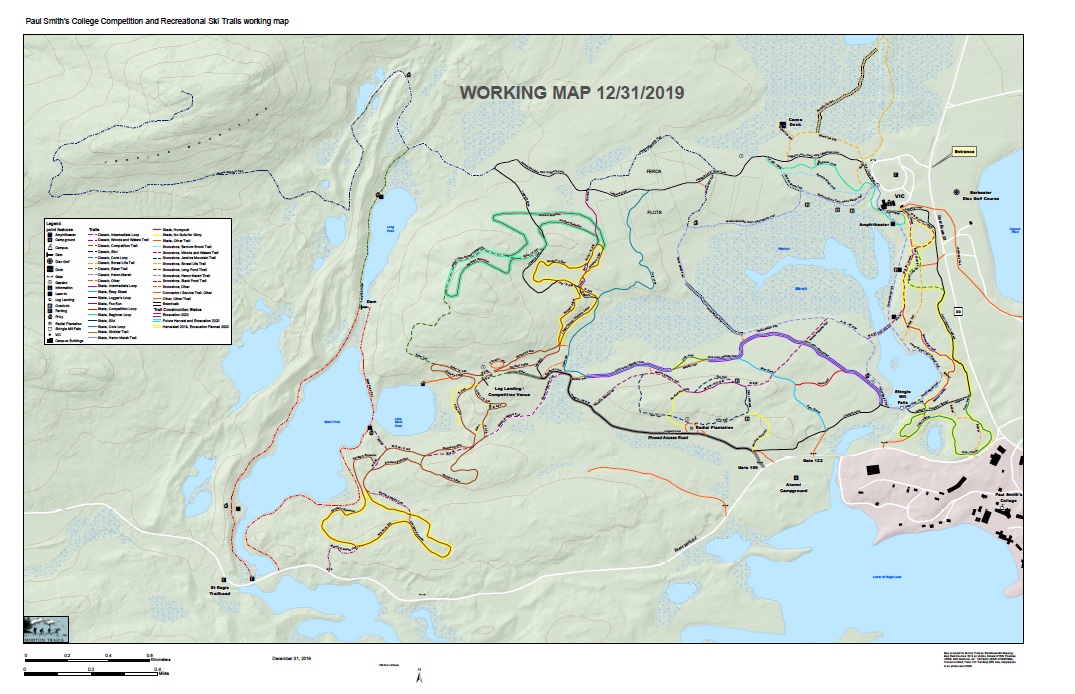
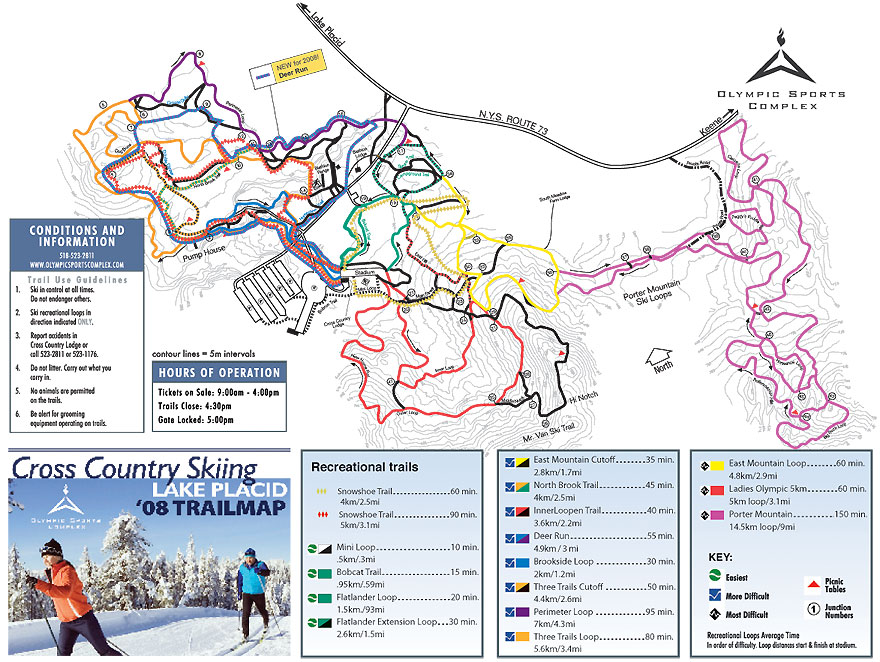
The 2019 working map of the competition and recreational ski trails Morton Trails laid out on the Paul Smith’s College campus. (Map courtesy of Paul Smith’s College)
Qualifications
Required:
Experience in outdoor recreation, event management, hospitality, community programming, destination development, customer service, Nordic skiing or a related field
A track record of helping develop and deliver events, programs, services, partnerships or customer experiences, with strong planning, communication, relationship building and problem solving skills
Ability to supervise and mentor student employees, seasonal staff, volunteers or crews, and to work across campus and with outside partners
Ability to work outdoors in variable winter conditions, on early mornings, evenings, weekends, holidays and changing hours
Strong computer and administrative skills, including email, spreadsheets, scheduling and digital recordkeeping, and the ability to learn point-of-sale, rental and reservation, equipment inventory and trail condition systems
Preferred:
Experience managing a Nordic center, winter recreation venue, trail system, outdoor recreation business, event operation or comparable public-facing operation
Experience with pass or membership programs, registration, earned-revenue services, marketing, sponsorships, tourism partnerships, Nordic events or cross country ski racing
Experience with or strong knowledge of Nordic grooming, snowmobile operation, grooming equipment, trail maintenance or winter trail operations
Physical requirements: The manager must be able to move safely on foot over icy, snow-covered and steep trails, lift and move equipment weighing up to 50 pounds, operate or learn to operate winter utility vehicles including snowmobiles and tracked UTVs, and have the endurance to respond quickly in deep snow.
How to Apply
Paul Smith’s College is accepting submissions through November 20, 2026. Apply through the college’s careers site:
Questions about careers at the college can go to Paul Smith’s College human resources at 518-327-6179. Paul Smith’s College is an equal opportunity employer.
Matt Dougherty has a way of knowing in September exactly what he is going to say in February.
It usually happens on the second day of the Adirondack Canoe Classic, the three-day, ninety-mile paddle from Old Forge to Saranac Lake that everyone in the North Country calls the 90-Miler. By then his skiers have been in a boat for two days. They have carried it over roughly five miles of portage trails. They are, by his description, flat on the ground.
“It was six hours of just going as hard as you can, which is still low on the L zones, but you’re putting out power for hours and hours and hours,” Dougherty said. “And then you get back in the boat.”
Dougherty is the head nordic ski coach at Paul Smith’s College, and also its head marathon canoe coach, which is not a combination most ski programs carry. In March his men won the USCSA national championship at Mount Van Hoevenberg, 68 points to St. Olaf’s 108, the program’s second national title in five seasons. His women finished second, as they did in 2022 when the men won the first one. He took the ski program over in the fall of 2020 with one skier on the roster and no recruits, at a college in the woods with fewer students than most high schools.
He is also, as of this year, the subject of a feature documentary, which is a strange thing to happen to a coach at a school of this size and which he did not see coming at all.
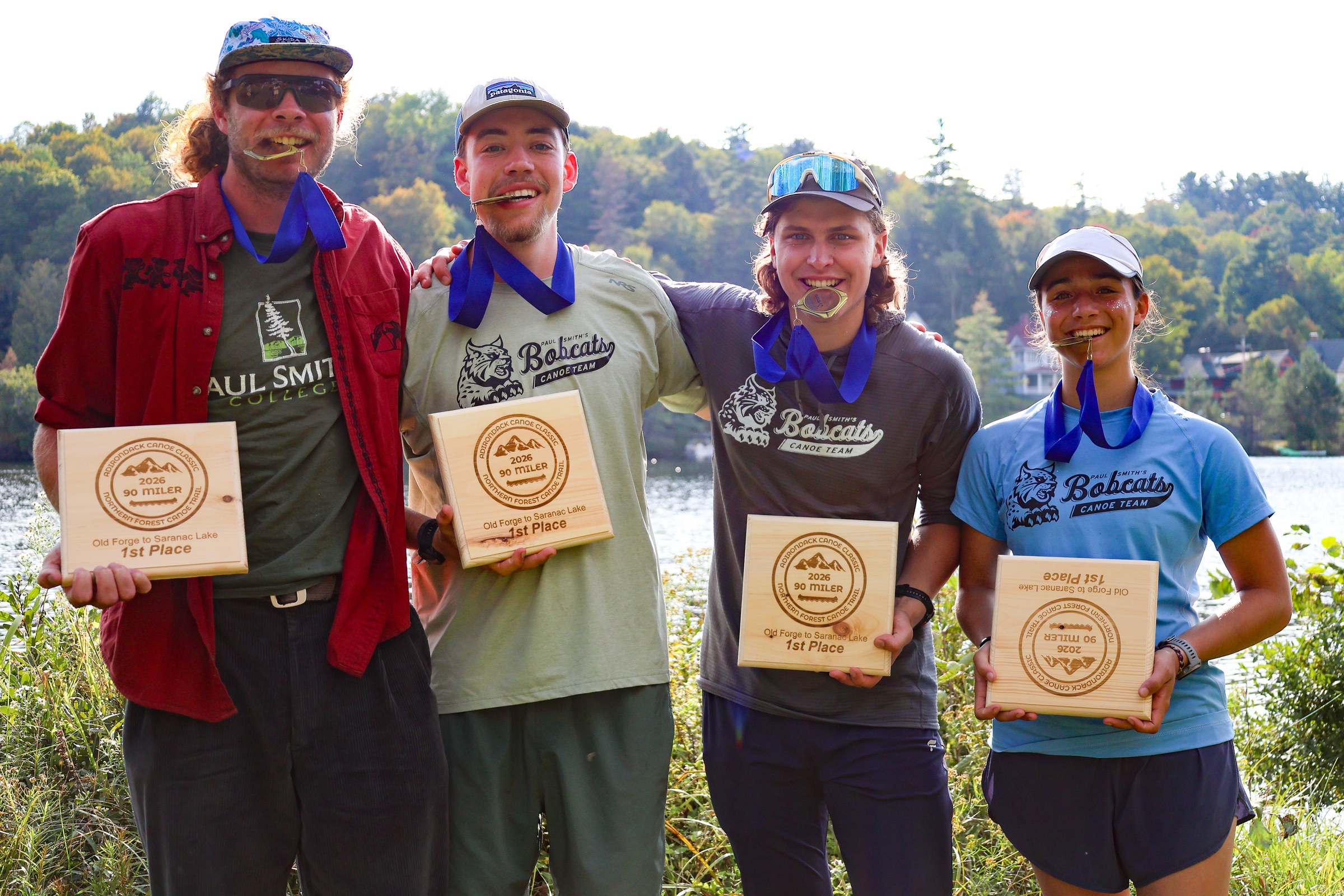
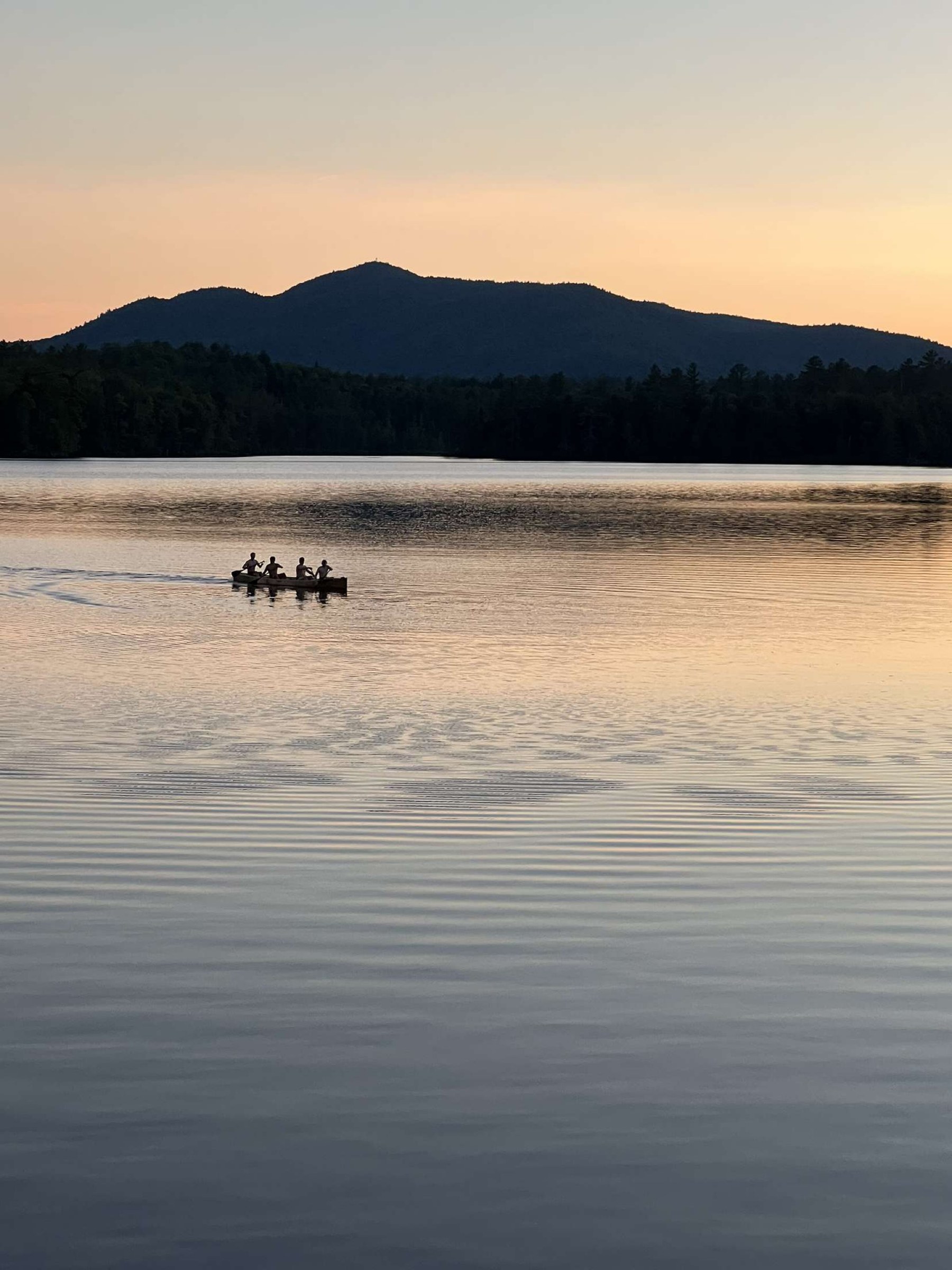
Paul Smith’s paddlers with their first-place plaques after the Adirondack Canoe Classic, the three-day, ninety-mile race the North Country calls the 90-Miler. Head coach Matt Dougherty runs the marathon canoe team as well as the ski team. (Courtesy photo)
Three days in a boat
The marathon canoe team is not a requirement for skiers at Paul Smith’s. A lot of them do it anyway.
“It gives me the opportunity to do the important lessons,” Dougherty said. “The 90 mile canoe race is super hard, and I can go back and be like, look at what we can do when we put our mind to it.”
The boats are the point. In the Voyageur class, where Paul Smith’s entered a seven-paddler crew in 2024 and won its division by two hours, the craft itself becomes part of the problem.
“It’s raining and you paddled,” Dougherty said. “You had to carry a boat that’s 300 pounds if you’re in the Voyageur canoe up and over a literal side of a mountain in a race.”
He is after two things. One is the plain demonstration that his athletes can do more than they think, a claim coaches make constantly and almost never get to prove in September.
“A lot of times our preconceived notion of what we can do is only limited by our own mind,” he said. “If you ask them at the end of day one, they’re like, there’s no way I can do that again. Day two, and you keep doing that, and you’re like, but what can you actually do if you open up your mind and say, like, I’m just willing to see, I’m willing to test those boundaries?”
The other is more useful to him in February.
“To affect change, you got to have shared experiences, even with a coach involved in it,” he said. “That say, like, we shared this really hard time, and there’s this high level of trust, and we can do super hard things. From there, we can then we can get into the training, and we can say, yeah, we’re gonna do 44 weeks of training next year, and you’re gonna put on 10 pounds in the weight room, and things that they’re like, what? But now it’s like, okay, we have a place to start from.”
There is a third thing, which he raises without being asked.
“It’s really hard for college students to understand all the hard things you’re going to go through in life, and I want them to be tempered and ready,” he said. “This is going to be hard to experience all of the emotions, sadness, grief, pain, but also to be like I can endure this.”
The roster Dougherty built. He took the program over in the fall of 2020 with one skier on it and no recruits. (Courtesy photo)
The long way back to Saranac Lake
Dougherty graduated from Saranac Lake High School in 1997 and got a running scholarship to Houghton University, then a small NAIA school in western New York, which is where the pattern that governs everything else started.
“Sport was an avenue to change my circumstances in life,” he said. “It changed my life because it got me to college. I paid for college. I got a degree, and then changed my circumstances drastically.”
He has two degrees, an undergraduate in outdoor education and ceramics, and a master’s in education from St. Lawrence in what he describes as cognitive behavior. He coached track and field for two decades before this, and he spent some of those years around people whose approach he took wholesale. One of them was Clyde Hart, the Baylor coach who put Michael Johnson, Jeremy Wariner and Sanya Richards-Ross on Olympic 400-meter podiums.
“You’d think, man, you have like three gold medalists on your team right now,” Dougherty said. “And you’d see him interact with his athletes, and you’d be like, wow, it’s always the person first. It is what’s going on in your life today, what’s going on the person before the athletic part.”
As a coach, he had chances to move up into Division I teams. He turned them down, and he credits his wife with the reasoning.
“What I realized then is, it’s a numbers game and it’s not a person game,” he said. His wife, he said, put it to him as a trade: “If you do this, you lose that, and it’s going to be miserable for you.”
He is now coaching three miles up the road from where Bill Demong grew up, at a college where Tim Burke’s father was a vice president for thirty-five years. He has a theory about what sticks from a life in that company.
“He would probably just hide his Olympic gold and silver medal for the rest of his life,” Dougherty said of Demong, who won gold and silver in nordic combined at the 2010 Vancouver Games. “But he would happily talk about what sport did, like what those experiences were.”
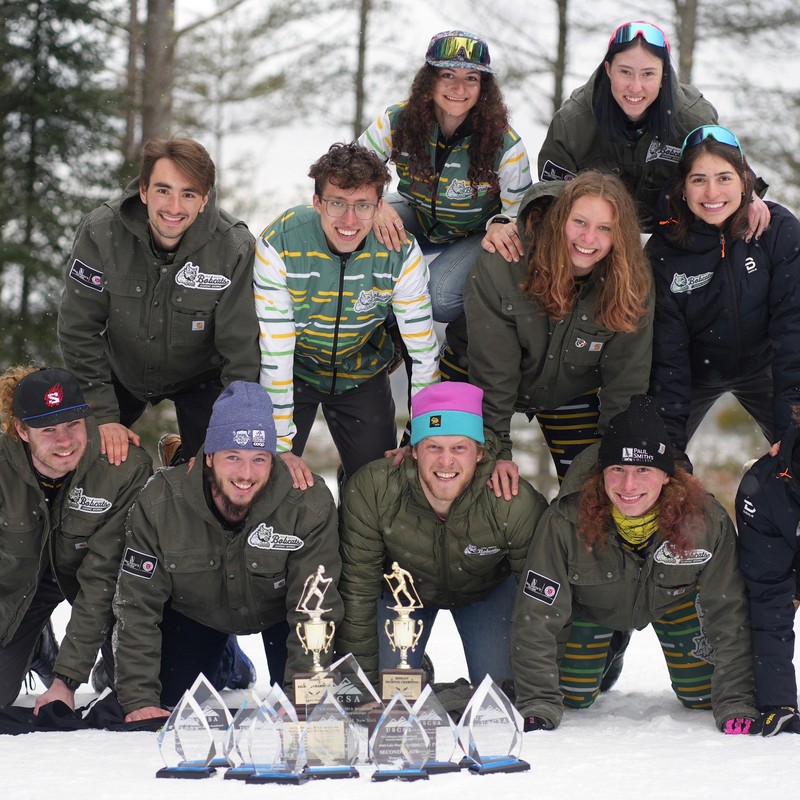
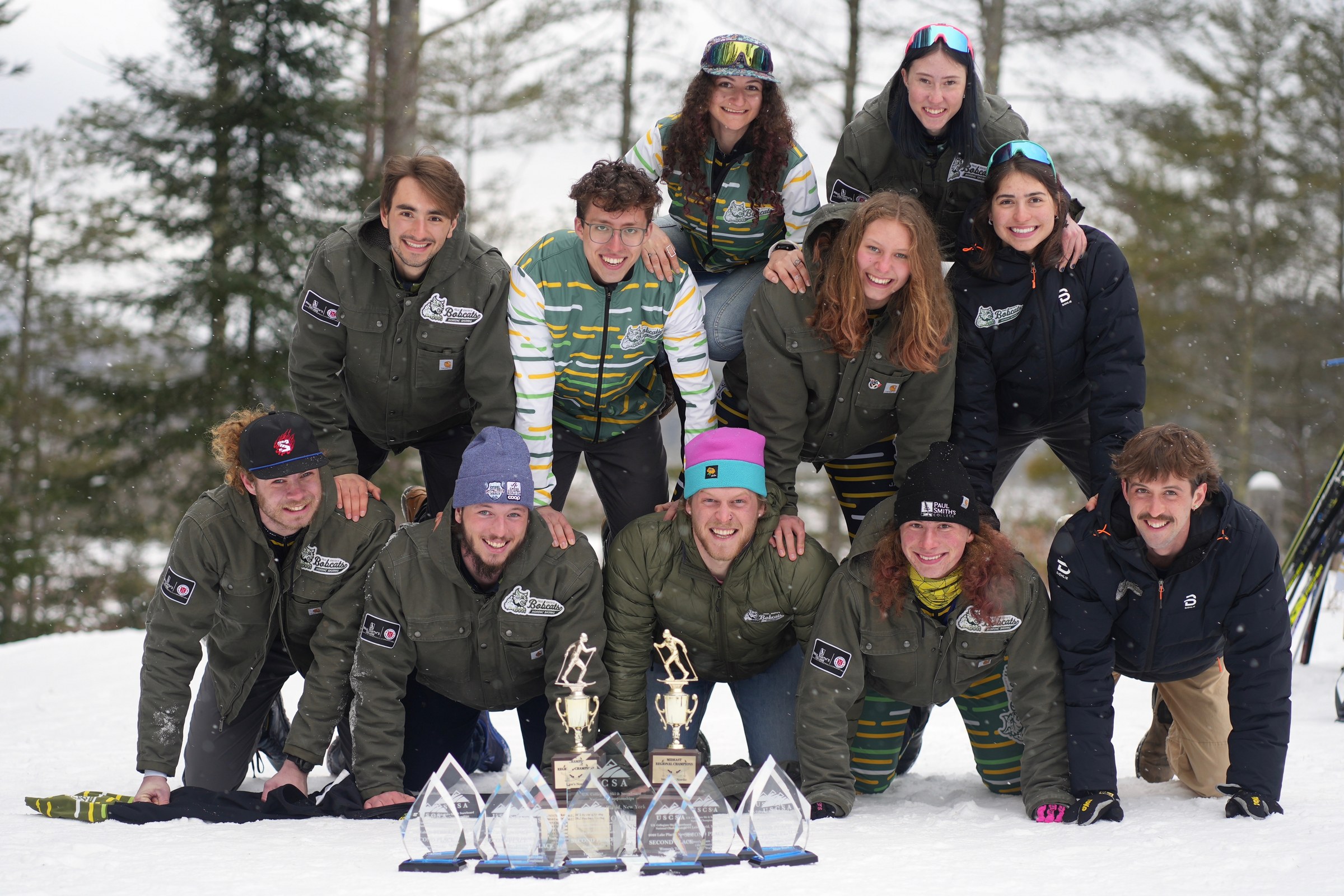
The hardware from a season in which the Paul Smith’s men won the USCSA national title and the women finished second. The team never set winning it as a goal. (Photo: Timo Ziegler)
Goals that do not squeeze anyone out
Paul Smith’s does not set a team goal of winning a national championship, even in years when it wins one.
“We just set process goals, because that’s the only thing we can control is what we do there,” Dougherty said. “And we caveat that with a little like, what do we hope that gets us. If we do all those things, we hope it can lead us to contending for a national title.”
The reason is not modesty. It is arithmetic about who a team goal excludes.
“I take such an individualized version of goal setting,” he said. “If we put a performance metric behind it, it often squeezes out other people in the program. It doesn’t allow their goals to exist.”
Last season one of his athletes was named to a US biathlon team for an international championship, which meant flying back from Germany and landing roughly a day before the national championships started.
“If the women’s team had said like our goal is to only win nationals and they were second overall, like that would have put her in a position where she’s like, well, I’m taken away from the team by going to World Juniors,” Dougherty said.
She went. The team finished second anyway. Nobody had to choose.
The team does have expectations, two of them, and he recites them the way people recite things they have said several hundred times.
“To be on this team, you got to be a good teammate first, and then maximize your opportunity,” he said.
What that produces, in his telling, is a program where the standard gets set from the back of the group.
“When a star is like, oh, I’m tired today, or this morning it’s raining and it’s 38 degrees, no one wants to ski, but they see the slowest guy kitting up and going out, then it allows all of us to kind of gain from that,” he said.
An ordinary training day on the trails at Paul Smith’s. Dougherty says his job is to make room for whatever an athlete is carrying, without asking for it directly. (Courtesy photo)
The person before the athlete
The documentary spends real time on mental health, and it is the part of the conversation Dougherty warms to fastest. He starts from what he does not know.
“I only get a piece of the story of this athlete,” he said. “We don’t know if they came from rough family life or they just feel like they don’t belong. All these things. Mental health issues are real, and I need to know about those. But I have to allow space for them to come up organically.”
“I can’t be like, who has mental health issues?” he said. “I’ve got to create the space for that.”
The space, in practice, is a rule about curiosity that the team applies to each other.
“We’re constantly like, we’re not judgmental on this team. Let’s be curious,” he said. “If as we look at a teammate and we wonder what they’re going through, instead of saying like whatever, we say like, oh, what’s the source of that?”
The same approach applies when he already knows an athlete is struggling. The problem then is how to open the door without making the asking the event.
“The really hard thing is when you get to the point where you know stuff’s going on, finding the way to indirectly be direct,” he said. “What do you need?” is the question he finds himself asking, and it generally opens the door.
That extends to how he thinks athletes should hold their own results. A race result, in his view, is a terrible place to store your sense of self.
“Their performance isn’t who they are, and it’s not anything connected to their value,” he said. “Whether we win by 20 points, lose by 20 points, doesn’t change their person or their value as a person.”
As he has gotten older he has become more concerned with sportsmanship, and he treats it as something other than a courtesy. It is how he teaches athletes to handle a disappointment and to recognize somebody else’s work.
“When you can say like, yeah, I didn’t have a great race today, instead of being sad and dour, if you go to celebrate someone you know who’s trained hard for a year and had a great day, you can’t be sad anymore,” he said. “It just changes you.”
He means it specifically. Clarkson won the USCSA men’s title at Mount Van Hoevenberg in 2024 and Paul Smith’s finished second, and Dougherty’s response was to have his team look closely at what the Clarkson skiers had done to get there.
“Even though we’d love to win, when you see someone perform like that, it’s actually inspiring,” he said. “The more we can be open to looking at performance and saying like other teams did great, but there’s value in me not just celebrating them, but seeing what they did and honoring it. I think it makes us better athletes in the end.”
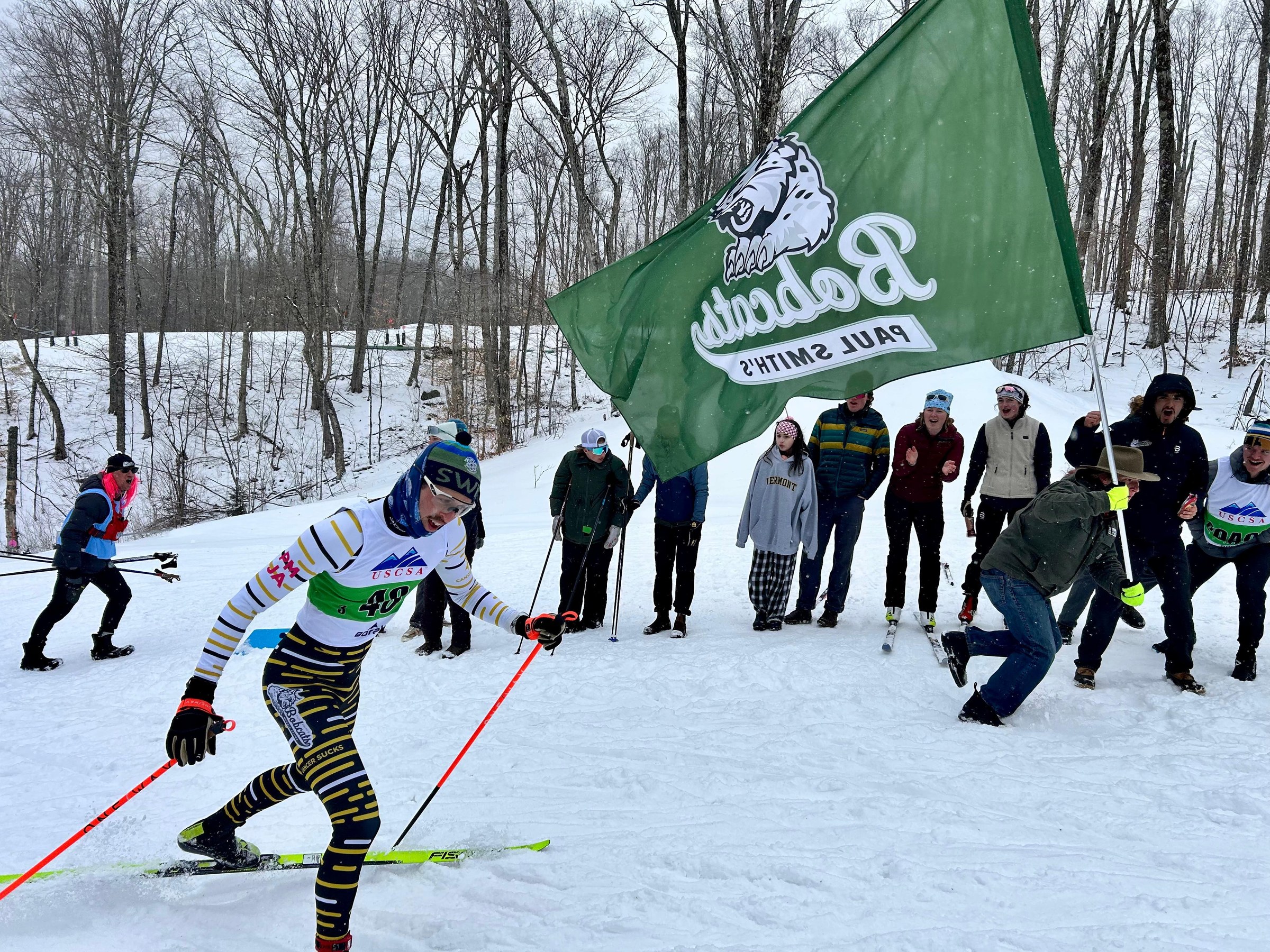
Teammates and the Bobcats flag trailside. At a college of roughly 750 students, Dougherty says, everyone on campus knows the ski program. (Courtesy photo)
A small college and a film crew
Paul Smith’s enrolls roughly 750 students by the college’s own count, on 14,000 acres at the northern edge of the Adirondack Park. Nearly half the bachelor’s degrees it awarded last year were in natural resources and conservation. It is the kind of place where a skier’s Saturday gets rearranged by a professor.
“When you come here, it’s individualized; it is a personal relationship school,” Dougherty said. “My students are working with a professor; he takes an interest, he gets to know them, and then I find out, well, Saturday we’re actually going out with this professor. He’s taking us into the mountains to show us this specific part of our research.”
“It is harder when you have 700 students. Everything about that is harder: recruiting, getting people here,” he said. “But because of that, we live in a culture where everyone on campus knows the ski program.”
That extends past the campus. Dougherty calls the Saranac Lake and Lake Placid community around the program super fans, and he puts the college president, Dan Kelting, in that category.
“He shows up at ski races and he’s not just there to like cheer,” Dougherty said. “He’s also there like, what do you guys need? What does the program need? What do we need to keep bringing in great students as a ski program?”
His summary of the whole arrangement is that it could not exist anywhere else.
“It’s this weird subculture that probably could only exist in the Adirondacks,” he said.
Which brings up the film. A donor with a seasonal home on one of the lakes near the college met the team at an event, decided there was a story, and asked whether Dougherty would sit down with a documentary crew. Dougherty said yes without any clear idea what he was agreeing to.
“I expected a three to five minute kind of like infomercial type thing for YouTube,” he said.
What arrived was Adrenaline Films, an Orlando company that Dougherty said had got its start on the early seasons of Survivor and had lately been following a ballet company through the war in Ukraine. The crew embedded with the ski team for close to two years.
“This was like pretty legit documentary crew following us for a long time,” Dougherty said.
The result is Coach Matt and the Outdoor ‘Cats, directed by Robert Jury and produced by Michael Murray and Tim Ranzetta. It runs about 95 minutes, and it is free to watch, with ads, on Amazon Prime Video and on Tubi. Its spine is the 2024 season, in which the Paul Smith’s men lost the national title by two points.
“They’re really just telling the story of a team,” Dougherty said. “Small, tiny school in the woods is really another theme there. You can do anything, anywhere, kind of an idea.”
Any money the film makes goes back to the program, and he doubts there will be any.
“My guess, without knowing all the specifics of cost, is that this is a net loss,” he said.
The team that lost by two points in that film won by 40 in March. Nobody set that as a goal.
Help Support Our Coverage!
If you value the thoughtful work and access FasterSkier provides, please consider becoming a Voluntary Subscriber. Your support directly fuels our work to cover the people, places, and moments that make our sport special.
You’ve got your tickets. You know the race schedule. You’re making the trip to Mt. Van Hoevenberg for the first World Cup finals ever held on American soil. But the racing doesn’t fill every hour of the day, and Lake Placid is the kind of town that rewards a little wandering. Over the last 15 years, my family and I have spent a lot of time in Lake Placid, and here’s what we’d suggest for filling in the gaps — whether you’re traveling solo, with a crew, or with kids in tow.
Fuel up
Start the morning at Big Mountain Deli & Crêperie on Main Street. They’ve got 46 sandwiches named after Adirondack high peaks, plus breakfast burritos, crepes, and all the espresso drinks you need to survive a cold morning in the stadium. A word of advice: order online in advance. The line moves faster if your food is already being made. Note that they’re closed on Wednesdays, so plan accordingly if you’re arriving midweek.
If you’d rather sit down and take your time, The Breakfast Club is just up the street and serves a proper breakfast and lunch with views of Mirror Lake. The portions are generous, the pancakes are legit, and if you’ve got kids, the hot cocoa is a guaranteed win. They open at 8 a.m. daily and close at 1, so don’t dawdle.
Lunch and dinner
For a real meal, Lisa G’s is our pick. It’s a short drive from Main Street on Sentinel Road, with a menu that leans American but doesn’t phone it in — think elevated pub food with creative wings, excellent fish and chips, and a solid beer list. They serve lunch on Fridays through Sundays starting at 11:30, and dinner Thursday through Monday. Closed Tuesdays and Wednesdays, so keep that in mind for early-week arrivals.
For something more upscale, the Mirror Lake Inn is one of the classic Adirondack properties — a lakefront resort with a polished dining room and views to match. And if you want something a bit more casual but still special, check out The Cottage, also on the Mirror Lake Inn grounds. It’s a cozy spot right on the water where you can grab dinner or a drink in an old gondola. It’s open Tuesday through Sunday — closed Mondays.
If you’re looking for a spot that can handle a crowd, Dancing Bears at the High Peaks Resort is worth a look. It’s at the far end of Main Street and has plenty of space — which matters on a weekend like this one, when every restaurant in town is going to be slammed. We’re fans of the food here, especially the salmon. It’s a reliable pick when other spots have a 45-minute wait.
Breweries
Lake Placid has two breweries worth your time, and both serve food if you’re looking to make a full stop of it.
Lake Placid Pub & Brewery has been an institution on Mirror Lake Drive for years. The beer list is deep, the vibe is pub-casual with college banners lining the walls, and the upstairs bar is a solid spot to post up after a day at the races. They’re open daily from 11:30 a.m. (noon on Sundays) and stay open late — midnight on weeknights, 2 a.m. on Fridays and Saturdays. If you can only try one drink, ask about the Smoked Berry Old Fashioned.
Big Slide Brewery & Public House is out on Cascade Road, about a five-minute drive from downtown and right near the Olympic Jumping Complex — which makes it an obvious stop if you’re heading to the Skirious Problems live recording Saturday evening. The beer ranges from fruit-forward lighter options to solid IPAs and porters, and the food holds its own. The burgers are good, the pizza is legit, and the buffalo wings have a bit of a cult following. They’ve also got outdoor seating with fire pits and Adirondack chairs if the weather cooperates. Open daily from 11:30 a.m. (10 a.m. on Sundays).
Catch some NCAA March Madness
The World Cup finals land smack in the middle of the NCAA basketball tournament, and if you need a screen and a cold beer between race sessions, Lake Placid has you covered. Wiseguys Sports Bar & Grill on School Street is the classic move — TVs everywhere, good wings, no pretense. They’re open Wednesday through Sunday. Players Waterfront Eatery on Main Street is another solid option with screens and lakeside seating if the weather cooperates.
Stroll and Explore Main Street
Don’t underestimate a good Main Street stroll. Lake Placid’s downtown is walkable and full of shops worth ducking into.
Saratoga Olive Oil Company is one of those places you walk into out of curiosity and end up spending way longer than you planned. They’ve got dozens of flavored olive oils and balsamic vinegars you can taste — some combinations will surprise you, and it’s a genuinely fun challenge for your taste buds. Great for picking up a gift or just entertaining yourself for half an hour.
The Maple Shop is exactly what it sounds like — a deep dive into maple syrup and all things maple. But it’s more interesting than you might expect. They carry different varieties and grades, and tasting your way through the range is a quick education in how much variation there is in something most people think of as one flavor.
Adirondack Popcorn Co rounds out the Main Street tasting tour. They specialize in creative popcorn flavors — some classic, some funky — and it’s the kind of snack you can grab and take with you to the races or back to wherever you’re staying.
Get Outside
You’re in the Adirondacks. Get some fresh air.
Though having recently CLOSED at the end of the 2026 season, Olympic Speed Skating Oval is open for public skating and is one of the few outdoor refrigerated ovals in the country. If the oval’s schedule doesn’t line up with yours, Mirror Lake itself often has a maintained skating area — check conditions locally when you arrive.
Get out on the Ironman Lake Placid course on Mirror Lake Drive — hopefully it won’t be raining — like IMLP Champion Trevor Foley. (Photo: Voisin / FasterSkier)
For our money, no trip to Lake Placid is complete without a walk or jog around Mirror Lake. The loop is about 2.7 miles on a paved path, it’s flat and accessible, and the residential architecture along the shoreline is worth the trip on its own — beautiful old Adirondack homes mixed in with classic lake houses, all set against the mountains. It’s a perfect way to shake out your legs before or after a day in the stadium.
If you’re looking for something a bit more rugged, there are dozens of short hikes in the area, but be warned: this time of year, trail conditions are unpredictable. You might hit packed snow, mud, ice, or all three in the span of a quarter mile. Bring traction devices if you have them, and dress for the mess. Cobble Hill is a nice short option with a rewarding view at the top — nothing too long or steep, but enough to feel like you earned it.
Need to get out for a Nordic Ski
If you’re itching to actually ski while you’re up here, your options may be limited. Mt. Van Hoevenberg’s trails will almost certainly be closed to the public during the World Cup weekend. But if you’re willing to make the drive, the Paul Smith’s College VIC in Paul Smiths — about 30 minutes north of Lake Placid — is a strong option. We checked in with Paul Smith’s head Nordic coach Matt Dougherty, who had his team out on the trails Wednesday morning for biathlon practice. “It was actually fantastic,” Dougherty told FasterSkier. “Conditions will reflect the temperatures — normal spring skiing.” Most trails are open and being groomed daily with the college’s PB 100, though a few trails that got washed out last week are closed for the season. The VIC maintains over 25 miles of trails, including more than 10 kilometers of FIS-homologated courses and 25 kilometers of skate skiing. The system benefits from heavier snowfall than other parts of the region, which tends to keep trails skiable even when conditions elsewhere are lean. Trail conditions are updated on their Nordic Pulse page. The VIC’s winter season runs through April 1.
Saturday Evening at the Jumps
After the sprint finals wrap up on Saturday, head over to the Olympic Jumping Complex on Cascade Road for a live recording of the Skirious Problems podcast at 6:00 p.m. Hosts Mika Vermeulen and James Clugnet will be joined by Ben Ogden, Frida Karlsson, and Federico Pellegrino. It’s free, but organizers are suggesting it may already have sold out — check the World Cup Finals event page for the link. After that, the Palace Theatre downtown is screening Threshold at 7:00 p.m.
Family-friendly fun
The Lake Placid Toboggan Chute on Mirror Lake is one of those only-in-Lake-Placid experiences — a 30-foot wooden tower that launches you and a toboggan out across the frozen lake. Warmer spring temperatures have caused the chute’s closing for this season, but it’s typically open Friday evening and Saturday and Sunday during the day. Lines can build, but it’s worth the wait.
If you’re already out at Mt. Van Hoevenberg, the Hi Notch Indoor Climbing center is right inside the Mountain Pass Lodge. It will be CLOSED during the FIS World Cup finals, but other days you’ll find a 30-foot top rope wall with over 1,500 square feet of climbing space, plus bouldering and traverse walls. All gear is provided, and instructors are on hand during daytime sessions. It could be busy this weekend, given the crowds, but it’s a great option for families or anyone who needs to burn off some energy between races.
If you’ve got a free morning or want a half-day excursion, the Wild Center in Tupper Lake is about 45 minutes west and worth every mile. It’s a natural history museum with live animals, hands-on exhibits, and the Wild Walk — a series of treetop bridges with panoramic views of the Adirondacks. It’s open Friday through Sunday, so you could pair it with a race day or build it into your travel schedule. Just know you’ll have to choose between the Wild Center and a morning at Van Hoevenberg if you’re trying to do both.
Closer to town, the Palace Theatre on Main Street is a beautifully maintained old single-screen movie house — a perfect way to wind down after a long day in the cold. And if your group wants something more active, Lake Placid Lanes (also known as Big Z’s) has bowling, arcade games, shuffleboard, darts, and a full bar. Reservations are recommended, especially on weekends — this place fills up.
Lake Placid has been hosting the world’s best winter athletes since 1932. The town knows how to do this. Get out there and enjoy it.
On an overcast Sunday, Ricardo Izquierdo-Bernier and Emma Page were the men’s and women’s winners of the Climb to the Castle roller ski race. Both were first-time victors.
Izquierdo-Bernier, of the club Fondeurs-Laurentides north of Montreal, won in 39:06.5. Aidan Ripp, of Paul Smith’s College, finished second for the men in 41:17.0. Behind him, Parke Chapin of Green Mountain Valley School (GMVS) took third in his first Climb to the Castle, in 42:41.7.
In the women’s event, Emma Page of Mansfield Nordic (MNC) finished in 52:42.7, Dolcie Tanguay came second in 55:06.2, and Master skier Kathy Schwenk finished third in 57:52.2.
Climb to the Castle, 2022.
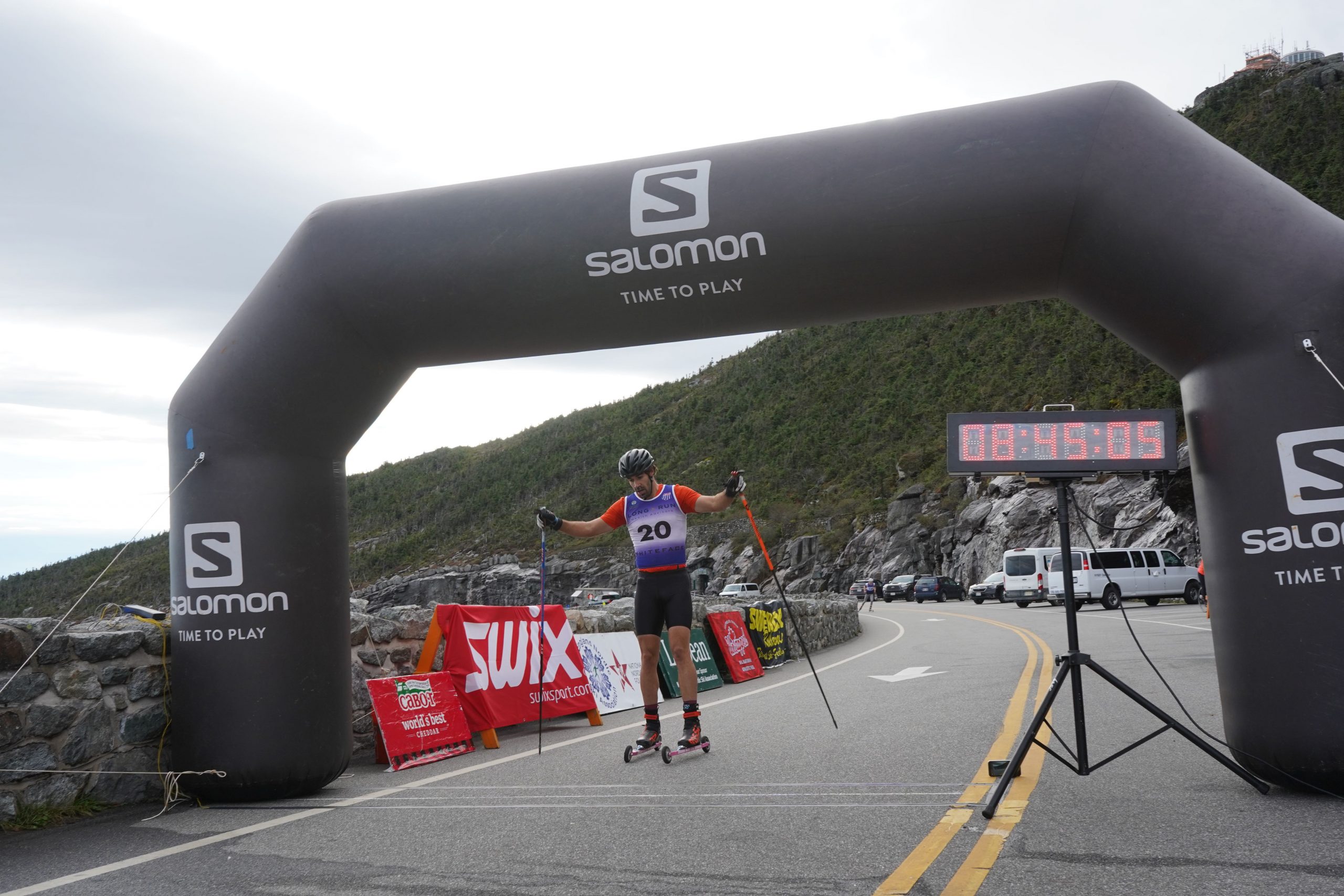
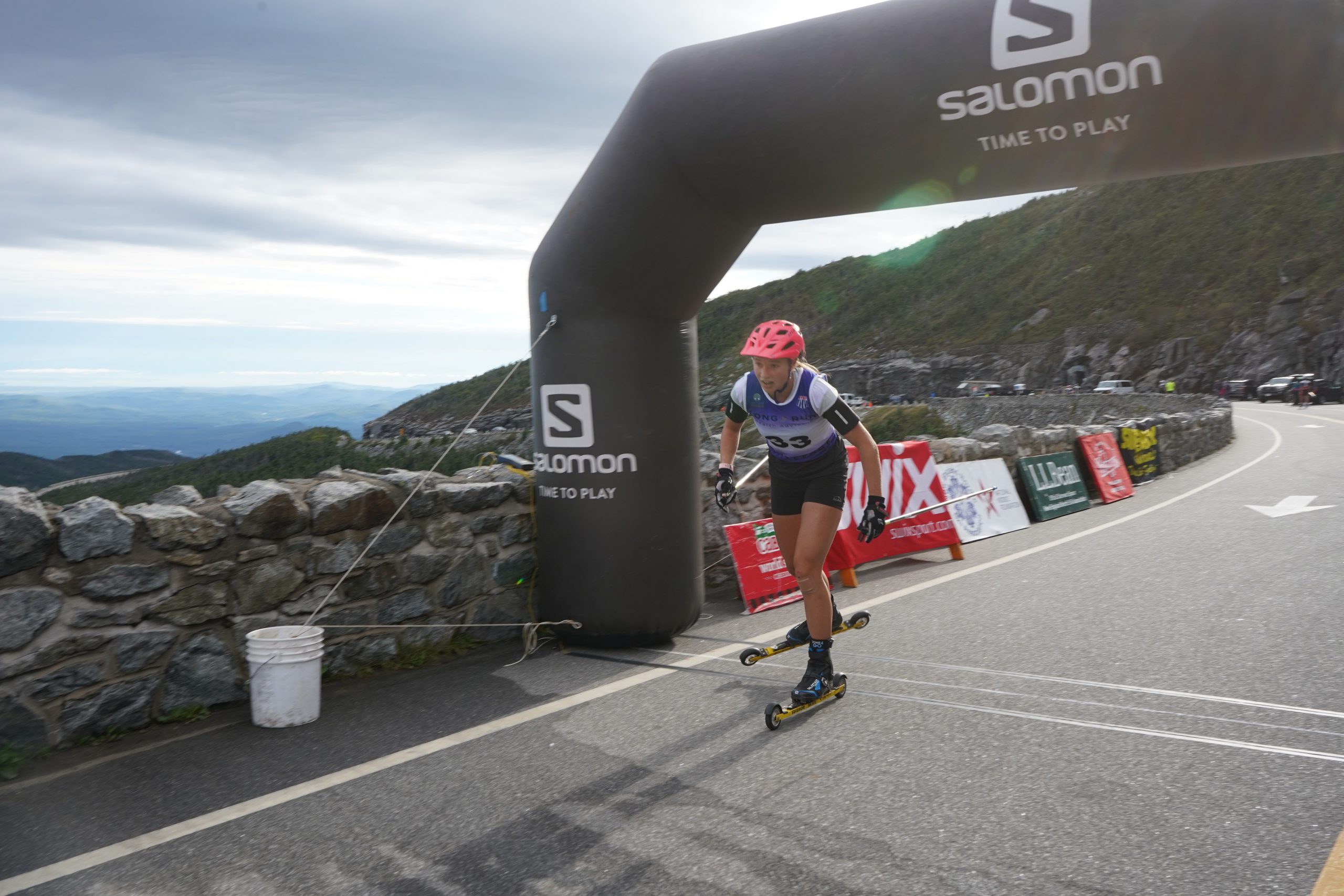
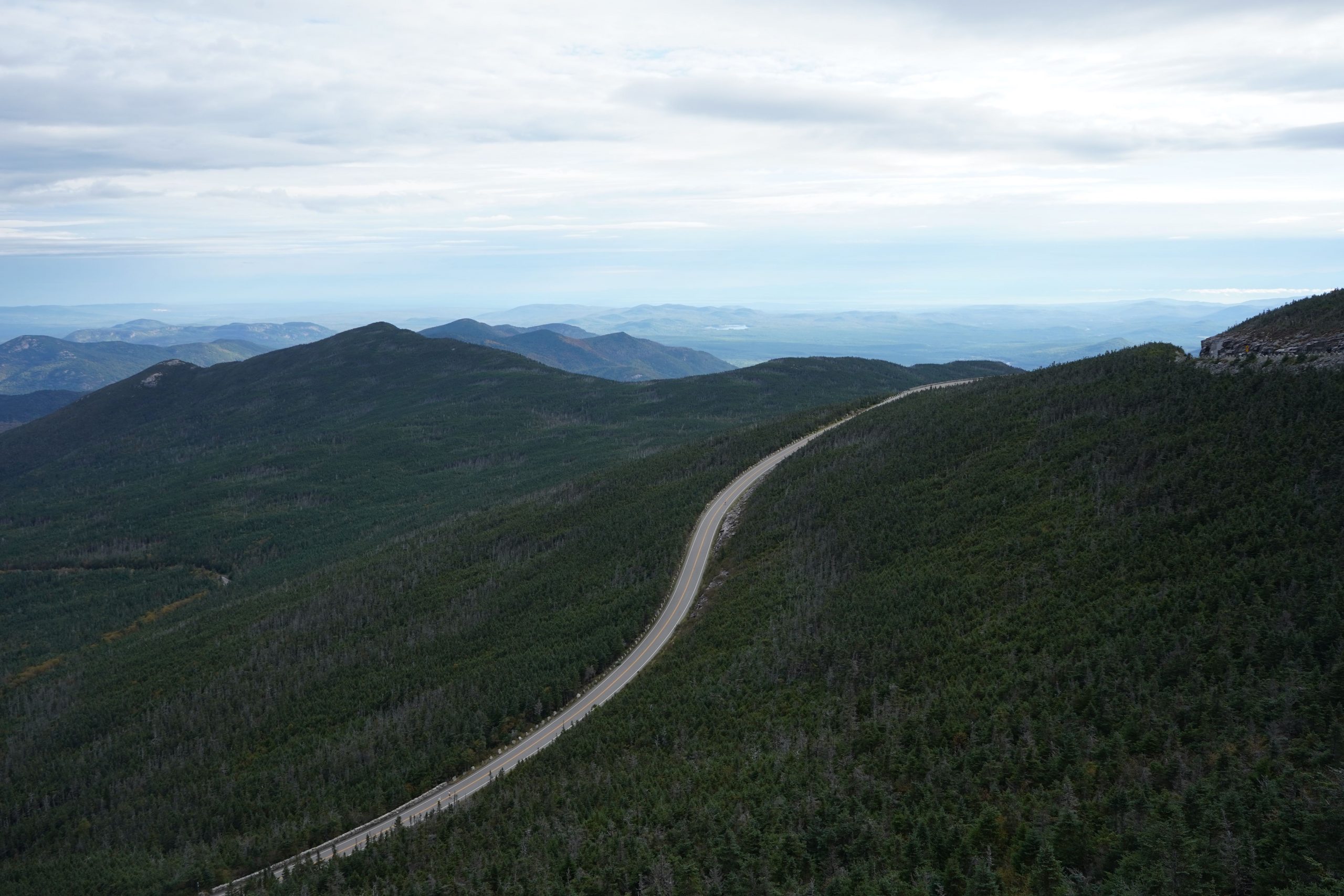
The Climb to the Castle follows the auto road on Whiteface Mountain in New York’s Adirondacks. At 4,867 feet, Whiteface is the fifth highest Adirondack peak. The toll road snakes upward for five miles at an eight percent average grade, gaining about 2300 vertical feet. Unlike the wet racers experienced in 2021, today the weather was dry, with a start time temperature around 50 degrees, and only a light breeze. Every two minutes, athletes went off in waves of 15.
Ripp led from the start, gradually dropping the rest of the first wave. Starting in the second wave, Izquierdo-Bernier bridged the gap up to the first wave around the halfway mark. “I stayed with [Ripp] all out to the top,” Izquierdo-Berniuer said. “In the last (kilometer) and a half, I put in a gap. That was fun to have someone to ski with.”
Ricardo Izquierdo-Bernier takes the win at Climb to the Castle, 2022.
Not only was this Izquierdo-Bernier’s first win, it was his first trip to the Climb. “I had wanted to come a couple times, but it never fit in my training,” he said. He added that he didn’t have a specific race plan. “Try not to start too fast, that was the only plan. I didn’t the course and where I was going, so it was more controlled, and try to have fun.”
In this his second Climb to the Castle, Ripp applied lessons learned from last year’s race. “Last year, we got drawn out really quickly, and a lot of guys went out hard,” Rip said. “Last year, Jake Brown went really hard off the gate so you were trying to chase him down. But this year it was just me off the front. It was a little bit odd to have to lead and have to pace myself to try and figure out what felt like a good pace. But it was nice because Ricardo caught me about halfway through and then it was really fun racing with him. Around the last corner [Windy Corner] was where he dropped me.”
For Parke Chapin, it was also his first attempt at the Climb, finishing with a solid third place. “I didn’t know what the course was like, I just knew it was five miles,” he said. “So I started out with two other dudes in my wave. They were similar pace, and I pushed with one of them. Towards the top, I felt like there was more in me and I turned the dial a little more. A positive day out there.”
Women’s Climb
On the women’s side, Emma Page gapped the field at the start and never looked back. She admitted to having a tough point, mid-race: “There was definitely a hard part in the middle where I was getting bogged down, but one of the master skiers, he was really helpful and he was pushing me through it,” she said.
Emma Page for the win, finishing well clear of the field on the summit of Whiteface Mountain.
Like several other skiers, Page competed in (and won, as we shall see) the previous day’s sprint races at Mount van Hoevenberg. Was she fully recovered from the previous day’s effort? “I could definitely feel my legs, but I think that once I got through the warmup I was recovered and ready to go,” Page said.
“I wanted to not start out too hard because last year I started too hard and I ended up dying a bit,” she continued. “So I wanted to make sure that I eased my way into it. I went kind of hard in the start, to the first corner, and then I reeled it in a little because I realized I might need a little extra [energy]. But I did feel good the whole time, I never had to stop or slow down.”
Dolcie Tanguay also raced not only the previous day’s sprints, sprints, but also the biathlon race at the end of the day. She said that at the start of the Climb, she didn’t feel 100% recovered. “I did it last year for the first time, so I knew what to expect. This time, I paced it pretty consistently, which is an improvement. At the start, Emma Page went out way ahead, and I couldn’t hold on to her. That’s pretty much how it stayed. I caught a couple of people along the way. I just tried to keep it consistent.”
Master skier Kathy Schwenk commented on her finish: “I just appreciate the opportunity to race. I thank the race director and everyone who put it on. I started in a group of six, and I wanted to go just a little bit faster. So I got out of that and pretty much skied by myself the whole way.”
The Whiteface Toll Road climbs to the castle.
Once again this year, racers could sign up to ski classic technique in a separate category. New this year was a short course: Athletes could choose to start further up the mountain in a three-mile race. New England Nordic Ski Association (NENSA) Competition Director Justin Beckwith wrote, “We’ve always talked about a junior race that was a more appropriate distance and time – but why limit that to just juniors? Hopefully it boosts participation and gives folks a way to participate and get the experience without having to ski for an hour.”
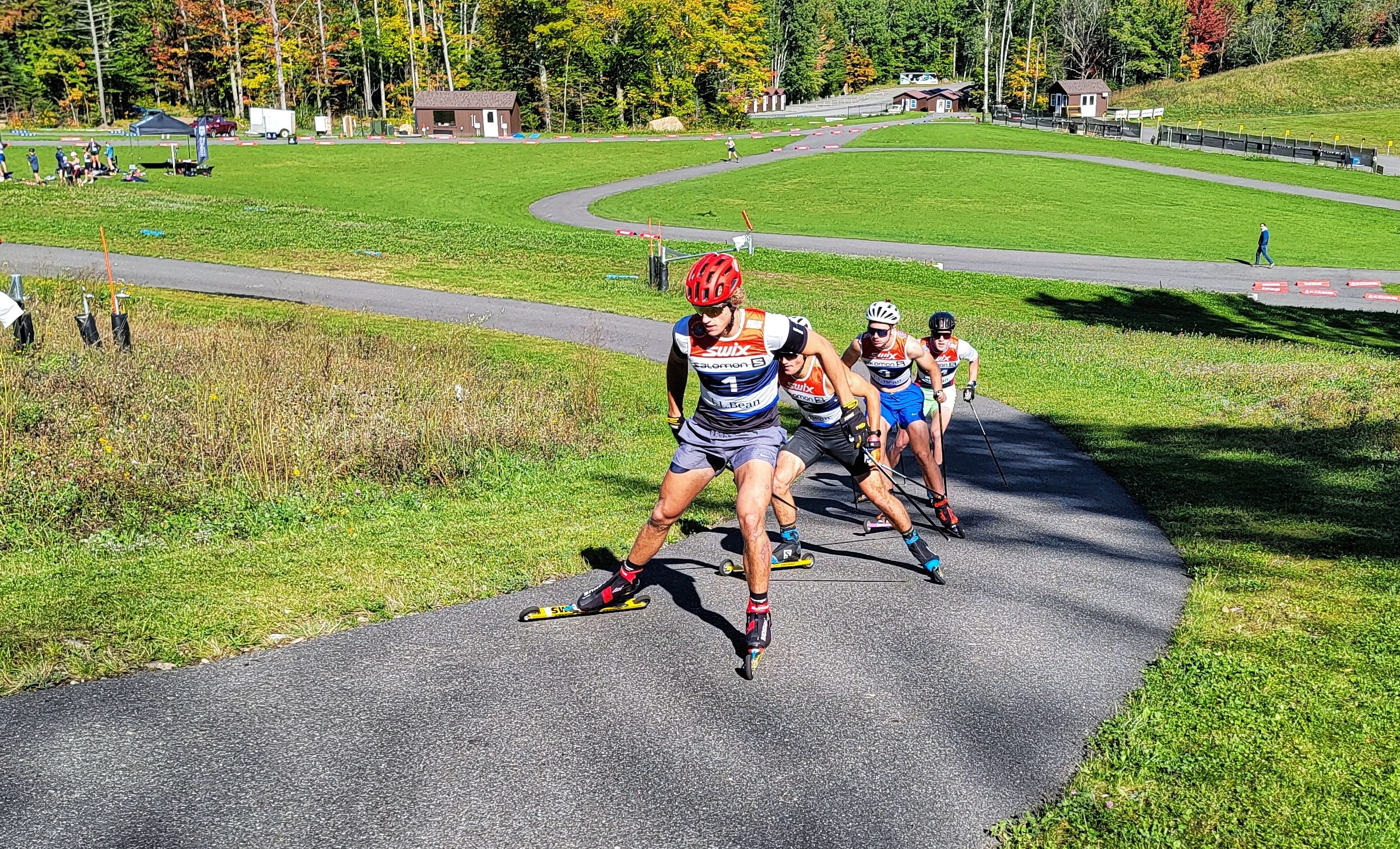
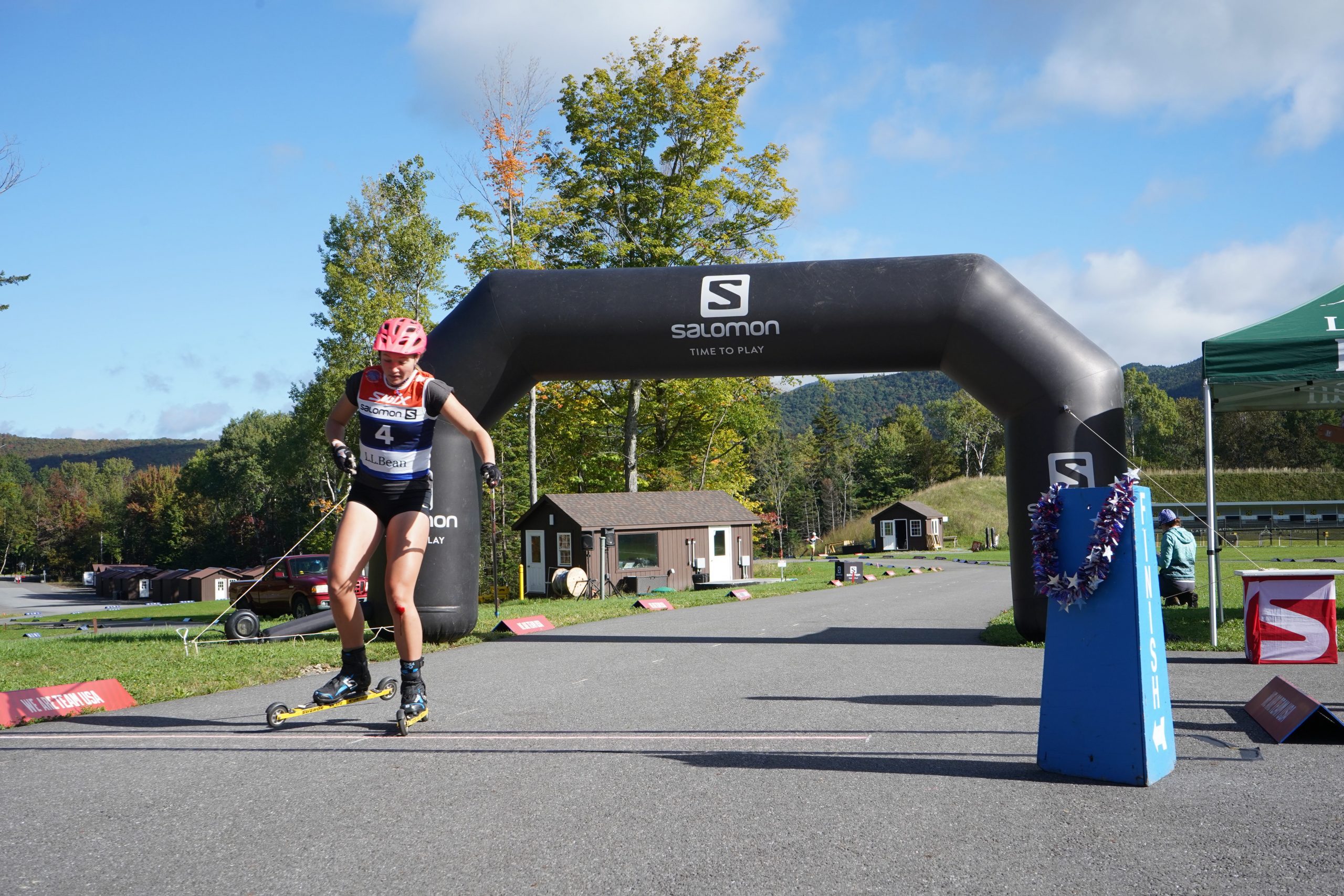
Rollerski Sprints and Rollerski Biathlon took place on Saturday, with action on the paved rollerski trails at Mount van Hoevenberg.
Men’s Freestyle Sprint
Sprints were contested on the 1500-meter sprint course that had seen use last winter. Instead of a typical “knockout” format, races were organized in a “king’s court” format. Individual start qualifiers determined athletes’ start positions with competitors racing four to a heat. Winners of each round moved up a bracket; second and third places remained in their bracket; fourth place finishers dropped to a lower bracket.
The action was fast and furious on the race course, as athletes accelerated to establish a lead before the first hill under the bridge. Some groups were incredibly tight—even in high-speed corners—while other heats saw athletes more spread out. There was less recovery time between rounds than in a normal sprint, and athletes approached recovery in a number of different ways. Most skied easy around the biathlon penalty loop, some did speeds, others changed into sneakers for a jog.
Eventual winner, Fin Bailey, leads the first quarterfinal ahead of Elvis McIntosh, Sam Gallaudet, and Wyatt Teaford.
Fin Bailey of Stratton Mountain School (SMS) won the men’s sprint in dominating fashion, winning the prologue and every subsequent round. Through the morning, he never appeared fatigued. On the decisive climb to the high point of the course, he jump skated to build a gap from other skiers.
“I pretty much worked as hard as I can,” Bailey said. “Worked with Elvis [McIntosh] in our heats, had a little strategy that when we got to the big hill, we just hammered. That’s about it.”
The final climb on the sprint course leads to a sweeping downhill past the lodge, to a hard turn and an uphill finish. Owning that climb was key to Bailey’s strategy: “That was a pretty important part of the course,” Bailey said. “You come over the top of the hill, right at the big swooping downhill to the finish, you can get ahead… you’ll be set for the finishing straight.”
Elvis McIntosh, of GMVS, was hunting for a podium before he broke a pole in the final round. “First couple of rounds went pretty well,” McIntosh said. “I was working with Fin to keep it controlled and keep the pace good and we’d hammer up and over the final hill and sweep around the [downhill] corner into the finish. It was working pretty well and then in the final, my pole broke. Final didn’t go as well as I would have liked. It was a good, fun, race.”
Wyatt Teaford of SMS described his day: “I qualified fourth today. I moved up and down throughout the heats; I narrowly missed out on the final (getting) narrowly out-cornered on the last corner there. I think races like this are really great for preparing for winter.”
When everyone’s in a tight group on a small piece of real estate, do you get nervous? “I think it’s faster than a normal ski race, but I don’t think it’s scarier,” Teaford said. “Because everyone knows the etiquette of the course. No one’s gonna cut people off on corners where it could be dangerous. I think in skiing in the winter, everyone can get more physical in sprint races.”
Aidan Ripp of Paul Smith’s and Charles Martell of SMC-MNC came second and third in the men’s sprint.
Women’s Freestyle Sprint
Emma Page was first in the women’s sprint, followed by Dolcie Tanguay and Margot Nightingale in second and third respectively.
“It was great! I fell in the warmup, but other than that, it was great,” Page said.
Emma Page was the top qualifier—and eventual winner—of the Women’s Sprints.
Asked how she manages her efforts to keep a consistent pace, Page said, “I’m usually really excited, so that’s actually my worst thing. I generally have worse energy towards the end. That’s what I worked on this summer. I’ve been working on doing speeds at the end of training, no matter what the training was. To try and get myself to push all the way to the end.”
Dolcie Tanguay took second place in the sprints before moving to the biathlon race later in the afternoon. “Usually, the point is to go pretty hard in the qualifier,” Tanguay said. “And then go from there. The high schoolers put on some pretty good competition today, so I just took each heat one at a time, went as hard as I could. The last one, I definitely slowed down a bit. But it was fun overall.”
Did she hold anything back for the biathlon? “Maybe a little. But the biathlon race is fairly short. I’m treating today more like a regular workout day, like two interval sessions.”
After the sprints, the biathlon race was contested: five laps of a 940-meter loop (with 140-meter penalty loop) with the high point of the course occurring near the lodge. There were two prone and two standing rounds of shooting. NYSEF head biathlon coach observed Maddie Phaneuf explained the challenging conditions that Mount van Hoevenberg is known to serve up:
“Here at the new van Ho range, it’s a bit more challenging wind,” Phaneuf explained. “You might zero with a consistent wind from left to right, like we have right now, then it keeps shifting from dead wind or wind from right to left. The athletes really have to pay attention to the wind flags and know what their zeroing wind was and then make corrections throughout the race.”
Paul Smith’s College grabbed five of the six podium positions in the biathlon. Kaisa Bosek of Paul Smith’s won the women’s event, getting shouts from spectators as one shot clean in the first standing round. What went through her mind when she shot clean, then had a couple of misses on the final shooting? “First, you get excited, I think you leave the range a little faster,” Bosek said. “Then after not doing as well in the next round, it’s a mental game so you have to try to forget about that. At least mine [multi-miss standing] was on the last round so I didn’t have to think about it any longer. Then leave the range, try to finish the race strong and keep going.”
Dolcie Tanguay took second place in the women’s biathlon with Taylor Landrum, also of Paul Smith’s, finishing third.
Logan Jensen of Paul Smith’s was the men’s biathlon winner. He said of his race, “It was all right; it’s early in the season. [I’m] using it as a benchmark to hopefully keep working, and get better, faster, shoot better as the season goes on.”
On his race plan, Jensen said, “Today the course was super interesting. Super flat. I was working on getting my heart rate up, seeing how high I could shoot and stay accurate.”
Diego Shillaci of Paul Smith’s finished second among the men’s biathlon competitors, while Frazier Patterson of Mansfield Nordic finished third.
RACE WEEKEND WITH A 360-DEGREE PANORAMIC VIEW OF THE ADIRONDACKS, NEW ENGLAND AND CANADA
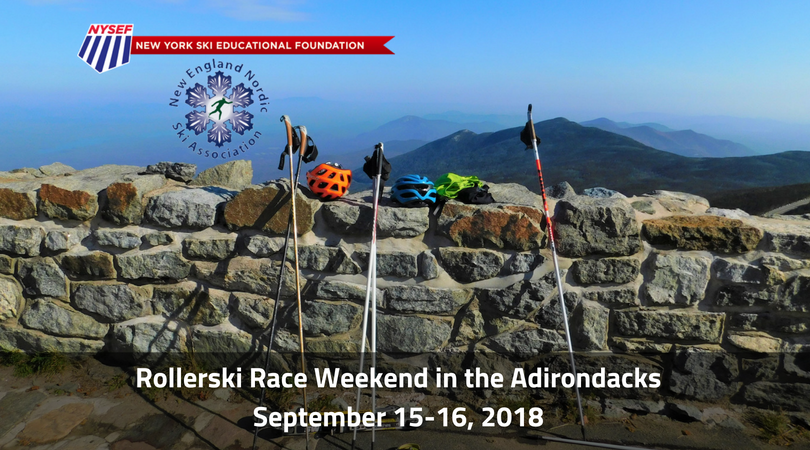
WILMINGTON, NY – The New York Ski Educational Foundation (NYSEF), the New England Nordic Ski Association (NENSA) and the Olympic Regional Development Authority (ORDA) invite athletes to a rollerski race weekend, September 15-16 in the Adirondacks. We are excited to make this a two-day race series and to take advantage of the Olympic venues in our region.
On Saturday, September 15, there will be a Lake Placid Doubleday consisting of a 3-kilometer freestyle prologue rollerski with an interval start followed by a 1.5-kilometer freestyle preliminary sprint. The Doubleday will take place at 9:00AM at the rollerski loop located at the Lake Placid Olympic Ski Jump.
On the Sunday, September 16, the Climb to the Castle Skate Race will begin at 8:00AM. The course will start at the Whiteface Toll Booth, climbing for 5 miles with an average 8% grade up the Memorial Highway to the summit of Whiteface Mountain– New York’s 5th highest peak with an elevation of 4,867 feet.
Following the race events there will be a brief award ceremony for Junior, Senior and Masters Classes.
Participate, volunteer and/or cheer on Nordic athletes from around the country!
From left to right: Maddie Phaneuf, Arielle Gold, Jessie Diggins, Stacey Cook, and David Wise in front of the U.S. Capitol in late April in Washington, D.C. (Photo: Barbara Weber/Protect Our Winters)
Young and empowered. Twenty-three-old Maddie Phaneuf, a 2018 Olympic biathlete and member of the US Biathlon’s national team, has been finding her voice this short offseason as she lobbied members of the U.S. Senate and House of Representatives in Washington, D.C., on April 25. Phaneuf, along with 2018 U.S. Winter Olympians Jessie Diggins, Arielle Gold (snowboarding), David Wise (freestyle skiing), and Stacey Cook (alpine skiing), spoke in D.C. on behalf of the Citizens’ Climate Lobby and Protect Our Winters (POW).
“I have been working with POW for about a year now,” Phaneuf explained on the phone on April 24. “I have been helping them out as a winter-sports athlete giving presentations to schools and teaching kids about climate change and its impact.”
Phaneuf may have been destined for winter sports, but until the age of 8, her life was a snow-void. Phaneuf was born in Virginia and spent her early childhood in South Carolina. Her limited exposure to snow consisted of a single freak snowfall where the snow melted within a day. Fortunately for US Biathlon, Phaneuf said her father wanted his children to experience the full spectrum of the seasons and relocated the family to Old Forge, New York, in the Adirondack Mountains.
“The whole town is really into skiing, whether it be downhill or nordic,” Phaneuf said of Old Forge, where her parents still reside. “So my parents wanted us to get into that because it would be a great way to experience winter in the Adirondacks, and for us kids to stay active.”
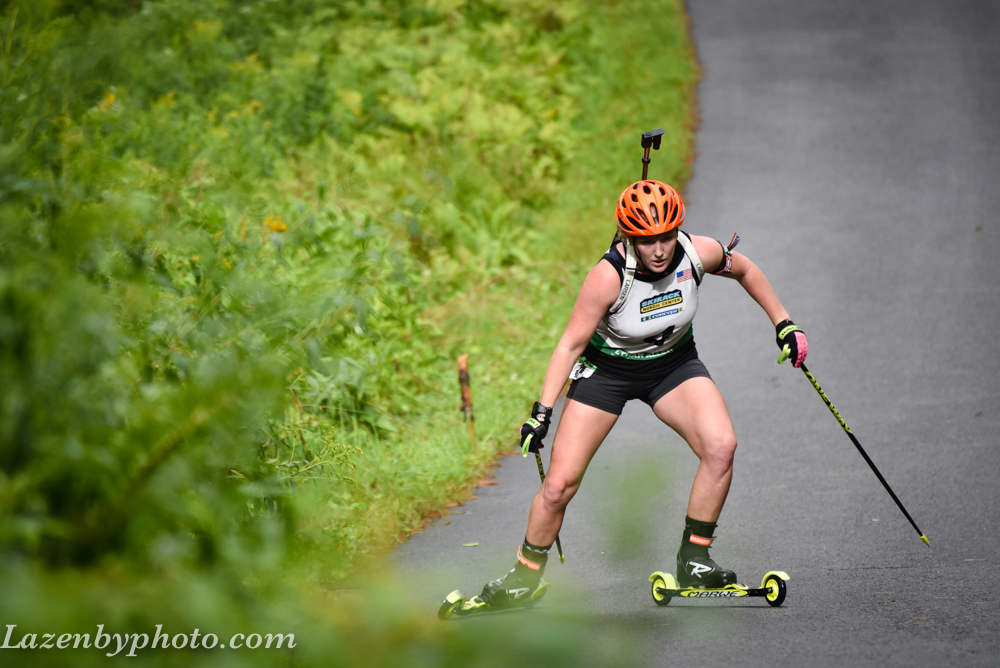
Maddie Phaneuf (USBA/PBSC) racing to fourth in the women’s mass start last August at 2017 US Biathlon Rollerski Championships in Jericho, Vt. (Photo: John Lazenby/Lazenbyphoto.com)
Nominated to US Biathlon’s X-Team in 2014, Phaneuf climbed the ranks and to reach A-team status last season. Last month, she was named to the B-team, part of the US Biathlon’s top-tier High Performance Team. While continuing to train and race with the national team, she planned to move from Lake Placid, N.Y., to her new training base in Boulder, Colorado, this summer.
New York’s North Country, where Old Forge is located, is a reliably conservative region. At least on electoral maps, the politics can skew towards an anti-climate-change perspective. However, Phaneuf said she has felt backed by Old Forge as she explains her point of view to others.
“My hometown is very supportive of me,” Phaneuf said. “I went into the local school and they were excited to learn about my climate-change presentation. But I am sure there are parents that don’t necessarily agree with what I am saying, but they are not going after me.”
Politics and athletics can be a non-starter for athletes. Being outspoken about a cause, in particular, one as divisive as climate change, can alienate an athlete — especially on social media. But Phaneuf has used the resilience she has developed in the fickle sport of biathlon to weather the storm and move forward with her activism.
Phaneuf admits she is still learning how to navigate the potential minefield of exercising her free speech. This past February, Phaneuf penned an op-ed piece for Syracuse.com, expressing her belief that change must be enacted to save winter, and by extension, our ability to sustain the winter sport economic engine and way of life in places like the North Country.
Phaneuf was eventually alerted to the many negative comments her piece received when she posted it on her personal Facebook page.
“I went to the article and 90% of the comments were bashing me,” Phaneuf explained. “Saying I am too young, I have never experienced anything — what am I talking about? Not even bashing climate change but bashing me personally … When I shared the climate-change article I wrote, one guy replied something like, ‘What’s up? You are not posting things about the Olympics. This is bullshit. I don’t want to read this. I want to follow you.’ I replied, ‘OK, the Olympics are over. It’s my offseason. I think it is irrelevant to post things about the Olympics right now because we aren’t there. And I want to show my followers what I do in my free time. Just because you are an athlete doesn’t mean you can only post about training and racing.”
Phaneuf recognizes that her Olympic-team nomination has given her more exposure. She said her Facebook page went from 1,000 to 4,000 likes during the 2018 Olympics in February. As she had matured, Phaneuf explained she’s become wiser when it comes to engaging detractors.
“I have been trying better than in the past,” Phaneuf said. “In the past, I would reply to all the comments kind of aggressively, like ‘what do you mean?’ But now I take a step back and simply read the comments. I understand everyone on the internet is human and all have their own opinion. I just try to not respond unless they are trying to put words in my mouth or saying other things about me, then I will respond and clarify the facts in a respectful way.”
The halls of Congress, on most days, are not the wild west of internet commenting. The tone is soberer. There is the understanding that change comes about from the steady persistence of advocacy, lobbying and voting at the ballot box.
Two weeks ago in D.C., the talking points for Phaneuf and the other athletes present were clear They were to speak about the following: What impacts have they witnessed regarding climate change? How is climate change impacting their sport? How might climate change impact future Winter Olympics?
The athletes also spoke of the regional economic boost snow availability brings certain regions across the U.S. (POW and Citizens’ Climate Lobby cite that in New York alone, the outdoor-recreation economy contributes $41.8 billion dollars and provides 313,000 jobs.)
US Biathlon’s Maddie Phaneuf outside the D.C. office of U.S. House Representative Elise Stefanik (New York). (Photo: Barbara Weber/Protect Our Winters)
The Congressional briefing was a bipartisan event sponsored by Senator Michael Bennet of Colorado and Senator Susan Collins of Maine. The athletes also met with Senator Tina Smith of Minnesota, Senator Dean Heller of Nevada, Congresswoman Elise Stefanik from Phaneuf’s district in New York, Congressman Scott Tipton of Colorado, and Congressman Mark Amodei of Nevada.
“It was good,” Phaneuf said on April 26, the day after her D.C. experience. “I was definitely nervous going into it. I had never been in the position of talking directly to congresspeople or senators. They definitely heard our message. It was definitely more chill than I expected it to be. I was afraid it was going to be judgmental and scary. … The biggest part of our day was simply talking about our own experiences with climate change. And not getting too much into the politics.”
Although Phaneuf has chosen to emulate a long line of athlete activist, her biathlon career remains a priority as she transitions from upstate New York and her residency at the Lake Placid Olympic Training Center to her new base in Boulder.
Phaneuf’s B-Team status comes on the heels of what she calls her “worst season ever”. Although qualifying for Olympics, Phaneuf said she struggled before the Olympics and spent her time in PyeongChang, South Korea, bedridden.
“I struggled a lot with fitness last summer and lost tons of training,” Phaneuf said of the start to her 2017/2018 racing season. “Then I didn’t make the World Cup team in the first period, and then I made the IBU Cup team, but was not performing well and barely made the Olympic team. [In PyeongChang] I got sick the day of my first race and got strep throat and a virus on top of that. I was totally out for two weeks. Being at the Olympics and being around that atmosphere and being so close to racing — having that stripped away from me, made we want to figure how to get better at training and do a lifestyle change. This is why I am moving to Boulder.”
A new training season has begun for Phaneuf. In the meantime, she’ll be juggling her sport with her more seasoned political voice.
“I don’t think I have ever voted in midterm elections,” Phaneuf said of the midterm elections set for this November. “I don’t think I ever thought of it as a big deal. So we are are trying to get the word out because it is a big deal. We want to elect people who will actually listen to us.”
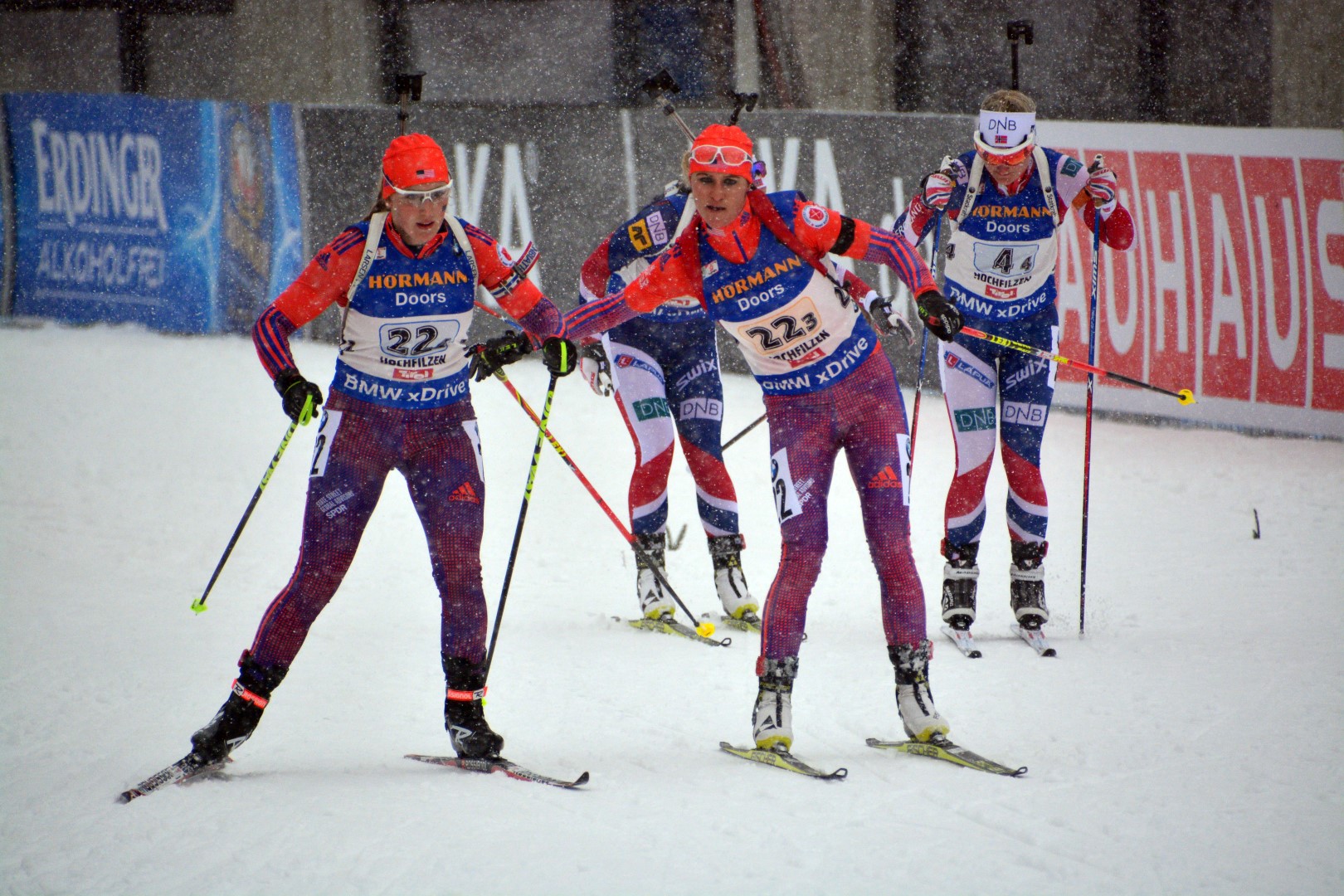
US Biathlon’s Maddie Phaneuf (l) gets tagged by teammate Joanne Reid during the final exchange of the women’s 4 x 6 k relay at 2017 IBU World Championships in Hochfilzen, Austria. The team finished 14th. (Photo: Glen Crawford)
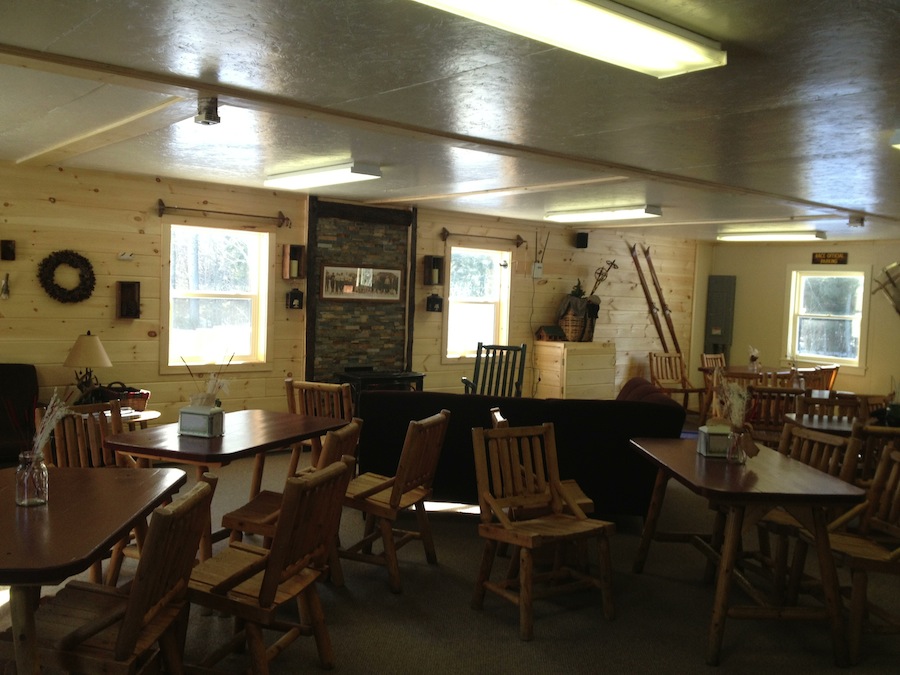
Part of Mt. Van Hoevenberg’s renovated lodge, as seen in January 2013, in Lake Placid, N.Y. A new bar area (not shown) was added in December 2013 and was still under construction on Dec. 21. According to ORDA program coordinator Rebecca Dayton: “We have also put in a small bar area with a plan to serve wine, beer and light snacks during the season.”
Editor’s Note: This is a follow-up article regarding the improvements New York’s Olympic Regional Development Authority (ORDA) has made to its Mt. Van Hoevenberg property, specifically its lodge, and what has yet to be planned. The first article, “Lake Placid: Mount Van Hoevenberg at the Crossroads,” originally appeared in April 2012.
***
LAKE PLACID, N.Y. — A picture of garaged machinery shouldn’t get a skier excited. But this was different.
Attached to a text message – “It’s here!” – was a photo of a brand new Pisten Bully 100, delivered to Mt. Van Hoevenberg in Lake Placid, N.Y., in November 2012. That was one of several improvements that came to Van Ho, the home of the 1980 Winter Olympics.
Known as “Van Ho,” the 50-plus-kilometer nordic area and nearby sliding track is operated by the Olympic Regional Development Authority (ORDA). After the 1980 Olympics, New York state created ORDA to manage all of its Olympic venues, including Lake Placid’s Olympic Center and speed-skating oval, the jumping complex, Olympic Training Center, and the alpine-ski areas, Whiteface, Belleayre and Gore.
To get the Pisten Bully out, Van Ho maintenance crews rebuilt some bridges to support the weight of the new groomer.
In the summer of 2012, ORDA also remodeled its cross-country lodge. On one side, walls were removed to create more usable space. Paneled with blond wood, the new space relieves crowding on busy days. Last but not least, if you’re a master blaster with a toddler in tow – there’s a new baby changing station in the men’s room. Equal rights have made it to Van Ho.
This past spring, ORDA Communications Manager Jon Lundin outlined some of the criteria for the authority’s annual planning. One doesn’t just cut a six-figure check for a snow cat. According to Lundin, ORDA assesses its needs during the winter and makes final plans in the spring.
“Purchase of grooming equipment depends on availability of snow cat and timing of funding,” Lundin wrote in an email. “[It] could take 8-10 months or could be quicker depending on both variables.”
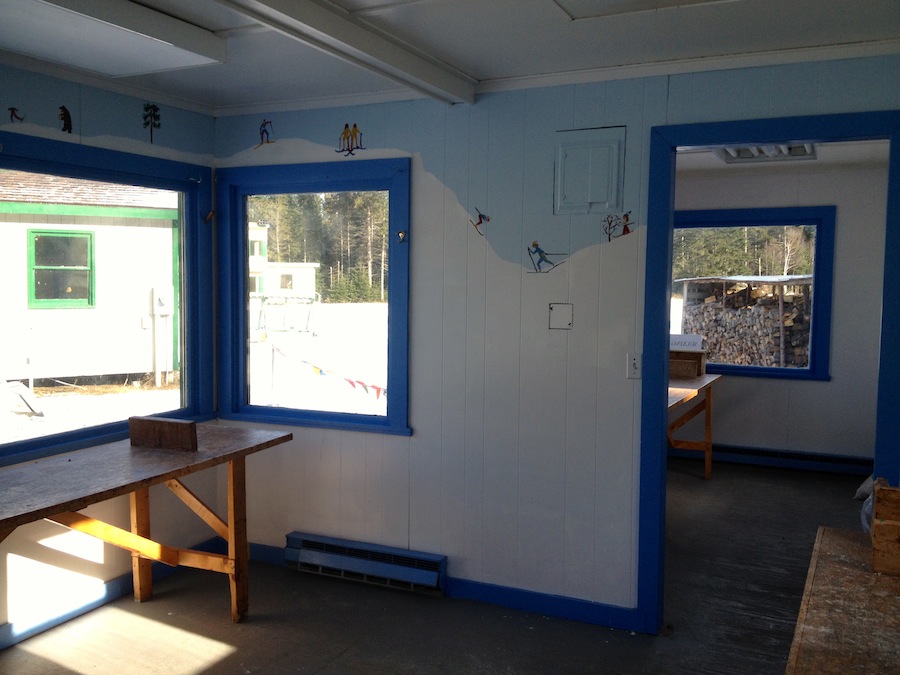
Interior of new wax room at Mt. Van Hoevenberg cross-country lodge.
Larger capital improvements have a longer timeline. For example, “[Alpine] ski lifts have to do with preliminary engineering, market variables such as number of lifts being installed in North America (availability of materials based on that) and funding,” Lundin wrote. “Eighteen months is a good and fair barometer” of the time it takes to put in a ski lift.
This year, ORDA made additional improvements to its cross-country lodge, expanding the lounge area into the former wax rooms for more public seating. The wax rooms are now in the New York Ski Educational Foundation (NYSEF) changing building behind the lodge, and the NYSEF team moved into the timing building, ORDA’s Olympic Sports Complex program coordinator Rebecca Dayton explained.
“More room and better flow for them as they are now in the same building as their wax facilities and more room and better ventilation for other skiers,” she wrote in an email.
As of Dec. 21, a small bar area was also under construction with the intent “to serve wine, beer and light snacks during the season,” Dayton added. Outside the lodge, trail homologation is complete with FIS certificates for six separate loops ranging from 1.4 to 7.5 km in length, she explained.
Laundry List of Long-Term Projects
While these are welcome improvements, more could be in store. But navigating the waters can be tricky.
Located in the Adirondack Park, most of Van Ho’s land is owned by the Department of Environmental Conservation (DEC), and ORDA operates Van Ho under an agreement with the DEC. It remains subject to Article XIV of New York’s Constitution, which mandates that Adirondack Park land shall be “forest preserve… forever…wild.”
The Adirondack Park Agency (APA) oversees land use in the park. According to the APA, Van Ho is designated as an “intensive use” area. Their State Land Master Plan specifies that Van Ho should be maintained as a “year-round sports facility meeting international standards for such sports as … cross country skiing on improved cross country ski trails under developed, competitive conditions.”
Under APA’s guidelines, ORDA and the DEC prepare a Unit Management Plan (UMP) outlining how Van Ho will be developed. There are dozens of UMPs for various public land parcels in the Adirondack and Catskills parks.
The women’s EISA field starts a race at Mount Van Hoevenberg in 2010. Leading are Ida Sargent (USST/Craftsbury) and Rosie Brennan (APU), then racing for Dartmouth College. Lake Placid is an important venue for developing racers.
Approved in 1999, Van Ho’s plan calls for, among other things, refurbishing and repurposing the biathlon lodge as a ski-tourism lodge. It includes building a new cross-country lodge “in a location with better drainage” than the site of the current lodge.
In a previous FasterSkier article, Greg Stratford, then-assistant manager of the Olympic Sports Complex, discussed the concept of replacing both the existing lodges with a single building on the site of the current cross-country lodge.
“One of the problems is that if we build a new stadium, it would need to be suitable for both cross-country and biathlon,” he said in April 2012. “Each of the different sports that use our facilities has their own specifications and requests and wants and needs. We need to get everybody together to determine what would be the best scenario for Mt Van Hoevenberg.”
Asked where the biathlon range might be sited for a single lodge, Lundin wrote, “Nothing contemplated.”
When asked whether a combined lodge to serve both Van Ho’s cross-country and accompanying sliding track was under consideration, he replied, “That concept has not been part of our planning process.” Dayton confirmed that there are no plans to build a new lodge currently in the works.
Environmental and Financial Challenges
The author’s daughter, Laurel Minde, 11, weathers rain and slush at the start of the Ladies’ 5K near the cross-country lodge at Mt. Van Hoevenberg on Dec. 21.
Whatever the future holds, if a new lodge was to be built at Van Ho, or snowmaking installed, it’s not as simple as drawing blueprints and soliciting bids from contractors.
Reviewing Article XIV case law, the UMP’s authors conclude that the improvements proposed for Van Ho “are consistent with the mandates of Article XIV.”
But a in a subsequent section, the UMP separates planned improvements into two categories: those that that don’t require an amendment to Article XIV and those that do.
Purchasing new grooming equipment, remodeling the biathlon lodge as a destination for recreation, and trail maintenance, for example, don’t require a constitutional amendment.
However, installing a new snowmaking system, building a new cross-country lodge “in a location with better drainage” than the current lodge, and rebuilding the tunnels under the access road – among other things – would require an amendment to Article XIV.
Would a new cross-country lodge, built on the site of the current one, require an Article XIV amendment? Dayton declined to comment. “That is outside my area of expertise,” she wrote.
What is it exactly about these improvements that would require a constitutional amendment?
“The proposals in the Van Ho UMP are compliant with the State Land Master Plan for Intensive Use,” APA spokesman Keith McKeever explained in an email, while adding, “With regards to the constitutional questions raised, APA does not make those determinations. That would be done by the Attorney General’s Office.”
The New York State Attorney General’s office declined to comment.
According to DEC spokesman David Winchell, ORDA would need to discuss proposed improvements with the DEC, which would decide whether a constitutional amendment would be necessary. The DEC “would determine whether the proposed action is acceptable” and would collaborate with ORDA “to determine whether an amendment should be pursued.”
Asked why ORDA hadn’t pushed for an amendment to Article XIV for Van Ho, Lundin wrote, “We have not pursued it at this time.”
The LA Group of Saratoga Springs, N.Y., conducted much of the environmental impact analysis for the plan. When asked what environmental road blocks there might be to improvements at Van Ho, director of environmental planning Dean Long declined to comment. “Our last work at the facility was in 1996,” Long wrote.
Resolving a possible Article XIV issue is only one challenge. ORDA would also have to find a way to pay for major improvements such as a snowmaking system. In addition Mt. Van Hoevenberg, ORDA has to budget for improvements at its other venues. Besides the Pisten Bully and an excavator for Van Ho, in its last fiscal year, ORDA renovated part of a Whiteface ski lift and purchased new snow cats for Whiteface and Gore.
Everything You Were Afraid to Ask in Civics Class
“You have conversations. There’s dialogue before a bill is introduced,” according to a person closely involved with the New York State Legislature.
Declining to be identified, the source explained that either ORDA or the DEC might approach a legislator to sponsor an amendment to Article XIV. The bill would pass through committee before being introduced to the entire legislature.
Hypothetically, any bill to amend Article XIV would have to be passed by two separate sessions of the N.Y. legislature. The legislature is up for election every two years. If a bill passes that hurdle, it would then be presented to the electorate as a referendum If an amendment to Article XIV was brought before the legislature, it would take about five years to pass.
The approach to amending the constitution is anything but casual. The source stressed that the legislature is “judicious in how frequently this is done.” Once an amendment makes it to the ballot, they do everything possible to ensure its success. It’s “critical to have environmental organizations on board,” he concluded.
The Future for Van Ho
Skiers warm up for the 2013 Lake Placid Loppet at Mt. Van Hoevenberg’s stadium in Lake Placid, N.Y.
Completed in 1999, Van Ho’s UMP was “proposed to be accomplished in five phases over the next five years.” It acknowledged that development could take longer.
In 2000, Van Ho’s 1980-vintage luge and bobsled tracks were replaced with one spectacular state-of-the-art sliding track. New York kicked in $13.5 million of the $20-million dollar cost, with the federal government covering the balance. The new track didn’t require an Article XIV amendment. The sliding track was a major piece in Van Ho’s UMP.
The Whiteface Memorial Highway illustrates the challenges facing Van Ho. If you’ve raced the Climb to the Castle, you’ve experienced this road’s frost heaves, bumps and sections of cracked pavement that can break poles and upend skiers.
Like Van Ho, the highway is located on DEC-owned land and managed by ORDA. The highway signs are property of the New York Department of Transportation. None of these bodies has the budget for repaving the highway. For over 40 years, the road didn’t see a major repaving project and deteriorated over time. Only recently, New York Governor Andrew Cuomo announced that he would appropriate $12 million dollars to repave the highway and refurbish the summit castle and toll house.
Over the last two years, ORDA has made significant changes at Van Ho. But some of the biggest projects in the UMP require significant expenditure and effort. Determining whether a constitutional amendment is necessary is only one challenge. Financing the improvements is another.