From the FasterSkier archive — posts syndicated from athletes’ and coaches’ own blogs between 2004 and 2012, kept online as published. Current coverage is at fasterskier.com.

Tag: Adrien Backscheider

  • Saying Goodbye to Some Big Names in Cross-Country: an International Retirement Roundup

    Saying Goodbye to Some Big Names in Cross-Country: an International Retirement Roundup

    Each year at the conclusion of the race season, there are always a few athletes who hang up their skis and step away from professional racing. The end of the four year Olympic cycle inevitably means a higher concentration of such announcements. Whether it was a fourth or a first appearance at the Games, or a near miss, the Olympics are always a target and their completion provides a good moment to move on. While the retirement announcements will likely continue into the spring, here is a roundup and recognition of the international athletes who have shared the news that they will be ending their ski careers. 
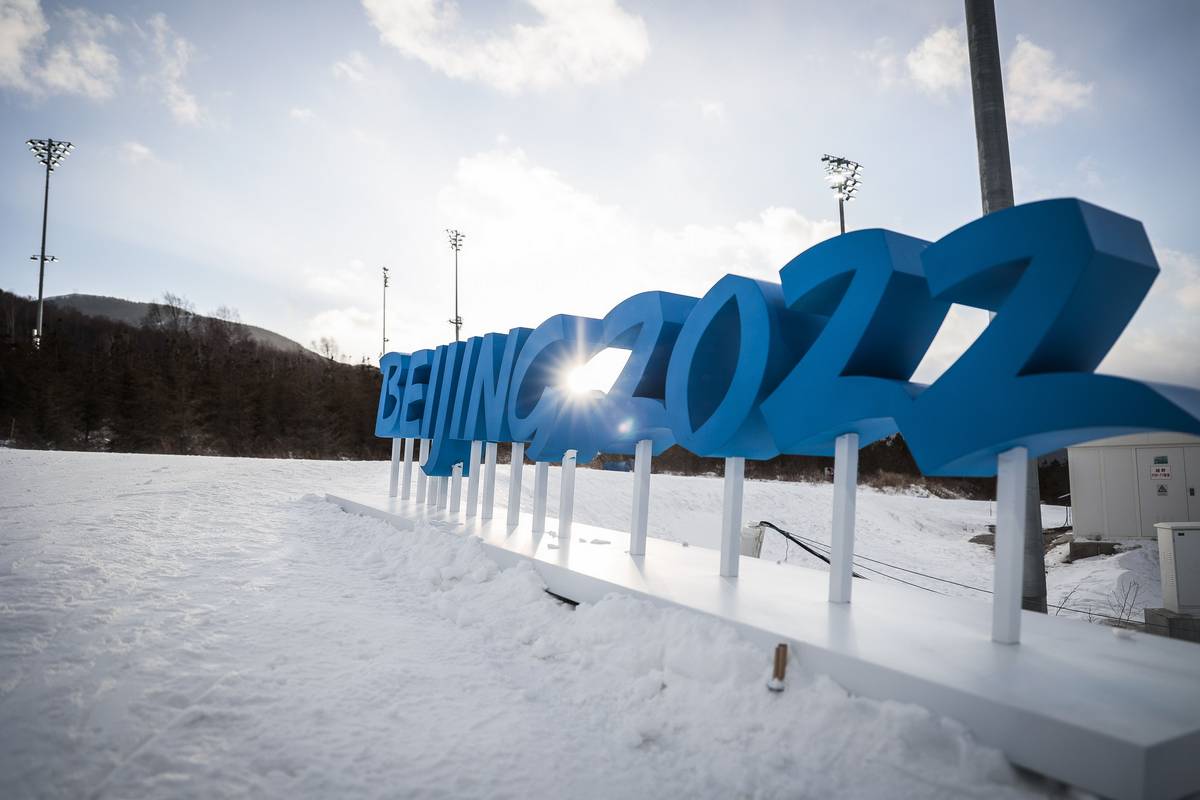
    A scene from the cross country venue in Zhangjiakou, China, host to the 2022 Olympic Winter Games. (Photo: NordicFocus)

    Four athletes from the Swiss team have announced that they will be moving on, chief among them – the king of the 15 k, Dario Cologna. At the age of 36, Cologna released his decision before the 2021/22 season even began, saying, “the decision came within the last months and after the Olympics, it will be the perfect timing for me. I have achieved everything I ever dreamed of in the sport.”
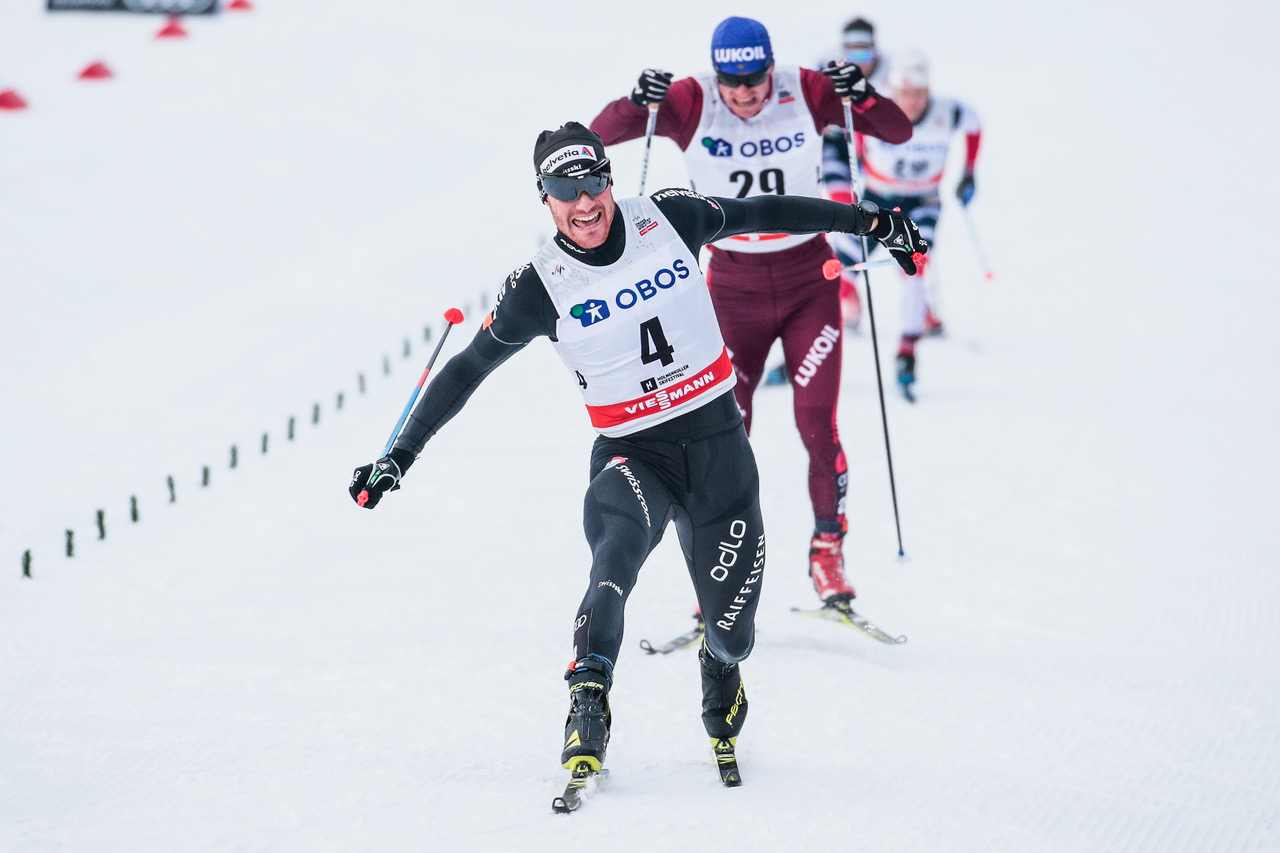
    Switzerland’s Dario Cologna lunges to the line at the 2018 Holmenkollen 50-kilometer freestyle race in Olslo, Norway. (Photo: NordicFocus)

    Cologna had his World Cup debut in 2006 and his first Olympic start came in 2010 in the 15 k skate event, where he finished first. This victory crowned him as the first Swiss cross-country skier to earn an Olympic gold medal. He went on to win three additional golds, in the 2014 Sochi Games he won both the skiathlon and the the 15 k classic, and in 2018 in PyeongChang added a gold in the 15 k skate. All told, Colgona had eighteen Olympic starts at four different games.

    In between Olympic years, he was equally successful. He won the Overall World Cup globe four times, first in the  2007/08 season, again in 2010/11 and 2011/12 and a few years later in 2014/15. In the 2007/08 season he also earned his first Tour de Ski victory, in spite of the fact that he never took a stage win that year. He won the grueling event three more times, in 2010/11, 2011/12 and again in 2017/18. 
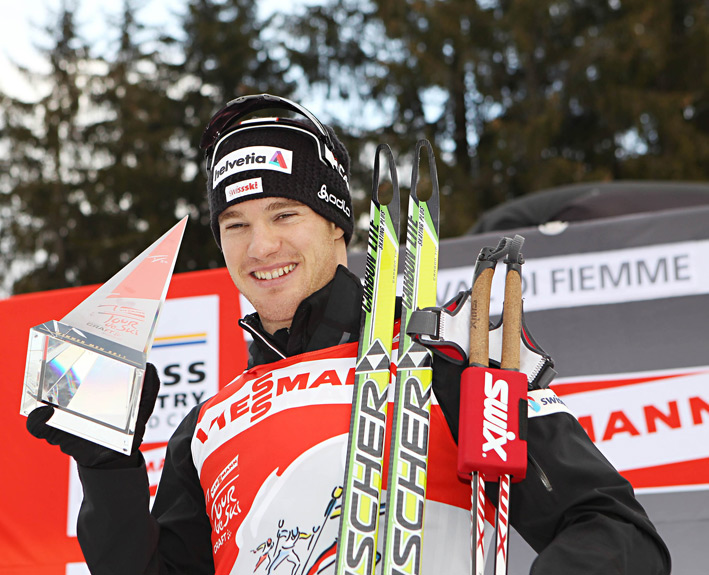
    Dario Cologna (SUI) with his trophy after winning the Tour de Ski in 2011 (Photo: Fiemme2013)

    After his final outing in the legendary Holmenkollen 50 k, Cologna wrote on Instagram, “I look back on a beautiful and successful career. 15 years ago I never dared to dream that one day I would be a four-time Olympic champion, World Champion, multiple Tour de Ski- and overall World Cup winner. In addition, I was privileged to travel to places I would never have seen and met great people, who became good friends.” 
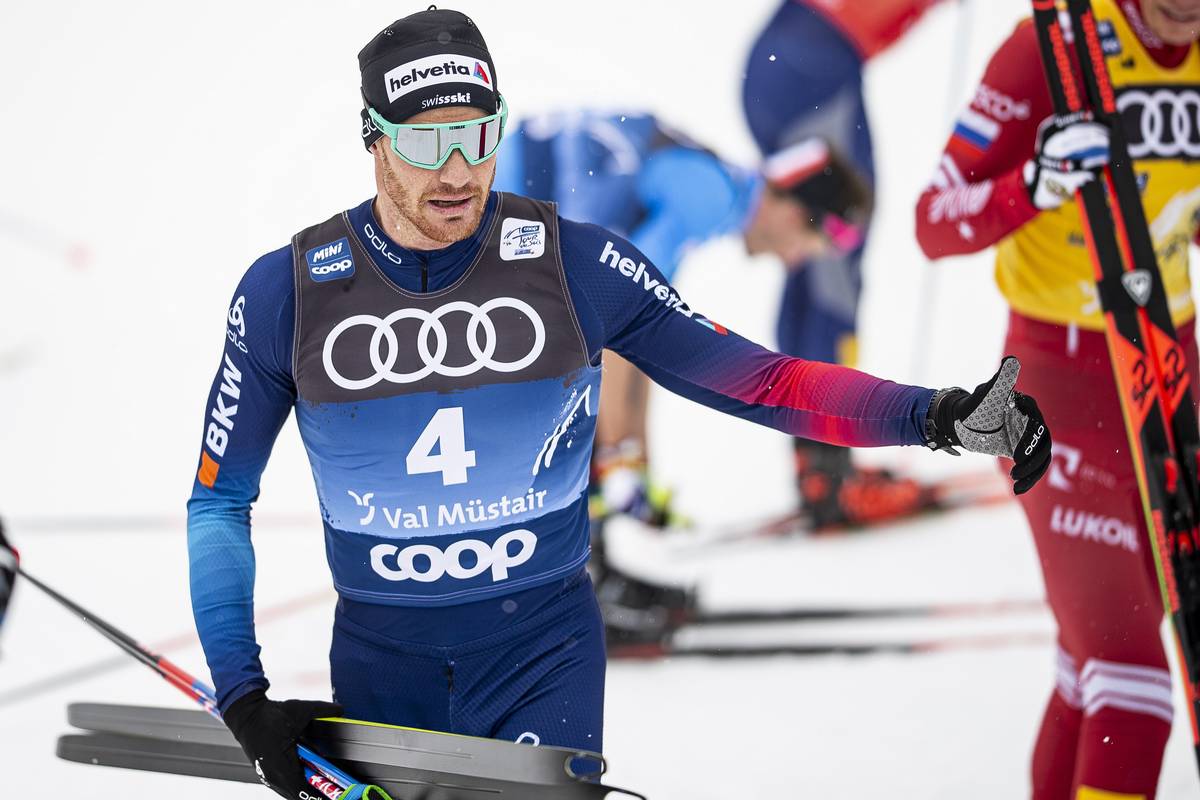
    Dario Cologna (SUI) after a 6th place finish in Val Mustair during the 2021 Tour de Ski. Photo: Nordic Focus

    Cologna’s teammate, Jovian Hediger, also announced his retirement prior to the start of this season. Hediger was known as a sprint specialist and has 107 World Cup starts to his name, having made his debut in 2009. His first and only podium appearance came in 2021 during the team sprint event in Ulricehamn, Sweden, where he and Roman Furger finished second. Hediger represented Switzerland at three Olympic games, beginning with Sochi in 2014 and ending most recently in Beijing (2022). 
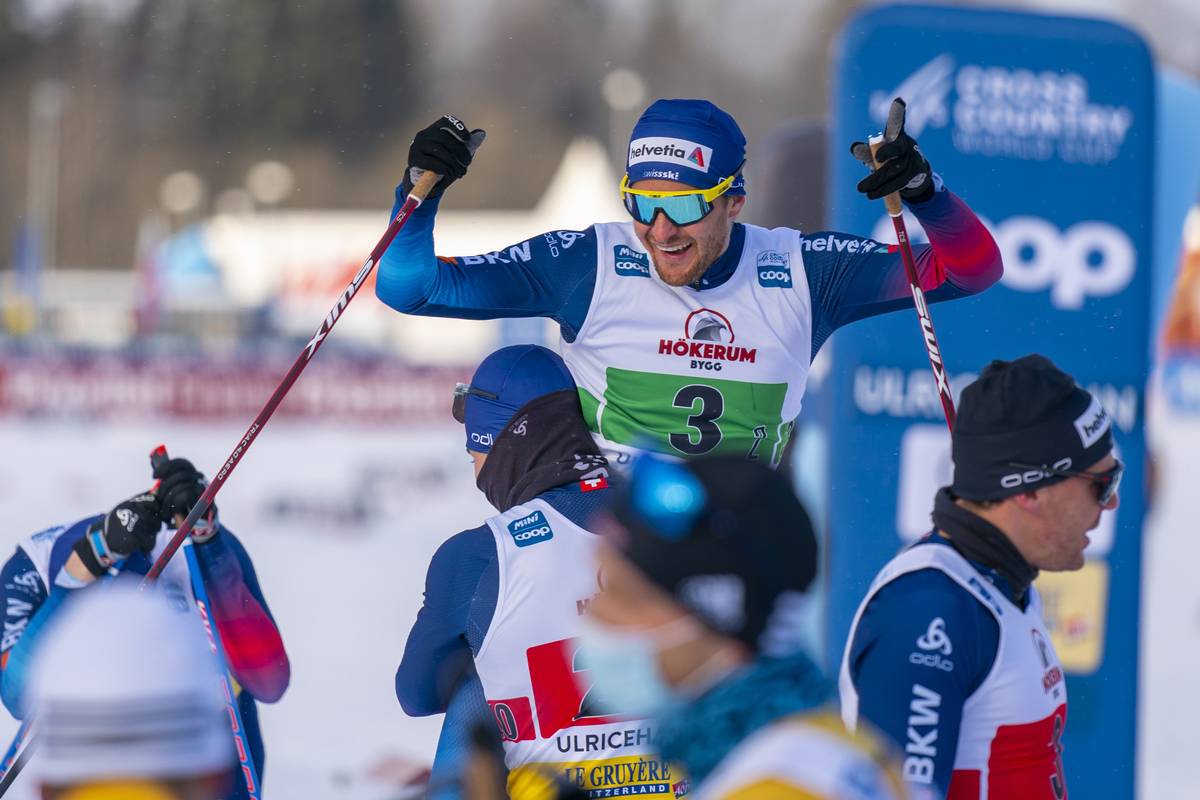
    Jovian Hediger (SUI) gets a boost from some happy teammates at the finish line in Ulricehamn Sweden. (Photo: Nordic Focus)

    Ueli Schnider of Switzerland is also stepping away from elite competition. Schnider has 62 World Cup starts and made two Olympic appearances, both in 2018 in PyeongChang where he finished 37th in the classic sprint and 41st in the 50 k classic mass start. 

    On the women’s side, Laurien Van Der Graaff of Switzerland is moving on. Van Der Graaff has long been a staple in women’s sprinting, beginning in 2011 with her first World Cup podium in Duesseldorf, Germany. In doing so, Van Der Graaff became the second Swiss female athlete ever to reach the podium and over the years she continued to pave the way for young Swiss female athletes. Her first victory came in 2017 in a skate sprint Tour de Ski stage race on home ground in Lenzerheide, Switzerland. 

    The women’s sprint podium in Rybinsk Russia, 2015 (from l-r): Natalia Matveeva (RUS) second, Jennie Öberg (SWE) first, and Laurien Van Der Graaff (SUI) third.

    Van Der Graaff partnered up many times with Nadine Fähndrich in team sprint events, resulting in four World Cup podium finishes. At the World Championships in Oberstdorf, Germany (2021), Van Der Graaff and Fähndrich teammed up again, earning a silver medal when they finished just hundreths of a second behind team Sweden. 

    Van Der Graaff shared with FIS, “for some time I was convinced that I would not continue skiing until Beijing 2022, but I made it and I am very proud of what I have achieved. However, now my time has come and I am excited for everything that is coming my way in this new chapter.”
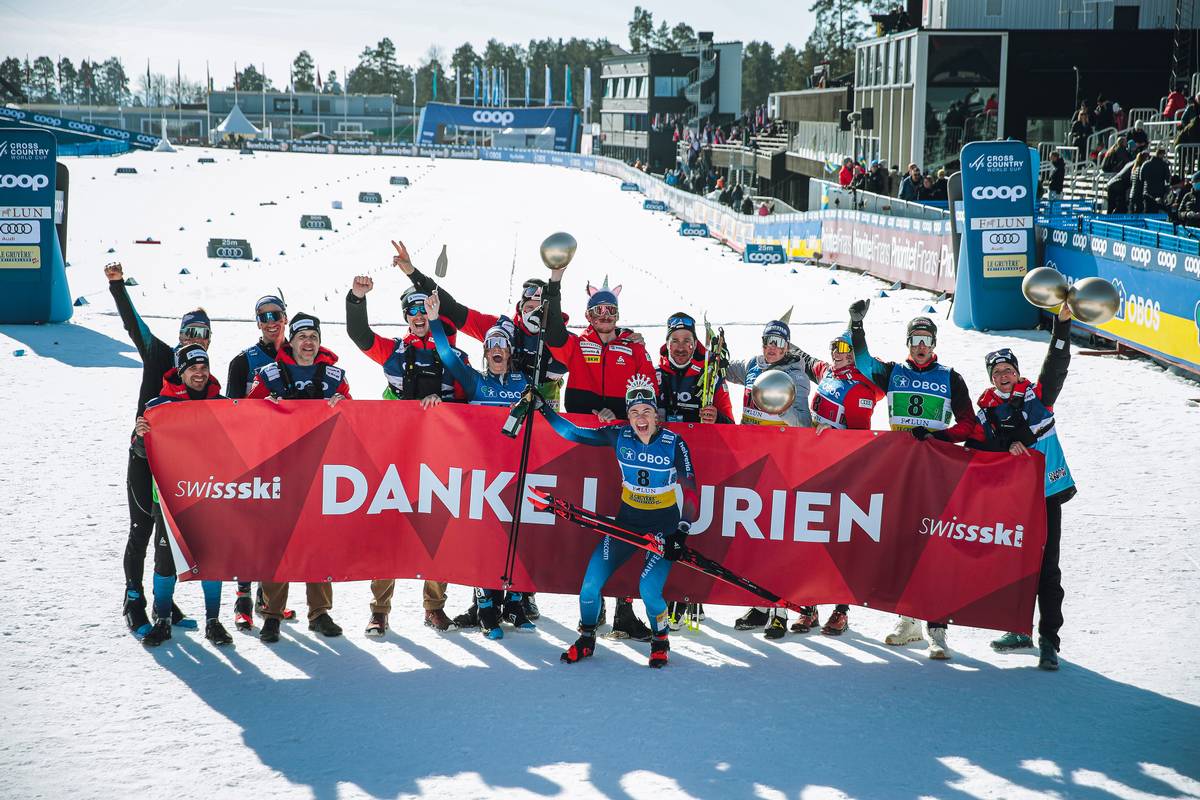
    The Swiss program celebrates the retirement of Laurien Van Der Graaff at the finish of the 4 x 5 k mixed relay in Falun. (Photo: NordicFocus)

    While some athletes knew from the outset of the season that this would be their last, others only recently came to the decision. Such was the case for Swedish star, Charlotte Kalla, who just announced her intentions within the last month. The 34-year said, “the curiosity about life outside of elite sports weighs heavier than what a continued investment would entail.”

    Kalla burst onto the World Cup scene at the age of eighteen. She earned her first victory in the next season, taking a stage win in Nove Mesto (2007) in the 10 k skate pursuit. In her first individual World Championships appearances, coming in Sapporo, Japan in 2007, Kalla finished 7th and 5th. To give you a sense of her consistency from then on, of the 34 World Championship events Kalla completed spanning 2007-2021, she finished in the top ten in 30 of those appearances with the exceptions being three 11th place finishes and one 18th. 

    Charlotte Kalla of Sweden on her way to Olympic gold in Vancouver 2010 (Photo: FS archives)

    Kalla represented Sweden at four different Olympic Games, Vancouver 2010, Sochi 2014, PyeongChang 2018, and Beijing 2022. She came away from these events with five individual podiums, including two gold medals and three team medals including her jaw-dropping relay performance in the relay in 2014 when she made up a 25 second deficit to bring the Swedish women their first Olympic relay gold since 1960. 

    Since then, the Swedish women’s team has come to dominate the World Cup circuit and Kalla has taken on a mentorship role within the team. “It’s an inspiring team to be a part of and many girls who have the right mindset to do their very best every day,” said Kalla in 2020. On March 22, 2022, Kalla announced on Instagram that the Swedish national competitions would be her last as an elite athlete. She wrote, “here I took my first [steps] as a seven-year old and it feels nice to end my career here.” 
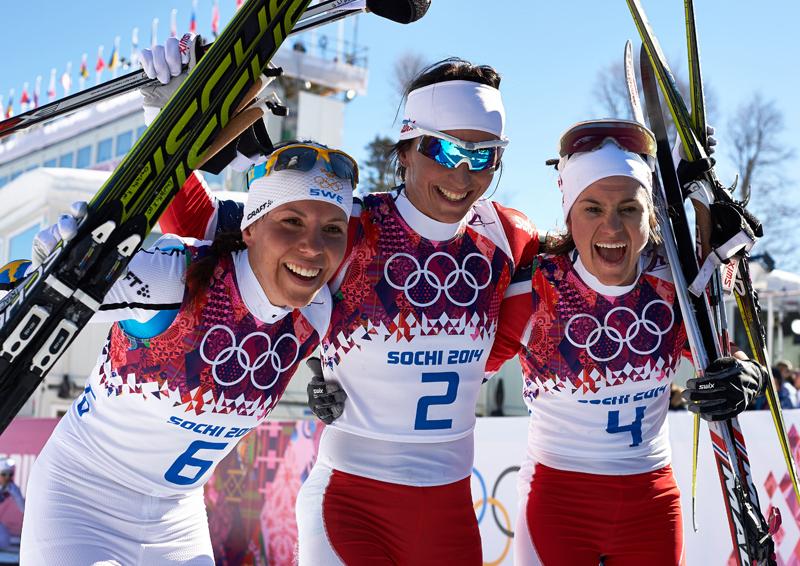
    Charlotte Kalla (SWE), Marit Bjoergen (NOR) and Heidi Weng (NOR) claim the podium in the women’s Olympic skiathlon, Sochi 2014.  (Photo: Fischer / Nordic Focus.)

    Elisa Brocard of Italy is ending her ski-racing career at the age of 37. Brocard had her first World Cup start in 2006 and went on to contest 162 World Cup events. She represented Italy in three Olympic Games, beginning in Vancouver 2010, through PyeongChang in 2018. Her best season came in 2018 when she finished in the top-30 distance World Cup rankings and 38th overall. 

    Nadine Herrmann of Germany is leaving elite competition as well. She is the younger sister of Denise Herrmann who raced the cross-country World Cup circuit until she transitioned to biathlon in 2017 where she went on to win gold in the individual event at the 2022 Beijing Olympics. Nadine Herrmann finished in the top-thirty in her maiden World Cup appearance in 2018 in the Dresden city sprints. She went on to earn a number of top-thirty finishes, including a personal best individual finish of 18th in Dresden in 2020. At the age of 26, Herrmann has decided to move on, she wrote “My active sporting career is coming to an end. The last 14 years of performance sports have shaped me into the person who today can say in the best of my conscience, I gave it my all.” 

    Adrien Backsheider of France has also announced his retirement. Backsheider began racing on the World Cup circuit in 2013. He earned six World Championships starts and helped propel team France to a bronze medal in the men’s 4 x 10 relay in Falun in 2015 and again in Seefeld in 2019. Backsheider also has four Olympic starts, as he represented France in Sochi 2014, PyeongChang 2018, and Beijing 2022. He was a member of the bronze medal relay team in PyeongChang when the French again earned a podium spot in the 4 x 10 relay. Backsheider’s personal best individual World Cup finish came in Östersund, Sweden in 2020 when he finished 7th in the 15 k skate stage race during the Tour de Scandinavia. 

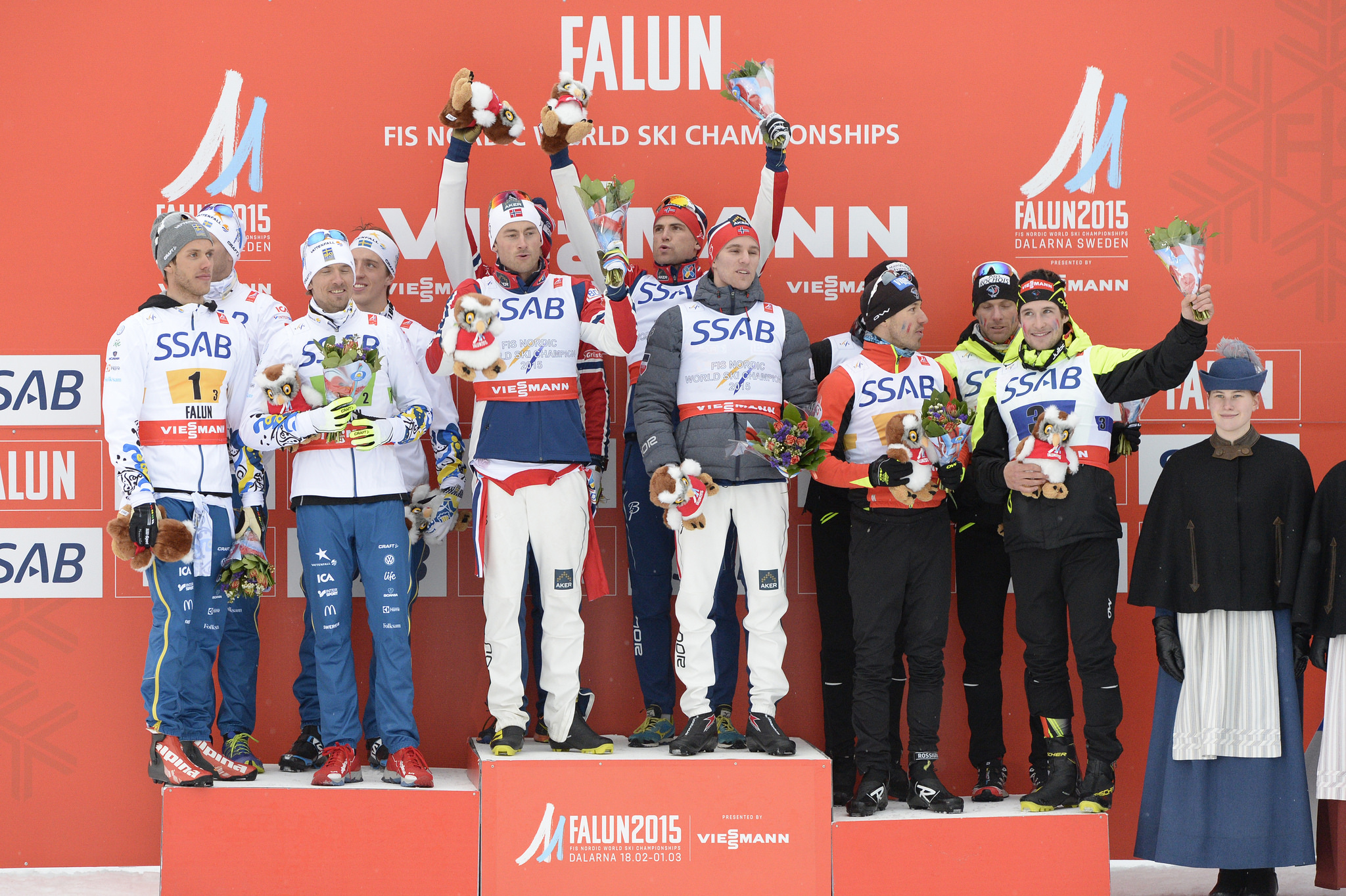
    The men’s 4 x 10 k relay at 2015 World Championships in Falun, Sweden, Norway with gold, Sweden with silver, and France with bronze . (Photo: Fischer/NordicFocus)

    Cendrine Browne of Canada is saying goodbye to professional ski racing as well, having concluded her career with a national title in the 45 k skate in Whistler, Canada. Browne made her World Cup debut in 2012 and went on to start 76 World Cup races. She made the Canadian Olympic team in 2018 and 2022 and also posted thirteen World Championships starts. Browne finished 16th in the 30 k skate mass start in Beijing, a personal best individual finish for her. In a statement to Nordiq Canada after the 45 k race, Browne said, “thank you to everyone in the ski community who has believed in me and cheered for me over the last ten years.” 
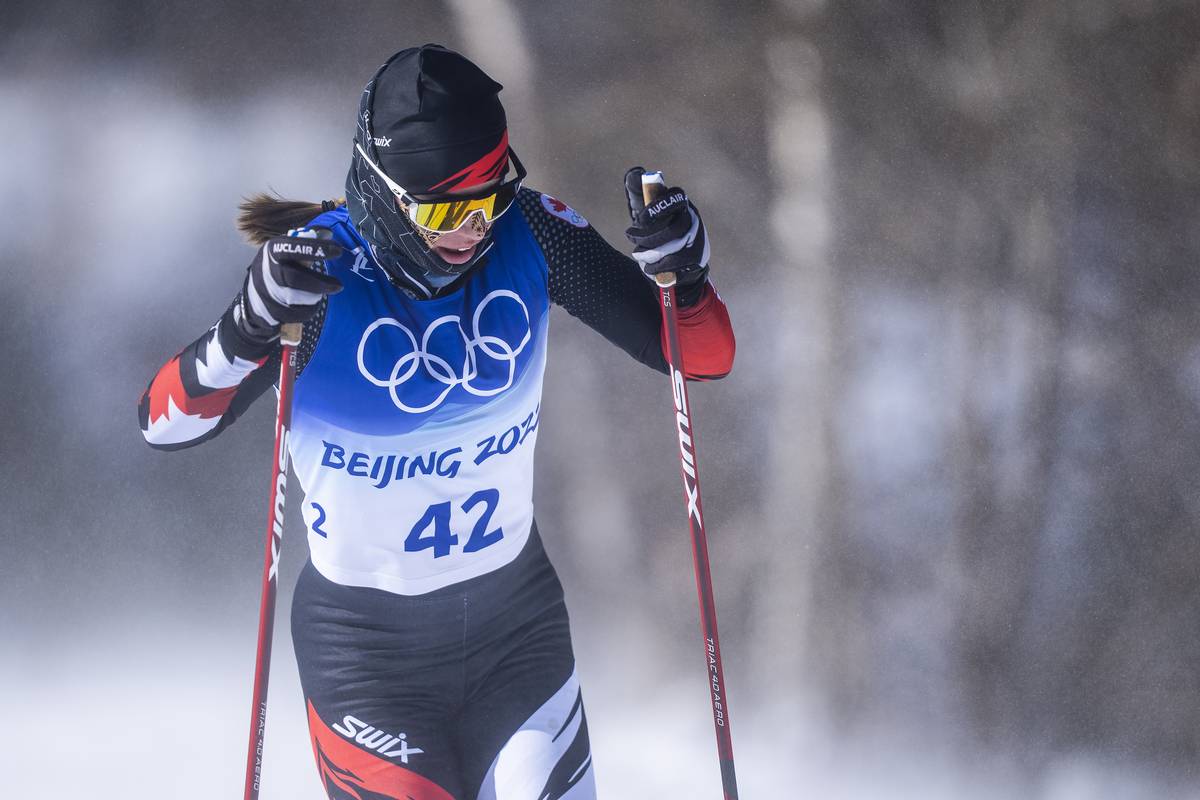
    Cendrine Browne reached a new personal best with her 16th place finish in the 30 k skate mass start in Beijing 2022 (Photo: NordicFocus)

    The notable retirement of the extremely successful, Therese Johaug of Norway has not been missed but will be receiving its own feature from FasterSkier in the coming weeks. Additionally, US Ski Team members Katharine Ogden, Hannah Halvorsen, and Caitlin Patterson have all shared news of their retirement, in addition to top SuperTour athletes Ian Torchia and Adam Martin. (Read Torchia’s retirement story here.)

    Stay tuned for more in-depth reporting on those athletes from FasterSkier.

  • Friday Race Rundown: Men’s 4 x 10 Relay from Seefeld

    Friday Race Rundown: Men’s 4 x 10 Relay from Seefeld

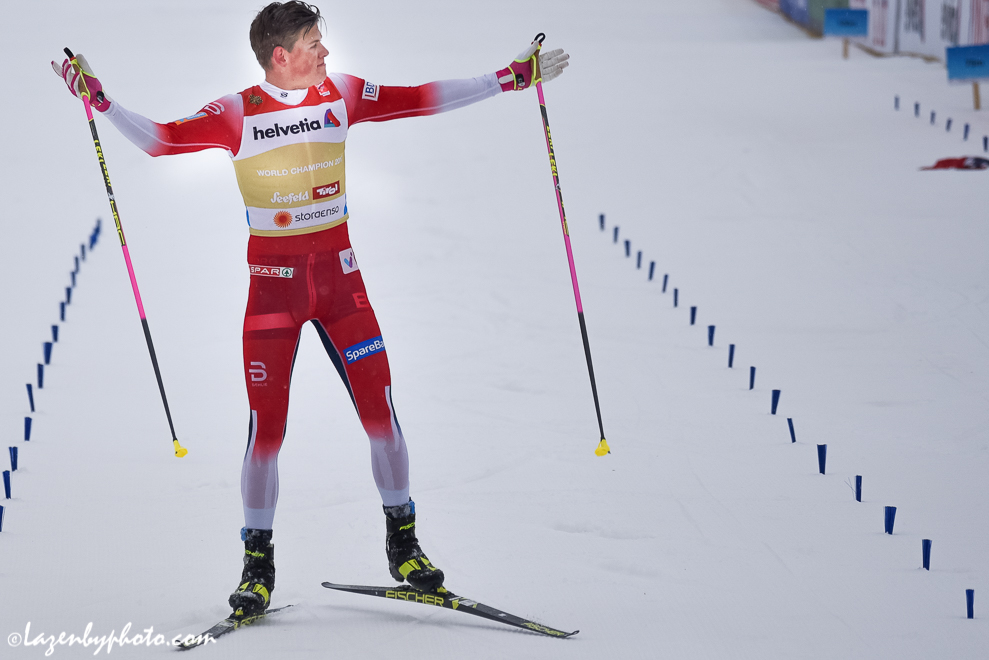
    Johannes Høsflot Klæbo of Norway displaying what has become his iconic gesture when crossing the line as a winner. Once again it was an opportunity for the arms being outstretched as Klæbo anchored Norway to the 4 x 10 k relay win at the 2019 World Championships. (Photo: John Lazenby/lazenbyphoto.com)

    The 4 x 10-kilometer men’s relay was a two-team tango as Russia’s Sergey Ustiugov and Norway’s Johannes Høsflot Klæbo were tagged for their respective anchor legs on Friday. The two teams stuck together until Klæbo moved ahead with less than five k to go and gapped Russia by 22 seconds.

    naltrexone revia

    It was enough final leg surge for Norway’s Emil Iversen, Martin Johnsrud Sundby, Sjur Røthe, and Klæbo to win in 1:42:32.1 hours. Russia’s Andrey Larkov, Alexander Bessmertnykh, Alexander Bolshunov, and Ustiugov placed second (+38.8).

    The final podium spot came down to a final sprint won by France’s Richard Jouve over Finland’s Perttu Hyvarinen.

    Adrien Backscheider, Maurice Manificat, Clement Parisse, and Jouve were 1:01.0 back in their third place statement.

    Finland’s Ristomatti Hakola, Iivo Niskanen, Matti Heikkinen, and Hyvarinen were fourth (+1:02.8).

    The U.S. team of Erik Bjornsen, Scott Patterson, David Norris, and Kyle Bratrud skied to ninth (+4:06.4).

    Canada’s Alex Harvey, Scott James Hill, Evan Palmer-Charrette, and Lenny Valjas placed 12th (+7:05.5).

    Results

  • Torchia on the Ups, Downs and All He’s Learned Since His First USST Nomination

    Torchia on the Ups, Downs and All He’s Learned Since His First USST Nomination

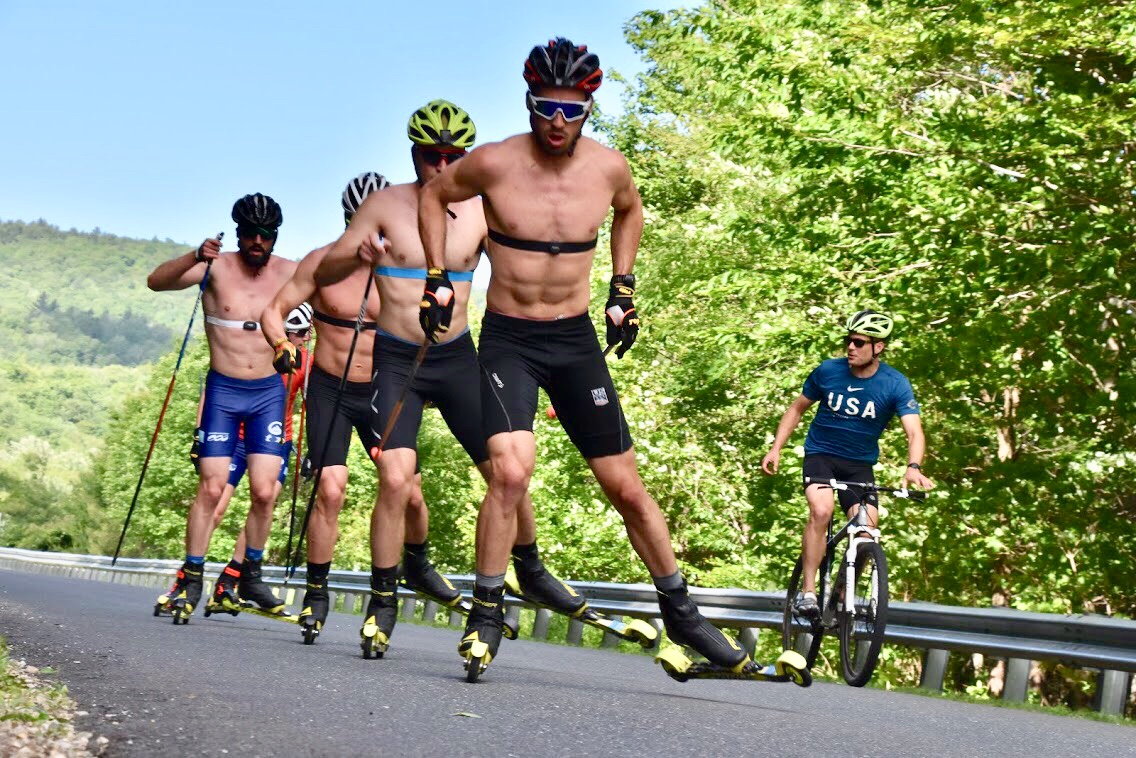
    Ian Torchia (front) leading L3 intervals with the Stratton Mountain School (SMS) team in June. (Photo: Pat O’Brien)

    Two summers ago, with just five miles left of the Marquette Trails Fest 30-mile mountain bike race, all Ian Torchia could hear in his head was the voice of Krystof Kopal, his Northern Michigan University (NMU) teammate, snidely saying, “You drop out again?”

    Fifteen minutes earlier, Torchia had careened into a tree. After dusting himself off, he remounted his bike, but not before noticing his left wrist was badly injured.

    For a moment, Torchia considered pulling out of the race. Thoughts of Kopal, however, kept his feet on the pedals. A few months earlier, Kopal had given Torchia ceaseless verbal flak for dropping out of the 2016 Spring Series 50-kilometer ski race due to cramping. 

    “[Kopal] was playing in my head … so I finished the last five miles with a broken wrist,” Torchia, now 22, recalled on the phone this summer, noting that it wasn’t until after he had finished the race that he found out it was broken.

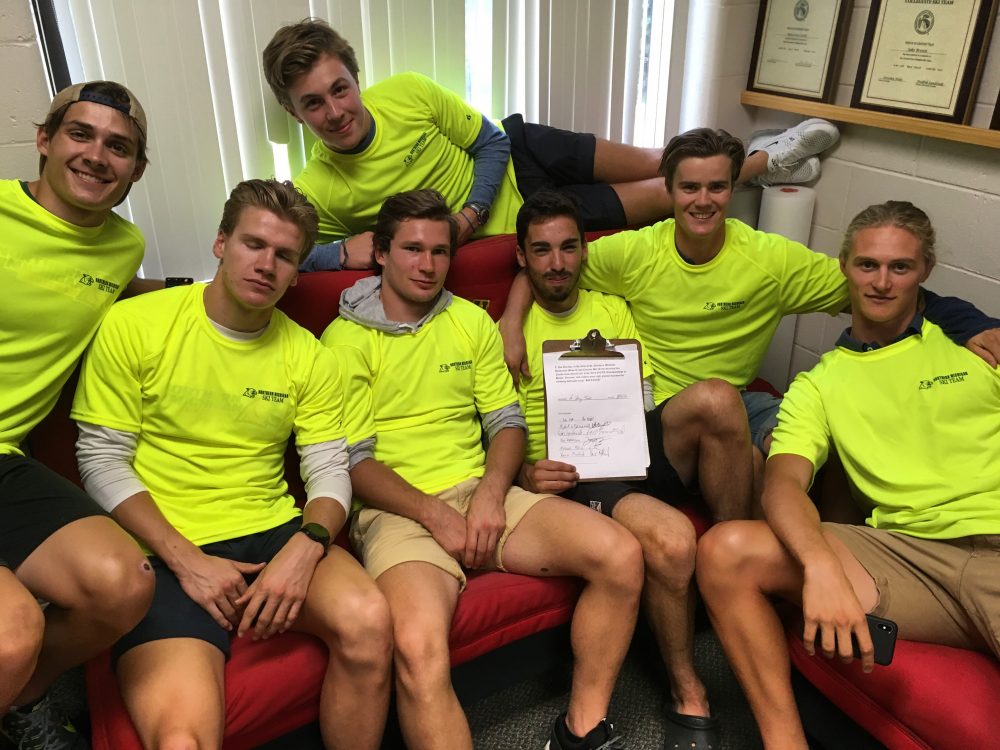
    The NMU men’s ski team with Ian Torchia (third from r) in late August. According to Torchia, the paper he’s holding is a contract. “If we win [the] team NCAA title [this winter], they get to tattoo my gluteus maximus,” Torchia wrote. (Photo: Andy Keller)
    Shortly after, Torchia had his wrist examined by doctor and was told he would need to have surgery. The procedure — scaphoid fixed via percutaneous fixation–left Torchia in a cast. 

    About a month before his crash, Torchia had been nominated to the U.S. Ski Team (USST) D-team and invited to two national-team training camps that summer. Torchia had intended to attend both camps, regardless of whether his wrist was healed or not.

    Fourteen days after his accident, Torchia departed Marquette, Michigan, his “home” since he began attending NMU in 2014, and headed for Eagle Glacier, Alaska, the location of the first USST camp.

    On the glacier, he skied with either one pole or none at all. When he returned to Marquette, the pattern continued for another two months. It wasn’t until the end of August that he had his cast removed. 

    “I kept training super hard with the broken wrist,” Torchia said.

    All that training led Torchia to what he recalled as being “in pretty good shape” leading up to November. Then things started to go south. Fast. Right around Thanksgiving, Torchia was exhausted and experiencing severe night sweats.

    buy inhalers

    “If you type in ‘mono’ on Google and look at the symptoms, I probably had seven out of the eight,” he said. “But I at the time was thinking ‘It’s just a bad virus. It will pass.’ ”

    The symptoms continued. Torchia’s girlfriend suggested he get tested for mononucleosis. He didn’t. 

    “I didn’t want to believe her,” Torchia said. 

    Soon enough he had to. In mid-December, hypothermia forced him to drop out of a race. At 2017 U.S. Cross Country Championships in Midway, Utah, he felt sluggish and “off” during training, so he visited a walk-in clinic in Park City. The doctor tested for mono, and the results came back positive. 

    “The doctor was kind of nonchalant about it,” Torchia said. “He came in and was like, ‘Oh yeah, you’ve got mono, but nordic skiing isn’t a contact sport so you should be good to go and ski at nationals. I was like, ‘Oh, sweet…that’s not how it works.’ ”

    Following the diagnosis, Torchia decided to skip nationals and return to his hometown of Rochester, Minnesota, for the holidays. He stopped exercising for a month before gradually returning to training.

    “A lot of different skiers messaged me saying, ‘On this return, you need to take it really easy,’ ” Torchia said. (One of those skiers included Tad Elliott, who caught the Epstein-Barr virus in 2014 and went on to win a national title in 2016).

    Torchia took their advice, as well as that of his NMU head coach, Sten Fjeldheim, who has helped other athletes diagnosed with mono safely return to training. The two worked out a meticulous day-by-day plan for Torchia’s return. Torchia redshirted the 2017 college season, but by March, he was back on skis.

    “I wasn’t really thinking about what other people thought,” Torchia said when asked if he was worried whether others were questioning his USST nomination during that time.

    “I was thinking more about the next steps,” he continued. “Like the day to day, ‘Oh, my morning heart rates are going down,’ or ‘This next weekend I can start running again.’ … I think before [mono], I was riding really high on skiing, and it was … a big, big part of my life. Getting mono kind of let me take a step back and realize, OK, there are other things [besides skiing].”

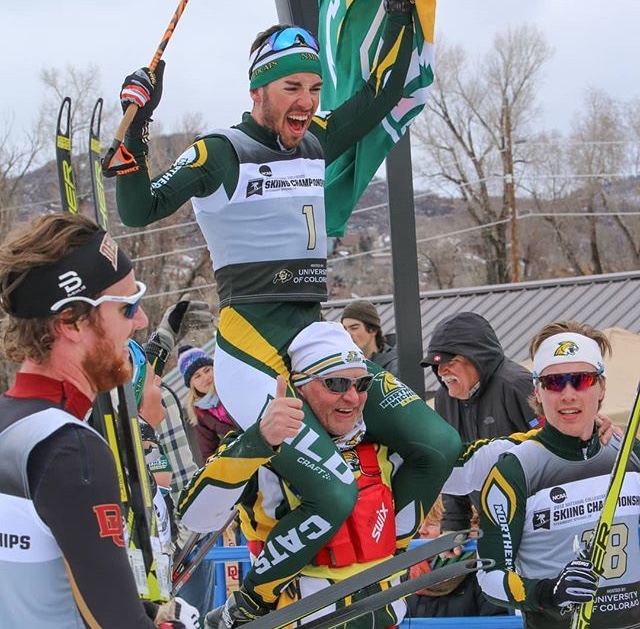
    Ian Torchia (1) on the shoulders of Northern Michigan University Head Coach Sten Fjeldheim after he won the men’s 20-kilometer freestyle race at 2018 NCAA Skiing Championships in Steamboat Springs, Colorado. (Courtesy photo)

    Mono not only gave Torchia a little perspective, but also an extension on his time to compete in college. By redshirting in 2017, Torchia retained eligibility to compete in 2018 (as a junior) and 2019 (as a senior). In his fifth year at NMU, he is currently working toward a master’s degree in exercise science.

    This past March, he won the 20 k freestyle at NCAA Skiing Championships to become NMU’s seventh NCAA champion in program history. In the other race at 2018 NCAA’s, the 10 k classic, he placed fifth for All-American status. Earlier last winter, Torchia qualified for and competed at U23 World Championships in Goms, Switzerland.

    “I try to look at the positives that mono brought,” Torchia said. “That first season of being on the USST brings a lot of pressure and inadvertently getting mono kind of lessened that. Afterward, when I got renominated to the team [last spring], I was like, ‘OK, they’ve given me this second chance, so I need to take it.’ ”

    Torchia was renominated to the D-team for 2017/2018 and again this past spring for the 2018/2019 season. After his third-straight nomination, he approached his summer with revitalized vigor. For the first time since enrolling at NMU, he decided to spend some time training outside of Marquette, largely as a result of a wedding invitation from his USST teammate, Erik Bjornsen. In July, Bjornsen and Marine Dusser were married in Villard-de-Lans, France.

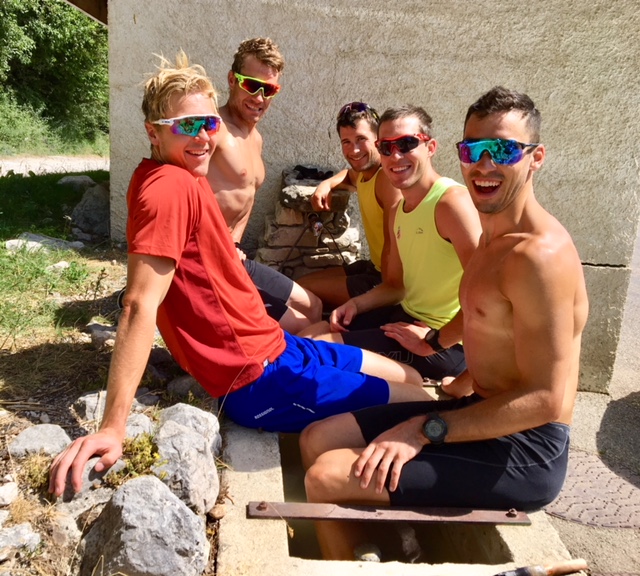
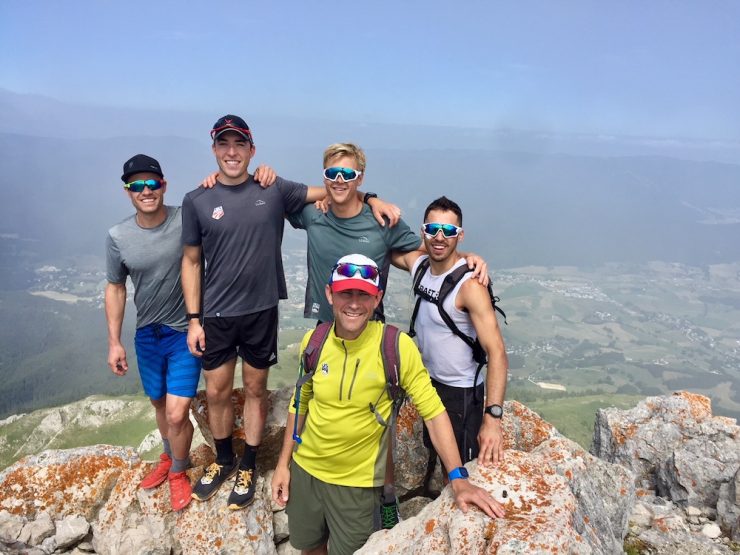
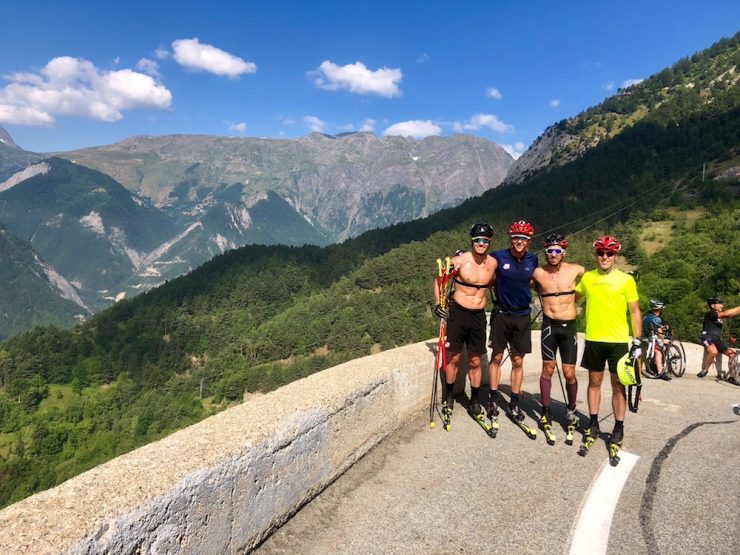
    Right to left: Ian Torchia, Paddy Caldwell, Adrien Backscheider, Simi Hamilton, and Erik Bjornsen during a post-interval cool down in Villard-de-Lans, France. (Courtesy photo)

    “After getting Erik and Marine’s ‘save the date’, I knew there was no way I was missing the wedding,” Torchia explained.

    After the wedding in early July, Torchia remained in France for the USST men’s training camp. The camp lasted 10 days and featured what Torchia described as “hard rollerski intervals and epic mountain runs.”

    He was accompanied by three teammates, Bjornsen, Simi Hamilton and Paddy Caldwell, and their coach Chris Grover. French national-team member Adrien Backscheider joined the group for interval sessions.

    Following the camp, Torchia had made arrangements to stay in Europe for another two and a half weeks, which was partially prompted by his Norwegian teammates at NMU. Over the years, many had encouraged him to travel to Norway and compete in the famed Lysebotn Opp, an uphill rollerski race in Norway’s Blink ski festival.

    Before heading to Sandnes, Norway, for Blink, Torchia made two stops. First, Oslo, where he stayed with his former NMU teammates Fredrik Schwencke, a native of the city, and Kristen Bourne, an American citizen currently training with the Lyn Ski Club in Olso.

    “Pretty lucky to have so many great friends and teammates that put me up throughout the trip,” Torchia wrote in an email.

    Torchia spent a week in Oslo before traveling to Kragerø, where he visited his current NMU teammate Mathias Aas-Rolid. A native of Redalen, Norway, Rolid has a cabin in Kragerø that he opened up to Torchia for “a pre-Blink training camp”.

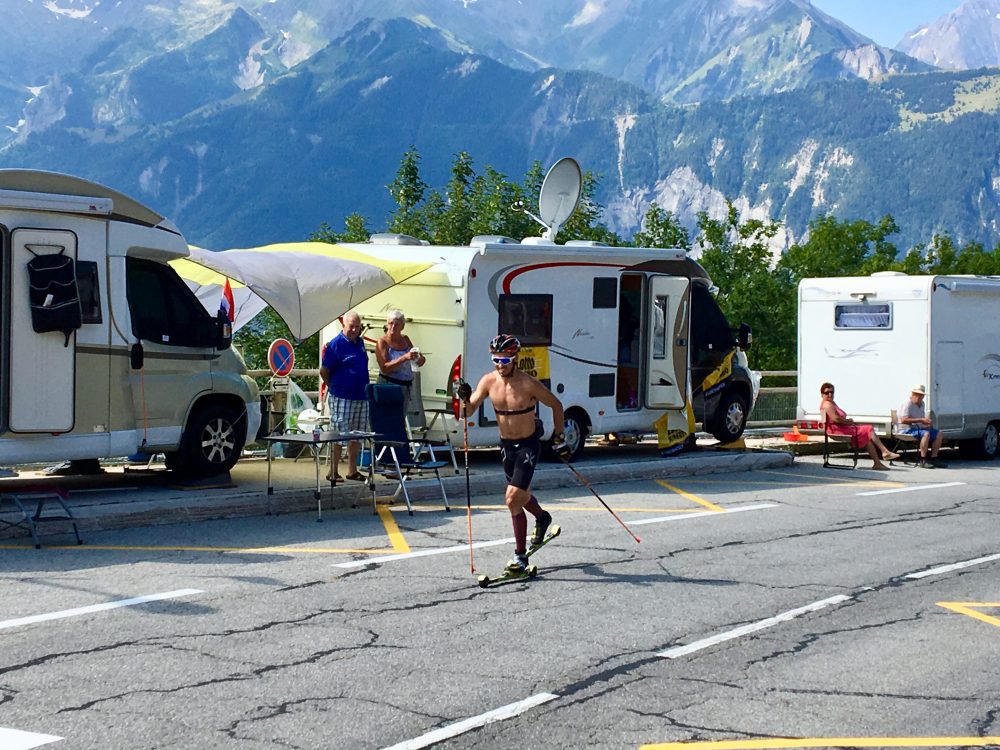
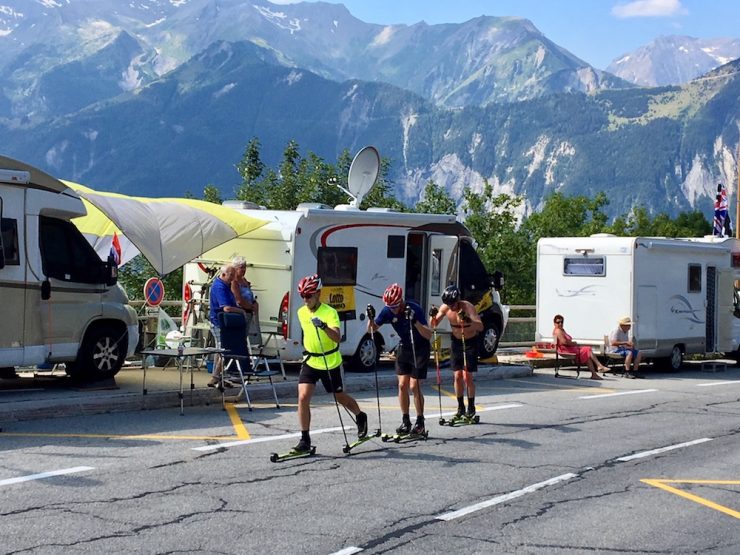
    Ian Torchia rollerskiing up Alpe d’Huez, two days before the Tour de France on July 17, 2018. (Photo: Chris Grover)

    Following Kragerø, Torchia headed to Sandnes for the Blink races. Canadians Evan Palmer-Charrette, Scott Hill and Bob Thomson had rented an Airbnb in Sandnes for the weekend, and keeping with his summer nomadic style, Torchia crashed on their couch during the festival.

    tetracycline buy online, betnovate

    tetracycline buy online, betnovate

    He competed in the 60 k distance race as well as the Lysebotn Opp. The 60 k was what Torchia referred to as “an add-on to the main focus of Lysebotn.

    “For the 60, I made a big blunder by not bringing a water pack and counting on getting feeds along the race course,” he recalled. “Turns out trying to get a feed from a stationary volunteer at 20+ mph is not very effective.” 

    Without feeds, Torchia explained that he “bonked” halfway through the 60 k and ended up finishing 55th. The result left him ready to “turn it around” for the 7.5 k Lysebotn Opp the next day. He managered to position himself well early on in the race’s mass start and within the first kilometer, found himself with the likes of Russia’s Sergey Ustiugov and Finland’s Iivo Niskanen.

    “After the 1 k tunnel, I passed Ustuigov and Niskanen and probably got a little too excited and blew my load about 2 k from the finish,” Torchia wrote of his Lysebotn start. “ ‘Twas a long 2 k in from there and almost managed to catch Harvey but just missed the auto qualifying for the mass start (top-10) by about 15 seconds. I’ve never done a rollerski race, period, so competing in Norway in the strongest field they’ve ever had was a hell of a way to start.”

    Torchia placed 13th, just over 2 minutes behind the winner (and 2018 Olympic skiathlon gold medalist) Simen Hegstad Krüger of Norway and 15 seconds behind Canada’s Alex Harvey, who placed 10th.

    Torchia’s summer adventure ended after Blink, and he flew back to the U.S. on Aug. 6.

    “Getting to do intervals with Adrien Backscheider, [South Korean/Norwegian skier] Magnus Kim, and then race with a World Cup field at Blink served me a big piece of humble pie but was a good indicator that the summer progress[ed] well,” Torchia wrote.

    Torchia is now back in Marquette, focused on school and skiing. Beyond college races, Torchia is targeting 2019 U.S. nationals in Craftsbury, Vermont, 2019 World Championships in Seefeld, Austria, and 2019 World Cup Finals in Québec City.

    “It’s been some ups and downs and definitely a learning experience,” Torchia said of the years since he was first nominated to the USST. “But it’s made me stronger in the process.”

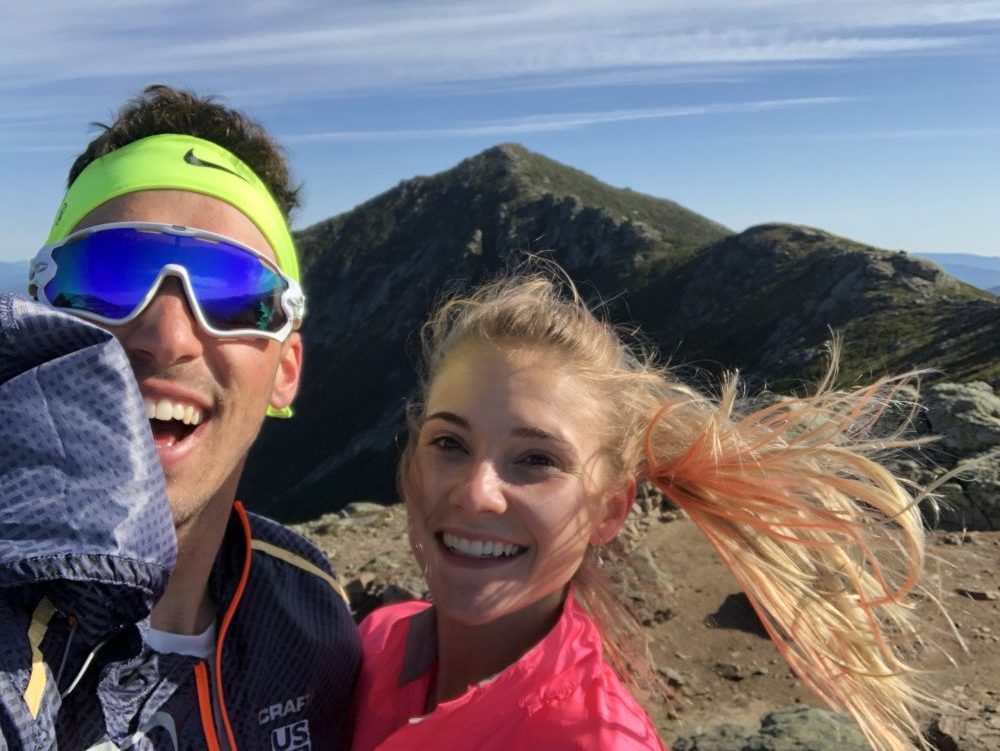
    Ian Torchia (l) with girlfriend, Kameron Burmeister, hiking in Franconia Notch, N.H., during an East Coast road trip they took in June. (Courtesy photo)
  • Lake Placid to France: U.S. Ski Team Camp Photos

    Lake Placid to France: U.S. Ski Team Camp Photos

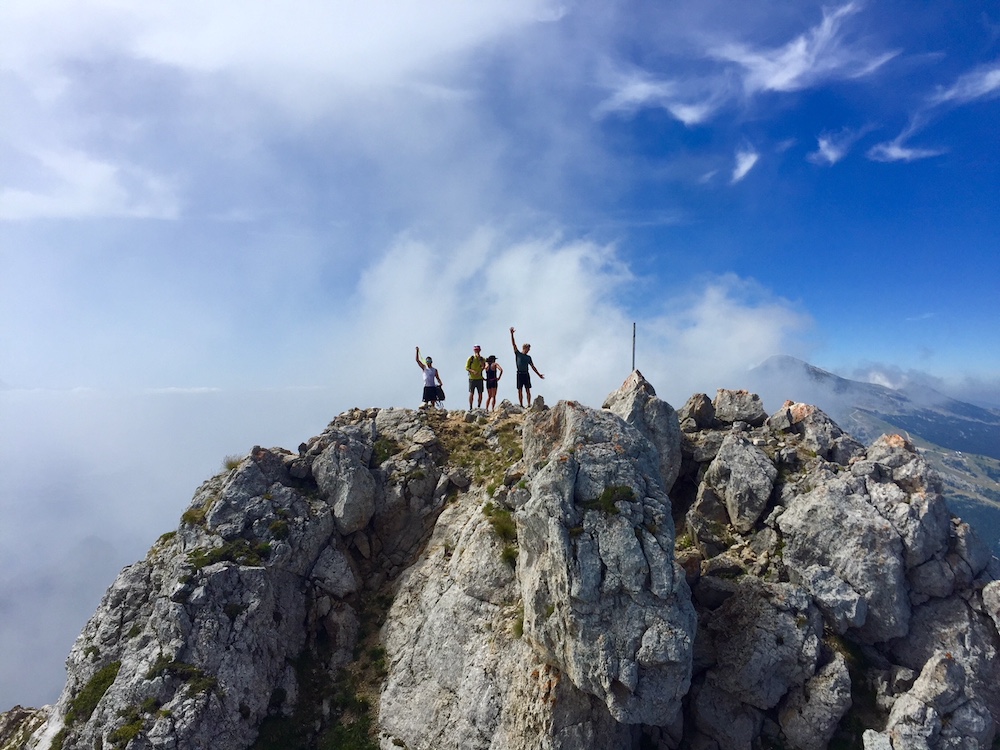
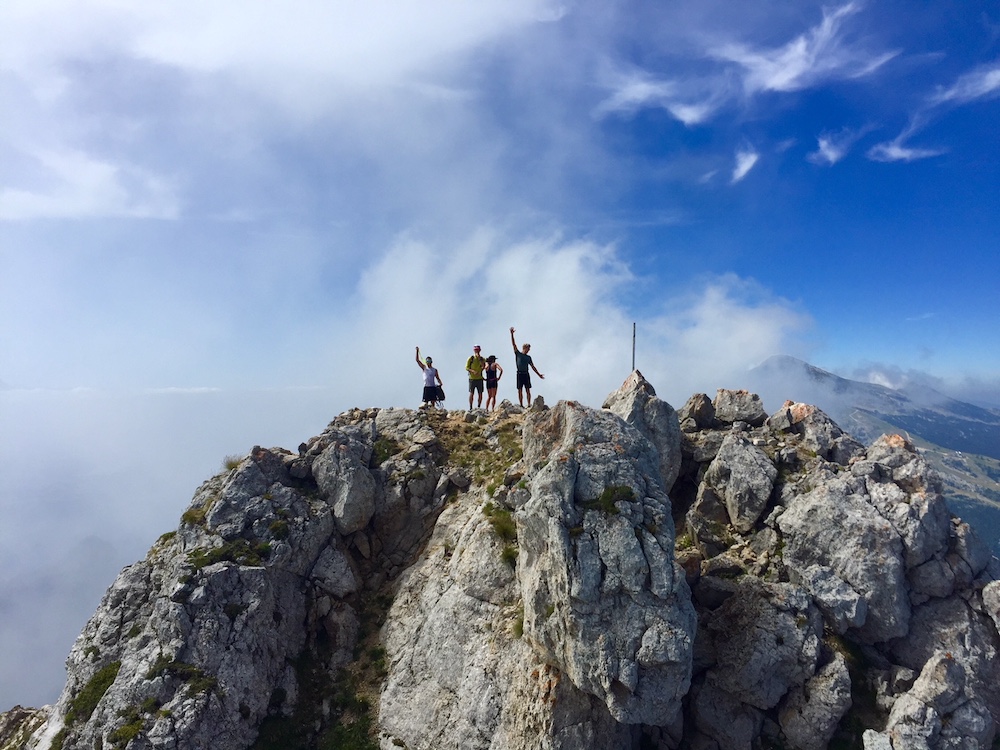
    Members of the U.S. men’s ski team on a mid-overdistance run on top of the Roc Cornafion above Villard-de-Lans, France. (Photo: Chris Grover)

    This month, the U.S. Cross Country Ski Team (USST) held dryland camps simultaneously, about 6,000 kilometers away from each other, in Lake Placid, N.Y., and Villard-de-Lans, France. Five of the eight women on the team attended the camp from July 11-20 in Lake Placid, which, up until a couple of years ago, was a September staple on the USST calendar. Meanwhile, four of the team’s men trained together in the picturesque, mountainous region of southeast France from July 9-18.

    Who was where? In Lake Placid, USST A-team athletes Jessie Diggins, Sophie Caldwell and Ida Sargent worked out alongside development (‘D’) team members Julia Kern and Katharine Ogden, as well as several others from their respective clubs and Stefani Böhler of the German National Team. Outside of camps, the five USST women spend most of the offseason training with their respective Vermont-based programs; Diggins, Caldwell, Kern, and Ogden are all on the Stratton Mountain School (SMS) Elite Team, and Sargent trains with the Craftsbury Green Racing Project (CGRP).

    The other three women on the national team — Sadie Bjornsen, Hannah Halvorsen and Hailey Swirbul — are based in Anchorage, Alaska, where they train with Alaska Pacific University (APU) and have multiple opportunities to ski on snow on nearby Eagle Glacier.

    “Getting participation in a country as large as ours is always a challenge,” U.S. coach Matt Whitcomb told FasterSkier in Lake Placid. “… But the Alaskans have gone out of their way to give us adequate representation at these camps. They work really hard to, when they’re present, be very present.

    “It’s not so much an APU or Alaska issue, it’s a distance issue,” he continued. “We can fight it as hard as we want, but we’re going to be running into a wall because it’s hard to get from upstate New York to Anchorage or Fairbanks; it’s a long ways. We do our best. We try to identify which camps the whole team will be present at, and while we’d love to be able to get together five or six times a year like the Norwegians do every four weeks for eight days, it’s not the reality for us. Our club system is the key for us, and APU is doing a great job with or without the Ski Team at a camp up there, and you have all these other clubs now running their programs like mini national teams. If we can have more of those, that’s how we’ll get better.”

    In France, Erik Bjornsen (fresh off his wedding there), Simi Hamilton, Ian Torchia, and Paddy Caldwell trained under the guidance of head coach Chris Grover. Two of the team’s B-team members, Scott Patterson and Kevin Bolger, did not make the trip; Patterson has been rehabbing a fractured toe in Anchorage and Bolger is currently training in Norway.

    From Aug. 20 to Sept. 10, half of the team plans to train on snow in New Zealand (Diggins, Sargent, Kern, Ogden, Hamilton, Bolger, and Sophie and Paddy Caldwell) with three coaches: Whitcomb, Jason Cork and Gus Kaeding. Then from Oct. 8-21, most of the 16-athlete squad will meet up for a final dryland camp in Park City, Utah, before revving up for another World Cup season.

    Here are some photos from the two mid-summer camps, courtesy of the U.S. Ski Team:


    “The Villard-de-Lans camp was excellent, and the men came away from camp mentally charged for the next period of training, although certainly needing some physical rest,” Grover summarized in an email.

    French national-team member Adrien Backscheider, who lives part time in the area, joined a few of their workouts. Grover explained their training included five “high-quality sessions” during the 10-day camp, all held on the rollerski loop in Corrençon-en-Vercors: a classic speed session, a skate speed session, a Level 3 classic workout, a Level 4 skate workout, and a classic team sprint simulation. The remaining sessions were either distance, over-distance or strength.

    “We had 2 classic roll + run combo workouts in the mountains, including skiing up l’Alpe d’Huez two days prior to the Tour de France stage and then hiking/running up the mountain from the village to create a 4 hour/6000 vertical feet workout,” Grover wrote. “We are very grateful to all the people we met in the Villard-de-Lans area for welcoming, supporting, and taking care of us.”

    “Being sea level, we can do more of an effective intensity camp, which this is a semi-intensity focused camp here,” Whitcomb said of the USST’s 2018 Lake Placid camp. “It’s only 2,000 feet here. The running is really great here and the mountains, you get these great Adirondack peaks all over 4,000 feet. The roads in upstate New York are hardly used and the pavement is fantastic. It’s really great rollerskiing out here.”

  • Monkey Off Its Back, Norway Wins First Men’s Olympic Relay Since 2002

    Johannes Høsflot Klæbo of Norway moments before crossing the line for Norway’s first Olympic men’s 4 x 10 k relay victory since 2002 in Salt Lake City, Utah. (Photo: FlyingPointRoad)

    FasterSkier would like to thank Fischer Sport USA, Madshus USA, Concept2, Boulder Nordic Sport, and Swix Sport US for their generous support, which made this coverage possible.

    PYEONGCHANG, South Korea — Conversing in the native tongue of the men’s 4 x 10-kilometer relay winner of Olympics past and present requires a world map and an aptitude for language acquisition. 1952 Oslo Games: Finland wins. 1956 in Cortina: the Soviets win. 1968 in Grenoble: France wins. 1984 in Sarajevo: Sweden prevails. 1992 in Albertville: Norway wins.

    The previous two Olympics in Vancouver, British Columbia, and Sochi, Russia, — Norway took a hit. The nation’s simultaneously self-righteous and justifiable claims of cross-country-ski-racing dominance fell hollow on the men’s Olympic relay stage. In a country where it’s win and nothing else, the years between the last two Olympic cycles, 2010-2018, have been fraught with relay angst and foreboding.

    Sweden won the men’s 4 x 10 k relay in Vancouver and Sochi. Norway placed second in Vancouver. Within the Norwegian singularity of win or lose, that’s a Norway loss. In 2014, Norway placed fourth. Fourth place. Can you imagine the Norwegian disgust?

    Start of the scramble leg during the men’s 4 x 10 k Olympic relay on Sunday in PyeongChang, South Korea. (Photo: FlyingPointRoad)

    “I knew some of those teams, like Russia, was going to try to spread it out,” Andy Newell, the Americans’ scramble-leg skier told FasterSkier after his first leg in Sunday’s Olympic 4 x 10 k relay. “I knew Poltarainen was going to try to spread it out because he’s such an amazing classic skier.”

    For the full 10 k on the scramble leg, Kazakhstan’s Alexey Poltoranin monopolized camera time. His killing form dragged Andrey Larkov, of the Olympic Athletes of Russia, close behind as he stuck to Poltoranin’s tails. Unable to keep pace, and bleeding time already were Italy (+10.0) and France (+10.8) in third and fourth. Norway tagged off in fifth (+18.2), Sweden sixth (+36.9), and Finland seventh (+1:02).

    Surely Norwegian social media was rife with eyeroll and poop emojis. And for Norway’s waxing boss, Knut Nystad, most recently featured in a New York Times piece, another debacle like Sochi would cost him.

    With Kazakhstan’s team expected to drop off during the next three legs, Alexander Bolshunov of Russia used Larkov’s Poltoranin-pull as a springboard.

    Norway has a reliable steady — and over the last three years that has been Martin Johnsrud Sundby. Like Poltoranin, Sundby is a kick-and-glide master. On paper at least Sundby would cut Norway’s losses to the steal-the-show Russians.

    Norway’s Martin Johnsrud Sundby (1), Italy’s Francesco de Fabiani (8) and Kazakstan’s Yevgeniy Velichko (9) during Leg 2 of the men’s 4 x 10 k Olympic relay on Sunday in PyeongChang, South Korea. (Photo:FlyingPointRoad)

    Since the 2014 Norwegian relay breakdown in Sochi, there have been six 4 x 10 k relays on the World Cup and World Championships combined — Norway won them all. Sundby was in five of those six Norwegian relay lineups. Through thick and thin, Sundby appeared to be the winning missing link.

    Yet, a little more than halfway through his leg, Sundby’s and all of Norway’s fate resembled the second leg of the women’s Olympic 4 x 5 k relay on Saturday when Norwegian Astrid Uhrenholdt Jacobsen fell adrift of the front skiers. Both were haunting Sochi déjà-vu moments.

    Passing his 6.6 k checkpoint Sundby looked spent. He uncharacteristically let France and Italy take over the pacing. By then, Bolshunov had gapped the chasing trio by a full 41 seconds.

    In the post-race press conference, Bolshunov explained he had been hospitalized in the weeks before the Olympics.

    “I have fever over 40 degrees [104 Fahrenheit] and I spent like a week in a hospital,” Bolshunov said of his illness. “But like two weeks ago I began my preparation for the Olympic games. It was not very easy but I am very glad I got myself in a good shape and that I could compete on the same level as my contenders.”

    Chervotkin took over for Russia on the third leg. Skating away up the first climb alone was Russia, followed by Italy (+24.5), France (+28) and Norway (+32.1) as they tagged off for the first of two skate legs.

    The moment Norway’s Simen Hegstad Krüger, already a two-time medalist here, gold in the 30 k skiathlon and silver in the 15 k skate, glided away on his leg, the Norwegian fans in attendance vigorously waved their once-limp flags.

    Krüger took control by reeling in France, Italy, and eventually Chervotkin of Russia. By the 10 k mark, when Krüger tagged Norway’s now-and-future relay anchor, Johannes Høsflot Klæbo, France hung tight with Norway, while Russia tagged off in third (+16.2).

    Klæbo and France’s anchor, Adrien Backscheider, backed off the pace intermittently as Klæbo appeared reluctant to make a too-early move. Russia’s Denis Spitsov caught Norway and France from behind with less than half the leg remaining.

    Denis Spitsov of the Olympic Athletes from Russia leading Norway’s Johannes Høsflot Klæbo (1) and France’s Adrien Backscheider (7) during the fourth leg of the men’s Olympic 4 x 10 k relay in PyeongChang, South Korea. (Photo: FlyingPointRoad)

    Backscheider faded as Klæbo and Spitsov danced. Klæbo went where he was expected to go: in a flurry of red-white-and-blue lycra up and over the final headwall. With enough time to grab a Norwegian flag and undo eight years of wait, Norway won the day, crossing the line in 1:33.04.9. Of the eight gold medals awarded so far in these Games, Norway has won five. Sunday also marked Sundby’s first Olympic gold in his third Olympics.

    “Today Didrik and I are very happy that we’re on the same team as Simen and Johannes,” Sundby told Eurosport after, according to a translation. “We have a fantastic team and I would at the same time like to send a greeting to all of the other guys on the team. There are a lot of guys who could have skied here today.”

    “I think for all of us it’s an unbelievable feeling to be able to take part of this great team,” Klæbo said at the press conference. “I think that we have people back at the hotel we also could have this relay with us. I think that we have done something right the last couple of years and to be part of this team is quite cool. I think we are all grateful for that.”

    Russia secured silver as Spitsov came through 9.4 seconds after Klæbo, and France’s Backscheider was next across the line for bronze (+36.9).

    Norway’s 2018 Olympic 4 x 10 k relay winners: the country’s first Olympic gold in the event since 2002. From left to right, Didrik Tønseth, Martin Johnsrud Sundby, Simen Hegstad Krüger, and Johannes Høsflot Klæbo. (Photo: FlyingPointRoad)

    “This is a great achievement also for my country,” Spitsov said of his team’s silver at the press conference, through a translator. “We are a young team represented here while a majority of athletes were not able to attend and participate in the Olympic Games. We are very young, but still we proved that we are able to achieve great result and we are happy about that.

    France’s Manificat made it clear the bronze medal was no disappointment. “For sure its a bronze medal, but for us it’s like gold,” Manificat explained. This is France’s second consecutive 4 x 10 k relay bronze after finishing ahead of fourth place Norway in Sochi.  

    “To do it again it’s really important,” Manificat reflected. “We are a lot of generation in this relay — old guys in term of dates and young’ ones. But they are really strong. In all the legs we were really strong and we knew that we could play the game and it was perfect.”

    Finland placed fourth (+1:40.5), Sweden fifth (+2:05.6), Germany sixth (+2:08.2), Italy seventh (+2:35.2), and Kazakhstan eighth (+3:31.4). Canada was ninth (+3:41.0) to tie its second-best Olympic relay result (with Len Valjas, Graeme Killick, Russell Kennedy, and Knute Johnsgaard), and the U.S. finished 14th (+9:24.2), out of 14 teams, with Andy Newell, Reese Hanneman, Scott Patterson, and Noah Hoffman. 

    Racing continues Wednesday with the men’s and women’s team sprint.

    Results

  • Sunday Olympic Rundown: Klæbo Anchors Another Norwegian Gold; Fourcade Edges Schempp in Mass Start

    Johannes Høsflot Klæbo anchoring the Norwegian men’s 4 x 10 relay to gold on Sunday at the 2018 Olympics in PyeongChang, South Korea, while Denis Spitsov (background) celebrates silver for the Olympic Athletes for Russia. (Photo: FlyingPointRoad)

    FasterSkier would like to thank Fischer Sport USA, Madshus USA, Concept2, Boulder Nordic Sport, and Swix Sport US for their generous support, which made this coverage possible.

    2018 Olympics (PyeongChang, South Korea): Men’s 4 x 10 k relay

    International report

    North American report

    For a while in the men’s 4 x 10-kilometer relay on Sunday, it looked like the Russians might run away with the win. But that was just two classic legs and 20 k into the race, with a lot more racing to come.

    While Kazakhstan’s Alexey Poltoranin had handed off in first at the first exchange, just ahead of Andrey Larkov of the Olympic Athletes from Russia, Italy, France and Norway skied together behind them, with Norway’s Didrik Tønseth trailing off the back, 18 seconds behind.

    On the next classic leg, Russia’s Alexander Bolshunov put a hurt on the field. Within the first 3.3 k lap, he was 25 seconds ahead of Kazakhstan’s Yevgeniy Velichko in second, who was followed closely by Italy, Norway and France in third through fifth. Sweden’s Daniel Rickardsson had fallen farther behind to more than a minute back in sixth place, after his teammate Jens Burman lost contact with the lead group on the first leg.

    By the second exchange, Russia was 24.5 seconds clear of second place, while Italy’s Francesco de Fabiani tagged Giandomenico Salvadori in second, France’s Maurice Manificat tagged Clement Parisse in third (+28.0), and Norway’s Martin Johnsrud Sundby tagged Simen Hegstad Krüger in fourth (+32.1). Kazakhstan’s Velichko had fallen off the pace and was another 19 seconds back in fifth.

    Over the next 10 k, the first skate leg, Krüger and Parisse reeled in Russia’s Alexey Chervotkin, catching him before the end of their second lap. One lap later, Krüger came through the final exchange in first, tagging Johannes Høsflot Klæbo 0.4 seconds ahead of France in second. Chervotkin tagged Russia’s anchor Denis Spitsov in third, 16.2 seconds back, while Finland’s Matti Heikkinen passed Italy’s Salvadori on the last climb to put Finland in fourth (+58.6).

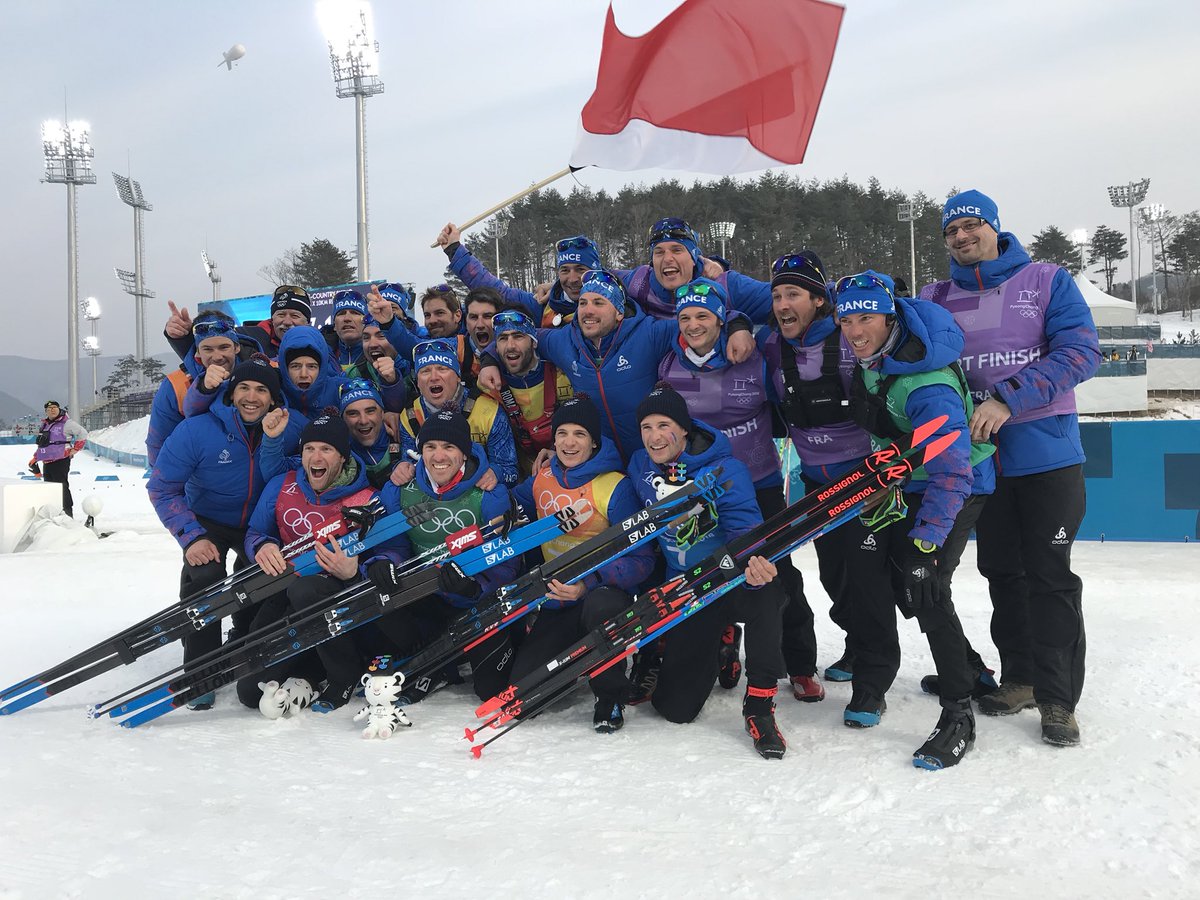
    Team France celebrates its bronze-medal finish in the men’s 4 x 10 k relay at the 2018 Olympics on Sunday in PyeongChang, South Korea. (Photo: FIS Cross Country/Twitter)

    Early in the final leg, France’s Adrien Backscheider took the lead ahead of Klæbo. The two held Spitsov off until the end of the second lap, where Spitsov came through the stadium first to start the final loop. Spitsov and Klæbo soon upped the pace, dropping Backscheider, and shortly after the 8.27 k checkpoint, Klæbo truly put the jets on to accelerate away from Spitsov. He dropped the Russian on a climb just before the final uphill, where it was clear that the gold was Norway’s.

    As he sped down into the stadium, Klæbo relaxed his arms, skied to the sideline and took a flag from the stands. He looked back for a moment and then crossed the finish line first in 1:33:04.9 hours, while Spitsov followed 9.4 seconds later for silver for Russia. Backscheider held on for bronze (+36.9) as his team exuberantly celebrated with him at the finish.

    Finland placed fourth (+1:40.5), Sweden fifth (+2:05.6), Germany sixth (+2:08.2), Italy seventh (+2:35.2), and Kazakhstan eighth (+3:31.4). Canada was ninth (+3:41.0) for its second-best Olympic relay result (with Len Valjas, Graeme Killick, Russell Kennedy, and Knute Johnsgaard), and the U.S. finished 14th (+9:24.2), out of 14 teams, with Andy Newell, Reese Hanneman, Scott Patterson, and Noah Hoffman.

    Results (will be posted here)

    ***

    France’s Martin Fourcade lunging for his second gold of the 2018 Olympics in PyeongChang, South Korea, winning the men’s 15 k mass start on Sunday. (Photo: FlyingPointRoad)

    Biathlon: Men’s 15 k mass start

    Full report

    Martin Fourcade is the champion once again. Six days after he won the 12.5-kilometer pursuit for his first gold in PyeongChang, the 29-year-old Frenchman did it again in the men’s 15 k mass start on Sunday, winning in a photo finish at the line.

    He took charge on the first loop, leading the field into the range for the first prone shooting. There, Fourcade shot a penalty and slipped to 19th, but it wasn’t over.

    Clean shooting on the second prone brought him up to eighth, 9.4 seconds out of first. Germany’s Benedikt Doll took that lead at that point after his second stage without a miss. Meanwhile Norway’s Johannes Thingnes Bø shot three misses on that second stage and dropped out of contention.

    One loop later, Fourcade moved into first with a clean standing. He left the range about 1 second ahead of Germany’s Simon Schempp and 2 seconds ahead of Germany’s Erik Lesser, after both made it through the first three stages without a miss. Doll missed one to slip to seventh, almost 30 seconds behind.

    After Fourcade and Schempp exchanged leads over the next loop, Lesser moved into first just before the final shooing, Going head to head, Fourcade and Schempp both missed one while Lesser missed two. Fourcade and Schempp still left the range in first and second, respectively, separated by 0.4 seconds, while Lesser slipped to fifth, 22.5 seconds back.

    Doll left the range in third (+19.2) after cleaning and Norway’s Emil Hegle Svendsen moved into fourth (+21.9) with a clean standing stage as well.

    In the end, Fourcade outlunged Schempp for the win in 35:47.3 minutes, with Schempp finishing less than a tenth of a second behind for silver, and Svendsen beat out Lesser in the finishing stretch by 0.4 seconds to claim bronze, 11.2 seconds behind, while Lesser settled for fourth (+11.6). Doll followed them in fifth (+18.8), Austria’s Julian Eberhard placed sixth (+30.7) with three penalties, Norway’s Erlend Bjøntegaard seventh (+32.1) with two misses, Norway’s Tarjei Bø eighth (+34.6) with three penalties, Sweden’s Jesper Nelin ninth (+34.6) with two misses, and Slovenia’s Jakov Fak 10th (+36.1), just ahead of the Czech Republic’s Ondřej Moravec in 11th (+36.3), with one miss each.

    Results

  • Northug Sticks It to Halfvarsson, Edges Swede for Norwegian Relay Win at Worlds

    Northug Sticks It to Halfvarsson, Edges Swede for Norwegian Relay Win at Worlds

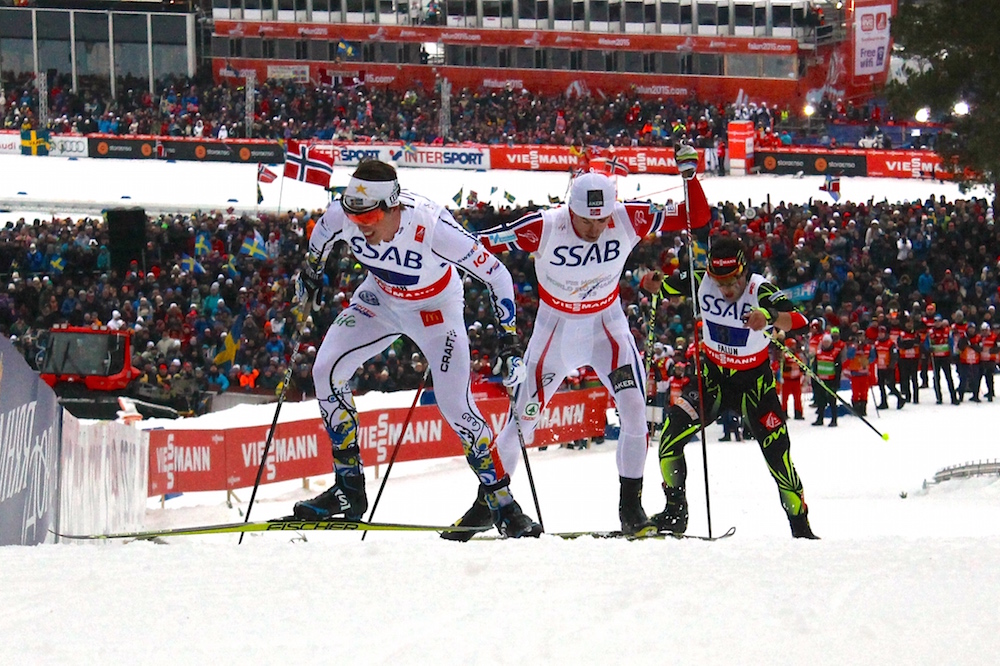
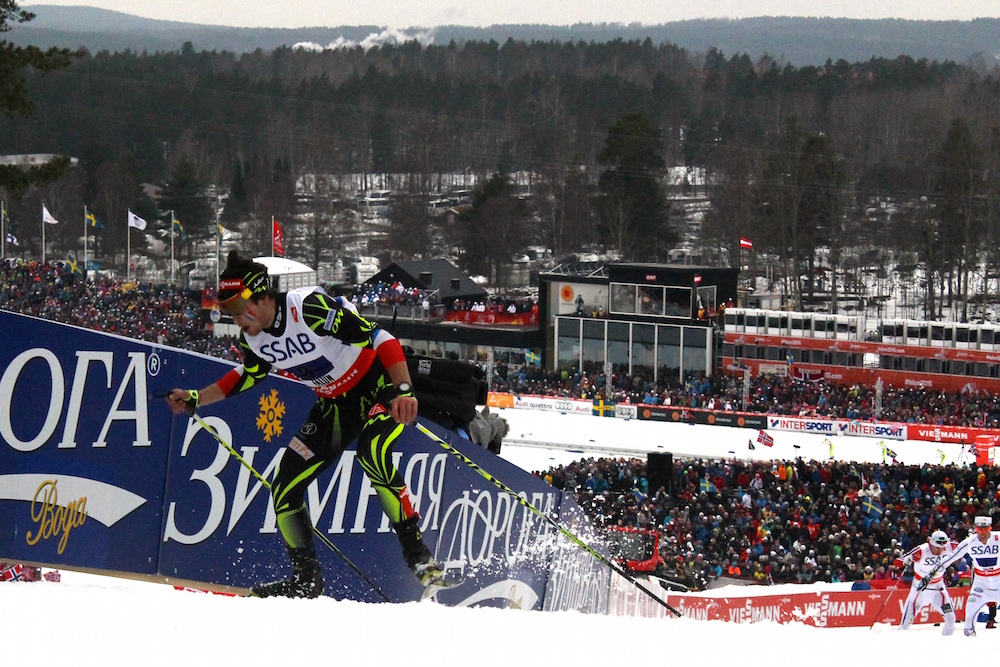
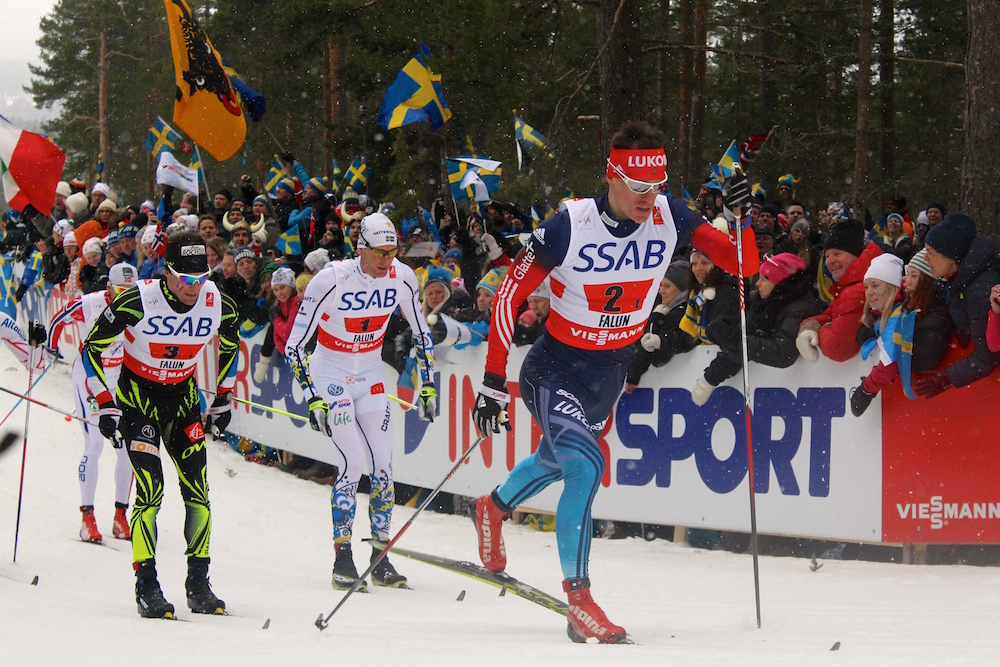
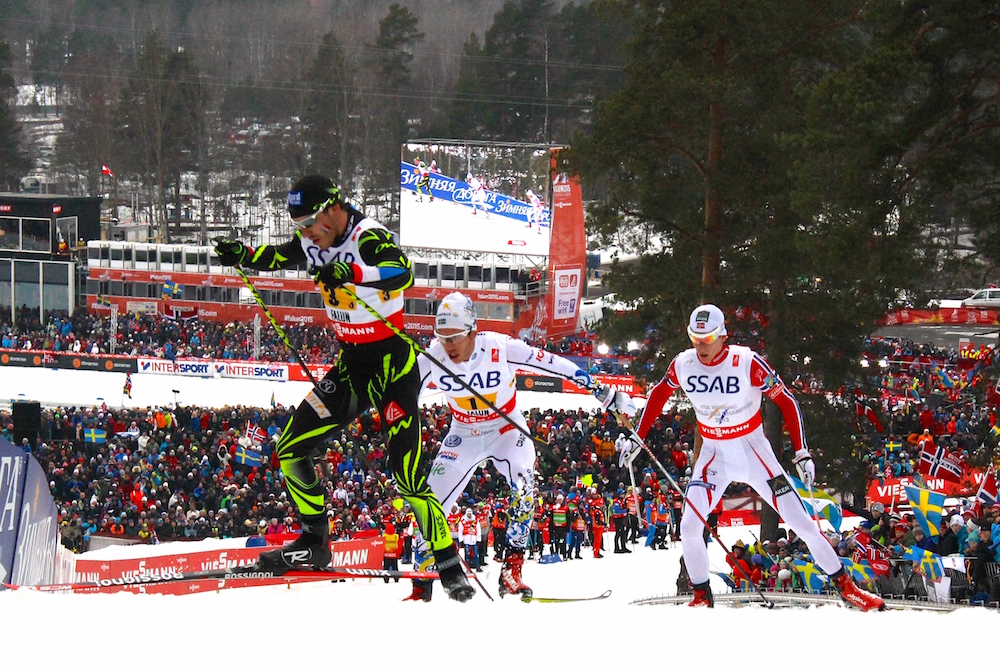
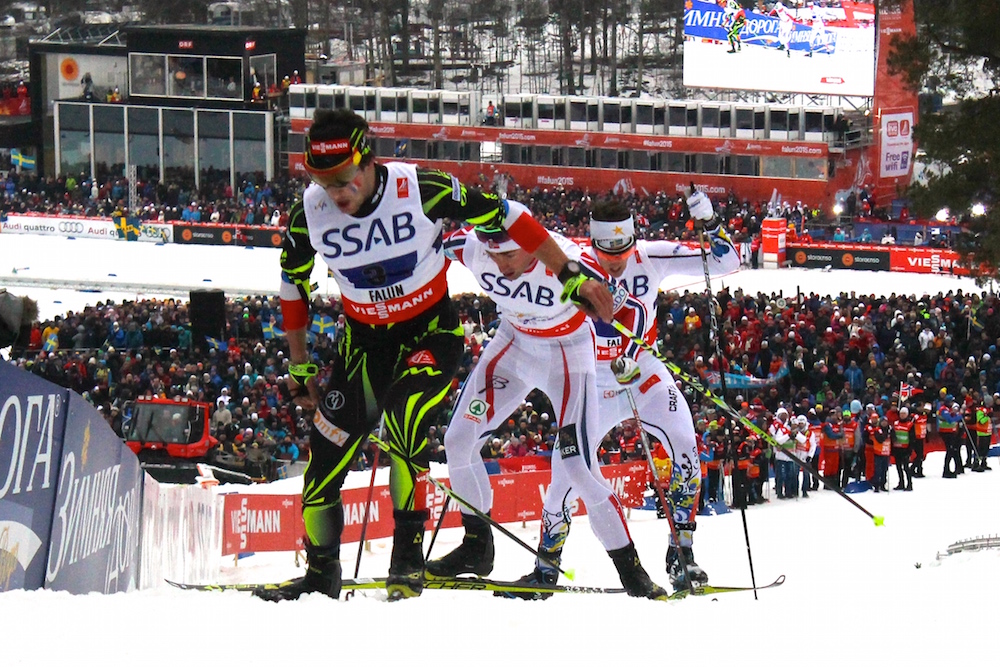
    Sweden's Calle Halfvarsson leads Norway's Petter Northug (c) and France's Adrien Backscheider on the second-to-last major hill on the last lap of the men's 4 x 10 k relay at 2015 World Championships in Falun, Sweden. Northug went on to edge Halfvarsson by 0.6 seconds for gold, Sweden took silver and France was 8.9 seconds back for bronze.
    Sweden’s Calle Halfvarsson leads Norway’s Petter Northug (c) and France’s Adrien Backscheider on the second-to-last major hill on the last lap of the men’s 4 x 10 k relay at 2015 World Championships in Falun, Sweden. Northug went on to edge Halfvarsson by 0.6 seconds for gold, Sweden took silver and France was 8.9 seconds back for bronze.

    FasterSkier’s coverage of the 2015 FIS Nordic World Ski Championships in Falun, Sweden, is brought to you by the generous support of L.L. Bean, now featuring a complete line of Kikkan Randall training wear.

    FALUN, Sweden — All of Calle Halfvarsson’s trash talking gave Petter Northug something to get fired up about in the last couple hundred meters of the men’s 4 x 10-kilometer relay at FIS Nordic World Ski Championships on Friday.

    Trailing Halfvarsson down into the stadium and leading up to the final rise before the finish, Northug rode on the tails of the Swede and blew past him on the climb, before giving him the ultimate run on the descent toward the finish.

    There, Northug, who had already racked up two golds at these championships (in the classic sprint and freestyle team sprint), V2-ed like a madman to keep the slightest edge on Halfvarsson over the finishing flat. The Norwegian did so, and Halfvarsson let up about 20 meters before the line to accept his defeat.

    It’s a lesson as old as time: talk smack and be ready to deal with the repercussions. Halfvarsson had to settle for silver when he was leading the fight for gold, and then watch Northug shush him at the finish.

    That’s right, Northug, the now 12-time world champion (with two Olympic golds as well), put his finger to his lips after crossing the line, looking at cameras rather than back at Halfvarsson to send a message to the Swede.

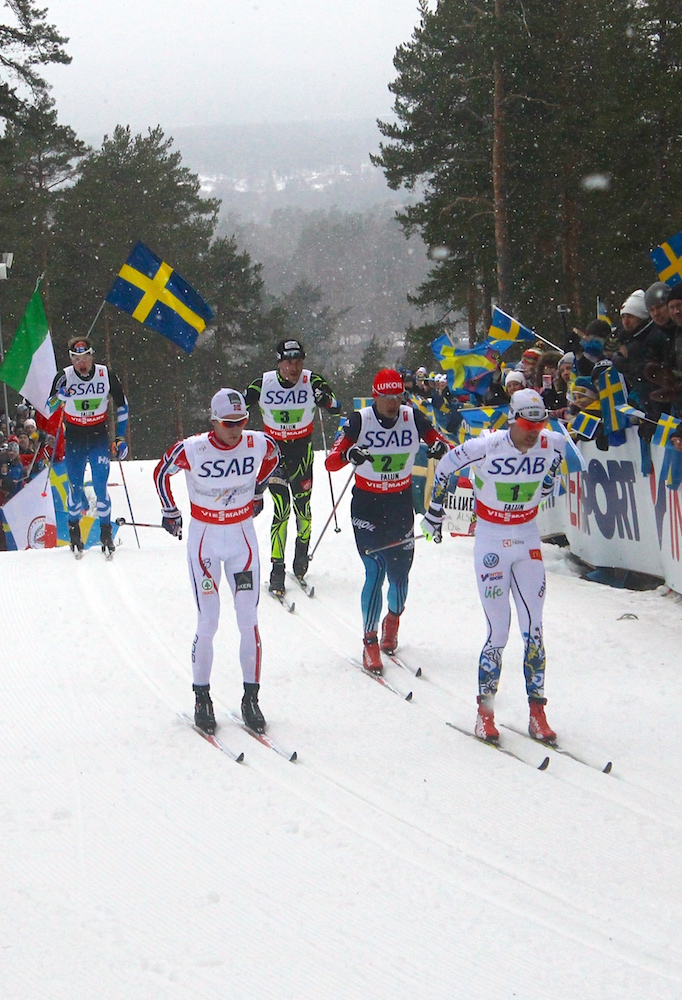
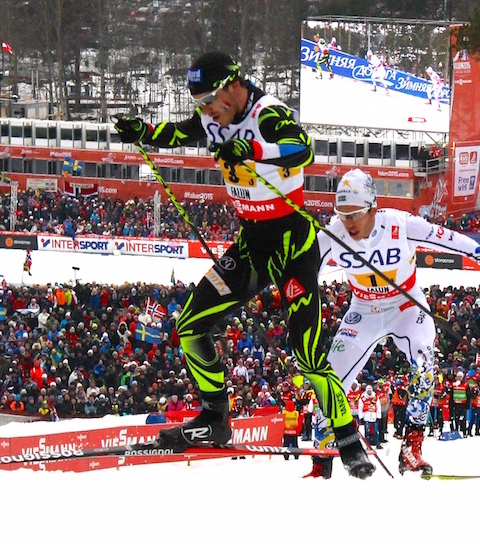
    The French men's relay team (right) skied the entire World Championships 4 x 10 k with the Norwegians (center) and Swedes, proving something to themselves and the ski world: they belong as championships medalists. (Photo: Falun2015.com/Flickr)
    The French men’s relay team (right) skied the entire World Championships 4 x 10 k with the Norwegians (center) and Swedes, proving something to themselves and the ski world: they belong as championships medalists. (Photo: Falun2015.com/Flickr)

    “When Calle crosses the finish line, [I wanted to] make it hurt so much that he takes [it] with him for a lifetime,” the 29-year-old Northug told NRK, according to a translation, after sealing the win for Norway in 1:34.18.5, six-tenths of a second ahead of Sweden.

    So what exactly did Halfvarsson do to get him so riled? A year ago, he said he would beat Northug in a finishing sprint on home soil in Sweden. Unfortunately for Halfvarsson, in front of more than 41,000 spectators in Sweden on Friday, it didn’t happen.

    The Swede led much of the last lap, countering Northug’s attack on the second-to-last major climb on the 2.5 k freestyle course while France’s Adrien Backscheider clung to the duo as well.

    The three had skied on their own, a healthy distance away from Russia in fourth, since the end of the second classic leg. Sweden’s Johan Olsson had brought the team from seventh and 20 seconds out to first, ahead of France’s Maurice Manificat and Norway’s Didrik Tønseth, by the halfway point amid heavily falling snow — which lightened up considerably for the first skate leg.

    “It was really nice to be able to exchange first,” Olsson said in a press conference, after tagging Swedish teammate Marcus Hellner with a 6.7-second lead on France’s third skier, Robin Duvillard. “I was a little bit worried before the race. Yesterday I didn’t recover so much after the 15 k race. Of course I’m really satisfied with my race and the other guys as well.”

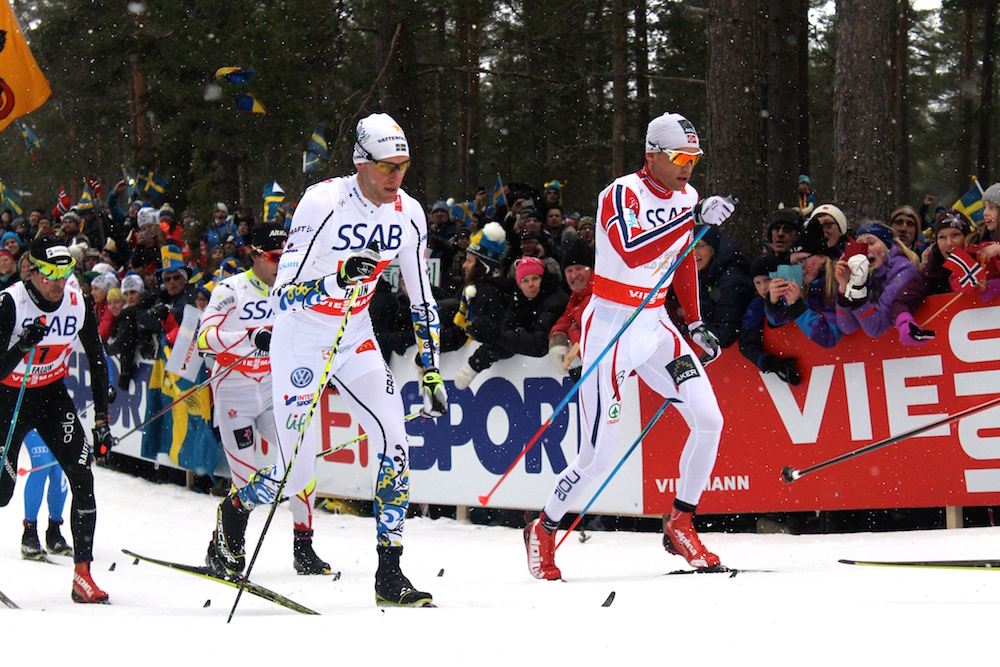
    After catching the leaders, Johan Olsson of Sweden (right) skied through to the lead on the second leg of the men's 4 x 10 k relay in Falun, Sweden. Here he's shown leading the third of four laps with Norway's Didrik Tønseth (l) and Russia's Maxim Vylegzhanin (behind Olsson).
    After catching the leaders, Johan Olsson of Sweden (1) skied through to the lead on the second leg of the men’s 4 x 10 k relay in Falun, Sweden. Here he’s shown leading the third of four laps with Norway’s Didrik Tønseth (left) and Russia’s Alexander Bessmertnykh (2), and Maurice Manificat of France (3).

    A two-time world champion, Olsson won Wednesday’s 15 k freestyle individual start by 17.8 seconds over Manificat in second, and Norway’s Anders Gløerssen took bronze, 19.2 seconds behind.

    On Friday, Gløerssen skied the third leg for Norway, heading out 14.1 seconds after Hellner, and over the course of his four 2.5 k laps, he lifted Norway to first.

    “I tried to set my own pace in the start and when I went out on the second lap, I was closing a little bit so I tried to speed up and close the gap,” Gløerssen said in the conference. “When I joined with the teams in front, I was a little bit tired so I tried to calm down. In the end i made a little attack just to see what happened.”

    The result was Norway leading France by 3.8 seconds to start the last leg. Hellner tagged Halfvarsson in third, 6.4 seconds out of first.

    “I think [Olsson] did a fantastic job and I was really satisfied with that gap, but I tried really hard but I wasn’t so strong today,” Hellner said. “The other guys were stronger and I lost some seconds to them.”

    With one last skate leg to go, Northug led Halfvarsson and Backscheider out of the stadium. The Frenchman put himself in first for the first of two steeper climbs, both of which were used on the championships sprint courses, while Halfvarsson and Northug followed closely in second and third.

    Meanwhile, Russia’s Evgeniy Belov pushed to catch the leaders, after his teammate Alexander Bessmertnykh brought his team from sixth to fourth on the second classic leg. Bessmertnykh finished his leg 32.4 seconds out of first and 18.3 seconds behind third. Alexander Legkov kept the Russians in fourth, tagging Belov about 40 seconds out of the mix.

    From there, Belov — who ended up skiing the fastest anchor leg — cut the deficit in half early. Behind him, Italy’s Federico Pellegrino, Switzerland’s Toni Livers and the Czech Republic’s Petr Knop contended within a chase group. Germany’s Tim Tscharnke and Finland’s Ville Nousiainen skied together in eighth and ninth, and Simi Hamilton of the U.S. initially led Canada’s Lenny Valjas on the first of their fourth laps together in 10th and 11th.

    Adrien Backscheider attacks around 3 1/2 k into his 10 k skate leg as the anchor for France in the men's 4 x 10 k relay at 2015 World Championships in Falun, Sweden. He went on to place third behind Norway's Petter Northug and Sweden's Marcus Hellner, respectively.
    Adrien Backscheider attacks around 3 1/2 k into his 10 k skate leg as the anchor for France in the men’s 4 x 10 k relay at 2015 World Championships in Falun, Sweden. He went on to place third behind Norway’s Petter Northug and Sweden’s Marcus Hellner, respectively.

    About 3 1/2 k into the final 10 k leg, Backscheider decided to push the pace to ensure a medal. Russia was closing, or so he thought, and he didn’t want Belov to get anywhere near the top three.

    “I started in second position and I just skied to make the gap with the Russian guy,” Backscheider told FasterSkier.
    A 22-year-old bronze medalist from this year’s U23 World Championships, Backscheider’s timing wasn’t exactly spot on. While he slightly increased the distance to Belov to 26.7 seconds at 5 k and was seven seconds ahead of Halfvarsson and Northug at the halfway point, the Swede and Norwegian pulled him back in by the third lap.

    On that same lap, Livers and Pellegrino two minutes behind the leaders dropped Knop, while Tscharnke and Nousiainen, Valjas and Hamilton, continued to ski in their own mini groups within the top 11.

    With just over a kilometer to go, Northug upped the ante and tried to pass Halfvarsson on the first, longer climb. Halfvarsson stayed in front of him, while Backscheider matched them stride for stride in third over the top.

    Not long after on the next steep uphill, Halfvarsson took his turn — looking at Northug and attacking at the base. Northug stuck on him, tucking behind him in second, while Backscheider hung on at the back.

    “I didn’t want to be in front in the sprint hill; I wanted to stay in second, conserve power and I also didn’t want to [ski into] the wind,” Northug said in the press conference. “The last 150 meters was not that good, but I think it was pretty difficult today because it was really icy [in the finishing stretch].”

    Racers had a mix of conditions, from light to heavy snow to in the classic portion, to hardly any precipitation for the skate legs. Organizers salted both courses beforehand to cope with the above-freezing temperatures and near-100-percent humidity, which has made the track increasingly soft throughout the week.

    While most of the skate course was breaking down, the finishing straight was fast and hard-packed. There, Northug and Halfvarsson focused on skiing fast while staying on their feet.

    “The most important thing is to cross the finish in first,” Northug said after racking up his fifth World Championships relay gold.

    “You never know what’s going to happen in a relay, but we had a better chance this year on the last leg than in Sochi,” he added, referring to last year’s Sochi Olympics, in which the Norwegian men placed fourth behind Sweden, Russia and France, respectively. “It feels good to be back on top again. … It’s a lot of pressure on the Norwegian team before a relay. We knew before the championships that only gold makes the Norwegians satisfied.”

    The defending Olympic relay champions, which came 0.6 seconds short of gold on Friday, Sweden took silver with essentially the same four-man lineup (except Halfvarsson in place of Lars Nelson, who scrambled for the team in Sochi).

    Daniel Richardsson of Sweden and Niklas Dyrhaug of Norway leading the men's 4 x 10 k relay in Falun, Sweden.
    Daniel Richardsson of Sweden and Niklas Dyrhaug of Norway leading the men’s 4 x 10 k relay in Falun, Sweden.

    This time around, Richardsson led Swedes out instead, finishing his first leg in seventh behind Canada’s Alex Harvey in first, Finland’s Sami Jauhojaervi in second and Kazakhstan’s Alexey Poltoranin in third. Norway’s Niklas Dyrhaug tagged in fourth, followed by Germany’s Johas Dobler and Russia’s Maxim Vylegzhanin, respectively.

    While the top six were within 5 seconds of one another at the first exchange, Richardsson was 20.5 seconds back in seventh. (France’s Jean-Marc Gaillard was another 0.7 seconds back in ninth, behind Italy’s Francesco de Fabiani in eighth.)

    “Yesterday I was a little bit worried that we wouldn’t take a medal at all,” Olsson said. “We know that Norway is the team to beat, and with Petter as the last leg, he’s almost Mr. One-Hundred Percent at the finish. … We’re satisfied with the medal, but of course we would be more satisfied with the gold.”

    For Halfvarsson, it was personally his first medal of his home championships. Two years ago at World Championships in Val di Fiemme, Italy, the Swedish men’s relay — with the same team and order — placed second to Norway by 1.2 seconds.

    After Friday’s race, Halfvarsson realized his mistake.

    “[Northug] came into my draft behind and got better speed and knew exactly how he’d run into the [downhill corner before the finish],” Halfvarsson told HD.se, according to a translation.

    “I had trouble keeping track of where he was, then suddenly he just takes off. It might have been better to get in back of him before the stadium.”

    He acknowledged that Northug was stronger, as did Backscheider, who finished 8.9 seconds back in third for bronze for France.

    “The finish was hard — I need more experience to have a better finish,” Backscheider said at the press conference.

    Regardless, France was pleased to repeat its bronze medal following the 2014 Olympics.

    “We believed that it is possible,” Manificat said in the conference. “Championships is always a surprise, but we fight for this and … it’s really perfect.”

    Russia's Evgeniy Belov in fourth tries to close the gap to the top three, on his first of four laps in the men's 4 x 10 k relay at 2015 World Championships in Falun, Sweden.
    Russia’s Evgeniy Belov in fourth tries to close the gap to the top three, on his first of four laps in the men’s 4 x 10 k relay at 2015 World Championships in Falun, Sweden.

    Belov finished fourth for Russia, 31 seconds after Norway, and Livers skied away from Pellegrino to finish fifth for Switzerland, 2:03 behind Norway and 24.2 seconds ahead of Italy in sixth.

    Tscharnke and Nousiainen raced to a photo finish for seventh, in which Germany had the edge, while the Czech Republic placed ninth 5.6 seconds later.

    Canada’s Valjas held off Hamilton by 1.4 seconds for 10th (+3:03.5).

    Norway’s prime minister, Erna Solberg, attended the race and personally congratulated her nation’s four-man team after the finish.

    “I enjoyed it very much,” she told FasterSkier. “But it became a bit too exciting. I always want them to have a bigger lead in the last part, but of course Petter Northug is like this. He keeps it until the last 200 meters. … He always makes me nervous.”
    Results

  • From the Land of Alpine Stars, French Win a Relay Medal with No Asterisk

    From the Land of Alpine Stars, French Win a Relay Medal with No Asterisk

    The French men's relay team (right) skied the entire World Championships 4 x 10 k with the Norwegians (center) and Swedes, proving something to themselves and the ski world: they belong as championships medalists. (Photo: Falun2015.com/Flickr)
    The French men’s relay team (right) skied the entire World Championships 4 x 10 k with the Norwegians (center) and Swedes, proving something to themselves and the ski world: they belong as championships medalists. They might have been the happiest team in the race by the time 40 kilometers of racing were complete. (Photo: Falun2015.com/Flickr)

    FasterSkier’s coverage of the 2015 FIS Nordic World Ski Championships in Falun, Sweden, is brought to you by the generous support of L.L. Bean, now featuring a complete line of Kikkan Randall training wear.

    FALUN, Sweden– When the French men’s ski team won bronze in the relay at the Olympic Games in Sochi, Russia, last year, they made history. Never before had the French made the relay podium in a championship event, and team members Jean-Marc Gaillard and Maurice Manificat said they were crying from joy.

    But that medal came with a caveat: Norway, despite being heavy favorites, famously missed the wax for large portion of the Sochi Games. And so, once the event was over, the French cross-country skiers vowed to do it again, and this time with no asterisk.

    “We were thinking about it since last spring,” Gaillard told FasterSkier at the finish of today’s World Championships 4 x 10 k relay in Falun, Sweden. “We knew that the Norwegians had not so good skis in Sochi and we were a little bit lucky. So we were just thinking about how to have a medal in Falun, but in a regular race.”

    French dreams came true today when the team of Gaillard, Manificat, Robin Duvillard, and Adrien Backcheider repeated in bronze – with Norway at the top of the podium and Sweden second.

    The French were closer to first place (just 8.9 seconds) than they were to fourth. It was a clear, decisive accomplishment for a team with just a fraction of the resources of the Swedes, Norwegians, or fourth-place Russians, and from a country where cross-country skiing is hardly a popular pastime.

    “In the finish we had a medal, and that was a very great thing for the French ski team,” said 22-year-old anchor Backscheider. “It’s a dream.”
    Jean-Marc Gaillard of France (left) following Russia's Maxim Vylegzhanin in the opening leg of the 4 x 10 k relay in Falun, Sweden.
    Jean-Marc Gaillard of France (left) following Russia’s Maxim Vylegzhanin in the opening leg of the 4 x 10 k relay in Falun, Sweden.

    It was a true team effort, with all four skiers contributing to the overall result. Gaillard had the weakest leg – “not the best race in my career” – and tagged off in ninth, 21.2 seconds behind Alex Harvey of Canada.

    But after that, Manificat, the silver medalist from the 15 k skate earlier in the Championships, set to work.

    Following along with Johan Olsson of Sweden, Manificat first caught the lead pack. Then, as Olsson put in an incredible push and fractured the group, Manificat tried to go behind him. He wasn’t able to hold onto the Swede, but entered the exchange zone more than seven seconds clear of third-place Norway. Next to Olsson, Manificat had the second-fastest split time for his leg.

    By that time, Robin Duvillard was thinking that the podium was definitely attainable. Rather than focus on Norway or Sweden, he tried to extend the gap to the Russians, who were skiing in fourth place. By putting in his time pulling the lead trio (Duvillard caught Marcus Hellner of Sweden, and then the pair was caught by Norway’s Anders Glöersen), he was able to put another eight seconds into the Russian team and come one step closer to securing a podium spot.

    “Maurice did a great job in the second lap, and for me it was – it was not to think, I had to just follow Marcus and it was just amazing,” Duvillard said. “Then I tried to push and make the gap bigger to the Russians. We were just here to take medals, we didn’t care if it’s gold, silver, or bronze. And the last one [Backscheider] is young. I took responsibility, and it was good because the Russians pushed really hard on the first two loops.”

    Robin Duvillard of France pushing the pace on the third leg of the relay.
    Robin Duvillard of France pushing the pace on the third leg of the relay.

    Backscheider took the tag in second place, just ahead of Norway. He had recently returned from Kazakhstan, where he placed third in the 15 k skate at Under-23 World Championships, and had also turned in an admirable 19th-place finish in the World Championships 30 k skiathlon.

    But skiing with the Norwegian and Swedish anchors, Petter Northug and Calle Halfvarsson, was another story. Nobody was quite sure what he could do.

    Backscheider skied like a pro, however, and stuck with the superstars until the very finish. In fact, at times he pushed the pace and even began to drop them.

    “I couldn’t stop because the Russian guy would come,” he said. “I tested the other guys, Northug and Halfvarsson. But they were very strong. I have to have more experience at the final sprint to compete there.”

    In the end it was bronze for France, 8.9 seconds behind Norway. They were far from disappointed not to win gold. Their goal was a medal, no matter what color.

    “Today it happened, and it’s just unbelievable,” said Gaillard, still ebullient from the team’s success.

    “We knew that we were in good shape,” Duvillard said. “But in the relay, many things can happen. You can break a pole, fall, or have not good skis, or just find some team better than us.”

    Despite wearing bib three as the Olympic bronze medalists, Duvillard asserted that there was no external pressure for the team to medal.

    “We only took one medal in our history,” he said. “For us we are not here to defend something.”

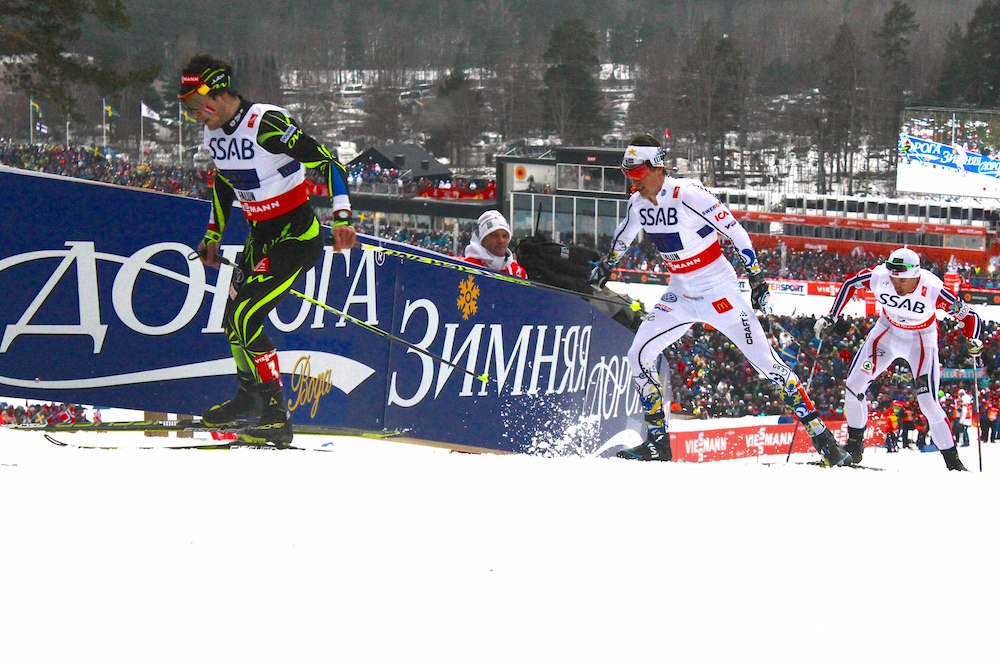
    22-year-old Adrien Backscheider of France leads Norway's Petter Northug and Sweden's Calle Halfvarsson in the final kilometers of the World Championships 4 x 10 k relay in Falun, Sweden.
    22-year-old Adrien Backscheider of France leads Norway’s Petter Northug and Sweden’s Calle Halfvarsson in the final kilometers of the World Championships 4 x 10 k relay in Falun, Sweden.

    That might be because, despite the recent success of the French team and the earlier success of stars such as Vincent Vittoz, cross-country skiing doesn’t get much press in France.

    “Don’t worry, it changes nothing,” Gaillard laughed about the result. “That’s not the biggest sport for sure in France. It’s maybe the 25th sport. Maybe we have some place in the newspaper tomorrow. But a little one.”

    The oldest member of the team at 34 years of age, Gaillard has put in his time on the World Cup circuit since 2002. And he has found success – individual podiums in Canada, Russia, Italy, and the Czech Republic, as well as relay podiums starting in Davos, Switzerland, in 2007.

    But doing it at a championships event, with a team, is something special.

    “It’s not that I deserve it, but I can feel that I know what is a medal and what is a good result,” he said. “If you are 20 years old when you get some medal, you think it’s easy and everything is possible. But when you don’t get a medal until you’re 44 years old, you can appreciate it. Really, it was a good idea to continue my career after the age of 30!

    “With the team it’s more fun,” he continued. “When you have a medal individually, you can’t share with everybody because for sure you have some guy on the team who is disappointed about the race. When it’s a relay, it’s crazy because everybody is happy. You can really share it with the team.”

    The men might get a few accolades back in France, but that’s not why he races, Gaillard said.

    “The most important is to have fun with the team, and get the best results we can have,” he explained. “We can move mountains, sometimes even when you don’t have much support of your country. I think we have a good spirit in the team and I’m sure we train as much as the other ones. We have good conditions for training in France, nice mountains, everything. We just don’t have the money that the other teams have. So it really shows that everything can happen, even if you are not in the really strong country.”

    Stay tuned for a complete international report and detailed reports on North American results.

    Results

    — Lander Karath contributed reporting.

    Adrien Backscheider of France leading Sweden's Calle Halfvarsson and Norway's Petter Northug in the final leg of the World Championships relay.
    Adrien Backscheider of France leading Sweden’s Calle Halfvarsson and Norway’s Petter Northug in the final leg of the World Championships relay.
  • Three Americans Land Top 20s in U23 Worlds 15 k: Patterson 13th, Caldwell 15th and Bratrud 19th

    Three Americans Land Top 20s in U23 Worlds 15 k: Patterson 13th, Caldwell 15th and Bratrud 19th

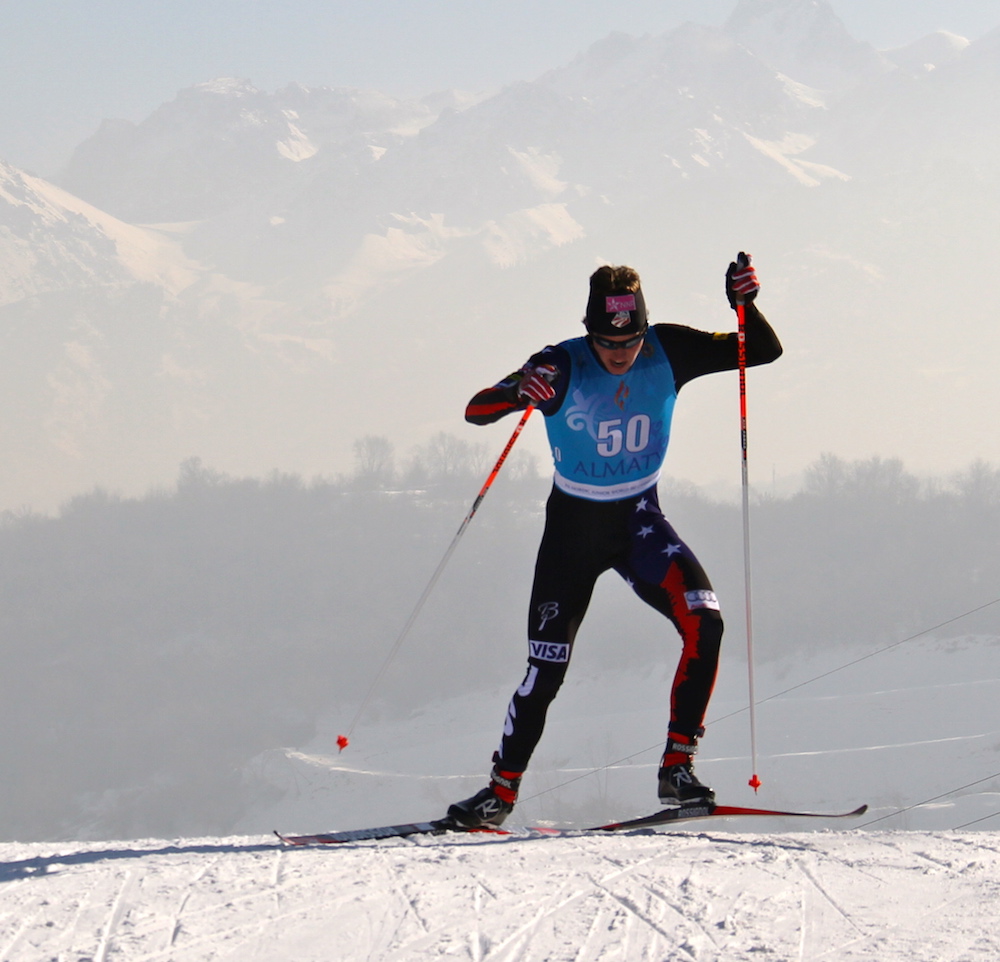
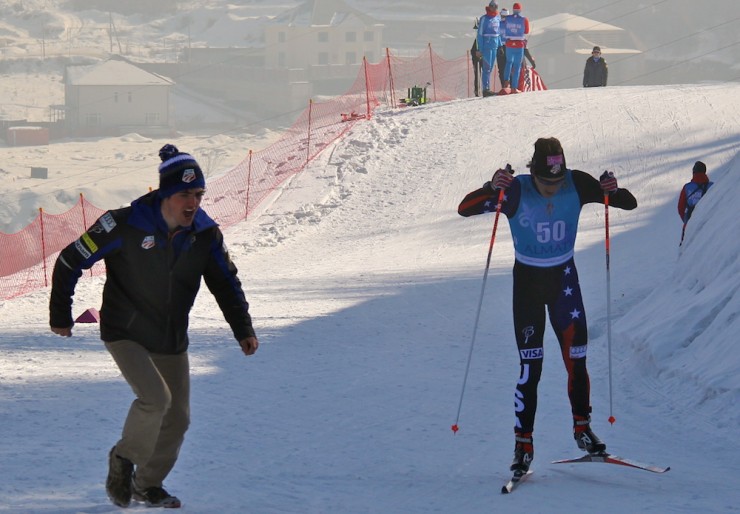
    Scott Patterson (APU) racing to a career-best 13th  in the 15 k freestyle on Thursday at U23 World Championships in Almaty, Kazakhstan. (Photo: Bryan Fish/USSA)
    Scott Patterson (APU) racing to a career-best 13th in the 15 k freestyle on Thursday at U23 World Championships in Almaty, Kazakhstan. (Photo: Bryan Fish/USSA)

    A career-best 13th sounds great until you realize that you were skiing as high as third at one point in the race, which is how Scott Patterson of Alaska Pacific University (APU) felt on Thursday after the men’s 15-kilometer freestyle at U23 World Championships in Almaty, Kazakhstan.

    Patterson, who turned 23 on Jan. 28, started 50th of nearly 60 men and was tied for third at 1.7 k with Russia’s Andrey Melnichenko, 2.2 seconds behind another Russian, Roman Tarasov, and 1.2 seconds behind France’s Mickael Philipot.

    By 6.7 k, Patterson remained in the top 10 with the ninth-fastest time, while Melnichenko had improved to fifth and Tarasov’s time ranked fourth. However, the last of three laps proved particularly challenging for several competitors, as Patterson slipped from ninth to 13th in the last three kilometers. Earlier in the final 5 k lap at 11.7 k, Melnichenko dropped to 12th and Tarasov fell to 17th, while Philipot ranked 22nd.

    Patterson ended up 13th, 1.27.8 behind winner Florian Notz of Germany, who improved from 11th early in the race to second at the 11.7 k checkpoint and finally, first at the finish in 35:55.3. Melnichenko finished 14th, Tarasov was 20th, and Philipot 23rd.

    “Honestly, I am a little disappointed with the result,” Patterson wrote in an email after his career-best performance at U23 World Championships. He had previously finished 18th in two races at 2014 U23 worlds (the 30 k skiathlon and 15 k classic), and 17th in the 10 k classic at 2010 Junior World Championships.

    “For most of the race I was fighting for a top 10,” he explained. “However, I faded as the race progressed while some of my competitors maintained the pace or got stronger.  At the finish I had heard I was in 8th so dropping to 13th in the end was a bit of a bummer. Luckily I still have one more race to improve on my finish. Coming into these championships, I had definitely been aiming for a top 10 with hopes even higher than that so I will continue that in the pursuit [skiathlon].”

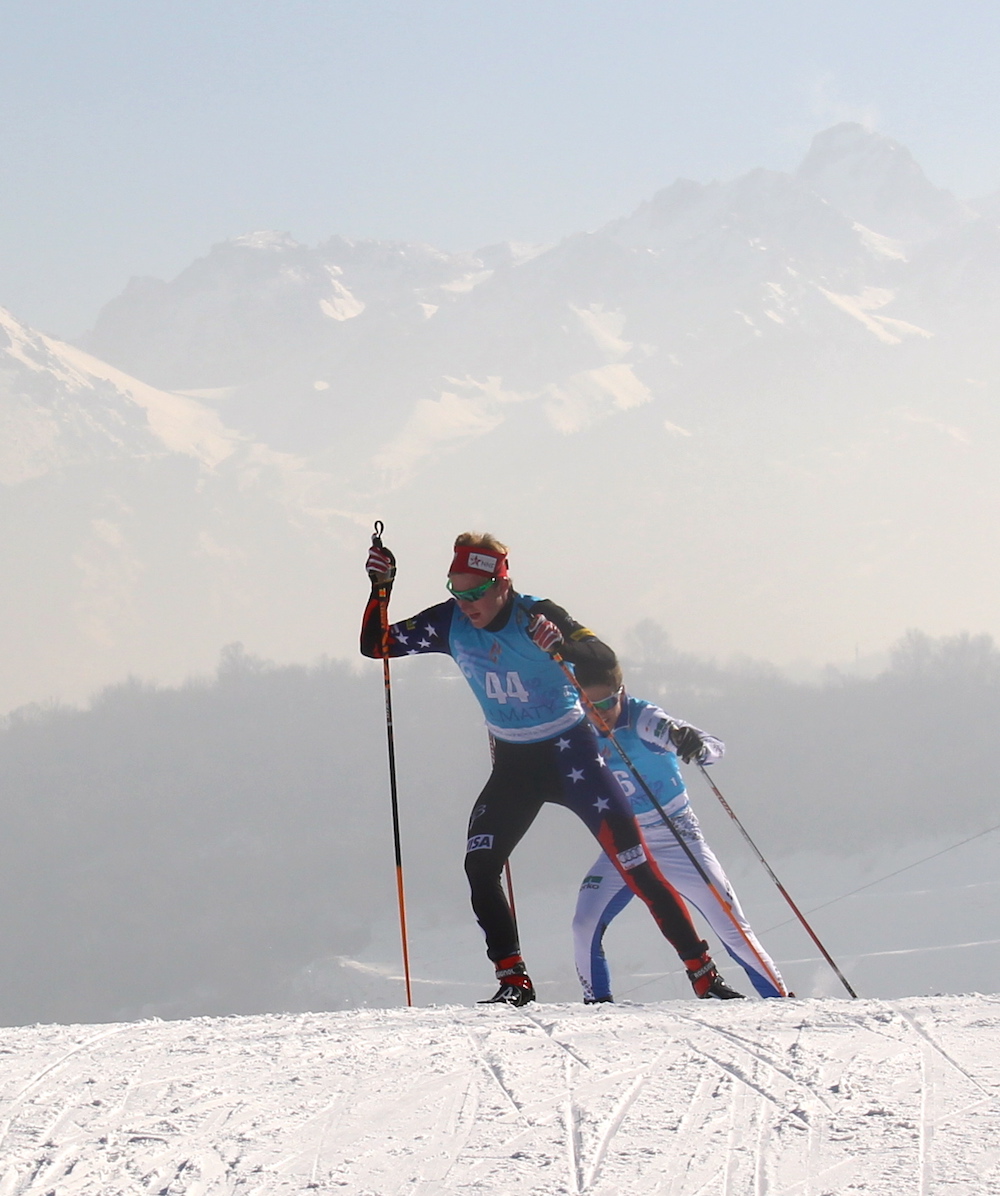
    Kyle Bratrud racing to 19th in his first race of U23 World Championships, the 15 k freestyle in Almaty, Kazakhstan. (Photo: Bryan Fish/USSA)
    Kyle Bratrud racing to 19th in his first race of U23 World Championships, the 15 k freestyle in Almaty, Kazakhstan. (Photo: Bryan Fish/USSA)

    Patterson led three American men in the top 20, with Patrick Caldwell (Dartmouth College/U.S. Ski Team) placing 15th (+1:40.1), and Kyle Bratrud finishing 19th (+1:49.1).

    “This was definitely one of my target races,” Patterson explained. “U23s is always an important part of the season and 15k skate races have historically been pretty successful for me, but the 30k pursuit is just as much of a target race.”

    While a top result at U23 worlds could draw the attention of the U.S. Ski Team and make a case for being considered for the U.S. Senior World Championships team, which will compete in Falun, Sweden, later this month, Patterson explained he wasn’t thinking about that.

    “Senior world championships would be awesome, but really I am here to race this week not race for a couple weeks later,” he wrote, adding that OPA Cup Finals in Chamonix, France, will likely be his next focus.

    Thursday’s course was tough, with “mostly relentless gradual uphills and working downhills with a few steep kickers and technical descents thrown in to keep it interesting,” he added. “Conditions were also quite interesting today with significantly faster almost icy section in the shade but almost slush in some spots. I think overall I skied it quite well but there were parts that could have gone better. By the third lap, I wasn’t working the transitions as hard as I should have been.”

    He paced his race aggressively, but found himself losing positions as the race continued.

    “I went out pretty hard with the idea that I was not going to be timid at U23s,” Patterson wrote. “Even in the first lap I could feel that this might cost me, later in the race. Although I hung close, I was gradually fading and transitioned into survival mode for the final few hills. Maybe it would have been better to go out a bit more conservative and ski into it, but I chose the opposite and it kind of worked out.”

    Just over three months ago, Patterson suffered a pulmonary embolism after a freak skiing accident with a teammate. He was limited to short walks for about a month, and it seemed the University of Vermont graduate’s first season as a professional skier was over before it had begun.

    “While I was injured there were definitely moments where I was questioning whether I would be able to qualify for this trip or even be able to race at nationals,” he reflected.

    He went on to win his first race back in December, a 15 k freestyle at home in Anchorage, Alaska, and placed eighth in the 30 k classic mass start at U.S. nationals last month.

    “The hardest part has been to keep everything balanced between the perspective of being injured and the perspective of it being a normal season,” he wrote. “On one hand everyone keeps telling me how amazing I am doing for where I was in November, but then there is the other side of me always wanting more and being quite close to where I actually want to be. Sometimes the injury just feels like it’s an excuse holding me back.”

    “Everyone keeps telling me how amazing I am doing for where I was in November, but then there is the other side of me always wanting more and being quite close to where I actually want to be.” — Scott Patterson, 13th in 15 k freestyle at U23 World Championships

    Heading into these championships, Caldwell explained in his email that his goals were to “race hard and stay healthy.” On Thursday, he was specifically aiming for a top 15 and was relieved he lunged at the line to do so.

    The 20-year-old Dartmouth ski team member finished 0.1 seconds ahead of Great Britain’s Andrew Young in 16th and edged Russia’s Krill Vichuzhanin in 17th by 0.3 seconds. In 15th, Caldwell was 11.4 seconds back from Melnichenko in 14th.

    “I’m really psyched with how things went today. It is a pretty tough course: lots of steep uphills, long gradual grinds and not much rest,” Caldwell wrote, adding that he focused on “staying relaxed on the climbs and really pushing it on the flats and gradual ups.”

    In his first race at a U23 World Championships, 15th marked his second-best result at a world championships since placing 10th in the 20 k skiathlon at junior worlds last year.

    “Many aspects of the competition are very similar so far,” he explained. “The biggest difference is that the top end for U23s are also competitive on the World Cup. Its pretty cool to be out there with some really successful World Cup skiers. … I think everyone is particularly fired up with the World Championships coming up soon. The upcoming races in Falun haven’t changed my approach to these races but have definitely added to the overall excitement at this event.”

    Bratrud placed 19th in his U23 worlds debut, after having competed at the 2013 junior worlds in Liberec, Czech Republic.

    “My goal going into today was to be in the top 15 or even top 10 so I am disappointed about that,” Bratrud wrote in an email. “I was in the hunt for the first two laps, but faded and leaked quite a bit of time on the last lap. That being said, it is hard not to be excited about a first top 20 and seeing two teammates in the top 15. This male U23 group is the future of US Skiing and it is a blessing just to be a part of it.”

    “This male U23 group is the future of US Skiing and it is a blessing just to be a part of it.” — Kyle Bratrud, 19th in 15 k freestyle at U23 World Championships

    Bratrud, who turns 22 on Feb. 9, started 44th — right behind Caldwell in bib 43 — and improved from the 25th-ranked time at 1.7 k to 12th at 6.7 k. He slipped to 16th with just over three kilometers remaining and ultimately finished 2.2 seconds within the top 20.

    “Anyone who knows me knows I put a lot of pressure on myself, so following a very successful US Nationals [where he won the 15 k freestyle and placed third in the 30 k classic] I certainly have new expectations for myself,” Bratrud said.

    Last week, he was named to the U.S. Senior World Championships team.

    “I constantly feel I need to justify my naming,” he added. “But at the end of the day I am on this trip with some of the best skiers in the US and if you are slightly off one day than a lot can happen. I went for it and came up short, but I am happy that I tried and excited for what lies ahead. This is certainly a new level. There are regular World Cup skiers racing with us and it’s fun to see where you compare.”

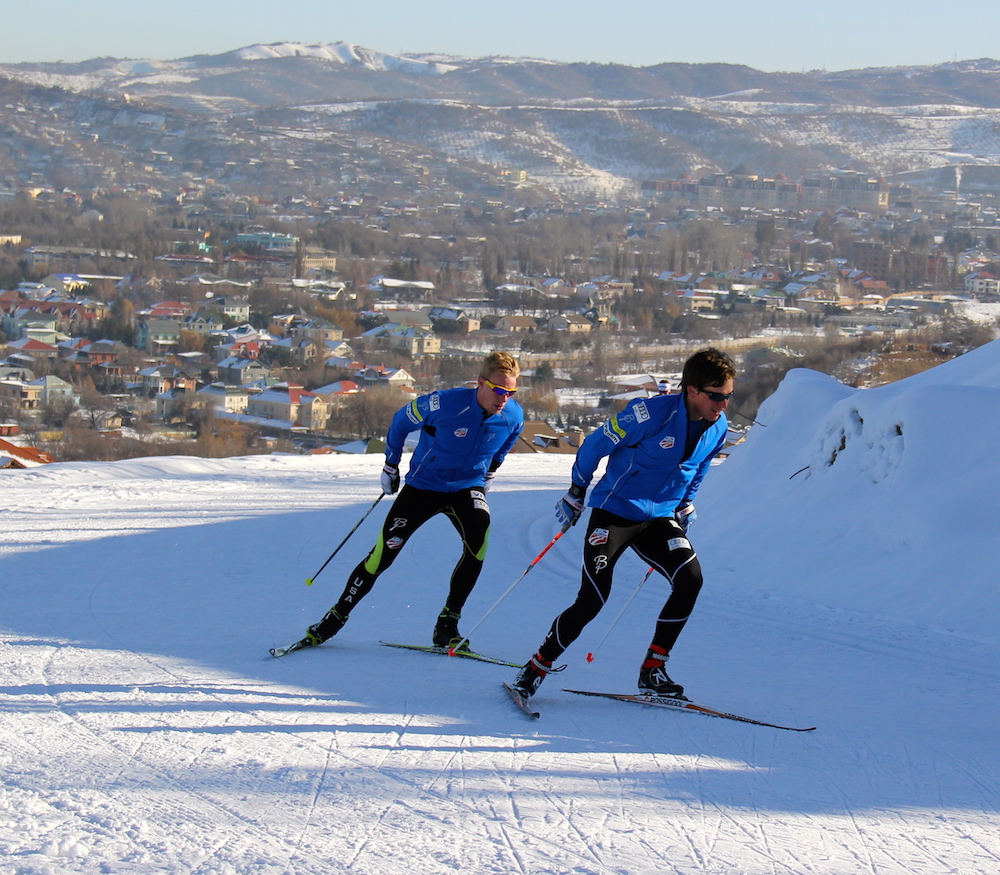
    Scott Patterson leads APU and U.S. U23 World Championships teammate Logan Hanneman during training last Friday in Almaty, Kazakhstan. (Photo: Bryan Fish/USSA)
    Scott Patterson leads APU and U.S. U23 World Championships teammate Logan Hanneman during training last Friday in Almaty, Kazakhstan. (Photo: Bryan Fish/USSA)

    Also for the U.S., Logan Hanneman (University of Alaska Fairbanks) placed 40th, 2:54.1 behind the winner.

    Germany’s Notz kicked it into high gear on the last of three laps for his first podium at a U23 or junior worlds, beating Norway’s Simen Hegstad Krueger by 9.5 seconds and French bronze medalist Adrien Backscheider by 26.7 seconds.

    Notz started last in bib 58 and paced himself accordingly to beat the times of both Krueger and Backscheider in bibs 56 and 57, respectively. Italy’s Giandomenico Salvadori held on for fourth (+34.7) and Norway’s Magne Haga, brother of women’s World Cup skier Ragnhild Haga, placed fifth (+40.2).

    Raphaël Couturier of the Pierre-Harvey Training Centre (CNEPH) and national U23 team placed 41st (+2:56.4) to lead the Canadian men, while teammates Knute Johnsgaard (Whitehorse/Yukon Elite Squad) finished 47th (+3:51.1), Scott James Hill (Thunder Bay NDC) took 48th (+3:54.3), and Colin Ferrie (Black Jack) placed 50th (+4:06.8).

    The U23 World Championships wrap up with the women’s and men’s 15/30 k skiathlons on Saturday.

    — Chelsea Little contributed reporting

    Results: Men | Women