From the FasterSkier archive — posts syndicated from athletes’ and coaches’ own blogs between 2004 and 2012, kept online as published. Current coverage is at fasterskier.com.
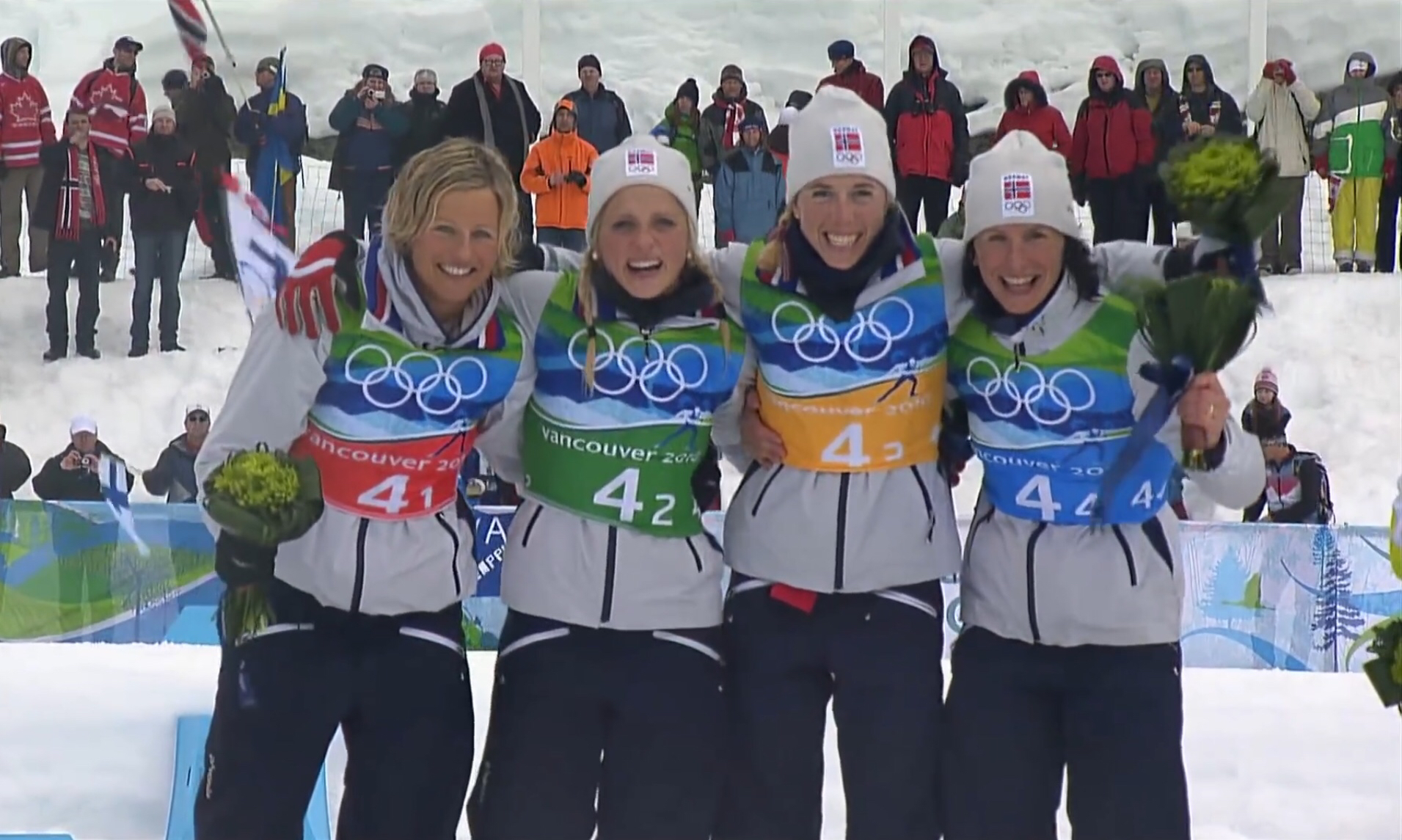
Norway’s gold-medal women’s relay at the 2010 Olympics in Vancouver, B.C., with (from left to right) Vibeke Skofterud, Therese Johaug, Kristin Størmer Steira, and Marit Bjorgen. (Screenshot: 2010 Vancouver Olympics relay video)
(Note: This article has been updated to include comments from Vidar Løfshus, head of the Norwegian cross-country ski team, and the team’s former performance manager, Åge Skinstad.)
The death of Norway’s Vibeke Skofterud shocked the international cross-country skiing world on Sunday, and as of Monday, multiple renowned skiers, particularly in Norway, had reacted publicly.
“I am shaking and am in complete shock over this horrible news that I received today,” Marit Bjørgen wrote in a press release, according to a translation. “Dear Vibeke, this was way too soon.”
Bjørgen and Skofterud were teammates on the Norwegian national team for well over a decade until Skofterud retired in 2015. They won gold together in the women’s relay at the 2010 Olympics and at World Championships in 2005 and 2011. Kristin Størmer Steira was also on all three of those winning relays, and Therese Johaug teamed up with the three to win in 2010 and 2011.
“I have lost one of my best friends,” Johaug wrote in another press release quoted by NRK. “A friend who lit up the room when she entered, one who gave everyone around her lots of energy, love and care. I take with me all of the nice moments and experiences in and outside of the trails and I will miss her. My thoughts go to her family and those left behind.”
Bjørgen added that she was “incredibly happy about all of the nice moments we had with each other. A tough competitor in the course, but more importantly, the warmest, nicest, toughest woman in the world,” she wrote. “We have experienced much together, from an Olympic gold medal in the relay … and I will cherish the memories for a long time. My thoughts go to her families and those closest to her. Love you Vibeke. Rest In Peace.”
Petter Northug wrote that the news was “incomprehensible and sad to hear,” according to News in English.no. “We had many fun years together on the national team.”
Odd-Bjørn Hjelmeset, a former skier who competed until 2011 and became a national team coach, recalled her “infectious humor”. Erik Røste, president of the Norwegian Ski Federation since 2012, said she was “an important ambassador for the sport of skiing with her winner’s spirit and great engagement.”
“Vibeke was that joyful girl who always contributed positively to the community she was a part of, definitely with her good results on the course,” Vidar Løfshus, head of the Norwegian cross-country team, told Aftenposten, according to a translation. “The fact that we have lost girl like her, who was always open, honest and spoke her opinion, is a loss to the entire community and inconceivable.”
“It is incredibly sad,” Åge Skinstad, a former national-team performance director who is currently TV 2’s cross-country expert, told TV 2, according to a translation. “The first thing you think about is the family and those closest to her. Vibeke was a fantastic human-being. She was a very, very good skier.”
One of her former competitors, Charlotte Kalla of Sweden, told Expressen that she was shocked by the tragedy.
“It feels uncomfortable and difficult to accept that such a joyful, positive, and full of energy kind of competitor such as Vibeke is longer with us,” Kalla said, according to a translation. “Vibeke was one of my role models when I entered the national team. A positive person who spread joy and really contributed to the cohesion with Norwegian team. She was a character within the sport who offered a lot of herself. It is with great sorrow that I now think of Vibeke and those closest to her. Rest In Peace Vibeke.”
Sjur Røthe (Norwegian National Team) double poling his way to a win in the first race of the 2015/2016 season, a 15 k classic FIS race in Beitostølen, Norway. (Photo: Eirik Lund Røer/SKIsport)
Note: This article has been updated to include comments from Andy Newell, Chris Grover, Ivan Babikov, Alex Harvey, and Devon Kershaw, and additional comments from Kikkan Randall and Erik Bjornsen.
***
Eighty-three percent. That was the magic figure swirling about the internet on Friday, as news broke on the International Ski Federation’s (FIS) decision to limit classic pole lengths to 83 percent of one’s body length. That means some of the World Cup field will have to shorten their classic poles as FIS tries to discourage double poling from start to finish in races.
“Cross-Country community determined to defend classic technique,” FIS Cross Country tweeted on Friday. “Maximum classic pole length 83% of body length approved.”
The purpose of this new rule, apparently effective for the fast-approaching 2016/2017 World Cup season, is to preserve classic skiing. Åge Skinstad, Norway’s national-team director and FIS World Cup Committee representative, told NTB, according to a translation, that “there were discussions about percentages, but everyone agreed there must be a rule.”
Chris Grover, head coach of the U.S. Ski Team and chairman of FIS’s Subcommittee for World & Continental Cups, explained that the German Ski Association originally proposed a maximum classic-pole length of 85 percent of one’s height, “but that was without shoes and measured to the top of the classic poles,” he wrote in an email to FasterSkier. “They revised their proposal to 83% to reflect the fact that any athletes that are measured would be wearing ski boots since the measurement would take place at the race start/finish, and to reflect that different brands of poles have differing distances between the top of the pole handle and the point on the handle where the strap is attached. I asked that the Cross Country Committee consider 84% of skier height due to how close we are to the season, but the other nations wanted to see 83%.”
Based on the Cross Country Committee’s decision on Friday, athletes will be measured while wearing their ski boots, and the length of their poles measured from the tip to where the strap comes out of the handle.
“Any time we create a rule we take away some freedom from the athlete,” Grover wrote. “The USA went into these meetings prepared to argue against the proposal. However, in Zurich I learned more about some double-pole trends they are seeing in Scandinavia that involve athletes using skate-length (or longer) poles and became more sympathetic to the idea, especially as it pertains to keeping the playing field level for all athletes, including USA athletes.”
While Grover stated that the U.S. supports the idea of preserving “many of the elements of traditional classic skiing, classic ski racing, and classic waxing … These include the classic striding technique and the classic double-pole technique in a form where we would recognize it today,” it is also “not afraid of innovation and change…
“The risk at this point is that double-poling becomes a third type of racing in Cross Country Skiing, with a third set of equipment needed for each developing and elite athlete, and that it may eventually spell the demise of the classic technique as we know it,” he continued. “Vegard Ulvang and the Cross Country Committee [CCC] wanted to make a statement that we are willing to fight for the preservation of the classic technique, and we are willing to try multiple strategies to preserve that technique. Along with this classic pole height restriction, the CCC has also passed a rule earlier this summer that allows the Technical Delegate to implement special technique zones on a classic course if they so choose.”
At its biennial Congress this spring, FIS addressed the issue of double poling on skate skis in classic races and how to prevent this method from dominating future classic races. Two World Cup classic races were won on skate skis last year, according to Adressa.no.
One new rule that came out of those June meetings was no-double-pole zones. This coming season at all levels outside the World Cup, World Championships and Junior World Championships, race juries may designate and mark zones where no double poling is allowed.
Additionally, juries can disqualify racers for taking skate strides in classic races without video evidence.
At the Cross Country Committee’s most recent meeting in Zurich, Switzerland, Grover explained they opened with the World Cup Subcommittee and CCC discussing the future of classic skiing.
“All nations agreed that we need to find a way to preserve the classic striding technique within classic skiing,” he wrote. “All agreed that it is part of our identity as a sport and part of what differentiates Cross Country from Biathlon, Nordic Combined, etc. In some places (esp. Scandinavia) they see traditional classic skiing and waxing as disappearing quickly, and they are also worried that double-poling in the future might be unrecognizable. As leaders in the sport, the Scandinavians are seeing these rapid technique evolutions generally before we are seeing them in the USA. Importantly, all are concerned with micro-skating (the many small skating steps taken by those athletes double-poling a classic race) as a form of cheating and it appears to be happening more frequently at every level (WC, COC, Junior races, popular races especially marathons, etc). I can think of several examples in recent years of USA men being very negatively impacted by competitors getting away with micro-skating when racing classic races on skate gear.”
Asked whether this could lead to injury, Grover didn’t think so.
“All members of the CCC also felt that implementing a change so late in the preparation season and so close to the competition season was far from ideal. However, the changes in the sport are coming so fast (including some pole length testing and training over the summer) that the CCC felt it had to act now,” he wrote. “We also felt that by waiting until next spring, after pole heights had continued to increase over the competition season, that a pole-height restriction would make it even harder for the athletes to adapt to a rule change.”
One of Grover’s athletes, U.S. Ski Team sprinter Andy Newell noted that World Cup skiers have developed a double-pole technique using their core, shoulders and chest muscles to help save their lower back.
“Longer poles are [definitely] better for this,” Newell wrote in an email. “There is a reason why skiers from the 80’s and 90’s were more likely to develop lower spine problems. I would worry that regulating pole lengths too much could set us back.”
Ivan Babikov, a Canadian World Cup racer as recent as last season and now one of Canada’s World Cup coaches, said in an interview that longer classic poles had not made much of an impact at the World Cup level. But men were using them in long-distance races, like the Ski Classics series.
He reasoned that perhaps FIS was trying to nix the longer poles before they reached the World Cup.
“Personally, I think FIS is in kind of a tough situation here,” Babikov said. “I don’t know if they could do anything about it, just to approve more harder courses where people won’t be able to double pole.”
Asked how his athletes feel about the measure, he said nobody was “freaking out or concerned about it, because when you think about it, 83% with the boots on from the tip to the strap, where the strap comes out of the handle, I mean it’s not really such a big difference. It’s like the same normal length of what the guys use now. It doesn’t really affect me or anybody I know.”
Alex Harvey racing a World Cup classic sprint in December 2013 in Asiago, Italy. Harvey posted the 13th-fastest qualifying time but was disqualified for skating. (Photo: Fischer/Nordic Focus)
“My initial reaction was just a laugh,” Canadian World Cup skier Alex Harvey wrote in an email. “Then I worried a bit, thinking maybe I would have to shorten my pole length and maybe have to adjust my technique/tempo. So I went and did a check of my height in my classic ski boots today, and did the whole calculation, then measured my poles from the tip to where the strap goes into the handle and I still have 4 cm to play with (my cl poles are 155cm long but the way FIS wrote the rule, you mesure to the strap and it’s actually 151cm.)…so not gonna be an issue for me…I usually go 3cm longer for DP races, I guess I will still be allowed to do this according to the new rule.”
His teammate Devon Kershaw reacted similarly.
“My thoughts when I read this was that obviously I found it a bit comical,” Kershaw wrote. “There’s a really easy way to ‘defend’ classical skiing. Put classic races on hard courses. Courses like Sochi, Canmore, Lillehammer, Holmenkollen, etc… You will not have people double poling – if that’s what you are trying to stop. It’s so easy. When FIS puts classic races in Toblach or Davos – both super old school/flat courses – I never understand how they can really be surprised when people do well by using just the double pole technique. Same goes for sprints. Want to stop double poling there too? Easy. Drammen, Stockholm and in the past Asiago cannot have classic sprints on their current courses. Think of kuusamo: ever see people double pole that beast? And win? No, of course not. The easy solution is for FIS to do their job properly when they are out reviewing the race courses (homologating them) – instead of putting a “percentage” rule for pole length. It’s hilarious.”
Harvey pointed out that the Norwegians use some of the shortest classic poles (relative to their height) in the World Cup field, “and it’s not stopping them from being the best in the World at double poling. … I agree with FIS when they say they need to keep striding and protect this beautiful technique, but to me, it’s easy. Pick the right courses!”
Harvey recalled getting disqualified in a classic sprint in Asiago, Italy, in December 2013.
“There was so many people getting infractions that they could’t actually hold the meeting in a proper room, it had to be outside, right next to the stadium because we were so many skiers getting a speech from the TD,” he explained. “I kinda lost it in the middle of the meeting and asked what the heck was he [and] the other FIS TD’s doing when they came in the Summer to check out the race site? Did they expect ANY men to choose striding over double poling on that course that was in a flat field? My final quote before I left the meeting was this: ‘Did you just come to Asiago, eat some cheese and drank some wine, then decided it was gonna be a good place for a classic sprint and a classic team-sprint?!!’. I got in trouble but I was just too pissed. It’s easy for FIS, just choose a location with good hills. DONE!”
On the double-pole note, Harvey added his opinion on sprinting. “I actually think that double poling makes it more exciting. In a place like Drammen, in the final you always have guys double poling and guys striding. Will the DP’ers be too tired from the quali, 1/4 and semi by the time the final comes? Will the conditions change? How is the tactic going to be? To me it makes it more exciting if your’e watching on TV, and isn’t it what FIS should be focusing on?”
Kershaw noted that this rule will have a bigger impact on the distance skiers who “pioneered the long-pole/double pole revolution. On the World Cup it’ll affect those that are using long poles for their height. Northug for example comes to mind or Noah (Hoffman). I doubt it will drastically affect most World Cup skiers. If they end up having to cut their poles, it will be by a few cms MAX which won’t take long to adjust to. For me for example I can actually go up in length by roughly 2-3cm from what I’m using.”
Grover explained that some of his athletes will have to use slightly shorter classic poles, while others will be unaffected.
Kikkan Randall, a longtime U.S. Ski Team member and FIS athlete representative, joked in an email that she needed to break out the measuring tape. What she found was her classic pole length appeared to be legal, with about 1.5 cm to play with.
“I’ve been in touch with Pierre Mignery, the FIS CC Race Director and Chris Grover, the WC Committee Chairman,” Randall explained in an email on Saturday. “Both explained that this rule comes from a strong common feeling from the whole committee to try to preserve classic skiing. It’s a rule that will be tested for sure this season and then reviewed next spring. I also learned the pole testing will not necessarily be carried out for every racer every time. In the case of mass start, they may only pull random skiers or check at the finish, similar to the random selection used for drug testing. So that is nice to hear.
“I’m sure there will be healthy discussion next spring about whether or not this rule helps the double pole problems and then it will either stay or go,” she added. “I will look forward to collecting athlete feedback on the topic through the season.”
In a previous email, Randall explained she thought 83 percent was too conservative.
“Skiers have different body types and styles and this new standard seems too close to the minimum height,” she wrote. “I experimented with different pole heights in the past and gradually worked my way down from 145cm to 140cm. For me longer poles did not feel like an advantage. I think this rule could have been used to prevent the use of ‘much longer’ poles. But within a couple centimeters of the average seems overly cautious.”
But changes are always hard, she added on Saturday.
“When they first proposed the sprint heat selection procedure, most athletes were against it,” Randall wrote. “It took a little getting used to but now I would say all the athletes positively support the heat selection. So perhaps this will happen with this rule too.”
American Andy Newell (c) after double poling to the victory in the men’s classic sprint final at New Zealand National Championships on Sept. 9 at the Snow Farm in New Zealand. South Korea’s Hwang Jun-Ho (l) placed second and SMST2 skier Ben Saxton (r) finished third. (Photo: Matt Whitcomb)
Her teammate Newell called the rule “a little hasty and unnecessary. I tend to be someone who believes that less rules are better especially when it comes to equipment and technique regulations, just because it kind of has the potential to stunt the evolution of sport,” he wrote.
“It’s crazy, and even a little bit funny how FIS is approaching the double pole problem exactly the same way they embraced the skating revolution when it was in its early days,” Newell added. “I think most World Cup skiers fall into the same category as me which is someone who really loves classic skiing and using kick wax and striding and gliding, but also appreciates the feeling of a good double pole.”
At the same time, he doesn’t have a big problem with the new rule because 1.) strong double polers are always going to be strong double polers, and 2.) measuring athletes in their ski boots and their poles from tip to strap isn’t going to be a drastic adjustment, he wrote. Newell anticipated he wouldn’t need to cut down his poles.
“Last month we double poled a classic sprint race in New Zealand, and under the current rules I still would have been able to use the same length poles that I did in that race,” he wrote.
His teammate Erik Bjornsen explained he was surprised to hear about the new rule.
“Earlier this summer I decided to shorten my poles by 2.5 cm because I thought it was an advantage to use a little shorter pole, maybe I’m wrong,” he wrote in an email. “I thought shorter poles aloud me to bring my weight up more before dropping it into the poles.”
Bjornsen uses 157.5 cm classic poles and is 6-foot-2 (roughly 188 cm) without ski boots. He measured himself with boots on and his poles as described and found his height to be 189 cm and and poles 155 cm, which brings him to 82 percent.
“I believe I wont have an issue with my current pole length,” he wrote. “Either way it should be fun watching the FIS try to enforce this new rule.”
“If anything I see it mostly as an added stress and headache for FIS to try to regulate this on race day, and also regulate in a fair way, because you know skiers are going to try to push the rules,” Newell wrote. “I was told today that an average person’s height can very 1-3 centimeters between morning and night haha. Who knows maybe T grips will come back into style:)”
“The new limit won’t prevent people from double-poling a race if they want to,” Grover acknowledged. “However, the rule is intended to keep future athletes from double poling races (and micro-skating) with poles that are close to the head-height limit (i.e. skate length or taller). This new rule is intended to be used as one tool, alongside the new technique zone rule, and possible future rules in the struggle to retain something that looks like classic skiing in the future. Will it work? I don’t think anyone is convinced that this is a guaranteed solution. But the message coming out of the CCC is that we want to try to preserve the elements of classic skiing, and the hope is that it helps to halt the one-way trajectory of double-poling that we see at the moment.”
Kristin Størmer Steira (second from l) with the Norwegian gold-medal relay team at 2013 World Championships with teammates Marit Bjørgen (l), Therese Johaug (second from r) and Heidi Weng in Val di Fiemme, Italy.
Last Monday, April 20, Norwegian national-team veteran Kristin Størmer Steira, 33, announced her decision to retire following several seasons of injuries and illness, the most recent of which came just prior to 2015 World Championships in Falun, Sweden, and kept her from racing the 30-kilometer classic mass start there.
“I’ve experienced so much as a cross-country skier and I love ski racing, but the time has come to find a new track. And that won’t be a ski track,” Steira said in a translated team press release.
“I feel privileged to have had the chance to work with the best ski racers and coaches in the world,” she added. “There have been rough times, sacrifices, blood, sweat and tears too, but those are valuable experiences that I will carry with me.”
And she will be missed, by both her teammates and coaching staff.
“I am sad to see her quit now,” Marit Bjørgen told TV2. “Kristin and I have been teammates since 2003, so it will be strange to continue without her, but I respect her decision. She has meant so much to me, both as a teammate on the course and as a friend outside the track, and she has been an important part of Norwegian cross-country skiing for over a decade.”
“She has been an important part of Norwegian cross-country skiing for over a decade.” — Marit Bjørgen, on Norwegian teammate Kristin Størmer Steira’s retirement
“Kristin is not only a solid skier. She is a fantastic person with a great personality and contributes to a positive atmosphere wherever she goes,” said national-team director Åge Skinstad.
During her career, Steira participated in three Olympics: 2006 in Turin; Italy, 2010 in Vancouver, Canada; and 2014 in Sochi, Russia. She earned an Olympic gold medal in the relay in 2010, and her first individual Olympic medal in 2014 with bronze in the 30 k freestyle mass start.
Kristin Størmer Steira after taking bronze in the 30 k mass start at the 2014 Olympics. (Photo: FIS)
Steira competed in six World Championships: 2003 in Val di Fiemme, Italy; 2005 in Oberstdorf, Germany; 2007 in Sapporo, Japan; 2009 in Liberec, Czech Republic; 2011 in Oslo, Norway; and 2013 again in Val di Fiemme. During that time, she helped Norway win three World Championships golds in the relay in 2005, 2011 and 2013. Additionally, she earned four individual World Championships medals: two silvers in the 30 k classic mass start in 2007 and 15 k pursuit in 2009, as well two bronze medals in the 15 k skiathlon in 2005 and 15 k pursuit in 2007.
She also holds two individual Norwegian national titles in the 15 k pursuit in 2014 and the 30 k classic in 2010, along with two silver and three national bronze medals.
Steira first entered the World Cup circuit in 2002, when she raced the 30 k classic on home turf in Holmenkollen and came in 46th. She started 181 World Cups, tallied six individual World Cup victories and reached the World Cup podium 22 times.
Kristin Størmer Steira racing in the 10 k classic mass start at 2012 World Cup Finals.
In 2012, the national team sidelined her in the middle of the season due to weight concerns, with a BMI under the team’s minimum limit. She told NRK that she has fought weight problems throughout her career.
“It is something that has been challenging for me through my whole sports career. I’m naturally thin, and when I train my body reacts with that I lose weight,” she said, according to a translation. “I have worked hard, and it has been challenging since I have been on the border many times.”
She reiterated that she did not have an eating disorder and was happy to talk about the subject.
“People have wondered and I have tried to be as open about it as I could,” she said. “This is particularly true with teammates and the others we have worked with on the team … But it’s not something I feel … has been a major problem.”
For the rest of the spring, Steira will continue to study full time, stepping up her academic pursuits of earning a business degree. In July, she has a wedding date set with Canadian World Cup skier Devon Kershaw, and the couple hopes to start a family soon.
This FasterSkier series will examine the growing challenge to the national team model by privately funded ski teams and independent sponsorship agreements. Will national teams be able to support themselves in the future, or will corporate teams take over cross country skiing? This first article in the series will look at Petter Northug, Jr.’s record deal with Coop and the implications it has for the Norwegian National Team and the sport as a whole.
***
Last May, Petter Northug, Jr., the bombastic figure of nordic skiing, called a press conference and announced that he was leaving the Norwegian National Team. The news hardly came as a surprise to Norwegian ski fans; for weeks prior to the announcement rumors had swirled in the press that the ski star had signed a lucrative deal with Coop, a Norwegian grocery chain.
The deal was indeed a profit windfall for the then 27-year-old Norwegian. Though the financial terms of the agreement haven’t been made public, the three-year deal was widely reported to be worth somewhere between 10 to 20 million Norwegian kroner a year, or $1.6 to 3.3 million dollars.
Predictably, Northug’s decision to leave the Norwegian National Team, or the Norges Skiforbund (NSF) as it is known in Norway, caused a certain amount of backlash at home. Northug’s career has been rife with moments of controversy, but his decision to leave the NSF may well be a watershed moment for skiing, one that comes to redefine the role of national teams in the international ski arena. This spring will likely see what the future holds for skiing, as the NSF debates whether it will allow Northug to continue to ski for Norway, and other ski stars watch and weigh their options.
“I’m going out of the national team and will train independently,” Northug said at his press conference last year. “I want to prepare myself mostly alone. Motivation makes me draw this initiative. If you are not 100-percent motivated, you’re done. I want to control things myself.”
“There are major challenges,” Northug’s father Petter Northug, Sr., better known by his middle name, John, said. “He chooses not a good arrangement for the national team, but said he had to do this to get greater motivation.”
John Northug added that the cause of his son’s flagging motivation was the stagnation of having already spent seven years on the national team.
“This was the new personal challenge he needed,” he continued. “I see that he thrives on it and he thinks it is brilliant to have responsibility for himself. He is in high spirits everyday. It has given him a new dimension to govern himself.”
Inevitably, Northug’s announcement caused a stir. Some accused him of being unpatriotic, even traitorous, a point of view that Northug says he understands. The older generation of Norwegians is more critical of Northug’s perceived lack of patriotism, while younger Norwegians are more sympathetic with his financial desires.
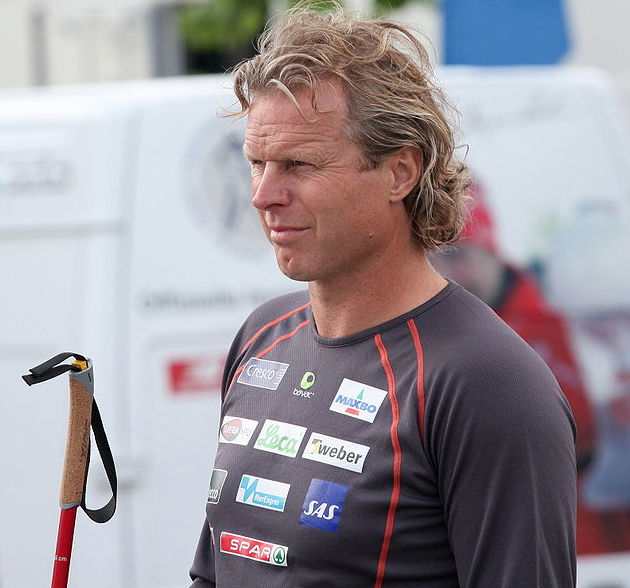
To counter the fallout, Northug brought NSF Cross Country Head Coach Åge Skinstad to sit beside him in front of the press. Looking like an older, somewhat elfin version of Northug with his similarly shaggy hair, Skinstad was there to lend his protégé support, if not his stamp of approval.
Åge Skinstad, Norwegian National Team head coach (Photo: Jarle Vines)
“We have discussed the consequences,” Skinstad said. “And although we have disagreed about the decision, there have been good discussions. … We still have a common goal towards next season with the Olympics, the Tour de Ski, and the World Cup.”
Skinstad stressed that all the funding and support that Northug had enjoyed from the NSF would end immediately. But he added, “When we come to the [World Cup] ski races in Kuusamo [Finland], then Petter will get the same support as the others.”
Northug penned the agreement in the belief that he would still be able to compete for Norway at World Cup competitions, the Olympics, and World Championships through a representation agreement. Since only national teams are allowed to compete at these competitions, temporary representation agreements are often drawn up to allow skiers who are not normally on the national team to temporarily join the team when they qualify for competitions.
It is this representation agreement that continues to put the NSF in a bind. The problem is simple: sponsor exclusivity.
“… [Northug] has signed a major sponsorship agreement with Coop, which is a competitor of NSF’s sponsorship Norgesgruppen/Spar,” Stein Opsal, NSF secretary general, stated on the NSF’s website. “NSF sponsors have industry exclusivity in their agreements. It has therefore been important for the NSF to fulfill our partners’ interests. It is these partners who contribute to the financing of … Norwegian cross country skiing.”
“At the same time,” wrote Opsal, “it has been our clear desire to contribute to Petter getting the best possible athletic program before the Olympics, within the limits we can defend.”
For a star like Northug to be absent from the team for 10 months of the year, while partnering with the NSF’s sponsor’s closest competitor, creates a vexing problem for Opsal and his organization. They were counting on Northug to provide them with Olympic medals in Sochi, and felt that they could scarcely afford to sacrifice that all-important marker of success over exclusivity clauses.
For that reason it was to no party’s advantage to see him left out of the team in a critical Olympic season, but with the 2014 Games behind him his future is in some doubt. Partly it depends on the desires of the Norgesgruppen. If the food conglomerate insist upon total exclusivity, then Opsal will be under serious pressure to exclude Northug entirely. If, on the other hand, Norgesgruppen decides that his temporary inclusion on the national team still elevates its sponsorship profile, or fearing a negative backlash if they force him out, the company may let the issue rest. In any case, Northug correctly gambled that he wouldn’t be pushed out, though that may change.
From his announcement last May, Northug was unable to come to terms with the NSF over a representation agreement until October 13, 2013, an unusually long time for what Opsal called a “general representation agreement.” That agreement also came with “an attachment that governs the relationship between Northug’s sponsorship and NSF sponsorship.”
The Agreement Itself
That attachment seems to have been an awkward compromise at best. As part of his deal with Coop, Northug has become a face of the store, and a poster boy for its healthy living campaign. His visage is on everything from juice, cereal, and bread in the store, and as part of the contractual agreement, all Northug-related products and advertisements that were launched after October 30 had to be removed from stores between January 30 and February 28, 2014, so as not to interfere with Spar’s Olympic exclusivity.
If the products remained in the stores, Northug risked being suspended from the Games, and fearful store managers scrutinized their aisles for Northug items that could have caused trouble. One store manager, Erik Tangstad, said that he didn’t even dare let the advertisements stay in the warehouse, and threw everything away for fear that banned items could be mistakenly be brought into this store during the Olympics.
How long these sorts of arrangements can remain feasible is uncertain.
“It is clear it can be a challenge for the national model,” Opsal told NRK. “It is something we will now evaluate after the season, for our loyalty lies primarily with our partners. So if we feel we have gone above and beyond what we feel is reasonable [with representation agreements], we will tighten it for next season.”
Northug has also put himself at disadvantage in these agreements by having a poor season. Having struggled with sickness in the fall, Northug was lackluster at best on the World Cup and dreadful at the Olympics. Additionally problematic, at least for Northug, was the emergence of Martin Johnsrud Sundby as the Tour de Ski and Overall World Cup winner at the end of the season. Throughout the Northug era Norwegian ski fans have worried that there wasn’t another world-class man on the team. In the one season that Northug was a non-entity, Sundby suddenly emerged as the world’s best all-round skier. With Sundby in good form, Opsal may now feel less pressure to come to an agreement with Northug for the 2014/2015 season.
While Opsal speaks cryptically about tightening agreements, Vegard Ulvang, former Norwegian ski star and head of the FIS Cross Country Committee, is more direct.
Vegard Ulvang
“It’s a very difficult issue,” Ulvang told Aftenposten. “In principle, the Norwegian national model is built on a strong Norwegian National Team, which all contribute to the economy [of the NSF]. If the model is broken … then we need to align ourselves with another system, to lay down the national team and let the [professional teams] take over.”
Ulvang questioned who would provide the infrastructure and support system that national team skiers now enjoy. “If you let [skiers] be free,” said Ulvang, “the system will not work the way it does today. In my mind there is not any other way, either to finance or organize this, than we do today. Then everyone must contribute.”
As a longtime advocate for the national-team structure Ulvang does not think that skiing will go the way of cycling with its professional teams. In a June 25 interview with NRK he ranted, “Our sport is not developed alone in a hotel room in Italy. The development of the national [team] environment and the Petter Northug training culture today is a product created over 50 years where everyone has contributed. To break out of the federation’s national system is a serious violation of the way we are organized.”
“I fear that Petter has started something that more will [choose],” he continued. “I am very concerned that this will be the trend. It is important that Northug and all others that are good give knowledge and expertise back to those who come after them. There’s supposed to be a new Northug one day. Therefore, we must avoid that the best break out of the national system once they have received the best fruits contained therein. There is enough flexibility in the national team, so this is about one thing only: Economy.”
“Petter is not the first star who has had the opportunity to do things differently,” Ulvang fumed. “But in previous cases, we have always found flexible solutions within the system.”
“What people are saying I do not care so much about,” Northug responded. “I follow what I want and what I feel.”
New Money
Jürg Capol, former FIS race director and current marketing chief, supports Northug’s route.
Jürg Capol
“The ability to concentrate on one’s own, with major sponsors at one’s back, is too good to miss,” Capol said. “[It’s] essentially a luxury problem: that there is so much money in the sport.”
The fact that there is so much money now in the sport is an issue that national teams have been slow to respond to. The last decade and half has seen a concerted effort by FIS to turn World Cup skiing into a TV-friendly event. The reinvention of race formats and coverage quality has paid off handsomely. The 2013 Cross Country World Cup season boasted an aggregate audience of 1.86 billion viewers over 1,135 hours of broadcast time. This represented an audience increase of 25 percent from the 2012 season alone, and with it, sponsorship revenue.
It’s not just the World Cup races that are popular to watch on TV. The Vasaloppet captures 73.9 percent of the television audience in Sweden the first Sunday morning in March. It’s such a TV event that former race director Jonas Bauer, looking to expand the Vasaloppet’s market abroad, concocted a new marathon circuit: the Swix Ski Classics.
The Swix Ski Classics was inaugurated in 2011 with the Tour de France as a role model, and the races follow in that tradition. There are now 32 professional ski teams that compete on the circuit, and 200,000 euros in prize money. The series consists of six long-distance classic races: La Diagonela, Marcialonga, König Ludwig Lauf, Vasaloppet, Birkebeinerrennet, and the Årefjällsloppet. These races were broadcasted last year in 50 countries with 20 million live viewers.
Though far from equaling FIS’s TV audience, the Ski Classics is only in its fourth year and growing rapidly. This alternative ski circuit has fueled the creation of private ski teams, particularly in Scandinavia, where sponsorship money is ripe for the picking. It is precisely these ski teams that are now catching the eye of many top cross-country skiers.
A former member of the Norwegian junior and recruit national teams, Chris Andre Jespersen left the national team in favor of Team United Bakeries. Jespersen had a breakout season this winter, finishing second in the Tour de Ski. At the summit of the Alpe Cermis after the race, he was asked whether or not he would join the national team the next season. Shrugging off the question he thanked United Bakeries for the support they’d given him.
“I got an offer last year,” Jespersen said on top of Alpe Cermis. “We get good financial support, all of the camps, private physio — we really have it all. There is no reason why we should not go as fast.”
Norway’s Chris Arne Jespersen racing in shorts at the 2014 Winter Olympics 15 k classic in Sochi, Russia.
He doubted whether he would receive the same kind of treatment in the NSF. Asked about his future on April 2, Jespersen gave a cautious answer, “I’ve decided, but I do not want to say what I’ve decided.”
All of this leads back to the Northug debate, and the amount of money that Northug had left on the table while still on the national team. Public tax statements indicate that Northug’s income in 2012 was 1.6 million kroner ($268,000), the lowest amount that Northug has reported since 2008. As more money is available in the sport, Northug has apparently been making less.
The high water mark for Northug was in 2011, the year the World Championships were held in Oslo when he reported 3.59 million kroner. All told, according to Bergens Tidende, Northug’s net worth in 2012 was 11.9 million kroner ($2.18 million dollars). Compared to these numbers, the 10-20 million kroner ($1.5-3.6 million) Coop is now paying him seems too good a prize for him to have passed by.
For skiers on the national team, the base salary is 200,000 kroner ($33,500), while its top stars earn 450,000 kroner ($75,400). Prize money and additional sponsorship make up the rest of a skiers income. Even so, Therese Johaug reported an income in 2012 of 1.1 million kroner ($184,000) while Marit Bjørgen made only million kroner herself, though her total wealth is estimated at $3.6 million.
All of this comes as the NSF’s sponsorship revenue has exploded. In 2009 the team collected 20 million kroner ($3.3 million) in sponsorship funds. In 2013 that number was 66 million kroner, or $11 million.
To what extent Northug was responsible for the 10-million kroner increase per year is up for debate. Skinstad dismissed the idea saying, “It is impossible to say what Northug has had on the economy [of the team]. I believe that the total interest is not very dependent on individuals.”
Northug’s manager Are Soerum Langås, has a different take. “Peter has contributed an amazing amount in all the years in which he has been part of the national system, including by increasing the FIS market,” Langås said.
In the minds of Camp Northug, Petter has already contributed his share, and has seen his personal income drop while the profits of FIS and the bankroll of the national team have soared.
Bernt Halvard Olderskog, the NSF’s commercial manager questioned the notion that Northug helps attract sponsorship to the NSF in a March 2014 interview with Adressa. Olderskog noted that this year with Northug only temporarily on the team, the NSF received 73 million kroner in sponsorship funds, up 7 million from the previous year, an increase of 10 percent.
“We expect an increase next year,” said Olderskog. “The large income jump we have already taken, but there is additional revenue in license products and equipment sales.”
Olderskog defended the fact the NSF’s ski stars make less than their earning potential while they’re on the team. “It’s a social democracy that prevails in the national team,” he said. “Marit and Therese could have earned more …”
Will Others Follow?
The biggest threat to the National Team’s economic model of course is losing more of its star athletes. Of chief concern are its leading ladies, Marit Bjørgen and Therese Johaug, both hugely popular figures in Norway. The NSF receives sponsorship from ASKO specifically for Bjørgen and Johaug, and if it lost them, the team would likely find itself much less attractive to partners and its overall revenue would decline. The NSF will likely never be able to offer athletes the money and exclusive perks of a well-funded corporate team, instead for the time being they are relying on other methods to keep their athletes on board. What the team can offer is top-notch resources and personnel, not to mention prestige, national pride, and camaraderie.
To prevent the further loss of athletes, Opsal is debating his options. Ulvang is encouraging the total exclusion of Northug from the national team to set a precedent, while Opsal seems to be favoring a more moderate approach.
An April 2, 2014 article in NRK stated that Opsal is actively reviewing the NSF’s representation agreement policy and would come to a conclusion on the matter by the end of May of this year.
“It is wrong to talk about possible outcomes at this stage in the process,” Opsal said. Nevertheless, NRK proceeded to outline the three possible outcomes:
1) The policy will remain the same. Athletes can sign representation agreements even if they have other conflicting sponsorship agreements.
2) Athletes can sign representation agreements only if they have no conflicting sponsorship agreements.
3) Athletes that are offered membership on the national team but opt not to join will be refused the right to sign representation agreements.
Eldar Rønning may leave the the Norwegian National Team after the 2014/2015 season
While it’s unlikely that the NSF would choose Option 3 and essentially force skiers onto the national team, Opsal must choose whether or not to allow sponsorship conflicts to continue. His decision will be shaped by how threatening he finds Northug’s private initiative to be for the future of the national team. With Jespersen likely to remain with United Bakeries, and Eldar Rønning hinting that he may pursue something similar after next season in order to be more “family friendly,” Opsal may heed Ulvang’s warning.
Yet Opsal knows that if he goes with Option 2, it is very unlikely that Northug will leave his partnership with Coop. Therefore, if he changes the terms of the representation agreements, Northug will almost certainly no longer ski for Norway. Whether Norway can remove the sting of the Olympics with a Northug-free relay team at next years World Championships in Falun, Sweden, is also a question that must be on his mind.
The reality is that Northug is fully prepared to no longer ski for Norway. He has already won everything there is to win, and though he surely would like to win more, he and the NSF don’t get along very well, and never really have.
His disagreements with the NSF began at the very beginning of his career: he was contentiously left off the Norwegian team for the 2006 Olympics, and has said he has not yet forgiven then National Team Coach Krister Sørgård for the decision. The bad blood he felt between himself and the national team from this episode has remained with him throughout his career, and with each new conflict he can taste it again — a sense of mistreatment and injustice.
The Northug Complex
Petter Northug
To understand Northug is to know that for him skiing has always been about proving people wrong. His motivation seems to stem from a sense of himself being set against the world. Many thought he would mellow with age, but so far at 28, that hasn’t quite happened. Even as he became arguably the best skier of his time, he kept up his war of words: belittling Sweden at every opportunity, mocking his rivals, and making boastful comments whenever a microphone was in front of him, much to the delight of reporters.
Media outlets like NRK have covered him extensively, and the following two sections are based largely on their reports.
Perhaps the most telling example of his attitude was Northug’s warmup jacket at the 2013 World Championships in Val di Fiemme, Italy. Emblazoned on the back of the jacket was a picture of Northug’s face holding up a single, shushing finger over his mouth, while an inscription on his sleeve read in English: “Haters gonna hate.” If that wasn’t clear enough, Northug took it upon himself to point out the inscription whenever the cameras rested on him.
Critically, though, for Northug, he wasn’t able to maintain a harmonious relationship within the insular national team. In April of 2008, Northug was reprimanded by his teammates at the end of the season evaluations for “contributing too little in training.” The grievance was that he was too concerned with training at the right intensity to fully participate and push his teammates in the harder workouts. Northug’s occasional lack of effort at training sessions has continued to be a bone of contention on the team.
Northug’s sponsorship battles are also nothing new. In November of 2008, he showed up on the TV show “Grosvold” with his personal sponsor, a decision his teammates criticized him for. His sponsorship conflicts really heated up though the following year, when Northug signed on with Red Bull. The NSF did their best to stop the Red Bull deal going forward, despite the fact that on the NSF’s alpine team, the famous Aksel Lund Svindal was enjoying a rewarding partnership with the very same brand.
The NSF threatened to revoke Northug’s racing license over the issue, and he was accused of sending “unfortunate moral signals” by pursuing the deal. Northug in the end was allowed to keep his Red Bull contract, but for him the experience equaled the injustice he felt following his 2006 Olympic team omission. It was then, in the fall of 2009, when the Red Bull tensions were at their highest that Northug first began to privately consider a career for himself outside of the national team.
More Conflicts
Of course there have been many other flare-ups along the way. He was outraged at not being given a bib in the sprint race at the 2009 World Championships in Liberec, Czech Republic, the race he felt gave him his best chance to win gold. After a poor performance in the 15 k at the 2010 Olympics Northug declared that something had been done to his skis.
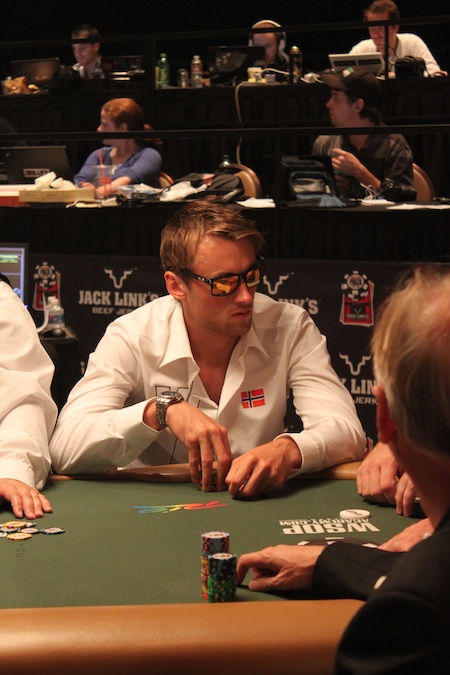
Petter Northug during his first day at the 2010 World Series of Poker
While it was never confirmed whether anything had happened to his skis, tension remained high throughout the Games as his father stepped in, giving Northug the equipment and wax service he needed to be successful in Vancouver.
In April 2010 he was hounded by the Confederation of Norwegian Sports over his poker habit, and that May he failed to show up to a national-team camp citing illness, but was skewered in the press after it was revealed that he had actually gone instead to play a soccer match for Mosvik, a lower-division club he occasionally plays for. That revelation was relatively benign compared to the popularly held belief that he had skipped the camp to get blindingly drunk on the Spanish island of Mallorca.
In December 2010, Ulvang howled that he was “embarrassed to be a Norwegian” after Northug showed up late to an award ceremony after a World Cup race in La Clusaz, France. Last year, Sundby called him a coward, and Northug had to fight to be allowed to ski in the World Cup races in Sochi, preparation he said was vital ahead of an Olympic year. All told, by the end of the 2012/2013 season he simply ran out of patience with the national team and its “haters-gonna-hate” attitude, as his sleeve that year attested.
It’s likely Northug had been developing his strategy for a national-team exit for some time before his announcement last May. To understand how he managed to land such a momentous agreement with Coop, one need not look farther than Northug’s father.
The Ultimate Ski Patriarch
John Northug is nothing if not the ultimate ski patriarch. He is the father of three sons, all skiers: Petter, Thomas, and Even, and he has been instrumental in developing their ski careers. Aside from his eldest son Petter’s obvious success, Thomas, age 23, is a member of the National Team, and Even, 18, is on his way up. When Even took third in a Norwegian rollerski race last summer, Petter exclaimed: “We don’t play around, we don’t play around. F*ck, we’re good.”
For three years John has managed Petter’s career, helping him reach an unprecedented level of success and fame. Yet the relationship between the two was argumentative, often tense in the public sphere and said to be even more turbulent behind closed doors.
Petter Northug at the 2011 Bislett Games. Photo: Chell Hill
“When I started, it was because Peter wanted it. And I was positive. We both agreed that I was the right man for the job,” John told Dagbladet. “In the aftermath, we can say that it was a misjudgment.”
After three years, they decided that John would move on from his managerial role, and he told Dagbladet he was relishing a return to the simple life of living on his farm and working at the Agricultural Office in Inderoy.
“Now I have it good,” John said at the time. “Now I have found serenity. When I was a manager, I walked around with a tension in my body all the time. What would show up today? It was something all the time.”
He didn’t last long at the Agricultural Office. If John Northug thought he was ready to return to the simple life of a municipal worker, and leave his role as chief of the “Northug Circus” as his son’s exploits are referred to, he was kidding himself.
“It is just a little bit that I do some other things too well,” he said about he decision to leave the municipality.
He then joined a sport-management company based in Trondheim, Norway, called Nye Høyer, or “New Heights” in English. As a senior consultant with New Heights, his role was largely to help the company develop its activities relating to major Worldloppet ski events such as the Marcialonga, Dolomitenlauf, and the Engadin.
It was no accident then that Northug arrived at the doorstep of New Heights, the company he actually signed with when he left the national team in 2013. Whether John was hired by New Heights with the expectation that they would manage Petter’s business affairs in the future, or whether that idea was borne later, by last spring it was decided that Northug would partner with New Heights, and that they would, “handle all areas around the Petter Northug brand.” The deal they arrived at with Coop didn’t disappoint the company motto of, “a profitable journey of continuous improvement.”
With New Heights, Northug has the experience of his father backed up with the support and connection of a well-oiled management company. New Heights cited their connection to the legal firm Pretor Advokat and the Trondheim branch of the international auditing house PricewaterhouseCoopers to provide Northug with extra legal, financial and tax assistance.
To what extent New Heights is currently leveraging their connections to assure that their golden boy remains able to compete for Norway in big competitions is unknown. Perhaps his future will lie entirely in the world of marathon races, and if so he may lift those events to even greater prominence. In any case, whatever Opsal decides and despite Ulvang’s cries of alarm, the sport of cross-country skiing is not likely to proceed in the same way for long. FIS has been successful in making skiing popular to watch, and there is money in the sport in a way there never has been before. With Norwegian national-team salaries capped at $73,000 and most other nations paying their athletes significantly less, it’s only a matter of time before more skiers opt for a more remunerative route.
If Opsal opts to change the agreements he may delay the inevitable for some time in Norway, but star athletes from other countries will likely soon hear the siren sound of private teams, exclusive contracts, and real wealth.
***
This series will continue by examining Therese Johaug and her path to a successful career while on the Norwegian National Team.
In a book published in Norway on April 12, John Northug – Petter Northug’s father and manager – says he has never witnessed a more severe invasion of privacy than what he saw when the Norwegian government-supported TV station NRK transmitted Northug’s victory tears from the finish line at 2011 World Championships in Holmenkollen in February.
Sunday February 27, 2011, Petter Northug became the World Champion of the 30K mass start pursuit. It was Northug’s first World Championship gold medal in Holmenkollen. National team head coach Morten aa Djupvik was equipped with a miniature microphone from NRK when he went over to Northug in the paddock. The world Champion was crying, while his dad John displayed his joy on live on VGTV from the stands.
Already the next day John Northug announced to the Norwegian online newspaper VG Nett that he was upset with the national TV station’s handling of the situation. In a book launched this week titled “Gull og Grønne Svensker” (literal translation: “Gold and Green Swedes”) written by Thorkild Gundersen, a journalist writing for the men’s magazine “Vi Menn” (translation: “Us Men”), the manager/dad is lashing out at the media and NRK in particular.
“This is exactly what we’ve worked so hard at – protecting him the first seconds after he crosses the finish line, allowing him some privacy and staying out of his intimate zone right after the race is over. Now, I don’t think this incident damaged Petter’s image, but at the same time, I think NRK is going far across the line by broadcasting the sound track along with the images, and showing it on TV at the same time as they filmed Petter’s reaction to the broadcast from the couch in the TV studio. This is about the principle of privacy,” John Northug says in the book.
Petter Northug was shown the footage of himself on the couch while he was in the studio with NRK reporter Espen Graff a few hours later, without knowing that NRK filmed him crying.
“When I was sitting there on the couch I didn’t particularly enjoy the footage and the sound track. But it wasn’t something that made me mad at NRK, I was just so incredibly happy over the gold medal that I gladly handled seeing myself cry on TV,” Petter Northug said in the book.
“The inconvenience of seeing myself sob on TV was something I just decided to forgive and forget. There was so much more left of the Championships and I just thought it would be stupid to spend any energy on being annoyed,” he explained.
However, John Northug experienced the episode as extremely invasive.
“It felt like an extreme invasion of privacy as it was happening. And to put it bluntly: After dealing with ‘Se og Hør’ (Ed. Norway’s Number 1 celebrity magazine) trailing our footsteps for five years, we’ve become used to a fair amount of media presence, but nothing they have done has been anywhere close to this,” John Northug said.
Norwegian Ski Association’s media spokesman Otto Ulseth explained that he had a stern discussion with Norwegian national coach Morten Aa Djupvik after this incident.
“Morten apologized to Petter immediately after we had talked,” Ulseth said to VG.
NRK sports editor Rune Haug also apologized.
“We understand the issue John Northug brought up, and we recognize that we used bad judgment in this case by not informing Petter Northug about what he would see from the couch in the TV studio that night. I can understand that Petter felt a little caught off guard,” Haug said to VG.
Norway’s national team director Åge Skinstad explained that in general, they are careful about using microphones around the racers.
“This is an incident we quickly put behind us. The microphone Morten was wearing was the last thing he was thinking about when he ran out to greet Petter in the paddock after the race,” Skinstad recalled.
From VG.no, April 12, 2011 By Camilla Vesteng, translation by Inge Scheve
After two days of meetings, the Norwegian Ski Association (NSF) determined to offer Vidar Løfshus the National Team Director position. Due to reorganizations, his former job title was eliminated.
Løfshus has covered a variety of different positions over the past five seasons, but with the new divisions within the organization, Løfshus will now be responsible for the elite teams.
“We got the man we most wanted for the job; Løfshus was our first choice. He has a solid network of contacts in exercise science and close ties with the physiology department at Olympiatoppen (Ed: Norway’s Olympic development center). He was also wanted by the other coaches,” said Åge Skinstad, who is leaving the position Løfshus has accepted.
Løfshus, 41, was first hired by NSF in 2006, as an assistant coach for the all-round team and the sprint team. Five years later, he is now the “boss” of all the coaches. Løfshus has a business degree and currently lives in Vestby, just south of Oslo. He is originally from Meldal in central Norway, and from 2004 to 2006, he was responsible for the US sprint racers.
His own racing background includes competing for the private team Postgiro-laget in the mid-1990s. Merits include a third place in the Vasaloppet, as well as a ninth place in the 30K at the Norwegian nationals in the 1990s.
“Of course, I feel honored to be considered for the head coach position with the Norwegian national team. It’s a coveted position, and I am certainly aware of the job that needs to get done. This is a huge challenge, but I hope to be able to continue the solid effort that’s been put into this over years. The goal is to solve the challenge of further developing the success that we’ve experienced the past seasons. If necessary, we’ll develop processes in the teams that allow us to raise the bar even higher,” Løfshus said in the press release.
Løfshus will have the overall responsibility for everyone in the coaching and support system. At the same time, he will name Norway’s World Cup, championship and international racing teams.
The national teams for the next season will be announced at Geilo on April 29, prior to Skarverennet, which takes place on April 30.
Press release from The Norwegian Ski Association, April 8, 2011. Translation by Inge Scheve
The Norwegian Ski Association (NSF) is reorganizing, and as a result, national team director Åge Skinstad will change jobs and titles. He is now the cross country team director, an entirely new position in the organization.
“There will be three different divisions under the cross country team director: The national teams, depth/recruiting, and marketing. Additionally, we are also considering a communications position,” Hermod Bjørkestøl said, the chair of the NSF cross country committee.
The reorganization will better take care of the entire sport in Norway, and considers all aspects of cross-country skiing. The new organization will put marketing and depth/recruitment at the same level as the national teams, the press release stated.
“I am really excited to start this process. At the same time, I am also happy that we have determined and defined the overall direction of the new organization. I think the new organization will serve the sport well in that it puts equal emphasis and importance on citizen racing and recreation as on national teams,” Skinstad said.
Bjørkestøl explained that the NSF started talking about how to reorganize the cross-country division for the future already last fall. In January, the cross-country committee started discussing specific models, and it didn’t take long to agree on the new model, he said.
The cross country committee chair denied that NSF’s main sponsor, Aker, has had any influence on the hiring process in NSF-Cross Country. However, Bjørkestøl said there have been interesting conversations with several of the sponsors about how NSF-Cross Country can capitalize on the amazing results from the past season and the 2011 World Championships.
The cross country director will work closely with the cross country committee to further shape the new positions in the organization. The cross country committee will honor and respect current contracts.
Press release from the Norwegian Ski Association, April 5, 2011. Translation by Inge Scheve
Sweden can bring more cross-country skiers to the 2011 Worlds in Oslo than Norway.
Norway can bring a maximum of 18 athletes to the cross-country competitions at the 2011 World Championships. Sweden can enter up to 24.
The reason for the different number of berths is as follows: A nation can bring no more than 32 athletes to a championship, but they have to be spread out over the various disciplines: jumping, cross-country and Nordic combined. Norway has qualified athletes in all disciplines. Sweden, for instance, does not have any Nordic combined or jumpers. Accordingly, Sweden can fill up the team with more cross-country skiers and bring more specialists, such as sprint racers and long-distance skiers. According to Norwegian newspaper VG, Norway will be forced to use a sprint racer for the 50K.
“I think it’s unfair that a nation like Sweden should be essentially rewarded because they are less well-rounded and can’t field a team to Nordic combined or jumping. And if they get to bring more cross-country skiers because of that, I think it’s just wrong,” said Jann Post, a cross-country commentator with the Norwegian television station NRK.
The Norwegian Ski Association has spread out their qualified athletes over all the disciplines, leaving the Norwegians with 18 cross-country skiers, nine jumpers (four of them female) and five nordic combined racers.
The Norwegian National team director Åge Skinstad argues that introducing a cap for how many athletes a nation could bring to each discipline would be more fair. Skinstad said to VG Nett that it will be a challenge for Norway to field full teams in the distance events, especially because you have up to five racers for both the sprint and the 50K (including free berths for the World Cup overall leader Petter Northug and sprint leader Ola Vigen Hattestad).
The president of the Norwegian Ski Association Sverre Seeberg said to VG Nett that he will put together a proposal to the International Ski Federation (FIS) as soon as possible, changing the rules to eliminate this unfair loophole. Seeberg is the vice president of the FIS Council.
“It’s unfair the way the rules are now. It shouldn’t be a disadvantage to field athletes in all the disciplines,” Seeberg said.
Seeberg will propose either to reduce the number of racers a nation can field in each discipline, or increase the total number of athletes can bring. Today, the maximum number of cross-country skiers a country can bring is 24.
From Langd.se, February 3, 2011. By Kjell Erik Kristiansen, translation by Inge Scheve
Emil Hegle Svendsen (NOR) racing in the Vancouver Olympics.
First, retired star Thomas Alsgaard showed up at Norwegian national championships and placed third in the 15 k classic, leading commentators and fans alike to bemoan the state of the national team. Sure, Alsgaard is an amazing talent and is training fairly seriously for marathons, but should a man who has been retired for almost ten years be able to beat everyone except Martin Sundby Johnsrud and Eldar Roenning?
Then the Norwegian team for World Championships was announced, and while it didn’t include Alsgaard (no surprises there), it did include Emil Hegle Svendsen, currently the second-ranked biathlete in the world, just six points behind his teammate Tarjei Boe in the overall World Cup standings.
Cue the drama: besides the fans, Sjur Rothe, one of the skiers who will potentially be replaced by Svendsen on Norways 4 x 10 k relay team, has voiced his displeasure, and Sundby told NRK, Norway’s state-owned media company, that he “knew that the cross-country skiers are stronger.”
But Norwegian cross-country head coach Åge Skinstad had a different opinion.
“We are very pleased that Emil Hegle Svendsen made himself available,” he told NRK.
The naming represented the resolution of a much-discussed crisis: Skinstad said that none of the skiers besides Petter Northug had impressed him enough to ski a skate leg in the relay. As a result, he turned to the biathletes for help.
Svendsen is clearly quick on his skis, and often has the fastest ski times in World Cup biathlon races. In addition, his current teammates Ole Einar Bjorndalen, Lars Berger, and Ronny Hafsas have all contributed to skiing relays in the past, with great success. (In fact, Berger was Skinstad’s first choice, but he refused to participate.)
But biathlon World Championships are at roughly the same time as skiing World Championships, and they are far away – in Khanty-Mansiysk, Russia, deep in the heart of Siberia. Would Svendsen really give up his own World Championships for a chance to ski in a relay?
The answer was yes – perhaps particularly because World Championships are in Oslo, on home soil.
An agreement was reached that the relay team itself would be named on February 27th, so that if Svendsen wasn’t on it, he would still have time to head to Russia. And if he was on it, he would race on March 4th and then fly to Russia, having missed only the mixed relay. With Boe sitting atop the World Cup overall and Bjorndalen ranked fifth, Norway could most likely survive a mixed relay without Svendsen.
As a results, Svendsen will not be traveling with the biathlon team; because of the timing, he requires his own private flight to Siberia, which will cost an estimated 150,000 to 300,000 kroner. A number of commentators have questioned whether relay gold is worth that expense.
But Skinstad stood by his decision.
“Emil has been stable and well throughout the winter,” he told the Bergen News. “He is also very motivated to be part of the squad. He is one of several alternatives to the two freestyle legs of the relay, but it is still open.”
The 15K classic course in Steinkjer features a lot of double-pole terrain and relatively gentle climbs. The former Olympian and World Champion Thomas Alsgaard used the course profile to his advantage. Although the veteran is pushing 40 and retired almost ten years ago, he delivered a performance that earned him the bronze medal at the Norwegian nationals.
“I have all kinds of respect and I am super impressed with the performance Thomas delivered today,” Martin Sundby Johnsrud said to Norwegian television NRK after the race.
“Thomas skied an incredibly solid race,” said Johnsrud, who skied into silver on the same course.
Gold medalist Eldar Rønning was also impressed with veteran Alsgaard. “I was a little surprised, but Thomas is a strong skier and this course seemed to suit him well,” Rønning said to NRK.
National team director Åge Skinstad was asked if this shows signs of weakness in the Norwegian national team when only two national team racers beat the retired veteran. “This was a very strong performance from Thomas, he delivered an incredible race. I had not believed he would race into third place,” Skinstad said to NRK.
From Langrenn.com, January 27, 2011 – By Geir Nilsen, translation by Inge Scheve.
Therese Johaug at the 2010 Olympics. (Photo courtesy of Kent Murdoch)
BEITOSTØLEN, Norway – “It’s really too bad there weren’t more girls here,” Therese Johaug told Langrenn.com after the 10 k classic FIS race in Beitostolen on Sunday.
That race had 25 Norwegian females on the result lists, while Friday’s 10K skate race featured 23 Norwegian women, and 21 completed Saturday’s sprint.
“There are definitely fewer girls here than previous years,” said Egil Kristiansen, head coach for the Norwegian national team women.
“Disappointingly few girls here,” said Norwegian national team director Åge Skinstad.
But the most serious comments belonged to Steinar Mundal.
“That we don’t have more girls racing at Beito is one thing, and in and of itself not that big of a deal. But this is an elite race, and there should have been more racers here. However, the general trend is incredibly scary. I am seriously concerned,” Mundal told Langrenn.com.
Mundal pointed out that in the entire state of Buskerud, in the south of Norway, there is only one female skier left at the senior level who is pursuing the sport.
“That’s just really sad. If this is a general trend, Norway will soon have very few female skiers,” he said.
Who is responsible?
“Somebody has to step up here. Soon,” Mundal said. ”But I don’t know who.”
Not enough snow
Therese Johaug thinks the lack of snow in parts of Norway is part of reason why so few girls raced this weekend.
“A lot of the girls don’t feel like they’ve skied enough yet, and many of them have lofty ambitions for themselves here at Beito. But I still think there are too few girls racing. I hope we can increase the recruitment, and that the girls are well taken care of during the most critical phases – from the youth to the junior level and from the junior to the senior level,” Johaug said.
Considerably More Swedes in the Swedish FIS Opener
Parallel to the FIS opener at Beito last weekend, the Swedes held their FIS opener in Bruksvallarna. At those events, nearly 80 female skiers entered, and more than half of them were Swedish.
Sweden has also had spotty snow coverage this fall, just like Norway.
Erik Østli, the race director at Beito, is wondering what the reasons may be. “It’s disappointing how few girls are racing, and I also notice that there are huge gaps in the performance levels. I wonder if all the restrictions on entries in the past have scared people from registering,” he said.
Encouraging Trend
Erik Røste, vice president of the Norwegian Ski Association, doesn’t find the trend alarming. In fact, he finds it encouraging that fewer girls are racing the Beito opener.
“As far as I know, this is a positive trend. Just look at the nationals. There are more racers than ever before,” Røste pointed out.
What does he think about the sparse number of girls at the season opener?
“It’s almost nice. We’ve tried to downplay the perceived importance of the Beito races for years. I’m actually encouraged to see less emphasis on this. There will be more important races later,” he said.
From Langrenn.com, November 15, 2010. By Ola Jordheim Halvorsen, translation by Inge Scheve
OSLO, NORWAY – The Norwegian team will be named no later than 18 days prior to the first competition in Oslo, likely right after the Norwegian national championships in Steinkjer. “In those instances where there is any doubt, the results from Nationals will be the deciding factor,” said Aage Skinstad, Norwegian team director.
The Norwegian team will consist of a maximum of 18 skiers, including both men and women. The final selection will be based on the following criteria:
• Medal candidate in individual events
• Medal candidate in the relay
• Candidate for points (top six)
• If there are still spots open, younger athletes who have shown potential but need the experience for future championships/major events will be selected.
Norway probably has the biggest recruitment base in the world and the most depth at the elite level, possibly with the exception of Russia. Just earning a spot for the opening World Cup races in Gällivare, Sweden, and Kuusamo, Finland, isn’t going to be easy.
“We will not do an ‘American selection’ for the qualifying races at Beitostoelen. The skiers who are already named to the national team will have priority for the Beito races,” Skinstad explained. (Ed. In Scandinavia “American selection” refers to a selection process based on points and rankings rather than coaches’ discretion, development trends and potential.)
In Kuusamo (Finland), the socalled Ruka Triple, Norway can start nine racers in both the men’s and women’s events, in addition to the racers who are prequalified. On top of that, Ingvild Flugstad Østberg and Kristian Tettli Rennemo are prequalified until Christmas as the overall winners of the Scandinavian Cup last season.
For the Tour de Ski, Norway can start nine racers in both the men’s and the women’s events, but will probably not fill their spots. Norway will probably only field those racers who are likely to win stages or fight for the overall titles – probably 12 racers total. Marit Bjørgen has already said that she will not race the Tour this season.
From www.langd.se October 26, 2010. By Kjell Erik Kristiansen, translation by Inge Scheve, FasterSkier.
FIS Cross-Country checks in with Norwegian national Team Coach Age Skinstad.
FIS Cross-Country: How are you satisfied with training so far? Are you keeping your schedule?
Åge Skinstad: We manage to keep the schedule we planned in spring. It is early to judge the whole training period but I am happy with the first part. We have done a good job so far.
FIS Cross-Country: How is the situation in the team? Are all in the team healthy?
ÅS: I am happy that until today we have not had any big injuries in the team. Of course Kristin (Steira) has elaborated with injured heel. She has to carry out alternative training workouts. It will take approx. one month until she has been fully recovered.
FIS Cross-Country: How often do you meet as a whole training group?
ÅS: We had training couple of common team training camps. One took play in Oslo in May and another one in Sognefjellet in June. In July we will meet again in Sandnes.
FIS Cross-Country: What about sprinters and distance skiers? Does their training differ?
ÅS: After meeting in Sandnes the sprinters will not focus on high altitude training. Ladies’s and men’s distance team as well as sprint teams will have common training camps. All of us will meet again in Norway in September. Following month we plan to go for 3-4 days together to Val Senales. So you can see we are together quite often.
FIS Cross-Country: Where did you train in July? Where do you plan to go for a training camp?
ÅS: The month of July was without regular training camp. The squad will gather at a rollerksi race from 22-24 July. There will be live TV coverage. We are looking forward going there.
FIS Cross-Country: Do you carry out any special workouts for Oslo?
ÅS: Naturally World Championships is the biggest objective for us next season. Athletes are motivated to succeed in Oslo. Some racers do running on the World Championships trails and we will have a training camp in Oslo in late September.
FIS Cross-Country: Are there any coming special events in Norway?
ÅS: There will be in October an “open” training camp for juniors 18-20 years. It will take place in Sjusjøen. There were 115 available and they were occupied within 24 hours. This shows a huge interest in our sport and I am really excited about that.