Tag: Ahvo Taipale

  • Keeping the Shop Part II: Ahvo Taipale Skis On

    Keeping the Shop Part II: Ahvo Taipale Skis On

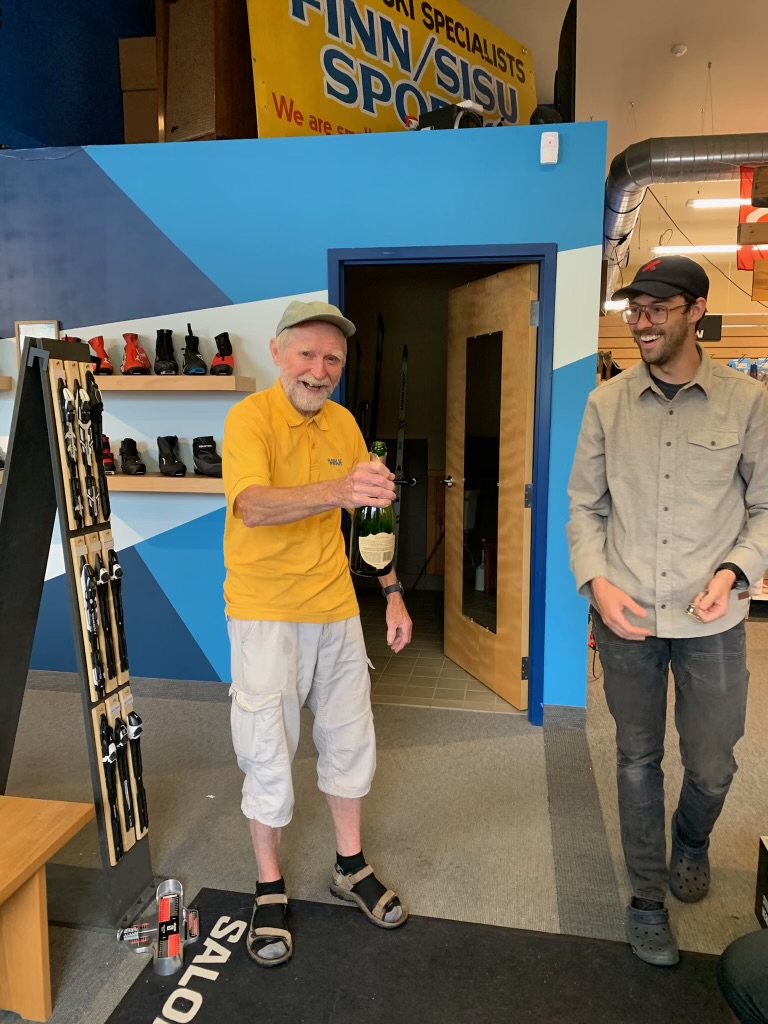
    Ahvo Taipale pops champagne at the end of a 45 year career as the owner and operator of Finn Sisu, the Twin Cities’ oldest race-oriented ski shop. (Photo: Finn Sisu)

    Like most Midwestern states, the majority of Minnesota is an unending grid of corn and soy fields. Land isn’t so much land as it is commodity. Inhabiting that landscape tends to be a constant reminder to think in terms of economy. Life, like farming, is a series of inputs and outputs, costs, and benefits. Unlike most Midwestern states, though, things get wilder the farther North you go in Minnesota. Lakes, lots of them, jut in on the back forty. The Earth is filled with ore. The pines displace the corn. The metaphysical effect is that impulses towards wildness and creativity get nourished, not dulled. Across six million people that produces a disproportionate number of that very American archetype: the original. A peculiar list of names. Bob Dylan, Terry Gilliam, Alan Page, Bud Grant, Herb Brooks, Paul Bunyan, Jim Klobuchar, Amy Klobuchar, Paul Wellstone, Paul Westerberg, Judy Garland, Jessie Diggins, and of course, Prince.

    While Prince may be the only individual on the list who is known, universally, by a single name, Minnesota skiers add one more name: Ahvo. After 45 years, Ahvo Taipale is retiring from his role as the owner and operator of Finn Sisu Ski Shop. To most Midwestern skiers, he’s always just been there. But in his telling of the story, even he came in his own time.

    “I first came to this country in 1968 to attend the University of Minnesota as an agriculture exchange student,” said Taipale when FasterSkier caught up to him this month. “I was doing what I always did as a farm boy in Finland: ski racing. I went up to the Duluth Loppet in I’d say 1973 or 1974, and I won the race. I was about to head out back to the Twin Cities when this group of people approached me, and one of them said, ‘you are Finnish, we are from Finland too.’ And they were, it was just that some of them were from the Two Harbors-Finland, Minnesota area, and I thought, well, I’ve accidentally found my way home.”

    The past and future of skiing in Minnesota would merge at that moment. Ahvo would be the bridge between. He caught the tail-end of the Norse diaspora that originally brought cross-country skiing to Minnesota in the late nineteenth century, and then charted a unique future for the sport in America through his passion and savvy as a businessman.

    “There were two parts that led to me starting a shop,” he said. “One was that I didn’t want to be traveling the world, I wanted to settle into a place. The second was that I was racing as much as I could in Minnesota, and through that, was starting to sell skis from Finland to others, because there was no shop that was selling high-quality racing skis in the United States.”

    In 1978, Taipale imported a shop’s worth of racing equipment, and set himself up on University Ave. in the center of the Twin Cities. The shop’s name? Finn Sisu. “[Naming it] was easy,” said Taipale. “Everyone knew me as the Finn. And I was telling them all about Sisu, the untranslatable Finnish value of stoic determination and tenacity of purpose.”

    Ahvo Taipale out on the snow in his capacity as a coach for the University of Minnesota, one of the many other roles he filled beyond shop owner while at Finn Sisu. (Photo: Finn Sisu)

    The name would also cause Ahvo to foster cultural exchange between Finland and the United States, and lead to the other lasting part of his business life: the sauna. A few days after Finn Sisu opened its doors, a customer came in off the street and inquired about that other great Finnish export, the sauna. “They asked, ‘you’re a sauna business?’ and I thought about it for about three seconds and said, ‘Yes, of course!’” said Taipale, “Truth was, I had never built a sauna before.” His upbringing kicked in though, “When you are a farm kid and another way to do business walks right in the door, you figure it out.” Finn Sisu Ski Shop became Finn Sisu Ski and Sauna.

    Over the subsequent forty years. Finn Sisu quickly became the go-to shop for high school teams and citizen racers alike in Minnesota. From the point of purchase at Finn Sisu, new ideas and new communities would start to take hold within Minnesota, and US, skiing. In turn, Ahvo would be there to support them. “I had a very simple policy that we would support any new club that came to me asking for some kind of support,” said Taipale. “If it was as simple as buying a spot on their t-shirt, we would do that. Oh boy, do I have a lot of t-shirts! As a businessman, I knew that was where my customers were coming from, and as a skier, I like more people to ski with.”

    At the same time, Ahvo began to take an active part in developing the places that his customers were skiing, pushing the Twin Cities Metro Government to protect and expand its network of ski trails. “They initially came to me, because I guess I was easy to identify as someone who is passionate about skiing as a shop owner, but I really took to the dream of having the best trail system in the world here in Minneapolis,” said Taipale. “I could see that the Twin Cities were expanding. When I first got here, all the places we think of as ski areas now were relatively on the edge of the city—Battle Creek, Elm Creek, even Theodore Wirth Park—but that was quickly not going to be the case.”

    From the 1980s on, he would lend his support to each new trail system proposal that came up. In the process, another dream of his started to formulate: “I wanted us to have the most snowmaking of any city in the world” said Taipale. As the Twin Cities grew, the ski facilities became world-class. Achieving all his goals as a promoter though, would turn out to span his entire career. “We got to a point where we had four snowmaking loops, which is what Oslo, Norway has. But we didn’t have one in St. Paul, in my neighborhood, until 2022 when Battle Creek opened. So now we have five, more than Oslo, and I skied 127 days last year, almost all, outside of the Birkie Trail and Korkki in Duluth, were at Battle Creek. That was thirty years’ worth of work, but well worth it.”

    More trails were needed to accommodate more races, more clubs, and more skiers. In the late 1980s, Taipale started Vakava racing, which would go on to become the Twin Cities’ largest training group for a number of years and would expand Finn Sisu’s calendar to include wax clinics, ski clinics, and training opportunities with the scores of Minneapolis skiers that would go on to make pro clubs and the US Ski Team. For Ahvo, the business was always on his mind first and foremost in doing so, but he also admitted, that it was “Easy to get carried away with doing more, because why wouldn’t you? Skiing is fun to do, and skiers are good people too!”

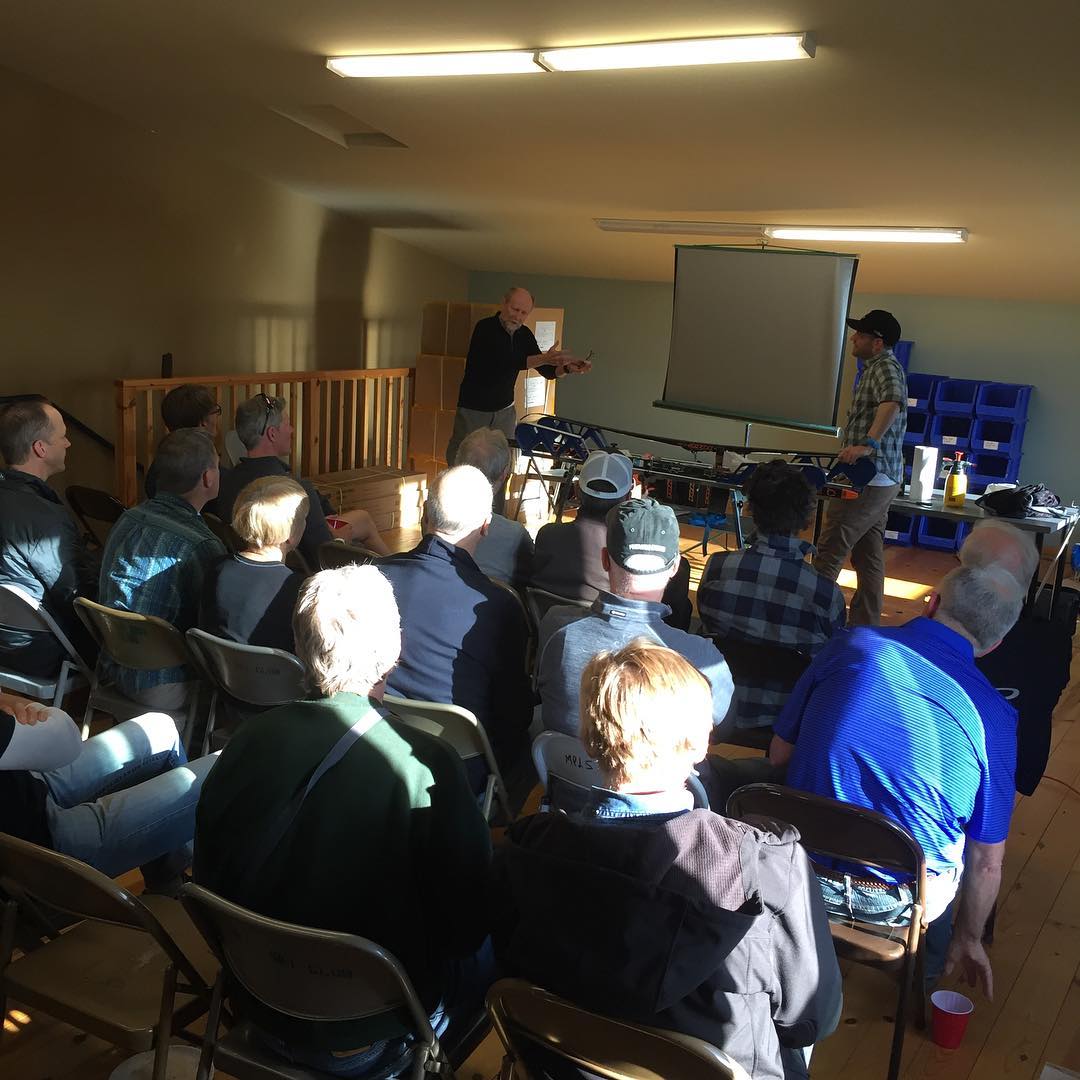
    Ahvo Taipale presents during a wax clinic alongside then-CXC Coach and present US Ski Team coach Jason Cork in 2011. (Photo: Finn Sisu)

    Business grew. Wood skis gave way to fiberglass and carbon fiber. Three-pin bindings were replaced by the “new nordic norm” (NNN). Skate skis became the new game in town, then the only game in town, then split with their old-school “classic” counterparts. Ahvo always kept his eye out for the latest and greatest. As he built out training groups that looked to push skiing beyond its traditional wintertime season, Taipale began to import rollerskis, which were still in their early stages of development. “At the time, we were importing these rollerskis that had three wheels, which you don’t see anymore.” On a trip back to Finland though, he came across an engineer that had been tinkering around with rollerski design. “He really focused on making more durable wheels that could support heavier skier and make it actually feel like skiing, and what he came up with was a two-wheel design with a fiberglass shaft, and they looked almost like what you would think of as a skate rollerski today.” They were also, said Ahvo, “very bright, neon yellow.” The engineer had just started a company, Marwe. Taipale was giddy to bring them back to the United States, but there was one problem. “He already had a marketing firm that had drawn up a plan to import them to the United States.” Taipale though, knew the customers that those numbers represented, and knew that the marketing firm hadn’t counted for enough. “Their initial order was something like 30, and I simply said, ‘I will order ten times that right now and be back for another order in a week.’ And I did.” Finn Sisu would outfit the US Ski Team with Marwe skis for years and continues to sell them today.

    By the mid-2000’s, the Twin Cities ski community was exponentially bigger than it had been in the 1970’s. New shops with a racing focus had started to pop up, with Taipale welcoming and supporting them, “competition helps everyone, and even today, the community is underserved.” Finn Sisu was growing likewise. Some of Ahvo’s original customers were bringing in their sons, daughters, grandsons, and granddaughters. Employees who had started working with Taipale as part-time high school workers were now full-time specialists in nordic skiing, and had been at the shop for decades. Finn Sisu needed a new, bigger, home. In 2009, the familiar awning outside their University Ave. location moved north to the Lauderdale neighborhood of St. Paul, and into their present location off Larpenteur Ave.

    A Park Bugle report on Finn Sisu’s location-switch from their longtime University Ave., St. Paul, location to Lauderdale in 2009. (Photo: Park Bugle Archives, www.parkbugle.org)

    There was new space, new products, and a new feel at the new Finn Sisu location, but at its beating heart was the same warm presence of Taipale, now an elder statesman in the US ski community he had steadily kept on track, literally, for three decades. He had furrowed in and formed a community that now distinctly bore a semblance to his principles of hard-work, passion, and yes, sisu. For many skiers, trips to Finn Sisu were as much about the feeling that the experience as they were about the skis you left with. For some, it was a late summer trip to the nearby Como Park zoo before it closed on Labor Day weekend, a sure sign of winter to come. Opening the door with the familiar white beard holding forth with characteristic expression about where the sport of skiing, and skiing technology, and skiers, were going. When FasterSkier recounted a personal memory of a piece of wisdom from Ahvo, “cyclists and runners you can make into skate skiers quick, but learning to stride takes time,” he simply responded, “that is very true.” The skis you picked up always came with a story, even if they were brand new, because Ahvo couldn’t help it. And if there wasn’t a good fit, then you would get trademark honesty and generosity: “You might need to look elsewhere,” he’d say. “And have a great season!”
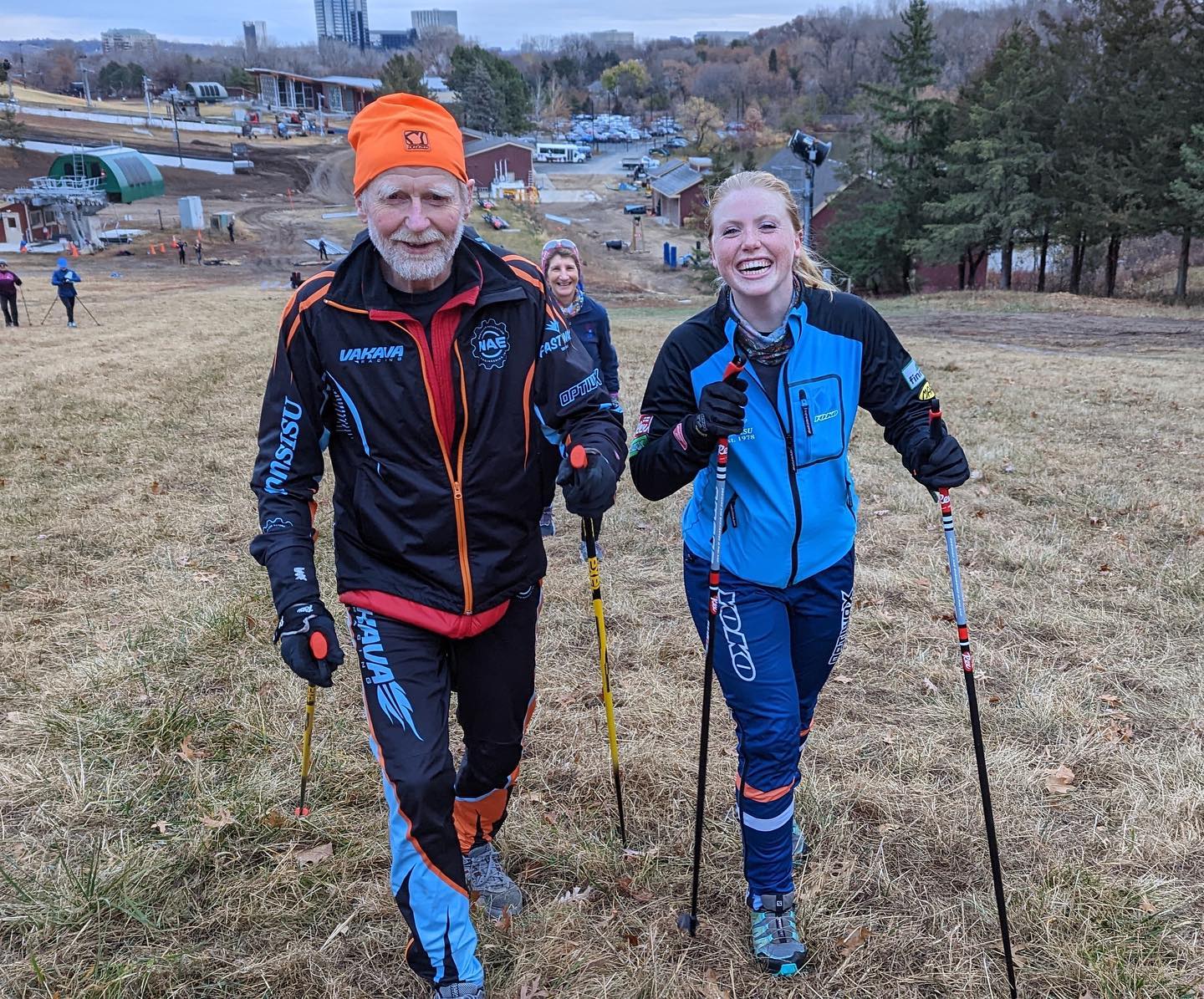
    Ahvo Taipale during a Vakava training session. (Photo: Finn Sisu)

    Approaching the age of 80, Taipale had begun to start to look at retirement. Pretty early in the process though, a set of principles that had guided him in business for fifty years became the clear priority in moving on from it. “I always have said to myself that I am very lucky to have been very successful in business,” he said. “Money couldn’t be the priority; the customer had to be.” Towards that, Taipale made the decision to sell to those that came from the community that encompassed Finn Sisu, to his employees. “I wanted there to be continuity,” he said. “Our customers who have come to Finn Sisu for fifty years can walk in, and it’s still Finn Sisu.”

    After a few years of putting different coalitions and proposals together, the right deal came along. Novak, Rhode, and Weium would buy the shop from Taipale. Last month, they took Finn Sisu over as the owners and operators, and Ahvo Taipale took on his first new job title in 45 years: retired.

    “To do something for 45 years is a long time,” he said. “All you can hope for is to be steady, and that is what I am most proud about. [Over that time,] I can only remember three bad days. Three days over nearly half-a-century, I will take that. I feel really lucky to have known the ski community and have them have known me. I couldn’t be a successful businessperson if it wasn’t in skiing.” He also acknowledges that along with that steadiness in business, comes a stubbornness in moving out of it: “I will still be around the shop. I will still be skiing over 100 days. I will probably do more, come to think of it.”

    After a career spanning half a century, the continuity is there for Taipale. “I began skiing in Finland because it was the quickest way across the lake to get to school,” he remembered. “And here I am in the Twin Cities, where it’s still the quickest way across the lakes!” Through steady years skiing them, he took on the ingenuity and wildness those lakes fostered across the landscape of Minnesota, spread it to its people, and continues today, beloved by a land he came to as a stranger, and now calls home, the man simply known as Ahvo.
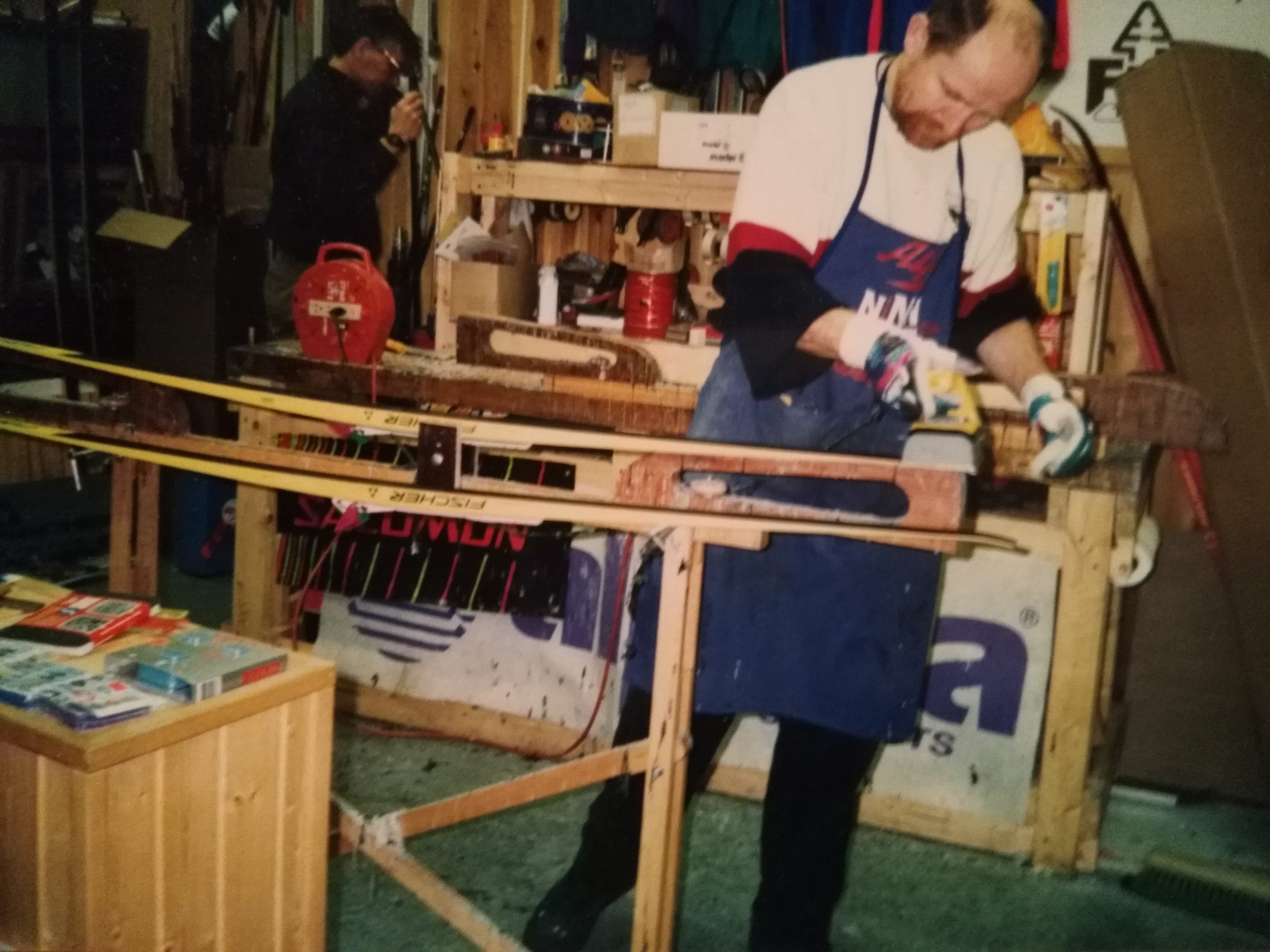
    Ahvo Taipale at the Finn Sisu wax bench. (Photo: Finn Sisu)
  • Keeping the Shop, Part I: Past, Present, and Future at Finn Sisu

    Keeping the Shop, Part I: Past, Present, and Future at Finn Sisu

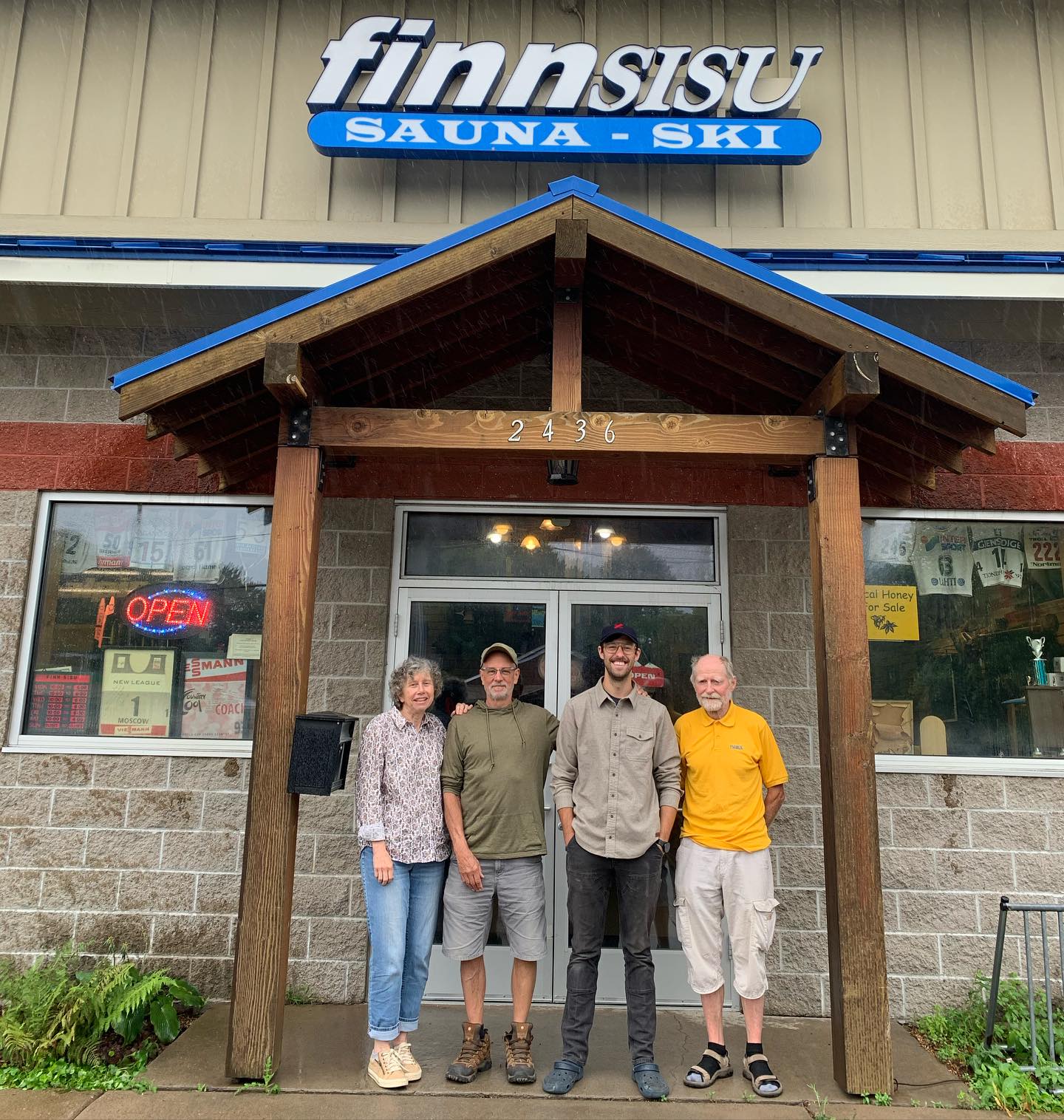
    Nate Rhode, Tom Novak, and Karen Weium alongside Ahvo Taipale, who sold Finn Sisu to three longtime employees after 45 years in business. (Photo: Finn Sisu)

    Finn Sisu may not have been the first place to sell skis in the Twin Cities, but it was the first “ski shop.”

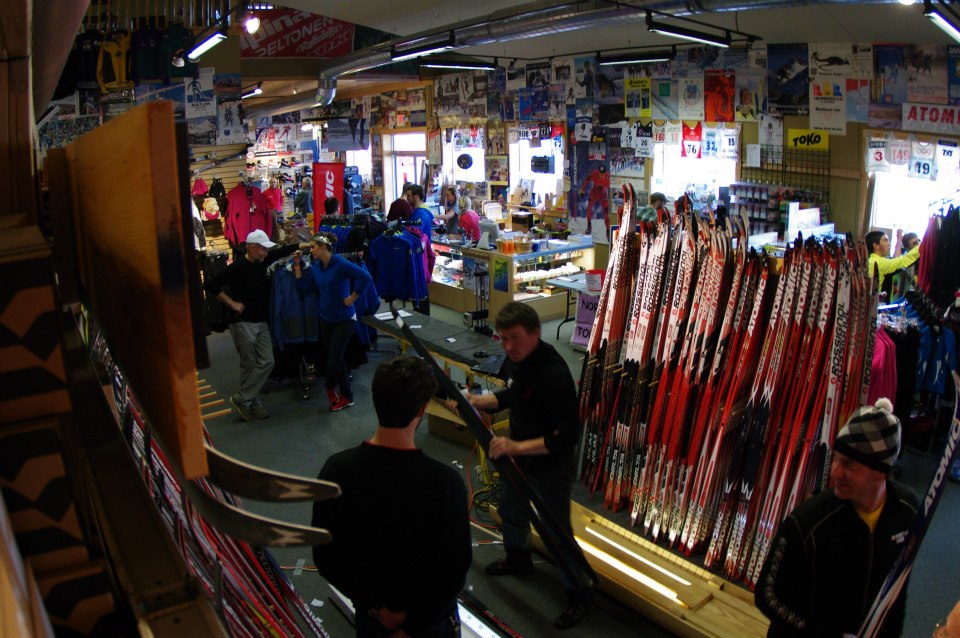
    Ahvo Taipale, a Finnish immigrant and Agricultural Engineer, had spent a decade competing (and often winning) cross-country ski races across the Midwest before he looked around at the growing number of Twin Cities skiers doing new races like the American Birkebeiner and realized that someone would need to provide all those skis. In 1978, he opened his shop, Finn Sisu. Since then, amid the vibrance and diversity of Minnesota’s largest city, there has always been the option to park in the little nook off Larpenteur Ave. (or University Ave. before 2009), walk under the blue and white cartoon Viking, open the door, and furrow completely into cross-country skiing. At Finn Sisu, you can buy skis. But you can also spend five minutes, or an hour, or a whole afternoon, living amidst all that those thin planks of wood had created. Over the course of 45 years, the place to buy skis—Finn Sisu—became the center of a ski community.

    Last month, Taipale sold Finn Sisu to three long-time employees: Nate Rhode, Tom Novack, and Karen Weium. It was the biggest transaction of Taipale’s career, and couched among the terms and conditions were the intrinsic motivations that keep and grow a ski shop, and how to foster the community. In two parts, we at FasterSkier will investigate just that. First, the plans for Finn Sisu as it goes forward with a new collective ownership. Then, in Part II, the story of Ahvo Taipale, the Finnish farm boy who’s been on skis—and providing others with skis of their own—his entire life.

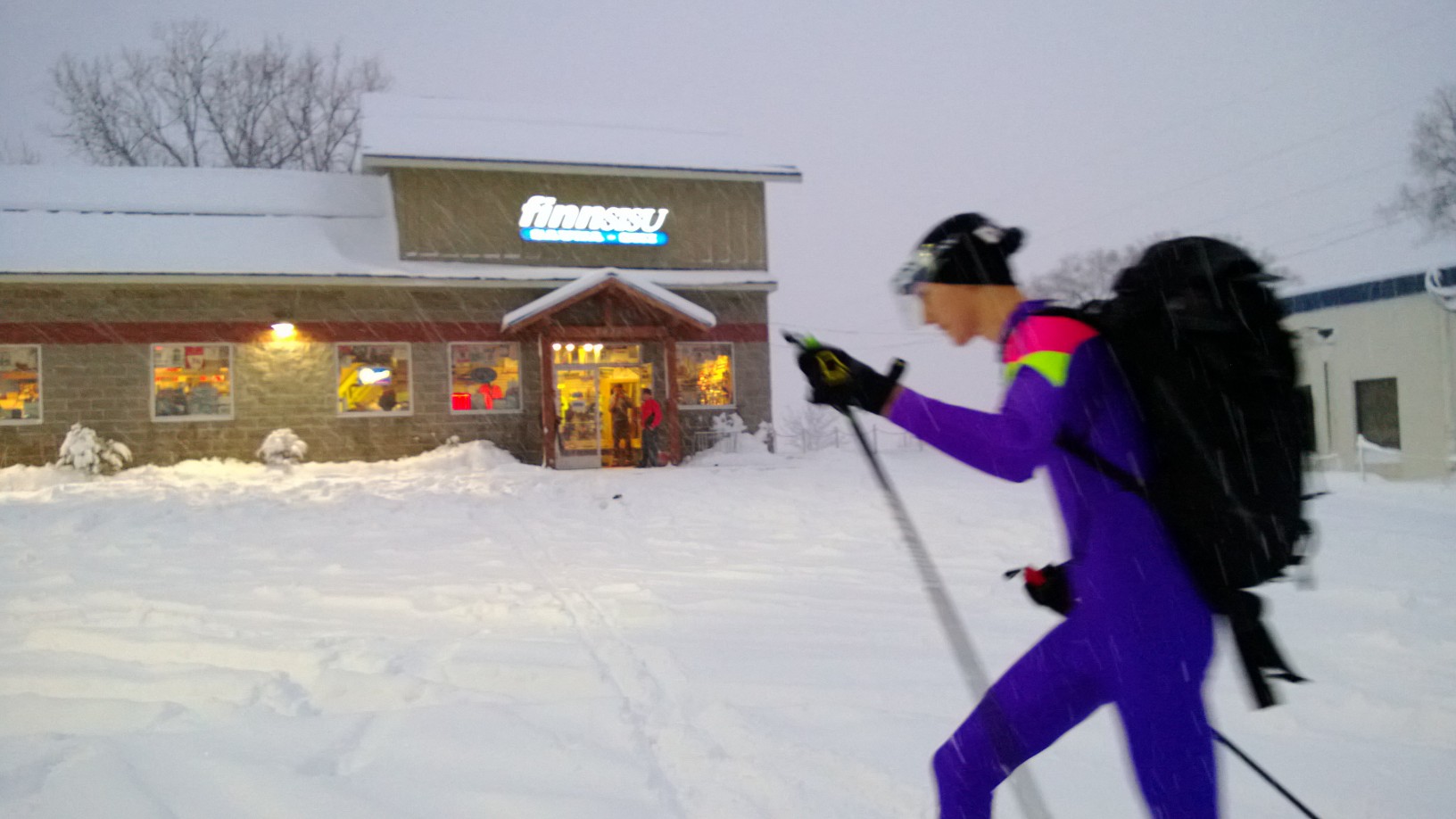
    The center of ski city: A Twin City’s skier heads into Finn Sisu after an historic storm left nearly two and a half feet of snow on the streets of St. Paul, winter 2012. (Photo: Finn Sisu)
    Part I: “The Keys are for Sale!”

    Ahvo Taipale set the tone with the first addition made to his ski buisness at Finn Sisu. A customer walked into the new shop in the winter of 1978—named after Taipale’s homeland and its national spirit—with a different product in mind. “I was sitting there, and they came in and asked, ‘this is a Finnish shop, yes?’” said Taipale in an interview with FasterSkier. “Well, I am Finnish, yes,” he replied. “You must sell saunas?” was the customer’s next question. Taipale’s boyhood farmer instincts kicked in: “When someone presents you with a way to make money, you take it. So, I figured out how to make a sauna.” Finn Sisu Ski became Finn Sisu Ski and Sauna. That not only led to a Twin City ski community joke a la the Ole and Lena-type—“I went into Finn Sisu the other day and bought a pair of skis, and Ahvo said, ‘Would you like a sauna with that?’”—but became representative of Taipale’s core business philosophy. Over the years, he would amalgamate more than just new product-line items, adding different folks, with different talents, to his ever-growing shop.

    Karen Weium was one of those. The new owner of Finn Sisu was a customer, first, at Taipale’s shop, stretching back through her time on skis, which includes a staggering streak of 35 American Birkebeiners. For Weium, the visit to Finn Sisu was a periodic one over the years as she managed a first career in publishing. “I came in about a decade ago to help Ahvo with some photos,” she said. “From there, little-by-little, started to do more.” When did it cross her mind that she might be on the path to owning the shop? Not until the deal was nearly done.

    That became the case with Weium’s new co-owners, too. Tom Novak is a particular kind of gear-nut, a ski technician’s ski technician who came into the business when wood bases were being prepared with pine tar. He now owns a stone-grinding machine that’s capable of turning out grinds on carbon fiber skis with digital precision. Nate Rhode’s college job was working for Taipale before he walked a similar path to his now-predecessor. To hear Taipale tell it, “Tom went into engineering after college at the University of Minnesota, and then came back to me saying, ‘I like the atmosphere in skiing much better,’ and I replied, ‘well I did too!’”

    Ahvo Taipale and US Ski Team coach Jason Cork host a wax clinic in 2017, one of many events establishing a community around Finn Sisu over the years. (Photo: Finn Sisu)

    The group that now owns Finn Sisu is just the center of an expansive network that includes customers, lesson-goers, Valkava racers, sauna owners, and Birkie skiers (lots of Birkie skiers). In each case, the customer experience was what they got up front, and what formed their most important impression of the Finn Sisu they wanted to be part of, “Ahvo was generous up front, honest, and just came you an immediate sense of his knowledge and passion for the sport,” said Weium. “It made me want to be more a part of it, and I am very lucky that I did that.”

    That was the way of doing business over the years, as Taipale adapted and expanded his practice with the sport he was working to grow in the United States. When the racers started coming, he expanded the types of skis he could sell. When more people looked to get into the sport, he expanded to offering entry-level skis. Rollerskis came, new wax formulas, fiberglass and then carbon fiber skis, NNN bindings, and stone grinds. But with every customer, the philosophy was the same: “Be honest, be truthful, and get them what they need” said Taipale. If that meant fitting and re-fitting skis for hours, he would do it. If that meant occasionally admitting that he didn’t have the best fit, he would send them where they could find it. “The customer won’t remember exactly what they bought,” he said. “But they will remember their experience that went into finding it.” Taipale also was attendant to the race community that his shop had found an impetus in serving, “When I started out, I needed to be at races, because I knew that was where my customers are. I still do that, but there’s a lot more happening now. High school races and junior national qualifiers, and college racing, and I am not anywhere close to being in school anymore!” To serve those racing communities, Taipale sourced expertise elsewhereL: “I always like employing young people who are passionate about the sport,” he said. “Because they know how it is changing and how I need to change my approach to giving customers good service.”

    Much of that dissemination of critical ski business information happened in the same types of settings that customers at Finn Sisu came to expect. “It [was and is] the kind of shop people like to hang around and listen to how we are working with our customers.” In the shop’s main ski fitting area, you can find one employee talking details about ski fit as another holds forth on the kinds of debates skiers like to have, ranging from technical to down right existential: “How about that wax in that temperature?” “Classic or skate?” “How cold is too cold?” Over his half century in the shop, hearing Ahvo hold forth on any and all topics was as big a draw as the shop inventory.

    What Finn Sisu has become is likely to continue. “Ahvo will still be around to be Ahvo, I’m sure,” said Weium. “But what we have from the way he conducted business is a blueprint for creating a shop that people want to be part of.”

    What will that look like? “We’re hoping that it’s not too noticeable,” Weium admitted. “If people have valued our way of doing business, then our main job is to conduct ourselves with those values.” That core focus sets Finn Sisu up to change as the sport changes: “We recognize that things change and change very quickly in the ski business,” said Weium. “A couple of years ago, for example, we pretty much went from having fluorocarbon topcoats in the front display cases, and now they’d sit on the shelf all winter if we had them out. There’s also a lot changes to how we sell skis. The young racers we work with used to all come in to get fleets of skis on their own, and now, we’re doing a whole lot more team fleet orders, which points to a different attitude towards accessing this sport at that level. These types of things are things that we as a shop don’t control, but are essential for us to adapt to quickly.”

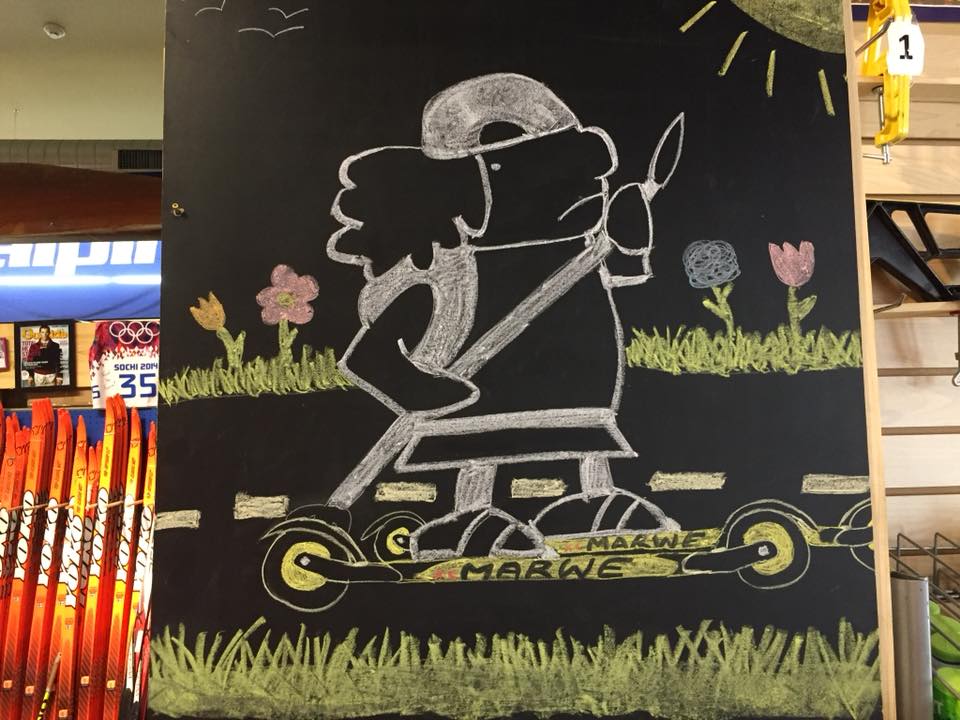
    The famous Finn Sisu Viking rocks a pair of Marwe rollerskis. (Photo: Finn Sisu)

    That same adaptability is something that the new owners at Finn Sisu are maintaining when it comes to the parts of the business that extend to community-building and service. “There’s things like the training group we have at one point that was the largest training group in the Twin Cities,” said Weium. “And now, we’re super small compared to the Loppet Foundation, Minneapolis Ski Club, and Endurance United.” In weathering the sometimes-rocky trail that comes when little cultural shifts change the sport the shop is centered around, there’s a kind of paradox that Weium points to for success: “As a business, we’re very focused on doing our best in every interaction with customers,” she said. “But with sponsoring races or programs or events, we have gained a lot of experience knowing that not everything has to be a success. There will be starts and stops, but the important thing is for us to continue to support the ski community, that’s something Ahvo really cared about.”

    Both the old and new owners of Finn Sisu agree that what all the philosophy and community-involvement lead to is a simple pleasure with profound implications. “With us having been here for fifty years, we’re one of the few shops that is lucky enough to have served multiple generations of skiers,” said Weium. “It’s always a cool moment when a parent comes in and says, ‘I bought my skis here when I was in high school and now my kids are getting into the sport.’”

    “I got to see skiers grow up and bring new skiers into the sport with their families,” said Taipale. “How lucky am I to have done that?”

    Finn Sisu in full swing. (Photo: Finn Sisu)

    Continuity, in customers, and in community, is ultimately what proved to be the defining quality of Taipale, and the ski shop that he started forty-five years ago. “[When I started to think about retirement] a couple of years ago, I got an evaluation and went to the business brokers saying that they could put it on the market. I pretty quickly thought about all the skiers that we serve, and kind of panicked that there might be an operator who would shut down the ski side of the business and keep the sauna side open. Pretty quickly after that, the staff got used to me saying ‘keys are here, and they’re for sale!’”It ultimately took a few years, but spearheaded by Nate Rhode, the right combination of Finn Sisu staff and community members were ultimately coming together with a simple mission: keep it going. The deal they reached allowed Taipale to step away into retirement, and for the new collective to immediately take the shop over, rather than financing things in a way that would have essentially changed the business. “I wanted to get it done, but not change it too much,” said Taipale.” So something like giving them the option to buy the building later and lease it [for cheap] so that they would still be in the same neighborhood, especially when we are the only shop on that side of the [Twin] Cities, was very important.”

    As the ski season begins to appear on the horizon, business at Finn Sisu doesn’t look all that different. And that, said Weium, is the sign that things are going well. “There’s definitely some anticipation of how the winter will go,” she said. “But I think if anything, we’re all more thankful to be part of it.” Taipale, meanwhile, is into retirement, having headed back to the country that gifted him his love of skiing, saunas, and of course, sisu. His parting words were a vote of confidence: “I wanted there to be continuity [at Finn Sisu]. And there is now. Customers who have come to Finn Sisu for 50 years can walk in, and it’s still Finn Sisu. I feel very lucky about that.” And the keys to the Twin Cities oldest ski shop? They’re in the hands of Karen Weium, Tom Novak, and Nate Rhode’s. Finn Sisu is not for sale, anymore.

  • From Ahvo’s Vantage-point: Last Update from Kuusamo with Videos

    From Ahvo’s Vantage-point: Last Update from Kuusamo with Videos

    Greetings from Central Finland (where the temp was a balmy -25C upon waking up this morning)! The sun has set on the Nordic Opening and everyone has packed their bags and headed either to the next races or homeward.

    Stadium (this is actually mid-day).

    As a final wrap-up, the weekend was packed with lots of action. The Nordic Opening is one of the only places where you can see Nordic skiing, ski jumping and Nordic combined all in one weekend in the same area (the stadium and jumping hill are right next to each other and schedules (barring unforeseen delays because of temperature or wind) are such that one can take in pretty much every event). The Nordic Opening is also a great place to connect with representatives from our favorite skiing-related companies, to see old friends and to make new friends/connections. It’s too bad that the action only lasts 3 days. I guess we just have to go back next year!

    The US Ski team had an excellent weekend (I am sure many of you have already read the official reports). It was great to see so many solid performances in spite of the cold temperatures and a little bad luck (Freeman’s broken pole in the skate race yesterday).

    Ahvo got in a few more interviews on Saturday (our internet connection got goofy so I didn’t post them earlier – maybe the air was too cold for mobile services…?).:

    Leena Peltonen and Silvano Barco from REX

    The stadium during the sunday skate race.

    During the races, Ahvo caught the action on the steepest hill on the course (which the skiers climbed multiple times during the race) while I hung out in the stadium doing my attaché thing start lists in hand (while having a technique discussion with another attaché). Make sure your sound is on so you can hear how cold and dry the snow is… ahhh winter!.

    Marit Bjorgen

    Kikkan Randall

    Nordic Opening, Men’s 15 km skate, Uphill

    Men’s 15 km skate, Early in the race (with a glimpse of Kris Freeman)

    Men’s 15 km skate, lead group

    Stadium videos and pictures were at a minimum this year (frozen fingers and batteries, camera swapping, fences that were 15cm higher than last year, being too caught up in the action to watch it from behind a lens….). Nevertheless, here are a couple of the stills that I got from my position in the stadium:

    Marit Bjorgen
    Chasing Marit Bjorgen…

    Until next time, all the best from Finland and have a great ski season!

    Ritva and Ahvo Taipale

  • From Ahvo’s Vantage-point: Another Update Kuusamo

    Aside from some frozen toes and fingers (temps still between -17 and -14 most of the time), the action in Kuusamo just keeps getting better (though photos are somewhat limited). Bjorgen continues her lead with a second win today while Cologna took over the top spot for the men (the top two Norweigian men did not compete today). A total of 15 athletes who started the tour did not compete today an will not continue tomorrow. The USA had some solid performances today, and looks fit. Check out http://www.nordicopening.com/en/ and http://www.fis-ski.com/uk/disciplines/cross-country/results.html for results.

    Tomorrow will wrap up the Kuusamo mini tour with women’s 10km and men’s 15km skate (pursuit format based off of the sprint and today’s classic race). It should be an exciting end to a fantastic weekend of world class racing.

    Ahvo caught up with the US ski team for a couple of quick interviews before the races today.

    Randy Gibbs

    Chris Grover

    Ahvo also got some video out on the course, but the connection today is being finicky and slow, so uploading will happen tomorrow along with our final report from the north.

    Ritva and Ahvo

  • From Ahvo’s Vantage-point: The Kuusamo World Cup Sprint

    From Ahvo’s Vantage-point: The Kuusamo World Cup Sprint

    Andy Newell and Kein Einaste (EST) – Quarter Finals.

    The race action started today at 10:45 this morning with ladies sprint followed immediately by the men.  Today’s format included a qualification round from which the top 30 are distributed into 5 heats of 6 skiers. The top 2 skiers from each skier and the next two fastest skiers advance to the semi-finals. From the semi-finals, the top two skiers from each heat and two lucky losers advance to the final.

    The weather remains close to perfect with -14C today and dry snow. It is a bit on the windy side though, so while Nordic combined was able to complete their competition today, the ski jumpers’ competition has been cancelled for tonight.

    Newell had a good day, check out the official results and official news from:

    http://www.nordicopening.com/en/

    For some videos from Ahvo’s vantage point, check out the following youtube links:

    Kris Freeman

    Swedish Skier

    Andy Newell

    Marit Bjorgen

    Andy Newell – SemiFinal

    On a non-skiing related note, I met Santa Claus and Mrs. Claus at the finish line. They actually have FIS accreditation! Proof that Santa is from Finland (Korvatunturi) and that he’s the real deal. (Finally!!)