From the FasterSkier archive — posts syndicated from athletes’ and coaches’ own blogs between 2004 and 2012, kept online as published. Current coverage is at fasterskier.com.
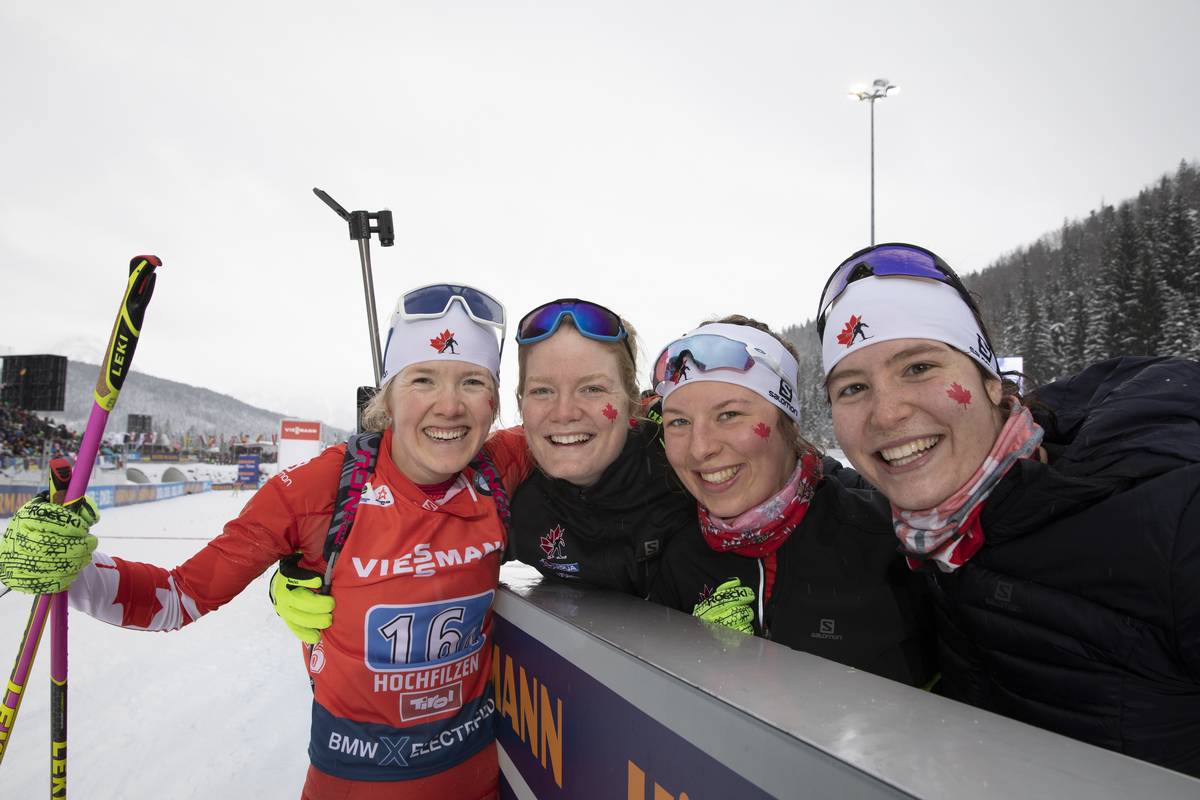
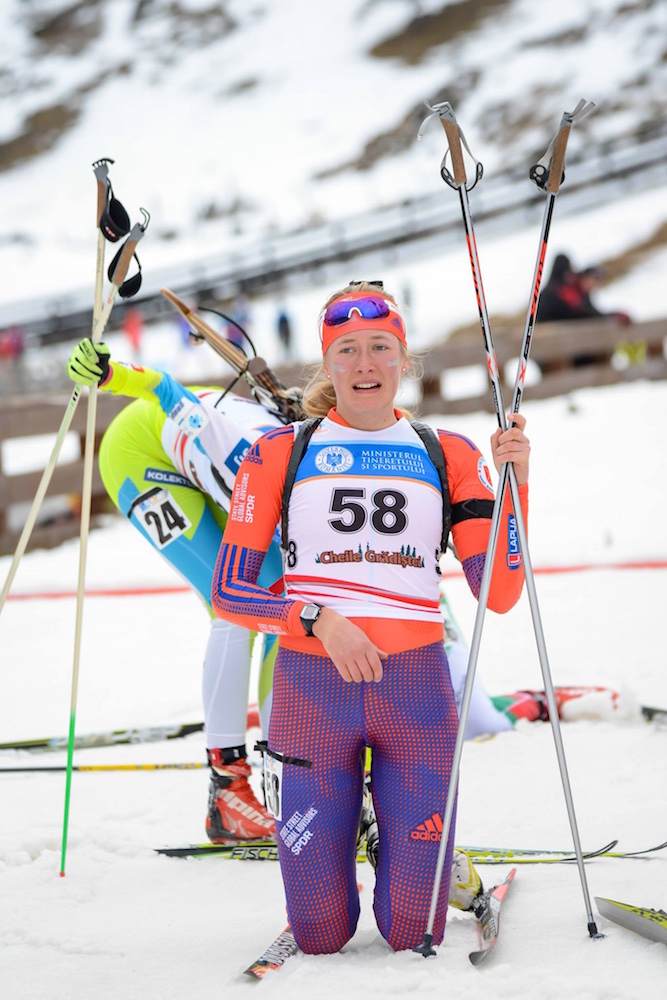
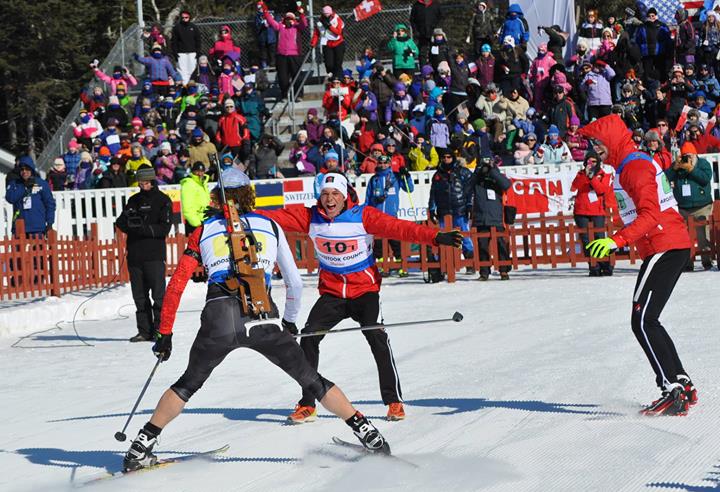
Canada’s Emma Lunder, Sarah Beaudry, Nadia Moser, and Megan Bankes (l-r) after placing fifth at the IBU World Cup biathlon 4 x 6 k relay in Hochfilzen (AUT). (Photo: NordicFocus)
On Saturday and Sunday, racing continued on the IBU World Cup in Hochfilzen, Austria. Some story lines remained familiar, some reflect the national diversity of the biathlon circuit and that on any given day, a historically non-dominant team can excel.
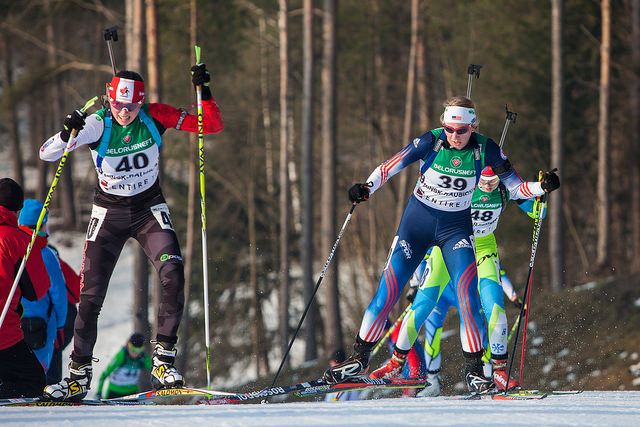
Sarah Beaudry during the Hochfilzen relay. (Photo: NordicFocus)
Nadia Moser during the Hochfilzen relay. (Photo: NordicFocus)
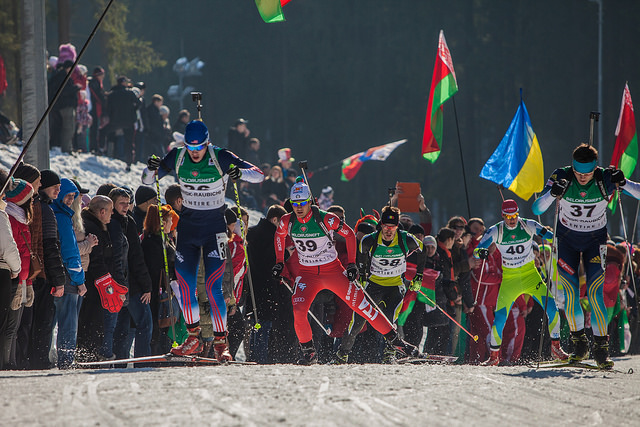
Megan Bankes racing in the women’s 4 x 6 k relay in Hochfilzen. (Photo: NordicFocus).
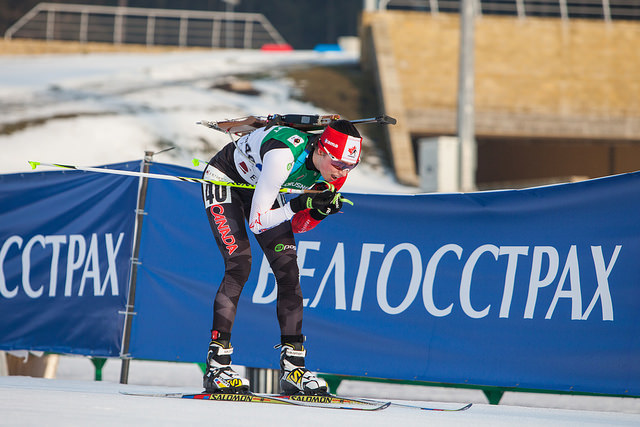
Emma Lunder anchors the Canadian women’s relay team in Hochfilzen. (Photo: NordicFocus)
Saturday featured a women’s 4 x 6-kilometer relay and the men’s 12.5 k pursuit.
Norway’s team of Karoline Offigstad Knotten, Ingrid Landmark Tandervold, Tiril Eckhoff, and Marte Olsbu Roeiseland won the relay in 1:10:04.7 with one penalty and using seven spares. Kristina Reztsova, Larisa Kuklina, Svetlana Mironova, Ekaterina Yurlova-Percht of Russia finished 8.2 seconds back for second place. Russia had no penalties after using five spares. Switzerland’s Elisa Gasparin, Selina Gasparin, Alta Gasparin, and Lena Haecki took the final podium spot (+1:04.1; 1+9).
For North America, Canada came through with a fifth place overall (+1:09.3). Sarah Beaudry, Megan Bankes, Nadia Moser, and Emma Lunder shot penalty free after using seven spares. According to Biathlon Stats and Facts, this is the Canadian women’s best relay result since the 1994/1995 season.
The U.S. team of Joanne Reid, Susan Dunklee, Clare Egan, and Emily Dreissigacker placed eighth overall (+1:37.0 0+6).
That same day, Johannes Thingnes Bø, Norway’s dominant biathlete on the men’s side, won the 12.5 k pursuit in 31:27.0 while shooting clean. Russia’s Alexander Loginov, who also shot clean, took second (+33.5). Emilien Jacquelin was third (+40.5; 0+0+0+0).
For the U.S., Sean Doherty placed 49th (+5:12.6; 1+2+2+1), and Leif Nordgren 53rd (+6:17.2; 1+2+2+2). No Canadian men qualified for the pursuit.
Race festivities on Sunday included the men’s 4 x 7.5 relay and the women’s 10 k pursuit.
We’ll get to the podium spots shortly, but again Canada came through with a near podium performance in the relay. Jules Burnotte, Scott Gow, Aidan Millar, and Christian Gow had no penalties while using six spares to place fourth (+1:28.7). That matches a World Cup best fourth place, earned back in 1991. (Canada earned bronze in the men’s relay at the 2016 World Championships in Oslo, Norway.)
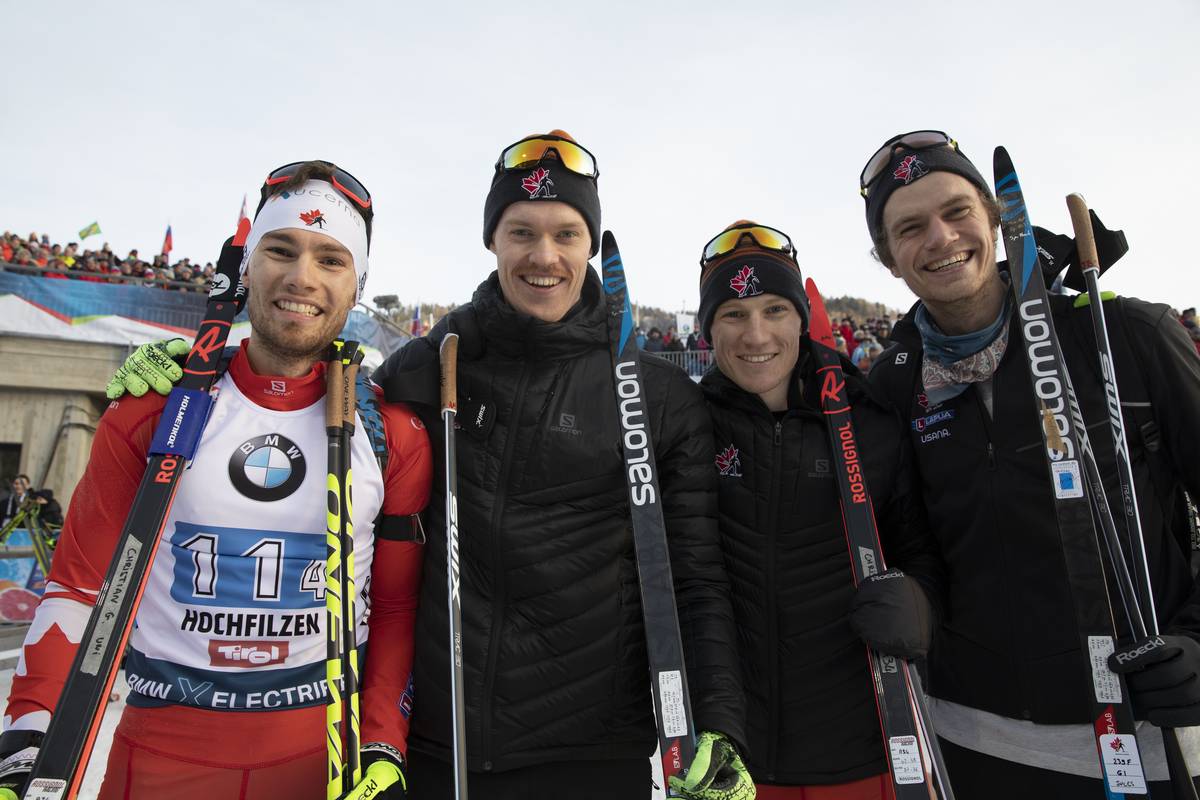
Christian Gow, Aidan Millar, Scott Gow, Jules Burnotte, (l-r) after placing fourth at the Hochfilzen men’s relay. (Photo: NordicFocus)
Scott Gow and Jules Burnotte (l-r) during the Hochfilzen men’s relay. (NordicFocus).
Aidan Millar during the men’s relay in Hochfilzen. (Photo: NordicFocus)
Christian Gow during the 2019 Hochfilzen relay. (NordicFocus).
Johannes Dale, Erlend Øvereng Bjøntegaard, Tarjei Bø, and Johannes Thingnes Bø of Norway won the event in 1:14:44.2. The foursome had a single penalty and used seven spares. Germany’s Philipp Horn, Johannes Kuehn, Arnd Peiffer, and Benedikt Doll were second (+19.5; 0+4). France was third with Antonin Guigonnat, Emilien Jacquelin, Fabien Claude, and Quentin Fillon Maillet. They finished 51.9 seconds back with a single penalty and using eight spares.
The U.S. team of Sean Doherty, Alex Howe, Leif Nordgren, and Travis Cooper were 18th (+5:33.5: 3+9).
The women’s 10 k pursuit was won by Norwegian Tiril Eckhoff in 29:14.6. Eckhoff shot clean on her way to the win. It was her first career World Cup pursuit victory. Sweden’s Hanna Hannah Öberg was second (+25.8; 0+1+1+0). Ingrid Landmark Tandervold, also of Norway, was third (+39.7; 0+0+1+0).
Lunder, the only North American to qualify, placed 37th (+3:09.0; 1+0+1+1).
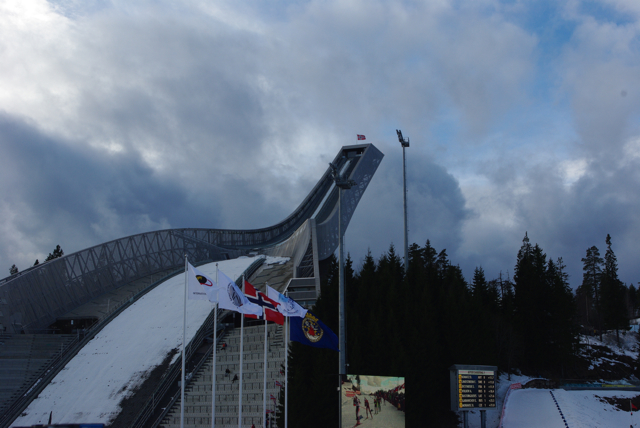
The Holmenkollen jump overloooks the iconic venue above Oslo, Norway.
FIS World Cup Oslo, Norway Holmenkollen 50 K Mass Start Classic
Today’s podium at the men’s 50-kilometer mass start classic at Holmenkollen involved a tight group of skiers, many of them Russians and Norwegians.
Of the top-11 skiers, five were from Russia, five from Norway with the lone wolf slotted in there, Alex Harvey from Canada.
Russia swept the podium with twenty-two-year-old Alexander Bolshunov placing first in 2:23:49.8 hours. Maxim Vylegzhanin was second (+1.0), and Andrey Larkov third (+1.6). For good measure, Ilia Semikov, also from Russia, skied to fourth (+2.0).
Harvey, in his final appearance at Holmenkollen, placed fifth (+4.6). Norway took sixth through ninth.
On Saturday in Östersund, Sweden, the IBU World Cup men’s field raced a 10-kilometer sprint, with Norway’s Johannes Thingnes Bø took the win, completing the course in a time of 24:37.6 after one miss (0+1). Russia’s Alexander Loginov placed second after shooting 100 percent and finishing 13.7 seconds behind Bø. Third place went to France’s Quentin Fillon Maillet, who also shot clean and finished 16.5 seconds behind the winner.
Leading the way for the North Americans was the U.S.’s Sean Doherty in 22nd. Doherty shot clean and finished 1:32.1 minutes back from Bø. Just outside the Top 30 was American Leif Nordgren who also had a perfect shooting score and finished 1:51.5 minutes off the winning time.
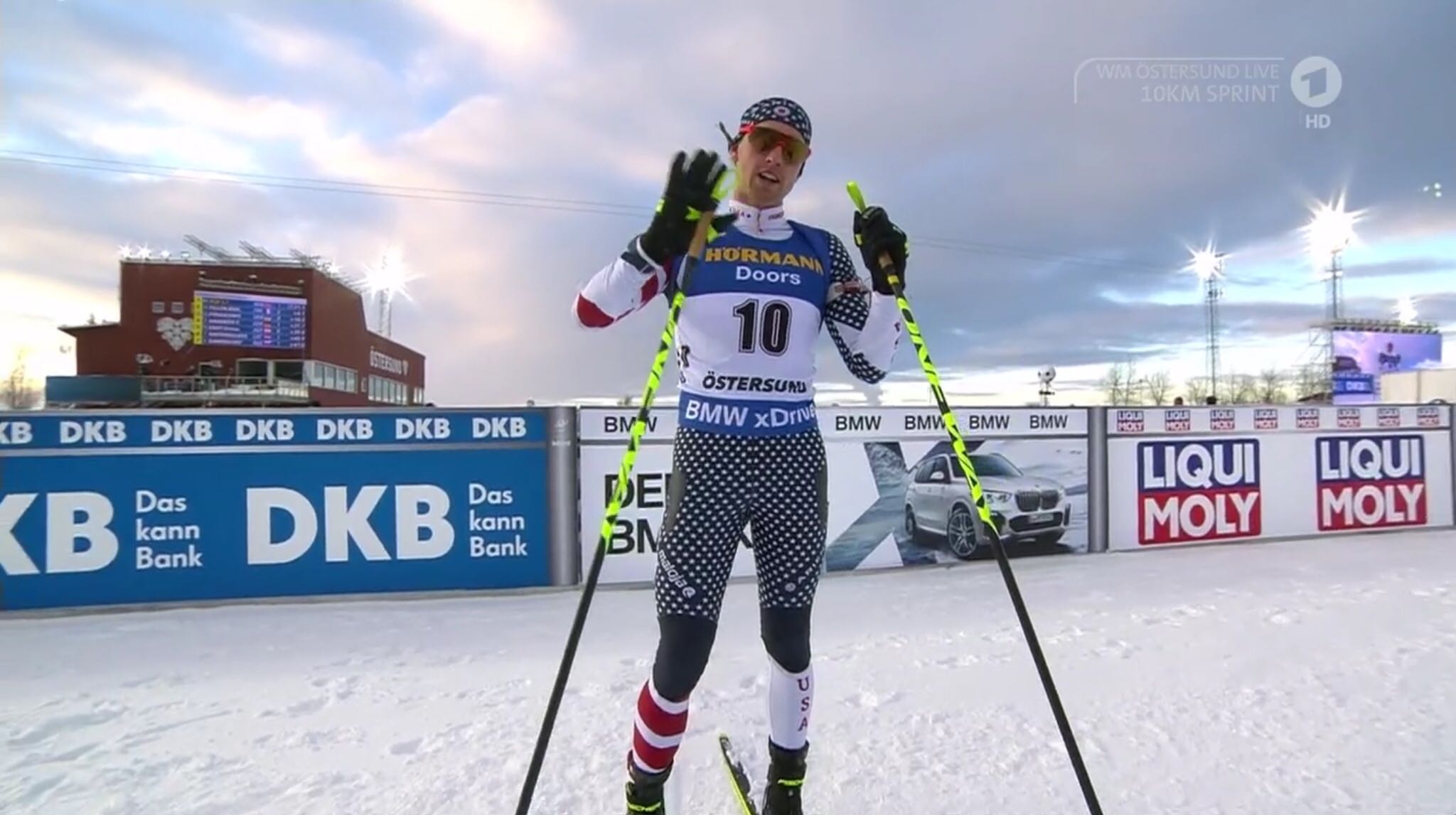
American Sean Doherty ater placing 22nd on Saturday in the men’s IBU World Cup 10-kilometer sprint held in Östersund, Sweden. (Photo: ZDF Screenshot)
Racing for Canada, Scott Gow finished in 50th (+2:18.2) after one miss. U.S. skier Jake Brown placed 58th (+2:41.0) after three misses (0+3) and Canadian Aidan Millar 61st (+2:43.5) with one missed shot (1+0). Two more Canadians raced on Saturday, with Jules Burnotte placing 76th (+3:18.1) after two misses and Christian Gow finishing in 84th (+3:32.5) after four missed shots (2+2).
The 2019 NCAA Skiing National Championships wrapped up on Saturday, with the University of Utah taking home the overall title. Utah finished with 530.5 points, followed by the University of Vermont with 476 points, and Colorado University with 455 points.
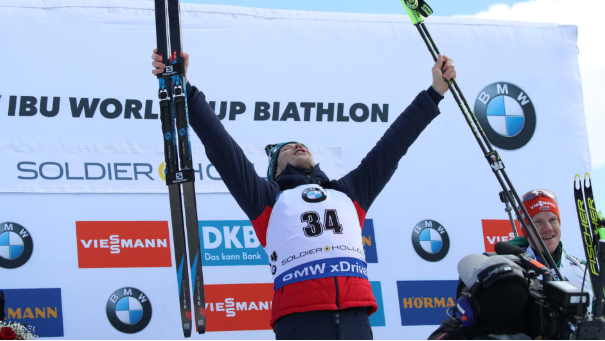
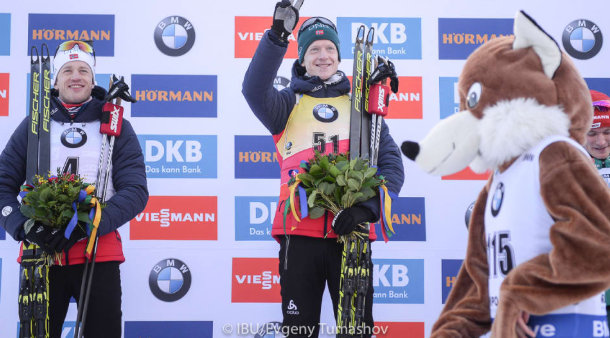
It was a career first IBU World Cup win for Norway’s Vetle Sjåstad Christiansen in the men’s 10 k sprint on Friday at Utah’s, Soldier Hollow. (Photo: biathlonworld.com screenshot)
IBU World Cup Soldier Hollow Men’s 10 k Sprint
It was a career first IBU World Cup win for Norway’s Vetle Sjåstad Christiansen in the men’s 10 k sprint on Friday. Christiansenwon in a time of 23:39.7 minutes while shooting clean for the day. France’s Simon Desthieux earned his first World Cup podium of the year as he marked a time only 1.3 seconds behind Christiansen while accruing one penalty after missing a target during his prone stage. The third podium spot went to Germany’s Roman Rees who missed one target standing and finished 22.4 seconds behind.
For the North American men, several athletes marked top-20 results.
U.S. biathlete Sean Doherty placed 14th (+1:03.6, 1+0). Canada’s Scott Gow finished 17th (+1:13.8, 1+0), and Aidan Millar 20th (+1:20.7) while cleaning both his shooting rounds. According to the IBU, this is Millar’s career best World Cup result.
Also for the U.S., Alex Howe finished 81st (+3:51.4, 3+2), and Jake Brown 85th (+4:17.8, 2+5).
Christian Gow for Canada placed 44th (1:59.7, 0+3), Jules Burnotte 64th (+2:52.6, 1+3).
Eighty-six athletes finished Friday’s sprint.
In the season long overall results news, Norway’s Johannes Thingnes Bø, by placing fourth today (+41.5, 0+4), captured the IBU World Cup sprint globe. It is Bø’s first “unshared” globe. Last season he tied with France’s Martin Fourcade for the individual title.
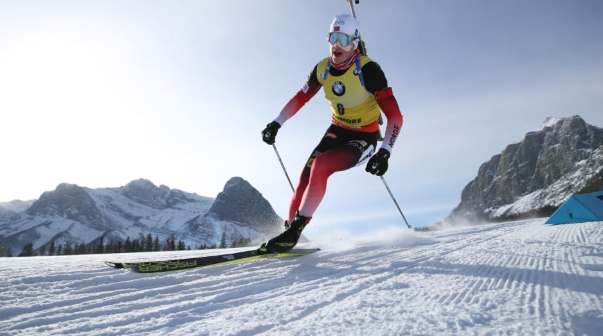
Johannes Thingnes Bø of Norway shot clean and skied fast in Canmore’s 15 k short individual race on Thursday. (Photo: biathlonworld.com screenshot)
IBU World Cup Canmore, Canada 15 k/ 12.5 k Short Individual Races
Sun, mountains, and what may have seemed like relatively warm temps allowed the IBU World Cup events to proceed on Thursday in Canmore, Canada. It’s been Polar Vortex cold in Canmore. Cold enough to thwart the original plans for traditional length 20-kilometer and 15 k individual races, for men and women respectively. With cold temperatures predicted all week, and a window of legal-limit warmer weather punching through on Thursday, the races were shortened to provide enough time during the warming window to hold both races.
For the men, this fill in the blank is easy: _________________ dominated the day in the men’s 15 k short individual race as he shot clean and skied faster than all the others.
Johannes Thingnes Bø of Norway did shoot clean. And he skied fast. And he won in a time of 35:27.9 minutes. For the twenty-four-year-old Bø, it was his 12th win of the season as he continues to cement his grip on the IBU World Cup overall.
His Norwegian teammate Vetle Sjåstad Christiansen, finished second (+2:10.2, 1+0+0+1), with Alexander Loginov in third (+2:41.0, 1+1+0+0).
Canada’s Chirstian Gow posted a career best 10th place. Gow stopped the clock 3:05.4 minutes after the winning time, as he went 0+1+0+0 for a single penalty on the shooting range.
“I didn’t treat the race any differently,” Gow emailed when considering the 15 k format. “It is still an Individual where each penalty is a major set-back so I knew I needed to keep the same focus for the race. It was something new, so a bit more of an unknown going in to it … I actually started a bit harder than I normally would. I wasn’t sure if I could keep the pace going, but in the end I managed it so I’m happy that it worked out!”
For the U.S., Sean Doherty was the second best North American in 27th. Doherty finished 4:29.0 minutes behind, and went 0+1+0+1 on the range.
“Today the shortened format was welcome as the snow conditions were very abrasive and slow. as far as a tactics go the shorter distance is just a bit more aggressive pacing but that’s about it,” Doherty wrote FasterSkier to explain how the shortened race might impact his race strategy.
Much of the past week was prohibitively cold for athletes. Some ventured outdoors for training, with many making due with local gyms and indoor training facilities.
“The cold temperatures as we are dealing with here have some added challenges,” Doherty added. “The biggest one being keeping your hands warm. Lots of people have their own tricks but you usually sacrifice some dexterity in the range but it is necessary because it is even harder to shoot with numb fingers. The other thing you see is the tape on our faces to try to protect frostbite prone areas. Then it’s all about layers and you end up doing a lot of fussing around with all the clothing you are wearing.”
For the U.S., Leif Nordgren raced to 43rd (+5:48.3, 0+1+0+1), Max Durtschi 71st (+7:52.5, 0+2+1+2), Travis Cooper 73rd (+8:01.0, 1+1+1+2).
Also for Canada, Scott Gow placed 40th (+5:42.6), Jules Burnotte 57th (+7:00.2, 3+1+2+0), Aidan Millar 81st (+8:34.0, 2+1+1+2).
The women’s 12.5 k short individual race was run with increasing cloud cover and temperatures hovering around 10 degrees Fahrenheit.
Norway’s Tiril Eckhoff took the win in 36:32.9 minutes with a single penalty. It was Eckhoff’s first career IBU World Cup win in the individual event.
The Czech Republic’s Marketa Davidova raced to second as she cleaned her shooting stages and finished 9.2 seconds back. Lisa Vittozzi of Italy was third, 20.9 seconds behind, while also shooting clean.
Megan Bankes was the top placed Canadian in 26th (+3:14.5, 1+0+1+0). Canmore’s local biathlete Rosanna Crawford was 29th (+3:21.7, 0+1+0+1). Sarah Beaudry was 34th (+3:36.5, 1+0+1+0), and Emma Lunder 63rd (+5:51.3, 1+0+4+1).
Clare Egan was he top American in 43rd (+4:17.5, 1+0+1+2). Joanne Reid skied to 64th (+5:55.9, 0+2+1+1), Emily Dreissigacker 66th (+6:07.1, 0+0+0+2).
Of the four Russian athletes starting the 15-kilometer classic mass start in Lahti, Finland three placed in the top four. Anna Zherebyateva won in 40:31.4 minutes as she was able to stretch her nine-second gap at 10 k to 23.5 seconds by the finish. Also from Russia, Lidia Durkina placed second (+23.5), Germany’s Katharina Hennig skied to third (+37.5).
“My tactic was to make a gap in the second loop,” Zherebyateva said during the post-race press conference. “So I did exactly what I wanted. It went really well. Tracks were exactly right for me. This gold medal is an important step for my sport career.”
Yana Kirpichenko was the third Russia in the top-five as she placed fourth (+41.6).
The best North American finisher was U.S. skier Hailey Swirbul who raced to 10th (+1:27.8). Swirbul was positioned 29th at the 5 k time check but steadily moved up in the field as the race progressed. By 10 k she had positioned herself in the top-15.
For the twenty-year-old Swirbul, this is her first go at U23 Worlds after participating in three Junior Worlds as an U20. Last season in Goms, Switzerland she placed second in the 5 k classic and third in the 10 k skiathlon.
Two other U.S. skiers raced into the top-30. Julia Kern placed 16th (+1:43.4), while Alayna Sonnesyn was 23rd (+2:24.9). Hannah Halvorsen, the fourth U.S. starter, placed 54th (+6:58.6).
Hannah Mehain was the top Canadian in 31st (+3:16.8), Sadie White placed 33rd (+3:18.6), and Natalia Hynes 51st (+3:40.9). Marie Corriveau did not start.
Similar to the U23 women’s race, Russian skiers dictated the pacing at the front of the pack — the four Russian starters swept first through fourth place.
Andrey Sobakarev won in 1:17:19.1 hours, Ivan Kirillov placed second (+3.5), Ivan Yakimushkin third (+4.9), and Anton Timashov fourth (+11.4).
Canada’s Antoine Cyr was the top North American in 27th (+2:26.8), while teammate Gareth Williams toed the line a fraction behind in 28th (+2:26.9). Also for Canada, Ritchie Graham was 41st (4:44.1), and Julian Smith 45th (+5:14.3).
Peter Holmes was the top U.S. finisher in 33rd (+3:15.7). Hunter Wonders placed 40th (+4:43.0), Braden Becker 53rd (+6:59.0), and Daniel Streinz 66th (+15:53.9).
Johannes Thingnes Bø scored his 10th IBU World Cup win of the season today in the 10 k sprint in Antholz, Italy. (Photo: biathlon world.com screenshot)
IBU World Cup Antholz, Italy 10 k sprint
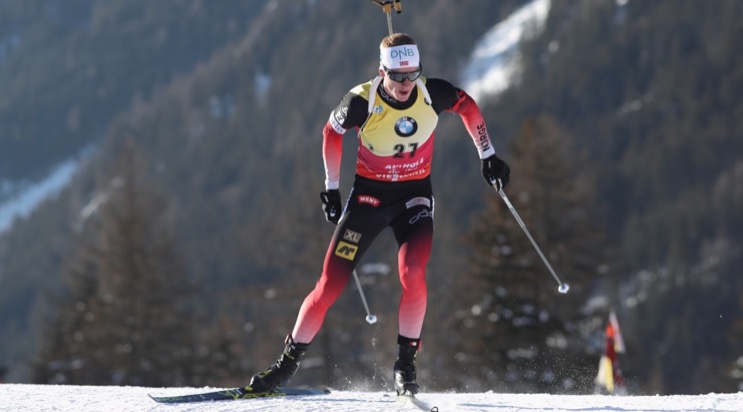
In the groove is in the groove. Norway’s twenty-five-year-old Johannes Thingnes Bø scored his 10th IBU World Cup win of the season today in the 10 k sprint in Antholz, Italy. Bø won the race in 23:53.9 minutes with a single penalty in standing. The Norwegian leads the IBU World Cup overall and padded his lead with his fifth sprint win this year.
“It was quite difficult; the altitude here is quite heavy and with the new tracks, I felt dead from 5K so the last 5K was really tough,” Bø said to the IBU after the race. “I managed to have a good plan for the race. When I shoot nine targets, I was quite happy and then it was just to fight hard for the finish line. I like this year’s track; I liked last year’s too because it was not so painful.”
Bø’s season thus far has been a study in speedy skiing. His shooting stands at 87% for accuracy (82% standing, 91% prone) with his superior skiing speed carrying him to the World Cup overall lead. In Antholz today, his course time for each of his two 5 k laps were ranked first.
Norwegian teammate Erlend Bjøntegaard shot clean in both his shooting bouts to take second place, 17.5 seconds behind. France’s Antonin Guigonnat placed third (+20.2, 0+1).
Scott Gow of Canada was the top North American in 20th (+1:06.6, 0+0). Teammates Jules Burnotte raced to 48th (1:55.9, 1+1), Christian Gow 61st (+2:13.4), and Aidan Millar (+3:46.7, 2+2).
Jake Brown was the top American in 40th (1:42.4, 1+0). Sean Doherty finished in 55th (+2:06.2, 2+1), Max Durtschi 62nd (+2:13.8, 0+1), and Leif Nordgren 73rd (+2:43.1).
Racing continues tomorrow in Antholz for both the men and women with the 12.5k and 10 k pursuits.
Lake Placid SuperTour 5 k/10k Skate Individual Start
In the 5 k-freestyle individual start Jessica Yeaton (APU/Australian National Team) placed first with a winning time of 15:01.9 minutes. She was in a tight race for the top spot with U.S. Ski Team/SMS T2 athlete Sophie Caldwell who finished 3.0 seconds back. Caldwell is back home in Vermont training and preparing for the 2019 World Championships.
Katherine Ogden (Dartmouth Ski Team) placed third in a time of 15:17.8. Kelsey Phinney (SMS T2) placed fourth in 15:37.7.
“Today’s race went super well for me; I had awesome skis despite tricky conditions/weather leading into the race – our wax tech did a phenomenal job,” Yeaton wrote to FasterSkier. “The course here is really good for me with all the steady climbing in the first part- I just tried to push hard to the top of the course and then survive and carry my speed on the downhill, which turned out to be a good tactic.
“Between US Nationals and now I definitely feel like I am in a good place leading into Seefeld. I struggled with some injuries in the fall and was forced to do a lot of cross-training (especially on the bike) and skip the early season races in Nov/Dec. In retrospect I think this actually was a blessing in disguise, as I ended up putting in a super hard training block and gaining a lot of fitness. Looking ahead to Seefeld, my goal is to top 30 in one of the races, with my main focus being on the skate events (30k and sprint), and the 15km skiathlon. I am really excited for the rest of the races this weekend; they are my final prep before heading over to Europe to race on World Cup and in Seefeld.”
Kyle Bratrud (SMS T2) won the men’s 15 k skate in 25:27.1 minutes. Bratrud, who was recently selected to the 2019 U.S. World Championship Team, has been a top-performing distance skier this season on the SuperTour.
“Today went well,” Bratrud emailed. “After Nationals, I made the tough decision of turning down World Cup starts in Otepaa and Ulricehamn in order to get some quality training in for the World Champs. Today reflected that as I felt a little tired and pretty flat from not racing since Nationals. That being said, I expect to keep feeling better each race and I should be in a great place when I fly to Europe on the 4th!”
Bratrud recently won the NorAm/SuperTour 15 k classic in Sovereign Lake and the 15 k classic at U.S. Nationals. Bratrud placed second in West Yellowstone’s SuperTour 15 k skate, and the 30 k skate mass start at U.S. Nationals.
Akeo Maifeld-Carucci (CGRP) placed second in a time of 26:18.9. It was Carucci’s second SuperTour podium of the season and his best career SuperTour result. In West Yellowstone, he was third in the 15 k skate behind Ben Lustgarten (CGRP) and Bratrud.
Alexis Dumas (CNEPH) of Canada was third in 26:32.2. U.S. skier Adam Martin was fourth, 3.1 seconds behind Dumas.
The brothers Bø. Norway’s Johannes Thingnes Bø (right) of Norway with the sprint in Ruhpolding, Germany. His brother Tarjei (left) placed second. (Photo: biathlonworld.com screen capture)
IBU World Cup Biathlon Ruhpolding, Germany 10 k / 7.5 k sprint
Cutting to the chase: it has been dumping in certain regions of the alps. Ruhpolding, Germany, site of this week’s International Biathlon Union (IBU) World Cup’s has been no exception.
The men’s 10-kilometer sprint that went off today under clear skies had been postponed, it was scheduled to run Wednesday. Race officials postponed the race due to a weather related (read heavy snowfall) state of emergency in the district of Traunstein, where Ruhpolding is located.
With a bit more rest in their legs, Norway’s Bø went one and two in the results.
The younger of the brothers, twenty-five-year-old Johannes Thingnes Bø won in a time of 22:56.3 minutes after skiing a single penalty lap. Johannes Bø cleaned his prone stage, while missing one target while standing.
The elder Bø, thirty-year-old Tarjei Bø placed second (+7.9) after cleaning both shooting stages. It was Tarjei’s second individual podium of the season. Benedikt Doll of Germany was third (+10.5), with one penalty while standing. France’s perennial biathlon star Martin Fourcade was fourth (+15.9) with no penalties.
Sean Doherty of the U.S. was the best placed North American in 23rd (+1:10.2, 1+0). As of late, Doherty has been racing consistently in the top-30.
Also for the U.S., Jake Brown shot clean to finish 47th, 1:40.8 minutes back. Leif Nordgren placed 50th (+1:45.3, 0+0), and Max Durtschi 103rd (+3:29.0, 2+2).
Canada’s Scott Gow skied to 42nd (+1:36.0, 0+1). His brother Christian Gow placed 56th (+1:52.7, 0+1), Jules Burnotte skied and shot to 67th (+2:01.5, 1+0), and Aidan Millar 102nd (+3:26.4).
Friday’s racing in Ruhpolding will feature a 4 x 7.5 k and 4 x 6 k relays for the men and women respectively.
Anatasiya Kuzmina won the women’s 7.5 k sprint on Thursday in a time of 19:15.1 minutes. It was Kuzmina’s second win of the 2018/2019 IBU World Cup season. Kuzmina’s day was made a bit easier as she cleaned both her prone and standing shooting stages.
Italy’s Lisa Vittozzi placed second 11.5 seconds behind Kuzmina. Vittozzi also shot clean. In third place was Sweden’s clean shooting HannahÖberg. She finished 29.1 seconds back.
Susan Dunklee for the U.S. placed 20th overall, 1:11.3 minutes behind with a single penalty. Teammate Clare Egan, placed 35th (+1.44.6, 2+0). Also for the U.S., Joanne Reid finished two places back in 37th (+1:45.2, 1+0).
Rosanna Crawford was the top Canadian in 27th. She skied a single penalty loop to cross the finish line 1:32.3 minutes behind. Megan Bankes placed 68th (+2:32.7, 1+1), Emma Lunder 88th (+3:17.9, 3+2), and Sarah Beaudry 96th (+3:40.3, 1+3).
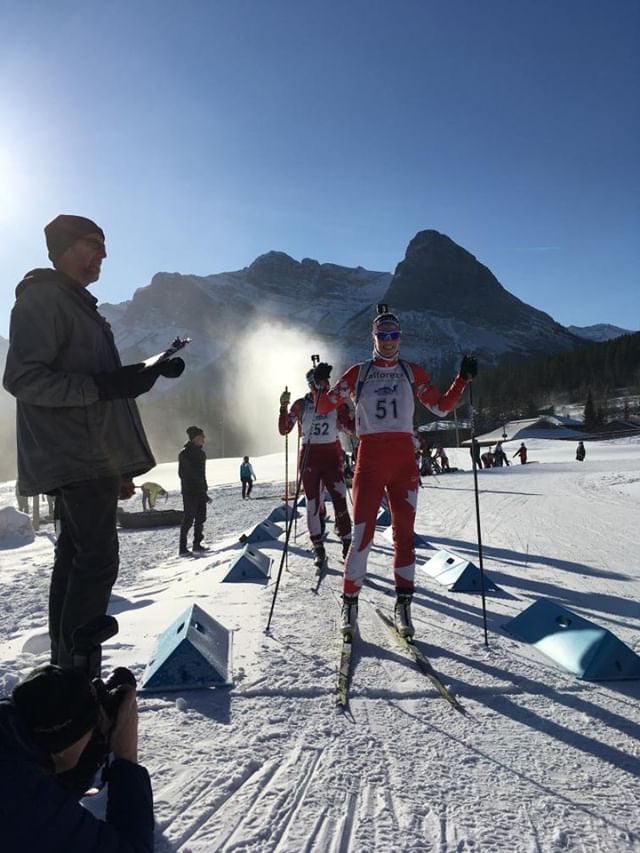
Megan Tandy (bib 51) won the women’s sprint during the second day of racing at Canada’s biathlon selection trials in Canmore. (Photo: Matthias Ahrens)
Thursday in Canmore, Alberta day two of Biathlon Canada’s selection trials featured a sprint, with the men racing a total of 10-kilometers, the women 7.5 k.
Nathan Smith of Canada’s Senior National team placed first for the men in a time of 24:02.7 minutes. Smith missed one shot prone and cleaned standing. Christian Gow, winner of the trial’s Tuesday sprint, placed a close second (+4.2). Gow missed a single shot shooting prone and shot clean during his standing stage. Aidan Millar (Team R.A.D.) skied to third (+35.7) after missing two shots — one each in prone and standing.
With limited snow, the course is absent a penalty lap — male athletes were penalized 22 seconds per miss.
Megan Tandy, also part of Canada’s Senior National Team, won the women’s sprint in 21:17.5 minutes after cleaning her prone stage and missing one shot standing. Tandy placed second in Tuesday’s sprint.
Teammate Rosanna Crawford improved on Tuesday’s result, when she placed third, to take second (+5.7). Nadia Moser skiing for Biathlon Yukon, finished third (+21.2). Moser missed one shot in both prone and standing.
The women were penalized 22 seconds for each missed shot.
The selection trials will help determine Canada’s teams on the IBU World Cup, Ibu Cup and IBU Junior Cup for the first race period beginning the end of November. To date, only Scott Gow and Crawford pre-qualified for the 2018/2019 IBU World Cup.
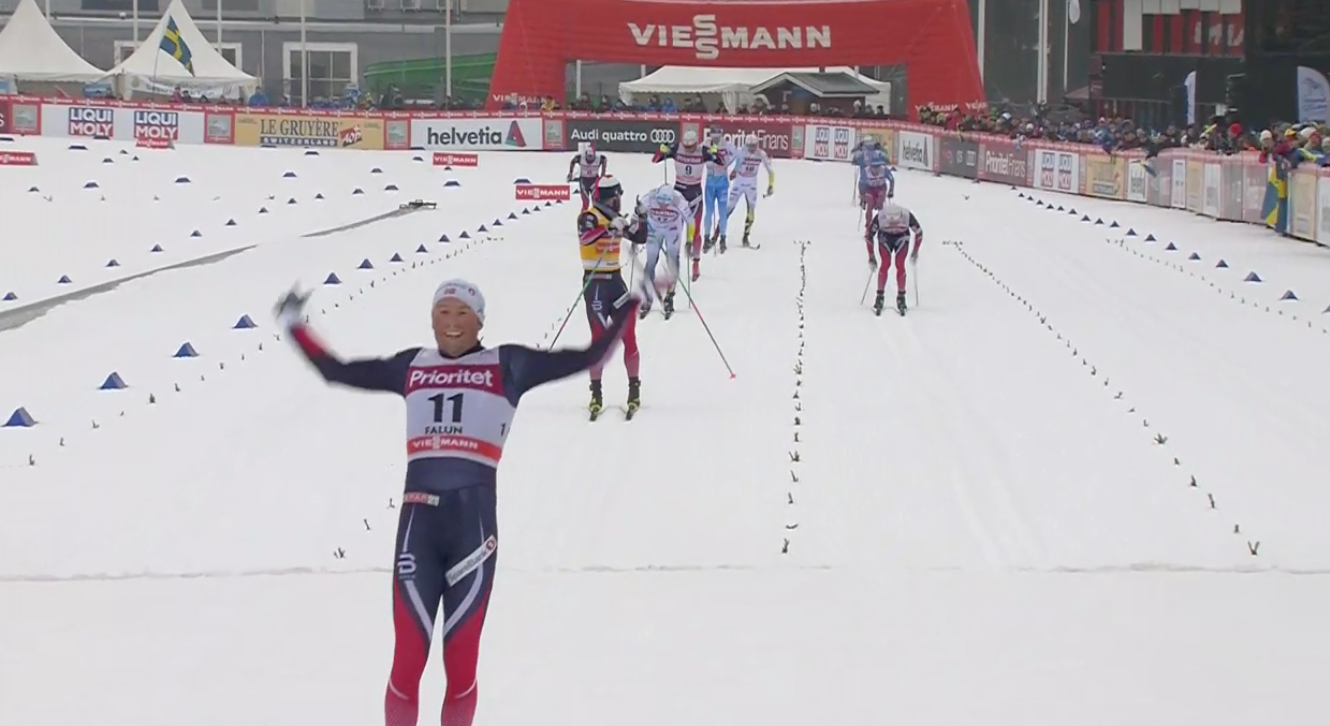
Emil Iversen celebrates his win in the 30 k classic mass start in Falun, Sweden, on Sunday. Norwegian teammate Martin Johnsrud Sundby finished second and Sweden’s Calle Halfvarsson third.
FIS Cross-Country World Cup (Falun, Sweden): 15 / 30 k classic mass start
In the women’s 15-kilometer classic mass start on Sunday, Norway swept the podium with Marit Bjørgen taking the win in a time of 41:28.8 in Falun, Sweden. Crossing just half a second behind her was her teammate, Ingvild Flugstad Østberg in second place. Rounding out the podium was Heidi Weng in third (+8.1).
American Jessie Diggins was the first to cross the line for the U.S. in 10th (+1:37.5). Three other U.S. women finished in the top 30, with Sadie Bjornsen finishing 21st (+2:43.6), Rosie Brennan 24th (+2:57.0), and Liz Stephen in 29th (+3:24.5).
Just outside of scoring World Cup points was American Caitlin Patterson in 32nd (+3:47.6) and Ida Sargent in 34th (+4:02.8). Canada’s Cendrine Browne finished 46th (+5:41.4) and American Liz Guiney 49th (+6:22.6).
After losing the skate sprint yesterday in a photo finish to Italy’s Federico Pellegrino, Emil Iversen ascended to the top step of the podium in the men’s 30 k classic mass start on Sunday in Falun.
The Norwegian was often near the front, but hadn’t tried to lead a breakaway like his teammates Martin Johnsrud Sundby and Sjur Røthe did earlier in the race. In the final two kilometers, Sundby – the overall World Cup leader – put in a sprint to try to drop the field. But Iversen caught up, drafting his veteran teammate into the stadium. In the final up-and-over before the finish line, Iversen made a pass and then accelerated down the finishing stretch to beat Sundby by 1.14 seconds.
“I got motivation from yesterday’s last 20 meters,” Iversen told FIS in a finish-line interview. “So today I fought all the way, and I was really stronger. It is amazing for me to be second yesterday and first today. I’m really proud of that.”
Calle Halfvarsson, who had been falling off the back of the lead pack just a few kilometers earlier, managed to get back to the front and claim third place for Sweden (+1.72 seconds) in a photo finish with Røthe (+1.76 seconds). Niklas Dyrhaug was next (+2.52 seconds) to give the Norwegian men’s team four in the top five.
In his return to the World Cup stage, Norway’s Petter Northug finished 31st (+3:10.6).
Alex Harvey was the lone Canadian on the start line. After skiing near the front of the field for the early part of the race he was dropped by the lead pack in the final kilometers, finishing 15th (+1:17.5).
Erik Bjornsen and Noah Hoffman took 35th and 37th places for the United States, finishing +3:30.8 and +3:59.8, respectively. SuperTour leader Matthew Gelso — familiar with the Falun course after competing in 2015 World Championships — finished 44th (+5:23.6), and Andy Newell placed 53rd (+7:45.3).
IBU Open European Championships (Duszniki-Zdrój, Poland): Single mixed & mixed relay
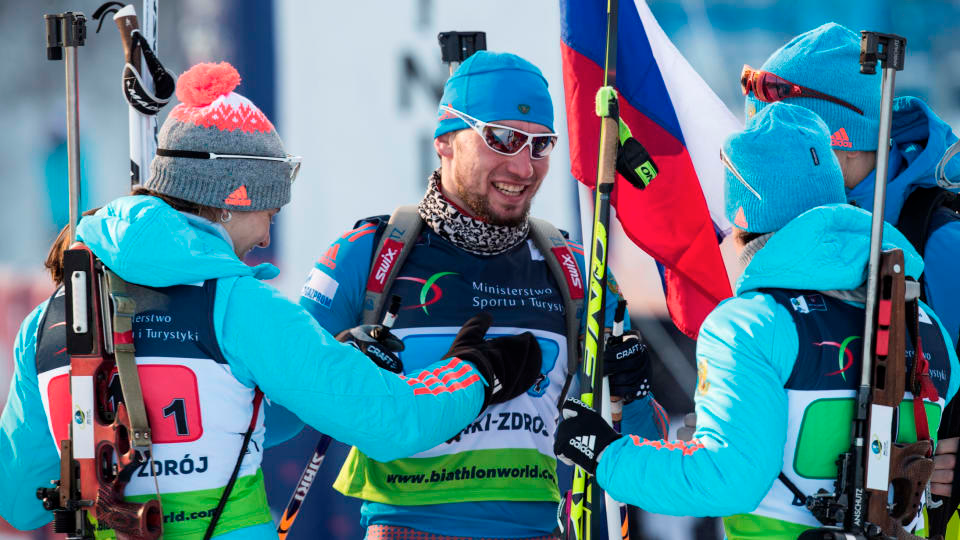
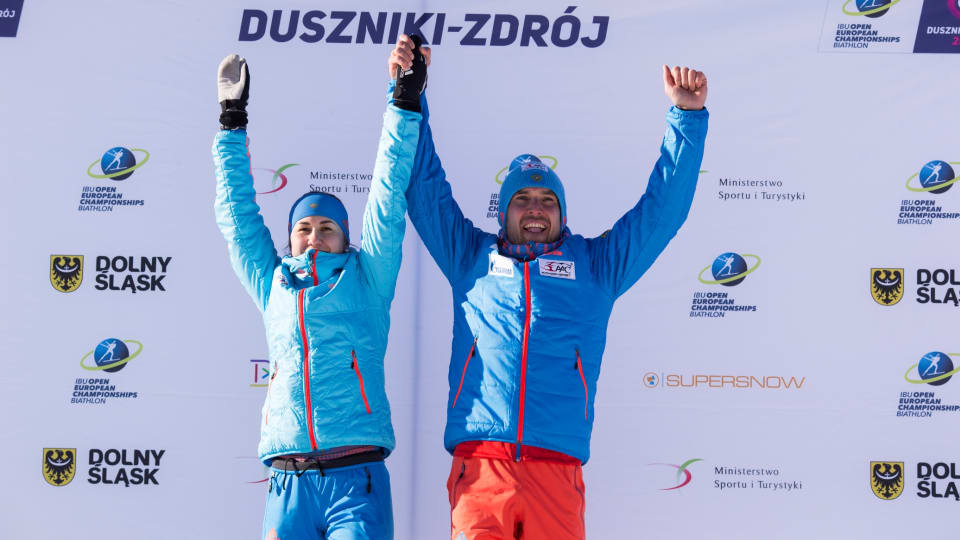
Russia’s Alexander Loginov (center) is greeted at the finish by his teammates Irina Starykh, Svetlana Sleptsova and Alexey Volkov after anchoring his team to the gold medal in the mixed relay at the 2017 IBU Open European Championships in Duszniki-Zdrój, Poland. (Photo: IBU)
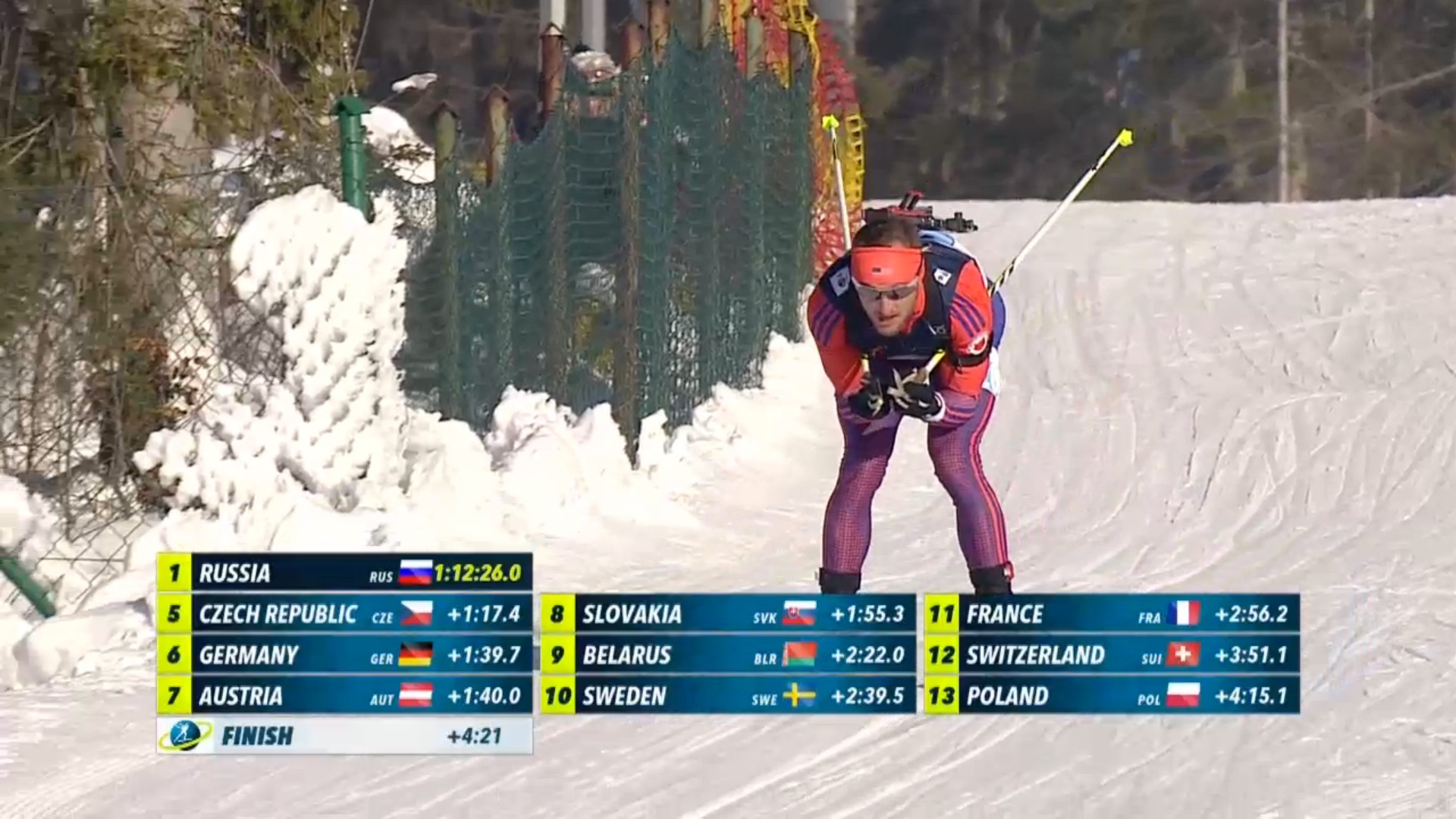
[UPDATED] The Russian victory in the final 2 x 6 + 2 x 7.5-kilometer mixed relay event of the 2017 International Biathlon Union (IBU) Open European Championships in Duszniki-Zdrój, Poland, was only briefly in doubt, when Alexander Loginov skiing the anchor leg required all spares in his prone shooting stage. But with his final shot he managed to also hit that target to avoid the penalty lap, leaving the range with a lead of more than 30 seconds.
Loginov then did not need any spares in the last standing stage, and could take his time on the final loop. Unlike Russia’s Evgeniy Garanichev earlier in the day during the single mixed relay, he also managed to pick up a flag for the final meters of the race, crossing the line in a time of 1:12:26.0 hours.
The Russian team with Irina Starykh, Svetlana Sleptsova, Alexey Volkov and Loginov led from the first exchange and required only six spares with zero penalties.
With this medal, the 28-year-old Volkov became the most successful athlete in history at European Championships, according to an IBU press release, surpassing the retired Polish biathlete Tomasz Sikora. Russia was the most successful team of the 2017 Open European Championships with six gold, four silver, and three bronze medals.
Behind them, a number of teams vied for the positions on the podium. Sweden initially looked like a strong contender exchanging in second place after the women, but fell back with three penalty laps to only finish 10th.
Still six seconds back after the final shooting, Norway’s Fredrik Gjesbakk caught up to and outsprinted Ukraine’s Ruslan Tkalenko in the finishing stretch to claim the silver medal (+36.4) with the bronze left for Ukraine (+37.1).
“I thought that I made sufficient gap to win silver,” Tkalenko told the IBU. “But in the end, on the final downhill before the finish, I was very surprised when the Norwegian guy passed me, I truly did not expect that.”
The Norwegian team with Karoline Erdal, Marion Rønning Huber, Erlend Bjøntegaard, and Gjesbakk needed nine spares and had no penalties.
Ukraine with Anastasiya Merkushina, Yulia Dhzyma, Oleksander Zhyrnyi (who originally started for Russia before making the switch in 2014) and Tkalenko required six spares, and Dhzyma had to ski a penalty lap only temporarily setting the team back.
Bulgaria finished fourth (+1:16.4), with its anchor Vladimir Iliev narrowly beating Czech Republic’s Lukas Kristejn (+1:17.4) in the finishing stretch. Both teams needed 11 spares and had no penalties.
Jakob Ellingson skiing the anchor leg for the U.S. mixed relay at the 2017 IBU Open European Championships in Duszniki-Zdrój, Poland. The U.S. team finished 14th. (Photo: IBU/Eurovisionsports.tv screenshot)
Starting at the back of the field in bib 20, US Biathlon’s Emily Dreissigacker got her team off to a strong start with a clean prone shooting and one spare round in standing, exchanging in 10th, a minute behind the leaders. Hallie Grossman needed one spare in each of her stages, tagging off to the men in 14th position and now 2:39 behind. Max Durtschi also had one miss each in prone and standing, coming into the last exchange still in 14th position, but another minute back. Jakob Ellingson required all three of his spares in his prone shooting stage narrowly avoiding the penalty lap, and one more in his final shooting stage. As the team from Finland was racing over a minute behind the Americans, he was able to keep the 14th position into the finish (+4:47.4), with a team total of nine spares and no penalties overall.
For Biathlon Canada, Erin Yungblut starting in bib 19 shot clean in her prone stage and required two spares in her standing shooting, tagging off in 18th position and more than two minutes back from first. Leilani Tam von Burg stayed clean in her prone shooting stage and needed one spare in standing, moving up two positions to exchange in 16th place, yet more than four minutes behind the leaders. After the exchange to the men, both Matthew Neumann and anchor Carsen Campbell managed to shoot clean in all of their stages, but lost additional time on the course to finish 16th (+6:39.9) ahead of four lapped teams.
Canada had the best shooting result of all 20 teams starting the relay, with just three spares and no penalty.
Russia’s Daria Virolaynen (l) and Evgeniy Garanichev after winning Sunday’s single mixed relay at the 2017 Open European Championships in Duszniki-Zdrój, Poland. (Photo: IBU)
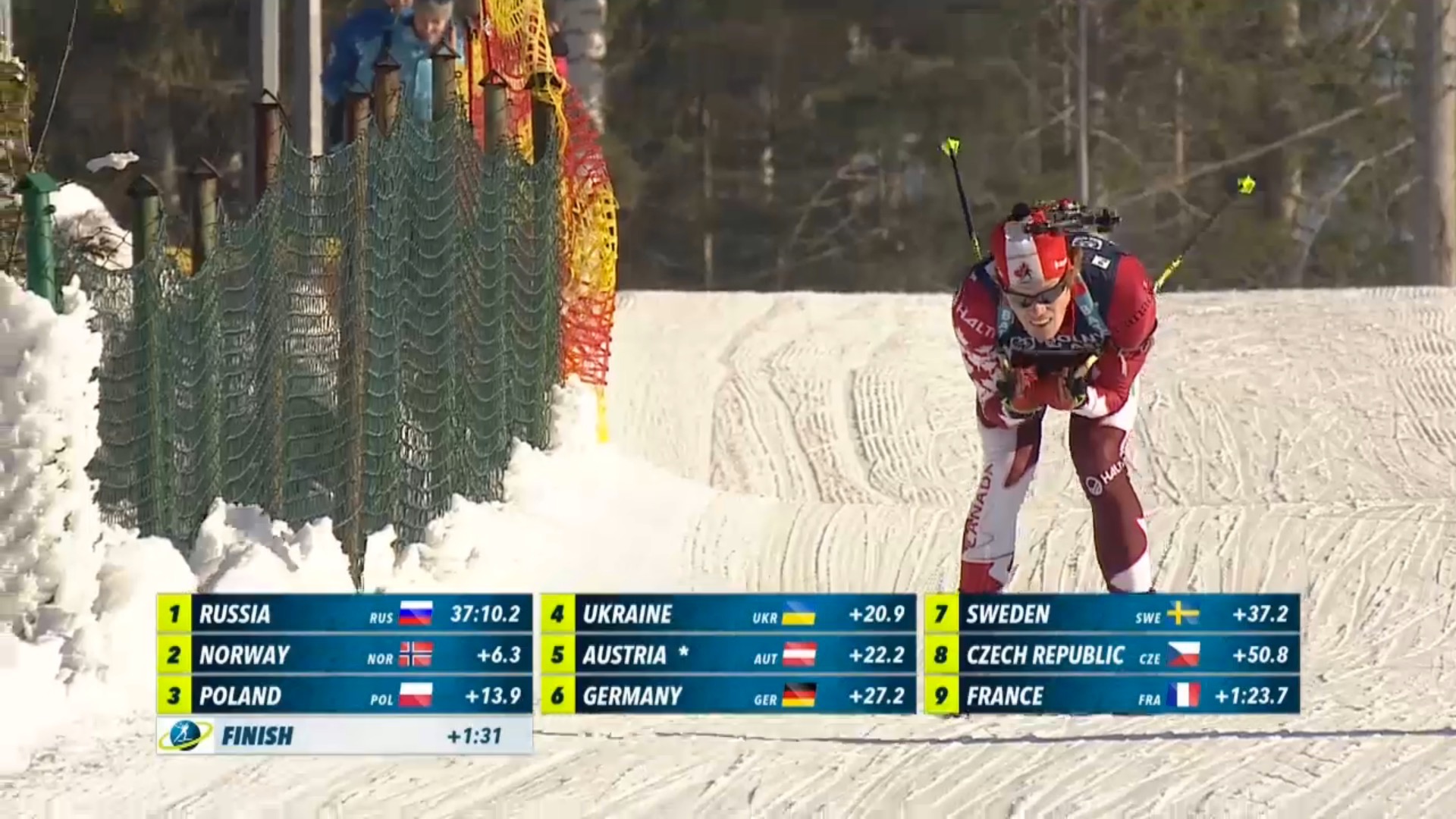
Earlier on Sunday, pretty much the only thing that went wrong for Russia’s Daria Virolaynen and Evgeniy Garanichev in the single mixed relay happened on the last meters of the finishing stretch, with Garanichev gesturing for a Russian flag he wanted to cross the line with. But the handoff was too short and the flag dropped past his outstretched hand to the snow. He glanced back, weighing if his lead was big enough to ski back, but decided it was not worth the risk, instead skiing into the arms of his partner waiting for him behind the line in a time of 37:10.2 minutes.
Russia needed seven spare rounds and incurred zero penalties. Garanichev secured the victory in the final shooting, when he only needed one spare – albeit fumbling a few seconds to insert it – while his direct opponents standing next to him required more time to hit their targets.
“Probably, I took some risk at the last standing,” Garanichev said, according to an IBU press release. “I wanted to shoot fast and clean, but missed with the last shot. But in general, I felt very comfortable; came and worked at the range in my rhythm.”
6.3 seconds behind, Norway with the team of Ingrid Landmark Tandrevold and Vetle Sjåstad Christiansen placed second, with seven spares and zero penalties.
“These are very short loops,” Christiansen commented on the fairly new, single mixed relay format. “You feel the pressure from the crowd and to shoot fast every time.”
The 20-year-old Tandrevold previously earned three bronze medals, including one in the single mixed relay, also with Christiansen, at last year’s Open European Championships in Tyumen, Russia.
To big cheers from their home crowd fans who had come out to the Duszniki Arena in beautiful but cold weather, the Polish husband-and-wife team of Krystyna Guzik and Grzegorz Guzik placed third with just five spares and zero penalties (+13.9), not quite able to keep up with Christiansen on the final loop after leaving the range together within a second.
“It is so nice to win a medal here in Poland,” Krystyna Guzik said. “We were both very disappointed with all of our mistakes in the other competitions. So today, we were relaxed and laughing before the competition, hoping not to have those mistakes again. We did not … and now have a medal.”
It was the first medal for Poland at these championships.
Ukraine with Iryna Varvynets and Andriy Dotsenko finished fourth, also with five spares and zero penalties (+20.9).
Biathlon Canada’s Aidan Millar skiing the final loop of the single mixed relay at the 2017 IBU Open European Championships in Duszniki-Zdrój, Poland. With teammate Sarah Beaudry, Canada finished 13th (Photo: IBU/Eurovisionsports.tv screenshot)
For Biathlon Canada, Sarah Beaudry and Aidan Millar required seven spares during their race and had no penalty, just like the winning Russians and Norwegians, but could not quite keep up with the best teams on the course in the fast-paced race format with short loops somewhat comparable to a team sprint in cross-country.
Beaudry cleaned her first shooting stage and then needed one spare to hit all targets in standing. At the first exchange Canada was 10th, 35.8 seconds behind the then leading team from Poland.
Millar missed one shot in his first prone stage, leaving the range again in ninth position. Then he needed two spares in his standing shooting on the way to exchanging back to Beaudry in 11th (+56.4).
On her second leg, Beaudry had one miss in prone and required two spares in standing, falling back a bit to exchange in 13th (+2:12.0).
On his final leg, Millar was able to shoot clean in both stages, reducing the time gap to the top but not able to make up another position, and finished in 13th place (+1:56.1).
US Biathlon is only represented with two women at the Open European Championships in Poland, and decided to forgo a start in the single mixed relay, instead entering a team in the mixed relay later on Sunday.
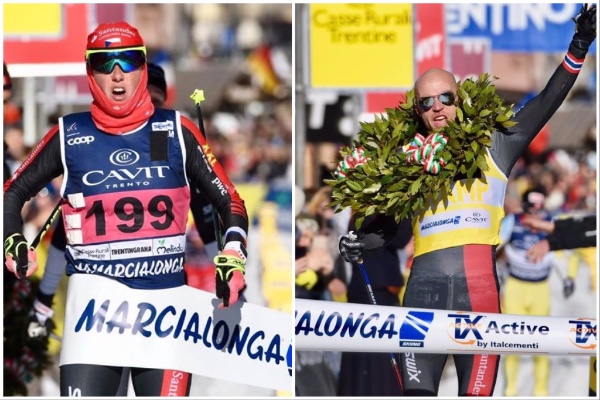
Katerina Smutna (left) and Tord Asle Gjerdalen (right) of Team Santander won the 2017 Marcialonga. (Photo: Visma Ski Classics)
Tord Asle Gjerdalen won the Marcialonga, a Worldloppet and Swix Ski Classics marathon for the third time – in a row. This year was on a shortened course, “just” 57 rather than the traditional 70 kilometers.
The Team Santander athlete finished in two hours, eight minutes, and 36 seconds, edging Johan Kjølstad (Team United Bakeries) and Morten Eide Pedersen (Team BN Bank) in a sprint finish by 2.6 and 2.9 seconds, respectively.
Tyler Kornfield and David Norris of Alaska Pacific University finished 43rd (+5:03.8) and 66th (+10:43.1). Canadian Paralympian Brian McKeever finished 57th (+9:13.5) and guide Graham Nishikawa 81st (+12:56.5), followed by Ian Murray in 85th (+13:37.5) and Erik Carleton in 111th (+17:50.2).
In the women’s competition, Katerina Smutna, also of Team Santander, won her third straight Ski Classics competition. She crossed the line in two hours, 22 minutes, and 46.4 seconds. Britta Norgren of Team Lager 157 was second by just 0.8 seconds, and Sara Lindborg (Team Serneke) third, +4:22.2. University of Utah alum Maria Graefnings was tenth, +10:35.8.
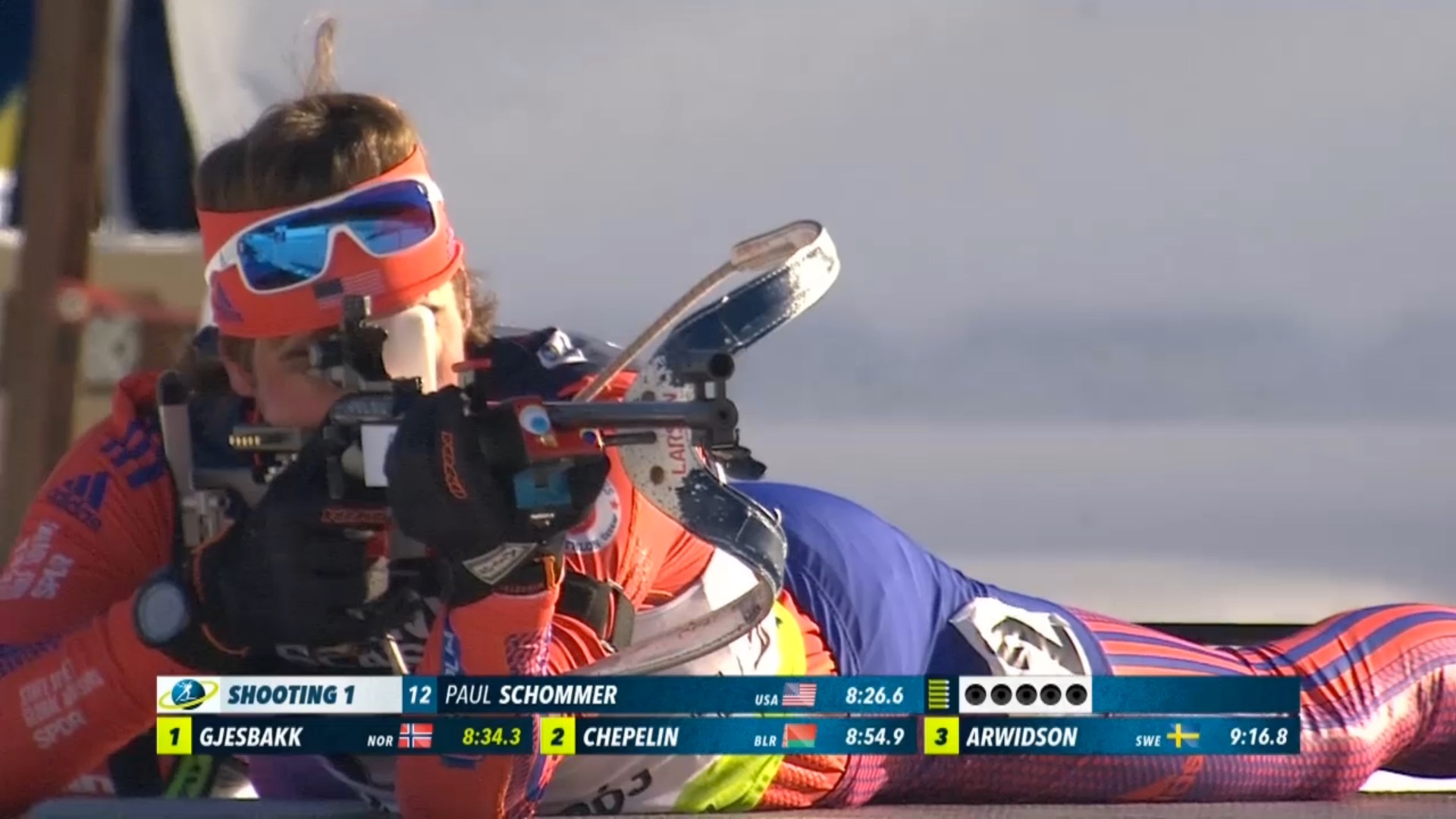
US Biathlon’s Paul Schommer shooting prone in the men’s 10 k sprint at the 2017 IBU Open European Championships in Duszniki-Zdrój, Poland. He was the top North American on Friday in 58th. (Photo: IBU/Eurovisionsports.tv screenshot)
IBU Open European Championships (Duszniki-Zdrój, Poland): Men’s & women’s sprints
On Friday in the men’s 10-kilometer sprint, two Bulgarian athletes were able to break the Russian dominance at the 2017 International Biathlon Union (IBU) Open European Championships in Duszniki-Zdrój, Poland.
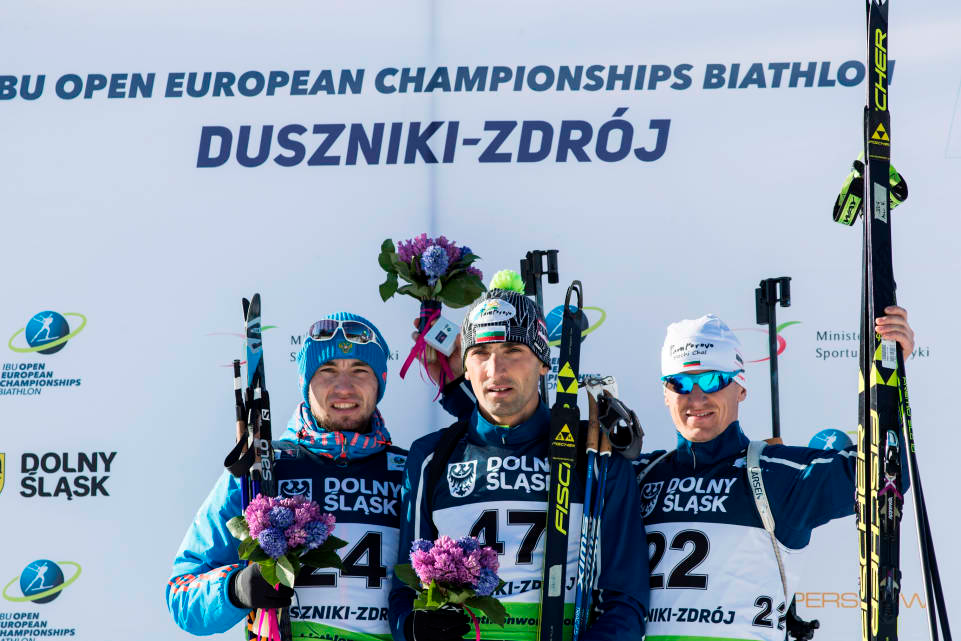
The men’s 10 k sprint podium on Friday, with Bulgaria’s Vladimir Iliev (c) in first, Russia’s Alexander Loginov (l) in second, and Bulgaria’s Krasimir Anev (r) in third at the 2017 IBU Open European Championships in Duszniki-Zdrój, Poland. (Photo: IBU)
Bulgaria’s 29-year-old Vladimir Iliev, who has competed on the IBU World Cup since 2007 and posted a career-best fifth (which he achieved earlier this season), claimed the win in a time of 24:26.9 minutes despite one penalty in the standing stage (0+1), giving a kiss to his fast skis in the finish. Russia’s Alexander Loginov, who won the men’s 20 k individual race on Wednesday after returning this season from a two-year doping suspension, placed second (+4.9) with clean shooting. Behind them, Iliev’s teammate Krasimir Anev took third (+16.7), also shooting clean, to push Latvia’s Andrejs Rastorgujevs off the podium by just 0.6 seconds (+17.3). Rastorgujevs started early in bib 4 and skied the fastest course time of the day, but incurred two penalties in his standing stage (0+2), which ultimately set him back too far for a podium.
“It was a long way to this medal and this win,” Iliev said his first career victory, according to an IBU press release. “I was ready for a high result for many years, but many things have happened, so I’m really happy to get a victory today.”
“I did not expect anything in this race, because yesterday I had health problems so even my coach advised me not to start,” Anev said after winning his second medal of the championships, following up on a second place in the individual. “So [I] went into competition without any expectations.”
In beautiful weather conditions with little wind and the sun shining on the new arena in Duszniki-Zdrój throughout the race, US Biathlon’s Paul Schommer was the best of 11 North American starters, finishing 58th (+2:14.9) with three penalties (1+2). Schommer was less than a second faster than his U.S. teammate Alex Howe, who finished 59th (+2:15.3), after skiing two penalty laps (1+1). The third American Jakob Ellingson placed 64th (+2:24.6) with one penalty (0+1), Russell Currier was 75th (+2:41.4) with four penalties (2+2), Max Durtschi was 88th (+3:16.1) with three penalties (1+2), and Michael Gibson was 103rd (+4:30.4) with two penalties (1+1).
Matthew Hudec led the Canadians on Friday in 80th (+2:54.7) with one penalty (1+0). Also for Canada, Aidan Millar finished 86th (+3:13.9) with three penalties (1+2), Carsen Campbell 89th (+3:18.3) with three penalties (2+1), Pearce Hanna 92nd (+3:24.7) with two penalties (1+1), and Matthew Neumann 94th (+3:31.8) with four penalties (1+3).
In the large field of 125 starters, Schommer and Howe qualified for Saturday’s pursuit race by placing in the top 60.
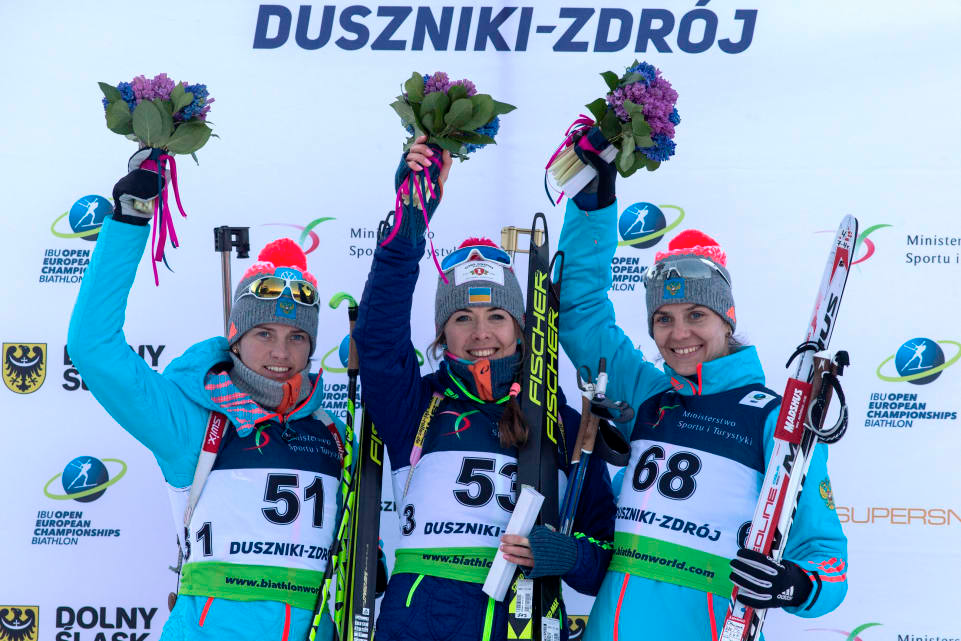
The women’s 7.5 k sprint podium on Friday, with Ukraine’s Juliya Dzhyma (c) in first, Russia’s Svetlana Sleptsova (l) in second and Russia’s Irina Starykh (r) in third at the 2017 IBU Open European Championships in Duszniki-Zdrój, Poland. (Photo: IBU)
[UPDATED] In the women’s 7.5 k sprint that followed, Ukraine’s Juliya Dzhyma managed to win in convincing fashion in a time of 21:02.3 minutes, shooting clean and skiing the second-ranked course time. It was the first individual career victory for the 26 year old in either a junior or senior championships, after she won a gold medal with Ukraine’s relay team at the 2014 Olympics in Sochi, Russia.
“When I saw that everyone was cleaning, I knew that to get in to top three, I have to do the same,” Dzhyma commented on her race, according to an IBU press release. “But honestly, I have no idea how I hit all the targets today; for the whole season, it was my first competition where I had zero.”
“I was just trying to do my best and to make the gap bigger because tomorrow is the pursuit!” she added, regarding her last loop when she increased her lead by another ten seconds.
Also shooting clean but 27 seconds off the win was Russia’s 30-year-old Svetlana Sleptsova, who, earlier in her career, won five World Cups and gold medals in the women’s relay at the 2009 World Championship and 2010 Olympics in Vancouver.
Starting behind Sleptsova, her Russian teammate Irina Starykh, the winner of the women’s individual race on Wednesday, and like Loginov, also coming back from a two-year suspension for EPO use, claimed third (+37.8) with one penalty in her standing stage (0+1). Starykh bumped Germany’s Karolin Horchler, who had led the race early on after starting in bib 2 to fourth (+42.2, with no penalties). Horchler won her first World Cup a week ago in Antholz, Italy.
“Before the competition I already felt that it would be very hard for me to shoot today,” Starykh told the IBU. “And in the end it came out that way, it was tough for me to shoot at the prone and at the standing. But just one penalty is a pretty good result, based on how I feel.”
Horchler’s teammate Denise Herrmann, who made the switch from cross-country skiing to biathlon this season, followed in fifth (+47.7) with the fastest course time of the day, but missed two targets in her standing stage including her very last shot (0+2) to miss the podium.
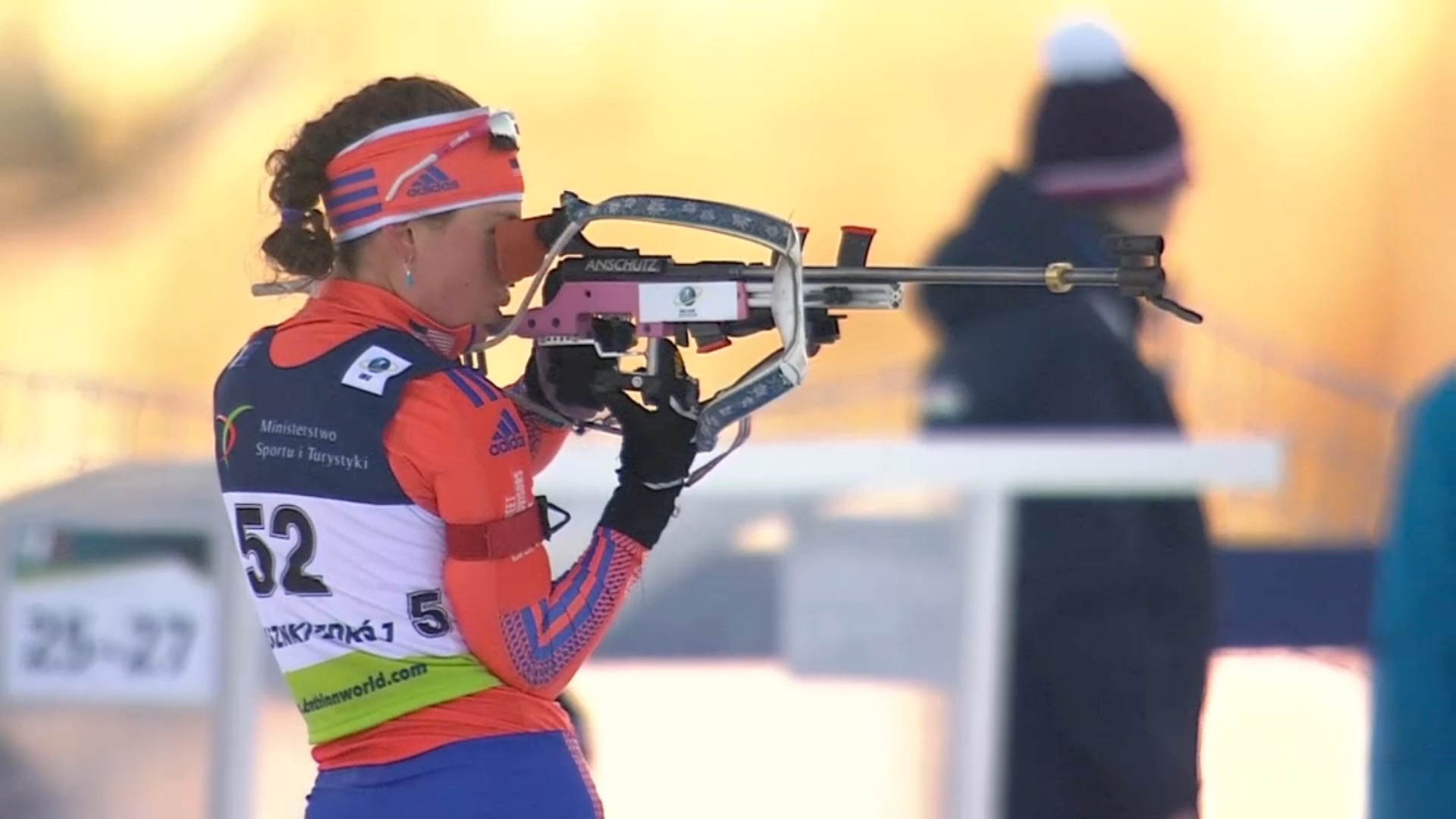
American Hallie Grossman during her standing stage in the women’s 7.5 k sprint on Friday at the 2017 IBU Open European Championships in Duszniki-Zdrój, Poland. She finished 70th with three penalties as the second-best North American. (Photo: IBU/Eurovisionsports.tv screenshot)
In stable weather conditions, though not as sunny as during the men’s sprint earlier on Friday, US Biathlon’s Emily Dreissigacker was the top North American woman in 69th (+3:31.1), with three penalties (2+1). Just one position behind her, American Hallie Grossman also missed three (2+1) on her way to a 70th (+3:34.4). For the 23-year-old Grossman it is her first season overseas racing in the IBU Cup.
Canada’s Erin Yungblut finished 81st (+5:50.0) with four penalties (1+3). Her teammate Leilani Tam von Burg did not finish after incurring two penalties in her prone shooting stage, and the third Canadian, Sarah Beaudry did not start.
None of the North American woman qualified for Saturday’s pursuit.
Sean Doherty competing in the 20 k individual at 2016 IBU World Championships in Oslo, Norway. Two Russian biathletes who Doherty competed against at the youth and junior level, Alexander Loginov and Eduard Latypov, have now been caught doping shortly after graduating out of the junior ranks. (Photo: JoJo Baldus)
OSLO, Norway—“What’s done is done, they will have their punishments, but it’s just– it’s not cool, man.”
That’s how U.S. biathlete Sean Doherty, still a junior, reacted to one of his former competitors getting suspended for doping. The case has raised uncomfortable questions about when doping starts in elite sport, with mounting evidence that even young athletes are not competing on a level playing field.
On Thursday news broke that a third biathlete had tested positive for meldonium, the metabolic modulator also known as mildronate which was added to the World Anti-Doping Agency (WADA) Prohibited List on January 1. Earlier this winter, Ukraine’s Olga Abramova and Artem Tshchenko were also suspended for the same offense.
This time the offender was a young Russian athlete, Eduard Latypov. A first-year senior, Latypov won a second-tier IBU Cup sprint in Brezno-Osrblie, Slovakia, on February 14.
Latypov was not identified by the IBU, which as a policy does not name implicated athletes or their nationalities until they either waive their right to have the ‘B’ sample opened or the ‘B’ sample tests positive.
Eduard Latypov, second from left, helped his Russian team to World Junior Championships gold in 2015. (Photo: IBU/Evgeny Tumashov)
But the Russian Biathlon Union announced that Latypov was the athlete in question in a brief press release. The organization offered no comment on the situation and Latypov seemingly has not spoken to the press.
That makes him unlike other athletes who have tested positive for the drug, many of whom offered explanations of how they had been prescribed the drug months or years ago before it was added to the list.
Since many of these athletes have shown a pattern of long-term meldonium use, this raises questions of Latypov’s own use, even if it wouldn’t have constituted a violation before January 1.
A 2015 World Junior Champion, Latypov is the second Russian biathlete to have been found doping shortly after leaving the junior ranks.
Alexander Loginov, a four-time medalist at 2013 World Junior Championships, was revealed to be doping just months after those competitions when retroactive testing carried out in 2014 found traces of recombinant erythropoietin (EPO), a blood-doping drug, in a sample collected in November 2013.
Antidoping work is carried out at World Youth and Junior Championships, but in Loginov’s case, the amount of EPO present in his later sample was only detectable using an improved method which was used in 2014.
While doping is accepted as a regrettable feature of elite sport, the possibility of juniors resorting to cheating is still an emotional punch in the gut to some athletes and fans.
Sean Doherty competing at 2015 World Junior Championships in Minsk, Belarus. (Photo: Jakob Ellingson)
“I was such a baby when I was 15, competing internationally!” Sean Doherty said after finishing the 20 k individual here at senior World Championships on Thursday. “I had no idea that people would break the rules! It never crossed my mind. It’s not something that I would think of. Ignorance is bliss in its own little way.”
Teammate Jakob Ellingson agreed.
“When I remember my first time at the World Junior Championships, it was a lot to take in for me all at once,” he wrote in an email. “I just assumed [other athletes] had spent the same and probably more time training than I had. So no, I did not go into those races thinking, that no matter what I do, there are other kids doping.”
And even after a few different trips to World Junior Championships, Ellingson’s attitude hadn’t changed.
“Over the years I have gotten to hang out with some of the Russian juniors in between competitions,” he wrote. “It may just be the person I am, but I always left after hanging out with them thinking that we were the same, those guys were just born in Russia, and had Russian coaches, while I was born in the USA and have a Czech coach. I thought, and maybe it’s naive of me, but I still think that most of them are just working very hard on an intense training plan. And that is why they constantly have top-performing juniors.”
A six-time competitor at World Youth and Junior Championships (including his last edition this year in Romania), Doherty has gone on to a successful senior career for the U.S. biathlon team. A 2014 Olympian, he has also competed at two senior World Championships and earned his first World Cup top-20’s this season.
Aidan Millar competing in Minsk. (Photo: Jane Robertson)
The first time Doherty competed against Latypov was in 2013, when they were both in the youth category in Obertilliach, Austria. Doherty won two silvers and a gold in individual competition; Latypov had a top finish of 18th.
Two years later in Minsk, Belarus, both had moved up to the junior category, and Latypov finished sixth in the sprint before moving up to win the pursuit. Doherty earned bronze in the sprint, finishing 16.8 seconds ahead of Latypov, who had one more penalty than the American.
“I just think doping in general is a plague on the sport,” Doherty said. “I think it’s a shame. I take so much pride in what I do, in representing my country and myself in this sport that I so love. It’s a real shame when other people don’t hold it in as high a standard, and think that they can cheat and it’s okay.”
Another athlete who competed against Latypov is Aidan Millar of Canada, who finished eighth in that same World Junior Championships sprint in Minsk.
“As a junior it’s pretty hard to wrap your head around the fact that some of the people you are competing against might be doping,” Millar wrote in an email. “When Alexander Loginov got caught a few couple years ago it was a bit of an eye opener to see that juniors or young athletes were using performance enhancing drugs.”
While Doherty said it was a “bummer” looking back, he was still upbeat, saying that there’s “still no doping for shooting” and that he was happy that in some cases, he beat people who later turned to doping.
Millar was more open about how the revelations changed his feelings about his junior career.
“Looking back at last season’s World Juniors, it makes me feel cheated,” Millar wrote. “I dealt with some big injuries that year but trained super hard and had a great result. But to think that somebody cheated to do well makes me wonder if you can get to the top without cheating. It’s a sad thought, but in a sport that is known for doping I think we need harsher penalties for those who cheat. Why not a lifetime ban for a first time offender?”
Both also lamented the fact that using performance-enhancing drugs may have long-term health effects, and that athletes their age should not be signing themselves up for such long-lasting dangers so early in their careers.
“That’s really a high cost,” Doherty said. “And then the cost of getting banned… With all of this doping stuff in so many sports lately, it’s really just sad that people aren’t morally sound enough to avoid doping.”
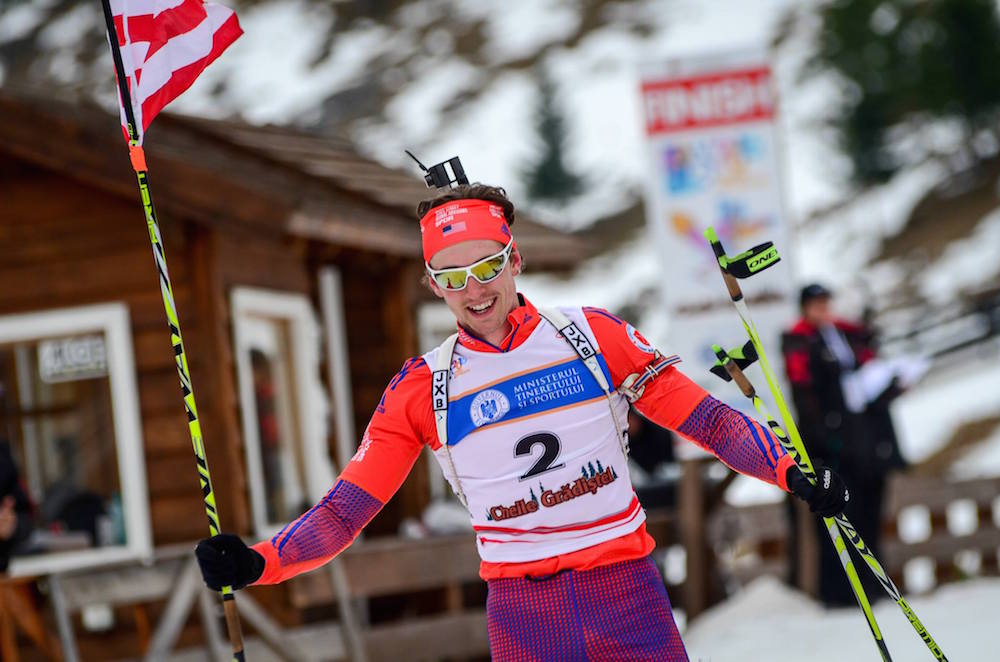
Sean Doherty (US Biathlon) after winning the final race of his last IBU Junior World Championships in Cheile Gradistei, Romania. In winning the junior men’s pursuit on Sunday, it was his fourth gold and 10th medal in six IBU Youth/Junior World Championships. (Photo: IBU YJWCH Cheile Gradistei 2016/Facebook)
(Note: This article has been updated to include comments from American Claire Waichler and Canadian Aidan Miller.)
Imagine a race where you’re in second place for the first half of it, then suddenly, you emerge out of the third of four shooting stages in first (disclaimer: this is a biathlon race), 13 seconds ahead of second place.
You cruise around the 2.5-kilometer course, entering the range for the fourth and final time, where you hit all five targets and set out on your final loop almost 40 seconds ahead of anyone else.
What goes through your mind? For US Biathlon’s Sean Doherty, it definitely wasn’t damage control.
“Let’s lock this up,” he recalled thinking in a phone interview on Sunday after the junior men’s 12.5 k pursuit at IBU Junior World Championships, the final junior race of his career.
“The pressure kind of changes when you’re in the lead. A lot of people fall into a track where, ‘I don’t want to mess this up.’ That’s the wrong mindset. You’re still in charge,” he said.
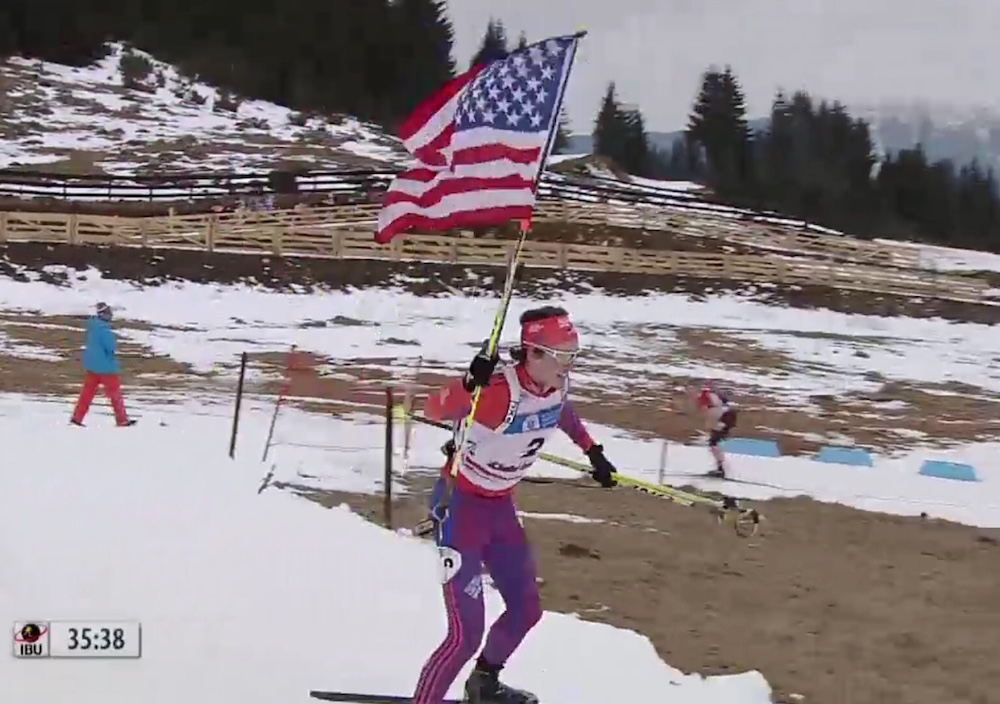
Sean Doherty on his way to securing a nearly 30-second win in Sunday’s pursuit at 2016 IBU Junior World Championships in Cheile Gradistei, Romania.
Doherty, 20, didn’t lose sight of that and raced to his first win of the week in Cheile Gradistei, Romania, with enough time to grab an American flag from a teammate and wave it high above his head as he crossed the finish line in first. That moment meant a lot to him, he said.
Previously, Doherty had placed third in the 15 k individual and second in Saturday’s sprint, behind Austria’s Felix Leitner, who won both previous races at this year’s worlds. On Sunday, Doherty hit 18 of 20 targets, missing one on his second and third stages, to secure the win by 29.6 seconds over Russia’s Nikita Porshnev in 36:01.1.
Porshnev had one penalty in the first stage, then three clean stages and the fastest overall course time to rise from 12th at the start to second at the finish. Leitner recovered from three late penalties (0+0+2+1) to land on the podium in third, 38.8 seconds after Doherty.
Before the flower ceremony, cameras panned on Doherty and Leitner, 19, casually chatting.
“We’ve been racing together off and on a bit; we’re just kind of buddies,” Doherty explained.
But do some of the other junior athletes look up to him?
“I always like to talk and discuss race strategies,” Doherty said. “I’ve been in all sorts of different positions with this stuff.”
Sunday marked his 10th career medal at IBU Youth/Junior World Championships. He had previously set the all-time record on Saturday with nine medals.
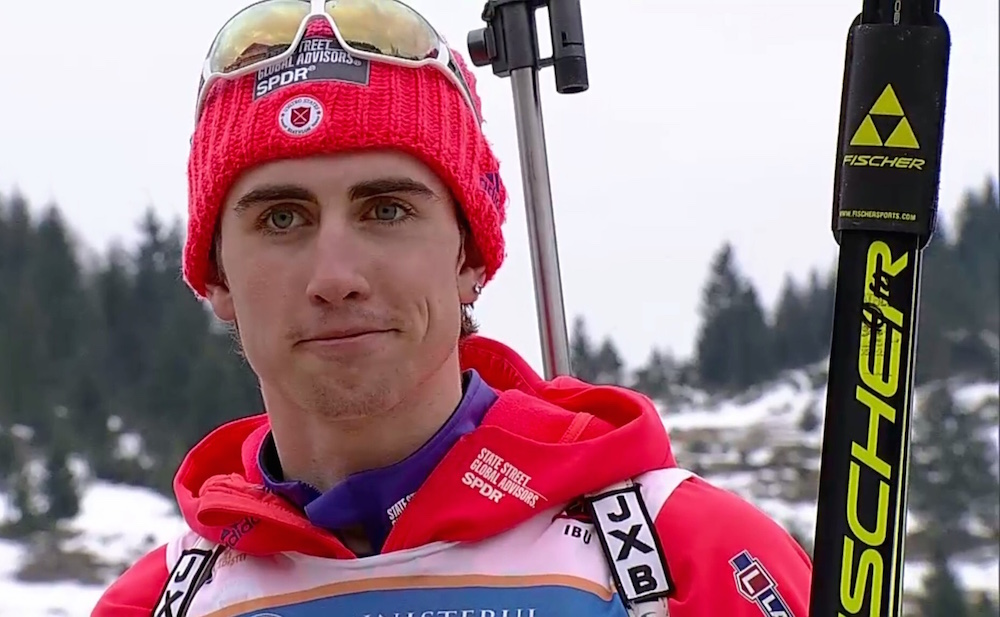
Sean Doherty before the flower ceremony at IBU Youth/Junior World Championships, where he won the final race of his junior career (the junior men’s pursuit) in Cheile Gradistei, Romania. (Photo: IBU YJWCH Cheile Gradistei 2016/Facebook)
“I didn’t know I had done it until a good ways after the [sprint] race,” Doherty recalled of becoming the most decorated biathlete at youth/junior worlds. “I was in the press conference [and a reporter] asked the question, and I didn’t know until that point that I had set a new record.”
When it came down to it, he insisted he was just like every other junior at the championships. He woke up each morning on race days and had to kill time while staying focused until 2:30 in the afternoon. Then, he’d put on his race suit, get into his pre-race routine, and get down to business.
“I get nervous just like any other human,” Doherty said. “There’s a lot of pressure for these races I just did, and I’m really happy with how I performed with it all, but it’s something that’s not that easy to deal with.”
“I get nervous just like any other human. There’s a lot of pressure for these races … I’m really happy with how I performed with it all, but it’s something that’s not that easy to deal with.” — Sean Doherty, US Biathlon A-team member and IBU World Cup skier, on podium expectations
He reached the podium in all three individual races at these championships and started Sunday’s pursuit 12 seconds behind Leitner as the second starter out of the gate. Mostly, Doherty said he focused on his own race and staying confident in his ability to catch Leitner.
“Even though it’s tempting to charge out of the game and try to catch Felix on the first lap, it’s not smart,” he recalled.
After cleaning his first prone stage, Doherty missed his first shot of his second prone. That wasn’t ideal, he explained, but he made a point to maintain his energy and keep a good headspace heading into his second loop.
“That wasn’t damaging, that one miss,” he said.
Meanwhile, Leitner cleaned the first two stages to remain in the lead, by 21 seconds over Doherty. He entered the range for the third time in first, well enough ahead of Doherty that he had fired off his shots before the American settled in.
While Doherty knew it was best to focus on himself, he couldn’t help but notice Leitner had missed two in that standing stage.
“I tried to stay to stay calm and not let what was was going on with him not affect me too much. I got a little excited and kind of jerked the last shot,” Doherty said.
He missed one, but emerged out of the penalty loop 13.4 seconds before Leitner.
“I just really wanted to finish the race off and I knew that I could do it,” Doherty said. “I just tried to think of it like training: I’ve done this before and nothing crazy needs to happen right now.”
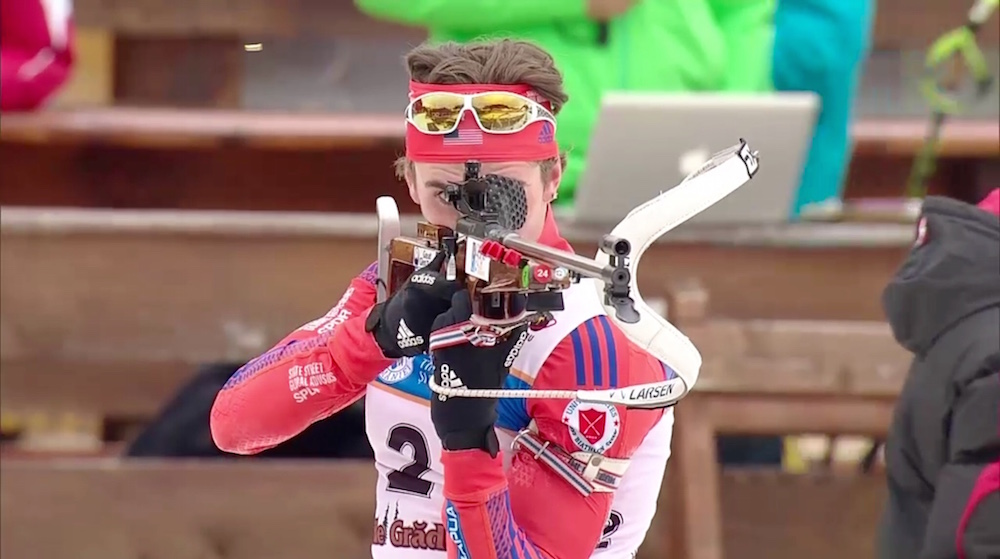
Sean Doherty cleaned his final shooting stage to secure his lead (and ultimately the victory) in the junior men’s pursuit at IBU Youth/Junior World Championships in Cheile Gradistei, Romania.
The Austrian went on to miss another in his final standing stage (while Doherty cleaned) to fall to third. Russia’s Porshnev cleaned his last three stages to take hold of second place.
“This was my biggest comeback because in general, I am not so good with the shooting,” Porshnev said in the post-race press conference. “I was really lucky and I understood that if I want to be in the top I need to shoot well today.”
Despite missing out on a sweep of the individual races, Leitner said he was happy with third.
“At the moment I am really tired, but I am very happy with this whole week,” he said in the press conference. “It is like a dream. There are too many great athletes here, and I am happy with my [bronze] medal.”
For Doherty, capping his junior career with gold in the pursuit was perfect.
“I really couldn’t have imagined a better ending, really,” he said. “This is the perfect end to my junior career.
“I’m still pretty over the moon,” he added.
On Monday, Doherty planned to fly home to New Hampshire, where he’ll spend the next week recovering leading up to the IBU World Cup in Presque Isle, Maine — about a six-hour drive from his hometown. He is skipping Tuesday’s junior relay and the upcoming World Cup in Canmore, Alberta, which starts Thursday.
(Story continues below)
Sean Doherty won his final race of 2016 IBU Junior World Championships in Cheile Gradistei, Romania, the junior men’s pursuit by nearly 30 seconds on Sunday for his 10th career medal at youth/junior world championships. (Photo: USBA/NordicFocus)
Sean Doherty won his final race of 2016 IBU Junior World Championships in Cheile Gradistei, Romania, the junior men’s pursuit by nearly 30 seconds on Sunday for his 10th career medal at youth/junior world championships. (Photo: USBA/NordicFocus)
Sean Doherty won his final race of 2016 IBU Junior World Championships in Cheile Gradistei, Romania, the junior men’s pursuit by nearly 30 seconds on Sunday for his 10th career medal at youth/junior world championships. (Photo: USBA/NordicFocus)
Sean Doherty won his final race of 2016 IBU Junior World Championships in Cheile Gradistei, Romania, the junior men’s pursuit by nearly 30 seconds on Sunday for his 10th career medal at youth/junior world championships. (Photo: USBA/NordicFocus)
Sean Doherty won his final race of 2016 IBU Junior World Championships in Cheile Gradistei, Romania, the junior men’s pursuit by nearly 30 seconds on Sunday for his 10th career medal at youth/junior world championships. (Photo: USBA/NordicFocus)
Sean Doherty won his final race of 2016 IBU Junior World Championships in Cheile Gradistei, Romania, the junior men’s pursuit by nearly 30 seconds on Sunday for his 10th career medal at youth/junior world championships. (Photo: USBA/NordicFocus)
Sean Doherty won his final race of 2016 IBU Junior World Championships in Cheile Gradistei, Romania, the junior men’s pursuit by nearly 30 seconds on Sunday for his 10th career medal at youth/junior world championships. After winning both previous races at the championships, Leitner placed third. (Photo: USBA/NordicFocus)
Another Top 10 for Phaneuf
In the junior women’s 10 k pursuit, 20-year-old Maddie Phaneuf (US Biathlon X-team) started seventh and finished ninth with four penalties (1+0+1+2).
In fifth after the first prone stage and up to fourth following the second stage, Phaneuf slipped to seventh after a penalty in her first standing, then ninth with two more penalties on the final standing. She finished 2:08.8 behind the winner, Sweden’s Hanna Öberg, who won Saturday’s sprint and started the pursuit first, 1 second ahead of Switzerland’s Lena Häcki.
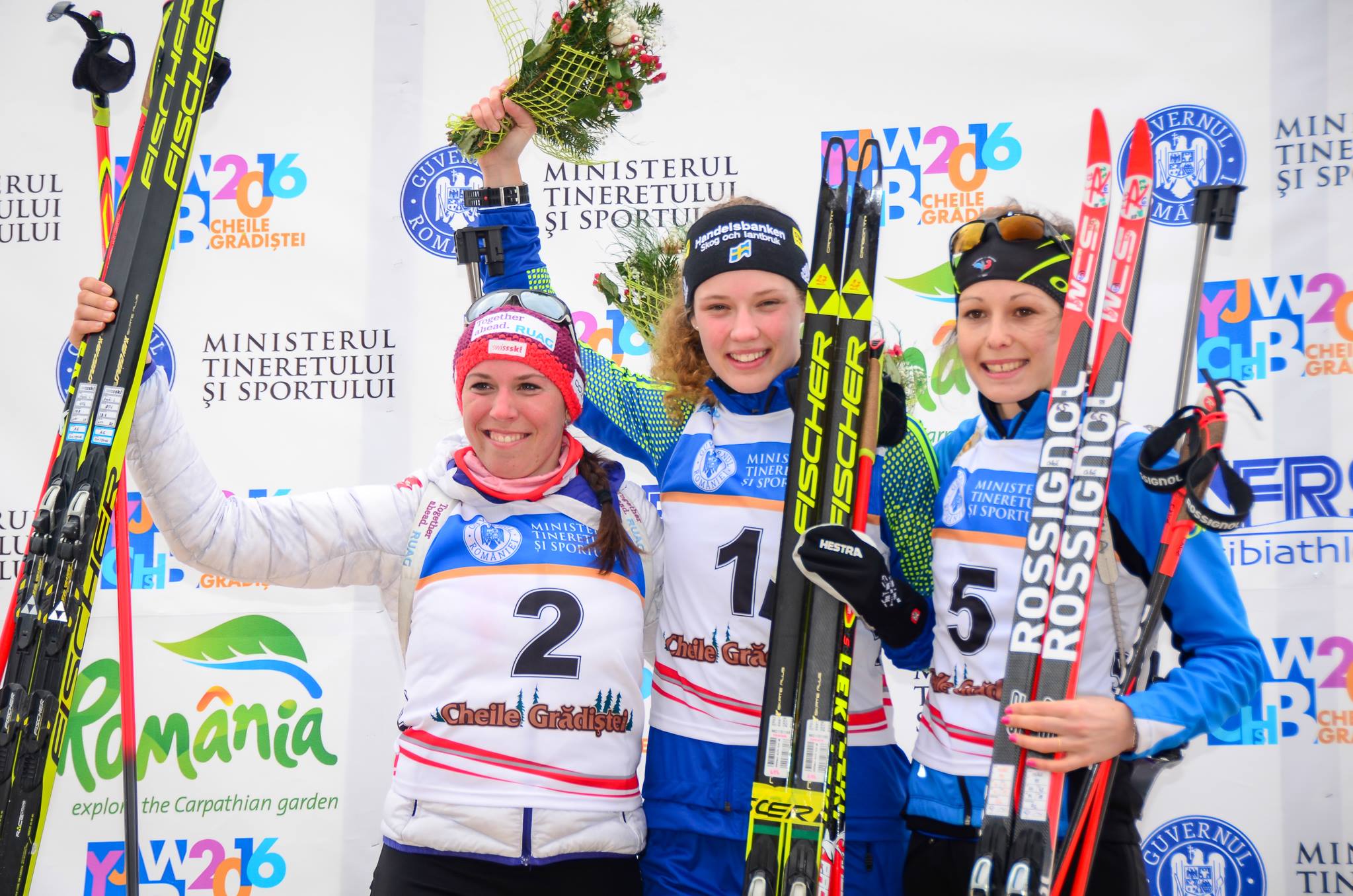
The junior women’s pursuit podium, with winner Hanna Öberg (c) of Sweden, Switzerland’s Lena Häcki (l) in second, and France’s Chloe Chevalier (r) in third. (Photo: IBU YJWCH Cheile Gradistei 2016/Facebook)
While Öberg cleaned the four-stage pursuit to win in 33:16.8, Häcki finished second, 13.7 seconds back, with six penalties (0+2+3+1) and the fastest overall course time by just over a minute.
“I felt crazy good on the skis today, it just went all by itself,” Häcki said during a post-race press conference. “After the three misses in the third shooting, it was then very difficult for me. But after I got the info from my coaches that I was still on course for the medals, I could really turn it up again.”
“I couldn’t believe I get the second gold medal in a row,” Öberg said, according to the event organizers’ Facebook page. “I was so tired during the race today. Lena is so great on skiing. I was not nervous on the shooting range and like yesterday, I was confident.”
France’s Chloe Chevalier rose from fifth to third (+41.9) with two penalties, both in the first stage (2+0+0+0).
“I am really happy to be on the podium,” Chevalier said. “After my first shooting it was very hard, but I was very motivated today so after that I did zero mistakes.”
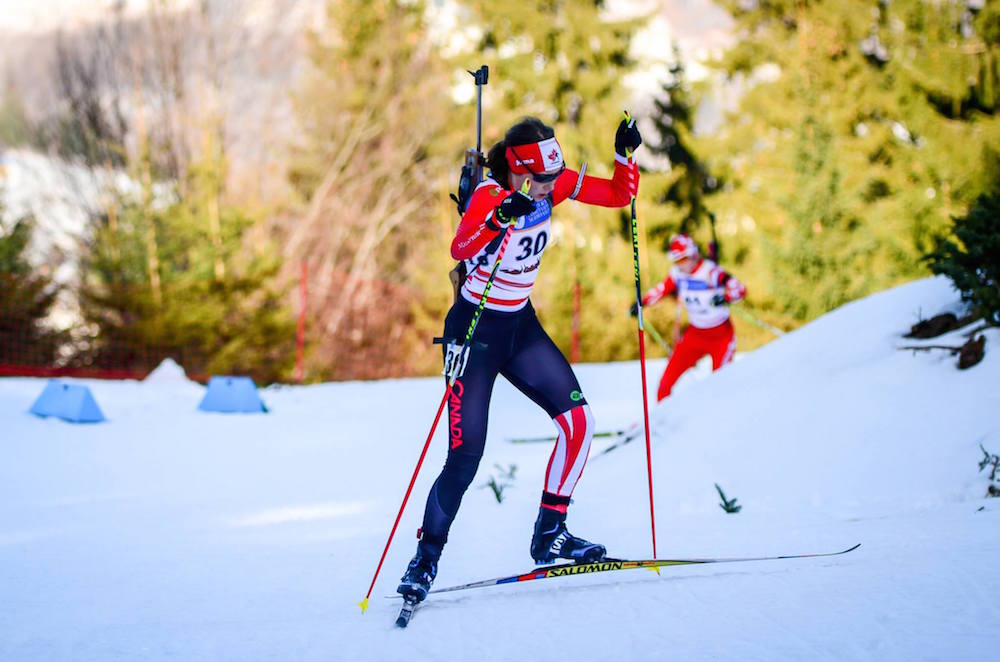
Maddie Phaneuf racing at 2016 IBU Junior World Championships in Cheile Gradistei, Romania, where she notched three consecutive top 10 results. (Photo: IBU YJWCH Cheile Gradistei 2016/Facebook)
Phaneuf explained in an email to FasterSkier that she was hoping to reach the top six and flower ceremony that came with it for the second time this week. She placed fifth in the 12.5 k individual.
“But I also just wanted to stay in the top ten!” she wrote on Sunday. “I found myself consistently in around 5th place throughout the race. I was not happy with missing one in my first prone, but glad to be skiing fast and holding my positions.”
Despite feeling tired during the second half of the race, Phaneuf posted the sixth-fastest course time on the last loop.
“I just tried to ski hard and not let any girls pass me,” she wrote. “I was skiing mostly alone on that loop I think, I didn’t even know there was a Russian behind me until the last 500 meters before the finish.”
She held off Russia’s Kristina Reztsova by 3.6 seconds for ninth place, and finished 11.7 seconds out behind Germany’s Christin Maier in eighth. For Phaneuf, it was her third-consecutive top 10 of the week (after placing fifth in the individual and seventh in the sprint).
“I was really happy and surprised with my results overall,” she wrote. “The training I’ve been doing with [US Biathlon development coach] Jean [Paquet] all year is showing in my skiing and strength and it’s been really great!”
Also in the junior pursuit, Canada’s Leilani Tam von Burg placed 33rd (+6:13.2) after starting 28th. While the 20-year-old Ottawa native and Chelsea Nordic skier cleaned both prone stages, she missed three between the two standing stages (0+0+1+2). Siena Ellingson placed 50th for the U.S. after starting 48th, ending the day with six penalties (1+1+3+1). Canadian Kendall Chong finished 58th with eight penalties (3+1+3+2) after starting 51st.
While Doherty was the lone American in the junior men’s pursuit, Aidan Millar led the Canadian men in 37th (+6:00). He improved 18 places with 19-for-20 shooting (0+1+0+0) to post his best result of these championships (his third).
“I was pretty happy with how the race played out. Especially on the shooting range,” Miller wrote. “Felt pretty strong on my skis but faded a little in the last lap. Overall I was super disappointed with the championships. Going in I wanted a top 10 so obviously didn’t meet that. My shooting was no where near as good as it should have been which was the most disappointing part. Over the week my skiing felt better and better but still not as fast as it needed to be for a top 10.”
Also for Canada, Matthew Strum finished 47th with four penalties (1+1+0+2) after starting 37th, and Pearce Hanna placed 49th with 11 misses (2+4+3+2), slipping one spot from 48th.
Three Canadians in Top 20
Megan Bankes racing to 26th in the women’s 6 k sprint at IBU Youth World Championships in Cheile Gradistei, Romania. (Photo: IBU YJWCH Cheile Gradistei 2016/Facebook)
Three familiar Canadian youth skiers again landed in the top 20: Teo Sanchez in 17th (+4:54.9) and Adam Runnalls in 19th (+5:10.5) in the youth men’s 10 k pursuit, and Megan Bankes in 18th (+3:47) in the youth women’s 7.5 k pursuit.
The result stood as the second-straight 17th place for Sanchez, 18, of Wakefield, Quebec. He shot 95 percent with a single miss on the first standing stage (0+0+1+0). In all three races this week, Sanchez has shot 90 percent or better.
“I’m a little disappointed with my result considering my skiing. It was kind of frustrating to shoot so well but not ski very fast,” Sanchez wrote on Sunday. His course time ranked 48th overall.
“I feel like I could’ve been several spots higher,” he added. “17th place is still nothing to scoff at though. I think overall, three top 20’s is pretty awesome and it shows some pretty good consistency.”
For Runnalls, 80 percent shooting with four penalties (0+0+3+1) was right where he had been all week.
“I was a little nervous coming into today because I had never done a ‘real’ pursuit before,” Runnalls, 17, of Calgary, wrote in an email. “In Canada pursuits are usually started with 5 second gaps between starters but here at world juniors we start at the time we finished behind the winner of the sprint. This new style of pursuit was a little intimidating in the start gate.
“After my second clean prone shooting I tried to keep a clear head and not get ahead of myself,” he explained. “I knew that with 2 clean prones I was in a good spot and need to nail my standing.”
However, he described overthinking his first standing stage and slowing down too much.
“I tried too hard to find the perfect shot and didn’t follow my normal pattern, which caused me to only hit 2,” Runnalls wrote. “Coming into my second standing I told myself that this was a do or die moment and to not overthink it, follow my normal pattern which worked out with me hitting 4.
“I am super excited about my finishes here as it shows I belong here on the international stage,” he added. “I couldn’t be happier with the way I performed and with my overall result.”
Russia’s Viacheslav Maleev won the youth men’s pursuit in 30:14 after starting third (based on his third-place finish in Saturday’s sprint). He won by well over a minute after overtaking another Russian, the sprint winner Igor Malinovskii and beating him by 1:07.6 after Malinovskii had seven penalties (2+1+2+2).
Norway’s Harald Øygard, the 12.5 k individual champion, moved up from eighth at the start to third overall (+1:13.4) with two misses (1+0+0+1). Another Norwegian, Aleksander Fjeld Andersen placed fourth (+1:44.1) for the second-straight race.
Canada’s India McIsaac (54) and American Claire Waichler (behind, in bib 58) await their start during the youth women’s pursuit at IBU Youth/Junior World Championships in Cheile Gradistei, Romania. (Photo: IBU YJWCH Cheile Gradistei 2016/Facebook)
In the youth women’s pursuit, Kazakhstan’s Ariana Pantova started sixth and cleaned every target but one in her first stage to win her first world title in 27:15.2. Ukraine’s Anna Kryvonos rose from third to second place at the finish, 3.4 seconds back, and Germany’s Marina Sauter reached the podium for the second time this week in third (+1:02.9) after starting 14th. While Kryvonos had three penalties (0+0+1+2), Sauter had two (0+1+0+1).
Canada’s Bankes missed seven targets (2+1+2+2), but skied the seventh-fastest course time to place 18th. It was her second top 20 of the week, after finishing 19th in the 10 k individual.
“The goal for today was to continue my fast skiing in order to move up as many places as possible, and focus on hitting more targets,” Bankes wrote in an email. “Because the course and the race are both quite short, fast skiing was necessary, but good shooting was really important, especially in the first bout. My skiing felt pretty strong again today, however the snow on the course was pretty soft, which made my legs quite tired right off the start.”
She lost track of her position rounding the penalty loop twice after the last stage, and explained she was excited to learn she finished 18th.
“I knew today that my ski speed would definitely keep me in top 20 contention as long as I could hit a few targets,” she wrote. “Overall I’ve been very pleased with my skiing this week, and it’s nice to see my ski speed progressively get better over the last three years. My main issue this week was my shooting, which I was overall very disappointed with. … On a whole I am super stoked by the results I achieved this week, even if my races weren’t entirely perfect.”
Six places behind her, another Canadian, Nadia Moser placed 24th (+4:52.4) after starting 19th. Moser had eight misses (1+2+3+2) on the day.
American Claire Waichler started 58th and finished 33rd in the youth women’s pursuit on Sunday at IBU Youth/Junior World Championships in Cheile Gradistei, Romania. (Photo: IBU YJWCH Cheile Gradistei 2016/Facebook)
For the U.S., Claire Waichler picked off 25 places to end up 33rd (+5:29.5) with three penalties (0+1+2+0).
“This is my first time at world juniors so I was hoping to just have fun and experience competition at a higher level,” Waichler wrote in an email. “My skiing had been going well throughout the week but the shooting had been unusually rough. So my goal for the pursuit was to keep up the skiing and shoot a cleaner race — at least 70%. When I shot 85% and cleaned twice I was stoked.
“The competition is very strong and being able to chase down foreign girls during the whole race was educational,” she added. “And a top 20 isolate pursuit time was certainly more than I’d hoped for.”
Canada’s Emily Dickson followed in 35th (+5:48.1) with five misses (0+0+3+2) after starting 41st, Amanda Kautzer of the U.S. slipped three places to 55th with 10 penalties (3+2+2+3) and Canada’s India McIsaac went from 54th to 60th with 13 misses (3+3+4+3).
Two American men moved up in the pursuit, with Brendan Cyr rising to 35th (+6:49) with three penalties (0+1+2+0) after starting 46th. For the 18-year-old Maine Winter Sports Center biathlete, it was his first top 40 in his debut world championships.
His teammate Cody Johnson finished 41st (+7:11.1) with two misses (0+2+0+0) after starting 50th.
“I knew that I had plenty of time that I could make up in the Pursuit,” Cyr wrote in an email after starting in bib 46. “I knew that if I came into the range calm and focused on my own shooting process for each of the stages, while also keeping a good rhythm on the skis, I could put together a top-40 performance.
“The key to my success on the range was just making sure that every time I came to the mat, I was not rushing any of my process,” he added of his 85-percent shooting. “On the skis, the key for me was just making sure I kept a good rhythm throughout the race, most importantly towards the end.”
IBU Youth/Junior World Championships conclude with the three-person relays on Monday and Tuesday, with the youth relays on Monday.
Chloe Levins, Kautzer and Ariana Woods are slated to start the youth women’s 3 x 6 k for the U.S., while Dickson, Moser and Banks represent Canada.
In the youth men’s 3 x 7.5 k, Johnson, Vaclav Cervenka and Peter Carroll are listed for the U.S., while Sanchez, Runnalls and Zachari Bolduc are on the start list for Canada.
Canada’s Bryn Robertson (bib 40) and USA’s Amanda Kautzer (bib 39) on course in the youth women’s 7.5 k pursuit in Belarus on Sunday. (Photo: Jake Ellingson)
Sunday was a big day at the Raubichi biathlon venue outside of Minsk, Belarus. With four days of racing at IBU World Youth and Junior Championships, it was time for the pursuits: four on one day. Competitors completed four shooting stages, two prone and two standing, and skied 7.5 (youth women), 10 (junior women, youth men), or 12.5 kilometers (junior men).
With a pursuit format based on results from the previous days’ sprint competitions, there was plenty of excitement and finally, the first head-to-head racing of the Championships.
The youth women’s pursuit, Norway’s Ingrid Landmark Tandrevold cleaned both prone stages and by the second, had moved from third place up to first. She never relinquished her lead despite a penalty in each standing stage. Behind her was the drama: Darya Blashko, the Belorussian winner of the sprint, cross-fired onto Julia Schwaiger’s targets. The Austrian thus couldn’t shoot her own targets in a timely fashion, but was given a time credit that moved her into second place. Blashko was penalized ten minutes. Another Austrian, Simone Kupfner, finished third.
That may have been the most dramatic incidence in any of the races, but there was plenty of good, catastrophe-free racing. In the junior women’s pursuit, two women managed to shoot a perfect 20 for 20: Marie Heinrich of Germany, who moved from fourth after the sprint up through the leaders and won by 15.4 seconds over Galina Vishnevskaya of Russia, and Yuliya Zhuravok of Ukraine, who moved from eighth up to third. Maddie Phaneuf of the United States had three clean stages and one with two penalties, and moved from 33rd up to 22nd.
In the junior men’s competition, Eduard Latypov of Russia took the win by 24.4 seconds over Vermund Gurigard of Norway. Alexander Povarnitsyn, also of Russia, finished third. There were great hopes on North American competitors, but Sean Doherty and Aidan Millar both struggled on the range. Doherty had placed third in the sprint and Millar had placed eighth, but the pair finished 11th and 14th after seven and six penalties, respectively.
Finally, in the youth men’s pursuit, Felix Leitner of Austria won an exciting sprint finish against Kirill Streltsov of Russia. Streltsov had left the range for the final time 23 seconds behind Leitner, but made up 20 seconds on the trails and almost caught him by the finish. Mattias Haug of Norway finished third; all three hit 18 of their 20 shots. Pearce Hanna of Canada shot an impressive race, collecting only three penalties as he moved from 34th after the sprint all the way up to 13th place.
Here’s a photo gallery of the day; below the jump, find notes and quotes from the North American competitors.
Paul Everett racing at 2015 IBU Junior World Championships near Minsk, Belarus. (Photo: Jake Ellingson)
Photo: Jake Ellingson.
Photo: Jake Ellingson.
Photo: Jake Ellingson.
Photo: Jake Ellingson.
Photo: Jane Robertson
Photo: Jake Ellingson.
Eisenbichler testing skis in 2015. (Photo: Jake Ellingson)
Photo: Jake Ellingson.
Photo: Jake Ellingson.
l Photo: Jane Robertson
Photo: Jake Ellingson.
Aidan Millar competing in Minsk. (Photo: Jane Robertson)
Photo: Jake Ellingson.
Richard Boruta, head coach at the Biathlon Alberta Training Center. died in a climbing accident on August, 9th. (Photo: Jane Robertson)
Photo: Jake Ellingson.
Photo: Jake Ellingson.
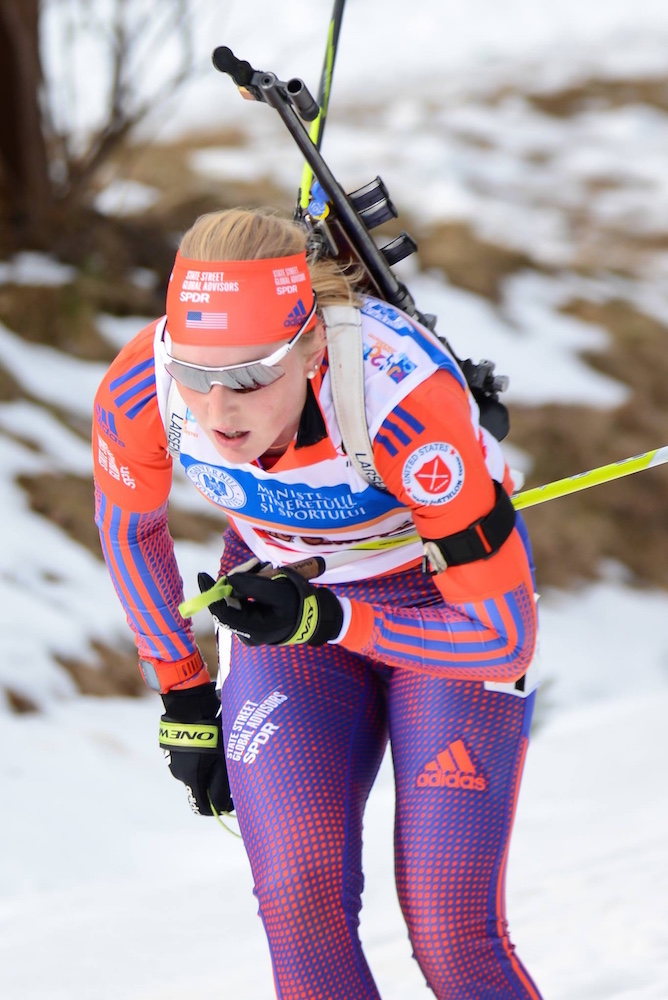
Sarah Beaudry racing in 2015 (Photo: Jake Ellingson)
Photo: Jake Ellingson.
Carsen Campbell competing at 2015 World Junior Championships. (Photo: Jake Ellingson.)
Photo: Jake Ellingson.
Photo: Jane Robertson
Photo: Jake Ellingson.
Carsen Campbell (l) racing in 2015. (Photo: Jake Ellingson)
Photo: Jane Robertson
Photo: Jane Robertson
Sean Doherty competing at 2015 World Junior Championships in Minsk, Belarus. (Photo: Jakob Ellingson)
Photo: Jane Robertson
Photo: Jane Robertson
Photo: Jake Ellingson.
The Top Finishers
“I am a little disappointed, definitely wanted to hit a few more targets but felt great on the skis again,” wrote Millar of his 14th-place finish. “The range was really calm so I’m not really sure why the shooting was so poor. Coming out of the range and up the first hill was very deep slush so I just tried to keep a half decent pace through there then make up ground on the firmer snow.”
“I was really happy with my shooting, I think that’s the best percentage (90% hits) I’ve had in a four stage shooting race before,” explained Phaneuf, who is in her first year of junior racing after competing as a youth last season. “Going into the pursuit I was mostly just getting really excited to race, because pursuits always seem to be more chaotic and fun. I told myself before the race that a lot of time can be made up on the range, and if I shot well I could move up quite a bit…which was true! It was nice to see myself getting a top 25, and only being 8 seconds out of the top 20.”
On Gaining Experience
Phaneuf has been bouncing all over Europe so far this season, competing at Open European Championships as well as on the World Cup, where she competed in a sprint and a relay.
“I think being over here in Europe for over a month before these World Junior races really helped me get ready,” she wrote. “This season I raced more international races than I ever have before, and now I see myself being much more comfortable in this type of higher competition… I think being slowly introduced to the highest level has helped me as an athlete. It also has given me an idea of what I need to do to stay on that level of competition. I know I am not ready to make the full jump into the World Cup level, but in the next couple of years I hope to see myself becoming competitive on that circuit.”
“I have definitely felt more prepared this time round, because I knew, more or less, what to expect,” wrote Canada’s Megan Bankes, who raced from 45th up to 27th in the youth women’s pursuit. “Last year was mainly about the experience, and this year I was more focused on results.”
“I am a first year junior this year, so I have one more year to prove myself at the World Champs, next year being in Romania,” wrote Canada’s Matt Strum, who placed 49th in the junior pursuit. “Compared to my trip in 2013 to Obertilliach, I feel like a stronger athlete, more capable, and generally more prepared for what was to come, as the Champs are probably the biggest events I have attended. In Austria, it was a bit of a shock to the system, and I was more in awe of my accomplishment of making the team, so my performance probably wasn’t at the peak for that season. This year however, I have more experience racing internationally, so I have expected to and succeeded at performing at a higher level.”
Or, On Being a Newbie
“This being my first international competition has been quite the eye opener,” wrote Canada’s Bryn Robertson, who finished 40th in both the sprint and the pursuit. “When you come here you realize how big the sport is in Belarus, and Europe for that fact. It is amazing to see hundreds of spectators at the range and lining the course during the races with flags waving and horns honking as the competitors ski by. Talking to some of the other competitors here is very inspiring because of how energized they are about the sport and how hard they work to improve themselves. This made me realize how important it is to have a dream and to set goals to get to that dream because otherwise you will never get where you want to be racing if the heart isn’t there. And in Europe, the heart is really there.”
“The level of competition is insane,” agreed fellow youth competitor Amanda Kautzer of the U.S. “I found myself saying over and over ‘wow, those (insert country name here) are so fast/strong/ good shooters.’ I am glad for the opportunity to be here as it is definitely making me a better athlete. I’m just trying to absorb and learn as much as I can from all the amazing athletes around me.”
On Shooting Well
“Today in the pursuit, I knew that my skiing would be pretty strong, so I really focused on making each shot count, and not going to the penalty loop,” wrote Canada’s Bankes. “After missing 2 in the first prone, I was a little disheartened, but got a correction, and then only had one other miss in my first standing. I was particularly happy with my second standing shooting because I cleaned, and had the 4th fastest shooting time for the bout.
“When I came into the second standing, I didn’t take time to really set my position and focus my attention on the targets before I started shooting and missed 3 which set me back a little,” wrote teammate Robertson. “The range was very busy! It is very different from racing in Canada because there are so many people rushing into the range at once. It can be very distracting! You don’t realize how ten other people entering the range at the same time as you can influence your mind space!”
“To be honest, I think I got a little too excited,” wrote Kautzer of a stage where she missed four shots. After placing 39th in the sprint, she finished 46th in the pursuit. “I zeroed for no wind, and there was a slight wind coming into the range the first stage so I took 2 clicks. At home I mostly shoot at a small 10 point range in the middle of the woods virtually wind free, so was very nervous about the wind and how to take clicks. By the time I got to standing I was relieved I didn’t have to worry about clicks and since the prone had gone so well (usually I miss more prone) I thought standing would go better. I rushed it and took shots that I should have waited out and taken another breath for.”
On Last-Lap Heroics
“The last lap was very hard but also a lot of fun,” wrote Canada’s Millar, who had to defend his 14th-place position from several challengers and held off Germany’s Johannes Werner Donhauser by just 0.4 seconds. “I had a good battle with one of Germans and tried to drop him on the last hill before you come down in to the finish. He was able to stay with me but the great skis we’ve had all week helped me get the few meters I needed.”
On Disappointment
“Overall I’m indifferent with my results,” wrote Mikaela Paluszek of the U.S., who finished 55th in the pursuit. “Of course I wanted to do better than the paper showed, but I’m still learning. Being able to go to Open European Champs I do believe helped me a little bit as well. Without Open European Champs, Junior Worlds would only have been my second set of biathlon races this year. Despite getting sick for the last race in Estonia it was great to get a few more competitions done before Belarus.”
”I believe that I was focusing too much on keeping up with the field and was not aware of the speed coming into the range,” wrote Chloe Levins, an American who finished 18th in the youth women’s sprint but slipped to 42nd in the pursuit with nine penalties. “I am happier with my ski speed and believe that I maintained a good present focus throughout the race. I stayed relaxed, despite many misses, and accepted the challenge to make up some time on the track. I am disappointed in the outcome, but there are many things to learn from this race that will be useful going into another head-to-head competition tomorrow. I will focus on being smooth on the range without hesitation.”
“I was very disappointed with my result in the sprint,” wrote Jakob Ellingson, an American who placed 65th in the junior men’s sprint and missed the cutoff for the pursuit by 17 seconds. “I am not a fast enough skier to get away with missing 5, and I knew that ahead of time. I did ski as fast I had hoped I was going to, and if (biathlon is full of these ifs) I had held it together prone I could have had a good result. I know that on a better day I should be able hit more than I did. I am pretty sad that I wont have another chance to do what I know I’m capable of doing in an individual race here.”
On Crazy Crowds
“The number of spectators and the atmosphere here is crazy!” wrote Ellingson. “It has really been building up since the first race, not so many were here for the individual, but still more than I’ve ever had cheering for me in any race. Quite a few more for the sprint, and then so far the biggest day was the pursuit. I’m not sure if people will still be here for the relays today and tomorrow. It isn’t the weekend here anymore…
“But yes, the spectators did cheer for Americans as well,” he continued. “There are so many people and its like a party for them on the side of the trail, every body is really excited and when they see somebody skiing up the trail they start making noise. Even if its not a racer, in between races yesterday there were a few officials skiing the course, i think to make sure everything was still good to go, and even they were cheered all the way up the hills!”
On Motivation
“My goal for this competition was to place top 30, but I am not unhappy with my results because, in making that goal, I did not put into account all of the unexpected obstacles and distractions that I have faced,” wrote first-time youth competitor Robertson of Canada. “There has been huge value in what I have learned this week, despite the fact that my performance was probably lower than my typical performance in Canadian races. I have learned so much about international racing that I would never have discovered if I hadn’t had this opportunity. I have been inspired by my team, the crowds, and my competitors – and this will motivate me to train to the top of my abilities in time to come. This trip has given me something to work toward outside our small pool of Canadian athletes.”
Aidan Millar (Canada/Biathlon Alberta Training Center) racing to eighth place in the 10 k sprint at biathlon World Junior Championships in Raubichi, Belarus. (Photo: Jane Robertson)
Canmore, Alberta’s Aidan Millar was the third man onto the course in Saturday’s individual-start 10 k sprint at World Junior Championships for biathlon in Raubichi, Belarus.
With little information about his competitors, Millar had to just ski his own best race. He had a penalty in prone but then cleaned in standing, and was unsurprisingly the race leader when he crossed the line. The thing was waiting for the other 90+ racers to finish as well.
“As soon as I had gotten my stuff I left the finish area and went and cooled down away from the TVs and the stadium,” he wrote in an email. “I knew I would probably stay in the top 10 but it was way too hard to watch the results.”
As his team had predicted, it was a top-10 finish when all was said and done. Millar’s time put him in eighth, 44.9 seconds behind Russia’s Aleksandr Dediukhin, who won with a time of 24:49.0.
Millar’s split after the last shooting had him in fifth place, but he was unable to hold onto that position, and lost about 20 seconds to the leaders over the final 3.3 k.
Canada’s Aidan Millar racing in the individual competition earlier this week at World Junior Championships. (Photo: Jane Robertson)
Still, the result was a major recovery after the individual competition, where Millar missed nine shots. He was frustrated with himself and vowed to do better.
“The individual was pretty disappointing shooting-wise,” he explained. “So for the sprint I tried to shoot more in control and not get caught up in shooting fast.”
Despite those goals, Millar actually had the eighth-fastest shooting time in the field. That speed and accuracy helped him to his best-ever result in an international competition. It was also the best result for Canada so far at the Championships, including in the youth competitions which are held on alternating days with the junior races.
At last year’s World Youth Championships in Presque Isle, Maine, he placed ninth in the sprint. But this year is completely different, and not just because the junior field is older and more experienced than the youths, Millar explained.
“I would say it’s definitely a huge step up,” Millar wrote. “With last [Championships] being in North America some of the better countries didn’t send full teams so the field wasn’t as strong. So with the jump from Youth to Junior already making it more competitive the fact that it was in Europe made even that much more competitive than last year. With those things in mind, I’m finding it hard to believe that I was actually able to get that result.”
Millar’s coach at the Biathlon Alberta Training Center, Richard Boruta, is the leader of Canada’s team on the trip and expounded a bit more on the jump Millar has made.
“While in the Youth category lots depends on biological age and other factors, in the Junior category the results are much more representing the quality of training and future potential of the athlete,” he wrote in an email. “By staying in (or at least being capable of) the top ten at [Junior Worlds], athletes are showing that they are on the progression curve necessary for future good performance in the World Cup.”
The age category is not the only change Millar has made this year. He also transitioned from the Canmore Nordic Ski Club to training with Boruta’s training center.
“He has the benefit of training with strong juniors on our team and after his recovery [from a concussion in the fall] his ski speed kept improving during all of our tests and early season races,” Boruta wrote.
He hopes for even more from Millar in the future, but is also content to have eighth place as a standout result.
“Aidan is a prototype of modern high performance biathlete (tall and strong), and I am sure we will hear about him in the future again,” Boruta wrote. “I am really happy for his result today and his goal for Pursuit is to learn how it feels to compete head-to-head with the best in the world. I would like to think that another top ten is possibility, but the field is very competitive, so it will likely come down to shooting performance during the entire race.”
As for Millar, he professed to have no results-based goals for the pursuit, which will be held on Sunday.
“Try and stay calm, shoot in control and see what happens,” he wrote.
But regardless, the top-ten is a confidence boost that still leaves him marveling.
“I’m super happy with the result,” he wrote. “I didn’t really have a results goal coming in to the Championships but 8th was beyond my expectations.”
Also in the junior men’s sprint, Matthew Strum finished 46th with one penalty, and Carsen Campbell 55th with three. Both made it inside the 60-man cutoff to compete in Sunday’s pursuit.
Stuart Harden, one of Canada’s top young biathletes, did not start the race. He explained in a facebook post that he woke up with a cold and is trying to recover in time for the relay early next week.
In the junior women’s 7.5 k sprint, Sarah Beaudry placed 38th with three penalties.
Canada (l) won silver in the youth men’s relay. Russia (c) took first and Finland (r) was third. Photo: Biathlon Canada.
The Canadian biathlon team has turned in impressive results at the highest level over the past years, but as several top athletes wind down their careers, questions about the future of the program arise.
Alex Dupuis, Aidan Millar and Jules Burnotte may not have answered those queries definitively, but they certainly gave a resounding reason to be optimistic.
The trio teamed up to win silver in the youth relay at the biathlon World Youth/Junior Championships in Presque Isle, Maine, edging out Finland by just 3.7 seconds.
After a week of strong results, with all three men posting individual top-10 results, Canadian coach Roddy Ward was not surprised to see his squad on the podium.
“Last night we told the Youth Men that they would not need to do anything special – just have 3 solid legs. 3 normal performances and they would have a good result. Using some spares would be fine but they needed to be sure they are in control in the range to avoid the penalty loop,” Ward wrote to FasterSkier in an email.”
The Canadians did just that, finishing the day as the only team to ski just a single penalty lap. Russia, who ran away with the win by over two minutes, used one less spare round — nine to Canada’s ten — but finished with two penalties.
Dupuis started strong, needing just one spare in prime and two in standing to tag off in second, 28.7 seconds down on Yaroslav Kostyukov of Russia.
“Alex started off really strong, skiing near the front and just a normal routine in the range. He is a fighter by nature and created the momentum for the team,” Ward wrote of his scramble skier.
Millar tags Burnotte for the third leg. Photo: Biathlon Canada
Millar took over, shooting identically to his teammate, and keeping the Canadians in the medal hunt. He dropped to third, behind the U.S.
“Aidan’s job was to run his own race, pace it smart and take his time on the range to ensure he avoided the penalty loop. Aidan had a great leg,” Ward explained.
“I just wanted to ski my own race race and not worry about positions or anything,” Millar wrote in an email to FasterSkier. “The shooting went well and I was able to focus on my shooting and execute properly. My skiing felt fast and I just left everything on the course.
Olympian Sean Doherty moved the Americans from 6th, +1:09 up to second with a blistering second leg. Doherty used a single spare in both prone and standing while taking nearly third seconds out of the next fastest racer, Poland’s Mateusz Janik.
It was not meant to be the American’s day however. Brian Halligan ended up with two penalties in prone, and another in standing, to drop the team back to 5th, where they would ultimately finish.
Canada, on the other hand, moved in the other direction. The towering 6’5” Burnotte earned a penalty in prone, but kept his composure, and bested Finland in a sprint to the line.
“We figured Jules to be the guy to battle in the last standing, that is why he was chosen for the final leg,” Ward wrote. “He has a carefree personality and we thought that would serve him well under stress. We also knew Jules had great speed for that final loop and at 6’5″ had the pure speed if it came down to a sprint. The race ended up playing out as expected, Jules kept his composure perfectly and won a sprint to the finish against Finland.”
Millar wrote that he didn’t know exactly how to describe the feeling of winning a medal, saying, “it was more then happiness and excitement. It’s unbelievable.”
The Canadians celebrate as Brunotte crosses the line for silver. Photo: Biathlon Canada.
Ward witnessed a distinct difference between the winning Russians and the Canadians. The victors, he wrote, looked “relived and happy” in the finish area. “Our guys looked like they just won the lottery when they crossed the finish line!”
He explained that the teams came in different expectations and that he doesn’t think he has ever seen athletes as excited as his team.
“The whole finish, medal ceremony and press conference was pretty fun to watch, they were just buzzing with excitement!” Ward wrote.
And looking forward?
“This season has been fun with great results at all levels (Olympics, WC, IBU Cup and WJYCH). We have some serious momentum going so we need to plan smart and empower all our programs across the country to keep this momentum moving forward,” Ward concluded. “This week has shown that we have good depth in our ranks, which bodes well for the future of course.”
Canadian Stuart Harden in the finish pen, moments before he learned of his 2 minute penalty
In his address to the competitors and spectators who packed the bleachers of the Bergisel stadium during the Opening Ceremonies of the inaugural Winter Youth Olympic Games in Innsbruck, IOC President Jacques Rogge emphasized the importance of the Games with respect to the core Olympic values. “You have a chance to be true champions, not only by winning medals, but by conducting yourself like Olympians,” Rogge told the 1,078 Youth Olympians in attendance.
YOGGL, the mascot of the Games, was on hand to spark some serious enthusiasm in the fans. He's a lucky charm for athletes and is a vivid example of the Innsbruck 2012 motto "be part of it!"
Today in Seefeld, the true spirit of an Olympian was epitomized by young Canadian Stuart Harden who crossed the line in first position, but was regulated minutes after his finish to 7th place after being penalized for failing to ski his single penalty loop of the day. Gold went instead to Germany’s Niklas Homberg. Rene Zahkna of Estonia took Silver, finishing 9.5 seconds behind Homberg, and Fangming Cheng—yesterday’s winner—added a Bronze medal to his collection, finishing 14.6 seconds off the pace.
2002 Gold Medalist and Canadian YOG Team Leader Beckie Scott was on hand with husband Justin Wadsworth and son Teo to take in today's Biathlon Pursuit action
How it unfolded–
For today’s Biathlon Pursuit, the 50 competitors completed four laps of a 2.5km course and shot four times during two prone and two standing stages. Yesterday’s champion, Fangming Cheng of China, set out first with a 21 second advantage over Rene Zahkna of Estonia and a 27 second cushion on Aristide Begue of France.
But it was the fourth starter, Stuart Harden of Calgary, who would prove to be biggest threat to the top starters. Harden and Coach Chris Lindsay devised a pre-race strategy in which Harden would combine progressively more aggressive skiing with his reliably consistent shooting to fight for the podium. Both had high expectations coming into the event.
“Stu was very happy with his race [yesterday’s Sprint]. Deep down, I think he’s anxious because he knows there’s an opportunity to be the first Canadian to come away with a medal here [at the Games]. Stu knows that if he has another race like he had yesterday, the medal will come to him,” Lindsay explained to FasterSkier in a trackside interview before the race start.
“The reality is, there’s nothing to protect here. 4th or 10th, it doesn’t matter. He [Harden] is going to ski a strategic race in the first half, and then ramp it up and see what kind of damage we can do,” said Lindsay moments before the race started, under the same ideal conditions which graced Seefeld for the past three days: crisp, firm tracks, blue skies tainted by nothing other than jet contrails, and calm winds.
Fans line the finishing straight in the Seefeld Biathlon stadium
As the competitors headed into the range after the first lap, it was clear that Harden was doing some serious damage indeed.
When race leader Cheng and sixth placed Homberg both missed two penalties on the first prone stage, Harden cleaned. And then he cleaned again, and again once more during the first shooting stage. The massive crowd began to rally behind the young Canadian who turned heads with his mechanically precise shooting.
“He’s a methodical shooter, not a speed shooter,” noted Lindsay.
By the time the racers headed up the sharp uphill heading into the range, it was clear that the final standing stage would determine the winner. The crowd went silent as Cheng and Harden stood side by side, taking their final shots of the day.
Canada's Stuart Harden and China's Fangming Cheng go head to head during the final shooting stage
Cheng missed, and missed again. Harden, who opted to take several breaths in between shots, missed the first shot but nailed the final four. Cheng took off first towards the penalty loops, having missed three shots, with Harden following close behind. With a penalty loop taking competitors roughly 15-20 seconds, Harden realized that he’d have a 30 second advantage on Cheng for the final 2.5km of racing. Gold was in his sights.
But then Harden turned left, onto the course, instead of right, which would have sent him onto his required penalty loop. It was a mistake that would cost him the victory.
No one recognized the error in time, and Harden continued his final loop, oblivious of his mistake and focused on holding off the notoriously fast Cheng.
Fangming Cheng of China completes one of his three required penalty loops following the final standing shooting stage. Harden is posted as race leader on the scoreboard.
“I think I can say I was having the race of my life,” explained Harden to FasterSkier after the race, “My mindset was go-go-go, and I simply missed the penalty loop. It cost me a penalty, and that’s what happened.”
As Harden raced up the final steep climb before the descent to the finish, the young Canadian seemed destined for a textbook victory. 2002 Gold Medalist and Canadian YOG Team Leader Beckie Scott was cheering with Harden’s parents at the finish, ready to congratulate the Calgarian. The crowd roared as the North American grabbed a flag from a fan and coasted to the line, no rivals in sight.
Yet the stadium quickly fell silent as Harden’s name appeared atop the score board with an asterisk beside it. Lindsay confirmed that his young skier had indeed failed to complete his final penalty loop, and he was penalized 2 minutes—the standard penalty for failing to complete a loop.
Stuart Harden slotting into the first position. Crowds fell silent after an asterisk appeared beside his name, indicating that the placing was in question
Harden stood in the finish pen after the race surrounded by three of his biggest supporters: his parents and his coach. The young athlete was clearly rattled, having gone from experiencing the euphoria of his first international win, to suddenly learning of the penalty and its effect on his result. Despite the commotion, Harden demonstrated experience beyond his years in recounting how his race unfolded.
“Despite the penalty, I could feel worse. I’m pretty happy with how I feel,” Harden told FasterSkier post race. Asked how he might learn from the incident, Harden replied, “I’m learning a lot from it, and I’m sure I’ll learn more. It’s only been a few minutes. I already feel better about it. You know, it’s never going to happen again. It’s just one more thing on my way to the World Cup, the World Championships, and the real Olympics—if I get there. I’m building up, and I’m still really confident in myself.”
Harden wasn’t the only North American to experience ups and downs on the course today. Sean Doherty, who began the race in 12th, moved up to 7th place after missing one target in each of the first two prone stages. But in the first standing stage, Doherty dirtied, missing all five shots.
Sean Doherty of Conway, New Hampshire shoots during a prone stage of today's Biathlon Pursuit
“I kind of made a major mistake there. Obviously. But then I put my head down and just skied really, really hard, and worked my way back up to 14th. So the day ended up alright,” Doherty told FasterSkier.
“I just lost it mentally a little bit,” explained the young American about his collapse in the first standing stage, “I didn’t feel that off, but just didn’t hold it together. Kinda wish I could have that one back.”
Doherty and teammate Nick Proell stood together after the finish, supporting one another after a challenging day. But like Harden, they’d each learned valuable lessons which would help them on their way towards success at the “real” Olympic Games. Proell ended up finishing in 40th place, with a total of 8 penalties. Canadian Aidan Millar finished 32nd, finishing 5:33 back of Homburg.
Teammates nick Proell and Sean Doherty touch base with FasterSkier after the 10km Biathlon Pursuit
But both teams remained positive, optimistic and highly motivated for the upcoming Mixed Relay. Proell and Doherty joked that some serious Wiener Schnitzel for dinner might be just what they’d need to deliver strong performances later in the week.
While they didn’t manage to claim spots on the podium today, the North American biathletes personified perhaps what are the primary goals of this unique event: to give it all on course, to be part of the event, and to be a supportive member of a strong team.
“Stuart is the anchor for our team here. I think the actual happening here, the situation that Stuart found himself in, has actually buoyed up the spirits of everyone on our team,” reflected Coach Lindsay after the finish. “I think the rest of the team— because we’re very tight as a group—is anxious to help him realize the dream it’s obvious he had as he crossed the line today.”
Finishers from today's Youth Olympic Biathlon Pursuit event
If today’s performance was any indication, we’ll have plenty to look forward to from the strong North American biathletes at these Youth Olympic Games, both in the upcoming relay, and on the world stage in years to come.
Aidan Millar competing for the Canmore Nordic Ski Club last season. Courtesy photo.
Canmore’s Aidan Millar might be the only Canadian biathlete headed to the Youth Olympic Games who doesn’t have international racing experience, but that doesn’t mean that he’s unprepared for the world stage.
For one thing, training in Canmore has meant that he can keep an eye on the competition: Canadian teammates Danielle Vrielink and Stuart Harden are also members of different clubs based out of the 1988 Olympic venue. The plethora of talented youngsters makes it difficult to stand out, but easy to get faster.
And over the last few years, Millar has done just that, making a spot for himself both in the competitive Canmore community as well as on the Canadian biathlon scene. In 2010, the Alberta Biathlon Club recognized his progress by awarding him a grant for a summer development camp.
The move paid off – in part because Millar decided to quit basketball and focus entirely on biathlon, according to coach Roddy Ward.
“His change in commitment and effort in training last season made a huge difference,” Ward told FasterSkier. “His progress through the season was impressive and he finished off the year with multiple medals at Biathlon National Championships and a spot on the YOG team. Aidan also had some very good races at Cross Country Nationals.”
In 2011, Millar improved steadily over the course of the season, first notching NorAm podiums and then winning the sprint at Alberta Championships, which also served as the sixth NorAm weekend. He capped the season off by collecting two age-group medals at Canadian national championships, results that ultimately led to his nomination for Innsbruck.
Ward knew that Millar’s best was yet to come.
“Aidan’s potential in the sport is very good of course, as long as he stays motivated, resilient and works hard in training each year,” Ward said. “Aidan does not shy away from the hard work and he maintains a good perspective on life, so I am excited to see how far he can take it.”
FasterSkier checked in with Millar to see how he was preparing for the Games.
FasterSkier: Can you tell me a little bit about your history as a skier? How did you get into skiing when you were growing up?
Aidan Millar: I first started skiing when I was about nine years old when I joined the local jackrabbit program. Near the end of my jackrabbit career I had someone from the level above come and talk to my group about what the next level was all about. When I joined the next level (which at the time was called Radical Skiers Unlimited) that’s when I really started to love skiing.
FS: When did you take up biathlon and what made you want to do it?
AM: While I was in jackrabbits I had the opportunity to try biathlon. Trying biathlon was one of the main factors that made me continue to the next level. I really liked it for the different aspect it gave to cross-country skiing and it made cross-country more interesting for me.
FS: What team do you train with in Canmore, and who is your coach?
AM: My club is the Canmore Nordic Ski Club. I train with all the older biathletes and cross country skiers in the club who range from 14 to 17. I have some great people to train with who push me and help keep it fun. In my club the biathletes and cross country skiers train together every week, so I train with some very fast skiers. We are all close in ability so it is a great group to train with to help improve my skiing. My biathlon coach is Roddy Ward and in the skiing aspect I have Alain Parent as well as Roddy Ward. Both my coaches are great and they have really helped me to get to where I am.
FS: So there’s a lot of competition for you in Canmore – do you feel like that’s a benefit?
AM: Training here is great. There are so many fast skiers around to push yourself against or others who are pushing you. In Canmore we are friends with some of the kids from other clubs so it’s a friendly atmosphere. With lots of clubs training in Canmore, you get to see how other athletes training is going and how you measure up against them.
FS: Besides having a strong club team, there are a lot of great senior racers kicking around Canmore. Do you feel like you’ve learned a lot from being exposed to senior training groups?
AM: It’s really cool having both the senior biathlon and cross-country teams here. It gives you someone to aspire to and look up to. I find it really helps motivate me to try and be where they are in the future.
FS: Have you ever raced internationally before?
AM: I have never raced internationally before so I am really looking forward to this opportunity.
FS: What are going to be some of the biggest challenges for you to adapt to at such high-level races?
AM: I think it will be the skiing. Here in Canada we have some great skiers but I think that some of the other nations will be even faster.
FS: Did the fact that you were named to the team so far before the competition change your approach to summer and fall training at all? Are you doing anything differently to prepare?
AM: It has giving me something to look forward to and something to motivate me. I think this year I have really put all my effort into my training so I am excited to see how it pays off.
FS: What are you most looking forward to about the Youth Olympic Games?
AM: Racing against the some of the best in the world. I think it will really give me a chance to see how I measure up internationally. I am also looking forward to just meeting other athletes from all over the world.