From the FasterSkier archive — posts syndicated from athletes’ and coaches’ own blogs between 2004 and 2012, kept online as published. Current coverage is at fasterskier.com.
Coaches: Pepa Miloucheva (head coach); Michael Gibson (biathlon coach); Nick Brown (assistant coach and wax tech); Ethan Dreissigacker (assistant biathlon coach)
Current roster (skiing and biathlon): Braden Becker, Adam Martin, Akeo Maifeld-Carucci, Caitlin Patterson, Michaela Keller-Miller, Margie Freed, Annika Landis, Alex Lawson (skiing); Jake Brown (Luke’s brother), Raleigh Goessling, Hallie Grossman, Susan Dunklee, Kelsey Dickinson, Tara Geraghty-Moats, Clare Egan, Luke Brown (Jake’s brother) (biathlon)
Who’s new: Luke Brown joins the team for biathlon, coming from Crosscut; Carsen Campbell joins the team for biathlon, coming from Rocky Mountain Racers; Tara Geraghty-Moats rejoins the team for biathlon, coming from nordic combined; Annika Landis joins the team for skiing, coming from Sun Valley; Alex Lawson joins the team for skiing after graduating from Middlebury this spring
Who’s still on this team, or otherwise involved in American skiing, from when we did this in 2012: Caitlin Patterson (athlete, skiing); Susan Dunklee and Clare Egan (athletes, biathlon); Maria Stuber (head nordic coach, St. Scholastica); Patrick O’Brien (head coach, SMS Elite Team); also, former CGRP teammates Pat O’Brien and Ida Sargent got married this summer
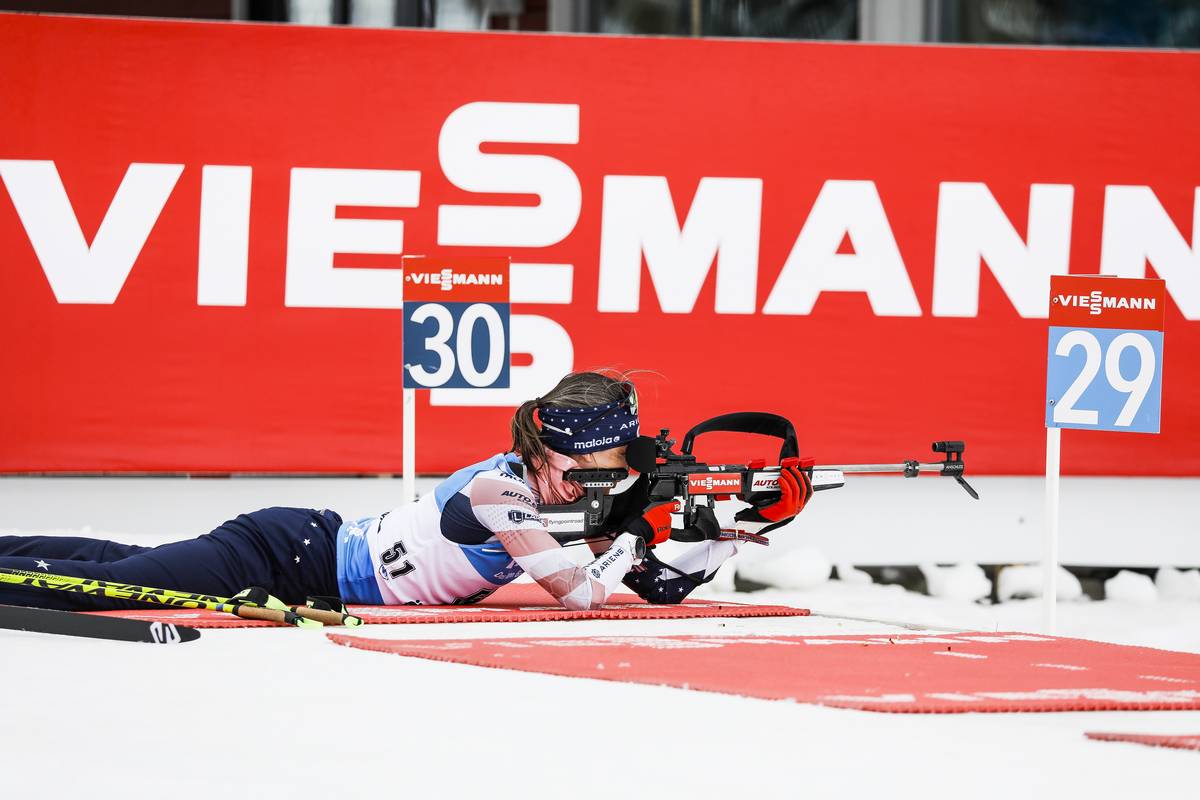
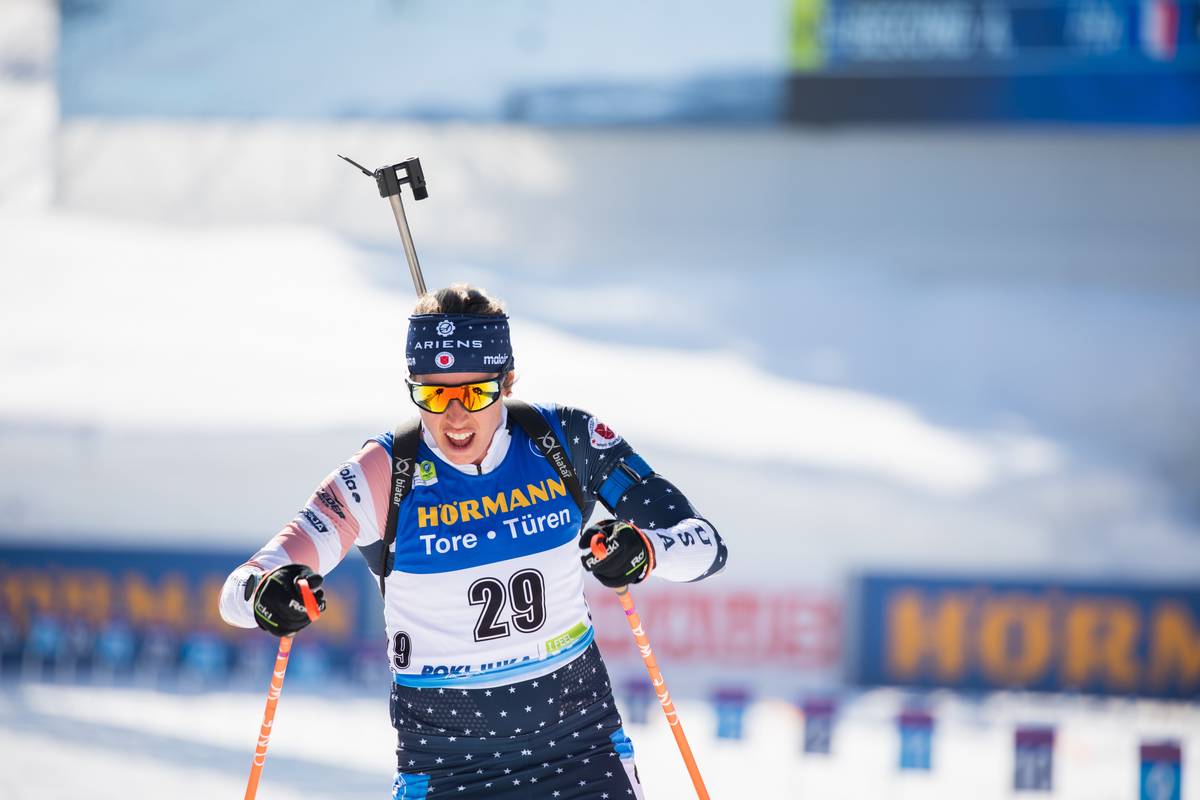
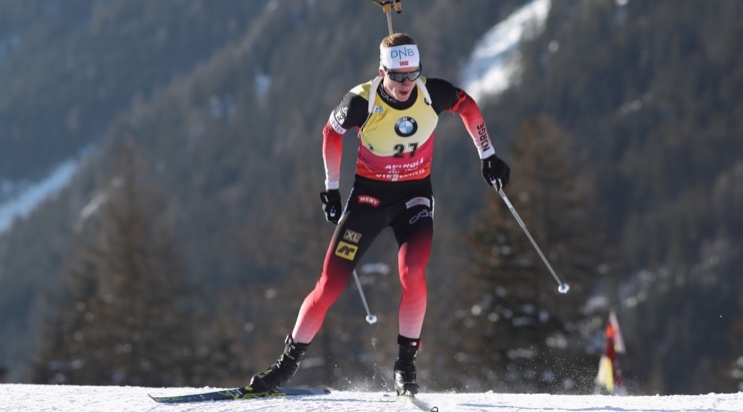
Susan Dunklee in Pokljuka, Slovenia, February 2021. (photo: Manzoni/NordicFocus)
Top results last season: Starting with biathlon: The redoubtable veteran Dunklee finished last season on a strong note with two individual eighth-place finishes in Nové Město, one in sprint and one in the pursuit. She teamed up with Sean Doherty for the country’s first single mixed relay World Cup podium since Lowell Bailey and, well, Dunklee, in 2017. Egan had a pair of top-10 finishes, 9th and 10th in Hochfilzen, and was a member of two sixth-place relay teams. Dunklee and Egan are both already qualified for the Beijing Olympics. Jake Brown was on a sixth-place mixed-relay team in Nové Město and had a season’s best of 12th in individual races, in the sprint in Pokljuka.
Moving on to nordic combined: Geraghty-Moats won the only regular-season women’s noco race that was able to be held last year, in Ramsau, to take the inaugural overall title, while garnering praise as a trailblazer for women’s sports. She was fifth at World Champs in Oberstdorf.
And finally, on the nordic trails: Patterson raced on the World Cup from Ruka through the end of January, including finishing 34th overall in the Tour de Ski. She was on a fifth-place relay team in Lahti, and had individual World Cup bests of 27th, 29th, and 30th. Martin had three World Cup starts in distance races, with a best of 44th in Davos. Lawson was 24th at World Juniors in the 10 k skate.
Tara Geraghty-Moats racing at World Champs in Oberstdorf, February 2021. (photo: Modica/NordicFocus)
Coach’s comments: Pepa Miloucheva writes, “Summer and fall training for GRP was good and mostly went as planned. This spring we officially added Alex Lawson, although she was here last year too and the only other addition was Annika Landis, who joined us after a year in Sun Valley.
“The whole team stayed and trained in Craftsbury through August. Waverly Gebhardt and Rena Schwartz trained with us as part of the summer U23 program and with our GRP biathletes here we had a really solid training group.
“Michaela had a setback early summer, broke her ankle and had to have surgery, but she kept really good fitness by spending hours on the SkiErg and was able to join the rest for the ski camp in September.
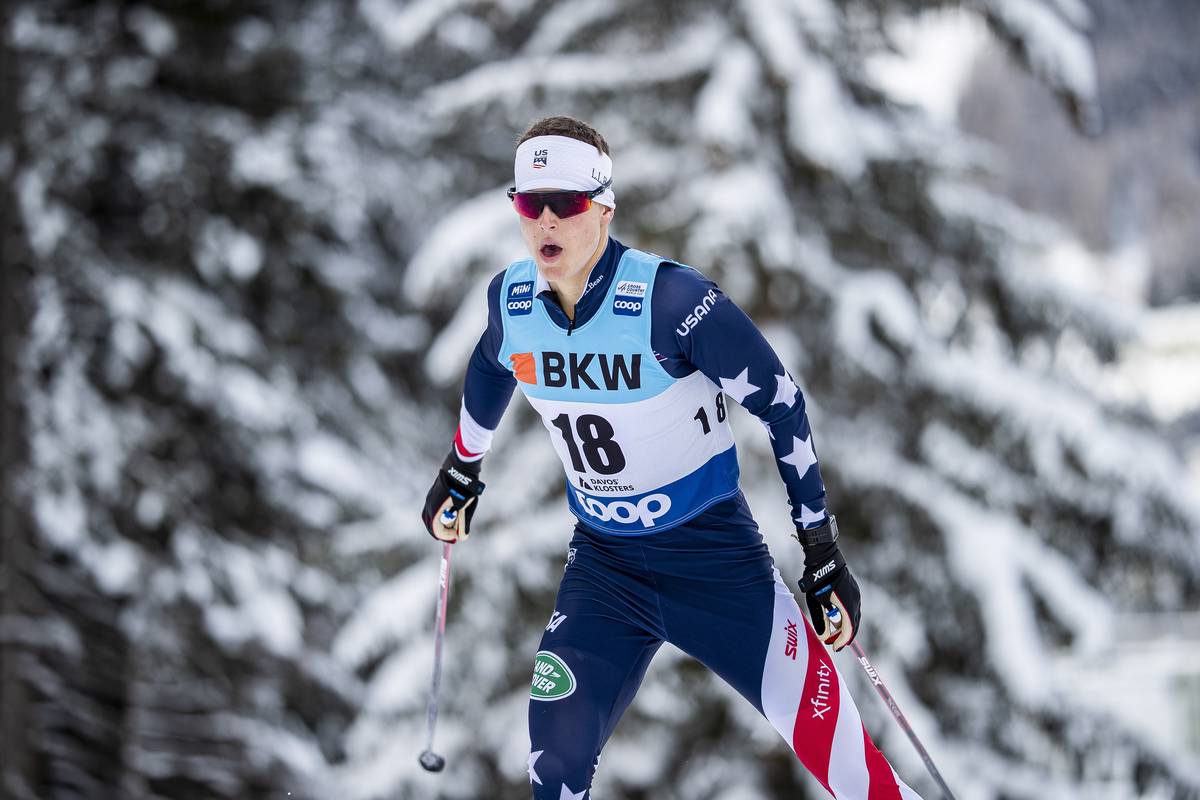
Adam Martin racing in Davos, December 2020. (photo: Modica/NordicFocus)
“Early September we went to Oberhof, Germany, for just over two weeks of training in the ski tunnel. This was our first trip since the pandemic, so I was little nervous, but everything worked out really well. The first few days the focus was on technique, transferring on-snow improvements athletes worked on during the summer. Second part was a solid speed block. Luckily there ware only a few other skiers [in the tunnel] at this time so we ware able to have really high quality intensity sessions.
“After a few weeks training at home and having incredible fall weather we packed up bags again and went to Park City for two weeks of elevation training. First part of the camp was lots of volume, some L3, a few athletes even hopped in a rollerski race at SoHo for fun. Second week we lowered the volume, had a couple mellow days, and finished the camp with a couple solid TT efforts to gain some experience racing at this elevation in preparation for Nationals.
“Back home athletes took a few easy days post-Utah. I did some testing, where a few records were broken, which was exciting to see, and now we are concentrating on race prep. Caitlin Patterson left for Europe [on Nov. 17], she will race the first WC period and in less than two weeks we all are about to hit the road for a month and a half.
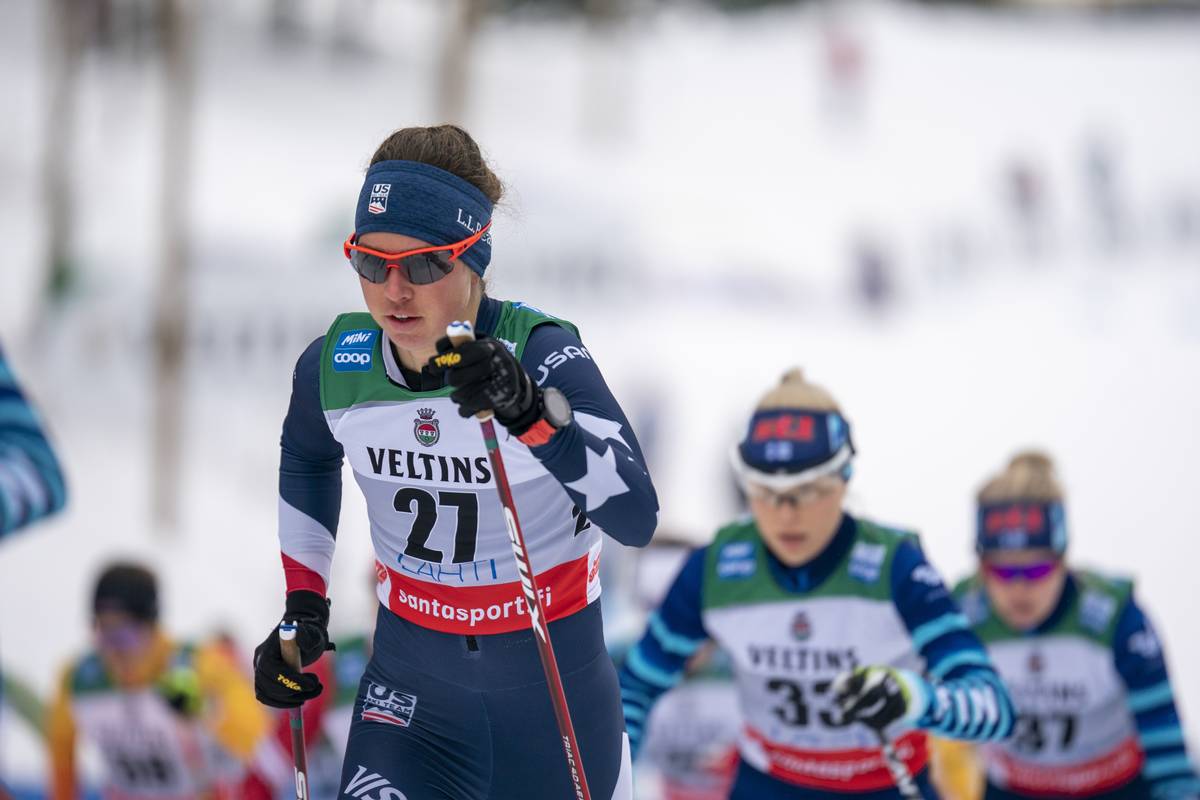
Caitlin Patterson racing in Lahti, January 2021. (photo: Vianney THIBAUT/NordicFocus)
“Last year we were totally sheltered here at the center, didn’t travel at all, didn’t go to any camps, didn’t go to any races outside Craftsbury. Although we had everything we need here and the outdoor center staff was incredible, taking really good care and keeping us safe and healthy, it was mentally very hard on the athletes not to be able to race against the other regions. So this year I’m excited for this team to have a more normal race season and to see what they can do, as they worked really hard for it.”
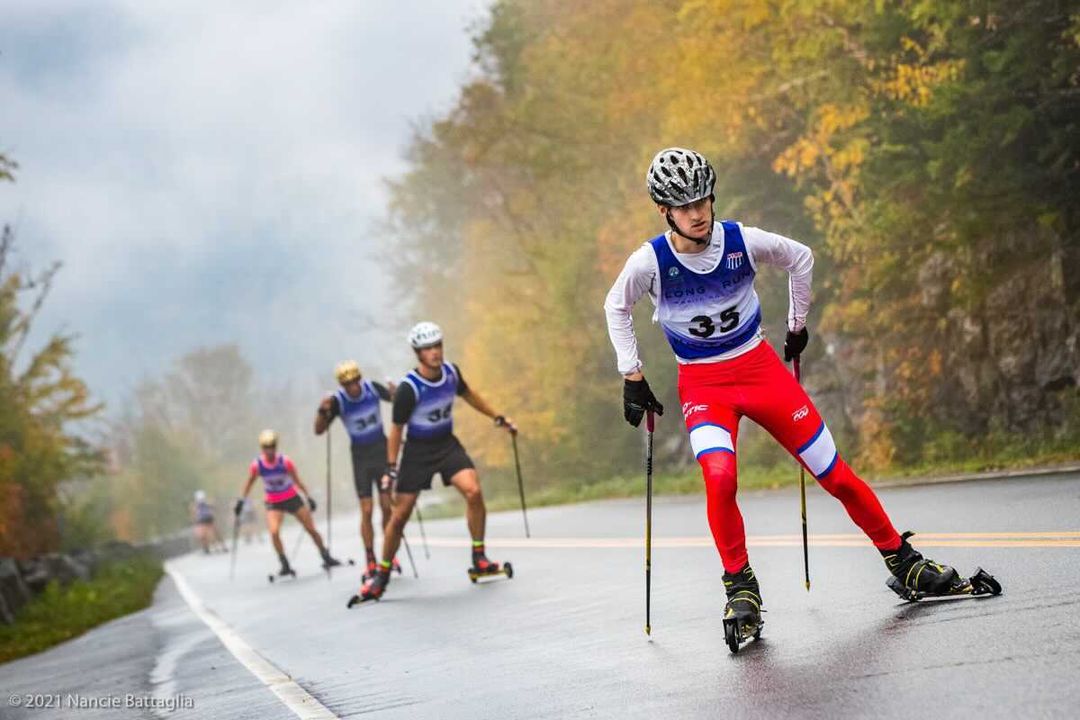
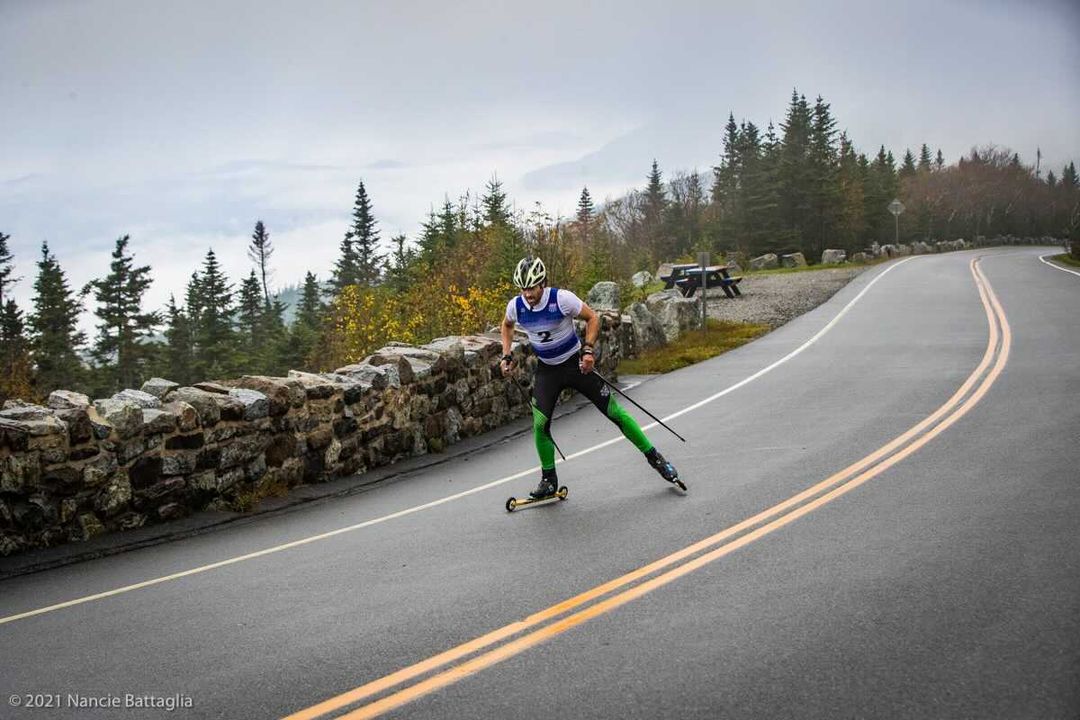
Racers climb the Whiteface Veteran’s Memorial Highway during the 2021 Climb to the Castle. (Photo: Nancie Battaglia/NYSEF)
The rain stopped just long enough for Caitlin Patterson and Jake Brown to savor their wins at the 2021 edition of the Climb to the Castle last Saturday in Wilmington, NY, near Lake Placid.
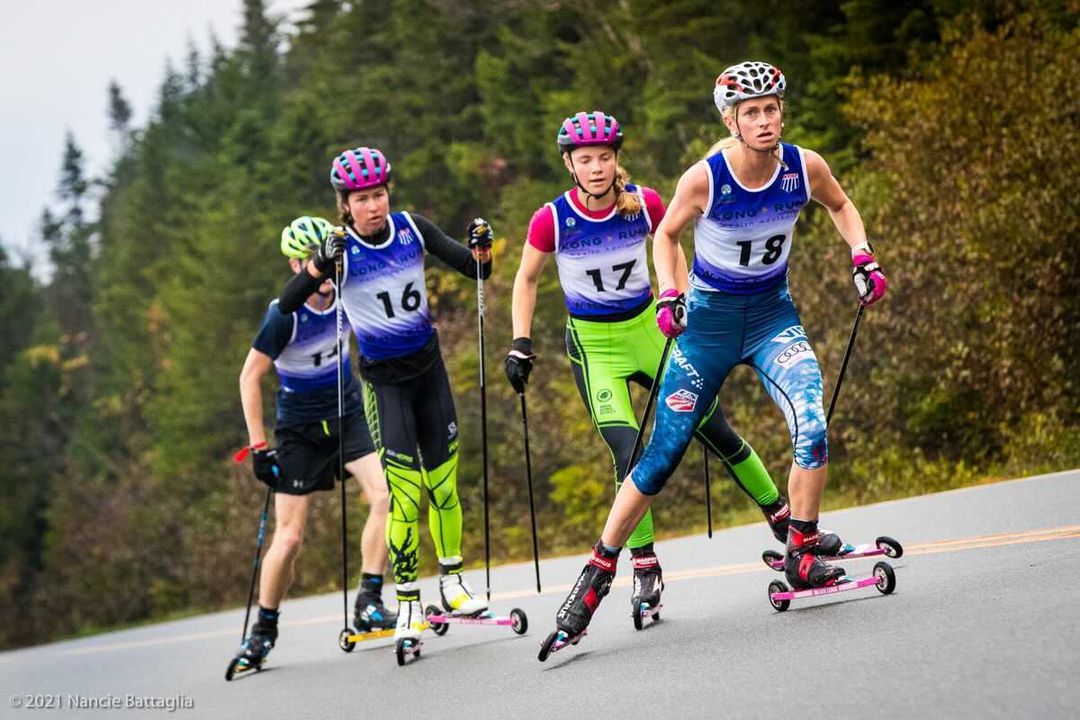
Craftsbury Green Racing Project (CGRP) swept the women’s podium; Caitlin Patterson edged Margie Freed for the win in 46:48.8, with her teammate just .7 second back in 46:49.5. Tara Geraghty-Moats placed third in 47:35.0.
Brown, skiing for US Biathlon / CGRP, took the men’s win in a time of 38:04:00. CGRP teammate Akeo Maifeld-Carucci came second in 39:34:9, and Junior athlete Tabor Greenberg, a U16 athlete out of the Green Mountain Valley School (GMVS), interrupted CGRP’s command of the podium in third place at 41:24.7.
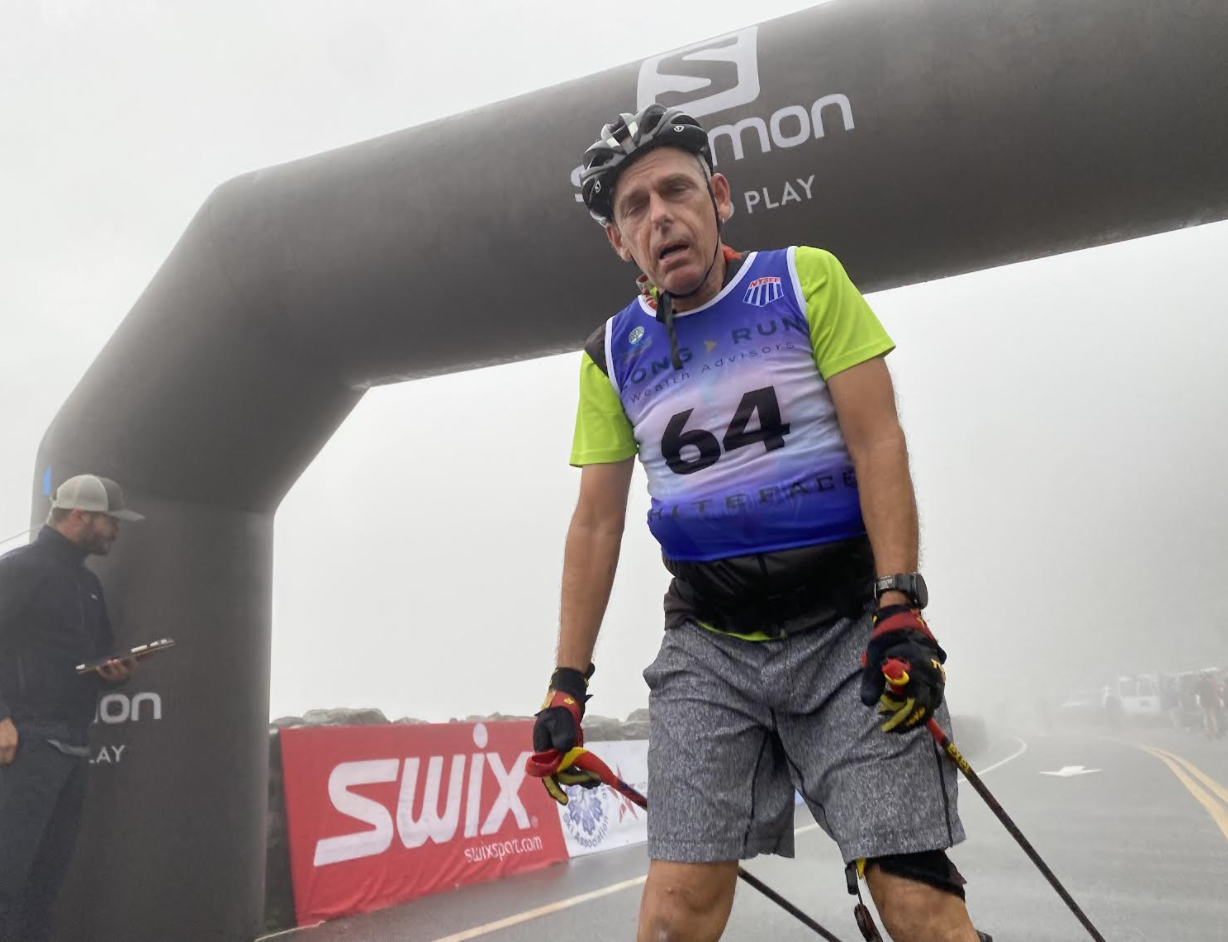
After taking 2020 off due to the pandemic, the Climb to the Castle returned to the Northeast roller ski calendar, co-hosted by NENSA and NYSEF. The race leads skiers five miles up the Whiteface Veteran’s Memorial Highway at an average eight percent grade. Whiteface is the fifth highest mountain in New York’s Adirondacks; start too hard, and you’ll never recover. This author can attest.
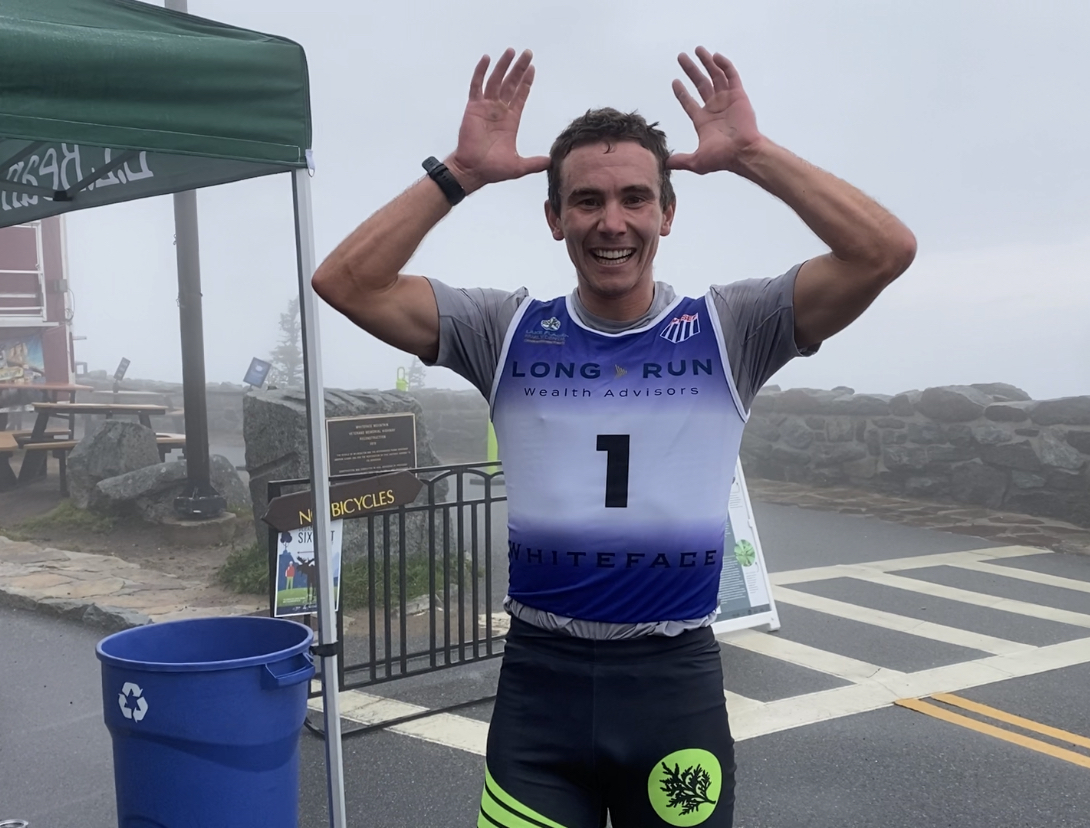
The author completes his Climb to the Castle. (Photo: NENSA)
As is often the case, weather made the race…. interesting. Light overnight rain tailed off about an hour before the start. Although the temperature hovered in the low 50s, the humidity made it feel warmer. Clouds and fog obscured vision throughout the day. In some places, one was lucky to see a hundred feet. For a change, there was little wind, even at the infamous Windy Corner and chute, 800 meters or so from the finish.
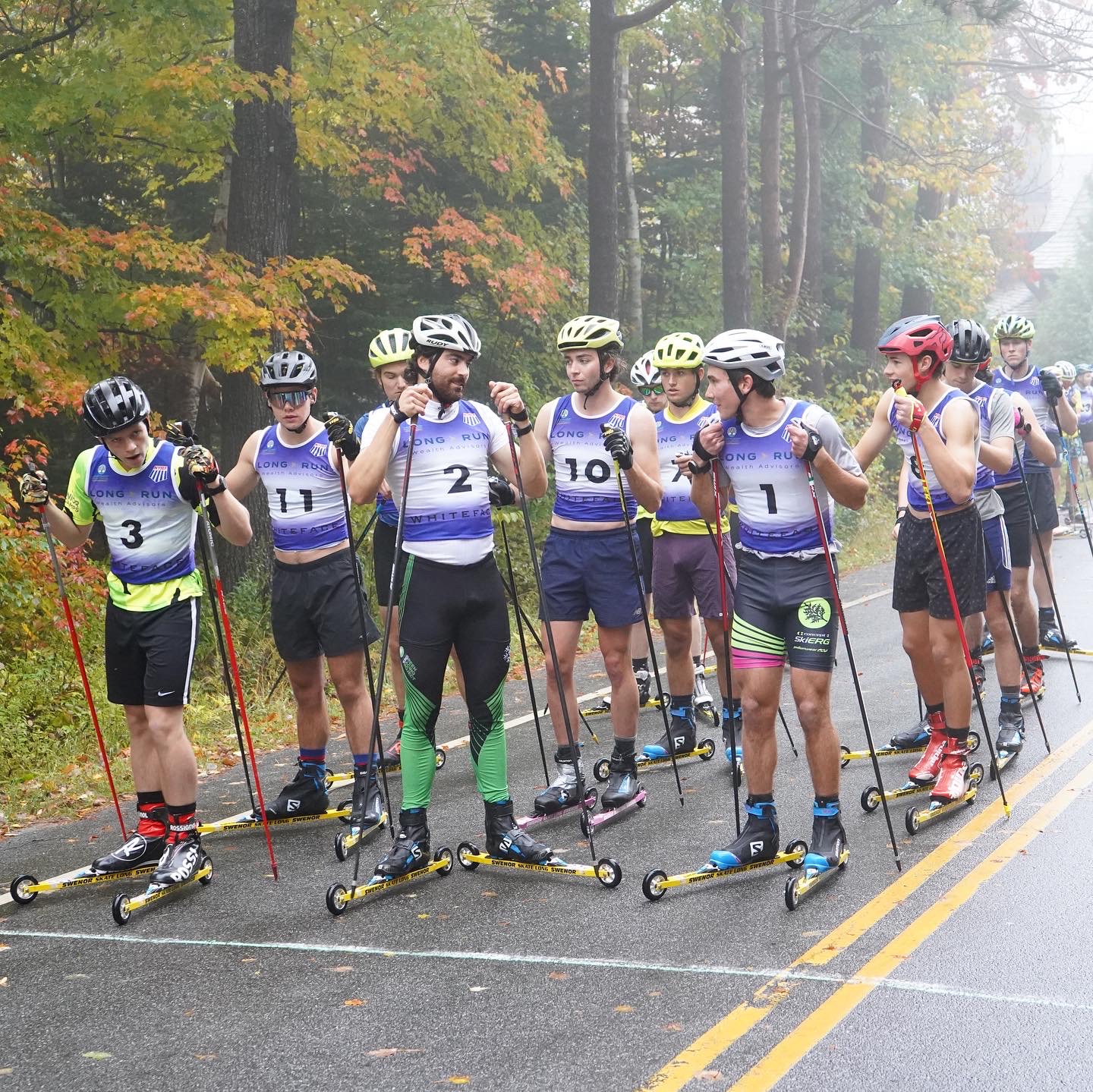
For COVID safety, organizers started five waves of skiers, each two minutes apart. Competitors wore masks at bib pickup and on the summit after finishing their race.
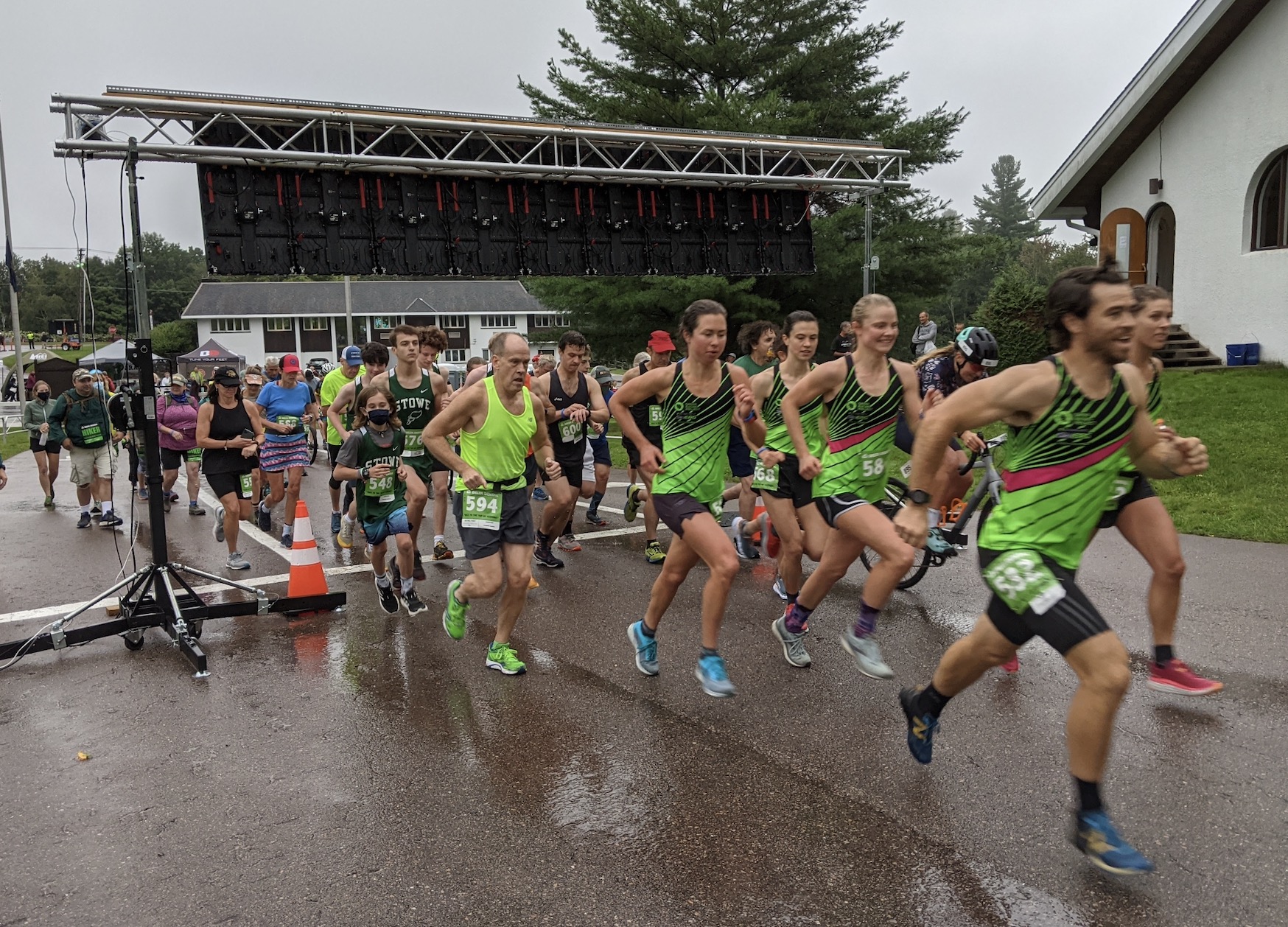
Visibility low, energy high: a wet start for the men’s wave in the 2021 Climb to the Castle. (Photo: NENSA)
The women’s race was high drama as Patterson, Freed, and Geraghty-Moats worked together up the road.
“Tara and Margie and I knew we wanted to work together, especially with the way the Climb can be pretty windy at the top. It was just gonna be: ski smooth, work together, and shuffle around the leads, which is what we did. I definitely wanted to make sure not to start too fast. I did that well, though I certainly had some rough moments in the middle.”
From the start, Patterson said that she and Geraghty-Moats took turns in the lead, trading off about every kilometer. “Towards the upper part, Margie was taking some really strong leads. I was suffering a bit,” Patterson added.
With two kilometers left, Freed opened a gap from Patterson and Geraghty-Moats. Patterson said it took a few minutes for her to regain contact. At that point, Patterson and Freed pulled away from Geraghty-Moats, skiing to the finish.
“Maybe 30 seconds out, I passed [Margie],” Patterson said. “It was really strong work by both of them. It was great to ski with people because it was as tough a course as ever.”
Of her finishing kick, Patterson said, “I know that I can tap into a late surge. We were working together for most of it, and as the finish line was drawing near, it was definitely every person for themselves.”
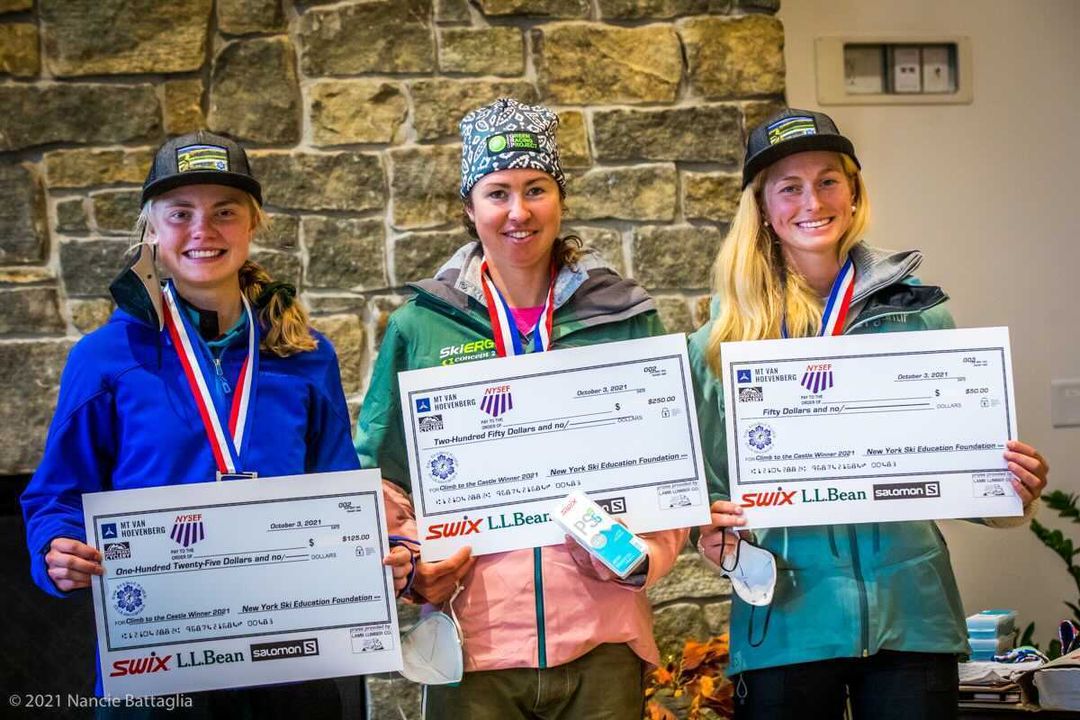
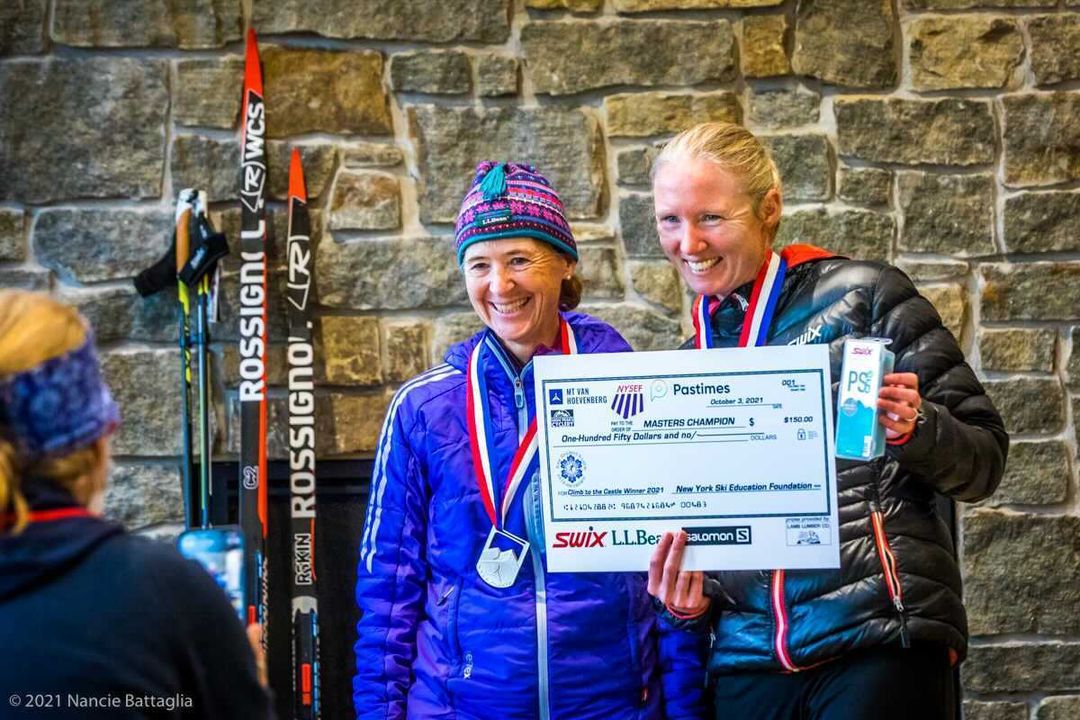
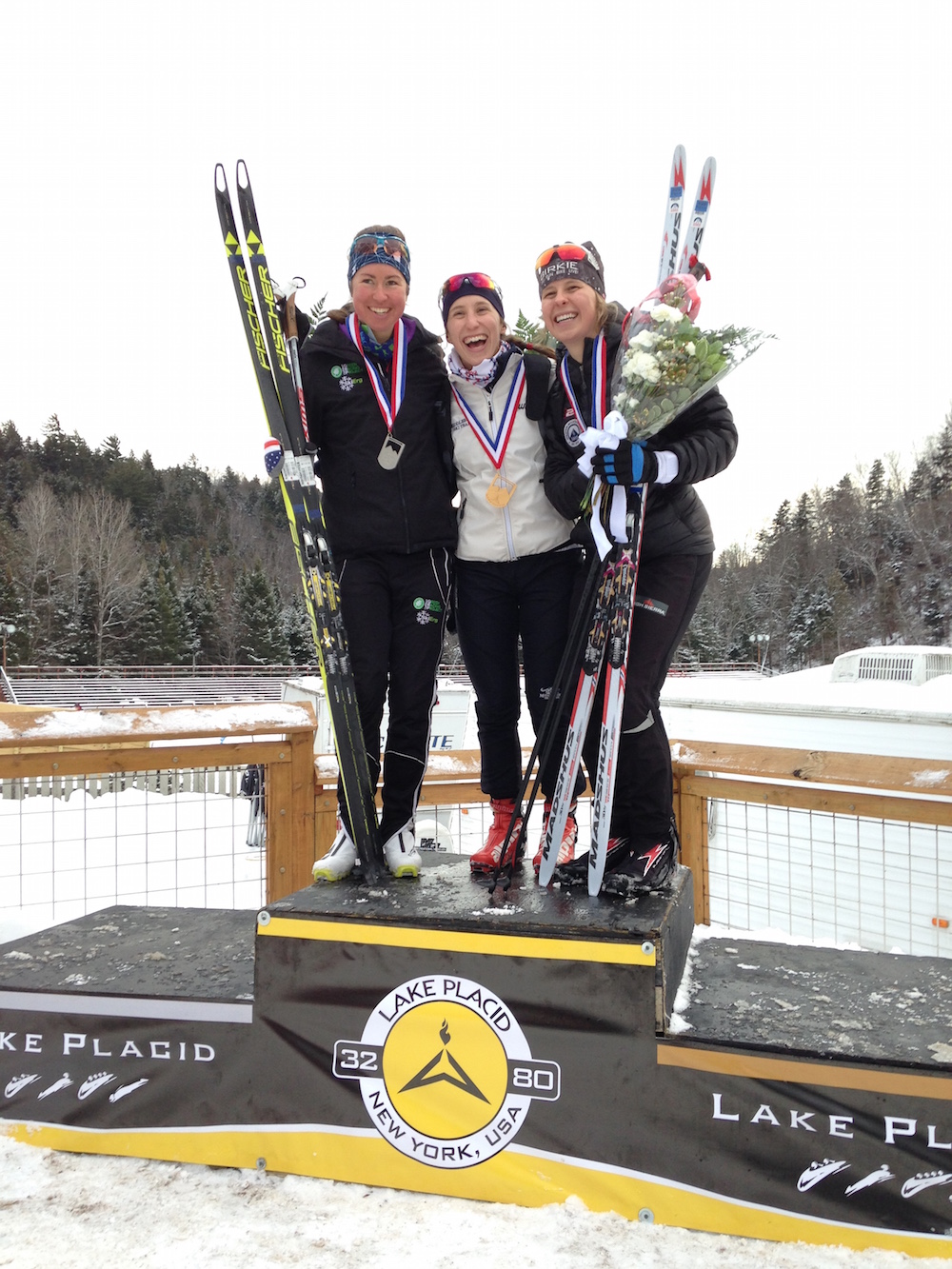
Craftsbury women clean up at the 2021 Climb to the Castle. Caitlin Patterson took the win ahead of Margie Freed (left) and Tara Geraghty-Moats (right). (Photo: Nancie Battaglia/NYSEF)
“It went pretty well today,” said Freed of her race. “It was awesome to ski with Tara and Caitlin for so long. I don’t think I could have kept up that pace if I was alone.
“I’ve never done this race before, so it was exciting to have every step be something new for me,” Freed continued. “Even though I didn’t quite know where the finish was, or when it was coming. I couldn’t quite see it because it was so foggy. It was an awesome day out there, and I was glad it wasn’t as windy or rainy or cold as I was thinking it was going to be.”
This past winter, Geraghty-Moats won the first ever crystal globe for FIS Women’s Nordic Combined. She also won the Climb in 2018. After the race, she wrote, “It was really nice to go all out with my teammates. We skied together really well. We all had moments of fading and then climbed back on. I dropped back about half a k after the Lake Placid turn — I just kind of ran out of gas. I’m pretty happy with how I felt and it was a really fun race.”
Jake Brown wins the 2021 Climb to the Castle in a long solo effort. (Photo: Nancie Battaglia/NYSEF)
For Brown, this was his third win at Climb to the Castle, his previous two coming in 2017 and 2018.
“I wanted it to be a good, solid effort,” Brown said. “I knew that I couldn’t sprint too hard off the line, but I wanted to get into that high heart rate zone and stay there as long as I could.”
Asked about race strategy, Brown said, “I was with Akeo [Maifeld-Carucci], my Craftsbury Green Racing Project teammate. He led for the first 3 minutes or so.”
At that point, Brown said, he took a turn pulling and developed a gap. “I was hoping we could work together a little bit more, but we ended up with an awkward 20-meter gap between us that we held for maybe half the race. Then I slowly pulled away and was by myself.”
Jake Brown wears the moose-antler crown after winning the 2021 Climb to the Castle. (Photo: NENSA)
Asked if he could use this as a fitness benchmark, Brown said, “This was my fourth time doing the race. This was a bit of a slower year; I’m hoping it was just because of the weather. Maybe a little later in the year and a little colder pavement. It was kind of warm today, but maybe the pavement was a little colder. Maybe my fitness isn’t where it was. We’ll find out when the winter comes — that’s what matters.”
For Maifeld-Carucci, “It was a sweet day. I wanted to do this race for a long time, since early in college. So it was great to actually be here and do it. The weather was way better than we expected. It was a little wet and a little cloudy at the top, but there were moments when it opened up and it was super pretty. Constant great climb, hard skiing — it was definitely a hard race and a really good effort.”
Commenting on the men’s pacing and tactics, Maifeld-Carucci echoed Brown’s explanation of the duo’s ability to collaborate.
“Jake and I were hoping to ski together and trade leads,” Maifeld-Carucci explained. “He was feeling a little stronger than I was so I fell off early and we were dangling 20 meters apart for a long time. Then he started to open it up.”
Akeo Maifeld-Carucci skis to second place at the 2021 Climb to the Castle. (Photo: Nancie Battaglia/NYSEF)
In addition to Greenberg nabbing third place overall, the GMVS boys swept the junior podium.
Responding to an email, GMVS head coach Colin Rodgers said that his skiers didn’t taper for the race. “Tabor actually trained a lot in the past week including a 120 mile bike ride to raise money for the Kelly Brush Foundation.”
Commenting on the preparation for this event, and how it fits into the season preparation, Rodgers explained:
“We spent some time recently working on climbing technique. When we were recently on snow on the Stelvio glacier we were working on standing well (balanced and forward) on our skis. We did not discuss any mass start race tactics for today — I really just wanted the crew to focus on pacing the effort properly and being consistent throughout the duration of the climb. [Having] a dialed warm up and trying to keep good form when tired were also a few other things we were honed in on today.”
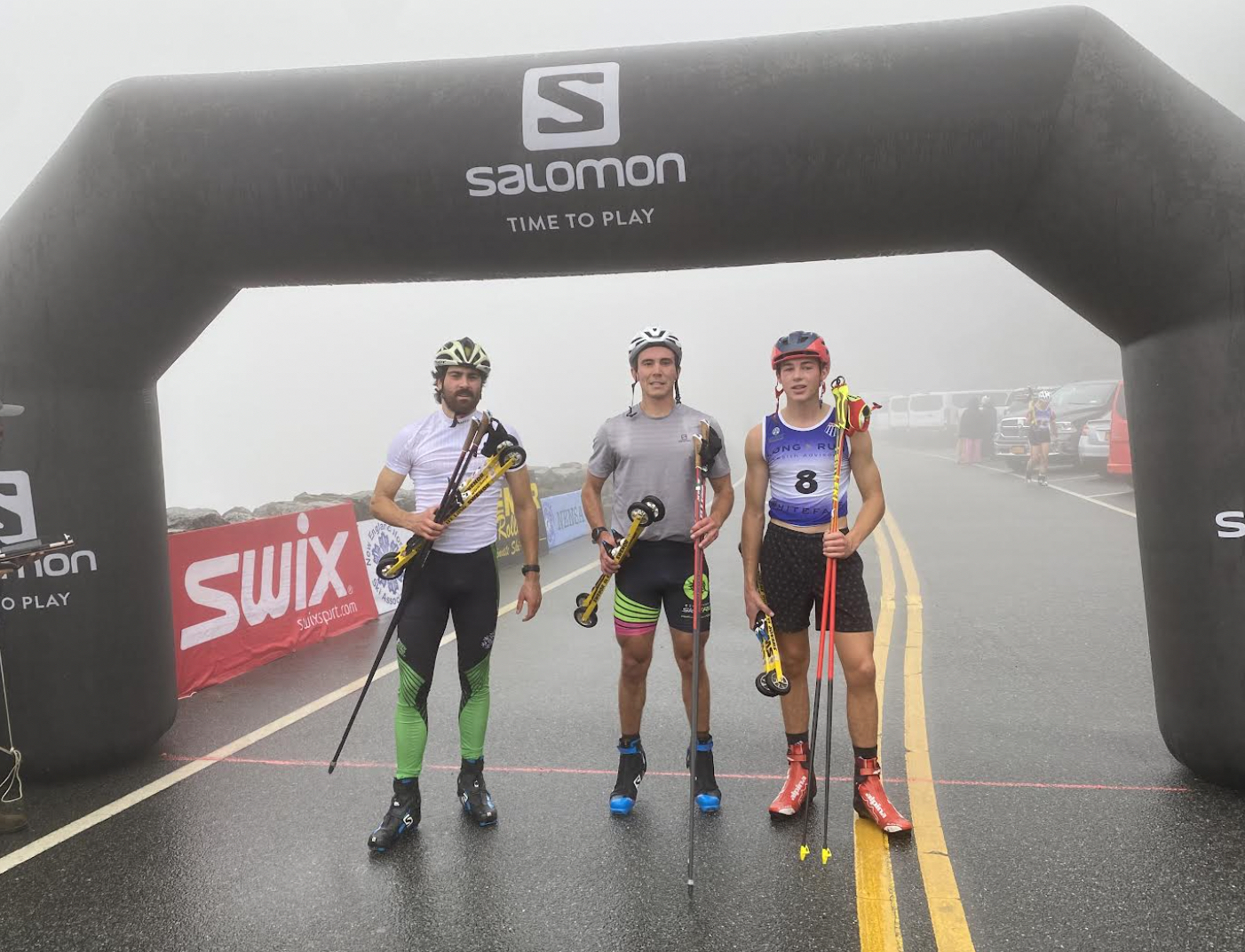
The men’s podium at the 2021 Climb to the Castle. Jake Brown (CGRP) took the win ahead of Akeo Maifeld-Carucci (CGRP) and Tabor Greenberg (GMVS). (Photo: NYSEF)
Did Rodgers have an inkling that Greenberg might podium?
“We were not focused on the podium, we were just focused on executing a solid race effort. We are primarily focused on competitions in March, so all of this is just trying to build momentum towards the end of the race season.”
According to Sara Falconer, a coach at Mansfield Nordic (MNC) in Vermont, “It’s a good opportunity for [MNC junior athletes] to race other high school athletes and college athletes that are here. It’s also a chance for them to compare their times to last year and see the results of all the work they put in over the summer. They can see a lot of dramatic improvement. It’s a really motivating thing for them. And it’s also a good workout.”
From juniors to collegiate to masters, racers ascended Whiteface during the 2021 Climb to the Castle. (Photo: Nancie Battaglia/NYSEF)
Ethan Townsend, Saint Lawrence University’s (SLU) head nordic ski coach, planned a training weekend for his team. SLU athletes also roller skied the new loop at Mount van Hoevenberg on Friday.
“Saturday morning, we got up early and did a run/hike” said Townsend. “They had the option of going up Algonquin or Wright or Marcy. A lot of them took the option of going up Marcy. A few of them went up Phelps and Tabletop. Probably an average of five hours.”
Mount Marcy is the highest Adirondack mountain at 5,344 feet and Algonquin, the second highest, stands at 5,114 feet. The remaining peaks named are also among the 46 Adirondack High Peaks, which are all above 4000 feet.
After coming out of the woods, the SLU team reconvened for an afternoon double pole roller ski session.
“We weren’t concerned about performance, necessarily, in this race,” Townsend said. “It’s a training race. Something to do as a group. I told them, ‘Don’t worry about the results so much. It’s great that we can come here and do this. If you just stay in level three the whole time and you’re not feeling it to go super hard, I think that alone would be worthwhile.’”
Racers take off to climb the Mount Mansfield service road in the 2021 Race to the Top of Vermont. (Courtesy photo)
Under gray skies, runners and bikers lined up on Sunday, August 29th in Stowe, VT, to “Race to the Top of Vermont.” The 4.3 mile race climbs over 2,500 vertical feet up the Mt. Mansfield Toll Road at roughly an 11% average grade, this year finishing inside a cloud with wind whipping the finish line flagging. The event drew in nearly 300 participants with 215 runners taking on the focal challenge of making their way up the mountain on foot. The event is a fundraiser for the Catamount Trail Association (CTA), which maintains a 300 mile long backcountry ski trail through the heart of Vermont, from the Massachusetts border to the south and ending on the Canadian border at its northern end.
According to CTA events director Greg Maino, “[The CTA] focuses on developing backcountry ski terrain, conservation in the state of Vermont, and increasing access to the outdoors for everyone.”
Topping the results list were several members of the Craftsbury Green Racing Project (GRP), including winners Adam Martin and Caitlin Patterson. FasterSkier connected with Martin and Patterson via email as they prepared to travel across the pond to spend time on snow.
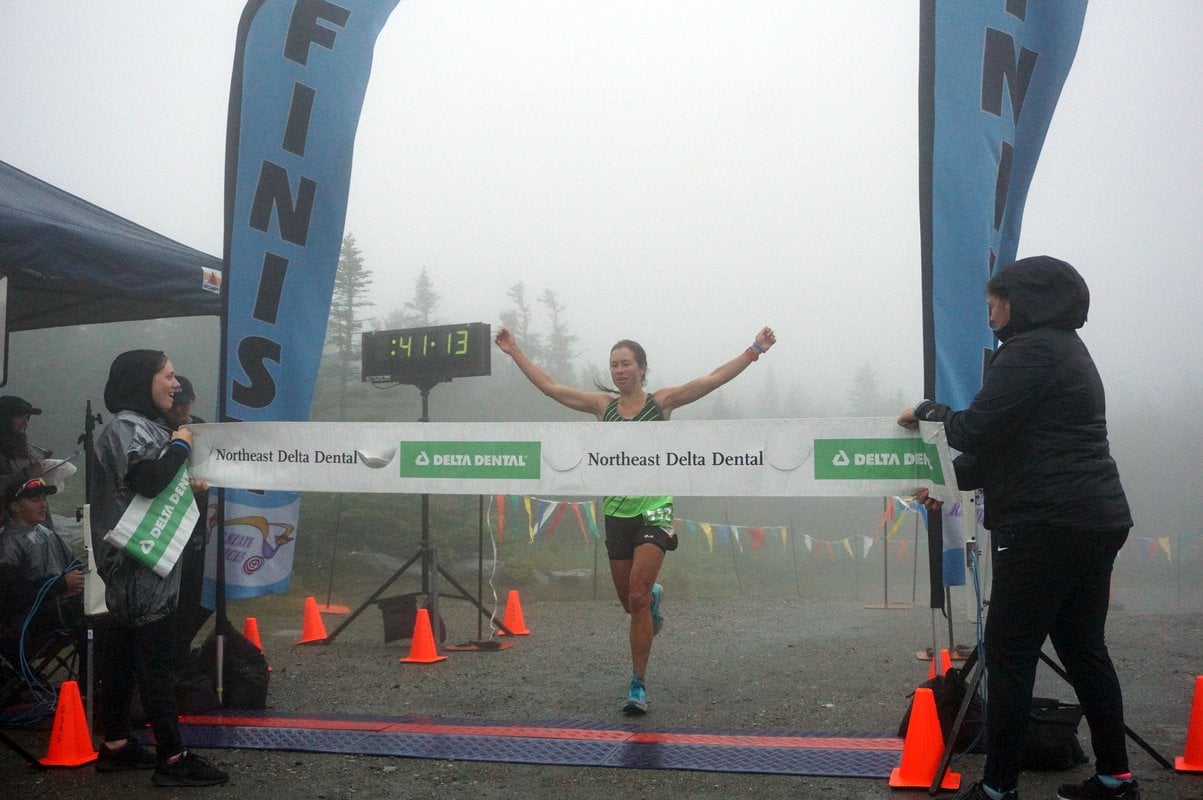
Martin expressed that his summer training has been “going great”. Crossing the line as the first runner to the top — he was beaten by just one cyclist — Martin stopped the clock at 34:11.5, nine seconds off his fastest time. In his email, he explained how this race fits into his ski training regimen.
Adam Martin breaks the tape (and stops his watch) at Race to the Top of Vermont. (Photo: Granite State Race Services)
“This year my big focus is on prioritizing intensity workouts, and so far, I think my body has been responding well. We’re planning on heading to Germany [to get on snow in] the Oberhof ski tunnel this week, so last week I backed off a bit ahead of the race and upcoming travel. Across the GRP, I think we were all coming in at varying levels of fatigue.”
It’s no secret that Martin has got some wheels. He’s got a 1:06:18 half marathon PR (5:03 per mile), and caught our eye for running a 14:34 5k in 2019 (4:41 per mile). While uphill is a different ballgame for some runners, ski training lends itself well to the challenge.
“Sunday the race was great – and hard. Early on I broke away from the rest of the field and tried to embrace the grind for the remaining 30+ minutes of the race. I really like this event, specifically how it’s a huge climb on an easy running surface, and I’m really happy to come away with the win.”
All five of the men of Crafsbury landed in the top-eight, with biathlete Raleigh Goessling taking third (37:10), Luke Brown fourth (37:45), Akeo Maifeld-Carucci seventh (38:28), and Carsen Campbell eight (39:14).
Caitlin Patterson takes the win at Race to the Top of Vermont. (Photo: Granite State Race Services)
Female cross country skiers have a history of breaking the tape at this event. Queen of the hill climb, Liz Stephen holds the course record of 37:15.9 set in 2014. This year, Patterson set a new personal best of 41:14 for tenth place overall.
Making a clean sweep for Crafsbury, Alex Lawson took second place in 41:42, with Margie Freed following for third in 43:09. Both women are new to the GRP this season after graduating from Middlebury College and the University of Vermont, respectively.
Hallie Grossman took fourth in 45:25, and Annuka Landis rounded out the GRP results in sixth 47:23.
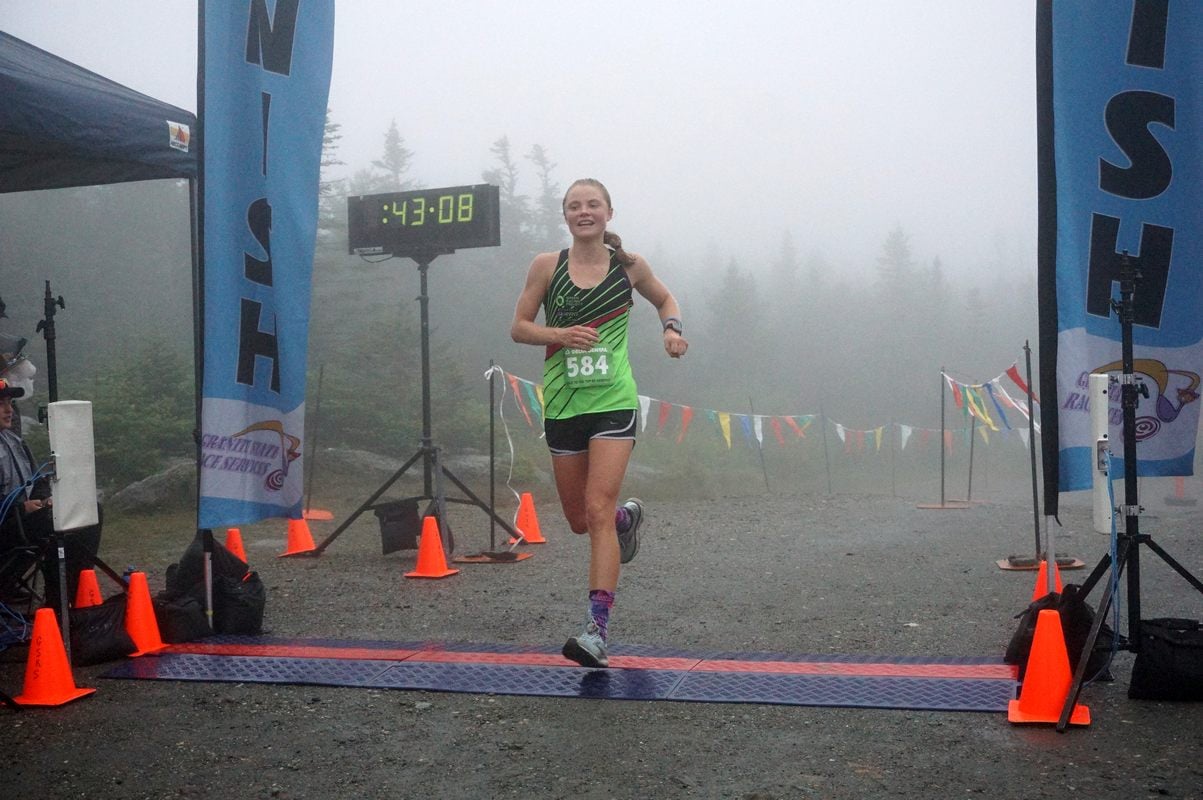
Margie Freed finishes third at Race to the Top of Vermont. (Photo: Granite State Race Services)
“Race to the Top of VT is always a fun one, and I’ve done it enough past years that it’s a bit like a fitness-check time trial for me,” wrote Patterson after the race. “I was looking forward to it as a hard effort and chance to put on a bib – I’d hoped to have done some running races earlier in the summer, but I strained a tendon in my foot in July so have hardly run at all during August. Of course I’ve been doing plenty of other ski training and all of that is going well, but I was very pleased with the Race to the Top, to win it and to run a fast time. In fact this year was my fastest time ever, helped I’m sure by the nice cool misty weather conditions.”
Patterson also sent the following comment about her racing strategy, which she initially shared with a local newspaper covering the event.
“Alex and I ran together for at least the first 3 miles, and she was really strong today too. We’ve been doing running workouts together for our ski training and I had an idea that Alex would be fast today. So we ran together for much of the race, and then I very gradually pulled ahead in the last mile or 1.5 miles or so, but Alex was not far back at all. In an uphill race like this, I think we were just enjoying the company in suffering, keeping moving, but not doing anything drastic. My race strategy was basically just to run smooth and efficiently, to breathe well, and be ready to dig in and make it hurt especially towards the top. So I was pleased with how the race went and I enjoyed running with Alex while it lasted because otherwise I did not see many people at all.”
To be depleted can take on many forms. In endurance sport, depletion often refers to an athlete’s fueling state. Are they stocked up on muscle glycogen, have they properly fueled with a balanced diet of proteins, carbohydrates, and “good” fats or are they trending towards empty?
Carbohydrates are the body’s primary fuel source, particularly during exercise, however, fat molecules are a caloric gold mine when it comes to available energy. The caveat is that fat is not as readily available, as it is more difficult for the body to break down into a usable form. Some athletes use depletion workouts to train their bodies to better adapt to fat burning when training and racing. When glucose/glycogen stores run low, the ability to burn fat for energy might ward off the feared bonk.
The general rule of thumb goes like this: as exercise intensity increases, the body’s ability to burn fat (fat oxidation) decreases. Sprinters burn almost exclusively glucose/glycogen for those big bursts of speed. Those running marathons or skiing 30 and 50 k cross-country events also use glucose/glycogen stored in their muscles, but this fuel source will become depleted as the body is not able to produce glycogen at a fast enough rate to replace what is being consumed. If the long-distance athlete’s body is able to adapt to this depleted state and break down its fat stores for energy, they may be able to maintain their level of exertion longer with less dependence on fueling.
Ben Lustgarten during the 2018 Sovereign Lake NorAm/Supertour 15 k classic.(Photo: Peggy Hung)
Some Craftsbury Green Racing Project (CGRP) athletes have been experimenting with their version of a depletion workout. Before we contrast this with what is done the realm of long distance running, CGRP skier Ben Lustgarten briefed us on their rollerski workout that adds elements of “depletion”.
We eat and drink normally until the workout starts, then we are just supposed to drink water.
We do about a standard 30 min easy skiing warm up.
We then do depletion L3 with minor short 15 second pick ups every 10 minutes or so just to mix it up.
We pick an out and back over a large hill that is about 14 minutes out, 14 minutes back, and we usually do 3-4 full “loops”. I think it is a good hard workout. It is weird to do continuous L3 without fueling properly, but good practice to feel some cramping and keep pushing.
“Refueling, naturally, is incredibly important for this workout,” Lustgarten said of the need to replenish stores following the effort. “It resembles most the feeling of a 50k so immediately after the interval, I try to eat carbs and protein, and I use Hammer Recoverite but just a good ratio of carbs, protein, and proper electrolytes is important. It actually feels kind of like my mountain bike races in the summer because they go from about 1h 30m to 2h long. Naturally, I fuel properly for those, but that duration and need for power in the legs feels kind of similar.”
Lustgarten emphasized that the CGRP depletion efforts are similar but not the same as what runners would call a depletion run or workout. He eats a normal breakfast of oatmeal before executing the workout. “I think for us it was more a basic depletion like L3 until you cramp and bonk,” said Lustgarten. “With the volume we are training, on the hard weeks, a full depletion would really destroy the quality after the workout for the next few days when we needed to keep training.”
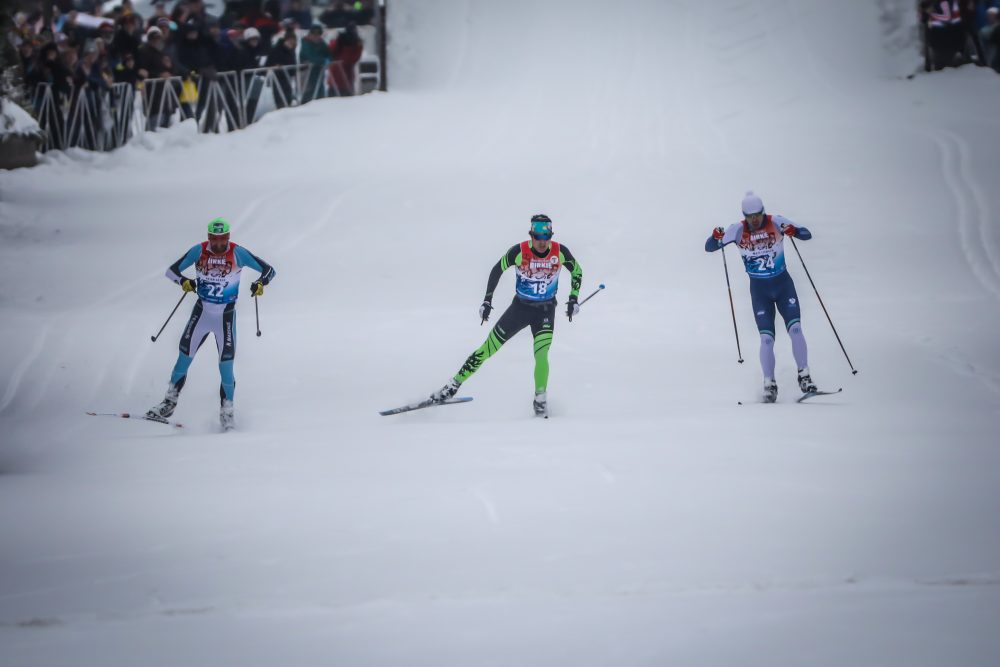
Akeo Maifeld-Carucci in green, winner of the 2019 American Birkebeiner, along with Brian Gregg in 2nd (left), and Matt Liebsch (right) in 3rd, racing down main Street in Hayward, WI. (Photo:James Netz)
Akeo Maifeld-Carucci, one of Lustgarten’s teammates, explained they try to keep their effort during the workout solidly in L3, noting that is approximately 4mmol of lactate. They are not puttering along in L1+ at 1-2mmol of lactate. In their first depletion rollerski, Maifeld-Carucci and Lustgarten skated 44 k in under two hours.
“That is no normal distance ski,” wrote Maifeld-Carucci. The team only plans on a few of these workouts over the duration of the May-November dryland season.
FasterSkier reached out to Elliott Heath, a former pro-runner and the product line manager for track and field and racing at Nike to learn more about depletion running workouts. As part of his job, Heath spends time in endurance running hotbeds like Kenya, receiving feedback from athletes to optimize the racing shoe line. He also coaches for the Bowerman Track Club (BTC) based in Portland, Ore. and directs their summer running camp in Bend. Ore. One of his runners, Carrie Dimoff, will be representing the U.S. at the 2019 IAAF World Championships in Doha, Qatar. Dimoff races the marathon.
“Depletion workout or depletion run, there are probably different forms of it generally,” said Heath. “The idea is this: going for a long time and not fueling. A more common version of a depletion effort would be to set yourself up to be in a depleted state by doing a long effort in the morning before eating breakfast. You head out and go for your long run right away after waking up so that your body has less free and readily available energy stores in the muscles.”
For those with a ritual of big breakfast fuelings prior to a long effort, the mere thought of food-restriction can be a stressor. According to Heath, the whole premise is to train yourself in a depleted state.
“It puts you into a state where you have used all the readily available energy and your body has to figure out how to deal with that depleted state either by getting fatigued or switching over fuel consumption into things like fat and more long chain fuel stores,” said Heath.
In his experience, Heath, who ran competitively in Minnesota as a high schooler, with Stanford in college, and with Nike/BTC as a pro, depletion workouts are the realm of marathoners.
“It is pretty much exclusively marathoners, but it could be arguably applicable to a half-marathoner or even a 10k athlete in a less direct way,” clarified Heath. “But considering a direct benefit area, it is really only marathoners that are going to be experiencing that state in their race.”
The traditional methods for runners using depletion workouts are as follows:
At least ten hours after your last meal, complete a long run at moderate intensity with no refueling before or during the run. (Hydrating with water is fine.)
Complete two workouts during the day, with each workout incorporating moderately hard distance efforts. Do not refuel between workouts with carbs.
This is an oversimplification of depletion runs. There are many ideas about how best to incorporate them into training and the type of preferred diet that should be maintained to optimize the efficacy.
Which brings us to an important point raised by Heath. He explained that coaches and athletes need to think of both stress and adaptation, but also stress and recovery.
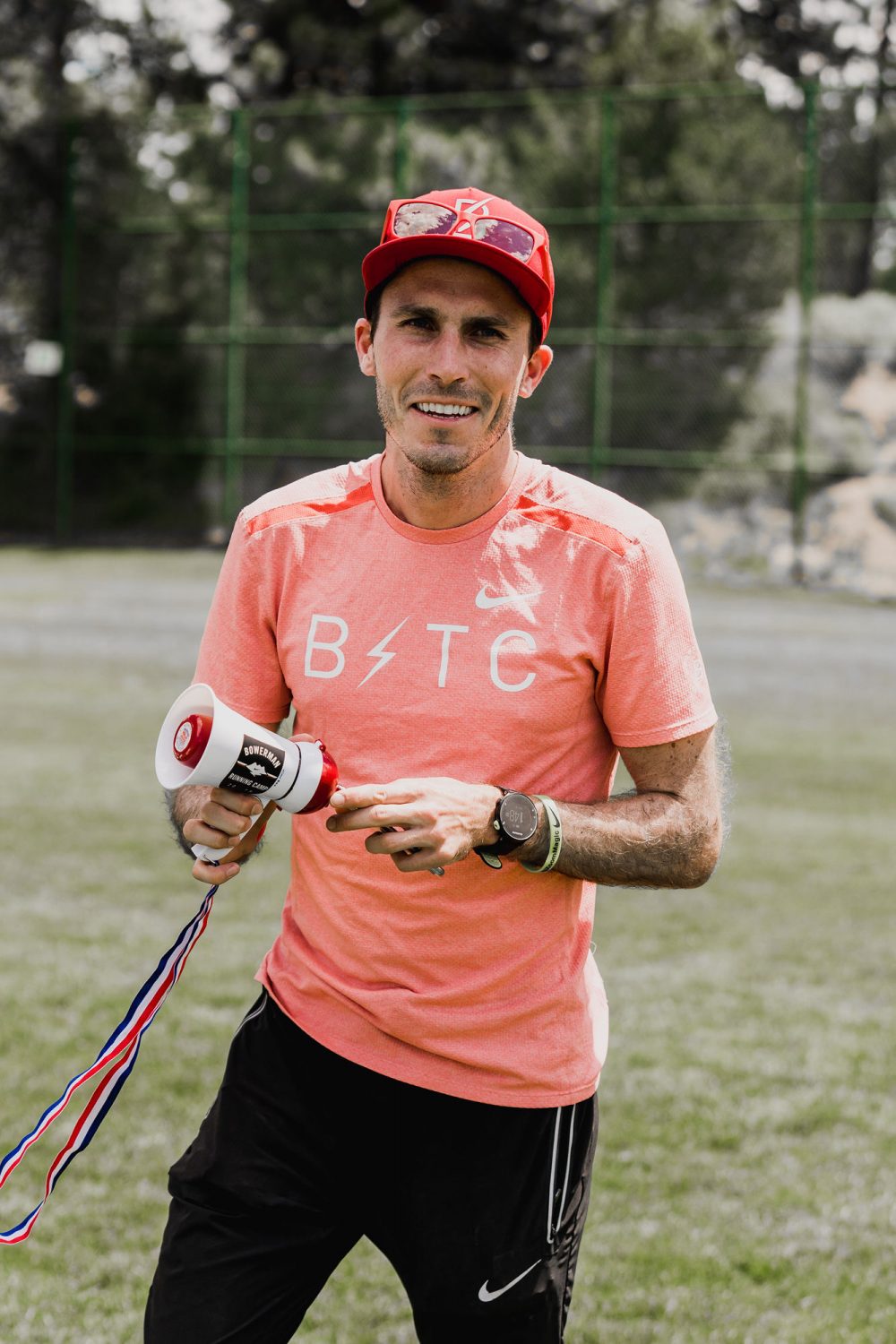
Elliott Heath in Bend, Ore. as the director of the Bowerman Track Club Running Camp. (Photo: Cortney White)
“You are trying to balance the benefit of that adaptation process with the cost of possibly needing four more days of recovery to actually dig yourself out of that hole from the depletion session,” added Heath. “From a training perspective I would say yes, it is all about stress and adaptation but when it comes to something like depletion runs, there is always a trade off between stress and adaptation and stress and recovery. What I would think about in terms of incorporating depletion runs or depletion efforts into your training is what are the trade off costs?”
As a student of running, Heath has thought about the origins of depletion workouts and why they may have been adopted more widely. “I am sure there were origins of this being researched in the lab long before this, but what perked a lot of interest in depletion running was asking how Africans train for marathons?”
That question has been explored ad-nauseam. The answer as to why East Africans have come to dominate the world’s top marathons are complex. But something as basic as observing daily training routines and habits, as Heath does as part of his work with Nike in Kenya, reveals depletion happens less by design.
“A lot of African runners, they are not thinking about ‘OK I need to do depletion training’,” said Heath. “Their life routine is that they wake up at sunrise, and they go out and do their long run. They don’t have food until they are back from it usually. So I believe some people have looked at that and think all these African runners are the best in the world at marathons, and this is what they do. They are so good at the end of the race it must be because they are practicing this depleted state over and over and over.”
Causation and correlation then enter the conversation. And Heath can play devil’s advocate.
“You could make the flip side argument,” claimed Heath. “If fueling is actually really important, I would say in many races some of them still under fuel and do not take enough to replenish the system over the course of a two hour plus marathon. You could say they are the best now, but how good could they be if they fueled ideally? Is it the practicing of depleted state running that is making them great or could they just be better? There are a lot of other things that are making them great.”
In cross-country skiing, depletion training is no staple in the stress, adaptation, and recovery training matrix. And it is wise to remember that consulting an expert on your personal capacities, nutrition, and goals are important before engaging in a depletion workout. There are lots of right ways to do things, but only a long wait to dig yourself out of a training hole.
“Even along the lines of depletion runs, you can talk to five different coaches and get a handful of different opinions on whether that was important or not,” Heath said. “Some might say it is the gold standard and there is no way you should run a marathon without doing it. And another coach might say that you are crazy for doing that because all you are doing is sending your body through too much stress that you are not recovering well from.”
That said, Heath does not incorporate depletion running into the training for the athlete’s he mentors.
“It depends on the athlete, but in most cases, we usually prioritize practicing fueling and teaching the body to process that nutrition while running rather than seeking out a depleted state,” added Heath. “Naturally, there is likely to be some depletion over the course of a really long effort, but we generally try to avoid more excessive depletion. This prioritizes optimal recovery from the long hard sessions so that it’s easier to turn around a couple of days later for another hard session.”
Doing our due diligence, we contacted Stephanie Howe Violett PhD — a former skier and cross-country runner at NMU and accomplished ultramarathoner. Along with running professionally, she is a coach and sports nutritionist. She said what remains critical is that athletes maintain a long term outlook and steadily fuel their system. Howe Violett has never incorporated depletion running into her training.
“I think maximizing training and fueling properly lead to better physiological adaptations than trying to manipulate depletion runs,” Howe Violett emailed. “There is no scientific evidence that this is helpful in the long term, or even the short term for performance. Of course, we want to stress the body to lead to the greatest adaptations, but training in a fasted state doesn’t do this. If anything it reduces the intensity at which one can train and creates a longer recovery time, both of which are negative for performance.”
Athletes commonly seek out a new stressor to stimulate adaptations for improved race day performance. When introducing new concepts, Howe Violett said to proceed with caution.
“I’d really work closely with an exercise physiologist and sports nutritionist because low glucose can lead to many negative performance and health issues,” said Howe Violett. “Overtraining, injury, illness, disturbed mood state, negative impact on performance are the short term consequences. But these can take weeks to years to correct.”
If you are reading this, we assume you are interested in skiing. To be clear on how the CGRP athletes are “depleting” themselves, they are not adhering to the strict concept put forth by depletion running. They are fueling with a solid breakfast before their roughly two hour depletion rollerski. They are also montitored closely by their coach and have access to high quality food at the Craftsbury Nordic Center. Further, the athletes using this workout are doing so sparingly, two to three times over nearly a seven month dryland training period.
SMS T2 skier Alayna Sonnesyn with the 2019 American Birkebeiner win. (Photo: James Netz)
FasterSkier’s American Birkebeiner coverage is made possible through the generous support of New Moon Ski & Bike in Hayward, Wisconsin. While you are at the Birkie be sure to visit New Moon Ski & Bike for all your local expertise.
Falling snow. Not too frigid temps. And a layer of fresh snow overlaying the 50 kilometers of undulating terrain for the 2019 American Birkebeiner. Perhaps no matter the conditions, it is cross-country ski racing paradise. The event marks a gathering of nordic skiers from across the continent there to partake in an event boasting serious on-the-verge-of-leg-cramp racing and a double dose of Wisconsin culture. Norwegian sweaters and Birkebeiner chotschi aside, the famed point to point race defines head to head tactics and fitness.
Amidst the infamous trail lined with deciduous trees that eventually opens up onto Lake Hayward in the event’s closing kilometers – the 50 k skate saw a new winner in the elite men’s and women’s categories.
In her first year training full time after graduating from the University of Vermont last spring, twenty-two-year-old Alayna Sonnesyn took the overall win in the women’s race. Sonnesyn now trains fulltime with the SMS T2 based at the Stratton Mountain School in Vermont.
But she is to the bone Midwest and understands the import of the win.
“There is definitely so much excitement and enthusiasm in the state of Wisconsin right now for this race and so it is pretty cool to be a part of it,” Sonnesyn said in call after her win. “This was my first time racing up Main Street and to hear those thousands of people cheering was pretty unforgettable and my whole body kind of went numb when I heard that. It is amazing to be part of an event that has so much passion and love for this sport. It was pretty fun.”
For those not partaking in the event but wanting to know how each k went down for the winner. Where the screws were turned. Where the skis felt silky. Where they felt like the wax tech corked in a top coat of 40 grit sandpaper.
In Sonnesyn’s exuberant retelling, the 10 k to go mark was the ah-hah. Until then, a foursome of skiers had broken away to make the elite selection of the elite wave: APU’s Becca Rorabaugh, Katie Feldman (SVSEF Gold Team), Anja Gruber (Salomon), and Sonnesyn. In the midst of the 10 k and 9 k markers, Rorabaugh began to peel little by little off the back. The three remaining skiers kept the strong pull going to separate themselves.
“Anja, Katie and I were definitely picking up the pace and really working hard,” Sonnesyn said. “And I had been taking plenty of feeds the entire race and I still felt really energetic. My muscles were definitely getting pretty tired. but I still felt like I had a lot in me.”
As the k’s began to click past, Sonnesyn passed over route 77 where she took another feed.
“As soon as I crossed 77 I just felt this jolt of energy,” said Sonnesyn. “I think from a coke feed that I got or from some of the cheering there and also just realizing that I have got 5 K left. If I want to go I have got to go.”
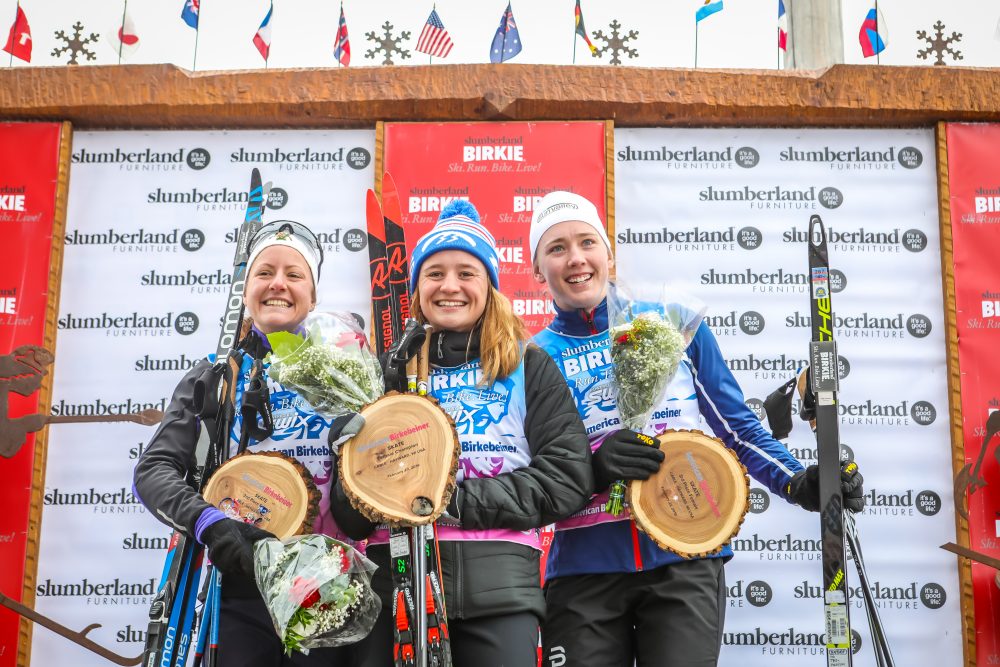
2019 American Birkebeiner women’s podium from left to right: Anja Gruber in second, Alayna Sonnesyn in first, and Katie Feldman third. (Photo: Sally Krueger)
In a race like the American Birkie, the mental stamina to stay in it can rattle some and embolden others. With so many K’s to ski, it always seems safe to wait. Wait until a bit closer to the finish to make a move. With 50,000 meters to race, late can never seem too late. That is until the opportunity is abruptly snagged away.
“I thought in the back of my mind, ‘you know I could go for it here and win or I could just be patient and maybe not even make the podium,’” she said. “To me, I thought it was worth it to go for it and take that risk and take the chance to break away.”
The moment was for real. A groomed Hayward main street. A cacophony of cheers. And Sonnesyn, alone amongst her elite wave peers, won in a time of 2:34:01 hours.
“I did keep looking across my shoulder but once I got onto Main Street up and over that bridge it was surreal. All the cheering just hit like my entire body went numb. I was overcome with emotion and definitely by the time I crossed the finish line and realized I had actually done it I broke down.”
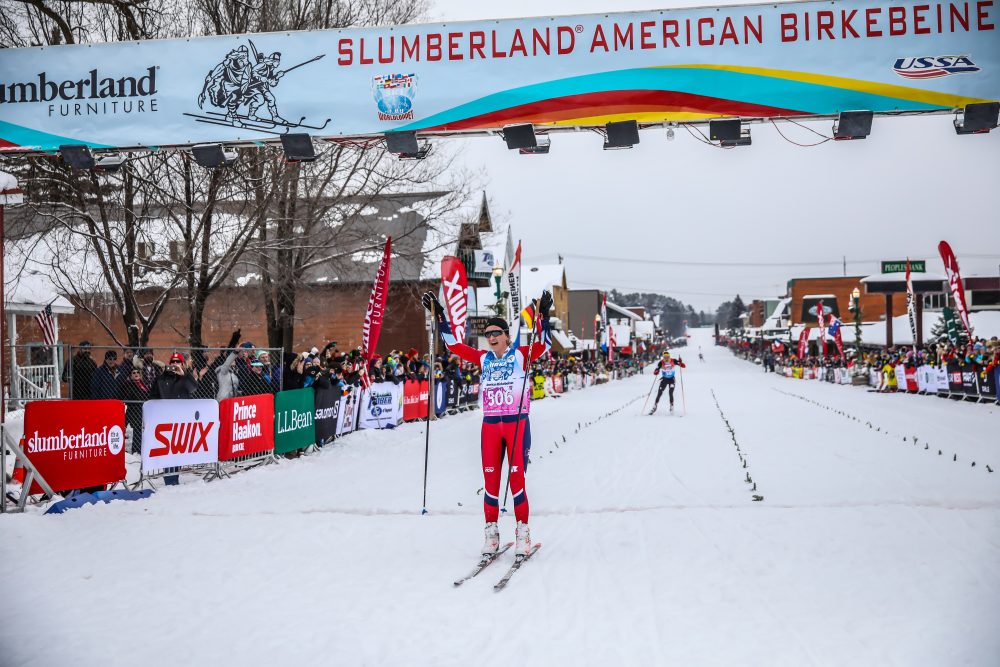
Akeo Maifeld-Carucci in green, Brian Gregg (left), and Matt Liebsch (right) down Main Street in Hayward, WI. (Photo: James Netz)
Phonetically, it is a unique name, but a simple one. Say it: “Ahh-key-oh” … Akeo. The first name has Marshall Island roots, the last name possess a Euro core. It’s Akeo Maifeld-Carucci.
The twenty-ski-year Maifeld-Carucci can ski.
But let’s dial the time machine back a bit and be a bit less formal and go with the first name. Akeo skied at Harvard, then spent stints training in Bozeman (his hometown) and Bend before settling in with the Craftsbury Green Racing Project last June.
He is a mechanical engineer. As much as he is an endurance junkie, he is a fastidious analyzer. Not a bad trait in the world of design and build, but on the race course, analyzing can help only to a point. On some occasions, the over-analysis can see the make-your-move-moment lost.
“We were at Double OO, which is 28 k from the finish or so is when Brian Gregg really put in a move,” Maifeld-Carucci said in a phone call. “There is a prime there and he went for the prime. And there is this hard gradual uphill section right after the prime and he maintained, he put a gap on us. No one really chased him and he maintained that gap for a little bit and I was like, ‘Brian is really strong we should probably try and close down on that’. So I just went to the front. Closed down. Then I looked back and saw that Matt Liebsch was on me. So it was the three of us and we had maybe a twenty-meter gap back to the rest of the pack.”
Closing the gap right then and there was the first of several clinching moves. The analysis worked. It was Maifeld-Carucci and two of the American Birkebeiner’s most knowledgeable elders in Liebsch and Gregg. As the trio raced on, according to Maifeld-Carucci, Liebsch went to the front and stated this was the time to separate from the chase.
“And I was sitting there and thinking ‘well, there is a little downhill after this and usually, it is really early to go and usually the pack can close on that downhill stretch because they move faster,’” Maifeld-Carucci said as he reflected on a moment of doubt. “I had heard a couple of guys before the start saying, ‘oh a break at OO never lasts, people always close it on the k-and-a-half of rolling downhill after that. The pack moves faster on that downhill stretch so the gap never lasts at OO.’”
The real-time analysis at OO made Maifeld-Carucci hesitate.
“I was nervous but then when they said, ‘I think we can make it’ and I knew Matt and Gregg are strong and they know the course really well, so I was considering that,” said Maifeld-Carucci.
Considering. Computing. Sensing the energy reserves and the stamina left in his legs. Again, like closing down Gregg’s pulse, Maifeld-Carucci’s endurance calculus told him to trust in Gregg, Liebsch, and himself.
SMS T2 skier Alayna Sonnesyn with the 2019 American Birkebeiner win. (Photo: James Netz)
“It was nerve-wracking,” said Maifeld-Carucci. “I felt my legs starting to tighten up maybe on the edge of cramping even from 20 k out. So I was a little nervous about that, because you know that is a lot of race left. I was trying to flirt with the line of how fast I can go without pushing too hard and using too much power and making the legs cramp. I was dealing with that and it only got worse.”
But not bad enough. Across the lake, and over the American Birkebeiner International Bridge with 400 meters to go the sprint was almost on. Not before the path to victory was thoroughly analyzed did his motor truly rev.
“We dropped into the finishing stretch, 400 meters of just straight away gradual uphill and I kept telling myself, ‘’you don’t want to lead and you don’t want to go too early.’ I was trying to wait. But the crowd was so loud and so explosive I just couldn’t wait any longer I saw the finish line, felt the noise and I was like ‘screw that, we have got to go.’”
As precise a win as can be over 50 k, Maifeld -Carucci won by 0.9 seconds over Gregg in second. Liebsch placed third (+8.5). The winning time was 2:12:34.9 hours.
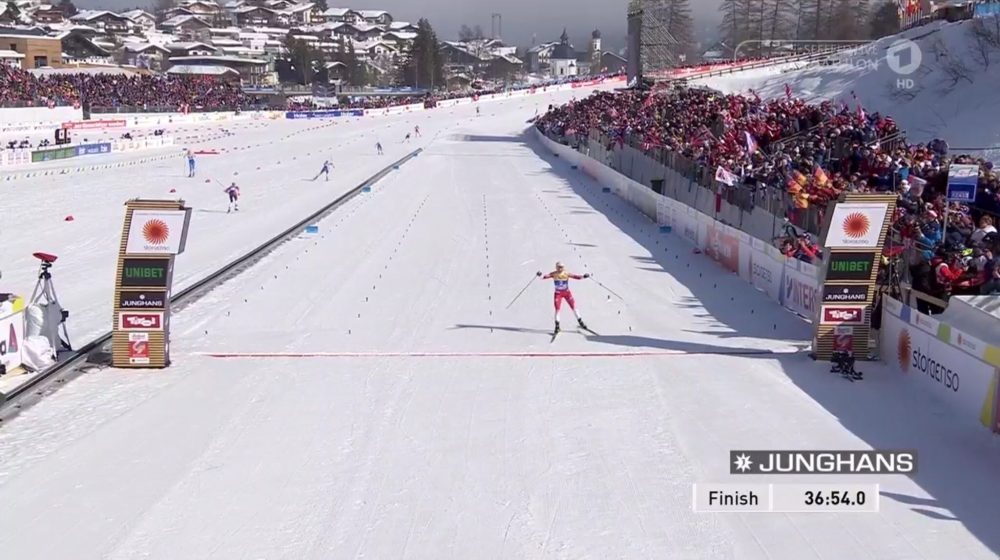
Between 3.75-kilometers and 4.85 k on Saturday, Norway’s Therese Johaug began to pull away in earnest during the women’s World Championship 15 k skiathlon — by then she had built a near 15 second lead.
The time back to the Norwegian would only grow. Johaug powered into the classic to skate transition zone in control with a lead padded by 26.2 seconds. At the finish, Johaug crossed the line with no other skiers in sight and a winning time of 36:54.5 minutes. It was Johaug’s fourth World Championship medal in the skiathlon.
Ingvild Flugstad Østberg, also of Norway, placed second (+57.6), with Russia’s Natalia Nepryaeva third (+58.7).
Rosie Brennan of the U.S. was the top North American in tenth (+2:01.8). Also for the U.S., Julia Kern placed 19th (+2:55.5), Rosie Frankowski 24th (+3:00.6), and Caitlin Patterson 34th (+3:54.5).
Canada’s Katherine Stewart-Jones skied to 39th (+4:19.8), Cendrine Browne 40th (+4:25.2), and Maya Macisaac-Jones 54th (+8:53.4).
The men’s 30 k skiathlon featured no off the front winner like Johaug. As the pace setting screws tightened well into the men’s race, with Russia’s Alexander Bolshunov often taking charge, the pack was winnowed to five skiers at the 26 k mark. Along with Bolshunov, France’s Clement Parisse, Norway’s Sjur Røthe and Martin Johnsrud Sundby, and Iivo Niskanen of Finland were the skiers vying for the win.
By the final half-k, only Sundby, Bolshunov, and Røthe remained up front. Down the final straight Røthe possessed the strongest reserves as he won in a time of 1:10:21.3 hours. Bolshunov placed second (+0.1), and Sundby third (+0.7).
Canada’s Alex Harvey paced himself to sixth overall (+58.9). Evan Palmer-Charrette placed 45th (+6:12.4), and Scott James Hill 56th (+9:58.8).
For the U.S., Scott Patterson raced to 32nd (+4:40.6), David Norris 38th (+4:54.4), Kyle Bratrud 49th (+6:19.6), and Adam Martin 54th (+7:47.4).
The plotline thickened on Saturday in the elite men’s freestyle 50 k at the American Birkebeiner when Akeo Maifeld-Carucci (CGRP), Brian Gregg (Team Gregg), and Matt Liebsch separated themselves from the field. The three skiers fended off any chasers and charged onto main street three across in their final effort towards the finish line.
Maifeld-Carucci took the win in 2:12:35 hours, with Gregg second (+0.93), and Liebsch third (+8.50).
Alayna Sonnesyn (SMS T2)won the overall women’s 50 k skate in 2:34:01. By the time Sonnesyn passed the time check on Lake Hayward, she had gapped Anja Gruber (Salomon) in second by 29.60 seconds. Gruber took second overall finishing 54.60 seconds back from the winning time. Third place went to Katie Feldman (SVSEF Gold Team) crossing 1:08.63 minutes back.
FasterSkier will be posting race reports on the 2019 American Birkebeiner later today.
(Friday) FIS Nordic World Ski Championships Seefeld, Austria Individual Gundersen 10 k
U.S. athlete Taylor Fletcher on his way to placing 35th overall during Friday’s individual Gundersen 10 k at the Seefeld, Austria World Championships. (Photo: John Lazenby/lazenbyphoto.com)
On Friday in Seefeld, the first nordic combined event, an individual Gundersen 10 k was won by Germany’s Eric Frenzel. The German was the best ranked jumper and won the ski in a time of 24:43 minutes. Jan Schmid of Norway, the day’s third ranked racer after the jump, placed second (+4.3). Austria’s Franz-Josef Rehrl placed third overall (+8.7).
Americans Taylor Fletcher skied to 35th (+4:05.5), Ben Loomis 44th (+5:29.7), Jasper Good 47th (+6:25.1), and Grant Andrews 48th (+6:52.8).
Of the four Russian athletes starting the 15-kilometer classic mass start in Lahti, Finland three placed in the top four. Anna Zherebyateva won in 40:31.4 minutes as she was able to stretch her nine-second gap at 10 k to 23.5 seconds by the finish. Also from Russia, Lidia Durkina placed second (+23.5), Germany’s Katharina Hennig skied to third (+37.5).
“My tactic was to make a gap in the second loop,” Zherebyateva said during the post-race press conference. “So I did exactly what I wanted. It went really well. Tracks were exactly right for me. This gold medal is an important step for my sport career.”
Yana Kirpichenko was the third Russia in the top-five as she placed fourth (+41.6).
The best North American finisher was U.S. skier Hailey Swirbul who raced to 10th (+1:27.8). Swirbul was positioned 29th at the 5 k time check but steadily moved up in the field as the race progressed. By 10 k she had positioned herself in the top-15.
For the twenty-year-old Swirbul, this is her first go at U23 Worlds after participating in three Junior Worlds as an U20. Last season in Goms, Switzerland she placed second in the 5 k classic and third in the 10 k skiathlon.
Two other U.S. skiers raced into the top-30. Julia Kern placed 16th (+1:43.4), while Alayna Sonnesyn was 23rd (+2:24.9). Hannah Halvorsen, the fourth U.S. starter, placed 54th (+6:58.6).
Hannah Mehain was the top Canadian in 31st (+3:16.8), Sadie White placed 33rd (+3:18.6), and Natalia Hynes 51st (+3:40.9). Marie Corriveau did not start.
Similar to the U23 women’s race, Russian skiers dictated the pacing at the front of the pack — the four Russian starters swept first through fourth place.
Andrey Sobakarev won in 1:17:19.1 hours, Ivan Kirillov placed second (+3.5), Ivan Yakimushkin third (+4.9), and Anton Timashov fourth (+11.4).
Canada’s Antoine Cyr was the top North American in 27th (+2:26.8), while teammate Gareth Williams toed the line a fraction behind in 28th (+2:26.9). Also for Canada, Ritchie Graham was 41st (4:44.1), and Julian Smith 45th (+5:14.3).
Peter Holmes was the top U.S. finisher in 33rd (+3:15.7). Hunter Wonders placed 40th (+4:43.0), Braden Becker 53rd (+6:59.0), and Daniel Streinz 66th (+15:53.9).
Johannes Thingnes Bø scored his 10th IBU World Cup win of the season today in the 10 k sprint in Antholz, Italy. (Photo: biathlon world.com screenshot)
IBU World Cup Antholz, Italy 10 k sprint
In the groove is in the groove. Norway’s twenty-five-year-old Johannes Thingnes Bø scored his 10th IBU World Cup win of the season today in the 10 k sprint in Antholz, Italy. Bø won the race in 23:53.9 minutes with a single penalty in standing. The Norwegian leads the IBU World Cup overall and padded his lead with his fifth sprint win this year.
“It was quite difficult; the altitude here is quite heavy and with the new tracks, I felt dead from 5K so the last 5K was really tough,” Bø said to the IBU after the race. “I managed to have a good plan for the race. When I shoot nine targets, I was quite happy and then it was just to fight hard for the finish line. I like this year’s track; I liked last year’s too because it was not so painful.”
Bø’s season thus far has been a study in speedy skiing. His shooting stands at 87% for accuracy (82% standing, 91% prone) with his superior skiing speed carrying him to the World Cup overall lead. In Antholz today, his course time for each of his two 5 k laps were ranked first.
Norwegian teammate Erlend Bjøntegaard shot clean in both his shooting bouts to take second place, 17.5 seconds behind. France’s Antonin Guigonnat placed third (+20.2, 0+1).
Scott Gow of Canada was the top North American in 20th (+1:06.6, 0+0). Teammates Jules Burnotte raced to 48th (1:55.9, 1+1), Christian Gow 61st (+2:13.4), and Aidan Millar (+3:46.7, 2+2).
Jake Brown was the top American in 40th (1:42.4, 1+0). Sean Doherty finished in 55th (+2:06.2, 2+1), Max Durtschi 62nd (+2:13.8, 0+1), and Leif Nordgren 73rd (+2:43.1).
Racing continues tomorrow in Antholz for both the men and women with the 12.5k and 10 k pursuits.
Lake Placid SuperTour 5 k/10k Skate Individual Start
In the 5 k-freestyle individual start Jessica Yeaton (APU/Australian National Team) placed first with a winning time of 15:01.9 minutes. She was in a tight race for the top spot with U.S. Ski Team/SMS T2 athlete Sophie Caldwell who finished 3.0 seconds back. Caldwell is back home in Vermont training and preparing for the 2019 World Championships.
Katherine Ogden (Dartmouth Ski Team) placed third in a time of 15:17.8. Kelsey Phinney (SMS T2) placed fourth in 15:37.7.
“Today’s race went super well for me; I had awesome skis despite tricky conditions/weather leading into the race – our wax tech did a phenomenal job,” Yeaton wrote to FasterSkier. “The course here is really good for me with all the steady climbing in the first part- I just tried to push hard to the top of the course and then survive and carry my speed on the downhill, which turned out to be a good tactic.
“Between US Nationals and now I definitely feel like I am in a good place leading into Seefeld. I struggled with some injuries in the fall and was forced to do a lot of cross-training (especially on the bike) and skip the early season races in Nov/Dec. In retrospect I think this actually was a blessing in disguise, as I ended up putting in a super hard training block and gaining a lot of fitness. Looking ahead to Seefeld, my goal is to top 30 in one of the races, with my main focus being on the skate events (30k and sprint), and the 15km skiathlon. I am really excited for the rest of the races this weekend; they are my final prep before heading over to Europe to race on World Cup and in Seefeld.”
Kyle Bratrud (SMS T2) won the men’s 15 k skate in 25:27.1 minutes. Bratrud, who was recently selected to the 2019 U.S. World Championship Team, has been a top-performing distance skier this season on the SuperTour.
“Today went well,” Bratrud emailed. “After Nationals, I made the tough decision of turning down World Cup starts in Otepaa and Ulricehamn in order to get some quality training in for the World Champs. Today reflected that as I felt a little tired and pretty flat from not racing since Nationals. That being said, I expect to keep feeling better each race and I should be in a great place when I fly to Europe on the 4th!”
Bratrud recently won the NorAm/SuperTour 15 k classic in Sovereign Lake and the 15 k classic at U.S. Nationals. Bratrud placed second in West Yellowstone’s SuperTour 15 k skate, and the 30 k skate mass start at U.S. Nationals.
Akeo Maifeld-Carucci (CGRP) placed second in a time of 26:18.9. It was Carucci’s second SuperTour podium of the season and his best career SuperTour result. In West Yellowstone, he was third in the 15 k skate behind Ben Lustgarten (CGRP) and Bratrud.
Alexis Dumas (CNEPH) of Canada was third in 26:32.2. U.S. skier Adam Martin was fourth, 3.1 seconds behind Dumas.
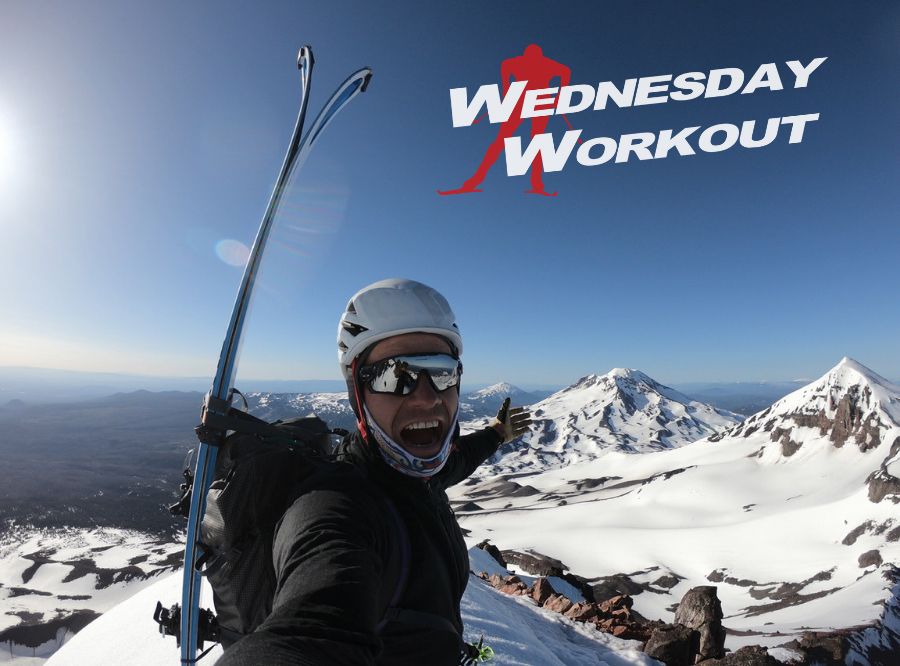
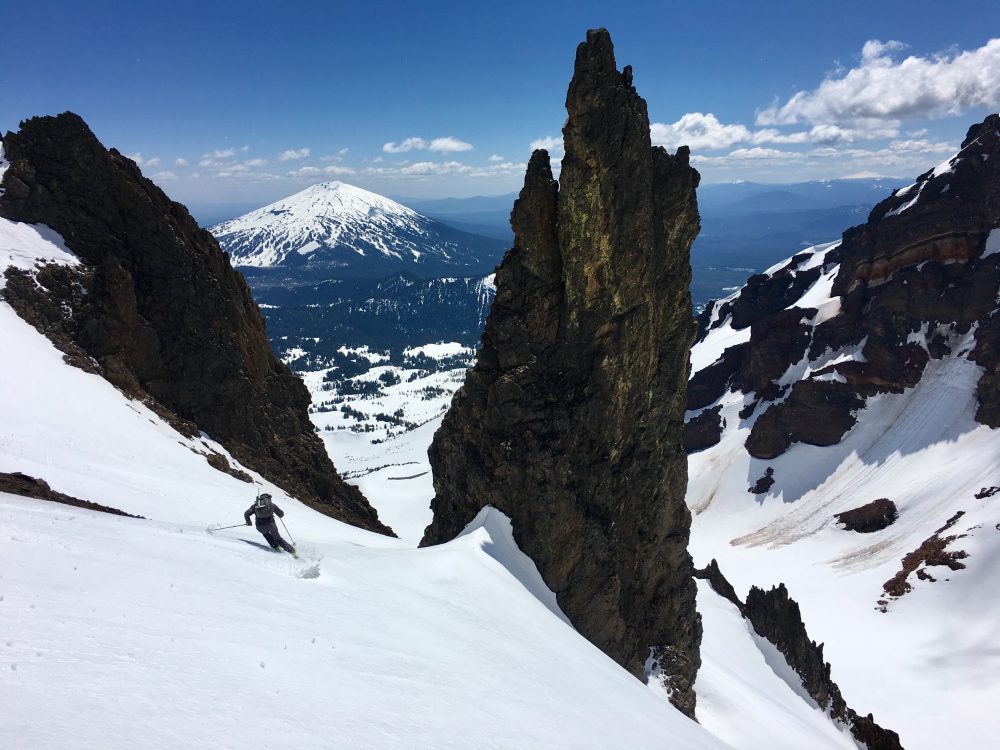
Simi Hamilton on a solo ski-mountaineering adventure to Oregon’s North Sister. The photo was shot before Hamilton skied down and tagged the summit of the Middle Sister (rightmost peak) this May. (Photo: Simi Hamilton)
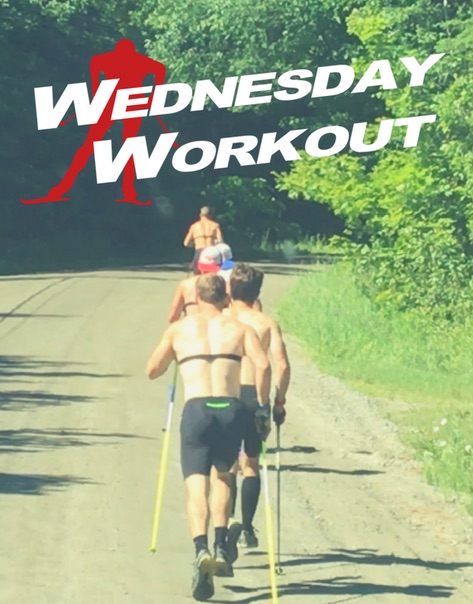
This post in our long-running Wednesday Workout series takes the 10,000-foot view — almost literally. The nuts and bolts of it are this: we’re posting Simi Hamilton’s training log from Monday, April, 3oth thru Saturday, June 9th.
Hamilton needs no introduction to FasterSkier readers. In any case, here are Hamilton’s basics. Thirty-one-year-old sprint specialist who popped a 12th last season in Seefeld, Austria in a loaded 15-kilometer mass start freestyle. The seventeenth ranked sprinter on the World Cup. Member of the U.S. Ski Team. Fond of thin air, like any good kid from Aspen, Colorado.
On his International Ski Federation (FIS) profile page, two small dashes “–” leave a void describing Hamilton’s hobbies. Let’s assume this was an oversight, with too little room to honor what Hamilton sees as more than a hobby.
He is an athlete clearly satisfied with skiing fast as he’s been a top-ranked World Cup sprinter since 2012. But if you follow Hamilton on social media or the Stratton Mountain School blog, there’s the occasional glimpse into Hamilton’s “hobbies”. If it’s an outdoor activity involving larger than normal size mountains, moving fast and light, pushing what even fit athletes would consider sustainable aerobic thresholds, Hamilton is home.
Simi Hamilton (left) with Akeo Maifeld-Carucci (right) on the southeast ridge of Mt. Jefferson.
Why present a broad-in-scope training log snapshot for a Wednesday Workout? By now, we are guessing most cross-country skiers are seeking snow. They have logged hundreds of hours. There’s been the OD, the L1-L5, the 30 x 30s, the 4 x 4 min. And we are also hoping there’s been plenty of “hobby” time.
If there’s something to learn from Hamilton’s logs, it’s to have fun.
Simi Hamilton harvesting corn snow on Broken Top near Bend, Ore. (Photo: Linden Mallory)
***
The Training Logs:
“That first week in May probably looks a little weak, and it was,” Hamilton emailed, explaining he had been relaxing on a river trip in early May. “I’m usually on my bike a bit more in May, but Matt [Whitcomb] and [Chris] Grover have tried to steer me more towards skiing while in Bend the last few years.”
Technically speaking, skiing has many forms. Maybe skiing in the mountains is what his coaches had in mind.
If you’re reading this now and you’re wearing a race bib at some point this season, we hope you’re having fun. We hope you’ve had fun. We hope you’ve logged some full-blown adventure days.
BSF’s Nick Michaud (red suit) at last season’s Senior National Championships in Anchorage, Alaska. Michaud qualified 4th. (Photo: Gilbert Michaud)
This Wednesday Workout was provided by twenty-six-year-old Bridger Ski Foundation (BSF) skier Nick Michaud. Bates College educated and raised plumb-line north in Fort Kent Maine, Michaud has emerged as a sprinter to watch on the SuperTour. He’s a gritty, salt-of-the-earth athlete who barely missed a nomination to the 2018 Olympic Team.
Michaud offered FasterSkier a menu of options for the 30/30 workout — 30 seconds on 30 seconds off. From junior athletes to masters in M8 and beyond, Michaud has you covered with these training session variants.
Let the gains begin.
Backstory of the Sizzling Hot 30/30’s from Michaud:
“Short, explosive movements are like bacon for me. I’m thrilled to eat bacon anytime, anywhere, with anyone. With vegetables, grains, and most foods that are really important for function, it can feel like a chore. That’s what a lot of nordic ski training feels like for me. My body, my mind, would prefer to just do speed work, lift heavy weight, and play basketball — and eat bacon. But in order to meet my performance goals, I have to eat vegetables and grains: aerobic base, lactate threshold, energy management, mindfulness and so much more. For these reasons, I love 30/30s.
30/30 home terrain for BSF’s Nick Michaud in Bozeman, Montana. (Photo: Max Lachance)
The execution is very simple: 30 seconds “on”, 30 seconds “off”. The effort and duration can be customized for the purpose of the workout. There should always be a purpose!. For athletes with periodized training plans, 30/30s can be used in different cycles of training to meet different goals. For a more casual athlete, 30/30s can simply be an extremely fun way to get in some higher intensity training.
Dragan Danevski, BSF nordic program director, began using 30/30s eight years ago. There was a study in Europe focusing on track and field and how to improve efficiency of running economy, improve aerobic capacity, and reduce the recovery time in a 30/30 workout. The original study tracked mainly 1500m and 3000m runners. Danevski adjusted the workout for skiers here at BSF.
Danevski said BSF has used 30 by 30s for a few different goals: improving skier’s economy, stimulate good technique, and shortening recovery time for lactate clearance. Originally it was for improving threshold. For his skiers, Danevski saw the potential to improve anaerobic capacity.
Throughout summer Danevski follows the study and uses 30/30s to improve threshold.
For the following age groups, the coach prescribes one 25-30 minute block of 30/30s for U16 and U18s. U20s go for a 30-35 a minute block of 30/30s. Some older skiers are ready for a 45 minute 30/30 session.
Danevski said these 30/30 training days need to be disciplined by monitoring heart rate.
In the past, the 30/30 workouts were used only during intensity blocks. Recently, we’ve started using it throughout the whole training year: on skis, foot, and rollerskis.
Psychologically, Danevski said the 30/30 is a more tolerable intensity session, especially for kids, since they can focus on high-quality efforts for 30 seconds each time. It’s easier to focus.
As we transition into fall here at BSF, we also use 30/30s to improve anaerobic capacity. One basic example we use are three to six sets of a 15-minute long 30/30s — with appropriate rest between each set.
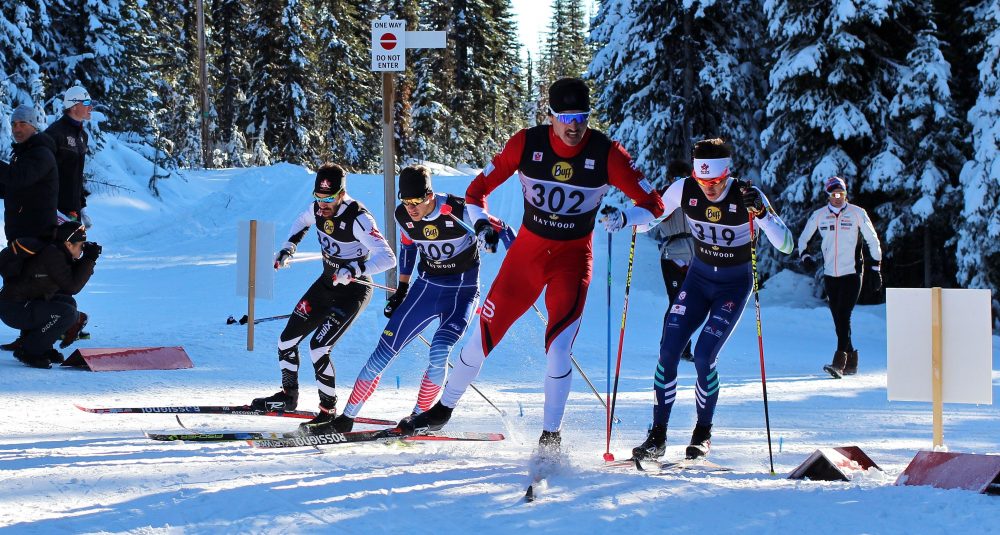
Nick Michaud (BSF) in bib 302 putting those 30/30s to good use at the Sovereign Lake NorAm in 2017. Michaud was the second fastest qualifier. (Photo: Forrest Mahlen)
The 30/30 Workout Menu Starting with Michaud’s Favorite Variation:
Nick Michaud: 3 x 5 minutes, sprint pace. So we are all clear, this means a five minute long 30/30 excecuted three seperate times. During each five minute period, that’s a total of 2.5 minutes “on”, and 2.5 minutes “off”. For the entire session, the athlete is “on” for 7.5 minutes, or half the total elasped time. I rest for five minutes between each set.
Notes:I use this two days before a sprint race, increasing my effort each set. It’s a great way to get a feel for speed, technique, and effort in all areas of the course. I take five minute breaks between sets. I leave the venue with a good understanding of the course and excited to move fast on it two days later. Using this training sessions at different points of the year is a great way to practice understanding the critical difference between effort and ski speed — which I think is crucial.
Favorite 30/30 Variations from Others:
Gary Colliander, US Paralympic Biathlon Coach: 4-8 x 6 minutes. Number of blocks depends on L3 or L4.
Notes from Colliander: “Focus on quality of movement through the interval and a slightly higher turnover. With the short ‘on’ time I think you can hold the technique together better and because there is a short rest you can potentially push the pace and thus the level a bit. They’re still very tough, but that short rest just seems to offer bit of recovery while allowing the heart rate to remain high.
Another way to look at the short 30 second rest is like it’s a downhill. Anytime you get a downhill it’s a chance to grab some O2 and recover although for a very short bit. But it always feels good when you come out of that tuck.”
Lina Hultin, Bridger Ski Foundation Development/Competitive Team Coach: 5×6 minutes.
Notes from Hultin:“What I like with 30/30s and 45/15s is that it allows the athletes to ski more efficiently. Since you have that shorter break, you tend to have better and more efficient technique since athletes ‘dare’ to push it a little harder when they know they will have a shorter break. Good technique requires strength and power and the shorter interval allows athletes to keep good technique for a longer time.
The closer you get to the season you can dare to let go of that shorter break and hopefully you can maintain that good efficiency in you technique in a continuous time trial or longer intervals.”
Akeo Maifeld Carucci: Craftsbury Green Racing Project Athlete: 2-4 x 10-15 minutes at L4+.
Notes:“Terrain wise, I like small rolling terrain or maybe gradual uphill with some bumps. I believe in keeping it between L1 and recovery pace during the rest phase, but it is important that it keeps moving at the least.”
Seth Hubbard, Bridger Biathlon Club Head Coach: 15/15s for sets of 4-8 minutes at race pace +
Notes: “This workout is altered depending on an athlete’s age and their work on pacing, and ability to surge and recover.”
Will Sweetser: Nordic Programs Director at Sugar Bowl Ski Team and Academy: 15 sec/15 sec 6-12 minutes.
Notes:“I use 6-12 minute repeats with ‘on time’ at either L3+ or goal pace for races 8 minutes and longer. First used this coaching runners in the mid 90’s. Have since had good success with younger athletes developing pace sense.
Used the 15/15 to help take an athlete’s 3,000 meter time from 11:38 to 10:10 in 5 weeks. The next year this athlete brought their time down to 9:27 using 15/15 session of 2 x 3000m about once every 10 days.”
Craftsbury Green Racing Project nordic skiers and biathletes doing uphill running intervals on a dirt road in Craftsbury, Vermont. (Photo: Pepa Miloucheva)
For a mid-summer Wednesday Workout, we reached out to Craftsbury Green Racing Project head coach Pepa Miloucheva. In addition to sharing a running workout, Miloucheva told us what and who is new to the team based out of Craftsbury, Vermont.
“All is good here in Craftsbury, everyone is healthy and training is going well,” she wrote in an email in early July. The nordic team joined last month’s U.S. Ski Team (USST) training camp in Lake Placid, N.Y., and also plans to attend the USST’s on-snow New Zealand camp in late August.
Ida Sargent, of the Craftsbury Green Racing Project and U.S. Ski Team, during dirt-road running intervals in Craftsbury, Vt. (Photo: Pepa Miloucheva)
Craftsbury’s roster additions include Corey Stock and Akeo Maifeld-Carucci. Returning to the nordic squad are Ida Sargent (U.S. Ski Team), Caitlin Patterson, Kaitlynn Miller, Liz Guiney, Adam Martin, and Ben Lustgarten.
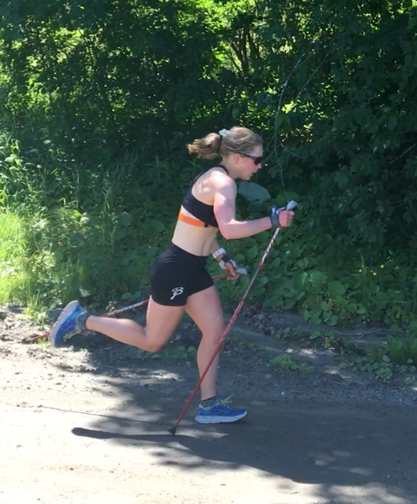
The workout itself, one Miloucheva explained the team does this time of year, is 6-8 x 10-minute running intervals with poles. They do so on a gradual, mile-plus-long hill on a dirt road in Craftsbury. To replicate, find a climb that takes at least 10 minutes to run up, and repeat six to eight times.
“This is a lactate threshold workout, important for improving our sustainable speed,” Miloucheva wrote. “Threshold workout improves both lactate production/recruiting more fast twitch units and lactate removal, ability to minimize the negative effects of lactate while having the benefits.”
“Athletes run with poles up and I drive them down as quickly as possible to shorten the time between the interval,” she explained. “Goal is to maintain speed for all intervals and keep lactate between 3-5mmol/l, depending on the athlete.”
Male and female athletes all start at once, just at different starting points so they finish in the same place. Miloucheva recommends focusing on controlling speed during this workout to ensure a productive 50-plus-minute workout at Level 3.
Upon repeating the workout later in the training season, athletes are instructed to push the pace at the end of the interval to Level 4.
The workout: 6-8 x 10-minute running intervals with poles
Need: A hill that takes at least 10 minutes to run up, poles.
Warmup: 30 minutes easy running, with a few accelerations and functional movements
Then: Run uphill for 10 minutes at Level 3, return to starting point, repeat 6 to 8 times. Pace at end of interval can be increased to Level 4 later in the season.
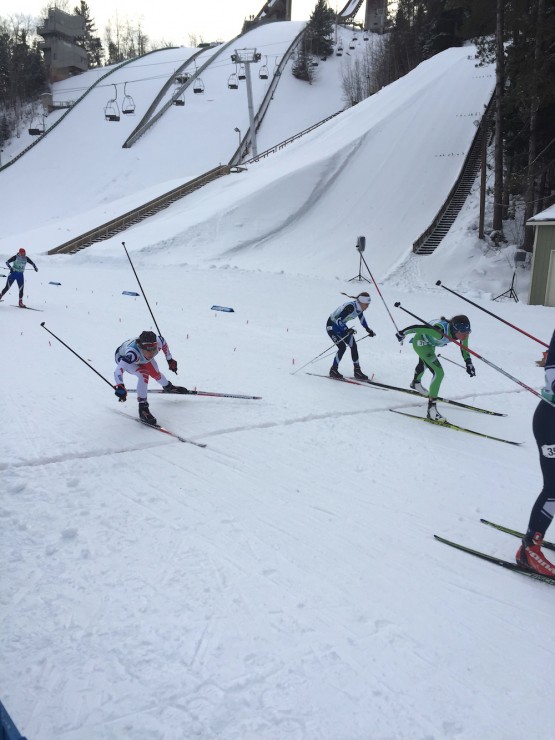
The start of the women’s freestyle sprint final at the SuperTour in Lake Placid, N.Y., with Anne Hart (front left), Chelsea Holmes (behind, second from l), Becca Rorabaugh (back left), Caitlin Patterson (center, in green), Jessica Yeaton (second from r) and eventual winner Kelsey Phinney (r). (Photo: Heidi and Bob Underwood)
Kelsey Phinney (Middlebury) after winning the women’s final at the SuperTour freestyle sprint on Jan. 30 in Lake Placid, N.Y. She beat out Caitlin Patterson (behind), Anne Hart (left, in red and white), and Jessica Yeaton (third from right) for her first SuperTour win. (Phot: Heidi and Bob Underwood)
Second through fifth in the women’s freestyle sprint final at the Jan. 30 SuperTour in Lake Placid, N.Y., with Caitlin Patterson (r) edging Anne Hart (l) for second, Jessica Yeaton (second from r) placing fourth and Chelsea Holmes (behind) bringing it home in fifth. (Photo: Heidi and Bob Underwood)
SuperTour action resumed this past weekend at the Lake Placid SuperTour/Eastern Cup and the podiums were shared by this season’s regulars as well as some new faces.
The 1.4-kilometer freestyle sprints were held Saturday in Lake Placid, N.Y., at the Olympic Ski Jumping Complex rather than the cross-country trails at Mount Van Hoevenberg, where they were originally scheduled, due to low snow. Sunday’s classic mass start was changed to an interval start as it was held on a 2.5 k lap with more than 200 skiers. The jump site, the home training venue for US Biathlon’s national team members during the offseason, made for a hilly race course with great snow conditions.
Day 1: Skate Sprint
The freestyle sprints belonged to the dark horses as Middlebury senior Kelsey Phinney and David Norris of Alaska Pacific University (APU) both captured the first SuperTour victories of their careers.
In contrast to the long finishing grind to the finish of the sprint at U.S. nationals in Houghton, Mich., the previous stop on the domestic circuit earlier in January, the Lake Placid course had a relatively short home stretch. A fast descent with a sharp turn led into the finish, making positioning on the downhill crucial as there was a significant advantage to drafting.
Phinney Beats the Pros
The women’s final included several names who have been regulars on domestic podiums all season including Caitlin Patterson (Craftsbury Green Racing Project), Anne Hart (Stratton Mountain School T2 Team), Chelsea Holmes (APU), Becca Rorabaugh (APU), Jessica Yeaton (APU), and Phinney, the lone collegiate athlete. In contrast to the heats, where the leaders could often create enough of a gap on the hill to be clear of the field after the descent, the final was a game of tactics.
Jessica Yeaton (APU) leads up the hill during the SuperTour women’s freestyle sprint final on Saturday, Jan. 30, at the Olympic Ski Jumping Complex in Lake Placid, N.Y. (Photo: Alex Howe)
Although the pace in the final started out relaxed, Yeaton was the first to push the pace on the climbing section and Patterson, Hart and Holmes were shuffled to the back. Concerned that the pack would separate, Holmes made a move on the final climb and crested the top of the final hill in the lead.
Phinney slipped behind Holmes, allowing her to take advantage of the draft down the final hill and slingshot into the lead on the home stretch. Patterson followed Phinney through the inside line into second and was able to hold off the field but unable to overtake her for the win.
“My main focus in the final was to be in second or third going into the last downhill and to get the inside track around the final corner coming until the finishing straight,” Phinney, 21, wrote in an email. “I took the lead around the final corner and I felt confident in my ability to hold that lead to the line.”
In securing her first SuperTour win (and podium), Phinney held off Patterson by 0.45 seconds in the final straightaway. A hard-charging Hart fell short of catching the pair and placed third (+1.7). Yeaton followed just off the podium in fourth (+2.14).
Middlebury senior Kelsey Phinney (c) takes her first SuperTour win at the Lake Placid freestyle sprint on Jan. 30, followed by Craftsbury’s Caitlin Patterson (l) in second and Stratton’s Anne Hart (r) in third. (Photo: Heidi and Bob Underwood)
For Phinney, the win was redemption after a rough freestyle sprint at nationals, where she finished 31st — missing qualifying for the heats by one place.
“I had placed some high expectations on the skate sprint and ended up having a tough day — just narrowly missing the heats after feeling pretty off in the qualifier,” Phinney reflected.
However, a couple of weekends of collegiate racing brought confidence and racing form, and Phinney put it to good use.
“I skied across the line into the arms of my teammate Annie Pokorny, who was waiting for us in the finishing area. That was such an amazing feeling!” she wrote.
Although Patterson had hoped to drive the pace up the hill, a bad start left her boxed in. Patterson stayed calm and patient and her opportunity arose on the final descent.
“I would have liked to have gotten off to a faster start and been in more control of the heat, but throughout the final I had both bad luck and good luck in positioning, and overall it turned out pretty well at the end,” Patterson wrote in an email.
Hart also had to recover from suboptimal positioning and was forced to the far outside on the final turn.
“I had a great last 100 meters with some nice maneuvering, but didn’t give myself the chance to battle for first — ran out of real estate at the end!” Hart wrote.
Although Holmes was able to use the downhill to her advantage to win her semifinal, she found herself at a disadvantage in the final leading down the last hill. The pack took advantage of her draft to set up the final sprint, and Holmes ended up fifth (+2.96).
“I felt like I was able to dig deeper than I have in awhile, which was really great. Moving through the heats it was definitely pretty hard but more than anything it was an important reminder to how tactics play a role in sprinting,” Holmes wrote.
Norris Nabs a Win
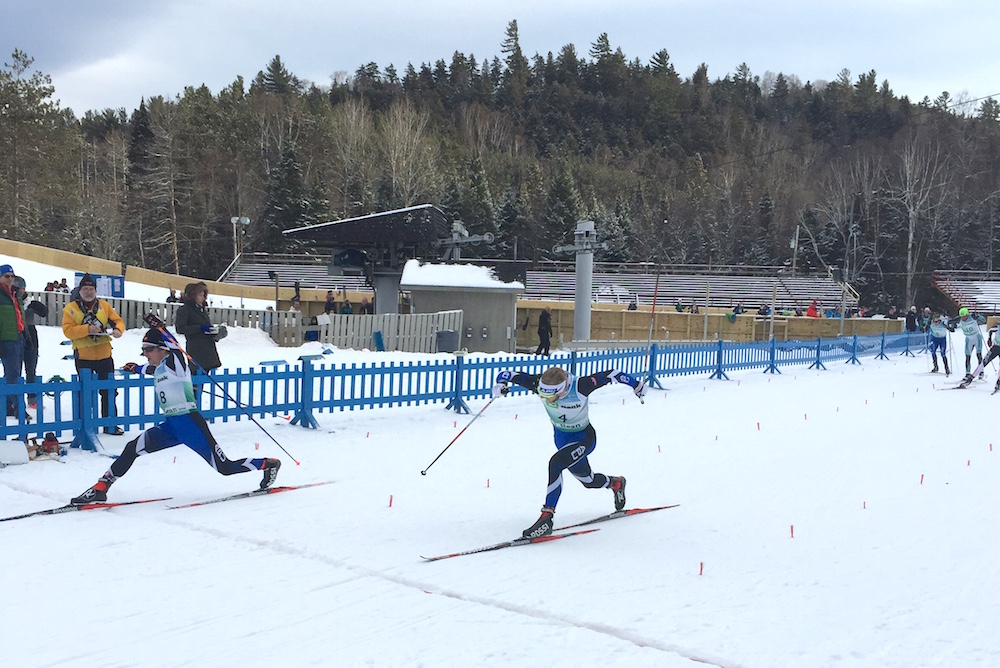
David Norris (l) lunges at the line to beat APU teammate Eric Packer (r) in the men’s freestyle sprint at the SuperTour in Lake Placid, N.Y. (Photo: Heidi and Bob Underwood)
In the men’s freestyle sprint, Norris cruised through the heats, winning both his quarterfinal and semifinal before topping the final in 3:18.9 minutes, 2.16 seconds ahead of APU teammate Eric Packer. Less than a second later, Akeo Maifeld-Carucci of the Bridger Ski Foundation took third (+3.0).
A third APU skier in the final, Tyler Kornfield fell on the downhill and had to settle for sixth. Brian Gregg (Team Gregg) took fourth (+5.17) followed by Canadian Alexis Turgeon (Skinouk) in fifth (+5.57).
The men’s heats again reflected the importance of the descent into the finish in the overall placings.
“I focused on skiing relaxed to the top of the course, which put me in last place at the top of the hill every heat. From the top I was able to use the draft to pass guys and work my way to the front for the final corner into the last 50 meters or so,” the 25-year-old Norris explained in an email. “By the time the final 100m sprint happened the speed was so high that it was tough to make or lose much ground to the competitors. I led into the finish every heat of the day and was able to hold it each time — thankfully!”
Packer also hoped to pull off the same strategy, but lost time when he narrowly avoided Kornfield, who had crashed hard in front of him on the descent.
“After that I no-pole skated as hard as I could to catch back on to the group,” Packer wrote in an email. “I really pushed hard over the top of the hill, and passed the group on the outside with 200m to go. At the same time, Dave passed the group on the inside, and he was first around the corner into the final stretch. I was closing on him in the finish lanes, but he beat me to the line.”
“David has an amazing no-pole skate, and that was just what you needed today,” Packer added. “I’m super happy to see David performing where he should, and he skied the race perfectly.”
For Maifeld-Carucci, a Harvard graduate in his first professional season, the day was a learning experience that he was able to immediately put into action.
“I just went into every round trying to focus on how I could ski better than the qualifier or the previous round,” he wrote in an email. “I learned a lot skiing in such strong competition all day. I tried to use some of that knowledge right away in the next heat but will keep thinking about it and finding takeaways for my next sprint race which will be at U23s.”
Despite placing fourth in his semifinal, Maifeld-Carucci earned a shot at his first SuperTour sprint final, advancing as a lucky loser along with Gregg.
Maifeld-Carucci just missed qualifying in two U.S. nationals sprints at the last two years, placing 31st in the 2015 freestyle sprint and 2016 classic sprint. However, he made it to the heats in the freestyle sprint at nationals this year, placing 15th overall.
“It was fun to see the depth of the field and see that even the lower qualifiers can be competitive in the finals,” he wrote. “It is also a nice reminder to see that even if you are fourth in your heat every fraction of a second matters and pushing hard to the line can be enough to get you through. Overall it was a very fun and exciting day.”
Canada’s Alexis Turgeon (Skinouk) leads early in the men’s freestyle sprint final at Saturday’s SuperTour in Lake Placid, N.Y. Turgeon finished fifth in the final, behind David Norris (third from l), Eric Packer (l), Akeo Maifeld-Carucci (behind) and Brian Gregg (second from l). Tyler Kornfield (second from r) fell on the downhill and placed sixth. (Photo: Heidi and Bob Underwood)
Akeo Maifeld-Carucci (r) of the Bridger Ski Foundation and Brian Gregg (l) early in the men’s freestyle sprint final at the SuperTour in Lake Placid, N.Y.
Day 2: 10 k Classic Individual Starts
The men’s 10 k classic podium at the Lake Placid SuperTour on Sunday, with David Norris (APU) on top for the second-straight day, Kris Freeman (l) in second followed by Lex Treinen (r). (Photo: Heidi and Bob Underwood)
Sunday’s classic individual start consisted of four laps of a 2.5 k course for a total of 10 k for both the men’s and women’s races. The course consisted of several of the jump hills strung together in the beginning, followed by the descent winding back into the stadium.
With temperatures in the low 40s, the course conditions were variable, but most certainly requiring klister. With the challenging climbs of the jump area, going without kick wax was a disadvantage.
Norris Repeats
A day after winning his first SuperTour race in the freestyle sprint, Norris charged to the classic-distance race victory in 28:26, 45 seconds ahead of Kris Freeman (Team Freebird). The second APU skier on the podium, Lex Treinen placed third (+0.58).
The multiple-lap course made for interesting dynamics with many skiers on the course at a time.
“It was fun conditions because skis slowed after the first lap so some of the second seed skiers had the chance to draft off of the leaders, and we had the opportunity to ski with them,” Treinen wrote in an email.
Treinen posted the fastest split after the first lap, but by the second lap, Norris had a 14-second lead that he only increased over the final two laps.
“I burned up the nerves on the first lap and had the fastest split going into the first lap, something I have probably never ever done,” Treinen wrote.
David Norris (APU) giving his all across the line to win the 10 k classic individual start at the Lake Placid SuperTour on Sunday. (Photo: Heidi and Bob Underwood)
Freeman explained in an email that he’s been feeling healthy for about three weeks.
“My overall energy felt much better than at any other time this season,” he explained.
His game plan for the 10 k wasn’t anything out of the ordinary: “Go out at a sustainable pace and try to speed up in the last lap,” Freeman wrote. “I think a mass start would have been very interesting and more fun but changing the race to a time trial was the right call give the width of the trail.”
After having never before won a SuperTour, Norris picked up back-to-back victories in Lake Placid.
“After Nationals I had a good chunk of time in Anchorage, which allowed me to get some quality rest and some really good mid-season training in,” Norris explained.
“I went pretty thin on the wax knowing that the course had a lot of double pole and tucking time each lap,” he added. “I’ve been trying to teach myself to race on faster classic skis with less kick and that has caused me to suffer in the last few kilometers of a few races, but today I was able to maintain my technique and keep finding kick.”
Similar to Norris, Treinen is seeing the results of consistent training and racing.
“I felt good going into Houghton, but I also didn’t have that much racing under my belt for the season, and I tend to start out the seasons slow and build throughout,” Treinen wrote. “It was fun to get some true East Coast klister skiing after having all of first races in cold, hard conditions.”
Freeman noted, “I had very accessible kick and pretty good glide.”
Same Ol’, Same Ol’
The women’s race was the epitome of consistency as the podium was identical to the same at nationals this year: the 10 k classic in Houghton.
Patterson, 26, continued to assert her dominance of the distance races (after winning both distance races at nationals) by winning by a full minute on Sunday in 31:45.
Her Craftsbury teammate, Kaitlynn Miller placed second (+1:00) and Holmes finished third (+1:19).
“Although it also was a somewhat variable and difficult day for snow conditions, so it was important to keep the technique together and stay smooth,” Patterson wrote. “I know I did a good job today of skiing through terrain changes and transitions, and I suspect that’s where I may have gained some time over competitors.”
Miller also attributed her success to good skis and adapting to the conditions.
“The conditions varied a fair amount over the 2.5k loop with flagpole hill becoming a bit slushy while other parts of the course remained slightly glazed,” she described. “I started right as Annie Hart was lapping through so she definitely helped push me along. Also, I was the last starter in the A-seed so was able to get some informative splits from my coaches out on course.”
Hart finished just off the podium in fourth (+1:29).
This weekend was Holmes’ first races in the U.S. after returning from Europe where she competed at the World Cup in Planica, Slovenia, and Nove Mesto, Czech Republic. Holmes placed 37th in the Nove Mesto 10 k freestyle in her international World Cup debut.
“I wish I had had more time on the World Cup as I really felt like I learned a lot in both the race experiences I had,” Holmes wrote. “Maybe it wasn’t ideal to do the back and forth so quickly like that — I was sick when I went over but other than that I’ve managed to stay healthy.”
This weekend marks the end of SuperTour Period 2. Period 3 will begin next weekend, Feb 5-6, at Trapp Family Lodge in Stowe, Vt.
The women’s 10 k classic podium on Sunday at the Lake Placid SuperTour: with winner Caitlin Patterson (c), Kaitlynn Miller (r) in second, and Chelsea Holmes (l) in third. (Photo: Heidi and Bob Underwood)
The men’s 10 k classic podium on Sunday at the Lake Placid SuperTour: with winner David Norris (c), runner-up Kris Freeman (l), and Lex Treinen (r) in third. (Photo: Heidi and Bob Underwood)
WEST YELLOWSTONE, Mont.– While the Yellowstone Ski Festival crew is plenty busy grooming the trails with the fresh snow fall Wednesday, many skiers are also busy grooming their upper lip. In the spirit of no-shave “Movember,” FasterSkier decided to rank the top mustaches found out on the trails. Ranking decisions were made based off the official rules according to the Movember Foundation, as well as an individual’s responses, and overall look.
The photo gallery shows our picks for the Top 10 Movember Men. This is followed by the Top Five Movember Women*, abbreviated because of the number of women who participated*. The gallery is rounded out with the top-three Bearded Honorable Mentions.
Why this ‘stache: “I’m just a poor college student and I can’t afford a razor,” said Parr. “I’ve been working on this for quite a while, not going to lie, I cheated a little bit. Started this back in June to prepare for this month. It’s a big month, there’s Yellowstone races, you have to show up and look tough and having facial hair is a big part of that,” added Dubay.
Why this ‘stache: “I thought it looked pretty good.”
Why this ‘stache: “Been growing it since November first. Started as a full beard, then I went to a goatee for a couple days. A lot of people didn’t like that, now I have handle bars,” said Michaud. “It’s really thick and full,” voiced Diekmann.
Why this ‘stache: “First, it started because a professor called me out last year for not having a mustache during November. That was number one. And then two, coming out to Montana from Minnesota, I’m thinking, I gotta get that ski bro..pretty laid back look.”
Why this ‘stache: “It’s been a very important month preparing for this moment.”
Why this ‘stache: “I had a big beard up until three or four days ago. We had a fundraiser for our team, it’s call Nordic Fest, a nordic themed dinner/silent auction. At the end of the night, someone had the idea [that] we could auction off shaving my beard. People threw up money like crazy and we raised over $600.00 for it. Now I’ve got this mustache.”
Why this ‘stache: “You can use the mustache to double check the kick wax of the day. For example, I’m using Extra Blue today to wax my mustache and it’s clearly the right wax for the day.”
Why this ‘stache: “It started on a hunting trip in September. It got hearty enough, that I had more than I ever had before, so I figured I just had to keep it going. I made a deal with the girlfriend that I could keep it until I got home from the SuperTours this fall. I look mean, but it makes the ‘stache look better that way.”
Why this ‘stache: “It reminds me of Colonel Mustard,” said Bean. “I don’t really know…,” Guiney reflected.
Why this ‘stache: “It’s a classic.”
Why this ‘stache: “It’s a modern twist on a classic ‘stache.”
Why this ‘stache: I chose this mustache because it has attitude, but it’s also business-like, which is how I feel I try to ski. You want to take what you’re doing seriously, but not take yourself too seriously, [and] I feel like ‘No Shave November’ really encapsulates that lifestyle.”
Why this look: “Oh, I just always have a beard.”
Why this look: “I really don’t like my facial shape. So it’s sort of to make an illusion that I have a better shape than I have.”
Why this look: “It didn’t really happen on purpose or anything. Starting in October I felt like I’d try it out, and that’s all there really is to it.”
Along with getting the history behind the facial hair, FS asked athletes about their race goals for the weekend and beyond:
Annie Pokorny (SMST2): “Be one of the top girls going into the season.”
Sloan Storey (University of Utah): “Just getting back into it, waking my body up, and having fun.”
Liz Guiney (CGRP): “Get the first races out of the way and have fun.”
Miles Havlick (SVSEF): “Should be a good weekend to get into the racing routine.”
Chris Parr (Unaffiliated): “To try and not to shave … I’m hoping I can hold off, it’s tempting.”
Joe Dubay (Unaffiliated): “I’m going to try not to let the icicles on my beard get too out of control.”
Nicholas Michaud (BSF): “Have the best mustache in the A-final on Friday.”
Eric Packer (APU): “First race of the year you’re always trying to put down a good effort and practice all of the things you worked on over the summer. My biggest goal is to go out there and ski really well.”
Akeo Maifeld-Carucci (BSF): “Make sure my mustache is looking real good at the finish.”
Reese Hanneman (APU): “I’m focusing on the sprint and hoping for an elite podium.”
Bernie Nelson (l) coaching Australian national-team skier, Alaska Pacific University member and former MSU athlete Jessica Yeaton (r) at the 2015 World Championships in Falun, Sweden. (Photo: Bernadette Nelson)
“I don’t think that there being a lack of [elite] female coaches has anything to do with entry into the sport,” she said in a recent in-person interview. “I think it’s more that the lifestyle is not the most glamorous.
“Sleeping in bunk beds, sleeping on couches, sleeping in different tiny little rooms”, as she describes it, “coaches just put 150 percent into what they’re doing. And then they go home and collect themselves because next weekend, they’re doing it again.”
The copious amounts of coffee and early mornings spent doing hot laps in the dark is not a job for the weak at heart. Still, if the profession doesn’t include fancy hotels and plush king-size beds, what keeps Nelson, and other nordic coaches like her, going? According to Nelson, one word: passion.
“I don’t think that there is a single [nordic] coach out there — young, old, grumpy, not grumpy — who doesn’t truly love skiing,” she said. “I think that passion drives most coaches. Let’s be honest, coaches don’t start coaching for the salary. Coaches coach because they love coaching, or they love skiing, or they love teaching, or there’s something that they are passionate about in the sport.”
“Let’s be honest, coaches don’t start coaching for the salary. Coaches coach because they love coaching, or they love skiing, or they love teaching, or there’s something that they are passionate about in the sport.” — Bernie Nelson, head coach of the BSF Elite and postgrad teams
But what does this passion look like? For Nelson, who turns 25 on Tuesday, it’s five years of ski coaching — one year at Montana State University (MSU) as a student assistant coach, followed by two years there as an assistant coach, and a year as the Bridger Ski Foundation (BSF) PG and Elite Team head coach — as well as over 10 years of competitive ski racing. It’s also a lot of time.
“I put thought into each session and I put thought into each individual at each session,” Nelson said.
Bridger Ski Foundation athletes:
Elite Team
Akeo Maifeld-Carucci
Jennie Bender
Nicholas Michaud
Full-time PG
Max LaChance
Logan Diekmann
College PG
Mitch Harris
Cameron Bobb
Henry Trowbridge
Erin Bolger
Paul Everett
Ben Grodner
Sam Nelson
Sarah Lyle
With a total of 13 athletes and close to 12 sessions a week, Nelson’s passion for coaching invariably means a lot of time dedicated to people other than herself. It also means looking to others.
“I try not to get stuck in just nordic,” she said. “I love hearing about what other people are doing in our sport, but also I love hearing what other coaches are doing in other sports because I think you can take those components, think about them and implement them when they need to be implemented. It’s more tools in your toolbox.”
A native of Truckee, Calif., she added that a bit of time in the race bib isn’t unwarranted as a coach.
“I think it’s so important to race every now and again, because it reminds you how much it hurts, how nervous you get, and all the different feelings that your athletes have,” Nelson said.
Being a nordic skier, Nelson explained that “it’s fun to tie up the competitive laces” and experience “the pain that’s replaced with euphoria” every once in a while. Especially when running on four hours of sleep with a legion of race skis to wax.
Part of the passion Nelson exhibits stems from those who coached her. “A lot of my coaching principles are rooted deeply in [Far West Nordic Head Coach] Ben Grasseschi’s approach to skiing,” she said. “Ben taught me not only how to love the sport and nordic skiing as an athletic endeavor, but also to love what you’re doing when you’re doing it.”
Nelson’s work with coaches, such as Grasseschi and former MSU assistant Chad Anderson, gave her what she called “perspective.” The perspective of not just a coach, but an athlete and mentor.
“Coaching is complex,” BSF Head Coach and Program Director Dragan Danevski said in a recent phone interview. “One coach needs to have different abilities: understanding physiology, understanding psychology, understanding waxing, organizational skills with athletes, races, and trips. These abilities come with experience and you need somebody willing to take on that challenge. Somebody who has enthusiasm, energy, and motivation. I believe Bernie is that person.”
Bernie at a Glance:
-Name: Bernie Nelson -Nickname: Bern -Age: One day shy of a quarter century! -Hometown: Truckee, Calif. -Education: B.S. in Community Health, Montana State University -Current Profession: BSF Postgraduate and Elite Team Head Nordic Coach -Interests/Hobbies: Skiing, skiing, skiing, mostly in the downhill direction. Running, Mountain Biking, General life training to keep up with Dak [Dakota Blackhorse-von Jess] -Most Bad-A** Moment: Snowshoeing in Yellowstone Park with my mom. -Most Embarrassing Moment: Getting arrested in Yellowstone Park while snowshoeing with my mom. It was a mix up and I still don’t like snowshoeing. -Self-Identified Spirit Animal: Bear -Favorite Music Jam: Eric Church. But the team loves the Greatest Hits of Elton John CD.
Along with coaches, Nelson’s experience with team sports has influenced her coaching style.
“The biggest thing I bring to skiing is the idea of team and feeling a part of something that’s bigger than yourself,” she said. “There’s something to be said about digging deep and pushing past your point of comfort and really burying yourself in the pain, but there’s also something really enlightening about doing it for yourself and doing it for the people that are right next to you, whether you are on the same team or not.”
During an in-person interview, Michaud — the newest BSF Elite team member who hails from Maine — said that even after one summer with Nelson, he learned “there’s always more in the tank.”
“Working with Bernie, you learn a lot about the power of positive attitude and energy,” said Maifeld-Carucci, a recent Harvard graduate and also first-year BSF Elite Team member.
For Nelson, having that sort of positive impact on her athletes remains the most important part of her coaching. One of her goals for the BSF program includes “helping motivated and committed BSF athletes discover their athletic potential, believe in their potential and supporting them as they develop from domestic racing to the highest level of the sport,” she explained.
Nelson’s passion as a coach stems largely from the people she coaches.
“What makes me love coaching, is to not only see my athletes’ athletic development, but also to see their development as a person,” she said. “My goal in and out for the last five years that I’ve been coaching is to have my athletes not only leave as better skiers, but as better people.”
***
About the Author: Gabby Naranja considers herself a true Mainer, having grown up in the northernmost part of the state playing hockey and roofing houses with her five brothers. She recently graduated from Bates College where she ran cross country, track, and nordic skied and is excited to work with FasterSkier.