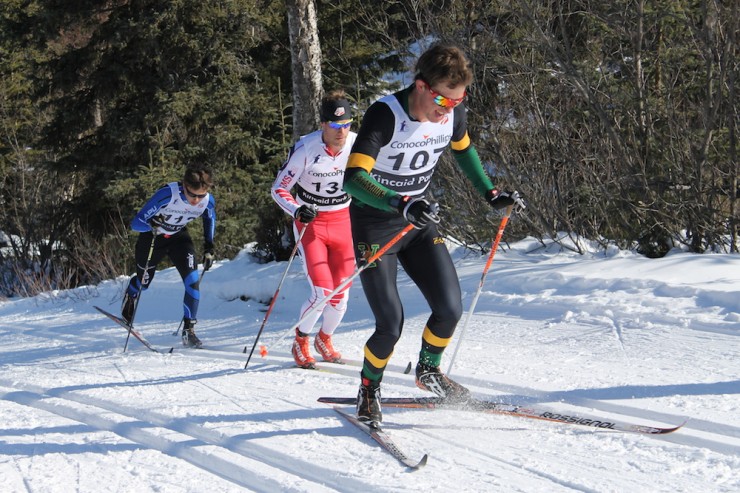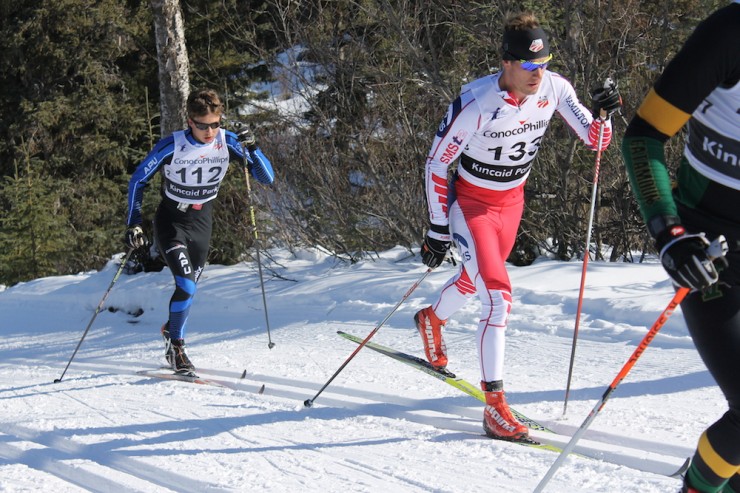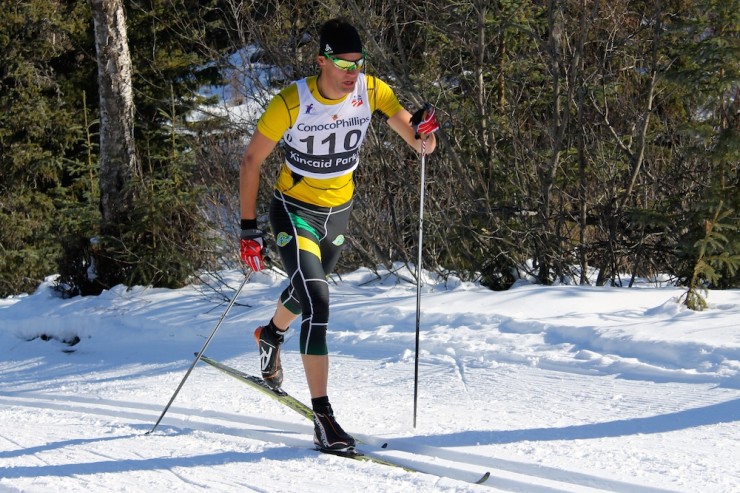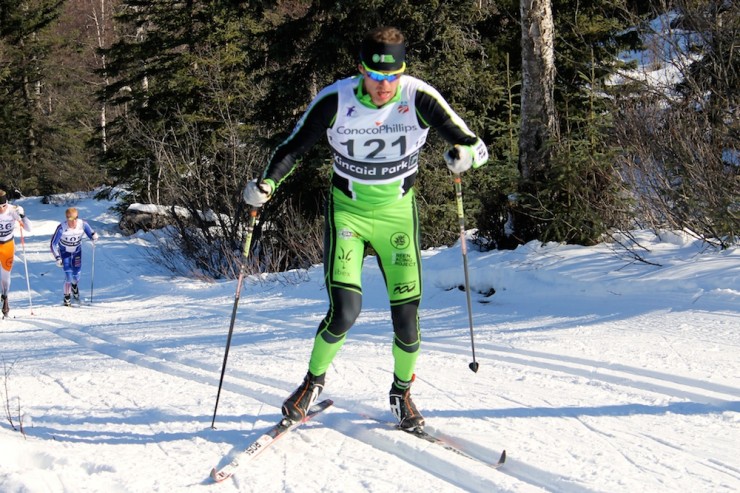
Tag: aku nikander

  • RMISA Season Concludes in Anchorage with Colorado Crowned Season Champs

    RMISA Season Concludes in Anchorage with Colorado Crowned Season Champs

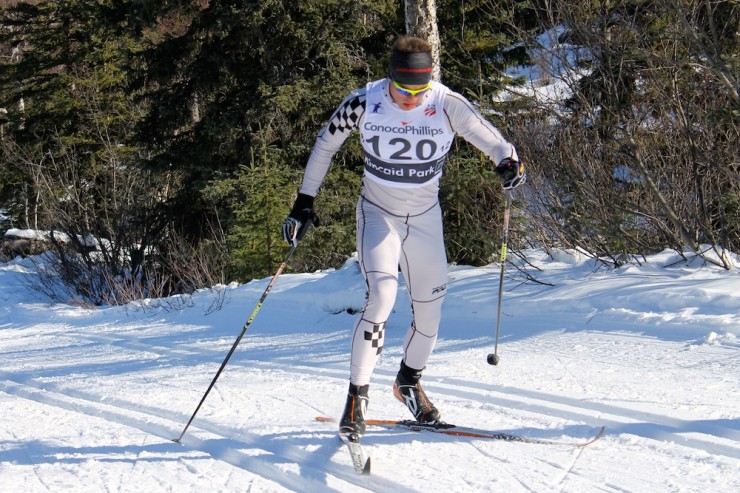
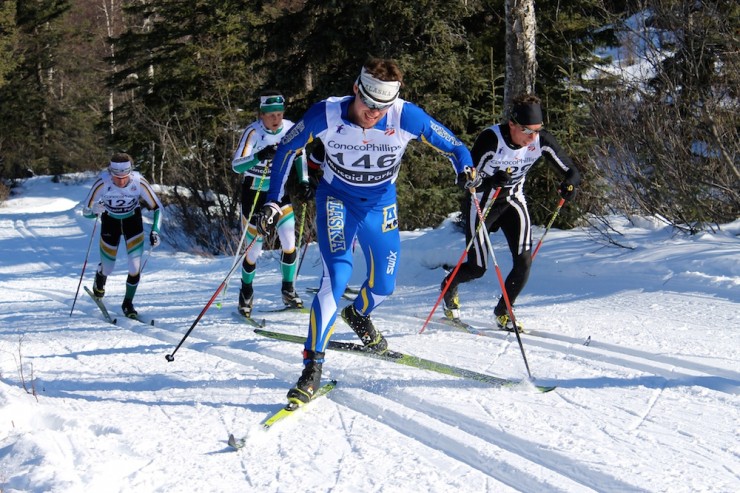
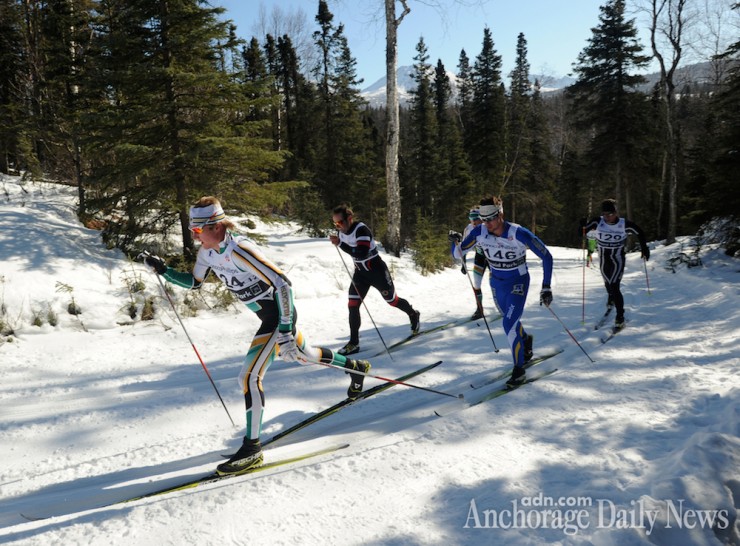
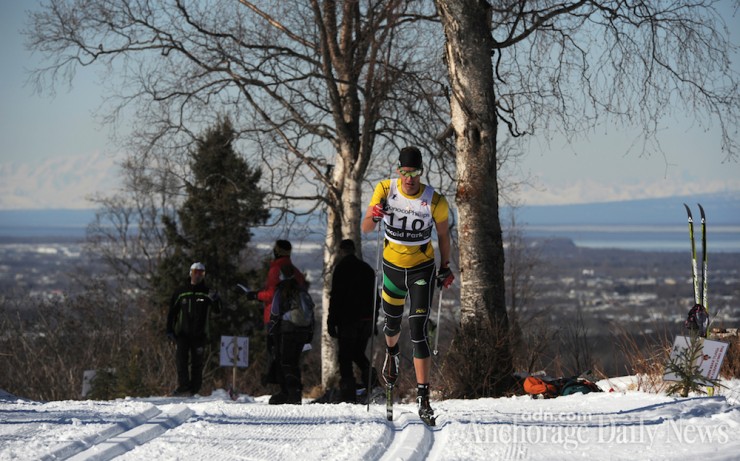
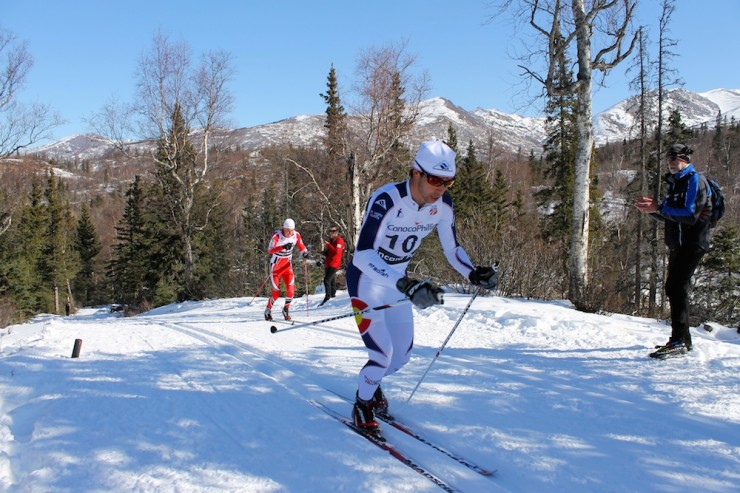
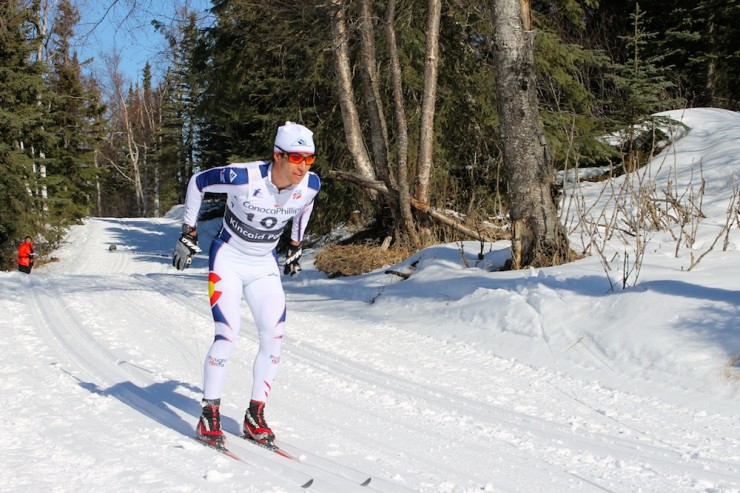
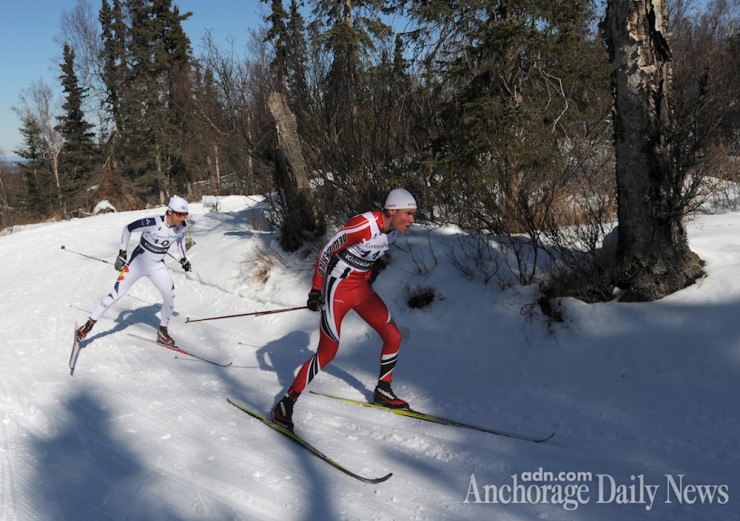
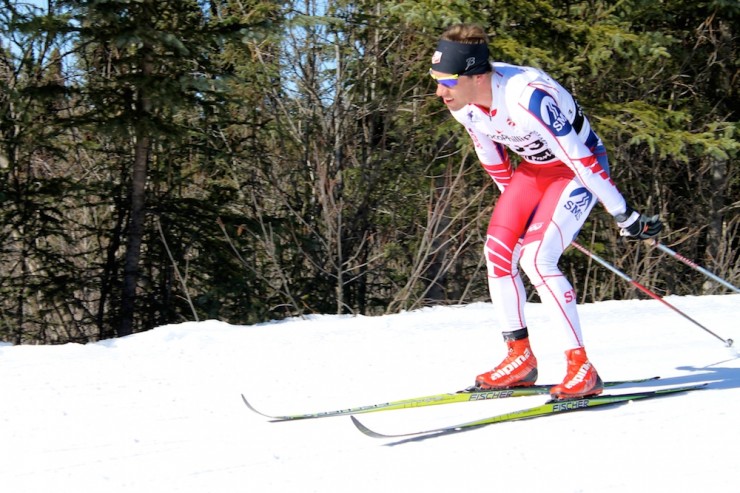
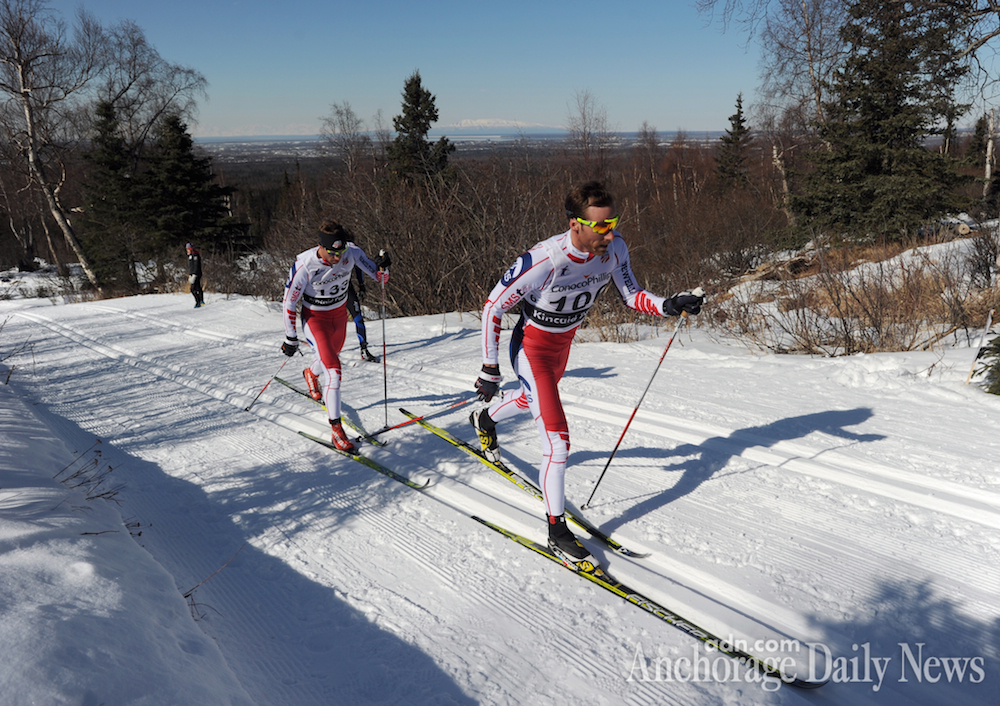
    Colorado University's Mads Stroem on his way to victory in the 7.5 k classic race at Kincaid Park, part of the University of Alaska Anchorage Invitational held last week. (Photo: Tim Whiton)
    University of Colorado’s Mads Stroem on his way to victory in the 7.5 k classic race at Kincaid Park, part of the University of Alaska Anchorage Invitational held last week. (Photo: Tim Whiton)

    After a three-week break of racing after the University of New Mexico Invitational in Red River and the University of Colorado Invitational in Steamboat Springs, the Rocky Mountain Intercollegiate Ski Association (RMISA) shifted gears to sea level and the University of Alaska Invitational and this year’s RMISA Championships. The UAA Invite was originally scheduled to be held at Girdwood, but a lack of snow and an abundance of cold rain moved all four of the final RMISA races to Anchorage.

    “Seven days ago at this time, we didn’t have hardly any snow on the ground and we were in the middle of three days of steady rain,” the UAA team wrote on their blog this weekend. “We’d scrapped our original plan to race our first two (of four) races on the new Girdwood racing trail because there was no snow at all in Girdwood. Not even a thin film of ice. Just brown dirt and gray rocks. Skis hardly glide on that kind of surface.”
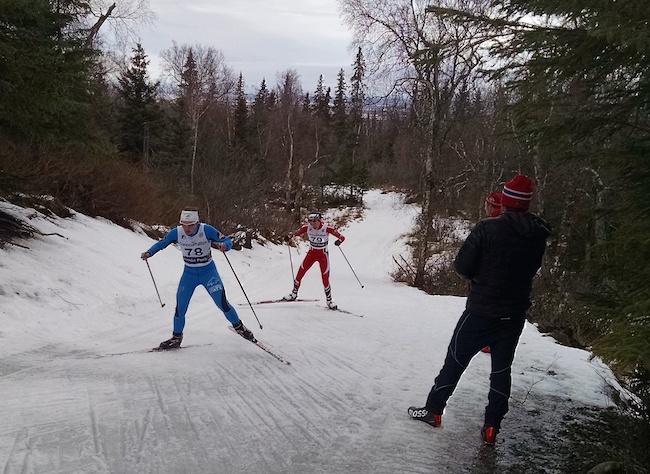
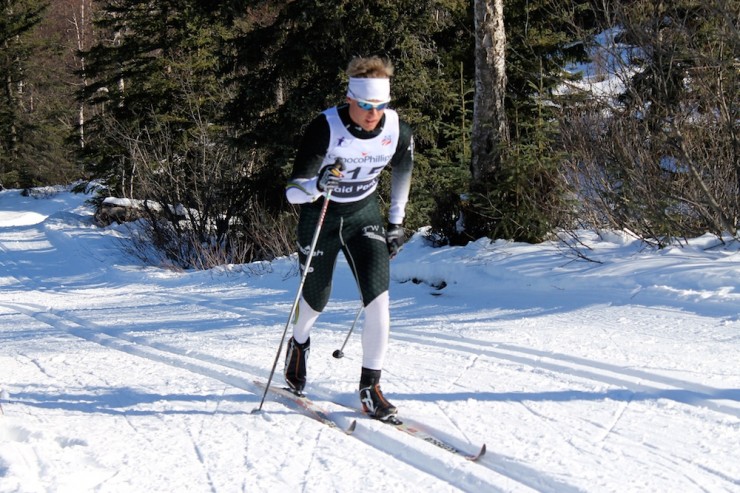
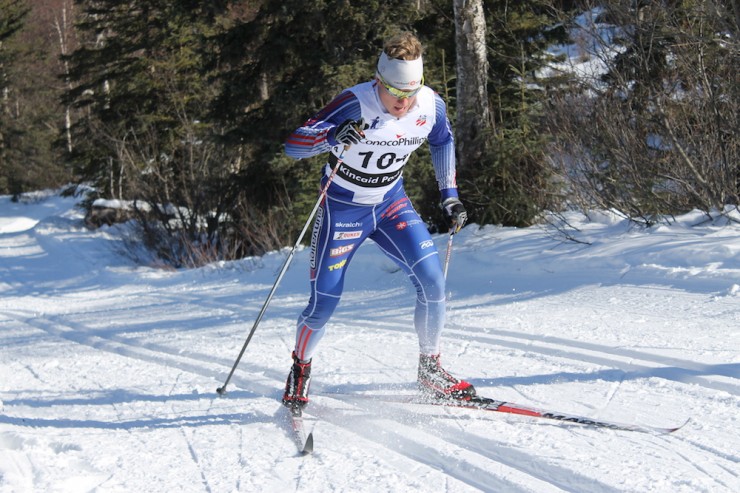
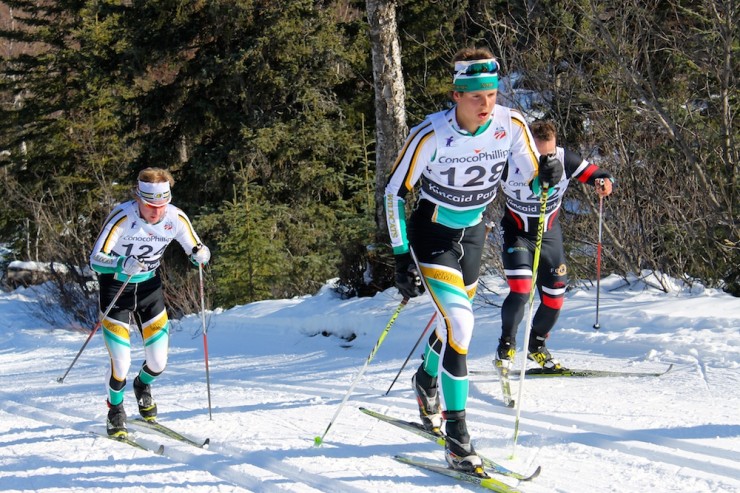
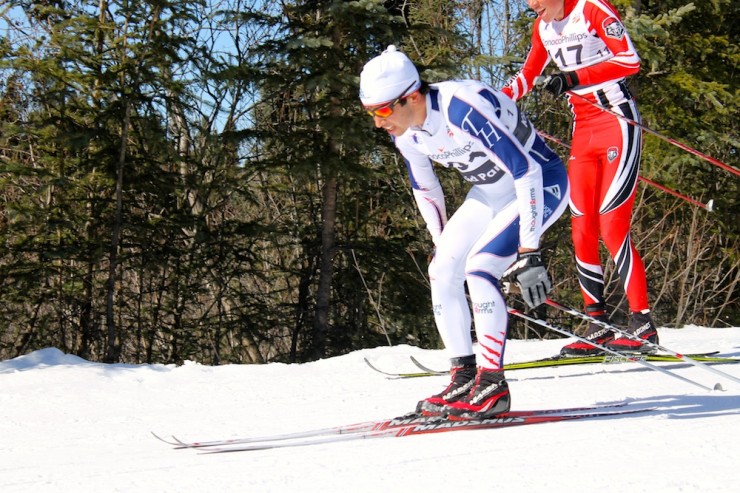
    Cambria McDermott of Montana State, who would eventually finish eighth, leading Emilie Cedervärn in the interval-start 5 k skate held at Hillside.
    Cambria McDermott of Montana State, who would eventually finish eighth, leading Emilie Cedervaern in the interval-start 5 k skate held at Hillside. (Photo: Tim Whiton)

    Despite the wet weather that greeted most teams on Saturday’s arrival, races began on Monday, Feb. 23, at the Hillside Nordic trails with 5- and 10-kilometer skate races for women and men respectively. The course was fully saturated with some standing water, dirt, and icy uphills. Using the Spencer loop as the beginning of the course, racers faced a challenging climbing section for roughly two kilometers before a slow, grinding descent past the start, and two kilometers of short, steep uphills and downhills before the finish.

    As much of the season has gone, the University of Colorado’s duo of Mads Strøm and Rune Ødegård paced the men’s field. Ødegård won the 10 k in 25:18.6, after starting slowly and speeding up on the second lap, with Strøm nipping University of Utah’s Niklas Persson by two-tenths of a second in 25:26.4. The rest of the men’s top ten was over thirty seconds back, but tightly bunched together despite the tough conditions and hilly course.
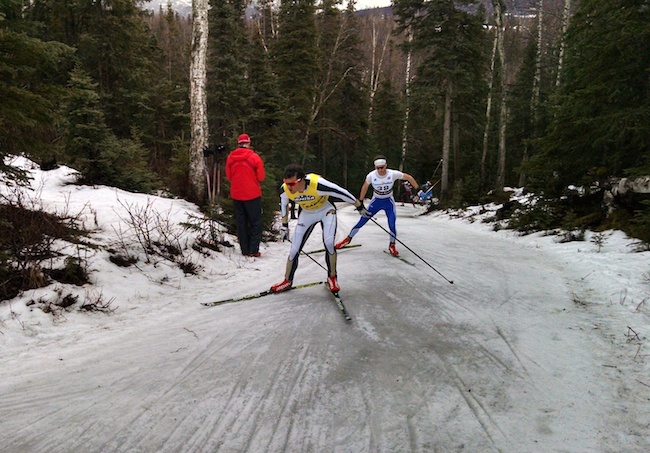
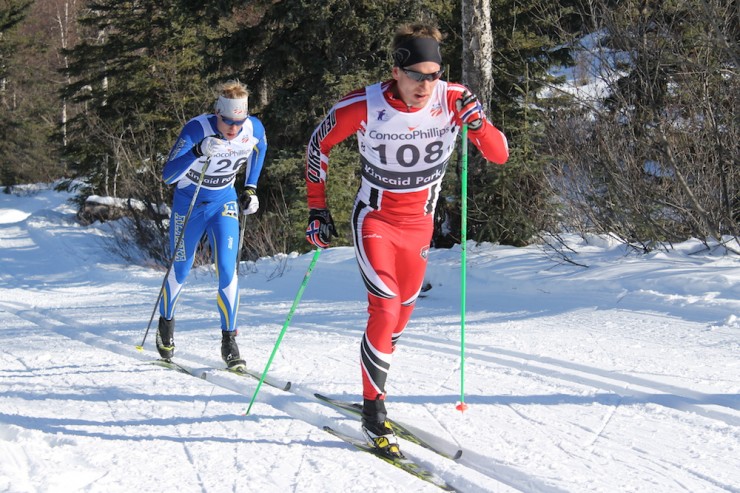
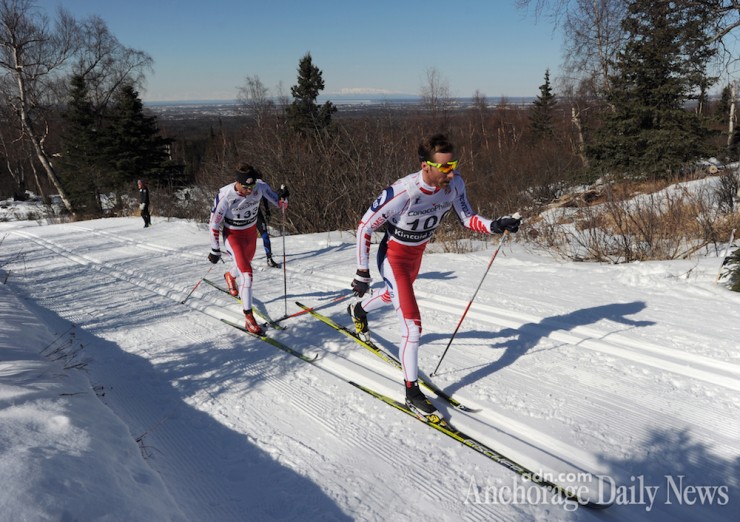
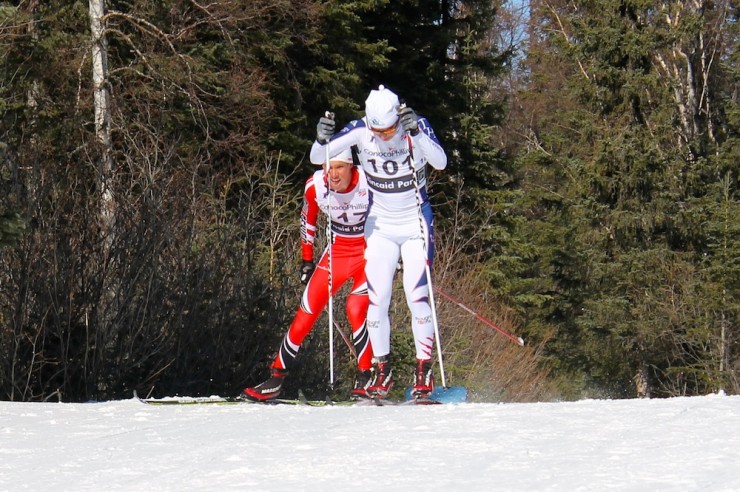
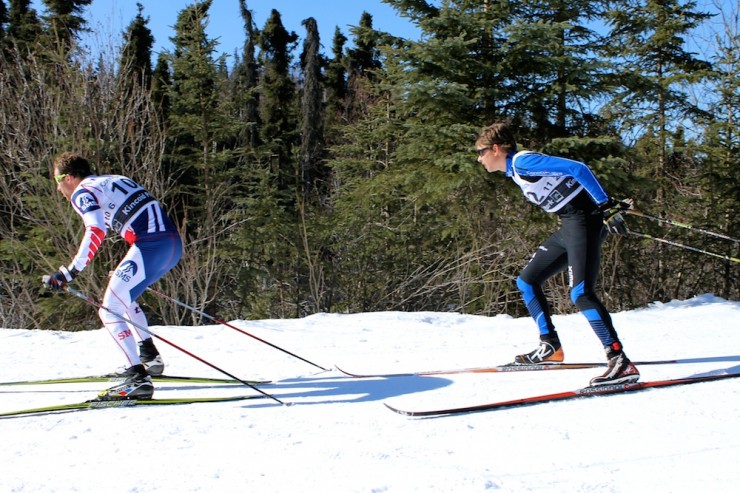
    Race winner Rune Ødegård of Colorado University leads Michael Fehrenbach of University of Alaska Fairbanks in the 10 k skate at Hillside. Fehrenbach placed 16th. (Photo: Tim Whiton)
    Race winner Rune Oedegaard of the University of Colorado leads Michael Fehrenbach of University of Alaska Fairbanks in the 10 k skate at Hillside. Fehrenbach placed 16th. (Photo: Tim Whiton)

    In the women’s 5 k race, University of New Mexico’s Emilie Cedervärn led New Mexico to the team win over Utah. Cedervärn won in 14:46.9 to Utah’s Veronika Mayerhofer’s 14:58.9 and New Mexico’s Eva Severrus’ 15:11.5. Much of the women’s top ten was strung out, finishing less than a minute out of the lead.

    After the first day of racing, the University of Utah led the University of Colorado by eight points.

    With the skate races finished, it was obvious the Hillside courses would not allow for another day of racing. With a return of freezing temperatures Monday evening, the trails turned to a sheet of ice and Tuesday’s races were tentatively postponed to Wednesday with the prospect of shifting even to Thursday depending on how Kincaid park, the site of the weekend’s RMISA Championships looked in the morning.
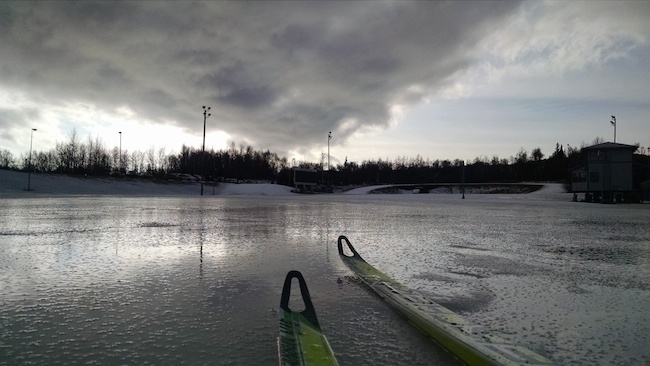
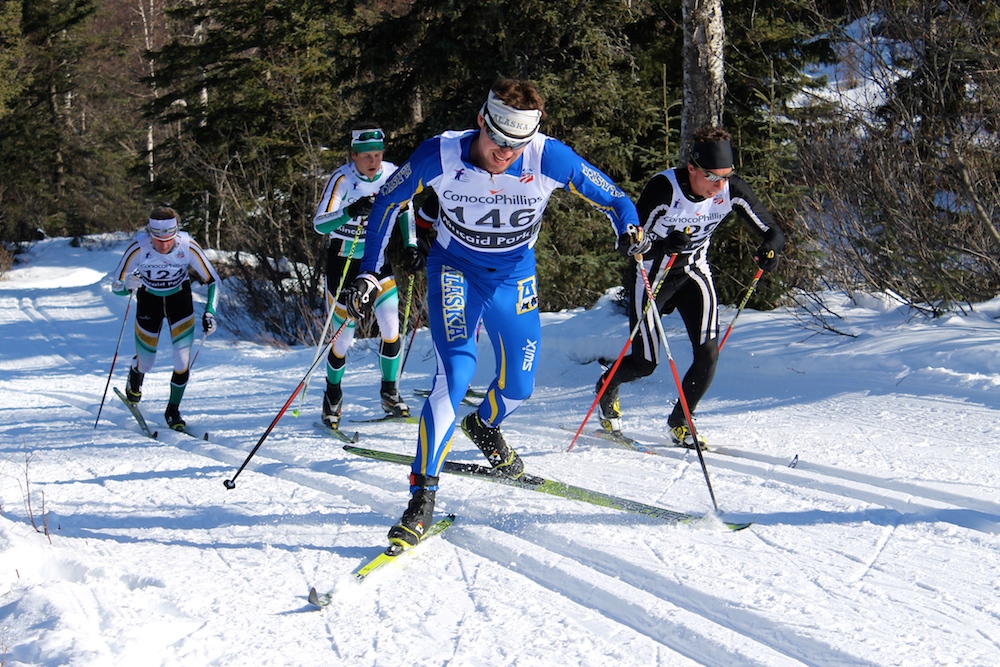
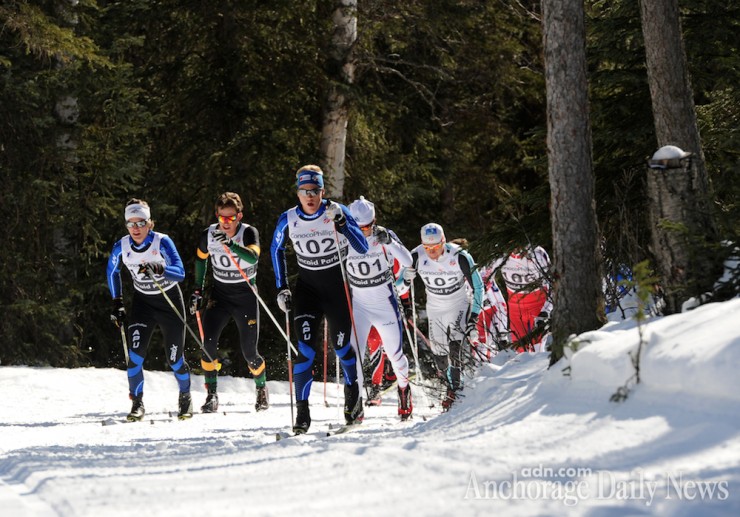
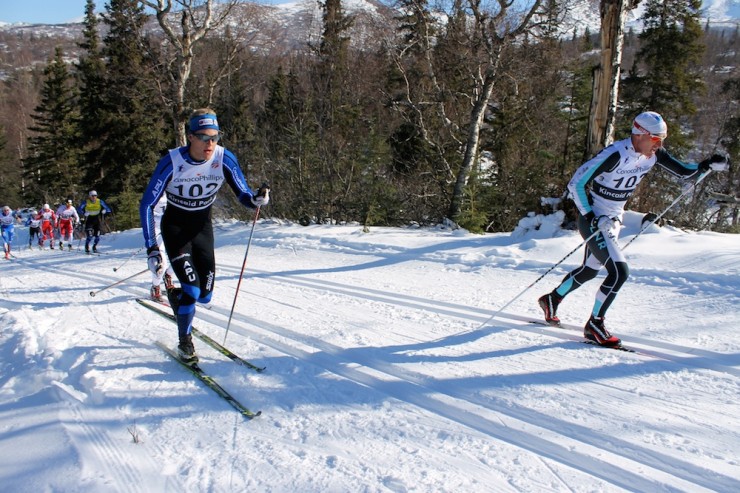
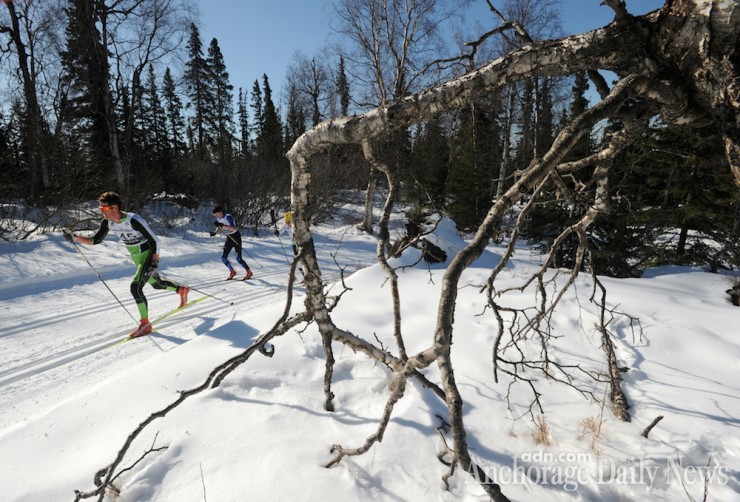
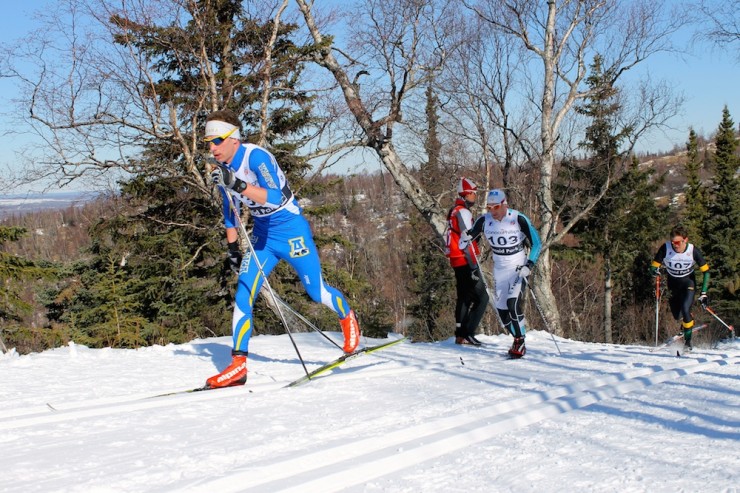
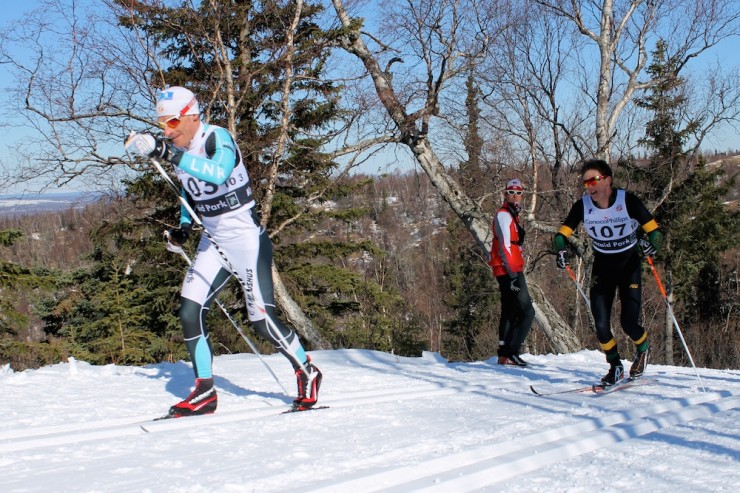
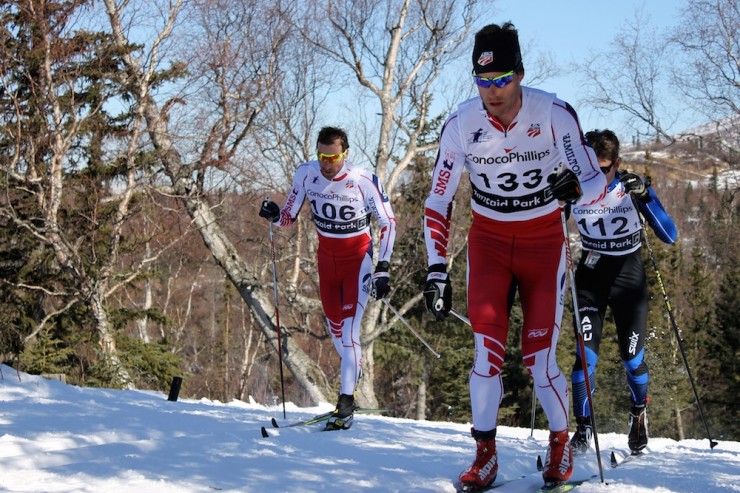
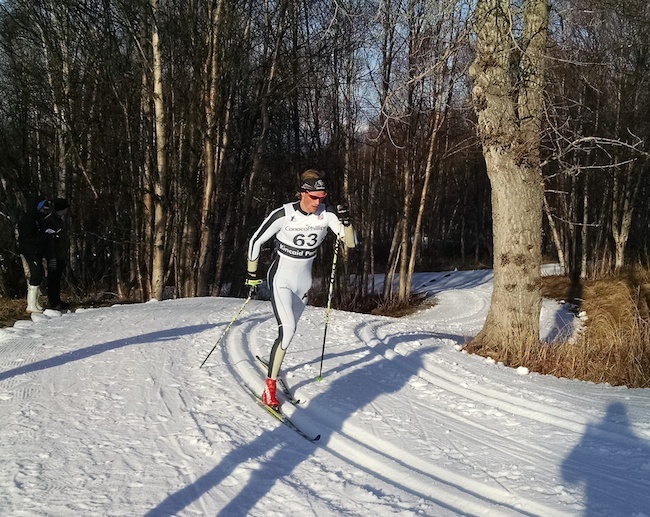
    Conditions at Kincaid Park were not always ideal, but organizers and racers made the best of things. (Photo: Tim Whiton)
    Conditions at Kincaid Park were not always ideal, but organizers and racers made the best of things. (Photo: Tim Whiton)

    Luckily, Kincaid did manage (mostly) to freeze over night. The traditional stadium remained under water so the courses focused on short 2.2 k loops starting and finishing in the biathlon stadium and racing resumed on Wednesday morning with five and seven and a half kilometer classic races. Despite aggressive grooming, the course was mostly chunked ice and sugar, resulting in fast times and challenging conditions.

    In the women’s race, Cedervärn made it two wins in a row in a time of 15:50 by beating  Mayerhofer, who had started wearing the yellow discipline leader bib. Mayerhofer’s 15:57.8 put her in front of teammate Sloan Storey’s 16:01.9 and UAA’s Manon Locatelli’s 16:06.1. The top four women were clearly in a league of their own, with a gap of 25 seconds between Locatelli and fifth-place Kathrin Schratt of UAA. However, after that it was again close racing for the women, with places five through nine separated by less than nine seconds.

    Storey’s third place finish was the only time in four days of racing in Alaska that an American skier stood on the podium in an RMISA race.
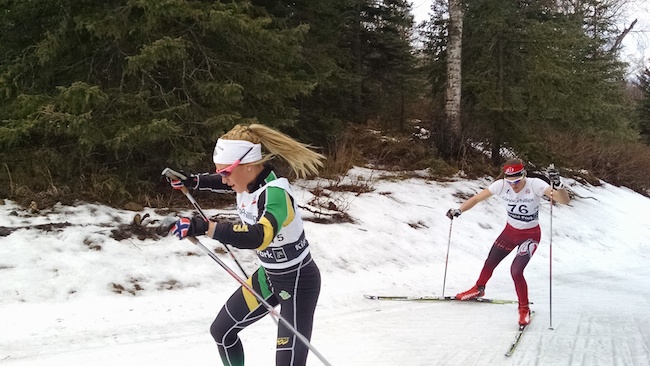
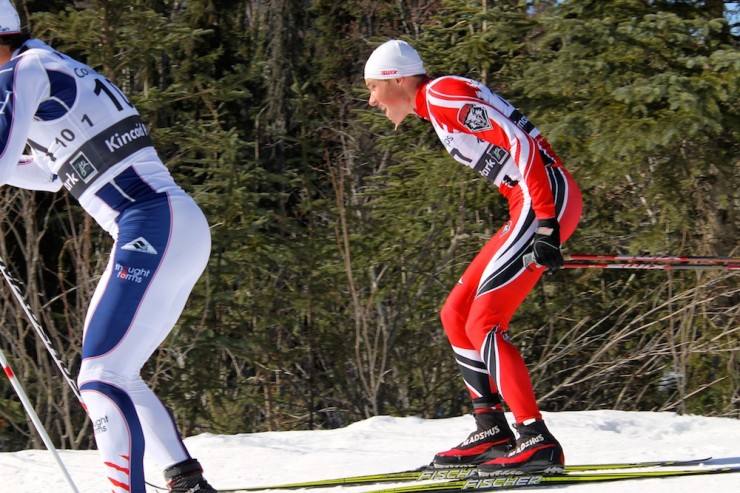
    Macjenzie Kanady of University of Alaska Anchorage, who finished seventh, and runner-up Veronika Mayerhofer of the University of New Mexico in the 5 k skate at Hillside. (Photo: Tim Whiton)
    Macjenzie Kanady of University of Alaska Anchorage, who finished seventh, and runner-up Veronika Mayerhofer of the University of  Utah in the 5 k skate at Hillside. (Photo: Tim Whiton)

    The men’s race saw the same top three from Monday’s race, but with a small shift. Strøm and Ødegård used some fine classic skiing to distance themselves, once again, from the men’s field. Strøm won in 20:22.2 and Ødegård finished second in 20:33.5. Persson finished third again in 20:57.4, just ahead of Clement Molliet of UAA. Places five through 18 were separated by only 35 seconds, making for some tight and exciting racing. Interestingly, four of the men’s top 10 raced the steep uphills on skate skis and double poling. Moritz Madlener of Denver University led the four in seventh place, while Montana State University’s threesome of Forest Mahlen, Erik Axelsson, and Martin Muan finished close together in 8th and tied for 10th respectively.

    After the two races of the UAA Invitational, the University of Utah won the team competition on the nordic side with 351 points to the University of Colorado’s 319. University of New Mexico rounded out the top three teams with 299 points. Combined with alpine, Utah took overall top honors.

    UAA Invitational Results: men & women at Hillside / men & women at Kincaid / overall scores
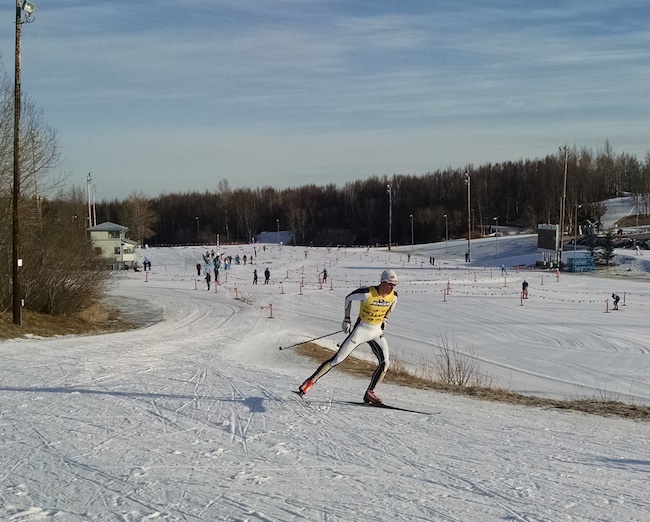
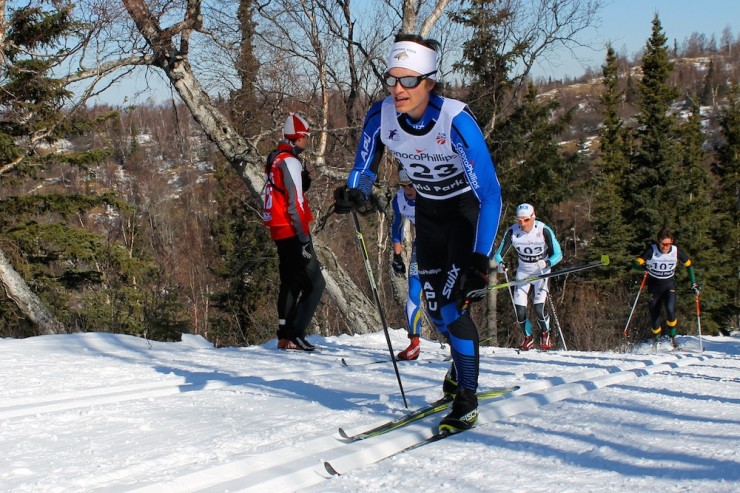
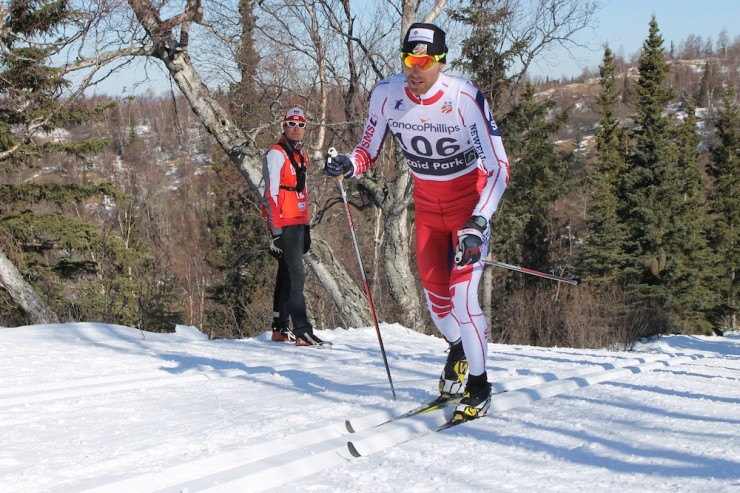
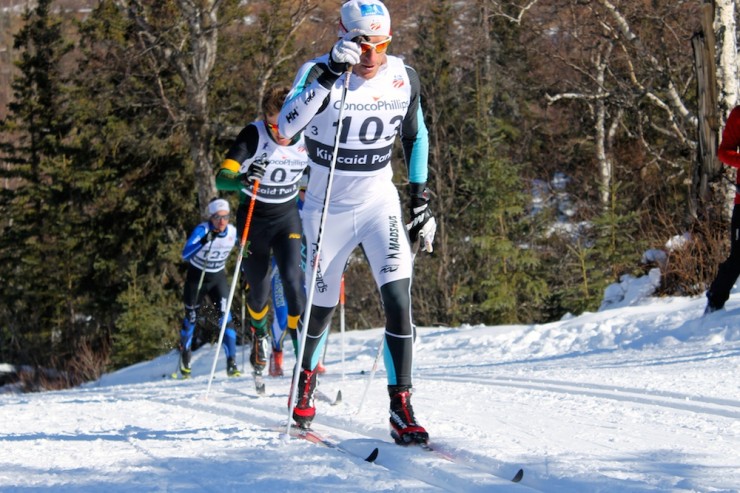
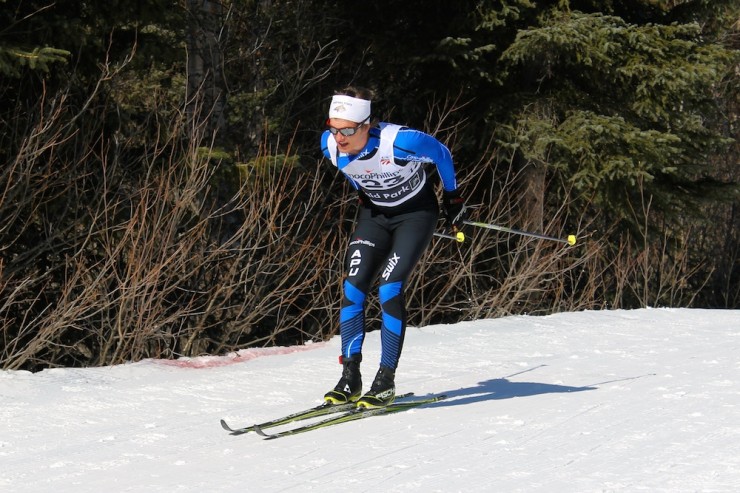
    CU's Rune Ødegård racing to second place in the 10 k skate at Kincaid Park as part of RMISA Championships. (Photo: Tim Whiton)
    CU’s Rune Oedegaard racing to second place in the 10 k skate at Kincaid Park as part of RMISA Championships. (Photo: Tim Whiton)

    After a training day at Kincaid on Thursday marked by late morning grooming that left the track soft and sugary, RMISA regional championships commenced on Friday with 5/10 k skate races. Thankfully, the Kincaid groomers did incredible work which, coupled with overnight lows around 15 degrees, made for a first and fast track. The extensive work allowed for an increase in track length to 3.7 k with several short, steep climbs and limited rest.

    Strøm made quick work of the challenging three lap course and stormed to a nearly twenty second victory in 22:49.3 over his teammate Ødegård’s second place 23:08.1. One second behind was Denver University’s Dag Frode Trollebø. Just as in the classic race on Wednesday, places four through 17 were separated by 35 seconds. The women’s race saw domination by New Mexico’s Cedervärn and Severrus. Cedervärn won the lap and a half course in 13:40.5 ahead of Severrus in 13:49.3 and Colorado’s Petra Hyncicova’s 13:51.1.

    Unfortunately, Anchorage, as it has much of the year, did not see very cold temperatures and come Saturday morning the track was soft and quickly turned into a loose mealy ice. Nevertheless, great racing occurred on the same courses at Kincaid with 15/20 k classic mass start races.

    The women raced first on a slightly longer course and the lead pack of seven stayed tightly bunched through about halfway despite some aggressive skiing. Early on the third lap, Cedervärn made a hard push on the steep climbs, breaking apart the field, and dropping everyone except Utah’s Mayerhofer. Despite a gritty chase, Mayerhofer lost time on the final lap and Cedervärn won in 42:35.3 with Mayerhofer in 42:59. UAA’s Locatelli finished strong in third in 43:10.8.
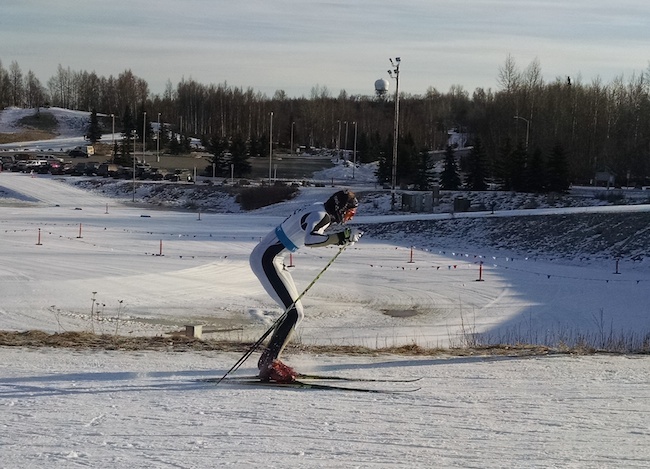
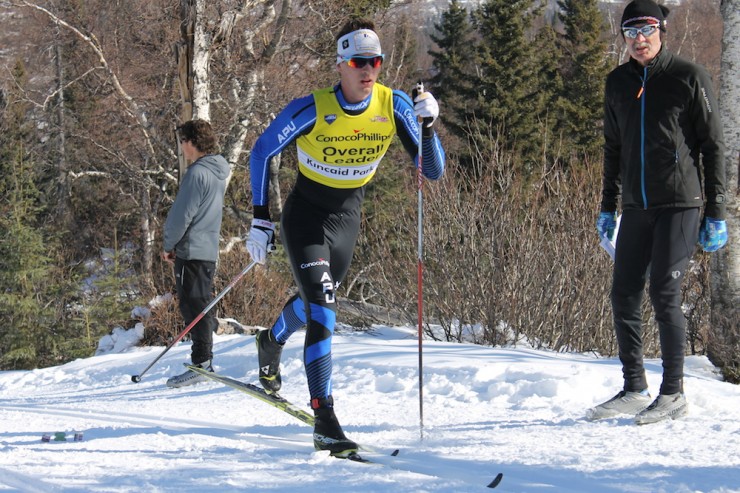
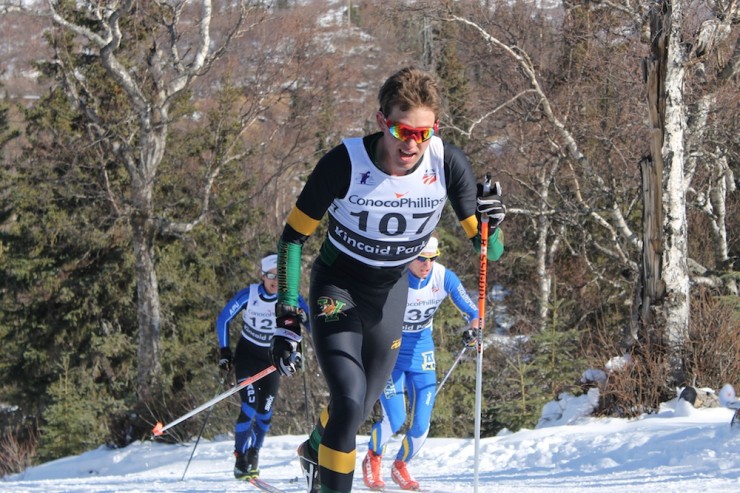
    Mads Strøm of CU became the RMISA Champion in the 10 k skate at Kincaid Park in Anchorage. (Photo: Tim Whiton)
    Mads Stroem of the University of Colorado was the RMISA Champion in the 10 k skate at Kincaid Park in Anchorage. (Photo: Tim Whiton)

    The men’s race, despite the end result, was quite different and more exciting than any other race this season.

    A large pack 11 formed on the first of six laps and stayed bunched together through four laps. Several skiers made hard pushes to get off the front and ski away, but the fast conditions, lack of long uphills, and strong drafting made the chase pack very strong. Aku Nikander of New Mexcio was aggressive in covering many of the attacks and Ødegård of Colorado also brought the race back together several times.

    Ultimately, the race came down to the last lap with Colorado’s Ødegård and Strøm attacking the uphills and creating some separation. Nikander continued to fight and managed to solidify a podium spot partway through the lap by closing down the gap several times. The three were together in the last climb, but the CU boys made a gap on the final downhill and rise into the stadium, distancing Nikander by two seconds at the finish.

    In the last hundred meters, Ødegård, visibly tiring from pushing the pace hard for the last two laps, was overtaken at the line by Strøm by three tenths of a second. The men finished in a blistering 50:20 for the over-21 kilometers. The rest of the men’s top ten was within 45 seconds of the lead.

    With final scores for RMISA Championships tabulated, Colorado won the nordic standings with 337 points to New Mexico’s 324 and Utah’s 295; CU also took the overall title, this time over New Mexico.

    Results from RMISA Championsips: men & women classic / men & women skate / overall standings

    The Western schools are looking forward to heading east shortly for NCAA’s. After racing at sea-level for a week, the RMISA skiers are psyched for some fast skiing and ready to see how the other divisions are skiing. Mostly though, they are all hoping for some cold snow and extra blue skiing, something not seen out west yet this season!
  • Wednesday Workout: Rollerskiing Intervals + All-Out Sprints with Aku Nikander

    Wednesday Workout: Rollerskiing Intervals + All-Out Sprints with Aku Nikander

    Mats Resaland (front), Christian Otto (c) and Aku Nikander of the University of New Mexico training in early February. (Photo: Aku Nikander)
    Mats Resaland (front), Christian Otto (c) and Aku Nikander of the University of New Mexico training in early February. (Photo: Christian Otto)

    Welcome back to our weekly workout! Now that the racing season’s (generally) over and the training season’s (mostly) beginning, we asked the winner of last Friday’s 50-kilometer classic at U.S. Distance Nationals, Aku Nikander, what his secret is while training at the University of New Mexico. 

    In his first season with the team, the Finnish skier trains with the team near the 9,700-foot South Sandia Peak in a national park just east of Albuquerque. When the Lobos are not on the road racing during the season, they ski two to three times at Sandia or Red River a three-hour drive north of the university at some 3,000 meters (9,800 feet) in elevation. 

    While the altitude piece isn’t key, and can actually be a killer to those not used to working out thousands of meters above sea level, Nikander recommends a particular skate rollerski workout: 3 x 3-minute Level 3 + 5 x 1-minute all-out sprints, with 3-minutes of recovery in between.

    ***

    “Because we have kind of special conditions here in New Mexico I decided to choose a workout that we used as a race preparation or prerace training before all the college competitions. We did it 2-3 days before the race.

    Training speed in high altitude is usually slower than training in sea level because there is less oxygen to use and the threshold limits are achieved faster. That is why it is important to keep up the speed capacity in your training.

    Also because we don’t have snow in the city we are doing this exercise on roller skis. Of course it works perfectly out on snow too, but this shows that if there is a bad winter and no snow, it is not time to panic because once or twice a week you can easily replace the skiing on snow with roller skiing. I think the transfer effect works from roller skis to skis well. We usually do this training as a team.”

    The Workout: Rollerskiing Intervals + All-Out Sprints

    Warmup: 30 minutes easy rollerski

    Part I Intervals: 3 x 3 minutes Level 3, with 3 minutes of rest in between each interval

    “This helps muscles to warm up and helps your cardio to be ready for the next part.”

    Part II All-Out Sprints: 5 x 1-minute all-out sprint, with 3 minutes of rest in between

    “The loop or course should be like this: the last 15-20 seconds are supposed to be uphill.”

    Cool down: 30-40 minutes very easy skiing so that the body can remove the lactate that has accumulated to the muscles.

    “The most important things in this training are: the part 1 3 x 3 minutes is really Level 3 because too hard pace would otherwise effect too much to the second part; I recommend that the first part is performed individually;
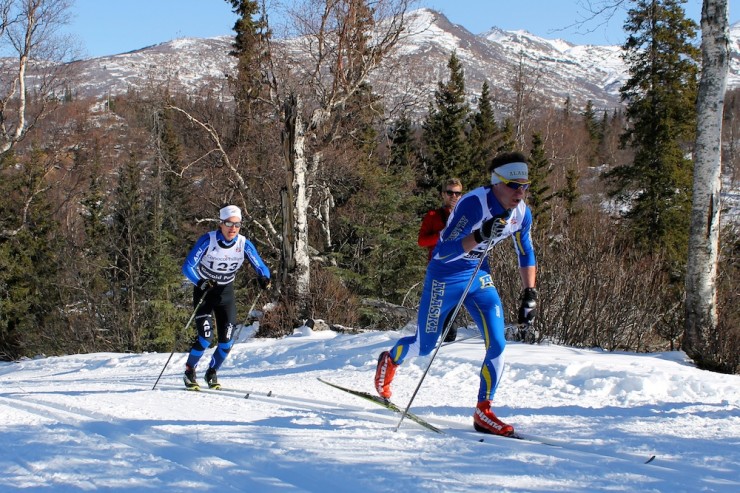
    Second part is good to do in group because when you have people around you sprinting, you can really push harder and get more out of your muscles than doing it alone. Also you have to really focus and mentally prepared so you can get as high power as possible.

    If you are mentally well prepared you can recruit muscles faster and produce more power. It is also important that the sprint ends up on uphill (that should not be too steep, rather one you can go V2). This is kind of specific speed strength training that improves your ability to ski faster. Speed strength is scientifically proved to effect on the performance in skiing. Uphills bring out this dimension because you have to use higher strength level than doing it on flat part.

    This season we did this training once a week and [as a result] our team improved a lot in skating mass starts.”

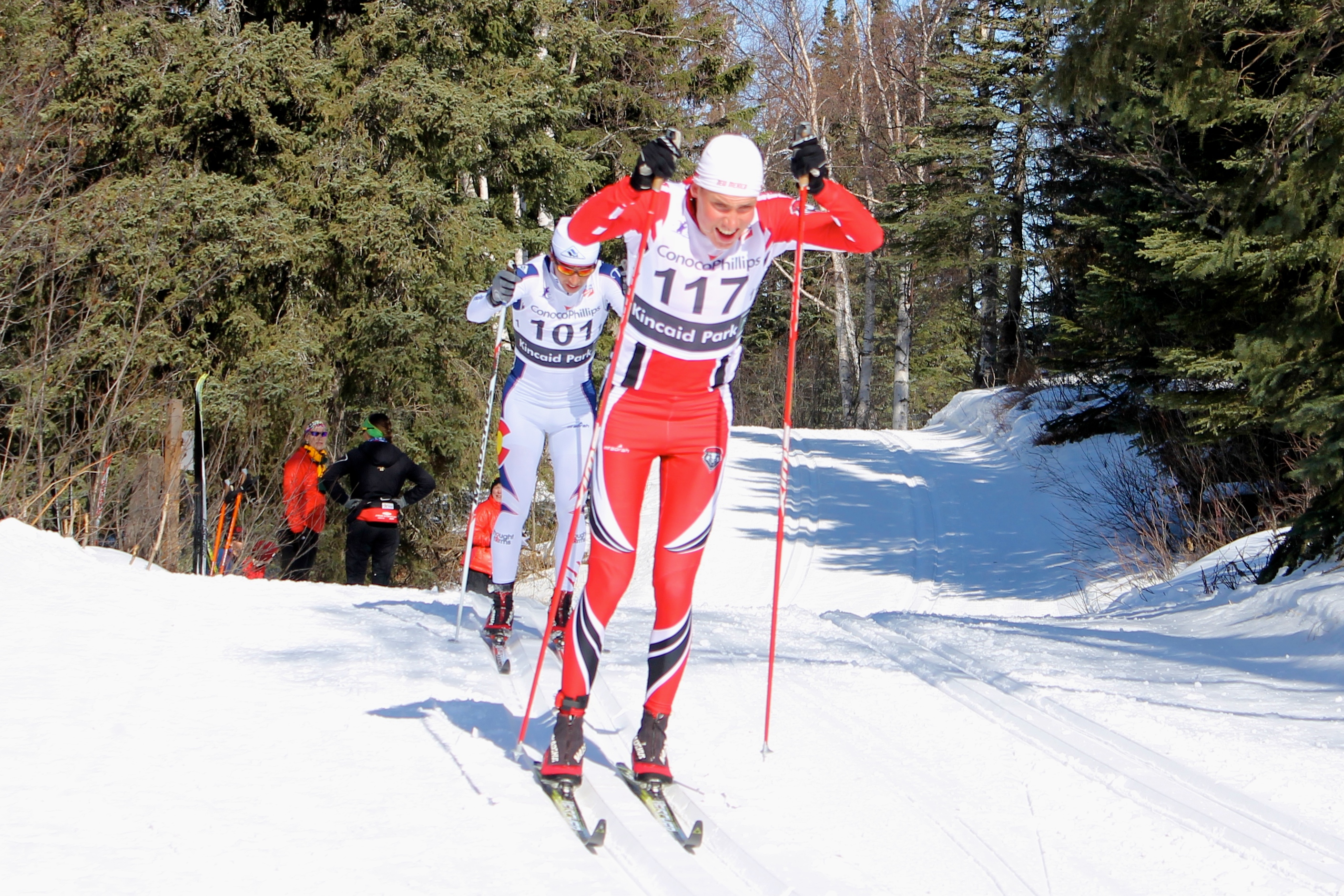
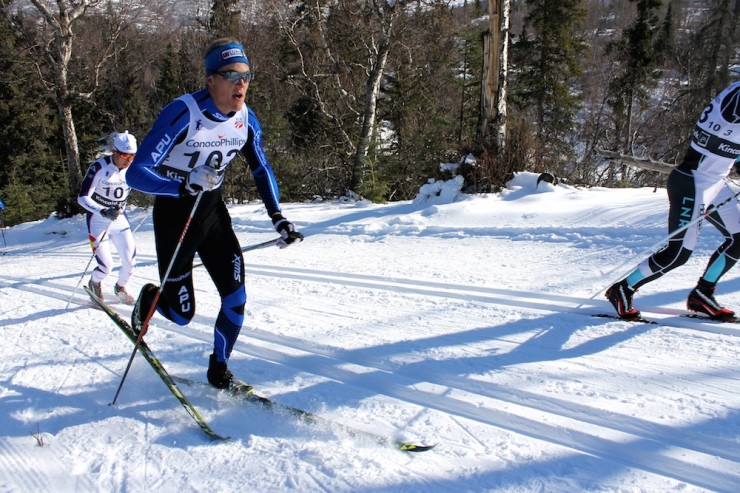
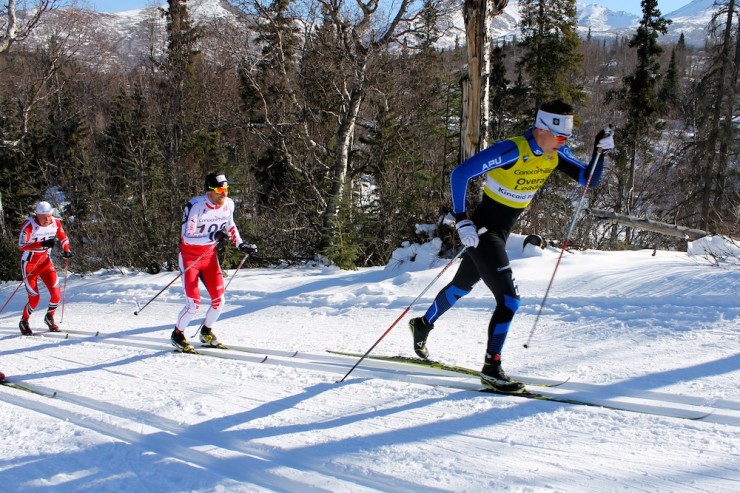
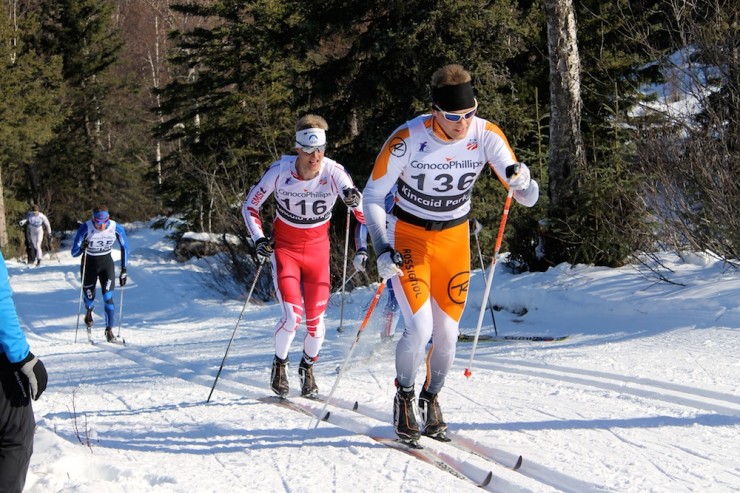
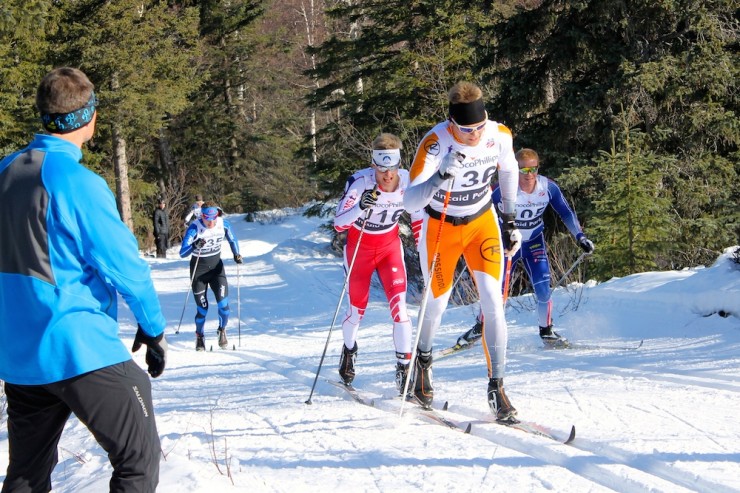
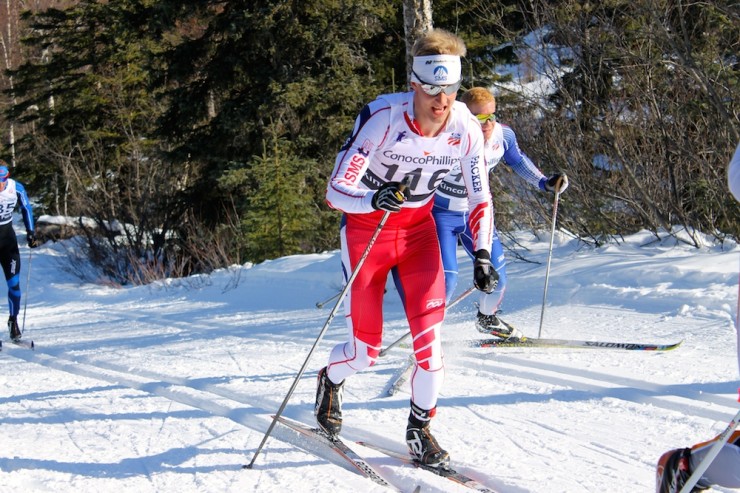
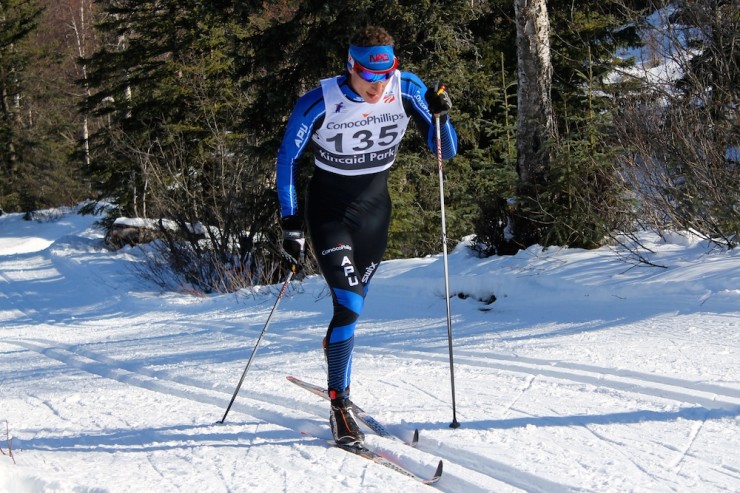
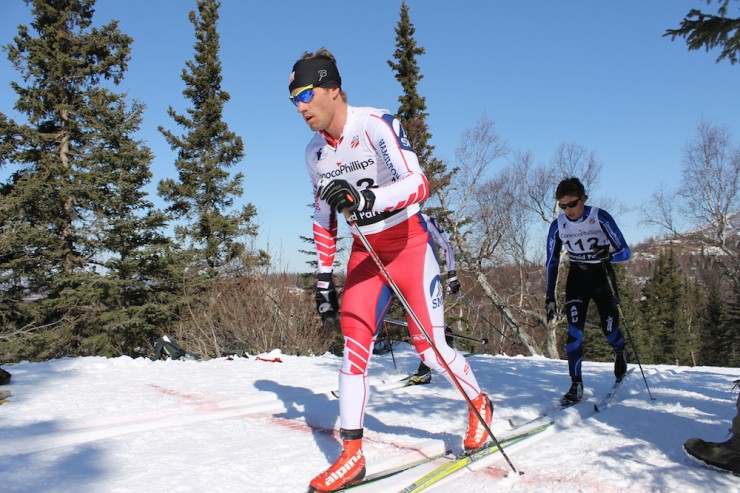
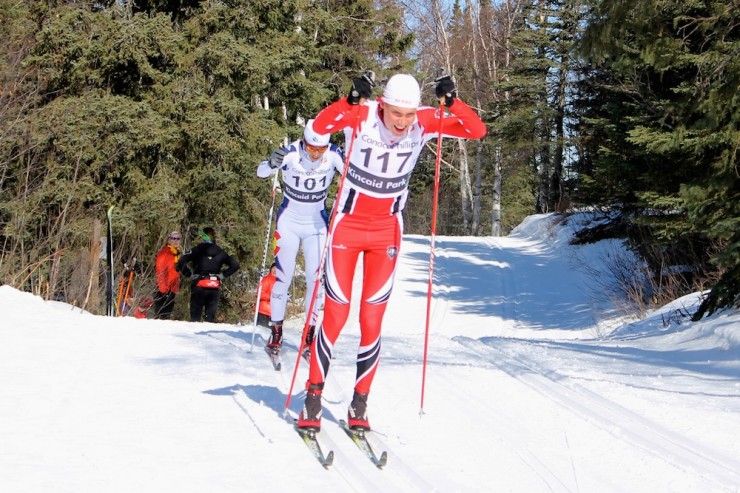
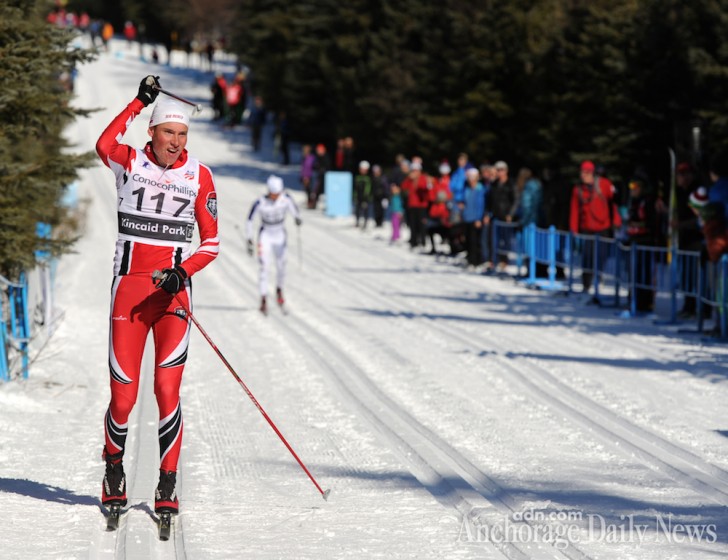
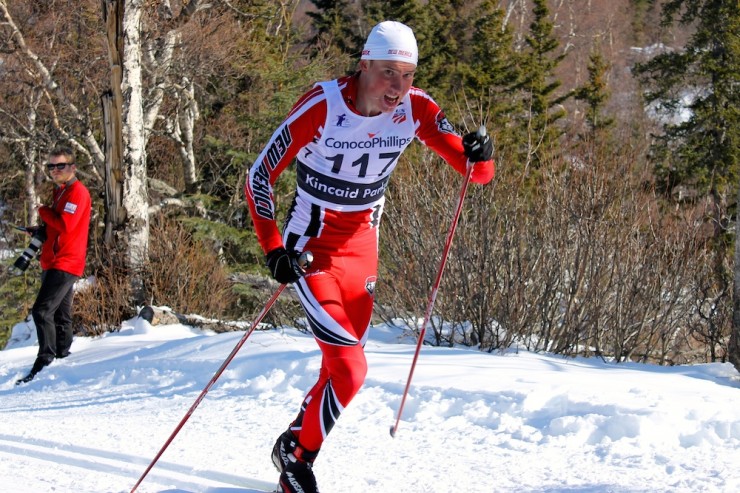
    Aku Nikander (117) leads Noah Hoffman of the U.S. Ski Team with about 4 k to go in the 50 k classic mass start at U.S. Distance Nationals on March 28. Nikander went on to out-double pole Hoffman for the win.
    Aku Nikander (117) leads Noah Hoffman of the U.S. Ski Team with about 4 k to go in the 50 k classic mass start at U.S. Distance Nationals on March 28. Nikander went on to out-double pole Hoffman for the win.
  • Spring Series Photos: U.S. Distance Nationals 50 k Classic

    Spring Series Photos: U.S. Distance Nationals 50 k Classic

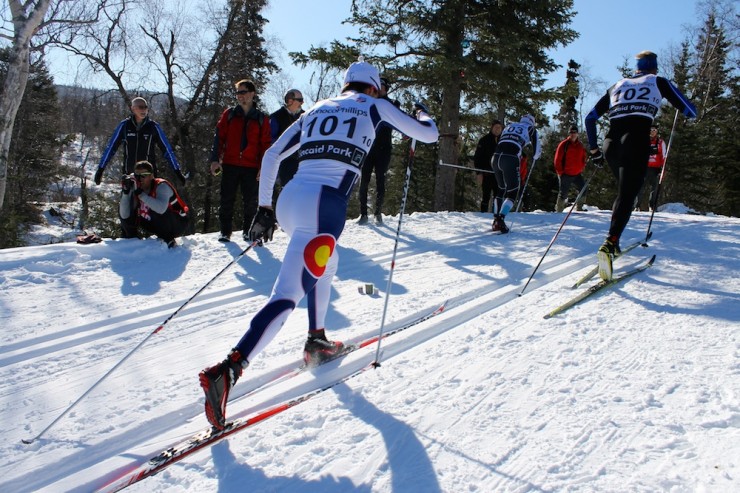
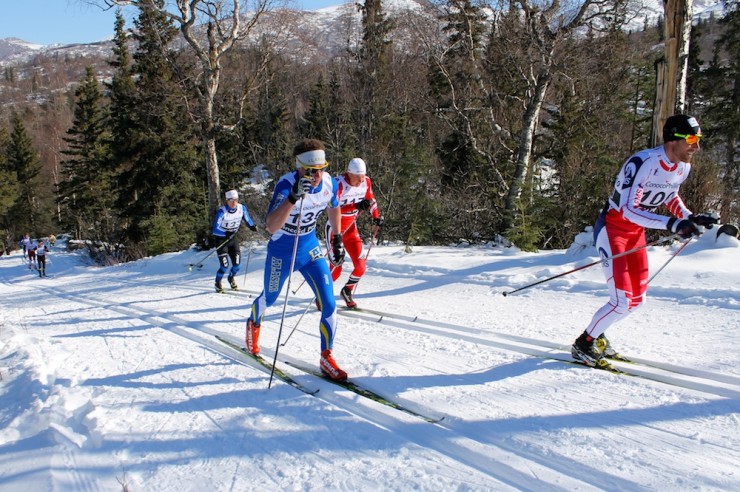
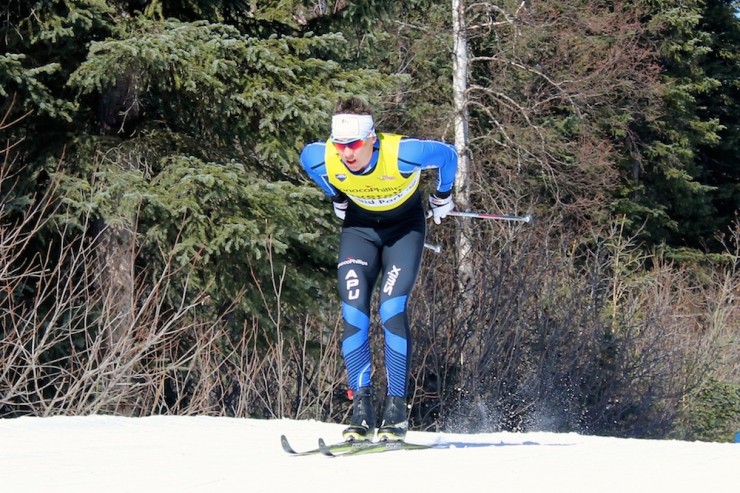
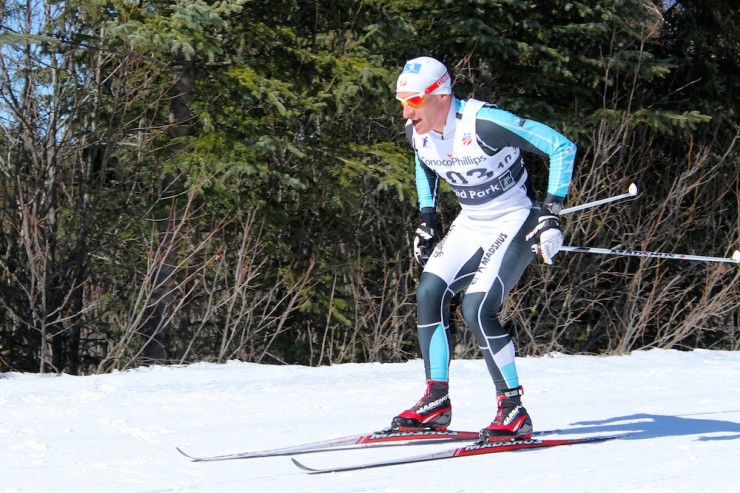
    ANCHORAGE, Alaska — A look back at the men’s 50-kilometer classic mass start at U.S. Distance Nationals last Friday, March 28, with the focus on the frontrunners of the five-lap race.

    Read the story here.

    Results

  • Mysterious Man in Red, New Mexico’s Nikander Out-Double Poles Hoffman in 50 k

    Mysterious Man in Red, New Mexico’s Nikander Out-Double Poles Hoffman in 50 k

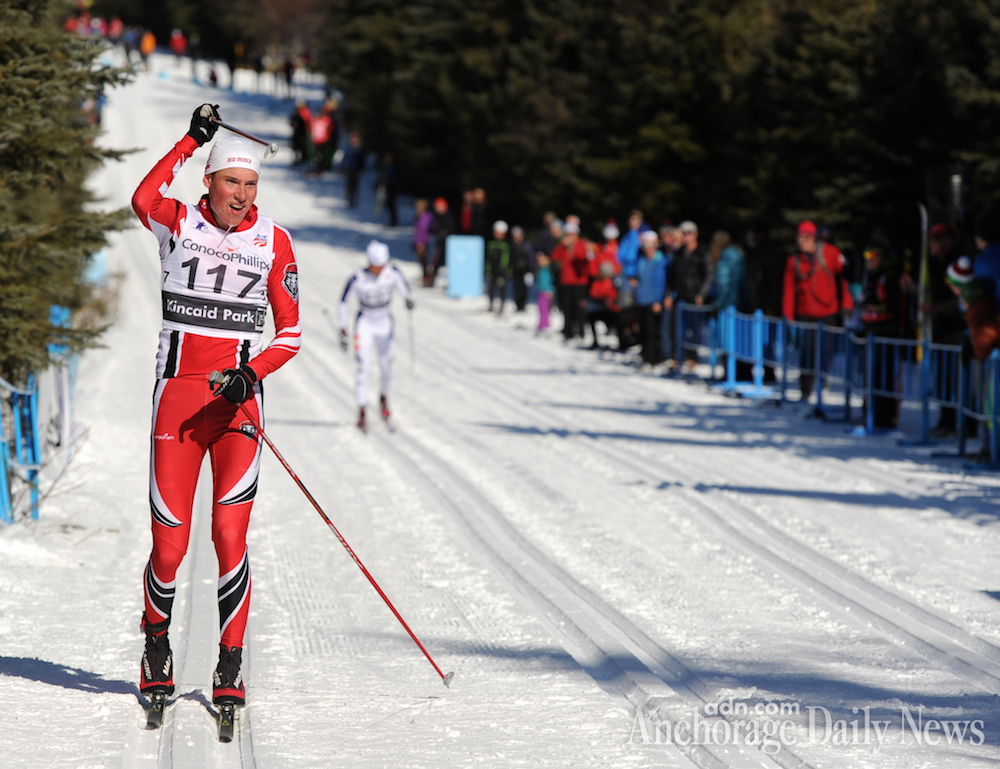
    Finland's Aku Nikander (University of New Mexico) celebrates his win in the 50 k classic mass start at U.S. Distance Nationals on Friday in Anchorage, Alaska. He beat Noah Hoffman (SSCV/Team HomeGrown/USST) by 9 seconds after the two skied together for essentially the entire race. (Photo: Erik Hill/Anchorage Daily News)
    Finland’s Aku Nikander (University of New Mexico) celebrates his win in the 50 k classic mass start at U.S. Distance Nationals on Friday in Anchorage, Alaska. He beat Noah Hoffman (SSCV/Team HomeGrown/USST) by 9 seconds after the two skied together for essentially the entire race. (Photo: Erik Hill/Anchorage Daily News)

    ANCHORAGE, Alaska — Aku Nikander was somewhat a mystery in the men’s 50-kilometer classic mass start on Friday in the last race of the season at U.S. Distance Nationals.

    As far as Noah Hoffman of the U.S. Ski Team (USST), Ski & Snowboard Club Vail and Team HomeGrown was concerned, he was the guy that stood between him and a shot at his second-individual victory of 2014 Spring Series.

    For Nikander, a Finnish student in his first year at the University of New Mexico, a win is a win, no matter what country you’re racing in, and it’s what he wanted.

    It wasn’t until the second of five 10-k loops on the challenging Spencer Loop at Hillside trails that Nikander, a 24-year-old sophomore, emerged as a noticeable contender. Erik Bjornsen, of Alaska Pacific University (APU) and the USST, led through the 10 k checkpoint. Nikander was 2.4 seconds back in 12th, and one lap later, he was up to third, less than two seconds behind leader Reese Hanneman (APU) and Hoffman.

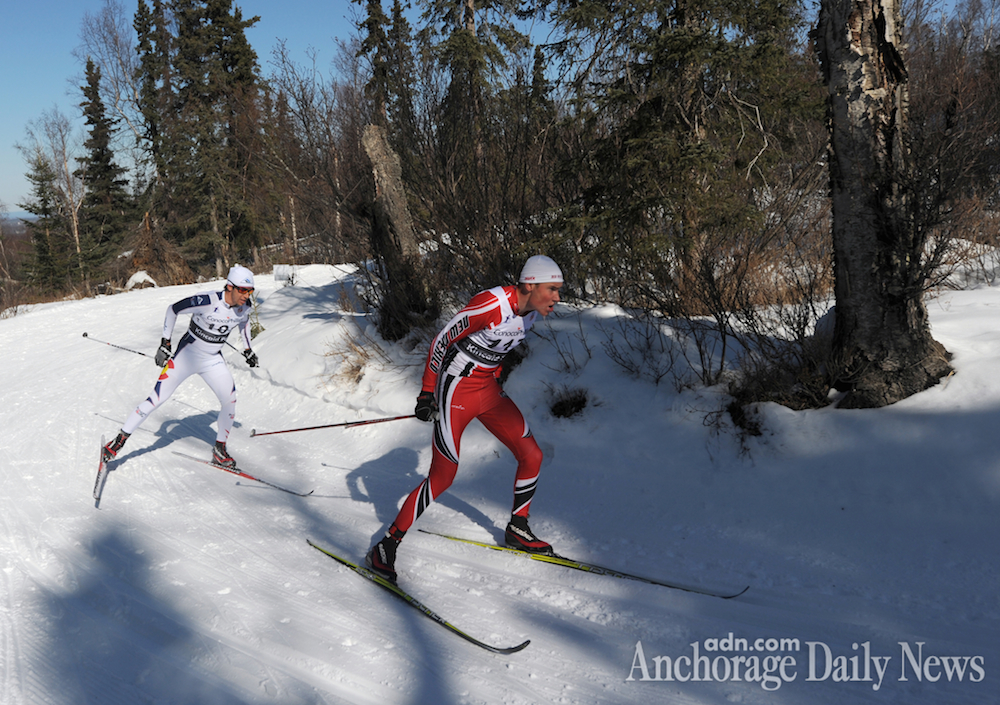
    Finnish skier Aku Nikander (r) of the University of New Mexico leads Noah Hoffman of the U.S. Ski Team around a corner on the Spencer Loop during the final lap of the men's 50 k classic race at the U.S. Distance Nationals at Hillside in Anchorage, Alaska. (Photo: Erik Hill/Anchorage Daily News)
    Finnish skier Aku Nikander (r) of the University of New Mexico leads Noah Hoffman of the U.S. Ski Team around a corner on the Spencer Loop during the final lap of the men’s 50 k classic race at the U.S. Distance Nationals at Hillside in Anchorage, Alaska. (Photo: Erik Hill/Anchorage Daily News)

    With a 16-second gap to fourth place, Nikander began to ramp up the pace, while Hanneman and Hoffman wondered who exactly he was.

    “There’s always those wildcard Europeans at these last races of the year,” Hanneman said with a laugh. “Clearly going into lap three it was just us three and it sounded like we had a pretty decent gap, so I knew, he wouldn’t have been up there if he wasn’t a good skier with good skis and feeling good. I don’t know anything about him, but obviously he’s in contention for the win.”

    Earlier this season, Nikander won a college race in Utah in a 30 k skate.

    “After that I was struggling,” Nikander said. “I was a little bit overtrained because we had been training in the 3,000 meters so I was so tired the whole season practically. I didn’t do so well in NCAA’s so I was really looking forward to this race.”

    On March 6 and 8, he placed ninth in the 10 k classic at NCAA Championships and was 23rd in the 20 k freestyle mass start. Two seasons ago, Nikander finished ninth in the 50 k classic at Finnish Championships, and narrowly missed the podium in two U23 Finnish Championships races in 2012 and 2013.

    He applied to Utah, but then New Mexico head coach Fredrik Landstedt contacted him.

    “I knew a couple Finnish alpiners so I decided to go there,” Nikander said. “It’s a little bit deeper than Finland so I wanted to experience something else. It has worked this season pretty well.”

    This week marked his first time in Alaska; first time at U.S. Spring Series.

    Meanwhile, heading into lap three, Micheal Fehrenbach of the University of Alaska-Fairbanks led the chase with David Norris (Montana State University/APU), Andy Newell of the Stratton Mountain School (SMS) T2 Team and USST, and Brian Gregg (Team Gregg/Madshus).

    One lap earlier, Gregg had raced to the top of the high point of the course, known as Wall Street, to nab the first of two $100-dollar primes at 16 k, but he said the effort cost him. Bjornsen had followed him closely in second, going out hard early in an effort to break up the pack, and Hoffman crested the top with them with a slight gap to Hanneman, Newell and Fehrenbach.

    A former University of Alaska-Anchorage skier, Gregg, 29, recalled doing bounding intervals at the top of Wall Street.

    “Most of our training we did on the Spencer Loop,” he explained. “We’d do three loops, maybe one time we did four, so I’ve never done five so that was pretty hard.”

    On Friday, he saw his college coach Trond Flagstad at the top of the same climb.

    “I got a little fired up, I went for that first prime,” Gregg said. “I was a little tired when the other guys sort of separated so I wasn’t able to quite hang with those guys.”

    By 26 k, Nikander was first to the top for the second $100 bonus. Hoffman was once again right there with him, and Hanneman a few seconds behind by the summit. Norris led the chase with Fehrenbach, Gregg, and University of Vermont (UVM) senior Scott Patterson, while Newell skied slightly behind in eighth.

    “After two laps, I was pretty comfortable,” Nikander said. “We took off with Hoffman and Hanneman. After the uphill sprint we got a gap and I had such good skis.”

    Hoffman was glad it broke up by the halfway point.

    “I didn’t really know anything about Aku, I didn’t even know his name,” he said. “He’s a good skier.”

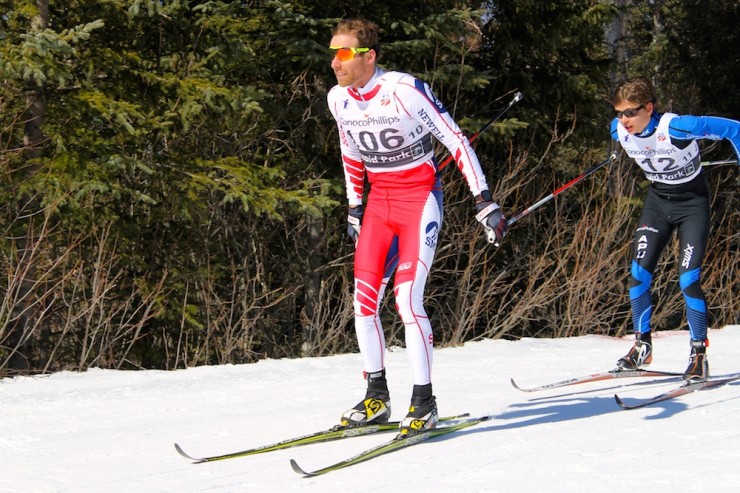
    Teammates on the U.S. Ski Team and Stratton Mountain School T2 Team, Andy Newell leads Simi Hamilton on one of several hills on the Spencer Loop in the 50 k classic at U.S. Distance Nationals in Anchorage, Alaska. (Photo: Erik Hill/Anchorage Daily News)
    Teammates on the U.S. Ski Team and Stratton Mountain School T2 Team, Andy Newell leads Simi Hamilton on one of several hills on the Spencer Loop in the 50 k classic at U.S. Distance Nationals in Anchorage, Alaska. (Photo: Erik Hill/Anchorage Daily News)

    By the time the leaders reached 30 k, Hoffman led Nikander by 0.5 seconds, and Hanneman was nearly 28 seconds behind in third. He still had nearly a minute separating him from fourth, however, with Patterson leading Fehrenbach, Gregg and Norris. Newell was another 28 seconds behind in eighth, followed by teammate Simi Hamilton (SMST2/USST) and Lex Treinen (APU), respectively.

    The order of the front three stayed the same through the fourth ascent of Wall Street, with Hoffman and Nikander skiing to the top together and Hannemen trailing by about 40 seconds. Gregg led the chase, with Fehrenbach and Norris, and Hamilton was at the front of the second group with Newell and Treinen over the top.

    With one 10 k lap to go, Nikander and Hoffman skied through flatter section of the course as a unit, 48 seconds ahead of Hanneman. The two began to study each other more carefully.

    “I just double poled faster than him,” Nikander said. “I was actually leading a lot in the last lap. I had maybe better kick and better glide.”

    Neither of Nikander nor Hoffman re-waxed in a race that didn’t allow ski changes.

    “I don’t like my chances coming into the final stretch, but part of me was just glad to be with him,” Hoffman said. “I did try a little bit over the final hills, but I just didn’t have a chance getting away from him.”

    Nikander took charge the last time up Wall Street and gapped Hoffman before he caught back up on the backside of the course. With an efficient double pole, Nikander was able to stay ahead, entering the finishing straight almost even with Hoffman.

    There, he unleashed the double pole he had been banking on, passing Hoffman in the last 150 meters. Hoffman strided into the gradual-uphill finish in second, accepting the race for what it was and the effort he’d put toward it.

    “When I saw that Noah can’t keep up in the flat part, in the double-poling part in the last loop I just waited for the final straight and sprint and it was enough for the day,” Nikander said.

    “He was better than me double poling all day,” Hoffman said. “I was struggling and it’s a been long season and he was impressive and I’m glad to be done. … Rarely does the best guy not win in a 50 k. I think execution, which I struggle with day in and day out to really perform the way I want to perform, is easier in a longer race for me.

    “It doesn’t define my season,” he added. “I’m excited to take a break and excited to look to improve for next year.”

    Nikander was excited, although unsure what it would mean to those back home.

    “I don’t know how much they are looking at the results from here. We’ll see,” he said. “I think it can help a little bit for [team selection] and next summer’s training camps. I hope so.”

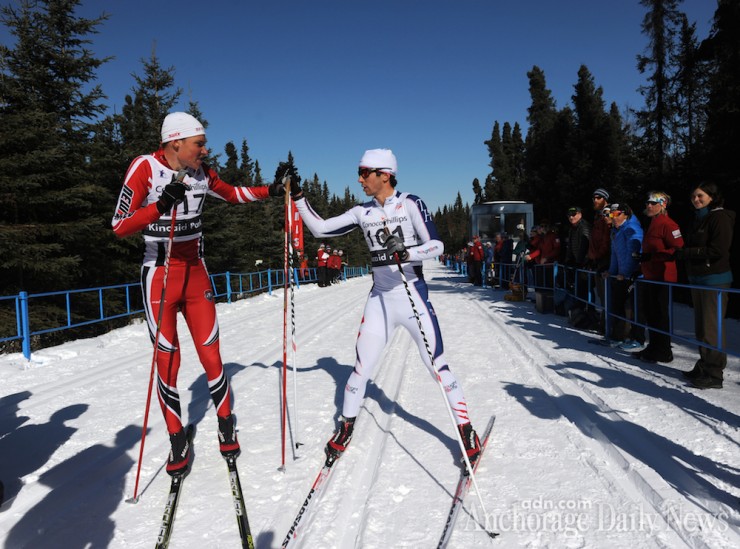
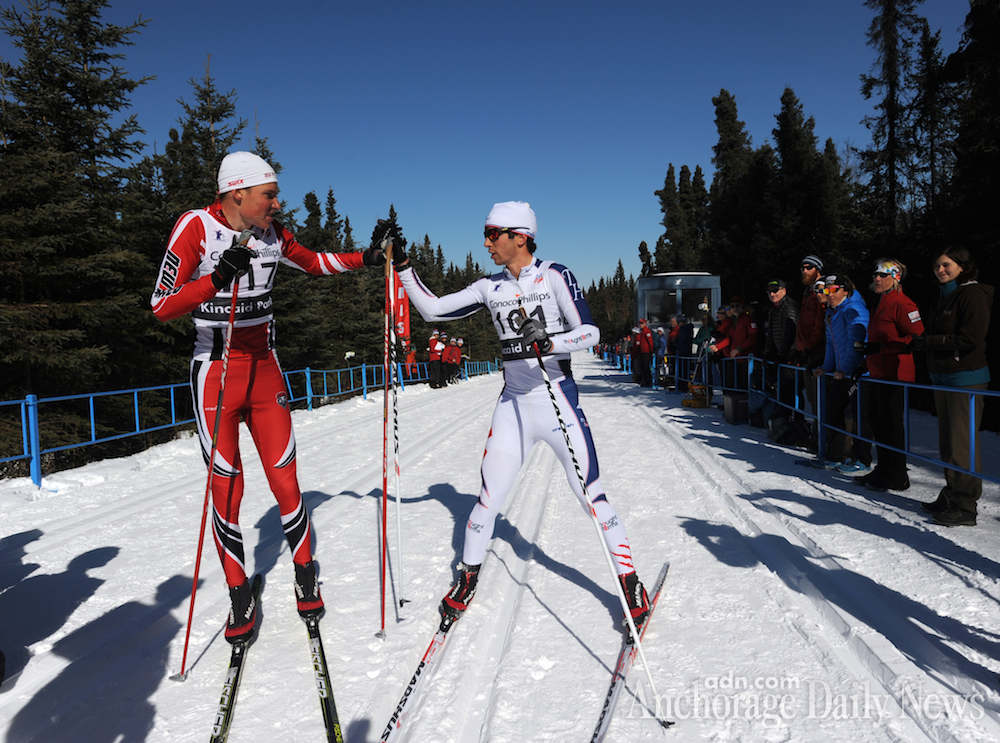
    Winner Aku Nikander of the University of New Mexico (l) and runner-up and first American Noah Hoffman of the U.S. Ski Team congratulate each other after finishing the men's 50 k classic race at U.S. Distance Nationals on Friday. (Photo: Erik Hill/Anchorage Daily News)
    Runner-up and first American Noah Hoffman (r) of the U.S. Ski Team congratulates overall winner Aku Nikander (University of New Mexico) after the men’s 50 k classic race at U.S. Distance Nationals on Friday. (Photo: Erik Hill/Anchorage Daily News)

    The first American, Hoffman finished 9 seconds after Nikander, who won the roughly 51.5 k race in 2:23.08.3. Hanneman locked up third, 1:01.6 behind Nikander. It was his second podium in three individual races this week, and third including a win in the mixed relay.

    “My last two laps, I tried to ski that climb sort of relaxed, just my own pace and not worry how I thought someone else would be skiing it and then try to ski pretty hard on the rest of this stuff,” Hanneman explained.

    “You kind of come into the last week and for the most part have no idea how it’s gonna go. I knew I felt good at the World Cup last week … and I ended up feeling decently good,” the overall men’s SuperTour leader said. It’s been really fun to do well here at home. “It’s hard to beat doing well at home. That was a great way, a little reward at the end of the season.”

    Gregg, who’s wife Caitlin finished the season as the female SuperTour leader, finished more than 3 1/2 minutes later, uncontested in fourth.

    “Last lap, that’s where I tried to make a move to separate from our little pack,” he said after making his move over the top over Wall Street. “I looked back at the corner. I saw Newell, Simi must’ve been there, too — those guys had just caught us and I was like, it’s time to go. I love that downhill we used to do downhill time trials down that from the very top to the bottom. … Those workouts that we did eight, nine years ago really played into this race course.”

    One of the APU skiers that train in Anchorage year-round, Treinen came into the stadium with Newell, then stepped around him at the beginning of the finishing lanes with about 200 meters to go. He out-double poled the Olympic sprinter by 3.1 seconds to finish fifth. Newell placed sixth and Hamilton finished another 11 seconds back in seventh. Norris placed eighth — 13.4 seconds behind Hamilton and 14 seconds ahead of Patterson in ninth, and Fehrenbach was another 27 seconds back in 10th.

    Eleventh place went to Eric Packer (SMST2), who finished more than two minutes later and 8:03.2 behind the winner. Bjornsen placed 36th.

    Results